
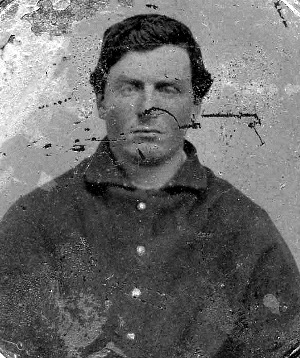
The following letters were written by David H. Barber who enlisted in December 1863 as a private in the 14th New York Heavy Artillery and was transferred to Co. L, 6th New York Heavy Artillery on May 10, 1864. He was transferred to Co. C on June 27, 1865 and mustered out with company, August 24, 1865, at Washington, D. C.
David was born in Onondaga county, New York in 1841. On the muster rolls, at the time of his enlistment, he was described as a 5′ 3″ farmer with black eyes and black hair.
Letter 1
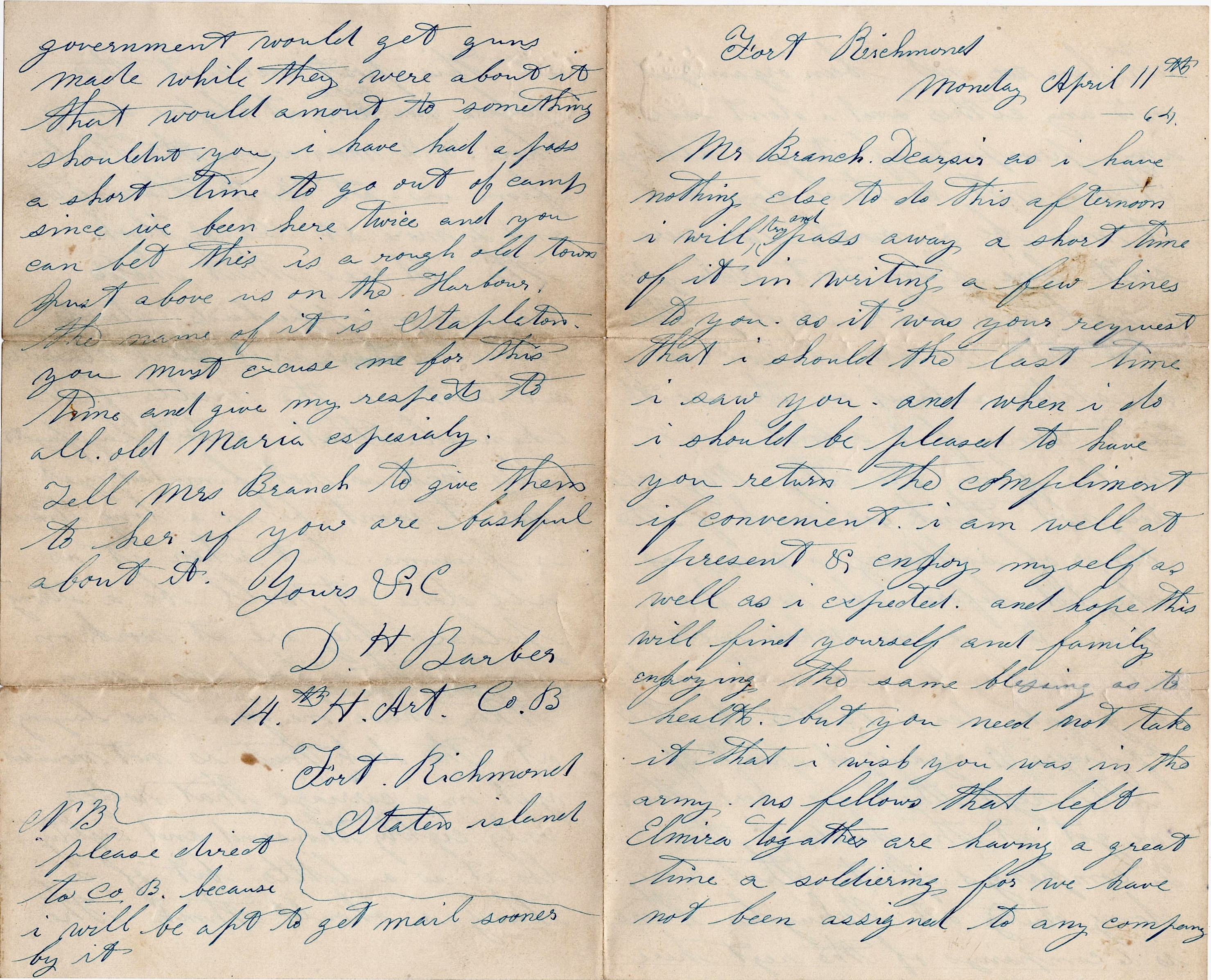
Fort Richmond
Monday, April 11th 1864
Mr. Branch,
Dear sir, as I have nothing else to do this afternoon, I will try and pass away a short time of it in writing a few lines to you as it was your request that I should the last time I saw you. And when I do, I should be pleased to have you return the compliment, if convenient.
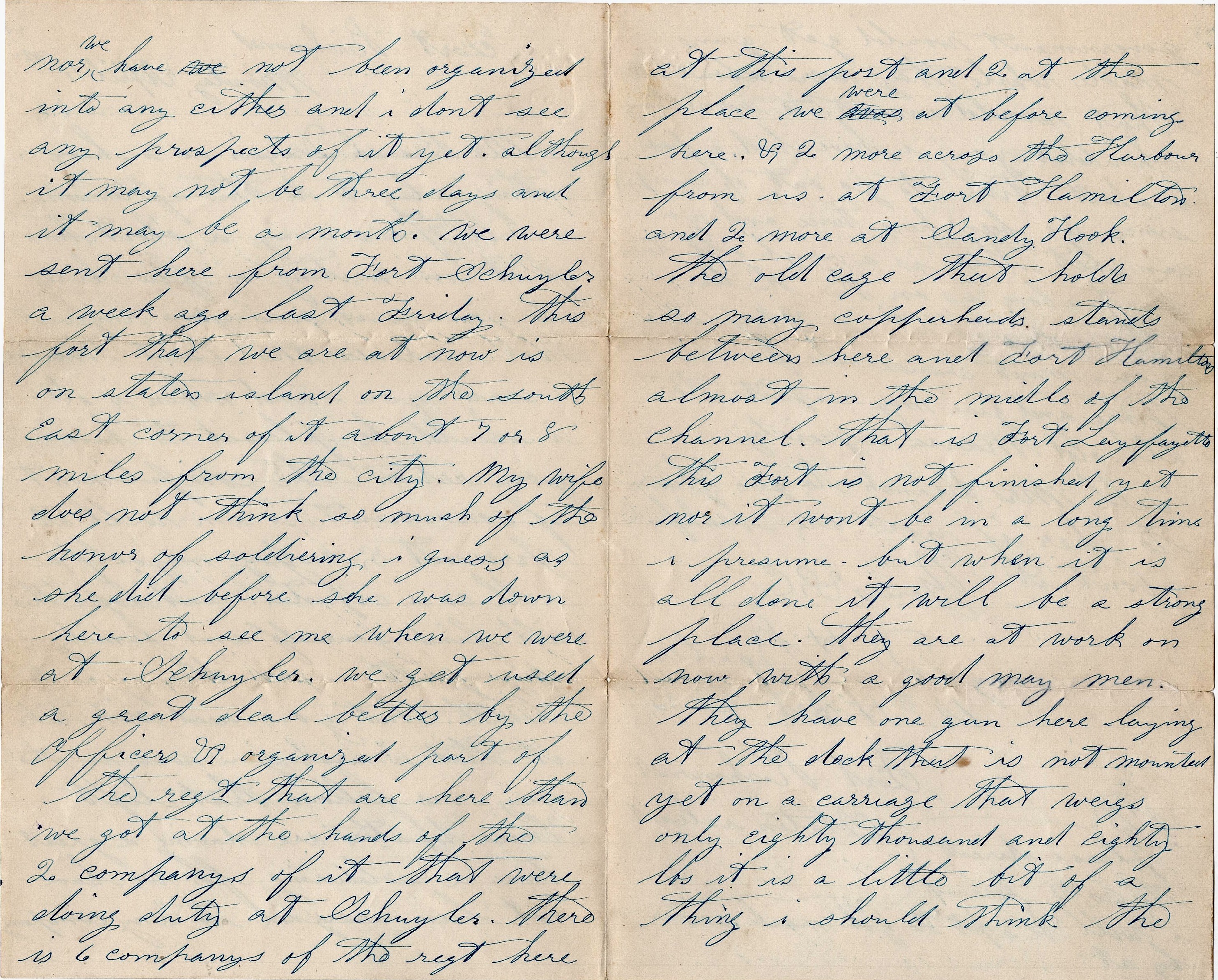
I am well at present & enjoy myself as well as I expected. And hope this will find yourself and family enjoying the same blessing as to health. But you need not take it that I wish you was in the army. Us fellows that left Elmira together are having a great time a soldiering for we have not been assigned to any company nor have not been organized into any either, and I don’t see any prospects of it yet although it may not be three days and may be a month.
We were sent here from Fort Schuyler a week ago last Friday. This fort that we are at now is on Staten Island on the southeast corner of it, about 7 or 8 miles from the City. My wife does not think so much of the honor of soldiering I guess as she did before she was down here to see me when we were at Schuyler. We get used a great deal better by the officers & organized part of the regiment that are here than we got at the hands of the two companies of it that were doing duty at Schuyler. There is six companies of the regiment here at this post and two at the place we were at before coming here. And [there are] two more across the Harbor from us at Fort Hamilton and two more at Sandy Hook.
The old cage that holds so many Copperheads stands between here and Fort Hamilton, almost in the middle of the channel. That is Fort Lafayette.
This fort is not finished, nor it won’t be in a long time, I presume. But when it is all done, it will be a strong place. They are at work on it now with a good many men. They have one gun here laying at the dock that is not mounted yet on a carriage that weighs only eighty thousand and eighty lbs. It is a little bit of a thing. I should think the government would get guns made while they were about it that would amount to something, shouldn’t you?
I have had a pass a short time to go out of camp since we been here twice and you can bet this is a rough old town just above us on the harbor. The name of it is Stapleton. You must excuse me for this time and give my respects to all—old Maria especially. Tell Mrs. Branch to give them to her if you are bashful about it. Yours, &c. — D. H. Barber, 14th H. Artillery, Co. B, Fort Richmond, Staten Island
N. B. Please direct to Co. B because I will be apt to get mail sooner by it.
Letter 2
Camp near Petersburg on or near the James River, Va.
Monday, June 20th 1864
Mr. Branch,
Dear friend, as I now have an opportunity, I will try to write you a few lines and let you know where I am and what I am doing. But first I must beg your pardon for not writing to you as I agreed when I saw you last, And now I will tell you the reason.
When we left New York Harbor, I was put into the 6th New York Heavy Artillery and sent right into the field and have had to march and fight ever since, night and day, so you see that I could not even get a chance to write to my own home as often as would have done. But for the past two weeks, I have been detailed to help drive cattle & butcher so I can have a little better chance to write once in a while.
After I got to this regiment, we started right out on the march from a place called Brandy Station and marched 3 days and 2 nights when we got out to where the Battle of the Wilderness was, in time to get into that the second day of the fight. And we have been right in the front line of battle about all the time up to this place where we now are. If not in one battle that was going on, it was on the skirmish line in another. So you can judge for yourselves whether I have seen and realized any of the hardships of this summer’s campaign.
And now, while I am writing this morning, our batteries are shelling the City of Petersburg in sight of where I am. But I am in the rear with a herd of cattle and close by the ammunition train of the 5th Army Corps. That is what we are in. So you see that I am not in a very dangerous position just at present. This is the 4th day they have been fighting at this place and all around where I am now I can go in the field and pick up a musket or cannon ball at any place almost.
Our regiment was out on the extreme skirmish line all day yesterday and day before yesterday our Corps made a charge on the Johnnies and drove them from their breast works and drove them away from the railroad that runs into Petersburg. And we hold it yet.
I was in the Battle of Bethesda Church and all through where we happened to be along the line of Lee’s army up to this place. We crossed the James river last Thursday about noon so we are now nearly south as near as I can judge from Richmond.
I have seen Charlie Beers once since we have been down here. Andrew, you people at home can form no kind of an idea of this war by what you read at home. It is awful to look upon. It is far different from what I thought it was before I had had the experience myself—to see men all shot and mangled to pieces in every way you can think of. But thank God I have been spared so far. The other day I witnessed the explosion of one of the enemy’s shells that was sent at us in the Battle of Bethesda Church. We were in the first line of battle at the time and our Brigade—that is, our Regiment and the 15th New York Heavy Artillery that constitutes it—were in a little piece of woods and it burst in the 15th and tore both legs and one arm off a poor fellow and a great many others just about as bad I have seen with my own eyes.
But if I was sure of staying where I am now in this business, I should feel quite contented. But I am here and it’s no use for a man to flinch from his duty or what is called by some shoulder strapped men. They—some of them—know other men’s duty as a soldier but they don’t know their own. But dear friend Branch and family, one and all, enough of this for the present. I should like to hear from you all as soon as you get this and tell me all the news for it is the only consolation a poor soldier gets here in his letters from his home or some friends of his for we can’t get any papers to read or anything of the kind here unless it is sent to us. I have lately got a letter from my wife about every time.
[no signature]


Letter 3
Camp near Petersburg, Va.
Monday, July 18th 1864
Mr. Branch,
Dear sir, I received your letter a week ago yesterday & have neglected to write again until now. But an old saying is you know, better late than never.
I am now about a mile or a little over perhaps from where we were camped when I wrote to you last. We are camped now about a mile from the Norfolk & Petersburg Railroad. This road is not used any now at this end of it nor it has not been since we came up to this place. We had our camp right alongside of it for a couple of weeks back until one day last week we were ordered to move back a little farther to keep out of the way of the Johnnies’ shells which they throwed once in a while pretty close to our ammunition & commissary trains and cattle herds.
I am with our Brigade herd yet but how long I will be kept on this duty, I can’t say, but hope it will be the remainder of this campaign. I have to go out to the front and help to butcher every other day. That is about as often as I care about unless I go up one in a while to my company and get my letters for they shoot right at our fellers, you know, with their cannons.
Our regiment has been in the front line of battle all the while since we came to this place with the exceptions of two days [when] they were relieved by another Brigade. They are laying behind breastworks and our line of works is not more than 80 or 100 rods from the rebel breastworks at this place. I have been outside of the works once to see a man that was on picket. The pickets do not fire at each other here where our Brigade lays at all. They are within a stone’s throw of each other and sometimes go to a spring about halfway between them to get water at the same time.
But they get to playing ball once in a while about every day with their batteries and that makes the men keep their heads below the top of the breastworks when they get at that. There has not been very many killed out of our regiment since we got into the breastworks. There was one struck last week one day with a solid shot and tore all to pieces, but he was a man that I was not acquainted with. He did not belong to our company. We have not had any killed here out of Co. L since we have been in these works or had not the last time I was up to them which was last Saturday afternoon. But there has been a good many wounded with pieces of shells.
The Butcher has just got orders to go out and butcher now but we won’t go till just before sundown. I saw Frank Sparks & Abe Decker yesterday. They are camped near us now. They are at work in the woods near us now for a few days. Frank says tell the folks when I write that he is well. They look tough and healthy. I was in this camp an hour or so yesterday. I saw Delos Green too. He is in the same company with them.
You will have to excuse me for this time so I will bid you goodbye for the present. This leaves me in good health and I hope it will find you and family enjoying the same blessing. Yours truly, — D. H. Barber, 6th New York Heavy Artillery, Co. L, Washington D. C.


 Spared & Shared 23