

The following letters were written by George Cook (b. 1841) of Crete, Will county, Illinois, who enlisted 1 October 1862 as a private in Co. A, 113th Regiment Illinois Volunteers. He mustered out of the regiment in June 1865.
George wrote most of his letters to his older brother, Thomas Cook (b. 1838) of Crete. They were the children of William Cook (1810-1890) and Elizabeth Atkinson (1803-1863).
These letters are from the personal collection of Ryan Martin and were offered for transcription and publication on Spared & Shared by express consent.
[Editor’s Note: the header image is a picture of the 113th Illinois taken in Memphis.]
Letter 1
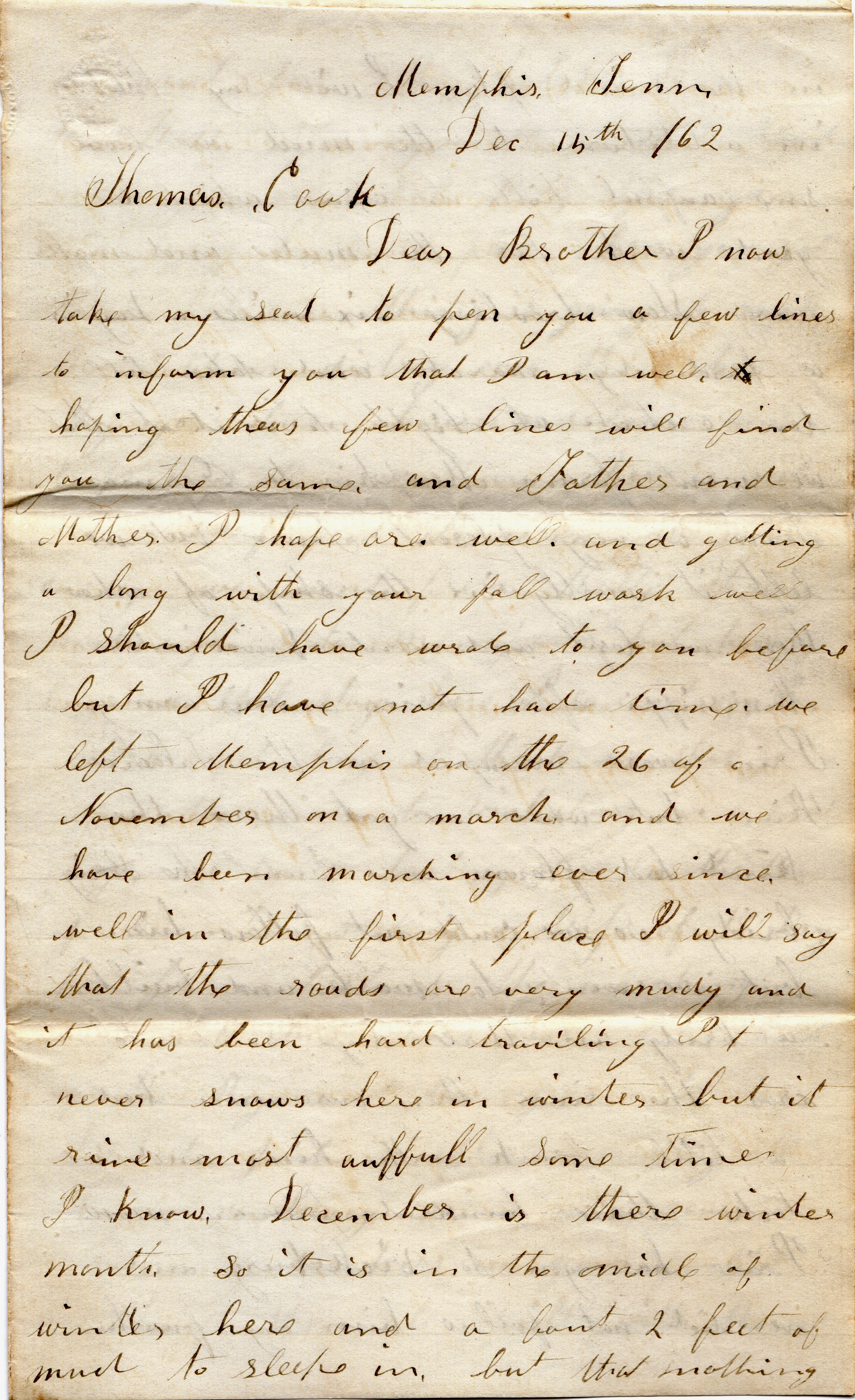
Memphis, Tennessee
December 15, 1862
Thomas Cook,
Dear brother, I now take my seat to pen you a few lines to inform you that I am well, hoping these few lines will find you the same, and Father and Mother I hope are well and getting along with your fall work well. I should have wrote to you before but I have not had time.
We left Memphis on the 26th of November on a march and we have been marching ever since. Well, in the first place I will say that the roads are very muddy and it has been hard traveling. It never snows here in winter but it rains most awful sometime. I know December is their winter month so it is in the middle of winter here and about two feet of mud to sleep in. But that’s nothing.
In the second place I will say that in addition to the mud, we have some awful hills to climb which is good work for the mules and makes very slow traveling. Six miles a day is a hard day’s march and take till ten o’clock at night to do it at that.
We went from Memphis to Germantown—a very pleasant town—but we left it mostly in the shape of ashes. Then we left and went down into Mississippi after Price and his army. Price was encamped on the Tallahatchie River but when we got there, the bird had flown and burned the bridge so we could not follow him. But we went to work and built a bridge in three days so as to cross the river. Then our men had a little brush with him and we took three hundred prisoners. Now Price has gone to Vicksburg and we did not follow him any further.
We went from the [Talla]hatchie River to Holly Springs, the hilliest road ever you see, but Holly Springs is a very handsome place when you get there. But everything is going to rack [and ruin]. The soldiers destroy everything—they burn houses and fences and crops and all—everything. There is not 80 rods of good fence in the whole country.
We went from Holly Springs back again to Memphis, but how long we shall stay here I cannot say. I think not long. I think we shall go down the river to Vicksburg in a few days. We came back yesterday, the 14th of December, making a trip of 18 days. As for me, I stand the marching very well but there was about half of the regiment that give out. The hardest part is after marching all day in a heavy rain with your supper of crackers in your pocket to have them all spoilt with the wet and have to lay down in the mud without any supper. But mud makes a soft bed to sleep on.
The country out here is all timber and very heavy timber too, from one end to the other. Wherever I have been, it is one vast forest—no openings at all—nothing but trees and stumps. All the large plantations have been cleaned up by the colored people. Some of the large farmers have as many as two or three hundred slaves on their plantations. There was one day 140 slaves left one man and came into our regiment and came with us to Memphis—quite a loss for the man. But then it could not be helped.
Levi [James] and Darton [?] are well and stand soldiering very well. [Sgt.] Henry Case has been sick ever since we came here but he is getting better now. He did not go with is on our march. He stayed in the hospital in Memphis. He is getting better fast.
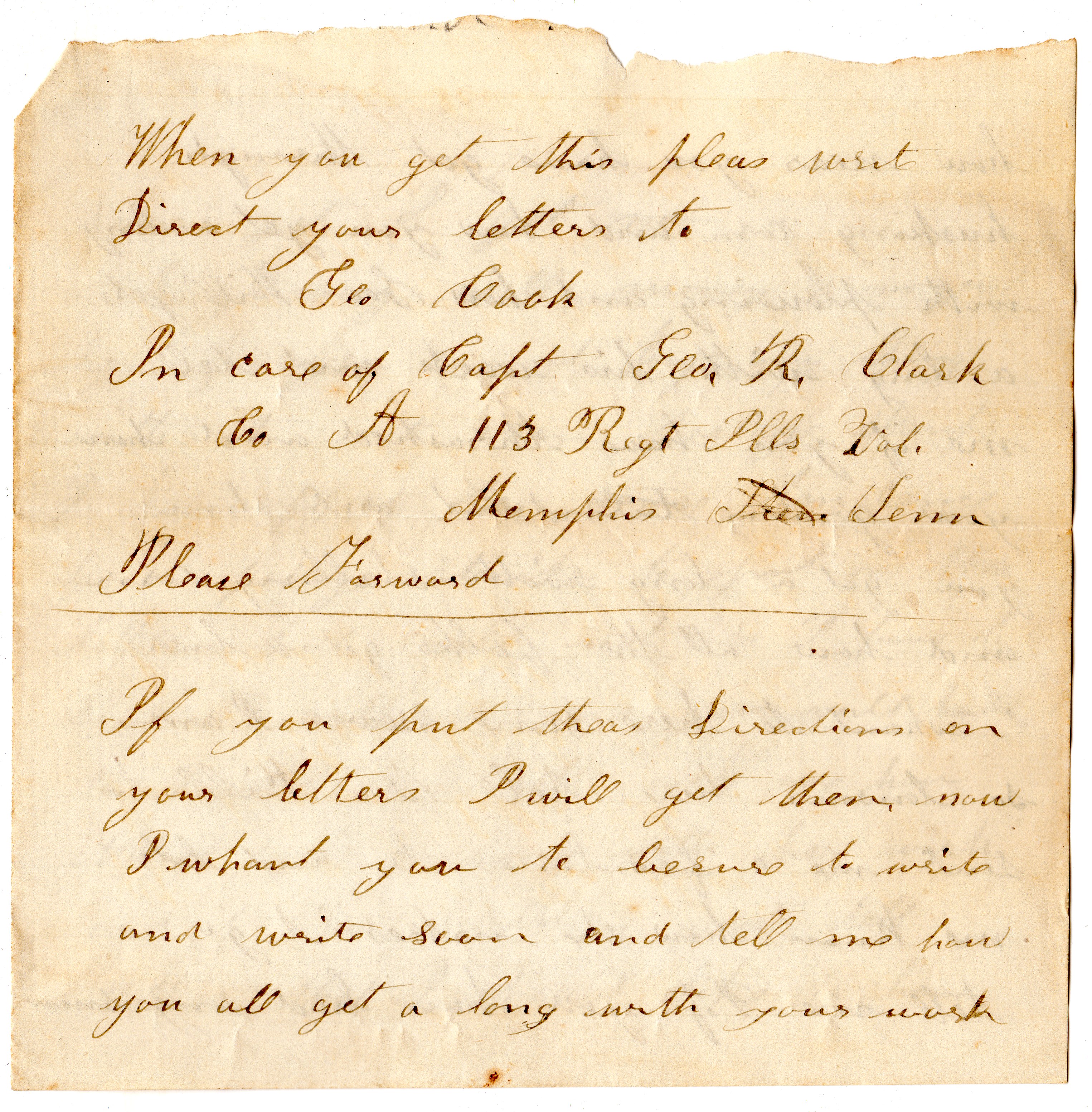
When you get this, please write. Direct your letters to George Cook, in care of Capt. George R. Clark, Co. A, 113th Regt. Ills. Vol. , Memphis, Tennessee.
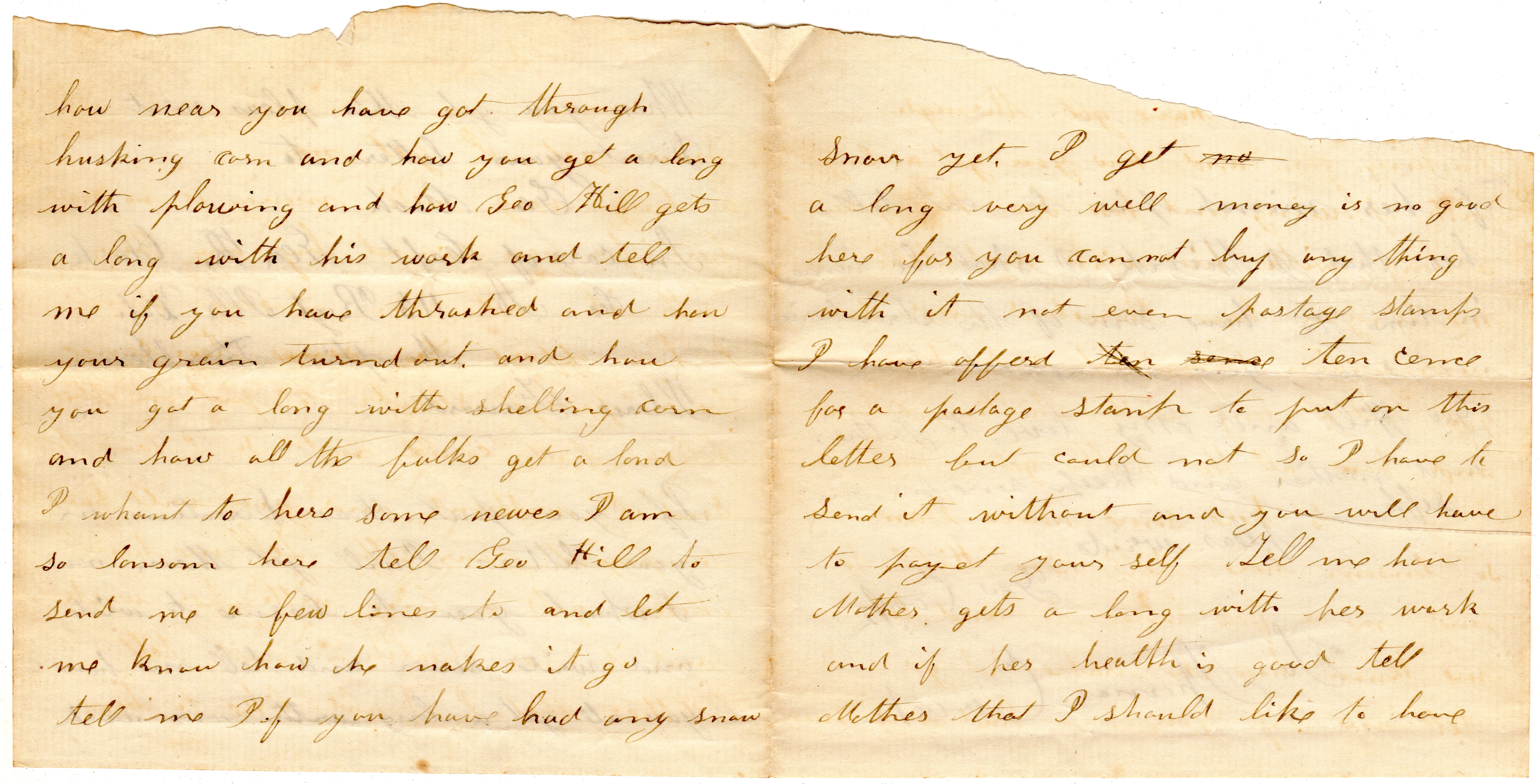
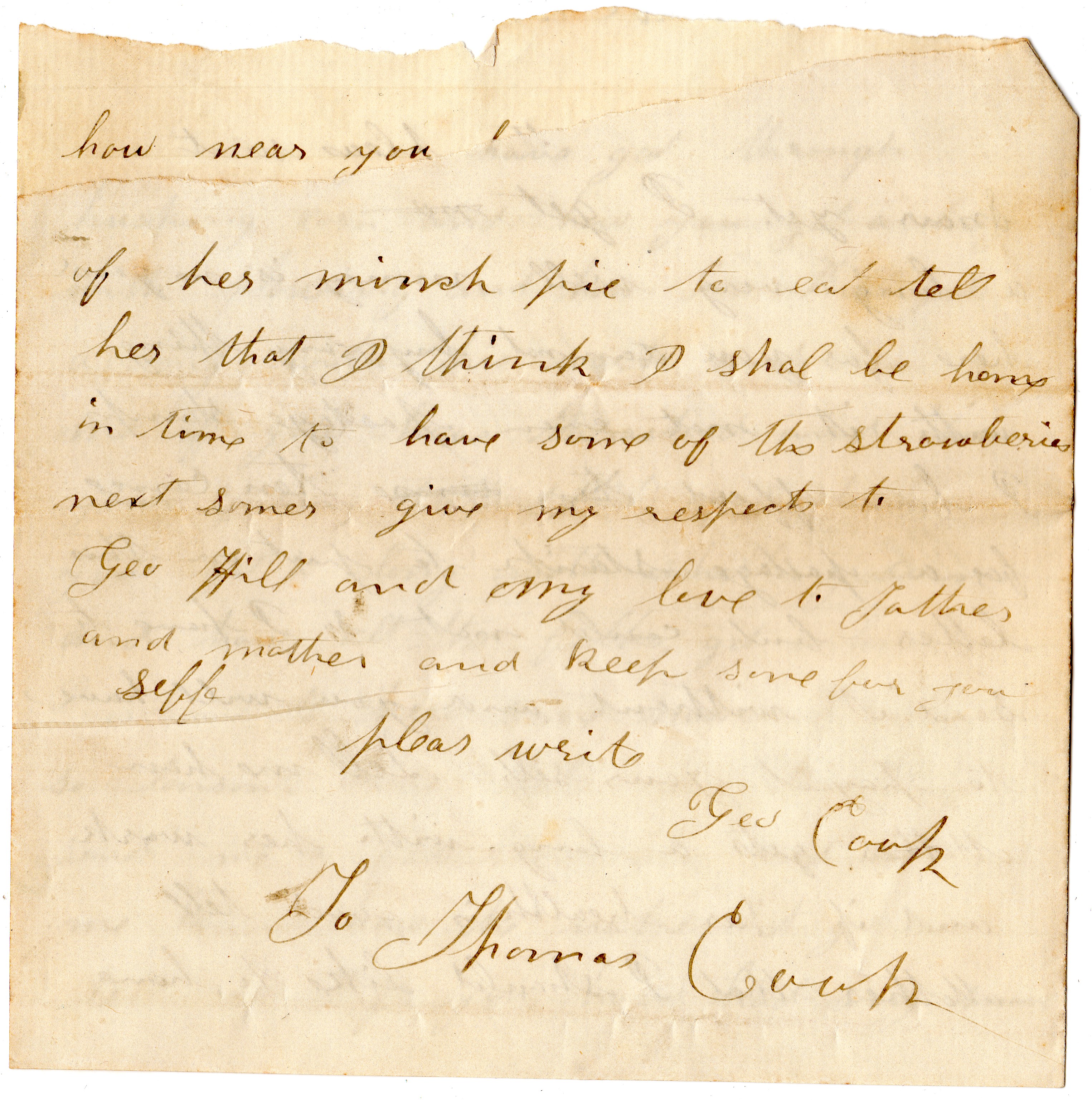
If you put these directions on your letters, I will get them. Now I want you to be sure to write and write soon and tell me how you all get along with your work. How near you have got through husking corn and how you get along with plowing and how George Hill gets along with his work and tell me if you have thrashed and how your grain turned out and how you get along with shelling corn and how all the folks get along. I want to hear some news. I am so lonesome here. Tell George Hill to send me a few lines too and let me know how he makes it go. Tell me if you have had any snow yet. I get along very well. Money is no good here for you cannot buy anything with it—not even postage stamps. I have offered ten cents for a postage tamp to put on this letter but could not so I have to send it without and you will have to pay it yourself. Tell me how Mother gets along with her work and if her health is good. Tell Mother that I should like to have her mince pie to eat. Tell her that I think I shall be home in time to have some of the strawberries next summer. Give my respects to George Hill and my love o Father and Mother and keep some for yourself. Please write, — George Cook
To Thomas Cook


Letter 2
In front of Vicksburg
State of Louisiana
January 25, 1863
Dear Brother,
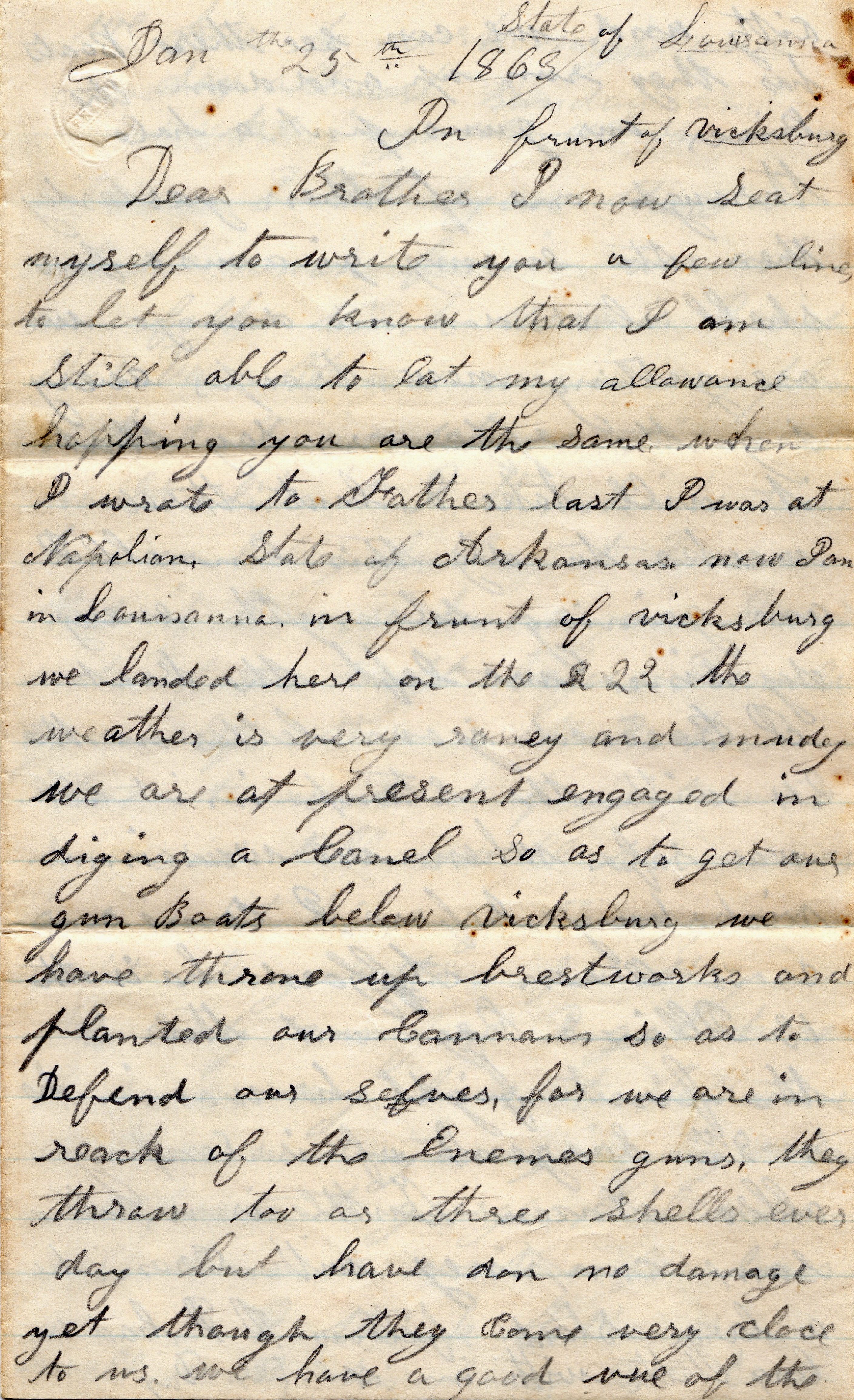
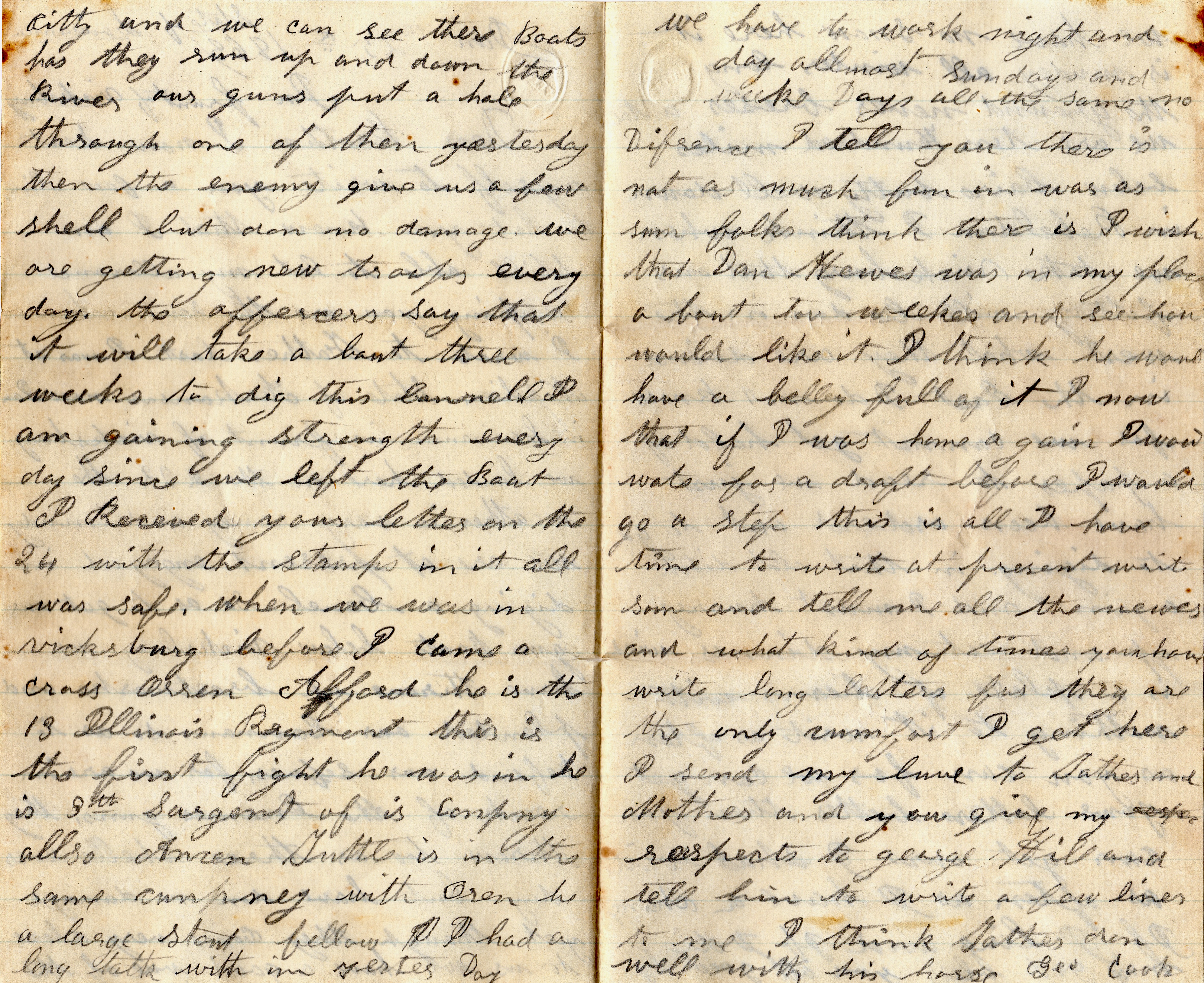
I now seat myself to write you a few lines to let you know that I am still able to eat my allowance, hoping you are the same. When I wrote to Father last, I was at Napoleon, State of Arkansas. Now I am in Louisiana in front of Vicksburg. We landed here on the 22nd. The weather is very rainy and muddy. We are at present engaged in digging a canal to as to get out gunboats below Vicksburg. We have thrown up breastworks and planted our cannons so as to defend ourselves for we are in reach of the enemy’s guns. They throw two or three shells everyday but have done no damage yet though they come very close to us. We have a good view of the City and we can see their boats as they run up and down the river. Our guns put a hole through one of them yesterday. Then the enemy gave us a few shell but done no damage.
We are getting new troops everyday. The officers say that it will take about three weeks to dig this canal. I am gaining strength every day since we left the boat. I received your letter on the 24th with the stamps in it. All was safe.
When we was in Vicksburg before, I came across Orin Alford. [Orrin T. Alfred, Co. I, 13th Ill.] He is [in] the 13th Illinois Regiment. This is the first fight he was in. He is 3rd Sergeant of his company. Also Anson Tuttle [Tuthill] is in the same company with Orrin. He ia a large stout fellow. I had a long talk with him yesterday.
We have to work night and day almost, Sundays and week days all the same. No difference. I tell you, there is not much fun in it as some folks think there is. I wish that Dan Hewes [Hughs?] was in my place about two weeks and see how he would like it. I think he would have a belly full of it. I know that if I was home again, I would wait for a draft before I would go a step. This is all I have time to write at present. Write soon and tell me all the news and what kind of times you have. Write long letters for they are the only comfort I get here. I send my love to Father and Mother and you give my respects to George Hill and tell him to write a few lines to me. I think Father done well with his horse. — George Cook
We have no snow here yet. It is muddy all winter long. The ground never freezes at all. We are ten hundred miles below Cairo—pretty well down in Rebeldom. I think when we take Vicksburg, that our fighting will be done in the West. What they are doing in the East, I do not know for we cannot get hold of a paper to read. We just have been ordered out to go to digging in that old ditch again and I must hurry up and eat my dinner which is a plate of beans with nothing to it.
Write as often as you can for we can get your letters better than you can get ours. I shall write as often as I have a chance if I live and if I die. May God bless you all. Goodbye.

Letter 3
[Expedition to Rolling Fork, Mississippi, via Muddy, Steele’s and Black Bayous and Deer Creek]
Headquarters 113th Regt. Illinois Vols.
Young’s Point, Louisiana
March 28, 1863
Thomas Cook,
Dear brother, I received your letter last night and was very glad to hear from you but was very sorry to hear that Mother is sick. I am glad to hear that the rest are all well. I am well at present though I have had some hard times since I last wrote to you. I should have wrote home before this for I should have got your letter had I been in camp but we have been on a march for 11 days. We was ordered up on the morning of the 17th of March at about 4 o’clock in the morning with one day’s rations in our knapsacks and our blankets on our shoulders and [told] to leave all the rest of our things in camp. So with out guns and 40 rounds of cartridges in our cartridge boxes, we started under cover of a heavy fog.
We marched four miles when we got on board of the steamboats and started up the river. The swift-footed steamers soon brought us to land 15 miles up the river. Everybody was wondering where we was going to and what we was going to do up here with only one day’s rations along with us. Gen. Stuart went on shore, looked around a spell, and then ordered the boats to lay to for the night.
Well in the morning our grub had run out. Gen. Stuart ordered us to go on up the river to see if we could get anything to eat. We run up the river about 15 miles and landed at a handsome plantation. Here our company was ordered to go ashore to kill some beef. We killed one cow and a lot of sheep and started back to the rest of the boats. We got there about 5 o’clock, having been all day with[out] a mouthful of anything to eat. We got there about dark. [Received but] a chunk of beef with[out] anything to [go with] it—no salt, no pepper, no bread.
The next morning after making our breakfast out of beef again, we started to march through the woods. We went about one mile when we came to some more boats in the woods—a funny place for steamboats to be—but the water was high and had run through a ravine about like that seventy. Here we stayed all night with nothing for supper. In the morning we got another day’s rations of crackers. These all went up for breakfast. We went on board the boats and run up the Black river about twenty miles. This is the finniest river you ever saw. The water looks like ink—black as a nigger’s face. Well we landed a little before dark and marched about two miles to where we camped.
There was a large plantation. Corn was up about a foot. The Negroes never thought of us coming out there. Here we had to lay down without any supper but I was about starved out and so I went into a nigger hut here. They was roasting a chicken which I confiscated with a large Johnny Cake and made out a good supper.
The next morning we got another day’s rations of crackers and started on a march. We marched on quick step all day till about 4 o’clock in the afternoon when we troops was attacked by the Rebels. We was thrown into line of battle and ordered to advance. The you ought to have seen the coats and blankets go scattered in every direction. Here I lost my blanket. We soon put them to flight and after running through the woods after them for about two hours, we brought up in the road again. Here we soon learned that the rebels was about ten thousand strong [and] about 5 miles in our advance. This was a stunner and we made up our minds that we had better retreat.
Here we was without anything to eat and within five miles of a large force so off we started on a quick retreat, We went till ten o’clock when we lay down to rest. Here is commenced to rain and it rained good and strong. We have no such rains up North. We killed a hog and roasted it over the fire in the morning for breakfast when we started on in the mud and water and rain. Here my boots failed to keep me dry for every step I went in over the tops. In this style, we paddled all day lay down in the mud at night and slept sound as a brick, the rain falling all night.
The next day we got about near to where we could get some more hard crackers which was grabbed at and no grumbling. In the afternoon, the sun came out fine and we partly got our clothes dry. At night we made our beds and expected to get a good night’s sleep but our pickets were drove in and we was ordered to fall into line of battle. In this way, we stood all night. The next morning we marched on board of the boat again. Here I lay down and liied to slept myself to death. Here we got some pies and some butter and after running round two days, we got back to Young’s Point on the night of the 27th and here I got your letter. What we will do next, I do not know.
Vicksburg is not taken yet nor is it likely to be taken yet awhile. The Rebels have shelled us out of the canal so it is a failure as I always thought it would [be] after so much labor and so many lives been lost by sickness by being down in this swamp. They talk about starving out the Rebels. If some of these big bugs would come down here and see some of the plantations on the Black river and all through the South stocked with cattle and hogs and chickens, geese and turkeys—every plantation is stocked with poultry, and the woods and fields are [ ] with cattle and hogs. They talk about living off of the enemy and eating them out of house and home. They have not see the corn cribs that line the roads wherever you go. We may feed our army horses at their corn cribs and feed our soldiers on their stock, and still there is stock enough in the South to feed both armies and keep them a going for years yet. They have got corn enough to make corn bread and they have got meat enough to eat. The Southern army lives better today than the Northern army. Every place we go to, every plantation has ten or twelve nigger huts on it and in every hut on the plantation, you will find from one to two barrels of molasses and sugar. Why the other day I went into an old log hut. It looked some like John Cole’s blacksmith ship. In this I found one barrel of salt, three barrels of the best salted ham, one barrel of molasses, and one of sugar and a barrel of sides ad a bout 15 bushels of potatoes. The old reb himself was in his nice house with about a hundred slaves around him. I got a canteen of sides and a handful of salt. This was all that we must touch. A litle while after this, we was attacked by the enemy and then our Generals say, “Well Boys, we will soon starve them out.”
Capt. [George] Clark has come back. He has been promoted to Major. He did not bring the other companies with him adn he says that he thinks that we will all go to Springfield in a little while. If we do, I shall come home as soon as we get there.
You said in your letter that George Shipley was going to get married. Write and tell me if she is good looking or not. Tell him when you see him that I wish him a happy life and if I was home, I would dance at his wedding. He had better wait till I come home but it is getting dark and I must close. Write soon. Tell George Hill to write. Give my respects to all. Much love to all—to Mother, to Father, and to yourself. I trust Mother will be [better] when you get this. I think Father is going in on trading horses.


Letter 4
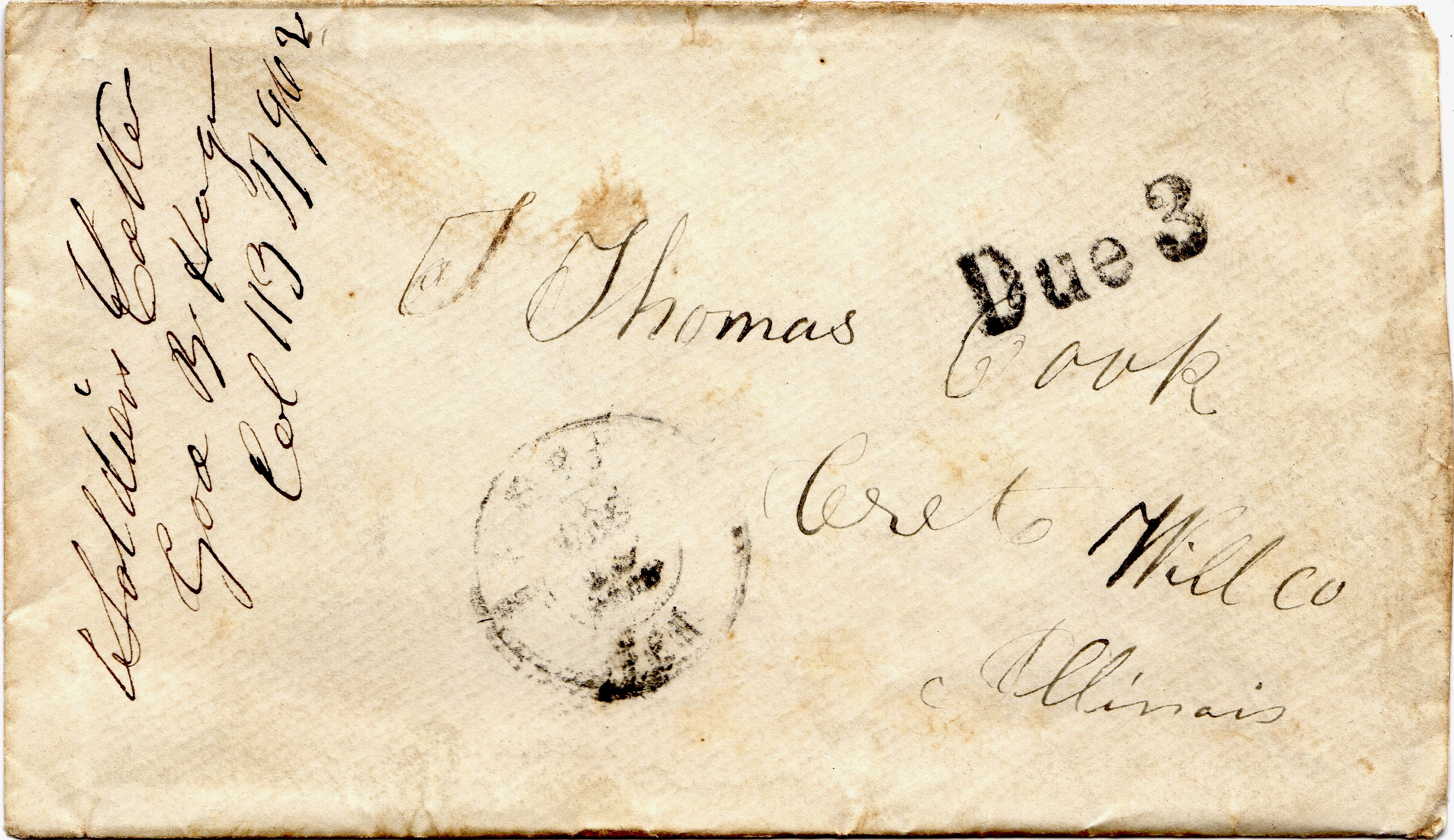
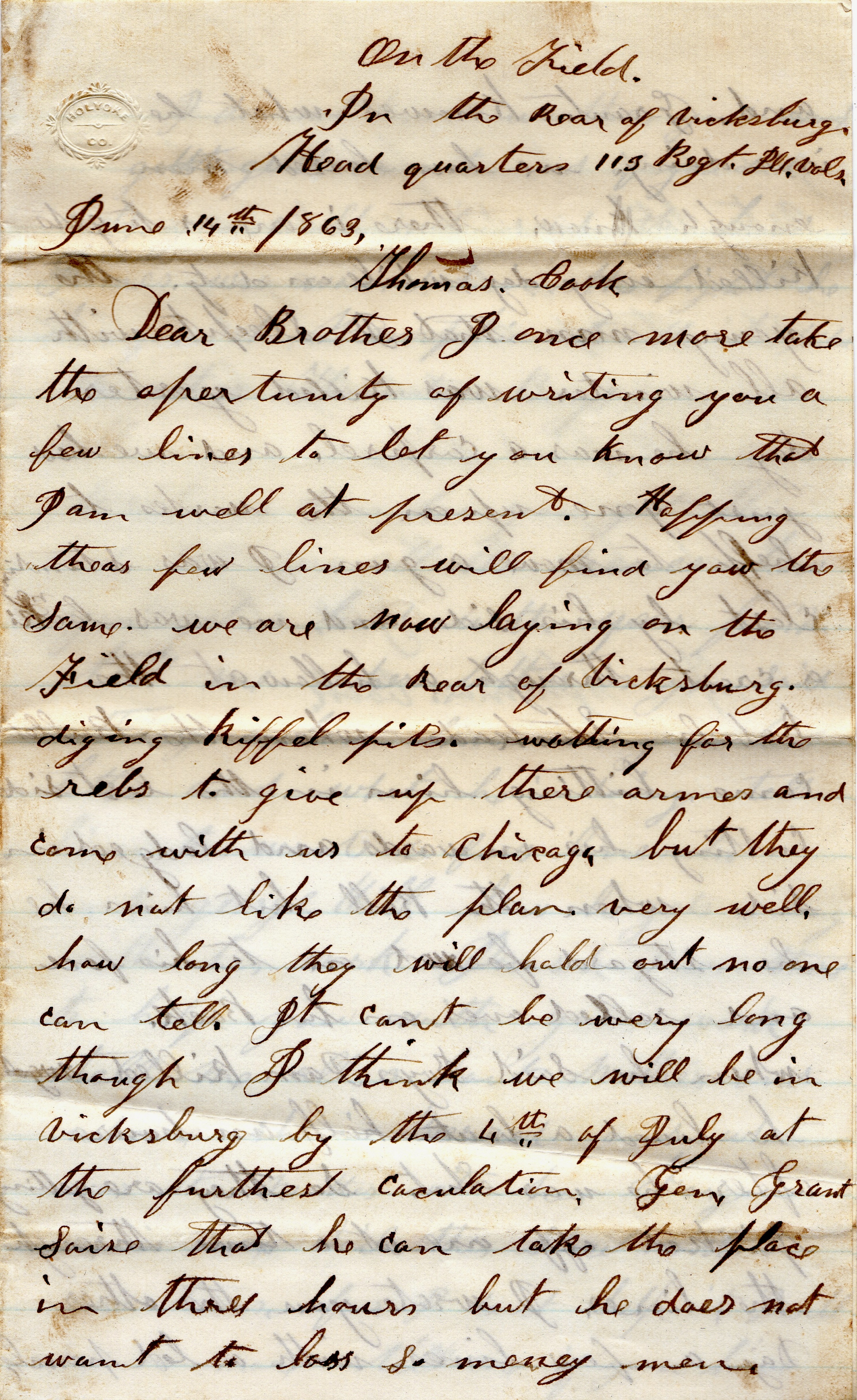
On the Field in the Rear of Vicksburg
Headquarters 113th Regt. Ill. Vols.
June 14, 1863
Thomas Cook,
Dear brother, I once more take the opportunity of writing you a few lines to let you know that I am well at present. Hoping these few lines will find you the same.
We are now laying on the field in the rear of Vicksburg digging rifle pits waiting for the rebs to give up their arms and come with us to Chicago. But they do not like the plan very well. How long they will hold out, no one can tell. It can’t be very long though. I think we will be in Vicksburg by the 4th of July at the furthest calculation. Gen. Grant says that he can take the place in three hours but he does not want to lose so many men and Grant knows what he is doing. We have lost men enough now. There is one or two gets killed every day while on duty.
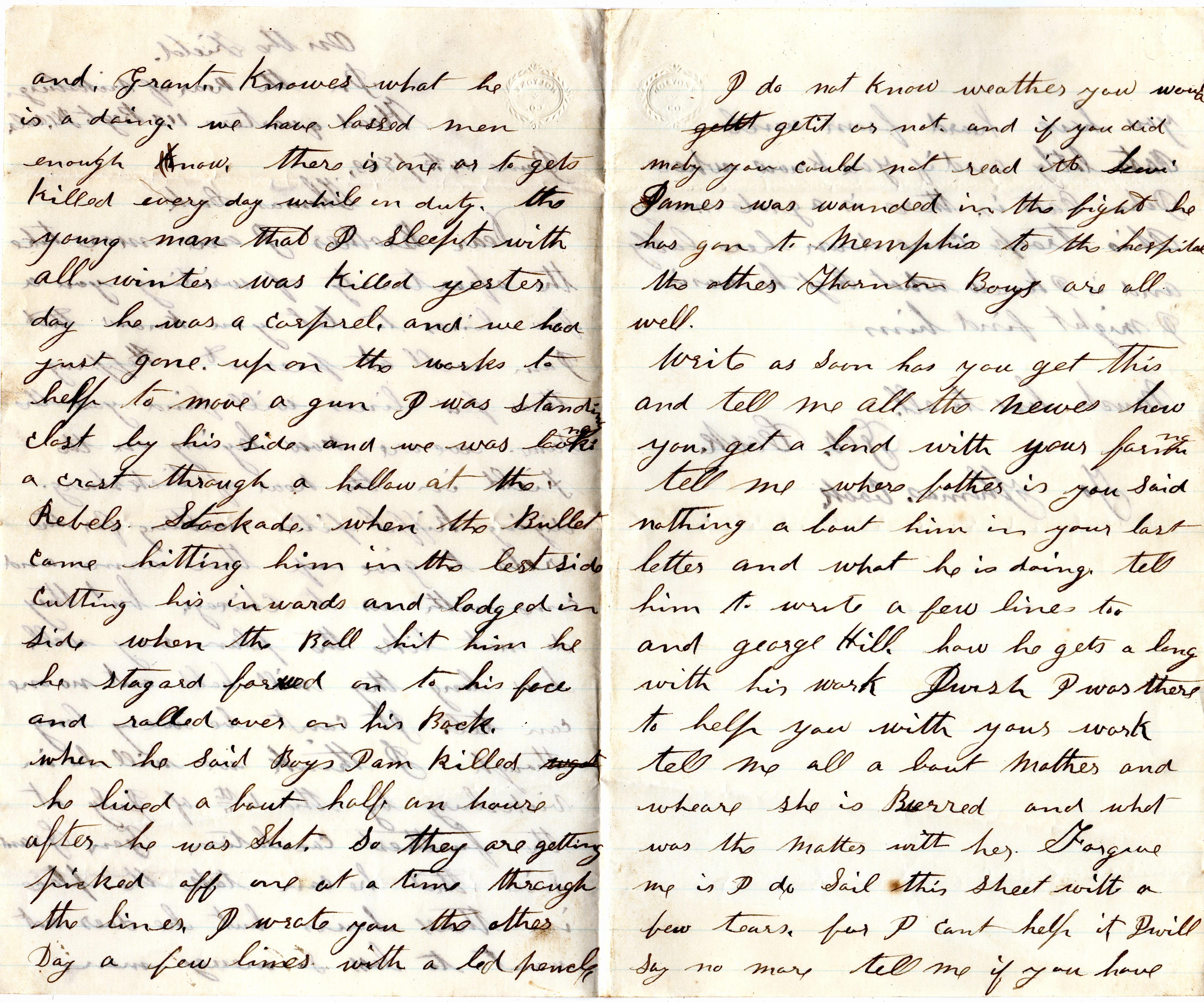
The young man that I slept with all winter was killed yesterday. 1 He was a corporal and we had just gone upon the works to help to move a gun. I was standing close by his side and we was looking across through a hollow at the Rebel’s stockade when the bullet came, hitting him in the left side, cutting his inwards and lodged inside. When the ball hit him, he staggered forward onto his face and rolled over on his back. [That’s] when he said, “Boys, I am killed.” He lived about half an hour after he was shot. So they are getting picked off one at a time through the lines.
I wrote you the other day a few lines with a lead pencil. I do not know whether you would get it or not and if you did, maybe you could not read it. Levi James 2 was wounded in the fight. He has gone to Memphis to the hospital. The other Thornton boys are all well.
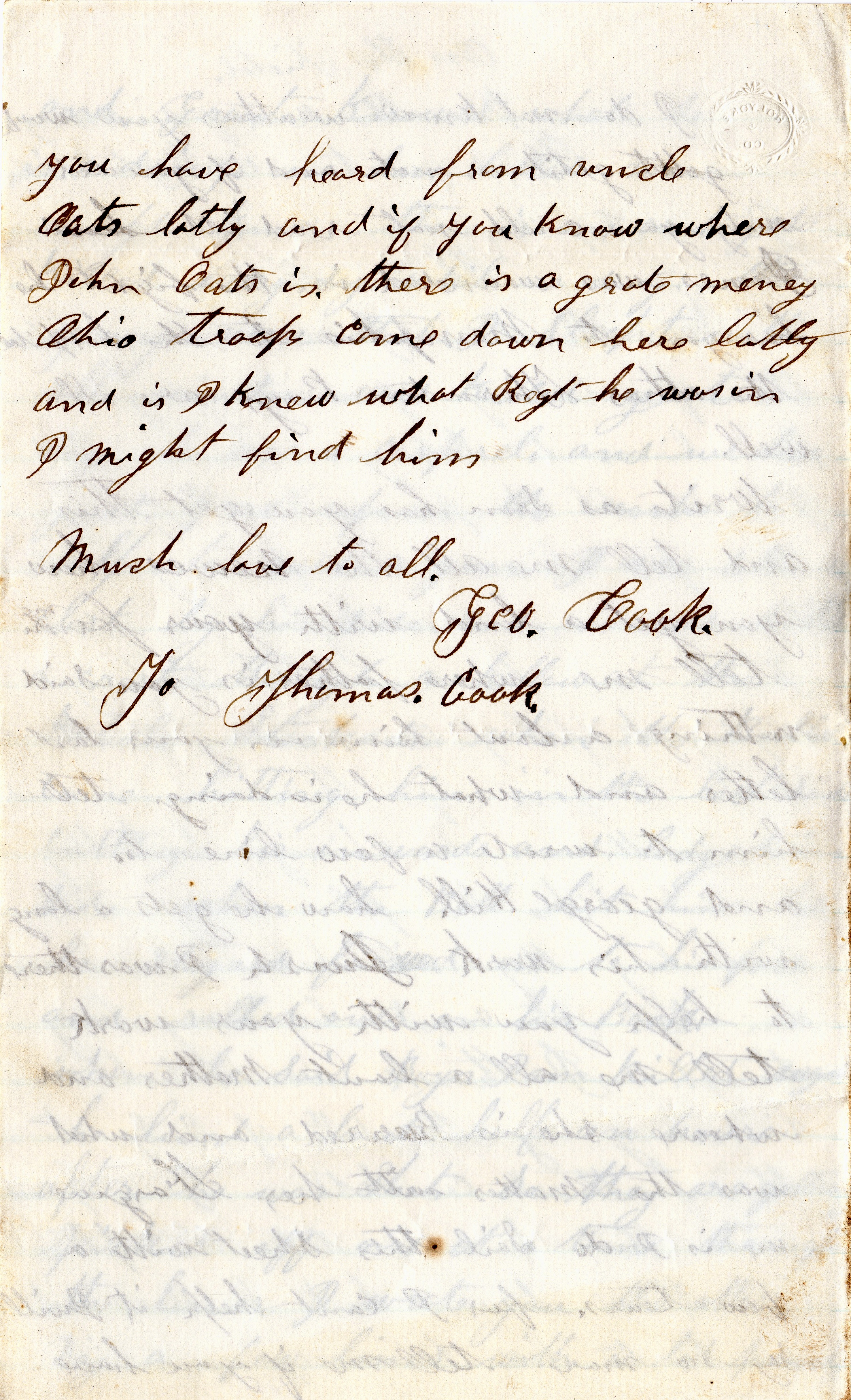
Write as soon as you get this and tell me all the news—how you get along with your farming. Tell me where Father is. You said nothing about him in your last letter and what he is doing, Tell him to write a few lines too. And George Hill—how he gets along with his work. I wish I was there to help you with your work. Tell me all about Mother and where she is buried and what was the matter with her. Forgive me if I do soil this sheet with a few tears for I can’t help it. I will say no more. Tell me if you have heard from Uncle Oats lately and if you know where John Oats is. There is a great many Ohio troops came down here lately and if I knew what regiment he was in, I might find him.
Much love to all. — George Cook
To Thomas Cook
1 Possibly William Ferrell of Chicago who served in Co. A with George. The roster states that he was killed on 14 June 1863 at Vicksburg, Mississippi.
2 Levi H. James (1844-1912) was the son of George B. James.
Letter 5
Corinth, Tennessee [Mississippi]
August 12, 1863
Thomas Cook.
Dear brother, I once more take the pleasure of writing you a few lines to let you know that I am well as this leaves me, hoping this letter will find you the same.
Our regiment has gone to Corinth to recruit up a little, There is out of our five companies, 164 sick in the hospital. I am in the hospital as nurse for the sick. There is two men in our company fit for duty. The rest are all sick. This is a good healthy place and a handsome country. Apples are 5 cents a dozen, and peaches all you want for nothing. Milk and butter scarce. Plenty of watermelons as large as you can lift.
We got our last pay before we left Vicksburg. Did you or Father ever get the money I allotted home? When you wrote, you never said anything about it and I never heard whether you got ot or not. When you write, let me know and how much you have received. Write and tell me how you get along with your harvesting. I suppose you have got all through with [it] long ago.
This is a great country for potatoes. They grow very large and they raise a great deal of corn in the South. Out at Jackson in Mississippi, I rode through one field of corn in one plantation [where] there was ten thousand acres in it—quite a small field.
There is some talk of making cavalry out of us and if we stay down here, I hope they will. But there is a good show for our coming up North before long.
How do you get along with the draft up North? I suppose the boys are getting a little scared again. I do not think they will draft much in Illinois. Every regiment in the field now is almost from Illinois. Write and tell me what kind of teams you have got. I suppose that Father has got through going with the horse and is at home now. If we come up North, why of course I will come home. I can get a furlough here and come home if we do not go North but it will cost a little too much for me.
This is all I have got to write this time. Write soon. Write all the news. Give my love to Father and keep a share for yourself. Tell Father to write a few lines in your next. Levi James has got his discharge. I think he will lose his arm. I saw him at Milliken’s Bend as we came up the river. Martin Pierson is in the hospital and so is all the Thornton boys.
— George Cook
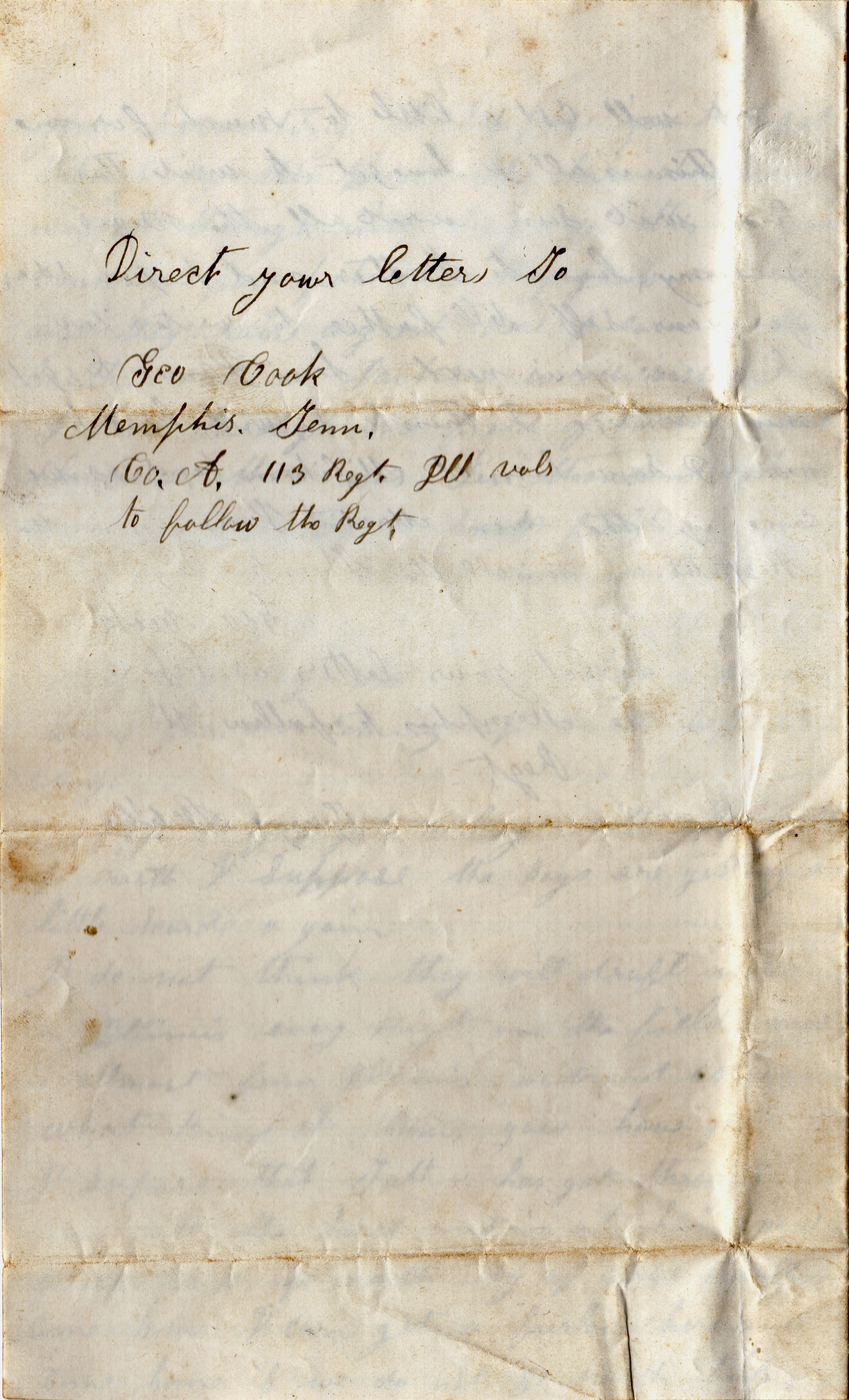
Direct your letters as before to Memphis to follow the regiment. — George Cook


Letter 6

Corinth, Mississippi
September 16th [1863]
Thomas Cook,
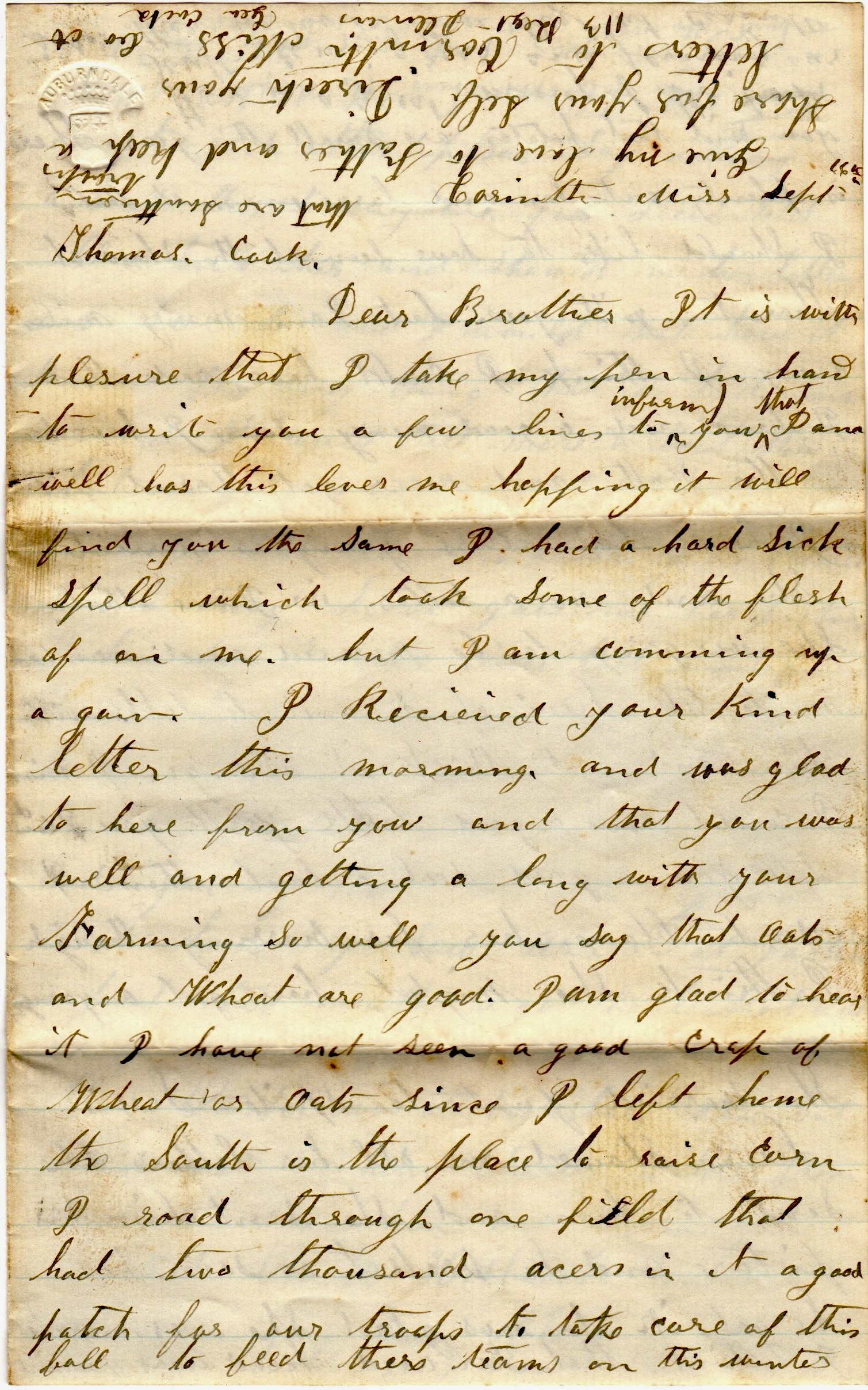
Dear brother, it is with pleasure that I take my pen in hand to write you a few lines to inform you that I am well as this leave me hoping it will find you the same. I had a hard sick spell which took some of the flesh off of me but I am coming up again. I received your kind letter this morning and was glad to hear from you and that you was well and getting along with your farming so well. You say that oats and wheat are good. I am glad to hear it. I have not seen a good crop of wheat or oats since I left home. The South is the place to raise corn. I rode through one field that had two thousand acres in it—a good patch for our troops to take care of this fall to feed their teams over this winter.
You said that potatoes are small this year. There is plenty out here and large ones at that. I should like to have been at the show at Thornton with you but I am many miles away. I think I could have rode the mule. I have rode a good many since I have ben in the South and never got throwed yet.
I heard that Miss Young is married. She wrote me a letter in June that she was going to be married and wanted me to tell Levi of it and to talk with him and not think it strange. I wish I could have a good talk with you. I could tell you a good deal about them. I don’t blame her for marriage though I think she might have got a young man. She married just to spite Levi. Levi showed me all her letters she sent to him and she sent him her picture and he broke it as soon as he got it. He was glad she was married. I think that her and Levi was promised to each other. Please say nothing about this to anyone for Levi told all about her and showed me her letters as a secret and would not have it known for anything that I had said a word. I could tell more about them but I guess I will not at present for he never told [Martin] Pierson a thing or showed him a thing. Levi gave me her picture. I have had it ever since last winter. I saw Levi as we came up the river to Memphis. He was at Milliken’s Bend in the hospital. His arm was very bad.
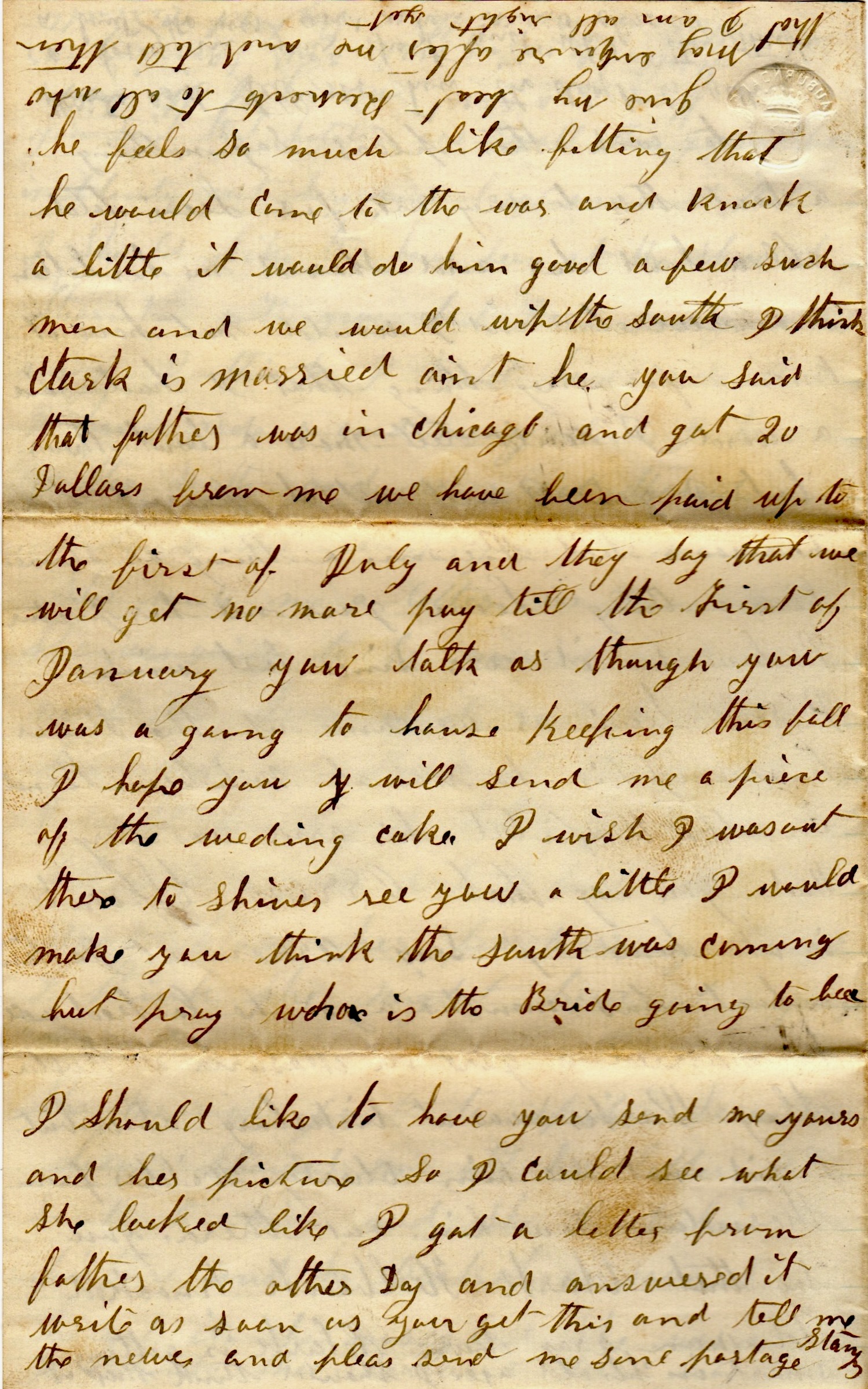
You say that Orrin Alfred is at home. I saw Orrin at Jackson about two months ago. He looked well. He married a girl in Missouri at Rolla. Alvey Parks was at Vicksburg also but I did not see him. Charley Wilder from Thornton saw him out there. You say that Clark Holbrook knocked old man Gray down. Clark is getting smart in his old age. I should think that if he feels so much like fighting, that he would come to the war and knock a little. It would do him good. A few such men and we would whip the South. I think Clark is married, ain’t he? You said that Father was in Chicago and got 20 dollars from me. We have ben paid up to the 1st of July and they say that we will get no more pay till the 1st of January. You talk as thougfh you was a going to housekeeping this fall. I hope you will send me a piece of the wedding cake. I wish I was out there to shivaree you a little. I would make you think the South was coming. But pray, where is the bride going to be?
I should like to have you send me yours and her picture so I can see what she looked like/ I got a letter from Father the other day and answered it Write as soon as you get this and tell me the news and please send me some postage stamps. Give my best respects to all who may enquire after me and tell them that I am all right yet. Write and tell me how the draft is getting along in your part and what they think about the war and when it will close. There is a great many of the South coming over and joining our side. There is two or three regiments at Corinth.
Give my love to Father and keep a share for yourself. Direct your letters to Corinth, Mississippi. Co. A, 113th Regt. Illinois. — George Cook

Letter 7

Corinth, Mississippi
October 4, 1863
Thomas Cook,
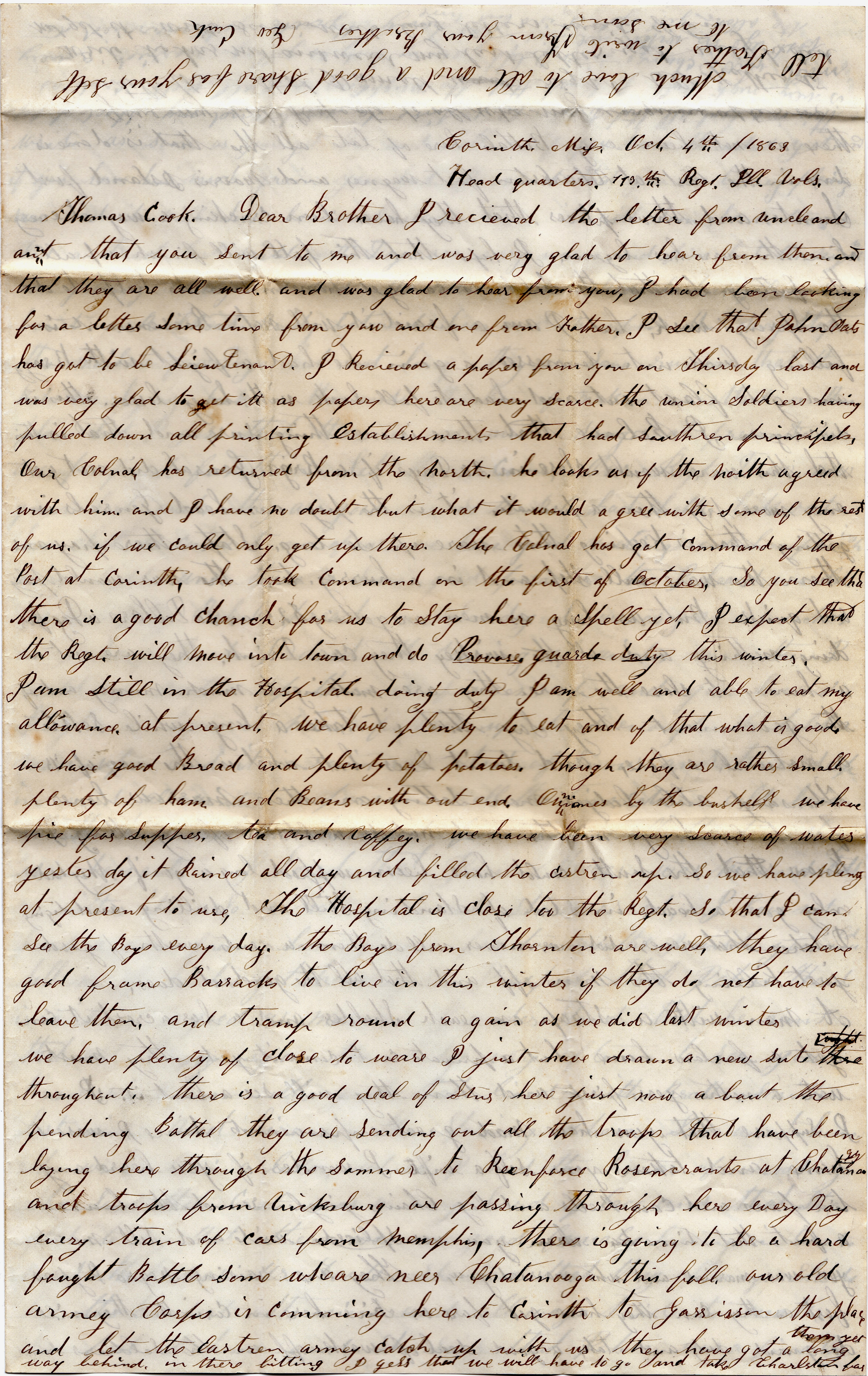
Dear brother, I received the letter from Uncle and Aunt that you sent to me and was very glad to hear from them and that they were all well and was glad to hear from you. I had been looking for a letter some time from you and one from Father. I see that John Oats has got to be Lieutenant. I received a paper from you on Thursday last and was very glad to get it as papers here are very scarce, the Union soldiers having pulled down all printing establishments that had Southern principles. Our Colonel has returned from the North. He looks as if the North agreed with him and I have no doubt but what it would agree with some of the rest of us if we could only get up there. The Colonel has got command of the post at Corinth. He took command on the first of October. So you see that there is a good chance for us to stay here a spell yet. I expect that the regiment will move into town and do Provist Guard duty this winter.
I am still in the hospital doing duty [as nurse]. I am well and able to eat my allowance at present. We have plenty to eat and of that, what is good we have good bread and plenty of potatoes though they are rather small, plenty of ham and beans without end. Onions by the bushel. We have pie for supper, tea and coffee. We have been very scarce of water. Yesterday it rained all day and filled the cistern up so we have plenty at present to use. The hospital is close to the regiment so that I can see the boys every day. The boys from Thornton are well. They have good frame barracks to live in this winter if they do not have to leave them and tramp round again as we did last winter. We have plenty of clothes to wear. I just have drawn a new suit throughout. There is a good deal of stir here just now about the pending battle. They are sending out all the troops that have been lying here through the summer to reinforce Rosecrans at Chattanooga and troops from Vicksburg are passing through here every day [and on] every train of cars from Memphis. There is going to be a hard fought battle somewhere near Chattanooga this fall.
Our old Army Corps is coming here to Corinth to garrison the place and let the Eastern army catch up with us. They have got a long way behind in their fighting. I guess that we will have to and take Charleston for there has not been any battles here of late. All that is done in the East at Charleston, Fort Wagner, and Morris Island, Fort Sumter, and those places that they have been cracking away at ever since the war has begun. I hope that this fall will finish up all the fighting so that the soldiers can get home in time to help to do the spring work. But I am afraid it will not.
Rosecrans is falling back into Tennessee again. He had a fight with Bragg [at Chickamauga] and got flaxed out and had to fall back with heavy losses. This is discouraging. I believe that there is one thing sure. and that is this—that this war would close in 30 days if a Brigadier General did not get anymore pay than a private. It is the pay our head generals is getting that is keeping this war up so long. Stop their pay and then the war will stop—and in a hurry too. THe war would play out quick. But as long as men are getting $25 or 30 dollars a day for doing nothing and all the whiskey they can drink, they are not in any hurry to close the war. They are making too much money out of the government. They say that it takes a long while to settle a national affair, and so it does. But what is the use of 75,000 able bodied men sitting on their marrow bones for twelve large months and not do a stroke of anything? I know that the South could have been whipped long ago if they had only gone ahead instead of standing still and drilling and digging ditches that never did nor never will do them a cent’s worth of good—just killing the men off and that all the good it does.
A man with a strap on each shoulder and a bar across it can get a furlough home but a private can’t come it. Yet they must wait another year first and then they will see about it. I suppose that you have made a great improvement since I was at home and taken yourself a wife. I wonder if you heard any tin pans and cow bells and leg chains jingle round the house about that time when you was spliced [married]. Write and tell me when you was married and who married you.
They are raising negro regiments as fast as they can. They have got four or five here in Corinth. They will do guard duty and take a good deal of work off of the soldiers’ hands.
Write as soon as you get this and tell me if you have thrashed yet and if you have, how much grain you had. I expect that you are busy plowing now and it will soon be cornhusking time. It wil soon be winter. We had a frost last night. They days are very warm and fine but the nights are getting chilly and cold. The Rebs made a raid last night and burnt a railroad bridge between here and Memphis. This may stop the mail a few days but not long. There are some rumors that the Rebs are laying back in the woods thinking of making an attack on this place but I guess that there is not much danger at present. We are prepared for them. Let them come.
Our regiment drew new guns last week. They are good ones so the Reb had better look out how close he comes to one of us. We had good meetings out here—preaching every night, and there is some good preachers too. I heard one old man—a Johnny Rebel—preach one Sunday. He was as good a preacher as I ever heard. I dread the coming of winter more than I think I would up North. Up there it freezes up and you have sleighing. Here it never freezes up hard enough to hold a man up and it is rain instead of snow and knee deep in mud all winter. A person is all the time wet and has wet feet and is all the time chilly when he is out.
I heard that Jane Hughs was married. Tell me whether it is so or not. If so, who she married. I have not heard a word from Levi James for two months. I wish you would tell me if he has got home yet. I expect that John Hood is about as good as married. I understand that he runs that old buggy upon the ridge very often to see you know who—I mean the girl that lived with brother Smith’s last winter and in the spring when she went home. She wrote Levi a letter which I had the honor of reading. She said that Crete was a very hard place and that she was glad to say that there was one good family living in Crete and that was Dr. [Samuel] Hood’s. She said that they always showed her the kindest attention and always tried to make her feel at home and she said that John was a fine man and that John wanted to enlist and go to fight for his country so bad but his Father could not spare him. He had such a large farm to work and John had to tend to that and he felt very bad over it.
Levi was sick at the time he got this letter and it made him a little made and he asked me to answer it for him which I done to the best of my ability. And it is the last letter ever I wrote to her and the last one I shall write though I got one the other day from her and Lydia. Well Levi furnished pen and ink and a sheet of paper somewhat larger than this and at work I went filling the sheet full and more too. I told her my experience from the earliest period of my existence up to the present moment. I gave her my views on politics and on the present war and a man’s duty to his country in her hour of danger. What if Dr. Hood has got a large farm? He has got Tom and Sam, two of the best men in the town. I told her that Mr. Hood when the draft was talked of so strong, found time to spare John to let him go into Chicago and draw out rotten sausages into the flat and then go home and tell round the lie that his Johnny had got to be clerk in a hardware store and as soon as the danger of the draft was over, Johnny found time to go home again. She didn’t like the way I talked about my politics and I guess she didn’t like the way I talked about John. And in the next place, there was too much for her. And what kind of an answer do you think I got? Well, sir, she went to work and got a Chicago Times paper and clipped it in two, sent me the one half and Levi the other with a note complimenting me on being such a good politician and that if I had a mind to write her a sheet all about the war, that she would het it printed in the Chicago Times. Well, as I did not wish to disgrace myself by having a piece of my writing come out in a Copperhead paper, I concluded that I would not write any more letters to young girls so that put an end to my writing there. Now if John wants to enlist so bad and his father had got such a large farm that he can’t spare him, I will exchange places with him. He may com out here and soldier and I will come home and take care of the place. I know that I should feel very bad if I was at home and couldn’t enlist and I suppose he does the same. You can tell the Dr. that if John wants to enlist, send him down here and I will make the change with him for one year. I could take care of the girls if nothing more. 1
This is about all that I can find time to write and my sheet of paper is very nigh full. I trust that the neighbors are all well. Crete has made quite a change since I left. Everybody is getting married very fast. Has Harvey Myrick got married to the Allen gurl yet? It is about time.
Give my best respects to all you may enquirer after me. Tell them that I am all right. Tell Father to write. He has not answered my last letter yet. Maybe he did not get it. Write soon. Wrote long letters. Write often. Much love to all and a good share for yourself. Tell Father to write. From your brother, — George Cook
Write soon.
1 This long paragraph refers to Dr. Samuel Hood (1815-1908) and his son, John James Hood (1840-1926) of Crete, Will county, Illinois. Public records show that John Hood never served in the Civil War. Dr. Hood’s other sons were Thomas Hood (b. 1852) and Samuel Hood (b. 1853).

Letter 8
Chewalla, Tennessee
November 4, 1863
Dear Father,
I take my pen in hand to pen you a few rough lines in an awful hurry in answer to your welcome letter which came to hand on the 3rd. I was glad to hear from home and to hear that you are all well. I am well of course. So are all the Thornton boys.
We are at present at Chewalla doing picket duty on the outside post, and I had a great time with two guerrillas. They came to my post and wanted me to pass them through the lines. They said that they had deserted the Rebel army. I would not let them in and then they wanted to sneak back into the woods. Then I told them that they could not go. Then they was going anyhow so I cocked my old gun on them and made them stand in the middle of the road till the Sergeant of the Guard came. Then we marched them into camp and turned them over to the commander of the post. He sent them to Corinth for winter quarters.
This is a lonesome place. Not much of anything going on. Our barracks are half a mile from the Memphis & Charleston Railroad. There is no trading to be done—only with the few citizens that come to our lines. The women folk come to the lines two days in every week—Tuesdays and Saturdays. These two are trading days. Their produce is a few chickens which look as if the war had some effect upon them. They in general are more bones than meat. They fetch in some butter and a good deal of butter milk worth 30 cents a pound. And they fetch in some potatoes which is worth one dollar and a half a bushel. And they sometimes fetch in a few eggs. Some of the eggs are fresh and some have chickens in them. We get the one with chickens in as cheap as those without. We trade them salt and pork sowbelly, rice, flour, coffee, and such things as these which we have left of our rations. Yesterday I traded 30 pounds of flour for two bushels of potatoes. I made a good trade. I have got the pot on boiling and I am going to have a good dinner out of potatoes, pepper, salt, [and] a piece of corn bread that I paid a dime for. But last night the mice eat about half of it up so the corn bread part will be scarce. A piece of sow belly, a cup of water, will make my dinner and it is a meal good enough for a king or old Abe Lincoln himself.
This is about all that I have to write unless it is something on the war. I think that the war must soon close or there will be a great suffering in the South amongst the poor folks. There is a great many already suffering. Very few raised anything this summer and the few that did raise any have had them most all destroyed so that they are dependent upon our lines for their support. They have hardly any clothes to wear. Most all go bare footed. They have poor houses to live in. All the good ones have been burnt to the ground in the beginning of the war and the folks had to move into the nigger shanties. Things in the South look rather scanty at present and Jeff Davis thinks so too, I guess. He is already hunting a mouse hole to crawl out of and I think he had better for there is hundreds of his own men that would shoot him if they had a good chance.


Letter 9

Memphis, Tennessee
May 20, 1864
Thomas Cook,
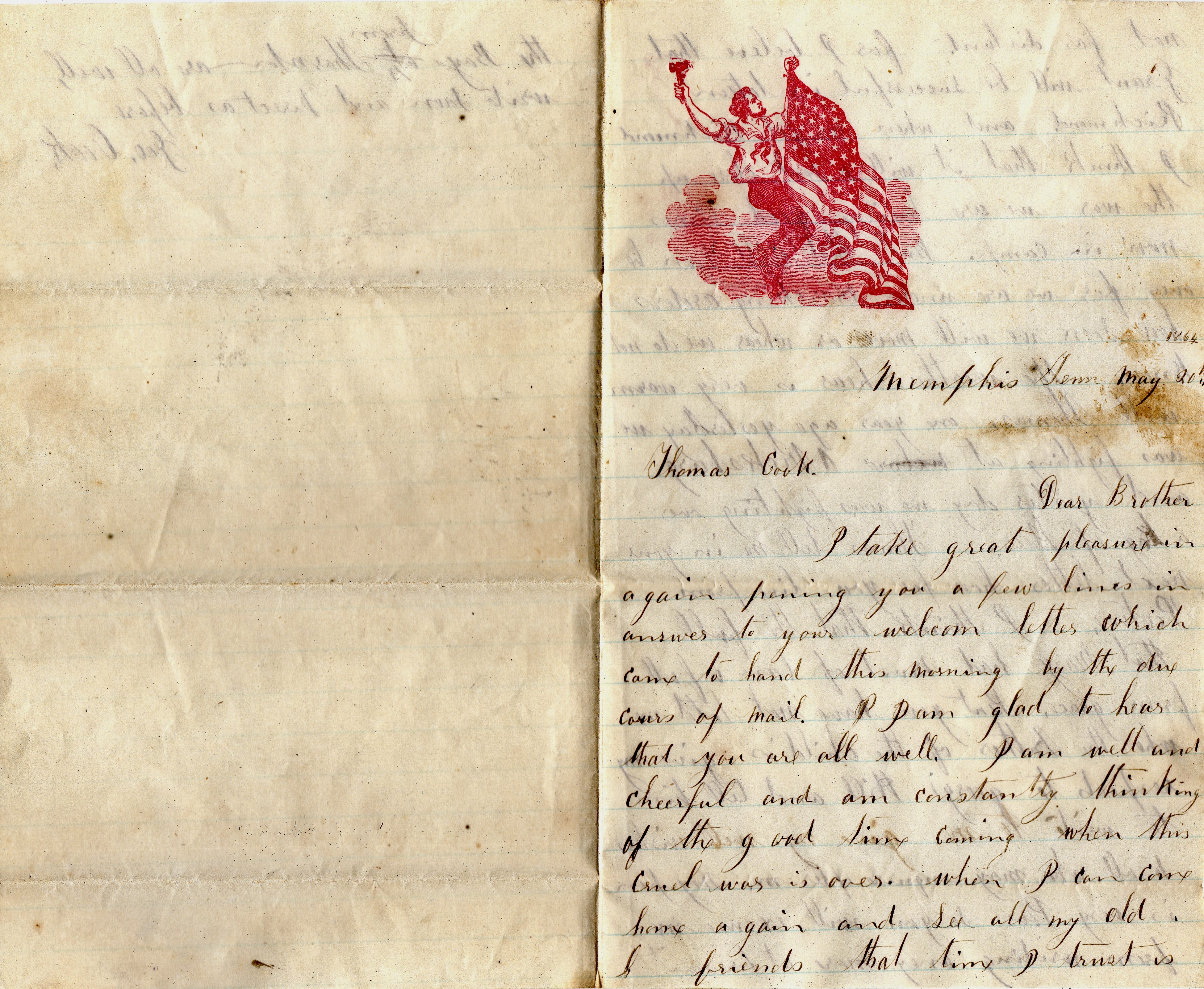
Dear brother, I take great pleasure in again penning you a few lines in answer to your welcome letter which came to hand this morning by the due course of mail. I am glad to hear that you are all well. I am well and cheerful and am constantly thinking of the good time coming when this cruel war is over when I can come home again and see all my old friends. That time, I trust, is not far distant for I believe that Grant will be successful in taking Richmond. And when we get Richmond, I think that it will about close up the war.
We are having good times now in camp. But that will soon be over for we are under marching orders. How soon we will move or where we do not know. The weather here is very warm.
Well Thomas, one year ago yesterday we was fighting at Vicksburg and yesterday we was fighting over a keg of beer. Thomas, tell me in your next letter how far you live from Peotone.
I think that the fall that Mary had must have of been a fall from grace. But you have not told me who the father of the child is. Give my respects to George Hill and tell him to write to me. Give my well wishes to all who may enquire after me. My pen is very poor so you will excuse me from writing anymore at present. The boys from Thornton are all well. Write soon and direct as before, — George Cook

 Spared & Shared 23