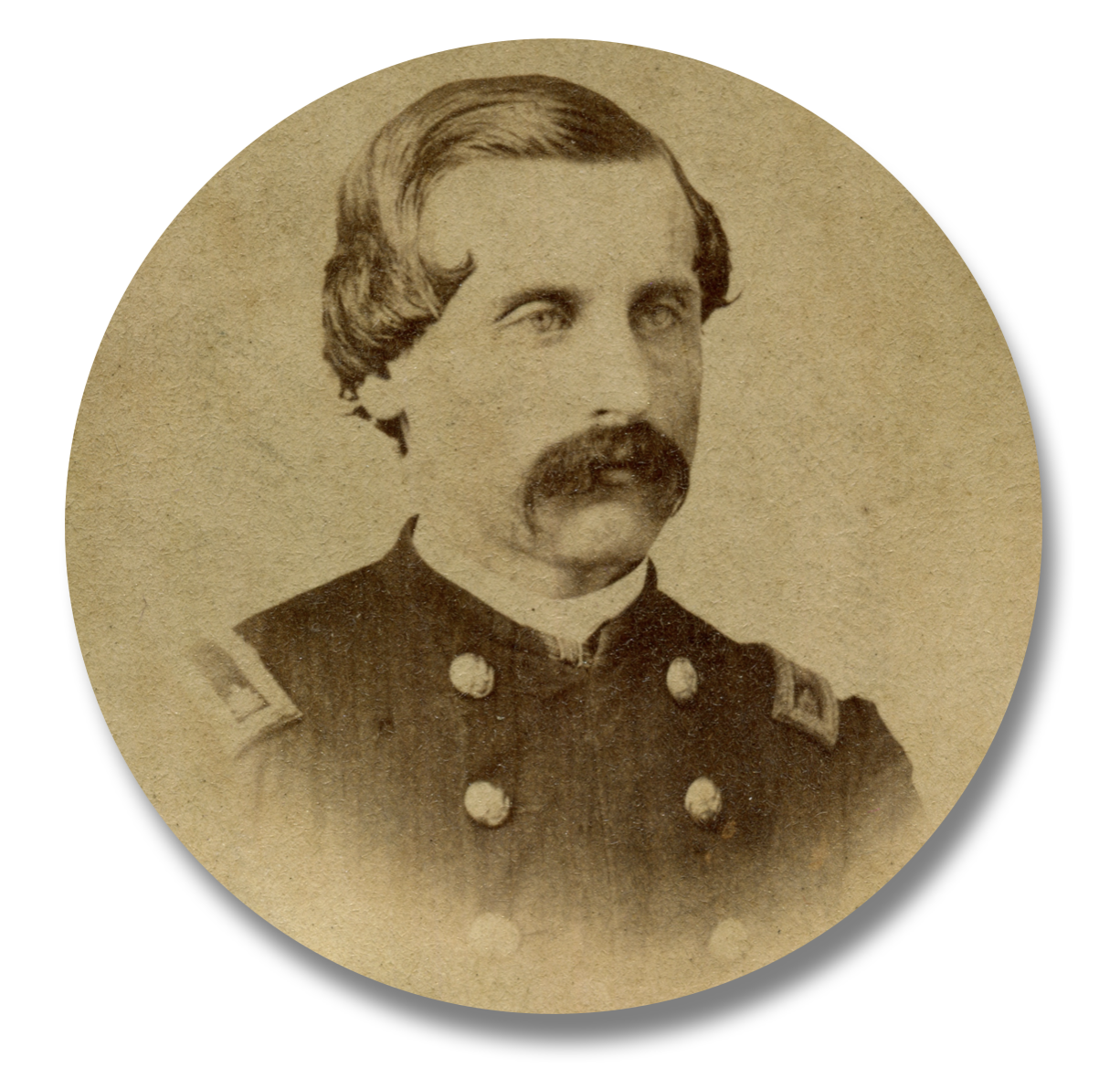
The following letter was written by William H. Kirwin (1839-1917) who enlisted at Troy, New York as private, Co. E , 43rd New York Infantry on 30 December 1863; appointed musician and returned to ranks sometime after February 1865; mustered out with company, June 27, 1865, at Washington, D. C. While he was in the service, he was described as 5′ 8″ inches tall, with gray eyes and brown hair.
William was the son of William and Esther (Rasper) Kirwin. He was educated In the public schools of Troy and his first business in which he was engaged was that of groceryman. At one time he was one of the best known horsemen in this section and for the last seventeen years had been Superintendent of the Lansingburgh Waterworks.
T R A N S C R I P T I O N
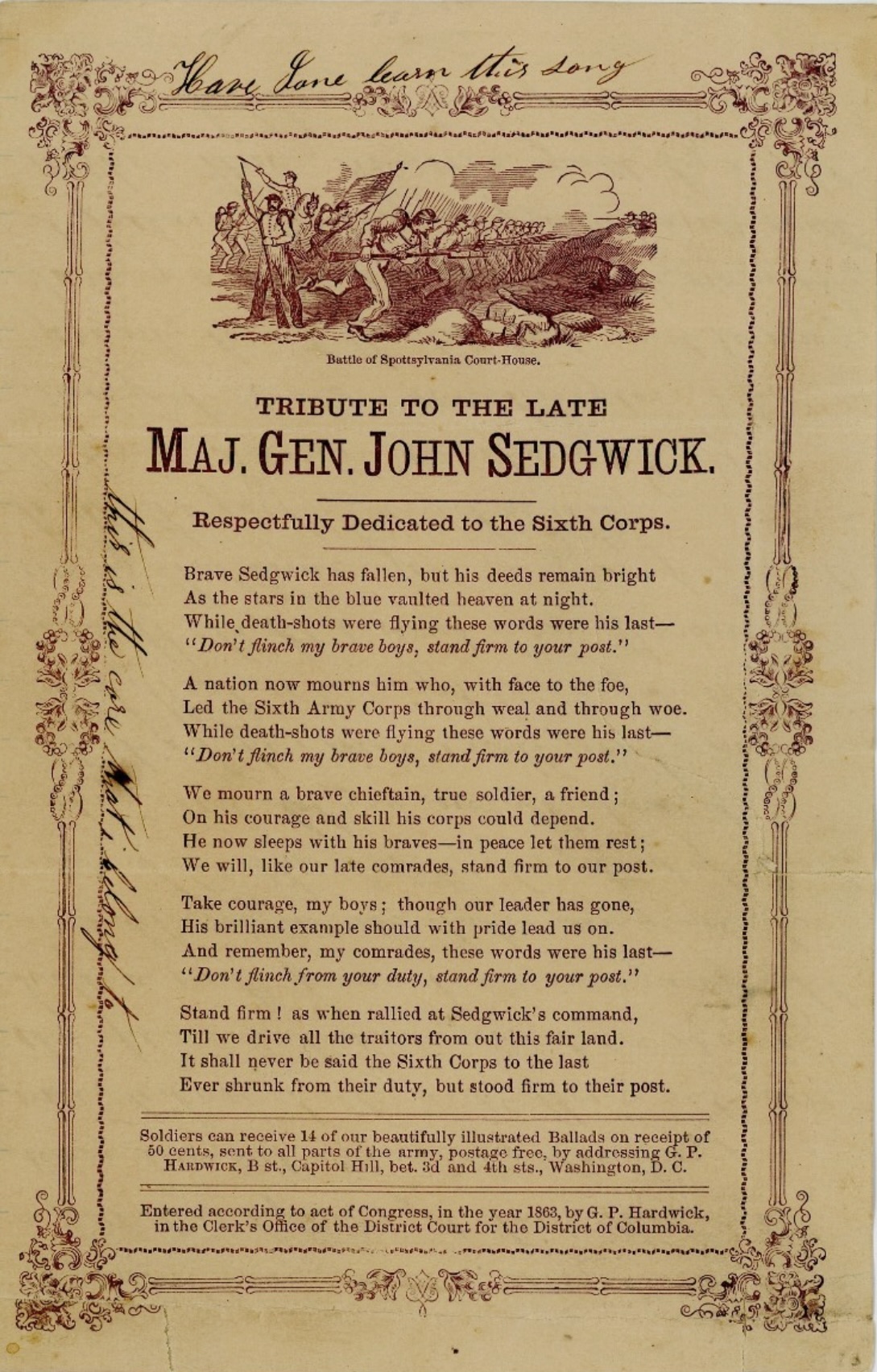
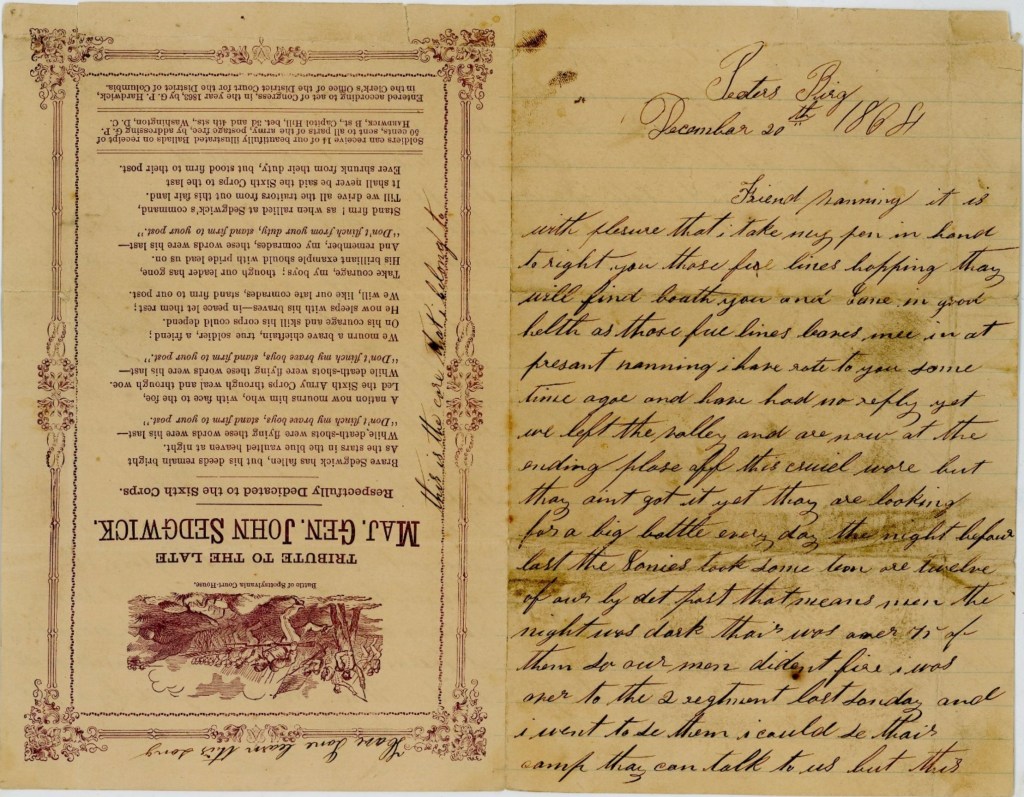
William’s letter was written on stationery with a “Tribute to the Late Maj. Gen. John Sedgwick” printed on it.
Petersburg December 20, 1864
Friend Nanning,
It is with pleasure that I take my pen in hand to write you these few lines hoping they will find both you and Jane in good health as these few lines leaves me in at present. Nanning, I have wrote to you some time ago and have had no reply yet.
We left the Valley and are nowat the ending place of this cruel war but they ain’t got it yet. They are looking for a big battle every day. The night before last the Johnnies took some ten or twelve of our outpost—that means men. The night was dark. There was over 75 of them so our men didn’t fire. I was over to the 2nd Regiment last Sunday and I went to see them. I could see their camp. They can talk to us but this is the hardest place that they have to take but their breastworks are much better than ours. If they make a charge, then we are all right. But if we make the charge, we will lose the half of our army and then get drove back. We lay right at the front breastworks so when they do make a break, we will take the front.
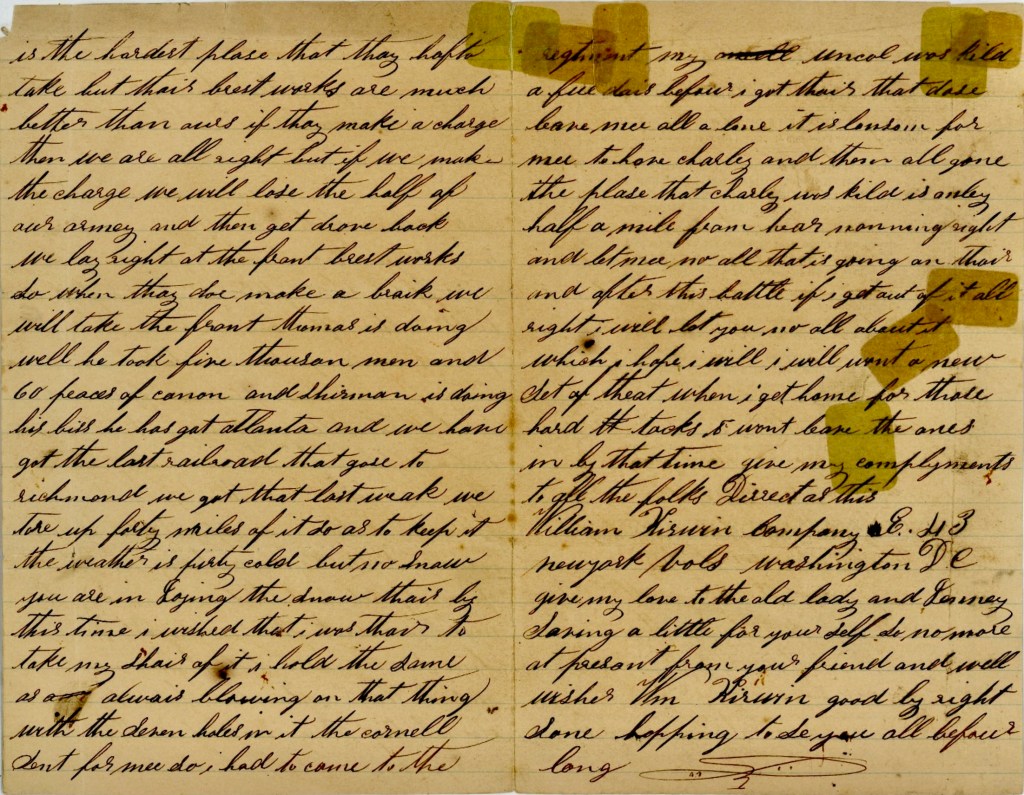
Thomas is doing well. He took five thousand men and 60 pieces of cannon and Sherman is doing his biss [business]. He has got Atlanta and we have got the last railroad that goes to Richmond. We got that lastweek. We tore up forty miles of it so as to keep it.
The weather is pretty cold but no snow. You are enjoying the snow there by this time. I wished that I was there to take my share of it.
I hold the same as always, blowing on that thing with the siren holes in it [bugle]. The Colonel sent for me so I had to come to the regiment. My uncle was killed a few days before I got there. That does leave me all alone. It is lonesome for me to have Charley and them all gone. The place that Charley was killed is only half a mile from here.
Nanning, write and let me know all that is going on there and after this battle, if I get out of it all right, I will let you know all about it which I hope I will. I will want a new set of teeth when I get home for those hard tacks won’t cave the ones in by that time. Give my compliments to all the folks.
Direct as this: William Kirwin, Company E, 43rd New York Vols., Washington D. C.
Give my love to the old lady and Jenny, saving a little for yourself. So no more at present. From your friend and well wisher, — Wm. Kirwin
Goodby. Write soon. Hoping to see you all before long.
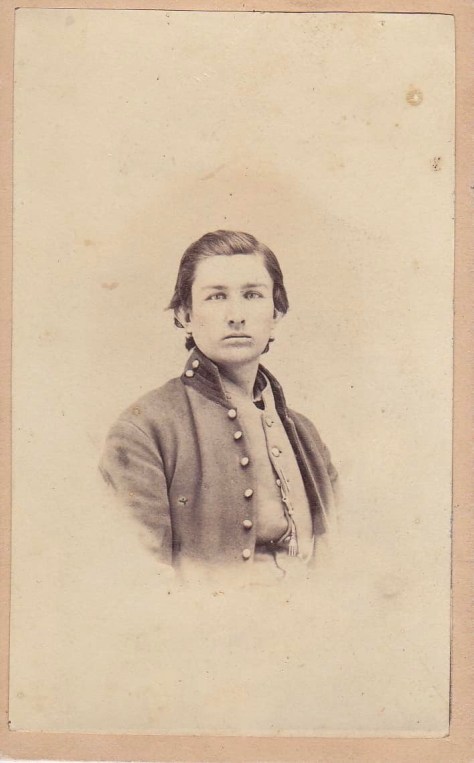
Frederick Augustus Starring, Phil Flickinger Collection
This brief letter was penned by Frederick Augustus Starring (1834-1904), the son of Sylvanus Seaman Starring (1807-1862) and Adeline Morton Williams (1809-1853) of Buffalo, New York. Fred came to Illinois in 1852 to work as an engineer on the Illinois Central Railroad. In 1856 he was living in Little Rock, Arkansas, where he served as the secretary of a railroad. He was still working in 1861 and witnessed first hand how “the secession fervor swept the South.” 1
Using the political connections of friends and relatives, Fred obtained a commission as the Major of the 46th Illinois Infantry in September 1861. In August 1862, he was promoted to Colonel of the 72nd Illinois Infantry. His complete succinct biography can be found on Wikipedia here: Frederick Augustus Starring.
Fred wrote the letter to his younger sister, Sarah Anna Starring who was born in 1846.
[Note: This letter and accompanying images are from the personal collection of Phil Flickinger and offered for transcription and publication on Spared & Shared by express consent..]
T R A N S C R I P T I O N
Columbus, Kentucky July 14th 1862
My dear Sister Sarah,
I send you two cartes de visite. They are very poorly taken, but you can cut the one for you so it will fit in your locket. I will have some better ones shortly and will send each of my dear sisters one.
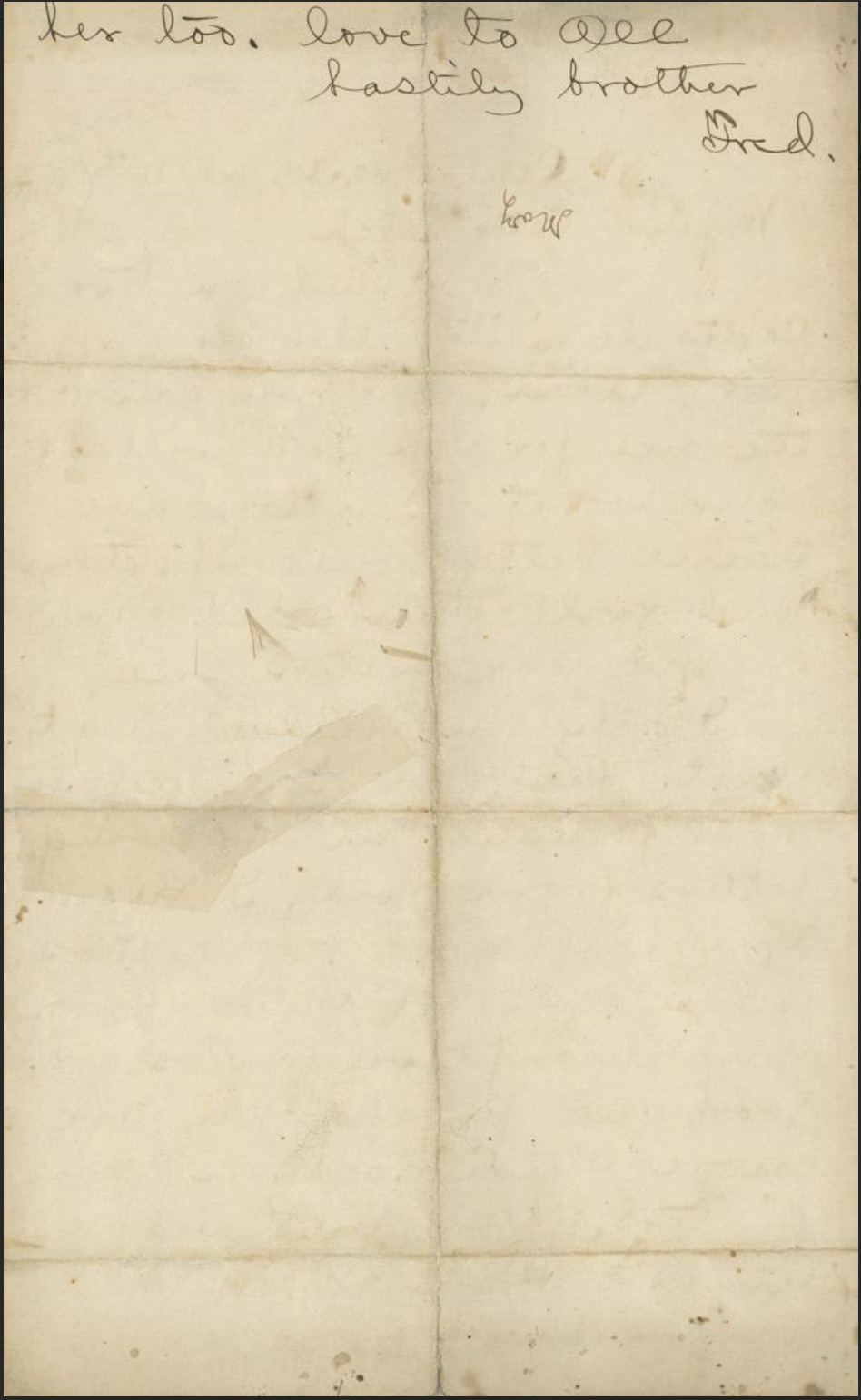
I hope you are learning to write fast for I anticipate great pleasure in receiving letters from you. I know you will write good letters when you are older for your description powers are good and perhaps you are more studious that your sisters. You must read your letter to sister Mary so it may answer for a letter to her too. Love to all. Hastily, brother Fred
1 “Bvt. Brig. Gen. F. A. Starring, Opportunist or Ideal Soldier?” by Richard K. Tibbals, Military Images, Jan-Feb 2000.
Daniel Kester, 13th Ohio Volunteer Cavalry, see Footnote 2.
The following letter was written by Wilbert Granger (1845-1904), the son of Dr. George Granger of Westfield, Morrow county, Ohio. Wilbert enlisted initially in Co. B, Fifth Independent Battalion, Ohio Volunteer. Cavalry (OVC) and then reenlisted 5 May 1864 in Co. B of the 13th OVC when the 4th and 5th Cavalry Battalions were consolidated. The regiment left Ohio for Annapolis, Md., in May and then moved to White House Landing, Va. where they soon joined Grant’s Overland Campaign. According to his obituary, Wilbert “participated in all the battles in which his regiment was engaged. In one battle he received an injury which resulted in partial deafness and at the Battle of Dinwiddie Court House he received a wound in his left shoulder” that troubled him the remainder of his life. He was married in 1867 to Mary A. Olds and lived out his days in Olathe, Kansas.
Gilbert wrote this letter on 29 July 1864, the day before the mine explosion that initiated the Battle of the Crater in which the 13th Ohio Volunteer Cavalry were only partially involved. See footnote 2.
T R A N S C R I P T I O N
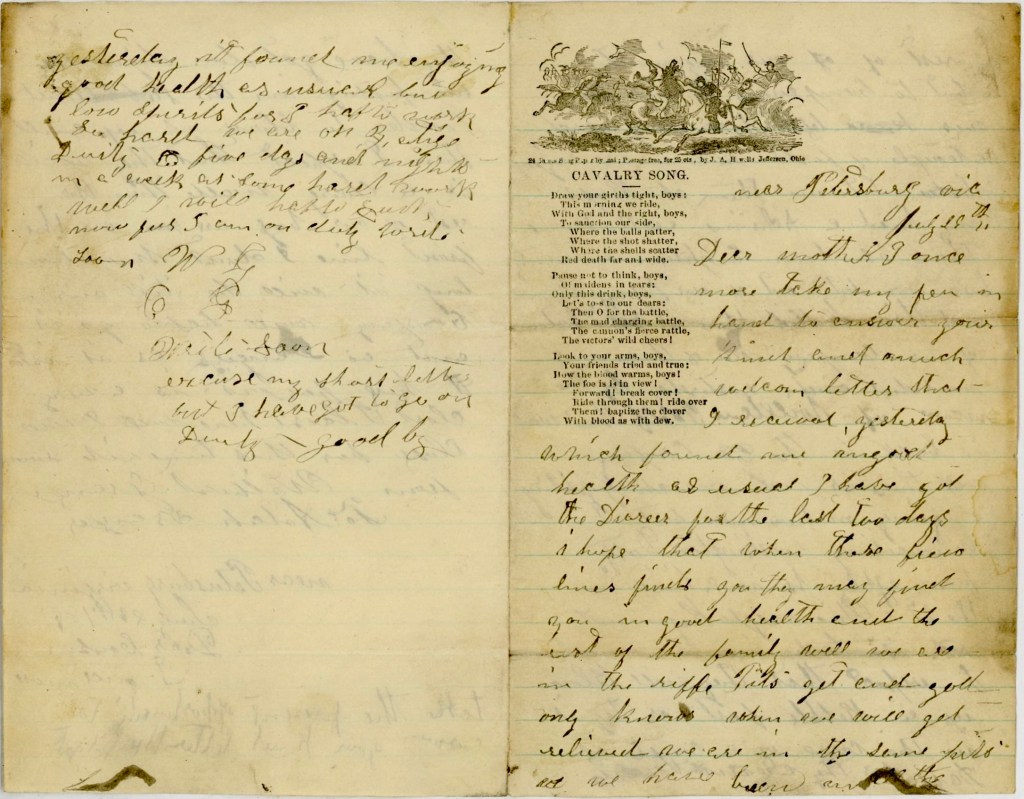
Near Petersburg, Va. July 29th [1864]
Dear mother,
I once more take my pen in hand to answer your kind and much welcome letter that I received yesterday which found me in good health as usual. I have got the diarrhea for the last two days. I hope that when these few lines find you, they may find you in good health and the rest of the family well.
We are in the rifle pits yet and God only knows when we will get relieved. We are in the same pits as we have been and all the rest of our regiment but two companies—B and H—was left here to guard a couple of forts here. We are laying between them. It keeps my head aching all the time.
There has been eighteen or twenty been wounded out of our regiment and three killed. There is three out of our company. One of them was wounded yesterday by the name of William Wolf. Bill Ward is back to the company.
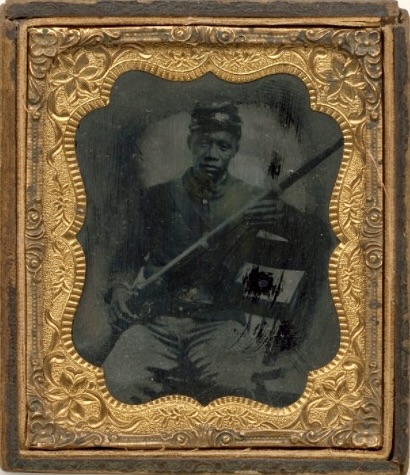
Sgt. Qualls Tibbs, 27th USCT
Well, there is not much fighting a going on here now but I have been visiting [George] Washington Doty from Ashley. He is a [1st] Lieutenant in [Co. G of] the 27th Ohio Negro Regiment and is back in the woods. 1 I expect that they will blow up a Rebel fort or try it in the course of a couple of days for they are most ready. They have got done digging. They are putting in the powder to blow it up. Then I expect that there will be a charge made then.
The rest of our boys are on the front line. I don’t know how long it will be till our company will have to go it and as dangerous as it is, I have forgot it is a very close place here. Well I now close for this time. Write soon. From Wilbert Granger
To Adah Granger
Near Petersburg, Virginia, July 28th, 1864
Dear cousin, I once more take the present opportunity to answer your kind letter that I got yesterday. It fond me enjoying good health as usual but low spirits for I have to work so hard. We are on fatigue duty for five days and nights in a week at some hard work. Well, I will have to quit now for I am on duty. Write soon. — W. G.
Excuse my short letter but I have to go on duty. Goodbye.
1 The 27th USCT was the second black regiment organized in Ohio. The state government of Ohio was slow to organize black regiments and the first African Americans from the state to join the Union army from Ohio were those who enlisted in the 54th Massachusetts in the early months of 1863. The 27th was not organized until January of 1864. It participated in the Overland Campaign guard supply trains and did not experience its first real combat until the Battle of the Crater. Because it was one of the last Black regiments to enter the battle, it did not suffer as many casualties as the other Black regiments.
2 The 13th OVC and the Battle of the Crater: “Through July 29, 1864 the men of the 13th Ohio would be engaged in direct, position to position line fire. Most of the wounds received would be to men who were unlucky enough to break their cover, and a good number of the dead were the result of disease. The harshness of the campaign would take a visible toll on the men, their appearance from when they first moved out on the march until now differs substantially. They are now dirty, their clothes are ragged and torn, hair is a mess, and to make matters worse most of the food was bad. Their hardtack was infested with bugs, a problem that was solved simply by dipping it in hot coffee, forcing the bugs out. Their meat had turned rancid and the water used for drinking and cooking was gathered from contaminated sources from the battling raging around them, yet the men would still report that they were generally a jolly set of men. Most of the men had not washed their shirts in over a month at this point.
Sometime during July 29, 1864, the men received orders to leave their positions and return to the rear. A chance would finally be granted for them to clean up, and they received word that The Christian Commision had sent them a large shipment of canned fruit, red herring, tobacco and bandages. Around 2 a.m., on Saturday July 30,1864, the men would hear the troops that they thought were coming to relieve them approaching. When the men of the 13th Ohio could see them, to their surprise, they were equipped with bayonets fixed on their rifles. The boys of the 13th Ohio asked, “What’s up?” And they were met with the reply of “Don’t know, but guess we’re going to make a charge. The 13th Ohio Volunteer Cavalry Regiment poured out of their breast works, formed a column, and moved to a depression in the bluff towards an open space that sloped and ran up to the breast works. Here in the predawn darkness, the boys could see a large body of troops from other Union units, they now knew for sure they were to make an assault.
During the time the boy of the 13th Ohio Volunteer Cavalry Regiment manned their positions across from Elliots Sailent, Colonel Pleassants and of his men (the 48th Pennsylvania Regiment, composed mostly of men who had worked in the coal mines), had done what they knew best. They dug a tunnel that reached all the way under the confederates position, they excavated two or three rooms at the end of the tunnel and rolled barrels, totaling approximately 8,000 pounds of black powder, into said rooms and ran a fuse back to the mouth of the makeshift mine. Colonel Pleassants would light the fuse at approximately 3:15 a.m. but due to a malfunction at the fuse splice approximately halfway through the tunnel, he would have to crawl back in and relight it from that point. It would finally go off right after sunrise, the ground could be felt rumbling as dirt, dust, smoke and a 200 foot fireball could be seen coming from Elliott’s Salient.
Leslie’s First Division was to spearhead the attack. Meanwhile Potter’s Second Division (on the right side), and Willcox’s 13th Ohio (on the left side) followed directly behind. The men watched as the explosion blew Confederate soldiers into the air, and in some cases to pieces. Due to a last minute change of personnel, prior the attack, it was approximately a full ten minutes before the assault commenced, but the surrounding forts opened up every gun aimed at the Rebel positions immediately. The 13th Ohio Boys watched as cannon balls and other heavy ammunition bounced off the ground and through the enemy. During this the Union men receive the order to move forward over their breast works. They fought through all of the carnage going on in the air until they were forced to lay down in a covered position approximately halfway between their original positions to the “crater”.
After the firing let up just a little bit the Union men were able to advance on the crater. What they found were horrors they could not imagine. The bodies of horses, wreckage of gun carriages and half bodied rebels, some still alive and begging for help, littered the ground. The crater, which was no more than the result of the black powder explosion the Union Army let off, was a hole approximately 150 feet long, 60 feet wide and 30 to 40 feet deep.
As it took more time than originally thought, by the time the assault force of The Union Army reached the lip of the crater, the surviving Confederates soldiers had a few minutes to compose themselves and line up along their top ridge of the crater. As the Union soldiers (approximately 2,000) entered the crater, the Rebels had a turkey shoot, picking off the men who were piled up in the confusion inside of the hole, as well as directing artillery directly into the crater. A large group of approximately 300 Union Army troops stood at the base of the edge, staring up at the Rebels, and firing to hopefully help defend their comrades towards the opposite end of the crater.
Some small groups that were able to escape the crater and flank to the right engaged the Rebels directly at their lines. Engaging in very close hand to hand fighting, the Union troops drove the Rebels back for several hours until another group of rebels reinforced their men and drove the Union Soldiers back to the East for good.
The battle would rage on until approximately 3 p.m. on August 1, 1864, when the men reached a ceasefire. It would be a technical Confederate win, resulting in 3,798 Union Casualties. 1,413 were missing or captured, 1,881 would be wounded and 504 would be killed. Sometime during this carnage of “The Battle of The Crater”, Daniel Kester would receive a bullet wound to his left shoulder in which he would later succumb to, most likely due to blood loss. Many of the men of the 13th Ohio Volunteer Cavalry Regiment could be identified only by their distinctive cavalry jackets.
It is not known with 100% certainty where the mortal remains of Daniel Kester are buried. Due to the lack of a publicly recorded grave site, it is believed that he is buried in the Civil War Unknowns Memorial, located in Arlington National Cemetery, along remains of over 2,100 other soldiers who were not able to be identified after the hostilities of The Civil War ended.” [Source: Mid Ohio Military Collection: A Traveling Museum Exhibit’s Post]
This letter was written by Philo E. Ruggles (1843-1863), the son of Noble O. Ruggles (1807-1892) and Sarah Shoens (1824-1890) of Syracuse, Onondaga county, New York.. Philo and his younger brother William Eugene Ruggles (1844-1907) served in Co. B, 122nd New York Infantry. Philo was a sergeant and William was a private. In the Battle of Rappahannock Station, on 7 November 1863, Sgt. Philo Ruggles was killed instantly by a shell fragment that hit him in the head when it exploded in the ranks.
Philo’s letter was written on stationery with a song published by James D. Gay entitled, “When This Cruel War is Over.”
T R A N S C R I P T I O N
Camp on Picket near Warrington, Va. August 28, 1862
Dear Father and Mother,
We received your letter yesterday morning and it found us all well and in good cheer. We have been on picket six days now. I do not know how long we shall stay here. I had rather be here on picket than in camp and if we were in camp we would have to drill this warm weather. Now we do not have to drill—only stand guard nights and keep watch for guerrillas and if we can catch them, bring them into headquarters. We are driving them out the way pretty fast. We send out a patrol guard everyday for to pick them up. We have bread and milk most every meal. We have [to] pay twenty-five cents a canteen full of two quarts. It is pretty dear but we have it when we can get it. We draw rations of soft bread two or three times a week, dried apples, beans, rice, molasses, black tea, once in a while. I must close. I cannot think of any more to write about this time so I shall have to close. With my love and best respects to all inquiring friends. From Sergt. Philo E. Ruggles.
Dear Father & Mother,
I now take my pencil in hand to write too. We are all well and kicking. We have fun halting the big officers. We make them show their passes all the time they go through our lines. It is 3 o’clock, The drums is beating for church. I am growing so fast that you won’t hardly know me. Tell the folks to write to me. I don’t hear half of the news. Tell Tom Shoens to write and John Shoens to write. Give my love to all. — William E. Ruggles
An unidentified 1st Lieutenant in Confederate Uniform (Rees, Richmond, LOC)
John W. Lewis was born October 8, 1837, in Virginia. Following graduation from Virginia Military Institute in 1859, he was hired as drill master and professor of mathematics at St. Johns’ College, Little Rock, Ark. When the school closed after the outbreak of war, Lewis returned to Virginia to enlist in the army.
On August 19, 1861, Lewis was commissioned as an officer in the 52nd Virginia Infantry. Promoted to 1st lieutenant on December 2, 1861, he was wounded at the Battle of Port Republic, Virginia, June 9, 1862. In October 1862, he was promoted to captain and ordered to report to Major General T. H. Holmes, commander of the Trans-Mississippi Department at Little Rock.
From the fall of 1862 until the end of the war, Lewis served as assistant adjutant general with various commanders in Arkansas, including Major General T. C. Hindman, Brigadier General D. M. Frost, Major General Sterling Price, and Major General J. B. Magruder. He was at the headquarters of the District of Arkansas in Camden when this letter was written. By the end of the war, he had been promoted to major.
Lewis remained in Arkansas following the end of the war, and on January 18, 1866, he married Laura Crease, one of seven daughters of John H. and Jane Crease of the Collegeville area near Little Rock and sister of Mrs. Cara Peyton. The couple had two daughters and was living in Miller County, where John kept a grocery store, at the time of his death in February 1882. He and Laura, who died in 1889, are buried at Mount Holly Cemetery in Little Rock.
T R A N S C R I P T I O N
Camp near Bunker Hill October 25th 1862
Dear Father,
I have been expecting to get off every day for the last month or I would have written to you immediately after the Battle of Sharpsburg, but it seems I am doomed to be disappointed as my orders have never come. I was in all the last battles—at Manassas for five days, at Harpers Ferry, and at Sharpsburg. But thank God, I escaped without a scratch. We had some terrific fighting I think at this place where we fought. We fought and whipped at least four to one. I never saw such a slaughter. We did not stand and fire at all—advanced on them all the time and charged them three times. We also made a charge on them at Manassas and drove them from behind a railroad bank. From what I can hear we met with a reverse at Shiloh [Corinth] but gained a decided victory at Perryville, Kentucky. I hope this is about the winding up of the war. The Yankees seem slow to advance up this way.
We were down near Harpers Ferry all this week tearing up and destroying the Baltimore & Ohio Railroad. We destroyed about twenty-five or thirty miles. They did not molest us in the least. I have no idea what will be the next move. It may be going on now but I don’t know anything of it. I heard today that Gen. Longstreet was moving through Winchester towards Front Royal.
I have just received a letter from Uncle Jim Crawford saying he had sent you my letter. I have thought it very strange that I did not hear from home. I have not heard a word from anyone of the family since I left Gordonsville. Tell the girls they must write to me. Someone told me that they saw Jasper in Staunton a short time since.
John Brown Baldwin (11 January 1820–30 September 1873), attorney, member of the Convention of 1861, member of the Confederate House of Representatives, and Speaker of the House of Delegates, was born in Augusta County, the eldest of three sons and third of six children of Briscoe Gerard Baldwin and Martha Steele Brown Baldwin. To the dismay of many old Democrats and advocates of secession, Governor John Letcher appointed Baldwin inspector general of volunteers. On 19 August 1861 Baldwin became colonel of the 52d Virginia Infantry. He served briefly in the mountains of western Virginia but suffered a physical breakdown and resigned on 1 May 1862. Thereafter he was colonel of the Augusta County militia, and although he was called into the field several times, he saw no further action. While still recuperating, Baldwin was elected to the Confederate House of Representatives on 6 November 1861. He defeated Letcher in May 1863 to win reelection and served in Congress for the duration of the war.
Col. [John Brown] Baldwin wrote to me last month saying I have been promoted and assigned to duty on some General’s staff in Arkansas and would get my orders from the Secretary of War soon. I have been anxiously waiting for them. When they come, if at all, I will take time to pay you all a visit before I go to Arkansas. I sent my horse up to Uncle Linus’ and have been taking it afoot ever since.
I don’t even know where to direct my letter. First I heard you were living at Green Valley but I seen William Burger here last week and he told me you were not but thought you were at the Warm Springs. I hope you will make arrangements to get what salt you need while the works are open. If I could have gotten things home from Manassas & from Maryland, I could have gotten a great many things that would have been very useful.
Father, as horses are now very high—as is everything else—I think it advisable that you should sell any you may have to spare and pay all your debts. There is my horse, Red Wing, will bring $1000 or maybe $750, and there must be many things there of little value to you that would bring a good price. I should like to see you clear of debts. It is my opinion that when the war ends, the man who is out of debt is the best off. In case anything should happen to me, you will place all my land certificates in the hands of Mr. William Woodruff of Little Rock, Arkansas. And I have some two or three hundred dollars deposited with Uncle Ben [?], all of which with what I have elsewhere I want Jasper and the girls to have if anything should happen to me, which I hope and pray will not.
Give my best love to the girls. Tell Mat & Sallie I will soon want socks. With that exception, I am very well off for clothing. Tell them all to write to me. If you have any leather suitable for making boots, I wish you would save me enough to make me a pair when I get home. I did intend writing to you some time ago to send apples to Albert Fossett and get him to make me about five gallons of brandy but suppose it is now too late. Apples are selling here for 75 cents per dozen.
My love to Jasper when you write to him. Tell Kate to save and sell everything she can. Soap is commanding a fine price. My love to all. May God shield, protect, and bless you all is the prayer of your devoted son, — John W. Lewis
The following letter was written by William D. Chamberlin (1842-1881), the son of John Chamberlin (1818-1883) and Martha J. Biggs (1819-1883) of Cashtown, Adams county, Pennsylvania. He wrote the letter to Margaret (“Maggie”) A. Carpenter (1845-1880) with whom he married in October 1869. Co. K, 87th Pennsylvania Volunteers. His grave markers gives his surname as Chamberlin though he was carried on the muster rolls of the regiment as Chamberlain.
T R A N S C R I P T I O N
William’s letter was written on stationery printed with poem, “Old Jeff as Miss Dixie” by R. B. Nicol.
Camp near Bailey’s Cross Roads, Virginia June 9th 1865
Good evening Maggie,
I am reasonably well, thank you. How are you prospering? Your favor of the 23rd ult. came to hand a few days ago, and met a welcome reception. I was very busy today. I am now engaged as clerk at Regimental Headquarters and have a considerable amount of work on hand just now. But as it is now 9 o’clock, I have taken the liberty to put the other papers to a side and devote a few moments to the agreeable task of answering your letter. I received the note you sent me just about the time we wrestled starting on the march from Richmond to this place. I knew you would certainly receive my letter—hence I didn’t answer the note. I am inclined to think you were not in a very good humor when you wrote it. Well, I can’t censure you for it after having waited so long for an answer, but I presume you have already forgiven me. You know full well that it is almost impossible for a soldier to be punctual with his correspondents at all times—especially it he has a goodly number. He has a great many other duties to perform and they demand his attention first.
Your thoughts concerning the “Locust trees” are very good. It calls to my mind scenes around my home that I often looked upon with delight about this time of the year.
William’s letter included a cdv of Jeff Davis in ladies clothes being taken captive by Union Cavalry. Two black infantrymen look on in the background.There were numerous variations on this theme but this is the only one I have seen of this view.
I should like to hear your sermon on the flight of Jeff Davis. I have been thinking you would probably make an appointment in the neighborhood for that purpose. Hence I have selected a piece of music with appropriate lines for an occasion of that kind which i will place at your disposal. What do you think of it? Pretty good, eh?
I understand you had quite an assemblage of people at the meeting in the grove on the 1st of June. It would have been very gratifying to me to have met with the rest of you. Such, however, could not be the case.
Well the Grand Review of the 6th Corps is over. No doubt the idle curiosity of a great many people has been gratified, but it cost the lives of quite a number of good soldiers—some no doubt who have served faithfully for three years. There was scarcely any air stirring in the streets of Washington and som of the streets were clouded with dust. The day was very warm and there was hundreds to be seen through the city on the sidewalks who were overcome with the heat and had fallen—some to rise no more. I was along but had no gun or accoutrements to carry. Sometimes I thought I would fall too. Our Corps, I noticed, receives great praise in the papers. 1
This evening when our regiment was on “Dress Parade,” the Colonel complimented the boys for their good behavior and fine marching in the City yesterday. Our camp is about fives miles from Washington on the Virginia side of the Potomac. The troops are being sent home as rapidly as possible. As yet, there has been no orders to muster out troops who entered the army last spring but I presume there will be such orders issued as soon as they get those mustered out who come under the first order from the fact that they are mustering out all of our sick men.
I will not get angry at you for threatening to box my ears. Talk about it as much as you have a mind to, but I would like to see you carry it into execution. If you would attempt it, I’ll bet I would have a k–s. Oh! I almost forgot myself. Well, as you say, you often think on paper so I will come in with that idea too. If you would or could see me now, you would see as much of a dash on my face as there is between those two letters up there. After all, I can’t see any harm in the expression, “Worse half.”
You say “A candid confession as good for the soul.” Now tell me why you were angry when you came to that part of my letter when I said, “Who will have me?” You ask why I don’t correct faults that I may notice in you. The fact is I have not noticed any of which to accuse you or correct in you. Will that do? As you are getting weary of this scribbling. I will close and go to my bed such as it is on the ground. Let me hear from you soon again. I have the honor to remain very respectfully your friend, — Wm. D. C., Co. K, 87th P. V., 1st Brig., 3d Division, 6th Corps, Washington D. C.
P. S. Please remember me to all of your folks, — Wm. D. C.
1 There was a separate review of the 6th Corps on 8 June 1865. THE CLOSING PAGEANT OF THE WAR.; Grand Review of the Sixth Corps by the President and Gen. Meade. The War-Worn Veterans Make a Splendid Appearance. They are Greeted Everywhere with the Greatest Enthusiasm. Reconstruction in Alabama A Rather Startling Demand. Military Re-union of the 14th and 20th Corps. Speeches by Gens. Howard. Slocum and Others. REVIEW OF THE SIXTH CORPS. WASHINGTON, Thursday, June 8. Published: June 9, 1865 The dusty veterans of the Sixth have a proud record. The colors are for too small for the inscription of the names of all their battles, and there are hundreds of officers and men who have been under fire a round hundred times. The corps was first brought into existence by MCCLELLAN, at Cumberland Landing, on the Pamunky River, in May, 1862, when it was styled the Sixth Provisional Army Corps, and Maj.-Gen, W.B. FRANKLIN assigned to the command. The corps has graduated some splendid soldiers, foremost among whom stand the lamented SEDGWICK, the indomitable HANCOCK, who was present today, and again looked upon the fragments of the brigade that he so vigorously disciplined at Camp Griffin, in the Winter of 1861-2; “Baldy” SMITH, whose features were once so inseparable with the corps, and DAVIDSON, whose Trans-Mississippi cavalry campaigns have been so successful; and BROOKS, now out of the service, but once a pet of the Vermonters and a gallant officer: young VINTON, badly wounded at Fredericksburg; BURNHAM, the valiant son of Maine, who fell at Fort Harrison; RUSSELL, killed in the very hour of victory, at Cedar Creek, in the valley; BIDWELL, giving up his life just after receiving his hard-earned star; and many others gone, now forever, whose memory is renewed most vividly as the veterans of the Sixth pass by. The term “SHERIDAN’S heavy cavalry” was applied to the Sixth Corps by some one who had a singularly correct idea of its significance, for the must brilliant victories of the valley were those in which the “heavy cavalry” came vigorously to the support of the “light cavalry,” and which, on the 19th of October, under the inspiring presence of SHERIDAN himself, wrested victory from the very jaws of defeat, and which again, in the final rout of LEE, overhauled, defeated and captured the rear guard of EWELL, and sent to the rear ten thousand prisoners, innumerable flags and cannon, and half a score of Major-Generals. So, if the Sixth Corps marched to-day with a vigorous step and proud spirit, they were entitled to do so by all that goes to make valiant and victorious soldiers. http://www.nytimes.com/1865/06/09/n…sident-gen-meade-war-worn.html?pagewanted=all
The following letter was written by Francis M. Pressley who mustered into Co. E, 10th New York Heavy Artillery in early August 1862 at Henderson, New York. Soon after he was transferred into Co. A.
His muster records inform us that he was born at Sandy Creek, New York, and that he was an 18 year-old laborer when he enlisted. He was described then as standing 5′ 7″ tall, with blue eyes and light hair. He mustered out of the regiment at Petersburg on 23 June 1865.
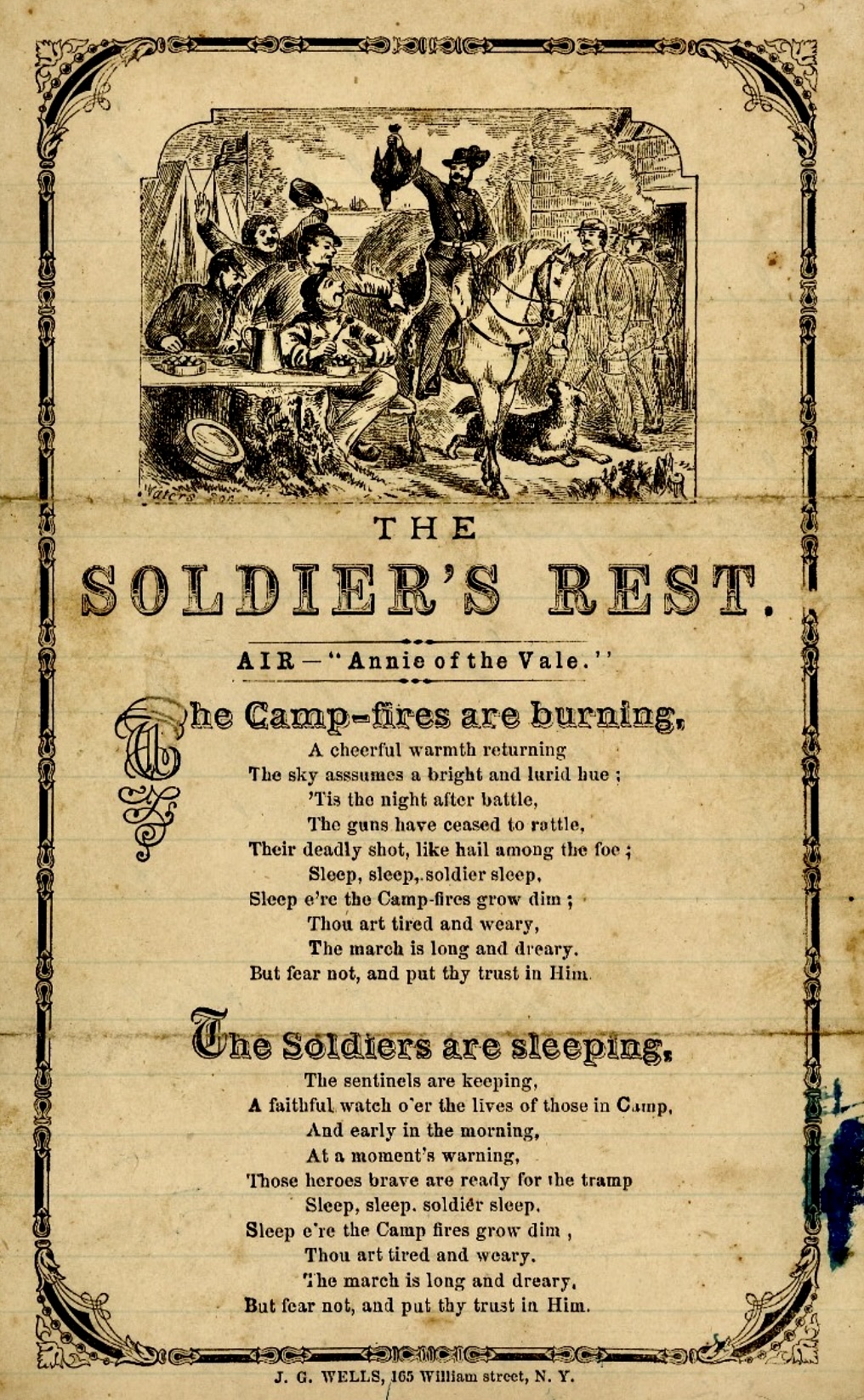
Francis’ letter was written on stationery entitled “The Soldier’s Rest” which had two poems—-“The Campfires are burning” and “The soldiers are sleeping.”
T R A N S C R I P T I O N
Fort Richmond [Staten Island, New York] March 6, 1863
Dear Friend,
It is a willing hand that sits down to answer your ever welcome letter that I received the 24th of last month. I was glad to hear from you. Your ever welcome letter came to hand in due time.
I think you must have enjoyed yourself very well the day that you and Francis went a visiting. I should like to have been there to went with you. I think that I could enjoyed myself well, don’t you? But I han’t been very lonesome yet for I think that if noise will prevent it, that we shan’t.
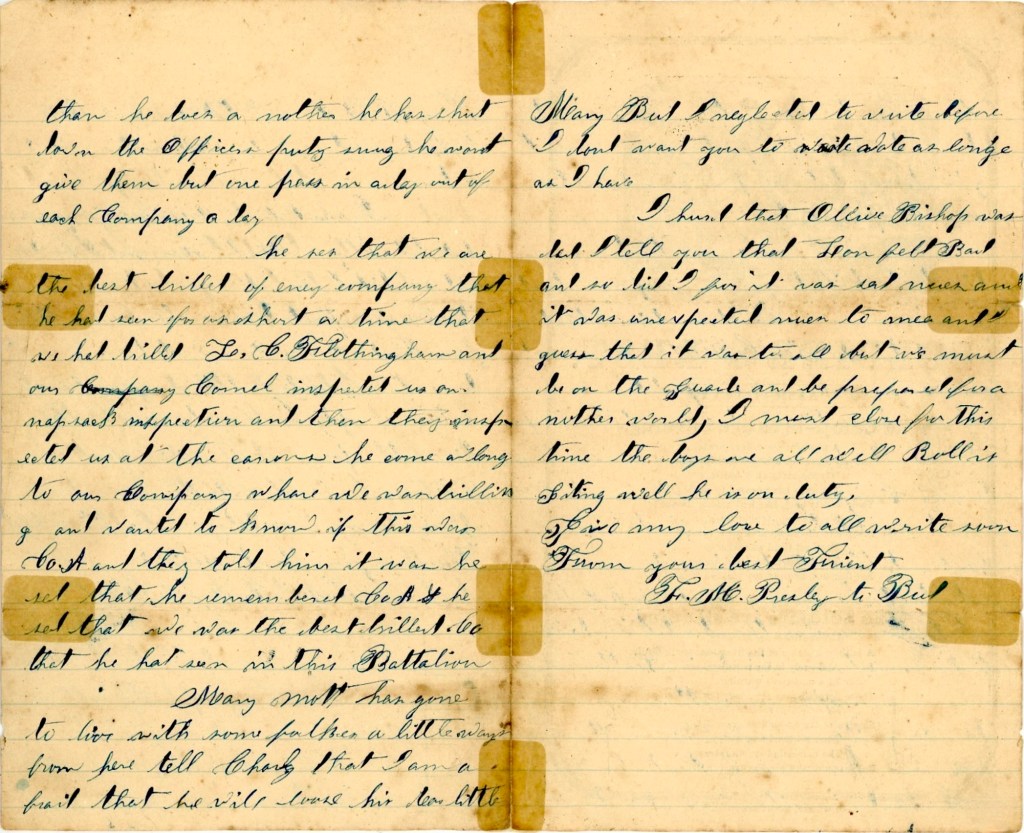
L. C. [Lieut. Col.] Joseph Spratt is our Colonel now. He is just the man for this place. He is very strict and he don’t favor anyone more than he does another. He has shut down the officers pretty snug. He won’t give them but one pass in a day out of each company a day. He says that we are the best drilled of any company that he had seen for as short a time that we have drilled.
L. C. [John Bradbury] Frothingham and our Colonel inspected us on knapsack inspection and then they inspected us at the cannons. He come along to our company where we were drilling and wanted to know if this was Co. A and they told him it was. He said that he remembered Co. A & he said that we was the best drilled company that he had seen in the Battalion.
Mary Mot has gone to live with some folks a little ways from here. Tell Charley that I am afraid that he will lose his dear little Mary but I neglected to write before. I don’t want you to wait as long as I have.
I heard that Olive Bishop was dead. I tell you that Lon felt bad and so did I for it was sad news and it was unexpected news to me and I guess that it was to all. But we must be on the guard and be prepared for another world. I must close for this time. The Boys are all well. Roll is getting well. He is on duty. Give my love to all. Write soon. From your best friend, — F. M. Presley
The following letter was written by Peter Baggerly (1841-1925) of Savannah, Wayne county, New York, who enlisted as a recruit in March 1864 to serve in Co. G, 9th New York Heavy Artillery. He was described at that time as a 5 foot 10 inch tall, brown-haired farmer. He was wounded on 15 March 1865 before Petersburg and was transferred on 27 June 1865 to the 2d N. Y. H. A.
Peter was the son of Hezekiah Owen Baggerly (1814-1891) and Olive Dewey (1817-1902). After the war he married Margaret Sibley (1846-1930) and lived out his days in Clyde, Wayne county, New York.
T RA N S C R I P T I O N
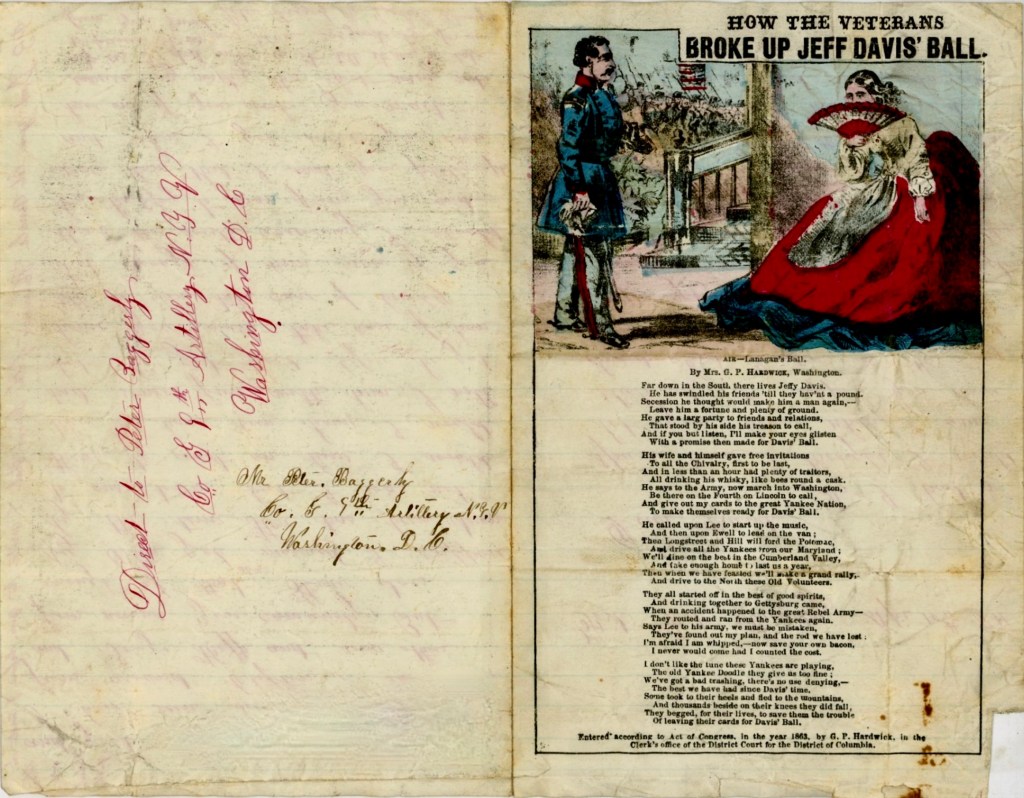
Peter’s letter was written on stationery with the poem titled. “How the Veterans Broke Up Jeff Davis’ Ball.” It celebrates the defeat of Lee’s Army of Northern Virginia at Gettysburg.
Fort Foot Sunday, April 10th 1864
Dear Friend,
As I had a spare time, I thought I would let you know where I am stationed. I suppose you have heard that I was in the army. Well I am well as usual and hope you are ditto. We are fourteen miles south of Washington on the Potomac river on a bluff about 100 feet above the river. It is a very nice place and have nice times. There is only five companies here. We have good victuals and good clean barracks and good straw beds to sleep on.
I have seen some of the boys from around Clifton. I saw Mike and George Kipp and some others from around your community. But enough of that.
How does Olin get along married? I suppose by this time he has been down to our town but I was not there to wait on him. I would like to have been home. I would had some fun with him. I will bet he got lost before he got home. You must take care of him till he can take care of himself. But enough of him.
Now if you will think this worth answering, I should be happy to hear from you and more than that, I want your photograph and when I get some, you can have one if you wish. You must excuse my writing this sheet wrong side up as I did not see it till it was too late to prevent it. Answer soon. So goodbye for now. From your friend, — Peter Baggerly
To Isabel Spangle
P. S. Don’t you let Uncle Harrison’s folks know that I wrote to you before I wrote to them or Robert’s folks.
Direct to Mr. Peter Baggerly. Co. G, 9th Artillery, N. Y. V., Washington D. C.
I could not find an image of Daniel but here is one of William W. Harding of Co. G, 11th Pennsylvania Cavalry (Union Drummer Boy)
The following letter was written by 1st Sergeant Daniel H. Schriver (1836-1864) of Co. I, 11th Pennsylvania Cavalry. He enlisted in September 1861 and was promoted from 1st Sergeant to 2nd Lieutenant on 8 November 1863. He was killed in a brisk skirmish at Flat Creek Bridge, Virginia, on 14 May 1864. At the time of his enlistment, Daniel was described as a 25 year-old, 5′ 4″ tall, black-haired saddler.
Schriver’s letter informs his brother of the evacuation from White House Landing, McClellan’s Supply Depot on the Pamunkey river in June 1862 when J. E. B. Stuart conducted his raid. He referred to him as Jackson but it was actually Stuart.
T R A N S C R I P T I O N
Williamsburg, Va. July 1st 1862
Dear Brother,
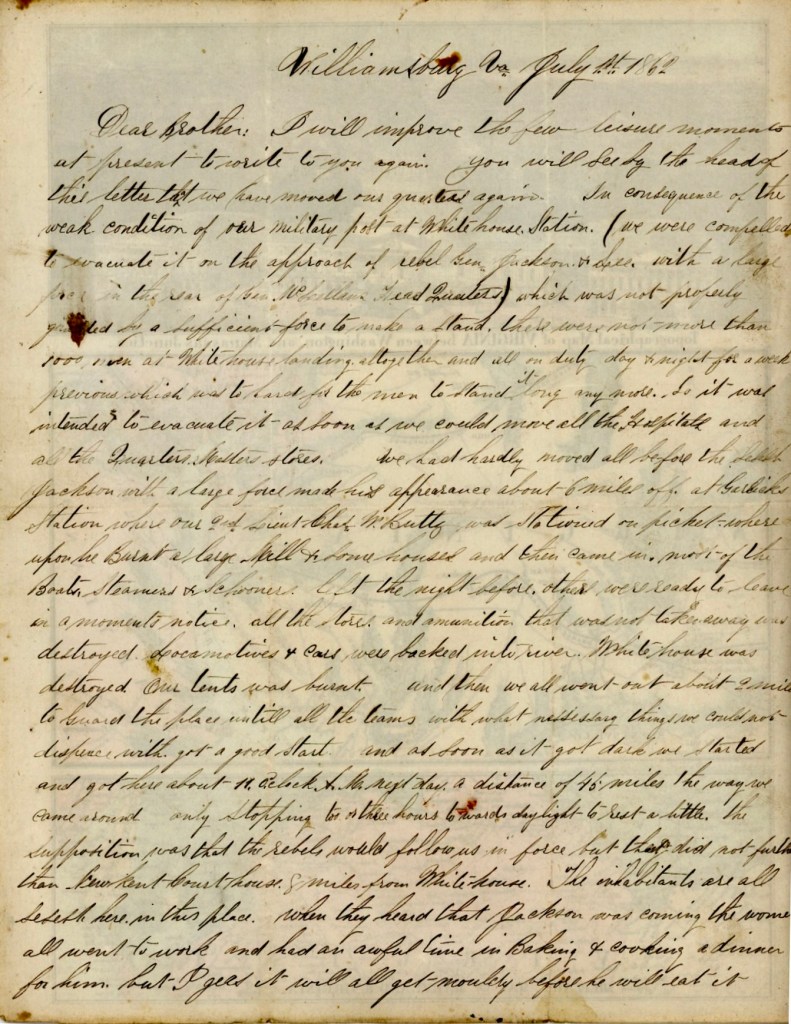
I will improve the few leisure moments at present to write to you again. You will see by the head of this letter that we have moved our quarters again. In consequence of the weak condition of our military post at White House Station, we were compelled to evacuate it on the approach of Gen. Jackson & Lee with a large force in the rear of McClellan’s Headquarters which was not properly guarded by a sufficient force to make a stand. There were not more than 1,000 men at White House Landing altogether and all on duty day and night for a week previous which was too hard for the men to stand it lone anymore. So it was intended to evacuate it as soon as we could move all the hospital and all the quartermaster’s stores.
We had hardly moved all before the Secesh Jackson with a large force made his appearance about 6 miles off at Garlick’s Station where our 2nd Lieutenant Chas. W. Butts was stationed on picket whereupon he burnt a large mill & some houses and then came in. Most of the boats and schooners left the night before; others were ready to leave in a moment’s notice. All the stores and ammunition that was not taken away was destroyed, locomotives and cars were backed into river. 1 White House was destroyed. Our tents was burnt. And then we all went out about two miles to guard the place until the teams with what necessary things we could not dispense with got a good start, and as soon as it got dark, we started and got here about 11 o’clock a.m. next day—a distance of 45 miles the way we came around, only stopping two r three hours towards daylight to rest a little.
“Burning of the White House- the Federal troops, by command of General McClellan, abandoning their position at the White House, and breaking up the commisariat depot on the Pamunkey River- departure of the Union flortilla for the James River, June 26th, 1862. The Confederate raid of Stuart’s cavalry at Garlick’s Landing and Tunstall’s Station had struck the occupants of the White House Landing with a deep sense of insecurity; and, consequently, when they received orders on Wednesday, June 25th, to prepare for the hasty removal of all the government stores, they set to work with great activity, and by Thursday the greater portion of the heavy stores were embarked on board the numerous transports lying in the river. Unfortunately, through some accident the White house took fire, and the house of Washington’s wife was soon destroyed.” — Frank Leslie, 1896
The supposition was that the rebels would follow us in force but they did not further than New Kent Court House, 8 miles from White House. The inhabitants are all secesh here in this place. When they heard that Jackson was coming, the women all went to work and had an awful time in baking and cooking a dinner for him but I guess it will all get moldy before he will eat it.
I do not think we will stay here long but where we will go to next I cannot say. But I hope not to a place where there are too few troops and so much duty to do. There sounds the bugle for sick call. I must go and see if anybody is sick enough to go to the Doctor’s 9in order to shirk duty). Excuse this scratching. I have to do it all on my knee under two India rubber blankets for tents. Yours expecting a letter soon from you, I remain your devoted brother, — Dan’l H. Schriver, 1st Sergt. Co. I
The surest way to direct your letters since we have no permanent encampment is to Camp Hamilton, Fort Monroe, Va., or to Washington D. C. and the other preliminaries and it will follow.
P. S. Enclosed you will find part of a Magnolia flower that grows wild here on pretty large trees.
1 J. E. B. Stuart’s cavalry raided Garlick’s Landing on the Pamunkey River above the railroad bridge and captured 14 wagons and some sutler’s stores, and burnt two schooners laden with forage and then headed toward Tunstall’s Station.
War Correspondent George Alfred Townsend was heading back to White House at the time of Stuart’s raid and described what he saw at Garlick’s Landing and White House when he arrived: “I remained a full hour under cover; but as no fresh approaches added to my mystery and fear, I sallied forth, and kept the route to Putney’s, with ears erect and expectant pulses. I had gone but a quarter of a mile, when I discerned, through the gathering gloom, a black, misshapen object, standing in the middle of the road. As it seemed motionless, I ventured closer, when the thing resolved to a sutler’s wagon, charred and broken, and still smoking from the incendiaries’ torch. Further on, more or these burned wagons littered the way, and in one place two slain horses marked the roadside. When I emerged upon the Hanover road, sounds of shrieks and shot issued from the landing a “Garlic,” and, in a moment, flames rose from the woody shores and reddened the evening. I knew by the gliding blaze that vessels had been fired and set adrift, and from my place could see the devouring element climbing rope and shroud. In a twinkling, a second light appeared behind the woods to my right, and the intelligence dawned upon me that the cars and houses at Tunstall’s Station had been burned. By the fitful illumination, I rode tremulously to the old head-quarters at Black Creek, and as I conjectured, the depot and train were luridly consuming. The vicinity was marked by wrecked sutler’s stores, the embers of wagons, and toppled steeds. Below Black Creek the ruin did not extend: but when I came to White House the greatest confusion existed. Sutlers were taking down their booths, transports were slipping their cables, steamers moving down the stream. Stuart had made the circuit of the Grand Army to show Lee where the infantry could follow.”
Joel Cook described what he heard about the attack on the train passing through Tunstall’s Station and the reaction at White House Landing: “There were numerous passengers on the cars, mostly laborers, civilians, and sick and wounded soldiers, and a general effort was made to jump off, and, if possible, elude the enemy’s fire. Several succeeded, and hid themselves in the wood; but the quickly increasing speed of the train prevented the majority from following their example. The cars, however, were soon out of reach of the Rebels, and the engineer, fearful of pursuit or of meeting more enemies, increased the pressure of steam so that the train almost flew over the distance between Tunstall’s Station and White House. There the news of what had occurred spread like lightning, and there was the utmost consternation among the sutlers, civilians, clerks, laborers, and negroes who inhabited the canvas town which had sprung up on the Pamunky. Lieutenant-colonel Ingalls, of the quartermaster’s department, was the officer in command, and, under fear of impending danger, he mustered the few soldiers who were at the place, and armed the civilians and laborers. He also placed all the money, records, mails, and other valuable property of the United States upon a steamboat in the river. The panic among the sutlers was beyond all description: each one expected utter ruin, and awaited, with an anxious heart, the approach of the enemy. They did not come, however, and White House, though it was so soon to be destroyed, had a short respite.” [Source: White House Landing Sustaining the Army of the Potomac during the Peninsula Campaign.]
A young Maine soldier returned home in his “long home” (casket).
This letter was written by William Evans of Media, Delaware county, Pennsylvania, the father of Thomas Evans (1844-1864) who was a private in Co. E, 197th Pennsylvania Infantry. Thomas died from “inflammation of the stomach and bowels” on 5 September 1864 at the Garrison Hospital at Rock Island, Illinois.
In his letter, William thanks Capt. Ralph Buckley of the 197th Pennsylvania for sending his son’s body home and asks him to explain the cut in his son’s neck under his right ear. This cut was presumably made by the caretaker who severed Thomas’s carotid artery to drain the blood as part of the embalming process.
T R A N S C R I P T I O N
Rose valley, Media [Pennsylvania] [September] 20th, 1864
Capt. R. Buckley—dear sir,
I return you my sincere thanks for the kindness you and your company have done to my dear son Thomas Evans and may God reward you and your company of men for their kindness to my son and me. I received his corpse on the 10th, Saturday, at 5 p.m. at the Adams Express, 4th and Chestnut. I brought him home to Media and buried him the next day. I opened his coffin and found my dear son. No tongue can tell how I felt when I saw my child. There was a cut on his neck under his right ear and it was sowed and I am much grieved about it too. What was the cause of it? Please Captain, if you know, to send me word and you will do me a great kindness.
I had my son’s death put in the papers and I have sent one to you, Captain, and some to the boys of Co. I and to the officers of Co. E, and I hope you will get them. I was talking to your mistress yesterday. She and the family are well. I got the bill of expense that you were at on account of sending my son home. I have it and may God do to you and your men as you have done to me. All I can do us to pray for you and I will do that with the help of God. Dear Captain, you can tell me if I will get his pay for the time he served?
Dear Captain, please answer this letter and you will do me a great kindness as I will be happy to hear from you and the boys. I will bring my letter to a close by sending you and the boys my kind love and may God send you safe home. — William Evans
My directions is Media Post Office, Delaware county, Pa., care of Antrim O’Horne











 Spared & Shared 23