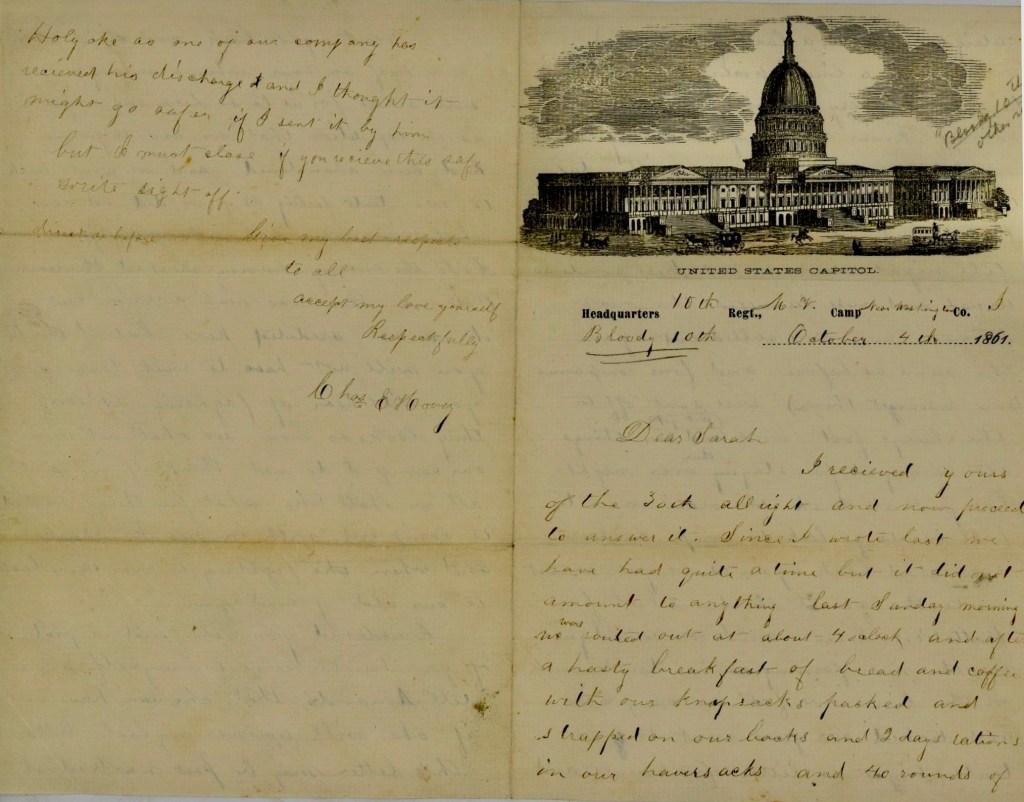
1864: Bailey Martin to Emma E. Hopkins

The following letter was written by Bailey Martin (1805-1868) who was employed as the overseer of a plantation owned by Mrs. Emma Hopkins. Bailey was raised in Kershaw county, South Carolina, the son of Samuel and Mary (Bailey) Martin, but appears to have been a resident of Mississippi prior to 1840 and possibly an overseer for the Hopkins family even at that time. The Hopkins plantation was located along the Natchez Trace east of present day Canton, Madison county, Mississippi. The slave population in Madison county just prior to the Civil War exceeded 18,000 which placed it as the third highest county in Mississippi and the 16th highest in the U. S. The plantation was sited in one of the richest farming sections of antebellum Mississippi and ideally located near the Pearl River and later near the terminus of the New Orleans, Jackson, and Great Northern Railroad, providing a means for transporting cotton from the interior of the state.

Bailey wrote the letter to Emma Goodwyn Hopkins (1808-1868) who married her cousin William Hopkins (1805-1863) in 1833 and bore him at least nine children before his death in 1863. William was the grandson of John Hopkins—a delegate to the First Provincial Congress in South Carolina in 1775. Emma was the daughter of Lieut. Governor John Hopkins. William served in the South Carolina Militia and rose to the rank of Brigadier General. General Hopkins was a delegate to the Secession Convention on December 17th 1860, which convened in the Baptist Church in Columbia. Most likely the Hopkins family never took up residence in Mississippi but managed their plantation in absentia by hiring an overseer to management investments and interests. According to a list of Madison county slaveholders in 1860, Gen. William Hopkins owned 73 slaves in Mississippi.

In his letter, Bailey mentions three slaves by name—Pender, Sas, and Ellen. I was able to find both Pender and Ellen in a post-war Freedman’s Bureau listing on the Hopkins plantation where Bailey Martin was still identified as managing the property. That list gives Pender’s age as 30 and Ellen’s as 28.
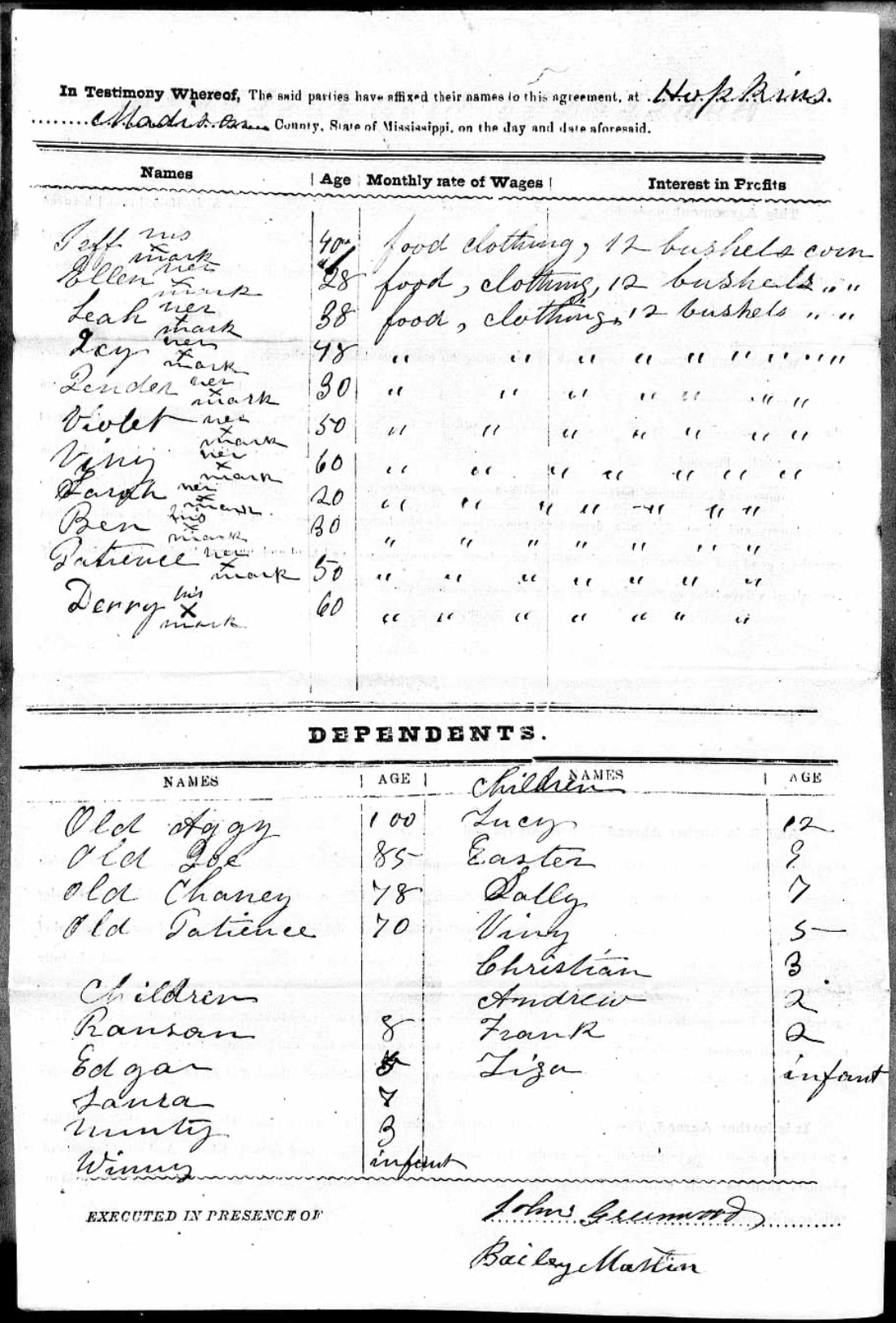
Freedman’s Bureau Records

Note: This letter is from the private collection of Rob Morgan and was offered for transcription and publication on Spared & Shared by express consent.

T R A N S C R I P T I O N
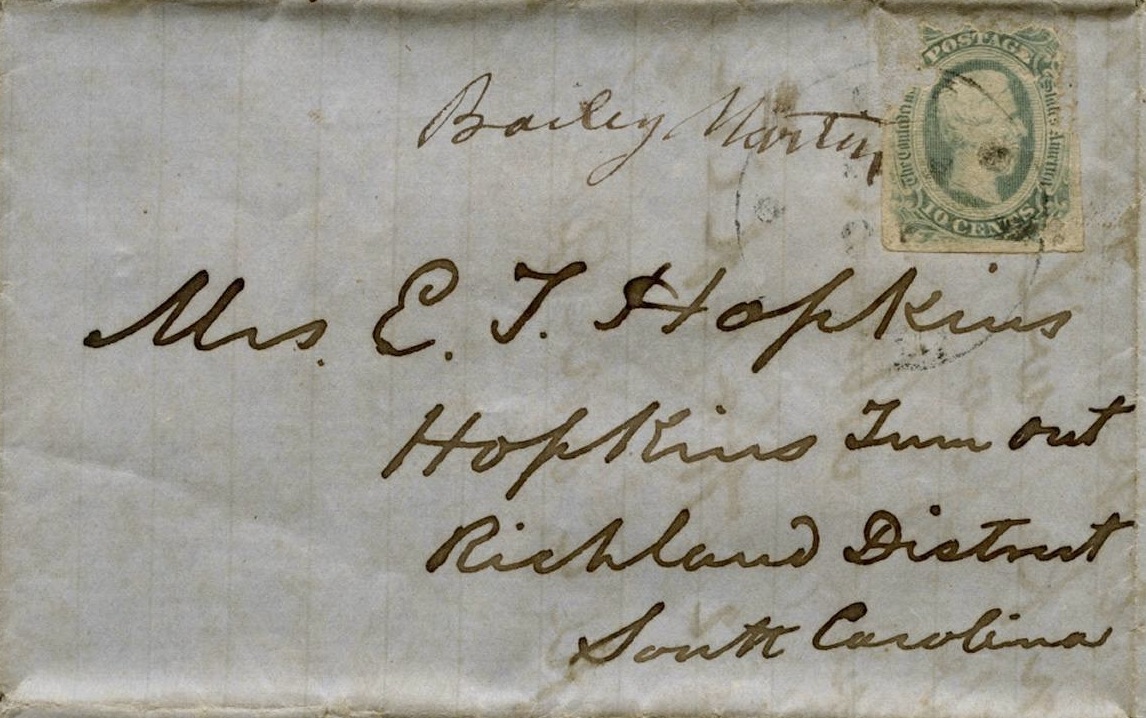
Addressed to Mrs. E. T. Hopkins, Hopkins Turnout, Richland District, South Carolina

[Madison County, Mississippi]
May 15, 1864

Mrs. Hopkins—dear madam,

Have just received yours of April the 4th. I had written three letters to you. I sent them to Alabama to be mailed as there was no mail that came this far for some time. The Yankees was above us and below us. Three miles below us at Mr. [Hugh Washington] Hayes’ [plantation] 1; above us at Mrs. Carson’s about two miles and a half from us. The people from Mr. Hays’ to Canton have lost nearly all they possess—their negroes, horses, cattle, hogs, and some their house and kitchen furniture.

I had yours back in Pearl River swamp but there is danger. Below this they hunted the swamp but the negroes generally run off to the Yankees [who] carried them to their masters’ camp. I have known the negroes to use so much deception with their masters that I have no confidence in one at all. Your negroes made no attempt to betray me but I fear them. I shall try to keep the Yankees [from] getting anything that I have in charge. I shall [try] to keep the negroes from seeing the Yankees if I can.

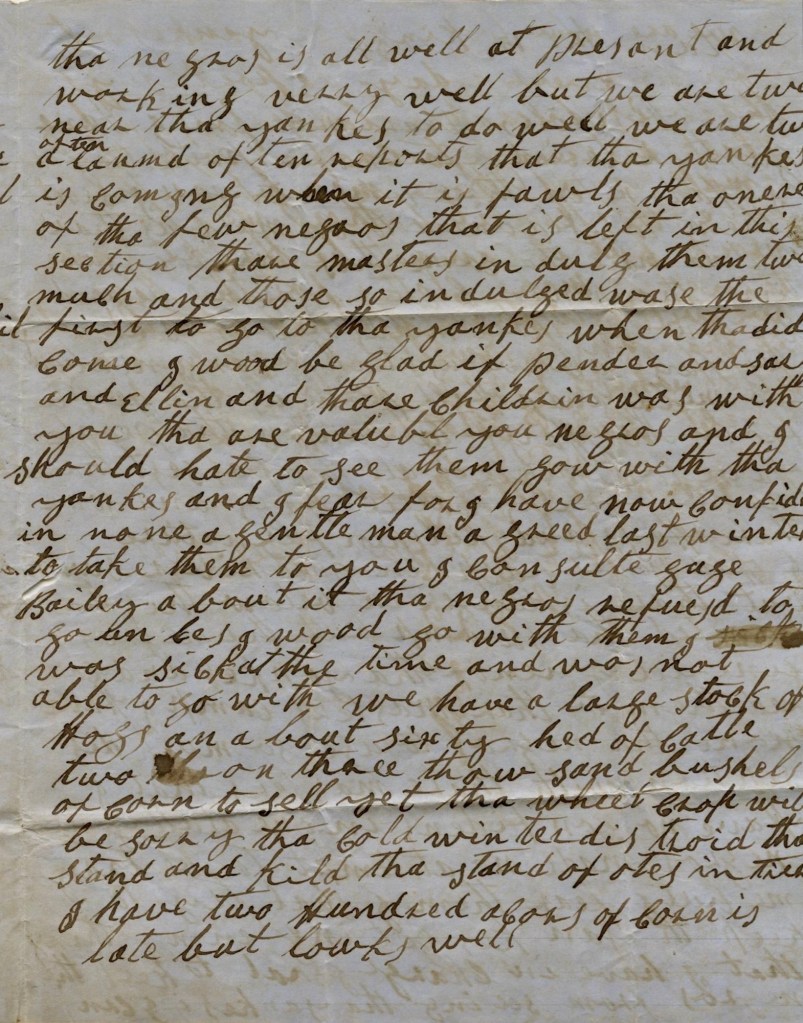
The negroes is all well at present and working very well but we are too near the Yankees to do well. We are too often alarmed. Often reports that the Yankees is coming when it is false. The owners of the few negroes that is left in this section, their masters indulge them too much and those so indulged was the first to go to the Yankees when they did come. I would be glad if Pender and Sas and Ellen and their children was with you. They are valuable. Your negroes and I should hate to see them go with the Yankees and I fear for I have no confidence in none. A gentleman agreed last winter to take them to you. I consulted Gage Bailey about it [but] the negroes refused to go unless I would go with them. I was sick at the time and was not able to go with.

We have a large stock of hogs and about sixty head of cattle, two or three thousand bushels of corn to sell yet. The wheat crop will be sorry. The cold winter destroyed that stand and killed the stand of oats in till. I have two hundred acres of corn—it’s late but looks well.

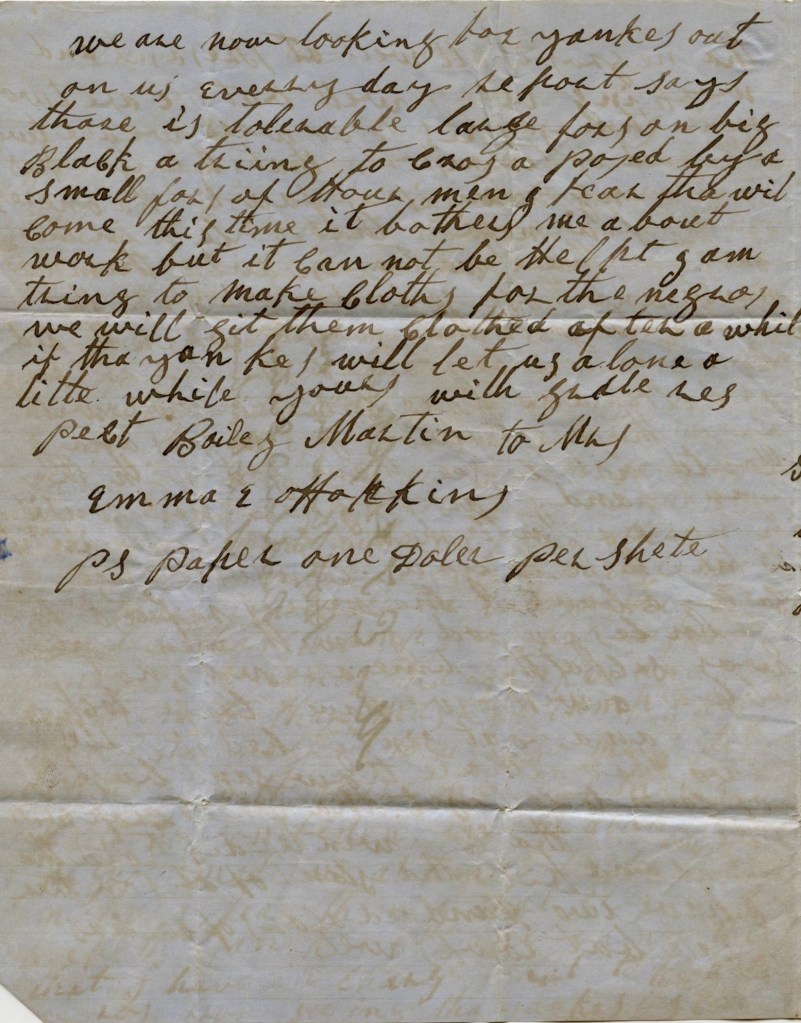
We are now looking for Yankees out on us every day. Report says there is tolerable large forces on Big Black [river] a trying to cross opposed by a small force of our men. I fear they will come this time. It bothers me about work but it cannot be helped. I am trying to make clothes for the negroes, We will get them clothed after awhile if the Yankees will let us alone a little while. Yours with [ ] respect, — Bailey Martin

To Mrs. Emma E. Hopkins

P. S. Paper [is] one dollar per sheet.


1 The plantation owned by Hugh Washington Hayes (1812-1873) was near unincorporated Farmhaven and we learn from Bailey’s letter that it was located “three miles below” the Hopkins Plantation. In 1860, Hayes had 60 slaves on his plantation.

1864: Bruce Elmore to Ann Elizabeth (Hill) Elmore

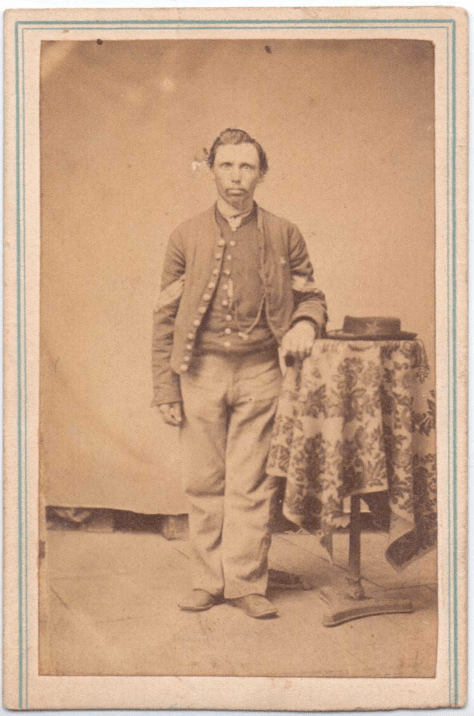
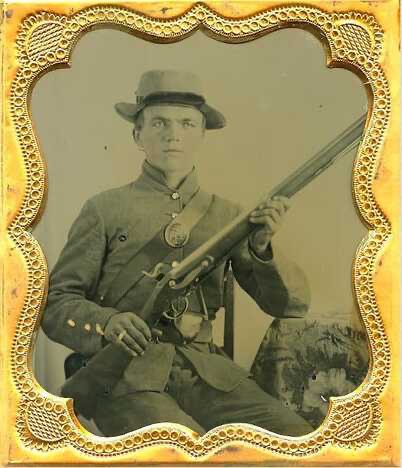
I could not find an image of Bruce but here is a cdv of Sgt. Robert Cantrell of Co. B, 143rd New York Infantry (Ancestry.com)

The following letter was written by Bruce Elmore (1835-1876), the son of Alexander and Mary (Divine) Elmore of Fallsburg, Sullivan county, New York. He wrote the letter to his wife, Ann Elizabeth (Hill) Elmore, in July 1864 while serving as a sergeant in Co. C, 143rd New York Infantry. He enlisted in August 1862 and mustered out on 20 July 1865. Auburn University Digital Library has Bruce’s Civil War Diary on-line. The “Willard” he mentions in his letter was his younger brother, born in 1838.

The 143rd New York had a distinguished service record, particularly while participating in the 20th Army Corps under General William Sherman They saw action in major battles and campaigns from Chattanooga to Raleigh, including the Atlanta Campaign. The regiment also suffered significant casualties, with heavy losses at Kennesaw Mountain and Peachtree Creek.

T R A N S C R I P T I O N

Addressed to Mrs. Bruce Elmore, Fallsburg, Sullivan county, New York

Camp 143 Regt. N. Y. V.
near Peach Creek, Ga.
July 21st 1864

My Own Dear Libbie,

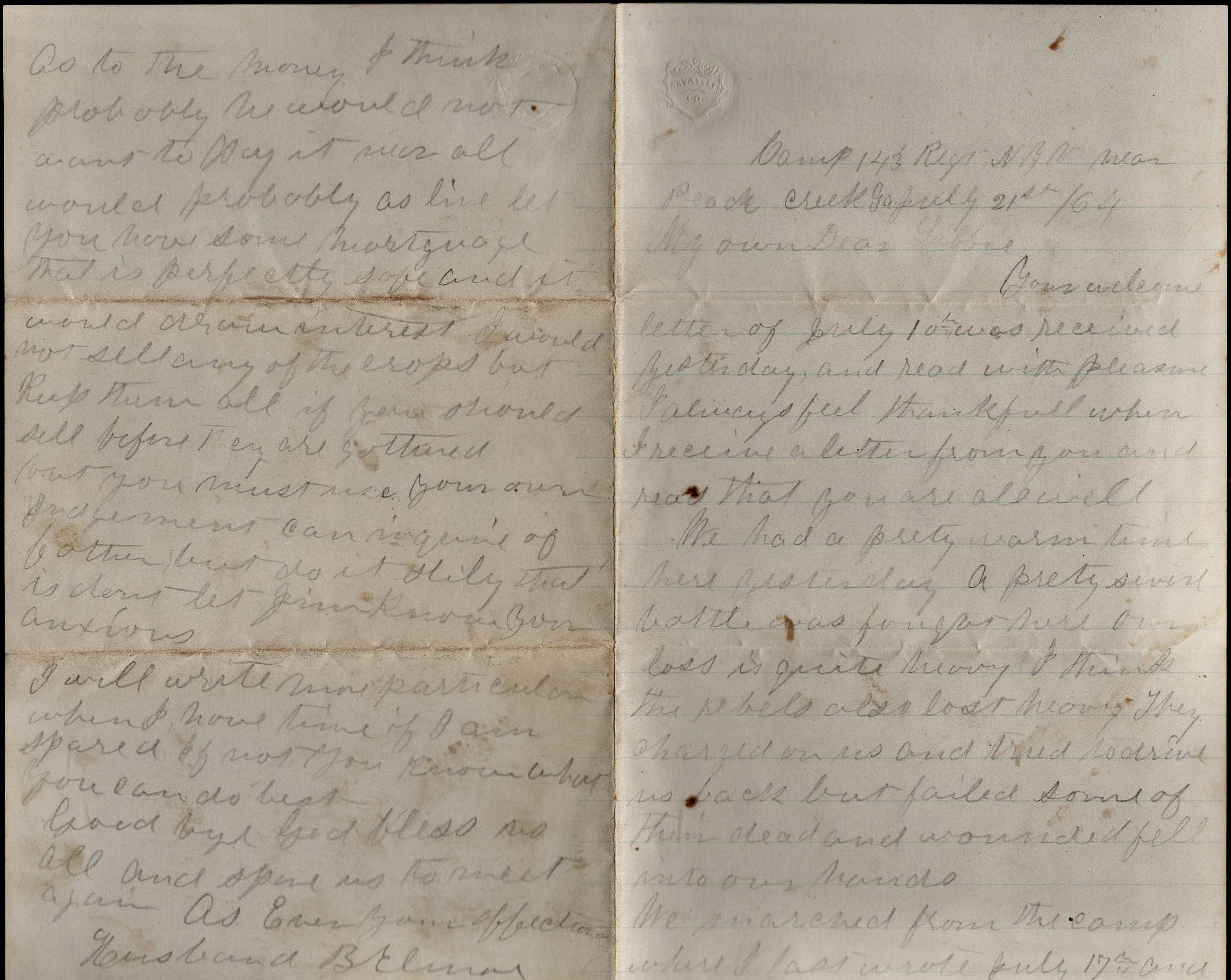
Your welcome letter of July 10th was received yesterday and read with pleasure. I always feel thankful when I receive a letter from you and read that you are well.

We had a pretty warm time here yesterday. A pretty severe battle was fought here. [See Battle of Peach Tree Creek] Our loss is quite heavy. I think the Rebels also lost heavy. They charged us and tried to drive us back but failed. Some of their dead and wounded fell into our hands.

We marched from the camp where I last wrote July 17th and crossed the River Chattahoochie since which time the army has been getting its position. We are now about 4 miles from Atlanta, although some of our line is closer, being within two miles.

Our regiment lost forty-five killed and wounded—7 or 8 killed, 2 of our own company were wounded—Gilbert B. Lawrence severely. The doctor says he thinks he may get well. I hope he may and Sergt. McKendree N. Dodge (of Rockland) quite severely wounded, though not dangerously—a flesh wound in the leg. Lieut. Wm. M. Ratcliff, Adjutant, is also killed and Lieut. Waterbury of our regiment also killed. I am well, have not received a scratch, and I feel to fervently thank my Heavenly Father for mercifully sparing me amid peril and danger so imminent.

[My brother] Willard is to the field hospital. He is not well enough to be on the march. W. H. Newman has returned to the company. Also James W. Stewart.

You say you think J. V. B. Reynolds would like to buy the farm and would give 1200. I think I would sell for that if I could get no more. Maybe he would give more. Get all you can. It almost ought to fetch more according to the price of other things, but if this war settles, everything falls again, and then I think land will be as low as ever again. As to the money, I think probably we would not want to pay it near all. Would probably as leave let you have some mortgage that is perfectly safe, and it would draw interest. I would not sell any of the crops but keep them all. If you would sell before they are gathered but you must use your own judgment. Can inquire of father but do it slyly—that is, don’t let Jim know you’re anxious.

I will write more particular when I have time if I am spared. If not you know what you can do best. Good bye. God bless us all and spare us to meet again. As ever your affectionate husband, — B. Elmore

All well at half past 12. Have heard a little cannonading. Hard to tell whether there will be any hard fighting in any part of the line today or not. Lieut. Waterbury is not yet dead.

1864: John Howell Phillips to Alice Phillips

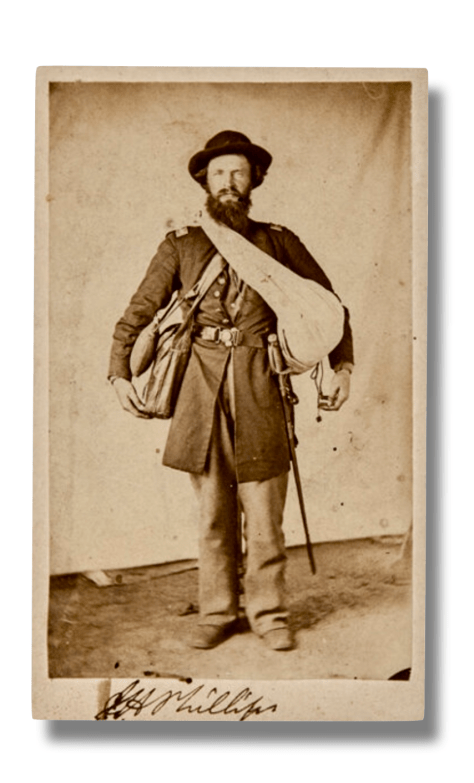
CDV of Capt. John Howell Phillips. Inscribed on the verso “Coming from picket, May 26th 1863” (Heritage Auctions)

This letter was written by John Howell Phillips (1832-1876) from the camp of the 22nd Illinois Infantry in March 1864 while serving as Captain of Co. D. There were 27 of his letters ranging in date from January 8, 1862 to May 24, 1865 sold at auction in 2015. It isn’t clear if this was one of them or not. They were all written to his mother or sister Alice (“Allie”). They were datelined from Corinth, Camp Lyon, Florence [Alabama], Nashville, Murfreesboro, Stone River, Bayou Pierre [Mississippi], Bridgeport [Alabama], Cairo [Illinois] and others.

In one of the letters he wrote, “The inspector on General Grant’s staff is to inspect us and I think he will find a ragged and dirty set as the regiment has been out on the tramp nearly all winter and have not had a chance of keeping themselves in any kind of decency… You have no doubt seen a great deal in the newspapers about the Rebels being nearly starved out and that they are deserting because they did not get enough to eat. But if they fare any worse than we men in this Department have this winter I pity the poor devils.”

John was born in Connellsville, Fayette county, Pennsylvania. He was the son of John Wesley Phillips (1803-1867) and Margaret Rice Connell (1808-1895). When John enlisted in June 1861, he gave his occupation as carpenter and his residence as Greenville, Bond county, Illinois. He was described as standing just over 5′ 9″ tall, with light hair and blue eyes. He claimed to be single but he was, more accurately, a widower. His wife, Mary Virginia Buie (1833-1859) died on 22 June 1859 after less than two years of marriage.

T R A N S C R I P T I O N

Camp near Louden, Tennessee
March 21st 1864

Dear sister Alice,

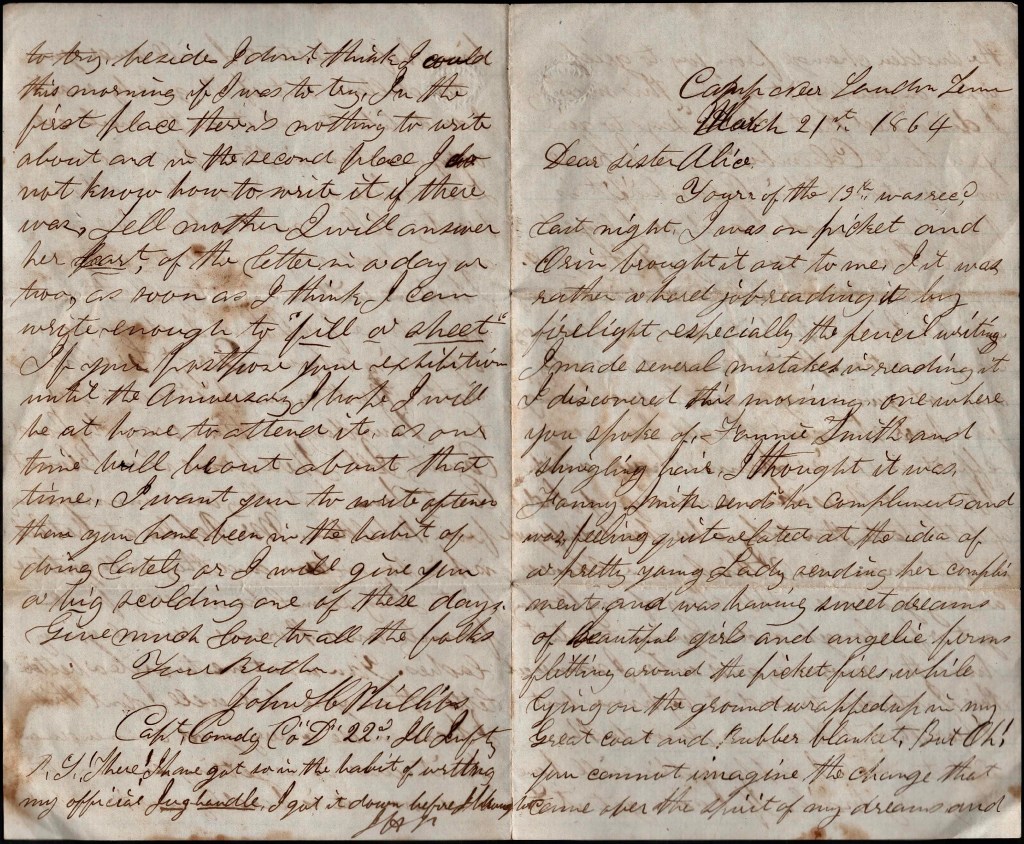
Yours of the 13th was received last night. I was on picket and Orin brought it out to me. It was rather a hard job reading it by firelight—especially the pencil writing. I made several mistakes in reading it. I discovered this morning one where you spoke of Fannie Smith and shingling hair. I thought it was Fanny Smith sends her compliments and was feeling quite elated at the idea of a pretty young lady sending her compliments and was having sweet dreams of beautiful girls and angelic forms flitting around the picket fires while lying on the ground wrapped in my great coat and rubber blanket.

An example of a short bobbed hairstyle for young ladies called “shingling” which was a radical departure from the long, elaborate hairstyles worn by women in the 1860s. It was more popular in the South than in the North. It was seen as a symbol of liberation.
But oh!! you cannot imagine the change to come over the spirit of my dreams and the sudden change from joy to grief when on reading it again this morning I discovered that it was, “says to give you Hail Columbia.” Now I have no objection to “Hail Columbia” if it is played by a good band or played on a piano and sung by a pretty girl. but when it comes in a letter and in the way this did, I do not think it means anything very complimentary. But I cannot see why my not giving my consent to you having your hair shingled should have any effect on Miss Fannie’s hair, and I thought Miss Fannie was a young lady of better taste than to have her head disfigured in that manner.

I think your likeness a very good one. Mr. [Joseph A.] Jay of my company got a furlough and is going to start home this morning and when I commenced this I intended to send it by him but I hear that he has gone down to the Depot and I suppose this will have to go by mail. If I can get it to him before he starts, I will send you ten dollars but if it goes by mail, I don’t like to risk it as the mails are very uncertain in these parts now.

Lee is here and is quite well and hearty. All is quiet about here now and no prospect of a move for us yet. I hope we will get to stay here the rest of our time for I have had enough tramping about. Sergt. [Archibald C.] Grisham’s father, mother, and sisters were here last Thursday on their way to Bond County, Illinois. Their home is in Blount county, Tennessee, but they are running away from Rebeldom. Mr. Peoples at Bethel is his son-in-law and they will go there first. They seem like a very fine family and there are several young ladies.

You want me to write a better letter than you did. Well, I don’t. think I have made a very good commencement for it and it is getting so near the end now it is hardly worthwhile to try. Beside, I don’t think I could this morning if I was to try. In the first place, there is nothing to write about. And in the second place, I do not know how to write it if there was. Tell mother I will answer her part of the letter in a day or two, as soon as I think I can write enough to “fill a sheet.”

If you postpone your exhibition until the Anniversary, I hope I will be at home to attend it, as our time will be out about that time. I want you to write oftener than you have been in the habit of doing lately or I will. give you a big scoulding one of these days. Give much love to all. the folks. Your brother, — John H. Phillips, Captain Commanding Co. D, 22nd Illinois Infantry.

P. S. There! I have got so in the habit of writing my official jug handle, I got it down before I thought. — J. H. P.

1861: Theodore Watson to John Watson

The men of the 7th, 8th, and 9th Illinois Volunteer Infantry initially signed on for 90 days service, and due to a lack of uniforms and proper equipment and weapons, when the 90 days was up, many of the men returned home. One of the things that was actually used as a re-enlistment incentive was a newly issued uniform from the State of Illinois. Since the State was providing the uniform, and not the Federal Government; these first uniforms, which were issued to the men who agreed to sign on to three year enlistments, were made of a grey material, simply due to a shortage of blue cloth.

The 7th – 12th Regiments all received grey uniforms when they re-enlisted for three years, likewise the 13th – 22nd Regiments were also issued grey uniforms which consisted of a grey jacket, and trousers, and grey broad brimmed hat. ‘The fatigue suit is a shirt, pantaloons and “Zouave” cap in a firm hickory cloth’, noted the Chicago Tribune in April 1861.

This letter was composed by Theodore Watson (1838-1864) during his service in Company H, 3rd Illinois Infantry (3-month enlistment) regiment. Ten of Theodore’s letters, authored between April 27th and July 7th while in this regiment, are preserved in the Newberry Library in Chicago, while this particular letter remains in private possession.

Watson’s correspondence reflects a mix of enthusiasm for the rigors of army life, where morale is relatively high, and provisions are adequate, allowing for sufficient rest. Upon the company’s establishment at Camp Defiance in Cairo, Watson expresses a sense of well-being and readiness for the tasks ahead, enjoying activities such as singing, games, swimming, and the general camp experience. Yet, by early July, despite his initial pride in the military skills of his unit, he has become weary and disillusioned, experiencing ill health. Consequently, Watson cautions his brother John against enlisting, as he himself also declines to commit to the extended three-year enlistment.

Theodore was the son of John Watson (1806-1890) and Mary Eliza Kelly (1802-1853) from Hillsboro, Montgomery County, Illinois. He died in 1864 in Hillsboro, apparently from disease.

Location of Camp Defiance near Cairo, Illinois

T R A N S C R I P T I O N

[Camp Defiance] Cairo, [Illinois]
May 9th 1861

Dear Brother,

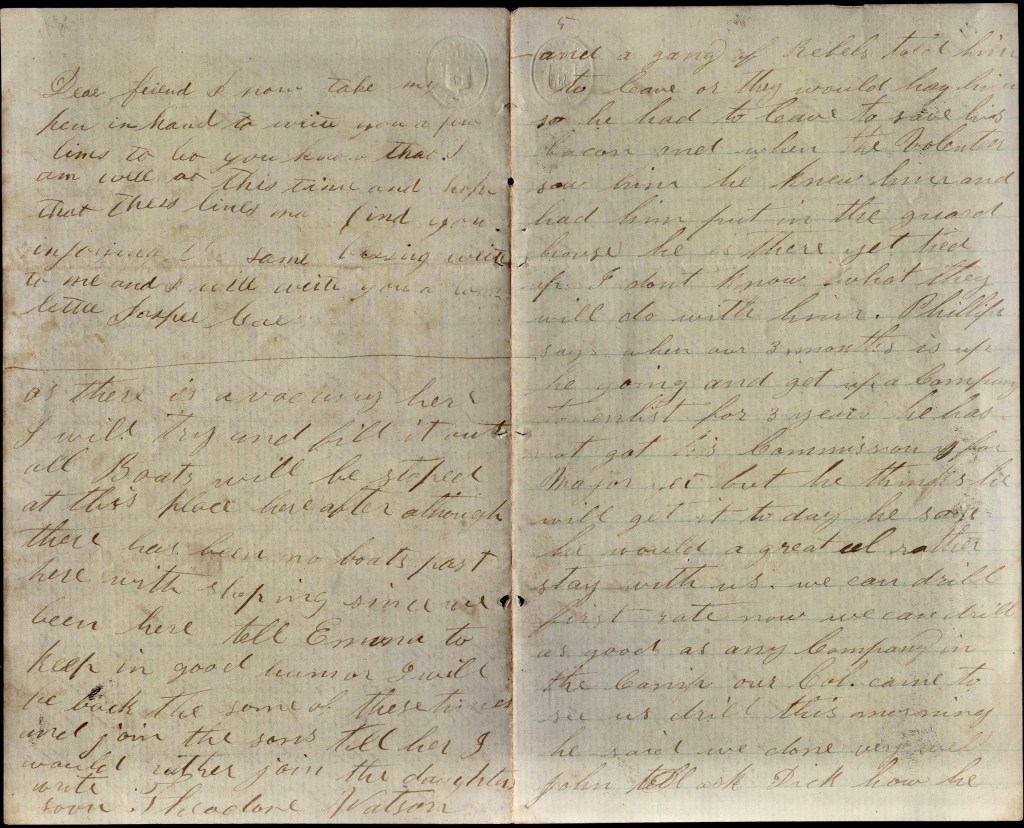
I received yours of the 8th with great pleasure . You had better believe I was anxious to hear from you. We have got a better place now to sleep in, We have built some barracks here. WE have got fixed up nicely. But Major [Jesse J.] Phillips says he would not be surprised if we were sent to Texas. We would all like to go there. Here is the idea. We would get to see the country if nothing more. Everything is quiet here. No fighting yet. We are all spoiling for a fight. You said you heard that the secessionists were building batteries on the Kentucky shore, I guess there is nothing of it. There were some of our boys over on the Kentucky shore the other day. They say there were no signs of batteries over there. But excuse me from going over there although they got back safe. We get papers here every day. We hear all the news.

You want me to give you a description of Cairo. Cairo is the nastiest place I ever was in. The levee is on a pretty high place but back of the levee it is lower than the river. Some of the houses are built in ponds, Our camp is at the edge of Cairo in a low place but it is a very good place in dry weather. We have had a little rain here but not much. We are in a dry place.

I guess the election will come off today for electing our Captain Jim Munn is a going to run against [John W.] Kitchell. I don’t know which will be elected. I am a going to vote for Kitchell. Kitchell was appointed Adjutant General at Springfield but if he is elected Captain he will resign his present position. They say there are about 30 six-pounders scattered along the river. There are only 5 six-pounders in this place but no secessionists can land here. It is as Col. Prentiss says, we are ready for them. I have not seen Colonel Prentiss yet although some of the boys has. I don’t know what kind of a looking man he is. The Colonel of our regiment, Col . [Eleazer A.] Payne, is a very nice kind of a man.

Ira Clark took sick yesterday. He went to the hospital last evening. The rest of us are all well, fat and saucy. I believe we could whip the whole South. Dinner is about ready now. I will leave the rest till after dinner. I am very hungry.

Well, John, I have are my dinner and feel very much refreshed. I drank about a pint and a half of coffee. You said you heard the Ohio was poisonous. There is nothing of it. There was a man taken here yesterday as a spy. One of the volunteers in our camp was acquainted with him in Kentucky. The volunteer said he was living in Kentucky when this spy and a gang of rebels told him to leave or they would hang him so he had to leave to save his bacon and when the volunteer saw him, he knew him and had him put in the guard house. He is there yet, tied up. I don’t know what they will do with him. Phillips says when our three months is up, he is going and get up a company to enlist for three years. He has not got his commission for Major yet but he thinks he will get it today. He says he would a great deal rather stay with us. We can drill first rate now. We can drill as good as any company in the camp. Our Colonel came to see us drill this morning. He said we done very well.

John, ask Dick how he like packing flour. Tell him I wouldn’t exchange places with him [for] anything. Tell him I don’t see how it makes his knuckles sore as it never made mine sore. When it gets warm weather, I guess he will wish he never saw the mill—that is, if you. run all the time. John, I would rather do anything else than pack flour in the summer time. I like it very well here except cooking. That is what I hate the most. we don’t see a woman here once in a week. If one of the Hillsboro girls wish to come down here and look for us, tell them we will give them their board if they cook and wash for us. But they will find that we are a pretty hard set here. John, bring your girl here some day and take dinner with us. John, you mustn’t run around with the girl too much. John, this is a very warm day but we have cool nights.

John, I am afraid if I write any more, I will not have anything for next time. I wrote to father yesterday. I guess I will not write any more till I hear from some of you again. I will not close this yet for I may get some more ideas between now and evening.

You want to know what Henderson knows about his girls. How does he know they are all right. Tell Emma I will be back there some of these times and join the sons. Give my folks my respects and write soon. — Theodore

As there is a vacancy here I will try and fill it out. All boats will. be stopped at this place hereafter although there has been no boats past here with stopping since we’ve been here. Tell Emma to keep in good humor, I will be back there some of these times and join the Sons. Tell her I would rather join the Daughters. Write soon. — Theodore Watson

1861: Unidentified Soldier in Co. K, 27th New York Infantry

The following letter is unsigned and though there are several clues to his identity, I have not yet been able to attribute it to any particular soldier beyond his being a member of Co. K, 27th New York Infantry. He wrote the letter shortly after having made the march from Arlington to Hunting Creek in October 1861 where the regiment expected to construct Fort Lyon. It was Henry W. Slocum’s Brigade that was tasked with building. the fort and that duty was largely assigned to the 27th New York Infantry. The author claims to be a private though he was detailed as the Orderly’s assistant in Co. K.

T R A N S C R I P T I O N

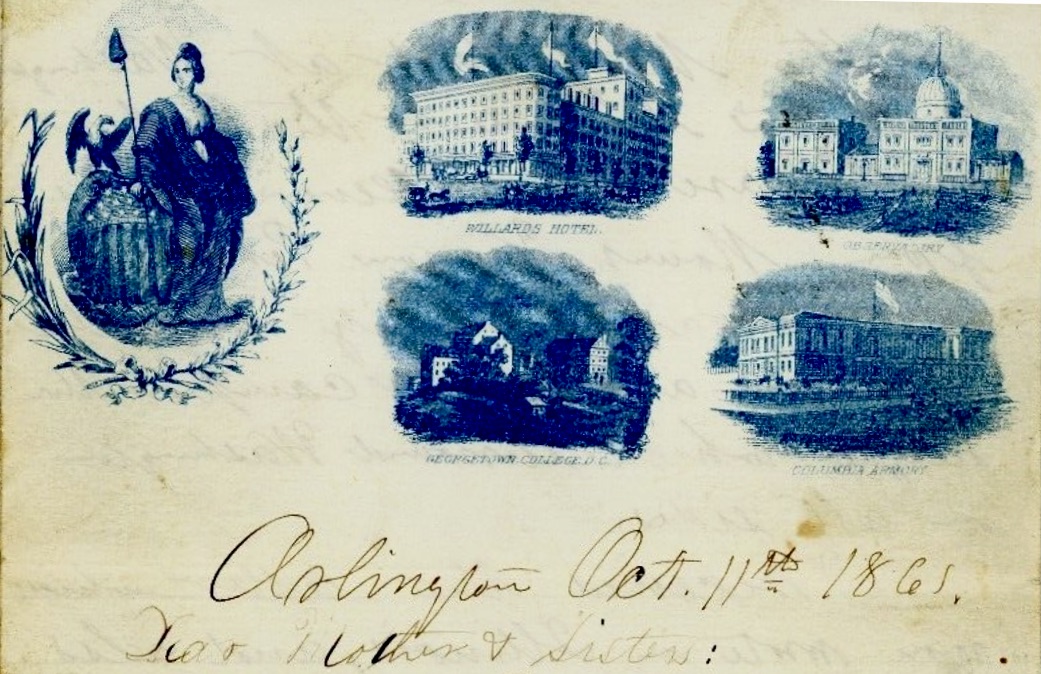
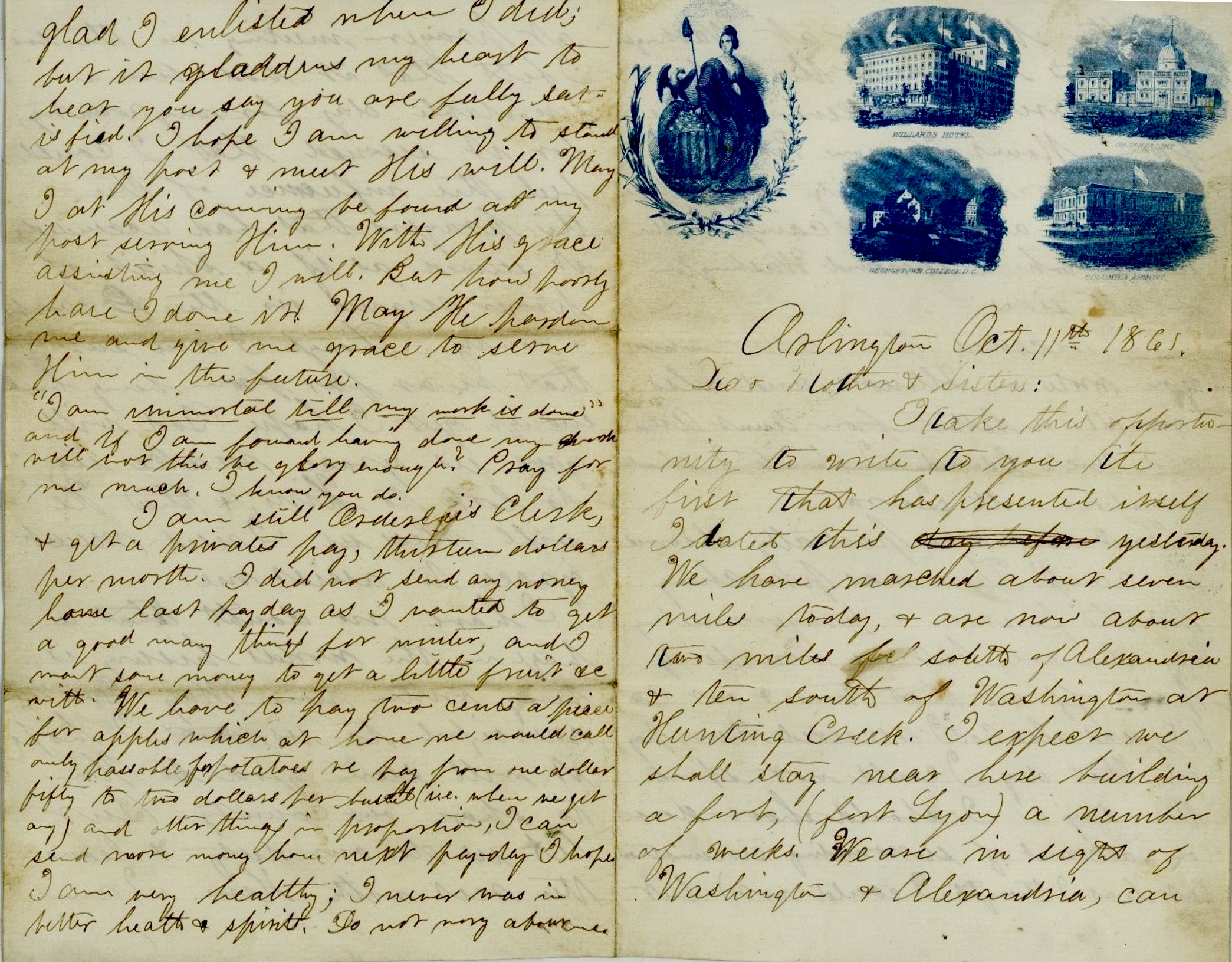
Letter head of Soldier’s Letter with Washington D. C. Landmarks

Arlington [Virginia]
October 11th 1861

Dear Mother & Sister,

I take this opportunity to write to you. It’s the first that has presented itself. I dated this yesterday. We have marched about seven miles today & are now about two miles south of Alexandria and ten south of Washington at Hunting Creek. I expect we shall stay near here building a fort (Fort Lyon) a number of weeks. We are in sight of Washington & Alexandria, can see the Navy Yard at Washington, Washington Monument, the Capitol, &c. We are about seven miles from Mount Vernon. Perhaps I may get an opportunity to go. there. We have a pleasant camp on the heights which surround Washington on all sides.

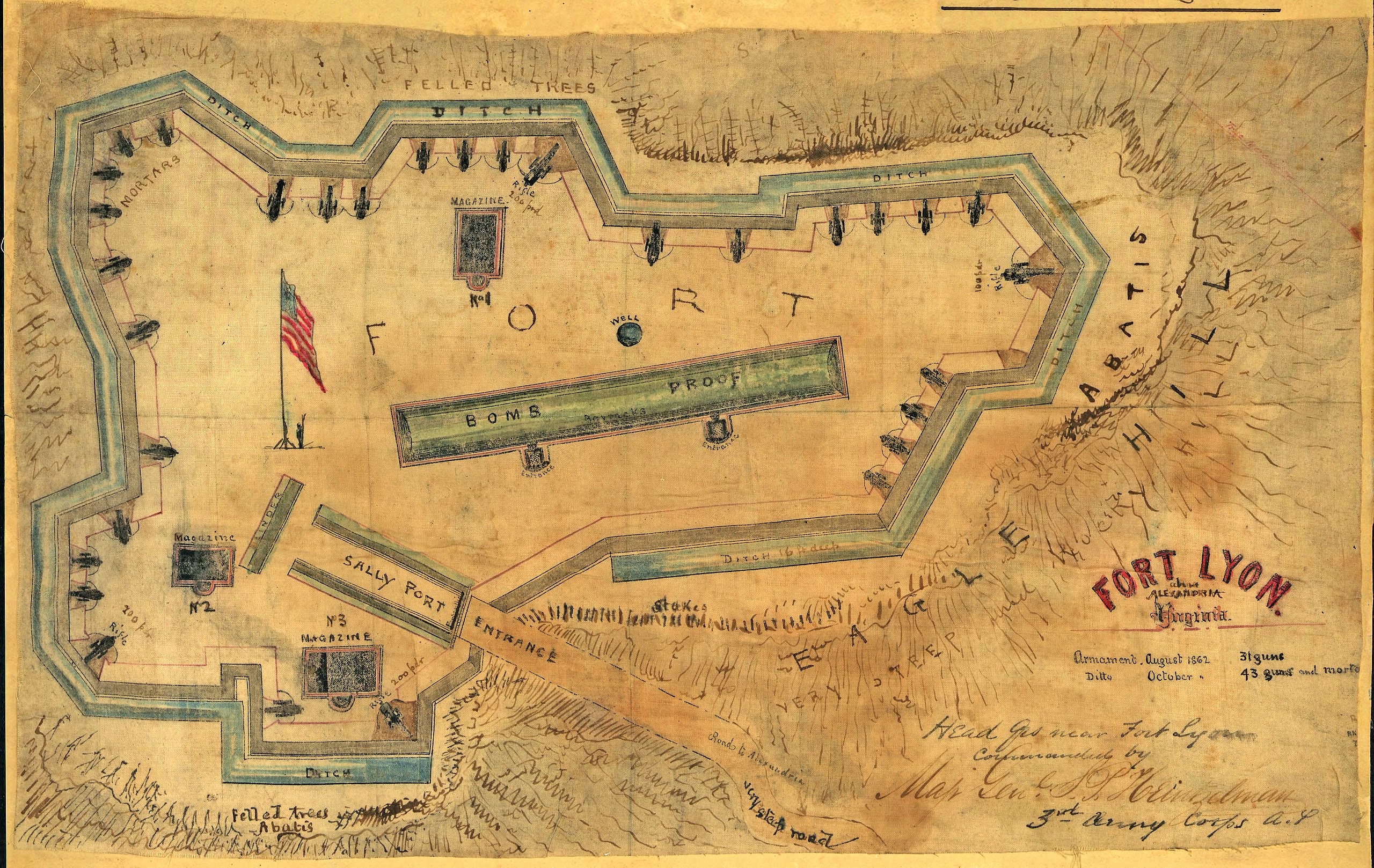
The map by Sneden, Robert Knox, 1832-1918, is a close up drawing of Fort Lyon located on Ballenger’s Hill south of Hunting Creek, and Cameron Run. From its position on one of the highest points south of Alexandria, the fort overlooked Telegraph Road, the Columbia Turnpike, the Orange and Alexandria Railroad, the Little River Turnpike, and the southern approaches to the city of Alexandria, the largest settlement in Union-occupied Northern Virginia.

I received the letter which you wrote in Illinois, and also in it a letter from Aunt Ann and Uncle Edward. I think I shall correspond with Isora.

Fast day was partially observed in camp. There was preaching in the forenoon and prayer meeting in the eve; but we were being paid off at that time & our company (K) and also Co. I received their pay on that day. I could not spend the day as I should have done on account of surrounding circumstances (at least I thought I could not). But at prayer meeting in the eve I felt that it had been a profitable day for my country for it seemed that I could feel the influence of the prayers that had ascended. It seemed as if a spirit of prayer reigned o’er the camp & country. Though I am sure that we are far from being humble enough, yet I hope God will give us grace, make us look to Him, & that He will bless us. I need much grace to assist me.

I have no doubt that a page in the world’s history is being written now. May God be merciful to us. I hope it will seem good to Him to spare our country. But let us do our duty & leave the rest with Him. I am glad I enlisted when I did. But it gladdens my heart to hear you say you are fully satisfied. I hope I am willing to stand at my post and meet His will. May I at His coming be found at my post serving Him. With His grace assisting me, I will. But how poorly have I done it. May He pardon me and give me grace to serve Him in the future.

“I am immortal till my work is done,” and if I am found having done my duty, will not this be glory enough? Pray for me much. I know you do.

I am still Orderly’s Clerk and get a private’s pay—thirteen dollars per month. I did not send any money home last payday as I wanted to get a good many things for winter, and I want some money to get a little fruit, &c. with. We have to pay two cents apiece for apples which at home we would call only passable. For potatoes we pay from one dollar fifty to two dollars per bushel (i. e., when we get any) and other things in proportion. I can send more money next payday I hope. I am very healthy. I never was in better health & spirits. Do not worry about me. [unsigned]

1862: Oliver M. Abel to Sally (Ferris) Abel

I could not find an image of Oliver but her are three members of Co. D, 23rd Michigan Infantry. They are Sgt. A. Judson Slafter (1822 – 1863) in the middle; Cpl. Orson Ormes on the left; and Sgt. Nelson Hewes on the right. The three Tuscola men mustered into service on 12 September 1862 at Saginaw. Slafter was wounded in the battle at Campbell Station, Tennessee, on November 16, 1863, and was taken to a military hospital in Knoxville, where he died on December 31, 1863. Ormes survived the Civil War and returned to Tuscola County to farm. Hewes (1829 – 1864), was appointed Commissary Sergeant on March 30, 1863, and commissioned 2nd Lt. on December 25, 1863. He died of disease on March 4, 1864. (Ancestry.com)

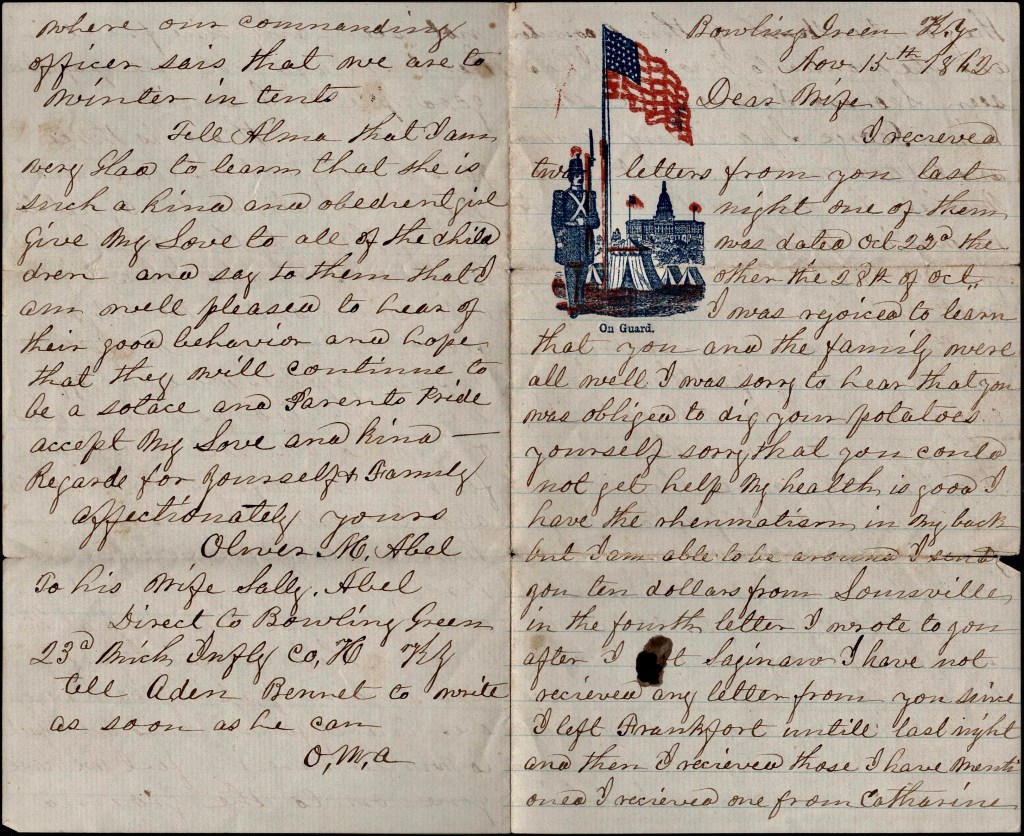
This letter was composed by Oliver M. Able (1820-1883), the progeny of William Abel (1796-1880) and Alma Sager (1805-1861). In October 1842, Oliver entered into matrimony with Sally L. Ferris (1822-1900). The couple engaged in agriculture in Perry, Shiawassee County, Michigan, and by the time Oliver, then 42 years old, enlisted on 13 August 1862 as a private in Company H, 23rd Michigan Infantry, they had borne as many as eight children. In his letter, written three months into his three-year term of service, he conveyed his struggles with rheumatism, which compelled him to seek a disability discharge, ultimately granted on 20 February 1863 in Bowling Green, Kentucky.

The 23rd Michigan left Saginaw on the 18th of September 1862, under the command of Colonel Chapin, proceeding at once to Kentucky, its muster rolls showing a force of 983 officers and men. Soon after its arrival, it was assigned to the Tenth Division of General Rosecrans’ Army, then pushed forward to Bowling Green. While there a detachment of the Regiment was attacked by a superior force of Confederate guerrillas, but were repulsed. The 23rd remained at Bowling Green until May 29,1863, employed in guarding the trains.

T R A N S C R I P T I O N

Addressed to Mrs. Sally Abel, Perry Center, Shiawassee county, Michigan

Bowling Green. Kentucky
November 15th 1862

Dear Wife,

I received two letters from you last night. One of them was dated October 22nd. The other the 28th of October. I was rejoiced to learn that you and the family were all well. I was sorry to hear that you was obliged to dig your potatoes yourself. Sorry that you could not get help.

My health is good. I have the rheumatism in my back but I am able to be around. I sentr you ten dollars from Louisville in the fourth letter I wrote to you after I left Saginaw. I have not received any letter from you since I left Frankfort until last night and then I received those I have mentioned. I received one from Catharine the fourteenth of this November and she wanted to know if I had seen Leonard. I have not seen him. George Spaulding saw him and talked with him at New Market. He was well and hearty. He was in Michigan 2nd Cavalry.

You ask me how I like soldiering. Well only I do not like this lying in the dirt and being so dirty and smutty looking. If Father is going East and wants to sell you his things and you want them, why buy them of course. They are second hand things. Don’t pay too much for them. Keep in good courage as I am in the firm believe that I shall get to return to my family.

Bowling Green is quite a place for a Kentucky town. There is some very nice churches and dwellings and some splendid orchards here—that is, the trees grow very large and thrifty but I have not seen any nice fruit in Kentucky and not one passable good pie or biscuit.

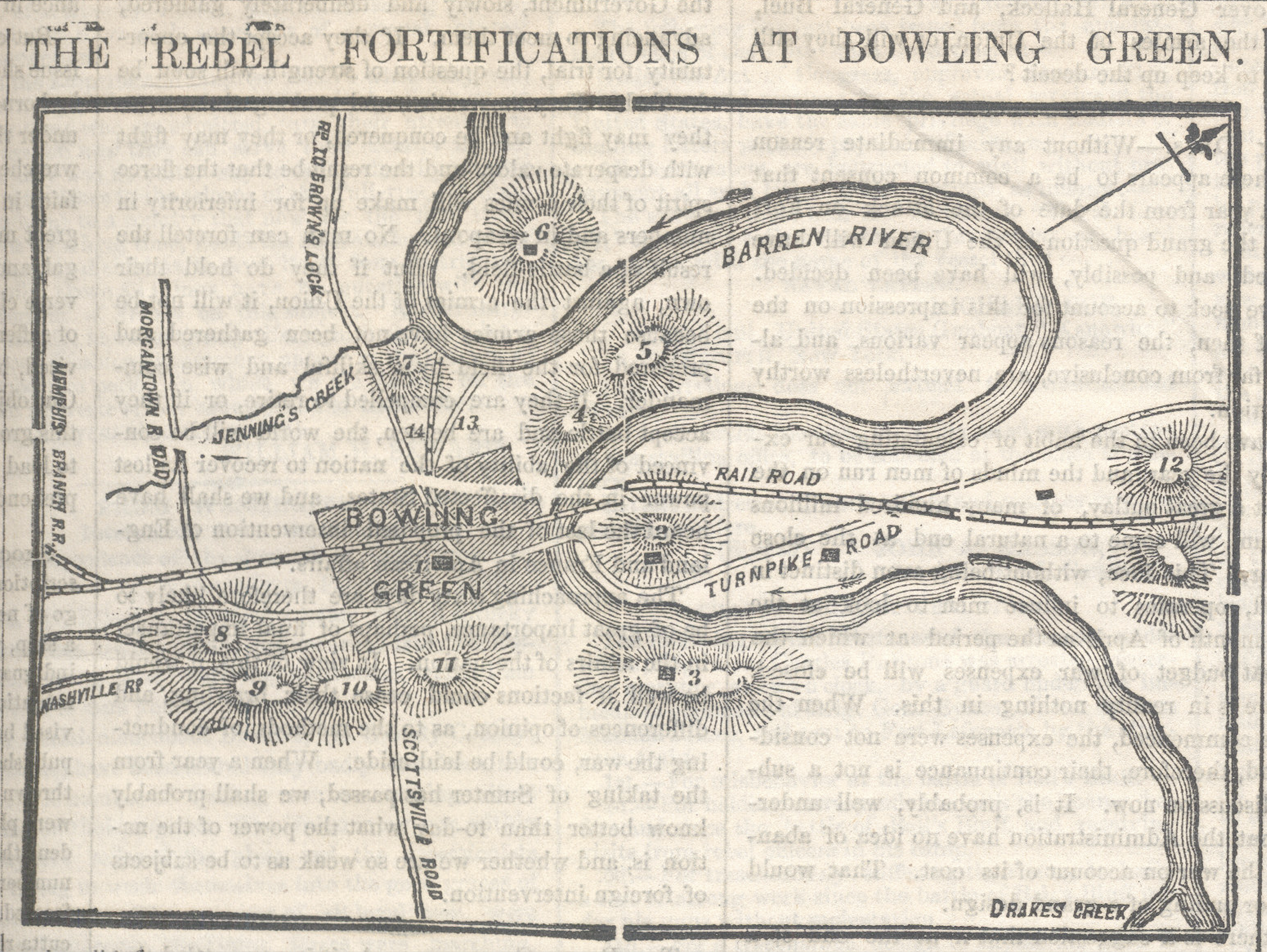
There is three fort or fortifications commanding. the place—all built by Rebels. One of them by the Rebel General [Simon] Buckner situated on a high hill commanding the city and all of its surroundings. 1 But his supplies were cut off by the Union troops and he was obliged to evacuate it too soon for his own safety as he was killed about eighteen miles from here. There is a railroad passing through here doing a large and extensive business at this time. There are certainly as many as six trains passing each way every twenty-four hours.

We expect to winter here. In fact, we have gone on to the ground where our commanding officer says that we are to winter in tents.

Tell Alma that I am very glad to learn that she is such a kind and obedient girl. Give my love to all of the children and say to them that I am well pleased to hear of their good behavior and hope that they will continue to be a solace and parents’ pride. Accept my love and kind regards for yourself & family. Affectionately yours, — Oliver M. Abel

To his wife Sally Abel.

Direct to Bowling Green, Kentucky, 23rd Michigan Infantry, Co. H

Tell Aden Bennett to write as soon as he can. — O. M. A.


Map from the New York Weekly Journal of Commerce for Thursday, Feb. 13, 1862; showing “Rebel” fortifications near Bowling Green; the news report accompanying map shows numbered areas 1-14, they are the courthouse, Webb and Price’s Hill, Underwood and Calvert’s Hills, McGoodwin and Grider’s Hills, College and Gossom’s Hills and the roads and railroads to the river. A description of the topography, water supply and general lay of the land is noted. (Kentucky Library Research Collections)

1 The two largest fortifications built by the Confederates were Fort C. F. Smith and Fort Baker. The former was built on Reservoir Hill south of town. The latter was built on a hill north of the city on the Barren River.

1862: Warren Smith Leslie to Elvira (Smith) Leslie

Warren S. Leslie

Warren Smith Leslie was born on 14 December 1841, the oldest son of Cyrus Leslie (1812-1848) and Elvira Smith (1809-1894). Following his father’s death in 1848, he was placed in the home of a farmer in Plymouth, Vermont, and remained involved in agriculture throughout his life. He served in Co. I of the 2nd Vermont Infantry during the Civil War, enlisting in 1861. He was honorably discharged in mid-February 1863 after many months in the hospital. His military records indicate he received a gunshot wound to his left chest though it doesn’t say when. Presumably it occurred in the Peninsula Campaign. He married Alice D. Newman (1847-1914) of Woodstock, Vermont, in 1866 and the couple moved to Kansas. He died in Osawatomie, Kansas, on 16 December 1913.

In this letter to his mother, Warren expresses disenchantment with the war and its officers from his bed in the Haddington General Hospital at Philadelphia.

Haddington Hospital in Philadelphia, PA.

T R A N S C R I P T I O N

Haddington Hospital [Philadelphia, Pa.]
December 25th 1862

Dear Mother,

I received two letters from you and one from Henry yesterday. I was glad to hear from all of you once more. I don’t know as I am any better than I was when I wrote before and I have got so far from Washington now that I don’t know as I can get my discharge or a furlough either but I don’t know but they will send me to a hospital in Vermont by and by. I have got so that I don’t care much which way the world goes. They have kept me six months without pay and there isn’t any prospects of getting it for six to come.

I have written to the Captain for my Descriptive List so that I could draw my money and some clothes but he hadn’t never answered it nor sent the list either. The officers if our army are nothing but a set of rascals and thieves. They are making money out of it and that is all they care for. The rebels are bad enough but if they are traitors, they are honest men. What the most of our officers are and unless we have different leaders, the rebellion never will be put down. Now you see if my words don’t prove true. I have spoiled my health and constitution fighting for these money eaters but if I live to get out of this, they won’t catch me again.

You wrote that Warren Walker has got home. I never knew before that he had enlisted. What regiment was he in? An Iowa [regiment], I suppose, for I believe that is where he was when the war broke out. I must close for it is growing dark. Give my respects to all the brothers and sisters and to grandfather’s folks.

Yours respectfully, — Warren S. Leslie

1863: William Paine Green to Julia E. (Greene) Bowen

The following letter was written by William Paine Green (1838-1872), the son of Kendall Greene (1812-1841 and Mary Paine (1816-1898) of Foster, Providence county, Rhode Island. William enlisted in Co. K, 11th Rhode Island Infantry and survived the war to marry in 1865 with Miranda E. Tracy (1841-1905) but died in December 1872 leaving three children.

In the 1860 US Census, 22 year-old William was enumerated as boarders in the household of Providence jeweler Henry Anthony. Sharing a bed with him was Vincent Bowen, as 22 years old, both of them employed as carpenters. Vincent would marry William’s cousin, Julia E. Green (1840-1872) in 1863.

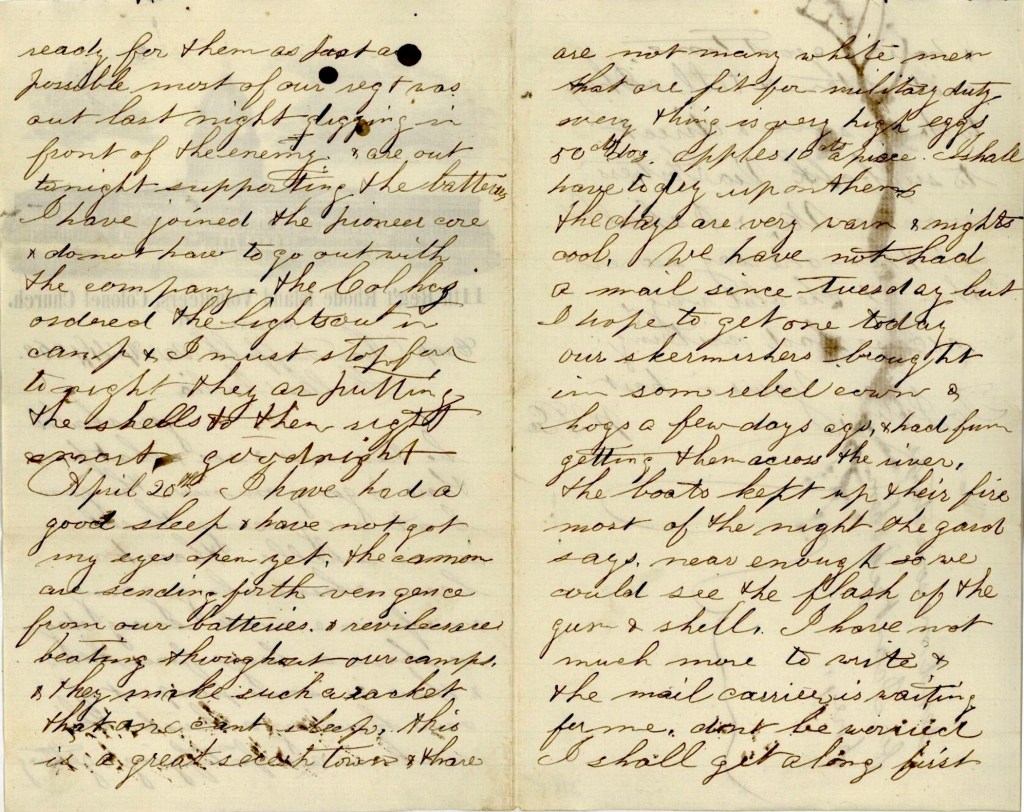
William’s letter was written on 19-20 April 1863 during the Siege of Suffolk by Longstreet’s Confederates.

T R A N S C R I P T I O N

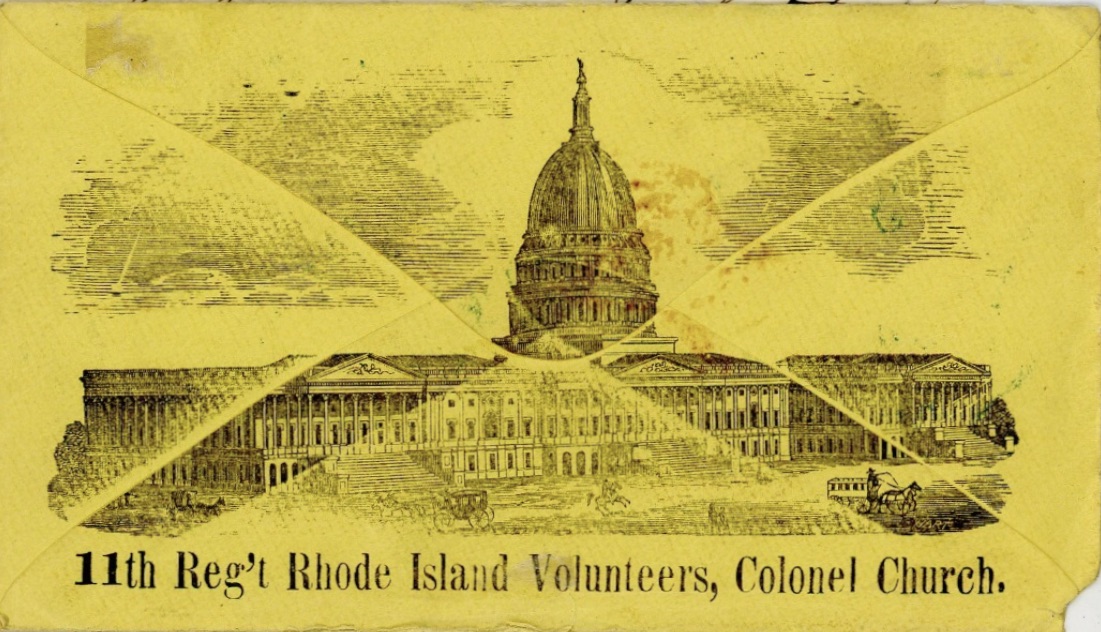
The back side of the envelope used to carry the letter to Providence, Rhode Island.

11th Regiment Rhode Island Volunteers, Co. K
Camp near Suffolk, Va.
April 19, 1863

Hello Julia,

You should be here now & see what fun there is going on now. The gunboats are giving the rebs some shells. There has been skirmishing going on for one week everyday We have a large force here and there is some prospect of our having a brush this week. We are fortifying & getting ready for them as fast as possible. Most of our regiment was out last night digging in front of the enemy & are out tonight supporting the batteries. I have joined the Pioneer Corps and do not have to go out with the company. The Colonel has ordered the lights out in camp & I must stop for tonight. They are putting the shells to them right smart. Good night.

April 20th. I have not got my eyes open yet. The cannon are sending forth vengeance from our batteries & reveille’s are beating throughout our camps & they make such a racket that one can’t sleep. This is a great secesh town & there are not many white men that are fit for military duty. Everything is very high—eggs 50 cents a dozen, apples 10 cents apiece. I shall have to dry up on them.

The days are very warm & nights cool. We have not had a mail since Tuesday but I hope to get one today. Our skirmishers brought in some rebel cows and hogs a few days ago & had fun getting them across the river. The boats kept up their fire most of the night, the guards say near enough so we could see the flash of the gun and shells. I have not much more to write & the mail carrier is waiting for me. Don’t be worried. I shall get along first rate and have a good time. Write often and tell others to so the same & direct to Suffolk via Fortress Monroe, Va. & I shall get them. one day sooner than if the old way. Excuse bad writing. Yours in haste. — W. P. G.

To Julia

1861: Alexander Mony to William J. Ditty

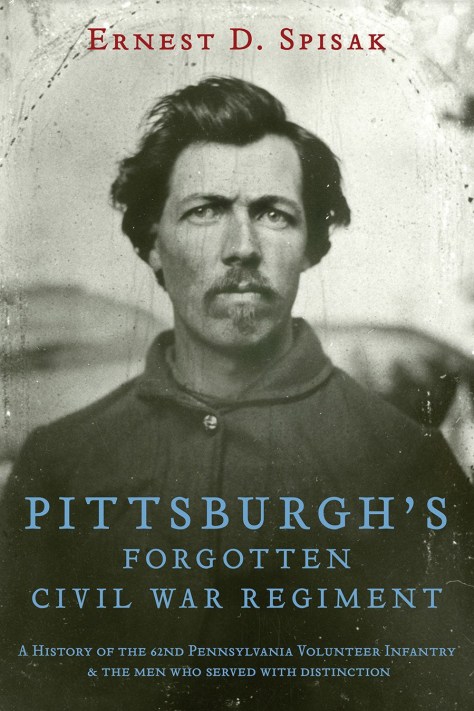
Jacket cover of Spisak’s book on the 62nd Pennsylvania Infantry.

The following letter was written by Alexander Mony (1836-1924), the son of Archibald Mohney (1809-1886) and Mary Catherine Heckman (1814-1884) of Clarion county, Pennsylvania. He wrote the letter to his brother-in-law, William J. Ditty, the wife of his older sister, Nancy Jane Mohney (1834-1907). After the war, Alexander would marry William Ditty’ younger sister, Sarah Jane Ditty (1840-1921).

Alexander enlisted in Co. E called “the Rimersburg Guards” in the summer of 1861, recruited by Thomas Kerr who would lead the company as part of the “33rd Independent Pennsylvania.” The regiment was organized at Pittsburg and left for Washington, D. C. on August 31, 1861. Their unit designation was changed, however, to the 62nd Pennsylvania Volunteers on November 18, 1861, just days before this letter was written. The 62nd Pennsylvania Infantry Regiment was stationed on Minor’s Hill in November 1861 after crossing the Potomac River and being assigned to the Second Brigade of General Porter’s Division.

In his book, “Pittsburgh’s Forgotten Civil War Regiment,” published in 2013, author Ernest Spisak informs us that he pulled the history of the 62nd Pennsylvania from 347 letters and diaries of the veterans of the regiment. I’m unaware if any of Mony’s letters were included in the history. This letter remains in private hands. The only other letters I have transcribed (to date) by a member of this regiment were those written by Will Dunn of Co. F (25 Letters), pictured below, courtesy of my friend Charles T. Joyce.

T R A N S C R I P T I O N

Headquarters 62nd [Pennsylvania] Regiment, Co. E
Camp Minor’s Hill, Virginia
November 24, 1861

Dear Brother in law,

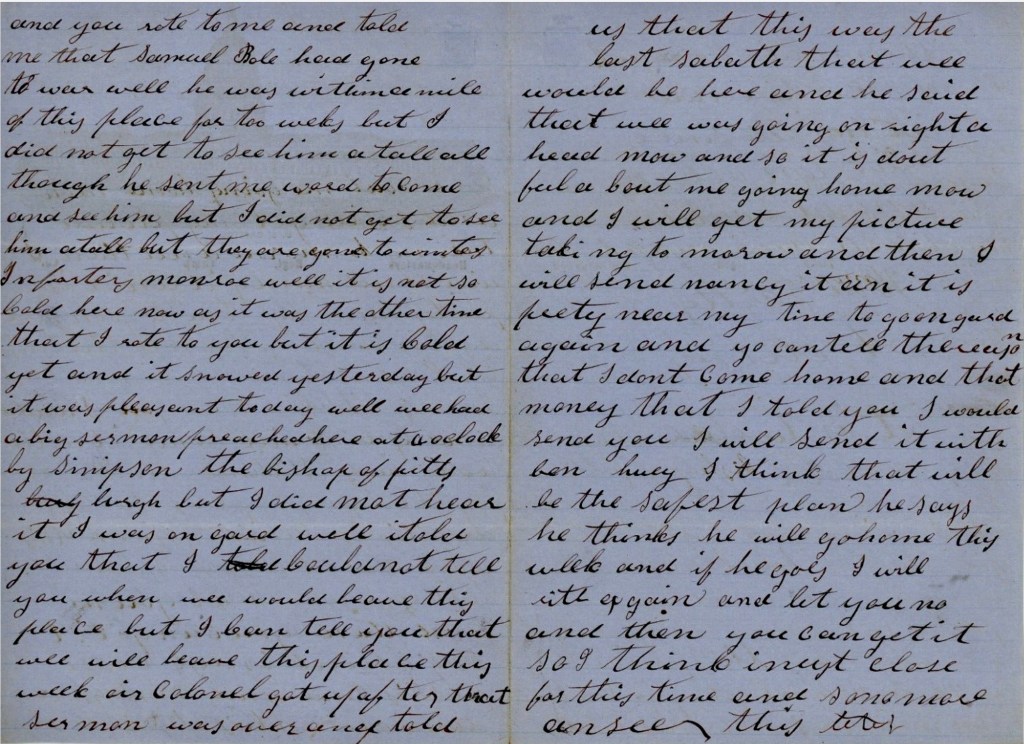
It is with the greatest of pleasure that I take my pen in hand to inform you that I am well at present and hoping that these few lines may find you all enjoying the same blessings & well. I heard from Mr. Cocren [Cochran] this morning and he is uneasy about me coming home again the next court and I guess there is no chance to go home ow at this time. We are expecting a fight before long and there will be no chance to go home at this time. If it was the next time the court comes, when then I could go home in spite of the devil. Then I would be in the army six months and then I would go home on furlough. There has a great many has tried to get a pass home and they could not get off. But I will do all that I can and if I can’t get off, why then I suppose they will in tait [?] and I can’t help it at all no how. And if I could be put off till the next court, I will. be home without doubt.

I went over to the Colonel this morning to see him but he was not at home and so then I went to General Morell and he said that he would not sign no furlough at this time. He said that if I was in the service six months, that there would be a chance to get off. That is about all that I can tell you about going home. And if you can do anything in that case, do so and that is all that I can ask of you. And I have got twenty dollars that I will send you.

Well, we are in Virginia yet and I can’t tell you when we will leave this place. I thought that we would a left this place a good while ago. The news was still that we was going to South Carolina on one of them big fleets but that has all fell through I guess and so I don’t care now where we go or when.

Well we had a big review last Wednesday [November 20] 1 and there was the small sum of seventy thousand—that is, of soldiers of course. There was a great many spectators that did not drill at all and it was the prettiest sight that I’ve seen in my life. There was a great many girl and a great many women and there was a good many old men and a great many that was not so old. Well we had that review handy [to] the rebels and they hoped for a fight and so we took twenty rounds of cartridges and our knapsacks and our overcoats and our haversacks and one day’s provision and so then we was prepared for the lads but they did not bother us at all. We got home safe and we did not see a rebel at all. But they still get some of our men and they will. get more of them for they do not care if they can get out. They run any place at all.

Well, this is the day that they call. Sunday in this place but it does not seem so to me at all for they are chopping wood and hauling and I am on guard today and there was a call made for six companies to go on picket guard and so they went and they seen a lot of the rebels working toward them and so they sent for the balance of the regiment and they are getting ready to go. And that leaves only us, about one hundred in the camp at this time.

You wrote to me and told me that Samuel Bole had gone to war. Well he was within a mile of this place for two weeks but I did not get to see him at all although he sent me word to come and see him. But I did not get to see him at all. But they are gone to winter in Fortress Monroe.

Well, it is not so cold here now as it was the other time that I wrote to you but it is cold yet and it snowed yesterday. But it was pleasant today. We had a big sermon preached here at 4 o’clock by [Matthew] Simpson, the Bishop of Pittsburgh, but I did not hear it. I was on guard. I told you that I could not tell you when we would leave this place but I can tell you that we will leave this place this week. Our colonel got up after that sermon was over and told us that this was the last Sabbath that we would be here and he said that we was going on right ahead now and so it is doubtful about me going. home now.

I will get my picture taken tomorrow and then I will send Nancy it. It is pretty near my time to g on guard again and you can tell the reason that I don’t come home and that money that I told you I would send you, I will send it with Ben Huey. I think that will be the safest plan. He says he thinks he will go home this week and if he goes, I will write again and let you know and then you can get it. So I think I must close for this time and so no more. Answer this. There is about one inch of snow here now. It has fell since about ten o’clock tonight and is still snowing yet. [To] William J. Ditty

[From] A. Mony

It is twelve o’clock now.


1 The Grand Review of the Army of the Potomac was held at Bailey’s Crossroads, Virginia, in eastern Fairfax County on 20 November 1861.  Among those in attendance was President Abraham Lincoln.

1861: Charles E. Hovey to Friend Sarah

I could not find an image of Charles but here is one of Perry Coleman of Co. C, 10th Massachusetts Infantry. He was killed at Fair Oaks in May 1862. (Doc Krausz Collection)

This letter was written by Charles E. Hovey (1843-1863) who enlisted on 21 June 1861 to serve three years in Co. I, 10th Massachusetts Infantry. He was with his regiment until the Battle of Chancellorsville where he was mortally wounded and died on 3 May 1863. Before his enlistment, Charles was employed making envelopes in a factory at Holyoke, Massachusetts.

Charles was the orphaned son of Ezekiel Hovey (1818-1859) and Mary M. Janes (1820-1854) of West Boyleston, Worcester county, Massachusetts.

T R A N S C R I P T I O N

Headquarters 10th Regiment Mass. Volunteers, Co. I
Camp near Washington D. C.
October 4th 1861

Dear Sarah,

I received yours of the 30th all right and now proceed to answer it.

Since I wrote last, we have had quite a time but it did not amount to anything. Last Sunday morning we were routed out at about 4 o’clock and after a hasty breakfast of bread and coffee, with out knapsacks packed and strapped on our backs and two days rations in our haversacks and 40 rounds cartridges (quite a load for 1 horse) we formed a line expecting to have to march every minute somewhere but no one knew where. After waiting about an hour, we broke ranks with orders to be ready to fall in at the sound of the drum but the drum did not sound till night and we had Dress Parade as usual and were dismissed.

The next forenoon we were called out again the same as before and four companies (ours amongst them) were sent off to the large fort and had just got our things all arranged for staying there over night but just at dusk the order came to fall in to go back to camp and we marched back again. As we got almost onto the ground, the drums beat for Battalion line and we could just see the men forming in double quick on the line. We fell in our places and stacked our guns, went to our tents to get a little refreshment, and went right back and stayed about half an hour when a messenger came with orders for us to be dismissed again as the expedition that we were to go on had been abandoned and we went back to our tents feeling as if we did not care whether we ever had a chance to fight.

As to the enemy’s having crossed the river Potomac, there was such a rumor but it is not credited here but I think you. will not have to wait long before you will hear of fighting as everything looks so now. We shall not move our camp. I do not think if we go at all we shall take what few things we need to camp out with in our knapsacks and when the fighting is over, come back to our old ground again.

Enclosed you will find a picture of your humble servant myself and tell Amanda that she can have one if she will answer my last letter. This letter may be post marked at Holyoke as one of our company has received his discharge and I thought it might go safer if I sent it by him. But I must close. If you receive this safe, write right off. Give my best respects to all. Accept my love yourself. Respectfully, — Charles E. Hovey