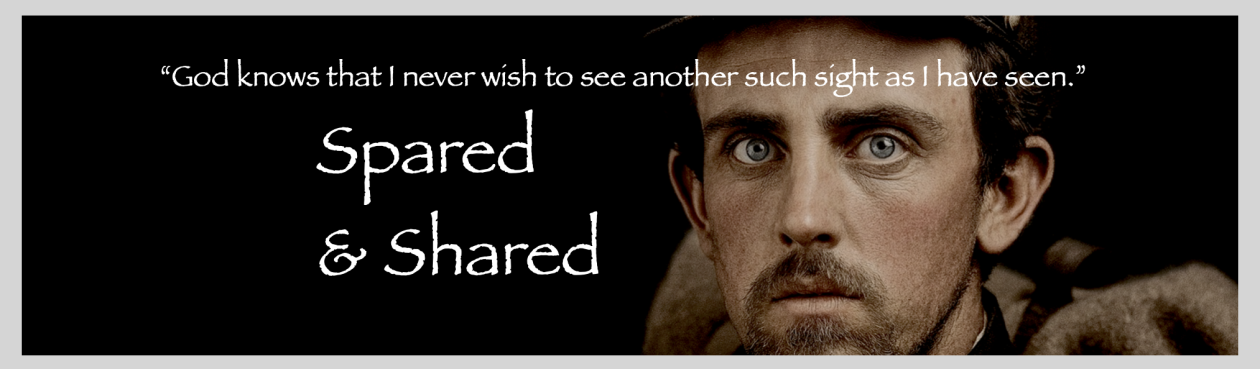
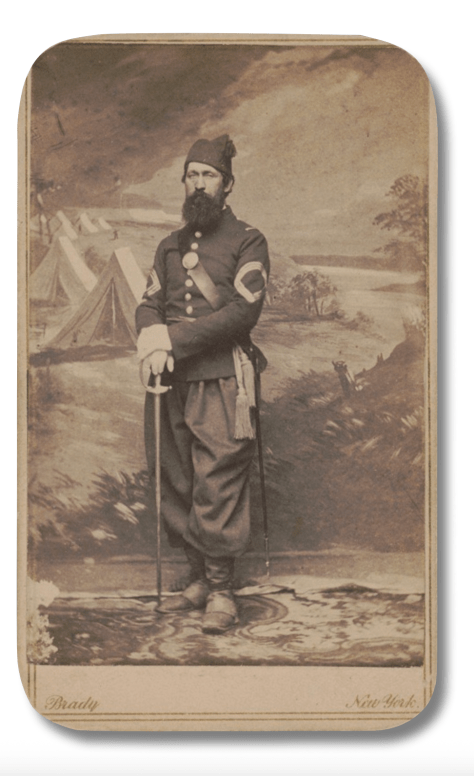
Sergt. Major Charles Seager showcasing the special chasseur-style uniforms awarded to the 62nd Pennsylvania for their excellence in drill. These were distributed in mid-December 1861.
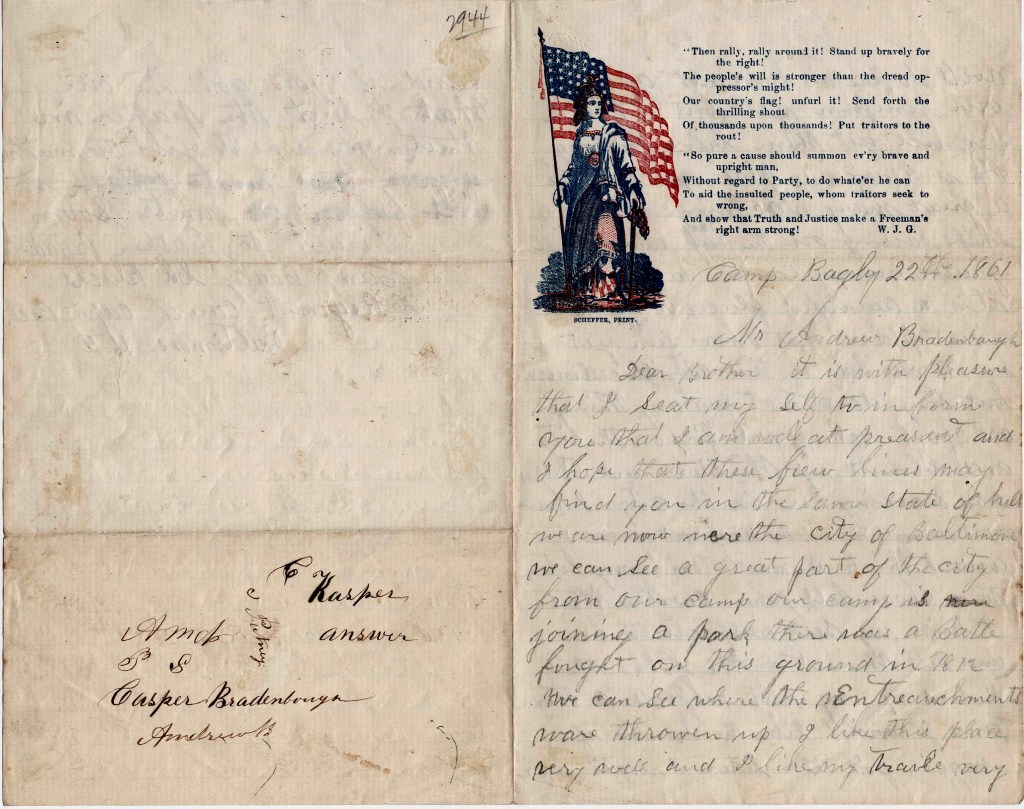
The following letter was written by Caspar Bradenbough of Co. D (the “Finley Cadets” of Armstrongcounty), 62nd Pennsylvania Infantry (he signed his name Casper Brady). Enrollment records describes him as 18 years old, with brown hair, brown eyes, and 5′ 6.5″ tall. According to a letter from 1st Lieutenant Putney, Bradenbaugh died at Washington Street General Hospital, Alexandria, Va. on 18 May 1862 at 7 P.M. of pneumonia. He was buried on 19 May 1862 in the Alexandria National Cemetery in Section A, Grave 9. Bates, in error, indicates Grave #8.
The 62nd Pennsylvania Infantry Regiment was organized by Colonel Samuel Black at Pittsburg as the 33rd Independent Regiment under the authority of Secretary of War Simon Cameron. T. Frederick Lehman was appointed Lieutenant Colonel and Jacob Sweitzer was appointed Major. The authority to raise ten companies was later raised to 12. The name of the regiment was changed to 62nd Pennsylvania Infantry on 19 November 1861.
In late August 1861, the regiment moved to Baltimore, Maryland, after training at Camp Cameron near Harrisburg. The regiment, commanded by Colonel Samuel Black, camped at Patterson’s Park, across the harbor from Fort McHenry, before continuing to Washington. It was at this location that Casper wrote the following letter.
T R A N S C R I P T I O N
Camp Bagley 22nd August 1861
Mr. Andrew Bradenbough,
Dear Brother, It is with pleasure that I seat myself to inform you that I am well at present and I hope that these few lines may find you in the same state of health.
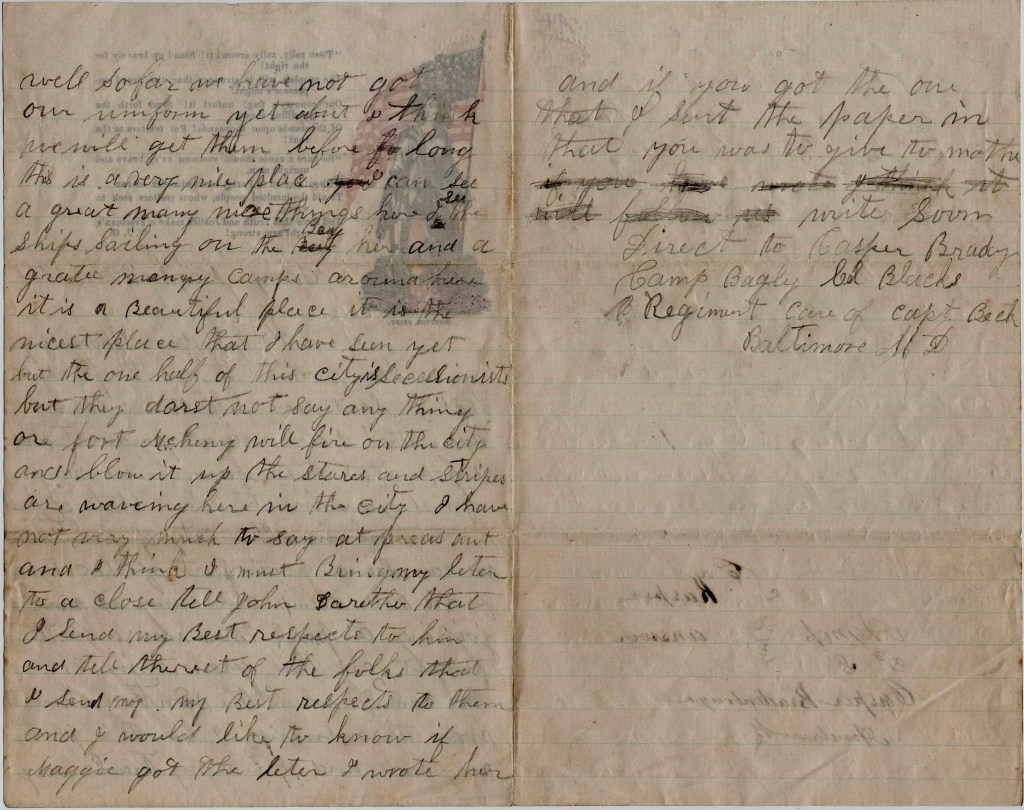
We can see a great part of the city from our camp. Our camp is joining a park. There was a battle fought on this ground in 1812. We can see where the entrenchments were thrown up. I like this place very well and I like my travel very well so far. We have not got our uniform yet but I think we will get them before long. This is a very nice place. I can see a great many nice things here. I see the ships sailing on the Bay here and a great many camps around here. It is a beautiful place. It is the nicest place that I have seen yet. But the one half of this city is secessionists but they dare not say anything or Fort McHenry will fire on the city and blow it up. The stars and sripes are waving here in the city.
I have not very much to say at present and I think I must bring my letter to a close. Tell John Bartho that I send my best respects to him and tell the rest of the folks that I send my best respects to them and I would like to know if Maggie got the letter I wrote her and if you got the one that I sent the paper in that you was to give to mother.
Write soon. Direct to Casper Brady, Camp Bagly, Col. [Samuel] Black’s Regiment, care of Capt. [William C.] Beck, Baltimore, Maryland
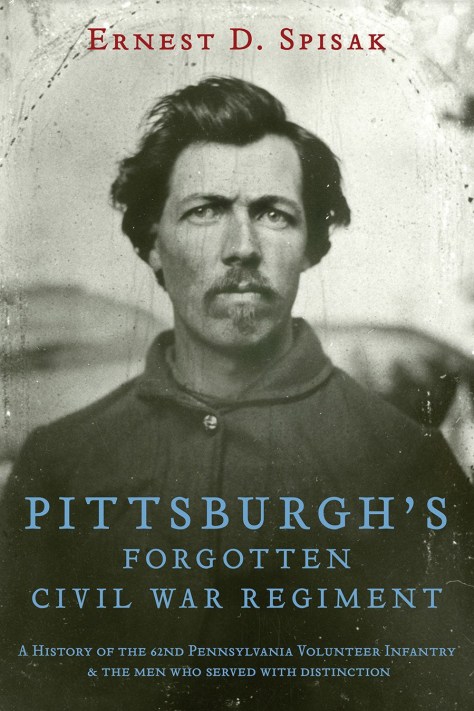
Jacket cover of Spisak’s book on the 62nd Pennsylvania Infantry.
The following letter was written by Alexander Mony (1836-1924), the son of Archibald Mohney (1809-1886) and Mary Catherine Heckman (1814-1884) of Clarion county, Pennsylvania. He wrote the letter to his brother-in-law, William J. Ditty, the wife of his older sister, Nancy Jane Mohney (1834-1907). After the war, Alexander would marry William Ditty’ younger sister, Sarah Jane Ditty (1840-1921).
Alexander enlisted in Co. E called “the Rimersburg Guards” in the summer of 1861, recruited by Thomas Kerr who would lead the company as part of the “33rd Independent Pennsylvania.” The regiment was organized at Pittsburg and left for Washington, D. C. on August 31, 1861. Their unit designation was changed, however, to the 62nd Pennsylvania Volunteers on November 18, 1861, just days before this letter was written. The 62nd Pennsylvania Infantry Regiment was stationed on Minor’s Hill in November 1861 after crossing the Potomac River and being assigned to the Second Brigade of General Porter’s Division.
In his book, “Pittsburgh’s Forgotten Civil War Regiment,” published in 2013, author Ernest Spisak informs us that he pulled the history of the 62nd Pennsylvania from 347 letters and diaries of the veterans of the regiment. I’m unaware if any of Mony’s letters were included in the history. This letter remains in private hands. The only other letters I have transcribed (to date) by a member of this regiment were those written by Will Dunn of Co. F (25 Letters), pictured below, courtesy of my friend Charles T. Joyce.
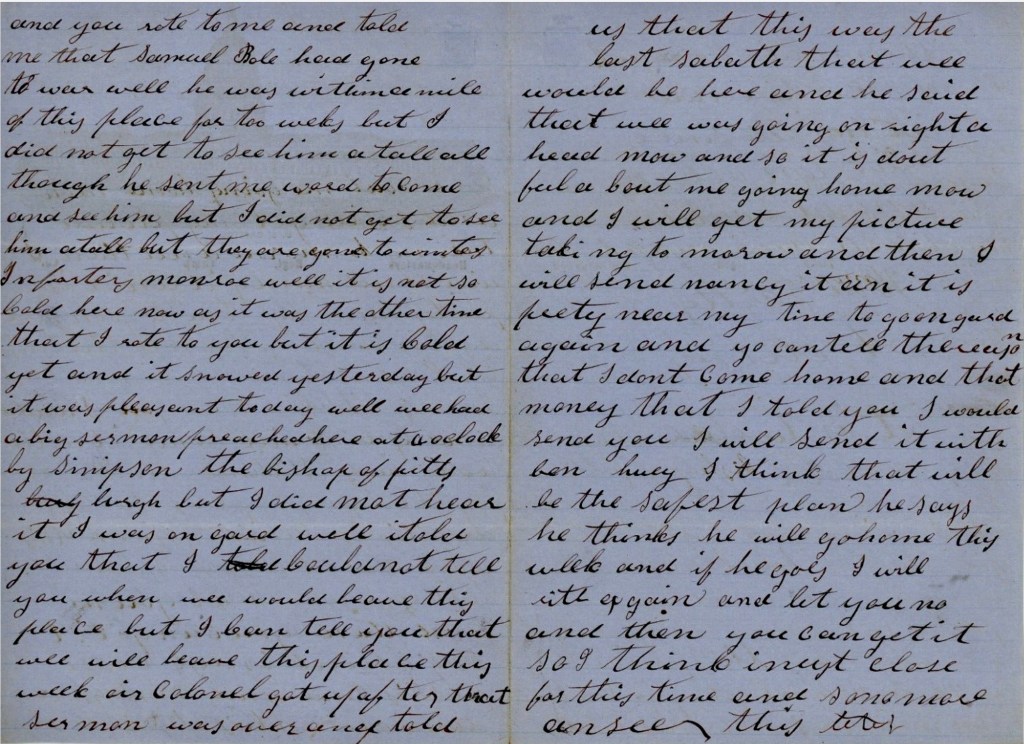
T R A N S C R I P T I O N
Headquarters 62nd [Pennsylvania] Regiment, Co. E Camp Minor’s Hill, Virginia November 24, 1861
Dear Brother in law,
It is with the greatest of pleasure that I take my pen in hand to inform you that I am well at present and hoping that these few lines may find you all enjoying the same blessings & well. I heard from Mr. Cocren [Cochran] this morning and he is uneasy about me coming home again the next court and I guess there is no chance to go home ow at this time. We are expecting a fight before long and there will be no chance to go home at this time. If it was the next time the court comes, when then I could go home in spite of the devil. Then I would be in the army six months and then I would go home on furlough. There has a great many has tried to get a pass home and they could not get off. But I will do all that I can and if I can’t get off, why then I suppose they will in tait [?] and I can’t help it at all no how. And if I could be put off till the next court, I will. be home without doubt.
I went over to the Colonel this morning to see him but he was not at home and so then I went to General Morell and he said that he would not sign no furlough at this time. He said that if I was in the service six months, that there would be a chance to get off. That is about all that I can tell you about going home. And if you can do anything in that case, do so and that is all that I can ask of you. And I have got twenty dollars that I will send you.
Well, we are in Virginia yet and I can’t tell you when we will leave this place. I thought that we would a left this place a good while ago. The news was still that we was going to South Carolina on one of them big fleets but that has all fell through I guess and so I don’t care now where we go or when.
Well we had a big review last Wednesday [November 20] 1 and there was the small sum of seventy thousand—that is, of soldiers of course. There was a great many spectators that did not drill at all and it was the prettiest sight that I’ve seen in my life. There was a great many girl and a great many women and there was a good many old men and a great many that was not so old. Well we had that review handy [to] the rebels and they hoped for a fight and so we took twenty rounds of cartridges and our knapsacks and our overcoats and our haversacks and one day’s provision and so then we was prepared for the lads but they did not bother us at all. We got home safe and we did not see a rebel at all. But they still get some of our men and they will. get more of them for they do not care if they can get out. They run any place at all.
Well, this is the day that they call. Sunday in this place but it does not seem so to me at all for they are chopping wood and hauling and I am on guard today and there was a call made for six companies to go on picket guard and so they went and they seen a lot of the rebels working toward them and so they sent for the balance of the regiment and they are getting ready to go. And that leaves only us, about one hundred in the camp at this time.
You wrote to me and told me that Samuel Bole had gone to war. Well he was within a mile of this place for two weeks but I did not get to see him at all although he sent me word to come and see him. But I did not get to see him at all. But they are gone to winter in Fortress Monroe.
Well, it is not so cold here now as it was the other time that I wrote to you but it is cold yet and it snowed yesterday. But it was pleasant today. We had a big sermon preached here at 4 o’clock by [Matthew] Simpson, the Bishop of Pittsburgh, but I did not hear it. I was on guard. I told you that I could not tell you when we would leave this place but I can tell you that we will leave this place this week. Our colonel got up after that sermon was over and told us that this was the last Sabbath that we would be here and he said that we was going on right ahead now and so it is doubtful about me going. home now.
I will get my picture taken tomorrow and then I will send Nancy it. It is pretty near my time to g on guard again and you can tell the reason that I don’t come home and that money that I told you I would send you, I will send it with Ben Huey. I think that will be the safest plan. He says he thinks he will go home this week and if he goes, I will write again and let you know and then you can get it. So I think I must close for this time and so no more. Answer this. There is about one inch of snow here now. It has fell since about ten o’clock tonight and is still snowing yet. [To] William J. Ditty
[From] A. Mony
It is twelve o’clock now.
1 The Grand Review of the Army of the Potomac was held at Bailey’s Crossroads, Virginia, in eastern Fairfax County on 20 November 1861. Among those in attendance was President Abraham Lincoln.