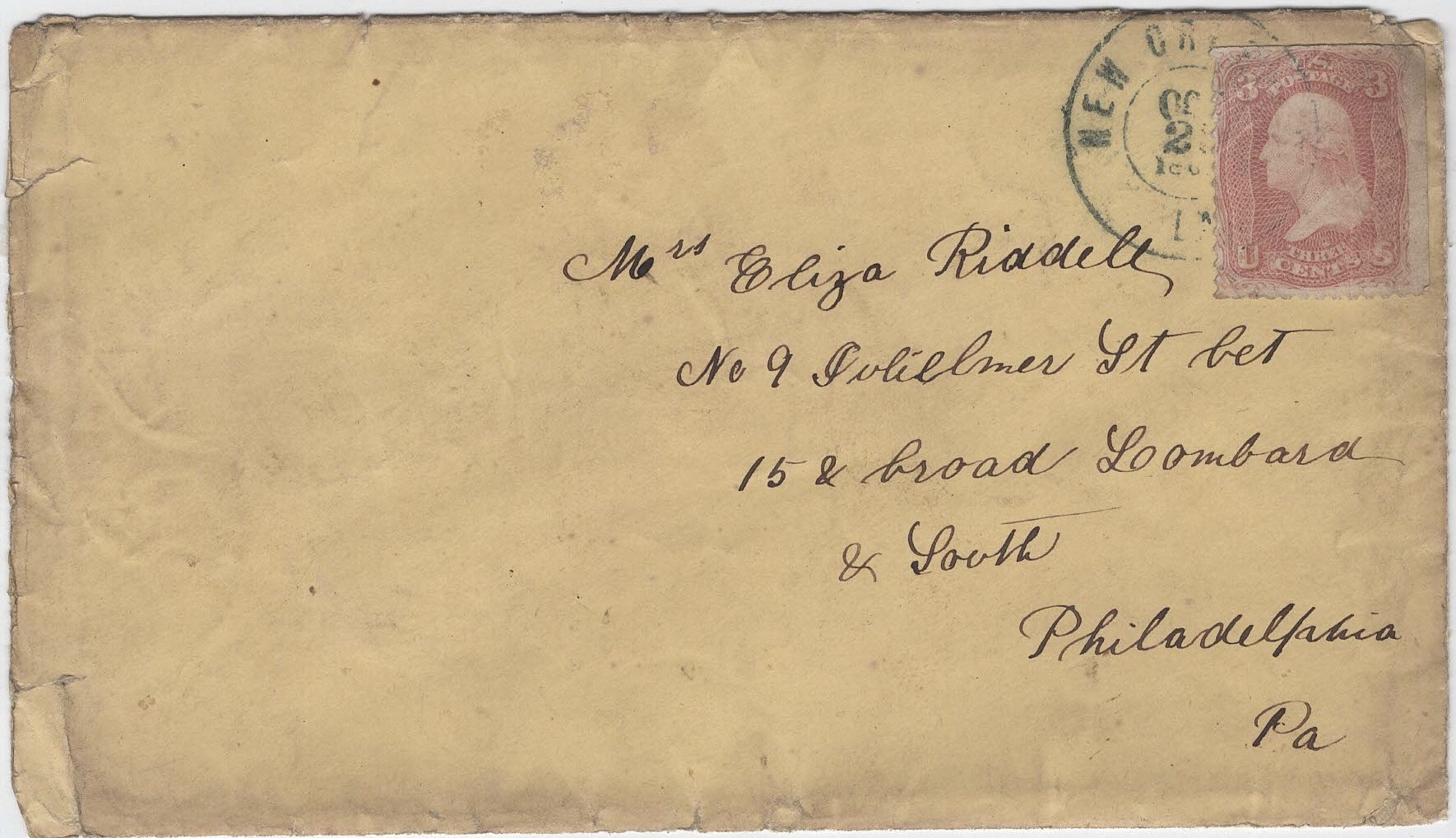
Although there is no accompanying letter remaining with this sketch, it was retained in the original envelope and the address to Mrs. Eliza Riddell of Philadelphia, Pennsylvania, informs us that it was likely the work of her son, George Riddell (1844-1916) who served as a private in the US Marine Corps aboard the USS Clifton in Farragut’s fleet, West Gulf Squadron, from 15 October 1861 to 15 October 1865. While in the service, he was described as standing 5′ 8″ tall, with blue eyes and brown hair. The family bible gives George’s date of birth as 24 March 1844 which would have made him 17 when he entered the service. The pension record also states that just prior to his enlistment in October 1861, George was employed in a Type Foundry. He died unmarried in 1916.
At the time of the 1860 US Census, Eliza Riddell (b. 1819) was enumerated as a 41 year-old “Shoe binder” living in Philadelphia’s 7th Ward with six children in the household ranging in age from 5 to 21. The 21 year-old, named John, was employed as a “car builder” and his 16 year-old brother, George, was employed as an “apprentice.” The four younger children were all females. George’s death certificate informs us that his parents were John Riddell and Eliza Scott, emigrants from Ireland. George’s father, John Riddle (1815-1859) was a blacksmith by trade.
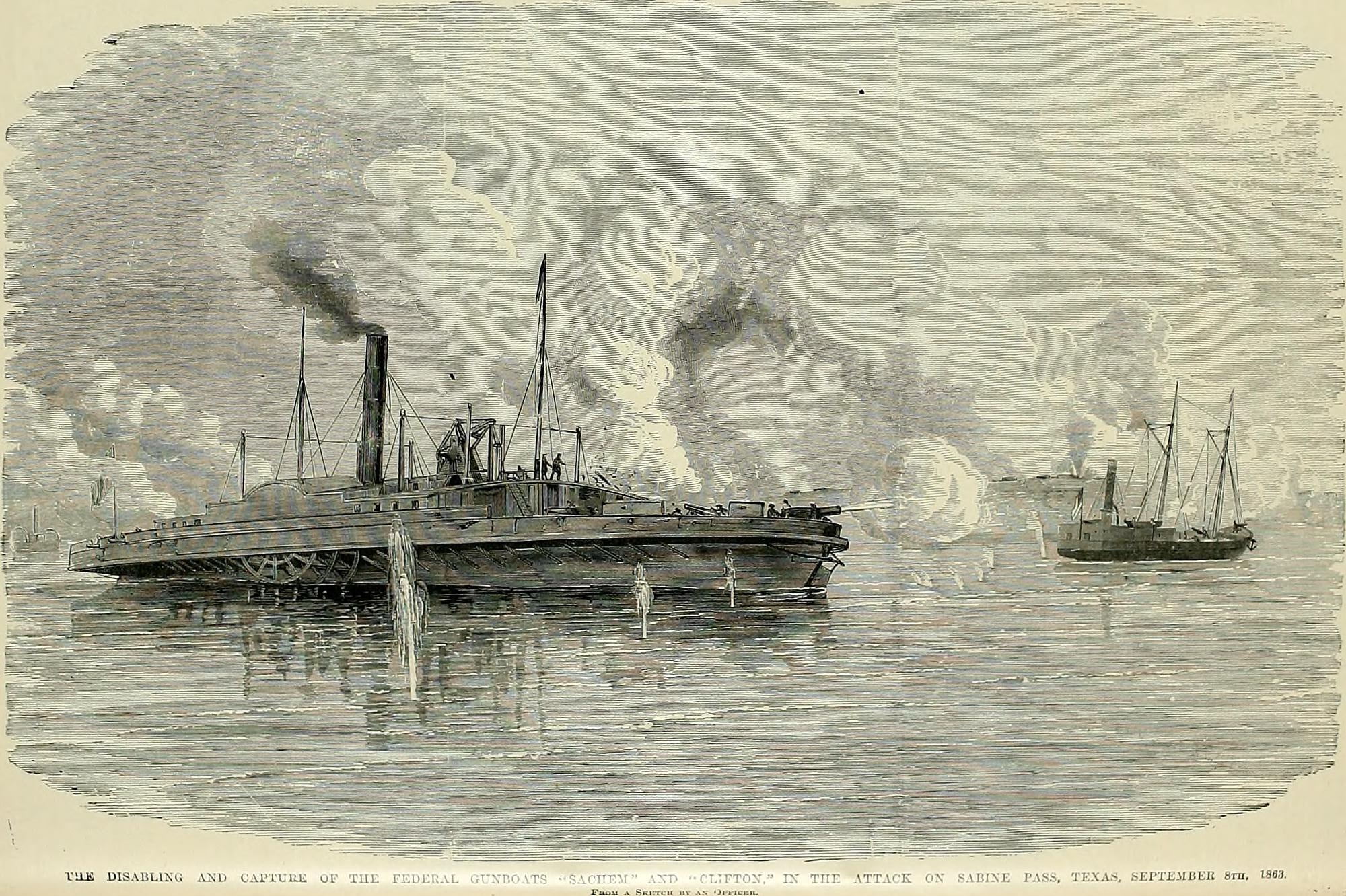
As near as I can tell, George served only on the USS Clifton which saw a lot of action during the war. The Clifton was a side-wheel steam ferryboat built in Brooklyn in 1861. In February 1862, she joined Porter’s mortar fleet at Ship Island and then participated in the capture of forts Jackson and St. Philip below New Orleans in late April. She took part in the attacks on the Confederate batteries at Vicksburg in June 1862, taking a shot through her boiler that killed 7 men. She helped to capture Galveston in October 1862 and saw action in the lower Mississippi until she participated in the attempt to establish a foothold in Texas in September 1863 and was run aground and captured by the Confederates at Sabine Pass.
George’s pension record states that he was taken captive at the Second Battle of Sabine Pass on 8 September 1863. He wrote in 1915, “I was a private in the Marine Corps on board of the gunboat Clifton when taken prisoner. I was sent with other prisoners to Camp Grose, Texas, and from there to Shreveport, Louisiana, and again to Tyler, Smith county, Texas, and again put in prison from which place I was paroled. I cannot remember the date on which I was paroled. I was then taken back to Shreveport and placed on board a boat and taken to New Orleans and transferred to another vessel and taken to Brooklyn Barracks, New York.”
Clifton (left) is captured at Sabine Pass along with USS Sachem
Addressed to Mrs. Eliza Riddell of Philadelphia, Pa.
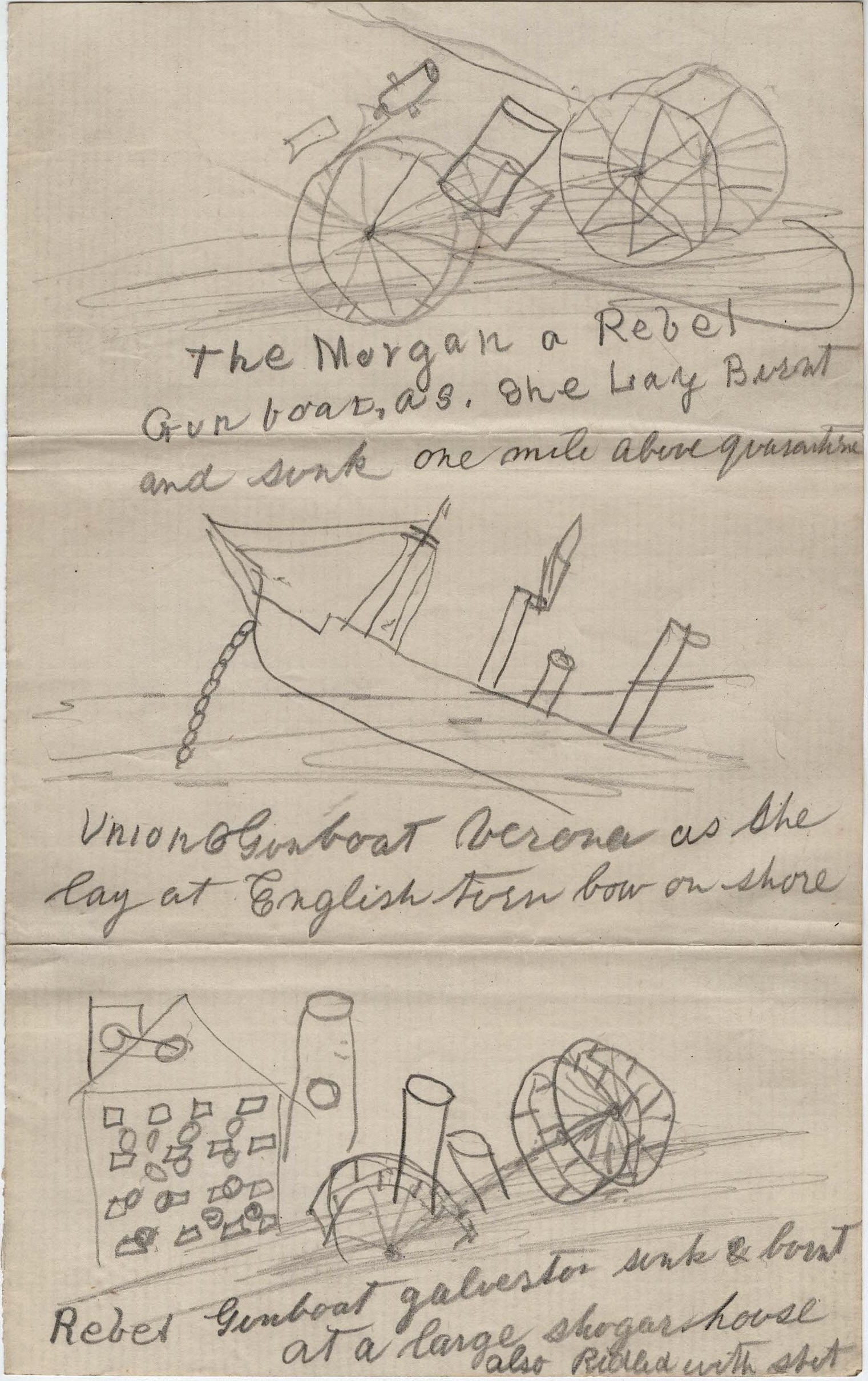
Drawing
George’s sketches of three shipwrecks: (1) The Morgan—a Rebel Gunboat as she lay burnt and sunk one mile above quarantine [on the Mississippi River]. (2) Union Gunboat Verona as she lay at English turn bow on shore. (3) Revel Gunboat Galveston, sunk and burnt, at a large sugar house also riddled with shot.
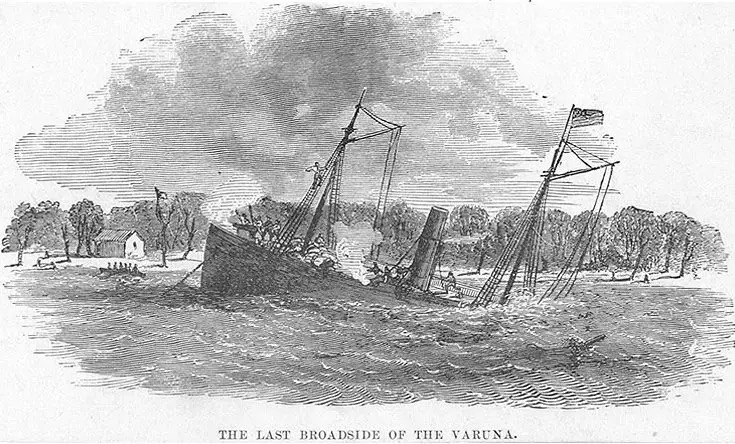
The Union gunboat Veruna (not Verona), pictured above, was sunk in April 1862 and seems to match George’s sketch. I could not find any record of the other wrecks, however.

 Spared & Shared 23