
Joseph Spang (1839-1927), a brick maker and the son of Jeremiah Spang and Catherine Fricker of Pottstown, Montgomery county, Pennsylvania lived to be 88 years old, but in his entire life we can be certain that he never forgot the 13th of December 1862 on the heights above Fredericksburg. He was quick to enlist when the war began, offering his services in Co. C of the 4th Pennsylvania Regiment. Later, in September 1861, he mustered into Co. A of the 53rd Pennsylvania Volunteers and was awarded the stripes of a corporal.
[Note: This letter is from the private collection of Keith Fleckner and was offered for transcription and publication on Spared & Shared by express consent.]
T R A N S C R I P T I O N
Falmouth, Virginia
December 18th 1862
Dear Parents & Brother,
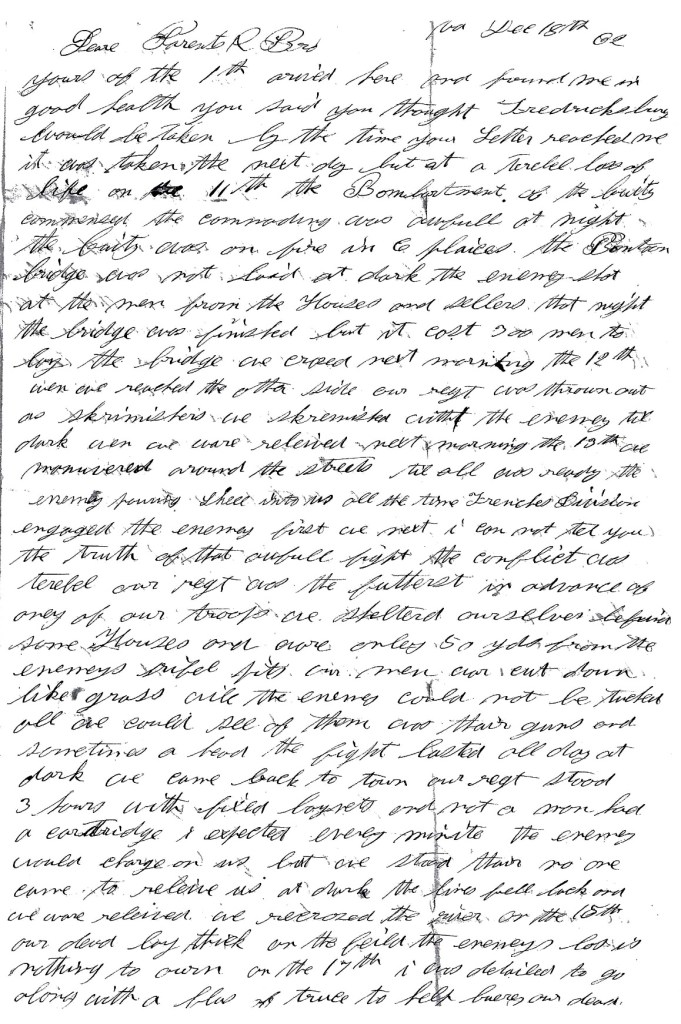
Yours of the 1st arrived here and found me in good health. You said you thought Fredericksburg would be taken by the time your letter reached me. It was taken the next day but at a terrible loss of life. On the 11th the bombardment of the city commenced. The cannonading was awful at night. The city was on fire in six places. The pontoon bridge was not laid at dark. The enemy shot at the men from the houses and cellars. That night the bridge was finished but it cost 300 men to lay the bridge.
We crossed next morning the 12th. When we reached the other side, our regiment was thrown out as skirmishers. We skirmished with the enemy til dark when we were relieved. Next morning, the 13th, we maneuvered around the streets til all was ready, the enemy pouring shell into us all the time. French’s Division engaged the enemy first. We next. I cannot tell you the truth of that awful fight. The conflict was terrible. Our regiment was the furthest in advance of any of our troops. We sheltered ourselves behind some houses and were only 50 yards from the enemy’s rifle pits. Our men were cut down like grass while the enemy could not be touched. All we could see of them was their guns and sometimes a head.
The fight lasted all day. At dark we came back to town. Our regiment stood three hours with fixed bayonets and not a man had a cartridge. I expected every minute the enemy would charge on us but we stood there [and] no one came to relieve us. At dark the lines fell back and we were [finally] relieved. 1
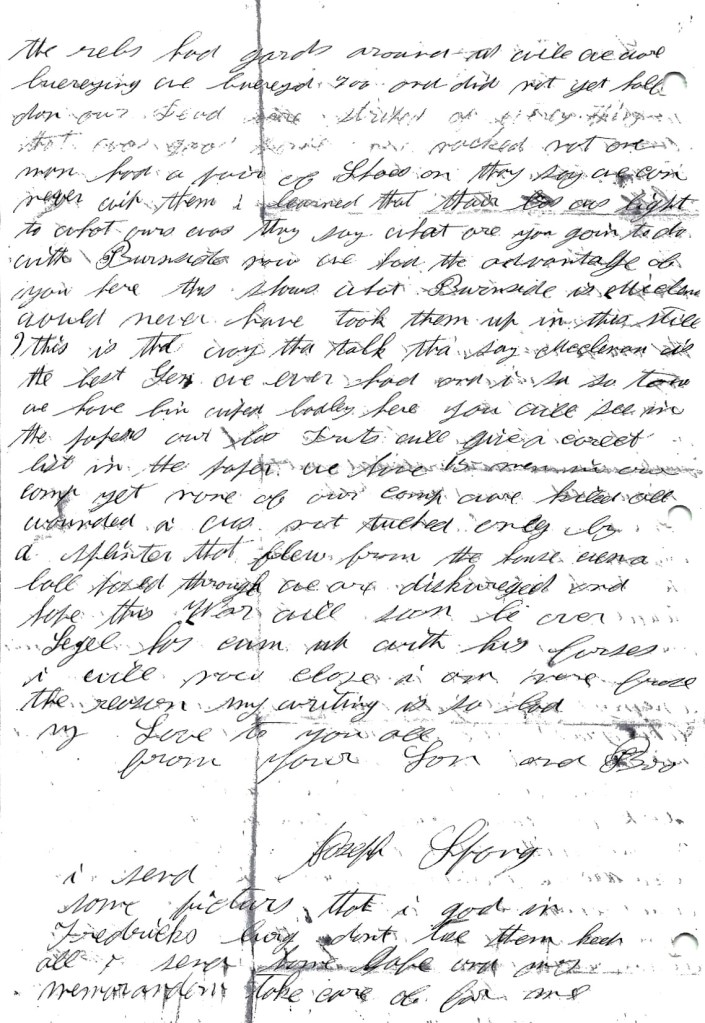
We recrossed the river on the 15th. Our dead lay thick on the field. The enemy’s loss is nothing to ours. On the 17th I was detailed to go along with a flag of truce to help bury our dead. The rebs had guards around us while we were burying. We buried 700 and did not get half done. Our dead were stripped of everything that was good. Some were naked. Not one man had a pair of shoes on.
They say we can never whip them. I learned that their loss was light to what ours was. They say, “What are you going to do with Burnside now? We had the advantage of you here. This shows what Burnside is. McClellan would never have took them up in this style.” This is the way they talk. They say McClellan is the best general we ever had and I say so too. We have been whipped badly here. You will see in the papers our loss. [ ] will give a correct list in the paper. We have 15 men in our company yet. None of our company were killed, all wounded. I was not touched—only by a splinter that flew from the house when a ball passed through. We are discouraged and hope this war will soon be over. Sigel has come up with his horses. I will now close. I am near froze the reason my writing is so bad.
My Love to you all. From your son and brother, — Joseph Spang
I send some pictures that I got in Fredericksburg. Don’t lose them. Keep all I send home safe and my memorandum, take care of for me.
1 According to Bates’ History of Pennsylvania Volunteers, “ Early on the morning of Saturday the 13th, under a dense fog the regiment marched into the city and halted for an hour under fire of rebel artillery. The fight was opened at the front near Marye’s Heights by French’s Division, which was repulsed. Soon after, the Third Brigade led by the 53rd moved amidst a shower of deadly missiles by the right flank, up St. Charles street and formed in line of battle along the edge of the town. The rebel infantry, but a few hundred yards in front, was protected by a stonewall along a sunken road while immediately above, the hilltops were bristling with cannon. At the word of command, Colonel Brooke at the head of his regiment led the charge under a storm of shot and shell that swept the ranks with terrible effect. But undismayed they closed up and pressed steadily on till they reached a position within one hundred and fifty yards of the enemy’s line which was held, despite every effort to dislodge them, even after their ammunition was spent. At evening, when the battle was over and the day was lost, what remained of the regiment retired silently from its position and returned to the city.”
 Spared & Shared 23