
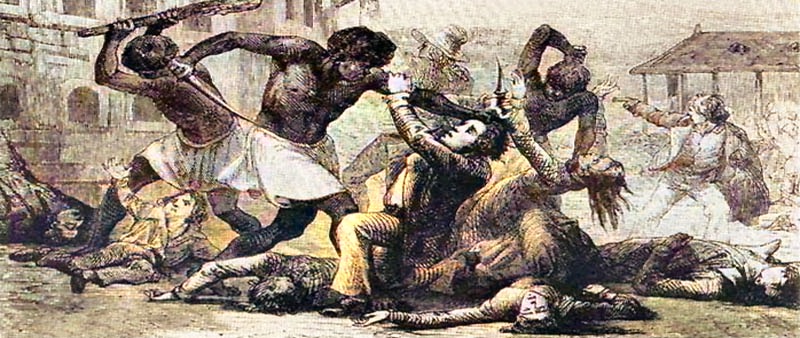
The following essay or oration on slavery was not dated and signed only by the name “H. Flagg” so confirming the author’s identity remains problematic. However, I think there’s a high probability that it was written by Henry Collins Flagg (1792-1863), a native of Charleston, South Carolina, a graduate of Yale, and a lawyer in Charleston by 1814. He gave up the practice to return to New Haven to edit the Connecticut Herald, honing his skills as a writer and immersing himself in politics. He returned to the practice of law in South Carolina in the 1820s and then resided in New Haven once again in the 1830s so that his children could attend school there. He remained there until his death in 1863.
The essay refers to frequent fires in southern cities that were thought by many to be started by slaves. Charleston was one such city that had numerous fires in the 1850s and these would have no doubt caught the attention of Henry Flagg. He was described by those who knew him as a “graceful and eloquent public speaker, with a powerful voice and fluent utterance, and a ready and effective writer. His attachment to his native State was strong, but secondary to his devotion to the Union.” [Source: Biographical Sketches of the Graduate of Yale College, page 385]
The essay presents a powerful persuasive argument for a gradual, if not immediate emancipation of the slaves held in the southern states and suggests that, once liberated and recognizing themselves that they could never be treated as equals in American society, most of the free Blacks would opt for migrating back to Africa. The author also suggests that by ridding themselves of slavery, the white population would become less indolent and more virtuous.
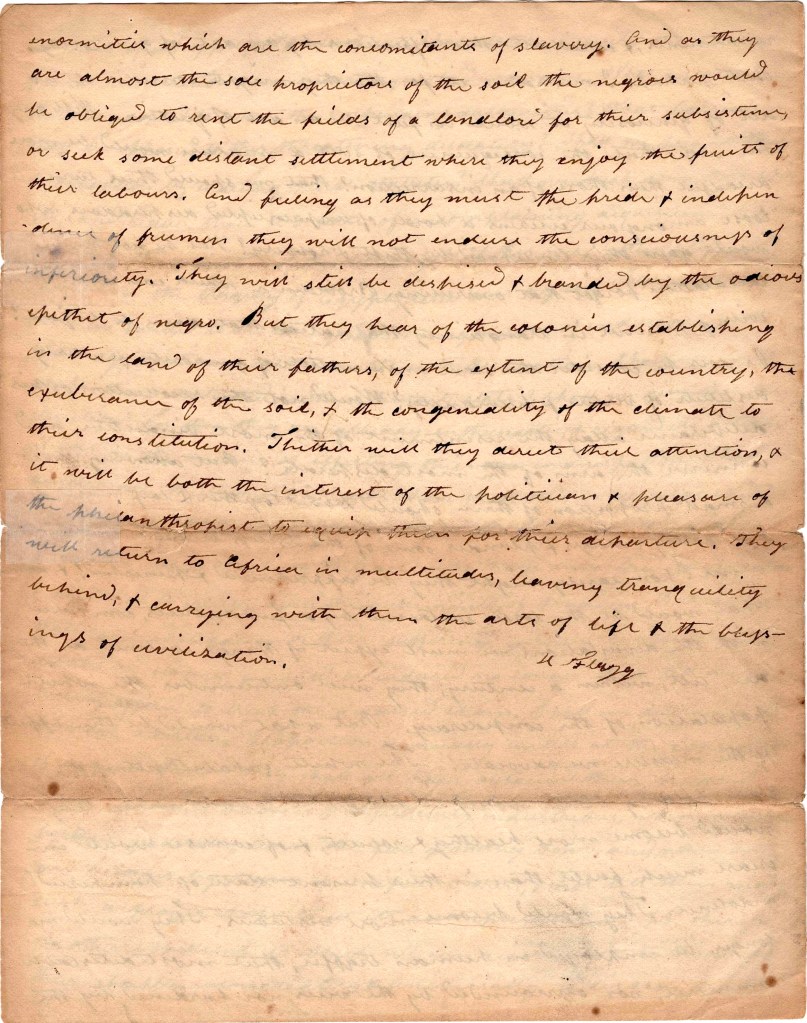
T R A N S C R I P T I ON
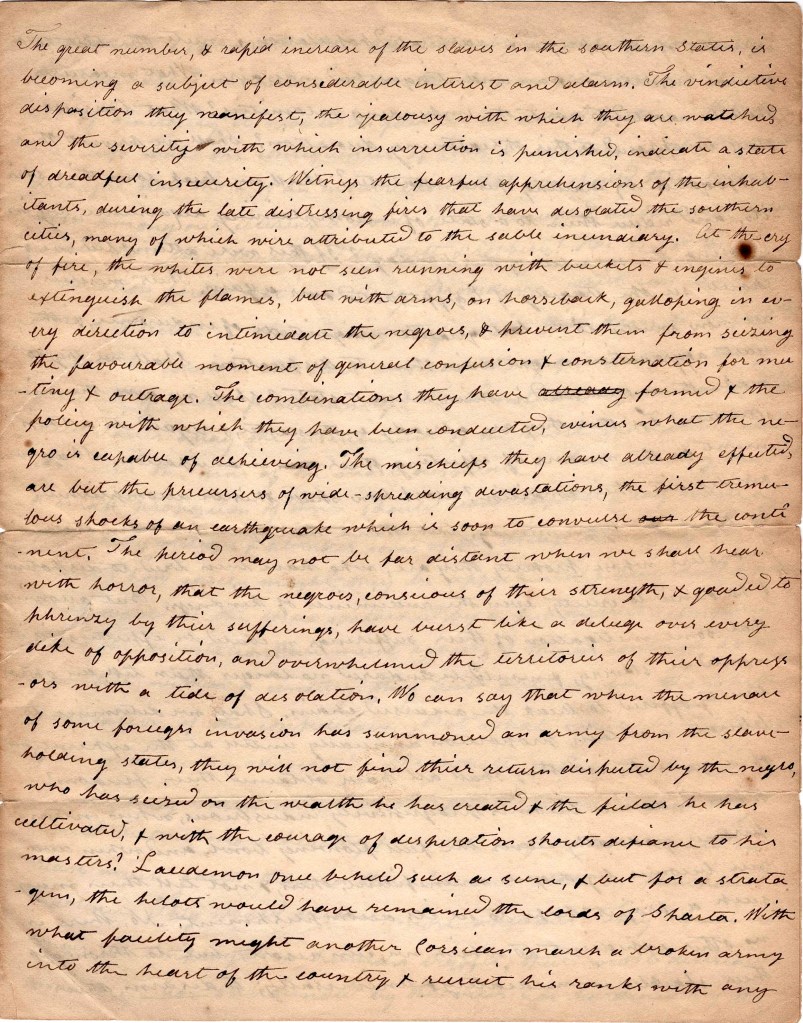
The great number and rapid increase of the slaves in the southern states is becoming a subject of considerable interest and alarm. The vindictive disposition they manifest, the jealousy with which they are watched, and the severity with which insurrection is punished, indicate a state of dreadful insecurity. Witness the fearful apprehensions of the inhabitants during the late distressing fires that have desolated the southern cities, many of which were attributed to the sable incendiary. At the cry of fire, the whites were not seen running with buckets & engines to extinguish the flames, but with arms, on horseback, galloping in every direction to intimidate the negroes & prevent them from seizing the favorable moment of general confusion & consternation for mutiny & outrage. The combinations they have formed & the policy with which they have been conducted, evinces what the negro is capable of achieving. The mischiefs they have already effected are but the precursors of wide-spreading devastations—the first tremulous shocks of an earthquake which is soon to convulse the continent. The period may not be far distant when we shall hear with horror that the negroes, conscious of their strength & goaded to frenzy by their sufferings, have burst like a deluge over every dike of opposition, and overwhelmed the territories of their oppressors with a tide of desolation. Who can say that when the menace of some foreign invasion has summoned an army from the slave-holding states, they will not find their return disputed by the negro who has seized on the wealth he has created & the fields he has cultivated, & with the courage of desperation shouts defiance to his masters?
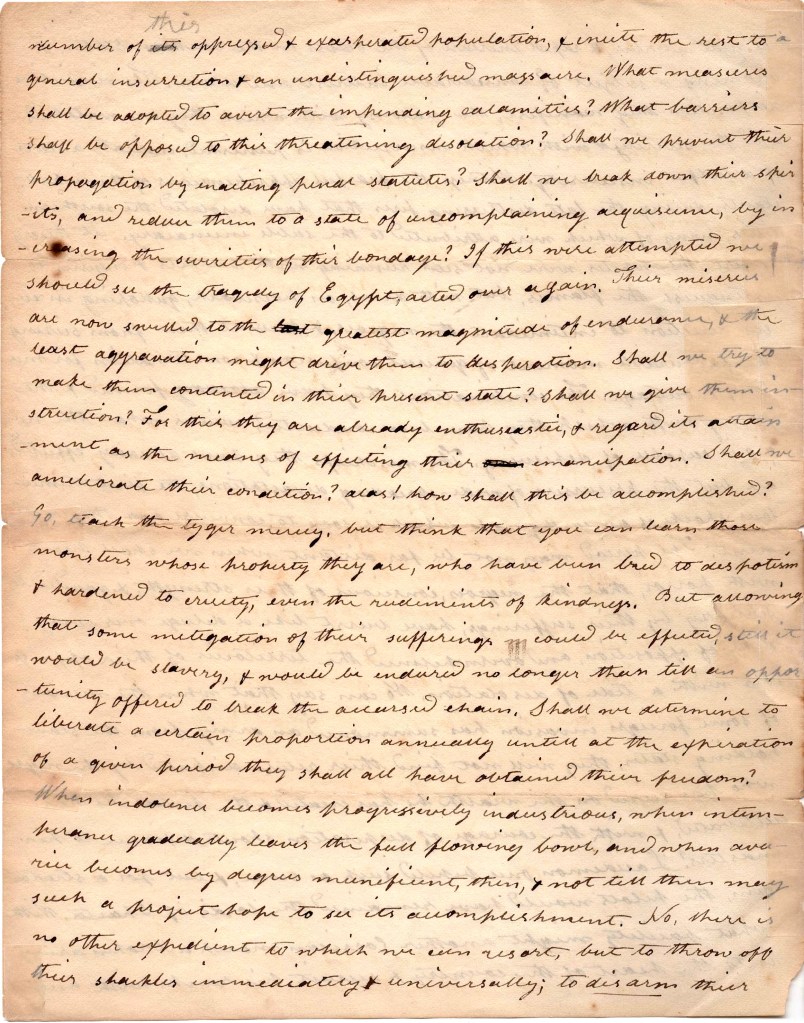
Lacedaemon once beheld such a scene & but for a stratagem, the Helots would have remained the lords of Sparta. With what facility might another Corsican march a broken army into the heart of the country & recruit his ranks with any number of this oppressed & exasperated population, & incite the rest to a general insurrection & an undistinguished massacre. What measures shall be adopted to avert the impending calamities? What barriers shall be opposed to their threatening desolation? Shall we prevent their propagation by enacting penal statutes? Shall we break down their spirits, and reduce them to a state of uncomplaining acquiescence by increasing the severities of their bondage? If this were attempted, we should see the tragedy of Egypt acted over again. Their miseries are now swelled to the greatest magnitude of endurance & the least aggravation might drive them to desperation. Shall we try to make them contented in their present state? Shall we give them instruction? For this they are already enthusiastic & regard its attainment as the means of effecting their emancipation. Shall we ameliorate their condition?
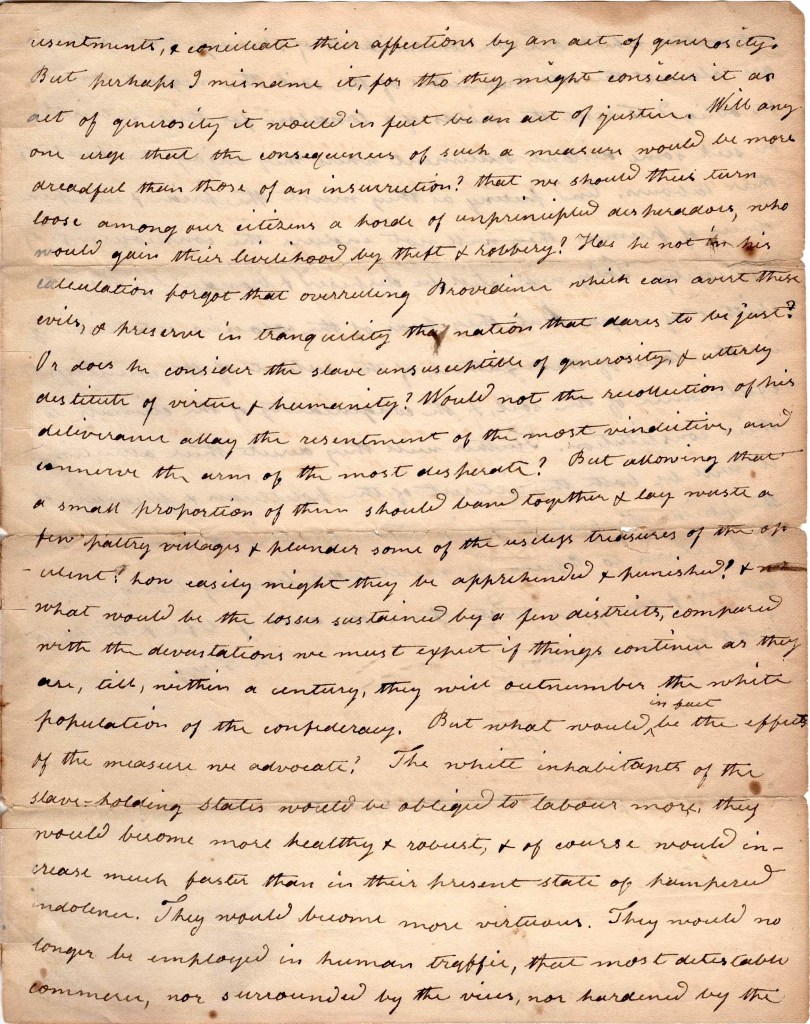
Alas! How shall this be accomplished? Go, teach the tiger mercy, but think that you can learn those monsters whose property they are, who have been bred to despotism & hardened to cruelty, even the rudiments of kindness. But allowing that some mitigation of their sufferings could be effected, still it would be slavery & would be endured no longer than till an opportunity offered to break the accursed chain. Shall we determine to liberate a certain proportion annually until at the expiration of a given period they shall all have obtained their freedom? When indolence becomes progressively industrious, when intemperance gradually leaves the full flowing bowl, and when avarice becomes by degrees munificent, then, & not till then, may such a project hope to see its accomplishment. No, there is no other expedient to which we can resort, but to throw off their shackles immediately & universally; to disarm their resentments, & conciliate their affections by an act of generosity. But perhaps I misname it, for tho they might consider it an act of generosity, it would in fact be an act of justice. Will anyone urge that the consequences of such a measure would be more dreadful than those of an insurrection? That we should thus turn loose among our citizens a horde of unprincipled desperadoes who would gain their livelihood by theft & robbery? Has he not in his calculation forgot that overruling Providence which can avert these evils & preserve in tranquility the nation that dares to be just?
Or does he consider the slave unsusceptible of generosity & utterly destitute of virtue & humanity? Would not the recollection of his deliverance allay the resentment of the most vindictive, and unnerve the arm of the most desperate? But allowing that a small proportion of them should band together and lay waste on a few paltry villages & plunder some of the useless treasures of the opulent How easily might they be apprehended & punished! And what would be the losses sustained by a few districts compared with the devastations we must expect if things continue as they are, till, within a century, they will outnumber the white population of the confederacy. But what would in fact be the effects of the measure we advocate? The white inhabitants of the slave-holding states would be obliged to labour more. They would become more healthy & robust, & of course, would increase much faster than in their present state of pampered indolence. They would become more virtuous. They would no longer be employed in human traffic—that most detestable commerce, nor surrounded by the vices nor hardened by the enormities which are the concomitants of slavery. And as they are almost the sole proprietors of the soil, the negroes would be obliged to rent the fields of a landlord for their subsistence, or seek some distant settlement where they enjoy the fruits of their labors.
And feeling as they must the pride & independence of humans, they will not endure the consciousness of inferiority. They will still be despised and branded by the odious epithet of negro. But they, hearing of the colonies establishing in the land of their fathers, of the extent of the country, the exuberance of the soil, & the congeniality of the climate to their constitution, thither will they direct their attention & it will be both the interest of the politician & pleasure of the philanthropist to equip them for their departure. They will return to Africa in multitudes, leaving tranquility behind, & carrying with them the arts of life & the blessings of civilization. H. Flagg
 Spared & Shared 23