The following letter was written by Charles W. Messer of Co. B, 2nd Wisconsin Infantry. He enlisted on 22 May 1861 and was discharged due to disability on 27 May 1863 after two years service. Charles was the son of Moses Messer (1767-1823) and Abigail Stevens (1772-1833). He was married in March 1864 to Etta E. Phenix at La Crosse, Wisconsin. He was buried near Bangor, Wisconsin, in 1902.
In July 1861, the 2nd Wisconsin Infantry Regiment brigaded with three New York regiments of Infantry; all of them under the command of Colonel (later General) William T. Sherman. Together, they participated in the battle of Bull Run in Virginia on July 21. Later in the war the regiment became a part of the vaunted Iron Brigade. The regimental history states that Charles did not remain with his regiment in the East, however. In February 1862, he was detached into the Western Gunboat service and remained there until his discharge in 1863. Charles’ age at the time of his enlistment could not be found but he was probably middle aged, making the gunboat service a better fit.
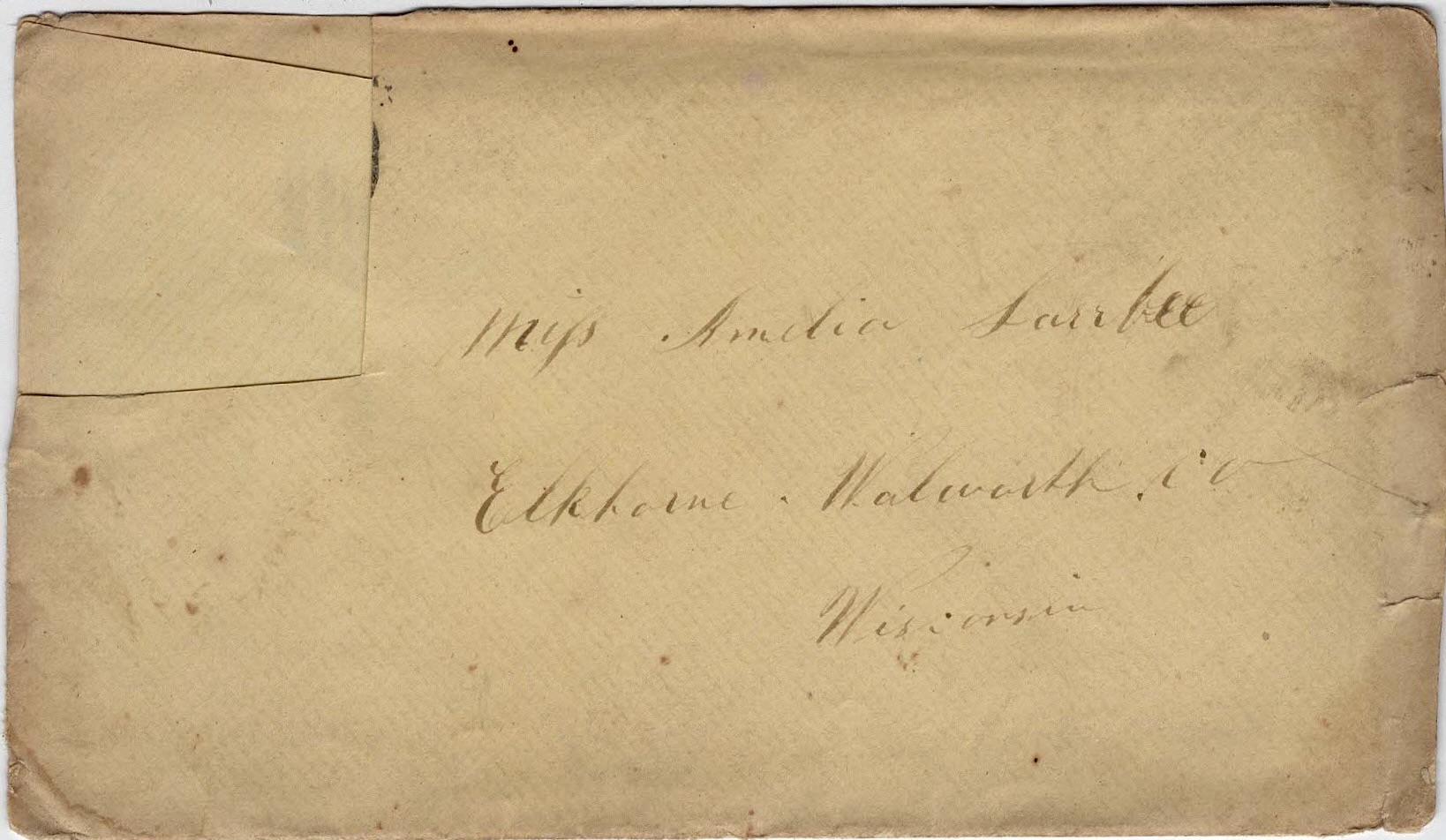
Charles wrote the letter to his niece, Amelia C. Larrabee (1846-1893) of Elkhorn. Walworth county, Wisconsin. Her parents were Charles W. Larrabee (1815-1890) and Olive L. Messer (1815-1870). In the 1860 US Census, Amelia’s father was enumerated in Salem, Kenosha county, Wisconsin, where he was identified as a “Hotel Keeper.” Amelia’s siblings at the time included, John (age 10), James (age 8). That census also informs us that Amelia and her siblings were all born in Vermont, her father’s native state. Her mother was born in Massachusetts. Their residence in 1850 was confirmed as Shoreham, Addison county, Vermont.
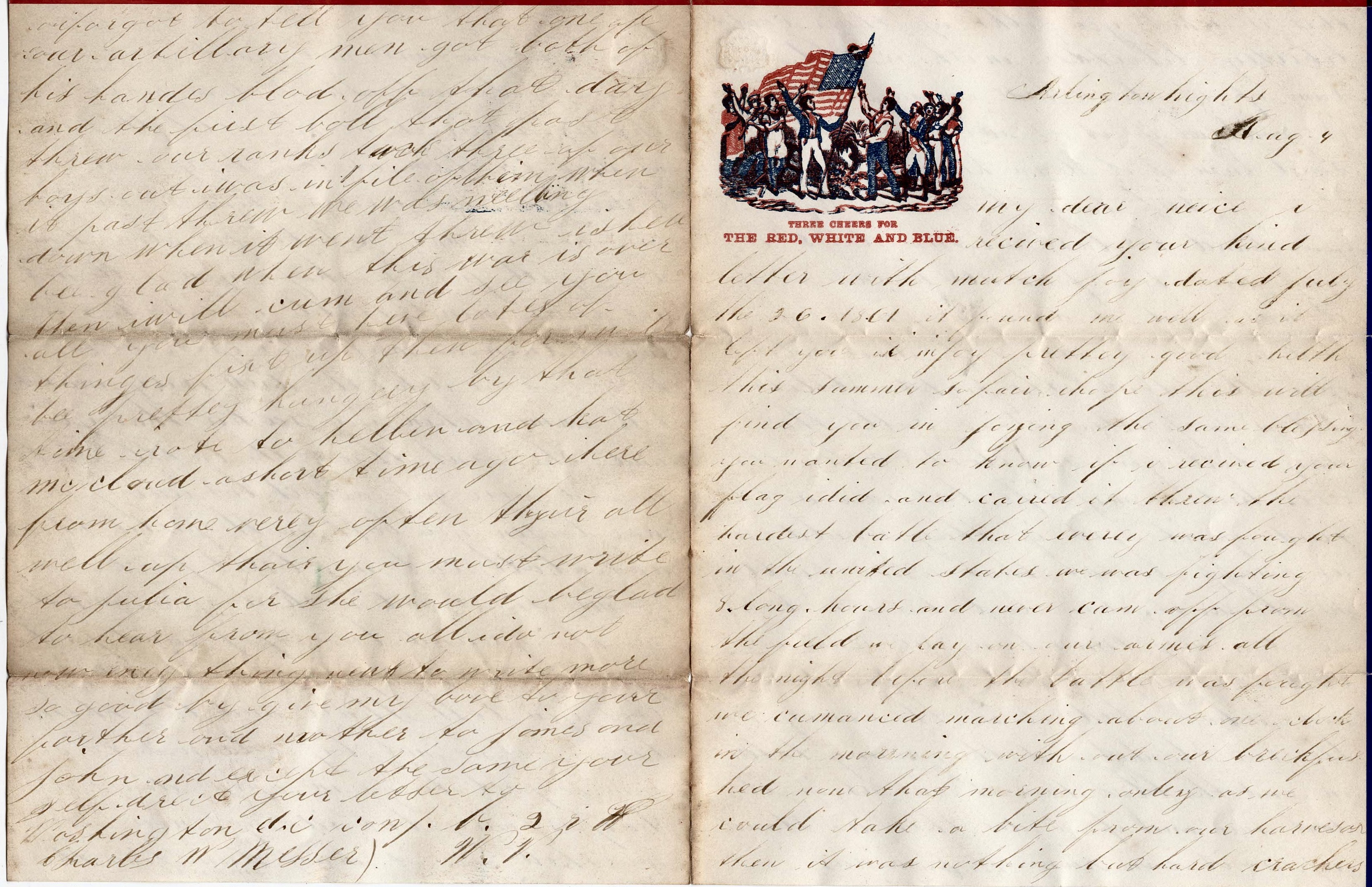
T R A N S C R I P T I O N
Arlington Heights
August 4th [1861]
My dear niece,
I received your kind letter with much joy dated July the 26th 1861. It found me well as it left you. I enjoy pretty good health this summer so fair. I hope this will find you enjoying the same blessing.
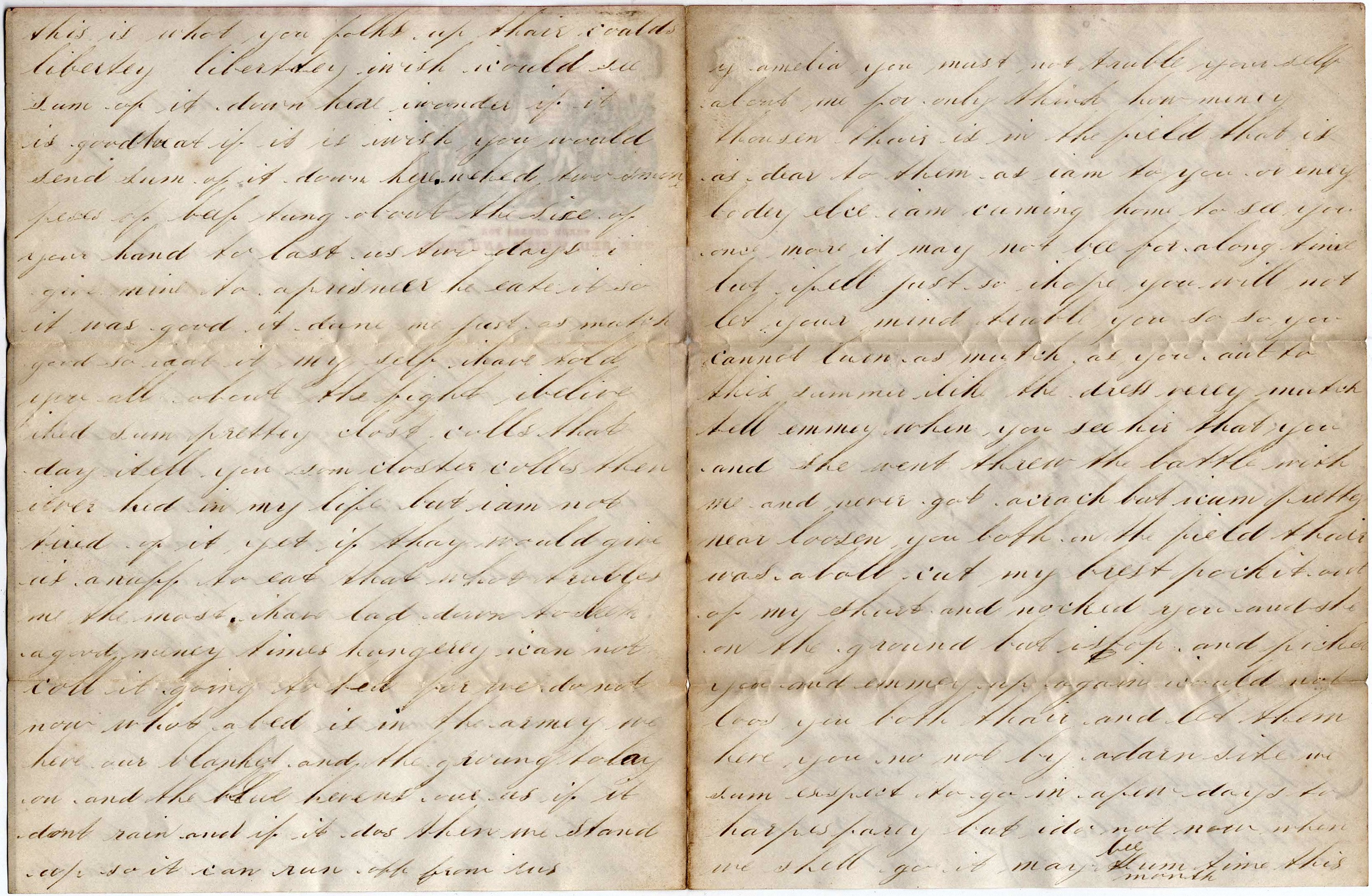
You wanted to know if I received your flag. I did and carried it through the hardest battle that ever was fought in the United States. We was fighting eight long hours and never came off from the field. We lay on our arms all the night before the battle was fought. We commenced marching about one o’clock in the morning without our breakfast—had none that morning, only as we could take a bite from our haversack. [Even] then it was nothing but hard crackers. This is what you folks up there called liberty. I wish [you] would send some of it down here. I wonder if it is good wheat. If it is, wish you would send some of it down here. We had two small pieces of beef tongue about the size of your hand to last us two days. I give mine to a prisoner. He eat it so it was good. It done me just as much good so I eat it myself.
I have told you all about the fight, I believe. I had some pretty close calls that day, I tell you—some closer calls than I ever had in my life. But I am not tired of it yet. If they would give us enough to eat. That’s what troubles me the most. I have laid down to sleep a good many times hungry. I cannot call it going to bed for we do not know what a bed is in the army. We have our blanket and the ground to lay on and the blue heavens over us if it don’t rain. And if it does, then we stand up so it can run off from us.
Amelia, you must not trouble yourself about me for only think how many thousand there is in the field that is as dear to them as I am to you or anybody else. I am coming home to see you once more. It may not be for a long time but I feel kust so. I hope you will not let your mind trouble you so so you cannot learn as much as you ought to this summer. I like the dress very much. Tell Emmy when you see her that you and she went through the battle with me and never got a scratch. But I come pretty near loosing you both on the field. There was a ball cut my breast pocket out of my short and knocked you and she on the ground. But I stopped and picked you and Emmy up again. I would not lose you both there and let them have you—no, not by a darn sight.
We some expect to go in a few days to Harpers Ferry but I do not know when we shall go. It may be some time this month. Oh! I forgot to tell you that one of our artillery men got both of his hands blowed off that day and the first ball that passed through our ranks [and] took three of our boys out. I was in file of them when it passed through. We was kneeling down when it went through.
I shall be glad when this war is over. Then I will come and see you all. You must have lots of things fixed up then for I’ll be pretty hungry by that time. I wrote to Hellen and Kat McCloud a short time ago. I hear from home very often. They’re all well up there. You must write to Julia for she would be glad to hear from you all. I do not know anything new to write more so goodbye. Give my love to your father and mother, to James and John and accept the same yourself.
Direct your letter to Washington D. C., Company B, 2nd Regiment Wisconsin Infantry, — Charles W. Messer