My passion is studying American history leading up to & including the Civil War. I particularly enjoy reading, transcribing & researching primary sources such as letters and diaries.
The following letter was written by 32 year-old Electa F. (Sawyer) Miller of West Hampden, Penobscot county, Maine, who served as an officer in the Morning Star Division—a temperance organization. Electa was married to 54 year-old Joseph Buck Miller, a cooper in West Hampden. Her parents were Capt. Samuel Sawyer (1797-1864) and Rebecca Hewes (1798-1870).
Joseph B. Miller was appointed the postmaster of West Hampden on 2 October 1862 and held the position until April 1865. Electa mentions her daughter Ada in this letter who would have been about 8 or 9 years old.
Transcription
Addressed to Miss C. Clarke, West Amesbury, to be left at G. W. Hunt’s Store
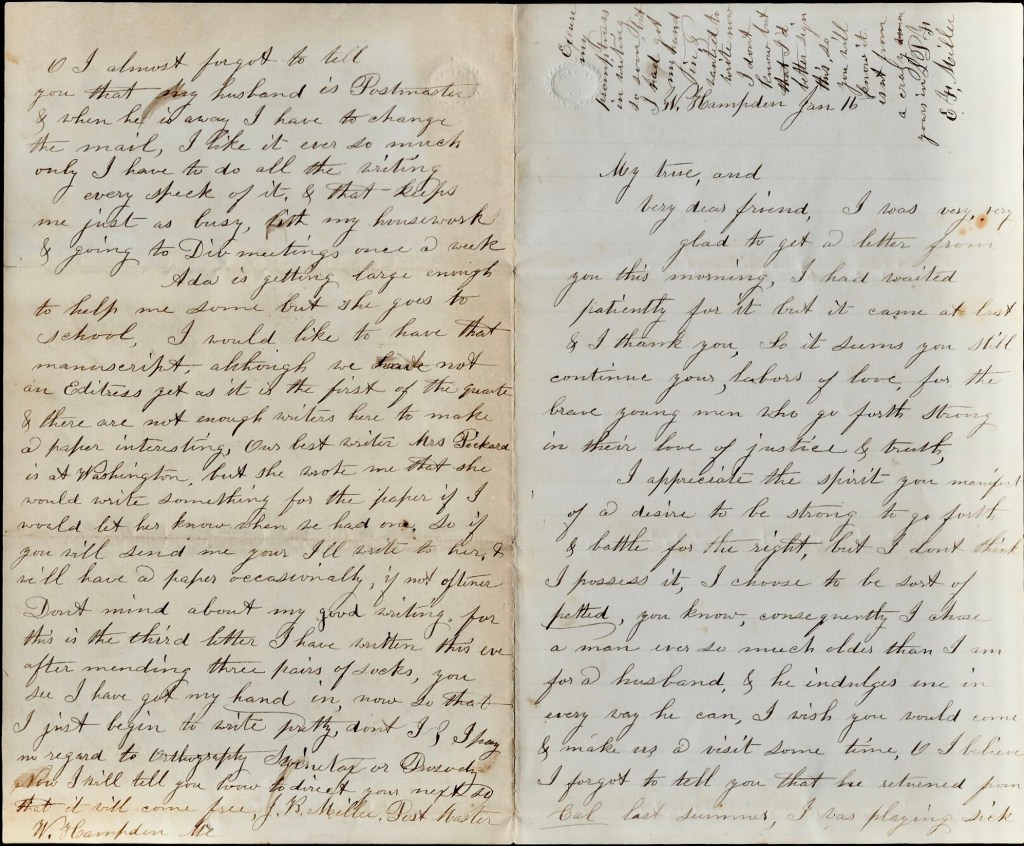
West Hampden [Penobscot County, Maine] January 16 [1863]
My true and very dear friend,
I was very, very glad to get a letter from you this morning. I had waited patiently for it but it came at last & I thank you. So it seems you still continue your labors of love for the brave young men who go forth strong in their love of justice & truth. I appreciate the spirit you manifest of a desire to be strong, to go forth & battle for the right, but I don’t think I possess it. I choose to be sort of petted, you know. Consequently, I chose a man ever so much older than I am for a husband & he indulges me in every way he can. I wish you would come & make us a visit some time. Oh, I believe I forgot to tell you that he returned from California last summer. I was playing sick but he soon talked me out of that notion. Besides, he is a healing medium you know—believes in Spiritualism; but I don’t, do you? He can take the pain out of my head by holding his hands on my head.
About the [Morning Star] Division, we are prospering quite well, considering the circumstances. One of our best members died this winter after winning golden opinions from the company & regiment in which he enlisted as a private soldier, being engaged in several battles, at last was taken sick, sent to a hospital, and after a long time, got a discharge, came home, and a poorer looking object no one ever saw. He was a walking skeleton. He lingered a few weeks, was all ambition to get well, but it was not to be. He sleeps his last sleep. Oh, how very many precious lives have been sacrificed for the Southern traitors. How I wish they would speedily get their just recompense. My husband used to see something of their disposition in California. He hates them. They are so revengeful and overbearing.
Let me see, you wrote that William spent a great part of his time with Mrs. Hoyt. I’ll warrant it. I’m right glad you told me for I want to know all the gossip. You didn’t write half enough. You know I want to know lots of news. I had one little letter from Sarah Huse for a year & then she was very sparing of news. I should think there might be some gossip. There always is in most every town. Do tell me what street Mrs. Hoyt lives on. Sadie wrote that she was keeping boarders there & I have a friend in Washington this winter. She writes me she is boarding with a New Hampshire lady. I thought it might possibly be Mrs. Hoyt. Write me all about it, won’t you, and don’t let any one read this for I write by the jump, just as I happen to think.
Oh, I almost forgot to tell you that my husband is postmaster and when he is away, I have to change the mail. I like it ever so much only I have to do all the writing—every speck of it—& that keeps me just as busy with my housework & going to Div. meetings once a week.
Ada is getting large enough to help me some but she goes to school. I would like to have that manuscript, although we have not an editress yet as it is the first of the quarter & there are not enough writers here to make a paper interesting. Our best writer—Mrs. Packard—is at Washington, but she wrote me that she would write something for the paper if I would let her know when we had one. So if you will send me yours, I’ll write to her & will have a paper occasionally if not oftener. Don’t mind about my good writing for this is the third letter I have written this evening after mending three pairs of socks. You see I have got my hand in now so that I just begin to write pretty, don’t I, & I pay no regard to Orthography, Syntax, or Prosody. Now I will let you how to direct your next so that it will come free; J. B. Miller, Post Master, W. Hampden, Me.
Excuse my promptness in writing so soon but I had got my hand in & wanted to write now. I don’t know but that I’d better sign this so you will know it isn’t from a crazy woman. Yours in L. P. F. — E. F. Miller
The following partial letter is missing the signature page and the content can only lead us to his membership in Co. A, 74th Indiana Infantry. Co. A was raised in Warsaw, Koscusko county, Indiana, and left Indianapolis the day after they were sworn into service for Louisville, Kentucky. They were rushed to Kentucky even before they were fully equipped in order to defend Louisville from Bragg’s army which was known to be advancing north into Kentucky.
There were far too many young men from Warsaw to narrow down the author’s identity but he was most likely good friends with those mentioned in his letter and possibly lived nearby. Perhaps another of his letter will show up someday.
Transcription
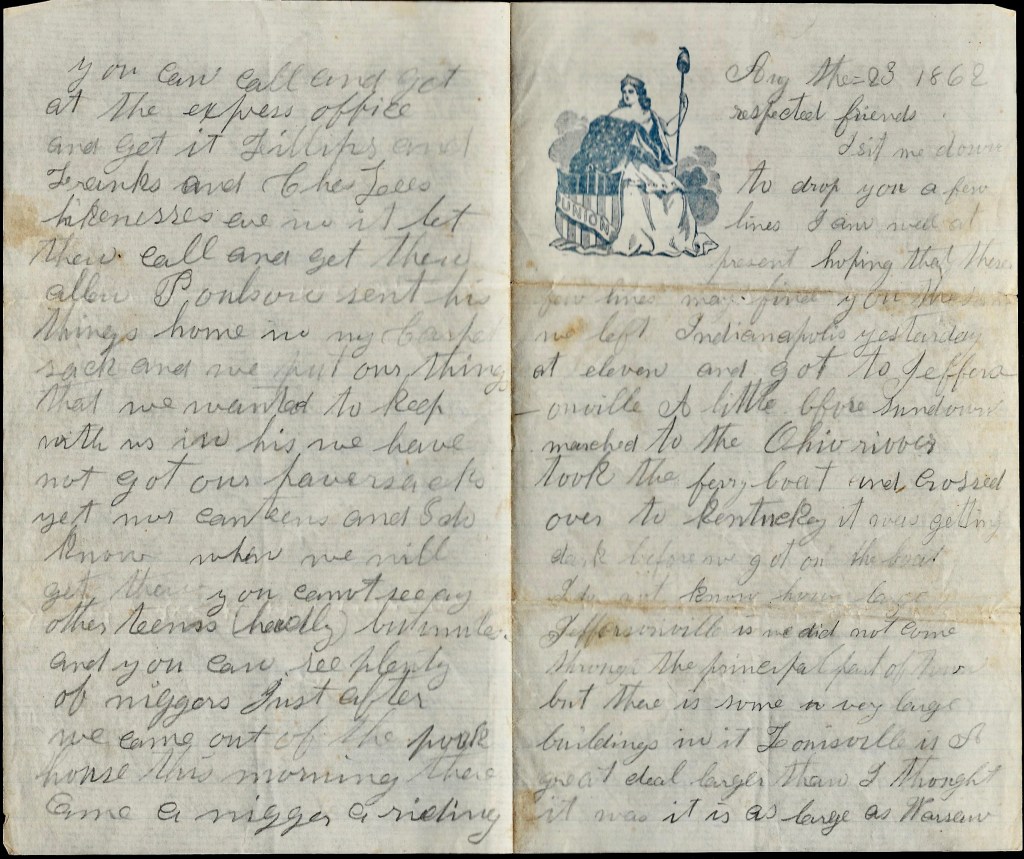
[Camp near Louisville, Kentucky] August the 23rd 1862
Respected friends.
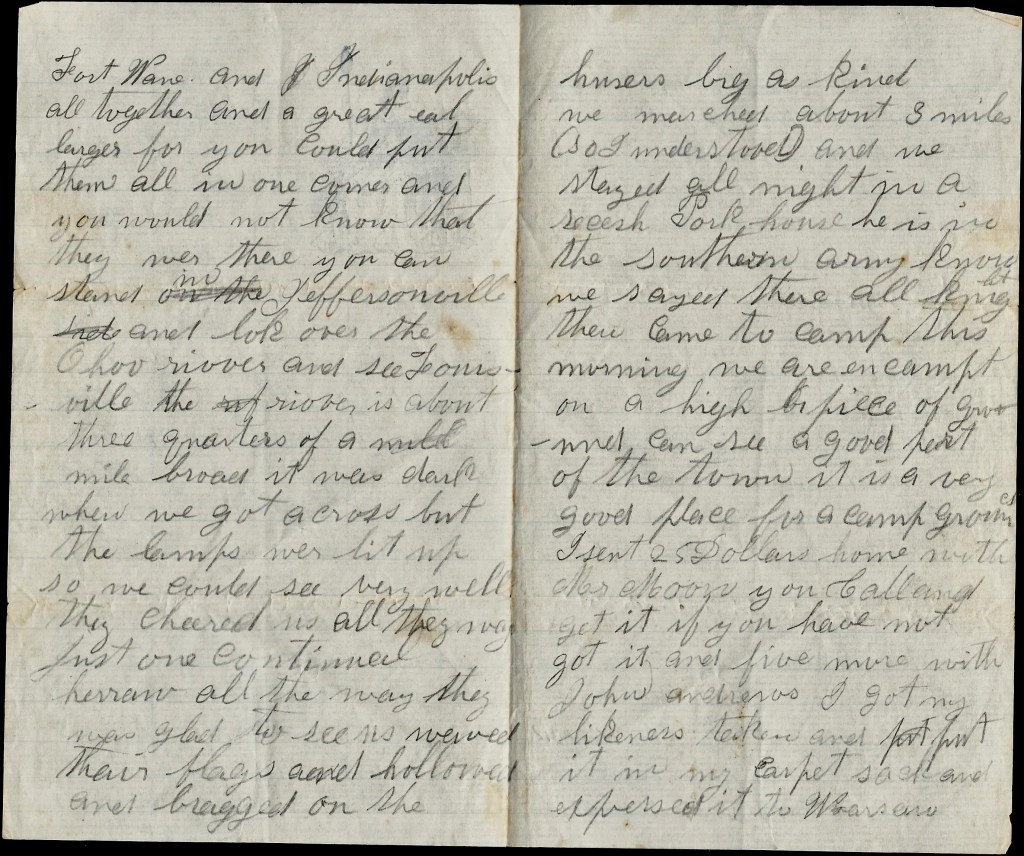
I sit down to drop you a few lines. I am well at present hoping that these few lines may find you the same. We left Indianapolis yesterday at even and got to Jeffersonville a little before sundown. Marched to the Ohio river, took the ferry boat and crossed over to Kentucky. It was getting dark before we got on the boat. I do not know how large Jeffersonville is. We did not come through the principal part of town but there is some very large buildings in it. Louisville is a great deal larger than I thought it was. It is as large as Warsaw, Fort Wayne, and Indianapolis all together and a great deal larger for you could put them all in one corner and you would not know that they were there.
You can stand in Jeffersonville and look over the Ohio river and see Louisville. The river is about three-quarters of a mile broad. It was dark when we got across but the lamps were lit up so we could see very well. They cheered us all the way—just one continual hurrah all the way. They was glad to see us, waved their flags, and hollowed and bragged on the husers [Hoosiers] big as kind. We marched about three miles (so I understood) and we stayed all night in a secesh pork house. He is in the Southern army now. We stayed there all night, then came to camp this morning. We are encamped in a high piece of ground. Can see a good part of the town. It is a very good place for a camp ground.
I sent 25 dollars home with Mr. Moon. You call and get it if you have not got it, and five more with John Andrews. I got my likeness taken and put it in my carpet sack and expressed it to Warsaw. You can call and get it at the Express Office and get it.
Phillip’s and Frank’s and Ches[ter] [Tris]del’s likenesses are in it. Let them call and get these. Allan Paulson 1 sent his things home in my carpet sack and we put our things that we wanted to keep with us in his. We have not got our haversacks yet nor canteens and I do not know when we will get them. You cannot see any other teams (hardly) but mules and you can see plenty of niggers. Just after we came out of the pork house this morning, there came a nigger a riding…[rest of letter missing]
1 Ethan Allan Poulson of Warsaw, Indiana, served in Co. A, 74th Indiana Infantry. He enlisted on 14 July 1862 and died of chronic diahhrea at Nashville, Tennessee, on 24 July 1863.
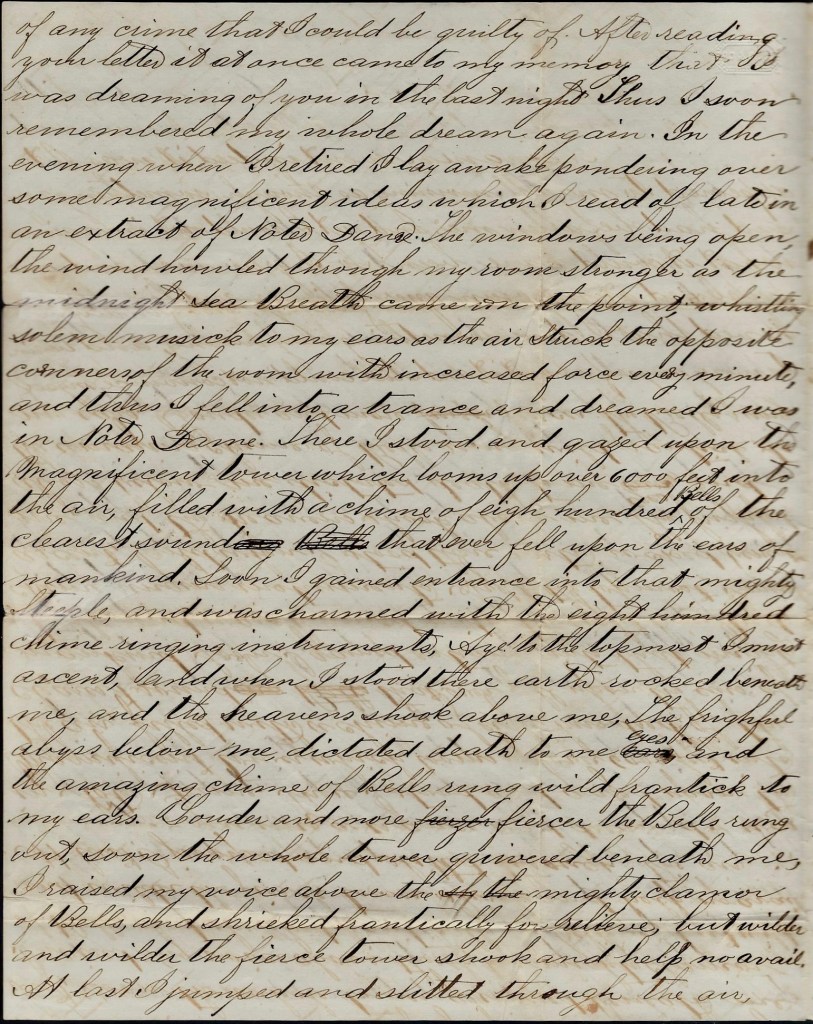
The following letter is one of the most bizarre letters I’ve ever transcribed. Soldiers often mention their dreams and sometimes share short descriptions of them in their letters home but this is the first letter that devoted four full pages to detailing a single night’s dream in vivid detail. The letter was written by Aaron Eckert Killmer [or Kilmer] (1836-1911), the son of Thomas Kilmer and Elizabeth Eckert of Lebanon county, Pennsylvania, to his cousin, Callie. Aaron datelined his letter on 30 September 1864 from the US General Hospital at Point Lookout, Maryland.
From his obituary we learn that Aaron’s parents died when he was young but he managed to graduate from Franklin & Marshall college with honors. He first enlisted in April 1861, serving as a private for three months in Co. H, 5th Pennsylvania Infantry. He enlisted a second time in September 1862 as a commissary sergeant in Co. E, 17th Pennsylvania Cavalry. Aaron was with his regiment at Chancellorsville, Beverly Ford, Kelly’s Ford, Gettysburg, Boonsboro, Brandy Station, Mine Run, New Kent Court House, Bethesda Church, Cold Harbor, Trevillian Station, White House Landing, Raid to Lynchburg, Petersburg, Berryville, and finally at Appomattox. The obituary doesn’t indicate that he was wounded or ill leaving us to wonder why he was at Point Lookout, Maryland. He speaks of going about his “business” so we are left to presume that he was working there at the time and not in the hospital as a patient. His dream, however, leaves one to wonder if he suffered from delusions, post traumatic stress disorder, or simply an overactive imagination.
After he was discharged from the service in June 1865, Aaron returned to Lebanon where he became a school teacher for many years. He then resided in Reading and worked many years for his uncle, George J. Eckert, in the firebrick works.
To read more about soldier’s dreams, I’ll refer you to an interview of Dr. Jonathan White, Associate Professor of American Studies at Christopher Newport University in 2017 conducted by Ashley Whitehead Luskey for The Gettysburg Compiler. See Soldiers’ Dreams with Jonathan White.
Transcription
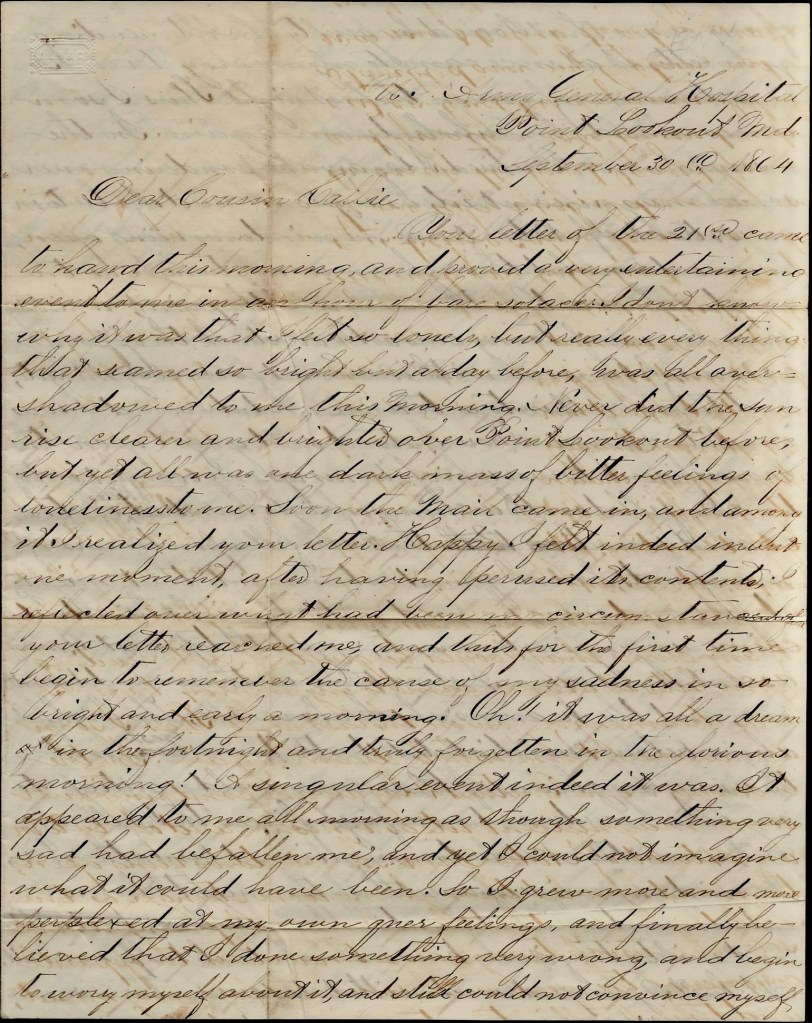
US Army General Hospital Point Lookout, Maryland September 30, 1864
Dear Cousin Callie,
Your letter of the 21st came to hand this morning and proved a very entertaining event to me in an hour of bare solace. I don’t know why it was that I felt so lonely but really everything that seemed so bright but a day before, was all overshadowed to me this morning. Never did the sun rise clearer and brighter over Point Lookout before, but yet all was one dark mass of bitter feelings of loneliness to me. Soon the mail came in and among it I realized your letter. Happy I felt indeed in but one moment, after having perused its contents; reflected over what had been my circumstances your letter reached me, and thus for the first time begin to remember the cause of my sadness in so bright and early a morning. Oh! it was all a dream in the fortnight and truly forgotten in the glorious morning! A singular event indeed it was. It appeared to me all morning as though something very sad had befallen me, and yet I could not imagine what it could have been. So I grew more and more perplexed at my own queer feelings, and finally believed that I done something very wrong, and begin to worry myself about it, and still could not convince myself of any crime that I could be guilty of.
After reading your letter it at once came to my memory that I was dreaming of you in the last night. Thus, I soon remembered my whole dream again. In the evening when I retired I lay awake pondering over some magnificent ideas which I read of late in an extract of Notre Dame. The windows being open, the wind howled through my room stronger as the midnight sea. Breath came on the point, whistling solemn music to my ears as the air struck the opposite corners of the room with increased force every minute, and thus I fell into a trance and dreamed I was in Notre Dame. There I stood and gazed upon the magnificent tower which looms up over 6000 feet into the air, filled with a chime of eight hundred bells of the clearest sound that ever fell upon the ears of mankind. Soon I gained entrance into that mighty steeple and was charmed with the eight hundred chime ringing instruments. Aye! to the topmost I must ascend, and when I stood there, earth rocked beneath me and the heavens shook above me. The frightful abyss below me dictated death to my eyes and the amazing chime of bells rung wild frantic to my ears. Louder and more fierce the bells rung out. Soon the whole tower quivered beneath me. I raised my voice above the mighty clamor of bells, and shrieked frantically for relief, but wilder the fierce tower shook and help no avail.
At last I jumped and slitted the air that every bone within me quaked and just before I struck the ground, awoke, but knew not rightly where I was, and soon fell into a trance again. But not Notre Dame. There came that white, Aye! ice cold snow-white form of a ghost, stood before me, gazing over me with eyes so glaring that it dazzled me in vengeance! For ever can I see those ivory teeth, its contraction and its expanding. Soon I wandered away and passed upon a forest, endless to my view. Wearied as I was, I continued my journey till I was completely jaded out. It is now I leaned against a lofty pine whose huge branches stood for rods over me and silent as the grave all around it seemed to my ears. It’s now I hear a human voice. I harked and soon I heard it again—plainer and nearer. Soon I heard the footsteps upon the forest lawn. It now steps from beyond the tree and addresses me thus, “Cousin Aaron, is that you? In all my confusion I replied yes. I gazed and gazed and stared at last and thus it was my cousin Carrie who found me in the wilderness on a stray path. She now conducted me out into the clearing and there we stood upon the banks of a bright, flowing river. Its waters were the brightest I ever saw, The landscape the most magnificent I ever beheld. Being weary with fatigue, we both lay down and fell asleep.
In my sleep, I heard my cousin call me to come, louder, louder, and still louder. I arose and saw her on the opposite side of the river in a beautiful land, still calling, “Come. Aaron.” Soon I plunged onto the dazzling water and thus awoke and found myself standing along side of my bed, not knowing whether I was in a dream or crazy. With a shame of feelings, I went to bed again. Soon the third trance was at hand. Again I was in that wilderness, traveling on, on, and on with a half remembrance that my cousin lead me out of it once before, but no end I found. At last I stepped into a deep pit. There I moaned for help but no help was there. Soon kind of a being came to me in that pit, and it appeared to me as a rebel. I drew my saber and stabbed him through the heart. I gazed upon a bright star continually and finally a robe lowered and I was once more drawn out on level terra firma. I started for that bright river, but stumbled over my Captain, and awoke the third time. It was now 5 o’clock. Time to go about my business.
I dressed and went about my business. Back of my room or bed chambers sleeps a Rebel. When my mind got on different business, I forgot my dream, but this thing of having drawn my saber and stopping a reb was not out of my mind. Soon I thought it was really so—that I had killed that Rebel who sleeps back of my bed chamber. So I worried myself awful until your letter reached me and as soon as I saw your name, I recollected the whole dream. Thus, it all was a dream and no one harmed. My dear cousin, write soon again. Yes, very soon. I am in health as usual and may I hope this meets you all in the good blessings of good health. Yours cousin, — Aaron E. Killmer
William C. Banta was the captain of Co. B, 7th Indiana at the Battle of Fredericksburg. He later rose to the rank of Lt. Colonel.
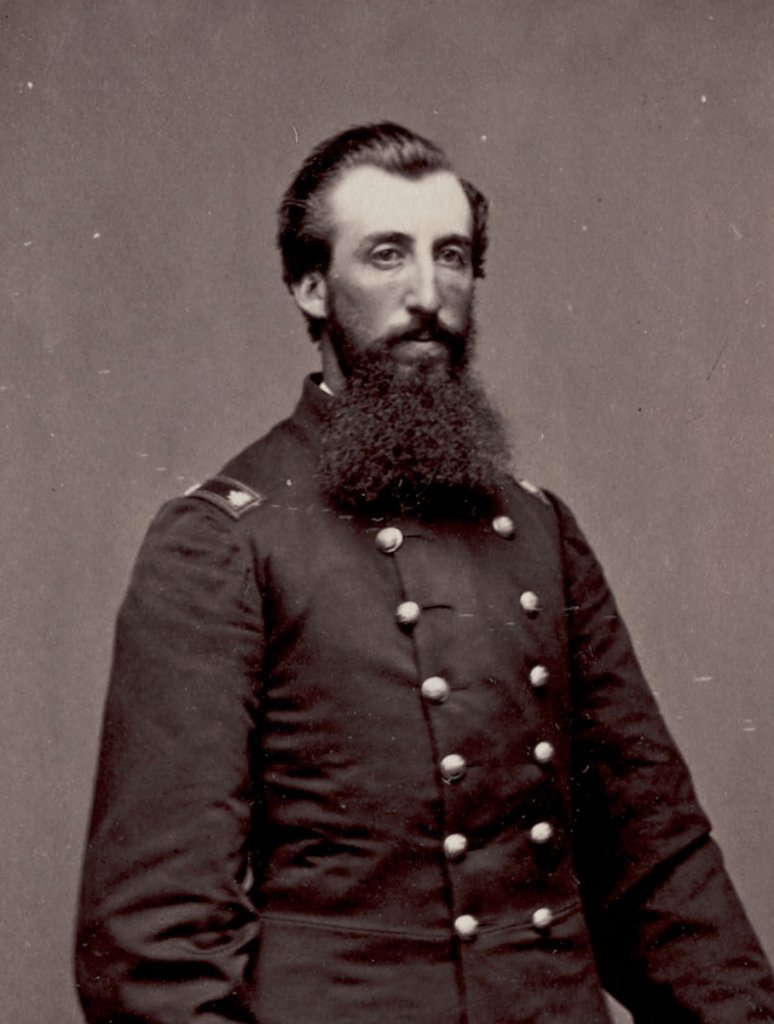
The following letter was written by John W. Morgan of Brownsburg, Hendricks county, Indiana. John was 22 years old when he enlisted on 30 August 1861 in Co. B, 7th Indiana Infantry. Sometime prior to the Overland Campaign, John was promoted to corporal. He was taken a prisoner on 5 May 1864 in the opening fighting in the Wilderness. His military records indicates that he died on 22 April 1865 and was buried in the National Cemetery at Hampton, Virginia. POW records suggest that he was held at Andersonville for a time but later transferred elsewhere, not stated.
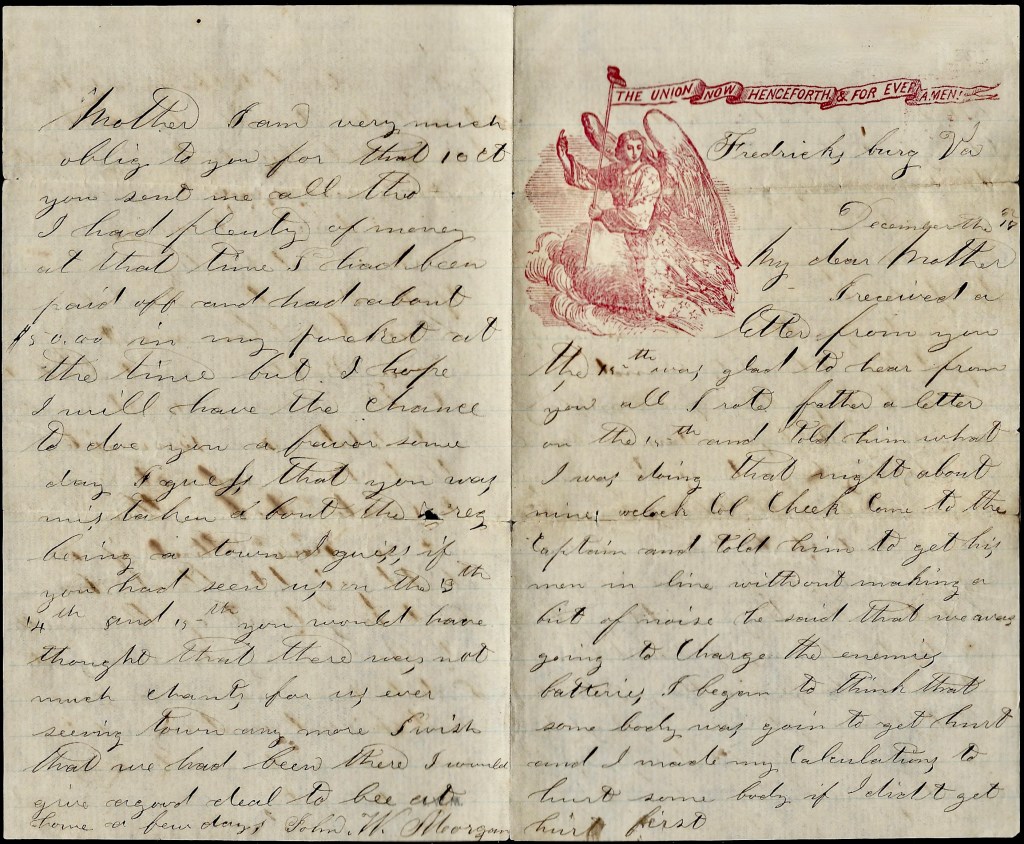
John wrote the letter to his mother who I believe was Nancy (Larimore) Newham (1813-1891)—married to her second husband, Thomas Newham (1816-1898), about 1849. It was written from the regiment’s encampment near Falmouth just after the Battle of Fredericksburg in which they were present but held in reserve and never called upon to engage with the enemy. The regiment was brigaded with the 76th and 95th New York, and the 56th Pennsylvania in Col. Gavin’s 2nd Brigade of Abner Doubleday’s 1st Division, 1st Corps. Morgan’s letter tells of the nighttime retreat across the Rappahannock and alleges that whiskey was being offered to the men in the event they were called upon to charge the enemy’s breastworks or batteries.
To read letters by other members of the 7th Indiana Infantry transcribed and published on Spared & Shared, see:
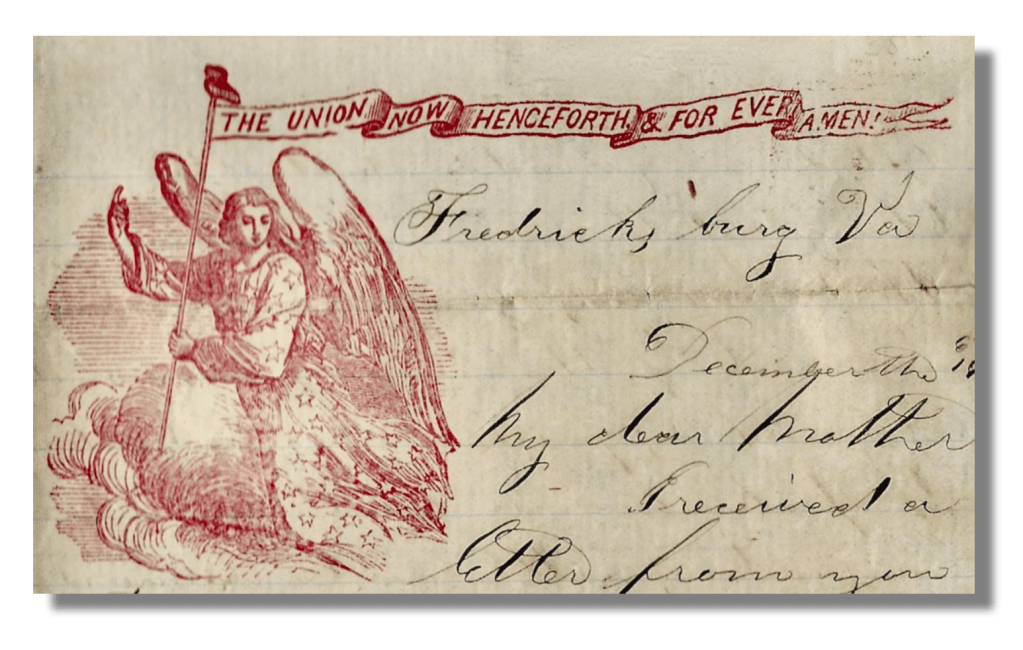
Patriotic Letterhead of Morgan’s stationery. “The Union Now Henceforth & Forever, Amen!”
Fredericksburg, Virginia December the 17th 1862
My dear mother,
I received a letter from you the 15th. Was glad to hear from you all. I wrote father a letter on the 15th and told him what I was doing that night. About nine o’clock, [Lt.] Col. [John F.] Cheek come to the Capt. [William Cyress Banta] and told him to get his men in line without making a bit of noise. He said that we was going to charge the enemy batteries. I began to think that somebody was going to get hurt and I made my calculations to hurt somebody if I didn’t get hurt first.
“He said that we was going to charge the enemies batteries. I began to think that some body was goin’ to get hurt and I made my calculations to hurt some body if I didn’t get hurt first.”
But I soon found instead of charging the enemy’s batteries that we were going to get on our own side of the [Rappahannock] river as easy and as quick as possible. We wasn’t allowed to speak above our breath not let our canteens rattle. Our cannoneers wrapped their blankets round the wheels to keep them from making noise.
Just before dark a barrel of whiskey came to us to give us before making the charge. I seen the barrel but didn’t know what it was for—only to give because we was so exposed to bad weather. They wouldn’t of got me to drank any if I had knew it was to charge a battery. I think that I have got nerve enough to go anywhere the 7th Indiana Regiment goes and it will go anywhere it is ordered. If it is ordered to charge a battery, it will do it without whiskey. I guess that this beats any retreat that has been made since the war commenced. We went across the river and hardly a man spoke a word.
Gen. McClellan went up in a balloon and looked at the enemy’s breastworks and told Gen. Burnside that he would not undertake to take them and he knew that if he didn’t fight that he had to get out of there without the enemy knowing it. I don’t know how many we had killed and wounded. We have not made any report yet.
Mother, I am very much obliged to you for that 10 cents you sent me although I had plenty of money at that time. I had been paid off and had about $50 in my pocket at the time. But I hope I will have the chance to do you a favor someday. I guess that you was mistaken about the 7th regiment being a town. I guess if you had seen us on the 13th, 14th, and 15th, you would have thought that there was not much chance for us ever seeing town any more. I wish that we had been there. I would give a good deal to be at home a few days. — John W. Morgan
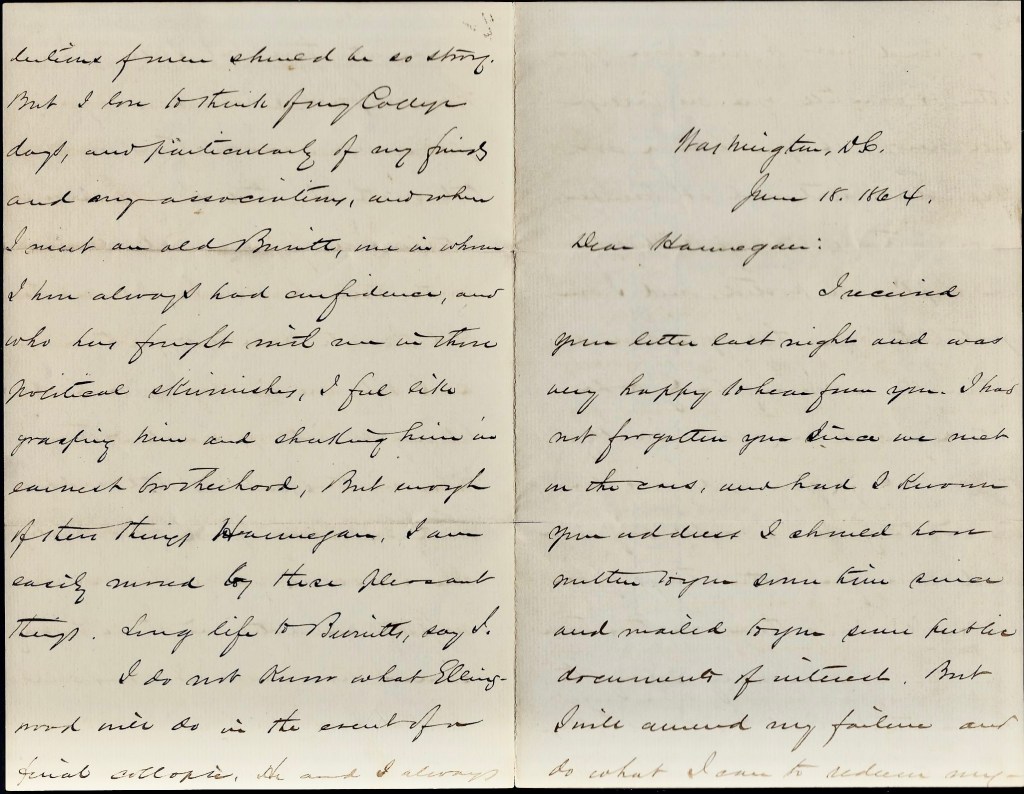
The following letter was written by a government clerk working in Washington D. C. in June 1864. He signed his name “M. J. Farrell” and I have found only one Michael J. Ferrell, Jr. working in Washington, taxed and employed in the District of Columbia in 1864. He mentions a wife in his letter so he must have married between the time he wrote the letter and when he registered for the draft in June 1863, wherein he described himself as 26 years old, single, a native of Ohio, and a clerk in the Treasury Department.
Michael addressed the letter to “Hannegan” and though I can’t be certain of his identity, my hunch is that it was Sellman Key Hannegan, the son of US Senator from Indiana Edward Allen Hannegan (1807-1859) and Margaret Chambers Duncan (1796-1852). In 1861, at the outbreak of the rebellion, Sellman was serving as Deputy City Clerk in Terre Haute, Indiana. In 1863, Sellman was yet unmarried and living in Indianapolis. After his marriage in 1868 he worked in Washington D. C. in the US Documents Rooms.
From the content of the letter, it is revealed that the correspondents were previously acquainted in the College Hill area, a suburb of Cincinnati. It is possible that both individuals were students at the Farmer’s College, a topic that is extensively discussed in the letter. The college was experiencing significant financial constraints at the time and was at risk of failing.
The Strobridge Lithograph of College Hill c1860, showing the home and grounds of Dr. Mathias C. Williams in College Hill (lower right), as it would have appeared prior to being consumed in a fire in 1864. At left is the Farmers’ College and Cary’s Academy Buildings.
Transcription
Washington D. C. June 18, 1864
Dear Hannegan,
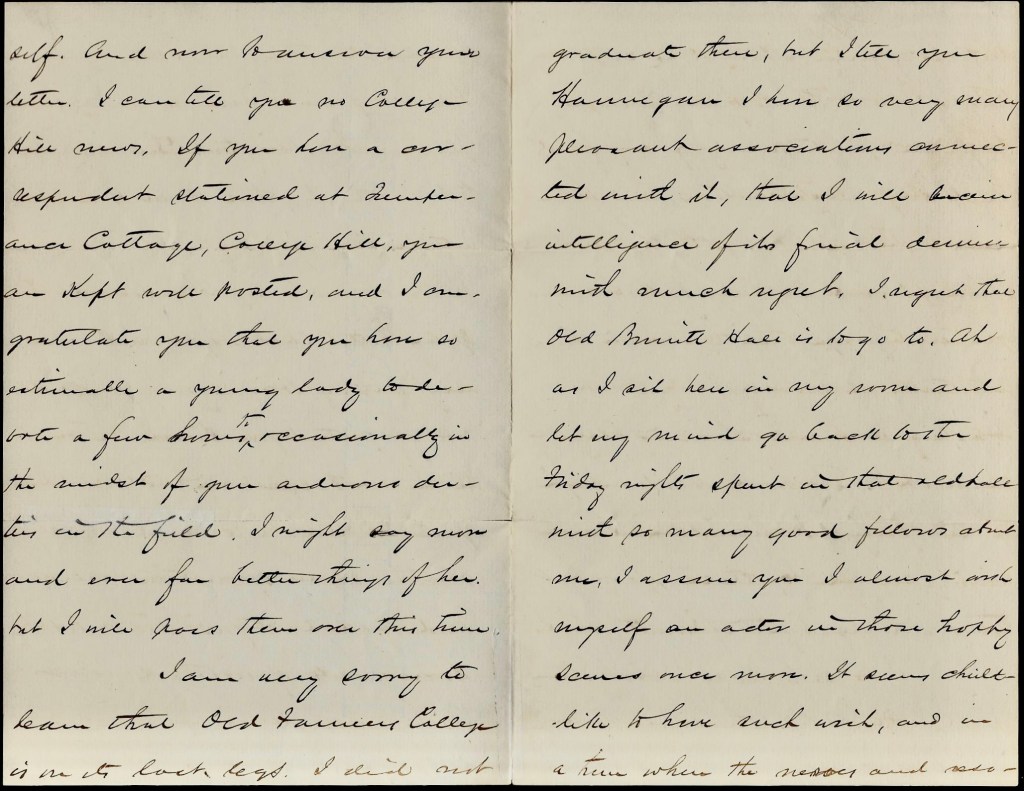
I received your letter last night and was very happy to hear from you. I had not forgotten you since we met in the cars, and had I known your address, I should have written to you some time since and mailed to you some public documents of interest. but I will amend my failure and do what I can to redeem myself and now to answer your letter. I can tell you no College Hill news. If you have a correspondent stationed at Temperance Cottage, 1 College Hill, you are kept well posted, and I congratulate you that you have so estimable a young lady to devote a few hours to occasionally in the midst of your arduous duties in the field. I might say more adn even far better things of her but I will pass them over this time.
I am very sorry to learn that Old Farmer’s College is on its last legs. I did not graduate there, but I tell you, Hannegan, I have so very many pleasant associations connected with it that I will receive intelligence of its final demise with much regret. I regret that Old B___tt Hall is to go to. Oh, as I sit here in my rom and let my mind go back to the Friday nights spent in that old hall with so many good fellows about me, I assure you I almost wish myself an actor in those happy scenes once more. It seems child-like to have such a wish, and in a time when the news and resolutions of men should be so strong. But I love to think of my College days and particularly of my friends and my associations, and when I meet an Old Bu__tt, one in whom I have always had confidence, and who has fought with me in those political skirmishes, I feel like grasping him and shaking him in earnest brotherhood. But enough of these things. Hennegan, I am easily moved by these pleasant things. Long life to Bunitts, say I.
I do not know what [J. P.] Ellingwood 2 will do in the event of a final collapse. He and I always agreed very well. Not having much to do with him, of course our relations were not very intimate. I hope McKennan will find a good place. He deserves it. But I hope also that he will never again undertake a Presidency. It was a sad day for the College when President [Charles N.] Mattoon was compelled to resign. 3
There are a great many changes on the Hill. The old inhabitants are leaving for other parts, some to the “long, quiet home, others to other sections for the state and country. Pres. [Henry Noble] Day has been trying for a long time to have the commencement exercises [of the Ohio Female College] private. I don’t like that. It savors too much of the aristocracy. But Day generally fights it out on his line.
I don’t know much of the old boys. Fenton is married. He had an attack of measles this Spring, but he is getting better. Quite an old boy to be thus troubled. He is measuring calico and weighing groceries to the people of his native town. You did not think that of Fenton when he was in college.
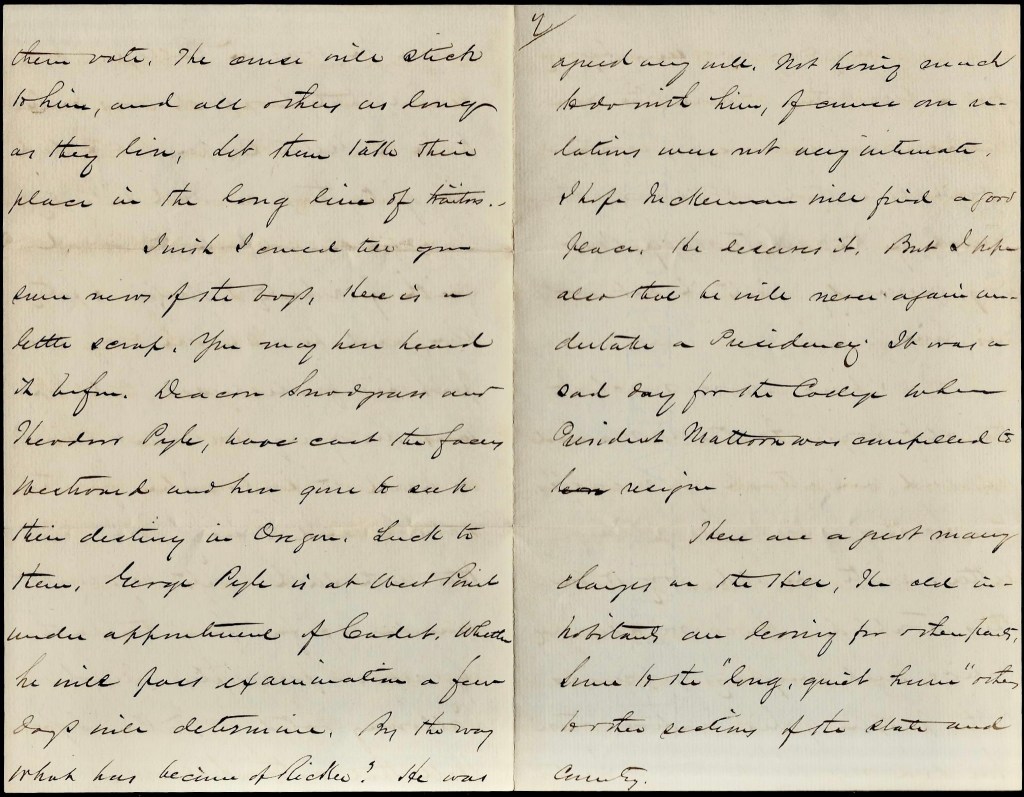
I have heard that [William Jay] Coppock 4 was inclined to be a little Copper, but I did not quite think he had entirely lost his hold on the good faith of Liberty & Union. I pity him and we will one day repent his foolishness. Old Cop was one of my warmest friends. He used to subscribe for the Tribune and Evening Post. Alas, that was with such lights he should wander so far from the path of honest principles.
And Calloway voted for Vallandigham? Well that astonished me. Let them vote. The curse will stick to him, and all others as long as they live. Let them take their places in the long line of traitors.
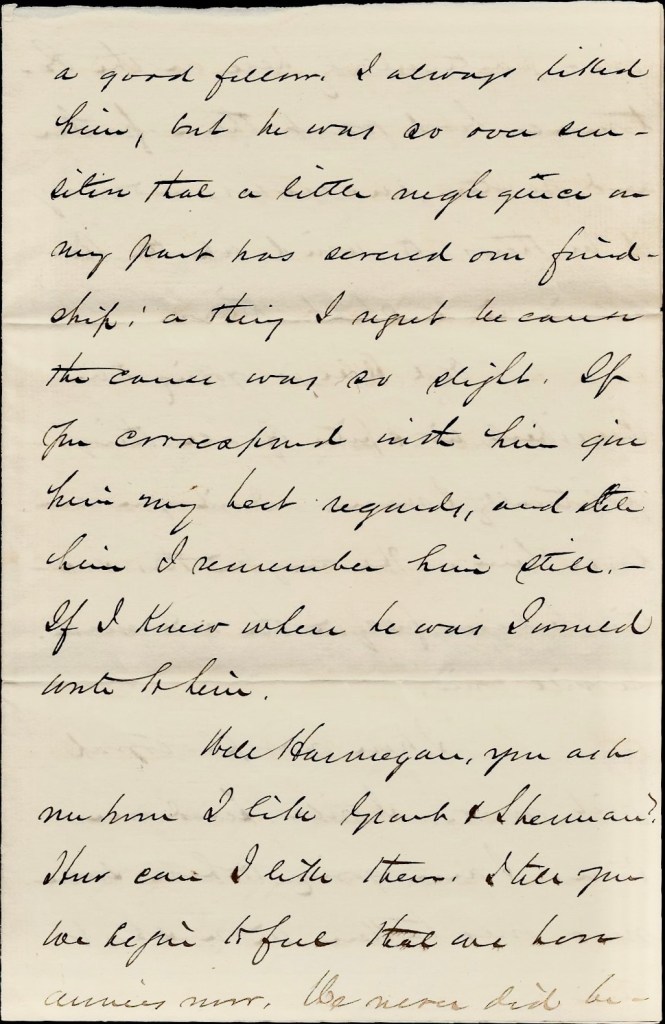
I wish I could tell you some news of the boys. Here is a little scrap. You may have heard it before. Deacon [W. J. ] Snodgrass and Theodore [W.] Pyle have [ ] and have gone to seek their destiny in Oregon. Luck to them. George [W.] Pyle 5 is at West Point under appointment of Cadet. Whether he will pass examination a few days will determine. By the way, what has become of Ricker? He was a good fellow. I always liked him, but he was so over sensitive that a little negligence on my part has severed our friendship—a thing I regret because the cause was so slight. If you correspond with him, give him my best regards and tell him I remember him still. If I knew where he was, I would write to him.
Well, Hannegan, you ask me how I like Grant & Sherman? How can I [not] like them. I tell you, we begin to feel that we have armies now. We never did before—particularly here on the Potomac. God grant them further and greater success, and may it be theirs to wind up the Rebellion in a short time.
Old Abe is going to be President in spite of all things—politically I mean. Don’t you endorse him? The army in this section believes fully in the old man. He will win.
I have no photograph just now. I will send one soon. I am going to have some new ones taken in a short time.
Well, Hannegan, I must draw this letter to a close. I am quite busy now-a-days. Hands full.
Mrs. Farrell is well. we anticipate going to Ohio in July. Do you think you will be up about that time? I would like to see you. I wish we could have a meeting of the Old Br__tt’s.
Goodbye, Hannegan. The Lord of battles shield in these days of struggle. write soon. Truly yours, — M. J. Farrell
1 “Temperance Cottage” was the name of the home of Gen. Samuel Fenton Caryon College Hill in Cincinnati.
2 Probably J. P. Ellingwood who became the Principal of the Preparatory Department in 1857.
3 Rev. Charles. N. Mattoon, President of Farmer’s College, tendered his resignation on 11 July 1860. It was regretfully accepted on 14 August 1860.
4 Probably William Jay Coppock (1835-1912), A. M., Class of 1859—a lawyer in Cincinnati, Ohio.William had two younger brothers that fought for the preservation of the Union. William buried in an unmarked grave in Spring Grive Cemetery in Cincinnati.
5 George W. Pyle entered West Point in 1864. He was from College Hill, Ohio, and received an “at large” appointment. He graduated in 1868.
The following letter was written by Augustus Granville Randall (1813-1898), a lawyer of Lincoln, Penobscot, Maine. He was married to Mary Shannon Sanders (1823-1866) in 1847 and had at least five children by 1863. The following biographical sketch appears in a history of Lincoln, Maine, though it fails to mention that he served in the State Legislature prior to his military service. It also fails to mention that before he was discharged from the service, he had to stand trial for a charge of “habitually selling subsistence stores at a rate exceeding prices invoiced” without accounting for the excess. He plead not guilty to these charges but was subsequently found guilty.
“Mr. Randall was the son of Nathan Randall, born in Leeds, Me., 15 June, 1813-; died in Chicago, 22 Feb., 1898. Mr. Randall was a lawyer in Passadumkeag in 1839., and went to Lincoln, probably, in the winter of 1848, and was a lawyer in Lincoln till 1864, when he went to Oshkosh, Wis., and from there he removed to Chicago in 1892. In 1863 he had entered the Commissary Department of the army, his appointment being signed by President Lincoln, and he served with the rank of Captain till the close of the war. Mr. Randall, during his residence in Lincoln, was active in the municipal affairs of the town and in temperance and civic reforms. On the 22 Oct., 1859, a division of the Sons of Temperance was instituted at Lincoln in which Mr. Randall, with a dozen of the· more prominent citizens, was active. He had been identified with these affairs while in Passadumkeag.” [History of the Town of Lincoln, by Dana Willis Fellows, page 109.]
Augustus wrote the letter soon after arriving in Washington D. C. in early June 1864 after having been commissioned into the US Volunteers Commissary Department. He served on this position with the rank of Captain until May 1865 when he was dismissed from the Commissary Service Volunteers.
Transcription
Washington June 5th 1864
My dear sir,
Your very kind favor of the 2nd inst. has just been received and I assure you it was a most welcome message. Please accept my thanks for it, and be assured that nothing will give me greater pleasure than a correspondence with you. You are mistaken as to my feelings in leaving Old Penobscot. I did not feel cross. It is true there were some things I could have wished had been otherwise. You know what they are. It has never been any part of my political life to lie, cheat, and deceive, and I detest those who do. What little political record I have is in Old Penobscot. I am not ashamed of it. I shall return there if I live one of these days and, perhaps, may have an opportunity to help some of my friends to places of honor and trust.
In regard to Main[e] politics, I feel the same interest I always felt and wish I could be there to help the campaign along. As to the judge of Probate, any man but Godfrey. Don’t renominate him. Hilliard is the best of the three by all odds yet he would not be my choice. But if one of the three you mention must have it, take Hilliard.
Hon. John Hovey Rice (1816-1911), ca. 1864
And for Congress, don’t fail of giving Rice a renomination. There is no man stands better here than John H[ovey] Rice and no one can accomplish much for the 4th District and for Maine as he can. Besides, it is no time to send green hands here, and no intelligent constituency will do it. It would be worse than folly—yes, suicidal to do so. Maine must keep her faithful and tried representatives here during this struggle for Constitutional liberty, and not send men here, who, during these three years of terrible war for the Union have but recently found where they are. These men who have been so long coming to the light, see it but dimly now and will be quite likely to fall back into utter darkness. Mr. Rice is not only a popular man in Congress, but an industrious, working man. Every moment of time, aside from his public duties, is devoted to the wants of our poor wounded soldiers from early morning until noon—the hour Congress meets—and from adjournment until 11 & 12 o’clock at night he is visiting the different hospitals, writing letters, sending dispatches, &c. &c. for the boys of his District. Mrs. [Grace E. (Burleigh)] Rice labors equally hard. To set aside so faithful and devoted public servant at this time of our country’s peril for a green hand of somewhat doubtful political stripe, would be an act of folly I never shall believe Old Penobscot will be guilty of.
For President & Vice [President] we all go for Lincoln & Hamlin and they will be nominated. It would be too personal and unjust to leave Hamlin off and take Dickinson or Johnson.
I suppose you have seen my appointment and confirmation in the Commissary Department. This is a good place and pays well, provided I can procure the necessary bond. The duties are to receive & distribute subsistence to some division of the Army. The rank is that of Captain of Cavalry. I am entitled to one, & in certain cases, two clerks at from 75 to 100 per month & rations. How I wish I could have you here with me.
I shall not move my family here at present, if at all. I room at 421 11th Street between G & H West and board at the New England Restaurant. I have not got settled yet. Shall take a larger room soon and board at a hotel—a good boarding house. If you come here, and I hope you will, come to my room and I will take care of you as long as you stay. If I change quarters, I will inform you in season.
Clark, postmaster, has been removed and is now about the State of Maine Agency, in what capacity I know not. Azro is, or was here a few days ago. I should be very glad to have you send me some Maine papers. Two cents postage on 4 oz.’s without regard to number of papers is the law now. Printed matter goes by weight. 4 oz. two cents; 8 oz. 4 cents.
Now Mart, I have written you a hasty letter and hope I shall receive an answer soon. Remember me to all my friends, if I have any, in that section—particularly to your wife. Give my regards to Mag Smith, Mr. Jameson and others. With great respect, your friend & servant, — A. G. Randall
Don’t forget me to my friend Hammatt. I wish I could have seen him longer.
The following documents from Fold 3 reveal that Augustus G. Randall was actually nominated for his position by the Hon. John H. Rice. I do not see any evidence that President Abraham Lincoln signed his appointment letter despite what his obituary says.
This letter was written by John Ingerson (1837-1913) of Sycamore, Wyandot county, Ohio. He was the son of Alvin C. Ingerson (1815-1857) and Tirza Ann Palmer (1816-1895). John was 24 years old when he enlisted in August 1861 to serve as a private in Co. G, 49th Ohio Volunteer Infantry (OVI). He survived the war but was wounded in the Battle of Pickett’s Mills, Georgia, on 27 May 1864. He was discharged for disability on 29 October 1864. [It should be noted that John’s obituary appearing in the Marion Star (Marion, OH) claimed that John was “wounded at Gettysburg when a shell hit him in the face, cutting his upper lip and terribly disfiguring him.” Since the regiment never fought at Gettysburg, the wound is presumed to have occurred at the Battle of Pickett’s Mills in Georgia. The 1890 Veteran’s Schedule claims that John’s wound was caused by a gunshot wound, not a shell.]
After the war, John returned to farming in Ohio. In 1875, he married Lydia Ann Shaffer (1839-1931)
Transcription
Camp George December 10th 1861
Well friend Mother, I guess tonight I would write you a few lines to let you know how I am. I am well at present and so is all of the rest of the Sycamore Boys and I hope these few lines will find you the same. The 32nd had a fight yesterday and they lost eleven men and had twelve wounded and the secesh lost forty and about that many wounded. The young men killed several of their horses. There only was three companies of them against five hundred and they whipped them and made them [paper creased]…If Co. G had been with them, we would have taken eight of their cannons. The boys got two or three of their horses and several of their guns.
Now Mother, I want you to write to me and tell me all of the news that it afloat in Sycamore. I am the fattest now that I ever was in all of my life. I only weigh one hundred and sixty-five pounds. We have between 60 and 70,000 men here in the field with us and I think we will flog them nicely. I hope so.
We have plenty to eat and plenty to wear and good water to drink. I hant been sick yet and I hope I won’t get in that way. I got my pay last Monday but I don’t want you to think hard of me for not sending you some of it for I got five dollars of Daniel Hartsough to get me a pair of boots and I’d drawn five dollars off the sutler which makes ten dollars [I owed] and I have got [only] a little left and I think that will last me for a good while. We will draw pay again in twenty days and then I will send all of that to you for I shan’t need it.
So now I must stop writing for this time. Write soon and direct your letters in the care of Capt. [Luther M.] Strong, 49th Regiment, OV, USA. by the way of Louisville, Kentucky.
Not unlike the poisonous effects of the shadow of the deadly upas tree,” secession “has spread a blight and desolation over the country.” So wrote 42 year-old Benjamin D. Carpenter (1819-1895), “a northern man who settled in Alexandria county, Virginia, long before the war, having a large farm at Red Hill…Coming to Washington during the war, he bought a large farm on Rock creek west of Brightwood, where he lived for nearly a quarter of a century. This place is now embraced in Rock Creek Park.” [Source: Obituary] Benjamin was married in the mid 1840s to Anna Maria Crocker (1822-1895) and was the proud father of four daughters.
Benjamin was trained as a surveyor and he was the first to prepare a map showing the metes and bounds of the District of Columbia.
Benjamin wrote the letter to his brother-in-law, John Simpson Crocker (1825-1890) who was appointed Colonel of the 93rd New York Infantry. He was captured during the siege of Yorktown and imprisoned at Libby Prison and later Salisbury before being exchanged in August 1862.
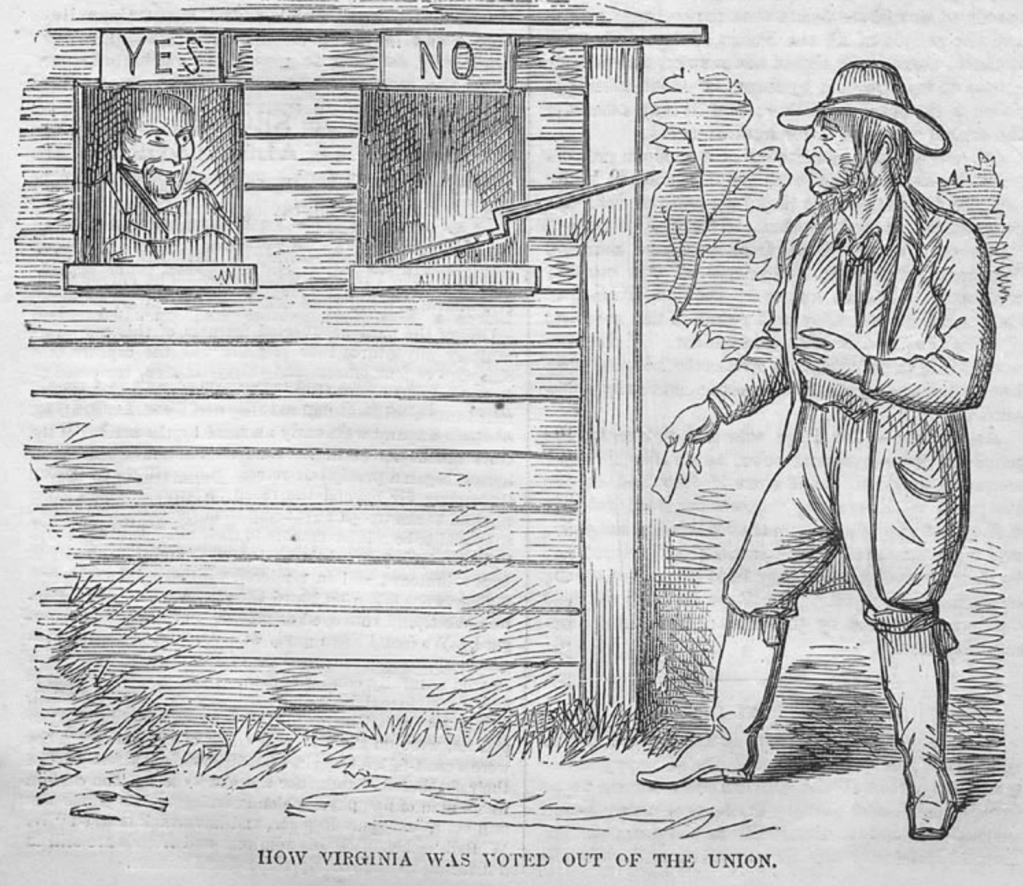
“Men were deprived of the elective franchise through fear and suffer all the horror of a reign of terror rather than vote at all. ” — Benjamin D. Carpenter
Transcription
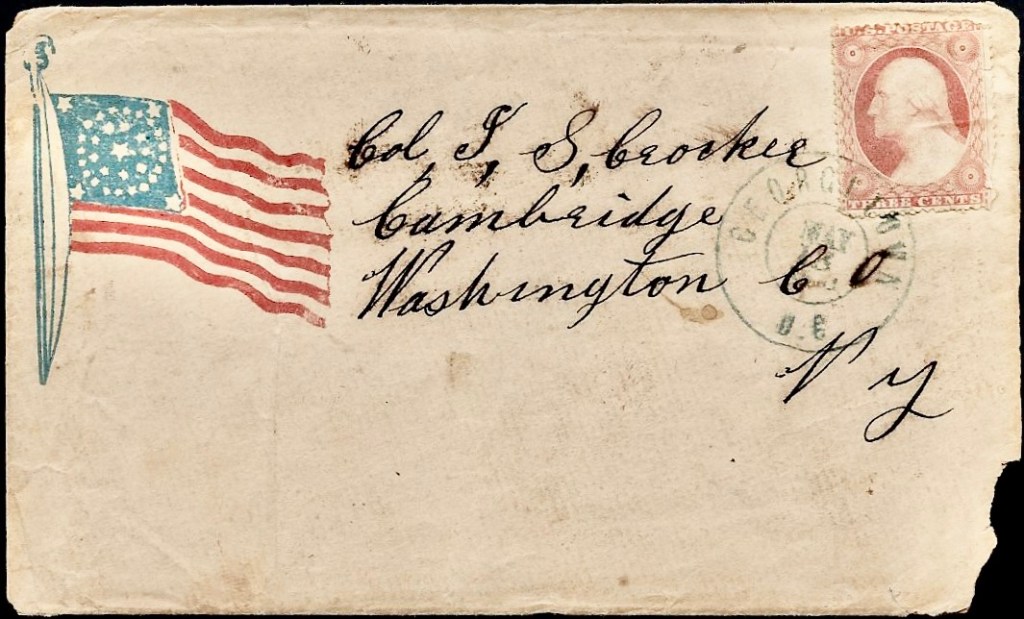
Addressed to Col. I. S. Crocker, Cambridge, Washington county, New York
Fairfax county [Va.] May 30th 1861
Dear brother,
Yours has been duly received and I hasten to reply. You will perceive that I have changed front or right about faced since I last wrote you. That’s so. I go in for the motto that heads this sheet secession is but a name for all that is devilish and infernal. If you or anyone else were here only one week, you would see a fair illustration of Mexican despotism. You would see the most intense hatred of those anti-white labor Nero’s that would cause your blood to boil with indignation and would make you turn away from them with loathing and contempt. Men are prosecuted and threatened with violence and even with hanging for wishing to cling to that government which has protected them in their civil and religious liberty, which has thrown over them and around them a halo of Freedom and prosperity that no other government under heaven has. Men are fleeing for their lives for wishing to preserve the Union of these states which was formed for the protection of our lives, liberty and property.
Secession leaders marched about breathing vengeance on all who would not enroll themselves with them under the black banner of Treason whose baneful shadow is not unlike the poisonous effects of the shadow of the deadly upas tree. It has spread a blight and desolation over the country; it has paralyzed and prostrated business and the energy of the people; it has destroyed the confidence between friends and neighbors; it has made vacant firesides and empty houses; it has made silent workshops and deserted villages; it has silenced the ploughman’s song and the wagons rattle on the roads, and last but not least of all, it seeks to pull down the strong pillars of the wisest and best governments, and if they can accomplish no more, involve all in one common total overthrow. It makes my heart bleed to see the people leaving for life, fleeing from that demon of secession which would wring the last drop of blood from one’s heart for wishing to live in the Union—the land of the free and the home of the brave.
Thirty-four families left Vienna in two days with what they could hastily gather up and then bid adieu to their homes for which they have toiled to make comfortable and pleasant. John, a great gloom is over the land like some great and sudden calamity. The sun seems to shine through some kind of a veil which casts a shade of sadness over heavens and earth, not unlike the feeling of some swift and sudden calamity about to happen, that strikes terror and dread to the heart. Men were deprived of the elective franchise through fear and suffer all the horror of a reign of terror rather than vote at all.
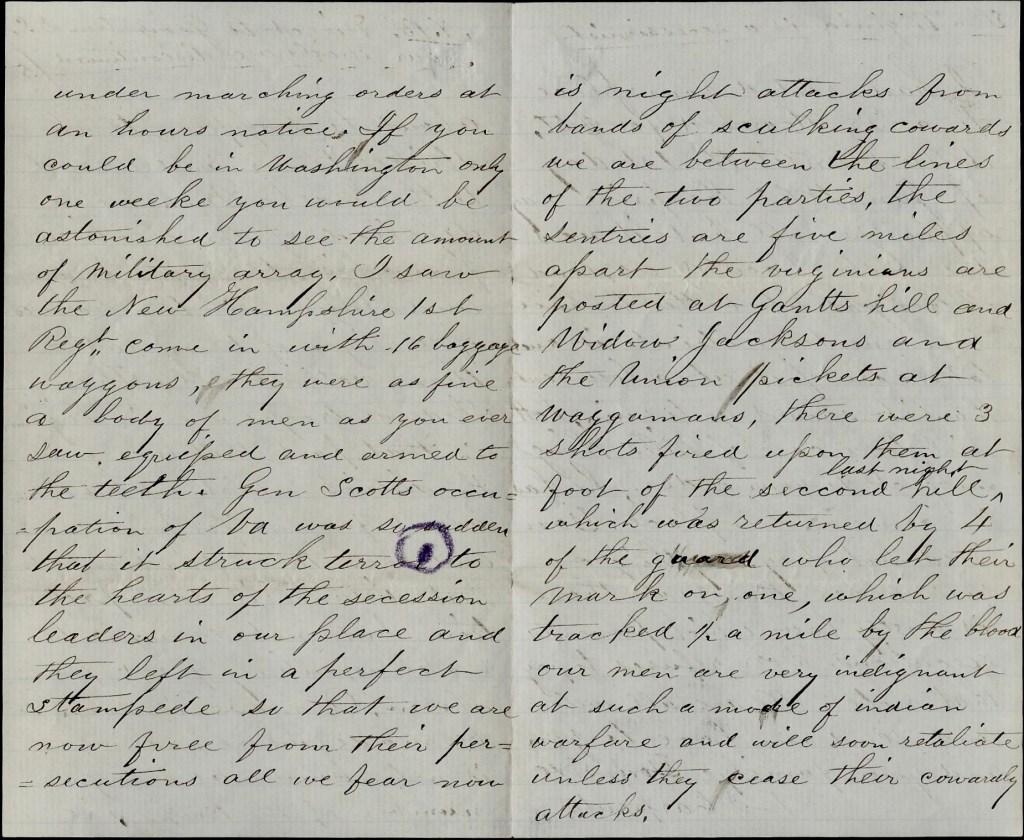
The Federal troops are in Virginia in that part that once was the district which makes them about four miles from us and even their shadow at that distance is some protection but not enough to make us entirely free from alarm. A move is soon to be made—where and when is not known—as a large number of troops are under marching orders at an hour’s notice. If you could be in Washington only one week, you would be astonished to see the amount of military array. I saw the New Hampshire 1st Regiment come in with 16 baggage wagons. They were as fine a body of men as you ever saw, equipped and armed to the teeth. Gen. Scott’s occupation of Virginia was so sudden that it struck terror to the hearts of the secession leaders in our place and they left in a perfect stampede so that we are now free from their persecutions. All we fear now is night attacks from bands of skulling cowards. We are between the lines of the two parties, The entries are five miles apart. The Virginians are posted at Gantt’s Hill and Widow Jackson’s, and the Union pickets at Waggaman’s. There were three shots fired upon them at the foot of the second hill last night which was returned by four of the guard who left their mark on one, which was tracked half a mile by the blood. Our men are very indignant at such a mode of indian warfare and will soon retaliate unless they cease their cowardly attacks.
I have rented your place to a Dr. Harrold for $50 dollars until the 1st day of January 1862. The price may appear small but it was the best I could do adn I thought it better to have someone to cultivate it and take care of it at a low rent than it should go to ruin. Lott will take care of Will’s things. subject to your order. He has the cows on his place. You need not pay anything on your place this year. There is a stay law which prevents executions. Dorr refuses to pay that note. We are all well and send our love to you and your families. Yours, &c. — B. D. Carpenter
Ellen Virginia is a secessionist.
N. B. Direct to Georgetown. Our mails are discontinued.
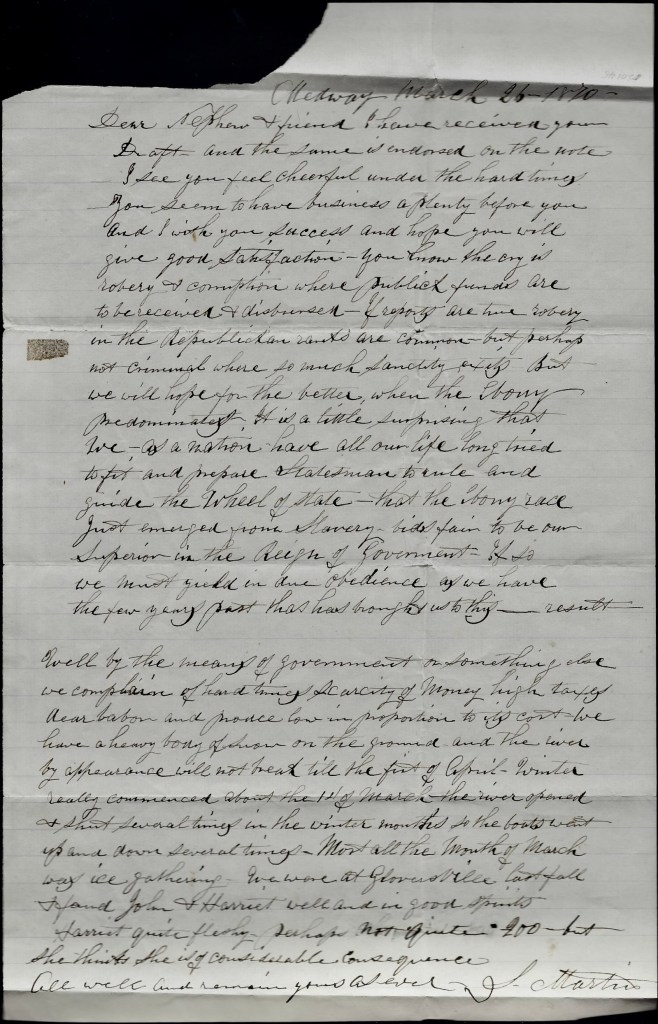
The identity of the author of this letter—whether male or female—could not be confirmed. It was datelined from Medway, Massachusetts, in late March 1870. There is no envelope with the letter to identify the addressee who we learn is the author’s “nephew and friend” and the benefactor of a note endorsed by the author. While completing this transaction, the author refers to the “radical Republican” corruption in the post-Civil War South and shares the belief that the “Ebony race” may prove better suited to govern than the Caucasian race.
Transcription
Medway [Massachusetts] March 26, 1870
Dear Nephew & Friend,
I have received your Draft, and the same is endorsed on the Note. I see you feel cheerful under the hard times. You seem to have business a plenty before you. and I wish you success and hope you will give good satisfaction. You know the cry is robbery & corruption where public funds are to be received & dispersed. If reports are true, robbery in the Republican ranks are common—but perhaps not criminal were so much sanctity exists. But we will hope for the better when the Ebony predominates. It is a little surprising that we, as a nation, have all our life long tried to fit and prepare Statesmen to rule and guide the Wheel of State, that the Ebony race just emerged from Slavery bids fair to be our superior in the Reign of Government. If so, we must yield in due obedience as we have the few years past that has brought us to this result.
Well, by the means of government or something else, we complain of hard things, scarcity of money, high taxes, dear labor and produce low in proportion to its cost. We have a heavy body of snow on the ground and the [Charles] river by appearance will not break till the first of April. Winter really commenced about the 14 of March. The river opened & shut several times in the winter months so the boats went up and down several times. Most all the month of March was ice gathering. We were at Gloversville [N. Y.] last fall & found John & Harriett 1 well and in good spirits. Harriet quite fleshy. Perhaps not quite 200 but she thinks she is of considerable consequence.
All well and remain yours as ever, — S. Martin
1 Probably John Stewart (1834-1889) and his wife, Harriet (Macdougall) Stewart (1839-1901) of Gloversville, Fulton county, New York. John Stewart was a merchant.
The following letters were written by 30 year-old John Thompson (1833-1916) of North Colebrook, Ashtabula county, Ohio. He wrote the letters to his wife, Harriet (Knowles) Thompson, while serving in Co. I, 105th Ohio Volunteer Infantry (OVI). He served from August 1862 until June 1865. Frequently mentioned in his letter is his young first-born son, Elmer Adelbert Thompson, born in April 1862.
John’s 2nd letter was datelined from the Union entrenchments at Chattanooga in the days following the setback at Chickamauga. He informs his wife that, “if it was not for the officers, this war would soon be over. The Rebel privates is tired enough of the war.” He speaks of the exchange of newspapers between pickets—apparently acceptable between enlisted men but as soon as a lieutenant tried it, he was nabbed. He mentions the accidental death of a soldier who threw a shell into a fire, a rumor of fighting between Longstreet’s and Bragg’s men over disagreements in command, and of his longing for home. He also encourages her to write. “I want you should let me know all the particulars about everything you can think of and some more.”
Lieutenants Tourgee, Wallace, & Morgaridge of 105th OVI, July 1863 (L. R. Stevens Collection)
Letter 1
[Hospital No. 3] 1 Quincy, Illinois May 10, 1863
Dear Companion,
I should like to spend this evening with you and Elmer. We would have a good visit most a beautiful chat. I long to see you. If I go to Camp Chase or to Cleveland, I shall try to go home on a furlough and see you and Elmer, and if I can’t go and see you, you. can come and see me. You said that you wished that I was to home so I could help you take care of Elmer. Harriet, keep up good courage and be as contented as you can and take care of what little we have and the money that I send you. I have been mustered in for pay once more and if I get it, I shall send it home to you as soon as I get it. When I get home for good and the war closes, we will have some good times.
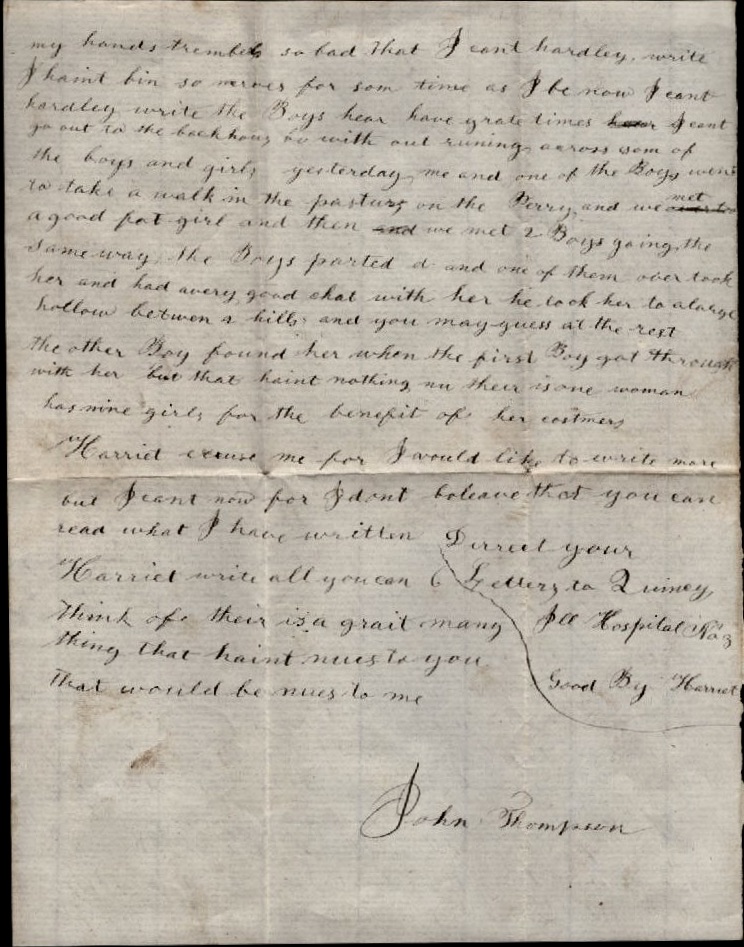
If you don’t want to sell the colts, you. need not sell them. I want to stop interest on our place as fast as possible. Harriet, I think that when I get home we will have some good times. We have a small place and if we have good luck and pay for it, we have taken comfort in riding around and we can take comfort again, I hope. I think of you night and day. If it was in my power to come home and see you, I should go. But Uncle Sam has got me in his clutches and I can’t do so as I wish. If I was of any use to the government, I would not think of going home for I came here to serve my country, and I want to serve it. But it will be some time yet before I can go back again, if ever. I don’t think that I can stand camp life but I wish I could. You must excuse my writing for my hands tremble so bad that I can’t hardly write. I hain’t been so nervous for some time as I be now. I can’t hardly write.
The Boys here have great times. I can’t go out to the back house without running across some of the boys and girls. Yesterday e and one of the Boys went to take a walk in the pasture on the Ferry and we met a good fat girl and then we met two boys going the same way. The boys parted and on of them overtook her and had a very good chat with her. He took her to a large hollow between the hills and you may guess at the rest. The other boy found her when the first boy got through with her but that haint nothing new. There is one woman has nine girls for the benefit of her customers. 2
Harriet, excuse me for I would like to write more but I can’t now for I don’t believe that you. can read what I have written. Harriet, write all you can think of. There is a great many things that hain’t news to you that would be news to me. Direct your letters to Quincy, Illinois Hospital No. 3. Goodbye Harriet, — John Thompson
1 Hospital No. 3 opened in October 1862 on the northeast corner of Sixth and Spring. Dr. Bailey was in charge under Dr. Nichols. When opened, it was to be used only when the two other hospitals were full. That changed as the war went on and more hospitals opened.[Source: Civil War Hospitals Grew to Five in Quincy]
2 Quincy’s “seedy indulgences” were well established before the Civil War but the large influx of soldiers into the town caused the red light district to flourish. See: “Illuminating History on Quincy’s Red Light District.”
Letter 2
[This letter is from the personal collection of Greg Herr and was transcribed and published by Spared & Shared by express consent.]
Chattanooga, Tennessee October 11, 1863
Dear Companion,
I thought I would spend a few moments in writing to let you know that I am well and enjoy myself well considering everything—not as well as I would if I was to home, and I hope these few lines will find you well and Elmer [too].
I have been on inspection and ate my dinner. You would like to know what we had for dinner? We had beans and hard tack and coffee and now I am sitting on my bunk with my bunk mates on each side of me. One of them is [ ]. Ball and N[ewton] Knolton. We have still times gear today as for cannonading.
There was one man killed and one or two wounded this morning. They was playing with a shell and the shell bursted. They supposed that they had got the powder out of the shell and then threw it in the fire and throwing it in the fire bursted.
1st Lt. Andrew Clement, taken prisoner by the Rebels while exchanging newspapers on the picket line at Chattanooga, TN. (Wisconsin Historical Society)
Our boys in my [company] is well and enjoying themselves well. We have been pretty busy since we came here in fortifying our camp. Our regiment was on picket yesterday and day before we lost one man—or the 15th Wisconsin Regiment lost one. The boys have been in the habit of exchanging newspapers with the rebs. One of the lieutenants 1 thought he would try it and he went over to the Rebs’ lines and they took him in and kept him. The Rebs and our lines is from 40 to 50 rods (250 yards) apart. We can talk with each other. The Rebs as a general thing is very talkative. If it was not for the officers, this war would soon be over. The Rebel privates is tired enough of the war.
I see Dr. L. Chapel yesterday. I did not have much time to visit with him. He told me that I must call on him if I got wounded. I see John Carmichael yesterday. He is fat as a bear. I have seen a number of the Quincy boys since we came here to hold the right or left wing. We hold the center now. We are getting good news occasionally. It is a flying report that Longstreet’s men and Bragg’s men have had a fight between themselves and killed quite a number and wounded a good many. I don’t know how true it may be. If we have a battle here with them and whip them, I think it will be the last big battle that we will have.
Harriet, I wish you would see Elder Washburn the first chance you have and have him see to my place and crops if he will. Tell him that I will pay him for his trouble. If there is any crops on the place, I want he should divide them. I hain’t heard anything from Thomas yet and shan’t until it is too late to do anything about them.
Harriet, do the best you can for me and yourself and when I get home, I will tend to such things myself. If you can sell my harnesses, you may do so for the money or some good man’s note. I would rather have the two-thirds of what they are worth than have them laying around at loose ends. If I could get home only for one week, I could see to such things myself but I can’t at present at any rate, and if the war should close by spring, I would rather stay than get a furlough if the Elder should see to my place.
I should like to have the grass get a good start in the meadow and then you can keep the colt in the meadow this winter. I want you should let me know whether Lonny is a going to keep the cows this winter or not. I want you should let me know all the particulars about everything you can think of and some more.
Harriet, keep the things as straight as you can and as snug for it is for your interest and Elmer’s so that I never should return, you will have what little we have. You and Elmer can have it for your own. Keep up good courage and good spirits. I know how lonesome you feel—if you feel as I do—but I hope that my life will be spared and return home to my little family once more to enjoy ourselves once more. I think that time is not far off. Our army has had good luck this season. That you can see for yourself.
I hain’t had any letter from you for some time. Harriet you must excuse my scribbling for I wrote in a hurry and am knocked on one side and then on the other. Harriet, if there is anyone that you would rather see to our place, you can get them. This is from your most beloved husband, — J Thompson
to H. E. A. Thompson
I want a pair of gloves and two pairs of socks. You can send me a pair of gloves in a newspaper and socks in the same way, one at a time. Goodbye.
I have had a letter from K. Thompson. He is well. He has been in a hard battle.
1 The lieutenant was Andrew Clement of Co. K, 15th Wisconsin Infantry. He enlisted in October 1861 at Waupon when he was 22. He was appointed to the rank of sergeant. He was reduced in ranks to Musician in May 1862 and then in October was commissioned a 1st Lieutenant and transferred to Co. K, In October 1863, he was “taken prisoner” while on picket duty near Chattanooga and was paroled and returned to service in December. He was sent home on leave where he died of chronic diarrhea in September 1864.


















 Spared & Shared 23