My passion is studying American history leading up to & including the Civil War. I particularly enjoy reading, transcribing & researching primary sources such as letters and diaries.
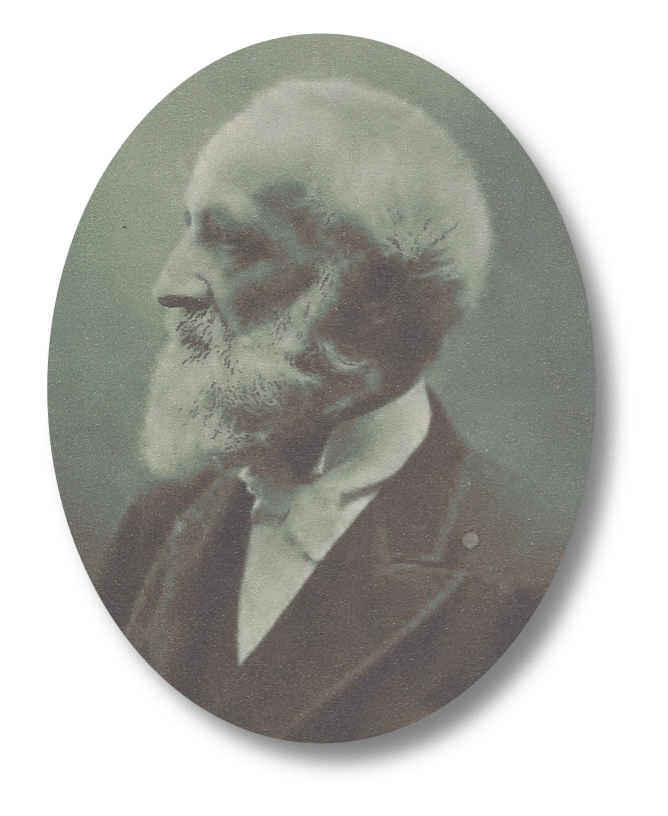
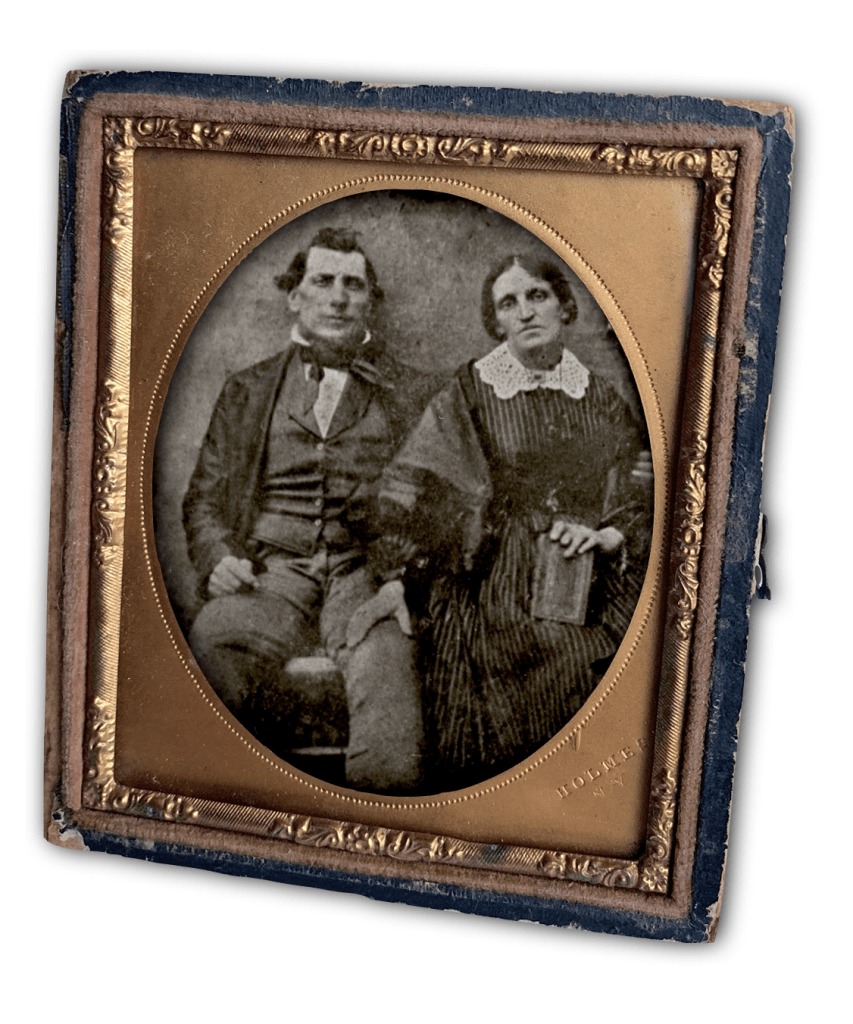
These two letters were written by Dwight Whitney Marsh (1823-1896), the son of Henry Marsh (1797-1852) and Sarah Whitney (1796-1883) of St. Louis, Missouri. Dwight had several siblings; those mentioned in these letters include, Calvin “Waldo” Marsh (1825-1873), Elizabeth (“Lizzie”) Willard Marsh (1829-1882), and Clarissa (“Clara”) Dwight Marsh (1834-1899) who married Samuel Watkins Eager, Jr. (1827-1903). Dwight’s father was an attorney in St. Louis at the time of his death in 1852 at the age of 53.
Dwight was born in Berkshire county, Massachusetts, and graduated from Williams College in 1842. He studied theology at Andover Theological Seminary in 1842-3, and then taught school in St. Louis, Mo., from 1843 to 1847. He continued his theological training at Union Theological Seminary and graduated in 1849, after which he was ordained and sailed in December 1849 from Boston to Mosul, Turkey, as a missionary for the A. B. C. F. M. In 1852 he returned to the U.S. and married 19 October 1852 to Julia White Peck of New York City. He then returned to Mosul where his wife died in August 1859. He finally returned to the U.S. in 1860 and began a lecture tour on missionary life. He was married on 21 August, 1862, to Elizabeth L. Barron in Rochester and then accepted charge of the Rochester Young Ladies’ Female Seminary where he remained five years. While there, he also preached for the Wester House of Refuge. He then went on to serve in the pulpit of various churches in the midwest before his death in 1896.
Letter 1
Osburn House Rochester, New York Thursday, August 21, 1862
My own ever dear sister Lizzie,
I am very sorry that our marriage comes off so suddenly that you & Mother could not be present. I think of you all much. It is now about noon & we are to be married at 3:30 & at 9 shall be at the [Niagara] Falls if all goes well. We have a charming day & I wish you were here to share in our delight. How often in this life our affairs move differently from our anticipations. I think we are about to be happy; but only our Maker knows what trials of sickness or partings are in store.
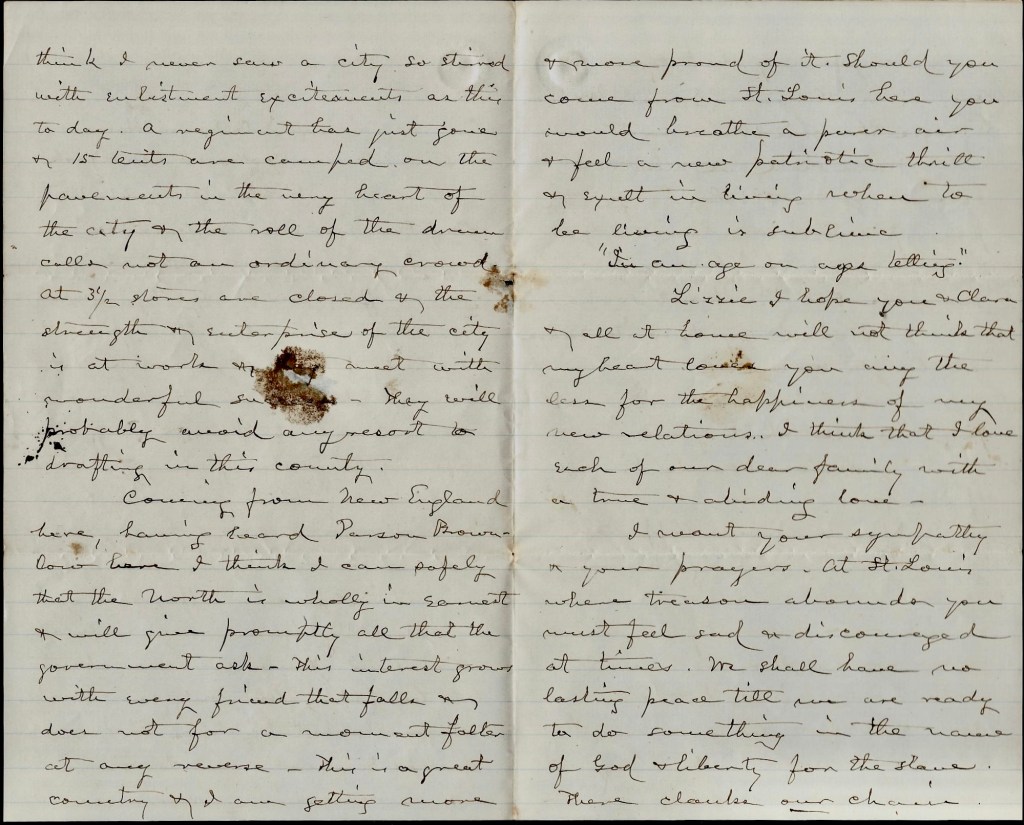
We are in war times. I think I never saw a city so stirred with enlistment excitements as this day. A regiment has just gone & 15 tents are camped on the pavements in the very heart of the city & the roll of the drum calls not an ordinary crowd. At 3:30 stores are closed & the strength & enterprise of the city is at work & will meet with wonderful success. They will probably avoid any resort to drafting in this county.
Coming from New England here, having heard Parson Brownlow 1 here, I think I can safely [say] that the North is wholly in earnest & will give promptly all that the government asks. This interest grows with every friend that falls & does not for a moment falter at any reverse. This is a great country & I am getting more & more proud of it. Should you come from St. Louis here, you would breathe a purer air & feel a new patriotic thrill & exult in living where to be living is sublime. “In an age on ages telling.”
“We shall have no lasting peace till we are ready to do something in the name of God & liberty for the slave. There clanks our chain.”
Rev. Dwight Whitney Marsh, 21 August 1862
Lizzie, I hope you & Clara all all at home will not think that my heart loved you any the less for the happiness of my new relations. I think that I love each of our dear family with a true & abiding love. I want your sympathy & your prayers. At St. Louis, where tiresome abounds, you must feel sad & discouraged at times. We shall have no lasting peace till we are ready to do something in the name of God & liberty for the slave. There clanks our chain.
Do give my best love to Anna & Clara & Sam & Waldo & kiss the children. When shall we meet? I cannot go to St. Louis for the present. I shall have to go look after Charlie again, as soon as October 1st, if not sooner. I shall try to write more at length soon. I hope Katy will not forget “Uncle Dwight.” Remembrance to all friends.
Your ever affectionate brother, — Dwight
1 William Gannaway Brownlow (1805-1877) was a preacher in the Methodist Church and a Tennessee newspaper editor. A Unionist despite owning slaves himself, Brownlow criticized the Confederacy even after Tennessee seceded. He was briefly imprisoned by the Confederacy at the beginning of the war. After leaving the state, he began a lucrative lecture tour in the North.
Letter 2
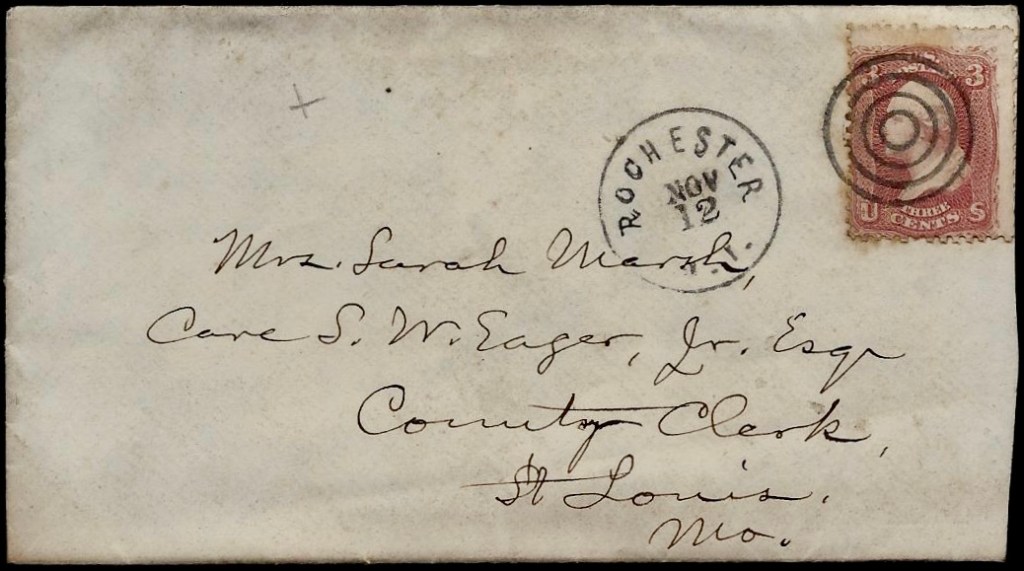
Addressed to Mrs. Sarah Marsh, Care of S. W. Eager, Jr., Esqr., County Clerk, St. Louis, Mo.
Rochester, New York Saturday, November 12th 1864
My own dearest Mother,
Your kind letter written just before election came yesterday & now we can rejoice & thank God together. This state and Nation are safe. God has heard the prayer of thousands of His creatures. He has been very gracious & to Him be all glory & praise. The world does surely move on towards the glad day when truth shall no longer be trampled down in the streets. The Nation, by God’s inspiring decree & influence, has asserted the heaven given rights to live notwithstanding rebels in arms & traitors at the polls would have assassinated the nation.
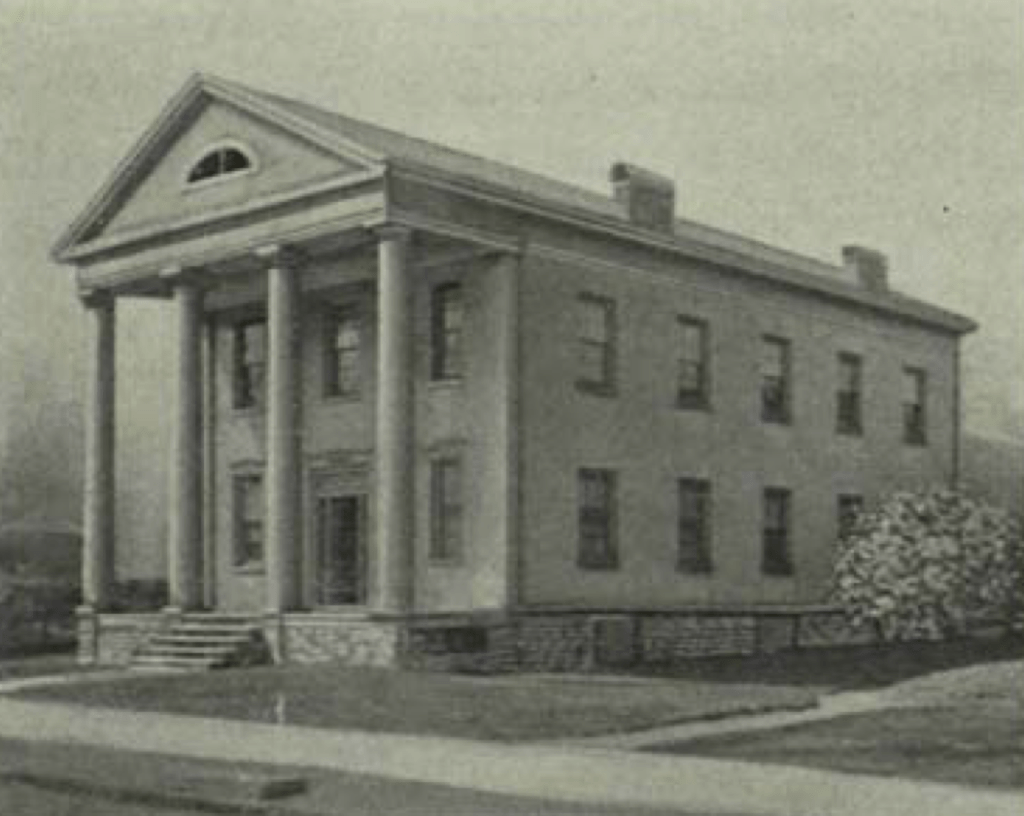
Rochester Female Seminary—pillars repaired in 1864
I am almost too happy in the defeat of the intriguer [Horatio] Seymour & hardly less in that of the weak tool McClellan. I think McClellan was a well-meaning little coxcomb—fooled to the top of his bent by larger and meaner men. The sun has set upon [Samuel S.] Cox & [Alexander] Long & poor Fernando [Wood] has not even traitors enough in New York [City] to elect him. All lovers of liberty & truth must rejoice in the result of last Tuesday’s election. I have some curiosity to know how [brother] Waldo voted. I hope that he is under good influences. I want very much from time to time to hear just how he is situated.
Lillie & Miss Eaton are well. Were they in the room, he would no doubt send love.
Our school continues full. We have about eighty. We had lately a singular case of theft by one of the girls of silver spoons & we were obliged to send her home. She was only fifteen & lived some thirty or forty miles away.
Please tell me any news of the dear ones in Racine. Love to them too if you write.
We have been repairing considerably. Clara will remember that the pillars in front of the house were very shabby. We have had them freshly covered and they look now very well indeed. We have expended over $200 in repairs since Mr. Eager & Clara were here & they would no doubt notice great improvement, This change has been essential to be decent.
Rev. Augustus Walker and his bride, Eliza Mercy Harding—Congregational missionaries to Turkey
Mr. & Mrs. [Augustus] Walker 1 of Diarbekir made us a very delightful visit of nearly a week—only it was too short. We put on Turkish dresses on Wednesday afternoon & the young ladies had quite a treat. One day the girls took a vote & found 58 for Lincoln to 12 for McClellan, & besides the teachers all for Lincoln.
Our city (I am sorry to say) gave some 80 majority for Little Mac. He must feel very small. Little Delaware was just large enough to vote for him.
Old Kentucky started wrong in this war (only half loyal)—that is, loyal with an if—and she has suffered & may suffer far more for it. I hope she will consult her own interests well enough to give up slavery. It is idle to attempt to maintain it longer & will only delay what is inevitable.
Please give much love to Waldo & Mr. Eager & all their families, kissing the little ones for me. Thank you for remembering & writing to me on my birthday. I see God’s hand more the longer I live & I hope am grateful for His goodness & love. Every affectionately your son, — Dwight
1 Rev. Augustus Walker and his wife, Eliza Mercy Harding, were missionaries to Diarbekir, Turkey, where they spent 13 years. They had six children, two of whom died in Turkey. Only one child, Harriet, was born in America during a furlough. In 1866 the Reverend Augustus Walker died of cholera in Turkey, and Mrs. Walker returned to America with their four children.
This letter was written by Charles Smith Hempstead (1794-1874), the son of Stephen Hempstead (1754-1831) and Mary Lewis (1757-1820) of St. Louis, Missouri. Charles was married in 1838 to Eliza Barnes (1799-1880). He wrote the letter to his younger brother, William Hempstead (1800-1854) who lived in St. Louis with his wife Sarah Augusta Bouton (1815-1844). Charles & William had a sister named Sarah Hempstead (1789-1858) who was married to Elijah Stuart Beebe (1785-1822)—a saddler & harness maker in St. Louis. An older brother, Edward Hempstead (1780-1817) was a delegate to the US Congress as a representative from Missouri Territory from 1812 to 1814. The Hempstead family were close friends with the Thomas Hart Benton family of St. Louis.
Charles was an early resident of Galena, Jo Daviess county, Illinois, where he had a law practice with U. S. Congressman Elihu Benjamin Washburne. He came to Galena in 1829. He was elected the city’s first mayor in 1841. He partnered with Washburne from 1845 until 1852. Described as “a quiet, dignified, urbane man, and an able lawyer,” Charles practiced his profession until past middle life, when “he devoted his entire attention to his private affairs. He was a promoter of the Galena and Chicago railroad, the first road to be constructed west of Lake Michigan, and was one of its board of directors for many years. He served in the civil war as a paymaster and was one of Galena’s early mayors. His two sons, Edward and Charles, became prominent citizens of Galena, and both moved to Chicago and engaged, the first named in the lumber business, and the second in the practice of his profession as a physician, in which he became distinguished.”
In his letter, Charles speaks of his slave Tom and of his desire to see him placed in a free black community in the country somewhere. That Charles was a slave holder is certain. Cornell University Library houses a Certificate of Manumission for a mulatto woman named Mary and her ten year-old son Augustus who came into his possession in 1836 and were manumitted in 1845.
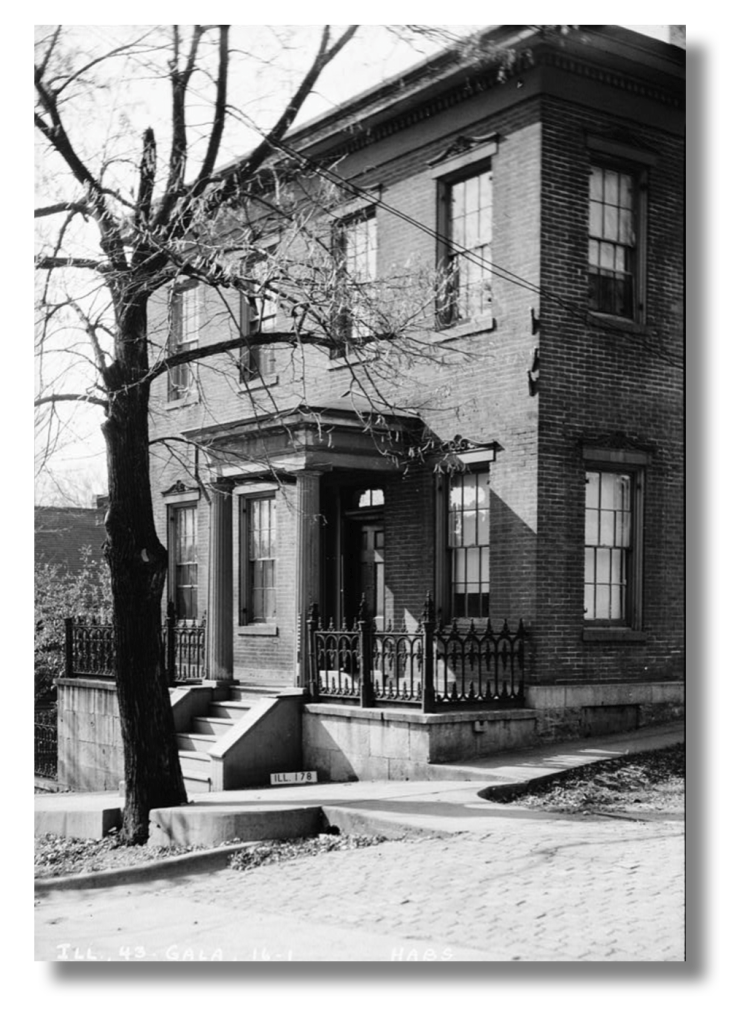
Charles S. Hempstead’s Brick Home at 611 South Bench Street in Galena, Illinois
Transcription
Galena [Illinois] February 23rd 1837
Dear William,
Charles S. Hempstead served as one of the commissioners appointed by the Illinois General Assembly selling shares for the Mississippi & Rock River Canal Company in 1838
I received your favor 13th inst. by due course of mail. Respecting your interest in Milan, I will write to [John] McNeil to try and sell one or two shares of interest at the rate he sold & to clear myself of H. S. B. & one or two other liabilities. I would sell a part of my interest also although now is not the time to sell for Mr. [Charles] Oakly & partner in that place are waiting for some other [ ] before they will offer lots in the place for sale—such as a canal to unite Rock river with the Mississippi to terminate in [ ] below the town. Those men have been all winter at Vandalia to effect a law for that purpose.
I will attend to the estate matter you have set up and I am pushing my town lots & other business to be [ ] to leave by 15th or 20th next month for St. Louis. Edw. Beebe has not arrived here yet. Our rivers are yet firmly frozen & in probability of a breakup to await boat before 4 or 5 weeks.
We have nothing new here. Times [are] dull. Nothing stirring. No speculation this winter. All of our speculating citizens are East, operating there. The Iowa Copper Mines 1 of Aubry & Mills have been sold to a C. in Philadelphia 3/4th for $75,000, Dr. Miller, one of the purchasers, but we hear poor Mills will not live to enjoy any of it.
You ask what is to be done with my Tom. I wish you would send him to the country somewhere. Are there no free black men with whom he could live? If you cannot do anything with him till I come down, let him be and I will attend to him. As to family matters on this side of the river, we all are well—and also on the other, and the fear of her husband & others have been happily relieved. Dr. McKnight’s wife—who has a fine daughter, & mother & child doing well—at my home. We are all as usual, and among yous and your wife’s friend in town. I believe we are all well.
Please remember us affectionately to all the family & believe me ever & affectionately yours, — Chas. S. Hempstead
1 The Iowa Copper Mines were located about one mile from Mineral Point in Wisconsin Territory, and about 35 miles from Galena.
This letter was written by Augustus Charles Barry (1829-1917) of Wyanet, Bureau county, Illinois, while serving as the captain of Co. K, 57th Illinois Infantry. He was mustered into the regiment on 26 December 1861 and resigned his commission on 20 June 1862 after six months service.
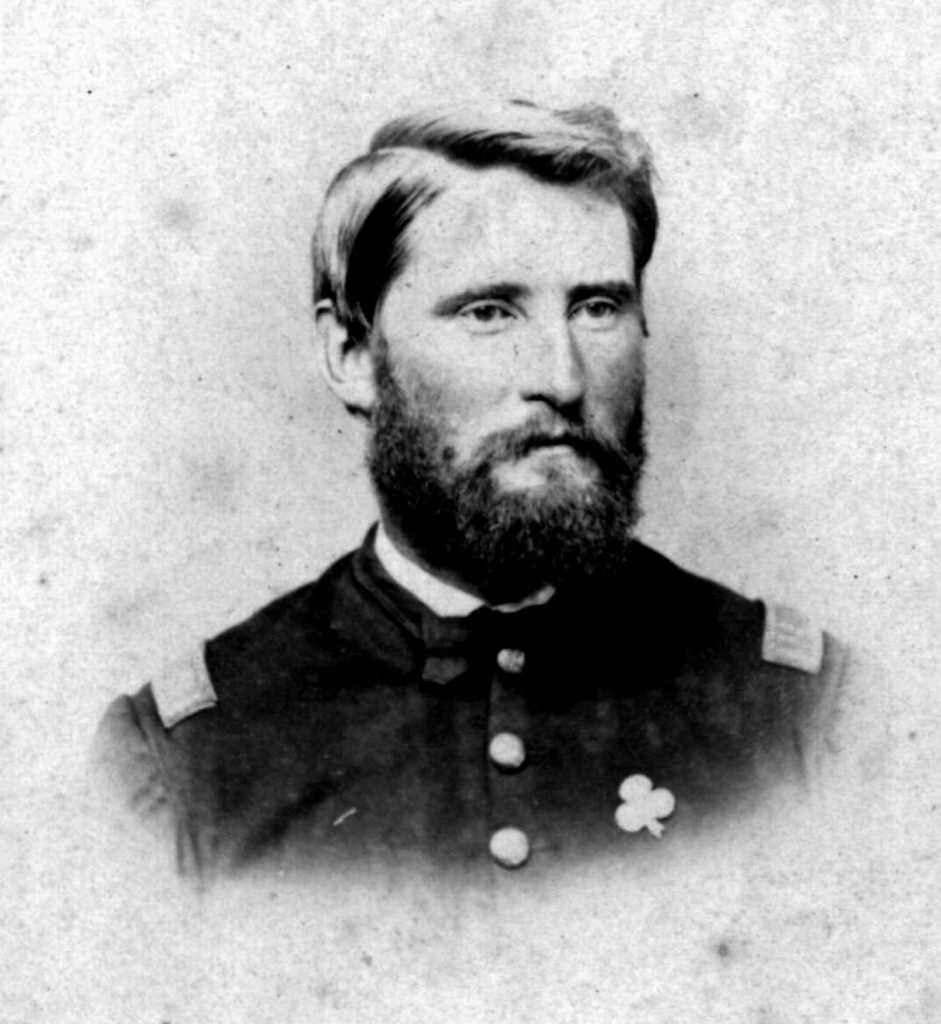
I could not find an image of Barry but here is one of Linas van Steenburg who also served as a captain in the 57th Illinois Infantry
At the time of the 1860 US Census, Augustus was enumerated as a boarder in the household of station agent David T. Nichols of Wyanet, Illinois. His occupation was given as “attorney of law.” He was the son of John and Eunice (Sweet) Barry of Brookfield, Madison county, New York. He was married to Catherine Ettie Miller in May 1867 and she may have been the “Dear Friend” to whom this letter was addressed. While many of his siblings settled around Elgin, Illinois, Augustus eventually moved to San Francisco, California where he died in 1917.
The 57th Illinois Infantry was raised in the fall of 1861 and was composed of five upstate companies and five from downstate—a situation that was ripe for discord among the leaders of the organization if not the men. The Colonel and Lt. Colonel did not get along and officers below them were often compelled to pick sides in this confrontation. Though he does not say so in his letter, perhaps Augustus resigned in part because of the growing antagonism among the officers. He was long gone from the regiment by the time charges of cowardice were levied against Col. Silas D. Baldwin by Lt. Col. Frederick J. Hurlbut with specifications that dated as far back as the Battle of Fort Donelson in which the 57th Illinois barely even participated. Since he was no longer a member of the regiment, Augustus was not called upon to testify but he appears to have been strong friends with the Lt. Col. and the Regimental Surgeon suggested he may have sided with the prosecution. To read more on the Court Martial of Col. Silas D. Baldwin, readers are referred to Richard P. Dexter’s JSTOR article, “Col. Silas D. Baldwin: Guilty or not Guilty? A Case of Command Influence?”
[Note: This letter is from the private collection of Greg Herr and is published on Spared & Shared by express consent.]
Transcription
[Camp near Corinth, Mississippi] June 5th 1862
Dear Friend,
I wrote you a few words some time ago when I was in the hospital. At that time I had not received a word from you but soon after I got quite a number of letters which ’tis needless to say has been a fund of enjoyment for a long time.
I am gaining slowly but hope soon to take the field. I would not let our surgeon [Dr. James Zearing] send me back to the river but followed close to the regiment and am now in the old camp formerly occupied by Generals Price & Van Dorn and more recently by our forces. The rebels left their tents just as they had used them and left a large quantity of provision, camp equipage, &c. The provision was partially destroyed although we found a large quantity of sugar and molasses of the finest quality all right. Our men have have moved out about fifteen miles to a place called Danville and we got a report this morning from a deserter that some five miles further on at a place called Boonville the rebels have made a stand in strong force and will probably offer our forces battle—especially if they are commanded by Beauregard. I hope they will give us one more square stand-up fight and then I think they will be fully satisfied to go home and call the war a mistake on their part.
I would have come home two weeks ago but I had made a solemn promise that I never would come to Bureau County again sick if I could help it. I want to have a visit next time when I am in good health.
This is one of the finest camping grounds I have seen situated on a ridge of hills affording a fine view of the country to the south and west. Corinth is a very pretty village with quite a number of houses built in good taste surrounded by trees. Beauregard burned the railroad depot and some large storehouses around it which gives that part of the town rather a desolate appearance. I suppose a vast amount of property was destroyed. The storehouses were filled with provisions and ammunition beside the public square had been filled with military stores of every kind and burned with almost everything valuable in the town.
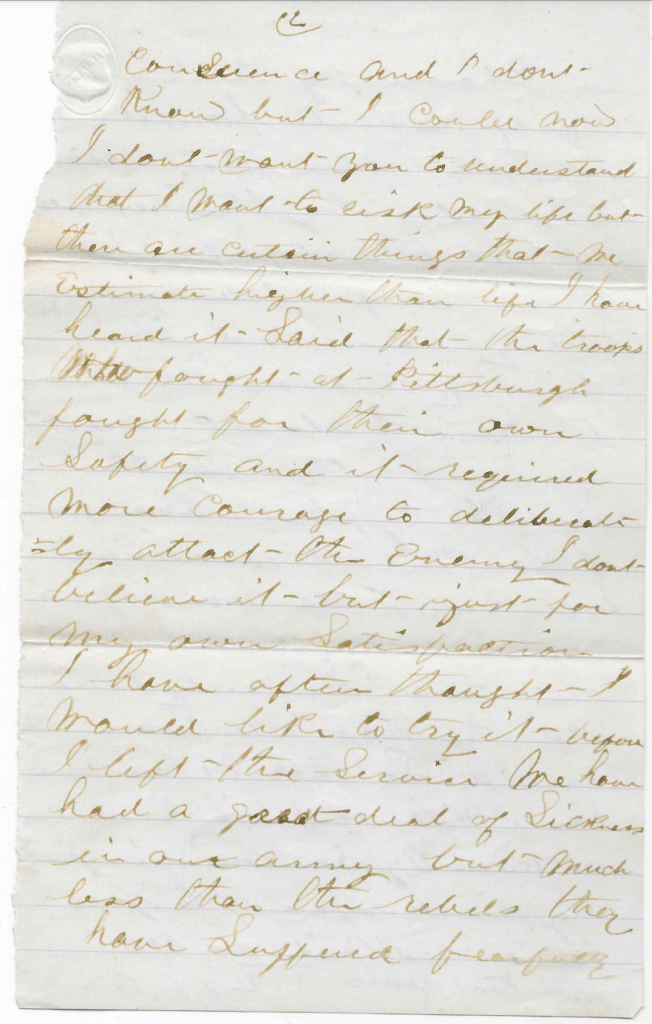
I think of offering my resignation and shall certainly do so if I don’t improve a good deal in ten days from now. I am just able to ride in an ambulance and shall follow the regiment tomorrow. If I could take part in one more good sharp fight, I could leave the service with a clear conscience and I don’t know but I could now. I don’t want you to understand that I want to risk my life but there are certain things that we estimate higher than life. I have heard it said that the troops who fought at Pittsburg [Landing], fought for their own safety and it required more courage to deliberately attack the enemy. I don’t believe it, but just for my own satisfaction I have often thought I would like to try it before I left the service.
We have had a great deal of sickness in our army but much less than the rebels. They have suffered fearfully as shown by their daily reports found in Corinth after they left and also by the reports of all the deserters from their camp. It is getting very warm and the sickly season will soon be here. I almost dread going further south for the cypress swamps of Southern Mississippi will sweep off more of us than Beauregard and all his rebel crew. I sincerely hope that the war will soon terminate so that we can come home without being sneered at even by our enemies.
Give my kindest regards to you family and write as often as you can. Yours truly, — A. C. Barry
This mid-June 1863 letter was written by Lt. William Wilcox Hulbert (1838-1911) of Co. D, 4th Georgia while passing near Williamsport, Maryland, on the Gettysburg Campaign. The letter, which is signed “your affectionate but rebel nephew,” represents a communication between Hulbert, who was originally from Connecticut, and his Northern relatives. Flush from their victory in May at the Battle of Chancellorsville (at which Hulbert was promoted to 1st Lieutenant), Lee’s Confederate forces were on the move northward. Williamsport, which is just south of the Pennsylvania border, offered Hulbert yet another chance to send a letter without having to mail it across enemy lines. This campaign would culminate two weeks later at the Battle of Gettysburg, in which Hulbert’s unit fought.
The 4th Georgia Infantry had one of the most illustrious records of any Confederate unit, fighting at 24 battles from Seven Pines all the way to Appomattox Court House (see History of the Doles-Cook Brigade by Henry Thomas). Lieutenant Hulbert himself had a particularly distinctive war history. After being captured at Spotsylvania while in command of the sharpshooters of his 4th Georgia Infantry, he became one of “The Immortal Six Hundred.” These 600 Confederate officers refused to sign a loyalty oath to the North so that they could be paroled and consequently languished in prison. On 20 August 1864, angered by Southern treatment of Union prisoners, the North deliberately chose the 600 to be taken to Morris Island, at the mouth of Charleston harbor, where they served as a human shield to the Union forces of Gen. John Foster who were under attack by Confederate forces. After suffering through 45 days on Morris Island, the weakened survivors were sent to Ft. Pulaski where they continued to be mistreated and starved. Hulbert was paroled on 15 December 1864. The Immortal 600 continue to be honored for their adherence to principle under the most adverse circumstances (see The Immortal 600, Surviving Civil War Charleston and Savannah by Karen Stokes, or The Immortal Six Hundred, A Story of Cruelty to Confederate Prisoners of War by Maj. John Ogden Murray.
Jacket Cover to Karen Stokes’ book, The Immortal 600
William was the son of Abijah and Maria Wilcox Hulbert. The family moved from Berlin, Connecticut, to Atlanta, Georgia, when William was a young man. Before the war, he began his career with the Express Company where he remained throughout his entire life except for the four years he passed in the Confederate Army. When the began, Hulbert was running messenger into West Point on the Atlanta and West Point Railroad. The West Point Guards was one of the crack military companies of the state before the war, and when Georgia cast her lot with the seceded states, the West Point Company tendered its services. Within a short time that company found itself in the Fourth Georgia Regiment, which was attached to the Doles-Cook Brigade, one of the first bodies of Georgia Troops to go to the front in Virginia.
[Note: This letter is from the personal archives of Richard Weiner and is published on Spared & Shared by express consent.]
Transcription
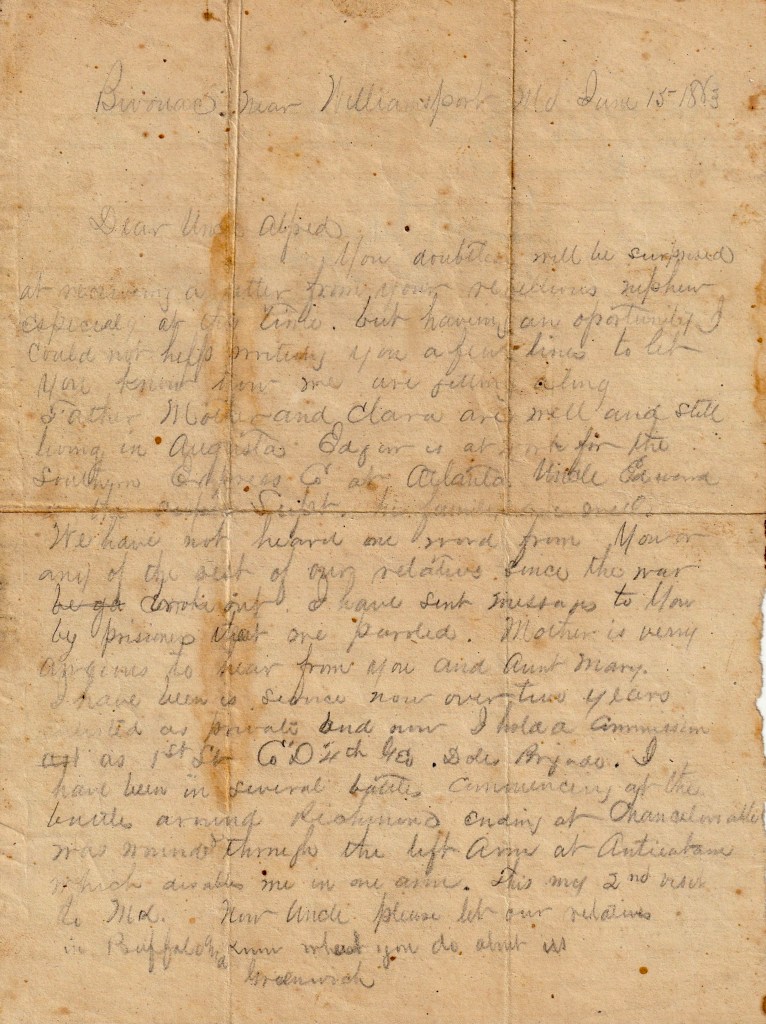
Bivouac near Williamsport, Maryland June 15, 1863
Dear Uncle Alfred,
You doubtless will be surprised at receiving a letter from your rebellious nephew—especially at this time, but having an opportunity, I could not help writing you a few lines to let you know how we are getting along. Father, mother, and Clara are well and still living in Augusta. Edgar is at work for the Southern Express Co. at Atlanta. Uncle Edward is the express superintendent. His family are well. We have not heard one word from you or any of the rest of our relatives since war broke out. I have sent messages to you by prisoners that are paroled. Mother is very anxious to hear from you and Aunt Mary.
I have been in service now for over two years. Enlisted as private and now I hold a commission as 1st lieutenant, Co. D, 4th Georgia—Dole’s Brigade. I have been in several battles commencing at the battles around Richmond, ending in Chancellorsville. Was wounded through the left arm at Antietam, which disables me in one arm. This my 2nd visit to Maryland.
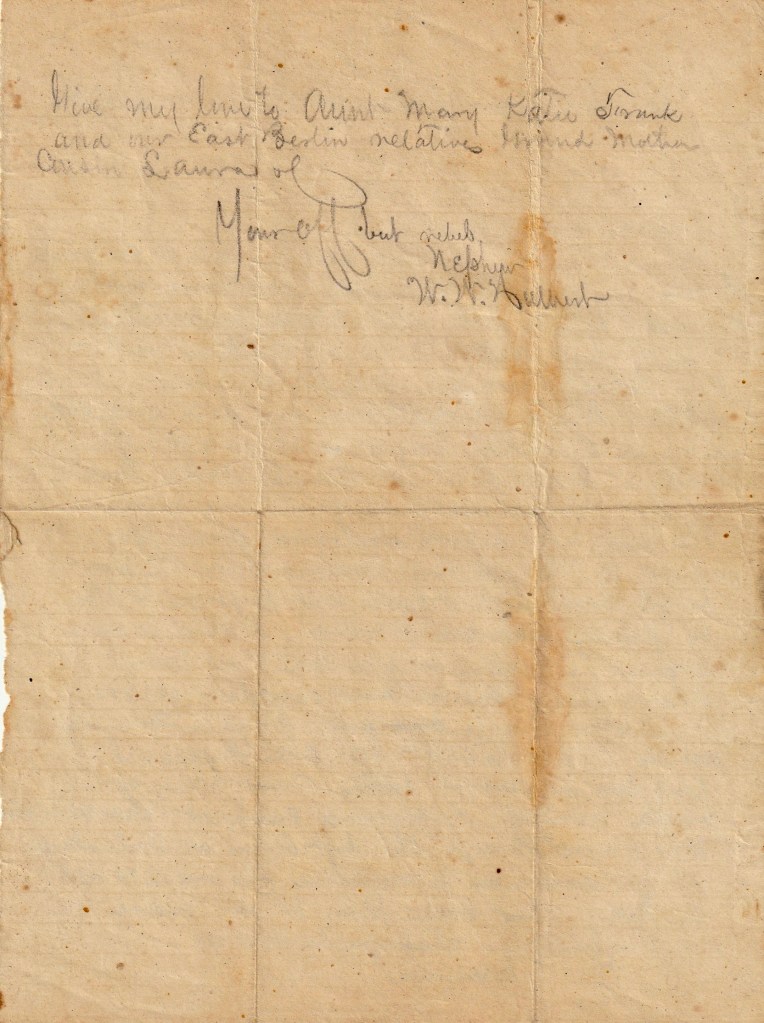
Now uncle, please let our relatives in Buffalo and Greenwich know what you do about us. Give my love to Aunt Mary, Katie, Frank, and our East Berlin relatives, Grandmother, Cousin Laura, &c.
Your affectionate, but rebel nephew, — W. W. Hulbert.
Ginnie’s parents, William and Martha (Reid) Ayre of Centreville, Fairfax county, Virginia
This letter was written by Jane (“Ginnie”) M. Ayre (1844-1885), the 17 year-old daughter of English emigrant William Mason Ayre (1818-1899) and his Virginia native wife, Martha Ann Reid (1817-1889), of Centreville, Fairfax county, Virginia. Ginnie and her older sister, Mary Catherine (“Kate”) Ayre (1843-1926) were the oldest of nine children born to the couple. The William Ayre farm was located on present-day Stringfellow Road (Section 45-3) near Chantilly, six miles west of Fairfax. It was known as the Buena Vista Farm in later years.
She wrote the six-page letter to a dear friend named “Minnie” who probably resided in Maryland, beyond enemy lines, with whom she mostly likely had a previous acquaintance while attending the Fair Hill Boarding School for Girls. Ginnie married Leander Makely in 1878 but died seven years later. The mail had to be smuggled across enemy lines by those who were able to obtain passes—more easily done at this stage of the war than later.
In her January 1862 letter Jennie speaks of the family’s displacement from Fairfax to Farquier county, Virginia, due to the war and also of the depredations by Union troops in their former home near Centreville.
[Note: This letter is from the private collection of Richard Weiner and is published on Spared & Shared by express consent.]
Letter 1
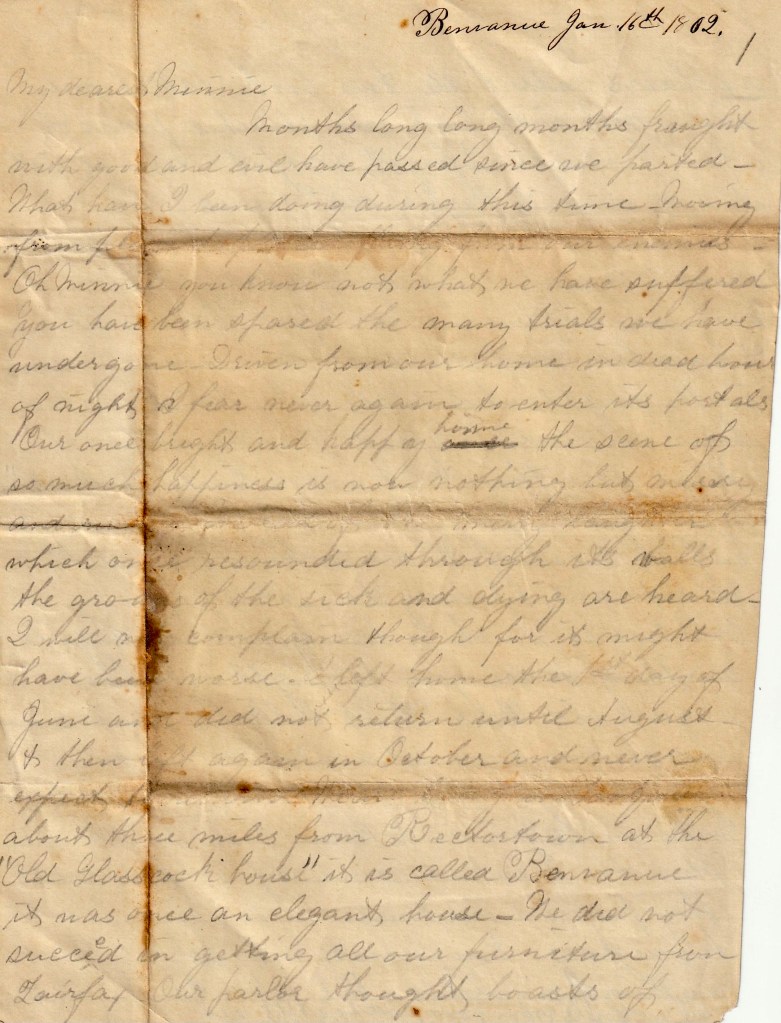
Benvanue 1 January 16th 1862
My dearest Minnie,
Months, long long months fraught with good and evil have passed. What have I been doing during this time? Moving from place to place, fleeing from our enemies. Oh, Minnie, you know not what we have suffered. You have been spared the many trials we have undergone—driven from our home in dead hour of night. I fear never again to enter its portals. Our once bright and happy home—the scene of so much happiness—is now nothing but misery and ruin. Where once the merry laughter which once resounded through its halls, the groans of the sick and dying are heard. I will not complain though for it might have been worse. I left home the 1st day of June and did not return until August & then left again in October and never expect to return.
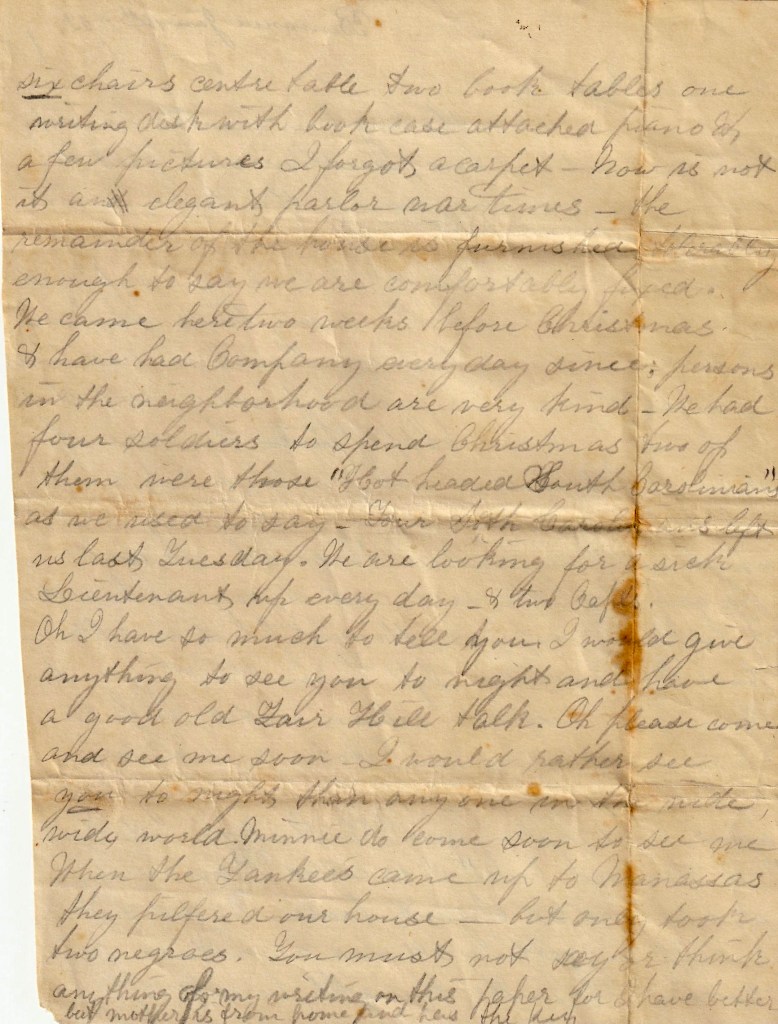
We are [now living] about three miles from Rectortown at the “Old Glasscock House.” It is called Benvanue. It was once an elegant house. We did not succeed in getting our furniture from Fairfax. Our parlor though boasts of six chairs, centre table, two book tables, one writing desk with book case attached, piano, & a few pictures. I forgot a carpet. Now, is not it an elegant parlor [these] war times? The remainder of the house is furnished tolerably enough to say we are comfortably fixed. We came here two weeks before Christmas & have had company every day since; persons in the neighborhood are very kind. We had four soldiers to spend Christmas. Two of them were those “hot headed South Carolinians” as we used to say. Four South Carolinians left us last Tuesday. We are looking for a sick Lieutenant up every day & two Captains.
Oh, I have so much to tell you. I would give anything to see you tonight and have a good old Fair Hill talk. 2 Oh please come and see me soon. I would rather see you tonight than anyone in the wide, wide, world. Minnie, do come soon to see me. When the Yankees came up to Manassas, they pilfered our house—but only took two negroes. You must not say or think anything of my writing on this paper for I have better but Mother is from home and has the desk.
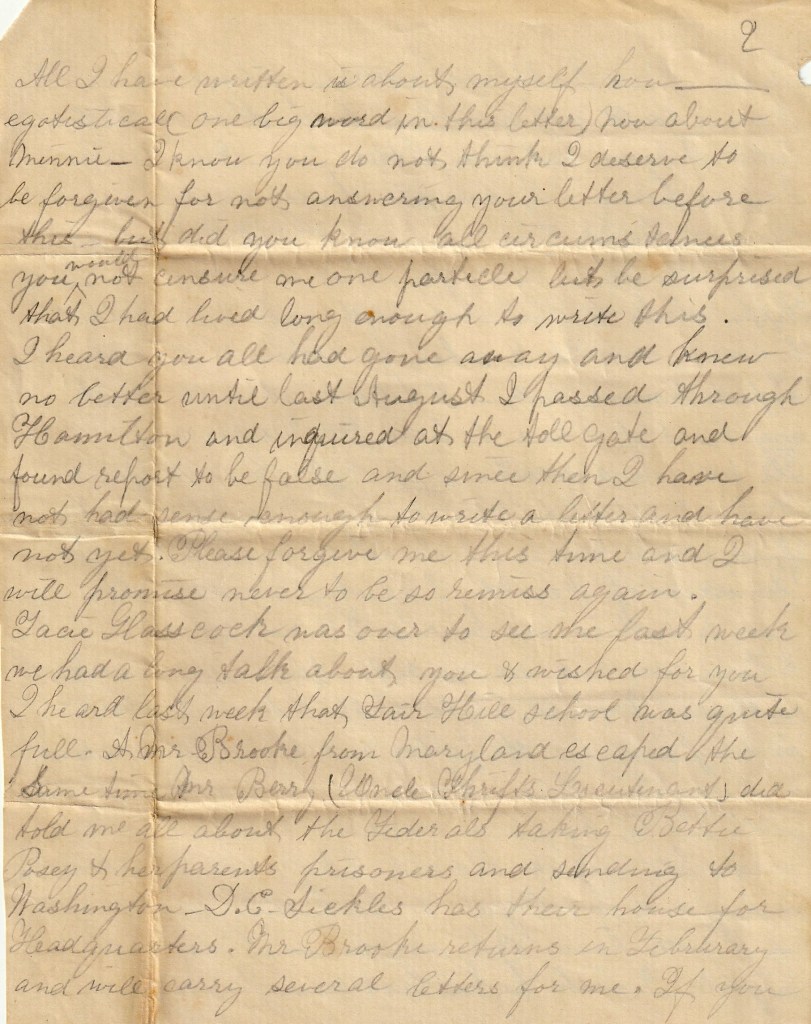
All I have written is about myself. How egotistical (one big word in this letter). How about Minnie? I know you do not think I deserve to be forgiven for not answering your letter before this—but did you know all circumstances, you would not censure me one particle but be surprised that I had lived long enough to write this. I heard you all had gone away and knew no better until last August. I passed through Hamilton and enquired at the toll gate and found report to be false and since them I have not had sense enough to write a letter and have not yet. Please forgive me this time and I will promise never to be so remiss again.
The Charleston Tri-Weekly, 26 November 1861
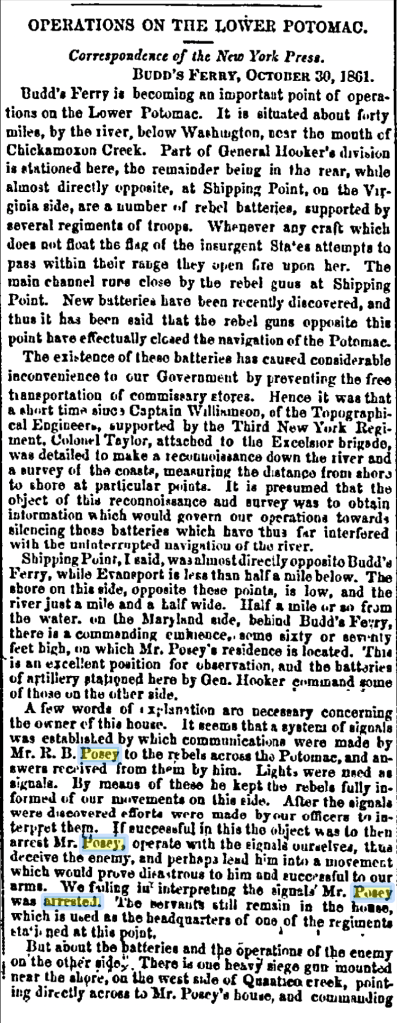
Lacie Glasscock was over to see me last week. We had a long talk about you & wished for you. I heard last week that Fair Hill school was quite full. A Mr. Brooke from Maryland, [who] escaped the same time Mr. Berry (Uncle [James] Thrift’s Lieutenant) [of Co. G, 8th Virginia] did, told me all about the Federals taking Bettie Posey & her parents prisoners 3 and sending to Washington D. C. [Gen. Dan] Sickles has their house for [his] headquarters. Mr. Brooke returns in February and will carry several letters for me. If you know Alice Matthews’ address, please send it to me. Would not you love to see Alice & Sallie Cole? I have had one letter from Edie Smee. It came home by private conveyance. Have you heard from any of them? I have so many things to tell you that I cannot write.
Pappa starts to Alabama next week and will be gone a month & when he returns, we all expect to move out. I believe it will break my heart if I have to leave Old Virginia. I’ll tell you a secret—I am not going there. I’ll tell you where I am going when we meet—-if we ever do, that is. I would come and see you tomorrow if I could. I expect I would talk you to death in one hour so I’ll not come. Please come and see me and stay several weeks with us. I would write with ink but there is company in the parlor and the only inkstand we have is in there. I am up in Mother’s room with slight headache (or heartache). I could write all night but old Professor Bartenstein 4 is here and is obliged to leave early tomorrow so I will have to take my music lesson tonight. I wish he had not come this evening.
When the Eighth [Virginia] Regiment 5 was at Leesburg, I visited it frequently and always thought of you as I passed through Hamilton. We have two lady friends of Mother’s from South Carolina staying with us. Minnie, I would not send you this scribble but knowing you will not think any less of me for it, for you know I am writing at night without paper, pen or ink—am I not excusable? I won’t have anything to do but write letters this whole winter and I expect you will get tired of reading my productions.
George Dandridge is down at [ ville]. Papa is going to Fairfax in the morning. He goes down about once every week. He expects to bring some soldiers up with him when he comes. I wish you could have seen Grandfather’s old place after the Yankees left it. They cut up all the carpets with their bayonets, poured out all the preserves, broke every door about the place, took all the wearing apparel of five families who had deposited them there & a quantity of bed clothes. Took all the horses on the place and then gave all the negroes free papers. Oh, you who have not seen them know nothing about the depredations they commit.
At our home, they were not quite so vicious. They enquired of the negroes where Kate and I were and sent their love to us. I expect some of our acquaintances were them. In fact, I know they were. Please don’t show this miserably written letter to anyone but burn it as soon as read. Please write soon—very soon—and the next letter I write I will promise to write more legibly.
I must go down now and take my music lesson. Please write soon. Your devoted friend, — Ginnie Ayre
Direct your letter to Rectortown P. O., Fauquier county, Va.
P. S. What has become of the Mr. Hopkins?
1 Built of stone construction, Benvenue was constructed around 1824 on 335 acres then owned by John P. Duval. Enoch Glasscock purchased the farm in 1849 and just as the Civil War began, Glasscock sold it to Samuel Tebbs. Interior chimneys are present on either end of the house. The facade (south elevation) holds a centrally located entrance that is flanked by tall six-over-six, wood-sash windows. A round-top transom is set above the entrance door and the bay is detailed with an elaborate pedimented aedicule surround. Other classical elements include the modillion blocks along the cornice line of the house. [See National Register of Historic Places.]
Benvenue as it looks today
2The Fair Hill Boarding School for Girls (Fair Hill Seminary) was “one of the earliest schools in the county to include a program for girls. With the help of the Baltimore Yearly Meeting, Samuel Thomas and his wife Anna, both Quakers, opened a school for boys at Fair Hill in 1819. A year later, Margaret Judge added a girls’ department. The Thomases’ school closed in 1829; ten years later, Phineas Paxson bought Fair Hill, and turned it into a girls’ boarding school. In 1850, Richard and Mary Kirk took over the school, with William H. Farquhar as Principal. Mary Coffin, a young woman from New York state, taught at Fair Hill from 1854 to 1865, when the school closed. Her memoirs, published in 1916, provide a wealth of detail about the school during its last decade. According to her recollections, the school averaged 45 students a year, primarily drawing from Montgomery County. About a quarter of the students were Friends (Quakers), and some of these girls were from Quaker families in DC and Alexandria. In the early days of the Civil War, nearly two-thirds of the students withdrew, because of the school’s proximity to the fighting in Baltimore. The school closed for good in 1865 (the building itself burned down in the 1970s), although the Fair Hill Fund continued to provide money for local education.”[See Digital Maryland
Daily National Intelligencer, 4 Nov. 1861
3 Richard Barnes Posey (1806-1880), his wife, Elizabeth (Berry) Posey (1812-1887), and his daughter Elizabeth (“Bettie”) Posey (1844-1923) were all arrested and taken to prison in Washington D. C. on the charge that they signaled Union troop movements to Confederates by displaying signal lights (see newspaper clipping above). The family was released from prison in late November 1861, “no just grounds of suspicion having been established against them.” The Posey residence was described as sitting on an eminence “some sixty or seventy feet high” commanding a view of the Potomac river approximately “a half mile or so” from the river behind Budd’s Ferry in Charles County, Maryland.Bettie Posey probably was a school mate of Ginnie’s at the Fair Hill Boarding School.Ginnie claims that the Posey Home was used by Gen. Daniel E. Sickles for his Headquarters. See historical marker on the Port Tobacco Road.Sickles was in Charles county from October 1861 until March 1862 while training troops.
4Ferdinand Bartenstein (1815-1884) was a music teacher who resided in Alexandria, Virginia in 1860. He was born in Hochkirch, Saxony, Germany.He emigrated to the United States in 1846and married Elizabeth Cole Gordon in 1847.
5 Co. G of the the 8th Virginia Infantry (“The Bloody Eighth”) was recruited in Fairfax county by Captain James Thrift, Gennie’s uncle. The regiment took part in the Battle of Manassas. Held in reserve until afternoon, it then advanced to Henry Hill where they fought hand to hand with the 69th New York and the United States Marine Battalion. In August, they relocated to Camp Carolina, just outside of Leesburg where they remained until March 1862, taking part in the Battle of Ball’s Bluff during that time. In April 1862, Capt. James Thrift was promoted to Major of the regiment. He was mortally wounded in the Battle of Seven Pines. He died at Richmond on 2 June 1862.
The Fairfax )Virginia) Herald of October 5, 1888 contained the following article: “War Incident. An incident occurred after the battle of Gettysburg, at night, which shows how kindness is appreciated by soldiers who have been prisoners in the enemy’s hands. A private by the name of Iden, a member of one of the companies of the 8th Va. Infantry, being wounded and left in the hands of the enemy, but able to walk, asked to be taken to the officer of the day. He was conducted to that officer, who asked what he wanted of him. He politely asked him if he would make a detail and have the wounded of his regiment brought off the field and carried to the hospital and cared for. The officer asked him what regiment he belonged to. He answered, ‘The 8th Va. regiment of infantry.’ Whereupon he promptly replied: ‘Certainly; I was taken prisoner by that regiment at Ball’s Bluff and caried to Manassas by Capt. Thrift, of that regiment, who treated me so kindly while I was a prisoner under his charge, that it will give me a great deal of pleasure to render any assistance to that command to alleviate their sufferings.’ He at once had the detail of men made, procured a flask of brandy and went in person with Iden, and had every man of that regiment removed to the hospital that could be found that night. I am sorry that I cannot give the officer’s name. He belonged to a Massachusetts regiment. A member of the 8th Va.”The soldier named Iden could have been one of the Iden brothers from Upperville – John or Joseph of Co. B. Joseph’s record lists him absent from May thru August, so maybe, John is the soldier. John was wounded July 3 at Gettysburg.
Letter 2
The following letter scans were sent to me on 17 August 2023 by Claiborne Stokes for inclusion here. With scans of the letter, Claiborne wrote:
Hello Griff, What an awesome amount of work and incredible projects you have created on Spared and Shared. Really unbelievable. Whenever I run across sites like yours I always type in a name I might be researching and low and behold I have a hit on yours. It is very nice to see and read the letter you have transcribed from Ginnie Ayre.
I think you might want to add the attached to your collection. It is a letter from Ginnie’s first cousin, Maria Ellen “Nellie” Ayre written to none other than their friend Minnie. Nellie’s father was George Stephenson Ayre, brother of Ginnie’s father William. George Ayre owned “Ayrshire” north of Upperville, but prior to living there, had leased “Rose Hill” out on Rte 50 east of Upperville above the Goose Creek Bridge. That is where Nellie wrote her letter from. Anyway, you will see all of that and I believe Nellie’s letter will help you glean some more information about the mysterious “Minnie”. The credit for this letter goes to the Library of Virginia under “Ellen Ayre of Loudoun County – Accession 37062”.
I grew up on “Ayrshire”. My family owned the farm from 1913 until 1996. I have studied the farm and the Ayre family my entire life, but really started focusing on it over the past three years, so seeing your blog is a victory. Thank you. If I can help you with anything else on the GSA family let me know and if you have anything else on the Ayre family, I would be grateful if you might consider sharing it.
Best regards.– Claiborne Stokes
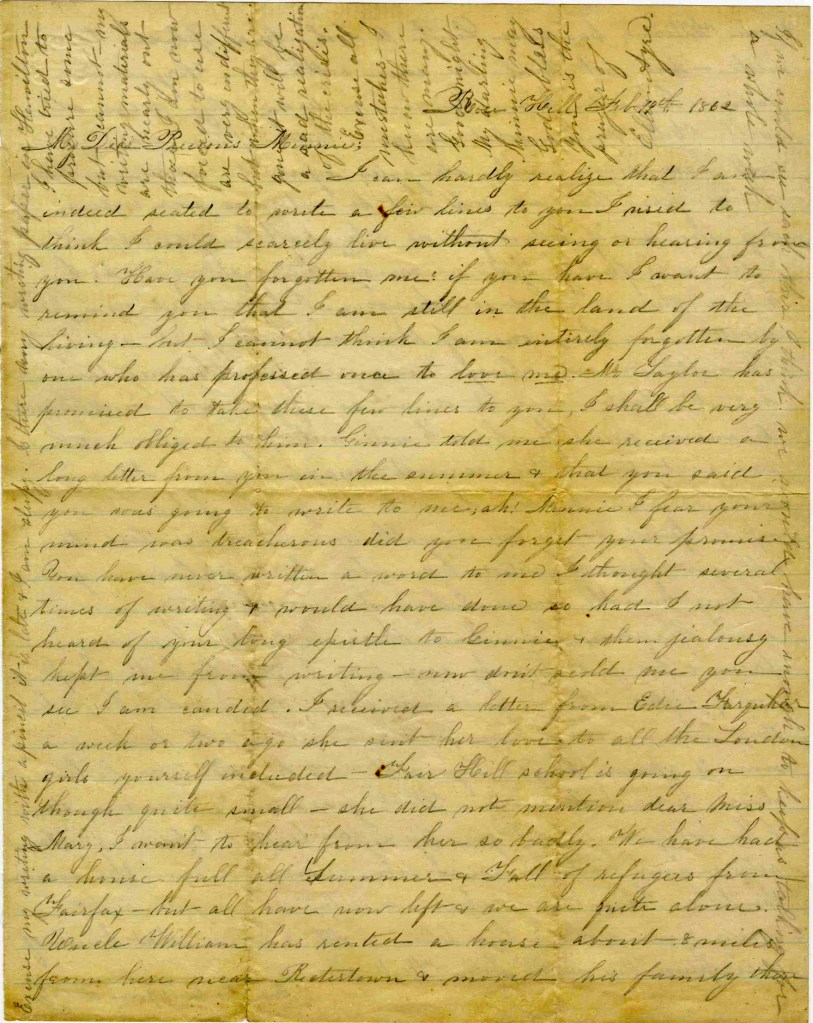
Rose Hill February 19, 1862
My dear precious Minnie,
I can hardly realize that I am indeed seated to write a few lines to you. I used to think I could scarcely live without seeing or hearing from you. Have you forgotten me> If you have, I want to remind you that I am still in the land of the living—but I cannot think I am entirely forgotten by one who has professed once to love me. Mr. Taylor has promised to take these few lines to you. I shall be very much obliged to him. Ginnie told me she received a long letter from you in the summer & that you said you was going to write to me. Oh! Minnie, I fear your mind was treacherous. Did you forget your promise. You have never written a word to me. I thought several times of writing & would have done so had I not heard of your long epistle to Ginnie & then jealousy kept me from writing. Now don’t scold me—you see I am candid.
I received a letter from Edie Farquhar a week or two ago. She sent her love to all the Loudon girls—yourself included. Fair Hill School is going on though quite small. She did not mention dear Miss Mary. I want to hear from her so badly.
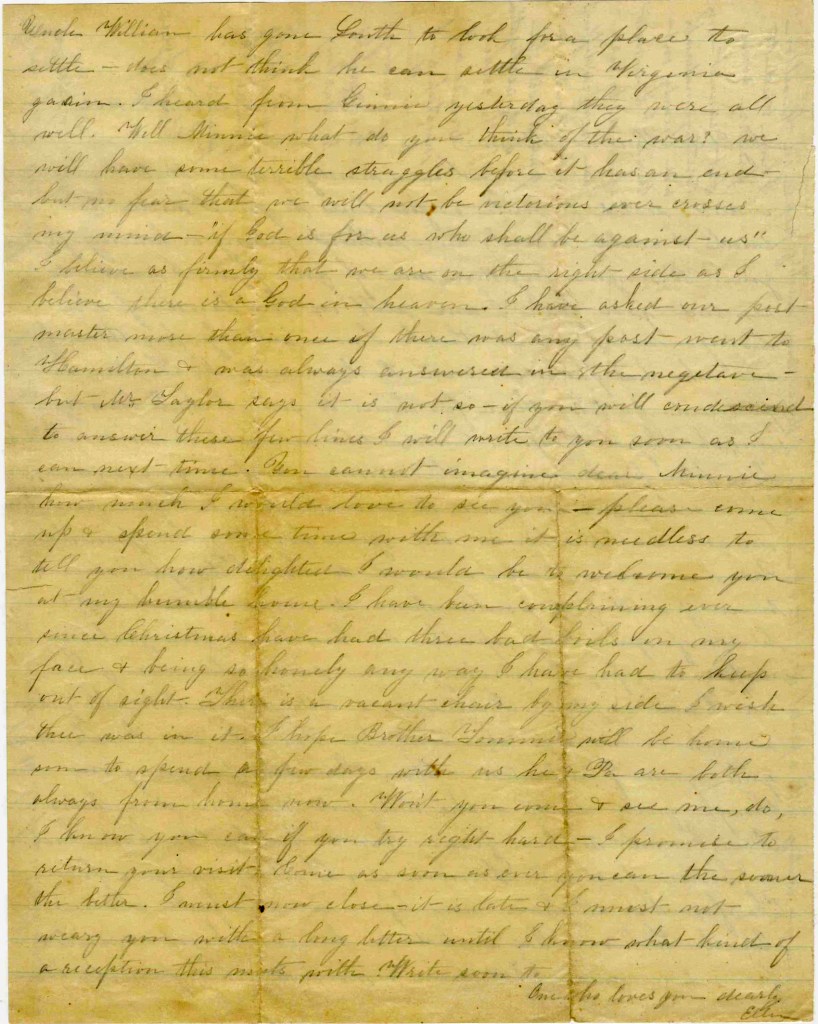
We have had a house full all summer and fall of refugees from Fairfax, but all have now left & we are quite alone. Uncle William has rented a house about 8 miles from here near Rectortown & moved his family there. uncle William has gone South to look for a place to settle. Does not think he can settle in Virginia again. I heard from Ginnie yesterday. They were all well.
Well, Minnie, what do you think of the war? We will have some terrible struggles before it has an end but no fear that we will not be victorious ever crosses my mind. “If God is for us, who shall be against us.” I believe as firmly that we are on the right side as I believe there is a God in heaven. I have asked our post master more than once if there was not a post went to Hamilton & was always answered in the negative. But Mr. Taylor says it is not so, If you will condescend to answer these few lines, I will write to you soon as I can next time. You cannot imagine, dear Minnie, how much I would love to see you. Please come up and spend some time with me. It is needless to tell you how delighted I would be to welcome you at my humble home. I have been complaining ever since Christmas. Have had three bad boils on my face and being so homely anyway, I have had to keep out of sight. There is a vacant chair by my side. I wish thee was in it. I hope Brother Tommie 1 will be home soon to spend a few days with us. He and Pa are both always from home now. Won’t you come and see me. Do. I know you can if you try right hard. I promise to return your visit. Come as soon as ever you can—the sooner the better. I must now close. It is late and I must not weary you with a long letter until I know what kind of a reception this meets with. write soon to one who loves you dearly, — Ellen
Excuse my handwriting with a pencil. It is late and I am sleepy. Is there any writing paper in Hamilton? I have tried to procure some but cannot. My writing materials are nearly out. Those I am now forced to use are very indifferent but when they are gone, it will be a sad realization of the crisis. Excuse all mistakes. I know there are many. Good night my darling Minnie. May God bless you is the prayer of — Ellen Ayre
If we could see each other, I think we would have enough to keep us talking for a whole week.
1 “Tommie” was Ellen’s brother, Lt William Thomas Ayre, Co F, 8th Virginia Infantry. Tom was mortally wounded on July 3, 1863, POW at Cashtown and then died at US hospital in Chester, PA on July 25.
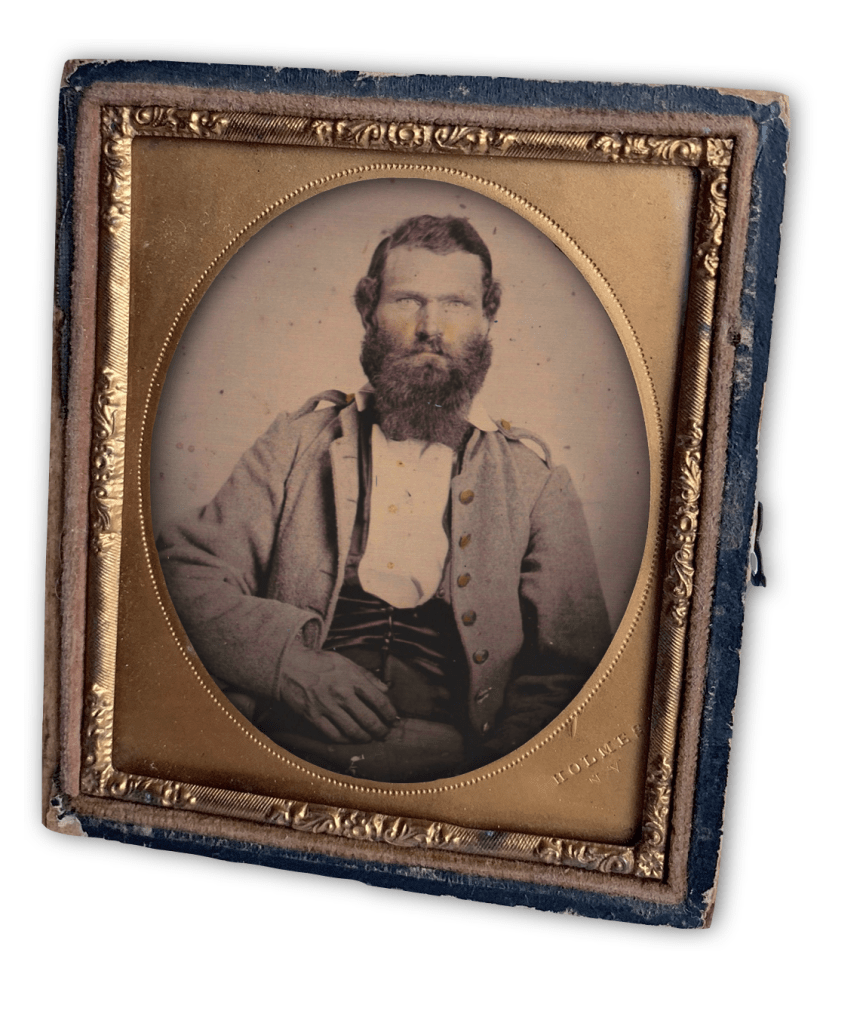
I could not find an image of J. L. Elliott but here is one of Willis Calloway Watkins of Co. D, 4th South Carolina (Photo Sleuth)
These five letters were written by John Lewis Elliott (1831-1863), the son of Lewis M. Elliott (1802-1881) and Winniford Weston Edgar (1805-1898). John was married to Ann Neal Caminade in 1853 and had five children by the time he enlisted to serve in Co. B, 1st South Carolina Palmetto Sharpshooters. He was wounded at the Battle of Wauhatchie on 29 October 1863, a relatively small affair which turned out to be the last best chance for the Confederates to prevent the Yankees from reinforcing Chattanooga. Elliott died of his wounds on 28 November 1863 at Oliver Hospital in LaGrange, Georgia. His remains now lie buried in the “Stonewall Confederate Cemetery” in LaGrange. In the 1860 US Census, John was enumerated in Shallowford, Anderson county, South Carolina.
Serving with him in the same battalion was his younger brother, Edward “Hardy” Elliott (1837-1864), mentioned throughout the letters. Hardy was killed at Spotsylvania, Virginia, on 11 May 1864.
Letter 1
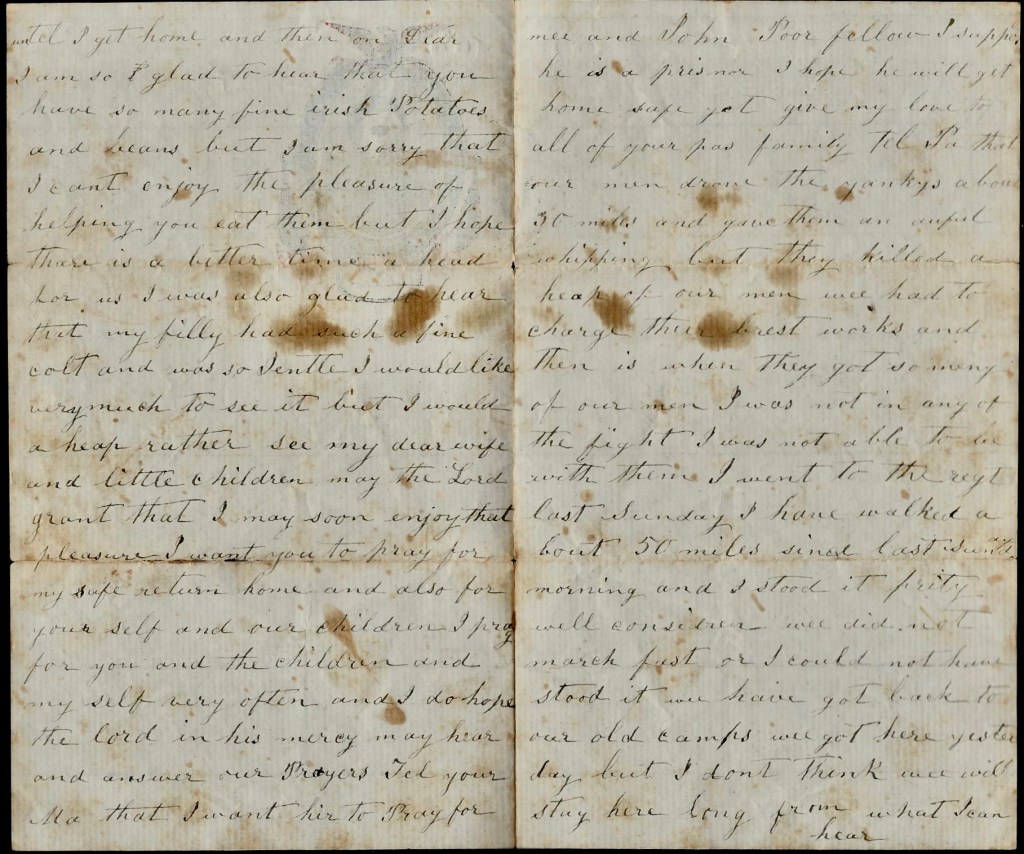
Camp near Richmond July 11th 1862
Dear Wife,
I seat myself this morning to drop you a few lines to let you know that I have got well and I hope that this may come to hand in due time and find you and the children all well. I got your letter yesterday that you wrote the 3rd and I was glad to hear that you was all well but Tete. I was sorry to hear that she had the bowel complaint but I hope you are all well now.
I got a letter from Papa that was wrote the 4th and he said that Jane had got poisoned or something. I hope she is well and I hope and pray that you may all keep well until I get home, and then on.
Dear, I am so glad to hear that you have so many fine Irish potatoes and beans, but I am sorry that I can’t enjoy the pleasure of helping you eat them. But I hope there is a better time ahead for us. I was also glad to hear that my filly had such a fine colt and was so gentle. I would like very much to see it but I would a heap rather see my dear wife and little children. May the Lord grant that I may soon enjoy that pleasure. I want you to pray for my safe return and also for yourself and our children and myself very often and I do hope the Lord in His mercy may hear and answer our prayers.
Tell your Ma that I want her to pray for me and John. Poor fellow—I suppose he is a prisoner. I hope he will get home safe yet. Give my love to all of your Pa’s family. Tell Pa that our men drove the Yankees about 30 miles and gave them an awful whipping but they killed a heap of our men. We had to charge their breastworks and then is when they got so many of our men. I was not in any of the fight. I was not able to be with them. I went to the regiment last Sunday. I have walked about 50 miles since last Sunday morning and I stood it pretty well considering we did not march fast or I could not have stood it. We have got back to our old camps. We got here yesterday but I don’t think we will stay here long from what I can hear.
Dear wife, I forgot to say that I was so glad to hear that our corn and watermelons look so well.
My dear, I do hope England and France will recognize us and stop the war shortly and let us poor fellows come home shortly to our families.
Dear wife, I will now close for this time with my best love and prayers for you and my little children. So farewell for this time. — J. L. Elliott to his wife, A. N. E.
P.S. Hardy is not well but I hope he will soon get well. He sends his best respects to you and the children. Derrick is not very well. He sends his love to you all.
Letter 2
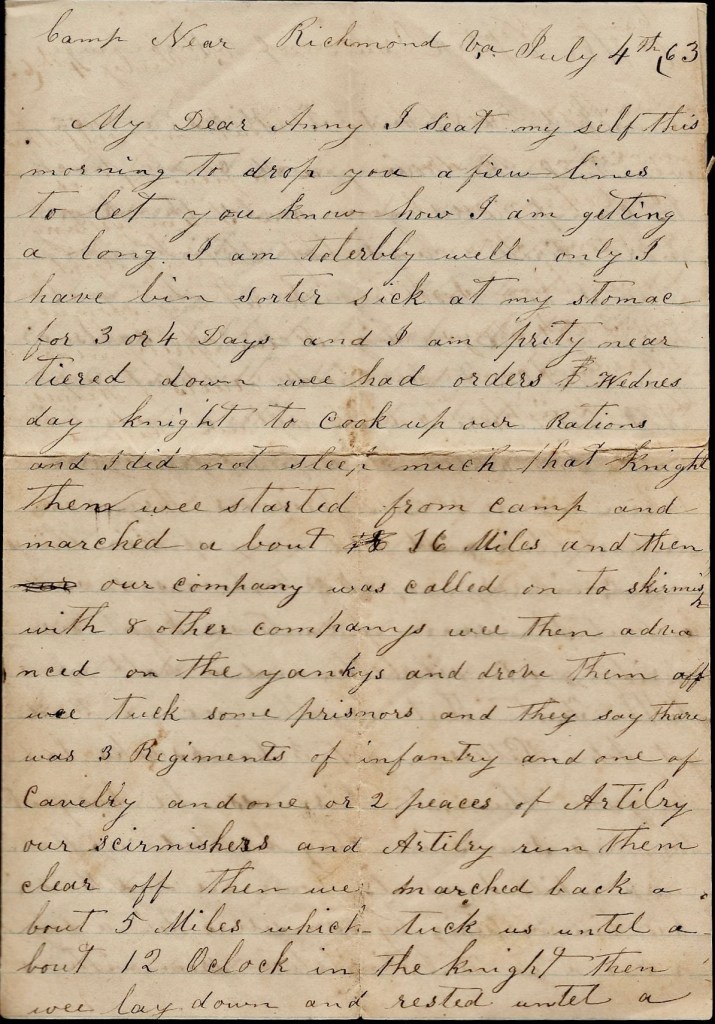
Camp near Richmond, Va. July 4th 1863
My Dear Anny,
I seat myself this morning to drop you a few lines to let you know how I am getting along. I am tolerably well—only I have been sorter sick at my stomach for 3 or 4 days and I am pretty near tired down. We had orders Wednesday night to cook up our rations and I did not sleep much that night. Then we started from camp and marched about 16 miles and then our company was called on to skirmish with 8 other companies. We then advanced on the Yankees and drove them off. We took some prisoners and they say there was three regiments of infantry and one of cavalry and one or two of artillery. Our skirmishers and artillery run them clear off. Then we marched back about 5 miles which took us until about 12 o’clock in the night. Then we lay down and rested until a little after sun up. Then we marched about 5 miles and then we took the train and come back to camp and you would think we were tired and not think far wrong.
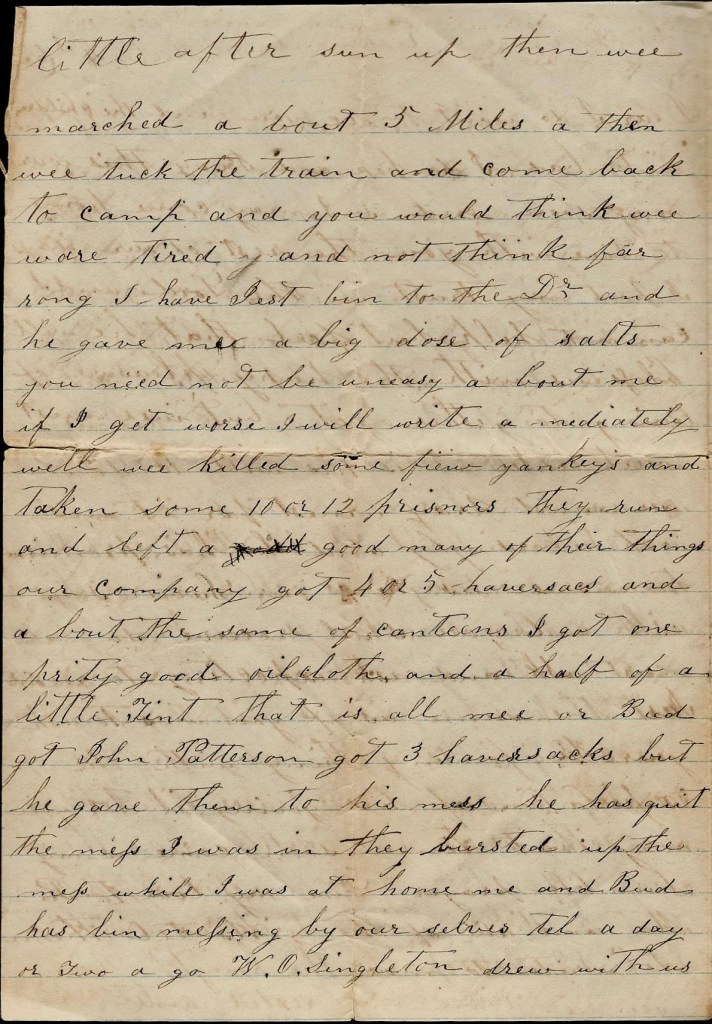
I have just been to the doctor and he gave me a big dose of salts. You need not be uneasy about me. If I get worse, I will write immediately.
Well we killed some few Yankees and taken some 10 or 12 prisoners. They run and left a good many of their things. Our cavalry got 4 or 5 haversacks and about the same of canteens. I got one pretty good oil cloth and a half of a little tent. That is all me or Bud got. John Patterson got three haversacks but he gave them to his mess. He has quit the mess I was in. They bursted up the mess while I was at home. Me and Bud has been messing by ourselves till a day or two ago. W. O. Singleton drew with us.
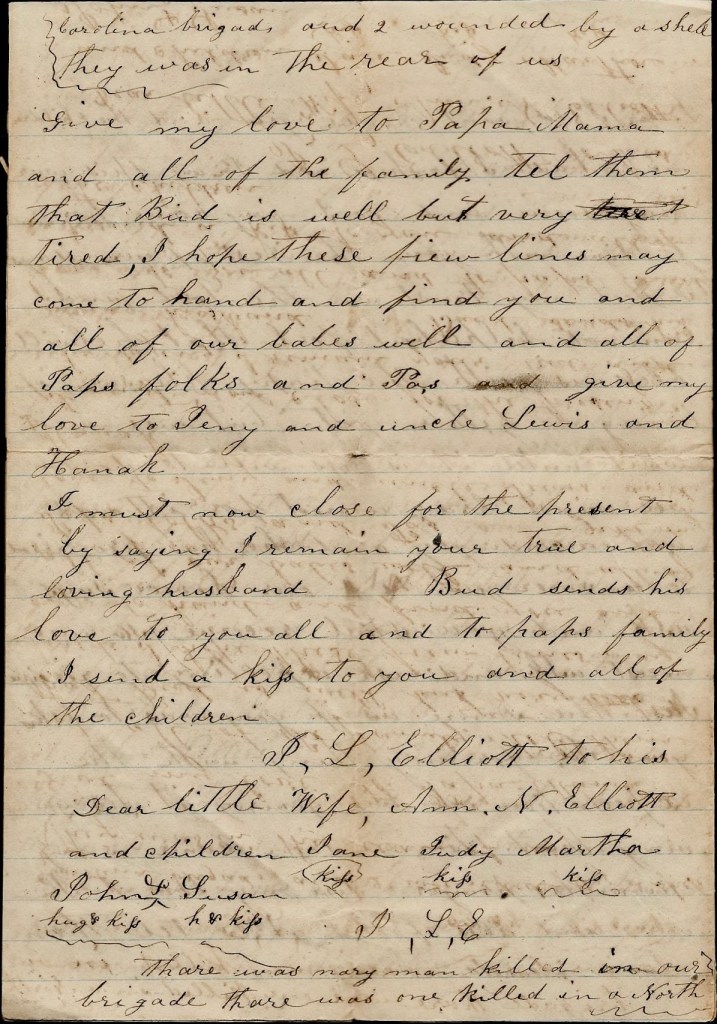
Dear, I do want to see you and the children mighty bad. I do hope and pray this war may soon end so I may come home to live with you the rest of our days. I put my trust in the Lord and I cannot help but feel that He will bless us with the happy pleasure of living together yet. But we must wait until it is His will to do so. We must pray earnest for it and act accordingly and He has promised to answer us. Our Savior says ask, and ask expecting to receive just the same as if you was to ask your Pa for anything with the expectation of his giving it to you. May that time soon come is my humble prayer. Give my love to Pa, Ma, and all of the girls. Tell them to write to me. Give my love to Papa, Mama, and all of the family. Tell them that Bud is well but very tired. I hope these few lines may come to hand and find you and all of our babes well and all of Pap’s folks and Pa’s. Give my love to Jenny and Uncle Lewis and Hannah.
I must now close for the present saying I remain your true and loving husband. Bud sends his love to you all and to Pap’s family. I send a kiss to you and all of the children.
— J. J. Elliott to his dear little wife, Ann N. Elliott and children, Jane, Judy, Martha, John & Susan.
There was nary man killed in our brigade. There was one killed in a North Carolina Brigade and two wounded by a shell. They was in the rear of us.
Letter 3
Camp near Lookout Mountain October 2d 1863
My Dear,
It is with pleasure I seat myself to drop you a few lines to let you know how I am getting along. I am well at this time and I hope these few lines may reach and find you and all the children enjoying the same good blessing. I have nothing new to write to you at this time—only I received a letter from you a few days ago and was very glad to hear you was all well and I was glad also to hear everything was getting along as well as it was. You said something about putting your hogs up early to fatten and you wanted to know what I thought about it. I think it the best to put them up as soon as you possibly can so as to kill about two weeks before Christmas, I am glad to hear Jenny and Hannah has got fodder enough pulled to do them. Tell them I want them to pick just as many peas as they possibly can. Tell them I have not forgot them. Give my love especially to Jenny and tell Lewis there is something else I must tell you. About a few days ago, we got out of bread and had to do without from one morning until the next day dinner and I got so hungry against it come to us I eat such a batch of the coarsest cornbread you ever saw and bacon that it made me right sick for awhile. But I have got over that. We eat our coarse cornbread, husk and all.
They say furloughing is stopped so I am afraid I will not get home soon unless Bud gets me a recruit. Give Bud my best respects. You said you wanted to know whether you ought to go to Papa’s or not without they asked you. My advise is not to go. If they are so mad, they will not ask you. I would not go where I was not wanted.
Our company went out on picket night before last and it rained on us all the time we was out. We was relieved yesterday evening and got a house to stay in for the night and it rained nearly all night. But his is a very pretty day. It has been very dry out here and dusty. I received a letter from Ma a day or two ago which gave me great pleasure. She says for me to write back forthwith but you must tell here to excuse me for I have no paper with me. I got this from E. H. I have not saw my knapsack since we left the railroad. E. H. sends his love to you and children. Give mine and Hardy’s love to Papa, Mama, and all of the family. Tell them Hardy is well. I will now close by giving my best love to you and the children. Give my love to all Pa’s family. — J. L. Elliott
Letter 4
Chattanooga, Tennessee October 20, 1863
My Dear,
I seat myself this morning to drop you a few lines in answer to one I received yesterday from you dated the 11th which gave me great pleasure to hear from you and hear you was all well. I hope you may all remain so. This leaves me well. all to the bellyache. I have got over my head and backache but I have got the bellyache. I reckon it is from eating too much fresh meat. The boys brought a fine chance with them the other day off of the mountain.
I have no news of interest to write to you as everything is quiet here. There is no advance being made on either side. I showed your letter to the captain and he says there is no chance for me to get a furlough. He is perfectly willing to give me a furlough but it is not in his power to do so. The captain says for me to tell you he would do anything in his power for us but it is impossible for him to do anything now. But he says there may be a chance this winter but he says if you could get anyone to come as a recruit for me, I could then get a furlough for forty days. He asked me if I knew anyone that I thought I could get. I told him about Robert Scruggs, if his mother would let him come, but I told him what you said about his Mother. I told him she would not let him come for the war to save all our lives. The captain asked me his age and I told him he was about sixteen and he says if she knew what was best, she would let him come for he says they will take him anyhow before long and and then they would send him just anywhere they pleased so she had better let him come here where he has some friends. So I will ensure her that if she will let him come here as a recruit for me, I will be a friend to him as long as we both live. So you can see Mrs, Scruggs and state the case to her and see what she says and let me know in your next letter. Tell Mrs. Scruggs that I do not wish her son to be obliged to go to the army but it is just as the captain says, he will be certain to have to go before long and it would be better for him to be where all South Carolinians are. Our whole brigade are South Carolinians. But just let her do as she pleases, but when she lets him be taken and they carry him to the coasts and takes sick and dies with disease, then she will wish she had let him come here in a healthy country. And if we leave here, we will be apt to go to Virginia where it’s healthy. We will be apt to be in a mountain country all of the time.
You said you wanted to know if I wanted the woolen shirts made. I don’t care anything much about them so you can make the cloth up for the children. I need some cotton shirts but you need not make any. I aim for the government to find me in clothes as you have so much hard work in getting your cloth wove. I like the color of your dresses very much. I want you to send me my overcoat by Bud when he comes and one pair of socks. Pa sent me two plugs of tobacco. Tell him I am glad he has not forgot me if he don’t write to me, and tell him I do thank him for them and tell him to write to me for I want to hear from him and tell him I want to know if he thinks this war will end any time soon. The most of the people out here think it will end this winter but I don’t know what is their reasons for thinking so without it is foreign intervention. I do hope and pray that it may end soon and that I may get home.
Tell Susan that John is well. He send his love to you all. Give my love to Papa’s family and also to Pa’s. I reckon you and Hardy and Papa has got the letters I sent you by A. J. Litton and I am in hopes Bud will be here soon to take my place for wahile. We will be apt to be through this fight before he gets here. I would like for him to be here now if I knew he would not get hurt. But if he was here, he should not take my place till this fight is over. I send a special kiss to you and also one to the children, — J. L. Elliott
to A. N. Elliott
Letter 5
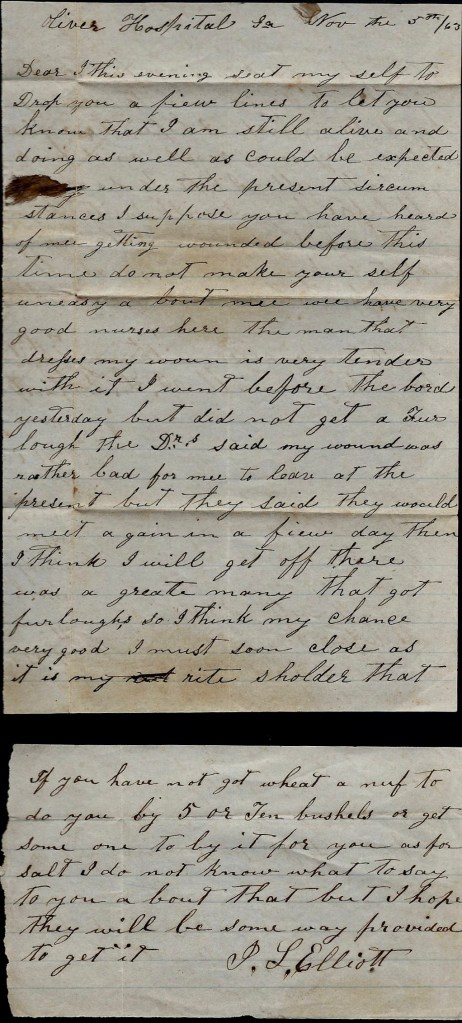
Oliver Hospital, Ga. November 5th 1863
Dear,
I this evening seat myself to drop you a few lines to let you know that I am still alive and doing as well as could be expected under the present circumstances. I suppose you have heard of me getting wounded before this time. Do not make yourself uneasy about me. We have very good nurses here. The man that dresses my wound is very tender with it. I went before the board yesterday but did not get a furlough. The doctors said my wound was rather bad for me to leave at the present but they saud they would meet again in a few days, then I think I will get off. There was a great many that got furloughs so I think my chance very good.
I must soon close as it is my right shoulder that is hurt and I am afraid it will not do for me to use my hand too much. I hope these few lines may soon reach and find you all well. I hope to see you all before long. I will write to you in three or four days again. I do not expect to hear from you at all unless E[dward] H[ardy Elliott] remails your letters.
I will now close with my best love to you all. — J. L. Elliott
If you have not got wheat enough to do you, buy 5 or ten bushels or get someone to but it for you. As for salt, I do not know what to say to you about that but I hope they will be some way provided to get it. — J. L. Elliott
This letter was written by Thomas D. Ayres (1838-1887), the son of Philadelphia paper manufacturer, George Washington Ayres (1811-1880) and Eliza Jane Williams (1818-1913). Thomas was married to Rebecca D. Hollis (1842-1916) on 19 September 1861 just after he had enlisted in Co. F, 95th Pennsylvania Infantry (“Gosline’s Zouaves”) in Philadelphia. Thomas survived the war, returned to Philadelphia where he and Rebecca had numerous children, and lived out his days as a confectioner. He died at the age of 49.
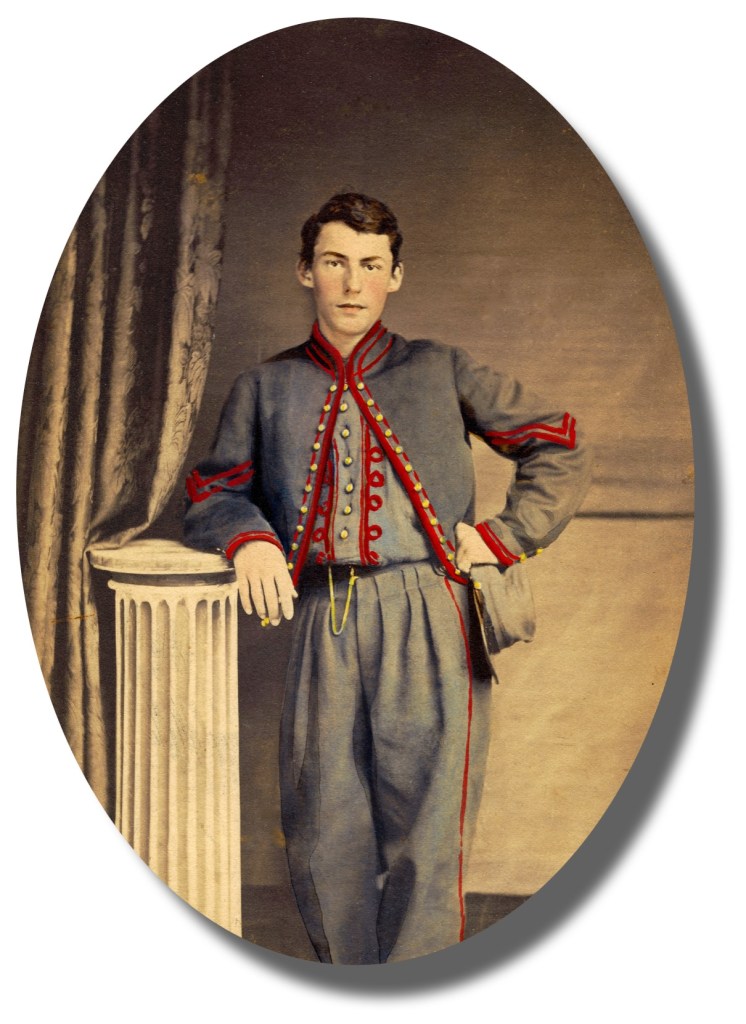
I could not find an image of Thomas but here is an unidentified corporal in Co. A of the Gosline’s Zouaves (W. Griffing Collection)
“Organized in Philadelphia during August 1861 under the enthusiastic guidance of John M. Gosline, the regiment was composed of men from the city and surrounding counties including one company of men from New Jersey that became Company B. First known as the “Pennsylvania Zouaves” and designated the Forty-fifth Pennsylvania Volunteer Infantry, the organization was re-designated in September as the Ninety-fifth Pennsylvania Volunteer Infantry with a new monicker, “Gosline’s Zouaves”. Gosline envisioned a well-trained, disciplined and distinctive regiment that would stand apart from other volunteer units. Using his own financial influence with friends in Philadelphia, Gosline secured a contract with Schuylkill Arsenal outside of Philadelphia to provide his new regiment with a zouave-style uniform of his design. The regiment’s first engagement with Confederate forces was at West Point (or “Brick House Point”), Virginia, on May 7, 1862. The regiment was initially deployed as skirmishers in the action and drove a Confederate cavalry force back into the main southern line where gray-clad infantry waited in an apparent ambush. Gosline skillfully pulled his zouaves back and ordered his men to occupy a barricade previously thrown up by other units, all the while keeping up a brisk fire on the Confederate infantry. The Confederates withdrew before nightfall leaving the ground in possession of Union forces. In their first action, the Ninety-fifth “behaved very well, bringing on the action with the enemy and keeping him well occupied”, according to General John Newton who commanded the brigade. (OR, Vol. 11, Pt. 1, p. 624) One officer and six enlisted men were wounded in the action, and eight enlisted men were killed.” [See A History of the Regiment, 1861-1862]
To read other letters and diaries by members of the Gosline’s Zouaves that I have transcribed and posted on Spared & Shared, see:
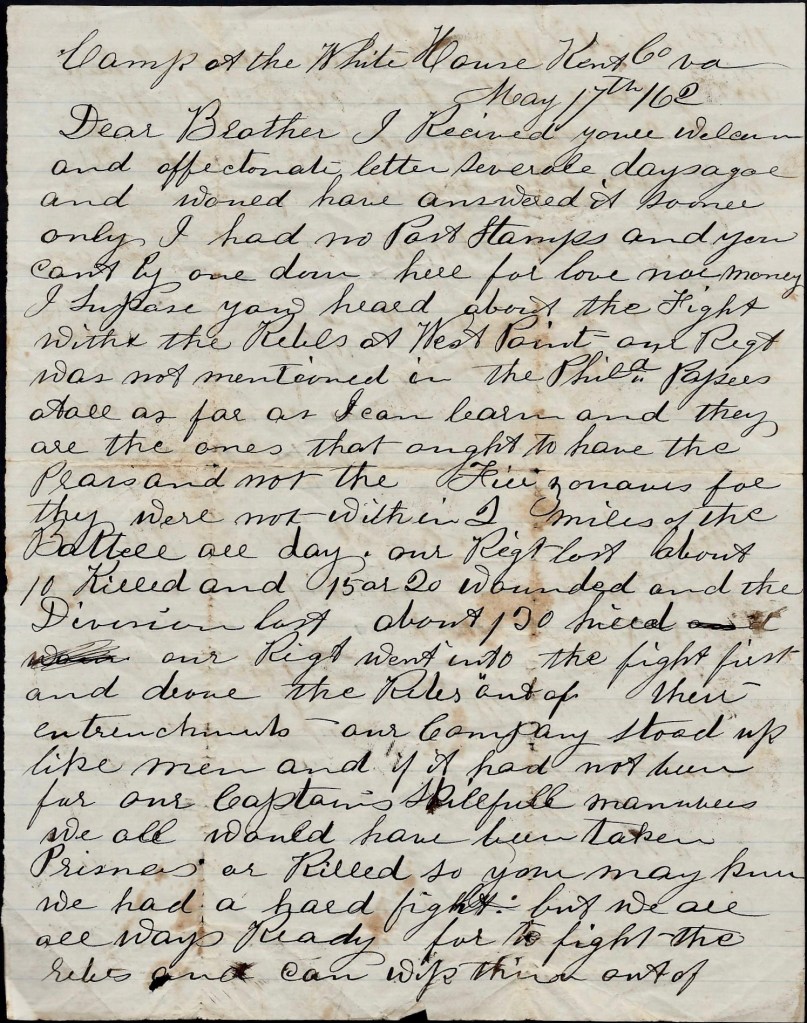
Camp at the White House [Landing] Kent County, Virginia May 17th 1862
Dear Brother,
I received your welcome and affectionate letter several days ago and would have answered it sooner only I had no postage stamps and you can’t buy one down here for love nor money.
I suppose you heard about the fight with the rebels at West Point. Our regiment was not mentioned in the Philadelphia paper at all as far as I can learn and they are the ones that ought to have the praise and not the Fire Zouaves for they were not within two miles of the battle all day. Our regiment lost about 10 killed and 15 or 20 wounded and the Division lost about 130 killed.
Our regiment went into the fight first and drove the Rebels out of their entrenchments. Our company stood up like men and if it had not been for our captain’s skillful maneuvers, we all would have been taken prisoners or killed so you may know we had a hard fight. But we are always ready for to fight the Rebels and can whip them out of their boots.
Tell Rebecca that I have not any letter from her for the last 3 weeks and have wrote to her every week regular. Goodbye. My love to you all. I will write again in a few days to you. I am your brother, — Thomas D. Ayres
Write soon and excuse this short letter for my paper is short and pen is bad. Your brother, — T. D. Ayres
Corp. Frank Miller of Co. E, 95th Pennsylvania, or “Gosline’s Zouaves” An early war image when they still wore their scarlet lined pants. (W. Griffing Collection)
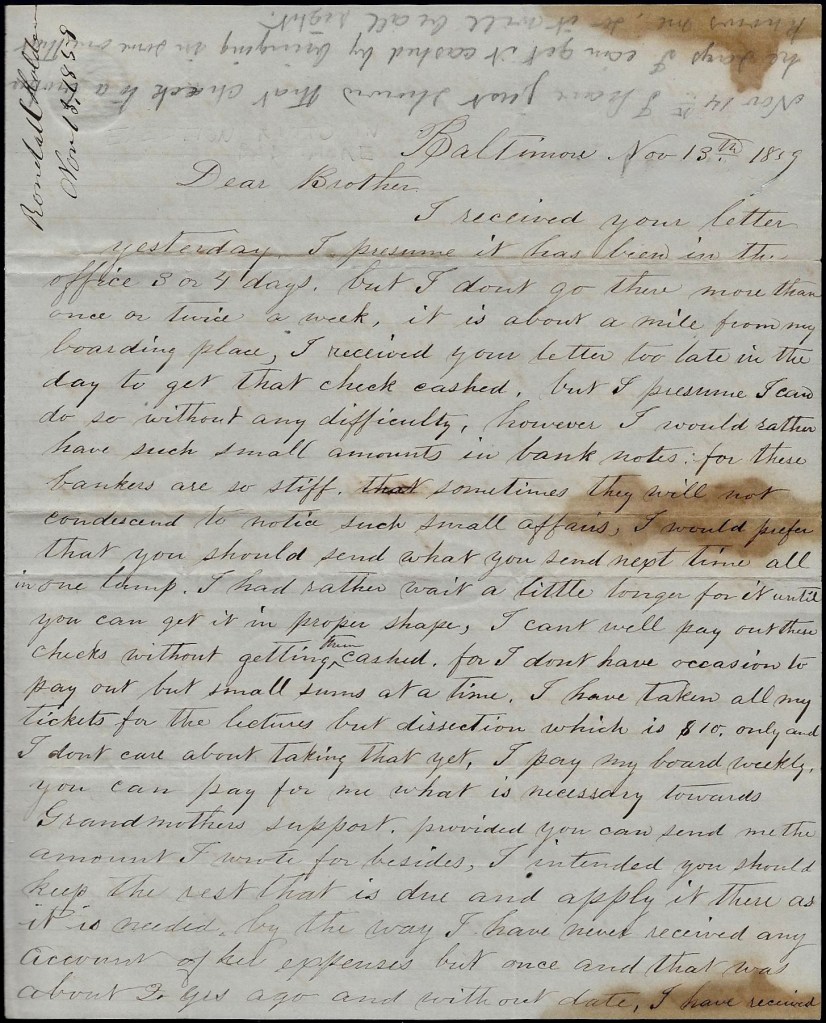
This letter was written by Randall Holden (1829-1906), the son of Joseph & Nancy Clinton (Brown) Holden of South Hartwick, Otsego county, New York. Randall’s father was a farmer and store and tavern keeper in the village of South Hartwick until 1852 when, due to ill health, he relocated to Manassas, Virginia. When Randall wrote this letter in November 1859, he was attending Medical Lectures in Baltimore, Maryland. He graduated from the Baltimore Medical College in 1861 and served as an Assistant Surgeon in the Confederate Army during the Civil War. He died at his home in Petersburg, Virginia, in 1906.
Randall’s brother, Capt. Stephen Holden of Co. H, 152nd New York Infantry.
Randall wrote the letter to his brother, Stephen Holden (1832-1909) who began teaching a district school in 1849-50 but in 1852 entered the Delaware Literary Institute at Franklin, Delaware county, New York. He then attended Yale College, earning his A. B. and then began teaching Latin, Greek, and mathematics in the Delaware Literary Institute where he was working when this letter was written in 1859. He studied law and was admitted to the New York bar before the Civil War began but entered his country’s service, enlisting in Co. H, 152nd New York Volunteers, rising from private to Captain. He was shot in the face at the Battle of the Wilderness but survived and returned to Otsego county.
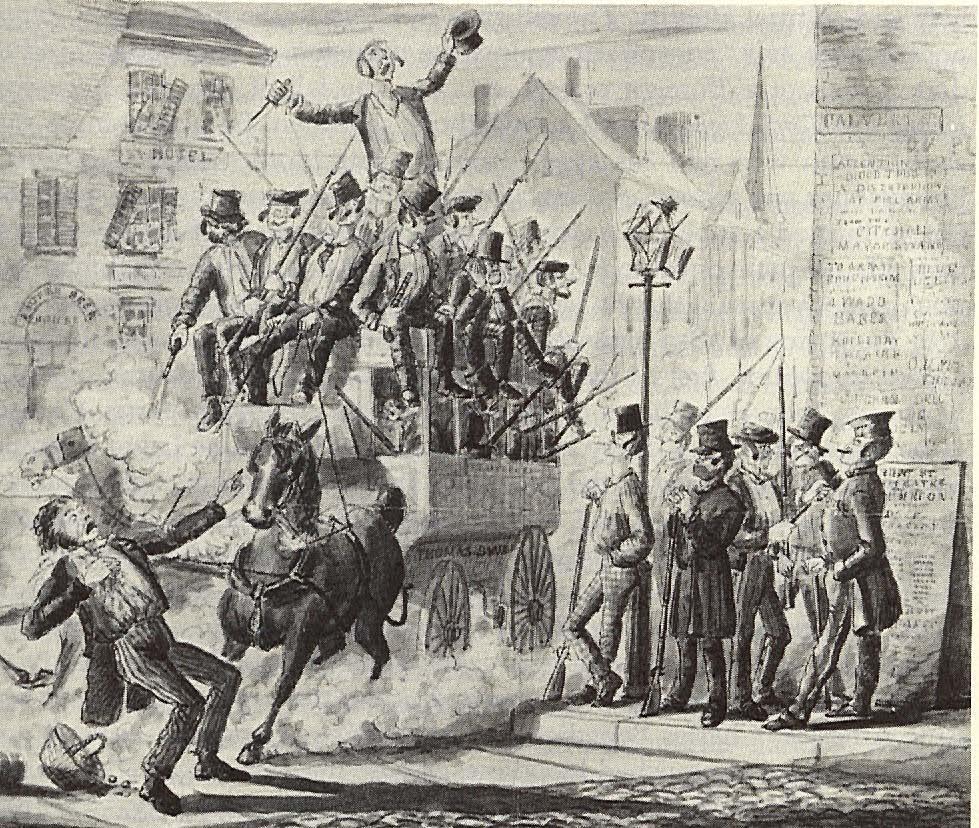
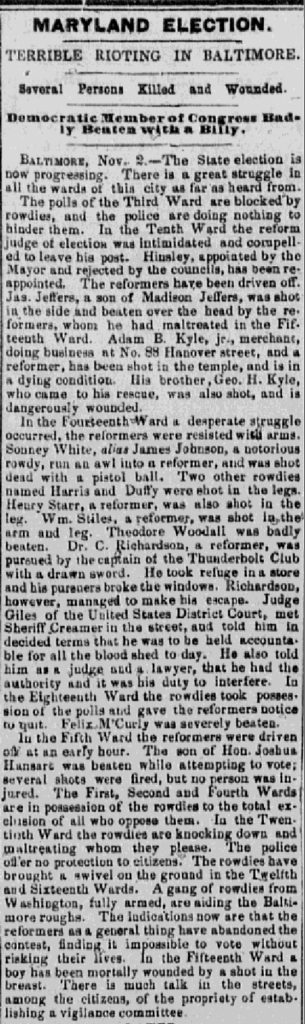
Randall’s letter provides us with a great description of the election day violence that took place on 2 November 1859 in Baltimore, Maryland—dubbed “Mobtown” by most Americans at the time. By the 1850’s, Baltimore’s population had swelled with Irish and German immigrants who were taking the jobs away from or otherwise lowering the wages of the “Nativists.” This resentment was so strong that the “American” or “Know Nothing” Party emerged, following the breakup of the Whig Party. They were opposed by the Loco Foco, or Democratic Party (“Reform Party”) who had a much higher percentage of emigrants and Catholics among their members. Gangs from each party roamed the streets, particularly on election day, pushing away, intimidating, or otherwise roughing up known members of the opposition party to keep them from casting their ballot. The poorly staffed police force were overwhelmed and ineffective in controlling the abuses.
For a great article on the violence of this particular election day, see Jill Lepore’s 2008 article in the New Yorker, “Rock, Paper, Scissors.”
Cartoon of Mobtown’s Plug Uglies
Transcription
Baltimore [Maryland] November 13, 1859
Dear Brother,
I received your letter yesterday. I presume it has been in the office 3 or 4 days but I don’t go there more than once or twice a week. It is about a mile from my boarding place. I received your letter too late in the day to get that check cashed, but I presume I can do so without any difficulty. However, I would rather have such small amounts in bank notes for these bankers are so still that sometimes they will not condescend to notice such small affairs. I would prefer that you should send what you send next time all in one lump. I had rather wait a little longer for it until you can get it in proper shape. I can’t well pay out these checks without getting them cashed for I don’t have occasion to pay out but small sums at a time. I have taken all my tickets for the lectures but dissection which is $10 only and I don’t care about taking that yet.
I pay my board weekly. You can pay for me what is necessary towards Grandmother’s support, provided you can send me the amount I wrote for besides, I intended you should keep the rest that is due and apply it there as it is needed. By the way, I have never received any account of her expenses but once and that was about 2 years ago and without date.
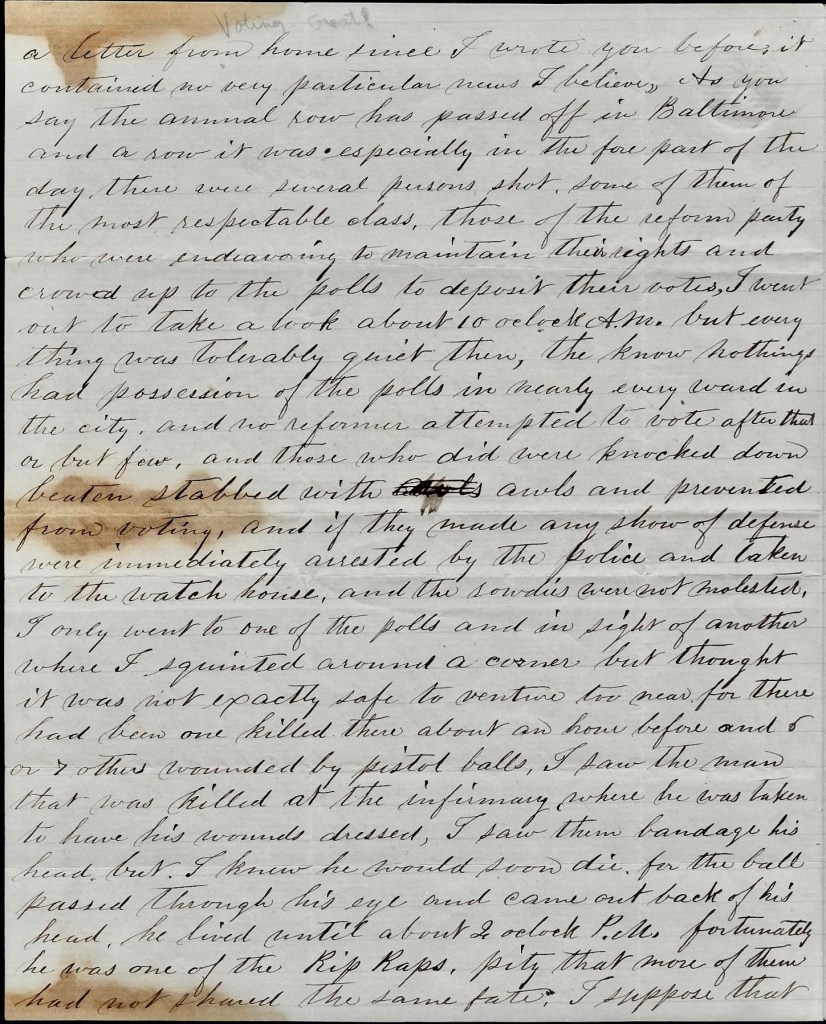
I have received a letter from home since I wrote you before. It contained no particular news I believe. As you say the annual row has passed off in Baltimore and a row it was—especially in the fore part of the day. There were several persons shot, some of them of the most respectable class. Those of the Reform Party who were endeavoring to maintain their rights and crowd up to the polls to deposit their votes. I went out to take a look about 10 o’clock a.m. but everything was tolerably quiet then. The Know Nothings had possession of the polls in nearly every ward in the city, and no reformer attempted to vote after that—or but few. And htose who did were knocked down, beaten, stabbed with awls, and prevented from voting. And if they made any show of defense, were immediately arrested by the police and taken to the watch house and the rowdies were not molested.
The Daily Ohio Statesman, 3 November 1859
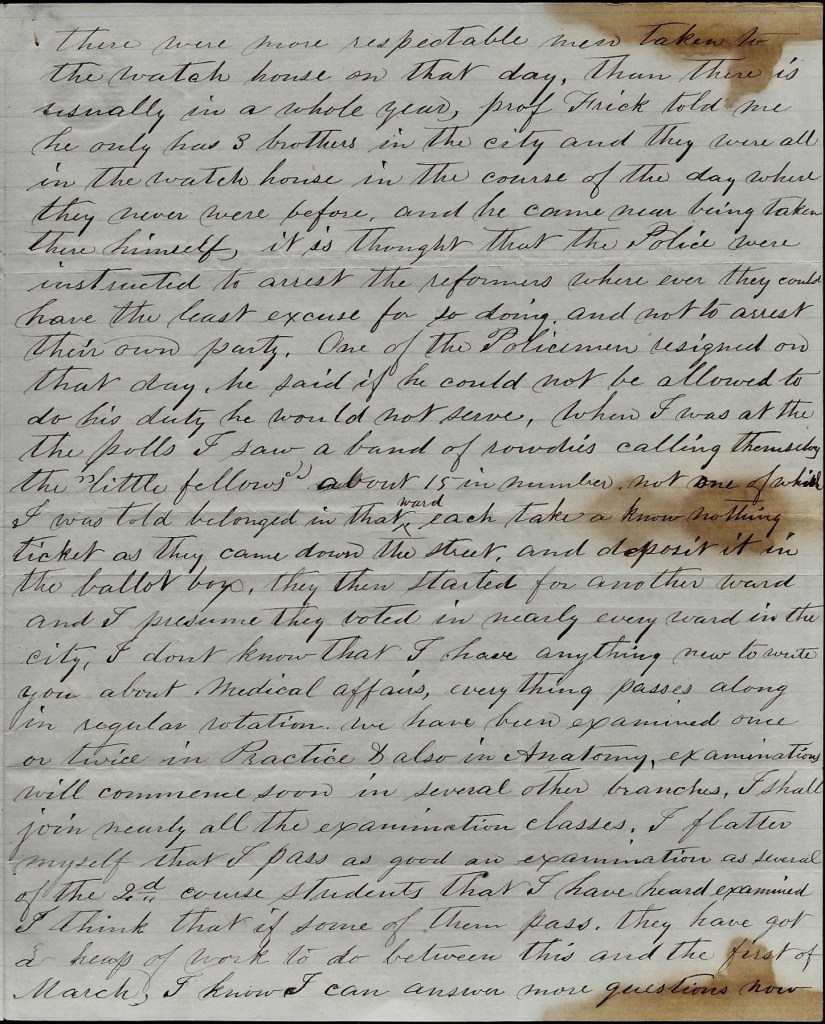
I only went to one of the polls and in sight of another where I squinted around a corner but thought it was not exactly safe to venture too near for there had been one killed there about an hour before and 6 or 7 others wounded by pistol balls. I saw the man that was killed at the infirmary where he was taken to have his wounds dressed. I saw them bandage his head, but I knew he would soon die for the ball passed through his eye and came out back of his head. He lived until about 2 o’clock p.m. Fortunately, he was one of the Rip Raps. Pity that more of them had not shared the same fate. I suppose that there were more respectable men taken to the watch house on that day that there is usually in a whole year. Prof. Frick told me he only has 3 brothers in the city and they were all in the watch house in the course of the day where they never were before, and he came near being taken there himself.
It is thought that the police were instructed to arrest the reformers where ever they could have the least excuse for so doing, and not to arrest their own party. One of the Policemen resigned on that day. He said if he could not be allowed to do his duty, he would not serve. When I was at the polls, I saw a band of rowdies calling themselves the “little fellows,” about 15 in number, not one of which I was told belonged in that ward, each take a Know Nothing ticket as they came down the street and deposit it in the ballot box. They then started for another ward and I presume they voted in nearly every ward in the city.
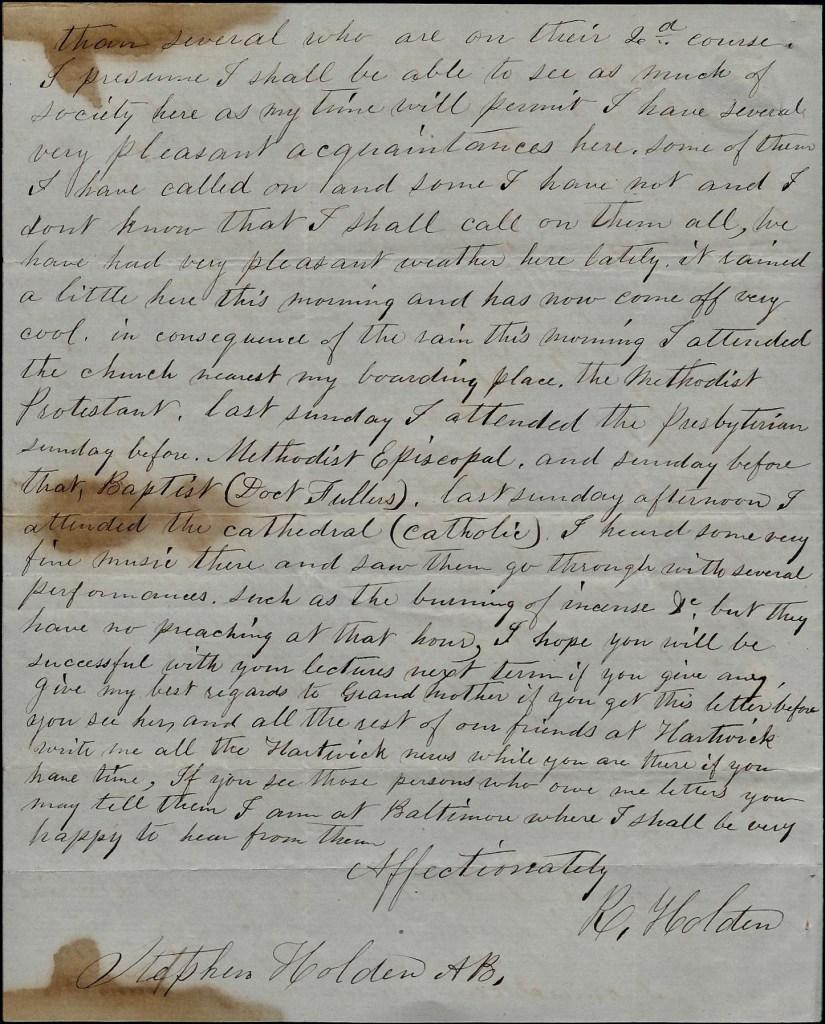
I don’t know that I have anything new to write you about medical affairs. Everything passes along in regular rotation. We have ben examined once or twice in Practice & also in Anatomy. Examinations will commence soon in several other branches. I shall join nearly all the examination classes. I flatter myself that I pass as good an examination as several of the 2nd course students that I have heard examined. I think that if some of them pass, they have got a heap of work to do between this and the first of March. I know I can answer more questions now than several who are on their 2nd course. I presume I shall be able to see as much of society here as my time will permit. I have several very pleasant acquaintances here, some of them I have called on and some I have not and I don’t know that I shall call on them all.
We have had very pleasant weather here lately. It rained a little here this morning and has now come off very cool in consequence of this rain. This morning I attended the church nearest my boarding place—the Methodist Protestant. Last Sunday I attended the Presbyterian. Sunday before the Methodist Episcopal, and Sunday before that, Baptist (Doctor Fuller’s). Last Sunday afternoon I attended the Cathedral (Catholic). I heard some very fine music there and saw them go through with several performances such as the burning of incense &c., but they have no preaching at that hour. I hope you will be successful with your lectures next term if you give any. Give my regards to Grandmother if you get this letter before you see her and all the rest of our friends at Hartwick. Write me all the Hartwick news while you are there if you have time. If you see those persons who owe me letters, you may tell them I am at Baltimore where I shall be very happy to hear from them.
Affectionately, — R. Holden
[to] Stephen Holden, A. B.
November 14th. I have just shown that check to a broker. He says I can get it cashed by bringing in someone that knows me so it will be all right.
The signature on this letter appears to read “Major N. N. Clark” but I have not been able to identify him definitely. There was a Brevet Major N. N. Clark (sometimes written in N. S. Clark in military records) that led the expedition of the U. S. Army’s 2nd Infantry into Maine during the First Aroostook War and who oversaw the construction of the Hancock Barracks on our northern border. This same individual claimed to be residing in Shelburne, Chittenden county, Vermont, in October 1829 when he requested a 1 year furlough from the military to visit southern France for the purpose of regaining his health. I can’t be certain if he is the same Nelson N. Clark who was a 2nd Lt., 4th Infantry in 1829. I feel there must be a connection, however, as he signed the letter “Major” in this letter even though it appears he was not longer in the military but was employed as a lawyer working out of Macon, Georgia—prominent enough in the community to have been asked to give a speech at the Washington’s Birthday Ball in Macon in 1846. He may have been employed as a lawyer for a cotton factor. He clearly had ties to the North though he was no abolitionist.
In his letter, Clark shares with his friend the content of the extemporaneous speech he gave at the Washington Birthday Ball, extolling the many virtues of George Washington, including having “habituated the people to our peculiar institutions” prior to his leaving office. He then speaks of the potential impeding conflicts with England over the Oregon Territory and with Mexico, particularly with the latter whom he says the U. S. will have to “teach a lesson” and take the war deep into their interior and claim as much land as is needed to pay for the expense of the war.
Clark wrote the letter to William Whitford Reynolds (1816-1876) of Petersburgh, Rensselaer county, New York
Transcription
Macon [Georgia] March 2nd 1846
Dear Sir,
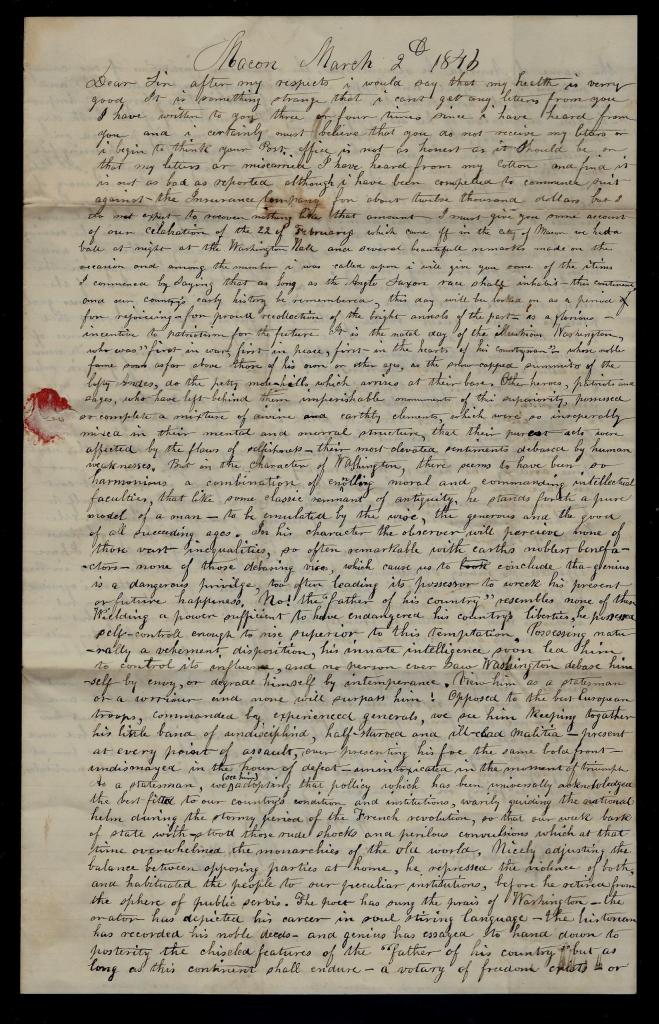
After my respects, I would say that my health is very good. It is something strange that I can’t get any letters from you. I have written to you three or four times since I have heard from you and I certainly must believe that you do not receive my letters or I begin to think your Post Office is not as honest as it should be or that my letters are miscarried. I have heard from my cotton and find it is not as bad as reported although I have been compelled to commence suit against the Insurance Company for about twelve thousand dollars but I do not expect to recover nothing like that amount.
I must give you some account of our celebration of the 22nd of February [Washington’s Birthday] which came off in the City of Macon. We had a ball at night at the Washington Hall 1 and several beautiful remarks made on the occasion and among the number I was called upon. I will give you some of the items.
I commenced by saying that as long as the Anglo-Saxon race shall inhabit the continent and our early country’s history be remembered, this day will be looked on as a period for rejoicing—for proud recollection of the bright annals of the past—as a glorious incentive to patriotism for the future. It is the natal day of the illustrious Washington who was “first in war, first in peace, first in the hearts of his countrymen”—whose noble fame soars as far above those of his own or other ages as the snow-capped summits of the loft Andes to the petty molehills which arises at their base. Other heroes, patriots and sages, who have left behind them imperishable monuments of this superiority, possessed so complete a mixture of divine and earthly elements, which were so inseparably mixed in their mental and moral structure, that their purest acts were affected by the flaws of their selfishness—their most elevated sentiments debased by human weaknesses.
But in the character of Washington there seems to have been so harmonious a combination of ennobling moral and commanding intellectual faculties, that like some classic remnant of antiquity, he stands forth a pure model of a man, to be emulated by the wise, the generous, and the good of all succeeding ages. In his character, the observer will perceive none of those vast inequalities so often remarkable with earth’s noblest benefactors, none of those debasing vices, which cause us to conclude that genius is a dangerous privilege, too often leading its possessor to reek his present or future happiness. No! the “father of his country” resembles none of these. Wielding a power sufficient to have endangered his country’s liberties, he possessed self-control enough to rise superior to the temptation. Possessing naturally a vehement disposition, his innate intelligence soon led him to control its influence and no person ever saw Washington debase himself by envy, or degrade himself by intemperance. View him as a statesman or a warrior and none will surpass him!
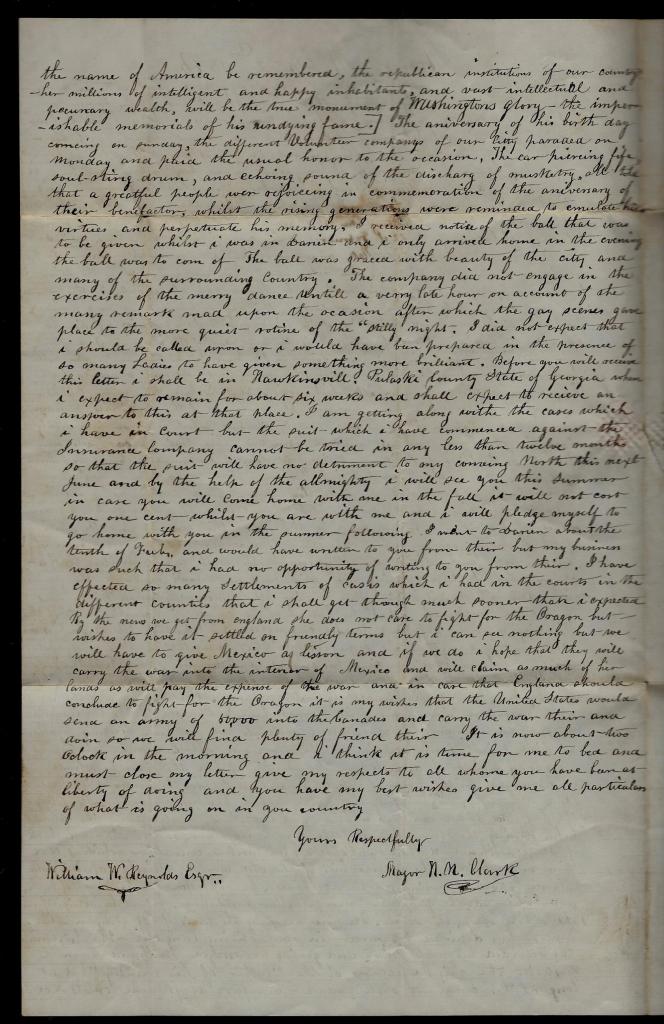
Opposed to the best European troops commanded by experienced generals, we see him keeping together is little band of undisciplined, half-starved and ill-clad militia, present at every point of assault, ever presenting his foe the same bold front, undismayed in the hour of defeat, unintoxicated in the moment of triumph. As a statesman, we see him adopting that policy which has been universally acknowledged the best fitted to our country’s condition and institutions, warily guiding the national helm during the stormy period of the French Revolution, so that our weak bark of state withstood the monarchies of the Old World. Nicely adjusting the balance between opposing parties at home, he repressed the violence of both and habituated the people to our peculiar institutions, 2 before he retired from the sphere of public service. The poet has sung the praises of Washington—the orator has depicted his career in soul stirring language—the historian has recorded his noble deed—and genius has essayed to hand down to posterity the chiseled features of the “father of his country,” but as long as this continent shall endure, a votary of freedom exists, or the name of America be remembered, the republican institutions of our country, her millions of intelligent and happy inhabitants, and vast intellectual and pecuniary wealth, will be the true monument of Washington’s glory—the imperishable memorials of his undying fame.
The anniversary of his birthday coming on Sunday, the different volunteer companies of our city paraded on Monday and paid the usual honor to the occasion. The ear piercing-fife, soul-stirring drum, and echoing sound of the discharge of musketry. all told that a grateful people were rejoicing in commemoration of the anniversary of their benefactor, whilst the rising generations were reminded to emulate his virtues and perpetuate his memory.
I received the notice of the ball that was to be given whilst I was in Darien and I only arrived home in the evening the ball was to come off. The ball was graced with beauty of the city and many of the surrounding country. The company did not engage in the exercises of the merry dance until a very late hour on account of the many remarks made upon the occasion, after which the gay scenes gave place to the more quiet routine of the “stilly night.” I did not expect that I should be called upon or I would have been prepared in the presence of so many Ladies to have given something more brilliant.
Before you shall receive this letter, I shall be in Hawkinsville, Pulaski county, State of Georgia, where I expect to remain for about six weeks and shall expect to receive an answer to this at that place. I am getting along with the cases which I have in court but the suit which I have commenced agains the insurance company cannot be tried in any less than twelve months so that the suit will have no detriment to my coming North this next June and by the help of the Almighty, I will see you this summer. In case you will come home with me in the fall, it will not cost you one cent whilst you are with me and I will pledge myself to go home with you in the summer following. I went to Darien about the tenth of February and would have written to you from there but my business was such that I had no opportunity of writing to you from there. I have effected so many settlements of cases which I had in the courts in the different counties that I shall get through much sooner than I expected.
By the news we get from England, she does not care to fight for the Oregon [territory] but wishes to have it settled on friendly terms, but I can see nothing but we will have to give Mexico a lesson and if we do, I hope that they will carry the war into the interior of Mexico and will claim as much of her lands as will pay the expense of the war. And in case that England should conclude to fight for the Oregon [territory], it is my wish that the United States would send an army of 50,000 into the Canades and carry the war there and doing so, we will find plenty of friends there.
It is now about two o’clock in the morning and I think it is time for me to bed and must close my letter. Give my respects to all whom you have been at liberty of doing and you have my best wishes. Give me all particulars of what is going on in your country.
Yours respectfully, — Major N. N. Clark
[to] William W. Reynolds, Esqr.
1 Washington Hall was completed in February 1827 and was located on the south corner of Mulberry and Second Streets. It was destroyed by a fire in September 1855 with several other structures on Mulberry Street.
2 “Peculiar institution” was a euphemistic term that white southerners used for slavery. John C. Calhoun defended the “peculiar labor” of the South in 1828 and the “peculiar domestick institution: in 1830. Ther term came into general use in the 1830s when the abolitionist William Lloyd Garrison began to attack slavery. [Enclopedia.com]
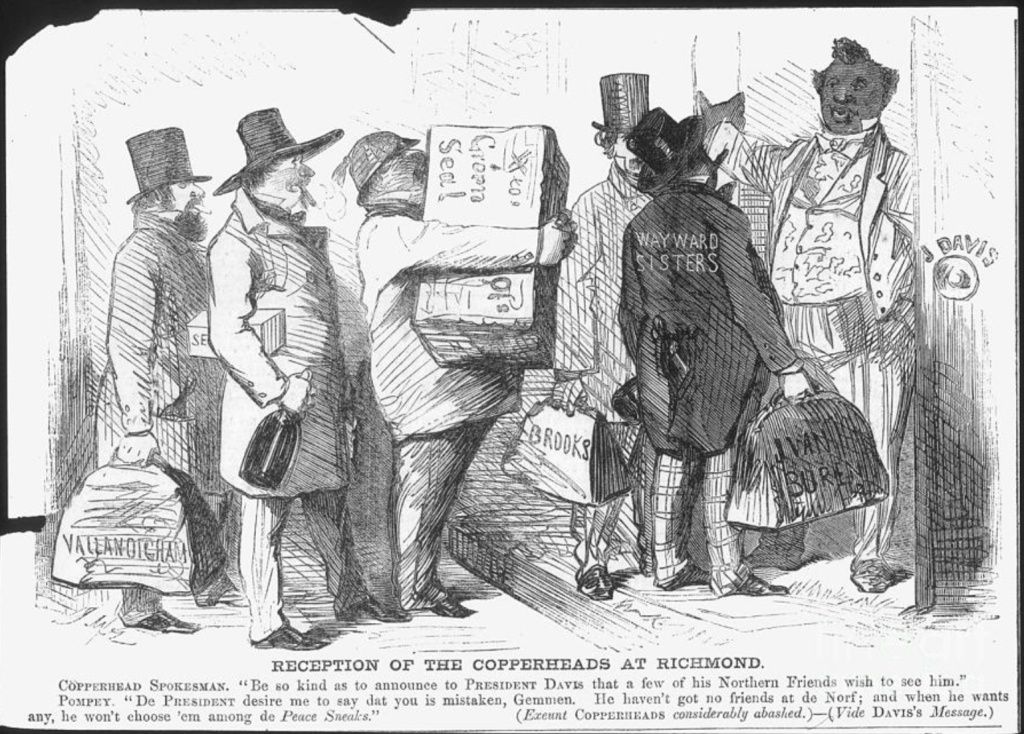
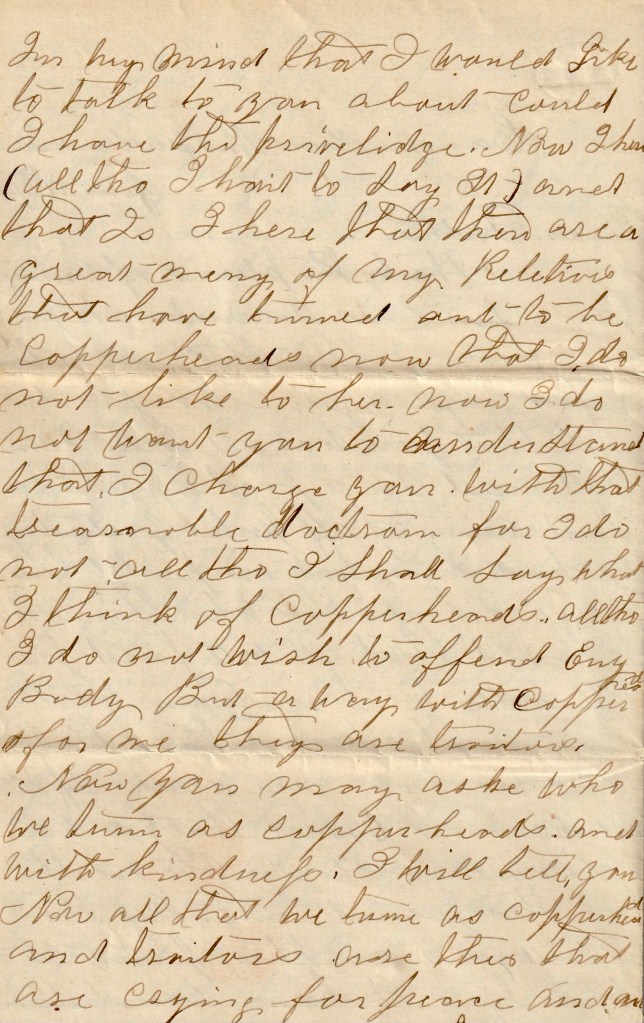
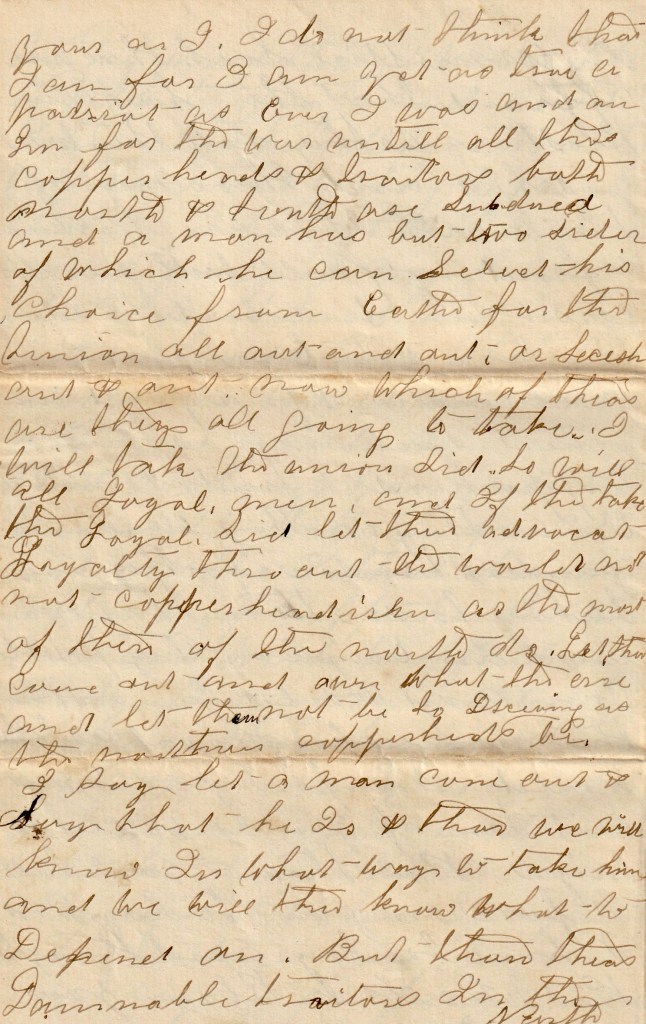
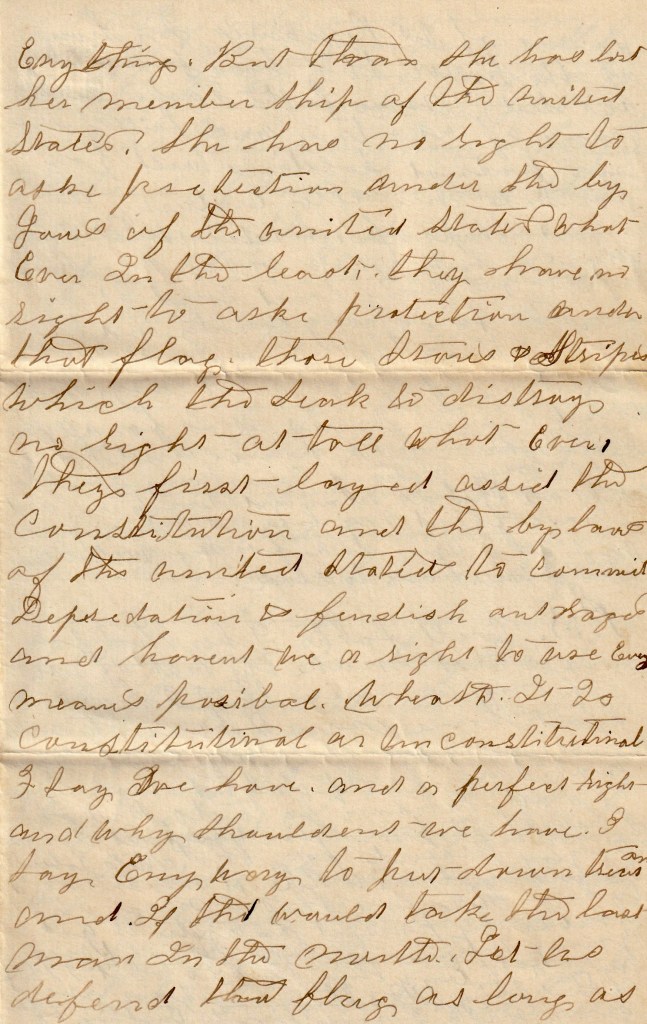
This letter was written by John Fox but I can’t be certain of the middle initial which was probably either a J., I. or a G. He does not provide any names or places in the letter, only to imply that his father—and perhaps many of his relatives—were Copperheads, which is the principle target of his anger. Given that the letter was written from Murfreesboro, Tennessee, and that there were many Copperheads living in southeastern Ohio, my hunch is that the author was from an Ohio Regiment. There are several by the name of John Fox who served in Ohio Regiments that were posted at Murfreesboro in June 1863 and given enough time, one might narrow it down to the one who wrote this letter. The best personal clue he gives is that the family at home consisted of his father, brothers and sisters. His mother was most likely dead and his father was courting a woman that John did not like.
[Note: This letter is from the personal collection of Richard Weiner and is published on Spared & Shared by express consent.]
Transcription
Camp near Murfreesboro, Tennessee June 17th 1863
Dear Father,
I take the pleasure of writing you a few lines in answer to your very welcome letter than came to hand a few days ago. I was glad to hear that you was all well. I am well and in good spirits too. Just came off of picket yesterday. We had been on picket ten days. I hope that when this comes to hand that it will find you all well.
We have warm weather here at this present time. But then we have nice weather, [even] if it is warm. I expect that you have pleasant weather in the North at this present time. But then I will quit on this point at this time. I have considerable in my mind that I would like to talk to you about, could I have the privilege. Now I have (although I hate to say it) and that is I hear that there are a great many of my relatives that have turned out to be Copperheads. Now that I do not like to hear. Now I do not want you to understand that I charge you with that treasonable doctrine for I do not, although I say what I think of Copperheads. Although I do not wish to offend anybody but, “Away with Copperheads!” For me, they are traitors.
Now you may ask who we term as Copperheads and with kindness, I will tell you. All that we term as Copperheads and traitors knows this that are crying for peace and an armistice. Such that are afraid that their Southern brothers, as they call them, will get hurt. And these men of the North that are kicking and finding fault with our officers and Abe Lincoln & the Administration, & the Emancipation Proclamation & find fault in general, such men as these are Copperheads & traitors, for they are seeking to overthrow the government in every way they possibly can. Now would you not term them as Secesh? I most assuredly would.
No perhaps this won’t suit some of you so well as it might, but I can’t help it for I am going to say what I have to say and then quit. But who is to blame, you or I? I do not think that I am for I am yet as true a patriot as ever I was and am in for the war until all these Copperheads & traitors—both North and South—are subdued. A man has but two sides of which he can select. His choice [must be] either for the Union all out & out, or Secesh out & out. Now which of these are they all going to take? I will take the Union side. So will all loyal men. And if they take the loyal side, let them advocate loyally throughout the world and not Copperheadism as the most of them of the North do. Let them come out and own [up to] what they are and let them not be so deceiving as the monstrous Copperhead be.
I say let a man come out & say what he is & then we will know in what way to take him, and he will then know what to depend on. But then these government traitors in the North—such as Vallandigham & his friend Vorhees of Indiana, and their followers—they do us more injury than the whole Southern Confederacy. And why? Because they are sneaking & low degraded human beings. They are afraid to come out in front and face the cannon. No, they dare not come. They are cowards. But they they are like a dog that will kill sheep and more so. If they can do everything sneakily, they will do it. Everything to injure the government and the army, they will do it. If they could demoralize the army by sending their damned secesh, low-lifed, low-degraded, dirty sheets [flyers] in our camp and let them advocate treason, they would like it very well. But then they don’t have much effect in the army.
I am in hopes that they will arm all the African race in the United States and let them fight for their liberty until death for it is at this present time a military necessity that we should pursue that course and take all that they have (that is, from traitors), both North and South, & let it help to pay the national debt. The traitors of the North, they should have their property confiscated as well as the Southern traitors. Had the South behaved herself, she could have had her property. But no, that was not enough for her. She wanted more territory & thus far she has waged a war against us and what will she gain? Not anything. But then she has lost her membership of the United States. She has no right to ask protection under the bylaws of the United States whatever. In the least, they have no right to ask protection under that flag—those Stars & Stripes which they seek to destroy. No right at all what ever.
They first laid aside the Constitution and the bylaws of the United States to commit depredation & fiendish and outrages and haven’t we a right to use every means possible. Whether it is constitutional or unconstitutional. I say we have. I say any way to put down treason. If that would take the last man in the world. Let us defend that flag as long as one of us remains, in honor of the brave that have fallen by our side.
Now Father, I ask in the name of a true and faithful patriot soldier, will you forsake me after enduring the hardships of a soldier that I have now. I hope not. Now I am honest of what I have said, and it is for the love of my country and the love of the Stars & Stripes, and the love of you and my brothers and sisters. It is for all them that I have left home adn have left my young company and have left all that is near and dear to me, and I have offered my life as a sacrifice and who can ask for more. Well, I guess that I will have to close.
P. S. Well, Father, I hear that you do not make the best of use of my money that I have sent home. Now I have this all from good authority. I would not say it if I did not have a good reason so to do. But then I hear that you have used it in buying presents for that Miss Roberts. Now my dear and kind mother used to say to me that a man that had to buy presents in order to get a young woman to love would never amount to anything. That is what I think of that thing you are going with. I never thought anything of her. But then I will have to come to a close for I think that I have written enough today. I remain as ever, your son, — John J. Fox.