My passion is studying American history leading up to & including the Civil War. I particularly enjoy reading, transcribing & researching primary sources such as letters and diaries.
The following letter was written by William Jasper Andrews (1840-1909) of Vermillion county, Indiana, who enlisted on 11 August 1862 as a private in Co. D, 85th Indiana Infantry. He mustered out three years later at Washington D. C. on 12 June 1865.
Jasper was the son of William Andrews (1807-1879) and Jane Wellman (1811-1879) of St. Bernice, Vermillion county, Indiana. Jasper’s father was a tanner & currier from Ohio. His mother was born in Kentucky. In 1870, Jasper married Amanda Minerva Davis (1846-1918) and lived out his days in Vermillion county as a farmer.
Transcription
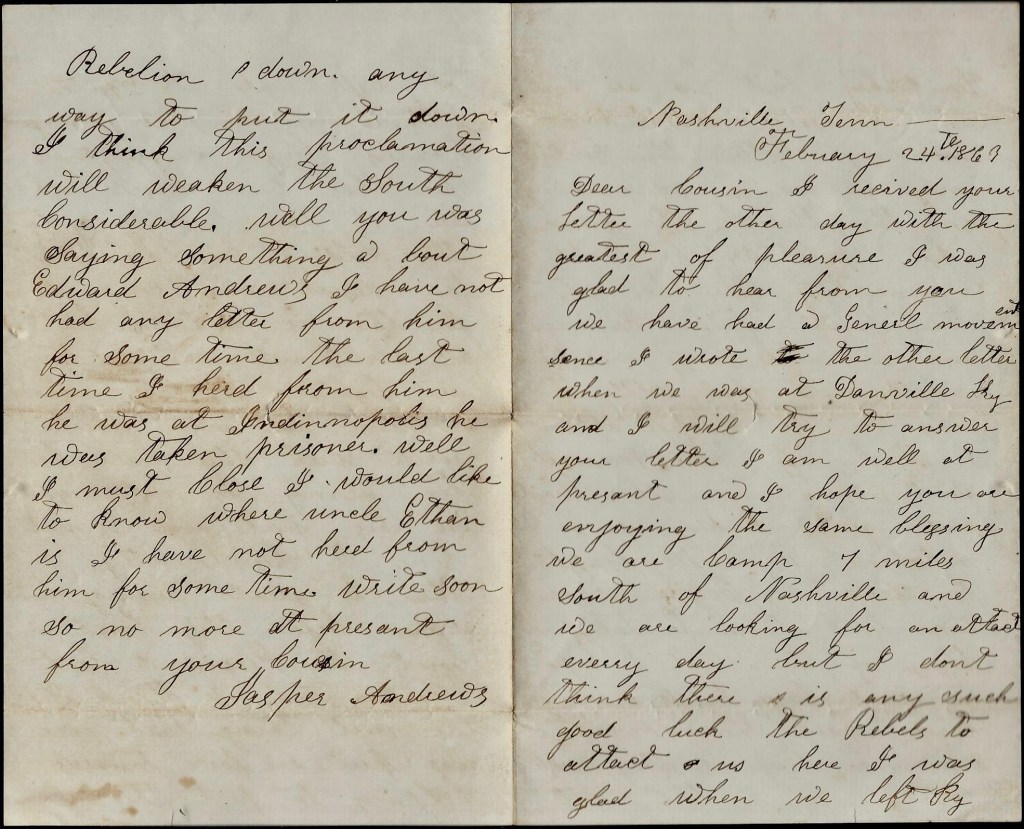
Nashville, Tennessee February 24th 1863
Dear Cousin,
I received your letter the other day with the greatest of pleasure. I was glad to hear from you. We have had a general movement since I wrote the other letter when we was at Danville, Kentucky, and I will try to answer your letter. I am well at present and I hope you are enjoying the same blessing. We are camped 7 miles south of Nashville and we are looking for an attack every day but I don’t think there is any such good luck [for] the Rebels to attack us here.
I was glad when we left Kentucky but we are now in Tennessee which is not any better than Kentucky—only we are advancing on the Rebels. The governor has called us to hold a meeting here to get the opinion of the soldiers and to make a proposition whether we shall settle this war or the people at home. I think if those Democrats don’t carry themselves straight and quit kicking up a disturbance, we will be apt to send a regiment or two back there to take charge of them. But I hope we won’t have to send any troops back there in old Indiana. Long as they keep cutting up in the North, it will make the South stand in arms some many months longer against us. There has been several back there at home writing to the soldiers here for them to desert and come home for this is nothing but a abolitionists’ war and they are fighting for the negroes. I think the man who would write such stuff back to the army is not right in his heart and is not true to his country. There was a great many men scared before they heard about the President’s last proclamation. I think it is the best thing that ever was put in force towards helping to put this rebellion down. Any way to put it down. I think this proclamation will weaken the South considerable.
Well, you was saying something about Edward Andrews. I have not had any letter from him for some time. the last time I heard from him he was at Indianapolis. He was taken prisoner. Well, I must close. I would like to know where Uncle Ethan is. I have not heard from him for some time. Write soon. So no more at present.
This letter was written by Francis (“Frank”) Markoe (1801-1872), the son of Francis and Sally (Caldwell) Markoe. Following his graduation from Middlebury College in 1823, Markoe studied law in the law office of John Sergeant in Philadelphia and practiced for two years. He then entered government service (1832-1861) serving as Chief, U.S. Consular Bureau and then in the Diplomatic Bureau. He married Mary Galloway Maxey in 1834. He died in Baltimore, Maryland.
An interesting vignette concerning Markoe involves his candidacy for the position as Secretary of the new Smithsonian Institute in Washington D.C. in 1846. The following was said of Markoe:
In his mid-forties, Markoe was a clerk in the Diplomatic Bureau of the State Department, as well as the corresponding secretary of the National Institute for the Promotion of Science, an organization based in Washington and founded with the hope of receiving the Smithson bequest to establish a national museum. Markoe had a botanical collection and was recognized as a mineralogist of some ability. But his most important qualification for the position of secretary was his extensive political connections. He claimed President James K. Polk, as well as current and former members of Congress and cabinet members, among his supporters. His selection would be a sign that the secretaryship was a post to be awarded on the basis of political patronage.
Markoe didn’t get the selection, however. He was passed over for Joseph Henry, a professor of natural philosophy & physics at the College of New Jersey.
Frank wrote the letter to James McHenry Boyd. He was the first husband of Anna Eliza Boyd Barnard (nee Hall). He is mentioned by Fanny Adeline Seward in her 1862-1863 diary as “the groom” when she recounts the unfortunate story of his brief marriage: “the very day of her [Anna Barnard’s] wedding day, while on their tour, the couple stopped at a hotel, in Philadelphia, I believe. Both were preparing for dinner when the groom was stooping over his open trunk and a loaded pistol there went off and killed him!” Boyd died in December 1847.
Transcription
Washington [D. C.] 21 May 1847
Mary & my father got here last night. They propose to go to W. River next Tuesday by railroad to Annapolis.
[George W.] Hughes 1 reached Washington Monday night last, stayed Tuesday & started for W. K. Wednesday morning. He will be back most likely next week, middle or end. My chief object in writing to you now is to impart a kind of secret which you may revolve in your own mind in connection with any remaining ambition you may have on the subject of going to Mexico. The President & [Secretary] Marcy have expressed a wish that he would take command of the Battalion that C. L. Jones expected to command but which was never intended to be given him. Hughes is willing to take it as Lt. Col., drill the body severely here for some time, & then proceed with them by [ ]. I spoke to him of you and he will be charmed if you will go with him. So you must see him as soon as you can. I let you know when he arrives here unless you choose to go down to W. River.
I was aware that something of the sort was in prospect before Hughes returned. When he returned he told me of it & desired me to say nothing about it because he meant to leave it to the President & Marcy to fix it their own way, but I spoke to him in reference to you immediately. Now, however, I think the matter will be generally known because this morning Major Scott, the Navy Agent, told me all about it as a thing known at the Department among many officers and I thought it well to drop you a line.
Hughes was carried to the field of battle Cerro Gordo in an ambulance & lifted into the saddle so he saw all & had a fair chance of being shot, as he was talking to General Scott when a ball knocked off a mule’s head close by them.
Henry, this letter writing is so unsatisfactory compared with talking. So find your way here somehow or other soon. I hope your knee is better. What do you hear from James & how is he? I got a letter two days ago from Ramsey in answer to the papers, &c. I sent him some time ago. He repeats your monstrous notion about the [ ] being Principles.
In haste. Affectionately yours, — Francis Markoe, Jr.
P. S. If you have any Revolutionary autographs, or such as you may have got in Europe & England [ ] may bring or send me some.
I. McH Boyd, Esq.
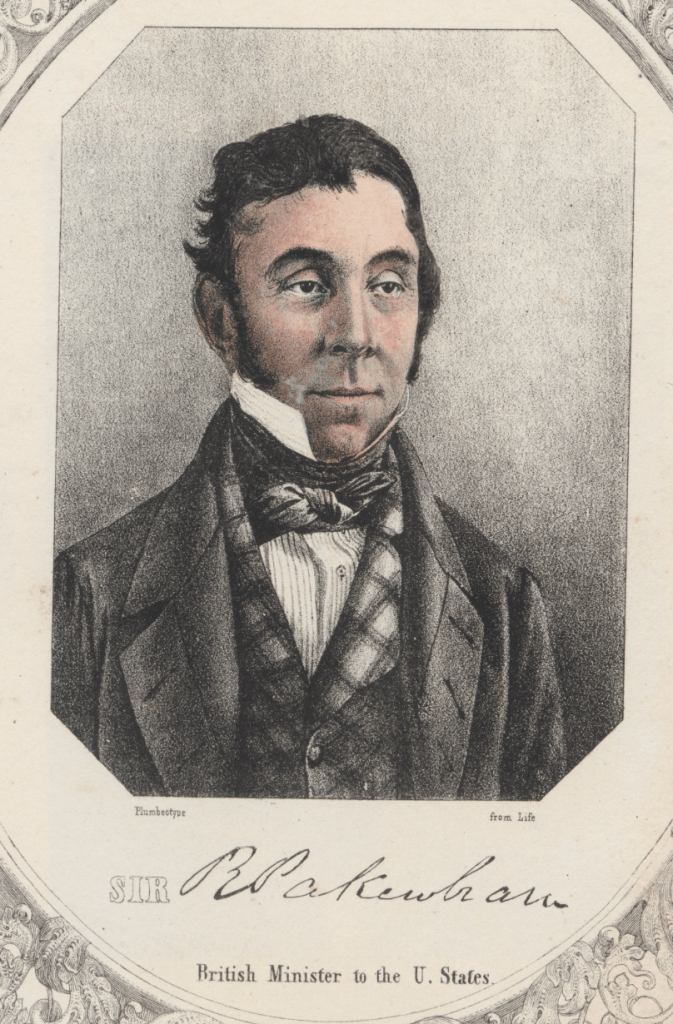
I have opened this letter to say that Mr. [Richard] Pakenham has just called in at my office to pay his final adieu. He goes to Baltimore tomorrow and says he will make it a point to see you & will inquire of your whereabouts from W. McLane whom he will see. He takes with him all our best feeling & wishes & hopes for a return to this country. Has leave of absence for two years & expects to return & will no doubt, unless promoted to some higher post.
1 George Wurtz Hughes (1806-1870) attended the United States Military Academy at West Point from 1823 to 1827, having been appointed by Caleb Baker, but was not commissioned and instead became a civil engineer in New York City. In 1829, Hughes began to work for the New York State Canal Commission. Hughes was appointed to the United States Army on July 7, 1838, as captain of Topographical Engineers. In 1840, he was sent to Europe by the War Department on an inspection tour of mines, public works and military fortifications. Hughes subsequently served in the Mexican–American War, acting as chief engineer on the staff of General John E. Wool in 1846 and General William J. Worth in 1847. He was brevetted major of Topographical Engineers on April 18, 1847 for gallant and meritorious conduct during the Battle of Cerro Gordo. Hughes was promoted to lieutenant colonel of a regiment of Maryland and District of Columbia Volunteers on August 4, 1847, and to colonel on October 1, 1847. In December 1847, he was appointed civil and military governor of the Department of Jalapa and Perote in Veracruz. Hughes was later brevetted lieutenant colonel of Topographical Engineers on May 30, 1848 for meritorious conduct while in Mexico. He was honorably mustered out of the volunteer service on July 24, 1848. From 1849 to 1850, he served as chief engineer of the Panama Railroad, resigning from the regular army on August 4, 1851.
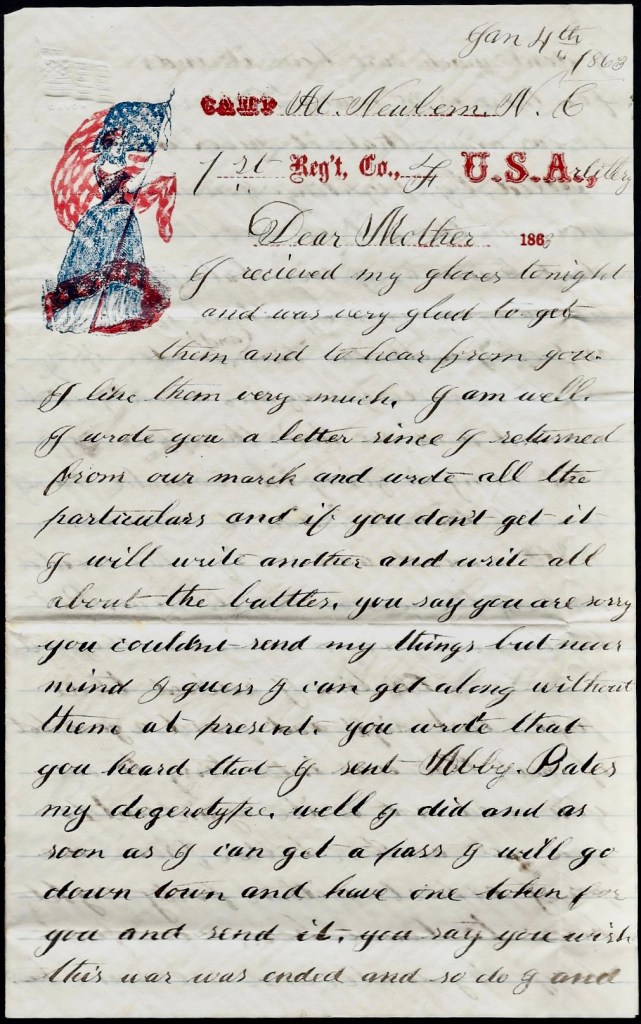
The following letter was written by Albert Sheldon Wood (1844-1923), the son of Silas R. Wood (1811-1857) and Lucy Barber (1816-1904) of Wyoming, Washington county, Rhode Island. Seventeen year-old Albert was working at the Hope Valley Mill when he enlisted in Battery F, 1st Rhode Island Light Artillery. He served three years and then returned to Hope Valley to work in the machinist’s trade.
In his letter, Albert asks his mother to give his regards to his sister Sarah Wood (1838-1918) who married Benjamin Franklin (“Frank”) Crandall (1833-1896), and also to his sister Angelina (“Lena”) Wood (1847-1940).
Transcription
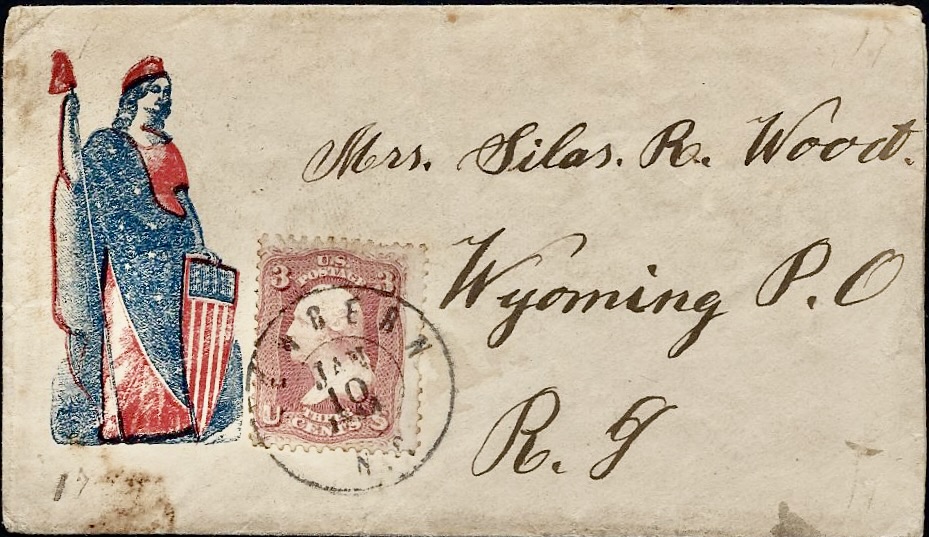
Addressed to Mrs. Silas R. Wood, Wyoming Post Office, Rhode Island
At Newbern, North Carolina 1st Regiment, Co. F, USA Artillery January 4th 1863
Dear Mother,
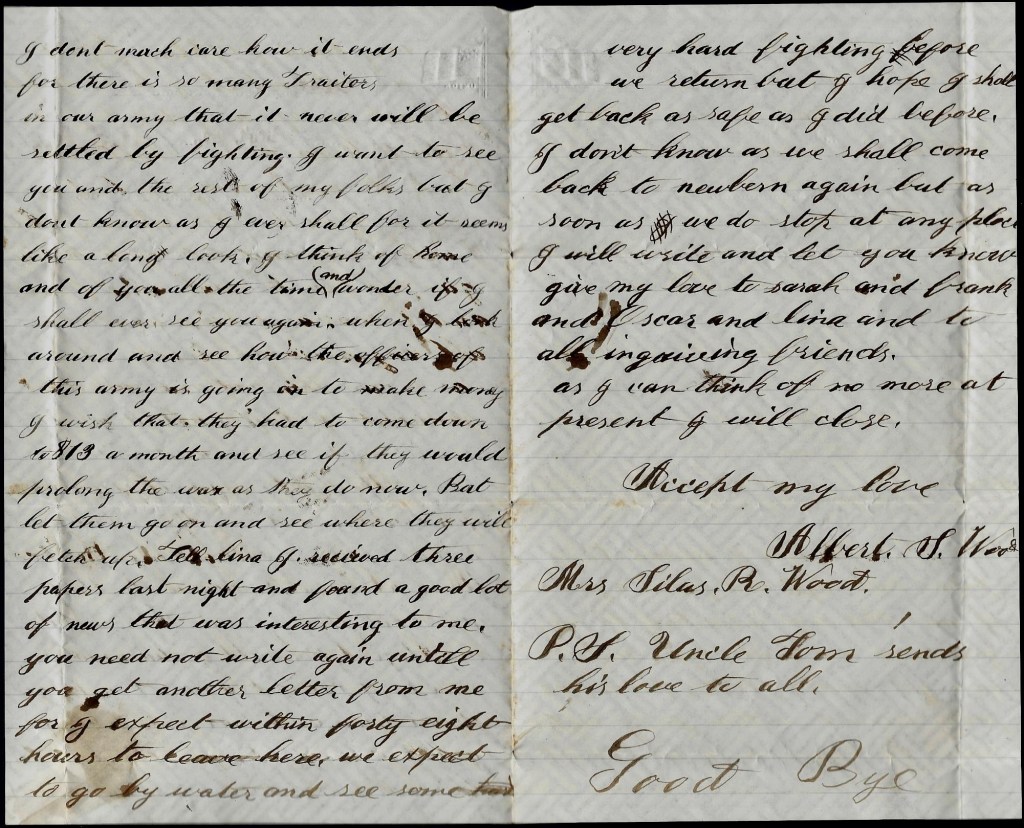
I received my gloves tonight and was very glad to get them and to hear from you. I like them very much. I am well. I wrote you a letter since I returned from our march and wrote all the particulars and if you don’t get it I will write another and write all about the battery. You say you are sorry you couldn’t send any things but never mind. I guess I can get along without them at present. You wrote that you heard that I sent Abby Bates my daguerreotype. Well, I did, and as soon as can get a pass, I will go down town and have one taken for you and send it. You say you wish this war was ended and so do I and I don’t much care how it ends for there is so many traitors in our army that it never will be settled by fighting. I want to see you and the rest of my folks but I don’t know as I ever shall for it seems like a long look. I think of home and of you all the time and wonder if I shall ever see you again. When I look around and see how the officers of this army is going on to make money, I wish that they had to come down to $13 a month and see if they would prolong the war as they do now. But let them go on and see where they will fetch up.
Tell Lina I received three papers last night and found a good lot of news that was interesting to me. You need not write again until you get another letter from me for I expect within forty-eight hours to leave here. We expect to go by water and see some very hard fighting before we return. I hope I shall get back as safe as I did before. I don’t know as we shall come back to New Bern again but as soon as we do stop at any place, I will write and let you know. Give my love to Sarah and Frank and Oscar and Lina and to all inquiring friends. As I can think of no more at present, I will close.
These letters were written by Frank Ashley (1834-1926) of Co. H, 64th Ohio Volunteer Infantry (OVI). Frank enlisted on 4 November 1861 to serve three years. He was appointed corporal on 1 May 1864 and mustered out with the company on 3 December 1865 in Victoria, Texas. Frank wrote the letters to his future wife, Celesta Ewing (1845-1868) at Plymouth, Richland county, Ohio. His parents were Jonah Ashley (1797-1862) and Sarah Hawks (1799-1875).
These letter were among the 125 letters written by Ashley sold by Heritage Auctions some time ago. I transcribed one other letter of Frank’s from a separate private collection back in 2018 that described the losses experienced by the regiment and, in particular, of his company at the Battle of Rocky Face Ridge where the 64th OVI participated in a charge on the enemy’s breastworks that was over in minutes and “gained nothing.” See—1864: Frank Ashley to Celesta (Ewing) Ashley on Spared & Shared 7.
Letter 1
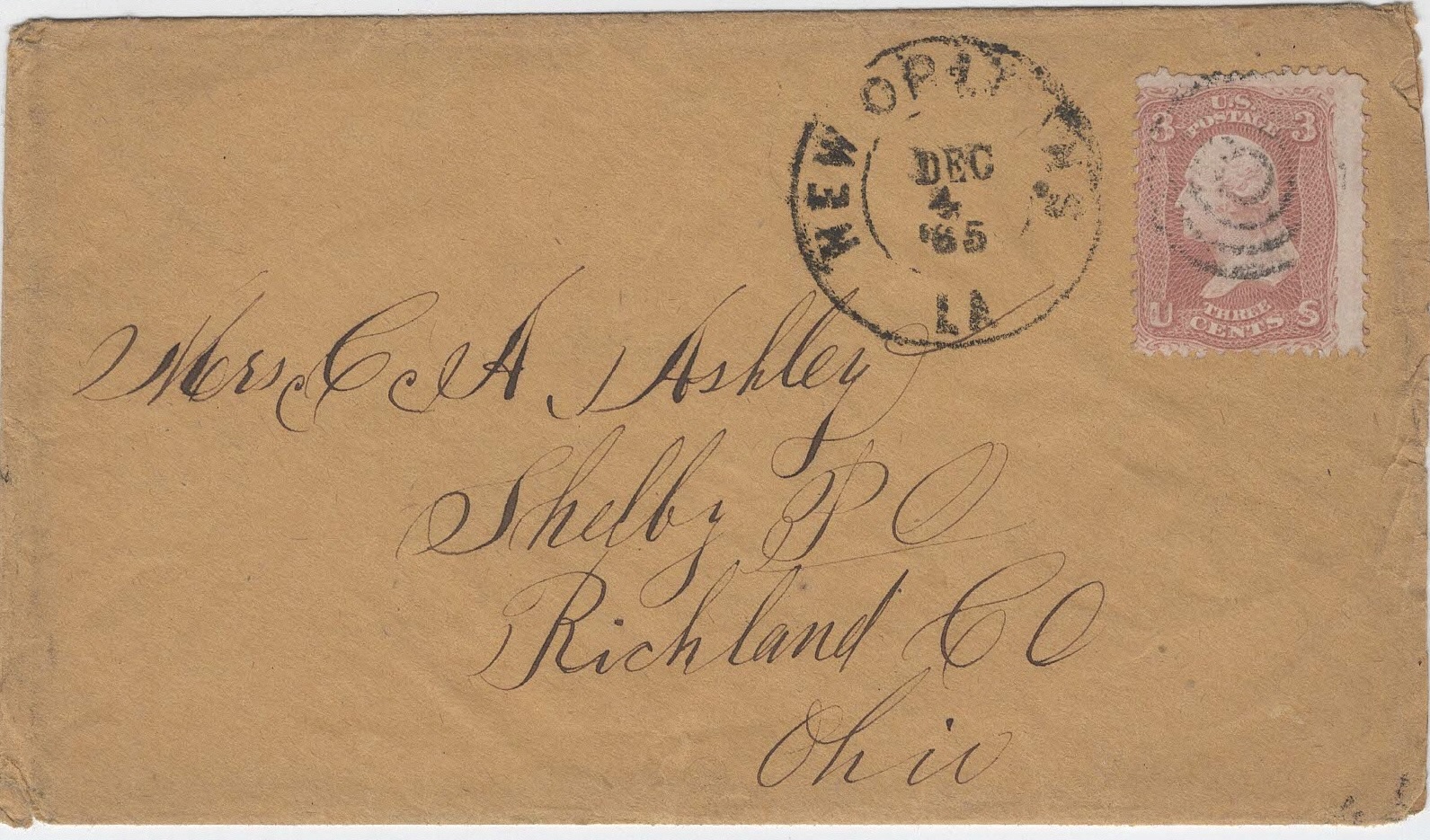
Mrs. C. A. Ashley, Shelby P. O., Richland county, Ohio (Envelope bears a New Orleans, La., December 1865 postmark so is not accurately paired with this letter)
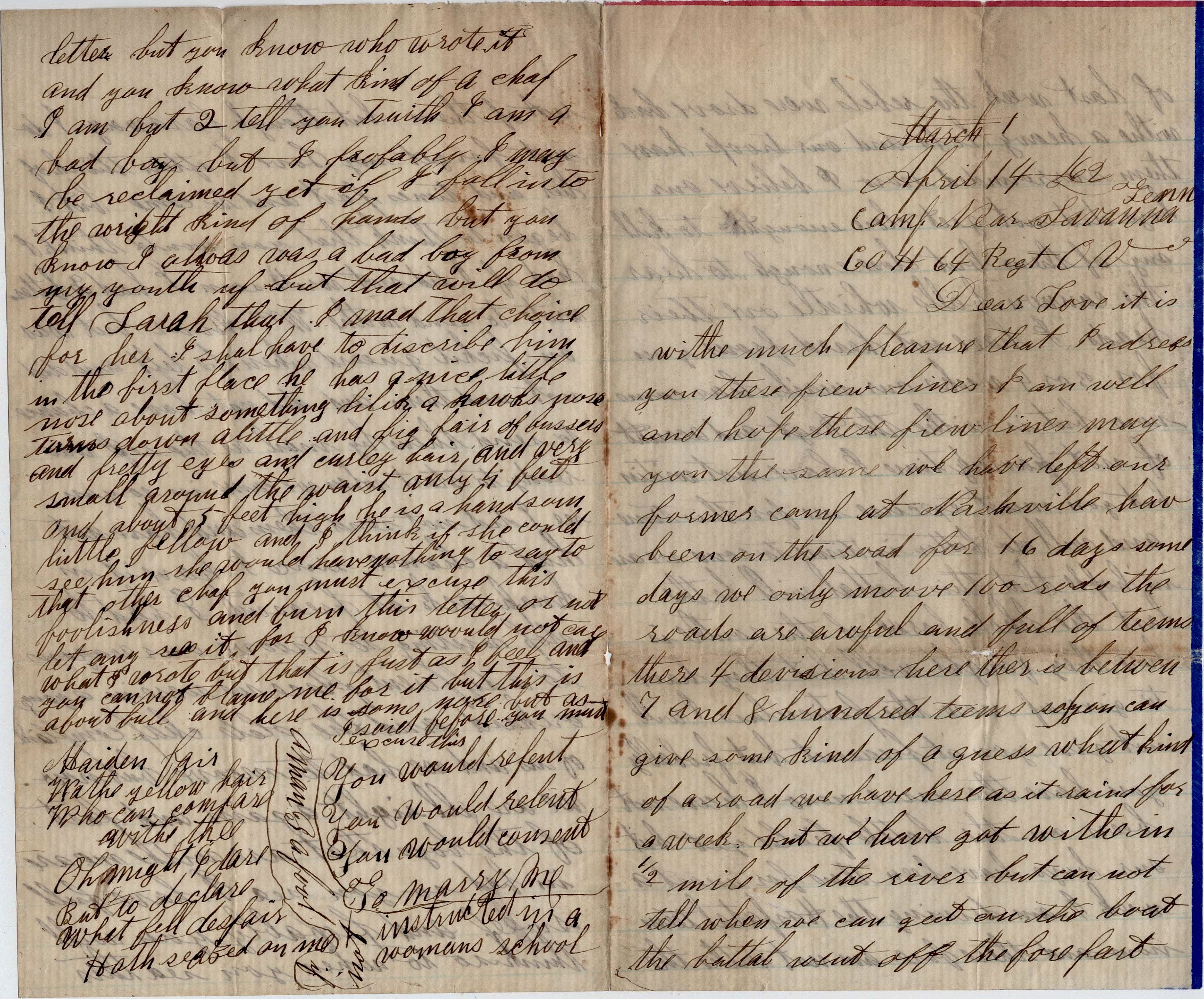
Camp near Savannah, Tennessee Co. H, 64th OVI April 14, 1862
Dear Love,
It is with much pleasure that I address you these few lines. May you the same.
We have left our former camp at Nashville. Have been on the road for 16 days. Some days we only move 100 rods. The roads are awful and full of teams. There are four divisions here. There is between 7 and 8 hundred teams so you can give some kind of a guess what kind of a road we have here as it rained for a week. But we have got within half mile of the river but cannot tell when we can get on the boat.
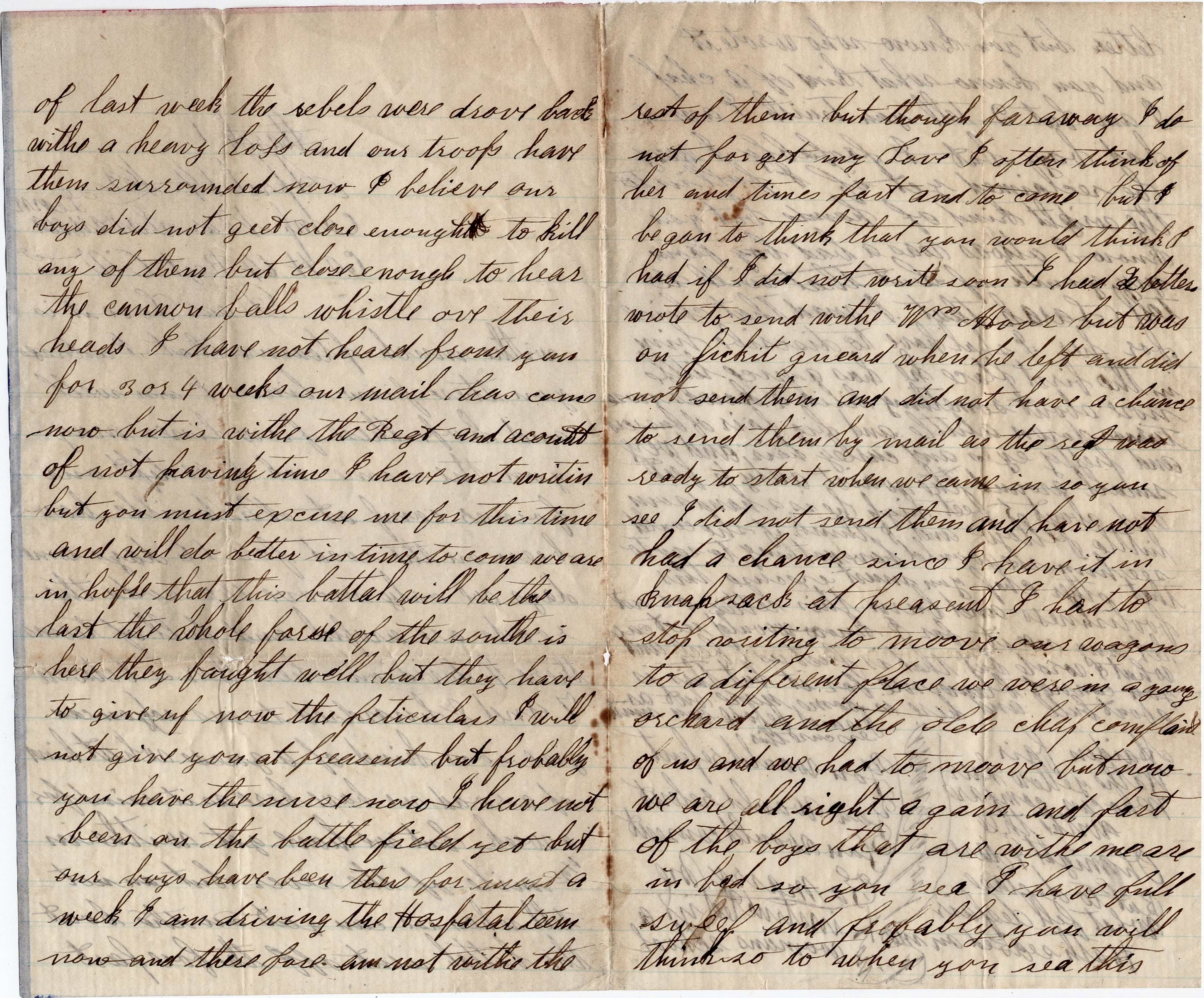
The battle [at Pittsburg Landing] went off the fore part of last week. The rebels were drove bad with a heavy loss and out troops have them surrounded now, I believe. Our boys did not get close enough to kill any of them but close enough to hear the cannon balls whistle over their heads.
I have not heard from you for three or four weeks. Our mail has come now but it is with the regiment and account of not having time, I have not written. But you must excuse me for this time and will do better in time to come. We are in hopes that this battle will be the last. The whole force of the South is here. They fought well but they have to give up now. The particulars I will not give you at present but probably you have the news now. I have not been on the battlefield yet but our boys have been there for most a week.
I am driving the Hospital team now and therefore am not with the rest of them. But though far away, I do not forget my love. I often think of her and times past and to come. But I began to think that you would think I had if I did not write soon. I had two letters wrote to send with William Hoos but was on picket guard when he left and did not have a chance to send them by mail as the regiment was ready to start when we came in so you see I did not send them and have not had a chance since. I have it in knapsack at present.
I had to stop writing to move our wagons to a different place. We were in a young orchard and the old chap complained of us and we had to move but now we are all right again and part of the boys that are with me are in bad [shape] so you see I will have full [sweep?] and probably you will think so too when you see this letter. But you know who wrote it and you know what kind of a chap I am. But I tell you [the] truth, I may be reclaimed yet if I fall into the right kind of hands. But you know I always was a bad boy from my youth up. But that will do.
Tell Sarah that I made that choice for her. I shall have to describe him. In the first place, he has a nice little nose—about something like a hawk’s nose, turns down a little, and big pair of bussers [?] and pretty eyes and curly hair, and very small around the waist. Only 4 feet and about 5 feet high. He is a handsome little fellow and I think if she could see him, she would have nothing to say to that other chap. You must excuse this foolishness and burn this letter or not let any see it for I know would not care what I wrote but that is just as I feel and you cannot blame me for it. But this is about full and here is some more. But as I said before, you must excuse this. You would repent. You would relent. You would consent, to marry me…
Letter 2
Camp near Pittsburg Landing Co. H, 64th OVI April 17th 1862
Dear love,
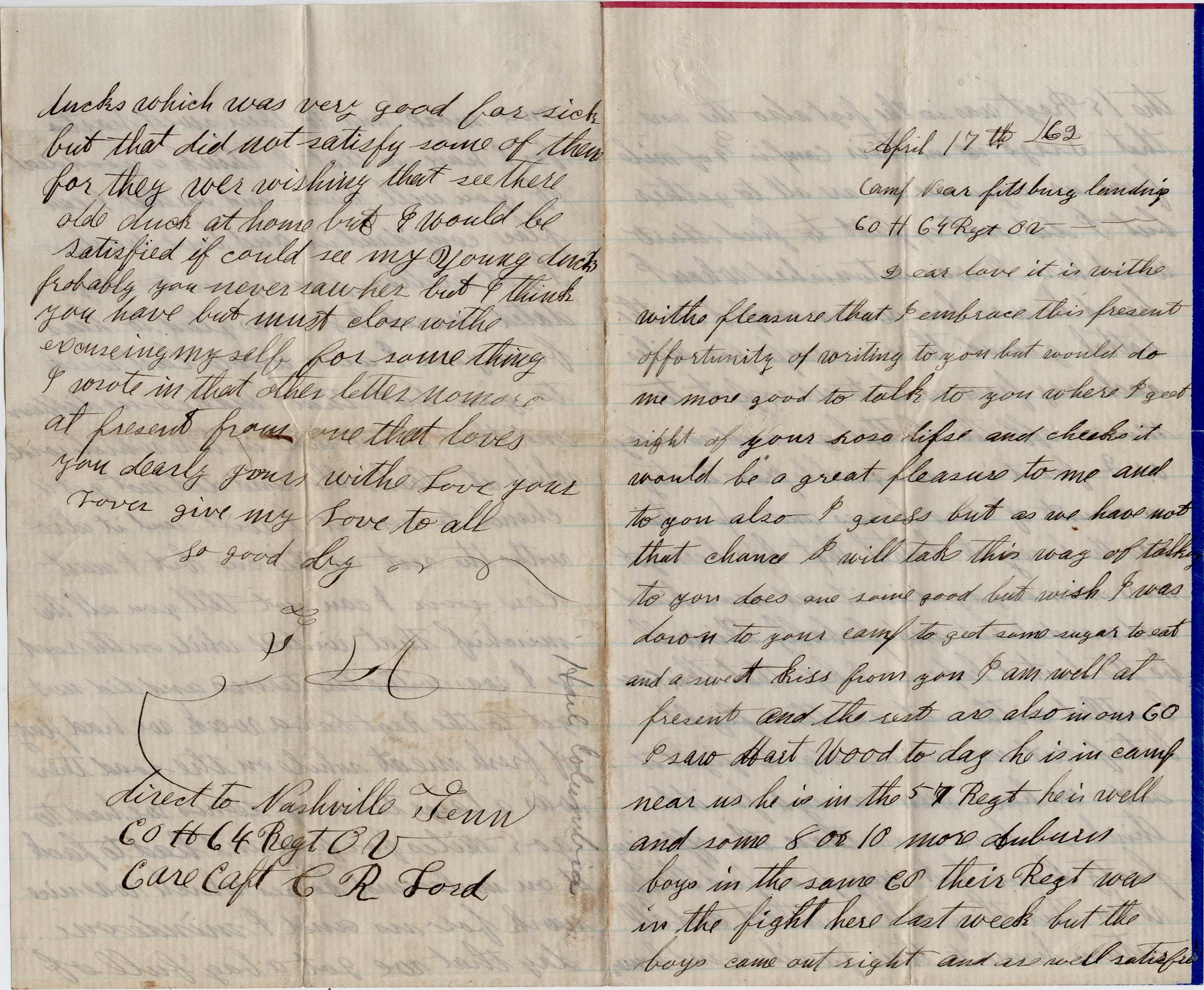
It is with pleasure that I embrace the present opportunity of writing to you but would do me more good to talk to you where I get sight of yourrosy lips and cheeks. It would be a great pleasure to me and to you also, I guess, but as we we have not that chance, I will take this way of talking to you. It does me some good but which I was down to your camp to get some sugar to eat and a wet kiss from you.
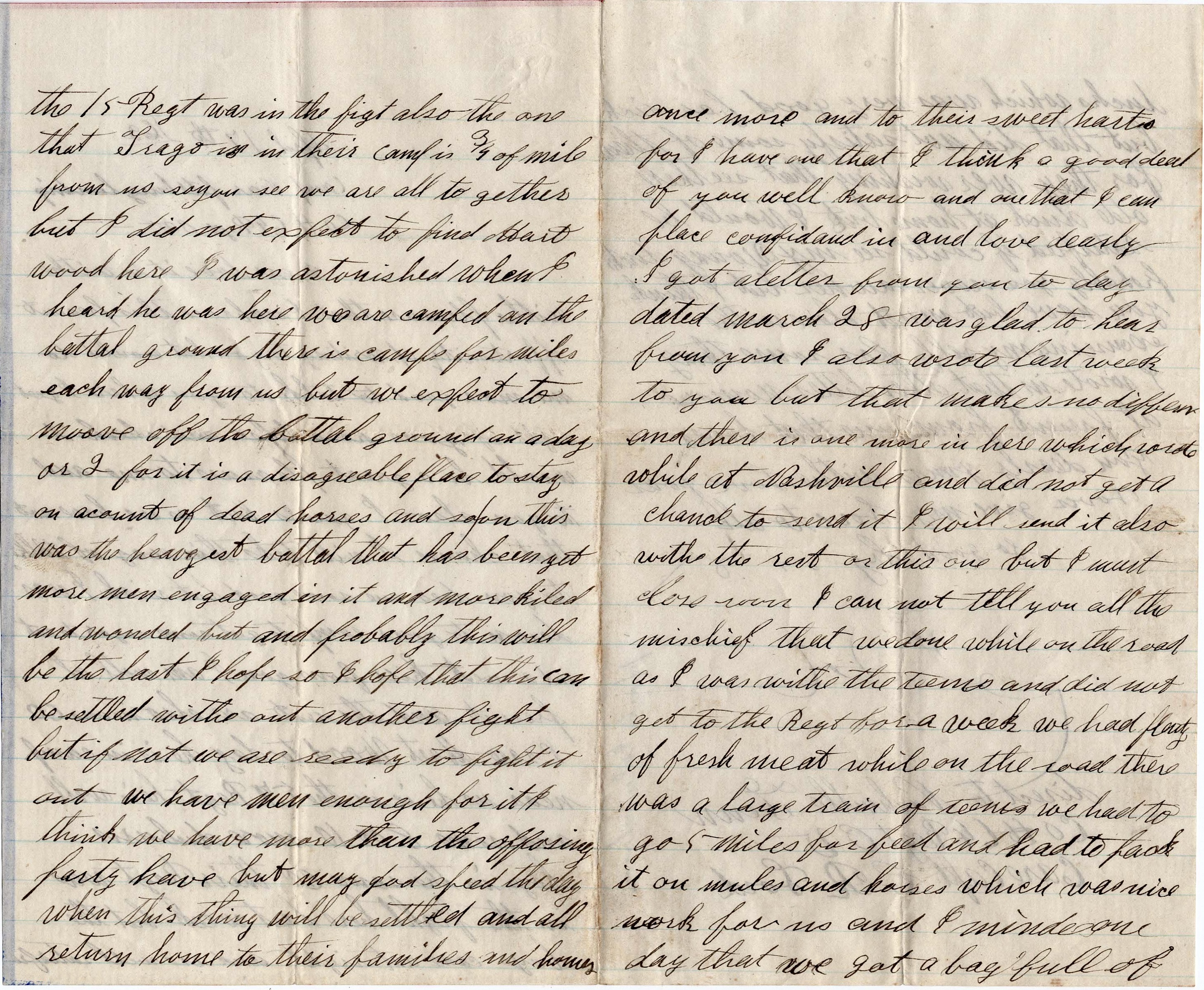
I am well at present and the rest are also in our company. I saw Hart Wood today. He is in camp near us. He is in tyhe 57th [Ohio] Regiment. He is well and some 8 or 10 more Auburn boys in the same company. Their regiment was in the fight here last week but the boys come out right and are well satisfied. The 15th [Ohio] Regiment was in the fight also—the one that Trago is in. Their camp is three-quarters of a mile from us. So you see we are all together. But I did not expect to find Hart Wood here. I was astonished when I heard he was here.
We are camped on the battleground. There is camps for miles each way from us. But we expect to move off the battle ground in a day or two for it is a disagreeable place to stay on account of dead horses and so on. This was the heaviest battle that has been yet. More men engaged in it and more killed and wounded. But probably this will be the last. I hope so. I hope that this can be settled without another fight. But if not, we are ready to fight it out. We have men enough for it, I think. We have more than the opposing party have. But may God speed the day when this thing will be settled and all return home to their families and homes once more. And to their sweethearts, for I have one that I think a good deal of, you well know, and one that I can place confidence in adn love dearly.
I got a letter from you today dated March 28th and was glad to hear from you. I also wrote last week to you but that makes no difference. And there is one more in here which I wrote at Nashville and did not get a chance to send it. I will send it also with the rest, or this one. But I must close soon.
I cannot tell you all the mischief that we done while on the road as I was with the teams and did not get to the regiment for a week. We had plenty of fresh meat while on the road. There was a large train of teams. We had to go 5 miles for feed and had to pack it on mules and horses which was nice work for us and I mind one day that we got a bag full of ducks which was very good for sick. But that did not satisfy some of them for they were wishing that [they could] see there old duck at home. But I would be satisfied if I could see my young duck. Probably you never saw here but I think you have. But must close with excusing myself for something I wrote in that other letter. No more at present. From one that loves you dearly. Yours with love. Your lover. Give my love to all. So goodbye. — F
Direct to Nashville, Tenn. Co. H, 64th OVI Care Capt. C. R. Lord
Letter 3
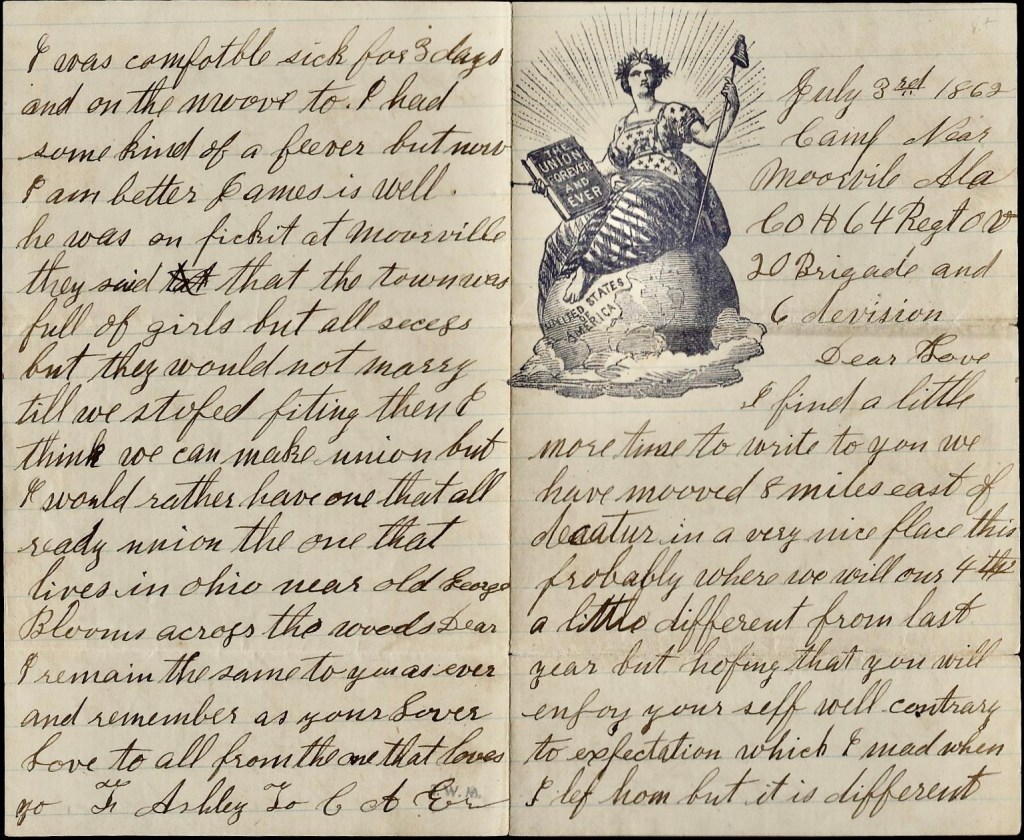
Camp near Mooresville, Alabama July 3rd 1862 Co. H, 64th Regt. OV, 20th Brigade and 6th Division [Army of the Ohio]
Dear Love,
I find a little more time to write to you. We have moved 8 miles east of Decatur in a very nice place. This probably where we will [have] our 4th [of July]—a little different from last year, but hoping you will enjoy yourself contrary to expectation which I made when I left home. But it is different from expectation of all of us. But we are good for it any they take us. the 64th is all right yet. But it is hopeful that this war will soon be over and we can return home to our homes and to our loved ones whom we love dearly. But God only knows when that will be, but hope it will be soon.
But I am looking for us to be stationed at some place. If so, we cannot leave till we are relieved by regular troops along the railroad running from Memphis to Chattanooga. We are going to Chattanooga but the citizens say will [never] get there for this war will be ended before we reach that point. That is near Virginia and North Carolina line. If this war does not close for some time, we will be in Virginia—at least I think so. But I may [ ] wrong, but time will tell all these things.
But to my health, it is better than when I last wrote to you. That [was] five or six days ago. But I am gaining slowly. I have been out twice since I got better after forage. I have to see to getting that but have not tended to it for some time on the account of being [sick]. I was comfortable sick for three days and on the move too. I had some kind of a fever but now I am better.
James is well. He was on picket at Mooresville. They said that the town was full of girls but all secesh. But they would not marry till we stopped fighting. Then I think we can make union, but I would rather have one that’s already Union—the one that lives in Ohio near Old George Bloom’s across the woods. Dear, I remain the same to you as ever and remember [me] as your lover.
Love to all from the one that loves you, — F. Ashley to C. A. E.
Letter 4
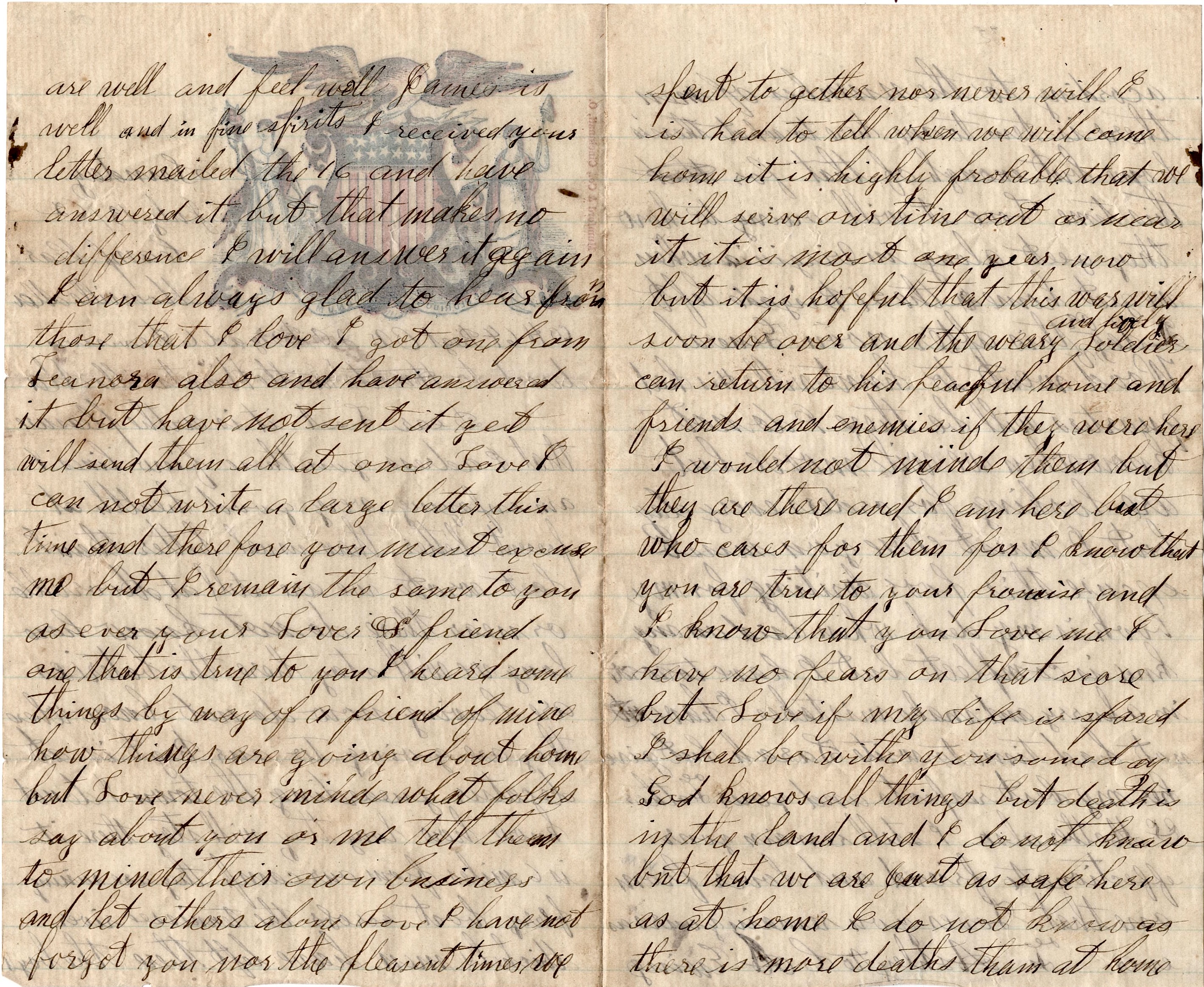
Camp near Mooresville, Alabama Sunday, July 13, 1862 Co. H, 64th Regt. OVI, direct to Huntsville, Alabama
Dear Lest,
It is with pleasure that I address you these few lines. I am enjoying good health at present—better than usual—better than [when] I last wrote. We are still at Mooresville or near there. Do not know how long we will stay here. The batteries are leaving now. Do not know where they are going to. Our regiment is at Decatur guarding the town. I do not know how long they will stay there. It is 6 miles from our camp. They are running ferry boat across the Tennessee river. Mitchell’s men have left there.
The boys are all well. James is well and in fine spirits. I received your letter mailed the 16th and have answered it but that makes no difference. I will answer it again. I am always glad to hear from those that I love. I got one from Leanora also and have answered it but have not sent it yet. Will send them all at once.
Love, I cannot write a large letter this time and therefore you must excuse me but I remain the same to you as ever—your lover and friend—one that is true to you. I heard some things by way of a friend of mine how things are going about home, but Love, never mind what folks say about you or me. Tell them to mind their own business and let others alone. Love, I have not forgot you nor the pleasant times we spent together nor never will.
It is hard to tell when we will come home. It is highly probable that we will serve our time out as near—it is most one year now, but it is hopeful that this war will soon be over and the weary and lonely soldier can return to his peaceful home and friends—and enemies. If they were here, I would not mind them but they are there and I am here but who cares for them for I know that you are true to your promise and I know that you love me, I have no fears on that score. But Love, if my life is spared, I shall be with you some day. God knows all things but death is in the land and I do not know but that we are just as safe here as at home. I do not know as there is more deaths than at home according to the number of men. There is ten to one here to what there is at home. But enough of that for this time.
Love, it will be owing to how they get along in Virginia when we get home. The 21st Brigade left today or this afternoon. General Wood went to Hunstville. His headquarters will be there. I do not know when we will move but are looking for orders every day. But I must close. You must excuse this poor writing for my book is my desk when laid on my knee is complete but I have to write in a hurry and make mistakes. I have not had time to write Sarah but give her my best respects and your Father & Mother also.
I still remain you affectionate friend and lover, from one that loves you. Remaining yours as ever, — F. Ashley
To C. A. Ewing
Note: These letter were among the 125 letters written by Ashley sold by Heritage Auctions some time ago. I transcribed one other letter of Frank’s from a separate private collection back in 2018 that described the losses experienced by the regiment and, in particular, of his company at the Battle of Rocky Face Ridge where the 64th OVI participated in a charge on the enemy’s breastworks that was over in minutes and “gained nothing.” See—1864: Frank Ashley to Celesta (Ewing) Ashley on Spared & Shared 7.
Letter 5
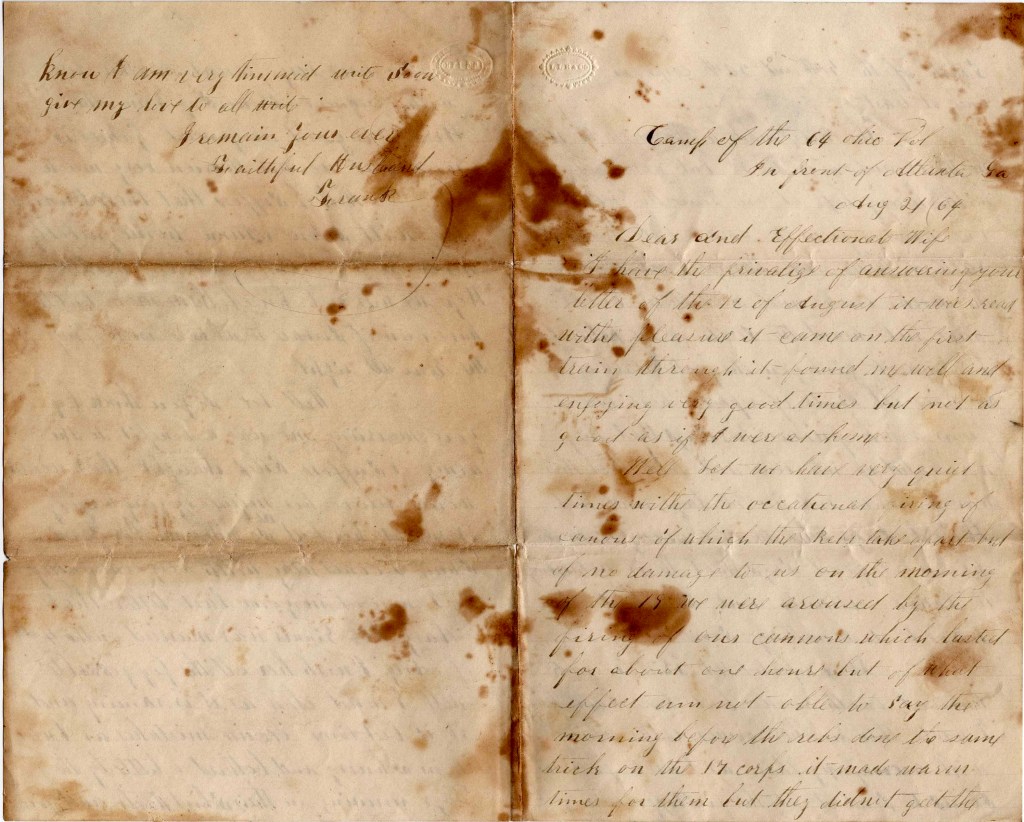
In front of Atlanta, Georgia Camp of the 64th Ohio Volunteers August 21, 1864
Dear and affectionate wife,
I have the privilege of answering your letter of the 12th of August. It was read with pleasure. It came on the first train through. It found me well and enjoying very good times but not as good as if I were at home.
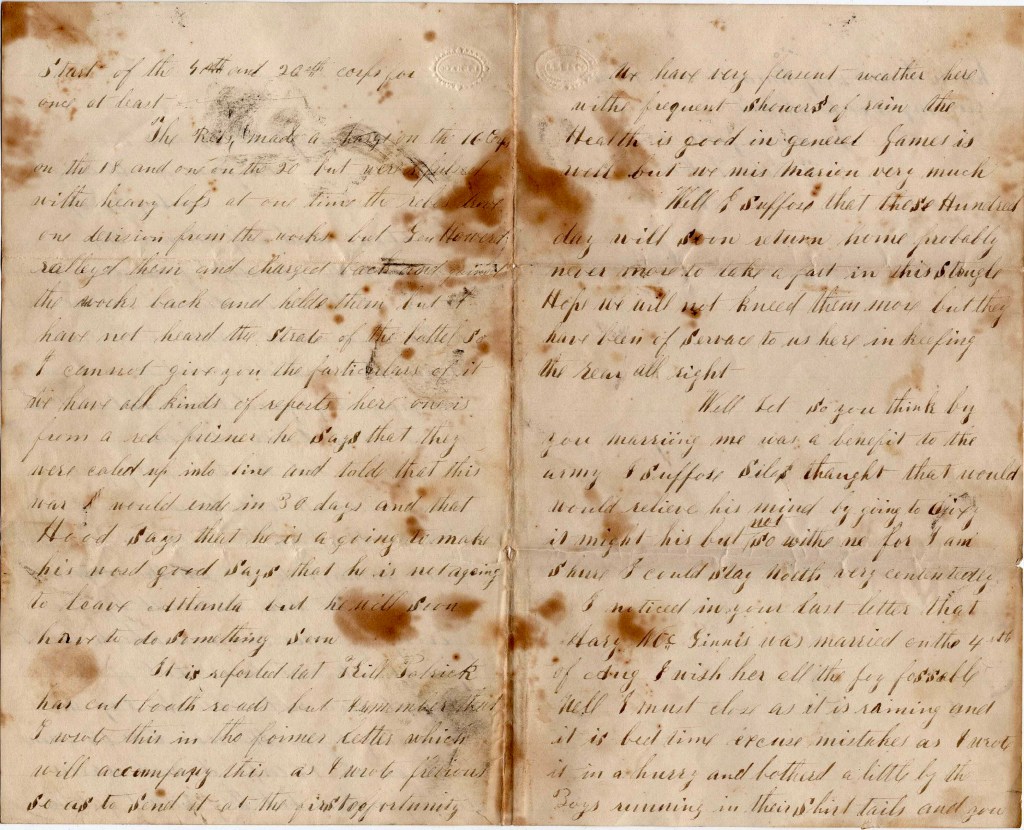
Well, Let, we have very quiet times with the occasional firing of canons of which the Rebs take a part but of no damage to us. On the morning of the 19th we were aroused by the firing of our cannons which lasted for about one hour but of what effect, am not able to say. The morning before, the Rebs done the same trick on the 17th Corps. It made warm times for them but they did not get the start of the 4th and 20th Corps for once at least.
The Rebs made a charge on the 16th Corps on the 18th and one of the 20th but were repulsed with heavy loss. At one time the Rebs drove one division from the works but Gen. Howard rallied them and charged back and gained the works back and held them. But I have not heard the strate [?] of the battle so I cannot give you the particulars of it. We have all kinds of reports here. One is from a reb prisoner. He says that they were called up into line and told that this war would end in 30 days and that Hood says that he a going to make his word good. Says that he is not a going to leave Atlanta but he will soon have to do something soon.
It is reported that Kill Patrick [Kilpatrick] has cut both roads but I remember that I wrote this in the former letter which will accompany this as I wrote previous so as to send it at the forst opportunity.
We have very pleasant weather here with frequent showers of rain. The health is good in general. James is well but we miss Marion very much.
Well, I suppose that these Hundred Day [men] will soon return home, probably never more to take part in this struggle. Hope we will not need them more but tey have been of service to us here in keeping the rear all right.
Well, Let, so you think by you marrying me was a benefit to the Army. I suppose Silas though that would relieve his mind by going to Dixie it might his, but not so with me for I am sure I could stay North very contentedly. I noticed in your last letter that Mary McGinnis was married on the 4th of August. I wish her all the joy possible.
Well, I must close as it is raining and it is bed time. Excuse mistakes as I wrote in a hurry and bothered a little by the boys running in their short tails and know I am very timid. Write soon. Gove my love to all. I remain your very faithful husband, — Frank
Letter 6
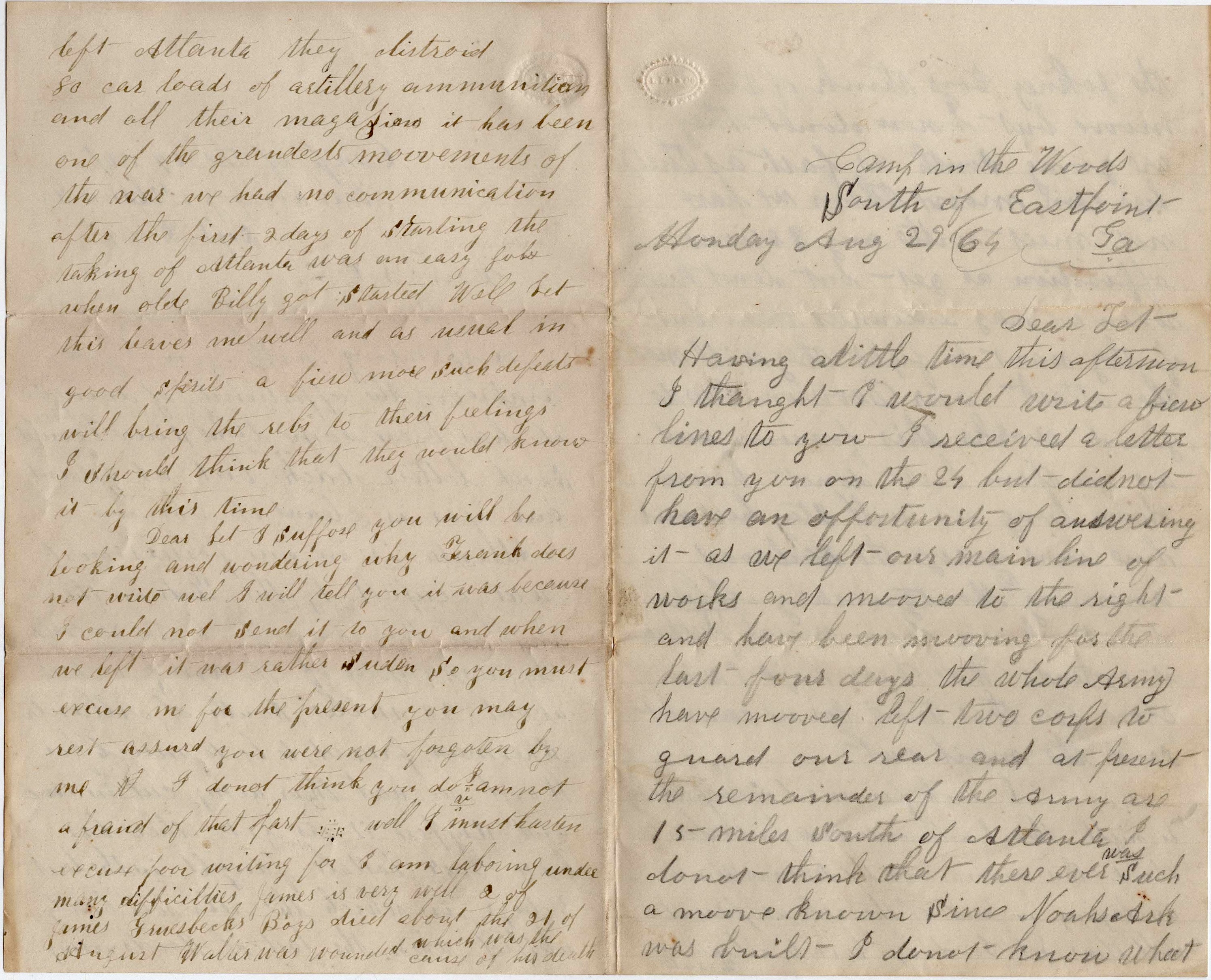
Camp in the Woods, South of Eastpoint, Ga. Monday, August 29, 1864
Dear Let,
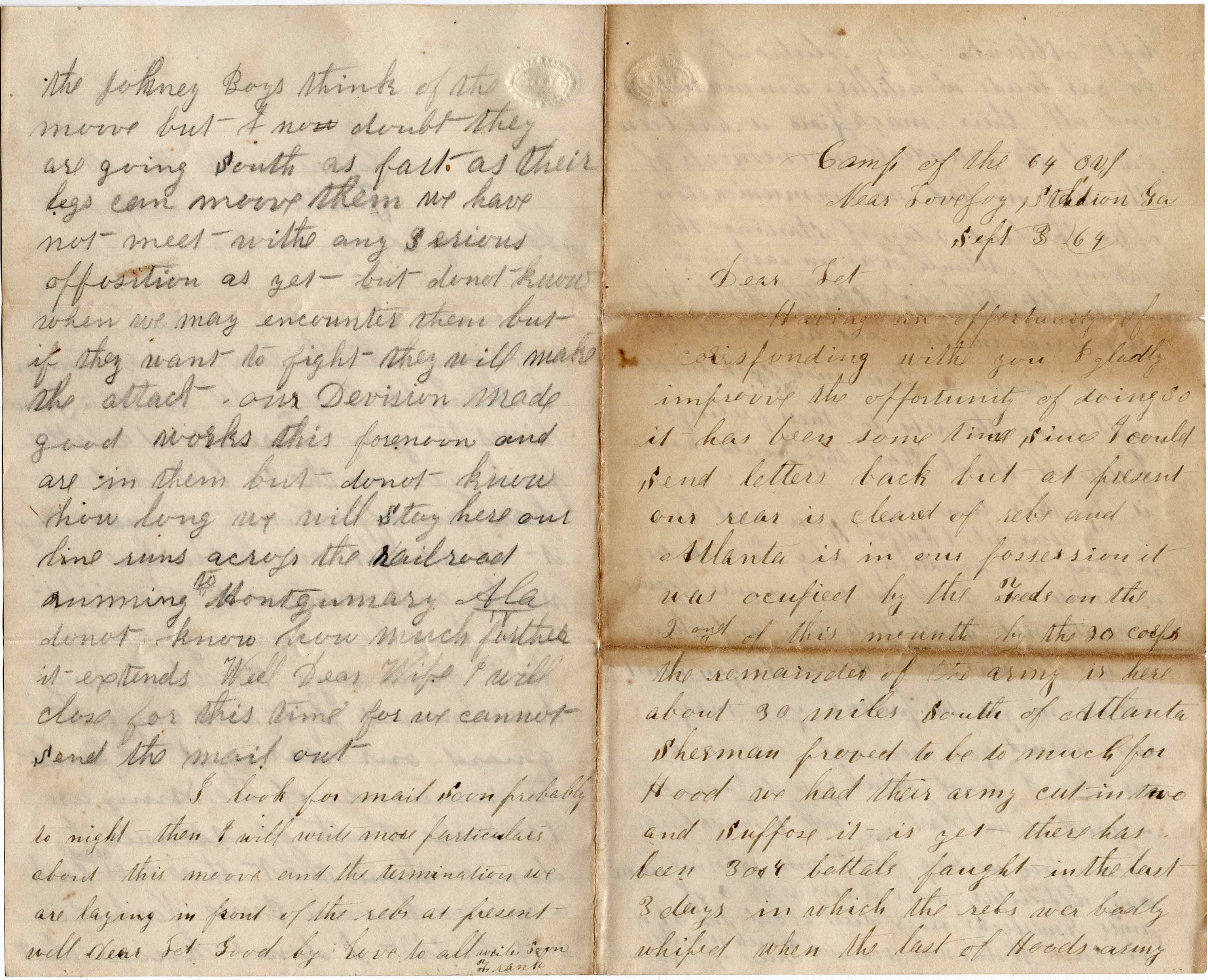
Having a little time this afternoon, I thought I would write a few lines to you. I received a letter from you on the 24th but did not have an opportunity of answering it as we left our main line of works and moved to the right and have been moving for the last four days. The whole army has moved left, two Corps to guard our rear, and at present the remainder of the army are 15 miles south of Atlanta. I do not think that there ever was such a move known since Noah’s Ark was built. I do not know what the Johnny boys think of the move but no doubt they are going south as fast as their legs can move them. We have not met with any serious opposition as yet but don’t know when we may encounter them. But if they want to fight, they will make the attack.
Our Division made good works this forenoon and are in them but do not know how long we will stay here. Our line runs across the railroad running to Montgomery, Alabama. Do not know how much further it extends.
Well, dear wife, I will close for this time for we cannot send the mail out. I look for a mail soon—probably tonight. Then I will write more particulars about the move and the termination. We are laying in front of the rebs at present. Well, dear Let, goodbye. Love to all. Write soon. — Frank
Camp of the 64th OVI near Lovejoy Station, Ga. September 3, 1864
Dear Let,
Having an opportunity of corresponding with you, I gladly improve the opportunity of doing so. It has been some time since I could send letters back but at present our rear is cleared of Rebs and Atlanta is in our possession. It was occupied by the Feds on the 2nd of this month by the 20th Corps. The remainder of the army is here about 30 miles south of Atlanta. Sherman proved to be too much for Hood. We had their army cut in two and suppose it is yet. There has been three or four battles fought in the last three days in which the rebs were badly whipped. When the last of Hood’s army left Atlanta, they destroyed 80 carloads of artillery, ammunition, and all their magazines. It has been one of the grandest movements of the war. We had no communication after the first two days of starting. The taking of Atlanta was an easy job when Old Billy got started.
Well, Let, this leaves me well and as usual in good spirits. A few more such defeats will bring the rebs to their feelings. I should think that they would know it by this time.
Dear Let, I suppose you will be looking and wondering why Frank does not write. Well, I will tell you. It was because I could not send it to you and when we left, it was rather sudden. So you must excuse me for the present. You may rest assured you were not forgotten by me. I do not think you do. I am not afraid of that part. Well, I must hasten. Excuse poor writing for I am laboring under many difficulties. James is very well. Two of James Gruesbeck’s boys died about the 21st of August. Walter was wounded which was the cause of his death.
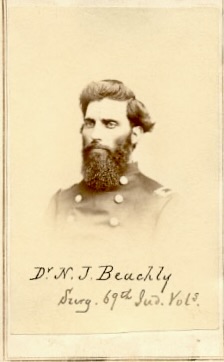
The following letters were written by Nathaniel Jacob Beachley (1831-1908), a native of Somerset county, Pennsylvania, and a graduate of the Jefferson Medical College of Philadelphia who was practicing medicine in Vernon, Jennings county, Indiana, when the Civil War began in 1861. In the first year of the war he organized Co. H, 26th Indiana Volunteers and served with that company until mustering out on 24 February 1863 to accept a commission as Assistant Surgeon of the 22nd Indiana Volunteers. In April 1864, he was commissioned Major Surgeon of the 69th Indiana Volunteers.
In his first letter, datelined from Vernon, Indiana, in late April 1861, he describes himself as an “old batch” though his biography states that he was married just three weeks later to Emily Vawter (1842-1866). After the war, Nathan moved to Bridgeport, Indiana, where he resided until 1877 at which time he relocated to Seward, Nebraska. In 1880 he moved to Lincoln, Nebraska, where he lived out his days.
Nathaniel wrote the letters to his boyhood friend, George Washington Shober (1826-1897) with whom he apparently carried on a correspondence throughout the Civil War. George was married in 1852 to Leah B. Berkley (1833-1916) in 1852. George was a farmer in Brothers Valley, Somerset county, Pennsylvania.
Letter 1
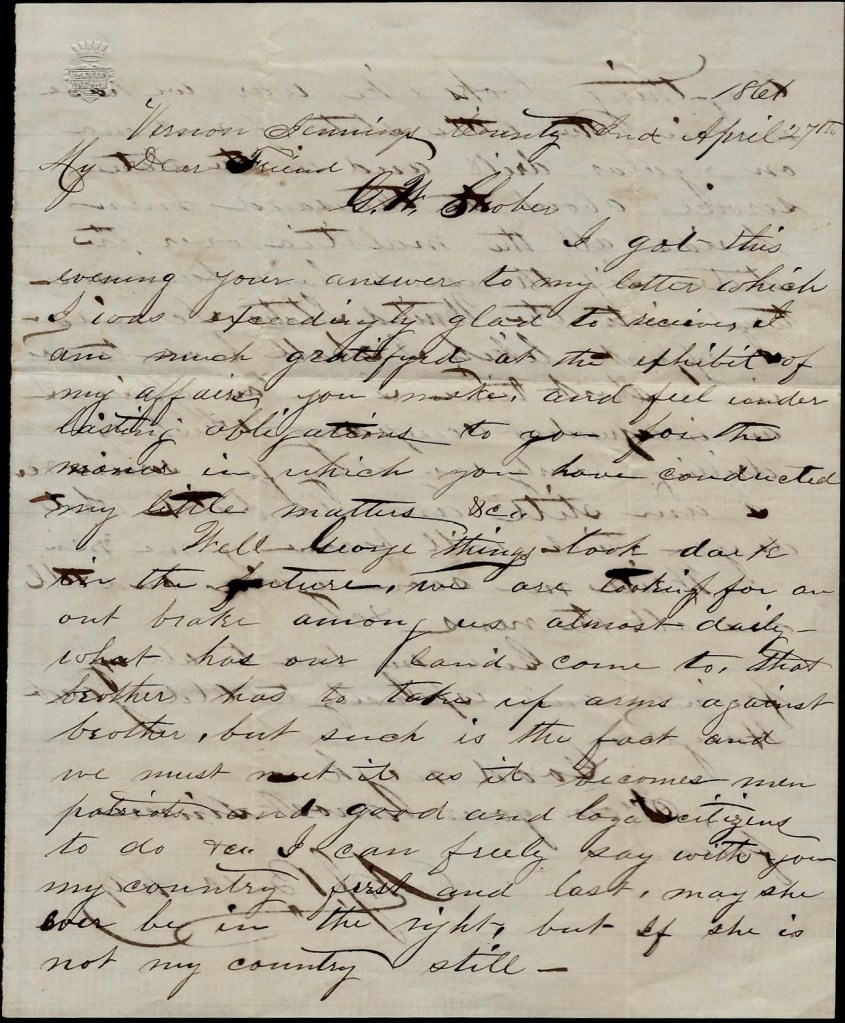
Vernon, Jennings county, Indiana April 27th 1861
I got this evening your answer to my letter which I was exceedingly glad to receive. I am much gratified at the exhibit of my affairs you make and feel under lasting obligations to you for the manner in which you have conducted my little matters, &c.
Well, George, things look dark in the future. We are looking for an outbreak among us almost daily. What has our land come to that brother has to take up arms against brother. But such is the fact and we must meet it as it becomes men patriots and good and loyal citizens to do, &c. I can freely say with you my country first and last, may she ever be in the right, but if she is not my country still—-
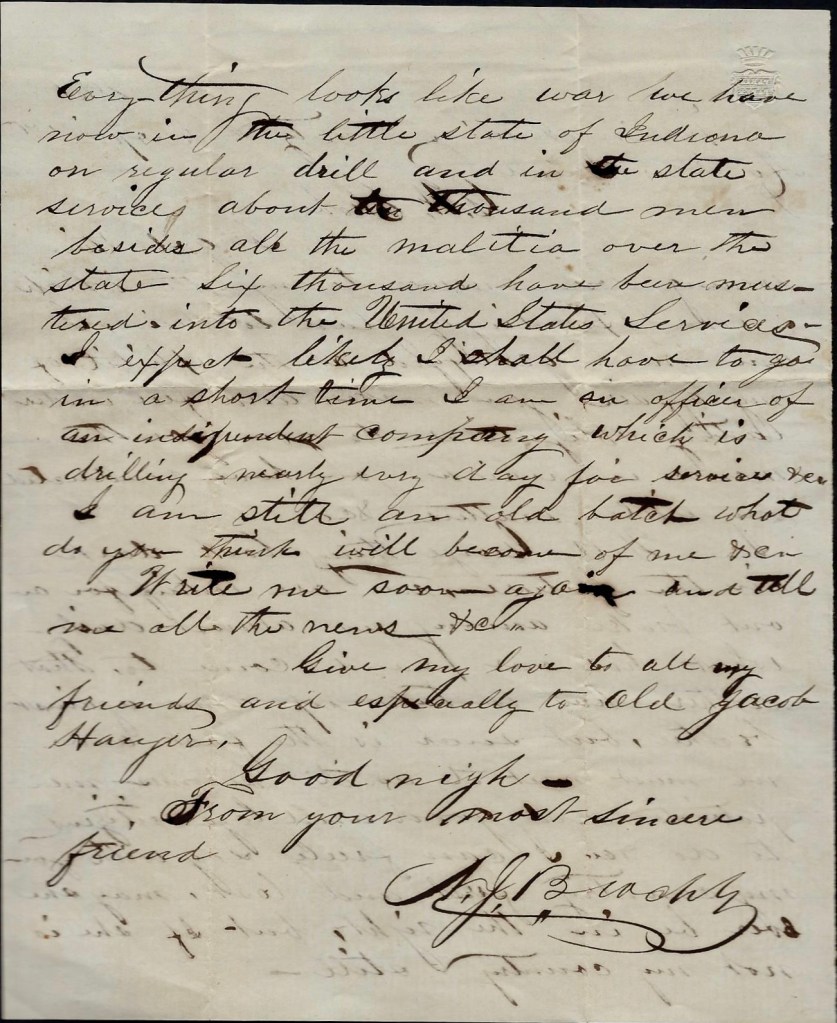
Everything looks like war. We have now in the little state of Indiana on regular drill and in the state service about ten thousand men besides all the militia over the state. Six thousand have been mustered into the United States Services. I expect likely I shall have to go in a short time. I am an officer of an independent company which is drilling nearly every day for service, &c.
I am still an old batch. What do you think will become of me, &c. Write me soon again and tell me all the news, &c. Give my love to all my friends and especially to Old Jacob Hauger. Good night. From your sincere friend, — N. J. Beachley
Letter 2
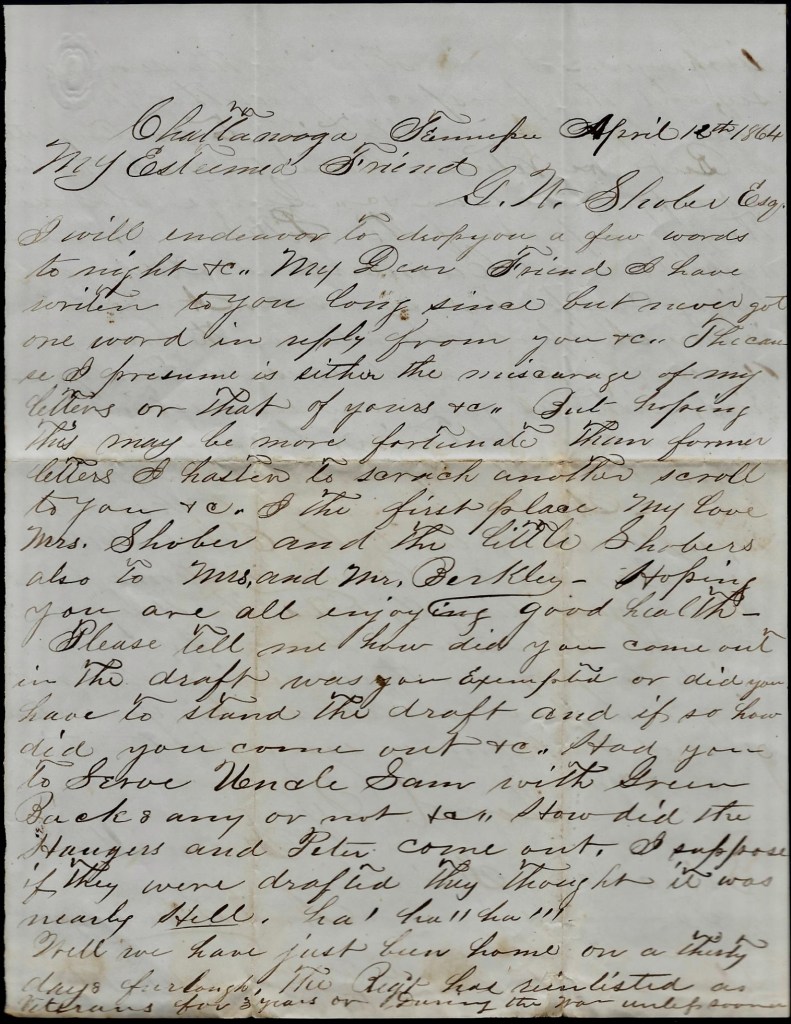
Chattanooga, Tennessee April 12th 1864
My esteemed friend, G. W. Shober, Esq.,
I will endeavor to drop you a few words tonight, &c. My dear friend, I have written to you long since but never got one word in reply from you, &c. The cause, I presume, is either the miscarriage of my letters or that of yours, &c. But hoping this may be more fortunate than former letters, I hasten to scratch another scroll to you, &c.
In the first place, my love to Mrs. Shober and the little Shobers; also to Mrs. and Mr. Berkley. Hoping you are all enjoying good health.
Please tell me how did you come out in the draft. Was you exempted or did you have to stand the draft, and if so, how did you come out, &c.? Had you to serve Uncle Sam with Greenbacks any or not, &c.? How did the Haugers and Peter come out? I suppose if they were drafted, they thought it was nearly Hell. ha! ha!! ha!!!
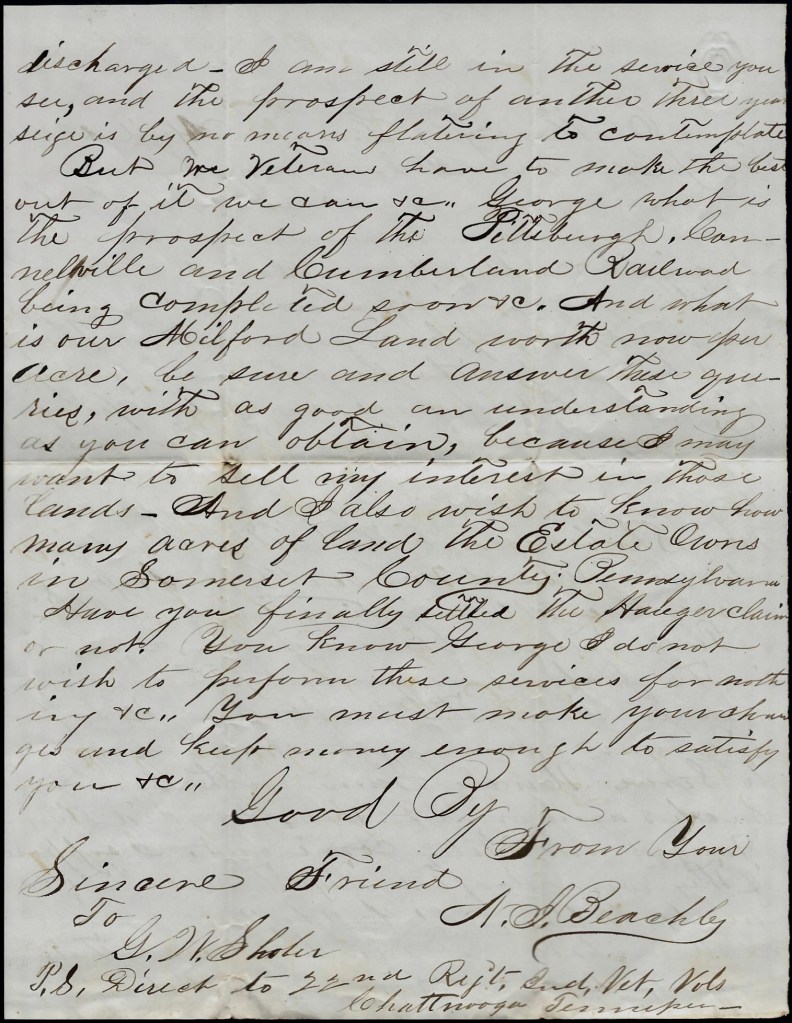
Well we have just been home on a thirty days furlough. The Regiment has reenlisted as Veterans for thre years or during the war, unless sooner discharged. I am still in the service you see, and the prospect of another three years is by no means flattering to contemplate. But we veterans have to make the best of it we can, &c.
George, what is the prospect of the Pittsburgh, Connellsville, and Cumberland Railroad being completed soon, &c. And what is our Milford Land worth now per acre? Be sure and answer these queries with as good an understanding as you can obtain because I may want to sell my interest in those lands. And I also wish to know how many acres of land the Estate owns in Somerset county, Pennsylvania.
Have you finally settled the Hauger claim or not? You know, George, I do not wish to perform these services for nothing, &c. You must make your changes and keep money enough to satisfy you, &c. Goodbye. From your sincere friend, — N. J. Beachley
To G. W. Shober
P. S. Direct to 22nd Regt., Indiana Veteran Volunteers, Chattanooga, Tennessee
The following letters were written by August Rost (1833-1864), principal musician in the 17th Alabama Infantry. August wrote the letter to his wife, Margaret Steele (1846-1934) with whom he married in January 1863. Margaret—called “Molly” in these letters—was the daughter of German immigrant Michael Steele.
August Rost (1833-1864)
Rost led a popular brass band in Mobile before the Civil War. On June 10, 1861, there is notice that he provided music for Gov. A. B. Moore’s excursion to Fort Morgan aboard the steamer Crescent. In that same month Rost’s band led the German Fusiliers (Co. G, 8th Alabama) and their escort to the train station as the company left for Virginia to participate in the Battle of Bull Run. By the end of July the band became the official garrison band at Fort Morgan at the entrance to Mobile Bay. A member of the 2nd Alabama Regiment stated that Rost’s Band “entertained the garrison after the duties of the day were over.” By mid-September, 1861, the band was back in Mobile.
Sometime in 1863, Rost’s Band became the band of the 17th Alabama Infantry and early in 1864, the regiment joined the Army of Tennessee, serving under General Cantey, and active in the Atlanta Campaign and Hood’s expedition into Tennessee. Rost, however, died on 11 November 1864.
Several years ago I transcribed six letters by August Rost and published them on Spared & Shared 10. See—1863-64: August Rost to Mary Rost.
Advertisement for the Mobile Military Brass Band, Mobile Register, 2 June 1860
Southern Republic Polka March as performed by Rost’s Military Brass Band, Mobile, Alabama
Letter 1
No. 1
Marietta, Georgia June 21st 1864
Dear Wife,
I received your kind letters on the 10th and 17th the 21st of June and was very sorry to see that [ ] was sick and [ ] again. Molly, you tell me very…kind letter. I received that tobacco bag and I can [ ] think of you whenever I do smoke…you did write for me to come home but it is not possible till after this fight, if I live to get home. But I would not go. But as soon as this fight is over I do come and stay about 10 days with you.
Dear wife, when I was eating my dinner today, Peter Von Alber came to me to tell me that he was looking for me the last month. He is well and was as glad to find me as a lost child finds his Pa. He told me he never had a happy day in ten years like today.
Darling, I have to close. My time is [ ]. Give my love to Pa, Ma, and sisters and brothers and tell Pa to write soon to me and if he wants me to write in English to let me know. Darling, take care of yourself and be happy if you can. You will see me soon if I am spared. — August Rost
Margaret (“Molly”) Rost
No. 2
Marietta, Georgia June 21st 1864
Dear Molly,
Tell me in your next letter how you are getting [on] and if that made you sick to lay in the bed of if was only unwell. Molly, you must not work much if you ain’t well, and neither work in the house. If you keep still, you soon will get over it, and if you think you are getting better, go out to that milk woman on Government Street and stay there about 9 or 10 days. That will do more good than all. Do not eat anything than milk and rice and flour bread, and let me know how you [are] getting on.
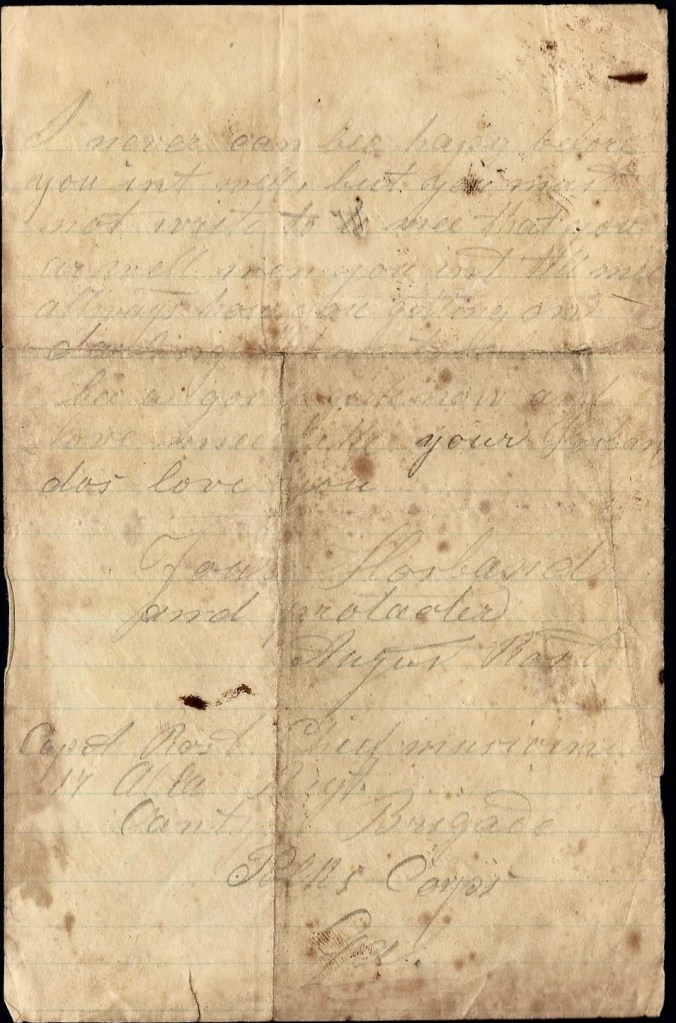
Dear wife, I am glad you get money yet. I will not get any before this fight is over. Dear Molly, try to get well till I do come home. I never can be happy before you are well, but you must not write to me that you are well when you ain’t. Tell me always how you are getting on. Darling….be a good wife now and love me like your husband does love you. Your husband and protector, — August Rost
I am still in Marietta yet and fighting is going on from day to day. We lost about 1,500 men on Thursday the 23rd 1 and I think the Yankees lost more. I think we will fall back about four miles and give the Yanks a general fight. If they do not fight us, we will have to fight them.
Dear Molly, I am well and I hope that you’re getting better. If not, let me know all about it. Darling, I think of you day and night. I never did know how dear you are to me before till now. [ ] only be one day with you. I have a lot of little things to tell you but I hope that day will come soon, and [I will] tell you all I know. And I know you have many things to tell me. …
[ ] wanted me to start a band for him and the 17th Brigade was bound to let me go of Gen. Polk says he wanted me. They sent a note to Col. [Virgil S.] Murphey that I should report to him the [ ] to let me go and he would have done so if he didn’t live me day…..
I will write more as soon as I receive a letter from you. Tell Pa to write to me and let me know [ ] and give my love to Ma and sisters and brothers. Darling, do not forget your true husband till dead. — August Rost
Capt. A. Rost, Chief Musician. 17th Ala. Regt., Cantey’s Brigade, Polk’s Corps.
1 August is probably referring to the Battle of Kolb’s Farm which took place on 22 June 1864. Polk was killed at Pine Mountain on June 14 and temporarily replaced by Major General William Wing Loring. Historian Albert E. Castel estimated that Hood’s attack cost his corps 1,500 killed, wounded, and missing, two-thirds of which were from Stevenson’s division.
Letter 3
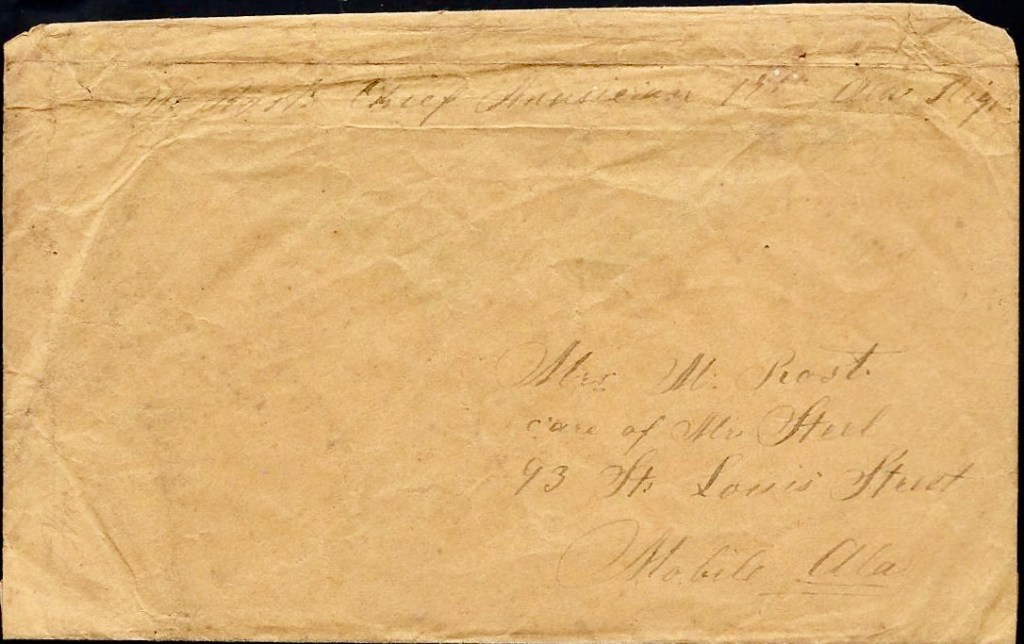
Addressed to Mrs. M. Rost, care of Mr. Steele, 93 St. Louis Street, Mobile, Alabama
Near Atlanta [Georgia] July 7, [1864]
Dear Wife,
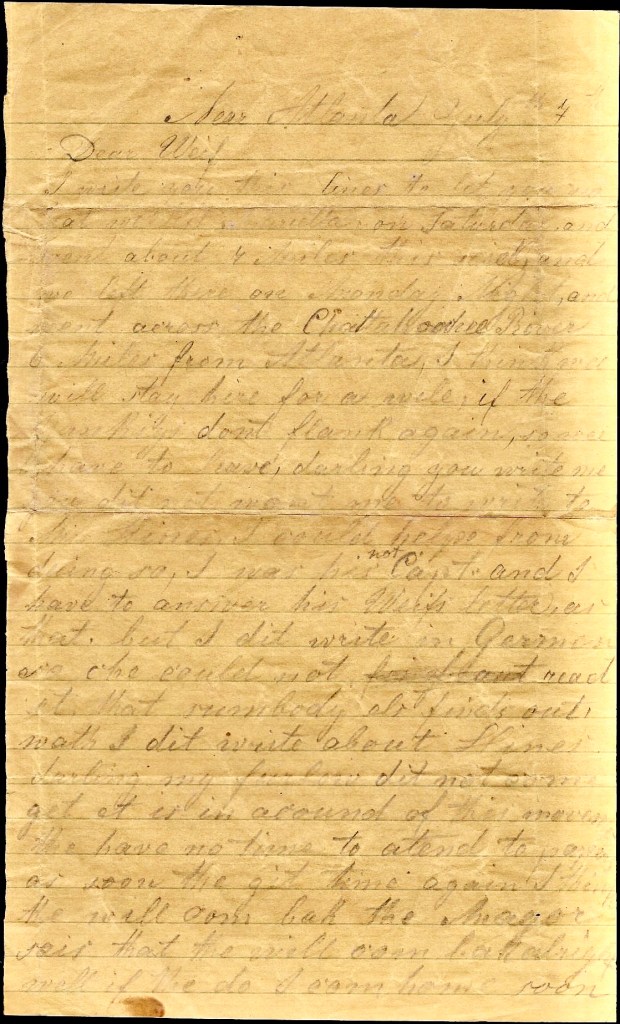
I write you this time to let you know that we left Marietta on Saturday and went back about 7 miles this [ ] and we left there on Monday night and went across the Chattahoochee River 6 miles from Atlanta. I think we will stay here for a while if the Yankees don’t flank again so we have to leave.
Darling, you write me you did not want me to write to Mrs. Hines. I could [not] help from doing so. I was his captain and I have to answer his wife’s letter at that, but I did write in German so she could not read it, that somebody else finds out what I did write about [Jacob] Hines. 1
Darling, my furlough did not come yet. It is in account of this move. We have no time to attend to papers. As soon as they get time again, I think they will come back. The Major says that they will come back alright. Well, if they do, I [will] come home soon, but I have no hope that I come before this fighting is over. I will come then or I come before I play again with my band. I give you my word.
Dear wife, I am in very good health and I hope that you are the same. And I think of you from hour to hour. Darling, you do not know how a true man does love his wife, yet he loves her better than himself. Oh, I did see 50 men at least wounded and nearly dead. All they pray for is, “Oh God, bless my dear wife.” They do not think about themselves. It does me good to see it. There is nothing in the world that is so dear to me than my little wife. Darling, goodbye. I have to close. Write soon and I hope we will meet soon again.
Your husband till dead, — August Rost, Capt. of Band, Chief Musician, 17th Alabama Infantry, Cantey’s Brigade, Polk’s Corps.
1 Jacob Hines was a musician in the band of the 17th Alabama. He was taken prisoner at Cassville, Georgia, on 20 May 1864 and sent to Louisville, Kentucky, and then forwarded to Rock Island, Illinois.
Letter 4
Atlanta, [Georgia] August 26th 1864 Cantey’s Hospital
Dear Wife,
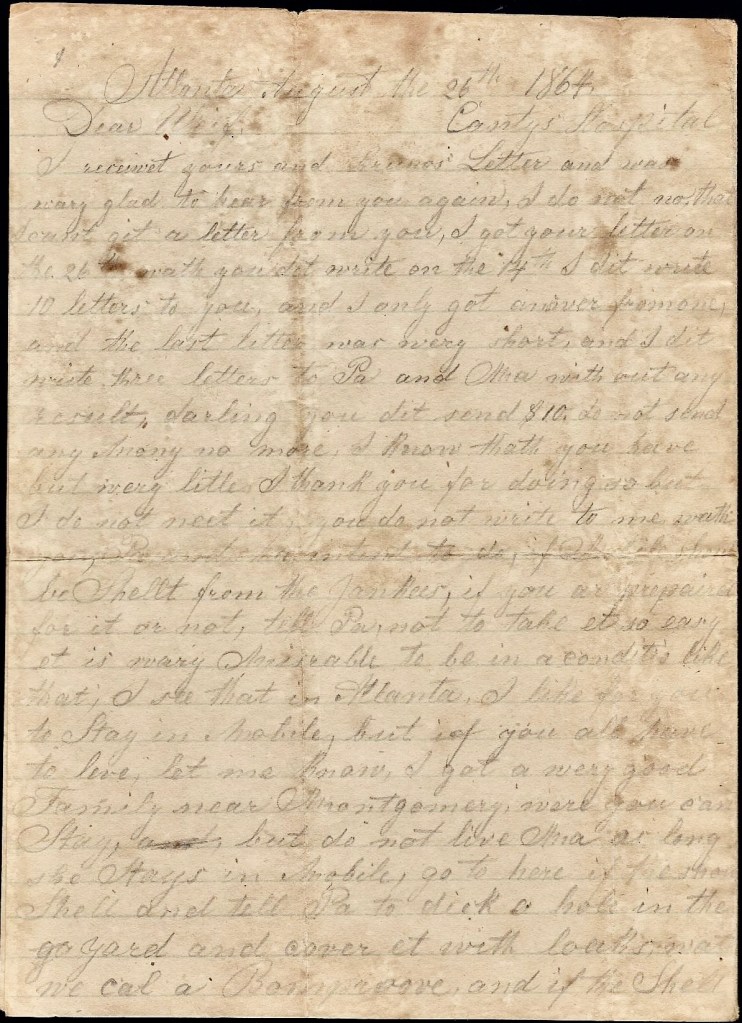
I received yours and [Edward] Bruno’s letter and was very glad to hear from you again. I do not know that I can’t get a letter from you. I got your letter on the 26th that you did write on the 14th. I did write 10 letters to you and I only got answer from one and the last letter was very short. And I did write three letters to Pa and Ma without any result. Darling, you did send $10. Do not send any money no more. I know that you have but very little. I thank you for doing so but I do not need it. You do not write to me whether your Pa wrote as he intended to do. If Mobile should be shelled from the Yankees, if you are prepared for it or not. Tell Pa not to take it so easy. It is very miserable to be in a condition like that. I see that in Atlanta. I like for you to stay in Mobile but if you all have to leave, let me know. I got a very good family near Montgomery where you can stay, but do not leave Ma as long she stay in Mobile. Go to her if they should shell and tell Pa to dig a hole in the yard and cover it with logs—what we call a bomb proof—and if the shells go in there, tell them to stay down.
Molly, tell me if you did get any money from me and if you got any, do not be without. Let me know and I [will] send you some. Darling, do not forget your true husband who thinks of you day and night and cannot help you in your present condition. If it were in my power, I would be on your side and protect you to the last but we are parted and left to ourselves so I have to call on Pa and Ma to protect you and I know they will do so until I return.
My dear wife, if Mobile should fall [illegible] come soon and take care of my darling and send me letters by Flag of Truce and I will do the same and think of the happy hours we had when met the last time. Darling, I got good times. I stay in the hospital and have nothing to do than write music and practice with my band. I went last night serenading to our Gen. [Alexander Peter] Stewart and thank for improving my band so fast and he told me to go in that way, that he would protect me, and if I want for anything to let him know.
Darling, I have to close…Give my love to Pa & Ma and to all. write soon again and tell Pa to write me. From your true husband, — August Rost
Letter 5
Cantey’s Brigade Hospital Atlanta, [Georgia] August 30th 1864
Dear Wife,
I received your kind letter sent by that young man on the 29th of August, and was very glad to hear that you are in good health and I thank God that I can tell you the same. Darling, I live in hopes we will be soon together again. This war must close soon. It is going to the end and if it don’t, I will try to finish it myself. I will try very hard to get my discharge on the 17th of September. If I get it, I will come home. It may be that we come back to Mobile as soon as this campaign is over, if the Yankees don’t take Atlanta.
Darling, Mr. Junger is coming to Mobile. I told him to come and see you and tell you all about how I get along. He told me he would go in Tuesday and I went to Atlanta on Monday to our Brigade General to get $200. A note was promised to me on Monday and when I came to Atlanta, our Brigade was moved from there and till I come home, Junger [Yunger?] was gone, and I could send no letter with money, after I walked about ten miles in the hot sun. He will tell you all about it.
Dear Molly, let me know if you did get them $200 paid. I do not pay the bill here until I hear from you. I will send you money as soon as I can get it to Mobile. It is very hard to send money at the present time from here. I did not get any pay yet from the regiment, neither from the government, but I did buy an instrument for $400 and I get $500 and I bought an old instrument for $10 and made a bugle from it today. I will sell that to the brigade for $100. As soon as I get that money together, I will send it to you and you will be alright again. I think I will get it together in about 10 days and I have got plenty left when I get paid off from the regiment, and the government. I will write to Montgomery again and if the sutler don’t pay you, I will write to Col. Murphey and be will tend to it. Dear Molly, you shall not suffer as long as I live and if I have to work day and night, it is all the pleasure I have got to work for you.
Darling, leave [Edward] Bruno’s trunk at Miss Fuceliting till I come home again. I don’t want you to have anything to do with it. I got clothes enough till I get clothes from the government. Molly, do not think hard of Pa because he is cross. He has a good deal of trouble, I believe, at the present time. He is a good old fellow. Let him have his way, darling.
I have to close. Write soon again and think you have a true husband far from you but he never will forget you. It never does pass an hour that he don’t think of you, I believe. — I remain your true husband, — August Rost
Molly, do not write no more with a pencil. That letter I got from you was most out. Your true Augusta
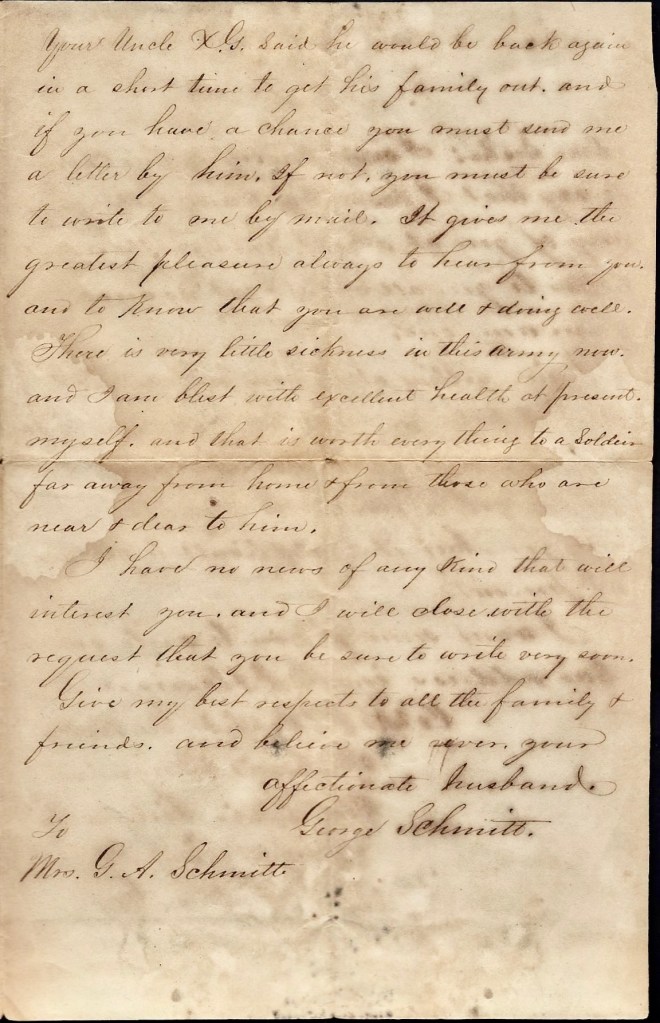
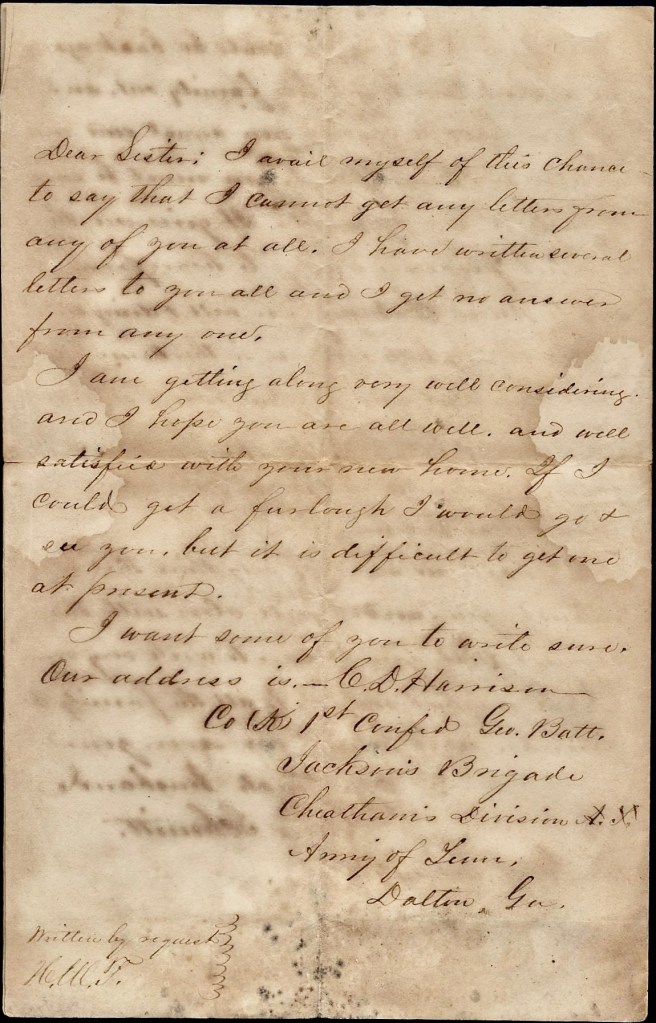
This letter was actually penned by Sergt. H. W. Thompson of Co. K, 1st Confederate Regiment Georgia Volunteers. Sgt. Thompson was later killed in action on 20 July at the Battle of Peach Tree Creek. Ga. He wrote it at the request of his mess mate, George Schmitt, who was apparently illiterate.
The letter was penned from Dalton, Georgia, where the Army of Tennessee wintered in early 1864. The names of many comrades who deserted during the winter were recorded in the letter.
Transcription
Dalton, Georgia January 18, 1864
Dear Wife,
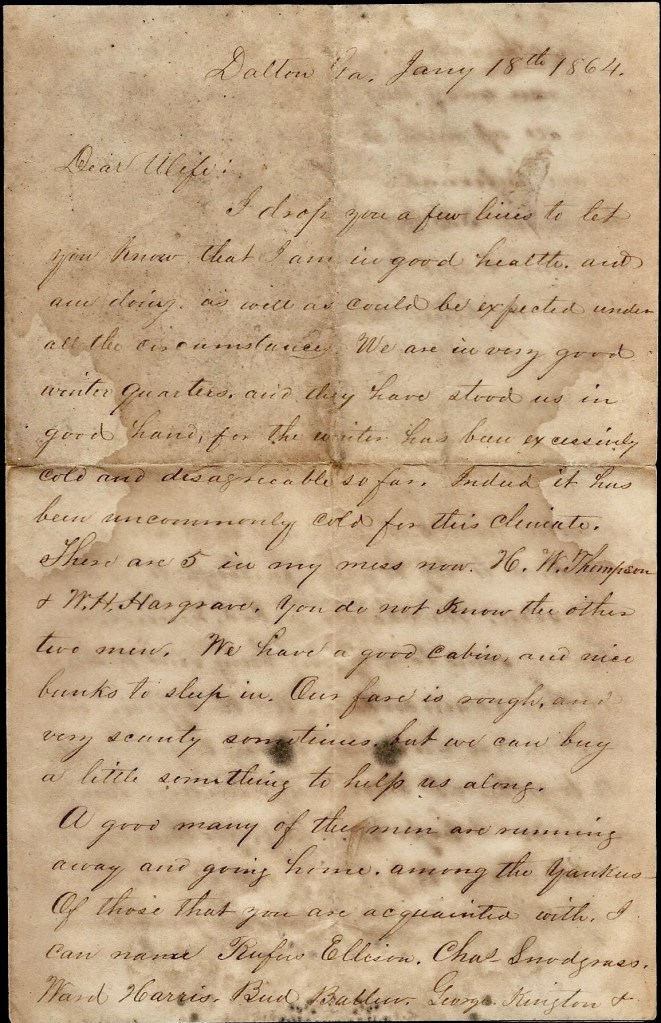
I drop you a few lines to let you know that I am in good health and am doing as well as could be expected under all the circumstances. We are in very good winter quarters and they have stood us in good hand, for the winter has been excessively cold and disagreeable so far. Indeed, it has been uncommonly cold for this climate.
There are five in our mess now. H. W. Thompson & W[illiam] H. Hargrave. You do not know the other two men. We have a good cabin and nice bunks to sleep in. Our fare is rough and very scanty sometimes but we can buy a little something to help us along.
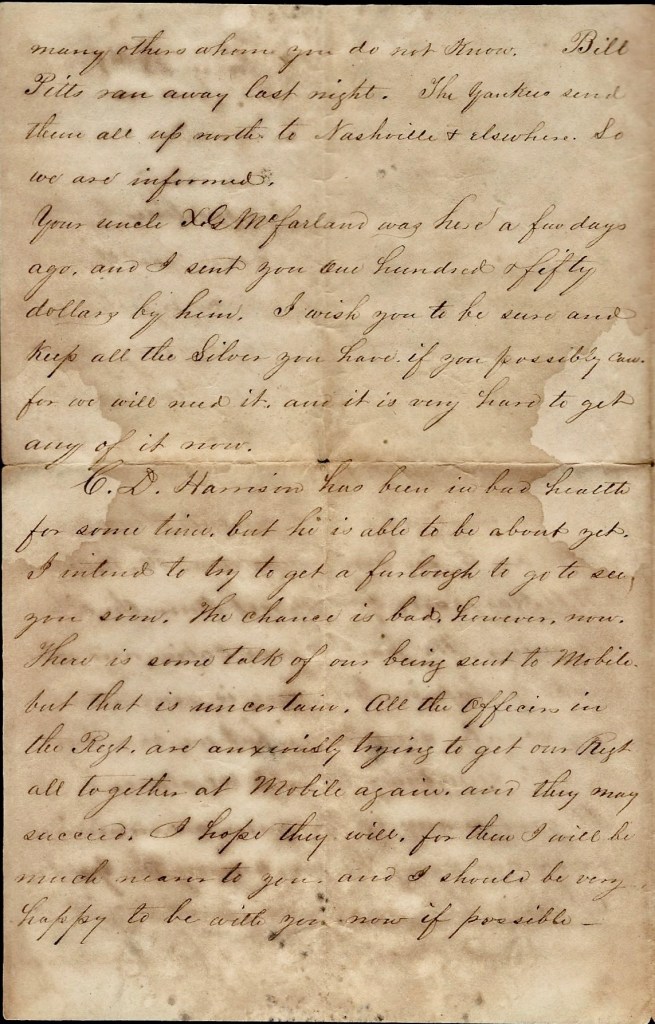
A good many of the men are running away and going home among the Yankees. Of those that you are acquainted with I can name Rufus Ellison, Charles Snodgrass, Ward Harris, Bud Ballew, George Kingston, & many others whom you do not know. Bill Pitts ran away last night. The Yankees send them all up north to Nashville & elsewhere. So we are informed. 1
Your uncle X. G. McFarland was here a few days ago and I sent you one hundred and fifty dollars by him. I wish you to be sure and keep all the silver you have if you possibly can for we will need it and it is very hard to get any of it now.
C[olumbus] D. Harrison has been in bad health for some time but he is able to be about yet. I intend to try to get a furlough to go to see you soon. The chance is bad, however, now. There is some talk of our being sent to Mobile but that is uncertain. All the officers in the regiment are anxiously trying to get our regiment all together at Mobile again and they may succeed. I hope they will for then I will be much nearer to you and I should be very happy to be with you now if possible.
Your uncle X. G. said he would be back again in a short time to get his family out and if you have a chance, you must send me a letter by him. If not, you must be sure to write to me by mail. It gives me the greatest pleasure always to hear from you and to know that you are well & doing well. There is very little sickness in this Army now and I am blest with excellent health at present myself, and that is worth everything to a soldier far away from home & from those who are near & dear to him.
I have no news of any kind that will interest you and I will close with the request that you be sure to write very soon. Give my best respects to all the family and friends, and believe me ever your affectionate husband, — George Schmitt
To Mrs. G. A. Schmitt
Dear Sister, I avail myself of this chance to say that I cannot get any letters from any of you at all. I have written several letters to you and I get no answer from any one. I am getting along very ell considering and I hope you are all well and well satisfied with your new home. If I could het a furlough I would go & see you but it is difficult to get one at present. I want some of you to write sure. Our address is C. D. Harrison, Co. K, 1st Confederate Georgia Battalion, Jackson’s Brigade, Cheatham’s Division, Army of Tennessee, Dalton, Ga.
Written by request, H. W. T. [H. W. Thompson]
1 It appears that most if not all of these soldiers were eventually sent to Louisville, Kentucky, where they were administered the Oath of Allegiance and pledged to stay north of the Ohio River for the remainder of the war.
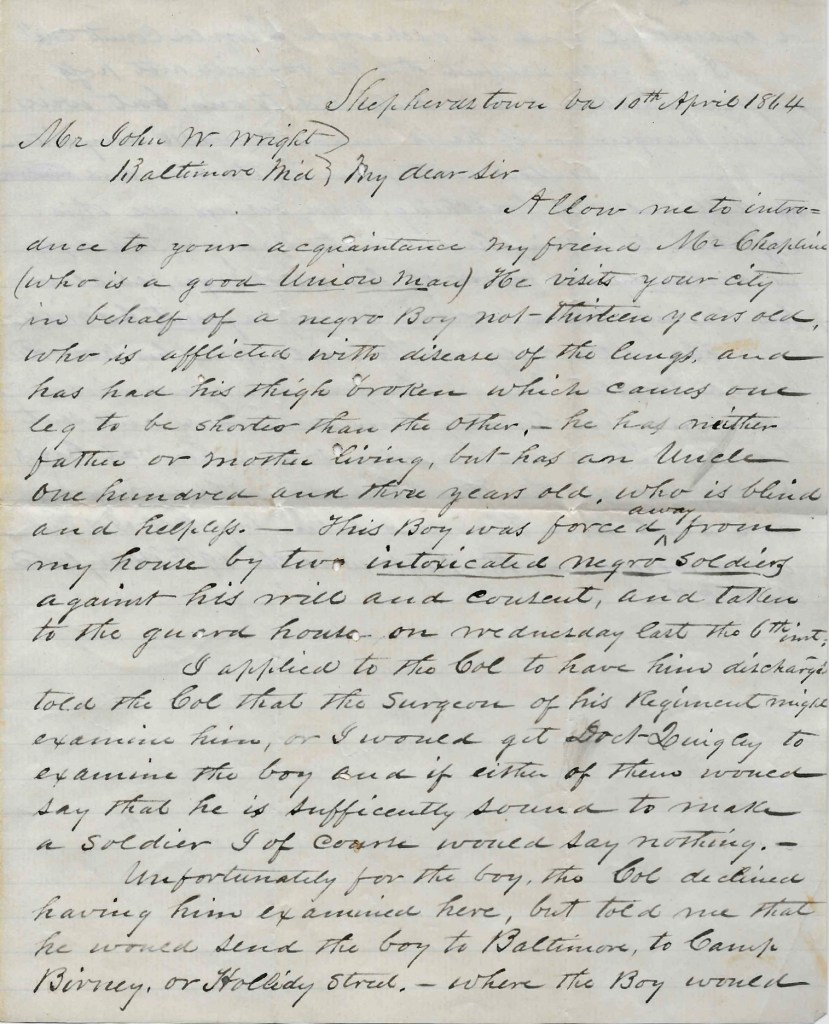
The following letter was most likely the draft or copy of a letter sent to a gentleman residing in Baltimore, Maryland, asking for his assistance in finding and returning a young Negro boy, “not thirteen years old” who was taken against his will to serve in one of the USCT regiments being organized at Camp Birney in Baltimore. The author of the letter never identifies himself (the letter is unsigned), nor does he even given the name of the Negro boy who was in all probability his slave. The only names given in the letter are “Mr. Chapline” of Shephardstown—the author’s agent sent to Baltimore to recover the boy—and Col. Joseph Perkins of the 19th USCT, whose “intoxicated negro soldiers….forced away” the boy. The author’s version of the boy’s abduction and of his physical disabilities seems to stretch credulity.
In July 1863, Druid Hill in Baltimore became known as Camp Birney, after Secretary of War Edwin M. Stanton assigned Gen. William Birney, son of an abolitionist, to recruit African Americans for U.S. Colored Troops (USCT) regiments. Birney freed 16 shackled slaves from a Pratt Street slave pen when they promised to enlist. He also organized the 7th USCT here, as well as the 4th and 39th USCTs in 1864.
The following letter is from the private collection of Greg Herr and was transcribed and published on Spared & Shared by express consent.
Transcription
Shephardstown, [West] Va. 10th April 1864
Mr. John W. Wright, Baltimore, Maryland
My dear sir, allow me to introduce to your acquaintance my friend Mr. Chapline (who is a good Union man). He visits your city in behalf of a negro Boy not thirteen years old who is afflicted with disease of the lungs, and has had his thigh broken which causes one leg to be shorter than the other. He has neither father or mother living, but has an Uncle one hundred and three years old who is blind and helpless. This Boy was forced away from my house by two intoxicated negro soldiers against his will and consent, and taken to the guard house on Wednesday last the 6th inst.
I applied to the Colonel to have him discharged, told the Colonel that the Surgeon of his regiment might examine him, or I would get the Doct. [John] Quigley 1 to examine the boy and if either of them would say that he is sufficiently sound to make I soldier, I of course would say nothing. Unfortunately for the boy, the Colonel declined having him examined here, but told me that he would send the boy to Baltimore to Camp Birney, or Holliday Street, where the Boy would be examined and if discharged—“would count one.”
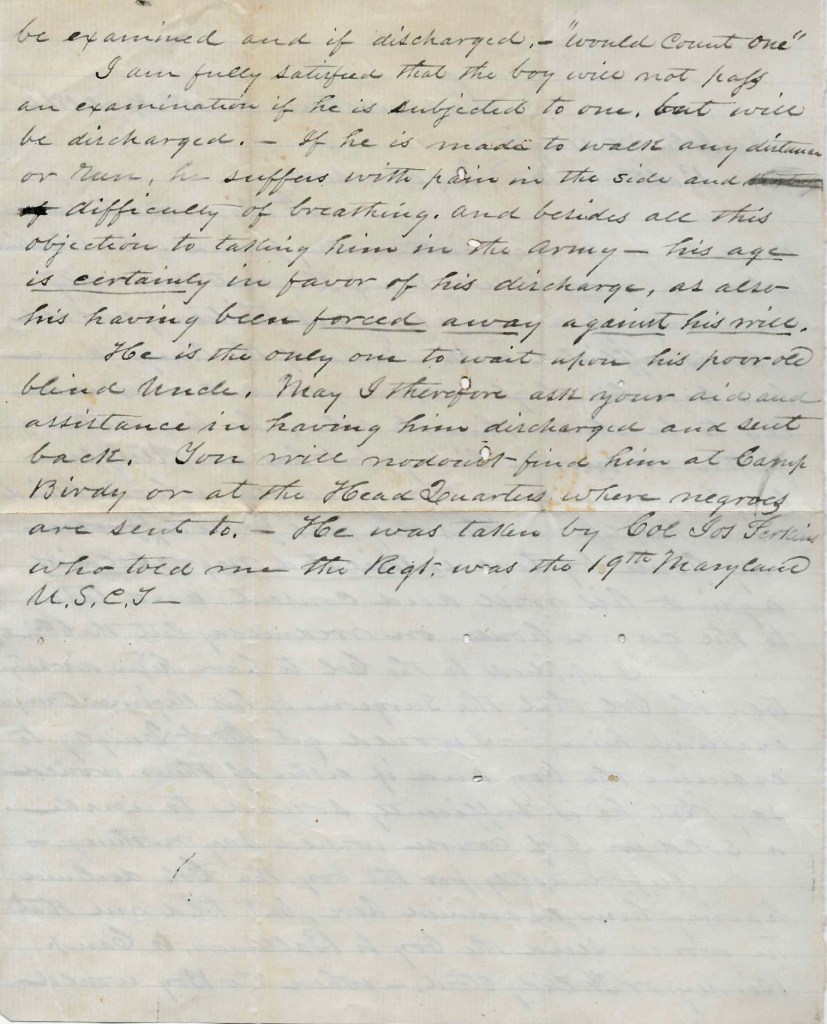
I am fully satisfied that the boy will not pass an examination if he is subjected to one, but will be discharged. If he is made to walk any distance or run, he suffers with pain in the side and difficulty of breathing. And besides all this objection to taking him in the army—his age is certainly in favor of his discharge, as also have been forced away against his will.
He is the only one to wait upon his poor old blind Uncle. May I therefore ask your aid and assistance in having him discharged and sent back? You will no doubt find him at Camp Birney or at the Headquarters where negroes are sent to. He was taken by Col. Jos. Perkins who told me the Regiment was the 19th Maryland U. S. C. T.
1 “John Quigley was a doctor in Shepherdstown in the 19th Century. He was born in 1802 in Shippinsburg, Pennsylvania and graduated from the University of Pennsylvania Medical School in 1823. He married Mary Swearingen of Shepherdstown in 1827 and practiced medicine here until his death in 1883. During the aftermath of the battle of Antietam, he and Mary took 34 wounded confederate soldiers into their home on German Street, and their children helped care for them.” [Source: Historic Shepherdstown & Museum]
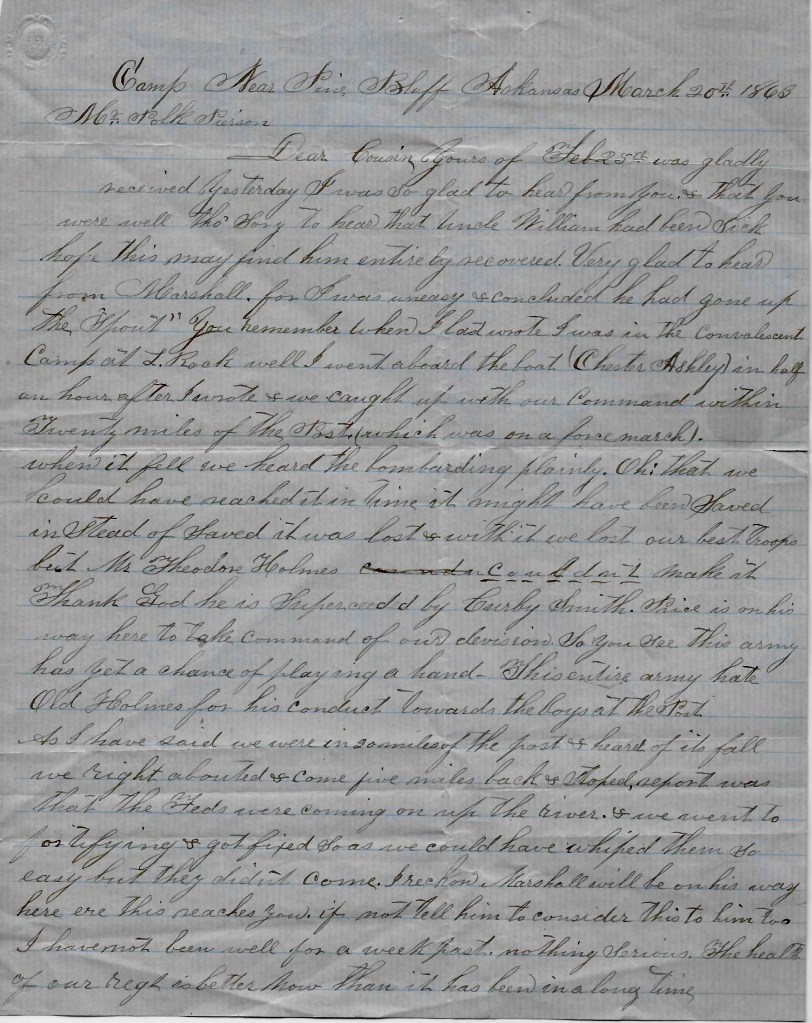
The following letter was written by a Confederate soldier named “Don” or Dan” who I believe served in the 12th (usually called the Eighth) Texas Infantry. He wrote the letter to his cousin, J. Polk Pierson (b. 1846), the son of William Howell Pierson (1816-1869) and Malinda Sharp (1820-1894) of New Salem, Rusk county, Texas. Polk’s brother, Marshall Samuel Pierson (1838-1909) served in Co. C, 17th Texas Cavalry (Moore’s). The 17th Texas Cavalry was dismounted and consolidated with other Texas regiments at the Battle of Arkansas Post (Fort Hindman) in mid-January 1863 where many of them were taken prisoner. Marshall Pierson escaped, however, and made his way back to Confederate lines.
The letter describes the last minute attempt to reinforce Arkansas Post before it was attacked by Union forces under the command of John McClernand. Trans-Mississippi Confederate Commander Theophilus Holmes was blamed for inadequately supplying troops to defend the Post though it was a virtually indefensible position to begin with.
Transcription
Camp near Pine Bluff, Arkansas March 20th 1863
Mr. Polk Pierson,
Dear cousin, yours of February 25th was gladly received yesterday. I was so glad to hear from you & that you were well though sorry to hear that Uncle William had been sick. Hope this may find him entirely recovered. Very glad to hear from Marshall for I was uneasy & concluded he had gone up the “spout.”
You remember when I last wrote I was in the convalescent camp at Little Rock. Well, I went aboard the boat (Chester Ashley) in half an hour after I wrote & we caught up with our command within twenty-five miles of the Post (which was on a force march). When it fell, we heard the bombarding plainly. Oh! that we could have reached it in time. It might have been saved. Instead of saved, it was lost and with it we lost our best troops. But Mr. Theodore [Theophilus] Holmes couldn’t make it. Thank God he is superseded by Kirby Smith. Price is on his way here to take command of our division. So you see this army has yet a chance of playing a hand. This entire army hate Old Holmes for his conduct towards the boys at the Post. As I have said, we were [with]in twenty miles of the post & heard of its fall. We right abouted & come five miles back and stopped. Report was that the Feds were coming on up the river & we went to fortifying & got fixed so as we could have whipped them so easy but they didn’t come. I reckon Marshall will be on his way here ere this reaches you. If not, tell him to consider this to him too.
I have not been well for a week past. Nothing serious. The health of our regiment is better now that it has been in a long time. We have nothing new. We have many rumors, none of which are worth relating.
We received the sad intelligence of Ellen’s death the first of this month. In her death we lost an affectionate sister which loss is irreparable. But “Our loss is her eternal gain.” We received letters from home yesterday. All well and getting along as usual.
Last Friday two men were executed by musketry for desertion. We were all marched down & witnessed it. It was a solemn scene. I was about twenty steps from them. They took it calmly—never shed a tear. The old priest was with them & he had humbugged the poor fellows till they thought he would take them right to Heaven. Another one is to be shot tomorrow & seven next Friday the 27th—all for desertion. They are all Dutch & Irish belonging to the artillery companies. We will all go.
Ras 1 in very good health. Col. [Overton] Young is superseded by Brig. General [James Morrison] Hawes (who formerly commanded the cavalry). It causes some dissatisfaction in the brigade. We are living some better than we used to. We get one-third of a pound of pork to the man per day. Same old corn bread. I never wanted to see a biscuit as bad in life. Farmers are planting corn. This is a good corn & cotton country but children here 15 years old who never saw a biscuit. If I had a bushel of biscuits, I could toll this entire army off.
As for peace, I don’t see much chance yet. It is rumored here that Abe has called for 600,000 more troops. Don’t believe it, Polk. I have a slight fever which makes me nervous as you see & I will close this uninteresting letter. My warmest love to all. Ras send love to all. I shall anxiously look for Marshall. Write soon to me, my dear cousin, & I will do the same.
I am, my dear cousin, yours as ever, — Don [Dan?]
P. S. A fire broke out in Pine Bluff a night or two ago and burned several houses. Polk, I have no postage stamps & I will send this without this time, but in the future I will pay on my letters. I have sent to Little Rock for five dollars worth of stamps that will be here tomorrow or next day. Adieu.
1 Believed to be Erastus Smith, Captain of Co. C, 12th Texas Infantry.
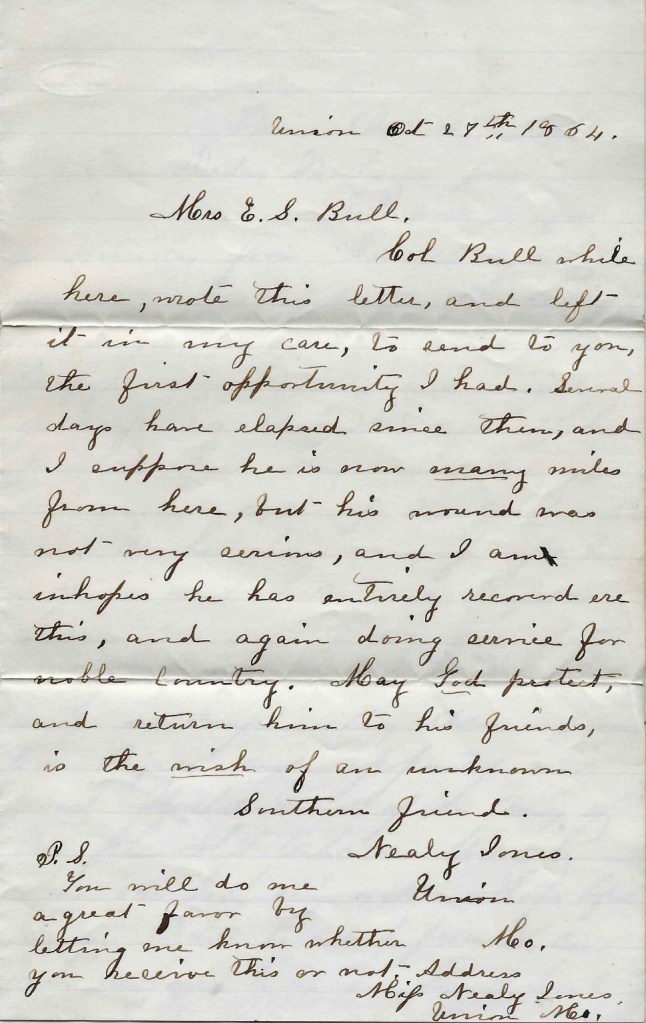
This letter was written by Lt. Colonel John Payne Bull (1840-1911), the son of John Cardwell Bull (1812-1898) and Eliza Sprigg Payne (1819-1905) of Carondelet, St. Louis, Missouri. John began his service in the Confederate Army as Major of the 8th Arkansas Cavalry. He was later promoted to Lt. Colonel of Cabell’s Brigade.
In this letter, John’s appointment by Gen. Price as the Provost Marshal of the army preparing to invade Missouri in the fall of 1864 is announced. The following excerpt of Price’s 1864 Missouri Raid describes Bull’s role:
“Price remained in the vicinity of Pilot Knob until September 29. Having abandoned hope of capturing St. Louis, he headed for the Missouri capital. Jeffer- son City, where he hoped to achieve his political goals. During the first week In October, the Army of Missouri wound its way leisurely across the central part of the state. Rampaging far and wide, they captured countless small and Isolated militia garrisons, “liberated” dozens of towns, tore up track and burned bridges of the Pacific Railroad, and “exchanged” worn out horses for fresh ones.
They also looted. Price had issued strict orders against looting before the army left Pocahontas, but the practice began In the vicinity of Pilot Knob, where Price appointed Lt. Col. John P. Bull as Provost Marshal of the Army, Bull organized a 50-man provost guard for each brigade to prevent straggling and plundering, but lawlessness continued. The army’s wide dispersion. with its main column stretched out for five or six miles, made it difficult for the guards to maintain control.
Slow movement of the cumbersome wagon train gave the soldiers ample time to roam about and forage. The train, which originally consisted of about 300 wagons, soon grew to over 500 wagons, many of which were being used to carry the “fruits” of the expedition. Accompanying the train were many stragglers, described by one observer as “a rabble of deadheads.” The incompetence and indifference of many of the line officers, and the fact that much of the army consisted of unwilling conscripts, added to the slow rate of march and lack of discipline. As time went on, the more seasoned veterans began to fear that “the odious train would occasion disaster to the army.”
[Note: This letter is from the private collection of Greg Herr and was transcribed and published on Spared & Shared by express consent.]
Transcription
Union, [Missouri] October 2, 1864
My own darling mother,
I wrote to you on yesterday from Franklin and hope you received my letter. I was slightly wounded in the knee on yesterday in the fight at Franklin and several good friends in this vicinity have promised me they would see you and assure you of the exact nature of it. It has been very painful but is now much better and I hope in a very few days I will again be able for duty. Gen. Price this morning issued a complimentary order with regard to our Brigade and appointed me Provost Marshal General of the Army of Missouri. When I left Arkansas, Willie & Nobia was both very well. I hope before many days I will be able to press my dear mother once more to my arms. Farewell. Love to all. Your affectionate son, — Johnie
[On opposite side in a different hand]
Union October 27, 1864
Mrs. E. S. Bull,
Col. Bull while here, wrote this letter and left it in my care to send to you the first opportunity I had. Several days have elapsed since then and I suppose he is now many miles from here, but his wound was not very serious and I am in hopes he has entirely recovered ere this and again doing service for noble country. May God protect and return him to his friends is the wish of an unknown Southern friend, — Nealy Jones, Union, Mo.
P. S. You will do me a great favor by letting me know whether you receive this or not. Address Miss Nealy Jones, Union, Mo.

















 Spared & Shared 23