All posts by Griff

My passion is studying American history leading up to & including the Civil War. I particularly enjoy reading, transcribing & researching primary sources such as letters and diaries.

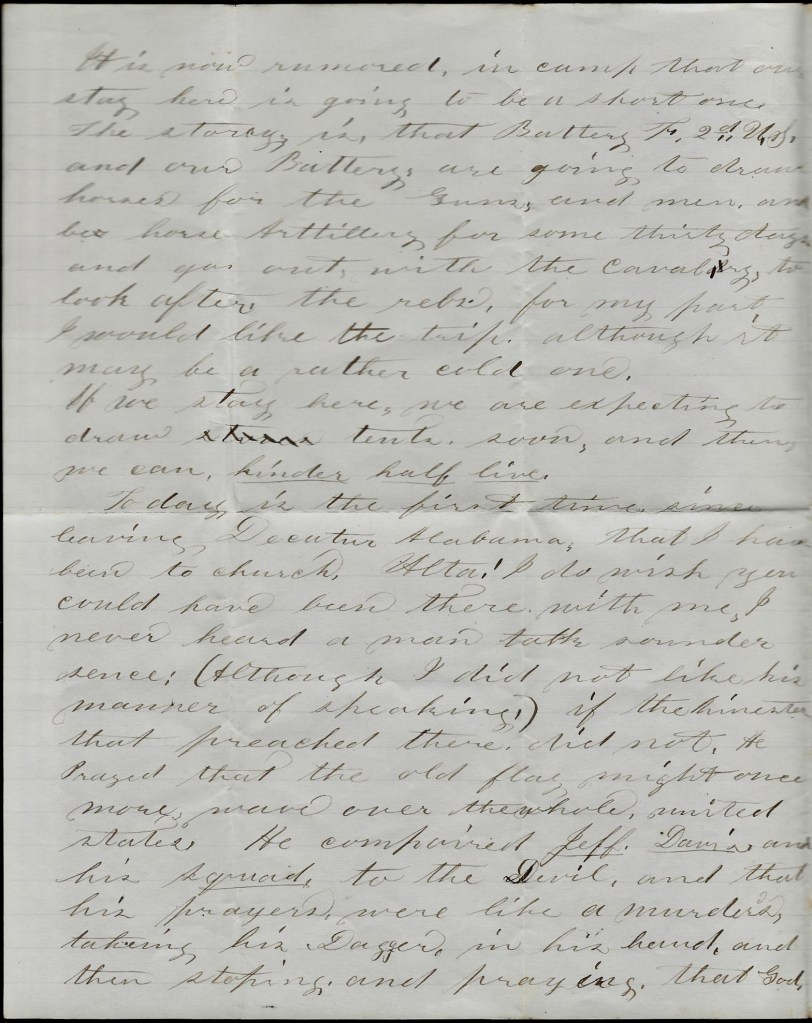
1862-64: Helen Louise Gilson to Mary Ann (Gilson) Holmes

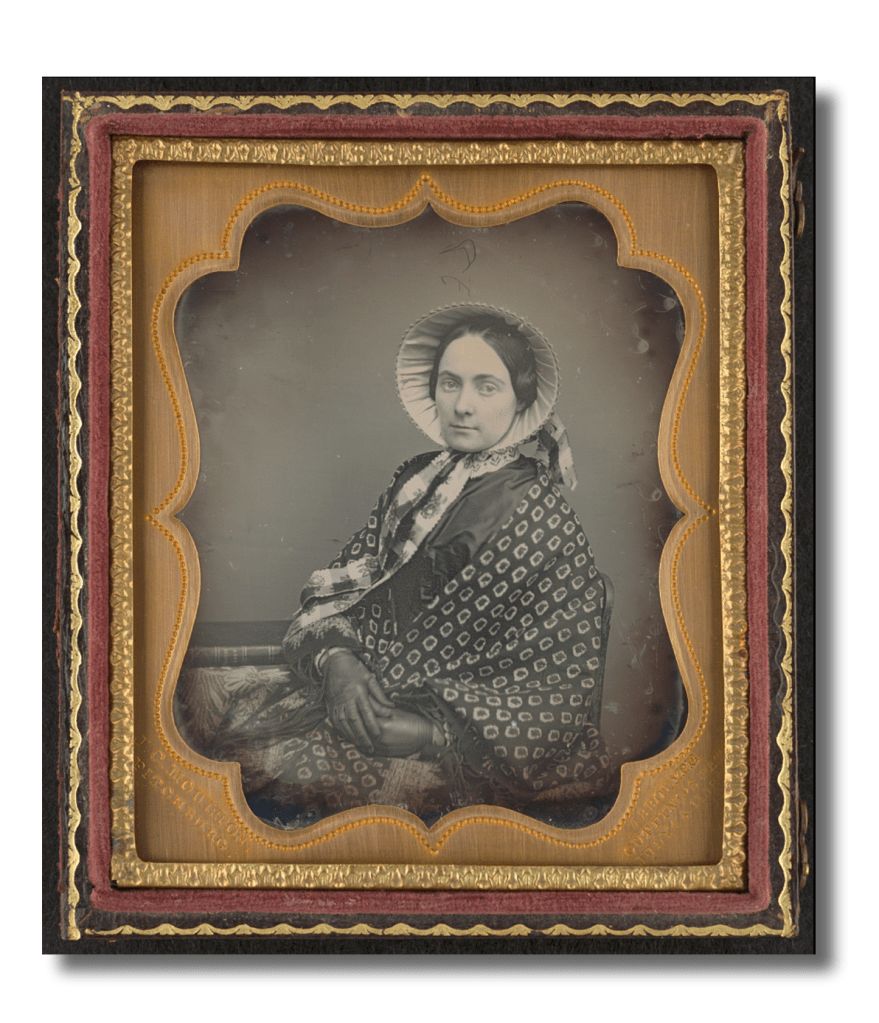
Helen Louise Gilson, Library of Congress

The following remarkable letters were written by Helen Louise Gilson, a native of Boston, but raised in Chelsea, Massachusetts. Her parents, Asa Gilson (1772-1835) and Lydia Cutter (1775-1838) died when Helen was but a little girl. She was the niece of the Honorable Frank Brigham Fay, former Mayor of Chelsea, and she was his ward. Helen wrote all of these letters to her older sister, Mary Ann (Gilson) Holmes (1824-1906), the wife of Galen Holmes, Jr. (1813-1892) of Boston. Their children were Helen (“Nellie”),b. 1850; Carrie, b. 1853; Galen Franklin (“Frank”), b. 1856; and Marian, b. 1859.

Mr. Fay took an active interest in the Union cause during the Civil War, devoting his time, his wealth and his personal efforts to the welfare of the soldiers. Beginning in the autumn of 1861, Gilson’s uncle Frank Fay went in person to every battle in which the Army of the Potomac fought. He went promptly to the battlefield and moved gently among the dead and wounded, soothing those who were parched with fever, crazed with thirst, or lying neglected in the last agonies of death.
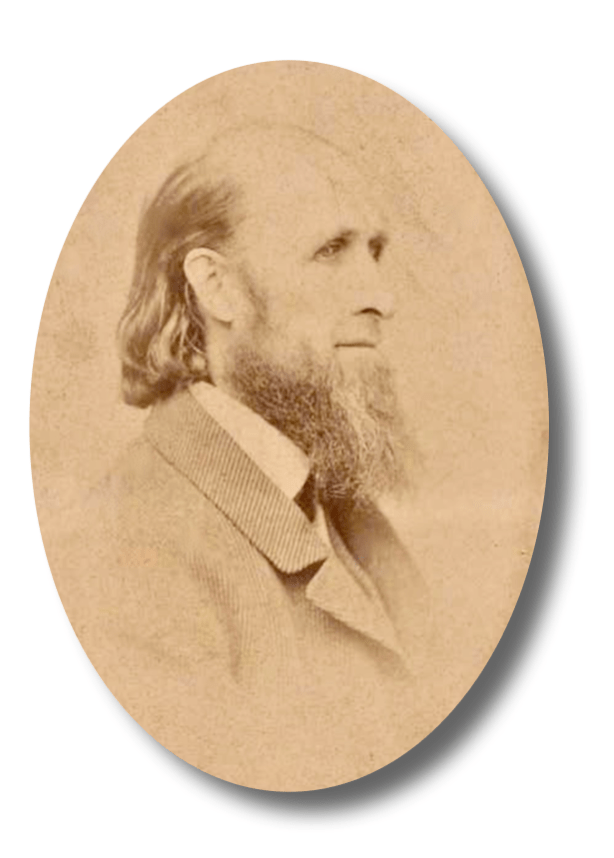
Frank Brigham Fay of Chelsea, Mass.

Helen Gilson was greatly influenced by her uncle’s selfless work and wanted to assist him. She applied to Dorothea Dix, the Superintendent of Female Nurses. She was rejected because she was too young, but that did not prevent her from fulfilling her desire to minister to the sick and wounded. Gilson was allowed to work directly with her uncle and his assistants. They had their own tent, formed a tight-knit group, and even created something of a home life. She was present at almost every great battle of the Army of the Potomac, except the first Battle of Bull Run.

In the summer of 1862, Gilson was for some time attached to the Hospital Transport Service, and was on board the ship Knickerbocker at White House and at Harrison’s Landing, Virginia, during the severe battles of McClellan’s movement from the Chickahominy to the James River, called the Peninsula Campaign.

When not more actively employed, she sat by the bedsides of the suffering men. She sang for them and knelt beside their beds amid all the agonizing sights and sounds of the hospital wards. She exerted a remarkable influence over the wounded soldiers. The United States Sanitary Commission had been established in 1861 to care for sick and wounded soldiers, but they had no field agents, and did not attempt to care for the wounded until they were brought to the field hospitals.

In 1863, Mr. Fay took to the Sanitary Commission his plans for an Auxiliary Relief Corps, which would give personal relief to the wounded soldier in the field, and to help him bear his suffering until he could be seen by a surgeon or be transferred to a hospital. For less serious wounds, the Corps would furnish the necessary dressings and attention. The Sanitary Commission adopted these plans, and made Mr. Fay chief of the Auxiliary Relief Corps. He served in that capacity until December 1864, when he resigned, but he continued his independent work until the war ended. Helen Gilson collected supplies and arranged for the transportation of wounded soldiers. She obtained a contract from the government to make army clothing, and kept soldiers’ wives and daughters busy raising money so she could attract more workers by paying a better wage than other contractors.

Gilson always shrank from publicity in regard to her work, but thousands witnessed her ability to evoke order out of chaos, and providing for thousands of sick and wounded men where most people would have been completely overwhelmed. From the reports of the Sanitary Commission, the following passage refers to her:

Upon Miss Gilson’s services, we scarcely dare trust ourselves to comment. Upon her experience we relied for counsel, and it was chiefly due to her advice and efforts that the work in our hospital went on so successfully. Always quiet, self-possessed and prompt in the discharge of duty, she accomplished more than anyone else could for the relief of the wounded, besides being a constant example and embodiment of earnestness for all. Her ministrations were always grateful to the wounded men, who devotedly loved her for her self-sacrificing spirit. Said one of the Fifth New Jersey in our hearing, “There isn’t a man in our regiment who wouldn’t lay down his life for Miss Gilson.”

But Gilson’s crowning work was performed during the last series of battles in the war, the Overland Campaign. Fought entirely in Virginia, from the Battle of the Wilderness to Spotsylvania Court House to Cold Harbor to Petersburg to Appomattox, this campaign was marked by almost a year of constant fighting, and ended the most destructive war of modern times. Gilson took the field with Mr. Fay at the beginning of the campaign, and was tireless in her efforts to relieve the suffering caused by those horrible battles in May of 1864, in which the dead and wounded were numbered by scores of thousands.

Not until the battles of June 15 through June 18 of 1864 had there been any considerable number of the colored troops among the wounded of Army of the Potomac. In those engagements and the actions immediately around Petersburg, they suffered terribly. The wounded were brought rapidly to City Point, where a temporary hospital had been provided.

Helen Louise Gilson, Library of Congress

“It was, in no other sense a hospital, than that it was a depot for wounded men. There were defective management and chaotic confusion. The men were neglected, the hospital organization was imperfect, and the mortality was in consequence frightfully large. Their condition was horrible. The severity of the campaign in a malarious country had prostrated many with fevers, and typhoid, in its most malignant forms, was raging with increasing fatality.

These stories of suffering reached Miss Gilson at a moment when the previous labors of the campaign had nearly exhausted her strength; but her duty seemed plain. There were no volunteers for the emergency, and she prepared to go. Her friends declared that she could not survive it; but replying that she could not die in a cause more sacred, she started out alone.

A hospital was to be created, and this required all the tact, finesse and diplomacy of which a woman is capable. Official prejudice and professional pride was to be met and overcome. A new policy was to be introduced, and it was to be done without seeming to interfere. Her doctrine and practice always were instant, silent, and cheerful obedience to medical and disciplinary orders, without any qualification whatever; and by this she overcame the natural sensitiveness of the medical authorities.

A hospital kitchen was to be organized upon her method of special diet; nurses were to learn her way, and be educated to their duties; while cleanliness, order, system, were to be enforced in the daily routine. Moving quietly on with her work of renovation, she took the responsibility of all changes that became necessary; and such harmony prevailed in the camp that her policy was vindicated as time rolled on.

The rate of mortality was lessened, and the hospital was soon considered the best in the department. This was accomplished by a tact and energy which sought no praise, but modestly veiled themselves behind the orders of officials. The management of her kitchen was like the ticking of a clock—regular discipline, gentle firmness, and sweet temper always. The diet for the men was changed three times a day; and it was her aim to cater as far as possible to the appetites of individual men.

Her daily rounds in the wards brought her into personal intercourse with every patient, and she knew his special need. At one time, when nine hundred men were supplied from her kitchen (with seven hundred rations daily), I took down her diet list for one dinner, and give it here in a note, to show the variety of the articles, and her careful consideration of the condition of separate men.”

Through all the war, from the Seven Days’ conflict on the Peninsula in those early July days of 1862, through the campaigns of Antietam, Fredericksburg, Chancellorsville and Gettysburg, and the fierce battles that were fought for the possession of Richmond and Petersburg in 1864 and 1865, Helen Gilson labored on until the end.

Through scorching heat and bitter cold, in the tent or on the open field, in the ambulance or in the saddle, through rain and snow, under fire on the battlefield, or in the more insidious dangers of contagion, she worked quietly, doing her part with all womanly tact and skill, until she finally rested, with the sense of a noble work done, and with the blessings and prayers of the thousands whose sufferings she has relieved, or whose lives she has saved.

As was the case with nearly every woman who cared for the sick and wounded, Helen Gilson suffered from malarious fever. As often as possible, she went home for a short time to rest and regain her strength, and it was those brief intervals of rest that enabled her to remain at her post until several months after General Lee’s surrender ended the war.

Helen Louise Gilson finally left Richmond in July 1865, and spent the remainder of the summer at a quiet retreat on Long Island, where she partially recovered her impaired health. In the autumn, she returned to her home in Chelsea, Massachusetts.

SOURCE: Woman’s Work in the Civil War
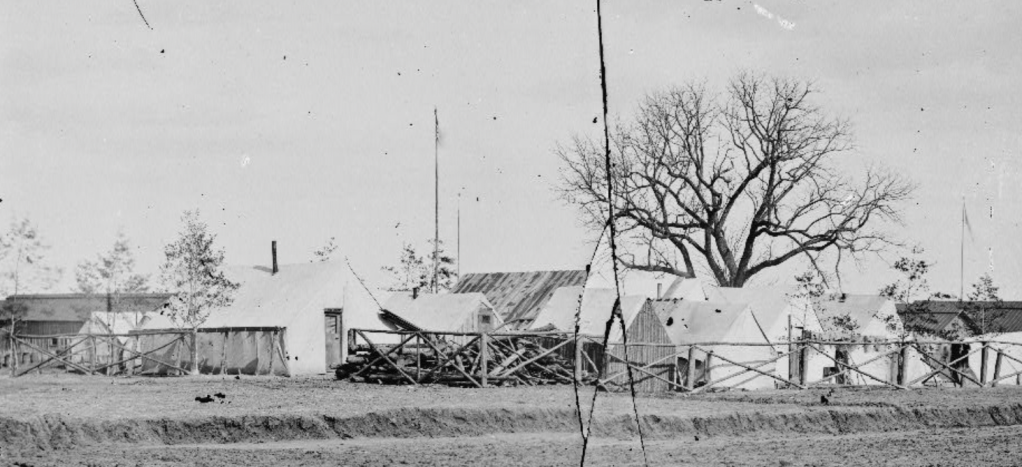
General Hospital at City Point, Virginia (LOC)

Letter 1

[Letterhead—US Sanitary Commission, Adams’ House, 244 F Street
Washington D. C.]

November 18th 1862

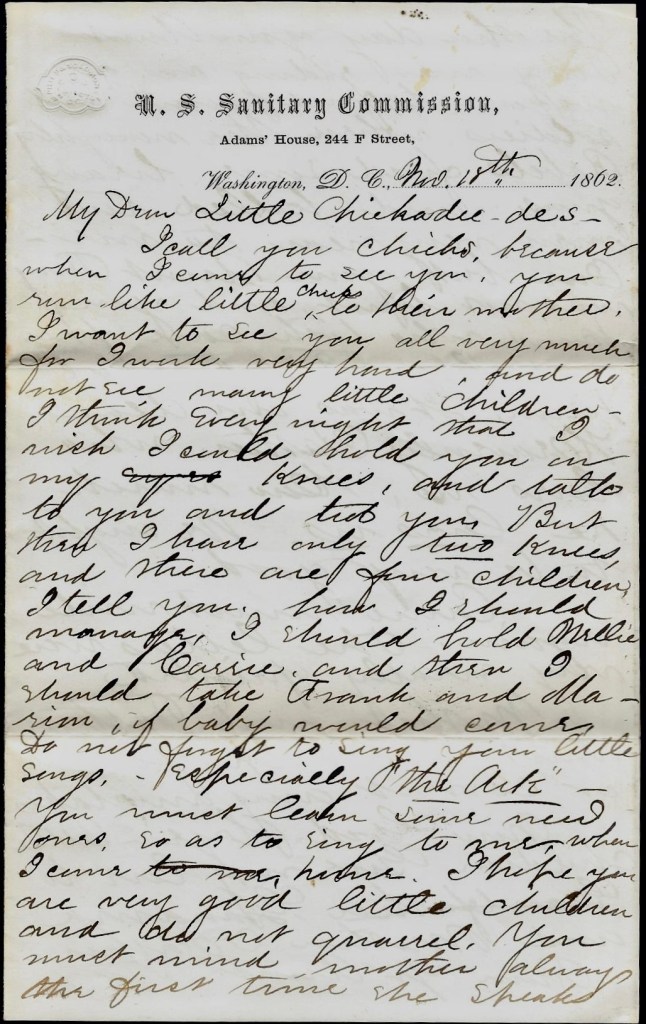
My drew Little Chickadee—dees. I call you chicks because when I come to see you, you run like little chicks to their mother. I want to see you all very much for I work very hard and do not see many little children. I think every night that I wish I could hold you on my knees and talk to you and tickle you, but then I have only two knees and there are four children. I tell you how I should manage. I should hold Nellie and Carrie and then I should take Frank and Marian, if baby would come. Do not forget to sing your little songs—especially “the Ark.” You must learn some new ones so as to sing to me when I come home. I hope you are very good little children and do not quarrel. You must mind mother always the first time she speaks.

The other day your Aunt Tiny was riding in a wagon to find some sick soldiers when the naughty Rebels fired some brawny guns and killed two men very near to me, but your Aunt Tiny was not hurt and you know who took care of her and kept her from all harm. It was our dear Heavenly Father who loves us—-how much He loves us. We ought to be very good.

Carrie must write again. The letters were very neatly printed. Mother and Father must not help you or correct any mistakes. Now goodbye little children. Give my love to Grandma and Mother & Father. From your Aunt Tiny

Letter 2

[US Sanitary Commission Letterhead, Washington D. C.]
April 15, 1864

Dear Mary,

I was very glad to get yours of April 7th although going to the ARmy it dd not reach me till yesterday as I came up from the Army on Tuesday last. Mr. Fay is still at the Front and will probably come up tomorrow. Then I shall be able to decide upon some course for myself. All ladies have been ordered away with much other extra baggage from the Army [of the] Potomac. It alters my plans materially and I am very much disappointed, I can assure you, but a few women have made trouble and the innocent must suffer with the guilty. There is a good field for labor among the Paroled Prisoners at Annapolis. Also I have had a call to go to Louisville, Kentucky but at present I am in chaos.

I received a most beautiful present of a diamond ring worth $110 and a Pearl Cross $100 the day before I came away. You can imagine I was delighted because it came from patients and officers of Potomac Creek Hospital.

I am glad to hear that Grandma’s foot is better. Give my warmest regards to her. Her journey on Earth has been a weary one, but there’s rest for the weary in Heaven.

I am glad Galen is improving so fast. He has harder battles to fight than some, to be sure. But every heart has its evil to conquer and we must all fight our battles daily, from Cyrus Hanks up to Dr. Bellows, and we all need to look up to a Higher Power to help us.

I am glad you are not going to move for you all enjoy the garden so much and you may now hope to gather your strawberries with your own hand,

I will send my drawers soon so that you may go on with the, I am glad you called on Delia. She has been kindly remembered by her friends and seems very happy. Their means are very limited, however, and they will have to economize. But Leander is enterprising and bound to get ahead. That is a good deal and while he tries to help himself, Mr. Fay will help him. Write me soon. Love to all the children and to Carrie. Very truly and affectionately your sister, — Helen


Letter 3

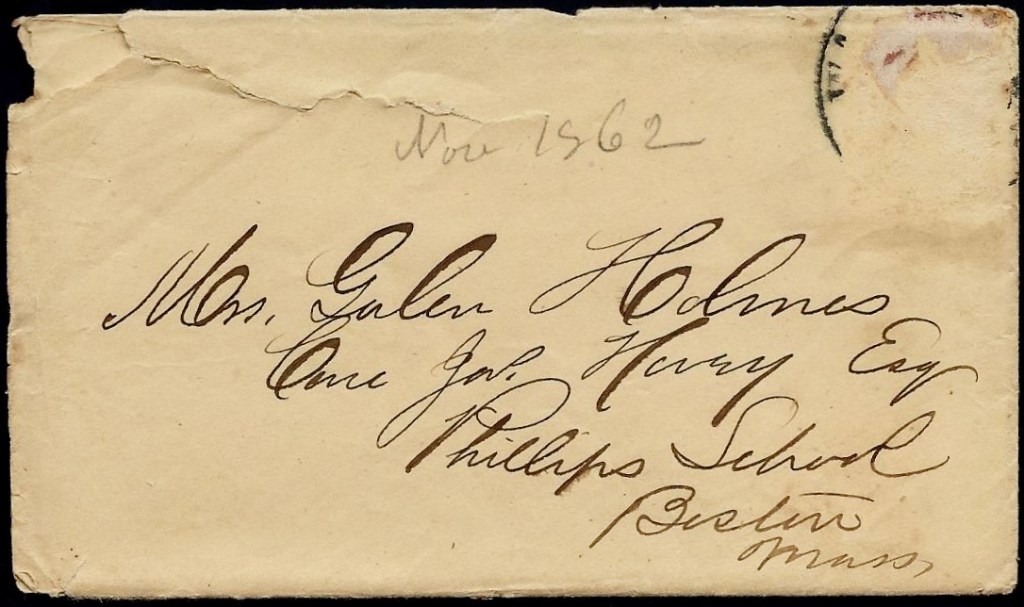
Addressed to Mrs. Galen Holmes, 65 State Street, Boston, Massachusetts

On Board Steamer Kent. off Port Royal
[May] 1864

Dear Sister,

It is a long time since you have heard from me. Indeed, I have had no time for many letters until now that we are on board this steamer where we can breathe a spell. Our wounded are all removed from Frederickburg and today we leave this place for White House Landing—the scene of our old labors of two summers since. We left Fredericksburg Thursday, bringing down wounded and now we expect tonight to go to White House. Today I have been ashore with Prof. [John Potter] Marshall of Tuft’s College—Mr. Fay’s particular friend—and he has been making sketches of old buildings and beautiful scenery. You cannot imagine what a scene of confusion an Army Base is—wagons, mules, fresh troops, forage. barges and steamers throng the place and make a scene of great confusion, and yet with all this Army life, in twenty-four hours everything will have left and all will be quiet—not a sound to be heard in this lovely spot on the Rappahannock’s banks except the splash of the waves and the sighing of the breezes.

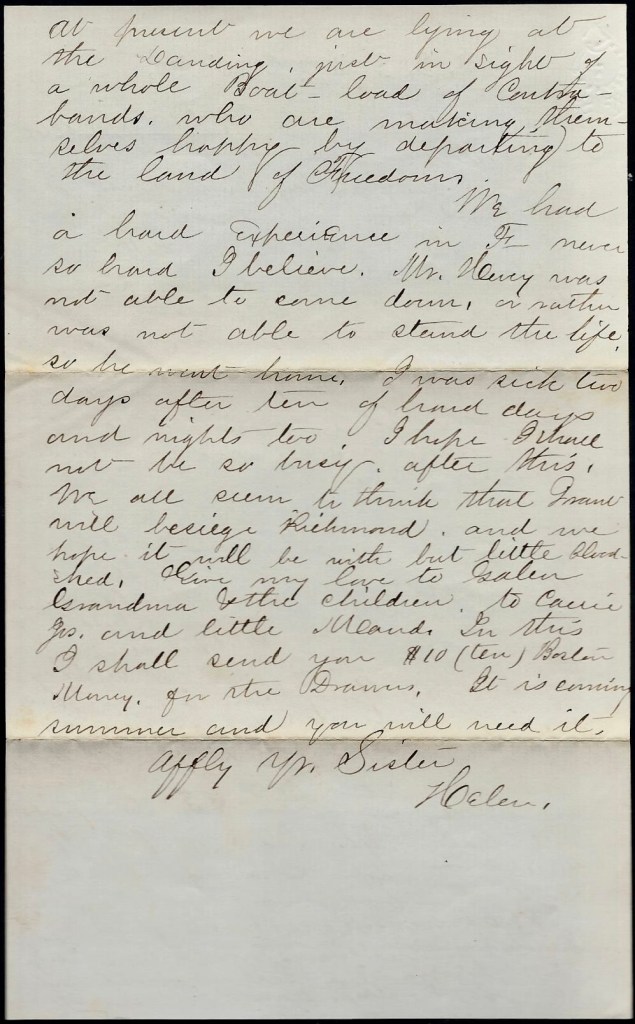
Our last wounded have gone off today from Port Royal and at present we are lying at the landing, just in sight of a whole boatload of Contrabands who are making themselves happy by departing to the land of Freedom.

We had a hard experience in Fredericksburg—never so hard, I believe. Mr. [William Alfred] Hovey was not able to come down, or rather was not able to stand the life, so he went home. I was sick two days after ten of hard days and nights too. I hope I shall not be so busy after this. We all seem to think that Grant will besiege Richmond and we hope it will be with but little bloodshed.

Give my love to Galen, Grandma and the little children, to Carrie, Gus, and little Meand. In this I shall send you $10 (ten) Boston money for the Drawers. It is coming summer and you will need it.

Affectionately your sister, — Helen


Letter 4

Colored Hospital, City Point, Va.
August 2nd 1864

Dear Mary,

Yours of the 27th came yesterday and I was glad to get it indeed. It is terribly hot here and we have plenty work. We had a number of wounded came in yesterday to the Colored Hospitals. The negroes made a charge the day before. They told lively stories of the undermining of that fort, describing the scene in glowing colors—of frying pans and tin plates filling the air. It seems they surprised the Rebs at breakfast. [see Battle of the Crater]

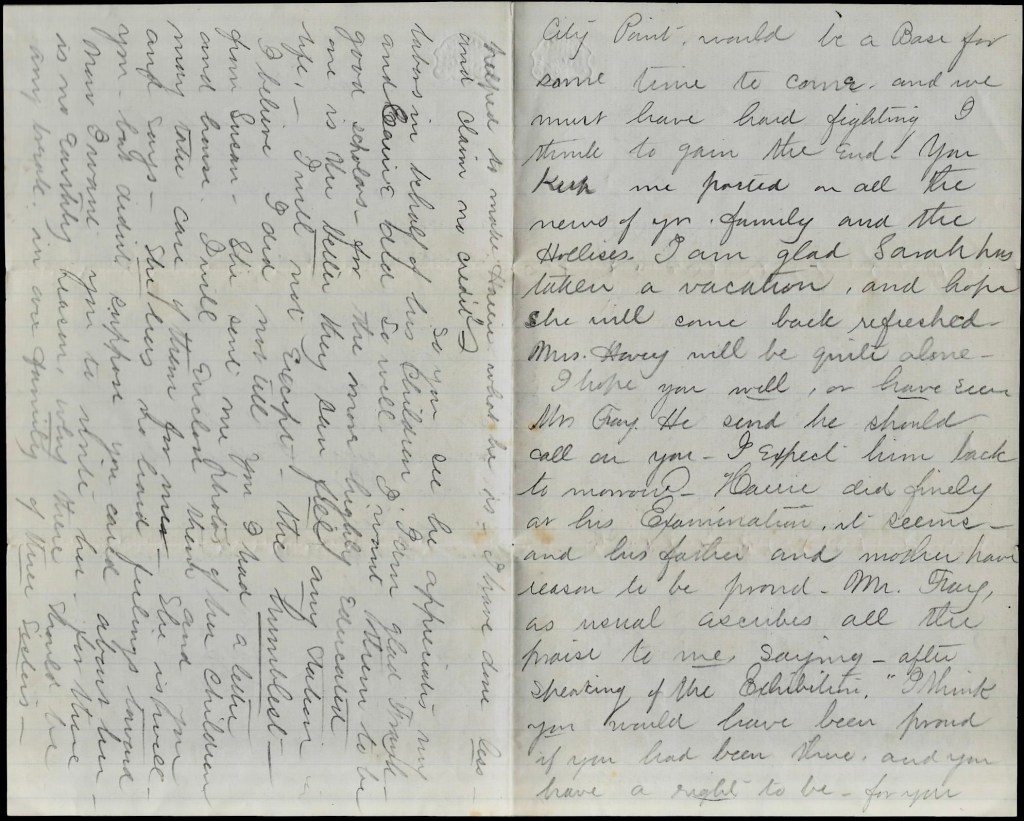
I have little news but no matter. If my letter don’t contain the news, you won’t care—if it is only a word from me. It looks as if City Point would be a base for some time to come and we must have hard fighting I think to gain the end. You keep me posted on all the news of your family and the Hollis’s I am glad Sarah has taken a vacation and hope she will be quite alone.

I hope you will, or have seen Mr. Fay. He said he should call on you. I expect him back tomorrow. Howie did finely at his examination, it seems, and his father and mother have reason to be proud. Mr. Fay as usual ascribes all the praise to me saying, after speaking at the Exhibition, “I think you would have been proud if you had been here and you have a right to be for you helped to make Howie what he is—I have done less and claim no credit.”

So you see he appreciates my labors in behalf of his children. I am glad Frank and Carrie did so well. I want them to be good scholars for the more highly educated one is, they better they can fill any station in life. I will not except, the humblest.

I believe I did not tell you I had a letter from Susan. She sent me photos of her children and house. I will enclose them and you may take care of them for me. She is well and says she has no hard feelings toward you, but didn’t suppose you cared about her. Now I want you to write her for there is no earthly reason why there should be any break in our family of three sisters and I shall never recognize any.

Now the mail closes. With love to all, old & young, I am affectionately your sister, — Helen


Letter 5

Addressed to Mrs. Galen Holmes, Jr. 65 State Street, Boston, Massachusetts

Colored Hospital
November 29, 1864

My dear Mary,

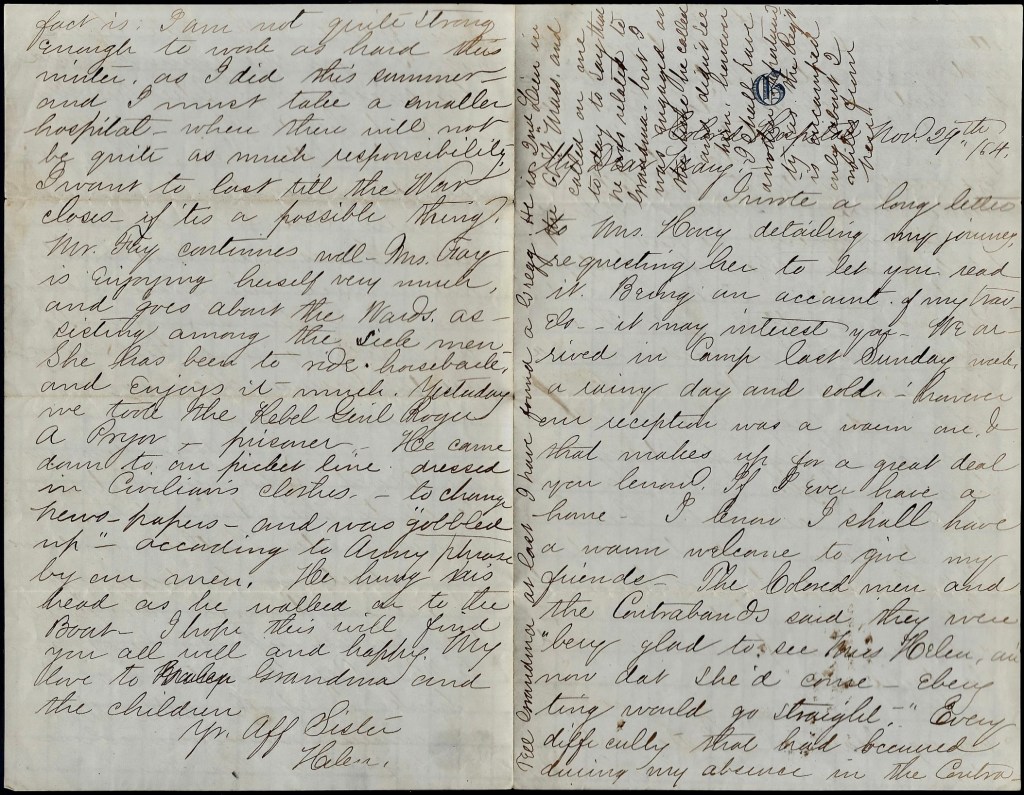
I wrote a long letter to Mrs. Hovey detailing my journey, requesting her to let you read it. Being an account of my travels—it may interest you. We arrived in Camp last Sunday week, a rainy day and cold. However, our reception was a warm one & that makes up for a great deal you know. If I ever have a home, I know I shall have a warm welcome to give my friends.

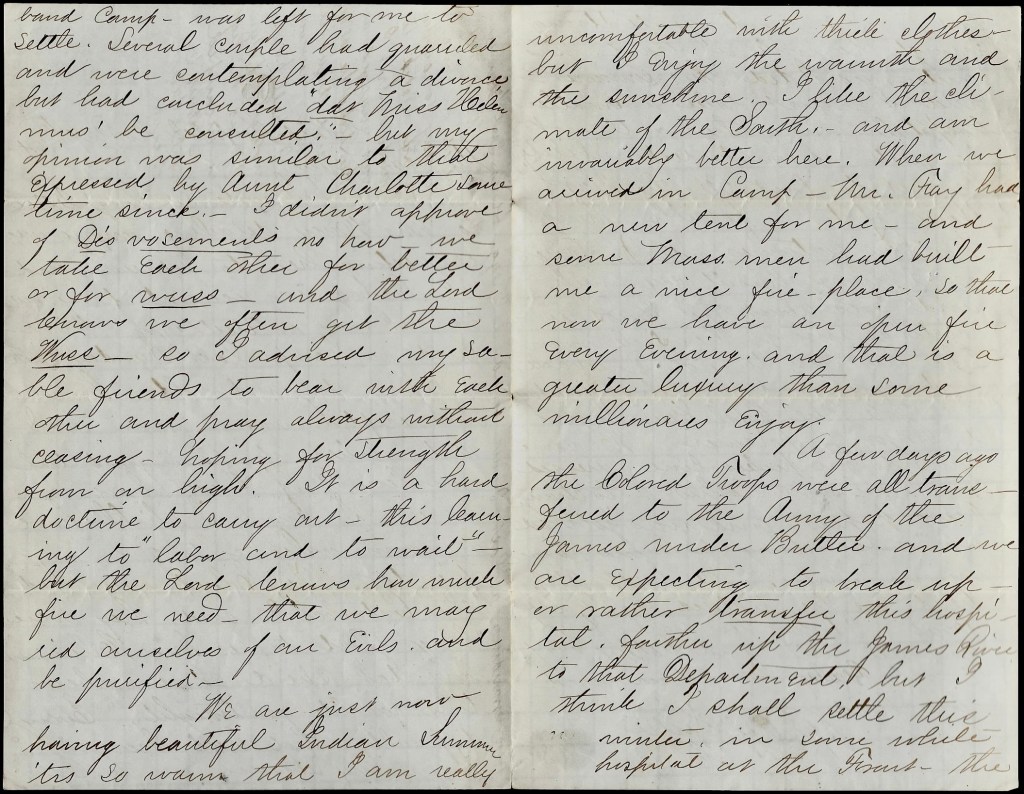
The Colored men and the Contrabands said they were “being glad to see Miss Helen and now day she’d come, ebery ting would go straight.” Every difficulty that had occurred during my absence in the contraband camp was left for me to settle. Several couples had quarreled and were contemplating a divorce but had concluded “dat Miss Helen mus’ be consulted” but my opinion was similar to that expressed by Aunt Charlotte some time since. I didn’t approve of Dis vosements no how. We take each other for better or for wuss, and the Lord knows we often get the Wuss—so I advised my sable friends to bear with each other and pray always without ceasing—hoping for strength from on high. It is a hard doctrine to carry out—this learning to “labor and to wait” but the Lord knows how much fire we need that we may rid ourselves of our Evils and be purified.

We are just now having beautiful Indian Summer. Tis so warm that I am really uncomfortable with thick clothes. But I enjoy the warmth and the sunshine. I like the climate of the South and am invariably better here. When we arrived in camp, Mr. Fay had a new tent for me—and some Massachusetts men had built me a nice fireplace so that now we have an open fire every evening and that is a greater luxury than some millionaires enjoy.

A few days ago the Colored Troops were all transferred to the Army of the James under Butler and we are expecting to break up or rather transfer this hospital farther up the James river to that Department, but I think I shall settle this winter in some white hospital ay the Front. The fact is, I am not quite strong enough to work as hard this winter as I did this summer and I must take a smaller hospital where there will not be quite as much responsibility. I want to last till the war closes—if tis a possible thing.
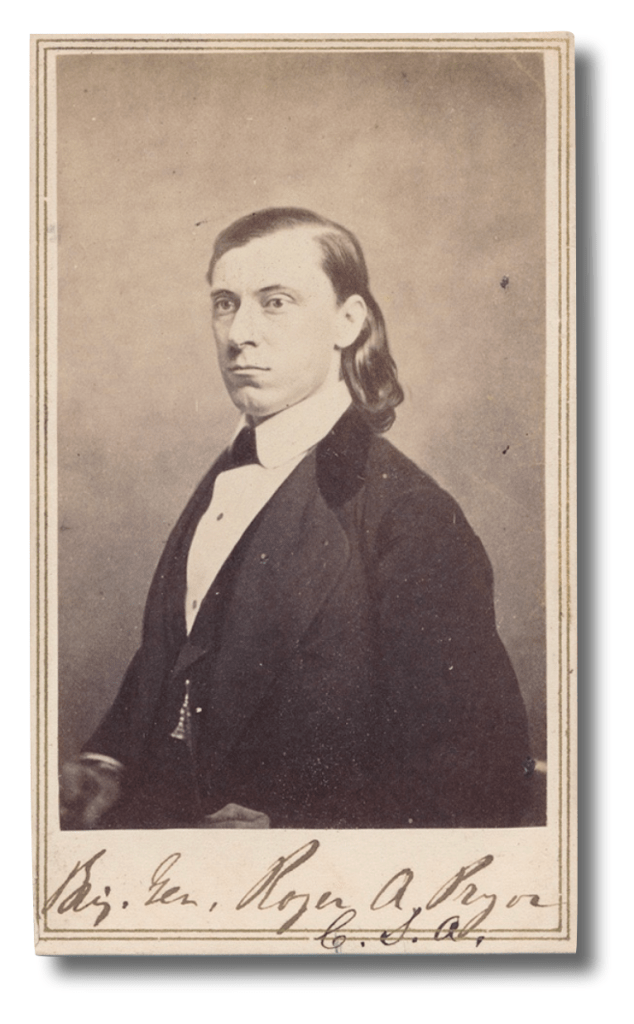
Roger Atkinson Pryor (July 19, 1828 – March 14, 1919) was a Virginian newspaper editor and politician who became known for his fiery oratory in favor of secession. He entered the Confederate army as colonel of the 3rd Virginia Infantry Regiment. He was promoted to brigadier general on April 16, 1862. His brigade fought in the Peninsula Campaign and at Second Manassas. Pryor was captured on November 28, 1864, and confined in Fort Lafayette in New York as a suspected spy. After several months, he was released on parole by order of President Lincoln and returned to Virginia.

Mr. Fay continues well. Mrs. Fay is enjoying herself very much, and goes about the Wards assisting among the sick men. She has been to ride horseback and enjoys it much. Yesterday we took the Rebel General Roger A. Pryor prisoner. He came down to our picket line dressed in civilian’s clothes to change newspapers and was “gobbled up” according to Army phrase by our men. He hung his head as he walked onto the boat.

I hope this will find you all well and happy. My love to Grandma and the children. Your affectionate sister, — Helen

Tell Grandma at last I have found a Gregg. He is 2nd Lieutenant in the 61st Massachusetts and called on me today to say that he was related to Grandma but I was engaged at the time he called and didn’t see him. However, I shall have another opportunity as the regiment is encamped only about two miles from here.
1863: William Oren Ensign to Alta Ensign

William O. Ensign

The following letter was written by William Oren Ensign (1841-1918), the son of Caleb Wadhams Ensign (b. 1790) and Orpha Deming (b. 1795) of Madison, Lake county, Ohio. William enlisted on 20 August 1862 to serve as a corporal in the 14th Ohio Independent Battery—a light artillery unit. He was in the battery for three years, mustering out in August 1864. Serving with him in the same battery was his younger brother, Herbert Dwight Ensign (1844-1898).

“Removing to Illinois in 1865, he again engaged in teaching, after which, in June, 1866, he entered the office of Dr. Henry A. Almy, of Rutland, Ill., …During the lecture course of 1867-’68, he matriculated in the Charity Hospital Medical College, now University of Wooster, Cleveland, Ohio, pursing the study of medicine between courses, until graduation, …After graduation, Feb 25, 1868, Dr. Ensign returned to Rutland, Ill., where he has since been engaged in the general practice of medicine …Married, in 1869, Miss Frances J., second daughter of the late Dr. Henry A. Almy, of Rutland, Ill.” [Source: Find-A-Grave] 

Transcription

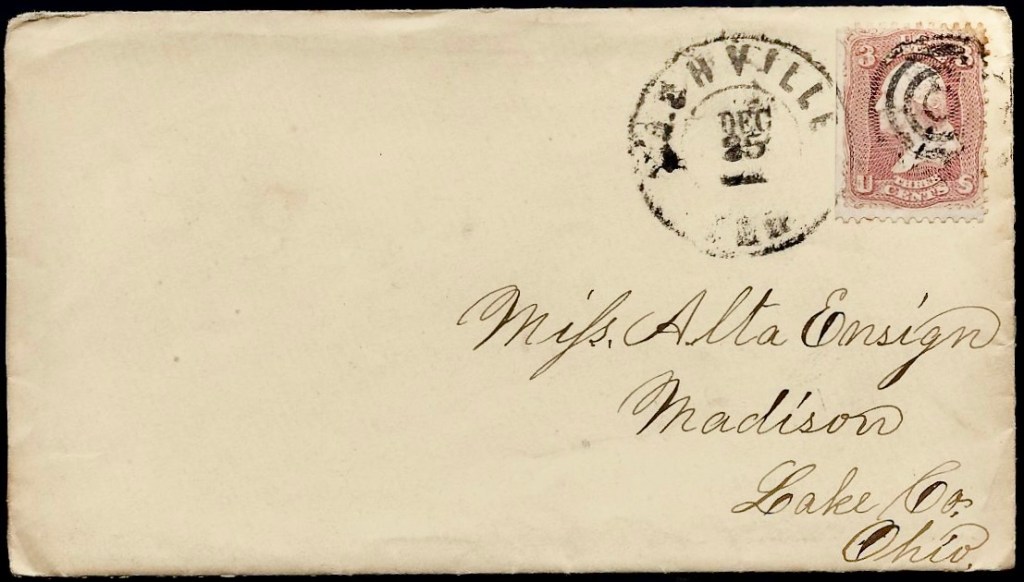
Addressed to Miss Alta Ensign. Madison, Lake county, Ohio

14th Battery, OVA
Lynnville, Tennessee
December 18, 1863
Via Nashville

Dear Niece,

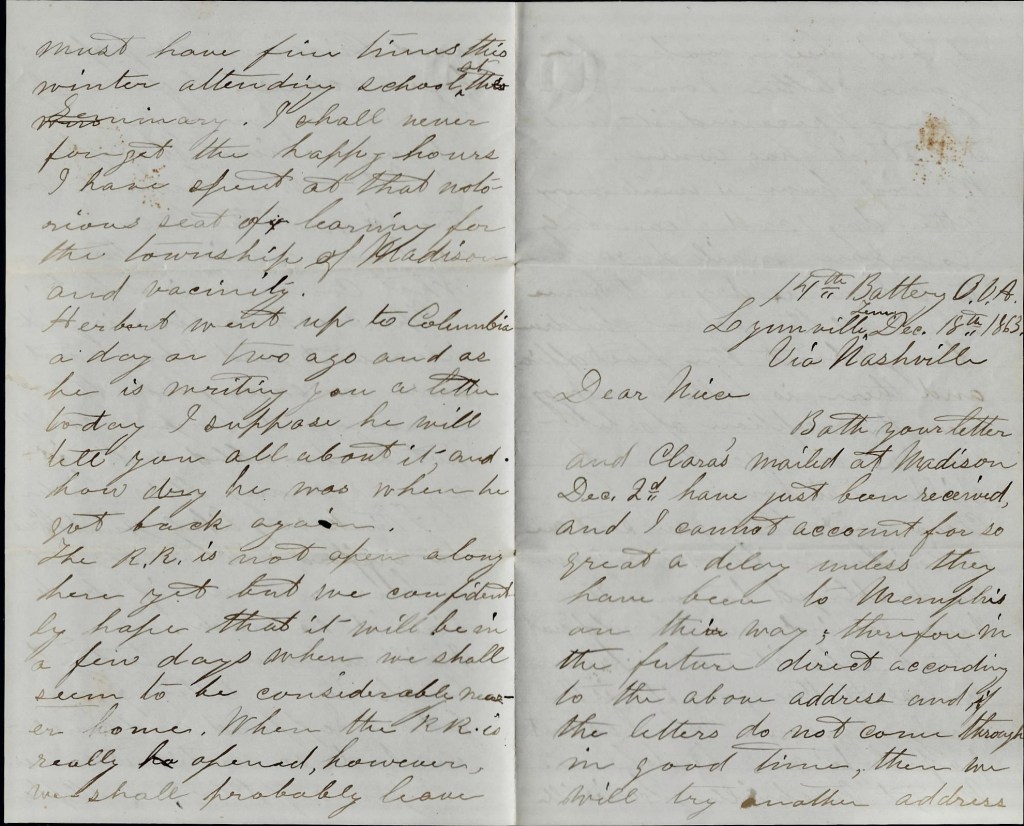
Both your letter and Clara’s mailed at Madison December 2nd have just been received, and I cannot account for so great a delay unless they have been to Memphis on their way; therefore in the future, direct according to the above address and if the letters do not come through in good time, then we will try another address. I have been looking for your letter some time before I received it and at last it has come. We now have a mail every other day and I can only compare mail days here to Valentine’s Day at home when all the school children hang about the post office and there is full as much joy over the reception of a letter here as a valentine by children at home.

Clara says that you sent me a Tribune for which I am much obliged to you. It has been received and I could not think who it came from unless Hattie for she is the only person who has sent papers to me heretofore. We Nashville, Louisville, and Cincinnati papers here occasionally for only ten cents per copy. I have serious thoughts of taking the Tribune for the six monthsto come as I am anxious to know what Congress is up to.

The weather here is quite pleasant and I have not seen a snowflake this season and I hope I shall not be troubled with a great many this winter. I think very likely Aunt Augusta Safford will be very apt to hear from me if she desires it so much. I will commence today to look for a letter from John Safford and continue to do so until it comes.

Yourself, Clara, and Orpha must have fun times this winter attending school at Seminary. I shall never forget the happy hours I have spent at that notorious seat of learning for the township of Madison and vicinity.

Herbert went up to Columbia a day or two ago and as he is writing you a letter today, I suppose he will tell you all about it, and how dry he was when he got back.

The railroad is not open along here yet but we confidently hope that it will be in a few days when we shall seem to be considerable nearer home. When the railroad is really opened, however, we shall probably leave here to go to Columbia or the other side of Pulaski—I hope to the former.

I am sorry that our own state is not able to keep John H. Morgan after he was captured and duly turned over to the authorities for safekeeping. Canadian conspiracies seem to be checked for the present and I hope forever. The President’s Annual Message has been lain before Congress and it is sound to the core. We ought to be thankful that we have such an honest, upright and able man in the Presidential chair.

Knoxville is safe and Longstreet fleeing from pursuit. His East Tennessee campaign is an utter failure. Good! I see that Mr. Foote of Tennessee, a member of the Rebel Congress, has offered some resolutions before that body in regard to the exchange of prisoners which looks towards a recognition of our colored soldiers as such. I like the President’s determination not to exchange unless every man who wears the blue uniform is recognized as a soldier of the United States.

Well, I must come to a close. Write often. Remember me to your parents and all the friends also to Grandmother Safford. I will write to Clara so as to have it go out with mail.

Your friend, — Will

1864: Alexander Gardiner to Ira Colby

Colonel Alexander Gardiner, 14th New Hampshire Inf.

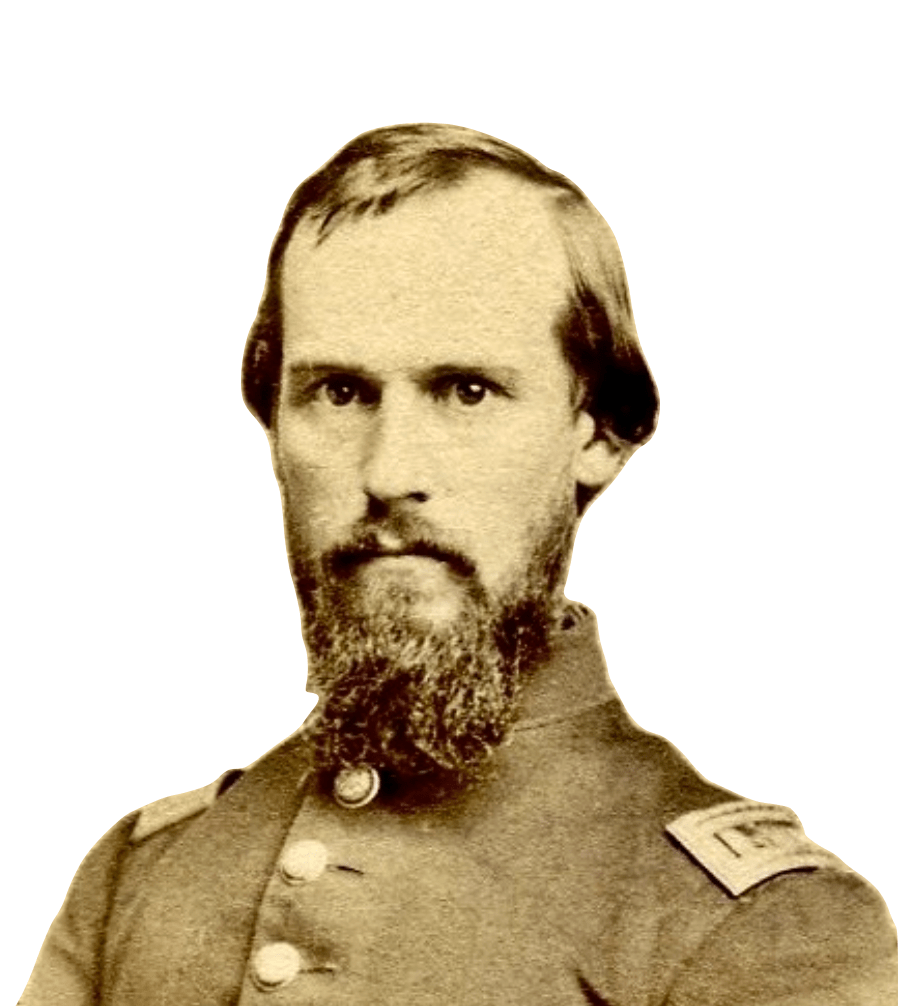
The following letter was written by Alexander Gardiner (1833-1864), the son of James Dempster Gardiner (1806-1853) and Emeline Graham (1806-1872) of Catskill, Greene county, New York. He practiced law in New York City for a while, and from there he moved to Osawatomie, Kansas, in 1856 with the intention of publishing a free state newspaper but was foiled by pro-slavery men before he published his first issue. He was married to Mary Powers Cooper (1834-1898) in 1859 in Croydon, New Hampshire and then settled in 1859 Claremont, N. H. In 1863 he joined the 14th New Hampshire Volunteers as adjutant and later became its Colonel. He was killed in action on 7 October 1864 in the Battle of Winchester. Gardiner was made Brigadier General by Brevet on 18 April 1867.

This letter is from the personal collection of Jim Doncaster and was transcribed and published on Spared & Shared by express consent.

Transcription

Addressed to Ira Colby, Jr., Esq., Claremont, New Hampshire

Headquarters 14th New Hampshire Vols.
Harpers Ferry, West Virginia
February 13th 1864

My Friend Colby,

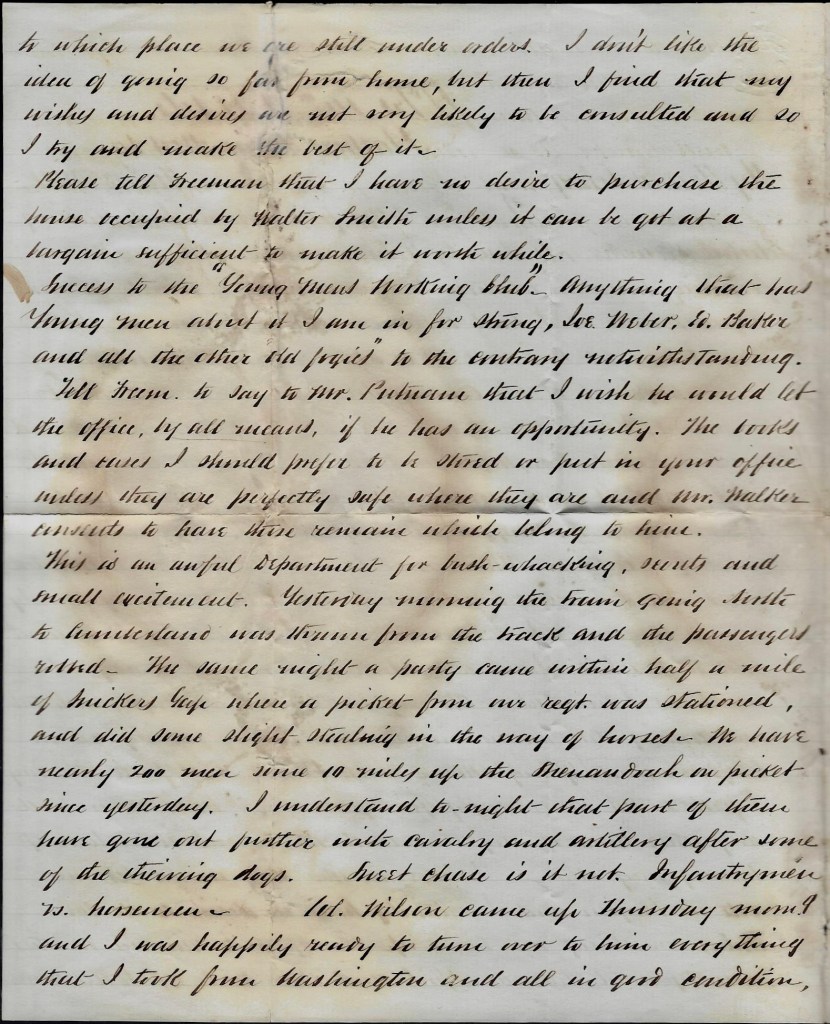
I received a letter from Freem. last evening dated 8th inst. As I wrote to him early in the week informing him in relation to some matters of which he now inquires, and as I had designed writing to you at this time, I will let this serve as a letter to you and as an acknowledgement of his communication. First and most important, I wish to ask you to look after the check list and see that Coopers, Vaughans, and my own name is upon it for I think it quite probable that we may all be home to vote at March meeting, although of course in the army nothing is certain. When I was home last, someone intimated to me that I was not a voter in Claremont because my family were in Croydon. If I have not a right to vote in Claremont, then no one has. I am a resident of Claremont today as much as I ever was. All my books, harness, sleigh, wash-tub and cooking stove remain in Claremont. My family are in Croydon awaiting my return to Clarement, and from the day I first settled there nearly five years ago, I have never had any other home of my own and no present intention of having any other. I have no idea [if] they would let me vote in Croydon and I certainly have no desire to do so.

Unless something new turns up, we expect to remain in this vicinity towards April and hten to be off to New Orleans to which place we are still under orders. I don’t like the idea of going so far from home but then I find that my wishes and desires are not very likely to be consulted and so I try and make the best of it.

Please tell Freeman that I have no desire to purchase the house occupied by Walter Smith unless it can be got at a bargain sufficient to make it worth while.

Success to the “Young Men’s Working Club.” Anything that has Young Men about it I am in for strong. Joe Weber, Ed Baker and all the other “old fogies” to the contrary, notwithstanding. Tell Freem. to say to Mr. Putnam that I wish he would let the office, by all means, if he has an opportunity. The books and cases I should prefer to be stored or put in your office unless they are perfectly safe where they are and Mr. Walker consents to have these remain which belong to him.

This is an awful Department for bushwhacking, scouts and small excitement. Yesterday morning the train going north to Cumberland was thrown from the track and the passengers rolled. The same night a party came within half a mile of Snicker’s Gap where a picket from our regiment was stationed and did some slight stealing in the way of horses. We have nearly 200 men some 10 miles up the Shenandoah on picket since yesterday. I understand tonight that part of them have gone out further with cavalry and artillery after some of the thieving dogs. Sweet chase is it not? Infantrymen vs. horsemen.

Col. Wilson came up Thursday morning and I was happily ready to turn over to him everything that I took from Washington and all in good condition, but he was not much better than when we left him and at his request I continue in command.

I wish, my dear fellow, that you would come out and make us a visit. You shall have my best horse to ride and I will promise to try hard and make it pleasant for you. Won’t you come? Remember me kindly to my friend Freem. and believe me to be your sincere and grateful friend, — Alexander Gardiner

Ira Colby, Jr., Esq.

P. S. Isn’t is a burning shame that such a “Poodle” as Ben Tucker Hutchins is appointed Lt. Col. of the new cavalry regt. in New Hampshire while hard working, brave, faithful Ed Vaughan with more manhood in his little finger than Ben has in his whole body is left a simple Lieutenant?

9 p.m. Just closing this letter when I received orders to proceed forthwith to Washington. — A. G.

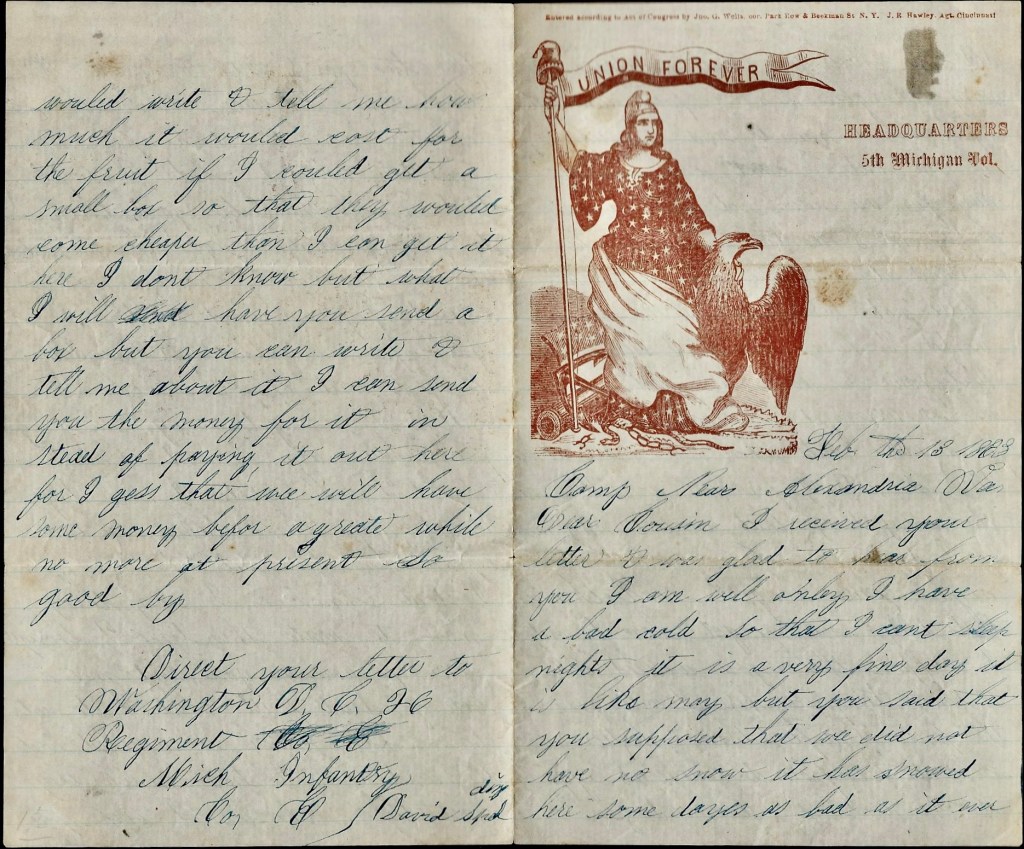
1863: David Spalding to Cousin Julia

The following letter was written by David Spalding (1843-1924), the son of Calvin Spaulding (1820-1897) and Malissa Hatt (1820-1904) of Deerfield, Livingston county, Michigan. David enlisted on 15 August 1862 as a private in Co. E, 26th Michigan infantry. He was wounded on 12 May 1864 at Spotsylvania Court House, Virginia, and discharged on 4 Jun 1865.

When David wrote this letter in mid-February 1863, the 26th Michigan was assigned Provost duty at Alexandria.

To read letters by other members of the 26th Michigan Infantry that I have transcribed and published on Spared & Shared, see: George Nelson Chalker, Co. B, 26th Michigan (1 Letter); and Nelson W. Shephard, Co. C, 26th Michigan (13 Letters).

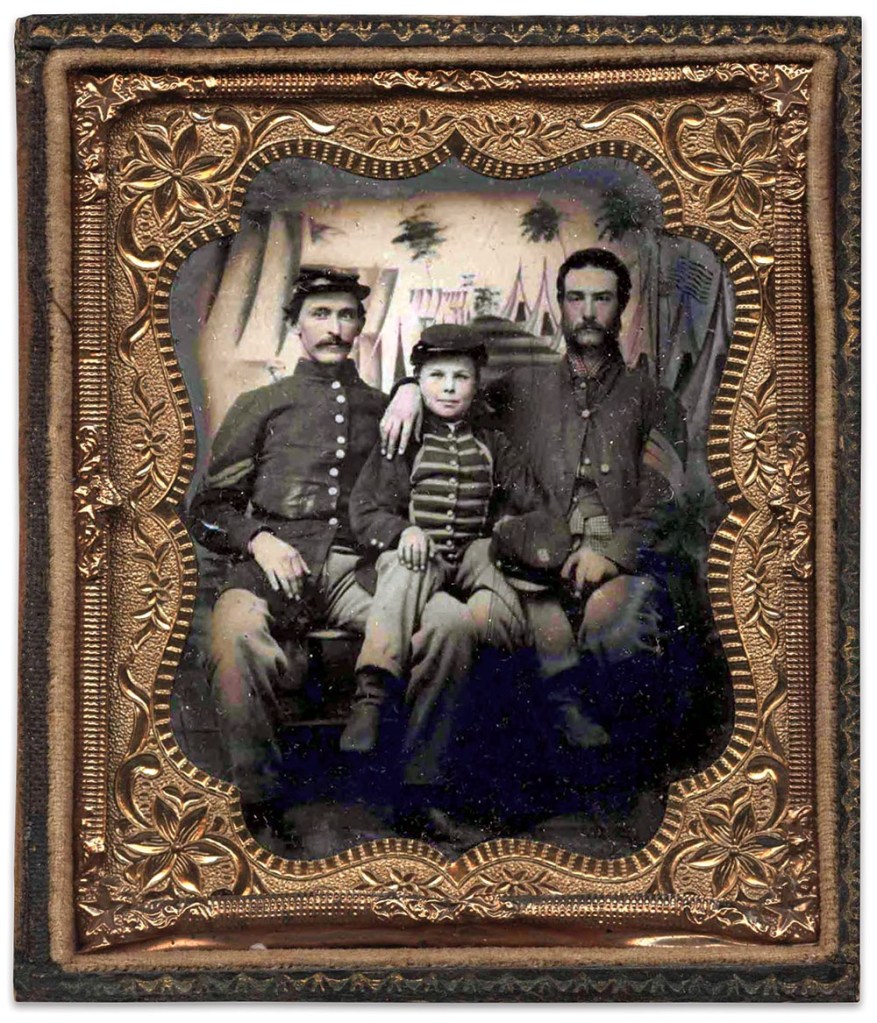
Members of Co. B, 26th Michigan Infantry, posed for this portrait about September-October 1862—soon after their enlistment. They are, from left: Corp. Henry Arnold (1838-1885), who received a disability discharge in October 1863; Drummer Alva O. Brooks (1851-1917), who departed the regiment in October 1862 with a discharge by order of Gov. Blair; and Sgt. Henry Chapin Smith (1837-1864), who died of wounds received during the Battle of Spotsylvania and was buried in Arlington National Cemetery. Courtesy Archives of Michigan, 347NMC, Civil War Photographs, File 137.

Transcription

Camp near Alexandria, Virginia
February 13, 1863

Dear Cousin.

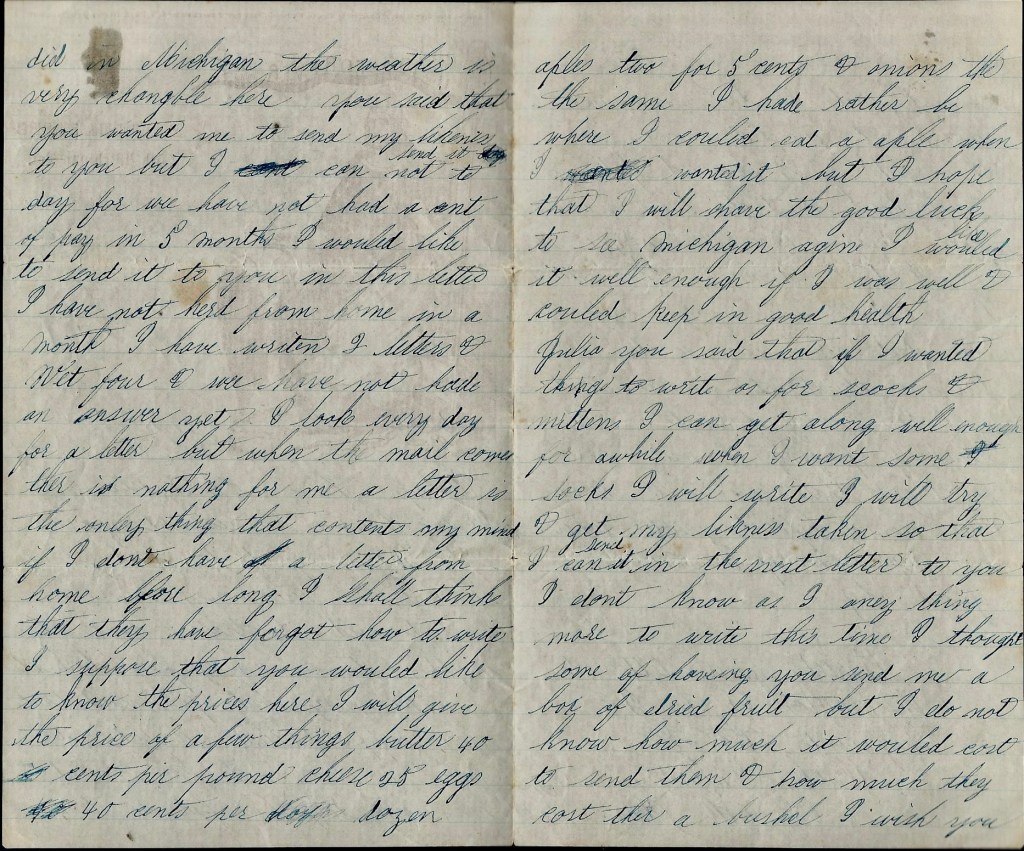
I received your letter. I was glad to hear from you. I am well only I have a bad cold so that I can’t sleep nights. It is a very fine day. I t is like May but you said that you supposed that we did not have no snow. It has snowed here some days as bas as it ever did in Michigan. The weather is very changeable here.

You said that you wanted me to send my likeness to you but I cannot send it today for we have not had a cent of pay in 5 months. I would like to send it to you in this letter. I have not heard from home in a month. I have written two letters & [ ] four & we have not had an answer yet. I look every day foor a letter but when the mail comes, there is nothing for me. A letter is the only thing that contents my mind. If I don’t have a letter from home before long, I shall think that they have forgot how to write.

I suppose that you would like to know the prices here. I will give the price of a few things. Butter 40 cents per pound, cheese 25, eggs 40 cents per dozen, apples two for 5 cents, and onions the same. I had rather be where I could eat a apple when I wanted but I hope that I will have the good luck to see Michigan again. I would like it well enough if I was well & could keep in good health.

Julia, you said that if I wanted things, to write. As for socks & mittens, I can get along well enough for a while. When I want some socks, I will write. I will try to get my likeness taken so that I can send it in the next letter to you. I don’t know as I [have] anything more to write this time. I thought some of having you send me a box of dried fruit but I do not know how much it would cost to send them or how much they would cost there a bushel. I wish you would write & tell me how much it would cost for the fruit if I could get a small box so that they would come cheaper than I can get it here. I don’t know but what I will have you send a box but you can write & tell me about it. I can send you the money for it out here for I guess that we will have some money before a great while. No more at present. Goodbye. — David Spalding

Direct your letter to Washington D. C., 26th Regiment Michigan Infantry, Co. E

1841: Benjamin Morris Gauldin to Josiah Hendrick

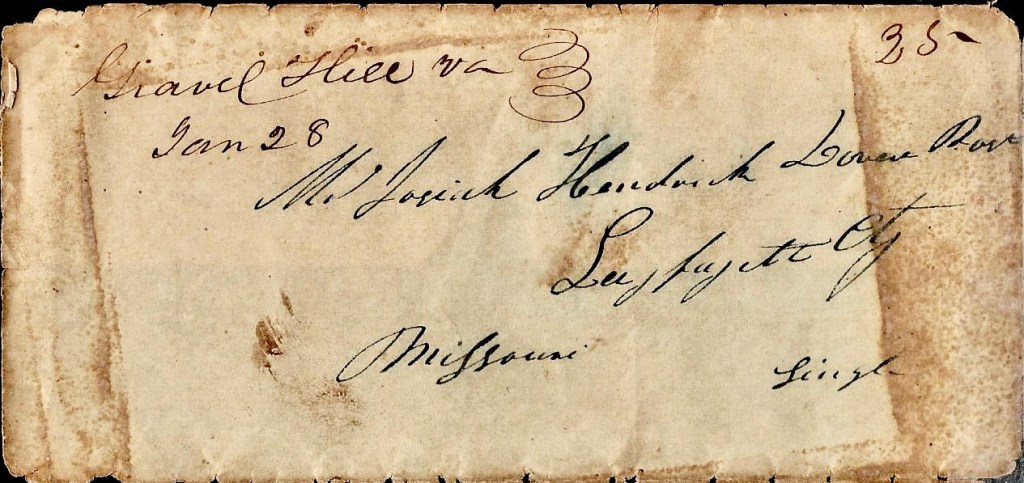
The following letter was written by Benjamin Morris Gauldin (1808-Aft1860), the son of Josiah Gauldin (1770-18330 and Serriah Seay (1776-1820) of Gravel Hill, Buckingham county, Virginia. Benjamin was married to Franccs C. Snoddy (b. 1813) in 1836. Benjamin wrote the letter to his nephew, Josiah Hendrick (b. 1821)—the son of Matthew Hendrick and Frances Gauldin—who was a Missouri resident in 1841.

In 1860, Benjamin was enumerated in Jefferson, Saline county, Missouri, as the owner of seven slaves ranging in age from 1 to 27.

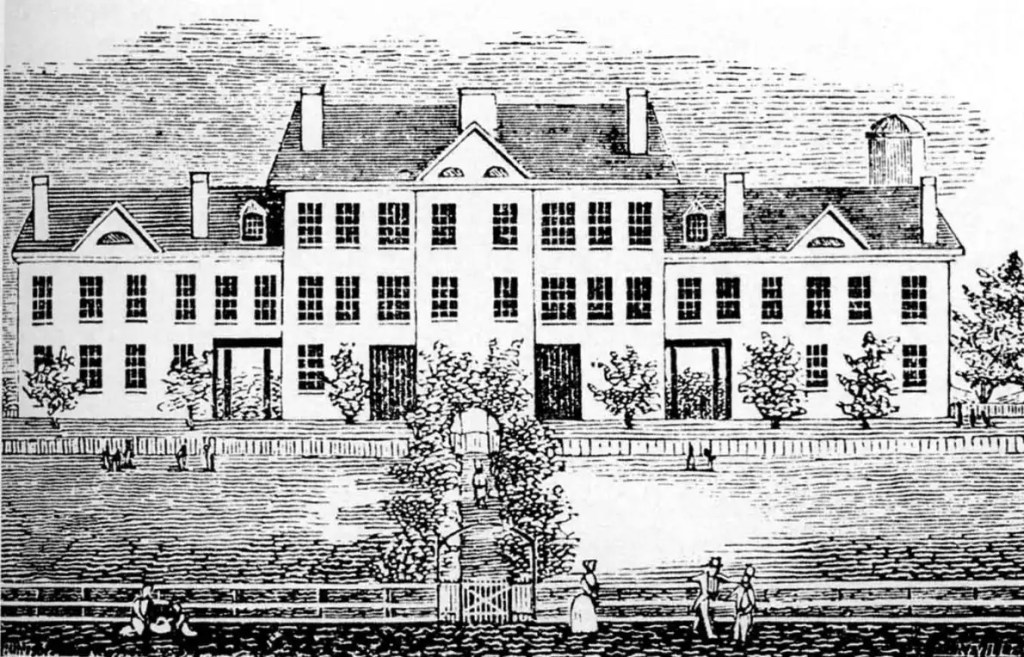
Benjamin datelined his letter from the Buckingham Female Collegiate Institute in January 1841. We learn from the letter that he was living at the Institute and in partnership with Samuel Benjamin Rush Loving (1813-1896) in some sort of merchandizing.

Benjamin’s letter speaks of the inheritance of slaves as part of an estate and also of the hiring out of slaves to others when not needed for the owner’s own labor.

The Virginia General Assembly officially incorporated the Buckingham Female Collegiate Institute on January 13, 1837, making it the acknowledged first chartered college for women in Virginia.

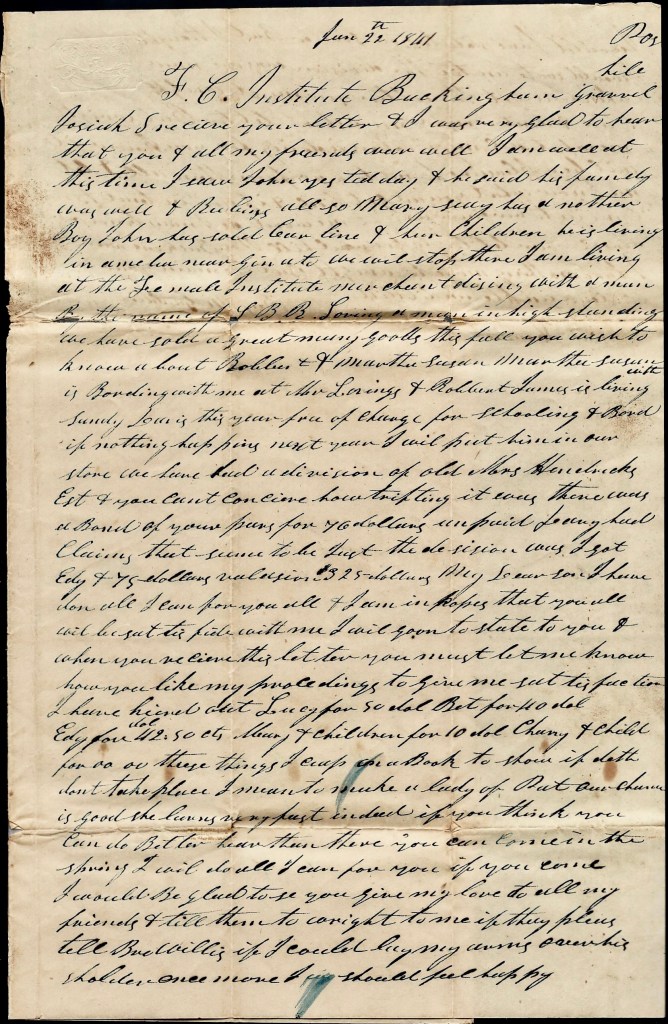
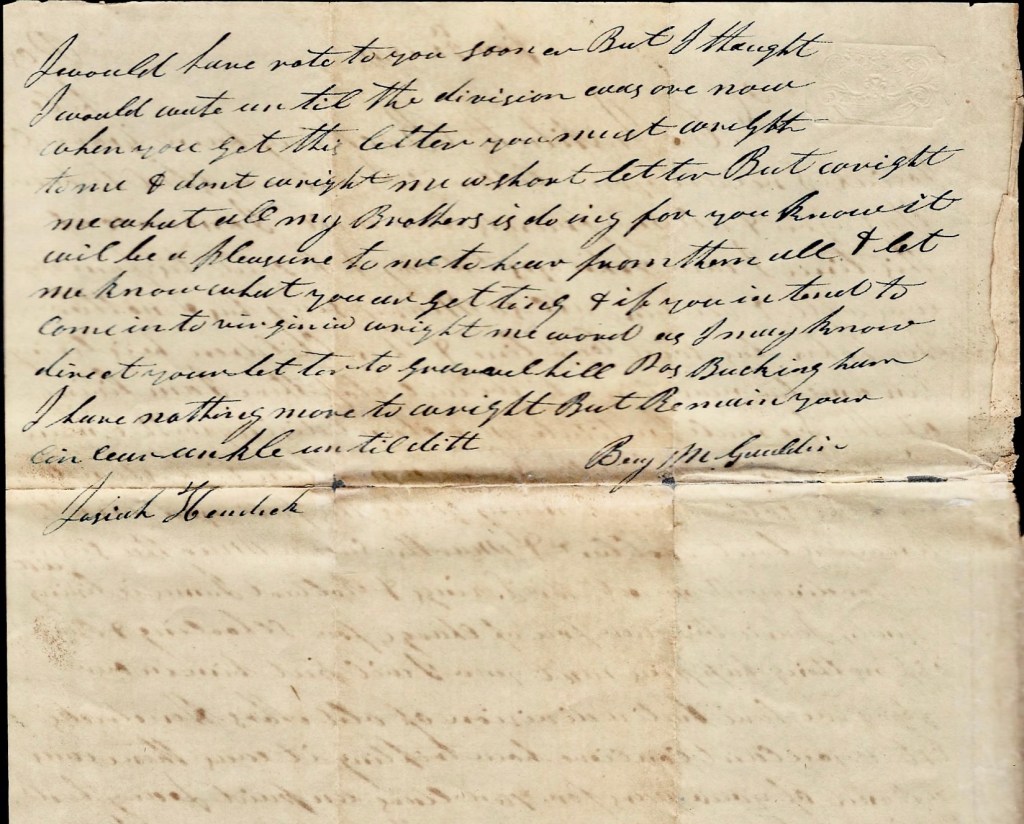
Transcription

Addressed to Mr. Josiah Hendrick, Lafayette county, Missouri

Female Collegiate Institute, Buckingham, Gravel Hill [Virginia]

Josiah, I received your letter & was very glad to hear that you & all my friends were well. I am well at this time. I saw John yesterday & he said his family was well & R___ings also. Mary Sedy has another boy. John has sold Caroline & her children. He is living in Amelia near Gin at the wil stop there. I am living at the Female Institute, merchandizing with a man by the name of S.B.R. Loving—a man in high standing. We have sold a great many goods this fall.

You wish to know about Robert & Martha Susan. Martha Susan is boarding with me at Mr. Loving’s & Robert James is living with Lundy Davis this year, free of charge for schooling & board. If nothing happens next year, I will put him in our store. We have had a division of old Mrs. Hendrick’s Est[ate] & you can’t conceive how trifling it was. There was a Bond of your Pa’s for 76 dollars unpaid & any bad claims that seem to be just. The decision was I got Edy & 75 dollars, valuation $325 dollars.

My Dear son, I have done all I can for you all & I am in hopes that you all will be satisfied with me. I will go on to state to you & when you receive this letter you must let me know how you like my proceedings to give me satisfaction. I have hired out Lucy for 50 dollars, Bet for 40 dollars, Edy for 42 dollars [and] 50 cents. Mary & children for 10 dollars. Chany & child for 00.00. These things I keep in a book to show. If death don’t take place, I mean to make a lady of Pat. Our chance is good. She learns very fast indeed. If you think you can do better here than there, you can come in the spring. I will do all I can for you if you come. I would be glad to see you. Give my love to all my friends & tell them to write to me, if they please. Tell Brother Willis if I could lay my arms around his shoulder once more, I should feel happy.

I would have wrote to you sooner but I thought I would wait until the division was over. Now when you get this letter, you must write to me & don’t write me short letter but write me what all my brothers is doing for you know it will be a pleasure to me to hear from them all & let me know what you are getting & if you intend to come into Virginia. Write me words as I may know. Direct your letter to Gravel Hill P.O., Buckingham. I have nothing more to write but remain your sincere Uncle until death, — Benj. M. Gouldin

[to] Josiah Hendrick

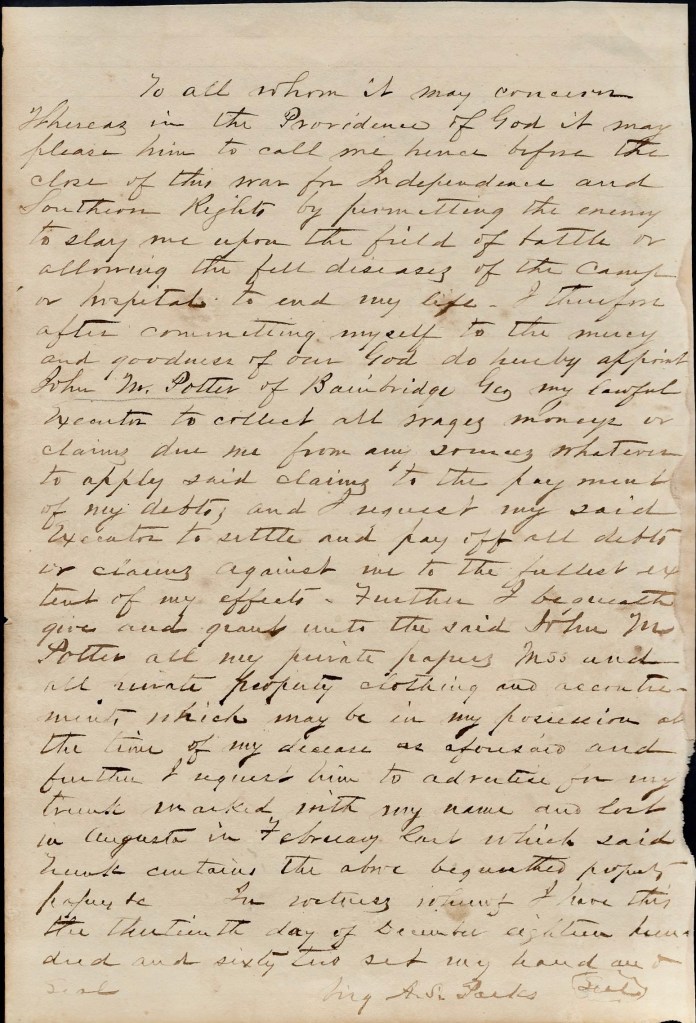
1862: Virgil Adam Stewart Parks to Whom it may Concern

The following document appointing an Executor to his Estate was composed and signed by Capt. Virgil Adam Stewart Parks of Co. D, 17th Georgia Infantry in December 1862. Parks was killed on the second day’s fight at Gettysburg—shot through the head. The following biographical sketch was posted on Civil War Talk:

Born in 1836 and while yet a small boy, Virgil A. S. Parks moved with his family from Georgia to Texas. His mother died soon after reaching Texas. His father remarried, but he also died a short time later. His step-mother took him to Arkansas, but then she departed for the North, leaving Virgil behind. Poor and sickly, with only a few cents in his pocket, he still succeeded in reaching relatives in Georgia. Virgil reportedly had one brother and two sisters, although there is no indication that they were close either physically or emotionally. But something in Virgil’s personality or demeanor must have been engaging, since he made some powerful friends in Georgia, including Judge Linton Stephens, who came to his assistance and helped him get through school and into college.

In 1861, Virgil graduated from Franklin College (now the University of Georgia) with a law degree. A college catalog entry states simply: “Cuthbert, Ga., Editor, Teacher, Andrew Female Coll.” The Andrew Female College (now Andrew College) was chartered in 1854. Affiliated with the Methodist Episcopal Church, South, it was only the second college in the United States to confer degrees on women. His association with the Andrew Female College is unclear, because in early 1861 Virgil moved to Bainbridge, Georgia and began a practice with law partner William O. Fleming (who afterwards became a field officer in the 50th Georgia and served at Gettysburg as captain of Company F). At this time Virgil also met John M. Potter, who later described him as a “high minded, modest, honorable man, and a consistent Christian.” Virgil had previously received favorable attention from the Hon. A. H. Stephens (afterwards Vice President of the Confederacy), and T. R. R. Cobb (afterwards a Confederate officer and brother of statesman Howell Cobb). Powerful and influential friends indeed.

If Virgil found some measure of happiness and contentment in his new profession, it was tragically all too brief. On August 13, 1861, he enlisted at Bainbridge as the 1st Lieutenant of Company D, 17th Georgia, which became part of Brig. Gen. Henry L. Benning’s brigade. He received a promotion to Captain on January 20, 1863.

Capt. Virgil A. S. Parks had a natural gift for writing, and during his military service he regularly submitted well-received articles to the Savannah Republican newspaper, becoming one of their finest correspondents attached to Gen. Robert E. Lee’s army. See @lelliott19 posts on his experiences: https://civilwartalk.com/threads/17…-usmr-stolen-4-july-1862.149223/#post-1880155https://civilwartalk.com/threads/50…-foxs-gap-and-sharpsburg.159534/#post-2083409 and https://civilwartalk.com/threads/2nd-and-20th-georgia-at-burnside-bridge.168585/#post-2192710. Parks’ final contribution was written from Chambersburg, Pennsylvania on June 28, 1863, which the paper published on July 20. He described the men being compelled to wade the Potomac without being allowed to strip, but receiving a ration of whiskey upon reaching the Maryland side, which made everyone either jolly or troublesome. While passing through Greencastle, Pennsylvania, the band of the 2nd Georgia played “Dixie,” while quartermasters and commissary officers scoured the countryside for horses, mules and cattle. He called out the 38th Virginia, assigned to provost guard duty in Chambersburg on June 27, for entering the stores and taking everything they wanted, although members of his own brigade completed the looting the next morning. Parks also wrote of a “respectable young man in the 15th Georgia,” who informed him that the streets were “strewn with gloves and fragments of goods.” Parks was evidently appalled and he expected Gen. Lee to punish those responsible.

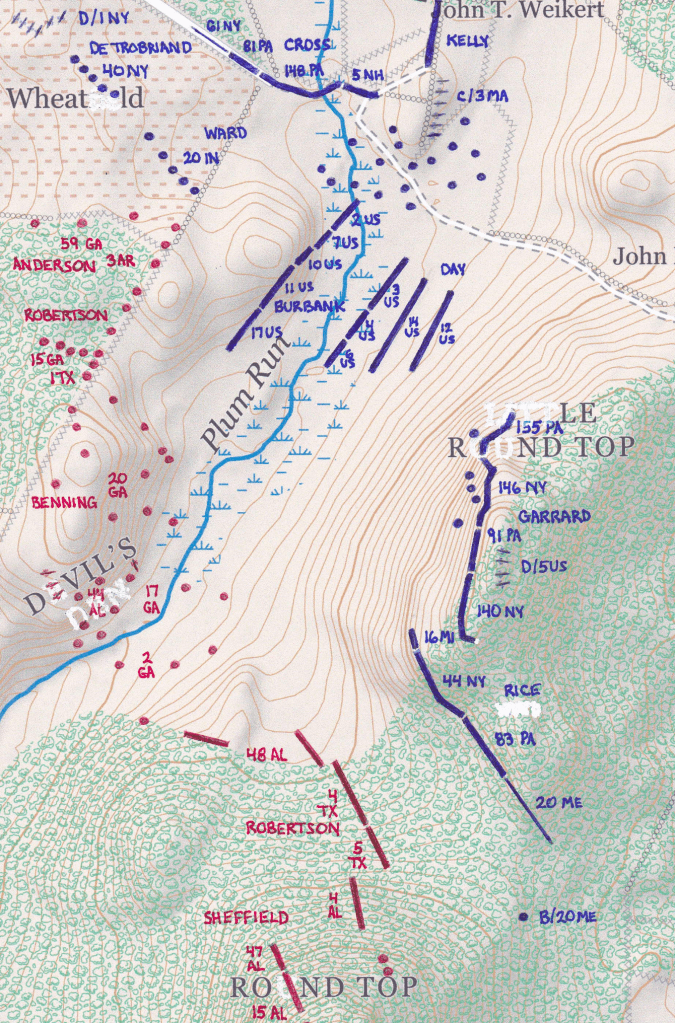
Map showing location of 17th Georgia near Plum Run in front of the Devil’s Den on 2 July 1863

Following Parks’ death on the second day at Gettysburg, the paper printed three testimonials on August 7 and 11, from Linton Stephens, John M. Potter and Lt. John Henry Martin. Martin succeeded Parks as captain of the company, and related his last hour or so among the living: “Capt. Parks was wounded when we first entered the field [likely by artillery fire], but remained in command until we had charged the battery [Smith’s 4th New York at Devil’s Den] and ran the Yankees off the hill [Houck’s Ridge]. He was then persuaded to go to the rear. He started back, saying that he would shelter himself behind a rock; that was the last that any of the company saw of him until after the firing had almost ceased, when we were informed that he was killed – he was found in the most dangerous and exposed spot on the field. He was shot through the head. I have been told by one who saw him fall that he was instantly killed – having fallen without speaking. His loss to the company is great, and in conjunction with his friends and relatives we mourn his loss. He was truly a Christian soldier, and exerted a beneficial influence in the circle in which he moved.”

Virgil A. S. Parks’ remains were never identified. The attached map depicts the situation at 6:10 p.m. on July 2, a few minutes after Brig. Gen. Ward’s brigade was driven from Houck’s Ridge, when Capt. Parks sought refuge behind one of the many scattered boulders that covered the exposed eastern slope of the ridge.

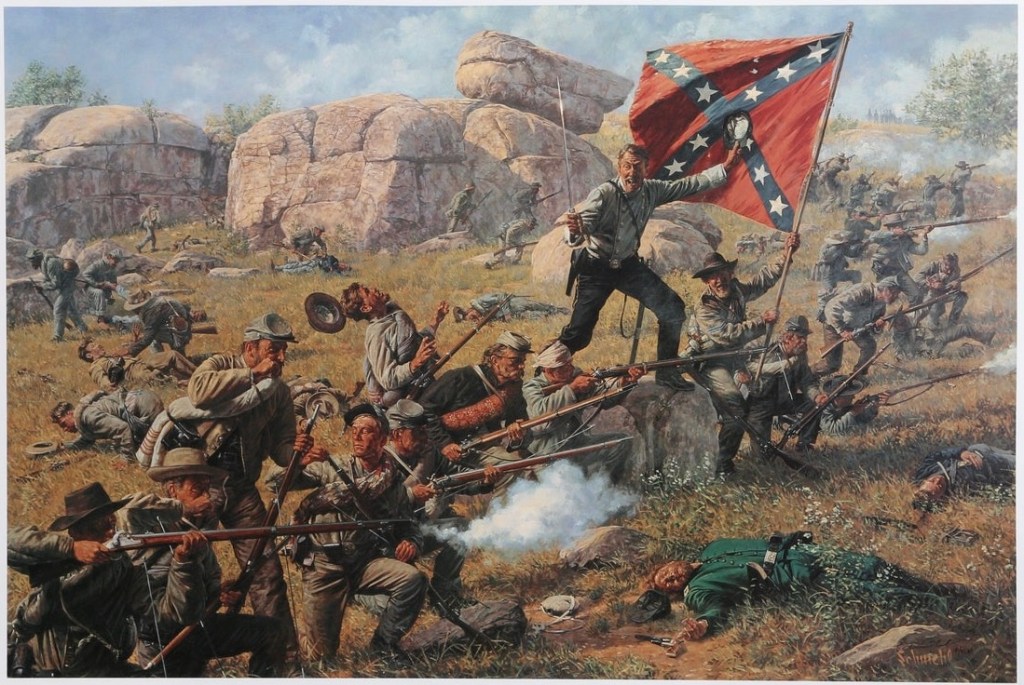
Great painting by Bradley J. Schmehl of the 17th Georgia fighting in front of the Devil’s Den at Gettysburg on 2 July 1863. Capt. Parks was slain on the battlefield fighting in the “War of Independence and Southern Rights,” as he termed it.

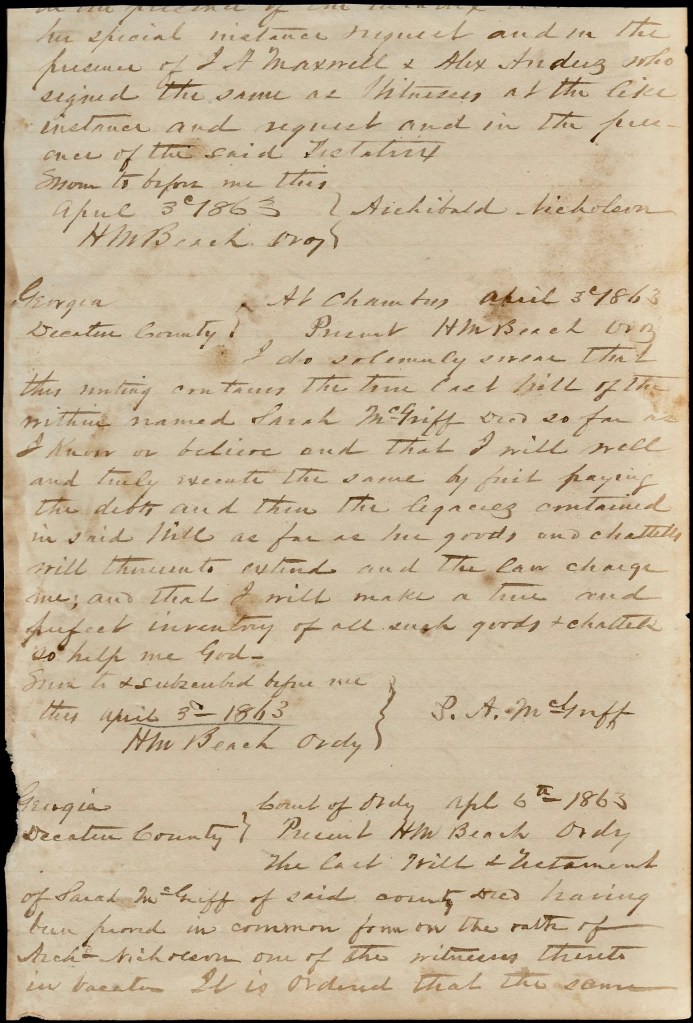
Curiously, this document appears to have been excised from a Decatur county ledger book. There are partial entries on the back side pertaining to the Last Will and Testament of Sarah McGriff, dated April 1863. The court house was located in Bainbridge, Georgia, where Parks practiced law before the war.

Transcription

To all whom it may concern. Whereas in the Providence of God it may please Him to call me hence before the close of this War of Independence and Southern Rights by permitting the enemy to slay me upon the field of battle or allowing the fell diseases of the camp or hospital to end my life, I therefore after committing myself to the mercy and goodness of our God, do hereby appoint John M. Potter of Bainbridge, Ga., my lawful Executor to collect all wages, moneys, or claims due me from any sources whatever to apply said claims to the payment of my debts, and I request my said Executor to settle and pay off all debts and claims against me to the fullest extent of my efforts.

Further, I bequeath, give and grant unto the said John M. Potter all my private papers MSS and all private property, clothing, and accoutrements which may be in my possession at the time of my decease as aforesaid and further I request him to advertise for my trunk marked with my name and lost in Augusta in February last which said trunk contains the above bequeathed property, &c. In witness whereof I have this the thirteenth day of December, eighteen hundred and sixty-two set my hand and seal. Virg. A. S. Parks (Seal)

1862: Samuel Durant to his Daughter

The following letters were written by a semi-literate English emigrant named Samual Durant (1819-1862) who enlisted at Fulton, Oswego county, New York, on 13 September 1861 as a private in Co. C, 81st New York Infantry. He was transferred to Co. G on 6 February 1862. He died of chronic diarrhea on 20 September 1862 at Philadelphia. He’s buried in the National Cemetery at Philadelphia, Section B, Site 406.

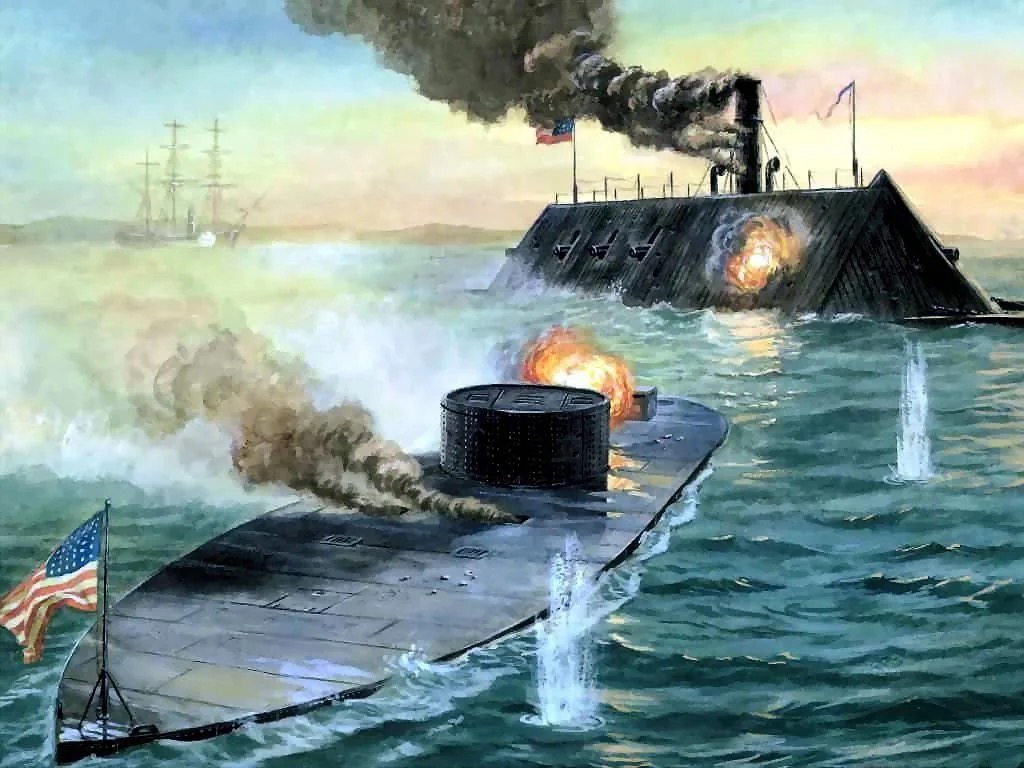
On the 21st of February the regiment was ordered to New York City, and then proceeded on the 5th of March to Washington, D. C. There the men remained in camp twenty days, and on the 28th of March, marched to Alexandria Va., where they embarked for Fortress Monroe, arriving on the 1st of April—just three weeks after the famous battle between the ironclads that captured the imagination of the public. Samuel’s description of the USS Monitor is classic: “She looks like a mud turtle with a barrel on his back. I can’t see nothing but her hump stick up out of the water. She is wicked. They are all afraid of her…”

From their landing at Newport News until May 31st the regiment was on the march or in camp, acting as reserve at the battle of Williamsburg Va., and reaching Seven Pines on the 28th, where they remained until the bloody engagement of the 31st was fought. In this battle the 81st was assigned to the left of Casey’s Division, unsupported in an open field. The regiment here underwent its baptism of fire and stood the ordeal heroically.

To read letters by other members of the 81st New York Infantry that I’ve transcribed and published on Spared & Shared, see: Horace Benjamin Ensworth, Co. B, 81st New York (1 Letter); Horace Benjamin Ensworth, Co. B, 81st New York (4 Letters); Marshall S. Moses, Co. E, 81st New York (1 Letter); Franklin Darius Sizer, Co. I, 81st New York (1 Letter); and
Dexter Samson, Co. K, 81st New York (1 Letter).

Letter 1

Headquarters, Camp Dutton
81st Regiment, Company G, NYV.
April 14, 1862

Dear daughter,

I take [this] opportunity to write to you. [I] take it from Albany. We march in the night to New York by railway in the morning & daylight. Laid there two days, then went on to Staten Island. Laid there 8 days, then [at] 4 o’clock in the afternoon, took a boat 25 miles and then took railway to the Delaware river, crossed that and a steamer to Philadelphia and a loyal place that was too. [The] saloon was a Cooper’s Shop. It was so large that we had a 11 hundred men all eat at one long table and we had everything the good. All regiments [that] pass through [Philadelphia] is fed by the corporation and all took pleasant good talk to boys.

Away we go for Baltimore and a fine country it was too, houses and other buildings painted white. The grass by the side of the road was on fire more than a 100 times. We come to a place called Mule City by ingen [?] I should think. They said there was 14 hundred mules and such—a sight you never saw, Great homely wagons, 6 mules make a team, one line on the leader and a saddle on the pull mull. The man sits this [ ] and [ ] is all I can make out. I tell you, he looked like a monkey on a hand organ. I wish you uncle James Harmon was here to see them. I tell you, we would have a laugh about it. I saw a team run away across the corn stubble. The wagon went bump, bump, bump. The boys all a laughing.

I have been down to the river and saw the Cumberland lay there sunk by the Merrimack. She is a iron-cladded rebel steamer. We have got the Monitor up there and she looks like a mud turtle with a barrel on his back. I can’t see nothing but her hump stick up out of the water. She is wicked. They are all afraid of her and [ ] battery that go by steam and [ ] chisels. And then we have got the Vanderbilt. If they attack us now they will smell powder. They keep playing round. I saw where they had two cut one [ ] off, killed two men and never touched them—the air knocked them dead. We had 11,000 men in one Division. I tell you, that made a show, and there was five thousand at that camp [which] is called Newport News.

All round us the fences are all burnt. I saw a wheat stubble and stacks of wheat knocked down, corn stubble and stalks and stacks of corn stalks but this is the pleasantest country I ever saw in my life. It is a good country for grain and potatoes. We [ ] cows nor hogs. We have two darkies follow us from [ ]. We keep them along with us. They cut wood, carry water. They are smart. We have tents now. The boys [ ] then about 3 miles and [ ]. I got up at light and take a black brand [?], named it Fort Spencer, Harpers ferry brew. Put on the Orderly….

Please send me particulars about your trade and where you [ ]. Excuse my writing and spelling. I must close my letter. Give my love to all my friends. I remain yours, — Samuel Durant


Letter 2

May 11th 1862

Dear daughter,

I take the pleasure to write to you to let you know I got back to my regiment last Saturday. I was very tired. The fever was leaving Robert on Saturday morning. I left him about 5 o’clock. I got to the regiment at 3 o’clock. The cannons was roaring all night. I didn’t sleep at all. The balloon went up in the night. They han’t got no light in camp so early.

The Sunday morning we started for the forts [at Yorktown], they had all left. As we were going along, I heard a report like a cannon. I thought [maybe] they was not gone, but when I got a little farther, I saw a man laying there badly wounded. There was one killed and 7 badly wounded. They had buried bomb shells in the road and all along where they thought we would go. As soon as you touch one of them, off they go. I say, “G. Van Pattan, what’s the matter?” [He said,” “see them shells buried, mind you [don’t] step on them. We had to be very careful.

Well, we traveled all day through forts and rifle pits until night and then laid down until 3 o’clock and then went back 8 miles in the rain. It rained all day and about all night. I was wet to my skin and my coat was so wet that I could barely carry it. I had to go in the dar, to a tree, chop some wood to be warm. There was firing all day just ahead of us. In the morning we marched round to get on the east side of them but they was just one day too fast. They had to fight like the devil to win. They did fight too, I tell you.

McClellan was up in the balloon. He see the Louisiana tigers come out of the woods put down the balloon. Our army is whipped. When he got there they had [ ] them all to pieces. The officer gave up his sword and said you have whipped the best regiment in the Confederate army. It is a very large field, I should think 1,000 acres. I should think and a 100 acres of wheat and corn. I don’t know but their five forts, ditches round 15 feet deep they got in there. Our boys got on one shoulder and the gun in the other hand and away they run, throwed the rails across the ditch [and] over they went [ ] them out. They took some prisoners but how many I don’t know. I saw 150 wounded rebels in one barn & shed. The doctors cutting off legs and arms, some screaming all night. That was on Wednesday night. I couldn’t sleep.

Next morning I got up and went off to south and west of the field. I come to a [ ] and then I come to a horse shot down, three or four in a mud hole with the harnesses on. They was the muddiest lot of horses and men I ever saw in my life. I saw the Michigan 5th, I think it was, all shot to pieces and bayonet[ed]. They was too fast. Had their knapsacks on all in the rain and mud. They was all muddy. 1

I just now read your letter. I felt glad to hear from you. I heard from Robert just before. He is better. I wish we get our pay so he could have some to get some things. I left all I could spared with Ed and I tell you that we are to march on the road to Richmond. They are not far ahead of us. Our boys are dragging [?] out all the time. We can’t get half enough to eat. The teams can’t get along with it. I would rather have seen wheat. I have seen the last 500 dollars but I have seen hard times. I received a letter from E. Carrier. He has received 35 dollars. From S. Durant

1 “The next major battle that the Fifth Michigan took part in was the battle of Williamsburg. The Union general wanted to attack the center of the Confederate line, which was heavily fortified by Fort Magruder. This proved to be too much for them and they were forced to turn back. This gave the Confederates a clear advantage and they decided to do a countercharge. The Confederates were able to capture a Union battery and fire upon the retreating Union soldiers. This is where the “Fighting Fifth” first earned its nickname. Once the Fifth saw what was happening, they fired upon the Confederates at the Union battery, then charged them. This shocked the rebels, resulting in them fleeing the battery. After which the Fifth started taking fire and many casualties from Confederates. To overcome this, another charge was called for, and the Fifth ended up in the rebel trenches, taking prisoners and displacing the Confederates. If it was not for their valor, the outcome of the battle would have been very different. It is reported that after the second charge they held their position for six or seven waves of attacks, incurring up to fifty percent casualties. This is the reason why the Fighting Fifth is such a notable regiment. Within their first battle, they showed gallantry and guts to overtake the Confederates with not only one, but two charges against the odds. Not only did they prove themselves at Williamsburg, but they did so too during other battles as well.”  [See The 5th Michigan Volunteer Infantry Regiment during the Civil War.]

1861-64: George W. Modie to his Parents

I could not find an image of George but here is one of William H. Oury of Co. E, 20th OVI (Ancestry.com)

These letters were written by 23 year-old George W. Modie (1838-1913) of Company A, 20th Ohio Infantry. He wrote the letters to his parents, William Modie (1799-1872) and Margaret Gates (1811-1880) of Chester, Morrow County, Ohio. George married Isabelle (“Belle”) Nye (1848-19xx), the daughter of W. W. Nye and Martha Ball in 1870. He died in 1913 and is buried in the Dayton National Cemetery, Section 1, Row 10, Site 42.

George served with the 20th Ohio from October 1861 until July 1865 — nearly the entire four years of the war. In the second letter, written from Camp King, near Covington, Kentucky, George informs his parents of the inclement weather and the need for another blanket. The regiment remained at Camp King until 11 February 1862 when they participated in the investment and capture of Fort Donelson and then on to Shiloh.

See also—1862: George W. Modie to Sanford N. Modie on Spared & Shared 9.

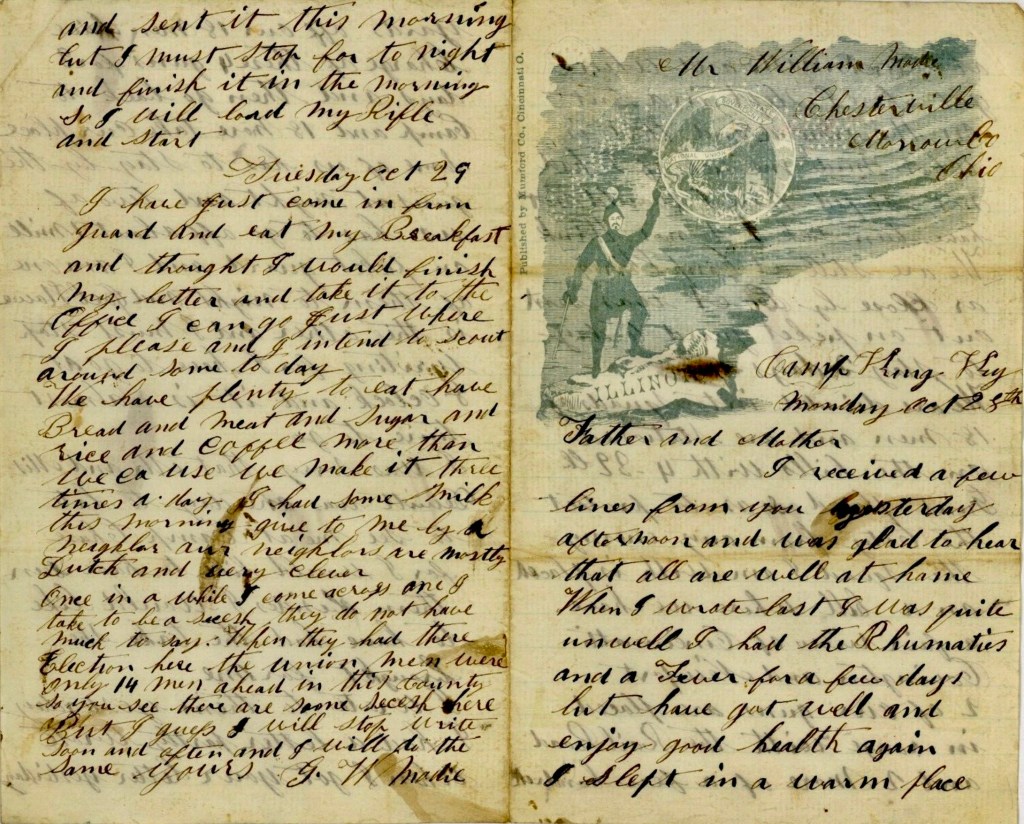
Letter 1

Camp King, Kentucky
Monday, October 28, 1861

Father and Mother,

I received a few lines from you yesterday after and was glad to hear that all are well at home. When I wrote last I was quite unwell. I had the rheumatics and a fever for a few days but have got well and enjoy good health again. I slept in a warm place at Cincinnati and when I got here I slept in a tent on the ground and that is what made me sick. If I had not stopped there, I would not have been sick, I do not think.

We are still at Camp King or close by. Co. A was sent out on picket guard today to stay three days. We are divided into squads of 18 men and are stationed on the hills with four 32-pound guns placed as to protect the City from any enemy. The squad I am with is placed on a hill where we have a fair view of Cincinnati, Covington, and Newport. Two of our guns are placed in range with the railroad and two more of a few hundred yards off. Our 18 men have charge of these four guns for three days and then go back to camp and 18 more take our place. Some of us has to stay by the guns at night and two of us has to go off about 1 mile on picket guard and I am one of them tonight and Joel Howe is the other. I must stop writing for I have togo on at 8 o’clock and it almost time to go.

I was sorry that Mr. and Mrs. Demitt was one day too late to see me at Camp Chase for I would like to have seen them. Besides, I would like to have had the cake she brought for me. I wrote to them yesterday. I had a letter partly wrote when I got your letter yesterday and sent it this morning. But I must stop for tonight and finish it in the morning. So I will load my rifle and start.

Tuesday, October 29th

I have just come in from guard and eat my breakfast and thought I would finish my letter and take it to the Office. I can go just where I please and I intend to scout around today.

We have plenty to eat. Have bread and meat and sugar and rice and coffee more than we can use. We make it three times a day. I have some milk this morning given to me by a neighbor. Our neighbors are mostly Dutch and very clever. Once in a while I come across one I take to be a secesh. They do not have much to say. When they had their election here, the Union men were only 14 men ahead in this county. So you see there are some secesh here. But I guess I will stop. Write soon and often and I will do the same. Yours, — G. W. Modie


Letter 2

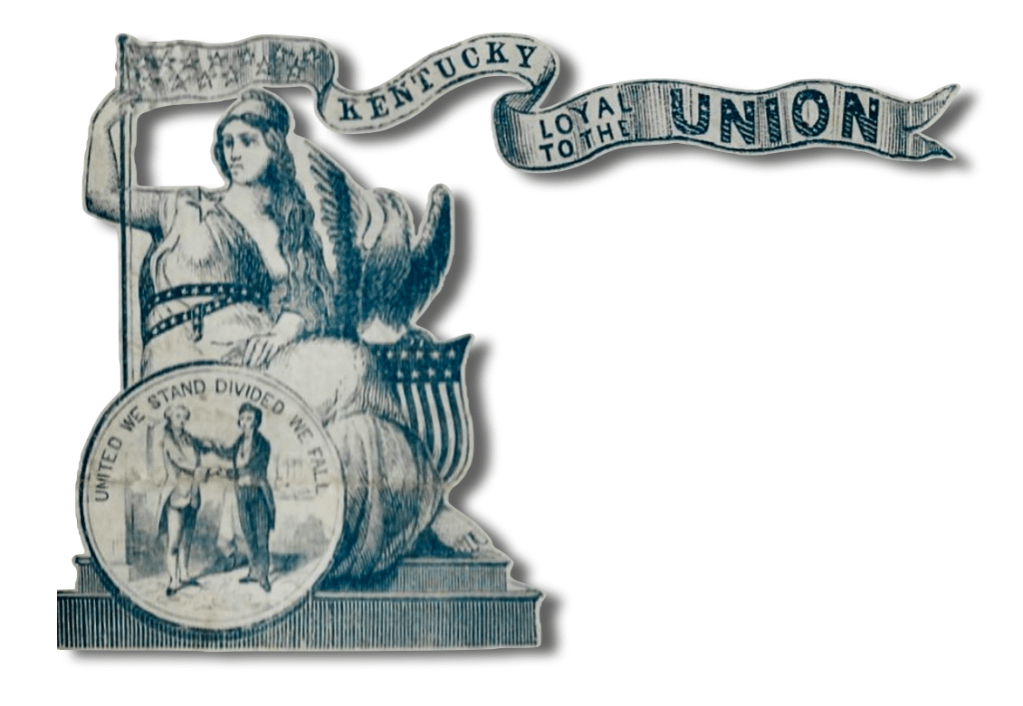
Patriotic letterhead celebrating Kentucky’s Loyalty to the Union

Camp King, [near Covington] Kentucky
Thursday, November 28 [1861]

Father and Mother,

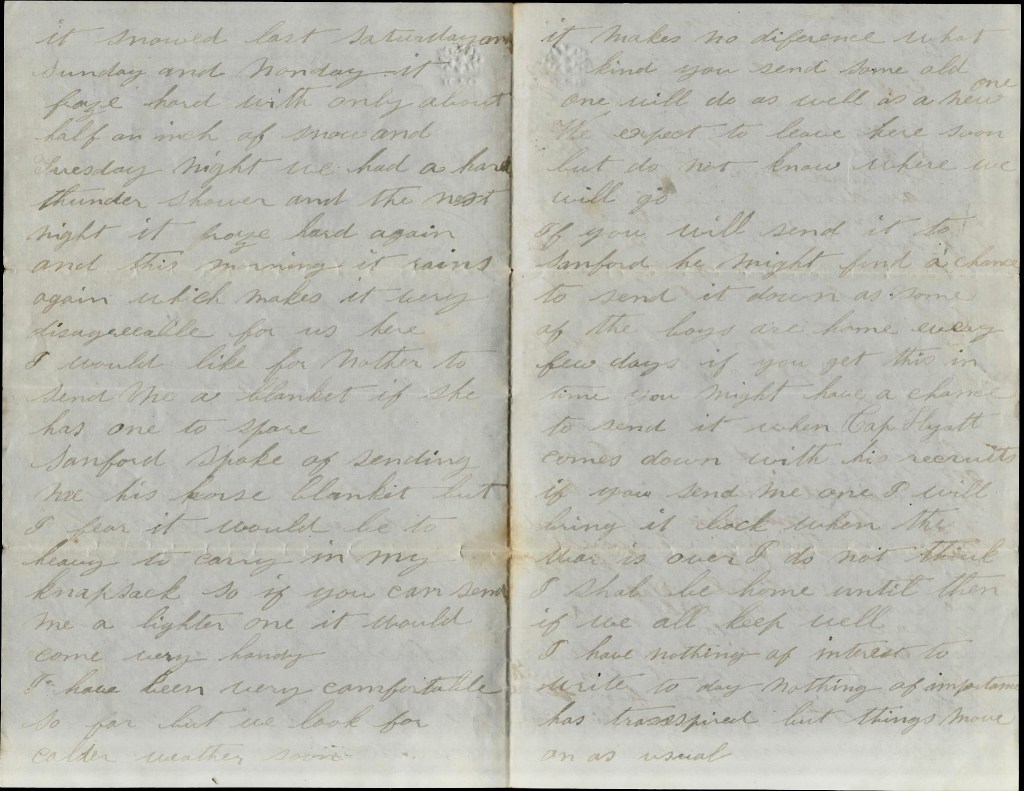
I write you a few lines again to let you know I am well. I received a letter from Sanford last night and was glad to hear you was all well. J. Runyan also arrived last night. He told me he saw you. We have had some very cold weather for a few days back. It snowed last Saturday and Sunday and Monday it froze hard with only about half an inch of snow and Tuesday night we had a hard thunder shower and the next night it froze hard again and this morning it rains again which makes it very disagreeable for us here.

I would like for Mother to send me a blanket if she has one to spare. Sanford spoke of sending me his horse blanket but I fear it would be too heavy to carry in my knapsack so if you can send me a lighter one, it would come very handy. I have been very comfortable so far but we look for colder weather soon. It makes no difference what kind you send. Some old one will do as well as a new one. We expect to leave here soon but do not know where we will go. If you will send it to Sanford, he might find a chance to send it down as some of the boys are home every few days. If you get this in time, you might have a chance to send it when Capt. Hyatt comes down with his recruits. If you send me one, I will bring it back when the war is over. I do not think I shall be home until then if we all keep well.

I have nothing of interest to write today. Nothing of importance has transpired but things move on as usual. I will look for a letter from Martin next week. Tell R. Wilson I received his letter and was glas to hear from him. Yesterday one of the boys in Co. F got shot through the right hand and left arm by accident and the other night one of the sentinels had a finger shot off by a rebel.

Tell Dave Bre__ I look for a letter from him. I heard he has got home.

The mud is about knee deep here and we hope to get out of here soon. General Fremont was at the city yesterday but I did [not] get to see him. We received our regimental flag this morning. If I had room on this paper I would tell you what it looks like. It is a beautiful flag. We have plenty of daily papers to read every day.

Tell Mary I received her letter the next day after it was mailed. I would like to hear from some of you often. No more at this time. Yours, — G. W. Modic


Letter 3

Addressed to Mr. William Modie, Lucerne, Knox county, Ohio

Hospital 17th Army Corps
Marietta, Georgia
Tuesday evening, August 17, 1864

Friends at home,

I wrote to you only a few days ago but I heard some bad news from Martin 1 today and it may be you have not heard from him so I will let you know all I can from him. I received a few lines from Reed Runyan today stating that Martin was wounded. He had lost both of his thumbs shot off and a flesh wound in the arm above the elbow. It is a bad wound. Still it could have been worse.

The boys of our company whose time is out came in today and are here waiting for transportation home. The rebels have destroyed the railroad between this place and Chattanooga and they may be obliged to stop here a few days but they expect to go tomorrow. Reed Runyon is not with the rest of the boys as his time is not quite out yet. The boys say they seen some of the boys of Martin’s company and said Martin was working on the breastworks when he was wounded. I do not know at which hospital Martin is at but suppose he is still at the field hospital and I expect he will be sent to this place or farther north soon. I will do all I can to get to see him. I am able to get about by carrying my arm in a sling.

Well, I almost forgot to tell you I expect to start for home in a few days on furlough as we are of no account here and they want us to go home out of the way. Only a few of us are going at present. Two of the Fredricktown boys are going with me and one to Mt. Vernon. We will not likely get our papers in time to go with the non veterans but our furloughs are sent to headquarters to be signed and will be back in a few days. You must not look for me until you see me for if Gen. Blair should refuse to sign our furloughs, we will stop where we are a while yet. I thought I had best accept a furlough as times passes very slow with me at the hospital. I hope Martin will get home soon and no doubt he will. I suppose he is done soldiering. You must not feel uneasy about him. His wound is not dangerous and he will be well taken care of and will get along as well as if some of you was with him.

My hand is still very sore but is doing well. Well, it is not necessary for me to write much this time. If I get home as I expect, I can tell you the news. I have not had a letter from any of you since I wrote last. I suppose the reason is the railroad is destroyed and I suppose it must be repaired before you get this. Do not write again until you see me or hear from me again. No more this evening.

Respectfully yours, — George W. Modie

I have not heard from Dave Bruce but suppose he is all right yet as I have no account of him being hurt. Reed Runyon got a light soup spilled in the bargain. It appears that I and Martin have all our bad luck at once after going through so many hard fights, but the fortunes of war are very uncertain. But I am willing to try my luck again soon as I am able.

1 Martin G. Modie (1840-1911) was George’s younger brother. Martin served from August 1862 to April 1865 as a priate in Co. G, 121st Ohio Volunteer Infantry. He was discharged for disability.

1865: Unidentified “Albert” to “Cousin” Clara Teresa Ensign

The following letter was written by a member of the 14th Ohio Infantry who signed his name “Albert” but I am unable to state with certainty his identity. There were few soldiers by that name in the regiment but I cannot place any of them in Lake county, Ohio before the war. We know from the content he was a veteran who has served a full four years in the war. There is an outside possibility it was Capt. Albert Moore of Co. A. I transcribed another letter by him some time ago and there is a similarity in the hand writing.

Albert wrote the letter to Clara Teresa Ensign of Madison, Lake county, Ohio. He addressed her as “cousin” but we learn from the letter that he does not believe they are actually related.

The letter contains a commentary on President Lincoln’s assassination.

Transcription

Camp of the 14th Ohio
April 29th 1865

Dear Cousin Clara,

Your kind and truly welcome favor of the 16th inst. has just come to hand and I hasten to write a few lines in reply to it. Your letter found me lying in my tent, some six miles from the city of Raleigh, North Carolina. I am in the best of health and spirits as we are now on our way home. Home sweet home. There is no place like home.

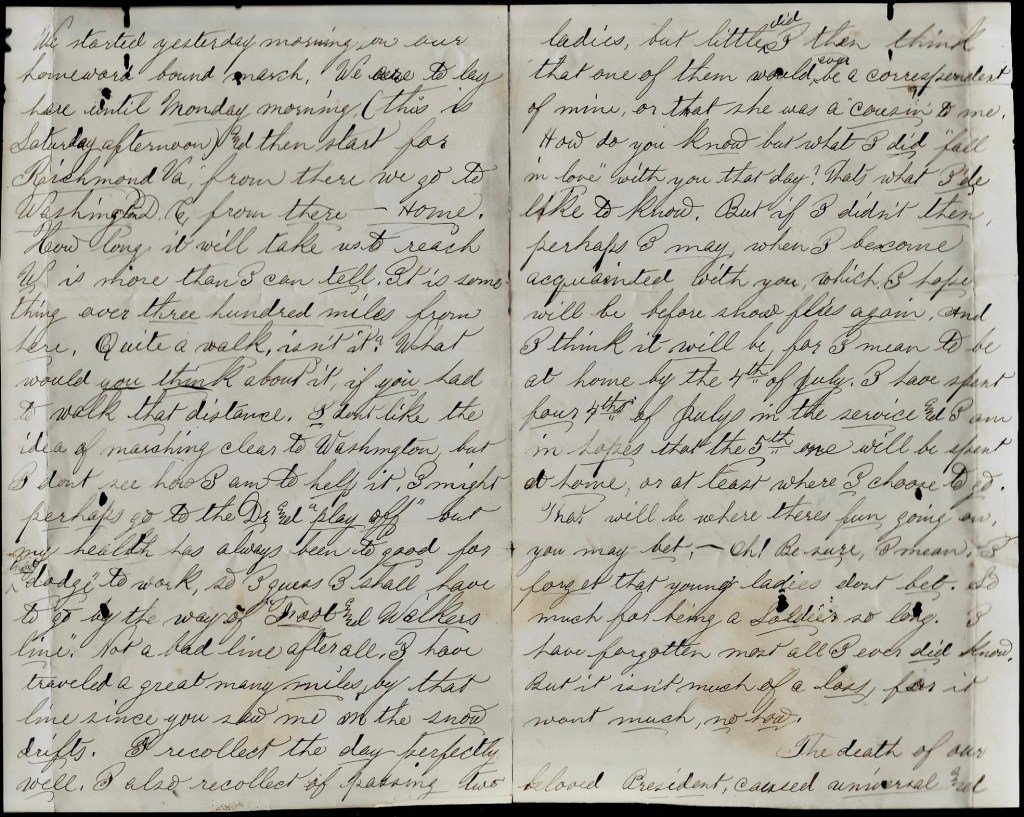
We started yesterday morning on our homeward bound march. We are to lay here until Monday morning (this is Saturday afternoon) and then start for Richmond, Virginia. From there we go to Washington D. C. and from there—home. How long it will take us to reach Washington is more than I can tell. It is something over three hundred miles from here. Quite a walk, isn’t it? What would you think about it if you had to walk that distance? I don’t like the idea of marching clear to Washington but I don’t see how I am to help it. I might perhaps go to the doctor and “play off” but my health has always been too good for that “dodge” to work so I guess I shall have to go by the way of “Fast and Walker’s line.” Not a bad line after all. I have traveled a great many miles by that line since you saw me on the snow drifts. I recollect the day perfectly well. I also recollect of passing two ladies but little did I then think that one of them would ever be a correspondent of mine, or that she was a cousin to me. How do you know but what I did “fall in love” with you that day? What’s what I’d like to know. But if I didn’t, then perhaps I may when I become acquainted with you which I hope will be before snow flies again. And I think it will be for I mean to be at home by the 4th of July. I have spent four 4th of July’s in the service and I am in hopes that the 5th one will be spent at home, or at least where I choose to go. That will be where there’s fun going on, you may bet. Oh! Be sure, I mean, I forget that young ladies don’t bet. So much for being a soldier so long. I have forgotten most all I ever did know. But it isn’t much of a loss for it want much no how.
The death of our beloved President caused universal and heartfelt sorrow through the entire army. The soldiers all think it was a plot laid by the leading men of the rebellion and their threats of vengeance were not loud but deep. If there had been any fighting to do after that, it would have been terrible work, for no prisoners would have [been] taken. They would have made short work with all that came into their power. Vengeance will surely overtake the murderer if years roll around before he is taken.

So you will tell me all about the affairs when I get home, will you? Well, I will take your word for it as I expect soon to be there and then I shall have a talk with the girl and find out all about “Ezeri” and “George” and perhaps something of “Carlton.” Quite a string of names. Clara! I have a favor to ask of you and that is to send me your photo. Will you do it? If you will, I will send you mine if you desire it, just as soon as I can get some taken, which may not be before I get home. But you shall have a copy then if you wish it. I have an album and can keep it first rate. I have just room for it. Some time when you come over to see Allie after I get home, perhaps I will show it to you. It is gay. I am happy to hear that Allie was able to go to school again. I received a letter from her today with one of her compositions enclosed. She does pretty well for a girl. The boys here in the tent have tipped over the inkstand and are raising “Ned” so that I can half write so I will close for this time and I dare say that you are tired of reading my nonsense by this time. Please write as often as you conveniently can and I will answer all your letters promptly. The longer they are and the oftener they come, the better. Ever your sincere friend and “cousin”—Albert

1863-64: Herbert Dwight Ensign to Alta Ensign

The following six letters were written by Herbert Dwight Ensign (1844-1898), the son of Caleb Wadhams Ensign (b. 1790) and Orpha Deming (b. 1795) of Madison, Lake county, Ohio.

Herbert enlisted on 13 August 1862 to serve as a private in the 14th Ohio Independent Battery—a light artillery unit. He was in the battery for three years, mustering out in August 1865. Serving with him in the same battery as a corporal was his older brother, William Oren Ensign (1841-1918).

To read letters by other members of the 14th Ohio Independent Battery that I’ve transcribed and published on Spared & Shared, see: Jerome B. Burrows, 14th Ohio Independent Battery (13 Letters), and
Timothy Dwight Root, 14th Ohio Independent Battery (1 Letter).

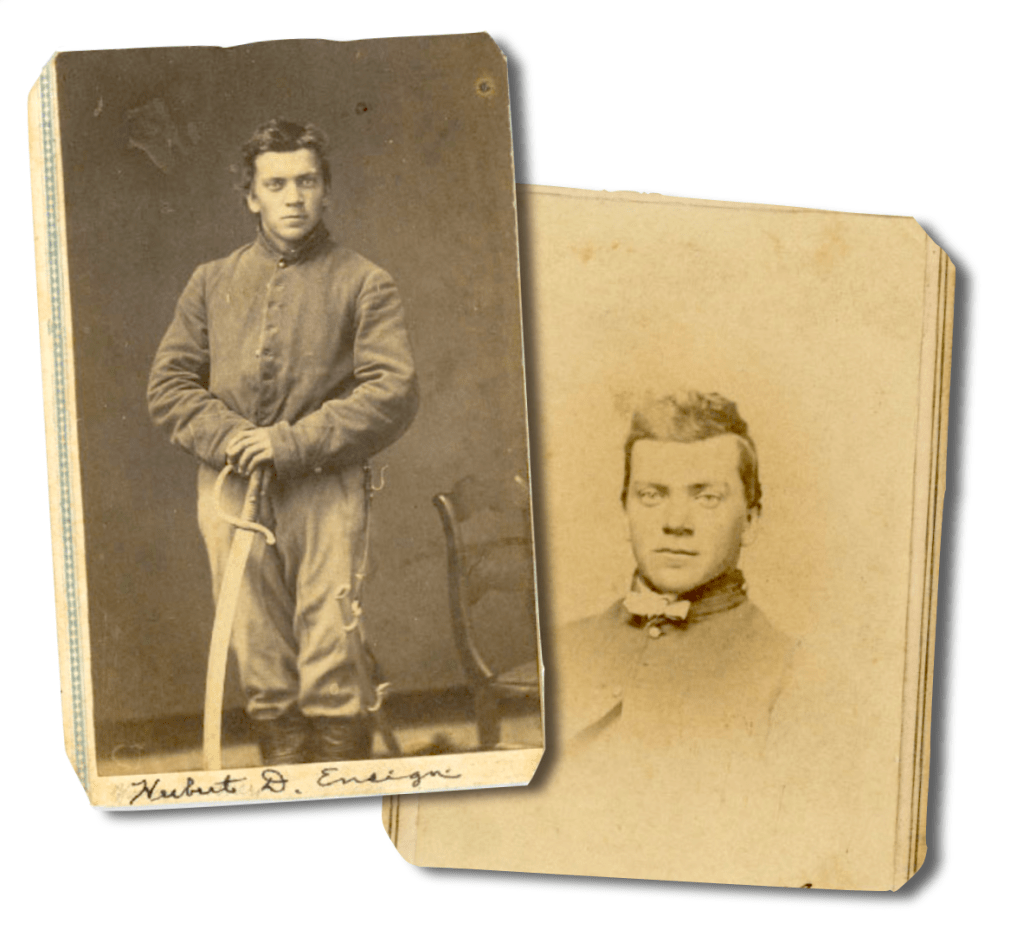
The image at left is identified as Herbert D. Ensign; the one at right is not identified but also looks like Herbert, though it might be his brother William Oren Ensign who served in the same Battery (from album with images of 14th Ohio Independent Battery.)

Letter 1

Camp on Lynn Creek
Lynnville, Tennessee
November 19, 1863

Dear Niece Alta,

Sometime since I wrote a letter to you and the next day I received one from you. so it seems that I have written two for one and now I will answer the last one from you.

I suppose you know all about our march from Corinth here by William who wrote a very long letter to Clara a day or two since. We left Corinth on the second instant and marched to Eastport where we crossed the Tennessee river on the sixth. We arrived at Pulaski on the eve of the 11th. Next morning we took the Nashville Pike and arrived at Lynnville in the afternoon, a distance of 15 miles. We are about 20 miles from Columbia and 64 from Nashville. Lynn Creek is a pretty little stream and is as clear as a crystal. Lynnville is a very pretty little town of about 300 inhabitants, but war has left its footprints here. There are a good many old chimneys left standing. The buildings were burnt by A. D. McCook. His command was fired on while passing through the place from the hills on the east side of the town and his brother Robert was killed on this same road, just across the Alabama line. By the appearance of things now, I guess we will stay on this line of railroad this winter though it is not working any further than Columbia at present.

The country here is very much broken. Some of the hills look like mountains. The soil is very rich and they raise some of the biggest corn that I ever saw and they have some good fruit, but potatoes do not do very well, being small and watery. We have not drawn very good rations since we came here (I mean from the commissary) but the fresh meat that we have had since we came here is heeps. The boys have helped themselves to so many hogs that there is some talk of fining the battery to pay for them. But it is all talk I guess.

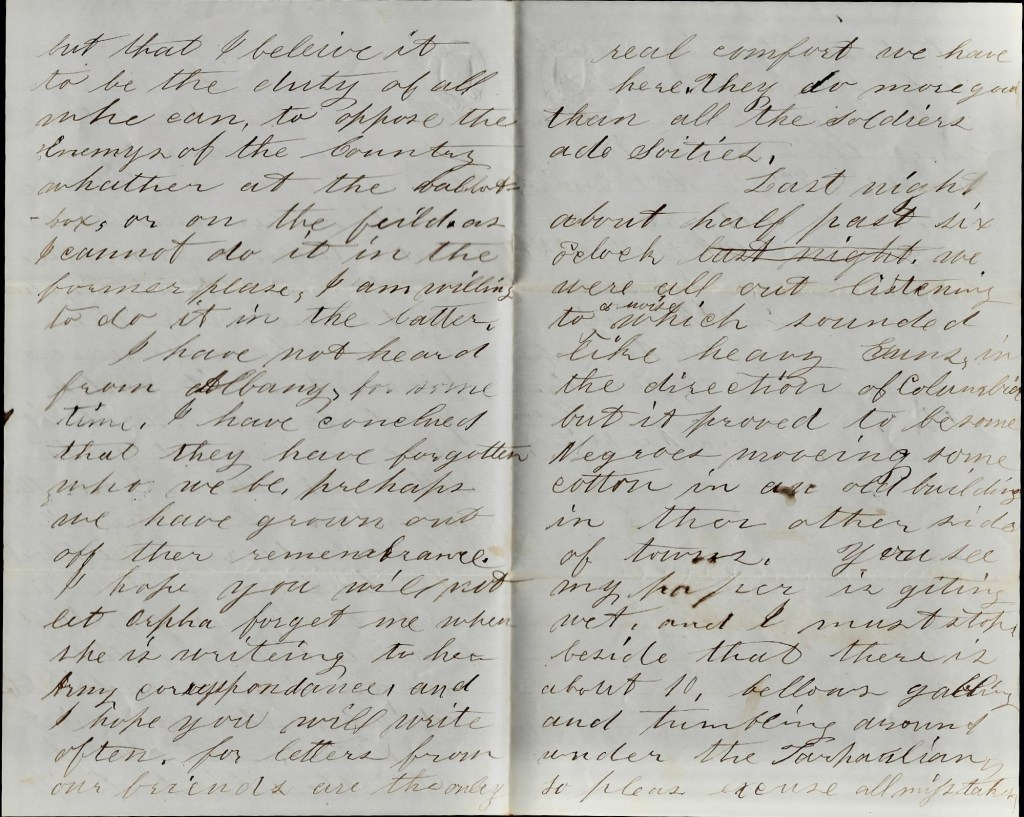
November 20th. We have had very pleasant weather until last night when it commenced raining and has rained ever since and it is so damp that I can hardly write legible. I received a letter from Clara a day or two ago in which she said Father and Mother had returned from the West and that Orpha had come with them. I hope she will have a pleasant visit and a good school. I wish it was so I could go to school at the Sem. this winter, but the life of a soldier is a school of itself, and I am no sorry as yet that I enlisted when I did. I only wish I had enlisted when the war first broke out, not that I like the kind of life, but I believe it to be the duty of all who can to oppose the enemies of the country, whether at the ballot box or on the field. As I cannot do it in the former place, I am willing to do it in the latter.

I have not heard from Albany for some time. I have concluded that they have forgotten who we be. Perhaps we have grown out of their remembrance. I hope you will not let Orpha forget me when she is writing to her army correspondences and I hope you will write often for letters from our friends are the only real comfort we have here. They do more good than all the soldiers aid societies.
Last night about half past 8 o’clock, we were all out listening to a noise which sounded like heavy guns in the direction of Columbia but it proved to be some Negroes moving some cotton in an old building in the other side of town/ You see my paper is getting wet and I must stop. Besides that, there is about 10 fellows jabbering and tumbling around under the tarpaulin so please excuse all mistakes and write soon and tell me all about what you are studying this winter and oblige, — H. D. Ensign

Address 14th Battery, O. V. Artillery, 4rd Brigade, 2nd Division, 16th Army Corps, Columbia, Tennessee via Nashville


Letter 2

14th Ohio Battery
Lynnville, Tennessee
February 10, 1864

My Dear Niece Alta,

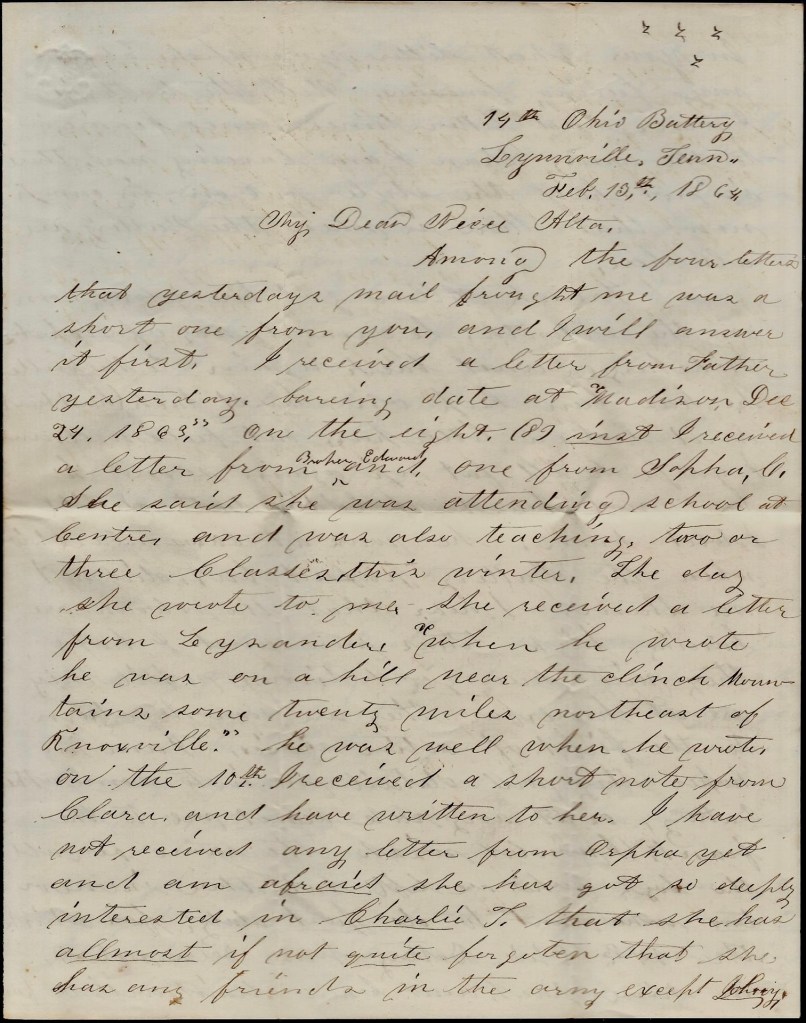
Among the four letters that yesterday’s mail brought me was a short one from you, and I will answer it first. I received a letter from Father yesterday, bearing date at Madison, December 24th 1863. On the 8th instant I received a letter from brother Edward, and one from Sopha C. She said she was attending school at Centre, and was also teaching two or three classes this winter. The day she wrote to me she received a letter from Lysander. When he wrote, he was on a hill near the Clinch Mountains some twenty miles northeast of Knoxville. He was well when he wrote. On the 10th I received a short note from Clara and have written to her, I have not received any letter from Orpha yet and am afraid she has got so deeply interested in Charlie T. that she has almost if not quite forgotten that she has any friends in the army except Johnny.

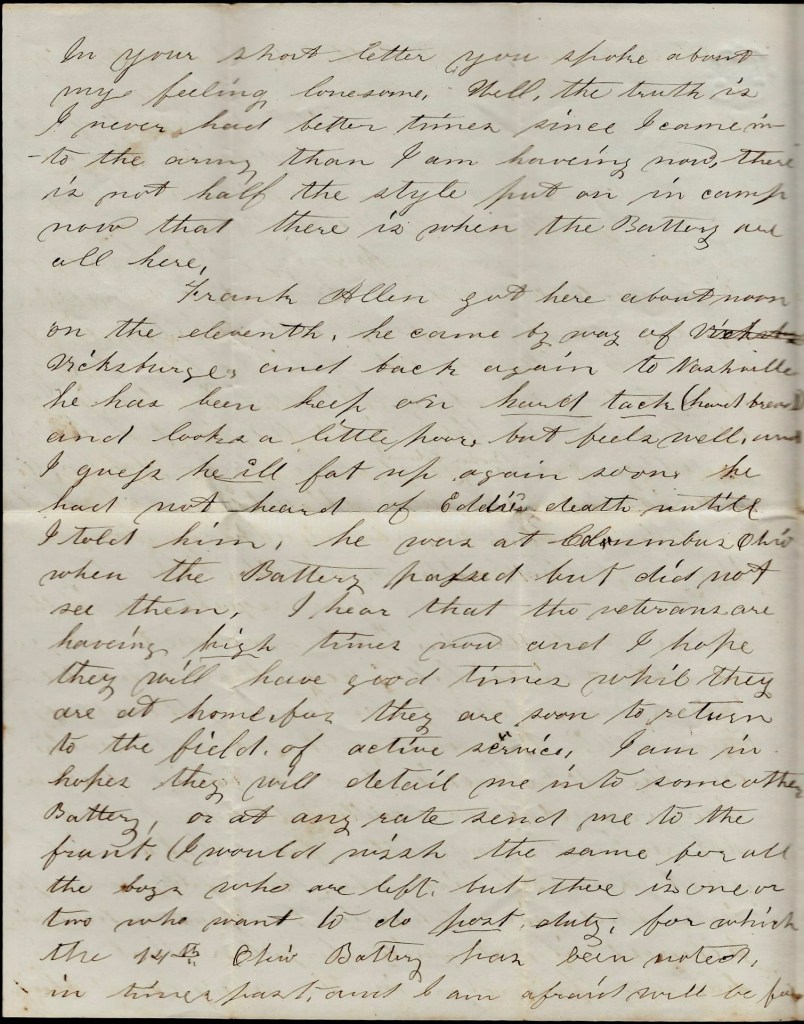
In your short letter you spoke about my feeling lonesome. Well, the truth is I never had better times since I came in to the army than I am having now. There is not half the style put on in camp now that there is when the Battery are all here.

Frank Allen got here about noon on the 11th. He came by way of Vicksburg and back again to Nashville. He has been kept on hard tack (hard bread) and looks a little poor, but feels well and I guess he’ll fat up again soon. He had not heard of Eddie’s death until I told him. He was at Columbus, Ohio, when the Battery passed but did not see them. I hear that the veterans are having high times now and I hope they will have good times while they are at home for they are soon to return to the field of active service. I am in hopes they will detail me into some other Battery, or at any rate send me to the front. I would wish the same for all the boys who are left, but there is one or two who want to do post duty for which the 14th Ohio Battery has been noted in times past and I am afraid will be for time to come. Yet I think that it will be sent to the front early in the spring.

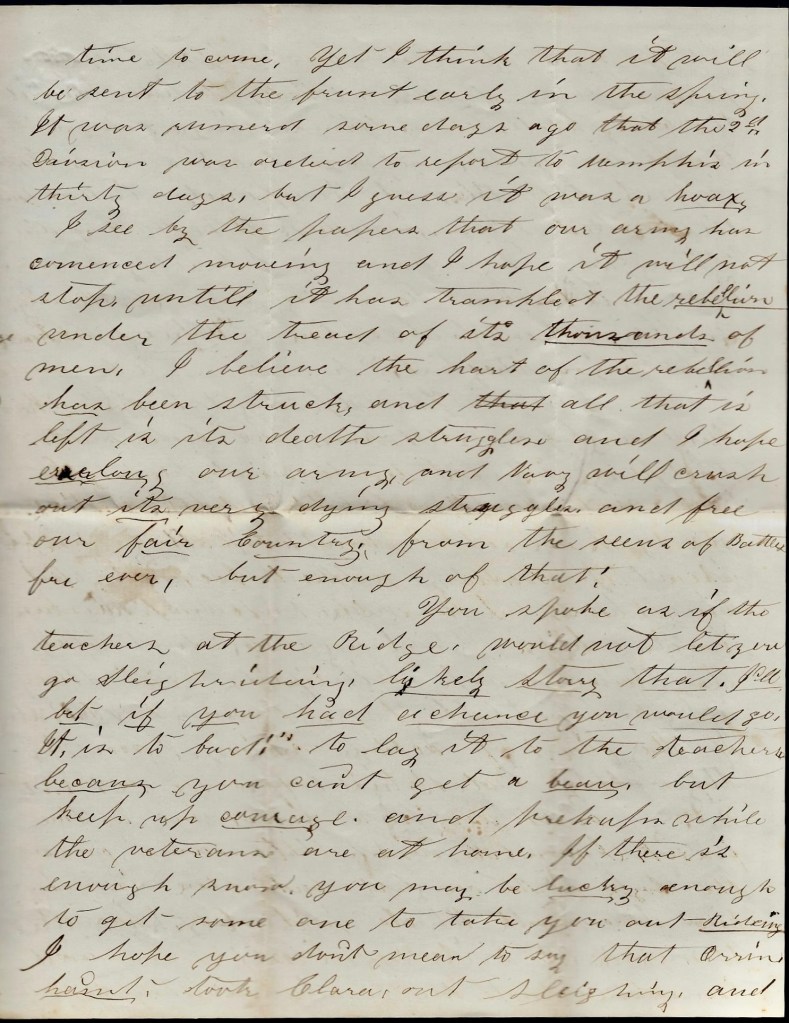
It was rumored some days ago that the 2nd Division was ordered to report to Memphis in thirty days, but I guess it was a hoax. I see by the papers that our army has commenced moving and I hope it will not stop until it has trampled the rebellion under the tread of its thousands of men. I believe the heart of the rebellion has been struck and all that is left its its death struggle, and I hope ere long our army and Navy will crush out its very dying struggles and free our fair country from the scenes of battles forever. But enough of that!

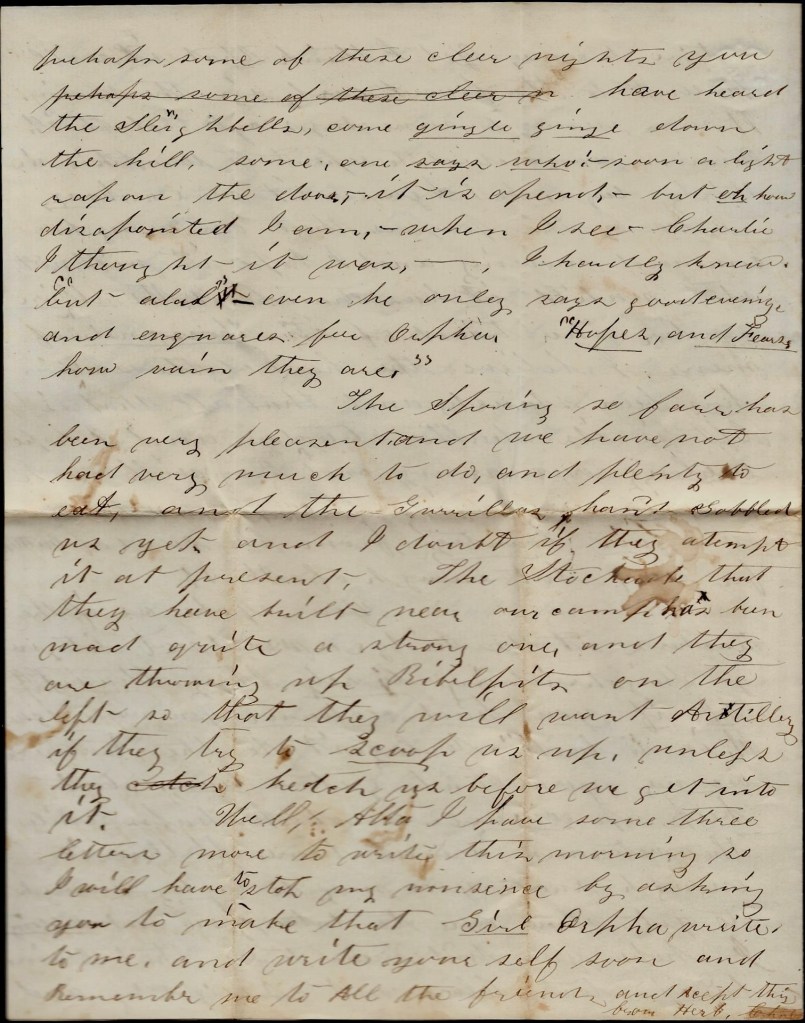
You spoke as if the teachers at the Ridge would not let you go sleigh riding. Likely story that. I’ll bet if you had a chance you would go. It is too bad to lay it to the teachers because you can’t get a beau, but keep up good courage and perhaps while the veterans are at home—if there is enough now—you may be licky enough to get some one to take you out riding. I hope you don’t mean to say that Orrin hain’t took Clara out sleighing and perhaps some of these clear nights you have heard the sleigh bells come jingle jing down the hill. Someone says, who! Soon a light rap on the door. It is opened, but Oh! how disappointed I am when I see Charlie. I thought it was ——. I hardly knew but, alas, even he only says good evening and enquires for Orpha. “Hopes and fears, how vain they are.”

The spring so fair has been very pleasant and we have not had very much to do and plenty to eat, and the guerrillas hain’t gobbled us yet, and I doubt if they attempt it at present. The stockade that they have built near our camp has been made quite a strong one and they are throwing up rifle pits on the left so that they will want artillery if they try to scoop us up unless they catch us before we get into it.

Well, Alta, I have some three letters more to write this morning so I will have to stop my nonsense by asking you to make that girl Orpha write to me and write yourself soon and remember me to all the friends and accept this from, — Herb


Letter 3

Detachment of 14th Ohio Battery
Culloeoka, Tennessee
April 22, 1864

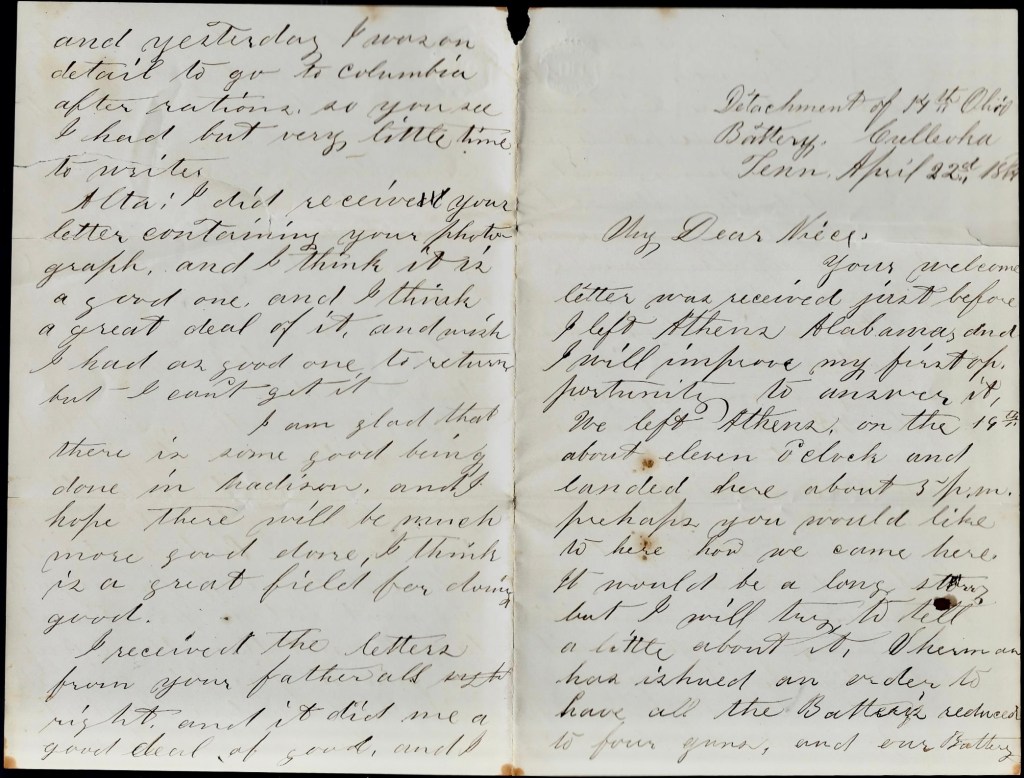
My dear niece,

Your welcome letter was received just before I left Athens, Alabama, and i will improve my first opportunity to answer it. We left Athens on the 19th about eleven o’clock and landed here about 5 p.m. Perhaps you would like to hear how we came here. It would be a long story but I will try to tell a little about it. Sherman had issued an order to have all the Batteries reduced to four guns and out Battery was ordered to turn over our brass guns and detail 25 men and one lieutenant to report to Culleoka to man a couple of guns and so they detailed the old boys who did not reenlist and made up the number of the recruits who were not well. There is about three hundred men here in all—most of them are recruits of for the 7th Pennsylvania Cavalry and greener, dutcher set of men (or rather boys) I never saw.

We have two old 6-pounders. They are not extra good guns. We tried them at a target 850 yards. The ammunition was poor but the solid shot struck it once or twice but the shell (most of them) burst short. I expect we will try it again today and I will have to go on guard soon. My accommodations for writing are poor and my pen and ink are far from being the best so if I can write this so that it can be read, I shall think I am doing well.

April 24. Well, Alta, I guess you think I don’t care much about your letters but that is not the case. They are always looked for with pleasure and welcome when they come. But last Friday when I came off from guard, we went out to practice at target and then there was so much jumping around in the quarters that it was near impossible to write and yesterday I was on detail to go to Columbia after rations so you see I had but very little time to write.
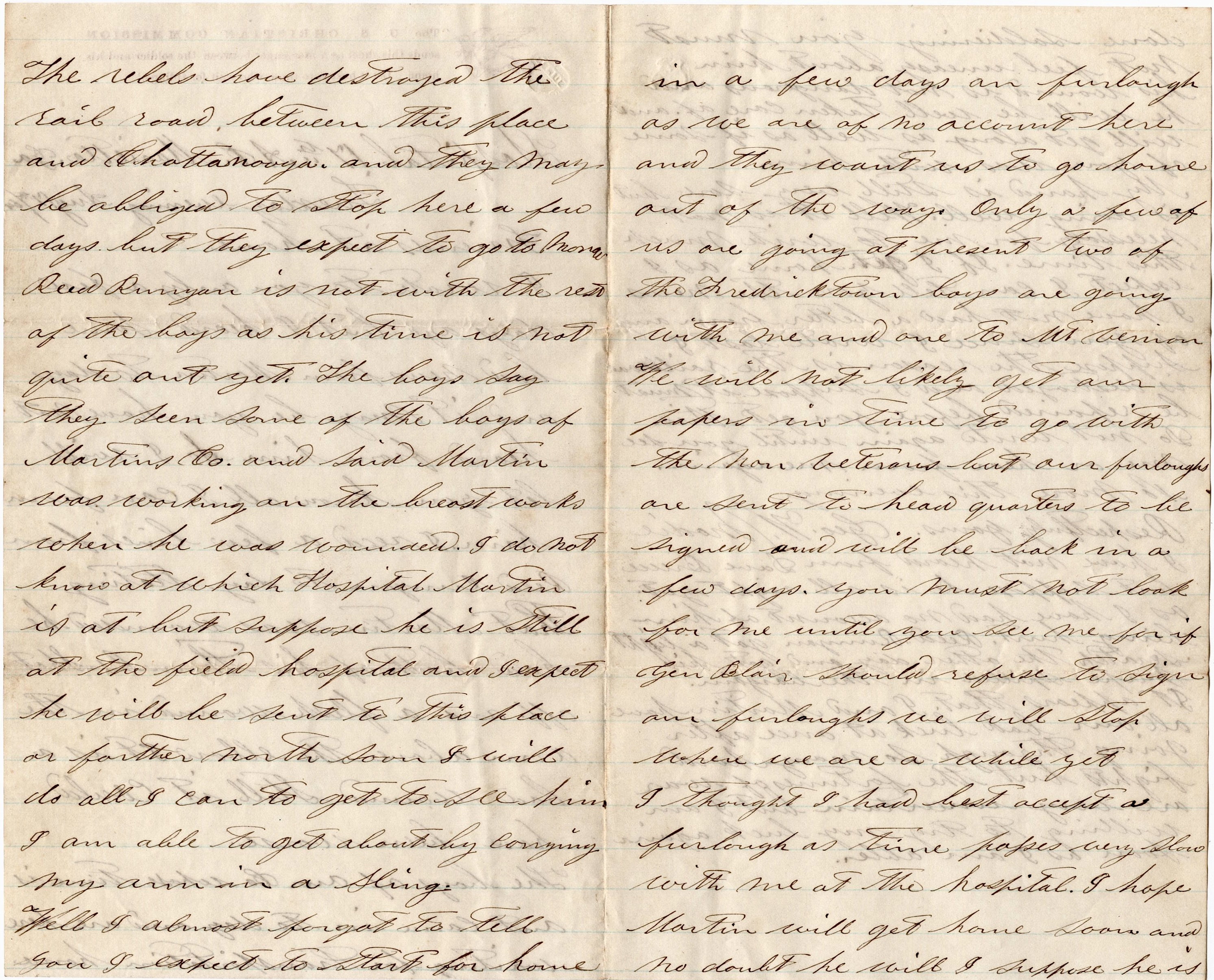
Alta, I did receive your letter containing your photograph and I think it is a good one and I think a great deal of it, and wish I had as good one to return but I can’t get it.

I am glad that there is some good being done in Madison and I hope there will be much more good done. I think it is a great field for doing good. I received the letters from you father all right and it did me a good deal of good and I wrote to Clara some time ago and hope she will not forget to write to me if Orren does come to see her every week.

Orpha would not tell me who took her to Mrs. Warner’s party but I guess it was Orrin—ain’t I right? I wrote to Orpha some days ago and directed to Williams Center.

Example of blockhouse constructed by the Engineers (LOC)

The Engineers are very busy building block houses at every trestle so that a very few men can stand a pretty hard attack. They are built of solid oak nearly two feet thick and earth thrown up to the port holes and covered with twelve inches of oak and three feet of earth. They are the prettiest little forts I ever saw.

One of our Dutch pickets got scared last night and run into camp.

Well, Alta, this is a dry letter but is it just as dry times here. Please write soon to Herbert D. Ensign, Post Battery, Culleoka, Tennessee

[to] Miss A. C. Ensign, Madison, Ohio


Letter 4

Post Battery
Decatur, Alabama
July 7th 1864

My dear Niece

I received your letter night before last and I do assure you that I was very glad to hear from you. I had hoped to hear that your Father was much better. Still I was thankful to hear that he was no worse. I am glad you and Clara have such good success in milking and in feeding the calves. Hope you will not get any ore of their love pats in your face. Will says he answered your letter if he received it. He received one from Clara day before yesterday and will answer it soon. On the 3rd I received a letter from Hattie Burget and answered it on the 5th. It has been some time since I heard from the Farmer friends. I am looking for a letter from Milo Carnes.

The 171st O. N. G.’s from our country were indeed lucky in not being with the regiment when it was captured. As for Vallandigham, I believe he is like a dead tree that is soon to be used for kindling wood and if there is no place in—-, hotter than another. It will be kept for him (Alta, I had almost forgotten the command judge not lest you be judged) but I will say he has played out, unless he can get the nominee for Vice President at the Chicago Convention. What a pretty ticket they can have. For President—George B. McClellan of Ohio, for Vice President—C. L. Vallandigham of Ohio. Alta, you are right! there are some that would grumble of they had everything to suit themselves, but such people never amount to much, or at least I think so. The only ticket that loyal men can support is Lincoln & Johnson. Fremont may be all right in his place, but when he accepted the nomination of the Cleveland Convention, he strayed far, far out of the place and has politically killed himself forever. I always had thought he was a good man but now I do not. When I first heard that Vallandigham had come back to Ohio, I was in hopes they would hang him, but now I say leave him be, but keep your eye on him and the soldiers will tend to his case when they get him.

For my part, I have no reason for caviling at the movements of Grant and Sherman so far in their campaign. We cannot under any circumstance expect single success to our army and haven’t. I think the news from the front of both of our armies of late is encouraging and the Lincoln administration is not so bad as might be, and the cry of the army is Lincoln & Johnson for President and Vice President. What is going to be worth anything of money is not.

We are under command of Lieutenant J. J. Calkins of Battery C., 1st Michigan Artillery. Lieut. Callender received his resignation papers on the 24th of June. His resignation was accepted and he left us on the 26th for home, and we were left under command of said J. J. Calkins. I do not like him very well. He puts on too much style for me.

We have but very little camp duty to do at present and I am thankful that we do not for it is hot enough in the middle of the day to bake bread outdoors.

There is a slight chance of our being ordered back to the Battery and I wish the order would come today. The boys write about their being under fire for twelve days and not a man hurt. That is what I call a galling fire. For some reason the rebs have left our pickets undisturbed of late. Not a shot has been fired on them for the last two weeks but at what moment they will commence again, we know not.

Friday 8th morning. Alta, I had to stop writing yesterday and go on detail to draw clothes and in the evening I went to prayer meeting so I will try to write a little more and close. This morning the boys are all talking about moving. What new reason they have for doing so, I do not know but expect that have heard something from the Lieutenant which makes them think we are going to leave soon. Alta, I told Frank Allen last evening that I would go over to the hospital this morning so I will close,

Please remember me to all the friends and do, write soon to me. — Herbert D. Ensign

P. S. Enclosed is a photograph which I send you to keep for me. If we move, I cannot take good care of it.


Letter 5

14th Ohio Battery
Rome, Georgia
October 28, 1864

My dear Niece,

Your letter of October 8th arrived some days ago but I have had no chance to write for a long time. We left East Point on the 4th and since then we have been marching day and night until the evening of the 25th when we came here and encamped near the depot. Our Battery and a section of Battery F, 2nd U. S. left the army at the river near Gaylesville, Alabama, and came here and turned over what horses and mules we had left which was not half of the number we should have. They had died on the road of strarvation. as soon as we can get transportation, we are going to Nashville, Tennessee, to get a new fitting out.

Rome, Georgia, in 1864 (LOC)

Now, to pay for the long delay, I am going to write a long letter [even] if it is not very interesting. I would have written [more] often if I could have done so. Did you ever read about Rome of olden times. How her armies went forth to conquer? if so, you know more about it than I do, but I will tell you about modern Rome whose armies went out of town in a hurry and were badly whipped at Atlanta. Rome is situated at the junction of the Oostanaula with the Etowah River, and they two form the Coosa. It had once been a very beautiful town and its buildings and streets were neat and well lighted with gas. But the gas works have been destroyed and the shade trees, lamp posts, &c. are badly destroyed. The hills at the upper end of town have been dug and throw up into ugly forts and cemetery hill on the south bank of the Etowah has shared the same fate. In this hill have been laid many citizens and rebel soldiers but there is one slope which is whitened with head boards marking the resting places of many a brave defender of this country’s honor.

Wildflowers collected from top of Cemetery Hill at Rome, Georgia, in October 1864. The cemetery was Myrtle Hill Cemetery, established in 1857.

Enclosed you will find a few leaves taken from the top of this hill. The flowers are wild ones which grow on the fill and are the only ones in bloom now. From this hill is to be obtained one of the prettiest scenery I ever saw (I wish you could be here just long enough to see it). It would pay you well for climbing its steep sides.

You spoke about “impressing” me into the “service” of paring apples. If I had been there, one thing is certain, I should have pressed some of the apples in a mill which is used for grounding and pressing a larger variety of [ ], than any of modern pattern.

I should judge from your description that you had kept yourself well posted with the condition of Charlie’s mustache.

I received a letter from Alta and will answer it before long. I also received letters from Milo Enmer, Sphia K., Orpha’s brother Edward, and one last night from Will. All well when they wrote but some of our former friends were ailing.

The citizens have been ordered to leave the place and there has quite a number gone south, but still there are some left. 1 I was lucky enough to get hold of a half loaf of soft bread today. It is the first in a long time. I said the horses died on the road. It was a few days after we left East Point. I guess it will be safe to direct your next to Nashville, Tenn. and omit the Corps & Division. As it is near supper time, I will call this a long letter and close. Please remember me to your Mother and Grandmother and all the rest of the friends and don’t forget to write often to [ ] — H.

1 Sherman burned Rome on November 10-11, 1864, four days before burning Atlanta, just prior to embarking on the March to the Sea.


Letter 6

In Camp Nashville, Tennessee
Thanksgiving evening, November 24th 1864

My dear Niece,

It has been some time since I wrote to you or received a letter from you, but I thought I would improve this beautiful evening in writing to you. This is the first evening for a long, long, time that it has been possible to write. In fact, we have had the most disagreeable weather that I ever saw. First it rained steady for three weeks, then it snowed a day or two, and wound up with a hard wind which would nearly cut one in two. And we could only draw our rations of wood which is only one six part of a cord per month to a man and we had no quarters except our tarpaulins which are very poor ones and will leak very bad. It does seem rather hard that we should live thus while staying at the very bas of supplies and in a loyal state too. What do you think?

It is now rumored in camp that our stay here is going to be a short one. The story is that Battery F 2nd U. S., and our battery are going to draw horses for the guns and men and be horse artillery for some thirty days and go out with the cavalry to look after the rebs. For my part, I would like the trip although it may be a rather cold one. If we stay here we are expecting to draw tents soon and then we can kinder half live.

Today is the first time since leaving Decature, Alabama, that I have been to church. Alta, I do wish you could have been there with me. I neber heard a man talk sounder sense (although I did not like his manner of speaking) if the minister that preached there did not. He prayed that the old flag might once more wave over the whole, united states. He compared Jeff Davis and his squad to the Devil and that his prayers were like a murderers, taking his dagger in his hand and then stopping and praying that God would help him yp carry out his wicked plans. There was not a very large turn out of citizens but that were there seemed to day amen to what the minister said.

Last Wednesday night I received letters from brother William and brother Edward. When Will wrote, he was in Cleveland and was well. Edward and family were well and had another little boy. Gideon’s people were well. But it was not so at Center. Sopha was buried on the 8th inst. Frank was very sick and Celia was not much better. I have not heard from Albany for some time. The last I heard all the friends were well.

Alta, I guess I must stop for I hear Tattoo sounding and I must go. I have been to roll call and now I must put out my light. So goodbye and don’t forget to write often to Herbert, 14th Ohio Battery, Nashville, Tenn.