My passion is studying American history leading up to & including the Civil War. I particularly enjoy reading, transcribing & researching primary sources such as letters and diaries.
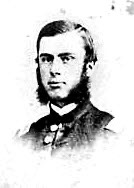
The following letter was written by 22 year-old Thomas Corwin Parsons (1842-1913) who enlisted as a sergeant in Co. A, 42nd Ohio Volunteer Infantry (OVI) in September 1861 and was promoted to Orderly Sergeant in July 1862. He mustered out of the service on 30 September 1864.
Thomas the son of Roswell Pease Parsons (1808-1893) and Rhoda Eggleston (1808-1901) of Chardon, Geauga county, Ohio. He wrote the letter to his younger brother, Wilder Curtis Parsons (1846-1929) and refers to an older brother named Milo Roswell Parson (1840-1932) who also served his country in Co. G, 2nd Ohio Heavy Artillery during the Civil War.
Thomas’s letter was datelined from Brashear City (modern day Morgan City) in S. Mary Parish, Louisiana. Though he anticipated they would march to Texas, the regiment would soon after participate on the Western Louisiana Campaign. The 42nd Ohio’s first commander was Colonel James A. Garfield (the 20th President of the United States).
To read other letters by members of the 42nd OVI thatI’ve transcribed and published on Spared & Shared, see:
Brashear City, Louisiana September 16th 1863 Dept. of the Gulf
Dear Welden,
I must beg your pardon for not writing to you sooner but I do assure you that if we had not been on the move, I should have written to you before. My stock of paper is nearly out so I must fill out my sheet double lined. I suppose you must be aware before this of our move from Vicksburg. We had a fine time while in the vicinity of New Orleans. New Orleans is the largest city I was ever in but it is not so fine in many respects as Cincinnati. This city is about the size of Chardon but has a fine, large depot. Southern cities are noted so far as I have had experience for the size and fineness of their depots. The cars come from New Orleans every day but don’t carry any papers or any mail—only once in a great while.
I think you have done well in making the bargain with Messrs. Wilkins & Kelly. But you will need to improve all your time next winter at school or you will have to stop clerking and go to school. Lay up your money. I got a letter from Milo last night. He was at Lexington, Kentucky. He was well and in good spirits. I also got a letter from Melbourne & one from an old friend (a captain) in the 3rd Miss. Colored Vols. 1 I also got three Democrats sent to P___ ____. From appearances I think we shall soon start for Texas and if we do go & should march, you must not expect me to write to you much till I get through—if I should be so lucky as to get through—for it will be a long, tedious march. You see we left our thins, knapsacks and all, at New Orleans, so I shall soon be out of writing material. But if we should be paid off, I can get a supply. But if you don’t hear from me, don’t think I have forgotten you. I will tell you a long story when I get through with the trip.
I hear a fine brass band playing. It reminds me of home and old times. Oh, Wilder, I shall be a happy boy to get home at the end of my three years. It’s a long time to be away, isn’t it? But I can stand it. But I must stop and write to Lucius, or he will surely be mad and for good reason.
Direct to Co. A, 42nd Ohio Vol. Infantry, 4th Brigade, 1st Division, 13th Army Corps, via New Orleans. To follow regt.
Yours truly, — T. C. Parsons, O.S.
To W. C. Parsons, Chardon, Ohio
1 Possibly Orlando C. Risdon who had been a 1st Lieutenant in the 42nd OVI. He was commissioned in the 3rd Mississippi Colored Troops in 1863 and later promoted to Colonel of that regiment that was redesignated the 53rd Regt. USCT.
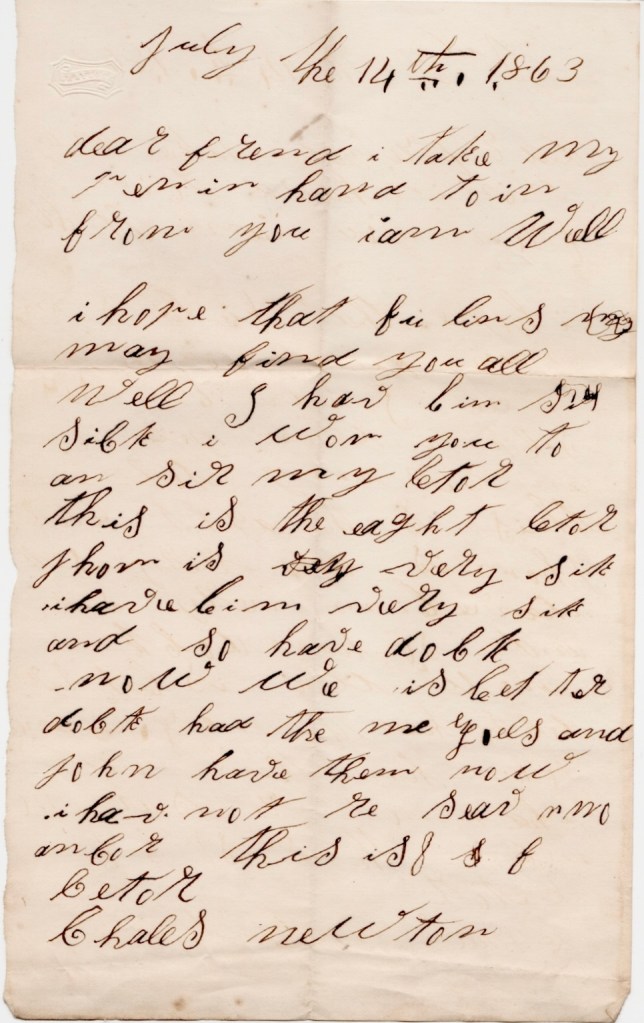
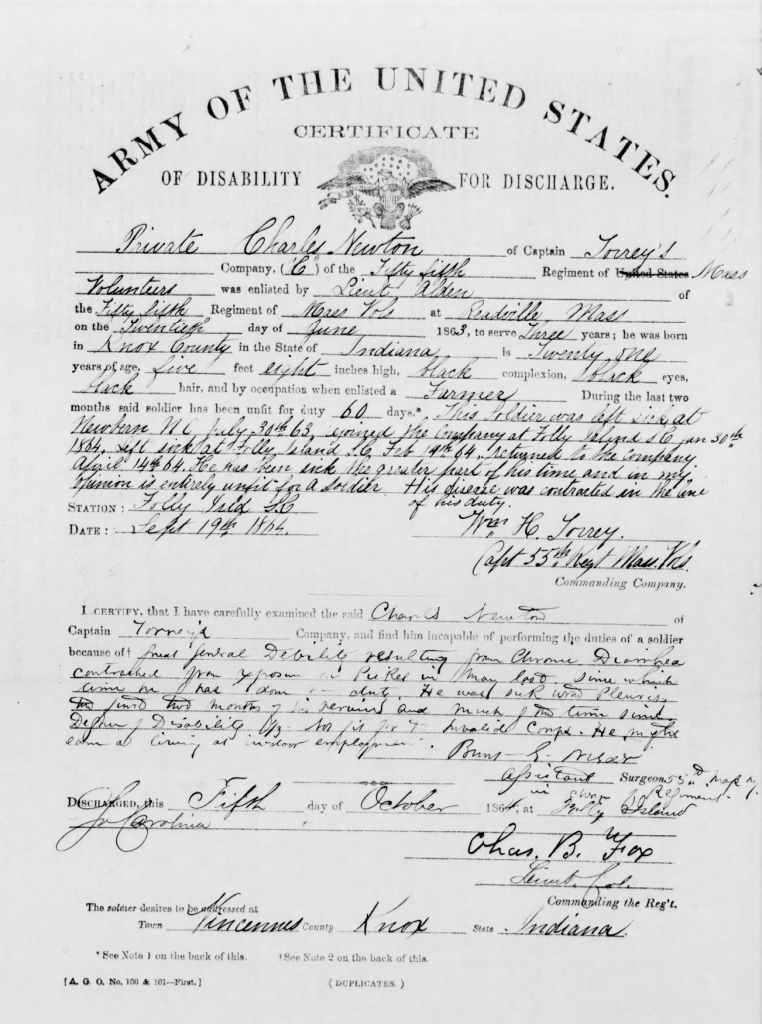
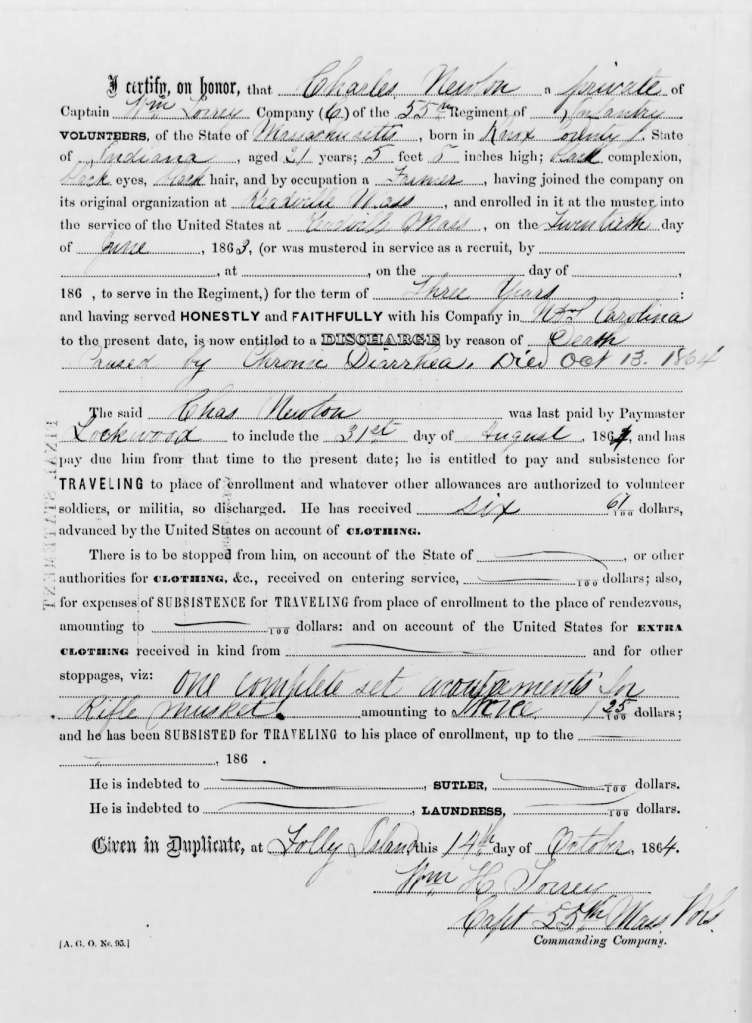
The following letter was written by 21 year-old Pvt. Charles Newton, a barely literate Black soldier in Co. C, 55th Massachusetts Infantry. According to muster rolls, Charles was a 5′ 8″ tall farmer from Knox county, Indiana, when he enlisted at Readville, Massachusetts on 20 June 1863. He was sick at left at Newborn, North Carolina, when the regiment left on 30 July 1863. He was on duty at Portsmouth and Norfolk, Virginia, in the fall of 1863, but was sick at Folly Island near Charleston in mid-February 1864. He was discharged for physical disability on 5 October 1864 but being unable to move due to his chronic diarrhea condition, he died on Folly Island on 13 October 1864.
There is a statement in Charles’ service record that claims he was “free” before 19 April 1861. Indeed, Charles was enumerated in his parents’ household in Busseron township, Knox county, Indiana in 1850 and 1860. He was the son of Jesse and Priscilla (Brock) Newton, who married in Knox county in April 1829. Jesse was a native of Tennessee and Priscilla of Illinois. By 1870, Jesse and Priscilla had relocated to Ypsilanti, Washtenaw county, Michigan.
The 55th was the “sister regiment” of the renowned 54th Massachusetts. Both regiments were raised in the spring of 1863 and both regiments would play a key role in the fighting in South Carolina. Due to the Commonwealth’s relatively small black population, both the 54th Massachusetts and, subsequently, the 55th Massachusetts, were made up of free men of color recruited from other states, including Ohio, New York, and Pennsylvania. The State of Ohio provided 222 recruits to the 55th Massachusetts, more than any other northern state.
In her 1995 article ‘History of 55th Massachusetts Volunteer Infantry’, Civil War historian Katherine Dhalle stated: “The war that had taken so many lives had also seen fit to form many survivors into the leaders of a new, reunited country. Despite frustrations, disappointments, obstacles, and restrictions, the men of the 55th bore their military office well. Instead of retreating in the face of adversity, whether it be the enemy, their fellow officers, or their own government, they continued in their quest to promote freedom and preserve the Union at all costs. For this they deserve our unending respect and admiration. As well, the brave men of the regiment, both black and white, who fought side by side, and lived through the inequities of a discriminatory government, deserve to be remembered as the heroes they are. Nothing less would be acceptable.” [Wikipedia]
[Note: This letter is from the personal collection of Harrison Pearl and was transcribed and published on Spared & Shared by express consent.]
Some members of the 55th Massachusetts
Transcription
Mr. Mathias Embry, Knox county, Vincennes, Indiana. Postmarked Boston, Massachusetts
July 14th 1863
Dear Friend,
I take my pen in hand to inform you I am well. I hope that [these] few lines may find you all well. I have been. I want you to answer my letter. This is the eighth letter.
John is very sick. I have been very sick [too] and so has Dock now. We is better. Dock had the measles and John has them now. I have not received no answer. This is 8th letter. — Charles Newton
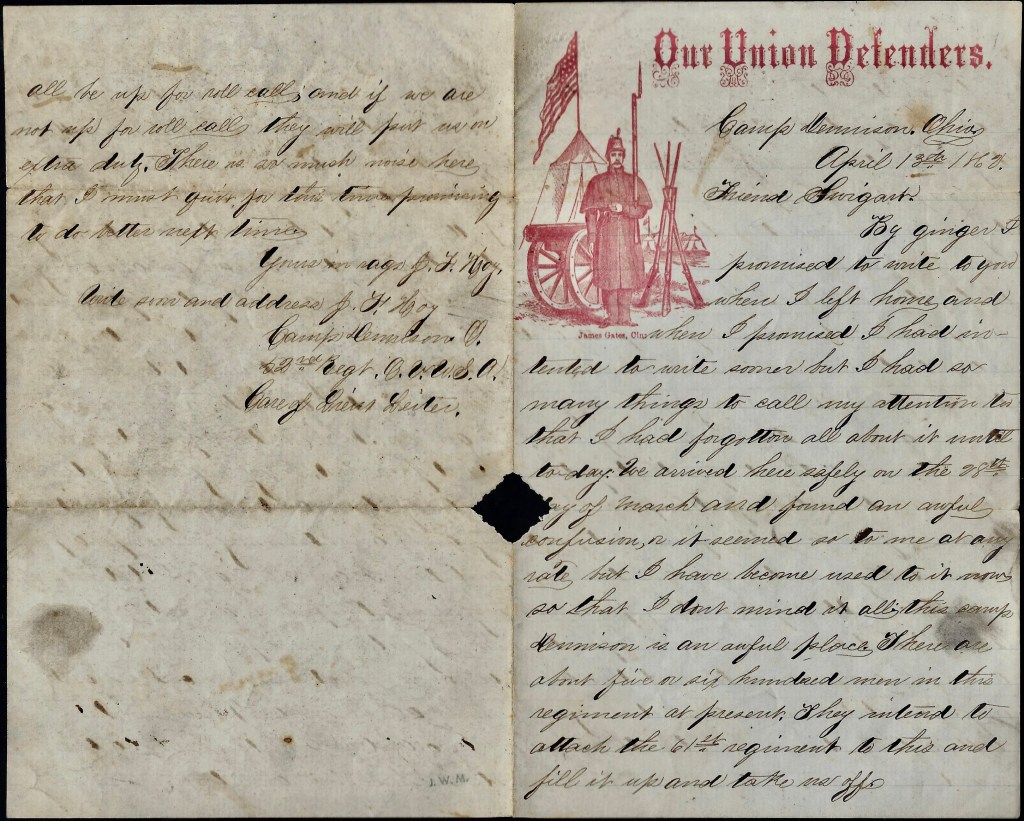
This letter was written by 19 year-old Pvt. John F. Hoy (1843-1914) of Co. E, 61st Ohio Volunteer Infantry (OVI). When he enlisted, John expected to be mustered into the 52nd OVI—as stated in this letter—but because the regiment was not yet full in mid-April, they were transferred to the 61st OVI to fill out that regiment. As such, unlike most Ohio regiments, the 61st OVI had members from nearly every county in the state. Nine of their companies were German speaking immigrants and two companies were Irish Catholics.
The Regiment fought at 2nd Bull Run, Chancellorsville, Gettysburg, Lookout Mountain, the Atlanta Campaign, March to the Sea, the March through the Carolinas, and at Bentonville, North Carolina. The 61st served the entire war as part of Gen. Oliver O. Howard’s 11th Corp. They began their service with the Army of the Potomac; then were transferred to Gen. Sherman’s western armies in September of 1863.
John was the son of Judge John Hoy (1797-1873) and Elizabeth Traxler (1803-1866) of Franklin, Summit county, Ohio. He participated in the battles of Cedar Mountain, Chancellorsville and Gettysburg, from Chattanooga to Atlanta, the March to the Sea, and the march into North Carolina where he was taken prisoner on 11 March 1865 at Fayetteville. He was held in captivity for 23 days.
Transcription
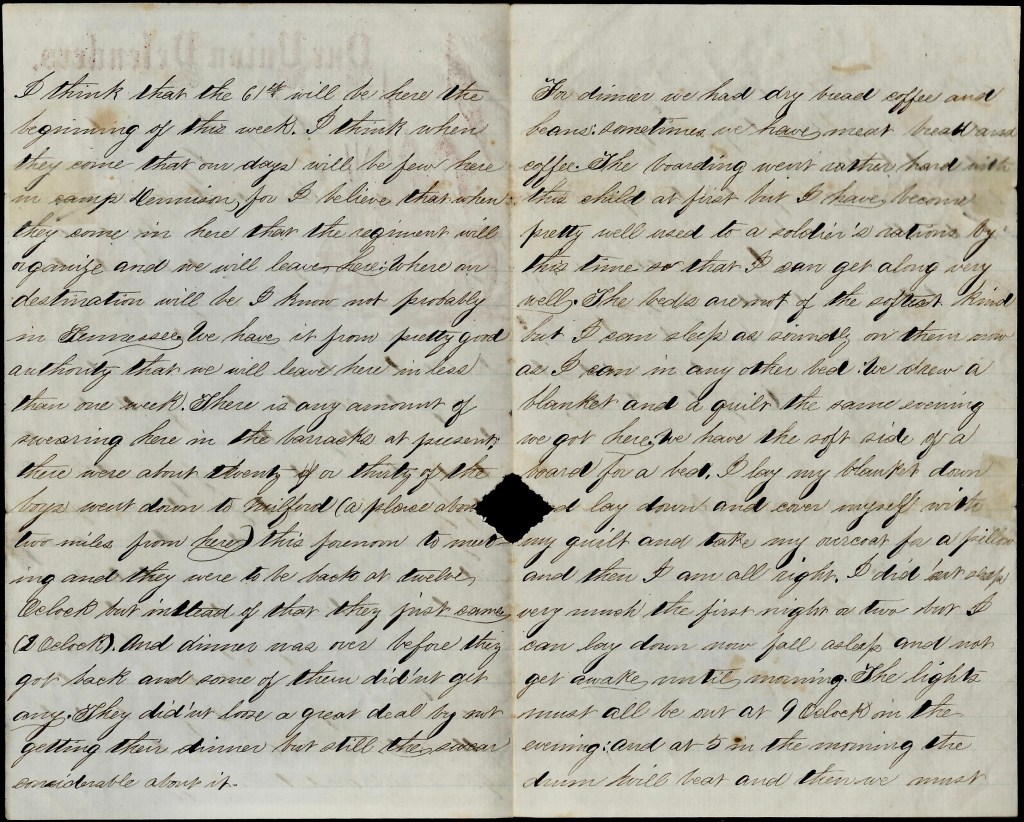
Camp Dennison, Ohio April 13th, 1862
Friend Swigart,
By ginger, I promised to write to you when I left home and when I promised I had intended to write sooner but I had so many things to call my attention to that I had forgotten all about it until today.
We arrived here safely on the 28th day of March and found an awful confusion, or it seemed so to me at any rate, but I have become used to it now so that I don’t mind it all. This Camp Dennison is an awful place. There are about five or six hundred men in this regiment at present. They intend to attach the 61st Regiment to this and fill it up and take us off. I think that the 61st will be here the beginning of this week. I think when they come that our days will be few here in Camp Dennison for I believe that when they come in here that the regiment will organize and we will leave here. Where our destination will be, I know not—probably in Tennessee.
We have it from pretty good authority that we will leave here in less than one week. There is any amount of swearing here in the barracks at present. There were about twenty or thirty of the boys went down to Miford (a place about two miles from here) this forenoon to meeting and they were to be back at twelve o’clock but instead of that they just came (2 o’clock) and dinner was over before they got back and some of them didn’t get any. They didn’t lose a great deal by not getting their dinner, but still they swear considerable about it.
For dinner we had dry bread, coffee and beans. Sometimes we have meat, bread and coffee. The boarding went rather hard with this child at first but I have become pretty well used to a soldier’s rations by this time so that I can get along very well. The beds are not of the softest kind but I can sleep as soundly on them now as I can in any other bed. We drew a blanket and a quilt the same evening we got here. We have the soft side of a board for a bed. I lay my blanket down and lay down and cover myself with my quilt and take my overcoat for a pillow and then I am all right. I did not sleep very much the first night or two but I can lay down now, fall asleep, and not get awake until morning. The mights must all be out at 9 o’clock in the evening and at 5 in the morning the drum will beat and then we must all be up for roll call, and if we are not up for roll call, they will put us in extra duty.
There is so much noise here that I must quit for this time, promising to do better next time. Yours in rags, — J. F. Hoy
Write soon and address J. F. Hoy, Camp Dennison, Ohio, 52nd Regt. O. V. USA, Care of Lieut. Leiter
The following letter was written by Pvt. William R. Wood (1840-1878) of Co. F. 27th Illinois Infantry. The regiment was organized in August 1861 and at Jacksonville, Illinois, until being ordered to Cairo on September 1, 1861. They had an encampment there until March 1862 but participated on expeditions to Belmont, Missouri, on 6-7 November 1861 (just after this letter was written) and into Kentucky in mid-January 1862, eventually occupying Columbus, Kentucky.
William was from Brighton, Macoupin county, Illinois. When he enlisted, he was described as a 5′ 10.5″ tall blacksmith with brown hair and hazel eyes. In the 1860 US Census, William was apprenticed to and living with Edward Bliss Stratton and his family. After serving in the regiment for more than a year, William was detached to the 10th Wisconsin Battery on 10 December 1862. He died in 1878 at the age of 39.
Six soldiers from the 27th Illinois Volunteer Infantry posing in camp. The 27th Illinois particularly distinguished itself at Stones River in the bitter fighting near the Wilkinson Pike on December 31, 1862. See “The Killing End of the Business: The 27th Illinois at Belmont” by Dan Masters.
Transcription
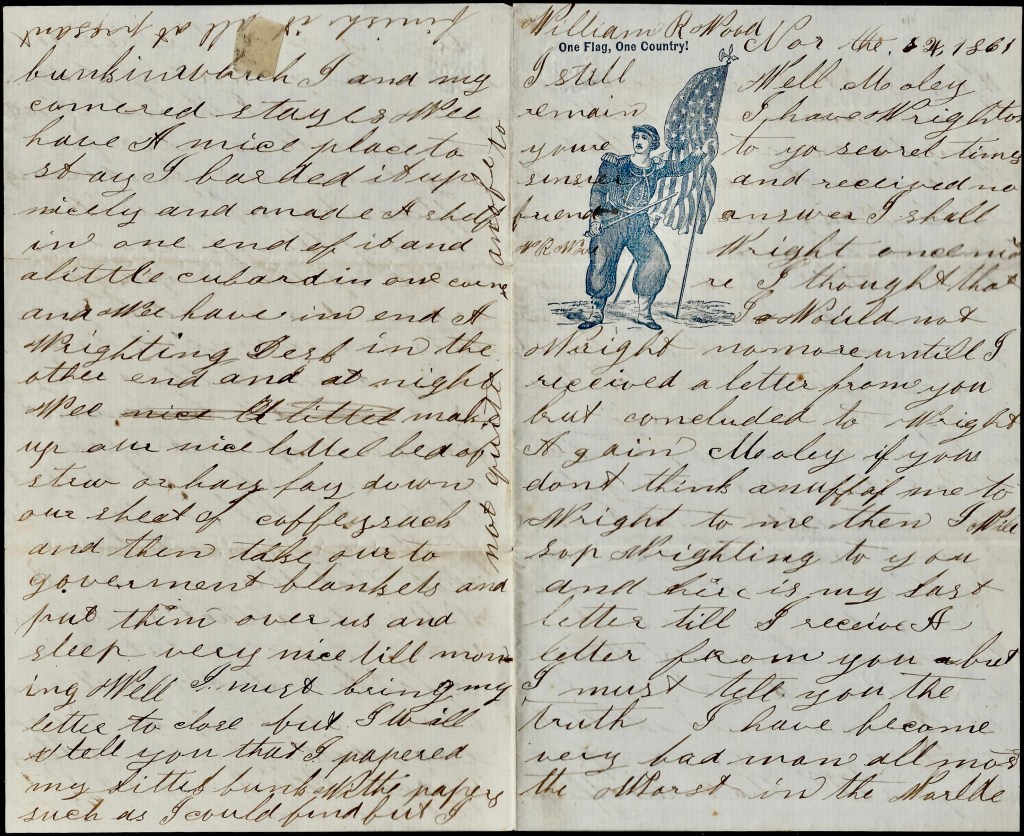
[Cairo, Illinois] November 4, 1861
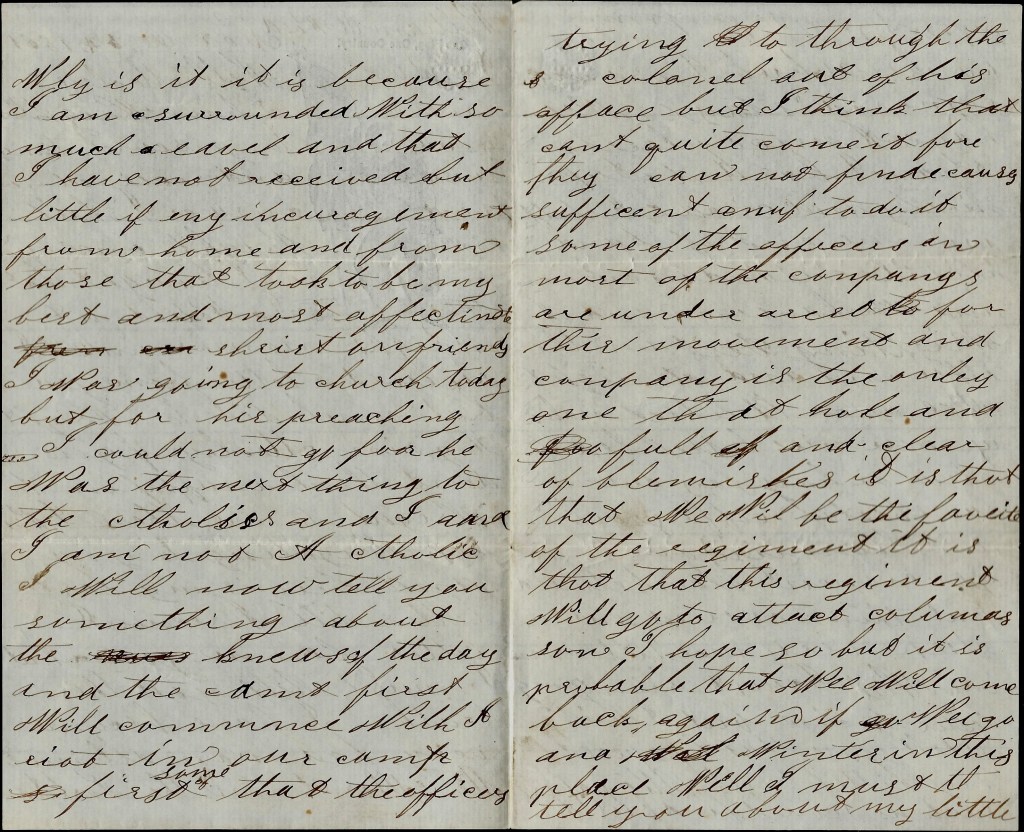
Well Molly, I have written to you several times and received no answer. I shall write once more. I thought that I would not write no more until I received a letter from you but concluded to write again. Molly, if you don’t think enough of me to write to me, then I will stop writing to you and here is my last letter till I receive a letter from you. But I must tell you the truth. I have become a very bad man—almost the worst in the world. Why is it? It is because I am surrounded with so much evil and that I have not received but little if any encouragement from home and from those that took to be my best and most affectionate Christian friends.
I was going to church today but for his preaching. I could not go for he was the next thing to the Catholics and I am not a Catholic.
I will now tell you something about the news of the day and the camp first. Will commence with a riot on our camp first. Some of the officers [were] trying to throw the Colonel out of his office but I think that can’t quite [do] it for they cannot find causes sufficient enough to do it. Some of the officers in most of the companies are under arrest for their movement and [our] company is the only one that is whole and full and clear of blemishes. It is thought that we will be the favorite of the regiment. It is thought that this regiment will go to attack Columbus soon. I hope so. But it is probable that we will come back again if we go and winter in this place.
Well, I must tell you about my little bunk in which I and my comrade stays. We have a nice place to stay. I boarded it up nicely and made a shelf in one end of it and a little cupboard in one corner and we have a writing desk in the other end and at night we make up a nice little bed of straw or hay, lay down our sheet of coffee sack and then take our two government blankets and put them over us and sleep very nice till morning
Well, I must bring my letter to a close but I will tell you that I papered my little bunk with the papers such as I could find but not quite enough to finish it all at present. I still remain your friend, — William R. Wood
I could not find an image of George but here is one of Abraham Palmer who also served in Co. D, 48th NYSV. He was a musician and was taken prisoner in the assault of Fort Wagner on 18 July 1863. (Claudia & Al Niemiec Collection)
The following letter was written by Pvt. George H. Reed who mustered into the 48th New York Infantry at Brooklyn on 10 September 1861 when he was 23 years old. He was initially mustered into Co. C but soon after transferred to Co. D. Company C’s members were mostly Brooklyn Boys so it may be that George requested the transfer to be with his friends from Trenton in Co. D. He was discharged from the service on 22 September 1864 after three years. He was carried on the muster rolls as “Reid” but he clearly spelled his name “Reed.”
George was the son of George and Sarah (Wright) reed of Mercer county, New Jersey. He mentions the birth of a niece in the last paragraph.
“The 48th New York is one of the lesser-known regiments involved in the fight for Fort Wagner. Yet, it was a key component of the history of that campaign. Theregiment helped secure the southern tip of Morris Island during the initial Federal landing on July 10th, and was integral to the Federal grand assault on the evening of July 18th. In fact, of all the Federal regiments involved during the battles for Fort Wagner, the 48th ranks highest in terms of total number of soldiers killed. By war’s end, it would rank 17th (out of the all Union regiments) in total number of soldiers killed during its time of service.Plus, its storied history would show that the 48th New York suffered its greatest sacrifice during the fight for Fort Wagner.” [Source: “So Rudely Sepulchered: The 48th New York Volunteer Infantry Regiment During the Campaign for Charleston, July 1863,” Thesis by Luis M. Evans, University of Oklahoma]
Transcription
Daw Fuskie [Daufuskie] Island February 10th 1862
Dear friends,
You have doubtless heard before this is my joining the army in the defense of my country. It was just five months ago yesterday since I enlisted and in that short time I have become pretty well initiated into the arts of war. When I was down to your house last summer, I had not the least idea enlisting but after I had got back to town, I was so taken with the war fever that I could not resist, but the first thing I knew after I had come to my senses was that I belonged to Uncle Sam. Since that time I have seen quite considerable of the world and have experienced some of its hardships.
The regiment that I joined was laying in Brooklyn, New York, near Hamilton. I joined on the 9th September and about the 17th we left for Washington. We had a most delightful ride in going from New York to Washington. After we had been about two weeks at the latter place, we again struck again and went to Annapolis. There we stayed about two weeks and again we was ordered to pack up for another move.
At Annapolis we was taken on board of vessels and for three weeks and two days we were kept on board. The worst part of it all was the storm at sea. The wind whistled through her rigging like a whirl wind and the rain fell in torrents, the thunder roared, the lightning flashed, and the waves ran mountain high. Our noble ship [the Empire City], she struggled hard. Every once and a while a large swell would take her and her paddle wheels would dip clear under. Two or three times the bow of the boat dipped clear under and the water would be a foot deep on deck. If you have ever seen a panorama of a storm at sea, you may have some idea of our situation at that time, but it is out of my power to give anything like a description of the scene. But we got through all right and never lost a thing.
Our regiment—which was the last to land—went ashore on Sunday, the 10th of November. We remained at Hilton Head until two weeks ago last Saturday. During our stay there we seen pretty good times. Of course we had to drill and to do some work but that only served to pass away time. Before we left there, we had the place very strongly fortified.
Where we are now, or close by, we have been building a battery where we have to work in mud and water up to our knees. The battery is intended to cut off communication between Fort Pulaski and Savannah. Our encampment is about six miles from Fort Pulaski and within 14 miles of Savannah. I am in hopes that we will be in the city before long, for ever since we came to this place we have had to work night and day and Sunday in the bargain.
When I enlisted I thought that I should get home by spring but I begin to think otherwise now for I don’t believe the war will be ended in a year yet to come. And a soldier while engaged in active warfare has but a slim chance of ever getting home until the end of the war.
How is times up your way this winter? Is there anything going on? What kind of luck did you have with your crops this year? How is John and Cad getting along? I have no doubt they were a little surprised when they heard that I had gone to war for I didn’t talk much like going when I was there. What is George driving at? Is he still working out by the year or has [he] gone to the wars. When did you see Uncle Charles’ folks last? I expect they are all fixed in their new house before this, are they not? Does Uncle Charlie drink yet as bad as ever?
I got a letter from Reuben last week. He says Druscilla’s husband is dead and buried. Mell has had a young daughter since I left. They call it Ida Violette Estella Pownall. 1 They have moved to No. 33 Broad Street, Mill Hill [Trenton, New Jersey], where they intend to keep a shop. I will now bring my letter to a close. Please write soon and give my love to all my friends. Yours truly, — George H. Reed
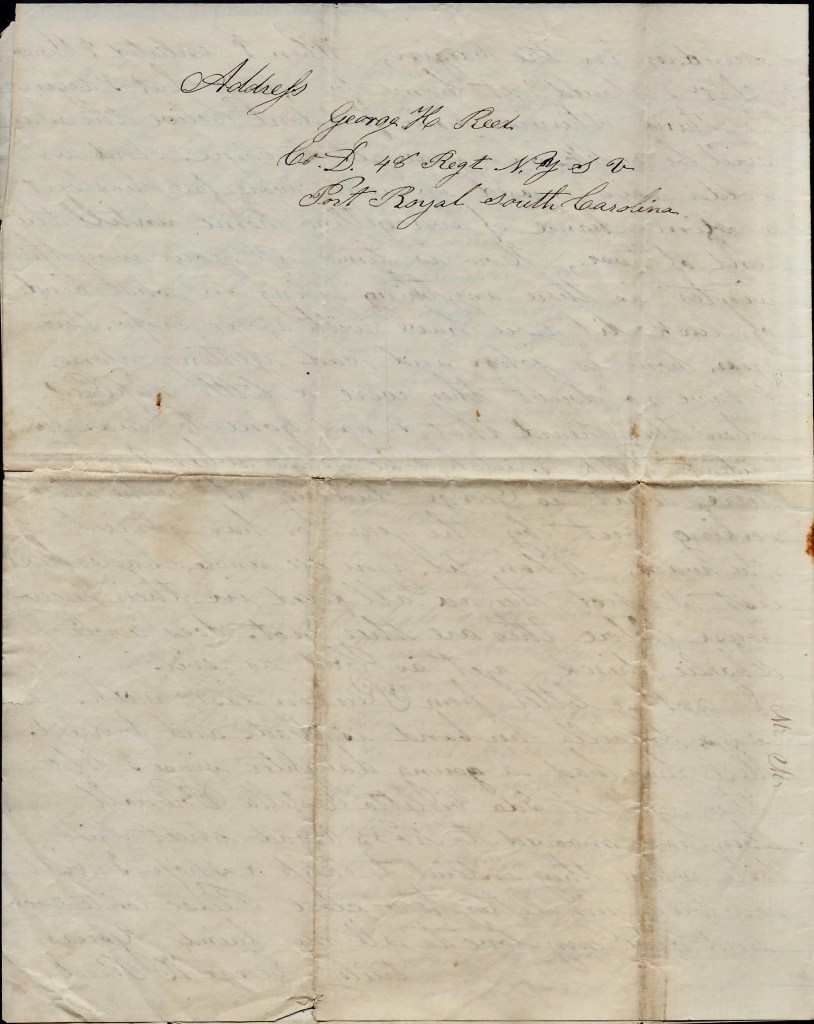
Address: George H. Reed, Co. D, 48th NYSV, Port Royal, South Carolina
1 Ida V. E. Pownall (1861-1923) was born on 10 November 1861, the daughter of Reuben Pownall (1831-1895) and Charlotte Malvina (“Mell”) Reed (1836-1898). She was married to Harry D. Beatty (1855-1936) in 1877.
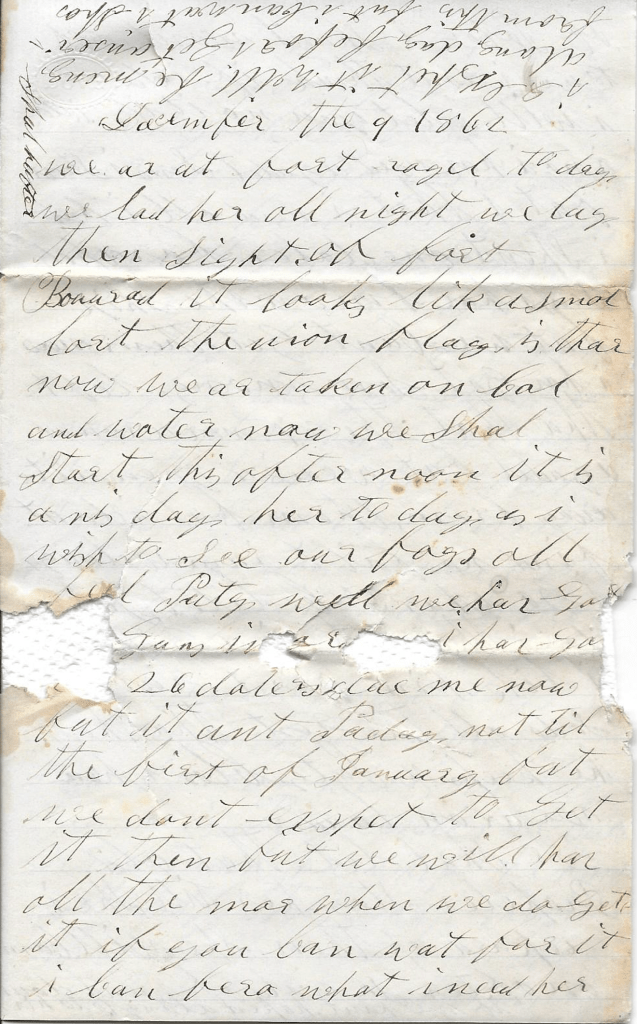
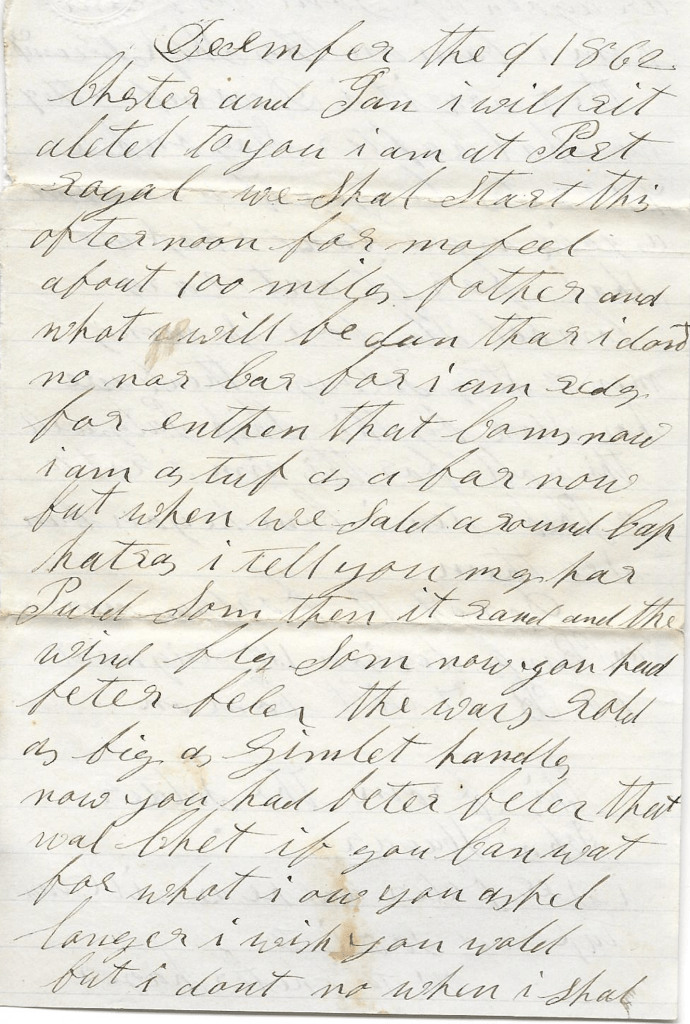
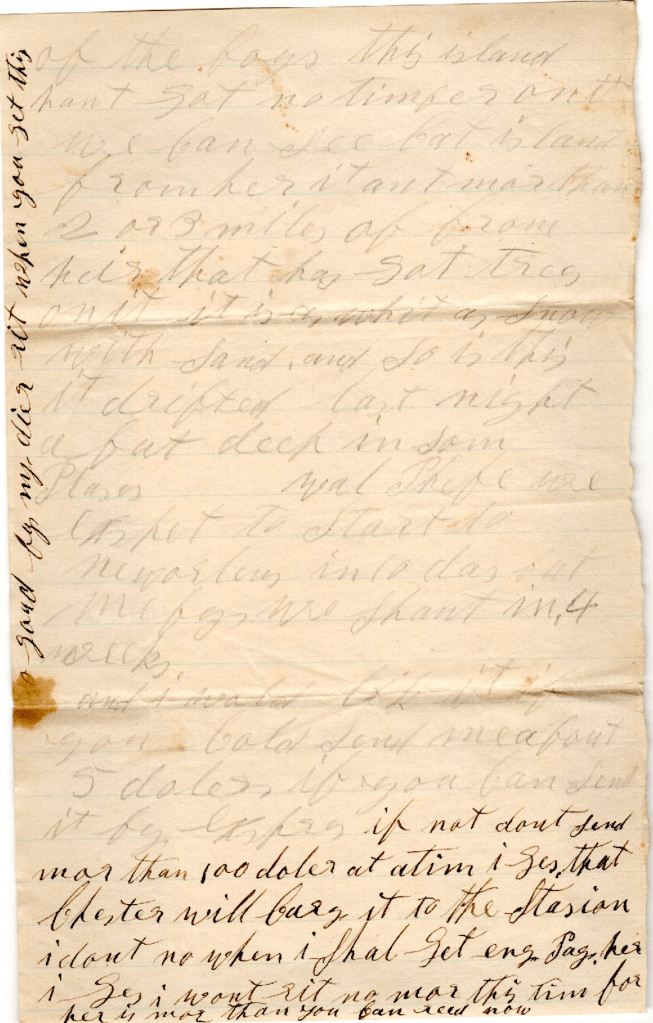
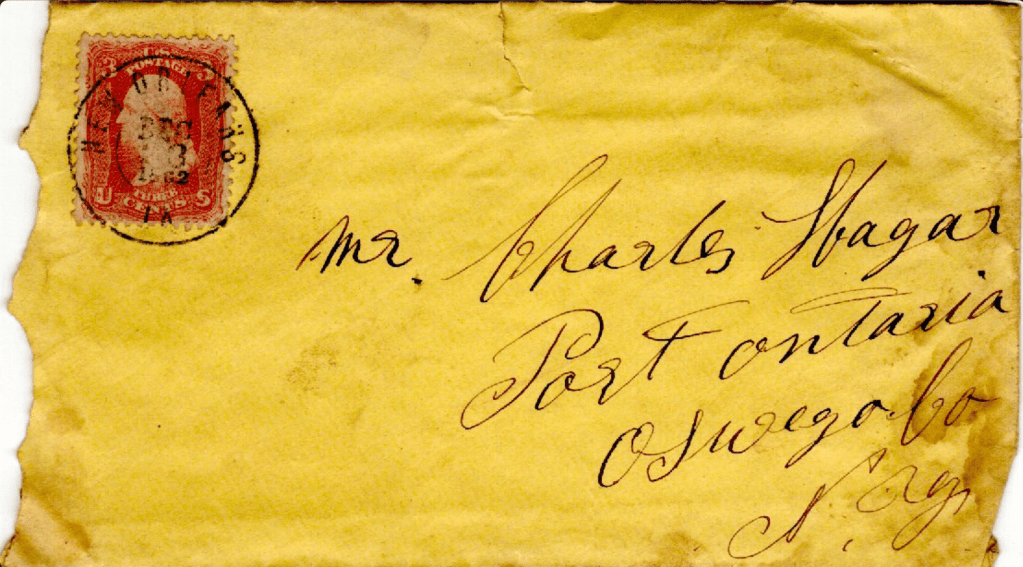
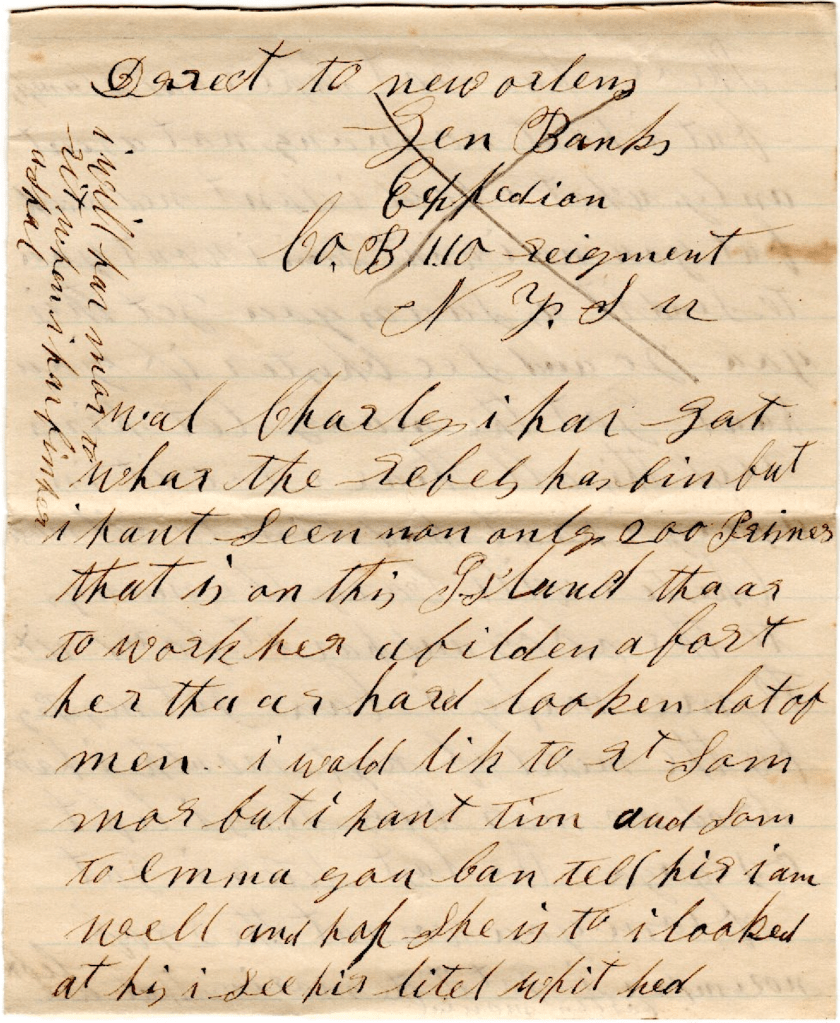
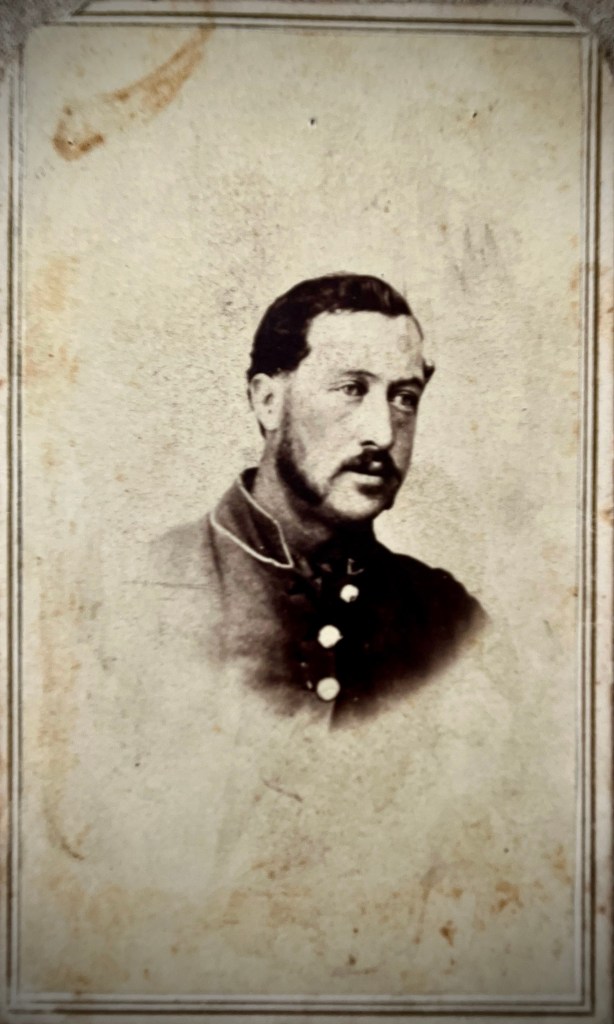
The following Civil War letters were made available for transcription and publication on Spared & Shared by Sue Hager, a descendant of the veteran soldier John Hager (1829-1897) of Oswego who served in Co. B, 110th New York Infantry Regiment. According to military records—where he was carried as “Hagar” on the muster rolls—John enrolled as a private in August 1862 and mustered out with the company on 28 August 1865 at Albany, New York (3 years, 23 days). The enrolling officer described John as 5′ 7″ tall, with blue eyes and sandy hair.
John’s parents were Gardner Hager (1784-1844) and Submit Presson (1878-1850). John was married to Phoebe Alice Calkins (1831-1898) about 1850 and two of their children, Charles (b. 1853) and Emma (b. 1858) were living at the time of the 1860 US Census when John was identified as a “cooper” in Richland.
The 110th New York Infantry was sent to Baltimore, Maryland on 29 August 1862 where they were on duty until 6 November 1862. They were then shipped to Fort Monroe, Virginia, and then sailed for New Orleans on 4 December, arriving at Carrollton on the Mississippi river 26 December. They remained on duty there until March 1863, participating in operations on Bayou Plaquemine, and then engaged with Banks’ army against Port Hudson. They were present in the siege and assault on Port Hudson culminating in its surrender in July 1863. They then were placed on garrison duty at Baton Rouge and elsewhere before participating in the Western Louisiana Campaign and eventually relocated to Key West, Florida where they were garrisoned at Fort Jefferson until their term of service ran out. The regiment lost a total of 210 men during service; two officers and 14 enlisted men killed or mortally wounded, three officers and 191 enlisted men died of disease.
I have searched high and low on the internet to find a regimental history of the 110th New York Infantry without success—in any form. There are a number of unpublished letters and diaries by members of the regiment housed in libraries. Those that I am aware of include letters by Samuel J. Bass who served in Co. C (died of chronic diarrhea, August 12, 1863, at Convalescent General Hospital, Baton Rouge, La.). His letters are held at Cornell University.
There is a partial 1863 diary that was kept by Charles M. Byington while serving at quartermaster sergeant of the regiment. His diary contains a first hand account of an engagement near Port Hudson, in which the USS Mississippi lost its rudder and exploded. In mid-April, he wrote about the Battle of Fort Bisland, including nearly getting hit by shells and seeing white flags hung outside of “most every house,” reportedly by Confederate women frightened of the Yankees (April 19, 1863). In June, he described frequent foraging, his health problems, and the Battle of Port Hudson, in which several men he knew were wounded and killed (June 14, 1863). He also recounted a surprising assault by Confederate cavalry, which he and several officers fled by boarding a ship that was “peppered by bullets” (July 2, 1863). On July 18, 1863, he mentioned a visit to the decimated Port Hudson (July 14, 1863: “The buildings inside were literally torn to pieces”). The diary ends with a search for a coffin for “one of our boys” and a church visit on July 19, 1863. This diary is housed at the University of Michigan.
There is an 1862-63 Diary kept by Sgt. Thomas Hall (died of sunstroke and disease, August 25, 1863, at Arsenal Hospital, Baton Rouge, La.) which provides some detail of the passage from Baltimore to Ship Island, noting the mechanical problems, extreme weather, his ship-related duties, health concerns, his surroundings, and shortage of food. He also describes the bombardment of Port Hudson as “fire & explosion on river” (March 15, 1863), and gave an account of a march through knee-deep mud (March 18, 1863). On April 12 and 13, 1863, Hall briefly commented on the Battle of Fort Bisland, noting that fighting had ended at 6 p.m. and the Confederate band had played “Dixie.” Subsequently, he mentioned the capture of Confederate prisoners near Franklin, Louisiana, (April 15 and 16, 1863) and the poor condition of the men in his regiment due to a lack of regular rations and the absence of the quartermaster (April 25, 1863). On May 26, 1863, he discussed a skirmish near Port Hudson, stating that “marshy ground” had caused the Union artillery to fail. Other entries note the surrender of Port Hudson (July 8, 1863), the suicide of a man in the regiment (July 8, 1863), and a Zouave’s failed attempt to escape from Port Hudson (July 9, 1863). This diary is also held at the University of Michigan.
During his three years in the regiment, Claudius W. Rider, a fifer in Co. C also kept a diary. Though his diary entries are brief, he refers to life in camp, weather, military and other music, practicing and rehearsing, socializing with fellow soldiers, marches, disease, fatalities, voyages, the presidential election of 1864, the assassination of Lincoln and ceremonies held in his honor at Port Jefferson, daily occurrences at the prison, and the arrival of the four conspirators in July 1865. This diary is held at the New York Historical Society.
Finally there was another diary kept by Henry B. Whitney during his three years of service in Co. B. His diary particular describes his service as a guard at Fort Jefferson, a prison for Confederates in the Dry Tortugas, Fla., 1864, including a description of the arrival of four civilian prisoners convicted of conspiring to assassinate President Abraham Lincoln. His diary is located at Duke University.
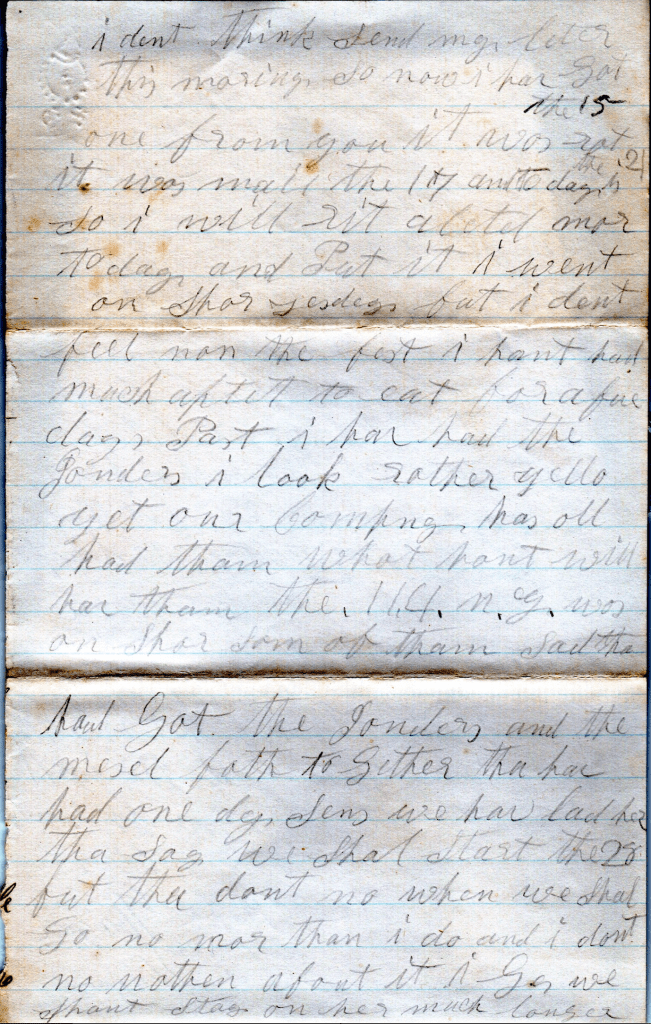
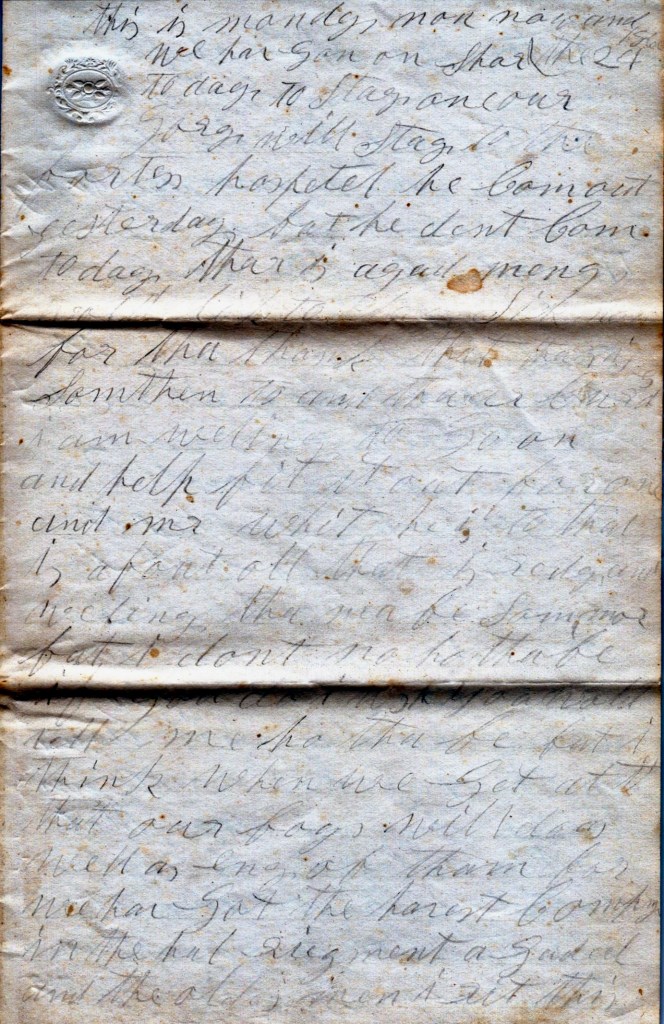
As warned by Sue Hager, his descendant, John Hager’s letters are challenging to read due to his informal education (he admits never having written much until he was 20 years old). His poor grammar, spelling, and lack of punctuation have made transcription difficult but every effort was made to retain John’s vernacular and yet make them readable. Sue informs me that the letters were not discovered among the family’s possessions until 1993 when a house and garage was being cleaned out. They were nearly tossed into the trash but thankfully discovered and preserved.
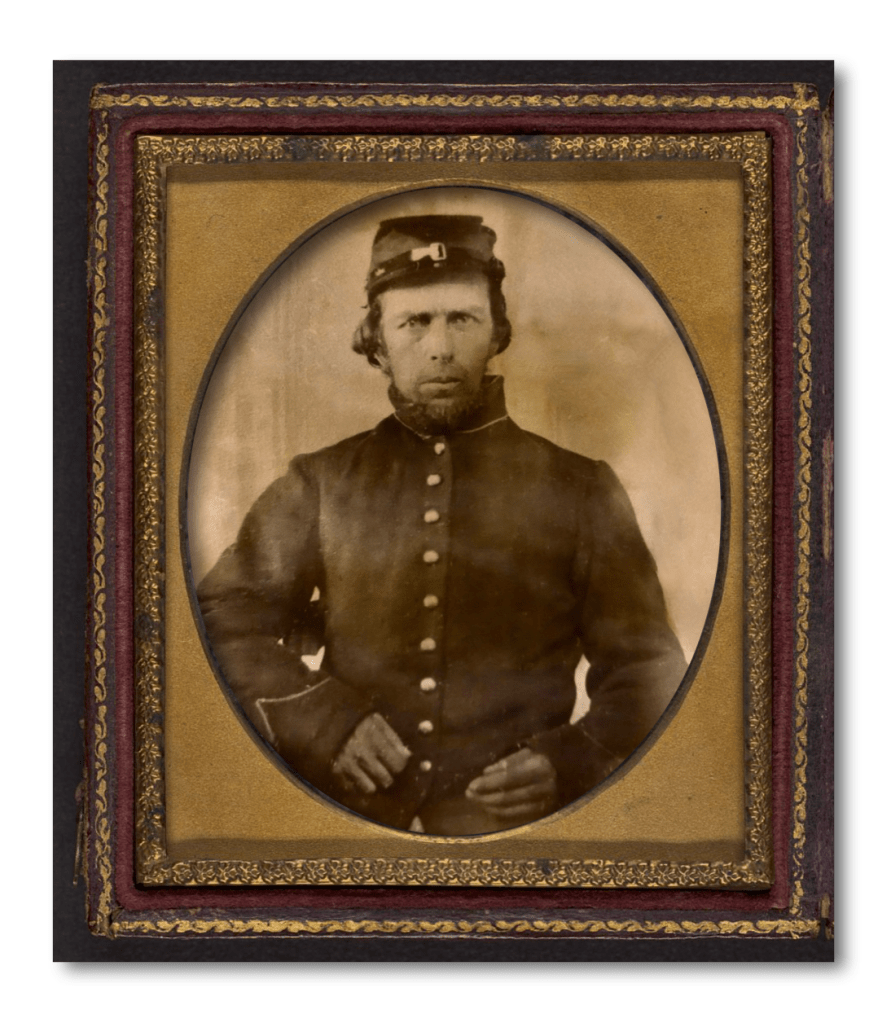
John and Phebe (Calkins) Hager—reunited after three years of war.
Though somewhat deteriorated and rodent nibbled, John’s letters reveal the hardships endured of three years service and separation from his wife and two children. His frequent letters—sometimes two or three written in a week’s time—not only inform us of the regiment’s movements, but we learn of John’s patriotic spirit that induced him to enlist, of his struggles to stay healthy while so many of his comrades fell ill or died from disease or malnutrition, and of his devotion to his family and the anxiety he felt when he learned of their hardships and could offer little relief due to delays in his receiving pay. These hardships placed an incredible strain on his marriage that tested both John and Phebe and yet they emerged from the war as partners.
Like most Northerners, John held clearly racist opinions about Negroes but it is interesting to observe the changes in his thinking over the course of the war as he observed their plight—particularly in Louisiana where he spent much of 1863. He notes that slaves were treated worse than he imagined and, as a fighter himself, he grew a new-found respect for the race as soldiers once they donned the union blue.
John’s letters mention many of his comrades in the 110th but those mentioned most frequently include Ransom (“Rans”) A. Soule (b. 1833), George S. Filkins (b. 1836), William C. Weed (b. 1829), and Jason B. Wright (b. 1831). All of these men were from the Richland area who joined Co. B and were of an age comparable to John.
Editor’s Note: The number of letters in this collection (171) compels me to post them on multiple webpages so that the files will load more quickly. As such, John’s letters written in 1862 (1 through 29) will appear on this page and his letters from 1863, 1864, and 1865 will appear on the following pages:
The 110th New York at Camp Patterson Park, Baltimore, Maryland, 1862
Letter 1
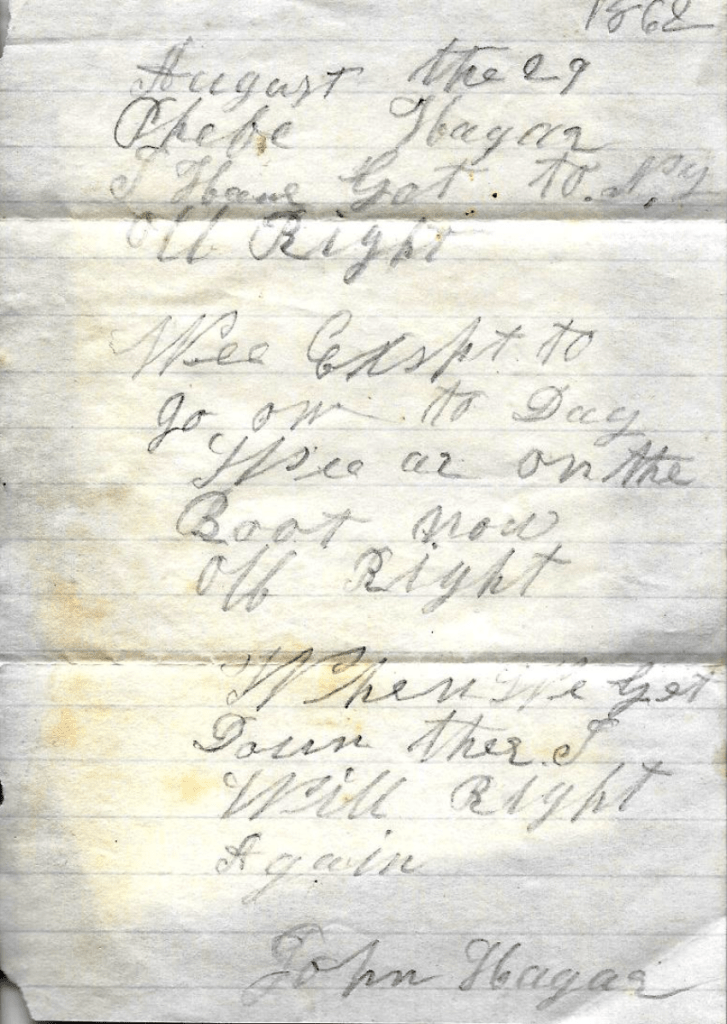
[New York City] August 29, 1862
Phebe Hager,
I have got to New York [City] all right. We expect to go on today. We are on the boat now all right. When we get down there, I will write again. — John Hager
Letter 2
Camp Patterson, Baltimore, Md. September 7, 1862
We went in swimming last night. It is salt water. This city is under martial law now. They put one of our boys in the guardhouse but they let them go in about an hour or two—one was Ramson Soule. I han’t been down to the city, some come here. Lester Pitcher has been here last Friday to see the boys but there wasn’t nobody but me and the Lester boys and they was in the guard house when he come here. Let is about a mile from here. He is in sight.
There has been a good many sick in our company but they have got better. William Weed has been sick all of the time since we have come here but has got better now. The boys that I tent with are all well and right yet. I am as tough as a bear now. I have fatted up like “hog” since I have come here.
The report was that Stonewall Jackson was coming here to take this city but we are ready for him. Now we have got our guns and ammunition. And we sleep on our arms one night since we came here. But it is rebel times now. There has been a good many soldiers along by here since we have come here. They say that there is some men down to Weston that they can’t feed them. But we have had enough to eat here since we have been here and good enough for any white men to eat. There is niggers enough here.
I don’t know what to write to you but I thought I would because I han’t got anything to go to today. But to go to meeting today at 3 o’clock in the afternoon on the ground here. I ain’t homesick yet any, but I thought I would like to see you and the children. But I am here and you are there. I have got a New Testament now. This from John Hager to Phebe Hager.
Direct your letter to Co. B 110 Reg N.Y., Camp Patterson, Baltimore.
Letter 3
September 8, 1862
Old General Wall (Stonewall Jackson) has been here and we expect to be hard answering. Colonel Littlejohn is (related to?) to lated to John?
Old Well Davison (?) is right here, close by here and I have seen him myself. He is an old grey man. I have to salute him according to war duty orders. I was on guard duty that day and to ? with him myself. I think we shall go in his army when we get deviled(?) so we know how to fight. Then we will give them hell then.
Some of our boys are ready to fight. They say they want Jackson to come on if he dare. He has started, but he han’t got here yet. I don’t believe I would like to see him myself. Then I could know that he was coming here or not. They is [with]in 40 or 50 miles of us. When we was down in a line the other night, the boys was a good many sick just then. We expected Jackson was coming in this city but I was all right myself.
I don’t know whether you can read this or not but I han’t no place to write—only on my knapsack. If I write as much every week as I have since I come here, I shall write a good deal more than I expected when I started from home. But I have a good deal of time since I come here and will keep you a reading this damn poor writing. But I want to bother you some if I am away down to Baltimore. It is a good place down here. Tell Charles and Emma Hager that I am well and han’t shot a gun since I left home. I expect to when we get where the rebels is. Then I will shoot like a good feller.
We have got news that Jackson is within 12 miles of us here now. We have been called out since 5 o’clock tonight. I thought I would write this down here to night but it is dark now.
Direct your letter Co B 110, Maryland Baltimore. It so dark. — J. Hager
Letter 4
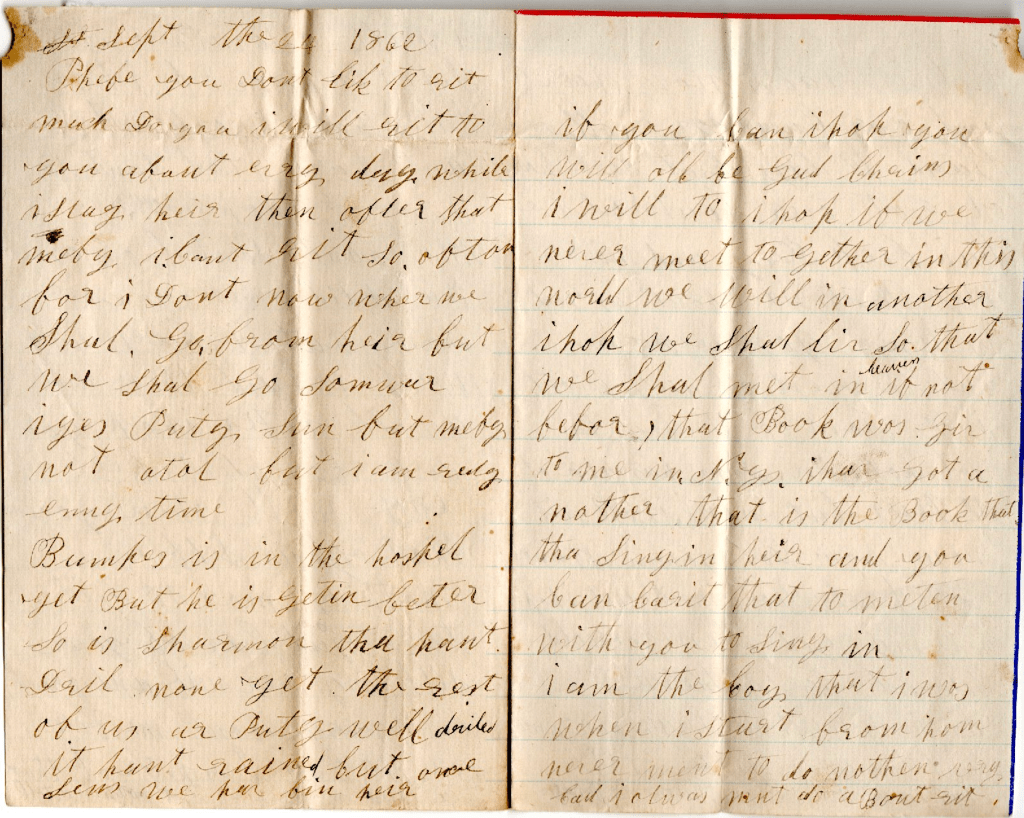
September 24, 1862
Phebe, you don’t like to write much, do you. I will write to you about every day while I stay here, then after that maybe I can’t write so often for I don’t know where we shall go from here. But we shall go somewhere I guess, pretty soon, but maybe not at all. But I am ready anytime.
Bumpus is in the hospital yet, but he is getting better. So is Shannon. They han’t drill[ed] none yet. The rest of us are pretty well drilled. It han’t rained but once since we have been here.
If you can, I hope you will all be good Christians. I will too. I hope if we never meet together in this world, we will in another. I hope we shall live so that we shall meet in heaven, if not before. That book was given to me in N.Y. I have got another that is the book that they sing in here, and you can carry it to meeting with you to sing in. I am [still] the boy that I was when I start[ed] from home. Never meant to do nothin very bad. I always want to do about right.
But it rains now here and our company is all on guard today. But we have all got overcoats and we can deep dry and nice. My pants is about as good as when you seen me. And the rest of my clothes is too. Some of the boys has got holes in [theirs], some has ripped to pieces, but mine is all right now. How does your’n stand it?
You hain’t got wet yet, I hope. May God bless your old soul and our children too. Don’t forget to pray for me and yourself and the children too. Learn them to pray.
I will tell you something about soldiering. Some of it is pretty hard work and some ain’t hard at all. Tain’t as hard as cooperin’ is. My hands don’t look as they did when you seen them, but I feel as well as I did then and a good better. I hope you do too for if I didn’t feel very well then. You know that yourself. Nothing more to write. Take good care of yourself, my dear wife and friend. Don’t worry about me for you and I are better off than a good many hain’t got nothin at all.
Letter 5
[near Baltimore] [Sunday, 25 September 1862]
Phebe, it is Sunday today. The boys have all [gone] down to City to meeting but Robert and me today. We stay and keep house alone. But we have a meeting here at 3 p.m. every Sunday.
We all have our belts on with our bayonet too. We don’t carry our guns to meeting. We have our dress coats on, and our boots blacked, and wear white gloves, and our hair combed and then we look pretty well. All stand up.
Phebe, I have heard from the 147th [New York] Regiment. They are 6 miles from Washington. They say they han’t got as good a place as we have here.
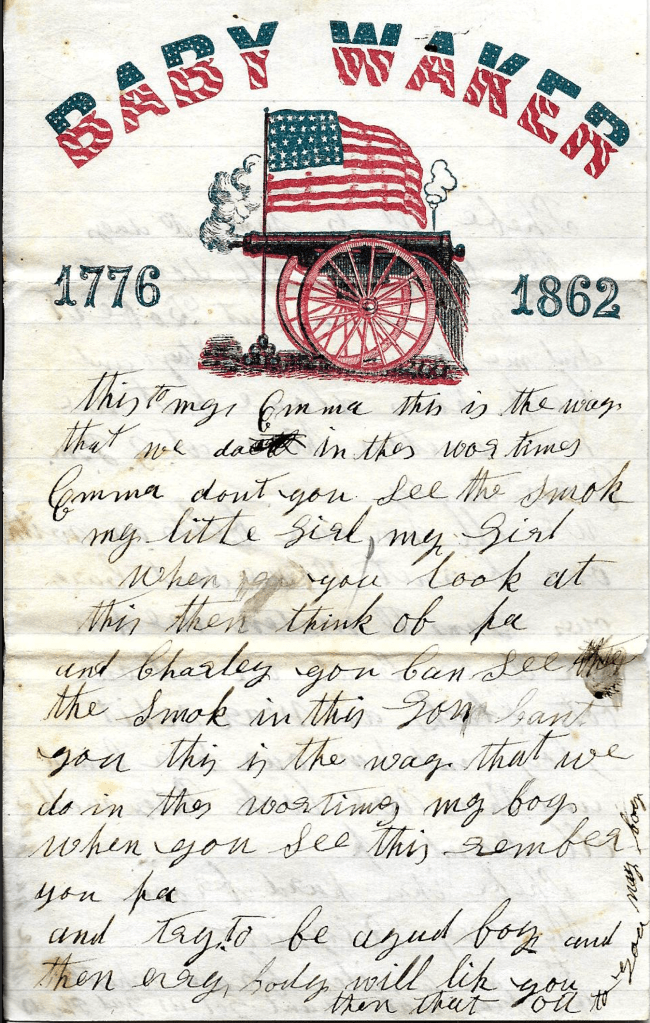
This to my Emma. This is the way that we do in these war times. Emma don’t you see the smoke [referring to cannon fire on stationery heading]. My little girl, my girl when you look at this, then think of pa. And Charley, you can see.the smoke in this gun, can’t you? This is the way that we do in these war times my boy. When you see this, remember your pa. And try to be a good boy and then everybody will like you.
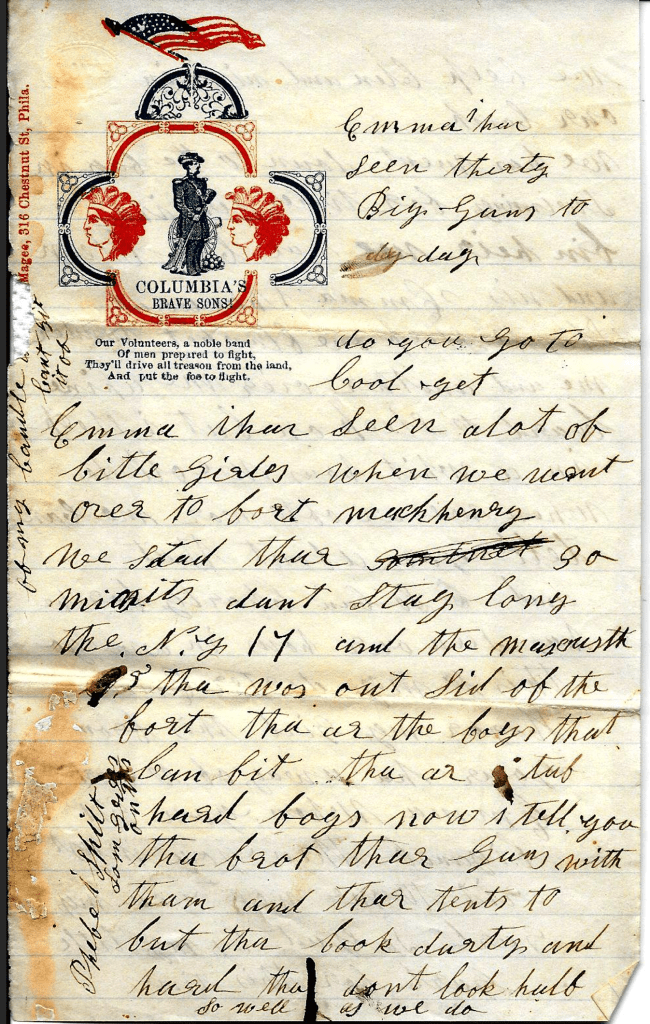
Emma, I have seen thirty big guns today. Do you go to school yet? Emma, I have seen a lot of little girls when we went over to Fort McHenry. We stayed there 30 minutes. Didn’t stay long. The New York 17th and the Massachusetts 15th was outside of the fort. They are the boys that can fight. They are tough hard boys now, I tell you. They brought their guns with them and their tents too. But they look dirty and hard. They don’t look half so well as we do. We keep clean and nice in our camp.
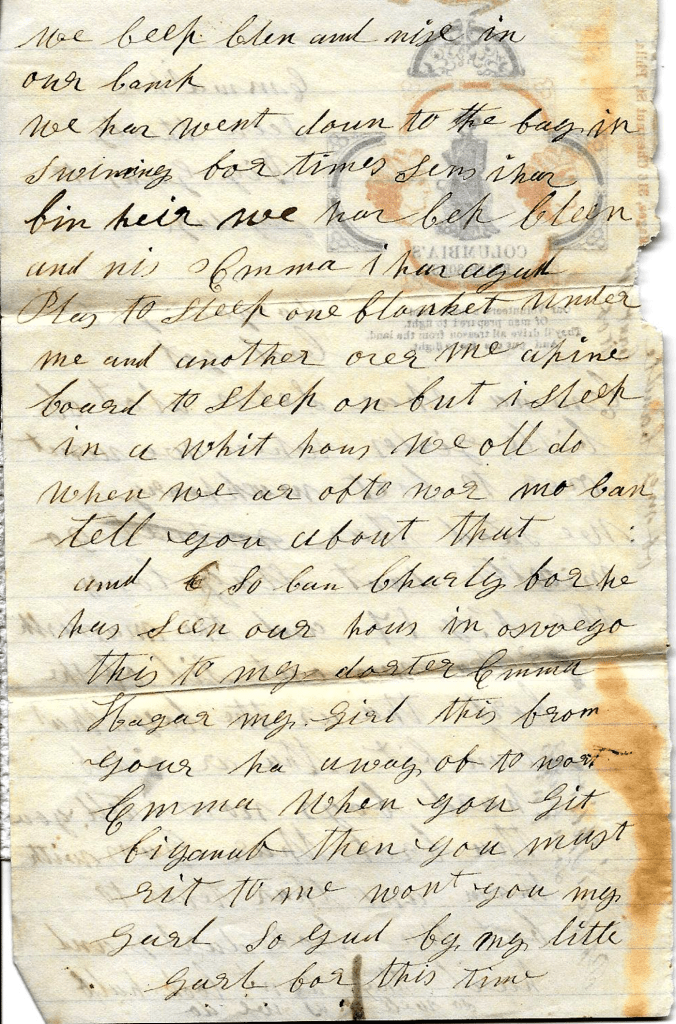
We have went down to the bay in swimming four times since I have been here. We keep clean and nice Emma. I have a good place to sleep, one blanket under me and another over me. A pine board to sleep on. But I sleep in a white house. We all do. When we are off to war, ma can tell you about that and so can Charley for he has seen our house in Oswego. This to my daughter Emma Hager, my girl.
This from your pa away off to war. Emma, when you get big enough then you must write to me. Won’t you, my girl? So good bye for this time.
Letter 6
[Near Baltimore, Md.] October 2, 1862
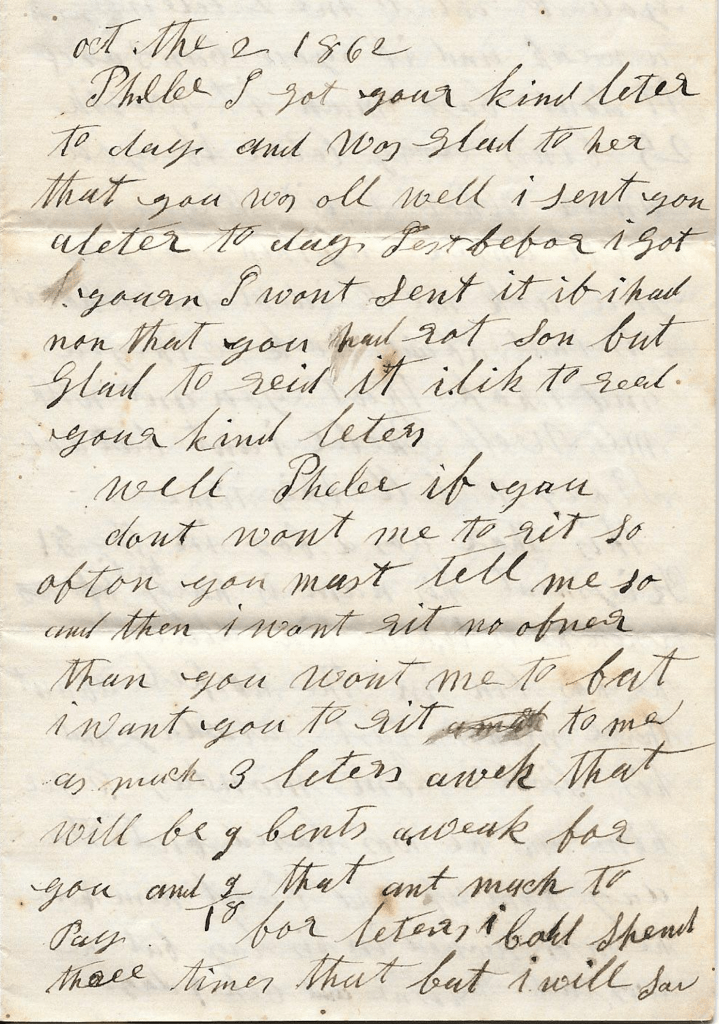
Phebe, I got your kind letter today and was glad to hear that you was all well. I sent you a letter today just before I got yours. I wouldn’t have sent it if I had known that you had wrote some, but [I was] glad to read it. I like to read your kind letters.
Well, Phebe, if you don’t want me to write so often, you must tell me so and then I won’t write no more often than you want me to. But I want you to write to me as much as 3 letters a week. That will be 9 cents a week for you and 9/18. That ain’t much to pay for letters. I could send three times that but I will save it so you and I can write. I want you to write to me 2 letters a week and if you can, 3 or 4. It don’t cost much. It’s worth 25 cents every letter if you answer what I write to you.
I will answer anything that you ask me to. I don’t care what it is. I ain’t afraid to talk with you. And I hope you aren’t with me.
Well Phebe, I han’t but one story to tell this time. [It’s] this. There was a boy in the 81th [New York] regiment. His name was Harry. He lives, when he was to home, in Albion. He has been in the hospital about 3 months last Saturday and his sister come Monday to see him and he was buried. But they dug him up and carried him home. He was wounded in his leg but he took poison and [ ] 9 days. One of our boys went and sat up with him 3 nights. He was a young man but his sister didn’t come soon enough to see him. I should thought that she would come before. That’s all about this boy.
Phebe, I don’t want you to trouble yourself about me. You must try to send me money unless I send for it, then there will be time enough then. Phebe, you feel pretty poor now, don’t you. But I don’t feel pretty sick now-a-days myself and I wish you did too. But Phebe, it will learn you and I both to write. If we write 3 or 4 letters a week.
This from your soldier — John Hager
to my wife and friend Phebe.
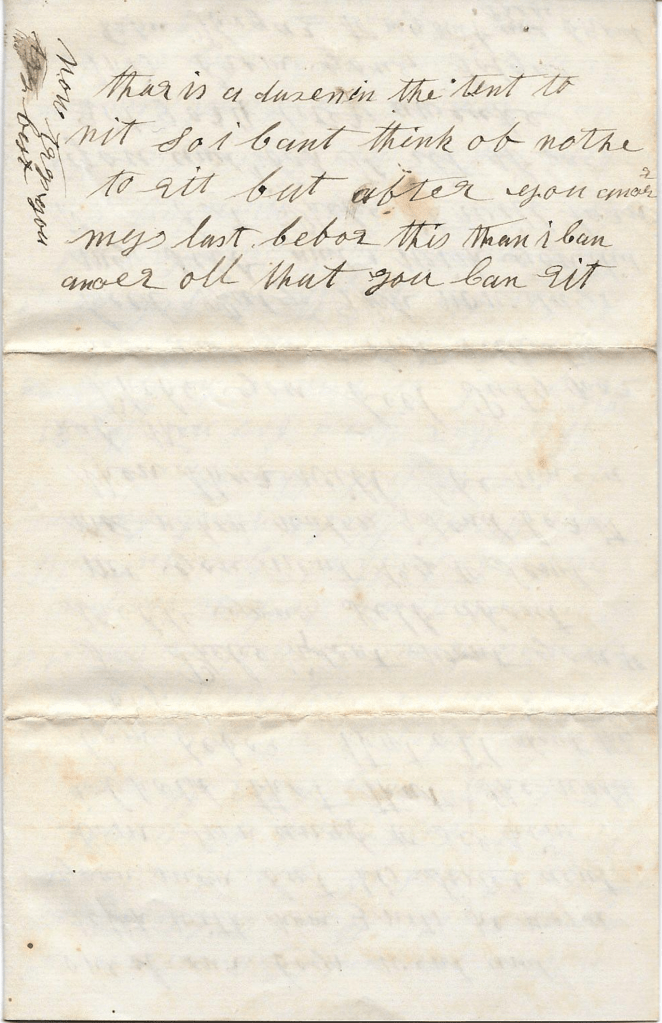
There is a dozen in the tent tonight so I can’t think of nothin’ to write but after you answer my last before this, then I can answer all that you can write. Now try your best.
Letter 7
[Near Baltimore, Md.] October the 8, 1862
Phebe, you didn’t tell me how you got along with your harvesting. I hope that you won’t try to do it alone. Phebe, I don’t want you to try to dig the potatoes yourself for I think that you ain’t able to do it and I wouldn’t try to do it. What is potatoes worth there now? I hope that you will have some to sell… They han’t been no frost here yet. Today is as warm as any day since I have been here.
Our company is all on guard today but it ain’t very hard work. I have to stand on post two hours and off 4 hours. That’s the way that we work it here. But we have to keep walking all the time and we can’t talk with nobody when we are on duty for we have got 10 rounds in our cartridge box.
The election is today in this city of Baltimore. They said that they should tear down all of the flags that is in the city, but they doesn’t come no such thing. If they do, we will give them all that they want, for we have got the tools to do it with. And they all know it too. The majority is Union men in the city.
Phebe there is about 20 in our company of sick men. But they ain’t but 2 that is much sick. The rest ain’t only grumble sick. They will be all right in a day or two I guess. I han’t missed a roll call yet since I come here and I feel pretty well pleased about it. I wish it would rain a little here for it is getting pretty dry here now, and dusty. Phebe, it ain’t half as hard work now for me as it was at first. It comes pretty easy now for me to deal now days. But it was most darned hard when I first come. But we have more to do, but it don’t seem half as hard.
You said that you hope that I would be contented here. Phebe, I am contented here and have been all the time and I meant to be. I like it better than I expected that I should. You know that I always was a Union man when I was to home and I am the same here. And I only will be till I die. You can tell that to anybody that you see. I don’t care who it is nor where they live. For I come here to fight. I didn’t come for nothin’ else—only to fight and that only.
Phebe, I don’t expect to make much at it, but I guess I can help you some. I might be sharing of my money as I can, and send it to you. I have used a good deal of money I know since I see you. It was for things that we need to use. I will write what I use my money for if you want me should and I will tell you what I do with every cent if you want I should, and what it is for, all of it is for.
Letter 8
[Baltimore, Md.] October 9, 1862
Phebe, my dear, I thought of a hard thing too when I was on guard last night but I can’t think of nothin’ now hardly to write. But my dear, I can tell one thing—that is, that I ain’t sorry that I enlisted, for you know that I wanted to go and help fight and I han’t altered my mind from that yet. And I don’t think that I shall. But I hope that the war won’t last long. And I hope that I shall come home again. But I am ready to fight anytime now.
We have had marching orders two or three times and we have got them now. But I don’t think that we shall go in a month yet, but maybe we shall go in 2 days. But guess not. But if we do, I am ready every time.
This from your best friend, I know it is in the world for think that you be mine.
Phebe, if I should be sick as Bumpus is, I should want you to come and see me before I should die for they won’t let nobody go home. For there is more then 4 bushels of letters been sent to Washington to see if they discharge the sick and wounded. Stanton says he han’t time to read them. They come so fast. That the reason that Tom Whitney han’t been discharged. I know this to be a fact.
Our Captain offered to send Bumpus home and pay the money himself if they would let him go, but they can’t do it—not till he can get his discharge. Then he can go. But I think that he will die in less that one week. But maybe he won’t. I han’t seen him today but Mr. Homes, Jesse Homes’ boy has seen him. He was acquainted with him. He goes over there every day to see him and he wrote to his wife for him a week ago.
Letter 9
[Maryland] October 16, 1862
I got your kind letter today and I was glad to hear that you was all well and your letter found me well too. Phebe I like my new home first rate, although it’s pretty sickly here now. But I guess it won’t be long for it getting some colder here now than it was. Phebe, we don’t have to drill half as much here as we did to Camp Patterson, but we have to go on guard almost every day here. But we have two men on one post every night but only one in the daytime. So it makes it a little better for us to have two on in the night so it ain’t so lonesome for us. It ain’t hard work—not at all—for us to guard the railroad.
This railroad is guarded all the way from Philadelphia to Washington. It has to be guarded. If it ain’t the rebels would take it all up. Here is where we went by when we went to Baltimore. This ain’t but 9 miles from Baltimore where we be. But you must send your letters just the same that you have, for the mail goes every other day here… Maybe we shan’t stay here more than one week but I think that we shall stay a month or two, and maybe longer. But I can’t tell much about it myself.
But Col. Littlejohn han’t resigned yet. About all that we know about it, we read in the papers. The Pulaski paper will tell you something about it. But I guess that he will stay with us till next fall, then I think he will leave but I hope not, for he is just the man for us.
But I think that the war will be over in less than one year, but maybe not, but it looks like it to me. There have two regiments gone by today. There has more than two a day ever since we left Oswego. Our lieutenant was down to Baltimore. He says that there was 30 regiments went to Washington today and last night the folks in Baltimore, they think that they has folks enough gone by to eat up the whole south. That what old man told me. He said that he had lived there over 60 years. He said that he hope that this war would be over right off, for he said that they can’t do nothin but work. For the said that they han’t done nothin but work for the government. All that they had done ever since the war began was to work for the government.
The poor folks han’t nothing to do. Phebe, we came by apples for 50 cents here, but potatoes are 100. We done have them but one in 2 days, and we have to buy some, as we don’t have to, but we do. It goes a little better the (cleg?) bread and meat fat. We have enough of that, but if we had a little butter it would be pretty good, l guess. But I can stand, it I guess.
Letter 10
[Maryland] October the 20, 1862
My dear,
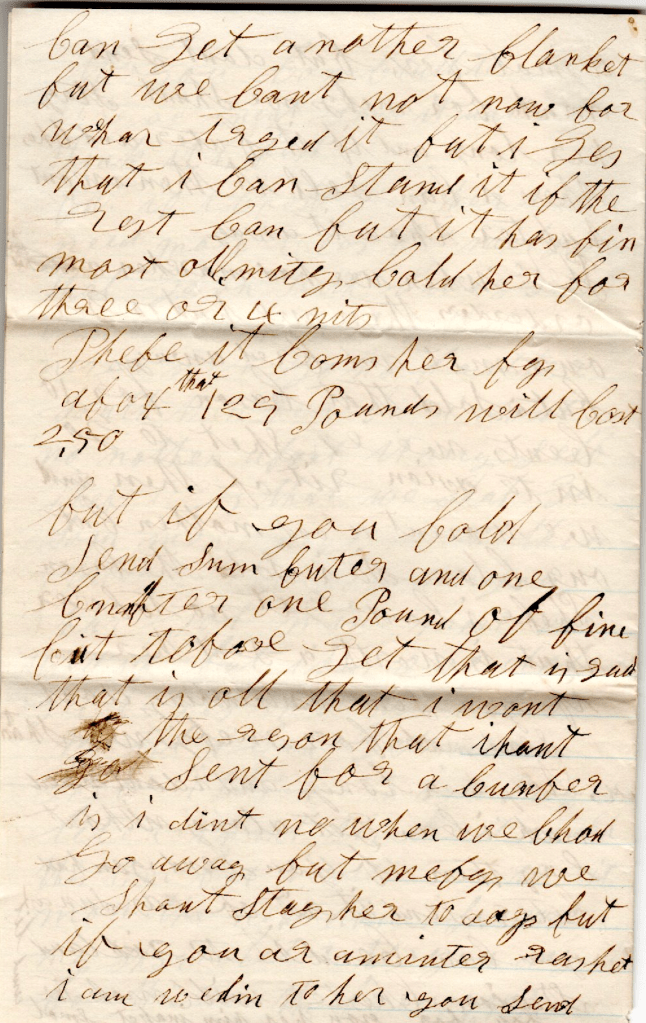
I have wrote more now than you can read, but I will write a little more to you. I got Chester’s letter the same time that I did your’n. We don’t get them only every other day. Phebe, I don’t know how long I shall stay here but I would like it if I had a bed quilt for it is pretty cold nights here now. But I s’pose that you can’t send one to me for you hain’t got money to send it with. Dick said that he wished that he had one quilt too, and some cheese and some butter too. He wanted I should send with him to get them. That was a week or two ago and I told him I didn’t want nothin’ but now I would like a comforter to put over me. But maybe we can get another blanket. But we can’t not now for Walter tried it. But I guess that I can stand it if the rest can. But it has been most all mighty cold here for three or 4 nights.
Phebe, it comes here by a box that 129 pounds will cost $2.50. But if you could send some butter and one comforter, one pound of fine cut tobacco. Get that is good. That is all that I want. The reason that I hain’t sent for a comforter is I didn’t know when we should go away. But maybe we shan’t stay here two days. But if you are a mind to rush it, I am waiting to hear you send a small box. But don’t send much for maybe we shan’t stay stay here long. And if it’s butter and cheese, then I can sell it. Then I won’t have to throw it away. Phebe, when we had marching orders then we had to give our meat and bread away. But I sold that bacon for 10 cents. We expect to go into action right off then and we wasn’t allowed nothin’ but our clothes. So I sold the bacon.
Phebe, I can’t get no tobacco that is worth a cent here. If you send anything don’t send much for maybe we shan’t stay here long and I don’t need much. I can get along without any. Then if you send, you had better send it right off as Sunday. You can send it to Richland Station. Chester will make the box for you. Have him make it small and light if you conclude to send it. You won’t send it unless you think it is best. But if I could stay here I could need more clothes. But maybe that we shall go on south. But I guess not. Boys around here say that we never will go no farther south than here but I don’t know nothin’ about it myself.
Phebe, I guess that we shall get some money next month. Then I will send some to you. I have got mine most all used up, but I have 200 dollars yet. I guess that will last me till I can get more. Phebe, I think this is a pretty small letter. I hain’t time to write much this time but I will try to write more the next time. So, excuse my short letter. To you my dear, for this time, this from your soldier.
Letter 11
[Maryland] October 21, 1862
My dear, I got your kind letter last night and I was glad to hear that you was all well for I am well too. And I feel as nice as you please here in Maryland for we have good times here now, for we can go off in the woods to shit here, and that is worth a good deal to me. You don’t know how good it seems to have the privilege of going where I have a mind to shit. But when we was in Camp Patterson Park we all had to shit in one house. That you, know was hard for me.
We have been here one week today and I like it first rate here. Phebe, I han’t been homesick not at all yet since I have been gone from you, and I hope that I shan’t, but I have thought of home some.
Phebe, I write just as I think to you. Phebe, I can write a good deal better since you said that you would live and die my own wife. I always said that I never would know no other woman but the one I have got. I could not marry, never again if I could come home tomorrow if you was dead now for I promised myself that I would have respect enough for my good wife for she is the only one that l ever thought enough of to marry. And if I should live till I was 100 years old, I never will. No woman but my hebe. So follow me, my dear, for I am yours truly. And if I should die today, I should think the same by you my dear Phebe. You may think that I am trying to flatter you but this is what I think. If I should die tomorrow I shan’t wan’t this [ ] not at all for it is so, my dear.
Letter 12
October 23, 1862
Phebe I wrote a letter yesterday but I will write a little today. I am well and I hope this will find you well too.
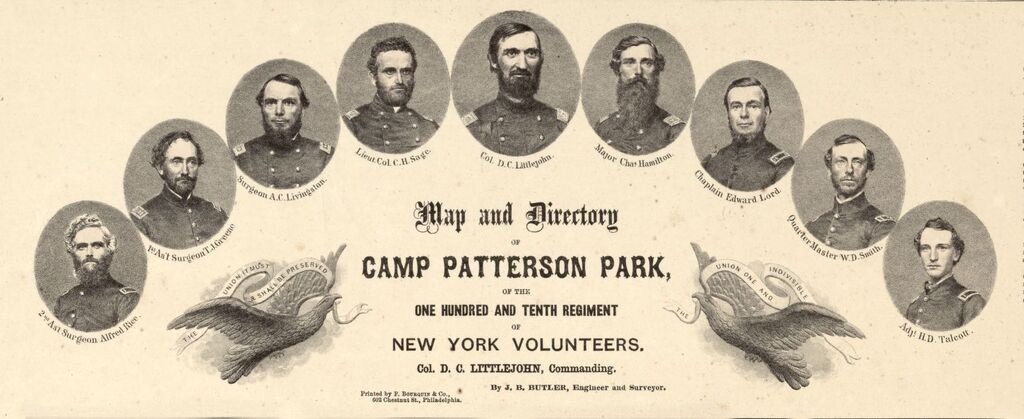
Phebe, I have sent two maps to you that they will go to Pulaski in a package. The boys have all got some. You can send and get them as soon as you get this. I give 50 cents for them. You can give one to Chester Hager and you can keep the other if you want it. And if you don’t want it, then you can give it to Ezra Whitehead for I think they are something pretty nice. But maybe you won’t think so. You may keep both till you hear from me again. Phebe you can see where we sleep in tent #9. Right by the tree.
Map showing Tent No. 9 in the line of tents occupied by Co. B, 110th New York Infantry at Camp Patterson Park.
I am off to Stemmer’s Run now but I think that it all looks natural to me. The officers and colonel seem to me but I s’pose it don’t to you. But if you have seen Col D. C. Littlejohn, he looks natural. So does [Lt.] Col Sage. If you ever seen him, they are noble looking men, all of them I think, don’t you? But maybe you hain’t seen them yet.
The images John is referring to in the preceding paragraph.
Phebe, this long crooked [steak] is a bank [earthwork] that was made in the last war [1812]. This shows everything just as it was in Patterson Park where we stayed 46 days. And here is the place where we was brigaded in General Emory’s Division. This Brigade has got 4,000 men in it. We have been brigaded now two weeks under General Wool but we shall be under General Emory. But I hain’t seen him yet. But I expect too sometime. But maybe we shan’t have to leave here—not this winter. And maybe we shan’t have to stay here two weeks. I don’t know nothing about it, but if we go from here, I will write to you.
Phebe, the boys say that I wrote home that we had 150 boys in our company that had the clap. Lester is awful mad about it and Sam too, and he don’t like it, I guess. George—he don’t say nothin’ about it, not to me. Sam’s brother wrote that I said that to him, but you know that there ain’t but 92 [men] in our company. You know I didn’t think that you would tell anything that I wrote, so to hear it come back into the company. I don’t care much, but it hurts them some, I guess.
But they told the 147th [New York] boys when they was here that there was more than 100 men that had the clap in the regiment. But I don’t care one damn for none of them. They are hard boys and I don’t think much of them now—none of them.
Phebe, I hope that I have one friend that I can put confidence in, that I can write what I am a mind to and not have everybody know it. But I don’t think you will tell all that I write to you and I guess you don’t.
Letter 13
Baltimore [Maryland] November 3rd, 1862
I got your box today, but I don’t know what to do with this bed quilt. But I can send it home again. But maybe we shan’t go in two or 3 days. But the boats that they sent for to New York has come to carry us off, we seen them when they come in the harbor. I guess we shall get ready to start about Wednesday this week. I guess you will get this about the time that we shall leave for Dixie. If you know where that is, you know more than I do, for I don’t know, nor the Colonel don’t either—[at least] I don’t think he does. If he does, he don’t tell us. But I don’t care as I know of, for I s’pose it is to fight and I s’pose that we can do that right up. For old Jeff, I want to shoot at him once or twice.
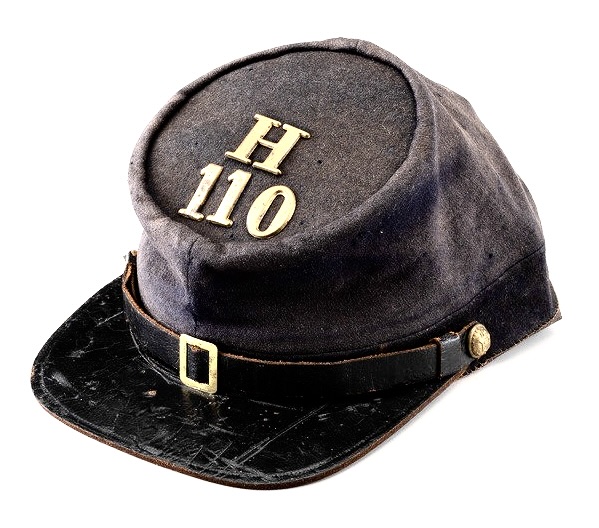
A blue wool kepi with leather visor and chin strap with 16 mm brass New York state “Excelsior” buttons, leather sweatband, and brown cotton lining. Underside of sweatband initialed “S.B.” This cap belonged to Samuel Burnside of Co. H, 110th New York Regiment. He died of disease on 25 October 1862 in Baltimore, Md. (Hindman Auctions)
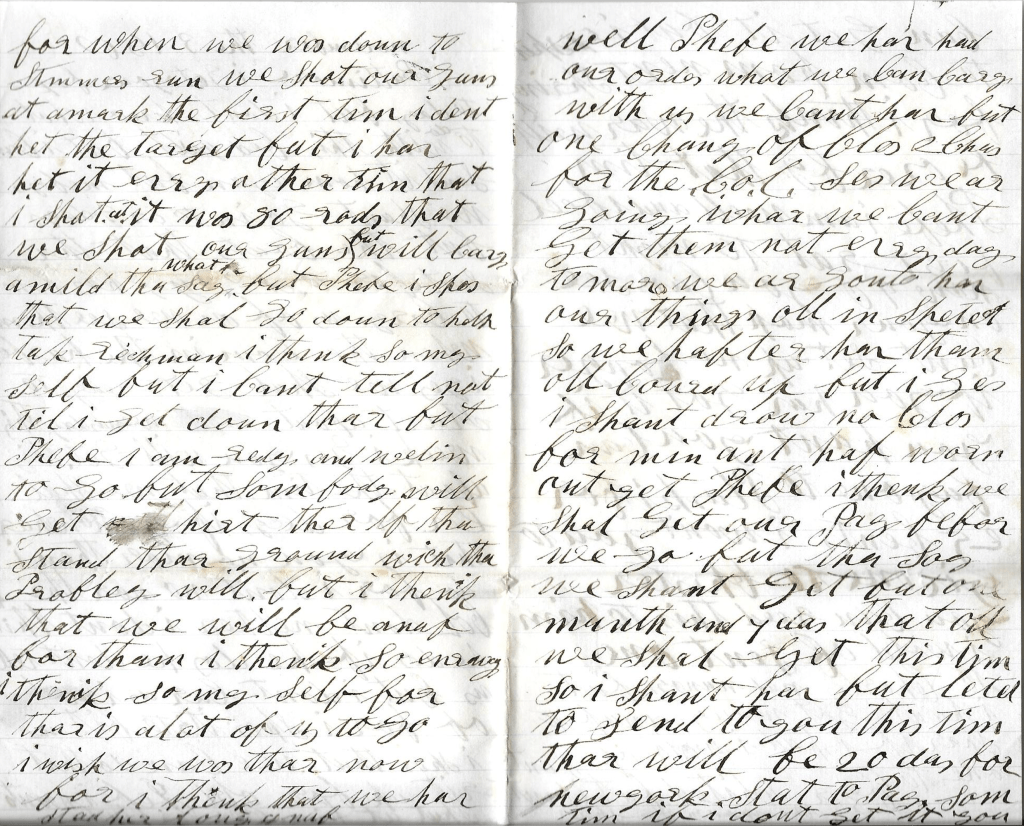
For when we was down to Stemmers Run, we shot our guns at a mark. The first time I didn’t hit the target, but I have hit every other time that I shot at it. It was 80 rods that we shot our guns, but will carry a mile they say. But Phebe, I s’pose that we shall go down to help take Richmond. I think so myself. But I can’t tell—not till I get down there. But Phebe, I am ready and waiting to go. But somebody will get hurt there if they stand their ground which they probably will. But I think that we will be enough for them. I think so anyway. I think so myself, for there is a lot of us to go. I wish we was there now for I think that we have stood here long enough.
Well Phebe, we have had our orders. [Here’s] what we can carry with us. We can’t have but one change of clothes [and] 2 shoes, for the Colonel says we are going where we can’t get them—not every day. Tomorrow we are goin’ to have our things all inspected so we have to have them all carried up. But I guess I shant draw no clothes for mine ain’t half worn out yet. Phebe, I think we shall get our pay before we go, but they say we shan’t get but one month and 7 days. That’s all we shall get this time. There will be 20 days for New York State to pay sometime. If you don’t get it, you can get it. But I expect to come home next spring for I think the war will be over by that time. Phebe, I am well and I feel first rate tonight. Now 90 you can see on your map that we can’t set up no longer. If you have got it. If you han’t, you can buy one to Pulaski for 25 cents. I want you to give one to Chester. You can read this to him.
I would of sent one to Charles and Nancy but I han’t got money enough to spare. If I had, I would of sent one to Ezra Whited, but I han’t the money to spare.
Letter 14
[Baltimore, Maryland] November 4th, 1862
Phebe, I thought I would write a little more tonight for I han’t had a moment of time today. We was inspected and he didn’t find no fault with my things. Phebe, I bought some new buttons and sewed them on my coat. Our Colonel likes to have us look pretty nice. We have to have our boots well blacked and our clothes well brushed up. So you can see that he likes to have us look pretty nice. He made a short speech tonight. He said that we must be ready at a minute’s warning and he said we mustn’t carry nothing but what the government furnished us. He said that the boat was ready to carry us now. So you can see that I don’t know when we shall go.
Phebe, I don’t want you to worry about it for I guess it will come out all right. I guess it will. Phebe, I will excuse you for reading that letter but I shan’t of thought that them darn fools would [have] told that. But it ain’t nobody [but] them damned old whores and their followers. You know that they are always the ones that want to make a row. I seen two of them boys. They said as much to say they was out with two whores the night that we left Stemmers Run. When we was on the cars, it was dark, but I seen them. I might of seen them at it if I got out of the cars. I could tell more but I ain’t [got] time tonight. But it is all right with me and you. I don’t think it makes it any better to have me say anything about it or have anything to do with it. When I want his help, I will ask for it so I burnt that [ ] up for he just got a letter from home.
George ain’t very well today but he says that he shall go with us. He is in the hospital now but he ain’t much sick. I guess he will be able to go but don’t you tell that I said he was in the hospital for if you do, I shall hear of that. After this, I will tell you what I don’t want you to tell but I ain’t afraid that you will do it again. I guess we shall start tomorrow. The boys all say it. But if we do, I am ready to. But we shan’t get no pay. There is about 26 dollars coming to me besides my bounty. I guess I can get it when I get on the boat. I han’t had time to write much…
This from your best friend in the whole world. I know I am. So I must say goodbye, my dear, for this time. This your friend and soldier, — John Hager
Letter 15
[On transport vessel] November 6th, 1862
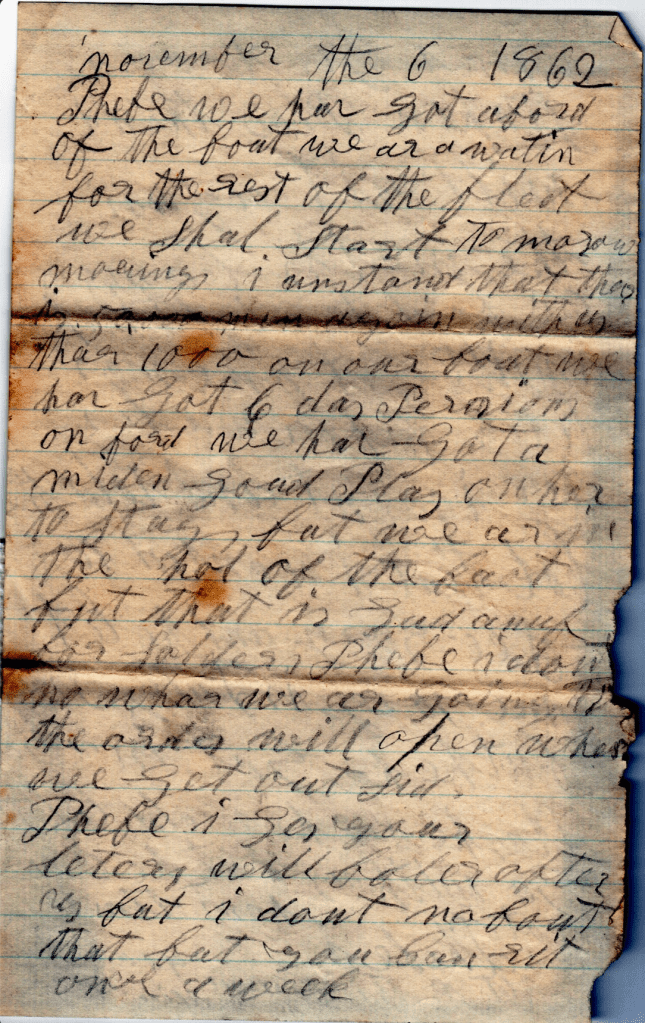
Phebe, we have got aboard of the boat. We are a waiting for the rest of the fleet. We shall start tomorrow morning. I understand that there is 50,000 men agoin’ with us.
There are 1,000 on our boat. We have got 6 days provisions on board. We have got a middling good place on here to stay but we are in the hold of the boat. But that is good enough for soldiers. Phebe, I don’t know where we are going to. The orders will open when we get outside.
Phebe, I guess your letters will follow after us, but I don’t know about that. But you can write once a week.
When I get to our stopping place, then I will write again. The mail is coming onboard tonight. I hope I will get one more letter before we leave here. I went and told the Colonel that I wanted to see George and he let me. George is pretty sick but he has got in a good place. He said he would like to go with us, but he cannot.
Phebe, I han’t time to write. This from your soldier –John
To my dear wife.
Letter 16
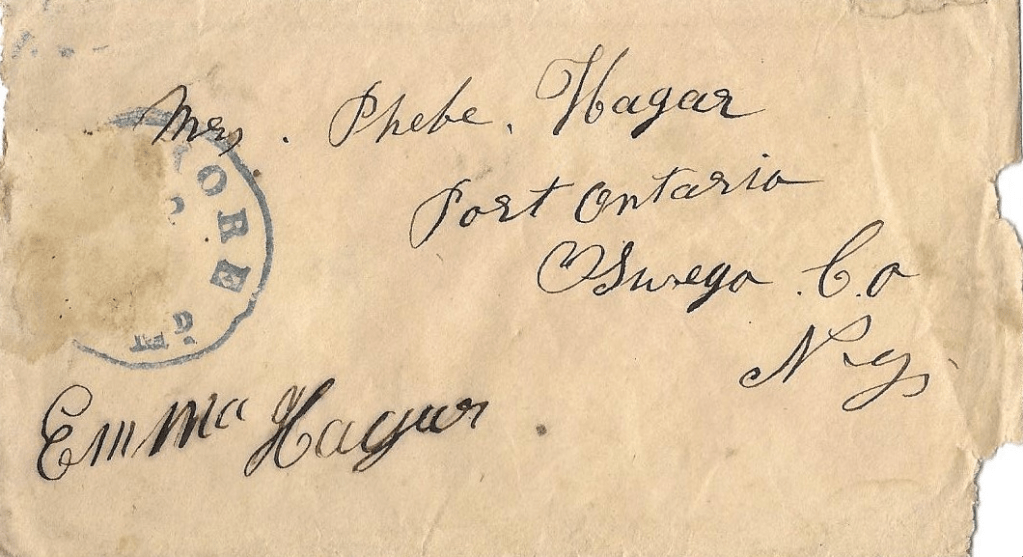
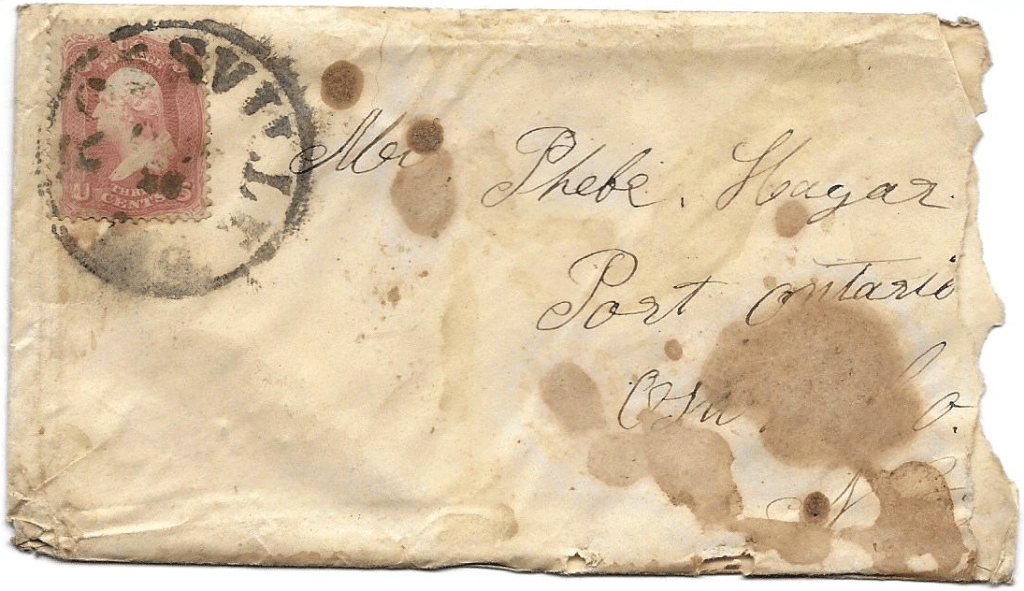
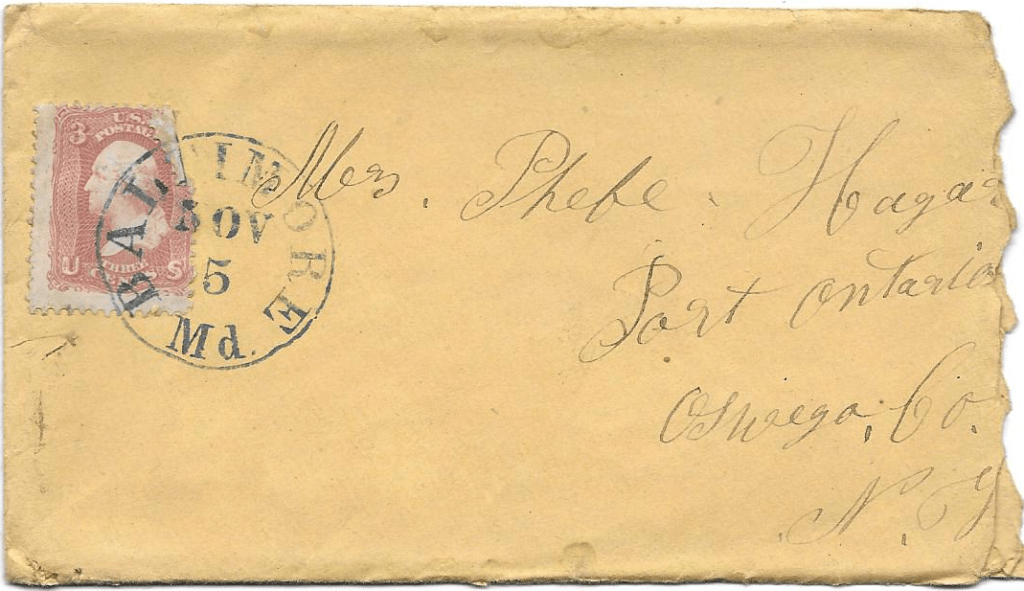
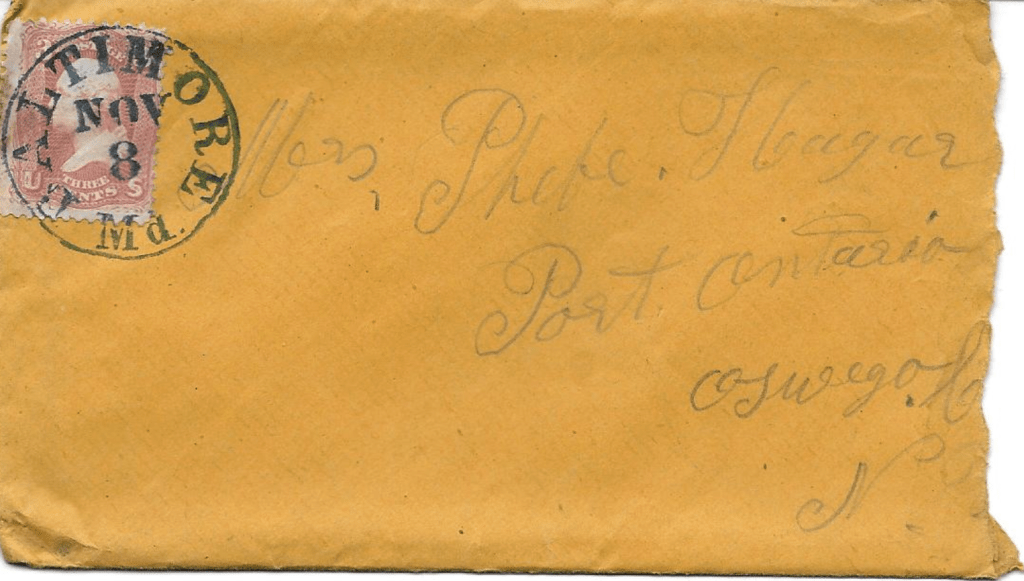
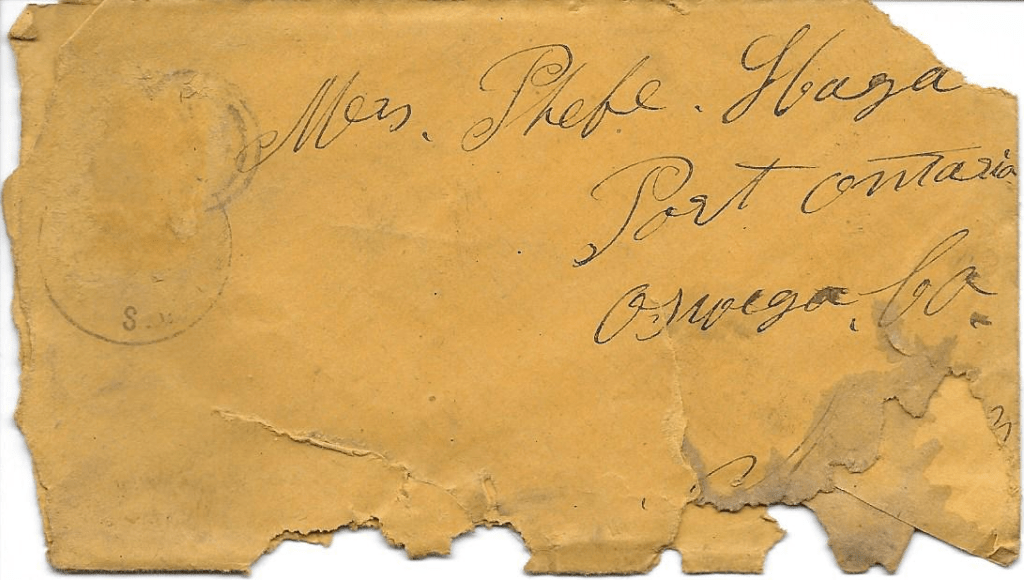
Addressed to Mrs. Phebe Hager, Port Ontario, Oswego, N. Y.
[Baltimore, Maryland] [7 November 1862]
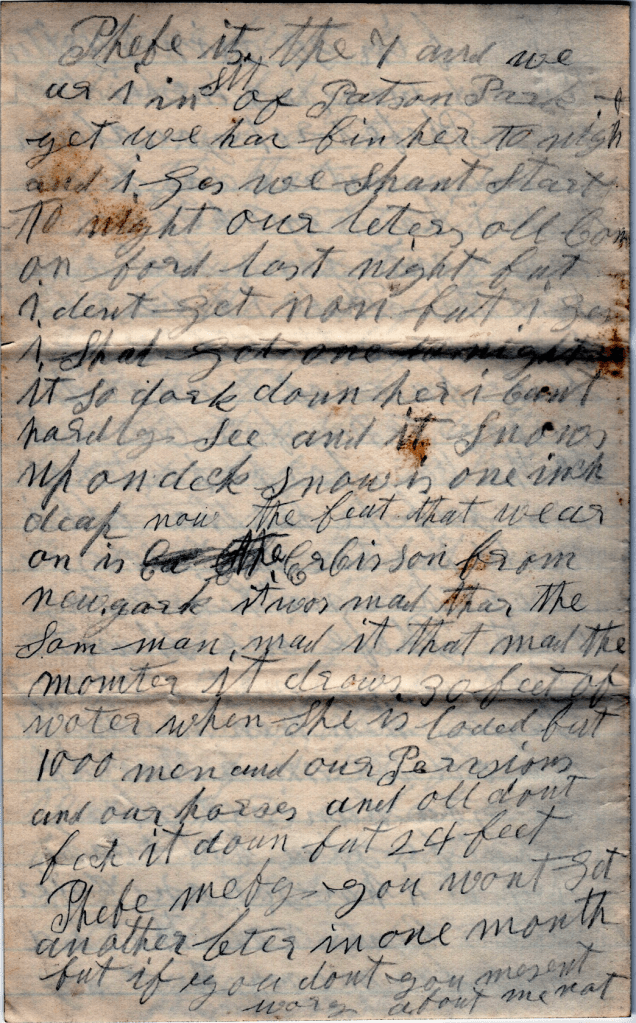
Phebe it is the 7th and we are in sight of Patterson Park yet. We have been here two nights and I guess we shan’t start tonight. Our letters all come on board last night but I didn’t get none. I guess I shall get one tonight. It is so dark down here I can’t hardly see, and it snows up on deck. Snow is one inch deep now. The boat that we are on is the Ericsson from New York. It was made there. The same man made it that made the Monitor. It draws 30 feet of water when she is loaded. But 1000 men and our possessions and our horses and all don’t [pack?] it down but 24 feet.
Phebe maybe you won’t get another letter in one month, but if you don’t, you must not worry about me—not at all, for we are all right I guess. For we are going to rout old Jeff now. I s’pose you will hear of something being done when we get down there.
Phebe I can’t hardly write for there is so much noise down here. There ain’t but 9 [ ] in this boat so one company have to stay on deck. But some of them has come down here. The Major come down here and had us all lay down to see how many more could sleep in our place. This is a pretty noisy place here now, I tell you, to write. Phebe, I am glad of this tobacco that you sent to me, but they have got some on board to sell that sells for 3 cents perhaps for 20 cents apiece. They don’t ask but 7 cents when we first came to Baltimore. But you know they charge more on the boat. I like this that you sent me first rate. I thank you a hundred times for it, and for the rest of the things. I have got my box on board. I put the things all in one and give the other to the Lieutenant Fellows to put books in. The boys are dancing to set right here. They hit my hand most every time that they promenade around.
This is a hard place to write, so I think it is. I can’t think of nothin’ to write much. I see Fuller today. He is as fat as a hog. He ain’t been sick—not at all. He is in Co A. He told me to tell Chester and Jan he would write when we get to our stopping place.
I have been 30 minutes in writing this and snow is 3 inches deep now. Phebe, I wrote you a letter yesterday and one day before too so I haven’t much to write now. I ain’t sure that I can send this… Phebe we shan’t get no pay, not till next payday… I have got one dollar and 25 cents now—that is enough for me now. This is to my wife, Phebe Hager
Letter 17
[On board ship] November 8th, 1862
Phebe, we are here about 5 miles from the Park. We are waiting for the wind to go down so the tide can come in. Then we shall start. We are all ready now. There is 80,000 men a goin’ with us. I guess we are a goin’ to do something now. Phebe, you can keep writing just as you have for General Wool will have them forwarded right on to my company. The captain said for he was the only man in Baltimore that knew where we was a goin’ to. He will forward them right to me, so we shall get them.
Phebe, we have an awful storm here. Snow on deck is 4 inches deep but the sun has come out now and is pleasant today. But it won’t be so cold when we get out one 100 miles from here.
Phebe, I thought that I would write every day while I was here, so to let you know when we started to fight, for I s’pose that’s where we are a goin’ to now. I am ready to go. That is what I started to do when I left home. Old Abraham says that we share this right along. Now Phebe, I understand that the Democrats has carried the day this fool for Governor. Some think it will be settled now cus they have got their man but the way they have got it is because they are most all to home. That is the reason. You can tell Da[ ] Flemmings of that and see what he will say. He always said of the Democrats that was off to war, but it ain’t the Republicans that run over to Canada to get away from the war. I had rather be where I am than to run [off from] my country. And you can tell them all. So if they say anything to you, if a mind to.
I han’t heard much from the 147th [New York] regiment. The boys all told me that they would write but they han’t none of them wrote to me—not yet. Nor old Harkemer han’t wrote neither. Nor I guess she won’t but I don’t care if she don’t.
They was here after the mail. But I han’t hardly begin mine then, so they give us a little more time to write. But I shall get another letter tonight, I guess. I han’t had none since Tuesday. It is Saturday today.
We shall leave tonight now, so good bye for this time. This from your friend and soldier — John Hager to his wife Phebe Hager. That is all for this time.
We are all on board of the Ship Ericsson from New York. It 4 o’clock now and we are all on deck now. The boys are a dreaming now to have a little fun. They make a lot of noise. I guess they do. Phebe, I feel first rate and I hope that you do too. There has one boat gone by just now with soldiers on. We went up and cheered them all. Phebe, I did think I won’t send this, but I have made up my mind that I would so 1 will. I write this on rail of the ship. That all my dear, this all.
Letter 18
[Enroute to Fortress Monroe, Virginia] November 9th, 1862
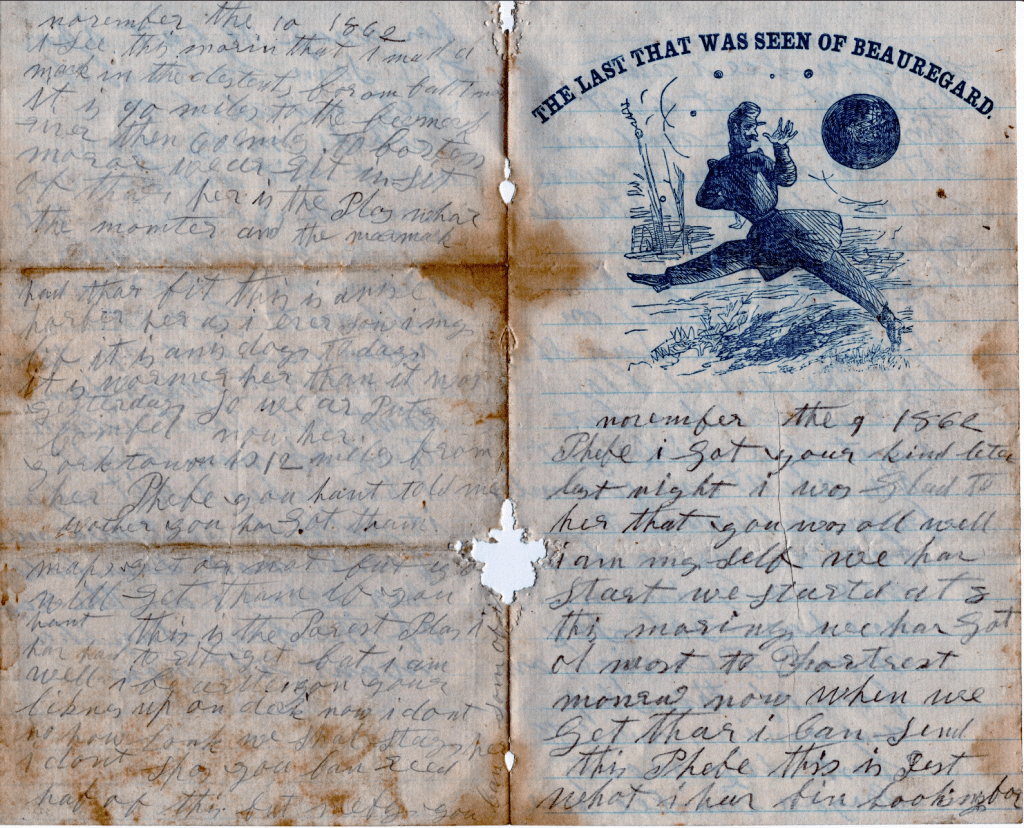
Phebe, I got your kind letter last night. I was glad to hear that you was all well. I am myself. We have started. We started at 8 this morning. We have got almost to Fortress Monroe. Now when we get there, I can send this. Phebe, this is just what I have been looking for, so you see I ain’t disappointed—not a bit. This is what made me write so often to you. I am satisfied with what you have sent me. I can’t write much for it is pretty cold on deck. The sun shines, but the wind blasts pretty hard here. But I ain’t seasick yet. It is about 100 miles from Baltimore to Fortress Monroe. But we are going on [ ]. We got six months provisions on board of this ship and ammunition enough to last six months. So you can see we have enough to eat. I have got some butter left yet and apples too.
Phebe, maybe you won’t get another in a month. You mustn’t write till you get another from me, for maybe I shan’t get them. When we get off [the boat], then I will write where I am. That’s all that I can think of now to write. I hope when I write again It will be a little warmer, for it is most damn cold here where I am. The rest of the boys say they won’t write now.
November the 10 1862
…We are right in sight of the place where the Monitor and the Merrimack had their fight. This is a nice harbor her as I ever saw in my life. It is a fine day today. It is warmer here than it was yesterday so we are pretty comfortable now here. Yorktown is 12 miles from here. Phoebe, you hain’t told me whether you got them maps yet or not but you will get htem if you hant…
November the 12 1862
We still lay her to Fortress Monroe. Yesterday we went to Newport News. We went on shore there and drilled a spell. It is seven [miles] from Fortress Monroe. We lay now right between the fort and the Rip Raps. I must tell you about the city there to Newport News. You have read of this place. Well, it is a hard looking place. Their buildings are made of round poles about 4 inches big but they are most all are whitest on the outside. There ain’t as good a building in the whole city as my old shop is. They are all blacks that live there, but the government supports them. They have all got government clothes on. I should think that there was 150 acres of land there, all cleared up nice. They ain’t a stump on the whole place. It did belong to the rebels till our men took it away from them.
This is to the mouth of the James River. The Monitor lays there. She lays right by the side of the Cumberland. That is the ship that the Merrimack sunk. But it don’t look so it would take much to sink the Monitor, for she is most all under now. She ain’t out [of the water] more than two feet besides her little cheese box that I should think was 14 feet abreast it. And her boiler is about 10 feet high, I guess.
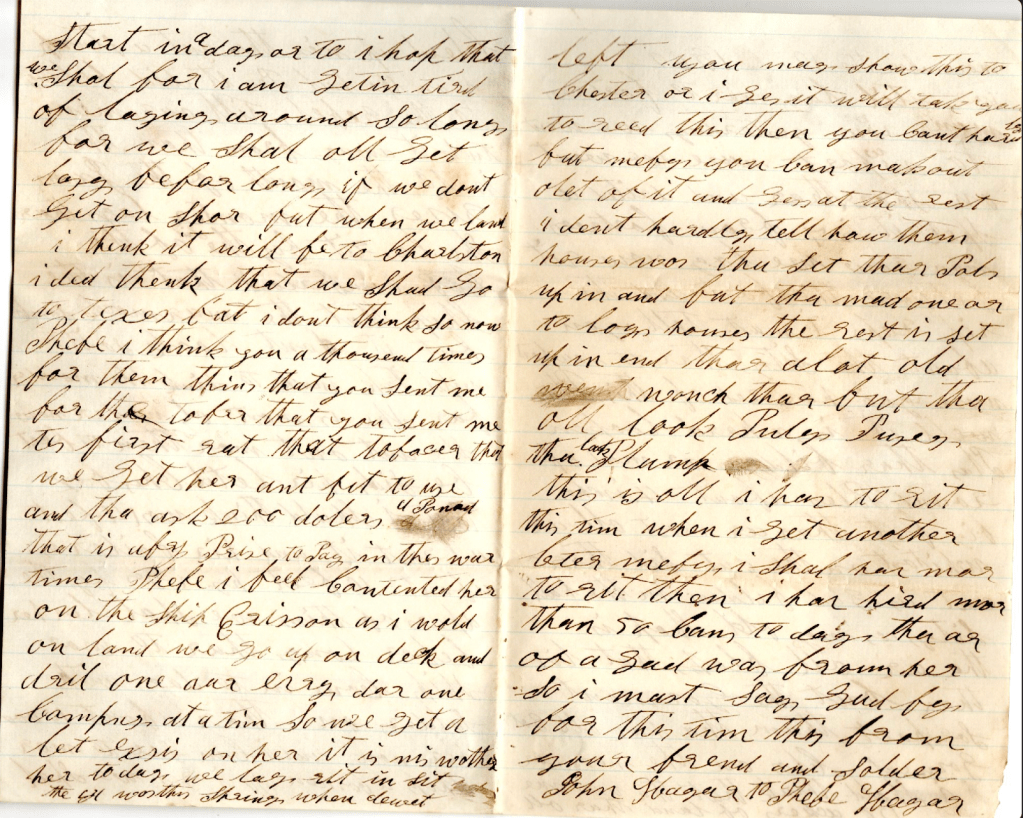
By the looks of things we shall leave here before long. There are two more ships come in today with soldiers on. There about 10,000 here now and I can see two more ships a coming. So I guess we shall start in a day or two. I hope that we shall, for I am getting tired of laying around so long. For we shall all get lazy before long if we don’t get on shore. But when we land, I think it will be to Charleston. I did think that we should go to Texas but I don’t think so now.
Phebe, I thank you a thousand times for them things that you sent me. For the tobacco that you sent me is first rate. That tobacco that we get here ain’t fit to use. And they ask $2 a pound. That is a big price to pay in this war times.
Phebe, I feel contended here on the Ship Ericsson as I would on land. We go up on deck and drill one hour every day, one company at a time. So, we get a lot of exercise on her. It is nice weather here today… You may show this to Chester, or I guess it will take you to read this. Then you can’t hardly, but maybe you can make out a little of it and guess the rest I don’t hardly tell how them houses was. They set their poles up in, and but they made one or two log houses. The rest is set up in end, there a lot old wenches there but they all look [ ] than look plump.
This is all I have to write this time when I get another letter maybe I should have more to write then. I have heard more than 50 guns today. They are off a good way from here. So, I must say goodbye for this time. This from your friend and soldier, — John Hagar to Phebe Hagar
Letter 19
Fortress Monroe November 14th [1862]
I got your letter tonight so I will answer tonight for it will go on shore in the morning. We are on the Ericsson Ship. We lay right where we have for a week or more. We all went on shore today to wash our clothes and we stayed there all day. We went from the ship on a steamboat and come back on it.
I sleep first rate here on the ship. It has been nice here today. It looks like spring of the year here today. I don’t need no coat here for it is warm enough without it. I don’t know when we will start from here but I guess it won’t be long but the government is pretty slow, [at least I think it is. But for my part, I’m ready to start anytime, even if it was tonight. There has 4 more ships come here today loaded with soldiers. The 114th New York Regiment has come today. There is as many as 1,000 soldiers a waiting at anchor right here. We are most all well.
This is 9 days since I came on this ship. It don’t seem so long as that but it is. Even so, I am well and hope you are well at home. I haint heard from George since we left there but I thought he would be with us before this. The doctor said he had a fever of some kind but they have good doctors there where he is. He was able to write when I left him. We left 2 or 3 others there.
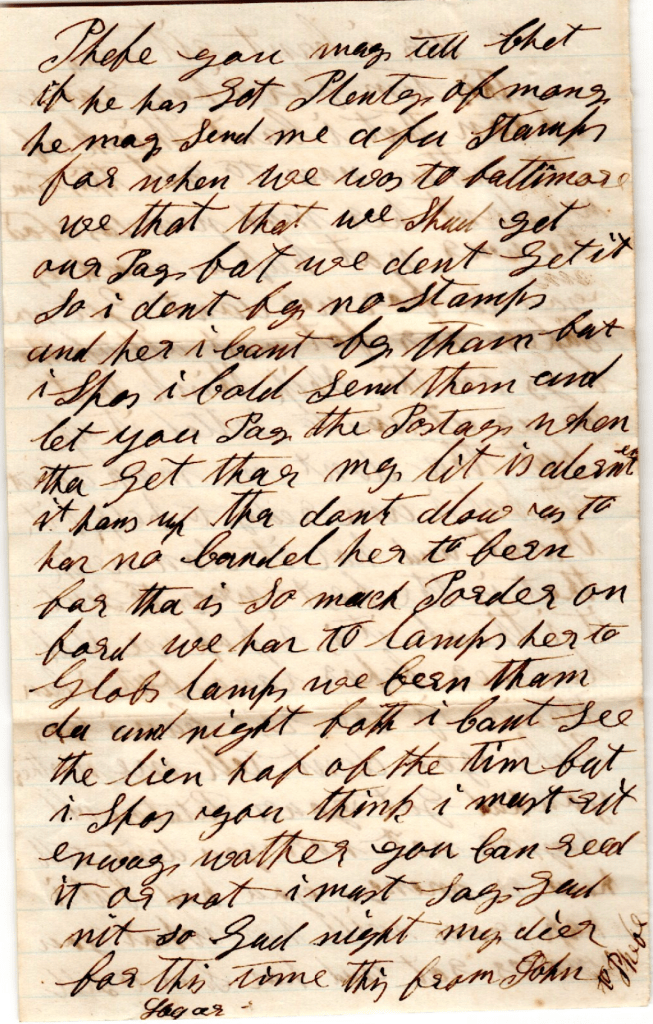
Phebe, your last letter was just 3 days a comin’. You may direct just as you have all the time. I guess I shall get them if we leave here. Phebe, you may tell Chet he has got plenty of money and he can send me a few stamps for when we was to Baltimore. we thought that we should get our pay but we didn’t get it so I didn’t buy no stamps and here I can’t buy them. But I suppose I could send them and let you pay the postage when you get them. My light is [inadequate]. They don’t allow us to have no candles [as] there is so much gun powder. We have two lamps here—2 globe lamps. We burn them night and day. I can’t see the lines half the time but I suppose you think I must write anyway whether you can read it or not.
I must say good night so good night, my dear, for this time. John Hagar to Phebe
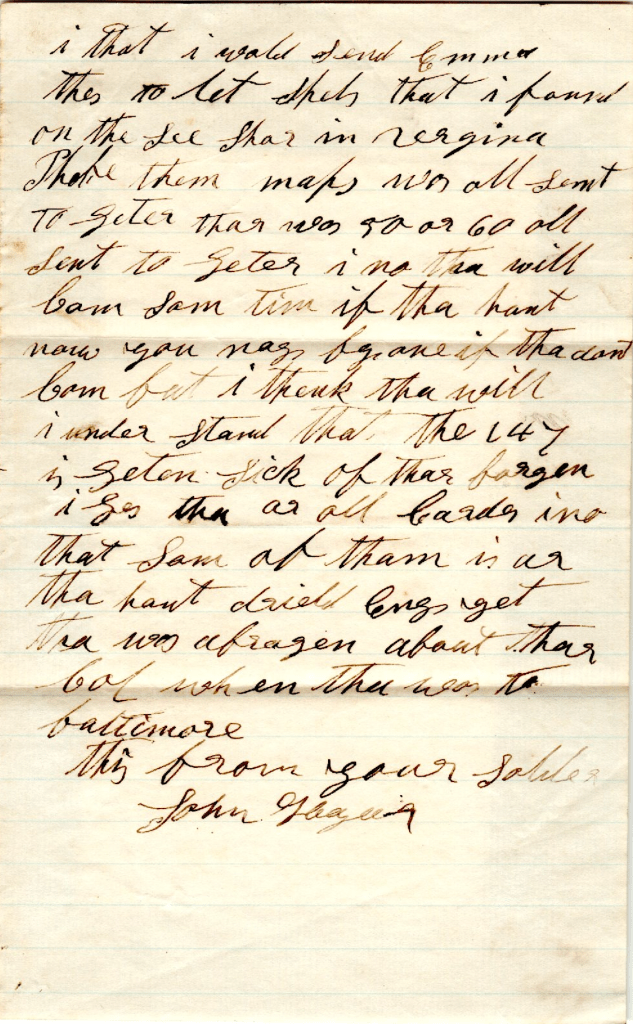
I thought I would send Emma these sea shells I found on the sea shore in Virginia. Phebe, them maps was all sent to Chester. I know they will come sometime. They was 50 or 60 of them. If they haint you may buy one if they don’t come. I understand the 147th is gettin sick of their bargain. I guess they are all [ ] I know they haint drilled yet. They was a braggin’ about their Col. whenever they was to Baltimore. This from your soldier — John Hagar
Phebe, don’t go to fretting nor stewing about me—not at all. I guess I shall come out all right. If I don’t, I s’pose it will be all the same. I don’t want nobody to shed not one tear for me for I think it will be well with me. When I die, let me die where I will. This is what I think.
Our mail has just gone out and I will write a little more. I am 70 miles from Richmond from here. I think that is the place where we shall go to but I don’t know. But it don’t make no [ach?] where for I am ready every time. You will hear of something been done before long. I think you will. I guess I han’t no more to write now. Write my dear when you get this.
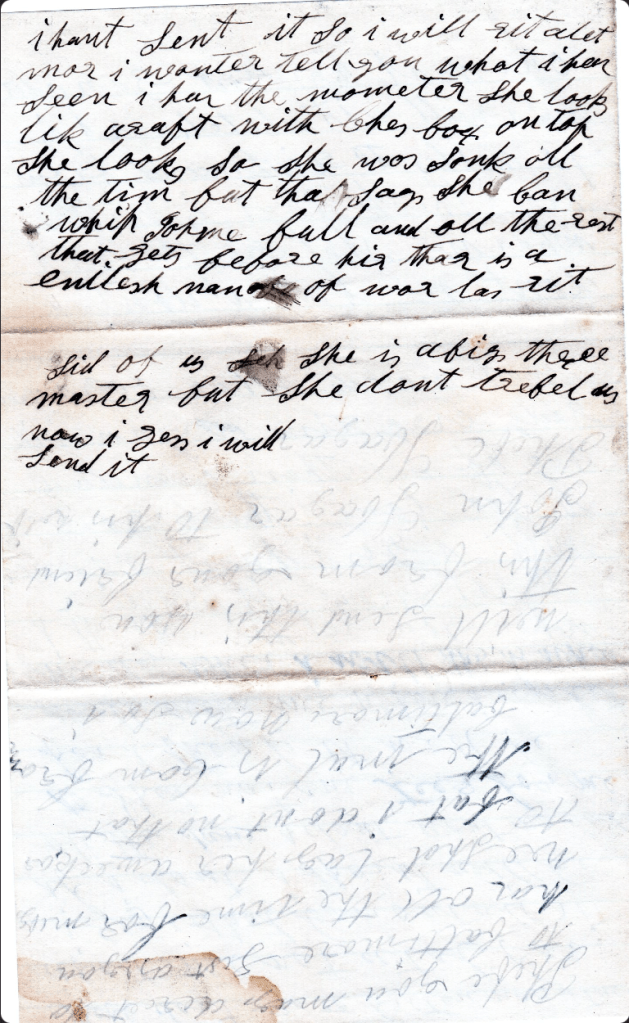
I han’t sent it, so I will write a little more. I want to tell you what I have seen. I have seen the Monitor. She looks like a raft with a cheese box on top. She looks so she was sank all the time. But they say she can whip Johnny full, and all the rest that gets before her. There is an English Man-O-War close, right side of us. She is a big three master but she don’t trouble us.
Now I guess I will send it. Phebe, you may direct to Baltimore just as you have all the time, for maybe we shall stay here a week or two. But I don’t know that. The mail is come from Baltimore now and I will send this.
This from your friend John Hager to his wife Phebe Hager
Letter 20
[On board ship] November 20, 1862
I thought I would write a little more for I was in a hurry when I wrote the last letter. We still lay here on the Ericsson ship. We lay here to Fortress Monroe but I don’t think we shall stay here much longer. The boys say that there are a going to keep us here till the war is over but I don’t think so.
George has got here today. He has got well. I got a letter yesterday from you that was wrote the 6th. It got delayed somewhere, I guess. It was all the letters that came for Co. B but I was glad to get it to read. It done me good to read it. I guess I get all of your letters. I got one letter today from Gardner and maybe you can tell them I am well and all to write here to Fortress Monroe on the Ship Ericsson.
I have seen something that I never saw before. I seen today in th Navy Yard a pile of cannon balls about four feet. There is two acres in the yard, I should think. There is bullets enough to shoot the whole South I should think but damn, I am in a hurry to fight them. I don’t care how much we get down for I think this is a pretty hard place on board of this ship for there is too many of us together and I think it is unhealthy on here too.
Our boys have got lazy now but I hain’t not got. But I shall if we stay here long. O’d rather go right into battle than to stay on here for it is warm weather. If it was cold, it would be better for us.
Well, Phebe, I feel pretty well today and I hope that you do to. I sent you $10. I sent it to Mr. Clark to Pulaski. You can get it any time, I hope what you don’t need, you will keep. Write when you can. You said you were wearing [a] short dress but I think maybe that you ought not wear them for folks will think kinder strange of you for they know I am off to war. I had a little rather you won’t wear them much till I come home. Then we will talk about short gowns. Then we will talk about matters and things.
This from your friend and soldier to his ever dear wife and friend Phebe, — John Hager.
I don’t think I’ll send my letter this morning so I…will write a little more today and put it in later. I went on shore yesterday but I didn’t feel none the best. I hain’t had much appetite to eat for a few days past. I have had the jaundice. I look rather yellow yet. Our company has all had them [adn] what hain’t will have them.
The 114th New York was on shore. Some of them said they had got the jaundice and the measles both together. They have had one die since we have laid here. They say we shall start the 28th but they don’t know when we shall no more than I do and I don’t know nothing about it. I guess we shan’t stay on here much longer. I hope not for I am afraid if we do that we shall all be sick for the water ain’t very good here. But I guess I can stand it if the rest can. But I am content with my lot. I get along a good deal better than a good many of our boys do. I got all of your lettres but some of them have been a good while a coming. But they all come.
It rains today so I have to sit down in the hold. We was a going on shore today but it rains so we don’t go… This is all I have to write this time so I must say goodbye to my dears for this time. — John Hager
Letter 21
Fort Monroe November 24-26, 1862
This is Monday noon now and we have gone on shore today to stay an hour. George will stay to the fortress hospital. He come out yesterday but he didn’t come today. There is a good deal of men would like to play sick now for they think they had something too and they are cured. I am willing to go and help fight it out. And Mr. White is too. That is about all that is ready and willing. There may be some more but I don’t know who they be. But if you do, I wish you would tell me who they be. But I think that when we get it, then our boys will do as well as any of them for we have got the hardest company in the whole regiment a good deal. And they all is men.
I write this on the seashore at Fortress Monroe. When we get started, I will finish it, if I don’t before. It is Wednesday today and we han’t start yet. The order has been countermanded and they have took us back on shore today. So we didn’t go to drill. It rains here today so we didn’t go to drill. George is getting better now. I guess he has concluded to go when we do but I won’t wonder if we stay here some time yet. It is so dark and cloudy, I can’t hardly write down in the hole. We are down three pairs of stairs. That ain’t all, there is a hole about 6 feet across it for the light to come down. The rain scatters on my paper some, but I will send it.
Maybe it will do you some good to see it. I know it does me good to hear from you. If I had a letter every day it would be much too often while I am here, for this is rather hard times. For we can’t more than half, take our vittles here on this ship. But we have enough to eat [even] if it was half cooked. But there is so many of us that they can’t do any justice.
It is the 26th. I had a letter the 21st. That is the last. But I think I shall get one today. I hope so, for it seems a good while to me. But I feel better than I have since I have been on the ship. You can tell Chester to write how he is. I shall tell him bugger it all up and send the account to me. I want to know how it is. I want him to get you what wood you want this winter. It is so dark here I can’t half write. But I will send it maybe you can read some of it. I han’t much to write this time so I will close by saying good bye for this time. — John Hager
To his dear wife Phebe Hager.
ScreenshotScreenshot
Letter 22
Thanksgiving Oysters, Confederate land November the 27, 1862
I got your kind letter today when we was a eating our Thanksgiving dinner our on shore. We had oysters for dinner. We bought 3 barrels full of oysters and we ate them all up for dinner. It was a good dish.
Now I tell you we have started for the ship. We are a waiting for the steam boat now. So, I wrote a little. We went out in the country about 2 miles. It was a nice place. The man that owned that place he went in the Southern army. He is killed.
His place was confederate and his wife and family has left his land. He had a nice house as you ever saw.
I have got on the ship now so I will finish my letter that I began when I was on the wharf. When we went from the ship we landed. We went right across the ship that Cal Bonet was on but I don’t know it. I felt I could have seen him. I could have seen him. The way I found it out: one of the 110 NY boys see him. They said he was well. There was 6 guns on the ship that he is on. That boat is a going with us when we go. If we ever get ready to start. I don’t know as we shall ever get ready to go. We lay right here where we have for the last 22 days. I won’t wonder if we sit here a spell yet before we go. But don’t care now for I have got a first rate appetite now. I feel first rate tonight so I must tell you of it. I had all the apples I could eat today. 2 for 5 cents on the ship. They sell for 5 apples but I han’t bought them on board but when we go on shore then I buy 3 or 4. Then they taste pretty good. Now I tell you George is getting pretty smart now. He told me to tell you so.
I sent 3 maps to Pulaski. One for John Calkins if he han’t got none. One for Charles M. Smith if he han’t got none. The other for Gardner. I know he han’t none, or you can do as you think.
I sent one to Ezra Whithead. I sent his to Mexico. I might of sent yours to the Port Ontario, but better sent than let it go.
The way I do with mine (letters), I read them three or 4 times first. So good bye my dear, I got two of your letters.
Letter 23
[Fortress Monroe] November the 29, 1862
I thought I would write a little tonight for I don’t have no time to write—only nights—and then not much time to write. We been on the shore today to drill. They put us right there on double quick. It warmed us up first rate. But I stood it first rate. I have got a good appetite to eat as ever l had, and a little better, I think. I feel I feel pretty well now. I han’t been excused but one day. Then I went on shore with the rest but I didn’t carry my gun that day. I look some yellow yet, but I feel pretty well. I have eat a good many apples today. We have to pay 5 cents for 2 apples, but they taste good.
Now I tell you our horses here gone on shore to stay 20 days. So, I guess we shall stay here. We have all been inoculated for the small pox. But they han’t no one got it—not as I know of. But there is a good many of us together here.
Phebe, I got them stamps. I got that [ ]. I did sleep under that quilt one night at Patterson Park in tent No 5. That is where we slept the last night that we stayed there before we went to Stemmers Run. You can see it on your map.
I don’t want you to pay Sam Stone no money, nor nobody else unless I tell you to. There is time enough to pay. I want you to keep all the money you can till I come home. I shan’t like it not a bit to have you pay no debt that I owe now. I want you to remember this. I didn’t cost but 15 cents to send that quilt for he paid me back the 25 cents. The (stage cleaner?) must of charged 10 cents for fetching it to you. So, you see it didn’t cost much to send it home. I had just bought a pound of sugar so l didn’t need that that you sent. George han’t got so he can drill yet but he went out on shore to day with the rest of the sick boys. But he is getting better.
I think lately, all of our sick is a gettin’ better now. I han’t got much to write not now. Maybe I shall have something to write the next time. So I can’t write no more tonight. So, I must say good night to my dear.
Letter 24
[Anchored at Port Royal] December 8, 1862
My dear,
I will write a letter tonight. We are anchored at Port Royal. We lay between there and Hilton Head. We are a goin’ on to Mobile. We go round by the Gulf of Mexico. It is a 6 day sail from here. The rest of our fleet didn’t stop here. There has been two gun boats here to lead us. We are about 36 hours behind the rest of our boys. The boys say we are a gettin’ a good ways from home but it don’t seem a good ways to me. It’s about 700 miles from New York to Port Royal. I don’t know if I have spelled it right or not. It is 8 at night. They said we must put all letters in at 9 so I haint got much time to write. You direct to Fortress Monroe, 110 Regiment, Mr John Hager, Co. B.
Well Charley, I must write some to you. Well Charley, I have seen 2 or 3 whales. I have seen a good many porpoises as the sailors call them. Charley, I have seen the gunboat they call [Comet?]. It has 6 big guns on it.
A little to my little Emma. You must be a lady. You can eat Pa’s part of meat and taters so to grow big and be a lady, when Pa comes home. Tell Charley to be a good boy and learn all he can when he is in school. I want him to learn to write so he can write to me and when you get a little bigger, you can to. I am off a good ways from but I hope you won’t forget me if you don’t ever see me again. But I expect to come home when the war is settled. I don’t want to come home before—not as I feel now.
This to Charles Hager and Emma Hager, my two children. Charles, I hope you get so you can write better than this but I write this on my knees by a globe lamp and 100 men all a talkin’ at once, so you see, I don’t have much chance to write.
Phebe, my dear, one more word. Keep a stiff upper lip and do the best you can. Be careful not to get sick, take good care of yourself and I will do the same. Good night my dear.
Letter 25
December 9th, 1862
We are at Port Royal today. We laid here all night. We lay within sight of Fort Beauregard. It looks like a small fort. The Union flag is there now. We are taking on coal and water now. We shall start this afternoon. It is a nice day here today as I wish to see. Our boys all feel pretty well. We have got [ ] guns in [ ]. I have got 26 dollars due me now but I ain’t payday—not till the first of January. But we don’t expect to get it then. But we will have all the more when we do get it. If you can wait for it. I can borrow what I need here of Peter. I shan’t want much to use, I don’t think. If I do, I will let you know it if I do. I know I have used a good deal since I started but I thought I needed all I bought. I spent one dollar for apples since I have been on the ship. But we can’t get them now. I have got some money left.
DeWitt Clinton Littlejohn served as Colonel of the 110th New York Vols.
They thought that the 81st more around a good deal, but we are a going right away from them. But I don’t find no fault. I am willing. I go where DeWitt Clinton Littlejohn does. I think he is a good man. I like him first rate. So does all the rest. They think he keeps us pretty close when we are on land.
We shall let that old propeller stay her till she is repaired up. Then she will come on after she would have went down if we hain’t happen’d along to here. She had on 3 or 4 hundred soldiers on—a part of the 114th New York on board. She rolled so they was all seasick. They was a hard lot of boys now, I tell you, and so was we for one or 2 days. I wasn’t much sick but I couldn’t eat much for the rest spewed so much that I couldn’t eat more for the sight of vittles. It was a hard looking sight for any white man to see. They laid right down in the [ ] and laid there [ ] see [ ] on deck for two days but he is getting smart now. But he hurls up pretty [ ]. He is pretty tender. He can stand much hardship. He hain’t got half the snap that I thought he had, but I guess he will fight pretty well when he gets into it.
I forgot to tell you that I seen the blockade at Charleston. Our gunboats lay along there, for a number of miles we could see them. Charleston—that belongs to the rebels yet. We have got one rebel prisoner on this ship. He is one of the sailors. They call him Stonewall Jackson. We all call him so. He has been on here 2 or 3 months. He would go into the rebel army if he could get away. It hurts him to be called Stonewall Jackson but we can’t help it. We have been here so long that we have got pretty well adjusted with the sailors. This from your soldier — John Hager
to his wife Phebe Hager
December 9th 1862
Chester and Jan, I will write a little to you. I am at Port Royal and we shall start this afternoon for Mobile—about 100 miles farther. And what will be done there, I don’t know nor care, for I am ready for anything that comes now. I am as tough as a bear now. But when we sailed around Cape Hatteras, I tell you my hair pulled some. Then it rained and the wind fly some now, you had better believe. The waves rolled as big as a gimlet handles. Now you had better believe that.
Well Chet, if you can wait for what I owe you a spell longer I wish you would. But I don’t know when I shall have any money now, for we are agoin’ off somewhere far from home. I came on this ship November the 5th. Now it is December the 9th. We shall have to stay on here 7 or 8 days longer. If we unload as quick as we land, I hope we shall, for it ain’t a very comfortable place for so many men to stay so long. I think we have stuck by this ship pretty well.
This is all for this time. I wrote to Phebe since I come here. You can see them. Direct to Fortress Monroe, General Banks Division,110th New York Regt., Co B. It will come on. This from the Soldier John Hager. I see Fuller and he is well and tough and so be I. This to Chester Hager
Letter 26
[Ship Island, Gulf of Mexico] December the 14 1862
We are on Ship Island. We came on here yesterday. We have put up our tents. We are a going to stay here 10 days, then go to New Orleans and take Old Butler’s place. I expect there ain’t a [ ] tree on this island. It is all covered with sand. It looks like snow but I han’t seen no snow since we had that snowstorm the next day after we started from Baltimore.
It is warm weather here now. There is about 7,000 men on this island. There is some houses on here. It did belong to the rebels but it don’t now. There is lots of old ships come on shore all around this island. We came off on small boats for the Ericsson draws 20 feet of water. We have been getting wood today. Old plank and baskets—that is what we bake our vittles with. We [ ] go before but can’t get no boat. Our boat can’t run up the Mississippi river. Our captain said direct to Ship Island. One word to my dear wife—I am well and hope you will be when you get this.
Letter 27
Ship Island Today is [December] the 18th, 1862
We are on Ship Island. I am in a tent with Jason Wright 1, Randy Soule 2, George Filkins 3, and William Weed. 4 That is five in our tent. It is a good lot of boys. We picked out our boys ourselves so we are suited with it. We have all got a good appetite to eat. We can eat all before us, but we have enough to eat. And we can cook it [too].
I don’t think we shall stay here more than 10 days but maybe we shall. We can’t tell nothing about it. I am well and so is George and all the rest of the boys. This island han’t got no timber on it. We can see Cat Island from here. It ain’t more than 2 or 3 miles off from here. That has got trees on it. It is as white as snow with sand. And so is this. It drifted last night a foot deep in some places.
Well Phebe, we expect to start to New Orleans in 10 days but maybe we shan’t in 4 weeks. And I would like it if you could send me about 5 dollars if you can send it by express. If not, don’t send more than 1 dollar at a time. I guess that Chester will carry it to the station. I don’t know when I shall get any pay here. I guess I won’t write no more this time for here is more than you can read now. So good bye my dear. Write when you get this.
1 Jason B. Wright, age 31. Enlisted August 6,1862 at Albion to serve three years: mustered in as a private Co. B, August 13 1862 promoted sergeant, August 21, 1862: first sergeant, May 1, 1862, Mustered out with Company August 28, 1865 in Albany N.Y.
2 Ransome A. Soule, Age 29 years. Enlisted August 7, 1862 at Richmond to serve three years: mustered in as private Co. B, August 13, 1862: mustered out with company August 28, 1865 in Albany N.Y.
3 George S. Filkins, age 26 years. Enlisted, August 9, 1862 at Richland, to serve three years: mustered in as private Co. B. August 13, 1862: mustered out with company, August 28, 1865 at Albany N.Y.
4 William C. Weed, Age 33 years. Enlisted, August 6, 1862 at Richland, to serve three years: mustered in as private, Co. B. August 13, 1862, Died of typhoid fever, April 21, 1863, at Marine Hospital, New Orleans, La.
Letter 28
Addressed to Mr. Charles Hager, Port Ontario, Oswego county, New York
[Ship Island, Gulf of Mexico] December the 21, 1862
This is to Charles,
I am on Ship Island. There is water all around the island. This island is 7 miles long. There is a few houses on this island and little houses here. They are a building a fort here. They are a building this fort of brick—there ain’t no stone here. There is plenty of sand here. We went after wood yesterday. He have to go 3 miles and fetch it in our arms. What do you think of that? My boy, we han’t no horses here and sand is over shoes every step. Sand does drift here like snow. Some nights it has drifted two feet deep. What do you think of that my boy?
Charles, I will send you some shells that I got when I was after wood on Ship Island. Emma, I will send you some shells. You can [ ] them your little own self. Some of them has got holes in them. I wish I could send you some fish, and there is some nice ones here. Charles and Emma, I am well and hope you all be.
This from you pa to Charles and Emma Hagar
Letter 29
[Ship Island, December 1862]
Phebe, I have got paper and stamps but I hain’t no money—not a cent—only what I have. I don’t need much but you know I want some. I want you to send it as soon as you get this letter. You go and see Chester if you hain’t got the money. Let him read this all there is. I wrote it in a hurry. I hain’t had time to write much. Chester will carry the money to the office and have it forwarded to me. Maybe I can get my pay by the middle of the month. I hain’t drawed no more clothes since I left Oswego. The last letter I got from you was the 28th of November. I got it the morning we left Fortress Monroe.
Well, Charles, I have got to where the Rebels have been but I hain’t seen none—only prisoners on this island. They are building a fort. They are a hard-looking lot of men. I would write some more but I hain’t got time to [write] Emma. You can tell her I am well and hope she is too. [When] I [think of] her, I see her little white head.
The following letter was written by Captain Franklin Johnson (1841-1870), of Company K, Twenty-sixth Michigan Infantry, which was addressed to Mrs. Austin Blair, “Michigan’s Wartime Governess.” In his letter, dated July 11,1864, Captain Johnson writes Mrs. Austin Blair from the Armory Square Hospital in Washington D.C. and mentions his badly wounded ankle, a result of his regiment’s engagement on May 12,1864, at Spotsylvania Court House, Virginia. His foot was amputated due to the severity of the wound. On March 13,1865, Franklin Johnson received the rank of Brevet Lieutenant Colonel, after being discharged from the service on November 30,1864. Johnson’s letter includes his reflection on the deaths of two 26th Michigan comrades—Charles Wellman and Walter H. Maxson—who were killed in action at Spotsylvania.
Franklin was the son of David Johnson (1810-1886) and Adelia A. Pollard (1821-1884) of Jackson, Jackson county, Michigan.
Transcription
Armory Square Hospital Ward “A”, Washington D. C. July 11th 1864
Mrs. Governor Blair,
My dear friend, your favor of June 6th reached me at a time when body & soul wavered in the balance between life and death, but the vivifying influence of a Mother to nurse me, encouraging, loving letters from home to tell me I was not forgotten, and kind friends to visit and cheer me, made their influence perceptible, and once more I am able to sit up and enjoy life, liberty, and the pursuit of happiness. You cannot imagine how pleased I was to hear from you and to think that though sick & wounded, weak & weary, down here in this living point of suffering, I still had friends who sympathized with and mourned for me and whom it would afford pleasure to assist me in any manner they were able.
Sergt. Walter H. Maxon, Co. K, 26th Michigan, killed at Spotsylvania Court House
I thank God that I was not killed, though sometimes a bitter feeling comes over me as I look down at my mutilated limb and I almost wish that the bullet had sped home, as was the case I am so sorry to say with my gallant sergeants Wellman & Maxson. But then when I see cases so much worse than mine here and plenty of them, I think I have cause for congratulation that I escaped simply with the loss of my foot instead of my head. Poor Charley Wellman. How happy it makes me feel to think that he was able to obtain a furlough so soon before his death. It seems to me that that little act of kindness conferred by you in obtaining him a furlough, since it was only by your influence that he obtained a leave of absence, must ever be remembered by you with feelings of the most exquisite pleasure, the thought that you had been able to obtain for a poor soldier the pleasure of visiting his wife and family so soon before he was dashed into the jaws of death and the gates of eternity had forever closed upon him. Indeed it seems wonderful that we were not all killed and wounded amid that storm of shot and shell. It reminded me of Tennyson’s poem:
“Into the valley of death Into the mouth of hell Rode the Six Hundred.”
Poor Charley sleeps in the trenches of that battlefield which wet by the best blood of our country adds one more to the list of victories gained by the aid of our gallant Michigan soldiery. Peace be to his ashes.
I wrote to Gov. Blair today asking for a promotion in some Michigan regiment in which I would be able to muster as I wish to be transferred to the Veteran Reserve Corps and to obtain said transfer I shall have to undergo an examination, but am not allowed to ask for an examination for any higher grade than that which I now hold. By being promoted, I could ask for an examination for the rank to which I was promoted and although if I should fail to obtain the position I aspired to, I should be awarded a commission corresponding to the merits of my examination and would thereby at once leave a vacancy for the person to whom it might more properly belong, and besides, it is much easier for me to ride now than walk, unless I should make my mind to accept of your offer, although I hardly think your delicate foot could stand Virginia marches and Virginia med. But I am so tired, I must to bed, so goodbye.
Your friend, — Frank Johnson, Capt. of Co. K, 26th Michigan Vols.
P. S. Ma sends her regards. She is quite well adn endures the fatigue of hospital life admirably.
The following letter was written by George Naven, a wagoner in Co. F, 6th Regiment, Missouri State Cavalry. This regiment was organized in the spring of 1862 and saw duty at Cameron and in Central Missouri till June, 1862. They participated on a scout into Pettis county in late July and then were ordered to Sedalia, Missouri, where they remained until late August, 1862. It was while in Sedalia that George wrote this letter to his friend, Francis D. Phillips (1826-1911), an Irish emigrant residing in Plattsburg, Clinton county, Missouri.
Transcription
Sedalia, [Missouri] August 12th 1862
Mr. F. D. Phillips,
Sir, your letter came to hand on the 11th by Mr. Michell. I received two letters. The first I received from you I was going out on a scout and I have had no opportunity to answer it, and when I got back, I received the last letter. The men that came from Plattsburg arrived here safe and well. They would have been here sooner, [but] the Colonel at Lexington called our boys in to reinforce him on the account of the trouble there. That is the cause of our boys being detained.
Mr. Mitch informed me that you have been bitten by a rattlesnake but he tells me you was getting better when he left.
That history that John Barns told about us being abolitionists or not laying down our arms until the negro is free—it is an infamous lie. There is two men in the regiment I believe a little tinged with abolitionism and that is all. It stands to hand for John to tell such a plausible history as that for if I was to desert my country’s flag as he has done, I could scratch up some infamous lie. I would like to see you but when you see me, I will come honorable—not as a deserter. Luis and Rollin is here and held as deserters. I will not mention what their punishment is because I do not think it would be prudent.
You must excuse this letter [that] I commenced on the 12th. We had an alarm and we have all been on duty ever since and reinforcements arriving every hour or so until today, the 15th, and the arlarm is quiet now and I conclude to finish my letter.
As for myself, my health is good. The diarrhea has left me and I seldom do without I should catch a cold and that is seldom. That gun Mr. Shepherd had taken from him, I believe it is his neighbors. I believe that he is no more than a bushwhacker and if you ever see him, shoot him as ew do all bushwhackers. I mean Keiffer.
I expect that this last call sets very hard on McClenick as he has boasted a good deal. I would like what he has done. I wonder if he ain’t called on the mountains to fall upon and him. That history that John Barnes told about us being swindled out of our pay is a lie. The paymaster made a mistake in paying off this regiment but when the mistake was known at headquarters, we had a little sent to us—not a payment. Every man that had a contraband have received 10 dollars—just enough for pocket change—with the assurance that we would receive all of our pay the next pay day.
I close my letter. My best respects to you and your family and Mr. George Shepherd’s and his brother’s families. Yours very respectfully, — George Naven
The following letter was written by Austin Train Wing Blair (1820-1847), the son of William Blair, Sr. (1765-1842) and Sally Train (1772-1864) of Williamstown, Berkshire county, Massachusetts. He wrote the letter to his older brother, Edwin Hugh Blair (1806-1878) who took over the family farm, became melancholic in his old age and committed suicide in 1878.
A notice placed in the Mobile Register & Journal in 1844 informs us that “Blair & Co.” purchased the well known drug establishment of Mr. George F. Marlow located at the southeast corner of Dauphin and Water Streets in Mobile. According to Austin’s headstone, he died of yellow fever in Mobile on 20 October 1847 when he was 28 years old.
Transcription
Addressed to Mr. Edwin Blair, Williamstown, Berkshire county, Massachusetts
Mobile, [Alabama] October 22, 1844
Dear Brother,
You may deem it somewhat strange that I have not written to you before this, but the fact is I have been “upside down” ever since I arrived here, which was on the 19th of November. I had a pleasant trip, meeting with only one accident which occurred in the stage in Georgia. There were only three passengers on board but we had about 25 mail bags all well filled. These were stowed on the two front seats of the coach, leaving just enough for us to get through the window onto the back seat. The roads were very slippery from the effects of the rain. While going down a hill, the coach began to sli, the driver stopped the horses, so that we went over very easy. We would have got out before the coach struck so slowly did it go over, but we were penned in by the mail bags so tightly that we could not help ourselves. No one was hurt. We called some negroes from a cotton field near, unloaded, turned up the coach, and went on our way rejoicing.
We staid one day in Philadelphia, passed through Washington in the night but could see the Capitol very distinctly as the moon shone brightly upon t. Did not have time to see much of the cities through which we passed so rapid was our flight on the rail roads &c. Fredericksburg in Virginia, Wilmington in North Carolina, Charleston, S. Carolina, Augusta in Georgia are very pretty places for the South but they do not compare at all with the northern cities. The section of Virginia through which the rail road runs is very barren in appearance. The land lies very handsomely but appears on the surface just like your fields when the snow goes off—black and dead.
In North Carolina the rail road runs in a straight line nearly 150 miles. On both sides of the road are forests of Pine trees nearly all of which have places about as large as your two hands cut on the from which the gum runs out and is gathered in dishes, put into barrels, and sent to Wilmington to be distilled. Nearly all of the turpentine, resin and pitch comes from North Carolina. This was a long and dreary road. The houses many miles apart and built mostly lof logs. A poor and desolate country. I would rather live on the top of old “Saddle Back” with a privilege to come down but once a year.
From Wilmington to Charleston by sea is pleasant in a smooth time, which was the case when we came over. But it is more dangerous generally than any other route on the salt water. From Charleston to Augusta we had a fine time; the weather was very pleasant and a fine rail road running at the rate of 25 miles an hour on an average. The cars are in the shape of a barrel. When we arrived in Hamburg, South Carolina, we got into an omnibus which looks much like a “Seventy four.” It holds 60 persons inside drawn by six horses. In this we crossed the Savannah river. The way the old bridge cracked was a caution.
A South Carolina Railroad Car (patented in 1841)
We staid 3 days in Augusta and had a very pleasant time. I then found a young man who used to live in Troy with a Weed & Sons. While here, I wrote to Savannah to Martin Yesterday I received a letter from him stating that he is non-commissioned officer, is very happy, situated in a pleasant place, and likes the life he leads very well, but what will surprise you is that he was to be married on the 8th of December. In his letter he says, “Before this reaches you I shall be a married man. You will be surprised but it is no sudden thing. I have been considering on a long time and I hope I shall have your best wishes for my happiness. I shall write to him before long and congratulate him on the occasion to his household, and find out what he intends to do in future—that is, after his term expires. I feel some interest in the boy and hope he may do well.
I found my affairs in very good shape here, though business has been very dull during the summer. It rained just four weeks after our arrival which threw me back some time with making repairs but I worked night and days and have got things in good shape now. The store is the handsomest on the outside of any store in the city and attracts a great deal of attention. Tis two stories high with iron doors and shutters, all opening on the outside. These are painted a bright green on the panels and trimmed with black. The building is pained the color of peach blossom except the caps and sills of the doors & windows which are white. Then the letters of the sign are 3 feet long. One can read it 6 squares off. The [ ] made of tin is 6 feet high and 3 feet in diameter painted blue, with gold bands around. On the whole, it is the handsomest building I ever saw.
But we shall have a hard season for business. There is a heap of competition & cotton is very low. The very highest price paid this season was 7 cents but nearly all of the crop so far has brought but 5 cents on an average. Some has been sold as low as 3 cents—a fair article too. We have had but little business yet and shall not do much before February & March. But enough to pay all expenses which is better than many have done.
The gardeners are now putting in a fresh lot of seed. We received yesterday upwards of 11,000 paper of garden seeds which we sell at $8 per hundred or 10 cents a single paper. I wish you were here to spend the winter with me. Write to me soon and let me know how you get on with your matters. Remember me to all the folks and give my love to our family & believe me your affectionate brother, — A. T. W. Blair
The weather is very pleasant now though we have two or three days cold enough to make a fire quite comfortable. Indeed, it has been colder than any weather we had last winter but notwithstanding this, there has been green corn, snap beans, radishes, and in fact, all kinds of vegetables in market grown this season.
I could not find an image of Frank but here is one of Elijah Roe who served in Co. G, 24th New York Infantry. Liljenquist Family Collection of Civil War Photographs (Library of Congress)
The following letters were written by 29 year-old Francis (“Frank”) Teear (1833-1862) of Pierrepont Manor, Jefferson county, New York, who enlisted in Co. K, 24th New York Infantry and was killed in action at the Second Battle of Bull Run on 31 August 1862. Prior to his death, Frank had been promoted to a sergeant.
He was married to Lestina L. Williams (1833-1908) in April 1860. Their only child, Hattie L. Teear was born at Ellisburg on 27 December 1860.
Letter 1
Addressed to Mrs. Frank Teear, Pierrepont Manor, Jefferson county, New York
Upton’s Hill, Virginia March 5th [1862]
Dear wife,
I thought that the last letter I wrote would be the last from Upton’s Hill, but we are here yet with I think as fairer a prospect of staying as leaving. I do not think that our noble Gen’l McClellan is quite ready. The right wing has crossed the river successfully at Harpers Ferry and have got good foothold. Vienna is in our possession so that we have possession of the Alexandria and Louden Railroad up to there. The cars run up to Vienna yesterday with a load of ties and rails to re-lay the track destroyed by the enemy. About 20 miles has been destroyed by them.
The left wing has also moved forward and I presume that as soon as they get their position, we shall have to move out to Centreville. All sorts of stories are in circulation as to when we shall go, but I think as long as the roads are in as bad condition as they are now, we shall stay where we are. I see that the rebels have finally evacuated Columbus, a pretty good plan if they want to be safe. I presume that when we go from here we shall go rather suddenly. It may be this week and it may be a month hence.
Some say that we shall not get our two months pay, which is now due us, until the 1st of next month. I do not see any cause why we should not get it in a day or two and I think we shall, or at least I hope so, for I am about out. I have bought more nic-nacs this time on account of my sickness. The purchasing of those lithographs did not make any material difference. I am glad that you was pleased with them. I would like to have conformed to your request to have that detested mustache off, but it was such a fine one I hated to cut the poor thing off. Then you know a soldier without a mustache looks like a pig with one ear.
We drill now in the bayonet drill and practice shooting at a target. The distances are 150, 250, 350 and 500 yards. We shoot at off hand and four rounds each at each distance. We do some pretty good shooting, though not more than 1/4 of the shots fired hit the target. Still they are all—or most of them—good line shots and would do execution if fired at a body of infantry. I hit it half the number of times that I fired except the 500 yard distance when I only hit it once in four shots.
I received yours of the 27th of February night before last and was glad to hear of your continued health and that of our little one. Poor little thing—she has to suffer while her teeth are coming through. But I hope she will soon get over that and enjoy good health & it makes me long to be at home and play with her when you tell me about her. I hope the time is not far distant when I shall be there.
I have to chronicle another death in our company—that of Edwin Green. 1 You knew him well as he lived at John Barnes and Mr. Packers. I used to think him a good moral man, but the immoral influence of the camp I fear had got the ascendancy. I did not see him until after his death. I hope he had made his peace with God. He was sent home by express yesterday. Almost everyday we hear the solemn notes of the band, which tells us that someone is being conveyed to his narrow home. One of Co. D’s boys was buried last Sabbath and also a member of the 12th Regiment, making two last Sabbath. On Monday one died belonging to the 21st. The undertaker at Washington says he averages ten a day. Wonder how many out of this vast number go into another world prepared. This is only known to the ruler of all.
Give my love to Joseph and Lucretia and a kiss for Hattie. I received a good long letter from my scholars signed by Mary, Eunice, Betty, Lovica, Celestia, Madora. I shall have to answer it tomorrow. I will send it to you in this. Well, I must bid you goodbye, remembering you always in my prayers. Yours forever. — Frank
I sent home all my old letters and a photograph by Myron Whitney who started last Monday. I told him if he did not get a chance to drop it in the office, to hand it to Mr. Hatch, so if you do not get them by the time you get this, ask Hatch if it was left with him. We do not have very settled weather yet. It rains or hails about every other day. I am feeling first rate again, thank God for it. Our mail does not go very regular now, sometimes every other day and sometimes not so often. We have three books of the Old Testament read. An order was read on parade tonight forbidding women to accompany the army in its advance.
1 Edwin Green—Age , 23 years. Enlisted, September 21,1861, at Ellisburg, to serve three years; mustered i n as private, Co. K , September 27, 1861; died of disease, March 1, 1862, at Brigade Hospital, Upton’s Hill , Va .
Letter 2
Camp Beardsley March 30th 1862
Dear wife,
I received your letter of the 23rd and was glad to hear of your continued good health and that of Hattie. I was sorry to hear of Joseph’s inability to fix up the old house on account of cold. I hope he will soon recover.
We are still in the same place as when I last wrote with about as good a prospect of leaving as then. About all the divisions of the Potomac Army have gone except McDowell’s Corps to which we belong. Last week we had two reviews—one to gratify the pleasure of certain English officers of the British Coldstream Guards. They expressed their admiration in strong terms to McDowell for our soldierly appearance and good marching, being equal to most European troops. The “puff” was read to the regiments next day.
Most of the boys got tired living in their little tents and for a change put back to the old camp and got the large ones, stoves and all, backing them down about 4 miles. The lieutenant stops with us and as I was not in favor of having one for the lugging, he hired one of the boys to go and get one but the lugging was not the only obstacle. They were guarded by cavalry and to get one, you must have an order from the Colonel and that he would not grant. So the boys had to stretch the truth or else make a forged order, neither of which I left like doing, but we have one and I am now writing under it.
Yesterday we had quite a snow storm. It commenced early in the morning and continued most of the day. It finally turned into rain and rained all night and has continued at intervals all day. Snow at this time of the year in Virginia is something uncommon and what is more so is the heavy thunder which has been rattling over our heads most of the day. Camp life remains about the same, Now and then a fire occurs to break the monotony. Two or three days ago we had one that destroyed 3 overcoats, the tent, guns and knapsacks and their contents, blankets and accoutrements of four men.
O, now I will answer your question as to whether I want any money. As long as I have my health, I shall get along with Uncle Sam’s rations. I have 20 cents yet and they say that we get our pay this week so I think that I shall not want any. But for all that, I am very glad and thankful for your offer. I sometimes think that we shall not go from here but stay and guard the City. Then things look as though we shall act as the reserve of the army which has gone down the river. I do not care much where we go if htis thing is only ended in a short time so that we can come home and enjoy civilized life once more.
Eldridge Green is here with us yet. He and the Captain have been over to the City for two or three days past. I thought he had gone. I had calculated to go down to Alexandria to meeting today but the weather has been so disagreeable that I thought I would not go. I went over to see Harrison a few days ago. He is now at Fort Blenker. He was not very well then but is now better. I had a letter from Arronina a few days ago. She says that Eunice Shepardson is pretty sick and thinks she has the consumption. I hope not. I read a letter from Doctor Bud tonight. He said that he had attended 7 births since he was out here and they were all boys. I think the women are making up for our losses and the men are not idle. It is now late and I think I shall put this off until morning.
Well, wife, I have just been to a breakfast of hard bread softened in grease and washed it down with coffee so I feel that I can finish this before eating again. We live entirely on hard bread. Soft has not been issued since the advance. Our boys have again been victorious at Winchester. The rebels must begin to think that Providence has entirely deserted them. They have met with quite a snag in the Mississippi but when Commodore Foote gets ready to bring down his foot, he will make them scatter. The 94th are doing duty at Alexandria and appear to have a great deal of trouble with drunken soldiers, They have shot three or four and filled the slave pen full. They have more trouble than any regiment that have done duty there. They do not understand the run of things yet but will learn in time.
We have no chaplain yet nor do I think we shall have another but it will make but little difference with me although I should like to hear a good sermon every Sabbath. The old heathen of a Colonel has always opposed the idea of having a chaplain. Harrison told me that your Pa bought the old house and that you and Joseph and Lucretia are going into. I told him he must be mistaken but he said he was not. How is it? Did he buy it? Ashel Dickerson is got a furlough started and will probably be at home before long. Well the boys are going to Alexandria and I shall send this by them.
So I must bid you farewell for a time. Hattie and you are ever with me in thought. Goodbye. Yours as ever, — Frank