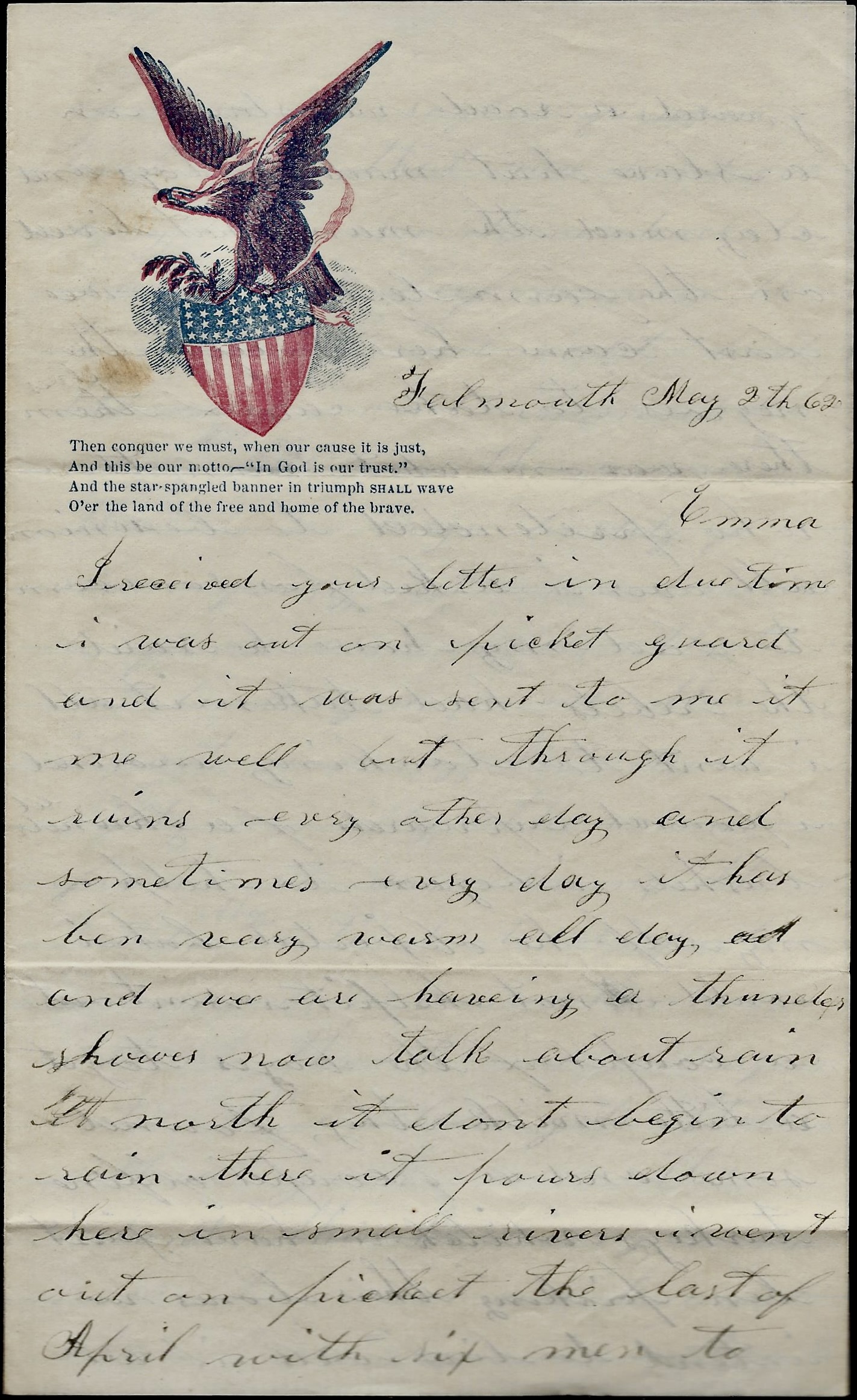
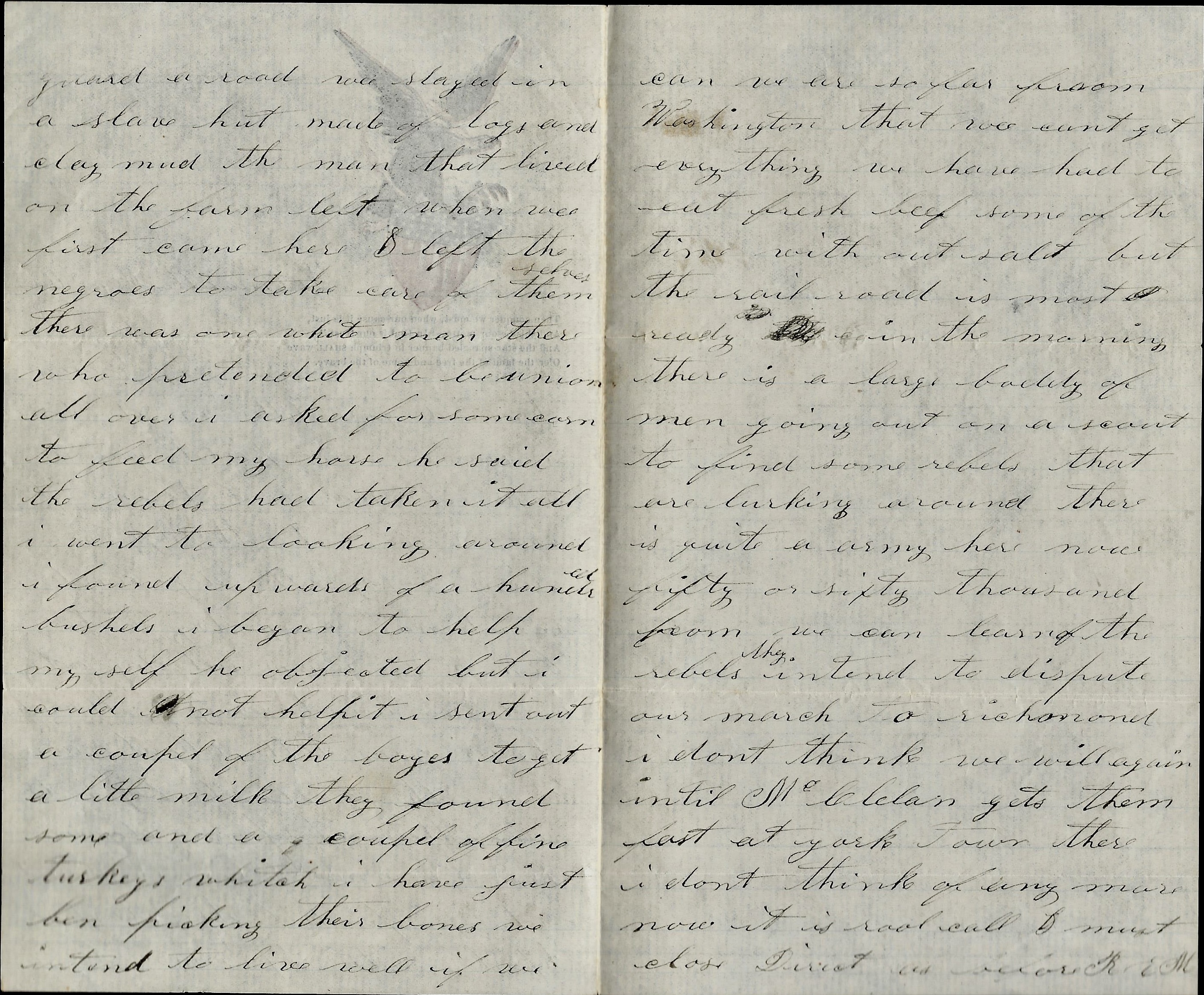
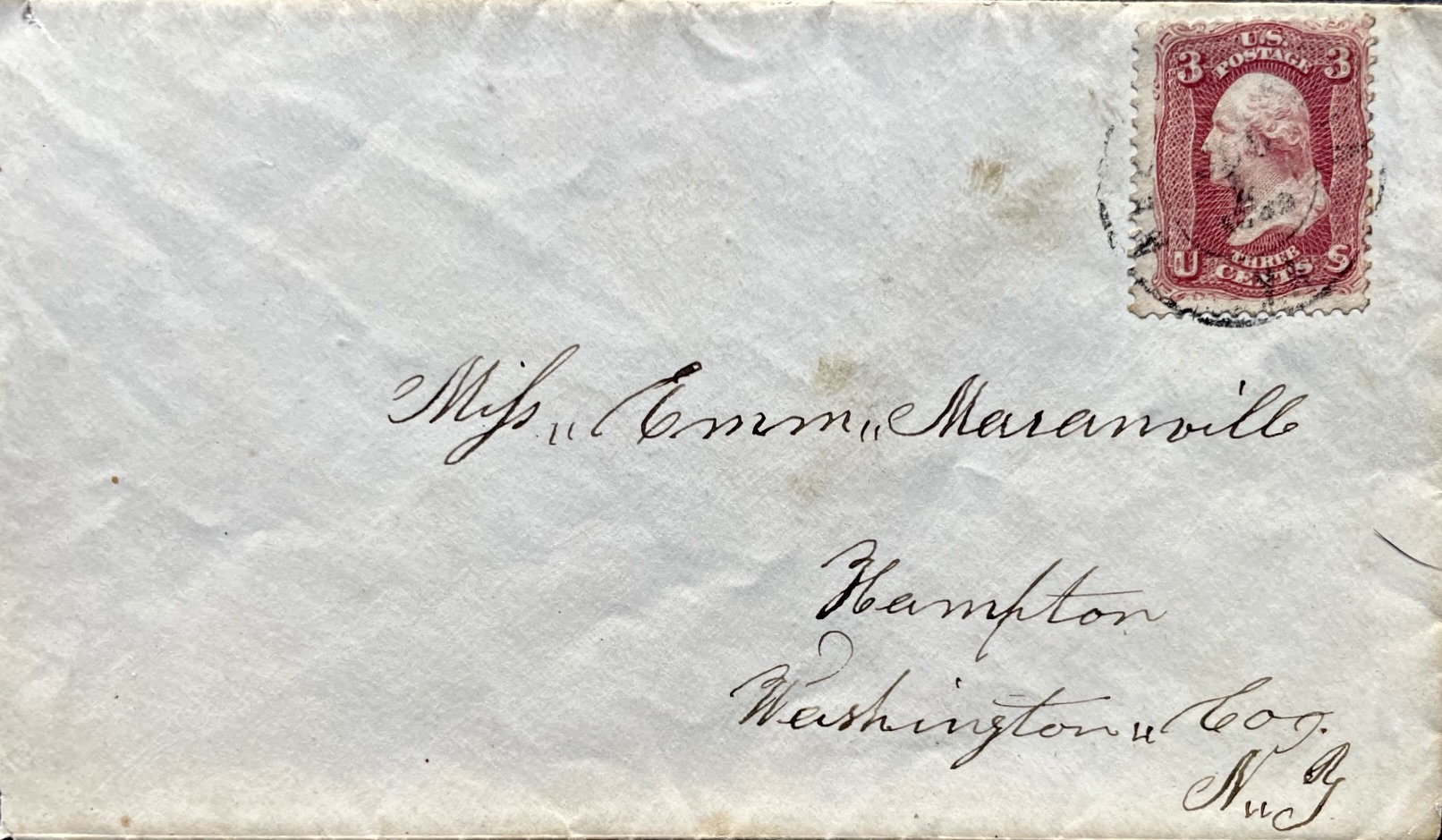
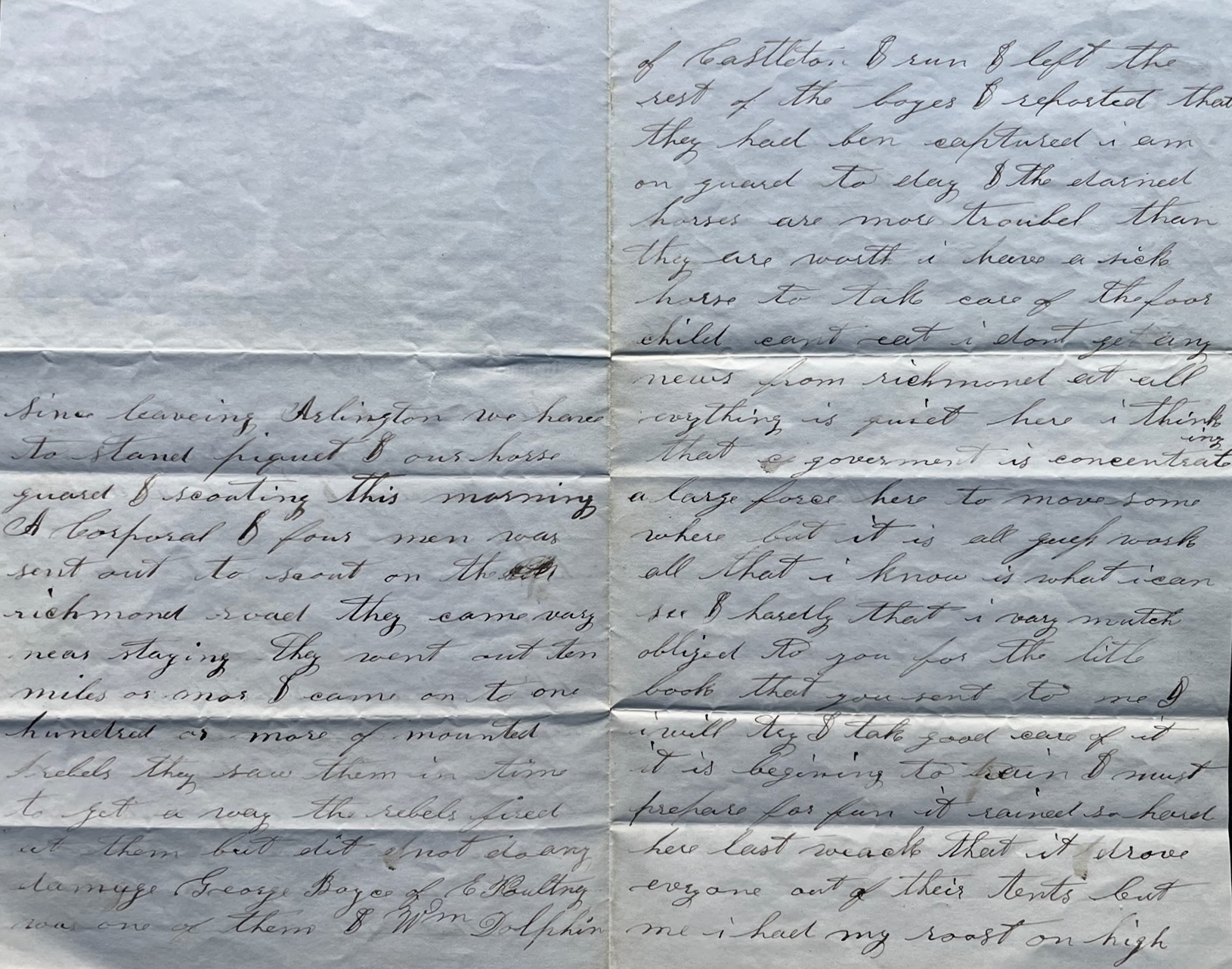
My passion is studying American history leading up to & including the Civil War. I particularly enjoy reading, transcribing & researching primary sources such as letters and diaries.
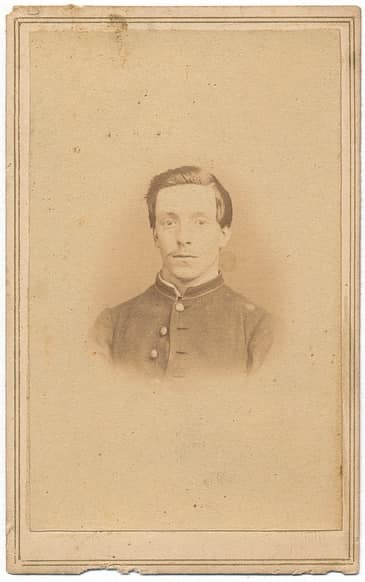
Corp. Christopher J. Edenborough of Co. C, 67th New York Infantry (Matthew Fleming Collection)
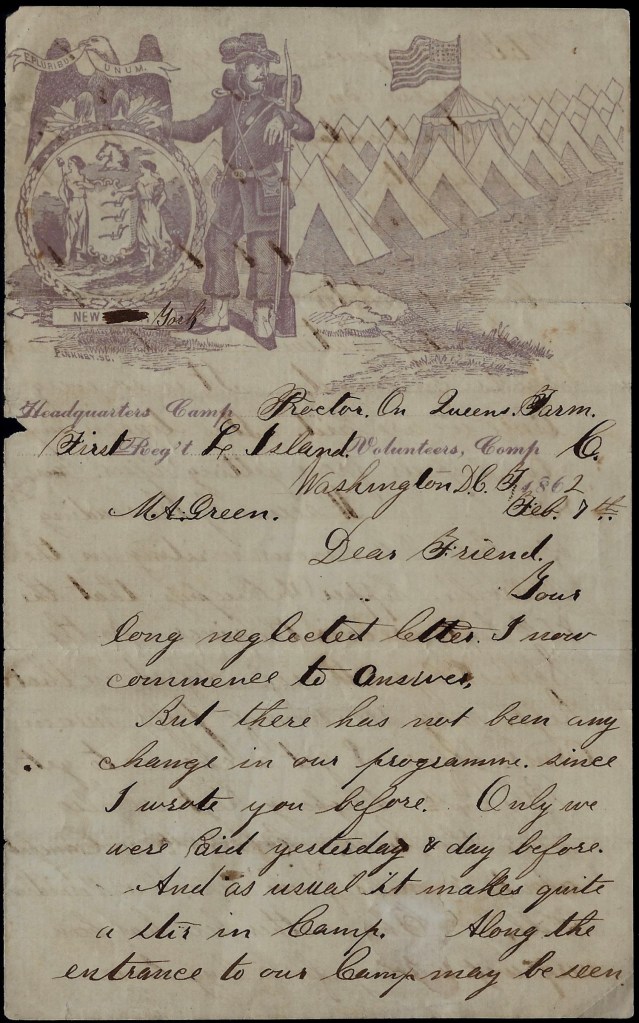
The following letter was written by William D. Bosenbark (1839-1862) of Co. C, 67th New York Infantry. Their nickname was the 1st Long Island Regiment. He enlisted on 24 June 1861 as a private and was wounded on 31 May 1862 in the Battle of Fair Oaks, Virginia. He died of a gunshot wound at David’s Island N. Y. Hospital on 23 June 1862 after one year’s service.
William was a resident of Ward, Allegany county, New York. His parents were Charles and Susannah (Bowers) Bosenbark.
Transcription
Proctor On Queens Farm First Regiment, Long Island Volunteers, Co. C Washington D. C. February 7, [1862]
M. A. Green,
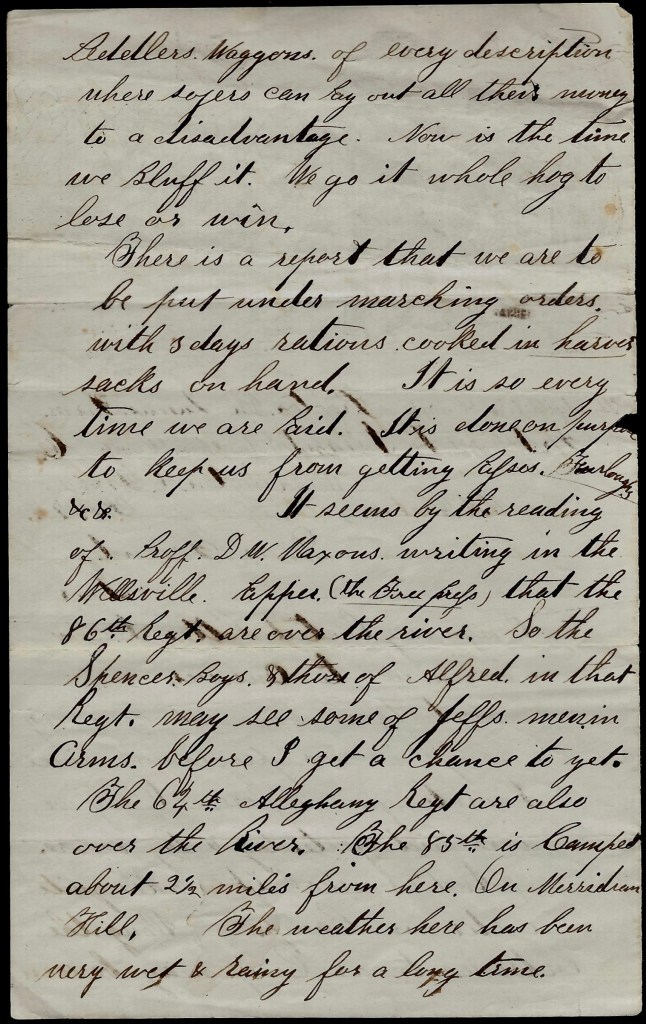
Dear friend, your long neglected letter I now commence to answer. But there has not ben any change in our program. Only we were paid yesterday & day before and as usual, it makes quite a stir in camp. Along the entrance to our camp may be seen peddlers wagons of every description where sogers can lay out all their money to a disadvantage. Now is the time we bluff it. We go it whole hog to lose or win.
There is a report that we are to be put under marching orders with three days rations cooked in haversacks on hand. It is so every time we are paid. It is done on purpose to keep us from getting passes, furloughs, &c. &c. It seems by the reading of Prof. D. W. Maxous writing in the Wellsville paper (the Free Press) that the 86th Regt. are over the river so the Spencer boys & those of Alfred in that regiment may see some of Jeff’s men in arms before I get a chance to yet.
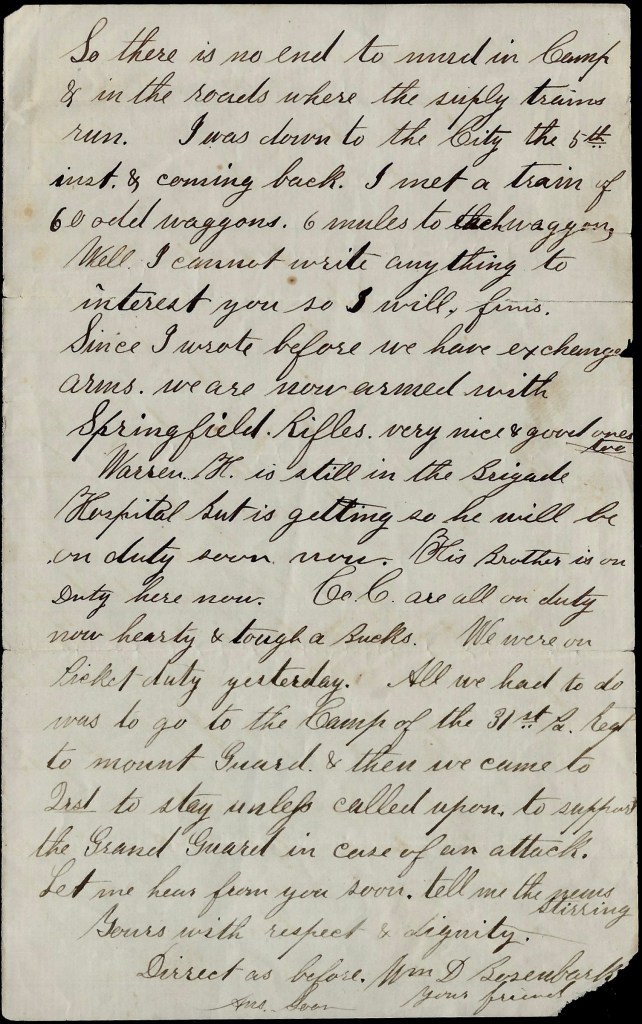
The 64th Allegheny Regt. are also over the river. The 85th is camped about 2.5 miles from here on Meridian Hill. The weather here has been very wet & rainy for a long time so there is no end to mud in camp and in the roads where the supply trains run. I was down to the City the 5th inst. and coming back I met a train of 60 odd wagons, 6 mules to the wagons.
Well, I cannot write anything to interest you so I will finish. Since I wrote before, we have exchanged arms. We are now armed with Springfield rifles—very nice & good ones too.
Warren H. is still in the Brigade Hospital but is getting so he will be on duty soon now. His brother is on duty here now. Co. C are all on duty now, hearty & tough as bucks. We were on picket duty yesterday. All we had to do was to go to the camp of the 31st Pennsylvania Regt. to mount guard & then we came to quarters to stay unless called upon to support the Grand Guard in case of an attack.
Let me hear from you soon. Tell me the news stirring. Yours with respect & dignity. Direct as before. — Wm. D. Bosenbark, your friend
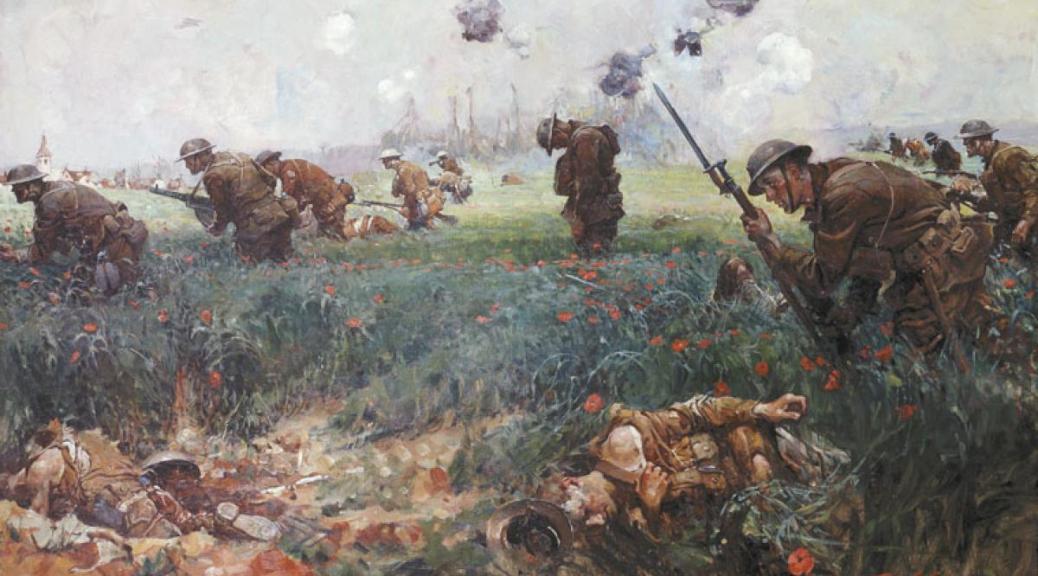
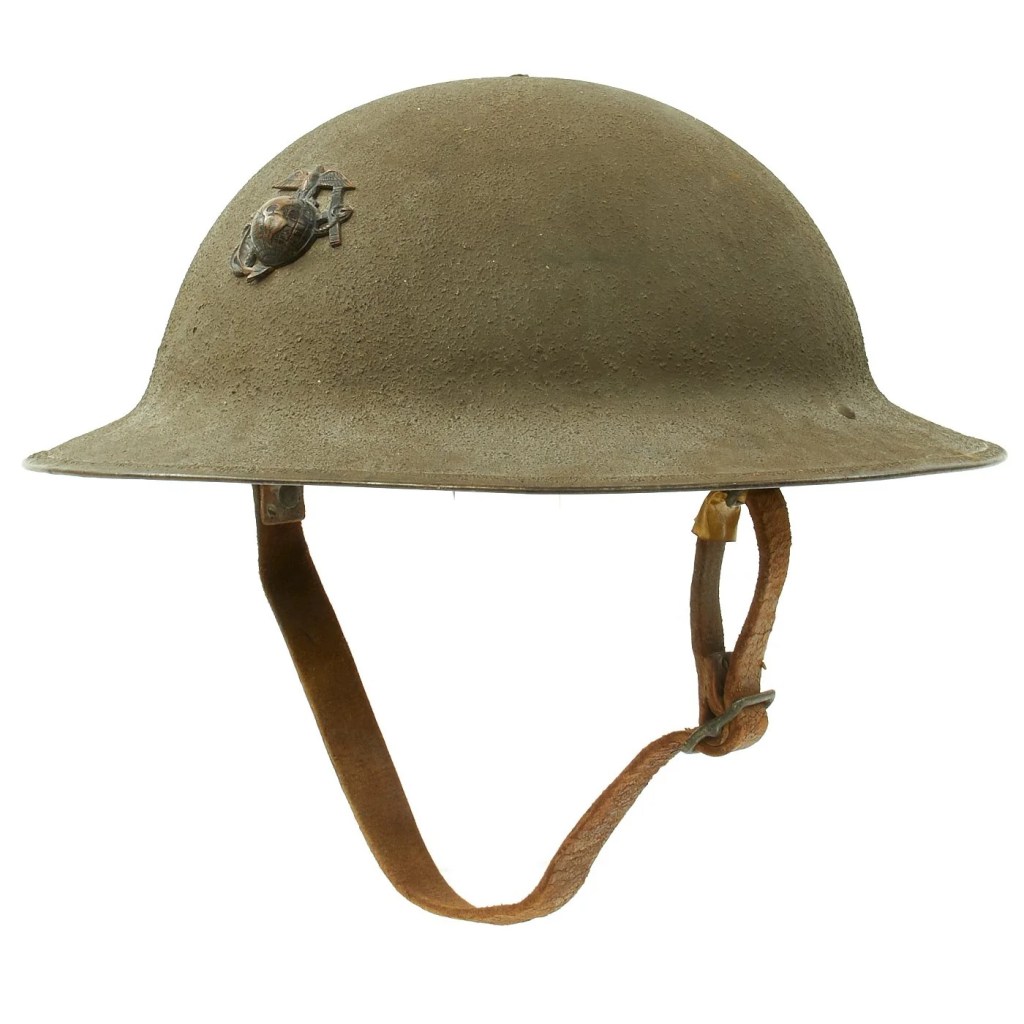
The following 45 letters are from an incredible collection of nearly 130 letters written by William (“Billy”) Blackshear Moore (b. 1895), a U. S. Marine Officer during World War One. Billy Moore was a 2nd Lieutenant when he wrote the letters presented here but he later rose to Captain in the 97th Company and was the Regimental Liaison to the 6th Marine Regiment Headquarters Company, 4th Marine Brigade, 2nd Division, American Expeditionary Forces (AEF) and Army of Occupation. He hailed from Texas and was a Princeton graduate where he starred in football and track. There are many newspaper articles extolling his athletic accomplishments. While deployed in France, Billy was awarded the French Croix de Guerre with gold star, the Distinguished Service Cross and the Navy Cross. The DSC and NC were awarded for his heroic actions on 6 June 1918 at the historic Battle of Belleau Wood under extraordinary circumstances. I do not know of any other complete archive of letters from such a decorated officer available in private hands. We are indebted to Kevin Thomas for making these letters available from his private collection for transcription and publication on Spared & Shared.
Billy meticulously chronicled his experiences in a series of letters to his parents, demonstrating his unwavering dedication to his duty. From the intense emotions of battle to the heart-wrenching losses, he vividly portrayed his journey from the ship ride to France in late October 1917 to the Occupation duty in Germany in May 1919. His accounts are filled with gripping details of his encounters, the hardships of trench life, and his remarkable acts of heroism, which have been documented in various publications, solidifying his legacy as a true wartime hero.
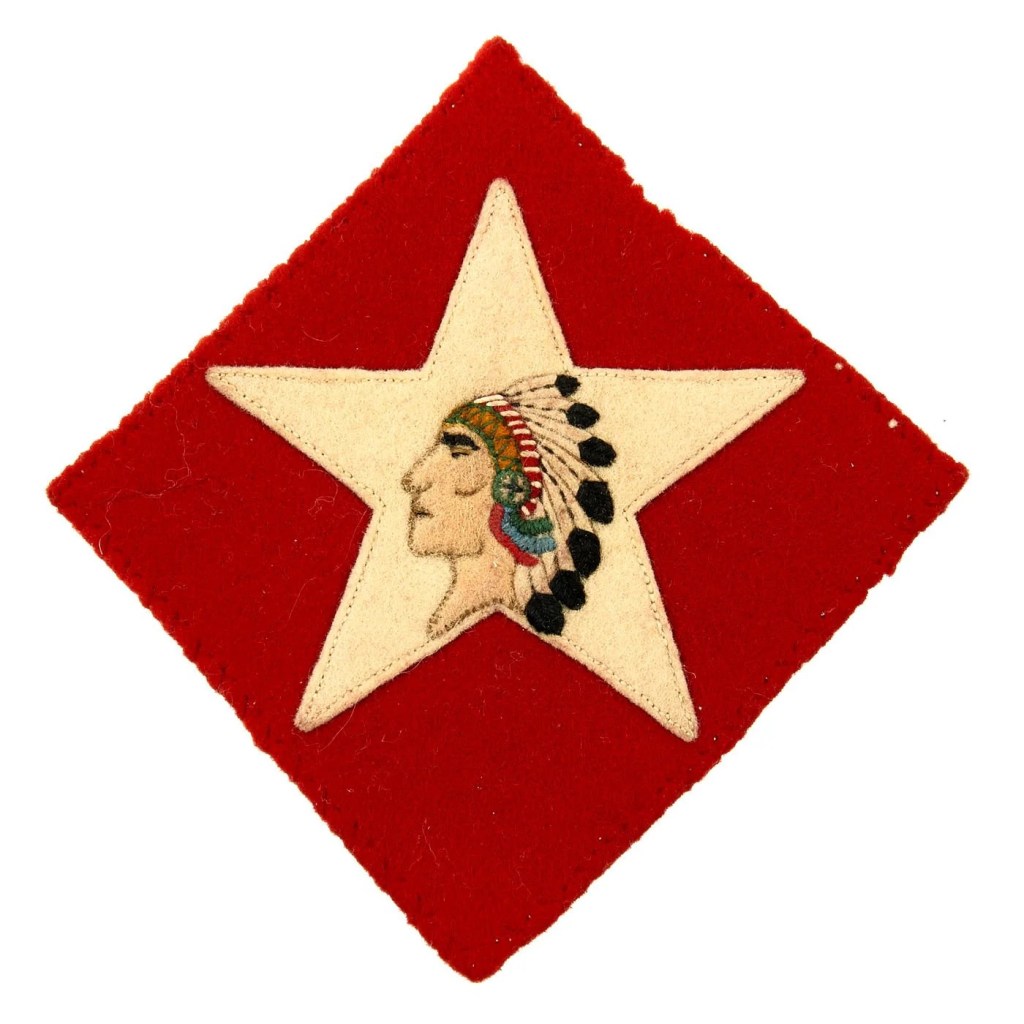
He describes being cited for “new” awards and great details leading up to and the ceremony where he received the Distinguished Service Cross. He writes on the day of the armistice and what Marines were doing and how France was celebrating. He describes amazing occupation duty details, locations, and shares his thoughts on the Germans. He provides context as to the creation of the 2nd Division Indian head insignia and what the colors on the patches mean—simply amazing stuff for a collector of USMC or historian.
The material presented here offers a fascinating firsthand account of the thoughts and experiences of a young Marine officer during World War I. The letters, often written on YMCA letterhead, Knights of Columbus, Red Cross, 2nd Division Indian Head, Third Army of Occupation, or any available paper, provide a continuous and detailed source for those interested in primary historical documents. The author describes battles as they unfold, or within hours to days after they occur. The abundance of content and letters begs for transcription into a book accompanied by historical commentary or for direct use as a primary historical source documenting the journey of a Marine officer who participated in all USMC campaigns in France, received numerous decorations, and survived to share his story. Interestingly, there was a point when he was mistakenly reported as deceased in newspapers back home. He even got a “Dear John” letter as the girl he was going to ask to marry him married another man.
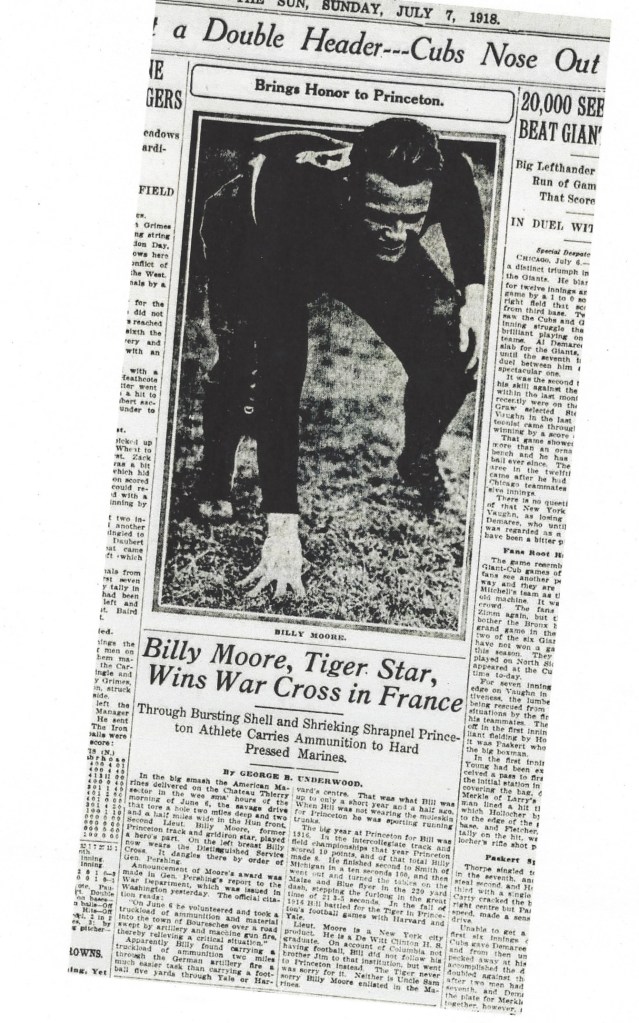
Billy Moore, Tiger Star, Wins War Cross in France—Brings Honor to Princeton
Though he disliked the duty, Moore was in a unique opportunity to be a censor for the 6th Marine Regiment working in the Headquarters and was able to censor his own mail! As a result, Moore pushed the envelope a bit, revealing a little more detail about things that you would normally not see in WWI letters including what he witnessed of superior officers, some troop movements, and soldier accounts and decisions. He even admitted to his parents that reading everyone’s mail, as a censor, was how he got to know his men!
During occupation duty in Germany after the armistice was signed, he was assigned as billeting officer for the Regiment and was able to go all around Germany in his motorcycle and sidecar that seems to have served him very well “squatting on the Rhine” as he describes it. At one point he was asked to write the Regimental history during the war, but while playing exhibition football in Germany he sustained a leg injury that set him back. Though interesting and worthy of publication, I have only transcribed those letters up to the armistice on 11 November 1918.
Many of these letters are very fragile as they were written on wood-pulp paper supplied by the YMCA to servicemen in Europe and they have become almost too brittle to handle.
Service Timeline:
Entered service July 5 1917 at Brooklyn New York. Marine Barracks Quantico Va July 28 to Oct 25 1917. Sailed for France Oct 25 1917; attached to 97th Company, 6th Marines. Bordeaux, Nov 1917 to Jan 1 1918. Training area Vosges Jan to Mar 1918. Woëvre Sector near Verdun Mar 14-27 1918. 1st Corps School, Gondrecourt Mar 27-Apr 28 1918. Woëvre Sector Apr 28 to May 15 1918. Aisne-Marne Defensive (Château-Thierry) June 1 to July 4, 1918 Aisne-Marne Offensive (Soissons) July 18-22, 1918 Marbache Sector Aug 1-20 1918 St Mihiel Offensive Sept 12-21, 1918 Promoted 1stLt Sep 6 1918 Meuse Argonne Offensive (Champagne) Oct 6-13 1918, (Argonne Forest) Nov 1-11, 1918 Army of Occupation, Germany November 1918 to June 1919 Promoted Captain March 5, 1919 Returned to US June 10, 1919 Marine personnel office NY June 12 1919 until discharged July 9, 1919
Capt. William B. Moore stand in center of back row.
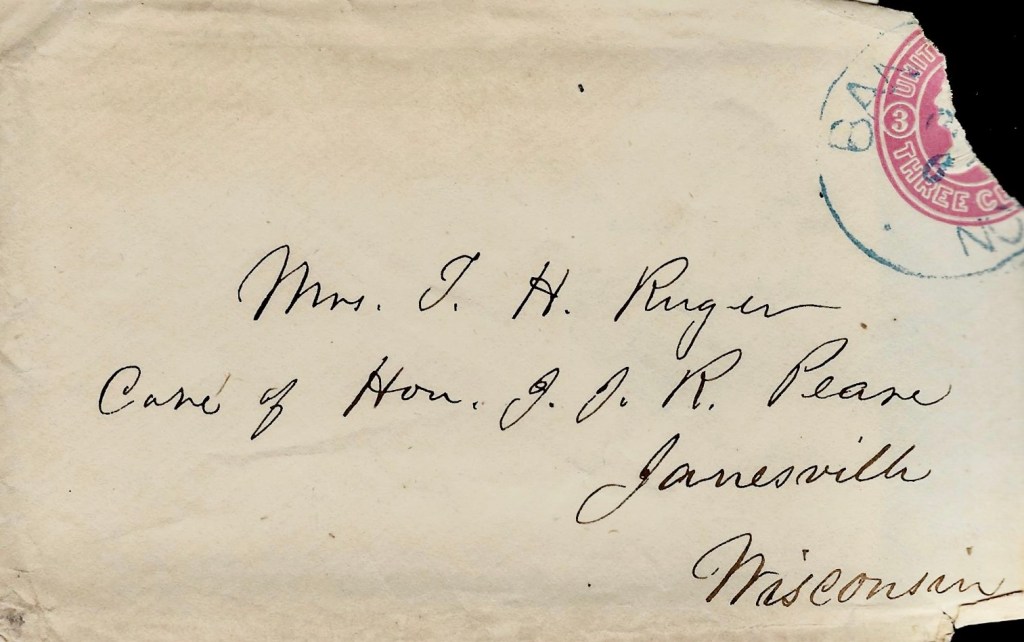
The following letter was written by Brig. General Thomas Howard Ruger (1833-1907). In 1854 he graduated from the U.S. Military Academy at West Point, and then embarked on a long and distinguished career in the military. After a brief commission with the U.S. Army Corps of Engineers, Ruger practiced law in Janesville, Wisconsin. In June 1861, he was assigned as lieutenant colonel of the 3rd Wisconsin Regiment, he rose to the rank of brigadier general, commanded a contingent in the Rappahannock maneuvers, and aided in the containment of the 1863 New York draft uprising. On November 30, 1864, he was promoted to major general for his admirable service in the Battle of Franklin. After serving as colonel of the 33rd Infantry in the U.S. Army, Ruger again was commended for his courageous service in the Battle of Gettysburg and was commissioned a brigadier general. On January 17, 1868, Major General George W. Meade, commander of the 3rd Military District, forced Governor Charles J. Jenkins out of office. Meade then appointed Ruger to serve as Governor of Georgia, a position he held until June 28, 1868. The following year, Ruger was appointed to supervise a board of U.S. officers in Atlanta, examining the qualifications of select members of the Georgia Legislature. From 1871 to 1876, he served as the superindent of the U.S. Military Academy, and was the commander of the Department of the South and West, serving until 1885. Two years after being promoted to major general, Ruger retired from active military duty. Governor Thomas H. Ruger died on June 3, 1907.
This letter to his wife was penned a couple of weeks after the Battle of Antietam and after having been introduced to President Lincoln who visited the battlefield afterward. Ruger’s impression of the President was not exactly favorable though he postulated correctly that history would be a better judge of the man. “Exact justice of opinion will be more surely found among thinking, candid men after the present condition of things has passed away and the results are seen,” he wrote.
Transcription
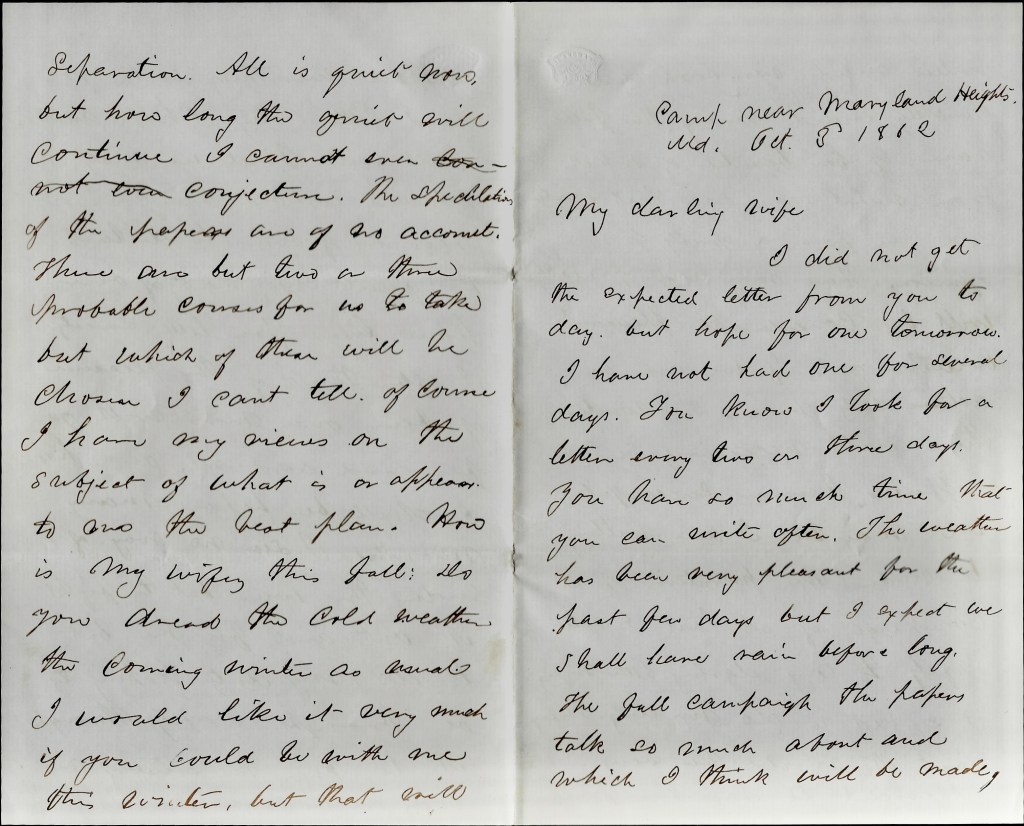
Camp near Maryland Heights, Maryland October 3d 1862
My darling wife,
I did not get the expected letter from you today but hope for one tomorrow. I have not had one for several days. You know I look for a letter every two or three days. You have so much time that you can write often.
The weather has been very pleasant for the past few days but I expect we shall have rain before long. The fall campaign the papers talk so much about and which I think will be made unless made very soon and quickly ended, will be made during the fall rains, of the beauties of which from what you saw last winter you can form a pretty good opinion. There may and probably will be considerable pleasant weather yet. If we are on active duty during the winter, there will necessarily be much suffering, however successful we may be. I am willing to undergo the privations of a campaign if at last I return safely to my darling little wifey, but it would be very pleasant to pass this fine fall weather with you and little Patey. I hope another fall will find us nicely situated without any war or rumors of war to disturb the quiet enjoyment of our home life.
You little sweetie. I often think of the pleasure of being once more with you for good and all, and hope I shall be before many months. I see no way of ending this war but to fight it out, and for me but to do my duty hoping to be brought safely through it to enjoy the society of my wifey all the more for the long separation.
All is quiet now, but how long the quiet will continue, I cannot even conjecture. The speculation of the papers are of no account. There are but two or three probable courses for us to take but which of them will be chosen, I can’t tell. Of course I have my views on the subject of what is or appears to be the best plan.
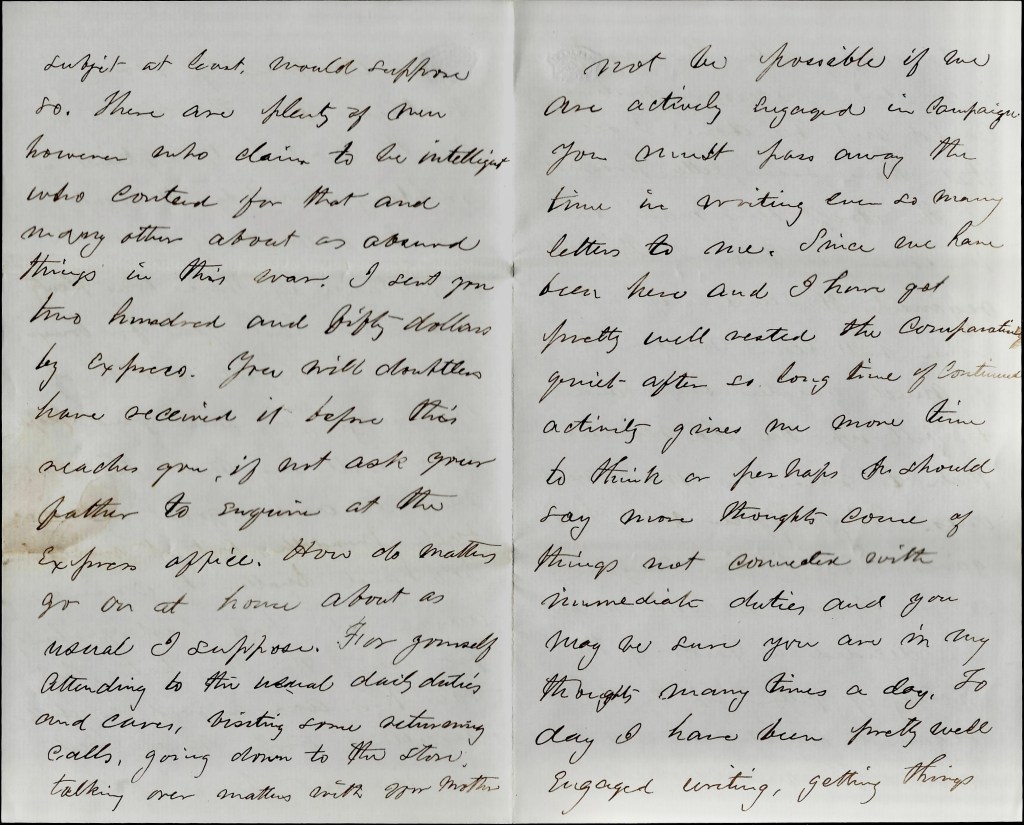
How is my wifey this fall? Do you dread the cold weather the coming winter as usual. I would like it very much if you could be with me this winter but that will not be possible if we are actively engaged in campaign. You must pass away the time in writing ever so many letters to me. Since we have been here and I have got pretty well rested, the comparative quiet after so long time of continued activity gives me more time to think or perhaps I should say more thoughts come of things not connected with immediate duties, and you may be sure you are in my thoughts many times a day. Today I have been pretty well engaged writing, getting things in shape after the long time when even necessary writing could not be done. I see that there seems little prospect of the draft being made in Wisconsin to fill up the old regiments. It seems as if we never will learn wisdom. It is of much greater importance to fill up the old regiments than to raise so many new ones. Every officer who has given his opinion, everyone whose opinion is worth much, has decided in favor of the policy of filling up the old regiments, but still it is not done. The new regiments are composed of good material but the officers are for the most part deficient in military knowledge. It would not be a matter of so much importance if there was plenty of time as last year for bringing the new troops into a state of efficiency.
You will find people who say that they don’t need it and a great deal more such twaddle, but it would be a hard matter to convince anyone who had had opportunity for seeing the thing tested, that raw troops are as good as drilled & disciplined troops. No one but an ignorant person on that subject at least would suppose so. There are plenty of men, however, who claim to be intelligent who contend for that and many other about as absurd things in this war.
I sent you two hundred and fifty dollars by Express. You will doubtless have received it before this reaches you. If not, ask your father to enquire at the Express Office. How do matters go on at home? About as usual I suppose. For yourself attending to the usual daily duties and cares, visiting some returning calls, going down to the store, talking over matters with your mother and Hattie, talking a great deal to Patey and watching her girlish pranks, thinking a great deal about Howard, reading the papers for war news, watching for a letter from me and hoping that all this may end and you will soon be in your own house with your husband. The picture makes you a very loving wife and is somewhat flattering to myself, but it is true, is it not wifey, you little sweet. Just imagine a good kissing.
You see I have written quite a letter. I almost forgot to tell you that the President was here yesterday. I had the honor of being introduced and hearing him tell several stories. You have heard of the Presidential inclination for stories. Old Abe is a good man but darling, not a great man for these times, which latter remark may be somewhat objectionable as implying that what is great under some circumstances may not be under others. Perhaps President Lincoln has done as well, all things considered as anyone would. The fact is, Helen, we cannot judge as truly as people will who are not actors in, and witnesses of the present scenes. Exact justice of opinion will be more surely found among thinking, candid men after the present condition of things has passed away and the results are seen.
Give my love to all. Take good care little Patey, three years and a half old by the time this reaches you, which outs me in mind of the day three days from now. Would I not like to drop in for a visit. Write often, very often, darling. With very much love, your affectionate husband, — Howard
The following letters were written by Daniel Curlet Montague Appleby (1840-1905) of Shade Gap, Dublin township, Huntingdon county, Pennsylvania. He was the son of John Appleby (1813-1856) and Priscilla M. Montague (1815-1892). He wrote the letters to his younger brother, Thomas Alexander Appleby (1843-1930).
During the Civil War, Daniel served in Co. I, 149th Pennsylvania Volunteers—a regiment formed in the summer of 1862 and brigaded with the 143rd and 150th Pennsylvania regiments, referred to generally as the “Bucktails” because they put the tails of white tailed deer in their kepis. Both of the letters presented here were written before the regiment came under its first real baptism of fire which was on 1 July 1st at Gettysburg near the McPherson Barn on Seminary Ridge.
Transcripts of these letters without images of the originals were provided to me by my friend Tom Clemens and though I rarely publish any letters on Spared & Shared without the originals, I made an exception on this case. I am not certain of the location of the original letters but I suspect they are part of the Appleby Family Papers, 1862-1902) at the William L. Clements Library, University of Michigan. I could find no evidence that they were published anywhere on line.
Letter 1
Camp Dwight April 2, 1863
Brother Tom,
Dear sir, after returning from General Reynold’s Headquarters where General Hooker reviewed the 1st Army Corp. our whole corps was together, amounting to about twenty thousand infantry and seven batteries—a beautiful procession, marching about fifty me in a breast with the cannon in front. Each cannon was drawn by six splendid horses—a man on every horse. Such a procession in Dublin township on some of them flats (or I don’t know whether we could all get inside the largest field in those parts) would attract considerable attention. Marching in four ranks, artillery and all, the string would reach from Graham’s to Shade Gap.
I would like to see the whole 12th Corps together. There are 12 corps in the Army of the Potomac. We are in the 1st Army Corps, 3rd Division, and 2nd Brigade. Roy Stone would not have any nine-month’s men or militia in his brigade so we have but three regiments in our brigade—149th, 150th Bucktails, and the 143rd Regiment Pennsylvania Reserves.
President Lincoln asked Hooker of the Army of the Potomac was in marching order. Hooker’s reply was, “I can have the who army marching in one hour from the time I give the order,” and said he, “I can march them to New Orleans when they are out too.”
It is reported that the rebels are moving out of Virginia and going to Nashville, Tennessee, their principal place. If so, we will be kept in the vicinity of Washington as a reserve or sent to Tennessee to wait on them at Nashville. If we go, we will pass Mount Union. I suppose we would hardly get stopping though. The Rebels don’t like Old Joe [Hooker]. They don’t fancy his mode of doing things. Six rebels left their posts while on picket adn came over to our lines and joined our army. They say the rebs are in rather bad order. Hooker says he can whip all rebeldom with eighty thousand men. He looks like fighting stock and I guess he can do it too.
Our colonel don’t drill us anymore. We have two hours company drill per day and dress parade pretty nearly every evening. I wish you were here some evening at dress parade. I know you would be pleased with the appearance of the 149th. Every man must be exactly alike in every particular. A man dare not come out without a button not buttoned or his pants turned up at the ankles. And brass must be bright as it can be made.
Pvt. Frank W. Lehman of Co. C, 149th Pennsylvania (“Bucktails”). From the Liljenquist Family Collection , LOC
We are brought in line of two ranks—that is, two men deep. The line is as straight as a die. You can’t see one man out farther than another. We stand at parade rest—that is, when we get the command parade rest, you set your right foot three inches in the rear of the left foot while the butt of the gun is just square with your left toe and [with] your hands you grasp gently the right hand (the army supporting the gun) with the left, body straight to the front, eyes looking straight forward, striking the ground fifteen paces in front. In that position we stand while the music passes twice along the battalion, not moving an eye. The Adjutant brings the battalion to a present arms, then turns to the Colonel who is standing fifteen paces in front of the battalion, and opposite the colors, and says, “Colonel. the parade is formed,” and walks around the Colonel. Then the Colonel puts us through the manual of arms and a few bayonet charges. Then we must stand at attention until the Adjutant reads the orders of the day, if he has any.
The colors are in the center of the battalion. I wish you could see them. We have two flags—the stars and stripes, and the state colors. The stars and stripes is about ten foot square, solid silk with a yellow fringe and tassels made of red, white and blue twine. The state color is the same size but all blue with a golden eagle as large as can be made in it, which is about four times the size of a turkey. It is the prettiest flag I ever saw. I has 149 Regiment Bucktails in gold letters across the top.
Our music corps consists of eight fifers. eight tenors, and one bass drum. They make the hills ring at night. At six o’clock in the morning the reveille is beaten by all the troops. I tell you, they make the plains ring. If there was about two hundred drums started up about daylight all within a mile of each other about Shade Gap, it would make them open their eyes. Well enough of military.
By the way, Dave and Tom [Appleby] are at Harrisburg in the hospital. What do you think of that? They want to play off and get the Governor to do something for that—that is, release them from the government. I think that is their idea. I don’t care what becomes of them. Dave wrote to Captain [Brice] Blair to send them their Descriptive Lists immediately. He swore they might go to hell; he was not going to send a deserter his Descriptive List. If they come to this regiment, salt-petre won’t save them. They have both been reported as deserters, not only to the Colonel but to the General. So if they don’t look sharp, they will get transportation down the Chesapeake apiece to a little place near Fort Calhoun and Old Point Comfort called the Rip Raps. I shall never own them as relations/ They are a disgrace to the name and place a stain on their own character which shall never be removed while the world stands. Dave sent word that he had letters for all the boys. If I thought he had any of any importance for me, I would send for them, but I don’t know whether he has or not.
Well, I am enjoying good health and equally good spirits. I never was better contented in my life. We have been looking for the paymaster for some time but do not see him. He owes us five months wages. I am out of money at last and only got three postage stamps. I wish you would send me a few as the paymaster might not come for awhile and I might have play out, which would never do. I am too much of a business man to be compelled to stop writing. That would never do.
I must close. As the Colonel don’t drill us any, we have nothing to do so I will send you a card or two which I drew altogether by the eye. I expect when you see them, you will think I am not strong. I must close. Yours as ever, &c. — Dan
[To] Thomas A. Appleby
Letter 2
Near Middletown, Maryland Saturday, June 27th 1863
Tom,
Dear sir, as we have been on the move for some time and are coming up to assist you folks in fighting the rebels up in your country—or rather to head them when you drive them back. We are said to have 104,000 up from Pennsylvania. We are only 15 miles from Hagerstown and I have an idea that we will go up into that country before we do much else.
Four hundred of us were on picket on the 23rd and on the 24th we were taken out five miles to bushwhack and we patrolled the woods all night. The next morning we were ordered to report to report to our camp and when we got there, the brigade had gone and we were left as rear guard.
We had a hard march. The wagon train had got started and we had to pass it and the train was twenty miles long and to mend the matter, it rained nearly all the time. But we had a good time though, hard as it was. i only hope we do not have to go back to Virginia for a while. I think I can get to see some of my friends now if we remain in Maryland.
I saw wheat in shock yesterday and all the grain that ever I saw. I never saw anything to compare with Frederick county and the biggest wheat ever I saw.
I think this war is going to play out. If we whip them here, they are played—that is, if Grant whips them too [at Vicksburg]. I can’t hear anything. We can’t get papers when we are moving. I have not say a paper or heard from Vicksburg for ten days.
We heard that the rebels were pitching toward Carlisle pretty fast yesterday and that the boys were preparing to give them a fight. I hope they may be able to whip them. I must close for the present, — Daniel
Sunday morning P.S. I had a letter from J. B. Peterson last night. He writes me there is quite an excitement up about the recent rebel invasion. I think there is but little danger of them doing much harm or remaining long either. I feel soon they will get their fill of it. If the militia can’t whip them, we can, and are only a short distance behind them—only one mountain between us and we are ready for them too. I will answer John Peterson’s letter in a few days. I must close. I just gave you a sketch of our trip again. Yours, — Dan
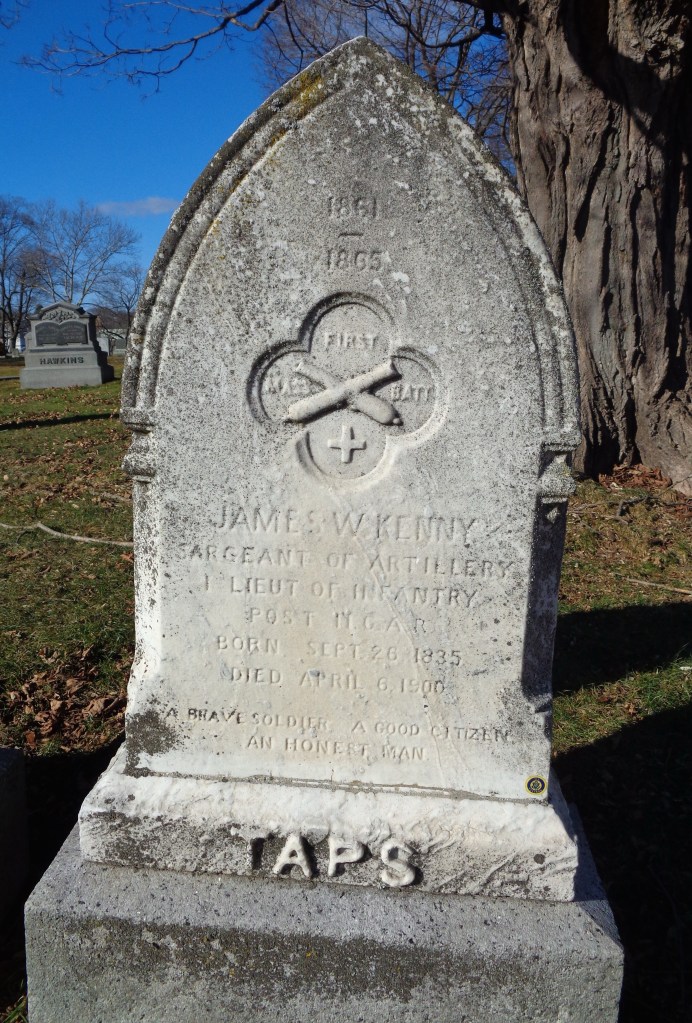
Headstone of James W. Kenney, “sargeant of artillery” and a “brave soldier, a good citizen, an honest man”
The following memoirs were recorded in 1893 by James Woodell Kenney (1835-1900), the son of Michael Kenney and Jane Woodell (d. 1844) of Arlington, Middlesex county, Massachusetts. Kenney’s memoirs and his military records inform us that he mustered into the 1st Independent Battery, Massachusetts Light Artillery in August 1861, commanded by Josiah Porter. He was wounded in May 1864 during the Wilderness Campaign and mustered out of the battery on 29 August 1864 after three years service. He was married to Lizzie S. Shattuck on 24 December 1868. In 1870, James and Lizzie were enumerated in Charleston, Mass., where he was employed as a clerk in a printing office. Vital records of Massachusetts inform us that he died of a cerebral hemorrhage on 6 April 1900 in Boston.
James’ brother, Andrew J. Kenney (1834-1862) is mentioned several times in the memoirs. He mustered into Co, B. 40th New York Infantry and was killed in action during the Battle of Williamsburg on 5 May 1862. According to Mass. vital records, he was married on 25 November 1860 to Mary Jane Hodge (maiden name Woodell) in Ashburnham, Massachusetts.
The memoirs were addressed to James’ nephew and namesake, James W. Kenney. Family tree records are scanty but my hunch is that this nephew was James W. Kenney (b. 1858), the son of Michael Kenney (b. 1831) and Mary McKenna Sheehan (1828-1882). Michael was a rope maker and later a shoe factory worker in Roxbury, Massachusetts and during the Civil War he served as a private in Co. K, 1st Massachusetts Infantry.
[Note: These memoirs were provided to me for transcription and publication on Spared & Shared by Tom Clemens. I could not find them transcribed elsewhere on the internet or in book form though the original might be housed at the U. S. Army Heritage & Education Center at Carlisle Barracks, Pa., as they claim to have a folder marked, “Memoirs of James W. Kenney’s Service.”]
Transcription
Dear Nephew and Namesake,
I greet you in love and kindness. Thinking you might like a short sketch of your Uncle Jim for whom you were named, and as I may have passed beyond “the River” before you grow old enough to remember me, or read these lines. the most of the sketch will be about my military service in the War 1861-5 which I thought might interest you. I kept a journal while in the service of every day—the drills, marches, reviews, battles, &c. After keeping it over two years, and being afraid I might lose it, I sent it home by a comrade going home on a furlough and he lost it, so the journal was gone up. What I write you in this will be taken from letters I wrote home and other memorandums. By reading this you will see what battles I was in any by referring to the History of the War, you can obtain an account of those battles. I was in the Army of the Potomac and served under every General that commanded it from General McClellan to General Grant.
I will commence with my birth, town, name (that is, the J. W. part) and follow with the army life. So many years have passed since that took place I cannot remember many things I would like. — Uncle Jim. January 1893
I was born in the town of West Cambridge, Mass., now called Arlington (name being changed about 1867) on September 26, 1835. I was named James Woodell for my grandfather (Woodell being my mother’s name before marriage). I also had an uncle J. W. who served in a Mass. Regoment and was killed in the Southwestern Army and also other relations who served in the Army or Navy in the war.
The town is between Lexington and Cambridge…The British troops crossed the river and landed in Cambridge, passing through West Cambridge on their way to Lexington and Concord. On the night of April 18th 1775 about midnight. the next morning the Battle of Lexington and Concord was fought and as the “Yankees” were coming in from the other towns making it rather warm for the British, they commenced to fall back to Boston. They were under fire almost all the way and lost many men on their return. There were more British and Americans killed in West Cambridge than at Lexington, and to West Cambridge belongs the honor at making the first capture of stores, provisions, and prisoners in the American Revolution on that day in the center of the town.
Cambridge is the place where General Washington took command of the American Army, its headquarters being there at the time. The old Elm tree under which he stood is still standing. Also the house in which he had his headquarters, bing for years the home of Longfellow—the poet. Here is also Harvard College, founded before that time….I was born on historical ground and grew up with a strong love for my country. My father had also held a commission as ensign in the 1st Regiment Mass. Militia under Gov. Lincoln in 1832.
I will not enter into details of my early life but will say my Mother died when I was quite [page missing]
…as the lawyer had to go out of town to court, he could not attend to the details. I offered my services in any way and it was left in my hands to call a meeting that evening at his office or the Town Hall. I went out and found the others, then got three uniforms—two that had belonged to father, and one that belonged to me as I had been in the militia before father died but gave it up then. Then got a fife and drum to make a noise and went all over town telling every one of the meeting in the Town Hall that evening. The Hall was not large enough to hold the crowd that came—the largest gathering ever held in town. We soon raised a company, the lawyer was chosen Captain and I was chosen First Lieutenant. As the Captain had so much to attend to in court fixing up his cases and turning them over to other lawyers. I had all the charge of the company in drill and I often duties in the daytime. We drilled in forenoon and afternoon on the street in marching and company movements and in the Hall in the manual of arms in the evening. My older brother Andrew came home and enlisted in my company. So we all three were in the service.
We continued drilling until the last of May when we were told of a regiment being raised in Brooklyn, New York, by Henry Ward Beecher that they had seven companies and wanted three more to fill the regiment and start at once for the Seat of War. My company and two others from Mass. took special train for New York on the evening of May 30th, arriving the next morning, and after breakfast, went over to Brooklyn and took quarters in a five story armory large enough for two companies on a floor. In the afternoon I went over to New York and took boat for Governor’s Island to see your father. I found him in “Castle William,” the round fort on the point of the island. He was surprised to see me. On Sunday we all went to hear Beecher preach in the morning and in the afternoon a few of us went to the Catholic Cathedral to hear the singing. It was fine.
We found out that there were not 7 companies—that all there were was about 150 men—the toughest looking you could find and they were not drilled or uniformed. The food they gave us was so bad we could not eat it and we could get no satisfaction from those raising the regiment so we called a meeting of the officers of our three companies and voted to return to Massachusetts. (You will understand we were Mass. troops and not mustered into U. S. service.)
On the evening of June 4th, took boat from New York to Boston, arriving the next morning. After breakfast, the officers went to the State House to see the Quartermaster General of the State and have him put us in camp until he could send us away but at that time the State did not have camps for troops as they did later on. But we were granted leave to go to Fort Warren (Boston Harbor) until we could make arrangements for something else. the companies went down in charge of their 1st Lieutenants and the Captains remained in town to see what they could do. They came down to the fort on June 8th and we went up to the City and were dismissed until the 11th when we all reported and started again for New York, arriving the next morning and taking boat up the river for Yonkers. On the morning of the 13th two of the companies were mustered into the U. S. Service. As each company was a few short, we lent them a few men to be exchanged back into our company later on. My brother Andrew went into one of those companies [Co. B, 40th New York Infantry] and remained in it until he was killed at Williamsburg, Virginia.
As we were going to New York Regiments, we would have to get N. Y. State commissions. The two companies mustered in were mustered as they were, officers and men, but my captain wanted a new election which was held and the same officers reelected although te captain tried to make a change and throw me and another out, and put in two friends used to drink and bum around with him. I heard what was going on and we had a row. He got some plain remarks from me and it ended in my taking all the men but about 12 and marching them out and took cars for New York City. I had two offers while there to take my men, fill up my company, and go as captain in some New York Regiment but I had enough of New York and was going home. I got quarters for my men that night in the Park Barracks near City Hall and started for home the next evening and arrived all right. The citizens were provoked at the action of the captain in breaking up such a fine company. I was offered all the backing with money wanted to raise another company but I was anxious to get away and did not want to wait so long as to raise and drill another company. A captain belonging to the 16th Mass. Regiment Infantry wanted me to take my men and join his company but as I could not get any satisfaction as regarding my being an officer in his company (and the men wanted me as an officer over them), I would not go. So you see I had bad luck all around in getting away. One reason was Mass. was so patriotic. We had about three times as many companies enlisted in the State as was called for.
I remained around home working or attending to some military duties until August 27th when being in Boston I found out the Boston Light Artillery had returned from its three-months service and was reorganizing for three years. I dropped my commission and enlisted in the Battery and was mustered into the U. S. Service for three years on the 28th of August. We went into camp in Cambridge about half a mile from the Arlington line.
Arriving in camp we were formed into Gun Detachments and the Warrant Officers appointed. I was made Gunner with the rank of corporal and took charge of a Gun Detachment. I soon picked up the drill (as artillery was new to me) and soon had the best drilled squad on Sabre and Gun Drill. I was promoted to Sergeant afterward and remained as such during the rest of my service.
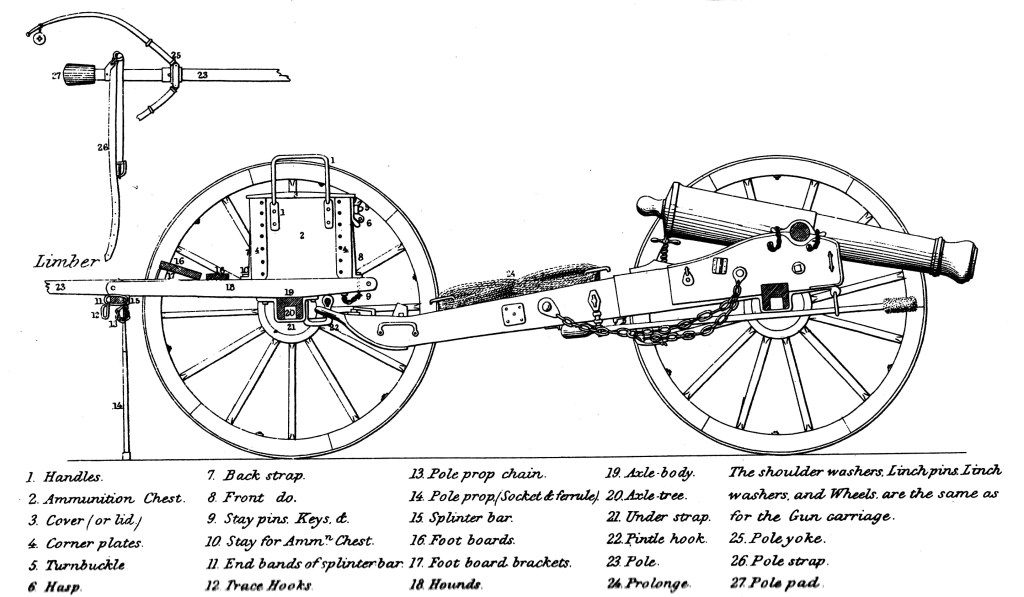
Perhaps now would be a good time to give you an account of the organization of a Battery and the duties of the men. This will be on a war footing as all troops are about one-third less in time of peace. Artillery is generally formed for field service, one third short range (smooth bore) 12 lb. Howitzers or Light 12’s called Napoleons, and two-thirds long range, or rifle, generally 10 lb. [ ], although our army had about the same number of each at the last of the war owing to the nature of the ground fought over being woody. Most of the fighting was at short range. There are 14 carriages in a Battery, 6 gun carriages with a gun mounted on the hind wheels, and an ammunition chest on the front wheels. The trail of the gun hooks on the axle of the front wheels when on the move, but rests on the ground when in action. Six caissons which carry ammunition, two chests on the hind wheels, and one on the front wheels, the front and rear parts of the caisson couple together the same as the gun carriage and are alike and can be exchanged when wanted, Thus in action the caissons are left in a sheltered place when convenient and if the ammunition of the gun limber is running low, the limber of the caissons come up and take its place and the gun limber returns to the caisson and refills from the rear chests, ready to exchange again. There is an extra wheel on the rear of the caisson, an extra pole under the carriage, shovel, axe, pick, water buckets, &c. One carriage called Battery Wagon with half round top to carry extra feed bags, parts of harness, halters, saddlers tools, wheelwrights tools, and various stores. One carriage called Forge or traveling Blacksmith Shop for shoeing horses and doing iron work of all kinds.
We have about 140 horses, three pair to each carriage, one for each sergeant, bugler, and artificer, and the rest are extra or spare horses to replace those broken down or lost in action. There are 150 men in a full battery, 5 commissioned officers (1 captain and four lieutenants), 8 sergeants, 12 corporals, 2 buglers, and three artificers. The Battery is divided into sections, two guns and two caissons make a section. Also into Gun Detachments, one to each gun and caisson.
Now I will give you a list of their duties. The captain is in command of all, one lieutenant in command of each section (taking 3) and the rest of the junior 2d in command of the caissons when they are away or separate from the guns. One first sergeant who is over he company next to the lieutenants and receives orders (in camp) to pass down to the other sergeants for details &c. draws rations, clothing &c. One quartermaster sergeant who draws forage or grain for the horses and looks after the baggage wagons. Six other sergeants, one for each gun and caisson, they having charge of the two carriages, horses and men. Twelve corporals, one for each gun and caisson and called 1st and 2nd Corporal (A Gunner and No. 8 man). They are under the sergeants. Buglers who blow camp and drill calls. Three artificers (one blacksmith, one wheelwright, 1 harness maker) to attend to all the work in their line. There is a driver to each pair of horses and he rides the nigh one when on duty. They take care of their horses—cleaning, feeding, and driving. Also take turns standing guard over the horses at night. Others are detailed to clean the extra ones and one man takes care of each sergeant’s horse as he has to look after the others while cleaning and feeding.
I will now give you the duties of the gun squad with the gun unlimbered and in position, the limber in rear of the gun, horses facing the rear of the gun, the drivers dismounted and “standing to horse” holding them by the bridle. The pole driver holds the sergeant’s horse when firing, he being dismounted and in charge of the gun. Standing in the rear, 8 men and the Gunner is a gun squad. the Gunner goves the order to load, cut the fuse, fire &c., he receiving the order from the sergeant, also sights the gun. The men are numbered from 1 to 8. No. 1 is on the right of the muzzle and sponges and rams the gun. No. 2 opposite him and he inserts the cartridge and shot or shell, having one in each hand. No. 3 on the right, he thumbs the vent, then steps to hand spike in end of te trail and moves the gun to right or left for the Gunner, then pricks the cartridge and steps to place. No. 4 is on the left and he fixes a friction primer to the lanyard, inserts it in the vent, stepping back to place, ready to pull at the order to “Fire.” No. 5 is on the left and half way between No. 2 and the limber. He takes the ammunition from his position to No. 2. No. 7 stands on the left of limber and takes it to No. 5. No. 6 stands at the rear of ammunition chest, cuts the fuze and delivers it as ordered to No. 7. No. 8 is the 2nd Corporal of the Gun Squad and in charge of the caisson and remains with it and attends to any order received. If to pack any ammunition from rear chests to limber, he would dismount his drivers and set them to work. The men are drilled at all the duties on guns and horses. Also drilled to work short-handed, one man doing the duty of two, three or more. On drill the sergeant would say, No. so and so knocked out, and sometimes would knock out almost all the squad and then en would go right along with the drill so when it came to active work, the men knew just what to do.
We remained in camp at Cambridge drilling on the guns and in field movements from August 28th until October 3rd. I went home quite often while there as the horse crew passed the camp and our officers let me go out of camp when not required for duty in camp or drill, and then men did not abuse the privilege. On October 3rd we started by railroad for Washington, passing through New York, Philadelphia, & Baltimore, arriving all right and going in camp on Capitol Hill in rear of the capitol.It was quite a different place then from what it is now. The capitol was not finished and on the Hill were log houses with negroes, pigs, and geese around loose (we caught some). The streets were awful from the gun carriages, wagon trains, &c. The mud at times was up to the hubs of the wheels and horses up to the belly.
When we left home we had two six-pound smooth bore guns, two six-pound rifled guns, [and] two twelve-pound Howitzers. While here we received orders to turn in the four six-pound pieces and take four 10-pound Parrott Guns, rifled—a fine gun and extreme range—about 5 miles.
There was a review of 75 horse companies and 22 batteries by General Scott, the President, Members of Congress, and others. We were picked out and received orders to join Gen. Franklin’s Division across the river. On the 14th October, we crossed Long Bridge and went in camp near Fairfax Seminary about three miles from Alexandria. Our camp was named Camp Revere in honor of a friend of the captain—Major Revere of the 20th Massachusetts Infantry. Our division has twelve regiments of infantry, 1 regiment of cavalry, and 4 batteries.
“We had been assigned to Gen. Franklin’s division, which was then lying about four miles northwest of Alexandria, on the borders of Fairfax County, the division headquarters being at Fairfax Seminary, the New Jersey brigade then commanded by Gen. Kearney, and the First New York Cavalry, lying upon the slope of Seminary Hill, south of the Leesburg pike, a brigade commanded by Gen. Newton located along the pike north of the seminary, and a brigade commanded by Gen. Slocum lying northeast of Newton’s brigade, and north of the pike, the camp of its nearest regiment, the Sixteenth New York Volunteers, being perhaps thirty rods from the road. These troops, with four batteries of light artillery, constituted this division in October, 1861.When we arrived, there was a battery of New Jersey volunteers commanded by Capt. Hexamer in the vicinity of division headquarters, a battery in the immediate vicinity of Newton’s brigade, a battery of regulars, D, Second U. S. Artillery, lying near the pike, and opposite, Slocum’s brigade. This battery was located upon a plain, which the road from Alexandria reaches shortly after it crosses the run which makes its way from Arlington Heights southeasterly to Alexandria. The First Massachusetts Battery encamped in a piece of woods on the east side of this run and at the left of Slocum’s brigade. In this camp, which was named Revere, we remained until winter. Our drill-ground was on the plain beyond Newton’s brigade, on the north side of the pike,—of this field we shall have occasion to speak later. The inspection of the artillery by the chief of artillery of the army, and the review of the division, were made upon the high plateau west of the seminary.” — Pvt. A. J. Bennett, First Mass. Light Battery
The execution of William Henry Johnson, 5th New York Cavalry
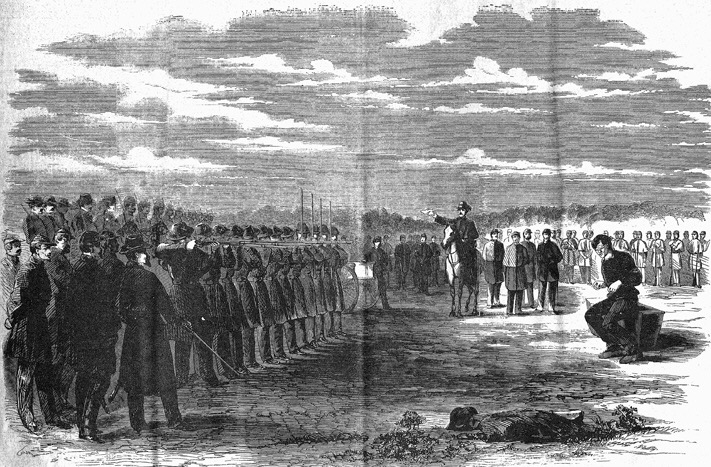
We remained here all winter with plenty of Division reviews, inspections, and camp duties. While here our Division had the 1st Military Execution for deserting. A man named [William Henry] Johnson, 1st New York Cavalry, was on the outer picket line and he left his post and rode towards the rebel lines. When a long distance out, he met a squad in Rebel uniforms and was halted. He said he had deserted. He had his horse, saddle, and bridle, sabre, carbine, and revolver—government property. The officer in charge asked him all kinds of questions as regarding our line, position of picket posts, &c.. He also asked to see his carbine, looked it over, cocked it, and told the man he was a prisoner. The squad was some of our scouts. He was brought in, courtmartialed and sentenced to be shot on the 13th December. The Division was ordered out to see the execution. We were formed on three sides of a square in double lines with the other side open and the grave dug in about the centre of that line…He was brought on the field in a wagon seated on his coffin and a horse with reversed arms (as at a funeral). They entered on the right of the line and passed through all the line. As they passed along, the band of each regiment played a funeral dirge (going to his own funeral). Passing on the left of the line, they drove to the grave. He and his coffin were taken from the wagon, the Judge Advocate read to him the charges, findings, and sentence of the court martial.He was then blindfolded and seated on his coffin. The firing party then stepped up and shot him. The line was then faced to the right and all were marched by close to where he lay. He was buried there. No one was sorry.
In November we had a Grand Review at Bailey’s Cross Roads. Over 75,000 troops before the President, foreign ministers, Members of Congress, and others. It was fine. Four batteries were picked out to fire the salute and we were one of the four. Instead of firing so many guns for the salute, we fired so many batteries, all the guns in a battery being fired at once, and counting as one gun. Then the next and so on.
On January 20th, we had one of our men thrown from his wagon and killed. While out after wood, his team, ran away and striking a stump, threw him off. This was the first death in our company. We remained in this camp all winter attending to drill and camp duties.
I will give you an account of what some of our camp duties were. 1st call in the morning at 5.30 when we get up, put on our boots, and are dressed. 5.45 fall in for roll call and served with a dipper of coffee. 6.00 fall in again and clean around the horses, also clean and feed them until 7.00 then breakfast. 8.30 guard mounting when the old guard are dismissed and the new guard go on for 24 hours. They are divided into three reliefs and go on for two hours and off in 4 hours. 9.00 water call when the drivers take the horses to water. 9.30 sick call when all the sick go to the doctor’s tent. 12.30 dinner. 3.30 stable call when the stalls are cleaned. Also horses ed and cleaned. 5.30 evening roll call, 8.00 tattoo roll call. 8.30 taps when all lights are put out. No noise or talk after that. Also about five hours drill beside if the weather is good. Every day field drill, gun drill, or sabre.
After remaining in Camp Revere from October 14th until March 10th, the army started on the march for Centreville and Manassas where the Confederate army were in winter quarters. We had large bell tents called Sibley tents that would hold 12 men each while in winter camp but when we received marching orders, we also received orders to turn them in and draw small ones called shelter tents, one half tent to each man. They would button together. The men would cut three small poles, one for each end and one for a ridge pole, put the tent over and pin it down. Two men could crawl under and sleep.
We had orders also to turn in wheelbarrows, shovels, hoes, pitchforks, small camp stoves and a large quantity of other things we could not carry. I was left in charge of all this property with a guard of six men, one sick man, and a prisoner and two teams. I had to take an account of all the property, turn it in at a government store house in Alexandria, and get a receipt for the same. Then take my men and follow on after the company and report. I overtook them at Annandale on the 14th March on their return from Centreville and Manassas where they had been and Lee’s army had fallen back towards Richmond. When this was found out, the plan of operations was changed ad we (the army) were ordered back to our camp. As we had cold rains on the return march and the men slept on the ground, they suffered very much.
At this time the army was formed into corps, three divisions in a corps. I told you before how many were in a division so you will understand the size of a corps. Our division was the 1st Division, 6th Corps—one of the best in the army and called the “Fighting Sixth.” We lay in camp on our old campground about three weeks, having drill, reviews, and inspections. On the 25th March, General McDowell reviewed and inspected about 50,000 troops. On the 27th, Lord Lyons and other foreign ministers with Members of Congress reviewed about 33,000. Also a review by General McClellan and others.
April 4th last night we received orders to be ready to start in the morning. Were up, tents struck and all packed before sunrise but did not start until about 10 o’clock. I was again left in charge of some stores with two men and orders to turn them in to the quartermaster’s department. The next afternoon at 2 o’clock I took the cars (baggage train) and went about three miles and stoped until six, then thirteen miles and lay on a side track until 10 the next morning in an open baggage car. Then we started again and I found my company at Manassas. Owing to rain and snow the roads were so bad we could not move. There were also various steams of water that had becone so deep we could not cross. We lay in a plowed foeld in a sheet of mud until the 11th when the steam Broad Run, having fallen, the cavalry found a place up the stream where we could cross. The water was up to the axle of the carriages. After passing the run, the fields were so soft we would get all ready and put on whip and spur to the horses and start across, sometimes clear up to the axle, and they would become stuck. Then all the men would get hold and help them out. Each carriage would take a different track in crossing. After getting about two miles beyond the river, we received orders (our Corps) to return to Alexandria, turned back and by a forced march reached Manassas on April 12th, marched again to Fairfax, and camped.
On the 13th reached Alexandria and camped outside the town near Fort Ellsworth. On the 14th we shipped our guns, caissons, and horses on stream transports, and men and baggage on schooners. On the 15th, 16thm and 17th the rest of the corps were being shipped to join General McClellan before Yorktown, he having taken the rest of the army some time before down the river. Sailed early on the 18th, the schooners and some transports in tow of the steam vessels, arriving at Ship Point about three o’clock on the afternoon of the 19th. On the 20th and 21st, unloaded the cavalry and artillery on account of the horses and left the infantry on the transports to await orders, it being understood we were to sail up the York River and attack Gloucester Point opposite Yorktown when McClellan attacks Yorktown. My brothers were in camp about three miles from our camp but I could not go to see them. While laying here the Boys killed quite a number of snakes—Blue Racers. Some of them were four or five feet long. They would crawl in along side the men in the night to keep warm and they would find then in their blankets in the morning.
From the 22nd until May 4th we attended to our regular duties with nothing of interest that I can think of. We could hear the firing every day at Yorktown. On the morning of May 4th, we were having our Sunday morning inspection when the officer commanding the artillery of our division informed us that Yorktown was evacuated and gave us orders to reship. We were all board by midnight. Started up the York River the next morning and reported at Yorktown, remained all night and in the morning, May 6th, we started up river again for West Point, reaching there early in the afternoon. Our horses, arriving first, were landed during the night and our carriages the next morning, May 7th. Some of our infantry that were landed the day before were skirmishing all night. We took position with our guns and were in our first battle. We also had General Sedgwick’s Division with us. The Rebs opened on our troops, steamers and transports. We replied to them and advanced a strong line of infantry and won the day. Our gunboats in the river aided us by rapid firing with large guns. There was a French gunboat came up the river with us to look on. Some of the shots struck quite near her and she run up the French flag and beat to quarters. We remained in harness all night and I was sergeant of the guard and had a gun loaded to fire as a signal if needed.
On the 8th [May], General McClellan and staff arrived, the rest of the army having marched from Yorktown up between the James and York rivers, his right joining our two divisions, remained here the 9th and 10th, the gunboats going further up the river and shelling the woods. On the 11th, moved a few miles and camped, remaining the 12th and moving again on the 13th, camping at Cumberland, remaining the 14th. On the 15th, up at four and ready for the march. Went to the White House—a fine estate belong to Lee. It was a beautiful place, a large number of slaves, and they had nice quarters and workshops. The fields of grain and everything looked fine. The 16th, 17th, and 18th were quiet but we moved again on the 19th. On the 20th and 21st we moved along and on the 22nd remained in camp. Also the 23rd and 24th. On the 25th, we marched again and camped on a plantation belonging to Dr. Gaines who raised grain and tobacco. The Rebs threw a number of shells into our camp today.
For the next few days we lay in camp here and could hear firing at different points along the line. I stood on the brow of a hill and looked down on the Battle of Fair Oaks. Could see the lines move up, hear the cannon and musketry, the yell of both armies as they charged. Also the Battle of Seven Pines. While in this camp I received a letter from your father informing me that in the Battle of Williamsburg (May 5th) that our brother Andrew J. was killed and that your father was wounded in the same battle and was then at Annapolis, Maryland in hospital.
On June 11th we started from camp (leaving the camp standing under guard) at 4 o’clock to relieve another Battery on picket at Mechanicsville where there were a few houses and a ford across the creek. Our troops held one bank and the Rebs the other. We could see them working on earthworks on a hill, but they remained quiet until about 6 p.m. when they opened on us. Each section of the Battery lay quite a distance from the other. The short-distance section was in the road leading to the ford. One long-range section to the right and the other to the left of it. So the lieutenant from right and left would go to the centre and eat with the captain and other lieutenants. As the officers were at supper when the firing commenced and only the sergeants in charge when an aide rode up and ordered us to reply to them. To the fort on the hill was about one mile. I from the left and sergeant Lawrence from the right, each dropped a shell in the breastwork. We heard afterwards from some prisoners that came in that we killed quite a number and dismounted a gun. They soon stopped when they found out what was in front of them. The lieutenant came up running and asked who gave the orders. I told him. Soon the aide returned and told us to stop. The lieutenant told me and I replied, I have a shot in the gun.” He said fire it but don’t load again. I asked could I fire where I wished, He said yes. I dropped the breach of the gun all I could (for elevation), pointed it toward Richmond, which was 4.5 miles and let it go. As the gun would carry about 5 miles, I have often wondered where it went.
We remained here a week laying around the guns, day and night, but we were not troubled again while there. On the [ ] we were relieved, returned to and struck camp, leaving Dr. Gaines’ place and crossing the creek at Woodbury bridge and camped in a field near Fair Oaks. On the 19th, moved a short distance and camped. While here I went among regiments of our line and found [ ] regiments and two batteries from Massachusetts. i found some friends in some of them. The sights I see in passing over the fields of Fair Oaks and Seven Pines were hard. Men thrown into [burial] trenches, some having as many as 100 to 150 in a trench. Many had been only covered as they lay on the ground by throwing dirt up from each side and as the rains had washed parts of them out—arms, legs, face, &c. and those parts were one living mass of maggots. The stench was horrible. And the troops were camped among the graves and had to drink the water. The reason they were buried so was after the battle, there was an awful rain storm and the creek was overflowed and the bodies were under the water. When it went down, they were so bad they could not be handled. The dead belonged to both armies.
Captioned “Woodbury’s Bridge—Chickahominy River.” Library of Congress
For the next week things remained about the same, firing along the lines every day and the regular camp duties. On June 26th the Rebs crossed at Mechanicsville and above, turning our right, where there was a terrible fight—the first one of the Seven Days. General Porter commanding the corps on the right was forced to fall back to Gaines Mills. On the 27th was the Battle of Gaines Mills. We crossed over at Woodbury Bridge and were in the battle in the afternoon. It was very fierce and the loss was large on both sides. At night we crossed back over the creek and took position on the front line remaining all night.
On the 28th, moved back to creek and took position to command another bridge. Troops passing all day and fighting at different points on the line. We held the position all day and on picket at night. Moved back before morning passing through lines of battle. I will explain something here something of the way we were falling back. While say one half of the army were fighting today, the other half formed the second line in rear of the first, ready to support them or take part holding the line all day, and at night the first line passed through the second and formed in their rear, being the supporting line that day. And at night change again from first to second.
On the 29th June was the Battle of Savage Station. When I passed here there were piles of rations—beef, pork, rice, hard bread, &c. Tons of musket and artillery ammunition, shot, shell, &c. All the stores of all kinds the teams could not carry were piled up and set on fire. Also hay and grain. The soldiers were taking the fuses out of the shells, pouring out the powder and in fact, destroying thousands of dollars worth of property. This was a railroad station and that is the reason there was so much property there. We had railroad trains moving what they could and kept them at it so long we could not get back. so the bridge over the creek was burned, the train loaded with stores, the engine started and all run into the creek.
You will form some idea of our wagon train when I tell you if it was put in a single ine, it would reach over 50 miles. We also drove a large head of cattle.
On June 30th, Charles City Cross Roads and White Oak Swamp Battles were fought. We were in the Charles City Cross Roads fight and had it hot. We fired so long and rapid our guns’ breach [became] so hot they would go off when the vent was uncovered. Although we wet the sponge in water, the water passed into the vent honeycombed them so bad that they had to be taken out and new ones put in as soon as we had an opportunity, a man coming from the gun foundry. We fired that day from our long-range guns about one ton from each.
I told you I had a good drilled squad ad we use to see who would gwt the first shot when we received orders to commence firing. I got the first shot and I suppose they fired at my smoke for while loading for the second shot, my No. 3 man at the vent, and my head by his side sighting the gun, a shell passed through him and over my shoulder, spattering the flesh and blood in my face and clothing. After dark we lay around the guns with a skirmish line in front. At midnight the lieutenant told me to wake my men and mount the driver and tell them and the other men not to speak a word or strike a horse and if they became stuck on stumps or in a hole, to leave then and save my horses if I could. If not, leave them. We drove off on the grass without a sound being made. One of our officers (said to be Gen. Kearny) rode up to the picket line and asked for the officer in charge, gave him orders to move the line back and uncover a cross road through a wood as he wished to pass some artillery. the officer, thinking it all right, moved the line and we passed through with everything all right. When we came out on a pike road inside our line, an officer sat on his horse and told us to let them go and we went down the road flying, arriving at Malvern Hill at 4 o’clock in the morning of July 1st, took position in line, and was in the battle part of the time. As our corps was out of ammunition, we received orders to go to the rear. Towards evening we took position for the night.
July 2nd left our position at 2 a.m. and marched to Harrison’s Landing, the troops coming in all day. When we arrived here we entered as fine a field of grain as ever you see, but before night, with the rain and the tramp of troops, it was all gone and was our sea of mud. Thus ended the Seven Days Battles before Richmond—one of the grandest movements of the war. When you think of the country we had to fight over, the large force General Lee brought against us, and we saved our trains and cattle, also artillery and troops.
On the 4th, 5th, 6th, and 7th, we were in different positions in reforming the lines. On the 8th, President Lincoln with a large staff and guard rode around the lines and received the troops, the gunboats and batteries firing salutes. The infantry built long earthworks and the artillery was placed in them all along the line, the guns being about 17 yards apart and the infantry camped in the rear. A strong picket line was out about 3 or 4 miles. We had drills and other camp duties every day. Otherwise it was quiet until the night of July [ ], when at midnight, the Rebs having brought down some batteries on the other side of the [James] River, opened fire on our gunboats, transports and camps. The gunboats and some batteries near the landing replied. The camps all turned out. It looked fine to see the shells going through the air when they didn’t come too near. In about an hour it stopped and all was quiet again and we turned in. The next day several regiments were sent across the river to destroy some buildings used by then=m for observation and a strong guard left to prevent the move again. A large number of men were dying in the camps every day from the hardships they had passed through but only one died in our camp from fever. Sometimes twenty or thirty dead bodies would pass our camp a day and I suppose the same in other parts of the army. It was very hot while here—from 100 to 115 degrees every day.
We received orders to turn in our guns and draw others of a different kind. We received six light 12-pounders or Napoleon guns, short-range (less than a mile) but the most destructible gun in the service for close fighting. Expecting the guns were ready, we took the horses and only 12 men and went to the landing and then found out we had to put the carriages together, mount the guns, and draw the ashore. Also all the ammunition, It took all day and was a hard job. The glass stood 80 degrees in the shade.
On August 6th, some 30 lb. Parrotts took position on our right. On the 7th Battery, B. Md. Artillery took our position and we moved into camp half a mile in the rear. On the 11th, received orders to be ready, packed up and hitched every day but did not start until the afternoon of the 16th when we crossed the Lower Chickahominy on a pontoon bridge which the gunboats were guarding. On July 18th, passed through Williamsburg (the place my brother Andrew was killed). On the 19th, passed through Yorktown and reached Lee’s Mills on the 20th and were ordered to Hampton. On the 23rd, we shipped our carriages on an old ferry boat that used to run from Boston to Chelsea which reminded us of home.
On the 24th shipped our horses and men on schooners. On the 26th went to Aquia Creek and received orders on the 27th to proceed to Alexandria. Arrived there on the 28th and disembarked, went into camp outside the city near Fort Lyons, and quite near the old camp where my brother was last winter.
On the 29th the Battery was ordered out towards Centreville and as our teams had not arrived, I was left in charge of baggage and stores with a guard until they came. The Battery returned to camp on September 2nd in the night and the next day moved to the old campground of last winter. In camp the 4th and 5th. In the 6th we received orders at 5 p.m. and were on the road at 6 passing over Long Bridge, through Washington and Georgetown on the trot and camping beyond on the Poolesville road (as the Rebs had crossed into Maryland). Remained in camp the next day. Troops passing all day. On the 8th passed through Rockville and at 7 went in position for the night. Marched the next day and camped at night at foot of the Sugar Loaf Mountain. Remained in camp the next day and marched on the following one camping near Buckstown. On the move next day and at noon, halted near Jefferson. Started again and halted near South Mountain, then opened the battery on Crampton Pass, South Mountain, where the Rebs were in a strong position on the side of the mountain with both artillery and infantry. Our battery was engaged part of the time, but being short-range, could only reach part of their line, but other batteries could. Part of our infantry moved on the front and another force moved into the woods and up the side of the mountain and flanked the position, driving them up and over the mountain, taking artillery, baggage wagons, and prisoners. We moved up the hill and camped on the field with the dead and wounded.
We were on the move again on the 17th and could hear rapid firing in the direction of Sharpsburg. We arrived at Antietam Creek at noon where we found a fierce battle going on. We was ordered into line on the right of center where the battle had been fierce, the dead of both armies and wounded lay thick as the field had been charged over two or three ties by both armies. In passing through a cornfield to take position, many a poor soldier (wounded), Union & Reb, would raise himself on his elbow and ask us, “For God’s sake” not to run over him. I can say I never run over a wounded man while in service. I rode by the lead driver and looked out for that. We took position within 500 yards and opened fire, remained on the field that day and the next, engaged or under fire.
On the night of the 18th, could hear the Rebs moving artillery or trains the most of the night, not knowing if they were massing troops for a final charge on our right, or a flank movement in the morning. As soon as daylight on the 19th, our skirmish line was advanced with a strong supporting line and forced the Reb skirmish line back. They soon found they had no support as their army had gone and left them. They threw down their guns and came in as prisoners.
We started after them at once, passing over the field of battle and I must say, I see worse sights here than on any other field I was ever on. Thousands of dead and wounded of both armies, killed in all kinds of ways and positions, and those that were killed at the first of the battle were swollen to twice their size and turned black. The stench was awful (when men are killed in health and full blooded, they turn soon) and the sun was very hot. In all the buildings from the field to the river, we found them filled with their wounded whom they had left behind. Lee’s army had crossed at Williamsport.
On the 21st, camped at St. James College. On the 22nd, moved into camp at St. James College. On the 22nd, moved into camp at Bakersville and remained the rest of the month and until October 9th when we went to Hagerstown and washed up the Battery for repairs and painting, and harnesses for oiling. After getting about half done, we were ordered on picket at Williamsport, put our carriages and harness together and went on the 16th finishing while there. We went out three or four times at midnight (with other troops) to command a bridge expecting a cavalry dash. The nights were very frosty and cold standing on watch. On October 31st we were relieved by the Baltimore Light Artillery and marched to the south side of the Blue Ridge, crossing at Crampton Pass and camping for the night. Then crossed the Potomac at Berlin on a pontoon bridge and entered Virginia once more.
During NOvember there was nothing of interest—only marches taking position in various places. Lots of rain and some snow. General Burnside had taken the place of General McClellan at the latter part of the month. Gen. Hooker’s Division was passing our camp and I run out and watched for the battery your father was in, he having returned to duty. I see him for about half an hour—the first time for eleven months.
December 4th, marched to Belle Plain and went in camp, remaining in camp until the 11th. Some rain and snow. On the 11th we started for Fredericksburg and camped near the river. On the 12th, crossed the Rappahannock on a pontoon bridge below the city (called Franklin’s Crossing) and went in position near the Barnard House. The day was foggy but about 3 o’clock it lifted and the Rebs opened on us and there was some brisk fighting. At night it stopped.
Early the next morning, the 13th, the firing was rapid and lively on both sides. At noon we moved and took position on the right of the left wing of our army, when the whole of the infantry line (in that wing) advanced towards the railroad and a fierce infantry fight took place. The Rebs moved a battery to rake the line, when our battery opened on their and blew up a number of heir limbers and the loss of life must have been large. We soon silenced that battery.
Our troops were repulsed with a large loss in killed and wounded and they fell back to their old place in line. Towards evening the opened a cross fire on us from a battery near the town. Their 1st shot smashed a wheel on a gun limber, took off a sergeant’s leg, and a private’s arm. Some horses killed and wounded. On the 14th and 15th lay in position with few shots from either side, both watching for a move from the other.
On the night of the 15th all the army fell back across the river on the pontoon bridges. These were covered with hay to deaden the sound. We were all across and the bridges up before daylight which surprosed the Rebs who expected to see us before them in the morning. Our battery was the last to cross, being with the rear guard. We had a large loss and no gain in this battle. We then returned to the same camp occupied before the movement. Remained here until the 19th when we moved and camped near White Oak Church on the Belle Plain Road. Nothing of interest during the rest of December—only the same as when we are in camp long. On the 28th I got a pass, mounted, and went out to find your father’s company. After riding about all over the army, I found him.
From January 1st to 20th, we were in the same camp building brush stables for the horses and attending to other camp duties. On the 20th, left camp at noon and marched across country striking the Warrenton Pike near Falmouth where we camped for the night. A cold rain all night and for the next three days. In the morning we were soaking and puddles of watrer where we lay. We had hard work to move our carriages, the mud was so deep. We had to take the horses from one carriage and put them on another, then return for the others. Sometimes we had from 8 to 28 horses on one carriage. Pontoon trains, baggage wagons, siege guns, and ambulances were struck fast in the mud. Mules and horses were mired and became so weak as to fall over in the mud and drown. I had to take a mounted detail of 16 men, go back and find the forage train, get a bag of oats, and put it in front…[the remainder is missing]
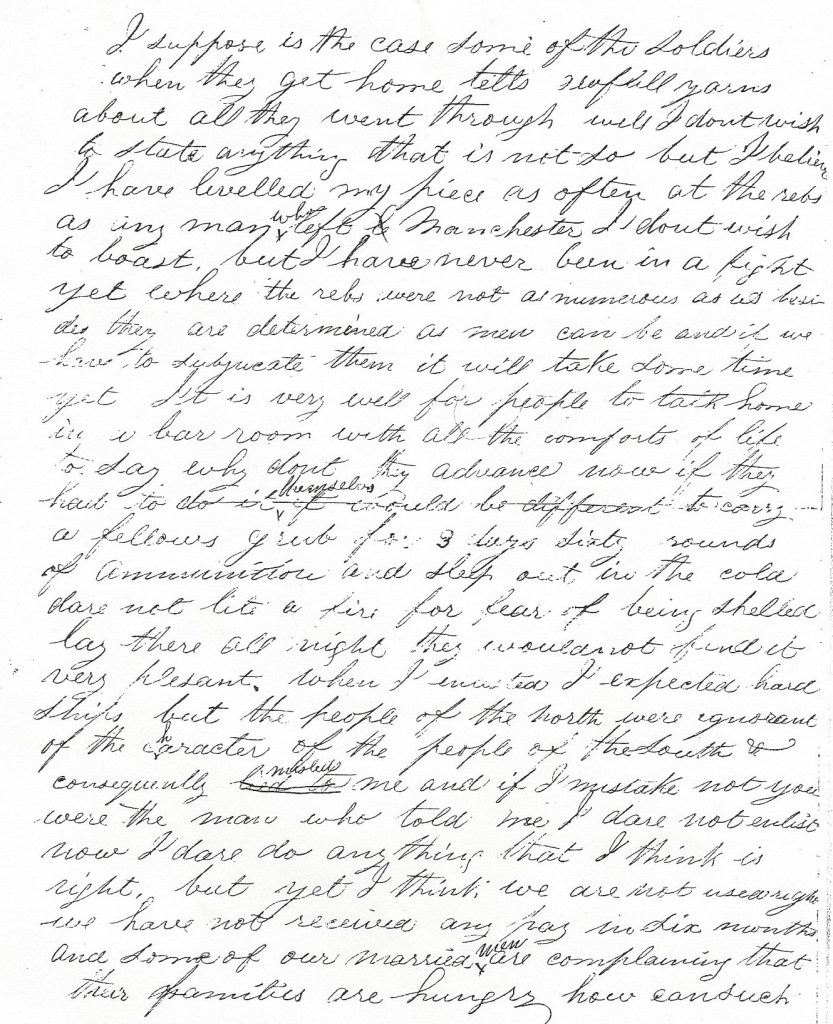
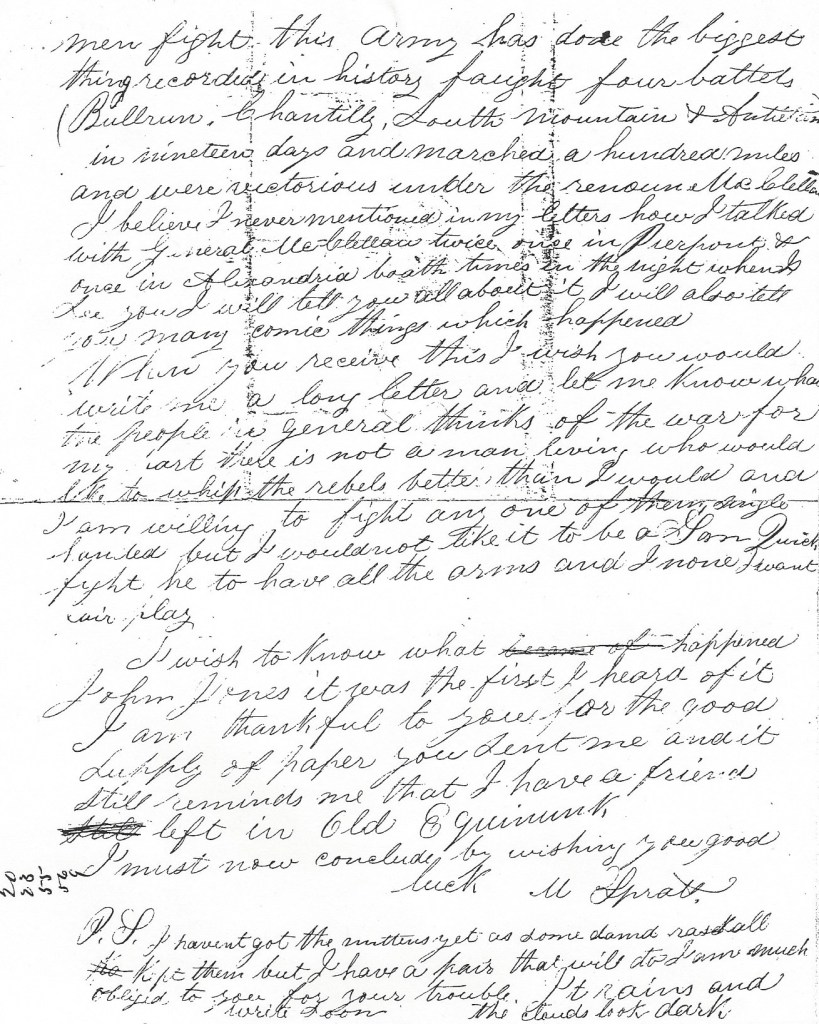
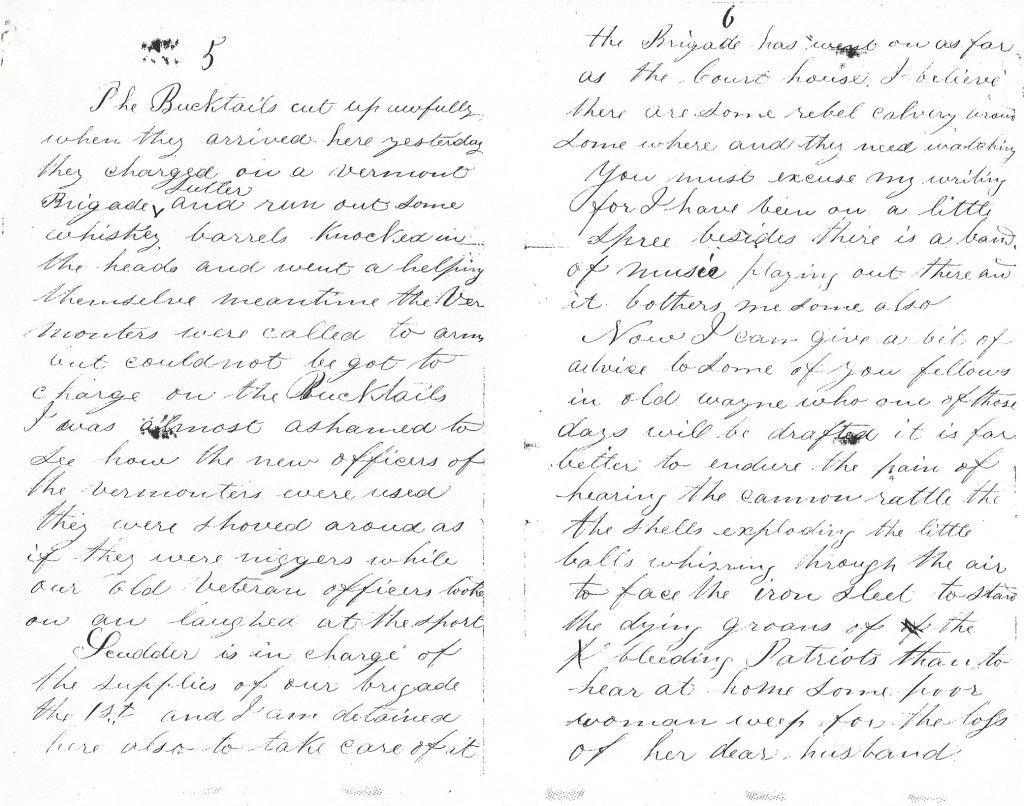
The following letters were written by Michael Spratt (1834-1888) who served as a private in Co. C (“the Honesdale Guards”), 6th Pennsylvania Reserve Infantry (35th Volunteers). Michael enlisted on 13 May 1861 and mustered out with the company on 11 June 1864 after three years service.
Michael Spratt, 6th Pennsylvania Reserves
Michael’s first letter conveys the details of his experience in fighting with the 6th Pennsylvania Reserves on the battlefields at South Mountain and at Antietam. In both engagements, the 6th Pennsylvania Reserves fought under Brig. Gen. George G. Meade in the famed 1st Brigade composed entirely of Pennsylvania Reserves (1st, 2nd, 5th, 6th, and the 13th). It was the 13th Pennsylvania Reserves who were known as the “Bucktails.”
The second letter was penned after the Battle of Fredericksburg and following Lincoln’s Emancipation Proclamation. It is more philosophical in nature. The third letter (partial) probably dates to March 1863.
Michael was born in Dublin, Ireland, in March 1834, the son of John Spratt and Mary Alice Stapleton. He came to the US with his parents in 1851 and settled in Manchester, Wayne county, Pennsylvania. Prior to his enlistment he earned his living as a farmer and took his mail at Priceville. After the war, he married Celia A. Carey (1844-1914) and resumed farming in Equinunk, Wayne county, Pa.
[Note: These letters are from the private collection of Tom Clemens and were made available for transcription and publication of Spared and Shared by express consent.]
Letter 1
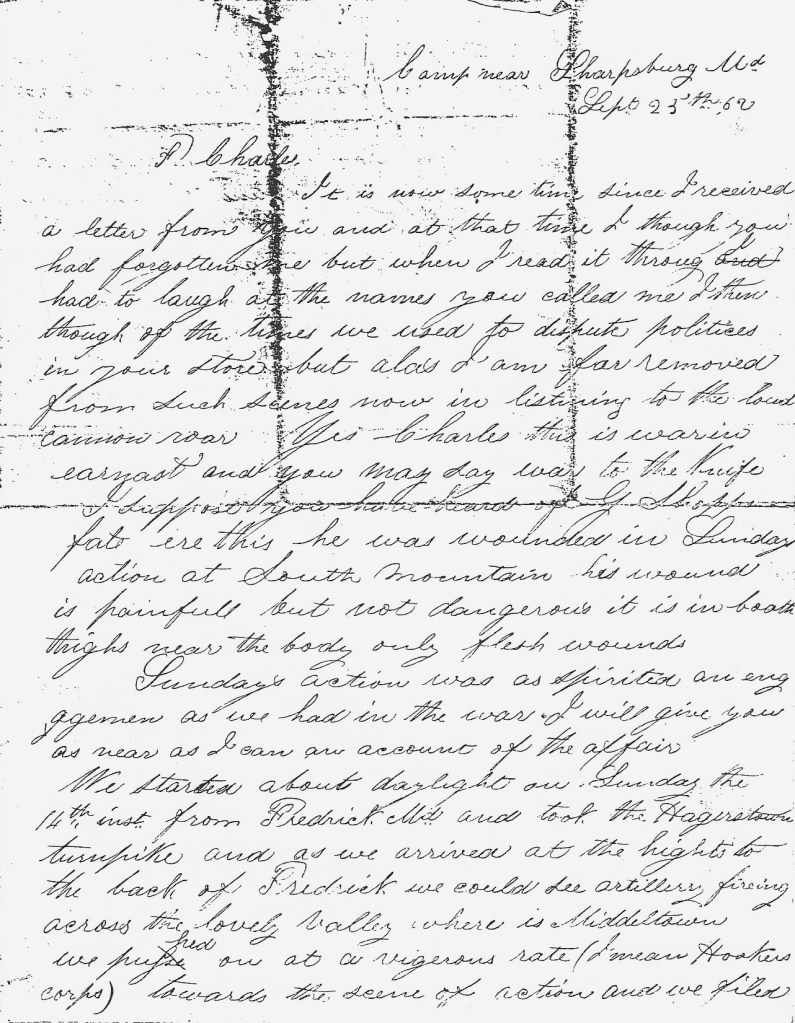
Camp near Sharpsburg, Maryland September 25th 1862
Friend Charles,
It is now some time since I received a letter from you and at that time I thought you had forgotten me but when I read it through I had to laugh at the names you called me. I then thought of the times we used to dispute politics in your store but alas, I am far removed from such scenes now and listening to the loud cannon roar. Yes, Charles, this is war in earnest and you may say “war to the knife.”
I suppose you have heard of G[eorge] Shopp’s fate ere this. He was wounded in Sunday action at South Mountain. His wound is painful but not dangerous. It is in both thighs near the body—only flesh wounds.
Sunday’s action was as spirited an engagement as we had in the war. I will give you as near as I can an account of the affair. We started about daylight on Sunday the 14th inst. from Frederick, Maryland, and took the Hagerstown turnpike and as we arrived at the heights to the back of Frederick, we could see artillery firing across the lovely valley where is Middletown. We pushed on at a vigorous rate (I mean Hooker’s Corps_ towards the scene of action and we filed to the right of the turnpike where we formed in line of battle and sent the far famed Bucktails in advance as skirmishers and in a few moments the whole line was in motion. Soon the Bucktails met & drove in the pickets and we soon found the whole body of the rebel infantry prepared to receive us. They poured a deadly volley into our ranks but it was answered by a still greater one. We stood here a few moments firing at each other when the gallant Meade gave the order to advance with fixed bayonets. Ah, my boy, this moment was the grandest I ever saw and I shall remember it while I live.
The enemy was in a cornfield at a slope in the hill. the sun was setting and the smoke from the firing was raising over our heads and the flash of our rifles rendered the scene sublime. The rebs took to the mountain and we after them. It was at this time that Shopp received his wound. We advanced in a run up the mountain and by the time we got to the top, some of us were mixed in through the rebels, there being such a smoke they succeeded in getting away.
I saw in front of us not farther than from your store to the Deacons the rebel rag a shaking to and fro. This raised my Irish blood higher than it ever was before so I takes deadly aim at the flag bearer. Whether it fetched him or not, I am not able to say. The rebs were concealed behind a breastwork of rocks so I dropped behind a stump and commenced firing away till we again got the order to advance and we drove them down the other side and darkness ended the hotly contested engagement.
Next morning was the most dreaded scene. The stiffened limbs of our poor dead comrades and the dead of the rebels lay thick. Three of our company were shot through the head and of course killed instantly. Well we did not get much time to look at the battlefield. We were ordered to march and that at a rapid rate for Little Mack was determined not to let them rest. So we marched to near Sharpsburg in front of a little stream and lay down on the ground, tired and weary.
We lay till the next day about 3 o’clock tuesday and we were again formed in order to advance on the enemy to find out their position. The Bucktails were as usual sent in advance and we advanced on the foremost daring in the face of three batteries pouring in grape and canister. We also had a sharp brush with the infantry so we lay all night, 1 fighting occasionally, and picketing till the dawn of day when the engagement commenced in earnest. I cannot describe this terrible scene nor is there words in the English language fit to describe the roaring of shell, the screeching of balls, the yells of the wounded, and the roaring of officers.
My dear friend, I never want to see another such affair. Our lines were moved in perfect order and I can assure you the rebels were moved as good. Sometimes we would gain on them, then they would get reinforced so we would be forced to give way till the veteran troops of the grizzley Sumner came up. The day seemed doubtful. Then we kept gaining slowly on them and at night we rested in possession of the battlefield. Thus ended the bloody affair. 2
Well, I almost forgot to tell you that I ran across the 137th Pennsylvania Reserves and saw all the boys. They were burying the dead. I suppose they will send you all particulars. I also saw several of the 45th today. None of the boys from Equinunk got killed. Several got wounded.
I wish to be remembered to all friends and I do often wish the war was ended. I hardly know what to think of it. If any of my friends wants me to write, they had better send me some paper and stamps or money to buy them and I can assure you I have suffered a little. You must not let the recruits know this. I have come through safe so far, thank God, and I hope I will return in safety. Yours as ever, — Michael Spratt
1 According to the regimental history, the regiment (in Seymour’s Brigade of Meade’s Division), bivouacked on either side of the road (now Mansfield Avenue), with pickets thrown forward in the East Woods.
2 The 6th Pennsylvania Reserves (35th Pennsylvania) advanced and became engaged at daybreak on either side of the Smoketown Road in the East Woods. It was checked at the western edge of the East Woods and retired from the field after exhausting their ammunition.
Letter 2
Camp in the pines near Belle Plains Landing, Virginia January 11th 1863
Friend Charley.
I received your letter today dated January 3rd and was surprised to find your words so few. I suppose your attention was drawn in another source and I do not wonder if it is for the rascally way our army affairs are conducted in enough to let any sensible man wild. Burnsides as predicted made a good butcher and the abolition press had something to converse over for a while after the combat which proved so fatal to our cause. And now as Rosecrans in the West has achieved a great victory, we are looking every day to hear of his removal.
Since I last wrote to you, I have talked with a number of the men who have to stand the hard knocks in the field and their feeling towards the administration is not very kindly at the way affairs are enacted. In passing the other night by one of our camps, I heard an aged patriot whose head is silvery with age and who participated in the War with Mexico—said he—there are a number of poor fellows killed for the nigger. Such is the feeling of the army since Old Lincoln proclaimed to set the nigger free and put him on equal footing with the soldier who is trying to battle for your rights.
The message of Gov. Seymour of New York is greeted among the soldiers. It is hailed with delight and calculated to inspire us to fight with more vigor when we know what we are fighting for. The question may be asked what we are battling for and we must say to free the nigger, to enrich contractors, and making generals. While look on the other side. Ask the rebels what they are fighting for. Answer—our homes, our property and our lives. At the beginning of this war, I thought we were fighting for the Union as it was. Not so now. Well, let all that pass.
When I see you which I hope to some day if I don’t be unfortunate like many other comrades who fell on some of the many battlefields which our regiment has been engaged in, I will then talk to you and tell you how I have suffered. Yet I am willing to suffer more in a just cause—to have the Union as it was.
Now Charley, I want to write you a word or two and I don’t wish you to let everyone know it for as I suppose is the case, some of the soldiers, when they get home, tells awful yarns about all they went through. Well, I don’t wish to state anything that is not so. But I believe I have leveled my piece as often at the rebs as any man who left Manchester. I don’t wish to boast but I have never been in a fight yet where the rebs were not as numerous as us. They are determined as men can be and if we have to subjugate them, it will take some time yet. It is very well for people to talk home in a bar room with all the comforts of life to say, “Why don’t they advance now?” If they had to do it themselves, it would be different. To carry a fellow’s grub for three days, sixty rounds of ammunition and sleep out in the cold, dare not light a fire for fear of being shelled, lay there all night, they would not find it very pleasant.
When I enlisted, I expected hardships but the people of the North were ignorant of the character of the people of the South and consequently misled me and if I mistake not, you were the man who told me I dare not enlist. Now I dare do anything that I think is right, but yet I think we are not used right. We have not received any pay in six months and some of our married men are complaining that their families are hungry. How can such men fight? This army has done the biggest thing recorded in history—fought four battles (Bull Run, Chantilly, South Mountain & Antietam) in 19 days and marched a hundred miles and were victorious under the renowned McClellan. I believe I never mentioned in my letters how I talked with General McClellan twice—once in Pierpont & once in Alexandria, both times in the night. When I see you, I will tell you about it. I will also tell you many comic things which happened.
When you receive this, I wish you would write me a long letter and let me know what the people in general thinks of the war. For my part, there is not a man living who would like to whip the rebels better than I would and I am willing to fight anyone of them single handed, but i wouldn’t like it to be a Sam Quick fight—he to have all the arms and I none. I want fair play.
I wish to know what happened [to] John Jones. It was the first I heard of it. I am thankful to you for the good supply of paper you sent me and it still reminds me that I have a friend left in Old Equinunk. I must now conclude by wishing you good luck. — M. Spratt
P. S. I haven’t got the mittens yet as some damned rascal kept them but I have a pair that will do. I am much obliged to you for your trouble. It rains and the clouds look dark. Write soon.
Letter 3 (Partial)
[Probably dates to March 1863 when the Bucktails with the 1st Brigade, encamped at Fairfax Court House. It was in March 1863, too, when Congress passed the Enrollment Act, establishing the draft for the first time.]
….The Bucktails cut up awfully when they arrived here yesterday. They charged on a Vermont Brigade Sutler and run out some whiskey barrels, knocked in the heads, and went a helping themselves. Meantime the Vermonters were called to arms but could not be got to charge on the Bucktails, I was almost ashamed to see how the new officers of the Vermonters were used. They were shoved around as if they were niggers while our old vetran officers looked on and laughed at the sport.
Scudder is in charge of the supplies of our Brigade, the 1st, and I am detained here also to take care of it. The Brigade has went on as far as Court House, I believe. There are some rebel cavalry around somewhere and they need watching.
You must excuse my writing for I have been on a little spree. Besides, there is a band of music playing out there adn it bothers me some also.
Now I can give a bit of advice to some of our fellows in Old Wayne [County] who one of those days will be drafted. It is far better to endure the pain of hearing the cannon rattle, the shells exploding, the little balls whizzing through the air, to face the iron sleet, to stand the dying groans of the bleeding patriots than to hear at home some poor woman weep for the loss of her dear husband, crying all that I depended on to support my family has gone, or some nice young lady weeping over the loss of her lover, and worst of all, she herself will have to die an old maid. Oh how glorious all this seems to the unthinking man seated in his easy chair smoking his cigar and reading the newspaper. It was a brilliant charge of that regiment; its loss was over half. But do they ever remember that those dead had friends to mourn their loss? But that’s not all. The war is not half over yet. Hooker has to take Richmond and yet somebody else Vicksburg and somebody else Charleston. But I think it will have to be left till ’65 for a Little Mac or some other talented man to finish.
As one of the boys says, “We have waded to our ankles in blood, but by God, we;ll have to wade to our knees yet before it is settled.” I cannot say more now—only i will tell the boys to be prepared for the draft and if they don’t come out willingly, we will go back and force them.
You will oblige me by letter. Tell Patrick Spratt that I sent him thirty dollars. He will find it at the depot. I must now conclude by hoping your family will remain in good health as I will expect a letter from you soon. I am also very much obliged to you for the nice presents you send me. Yours as ever, — M. Spratt
If we meet Stuart’s raiders, we’ll give them hell.
The following letters were written by Rollin E. Maranville (1836-1862) who enlisted at the age of 24 on 21 August 1861 at Fairhaven to serve as a private in Co. F, 2nd New York Cavalry, unofficially known as the “Harris Light Cavalry.” He was appointed a corporal sometime prior to his death on 13 September 1862, at the General Hospital in Alexandria, Virginia ofwounds received 29 August 1862 in the Second Battle of Bull Run. His grave marker in East Poultney, Rutland county, Vermont states that he served as “Color Sergeant” of Harris Light Cavalry and “lost leg at Bull Run.” He was the son of Merit Lily DeMaranville and Mary Ann Reed.
After leaving New York during September and October, the regiment served with McDowell’s Division of the Army of the Potomac from the latter month, on duty in the defenses of Washington, D.C. It was transferred to the Third Division of the First Corps of the Army of the Potomac in March 1862, and in May briefly became part of King’s Division of the Department of the Rappahannock. The 2nd New York Volunteer Cavalry formed part of the Cavalry Brigade of the Second Division of the Third Corps of the Army of Virginia (temporarily redesignated from the First Corps) from June.
Letter 1
Camp Palmer Arlington, Virginia February 19, 1862
Dear Emma,
I received your letter in due time. It found me well. I would have answered it before but it is awful muddy and raining like shot. It rains most every day.
I have just come off guard, It is raining pitch forks now. If it keeps on, I don’t know what will become of us. The weather is warm most of the time. Everything is quiet here. We stay in our tents most of the time & read the war news. When we get good news, we fall in the company and try our lungs. Then begin to talk about going home. But we generally wind up with a smoke and retire.
We have been expecting to move south but the roads are so bad it is all a horse can do to walk. When Mr. Inman was here, he thought it was tough. He ought to be here now. He would think it was tougher.
I think the horse that George had is dead. Wescott is alive yet. He is pining away to cart load. He is going to get his discharge. He goes with a big cane. We keep one kitten and two small dogs to draw his breath. Orson & Tip are well. There is one of our company in the hospital that is very sick. I don’t think he can live long.
There, I can’t think of any more—only give my best wishes to all. Please answer and oblige yours, — R. E. Maranville
Letter 2
Camp Palmer Arlington, Virginia April 2, 1862
Cousin Emma,
Your letter arrived in due time. It found me well as usual but I don’t know what to write. I don’t get any news. We have to drill every day without stirrups & swing the saber, horses on the run. I have made up my mind it is a little tough. I guess I shall have to stand on my head & ride yet.
We are expecting every day to move. I think when we do move, we are going down the river. The Vermont Regiments have gone on.
One of my tent mates has just dropped in. He says orders have arrived to pack provisions for a march, Maybe we will move tomorrow and maybe not. The weather has been quite warm lately. Once in a while a thundershower but it is cold enough tonight to suit me. A little fire would not hurt anybody.
Yesterday I went to the city for horses. It made me think of home to see men in citizen’s dress walking around taking their ease, enjoying [?] to be independent. But I have to come down to soldier’s style. I do things by rule, &c. Fred Campbell that worked in Hampton has left. He deserted a week ago, if he gets away all right. If he is found and brought back, he may get a little cold lead to settle his supper.
There, I don’t think of any more to write.
P. S. If you make any sugar from that old saw horse, just send a lump. Please answer when you get time. Next time I hope to get more news to write. Yours &c., — R. E. M.
Letter 3
Addressed to Miss Emma Maranville, Hampton Corners, Washington county, New York
Falmouth, [Virginia] May 2nd 1862
Emma,
I received your letter in due time. I was out on picket guard and it was sent to me. It [found] me well but [soaked] through. It rains every other day and sometimes every day. It has been very warm all day and we are having a thunder shower now. Talk about rain [in the] North. It don’t begin to rain there. It pours down here in small rivers.
I went out on picket the last of April with six men to guard a road. We stayed in a slave hut made of logs and clay mud. The man that lived on the farm left when we first came here & left the negroes to take care of themselves. There was one white man there who pretended to be Union all over. I asked for some corn to feed my horse. He said the rebels had taken it all [but when] I went to looking around, I found upwards of a hundred bushels. I began to help myself. He objected but I could not help it. I sent out a couple of the boys to get a little milk. They found some and a couple of fine turkeys which I have just been picking their bones. We intend to live well if we can. We are so far from Washington that we can’t get everything. We have had to eat fresh beef some of the time without salt but the railroad is [al]most ready.
In the morning there is a large body of men going out on a scout to find some rebels that are lurking around. There is quite an army here now—fifty or sixty thousand from [what] we can learn of the rebels. They intend to dispute our march to Richmond. I don’t think we will [see them] again until McClellan gets them fast at Yorktown there.
I don’t think of anymore now. It is roll call & must close. Direct as before. — R. E. M.
Letter 4
[Note: This letter is from the private collection of Greg Herr and was offered for transcription and publication on Spared & Shared by express consent.]
Addressed to Miss Emma Maranville, Hampton, Washington county, New York
Falmouth, [Virginia] June 28, 1862
Emma,
Chancy Warren arrived here today & found [me] well & tough. I saw Orson this morning. He is well. We are on detached service yet. I expect every day that we will have to join the regiment which is encamped nearly a mile from us. I had rather stay where I be but I won’t do to find fault. [We] obey orders if a regiment of rebels are before us.
We are having the best time now that we ever have had since leaving Arlington. We have to stand picket & our horse guard & scouting. This morning a corporal and four men was sent out to scout on the Richmond Road. They came very near staying. They went out ten miles or more and came onto one hundred or more of mounted rebels. They saw them in time to get away. The rebels fired at them but did not do any damage. George Boyce of E. Poultney was one of them. William Dolphin of Castleton run & left the rest of the boys & reported that they had been captured.
I am on guard today & the darned horses are more trouble than they are worth. I have a sick horse to take care of. The poor child can’t eat.
I don’t get any news from Richmond at all. Everything is quiet here. I think that our government is concentrating a large force here to move somewhere but it is all guess work. All that I know is what I can see & hardly that. I am very much obliged to you for the little book that you sent to me. I will try & take good care of it.
It is beginning to rain and I must prepare for fun, It rained so hard here last week that it drove everyone out of their tents but me. I had my roost on high ground. There, I don’t think of any more to write now & I think I had better close & fix my tent. Direct to Harris Light Cavalry, Co. F, Washington D. C.
The following letter was written by 18 year-old Winfield M. Perry of Co. M, 2nd New York Heavy Artillery. “Win” enlisted on 14 October 1861 at Utica, New York, mustering in as a corporal on 27 October 1861 to serve three years. Company M was sent to Washington D. C. where they were attached to Sturgis’ Command of the Military District.
I could not find an image of Winfield but here is a cdv of William Phelps McNeil of Co. H, 2nd New York Heavy Artillery
Win reenlisted in November 1863 and was appointed sergeant in mid-February 1864. He was wounded in the hip on 3 May 1864 at Pamunkey, Virginia, and discharged for disability on 8 June 1865.
Win’s reenlistment is surprising given that he became quickly disillusioned with being a soldier. Shortly after enlisting he wrote his mother, “I think this soldiering thing is about played out and if I ever get out of this I scarcely think my patriotism will let me enlist again.” He admitted to his mother that he had enlisted out of a sense of patriotism and duty. Later in the letter, Perry wrote about abolitionism, saying that, “I see by the papers that Abolitionism has met with a serious chech [sic] in the state of N.Y. by this fall’s elections as well as in other states. I do not suppose that the elections pleased father much but I suppose that is where we would differ for I think they are capitall [sic] ones.” Here was another Utica native against the idea of abolition. He was fighting to preserve the Union, and he did not appreciate the efforts of the abolitionists. In January 1863, Perry wrote, “I guess the Abolitionists of Trenton will begin to think of something else besides niggers and money when they see this war touch as near home as it has within the last month.” He was content with the defeat of the abolitionists and the way that the 1862 elections had gone, even though his county remained a hotbed of Republican sentiment. Perry also commented on soldiers who did not enlist as early in the war as he had. Those that enlisted later were known as “bounty men,” while the original soldiers referred to themselves as “old soldiers.” He wrote, “Mother you can not imagine what a feeling there is between the old soldiers and the bounty men as these new Reg’ts are formed [sic].” The letter closed with the story of a bounty man who was bragging about his bounty, only to be ferociously beaten by more than twelve men, “because he said he enlisted for the bounty and not to fight.”
Just over three weeks after his January 1863 letter, Winfield Perry wrote home and expressed his undeniable opinion about abolition and, more specifically, the Emancipation Proclamation. Perry’s rant was an opinion that was not solely his; there were certainly a number of men who felt the same way.
But mother this Regt will never fight one inch to free the negroes. There are men in this Regt that would sooner fight the President himself than fight to free the negroes. It was not what they came for. They came to war for the union and if this is to be turned into a political war or in other words Abolition, Nigger, war they will not fight at all [sic]. I think these appropriations of money that Congress are making for the Negro had better be turned toward paying the soldiers who have been without pay for eight months. Their families at home in the poor house Suffering Starving [sic] even for the want of it. I need not go outside of this Co to find such cases. One Mr. Stowe of South Trenton or near there has a wife and three children his wife sick and the children not much better [sic]. They had to go to the Poor-house or Starve. Negro first and White Man afterwards is the motto of our government at the present day. It would seem as if our Army had lost confidence in their Commanders. The Commanders even themselves at the way this war is being carried on, it would seem as if nothing had gone right since McClellan and Battle have been Superceded for freeing men I believe never lived [sic]. Now do not think I am turning toward the rebels, but mother I did not come down here to fight [for] Niggers, and the long and short of it is, I won’t.”
As the war was ending, Perry’s opinions on Abraham Lincoln, and his policies changed somewhat. After the Civil War ended in April 1865, Perry was was still in the Army. He had been wounded in June 1864, and he was still trying to recover. He was in a hospital in Alexandria, Virginia when the war ended, and when Lincoln was assassinated. A man who had been so vocally against Lincoln’s proclamation went to visit the President’s remains in the capitol building. He wrote his mother of this experience and stated, “Mother it was to [sic] bad that “honest old Abe” was not allowed to live to see peace proclaimed. I can say nothing against him now.” [Source: Abolitionists or Volunteers, Historical Memory and Oneida County during the American Civil War, by Barry J. Fitzgerald; based on the Winfield M. Perry Papers housed in the Oneida Historical Society Manuscript Division.]
Transcription
Patriotic letterhead, “The War for the Union.”
Mud Fort, Alexandria, Virginia January 28, 1862
Dear Mother,
I think I must write you again [even] if I have not had a letter. It does nothing but rain all the time and the mud is about ten feet deep or less. The boys this morning are all in an uproar about going to Port Royal but I don’t believe anything of the kind (my ink has given out and I cannot get any today so I must try a pencil).
Mother, you ought to come here and see the soldiers I saw 17 thousand in the field one day last week. The government can call together one hundred thousand men inside of an hour. But do not tell me anything about what a splendid place Virginia is. I had rather be hung in Old York than die a natural death in Virginia.
Willard Egleston is sick but not very. He is up and around but looks bad. All the rest of the boys are well. I was down to Alexandria Saturday and went in the Marshall House where Ellsworth was shot. The stairs and the floor where he fell is all cut away. They keep a guard over the house all the time. Alexandria is a place of about 6 or 8 thousand inhabitants. There are some splendid places that the secesh left all furnished finely used as saloons, hotels and gambling halls all in full blast—anything to make money out of the poor soldiers. I have known of soldiers going down to those places with from two or three months wages in their pockets, stay there not more than two hours, and come back without a cent. I believe there are more sharpers in and around Alexandria than in the City of Washington.
I saw Bill Dunn from Utica down here last week. There has been several here from Oneida county. Some of our boys are in quite a great stir about going away or are going home, Cape Vincent, Port Royal, Beaufort, and Fortress Monroe all in one day. Sometimes we will hear the rebels are making an advance and are expected to come in sight every minute, and then again they have all left Manassas and fled for Richmond. Such is all the time.
I saw Mary Saturday. She was well. So is Mr. Jones and as for myself, you may know I am always well. I saw Jimmy French last week and Jerome Frasier too. They are both well. I cannot write more this time. Goodbye, — Win
The following interesting letter was written by John Pattee, a Canadian by birth, who “came to Dakota Territory from Iowa in 1861. He had served as Iowa’s State Librarian (and State Auditor) for three years, from 1855 to 1858. Shortly after he left office, a second marriage made him the brother-in-law of Iowa Governor Samuel J. Kirkwood. (Perhaps he left the position in part to protect his new in-law from charges of nepotism, something honest politicians strive to avoid.) In early 1861, like thousands of his fellow Iowans, Pattee volunteered for service in the Civil War.
Courtesy of Iowa Civil War Images
He mustered into the Fourteenth Iowa Volunteer Infantry Regiment, and was named captain of Company A. Rather than being sent south to fight the Confederates, as expected, Pattee’s company was sent west, along with Companies B & C of the 14th, to relieve the regular army regiment then stationed at Fort Randall, Dakota Territory. (Many of the men were upset at losing the chance for glory in the big battles of the Civil War, but perhaps they changed their mind when the rest of the regiment was decimated in the Battle of Shiloh.) Pattee, as the senior captain, was given overall command of the battalion.
For the next three years, Pattee and his men would patrol the Dakota frontier and participate in significant actions during the Sully campaigns against the Sioux. (The three companies of the 14th Iowa Infantry would soon be re-designated as the 41st Iowa Infantry and later incorporated as Companies K, L, and M of the 7th Iowa Cavalry.) As the commanding officer in Dakota Territory, Pattee faced a number of challenges.
First, some wily Dakotans tried to usurp his command when “Major” Lyman showed up at Fort Randall and claimed the command for his own. Pattee was suspicious of Lyman’s commission (the papers bore an unusual number of erasures and changes), and refused to yield command. For this, he was placed under arrest and held for several months. Eventually, with the help of Governor Kirkwood and the Secretary of War, Lyman’s commission was proven false, and Pattee resumed command.
Pattee also faced some rebellion within the ranks when the captain of Company B—who thought he, not Pattee, should have been given command—fomented unrest among his men. Pattee effectively dealt with this by exiling Company B to the godforsaken post at Fort Pierre.
During the Sully campaign of 1863, Pattee stayed behind in Sioux City to command the department while Sully was in the field. In 1864, Pattee accompanied Sully on his campaign. In later columns, we’ll explore some of the pivotal events of these campaigns and their impact on central South Dakota.
In late 1864, Pattee led a small force from Sioux City up the Big Sioux in search of some remaining Dakota Sioux still causing problems in the area. Just south of present day Hawarden, IA, Pattee discovered the remains of two men killed by Indians earlier that year. The two had been hunting and trapping, and were likely killed for the large quantity of furs they had accumulated. One of the men, Mr. Tennis, was identified when soldiers found his wooden leg. The other man was Frederick Pattee, John’s brother. All John found of his brother was a boot with some foot bones still inside.
That night Pattee and his men camped near the mouth of a small creek flowing into the Big Sioux a few miles north of the site of the bodies. Some say the creek is called “Pattee Creek” in honor of John. I have to wonder, though, if a grieving John might not have named the creek in honor of his lost brother, Frederick.” [Source “From State Librarian to Dakota VIP“]
Pattee’s letter mentions John Blair Smith Todd, the cousin of Mary Todd Lincoln, who used his personal connections to seek political and military appointments for himself and friends in the Lincoln Administration.
[This letter is from the personal collection of Greg Herr and was offered for transcription and publication on Spared & Shared by express consent.]
Transcription
Fort Randall, Dakota Territory January 19th 1862
Dear Governor,
I scarcely know whether I had rather venture to write again or not. I have written once to you and once to Mrs. K. and have not received a line from either since we left home but I claim to be very charitable and I will attribute it to a want of time with you. I will try again.
J. B. S. Todd—the first delegate to Congress from Dakota Territory.
We were getting along very smoothly and nicely until news arrived that we was to be detached from the 14th Regiment and another Major appointed. This of course disturbed some a little, but none less than me, I assure you for I considered that matter definitely settled long ago. A petition would have been sent in long ago but I prevented it. But now a new contingency has arose. Two companies are being raised in this Territory and through the influence of J. B. S. Todd who was the sutler, a Mr. Lyman—a frontiersman with a squaw for a wife—has been appointed Major and is expected here in three days to take command of troops here. This man Todd is the man that rode in the cars with us to Davenport on the 13th of September last. He used to be sutler here and was arrested by the Commanding Officer and broke the arrest by running away and went to Washington and resigned his sutlership and because he was cousin to Mrs. Lincoln, got an appointment as Brigadier General. He never owned any part of the goods in the store here. They belonged to a man in St. Louis but he used some $4,000 in money & goods from the store to secure his election to Congress from this Territory. And is now, though a Democrat, able to wield some influence at Headquarters. He is quite influential here among half breeds which are quite numerous owing to the fact that he and many others like him have lived here some time.
There are men here in our companies that are acquainted with Major Leonard, lived by him for some time in Des Moines County, and when the news arrived today (in a letter from Will Kirkwood) that Major Leonard would probably be sent here, their men said, “For God’s sake, keep Major Leonard where he is and let us have the Mustang half-breed for our commander if he is from Dakota.” There is not men enough in the Territory to make up two companies and they are getting the balance from Iowa about Sioux City.
A letter or petition in regard to this matter will leave here by the same mail with this to you. I have not seen it but am told that the object of it is to ask of our companies are detached from the14th that we be allowed the same privilege that has been accorded to most of the troops from Iowa—that of electing our own officers. I will venture one more assertion that it will require but a word or two from you to Secretary Cameron in regard to the importance of this post and so forth to give us a Lieut. Colonel and thus outrank the Dakota halfbreed.
And now to conclude this subject, I will just say that had it not been that I have been almost driven by the many urgent entreaties of the officers of two companies and in view of the humiliation that the people of Dakota have sought to inflict upon us after our having come here to protect them, I would not thought of presenting my wishes or views upon this matter.
Very respectfully yours, — John Pattee
The family are very well and we are very thankful for the papers you have sent us and always glad to get letters from Des Moines. — J. P.
I send this to Mr. Pritchard because one of General Todd’s tools in Post Office here and I fear my letters are examined if addressed to distinguished persons.
The following 20 letters were sent to me by my friend Richard Weiner who purchased them recently. They were penned by Romanzo Alexander Coats, a flutist in Co. K of the 23rd Wisconsin Infantry. He informed me that as usual, some letters have better content than others, but in general, Romanzo had some facility with relating the experience of being a soldier. He says there is particularly nice content concerning his unit’s involvement in the Red River Campaign, particularly the Battle of Sabine Cross Roads (Letter 17).
Coats, whose father was a minister, went on after the war to become a Free Will Baptist Minister.
To read other letters by members of the 23rd Wisconsin previously published on Spared & Shared, see:
[Note: These letters are from the collection of Richard Weiner and were made available for transcription and publication on Spared & Shared by express consent.]
Letter 1
This lithograph of Camp Randall was taken from Bascom Hill looking southwest, circa 1864. According to the Wisconsin Historical Society, the railroad track seen in the image’s foreground runs along where University Avenue exists currently. (Wisconsin Historical Society)
Camp Randall, Wisconsin August 31st 1862
Dear Parents & Sister,
Although it is but a short time since I left home, yet thinking you would be anxious to know how I prosper in my career as a soldier, I gladly occupy these few moments in writing you. You will know by the date that I am far from the place where I last wrote you. Wednesday afternoon we were taken down to Mazo Manie by teams & got on the evening train going east & arrived in Madison about ten o’clock but did not have any supper until pretty near eleven when we had an excellent supper which we relished much, I tell you. But the coffee was so hot that it hardly cooled before we finished eating.
Herman and Lewis Gudmundsen of the 23rd Wisconsin proudly wearing their new uniforms in 1862 (Wisconsin Historical Society)
The next morning after breakfast we were marched into camp. I forgot to tell you we had to sleep on the platform around the depot because no other place had been provided. But that would have been well enough if they would have kept still, but some were rowing around all night. We have been in camp since. Yesterday we were mustered into service by Maj. R. S. Smith. The day before we were examined by the surgeon & about 12 were thrown out, among whom were the two Fessenden boys who had both enlisted. One had been in the 6th Regiment who owns that book you have. The other was only 16 years of age. Many felt very bad because they could not go. Byson Reynolds was on.
We are enjoying ourselves as well as could be expected under present circumstances. We have no tents but they are building barracks for us & will soon have them finished. I can be right down on a board & sleep soundly without any difficulty. We expect to get our uniforms tomorrow. Also $25.00 advance bounty. Part of the regiment have already received both. The uniform of the 23rd is a splendid one—a great deal better cloth & better made than that of any other regiment I have seen. The coat is cut like mine I now wear. The 20th Regiment was here when we came but went away yesterday morning for St. Louis. I saw Delos several times. Also J. Williams. Warner Hathaway is here yet but expects to start tomorrow morning. John Calkin is camped near us so that I see him often. We don’t know certainly whether we will get a furlough or not.
I must close. Our company is not lettered yet & you may wait until I write again.
Letter 2
Addressed to David N. Coats, Spring Green, Wisconsin
Camp Randall September 3, 1862
Dear Friends at Home,
Just after I commenced this, I was called out for dinner and will now finish it if possible. I am well and have been ever since I came here although many have been unwell, their illness caused by a change of diet and eating apples and one thing and another which are peddled around by the boys from town. We have received our uniforms excepting our shirts. I have one coat, cap, pair of shoes and pants, two pair drawers and stockings, an overcoat and blanket. Our regiment is furnished with better clothing than any other in or from the state. Our coats are as fine as broadcloth.
We have had new barracks erected for us as comfortable almost as a house. There are three rows of bunks, one above another each side of a partition running lengthwise of the house and then a space of about 6 feet wide, between the bunks and side of the building. There are eight bunks in each row and two sleep in each bunk so each building accommodates 98 persons. Alexander and I sleep together. We have not had a great deal to do yet—the regiment hardly being organized yet. The whole regiment received their arms day before yesterday and they are good ones too but I think they are partial not to give me one. I have not got any fife yet that will answer. I tried one this morning but it was not good for much. I shall have to furnish one myself I guess.
Our company has received the $25 advance bounty in treasury notes and expected to get the rest today and were marched up to headquarters for that purpose this afternoon but for some reason (a soldier never knows the why of anything, you know) did not get it but will probably tomorrow.
The prospect of getting a furlough is poor now. But few have been allowed to go yet and they the ones that have families to see to, many having enlisted expecting a 20-days furlough and left their business expecting to come back immediately. So you see the disadvantages of not being married. I don’t think there is.
Sept. 4th. Just as I wrote the last word preceding this date we were called into rank to march up to headquarters to get our month’s pay in advance which we did quite readily. Musicians only receive $12.00 per month so I have $37.00 in Treasure notes—just as good as gold. I wish I could come home to bring it for I don’t like to risk it in letters but if I can’t come, I shall send it in a few days.
We have got some first rate fellows in our band. The fife Major is a real good-natured fellow and a splendid player, I tell you. It is well for me that I enlisted as fifer if I take into consideration the difference in the respective duties of each. The men have been out drilling four hours this forenoon while I sat in a house in sight of them practicing. But sometimes I think I ought to be in the ranks while others less able are required to drill. The boys are in first rate spirits and have been since we have got regulated. Before that we had to sleep just where we could pick a place, but now everything goes off as orderly as could be wished.
Yesterday while passing along thru camp I met three women and the one next to me I thought I knew but she did not know me so I went on and happened to think it was Roana Wordworth. And then I went and spoke to her. She was quite surprised to see me here. They are well. I have been up to town once since we came into camp and staid an hour or two and have been out to the lake twice to bathe. We were glad of that for it’s a nice place and the water is warm. I wish you had time to come out here and see us as we are now. A great many folks are in the camp everyday to see the boys. If you could come out you would enjoy the visit first rate.
Our rations consist of bread, beef, potatoes, beans, rice, sugar, coffee, tea, and molasses twice a week. There are so many around talking that I cannot half write so please excuse all mistakes and poor writing and write immediately. I have spilled my ink and had to use a lead pencil. New—reliable news (for all kinds of rumors are afloat in camp) are mighty scarce here and I wish you would send me some papers.
Yours truly, — R. Coats, Madison, Wisconsin, Camp Randall, Company K, 23rd Regt., Wisconsin Volunteers, care of Capt. Frost
Letter 3
The 23rd Wisconsin Regiment left Madison on 15 September 1862 under orders to report at Cincinnati, Ohio. Arriving at Cincinnati on the 17th, they crossed the Ohio and joined the Brigade of Brig. Gen. Green Clay Smith which then held the extreme left of the Union line five miles above Newport, Kentucky.
Cincinnati, Ohio September 17, 1862
Dear Parents & Sister,
I have a very few moments to write to you in & thought I would improve them. We have just arrived here and I am well as usual—a great deal better than when I came. We rode two days and two nights without hardly stopping. We changed cars twice. I do not know where we will camp yet. We are now right in the street expecting to go over the river. I will write again soon. — R. Coats
Letter 4
Camp Bates September 20th 1862
I now have a little more time to write to you and will try and improve it and will begin by giving a little sketch of our journey here. We were called up last Monday morning in Camp Randall about 3 o’clock to prepare for starting but the trains did not arrive to us until nine o’ clock. Then we marched out of camp, the band ahead playing Jefferson & Liberty. We went in the same car that the Col. & the other officers were in, which was a very nice one. We played until we got underway out of town.
We had a great time between McFarland & Stoughton. The track had sunk about a week previous as much as ten feet & they had just got it toggled up but could not run over it with an engine and we pushed to it and then all the soldiers got out and walked around it & then they pushed the cars across where another engine hitched on and away we went. We turned off at Milton Junction onto the Chicago & Northwestern Railroad and went directly to Chicago. We passed through Janesville but could not see much of it. We saw some country between there & Chicago—the best we saw at all. We had some hot coffee & some of the hardest crackers I ever tried to eat before. I managed to eat one & that was enough. We did not stop until dark & then had to march two miles to another depot by gas light. I wish it had been in the daytime so we could see something o f it . We (the band) played all the way which took some wind. We got aboard of another train & the band had a car mostly to ourselves. We then had some good crackers & cheese & coffee or ice water but I guess the rest did not fare so well. The trains started about nine o’clock. l we rode all night & arrived in Toledo the next morning. We had some more hot coffee but very poor bread & beef.
There we had to change cars again & did not have enough cars to give one to the band so each one of us had to go with his company. I had to get into a 2nd class car without any cushions which was rather hard for us. We went within 25 miles o f Cleveland & then went almost back again to Columbus and got there just after dark. There we had our supper but without coffee. Had some water instead & some good cakes. We saw lots of fruit coming through Ohio but what a country—nothing but trees or woods & then a farm covered with stumps. But it was worse in Indiana for there was hardly nothing but woods, woods, and elms at that.
The cars stopped at one place in Ohio & I got out of the cars and went to an apple tree a little ways off where the owner gave me permission to get what I wanted & I got a lot of them. They tasted first rate. We staid in Columbus about an hour and then rode all night & got into Cincinnati about 8 o’clock the next morning. Then we left the cars for good a mile or so through the city & then halted right in the street and threw off our knapsacks, and after a little [rest], had a first rate breakfast furnished us by the citizens—good bread, ham, coffee, tomatoes, onions, apples peaches, cheese, and I ate it on a good table under shelter. We then had permission to run around town and staid until noon when we had as good a dinner as the breakfast was. There were plenty of peaches peddled around by the boys and women—great large ones for a penny and smaller ones for almost nothing. Here were nice large grapes for 5 cents a pint. I bought 3 cents worth and that was all I could eat.
I had quite a misfortune happen to me while here. My feet commenced to swell & became feverish & painful about 11 o’clock and in two hours I could hardly walk so when the regiment marched away, I was carried with the sick. The regiment was marched across the Ohio River into Kentucky about 3 miles and by that time it was dark. The regiment had to camp right out [in the open] without any tents or supper. I slept in a wagon which had a cloth cover.
The next morning we had our breakfast of bread & cheese and beef. My feet were not bad in the morning, yet I could hardly walk a rod. John had been on the sick list but was almost well & he took care of me. If he had not, I don’t know what I should have done. That morning the regiment marched 3 or 4 miles to our present camping ground & it was astonishing how many gave out in walking that little distance, but there are not a great many sick now. Alexander has not been very well but is getting better now.
We have a pleasant camp here but it is an awful rough country around here. There are a great many regiments around here guarding Cincinnati. The 21st and 24th Wisconsin are here. I have heard that the 11th is around here somewhere but I don’t know whether it is or not. I wish it was for there would be a chance of seeing the boys. We don’t know how near we are to the rebels. Some think they are within 5 or 6 miles & some think they are more than 20 miles. I think they will not trouble us while we are here at any rate. We have had very pleasant weather here thus far & it is lucky for us it has been for we have not yet our tents but expect them soon. We have good bread and meat and coffee & sugar & that is about all. The water we use we get out of the Ohio River about a mile distant but is rather poor.
Well I guess I’ve written a bout as much as you will wish to read. My feet are well now & I feel first rate. John is well. Give my love to all friends & write soon & often & send me some papers. Your affectionate son, — R. Coats, Co. K, 23’d Reg’t Wisconsin Vol.
Letter 5
Milliken Bend, Louisiana March 25th 1863
It is with pleasure I hereby acknowledge the receipt of your kind & affectionate letter of the 12th day before yesterday. I am happy to inform you of my good health & spirits & hope these few lines will find you all the same. I am glad you were so thoughtful to send me those stamps as I had sent away the last one I had the same day and although we plenty of money, not a postage stamp can we get here and I shall have to depend on you to furnish me & this currency is to purchase some with and send three or four at a time. Oh Father, if I were only permitted to receive thy counsels as it was my privilege to formerly, how precious it would seem for I do yearn for Christian society, for it is so dreary & lonesome here. When I view the course of life so many adopt in the army, so much profanity & immorality are exhibited, yet I don’t know as this is to be wondered at where so many are brought together, & then the absence of all social restrictions & under strict military laws so different in their moral & religious tendencies from our civil and liberal laws at home, that even old professors go astray & grow cold in their love to their Savior. But i do try to do my duty and live in His love & there seems to be a feeling of peace & security in thus trying in my feeble way to lead the life of a Christian. And how cheering the assurance that I am remembered in your prayers at home. And Father, I do know if I am permitted to return to you, we can live more happily & enjoy each others society much more.
I thank you for printing out the excellent passages of scriptures & hope it may be of true value to my soul. Oh how the importance of being a Christian has developed itself to my mind since I have made up my mind to find & love my Savior. I daily feel the need of His love & protecting care & pray to be strengthened in faith and acknowledge His ways in all my doings. You alway write such encouraging letters that it is a great comfort to receive them, and is, as it were, a beam of sunshine across my dreary pathway. But yet I don’t intend to convey the idea that ours is only a tedious and cheerless routine of duties for it is a life we are getting accustomed to & hence our difficulties are regarded as trifle and if it were not for such much sickness in our midst, the boys would be must more content & there would be less pining for the comforts of home.
The change of climate and water has had a terrible effect on the health of our boys and many is the one but for this might have still been with us in the full enjoyment of health. And where so many are sick, it is difficult to care for them properly. At best, it is poor treatment a soldier can expect in the army.
You generally speak hopefully of a speedy termination of this bloody strife. I did not know but you might speak so as an encouragement to us or it might be your sincere opinion in view of expected events. For our part, we think we have a mighty work to do yet before the South is conquered. It is just two years since the war was begun and then consider what we have gained and what we are to gain. I know we have drove them inch by inch in the West and gained many glorious victories but yet they seem as determined as ever. That statement mother sent me respecting the various successes of each party I received and it was a fair view of our affairs, but we look the matter right in the face and make up our minds to fight it out—long or short. Two months ago there was a good deal of talk about running, deserting, being taken prisoner and paroled, &c. &c., but now that is all over with and everone is bound to stick it out.
Often times when I get to thinking about home and its pleasant associations, I do wish I could be there. But generally speaking, I am about as cheerful & in as good spirits as any of them and much more fortunate than a great many, having an easy position as musician & enjoying such uniform good health. I am glad you had a good time at the quarterly meeting & I should like to have been with you. I would like to have heard Elder Miller preach first rate for I used to like him so well. How I wish he could have been our chaplain, for he would have been the right man in the right place. We are now without any and have no divine services at all.
It seems too bad to sell one of your horses to pay the debt as you have had them so long together and then you will be without any team. If you could pay for them by using the money I have sent you, would it not be best to use it? You can act your pleasure but you are perfectly welcome to use it. If you think best I suppose it would be best to let those people take the children if they would be kind to them as it must be a great task for you & mother to support and care for them these hard times. Yet I suppose it would be hard to part after being with you so long. I’m sure as little as I’ve been with them, I should miss them if I were to come home.
The weather is getting pretty warm in these parts this early & by a month to come I expect eggs will bake in the sun it will be so hot. Father, you wrote me a real good letter and I was very glad to get it. I received one from Susie & mother the same day I got yours & shall answer it in a day or two. John is quite smart now if it were not for that heartburn that troubles him so. Frank is well & so is Alex & most of the boys in our company. It is getting nearly bedtime & I shall have to bring this to a close. I have just been out to play tatoo. This morning I had to play all alone as the others were not very well. Give my love to all my friends & neighbors & ever remember your affectionate & truant son, — Romanzo Coats
Our overcoats have been drawn to the boats to go up river & I suppose you will have to go after it or send for it. It will go to L. V. Tabor in Prairie du Sac & your name is marked on it. Good night.
Letter 6
Holmes Plantation, Louisiana April 19, 1863
Dear Mother & Sister,
The morning after arriving here I wrote you a short note and having more leisure time today, I thought I could better improve it in no way than by having a sociable chat with you at home. I am well & hope these lines will find you all the same. Day before yesterday I was quite unwell with the sick headache but feel well today as usual. At first I did not know what ailed me—only I knew I had most awful headache which commenced in the morning & kept growing worse until in the afternoon when it was so bad I went up to the surgeons & he gave me a dose of castor oil & turpentine & excused me from the dress parade, much to the disappointment of the boys in the band for I was the main one they depended on. I felt a good deal batter in the afternoon and am well enough today. This was the first dose of medicine the doctors gave me & the first dress parade I had missed on account of being sick.
Well Mother, your predicted long letter did come sure enough & right glad was I to get it. The fellows think I’m the luckiest fellow in the company for getting letters & I think no one has been more thoughtful of the soldiers sons than you at home of me—at least none of them get so many letters & that is about as good an evidence we require of being remembered at home for nothing hardly will so animate the boys as to know the mail has come. Then there’s sure to be two or three for me & good long, long good ones too.
Dear! it was to bad we did not get those things that were sent to John & I feel if you had only said at first that it had been sent by express we might have had it long ago for we would have had to send an order to the express agent at Memphis and have it forwarded to us and then by the time we knew it was sent by express, we had to leave and come here so I don’t know where we will get it.
I don’t know as it will do to have too many chaps named after me as I could not remember them all in my will. I did write to Lucy Ann & I presume she has got it by this time. Too bad about Frank H, but don’t know as I could advise him in this matter. I guess you will think by my letters lately that I am not down hearted & in truth I am not for I never have felt more cheerful, hopeful or healthier than I have the last month or so—especially since we were paid off. By that we mean we have had good living. In fact it seems as though the boys are more encouraged and better spirits than any time since we left Kentucky. We are getting used to soldiering & only desire to whip the rebels soundly, restore the Union & (not slavery) but freedom. I guess you can tell pretty well how I feel by the way I talk for you were always a pretty good judge of humane nature & could not be very well deceived by me, at any rate.
Yes, mother, how thankful we ought to be to God for His kindness & mercy to us. I’m sure we could not have asked for more & I pray that it may be continued. Oh Mother, I’m so glad you feel so reconciled to our separation and apparently in such good spirits for it would grieve me exceedingly to know I should cause you unhappiness on account of my willfulness. Keep up your spirits. Don’t get to worrying & dream any of your ominous dreams & all will turn out all right in time. Only have patience and trust implicitly in God’s mercy. I knew the Harris you spoke of well and he had a pretty hard time before he got his discharge. As he said, I have to take the lead in the music and I don’t like it much either.
I did not think Abbie could scare you so easily as that about sending small things in a newspaper for most all the boys get things that way & to think of your being in prison—what a preposterous idea. But I suppose it is against the law and it is best to be on the safe side. Dear! Susie, how excessively flattering you are getting to be. I believe you have become so accustomed to such language in addressing or conversing with brother Frank that it has become a habit, hey? That makes me think about the story about Honey, or Sugar, but shaw! what am I t a l k i n g about. But please excuse me & I’ll turn over a “new leaf” & try to do better. Yes, I never could find out what it was & have about made up my mind I am only a common personage after all. I expect it was being praised so that made me think so. Isn’t that it? If I only had time I would praise you ever so much but I have got to finish this tonight so I can’t this time.
I am really glad Willie has made a start & I’m going to write him a letter one of these days & you must have him answer it too. I believe he could write a pretty good letter. I’m so glad Mary is getting better. I hope to see the day when we can have a good visit together. Well, are you going about “keeping house” in good earnest? Well you must be careful about breaking the dishes and tripping over the kettles or Frank will think you ought to have tin dishes as we do. How did you know that letter was from a dash, I never heard of him. I’ll have to see about that. I have seen the house. I think it quite a pretty one. Dear Susie, I know you will be happy if you only try to make others happy and let your happiness take care of itself.
The 29th Regiment came down the river two or three days ago & yesterday I heard they were a mile or so from here so I went up there and found King Buller and Joe King & had quite a talk with them. They say the most they have done is to guard cotton & they don’t like it much. I heard yesterday the C Battery had come down and in hopes to see the boys. Kinder curious how we come across the boys down this way, ain’t it. But it beats all how the troops are coming down the river, They are bound to make a sure thing of Vicksburg this time, I think sure. We are making great preparations for it at any rate. Part of Farragut’s fleet has come up and a night or two ago, eight or ten gunboats ran the blockade by Vicksburg and two or three transports and one was sunk. According to reports, the troops in Vicksburg and vicinity are pretty short of provisions and the plan seems to give it a regular siege.
We had quite a rain shower last night but today it is pleasant. Where we are camped now the ground is 8 to 12 inches high and the cover around here is fi v e or six inches high & we have a right smart of warm weather too. I saw some peaches on a tree as large as plums and trees look as green as in June at home. We are in the land of crocodiles but as yet I have not seen any. One of the boys found part of one’s hide & gave me a bit of it. John is well and in first rate spirits and appears almost like a new man. Franklin is well. Alex was not sick but was not strong enough to march. Isn’t it singular about our tent boys—only two left for duty; myself and Jefferson Daggett. Alex Thompson, Augustus Thomas, Wm. Jones, Charley Frim, George Partin, and Thomas Loysee & David Jones were left behind at the band unfit for duty. The rest are away in hospitals or dead. Well, I guess if I write much monger you will not be able to read it all for it gets poorer and poorer all the time. Give my love to all and ever remember your affectionate son and brother, — Romanzo
Letter 7
Smith’s Plantation, Louisiana April 25, 1863
Dear Friends at home,
Last evening after dress parade, our mail came in and letters from you, Mother & Susie dated the 12th and was glad indeed to receive it. We were then on Holmes’ Plantation and just after supper came the unexpected order to pack up and march. We hurriedly packed our things and about an hour after sundown we started. The roads were pretty bad and in some places a good deal muddy. The moon did not shine much and it was pretty dark but we jogged along the best we could and after marching 8 or 10 miles, came to a halt about midnight. We were tired enough and prepared to camp down. Our wagons did not come up but as we were going after some water, we came across some bales of cotton and the way the cotton walked was a caution.I got me a good arm full which made me a nice soft bed worth from 6 to 10 dollars—rather costly, but I don’t have to pay it.
What was our surprise to see two steamboats close by in the morning which had run the blockade past Vicksburg and had run up a bayou to us 6 or 8 miles from the river. They fared pretty hard coming down, I tell you. On one boat there were two shots through the pilot house, one through the smokestack from which a piece of iron flew & killed the pilot and then there were three or four shots through the engine room. They are to take the troops across the Mississippi to the mouth of the Black River. Part of our brigade went today and we may yet go tonight. I expect we are preparing to attack Vicksburg and perhaps before you get this, it may be ours.
It is getting very warm here now yet not very uncomfortable.I have not seen Leonard lately but the regiment is on ahead of us and I think I shall see him. I have not the time to write much of a letter now. I thank you very much for those stamps as I was entirely out and had to send some without any.
Susan, I think a good deal of that photograph you sent me and it looks so natural and lifelike. Frank looks just as he used to. John is well and myself too. I forgot to tell you before, I feel as well as I ever have in the army. I got a paper also from you last night. You must excuse this poor letter as I have not much time but thought I would write a few lines as I may not have time to write again for quite a spell. Remember me in your prayers and write soon to your affectionate son and brother. Franklin is well and will send his love. — Romanzo
Letter 8
Hospital Rear of Vicksburg Miss. Tuesday, June 23, 1863
Loved Mother,
I received your letter of the 11th inst. and perused it with my usual gratitude for I am indeed grateful that you write me so promptly & affectionately & if this is a poor method of conversing, it is the bearer of those messages of love & friendship treasures inestimable to us, cheering and enabling the heart to retain sacred those pleasant associations of bygone days and assurances of a loved remembrance even in this long separation.
I acknowledge the probability of a special providence in being unable to participate in our recent engagements. Yet it seemed that I ought to be with the boys and perform my duty as a true soldier. Yet, it may all be for the best. My ankle is not entirely well yet for it is painful to walk the distance of a mile or two as it is weak. I should have used that sweet oil you sent me but the bottle was broken that contained it and it was lost.
It was really too bad Lephe should have missed my letter. I addressed her long ago as I thought surely she had received it and I was waiting for an answer. Your motives for sympathizing with her were disinterested, I suppose, & Mary rejoiced at my misfortune. Should think she might be more affectionate than to exhibit such a spirit as that. I’ll —–. News indeed about Marion & Teresa. I will allow it will be a shock to Sylvester. Guess it is only a story. It would be just like Alex not to write home even if he were well for I used to almost drive him to make him write before. He generally writes home and waits for an answer before he writes again which would be sometimes over a month.
I did not write home between the 10th and the 25th as we were marching & fighting so much & [had] no opportunities for sending mails. I got a letter yesterday from Leonard and was happy indeed thus to learn directly from him of his partial recovery as I was very anxious about him. He wrote quite encouraging & I am in hopes he is much better. I have a real mind to scold you for talking so about your poor abilities in writing a letter for I think they are so good and kind. I can almost imagine you as invisible, talking to me. Father must find time to write to me soon or I shall have to talk to him. Yes, I think I could drink just about my hatful of that new milk you spoke about and that would be about as much as one cow gives. Most of those things were good but I could not keep them all. I sold a few dried apples & currants but they were just as thankfully received. I did not see anything of the cake at all—too bad. I get all your papers and love them dearly.
We were paid off a few days ago to the Ist of May but had to take all our money here. have sent $10 home by Mr. Paymaster.I am well as usual—only a little tired out by sitting up nights taking care of the wounded. I have t o sit up half the night and cannot get much sleep during the day, but it will not be so hard from now on for me as the poor fellow has died that I had to sit up with. Things go on about the old style around here but the Rebs acknowledge that they cannot hold out much longer. Theirs and our pickets stand within 2 or three rods of each other and by mutual agreement do not shoot but come right together and talk if their officers are not about.
I saw John yesterday. He has been a little unwell lately but said he was getting better. Franklin is a little unwell too but looks better. Mother, I am so glad that you are so hopeful and resigned in relation to our happy reunion and I pray for that day to hasten when our nation may be over from the yoke of civil war and our labors be blessed by the reign of peace. May our faith be strengthened to increase our love of God, the obeyment of His holy will. Remember me to all my friends and neighbors and please write to your affectionate boy, — Romanzo
I thank you for that tea but you need not send any more enough on hand. Yours in love, — R.
Letter 9
Front of Jackson, Mississippi Sunday, July 12, 1863
Dearest Relatives,
Again, by Gods Providence, I am permitted to address you, informing you of my good health and spirits. We received mail today—the first in a good while and received a letter from you, Father, and Susie on the date respectively June 25th and 22nd adn was very glad to get them and peruse them as usual with interest. You doubtless have heard ere this of the surrender of Vicksburg and today we hear of the surrender of Port Hudson. I wrote you on the 3d inst. the day the flag of truce came out and at 8 o’clock on the 4th, the white flag was hoisted on all the rebels’ forts, and then it was that our hearts were cheered by our final victory and expected immediately to march into town & take possession. But alas for human expectations, we found we were to march to Jackson & rout Johnston, but I was bound to see the town at any rate so I managed to elude the guard & went inside.
I wish I could minutely describe the appearance of the forts and town. I don’t see hardly how a rebel was left alive in there. There was hardly a house, tree, bush, or rock but what had been riddled or smashed and the houses near the fortifications looked like a nutmeg grater on a larger scale. I tell you I felt proud when I could walk along that town on which I had so often looked with longing eyes and behold our boats lying alongside the town and I took the opportunity of taking a good bath in the waters of the old Mississippi which I had not before seen since we crossed below Grand Gulf.
You probably know better than I how many prisoners & guns we took. I have seen no official statement out. I asked men plenty in town that day if it was ours. I don’t know what people in the North will think of the terms of surrender—that is, paroling the prisoners—yet I think it is well enough as they are as tired of fighting as we are and I don’t think their authorities will dare to force them until honorably discharged. They are considerably chagrined at their defeat—that is, most of them. Some were sulky, some mad, and some glad. Our boys rummaged the town considerably after getting in there but not as bad as I expected that they would.
The next morning, the 5th, we started for Jackson & came on by short marches to here. Yet it was quite fatiguing as the weather is so warm. But I get along first rate & feel as good as ever. It was a good thing I came away from the hospital when I did or I believe I should have been sick as I lost my appetite and got considerably poor.
We are here now at Jackson as we were at Vicksburg, camped close to it and throwing shells and bullets into it occasionally. I don’t know what force Johnston has here but they say they are mostly conscripts, picked up around the country, deficient of arms & ammunition. I hope we can soon rout him here & then have a rest for a spell for I think we have had a pretty heavy campaign for one army & done pretty good work too.
I still have faith in God and love to pray and read His word & I feel that He will protect and preserve me to return to you again where we can together offer Him our mingled prayers of gratitude & thankfulness. I know you always remember me in your prayers and may we all remain steadfastly in our faith and leave all to the Lord. John was not very well when we started from Vicksburg but he is much better now as marching has strengthened him up. He got a letter from you, Frank and Susie today. We left our knapsacks & took only our blankets so as to march easier so I have nothing very elegant to write on.
Keep up good courage at home and write to us often. Our boys are in good health and spirits and if we only get good letters from home we feel all right. Franklin was not well when we left Vicksburg and did not come with us. William Jones was wounded at Vicksburg and had his leg amputated so there are only J. Daggett and myself left of the S. Green tent. No more at present from your loving son and brother, — Romanzo C.
Letter 10
Vicksburg, Mississippi July 27, 1863
Beloved Mother,
Again with glad heart I improve this opportunity of writing you a few lines in answer to your excellent & affectionate letter written after your return from Quarterly Meeting which I received while on the march from Jackson to this place but had the misfortune to lose it. Too bad. But I had read it over twice and guess I can remember most of it. It was indeed a real good, long letter and I thought a good deal of it. In the first place, I’m sure you had fully sufficient reasons for not writing sooner & shan’t scold you a bit. I cannot expect you to write all the time & I think you do extremely well as you used to write so seldom and are making fine progress in the epistolary science. Flattering ain’t it. I cannot think of half what I wish to write because I lost that letter. It was just at night when I got it and I had a great time reading it. We had no candles and we had to read it by the firelight for I could not wait until morning.
Today it is Sunday and it is then that I think the most of home as I miss its privileges the more. But I try to bear it all cheerfully & succeed well generally. I am still well and healthy and hope you may be the same. I have just got another letter from you of the 12th with the rhubarb in it and I thank you very much as it is sometimes very hard to regulate the stomach.
I am glad you got the pictures.I knew you would like that one the best though I guess the features are not quite so distinct. Yet I thought you would like the position and appearance the best. But I guess I’m the “old plain sixpence” in them all. Yes, Mother, if I had only been there I would gladly have gone with you to meeting but I know you thought of and prayed for me and that is one comfort to me and hope I may always live worthy of your lively affection. You need not thank me so many times for that money for I’m sure they are worth more than a penny a piece for them and then I shall be your debtor. I did send that money by the paymaster and doubtless you have received it by now.
I was up to the 6th Battery today & W[ ] came back with me and I let him read your letter. He sends his love to you. He is not very well now and is not very tough, I guess. Albie looks first rate and I had a good visit with him today. He is just as sober as ever. Rollin is not very well either, yet is with the company. I guess I will leave the milk question alone until I come and then I will settle it (the question and milk both). You must not place too much confidence in my coming home but if we get up the river as we think we shall now, I shall try to get a furlough. I did write about sending Mary’s photograph but forgot to put it in both times. I think I am pretty well furnished in the medicine line at present & will not send any more orders.
We have moved down on the river bank now and gone into camp again in regular style—the first time since leaving Holmes Plantation a long time ago and it seems real good too. But yet I can sleep the soundest to spread down my rubber & put my blanket over me with my coat for a pillow. We have just had a fine shower of rain which was quite refreshing this warm weather. The other day while marching through town, the dust and heat was quite oppressive and then I had to play [my flute] which I had not done before of any account since crossing the river made it rather tough and I expect I shall have more to do now than I have had. While marching back from Jackson, I went with the wagon train and so got my things carried and took it pretty easy coming back as I had nothing to carry.
The more I see of this place and its defenses, the more I wonder at our achievement and the master mind that planned its capture. And then I think they are talking of taking him from us to the Army of the Potomac. That’s just the way. If we have a good western General, he is immediately transferred to that army, and then has to retire because he cannot be successful, trammeled as he is sure to be by the government there—Pope and Sigel, for example. General Grant is the pride of the army and to remove him would be to impair the usefulness of this army. What a series of successes there has been of late, though at the cost of many valuable lives and I hope these may be followed by the still more glorious achievement of a restored and peaceful Union.
While I think of it, I remember you spoke something of my letters being good enough to publish. Gracious, I should as soon think of jumping to the moon or taking a battery with a wooden gun as to think of such a thing, but guess after all you were only joking. Only I would say, don’t do so any more. I have read to the 22nd chapter of Elias and only a few chapters of Mark. Lately I have been so much engrossed by worldly cares that I have been too negligent in regard to reading my book faithfully, but will try to do better. I still love my Savior and put my trust in Him. He has been my most faithful friend and mau I ever remain true to Him.
I have done so little writing lately that I have got behind and having 10 or 12 letters to answer immediately and each one a scolding in it because I don’t write oftener. I have so much to do sometimes I can’t even wash my clothes. Don’t you pity me? But I will write home if I have to go without eating or sleeping. While out to Jackson we could not send mail as we did not have any writing material. Please accept them as they are in old envelopes.
I saw John a few moments ago and he is very well and good natured as ever. War don’t make any difference with him—just the same everywhere, ever ready to do his duty to both his country and God. You and father may have the secesh money if you want it. A negro let me have it. My well wishes to father, Frank and Susie, and hope to hear from you soon and often. Yours as an affectionate and only son, –Romanzo
Letter 11
Vicksburg, Mississippi Sunday, August 2nd 1863
My dear Father,
After a long silence I gladly improve this pleasant Sabbath morning in writing to you. I ought not to have delayed so long but for one reason and another I have kept delaying it until now, but this morning I thought I would answer your excellent letter. I received your excellent letter while on our campaign out to Jackson and it gave me a good deal of pleasure and it was such a good long one. I have almost forget how to write them and had to write short ones from necessity, but there’s nothing like trying. I still enjoy excellent health and spirits and hope you may have the same blessing.
A number of the boys are sick but not more than the usual number, I guess. Although the weather is so warm here. We have to take good care of ourselves or we have a good deal of sickness among us. After all our ardent desires to occupy this stronghold, it isn’t a place to reside in long as it has been occupied by troops so long and under peculiar circumstances that it is a filthy, unwholesome place, and I suppose our stay here will be rather short for we are under marching to go to Natchez as soon as transportation comes and our Army Corps is to keep the river clear between here and Port Hudson. I suppose it is a healthier place down there than it is here, yet I had strong hopes we would go back to Memphis. i suppose we will go in a day or two as Hovey’s Division is getting on today. Our corps comprises Gen. Osterhouse, Carr, Smith and Hovey’s divisions averaging perhaps 3500 men apiece, efficient men because there is always a great difference between the aggregate and efficient number of a regiment as ours, for instance, numbers between 150 and 200 men for duty and has over 600 sick and well here and in the hospital scattered from here to St. Louis.
It seems almost a strange kind of a life to go into a camp and adopt its usages again instead of the march and the line of battle to which we have been so long used since crossing the river as also the whiz of the bullet and the crashing of the shell so common before. We fared harder out to Jackson than we did for here the country was such that we could find protection easily behind the ridges and be in comparative security while there we were in almost all level country where they could have range on us all the time and it is a wonder to me that there was not more of us hurt. But they generally shot too high as the shells would go thrashing through the tree tops making everything rattle and I have had the pieces fly all around me when the shell would burst and the bullets whizzing through the air continually with that peculiar sound which sometimes startles the most daring. But it is with this as with other soldiers duties, nothing after we get used to it.
Letter 12
Camp 12 miles from Opelousas, Louisiana November 4, 1863
My Dearest Relatives,
Having only a few moments allowed me to write you a few lines, I hastily & gladly improve them to inform you that I am still alive & well although you will doubtless hear ere this of the terrible ordeal our regiment has just passed through, mourning the great loss of so many of our brave boys. I cannot write you in detail this time as I am now at the hospital taking care of the wounded & the mail will go out within a short time.
Yesterday about noon our Brigade—which was in advance of all troops about three miles quietly in camp—was suddenly attacked by a greatly superior force of Rebel infantry & cavalry and hardly before we could form a line & move out to meet them, they were around us on three sides, being flanked both right & left & of course it was beyond human endurance to stand in such a cross fire. And as our Brigade was ordered to fall back, they came on pell mell right into our camp where we had left everything & we were quickly forced to retreat. A few things were thrown into the wagons & they escaped just in time to save themselves.
Our regiment was cut up fearfully. We were a little less than 200 strong & lost 127 killed, wounded, & missing. Isn’t that terrible. Our whole Brigade was at a little over 1000 strong & they had a least six or eight thousand & came on us when so little expected. Before reinforcements could arrive, they had driven us a mile & then before they retreated took & destroyed most of our tents, clothing, &c. and robbed the killed & wounded & took a great many prisoners—about 100, I guess, from our regiment. Col. [Joshua J.] Guppey was wounded & taken prisoner, one captain killed, one missing, & several lieutenants. In our company, one sergeant was killed, one wounded, & two missing. One corporal wounded, one private killed, one mortally wounded, & three missing. One of the missing was Jeff Daggett who was out on picket & captured so that there are ten left in our company yet. I tell you, it was a a dreadful day for us. A great blame must rest on somebody in having us so far in front without any reinforcements any nearer but our boys did nobly & stood as long as they could.
The brigade, the 29 is in, came to our relief as soon as possible & checked them or they would have taken every one of us prisoners. The cavalry were following us right up & we could not escape them. They held our camp about an hour & then our reinforcements having arrived, they retired & by the kindness of Providence, I was spared although I had almost given up hopes of escaping as they were right around me. I’ll try to write soon again. Hoping to hear from you soon, I remain as ever your affectionate son, — Romanzo Coats
[to] Father, Mother, Sister, Brother
Letter 13
Berwick, Louisiana December 10th 1863
My Dear Respected Father,
I gladly embrace the opportunity to write a few lines so as you may [know] of our whereabouts & that I am still in excellent health & spirits & hope that this may find you all well.
You’ll observe that we have changed camp again by the commencement as we are back again to our old camp on Berwick Bay. It is now Thursday evening. Monday about ten o’clock, we received orders to be ready to march at one—pretty short notice—but we were ready & marched that day & part of the next two days & got in here about noon today & altogether had an easy march of it as it was good weather and we had our knapsacks carried, though it rained some Monday night but I had a pretty good shelter and did not get wet any. We expect to go on again from here tomorrow to New Orleans & what next after we get there, we have not definite idea, though of course there are rumors that we are going to Texas, Memphis & be mounted infantry, &c. but nothing positive. There are no troops with us—only our division. The 3rd Division &19th Army Corps. are still back at New Iberia & I don’t know whether they are coming back now or not.
We are having quite fine weather here for this season of the year as we have had but little cold weather or rain but l expect we’ll soon have enough of both.
We have lately heard of the brilliant success of our brave hero Gen. Grant & almost wish we could be with him again to share his victories as we think almost everything of him. I have not read the account of the fight [Lookout Mountain & Missionary Ridge] yet but hope to soon. I hope it may prove as great as we hear but I rather doubt it as rumor says he took 60 pieces of Artillery & 20,000 prisoners.
John is well & hearty & stood the march first-rate. Franklin is well also. I have not much news to right that will interest you though I wish you could travel through this country to see what a splendid rich country & but for this destructive war would be the most productive district in this state. Many of the plantations are partly cultivated this year but so we took possession they were abandoned leaving large quantities of sugar & cane not crushed & now many are carried on by the Government & I had the opportunity of seeing the operation of crushing the cane & making sugar which we was well worth seeing as it was on somewhat a more extensive scale than your little sugar mills up there & make eight or ten hogsheads a day.
Give my love to all the folks & please write to your affectionate son, — Romanzo Coats
Letter 14
Matagorda Bay, Texas Port Cavalla January 2nd 1864
Dear & Loved Mother,
Again in good health &enjoyment I am permitted to write you that you are still remembered by your soldier boy although you’ll think it a long time since I had last written—at last it does seem to me for we have just passed through one of those ever changeful scenes incident to our life & are now landed on the bleak and sandy shores of Texas. But still our hearts turn to the far loved homestead & distance only renders its association the more dear. And whatever the variations of life, the heart like the infallible magnet, invariably turns to its principal point of attraction—the loved homestead. Yet this life is not for more pleasure or gratification & if we only have Christ for our friend, He is ever with us in whatever land we are.
We did not leave Algiers until the morning of the 26th, therefore spent our Christmas there. But nothing uncommon occurred with us, only we did not have any drill. It was rather a cold, unpleasant day after all. The boat we got on was an ocean steamer, or propeller, & only had our regiment & a company of pioneers on & we all had good bunks on the lower deck which was much better than river boats we had been on before. We rode down the river that night pleasantly enough & in the morning we passed the forts near the mouth of the river—Forts Philips & Jackson—which are almost black with the large number of cannon they have as there in a line of them close together on each side for a long ways. It would not be well for any boat to try & run their blockade.
We soon came across the bar into the Gulf & it had commenced storming before we came into it & some of us began to feel sick enough as the vessel began to rock & pitch & it soon became manifest. The boys’ breakfast did not do them much good & they were heaving up in good style. I would not go below but staid on deck & determined not to be sick but it had to come at last & made me think of those terrible Lobelia emetics you used to give me. I soon got bravely over it though & after that day was not sick any more.
It rained all that day but cleared away just at night & I had a good night’s rest if I was on the sea. The next day was pleasant but the swell of the ocean rocked the ship worse than the day before. A good many of the boys were sick that day. We were out of sight of land all that day with nothing but the grand terrible ocean all around us. The next day, in the afternoon, we came in sight of land & soon came to the entrance of this bay but the water on the bar at its entrance was so shallow we could not go over & had to cast anchor outside & have smaller boats come & unload us and the old boat would rock like fury so that at times a person could not stand up at all & at noon when we were eating dinner, it upset our coffee & ourselves, producing a scene laughable enough.
That night (of the 30th) the wind rose from shore blowing almost a hurricane so that we could hardly walk the deck. It was most bitter cold to us too as it froze water on deck & so all that day we lay in sight of land & could not get off but the but the waves [did] not rock us as bad as the day before for we were close to shore & the wind was from there. The wind blew us all that day & night & till noon the next day, making us shiver if we were on deck a moment & we began to think we would have to spend our New Years aboard the DeMolay—the name of the boat.
But suddenly it became calm in the afternoon & a boat came out and & took us ashore just at dark & Oh! so cold. I thought I should most freeze. And then such a desolate scene that met our eyes as we came to land. Nothing but a plain of sand before our sight & the tents of the troops that had come before us. No timber or fuel in sight nor for miles away & we were almost freezing. We thought “Happy New Year” then sure enough, but it was far north by the side of a warm fire and dear friends.
When we got ashore, I shouldered my knapsack & without further ado, made for the camp of the 11th which I found was not far off although it was then after dark & soon found Leonard in his tent & he was kind enough to give me a welcome lodging three that night free of charge & so I made myself at home & soon were talking over old times pleasantly enough. He looks well & hearty as ever & I was glad enough to see him again. They have been here quite a long time. Jerome & Steven were both well as usual.
It was warmer the next morning & we soon pitched our tents again & we are now in damp in Texas. Wood has to be hauled six or eight miles but the water is pretty good—only a little sulphury. Most of the boys were glad enough to get ashore again as some had been sea sick all the time but I thought we had a “right smart” of a time & enjoyed it pretty well although we had pretty hard fare in the eating line as there was no chance for cooking—only making coffee—so we had only hard tack, uncooked bacon, though Ted and I bought us some good butter before we started which served us well. Franklin was sick most of the time & thought he would not make much of sailor. John was well. George Van Loan was the sickest in our company & many thought they would rather march the distance if they could, but I wouldn’t.
The first, second & our division are here now & part of the 3rd have come to the bar and when the rest of it comes, the 13th Army Corps will be in Texas instead of Memphis.
Mother, I am ever truest to God & love to read & obey His holy word the best I can though I often fall short of performing my duty, but I pray that I may be faithful & steadfast to the end. Keep up good courage for our time is nearly half out & then after 3 years service for my county, I think I can return conscious of having done my part. Yours in love forever, — Romanzo A. Coats
Letter 15
Port Covalla, Texas Feb 12th 1864
My Dear Mother,
How do you do today? I am very well indeed & have enjoyed excellent health since our arrival here—much better than I might expect. Although we must live on just what “Uncle Sam” provides for us, it is good, wholesome food & I believe is better than buying those little knick-knacks we would sometimes if they were brought around to us. We have first rate hard bread, salt pork or beef, beans, coffee, sugar &c. which we have got pretty well used to by this time. We have not had any soft bread since we came here as there is no flour that can be drawn for our use & I don’t know but it is just as well & healthier.
We have had nice splendid weather for the last three or four weeks—warm & pleasant without scarcely any storms. It seems as though Providence had favored the extension of this revival in this respect as in all the time they have been having meetings, over five weeks, it has not been so but that they held meetings & in the open air without any covering but the heavens & seated on the mother earth. There are now over 400 that have joined the band of Christians & probably over a hundred never before belonged to a church. Yet there does not seem to be much interest manifested in our regiment but a few belong to the band. None in our company but myself. I wish there were some.
Most of the 11th Regiment have reenlisted for three years & those that have not—50 or 60 in number—have been attached to our regiment. We have eight or more in our company. But Leonard [and] the Calkins boys have enlisted again. I did not think they would after serving so long. You would not let me go again, would you? The greatest inducement is the opportunity of getting a furlough to return home for a spell. I suppose they will soon be back there for a month or two.
John & Franklin are well. John stands it first rate since he came back to the regiment. I got a letter from Elvira a few days ago & she gave me quite a reprimand for being so negligent in writing to her. I felt rather bad about it—that she should think me rather ungrateful or distant as I always did value her correspondence highly. But none scarcely considers the difficulties to overcome in a punctual correspondence in the army. Have you not got that photograph I sent you from New Orleans yet?
I want to see home very much & sometimes I feel so heartsick at these deprivations, I hardly know what to do. Yet there is only one best way for us & that is to be patient & cheerful. I generally succeed. Our time is now half gone. If God is as merciful and kind to us, His poor mortals, may we not hope for a sweet reunion when we may enjoy life more sweetly? Remember to all my dear friends in affection, as well as spiritual contrition. Your ever loving son, — R. A. Coats.
Letter 16
Nachitoches [Louisiana] Sunday, April 3d 1864
My Dear Father
Again am I permitted to pen you a few lines & inform you of our safe arrival at the above mentioned place after a five days march from Alexandria where we were a week ago today. We left Alexandria a week ago tomorrow, the 28th ult. It was a rainy day & we had a muddy, tedious march which rather dissipated the romance of a soldier’s life—especially to our new recruits—yet we only made the best of it, the boys only making the more merriment so that a person could but laugh in spite of himself. It cleared off before night & we had good camp & bed for the night.
The next day we came into rough, hilly country covered mostly with pine timber & very poor land. Heretofore it had been level, rich country & had been extensively cultivated before the war on the culture of sugar & cotton but now it is mostly a deserted country.
The next two days march brought us to within a few miles of this place & yesterday morning we came close by town & went in camp & pitched our tents. I & another fellow went & got a lot of cotton to sleep on & just after getting all fixed up nicely there came an order for our regiment to go up in town & act as provost guard & we had to pull up & move about half a mile to this camp & where we may remain a few days.
From Alexandria we came ahead of the 19th Corps though now they have gone ahead of us. It was expected that the Rebels would try & give us a fight here but they skedaddled as usual though our cavalry captured three or four hundred prisoners & several pieces of artillery. We do not expect them to make any determined resistance till we get to Shreveport—about a hundred miles from here.
I got a letter from you & one from Mother at Alexandria & was very glad of them indeed & have not had any mail since. I do not know as I can send this today but I hope so. I am in good health & notwithstanding our long marching, feel as well as ever. Our soldiers are all very well on this expedition. This is quite an old town here, formerly settled by the French. All the cotton nearly along this route has been burned by order of the Rebel authorities to prevent its falling into our hands.
Monday, April 4th. We were again rejoiced once more by the receipt of another mail & I was particularly favored by getting six letters & was happy. One from Mother of an old date the 1st of February, written just before she left Mr Johnson’s. Also one from her of March 12—her birthday. Also got one from Susie, one from Mary Hoyt, & one from Albie & one from Lephe. I was very glad of them all indeed. Also of those Journals in our mail received at Alexandria. I read a letter from you and one from Mother dated, respectfully, March 24th & Mar 4th (how irregular our mails are). I would like to answer yours more at length as it was indeed an excellent letter in advise & counsel. I will soon try to answer more fully & write in reference to your request for me to the Journal.
Saturday evening we had a good meeting in an empty house close by camp & a real good one though there were not many in attendance. I find a love peace & joy in striving to live a Christian. There is not that dreariness about it that I had fancied. It is encouraging & pleasant even though we do have or trials & difficulties. I shall never forsake this good part, but pray I may daily increase in the love & knowledge of the Lord. Remember me to all my relatives & friend & as your affectionate son, — Romanzo A Coats
Letter 17
[An account of the Battle of Sabine Crossroads.]
Grand Ecore, Louisiana April 12, 1864
My beloved Mother,
Again through the mercies of a kind Providence am I permitted to inform you of my personal safety & good health, hoping this may find you as well though not as wearied for we have just passed it through one of the most trying es well as “terrible scenes” I might say that I have ever witnessed of which you will probably have learned before this & at present I cannot write particularly as I please. Yet please let it suffice for the present.
I last wrote you or Father at Natchitoches the 3rd & this is the first opportunity since. We left that place the morning of the 6th last Wednesday, our Corps taking the advance with only the cavalry ahead of us, leaving the 19th Corps to follow us & the 16th Corps—Gen. Smith’s forces—to follow them. That day we marched about 16 miles & camped right in the woods & the next day marched 18 miles and camped on Pleasant Hill, the cavalry having quite a severe fight just before evening and got pretty badly used as they ran into a kind of trap the rebs set for them by concealing their front line of men and showing themselves in their rear when our men charged upon them and lost pretty heavily.
Friday morning just our Brigade, having the four regiments—67th & 77th Illinois, 19th Kentucky, and ours with one battery (Nims of 6 guns; in all not numbering 2,000 men—were ordered up at 1 o’clock, ate our breakfast and were on the march by 8 o’clock to support the cavalry in their advance while the rest of the troops lay in camp till daylight. Our regiment was in advance. We marched on till 7 o’clock when we came to where the rebels were in line in the woods when our brigade passed all the cavalry but two regiments who dismounted and went just ahead of us as skirmishers and our regiment and the 67th [Illinois] formed in line of battle. We went on in this manner all the forenoon, getting pretty tired as we did not have much rest.
Finally we came to a large clear plantation on the side of a sloping hill facing us which we crossed & stopped just on the top as we discovered a large force in the woods ahead of us ready to receive us. Here our Brigade formed a line of battle and waited for our second brigade to come to our assistance as it was evident the rebels intended attacking us. It came up about 3 o’clock and formed on the right of ours. Our regiment was on the extreme left supporting four pieces of Nims Battery. We were anxiously wishing for the 3rd Division to come to our support as we had only one line of infantry and did not know what force there was to oppose us. But it did not come.
Soon we heard the rebels cheering and coming upon us with an overwhelming force of as much as twenty thousand against about five thousand of us. The firing on both sides became almost terrific—one continuous roar of musketry and the rapid boom, boom of our cannon. Our boys fought bravely, nobly and stood their ground while the rebels came on, on with irresistible power until they were almost to the very point of our bayonets. Then we were ordered to retreat. The line on our right broke before our regiment, leaving both the right and left flank of it exposed. Our Major then ordered us to retreat. I was right with the boys till then and we turned and ran as fast as possible across that field as much as a mile in width, all the time exposed to the fire of the enemy who were following us in good time and as fast as possible.
I ought to have mentioned that there was a support of cavalry in the rear of us which somewhat checked them as they drove us out. The cavalry could do nothing towards stopping them and they also soon turned and ran. And then it became one precipitate, disorderly retreat, each running for dear life, the rebels pouring in their galling fire among us, their bullets whizzing past our heads like hailstones and we were almost in as much danger of being killed by our own cavalry as being shot—and many were hurt that way.
Just as we came into the woods across the field, the 3rd Division came up on the double quick to our assistance but too late. Half an hour sooner they might have [helped] us but now we were in full retreat and it was a hard matter to rally even the remnant that were not disabled or taken prisoner. The 3rd DIvision formed as soon as possible and prepared to do their best to save this day, but the rebels, flushed with success, came steadily but surely on and it seemed that no power could hold them. They fought madly, recklessly, as they knew our inferior force & were confident of victory. They used no artillery and ours, as they advanced, would sweep down whole groups of them in a place, but the gaps would be filled by fresh men and on they would come.
A whole division in three lines of as much as six or seven thousand charged on just our regiment and the battery alone & as the pieces, charge after charge of grape and canister through their ranks, they still came on. At one time their flag was shot down right in front of us and they slightly wavered, but someone grasped it, waving it above his head, when they rallied around it and came on. Their line extended far beyond our left so that there was no force to oppose them at all but some cavalry which could do nothing towards checking their infantry. Those battery boys stood by their pieces like heroes and fired so rapidly that their guns got so hot. Their horses were partly killed and they had to leave pieces be captured by the enemy.
The 3rd Division could not hold them long and where was the 19th Corps all this time? They ought to have aided us four hours ago and still they had not come and if not all would be lost. the rebels were driving us all now and to make it more disastrous, our train had followed us closely as we were advancing and now we were driven back onto that, and being in the woods, our artillery and cavalry and ambulances could not pass it, could not be turned, and at this time everything seemed lost and our only hope relied on the assistance of the 19th Corps and it now was getting almost dark. We fought and marched hard all day from 1 o’clock in the morning, and all wearied out, but still we had to retreat and soon it became a general stampede of cavalry, riderless horses, mules, negroes crazy with fright, everyone fleeing for their lives.
Suddenly the music of a brass band struck our ears. Heaven be thanked. Success was at hand, the 19th Army Corps had at last arrived. Never did music sound as sweetly as that splendid band leading to our rescue. How it cheered our drooping spirits. Such cheers that were given in our joy were never given with such fervor before. The 19th formed their line three or four miles from the position we were driven from and soon were ready to receive the advancing rebels who were coming on whooping and cheering, all confident of complete victory. As they came, volley after volley from the 19th were poured into them & those taken said never before were they so surprised and so astonished as when they met the 19th. They had no knowledge of their presence till those volleys were poured into their midst. then they were checked.
It was now growing dark and our boys were scattered here, there, and everywhere. No company or regiment of our Corps were together and no one knew where to go or where to stop. While retreating, I found a cavalry horse all equipped without any rider and bestriding him, I went with the crowd. Finding a number of boys of our regiment late in the evening, we stopped together, built up a fire, and laid down to rest.
When first meeting the enemy in the morning, we left our knapsacks to be put on our wagons, but there were some blankets on my horse and I used them. I did not rest more than two or three hours when the whole forces and trains commenced retreating to Pleasant Hill. So we got up again and plodded on, marching till morning when we marched to Pleasant Hill, the place of our departure the morning before, having marched a distance of over thirty miles. Here were Gen. A. C. Smith’s forces who were hurrying to our assistance. Here the shattered regiments were reformed and matters somewhat more arranged.
The loss of our regiment was not as great as I at first supposed. I do not know it exact but not over 50 or 60. I think that our company was the most unfortunate as usual—one killed, one wounded, and seven missing. We do not know whether the missing are injured or not. As soon as we got organized again, our Corps were ordered back on the retreat to Natchitoches while Smith’s forces and the 19th Army Corps, which had fallen back to Pleasant Hill, remained to give battle to the rebels if they should advance. Although most tired out with so much marching, we marched back all that day and kept on all that night again with but short rests till after midnight, and then only had a rest of four hours when we had to get up and go on again. We are so tired and fatigued that we would fall asleep while marching along and I don’t know what I would have done but for my horse which I rode most of the way.
I ate the last I had the morning we retreated from Pleasant Hill and had only one small cracker which one of the boys gave me till the next morning and never did I relish a breakfast as I did that of crackers, coffee, and a bit of meat. We only marched Sunday till about noon and then our regiment was detailed to guard prisoners taken in the fight on Saturday, and then yesterday (Monday). We came on through to this place on Red River, four or five miles from Natichtoches.
The day we left Pleasant Hill, Saturday, Smith’s forces and the 19th Corps had by far the most severe battle and having sufficient forces and a competent general (Brig. Gen. A. C. Smith), repulsed the enemy and drove them from the field. As we were not there, I do not know the particulars and you will probably know more by the papers than I can tell you. Gen. Smith would take no part in the fight unless he had the whole command and although both Maj. Gen. Franklin and Banks were both there, they gave him the command and he won the day although it must have been hotly contested and since have fallen back to this place.
As I expect the expedition abandoned simply on account of carelessness or inefficiency of certain generals which I’m going to speak of plainly, and you may judge of its reasonableness or rather unreasonableness. In the first place, just our small Brigade was ordered so far in advance to attack the enemy whose force was not known, and then our train and the cavalry train were ordered right in to follow between us and the rest of the troops, here being a distance of four hours travel between our brigade and other troops and any other troops. Then, after driving their force which but retreated to decoy us after them (and of which we were confident all the time) seven or eight miles, our regiment though it ought to have been relieved by other troops as we were all tired out before the fight and even while fighting them, we were anxiously awaiting reinforcements. The 3rd Division & 19th Corps were going into camp 6 or 8 miles away, then after it was seen that we were overwhelmed, the 3rd Division was ordered up on the double quick and the 19th Corps drew two days rations and delayed two or three hours before they would come to our assistance. Is it to be wondered that we should be defeated under such management—or rather mismanagement> If only our two corps had been together and formed where out brigade was defeated, we could have checked, repulsed, and utterly defeated them, and now have beeb almost with Shreveport and the object of this expedition attained instead of being a repulsed and disappointed army.
Well, regret are of no avail now, but I do feel almost disheartened. We are so disgusted (you may think that a hard word but it is so) with such generalship that has been shown in this department that we have lost all confidence in our leaders here. I had great hopes that this expedition at least would be successful and it might have been but for such poor disposition of the troops with us. We had forces enough if they had only been judiciously employed. I did not intend writing so lengthy at first and yet have not said half I wish to. I do not know what is intended to be done next. Do not think me discouraged or disheartened—only several disappointed. I’ll try and write soon and interesting perhaps as such a letter as this may not be of much interest as of a different style. But excuse all for love of your soldier boy, — R. Coats
Franklin is by me and is safe. Gen. Ransom was badly wounded.
Letter 18
Grand Ecore, Louisiana April 20th 1864
Dear Dear Mother,
I sit down carefully to write a few lines in answer to your very good letter of the 21 ult. just after you have moved into the old home again. I think I must compliment you on your good improvement. I’m writing not by any means informing that you were not a good correspondent before, but have very much improved for you can write such long, interesting letters. I think all the world of them. You have really moved back to the old homestead again? How different from when were all there before–one of you children given away & the other lent. You hope to get him back sometime, don’t you? May a kind Providence permit it.
I am going to write to Uncle Charlie if I can have the opportunity for I know he likes to hear from the soldier boys. I don’t know what to say about that cry but I guess it is all right if you felt so much better after, isn’t it? I don’t know but you’d think by my last letter after so much trouble that I was a little down-hearted &I don’t know but I did write a little that way but we are getting to feel pretty well again. You must still have good spirits & not worry even if we do have it a little hard. I still have hope that it will all come out right. Perhaps this affair may not be so bad as we at first thought for the next days fight. I suppose the rebels were pretty badly defeated & lost a great many men but we had to fall back here for supplies.
I am in real good health & Iguess about as tough as most of the boys. I think I h a d been very fortunate about having such good health as but a few have enjoyed as good. I think a good deal of those shirts &things you sent me for they are just what I wished but I think the postage would not have been so much if the package been sealed. It ought [not] to have cost so much.
Some pretty good breastworks have been built here as I think the rebels will not dare to pay us a visit here. I had a real good letter from Susan last night &they were having great times with the 11th boys who had just got back. I am glad they have such good times for they have earned it or will certainly. We are having such uncommon cold weather here for this climate and season. Our two blankets hardly keep us comfortable some of these cool nights but I expect it will soon be warm enough to make it all up.
Mr. Hague that sometimes preached to us & took the lead in our prayer meetings was killed in the battle. We feel his loss very much. He was a real good man & seemed so earnestly engaged in his good work. I don’t know what we will do about them now but I mean to live right if we cannot have our regular meetings & try not to neglect my religious duties.
Mother, I have got entirely out of Postage stamps & wish you would buy me quite a number that I may have some ahead as that I will not send any not prepaid for it does not look well, does it. John is well & I expect about the best cook in the regiment. That is what his boys say. A person can live & learn most anywhere. Frank is well. How fortunate he has been in all our battles. He is a good soldier & a brave one too. We lost our shelter tents or they were thrown from the wagon so that they could get along with it better or the rebels would have got everything we had out it. I must close for this time. Yours in affection, — Romanzo A. Coats
Letter 19
Baton Rouge, Louisiana June 6th 1864
My loved & honored Father,
It seems a long time since I have written to you & I fear you’ll think me too negligent but I hope you will excuse me this time & I’ll try to do better in the future. I received your welcome letter of the 15th written at Sea Cross a short time ago and it seemed rather odd to hear from you in that part of the ate. I am glad you have encouraging success in your new business and I hope it may be profitable and pleasant to you. I suppose you have learned by this time most of the particulars concerning our late expedition and it will be unnecessary to enumerate the rather unpleasant details.
Gen. [John Alexander] McClernand came to us at Alexandria and took command of our [XIII] Corps and was greeted with the most enthusiastic cheers by his old Vicksburg heroes. But much to our regret, he was soon taken sick & very severely too & the last I heard of him he was hardly expected to recover. Gen. Banks was very unpopular with the army but whenever Gen. Smith rode along the lines the boys would give cheer after cheer for him & I see he has been rewarded for his meritorious conduct during our recent struggles by an additional star—now Maj. Gen. Andrew Jackson Smith. All honor to him, I say.
I hardly know when this letter will reach you as we hear the river is blockaded above here at Greenville but I guess it will be but a temporary obstruction. But it deprives us from hearing of the news from Gen. Grant which we are somewhat anxious to hear. I do so earnestly hope that he may be successful for there is so much at stake in the result of that terrible strife for the capture of Richmond. The last we heard, he was on the march again from the scene of a severe seven days fight. May Providence favor him with ultimate success.
We have had quite a pleasant time here although it is getting quite warm weather now making it somewhat uncomfortable in the middle of the day. The rest of those prisoners taken at Carrion Crow have just come to the regiment having been exchanged for those prisoners captured at the battle of Pleasant Hill April 9th. They have been in the Parole Camp at New Orleans ever since last December having had such an easy time of it. Col. Guppey has also returned to us. We have lately been joined by such a number of recruits from the state and now we have quite a respectable regiment, but the 11th [Wisconsin] boys in it have been ordered to the regiment. They number about 100.
The hardships & exposures of our late campaign are telling somewhat on the health of our boys—especially the recruits as quite a number are on the sick list but not very serious. We have considerable drilling to do now to remedy the demoralization we have lately experienced. I suppose our band had only two drummers left when we got here but now it is pretty well filled out and of course have our dress parades and in military style. Ours is the only division now here but we soon expect the 1st here and then we expect to go to Carrolton again.
Charlie Finn has come to the company again at last after an absence of more than a year. He looks well and hearty. I had a letter from Leonard a few days ago. His regiment is at Brashear. He thought the return to military life was somewhat tedious after enjoying the pleasure of a visit home. How true it is of what you wrote of the comfort of true religion. It is an inestimable treasure the more I strive to adopt its precepts yet, it is a source of regret that I cannot enjoy it. I would wish a circumstance from its hallowed influence & the enjoyment of religious society. Yet this only endears the heart to its worth. I hope Mother may come to you there for it seems more lonesome to me to think you separated. Please write. Your affectionate son, Romanzo
Letter 20
Morganza, Louisiana August 19th 1864
My loved & honored Father,
Your kind epistle of the 5 inst was yesterday received with much pleasure & it is a most agreeable task to employ these few moments in writing a few lines in reply. You must not expect much of a letter this time. There is such a dearth of any interesting news from this quarter that it is extremely dull with us.
That was a great story about the 23rd having been in a fight & the other still more absurd about the furloughs. I think that Bowers has a Machausen like style of story telling. Furloughs can only be granted in case of sickness.
I think there was quite an extravagant idea of cotton speculation connected with that Red River Expedition as subsequent events have pretty well proved. When we left Alexandria, one Division of the 19th Corps was left there together with our Corps supply wagon train & its guards. Also a good many of our regiment were with it & they were employed almost continually bringing cotton into Alexandria all the time we were away from there. They found immense quantities around there, yet a great portion was destroyed when we evacuated the place as the blockade of the river prevented its removal. It with a large portion of the town was burned. The expedition was dishonorable both in intention and results, the latter to be expected from the former.
Those papers did not come with the letters. They will probably come in the next mail. They are oftener delayed than letters. I would like the Star very much to read as there is no such paper taken by the company. Several take the Journal so I can read that. I wish you would send me the Star.
I still have excellent health, only my eyes are no better. They are not painful—only very weak, impairing my sight. There are eight cases of them in our company—rather unfortunate. John & Franklin are well & I am glad your health has improved as I was afraid you were unwell. I don’t know what I should do if you were ill & I could not come to you.
It is a rainy afternoon. We still have the most encouraging news from Sherman’s army. What a successful campaign he has had thus far & I think he will soon gain the prize of Atlanta which will surely prove a serious loss to the rebels. It is too bad Grant should have been unsuccessful in his charge at Petersburg. I’m afraid it will prove a serious drawback for his progress. It must have been some such a disaster as our famous charge on Vicksburg May 22d 1863. That was a terrible day.
We have more pleasant weather or at least more agreeable as these occasional showers make it cool &refreshing. It is too bad about having to pay that extra postage. I did not know before that it was so & can be more careful & send them without their being so heavy. I’m glad you told me. Of course I would not think you meant any such thing as that. This is rather a poor letter, yet please accept it as a slight token of the love of your affectionate son, — Romanzo
I still have stamps though not many. Please send 8 or 10 extra & then I’ll have them for a reserve. Yours in affection, — R. A. Coats