My passion is studying American history leading up to & including the Civil War. I particularly enjoy reading, transcribing & researching primary sources such as letters and diaries.
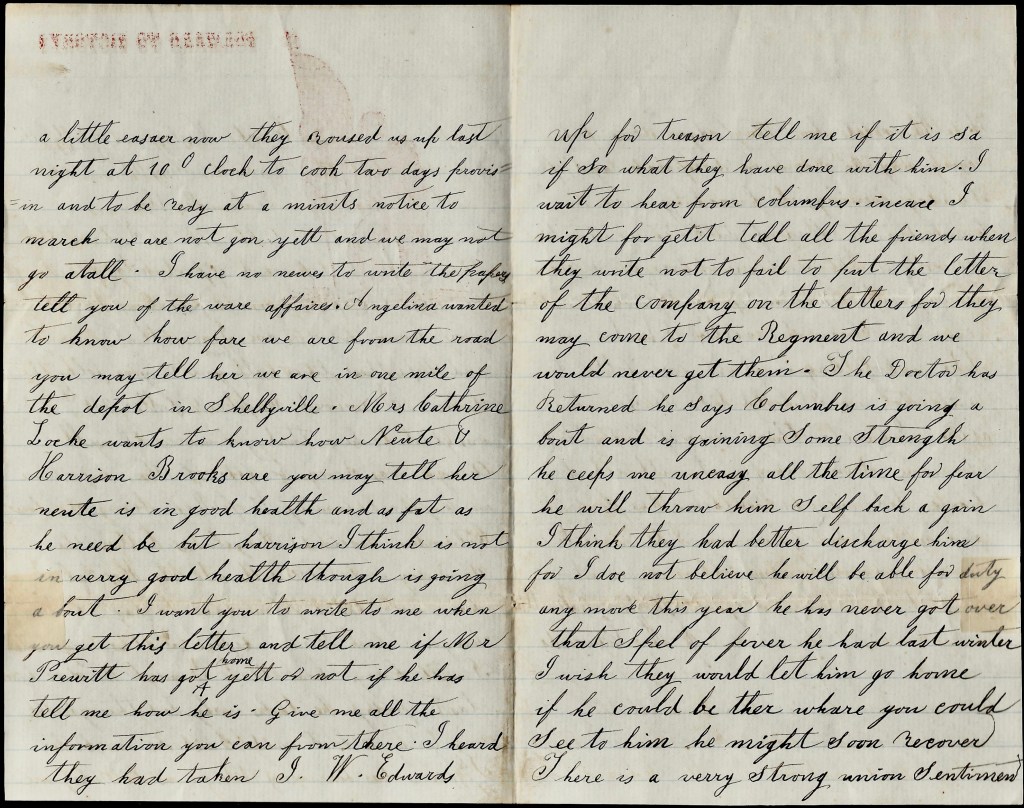
The following letter was written by James Hervey Edwards (1837-1899), the son of Cader King Edwards (1790-1851) and Ann Payton of Barren county, Kentucky. Family oral history has it that he was called “Honest Jim” by his peers because he lived by the law of iron-clad honesty. Two of James’ brothers are mentioned in the letter: Cephas D. Edwards (1837-1899) and Christopher “Columbus” Edwards (1842-1863), and one sister: Angelina Edwards (1828-1906). Both James and Columbus served together in Co. H, 21st Kentucky Infantry. James survived the war, Columbus did not. Columbus died of chronic diarrhea at a military hospital in McMinnville, Tennessee on 7 July 1863. James mustered out of the regiment at Huntsville, Alabama, on 23 January 1865. He was described as standing just shy of 5’10” with brown eyes and dark hair.
James wrote this letter to his brother who must have been Edward Steele Edwards (by virtue of elimination). Edward (1826-1900) was the oldest child and the head of the family after Cader’s death in 1851.
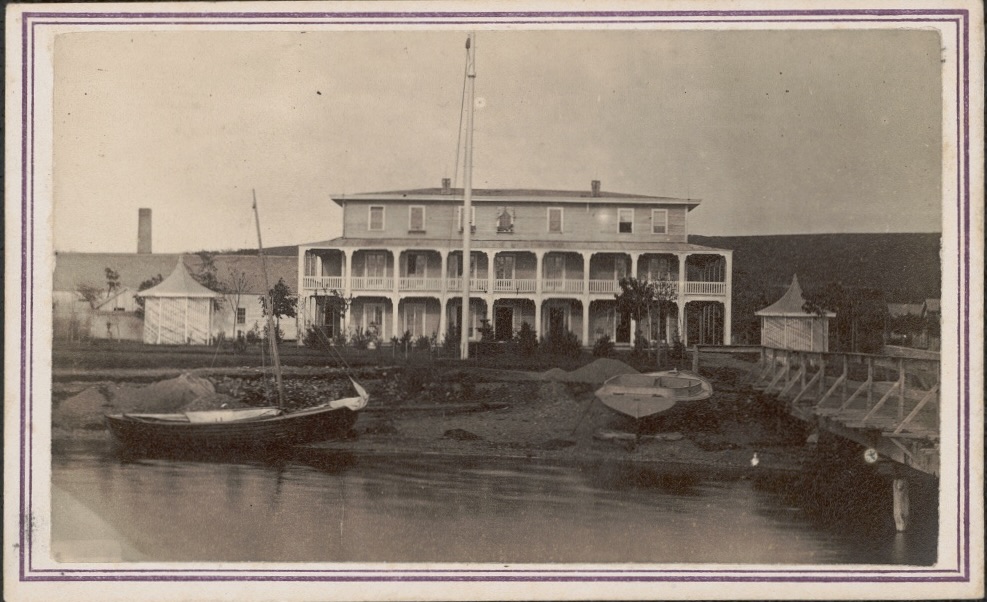
Edward Steele Edwards and other family members in front of their Barren county family home.
Transcription
Camp Negley near Shelbyville, Tennessee May 26th 1862
Dear Brother,
I have the present opportunity of writing you a few lines to let you know how I am. I am well at present and hope these lines will find you and your folks the same. I received Cephas’s letter the 24th & was glad to hear that you were all well though was sorry to hear of the misfortune in Cephas’s family and of Ben being so low. Columbus received Angelina’s letter the same day. He is still at the hospital. I have not heard from him today. The doctor has gone over there. Before I close my letter, I will know how he is. I went to see him last Friday. He looks very bad though he was going about and said he was better. The officers has been very tight on us but they are a little easier now. They roused us up last night at ten o’clock to cook two days provision and to be ready at a minute’s notice to march. We are not gone yet and we may not go at all.
I have no news to write. The papers tell you of the war affairs. Angelina wanted to know how far we are from the road. You may tell her we are in one mile of the depot in Shelbyville.
Mrs. Catherine Locke wants to know how Nute [Newton] & [William] Harrison Brooks are. You may tell her Nute is in good health and as fat as he need be but Harrison I think is not in very good health though is going about. I want you to write me when you get this letter and tell me if Mr. Pruitt has gone home yet or not. If he has, tell me how he is. Give me all the information you can from there.
I heard they had taken J. W. Edwards up for treason. Tell me if it is so. If so, what they have done with him. I wait to hear from Columbus. In case I might forget, tell all the friends when they write, not to fail to put the letter of the company on the letters for they may come to the regiment and we would never get them.
The doctor has returned. He says Columbus is going about and is gaining some strength. He keeps me uneasy all the time for fear he will throw himself back again. I think they had better discharge him for I do not believe he will be able for duty any more this year. He has never got over that spell of fever he had last winter. I wish they would let him go home. If he could be where you could see to him, he might soon recover.
There is a very strong Union sentiment for this state here. The ladies come here every day to see us on dress parade and of Sunday evenings to preaching. We are camped in a bend of Duck River on a high place in the prettiest place I ever saw a regiment stationed at. It is such a shady place, the sun scarcely strikes us the whole day.
Tell your folks to write to me. I would like to see you all. I have nothing more of importance to write. I am in hopes it will not be long till we can see each other. Be sure and write soon. Give my best respects to all who may inquire. No more at present but remain your affectionate brother, — J. H. Edwards
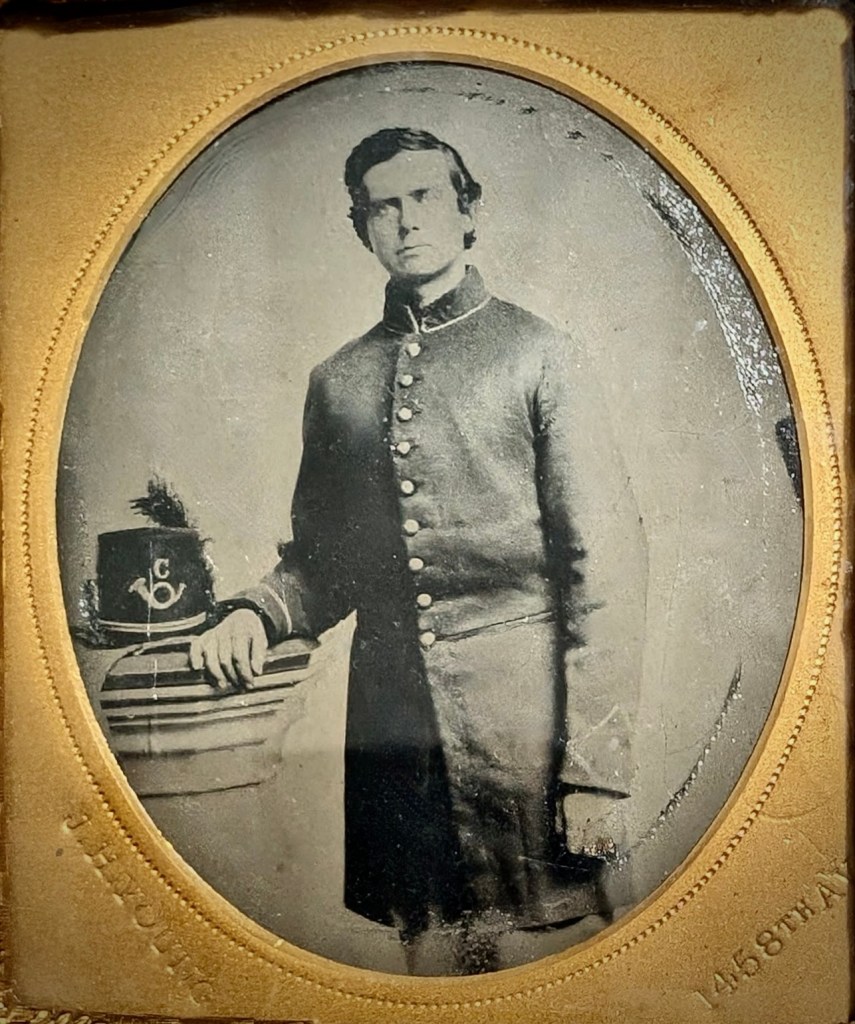
I could not find an image of George but here is Allen Nourse of Co. C, 17th Massachusetts Infantry (Mac Cook Collection)
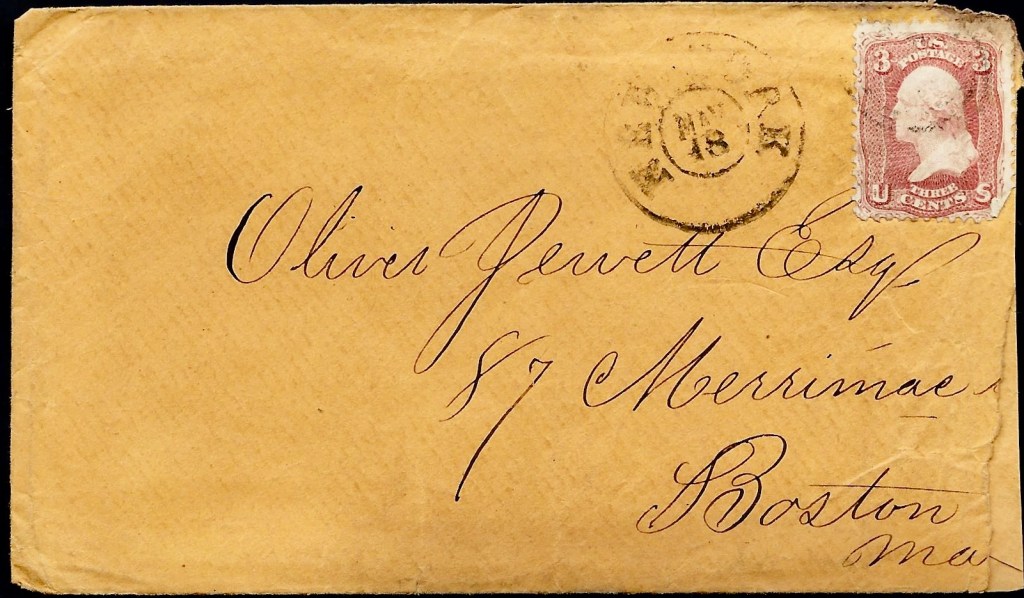
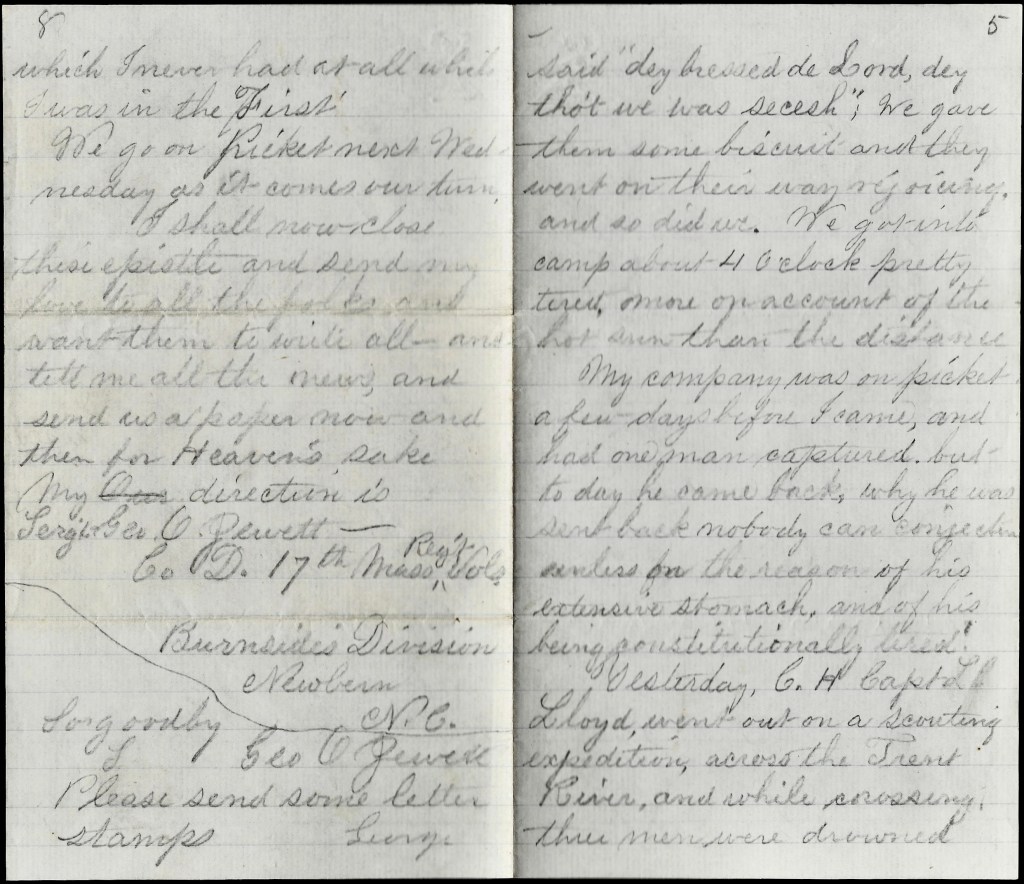
This letter was written by George Oliver Jewett (1837-1929), the son of saddler Oliver Jewett (1805-1873) and Elizabeth Underwood Hubbard (1809-1894) of Chelsea, Suffolk county, Massachusetts. George first entered the service as a corporal in the 1st Massachusetts. He later enlisted in March 1862 as a corporal in Co. H, but was eventually promoted to sergeant in Co. D. of the 17th Massachusetts Infantry. He mustered out in February 1864 and was transferred into Co. H, 13th Veteran Reserve Corps where he served until May 1865.
George’s letter describes his first arrival in New Bern, North Carolina, where he was assumed the duties of a sergeant in Co. D.
Jackson’s House Trent Road 6 miles from Newbern, N. C. May 11, 1862
Dear Father,
I have been three days in camp, having arrived last Thursday afternoon. The Captain, Lieut. Cheever and Lt. Fellows were very glad to see me as well as all the rest of the Chelsea fellows. We arrived at Newbern Wednesday evening at about 7 o’clock and anchored in the stream where we remained all night. The next morning we landed and had to remain in the city about four hours while Lieut. Poor ascertained where our reg’t was stationed. I could not see much of the city as there is a patrol all the time which allows nobody in the streets without a pass, but as far as I saw, it is an extremely pretty place. The streets are rather narrow but they are all shaded by trees on both sides of the way, and forming an arch over the middle of the street which has a fine effect.
Our regiment was found to be about six miles from town, doing picket duty, having been drawn in about 6 miles the day before. They were 14 miles from town a few days ago, but were relieved by the 103 New York Regiment (all dutchmen). My position as sergeant was all ready for me when I arrived and Lieut. Cheever told me to just do my best, and he should not be surprised at all if I obtained a commission—especially as there would probably be a change soon in the regiment which would affect our company.
After it was ascertained where we were to go, we left our knapsacks and other packages at the brigade headquarters in Newbern and marched to camp, passing through numerous encampments, munching our hard bread all the way. On our route we passed a few houses (there are not many in this region), one of which was empty. It belonged to “secesh” so we went in and examined “a few.” There was nothing in the house but a piano all smashed to pieces by some person or persons unknown. We went into the garden and picked a few strawberries and a few roses, after which we trotted on. About 2 miles further on we stopped [at] a house where there was on old lady and her daughter who were civil but didn’t say much to us as they were “secesh,” the daughter’s husband being in the rebel army. Most all the people about here are “secesh.”
A little way further up we met two darkies who were going to run away from us but we told them to “halt” and they did, and when we came up, they were very much frightened. We told them not to be scared as we were Union soldiers upon which they were joyful and said “dey bressed de Lord, dey tho’t we was secesh.” We gave them some biscuit and they went on their way rejoicing and so did we. We got into camp about 4 o’clock pretty tired more on account of the hot sun than the distance.
My company was on picket a few days before I came and had one man captured but today he came back. Why he was sent back, nobody can conjecture unless on the reason of his extensive stomach and of his being constitutionally tired.
Yesterday, Co. H Capt. L. Lloyd went out on a scouting expedition across the Trent River and while crossing, three men were drowned. Their bodies were recovered and brought in last night. There has been considerable anxiety about Co H as they did not return last night so they sent Cos. F and K to find them, but as I am writing, some of Co K’s men have come in and say Co. H is safe and coming along with two prisoners and some muskets.
One of the recruits who came on with me had his one of fingers shot off this morning accidentally. He belonged to Co. F.
The country about here is covered with forest, every tree which contains some kind of pitch, rosin, or other sticky substances. Our camp looks very pretty. The different companies have laid out trees in their company streets so it looks nice and clean. I would like to have you send word to me if Billy Jones has been paid or not ($100). I shall not get paid off for 2 months to come so I shall become quite used to being penniless, but I suppose there’s a good time coming. But I should like a little money to get my flannels washed once in a while, but I suppose I must grin and bear it. I am very well indeed and am always anxious for meal time as I have quite an appetite which I never had at all while I was in the First [Massachusetts].
We go on picket next Wednesday as it comes our turn. I shall now close this epistle and send my love to all the folks and want them to write all – and tell me all the news, and send us papers now and then for Heaven’s sake. My directions is Sergt. George O. Jewett Co. D, 17th Mass Reg’t Vols., Burnside Division, Newbern, N. C.
The following letter was written by Lydia (McAllister) McKeen (1838-1933), the wife of James H. McKeen of Patten [post office], Aroostook county, Maine.
Lydia write the letter to Hiram Keay (1828-1907), the son of Thomas Keay and Rebecca Grant of Bowdoin, Maine. Hiram was 34 years old and residing in Island Falls, Maine, when he enlisted as a private in Co. H, 20th Maine Infantry on 29 August 1862. He was transferred to the 2nd Battalion, Veteran Reserve Corps in September 1863 due to the wound he received in his left hand. How of when Hiram was wounded is not stated in the letter but a Return of Casualties in Maine Regimentsat the Battle of Fredericksburg shows that he was “wounded and missing.” Most likely Hiram was still hospitalized from that battle seven months earlier as the regiment did not participate in the Battle of Chancellorsville due to an outbreak of smallpox in the regiment.
Lovell General Hospital, Portsmouth, Rhode Island, where Hiram Keay was being treated for his hand wound, received in the Battle of Fredericksburg. (LOC)
Transcription
Addressed to Mr. Hiram Keay, Esqr., Ward G, Lovell General Hospital, Portsmouth Grove, Rhode Island
July the 12th 1863
Absent but not forgotten friend,
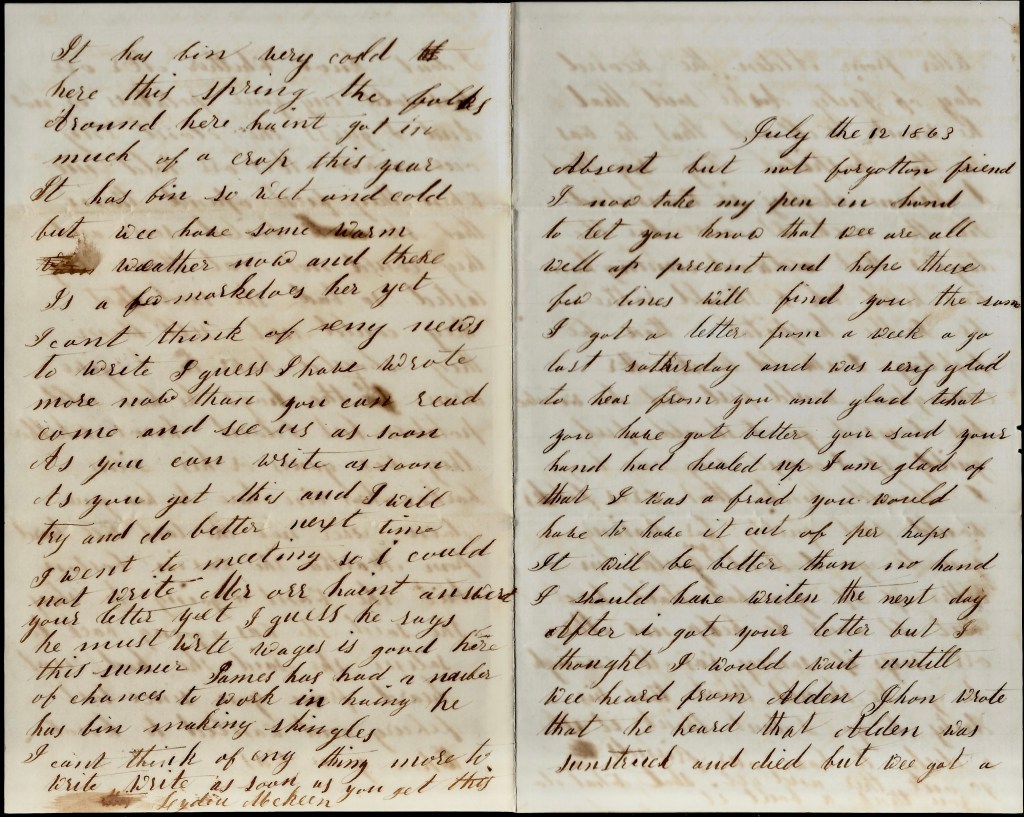
I now take my pen in hand to let you know that we are all well at present and hope these few lines will find you the same. I got a letter from a week ago last Saturday and was very glad to hear from you and glad that you have got better. You said your hand had healed up. I am glad of that. I was afraid you would have to have it cut off. Perhaps it will be better than no hand.
I should have written the next day after I got your letter but I thought I would wait until we heard from Alden [Cunningham]. I have wrote that we heard that Alden was sun struck and died but we got a letter from Alden the second day of July and he said that he wasn’t well and that he was in the hospital. They say that Hiram Chesley 1 is wounded in the neck. It come in the dailies that Edward Cunningham was killed. 2 Oh, I should rather be in the hospital than be fighting. I should think Mr. Cunningham would feel bad. He wanted his boys to go. I should feel guilty if I coaxed anyone to go. I should think that Orr’s folks would feel guilty for teasing you to go. I think you would [have] been better off if you had stayed here. But it can’t be helped now. Mr. Orr says if Sammy [b. 1845] was old enough to go, he should think t’was his duty to go. I don’t think it is a duty to have our friends go out there and get shot. What do you think about it?
I don’t know whether Mr. [William D.] Orr has sold any of your potatoes or not and I guess they don’t anyone know. Mrs. Orr told me when they first opened them that she boiled some and they could not eat them—they tasted so bad. She said that they could not sell them. They should have to give them to the hogs. He has sold potatoes but I don’t know whether they was yours or his.
Silas Barker has been here. He has gone down river now. The last we heard from Martha she was in Boston but she wasn’t going to stay. She said she a going back to Salem. She said she had not heard from you since last February and wanted to know where you was.
It has been very cold here this spring. The folks around here haint got in much of a crop this year, it has been so wet and cold, but we have some warm weather now and there is a few mosquitoes here yet.
I can’t think of any news to write. I guess I have wrote more now than you can read. Come and see us as soon as you can. Write as soon as you get this and I will try and do better next time. I went to meeting so I could not write. Mr. Orr haint answered your letter yet, I guess. He says he must write. Wages is good here this summer. James has had a number of chances to work in haying. He has been making shingles.
I can’t think of anything more to write. Write as soon as you get this. — Lydia McKeen
1 Hiram H. Chesley, attorney, Louisville, was born in Aroostook County, Maine, September 8, 1844, and is a son of Bela H. Chesley, of Anoka, Minn., a native of Oxford County, Maine. Mr. Chesley served in the late war in Co. H, 20th Maine Volunteer Infantry, and participated in the battles of Antietam, Fredericksburg, the Wilderness, Gettysburg and others. He received a gunshot wound through the neck at Gettysburg, which crippled him for life. He lay paralyzed for eighteen months, entirely helpless, and has suffered untold misery ; not an hour passes until the present time that does not bring its pains. He came to Marion County, Ill., in September, 1865. He there read law, and was admitted to the bar in 1867. In April, 1870, he located in Louisville, where he still remains, engaged in the practice of his profession. He was married, January 23, 1868, to Mary E. Tubbs, daughter of Alva Tubbs (deceased). She was born in Jennings County, Ind.” Excerpt from “History of Wayne and Clay Counties, Illinois 1884
2 Private Edward Cunningham, orderly to Major General Abner Doubleday. A member of Company I, 1st Maine Cavalry, he was a resident of Patten, Maine. Cunningham was killed on July 3 and was buried in the Maine plot in Gettysburg’s National Cemetery. On his body was found a postage stamp, a comb, and $3.95 in cash. (Union Casualties at Gettysburg, by Travis W. Busey and John W. Busey, 1:20)
The following letter was written by Christopher L. Davis (b. 1818) who entered Co. G, 29th Indiana Infantry as a private and was commissioned a 2nd Lieutenant on 2 May 1863. He resigned his commission on 14 November 1864. Christopher was born in Virginia but was living in LaPorte county, Indiana by the early 1840s and was married to Jemima Warwick in May 1845. He was enumerated as a farmer with his wife and five children in Springfield township, Laporte county, in the 1860 US Census. After the war, Christopher and his family moved to Chattanooga, Tennessee where he worked as a house carpenter.
The 29th Indiana was organized at Laporte, Indiana, and mustered in August 27, 1861. They were ordered to Kentucky and joined General Rousseau at Camp Nevin October 9, 1861, then attached to Wood’s Brigade, McCook’s Command at Nolin, Ky., to November, 1861; 5th Brigade, Army of the Ohio, to December, 1861.
The regiment first saw action at the Battle of Shiloh. “…People mainly tell me that the Rebels can’t fight. They can fight just as well as we can!” wrote Harvey Grable, a member of Co. E, to his mother a week after the battle. [See John Harvey Grable to Mary F. Grable, letter dated 15 April 1862, Spared & Shared 22]
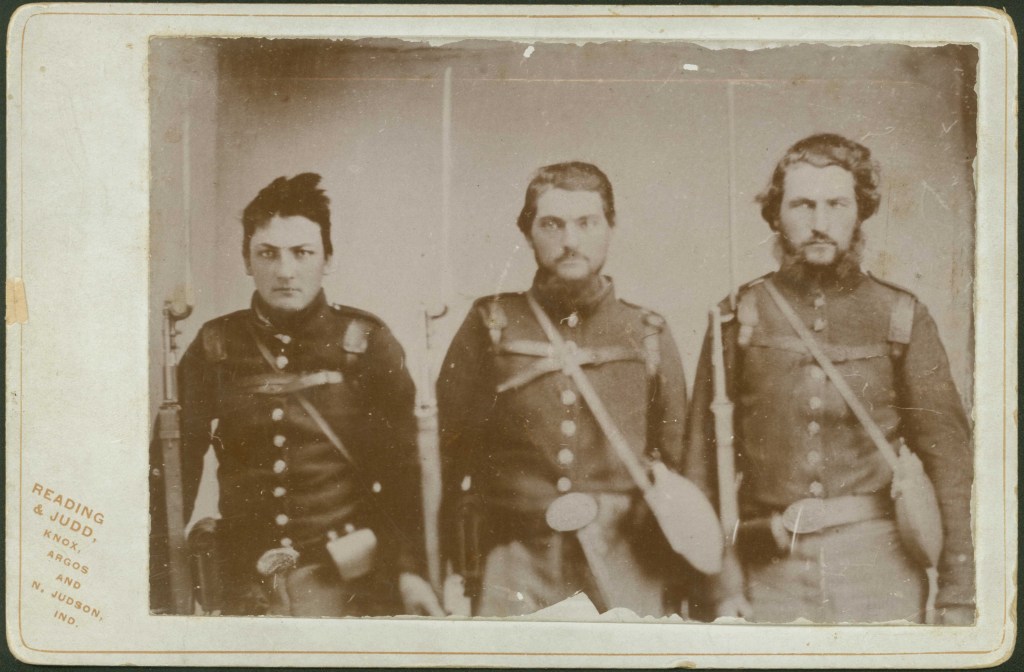
I could not find an image of Christopher but here are the Bascom brothers who all served in Co. D, 29th Indiana Infantry. Jonathan is to the left, then Silas, then Isaac Reece Bascom. They were mustered out at Marietta, Georgia on 2 December 1865, except for Silas who was wounded at Stones Creek, TN, and died from this wounds on 26 March 1865. (Ancestry.com)
Transcription
Camp Wood December 13, 1861
Dear Friend,
I take my pen up to write you a few lines to inform you where we are and what we are about. We moved on this place last Wednesday and we marched 15 miles farther into secesh. We are now where we can lay down on our back to look up to tops of the hills and eight miles from the secesh and about fifty thousand soldiers around us, with plenty of cannon and ammunition, [and] plenty to eat. But we are in a land that is cursed with the negro and if you could only look on us and the great preparation that is made, you would think that the war would soon come to a close. But [we] are a going have some hard nuts to crack yet.
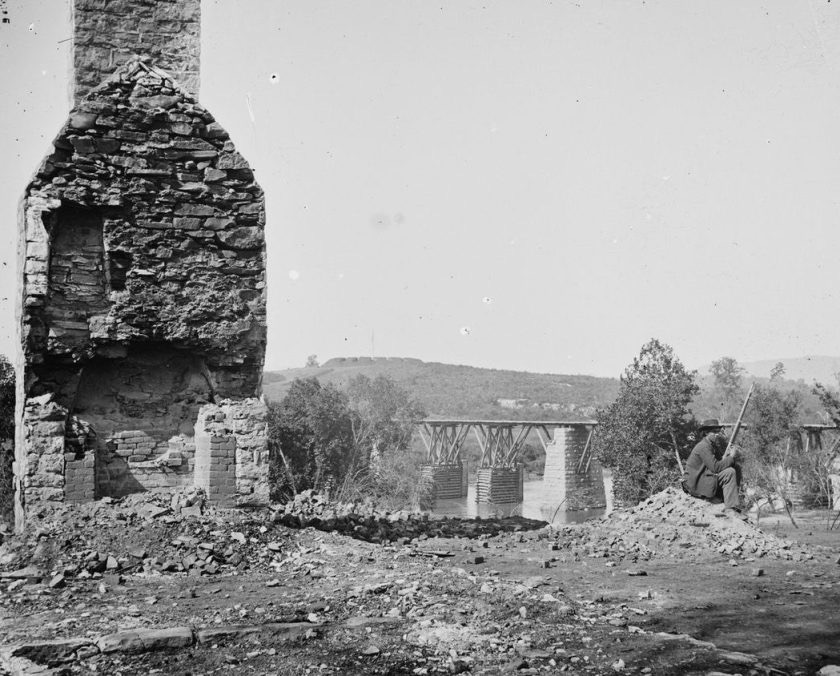
Where we are now, the secesh burnt the railroad bridge one week ago but now it is built up again and before you get this letter, I think that we will have something to do. We are going to make a move on Monday on to Bowling Green where Buckner is said to be fortified and our men are eager for a fight.
Men that never saw a movement of soldiers have no idea of the scene. Last Wednesday we were more than ten miles long and [as far as] you could see. The barefooted whites and blacks look like they thought that the angel Gabriel was blowing his trumpet, and from the noise you would have thought like an old man that we met on the road when he said that if he was a secesh, he would quit this world and climb a white oak tree. Says where did all of dese foks come from.
We are generally well. All of the boys from our part of the country are well and you will hear a good account of them when they come into a battle. We will give them fits first and then we will give them blue pills and powder to cure them. Where [we] are now, the grain is standing in the shock and the hay is in the cock and everything looks desolate—fences burnt, houses left vacant. But some of the owners are trying to get back. War desolates wherever it goes and I never want it to come any nearer to us that it is.
The weather is good here—pleasant and warm days but frosty nights. But we do not suffer in our cotton houses. Our beds are a bunch of hay out of the cock and a blanket for our cover. And yet we are comfortable and merry as larks. When night comes, you can hear many songs, fiddles and all kinds of noise. It is like building the Tower of Babel.
The boys went out today to get some chickens to eat and they found six at the moderate price of twenty-five cents and took them the [hen?], but when we get home, we want another picnic to make up for this and if you have any secesh up with you, just tell them that we are among their friends and we will clean them out and then come and give them a turn, and I tell you, it will do me good to do it.
B____’s boys 1 sent home twenty dollars to their father and the boys are good boys and I think that it will be a benefit to them if they ever get back. Give my respects to all of my union friends and tell them that I will do my best for my country but the secesh tell them to keep themselves clear for I hate them worse than ever. They are nothing but thieves and bridge burners here and if they had a chance, they would be nothing else as they would not have any sympathy for them.
We have four contrabands with us and some of the regiment get some every day. We make them cook for us. When we get through, we will have more of them [than] we will know what to do with and I think that old Abe ought to begin to send them to someplace now for they are the lowest of all creation. The more I see of it [slavery], the more I hate it. They have cursed all of Kentucky and all other lands where it lives and God speed the end now.
Dear friend, I have wrote you a few lines siting on the ground on a bunch of grass with a board on my lap which is all the desk that a soldier has now. I must close. You must write to me what is going on. Direct your letter as you do B____’s letters and they will come to me. Your friend, — Christopher L. Davis
1 Probably David Meredith Love (1841-1908) and his brother James Love (b. 1838). They were both living in Springfield township when they enlisted in 1861 in Co. G, 29th Indiana Infantry.
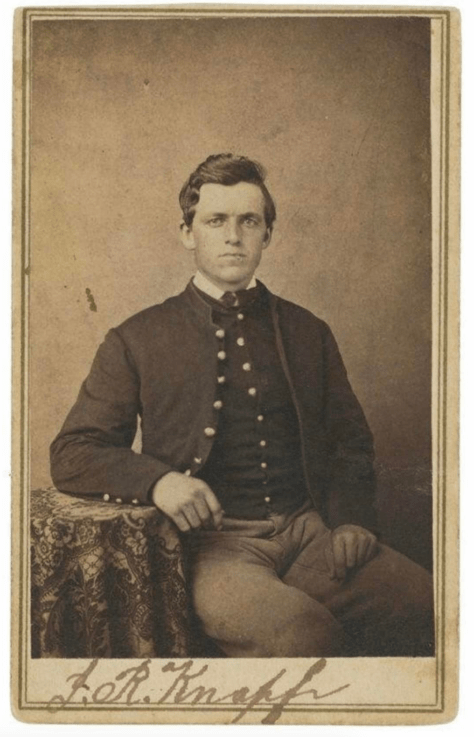
I could not find an image of James but here is a cdv of Jacob R. Knapp, also a resident of Rockford, Iowa, who served in the same regiment. (Iowa Civil War Images)
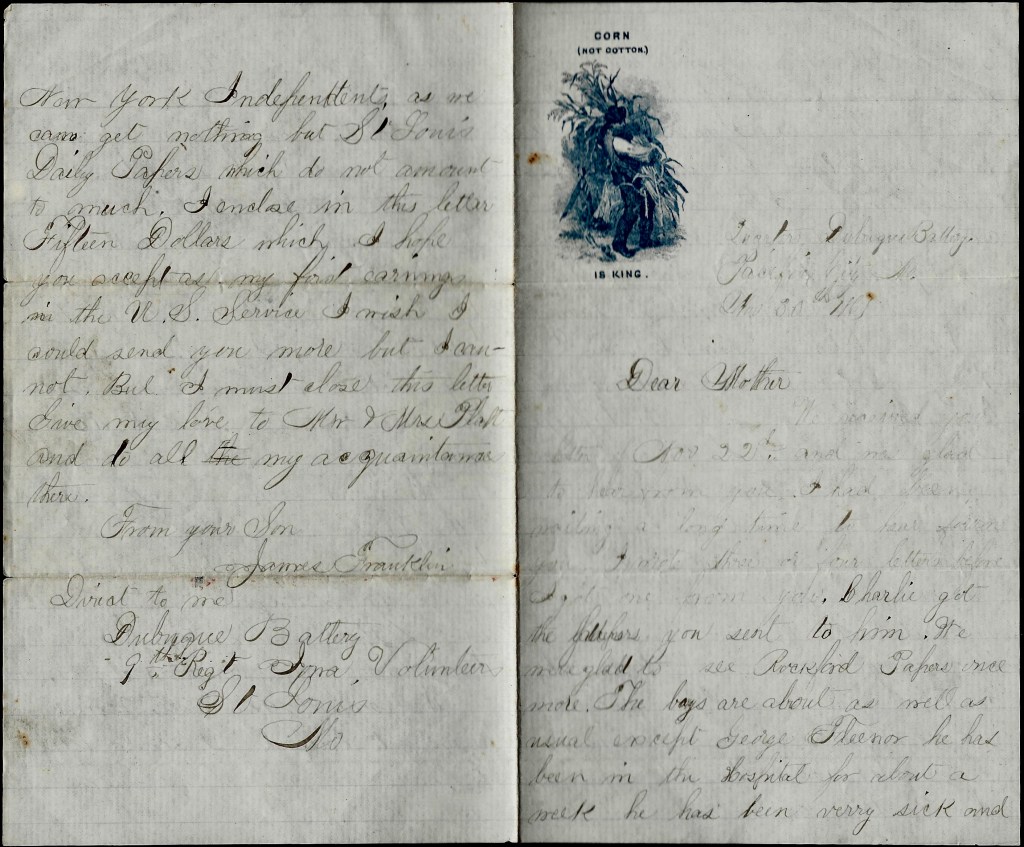
This letter is was written by James Franklin (1840-1874), the son of Burton P. Franklin (1811-1861) and Rachel K. Bushnell (1810-1886) of Rockford, Floyd county, Iowa. James and his younger brother, Charles R. Franklin (1843-1888) enlisted together in the 9th Iowa Regiment which became the “Dubuque Battery” (later designated the 3rd Iowa Light Artillery) in late August 1861. The Battery suffered 3 enlisted men who were killed in action or who died of their wounds and 34 enlisted men who died of disease, for a total of 37 fatalities. Both James and his brother survived the war and mustered out with the regiment on 23 October 1865.
James’ letter was penned on stationery with an image contending that “Corn (not Cotton) is King.”
Transcription
Quarters Dubuque Battery Pacific City, Mo. November 30, 1861
Dear Mother,
We received your letter of November 22d and was glad to hear from you. I had been waiting a long time to hear from you. I wrote three or four letters before I got one from you. Charlie got the papers you sent to him. We were glad to see the Rockford papers once more.
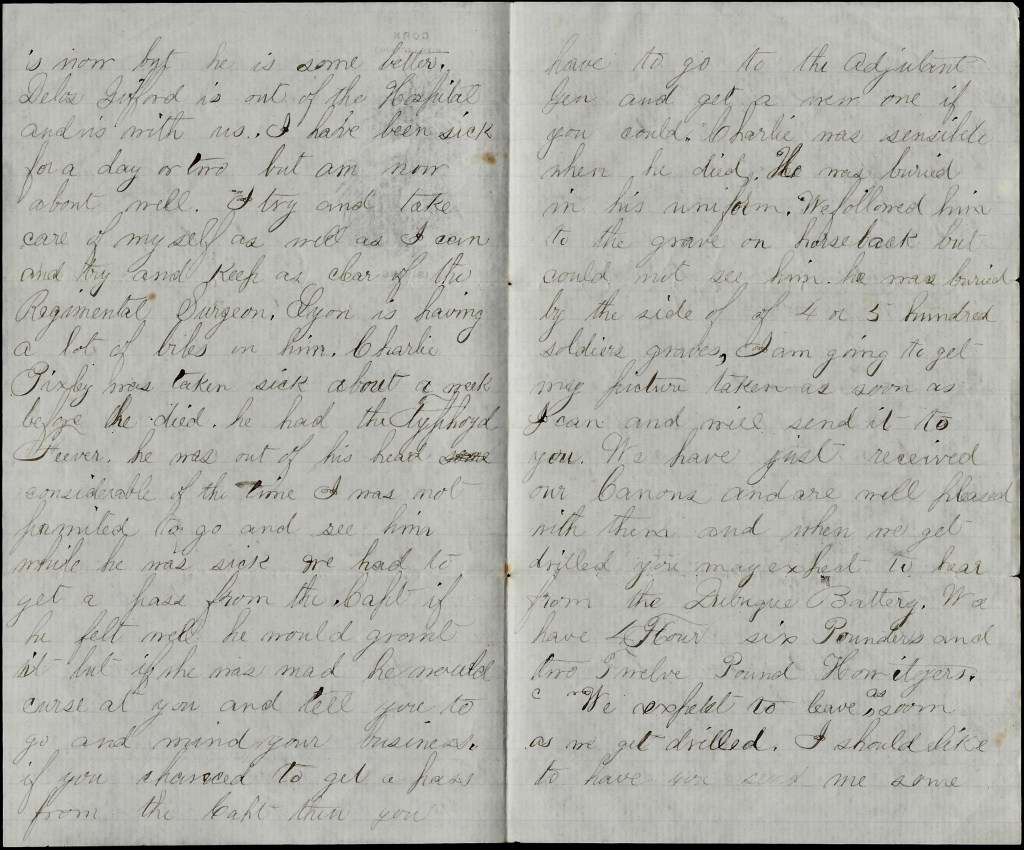
The boys are about as well as usual except George [T.] Fleenor. He has been in the hospital for about a week. He has been very sick and is now but he is some better. Delos Gifford is out of the hospital and is with us. I have been sick for a day or two but am now about well. I try and take care of myself as well as I can and try and keep as clear of the Regimental Surgeon. Lyon is having a lots of biles [boils] on him.
Charley [J.] Pixley was taken sick about a week before he died. He had the typhoid fever. He was out of his head considerable of the time. I was not permitted to go and see him while he was sick. We had to get a pass from the Captain. If he felt well, he would grant it but if he was made, he would curse at you and tell you to go and mind your business. If you chanced to get a pass from the Captain, then you have to go to the Adjutant General and get a new one if you could. Charlie was sensible when he died. He was buried in his uniform. We followed him to the grave on horseback but could not see him. He was buried by the side of 4 or 5 hundred soldier’s graves.
I am going to get my picture taken as soon as I can and will send it to you.
We have just received our cannons and are well pleased with them and when we get drilled you may expect to hear from the Dubuque Battery. We have four six-pounders and two 12-pound Howitzers. We expect to leave as soon as we get drilled. I should like to have you send me some New York Independents as we can get nothing but St. Louis Daily Papers which do not amount to much.
I enclose in this letter fifteen dollars which I hope you accept as my first earnings in the U. S. Service. I wish I could send you more but I cannot. But I must close this letter. Give my love to Mr. & Mrs. Platt and to all my acquaintance there. From your son, — James Franklin
Direct to me, Dubuque Battery, 9th Regiment Iowa Volunteers, St. Louis, Mo.
Sgt. William M. Vanzant, 1st Iowa Light Artillery (Special Collections, Iowa State University)
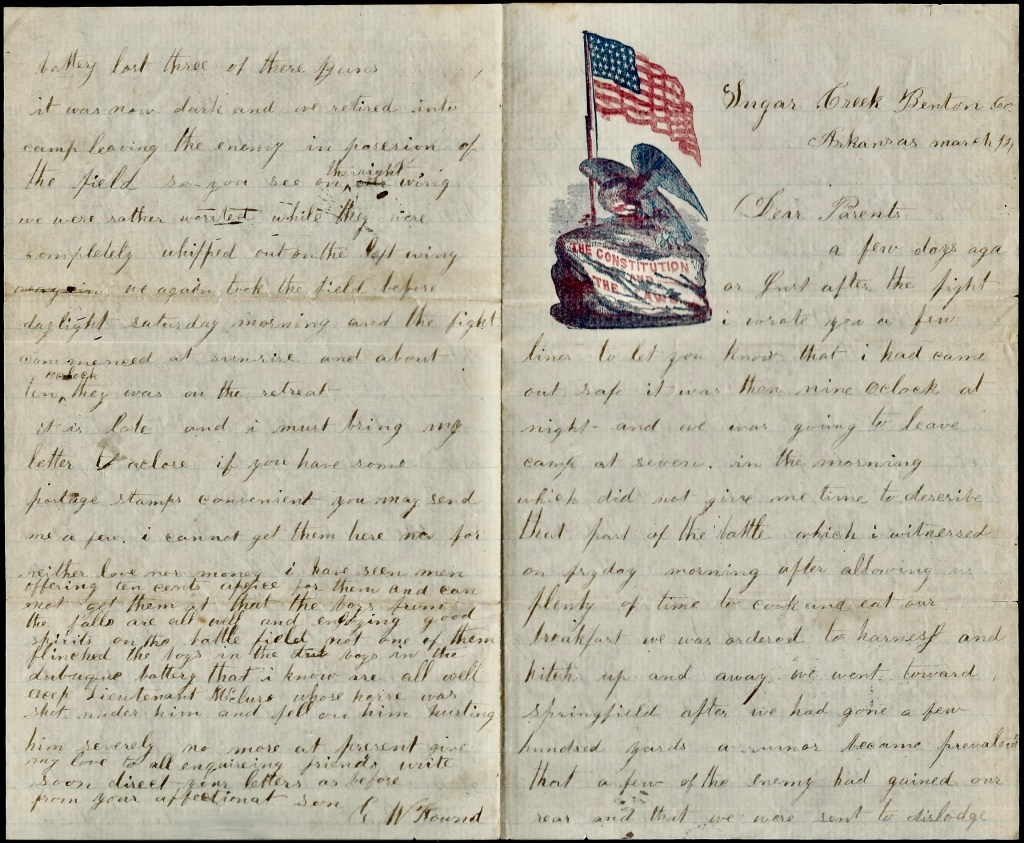
This letter was written by George W. Rownd (1842-1864), the son of James Quincy Rownd (1810-1905) and Caroline Brown (1817-1894) of Cedar Falls, Black Hawk county, Iowa. George’s surname name was entered in the Muster Rolls as “Round” when he was entered the 1st Iowa Light Artillery in August 1861. He was discharged for disability in late November 1863 and died early in 1864 at a Union Hospital in Helena, Arkansas.
George’s letter provides us with a great account of the Battle of Pea Ridge (or Elkhorn Tavern). A similar letter written by William Vanzant of the same Battery who wrote to his brother Henry and sister-in-law Nancy on March 14, 1862 from Arkansas’ Sugar Creek Camp. In the letter, William describes the Battle of Pea Ridge which took place during the early part of the Civil War in northwestern Arkansas. The letter is from the Van Zandt Family Papers. The collection’s description and finding aid is available online: https://www.scribd.com/document/84127758/Battle-of-Pea-Ridge-Letter-by-William-Vanzant-transcript
The 1st Iowa battery of four 6-pounders was able to turn and confront Price’s attacking Missourians until they were overrun, but their stand allowed the rest of the division of Col. Eugene A. Carr to arrive to oppose the Confederate drive. Unlike many of the commanders on both sides at Pea Ridge, Carr was a professional soldier, a graduate of West Point, and a cavalryman who had served on the frontier – characteristics he also shared with Van Dorn. Although he was wounded three times in the battle he remained on the field directing his division and was promoted to brigadier general and later awarded the Medal of Honor for his service here.[Civil War Talk]
Transcription
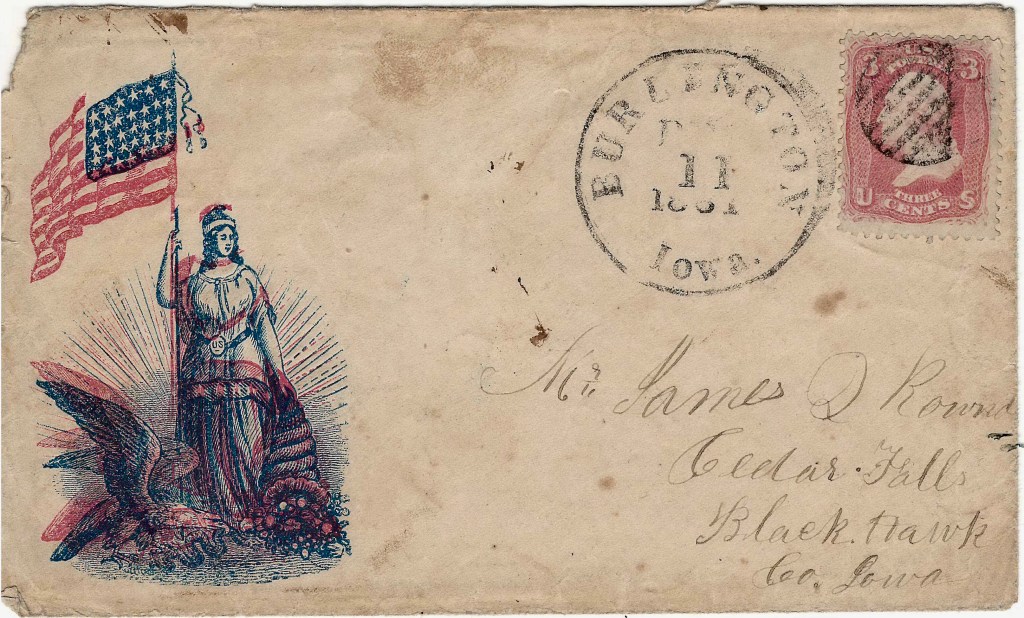
This envelope does not go with the letter; it’s from the collection of Alan Magary.
March 14 [1862] Sugar Creek, Benton county, Arkansas
Dear Parents,
A few days ago or just after the fight, I wrote you a few lines to let you know that I had come out safe. It was then nine o’clock at night and we was going to leave camp at seven in the morning which did not give me time to describe that part of the battle which I witnessed.
On Friday morning, after allowing us plenty of time to cook and eat our breakfast, we was ordered to harness and hitch up and away we went toward Springfield. After we had gone a few hundred yards, a rumor became prevalent that a few of the enemy had gained our rear and that we were sent to dislodge them. We soon found out that their small force consisted of the whole force of Price’s army and some two thousand Indians.
Our battery set the ball a rolling if I except Sigel’s fight on Thursday. The fight commenced about eleven o’clock at the Elkhorn Tavern, the right section turned to the wast and the left section and center section kept on about four hundred yards north. At the Elkhorn, the center section got tangled up with some mule teams and the left section or two guns had to bear the fire of a full battery of six guns. But we were not idle. We were sending shot and shell amongst them in a hurry and they were sending shell, shot, and canister at us and they fell around us like hail. Kirk [W.] Henry, Captain Jones, Lieutenant Gambell, Sergeant [H. R.] Horr, William Seldon, William [F.] Conner, Clark Woodmancy, John Easton, Corp. [D. J.] Duval, Samuel Black, and some three or four more wounded. Reese Parkhurst 1 and Gustavis Gustavison 2 and William Hall were killed.
After fighting against three times our number for more than an hour, our four guns retired and the six guns of the Dubuque Battery marched into our places but they did not stay long during the day. They drove us back to some open fields south of the Elkhorn Tavern. Here we made a stand. Our infantry fell to the rear of the artillery and on came the rebels whooping and yelling, flags a waving. In fact, they made sure if having us all in their power. But a few well directed rounds from twelve guns sent them in search of timber and then the splinters sent them farther when we again took possession of the Elkhorn Tavern. But in a few moments they again drove us back and here the Dubuque Battery lost three of their guns.
It was now dark and we retired into camp leaving the enemy in possession of the field, So you see on the right wing we ewre rather worsted while they were completely whipped out on the left wing. We again took the field before daylight Saturday morning and the fight commenced at sunrise and about ten o’clock they was on the retreat.
It is late and I must bring my letter to a close. If you have some postage stamps convenient, you may send me a few. I cannot get them here for neither love nor money. I have seen men offering ten cents apiece for them and cannot get them at that. The boys from the Falls are all well and enjoying good spirits. On the battlefield, not one of them flinched. The boys in the Dubuque Battery that I know are all well except Lieutenant McClure whose horse was shot under him and fell on him, hurting him severely. No more at present. Give my love to all enquiring friends. Write soon. Direct your letters as before. From your affectionate son, — G. W. Round
1 The report of the Battery by its commander, Capt. Junius Jones, states that Reese Parkhurst was killed early in the action, a cannon ball taking off his leg, and another shot striking him in the head.
2 Gustavison had his right leg shot off by a solid shot and died of shock and amputation.
The following diary was kept by Alonzo Clarence Ide (1842-1920) from mid October 1862 until 31 December 1863 while serving in the 2nd Michigan Infantry. His 1864 Diary, picking up where this one leaves off, is housed at the University of Michigan, is digitized, transcribed, and available on-line at Alonzo C. Ide Diary, 1864.
Alonzo was the son of Nathaniel Ide (1806-1863) and Almerie Hampton (1818-1897) of Cayuga county, New York. He came with his parents to Kalamazoo county, Michigan, about 1851 where his father took up farming. Alonzo had two younger brothers, William and Alva, but neither of them lived more than a couple of years. His two sisters, Mary and Alice lived into the 1920s.
Muster rolls records show that Alonzo enlisted on 18 May 1861 in Co. C, 2nd Michigan Infantry and that he was discharged from that regiment on 21 July 1864 (3 years and 2 months). He was then transferred to Co. D, 17th Michigan for the remainder of the war. In the Battle of Jackson, Mississippi, on 11 July 1863, Alonzo was wounded “slightly” (his words) in the head, as recorded in his diary.
This diary is from the personal collection of Greg Herr and was made available for transcription and publication on Spared & Shared by express consent.
Inside cover of Alonzo C. Ide’s 1863 Diary (Greg Herr Collection)
Transcription
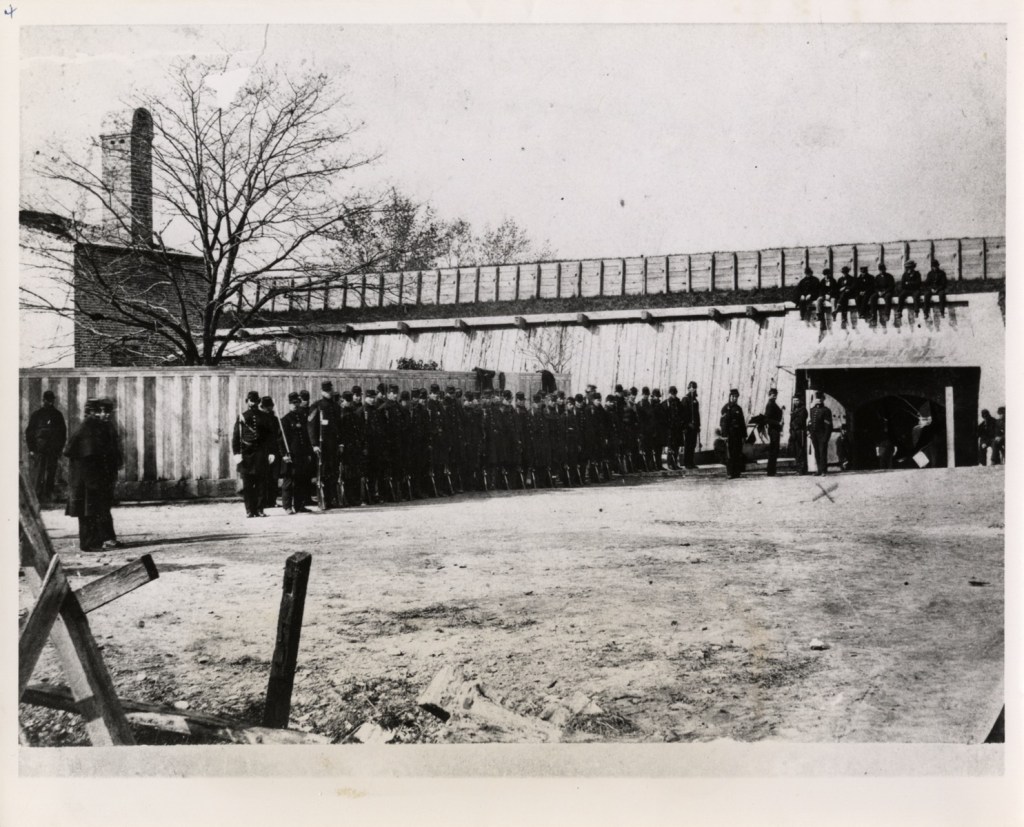
View of Battle Creek soldiers from Company C, 2nd Michigan Infantry standing in formation at Fort Wayne in Detroit. Typed on back: “Battle Creek volunteers. A group of Battle Creek soldiers of Company C of the 2nd Michigan drilling at Fort Wayne, Detroit in May, 1861. Many of them were killed or wounded at the Battle of Bull Run in July, 1861.” Handwritten on back: “Company C of the Second Michigan Infantry.” [Detroit Public Library Digital Collections]
I enlisted at Battle Creek, Calhoun county, Michigan on the 17th of May 1861. Cornelius C. Byington, Captain and J. B. Richardson, Colonel of the regiment. The regiment reached Washington on the 10th of June—went into camp (after being reviewed by the President and Gen. Scott) near the Chain Bridge. Our Brigade commanded by Gen. Richardson—was present at the 1st great Battle of Bulls Run which was fought on Sunday the 21st of July 1861.
Date of a few of the principal events of the war….
The Corps (Heintzelman’s) left Alexandria for Fortress Monroe on Monday the 17th of March 1862. Reached Fortress Monroe on Wednesday the 19th March. Encamped near Hampton, Va. Gen. Hamilton was command of our Division. Gen. E. G. Berry of our Brigade. On Thursday April 3rd, commenced the Grand Advance on Yorktown.
Sunday April 6th 1862 found us in front of Yorktown where we lay. Spending the time digging rifle pits and redoubts until the afternoon of Sunday, May 4th when the Rebels evacuated Yorktown and we commenced the advance again.
Monday, May 5th, we had a desperate engagement with the rebels at Williamsburg. It rained all day but we whipped them and occupied Williamsburg until Friday.
May 9th, Gen. Phillip Kearney I should have said before was in command of the Division & Sunday, May 25th 1862 crossed Bottoms Bridge over the Chickahominy, May 31st 1862, were in the Battle of Fair Oaks or Seven Pines. Afterwards encamped near Fair Oaks Station on the Richmond and York River railroad.
Sunday, June 29th, 1862, left Camp Lincoln in front of Richmond and commenced the great Seven Days fighting and retreat or Change of Base. Monday, June 30th 1862, were in the Battle of White Oak Swamp or Charles City Crossroads. Tuesday, July 1st 1862 were in the Battle of Malvern Hills. Wednesday July 22, 1862, reached Harrison’s Landing on the James River.
About this time General Pope issued the following address to the officers and soldiers of the Army of Virginia. I hear constantly of taking strong positions and holding them—of lines of retreat and of bases of supplies. Let us discard such ideas. The strongest position a soldier should desire to occupy is one from which he can most easily advance against the enemy. Let us study the probably lines of retreat of our opponents and leave our own to take care of itself. Let us look before and not behind. Success and glory are in the advance; disaster and shame lurk in the rear. Signed, John Pope, Maj. General Commanding.
Friday, August 15th, commenced the evacuation of Harrison’s Landing and reached Jones Ford on the same day where we staid until Sunday morning, the 17th of August. Monday, August 18th we bivouacked last night at Burnt Ordinary twelve miles from Williamsburg. Later we arrived at Williamsburg this afternoon at five o’clock. Left Williamsburg on the morning of Tuesday August 19th, reached Yorktown late the same day which is twelve miles from Williamsburg. August 20th our Division embarked on board of the transports. The 2nd regiment embarked on the steamer Express on the night of the 21st of August. August 23rd we took the cars and were taken to Warrenton Junction. Wednesday August 27th commenced falling back towards Manassas Junction having heard that Stonewall Jackson was in our rear.
Train derailed by Confederate cavalry on August 26, 1862 during the Battle of Manassas Station Operations.
Thursday, August 28th reached Bristol Station. Found three engines and a train of cars destroyed and also the bridge over Broad Run. Reached Manassas Junction about noon of the same day. Found everything in the wildest and most indescribable state of confusion. Occupied Centreville on the night of the same day. Friday August 29th, our regiment (the 2nd Michigan of Berry’s Brigade, Kearney’s Division and Heintzelman’s Corps) were deployed as skirmishers on the battle field while the fight of Bull Run No. 2 had already commenced and pretty much on the Old Bull Run Battlefield. The fight continued until the night of Saturday, August 30th, when we retreated to Centreville where we remained until the afternoon of Monday, September 1st when we once more commenced the retreat at Chantilly. About 5 miles from Centreville, the enemy attacked us again intending to cut off our retreat and capture our supplies. At this place we lost Brigadier General Stevens and Major General Kearney.
Tuesday, September 2nd. Reached Fairfax in safety. Wednesday, September 3rd, reached Alexandria. Wednesday, Sept. 10th, went into camp near Fairfax Seminary, Va. Thursday, Sept. 25th, moved camp (that is, Berry’s Brigade) to Upton’s Hill near Falls Church, Va….
[some noted dates]
Wednesday, February 12, 1862, the company received new Springfield Rifles…
Wednesday, March 19th [1862], had the honor of seeing the Monitor at Fortress Monroe. Monday, March 24th 1862—visited Old Fort Monroe. Saw the large Union Gun. Its weight is 52,005 lbs.
Camp near Falls Church, Va., Friday, October 10th 1862. We have just received orders to pack up and be ready to march tomorrow morning at four o’clock. It is expected that we are a going to Poolesville, Maryland.
Camp near Edwards Ferry, Maryland. October 13th. We took up our line of march from Upton’s Hill Saturday the 11th. Saturday night we bivouacked at Seneca Creek. Sunday noon we had reached Seneca Village and by nine at night we had reached Edward’s Ferry where we now are.
Camp near Edwards Ferry, Maryland. Thursday, October 16th 1862, today the left wing of our Battalion is on picket at the ferry. We are to remain for forty-eight hours. Monday, October 20th. Today we are on picket again—that is, the left wing of the regiment (we relieved the right wing). The whole of the regiment are on picket now. the line has been extended. Camp near Edwards Ferry, Md.
Sunday, October 26th 1862—Yesterday our Brigade was inspected by an officer of Gen. Burnside’s staff. We belong now in Stoneman’s Division and Wilcox’s Corps. 3rd Brigade, 1st Division, 9th Army Corps. under command of Major General A. E. Burnside.
Tuesday, October 28, 1862—Today our Brigade has left camp at Edwards Ferry and are once more on the march. I am with the teams as guard & J. C. Ide.
Wednesday, October 29th 1862—Today our Division forded the Potomac near Whites Ferry and we are once more in Virginia. Camp near Leesburg, Va.
Friday, October 31st 1862—Today we left our camp near the river and have went into camp some two or three miles from Leesburg.
Monday, November 3rd—We left our camp near Leesburg yesterday afternoon and reached this place late in the night. The place where we are at present encamped is called, i believe, Mt. Gilead. Close by here is the Mountain House kept by J. Eaton. Night of the 4th I left the Mountain House in company with the teams at 12 o’clock at night. We stopped at daylight about three miles from Middleburgh.
Wednesday, November 5th—We passed through to Middleburgh today about ten a.m. and through the village of White Plains about ten at night.
Thursday, November 6th—We passed through the village of Salem today about 12 M. It is a very pretty place.
Friday, November 7th, 1862—Snow fell for the first time today.
Monday, November 10th—General Richardson is dead, they say, and McClellan is removed from the command of the Army of the Potomac.
Tuesday, November 11th—Stoneman’s Division crossed the Rappahannock today.
Thursday, November 13th—Today our Division recrossed the river.
[Quotes McClellan’s farewell address]
Camp of the Michigan 2nd near Warrenton, Va. November 15th 1862—The 2nd Michigan no longer to Berry’s Brigade. We leave Stoneman’s Division today and go into Birney’s Division, Wilcox’s Corps. Name of Brigade as yet unknown.
Camp near Warrenton Junction, November 17th 1862—We passed White Sulphur Springs yesterday about 9 a.m. It is a very fine place. We reached this place near Warrenton Junction last night about 9 o’clock. We, the 2nd Michigan, belong now to Poe’s Brigade, Birney’s Division, Wilcox’s Corps.
Tuesday, November 18th—We passed Elk River (the place where I was a picket the night of the 20th of August, 1862) yesterday about ten o’clock a.m. and today we have reached this place. Time 12 M. We are about eight or nine miles from Fredericksburg. Bivouac near Falmouth, Va.
November 19th we passed through Falmouth last night about 9 o’clock and reached this place about 11. Burnside has just commenced paying his complements to the Rebels in the shape of shot and shell which he is throwing to them across the river.
November 26th—Today our Brigade were reviewed by Major General Sumner.
Friday, November 28th. Today I returned to my company. I have been with our regimental commissary department ever since the 27th of October acting as guard.
Bivouac near Fredericksburg, Saturday, Nov. 29th 1862—Today our regiment has moved down near the river to support a battery. We are close to the railroad bridge that crosses the Rappahannock and close by the side of the railroad.
Until the pontoon bridging material arrived, soldiers could only look across the Rappahannock River. Library of Congress
Bivouac near Fredericksburg, Sunday, Nov. 30th—Today I am on guard.
Friday, December 5th 1862—About two inches of snow fell today.
Saturday, December 6th—Today I am on guard again (J. C. Ide).
Monday, Dec. 8th—Came in from supporting the battery.
Thursday, Dec. 11th—The battle of Fredericksburg has commenced. Our batteries are shelling the town. We have orders to be in readiness to march at 4 in the morning in light marching order.
Friday, Dec. 12th—Time 9 a.m. Our Brigade has just crossed the river. We crossed on the pontoon bridge and are now in Fredericksburg occupying the lower part of the town.
Saturday, Dec. 13th—The ball has opened once more this morning. The fighting so far has been mostly done with artillery.
Sunday, Dec. 14th—Time 4 p.m. This day has been comparatively quiet. There has been more or less cannonading and some skirmishing going on today.
Monday, Dec, 15th—Today as regards fighting has been pretty much like yesterday with but few exceptions.
Tuesday, Dec. 16th—Last night we recrossed the river at about eleven a.m. [p.m.] and now occupy our former camp opposite Fredericksburg.
Friday, Dec. 19th—Today we had regimental inspection.
Saturday, Dec. 20th—Ordered to go on picket. We went but did not stay. We went as far as the river and then returned to camp. The weather is immensely cold.
Sunday, Dec. 21st—I am on guard. Weather is very cold.
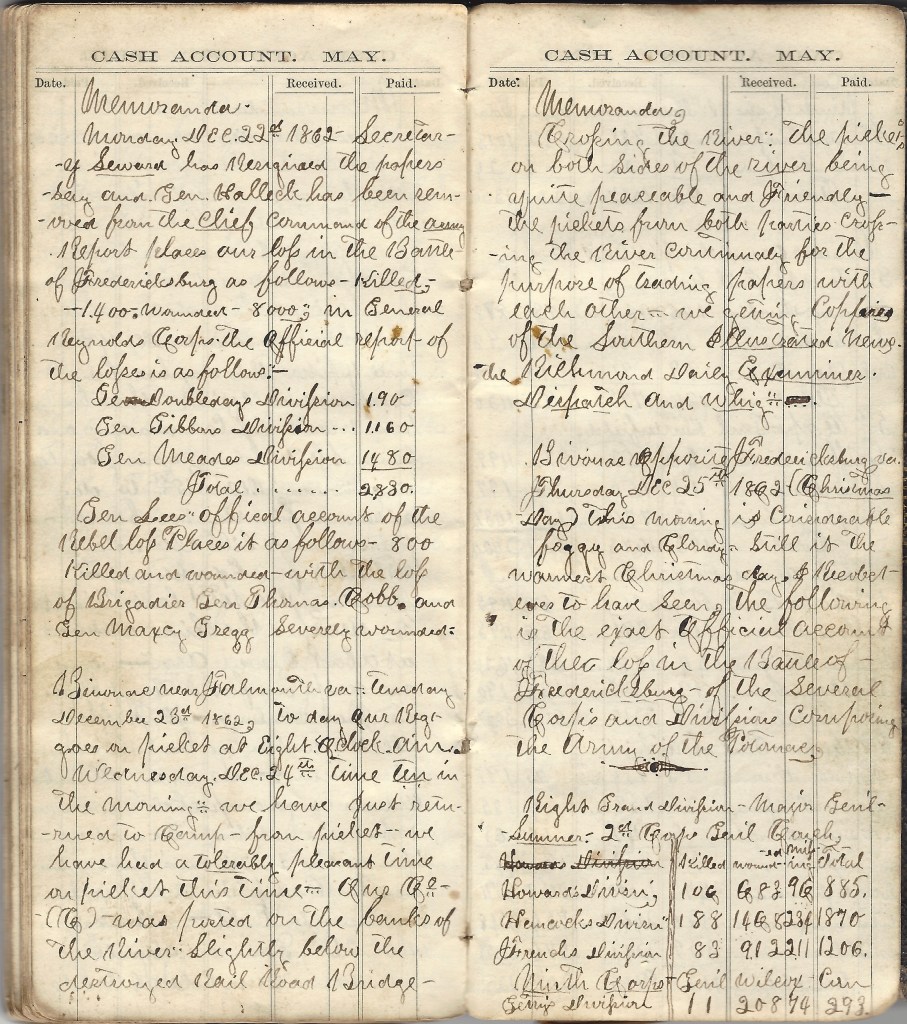
Monday, Dec. 22nd 1862—Secretary Seward has resigned, the papers say, and Gen. Halleck has been removed from the Chief Command of the army. Report places our loss in the Battle of Fredericksburg as follows. Killed 1400, wounded 8,000, in Gen. Reynold’s Corps the official report of the losses is as follows: Gen. Doubleday’s Division 190. Gen. Gibbon’s Division, 1160, Gen. Meade’s Division 1480. Total 2880. Gen. Lee’s official account of the Rebel loss places it as follows. 800 killed and wounded with the loss of Brigadier General Thomas Cobb and Gen. Maxcy Gregg severely wounded.
Bivouac near Falmouth, Va. Tuesday December 23rd 1862—Today our regiment goes on picket at eight o’clock a.m.
Wednesday, Dec. 24th—Time ten a.m. We have just returned to camp from picket. We have had tolerably pleasant time on picket this time. Our company was posted on the banks of the river slightly below the destroyed railroad bridge. The pickets on both sides of the river being quite peaceable and friendly. The pickets from both parties crossing the river continually for the purpose of trading papers with each other—we getting copies of the Southern Illustrated News, the Richmond Daily Examiner, Dispatch, and Whig.
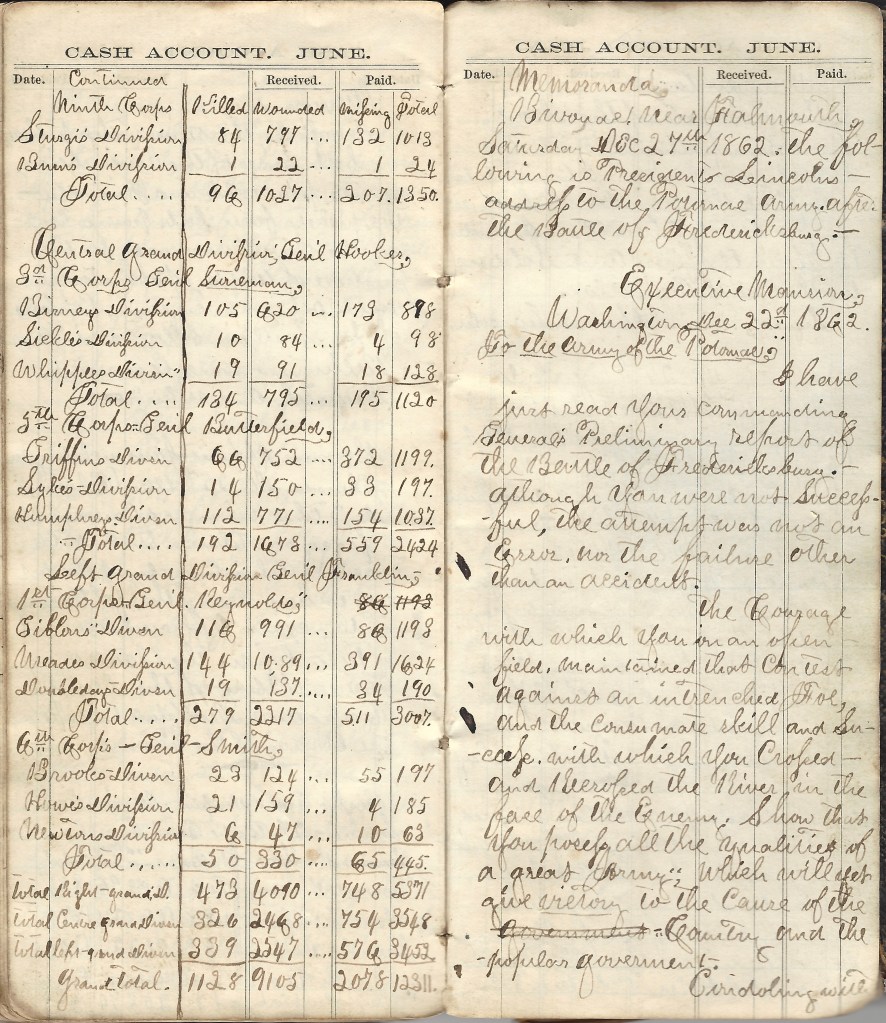
Bivouac opposite Fredericksburg, Va., Thursday, Dec. 25th 1862 (Christmas Day)—This mornin is considerable foggy and cloudy. Still is the warmest Christmas Day I have seen. The following is the exact official account of the loss in the Battle of Fredericksburg. Of the several Corps & Divisions composing the Army of the Potomac:
Bivouac near Falmouth, Saturday Dec. 27th 1862—The following is President Lincoln’s address to the Potomac Army after the Battle of Fredericksburg.
Executive Mansion Washington December 22d 1862
To the Army of the Potomac,
I have just read your commanding General’s Preliminary Report of the Battle of Fredericksburg. Although you were not successful, the attempt was not an error, nor the failure other than an accident. The courage with which you, in an open field, maintained that contest against an entrenched foe and the consummate skill and success with which you crossed and recrossed the river in the face of the enemy show that you possess all the qualities of a great army which will yet give victory to the cause of the country and the popular government. Consoling with the mourners of the dead and sympathizing with the severely wounded, I congratulate you that the number of both is comparatively small. I tender to you officers and soldiers the thanks of the Nation. Signed, — Abraham Lincoln.
Saturday, Dec 27th—Went to Famouth. Major Byington returned to the regiment.
Sunday, Dec 28th 1862—This afternoon there is to be a Division Review at one o’clock.
Wednesday, Dec. 31st 1862—Today our regiment was mustered for pay. There is now four months pay due the regiment. From the 1st of September to the 1st of January, 1863. This afternoon at 3 o’clock p.m. our Brigade was reviewed in the presence of Mr. Trowbridge, Esq., United States from Michigan. Our Brigade is now commanded by Colonel Fenton of the Michigan 8th. Col. Poe being on a furlough. Our Brigade is now composed of the following regiments, to wit: The 2nd Michigan, Col. O[rlando] M. Poe, the 8th Michigan, Col. Fenton, the 17th Michigan, Col. Willington, the 20th Michigan, Col. J. W. Williams, late Lieutenant Colonel of the 2nd Michigan, and the 79th New York.
I am detailed on picket in the morning. The remainder of this memorandum or diary will be found in the first part of the book, commencing with January 1st 1863.
January 1863
January 1, 1863—Bivouac opposite Fredericksburg, On picket today near the river. There is a detail out from each regiment in the Brigade. The weather is extremely pleasant today.
January 2nd—Nothing of importance has transpired today except that we have returned from picket.
January 3rd—Company drill this morning at eight o’clock. There is also a drill of the non-commissioned officers, Battalion drill in the afternoon.
January 4th—Another detail has gone from our regiment today for picket. I am on Brigade guard. I have a slight headache.
January 5th—Company drill this morning from nine o’clock until eleven and Battalion drill in the afternoon from two o’clock until four.
January 6th—Grand Division review at one o’clock p.m. Instead of being a Division review it has been a review of the 9th Army Corps. Brig. General Wilcox and Major Generals Sumner and Burnside were present. It rained slightly, Two men belonging to this division were drowned in crossing the river to exchange greetings with the Rebs.
January 7th—Company drill this morning from nine o’clock until eleven. I read in today’s paper that the gallant little Monitor foundered off Cape Hatteras on Monday, December 29th 1862. Another detail has gone from the 2nd Michigan this morning on picket.
January 8—The following are the distances from Washington to the following named places. Arlington Heights 2.5 miles. Alexandria 8 iles. Annapolis Junction 20 miles. Annapolis 39 miles. Aquia Creek (by way of river) 56 miles. Baltimore 38 miles. Bladensburg 5 miles. Fortress Monroe 225 miles.
January 9—Nothing of importance has transpired today—at least nothing worthy of notice., with the exception of a load of express goods from Michigan which has reached the regiment today. My headache still continues.
January 10th—Another detail went out from the regiment this morning for picket. Am excused by the surgeon on account of headache.
January 11th—All is quiet today. Company inspection only at 9 a.m.
January 12th—Many of the boys in this regiment are enlisting in the regular service.
January 13th—In the daily paper of today is an account of the capture of Galveston, Texas with commissary stores, &c. by the rebel General Magruder. The United States gunboat Harriet Lane was also captured. The commander of the steamer Westfield would not surrender but ran his steamer aground and blew her up.
January 14th—Nothing of importance transpired today. I returned to duty.
January 15th—Corporal [Robert] Molyneaux and privates Rogers & [Lansing] Fairchilds of Co. C enlist in Battery H, 1st Artillery.
January 16th—Another detail goes this morning from our regiment on picket. Eight privates go from our Co. C. I am as Brigade Guard, It is rumored that we are to move tomorrow.
January 17—The order to march today is countermanded for the present. We are to hold ourselves in readiness to march at a moment’s notice. This evening at Dress parade, orders were read to us to the effect that Maj. Gen. Sedgwick is appointed to the command of the Nine Army Corps in place of Gen. Wilcox.
January 18th—Sunday morning inspection at 10 o’clock on company grounds. The Major paid Co. C a high compliment. Said we had the cleanest and best looking lot of muskets he had as yet seen in the regiment. Orders read on dress parade that a captain [of the] 4th Maine Vols. had been court martialed and dismissed from the military service United States for showing cowardice while in front of the enemy at Fredericksburg by command of Maj. Gen. Burnside.
January 19th—Company drill forenoon and afternoon. Orders read this evening on dress parade to the effect that no more resignations were to be accepted in this Right Grand Division except on Surgeon’s Certificate of Disability or a dishonorable discharge from the service for tendering resignations while in the face of the enemy by command of Maj. Gen. E. Sumner.
January 20th—Company drill in the forenoon. Troops have been passing our camp ever since twelve o’clock M. [noon]. Orders read on dress parade to the effect that the Army of the Potomac was once more to have a chance to meet the enemy. We are to hold ourselves in readiness to march at daybreak by command of Maj. Gen. Burnside.
January 21st—We were awakened at an early hour this morning and ordered to be in readiness to march at four o’clock a.m. but we have not gone as yet. Last night a cold rain set in which has continued all day.
January 22nd—The rain continued last night until morning today. A fine mist has been falling all day. The roads are considerable muddy. Another detail from this regiment has gone on picket. 9 o’clock at night. They have just issued a gill [1/4th pint] of whiskey to each man. The forward movement seems to have been delayed for the present—probably on account of the state of the roads.
January 23rd—Major Gen. Franklin’s Grand Division have all returned to their old camps. The road has been lined all day with the stragglers from his Division.
January 24th—The distance from Washington to Fredericksburg is 65 miles, to Manassas Junction 35 miles, to Manassas Gap 110 miles, to Norfolk, Va., 233 miles.
January 25th—Another detail goes from our regiment on picket—myself as well as ten others from Co. C are in the details.
January 26th—Nothing of importance has transpired except that we have returned from picket. Orders read on Dress Parade to the effect that by order of the President, Major Gen. Burnside ceased to command the ARmy of the Potomac and Maj. Gen. Joseph Hooker assumes command of the Army of the Potomac.
January 27th—Manassas Junction, once the headquarters of the Rebel Army in Virginia is a small village situated at the junction of the Manassas Railroad with the Orange and Alexandria Railroad. It is 27 miles southwest of Alexandria, 61 miles northeast of Gondsonsville, 143 northeast of Lynchburg and 134 miles north of Richmond.
January 28th—Another detail has gone from this regiment on picket. Last night it rained. This morning there is some snow falling. I am on camp guard. Maj. Gen. Sumner at his own request has been removed from the command of the Right Grand Division. Maj. Gen. Franklin has also been removed from the command of the Left Grand Division. It is not known yet who are to take command in their places.
January 29th—There is about six inches of snow on the ground this morning. The mud is very deep and the weather is intensely cold. Another ration of whiskey was issued to us last night.
January 30th—Was detailed to go [get] fire wood for the company. In the afternoon, signed my pay roll and received two months pay. Another detail from the regiment has gone on picket.
January 31st—[quotes E. V. Sumner’s farewell address to the Right Grand Division, dated 26 January 1863]
February 1863
[In February of 1863, the Regiment with its Brigade moved to Newport News, Va..]
February 1st—I am on picket today. Another detail is out from our regiment. General Couch now commands the Right Grand Division. General Meade the Centre Grand Division, and Gen. W. T. Smith the Left Grand Division. General Franz Sigel the Reserve around Division. Gen. Hooker has issued an order granting furloughs to two men out of every hundred for 18 days.
February 2nd—Came in from picket and then went out on regimental inspection.
February 3rd—The Manassas Gap Railway is an uncompleted line of railroad terminating at Mount Jackson—a village in Shenandoah county 112 miles from the junction.
February 4th—Today I am on detail again to get wood for company. Another detail has gone from the regiment for picket. The regiment has had company drill in the forenoon and battalion in the afternoon.
February 5th—The weather has been intensely cold in the early part of the day. During the forenoon it snowed. This afternoon a heavy rain has set in.
February 6th—There is a rumor to the effect hat the 9th Army Corps is ordered to report as soon as practicable at Fortress Monroe or Newport News. This army corps is at present under command of Brig. Gen. W. T. Smith. It is thought our destination will eventually be the Carolinas.
February 7th—I am on picket again this morning. We were relieved from picket this afternoon about one o’clock. Our brigade was relieved by a detail from the 2nd Army Corps.
February 8th—Sunday morning inspection at the usual hour.
February 9th—Fredericksburg. Brig. Gen. [Orlando B.] Willcox has today assumed command of this division.
February 10th—Opposite Fredericksburg, Va. We have orders to be in readiness to march at daylight in the morning. A meeting of the Field Officers of this Division was held at Division Headquarters to decide on a badge to be adopted by the officers and men of the division. Division is as follows. Badge to be light blue for field officers a square piece on top of cap. Staff officers in shape of diamond on top of cap. Line officers, a square badge in front of cap, non-com’s right side, privates left.
February 11th [no entry]
February 12th—Fredericksburg. We have just received orders to pack up our knapsacks but not strike shelter tents until further orders.
February 13th—We received orders this morning at ten o’clock a.m. to strike tents and be in readiness to march at 12 M [noon]. Accordingly at 12 o’clock we marched to the depot and were taken to Aquia Creek by railroad. Immediately on our arrival, our regiment on board of the steamer Georgia.
February 14th—Went underweigh this morning about 5 o’clock. We are headed towards Fortress Monroe.
February 15th—At anchor in Hampton Roads off Fortress Monroe, Va. We cast anchor here last night about 12 o’clock. At ten a.m weighed anchor and started for Newport News. Reached Newport News and disembarked about 12 M. We have since gone into camp about two miles from Newport News. The gunboat Galena and two or three iron clad monitors are here off Newport News.
February 16th—Newport News, Va. Have spent the day in policing our campgrounds. Our company (C) have received eight A tents. Brig. Gen. O. M. Poe is in command of the division. General Smith is military governor of this district. Gen. Willcox take command of the Corps.
February 17th—Newport News, Va. Have been out all day sorting and loading bread for company. Weather cold and rainy. Have received one days rations of soft bread.
February 18th—Newport News. Spent the day in cutting and carrying timber to stockade our tent. It is cold and rainy.
February 19th—We have almost completed the stockading of our tents. I am on fatigue tomorrow morning at six o’clock.
February 20th—Was on fatigue at the dock. Our business was unloading government wagons (from transports) and coupling them together.
February 21st [no entry]
February 22nd—Washington’s Birthday. About two inches of snow fell during the night. This morning it is raining.
February 23rd—Brig. Gen. O. M. Poe is assigned to the command of this Brigade (the 1st), Col. William Fenton takes command of the 2nd Brigade.
February 24th [no entry]
February 25th—A review of the 9th Army Corps at Newport News by Major General Smith and General John A. Dix.
February 26th—The following is a list of the daily duty for this regiment. Guard mounting 8 a.m. Company drill from 10:30 until 11:30 a.m. Company drill from 1 until 2 p.m. Battalion [Drill] from 3 until 4 p.m. Dress Parade (retreat) 5 p.m. Brigade Drills Mondays and Thursdays from 1 pm until 4 p.m. Regimental inspections Wednesdays and Sundays at 8 a.m.
February 27th [no entry]
February 28th—Were mustered for pay on company grounds.
March 1863
[On the 19th of March, the regiment took its route via Baltimore, Parkersburg and Louisville to Bardstown, Kentucky.]
March 1st [no entry]
March 2nd [no entry]
March 3rd—Newport News, Va. Am on guard. The regiment received the blankets and clothing which we stored in Alexandria a year ago “nearly.”
March 4th [no entry]
March 5th–“This conspiracy is now known. Armies have been raised. War is levied to accomplish it. There are only two sides to the question. Every man must be for the United States or against it. There can be no neutrals in this war—only patriots and traitors.” — Stephen A. Douglas at Chicago, April 11th 1861
March 6th—“If any man attempts to haul down the American Flag, shoot him on the spot.” — John A. Dix
March 7th [no entry]
March 8th—Camp Newport News, Va. We have had a fine thunder shower this morning but now 12 M [noon] the shines brightly. I am on guard.
March 9th [no entry]
March 10th [no entry]
March 11th—A division review in the afternoon by Brig. Gen. Willcox. The 8th Michigan were presented with a stand of colors.
March 12th—A general and minute inspection of the regiment at 1 p.m. by the Inspector General of the Brigade.
March 13th—The 4rd Division of this Corps is embarking for Suffolk. It is rumored that the rebel general Longstreet is making a demonstration on that place with a view of finally attacking Norfolk.
March 14th—I am on Brigade guard.
March 15th—Camp at Newport News, Va. Sunday morning Inspection at the usual hour.
March 16th [no entry]
March 17th—We have orders to hold ourselves in readiness to march at a moments notice. General Corcoran has had a fight today on the Blackwater. We could hear the artillery firing quite distinctly. I am on fatigue. The anniversary of our leaving Alexandria enroute for the Peninsula.
March 18th [no entry]
March 19th—We left camp this morning at 7 o’clock and marched to Newport News. We have embarked on board of the steamer Georgia. It is rumored that our destination id Baltimore. Later, we have weighed anchor and moved over to Fortress Monroe where we cast anchor. It is just one year ago today since we disembarked at old Fort Monroe to follow the fortunes of Little Mac.
March 20th—We are still at an anchor off Fort Monroe. We shall remain here until we have taken in water and until the present storm shall have subsided. It is now snowing. I am on guard.
March 21st—It is thought that we shall leave here sometime today. It is now about 10 a.m. It has stopped snowing and the wind has abated a considerable. 11 a.m., we have started. The Bay is very rough and the waves run pretty high. Later, a great many of the boys are getting sea sick.
March 22nd—We arrived at Baltimore about 1 o’clock last night. We are now lying close by the dock in Baltimore Harbor. Later, we have disembarked and just been placed on board of the cars. It is now about 1 o’clock p.m. Previous to starting I was detailed in company with 11 men and a Lieutenant to go down to the dock and bring up some Express goods for the regiment.
March 23rd—When we returned with the Express, we found the train gone. We went down to Camden Depot and from there to the junction at the foot of Eutah Street where the Brigade received their rations. There I got on the train containing the 20th Michigan. We passed the Relay House about 9 p.m. and reached Harpers Ferry about 1 p.m. where we received hot coffee adn fresh bread. We passed through Martinsburg about 11 a.m. It is now about 1 p.m. The engine has given away in some slight prticular.
March 24th—We passed Hancock and several other villages yesterday and about 5 p.m. we reached Cumberland where I joined our regiment. We also received hot coffee at Cumberland. We have now crossed the Potomac and are now in Maryland. We received hot coffee this morning at the village of Grafton. We reached Parkersburg on the Ohio River 5 p.m. We have just embarked on board of the boats. Our regiment and the 79th New York are on board of the steamer Majestic.
March 25th—We left Parkersburg about 8 p.m. last evening. We passed Gallipolis at the mouth of the big Kanawha about 5 a.m. this morning. 10 a.m. we have just passed the village of Green Bottom. We have passed Guyandotte and also the village of Catlettsburg, at the mouth of the Big Sandy river. 1 p.m., we have just passed Portsmouth, Ohio.
March 26th—We reached Cincinnati, Ohio, last night between 10 and 11 p.m. 10 a.m., we have just reached Louisville, Kentucky. We disembarked about 12 M and marched through some of the principal streets when the Brigade stacked arms on each side of Broadway and were then furnished with refreshments by the loyal ladies of Louisville, Ky. We then marched out of the town about half a mile and went into camp. We were furnished with new tents immediately upon our arrival (called Bell tents).
March 27th—Camp at Louisville. We belong to the Department of the Ohio under command of Major Gen. A. E. Burnside. We have orders to be in readiness to march in morning 7 a.m with four days rations. I have signed the pay roll for four months pay.
March 28th—Am on Brigade guard. Received my pay. Our Brigade is all packed up and ready to march. It is 12 noon. The guard was just relieved. Later, 5 p.m. We are now on board of a train of cars in the Louisville Depot.
March 29th—We reached Bardstown, Kentucky, last night about 12. We got off of the cars this morning about 5 a.m. and passed through Bardstown and bivouacked about half a mile from the town. Company C is on picket about one mile from camp.
March 30th—Camp at Bardstown. I procured a pass today and went to the town to make some purchases.
March 31st—Am on Brigade guard.
April 1863
April 1st—Our Brigade was inspected today at 2 o’clock p.m. by an officer of Gen. Burnside’s staff. We have orders to be in readiness to march any time after sundown at a half hours notice with four days rations.
April 2nd—We left Bardstown this morning at 7 a.m. We marched on the Turnpike Road. We reached the town of Springfield about 5 p.m. and bivouacked for the night in the fair grounds having marched 18 miles.
April 3rd—We left Springfield this morning at 5 a.m. and reached the town of Lebanon at 11 a.m. We have bivouacked within a quarter of a mile of the town. Have marched 10 miles today. It is just one year ago today since the Grand Army of the Potomac commenced the advance on Richmond via the Peninsula.
April 4th—Bivouac near Lebanon, Ky. I am on fatigue.
April 5th—Sunday morning inspection at the usual hour.
April 6th—I am on Brigade guard.
April 7th—I procured a pass today and went to town [Lebanon, Ky.].
April 8th—Company drill from 10 until 11 o’clock a.m. Battalion drill from 2 until 4 o’clock p.m. The first number of the Union Vidette (a paper issued in Lebanon, Ky. by members of the 2nd Michigan Vols.) was published today.
Two Union newspapers published in Lebanon, Kentucky, in April 1863. The Union Vidette was published by the 2nd Michigan and The Wolverine by the 8th Michigan.
April 9th—I am on Brigade guard. There is to be a General Review of the Brigade today. The review took place this afternoon at 2 p.m.. It came off in a field close by the town.
April 10th—Came off guard this morning. The 18th and 20th Michigan Regiments arrived here last night from Lexington, Kentucky.
April 11th—The 2nd Michigan fell out under arms to hear the farewell address of Capt. O. M. Poe, late Colonel of this regiment. and still later Brevet Brig. General of Vols. He leaves us today and is now captain of Topographical Engineers, his appointment as Brig. General not having been confirmed by the US Senate. We part from him with general regret.
April 12th—The greater part of our regiment was passed down town yesterday afternoon for the purpose of seeing our late General (Poe) off on the cars.
April 13th—We learn today of the death of the old veteran Brevet Major General E. V. Sumner. He died at Syracuse, New York, on the 21st of March. At the time of his death, he was on his way to the Department of the Missouri to which command he had lately been assigned. The anniversary of the surrender of Fort Sumter to the rebels.
April 14th—Camp near Lebanon, Kentucky. Am on Brigade guard today. There was a general muster today of the regiments composing this Brigade for the purpose of finding out how many more were needed to fill out the rolls.
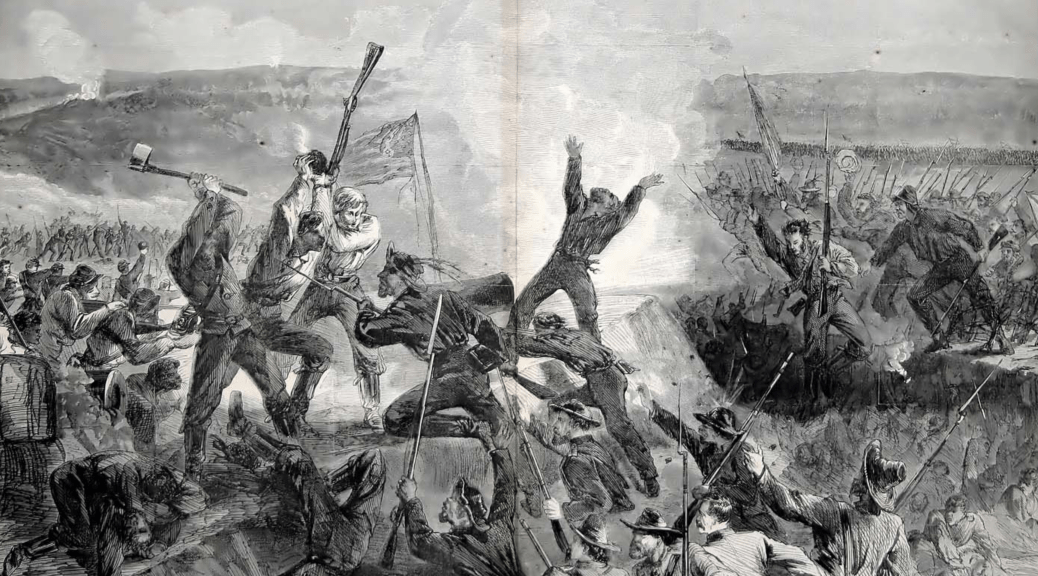
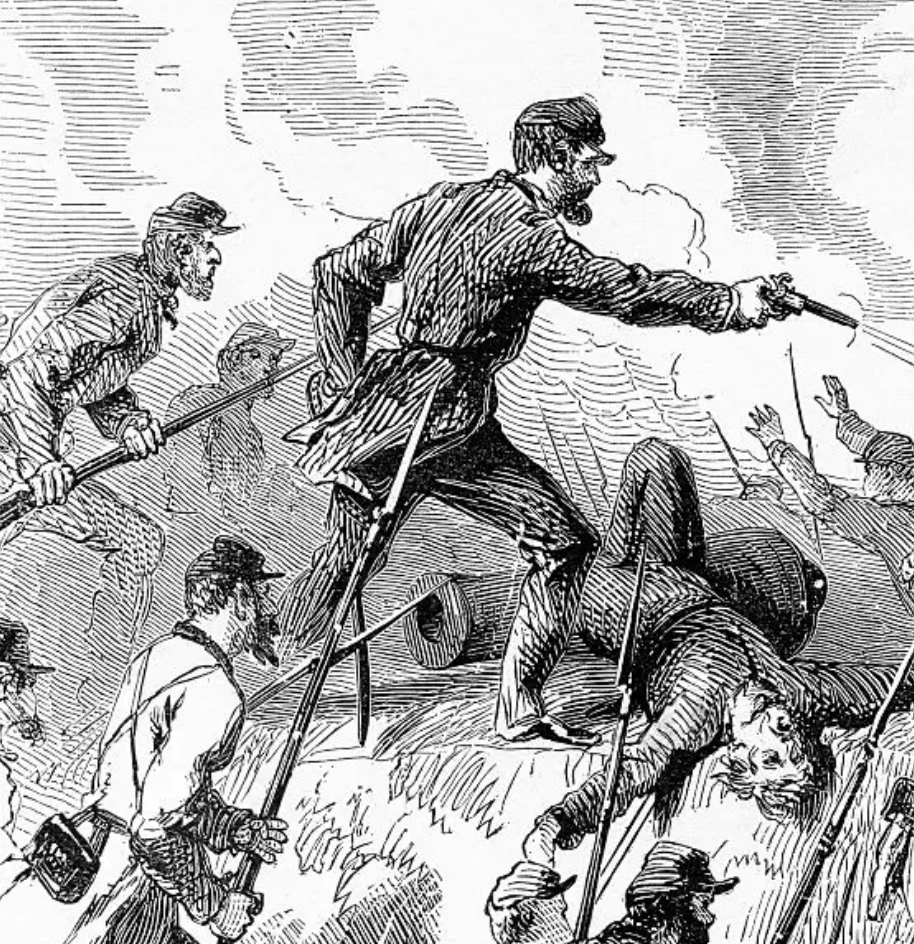
Lt. Col. David Morrison depicted gallantly leading the 79th New York Highlanders over the parapet of the Tower Battery on James Island in 1862.
April 15th—This afternoon we had Brigade Drill. Colonel [David] Morrison of the 79th New York [Highlanders] is in command of the Brigade.
April 16th—Napoleon’s Campaign in Russia in 1812…
April 17th [no entry]
April 18th—Camp near Lebanon. I am on Brigade Guard today.
April 19th-22nd [no entries]
April 23rd—Camp near Lebanon. Am on brigade guard again today.
[Attached to 1st Brigade, 1st Division, 9th Army Corps, Army of the Ohio. Private Franklin Thompson of Flint deserted near Lebanon, Kentucky after it was discovered that she was a woman, “and a good looking one at that,” according to Colonel Poe.]
April 24th—Company drill today from 10 a.m. until 11 a.m. Brigade drill from 1 until 4 p.m. This evening after dress parade, the regiment was formed for close inspection and Capt. Hayden then informed by company us that he had a few resolutions to read to us relating to our late Colonel O. M. Poe, and if we approved of them, they were to be published. He read them to us amid perfect silence. At the conclusion they were unanimously approved by the whole regiment without a single dissenting voice.
April 25th [no entry]
April 26th—Capt. William Humphrey is now colonel of this regiment.
April 27th—We received orders last evening to be in readiness to march at 5 a.m. this morning. Accordingly this morning we struck tents and started 11 a.m. We have just stopped to cook dinner. We have reached Rolling Forks. We have marched today to within about a mile of Campbellville and bivouacked for the night. Reveille is to be at 5 a.m. in the morning and we are to march at 6 a.m.
April 28th—We passed through Campbellville early this morning. We reached Green River about 1 p.m. Our regiment and the 17th Michigan are now encamped on the banks of the river. The 8th and 20th Michigan and 79th New York regiments have crossed the river. We are 28 miles from Lebanon.
April 29th—Camp at Green River, Kentucky. Was on picket last night. Seven rebel prisoners passed here today. The 17th and 20th Michigan Regiments have gone to Columbia and it is rumored that they are a going to the Cumberland.
April 30th—Camp at Green River. Regimental inspection and muster today at 1 p.m.
May 1863
May 1st—Camp at Green River, Kentucky. There has been a detail made today out of each of the three regiments here to rebuild the bridge which was destroyed by Morgan last New Years. A corporal and three privates have been detailed from our company. The weather is very warm.
May 2nd—Camp at Green River. The following is to be our roster of daily duty while at this place. Guard mounting 8 a.m., company drill from half past 8 until half past 10 a.m. Dinner 12 M, Battalion drill if not practicable, company drill from 1 until 3 p.m.
May 3rd [no entry]
May 4th—Camp at Green River. I am on regimental guard today. Just one year ago today the rebels evacuated Yorktown on the Peninsula and we commenced the advance again.
May 5th—Camp at Green River. One year ago today. We were in the Battle of Williamsburg. We have cheering news today from the Army of the Potomac. Hooker has crossed the Rappahannock. His right rests on the Rapidan; his left on the Rapahannock. He has captured the first line of entrenchments.
May 6th—Camp at Green River. Tonight we have cheering news from Hooker’s Army again. Stoneman has captured Maj. Gen. Fitzhugh Lee and captured and annihilated his command. Major General Evans is also captured. Howard’s 11th Army Corp is said to have behaved badly. It is composed of Schurz’s, Steinwehr’s, and Deven’s’ Divisions.
May 7th—Camp at Green River. The Louisville Journal of this morning confirms the news of last night. Stoneman has destroyed 5 miles of the Virginia Central Railroad and also the Fredericksburg-Richmond Railroad, thus cutting off the Rebel communications with Richmond. Maj. Gen. H. G. Berry is said to have been killed at the head of his men.
May 8th—Camp at Green River. This regiment has now got a band. They reached us today. There is now 11 pieces only in the band. They came from Niles, Michigan, and formerly belonged to the 6th Michigan. The news from Hooker’s Army is not quite so cheering today. We have no reliable news from the Rappahannock river.
May 9th—Camp at Green River, Kentucky. Company C is on picket today. Had orders read to us last night on Dress Parade to the effect that hereafter the troops in this department should be known as the “Army of the Ohio.” Headquarters to be removed to the field at once.
May 10th—Camp at Green River, Kentucky. A dispatch arrived about 9 p.m. to the effect that Richmond had fallen. Had been captured by General Dix with 30,000 men.
May 11th—We received orders this morning at 6 a.m. to pack our knapsacks & be ready to march at 7 a.m. in light marching order. 12 M, we have just reached the pleasant little town of Columbia and have stacked arms and been ordered to rest. The dispatch in regard to the capture of Richmond they say has been confirmed.
May 12th—Camp near Columbia. We still remain here at Columbia. The 20th and 17th have returned here today from the Cumberland. The report in regard to the capture of Richmond has been contradicted.
May 13th—Company C on picket on the Burkesville Road.
May 14th—Camp near Columbia, Kentucky. Our knapsacks were brought up from Green River last night. We have gone into camp one half mile from Columbia. The detail from this regiment have gone back to Green River this morning to work on the bridge.
May 15th—Camp near Columbia. The sentence of Vallandigham who was arrested a few days ago at Dayton is said to be two years’ confinement on the Dry Tortugas. The President has changed Vallandigham’s sentence to sending him South instead of to the Tortugas.
May 16th [no entry]
May 17th—Camp near Columbia. In a.m. on Regimental Guard. We are to have drill now twice each day. Saturdays and Sundays excepted.
Col. Richard Taylor Jacob (1825-1903)—though a slaveholder, he was loyal to the Union. He was married to Sarah Benton, daughter of Sen. Thomas Hart Benton.
May 18th—Camp near Columbia. Company C is on picket today. I went to Columbia in the afternoon. Listened to a Union speech by Col. [Richard Taylor] Jacob of the 9th Kentucky Cavalry. Morgan is expected here daily. We have commenced drilling again today. Company drill two hours in the forenoon. Battalion drill two hours in the afternoon.
May 19th—Camp near Columbia. Our loss in killed, wounded, and missing at the late battle of Chancellorsville, Va., is set down to be 1,000. The loss of the rebels 18,000. Stonewall Jackson was wounded in those battles so that he has since died—it is so reported at least. Jackson was a Lieutenant-General in the Rebel service.
May 20th [no entry]
May 21st—Camp near Columbia. Brigade drill today from half past 2 until 5 p.m. Col. Morrison still commands brigade.
May 22nd [no entry]
May 23rd—Camp near Columbia, Kentucky. Today Company C is on picket.
May 24th—Camp near Columbia. After coming in from picket, I procured a pass and attended church at Columbia.
May 25th—Camp near Columbia. It is two years today since I was sworn into the United States service by Lieut.-Colonel H___ at Fort Wayne, Detroit, Mich.
May 26th—Camp near Columbia, Ky. We had orders issued to us last evening to be in readiness to march at a moments notice with three days rations. It is said to be reported today in the Louisville papers that general Grant has captured Vicksburg.
May 27th—Camp near Columbia, Ky. Am on camp guard today. The 8th Michigan Regt. came up from Green River last evening. 3 p.m., have just received orders to be in readiness to march in light marching order at 7 p.m. with three days rations. The 2nd, 8th, and 79th [regiments] are going, besides a regiment of cavalry and a section of artillery.
May 28th—We left Columbia last night according to orders at 7 p.m. We marched 14 miles during the night and bivouacked five miles from Jamestown. We started this morning again at 9 a.m. We have just reached Jamestown—time 12 M. It is between four and five miles from here to the Cumberland River.
May 29th—Bivouac at Jamestown. Today our company is on picket.
May 30th—Bivouac near Jamestown. Nine a.m. Have just come in from picket. The 17th & 27th Michigan, 45th Pennsylvania Regiments have just arrived here from Columbia. Our regiment & the 8th and 79th started back for Columbia about 2 p.m. It is just eighteen long miles to Columbia.
May 31st—We got back to camp last night [near Columbia] at half past 9 p.m. It rained and was very muddy towards night. I have signed the pay roll today.
June 1863
June 1st—8 p.m. have just returned to camp from a foraging excursion after biscuits. The regiment has orders to be in readiness to march in the morning with eight days rations; three in haversacks and five in knapsacks.
June 2nd [no entry]
June 3rd—Regimental inspection today at 2 p.m. by the Ordnance Officer of the Brigade.
June 4th—Camp near Columbia. We had reveille this morning at 3 a.m. and marched at 4 a.m. with eight days rations. We reached Green RIver at 10 a.m. where we lated for dinner. We reached Camp Bellsville at 4 p.m. and bivouacked for the night. have marched 20 miles today.
June 5th—Reveille at 3:30 a.m. We marched at 4 a.m. Later we reached Lebanon about10 a.m. Have marched 20 miles since 4 a.m. We are to take the cars again sometime today or night. We went on board of the cars at 5 p.m. and have started.
June 6th—We arrived at the Louisville Depot sometime during the night. got off from the cars at 5 a.m. and marched to the river and were ferried across to Jeffersonville, Indiana. Left Jeffersonville about 1 p.m. Reached Seymour, Indiana, just at dark. Changed cars at this place. Also had cup of coffee issued to us.
June 7th—Reached Vincennes, Indiana, about 7 a.m. Here we received hot coffee and soft bread. reached S. Junction about 3 p.m. Bound for Cairo, they say. We have changed cars again. We received hot coffee and fresh meat at Centralia, Illinois.
June 8th—Reached Cairo about 5 a.m. this morning. Have got off the cars and waiting for orders. 5 p.m., have just gone on board of transports. Our regiment and the 20th Michigan are on board of the steamer Nebraska.
June 9th—7 a.m. Are still here at Cairo on board of steamer. Reached Columbus, Kentucky, today about 10 a.m. Stopped here to show our papers. Reached Island No. 10 at about 3 p.m. Hove to again to show our papers. Passed New Madrid today about four p.m. 8 p.m. we have tied up to the bank to wait until morning.
June 10th—On board steamer Nebraska. We passed Fort Pillow at about 8 a.m. At 3:30 p.m. have just reached Memphis. Plenty of hucksters and peddlers of all descriptions throng the gangways of the boats selling bread, pies, cakes, oranges, lemons. &c.
June 11th—8 a.m. We still remain here at Memphis waiting for orders. A dead man’s body was picked up out of the river this morning. 11 a.m. have moved across the river nearly opposite Memphis and have disembarked on the Arkansas shore. 3 p.m., the boat has been cleaned and we have returned on board.
June 12th—On board Nebraska. Left Memphis this morning at sunrise. About 12 M, have just reached Helena, Arkansas. Tied up for the night at a small place called Napoleon.
June 13th—Started this morning at sunrise again. 9 a.m. have just been fired into from the shore. 10 a.m. have been fired into again.
June 14th—5 a.m. at Milliken’s Bend, 25 miles from Vicksburg. 8 a.m. just passed the mouth of the Yazoo, 10 a.m., have landed on the Louisiana shore near the Old Canal. Can see Vicksburg quite plain. Also see out mortars thundering on the City.
June 15th—In front of Vicksburg. Left Young’s Point where we disembarked. At 4 a.m. we are nearly opposite to Warrenton. The order for us to cross the river at this point has been contermanded. 7 p.m. we have started back across the bend to Young’s Point. Our mortars are still thundering away at Vicksburg.
June 16th—In front of Vicksburg. 9 a.m. have orders to pack up and be ready to go on board of the transports immediately. Later, 2 p.m., our regiment and the 20th Michigan are on board of the steamer New Kentucky. We are now on our way up the Yazoo River. 4:30 pm have reached Snyder’s or Chickasaw Bluff.
June 17th—In rear of Vicksburg. Remained on board of the boats last night, disembarked this morning at 5 a.m. At 10 a.m. have gone into camp three miles from the Yazoo river at a small place called Milldale in Warren county, Mississippi.
June 18th—Was on fatigue policing camp. Colonel [Daniel] Leasure of the 100th Pennsylvania Infantry is in command of the Brigade. Been so since the [ ] of June. Brig. Gen. [Thomas] Welsh in command of Division. Major Gen. [John] Parke in command of the Corps (the 9th)
June 19th—General Inspection at 2 p.m.
June 20th [no entry]
June 21st [no entry]
June 22nd [no entry]
June 23rd—Am on camp guard today.
June 24th—I remain on guard today. There is to be no guard mounting as the regiment goes on fatigue.
June 25th [no entry]
June 26th—We (that is, the whole regiment, also the whole Brigade) to go on Fatigue again this morning at 5 a.m. We are digging rifle pits.
June 27th [no entry]
June 28th—I am on fatigue again today. Business is felling trees. Work from 5 a.m. until 5 p.m.
June 29th—In rear of Vicksburg. Had orders to march this morning at 8 a.m. in light marching order. Afterwards the orders were countermanded and we were told to strike tents and take everything. Later, we have marched about six or seven miles and we are now seven miles from the Big Black River they say.
June 30th—Regimental muster at 8 a.m.
July 1863
July 1st—In rear of Vicksburg. One year ago today was at Malvern Hill, Va. Colonel Leasure of the 100th Pennsylvania is in command of the Brigade. Gen. Welsh of the Division and Major Gen. Parks of the 9th Army Corps.
July 2nd—Reveille at 3 a.m. Go on fatigue at 4 a.m. Our work today is felling trees. The whole brigade is out. Hooker’s Farewell Address in conformity with orders from the War Department dated June 27th. “I relinquish command of the Army of the Potomac and it is transferred to Maj. Gen. George Meade, a brave and accomplished officer who has nobly earned the confidence and esteem of the army.”
July 3rd—Hooker’s Farewell Address [quotes the remainder of Hook’s speech.]
July 4th—Vicksburg is rumored to have capitulated today. We have orders to be in readiness to march at a moments notice with five days rations and in light marching order. It being the 4th of July, I have had a dinner of green corn. Left camp in light marching order at 4 p.m. Stopped for the night 7 miles from Black River.
July 5th—It is true that Pemberton surrendered Vicksburg yesterday morning about 5 a.m. Our 2d Lieutenant D. Cameron Morrison has been courtmartialed and dismissed from the service.
July 6th [no entry]
July 7th—Crossed the Big Black today at 12 M. The weather is almost [ ] warm. Were awakened this morning at 2 a.m. but did not start until 11 a.m.
July 8th—We marched last night until 12 a.m. It rained the most of the time after it became dark. Started again today at 4 p.m. Six miles from here to Brownsville so the sign board says. Marched until 12:30 a.m.. tonight. Water very scarce.
July 9th—Started again this morning at 7 a.m. 7 miles from here to Clinton Station. Passed to the left of Clinton at 12 M. 3 p.m. are about 8 or 9 miles from Jackson. We are to have till 4 p.m. to make coffee. Are fairly suffering for water.
July 10th—Near Jackson, Mississippi. Resumed the march at 8 a.m. Came in sight of the insane Asylum at 12. Had a half hour given us to make coffee. Were then formed in line of battle in a large cornfield with the 79th [New York Highlanders] in front as skirmishers. At night, stacked arms and bivouacked on the field of battle.
July 11th—Near Jackson, Mississippi. Our regiment (the 2nd Michigan) were deployed as skirmishers at 4 a.m. and kept continuously advancing until they found the enemy in force which was about 9 a.m. when a sharp and spirited skirmish ensued. At 10 a.m. we were obliged to fall back having no support. We fell back a short distance and then formed once more on our old line. I was wounded slightly in the head about 10 a.m. and afterwards obliged to leave the field. Before I left, we were ordered to take off everything but our canteens and charge the rebels double quick. It was after this charge was made that I was wounded.
July 12th—The fight has opened this morning good and strong and promises to bring on a general engagement. [Quotes Meade’s Address to the Army]
July 13th—[no entry]
July 14th—The hospital was moved this morning about a mile back to the [Mall Bank] plantation of one Mr. [Richard] Eubanks [which stood near the juncture of Eubank Creek and Old Canton Road, three miles north of Jackson.]
“In July, 1863, the Federal army returned from victory at Vicksburg to finish the destruction begun in central Jackson two months earlier in May. Mall Bank had escaped the May horror, but in July, 1863, Gen. Grant’s order was to destroy all within a 15-mile radius of Jackson. Vastly outnumbered by the Federal army, Confederate General Johnston left Jackson and the area unprotected and marched his troops east across the Pearl River toward Meridian, Mississippi. Moving north from the center of Jackson, Federal troops commanded by U.S. Brigadier General Welch and Col. Charles Walcott, moved their troops up Old Canton Road. Pausing to assess their progress, wagons filled with wounded soldiers began slowly making their way up Mall Bank drive and into the surrounding yard. Going from room to room at Mall Bank, men dragged furniture out of the house, left behind by the Eubank family when they sought refuge at their hunting lodge and farm across the Pearl River at Fannin in Rankin County. Clearing the rooms at Mall Bank to make space for their wounded men, out in the yard the Federals fed their horses from a classic baby-grand piano. Eyewitness accounts of the eventwere that . . . . they carried the grand piano out into the yard, and threw hay into it for the horses. (From memories of the Peter and Selina Eubank Rivinac family, Richard Fondren Rivinac, Sr.) Neither the Eubank family nor the Rivinac family, whose home was across Canton Road from Mall Bank, expected such destruction. The home and plantation products had survived destruction during the terror that swept through Jackson two months earlier. Now, in July, 1863, the Federals ransacked the house and outbuildings, confiscating plantation products of all kind, everything that the Eubank family might have left behind when making their move, with a number of servants, east across the Pearl River to their hunting lodge, Moss Side. ” See Ancestral Journeys.
July 15th [no entry]
July 16th [no entry]
July 17th—Hospital near Jackson, Mississippi. The Rebels are said to have evacuated Jackson last night and the colors of the 2nd Michigan are said to be flating over the Rebel works.
July 18th—We are to leave tomorrow. Some say we are going to Vicksburg.
July 19th [no entry]
July 20th—We left the hospital near Jackson this morning at 4 a.m. The whole Corps is on the move. A detail has been made from the Brigade to carry three or five of the most wounded on stretchers. Two men died on the road today.
July 21—Passed through Brownsville about 3 p.m. A man belonging in the 8th Michigan died today of fever. He was wagon master of the train. His name was [James Azro] Miller [of Co. I].
July 22nd—We crossed the Big Black last night at 11 o’clock. We have started again this morning. It is now 7 a.m. and 17 or 18 miles to Vicksburg. Another man breathed his last last night. We reached our old camp near the Yazoo today about 4 p.m. Gone into Regiment Hospital.
July 23rd—Received intelligence this evening of the death of my father. He died the 1st of July.
July 24th [no entry]
[Quotes lines from a song entitled, “The President’s Hope”]
July 25-31st [no entries]
August 1863
August 1st—A detail of 50 men went on picket about two miles from camp. Another detail of 100 men went in the afternoon to guard about six hundred prisoners. They are going to Indianapolis. Our sick and wounded have also left here today.
August 2nd—Lieutenant Colonel Dillman has tendered his resignation and it has been accepted.
August 3rd—We received orders to pack up in readiness to go on board of transports. About 12 M marched to the landing and then went on board of the steamer
August 4th [no entry]
August 5th [no entry]
August 6th—Reached Memphis today about 3 p.m. We got off the boat to allow the hands a chance to clean the boat.
August 7th—We are still here at Memphis waiting for them to coal up. Went on board of the boat again at 6 p.m. Started from Memphis at 9 p.m.
August 8th—Passed Island No. 10 this day about 9 pm.
August 9th—Reached Cairo at half past six a.m. Left Cairo at 4 p.m. Two month ago today we left Cairo bound down the river to Vicksburg. Our destination is thought to be Hickman’s Bridge, Kentucky.
August 10th—Centralia, Illinois. 25 minutes past 4 a.m., are now at Centralia, Illinois. We have just had a breakfast of warm coffee and fresh meat. 6 a.m. have reached Sanable at Junction. Here we change cars. Reached Vincennes, Indiana, at 6 p.m. and here had refreshments served to us.
August 11th—Took breakfast this morning at Seymour, Indiana. Reached Cincinnati at 10 a.m. Refreshments were served to us in the Market House. After dinner we were ferried across the river to Covington, Kentucky. Our headquarters are now in an old foundry building close to the river.
August 12th—Left Covington on the Kentucky Central Railroad today at 7 p.m. Lieut. Morrison adn Lieut. Dillman leave us today. We part with both of them with regret the most profound.
August 13th—Reached Lexington, Kentucky, this morning about 5 a.m. Remained here three or four hours, cooked and ate breakfast, &c. and then visited the Clay Monument in the Lexington Cemetery. Finally started for Nicholasville 12 miles further. Reached Nicholasville about 7 a.m.
August 14th—Moved this morning about three miles from Nicholasville on the pike towards Hickman’s Bridge and Camp Nelson and went into camp.
August 15th—Read today in the papers of the death of Brigadier General Welsh.
August 16th—Camp Parks, Kentucky.
August 17th [no entry]
August 18th—Are to have drill twice a day hereafter as follows. Company drill from 8:30 until 9:30 a.m. Battalion Drill from 4:30 until 5:30 p.m. by order of Major Byington, Commanding Brigade.
August 19th [no entry]
August 20th—Am on picket today. A detail has been made today from our Brigade to escort the remains of Major General [William “Bull”] Nelson from Nicholasville to Camp Dick Robinson where he is to be interred.
August 21st—[quotes letter by Maj. Gen. US Grant to the Headquarters, Sept. of Tennessee, dated at Vicksburg, July 31st 1863]
August 22-24th [no entry]
August 25th—Came off from picket this morning. We have now got all the battles we have ever been engaged in on our flag.
August 26th—Camp Parke. Major byington in command of Brigade. Capt. [ ] of the Regiment. Brig. Gen. Ferrero is in command of the Division.
August 27th—Camp Parke. Our company on camp guard tonight. We have orders to march in the morning at 4 a.m.
August 28th—Camp Dick Robinson. Left Camp Parke near Nicholasville this morning at 5 a.m. The whole brigade. reached camp Dick Robinson about 12 M and bivouacked for the night.
August 29th—Had reveille this morning at 4 and marched at 5 a.m. Passed through Lancaster at 9 a.m. and 11 a.m. Bivouacked some 8 or 9 miles from Crab Orchard.
August 30th—Reveille this morning at 4 and marched at 5 a.m. Reached Crab Orchard at 11 a.m. and gone into camp some two miles from the town.
August 31st—We are to have muster this morning at 9 a.m.
September 1863
September 1st [No entry. Remainder of song “President’s Hope” continued]
September 2-3rd [no entry]
September 4th—Today am on picket. John J. Callahan died.
September 5th—General and minute inspection of the regiment t 2 o’clock p.m. with knapsacks, haversacks, and canteens. Boots neatly polished and such.
September 6th [no entry]
September 7th—The last paper I received was No. 37 and dated September 12th.
September 8-9th [no entry]
September 10th—Left camp at Crab Orchard this morning at 10 a.m. with eight days rations. Was on picket last night at Mr. Murray’s. Marched 12 miles today. Bivouacked at Mt. Vernon.
September 11th—Reveille at 3:30. Marched at 5 a.m. Marched 15 miles today.
September 12th—Reveille at 3:30. Marched at 5 a.m. Marched about ten miles and bivouacked near London.
September 13th—Lay over at or near London.
September 14th—Reveille at 3 a.m. Marched at 5 a.m. Marched 3 miles today. Passed two thousand prisoners that were taken at Cumberland Gap.
September 15th—Reveille at 3:30 a.m. Marched at 5 a.m. Marched 13 miles to Barbersville on the Cumberland river. Had our rations of fresh beef stolen last night. Received pay this evening. $17 deducted for overdrawn clothing.
September 16th—Reveille at 3:30. Marched at 5 a.m. Marched 10 miles and bivouacked near the Cumberland River.
September 17th—Private Richardson and myself set out on the road one day ahead of the regiment to find forage for the company. As we drew but one days rations between now and Sunday.
September 18th—Near Cumberland Ford, found some provisions but up to this time (3 p.m.) the Division here not left camp. The division has not moved and Richardson and myself remain at a farmer’s [house] by the name of Enoch Smith. Bought some [ ] pies &c. of him.
September 19th—The regiment came up this evening and I proceeded on with it. We finally camped for the night about ten miles from Cumberland Gap. One corn cake and part of a loaf of bread 50 cents.
September 20th—Reveille at 4:30 a.m. Marched at 6 a.m. We reached Cumberland Gap about 10 a.m. Passed through the mountains and bivouacked in Tennessee.
September 21st—Reveille at 3:30. Marched at 5 a.m. Marched 13 miles to the village of Tazwell and stopped for dinner. In the afternoon marched to Sycamore and bivouacked five miles farther. 23 miles from here to Morristown.
September 22nd—Reveille at 3:30, Marched at 5:30. Our regiment goes in rear of the division. Bivouacked at Clinch River for the night.
September 23rd—Reveille at 5:30 a.m. It is about six or seven miles from here to Morristown. Reached Morristown about 1 p.m. The rest of our Brigade have left here on the cars.
September 24th—7 a.m. Our regiment is still here at Morristown awaiting a train of cars. We left Morristown on the Knoxville Road at 3 p.m. 41 miles from here to Knoxville. Marched 12 miles this afternoon.
September 25th—Reveille at 4 a.m. Marched at 6 a.m. Stopped for dinner near the Holston River. Marched 17 miles today and bivouacked 12 miles from Knoxville. Road very dusty. Crossed the Holston on the railroad bridge—a temporary one. The old one was destroyed by Col. [ ] when he made his raid through here.
The railroad bridge over the Holston River at Strawberry Plains.
September 26th—Reveille at 4 a.m. Marched at 6 a.m. Reached Knoxville at 12 M and encamped about half a mile from Knoxville. Have had a tolerable good road from Morristown up although it was pretty dusty.
September 27th—We are camped on the banks of the Tennessee River half a mile from Knoxville. One letter received.
September 28th—Reveille this morning at 3 a.m. and marched as soon as as we could pack up without breakfast. Marched to the Tennessee River and crossed it on a ferry. Have taken up a position in a cornfield about one mile and a half from Knoxville. Are in support of a section of artillery. Capt. Poe, Chief of Engineers, crossed the river with us.
September 29th [no entry]
September 30th—Received our clothing that we packed up and left at Columbia when we started to reinforce Gen. Grant before Vicksburg, Miss.
October 1863
October 1st—Still remain in line of battle. It is raining slightly. Two letters sent. Six days rations issued to us which are to last us ten days.
October 2nd—On picket near Knoxville this evening.
October 3rd—Co. C is on picket today on the Marysville Road. Citizens are passing continually who have been armed by the government for the purpose of fighting the rebel bushwhackers. Our Brigade has gone into camp about 1 mile from Knoxville.
October 4th [no entry]
October 5th—The 1st Brigade of this Division and the 2nd Brigade of the 2nd Division it is reported, have gone to Greenville. Maj. General Parke is now appointed Chief of Staff & Brigadier General Potter assumes command of the 9th Army Corps.
October 6th—Finished work on my tent. Have raised it now five logs high.
October 7th—Have received orders this evening to be readt to march at 7 in the morning with ten days rations of coffee and sugar and five days rations of bread and two of cooked meat.
October 8th—Our Brigade recrossed the river this morning at 7 o’clock. Our arms are now stacked at the depot and we are awaiting transportation on the railroad either to Greenville or Morristown.
October 9th—Got on board of the cars at Knoxville at about 8 a.m.. Reached Morristown about 5 p.m. and remained one half hour to make coffee. Got off from the cars about 9 p.m. at Bull’s Gap some fourteen miles from Morristown.
October 10th—Reveille at 4:30 a.m. Are to march at 6 a.m. Marched nearly ten miles today and found the enemy in position. We had a sharp and brisk skirmish with them. Drove them about 1.5 miles, then lay down on the field for the night. The night is very cold. No fires are allowed to be built.
October 11th—Blue Springs, Tennessee. The enemy evacuated last night and we commenced the pursuit of him a short time after sunset. Col. Foster was in rear of them with a Brigade. They broke through his lines. We marched some 22 miles and then bivouacked near Rheatown. We passed through Greenville today about noon.
October 12th—Reveille at 4 a.m. Were to have marched at 6. It is now 7 and we have not gone yet. Th order to march has been countermanded and we remain here today. The rebels are flying for life. Gen. Wilcox arrived at Greenville a day or so ago with one brigade of new troops.
October 13th—Reveille at half past 4 a.m. Marched at 6 a.m. We passed through Greenville about 10 a.m. We have stopped a mile and a half from the town to make coffee. Later, have bivouacked about three miles from Blue Springs. It is 4 p.m.
October 14th—Reveille at 5 a.m. Marched at 9 a.m. Expected to go on the cars but did not. Marched 12 miles to Bull Gap Station. The other two brigades were left back to Blue Springs. 12 miles today.
October 15th—Reveille at 4. Marched at 6 a.m. Went two miles beyond Russellville and stopped for coffee. In the afternoon marched to Morristown and bivouacked for the night. 15 miles today.
October 16th—Our Brigade have all got on the cars here at Morristown with the exception of this regiment. We remain here today or until one of the trains return from Knoxville. The train arrived & we got on board about 12 at night. Parson Brownlow and Horace Maynard have returned to their homes this day.
October 17th—Reached Knoxville at ten minutes past 4 this morning. Have gone into camp near the town.
October 18th [no entry]
October 19th—Cut timber this afternoon for the purpose of raising our tent. Toward night had orders to be in readiness to march at 7 in the morning. Have drawn two days and a half rations of coffee and sugar & bread for five days. Half rations.
October 20th—7 a.m. our tents are all struck. We are packed up adn ready to march. Later, have marched 15 miles today on the road to Loudon. We can hear quite distinctly the roar of cannon in the direction of Loudon.
October 21st—Reveille at half past 3. Marched at 5 a.m. Marched 12 or 13 miles today and bivouacked three miles from Loudon. It rained hard some two or three hours while we were on the march. Wolford had a fight yesterday with the rebels six miles from Loudon. He lost his trains and one battery and cut his way through their lines twice. Only the 1st Division of the 9th Corps came out [ ]. The 2nd Division are back at Knoxville. [See Battle of Philadelphia]
October 22nd—The pack up call was sounded at 4 p.m. The assembly was blown at half past 4. We then marched down to the river Holston, crossed it on the pontoon bridge, & went into camp close to the village of Loudon. There are two divisions here now—the 1st Division, 9th A. C. & White’s Division of the 23rd Army Corps.
October 23rd—Cold wet and rainy throughout the whole day. Rations most gave out. Bought some middlings at the mill & made pancakes of it. Our company is now on the right centre (color company). We were changed the morning we left Knoxville.
October 24th—Weather cold and cloudy. Have been detailed in company with five others to go after beef cattle. The trains have all recrossed the river.
October 25th—Were furnished with mules this morning, The Division Commissary Lieut. Justice to go after the cattle, Went out about four miles, procured the cattle and also procured of the mules, I was on taking a notion to bolt for a large mud puddle close by the side of the road.
October 26-27th [no entry]
October 28th—Got up this morning at 3 a.m. Were ordered to pack everything and be in readiness to march at half past 4 a.m. and also not to build any fires. The Division recrossed the river at half past 4 a.m. and we have stopped to cook breakfast about a mile from Loudon. This movement so far looks very much like an evacuation of Loudon. Marched 4 or 5 miles this afternoon and bivouacked near Lenoir Station for the night. We do not know what to think of this movement, whether it is to skedaddle or otherwise.
October 29th—Have moved camp today about one mile. Gone into camp in a piece of woods and have been ordered to put up log cabins for winter quarters. The mystery is now explained.
October 30th—Worked all last night in getting our brick and loading them on a hand car & running them up on the railroad near camp. Have spent the day in getting out timber for the house. Had nothing but corn and beef to eat.
October 31st—Muster and inspection right away after dinner. Nothing but corn and beef to live on. We are working on our log cabin.
November 1863
November 1st—Sat up last night guarding lumber for the company. Have drawn third rations for three days.
November 2nd—Was out all night after brick but did not find any.
November 3rd—Have got our cabin almost finished. Got two hundred brick this night to finish running up the chimney.
November 4th—At last our cabin is finished. We struck the last blow on it this afternoon. Almost in a starving condition. Begged two small ears of corn for dinner. Did not have any breakfast. Have since drawn two crackers to each man for tomorrow (half rations).
November 5th—On picket today on the banks of the Holston near Lenoir.
November 6th—Came off from picket. In the afternoon, procured our order of the captain and went to the mill three miles up the railroad and bought twenty lb. of flour. Drew one days rations and quarter rations of coffee and sugar to make half rations for seven days.
November 7th—We were awakened last night at 12 o’clock and ordered to pack up everything immediately. Leave all of our knapsacks in one house and be ready to march with three days rations in light marching order. At about 2 a.m. our brigade took the cars and we arrived at Knoxville at 5 a.m. and we have got off the cars about 4 p.m. and bivouacked near the depot. The27th Ohio got in a fight at Rogersville and the 2nd Tennessee lost all of its men—about 50 or 60.
November 8th—Remained here today. Weather very cold.
November 9th—Got on the cars and started back for camp at about 2 p.m. arrived at Lenoir about 4 p.m. 22 miles from our camp at Lenoir to Knoxville.
November 10th—Worked today on the Captain’s house.
November 11th—For two cans of milk bought this day of the sutler $1.40. Was ordered out this morning about 4 a.m. to roll call with arms and accoutrements. After roll call the arms were stacked on the color line. Fell in to take arms at tattoo.
November 12th—Went through the same performance this morning we did yesterday. That is, stacked arms on the color line. The first issues of Brownlow’s Knoxville Whig & Rebel [ ] appeared yesterday. For two cans of milk bought this day of sutler J. A. Thompson $1.50.
November 13th—On guard tonight. Col. Humphrey is now in command of the Brigade, Col. Leasure having gone north after the detailed men and convalescents of the 9th Corps.
November 14th—Farewell to our winter quarters. Packed up everything & left them this morning at daylight. Went to Loudon adn then down the river five miles. Were too late to prevent the Res from crossing. No fires allowed tonight. Have to stand to arms.
November 15th—Came back to Lenoir early this morning. Longstreet’s Corps has crossed & now for some tough fighting. At night went into line of battle near out=r old camp, The Rebs are on hand, No sleep this night. No fires allowed. Looks as though we had got to skedaddle. Weather very cold.
November 16th—Destroyed about one hundred wagons and left Lenoir at daylight. The rebs are tight after us, They came down on the Kingston Road about five miles from Concord and endeavored to cut us off. Fell back skirmishing all of the way to Concord. Made a stand there and had a desperate fight all day. At night commenced falling back again towards Knoxville.
November 17th—Reached Knoxville about 3:30 this morning. What little sleep I obtained & after I reached Knoxville is the first I have had for four nights. We have a good position here. We have built rifle pits and Gen. Ferrero plainly says to us that we must either fight and whip the enemy or else go to Richmond as prisoners. We have been permitted to put up our tents in the rear of the rifle pits, Skirmishing is now going on in our front. The enemy have followed us up pretty closely.
November 18th—Skirmishing has been going on all day. Some artillery firing also. Was on fatigue in the night. Was to work on rifle pits. The loss of our regiment was I think 37 killed & wounded at the Battle of Concord or Campbell’s Station on the 16th inst.
November 19th—Skirmishing still continues in our front. Sergt. Bell wounded in the head. The troops confronting us are supposed to be about 18,000 strong. I am on fatigue this night.
November 20th—Skirmishing is pretty sharp today on the picket line. Am on fatigue tonight.
November 21st—Am on fatigue again tonight. It is a rainy, disagreeable night.
November 22nd—I am on picket tonight at 7 o’clock.
November 23rd—I am on fatigue again today. Our work is forming an abatis in front of the rifle pits. Am on picket again tonight at 8 p.m. Nine men from a company are on. They are expecting a night attack. Later, we have fired 8 or ten buildings as the enemy have made a demonstration.
November 24th—Our regiment made a charge this morning. Our loss out of the regiment was 98 killed, wounded, and missing. Of field officers, there is the Adjutant killed. The Major it is feared mortally wounded and a prisoner.
November 25th—They have sent the bullets up here in camp pretty thick today. Colonel Comstock and a captain from the 20th have both been wounded. Skirmishing has also been going on pretty brisk across the river.
November 26th—Have built a fire in the rifle pits and gone into them, to stay at least during the day time.
November 27th—Skirmishing continues pretty much the same as yesterday and the day before. The enemy throw a great many balls up in camp.
November 28th—Tonight at 11 p.m. the enemy made a simultaneous attack on our lines on all sides. Drove in our pickets &c. Stood at arms all night.
November 29th—The enemy renewed the fight this morning at daylight. They made a charge on Fort Saunders but were repulsed with great slaughter. Three stand of colors taken by us besides a large number of prisoners. Hostilities have ceased until 5 p.m. I go on picket tonight at 5 p.m.
Longstreet’s Assault on Fort Saunders, November 1863
November 30th—Everything is remarkable quiet along the lines today so far. It is now about 8 a.m. Our lines and those of the enemy are not more than fifteen or twenty rods apart. The armistice was extended until 7 p.m. last evening. Came off from picket at 8 p.m.
December 1863
December 1st—Heard complimentary orders read to us this morning from General Burnside (Gen. Orders No, 33) stating that Gen. Grant had whipped Bragg, taken 52 pieces of artillery, 12 stand of colors, besides a large number of prisoners. Bragg is retreating towards Dalton followed by Grant.
December 2nd—Heard congratulatory orders read to us from General Potter in which he stated to us that Benjamin’s Battery of the 2nd New York and the 29th Massachusetts, the 79th New York or detachment from the 20th Michigan and the 2nd Michigan, to their conduct was due principally our victory at Fort Saunders on the 29th instant of November.
December 3rd—Was up all night. We were expecting another night attack. We spent the night in throwing up dirt and digging a ditch in front of our rifle pits. Everything seems to be comparatively quiet along the lines this morning. Two of our boys have died of their wounds—Henry Von Wirt & James G. Moore.
December 4th—Sherman’s advance reached here today. A Brigade of mounted men.
December 5th—The enemy skedaddled during the night and we breathe once more.
December 6th—All quiet in & around Knoxville.
December 7th—Packed up and left Knoxville this morning at 7 a.m. in light marching order. Marched some 12 miles and stopped in the neighborhood of Strawberry Plains for the night. Drew four days half rations previous to starting of flour and hard bread.
December 8th—Did not start until about 6 a.m. Marched eight miles, then bivouacked. This afternoon is somewhat rainy.
December 9th—Reveille at 5. Marched at 7:30 a.m. Marched some 12 or 13 miles and encamped near the village of Rutledge. 10 miles to Bean’s STation.
December 10th—Was detailed at nearly night to go out with a team after forage. Went out into the mountains five miles to Massingill Mill. Reached the mills at 8 p.m. We are after flour,
December 11th—Remained here at the mill all night and are likely to remain here the greater part of today. A detail is made tosay to take possession of the mill. The chief commissary of the 23rd Corps is now running it. Later, did not take the mill.
December 12th—Came into camp today from the mill. Did not get any flour. Afternoon is very rainy.
December 13th [no entry]
December 14th—Had reveille this morning at 3 and marched at 5 a.m. Drew five days half rations of coffee, sugar, and hard tack. marched 7.5 miles to a mill near a ford on the Holston. Only our Brigade came out here. It rained all last night and it was very hard marching, it being so muddy.
December 15th—The rebs commenced throwing shells into our camp last night from across the river. We lay an hour or so in line of battle behind a rail fence and finally about 9 p.m. fell back five miles and a half, and stopped for the night. Today our regiment has acted as rear guard. The brigade has fallen back to the junction of this road with the Bean’s Station road.
December 16th—We left Rutledge last evening at about 9 p.m. Was nearly all night in marching something like 7 miles and then bivouacked for the night. Was on the road again this morning at 8 a.m. Marched 7 or 8 miles and then stopped for dinner. 19 miles from here to Knoxville. At 3 p.m./ fell in and then took up our position in line of battle. We are intending to make a stand here in case the rebels attack us. The supposition is that the enemy have been largely reinforced from Lee’s army in Virginia.
December 17th—It rained hard all night. Our tents we have pitched in rear of the stacks.
December 18th—Major Byington is dead. Also private Bostwick. Weather very cold.
December 19-21st [no entry]
December 22nd—Six of us went out foraging, Crossed the mountain. Struck the Tazewell Road 8 miles from camp. Results of the expedition after being out all day. Shot a large hog and brought him into camp.
December 23 [no entry]
December 24—I am on picket today. Go on 8 a.m. We can hear cannonading in the distance. It sounds a long way off to our front & right.
December 25th—Came off from picket this morning at 8 a.m. The 23rd Corps have struck tents & moved.
December 26th [no entry]
December 27th—Private Myron L. Livingston died in hospital at Knoxville from wounds received in action November 24th 1863.
December 28th—It is currently reported throughout camp that the Eighth Corps is on the road to this place. Some say to relieve us.
December 29th—The excitement relative to going over the mountains has pretty much subsided.
December 30th—Sergeants T. P. Janes & A. B. Simpson, also Private H. H. Percy, have all three obtained furloughs & gone home. They were wounded in action November 24th 1863. Cleaning my musket & preparing for our inspection & muster which takes place on the morrow.
December 31st—Muster at 2 p.m. With this day the year 1863 is numbered among the things that were. Like the year 1862, it has been a year of bloodshed. The last has been drenched with blood both from traitorous and loyal hearts with the morrows rising sun or New Year (1864) dawns upon us and it is to be hoped that when that year 1864 shall like 1863 be numbered among the years of the past, that we can look upon our land once more blessed with peace—with the Stars and Stripes floating over every fort of her territory.
This letter was composed by Lockhart Davenport (1818-1875) of Hinsdale, Cheshire county, New Hampshire. According to the 1860 US Census, Davenport was involved in the lumbering business. He was also evidently tasked by his county or the provost marshal office to apprehend draft evaders in Canada or to locate military-age men willing to accept bounties offered by county governments to fulfill their draft quotas. Davenport’s letter discloses that the prevailing rate in New Hampshire for conscript substitutes was $565 and was projected to exceed $600 before the county quota could be fulfilled.
Davenport wrote the letter to Warren Snow Barrows (1824-1888) of Hinsdale, Cheshire county, New Hampshire. He was married in May 1856 to Maria L. Walker of Keene, Cheshire county, New Hampshire.
Transcription
West Lebanon [New Hampshire] December 2, 1863
W. S. Barrows, dear sir,
I sent you a telegram this morn. I have just returned from Canada with no success except getting out safely. Men are selling today for $565 each. Nims of Keene returned home last night. Has put in no men but thought he should be instructed to put in one half or more and run their chances about there being another draft. That would be my opinion in regard to the way for us to pursue. You will please write me tomorrow as I must go home Saturday.
H[enry] O[scar] Coolidge went home this morn without doing anything. I think men will be worth $600 but some think they will be less. Yours in haste, — L. Davenport
P. S. We have about 30 men to enlist this a.m. all taken up last night & are now rushing in to the office and being short of office help I have got yp help. Else I would write more. — L. D.
Telegram
“No men can be had for less than five hundred sixty-five dollars. What shall I do? If put them in, say so today. I have written you this morning.” — L. Davenport
The following letter was written by James Stevenson Sterrett (1821-1908), the son of Robert Trimble Sterrett (1791-1868) and Mary Woods Stewart (1791-1865). In the 1860 US Census, James was enumerated in the household of Bill & Mary Ann (Sterrett) Truesdale [Truesdail] of Elkhorn, Warren county, Missouri. Bill Truesdail was a notorious character who took advantage of his position in the Union army during the Civil War to rob and harass citizens in Mississippi and Tennessee (see newspaper obituary below entitled, “Death of a Notorious Detective“).
Bill Truesdail of Warren county, Missouri. “Gone down to the grave covered with obloquy and shame.”
Sterrett’s letter mentions the three or four fires in Texas towns that were alleged to have been set by Northerners in July 1860. Newspapers referred to them as “Abolition emissaries,” sent to the northern frontier of Texas to encourage negroes to run away from their masters and molest slaveholders. “If the Northerners are determined to cut our throats, or not to let us live in peace, the sooner they elect ‘Old Abe’ the better, for we shall look on such an event as an open declaration of war, ” wrote a San Antonio correspondent.
Transcription
Warrenton [Warren county, Missouri] August 17, 1860
Dear Brother,
I received yours of July 18 in due time, but was busy at making hay & neglected answering, but now I have got through my hurry, I have no excuse and here it goes. I am again on my own place. Mrs. Truesdail came to the house to stay on the first of this month and I left the same day & left her to her own way. Truesdail came home last Saturday and I have settled with him peaceably and that was more than I expected to do. There was a balance my due of 724 and he has paid me 100 cash & I took a span of mares, wagon, and harness and colt at 275, leaving a balance of 349 yet to come. I want to get his note for the remainder. He is very anxious for me to go back but I have got enough to commence farming with on my own hook & I think that he will not induce me to try it on again. I am certain he will not without an article of agreement, and in that will be a stipulation that Mrs. & Miss Truesdail shall not be allowed on the farm or in the neighborhood thereof signed by him and here too. These is my terms and I am not anxious at that.
The weather has been very warm and dry but it is getting more comfortable the past week but no rain. Corn is suffering from drouth. Also potato & pasture. I have not heard from home for some time. They was all well then. Money is close yet and business dull.
There was considerable excitement at the State Election. The Democratic State ticket was elected but in this district the Union Candidate, James [S.] Rollins is elected and you can put Missouri down for Bell & Everett. The contest is between [John] Bell and Brack [John C. Breckinridge]. 1
I am very sorry to learn of the destructive fires in Texas. Also that men from the North should be suspected. I have a better opinion of Northerners but if they are concerned in anything of the kind, they ought to be served as Old John Brown was (i.e.) prove them guilty and then hang them.
Write soon. Yours, &c. — J. S. Sterrett
1 In the 1860 Presidential Election, the Democratic candidate Stephen A. Douglas actually carried Missouri by a very narrow margin, winning 35.52% of the vote and the Constitutional Union candidate John Bell winning 35.26%. Breckinridge was a distant 3rd at 18.94% and Lincoln only 10.28%.
Unidentified member of the 4th Virginia Heavy Artillery (LOC)
The following letter was written by George T. Herndon (1844-1864) while serving as a private in Co. D, 4th Regiment Virginia Heavy Artillery. He enlisted in Jul 1863, and was sent with his regiment to Charleston in September 1863. He was transferred to Co. D, 34th Virginia Infantry in March 1864, and was killed in action near Port Walthall Junction on 16 May 1864. George was the son of James Herndon (1789-1857) and Esther Ferneyhough (18xx-1892) of Madison, Madison county, Virginia. His older brother Daniel Boone Herndon (1838-1923), also served in the Confederate army as a private in Co. C (the “Madison Invincibles”), 4th Virginia Cavalry on 24 April 1861. His military record indicates he was wounded on 15 February 1862.
Map of Fort Johnson in Charleston Harbor; Battery Simpkins is the shown in the upper right part of the map. Herndon informs us that he was stationed at Battery Simpkins on Thursday, 19 November 1863, under a heavy fire from the enemy’s batteries.
[This letter is from the private collection of Greg Herr and was transcribed and published on Spared & Shared by express consent.]
Transcription
Camp near Charleston & Savannah Railroad Charleston, South Carolina [Monday] November 23, 1863
Dear Brother,
For the first time I seat myself to write you a few lines to let you know where I am and how I am getting along. Our regiment has been stationed at Fort Johnson for the past week or two on duty. On last Thursday we were stationed at Battery Simpkins under a heavy fire from the enemy’s batteries. But as the Lord would have it, there was only one man was hurt and he had his arm shot off near his shoulder. He belonged to the 12th Georgia Battalion.
Dear Brother, I have no news to write that would interest you as times are dull in camp. It is rumored in camp that we are going up the country a few miles to take up winter quarter but whether it is so I am not able to say.
As one of our company is going home on a furlough, I wish you would contrive word to her to send a couple pair of socks to Gordonsville to brother John and on his return from home he will apply at the transportation office for the socks. He will be sure and bring them safe to me. I wrote to Mother the other day about it but for fear she would not get the letter, I named it in yours.
Give my love to Mr. Wayland’s family and Julia. Write soon as you can. I must close by saying goodbye for the present. — George T. Herndon