My passion is studying American history leading up to & including the Civil War. I particularly enjoy reading, transcribing & researching primary sources such as letters and diaries.
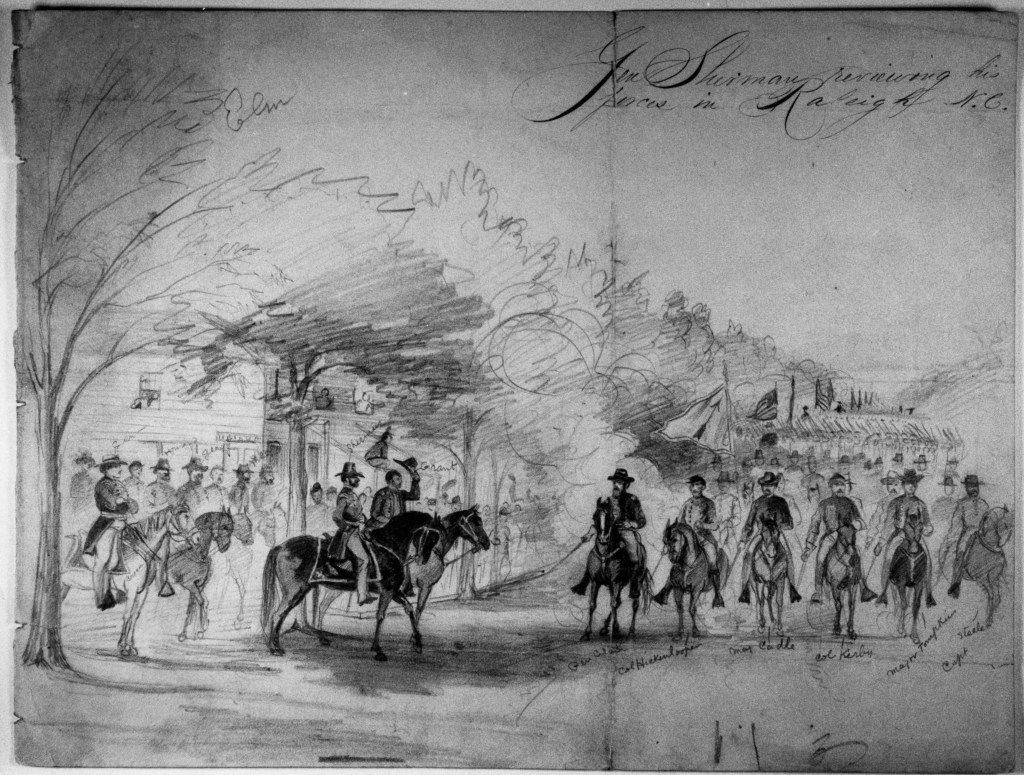
The following letter was written by Pvt. Samuel Frank of Co. B, 18th Missouri Infantry—a regiment formed early in the war and one that took part in most of the important engagements in the western theatre. It lost heavily at Shiloh. During the first two months of 1864m it was mounted and employed in scouting the country about Florence, Alabama. It then joined Gen. Sherman’s army and was assigned to the 17th Corps during the Atlanta Campaign and the March to the Sea. They then marched with Sherman to Raleigh, North Carolina, where this letter was written in April 1865 on the evening before Gen. Sherman reviewed his army in the streets of Raleigh
Gen. Sherman reviewing his troops as they march through the streets of Raleigh, 24 April 1865 The Becker Collection, Boston College Libraries
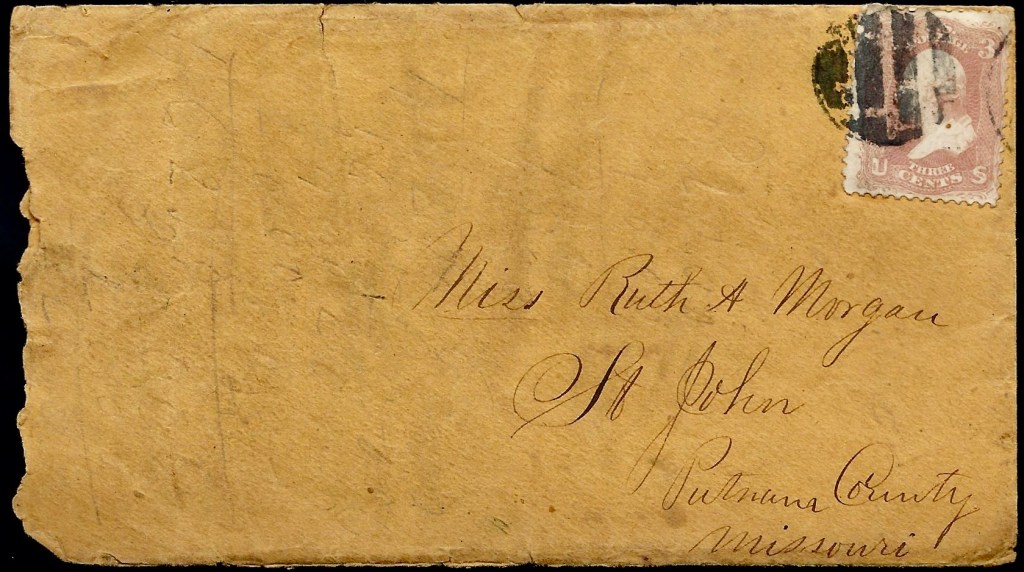
Samuel wrote the letter to 15 year-old Ruth A. Morgan (1849-1926) of St. John, Putnam county, Missouri. Ruth was married to Sidney Daniel Shattuck (1836-1918) in 1868 and lived her entire life in Putnam county, Missouri.
Transcription
Addressed to Miss Ruth A. Morgan, St. John, Putnam county, Missouri
Camp near Raleigh, North Carolina April 23rd 1865
Miss Ruth A. Morgan,
Dear friend, it is with pleasure that I take my pen in hand to answer your kind letter that came to hand a few days ago and was glad to hear from you and to learn you was well and to know that you haven’t forgot me. I am in good health and I truly hope when this comes to hand it will find you well and enjoying yourself.
Well, I haven’t much of importance to write, only I would like to see you once more and have the pleasure of talking to you. We have good news down here. Old General Lee has surrendered to General Grant and General Johnson has surrendered to General Sherman and lots of news about [the] place. It is the talk that we sill start in a few weeks on our way home and then all of the boys can come home and see the girls and have a good time with them. And then we can talk instead of writing and that will be much more pleasure to us.
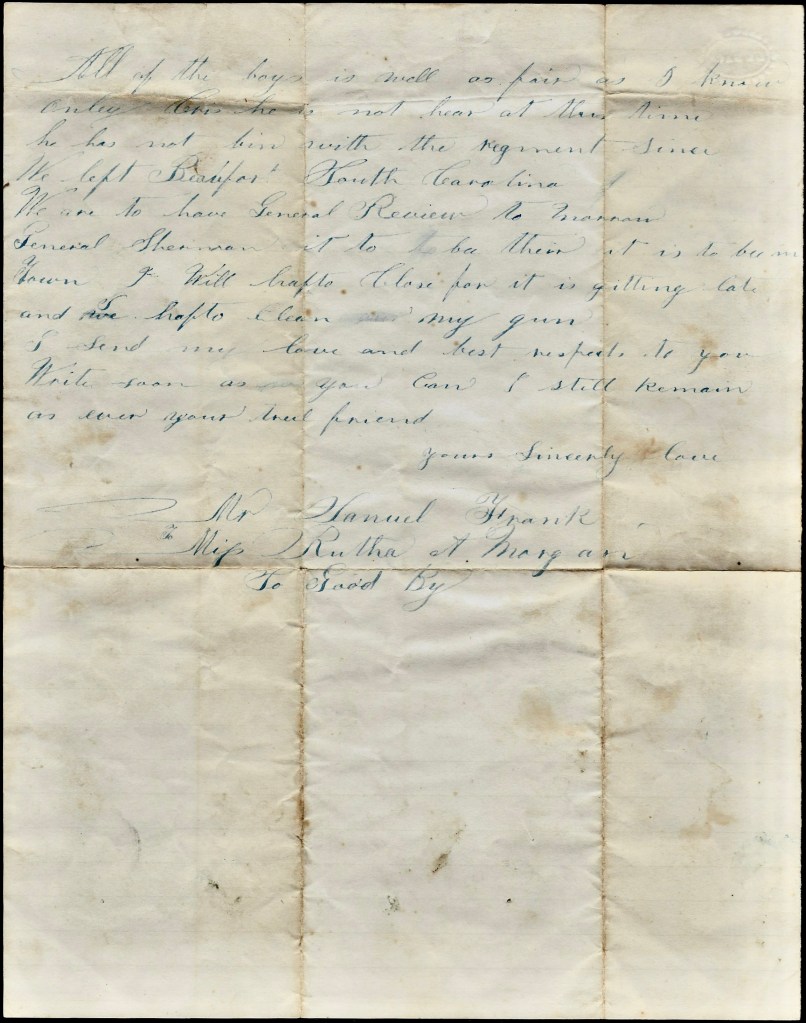
Thomas Good[e] has come and fetched the letter safe to me. It has been a long time since I heard from you. It done me lots of good to get a letter from you. All of the boys is well as far as I know. Only Chris—he is not here at this time. He has not been with the regiment since we left Beaufort, South Carolina.
We are to have a General Review tomorrow. General Sherman is to be there. It is to be in town. I will have to close for it is getting late and I have to clean my gun. I send my love and best respects to you. Write soon as you can. I still remain as ever your true friend. Yours sincerely [with] love, — Mr. Samuel Frank
The following letters were written by Melville P. Nickerson (1838-1907), the son of Solomon Swett Nickerson (1802-1856) and Sally Wentworth Veazie (1803-18xx) of Brewer, Penobscot county, Maine. He wrote the letters to his brother-in-law James S. Young of Brewer. In the 1860 US Census, Melville was enumerated in his mother’s home, his 26 year-old brother Oliver working as a boat builder, and Melville as a 22 year-old mariner.
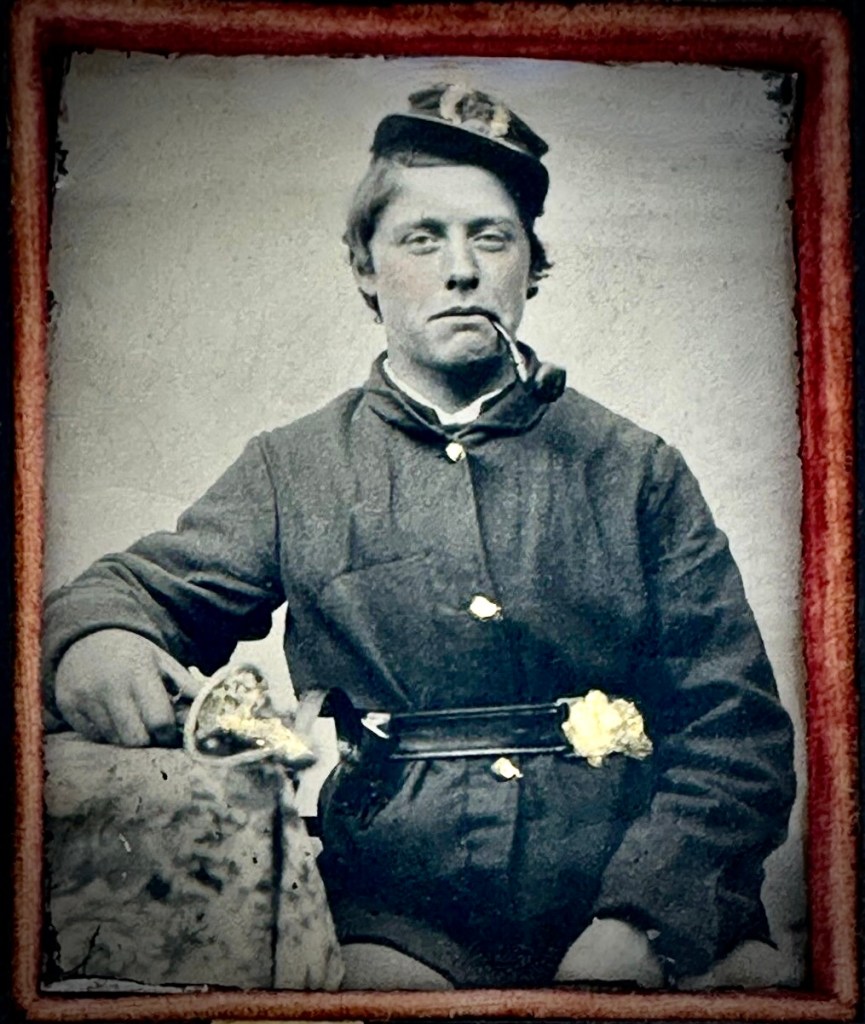
I could not find an image of Melville but here is one of Samuel Caley of Co. D, 2nd Maine Infantry
I have not provided a middle name for Melville as the genealogical records vary—some say it was Parker, some say Porter. In fact, his first name is also given variously as Melville or Melvin though I feel confident it was Melville. His comrade’s called him Mell.
The war had barely begun when Melville enlisted on 28 May 1861 as a private in Co. C, 2nd Maine Infantry. He was quickly elevated to a corporal and later rose to Sergeant. Despite Melville ridiculing others in his regiment for “playing off” and being discharged for medical disability by a surgeon’s certificate, it appears that he did the same thing in the spring of 1862, never even participating on McClellan’s Peninsula Campaign. By the time of the 1863 Draft Registration in the summer of 1863, Melville was back in Brewer studying law.
The 2nd Maine was the first Civil War regiment to march out of the state, and was greeted with accolades by civilians as it made its way to Washington, D. C. It engaged in “eleven bloody and hard-fought battles” including the First Battle of Bull Run, where it was the last regiment to leave the field, and Fredericksburg, where it took its greatest number of casualties. As one of the letters alludes to, the term of service to which the men had agreed to serve was a matter of dispute from the very beginning though most did not take the matter seriously in 1861 as most of them thought, like Melville, that the war would certainly be over by the spring of 1862. Whether it was a two year or three term of service seemed to matter little at the time.
Melville’s 1861 letters reflect the reputation of the regiment. They were known as a rough and rowdy bunch who loved a good fight. Many of them were seamen, dock workers, laborers and lumberjacks. Drinking and fighting were second nature to them.
Letter 1
Camp Seward June 20th 1861
Dear Brother Jim & Sister May
I received your letter last night and was glad to hear from you and the folks at home that I did not stop to think of your not writing before. We are all well here at present and me especially for i never was better in my life although I should like to have something more to eat sometimes but manage to get along very well. We are having very warm but pleasant weather now and some of the men feel the heat very much but I guess that when we get a little more used to it, we shall like it better.
Everything is quiet here at present. No important movements going on although the federal troops are slowly but surely advancing their lines towards Harpers Ferry and Manassas Gap and probably there will be a pitched fight there before long if there is any fight in the South. But every moment it is delayed finds us in better shape for we are improving in drill and there are troops arriving every day more or less. But it is thought that the war will not be prosecuted very much until Congress meets and then after they have another chance to throw down their arms and return to their allegiance. If they still persist in their rebellion, the immense forces concentrated here and at Fort Monroe and the West will probably be sent on and then Jeff Davis & Company had better look out for their necks are in danger.
You can have but a poor idea of the quantity of troops here. Even we, until we had been here a week, saw them come in every day and night, could not imagine anything of the preparations that are being made by the Government. I see by the letters that we get from home that it is generally thought down there that we are in the service for only three months but here we do not know how long we are in for—some say 3 years and others 3 months. As for myself, I cannot find out how it is and therefore shall not express an opinion on it anyway.
We are sorry to hear of the death of poor Benner for he was a first rate little fellow and he is the first of the 2nd Regiment that has fallen a martyr to his patriotism. But his name should be remembered by all true men i nMaine for although he did not [die] by the steel of the rebel’s [bayonet], he has fallen in a glorious cause. May he rest in peace and who will be the next? God only knows.
Mary wrote that Oliver had written the same day that you did but I have not anything from him. I got one last night from David. I should like to have been down there to have gone to the fires. I guess that you have got some secessionists down there. I think you had better organize a regiment right off and station some picket guard and send out patrols or you may see some morning when you get up the rebel flag flying over your heads and then don’t say that I did not warn you. But then, I suppose you don’t know much about war down there. If you had been encamped within two miles of Virginia and within sight of Alexandria and Fairfax Court House and also Arlington Heights for a fortnight, you would feel like fighting. I have been so mad for a week that I did not know what to do.
Because I did not get any letter from home and I have written 4 or 5, but since I got yours & David’s last night, I feel much better. Write as often as you can and tell all the folks to do the same and I shall keep you as well informed of our movements and condition as I can. I have not got only a half of a sheet of paper this morning so I must close. Your brother, — Mell
Letter 2
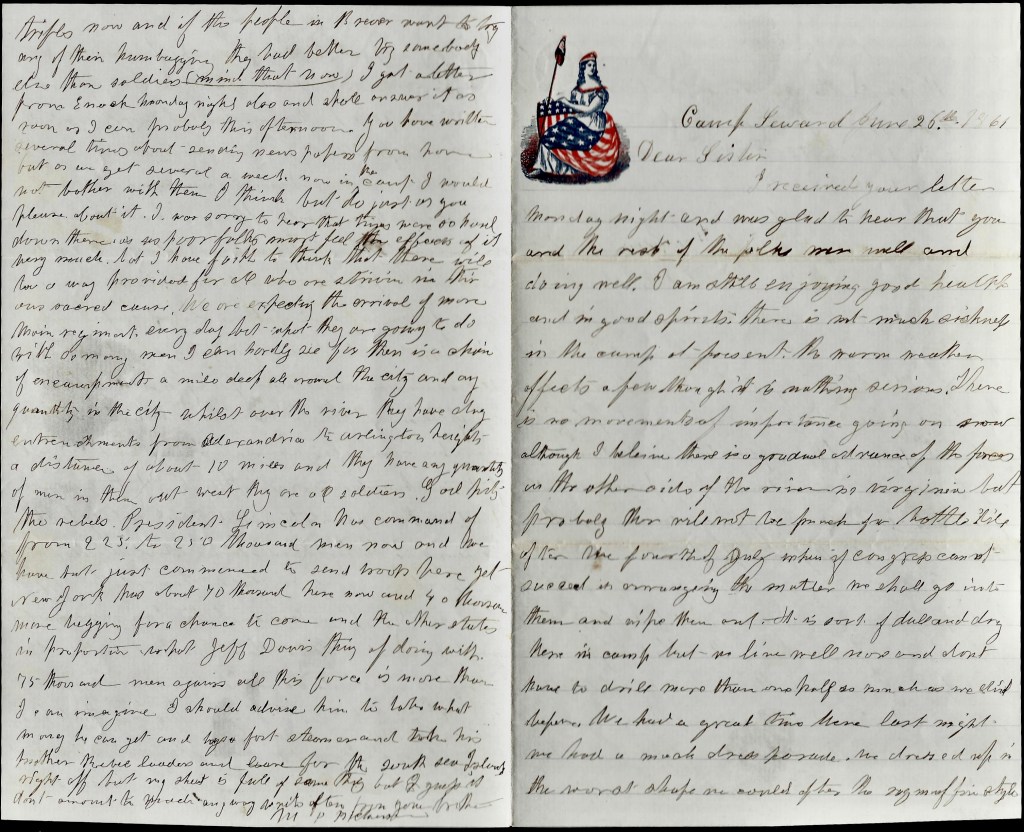
Camp Seward June 26th, 1861
Dear Sister,
I received your letter Monday night and was glad to hear that you and the rest of the folks were well and doing well. I am still enjoying good health and in good spirits. There is not much sickness in the camp at present. The warm weather affects a few though it is nothing serious. There is no movements of importance going on now although I believe there is a gradual advance of the forces on the other side of the river in Virginia but probably there will not be much of a battle till after the Fourth of July when, if Congress cannot succeed in arranging the matter, we shall go into them and wipe them out. It is sort of full and dry here in camp but we live well now and don’t have to drill more than one half as much as we did before.
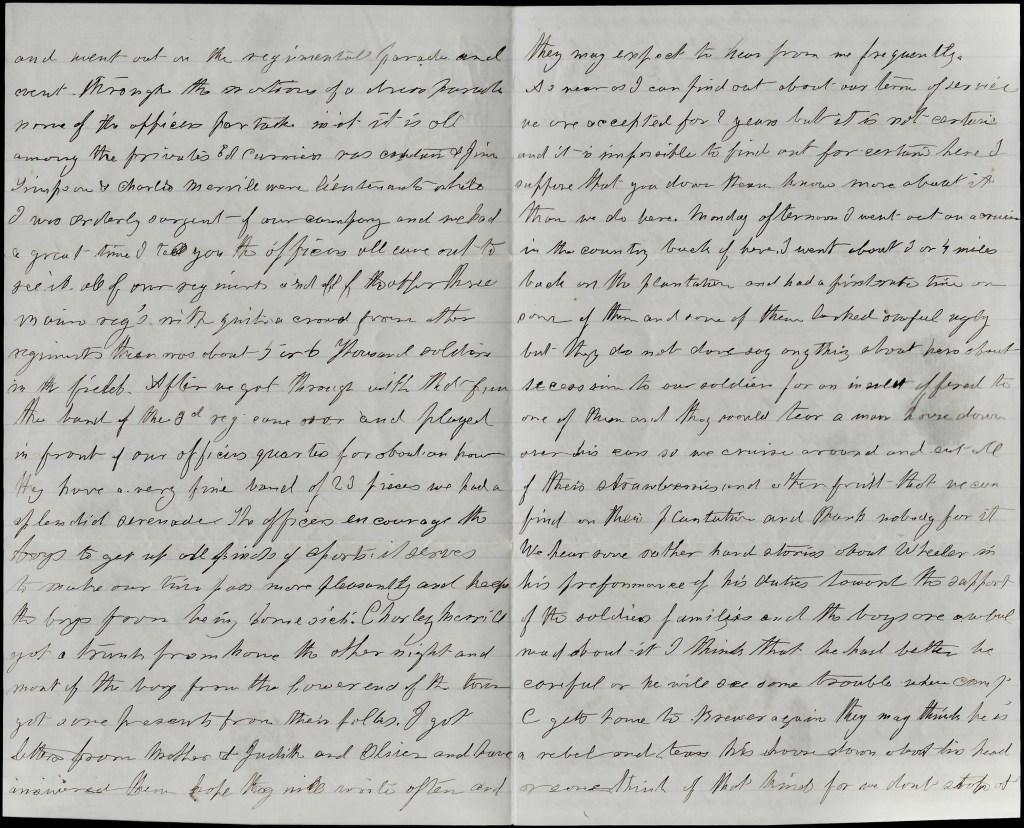
We had a great time here last night. We had a mock dress parade. We dressed up in the worst shape we could after the rag muffin style and went out on the regimental parade and went through the motions of a dress parade, None of the officers partake in it. It is all among the privates. Ed Currier was captain & Jim [ ]son & Charles Merrill were lieutenants while I was orderly sergeant of our company and we had a great time, I tell you. The officers all were out to see it. All of our regiment and all of the other three Maine regiments with quite a crowd from other regiments. There was about five or six thousand soldiers in the field. After we got through with that fun, the band of the #rd Maine came over and played in front of our officers’ quarters for about an hour. They have a very fine band of 23 pieces. We had a splendid serenade. The officers encourage the boys to get up all kind of sports. It serves to make our time pass more pleasantly and keep the boys from being homesick. Charley Merrill got a trunk from home the other night and most of the boys from the lower end of town got some presents from their folks. I got a letter from Mother and Judith and Oliver and have answered them. Hope they will write often and they may expect to hear from me frequently.
As near as I can find out about our term of service, we are accepted for two years but it is not certain and it is impossible to find out for certain here. I suppose that you down there know more about it than we do here.
Monday afternoon I went out on a cruise in the country back of here. I went about three or four miles back on the plantation and had a first rate time on some of them and some of them looked awful ugly, but they do not dare say anything about here about secession to our soldiers for an insult offered to one of them and they would tear a man’s house down over his ears. So we cruise around and eat all of their strawberries and other fruit that we can find on their plantations and thank nobody for it.
We hear some rather hard stories about Wheeler in his performance of his duties toward the support of our soldiers’ families and the boys are awful mad about it. I think that he had better be careful or he will see some trouble when Co. C gets home to Brewer again. They may think he is a rebel and tear his house down about his head or something of that kind for we don’t stop at trifles now and if the people in Brewer want to try any of their humbugging, they had better try somebody else than soldiers (mind that now!).
I got a letter from Enoch Monday night also and shall answer it as soon as I can. Probably this afternoon. You have written several ties about sending newspapers from home but as we get several a week now in camp, I would not bother with them, I think. But do just as you please about it. I was sorry to hear that things were so hard down there as us poor folks must feel the effects of it very much. But I have faith to think that there will be a way provided for all who are striving in this, our sacred cause.
We are expecting the arrival of more Maine regiments every day but what they are going to do with so many men, I can hardly see for there is a chain of encampment a mile deep all around the city and any quantity in the city whilst over the river they have dug entrenchments from Alexandria to Arlington Heights—a distance of about ten miles. And they have any quantity of men in them out west, they are all soldiers. God pity the rebels.
President Lincoln has command of from 225 to 250 thousand men now and we have but just commenced to send troops here yet. New York has about 70 thousand here now and 40 thousand more begging for a chance to come and the other states in proportion. What Jeff Davis thinks of doing with 75,000 men against all this force is more than I can imagine. I should advise him to take what money he can get and hop a fast steamer and take his brother rebel leaders and leave for the south sea islands right off.
But my sheet is fill of something but I guess it don’t amount to much anyway. Write often. From your brother, — M. P. Nickerson
Letter 3
Headquarters 2nd Regiment Vol. Maine Militia Camp Seward, Washington D. C. June 27th 1861
Dear Brother Jim and sister,
I have just received your letter of the 23rd and hasten to write in return. I was very glad to hear that you were well and that the rest of the folks were also well. Also that that garden was doing so well. When you eat your first mess of green peas, just eat a few for me. I am happy to say that we are faring much better now than we used to. We get enough and it is of good quality. The fault before was in the contractors. The quartermaster could not get good grub and so he stopped taking of them and engaged a new buyer and provision dealer and now we get along first rate. Ain’t you glad?
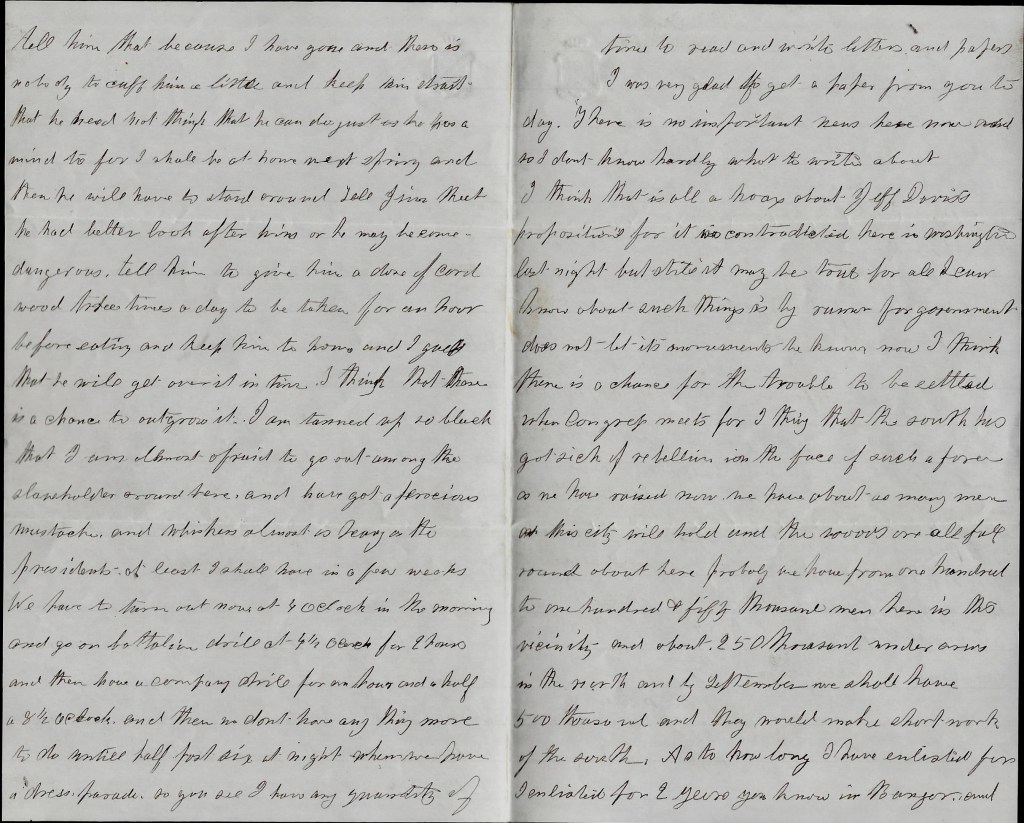
I want you to tell Mr. O[liver] M. Nickerson, Esq. that if he can’t stop toting Annie around long enough to write a few letters now and then, that he had better sell out to some loafer that has got time. Tell him that because I have gone and there is nobody to cuff him a little and keep him straight, that he had [better] not think that he can do just as he has a mind to for I shall be at home next spring and then he will have to stand around. Tell Jim that he had better look after him or he may become dangerous. Tell him to give him a dose of cord wood three times a day to be taken for an hour before eating and keep him to home, and I guess that he will get over it in time. I think that there is a chance to outgrow it.
I am tanned up so black that I am almost afraid to go out among the slaveholders around here, and have got a ferocious mustache and whiskers—almost as heavy as the President’s. At least I shall have in a few weeks.
We have to turn out now at 4:30 o’clock for two hours and then have a company drill for an hour and a half at 8:30 o’clock. And then we don’t have anything more to do until half past six at night when we have a dress parade. So you see I have any quantity of time to read and write letters and papers. I was very glad to get a paper from you today. There is o important news here now so I don’t know hardly what to write about.
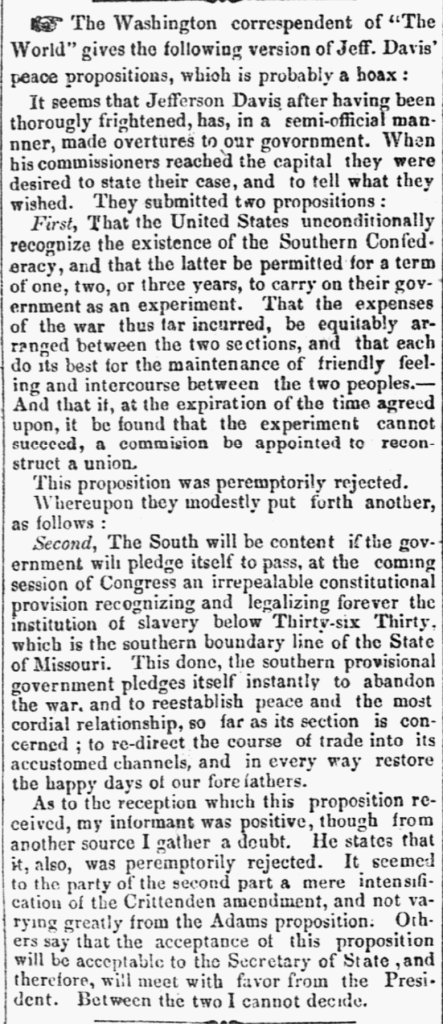
The Farmers’ Cabinet, 28 June 1861
I think that is all a hoax about Jeff Davis’s propositions for it is contradicted here in Washington last night, but still it may be true for all I can know about such things is by rumor for government does not let its movements be known now. I think there is a chance for the trouble to be settled when Congress meets for I think that the South has got sick of rebellion in the face of such a force as we have raised now. We have about as many men in this city [will] hold and the rooms are all full round about here. Probably we have one hundred to one hundred and fifty thousand men here in this vicinity and about 250 thousand under arms in the North and by September we shall have 500 thousand and they would make short work of the South.
As to how long I have enlisted for, I have enlisted for two years you know in Bangor, and then in Willet’s Point we took an oath for three years if we were mustered in for that length of time, but how long we were mustered in for, I do not know anything more about that than you do. But be it two or three years, this war will be over by next May and then we shall be discharged if not before. We may not have been mustered in for more than three months and so our time will be out the 28th of August.
There is a daguerrean artist here by the name of Mrs. Donaldson—a widow lady who is taking pictures for 25 cents. When I get paid off, I shall send my picture home. I expect it will be splendiferous! Gorgeously magnificent!
Tell mother to write me again and Judith and David and Oliver and everybody else. I have answered Mother’s and Judith’s letter and also your last. Keep on writing and send all the news. Tell Oliver to give my best respects to Ann and tell her that his [Oliver’s] soger brother is a great deal better looking than he is. Give my regards to all enquiring friends. So goodbye for this time and remember your brother.
— M. P. Nickerson, Co. C, 2nd Regt. V. M. M., High Private
Letter 4
Fort Corcoran August 29th 1861
Brother Jim,
As I have not written to you for some time and it rains today and is sort of dull, I thought I would write a few lines just to let you know that I am alive and well as usual and I hope you and yours are enjoying the same. I kinder thought I should get a letter from you today but did not. But I suppose that you are so busy that you don’t feel much like writing for I know that I don’t like to sit down and write when I have been to work hard.
There is no news of importance here—at least I don’t know any for I don’t have much chance to in here for we have moved inside of the fort and taken up winter quarters, I suppose. And we are busy just now learning how to handle the big guns in here. Our company has 8-inch [seacoast] Howitzers to handle. They differ from the common 64-pound siege guns only in its length and the thickness of the casting as they are made to heave shell and grape in and are not so good for heaving ball. I am gunner of one of the pieces and she is a beauty, I tell you. She weighs 5,780 pounds and I am going to fetch her home with me for a fowling piece when I come and I want to borrow some of your tools to make a stock for her for the one she has got now is rather clumsy.
The rear entrance to Fort Corcoran
I shall not want to borrow any gage for you know that I made one last winter and if you have not stolen it, I suppose it is to home now. I should like to play Euchre with you once more for that has been the principal business since we came away and I suppose I can beat anything but the Old Boy and I guess I could stand my hand with him even.
I hope you will follow my direction in regard to fighting if you should happen to have a battle there. There is not much sickness here now except a few that are sick the same as Hen[ry] Leach was. Oh he’s a brave lad. Have you joined the Home Guards yet? I understand they are getting up a company down there in Brewer. We are coming home in May to clean them out and the 400 of the Bloody Second that are left can clean out the whole state.
We had a grand review of this brigade last Tuesday by Gen. McClellan & staff accompanied by the President & Secretary Seward. They came into the fort and saw us exercise the guns and like all the others, they gave us a very good name but still not seem to think much of our good clothes. And to tell the truth, I never saw the regiment look quite so bad before. Their clothes are a great deal more holy than righteous. Anyway, since then, there is an order been signed to do away with all grey uniforms so I think we shall get new ones soon.
We have first rate fare now—the best we have ever had. Soft bread every day and baked beans quite often, and a plenty of fresh & salt beef with tea and coffee do that we get along quite well. I don’t weigh quite so much as I did when I enlisted but I am a pretty tough cup generally and I suppose I could clean out about a dozen of such critters as you & Oliver are.
I want you to be a good boy & keep your nose clean and not tear your trousers while I am away and when I come back, I’ll buy you a stick of candy. But as it is about time to drill, I must close this letter. Write as often as you can spare time and write everything you know. I expected a letter from Mary today but did not get any. If I was there I would cuff her ears, but hoping to hear from you all, I remain yours, &c., — M. P. Nickerson
Letter 5
Hall’s Hill, Va. November 25th 1861
Dear Sister,
As I have a few minutes leisure, I will scribble a few lines to you. I am well and doing well and we are in the same place yet and I see no prospect of moving yet a while. The weather is rather cold and wet here lately and we had a little snow storm on Sunday night and I was sergeant of the guard and we had to be on all night, so you see I got the whole benefit of it. But it did not last long, but is awful muddy here and growing worse every day.
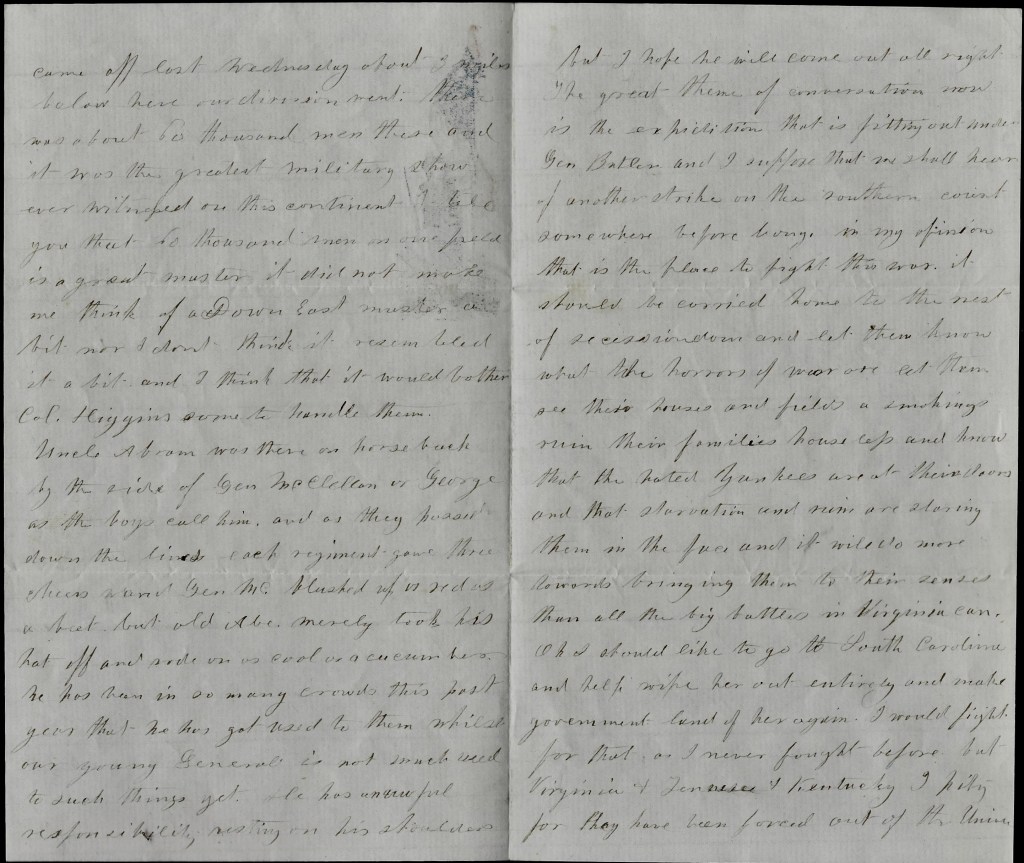
There has been nothing of interest to write about since my last except the great review that came off last Wednesday about 3 miles below here. Our Division went. There was about 60 thousand men there and it was the greatest military show ever witnessed on this continent, I tell you that. Sixty thousand men on one field in a great muster. It did not make me think of a Down East muster a bit, nor I don’t think it resembled it a bit. And I think it would bother Col. Higgins some to handle them.
Uncle Abram [Lincoln] was there on horseback by the side of Gen. McClellan, or George as the boys call him, and as they passed down the lines, each regiment gave three cheers and Gen. Mac blushed up as red as a beet, but Old Abe merely took his hat off and rode on as cool as a cucumber. He has been in so many crowds this past year that he has got used to them whilst our young General is not much used to such things yet. Abe has an awful responsibility resting on his shoulders but I hope he will come out all right.
President Lincoln and Gen. George McClellan reviewing the Union troops at Bailey’s Crossroads on 20 November 1861
The great theme of conversation now is the expedition that is fitting out under Gen. Butler and I suppose that we shall hear of another strike on the southern coast somewhere before long. In my opinion, that is the place to fight the war. It should be carried home to the nest of secession and let them know what the horrors of war are. Let them see their houses and fields a smoking ruin, their families houseless, and know that they hated Yankees are at their doors and that starvation and ruin are staring them in the face and it will do more towards bringing them to their senses than all the big battles in Virginia can.
Oh, I should like to go to South Carolina and help wipe her out entirely and make government land of her again. I would fight for that as I never fought before, but Virginia and Tennessee and Kentucky, I pity, for they have been forced out of the Union and into this business whilst the more southern states where this business was first hatched have thus far escaped with only a damage to their pockets. But now at their own doors, the enemy is thundering and they are likely to reap the fruit of their own folly. But I have moralized on this subject long enough.
I had a letter from you about a week ago which is the only one I have had for a fortnight. I wrote to Mother last night, Tuesday night, and sent her some money but have not heard from her yet. Expect to soon. But I must close for it is time to fall in for Brigade drill. I shall send a paper with this with a full account of the great review. Write soon and give my love to all. Your brother, — M. P. Nickerson
Letter 6
Halls Hill, Virginia December 1st 1861
Dear Sister,
I received yours of the 18th tonight and was very glad to hear from home once more—especially as I had not heard from home for a long time. I am quite well at present although I have had a little sick turn for a few days past caused by a light cold caught on picket and out scouting and fatigue, but have recovered entirely now and shall resume my duties tomorrow.
Everything is quiet in this section yet and I think will remain so until early spring for the roads are so muddy now that I think it will be impossible to move until they become settled in the spring and then after our immense naval forces shall occupy every important port & city of the southern seacoast this winter. With one grand sweep of this grand army, George [McClellan] will wipe out the bubble that Jeff Davis is pleased to call secession from the face of earth.
Jeff has already got frightened at the looks of things in Virginia and removed the capitol to Nashville, Tennessee, where Gen. Buell with about 50,000 men has gone to help him carry on his government, and I think that he will be a great help to him this winter. There has been a fight at Pensacola but we have not heard the particulars yet. The Southern papers are dumb on that particular subject but we shall probably hear soon the truth of the matter.
You can give my heartiest congratulations to Heman and Julin on the very pleasant accession to their domestic circle and tell them that I think that Melvina would be a proper, nice name for their illustrious stranger for I suppuse but they will now want to name it for something or someone that is in the army, and I really don’t know of a better name than her soldier uncle. Or I don’t know as I am just what you might call her uncle but the thing to it—sort of a half uncle. But tell them that if they don’t like that name, that most any other will do as well as I am not particular at all and a “Rose though called by any other name would smell as sweet.”
I should like to have gone on that excursion to Augusta to see Col. Goddard’s Cavalry make that splendid charge at an imaginary foe first rate—not that it would be anything of a new sight to me to see 1200 cavalry make and imaginary or even real charge at a foe. But I guess I should have liked the fun of the thing and I further guess that if the said charge had been near a plain where “leaden rain & iron nail” was sweeping like winter sleet and amid the crush & roar of battle, with the horrid shrieks and groans of the wounded & dying ringing in their ears, I think it would have taken the fun out of the thing wonderfully, for there is something in this experience of a real battle that is awfully grand and exciting. The cracking of thousands of muskets and rifles, the thick choking smoke, the shrieks of the wounded, the deafening yells and ringing cheers that burst spontaneously from the throats of some brave band as they go charging through this hailstorm of destruction, scattering slaughter and death in their track, forms a scene that to me makes Burns’ oft quoted line that “A man’s a man for all that” seem false for in such a time, a man is not a man but an incarnate demon. But that will do for battle scenes tonight.
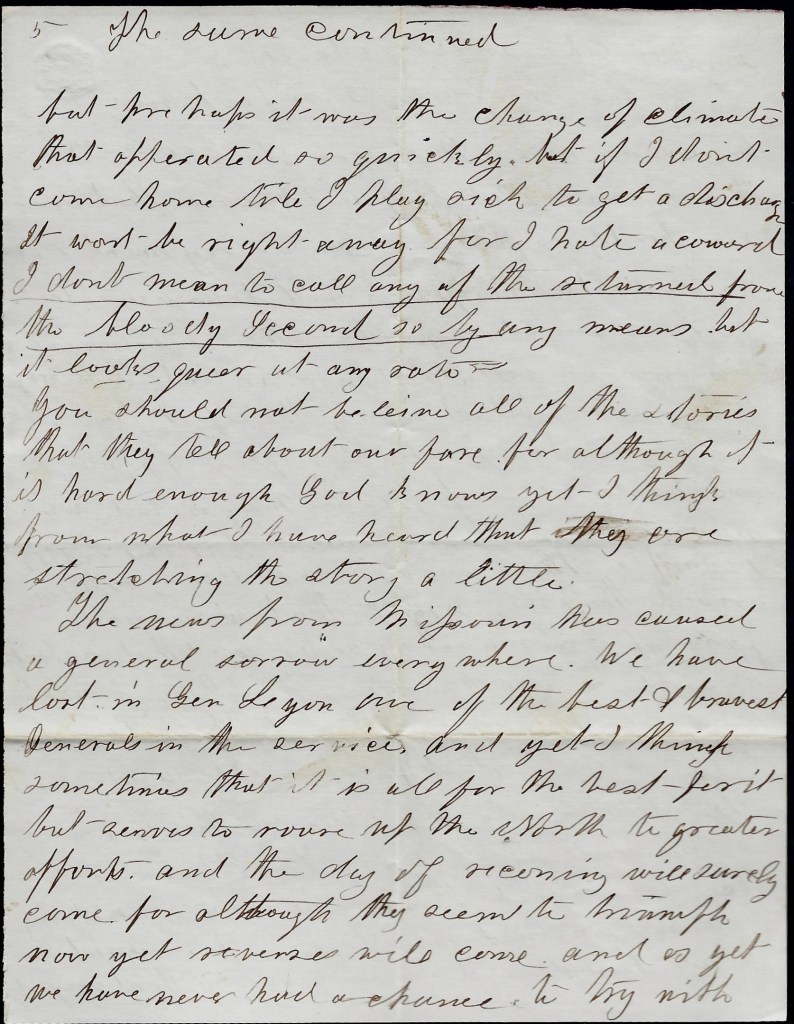
I should think it was about time for Lieut. Hull to be back to his regiment if he has got spunk enough to come back at all which I hope he will not for he don’t among to anything here and he is just fit for folks to talk about there. As for that other thing belonging to the Second Maine that you have got loafing around there, he has neither sense enough for a man nor not enough for a fool. But perhaps it was the change of climate that operated so quickly. But if I don’t come home till I play sick to get a discharge, it won’t be right away for I hate a coward. I don’t mean to call any of the returned from the Bloody Second so by any means, but it looks queer at any rate.
You should not believe all of the stories that they tell about our fare for although it is hard enough, God knows yet I think from what I have heard, that they are stretching the story a little.
The news from Missouri has caused a general sorrow everywhere. We have lost in General Lyon one of the best and bravest generals in the service, and yet I think sometimes that it is all for the best for it but seems to rouse up the North to greater efforts and the day of reckoning will surely come for although they seem to triumph now, yet reverses will come and as yet as have never had a chance to try with anything like an even chance.
As to the movements on foot now, I know no more than you do for everything is conducted so quietly here that one sees hardly anybody save his own regiment and his immediate neighbors. And from our place here we would think that the government was entirely idle & did not intend to do anything more. But it is only the effect of wisdom combined with greater discipline & prudence and preparations of greater magnitude were never seen on this continent. For one little example, there was a train of heavy artillery arrived the other night that was a mile long when in marching order and that is about a fair sample and yet under McClellan’s master mind, everything moves with all the precision of clock work.
But it is getting late and I must close this already long letter. Either you or Mother wrote me that Mrs. Smith wanted to hear from Frank Birce. He is well or doing well and is a first rate fellow. Give my respects to all friends and answer soon. So good night. — M. P. Nickerson
Letter 7
Georgetown Union Hospital March 26th 1862
Dear Sister,
I received yours of the 16th and 17th on Monday last and not take the first opportunity to answer. I am stopping at Union Hospital at present and as far as health is concerned, am much better than I was when I wrote last and have had but little of the chills for a week past. And the Doctor thinks that he has broken them up entirely and I hope so too for I don’t like them half as well as I do bread and butter.
You write that you have been looking for me home for several nights past. Well keep looking for I shall, or at least I think that I shall get there by the first of May if nothing happens and not much before. It is a very easy thing to be ordered a discharge and an easy thing to talk about it, but it is an entirely different thing to get it and to show you something about the process, I will tell you all about it.
First the surgeon orders a discharge and furnishes blanks and the Captain fills the descriptive part of them out and sends them to the Surgeon General’s Office for approval. They they are sent back to the Surgeon who first ordered them and he puts on his certificate of disability. and the cause which both he and the captain has to sign. Then that finishes that part of the business. Next the man must have another set of papers stating by whom he was enlisted, and by whom he was mustered into service. Also a statement of the pay & clothing he has received from the government and from whom or what officers he received it. Also at what time he received it. And after that is approved and signed by the captain of the company to which he belongs and also by the commanding officer of the regiment if he is with the regiment. If not, by the officer in command of the post where he is, he may consider himself fairly discharged. So that you can see that it must take some time to get discharged even after the order is given. If a man gets his papers all through in three months after they are commenced, he does well.
As for the regiment, all I can say is that it is gone somewhere and I am not allowed to say anything more about it. I would give a year’s pay to be able to be with them, that’s so.
The Union Hospital was located in the Union Hotel in Georgetown
The late war news is cheering. Everything is working finely, but I suppose that you hear it as soon as I do so I will not spend time to repeat it. As I suppose you will like to hear something about my present quarters, I will try and tell you about them and to commence, they are in a fine building in the city of Georgetown which you know joins Washington, and it is only a mile from this hospital to the White House and about a mile further to the [U. S.] Capitol. And as I am not very sick and am good chum with the doctor in charge, I have liberty to cruise around as much as I like. And I think of going to Congress a half a day tomorrow if it does not storm. I hope you won’t worry about my getting low and dissipated by going to such places for I shall be on my guard, I tell you, although I hate to associate with such characters as Congressmen and shall not do so more than is possible.
But I must close for my sheet is about full. Give my love to all and tell Mother that I shall write to her next time and that will be soon. Your brother, — Mell
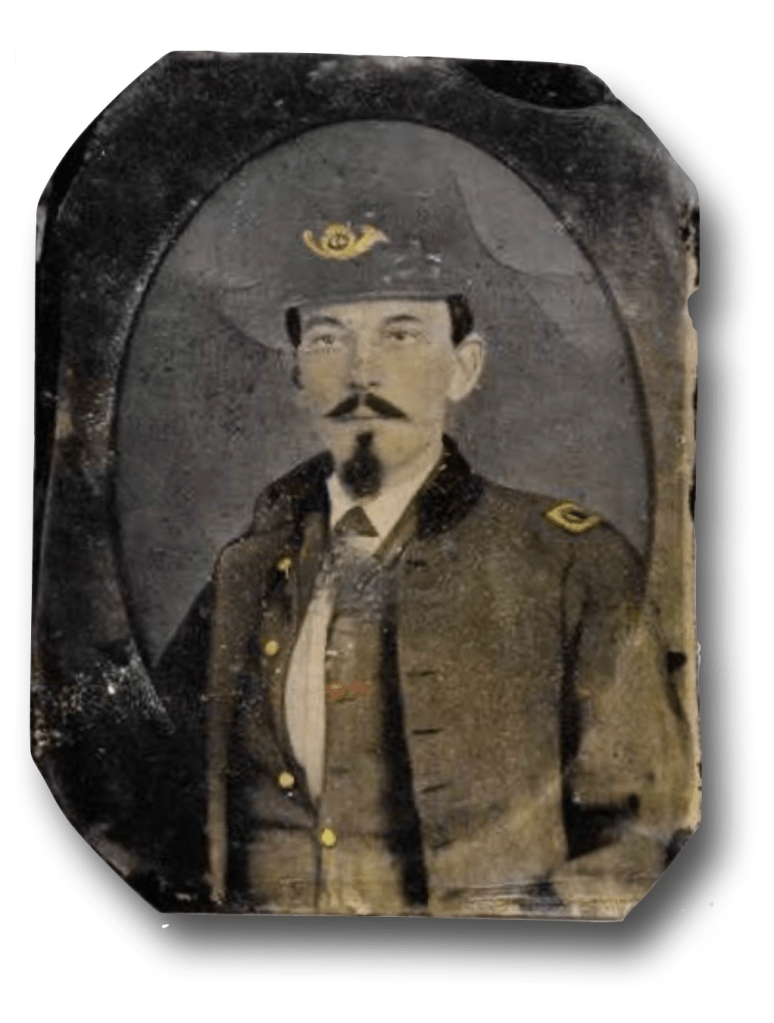
The following letter was written by James J. Martin (b. 1838), the son of Robert Thompson Martin (1790-1857) and Patsy Hall (1804-1880) of James City, Virginia. James served in Andrew J. Jones’ Company, Virginia Heavy Artillery, also known as the Pamunkey Artillery. This regiment was organized in May 1861 with men from New Kent county. James was mustered into the company on 3 June 1861. At that time, he was described as a 5 foot, 9 inch tall, light haired, 23 year-old farmer.
The Pamunkey Light Artillery were attached to the Department of Richmond and first served at West Point but later relocated to Chaffin’s Bluff to protect the approach to Richmond by Union gunboats coming up the James River. This point of the river was not heavily fortified until May 1862 during McClellan’s Peninsula Campaign. The company began as a Light Artillery but later changed to Heavy Artillery, manning fixed batteries on the James river.
James’ muster roll records indicate that he was with his company through December 1864. It appears that he was wounded on 5 January 1865 and that he deserted from the hospital in February. After the war, in December 1870, he married Mary Frances Curle (b. 1846) of New Kent Court House. She was the daughter of William Graves Curle (1808-1867) and Sarah Frances Tyree (1826-1860). Whether Mary F. Curle was the cousin to whom he addressed the following letter is unknown as he only refers to her as “cousin.”
James’ letter, written in the evening of May 9th 1862, informs us that artillery fire was heard. This may very well have been connected with the Union assault on and fall of Norfolk which resulted in the Confederates destroying the CSS Virginia (formerly the USS Merrimack), and the opening of the James River to Union gunboats. In fact, just days later, on 15 May 1862, Union gunboats led by the USS Monitor attempted to get to Richmond by maneuvering up the James river but were stopped by Confederate batteries at Drewry’s Bluff and Chaffin’s Bluff, within a mile of each other on opposite sides of the river.
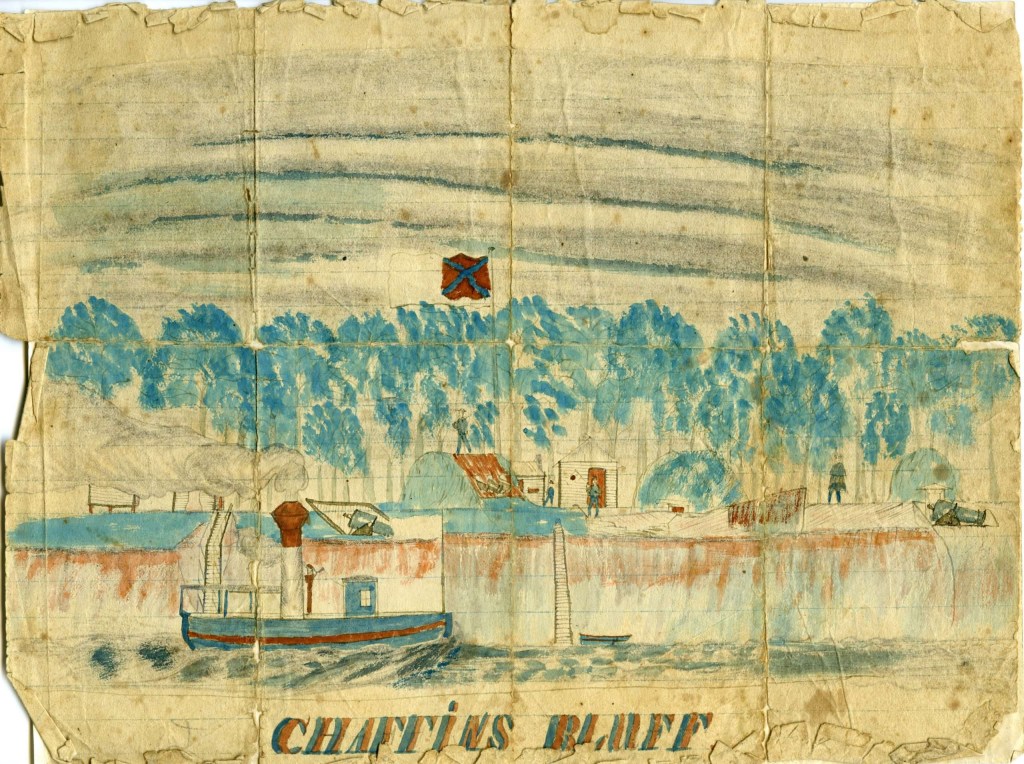
A soldier’s sketch gives a view of Confederate fortifications at Chaffin’s Bluff on the James River, about a mile downriver from Drewry’s Bluff. Chaffin’s Bluff represented the forward outpost of the James River Squadron’s defense of the Confederate capital at Richmond, and this drawing, possibly the work of Sergeant John A. Bland of the 34th Virginia Infantry, shows a wooden gunboat, artillery emplacements, and, overlooking it all, the Confederate Second National Flag. The James River Squadron faced Union forces in this winding section of the river for the last year of the war in a standoff that mirrored the one between Union general Ulysses S. Grant and Confederate general Robert E. Lee at Petersburg. Probably drawn in 1864.[Museum of the Confederacy]
Transcription
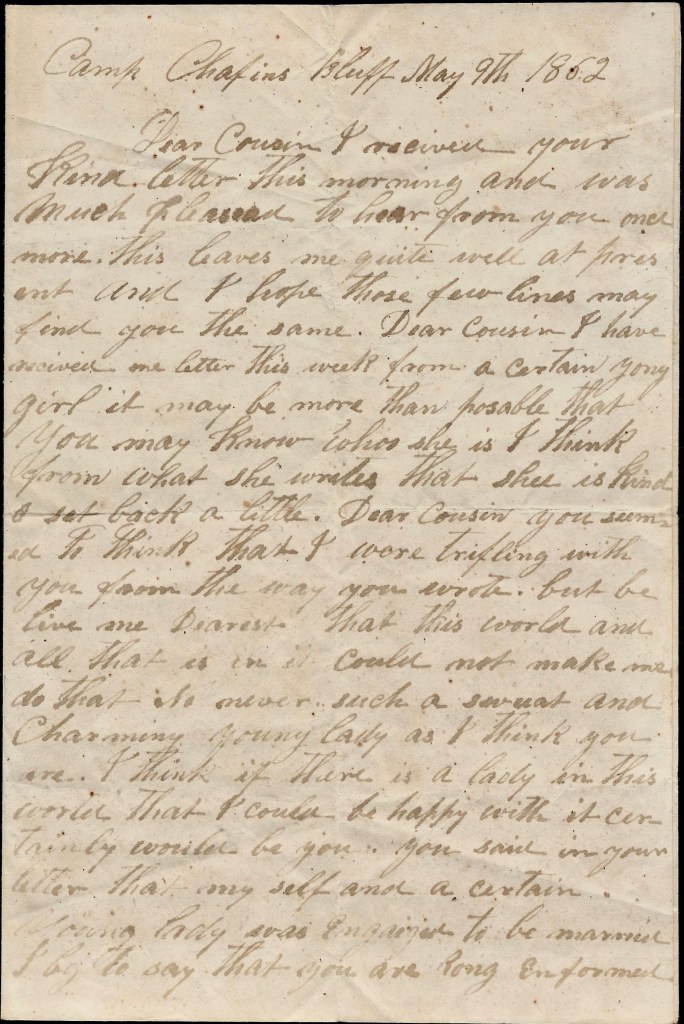
Camp Chaffin’s Bluff May 9th 1862
Dear Cousin,
I received your kind letter this morning and was much pleased to hear from you once more. This leaves me quite well at present and I hope those few lines may find you the same. Dear cousin, I have received one letter this week from a certain young girl. It may be more than possible that you may know who she is. I think from what she writes that she is kind & set back a little. Dear cousin, you seemed to think that I were trifling with you from the way you wrote. But believe me, dearest, that this world and all that is in it could not make me do that. No never. Such a sweet and charming young lady as I think you are. I think if there is a lady in this world that I could be happy with, it certainly would be you.
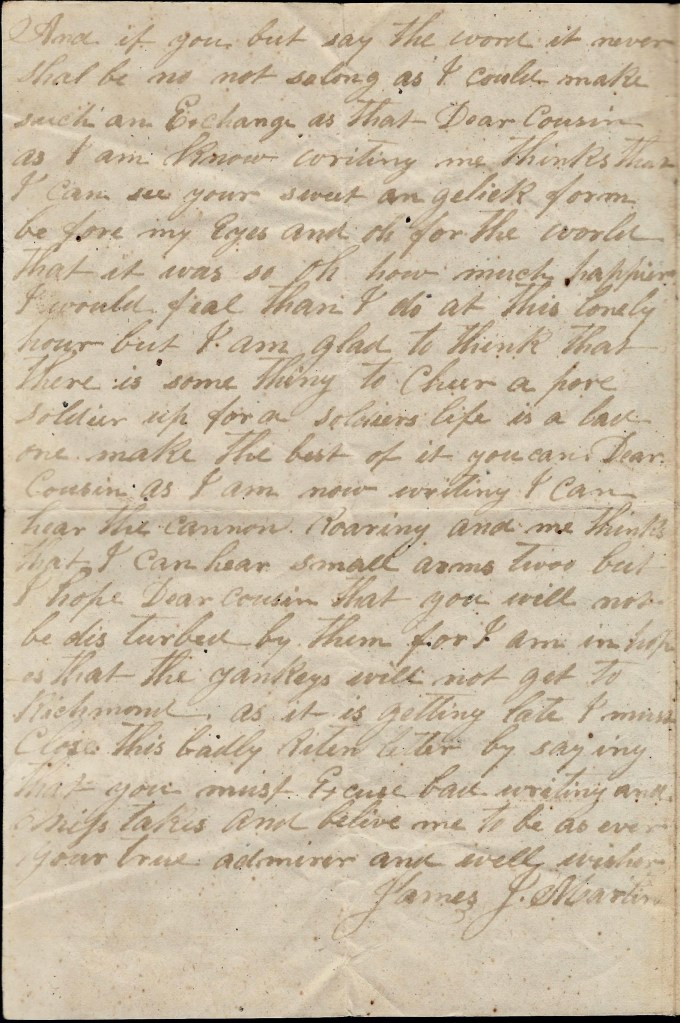
You said in your letter that my self and a certain young lady was engaged to be married. I beg to say that you are wrong informed. And if you say the word, it never shall be. No, not so long as I could make such an exchange as that.
Dear cousin, as I am now writing, me thinks that I can see your sweet angelic form before my eyes and oh for the world that it was so. Oh! how much happiness I would feel than I do at this lonely hour. But I am glad to think that there is something to cheer a poor soldier up for a soldier’s life is a bad one. Make the best of it you can, dear cousin.
As I am now writing, I can hear the cannon roaring and me thinks that I can hear small arms too but I hope, dear cousin, that you will not be disturbed by them for I am in hopes that the Yankees will not get to Richmond. As it is getting late, I must close this badly written letter by saying that you must excuse bad writing and mistakes. And believe me to be as ever your true admirer and well wisher, — James J. Martin
The following letter was written by 1st Lt. James Berry Jordan (1837-1899), a Confederate Prisoner of War (POW) at Johnson’s Island near Sandusky, Ohio. Jordan was a resident of Wake county, North Carolina, when he enlisted in late May 1861 as a 1st Lieutenant in Co, D, 26th North Carolina Infantry. With his excellent handwriting, he was soon after given the Adjutant’s job in the regiment. He was wounded in the hip at the Battle of Gettysburg and was taken prisoner. He was first sent to David’s Island and then in mid-September 1863 sent to Johnson’s Island which he humorously called his “Island Home” after 18 months of captivity there.
A week after this letter was written, Jordan went sent to Point Lookout, Maryland, and then to Ft. Delaware where he was released on 12 June 1865.
Jordan wrote the letter to Martha (“Mattie’) Elizabeth Fearn (1845-1936) with whom he would marry on 26 September 1866. Mattie lived with her parents, Samuel and Elizabeth (Owen) Fearn in Milton, Trimble county, Kentucky.
Note: “James Berry Jordan,” born 8 June 1838 is the way his name appears in the family bible.
Transcription
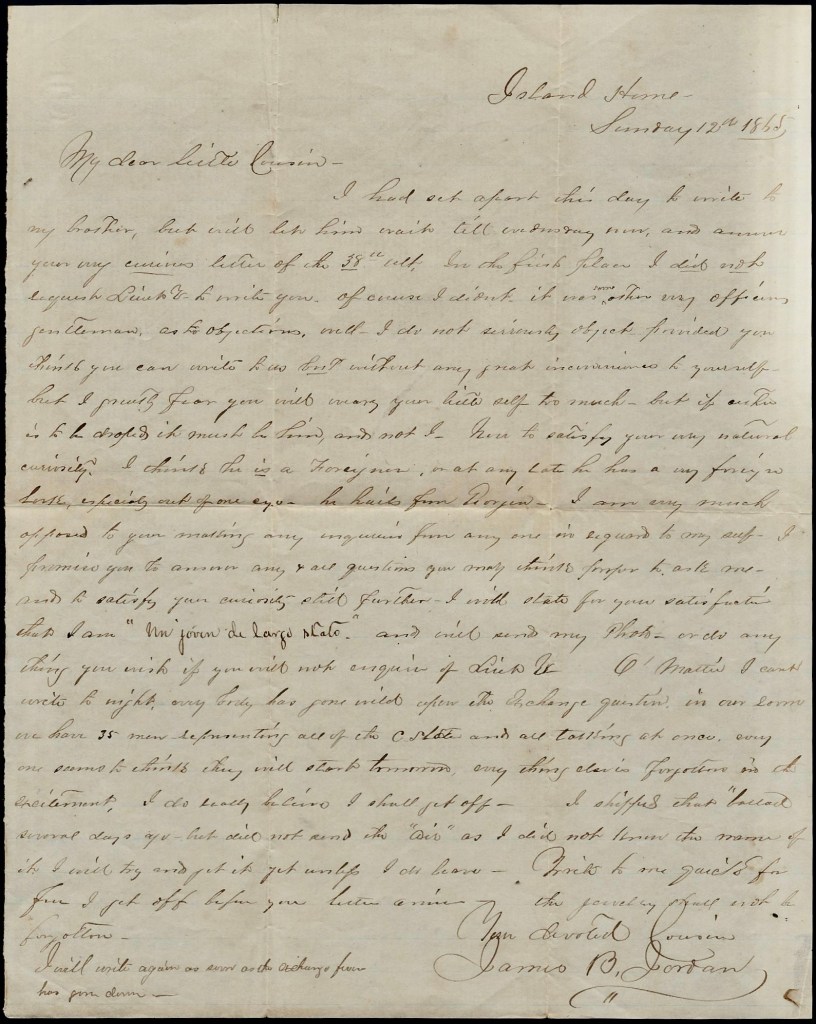
Island Home Sunday, [March] 12th 1865
My dear little cousin,
I had set apart this day to write to my brother, but will let him wait till Wednesday now and answer your very curious letter of the 38th ult. In the first place, I did not request Lieut. V. L. write you. Of course I didn’t—it was some other officer gentleman. As to objections, well, I do not seriously object provided you think you can write to us, but without any great inconveniences to yourself. But I greatly fear you will weary your little self too much, But if either is to be dropped, it must be him, and not I.
Now to satisfy your very natural curiosity. I think he is a foreigner, or at any rate, he has a very foreign look—especially out of one eye. He hails from Georgia. I am very much opposed to your making any inquiries from anyone in regard to myself. I promise you to answer any and all questions you may think proper to ask me and to satisfy your curiosity still further, I will state for your satisfaction that I am “Nu joven de large stato” and will send my photo, or do anything you wish if you will not enquire of Lieut. V.
Oh Mattie, I can’t write tonight. Everybody has gone wild upon the exchange question in our room. We have 35 men representing all of the Confederate States and all talking at once. Everyone seems to think they will start tomorrow. Everything else is forgotten in the excitement. I do readily believe I shall get off. I shipped that “ballad” several days ago but did not send the “air” as I did not know the name of it. I will try and get it yet unless I do leave.
Write to me quick for fear I get off before your letter arrives. The jewelry shall not be forgotten. Your devoted cousin, — James B. Jordan
I will write again as soon as the exchange fever has gone down.
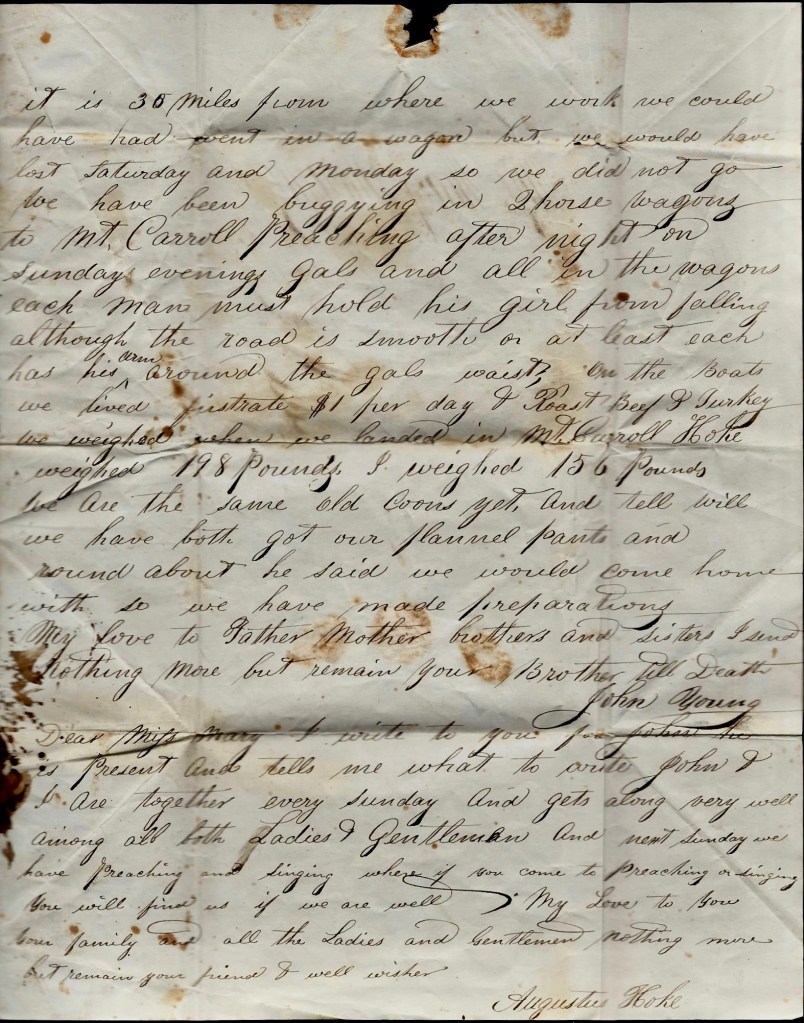
The following letter was penned by Augustus Caesar Hoke (1825-1910), the son of John Henry Hoke (1796-1876) and Anna Margaret Byers (1801-1857) of Greencastle, Franklin county, Pennsylvania. Augustus—a farmer by occupation—was married to Rachel Lucinda Stamy (1830-1893) in 1850 and soon after relocated to Seneca county, Ohio, where he spent the remainder of his days.
Augustus actually wrote the letter for his illiterate friend, John Young—a 21 year-old black man, also from Greencastle, Pennsylvania. John Young was the son of Eli Young and Mary Simpson, both most likely former slaves born and raised in Maryland. Greencastle is located a few miles south of Chambersburg on the Mason Dixon line. There were a large number of free blacks living in the county by the time of the Civil War but it was still a very dangerous place for blacks to live in the 1840s for fear of being captured and sold into slavery even though they may have been free. Certainly in the mid 1840s, it would not have been without risk for a black man to travel from Pennsylvania to western Illinois by way of an Ohio and Mississippi steamboat without being accompanied by a white man who might be assumed to be his owner.
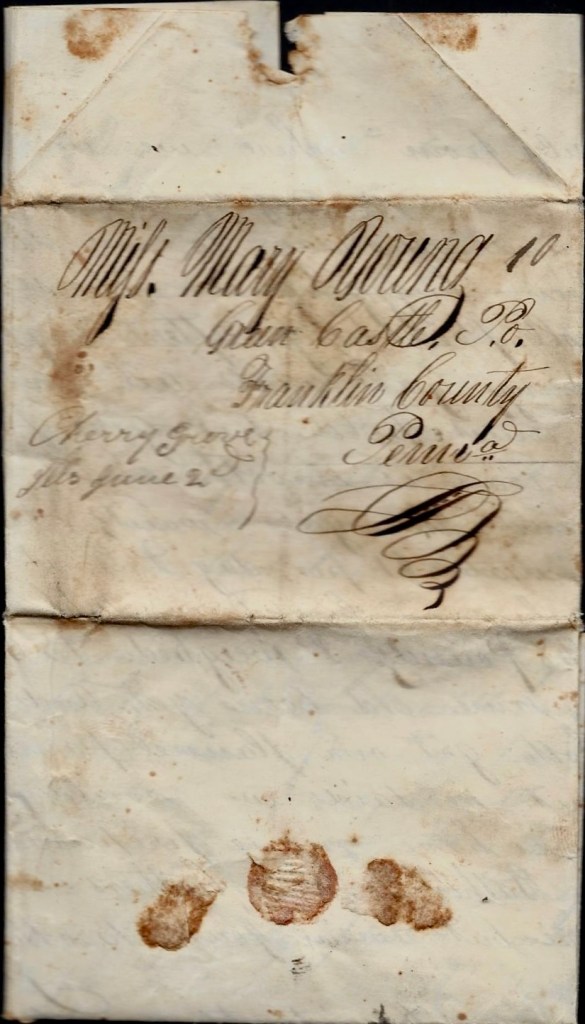
We learn from the letter that Augustus and John had traveled to Cherry Grove, Carroll county, Illinois, by steamboat. Mt. Carroll is just a few miles east of Savannah, the Mississippi river port where the young men would have entered Illinois. They were living with Daniel Arnold (1798-1857), a former resident of Chambersburg, Pennsylvania. Daniel and his wife, Betty Price, came to Cherry Grove (northeast of Mount Carroll) in June 1840, purchasing a 240 acre tract of land. Daniel was a community leader and a forceful minister in the Dunkard (German Baptist Brethren) Church. It isn’t clear from the letter what employment Augustus and John were engaged in though it may have been related to transporting mail.
Transcription
Cherry Grove [Illinois] May 31st 1846
Dear Sister,
I received your letter May 24th 1846 and was pleased to hear from you all that you were all well at present. I am living with Mr. [Daniel] Arnold from Chambersburg and gets $10.50 per month for three months. We were about two weeks too late to get big wages. Some men get $12 per month. We have to stay till July 14th, then our time will be up. We will not leave this till some time in August (towards the last of it). Hoke has been at me to go with him to Texas when we leave here but I cannot promise him. He said if I go, he will but I think I will come home sure this fall in time to attend singing the succeeding winter. If I come, he says he thinks he will unless he can get some other company to go to Texas. He appears to talk of nothing but traveling.
We have both been very healthy since we left home with the exception of a few days which we did not just feel so well. The camp meeting girl says she will not have the beau she had last year. Perhaps she may find a better one. If I could be at camp meeting, I should be with some of them Pennsylvania gals. A. Hoke and I goes partners in everything and in squeezing the gals. We have been taking sets with some of those Illinois gals since we have been here. There is some fine gals here. I must stop about gals. We must have one apiece tonight sure.
I am sorry that you were uneasy about us before we wrote home. We were so well contented on the boat that the time passed round so quick we did not think of writing. But I will continue to let you hear from us regularly from this till I leave for home—that is about three months yet. I intend coming to Cincinnati by water and then travel through Ohio by land. Perhaps I will buy a horse. If I do, I will come the whole way by land.
We have preaching here and singing all in the forenoon and singing in the afternoon. But I say three cheers for Old Pennsylvania gals forever. We are very well pleased with the country and the people that are in it [ink spill obliterates handwriting]…well, but there will not [illegible]…Corn is short yet but it has not been planted more than three weeks. Wheat is selling here for 40 cents per bushel, corn 16 cents per bushel, oats 16 cents per bushel, potatoes 12,50 cents.
The Dunkers have a big meeting at West Grove today but Hoke and I did not take the time to go to it. (I upset the ink after Hoke had wrote the letter but you can read it.) It is 35 miles from where we work. We could have had went in a wagon but we would have lost Saturday and Monday so we did not go. We have been buggying in 2-horse wagons to Mt. Carroll, preaching after night on Sunday evenings, gals and all in the wagons. Each man must hold his girl from falling although the road is smooth—or at least each has his army around the gal’s waist.
On the boats we lived first rate, $1 per day, & roast beef and turkey. We weighed when we landed in Mt. Carroll. Hoke weighed 198 pounds. I weighed 156 pounds. We are the same Old Coons yet and tell Will [that] we have both got our flannel pants and roundabout. He said we would come home with so we have made preparations.
My love to Father, Mother, brothers and sisters. I send nothing more but I remain your brother till death, — John Young
Dear Miss Mary, I write to you for John. He is present and tells me what to write. John & I are together every Sunday and gets along very well among all the Ladies & Gentlemen. And next Sunday we have preaching and singing where if you come to preaching and singing, you will find us if we are well. My love to you, your family, and all the Ladies and Gentlemen. Nothing more but remain your friend & well wisher. — Augustus Hoke
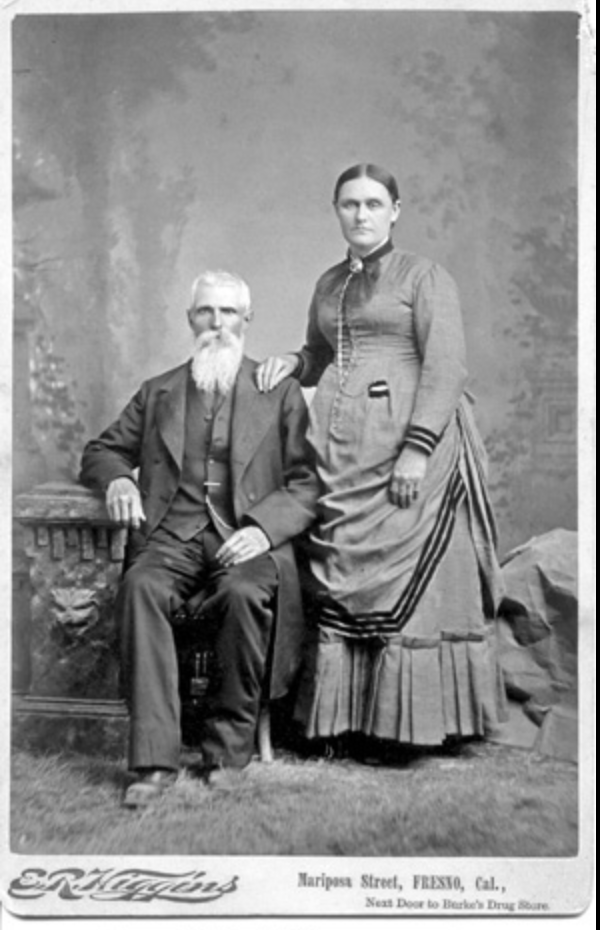
Thomas and Madlain (McCullough) DeWitt, circa 1880
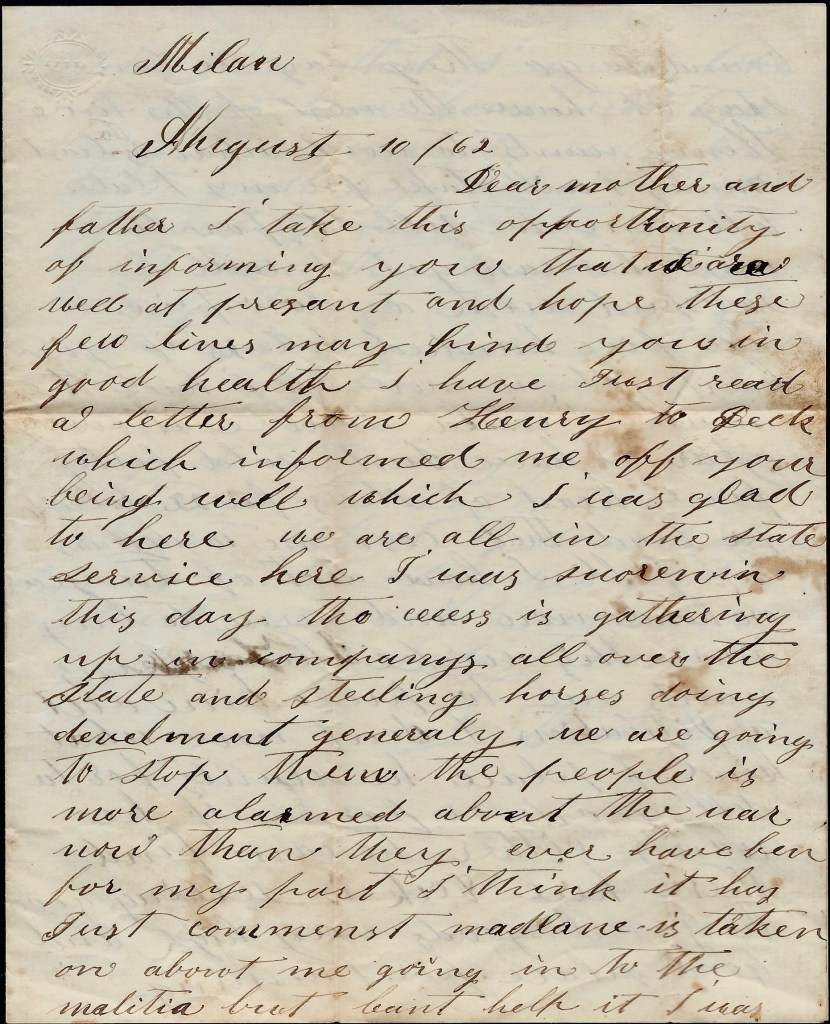
The following letter was written by Thomas Buffington Dewitt (1832-1891) of the Missouri Home Guard Infantry who had just been sworn in that day. The letter discusses the current state of the war in Missouri and a growing sense of alarm. John C. Porter’s band of Guerrilla’s had organized in northern Missouri in the early summer and had been raiding trains, stealing horses, and food from the citizens, occasionally skirmishing with state troops, leading to concern about their farms and livelihood. He states that they are able to stay at home most of the time.
Thomas wrote the letter from Milan, some twenty miles due west of Kirksville in northern Missouri. He was married to Madlain McCullough (1841-1927) after his first wife, Frances Carney (1833-1859) died in 1859. His parents were Thomas DeWitt (1791-1879) and Mary Magdalene Buffington (1797-1886) of Wheeling, West Virginia. By 1880, DeWitt had relocated to Polk, Adair county, Missouri. By 1886 they were living in Fresno county, California.
Transcription
Milan, [Sullivan county, Missouri] August 10, 1862
Dear Mother and Father,
I take this opportunity of informing you that I am well at present and hope these few lines may find you in good health. I have just read a letter from Henry to Beck which informed me of your being well, which I was glad to hear.
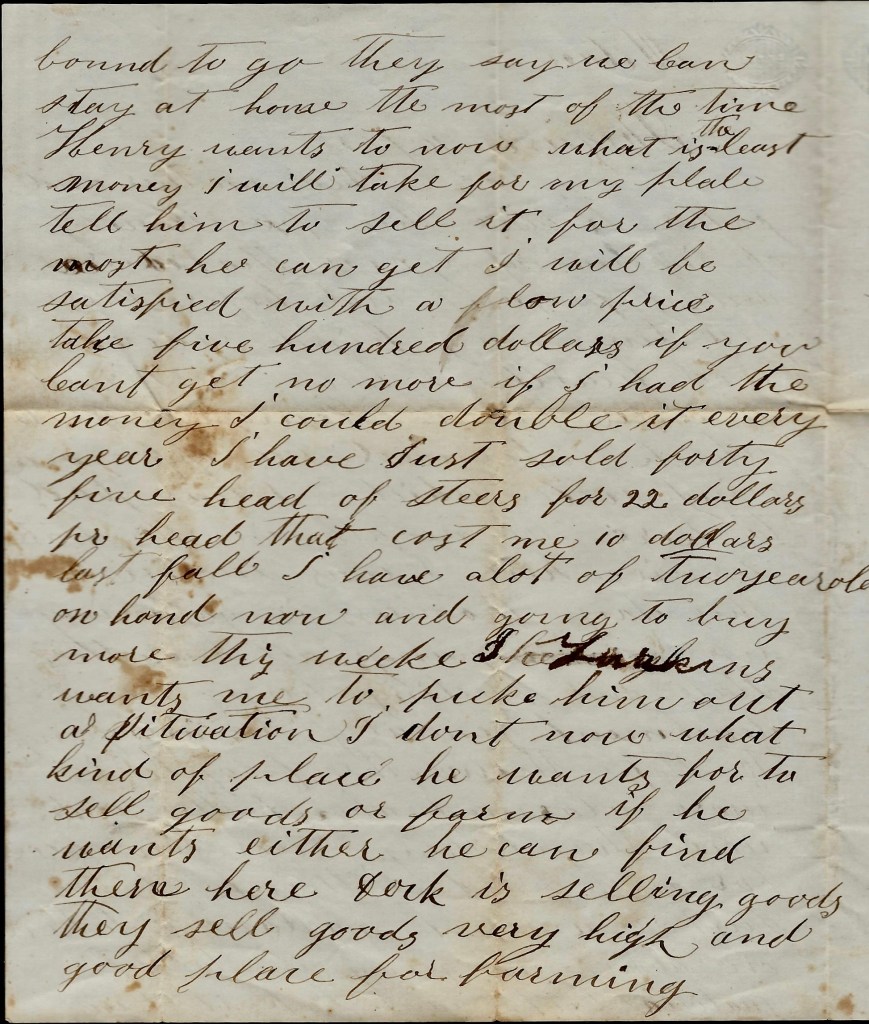
We are all in the [Missouri] State [Militia]Service here. I was sworn in this day. The secesh is gathering up in companies all over the state and stealing horses, doing devilment generally. We are going to stop them. The people is more alarmed about the war now than they ever have been. For my part, I think it has just commenced. Madlane is taking on about me going into the militia, but can’t help it. I was bound to go. They say we can stay at home the most of the time.
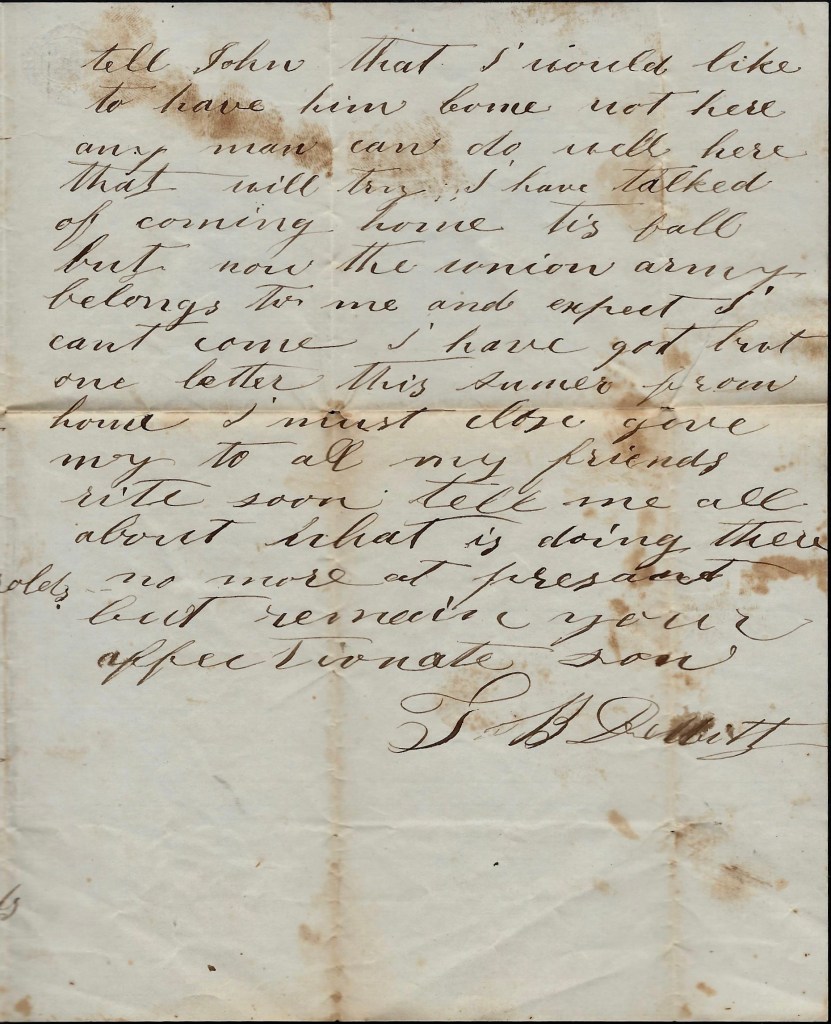
Henry wants to know what is the least money I will take for my place. Tell him to sell it for the most he can get. I will be satisfied with a low price. Take five hundred if you can’t get no more. If I had the money, I could double it every year. I have just sold forty-five head of steers for $22 per head that cost me $10 last fall. I have a lot of two-year-olds on hand now and going to buy more this week. I. Larkins wants me to pick him out a situation. I don’t know what kind of place he wants— for to sell goods, or [to] farm. If he wants either, he can find them here. Pork is selling good. They sell goods very high, and [it’s a] good place for farming.
Tell John that I would like to have him come out here. Any man can do well here that will try. I have talked of coming home this fall but now the Union Army belongs to me and I expect I can’t come home. I have got but one letter this summer from home. I must close. Give my [respects] to all my friends. Write soon. Tell me all about what is doing there. No more at present, but remain your affectionate son, T. B. DeWitt
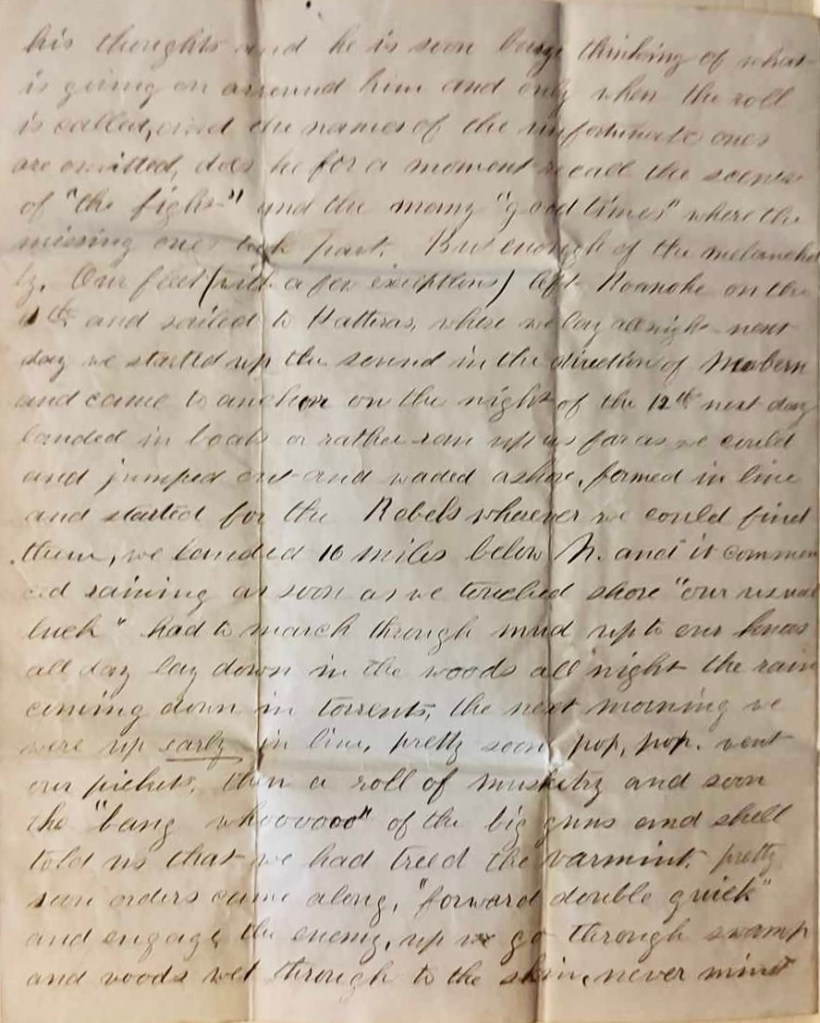
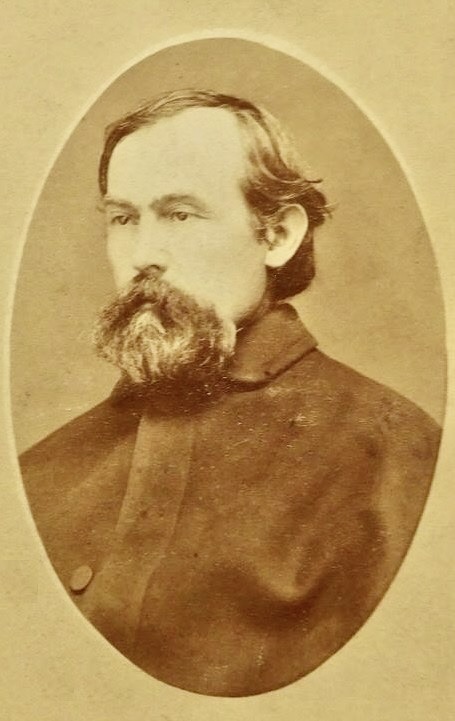
The following letter was written by Benjamin Lewis Hall (1838-1931), the son of Pardon Bowen Hall (1793-1872) and Abby Billings (1802-1895) of Providence, Rhode Island. Benjamin was married to Emeline Carr in 1860.
In April 1861, Benjamin was working as a jeweler in Providence when he enlisted as a drummer boy in Co. A, 1st Rhode Island Regiment, and mustered out as a sergeant on 2 August 1861. He reenlisted on 13 December 1861 as a sergeant in Co. E, 5th Rhode Island and resigned his commission as Captain of Co. I on 5 May 1863.
In his letter, Benjamin informs his brother that he has survived the battle that resulted in the capture of New Bern, North Carolina, in March 1862. Though the 5th Rhode Island was not in the vanguard of the attacking column, he gives a lively portrayal of the march to and capture of the city.
[This letter is from the private collection of Rob Grandchamp and was made available for transcription and publication on Spared & Shared by express consent.]
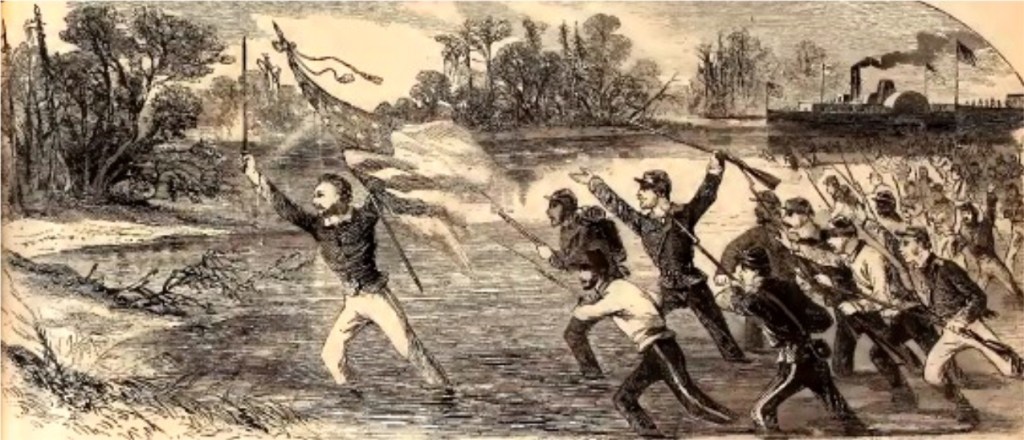
Union troops landing to begin their march on New Bern in March 1862
Transcription
Camp Pierce near Newbern, North Carolina March 18th 1862
Dear Brother,
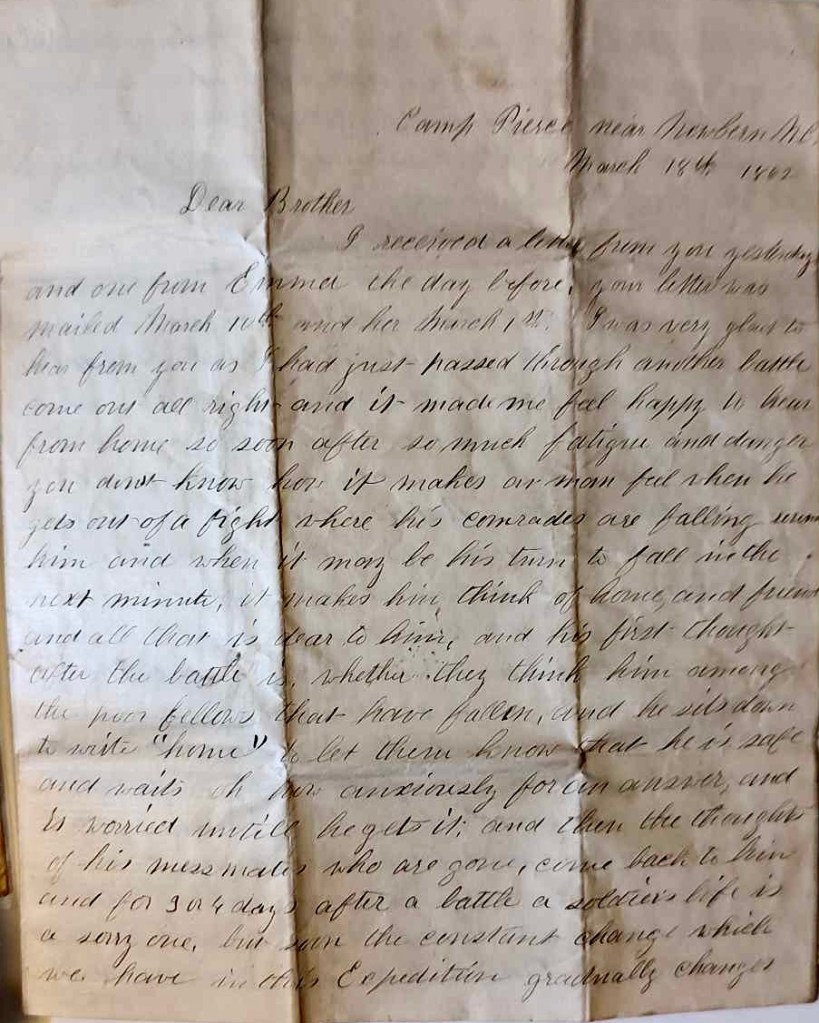
I received a letter from you yesterday and one from Emma the day before. Your letter wsa mailed March 10th and hers March 1st. I was very glad to hear from you as I had just passed through another battle. Come out all right and it made me feel happy to hear from home so soon after so much fatigue and danger. You don’t know how it makes a man feel when he gets out of a fight where his comrades are falling around him and when it may be his turn to fall in the next minute. It makes him think of home and friends and all that is dear to him, and his first thought after the battle is whether they think him among the poor fellows that have fallen, and he sits down to write “home” to let them know that he is safe and waits oh how anxiously for an answer, and is worried until he gets it. And then the thoughts of his messmates who are gone come back to him and for 3 or 4 days after a battle a soldier’s life is a sorry one. But soon the constant change which we have in this Expedition gradually changes his thoughts and he is soon busy thinking of what is going on around him and only when the roll is called and the names of the unfortunate ones are omitted does he for a moment recall the scenes of “the fight” and the many “good times” where the missing ones took part.
But enough of the melancholy. Our fleet (with a few exceptions) left Roanoke on the 11th and sailed to Hatteras where they lay all night. Next day we started up the sound in the direction of Newbern and came to anchor on the night of the 12th. Next day landed in boats, or rather ran up as far as we could and jumped out and waded ashore, formed in line and started for the Rebels wherever we could find them. We landed 16 miles below Newbern and it commenced raining as soon as we touched shore—“our usual luck.” Had to march through mud up to our knees all day, lay down in the woods all night, the rain coming down in torrents. 1
The next morning were up early in line. Pretty soon—pop, pop—went our pickets, then a roll of musketry, and soon the “band whooooo” of the big guns and shell told us that we had treed the varmint. Pretty soon orders came along, “Forward, double quick!” and engage the enemy. Up we go through swamp and woods, wet through to the skin, never mind boys, we have got a chance to pay the villains for making us march through the mud, “Give it to ’em lively boys!” over the batteries, rifle pits, breastworks, “Hurrah! There they go boys! There they run” and tell the old story, “Ribbils Licked.”
The Battle of New Bern, March 1862
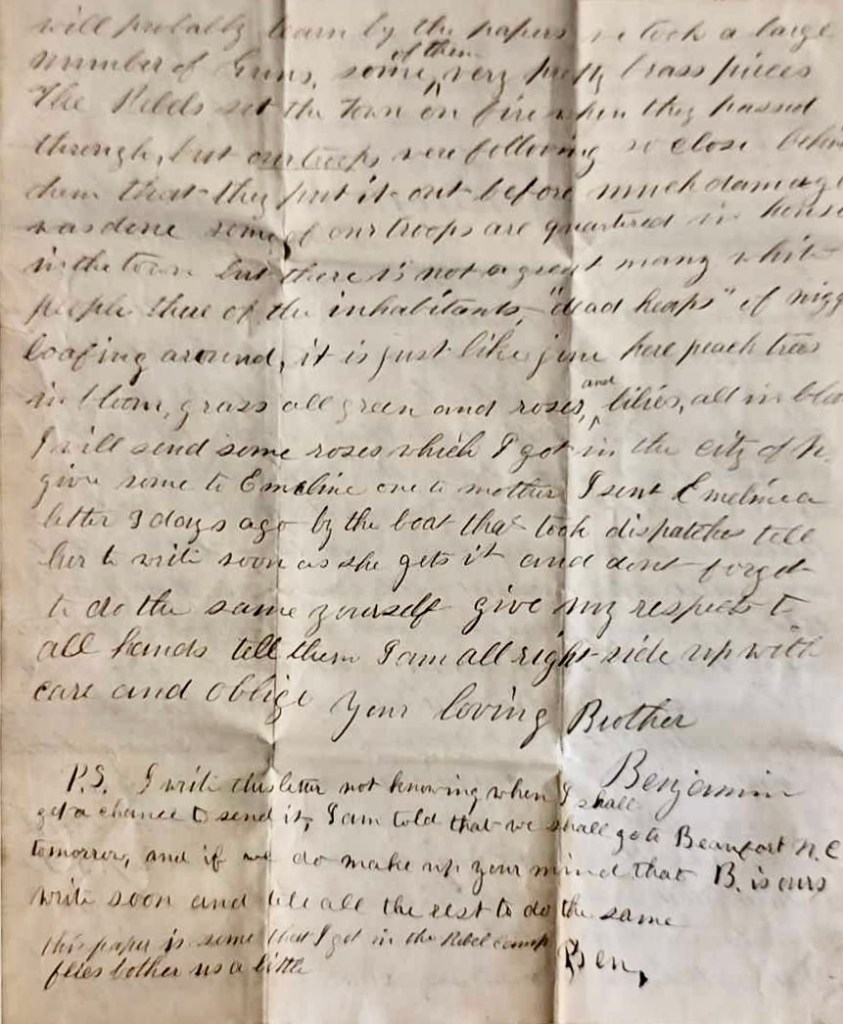
They left as fast as they could on the railroad to Newbern, burning the bridge as they crossed over, some taking another road had to strip and swim the river, and I visited the city yesterday and the old “mokes” 2 say they went through the town like sheep, some without any clothes at all on their back, in such a hurry to get away from the “Damn Yankees” as the old “dark” said. Two or three days before these same fellows had been swaggering about town telling that we could shy around with our boats but wait till they caught us on land and they would teach us a lesson.
I was talking with an old Nig about his “massa.” He said that “Massa” told him he would whip us like dogs, but when he come running back, the “nig” said “Massa. where am de Yankees?” And “Massa” said, “Twant no use, if we get them blood hounds after us we might as well give up. It is said that some of the prisoners which were let go at Roanoke are here but I don’t know how true it is. I do not know how many men we have lost. You will probably learn by the papers. We took a large number of guns—some of them very pretty brass pieces.
The Rebels set the town on fire when they passed through but our troops were following so close behind them that they put it out before much damage was done. Some of our troops are quartered in houses in the town but there is not a great many white people there of the inhabitants. “Dead heaps” of niggers loafing around. It is just like June here—peach trees in bloom, grass all green, and roses and lilies all in bloom. I will send some roses which I got in the city of Newbern. Give some to Emeline, one to Mother. I sent Emeline’s letter 3 days ago by the boat that took dispatches. Tell her to write soon as she gets it and don’t forget to do the same yourself. Give my respects to all hands. Tell them I am all “right side up with care” and oblige your loving brother, — Benjamin
P. S. I write this letter not knowing when I shall get a chance to send it. I am told that we shall go to Beaufort, North Carolina, tomorrow and if we do, make up your mind that Beaufort is ours. Write soon and tell all the rest to do the same. This paper is some that I got in the Rebel camp. Flies bother us a little. — Ben
1 The regimental history informs us that, “Here, as at Roanoke Island, the water along shore was very shallow, and many of the men were compelled to leave the boats and wade to firm land; and, here as there, no sooner had the debarkation fairly commenced than rain began to fall again. Wet as the men were not time was lost at the landing, but as fast as they came ashore the line of march was at once taken up, with a skirmish line from the 24th Massachusetts well in advance. Under the effect of the marching men in front, the roads soon became almost impassable for those who followed, the sticky mud adhering to their feet and lower clothing at every step until they often became so heavy that the tired men could scarcely lift them. The time spent in landing and a march of about twelve miles over such terrible roads used up the whole day, and a half-rain, half-drizzle of the most aggravating character fell nearly all of the time. [p. 31]
2 Mokes (or Mooks) is a racial slur for negro, in common use in the 19th Century.
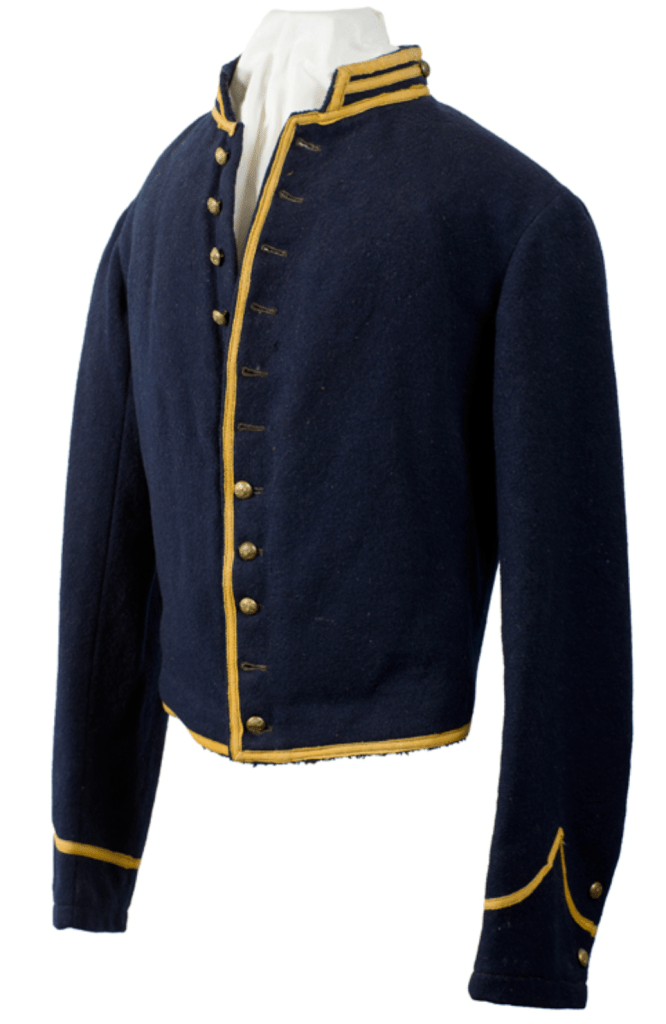
The shell jacket of William D. Thompson of Co. I, 3rd Missouri Cavalry. William ran away from home at the age of 16 and joined the 3rd Missouri in Palmyra in December 1861. He fought to defend Springfield on January 8, 1863, and was one of 180 men from the 3rd Missouri Cavalry involved in the Battle of Hartville. He was wounded in the groin at Hartville on January 11, 1863, and spent time in the post hospital at Lebanon, Missouri.
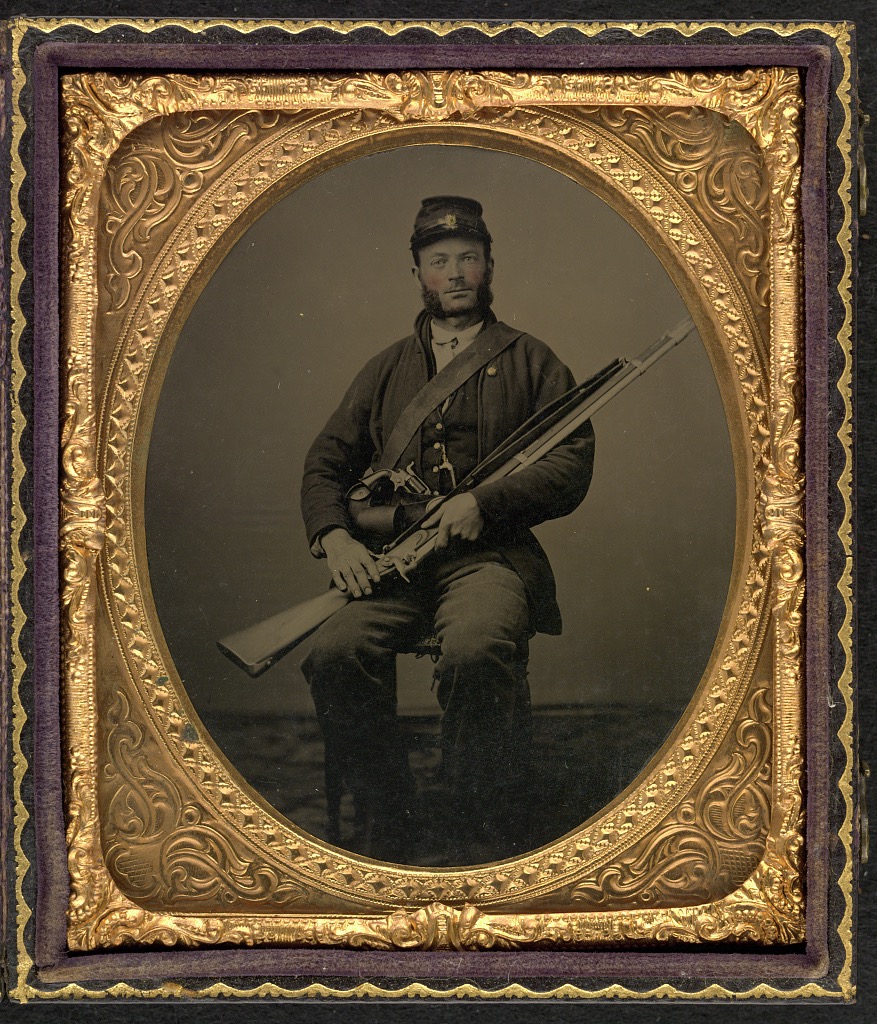
The following letter was written by James A. Humphres (1839-1863) began his service in Co. B, 3rd Missouri Cavalry, as a private but was later promoted to Commissary Sergeant of Co. H. According to the company rolls, James died on January 31, 1863 from a gunshot wound received during the Battle of Hartville on January 11, 1863. James was taken to the hospital at Lebanon, Missouri, where he died and was initially buried.
Though James served the State of Missouri in the war, he was actually a resident of Ashmore, Coles county, Illinois. James was the son of John Humphres (1803-1867) and Sarah Mitchell (1814-1849) of Ashmore. In the 1860 US Census, he was enumerated as a 21 year-old laborer in the household of Peter Conkler in Ashmore.
The letter was addressed to James’ cousins, Sarah Ellen Mitchell (1842-1879) and Phoebe Ann Mitchell (1844-1909), the daughters of John Bruce Mitchell (1817-1849) and Martha Cutler (1818-1882) of Ashmore township, Coles county, Illinois. For those who are unfamiliar with Ashmore, it is located just a few miles north of where Thomas Lincoln, the President’s father, had his farm when he died in 1851. Abe’s step-mother, Sarah Bush Lincoln, still lived in Coles county throughout the Civil War and died there in 1869.
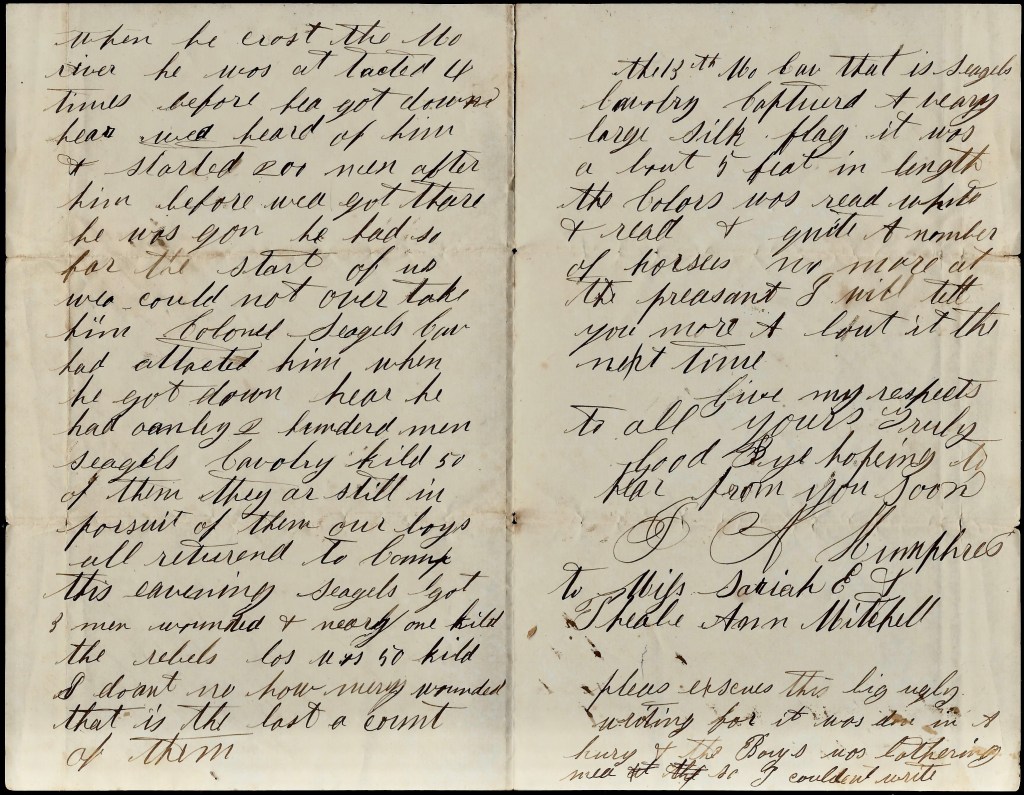
It is with pleasure that I seat myself to write you a few lines to let you know that I am well at the present time, hoping these few lines may find you all well. I received your letter the other day & was glad to hear from you & to hear that you was all well.
Col. Albert Sigel, 13th MO State Militia Cavalry
There was a skirmish near here yesterday. [Joseph Chrisman] Porter‘s force started from northeast, Missouri, with one thousand men. He still had a thousand when he crossed the Missouri River. He was attacked four times before he got down here. We’d heard of him & started 200 men after him. Before we got there, he was gone. He had so far the start of us [that] we could not overtake him. Colonel [Albert] Sigel’s Cavalry had attacked him when he got down here. He had only two hundred men. Sigel’s Cavalry killed 50 of them. They are still in pursuit of them. Our boys all returned to camp this evening. Sigel’s got three men wounded and nearly one killed. The rebels loss was 50 killed. I don’t know how many wounded. That is the last account of them.
The 13th Missouri Cavalry—that is Sigel’s Cavalry—captured a very large silk flag. It was about 5 feet in length. The colors was red, white, and red, & quite a number of horses [captured]. 1 No more at present. I will tell you more about it the next time.
Give my respects to all. Yours truly. Goodbye. Hoping to hear from you soon. — J. A. Humphries
to Miss Sarah E. & Poebe Ann Mitchell
Please excuse this big ugly writing for it was done in a hurry & the boys was bothering me so I couldn’t write.
1 The action described by Humphreys is verified in a report by Colonel Albert Sigel, colonel of the 13th Missouri state militia cavalry, which appears in the Official Records of the War of the Rebellion, Series 1, Volume 13, (skirmish at California house). Albert Sigel (1827-1884) was the brother of Gen. Franz Sigel (1824-1902).
The following letter was written by William W. Moore of Randolph, Cattaraugus county, New York, who enlisted on 17 August 1861 as a private in Co. F, 64th New York Infantry. He was promoted a corporal in April 1863 and wounded in action at the Battle of Gettysburg on 2 July 1863. He mustered out at Petersburg, Virginia, on 9 September 1864.
William wrote the letter to his cousin, Dwight Moore (1841-1864) who enlisted August 1862 in Co. H, 154th New York Infantry, was taken prisoner at Gettysburg on 1 July 1863, and who died in Libby Prison.
Transcription
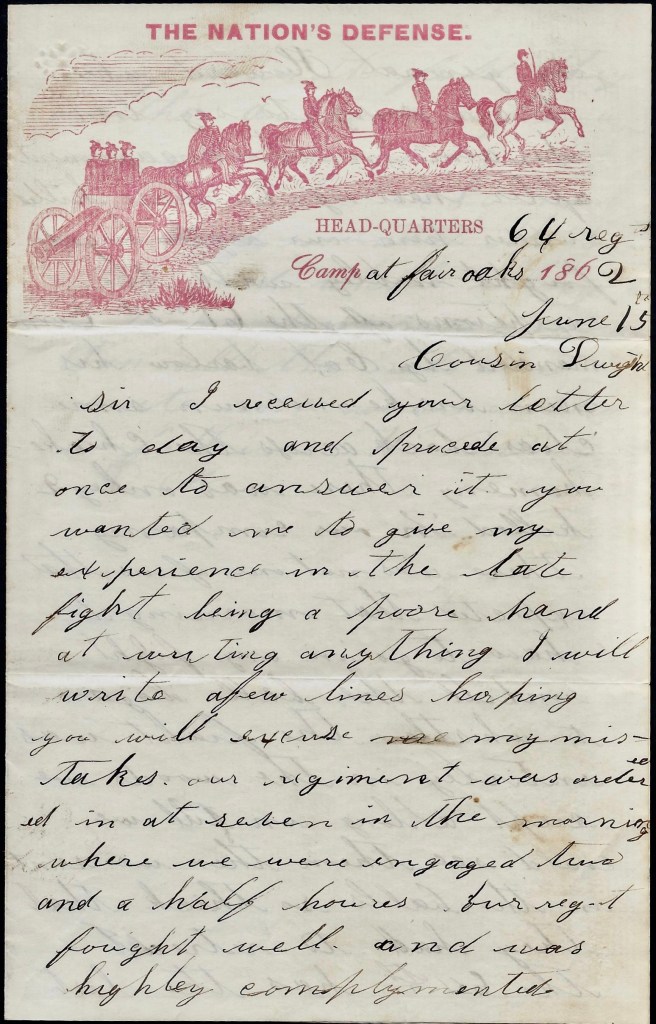
The patriotic header on Moore’s stationery
Headquarters 64th [New York] Regiment Camp at Fair Oaks June 15th 1862
Cousin Dwight,
Sir, I received your letter today and proceed at once to answer it. You wanted me to give my experience in the late fight. Being a poor hand at writing anything, I will write a few lines hoping you will excuse my mistakes.
A Union soldier holding an Austrian Lorenz Rifle
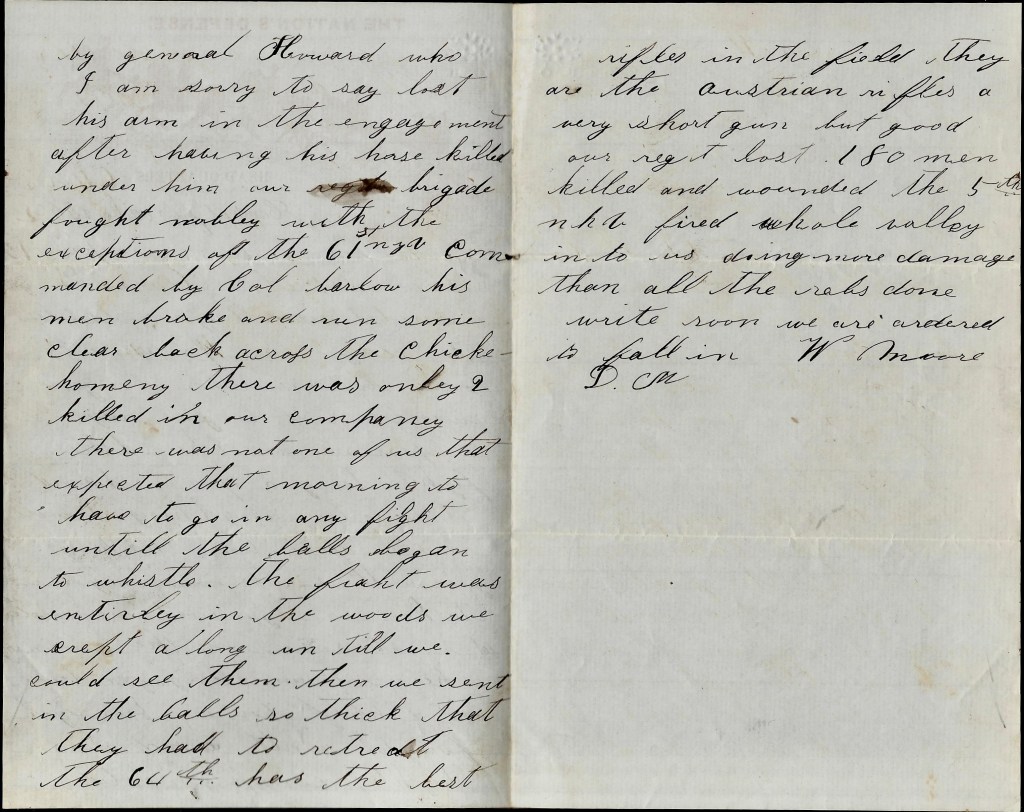
Our regiment was ordered in at seven in the morning where we were engaged two and a half hours. Our regiment fought well and was highly complimented by General [Oliver O.] Howard who I am sorry to say lost his arm in the engagement after having his horse killed under him. Our brigade fought nobly with the exception of the 61st [New York] commanded by Colonel [Francis C.] Barlow. His men broke and run some, clear back across the Chickahominy. There was only two killed in our company.
There was not one of us that expected that morning to go in any fight until the balls began to whistle. The fight was entirely in the woods. We crept along until we could see them. Then we sent in the balls so thick that they had to retreat. The 64th has the best rifles in the field. They are the Austrian Rifles—a very short gun but good.
Our regiment lost 180 men killed and wounded. The 5th New Hampshire Volunteers fired a whole volley into us doing more damage than all the rebs done. 1
Write soon. We are ordered to fall in. — W. Moore
[to] D. M.
1On page 84 of Pride and Travis’s book, “My Brave Boys, to War with Colonel Cross & the Fighting Fifth,” the authors describe the attack made by the Fifth New Hampshire and the trouble that Captain Barton was having to keep his company in line as they tried to maneuver through “a dense swamp, mud, vines, and underbrush.” When they did fire a volley, “its target proved to be not the enemy but members of the 64th New York, another regiment in the brigade.”
The following letters were written by Pvt. Richard Whitfield Jones (1839-1916) who enlisted in April 1861 to serve in Co. D, 1st Virginia Artillery (“Richmond Howitzers”). Later in the war he was a commissary sergeant. Richard brought his enslaved servant Grandison with him to the front and often used him, when not far from Richmond, to hand carry his letters home. In one letter that he penned to his mother shortly after the victory at Gaines Mill, Richard wrote that, “If my boy Grandison delivers this this evening, you will please give him something to eat, and let him stay all night. He is a good boy and has been with me for the last 5 months.”
Letter 1
Darbytown Road July 3rd 1862
My dear mother,
I have an opportunity of again dropping you a few lines by my old friend Plummer Payard. By him I send you a piece of oil cloth from which I wish you to make me a haversack as soon as you can. Enclosed you will find some pieces of poetry taken by me from the haversack of a Yankee officer on Monday. I send more to show you the fine hand writing than anything else.
Everything is very quiet today. We have only 29 cannoneers for duty, most of the men being sick, brought on by the want of something to eat. You can see a great change in all of the men—likewise in me—having been so long with nothing to eat but hard crackers. However, I am by no means sick—only weak.
Your bundle and note came to hand last night. I was very much obliged to you for the eatables. They were certainly enjoyed by the mess for supper last night, that being all we had. We drew rations of bread and shoulder today, and will I hope get along a little better now.
As Plummer is ready to go, I must now close. Have you heard anything from Dick? I understand the loss in the 12th Regiment was pretty heavy. I hope he got out all safe. Major John S. Walker 1 is reported killed. I only hope tis not so. If it is, his loss will be deeply felt both by his command, the church, and the community at large.
Give my best love to all. In haste, Your devoted son, — Richard
Major John Stewart Walker
1 Major John Stewart Walker (1827-1862) was the son of David and Amanda Norvell Walker. His father was a Scottish immigrant of the Brook Hill Stewarts. John was educated at Washington College and Harvard. His twenty-first birthday extravaganza at Harvard was so costly, that when his Uncle-guardian received the bill, he pulled John from school and brought him home. John was employed in the family tobacco business, married his second cousin, Lucy, and bought a place in Richmond. He developed his own brand of tobacco, the award winning Queen Bee. The Virginia Life Guard was organized in the City of Richmond in January of 1861. On May 14, 1861 it became Company B of the 15th Virginia Infantry under then Captain, John Stewart Walker. At the Battle of Malvern Hill, Colonel Thomas August, was severely wounded. The command of the Regiment was assumed by Major Walker. He led the command in an advance against “murderous and withering fire of grape, canister musket balls.” It decimated the ranks. Pinned to ground, with light fading, Major Walker stood and commanded “Forward charge!” He was immediately struck down and dragged back into a little creek. He soon died in the arms of his brother.
Letter 2
Frederick City, Maryland Sept. 9th, 1862
My Dear Mother,
You will see from heading that I have at last reached the state of “My Maryland.” I wrote you a letter on last Saturday when I stated that we expected to leave Sunday at 1 o’clock, but we did not get off until 5. I and one other was detailed from our company to form an advance guard together with two men from each of the other companies—making the party 8 men and a lieutenant. We moved on some distance in the head of the column, mounted, & with sabre & pistol, proceeded to see that the way was clear as we had neither infantry or cavalry with us. We reached the Potomac at 8 ½ o’clock and I was the first of the party to put foot on the soil of Maryland.
We forded the river at Cheek’s Ford. 1 Having reached the Maryland side, we proceeded along the tow path of the Chesapeake & Ohio Canal about a mile when we crossed and took the road to the above place. After moving on this road about 3 ½ miles, we went back to report to Col. Brown that the way so far was clear. Here we met couriers from General [Stonewall] Jackson who informed us there was no danger ahead. After reporting, we were again ordered to the front to keep well ahead and a good look out. So we again led the way. Reached a small village of about 800 inhabitants called Buckeystown at day break on Monday, arriving after traveling all night. Here we again halted, waiting for the batteries to close up, when the command halted and went into camp for the purpose of feeding and resting the horses which by this time were pretty well worn out.
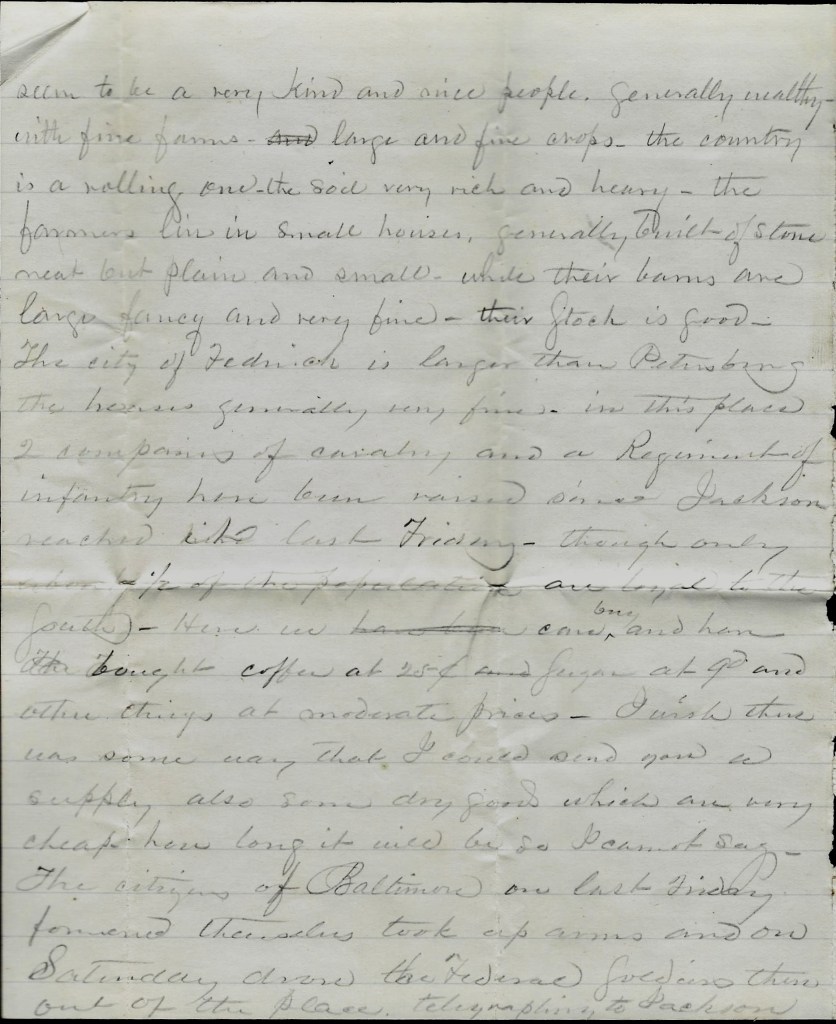
Again, at 11 o’clock, we moved on after a rest of 4 hours (this time without an advance, having infantry along) halting about 2 ½ miles from Frederick where it is likely we will remain for 2 or 3 days to rest the horses. This county (Frederick) is a very fine one, said to be the finest in the State—inhabited principally as far as we have gone, by Dutch, who seem to be a very kind and nice people, generally wealthy with fine farms, large and fine crops. The country is a rolling one, the sod very rich and heavy. The farmers live in small houses generally built of stone—neat, but plain and small, while their barns are large, fancy, and very fine. Their stock is good.
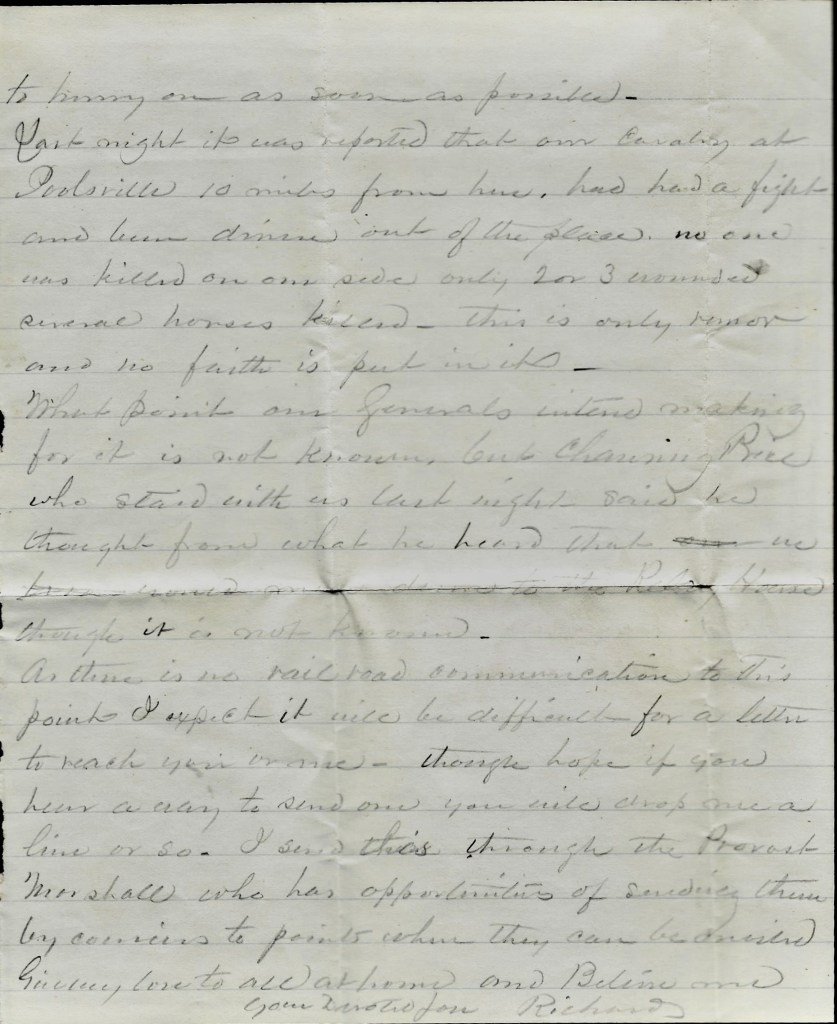
The city of Frederick is larger than Petersburg, the houses generally very fine. In this place two companies of cavalry and a regiment of infantry have been raised since [General] Jackson reached it last Friday, though only about half of the population are loyal to the South. Here we can buy—and have bought—coffee at 25 cents, sugar at 90, and other things at moderate prices. I wish there was some way that I could send you a supply, also some dry goods which are very cheap. How long it will be so, I cannot say. The citizens of Baltimore on last Friday formed themselves, took up arms, and on Saturday drove the Federal soldiers there out of the place, telegraphing to [General] Jackson to hurry on as soon as possible.
Last night it was reported that our cavalry at Poolesville, 10 miles from here, had a fight and been driven out of the place. No one was killed on our side—only 2 or 3 wounded [and] several horses killed. This is only rumor and no faith is put in it. What point our Generals intend making for, it is not known, but Channing Price, 2 who staid with us last night, said he thought from what he heard that we would move down to the Relay House, though it is not known. As there is no railroad communication to this point, I expect it will be difficult for a letter to reach you or me, though hope if you have a way to send one you will drop me a line or so. I send this through the Provost Marshal who has opportunities of sending them by couriers to points where they can be delivered. Give my love to all at home, and believe me, your devoted son, — Richard





















 Spared & Shared 23