My passion is studying American history leading up to & including the Civil War. I particularly enjoy reading, transcribing & researching primary sources such as letters and diaries.
The following letter was written by Augustus Granville Randall (1813-1898), a lawyer of Lincoln, Penobscot, Maine. He was married to Mary Shannon Sanders (1823-1866) in 1847 and had at least five children by 1863. The following biographical sketch appears in a history of Lincoln, Maine, though it fails to mention that he served in the State Legislature prior to his military service. It also fails to mention that before he was discharged from the service, he had to stand trial for a charge of “habitually selling subsistence stores at a rate exceeding prices invoiced” without accounting for the excess. He plead not guilty to these charges but was subsequently found guilty.
“Mr. Randall was the son of Nathan Randall, born in Leeds, Me., 15 June, 1813-; died in Chicago, 22 Feb., 1898. Mr. Randall was a lawyer in Passadumkeag in 1839., and went to Lincoln, probably, in the winter of 1848, and was a lawyer in Lincoln till 1864, when he went to Oshkosh, Wis., and from there he removed to Chicago in 1892. In 1863 he had entered the Commissary Department of the army, his appointment being signed by President Lincoln, and he served with the rank of Captain till the close of the war. Mr. Randall, during his residence in Lincoln, was active in the municipal affairs of the town and in temperance and civic reforms. On the 22 Oct., 1859, a division of the Sons of Temperance was instituted at Lincoln in which Mr. Randall, with a dozen of the· more prominent citizens, was active. He had been identified with these affairs while in Passadumkeag.” [History of the Town of Lincoln, by Dana Willis Fellows, page 109.]
Augustus wrote the letter soon after arriving in Washington D. C. in early June 1864 after having been commissioned into the US Volunteers Commissary Department. He served on this position with the rank of Captain until May 1865 when he was dismissed from the Commissary Service Volunteers.
Transcription
Washington June 5th 1864
My dear sir,
Your very kind favor of the 2nd inst. has just been received and I assure you it was a most welcome message. Please accept my thanks for it, and be assured that nothing will give me greater pleasure than a correspondence with you. You are mistaken as to my feelings in leaving Old Penobscot. I did not feel cross. It is true there were some things I could have wished had been otherwise. You know what they are. It has never been any part of my political life to lie, cheat, and deceive, and I detest those who do. What little political record I have is in Old Penobscot. I am not ashamed of it. I shall return there if I live one of these days and, perhaps, may have an opportunity to help some of my friends to places of honor and trust.
In regard to Main[e] politics, I feel the same interest I always felt and wish I could be there to help the campaign along. As to the judge of Probate, any man but Godfrey. Don’t renominate him. Hilliard is the best of the three by all odds yet he would not be my choice. But if one of the three you mention must have it, take Hilliard.
Hon. John Hovey Rice (1816-1911), ca. 1864
And for Congress, don’t fail of giving Rice a renomination. There is no man stands better here than John H[ovey] Rice and no one can accomplish much for the 4th District and for Maine as he can. Besides, it is no time to send green hands here, and no intelligent constituency will do it. It would be worse than folly—yes, suicidal to do so. Maine must keep her faithful and tried representatives here during this struggle for Constitutional liberty, and not send men here, who, during these three years of terrible war for the Union have but recently found where they are. These men who have been so long coming to the light, see it but dimly now and will be quite likely to fall back into utter darkness. Mr. Rice is not only a popular man in Congress, but an industrious, working man. Every moment of time, aside from his public duties, is devoted to the wants of our poor wounded soldiers from early morning until noon—the hour Congress meets—and from adjournment until 11 & 12 o’clock at night he is visiting the different hospitals, writing letters, sending dispatches, &c. &c. for the boys of his District. Mrs. [Grace E. (Burleigh)] Rice labors equally hard. To set aside so faithful and devoted public servant at this time of our country’s peril for a green hand of somewhat doubtful political stripe, would be an act of folly I never shall believe Old Penobscot will be guilty of.
For President & Vice [President] we all go for Lincoln & Hamlin and they will be nominated. It would be too personal and unjust to leave Hamlin off and take Dickinson or Johnson.
I suppose you have seen my appointment and confirmation in the Commissary Department. This is a good place and pays well, provided I can procure the necessary bond. The duties are to receive & distribute subsistence to some division of the Army. The rank is that of Captain of Cavalry. I am entitled to one, & in certain cases, two clerks at from 75 to 100 per month & rations. How I wish I could have you here with me.
I shall not move my family here at present, if at all. I room at 421 11th Street between G & H West and board at the New England Restaurant. I have not got settled yet. Shall take a larger room soon and board at a hotel—a good boarding house. If you come here, and I hope you will, come to my room and I will take care of you as long as you stay. If I change quarters, I will inform you in season.
Clark, postmaster, has been removed and is now about the State of Maine Agency, in what capacity I know not. Azro is, or was here a few days ago. I should be very glad to have you send me some Maine papers. Two cents postage on 4 oz.’s without regard to number of papers is the law now. Printed matter goes by weight. 4 oz. two cents; 8 oz. 4 cents.
Now Mart, I have written you a hasty letter and hope I shall receive an answer soon. Remember me to all my friends, if I have any, in that section—particularly to your wife. Give my regards to Mag Smith, Mr. Jameson and others. With great respect, your friend & servant, — A. G. Randall
Don’t forget me to my friend Hammatt. I wish I could have seen him longer.
The following documents from Fold 3 reveal that Augustus G. Randall was actually nominated for his position by the Hon. John H. Rice. I do not see any evidence that President Abraham Lincoln signed his appointment letter despite what his obituary says.
This letter was written by John Ingerson (1837-1913) of Sycamore, Wyandot county, Ohio. He was the son of Alvin C. Ingerson (1815-1857) and Tirza Ann Palmer (1816-1895). John was 24 years old when he enlisted in August 1861 to serve as a private in Co. G, 49th Ohio Volunteer Infantry (OVI). He survived the war but was wounded in the Battle of Pickett’s Mills, Georgia, on 27 May 1864. He was discharged for disability on 29 October 1864. [It should be noted that John’s obituary appearing in the Marion Star (Marion, OH) claimed that John was “wounded at Gettysburg when a shell hit him in the face, cutting his upper lip and terribly disfiguring him.” Since the regiment never fought at Gettysburg, the wound is presumed to have occurred at the Battle of Pickett’s Mills in Georgia. The 1890 Veteran’s Schedule claims that John’s wound was caused by a gunshot wound, not a shell.]
After the war, John returned to farming in Ohio. In 1875, he married Lydia Ann Shaffer (1839-1931)
Transcription
Camp George December 10th 1861
Well friend Mother, I guess tonight I would write you a few lines to let you know how I am. I am well at present and so is all of the rest of the Sycamore Boys and I hope these few lines will find you the same. The 32nd had a fight yesterday and they lost eleven men and had twelve wounded and the secesh lost forty and about that many wounded. The young men killed several of their horses. There only was three companies of them against five hundred and they whipped them and made them [paper creased]…If Co. G had been with them, we would have taken eight of their cannons. The boys got two or three of their horses and several of their guns.
Now Mother, I want you to write to me and tell me all of the news that it afloat in Sycamore. I am the fattest now that I ever was in all of my life. I only weigh one hundred and sixty-five pounds. We have between 60 and 70,000 men here in the field with us and I think we will flog them nicely. I hope so.
We have plenty to eat and plenty to wear and good water to drink. I hant been sick yet and I hope I won’t get in that way. I got my pay last Monday but I don’t want you to think hard of me for not sending you some of it for I got five dollars of Daniel Hartsough to get me a pair of boots and I’d drawn five dollars off the sutler which makes ten dollars [I owed] and I have got [only] a little left and I think that will last me for a good while. We will draw pay again in twenty days and then I will send all of that to you for I shan’t need it.
So now I must stop writing for this time. Write soon and direct your letters in the care of Capt. [Luther M.] Strong, 49th Regiment, OV, USA. by the way of Louisville, Kentucky.
Not unlike the poisonous effects of the shadow of the deadly upas tree,” secession “has spread a blight and desolation over the country.” So wrote 42 year-old Benjamin D. Carpenter (1819-1895), “a northern man who settled in Alexandria county, Virginia, long before the war, having a large farm at Red Hill…Coming to Washington during the war, he bought a large farm on Rock creek west of Brightwood, where he lived for nearly a quarter of a century. This place is now embraced in Rock Creek Park.” [Source: Obituary] Benjamin was married in the mid 1840s to Anna Maria Crocker (1822-1895) and was the proud father of four daughters.
Benjamin was trained as a surveyor and he was the first to prepare a map showing the metes and bounds of the District of Columbia.
Benjamin wrote the letter to his brother-in-law, John Simpson Crocker (1825-1890) who was appointed Colonel of the 93rd New York Infantry. He was captured during the siege of Yorktown and imprisoned at Libby Prison and later Salisbury before being exchanged in August 1862.
“Men were deprived of the elective franchise through fear and suffer all the horror of a reign of terror rather than vote at all. ” — Benjamin D. Carpenter
Transcription
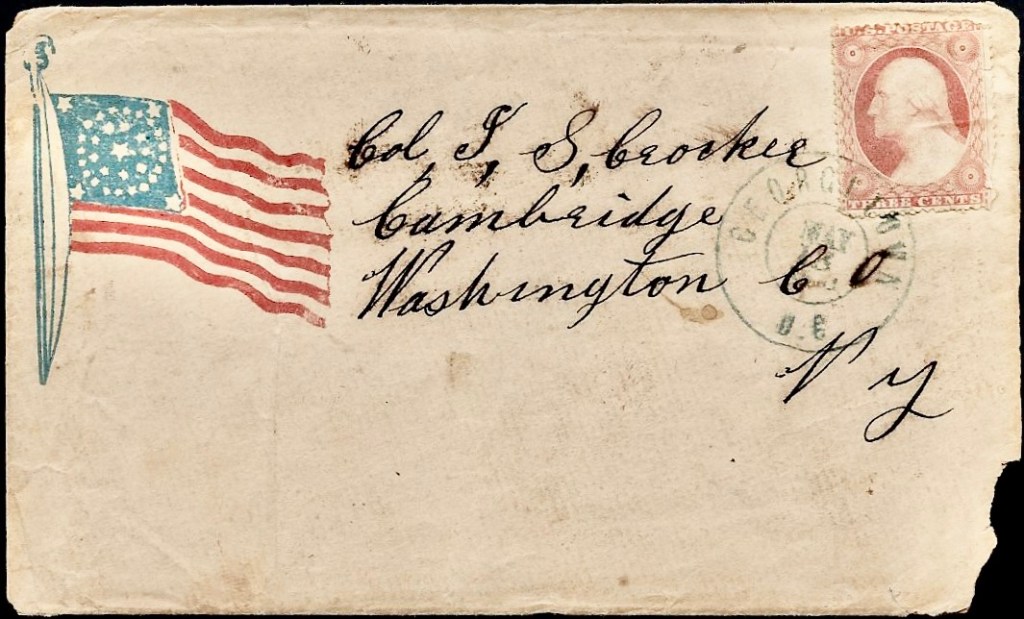
Addressed to Col. I. S. Crocker, Cambridge, Washington county, New York
Fairfax county [Va.] May 30th 1861
Dear brother,
Yours has been duly received and I hasten to reply. You will perceive that I have changed front or right about faced since I last wrote you. That’s so. I go in for the motto that heads this sheet secession is but a name for all that is devilish and infernal. If you or anyone else were here only one week, you would see a fair illustration of Mexican despotism. You would see the most intense hatred of those anti-white labor Nero’s that would cause your blood to boil with indignation and would make you turn away from them with loathing and contempt. Men are prosecuted and threatened with violence and even with hanging for wishing to cling to that government which has protected them in their civil and religious liberty, which has thrown over them and around them a halo of Freedom and prosperity that no other government under heaven has. Men are fleeing for their lives for wishing to preserve the Union of these states which was formed for the protection of our lives, liberty and property.
Secession leaders marched about breathing vengeance on all who would not enroll themselves with them under the black banner of Treason whose baneful shadow is not unlike the poisonous effects of the shadow of the deadly upas tree. It has spread a blight and desolation over the country; it has paralyzed and prostrated business and the energy of the people; it has destroyed the confidence between friends and neighbors; it has made vacant firesides and empty houses; it has made silent workshops and deserted villages; it has silenced the ploughman’s song and the wagons rattle on the roads, and last but not least of all, it seeks to pull down the strong pillars of the wisest and best governments, and if they can accomplish no more, involve all in one common total overthrow. It makes my heart bleed to see the people leaving for life, fleeing from that demon of secession which would wring the last drop of blood from one’s heart for wishing to live in the Union—the land of the free and the home of the brave.
Thirty-four families left Vienna in two days with what they could hastily gather up and then bid adieu to their homes for which they have toiled to make comfortable and pleasant. John, a great gloom is over the land like some great and sudden calamity. The sun seems to shine through some kind of a veil which casts a shade of sadness over heavens and earth, not unlike the feeling of some swift and sudden calamity about to happen, that strikes terror and dread to the heart. Men were deprived of the elective franchise through fear and suffer all the horror of a reign of terror rather than vote at all.
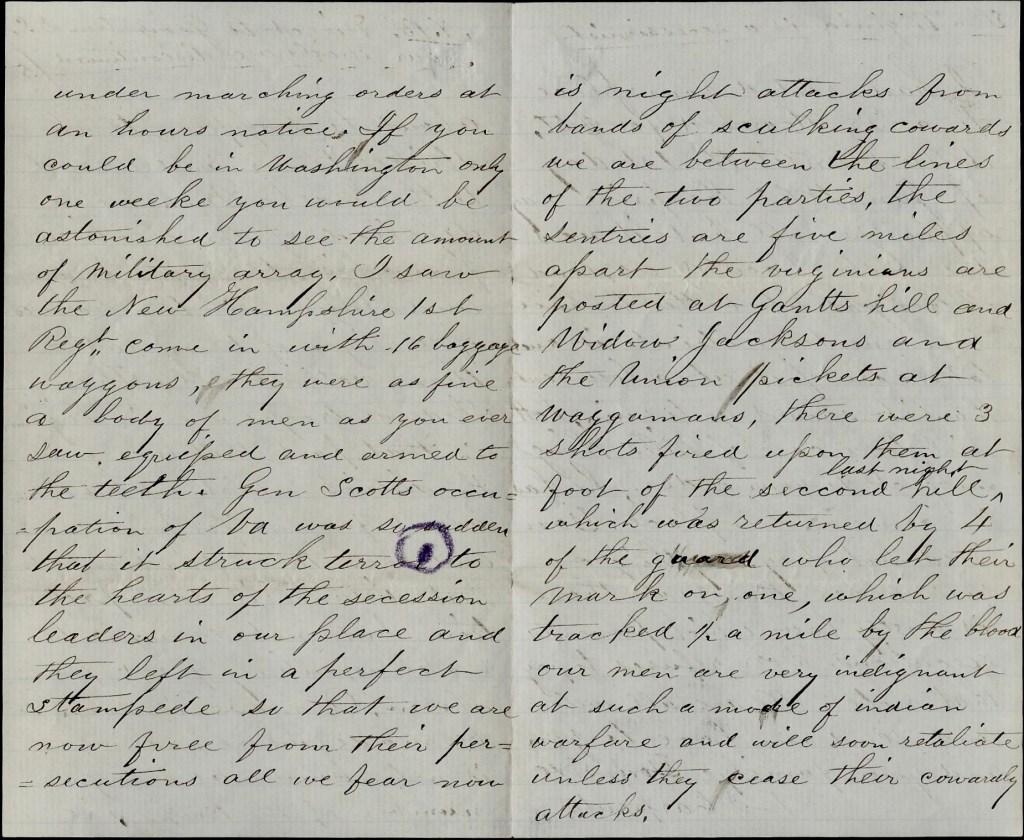
The Federal troops are in Virginia in that part that once was the district which makes them about four miles from us and even their shadow at that distance is some protection but not enough to make us entirely free from alarm. A move is soon to be made—where and when is not known—as a large number of troops are under marching orders at an hour’s notice. If you could be in Washington only one week, you would be astonished to see the amount of military array. I saw the New Hampshire 1st Regiment come in with 16 baggage wagons. They were as fine a body of men as you ever saw, equipped and armed to the teeth. Gen. Scott’s occupation of Virginia was so sudden that it struck terror to the hearts of the secession leaders in our place and they left in a perfect stampede so that we are now free from their persecutions. All we fear now is night attacks from bands of skulling cowards. We are between the lines of the two parties, The entries are five miles apart. The Virginians are posted at Gantt’s Hill and Widow Jackson’s, and the Union pickets at Waggaman’s. There were three shots fired upon them at the foot of the second hill last night which was returned by four of the guard who left their mark on one, which was tracked half a mile by the blood. Our men are very indignant at such a mode of indian warfare and will soon retaliate unless they cease their cowardly attacks.
I have rented your place to a Dr. Harrold for $50 dollars until the 1st day of January 1862. The price may appear small but it was the best I could do adn I thought it better to have someone to cultivate it and take care of it at a low rent than it should go to ruin. Lott will take care of Will’s things. subject to your order. He has the cows on his place. You need not pay anything on your place this year. There is a stay law which prevents executions. Dorr refuses to pay that note. We are all well and send our love to you and your families. Yours, &c. — B. D. Carpenter
Ellen Virginia is a secessionist.
N. B. Direct to Georgetown. Our mails are discontinued.
The identity of the author of this letter—whether male or female—could not be confirmed. It was datelined from Medway, Massachusetts, in late March 1870. There is no envelope with the letter to identify the addressee who we learn is the author’s “nephew and friend” and the benefactor of a note endorsed by the author. While completing this transaction, the author refers to the “radical Republican” corruption in the post-Civil War South and shares the belief that the “Ebony race” may prove better suited to govern than the Caucasian race.
Transcription
Medway [Massachusetts] March 26, 1870
Dear Nephew & Friend,
I have received your Draft, and the same is endorsed on the Note. I see you feel cheerful under the hard times. You seem to have business a plenty before you. and I wish you success and hope you will give good satisfaction. You know the cry is robbery & corruption where public funds are to be received & dispersed. If reports are true, robbery in the Republican ranks are common—but perhaps not criminal were so much sanctity exists. But we will hope for the better when the Ebony predominates. It is a little surprising that we, as a nation, have all our life long tried to fit and prepare Statesmen to rule and guide the Wheel of State, that the Ebony race just emerged from Slavery bids fair to be our superior in the Reign of Government. If so, we must yield in due obedience as we have the few years past that has brought us to this result.
Well, by the means of government or something else, we complain of hard things, scarcity of money, high taxes, dear labor and produce low in proportion to its cost. We have a heavy body of snow on the ground and the [Charles] river by appearance will not break till the first of April. Winter really commenced about the 14 of March. The river opened & shut several times in the winter months so the boats went up and down several times. Most all the month of March was ice gathering. We were at Gloversville [N. Y.] last fall & found John & Harriett 1 well and in good spirits. Harriet quite fleshy. Perhaps not quite 200 but she thinks she is of considerable consequence.
All well and remain yours as ever, — S. Martin
1 Probably John Stewart (1834-1889) and his wife, Harriet (Macdougall) Stewart (1839-1901) of Gloversville, Fulton county, New York. John Stewart was a merchant.
The following letters were written by 30 year-old John Thompson (1833-1916) of North Colebrook, Ashtabula county, Ohio. He wrote the letters to his wife, Harriet (Knowles) Thompson, while serving in Co. I, 105th Ohio Volunteer Infantry (OVI). He served from August 1862 until June 1865. Frequently mentioned in his letter is his young first-born son, Elmer Adelbert Thompson, born in April 1862.
John’s 2nd letter was datelined from the Union entrenchments at Chattanooga in the days following the setback at Chickamauga. He informs his wife that, “if it was not for the officers, this war would soon be over. The Rebel privates is tired enough of the war.” He speaks of the exchange of newspapers between pickets—apparently acceptable between enlisted men but as soon as a lieutenant tried it, he was nabbed. He mentions the accidental death of a soldier who threw a shell into a fire, a rumor of fighting between Longstreet’s and Bragg’s men over disagreements in command, and of his longing for home. He also encourages her to write. “I want you should let me know all the particulars about everything you can think of and some more.”
Lieutenants Tourgee, Wallace, & Morgaridge of 105th OVI, July 1863 (L. R. Stevens Collection)
Letter 1
[Hospital No. 3] 1 Quincy, Illinois May 10, 1863
Dear Companion,
I should like to spend this evening with you and Elmer. We would have a good visit most a beautiful chat. I long to see you. If I go to Camp Chase or to Cleveland, I shall try to go home on a furlough and see you and Elmer, and if I can’t go and see you, you. can come and see me. You said that you wished that I was to home so I could help you take care of Elmer. Harriet, keep up good courage and be as contented as you can and take care of what little we have and the money that I send you. I have been mustered in for pay once more and if I get it, I shall send it home to you as soon as I get it. When I get home for good and the war closes, we will have some good times.
If you don’t want to sell the colts, you. need not sell them. I want to stop interest on our place as fast as possible. Harriet, I think that when I get home we will have some good times. We have a small place and if we have good luck and pay for it, we have taken comfort in riding around and we can take comfort again, I hope. I think of you night and day. If it was in my power to come home and see you, I should go. But Uncle Sam has got me in his clutches and I can’t do so as I wish. If I was of any use to the government, I would not think of going home for I came here to serve my country, and I want to serve it. But it will be some time yet before I can go back again, if ever. I don’t think that I can stand camp life but I wish I could. You must excuse my writing for my hands tremble so bad that I can’t hardly write. I hain’t been so nervous for some time as I be now. I can’t hardly write.
The Boys here have great times. I can’t go out to the back house without running across some of the boys and girls. Yesterday e and one of the Boys went to take a walk in the pasture on the Ferry and we met a good fat girl and then we met two boys going the same way. The boys parted and on of them overtook her and had a very good chat with her. He took her to a large hollow between the hills and you may guess at the rest. The other boy found her when the first boy got through with her but that haint nothing new. There is one woman has nine girls for the benefit of her customers. 2
Harriet, excuse me for I would like to write more but I can’t now for I don’t believe that you. can read what I have written. Harriet, write all you can think of. There is a great many things that hain’t news to you that would be news to me. Direct your letters to Quincy, Illinois Hospital No. 3. Goodbye Harriet, — John Thompson
1 Hospital No. 3 opened in October 1862 on the northeast corner of Sixth and Spring. Dr. Bailey was in charge under Dr. Nichols. When opened, it was to be used only when the two other hospitals were full. That changed as the war went on and more hospitals opened.[Source: Civil War Hospitals Grew to Five in Quincy]
2 Quincy’s “seedy indulgences” were well established before the Civil War but the large influx of soldiers into the town caused the red light district to flourish. See: “Illuminating History on Quincy’s Red Light District.”
Letter 2
[This letter is from the personal collection of Greg Herr and was transcribed and published by Spared & Shared by express consent.]
Chattanooga, Tennessee October 11, 1863
Dear Companion,
I thought I would spend a few moments in writing to let you know that I am well and enjoy myself well considering everything—not as well as I would if I was to home, and I hope these few lines will find you well and Elmer [too].
I have been on inspection and ate my dinner. You would like to know what we had for dinner? We had beans and hard tack and coffee and now I am sitting on my bunk with my bunk mates on each side of me. One of them is [ ]. Ball and N[ewton] Knolton. We have still times gear today as for cannonading.
There was one man killed and one or two wounded this morning. They was playing with a shell and the shell bursted. They supposed that they had got the powder out of the shell and then threw it in the fire and throwing it in the fire bursted.
1st Lt. Andrew Clement, taken prisoner by the Rebels while exchanging newspapers on the picket line at Chattanooga, TN. (Wisconsin Historical Society)
Our boys in my [company] is well and enjoying themselves well. We have been pretty busy since we came here in fortifying our camp. Our regiment was on picket yesterday and day before we lost one man—or the 15th Wisconsin Regiment lost one. The boys have been in the habit of exchanging newspapers with the rebs. One of the lieutenants 1 thought he would try it and he went over to the Rebs’ lines and they took him in and kept him. The Rebs and our lines is from 40 to 50 rods (250 yards) apart. We can talk with each other. The Rebs as a general thing is very talkative. If it was not for the officers, this war would soon be over. The Rebel privates is tired enough of the war.
I see Dr. L. Chapel yesterday. I did not have much time to visit with him. He told me that I must call on him if I got wounded. I see John Carmichael yesterday. He is fat as a bear. I have seen a number of the Quincy boys since we came here to hold the right or left wing. We hold the center now. We are getting good news occasionally. It is a flying report that Longstreet’s men and Bragg’s men have had a fight between themselves and killed quite a number and wounded a good many. I don’t know how true it may be. If we have a battle here with them and whip them, I think it will be the last big battle that we will have.
Harriet, I wish you would see Elder Washburn the first chance you have and have him see to my place and crops if he will. Tell him that I will pay him for his trouble. If there is any crops on the place, I want he should divide them. I hain’t heard anything from Thomas yet and shan’t until it is too late to do anything about them.
Harriet, do the best you can for me and yourself and when I get home, I will tend to such things myself. If you can sell my harnesses, you may do so for the money or some good man’s note. I would rather have the two-thirds of what they are worth than have them laying around at loose ends. If I could get home only for one week, I could see to such things myself but I can’t at present at any rate, and if the war should close by spring, I would rather stay than get a furlough if the Elder should see to my place.
I should like to have the grass get a good start in the meadow and then you can keep the colt in the meadow this winter. I want you should let me know whether Lonny is a going to keep the cows this winter or not. I want you should let me know all the particulars about everything you can think of and some more.
Harriet, keep the things as straight as you can and as snug for it is for your interest and Elmer’s so that I never should return, you will have what little we have. You and Elmer can have it for your own. Keep up good courage and good spirits. I know how lonesome you feel—if you feel as I do—but I hope that my life will be spared and return home to my little family once more to enjoy ourselves once more. I think that time is not far off. Our army has had good luck this season. That you can see for yourself.
I hain’t had any letter from you for some time. Harriet you must excuse my scribbling for I wrote in a hurry and am knocked on one side and then on the other. Harriet, if there is anyone that you would rather see to our place, you can get them. This is from your most beloved husband, — J Thompson
to H. E. A. Thompson
I want a pair of gloves and two pairs of socks. You can send me a pair of gloves in a newspaper and socks in the same way, one at a time. Goodbye.
I have had a letter from K. Thompson. He is well. He has been in a hard battle.
1 The lieutenant was Andrew Clement of Co. K, 15th Wisconsin Infantry. He enlisted in October 1861 at Waupon when he was 22. He was appointed to the rank of sergeant. He was reduced in ranks to Musician in May 1862 and then in October was commissioned a 1st Lieutenant and transferred to Co. K, In October 1863, he was “taken prisoner” while on picket duty near Chattanooga and was paroled and returned to service in December. He was sent home on leave where he died of chronic diarrhea in September 1864.
The following letter was penned by Sarah Abigail (“Abbie”) Jenness (1843-1916), the daughter of Joseph Jenness (1813-1886) and Elizabeth J. Hawkins (1813-1903) of Wolfeboro, Carroll county, New Hampshire. In the 1860 US Census, Sarah was enumerated in her parents’ farmhouse and employed as a 16-year-old school teacher. What emotions stirred within her as she witnessed the boys of her generation enlisting to preserve the Union? Did she surrender her heart to a soldier who never returned from the war? Did tears fall as Wolfeboro revealed the Civil War Monument in 1914, just two years before she met her tragic end in a fire that engulfed her entire home on the Cotton Valley road in Wolfeboro?
Sarah defied societal norms by never getting married. Surprisingly, despite her remarkable achievements, there are no online obituaries for her. She was one of “nine young ladies” in the graduating class of the 1864 Abbott Female Academy in Andover, New Hampshire. Unbelievably, she resided at 431 Shawmut Avenue in Boston in the 1890s, earning a living as a physician! It’s fascinating to note that Sarah graduated from the Boston Medical College in 1889 at the age of 45. She dedicated herself to practicing medicine in Boston, providing care for the underprivileged for a couple of decades before eventually returning to Wolfeboro.
The following letter sheds light on another fascinating aspect of Sarah’s extraordinary life. It reveals that Sarah was residing in Savannah in March 1867, and a search through Ancestry.com records uncovers her role as one of seven teachers in the city, funded by the Freedmen’s Bureau—undoubtedly instructing former slaves. At the time this particular Bureau record was created in 1867, 458 females were enrolled in the school which had a total of 604 students. For more information, visit: https://www.wjcl.com/article/black-history-profile-beach-institute/46826174
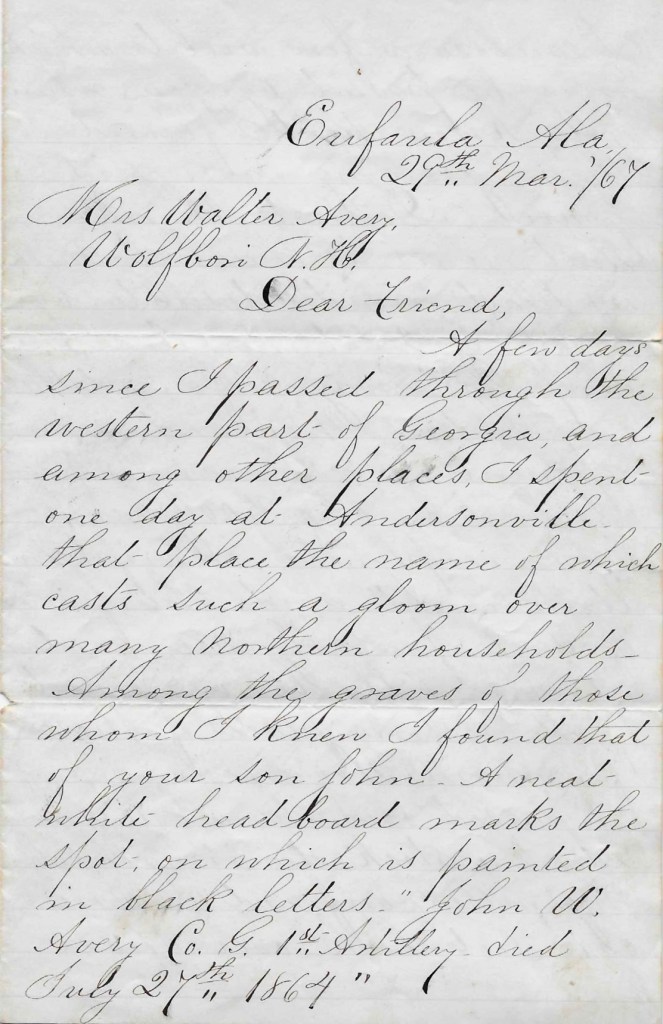
We are also informed in the letter that Sarah had a recent opportunity to visit the Andersonville Prison site in Sumter county, Georgia. During her visit, she took the time to honor the memory of the soldiers who lost their lives while detained there, some of whom were acquaintances. Among them was John Walter Cotton Avery (1835-1864) of Co. G, 1st Massachusetts Heavy Artillery, laid to rest in Grave 4065. He was the son of Walter Avery (1796-1874) and Sally Cotton (1795-1869), neighbors from Wolfeboro, who tragically lost their two youngest sons in the war. In addition to John, they also mourned the loss of Leonidas J. Avery (1839-1863) of Co. B, 16th New Hampshire Infantry, who succumbed to illness at Port Hudson in July 1863.
The following letter is from the personal collection of Greg Herr and was transcribed, researched and published on Spared & Shared by express consent.
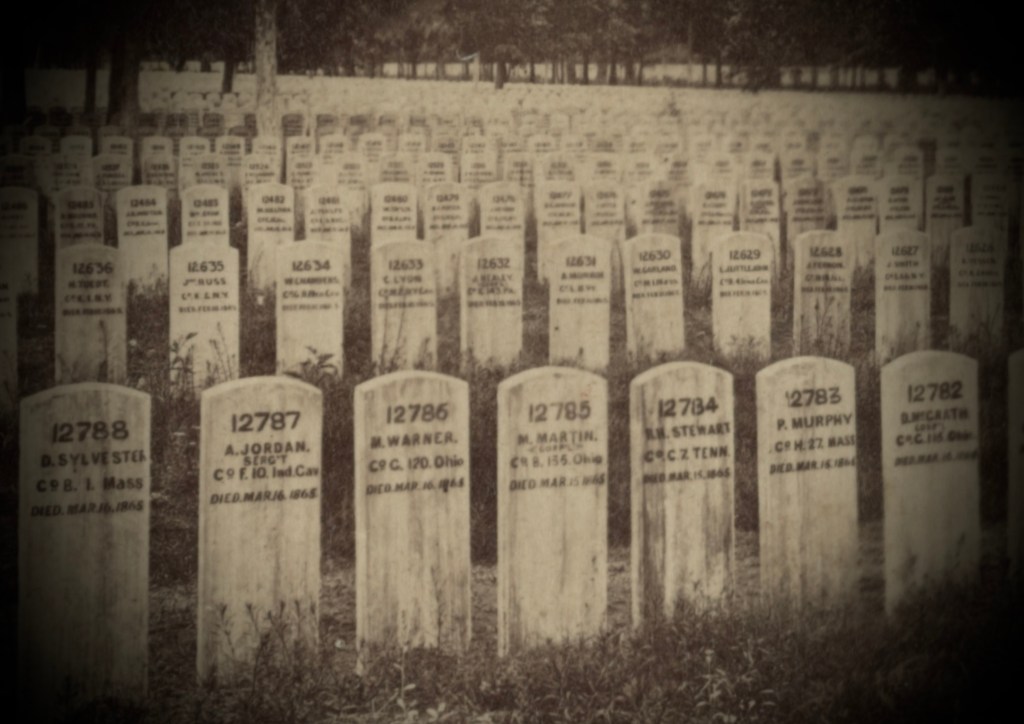
Andersonville Prison Graves, circa 1867
Transcription
Eufaula, Alabama 29th March 1867
Mrs. Walter Avery Wolf[e]boro, N. H.
Dear Friend,
A few days since I passed through the western part of Georgia, and among other places, I spent one day at Andersonville—that place the name of which casts such a gloom over many northern households. Among the graves of those whom I knew, I found that of your son John. A neat white head board marks the spot on which is painted in black letters, “John W. Avery, Co. G, 1st Artillery. Died July 27th 1864.”
I enclose a few violets which may be prized by you when you know that I found them growing near his grave. Do not think that yours is the only mother’s heart made desolate by knowing that her dear ones sleep far away. I found there over thirteen thousand graves representing as many saddened homes. Over 500 graves bear simply the inscription “unknown” and the friends of such probably are, and always will be ignorant of the resting place of those for whom they mourn.
I passed over the whole ground, saw the stockade in which they were confined, &c. One cannot look over those places without feeling that the cruelty practiced upon our prisoners there was but the legitimate result, caused by the unrighteous system of human slavery—a system which fostered and strengthened all the cruelty of the Southern people. Thank God the blood of our martyred soldiers was not shed without removing that curse from our land.
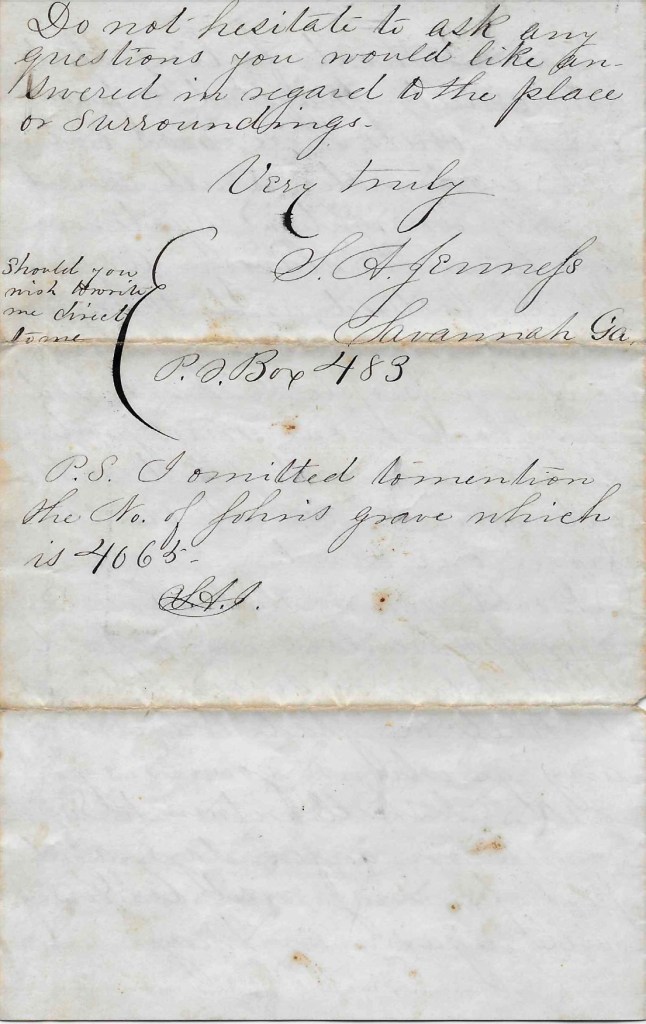
Should you wish to know any particulars in regard to the place or surroundings, I shall be glad to answer any questions you may ask. I shall return to Savannah in a few days and perhaps may visit Andersonville again in May. Do not hesitate to ask any questions you would like answered in regard to the place or surroundings.
Very truly, — S. A. Jenness, Savannah, Ga. P. O. Box 483
P. S. I omitted to mention the No. of John’s grave which is 4065. — S. A. J.
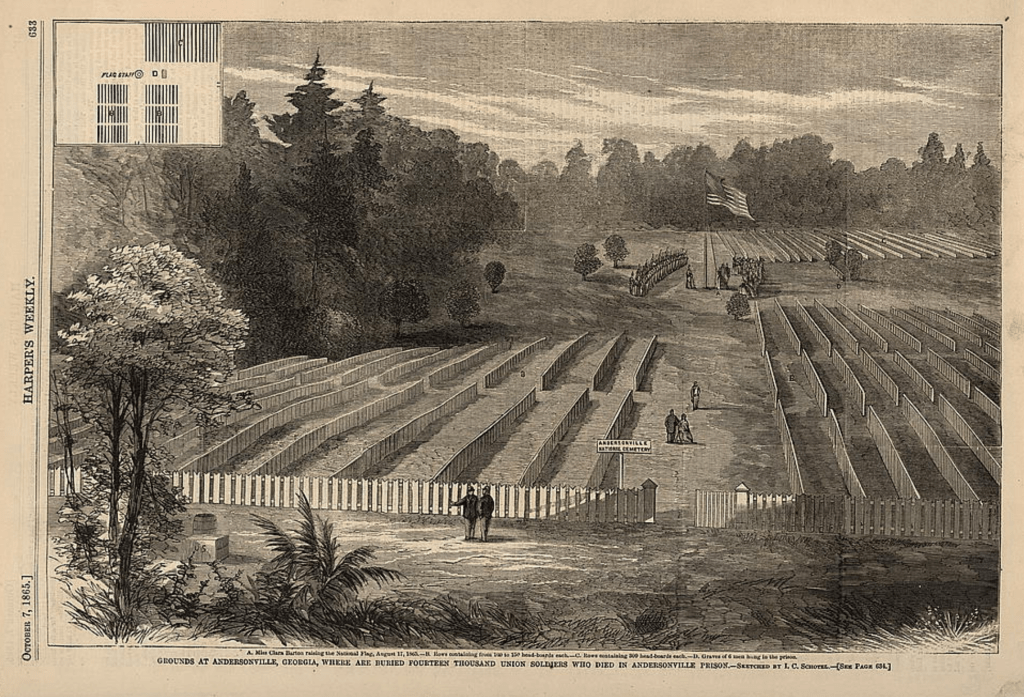
Andersonville National Cemetery, 1865, Harper’s Illustrated Magazine (LOC)
This unsigned 1865 letter is believed to have been written by Francis LeJau Frost (1837-1912), a Confederate surgeon in A. P. Hill’s Third Corps, Army of Northern Virginia. Francis was the son of Judge Edward Frost and Harriet Vanderhorst Horry. Following the war he took up planting, and was one of the organizers of the fertilizer business in South Carolina, and for eighteen years was head of a large industry of that kind in Charleston.
Everything within the letter seems to corroborate his identity, but there are discrepancies regarding his marriage date. According to genealogical and newspaper records, he didn’t marry until 11 December 1866. The bride was Rebecca Brewton Pringle (1839-1905), the daughter of William Bull Pringle (1800-1881), who is identified as “Mr. Pringle” in the letter. William Pringle was a substantial landowner, with four rice plantations and over 300 slaves. However, the records do not mention Frost’s daughters, Editha and Virginia, either, leading to further doubt.
Despite the absence of confirmation regarding the author’s identity, the decision was made to publish the content due to its high quality, with the hope that someone may step forward with a positive identification. This letter originates from Greg Herr’s personal collection and was transcribed and published on Spared & Shared with his explicit consent.
Transcription
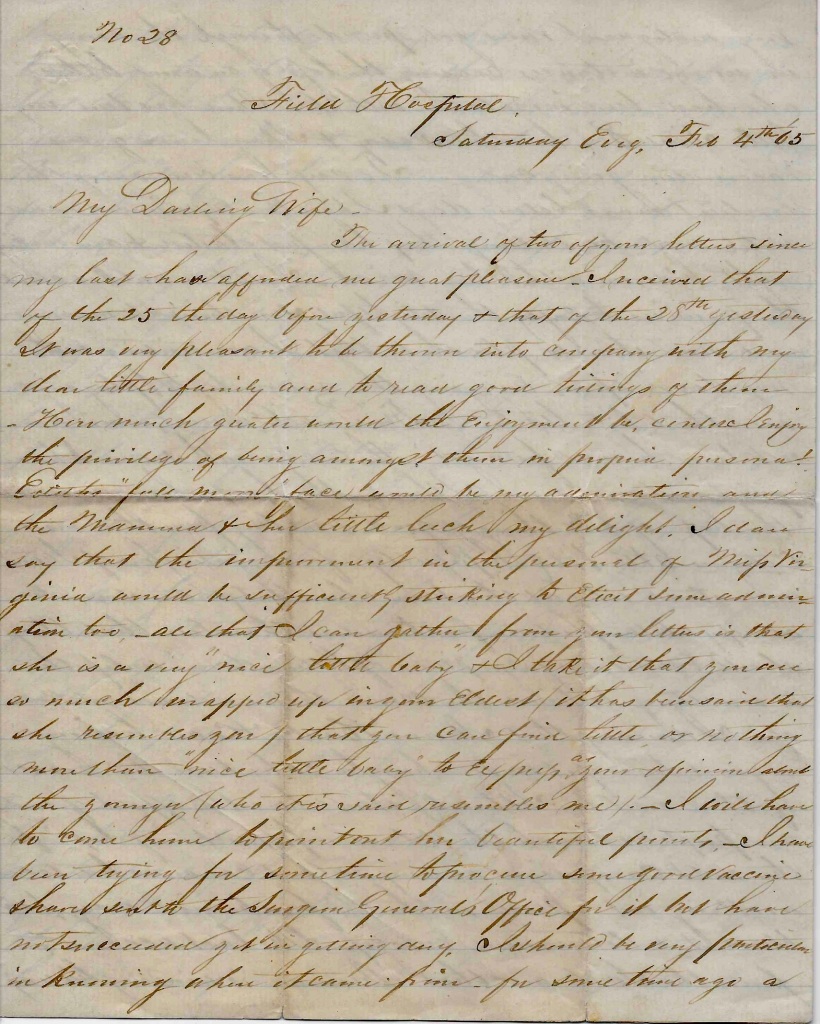
Field Hospital [near Petersburg, Virginia] Saturday Evening, February 4th 1865
My darling wife,
The arrival of two of your letters since my last have afforded me great pleasure. I received that of the 25th the day before yesterday & that of the 28th yesterday. It was very pleasant to be thrown into company with my dear little family and to read good tidings of them. How much greater would the enjoyment be could I enjoy the privilege of being amongst them in proper persona! Editha “full moon” face would be my admiration and the Mamma & her little leech my delight. I dare say that the improvement in the perusal of Miss Virginia would be sufficiently striking to elicit some admiration too—all that I can gather from your letters is that she is a very “nice little baby” & I take it that you are as much wrapped up in your eldest. It has been said that she resembles you—that you can find little or nothing more than “nice little baby” to express “your opinion about the youngest (who it is said resembles me). I will have to come home to point out her beautiful points.
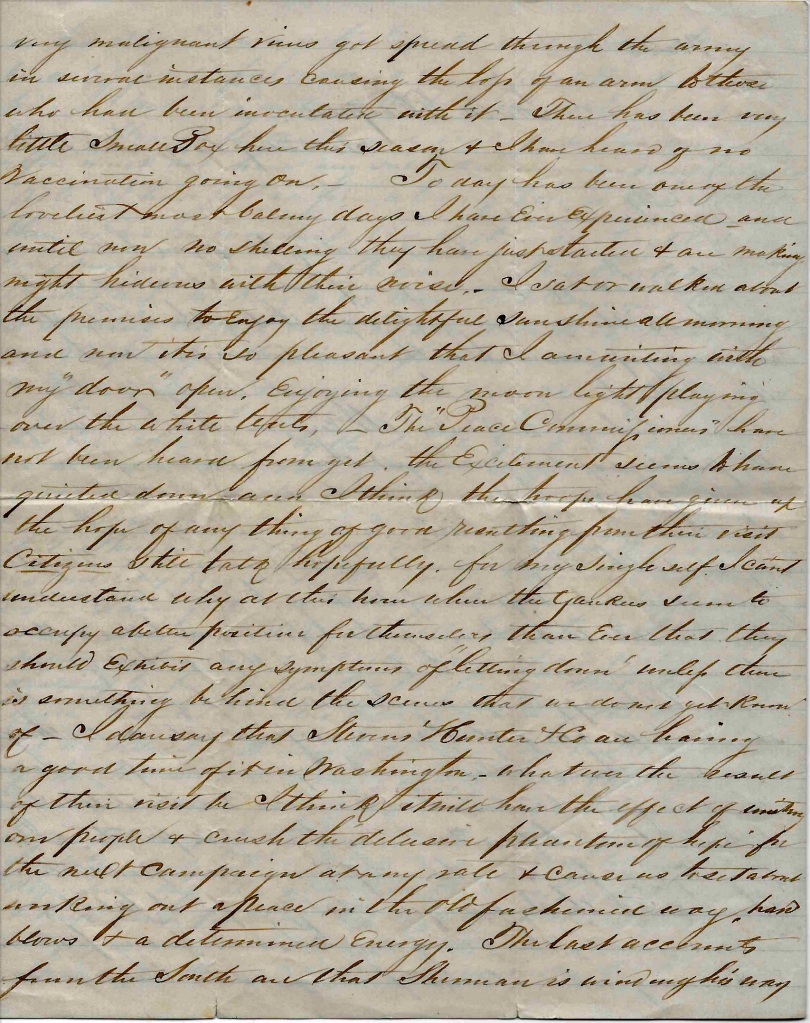
I have been trying for some time to procure some good vaccine share sent to the Surgeon General’s Office for it but have not succeeded yet in getting any. I should be very particular in knowing when it came here for some time ago a very malignant virus got spread through the army in several instances causing the loss of an arm to those who had been inoculated with it. There has been very little small pox here this season & I have heard of no vaccination going on.
Today has been one of the loveliest, most balmy days I have ever experienced and until now, no shelling. They have just started & are making night hideous with their noise. I sat or walked about the premises to enjoy the delightful sunshine all morning and now it is so pleasant that I am writing with my “door” open, enjoying the moonlight playing over the white tents.
The “Peace Commission” have not been heard from yet. The excitement seems to have quieted down and I think the troops have given up the hope of anything of good resulting from their visit. Citizens still talk hopefully. For my single self, I can’t understand why at this hour, when the Yankees seem to occupy a better position for themselves than ever, that they should exhibit any symptoms of “letting down” unless there is something behind the scenes that we do not yet know of. I dare say that Stevens, Hunter & Co. are having a good time of it in Washington, whatever the result of their visit be. I think it will have the effect of uniting our people and crush the delusive phantom of hope for the next campaign at any rate, and cause us to set about working out a peace in the old fashioned way—hard blows & a determined energy.
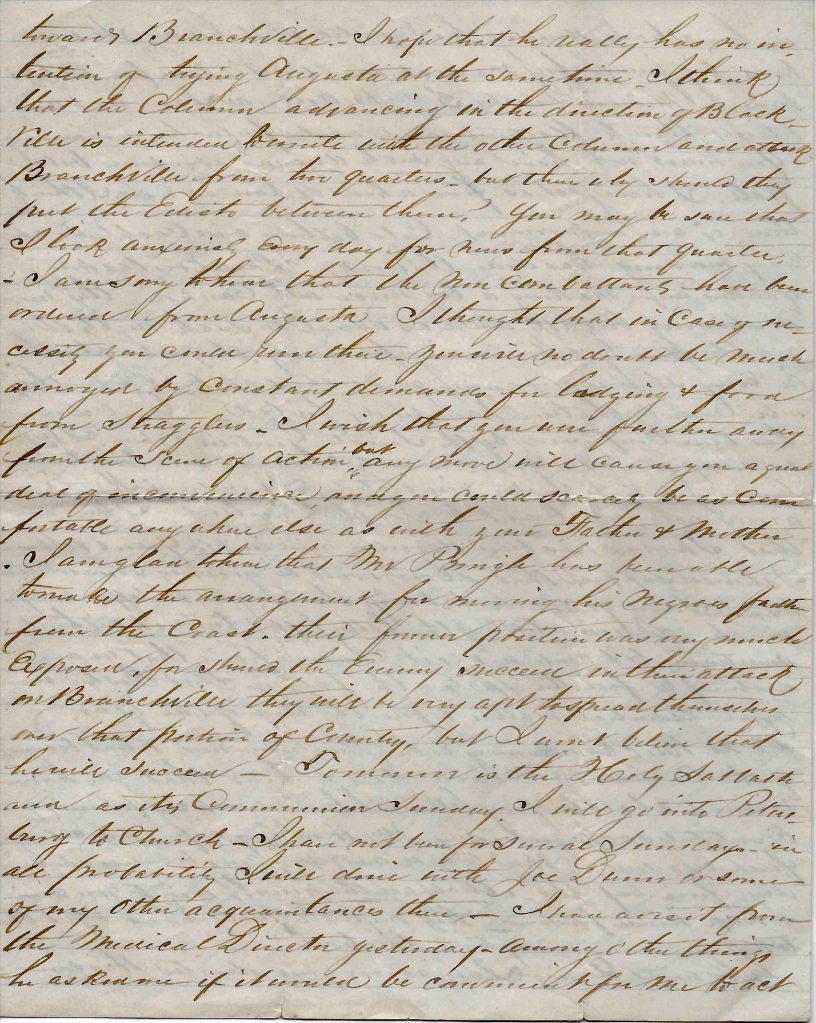
The last accounts from the South are that Sherman is winding his way towards Branchville. I hope that he really has no intention of trying Augusta at the same time. I think that the column advancing in the direction of Blackville is intended to unite with the other column and attack Branchville from two quarters. But then why should they put the Edisto [river] between them? You may be sure that I look anxiously every day for news from that quarter.
I am sorry to hear that the non-combatants have been ordered from Augusta. I thought that in case of necessity you could run there. You will no doubt be much annoyed by constant demands for lodging & food from stragglers. I wish that you wre further away from the scene of action but any move will cause you a great deal of inconvenience and you could scarcely be as comfortable anywhere else as with your Father and Mother. I am glad that Mr. Pringle has been able to make the arrangement for moving his negroes further from the coast. Their former position was very much exposed, for should the enemy succeed in their attack on Branchville, they will be very apt to spread themselves over that portion of country, but I can’t believe that he will succeed.
Tomorrow is the Holy Sabbath and as it is Communion Sunday, I will go into Petersburg to church. I have not been for several Sundays. In all probability I will dine with Joe Dunn 1 or some of my other acquaintances there. I had a visit from [Dr. John Walker Powell,] the Medical Director yesterday. Among other things, he asked me if it would be convenient for me to act in his stead during his expected visit home. It will be a big jump for modest me, won’t it? Even for a short time. Medical Director, 3rd Corps, Army of Northern Virginia. As I am not ambitious, though flattered, and would prefer his remaining.
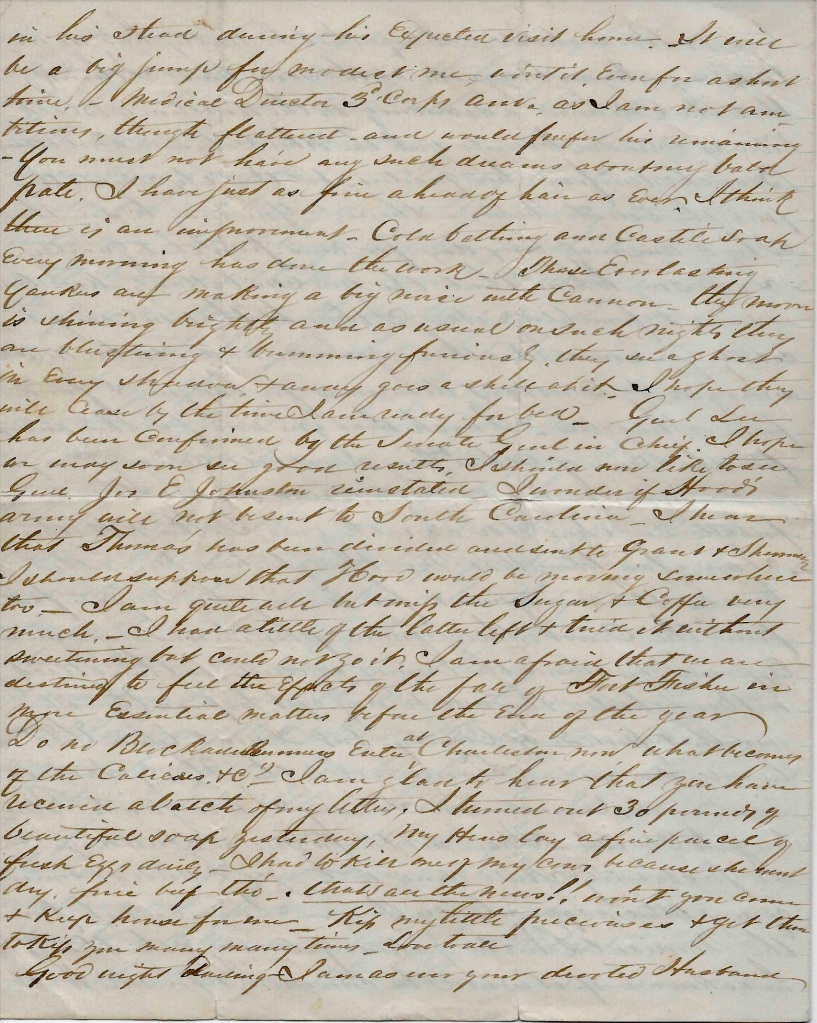
You must not have any such dreams about my bald pate. I have just as fine a head of hair as ever. I think there is an improvement. Cold bathing and Castile soap every morning has done the work.
Those everlasting Yankees are making a big noise with cannon. The moon is shining brightly and as usual on such nights they are blustering & bombing furiously. They see a ghost in every shadow and away goes a shell at it. I hope they will cease by the time I am ready for bed.
General Lee has been confirmed by the Senate General in Chief. I hope we may soon see good results. I should now like to see Gen. Jos. E. Johnston reinstated. I wonder if Hood’s army will not be sent to South Carolina. I hear that Thomas has been divided and sent to Grant & Sherman. I should suppose that Hood would be moving somewhere too.
I am quite well but miss the sugar & coffee very much. I have a little of the latter left & tried it without sweetening but could not go it. I am afraid that we are destined to feel the effects of the fall of Fort Fisher in more essential matters before the end of the year. Do no blockade runners enter at Charleston now? What becomes of the calicoes, &c. I am glad to hear that you have received a batch of my letters. I turned out 30 pounds of beautiful soap yesterday. My hens lay a fine parcel of fresh eggs daily. I had to kill one of my cows because she went dry. Fine beef though. That’s all the news!! Won’t you come and keep house for us? Kiss my little precious’s and get them to kiss you many, many times. Love to all.
Good night darling. I am as ever your devoted husband.
1 Joseph Bragg Dunn was born in Petersburg in February 1829 and was educated at the Petersburg Classical & Mathematical Institute and Amelia Academy. In 1861 he was president of the Mechanics’ Cotton Factory at Swift Creek, Chesterfield county. After the war he was superintendent of the Petersburg Iron Works. He died in 1891 and was buried in Blandford Cemetery in Petersburg.
Stephen Ward, Co. F, 38th OVI (Bruce Zigler Collection)
The following letters were written by Stephen Ward (1836-1927), the son of Lewis Ward (1805-1878) and Clara Ossa (1807-1881) of Brown township, Paulding county, Ohio. He married Nancy E. Shirley (1835-1894) on 26 March 1858 in Paulding county, Ohio, and was taking his mail in Brown township and working there as as a carpenter when the Civil War began. Nancy was the daughter of Robert Vernon Shirley (1806-1885) and Sarah Hudson (1812-1857) of Brown township. The couple had four children: Emmet (b. 1860), Laura (b. 1862), Sherman (b. 1864) and Winnie (b. 1867).
Stephen Ward enlisted in Co. F of the 38th Ohio Volunteer Infantry as a musician in 1861, and the unit served in the Tullahoma Campaign, the Chickamauga Campaign, the Chattanooga-Ringgold Campaign, the Atlanta Campaign, and the Campaign of the Carolinas before mustering out in 1865. After the war, Ward returned to his family in Ohio. The 1870 US Census finds them Spring Hill, Whiteside county, Illinois, where Stephen was enumerated as a farmer. By the time of the 1880 US Census, they had relocated again to Everett, Woodson county, Kansas where Stephen was enumerated as a carpenter. Stephen died there in Woodson county, Kansas, in 1927.
Joining Stephen in the same company & regiment was his younger brother, Sgt. George H. Ward. (1842-1917). George was wounded in the Battle of Mission Ridge on 24 November 1863—the minié ball buried so deep in George’s left hip that it could not be removed. He was subsequently discharged and returned to his parent’s farm in Paulding county where he married Celeste Deborah Cushman (1838-1910) in May 1865. He worked as a wagon maker, living in Michigan for a while before finally settling in San Diego, California.
Stephen had two brother-in-law who served in the same company and regiment as well. They were Elias W. Shirley (1838-1911), and David Clark Shirley (1840-1919)—both survived the war. David was a musician with Stephen in the company. He was discharged for disability in June 1862. Elias was taken prisoner at Milledgeville, Georgia, in November 1864 but mustered out with the regiment in 1865.
There is one letter of Stephen’s to his wife dated 18 February 1863 at the University of Tennessee archives in which he describes encountering Confederate cavalry on a recent scouting mission, the inclement winter weather, and foraging for food and supplies. He also complains that his recent exertions have left him “as sore as an old Government mule” and mentions that a wealthy Union sympathizer had been hung after two of his Confederate neighbors betrayed him shortly before Ward’s unit arrived in the area. See: Identifier 3032.
To read letters by other members of the 38th Ohio Volunteer Infantry that I’ve transcribed and published on Spared & Shared, see:
One of the patriotic envelopes Stephen used to mail a letter home to his wife Nancy (Bruce Zigler Collection)
Letter 1
Envelope (Bruce Zigler Collection)
Danville, Kentucky November 21, 1861
Dear Nancy,
I now improve this opportunity of writing you again. We left London last Wednesday night at 8 o’clock. We marched from there to Wild Cat that night, stopped there till daylight. We found some pretty bad road before we got there. It began to rain about daylight and pretty hard until we came to Rockcastle River, about 2.5 miles about from Wild Cat. We crossed the river on a ferry boat. After we crossed, the rain came down in torrents and went about a mile from there and stopped, built fires out of rails. After we got our fires started, it quit raining so that we got a chance to dry our clothes. Our over coats came in very good play. Mine kept me dry and comfortable.
We started again and marched until night. The roads was awful muddy. When we stopped, our teams had not come up so we had to lay out. I had lost one night’s sleep and it looked as though it was a going to be a wet night and the other boys had lain down rails and spread there blankets down around the fire so I picked up my knapsack & started for an old lot of cribs. When I got there, I found it full of [ ] and all of soldiers of the 14th, 17th, and 38th and the 33rd Indiana Regiments for we all started the same night, so my chance for a night’s snooze there was small. I saw another mess of old log buildings not far from there so I started for them but when I got there, I was no better off. There was not anybody in it for there was not any roof on it. Then I went to a house that was on the same farm and the man that lived in it gave me the privilege of lying upstairs on the floor. They had spread down a carpet so that it made it very comfortable. There was soon 15 or 20 slept there that night. I slept first rate.
There was some of our men that did not keep up with the regiment and camped by themselves in the woods. There was two of our regiment stopped with some of the 1st Tennessee Regiment. They were strangers to me and in the night the wind blowed quite hard and blowed a tree onto them. There was five hurt with it. Our boys got hurt the worst, One of them died the next day and they thought the other one couldn’t live long.
There was an accident happened. One of our regiment while we were at London had been cleaning his gun and put a cap on and put his hand over the muzzle and snapped it to see if he could feel any air come through and the gun was loaded. The ball passed through his hand mangling it very bad so that the doctor had to take it off his hand—all but the thumb and forefinger.
We was camped near Crab Orchard Friday night until yesterday morning. We slept out of doors three nights of that time before our tents came up. The roads was so bad. George has not been with us on this march. He has had something like the rheumatism in one of his ankles. He stayed at London until our teams came up. Now he is at Crab Orchard. The captain sent him there to see to the sick and doctor his leg. He can’t stand it to march all day and keep up with the regiment. There is several of our company in the hospital. George Kingery and George Hokes are there. I think they will be up with us in a few days. I stand the marching first rate.
After we got to Crab Orchard, we got on the pike. We have good roads yesterday and to[day] we have got in a very fine country and have been since yesterday. Wwe are camped a mile and a half from Danville. It is a very nice town—the finest town we been in since we left Ohio. We met with a good reception. The sidewalks was lined with people. The Union feeling is very strong in this town. There was apples given to us. There was a negro woman on the street with a basket full. The men helped themselves—I did anyhow and I don’t think any of the rest was. The negroes and the little boys followed us out of town.
We drawed our overcoats at London. They are blue with cape. This evening we drawed our dress coats. They are a dark blue cloth roundabout lined and waded through. there is socks for us too but we won’t get them [till] this afternoon. the officers say that we will stay here until we get our pay. I heard the colonel say on the road today that the paymaster was at Crab Orchard paying off the sick men. I shall send it home by Express. If I do, I shall send it to you in care of Sam Shiver to Delphos. One of our officers will take it to Nicholasville. It is 26 miles from here. I will let you know if & when I send it. You can pay my tax and do as you please with the balance. I don’t know how much it will be.
I got a letter from Emma last night and one for George from Clara. I got another this afternoon for George from Zanesville. I suppose Malinda wrote it. There was no name signed to it.
November 22. Friday morning. It is raining. It commenced about half an hour ago and I don’t think I shall get my socks for the ones that I did receive from the government and my drawers are good yet. I wrote you a letter last week. You need not bother about the trade I wrote of. I have not seen any need of one yet. I don’t know whether we get our pay today or not. I will let you know before I send that.
I thought I would write all I could think of one one sheet of paper but I could not crowd it in. I don’t know whether I can fill this part of a sheet or not. I have about run out of news. Capt. Adams told me that he would take our money to Nicholasville and express it. It will be a great deal safer than to send it by mail. I would like to have you pay Sam Sriver what you have left of it in that Shafer note but I want you to get what things you need first and pay my tax and if father needs any, let him have it.
George has not come yet. I suppose he has got his pay. He is a going to send is home. I hope he won’t try to send it by mail. I don’t know whether I shall send it to Delphos or Defiance but it will be fixed so that you can find out where to get it. I think if I send it to Defiance I had better send it in care of your father. I want you to get what you need for yourself and Emmet if it takes it all. I want you to take good care of him. Emma wrote that he was getting along so well. When you write, tell me how you are getting along and how they are a doing and whether you have any cold weather. It has not been very cold here yet. The coldest night we have had I think was last Saturday night [when] it froze ice about three-fourths of an inch thick on the water that stood in kettles.
I laid out in the open field on some hay. Sol Cambell and I slept together. We had three blankets and our overcoats over us and we slept first rate. I can think of no more at present. Yours as ever, — S. Ward
to N. E. W.
Letter 2
Camp Bradley Sunday, p.m., December 22, 1861
Dear Nancy,
I received your very welcome letter of the 16th and was very glad t hear from you and hear that you were well. My health is as good as ever. I weight 159 and one-quarter—more than I ever weighed before to my knowledge. I think I shall be able to stand the hardships if they don’t get any harder. George is considerable under the weather. His throat is swollen considerable but he looks a good deal better than I expect to see him. He looks better than the rest of the men that has had the measles.
Our regiment was on a scout day before yesterday. We left camp about 10 o’clock and went back on the river near our old camp where Colonel Hoskins regiment and the 1st Kentucky Artillery was camped. They have stationed themselves on a high hill. When we got to them, they were chopping down the trees fixing breastworks of logs and stones and watching for the rebels/ They said they had been within a mile or so of that place that morning but they did not come so we started for their camp about six miles off where a part of Zolicoffer’s army was camped. We got within a mile of them and stopped about dark in the woods along the road to wait for daylight (we had about one thousand men and four pieces of artillery).
We had a very good place to stop. Our pickets was stationed and we [laid] down with the expectation of pitching into them in the morning. I rolled myself up in my blanket and laid down in the leaves with my head on a chunk. I laid very well but could not sleep much for one end of my pillow stuck out rather far and every once in a while some one would step on it so I thought I could not get to sleep. I had to move my nest. I slept first rate after that what time we stayed.
About eleven o’clock there was a dispatch came for us to return to camp by daylight so we had to go back. We started back. We took another road that run nearer our camp but we missed the road and got on a byroad that came into the road that we have got very heavily picketed and the pickets knew nothing of our coming. The cavalry was about a half a mile further than the other ones were and they thought the whole of Zollicoffer’s force was coming. They waited until we got within gunshot and they they fired on us and put spurs to their horses and left but fortunately for us, they shot over us the whole length of the regiment and done no damage. They fired about ten shots at us. It scared the boys that was left in the camp and some of them that was in the regiment but we all got through safe.
It has been raining all day but we can’t complain for it is the first since we left Danville. Our forces have this place strongly fortified. I think the rebels will [have] something to do if he gets this place. Our men worked yesterday all day chopping and entrenching.
I am glad you have had such good luck with the hogs. I can’t think of anything more. Take good care of yourself and Emmet. I am glad to hear that he is doing so well. I will answer Emma’s letter as soon as I can. No more at present. Yours as ever, — Stephen Ward
I received that letter that you sent me with the postage stamps. It was mailed from Junction five days after the one you sent the 5th of December. It was mailed the 10th so it is alright.
to Nancy E. Ward
Letter 3
Camp Bradley, Kentucky January 17, 1861 [should be 1862]
Dear Nancy,
I received your very welcome letter of the 5th and was very glad to hear from you. I received one from Clara Georgiana & one from father last night. I got one from Joe and Mary. We are all well at present. I have been thinking of writing for several days I have four to answer now. I had to wash some this forenoon. We don’t very [ ] but it will do for a soldier.
We have had very changeable weather this week. Some days it has been pretty cool and then turn quite warm. That Tuesday night it snowed some. Wednesday it thawed and Wednesday night it rained all night and part of the day Thursday.
Our company went out on picket that night. I volunteered my service and shouldered a gun and went along. I like the business very well. There was another company along with us so that we did not have to stand until one o’clock a.m. I was on the second relief so that I did not stand till three o’clock. After I went on guard, it commenced thundering very hard and it was not long until it rained about as hard but I had a good oil cloth so that I did not get wet.
We were about two miles from camp toward Zollicoffer’s camp but there was none of them showed themselves. Our forces have all left camp for his part of the country. Our regiment and the 35th I expect will go tomorrow. I was afraid when we saw them start that we was a going to be left [behind] but Colonel Bradley told us we would go tomorrow. I expect there is something to be done now for I saw the account of the gunboat fleet had started down the river. I suppose there will be something done at Bowling Green before long. Our forces (so they report) form a junction at Fishing Creek with General Thomas’s forces. We have heard that the force below Zollicoffer has crossed the river and cut off his retreat but it may all be a camp report but I hope not.
We have been making a great improvement in our tent. We built an arch but it was not worth much. We got tired of that so day before yesterday three or four of us went to work and built a regular old fashioned fireplace topped out with a barrel on the top of the chimney. We can cook over the fire now without going out of doors.
Sol Campbell is now baking biscuits over the fire. I was in town the other day and got some saleratus and we borrowed a bake kettle and lid. He is now taking out a lot and the man has come after the kettle. We use vinegar instead of sour milk. We have plenty of fat pork so that we have plenty of grease. There is a pan of smoking hot beans sitting by the fire. I shall have to close pretty soon for it is pretty near sun down and the letters will leave camp soon.
I received a letter from Emma in one of Columbus’s letters. I wrote to you last week on a large sheet of letter paper in answer to one that you wrote to me. I feel for you in your trouble for I know how you feel but keep up your courage. Be a good soldier. We all have our troubles in this world. I have went through more than I ever expected I would be able to stand. Don’t be discouraged. I hope the time is not far distant till we will all be home. Yours as ever, — Stephen Ward
to N. E. Ward
Letter 4
Camp near Columbia, Tennessee Sunday after March 30, 1862
Dear Nancy,
I received yours of the 23rd of this month and one last week of the 16th and was very glad to hear from you. There was [one] for George from father. I opened it and read it. I think I can send it to him today. I have not heard from him for several days. Sam Harger told me that he was quite sick. We left 18 of our company at Nashville and I have heard that some of them has been sent home. I hope that they will send all of the sick ones home. My health is about as good as ever but the warm weather takes hold pretty strong. It is very warm today. I sweat like a harvest hand writing. Some of the boys are barefoot. We are boxing up our coats today to send them home. I have put up both of my heavy ones with some things in the pocket of the short coat. Some of them are buttons. Some of them I found in Zollicoffer’s camp. I had not time to sort them out. There is some artillery fuses and a paper of seeds that I send to father that I got at Wildcat. They are black cohosh [a woodland herb]. I don’t know whether they will grow or not. And a box of shaving cream that I got at Zollicoffer’s camp.
We marched yesterday about ten miles. It was very dusty on the pike. We were a dirty looking set of men when we got in camp. Roll Evans was here a while today. There is one of Jess Boughman’s boys in the 18th so he told me. I expect it’s Josiah. I want to go over to their regiment this afternoon if I get time.
I got a letter from Clara last week with 25 cents in it for George but he was not here. I got the letter that had Emma’s documents on and the one with the curl of hair in. I have it in my pocket book. I got the stamps in the letter of today. I am glad you have got the note of Weant. I think as much of the watch as you do of the note. There is a silversmith in the band that fixed it for me. He wanted to get it. I asked him what it was worth. He said if he had it, he would not take 45 dollars for it. He said it was a tip top watch.
I expect we will start tomorrow again. I heard we were a going to Decatur, Alabama. It is about a hundred miles. We have six days to go in. We have got the Cincin[nati] papers of the 21st and still later but I have not read them yet but they say that Island No. 10 has not been taken yet. We are one mile from Duck River. The rebels destroyed the bridge so that it kept us back.
I understood that Perry Kingary, J[otham] Rollins, and William Donnell was some of the men that was sent home from Nashville. Sam Harger saw them get aboard of a boat. I think they had better send A[ndrew] Linaberry if they have not. He was left there with the rest for he was quite unwell.
I saw a pretty sight this morning. It was a body of cavalry on parade. They all looked as though they had come out of a bandbox. They had as good a brass band as I have saw since I have been out. They were all in horseback and all grey horses. The horses all stood perfectly still when they were standing and when they marched, they went as regular as clockwork. One of them had a large bass drum hanging by his side. It looked grand.
You wrote that you had sent me stamps in lettres that I had not got. I don’t know how many you have wrote. I have got all of them yet that got [to me] since we left Kentucky. There is five of them.
I can’t think of all that I want to write. There is a great many troops on this road. I don’t know how many. There is several brigades.
I am glad you have got the horses if they were not doing well but I don’t think you had better sell your cow unless you think you can do better, I should like to know how Sam is getting along with that Shafer note. Think I can send you more money than I did this time. I had some borrowed money to pay out of it and some other little debts to pay so that it made a pretty big hole in the five dollars I had left. I paid Elias five dollars that I borrowed of him in Danville to get my boots with. I don’t know how soon we will get our pay again. I am afraid we will be so far south that I cannot send it home when we do get it. I should like to see you all very much but I feel well satisfied here. I have not been homesick yet and I don’t think I shall be for there is no use to fret about home for we can’t get there yet and I want to see this war through with before I quit and that honorable too.
Take good care of yourself and Emmet. I should like to see that little rogue running around the yard but I suppose he would run like a white [ ] if he was to see me a coming when he was out. But do your duty by him. I wish you had the coffee we have to spare. We have just drawn four days rations of sugar and coffee. We have about 6 lbs. of sugar very near, a peck of brown coffee/ I have about half a lb. of sugar in my haversack now. Coffee I have heard it was a dollar per lb. We have not sold any for some. We used all we drawed for a while. The weather is getting so warm that we don’t drink as much as we did in the winter. I can think of no more at present but remain yours as ever.– Stephen
[to] N. E. W.
Letter 5
Camp two miles from Crab Orchard, Kentucky October 17, 1862
Dear Nancy,
Your very welcome letter of the last of September was received last Sunday with a god deal of pleasure. I had almost given up hearing from you. It has been a difficult matter to get mail or send any. We have not had a chance of sending letters but once in two weeks and then we had such short notice that I had no chance to write. We have no knapsacks with us so that I have no way of carrying paper. This sheet and the one George is writing on I got from [Sgt.] Charles Hakes.
Our baggage is at Louisville that we heard had been burned but I don’t know when we will get them. We have been marching different from what we have done. The company is divided into smaller messes—only six in a mess—and they are furnished with a tin coffee pot and stew pan (that we have not got yet) and they have to carry it with them on th march. We have a black cook in our mess. He came from Nashville with us. He came from Decatur. I wish father had him. He is a good hand to work. He says he is going to stay with us as long as he can and go with us to Ohio.
Well, Nancy, I suppose you want to know how we have been getting along and what we done in time of the fight [At Chaplin Hills] but I suppose you have saw the full account of the battle before this and a more correct one than I could give. We left Louisville the first of this month. The rebels were around over the country from Shepherdsville on the railroad to Nashville. they burned the bridge at Shepherdsville across Salt river. We run then from there to Bardstown. They left that place one week ago last Sunday morning and our advance in full chase. We passed through about noon the same day. Our advance harassed them, so shelling them that they stopped at Perryville. It was a hard battle. Our division was held back as a reserve until about three o’clock in the afternoon [when] we got orders to advance closer and halted just in the rear of the artillery that was belching forth death and destruction, the shells from the rebel guns bursting a short distance ahead of us. But darkness closed the action and our division did not get into the action. Stedman’s brigade was ordered up to support a battery.
The harder sight was afterwards. All the martial band was under control of the surgeon so that we had to stay with the ambulances. The fife major and myself was sent to carry water to a house that our doctors of our regiment had cleaned out for a hospital and while we were gone the rest of the boys and the ambulances had moved and had taken our things with them so that [we] had to hunt them. While we were searching, we went to a house where there was a good many wounded. The sight was pretty hard. The yard was covered with wounded and the surgeons were at work at a table cutting and slashing. It looked like a slaughter shop. I went up to the table and they had one poor fellow under the influence of chloroform. They had taken his left leg off close as they could well to his body. The legs and arms was piled up under the table.
The 75th Illinois regiment had left their knapsacks on the ground that our regiment occupied that night. They were some of the new regiments. They had only been in the service about six weeks. They were considerable scattered. They came straggling in until the next day noon. The first ones that came in told us that their regiment was all cut to pieces but when the regiment came in that stayed together, they had a larger regiment than our was.
I was on a part of the battleground the next day. It was a hard sight to look on. There was one place where the 75th Illinois had went in that their dead lay quite thick on the ground. 1 Adjutant [John] Crosson was along. He stood in one place and counted some forty. It was on a high piece of ground. I suppose there was about 55 or 60 lay on the ground of that regiment. A great many from Whiteside county. I have not heard what the loss is yet on either side.
We left there the second day after the fight and I heard one of our officers say that there was a thousand dead rebels on the field unburied and from what I hear, they are not all buried yet and I expect there is a good many that never will be buried. While I was on the ground of the 75th’s fight, there was one of the regiment examining the bodies to identify [them]. He went up to one that lay there and said that he was acquainted with him and said that his brother had enquired of him about him. He said that he left a wife and two children. He looked to be about 27 years old. I saw one man that had his head blown entirely away. Some were laying as though they were asleep, one that lay on his right side with his head to the roots of a tree. He had his hat doubled up and put under his head for a pillow. I don’t think he had struggled in the least.
The 2nd Ohio lost a good many. Adjutant Crosson saw one dead man of that regiment of his acquaintance from the southern part of Ohio. Webster Jones was with us too. We went along a short distance farther and there was a young fellow standing looking at the body of a young man just in the prime of life that had been cut down by an enemy’s ball. I saw they both resembled each other and Web asked him if that was his brother. He said it was. It was then 22 hours after the battle.
There was a good many of the wounded of the 75th Illinois came to our regiment the night of the battle—some that had run a very close chance—two that had been cut across the top of the head with musket balls—one that was cut pretty deep.
We are camped in the field joining the one we camped in one year ago—that was the second march our regiment made in Kentucky, the night after we left Camp Dick Robinson and the day of the memorable Battle of Wildcat. I did not think that we would be here in one year. We have been here two days but I expect to hear the orders to get ready for we have not got any tents. We left our tents at Nashville. That was another hard march from there to Louisville. Water was so hard to get. We have suffered more for the want of water than for anything else. I have drank water that I would not offer a horse at home. Go into camp at night and have to use pond water that some of the men were washing their feet, face, and hands and watering horses and mules. They were in it to their knees sometimes. We had rather poor feed there several days that we had to take our own bread and enough of that to do three days and we had to mix it with salt and water adn wheat flour. Don’t make very light bread that way. And then baked on our plates before the fire which was rather a poor invention for some of it proved not to be very well cooked about the center of it. You could have throwed them through any of the stone fences along the road.
I wrote you a short letter while we were at Louisville the same day that I sent my money home. You wrote in your last that Emmet was getting better. I was glad to hear it for I felt uneasy about him. George received one from father the same day stating that he had been carrying him out. Benjamin’s death was very unexpected. Emma had written that he had been quite sick and that her father had gone after him but he’s at rest. You wrote that you wanted me to get my likeness taken and put in a breast pin for you but it came too late for I had sent you all the money I could spare. But I hope we will be where I can get one for you the next time we get our pay. We did not stay but one day after we were paid off. If I write any more I shall have to get a little more paper.
Forgive my long delay and remember [your] ever loving husband, — Stephen Ware
to Nancy E. Ward
We have got use to all kinds of usage. We are at home wherever we stop. You ought to hear the boys cheer when we get in sight of camp after a hard days march and when we get there it is all out of doors. I have go so use to sleeping out of doors that I don’t believe I could sleep in a house and take a good nights rest for looking at the ceiling. When we get in camp, the first thing is supper and then fix our bread. If the ground is level, all right. If it is in an old field, we kick the hubs off and lay down. I don’t know when I will get a chance to mail this. We expect the mail in tomorrow or the next day. There is no regular mail route yet. Our mail carried for this regiment has to take it to Louisville.
Battle of Perryville, October 8, 1862, 6:30 to 7:30 pm. American Battlefield Trust
1 In the Battle of Perryville, the 75th Illinois was brigaded with the 59th & 74th Illinois, the 22nd Indiana, and the 5th Wisconsin Battery Light Artillery. The Brigade was commanded by Col. Michael Gooding. The 75th Illinois was organized at Dixon, Illinois, and mustered into the service on 2 September 1862. It arrived at Jeffersonville, Ind., Sept. 29 and crossed the Ohio on the next evening. It was engaged in the battle of Perryville, the loss of the 75th in this engagement being severe. They were called up when McCook’s flanks collapsed. Gooding reported, “I found the forces badly cut up and retreating (they then having fallen back nearly 1 mile) and were being hotly pressed by the enemy.”Gooding formed his brigade south of the Benton Road, with the 59th Illinois on the left, the 75th Illinois in the center, and the 22nd Indiana on the right. His extreme left rested against the road. The 22nd Indiana lost 59 killed, 119 wounded and 17 men missing. When the troops marched into battle they had a force of 300 men. When the smoke cleared, 195 were casualties. They had lost a staggering 65.3 percent of their force. This regiment lost the largest percentage of troops killed and wounded at Perryville. The rest of Gooding’s brigade, the 59th and 75th Illinois, lost 71 men killed, 226 wounded, and 41 captured. [Source: “Literally covered with the dead and dying” by Stuart W. Sanders]
Letter 6
Camp at Gallatin, Tennessee Saturday afternoon, December 13th 1862
Dear Nancy,
Your very welcome letter of the 7th & 8th came to hand just before dinner. I was very glad to hear from you again. I had been looking for one for several days and was disappointed until today. I am sorry that you have so much sickness in the family. George got a letter from Clara yesterday stating that Laura had been very sick and that the hopes of her recovery had been doubtful for a while but was then on the mend. I hope she will get along without any backset for you have had your hands full with sick children but I hope that it may not prove fatal.
My health is very good. I don’t think I ever weighed heavier than I do now although I have not been weighed since we left Louisville.
I suppose you hear of the death of [our] Capt. [John H.] Adams before you get this. Adjutant Crosson started with his remains day before yesterday in company with an old gentleman from north of Defiance with the remains of his son—a member of Co. K of our regiment. He had been buried over two weeks. His father brought a metallic coffin and had him put in before he started. Crosson would get one for Capt. Adams when he got to Louisville. What news that will be for his family. Crosson telegraphed to his wife and her brother to come. After he died Adjutant [Crosson] telegraphed to Louisville to Capt. [David S.] Tallerday to have the metallic coffin ready and to have Mrs. Adams stop in Louisville. The Adjutant could not go any farther. He only had a pass for 48 hours.
The health of the regiment is good although there has been several deaths in the regiment since we have been here. There was one the same night that the Captain died—one of the Tennessee recruits [John M. Shaw?] that joined Co. A when we went from Nashville to Shiloh. He had been sick but a short time. We had 60 drafted recruits come for our regiment the last of the week. We have 8 of them in our company—one of them in our mess. He seems like a fine young man. (One of the grey backs commenced his depredations so I had to stop writing and put a stop to his ramblings. I don’t know as you know what I mean. They are vulgarly called LICE. He had marching orders, I expect, but got captured. But this is the way it goes in war times.)
I sent you a letter about two weeks ago with two shell rings that I made. One was a red one and the other was white, and then I wrote another one in answer to one that I received the next day. I don’t know whether you got them. We have had some cold weather and some snow that the last of last week and the first of this, but now we have quite pleasant weather, We moved here yesterday after noon. The 9th Ohio relieved us at Pilot Knob. It is about 6 miles from here. I don’t know how long we will stay here. We have been here now longer than I expect to have been. We are camped in a very nice place. It has been used for a fairground but everything has been burned down. I don’t know whether it has been our soldiers or the rebels that done it.
You mentioned about sending me some socks and mittens. They would come very good. I got two pairs of socks at Bowling Green. They are rather the worse of wear. I could not wear mittens to play the fife with. They would do for to wear when I am not playing. I could not play the fife with gloves on. I am still playing the fife yet. I shall have to send Emmet’s letter back, I can’t cypher it out.
William Donnell saw more than I did if he saw so many women of the lower order. There was one woman with our regiment at Somerset. She was with the saddler of the regiment. She passed as his wife and I knew no better until a short time before she left and then it was rumored that she was not his wife. I suppose there was a great many at Nashville but they did not bother our camp—at least I saw none. They said that there was fifteen hundred in Nashville the fore part of last summer and that is all that I know about it. I think them that know so much about it must of been in search of them. For my part, I never bothered my head about them and I don’t think George did. As for anyone else, I can’t say for I never have been away from the regiment but one night since we have been out and that was from Bardstown to Jonesville.
I shall have to close on this sheet. Write often and remember—Stephen
Letter 7
Galatin, Tennessee Sunday, December 14th 1862
Dear Nancy,
I neglected getting my letter off in this morning’s mail so I thought I would try and write a few more lines so as to fill up the envelope for it looks rather slim—only a half sheet of paper—and that what you sent one half of your letter. I thought that I had better use that before it got spoiled and paper not very plenty. I don’t keep much on hand for I have not a very good way carrying it since I lost my knapsack but I am glad that is gone for I have got tired of packing it. I should like to of had some of the things that was in it. I don’t [know as] I shall carry quite as much baggage as I did last winter. All that I carry now is a blanket, one shirt, one pair of socks, and a rubber cloth haversack, and canteen, and I think that will be the amount of luggage. There is some talk of getting the shelter tents but they had better save the cloth and give it to someone that needs it than to be wasting in that style. The Government had better save that expense if they think that the men is better able to carry their shelter than the horses and mules are to haul them. Then give us something that is worth carrying. If they would furnish an oil cloth, it would be a great deal better but we have not got them yet and they had better keep them than to send them here.
Last night or yesterday afternoon it clouded up and threatened rain but did not do much as it—the sky—has been cloudy all day and the wind has blowed quite hard all day. Our company went on picket yesterday afternoon and I expect they will be in pretty soon. Everything is quiet about here. There has not been any fighting that I have heard of.
The Louisville Democrat had the account of the fight at Fredericksburg and the victory of our forces at Prairie Grove. I hope that we have officers at the head of the armies that will do something now. I think that General Rosecrans will do the thing up about right.
Capt. John Haight Adams, Co. F, 38th OVI
I suppose that the folks think about home that the company don’t miss Capt. [John Haight] Adams for the reports that was circulated about him but if they do, they are mistaken for he was liked by all. The officers of this regiment are not near as strict as they used to be. We don’t have camp guard one tenth of the time. I was talking with Charles Hakes about his sickness. he was with him until he died. He said that he was deranged the greater part of the time and talked about his wife and part of the time he would be drilling the company. The night that he died, he seemed to have a great deal of pain. They thought that he would go into convulsions until about a half an hour before he died. Then it all seemed to leave him. The last half hour he slept all the time. He said that he never saw anyone die easier than he did.
George Kingery just went out of the tent. Him and Shive came back to the regiment a little while ago. Shive had the erysipelas. There has been considerable of it amongst the soldiers here of late. George looks well. He was taking care of Shive. Our [Black] cook has a great notion of going to Ohio. He is a great fellow for making money. He has made about 25 dollars since we were paid. He gave me his money to keep for him. He was afraid that he would lose it, he is so careless with it. I have 13 dollars in greenbacks and silver. He says that he has a notion to sed it to father for he says he will go there sure. He said that father could keep it for him. He made it all selling pies and bread, butter, milk, apples—anything that he could get hold of.
The boys have all come in off picket and they crowd in the tent so that I had to stop till they got settled. They brought in the report that our forces had taken eighteen hundred prisoners between Nashville and Murfreesboro. I can’t think of any more so I guess I had better wait and if it don’t go tomorrow, maybe I can write another sheet, I shall close by sending love to all. Yours as ever, — Stephen
Nancy, Emmet, and the rest of the little ones.
Letter 8
Nashville, Tennessee Sunday afternoon, December 21st 1862
Dear Nancy,
I received your very welcome letter of the 14th and was very glad to hear from you and that you were all well for I felt quite uneasy about Laura that her sickness might prove fatal. But I hope that both of the children may have good health for it is a great trial to have so much sickness. My health is as good as usual and George continues the same.
I was in Nashville last Friday. Charles Hakes and I went together. He got a pass from the Colonel of our regiment and I tooked & got it signed by the Colonel commanding the Brigade. We had from 9 p.m. till 2 a.m. so that we saw some of the sights about town. We visited the State House and the Penitentiary. They are not as fine buildings as those we visite in Ohio. The State House is not as large but it is built of the same kind of material and it is not as well finished inside. The 1st Middle Tennessee Regiment is quartered in it.
The penitentiary is not so large and there is not one-fourth of the business done in it that is done in the Ohio Penitentiary. All the work that I saw going on was stone cutting, cabinet making, some few making cedar buckets and all going by hand. The sleeping apartments are the same. They have a few small articles of the prisoners made [illegible due to lack of focus] in brass. They were very nice. The other was bone tooth picks. I got three of them. They charged 25 cents for them. They did not charge us anything for conducting us through and I thought it would not do to go away and not give them anything for their trouble. I shall try and send one to father if I can.
I weighed myself while I was in town and I weighed 172 pounds. I never weighed over 156 when I was at home. I was glad to hear that those rings got home safe. I was afraid they would get broke.
I suppose you would like to know how long we have been here. We got orders the night of the 15th after we got to bed to be ready to march at a moments notice with two days rations and it was pouring down rain. It did not create much stir in our company. We all lay still and concluded that when we had to go, it would be time enough then to get ready in the rain, but we were not disturbed that night. The orders came the next day at noon to pack up and load the wagons and leave a guard with them and don’t you think this brigade was taken to the town of Gallatin and put on board of the cars and was brought to this place. I think the war can’t last much longer of they can afford to let our regiment ride.
This has been a very nice day but the nights are quite cool. It looks much as though it would rain in a few days. Our regiment drew more clothing day before yesterday. George and I got each of us another blanket, drawers and socks. I got two pairs of socks and two pair of drawers so that I don’t stand in need of the socks that you have at present but them I may before spring for I bought two pair at Bowling Green when I got my boots and they are about worn out. But then they are rather small for me. I shall have to quit for a while. We are to have a general inspection in half an hour but I shall keep on writing till the time is up.
Our regiment did not leave the town of Gallatin till about 2 o’clock in the afternoon and got to Nashville about sundown and had to stand there for an hour. We had rode on platform cars and it was a raw, cold day so that the boys kept hopping and jumping around after after everything had passed along, we came out and put up for the night in an open field adjoining our camp that we are in now.
The regiment stacked arms and the officers told us that there was wood ready cut at the edge of the woods and the boys started but did not find much. They pitched into the fence—both rail and board fence. There was a large double log barn a few rods to the rear of our regiment built of cedar logs, shed all around, and a pine shingle roof. One hour after the brigade halted, there was not much of it left. The boys of some of the other regiments commenced on it at the foundation. Our regiment helped carry it away after they had got the building down. James Kellogg and I went and got the last log off of the foundation stones and we had considerable pulling to get it but hung on and lugged it off and when we got to the fire with it, our regiment had got orders that there should be no more of those cedar logs burned but there was not much of it left by daylight. The officers had not brought any blankets with them and they went to town to get their suppers and after we had all lain down, the whole regiment was ordered up for roll call, officers and all. One of General Rosecrans’ staff was present to take the names of the absent. I don’t know what they will do with them.
Our regiment was out on inspection and dress parade. It has delayed my letter so that it won’t go out tonight for the mail has gone already.
There was some cannonading last night abut six o’clock on the Murfreesboro Pike. Some of the rebel cavalry drove in some of our wagons that had been out. I don’t think it was very disastrous. Some of our wagons started out on the pike that we are camped on. I saw them going out. They had not been gone long before they came back and after a while they started back with a regiment of cavalry with them. They had been chased back by some of the rebels.
I don’t know how long we will stay here.Lloyd Gleason was here one day last week. He said that General Fry told him that this brigade was to be garrisoned here. The balance of the division is on the railroad between here and the town of M—-ville. Well, supper is ready and I shall have to quit. We have got light bread for supper. Well, I have had my supper and I will try and finish my letter and I shall have to do it by candle light. I must tell you what befell my plate. I had just filled it up with fresh beef and gravy and sat it down on the ground (that is the kind of table a soldier has) when some of the boys got after a ground squirrel and it run right through my plate of hot gravy. But I expect it hurt its feelings worse than it did mine.
We are camped in a very nice place. It is a wooded lot and in front of a very fine mansion. I think it seemed [like] the place I would try and love on it. We are camped out from town the same direction that we were last spring but not on the same pike and not so far from town. We are in sight of the pike that we were on last spring. Well, I shall have to bring my letter to a close for I have used up all of this paper and I can’t think of anything more to write at present. Give my respects to all. My love to you and the little one. Yours until death, — Stephen
to Nancy E. Ward
I don’t know how soon we will get our pay. When we do, I will send you all that I can spare. It will take some to pay what I owe for my boots but I suppose that we will get four months pay when we do get it.
Letter 9
Murfreesboro, Tenn. March 7, 1863
Dear Nancy,
Yours and fathers letters of the 22nd of last month was received about two hours ago and I was very glad to hear from home again. Yours of the 15th of last month only came to hand a few days ago which I answered. George and I received a letter in the mail from Mary which was read with pleasure. She gave us considerable of news amongst the rest that Adaline Kembaugh had been recruiting for the army in the shape of a young son but there was no father for it. She must of been writing to some of the soldiers of the army. In my last letter previous to this is sent the receipt for my money that I sent by the State agent which you will get for the county treasurer at Paulding which you can use as you see fit. We received four months pay. I sent you 50 dollars.
You were lamenting about not sending me gloves or mittens sooner but that would not have saved my fingers the morning that I froze my fingers for I done it playing the fife and I could not play with gloves or mittens and I have not stood in need of gloves for their has been no scarcity of them. I have found all that I have needed this winter and now the cold weather is about over they are of but little account. I want you to wait until I get home if you can wait that long before you build your house and I will build it as cheap for you as anyone but you are to boss me while I do the work.
The Missouri Republican, 11 March 1863
The Nashville Union of today has the account of the fight at Franklin a few days ago in which the rebels came off victorious, capturing 8 regiments of our men in which was the 33rd Indiana regiment of Wildcat notoriety. 1 The rebels had a large force and amongst them were two regiments of negroes. The rebels were under the command of Van Dorn. I wonder what the northern sympathizers will think of that? They are so afraid that the government will use the negroes as soldiers.
George sent his likeness to mother. It went out in the morning’s mail. I sent mine the first of last week which I suppose you have got before this time if not delayed on the way.
You wrote in your letter that you had sent or would send some stamps but they were not in your letter so that I supposed that William Roach did not get them. I sent to Nashville the other day for a dollars worth but they have not come yet. I expect them in tomorrow’s mail. I sent to the Post Master for them. Sent the money in a letter. I don’t see but deaths are of as common an occurrence at home as they are here. The health of our regiment is very good. There has been but few deaths this winter in the regiment. George’s and my health is as good as usual. In my letter that I wrote you the first of the week, I wrote all the news that I could think of and that was rather scarce for we have been here so long that there is nothing of any importance transpiring any more—only that it rains about every other day. Last night it rained as hard as it did any time this spring. It commenced yesterday noon and did not cease till this morning. It begins to look like spring. The yards about town begin to look quite green. The easter flowers are all out in bloom. Have been over a week.
The regiment has been getting new guns. They got the Enfield rifle.
You will have to let this letter do in answer to yours and fathers [even] if it is a short one, but it is all that I can think of at present so that I shall have to ask you to excuse the poor short letter . My love to all. Write often. Yours until we meet again. — Stephen Ward
Saturday night, [March] 7th 1863
Nancy, I thought when I closed my letter this afternoon I had wrote all but after I had closed, I thought of one thing I had promised that was to send a letter that I had read in the Nashville Union written by an East Tennessean but failed in getting one of the papers. But there has been several of them sent to Paulding so that I think you will see it in the Independent. I got todays paper with the account of the battle at Franklin and not only that but I want you folks to see what kind of paper Nashville affords and a genuine Union paper one that can stand. I saw [ ] yesterday. He was here. He looks quite well. I shall have to close as it is getting late. Write often and remember one that loves thee– Stephen Ward
Write as often as you can for I always like to hear from home often so that you never need be afraid of writing too often nor too long letters. When I expect a letter from you, all the letters that I receive from others don’t satisfy me [even] if it does let me know how you are all well and doing well.
Well, I shall have to close as it is about bed time and talking some of raining too, but we have got rainy weather in this country. It is something like Paulding but we have one of the nicest camps that anyone could wish to see. General Rosecrans was riding through inspecting but I don’t think he could find any fault with ours. General Thomas was through our camp looking around. He said that we had the nicest camp of any about Murfreesboro and everyone that sees it says so…
Father wrote in his letter that you had sent my fife but it has not come yet but I think that it will be along soon. The socks you talked of sending you had better keep them until they are scarcer than they are at present. The government keeps us very well supplied but I don’t know how long it will be so. I got two pair today so that I don’t need any more at present. The paper that I sent is directed father. I don’t know how long it will go through. It is the first that I ever sent home and I don’t know whether they are very apt to go.
Stephen Ward, Co. F, 38th OVI(Bruce Zigler Collection)
1 “As part of a general movement by Major General William Rosecran’s Army of the Cumberland to drive out of Tennessee General Braxton Bragg’s Confederate Army of Tennessee, Coburn’s Brigade, which included the 33rd Indiana, was ordered on a reconnaissance mission on March 5, 1863. Just south of Franklin, at Thompson’s Station, the brigade encountered a large body of Confederate cavalry commanded by Major General Earl Van Dorn. Severely outnumbered, after a fight of several hours, Coburn’s brigade surrendered to Nathan Bedford Forrest, who commanded a brigade in Van Dorn’s army. The 33rd Indiana sustained 13 killed, 85 wounded and 407 captured. The regiment, now prisoners, were sent to Libby Prison in Richmond, Virginia, where they remained for a month before being exchanged. The fight at Thompson’s Station was the worst engagement the 33rd had seen up to that point in the war. And, the defeat cast doubt on Colonel Coburn’s leadership and the fighting readiness of the regiments in his brigade. The criticism was unwarranted; Coburn’s men fought gallantly against overwhelming odds and surrendered only when all chance of success had evaporated. After the 33rd was exchanged in the spring of 1863, the regiment reassembled at Franklin. They were subsequently divided and ordered to perform guard duty throughout middle Tennessee, keeping supply lines open against Confederate cavalry raids.” [Source: 33rd Indiana History]
Letter 10
[On March 13, 1863, the 38th moved to Triune, Tennessee, where the regiment spent several months helping to construct Fort Phelps—an earthen fortification.]
Camp at Triune, Tennessee Monday evening, March 23rd 1863
Dear Nancy,
As the mail did not go out, I did not get my letter off so I will try and write you a few more lines as we have had rather an exciting time of it today. We were all rallied out and about three o’clock this morning and have been on the move ever since. Out brigade was encamped about three-quarters of a mile in advance of our fortifications. The teams were on the move from midnight moving the commissary stores. The rebels threatened to give us a drubbing and commence before we got up in the morning but they did not catch us napping. We tore up camp and moved back to the breastworks and have been fortifying principally all day. We advanced twice through the day. the rebels advanced in the morning and we went out to meet them but did not go far till we were ordered back, the rebels deeming it prudent< i suppose, to make an attack. We came back and went to work throwing up more fortifications. This afternoon the regiment went out again and was gone two or three hours. The rebels had pitched into our advance cavalry but done our side no damage. But the rebels were not so fortunate for our cavalry—or rather the light battalion of our brigade—said they made one of them make considerable of fuss. We expect a little fight here but if they come, they will meet with a warm reception for we are well fixed for them. We are on a large hill where we have a view of the country for several miles around.
I understand that General Rosecrans sent Gen. [James Blair] Steedman word that if we were attacked, to hold the place six hours and he would do the rest. We are not at all alarmed for our part but I expect that we will be routed out early tomorrow morning again for they will have to be pretty cute if they catch us asleep. We are early risers these mornings.
I hope that you folks won’t have us all killed and wounded nor believe any such reports until you get a correct account of such things. It is time enough to believe it then. Always keep the bright side out. That is the way we do here. As for the fighting, it has no more of an effect on us than a day’s work and hardly as much. The boys don’t complain much about it.
We have had very nice weather for over a week until this afternoon it commenced raining about three o’clock this afternoon and is still raining & is getting quite warm and pleasant. The farmers are plowing. The woods begin to look quite green.
As it is about bed time, I think I had better close and I can’t think of nothing more of importance to write—only that we are all well and hope that you are all enjoying the same great blessing.
Write often and remember one that is ever thinking of thee and the loved ones at home. — Stephen Ward
to Nancy E. Ward
Nancy, if you have any spare black thread, I wish you would send me a skein occasionally for it is not very plenty here and very dear and we occasionally have some mending to do.
Letter 11
Camp on Elk River and the army stuck in the mire Monday July 6, 1863
Dear Nancy,
Your of the 23rd came to hand one day last week while we were on the march. We had stopped to rest here. It was brought to the regiment. I was glad to hear from you. It was the first and only one I have received since we left Triune. I was glad to hear that you were all well. We are all well and short of rations. We drew two days rations to do us four days and only got crackers and coffee. We have had to forage for meat. We have been living on rebel cornmeal that we got at Tullahoma and we have had so much wet weather since we started that the roads are about impassable and the waters are very high. It has rained every day but the first since we started. Yesterday and last night it rained very hard. The river has raised again so that it is past fording and the roads are so bad that our supply train is past moving and it is in the rear and on the other side of the river. We had a tedious time of crossing the river. The rebs had burned the bridge and they had a force on the opposite side to dispute the crossing. So we crossed above them about two miles. They made an inglorious retreat from their chosen position at Tullahoma. Our division drove the rear guards out and took possession of the place. They left five heavy siege guns, ammunition, and commissary stores, 60 barrels of whiskey and a large quantity of manufactured tobacco.
I had liked to of forgotten to of told you how we got across the river. Well we had to wade it and when we crossed, it was raining as fast as it generally does. The water was waist deep and very swift. It swept some of the men of the other regiments down and would have drowned if they had not got help. Our company crossed in four ranks and held to each other and it was all some could do to keep their feet then. George nor myself had no difficulty whatever.
Our regiment was skirmishers the day we took Tullahoma. It made lively times for the boys. There was no one hurt. Some of them got close calls. The regiment was very angry the way they were used. Steedman’s Brigade was on the front and was to be relieved the same evening that I wrote and our brigade was to do it but he sent General Brannan word that he did not want to be relieved if he would send him another regiment and he would not have any others but ours and we had just come from the front where we had been for 24 hours, but we went. We had to lay all night in line and then relieve his skirmishers about daylight and had not been on the line more than an hour when we were ordered to advance and to feel of the rebs for it was the general opinion they had left. We done so and run on their cavalry. Our regiment drove them within half a mile of town and then he ordered them relieved by the 4th Kentucky of his own brigade for fear his brigade would not have their name of taking the place. He was careful not to relieve them till after he found there was no danger. He will be remembered for it.
There was two sad accidents happened in the 31st Regiment—one last night and one this morning which resulted in the death of two men. One last evening shot himself accidentally by letting his gun fall. The other was shot this morning while on picket. His comrade shot a hog, the ball passed through the hog, and it struck a stone which glanced it off striking the man in the breast.
We are getting back on our last summers running ground. We are now about 6 miles from Winchester. I don’t know where the rebs will stop. They left in a hurry. The road was strewn with old clothes and corn meal for several miles from Tullahoma. Their army is perfectly demoralized. Our men had skirmishes with them from Hoover’s Gap to Decherd Station. They had one fight on this ground. We are camped on. Our men had one or two killed. Our men captured one Colonel. He was mortally wounded. He died the morning after we got here.
I should of wrote sooner if I had papers and envelopes. I borrowed a dime’s worth of the material today. I left all of mine in our knapsack. Write often/ Yours as ever, — Stephen Ward
to Nancy E. Ward
I will answer Emma’s and Jennie’s letters as soon as I get an opportunity. Tell father that we have not forgotten him. I hope we will be better in future. My love to all.
Letter 12
Sand Mountain, Georgia Saturday afternoon, September 6, 1863
Dear Nancy,
Your very welcome letter of the 30th of last month came to hand this afternoon and I was very glad to hear from you again and also that the children were getting better but sorry to hear of so much sickness in the neighborhood. I hope that our children may escape it for they have had a hard time with the whooping cough and yourself in taking care of them. I only rote a letter yesterday and sent it out in the mornings mail giving you the paticulars of our camp and its surroundings.
We started the morning at daylight and came 7 miles to the top of the mountain. It is about a half mile up the mountain and a very rough road. It winds around the side of the mountain. Some places it is so narrow that one of the caissons of the artillery fell off taking horses, drivers, and all, but fortunately no one was hurt. There is some very extensive coal mines here and it is no trouble to get it. I expect we will start again in the morning. We are going to Trenton on the right of Chattanooga and have another mountain to cross called Lookout Mountain—larger than the one we came up today—which I suppose will be about tomorrow. The town of Chattanooga can be seen from the top of it.
Some of our forces I understand had a fight day before yesterday with some of the rebels. The latter had to fall back and I think there was one today. We could hear cannonading this afternoon. If the rebs don’t [skedaddle] in the course of a week, they will stand a poor chance of getting out of Chattanooga for Rosecrans will have it surrounded, which I hope he will and capture the whole of them.
George received a letter from Clara today which he has answered. The squad he was with was sent ahead to fix the road up the mountain. I am of the same opinion of yourself that this war will soon have to close for the rebels are sick of it themselves. Their deserters are coming in by large squads giving themselves up—all willing to have peace and come back into the Union. I shall have to close as I have nothing more of any importance to write. I will write as often as convenient but it is very uncertain while we are on the march. You write as you can. From one that loves you. —Stephen
I made a mistake in directing my letter yesterday and sent it to Charles.
Sunday morning. I did not get my letter off this morning. We marched 6 miles this forenoon. We have camped for the night in Lookout Valley, 6 miles from Trenton and 11 from Chattanooga. The rebels are scouting close around. Our calvary just brought in nine prisoners. We have been living well since yesterday on Irish potatoes, sweet potatoes, and green corn but meat is not so plenty. I have eat so many sweet potatoes that I can hardly write. Dave Bobenmyer is trying to clean the kettle. Five of us have eat over a peck for supper. Tomorrow morning we will start for Trenton. Write soon to one that loves you. –Stephen.
Letter 13
Camp at Chattanooga, Tennessee Monday morning, Sept. 28th 1863
Dear Nancy,
Yours and Emma’s letter of the 8th of this month was received on the 15th of this month. I was very glad to hear from you again and that you were all well. I should have wrote sooner but when I had my knapsack, we were on the move so much that it was of but little use to begin. I had got ready several times to write and then got orders to pack up to move and since last Tuesday we have been without our knapsacks and I had no chance to get paper until this morning.
We are all well as usual. Our regiment was not in the fight Saturday and Sunday [See Battle of Chickamauga, Sept. 19-20, 1863]. We were detailed to guard the wagon train to this place on Friday evening. We were on the road till after midnight before we camped. We were then 18 miles south of this place at the foot of the mountains and had come 10 miles. We stayed there until Sunday noon, then started for this place and arrived before sundown. We were a few miles in the rear of the army and could hear the roar of the musketry and artillery distinctly. Stone river was no where [compared] to it. The rebel force was a hundred thousand strong—two corps of them—the flower of their eastern army, Longstreet and Hill’s. Our force was not over 40,000. Our division [Brannan’s] was considerably cut up. The 17th [Ohio] lost heavily. Dave Pryne [?] was wounded in the arm. There was a number of the Paulding boys killed. William Graham was one of them—the only one I knew. The 18th Regulars and the 113th Ohio lost. Of the 18th [Ohio], Thomas Carpenter is missing. John Beecher got a slight wound on the head. Roll Evans and G. Wagner came out all sound. Lewis Bell of the 113th [Ohio] was wounded in the thigh and left on the field. All of our dead and the wounded that could not get off of the field fell into the rebels’ hands.
Their loss was as heavy as ours—if not worse. We got a good many prisoners. There was a flag of truce went to the rebel lines yesterday to see about our wounded. The rebels gives them up. The ambulance train has gone out this morning after them. The 4th Michigan Battery that is with our brigade lost all of their guns but one in the fight of Sunday afternoon. Our army fell back to Chattanooga where we still are and calculate to stay. We are occupying the rebels fortifications and we have been building more. Been working night and day besides strengthening the ones they built. I don’t suppose they like it much and have to fight us and we are occupying their fortifications. We will have plenty of reinforements if they come in again.
They are camped in sight of us and we can see their campfires plain every night. Their pickets and ours are within speaking distance of each other. They have attacked our pickets several times but they generally get the worst of it. The first one they made the other night at 11 o’clock drove our pickets back a short distance and when they advance but again. They [captured?] 10 men and one major that was too slow getting back. There was none of our boys of our regiment hurt. The rebs left several of their men dead inside of our line. Day before yesterday morning, they tried it again and done no better. They left one Lieut. dead on the field. We had several wounded. One of our regiment was but slight.
Our boys has just came in off from picket. They and the rebel pickets have been having a little friendly intercourse. The rebs called to our boys and told them that if they would agree not to shoot at them, they would do the same unless it was when the lines was to be an advance. Some of the boys met them half way and exchanged papers with them.
Afternoon. This has been a very pleasant day so far. We have very cool nights—rather too much to be comfortable. I don’t think the people that left this place will hardly know it again. There has been a great alteration made in it. The ground is somewhat dug up and the houses have all been destroyed in our front to keep the rebs from taking shelter behind and in them. The fences all town down and carried off. This has been a very business place once but it is like all of the towns after it has been occupied by a large army. Everything looks desolate. I don’t know how the rebs calculate to take this place. If they undertake it by storm, they will have a sorry time of it now and if they undertake to sell us out, we can play that kind of a game too and they may have some one feeling their flanks while that is going on.
I am sorry that I could not of wrote sooner for I know you have a great anxiety to hear from me. I will try and write as often as I can. I look for a letter from you every time the mail comes in. We don’t get our mail regular now. We have not had any since day before yesterday and I don’t suppose that it leaves headquarters any oftener than it comes in. I have not answered Emma’s letter yet but will as soon as I can.
Jack Weimer was wounded in the hand during the fight on Sunday I shall have to close for I cannot think of any more at present. Write as often as you can make it convenient. Give my respects to all and I send my love to you and the children. From one that thinks of you often. Yours as ever, — Stephen
to Nancy E. Ward
Tuesday morning. All quiet this morning. There was no disturbance along the lines last night. We got a good nights rest. We did not have to work last night. We are all well. The ambulance train has not come in yet. I suppose they will be today. Yours, — Stephen
Letter 14
Camp at Chattanooga, Tennessee December 4, 1863
Dear Nancy,
I have neglected your letter that I received a few days ago too bad but I had written you only a few days ago and thought that I would put it off a few days so as not have them both come at once. I received a letter from father yesterday morning with one for George which I took to him this forenoon. I was glad to hear from him and how he was getting along with his affairs. It was very satisfactory also to hear that the stock was doing so well.
I received a package containing a knit shirt and some thread in last night’s mail which [was] very thankfully received. Who ever sent it? There was no name or paper inside of it. I had written to you to make me two under shirts and a pair of overalls and send me a pair of gloves and a pair of suspenders, [and] to send the letter as soon as you could get them, but not to send the others until you heard from me again. But you may send the others whenever you get them ready. We have not been getting clothing very fast. I have drawn one pair of drawers since we have been here but there is a train gone after clothing now which will be back soon and I hope with plenty of it for it is badly needed. But we have got the rebs all cleared out from about this place so that we will have the railroad through before long, besides the use of the river, and I hope they will make good use of it and lay in plenty of supplies for the use of the army so that we can have plenty to eat. We are getting very well supplied with rations but we don’t get full rations. But we do very well—at least I can’t complain for fear of worse, for we have saw some hard times since we have been here. Went to bed hungry and get up in the morning with the same for breakfast. But that is all forgotten when we get our fill of grub, for it is an old saying and a pretty true one, that a full belly never thinks of an empty one. At least I have found it so lately.
We have to go to work on the fort. General Thomas issued an order that it should be finished according to Col. [Edward H.] Phelps’ plan, and it should be called Fort Phelps in honor of him. He is sadly missed. His loss is deeply felt in the regiment. He had command of the brigade when he was killed [in the Battle of Mission Ridge o 25 November 1863]. There has been a change made all through this army. Our regiment is now in the Third Brigade—the same one the 14th [Ohio] is in—and General Brannan was appointed chief of artillery on General Rosecrans’ staff, and General Baird has command of our division so that this is Baird’s Division.
Since George has been wounded I have had to find another bed fellow. I have got George Kingary now and I am well satisfied but I was sorry to loose George for him and I has been together for so long. But it might of been worse for their was 9 of our regiment that went to the top of Mission Ridge never to come down again. But they never could have died a more honorable death than fighting for their country. I and George Kingary was down to see the wounded boys of our company. Roll Evans [of 18th Ohio] came in to see George while we were there. He was over to Len’s yesterday. I told him where to find George. Their regiment only lost one man killed. He looks well and hearty. Soldering agrees with him as well as it does with myself and I hope that it may continue so with us both for I think I can go it for 8 months for we are done counting the time by the year.
I am sorry to hear that the small pox has got in the neighborhood but you will have to be very careful with yourself and the children. For if you get it in the family you will have your hands full. But I hope it may not. I have written about all the news that I can think of this time for you have read the account of the battle here and a better one than I could give of it so that it is useless for me to try it. It is now after tattoo so I had better close by wishing you good night. Write as often as convenient and remember one that ever thinks of you. Yours most affectionately, — Stephen Ward
Letter 15
Camp at Chattanooga, Tennessee December 4, 1863
Dear Father,
Your very welcome letter of the 22nd came to hand yesterday. I was very glad to hear from you and hear that you were all well. I was down to the hospital this afternoon to see the wounded boys of our company. They were all doing well but Isaac Robin. I fear that he is not going to do very well. 1
George is doing well. His wound is quite sore. I think that he will be at home as soon as he is fit to leave the hospital. He wants me to make him a pair of crutches. He thinks that he will be able to hobble about with the support crutches in a week or two. The surgeon did not get the ball out of the wound. He probed it twice. He said that it would get well without for he would have to cut his thigh half open to get a hold of the ball. Charles Hake is doing well. He has a severe wound. There has some slight wounded sent to Nashville.
I wrote to Nancy the day after the battle which I suppose she has got by this time. I went through all safe although the balls whistled pretty sharp all around me. This was the first regular engagement our regiment has been into and they went into it in earnest. There was no flinching about them. They were almost too anxious. But we miss our colonel. He was a brave man.
Amos Linaberry came here the day of the fight but was not out. He came out to the regiment in the evenings. Our new recruits stood up to the work bravely. The regiment was out until last Sunday evening. They were out four miles the other side of Ringgold. I came to camp the next day after the fight to see to George and started out again Sunday morning and got out about 5 miles when we herd that the regiment was coming in so turned about and came back. I received more information about affairs at home from your letter than I have had for some time. I am well satisfied but I don’t want you to discommode yourself but if you have the feed and can do it, I will pay you well for it if you can get someone to help you. I will pay part of the expenses or a part of it to lighten your work.
I received a letter from Nancy the other day but have not answered it yet as I had only written a few days before. I will answer today if I have time before the mail goes out. We have not got our boots yet but I expect them as soon as they can get the of bringing some more goods through. The captain talks of going home in a day or two. Some of the veterans are going home on furlough. I think I shall wait a while yet. I shall have to close as it is sundown and supper is ready. Write as often as convenient and remember your son. — Stephen Ward
1 Isaac Robin was 43 years old when he enlisted in September 1862. He died on 8 December 1863 of the wounds he received in the Battle of Mission Ridge.
Letter 16
Camp on the field, Georgia Saturday morning, June 11, 1864
Dear Nancy,
Your very welcome letter of the 23rd with Linnie’s came to hand night before last after we had gone to bed but it did not take me but a little while to get up to read a letter from you. It was the first one I have had since we left Kingston from you. I received one a few days before from father and George. I was glad to hear that he had got home at last. I wrote to you a few days ago while we lay in the camp. We left yesterday. We lay there two days and three nights and had the pleasure of a visit from Phil Hoot. I was glad to see him. He looks well. The same Phil yet.
The 68th [Ohio] came up the 8th. The boys came over to our regiment the same evening they got in. They all look well that I saw. I did not go over to their regiment. Ben Demend and John Renerd was over. John looks well. They were complaining of their hard march.
I received those likenesses of you and the children in the same mail with your letter. They came through in a hurry from the 2nd til the 9th. They are good ones. Yours is as natural as a picture can be. So is Emma’s. If they could talk, I would be all right. I have looked at them every little while since I got them. I thank you very much for them. I am in hopes the day is not far distant that I will be permitted to be with the ones they represent.
We left camp yesterday morning a little after daylight and advanced about three miles and came on the enemy’s pickets about 11 o’clock and halted. Our skirmishers fought them some but did not try to advance much. We shelled them occasionally all the afternoon. Our brigade had the advance of our corps, the 14th [Ohio] the advance of the brigade. Our regiment next to them. We met with no loss whatever that I heard of.
We had several hard showers of rain yesterday and I expected that we would have a rainy night of it but it cleared away about sundown so that we had a very comfortable night of it. We got orders this morning before daylight to be ready to march at daylight and now the order is to pack up so I shall have to close for the present.
Twelve o’clock. Well, Nancy, we have not moved far yet—only enough to straighten our line. There is some skirmishing with an occasional shot from some of the artillery. I don’t know what the move is to be—whether it is to lay here and fortify, or advance of line in battle. We had another heavy shower of rain this forenoon but the sun is shining now, but it has the appearance of being showery all day.
My health is good. I could not wish for better but the hot weather fetches the sweat pretty freely. The health of the company is very good. The boys all stand the marching very well. Tell Malinda she must excuse me this time for not writing to her for it is very uncertain how long we will stay at a place when we stop. But I hope that as long as they can hear from me through your letter they will be satisfied for our convenience for writing is not very good. But tell her to write as often as she can make it convenient to do so. I hope father and George will not think hard of my not writing to them yet and I will write as soon as I have an opportunity. But George knows how it is when the army is on the move. But this is the best campaign that we have ever been on. We have had plenty to eat so far. Some of the boys run short that eats considerable but for my part, I have had plenty and give some away.
I had to stop writing to put our tent up for it is threatening to rain again. Tell George and father to write as often as convenient and not wait for me. I will write as soon as we get camped someplace where we will stay for a while. But I can’t say how soon that will be. I suppose not before we get to Atlanta—that is between 20 and 25 miles from here. The rebels say they are a going to fight us at the river that is on this side of there.
I shall have to close for tis time. Give my respects to all. Write often and remember one that loves you dearly, — Stephen Ward
Letter 17
Camp near the Chattahooche river, Georgia Wednesday forenoon, July 8th, 1864
Dear Nancy,
I have received two letters from you since I have written. I received one of the 19th of last month but a few days after I had answered yours and George’s so I concluded to wait a few days and then we started on the march again and when we did stop, we was not certain of staying over night, so that I neglected it longer than I should of done. I received yours of the 19th the 6th of this month and should of answered it the same day, but the night before I had the toothache all night and all the next day so that I was in very poor trim for writing, and yesterday I was not much better off for the side of my face was swollen as full as the skin would hold and it made me feel as though I had a two pound weight hanging on my cheek. The swelling has not all gone down yet. I am afraid that it is a going to gather and break. If it does, it will be rather sore I am afraid.
Since I last rote to you we have driven the rebels back to the river and their main force is across. There is a small force on this side in our front. Yesterday morning there was six of our skirmishers ordered to advance and see if the rebs had fallen back. They run on the rebel skirmishers before they got far and were fired on, mortally wounding one man. The rebels took his gun and accoutrements and then told him that he could go back if he was able to go. He was not able to go but a little ways so the rebs called to his comrades and told them that one of their men was wounded and that they could come and get him, so they went and brought him off. He was shot through the breast. They all belonged to the 10th Indiana of our brigade.
When I last rote to you, we were about one mile from the foot of the Kenesaw mountains. Our Corps moved 3 miles farther to the right and joined Hooker’s Corps on the left. Our Corps moved in the night. The next morning the 2nd Division charged the rebels’ works and got repulsed and a part of the 4th Corp. I did not hear what our loss was. There was a flag of truce sent out the next day and an armistice granted until both sides could bury their dead. The boys improved the time. There was some of the boys from our regiment went out. The rebels and our men all mixed together trading and trafficking. The principal part of the trading was coffee for tobacco.
The rebs left their fortifications that protected Marietta very sudden. I don’t know the reason for it unless they were afraid of being flanked. They fell back 5 miles from Marietta but they did not make much of a stand. I suppose it was only to give them time to get their train across the river. We did not pass through the town of Marietta so we did not have a view of the place. I was with the hospital train and they stoped at the Military Institute about a mile from town. I was through a part of the building. It was nearly run over with spectators. Even the roof was covered with our men to get a view of the surrounding country. We can see the town of Atlanta quite plain from the ridge that we are on now. It is about 11 miles from here. The regt lays about a mile in front.
Our musicians are with the hospital department yet and I suppose we will have to stay until this campaign is over. There has not been but very few sick or wounded of our division since we left Kenesaw Mountains.
I suppose you want to know how I spent the fourth [of July]? Well, it was about the same that all the time has been spent although we did not march but little. We lay still pretty much all day. It was a very warm day and some little skirmishing and artillery firing, but we have got use to that for we hear more or less of it day and night. Last night there was some very heavy cannonading on our left. I have not heard any from it yet or what was the cause of it.
We have taken a number of prisoners but I have not heard any estimate of the number. I saw several squads that had from 50 to 3 and 400 in them. Their officers had told them that they had us surrounded. Some of them that had given themselves up wanted to know what we would do with them. They were told that they were to be sent back. They wanted to know how we could do it for their men had possession of the railroad in the rear of us. That is the way they keep up their army—by telling their men such bare face falsehoods. I think they will soon play out. I don’t see how they can hold out much longer. I think their day has passed and the sooner they knock under, the better it will be for them.
I was in hopes that George would remain at home the balance of his time for I can’t see of what use he will be. He is not fit for service of any kind as long as he has to use crutches. I understood the other day that Charles Hales has been commissioned as 2nd Lieutenant.
I hope you will not feel hard towards me for not writing sooner for I will knowledge that it was neglecting you so bad. I have not answered Emma’s letter yet. I don’t know what she will think of it. It has got to be an up hill business for me to write and you are the only one that I want to write to and I do love to write to you and receive letters from you. I should like to be at home with you if it could be so. I know it would be a great comfort to you, but keep up good courage loved one. This war can’t always last. I can’t help but think that this summer will close it and then if we are permitted to meet again on this earth, what a joyful time it will be when two loving hearts are permitted to enjoy each other socially again after a long absence. Oh, I long for that day to come when I can be at home and say that nothing but death can part us again although the time very quickly to me but I long to see the day when we all can be permitted to be at home and I think the day is not far distant when this war will cease and we will be one Nation again and I hope no more dissension. I should like very much to of been at home with you, seeing things has taken the turn they have, but I hope that all may be well and go well with you yet. Although you don’t see much enjoyment this summer under the present circumstances, I should much rather it had not of happened but I suppose that every thing is for the best, and if we live, we may see the day we that we will feel rejoiced at what we think is sore trials at present. I hope it may prove to be so.
This is a very warm day. We have not had any rain for about a week so it has been very warm marching. The regiment had orders yesterday to fix up camp and stay for a few days. I don’t know how long they will stop. I don’t think this campaign will stop until we get to Atlanta. I have a chance to send my letter to the regiment so I will have to close. Give my love to all after reserving the greatest share for yourself. Write as often as convenient and remain the one that loves you dearly. Your husband — Stephen Ward
Letter 18
July 18 and 20, 1864 Chattahoochee River, Georgia
Dear Brother,
Your very welcome letter of the 12th came to hand in this morning’s mail. It found us all reasonably well and truly glad to hear from you and that you were still mending. I was in hopes that you and Charles Hakes would be permitted to remain at home the balance of your time. I received a letter from Nancy this morning dated the 8th. They were all well. She wrote that you had started back to the hospital.
Our corp commenced crossing the river yesterday afternoon. Our regiment crossed about 5 o’clock and camped for the night but from the appearance of the movement, we will start now soon again—I am afraid before I can finish my letter. I was in hope that we would stay today. Yes, there is the old blowing now so I shall have to close and finish some other time.
July 20, 1864
Well George, I guess you will think some other time has been a good while. I will tell you the cause of it. The morning I commenced my letter, I was taken with the diarrhea and it run me down so that yesterday I was not able to march and had to ride in the ambulance for the first time since I have been in the service. Yesterday I kept getting weaker and sick at my stomach and had not eaten anything for two days so I felt about as slim as I have felt for some time. About four o’clock I was sent back to the hospital where I have fared well so that today I feel somewhat better.
Yesterday and today there has been some fighting in front of our corps. The second division, I think, has lost the heaviest. Their loss is something over two hundred. Our regiment as yet has not met with any loss. There has been some lost in all three of our brigades. Col. [George P.] Este commanding our brigade had his horse wounded and one of his orderlies was brought to the hospital. He was shot through the calf of his leg. Our men has drove the rebels about three miles since yesterday morning. They took one line of breastworks this morning so that we are not more than 4 miles from Atlanta. There is considerable of artillery firing going on now.
You wanted to know the about the transfer of officers in our regiment. Lieut. [Webster] Jones was promoted and assigned to Co. A as 1st Lieut. Jacob Lane, orderly of Co. A was promoted to 2nd Lieut. and assigned to our company. Lieut. Gleason received a commission as Captain of Co. I but would not be mustered. He is now Brigade Quartermaster. Jo Coons was assigned to Co. I also but he had not been with the regiment since we left Ringgold. Our commissary [Edmund] Metz got a commission as 2nd Lieut. and was assigned to Co. D for a short time but since has been sent to Co. I and Lieut. Ranton has been assigned to Co. D. There has been two batches of orderlies commissioned. The first was [Jacob] Lane of Co. A, [Jacob] Kelly of Co. H, Pollock of Co. E, [Emanuel] Cantlebury of K and John Cameron. The next was [James] Patterson of Co. B, [George] Towl of C, [William] Boyers of D. Charles Hakes, [David] Lazenby of G and Pete Evans but they can’t be mustered on account of the regiment not being full. But it is a wonder how Peat got his for he was only a private at Triune.
There is several of our company sick. [John P.] Critchfield, [John W.] Lore and [John W.] Clemens besides some of the recruits that came with us last winter. One died at Big Shanty by the name of [David] Ankney—a relation of Adam Ankney. I have company here. John Stewart is at the same hospital. He was sent back last Sunday—the day we crossed the river. Greenwood was sent back at the same time. He went to the regiment this forenoon.
The weather is very warm. We had a shower of rain Saturday night. Our camp was on picket that night. It was all right about paying that money to Nancy. She wrote to me about it. I have not answered her letter yet. I shall have to try and do it yet this afternoon. I shall have to close for this time. Give my respects to Charles Hakes. Write as often as convenient. I remain your brother, — S. Ward
Letter 19
Two miles south of the Chattahoochee river, Georgia July 21, 1864
Dear Nancy,
Your very long and interesting letter of the 8th came to hand in last Monday morning’s mail which I was happy to receive and truly glad to hear that you are all getting along so well. I received a letter from George by the same mail. He was then at Madison, Indiana, at the same hospital with Charles Hakes. He was well at the time he wrote. I answered his letter yesterday.
Well, Nancy, I have had to knock under for the first time I have been in the service. Last Monday the diarrhea took hold of me pretty rough and run me down so that on Tuesday morning I reported to the doctor of our regiment. Got some medicine and a permit to ride in the ambulance and after I had been in the ambulance a while I took to vomiting which lasted until yesterday morning. By Tuesday evening I was so weak that I could not carry my baggage so was sent back in an ambulance to the hospital for the first time where I have fared as well as I could wish and am doing well at this present time. I think that I will be able to go to the regiment in a few days. I have company enough. The Lieut. Col [Charles Greenwood] of our regiment is here and [Sgt.] John Stuart of our company—all able to be about. John and I are both sitting under one tree a short distance from the hospital writing. I don’t feel sick enough to lay in bed and I am not able to march and carry my knapsack but I am doing well. We get good living and plenty of it so that I think I will soon get stout again.
Our men have been fighting the rebs ever since we crossed the river which we crossed last Sunday after noon without any opposition from the rebs. The Fourth Corps had crossed farther up the river and they came down, capturing a number of the rebs pickets. Yesterday there was some hard fighting. Our division did not get into it although we lost some, but how many I cannot say. There is about 20 wounded here but none of our regiment. We have been very fortunate on this campaign so far but we don’t know how long it may continue so. Our regiment is about three miles from here in front. They are not more than two or three miles from Atlanta which will have to come under before many days more. Some of the prisoners said that Johnson was a going to let us cross the river and then he would show us a trick, but I have not saw it yet. He has been showing us tricks ever since he left Resaca but I guess he turned them the wrong way and they would not work.
You wrote in your letter that you had two swarms of bees and thought that you would try for some honey the next morning. I suppose you would liked to of had me there to of smoked them down for you. I don’t think it would make me quite so sick as it did the time I took the last. I should like to of been there to of had some to eat but how do you get along for things to eat now that every thing is so high? I am glad that you got some buckwheat sowed. I hope that it may do well for I should like to be at home next winter to help you eat some of it. The tobacco you sent has not come yet unless it has come today, but if it comes, George Kingary will take care of it for me. I don’t know but it was asking rather much of you to send me such a useless article but I know you won’t complain and I will send you that photograph as soon as I can get the money and where I can get them taken. I was somewhat surprised at some of the news that you wrote but I hope that she is a nice girl. But I have heard of some strange occurrences that has happened in Paulding. One was that one of the soldier’s wives had a fine son—one that was married last January. Another was that some that some of the women dressed themselves in men’s clothing and went to a house and took a young man out that was courting a soldiers of the 1oo’s wife. And the last of all was that M. H. Barnhouse and John K____el was married (strange world this).
I can think of nothing more of any importance (and I guess you will think that some I wrote is not much importance) so I shall have to close for this time. Kiss the children for me. Give my love to all after reserving what you think is your share of it and write as often as convenient and remember one that loves you. — Stephen Ward
Letter 20
Hospital 3rd Division Wednesday afternoon, July 27th 1864
Dear Nancy,
It has been about a week since I wrote to you and that was in answer to yours of the 8th, and fearing that you would feel uneasy about me, I thought it best to write again. I feel very well and could stand it with the regiment but being a bugler, the doctor said he wanted me to stay at the hospital to blow sick call. I don’t know how long he will keep me but I am ready to do either—stay here or go to the regiment. The hospital has been moved since I last wrote to you. It has to follow the army. We are now within 3 miles of Atlanta. Our regiment is about 1 mile in front. There is a battery of heavy artillery on the left of our Brigade that throws shells into Atlanta and they said that it was one mile and three-fourths on an air line to town. There has been but four wounded of our regiment that I have saw, yet none of our company.
There has been some heavy fighting on the left in McPherson’s army. General McPherson was killed during the engagement. It is a sad loss to the army. He was a good General. The rebel loss was heavy but you will see an account of it before you get this and more in detail than I can give it. I only noticed a short sketch of it in yesterday’s Chattanooga paper. There is considerable of artillery fighting and quite brisk skirmishing ever since our lines has been formed the 22nd of this month. The rebels seem to show a deposition to fight here but they have let us get too close to Atlanta to save it. But I would just as soon they would decide it here as any other place for they will have to knock under in the outcome and they have not got the army to cope with ours here and they have lost heavy since this campaign commenced.
The weather is not so hot as it was. For the last few days it has been quite pleasant. For two or three nights it was rather too cool to sleep comfortable—at least it was for me, and I had a good blanket. We have had some light showers of rain today—one quite a heavy one since I commenced this letter. It misted through the tent so that I had to stop writing. It will settle the dust and keep the atmosphere cool so that it will be better for the wounded. Our division has not lost many in killed and wounded yet, but we have lost some. But how many, I am not able to say. I should like to hear from the regiment. I should like to know if there is not some mail for me. It is about time I was getting another letter from you and that tobacco you sent me. I was over at the regiment yesterday but there was none for me. There was a letter that had been sent in my care directed to Frank Green. He belongs to Co. E. He was wounded in the arm slightly. He is here at the hospital now so that he got the letter. It was from his sister that is at his brother’s. I think there is a letter for me at the company if I was over there to get it. I think I shall have to go after supper and see. I can send it out to get a stamp for I am out and this is the last of my paper and the last envelope and no money to buy any more with—if there was any to be had. Lieut. Gleason told me the other evening that he would let me have some paper and envelope. I guess I should have to call on him before I write again. I can think of nothing more at present. Give my love to all. Write often and remember your affectionate husband, — Stephen Ward.
Third Division Hospital July 28, 1864
Dear Nancy,
I did not send my letter off yesterday and I did not go over to the regiment. Henry Rinebolt was there this afternoon and brought a letter for me from you of the 12th. He is driving a team in the supply train. I was very glad to hear from you again and that you were all getting along well and very glad to hear that you have started out on a tour to visit some of your friends and not stay at home as though you was compelled to.
I have not felt so well today. I am bothered some yet with the diarrhea but I don’t want you to think I am down for I am not, for I have worked many a day at and felt worse than I do now. I am very sorry you feel down-hearted. Try and keep up courage for I think that this war can’t last much longer. The rebs can’t stop this army for they have tried that to their sorrow. There has been considerable of fighting on our right this afternoon. Sherman has moved some of his forces around from the left and the rebs has been disputing his advance. Our division has orders to be ready to move this afternoon and take nothing but their guns and cartridges.
Since I have been writing there has been pretty heavy fighting in front of Johnson’s division of our corps. They join our brigade on the left. It is not over a half mile from here. The rebel shells come over this way pretty well before. Some of them burst but still I can’t stop writing. I wish I could carry this letter to you. I don’t believe you would stop to read it.
You wanted to know if I got enough to eat and wear. I have so far all I could wish. I haven’t wanted for anything yet. Sometimes I get rather dirty but that is nothing when a person gets used to it. I have drawed a pair of shoes and a pair of pants since we have been on the march. I don’t carry any extra clothing on the account of the load. I had heard that John Caskey’s wife had slid out with another man. Hank Rinebolt told me of it. I think she must be hard up. This paper is somewhat soiled but is the best I can do. It is part of a old letter I got from you. I have nothing more to write and if I had the space would be lacking. Kiss Emmet and Laura for me. No more at present. I remain yours ever and true, — Stephen
Letter 21
Third Division Hospital August 1,1864
Dear Nancy,
Your very welcome letter of the 17th came to hand the 2nd of this month. I was very glad to hear from you again and very glad to have Jennie write. I also received one from Switzer. I am at the hospital yet. The doctor won’t let me go to my regiment but my duty is light and I don’t feel able to do the marching yet with the regiment. My health is not as good as it was before we crossed the river. I have not gotten rid of the diarrhea yet. It seems to be a hard matter to get rid of it. I suppose it is on account of the warm weather. It is a pretty general complaint this summer in this army.
I am in hopes this campaign will end before long. There is a great many being sent back sick. It has been a very hard campaign. The men are nearly worn out. They have had to do so much fortifying and the greater part of it after night that it is not much wonder they are getting sick. Our regiment met with quite a heavy loss day before yesterday. However, there was only the companies engaged, Cos. A, C, and K. The loss was 42 killed and wounded of the privates and two commissioned officers. Capt. Gilbert of Co. A, flesh wound of the left arm. Major [William] Irving had his left leg amputated just below the knee. One of company was killed in the time of the engagement. One of company was killed in the time of the engagement and one was wounded and the skirmishers had to fall back, he was left outside of the lines. He crawled close to our lines. Some of the men run out and picked him up when the rebels fired on them. One of the balls struck the wounded man in the head and killing him. Two of Co. K had two left out and was not got off the field until after night. Our men charged on the rebel skirmishers line, capturing all of them—over 100 in all. There was three wounded rebs brought into our hospital. There is some heavy fighting going on now in front of us. I don’t know which is the assaulting party but expect that it is our men. I heard they are a going to advance. They thought the rebs were falling back.
It is our division that I think they are beginning to bring in the wounded. I hope that they will be successful for many a brave will fall. Our corps moved to the right about 4 miles. They moved last Wednesday. Our hospital is about full but they have been sending some to the railroad to be sent north. Yesterday there was between 70 and 75 wounded sent back. They sent about a dozen wounded and a number of sick.
I guess you will think I have strange kind of letter paper. It is some I cut out of some blank rolls. I have nothing else to write a letter on and I know you are not particular about the paper so as you get a letter from me. I hope you will not feel uneasy about me because I am at the hospital for I am down sick. I can work if it is realy necessary. I sit up with Major Irving all Friday night and about 1 o’clock held light for the surgeons to amputate a man’s leg.
We had a fine shower of rain yesterday. It cooled the atmosphere considerable. Today has been quite warm. It is threatening rain some now. There is several of the men here from the Christian Commission. They held prayer meetings last night and preaching today and are to have again this evening. Supper is ready so I will have to stop for the present.
Monday morning. I did not finish my letter last evening as there was considerable of fighting. Thought I would wait for the report but there was so many different reports that I know nothing positive concerning it at last. I don’t know what the loss of our regiment was. There was three companies on the skirmish line. I saw none brought in from our camp unless they were brought in after night. I feel better than I did yesterday morning. If I could only get the diarrhea stopped, I think I would be all right again. The tobacco you sent me has not reached here yet unless it is at regiment. Capt. Crosson is back at the hospital. He is not down sick. He is about but don’t feel able for duty but he thinks he will be able for duty in a few days.
I’m sorry you get disappointed in not getting my letters. I have tried to write as often as I could. I put this one off for rather long but it was the best I could do. I know how disappointed you feel when you miss getting my letters but I hope the day is not very far distant that we will be permitted to be at home and enjoy its comforts and blessings with the loved ones there. What joy it would be. I know that we could enjoy ourselves and live anywheres. Well, I hope the time is not far distant. Write as often as convenient and let me know all the news. I have nothing more this time to write so shall close as breakfast is ready. I wish I could sit down for breakfast with you this morning. Your affectionate husband, — Stephen Ward
Letter 22
Third Division Hospital Saturday afternoon, August 13th 1864
Dear Nancy,
Your very welcome letter of the 28th of last month came to hand a few days ago and was very gladly received for I love to get letters from you and the oftener the better. I should have answered your last one sooner but I had written to you only a few days before and wrote all the news so I concluded to wait a few days.
I feel quite well this afternoon. I have not been as stout as I was before I was taken sick but my duty is light and I have a very good place. But I have lost some of the flesh off from my bones but I have not been so what I could get about and have not felt no way discouraged so that I don’t want you to feel uneasy about me. It was a dread to me the first time I wrote for fear you would think me worse than I really was.
We are in the same place that we were when I last wrote to you. There has been a number of wounded brought to this hospital and quite a number of them has died. Our regiment, since they have been here, has lost about seventy-five killed and wounded, some ten or twelve killed. They are in a position where they are very much exposed. The rebs works and ours are so close together that they fire at each other with their rifles. There has not been any general engagement along the line for several days that I have heard of. The rebs improves every opportunity of deserting and coming into our lines. Some of them say that if they can’t hold this place—their army is a going to stack their arms and quit fighting for if they can’t hold us here, they can’t anywhere else. They have very strong fortifications here but I think they will have to come under before long. But then it is hard telling how long it may last. But I can’t see how this war can last much longer.
The weather is quite warm here but we have a shower of rain occasionally to cool the air. The warm weather and fatigue of this long campaign has made a great many sick. There is about 300 at the hospital that is under the weather, so they are not able for duty, and are not sick enough to be sent back to the rear farther. They send some of them to their regiment every morning. It was fortunate for me this time that I was a bugler. I have to do as much here as I would to the regiment but then I am not so much exposed here as I would be there. Capt. Crosson is here yet but he talks of going back to the regiment in a few days.
There is only one here from our camp sick. That is Bill Knox. He is not very bad. There has not been any from our camp killed or wounded as yet that I have heard of unless it has been done this afternoon. I have not received a letter from George for some time. I received one from Switzer but I could not answer it on the account of not having paper or envelopes. I have not answered Emmy’s letter. I suppose she will think hard of it but I had not the opportunity to do it at the time and since then have not had the paper so you will have to apologize for me. I shall have to close and go to supper and the mail goes out soon so that won’t have a chance to write any more. Write as often as convenient and remember one that loves you dearly, — Stephen
[to] Nancy E. Ward
Letter 23
Camp near Atlanta, Georgia Tuesday afternoon, September 13th 1864
Dear Nancy,
I have received two letters from you since I have written to you. The last one was while we were at Jonesboro just after the battle of the 1st, but since we came back to Atlanta I have been kept busy helping fix up camp and writing on muster rolls and making out the muster out rolls and discharges for the non vets of our company. I received yours and Lewis’s of the 26th. Also one from Jennie, one from Clara, and an envelope with six stamps in it and a short one from Joseph. I will try and answer them as fast as possible. I hope that none of them will think hard if they are not answered immediately for our Lieutenant is depending on me to do the greater part of his writing for him.
My health is getting a great deal better. The only thing that bothers me at present is I can’t stand marching as well as used to. My knees don’t stand it so well.
I suppose you have received the news before this of the loss of our company in the late fight. Your last was wrote the same evening of the fight. Poor [Sgt.] George Kingary, James Martin, and Tod McClain. No one knows what they suffered before death relieved them of their misery but they are gone to that land where suffering is not known. I did not go to see them after they were removed from the battlefield. the hospital was so far off that we could not get there very well and we did not know how soon we would get orders to move. Capt. Crosson died last Saturday morning. He suffered a great deal before he died. The regiment was called on to attend the funeral ceremonies of our Colonel [William A. Choate]. He died yesterday morning. The sermon was preached Brigade Headquarters yesterday evening by hte chaplain of the 10th Kentucky and after him, Col. Ward of the 17th Ohio made some very appropriate remarks concerning Col. Choate’s past history. It is a hard blow to the regiment for he was loved by all that knew him. We miss the captain very much and indeed all the boys. It hardly seems like the same company.
Lieut. [Webster] Jones was here today. He is getting along fine. He was shot just under the left eye. He thinks that his eye is not injured any. He said the boys was getting along well but Reuben Shawver he thinks it is doubtful if he gets well. The company was all down to the hospital the day the captain was buried. It is about 2 miles from here. His remains was taken up yesterday to send them home with the Colonel but they were so much decomposed. they had to bury them again. There were going to take up Capt. [Edgar M.] Denchar’s but he had been buried several days before Capt. [John] Crosson’s was so that the doctor thought best not to undertake to raise his body. The regiment escorted the remains of the Colonel to Atlanta this forenoon. I was with them. It was a very solemn occasion. The flag was dressed in mourning. The regiment marched through town at reverse arms, the brass band playing a very solemn tune. The body was put aboard the cars at the depot and then the regiment was marched into a yard and stacked arms and had 3/4 of an hour to see the town. It has been a very nice place but then it is somewhat shattered by our shells Some of the finest homes will show the marks for a good while.
Our non veterans were mustered out this afternoon so that they will start for home in a few days. They are all very anxious to go. I can’t blame them for they have been from home for a good while. If my time was out, I should feel anxious to get home too but as it is, I don’t feel any ways anxious to go. But I think that the war can’t last much longer, so that we can all be at home.’I am sorry that you and the children have the ague but I hope that it won’t last long. You can do as you see fit about buying that land but for my part, I don’t fancy it very much. There is not enough of it. I think we had better wait a while. I think we can do better.
I hope that you will get along with [Sal?] without much trouble. It must be a great deal of trouble to take care of her and her colt to have to keep her in a [ ] all the time. But do the best you can and don’t worry yourself and that is all that can be done.
The Tucker boys are getting along quite well. John is wounded pretty severe. Pete is able to get about. He has a bayonet wound in his shoulder. Dave Swan stands it bravely. It is his right leg amputated below the knee. The doctor feared that it would have to be taken off again but it has not been done yet that I have heard of. I hope that it will not have o be for it would go hard with him. I think it would be doubtful if he would get well if they did.
Rolland Evans was slightly wounded in the arm. It was only a flesh wound. I have not saw him since he was wounded. The rest of the Franklin boys are all well as far as I know. I saw Alexander Carpenter the next morning after the [Jonesboro] fight. He had got through safe. We are camped about two miles from town and right in an old Southerner’s garden. Tore down the board fence to make beds of. The country around Atlanta is not very good. It is quite broken but some of it is quite fertile.
It is getting so dark that I shall have to close for the present as it is getting too dark to see. Write as often as convenient and remember one that loves you dearly. Kiss the little ones for me. Yours most affectionately, — Stephen Ward
[to] Nancy E. Ward
Letter 24
Camp at Goldsboro, North Carolina Monday afternoon, March 27, 1865
My dear Nancy,
I now improve the present opportunity of answering your long wished for letters. I received three from you yesterday and one today. I also received one yesterday from father and one from Jennie and today one from George. The dates of yours were January 19th, February 3rd, and 8th, and March 4th. Jennie’s and Dave’s was January 23rd. Father’s was February 4th and George’s March 2nd. They all brought good new from home that you were all well.
Stephen Ward’s “ladder” badge (Bruce Zigler Collection)
My health is good as usual and so is all the rest of the company. John Rathbun was here yesterday. He looks better than I ever saw him before. He stands the service well. There has been a number of the 68th and 100th Regiments here. We came to this camp yesterday and have put up camp a few days but how long I am not able to say. We have railroad communication to this place from Kinston. 28 miles from there—Kinston—to Newbern by water and rail. Our Brigade went as guard for our Corp. train to Kinston for supplies, clothing, and rations. We started the morning of the 22nd and camped that night 6 miles from there. The train went to town the next day and loaded and came back and stayed at the same place that night and started back the next morning. We lived well while we were gone. We got plenty of smoked ham and flour and meal and brought a good share to camp with us besides a number of horses and mules and a lot of cattle. It is the richest part of the country that we have been in since we left Savannah.
We did not get along so fast after we left Fayetteville. Our Division had to guard our corps train so that we had considerable road working for we came over some wet country. Our Division was with the corp. at the time of the fight. They were on a road to the left of us. The first and second Brigade of our Division were sent out before the fight was over and ours stayed with the train. There was some hard fighting. I have not heard the loss of our side. The rebel loss was heavy. They charged the second Division of our corps seven times. Our corps buried 900 dead rebels. I have not heard the number of the wounded that fell into our hands. We got a number of prisoners. I heard from [your brother] Elias [W. Shirley] yesterday by the 100 boys. Dan Stair saw him at Wilmington. Dan said that he did not know him he was so poor, but I suppose that he is home before this time. How glad I am. I could hardly believe my own ears when I heard it. If I was in his place I would stay at home. I should like much to see him.
I wrote you a short letter while we lay at Fayetteville in this state and the mail went out before I had finished so that I suppose you thought it rather short for the first after so long a delay. The citizens of that town about all left after we took possession of the town. General Sherman furnished them transportation to Wilmington. There was several steamboat loads of them and contraband beyond all description. Our Division was on Provost duty all the time that we stayed there. We destroyed the Arsenal and armory. They were all brick and large fine buildings. They covered five acres of ground. First knocked the machinery to pieces and then tore the buildings down and afterwards set fire to it. I don’t think South Carolina will want to see Sherman’s army soon again.
I wish that I could be with you a while. I could talk to you faster than I can write and tell you five times as much. Well I should have to close for this time. Give my love to all and remember one that loves you dearly. — Stephen Wand
Kiss the little ones for me. How I should like to see them.
Well, my dear one, yesterday was a pleasant day. It reminded me much of the day seven years ago and I know that it did not pass unnoticed by you. How all through the day I wished that I could spend the day with you. How pleasant it would be. We could of talked over the past 7 years but what time we have been permitted to enjoy each others society the time passed of as pleasantly as we could wish and I hope that the time is not far distant that we may be permitted to enjoy each others society and the precious little ones again. What a time it will be and how I long to see that happy day for I love you as dearly this day as I did seven years ago and we have something to endear us to each other. I should like much to see the children—especially for father—and Jennie and father both bragged him up to the highest notch.
Jennie says that he is the prettiest baby she has ever saw and that he looks just like me. Father wrote that he was the smartest child that he ever saw of his age so that I feel quite proud of it and feel anxious to see him. Well, loved one, I shall have to close as it is nearly supper time. I should like to step in and take supper with you and the children. Would it not be a pleasure? Dear one, write as often as convenient and remember your, — Stephen.
The following brief letter was written by Daniel Egbert, Surgeon, USN, to Rear Admiral Hiram Paulding respecting the capture of his son, Lt. Tattnall Paulding (1840-1907) during the Gettysburg Campaign and spent time in Libby Prison. [See—1863: Tattnall Paulding to Hiram Paulding].
Transcription
46 Saratoga Street, Corner St. Pauls Baltimore [Maryland] July 11, 1863
Dear Admiral,
My son, Dr. Harry C. Egbert, 12th U.S. Infantry, Commissary of 1st Army Corps & aide to Gen. Newton, was taken prisoner on the night of Thursday’s battle at Gettysburg. He made his escape in the mountains on the 5th July & wrote me 7th Inst.
He requests me to write to you “and say your son [Lt. Tattnall Paulding] in the 6th U.S. Cavalry is a prisoner and quite well.” I presume you need have no further anxiety in his case, until he is paroled or exchanged. I presume he was among the 3 or 4,000 who refused to be paroled on the field of battle.
I am, dear Sir, yours very truly, — Dan. Egbert, Surgeon U. S. N.
To Rear Admiral Paulding, Commanding US Navy Yard, Brooklyn, New York
This letter penned by Toston S. Hollique (1841-1862) offers a poignant glimpse into the life of a young soldier from Leland, Lasalle county, Illinois. After the Bull Run debacle, Toston stepped forward to enlist for a duration of three years, beginning his service with Co. K, 12th Illinois Infantry on 1 August 1861. Records from the time portray him as a 5’9″ tall, blue-eyed, and blond-haired student, shedding light on his physical attributes and academic pursuits prior to joining the military ranks. Beyond these details, the fervent patriotism that coursed through Toston’s veins is evident, along with his abhorrence of the institution of slavery, which he vehemently denounced as “hellish.”
Toston did not survive the war. He was among the regiment’s casualties in the Battle of Shiloh. His older brother, Thomas S. Hollique, also served in the same company, entering as a corporal and rising in rank to 2nd Lieutenant. Thomas mustered out of the regiment on 8 September 1864.
Norton Campbell wearing the distinctive Tam o’Shanter cap.
Toston’s 8-page letter speaks of a journey up the Mississippi river from Cairo to Cape Giradeau in early August. That same trip was described by Norton Campbell of Co. G in a letter I transcribed in December 2022 which read: “A few days ago we were ordered to go to Cape Girardeau in Missouri as soon as possible. We heard that the town was attacked and was in danger and we started with one thousand men and got there that evening at 4 o’clock and was all disappointed for everything was quiet. There is three thousand of our troops stationed at that place now and it is considered safe. We stayed till the next day at 11 o’clock when we got on the boat and returned to Cairo again. We all enjoyed our trip very much and would of felt better if we had of had chance of a fight, but I think we will have one before long and I hope I shall be able to be with them.” See–1861-62: Norton William Campbell to Sarah Ann Rinehart.
Toston wrote the letter to Henry Verbeck (1822-1870) of Mission, LaSalle county, Illinois. Henry relocated from Pennsylvania to LaSalle county, Illinois, in 1837. He was a mason by trade though he did try his luck in the gold field of California for three years. He was a Democrat until his party favored the repeal of the Missouri Compromise—a move that disgusted him and caused him to turn to the Republican Party.
Transcription
Camp McArthur Birds Point, [Missouri] August 28, 1861
Mr Verbeck, Honored Sir,
Well I must say it is a shame; here it is nearly half a year since I shared in your kind letters, and perhaps over that time since I sent one to you. The fault is my own but hope you will overlook it as I can assure you it is no more than seeming neglect and hope I need no further apology except now to be more punctual.
Brother Thomas received a letter from you this morning as we were comfortably seated in our tent, I writing a letter to sister R[achel] who is at Leland, while brother was sewing an extra pocket in his new uniform coat which Uncle Sam presented to him yesterday; for what purpose I know not except to preserve a secret and sure place for his “sweetheart’s” portrait. While brother was reading your welcome and interesting epistle and I not less eagerly listening; hearing the enquiry made of my name, and of course, why not writing, &c., Thomas proposed that I write first and answer this to him written, and subsequently change about in answering your welcome notes and interesting items about home.
We are much pleased in hearing your activeness in preparing men for the field, now before and against our noble and free Republic. May your labors at home be blest as honored as well as ours, and may many proceed forward gallantly looking forward to that blessed day when our now distracted country shall once more be free, when discord and party strife shall cease, the hellish institution of slavery shall forever be ushered out of our Land, and the realms of peace and harmony prevail; and once more breathe the pure air of liberty from the cold forest of the Britons possessions in the north to the sunny shores of the South and on from sea to sea.
Grieved in hearing of your illness, hope it will soon cease. Mrs. Verbeck desired to know where Rachel resides. She is at Leland; was working for E. M. Kinnie—a merchant at that place. She would like to hear from Eva though she is a rather poor correspondent herself.
There are nearly all, or at least the majority of the young men of Mission [Illinois], and I suppose of all Fox River, enlisted as you write for the war, I suppose most of them in the Fox River Regiment. As concerning my whereabouts since I wrote you last, while teaching last winter, I left for Cedarville March 21st, went to school 11 weeks, returned June 29th, worked in harvest 3 days, and then about the 22nd of July, heard of and invigorated by the terrible disaster at Manassas. I then proceeded to the nearest recruiting office that I could find and enlisted immediately.
Next day after I had enlisted, I received letter from brother from Chicago that he also had prepared for the war. I left via Chicago the 29th July. Well then, I have “joined the Army” and I’m now at Birds Point, MO, opposite Cairo, where we were for 2 weeks or more, and from which place we started the 15th inst., crossed the great stream of the West at its confluence with Ohio River—that clear stream separating those 3 gallant and loyal states of the North from the neutral, doubtful, but finally brave and true State Kentucky.
Thomas, as you know, has been in the hospital on account of his leg being hurt, true, but he is almost all right now. He was there 2 weeks. It is now nearly healed and well. As for me, I had no idea about the disadvantages of camp life before I came here and experienced it myself. Though it seemed rather hard at first, yet I soon yielded to the advantages which it afforded and made myself as comfortable as I could for the occasion. And though at first hard and rather tough and rough, yet now it seems as pleasant, and I enjoy it as much as if I were at home almost; and it is certain that if the Officers do their duty and we preserve our health, nothing can discourage us or make us sad—that is, if we have the right patriotic fire burning in our breast.
Let me say here that we made, before leaving Cairo, an expedition up the river toward St. Louis, to a place named Cape Girardeau on the Missouri side where the report was that the Rebels forced themselves into. We was taken away from camp by surprise in the morning before tasting anything which could tend to nourish our bodies by a double quick onto the steamer Iatan, the steamer W. W. Brown also accompanying us full of troops. We had four pieces of brass cannon which we left at that place. After coming on the boat, we got some bread and filled our canteens with water and then filled our haversacks with bread and then we stood it till night. When within one mile of the town, W. W. B. commenced firing, being ahead of us. Then we prepared for a fight. Co. I and K forming in a line on the boat, ready for what might then instantly occur.
When we came nearer, we ceased firing and here saw all Union flags streaming all over. We were welcomed there and remained till the next day when we started home without having an attack with the slavers.
Everything has been comparatively quiet here except a few small fights at and about Charleston, a town some 14 miles from here—especially a week ago when six companies went in the night and only two of them in the fight. There were reported 1500 Rebels at that place and two of our companies fighting 1500. After fighting about three-quarters of an hour, our men killed 40 of rebels, took 13 prisoners and a number of horses. We losing one man, three being wounded. Our cavalry also taking a number of both men and horses so that the amount by us taken was 52 prisoners and 50 horses. At one place, two of our cavalry captured 15 rebels. They walked up and told the rebels to lay down their arms or die and they submitted at once.
I remain as ever your true friend, — Toston S. Hollique
Co. K, 12th Illinois Vols.
P. S. Please address to Cairo, Illinois. Write soon as convenient.