My passion is studying American history leading up to & including the Civil War. I particularly enjoy reading, transcribing & researching primary sources such as letters and diaries.
The following letter was written by Jairus T. Hammond (1839-1901), the son of Thomas Hammond (1799-1875) and Permelia Reynolds (1803-1891) of Wendell, Franklin county, Massachusetts.
Jairus was a 22 year-old mechanic when he enlisted on 12 October 1861 as a private in Co. K, 26th Massachusetts Infantry. He served nearly four years in the regiment, mustering out on 26 August 1865 at Savannah, Georgia.
Transcription
Addressed to Mr. Stillman H. Putnam, Wendell Depot, Massachusetts
Headquarters Middle Military Division Winchester, [Virginia] January 9th 1865
Dear Sister,
I am going to write a letter tonight that is short and sweet and I will tell you at once what I want the next time any of you write to me. You direct your letters a little different. Direct to the 36th Massachusetts Battalion, Provost Guard Headquarters, Middle Military Division. We are detached from our brigade and division and I am satisfied for the brigade has gone to Petersburg and all of the mail that is directed to it will go to it and it will be a good while before it will get to us.
Well, what I am a going to say is this. The boys are a getting furloughs and we hain’t got paid yet. We may get it soon and we may not, but nevertheless, I want a furlough and I want you to send me twenty-five dollars so I can come home. Put it in a letter and I will run the risk. If you send any, hurry it along soon as possible by the return of the mail, If you have sent any money since the time you sent it in Betsy’s letter, it has gone to Petersburg and I had rather it would than to go myself. That is about all that I have got to say this time unless it is to tell you that I am well.
I am going to draw to a close now. Goodbye for this time. Yours in haste. This from your brother, — Jairus
To Abby Putnam
Directions
Jairus T. Hammond Company B, 26th Mass. Battalion Provost Guard Headquarters Middle Military Division
The following letters were written by John Gilman who served initially in Co. C, 21st OVI, (3 months) and after he was discharged from that regiment he enlisted as a corporal in Co. A, 14th Ohio Infantry. Sometime prior to the Battle of Chickamauga in September 1863, John was promoted to a sergeant. He was mortally wounded in that battle, shot in the hip. He died three or four days afterwards.
Camp Dick Robinson Garrard County, Kentucky October 16, 1861
Dear Brother,
Your letter mailed the 10th instant was received on tyhe 12th instant. My letter of the 4th I sent to Toledo by Capt. [Henry D.] Kingsbury who left this camp for home on that day. There is nothing of special interest here to write about. We will leave this camp in a few days for the mountains. It was the intention to leave tomorrow morning but the wagons could not be ready in time. Our M. D’s. (mule drivers) have gone to Nicholasville after them. They will be back tomorrow noon.
Some excitement was created in camp last night by the pickets firing. The report is that they were fired upon by rebel cavalry but I don’t believe it. They may have been fired upon by secessionists but I don’t believe they were soldiers. I don’t believe a secession soldier would venture to show his head as near the camp as that, either by night or day. I was on the spot this forenoon. It was a “knob” about a quarter of a mile from here. It commands a view of the whole country for 12 or 15 miles in every direction.
James Blair Steedman was the Colonel of the 14th OVI. He was nicknamed “Steady Steedman.”
It is said by those who ought to know that the 14th, 17th, and 31st Ohio Regiments are to constitute the advance guard and be under the command of Col. [James Blair] Steedman. A few evenings ago our regiment marched about three miles to serenade the Hon. John J. Crittenden. He made a speech of fifteen or twenty minutes but I was so far from him that I could not understand a word he said.
One day last week our regiment was reviewed by Gen. [Robert] Anderson, the hero of Fort Sumter.
October 17. After the review, speeches were made by Senator Johnson and Congressman Maynard of Tennessee. Our Orderly Sergeant has drawn three days provisions. We leave tomorrow morning towards Cumberland Gap after Old [Felix] Zollicoffer. We have just got our overcoats. I think I shall send my old one home as I will not be allowed to wear it on account of its color. The new ones are light blue.
Since we left Toledo the weather has been delightful till last night when it commenced raining and by the looks of things I think we are going to have a nice wet time of it. All is well.
— John Gilman
Letter 2
Camp Wildcat, Kentucky Friday, October 25, 1861
I don’t believe there ever was a place more appropriately named than this. It is the wildest looking place I ever saw. It is all large hills or small mountains just as you may call them, thrown up in the wildest confusion, varying in height from one hundred to two hundred feet, all covered with thick underbrush. It is also pretty well timbered with oak, chestnut, and yellow pine with a plenty of scrub oak.
Since our friend [Felix] Zollicoffer 1 has left us, I spend most of my time strolling through the woods gathering grapes and chestnuts and taking observations generally. Our regiment here ought to successfully resist the attack of 5,000 men. I don’t think Zollicoffer would have attacked our forces if he had known our strength. He probably didn’t expect to meet more than one regiment. Instead of that, he found two—the 17th Ohio and 23rd Indiana, and probably would have driven them back if it had not been for the arrival of the 14th [OVI] and the battery of artillery.
Camp Pitman, October 26th
Yesterday about 10 a.m. we struck tents, packed up our traps and started on our march. Nothing of any special interest occurred on the march. We marched through the Wildcat Battlefield. Saw plenty bullet marks on the trees and a few graves. We arrived at this camp about 4 o’clock, distance ten miles. Roads were as rough and hilly as usual. Country poor, but better than for the last 25 or 30 miles. The weather is very pleasant. We have had no rain of any account since we left Camp Dick Robinson 8 days ago. We must be about 50 miles from Cumberland Gap.
We are to stay here a few days when we will be joined by the Indiana, Kentucky, and Tennessee troops now in Camp Wildcat. The Ohio 17th is in this camp. They came ahead of us.
Secessionism finds sympathy among the mountaineers. They are all true to their native allegiance. The rebel army has plundered everything worth taking this side of Wildcat. There wasn’t not much in the first place. There are several prisoners in camp arrested on suspicion of being spies. Such persons had better keep out of the hands of the Tennesseans for they have been driven away from their homes and their property destroyed and they swear eternal vengeance upon the traitors at home.
The Maumee men in this regiment are all well. Jno.
Monday, October 28th
The 3rd Kentucky Regiment (Col. Garrard) has gone on ahead of us. It appears to be pretty well ascertained that the enemy are fortifying themselves on a hill 17 miles ahead although it is reported that they have gone to the Gap. We will probably stay here a couple weeks. It is thought by some that Zollicoffer’s army will whip themselves out in that time. It is reported that his men’s time will be out in one week, that they draw nothing from the Confederate government, and have to live by plunder.
Captain Kingsbury has just arrived. He has been absent on furlough since the company left Toledo. We got four recruits a few days ago which makes the company full (101 men) but we have so many detached members—quartermaster, wagon master, sergeant major, commissary secretary, &c. that our ranks are not full. — Jno.
1 In mid-October 1861, a large part of Zollicoffer’s force marched 40 miles from Cumberland Gap to London, Kentucky. At the Battle of Wildcat Mountain on October 21, Zollicoffer’s force was stymied by a prepared Union force fighting on rugged terrain, and he soon retreated into rural eastern Tennessee, which remained rife with Union sentiment.
Letter 3
London, Laurel county, Kentucky Wednesday, October 30, 1861
On Monday evening about 500 rebel cavalry were seen reconnoitering about five miles south of this place. The citizens became frightened (supposing it to be the advance guard of an approaching army) and sent a messenger to camp for assistance. Our advance pickets were driven in and four of them captured but one of them escaped. They belonged to the 17th Ohio Regiment. In a very few minutes the 17th Ohio and I believe one of the Tennessee regiments and Captain Kenney’s Battery of 6 pieces of rifled cannon were on their way here.
Col. Garrard’s regiment—the 3rd Kentucky, and the 38th Ohio were already here. They worked nearly all night throwing up breastworks. Many of the citizens along the road assert that Zollicoffer is twenty-five miles in advance of us making for the Gap but I think it is hardly probable that a small army in retreat would keep 4 or 5 companies of cavalry twenty miles in the rear. Nobody here expects an attack from the scoundrels, but we are making every preparation to give them a warm reception in case they should come.
The days are warm and pleasant but the nights are cold. We are well supplied with clothes and blankets. The commissary department don’t furnish us as many vegetables as we would like, but we have plenty hard bread, pork, beef, hominy, rice, sugar, and coffee. When we are in camp with a prospect of staying a few days, each mess buys what potatoes, turnips, apples, squashes, cabbage, &c. they want. We have an abundance of good water. This is the county seat of Laurel County—not half as large as Waterville. Country poor but better than for the last 30 or 40 miles.
There is no slavery here. The land as a general thing is not rich enough to raise corn enough to feed them on, yet there is some good wheat land here. That is for common fruit. I have not seen a graft since I come to this state.
There are about 8,000 men at this place. Also two batteries of artillery. There are other regiments that could be got here in a few hours. We would probably have 12,000 or 15,000 men concentrated is an attack should be made.
We will probably be on the move continually but the mail will follow us wherever we go. There is a postmaster connected with the regiment. Yours as ever, — Jno.
Letter 4
Camp Calvert London, Laurel county, Kentucky November 4th 1861
Dear Brother,
We are still in this town of big name, but small pretensions. There probably is no man in this regiment, perhaps not in this brigade, who knows when we will leave. We have all sorts of reports and opinions on the subject. Some say we are going to make this our winter quarters. others say we are going back to Crab Orchard, Camp Dick Robinson, Lexington, Camp Dennison, and every other place that can be named. My private opinion of the matter is that when we get a good ready, we will push ahead for the Gap and if we don’t get flaxed out, we will winter in East Tennessee. If the rebels should interpose no objections, we would get to the Gap in about three days unless the roads are so outlandish rough that the baggage could not keep up. There are 28 teams for this regiment and it is all they can do to bring up provisions as fast as we eat them. If we should stay here a month, I don’t believe they could get one week’s rations ahead. The distance from Nicholasville—the end of the railroad—to this place is about 80 miles.
Let us go on 40 or 50 miles further on a worse road and it will require as much as double our means of transportation. Gen. Schoepf is anxious to push ahead but has had orders to stop here. Senator Johnson of Tennessee is here trying to get the machine to move ahead. It would be hardly practicable to winter here. In wet weather the roads must be next to impassable. I doubt there being provisions enough in the country to support our regiment. I don’t know what anybody wants to live here for unless it is to be out of the world. It is eighty miles from anywhere. I think it is naturally a good grazing country and in course of time will be well improved. But I don’t believe it will ever be used for anything but raising stock. It is too rough for railroads. I would like to have the chestnuts that grow here but I woukd not give much for anything else they have here at present.
We have has two or three days of rainy weather but it has cleared off and dried up and is as warm and nice as you please. We have had a little ice one or two mornings. The 14th [OVI] is encamped in a valley with [mountains] all around except on the southeast, so we are out of the worst of the winds. Last night about two hundred men from this regiment and I believe about the same number from each of the other regiments of this brigade went off on some sort or an expedition. They were very secret about it. They marched around in every direction for about an hour and then disappeared. It is rumored that they have gone to capture a drove of hogs that the enemy is driving to their camp. They took three days provisions with them.
Tuesday, November 6, 1861
Company A and one other company have been ordered to have one day’s rations in their haversacks and report at the Adjutant’s tent at 2 o’clock this afternoon. You know as much what it is for as I do. I have received but one letter from you since I left. That was in Camp Dick Robinson.
We have not had a peep at the seceshers since we left Wildcat and that is not the worst of it. We won’t as long as we stay here. — Jno. Gilman
There are a few of the men a little unwell but nobody really sick.
Thursday, November 7, 1861
We returned from picket duty yesterday afternoon. We had been out about two miles. While we were out, the scout sent out Sunday night returned. They went off in small parties in nearly every direction. Some went nearly to Barboursville—about 25 miles from this place. They saw nothing and hear of nothing of any consequence.
While we were on [picket] duty about a dozen horsemen approached. I halted them. The leader ride forward and presented his pass. He told me he had been through to Tennessee. He started alone and got over half way there when he found that he couldn’t go any further without being in danger of being arrested as a spy so he came back and got 9 men to go with him. He then went down farther west to Big Creek Gap, went into Tennessee, killed 8 seceshers, captured a lot of clothes and three horses, and got all the information they could and returned all safe. He says Zollicoffer is at or near Cumberland Gap with about 15,000 men.
Letter 5
Camp Coburn, Kentucky November 16, 1861
Dear Brother,
We stayed in Camp Calvert at London till we got the ground all tramped up into a mortar bed, then moved into new quarters about one mile south of town. We pitched tents in our new quarters Tuesday afternoon. We walked hard all the rest of that day and till about half past two the next day in leveling off the ground, cutting and carrying pine boughs for beds, and fixing up things generally for a long stay. Just as we got things arranged in good order, we were ordered to pack up and be ready to strike tents in fifteen minutes. In a few minutes came an order to draw two day’s rations, have them cooked and put in our haversacks. About 7 o’clock we started on the march northward.
The day had been uncomfortably warm. We come through as far as Wildcat that night. It was a beautiful, clear night, but a little too warm for a forced march. It was about one o’clock when we stopped at Wildcat. The distance was 14 or 15 miles which I consider good traveling over such roads, most all hills and mud with our knapsacks on our backs.
The next day we come to Mount Vernon. We put ahead full drive. The artillery couldn’t keep up. We arrived in this camp yesterday afternoon, whole distance from London 40 miles. After we had traveled one night and most all next day, the Tennessee regiments were ordered back again to Wildcat. Something is up but what it is, I don’t know. It is reported that Old Jollywhopper [Zollicoffer] is coming around behind us to cut of our supplies. He has left Cumberland Gap but whether he’s around in this part of the world trying to play a trick on this brigade or has gone to Bowling Green to assist Buckner is a matter of speculation with all except the General officers and I have my doubts about their knowing much about it.
We loaded our tents in the company wagon and have not seen them since. The last three nights we slept or rather staid in sheds, barns, corncribs, and in fence corners, and a jolly time we had of it too. Just as we left Wildcayt Thursday morning the rain began to pour down in torrents and kept it up all day. The next day Friday it was clear and cool and by night our clothes were tolerably dry. Last night was the coldest of the season. The Chaplain went to town (Crab Orchard) and a few of us took possession of his tent but it was so cold we couldn’t half sleep and had to get up and stand around the camp fires. As soon as the baggage arrives, we will probably move on. I would not be surprised if we should go around by way of Louisville to meet Old Buckner.
The removal of Frémont is universally denounced. It was the worst move the Administration had made.
I saw Wm. Cummings about a week ago. He is in the 38th Regt. He was well then but had been sick.
Mr. and Mrs. Rudebough are in this regiment. Rudebaugh is Ordnance Sergeant. That is all I know about them.
The paymaster is expected to make his appearance in a few days. If he does, I will send you some money. Have you got my black overcoat that I sent from Camp Dick Robinson? If you have not, go or send to Sheldon & Bergert’s Store, No. 66, Summit Street, Toledo, and get it. It was sent in Lieut. Pugh’s trunk with your name on it. — Jno. Gilman
Letter 6
Camp Lebanon, Kentucky Thursday, November 28, 1861
Dear Brother,
Your letter of the 19th inst. was received yesterday. On the 19th—the day your letter was written—we left camp Coburn at noon and arrived at this camp at noon of the 23rd; just four days on the road, coming a distance of fifty-five miles. There was a good gravel turnpike all of the way except about six miles in the Valley of the Rolling Fork which we followed in all its windings among the hills, with the exception of one place where the creek—or river, as they call it, was so crooked that we couldn’t follow it. Then we climbed up a hill about fifty feet and nearly perpendicular and by this means saved one mile distance, and what we considered of more consequence, we saved wading the stream four or five times where the water was two or three feet deep.
There was one place that there was no dodging. We had to wade it. The water was 18 inches or two feet deep and cold as ice, but we didn’t mind it much for we were as wet as we could well be. It had rained in torrents nearly all day.
That day all of our troubles come at once. We had the wading, rain and bad roads all in one day and I think it was a pretty good arrangement. We passed through three or four quite respectable villages. Most of the distance was good farming or rather grazing country. I saw more sheep and mules during our march of four days than I have seen before since I have been in the state. They raise a large amount of corn and sorghum. Nearly every farm along the road has a sugar mill—that is, a pair of wooden rollers 12 to 18 inches in diameter driven by horse power.
We are now as you will observe by referring to the railroad map at the eastern end of a branch of the Louisville & Nashville Railroad. It is reported and I suppose it is true, that we are now under marching orders. When we left London, some of our men were in the hospital and left behind. Among them were Antoine Lafleur who has since been reported to be dead but later reports contradict it. I suppose he is in Lexington in the hospital.
These chilly nights we find our tents more cool than comfortable. We are well supplied with clothing, except our blouses are rather thin and our socks are nearly worn out. Whether our quartermaster department will keep up the supply, I cannot tell. A few days since I received a pair of good warm gloves sent me by Mrs. J. C. Allen. Mr. Galen Norton is in town. A box of “fixings and things” was received and distributed a few days ago. I have everything I need except an India rubber “rigging” to keep the rain off. — John Gilman
Letter 7
In camp near Lebanon, Kentucky Saturday, December 7th 1861
Dear Brother,
On the 4th inst. I sent you by Express a $20 US Treasury Note which I presume you will have received before you get this. I put it in the hands of Lieutenant Pugh to take it to Louisville to be sent from there by Express.
I never enjoyed better health. Orlando Gere returned from the hospital yesterday. He has been pretty sick but has so far recovered that he walked from Crab Orchard here in four days—a distance of nearly 60 miles. I understand he was reported at home to be dead. There has been no deaths in our company yet and but little sickness.
About a week ago we had some cold weather. In one night the ground froze hard enough to bear up a wagon loaded with wood. Snow fell to the depth of two inches. It soon cleared off and became warm, and is now as pleasant as one could wish for. Day before yesterday our regiment moved to a new camp ground for the sake of getting out of the mud. We are now camped along side of the railroad. Several regiments are now encamped in this immediate vicinity. General Buell is evidently making preparations for a grand movement.
I see by the President’s Message that he recommends building a railroad through Kentucky to the eastern part of Tennessee, either by way of this place or Nicholasville. I don’t know how the country is from this place to Knoxville but if they build it from Nicholasville, they will have an interesting tome digging down or through some of the hills. From the Kentucky river towards Camp Dick Robinson, there is one hill more than five miles long. But I suppose railroads have been built over worse places than that from Nicholasville to Cumberland Gap.
Sunday, December 8, 1861
There is nothing of special interest this morning. Another regiment arrived this morning. There must be twelve or fifteen regiments near this town and still they come. I suppose here in Kentucky is to be the great battle if anywhere. I have been told by persons who have come from Louisville that there are troops encamped all along the road between here and that city. I will write again when I get a good ready, and find something to write about.
Yours as ever, — Jno. Gilman
P. S. When you get that money, let me know.
Tuesday, December 10, 1861
The weather is very pleasant. It could not be better. We have warm, sunny days and pleasant, moonlight nights. Neither rain nor snow nor frosty nights. We have not had any frost for more than a week. A Minnesota regiment arrived last night (I believe the 2nd).
I saw a statement in the Mound Express that the 14th Regiment ad been ordered to Somerset but it is a mistake; or at all events we have not gone and have not heard anything of it except by the paper. — J. G.
Letter 8
Camp Spaulding, Lebanon, Kentucky Sunday evening, December 29, 1861
I improve the present opportunity to write you a few lines to let you know that I am still in the land of the living and enjoying most excellent health. I wish I could say the same of all the rest of my friends in this regiment. On the 26th instant, it became my duty to attend the funeral of one of our company, Thomas Lonergon, of Maumee City. He died in the latter part of the night of the 25th and was buried in military style. He had been in the hospital about one month. He is the third man from Maumee that has died out of our company, namely Lafleur, Leoch, and Lonergan. Oscar Cobb has been unwell for about a week. He is now so far recovered that he thinks he can stand a pretty good march tomorrow. I have not seen Thomas Wolfinger for two or three days. He was then getting along pretty well. James Perrin is boarding in a private house. He didn’t like the hospital.
Tattoo has just beat and we must have our lights out in less than half an hour. From several little things that have occurred during the day, it is quite evident that an early movement is contemplated. We will probably strike tents tomorrow morning. It has been the practice so far to have as little work done on Sunday as they could get along with but this afternoon a dozen men were set at work cleaning up all of the muskets in charge of the ordnance sergeant.
Sine dark fifty men have been detailed to shell corn. They are at it now. I heard the adjutant tell the wagon master to have his teams ready early in the morning. Taking these things into consideration together with several other remarks that have been made during this afternoon by field and staff officers, I conclude that this Brigade will leave tomorrow. Our company officers don’t know anything more about it than we do.
John J. Clark, the man that I have got that coffin account against, is 1st Lieutenant in Co. F. I see him a dozen times a day. I think I will get the money from him. — Jno.
Monday noon. It is now spring weather again. This Brigade is composed of the 10th Indiana, 14th Ohio, and 10th Kentucky regiments under command of Col. Manson of the 10th Indiana.
It is now 2 o’clock p.m. No orders yet (except to drill). The probabilities are that we will leave tonight or tomorrow.
Since the above was written we had orders to pack up and be ready to strike tents early in the morning.
Letter 9
In camp near Campbellsville, Kentucky Saturday, January 4, 1862
Last Tuesday morning we struck tents, eat our breakfasts, and got two miles on our journey by daylight. Nothing of special interest occurred on the march. We passed a range of mountains or rather very big hills. There was a good turnpike all the way. After marching thirteen miles, we encamped at half past one o’clock p.m. The country was but thinly settled. We saw plenty niggers and a few white folks. The weather was pleasant and just cool enough to keep us from getting in a sweat.
Wednesday morning we took up the line of march at 7 o’clock precisely and arrived at this place (some 8 or 9 miles) a little past 11 o’clock a.m. We are in one of the meanest places for a camp in America—right on the bare ground, not a bit of sod—but we have got plenty straw. Yesterday and last night it rained and tried to freeze but couldn’t. The consequence is it is outlandish muddy and horribly disagreeable and the sooner we get out of it, the better we will be satisfied. The next day after our arrival our teams went back to Lebanon after provisions and on their return yesterday were ordered on to Columbia without stopping. Of course that means that we are to go to that place. I don’t know whether there is anything in the wind or not, but I saw Colonel Manson, who has command of this Brigade, come into camp a few minutes ago on a full gallop and ride up to Col. Steedman’s quarters and from there to the 10th Kentucky regiment.
The 10th Indiana (Col. Manson’s) regiment went to Greensburg yesterday to drive out some rebel cavalry. They must have had an interesting time of it. They have no tents with them. Most of the men have no blankets and it has rained most of the time since they have been gone.
We expect our second payment in a few days. I am afraid we will not be in a very good place to send money home. I suppose we could send it from here well enough but if we should get further in the country, it might not be as well. I rather think this Division of the army is intended to be a sort of side show. All well. — Jno. Gilman
Your letter of the 27th last month was received last evening. Elisha Lathrop, one of our brigade teamsters has just returned from Columbia. He reports roads bad and a considerable sickness among the soldiers there. It is now pretty well understood that we won’t leave for Columbus till Monday. There is no use of my scribbling any longer. I have nothing to write about and may as well quit. — J.
Letter 10
On the march Sunday, January 12th, 1862
We left Campbellsville last Wednesday morning and encamped near Columbia Thursday afternoon. Next morning we crossed a small stream by means of a foot bridge—the teams had to ford—and went about two miles and pitched our tents. The roads are very rough and muddy. It rains about semi-occasionally, sometimes a little oftener. We left the pike, or the pike left us, at Columbia. The roads over which we passed yesterday and today have been most horrible. We are now about fifteen miles east of Columbia on the road to Somerset.
We have always found plenty of straw to sleep on till the last few days. We now seem to be out of the straw country. For the last three or four nights, we have to cut bushes and gather leaves to sleep on. This morning we were on the road at daylight and stopped about 11 o’clock a.m. The men could as well march 3 or 4 hours longer but it is very hard on the teams.
We are after Old Zollicoffer again. We must be within twelve or fifteen miles of him. I suppose he is in a very strong position but we have got a good supply of artillery. There has been but little indication of winter so far except the first week in December. We don’t even have a frost in the mornings.
Monday, January 13, 1862
The weather cler has made different arrangements. Rain, snow, freeze and sunshine is the order of the day.
Tuesday, January 14
The weather is a little more on the winter oder this morning. Some freeze, a little snow, and a little sunshine. The roads between here and Columbia is almost impassable for loaded teams. Lieutenant Moore come through yesterday and saw a wagon with six mules stuck in the mud and all the load they had on was three barrels of hard bread. If it don’t freeze up pretty soon, it will be nearly impossible to get provisions enough through on this road for the two brigades. For the last two days this regiment has had fifty men repairing roads and helping teams out of trouble. Today the force is doubled. This country is tolerable level and pretty well timbered and will someday be of some consequence, but it is not worth much now and will not be till they get a different system of labor.
I suppose Old Zollicoffer is in a bad box. It is said that his only means of escape is to cross the Cumberland river under fire of six of our cannon or come this way and whip us out. I think either of these performances would be exceedingly difficult to execute. If we don’t have the old scoundrel and his whole force within one week, I shall be very much disappointed.
Letter 11
Beech Grove, Wayne Co., Kentucky Sunday, February 2nd 1862
It is now just two weeks since the battle at Logan’s Crossroads, and we are yet here in camp doing nothing of any account except eating our rations. That, we get along with pretty well. We have plenty of flour, meal, fresh beef, sugar and coffee. The first we were here we had half rations of beans, but now they are “played out,” they were secesh. Since we come here, we have got a better supply of cooking utensils than we had before. Many things that we will not be allowed to carry with us, such as pots and kettles, frying pans, bake kettles, bread troughs, &c. &c. There were several thousand tents and barracks and nearly everyone had from one to three frying pans and usually two bake kettle or dutch ovens, and several other articles than no government ever furnished their soldiers. Among the rest of the traps and calamities were women’s and children’s clothing. They evidently made calculations to stay here all winter.
But such a winter as this I never did see. It is not half a winter. There has not been half enough snow here to cover the ground since the first week of December. It don’t freeze enough to call it freeze. It rains a considerable part of the time. Since we have been here, we have had several days as fine spring weather as April or May ever afforded. It is raining now with a fair prospect of its continuing for some time.
The general opinion here is that we will go down the Cumberland [river] to Nashville. One day last week the battery of the 9th Ohio Regiment started for Cumberland Gap. This is a very good country, this side of the wilderness, but we can see the evil effects of the “peculiar institution.” There are some springs on the south side of the river opposite this place (Mill Springs) within two hundred yards, which are sufficient to drive all the mills and other machinery in Maumee.
One of the smallest springs drives a carding machine and turning lathe and in about two hundred feet is a grist mill that uses the same water and yet don’t use half the water the spring affords. But these springs don’t amount to much here. Everything here in the shape of machinery is of the most primitive kind. It would do you good to see some of the mills in this part of the world.
February 5th. Nice spring weather has come again and the mud is drying ip.
The 10th Kentucky regiment is crossing the Cumberland [river] today. It is thought by some that we will cross tomorrow. Our paymaster has not yet made his appearance. I would not be surprised if he did not come till the first of March. My health is as good as usual and a little more so. Nothing more at present. — John Gilman
Letter 12
In camp near Lebanon, Kentucky Thursday, February 20th 1862
Dear Brother,
I take my pen in hand to inform you that I am once more in the land of civilization and a little more than half well. I have been a little ore than half sick for about a week but now the case is reversed. I managed to keep up with the regiment by having my knapsack and musket carried on the wagons. We left the Cumberland river on the eleventh and arrived here last evening. We started in a snow storm and it has snowed or rained nearly every day since. The roads were about as bad as roads could be till we got within four miles of Stanford where we struck the pike and even that was cut through in many places. These army trains would spoil any road not made of cast iron. There are a large number of troops here they they are leaving as fast as the railroad can take them and when they can’t get transportation enough, they go on foot to the junction with the main road.
We expect to go tomorrow but whether by the cars or on foot, we don’t know. Since we left Lebanon on the 31st of December, we have made a circuit of about two hundred miles of the most God-forsaken country that was ever seen in America.
Yesterday morning before we got up, it commenced raining and kept it up all day till near dark. The consequence was everything was wet, blankets, overcoats, and everything else. Since we have got here, we hear all manner of good reports of the success of our arms which we were inclined to credit at first but they are being “piled up too thick.” I have no doubtr but that as far as Kentucky is concerned, Secession is “gone up.”
There is no knowing where we will go next; probably to the mountains of the moon. The success of our arms at Bowling Green, Ft. Donelson, & Columbus will probably have something to do with our destination. As far as I know, all the Maumee men are well except Carman. He was left behind when we got fifteen miles beyond Columbia. I have not hears from [him] since. Ephraim James was left to take care of him. It must have been nearly a month since.
Yours as ever, — Jno.
Letter 13
Camp near Nashville, Tennessee Friday, March 7th 1862
Dear Brother,
We left Lebanon, Kentucky Monday morning, February 24th and arrived at Louisville Wednesday at about 11 o’clock a.m.—a distance of 66 miles. We got up mornings between 12 and 2 o’clock. Thursday morning we went on board the steamer “Sir Wm. Wallace.” It took nearly all day to load so that we didn’t get started till Friday morning.
Nothing of any particular interest occurred on the journey. We arrived at Nashville, Tennessee on the 4th instant at 4 o’clock p.m. The first thing we saw was the State House. It is a splendid building and looks well with the Stars and Stripes flying from its dome. But it is a plain affair compared with the Ohio Capitol.
The Ohio and Cumberland rivers are very high. The whole country from the mouth of the Cumberland to Nashville is almost an unbroken wilderness. There are a few small towns along the river but they don’t amount to much. Nashville presents a very deserted appearance. Nearly all of the business places are closed. A great many of the inhabitants have left. Prices are pretty well up. Cheese sells for 40 cents per pound, butter—poor stuff at that—50 cents, eggs 30 cents per dozen, boots 20 dollars per pair, and everything else in about the same proportion. We come to camp yesterday forenoon. We are about three miles southwest of Nashville. There is an immense Federal army in the vicinity of Nashville—perhaps 75,000 men. When passing Ft. Donelson, I was informed that there was 50,000 or 60,000 men at that place.
John C. Cobb was left at Lebanon sick. I have not heard from Carman for about a month. He was pretty sick then but getting better. My health has considerably improved since I last wrote you but I am not very well yet. The weather is pleasant but cool. Last night was about as cold as any we have had this winter. Yesterday it snowed nearly all day. Today it is spring weather again.
When we were in Louisville, I saw Calvin and Doyton Spangler and A. B. Conant. Some of our men saw T. C. Floyd. We got our pay for two months day before yesterday. No chance to send any home. — Jno. Gilman
Letter 14
Nashville, Tennessee Friday, March 14th 1862
Dear Brother,
The last letter I received from you was dated or mailed on the 18th February. I don’t know whether I mentioned it in my last or not. Nothing of any particular interest is transpiring in this immediate vicinity. At least one third of this regiment is unfit for duty. I don’t know that many of the are in the hospitals, but a great many are unwell. It is not to be wondered at. The food we have had most of the time since the first of January has been enough to kill a regiment of heathens. From the time we left Lebanon, December 31st, till we got back again to the land of civilization, there was a pretty good excuse for it; but since them we are of the opinion that there is no excuse fr allowing soldiers to fare as we have.
For the last four or five days, there has been a decided improvement in our bill of fare. We now have about half rations of good soft bread, the other half in flour and hard bread. They give us a mixed up mess called “desiccated vegetables” used for seasoning soup. It is a mixture of onions, parsnips, carrots, and most everything else you can think of pressed into a cake. There is another article that comes very good just now. It is potatoes mashed and dried. I am afraid the supply will run out. We get beef two or three times a week, but it is poor stuff. If we could get all the regulations call for, we would have nothing to complain of.
The weather is variable. One day rain, the next sunshine. Our camp is in a piece of woods. The ground has worked up into mud, making it not only disagreeable but unhealthy.
It is reported here that Manassas is evacuated and their army is coming here to drive us out of Tennessee. Let them come. We are ready for them. But I don’t believe they will ever make their appearance in this part of secessia.
My health is not very good. I have not been fit for duty more than a month. I have now got the jaundice. Oscar Cobb is in the same fix. The rest of the Maumee men are well, I believe. A few days ago we were mustered for pay. We expect to get it in a few days.
Monday, March 17th
My health has improved considerably in the last two days. If we have anything like decent weather, I will get along without any further trouble.
I hardly know what to think of the present state of affairs. The rebels being driven completely out of Kentucky, the capture of Forts Henry and Donelson, and Nashville, the rout of the rebels in Missouri and Arkansas, the evacuation of Manassas and Pensacola, a Union army of 70,000 men in North Alabama makes it look to me as if the thing had about collapsed. I said several weeks ago that we would never see another body of armed secessionists. I am of the same opinion yet. — Jno.
Letter 15
Pittsburg Landing, Tennessee April 17th 1862
We arrived at this place on the 9th inst. The last 50 or 60 miles the country was hardly worth the shoe leather worn out in traveling it. The roads are horrible.
Sunday, the 6th, we were more than 30 miles from Savannah and we heard the cannonading very distinctly. Savannah is about 8 miles from the battlefield so we must have heard the cannonading 40 miles through the woods. Monday afternoon, the 7th inst., Gen. Thomas received orders to hurry through as fast as possible. About 5 o’clock we halted and were ordered to have two days rations in our haversacks and be ready to march at one o’clock.
About 7 it began to rain about as hard as it could without actually pouring down and kept it up till nearly the middle of the forenoon next day. We started at the appointed time. It was as dark as pitch. The mud and water was in many places more than a foot deep. We waded through the mud as well as we could till daylight, sometimes coming in contact with a tree, then falling over a stump, or slipping down a bank into a mud hole. Taking it altogether, the performance was not very pleasing. Gen. Thomas went ahead in the fore part of the evening. At daylight we had gone only two miles.
We are now encamped on the battleground of Pittsburg. There is so many soldiers here in camp that they keep up a perfect bedlam all the time. Last Sunday this brigade went up the river about 40 miles, passing through the corner of Mississippi into Alabama. We landed at Chickasaw about daylight and went about 13 miles into the country and burnt a very important railroad bridge. It cuts off all direct railroad communication between the rebels at Corinth and the East. Three other attempts had been made to burn it but failed.
The weather is warm and pleasant and a great portion of the forest leaves are more than half grown. In Alabama, I saw several fields of corn that was up two inches or more. I think there will be a great battle at or near Corinth, or no battle at all. No halfway about it. We have been here a week and over. No troops in sight of our camp have moved yet except artillery and cavalry. I presume Gen. Halleck is waiting for Gen. Pope or somebody to get in the rear of Corinth to cut off Beauregard’s retreat. I made my calculations to be at home by the 4th of July but I have concluded to postpone it for a month or two.
Letter 16
Pittsburg Landing, Tennessee Wednesday, April 23rd 1862
On the 17th inst. I learned that George Stevens died at Fort Donelson. I did not learn anything more about him. It must have been in February or the fore part of March. My informant was Benjamin Perrin.
We get out third payment today. The paymaster takes our letters containing our money to Louisville (I believe) and sends them by express home. It is just two weeks since we arrived in this camp and I can see no signs of a move yet. I think reinforcements have quit coming in. Two regiments, however, came in yesterday.
I see that the Cincinnati Commercial says two bridges on the Mobile and Ohio Railroad were burnt on Sunday, the 13th inst. That is a mistake. It was the Memphis and Charleston Railroad. I was in that frolic myself.
There is considerable sickness in camp owing, I think, partly to the water and partly to the mud and rain. The last four days it has rained almost constantly. Today there is not a cloud to be seen and is warm enough even for the “contrabands.” The mud disappears almost as if by magic. The Brigade has easy times now. We are in the woods and on hills so that we can neither drill nor have dress parades and that is what suits us.
Your last letter was directed to “Thomas’ Brigade.” I am not in Thomas’ Brigade nor am I aware of there being any such brigade in Tennessee. It is Thomas’ Division and Fry’s Brigade. Our letters come first to the division postmaster, then to the brigade postmaster, then to the regimental postmaster, and is delivered by him to the company commandant.
Enclosed I send you forty dollars in Uncle Sam’s currency. As I have nothing more to write about, I may as well quit. Now as ever, — John Gilman
5 o’clock p.m. I have just heard from reliable sources that an army 30,000 strong has just passed up this river said to be Gen. Pope’s army from the West. It is reported that Capt. Kingsbury is on his way here. It is my private opinion that the rebels at Corinth will mysteriously disappear before we get a sight of them. — Jno.
Letter 17
Camp near Corinth, Tennessee Monday, May 12th 1862
Dear Brother,
Sunday morning the 4th inst., we packed up our traps and started on the march toward Corinth. This move was probably made in consequence of heavy cannonading being heard Saturday night in the direction of Gen. Pope’s army. We had gone but a short distance when the rain commenced pouring down in torrents and kept at it twenty-four hours with the exception of about one hour in the afternoon. The road was very bad before the rain; afterwards it was about impassable. Our teams didn’t get along till near night next day so you see we had the privilege of standing in the rain all night or lying down, just suited us best.
Monday afternoon it cleared off and has been warm and dry ever since. Last Saturday this division advanced about three miles. Sunday morning the whole division went out on picket guard. The fight must come off very soon, if ever, which I very much doubt. The Mississippi Valley in our possession and all the strongholds in Virginia occupied by our forces rather indicates that the southern machine is about smashed up. I would have written sooner but it was generally believed that no letters would be allowed to leave Savannah till after the fate of Corinth was decided. I have no idea that this will get farther than Savannah till after the battle.
[On] April 23rd, we received our third payment. I sent you by express on the same day forty dollars. If it went home as soon as it should, you must have received it before this time. Another payment was due the first day of this month.
My health was never better than at present. We have just had orders to move at one minute’s notice. We are now 5 or 6 miles from Corinth.
John Gilman, Co. A, 14th Regt., 2nd Brigade, 1st Division, Army of the Tennessee
This Division is now commanded by Brig. Gen. T[homas] W. Sherman, the man who figured so conspicuously on the Atlantic coast.
Wednesday, May 14th
Yesterday Gen. Sherman’s Division advanced two or three miles. We are now on the ground where we stood picket guard last Sunday. The rebel pickets were driven in yesterday. We can hear their drums and locomotives every night.
— Jno. Gilman
Letter 18
Camp near Corinth Tishomingo county, Mississippi Wednesday, May 28th [1862]
Dear Brother,
Your letter dated, I believe, the 19th April ws read in a little less than two weeks after it was mailed. I believe I forgot to acknowledge its receipt in my last.
We have had stirring times for the last two weeks, but we have had no fighting in this brigade, except a little picket firing. The 14th [OVI] goes o picket every four days. Three men in this regiment have been slightly injured while on picket, the most serious was the fracturing of a man shin bone. While on picket, bullets have whizzed all around me thick and fast, but so far, out of regard perhaps for my personal feelings, they have kept a respectful distance. For the last ten or twelve days, there has been a great deal of firing on our right and left, but mostly on the left. We hear the brass bands and drums and the whistle of the locomotives at Corinth at most all hours, day or night. I think we must be in less than two miles of Corinth. We have been rallied and ready to pitch in more than twenty times since we have come here about two weeks ago.
The weather is very warm and dry. There has been very little rain for nearly three weeks. We are encamped on a ridge covered with dense woods. As much as three-fourths of the country around here is thickly covered by timber and underbrush that we can’t see four rods ahead. Water is rather scarce and not very good. The soil in this part of Dixie’s Land is very rich and capable of bearing immense crops. It is just about rolling enough to let the water run off readily. We occasionally run afoul of a swamp. We would enjoy ourselves a great deal better if there was not so many mosquitoes within about five hundred millions, more or less. We have a few more lizards, pinch bugs, and wood ticks than is really necessary for comfort. Another source of annoyance is the firing of artillery in our immediate vicinity. It disturbs our slumber. Even musketry keeps us in trouble. We are in the advance and every muss among the pickets calls up up. We expect something more serious every hour. Let it come, the sooner the better. We are anxious to get through with the job.
Thursday, 5 o’clock a.m.
Yesterday about 8 o’clock a.m., brisk firing commenced both sides of us. It kept up all day. In the afternoon there was very heavy cannonading done by the brigade on our left. Mo. Secesh tried to take a battery on our right. They got fooled on it, besides getting badly hurt. We got up at two o’clock this morning expecting to wade in, but everything is quiet this morning except a little picket firing. This regiment goes on picket this forenoon.
Yesterday afternoon this brigade went out to reconnoitre. We deployed as skirmishers and marched through the woods for half or three-quarters of an hour and then ascertained that we were inside of our own picket lines. I call the performance decidedly smart or otherwise. We brought in one prisoner—a four legged one commonly called dog.
I have not heard from that forty dollars I sent you on the 23rd of April. Several of the others that sent at the same time I did have heard from theirs so I presume mine went safe.
There is about as much military about our captain as there is about a muley cow. Our 1st Lieutenant is at home, our 2nd has been sick for some time, so we have been just about as well off as if we had no commissioned officers at all. There is not a corporal in the ranks but what is better qualified to take command of a company than Capt. Kingsbury. I mean as far as mere drilling or maneuvering is concerned. We had no chance of knowing much about him till our Lieutenants were taken sick. My health is as good as ever.
— John Gilman
Letter 19
Camp near Corinth, Mississippi Saturday, June 14th 1862
Dear Brother,
Your letter of the 13th of May was received on the 3rd of June and yours of the 3rd June received son the 13th.
Since the evacuation of Corinth the excitement has died away and everything is as quiet as “a mice”—as quiet as it used to be on the Potomac last winter. The night before the evacuation, this Brigade threw up some very strong earthworks within less than a thousand yards of the enemy’s works. Nearly the whole distance between our works and the rebels was a deep swamp which one month earlier must have been entirely impassable by an army. Directly in front of the position we occupied, the rebels had some of their heaviest batteries. On the morning of the evacuation, this Division rambled around through the enemy’s late camps for some time and then went back to camp, cooked three days rations, and about three o’clock started towards Farmington to reinforce Gen. Pope.
General Halleck appears to have he thought that the rebels might have fallen back and concentrated their forces on the right wing for the purpose of drawing us into a trap. We passed Farmington and then stopped at about six o’clock and started again about nine, and marched till about two or three o’clock a.m. Gen. Pope had gone in pursuit of Mr. Sesesh. Here we stayed two or three days.
We heard frequent cannonading in advance. About the third or fourth inst., Gen. Sherman ordered his Division ahead with two days rations in their haversacks and three on the wagons without tents or knapsacks. We went about twenty-five miles south of Corinth, stayed around in the woods a little more than a week, and finally come back again safe and sound—nobody hurt nor even frightened unless it was Gen. Sherman.
On returning to our camp on the 11th inst., we were ordered to strike tents and be ready to move as soon as we could. About one o’clock p.m., we started on the road toward Corinth and after traveling eight miles we camped within less than three miles of the camp we started from. Here we learned to our great joy that General T. W. Sherman had “played out,” and that Gen. Thomas had been appointed Military Governor of Mississippi and had resumed command of his old division. From this I conclude that we will spend the rest of our term of service in this state.
The weather here is not merely warm but it is extremely hot. Notwithstanding the excessive hot weather there is less sickness in the regiment than there was in the winter. The only ones that I know of being in the hospital from Maumee are A. B. Coffin and Owen Williams. Neither of them are very sick. Our regiment was paid on the 12th instant. Co. A placed in the hands of the Pay Agent sixteen hundred and forty dollars. Enclosed I send you the Pay Agents receipt for twenty-five dollars.
By calling on the County Treasurer you can get your cash, even if this receipt should be lost. I expect we will stay here several weeks. We will probably go to Jackson as soon as [Military] Governor Thomas gets ready to take up his headquarters at that place.
The Chicago, Cincinnati, Louisville, and St. Louis daily papers come into camp every day by the bushel. We get them when they are about three or four days old. Price 10 cents. Since the cars have got running to this place, we will probably get our mail matter in less time than formerly. This is a great peach country. Nearly every plantation has a large peach orchard and every tree I have seen yet has ben loaded as full as it could hold. There are also plenty of apples. Wheat was all harvested a week ago. I think it will average two bushels per acre. Cotton plantations have been turned into cornfields.
June 18th, I have heard nothing in the last few days of the appointment of General Thomas to the Military Governorship of Mississippi but presume the report is correct. There is one thing we do know—that is, we are no longer under that fidgety old granny, T. W. Sherman. I think it would not be best to direct your letters to my particular division or brigade as changes are made so often that it is hard to keep track of them. Since I last wrote you, two changes have been in the number of them Division and Brigade.
— John Gilman
Letter 20
Camp on “Rolling Fork” Sunday, October 26, 1862
Dear Brother,
On the 21st inst., I received your letter written on the 12th and mailed on the 14th. By it I learned that your wife and Joseph ewre unwell. I am sorry to hear such accounts and hope that by the next letter to have a better report.
It appears by your letter that somebody has been reporting that I was, or had been unwell. There is no foundation for such a report; at all events, sick or well, I have kept with the regiment ever since it left Toledo 13 months yesterday, and at no time have I been better able to do the duty that is required of me than I am at this time.
It is true that on some of the forced marches that we have made during the excessive hot weather with the dust four inches deep in the roads and traveling 30 miles per day when water was very scarce and much of it stagnant, I have found that my physical powers were scarcely adequate to the task. Still, according to the best of my recollection, I have failed to go into camp with the regiment only once in the last six months and then I was behind only half or three-fourths of an hour.
We are now encamped on the Rolling Fork about 6 miles from Lebanon, Kentucky. Water is very scarce. On our marches we have frequently been obliged to go 10 miles out of our way to get a supply of water. We have a good supply here. It is understood that we are to go to Bowling Green as soon as we can get a supply of clothing and rations.
This morning there was about three inches of snow on the ground. It was more than we had any time last winter. We are without tents and overcoats. Nights are quite chilly. We have had very little rain so far this fall. Last year at this time our company had about 80 men fit for duty. Now we have only 47. Some are dead, some are paroled prisoners, some discharged, some in hospitals.
I want a pair of boots and a rubber blanket but I don’t know that there is any sure way of getting them here. If we go to Bowling Green and there should be a prospect of our staying there any length of time, I will send home for them. The papers you proposed sending are not received. I presume our postmaster has the benefit of it. — John G.
Letter 21
The Washington Rosette Stationery
Gallatin, Tennessee Friday, November 21, 1862
Dear Brother,
We arrived at this place about one week ago. The 14th is Provost Guards of Gallatin. Col. Este is Provost Marshall.
About 225 men of this regiment went out on a wild goose chase. They were gone about 20 hours and travelled 36 miles. They left between 12 & 1 o’clock at night in a drenching rain and it rained nearly all the time they were gone. They returned last Wednesday evening, I was not among the number, being in town on Provost guard duty. I have charge of a squad of 14 men called the “police squad.” My duties are similar to those of an Orderly Sergeant. I am busy all the time but have little hard work to do. I am lazing around town most all the time.
Tuesday, November 25th. There is nothing going on here of any special interest. John Morgan is roaming around through the country between here and Lebanon, Tennessee. The other morning (two or three days ago) he undertook to play a sharp trick on the 1st Brigade of this Division. It is in camp on the bank of the Cumberland river about three miles from this place. Morgan sent in a flag of truce one day, probably for the real purpose of learning the position of the forces at that point. At all events, he made a dash at the camp the next morning at day break, but Colonel Walker (commanding the Brigade), smelt a rat and moved his camp across the river as soon as the flag of truce left.
I have attempted to write you nearly every day for the last two weeks but have been called off every time. Nathaniel O. Cobb is our 2nd Lieutenant. William B. Pugh, formerly our 2nd Lieutenant, is now Captain of Co. I. Harrison Wood of Springfield is our Orderly Sergeant, The weather is delighful. Night cold.
Yesterday I received your letter of September 27th. Almost two months old. I have received 2 or 3 from you since that was written. Your directions are all right. The trouble is with the post masters. John Gilman Co. A, 14th Regt. Ohio Vols. U.S.A., 2nd Brigade, 1st Division, Centre, 14th Army Corps, Department of the Cumberland
Letter 22
Lavergne, Tennessee January 28, 1863
Dear Brother,
Your letter mailed December 8th was received on the 12th ult. I have started to answer it three or four times since then but failed each time, in consequence of being obliged to go on some foraging expedition, scouting trip, or some other outlandish arrangement.
Morgan’s late raid in Kentucky interfered with my calculations in this matter to some extent. Our regimental postmaster left in Kentucky to go to Louisville after the mail and only returned this morning. We have had no sure way of sending mail for 5 or 6 weeks. We have a general variety of weather—rain, sleet, snow, and beautiful spring weather all mixed in together at various intervals. Mud is about as deep as a mule can sink.
I have about come to the conclusion that the 14th Ohio will never get in a fight. It would be just like our bullhead luck. We have been close by three or four important battles but were not counted in the muss. We may get badly warped yet before we get through with scrape. We are stationed here with three other regiments of this brigade to keep open the communications between Nashville and Rosecrans’ army at Murfreesboro. We are about halfway between the two places. We occupy our spare time in throwing up earthworks and standing picket guard. We are soon to commence building an extensive fort at this place.
From present indications, I am of the opinion that there will be no fighting in this State for several weeks. Rosecrans can’t get supplies to Murfreesboro much faster than he wants to use them. The pike between here and Nashville is cut through in a great many places so that wagons go down to the hub. Trains several miles in length pass by here every day.
Gen. J[ames Blair] Steedman is to command the post at Nashville and is trying to get the 14th regt. transferred to his brigade but Col. Harlan, the commander of this brigade has sent in his protest against the transfer…
January 29th. Your letter of Jan. 4th was received a few minutes ago. While at Gallatin our quartermaster furnished us with a rubber blanket apiece. The winter is so far gone that I think it will not be worthwhile getting a pair of boots. I have not needed the much so far and I think I can get along very well the rest of the winter.
We expect to get 4 months pay in a few days. Our officers were up nearly all of last night making out pay rolls. If we do get 4 months pay, I will send you one hundred dollars. My health is as usual very good. — Jno. Gilman
P. S. John Owen is as fat as pig.
Letter 23
Lavergne, Tennessee February 17th 1863
Dear Brother,
I again take up my pen to let you know that I am yet in the land of the living, enjoying my usual good health. Aside from this, I have nothing of consequence to write about. Our Brigade is yet stationed at this place. The 14th Ohio has taken the job of building the fort at this point. It exempts us from picket duty till the 15th of March. When finished, it will be a strong place and hard to take. It has embrasures for 17 pieces of artillery. If the weather continues favorable, it will be done in a week or ten days.
The weather here is warm & pleasant about half the time. the other half it rains. Crops is springing up finely. Everything gas the appearance of early spring.
Charles B. Mitchel is our Sergeant Major but I think his appointment in intended to be only temporary. We expect to get four months pay tomorrow.
February 18th 11 o’clock a.m.
We have just received four months pay. I send you one hundred dollars in this letter. I don’t know how I will send it, but probably by Pail Edward to Nashville. From there by Express. — John Gilman, Co. A, 14th Regiment O. V., 2nd Brigade, 3rd Division, Army of the Cumberland
The following letter was written by John Caldwell Cahoun (1843-1918), the son of Andrew Pickens Calhoun (1811-1865) and Margaret M. Green (1816-1891). John was born near Demopolis, Marengo County, Alabama, on his father’s plantation, July 9, 1843. He is the grandson of the distinguished South Carolina statesman John C. Calhoun, whose wife was Floride, daughter of John Ewing Calhoun, United States Senator for South Carolina, in the 7th Congress, and who died in 1802. His eldest son, Andrew Pickens Calhoun, was the father of Captain Calhoun, and one of the largest cotton planters in the South, before the Civil War, who devoted himself entirely to agricultural pursuits.
In the fall of 1860, at the age of seventeen years, young Calhoun entered the South Carolina College at Columbia as a sophomore. In the subsequent spring of 1861 the Civil War broke out, and he immediately volunteered for the Confederate Army in a company of cadets, which hastened to Charlestown, where they arrived at the time of the bombardment of Fort Sumter. After the cadets were disbanded he proceeded to Columbia and joined Capt. Tom Taylor’s company, which formed a part of the Hampton Legion Cavalry, of which he was appointed Color Sergeant. He was, however, discharged on account of his extreme youth. Hastily returning to his home, he organized a fine cavalry troop of 160 men and was on his way to the front within one month of his discharge. His company was assigned to Adams Battalion, commanded by Major James P. Adams, and afterward merged into the Fourth Regiment, South Carolina Cavalry, under command of Col. B. H. Rutledge, which was one of the regiments composing Gen. M. C. Butler’s Brigade, and it was under this commander Captain Calhoun continued to serve until the end of the war. When Lee surrendered he returned to Fort Hill, only to find his ancestral home devastated, and the entire fortune of the family swept away, in addition to which was the recent death of his father, that imposed upon him the immediate care and support of his widowed mother, together with provision for and the education of his young brothers, Andrew, James, and Patrick, and sisters, Margaret, and Lucrecia.
Transcription
Camp near Grahamville July 3rd 1862
My Dear Father,
I received yours of the 29th inst. this evening enclosing a note from Andrew Stevens. I am not very anxious to get him in my company as I think he is a perfectly worthless fellow. He will have to meet me in Columbia on the eighth if he desires to join us. I have the privilege men where I can get them by reporting the same to Col. Preston, but as I think I can get better men than Stevens, I will let him meet me in Columbia. I wrote to Col. Preston some time ago about the conscripts. He told me I might pick them provided I came in time. I will be in Columbia on the 7th and remain a few days. If I can do anything for you, write to me at Columbia.
I only last eight (8) men of having my company full; but as our duty is very arduous, I intend to count my wagoner, farrier, blacksmith, and artificer, &c. which will allow me fifteen men more. I have received numerous application from Pickens and several from this place to join my company & have sent for some eight or ten men in Pickens. I cannot take these men from the Low-country as they do not get on well with our Up-country men. My company at present is very well disciplined & give me no trouble. Therefore, I am very particular who I take. I think I will get Dr. Bennett elected in Boggs place. He is a very nice fellow & a perfect gentleman. Boggs will resign before very long but I can assure you it is not from sickness. It is from pure cowardice. He is the most errant coward I ever saw.
I went to McPhersonville a few days ago to see [Colonel W. S.] Walker 1 as I like to be well acquainted with my commanding officer. He paid my company quite a compliment (he was here on a review during my visit home). He told me I had one of the best drilled and finest looking companies on the coast. He is a very nice man but very stern.
The news from Virginia has been very good but I am sorry to see by this evening’s paper that the enemy are holding their ground. It will really be bad if the enemy are not completely routed after the glorious beginning. Stonewall Jackson deserves immortal praise for getting in the rear of the enemy so quickly. I regret very much to see the death of Howell Tsarvant and Oscar Leiber; also that John Haskel has his right arm shot off.
There is great complaint in our portion of the army against General Pemberton & I hear that the people of Charleston are petitioning for his removal. He treated Generals [Nathan G.] Evans and [William D.] Smith very badly (which I suppose you have heard of) & it is believed by some that he is delirious. We are all enjoying fine health at present & doing well. Love to all.
Your affectionate son, — John C. Calhoun
To Col. A. P. Calhoun
1Col. William Stephen Walker (1822-1899) commanded the Third Military District at McPhersonville, South Carolina, during the summer of 1862.
The following letter was written by George Warren Campbell (1830-1874), the oldest child of Samuel Graham Campbell (1797-1873) and Elisabeth Goings (1804-1882) of Selma, Delaware county, Indiana. George enlisted in Co. D, 84th Indiana Infantry in August 1862 and mustered out of the service in late July 1864, being transferred to Co. C, Veteran Volunteer Engineering Corps. He was married in 1850 to Sarah Amanda Snidow (1833-1922) and had at least eight children.
George wrote the letter to his brother, William Harrison Campbell (1838-1912), who enlisted in Co. K, 19th Indiana Infantry on 29 July 1861 as a first sergeant and was promoted to 2nd, then 1st Lieutenant during the war. The 19th Indiana was, of course, part of the famed Iron Brigade or “Black Hat” Brigade. He was discharged for medical disability in October 1863 on account of the wound he received in the right hand while fighting Pettigrew’s North Carolinians in the afternoon of July 1st above Willoughby Run near Gettysburg.
ASSASSIN SYMPATHIZERS FACE PUNISHMENT.—Not all Union men mourned the loss of their leader. The Nashville Press described this image shortly after it was taken on April 15, 1865. “We saw a photograph yesterday of ten men who were arrested at Chattanooga on Sunday last for expressing pleasure at hearing of the death of President Lincoln,” reported a correspondent, who added, “Upon the breast of each was a tin plate with the words ‘Assassin Sympathizer’ painted on it.” The men were sentenced to labor on the streets in Chattanooga by day while wearing the placards, and by night they were confined in irons.
The Press also identified the men. They were a mix of soldiers and contract employees. It is unclear if the names listed by the Press match the actual order, left to right, in the photo: Government employees E. Jones, R.C. Jones and James Martin; citizen S. Moxley and blacksmith C.G. Moxley; and 18th Ohio Infantry privates Cyrus Leight, Henry D. Metzer, David Alspaugh and Moses H. Matheny. The soldiers were all late war recruits: Leight, Metzer and Alspaugh were substitutes who mustered into Company K during the last week of March 1865. Matheny mustered into the regiment in February 1864, making him the veteran of the group. The four men eventually received honorable discharges. They also hailed from the same state as U.S. Congressman Clement Vallandigham, the leader of the Copperhead faction of anti-war Democrats, and a powerful opponent of the Lincoln administration.
A fragmentary period pencil inscription on the back of the mount notes that a lieutenant presented the photograph to a major general.
Albumen by an anonymous photographer. Paul Loane collection.
Transcription
Chattanooga, East Tennessee May 2, 1865
Dear Brother Will,
I received your kind letter of April 12th a few days ago. The reason I did not answer sooner was owing to my not having stamps nor could I get any until yesterday. I should have liked to have been sporting with you. I have [not] had a squirrel hunt since last summer and you know I did not make it pay very well then. It is a wonder some of the young soldiers of Linnville did not offer their services to sit up with you the evening you killed the goose. They are certainly not very neighborly about that place, not so much so as they were a few miles south of there about thirteen years ago [when] I killed my first wild turkey in Missouri and some of the young ladies offered to sit up with me. That was owing perhaps to their being better acquainted with me than you.
We were rather jubilant over the fall of Richmond and Petersburg, the surrender of Lee’s army. It is hardly necessary for me to tell you that the death of our President cast a gloom over every thing with the exception of a few Rebels and butternuts. There were a few Rebs collected together at a house near the camp of Co. I of this regiment the evening of his death and having quite a jubilee over the sad intelligence, but their rejoicing was of short duration. Co. I went for them as soon as they found out what they were at, thrashed the men and sent them to the military prison, turned the women out of doors and fired the house. There were a few men who bear the name of soldier that rejoiced at the death of the President; such are now working on the most public streets of Chattanooga (or at least all such that [are] near this place) with a ball and chain attached to one foot, or rather ankle, and a card tied to their back with these two words, “Assassin Sympathizer” printed in large letters on them so that every person that can read or spell may see for what they are working there for. They ought to have their heads shaved and be drummed out of the service.
Since the surrender of [Joseph E.] Johnston’s Army, things look more cheerful and we are trying to think we will be mustered out soon, probably before the fourth of July next. However, I am not taking much stock in it. As to finding a location for you where it will not cost so much to live, I think that would be hard to do here unless he was in Government employ and that is about played out for they are discharging all government employees about here.
I believe I have written all the news. I saw my old regiment pass through here about a week ago enroute for Nashville. The boys thought they were going home. Lucy Campbell tells me to send you her respects. Give mine to Porter and Albert Sawyer. This leaves me well and hope it may find you the same. Hoping to hear from you soon, I close. As ever your affectionate brother, — G. W. Campbell
The following letter was written by W. B. Powell, a private in Co. D, 5th Texas Infantry. This regiment was organized in 1861 and fought with the Army of Northern Virginia throughout the war. In his letter, Powell informs us that he survived the Battle of Sharpsburg in which his regiment fought, being part of Hood’s Texas Brigade commanded by Col. William T. Wofford. Students of the Civil War will remember that it was Hood’s men who were thrown into the battle on the Confederate left just as the fight was reaching its zenith and blunted the Union attack. The 5th Texas lost 4 killed and 62 wounded out of the 175 men taken into battle. Later, when Hood was asked where his division was, he replied, “Dead on the Field.”
On the evening of September 18, 1862, the day after the Battle of Sharpsburg, Gen. Lee withdrew his troops a position behind the town and marched three miles to a shallow ford on the Potomac River near Shepherdstown, Virginia. Before the rebel army could withdraw completely into Virginia, a rear guard engagement occurred on September 19th and in addition to numerous casualties, there were many soldiers captured, including Powell, who we learn was too sick to march and so was detailed to remain behind as a nurse to other wounded Confederate soldiers and was consequently taken prisoner with them.
Moore Hospital on Main Street in Richmond, Virginia—originally a tobacco factory owned by George Harwood, then a prison for Union soldiers, then a Confederate hospital.
Transcription
Moore Hospital Richmond, Virginia October the 27th 1862
I write this to inform you that I am here sick. I went through the Battle in Maryland, thank God, and did not receive a wound and when our army fell back from Maryland, I was detailed and left in Shepherdstown in care of some of our wounded. I was there 5 weeks and during the time I was made prisoner and paroled. I was sick all the time I was there. I suffer great pain in my back and my heath is fast declining and it appears I cannot get a furlough and I am very anxious to get home as I cannot be doing anything for my country if I was able and don’t know when I will be exchanged. I wish you would come down here and get me away if you please. If you come, you will find me at Moore Hospital on Main Street about half mile below the American Hotel.
Please come but if you cannot come, write me as soon as you receive this. Direct your letter to Gen. Hospital No. 24. I hope you will come. Yours truly, — W. B. Powell
This letter was written by Abner Newton Steele (1826-1862) while serving as 1st Lieutenant in Co. G, 11th Alabama Infantry. Before enlisting with the North Port Rifles, Abner had prior military experience during the War with Mexico having served as the First Sergeant of Co. A, Mississippi Regiment Rifle Battalion.
Abner Newton Steele (courtesy of Jeff Thomson who posted image on Find-A-Grave)
At the time of the July 1860 US Census, Abner was employed as a merchant in Tuscaloosa, Alabama, having previously operated a plantation near Columbus in Chickasaw county, Mississippi. Enumerated in the household with him was his wife, Eleanor (“Ellen”) Caroline Steele (1825-1906), age 33, his three sons, Richard (age 7), Frank M. (age 3), and John C. B. (age 1 month), and two girls, Isabella (“Bell”) Vaughan (age 16) and Mary J. Vaughan (age 14).
The 11th Alabama was organized in June 1861 at Lynchburg, Virginia, under Colonel Sydenham (“Syd”) Moore. By January 1862, they were attached to Cadmus Wilcox’s Brigade and fought under him at the Battle of Seven Pines, the Battle of Gaines’ Mill, and finally at the Battle of Frazier’s Farm (or “Glendale”) where Abner Steele, leading Co. G, was killed with 48 other men of the 11 Alabama in hand to hand combat with Federals defending two artillery batteries. Incredibly, eight of the ten officers leading companies in the 11th Alabama were killed in the bayonet assault at Frazier’s Farm.
Addressed to Mrs. E. C. Steele, Plum P., Tuscaloosa county, Alabama
Camp 16 miles below Richmond, Va. May 11th 1862
My dear Ellen,
I am happy to inform you that I am alive and well. So is Peter and all the North Port boys. We left our fortifications at Yorktown on yesterday a week ago and have been on the march up to yesterday. We have made a halt and are now in battle array but I can’t say whether [Joseph E.] Johnston intends making a permanent stand or not. If he does not here, it is not far to where he will. It is supposed that the Yankees under McClellan are in hot pursuit of us with a large force and close in our rear.
We had an engagement with them at Williamsburg the day after we left and repulsed them with heavy loss. Also another near West Point with a like result, The 11th Alabama Regiment was not in it but close by and held as a reserve to reinforce if necessary. We lost several gallant officers at Williamsburg—Col. [Christopher Hayes] Mott of the 18th Mississippi and Major Forney of the 10th Alabama were among the killed. 1
Our retreat has been managed with the greatest skill of any one known in the world. It has given the whole army a great deal more confidence in General Johnston and I believe now that the army we have here can whip any army the Yanks can bring against us and I think in a few days we will have a chance to try it against the flower of the North.
You must watch the papers and see our movements. Our regiment is now in General Howell Cobb’s Brigade and in Major General Magruder’s Division. I seen nearly all our army here and it is a sight to see it. I can’t say how many men we have but enough to keep the Yanks out of Richmond.
The courier starts to the office immediately and I must close. Don’t be uneasy about me. I am in excellent health and in fine spirits. Remember me to the little boys. My respects to all. In great haste. Yours truly, — A. N. Steele
Direct your letters to Richmond, Va.
1 Col. Mott was indeed killed at the Battle of Williamsburg but Major William H. Forney was wounded in the right arm and taken prisoner. He was exchanged on 31 August 1862 and returned to his regiment where he was wounded once again at the Battle of Salem Church on May 1863. He was left on the field with multiple wounds at Gettysburg, captured again, and exchanged in August 1864. He finished the war as a Brigadier General in William Mahone’s Division.
The following letter was written by Robert Lewis Bliss, Jr. (1843-1908), the son of Robert Lewis Bliss, Sr. (1803-1872) and Susan Collins (1807-1885) of Florence, Lauderdale county, Alabama. Military records are sketchy but it’s clear that Robert enlisted as a private at Florence, Mississippi on 24 December 1861 and that he was recruited by Capt. [T. A.] Jones whom he mentions in this letter that was datelined less than a month after his enlistment. He was initially in the 27th Alabama Regiment but that he was captured at Fort Donelson but escaped and rejoined the remnants of other regiments who were organized into the 33rd Mississippi Battalion and later served as an Ordnance Sergeant in various organizations. After fighting in the Battle of Franklin in late 1864, Robert transferred to Forrest’s Cavalry Corps.
Though he was a private, Robert had excellent handwriting and at the time this letter was written in January 1862 he was probably serving as the company clerk. Most likely he and Capt. Jones were tenting together. Danville, Tennessee, where this letter was penned, no longer exists. It was permanently flooded with the creation of Kentucky Lake, but it stood near present-day McKinnon. Located on the Tennessee river, it became a location of strategic important because of the railroad bridge and the siting of a rebel commissary and hospital near the landing. It was located about 10-15 miles upriver from Fort Henry.
This letter pertains to the expedition by Flag Office Andrew Hull Foote who assigned the Lexington and the Conestoga gunboats to move from Paducah up the Tennessee River along with the transport, F. W. Wilson, carrying 500 infantry troops and artillery on 16 January 1862. On the 17th, the flotilla stopped just below Ft. Henry to fire on a suspected masked battery and at Fort Henry, though they were too far away to have any effect. The flotilla then withdrew to Aurora and the troops disembarked. For the next couple of days, the two Union gunboats probed the area near the fort and exchanged a few shots with the fort and a Confederate gunboat and then withdrew, concluding that the fort could be readily taken by Grant’s forces should he obtain permission from Halleck to proceed. [Source: Union Gunboat Action on the Tennessee and Cumberland Rivers, 1861-1864, by Lowell L. Getz]
Transcription
Danville Landing January 19, 1862
Dear Mother,
A few days ago a runner came in from Paducah with a dispatch sewed up in his bootleg stating that a large force was preparing to march up the rivers Tennessee and Cumberland. Yesterday morning between 3 and 4 o’clock, the alarm was beat and the adjutant came to our tent and cried out, “Capt. get up—the devil’s to pay—the Yankees are coming!” It did not take long to dress. We were marched out to an old field where those who had no guns were ordered to return to camp to pack all things portable and to cook as many things as possible for it was thought probable we would have to abandon our position, having no fortifications and being very poorly armed, I was on the list of those who had no guns and was sent back and made manager of the camp. I had everything packed and made ready.
Two or three boats came up from Ft. Henry. All the negroes were sent up the river and all the sick were put on two other boats. Just as they were about starting, Capt. Jones ordered me to go with them and to take charge of our trunks and his negro. We left there between 9 and 10 p’clock. Two gunboats had been in sight of Ft. Henry and fired about twenty times. The scouts reported that they were landing in large force twenty miles below. On this boat were about 60 men sick and nurses. Dr. [Edward] McAlexander 1 came up this morning and reported no fight yesterday but that they expected an attack this morning had it not been for a very heavy rain which fell last night and still continues.
The enemy had landed 2,200 strong below. Our men had put all their baggage on board the “Smith” and if compelled were ready to be transported to Ft. Henry. They slept on their arms all last night. I am very well with the exception of being half starved. I did not want to come up here but Capt. Jones would not let me off. In a great hurry, — R. L. Bliss
We are now at the Tennessee [railroad] bridge but may have to go further up. — R. L. B.
1 Edward Asbury McAlexander (1833-1870) was a physician from Gravelly Springs, Lauderdale county, Alabama. He was the Colonel of the 27th Alabama Infantry.
The following letter was written by Richard G. Ketchum (1832-1872), the son of John Ketchum (1798-1886) and Sarah Groome (1796-1873) of Bristol, Ontario county, New York. Richard wrote the letter to his younger brother, Jesse W. Ketchum (b. 1841).
Richard served late in the Civil War, joining Co. H, 21st New York Cavalry in the fall of 1863. From the letter we learn that Richard was detached from his regiment working as a teamster for the General Hospital at Frederick, Maryland, where he imagined himself the beau idéal of Frederick. Perhaps the war had narrowed down the bachelor pool a bit.
Transcription
Addressed to Mr. Jesse W. Ketchum, Cheshire, Ontario county, New York
USA General Hospital Frederick, [Maryland] June 19th 1865
Dear Brother,
This morning I received your kind letter. I was glad to hear from home once more. So I must come home before long as I like to stay so well and they—the people here—as well as Dr. Helsby, think so much of me that they don’t want me to go yet. They say they can’t get along without me, So the girls are trying hard to nab me for a husband. There is forty leven of them after me. Yesterday two girls came in and enquired for me, but another girl had me to her house. She is [a] very steady girl too, and [a] hard working one. She is so small that I could carry her home without setting her down and not get tired. She loves me better, or she loves me stronger than any other girls do.
There is another one whose father is so rich that he won’t work and her mother is so fat that she tales off all her clothing but her shimmy and hoops as the weather is so warm. This girl is only thirteen years old and she is as big as Mary. I took her age at twenty-six. Now I think I better leave here. I can tell you plainer when I come home about all this.
I hardly know what to do to work here in harvest or come home. I shall write before I start. I think of going to Pennsylvania to see Minnie and her brother as he has come home from a reb’s prison. He was as large as John but now he only weighs eighty lbs. they say and it will be six months before he is like he was once. I will send you a letter from them to me if I can find it. I have so many letters, I shall have to burn most of it before I leave.
It is raining hard now only a big shower. I have bought some goats that I am is going to take home if I can. I gave three dollars for old, nanny goat and three for two kids. I have been well ever since last September. We got some goats then so I think it is their stink what keeps me well. You can smell them as soon as they get to camp. Then you will be sure to know that I am there. I guess (clean your nose). I have to drive a four horse team for the people here next Saturday to a spree. They say it’s the last ride with me.
Well Jesse, I must close this hoping to be home soon. Then we can have a long chat about Frederick. I goes out in the country most every day some. Part of this county is beautiful—so nice that I would like to live there. I wish I had five thousand dozen chickens down here. I could sell them in Baltimore for one dollar per pair no larger than doves. Is not that high? The people here in the country gets thirty cents apiece for them. Beef is twenty cents a lb. That is why chickens are so high. I buy for Dr. Helsby most every day as I goes in the country some twenty miles out and back the same day. I must stop. Square off, So goodbye, — Dick
The following letter was written by James Dion, a native of Quebec who emigrated to the United States and enlisted as a private in Co. D, 2nd Vermont Infantry on 13 August 1862 and served until 21 April 1865.
A post war tintype of James Dion
During the Battle of Chancellorsville, the 2nd Vermont was part of the Vermont Brigade led by Col. Lewis A. Grant in Albion Howe’s 2nd Division of John Sedgwick’s Sixth Corps. It was the 6th Corps that drove Jubal Early’s troops from Marye’s Heights on 3 May 1863—the day before this letter was penned. Only two Mississippi regiments, the 18th and 21st, under Brig. Gen. William Barksdale (1,200 men and eight guns) defended the rebel entrenchments.
After attacks on the flanks were repulsed, Sedgwick boldly decided to attack the center of the line—hard and fast—believing the lightly held, though strongly fortified position could be overrun if his men fixed bayonets and did not stop to reload as they charged up the slopes. He arranged for the assault to be made in three lines, the first composed of the 7th Maine, and two battalions of the 21st New Jersey and the 33rd New York. The 2nd Vermont was in the second line along with the 6th Vermont and the 26th New Jersey. The third line included the 3rd Vermont, 6th Vermont, and the rest of the 21st New Jersey.
In fifteen to thirty bloody minutes in the late morning of May 3, Sedgwick’s troops achieved their objective but lost 1,100 men in the process. This letter was written from the camp of the 2nd Vermont the morning after the battle before the regiment was marched out on the Orange Plank Road into the Wilderness where lead elements of Sedgwick’s Corps had met resistance at Salem Church the evening before.
We learn that in taking the rebel works, many of Early’s men left behind their knapsacks that were plundered by the 6th Corps. James’ letter informs us that he recovered the rebel stationery from a “napesaque” left in the earthworks.
Though written in French, fortunately James’ letter is short enough—and simple enough—that I can make out most of it, more or less.
This letter was provided to me for transcription and publication on Spared & Shared by Sherrie Westmoreland, who is his 3x great granddaughter. She informs me that James was married to Mary Ann Monney, a Swiss immigrant. Her father, Pierre (Peter) Monney was shot and killed at the Battle of Spotsylvania where James was also shot—twice—and taken prisoner. He then survived imprisonment at Andersonville.
Transcription
Fredericksburg, Virginia May 4, 1863
Dear woman, I am writing you a few lines to let you know that I am in good health and I hope my letter finds you well as it leaves me. Dear woman, we were in battle four days. Yesterday our regiment charged bayonets on a rebel fort and we took it. They were taken quite quickly without time to take their knapsacks and I found this paper that I took out of a knapsack.
Much respect to all the family. Kiss Emma for me. Farewell. I kiss you with all my heart. I don’t have time to write at length. I don’t have the time. Farewell.
This letter was written by Emma E. Davis (1842-1927) of Strafford county, New Hampshire, the daughter of Alfred Davis (1819-1898) and Chloe Parker (1822-1902). We learn from the letter that Emma was working as a store clerk in Boston during the last year or two of the Civil War. It appears she must have married Jacob Childs (ten years her senior) sometime shortly after this letter was penned and lived out her days in Worcester, Massachusetts.
Emma wrote the letter to her cousin, William Sydney Gray (1836-1907) of Stratford, Coos county, New Hampshire. “Sydney” was the oldest of six children born to Thomas Gray (1810-1882) and Olive F. Davis (1810-1895). Syndey enlisted August 1862 to serve in Co. F, 12th New Hampshire Infantry. He was wounded slightly in the head at Chancellorsville and again at Chapin’s Farm.
Emma expressed shock at the news of the assassination of President Abraham Lincoln and marvels that she saw the benefit performance of J. Wilkes Booth at the Boston Museum a year earlier.
[Note: This letter is from the Sic Parvis Magna Collection and was transcribed and published on Spared & Shared by express consent.]
Transcription
Adressed to Mr. William S. Gray, Washington D. C., Co. F, 12th Regt. N. H. V., Point Lookout, Md.
Boston, Massachusetts May 28th 1865
Cousin Sidney,
As I was looking over some of my letters this afternoon (it being so stormy that I could not attend church), I happened to take up your last and stopped and read it, and if I recollect right, I have not answered it. And having nothing particular to do this afternoon I thought to spend a few minutes in answering it.
I suppose you are truly glad that your time expires soon. How many happy hearts there will be when those brave soldiers come marching home. I am truly thankful that this “cruel war is so nearly at an end.” It seemed as news came over the wire that Lee had surrendered that our whole land was filled with rejoicing. Boston was all excitement. All places of business were closed and all the Military and Fire Companies of Boston and the adjacent towns marched through the principal streets and bells were rung and cannon fired.
The 10th of April was a day long to be remembered in Boston. But it seemed that their rejoicing was soon to be turned to mourning. The morning of the 15th I shall never forget. As I went to the store everybody looked so sad that I wondered what could be the reason of it. Upon entering the [store] I asked one of the salesmen why it was everyone looked so sad. And they said, did you not know that our President had been killed. I could hardly believe it. But upon opening the paper, I found that it must be so. And upon returning home that afternoon the buildings were everywhere draped in mourning. Such a sad sight as Boston presented that week will be long remembered.
It seems dreadful that such a good man as Lincoln was should die by the hand of the assassin. I saw J. Wilkes Booth a year ago this month in the Museum. That was the only time I ever went to the Museum. It was his benefit evening. It was a tragical performance. It hardly seems possible he could ever have committed such a crime as he personated that evening.
Advertisement appearing in the Boston Evening Transcript, Friday, May 20, 1864
But I suppose you will want to hear of something else so I will leave that. I presume you knew that Augustus had again enlisted for three years in the 17th US Regulars—the same regiment he was in before. He enlisted the 14th of March. I was home this spring and stopped one day. I had a letter from home yesterday. They are all well at home. Augustus is in a Recruiting Office in Dover, and expects to stop there this summer. Edwin & Charles are grown up now, nearly as large as Augustus. Lizzie is a great girl and Frank and Rubie say that they wish Emma would come home and stay. I hardly think I shall go there to stay again although Father thinks I ought to come home and stay this summer.
My health has been very poor this spring. I have sometimes thought I should not be able to work but they think they cannot spare me at the store. I suppose you are expecting to come home in a short time, as the story is here that all soldiers whose time expires this year will come home next month. If you come through Boston on your way home, please call at 25 Federal Street and see me. Or if it is in the evening or on Sunday, you will find me at 75 Brighton Street, Boston. I do not board in Chelsea now. Please excuse all mistakes writing, &c., and answer as soon as convenient and direct to Emma E. Davis, 25 Federal Street, Boston, Mass.
By the [by], I have a present from the ladies in the room. I am Overseer Officer of a photograph album and I have reserved a place for your picture in it. I have got three soldiers pictures in it now but I fear you will say, “I wish Cousin Emma would not write so long a letter to me so I will close.” Remember and call to see me when you go home. From your cousin, — Emma E., 25 Federal Street
How do you suppose Uncle Jeff likes his headquarters now?



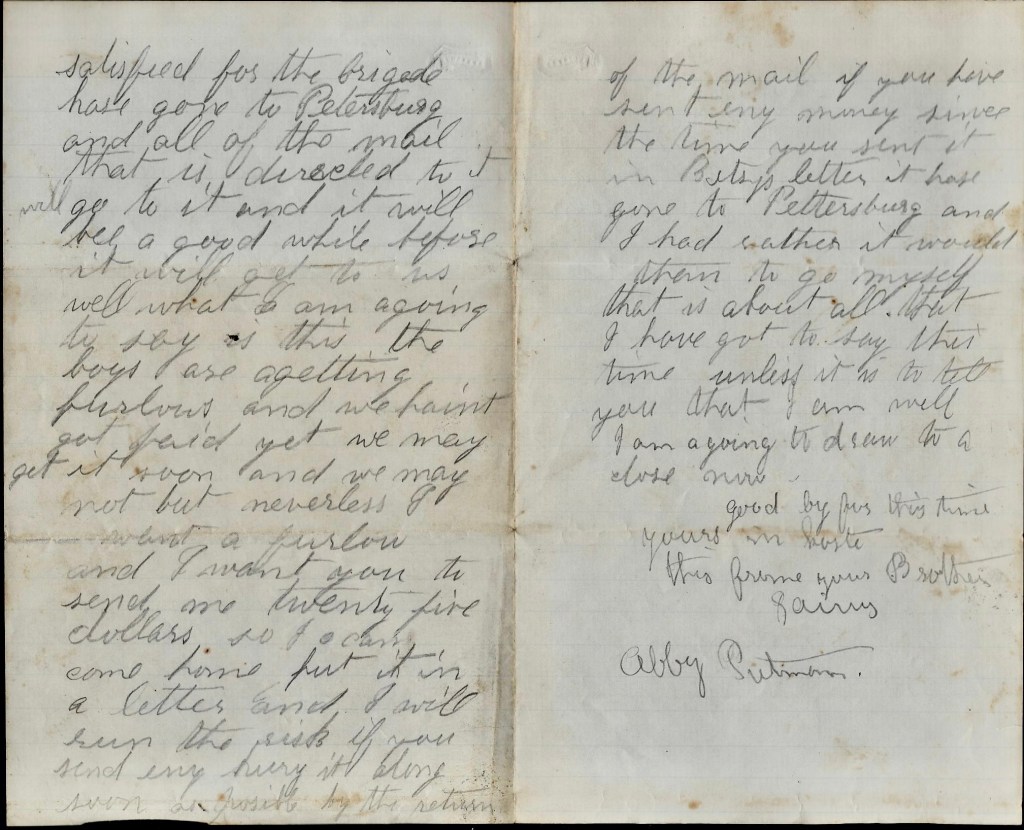
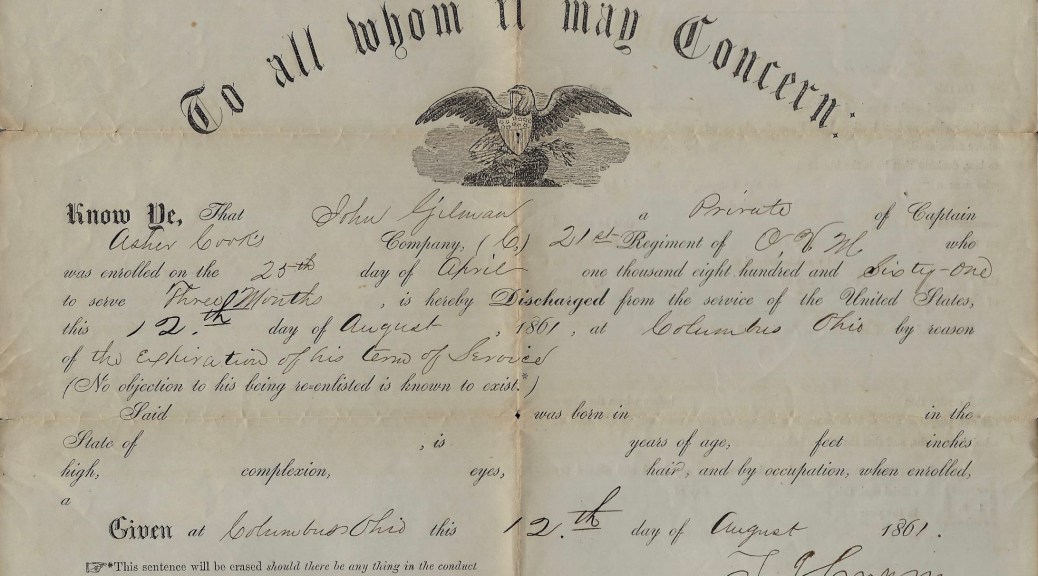

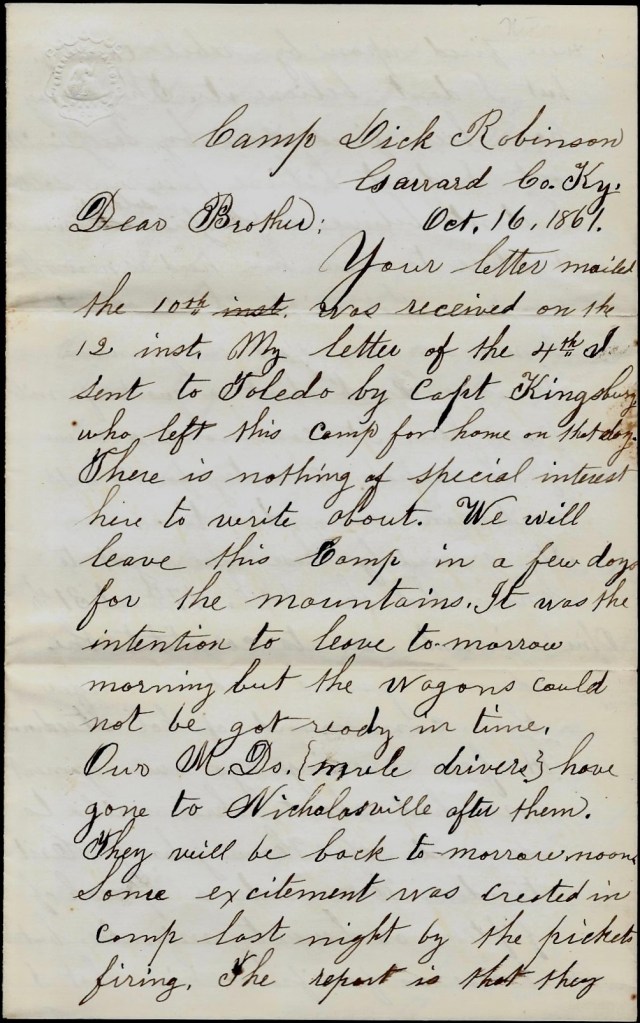


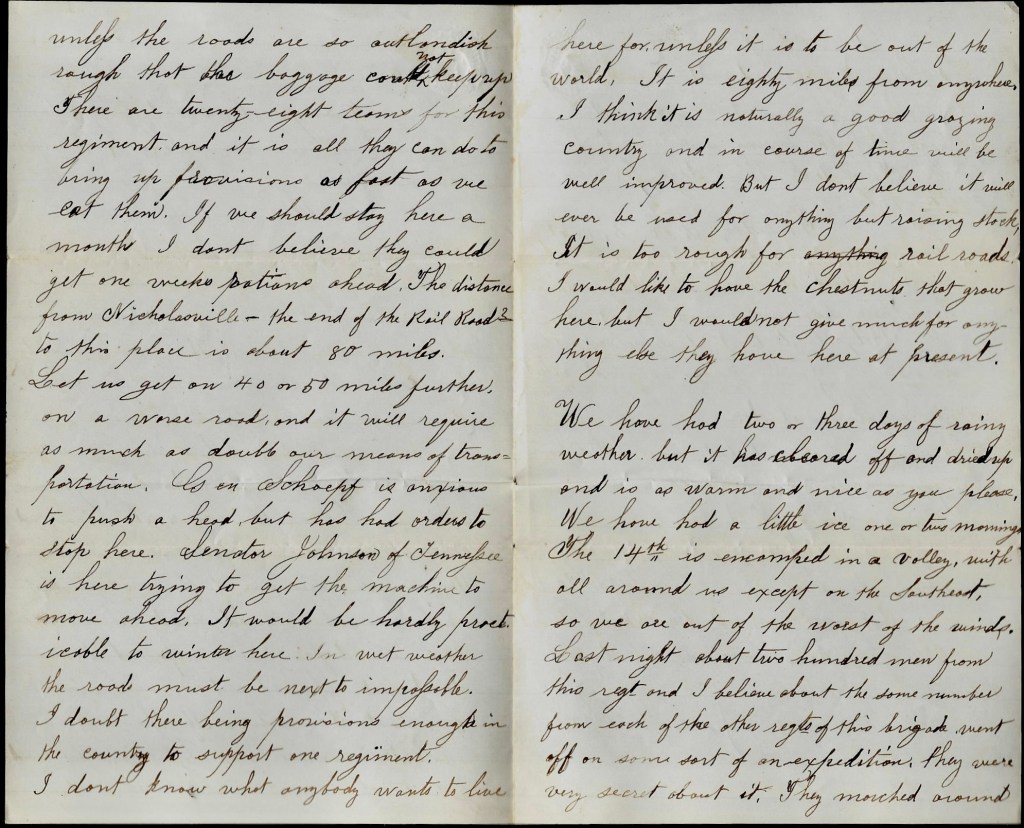


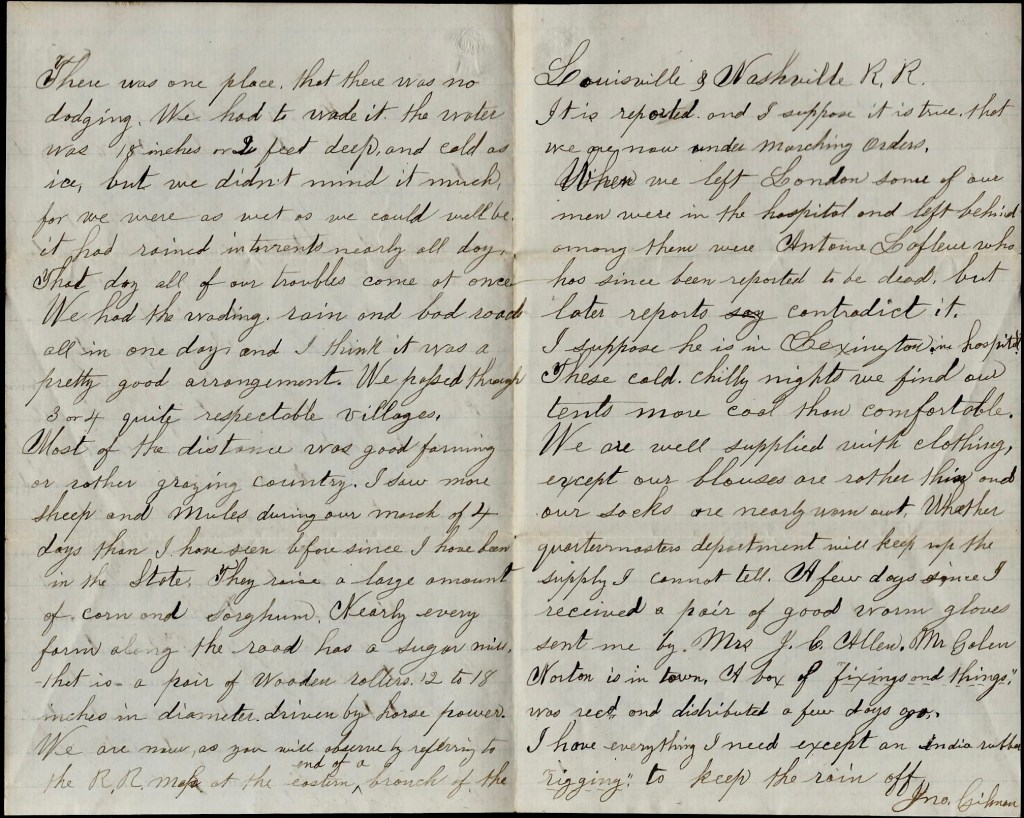

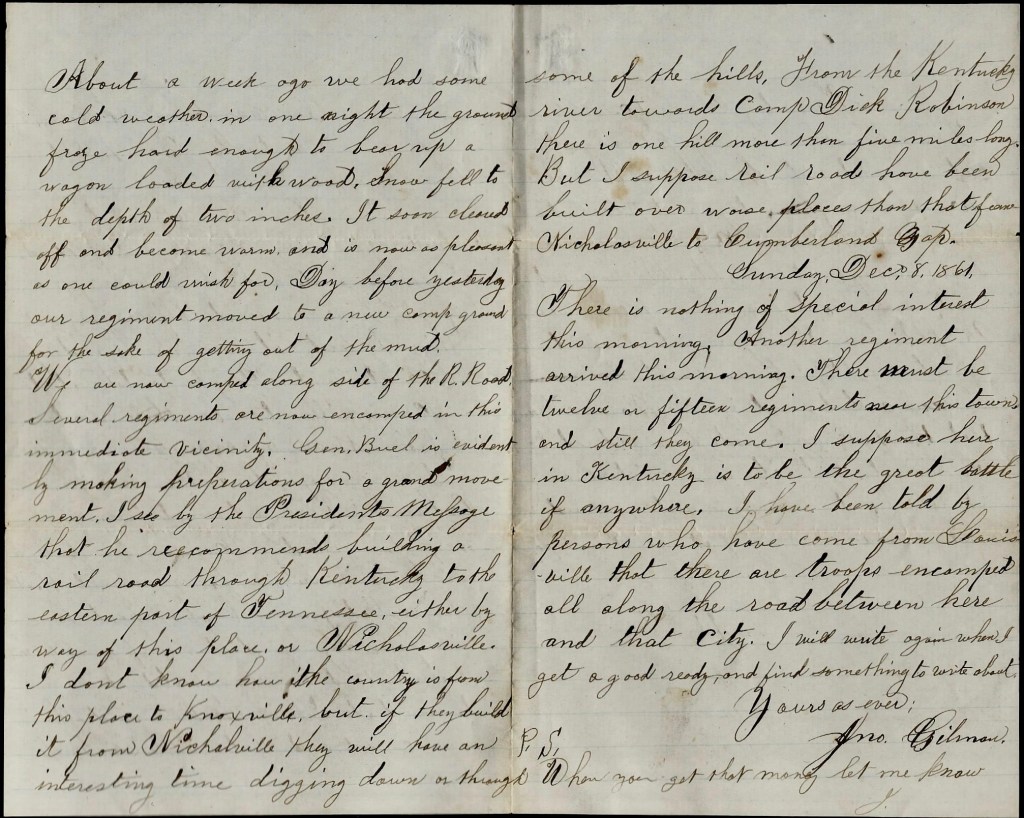
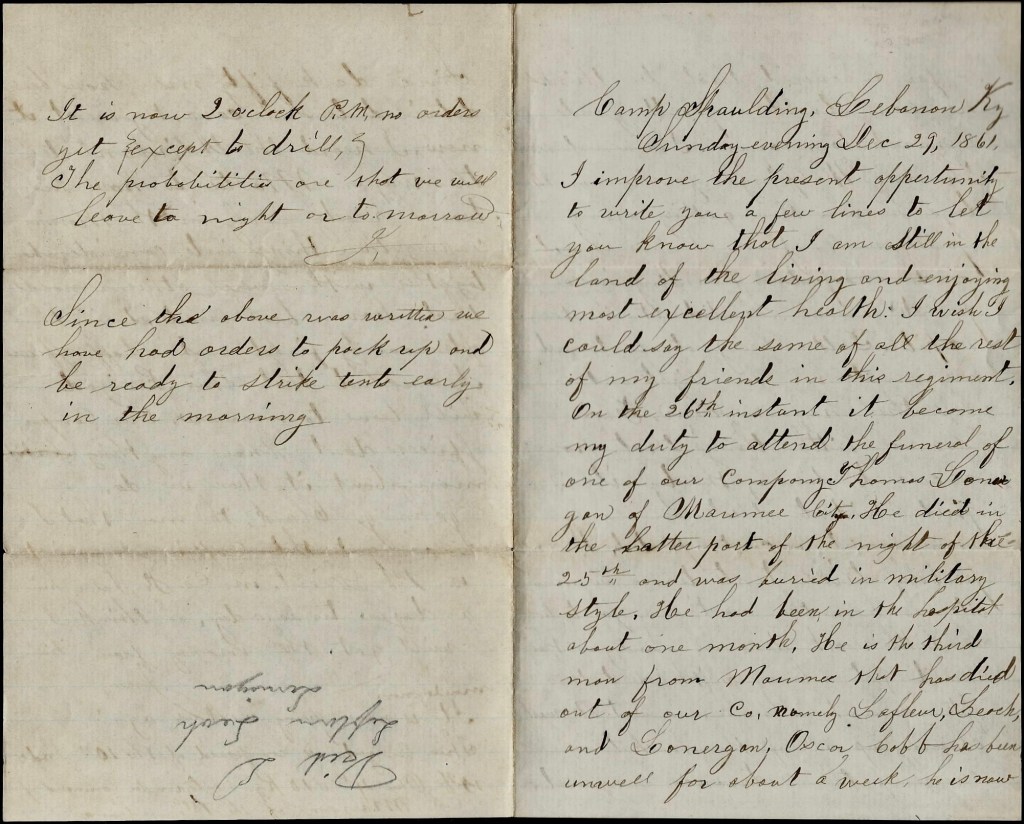

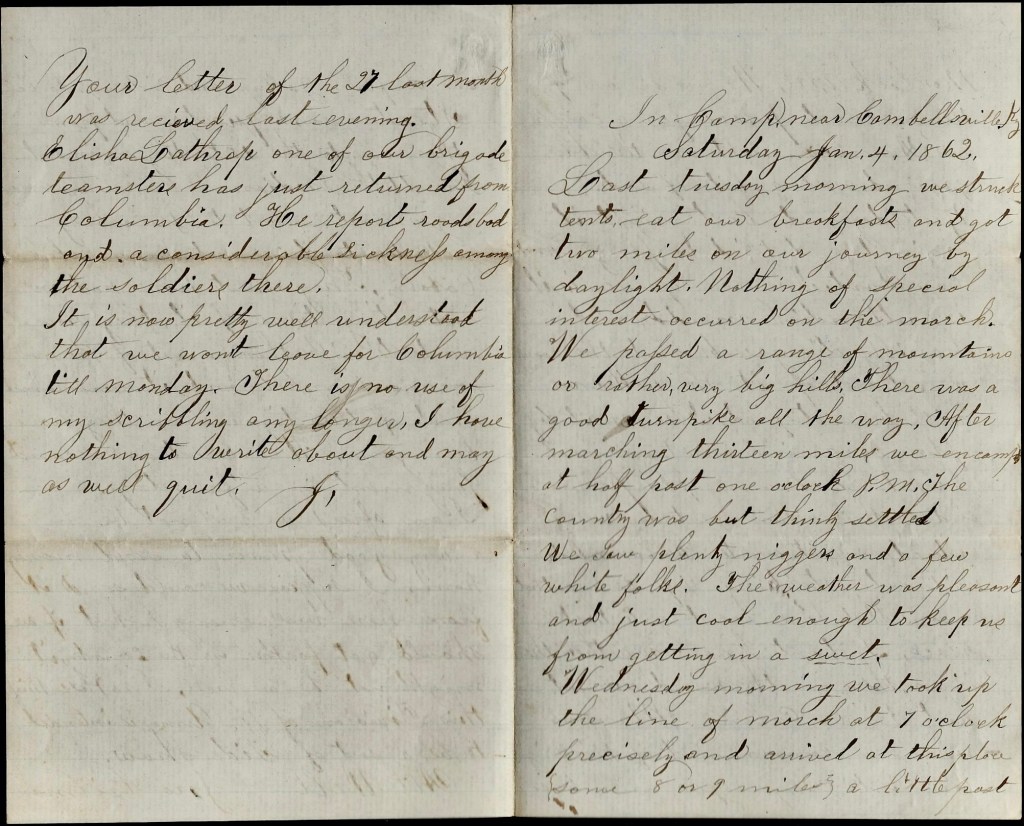

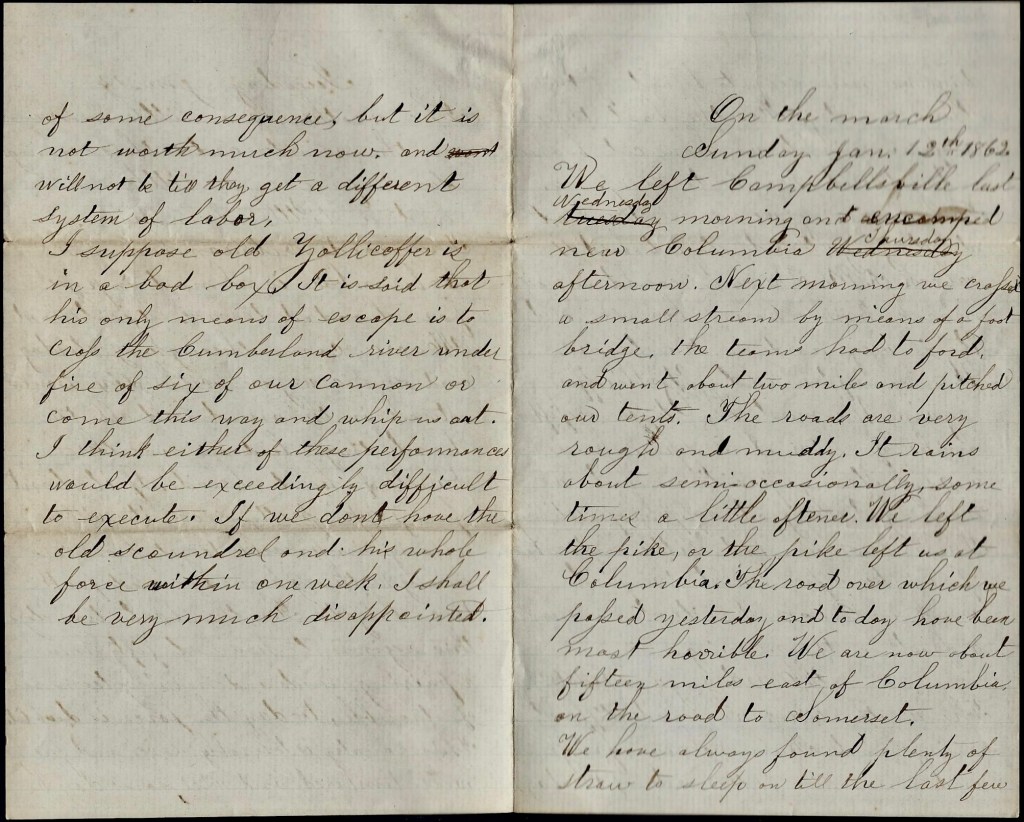

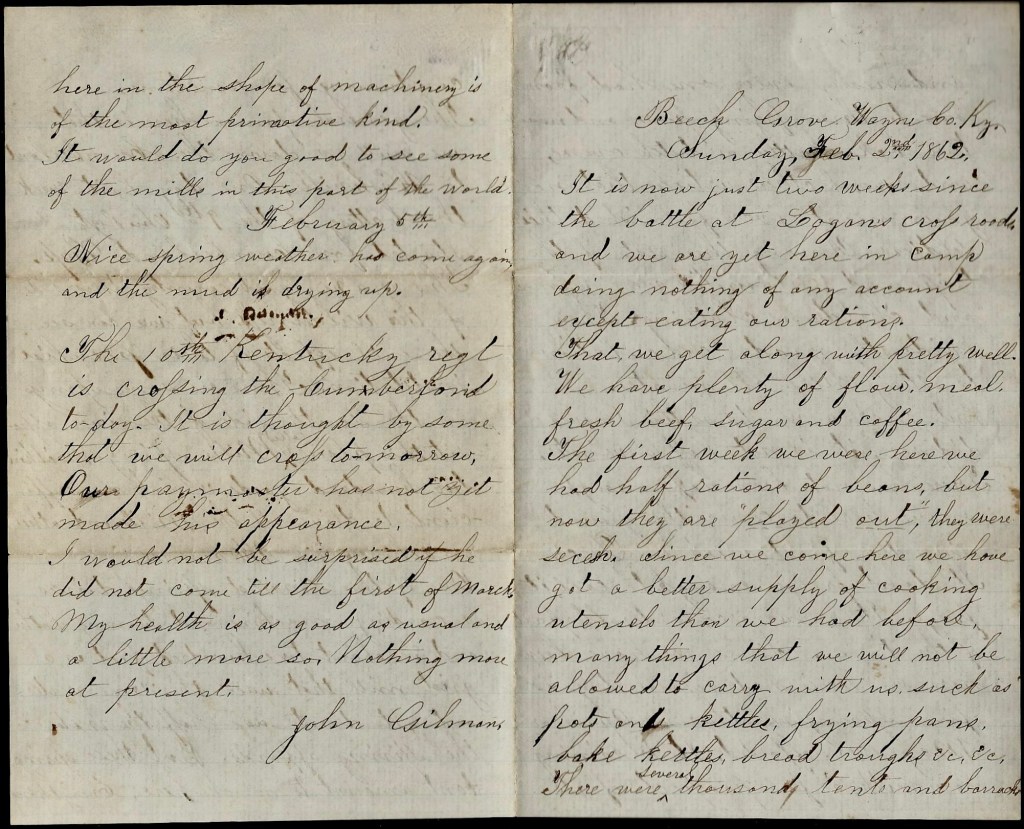


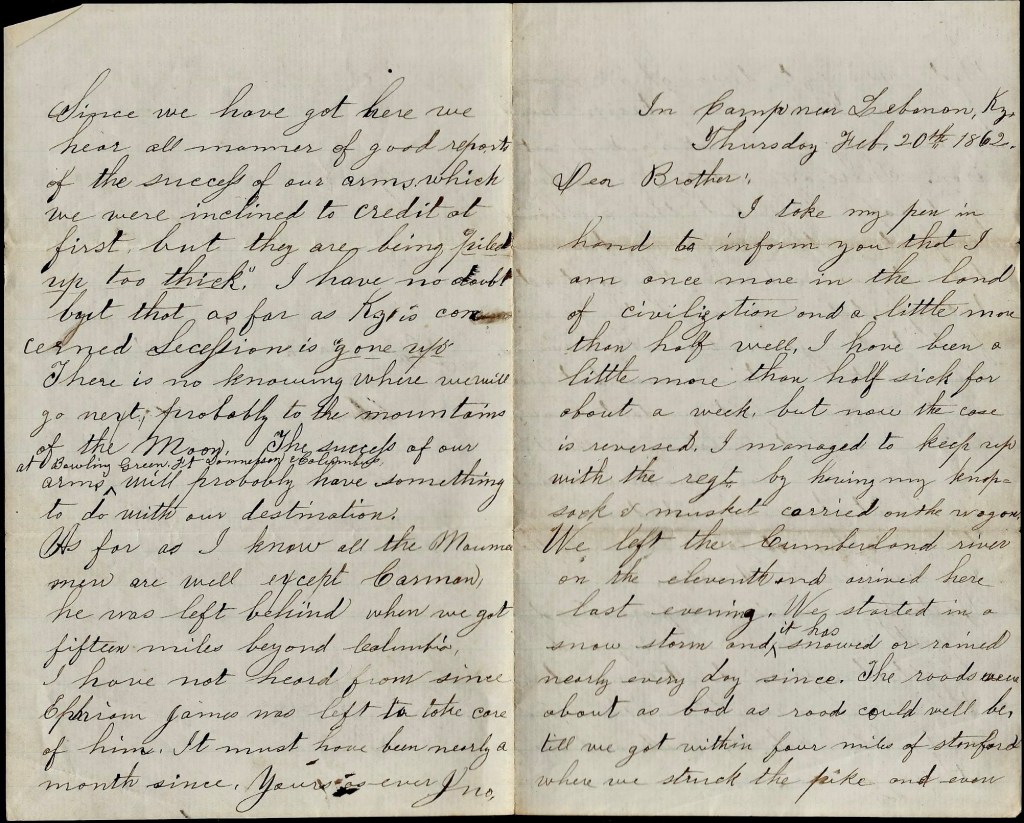


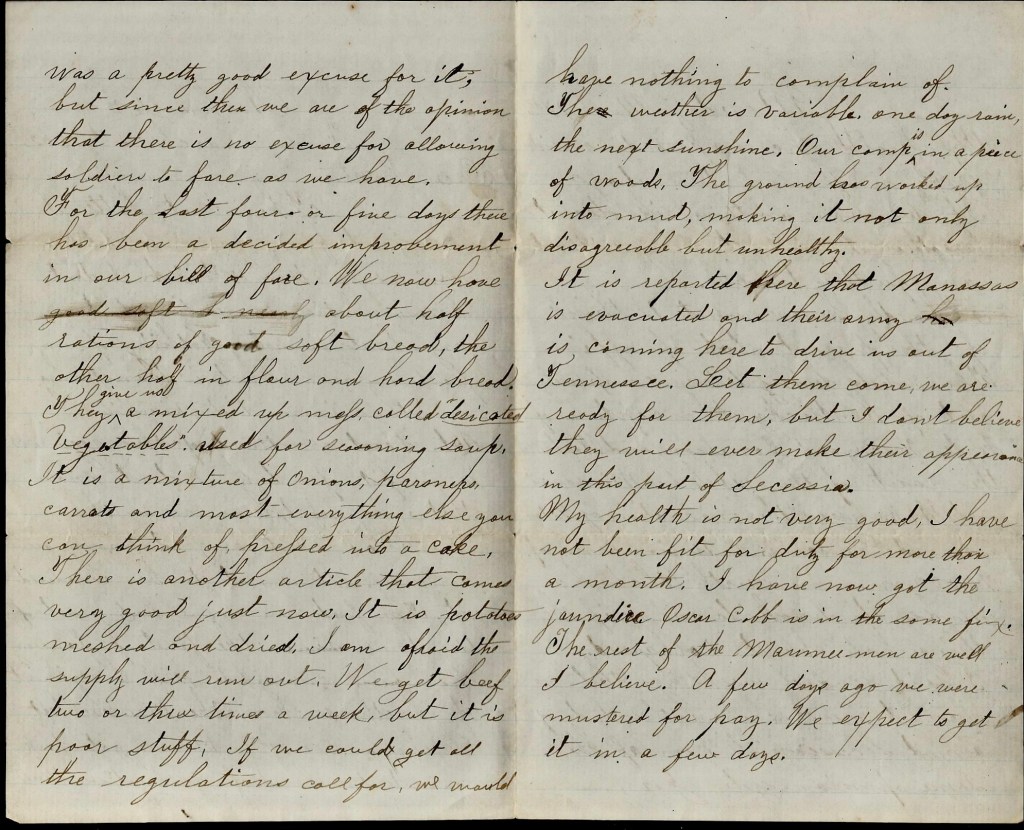

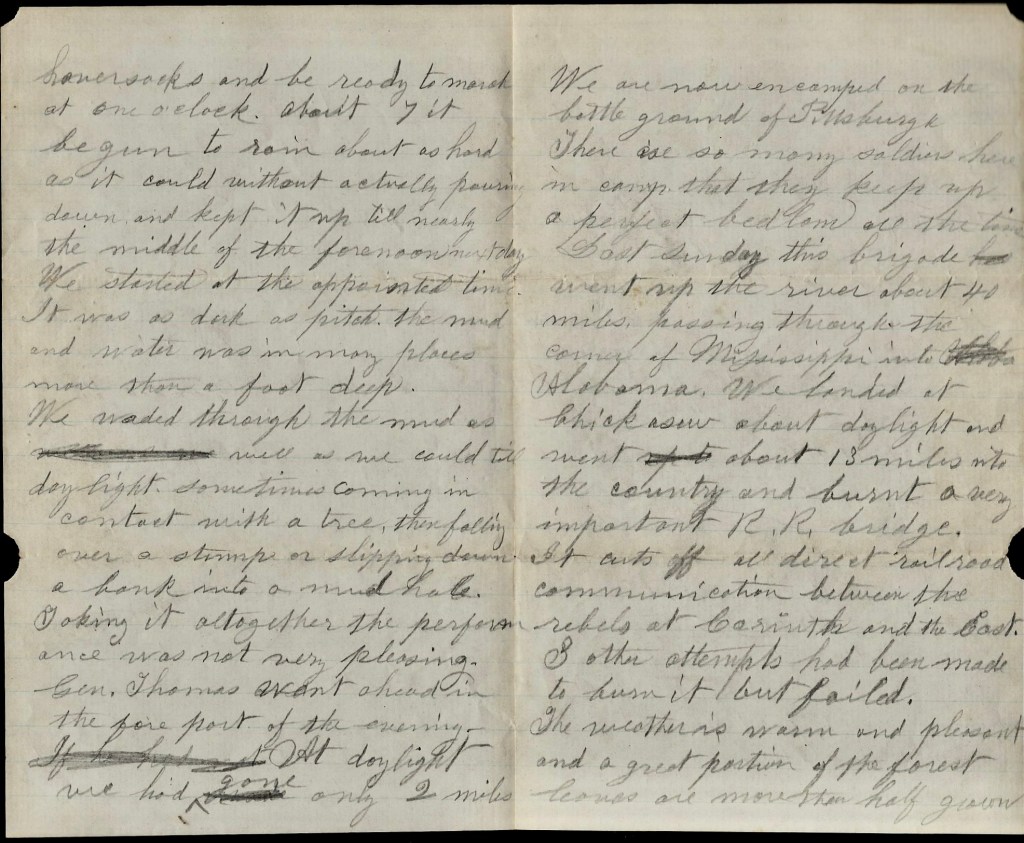
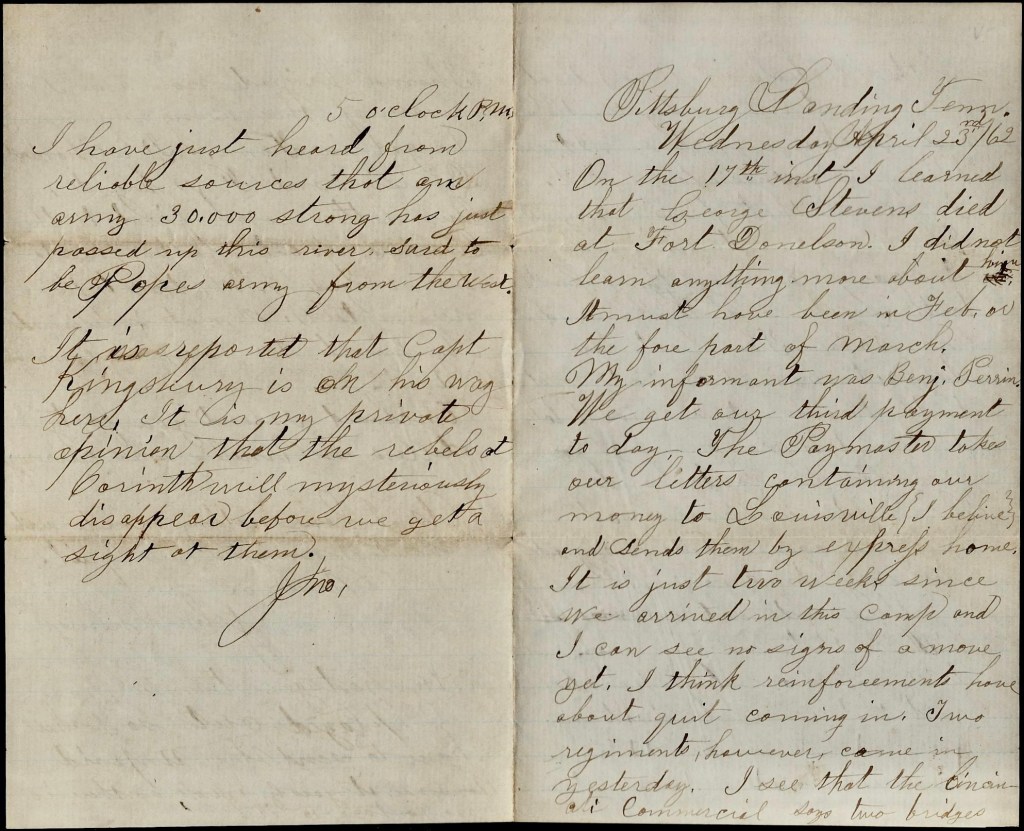

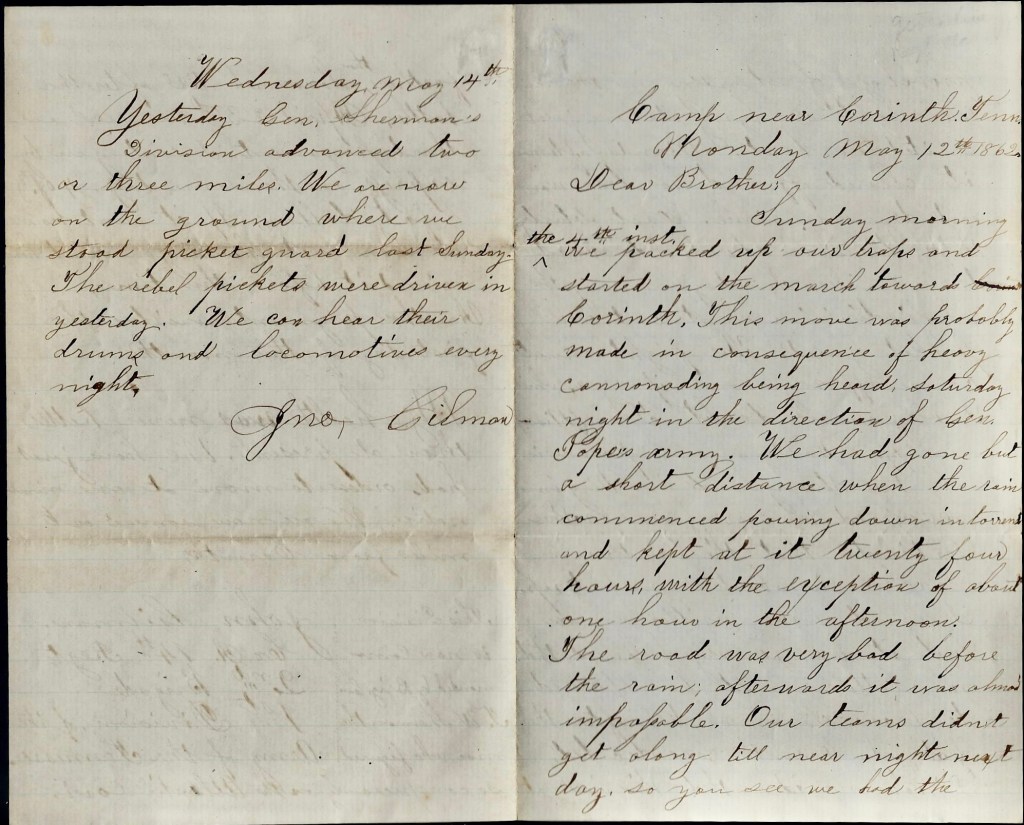


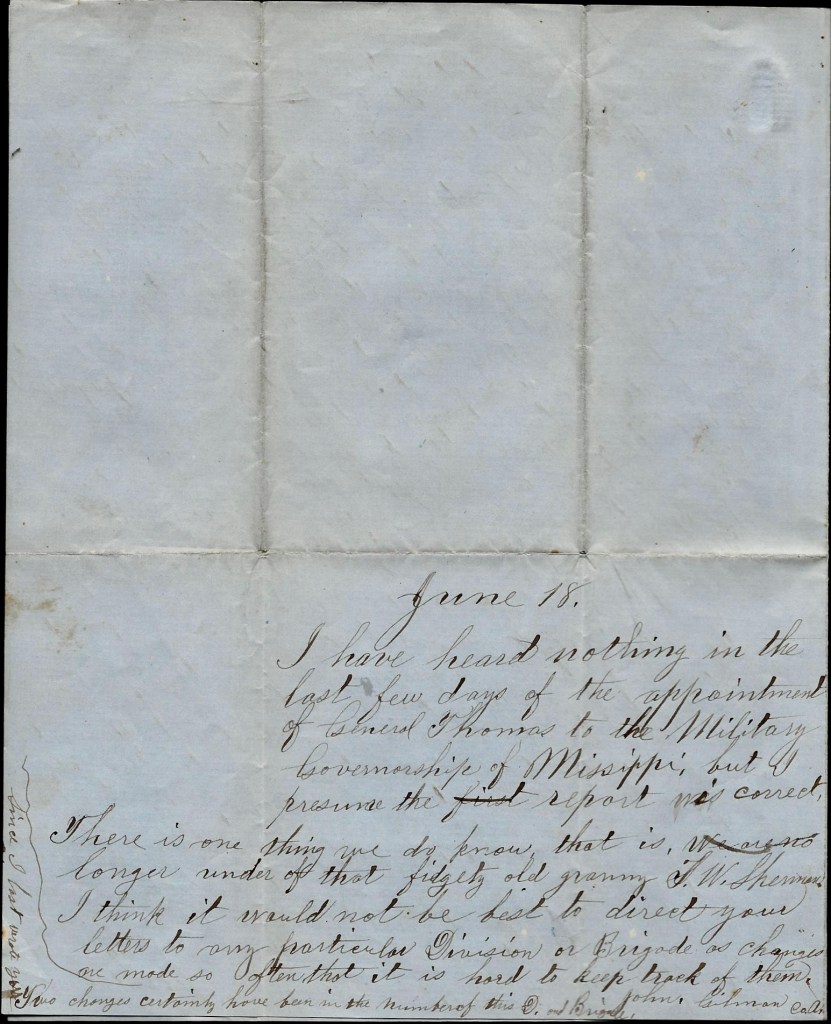
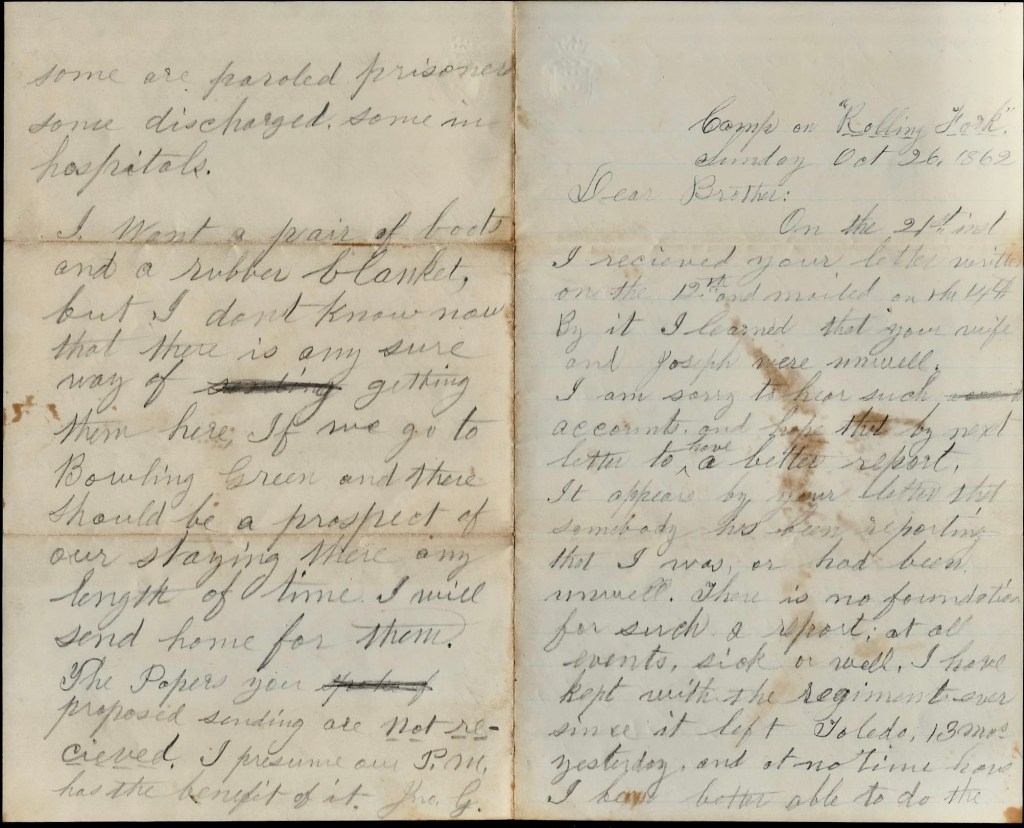
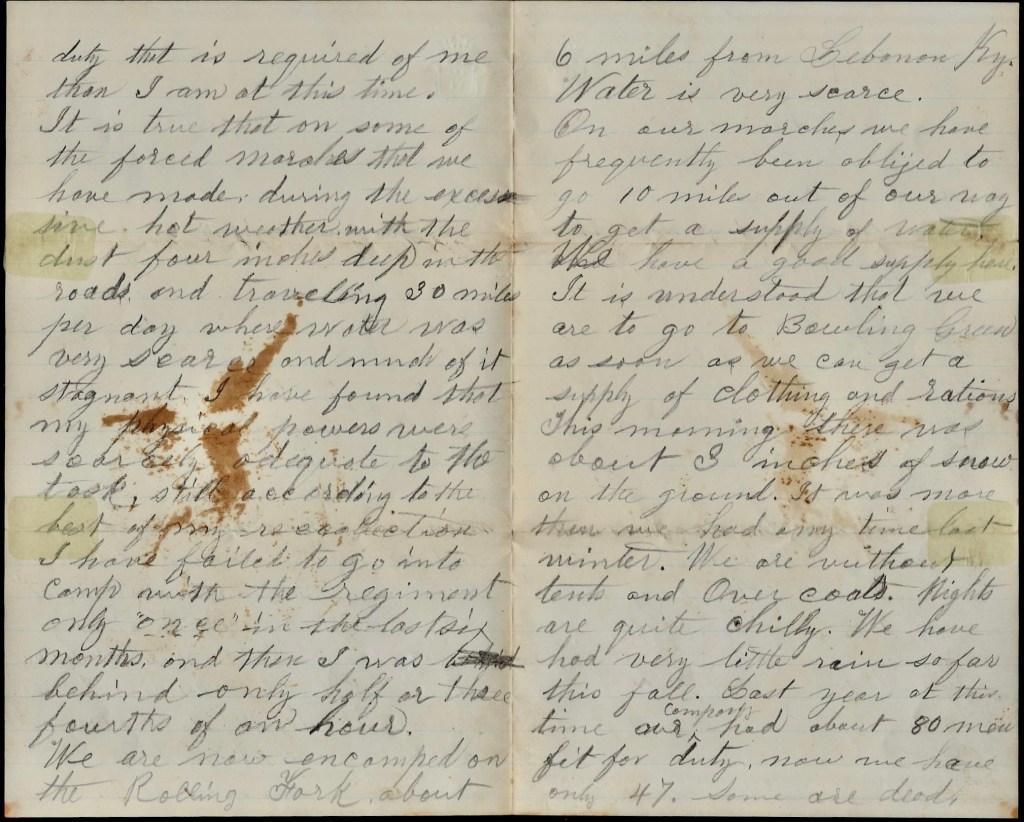


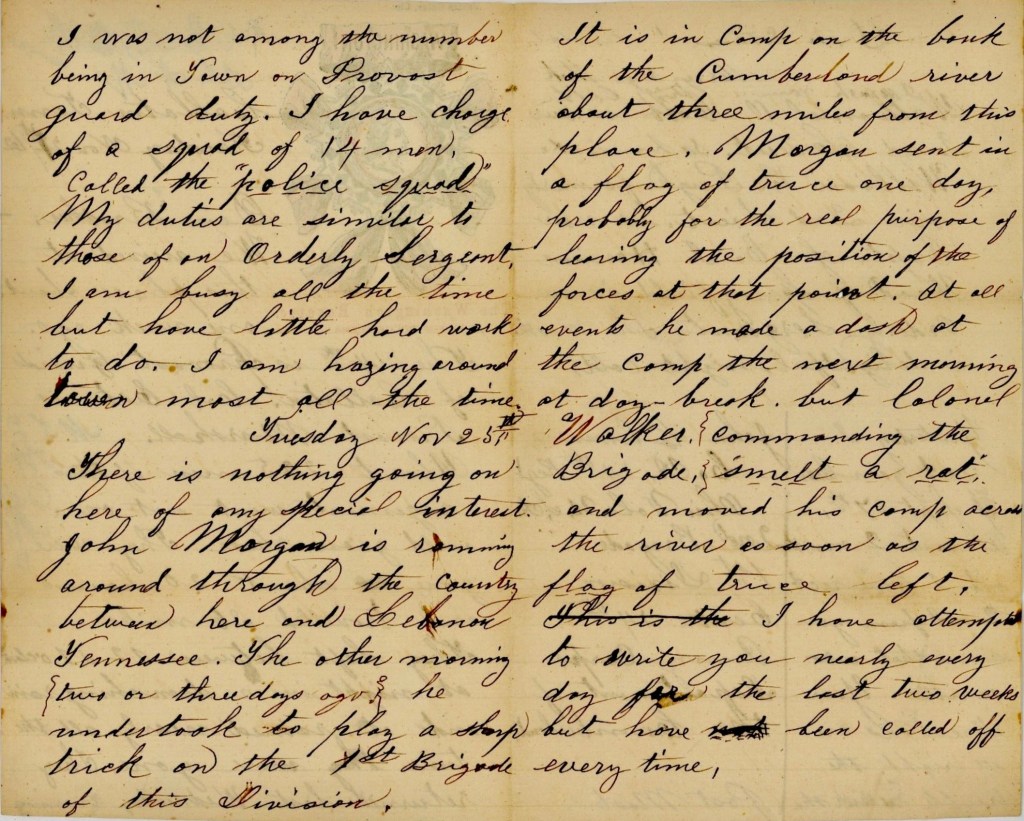


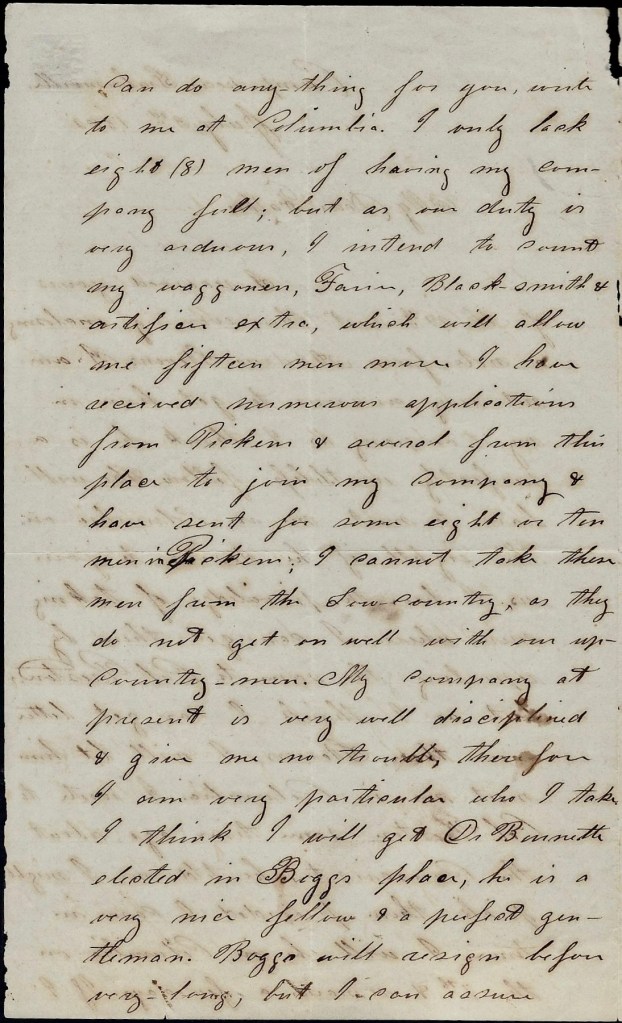

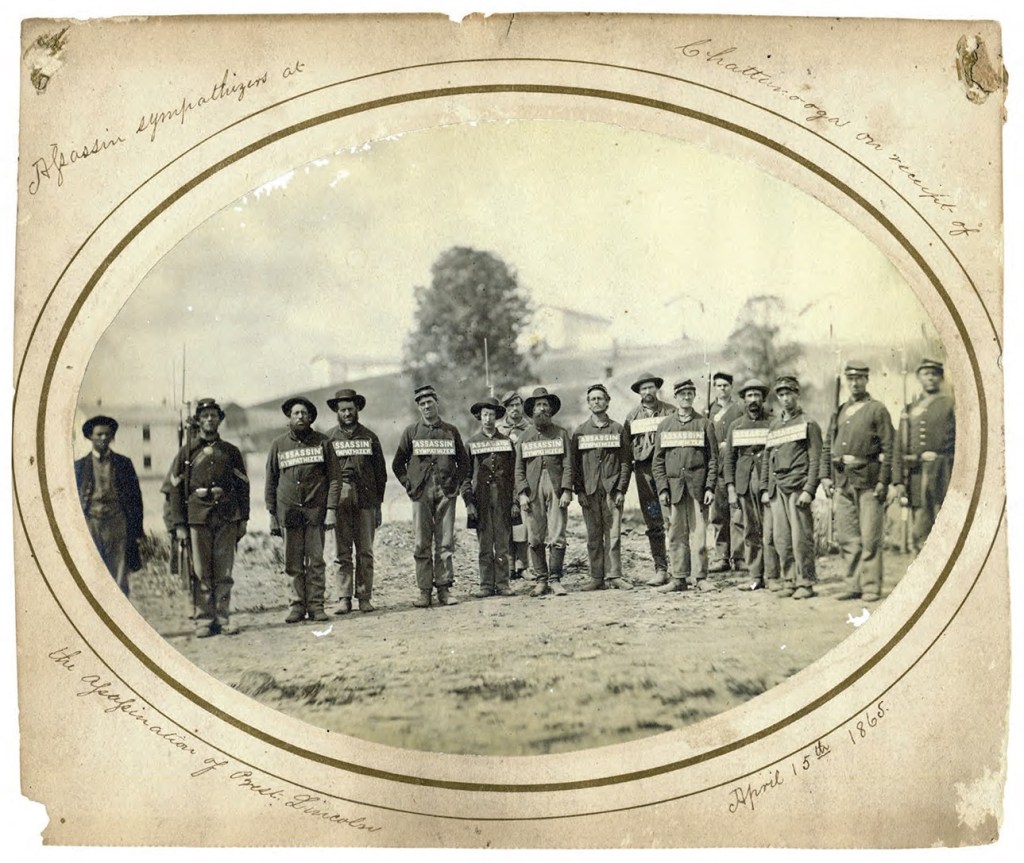


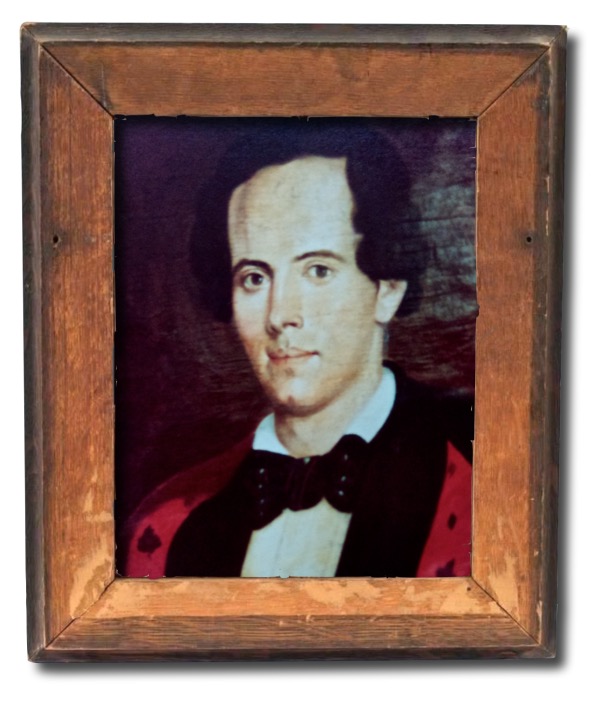


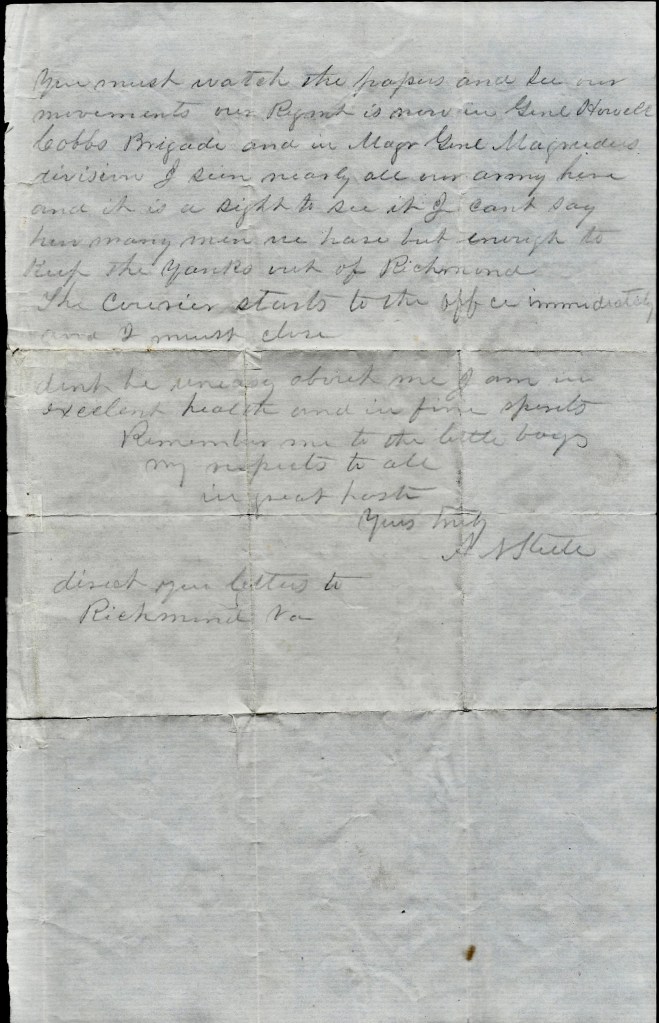
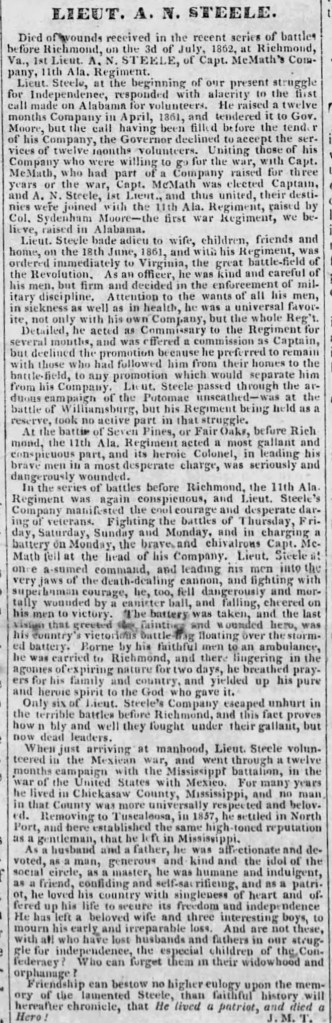





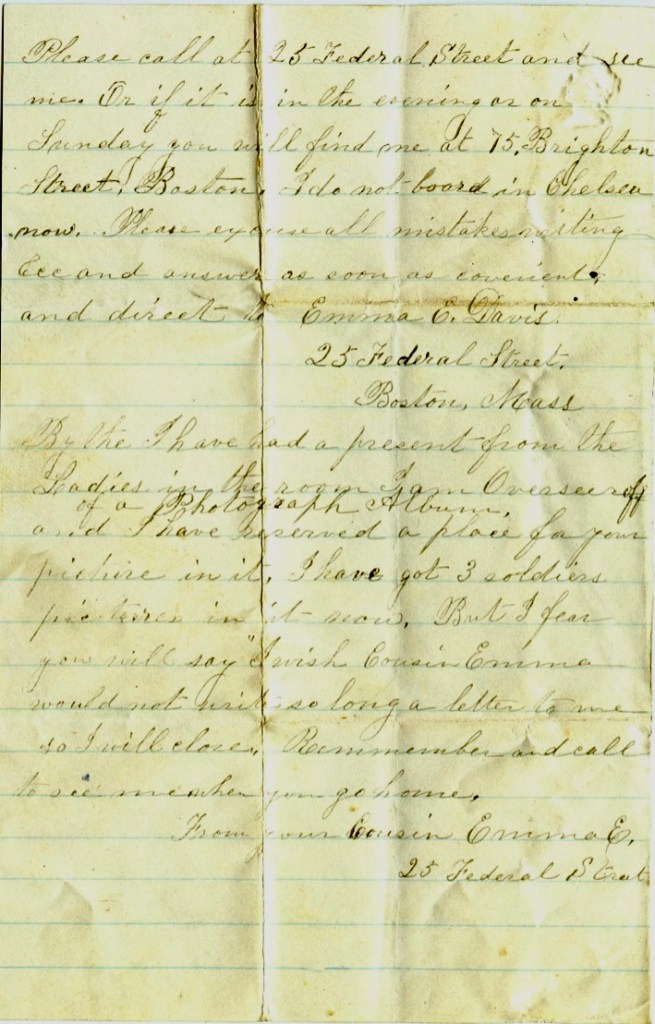
 Spared & Shared 23