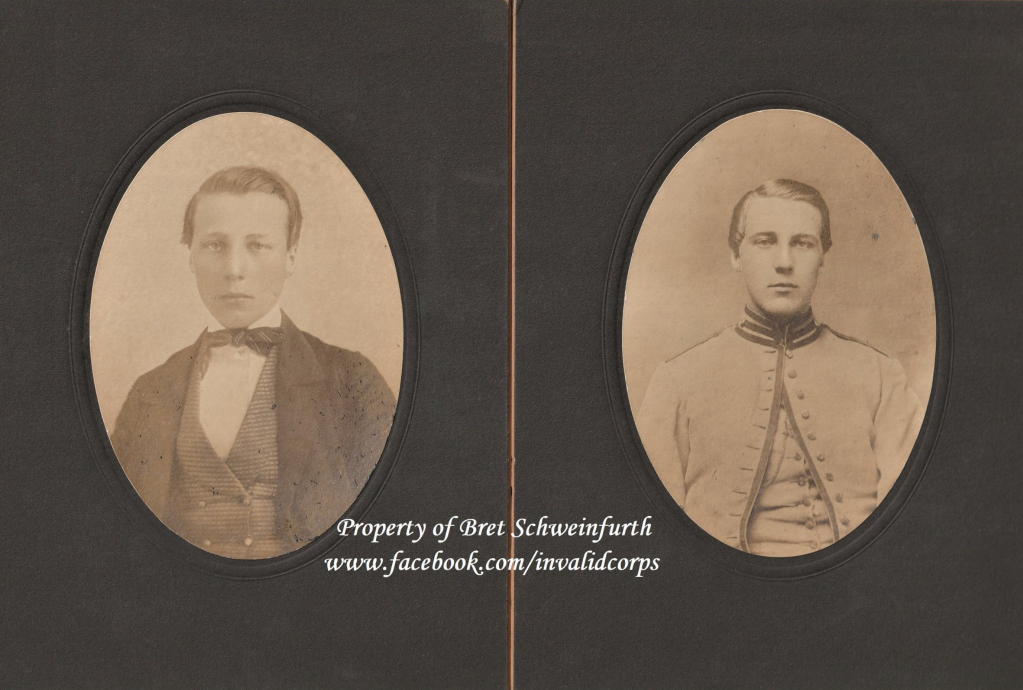
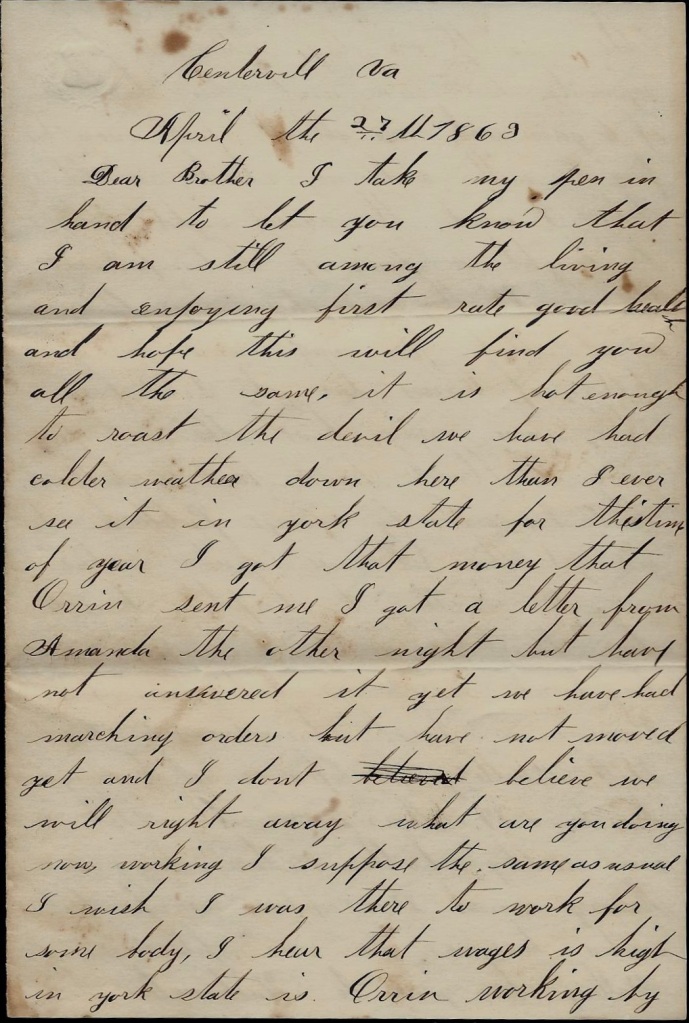
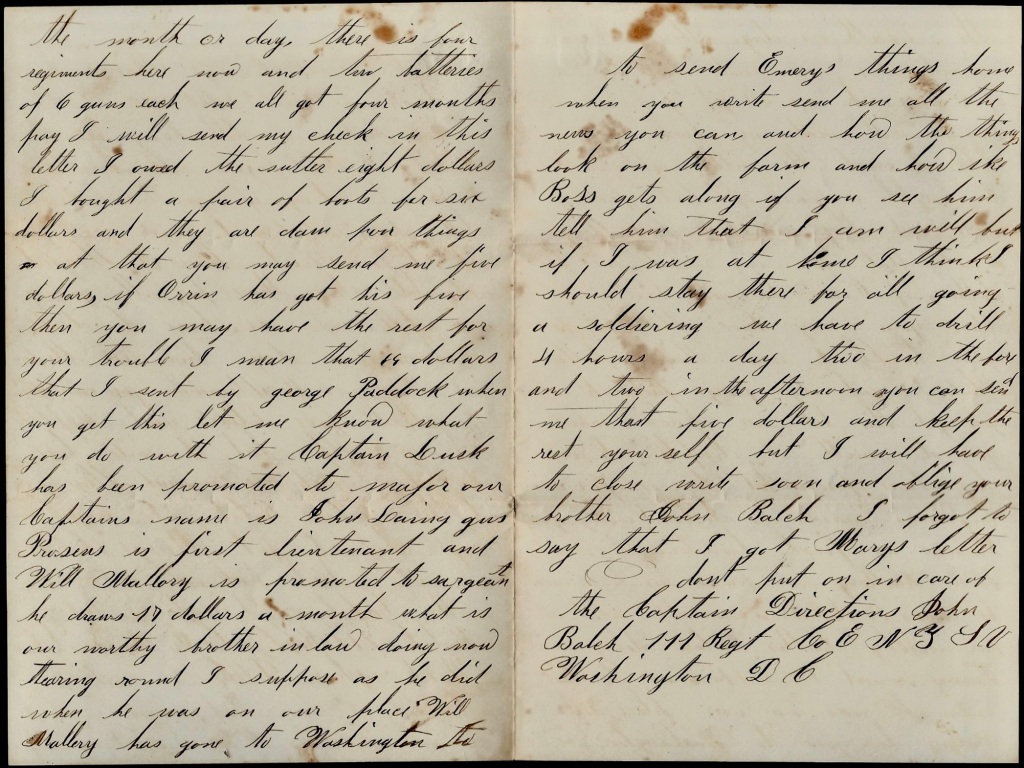
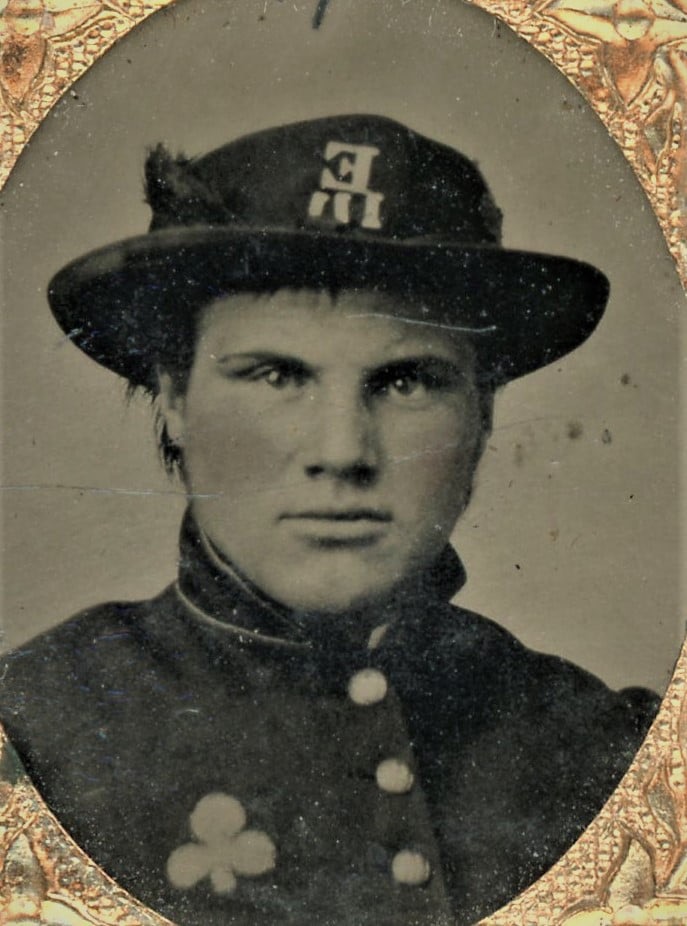
My passion is studying American history leading up to & including the Civil War. I particularly enjoy reading, transcribing & researching primary sources such as letters and diaries.
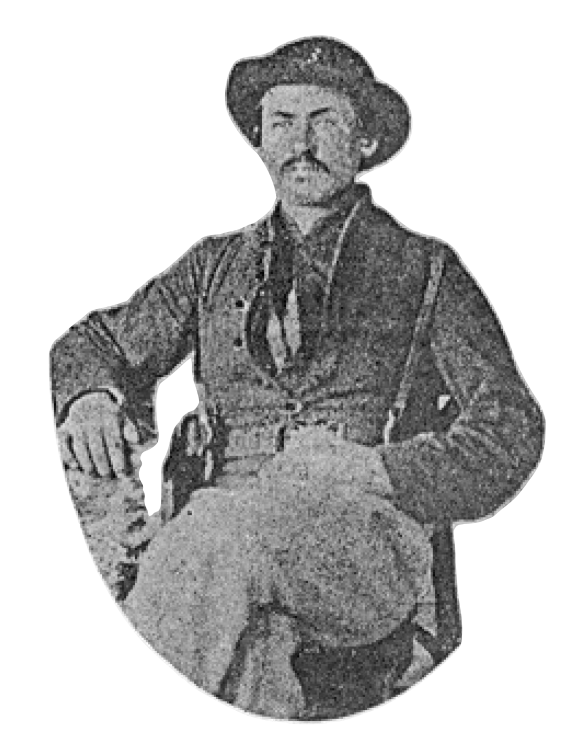
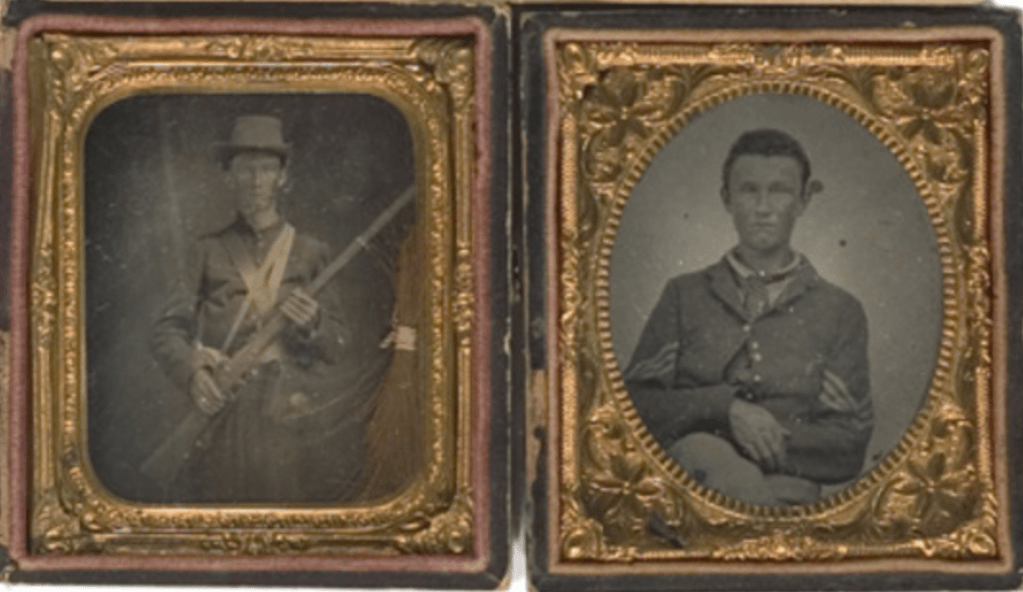
I could not find an image of William but here is Sgt. Moses B. Willis of Co. K, 44th Indiana Infantry. He was killed at Shiloh.
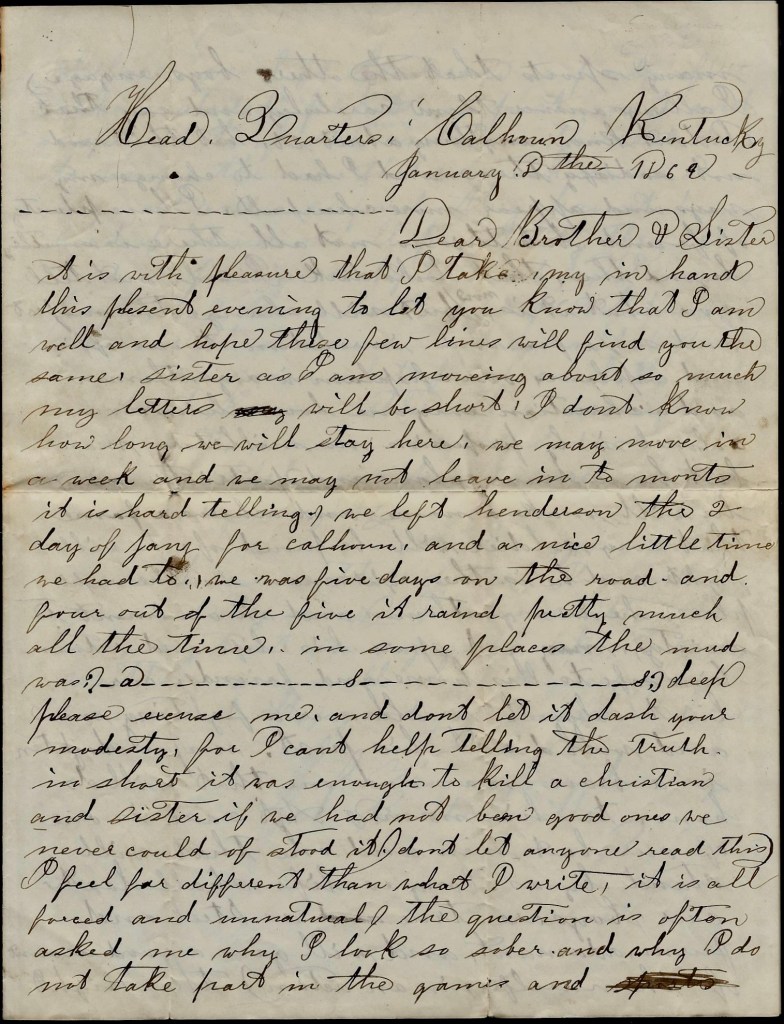
The following letter was written by Sgt. William W. Wright of Co. A, 44th Indiana Infantry. William was 21 years old when he enlisted in August 1861. He died in a St. Louis hospital on 2 March 1862—less than two months after this letter was penned. At the time of the 1860 US Census, William was working as a laborer on the farm of J. H. Chappell of Salem, Steuben county, Indiana.
In his letter, William describes the tramp of the 44th Indiana Infantry from Henderson to Calhoun, Kentucky—a distance of 40 miles—which took them four days due to inclement January weather. They reached Calhoun on 6 January 1862 and went into camp. They remained there until the 15th of January when they relocated to South Carrolton. In February the regiment in the battles of Fort Henry and Fort Donelson, and then later in April in the Battle of Shiloh.
To read letters by other member of the 44th Indiana Infantry published on Spared & Shared, see: Solomon Bean, Co. G, 44th Indiana (2 Letters), and Daniel Rowe, Co. H, 44th Indiana (1 Letter).
Transcription
Headquarters, Calhoun, Kentucky January 8th 1862
Dear Brother & Sister,
It is with pleasure that I take my [pen] in hand this pleasant evening to let you know that I am well and hope these few lines will find you the same. Sister, as I am moving about so much, my letters will be short. I don’t know how long we will stay here. We may move in a week and we may not leave in two months. It is hard telling.
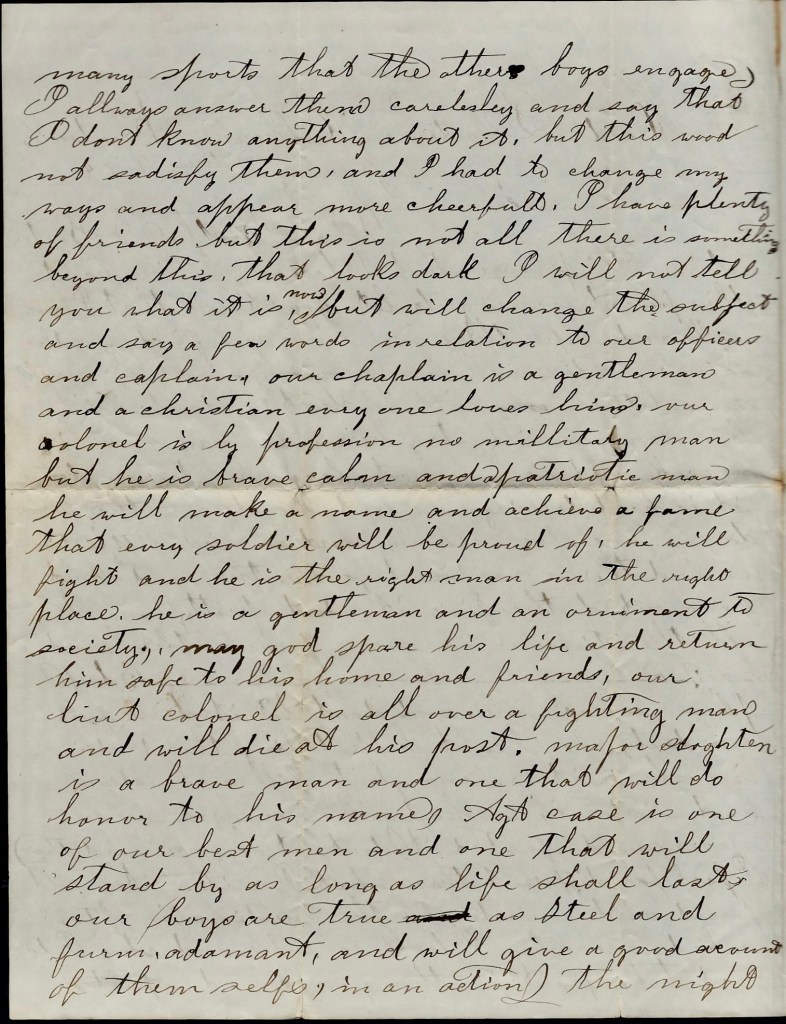
We left Henderson [Kentucky] the 2nd day of January for Calhoun and a nice little time we had too. We was five days on the road and four out of the five it rained pretty much all the time. In some places the mud was a—-s—s deep. Please excuse me and don’t let it dash your modesty for I can’t help telling the truth. In short, it was enough to kill a Christian and sister, if we had not been good ones, we never could of stood it. (Don’t let anyone read this.) I feel far different than what I write. It is all forced and unnatural. The question is often asked me why I look so sober and why I do not take part in the games and many sports that the other boys engage. I always answer them carelessly and say that I don’t know anything about it, but this would not satisfy them and I had to change my ways and appear more cheerful. I have plenty of friends, but this is not all. There is something beyond this that looks dark. I will not tell you what it is now, but will change the subject and say a few words in relation to our officers and chaplain.
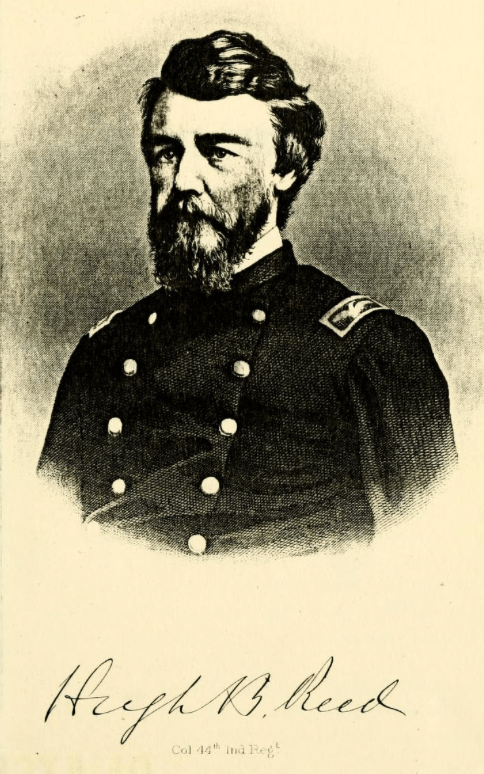
Col. Hugh B. Reed, 44th Indiana
Our chaplain [G. W. Beeks] is a gentleman and a Christian. Everyone loves him. Our colonel [Hugh B. Reed] is by profession no military man but he is brave, calm, and a patriotic man. He will make a name and achieve a fame that every soldier will be proud of. He will fight and he is the right man in the right place. He is a gentleman and an ornament to society. May God spare his life and return him safe to his home and friends. Our lieutenant-colonel [Baldwin J. Crostweit] is all over a fighting man and will die at his post. Major [Sanford J] Sloughton is a brave man and one that will do honor to his name.
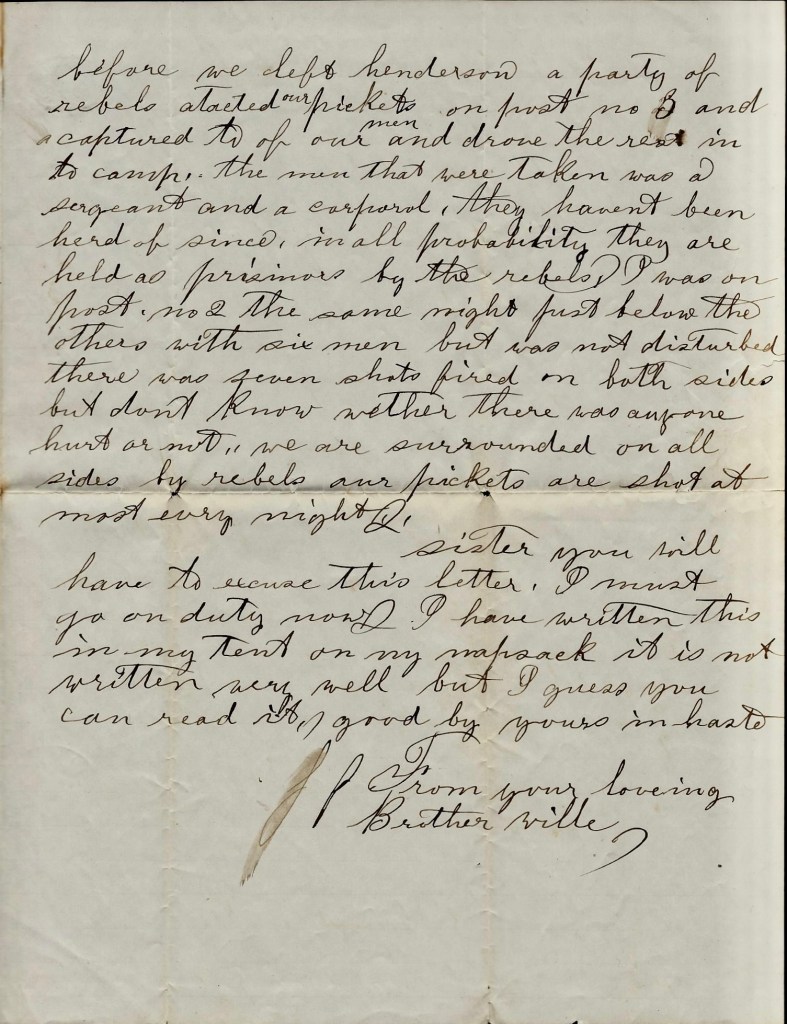
Adjutant [Charles] Case is one of our best men and one that will stand by as long as life shall last. Our boys are true as steel and firm, adamant, and will give a good account of themselves in an action. The night before we left Henderson, a party of rebels attacked our pickets on Post No. 3 and captured two of our men and drove the rest into camp. The men that were taken was a sergeant and a corporal. They haven’t been heard of since. In all probability they are held as prisoners by the rebels. I was on Post No. 2 the same night just below the others with six men but was not disturbed. There was seven shots fired on both sides but don’t know whether there was anyone hurt or not. We are surrounded on all sides by rebels. Our pickets are shot at most every night.
Sister, you will have to excuse this letter. I must go on duty now. I have written this in my tent on my knapsack. It is not written very well but I guess you can read it. Goodbye. Yours in haste, From your loving brother, — Wille
The following letters were written by James Champlin Worden (1818-1863), the son of Gideon Worden Sr. (1777-1858) and Phebe G. Gavet (17xx-1846) of Richmond, Rhode Island, later Plymouth, Chenango county, New York. Among James’ siblings mentioned in this letter are: Gideon Worden Jr. (b. 1811), Lucy (Worden) Harrington (1817-1879), Phebe Delina (Worden) Brown, and Elnora Esther Worden (1849-1883).
I could not find an image of James but here is an unidentified sailor from Ronn Palm’s Collection
James may have served for a time in the US Army in the 1840s but by the mid-1850s he was serving tours of duty in the US Navy. He was finally discharged from the Navy suffering from rheumatism in late July 1861. At that time he was described as 5’8.5″ tall, with dark complexion, light hair and blue eyes. He served for a time on the US Congress.
Both of James’ letters were written while serving aboard the USS Hetzel, a side-wheel steamer built in 1861 at Baltimore, Maryland, for the United States Coast Survey and transferred to the Navy Department 21 August 1861 for duty in the North Atlantic Blockading Squadron. She arrived at Newport News, Virginia, 18 November 1861. Her first taste of action came 2 December, when Confederate steamer Patrick Henry stood out into Hampton Roads and engaged several Union gunboats, including Hetzel. The Federal ships succeeded in damaging Patrick Henry in a 2-hour engagement.
Letter 1
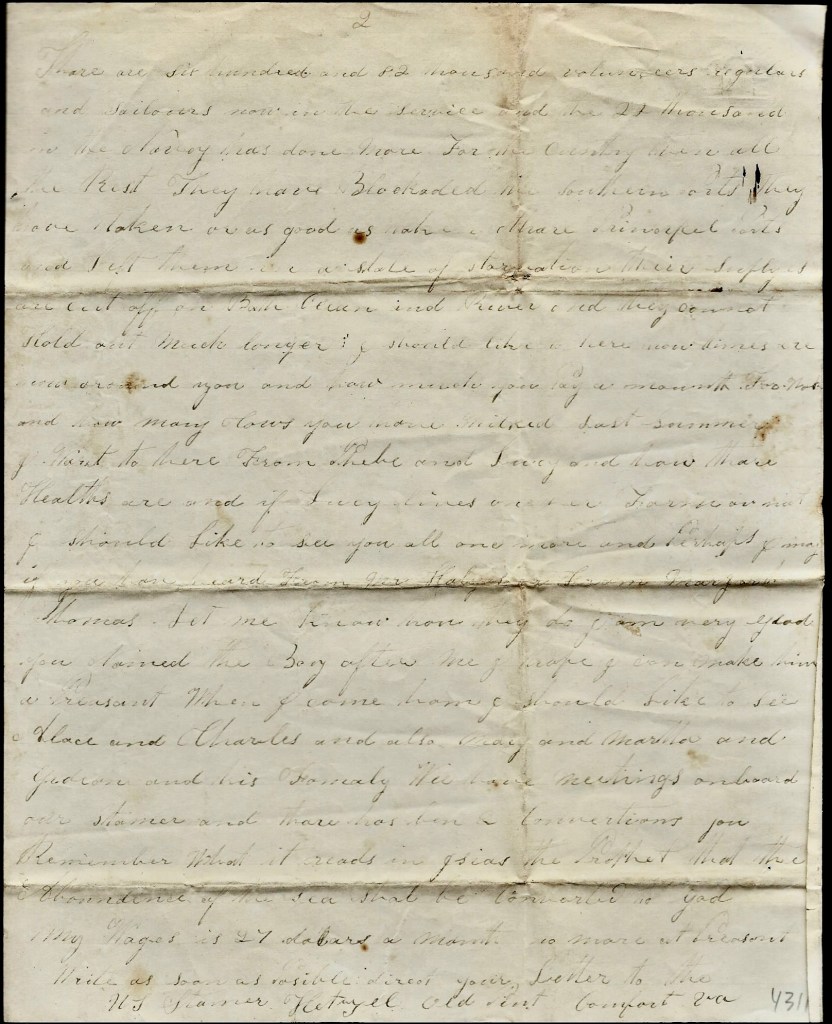
US Steamer Hetzel Newport News, Va. November 8, 1861
Dear Brothers & Sisters,
I received your letter on the 25th and I should [have] wrote sooner but I did not know that we should stay here so long as we have. but I expect we shall lay here all winter and so I have take this opportunity to write. I was very much pleased to hear so much news from all of my relations and friends. I was very happy to hear that Gideon attends meetings again.
We are now on picket duty at the mouth of the James river, Virginia, to keep the Rebels from coming down from Richmond and getting out to sea. We had an engagement the other morning which lasted about an hour betwixt the Hetzel (Union) and the Patrick Henry (Rebel) in which there was no lives lost on our side but they kept a long distance from us and their shots did not reach us.
I was glad to hear from Gardner but I don’t know why he should enlist if he is worth so much money. There are encamped at Newport News close where we lay about eight thousand volunteers. We expect soon to go to Norfolk with a strong fleet and storm the place.
We have plenty of oysters here which I believe you would like to have some too. My health is better this winter than it has been for some winters before. I must try to write to you more about the war.
There are 682,000 volunteers, regulars, and sailors now in the service and the 22,000 in the Navy has done more for the country than all the rest. They have blockaded the Southern ports. They have taken—or as good as taken—more principal ports and left them in a state of starvation. Their supplies are cut off on both ocean and river and they cannot hold out much longer. I should like to hear how times are now around you and how much you pay a month for work and how many cows you have milked last summer. I want to hear from Phebe and Sary and how their healths are and of Licy lives on her farm or not. I should like to see you all once more and perhaps I may. If you have heard from Mr. Hal___ from New York, Thomas, let me know how they do. I am very glad you have named the boy after me. I hope I can make him a present when I come home. I should like to see Alice and Charles and also Mary and Martha and Gideon and his family. We have meetings on board our steamer and there has been 2 conversions. You remember what it reads in Isaiah the Prophet that the abundance of the sea that be converted to God. My wages is 27 dollars a month. No more at present. Write as soon as possible. Direct your letter to the US Seamer Hetzel, Old Point Comfort, Va.
Letter 2
Hatteras Inlet, North Carolina January 17, 1862
Dear Brother,
Not having received any letter for a long while and getting tired of waiting, I thought I would write you a few lines to let you know where I am at present. We are now laying at or near Cape Hatteras in Potomac Sound and as lonesome barren place as ever I was in except Cape Horn. There is nothing but sand in sight as far as land is concerned. There are now from 30 to 40 gunboats waiting to go to Elizabeth City to attack the Rebels and sixteen thousand Union soldiers. We have just had a gale of wind and there has been 4 vessels lost besides 6 or 8 men drowned. The loss to the government could not been less than 200,000 dollars but that was nothing to mens lives when they are not prepared to die. 1
We still have meetings three times a week which makes the time pass quite cheerful. My situation is not a very pleasant one, notwithstanding I am very well contented. It is like a school teacher that has 70 or 100 large scholars to look out after. I have some very hard customers to deal with but I have plenty of handcuffs and shackles. Liquor is the cause of all the trouble and if there were no rum, it would be better times in the Navy and Army. I don’t know as you can read this writing. It’s quite dark in the night.
I should like well to receive a letter from you. I want to hear from Phebe and the children, from Lucy, Gideon, Thomas, Mary and Sary and all my dear relations and friends. If you have heard again from Gardner, let me know how he is getting along. I don’t get any news here and I don’t know how the war is going along. My mind is on things of more importance than warfare. If we were all good soldiers of the cross, our country would be at perfect unity. I wish you would direct me a letter as follows:
Mr. James C. Worden on board the US Steamer Hetzel, Hatteras Inlet, N. C.
If I had any news to write, I would write willingly. But as I han’t, I well close. I remain your friend and Brother, — James C. Worden
1 James description of the fleet of gunboats inside the bar at Hatteras Inlet is a reference to the Burnside Expedition which sailed from Hampton Roads on the 11th of January 1862. The gale occurred on the night of 12 January. Among the vessels lost or severely damaged were the Zouave, the City of New York, the Pocahontas, the Louisiana, and the New Brunswick.
This letter was written by Nancy Caroline Murphy (1836-1916), the daughter of Hiram Byrd Murphy (1807-1889) and Elizabeth Jackson (1812-1908) of Sharp Top, Cherokee county, Georgia. Nancy later (1877) married Francis (“Frank”) Marion Moss (1854-1926). In her letter, Nancy writes of her three younger brothers in the Confederate service, John “Franklin” Murphy (1838-1862), Isaac “Martin” Murphy (b. 1843), and “William” Lial Murphy (1843-1867). She also refers to her older sister, Julia Murphy (1831-1923), the wife of Pearson Lumpkin Worley (1831-1919).
Franklin (“J. F.”) Murphy served as a private in Co. D, Phillips’ Legion (Georgia Infantry). Co. D—known as “Polk’s Rifles” was with the regiment in the battle on 14 September 1862 at Fox’s Gap on South Mountain (Southerners referred to this as the Battle of Boonsboro). An 1863 death claim filed by Franklin’s wife, Phebe Ann (Worley) Murphy, states that Franklin was wounded and taken prisoner in the battle and died at Baltimore in captivity in late October 1862.
Serving in the same regiment with his brother, Isaac Martin Murphy was wounded in the back at the Battle of Sharpsburg and taken prisoner. He was exchanged at Fort Monroe on 13 October 1862 and furloughed home. He never returned to his regiment.
As stated in the letter, William Murphy served in Co. B, 34th Georgia. Accepting a bounty of $50, William enlisted in May 1862. He was taken a POW at Vicksburg on 4 July 1863 and paroled shorty afterward. He died young, however, in 1867.
Transcription
Cherokee County State of Georgia April 5, 1863
Miss Susan A. Hart,
Dear cousin, after a long delay, I seat myself to write you a few lines which if received, will inform you that we are all in tolerable health, hoping this will reach you enjoying the best of health. I reckon I will surprise you as think you have almost forgotten me. I thought I would write to you one more time & perhaps cause you to think of me again.
We have very cold weather for the season. The spring is uncommon late here. There is not a bud to be seen in the woods almost. Everything appears dull and lifeless. Times is very hard here as provision is very scarce.
I reckon you have heard that my brothers is all gone to the army as brother Martin saw your cousin Tucker at Richmond. Brother Franklin was either killed or captured at the battle of Boonsboro the 14th of September last & has not been heard from since. We think he was killed in the battle. He left a wife & two little children. Brother Martin was wounded at the battle of Sharpsburg the 17th September. They was falling back when he was shot in the back, the ball passing through his cartridge belt, glancing down bruising his right lung and lodged in his right side & could not be taken out. He was taken prisoner & stayed with the Yankees one month. He was paroled & came to Richmond. He came home in November & has not been able to go back since. I don’t think he will ever be able for the service any more.
Brother William is at Vicksburg, Mississippi, in the 34 Regiment Ga. Vols. We received a letter from him last week. He was well but suffering for something to eat. Cousin, I need not say anything about my troubles for this war brings troubles for all. I think the time has come when all flesh shall mourn. Life is uncertain & death is sure.
Cousin Susan, I want you to write me & tell me about your brother & cousin, I guess, children and all the news that you think would interest me. Sister Julia sends her love to you all. Susan sends howdy to you and says tell Mother that she has not forgotten her. Mother says tell your mother she often thinks of her and would [like] to smoke with her. Cousin, I wish I could send you and cousin Betsy a large potato that growed in Georgia as we have then plenty, e and mother has some new dresses in the loom. They are bark dye.
My hand is trembling. You must excuse bad writing, My pen is bad and my paper no better. So no more. I am as ever, your sincere cousin, — Nancy Caroline Murphy
N. B. I forgot to say that Mr. Bishop is not gone to the war He is over the age for the conscript. Julia’s husband has been discharged & never went to the army on account of his being deaf in one ear.
The following letters were written by Pvt. John W. Lund (1837-1863) who enlisted on 18 September 1861 at Sodus, Wayne county, New York to serve in Co. C, 8th New York Cavalry. He was killed on 9 June 1863 in the fighting at Beverly Ford, Virginia.
John’s parents were English emigrants John Lund (1797-1875) and Helen Lund (1799-1854) of Sodus. At the time these letters were written, John’s father was employed as a shoemaker in Pultneyville.
Assault on Beverly’s Ford Road: Morning Attack of the 8th Illinois Cavalry at Brandy Station Keith Rocco
Letter 1
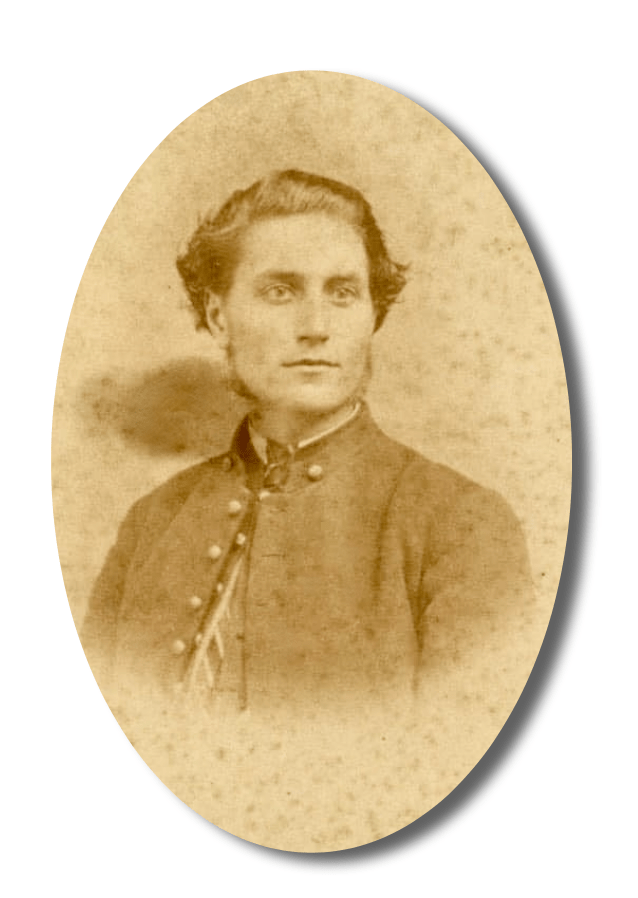
I could not find an image of John but here is one of Charles H. Beach who served in Co. F, 8th New York Cavalry. (Andrew German Collection)
Washington December 16, 1861
Dear Father and Friends,
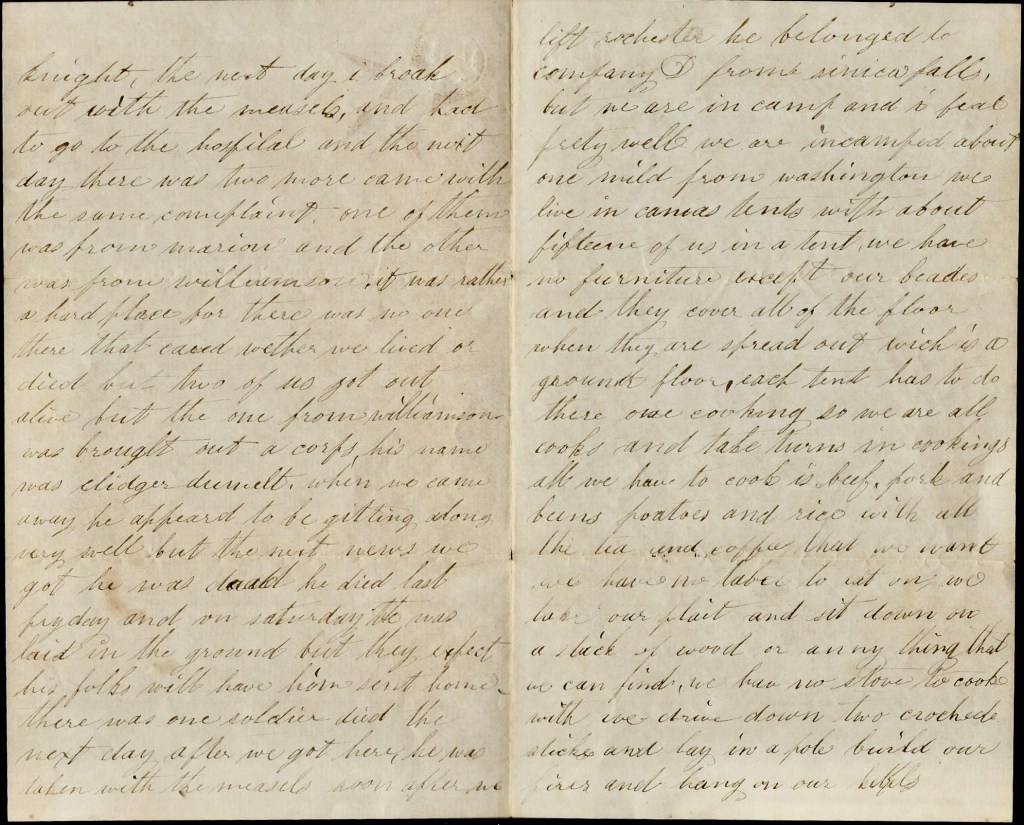
I now take my pen in hand to write a few lines to you that I ought to have done before but have not been able for I have been in the hospital most of the time that we have been here. I caught a very bad cold before we left Rochester and I did not feel very well on the way here. We left Rochester two weeks ago last Thursday. We was two days and most of the third nights on the way. When we arrived here, we was taken to a large house what they called the soldier home and gave us some dry bread and coffee and our bed was the soft side of the floor but I did not stay there but one night. The next day I broke out with the measles and had to go to the hospital and the next day there was two more came with the same complaint. One of them was from Marion and the other from Williamson. It was rather a hard place for there was no one there that cared whether we lived or died but two of us got out alive. But the one from Williamson was brought out a corpse. His name was Elijah Dumalt. When we came away, he appeared to be getting along very well but the next news we got he was dead. He died last Friday and on Saturday he was laid in the ground. But they expect his folks will have him sent home. There was one soldier died the next day after we got here. He was taken with the measles soon after we left Rochester. He belonged to Company D from Seneca Falls.
But we are in camp and I feel pretty well. We are encamped about one mile from Washington. We live in canvas tents with about fifteen of us in one tent. We have no furniture except our beds and they cover all of the floor when they are spread out, which is a ground floor. Each tent has to do their own cooking so we are all cooks and take turns in cooking. All we have to cook is beef, pork and beans, potatoes, and rice with all the tea and coffee that we want. We have no table to eat on. We take our plate and sit down on a stick of wood or anything that we can find. We have no stove to cook with. We drive down two crotched sticks and lay in a pole, build our fires and hang on our kettles. We don’t bake our bread. We have the nest kind of baker’s bread dealt out to us every day. This is the way that we live and a pretty coarse way too.
There has been a great deal of talk about our being discharged and it is not decided yet whether we shall or not. We have not got our horses yet, nor anything to defend ourselves with if the enemy should make an attack on us. If we get discharged, we shall soon be home.
The weather is very pleasant here. We have not had any snow or rain since we have been here. But I must stop. Excuse poor writing for I write with a piece of board across my knee and sit on a stick of wood. From your well wisher, — J. W. Lund
Write as soon as you get this. Direct to J. W. Lund, Washington D. C., 8th New York Cavalry, Co. C.
Letter 2
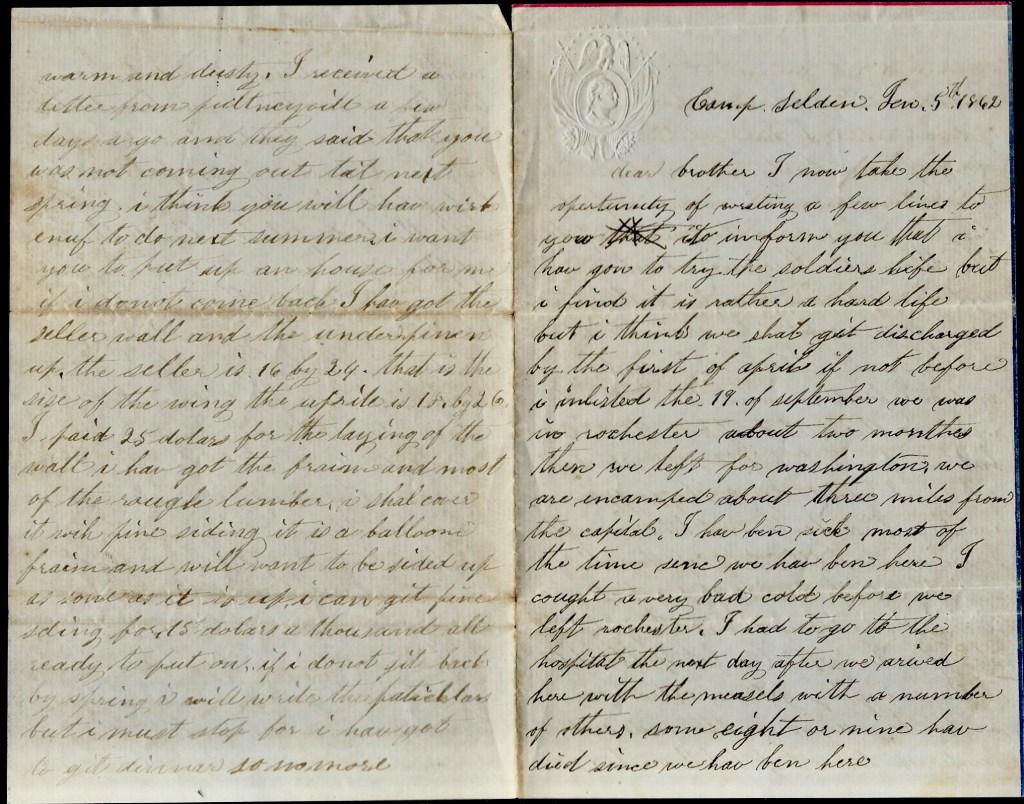
Camp Selden January 5, 1862
Dear Brother,
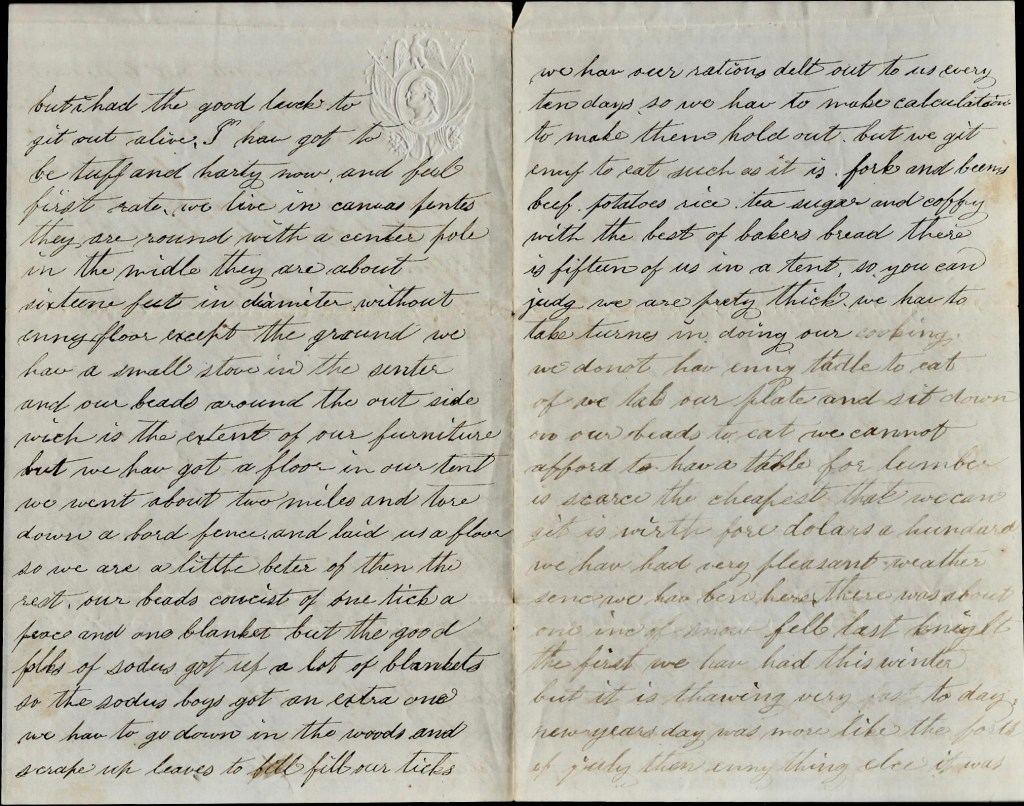
I now take the opportunity of writing a few lines to you to inform you that I have gone to try the soldier’s life but I find it is rather a hard life. But I think we shall get discharged by the first of April if not before. I enlisted the 19th of September. We was in Rochester about two months. Then we left for Washington. We are encamped about three miles from the Capitol. I have been sick most of the time since we have been here, I caught a very bad cold before we left Rochester. I had to go to the hospital the next day after we arrived here with the measles with a number of othres. Some eight or nine have died since we have been here but I had the good luck to get out alive. I have got to be tough and hearty now and feel first rate.
We live in canvas tents. They are round with a center pole in the middle. They are about sixteen feet in diameter without any floor except the ground. We have a small stove in the center and our beds around hte outside which is the extent of our furniture. But we have got a floor in our tent. We went about two miles and tore down a board fence and laid us a floor so we are a little better off than the rest. Our beds consist of one tick apiece and one blanket. But the good folks of Sodus got up a lot of blankets so the Sodus boys got an extra one. We have to go down in the woods and scrape up leaves to fill our ticks.
We have our rations dealt out to us every two days so we have to make calculation to make them hold out, but we get enough to eat, such as it is. Pork and beans, beef, potatoes, rice, tea, sugar, and coffee with the best of baker’s bread. There is fifteen of us in a tent so you can judge we are pretty thick. We have to take turns in doing our cooking. We don’t have any table to eat off of. We take our plate and sit down on our beds to eat. We cannot afford to have a table for lumber is scarce. The cheapest that we can get in worth four dollars a hundred.
We have had very pleasant weather since we have been here. There was about one inch of snow fell last night—the first we have had this winter, but it is thawing very fast today. New Year’s Day was more like the Fourth of July than anything else. It was warm and dusty.
I received a letter from Pultneyville a few days ago and they said that you was not coming out till next spring. I think you will have work enough to do next summer. I want you to put up a house for me if I don’t come back. i have got the cellar wall and the underpinnings up. The cellar is 16 by 24. That is the size of the wing. The upright is 18 by 26. I paid 25 dollars for the laying of the wall. I have got the frame and most of the rough lumber. I shall cover it with pine siding. It is a balloon frame and will want to be sided up as soon as it is up. I can get fine siding for 15 dollars a thousand all ready to put on. If I don’t get back by spring, I will write the particulars but I must stop for I have got to get dinner. So no more.
Letter 3
Camp Selden Washington D. C. February 17th, 1862
Sister,
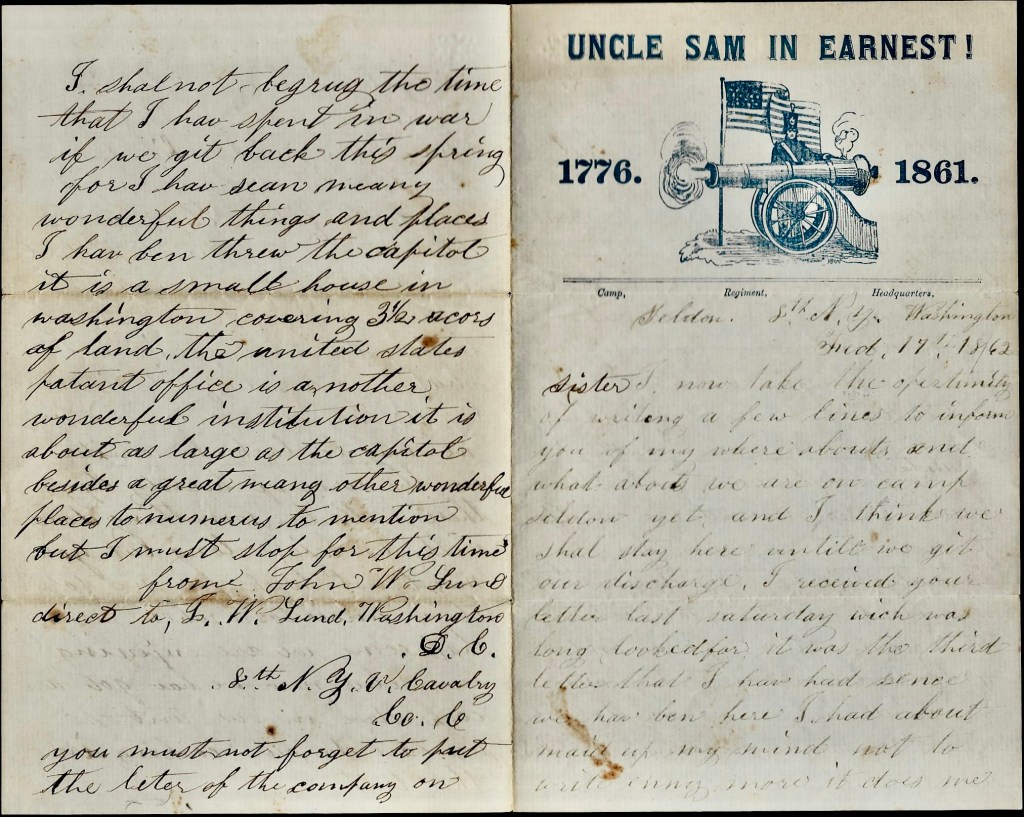
I now take the opportunity of writing a few lines to inform you of my whereabouts and what abouts. We are on Camp Selden yet and I think we shall stay here until we get our discharge. I received your letter last Saturday which was long looked for. It was the third letter than I have had since we have been here. I had about made up my mind not to write any more. It does me a great deal of good to hear from you. I am in good health now except a very bad cold which I have had for a few days. But I have got about over it now. But there is a great deal of sickness in the regiment. There has forty-five died out of this regiment since we have been here. The physician that we have had did not know anything about his business. He got his discharge last week and left. Te Colonel has resigned his commission. He resigned to save his being throwed out. He found out that he would not bear inspection. He would go down town and get so drunk that he would have to be helped off his horse when he came in camp. I think we shall not want any other colonel for we are having so many union victories that they will whip the Sout out before we get ready to fight. There has been seven regiments ordered over the river. They have been waiting for the mud to dry up. One regiment that was encamped close by us has gone over today.
We may be back in Rochester in the course of twenty days. There will be something done with us before long but you must not look for me for it is uncertain when we shall come. We are enjoying ourselves now. We have got a cook stove in our tent so we can do our cooking in the tent.
I shall not begrudge the time that I have spent in war if we get back this spring for I have seen many wonderful things and places. I have been through the Capitol. It is a small house in Washington covering three and a half acres of land. The United State Patent Office is another wonderful institution. It is about as large as the Capitol. Besides a great many other wonderful places too numerous to mention. But I must stop for this time.
From John W. Lund.
Direct to J. W. Lund, Washington D. C., 8th N. Y. Cavalry, Co. C
You must not forget to put the letter of our company on.
Letter 4
Edwards Ferry March 13th 1862
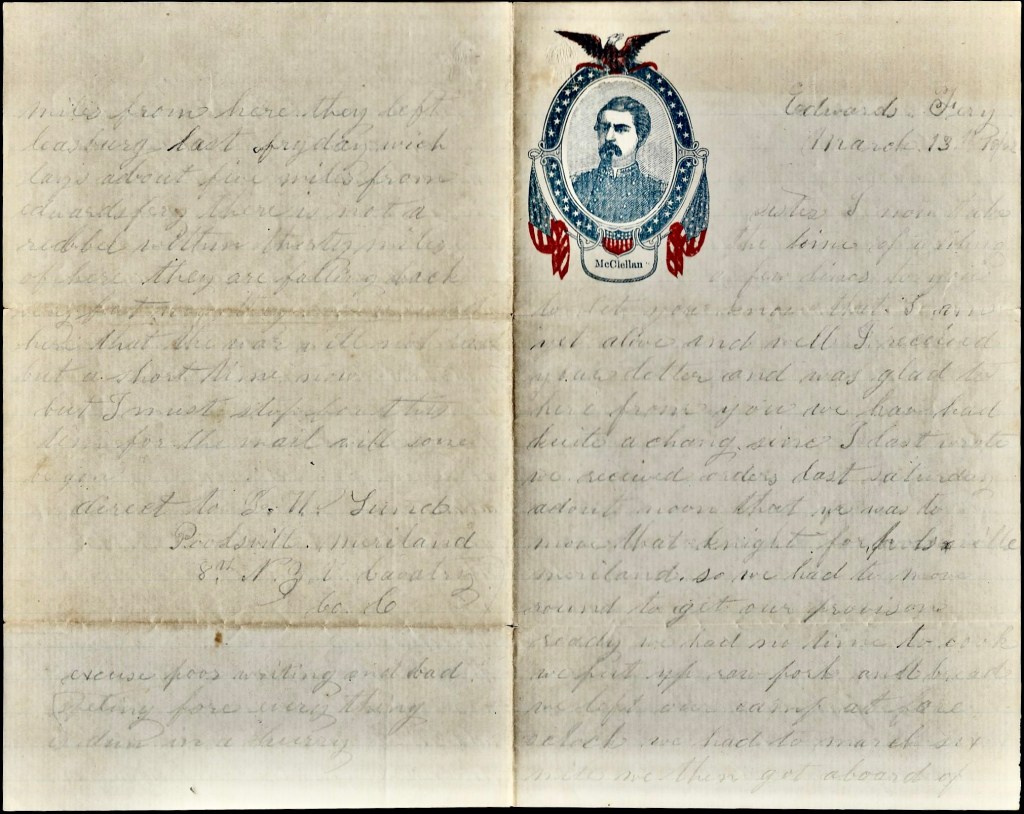
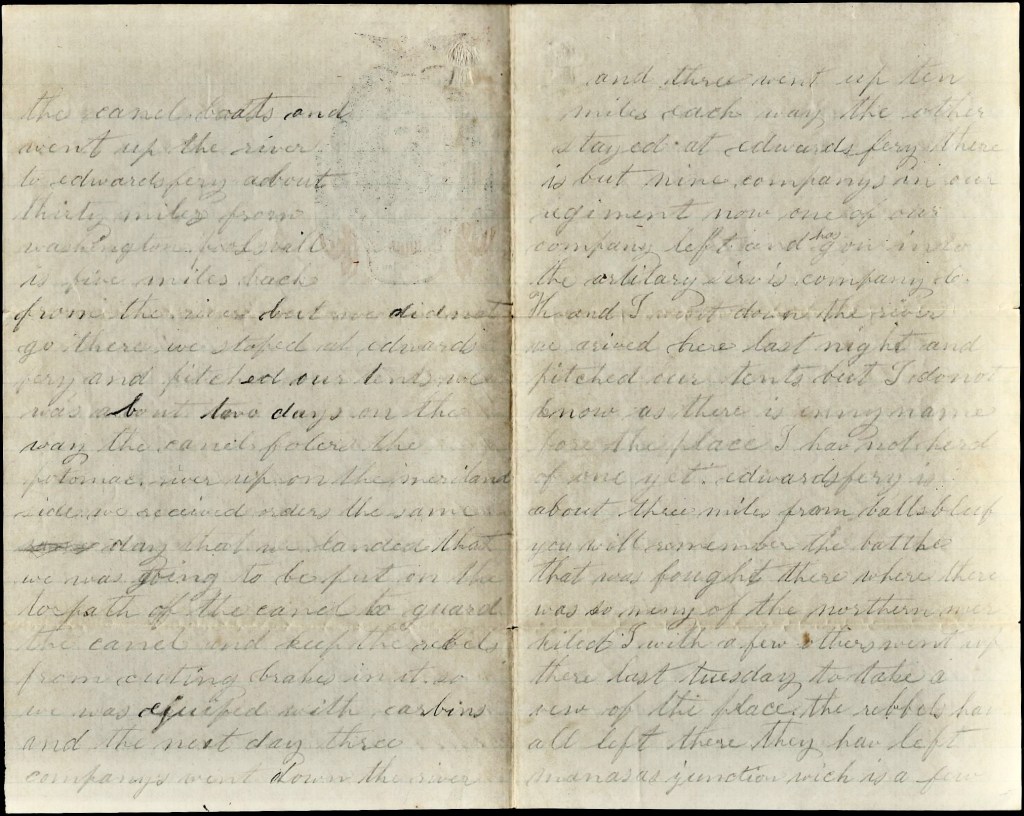
Sister, I now take the time of writing a few lines to you to let you know that I am yet alive and well. I received your letter and was glad to hear from you. We have had quite a change since I last wrote. We received orders last Saturday about noon that we was to move that night for Poolesville, Maryland. So we had to move around to get our provision ready. We had not time to cook. We put up raw pork and bread. We left our camp at four o’clock. We had to march six miles. Then we got aboard of the canal boats and went up the river to Edward’s Ferry about thirty miles from Washington. Poolesville is five miles back from the river but we did not go there. We stopped at Edward’s Ferry and pitched our tents. We was about two days on the way. The canal follows the Potomac river up on the Maryland side.
We received orders the same day that we landed that we was going to be put on the towpath of the canal to guard the canal and keep the rebels from cutting breaks in it so we was equipped with carbines and the next day three companies went down the river and three went up ten miles each way. The other stayed at Edward’s Ferry. There is but nine companies in our regiment now. One of our companies left and has gone into the artillery service. Co. C, H, and I went down the river. We arrived here last night and pitched our tents but I do not know as there is any name for the place. I have not heard of one yet. Edward’s Ferry is about three miles from Ball’s Bluff. You will remember the battle that was fought there where there was so many of the northern men killed. I with a few others went up there last Tuesday to take a view of the place. The rebels has all left there. They have left Manassas Junction which is a few miles from here. They left Leesburg last Friday which lays about five miles from Edward’s Ferry. There is not a rebel within thirty miles of here. They are falling back very fast. We hear that the war will not last but a short time now.
But I must stop for this time for the mail will soon be gone. Direct to J. W. Lund, Poolesville, Maryland, 8th N. Y. V. Cavalry, Co. C
Excuse poor writing and bad spelling for everything is done in a hurry.
Letter 5
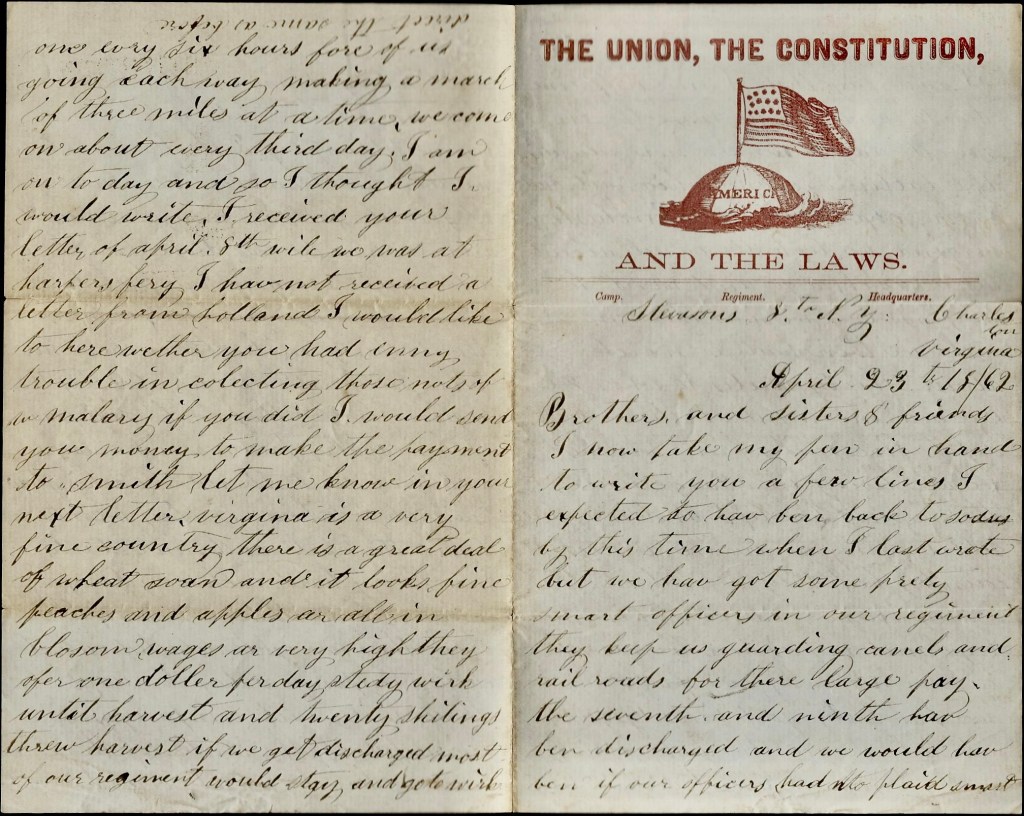
Stevenson’s Depot Charlestown, Virginia April 23, 1862
Brothers & Sisters & Friends,
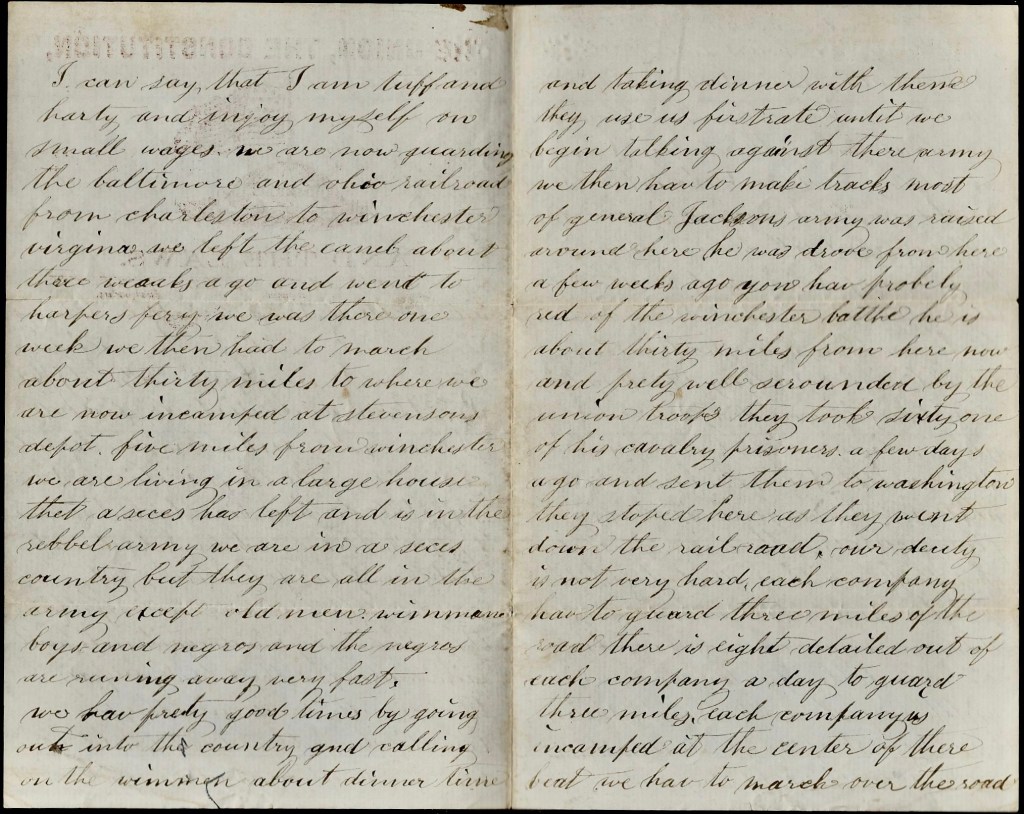
I now take my pen in hand to write you a few lines. I expected to have been bak to Sodus by this time when I last wrote but we have got some prtty smart officers in our regiment. They keep us guarding canals and railroads for their large pay. The 7th and 9th have been discharged and we would have been if our officers had not played smart. I can say that I am tough and hearty and enjoy myself on small wages. We are now guarding the Baltimore & Ohio Railroad from Charlestown to Winchester, Virginia. We left the canal about three weeks ago and went to Harper’s Ferry. We was there one week. We then had to march about thirty miles to where we are now encamped at Stevenson’s Depot, five miles from Winchester. We are living in a large house that a secesh has left and is in the rebel army. We are in a secesh country but they are all in the army except old men, women, boys and negroes, and the negroes are running away very fast.
We have pretty good times by going out into the country and calling on the women about dinner time and taking dinner with them. They use us first rate until we begin talking against their army. We then have to make tracks.
Most of General Jackson’s army was raised around here. He was drove from here a few weeks ago. You have probably heard of the Winchester Battle. He is about thirty miles from here now and pretty well surrounded by the Union troops. They took sixty-one of his cavalry prisoners a few days ago and sent them to Washington. They stopped here as they went down the railroad. Our duty is not very hard. Each company has to guard three miles of the road. There is eight detailed out of each company a day to guard three miles. Each company is encamped at the center of their beat. We have to march over the road once every six hours, four of us going each way, making a march of three miles at a time. We come in about every third day. I am on today and so I thought I would write. I received your letter of April 8th while we was at Harper’s Ferry. I have not received a letter from Holland. I would like to hear whether you had any trouble in collecting those notes of Mallory. If you did, I would send you money to make the payment to Smith. Let me know in your next letter.
Virginia is a very fine country. There is a great deal of wheat sown and it looks fine. Peaches and apples are all in blossom. Wages are very high. They offer one dollar per day steady work until harvest and twenty shillings through harvest. If we get discharged, most of our regiment would stay and go to work.
Letter 6
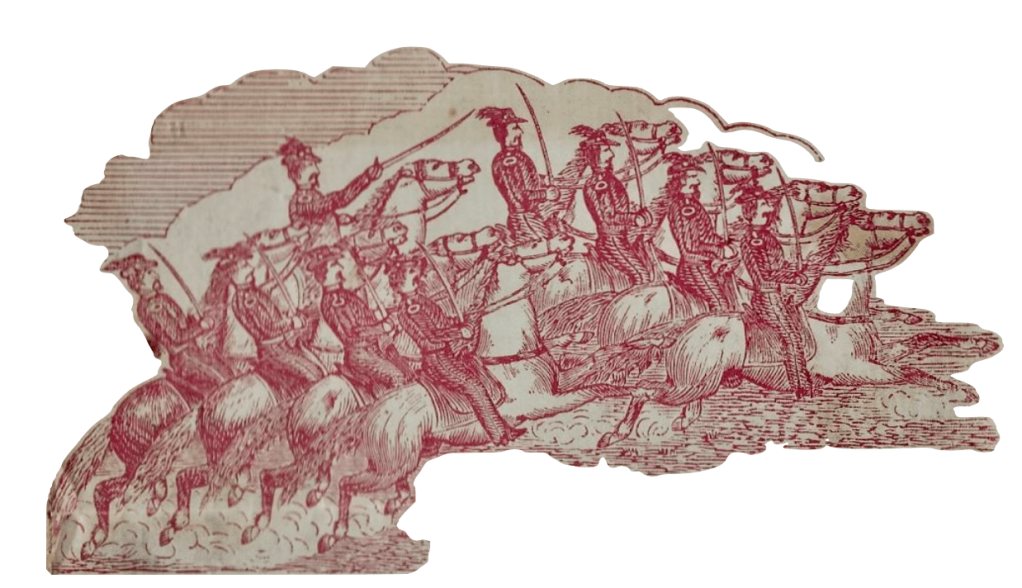
Patriotic Heading on John’s Stationery
Harper’s Ferry, Virginia May 27, 1863
Brother & Sister,
I now take the opportunity of writing a few lines to inform you that I am well and in the land of the living although I am pretty sore and lame with the effects of a long retreat. Last Saturday our regiment was ordered to Winchester to reinforce General Banks who was retreating from Strasburg, that the enemy was after him on double quick. We arrived at Winchester on Saturday night about the time that Banks came in. They were very much cut up and lost a great many of their supply wagons. [See First Battle of Winchester, 25 May 1863]
Everything was quiet through the night but at daylight on Sunday morning, the enemy commenced throwing shells into the town. We made a stand on the outside of the town and kept them out until about eight o’clock when we found they were too strong for us. They were about 30,000 strong and we had but about ten. We had to retreat on double quick, every man for himself. The bullets flew around our heads like swarms of bees. I saw out our captain fall with a great many others. I believe our Lieutenant Brown is safe. He is in Maryland, up the river from us. The rebels chased us about five miles, throwing the bomb shells after us. They are not very pleasant things to have bursting over one’s head.
We met about six thousand coming to reinforce us five miles out of town but it was too late. They had to retreat. We marched about forty miles that day. Arrived at Harper’s Ferry about eight o’clock. We lost all that we had. A great many threw their guns away. I lost my satchel and all the clothes I had. I had some pictures taken that I intended to send to you. I sent one to Lucy the day before we went to Winchester but the rebels has got the rest. We have made a stand on Bolivar Heights one mile from the Ferry. We have been reinforced thirty thousand so if they come here, we will give them fits and if they do not come soon, we shall follow them.
I received your letter yesterday. Was glad to hear from you. Tell Bill Cowley that I did not buy that land of him. I set the fence where the man staked out the line that I bought off it. He has not got as much land as he expected. It is his loss, not mine. He will be some older before I move the fense.
Letter 7
Relay House, Maryland July 17th 1862
Brother and Sister and Friends,
I now take the opportunity of writing a few lines in answer to the letter received from you last Friday. I had been looking for one a long time before it come. I wrote to Lucy about two weeks ago about the time we arrived here from Harper’s Ferry. I stated in it that we expected our horses by the first of July and sure enough, they came—horses for five companies only—A, B, C, D, and E are mounted and equipped with new sabers and revolvers, We have got a fine lot of horses and good equipments. All we want now is to get our horses trained. Then we will go and see the rebeks again. There is four companies to be mounted yet. They expect their horses every day. When they get them, we shall probably move o Baltimore or Annapolis to drill as the drilling ground is too small here for the regiment to drill on.
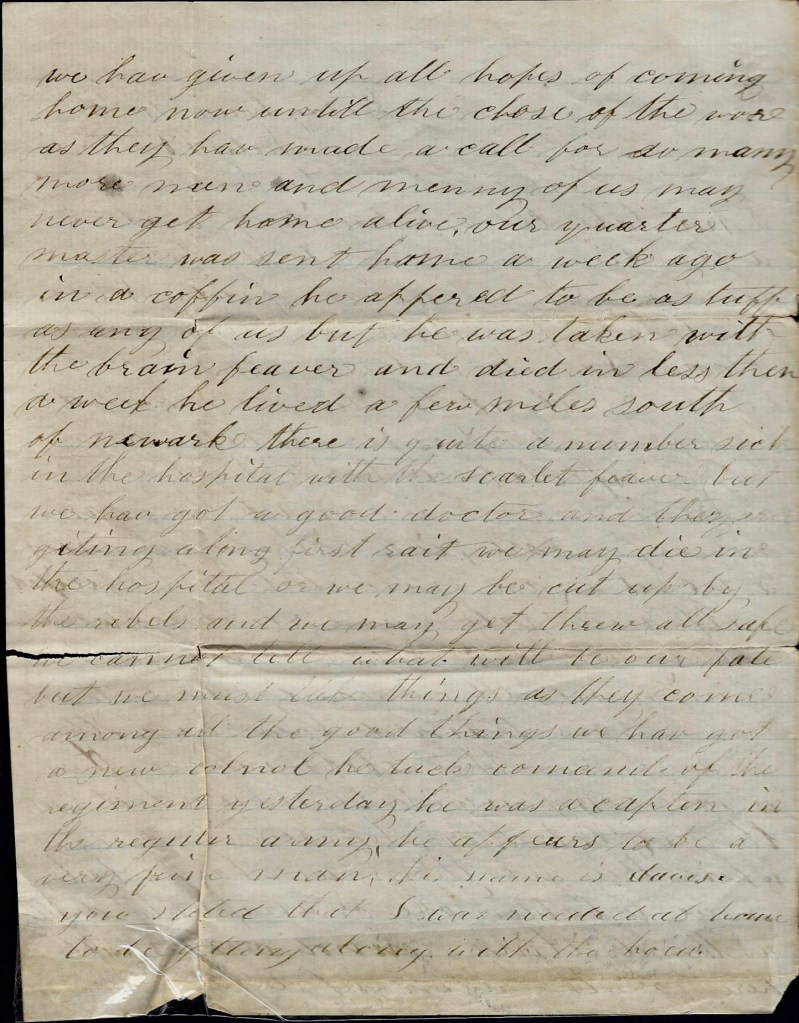
We have given up all hopes of coming home now until the close of the war as they have made a call for so many more men and many of us may never get home alive. Our quartermaster was sent home a week ago in a coffin. He appeared to be as tough as any of us but he was taken with the brain fever and died in less than a week. He lived a few miles south of Newark. There is quite a number sick in the hospital with the scarlet fever but we have got a good doctor and they are getting along first rate. We may die in the hospital or we may be cut up by the rebels and we may get through all safe. We cannot tell what will be our fate. But we must take things as they come.
Among all the good things, we have got a new colonel. He took command of the regiment yesterday. He was a captain of the regular army. He appears to be a very fine man. His name is Davis. You stated that I was needed at home to be getting along with the house. I would like t be there but I suppose that I am needed more here. I would like to have the house put up and enclosed this summer if no more in order to save what is done. I would risk but what Holland could put it up to suit me. I intended to put it up plain and cheap for sale or o let, but as things are now, I do not think I can afford to have it done for thirteen dollars a month is a slow way of making money. If Charles Munson wants that lumber, he can have it for just what I paid. I paid 4 dollars a thousand. I do not think that I would like to lend it to him.
We did not have much of anything to do on the Fourth of July. We did not leave camp. It was rather a dull day to us, but I must close for this time. If we leave here soon, I will let you know. The Relay House is within nine miles of Baltimore and 31 miles of Washington. I am tough and hearty and weigh 155 pounds. That is as heavy as ever I weighed so you can judge whether soldiering agrees with me or not. Yours truly, in haste. — J. W. Lund
Letter 8
Hagerstown, Maryland September 27th 1862
Brother & Sister & Friends,
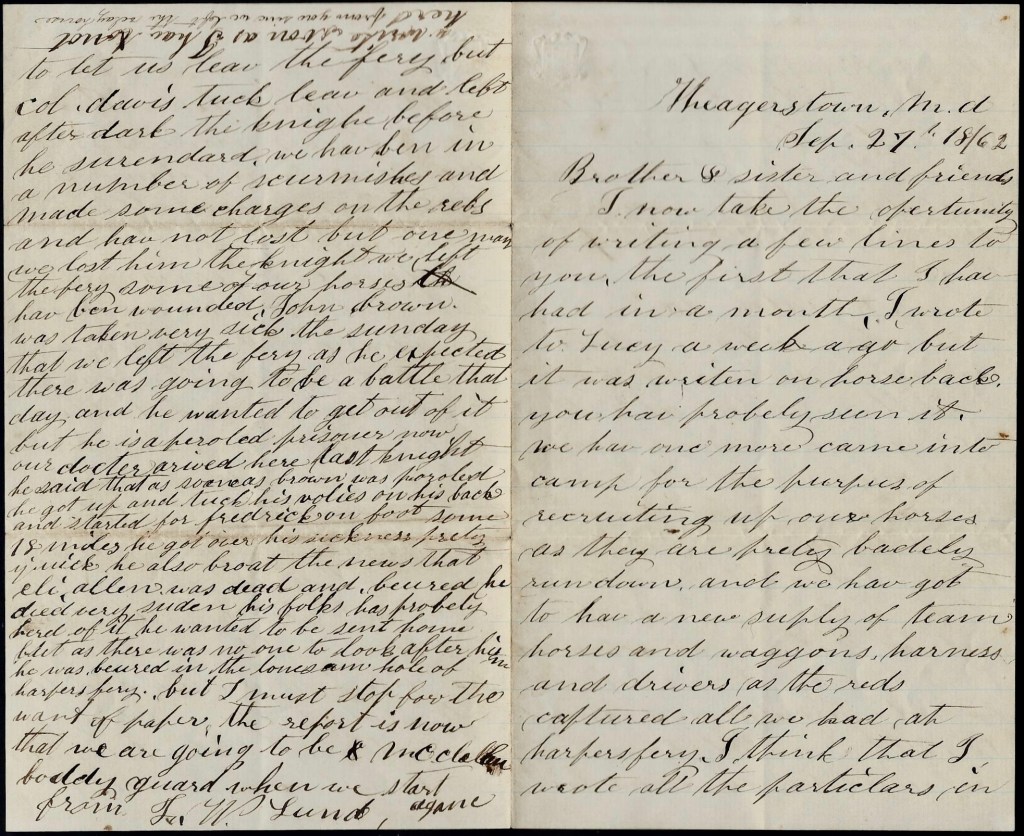
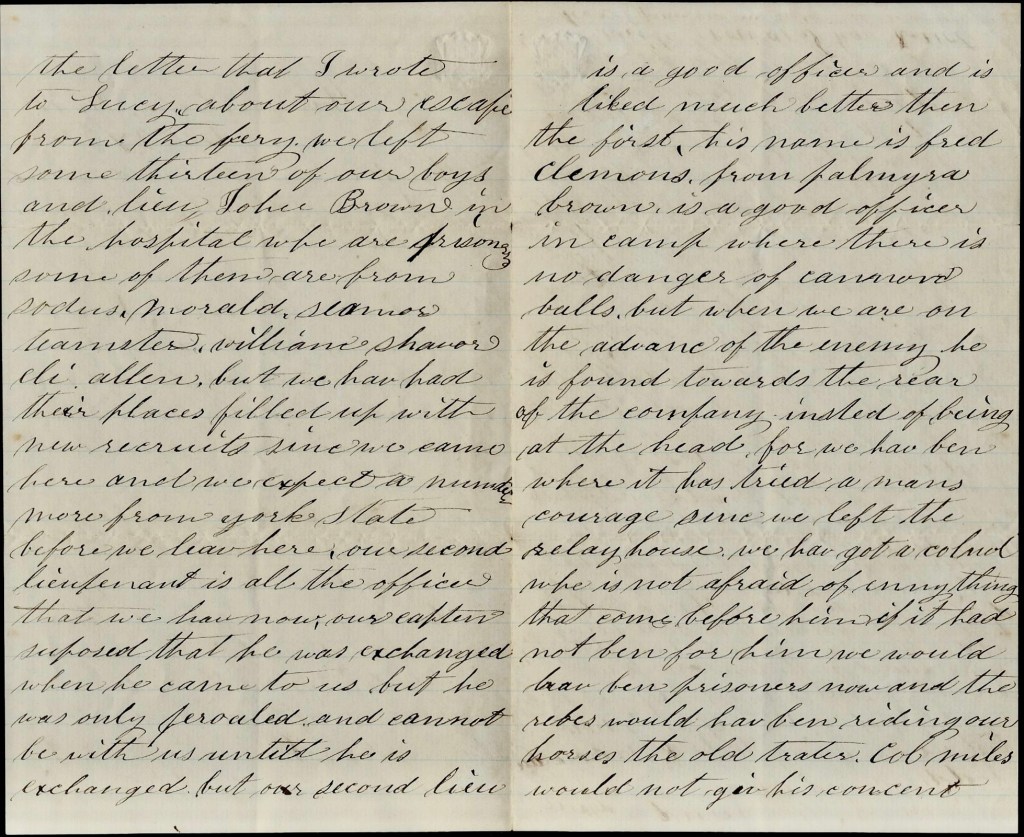
I now take the opportunity of writing a few lines to you, the first that I have had in a month. I wrote to Lucy a week ago but it was written on horseback. You have probably seen it. We have once more come into camp for the purpose of recruiting up our horses as they are pretty badly run down and we have got to have a new supply of team horses and wagons, harness and drivers as the Rebs captured all we had at Harper’s Ferry. I think that I wrote all the particulars in the letter that I wrote to Lucy about our escape from the ferry. We left some thirteen of our boys and Lieutenant John [W.] Brown in the hospital who are prisoners. Some of them are from Sodus—Morrill [D.] Seymour, teamster, William Shavor, Eli Allen. But we have had their places filled up with new recruits since we came here and we expect a number more from York State before we leave here.
Our 2nd Lieutenant is all the officer that we have now. Our captain supposed that he was exchanged when he came to us but he was only paroled and cannot be with us until he is exchanged. But our 2nd Lieutenant is a good officer and is liked much better than the 1st. His name is Fred Clemons from Palmyra. Brown is a good officer in camp where there is no danger of cannon balls, but when we are on the advance of the enemy, he is found towards the rear of the company instead of being where it has tried a man’s courage.
Since we have left the Relay House, we have got a colonel who is not afraid of anything that comes before him. If it had not been for him, we would have been prisoners now and the rebs would have been riding our horses. The old traitor, Col. Miles, would not give his consent to let us leave the Ferry but Col. Davis took leave and left after dark the night before he surrendered. We have been in a number of skirmishes and made some charges on the rebs and have not lost but one man. We lost him the night we left the Ferry. Some of our horses have been wounded.
John Brown was taken very sick the Sunday that we left the Ferry as he expected there was going to be a battle that day and he wanted to get out of it but he is a paroled prisoner now. Our doctor arrived here last night. He said that as soon as Brown was paroled, ge got up and took his valice on his back and started for Frederick on foot, some 18 miles. He got over his sickness pretty quick. He also brought the news that Eli Allen was dead and buried. He died very sudden. His folks has probably heard of it. He wanted to be sent home but as there was no one to look after him, he was buried in the lonesome hole of Harper’s Ferry.
But I must stop for the want of paper. The report is now that we are going to be McClellan’s body guard when we start again. From — J. W. Lund
Letter 9
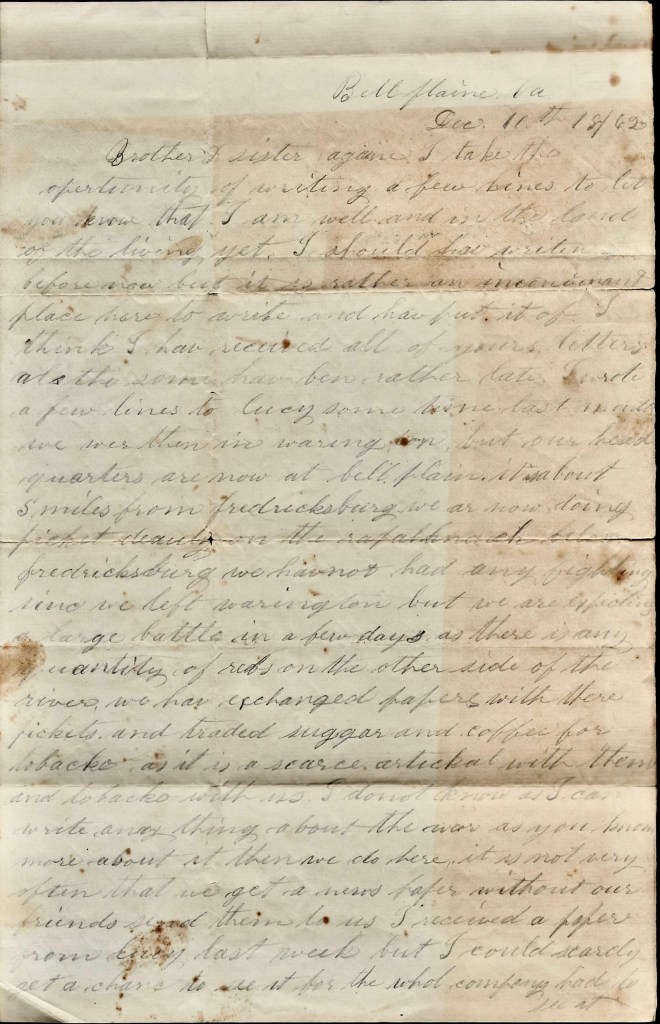
Belle Plains, Va. December 11th 1862
Brother & Sister,
Again I take the opportunity of writing a few lines to let you know that I am well and in the land of the living yet. I should have written before now but it is rather an inconvenient place here to write and have put it off. I think I have received all of your letters although some have been rather late. I wrote a few lines to Lucy some time last month. We were then in Warrenton but our headquarters are now at Belle Plains. It is about 5 miles from Fredericksburg. We are now doing picket duty on the Rappahannock below Fredericksburg. We have not had any fighting since we left Warrenton but we are expecting a large battle in a few days as there is any quantity of rebs on the other side of the river. We have exchanged papers with their pickets and traded sugar and coffee for tobacco as it is a scarce article with them and tobacco with us. I don’t know as I can write anything about the war as you know more about it than we do here. It is not very often that we get a newspaper without our friends send them to us. I received a paper from Lucy last week but I could scarcely get a chance to see it for the whole company had to see it.
We have had some snow here and very cold weather but it is quite pleasant now—but not very pleasant soldiering for we have not had as much as a shelter tent since we came into Virginia. But hard fare will not kill what is left of us or we should have been dead long ago. You wrote that John Balch said he was sick of a soldier’s life. He has not seen any of it yet. Let them follow the 8th Cavalry where they have been for the past three months and they will know something about soldier’s life. I suppose their regiment is exchanged. They will probably have a chance to try it. We have not got a commissioned officer in our company yet. Our Captain and 2nd Lieutenant have got sick of it and resigned, going home and left us. If John Brown is at home, he had better stay there damned coward will get booted out of the company if he comes back. Our Captain is not much better, but our 2nd Lieutenant was a bully boy. We regret losing him but he resigned on the account of his health.
But I must stop for this time. Susan must read this for an answer to her letter and I will write her another time. We are yet the 8th New York Cavalry in Gen. [Alfred] Pleasonton’s Brigade, Gen. Sumner’s Corps. We expect to get home by next spring. I think I shall come on a furlough if not a discharge. From — J. W. Lund
Letter 10
Belle Planes, Va. January 4, 1863
As I received your letter last night and found paper and stamp, I thought it must be answered. We are now encamped at Belle Plains where we intend to make our winter quarters, We have been here since the Battle of Fredericksburg with the exception of one week we left here last Sunday night on a cavalry raid with Gen. Averell’s Brigade and returned last night. Our first trip was to Warrenton about 45 miles from here. We made a charge into the town the night before New Years. We found a small force of the reb’s cavalry in town but they left as soon as they found we were coming. We cheated them out of their New Year’s dinner that the citizens was getting up for them and took it ourselves. We made some heavy charges on their fresh meats and bee hives and left the next morning for Catlett’s Station and so round home. We expect to go on another in a day or two. I cannot think of anything more to write today so it will be rather a short letter for this time.
I received a letter from Lucy a few days ago and a paper which I shall have to answer in a few days. I would liked a piece of your roast [ ] but it is impossible as we are soldiers now but I hope we shall be out of it by the next Christmas Day that comes round.
We have now got shelter tents and have built log shanties. Some are pretty well sheltered from the weather now. It is just warm and pleasant but I must close for this time as the boys have got a dish of pork and beans for dinner and they are almost ready. I would like you to send me some postage stamps as they are very scarce here. From yours truly, — J. W. Lund
Letter 11
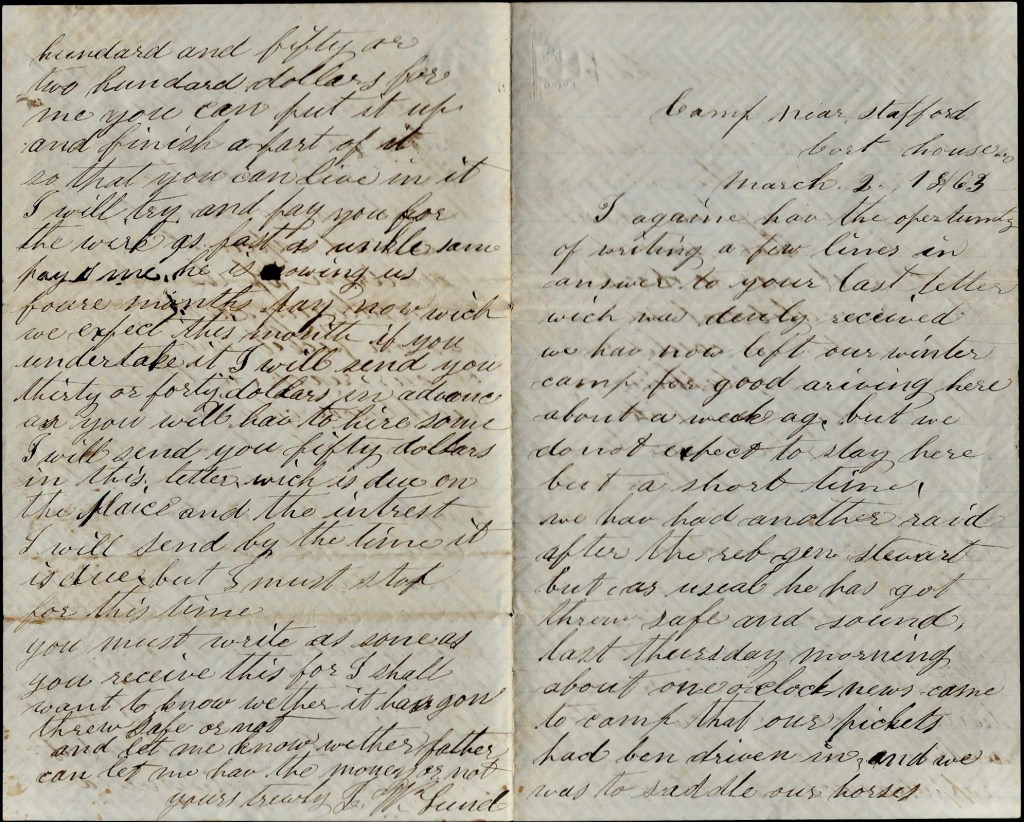
Camp near Stafford Court House March 2, 1863
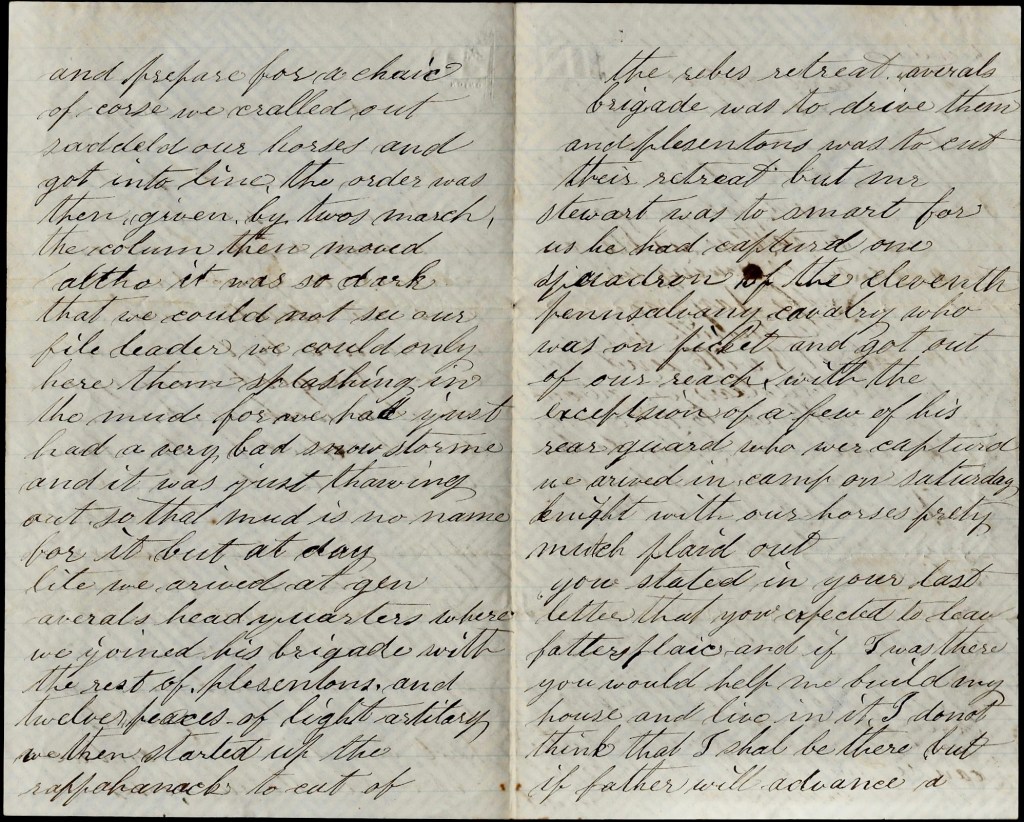
I again have the opportunity of writing a few lines in answer to your last letter which was duly received. We have now left our winter camp for good, arriving here about a week ago. But we do not expect to stay here but a short time. We have had another raid after the reb General [J. E. B.] Stuart but as usual, he has got through safe and sound. Last Thursday morning about 1 o’clock, news came to camp that our pickets had been driven in and we was to saddle our horses and prepare for a chase. Of course we crawled out, saddled our horses and got into line. The order was given by twos, march. The column then moved although it was so dark that we could not see our file leader. We could only hear them splashing in the mud for we had just had a very bad snow storm and it was just thawing out so that mud is no name for it. But at daylight we arrived at Gen. Averell’s Headquarters where we joined his brigade with the rest of Pleasanton’s and twelve pieces of light artillery. We then started up the Rappahannock to cut off the rebs retreat.
Averell’s Brigade was to drive them and Pleasanton’s was to cut their retreat but Mr. Stuart was too smart for us. He had captured one squadron of the 11th Pennsylvania Cavalry who was on picket and got out of our reach with the exception of a few of his rear guard who were captured. We arrived in camp on Saturday night with our horses pretty much played out.
You stated in your last letter that you expected to leave Father’s place and if I was there you could help me build my house and live in it. I don’t think that I shall be there but if Father will advance a hundred and fifty dollars for me, you can put it up and finish a part of it so that you can live in it. I will try and pay you for the work as fast as Uncle Sam pays me. He is owing us four months pay now which we expect this month. If you undertake it, I will send you thirty or forty dollars in advance and you will have to hire some. I will send you fifty dollars in this letter which is due on the place and the interest I will send by the time it is due. But I must stop for this time.
You must write as soon as you receive this for I shall want to know whether it has gone through safe or not. And let me know whether Father can let me have the money or not. Most truly, — J. W. Lund
Letter 12
Camp near Stafford Court House March 28th, 1863
Brother & Sister & friends,
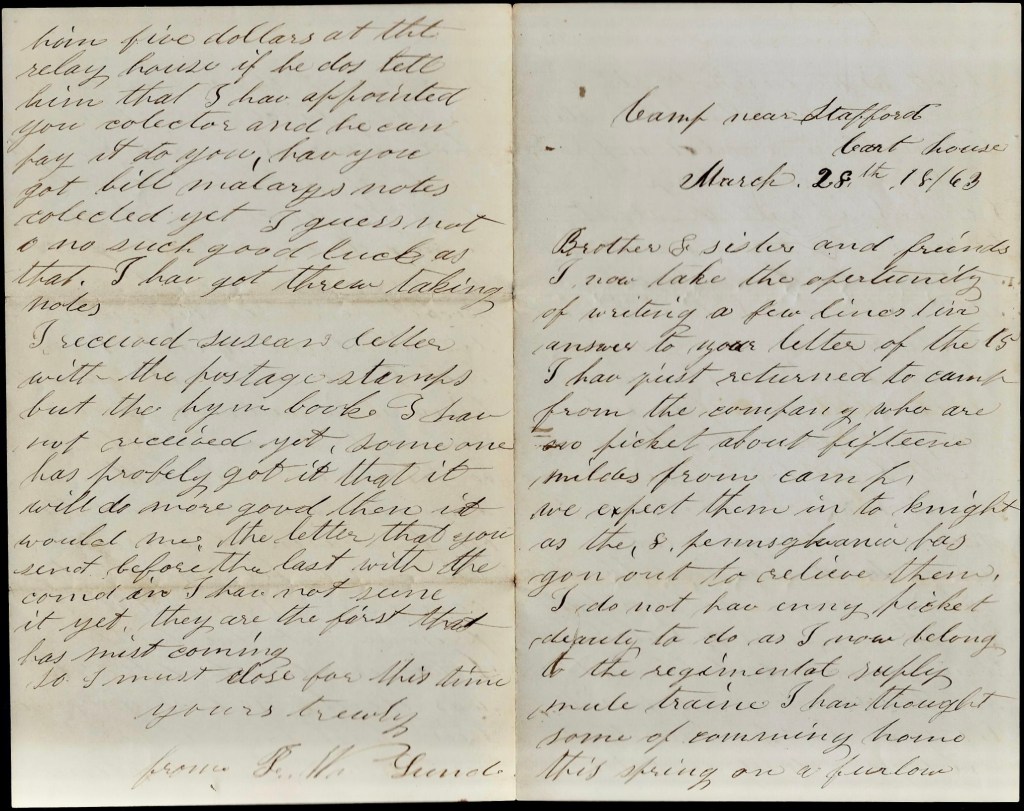
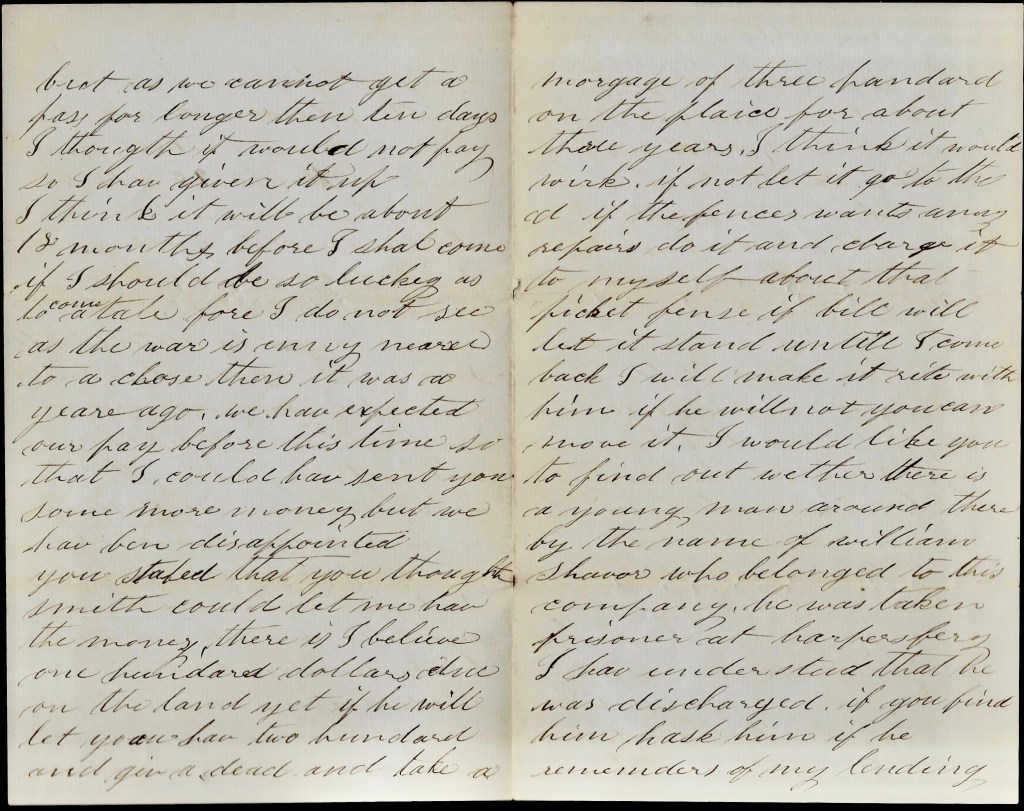
I now take the opportunity of writing a few lines in answer to your letter of the 15th. I have just returned to camp from the company who are on picket about fifteen miles from camp. We expect them in tonight as the 8th Pennsylvania has gone out to relieve them. I do not have any picket duty to do as I now belong to the regimental supply mule train. I have thought some of coming home this spring on a furlough but as we cannot get a pass for longer than 10 days, I thought it would not pay so I have given it up. I think it will be about 18 months before I shall come, if I should be so lucky as to come at all for I do not see as the war is any nearer to a close than it was a year ago.
We have expected our pay before this time so that I could have sent you some more money but we have been disappointed. You stated that you thought Smith could let me have the money. There is, I believe, one hundred dollars due on the land yet. If he will let you have two hundred and give a deed and take a mortgage of three hundred on the place for about three years, I think it would work. If not. let it go to the devil. If the fences wants any repairs, do it and charge it to myself. About that picket fence, if Bill will let it stand until I come back, I will make it right with him. If he will not, you can move it.
I would like you to find out whether there is a young man around there by the name of William Shavor who belonged to this company. He was taken prisoner at Harper’s Ferry. I have understood that he was discharged. If you find him, ask him if he remembers of my lending him five dollars at that Relay House. If he does, tell him that I have appointed you collector and he can pay it to you. Have you got Bill Mallory’s notes collected yet? I guess not. No such good luck as that. I have got through taking notes.
I received Susan’s letter with the postage stamps but the hymn book I have not received yet. Someone has probably got it that it will do more good than it would me. The letter that you sent before the last with the comb in I have not seen it yet. They are the first that has missed coming. So I must close for this time. Yours truly, — J. W. Lund
Letter 13
Potomac Station, Va. May 16, 1863
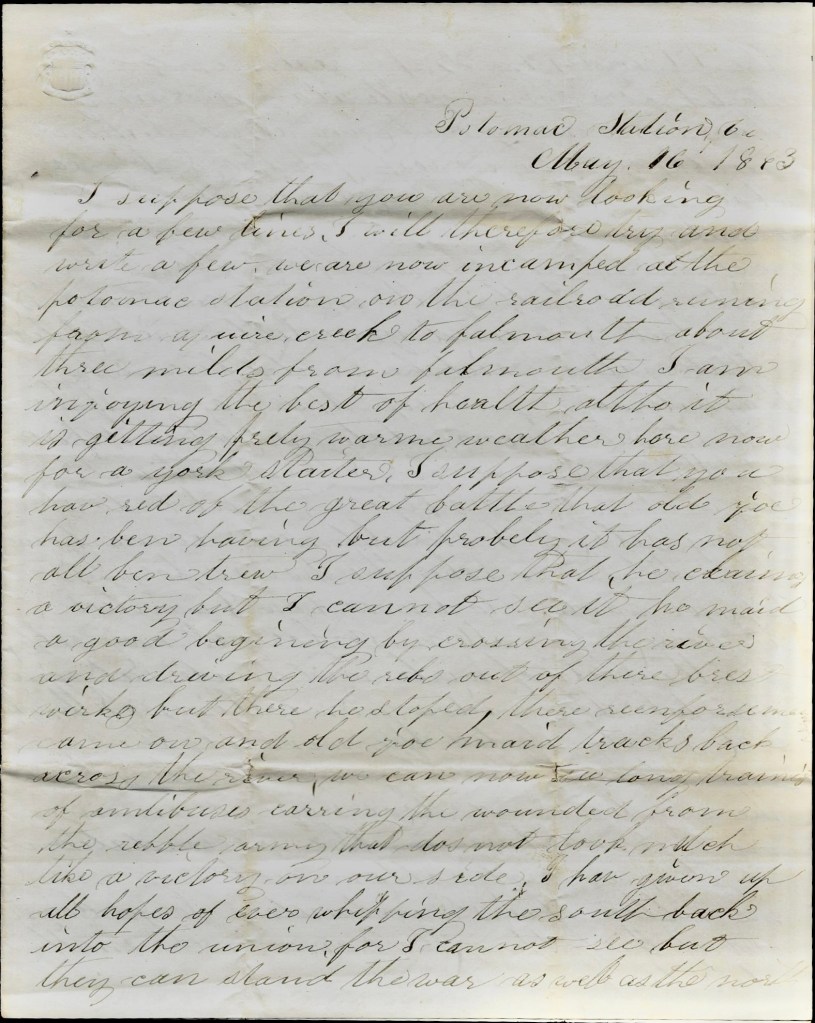
I suppose that you are now looking for a few lines. I will therefore try and write a few. We are now encamped at the Potomac Station on the railroad running from Acquia Creek to Falmouth about three miles from Falmouth. I am enjoying the best of health although it is getting pretty warm weather here now for a York stater. I suppose that you have read of the great battle that Old Joe [Hooker] has been having but probably it has not all been true. I suppose that he is claiming a victory but I cannot see it. He made a good beginning by crossing the river and drawing the rebs out of their breastworks but there he stopped. Their reinforcements came on and Old Joe made tracks back across the river. We can now see long trains of ambulances carrying the wounded from the rebel army. That does not look much like a victory on our side. I have given up all hopes of ever whipping the South back into the Union for I cannot see but they can stand the war as well as the North.
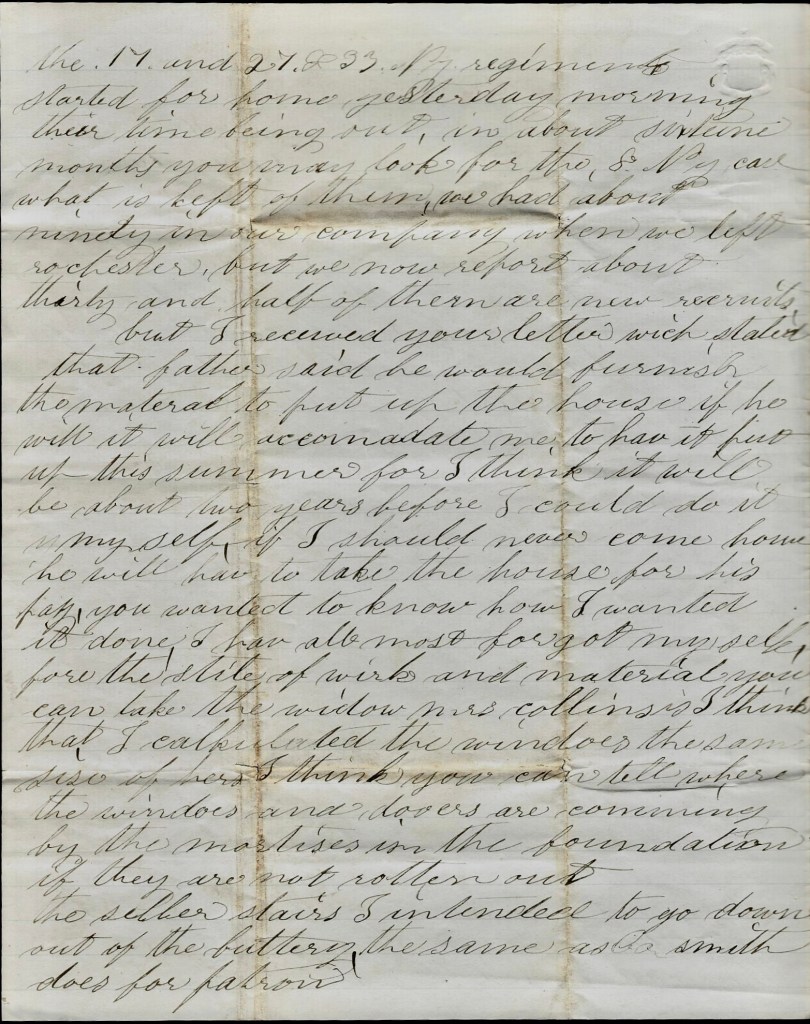
The 17th and 27th & 33rd New York Regiments started for home yesterday morning, their time being out. In about sixteen months you may look for the 8th New York Cavalry—what is left of them. We had about ninety in our company when we left Rochester but we now report about thirty and half of them are new recruits.
But I received your letter which stated that Father said he would furnish the material to put up the house. If he will accommodate me to have it put up this summer for I think it will be about two years before I could do it myself. If I should never come home he will have to take the house for his pay. You wanted to know how I wanted it done. I have almost forgot myself for the style of work and material. You can take the widow Mrs. Collins’. I think that I calculated the windows the same size as hers. I think you can tell where the windows and doors are coming by the mortises in the foundation, if they are not rotted out. The cellar stairs I intended to go down out of the buttery, the same as Mr. Smith does for patrons.
It will suit me if you do not get it exactly as I intended it if you can make it work. If you undertake it, I want you should let me know how you want to do it. You can do it by the day or take it by the job and how much. I will send you forty dollars in this letter which you can have in advance if you do it. If not, I want you should salt it down for me. I do not want no man’s note for it. I think that I have wrote all that I can think of at present. — J. W. Lund
A few lines to Louisa.
Miss Louisa, it was with pleasure that I read those few lines which you wrote me. I did not think that you was so far advanced in writing. I think it was done well. I should like to be there to some of your celebrations. I think you are having pretty nice times. You must go to school and study. Get a good education. It is what will make you great when you are a grown up. I will send you and CHarley a little book to read from the Army of the Potomac. So no more. You must write again. From — J. W. Lind
The following diary was kept by James Houser Bolens (1843-1921), the son of Lewis J. Bolens (1819-1860) and Rebecca Houser (1825-1855) of Lewisburg township, Preble county, Ohio. At the time of the 1860 US Census, 16 year-old James, recently orphaned, was employed as a day laborer on the farm of Henry Young near Eaton, Ohio. A year later, 17 year-old James enlisted as a private in Co. F, 17th Indiana Volunteers. On 11 November 1862 he was taken prisoner at Silver Springs, Tennessee by Gen. John Hunt Morgan’s men and later paroled and sent to Camp Chase, Ohio, where he was exchanged. He was wounded at the Battle of Hoover’s Gap, Tennessee, on 24 June 1863 and also wounded at Pumpkin Vine, Georgia, in the same year. He was discharged from the service on 8 August 1865 and settled in Logonier, Indiana, where he earned a living as a farmer and merchant. He died at Oxford Retreat (an asylum for the insane) in August 1921.
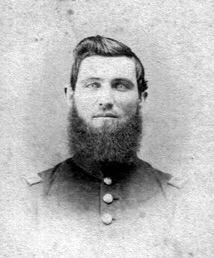
I could not find an image of Bolens as a young man but here is one of Jackson Lewis who served in Co. I, 17th Indiana Mounted Infantry (Jed Bryan Collection)
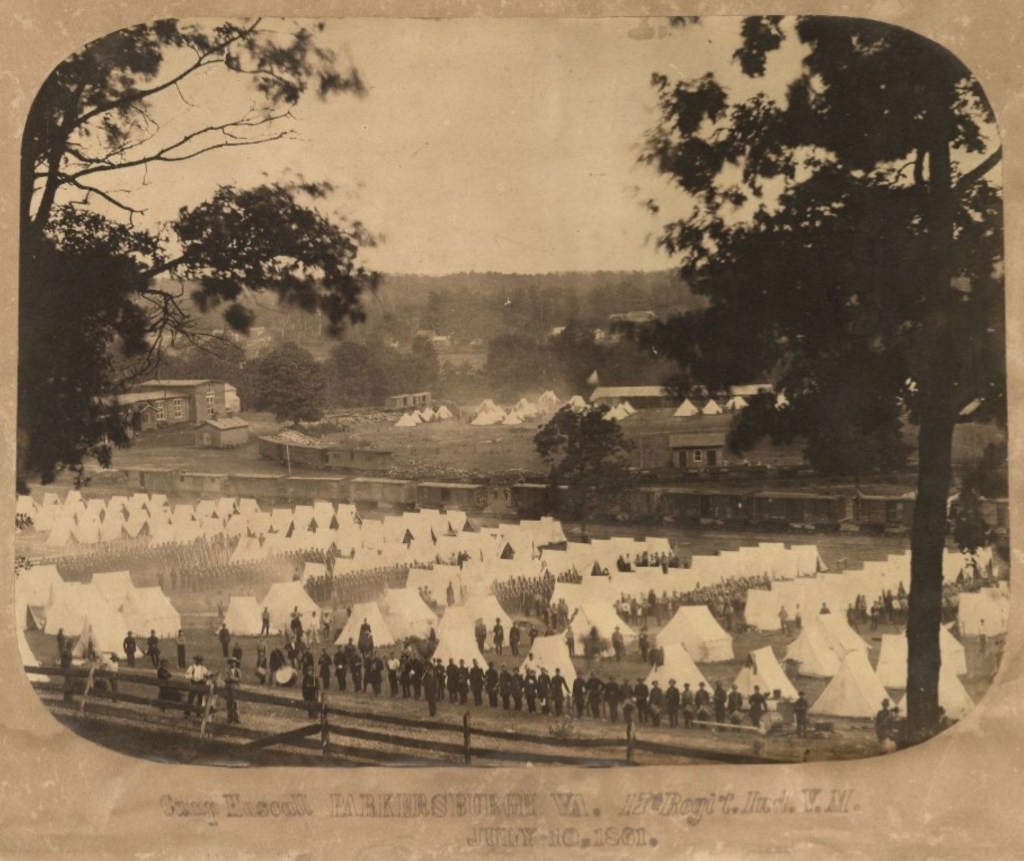
The 17th Indiana was organized in Indianapolis in May 1861 under Gen. Milo Hascall and arrived at Parkersburgh on July 1. “In 1862 it moved to the West under Lt. Col. John T. Wilder where it gained the reputation as the most feared unit in the Union Army.” Later in the war—early in 1863—the 17th Indiana was mounted and became part of Wilder’s Lightning Brigade, known for its swiftness and endurance. The units that comprised the brigade were the 17th and 72nd Indiana Infantry Regiment, the 92nd, 98th, and 123rd Illinois Infantry Regiments, and the 18th Indiana Battery of Light Artillery that was commanded by Capt. Eli Lilly of Indianapolis. Because they were issued hatchets instead of sabers for close, hand to hand combat, they were sometimes called the “Hatchet Brigade.” Bolen’s diary informs us that on 16 May, 1863, his company was issued Spencers Rifles to replace their old Enfields. These Spencer rifles could fire seven shots without reloading within about 15 seconds, giving them a superior advantage over the enemy.
[Note: This diary is from the personal collection of Greg Herr and was transcribed and published on Spared & Shared by express consent.]
Camp of the 17th Indiana at Parkersburgh, Va. (Indiana Memory).
Transcription
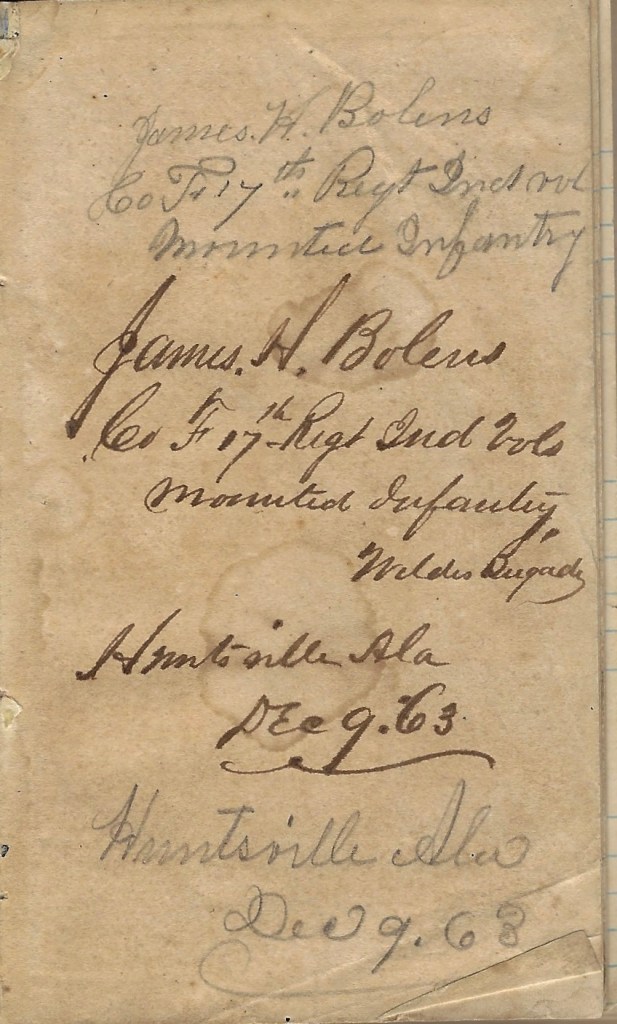
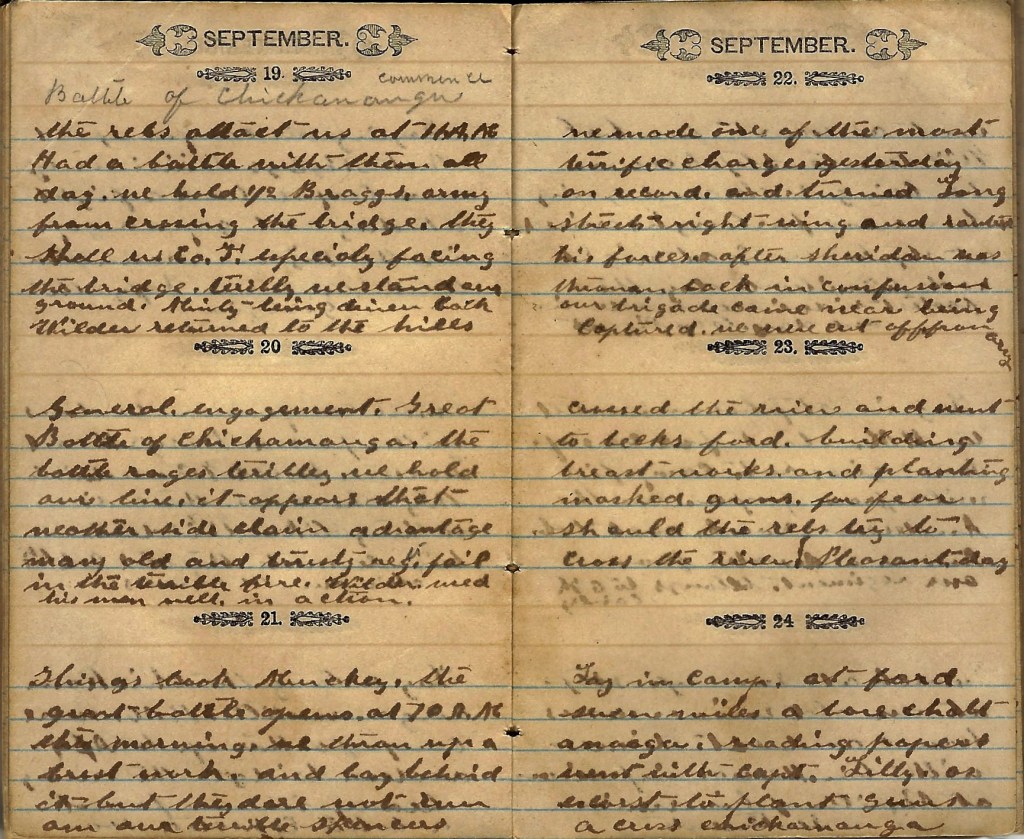
Front page of Bolen’s Diary
James H. Bolens Co. F, 17th Regt. Indiana Vols Mounted Infantry Wilder Brigade Huntsville, Alabama December 9, 1863
MARCH 1863
1—Commence my diary keeping an account of every day’s proceedings. Out with forage train. Were out two days. got on a [ ] of corn and fodder.
2—[Lander and John Conley] came to regiment. They look well. Drum a fellow of the 75th Indiana for conduct unbecoming a soldier and gentleman.
3—Regiment out on scout. I stay in camp and go on picket. Weather fine and pleasant. Reading March number of Atlantic Monthly. No letters.
4—Cold and clear. Pay 15 cents for a little apple. Cheap. Tremendous rain all night. We get a small ducking. Full bad after one drenching.
5—Showery. Rain most all day. Buy biscuits 30 cents a dozen. Worth 5 at home. Reading and writing letters. Nothing of importance.
Lt. George Hayden, Co. F, 17th Indiana
6—Showery. Laying in my bunk. Reading Independent, [ ], and other religious documents. Have a fine chat with Lieut. [George] Hayden.
7—Go on picket. Out as vidette on the Manchester Pike and Woodbury Pike. Very particular post on ahead of style. 3 gay, festive fellows.
8—Came off picket 8:30 o’clock. Had a fine time. Was at Triune, Carthage, Rome and [ ]. Brought in a number of prisoners. Had several small skirmishes.
9—Start for Woodbury. Get there 2 p.m. Co. F has a grand fight. Hand to hand encounter with the rebs. They cover themselves with glory.
10—1st Sergt. Wm. B. Edwards captured yesterday. He fought them like a hero. Bill Wright had his gun shot off. Some of us have sore heads from our hand to hand affair yesterday.
11—In camp writing letters to Uncle Joel. Bad time for horses. Have scratches and [ ] heal. Policing quarters. Fixing up camp. No letters today.
12—On guard. At the commissary guarding commissary stores. Plenty of grub. We go out on scout soon.
13—In camp. Pleasant day. we go out on scout tomorrow for horses. Scouts organizing under the supervision of Sergt. who killed [Col.] John A[ugustine] Washington.
14—Regiment starts out on scout for horses. I ride a mule. [Christan] Mangold’s mule make a charge through company and sends him whirling to the mud.
15—Charge on some Rebs. Make then get up. Capture some prisoners. Camp on Stones river for the night.
16—Start for camp early after eating a good breakfast. Make an imposing display as we march through town. I have a fine horse, formerly Lieut. Hayden’s.
17—In camp at 6 p.m. last night. Down to the creek and take a fine wash. Reading. Time passes off pleasantly. Bunk mate [Michael] Cavenaugh on guard.
18—To town in forenoon. Have fine time. On picket at 2:30 p.m. Lieut. Hayden in command co. Capt. [John R.] Fiscus on duty in camp.
19—Still on picket. Reading Union Press and other periodicals. Came in camp 4 p.m. and unsaddle, curry our horses.
20—In camp. Like spring. Beautiful. The violets and other posies. We wait for the putting forth of the beautiful leaves.
21—Still in camp. On fatigue duty at town. Loading commissary stores. Beautiful day.
William Morton Faulconer, Co. A, 8th Kentucky Cavalry—a member of Morgan’s Confederate Cavalry Division. Faulconer was captured in Morgan’s Ohio Raid later in 1863. (Rob Morgan Collection)
22—Sunday. In camp. Hall’s Brigade fights Morgan near Milton [See Battle of Milton, also known as Battle of Vaught’s Hill, on 20 March 1863] Thrashes him badly. Morgan’s loss three hundred men.
23—In camp on fatigue. Hauling provisions from headquarters for regiment. Reading in afternoon. Having good time in general.
24—In camp writing and reading. No news of importance. policing quarters. “All is quiet on the Potomac.”
25—Regiment out on a 5 days scout. Have a fine time. Camp at Franklin. Have a fine time with Granger’s boys. Captured a number of horses.
26—Scouting and scouring the country for bushwhackers. Scouts came up on some but did not get to fire at them.
27—Start for camp. In camp 9 p.m. Clean clothing, cavalry jackets. Grand Review tomorrow.
28—On Grand Review. Make a splendid display of Mounted Infantry. Drill. We being the only mounted infantry MI army first started by Col. Wilder—inventor of mounted infantry.
29—On picket all night on the Manchester Pike. All quiet. Rebs not stirring much. Reading Byron.
30—Off picket. Inspection and drill forenoon. Regiment goes on a scout. Cold snow squall.
31—Brigade on Grand Review by Jaj. Gen. Rosecrans. Five Divisions. Generals Garfield, Reynolds. & Thomas present. Rosy gives us great praise. Says we will make a good fight.
The month of March spent in numerous scouts, several small fights, and grand reviews. Inspections & drills. Army of the Potomac spend all their time in reviews and no fighting, but we manage to do a little.
APRIL 1863
1—Wednesday morn., start out on scout. 10 days. Camp at burnt bridge. Get a number of fine horses. Have fine time. All goes pleasant.
2—Scouting around the country. Get a few prisoners and some horses. Get some bridles.
3—Pleasant time. Capture a lot of Rebs. Camp at Rome on Cumberland river. Boys get too much whiskey. Bad.
4—Camp at Carthage. Have a hard fight with them. Skirmishing and dashing. Killed several Rebs and loss is small considering our chance.
5—Scouring the country, capturing a number of horses and a number of Morgan’s men. Boys got some ham. Have fine time with ladies.
6—Sharp fight with the rebels toward McMinnville. They won’t stand. Travel on tops of mountains. Beautiful. Pleasant.
7—Off for camp at Murfreesboro 20 miles. Have a pleasant time. Capture a few rebs. Have a small skirmish with them. Charge them—put them to flight.
8—Came in camp last night. On fatigue duty today. Hauling rations from Brigade commissary sergeants. Reading in the afternoon. Poems.
9—In camp reading. Writing letters to the dear ones at home. Building fortifications at town. Everything goes pleasantly.
10—To town. Very warm. Buy war map. Reading Atlantic Monthly for April. Muster for pay for four months.
11—Start on scout at [ ] Today’s scouts have a small skirmish with rebs. Whip them out. Camp there for the night.
12—Sunday. Pleasant. Delightful vegetation. March. Pass through Nolensville. On to Franklin. Have a fight yesterday with Van Dorn’s cavalry.
13—In Franklin. Prospects of a fight with Van Dorn. Boys ready yp give him a battle. May God be with us in all our perils and bring us into His heavenly kingdom.
14—Still at Franklin with Granger’s forces. Leave for camp tomorrow. Have a fine time. Wilder’s boys–the bullies of the Army of the Cumberland. Good.
15—March to Murfreesboro. Rebs clear out. Arrive in camp at 2 p.m. Have fine times on the road. All’s cheering.
16—In camp. Read to march at moment’s warning three days rations. Having fine times. We are all right for another scout. Go tomorrow.
17—Start out on scout toward Liberty and Alexandria. Find nothing. Came to camp in evening. Reading. Had dusty time.
18—In camp. Very hot. Reading Byron and other poems. Delightful. Elegant. All goes pleasant.
19—Sunday Inspection of guns, equipments & horses by Col. Wilder. Boys came out in good trim. Fine appearance.
20—Start out on scout at Readyville. Two brigades of our forces there. Have fine time with Alkanah Galbreath of the Old 9th Indiana [Co. G].
21—Make a dashing charge on McMinnville. Four regulars in advance. Capture town. Capture Dick McCann, the great guerrilla.
Lucy Virginia French of McMinnville kept a journal during the Civil War and wrote of the Union cavalry’s arrival on 21 April 1863: “I was combing my hair—and I remember my face turned pale as I looked in the glass.”Where are they?” “In a few miles.” I went and gathered up my fine books, silver, etc., land put them in my trunks…It was too late for us to move anything if they did come, so I assisted…in hustling a few things out of sight into our trunks and all we could do was “sit deep and stay where we were.” Presently…the blue line appeared coming down the hill they rode off in a gallop towards town. Our pickets were driven in. The Yankees threw out their skirmishing on both sides, those to the left dashed all around our house and down to the river, where they captured John Paine and another soldier who were down there fishing. The first sight of them made me mad—I did think before they came that I could treat them politely-but “my goodness!” (as Gen. Morgan says) how hard it was for me to be commonly civil to the thieves and scoundrels! Soon they were all round the house—off their horses, and after the chickens, fussing and flying in every direction. The little Ting came running in, crying and screaming “oh! they’re going to kill Mammy! they’re going to kill Mammy!” I ran to the back door, 6 or 8 of them were at the smoke-house taking out the meat. They rode up and presenting a pistol at her head, ordered her to show them the meat—Ting was standing right by her side, and thinking they would surely kill her mammy she flew wildly into the house screaming to me to save her. Poor child! how frightened she was! All this while their column was moving on into town— some pausing on the hill-side between our house and Colonel Splurlock’s [a neighbor]. Soon the porches were full of them—we were surrounded on all sides—they took this battery certain. They crowded to the doors, some wanting one thing and some another, all talking at once, until one imp of darkness started into the house swearing he had heard we had meat hid and he was going to search the house for it. Just as he was about to pass me I laid my hand on his shoulder and looked him right in the eyes—(the devil was just about as tall as myself and one of the most repulsive countenances I ever recoiled from,)—I stopped him and asked “Are you a man?”—he hesitated a moment—seemed surprised that I should dare interfere, and sail “Yes.” “Are you a gentleman?” he did not reply—but Mr. French who was standing just by smiled and said “of course child”—”Well,” I said, “if he is a gentleman he will show it by going out of this house,” and turning to another of the men who had a rather pleasant face I asked “do your officers permit you to search houses without orders?” He said not—it was strictly against orders—adding “You are loyal people?” “Yes,” I replied, “all our sympathies are entirely with the South.” His countenance fell in a moment—but by this time the wretch who had sworn to search the house had “fallen back” among the crowd. By this time I saw them breaking into Mammy’s house and sent Jessie flying to the kitchen to tell her. By the time she reached there the cabin was full—her drawers, trunks, and boxes upside down and inside out—half of their contents on the floor. Lee’s Sunday hat and pants were gone and one of them had two coats making off with them. She gave them a regular “blow out” and made them give up the coats, but when she had come to clear them out and look about her she found they had taken her spoons, her flour and sugar, her silk apron—bucket—Lee’s shaving apparatus—Puss’ breast pin collar, handkerchiefs, stockings, and a pink tarleton party dress! The idea! I had all my jewelry, etc., under my hoops, and so had Mollie. We had made enormous pockets and filled them with our choices valuable, before the came. I really felt weighted down. The man who prevented that hateful wretch, McKenzie, from going up stairs, I found out was a Scaright, and a relative of the Scarights of Pa —of whom two, Tom and Jennie, were great friends of mine at school. He was the only one among the whole 2500 that I saw that had the slightest claim to be considered a gentleman…After some conversation it appeared that the notorious Dick McCann, whom they had made prisoner the day previous, and who was confined with the rest of the prisoners at the stable, had made his escape, and they were all furious about it. Soon after, here they came to search the house for Dick McCann—one man swearing that he saw him run from the negro house to the big house. I laughed at first at the idea of their being such fools as to think McCann would stop here right in the midst of them—but soon my attention was called to Mollie who had fallen aback on the bed almost fainting when she heard the head of that armed ten men say in a bullying insolent tone, “I have orders to search this house for that man, and I don’t find him I shall set fire here, sir.” “Very well,” said the Col. quietly, opening the dining-room door and showing them in [and saying] “proceed with your examination. Your prisoner is not here and I beg you will satisfy yourselves.” Poor Mollie she as pale as the pillow she lay on. I was working with her when the two of them burst into the room—looked in the wardrobe tossed up the children’s bed— looked under mine, but as good luck would have it did not make Mollie rise— seeing her critical state I suppose. They went over the house like a thunderstorm—looked in the dirty clothes basket even….Everywhere, and in everything, they went with a rush, tossing and turning up everything, before them, and left, after tearing out the under-pinning of the house, and finding—a setting hen! They then fired the stable buildings where the prisoners had been kept and stood round it for awhile with their guns, looking for Dick McCann to jump out at them from a corn-shuck. Two came dashing up to the kitchen and smokehouse and after cursing and snorting round there awhile came to the house—and went thro’ the search again. I am not certain that they expected even that McCann was here—I think sometimes their object was to search the house for plunder. The looked in wash-stands—safes, and twenty places were a man could not possibly be hid, and even climbed up the posts of my bed-stead to look on top of the canopy! After they were gone the sight that this house presented was awful—and Mammy’s house—no pen can describe. The stables burned all day—Darlin’ save about one half of one poultry-house after they left. . . They had boasted so over the taking of Dick McCann that when he escaped them, they were perfectly furious, and it is a thousand wonders they didn’t arrest the Col., as he escaped here, or burn the place—-Anybody would have laughed to have seen the supper I gave those officers: biscuits, batter-cakes, hand and wheat coffee—voila tout!. . . All the wretches were from Indiana and Pennsylvania,—Great Caesar! How I did hate them! That imp of the devil, McKenzie, after he had been up stairs and searched for provisions—met Mollie in the hall and said to her in the hatefullest, taunting way, “is that all ye got? if it is I pity ye!” Oh how I did want to kill him—the reptile! [See Capture of McMinnville by Federal forces; a woman’s account.]
22—Morgan saved his bacon by flight yesterday. We captured a number of commissary stores, tore up railroad. March 40 miles. Camp on the farm of Virginia french an authoress.
23—Reveille 4 o’clock. March to Smithville—a poor little town. Had several hard skirmishes with rebs. Camp for night near Liberty.
24—March for Liberty. Camp at Alexandria. On picket. Rebs keep from Wilder’s Brigade. Don’t like us.
25—Still in Alexandria. Principally Union. Fine place. Received letters from some of my old girls. Fine chat with some ladies.
26—March for Lebanon. Citizens fear we are going to burn the town. Some very pretty ladies there but haughty secesh.
27—Leave Lebanon. Scout towards Nashville. Jim Smith, captured by bushwhackers. They try to kill him. Did not succeed.
28—Camp near Lebanon. Back to Alexandria. Showery time. Hard time on horses. So some hard riding. Get a number of good horses.
29—Showery but beautiful. Camp at Bryantsville. Headquarters of Morgan. Start to camp tomorrow. Have fine time.
30—To camp. Showery. Have comfortable time. Glad to get to camp, In camp at night—beautiful.
MAY 1863
1—In camp. Pleasant. Up in town viewing fortifications. A strong position. Quite a number of heavy guns mounted of all calibers.
2—Move camp to Boiling Springs 1 mile from Murfreesboro on the Woodbury Pike—a nice and beautiful place. Draw new tents—small dog tents.
3—Sunday. Nice day. Reading testament and poems. Col. Hall’s Brigade were up on our line tomorrow.
4—To town after forage. Get five hundred sacks of corn, 50 bales of hay. Writing letters for the boys.
5—Showery last none. Our dog tents do finely…Up to sutler’s. Have a glass of beer. Fine times at our house.
6—Regiment out on three days scout. Horse unshod. I stay in camp. Fixing up camp…
7—On horse guard. Have a jolly at 18th Indiana Battery Sutler. Have too much old bourbon. Cheap $2.50 per bottle.
8—In camp. Chaplain Layton gives us tracts & testaments, and after reading, digging wells for water to give our horses. A dry time.
9—Some of the boys go with the Provision Train out to the brigade at Alexandria. Have a chat with some rebel prisoners.
10—Laying in camp. Received a letter from Miss Adora, a great girl. Too much talk of love for this here chicken. And also from A. A. Yost. Glad to hear from him.
11—All goes pleasantly. Go to [Thomas E. G.] Ransom’s Division to see Sammy Thumber. Did not get to see him. Had a letter from Miss Mary K. Glad to hear from all my old gals.
12—Regiment comes in. Had great success. Captured a number of prisoners…
13—Had fine time last night. Our string band played and sung some beautiful songs. Went at 12 o’clock and serenaded Generals Ransom, Negley, and Wilder. They invite the boys to come round often.
14—Writing letters—one to Miss Mary K., one to H. A. Yost. Bought some tobacco and other notions. Sutler coining money for soldiers.
15—Good time with Dr. L. Rebel General Van Dorn killed. Jackson taken. Gen. [Joseph] Wheeler arrested by Bragg. Our armies are invincible. Bully.
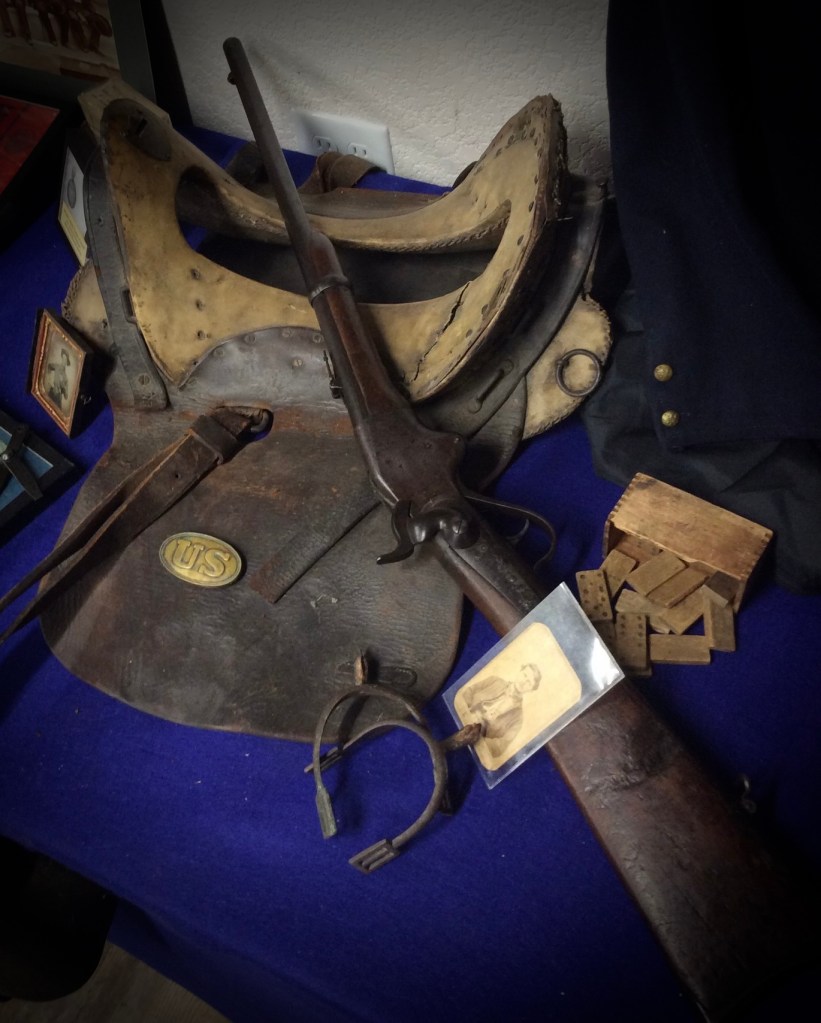
Some Wilder’s Brigade artifacts from my friend Dennis Headlee’s Collection. Most of Wilder’s Brigade were carrying Spencer Rifles like the one shown here by the spring of 1863.
16—Hurrah for our Spencer Rifles, 7 shooters. We draw rifles and new outfit. Now we will make the rebs git. They will find that we have not the old Enfield.
17—Hot. Chaplain Layton preaches a good sermon in the evening. Most all the boys attend to preaching. They all like him and respect him which is more than they ever done to any other of our chaplains.
18—Building sheds for our horses. Hot work. Finish in the evening. Have fine time at night. 72nd Indiana. Have a dance.
19—Box up our overcoats and send them to Nashville for storage until next winter by order Gen. Rosy. Making preparations for summer campaign.
20—In camp. Laying around and reading. Cleaning up our Spencers/ A number of the boys have bought Henry rifles, sixteen shooters. Scouts all have them.
21—Gayce [Gayle?] comes over to see us—Correspondent of Commercial and other papers. He was once Borgs [?] Spy—a sharp little one from the Emerald Isle.
22—Make a dash on the enemy toward Wartrace. Scouts capture two rebel colonels and a number of other prisoners. Had a sharp skirmish. Went in sight [of] reb camp and then returned to camp.
23—On duty in camp. Nothing of importance going on. Writing letters.
24—Start on scout to McMinnville. Camp at Readyville for the night. Meet some of my old chums in the 9th Indiana.
25—Pass through Woodbury. Met the rebs pickets two miles from town. Scouts have a hard fight. The pickets make a strong resistance. Scouts charge then take 12 prisoners. Bully for scouts.
26—Came back to Readyville yesterday. Camped for the night. the rebs run yesterday but we took 10 prisoners. They were Col. Breckinridge’s Mounted Infantry but they could not compete with us.
27—Arrive in camp at 4 p.m. Corn up knee high. Reading dime novels. Have nice time reading Rebel love letters—too much we’uns and you’uns.
28—Cool and raining. Finish reading [Edward] Bulwer’s Zanoni. Gen. [August] Willich, Reynolds came down to visit. Had fine times. Willich is a German.
29—Laying in camp. Plenty of peddlers around today. I buy some. Bread and pies 25 cents as price. Cheap.
30—On horse guard. Have fine chat with 11th Ohio boys about their Virginia Campaign.
31st—The last of May. A little over three months since I left home, sweet home, and all me charming Lucks O the darlints.
This month was spent in numerous fights and me still unhurt.
JUNE 1863
1—In camp on guard. Nice music by our string band last night. Went over and serenaded Col. Wilder, Gen. [George] Crook of the Virginia Brigade.
2—Inspection of horses, arms and equipments. Making preparations for a raid on some of the southern railroads. Reading novels.
3—Start out upon a scout toward Liberty. Had a skirmish with a few rebs under Gen. Wharton.
4—Col. Wilder makes his Headquarters at Liberty while we scout the country. Got after a squad of rebs and run them six or seven miles.
5—Scouting on the Lebanon Alexandria Pike. Capture 150 mules from rebs and a wagon loaded with five hundred dozen eggs, 150 of butter, and a rebel mail.
6—Went out toward Middleton, burnt a mill called Smith’s. Same hard words between the rebel girls and we’uns.
7—Start for camp at Murfreesboro. Had a successful time. Brought in a number of prisoners. Weather cool and pleasant. Flowers abundant and so sweet.
8—On guard. Reading novels. Co. has the boys planting cedars round camp. Have fine music by our string band. They go to serenade Gen. Rosy.
9—Col. Wilder trying his machine for tearing up railroad track. Witnessed by Gen. Rosecrans, Ransom, McCook, Willich.
In his diary, Col. John Beatty of the 3rd Ohio Infantry wrote that on 2 June 1863, he accompanied Rosecrans and others to witness the trial of a machine, invented by Wilder, for tearing up railroad tracks and injuring the rails in such a manner as to render them worthless. Hitherto the rebels, when they have torn up our railroads, have placed the bars crosswise on a pile of ties, set fire to the latter, and so heated and bent the rails; but by heating them again they could be easily straightened and made good. Wilder’s instrument twists them so that cannot be used again.”
10—Start am on five day’s scout. Charge through Alexandria. Scouts have a sharp fight with two hundred rebels under Capt. Ellison.
11—Scouting the country, picking up a number of bushwhackers. Co. I on picket in Alexandria. A number of good-looking ladies in the town.
12—March for Lebanon, distance 18 miles. Join part of our brigade that went by Beard’s Mill. Came to Beard’s Mill and camp.
13—Passed the house where I was paroled by John Morgan [on] November 13, 1862. The boys have a plenty of nice hams.
14—Came in camp at 2 p.m. tired and dusty. Took a good supply of beer from sutler. Over to 18th Indiana Battery to hear them play on the band.
15—On guard guarding some rebs at the Female Seminary in town. Two haughty females give me thunder for not letting them in seminary.
16—Came off guard at 8 a.m. Had a fine time on guard. Nothing of importance.
17—On vidette, as courier for Gen. Ransom’s. Lewis [?], our old chum, 26th Ohio, was over last night. We made the beer fly and danced and sung all night.
18—Thursday. Very hot. Written some letters. One to Izora Horace. Miss Sophia. Was glad to hear from them.
19—Moved camp to Stones River, five miles from Murfreesboro. Written one letter to Miss Lizzie Layton and received one also. Glad to hear from her.
20—Cleaning up camp, fixing up our bunks. A nice grove. Very hot. Down looking at the cave springs—a nice and cool place. Out grazing our horses.
21—Sunday. On guard reading Testament and other useful books. On Brigade guard.
22—Inspection of horses by Col. Wilder. Army ready for a grand move which we make soon. Boys in good spirits for a game of ball with the rebels.
23—Washing and drill in forenoon. Orders to march tomorrow with 13 days rations. Bully. We want to try our Spencers on the bloody rebs. Everything in good trim.
24—Grand advance begins—our Brigade in advance of 14th Army Corps. On the Manchester Pike. Drive in the rebs about 1 p.m. Their pickets make no resistance and we make a dashing charge and take their fortifications . Scouts drive their cavalry beyond their camps and drive out two wagons loaded with rebs out on inspection. Battle of Hoover’s Gap. The enemy with two brigades [Brig. Gen. William] Bate’s and [Brig. Gen. Bushrod] Johnson’s attacked our four regiments in three columns. They flank us but we drive them back. They charge us three times. We repulse them. Our loss in the Brigade yesterday was sixty. Our regiment lost 28 killed and wounded. We were in the hottest of the fight. I was wounded in the hand. Cannonading heavy all day. Rosey moving his troops in the Gap for a grand assault. They evacuate in the night. Gen. Rosy and Thomas give us great praise for our gallant conduct at Hoover’s Gap. [See Battle of Hoover’s Gap]
29—Reach Manchester without any resistance. Make preparations for a raid in rear of the rebels. Destination supposed to be Decherd. Start tonight. Five days rations. 100 rounds ammunition.
30—Some of our famous raid into Alabama to tear up two railroads. Captured Decherd, burn a large amount of ammunition and other stores.
JULY 1863
1—Tuesday. Lay in camp. Good & tired. Need rest. Strolling around amongst other regiments. We move camp tomorrow on some creek.
2—Move camp on a small creek. Get in camp about one hour when we receive orders from Gen. Rosy calling us back to Tullahoma.
3—Our forces pushing for Chattanooga. Bragg’s forces greatly demoralized. Awful hot. Rain in the afternoon.
4—Celebrating this glorious day by getting forage for our horses. Living well, Roads very muddy—almost impassable for wagons and artillery.
5—Laying in camp. Sutler brings a new supply of goods from Murfreesboro. Beard’s Brigade here with us. Cars soon run to Tullahoma. Nice camp is Wartrace.
6—Letters from my duck. Wants mr to come and see her when my time is up. How very delightful it would be. She’s a beautiful picture–a noble loving soul.
7—To Mary. Write letters for boys. Have fine tome. Showery. Raining most all day. Henry Haman, Harry Paulson. Sergeants reduced to ranks by order of Col. Jordan.
8—I am detailed to take horses to Murfreesboro and turn them over to convalescent pen. Roads muddy. Horse can hardly trail.
9—Back to camp 3 p.m. Find the regiment moved over Duck River to a little town called Roseville. Fine place to camp.
10—Hot day out gathering blackberries. Have a fine dinner. Glorious news from all our armies. May this unholy rebellion surrender.
11—Fixing up camp over at Col. Wilder’s Headquarters. Cleaning up guns to give to the new regiment in our brigade. I think they ought to clean them theirselves.
12—Start on a 7 days scout. 17th 123 in charge of Col. Monroe. Pass through Shelbyville, Bedford County. All Union. Splendid county. Fine faces. Camp at Lewisburg. Get horses.
13—Get to Columbia—a rebel town. On picket at night. Lieut. Hayden, Sergt. Birney of scouts take company out to Polk’s estate for fine horses. He is trying to run them south.
14—Got $40 worth of stock off toward Centerville, turn out my old mare and take a beautiful sorrel. Glass eyes. Call him Gen. Bill Lucius Polk.
15—Polk’s, Pillow’s estates are beautiful like the cultivated parks of England. Skirmish near Centerville by the scouts.
16—Still morning. Got a large number horses. Private Steward, Co. H, killed by bushwhackers. Passed through Connellsville, Eagleville. Camped at Petersburg.
17—Came to a small town by the name of Richmond where rebel Col. Smith lives. Turned a Union man. Was a scout with us and acted as guide.
18—Came to Shelbyville, thence to camp. We captured over one thousand fine horses and quite a number of prisoners.
19—Laying in camp. Resting ourselves. I like my charger, Billy Lucius, first rate. He is worth $500 at home. During our raid we captured the famous horse Commodore belonging to John Boots, a Union man in Virginia.
20—Miserably hot. cars now running to Tullahoma. On courier post at General Rosecrans’ Headquarters. S. Laird, chief of couriers. Fine to see currier. Get up all times in the night and pack dispatches.
21—Still on currier line. Have a fine hotel in Tullahoma. Plenty of papers to read. Rosy makes his headquarters to Winchester tomorrow. Then I go to camp.
22—Came to camp at 2 p.m. One of the teamster’s teams run off, killed mules, came near running over me. Chase promoted a corporal. Reading in Harper’s.
23—Laying in camp. Reading. Rosecrans campaign with the 14th Army Corps. A very interesting book. Corp. Daniel O’Brian back. He was taken prisoner while on the Columbia scout.
24—Still in camp. Out grassing our horses. A lot of Company H boys arrested for stealing while on the Columbia scout. Col. Jordan found in a hat laying at his tent one gold watch $250 in gold.
25—Still in camp. Waiting for pay. Signed pay roll today. The fellow that laid the money and watch at Colonel’s tent must of been afraid of being caught with it.
26—Hurrah for pay day. I received $65 and the sutler twenty dollars. Pretty steep. Chase and me talk about pieces in Byron. Received no letters. March tomorrow.
27—Strike tents. March at 5 o’clock a.m. for Decherd. Pass through Tullahoma. Would like to see the 93rd Ohio but had not time. Get to our division and camp.
28—Sent to Uncle J. A. Bolens the sum $17. Over looking at the large springs near Decherd—a beautiful place. Good time with the boys. Enjoying myself.
29—Down in the tremendous town of Decherd. Great talk of Wilder’s Brigade—the brag boys of the Army of the Cumberland. Talk about our raid we made on Decherd while rebs were at Tullahoma.
30—Laying in camp. Policing camp. Some of the boys have more old bourbon than they can digest. A letter from Izara.
31—On guard. Guarding prisoners at guard house. Lieut. Buttermilk, Wagoner officer of the guard. He is a case of buttermilk and old woman. Jolly time.
AUGUST 1863
1—Saturday, Pleasant day. Lying in camp. Shoeing our horses and fixing ready for any emergency.Received a letter from Liza Layton. Glad to hear from her.
2—Fine time with our Chaplain—Lafety Layton. Drs. Kemper and Larkins. Inspection at 9 o’clock a.m. of clothing, arms, and exquipments. Nice day.
3—Laying in camp. Took horses out to grass on rebel Captain Wagner’s Plantation. Have a chat with his daughters.
4—Corporal [Cyrus P.] Wick returns to company from Murfreesboro, well of his wounds. Reading papers. Telescope Press, Harper’s Weekly. Our grazing my horse.
5—Went to Decherd. Had a fine time. Get some photographs taken. Sergt. [Lafayette] Carnes and [William H.] Thompson go along with me. Went to 42nd Indiana Regiment.
6—Writing letters to my ducks and to Miss Angeline, Marysville, Ohio. One to Uncle J. A. Bolens, and one to sister Mary.
7—Reading. Delightful. Col. Wilder returns from home. Boys cheer him glad of his return. May God bless him and keep him with us always.
8—Company F on a drunk. Most half of company drunk. Lieut. Hayden scolds. Orders them to guard house and takes three bottles of whiskey from them. Breaks them in front of company at roll call. Says he will court martial all that get drunk.
9—Company all sober this morning. Went out to grass our horses. My famous charger Billy Lucius polk throwed himself and strained his hip. Noble steed.
10—Our advance begins tomorrow. Negley’s Division starts for Stevenson, Alabama. Doctoring my famous charger, General Billy Lucius Polk. I fear he is gone up.
11—Send two of my pictures to Izara and two to Janis P. Henkler. Give one to Frank Sullivan. Cousin from 75th Indiana comes to see me. On fatigue.
12—Very hot day—the warmest day I have felt in Dixie’s sunny clime. Reading Independent lying in the shade. Written one letter to Horace.
13—Awful hot day. Down in town. Bought some notions. Reading papers—Journal, Nashville Union, Harper’s Illustrated. On guard in the evening.
14—Inspection of horses and equipments, saddles at 10 o’clock a.m. by order Co. Wilder. On fatigue building fence to pool convalescent horses in.
15—Marching orders—ready to march at 7 o’clock tomorrow, Written one letter to my duck—beautiful Jennie, me heart’s delight.
16—Strike tents. March at 8 o’clock for Chattanooga, distance 40 miles. Camp on top of the mountain. A beautiful view of the country. Can see 30 miles the ridges where Tullahoma lays.
17—Marched at 6 a.m. camped for the night at Tracy City—a small town up on the Cumberland Mountains noted for its beautiful coal mines. People mostly secesh.
18—Traveling up and down the steep mountains. Camped in a valley between the lofty mountains. Had a splendid supper—roasting ears, potatoes, & hard tack.
19—Came down the mountain over an awful road, it being so steep we dismounted and walked down. Camped in Sequatchie Valley near Dunlap. Scouts had a small fight today. Killed some and took prisoners.
20—Left Dunlop for Chattanooga, distance 29 miles. Crossed Walden’s Ridge sixteen miles from one foot to the other foot. Met no opposition. See no rebs today.
21—Up at 5 o’clock for a dash on Chattanooga. We went a flying for Chattanooga. Reached the river in sight of town and commenced shelling them.
22—Our scouts gobbled up their pickets nicely yesterday. The rebs think hard of our brigade—especially Col. Wilder for shelling them in time of fasting and prayer, it being Jeff Davis’s Thanksgiving Day.
23—Down shelling Chattanooga. Had a fine time shooting across the river with our Spencers. Make the rebs skedaddle. I learn we killed two women and wounded some while we were shelling the rebs on Thanksgiving day. Bad affair.
24—On scouting expedition up the river at North Chickamauga Ford. Scouts fire into a boat full of rebs. They all jumped out and took for the shore.
25—Out after forage. Peaches and apples. Have a fine talk with Mrs. Williams down at Williams’ Island, 7 miles from Chattanooga. Fine lady. See rebs across the river.
26—Cool morning. Strolling around the country in forenoon. Cleaning up camp. Have a fine dinner. Peach cobbler. Go on picket tomorrow.
27—Down bombarding town. Several rebs swam the river last night and came to our pickets. We go over this evening at Colwell’s Ferry.
28—Came off picket 2 p.m. Went after forage. Mail came in. Letters from my ducks. Have fine sermon in evening by Chaplain [Lafety] Layton.
29—Laying in camp. Sergt. [Lafayette] Carnes builds a log house for himself and Seabolt up on the lookout looking at Chattanooga. Can see rebs moving around.
30—Sutler comes up. I buy a lot of paper and envelopes, a portfolio, one plug tobacco. Written several letters to the dear ones at home.
31—Went for forage. Wash my clothing. Reading Ledger, Independent, and rebel papers. Pass time finely. Plenty to eat. Living on peaches.
Have done all duty this month and not much fighting.
SEPTEMBER 1863
1—Tuesday. On picket. Talk with rebs across the river. Good time. I take three men and picket cross the North Chickamauga. Nothing of importance occurred during the night.
2—Came off picket. Came in camp. Down at Chattanooga, up in arms. Supposition that the rebs are making demonstrations to cross the river. Let ’em come. We will give them a dose of Spencers.
3—Out after forage. Get an abundance of peaches. The Tennessee Valley is lined with peaches—thousands of bushels. A plentiful country.
4—On picket at Becks Ford, seven miles above Chattanooga near the mouth of North Chickamauga. Rebs keep moving, We picket right under their guns.
Privates Thomas L. Charles & James A Harrison (right), of Co. A, 17th Indiana Infantry (early war image)
5—Still on picket. Hazen’s Brigade comes where we are on picket with a lot of bugles and drums and four guns. They made a big fuss and scared the rebs. They suppose we have a big force here.
6—Rebs badly scared last night. They outened all their picket fires on the other side of the river. They throw a few shells at us this morning. Hazen replied.
7—On picket. Hazen’s Brigade go to their camp 12 miles back on the mountain. See some handsome ladies. Have a fine chat with them. People mostly Union around here.
8—Down bombarding Chattanooga. Find the place evacuated at night. 92nd Illinois of Wilder’s Brigade the first in town. The rebs cut their [ ].
9—Move camp up to Beck’s Ford and ready to cross the river in the morning. Have a fine supper. Reveille at 4 o’clock.
10—Cross the river, pull our wagons up by hand, the river bank being so steep. The brigade all across by 1 o’clock. Go about fifteen miles. Drive in rebel pickets. Skirmishing all day.
11—Our brigade captured Ringgold, Georgia. After a sharp fight, the rebs retreat in direction of Tunnel Hill burning all the railroad bridges. Camp near Tunnel Hill for the night.
12—Retreat back to Ringgold. Co. F attacked the rebs 5 miles from Ringgold at Rock Spring. Our scouts surrounded. They cut their way out. We charge the rebs horseback.
13—[Jackson] Denny of our company wounded yesterday. Sergeant [Lafayette] Carnes, Golland, [William] Black killed. The rebs gave us a hard fight but could not budge our Spencer rifles. I stood in the hottest of the fight. I never had cannon and small balls to fly round me so fast.
14—Join our division at 10 p.m. Boys very tired and want rest. We have been fighting and skirmishing for the last ten days. Wilder’s boys are the chaps to do it.
15—Laying in camp today. Charles Anders of the 18th Kentucky visits us. I would like to see my Uncle King in the 75th Indiana but am too tired to go there.
16—Laying in camp. Report that Negley’s Division of our Corps had a fight at Dugout Gap—a gap in the Pigeon Mountains ten miles from Lafayette, Georgia.
17—Move camp near Gordon’s Mills. Passed rosy’s Headquarters. Passed Woods’ Division. They cheer us. There is nothing like Wilder’s Brigade. Meet the old 26th Ohio—our old chums.
18—Lay along the Chickamauga until 3 p.m. Move camp farther up to Alexander’s Bridge. The enemy heavy in our front. A battle expected soon.
Page from Boler’s Diary describing Battle of Chickamauga
BATTLE OF CHICKAMAUGA
19—The rebs attack us at 11 a.m. Had a battle with them all day. We hold up Bragg’s army from crossing the bridge. They shell us—Co. F especially, facing the bridge—terribly. We stand our ground. Minty being driven back, Wilder returned to the hills.
20—General engagement. Great Battle of Chickamauga. As the battle rages terribly, we hold our line. It appears that neither side claim advantage. Many old and trusty regiments fail in the terrible fire. Wilder used his men well in action.
21—Things look murky. The great battle opens at 7 o’clock a.m. This morning wet throw up a breastwork and lay behind it but they dare not run on our terrible Spencers.
22—We made one of the most terrific charges yesterday on record and turned Longstreet’s right wing and routed his forces after Sheridan was thrown back in confusion. Our brigade came near being captured. We were cut off from army.
23—Crossed the river and went to Beck’s Ford. Building breastworks and planting masked guns for fear should the rebs try to cross the river. Pleasant day.
Capt. Eli Lilly
24—Lay in camp at ford seven miles above Chattanooga. Reading papers. Went with Capt. Lilly on scout to plant guns across Chickamauga.
25—Went as escort for Col. Wilder to Stevenson [Alabama], he being sick and going home on furlough. Arrived at Stevenson 8 at night. Rode 67 miles today—the fastest ride I ever made in one day. Company on picket.
26—Lay in Stevenson until ten a.m. Start for camp. Horse gives out. Camp five miles from Hasper on the Anderson Road. Met Bob Burns, a deserter from our regiment. Belongs to [ ].
27—March at sun up. Stop at an old Union mans house and eat dinner with him. Minor impression at Knoxville of his Union sentiments.
28—Camped at the foot of Walden’s Ridge last night with a division train. Started for camp at day light with Lieut. Col. 24th illinois. Got to camp at 2 p.m.
29—March this morning for Blythe’s Ferry, 40 miles above Chattanooga. On picket at Ferry at night. The Miserable [Minty’s] cavalry let Wheeler across last night.
30—Raining very hard this morning. Marching orders after Wheeler on account of Minty’s unreliable cavalry letting them cross.
OCTOBER 1863
1—On the march with the regiment. Our brigade crosses the Cumberland Mountains after the rebs on the McMinnville Pike. Crossed Walden’s Ridge. Col. [Abram] Miller in command of the brigade.
2—Went through Sequatchie Valley to the top of the mountain on the other side. A hard days ride. Came in camp about midnight.
3—Up at 3 o’clock. get down the mountain. Have a sharp fight at Thompson’s C___ at 2 p.m. Whip out [Maj. Gen. John Austin] Wharton’s reb division. Fight after fight, charge them out of woods.
4—Sunday. Drove them two miles from McMinnville. Our brigade, 17th, right in front. we killed and wounded a good many last night in Hocker’s rebel brigade. May God be propitious to us on this His hold day.
5—May God bless and prosper our arms. Sharp skirmishing. Get into Murfreesboro at dark. Find a number of troops here. Rebs have been in sight of town. Capt. [John R.] Fiscus calls on us. 2nd Kentucky Cavalry makes a fine saber charge. Routs the rebs for seven miles.
6—Get rations. Capt. gives us coffee. Bully. We move off toward Shelbyville. Roads are in good condition. Through Shelbyville toward Columbia. Rebs robbed and stole everything.
7—Came up on the rebs a few miles from town and charge savagely—17th in front. Rebs fight sharply. We dismount and in the hearty forward of Major [William Theophilus] Jones, sends us cracking along. We flank them. Put them to utter rout. I shot two rebs and do not know how many more. It soon becomes a rout—each man takes to the woods and fields for himself, throw away their guns. George Shannon killed by my side. Lieut. Hayden severely wounded. Our loss getting heavy. We fight Wheeler’s whole force. Our brigade makes a dozen charges. Co. F, G, & D charges a battery. Captures three guns. We shall take a number of prisoners suffer for wearing our uniform. They were going to fool the Yankees by wearing our blue but it was a sad trick for many of them. Sergeant Kelcher wounded as night closes the scene.
11—Pleasant day. Heaven helped us safely and successfully through it. Rebs fled precipitately toward the river. We came up on their rear at the pretty town of Pulski.
12—Cavalry get scared we were in the rear and ordered to the front. Delpoy as skirmishers. we get in sight of town. The rebs get scared and run away.
13—Pleasant day. So stupid is cavalry. They seem to think they are not enlisted for fighting but brave when out of danger. Wilder’s [Brigade] done all the fighting and deserves all the praise.
14th—Clear day. Hear of Roddy after him this morning. Run Forrest across the [Duck] river yesterday. If our cavalry had any fight about them, we would have captured him.
15—Marched in camp within 10 miles of Winchester. Ordered back to Flint river, Alabama. Camp for night. Stay at Salem—a little old village where Gen. [Robert Latimer] McCook was killed.
16—From Salem to New Market, Alabama. 17th to burnt bridge on Flint river. M. C. Railroad burnt by Roddy so we are in camp for the present. Glad enough to rest. Raining and muddy.
17—Laying in camp reading Byron. Glad enough to get a day’s rest. Pleasant day. Received no mail since October 1st. Would be glad to hear from the dear ones at home.
18—Little pleasant. Beautiful country. Foraging. Living on flapjacks. Only 7 months, then for home, peace, and comfort, for loved ones. God bless them.
19—Tuesday. I go with a squad up to Paint Rock Bridge [near Woodville, Alabama] for rations, Maj. Lucas of 98th [Illinois] in charge. Leave and start back. eat honey and hard tacks—the first bread for 15 days.
20—March in camp. Very rainy. Dr. [Samuel E.] Monford with wagons from Stevenson. Grant assumes command of the whole western department. Our company on picket. I stay in camp until morning.
21—Still on picket. [David H.] Chase about to write an article on our pursuit after Wheeler raid. He will do something at an early day request, my guess.
22—Miserably cold and raining. Off at noon on scout. It rains all day. Camp at Huntsville. Have a splendid fire. Get dry and warm. Plenty of flour. No mails.
23—Saturday. March and camp at Athens, Alabama at 3 p.m. Cold and muddy. Have a good supper. The winter of our discontent vanishes. Thus be our hearts forever bright.
24—Weather more mild. Reveille at 3:30 a.m.. Took breakfast. Feel well. Heaven send a happy and prosperous day and strength and spirit for any emergency.
25—Went to Triana—a little and rebellious village. Rebs on the other side of the river. Our squad of ten encountered 30 who run and did not fight. They fled to the mountains. Returned to Huntsville and camp.
26—Cloudy but pleasant. From Huntsville to camp near Maysville. Met Miss Hewett, a southern authoress. Lives in a brick [house] pained white near our camp. Beautiful Huntsville. Nice looking people.
27—Reading Burns’ poems. Moving camp across Flint river. Had a very comfortable day. Mail comes in. Receive a letter from Sophia.
Butler’s Hudibras
28—Reading Butler’s Hudibras. Find it smart and witty. Nothing of importance today. Fixing up camp. Pleasant day. Have a good time.
29—In camp. Our wagons arrive at last from [ ] Creek. Hudibras quite funny. My health good. Glad to see boys with wagons. No mail today.
30—Hurrah for mail. Receive a letter from Lizzie Dayton. extremely glad to hear from Lizza. Reading papers—Commercial, Press, and Independent.
31—Cold and raining. Cut a big beech and have a rousing fire. Finish reading Hudibras—a mart book. Full of fun. Sutler comes up again. I lay in a good supply of paper and envelopes.
We received accounts of the battle. Our loss at Chickamauga battle in the paper is estimated at 16,000 killed & wounded. The enemy’s must be greater.
Our loss in Farmington Battle. Regiment loss, killed three, wounded 38. Brigade loss, killed 9, wounded 150.
NOVEMBER 1863
1—Went out with forage train. Brought in a hog. Went near Huntsville. Sutler received some new goods. It will be a caution the way the dimes will fly.
2—In camp. wrote one letter to [ ]. Talk of being paid off soon. Talk to Chase about writing a history of the 17th Indiana Mounted Infantry. No mail.
3—Written two letters, one to Miss Sophia and one to Miss Lizzie Dayton. Warm and pleasant day. Reading Lord Byron’s Poetry of Works.
4—Written one letter to Miss Jennie Langaster, Martin county, Indiana. On guard at forage pile. Have a fine chat with Chase. Warm and pleasant day. Sutler has new goods.
5—Written one letter to Mr. James B. Henkle. Warm and pleasant day. Nothing of importance going on in camp. Sergt. [Lafayette] Carnes goes home to recruit for Co. F.
6—Commenced building our winter quarters. Run out of lumber and quit work. Hauled one load of brick in the afternoon to build our chimney.
7—Written one letter to my copper nut friend on the war. Fine and pleasant day. Reading in the Independent—a religious paper, Henry Ward preacher’s organ. No mail tonight.
8—Went out with forage train after corn. Loaded all the wagons in the brigade but our regiment. Gathered out of the field near bell factory. Came in camp late.
9—Written several letters—one for Harper’s Weekly four months. one for Portrait monthly, three numbers sent to Cincinnati for two letter writers.
10—Written one letter to Indianapolis for the Journal for six months. One also to J. G. Packard for Silver Company. Been chopping wood for fireplace.
11—Written a peck of letters today—one to Izara and to Horace, one to J. B. Henkle, one to J. A. Boens for postage stamps. Chase out with foraging train.
12—Maj. Gen. Sherman’s Corps passes us on its way to Chattanooga. A fine-looking body of troops. Chaplain preached a good sermon in the evening.
Charles Harvey, Co. F, 17th Indiana Mounted Infantry
13—On guard acting [ ] corporal. Raining all night. Seabolt, [Samuel] Faucett, [Charles] Harvey and bunk mate ]Michael] Woolf gone to the river to destroy some rebel flat boats.
14—Ousterhout’s Division of Sherman’s Corps passes on it way to Stevenson. Camped all night near our camp. Written one letter to Izara. Received one also.
15—Sent by Dr. Monford, our regimental surgeon, thirty dollars addressed to J. A. Bolens. West [ ]. On guard. Weather cool and clear.
16—Came off guard at eight o’clock. Chase writing documents related to our gallant conduct at the terrible Battle of Chickamauga. SEnt it to Commercial for publication.
17—Again on guard at forage pie. Harvey, Woolf, and Chase return from expedition on the Tennessee River. Wagon train gone to Painted Rock for provisions, stance 14 miles.
18—Came off guard. Received marching orders in the evening to be ready to march in an hour. Countermanded until four in the morning.
19—Regiment started out for Chattanooga, distance one hundred miles, with Col. Long’s Brigade to make a raid in rear of the enemy. Destination supposed to be Cleveland.
20—On guard. Drizzling rain. Received a letter from sister Mary. Written one to Uncle Eugene. Reading a book called Gleanings of Poets—a book for every man to have.
21—Rise very late this morning. Rained very hard all night. Our shanty leaked very badly. On fatigue duty taking mules to convalescent pen brigade headquarters.
22—News that we march tomorrow. Report came in camp that the 72nd had a fight at the Tennessee River. Written one letter to Mary. Reading Tribune and a few poems.
23—News from the regiment. Elijah Conely returned from Stevenson. Regiment on its way to Chattanooga. On horse guard. Corp. [Cyrus] Wick returned from Stevenson.
24—Out with forage train. Raining all day. Went in the direction of Meridianville [Alabama] 12 miles from camp. Came in at sun down. No hogs.
25—Marching orders move camp at 6 a.m. for the beautiful town of Huntsville. Hear cannon in the direction of Tennessee river. Camped on the Fayetteville Pike.
26—On mounted patrol duty around camp. Orders to arrest any man that is doing mischief. Went on picket in the evening on the Triana Road 1.5 miles from camp. No mails today.
27—Came in camp in the morning. Had a fine chat with a Southern lady. Took breakfast with her. Received a letter from Lizza Layton. One also from J. B. Henkle.
28—Out with forage train. Raining all day. Built a board shany in the afternoon. Got corn. A Burns Plantation five mules from Huntsville. Bought 25 cents worth corn bread from the darkies.
29—On fatigue duty hauling brick for Headquarters to build chimneys. Got through hauling at noon. reading Telescope in afternoon and testament. No mail today.
30—On fatigue with forage train. went out towards Whitesboro. Finished building fire place to my tent or shanty as the case may be.
DECEMBER 1863
1—On fatigue duty hauling logs to build Major Jones a log cabin. Mail came in today. Received some papers and company pin from New York! Clear and cold.
2—Out with headquarter wagons for forage. A mail came in this evening. Received one from beautiful Jennie. Went up to hear [41 year-old Stephen] Dennis [Principle Musician in Co. K] play on the flute in the evening.
3—Written one letter to charming Jennie Loogootee. Went to town after lumber. Reading Willdean—a ghost story. Had a jolly time with Jo March and Nick.
4—Out with division headquarter train after forage. Sullivan West gone to Nashville with wagon train after our overcoats we left last spring.
5—On duty at headquarters papering Major Jones’ house. Drawed some clothing. Drawed some new drums. Now we will have plenty of music. Received a letter from charming Sophia of E.
6—Taken from Chase’ diary. Started for Knoxville with 11th, 12th, 14th Army Corps. Camp at Vleveland. See our wounded boys in hospital.
7—Camp at Benton on Hiawasee river. Capture 800 hogs and a lot of prisoners. Have to march to Charleston. Not able to cross the river.
8—Detailed back to Charleston. Guard bridge. Had a gard ride to Athens last night. Camp at Athens. Fine place. Plenty to eat.
9—Report of Wheeler coming this morning. A grand scare. We march to Sweetwater. Capt. Wade in command, 98th Illinois.
10—Get up in morning. Find my [ ] gone. Foot it to Loudon. Camp for the night. 28 miles from Knoxville.
11—Cross Little Tennessee river at Louisville. Regiments bound for Knoxville good. Some skirmish. Beautiful country is East Tennessee.
12—In camp at Louisville. I go with message to Gen. Howard. Fine specimen. Treat us well. All Union Bully for Wilder’s Brigade.
13—March at 5 a.m Camp at Morgantown. Longstreet runs. Army marching back as there is nothing for them to do. See Gen. Morgan & Smith.
14—Camp near Madisonville. See Gens. Blair, Ewing, Sherman. Fine looking men. One thing, the women all chew tobacco. Bad.
15—Near Tellico Plains. Camp for the night. Warmer. Having fine times. All goes pleasant.
16—In camp. Scouring the country. Some of the regiment go into North Carolina. State line 16 miles from Tellico Plains. Smith’s division laying here. Sherman.
17—Detail on scout. Two miles to rebel Iron Works. Bear skins plenty. Had a good dinner at Dr. steins. Back to camp.
18—Start toward Charleston. Camp on Swanee river. Good times. 3rd Regulars with us. Having fine times.
19—March to Charleston. Call on Miss Aikens. Have fine chat. Beautiful lady. Brigade go in camp at Charleston.
20—Sunday. Lord bless us and keep us all. Pour His benefactions upon all and the dear ones at home in the great and glorious North,
21—Leave regiment. Start for Chattanooga. Camp at Elk Fork. Have fine chat with ladies. Reach Chattanooga tomorrow.
22—Reach Chattanooga. Start for Stevenson. Want to get up with division soon for Huntsville tomorrow. Boys get little drunk.
23—Reach Huntsville, Alabama. Have fine time with my Southern duck, Miss Ann Williams. Fine young lady. Well educated. Came to camp 11 o’clock.
24—Marching orders tomorrow for Athens. Have fine time with Miss Jordan also.
25—Christmas. Cold and dreary. Five miles from Athens. Have hard tack for dinner. Bully for me.
26—March and camp on Elk River near Elkton. Rain during the night. Have fine time with friend Chase. All’s right.
27—Camp Pulaski. Have plenty fresh hog and parrolets [?]. Dodger. Rains all day. 81st Ohio here.
28—In camp. Very cold. Down in town in afternoon. See some of the 81st Ohio. Col. Martin’s regiment 7th Pennsylvania.
29—Out with forage train. Get forage 3 miles from camp. Raining, disagreeable weather. Chase gone to town.
30—On guard at forage pile. Cold and disagreeable. Reading papers.
31—Last day of the old year. A hard time, Have fought on many a hard field, 17th enlisting as veterans. Goodbye. Long will I remember some of my days.
JANUARY 1864
January 1, 1864—New Year’s Day. Close to town. Had a fine dinner. A Col. Jones make a stirring speech for veterans. We have beans and hard tack. Excellent.
2—In camp. A large number of the regiment enlist as veterans. I no go as veteran. $400 is no inducement for me. I go in [ ].
3—In camp reading. Col. Wilder came up last night. Made a fine speech. Boys glad to see the old chap.
4—In camp. Rained very hard last night. Return bounty raised to 500. I may go in yet. Regiment starts for Indiana tomorrow. Most all boys go.
5—Enlisted as a veteran yesterday. Start for Columbia. On our way to old Indiana. Camp for the night at D. Plain five miles from Columbia.
6—Rose at 4 a.m. March for Columbia. Pass through the camp at Spring Hill. See the house where Van Dorn was killed. Take cars tomorrow for Nashville.
7—Start for Nashville. Have a hard time. Get there at 12 midnight. Very cold. Came near freezing.
8—Stay in a large seminary, veteran headquarters. Boys on a tremendous drunk, fight with provost.
9—Down in the city, Had fine time. Buy some photographs of our generals. Boys go to the theatre.
10—Laying in barracks reading, writing. Sent one letter to charming Jennie of Lancaster. Happy was the house when first I beheld she.
Miss Maggie Mitchell
11—Sunday in barracks reading. Some of boys go to church. 7th Iowa came last night.
12—To town. Have fine times. Down to theatres in evening. Miss Maggie Mitchell principal actress. Most excellent. Beautiful.
13—Help make out re-enlistment papers for re-enlistment. Down in the evening to old theatre. Miss Matilda Heron, actress. Very poor.
14—Received a letter from beautiful Jennie. One also from charming Sophia. Reading poem Two Millions by William Alen Butler, a fine work. Down to theatre. The Pet of the Petticoats [with] Maggie Mitchell.
15—Strolling round town. Buy some paper, envelopes, Boys anxious to get home. Tired of staying here. One had fight at Calhoun’s.
16—Report of another fight with Wheeler. Whip him bad….
17—In barracks reading. Making out muster rolls. Down to theatre. Maggie Mitchell.
18—Regiment returns from Knoxville. On fatigue. Take horses up to oen. Down to theatre, Fanchon the Cricket.
19—Talk of regiment going tomorrow. Would be glad to go home. Hurrah for 17th. Have a mass with 19th Michigan.
20—In quarters. Help make out muster rolls. Down to theatre in evening. Miss Maggie Mitchell.
21—In barracks. Help make out rolls, Muster in afternoon. Col. Wilder returned from Indiana.
22—Finish making out our pay rolls. Have orders to march tomorrow for Evansville, Indiana. Theatre in evening. Last appearance of Maggie Michell.
23—Start for Evansville on the first steamer Havana at 5 in the evening. Have pleasant trip. Fine sight to look at the silver ripples. Beautiful night.
24—Stop at [ ]. River full of ice. Hard on the boat.
25—Arrive at Evansville, Indiana. Grand reception of 17th. Have a fine time. Detailed for duty in afternoon. Start for Indianapolis at 10 o’clock. Boys drunk and me sober.
26—Arrive in the city 10 a.m. Grand reception of 17th. 20 thousand present. Great enthusiasm by the people. Speeches by Gov. Morton, Gen. Wilder, Harry Armstrong.
27—Quarter in the Masonic Hall, one of the finest buildings in the ciy. Boys anxious to get home. All goes pleasantly.
28—Running around the city. Making myself famous among the civilians. Help make out furloughs in the afternoon for captain.
29—On guard. At Hall. Anxious to get home to see the loved ones. Buy a new uniform in afternoon $60 at people’s store.
30—Start for home this evening. Received our pay $200.15. Boys are drunk. Me sober as usual.
31—Did not get my furlough yesterday and must lay over today. Go to church. A fine sermon. Stay at Bates House. $3.50 per day.
This has been a glorious month. The cause of me enlisting after all the trials and hardships I have seen. The hero of 30 battles.
FEBRUARY 1864
1—Arrive at home, safe and sound. Greeted by my friends. Well pleased with them. One butternut friend of mine says I am fighting for the Blacks. All right if so.
2—Rise early. Had a pleasant dream. I got to see the long cherished object of my affections this afternoon. (good indeed).
3—Lazing in the store telling my exploits of soldier life. Interesting indeed (have an inclination of going out to see some of the feminine sex. I am rather backward.
4—Running with my friends. Spend the evening at a social party at Dr. Protzinger’s. Enjoying myself very well. Pleasant time.
5—All right this morning. Feel exceedingly well over my time I had last night.
6—Loitering around town having a good time. All goes pleasantly.
7—Running around town. Having a good time in general. Had fine time with Hainse.
8—Made my first advance among the [ ] Read Hardee’s Tactics (advanced cautiously).
Sgt. William H. Thompson of Co, F, 17th Indiana Mounted Infantry. In this earlier view Thompson wears an early state blue uniform with cloth epaulettes and gray dress hat. He sports a canteen and carries an Enfield rifle.
I could not find an image of Edwin but here is an unidentified trooper from the 12th New York Cavalry. This unit was armed with M1840 Heavy Cavalry swords, .44 Remington and Colt revolvers and Burnside carbines, for the most part.
The following letters were written by Edwin Thomas Scott (1837-1921), the son of David Wetherell Scott (1806-1854) and Lodensy Veronica Butterfield (1817-1870) of Cuba, Allegany county, New York. Edwin wrote all of these letters to his wife, Celora (“Lola”) M. (Stebbins) Scott (1845-1915) of Richburg, New York. After marrying Celora in the summer of 1862, Edwin enlisted in November as the commissary sergeant in Co. E, 12th New York Cavalry. He was later transferred to Co. C and survived the war, mustering out at Raleigh in July 1865. According to his enlistment records, Edwin stood five feet 7 inches tall, and he had light hair and blue eyes.
Celora was the daughter of John Stebbins (1807-1855) and Electa A. Clark (1813-1880). Celora’s brother, mentioned as “Henry” or “Hank” throughout these letters, was William Henry Stebbins (1839-1864) of Wirt, Allegany county, New York. William enlisted in August 1861 as a private in Co. C, 85th New York Infantry. He was taken a prisoner on 20 April 1864 at Plymouth, North Carolina and died of dysentery as a POW at Andersonville on 18 June 1864.
Edwin and Lola’s first child is also frequently mentioned. Her name was Lucille (“Lucy”) Lynn Scott (1863-1933). She was born on 21 September 1863.
Although I have written to you two times before this, I have not received a word from you yet. We moved from camp New Dorp yesterday and are now in sight of the great City of New York—also Brooklyn and Jersey City. I am so afraid my letters do not reach you, I do not know what to do, but I must wait and hope that you got through safe, that you are well, and that I may hear from you soon. I will not write much today as we are very busy fixing up our new quarters. When I hear from you I will write more fully. I have written to the following persons since I came over on this island; viz—Charles T. Scott, Wm. McK., Madame Lodensy, and Emma, Cora L. V., and Lola M. (this makes the third) and haven’t received a single letter yet. Stevens is over to the city today after some lime to whitewash our barracks and the other boys are making a sergeant’s room at one end. Write immediately on receipt of this. I send you a thousand kisses and hope you are well and safe. In haste. Your affectionate husband — [Ed]
To Lola.
[Direct to Sergt. E. T. Scott, Camp Washington, Staten Island, New York, 3rd Ira Harris Cavalry, Co. C
Letter 2
Camp Washington Staten Island, New York January 15th 1863
My dear Lola,
I went safely back to Crooks after leaving you on the cars, but could not go to bed—it was so lonely there—so I paid my our bill and went to Baker’s and stayed till this morning and came to the Island this morning on the 8 o’clock boat. My cough is a little better this morning but I did not sleep much thinking all the time you would be sick or meet with some accident. Oh how I wish I could know this morning how you are and whether you arrived at Cuba all right. But I must wait till Saturday and perhaps longer, nut I hope not. Oh how I wish I could look the entire length of that long winding Erie Railway & see how you succeeded in the journey. I will not try to write much this time but all I can do is to wait and hope. You will probably receive his Saturday and I will write you a full long letter next Sunday.
Give my love to Mother and Emma and all our Uncles, Aunts, and Cousins. Now write me a good long letter Sunday, and if you are not well enough, get Emma to write for you. You know how lonesome I get without a letter. I shall write to mother in a few days. Give my respects to all and excuse this bad writing as I have a severe headache. Your affectionate, — Ed
Letter 3
Headquarters 12th NYV Cavalry 4th Ira Harris Guard Camp Washington, L. I., N. Y. April 12th 1863
My dear Lola,
I did not receive a letter from you last evening as I expected but will write you a few lines today and perhaps tomorrow’s mail will bring me a word from the dear ones at home. I wrote you last Sunday and enclosed a few lines to Mother and Emma which I hope you have received before this, I received a line from Uncle Abel day before yesterday and one from you Tuesday which was written last Sunday. I wrote you one week ago Wednesday which I have not heard of yet. So that is two letters you must have received since you wrote last Sunday.
The weather has decidedly improved & is now very warm & pleasant. There is no news concerning the regiment and I don’t think anyone knows when we shall move or where to. Lieut. Stevens is still here awaiting orders. My health has been very good and I am getting fat. I was over to New York last Monday and stayed at Crook’s all night. Mr. Ludden & son William got belated & remained in the city the same night & at some place. They live in Flushing but are to move back to Brooklyn where they formerly lived when Cora lived with them on the 1st of next month (May). Mr. Ludden sent his best respects to Mother and Emma & so did William. Tell Emma [that] Mr. Ludden said his little girls have grown to be big girls & the little one was so fat she could not walk yet. Mr. Ludden is doing quite well in business and is as strong a spiritualist—tell Mother—as ever. Write me immediately, my dear, on receipt of this. I am very anxious to know if you got my last. I am going to send you some money soon as I get some.
There is no sign of pay yet but when it does come, there will be the more of it.
We have quite a band now in our regiment which makes it more pleasant as we have music twice every day. There is a call for some one to go on patrol in our company so I suppose I must stop for the present, but I will finish and send this tomorrow morning.
Monday morning, April 13th. My dear bride, it is a little cooler this morning—just enough so to make a little fire comfortable. And as we have all been to breakfast, will write you a few more lines before ending this. Lieut. Stevens is going over to New York today but I can’t go today as I have other business on hand. I have not heard a word from our brother Henry. If you have, write me where he was and how he gets along.
I am getting very tired of remaining here in this old dirty camp & would much rather be on the way South before it gets to be such terrible hot weather. Send your Mother & Carrie my best wishes when you write. Tell Mother I expect a letter from her and Emma this morning and shall wait till the mail comes in before I send this as I may hear from you all. I have got the letter sure enough and now will close this by bidding you all goodbye. Your affectionate, — Ed
Letter 4
Headquarters 12th N. Y. V. Cavalry 2rd Ira Harris Guard Camp Washington Staten Island [New York] May 24th 1863
My dear Lola,
I received a letter from Henry day before yesterday. He is well & the 85th is at Falmouth, North Carolina. I expect to see him if we go to Newbern. We are not on the move yet though I thought last Friday when I wrote you we should all be aboard transports by today. We have not received pay yet but expect it every day.
I had a letter from Stevens yesterday. He was at Washington. He has the appointment of Major in the Andrew Johnson Cavalry of Tennessee and expects to recruit a Battalion for the New York Regiment of that cavalry in western New York. So he will probably be at home before any days.
I received Mother’s and Emma’s letter all right and shall surely expect one from you tomorrow night.
Monday morning, May 25th. Here we are in old camp Washington with no more prospect of leaving than last Monday & I don’t think so much. I shall send this this morning and if you answer immediately on receipt, I think I can hear from you once more before we get away. I went and had my photograph taken yesterday and they will be finished by the middle of the week and I will write again.
The weather is quite chilly this morning and looks like a severe rain storm. We have had very pleasant weather the past week. Tell mother she did not read my letter very straight to think I wrote we were going to Indiana. It was to Annapolis, Maryland, that I then thought we should go.
Our going to Newbern may yet all fall through but I guess not as every preparation is being made for a move to some place.
I hope you got the package all right and have no doubt you did. There are many things I would like to buy and send you if I only had the money and opportunity.
I must close now as it is time for the mail to go. Excuse my haste and bad writing. I hope you will be able to read it. Give my love to Mother and write soon. I remain, my dear, as ever your affectionate, — Ed
Direct as usual and it will be sure to reach me. — E
Letter 5
Headquarters 12th New York Cavalry Camp near Newbern, North Carolina Monday eve, June 8th 1863
My dear Wife, Mother & Sister,
I wrote you a few lines last week just to let you know we had arrived safely and as I have received two from you today, one 27th May, the other June 1st, I will write you more particularly.
We have just got settled in a new camp out about three miles from town in a large forsaken plantation. There is a well, a large apple and peach orchard, and that is all that remains. It is rolling land, very sandy, and reminds me very much of Minnesota Prairie except is is surrounded by pine woods—the pitch pine for which North Carolina is so much noted—and which covers all the country around here. It is a scrubby tree and not near as large as the northern white pines. Blackberry season is about over. We got here just in time to get the last of it. I tell you it seems very strange to be picking blackberries the first of June and to see peaches and apples half grown and corn as high as your head and new potatoes. This is a great country for fruit and I think a fine country to live in. I think I should like to live here if it was filled with northern people.
There is a great many soldiers here from different states. Some have lately come out and some are just ready to go home (2 years men).
I sent a letter to Henry by on of his company yesterday. His regiment is still stationed at Plymouth
Our horses, arms and equipments are all here and we are soon to be transformed into soldiers. We are taking lessons very fast now, learning the uses or arms and horses at the same time. We have fine horses and expect to make a good appearance by first of July. I am very glad to hear you are all getting along so well. I sent some money to Uncle Abel and enclosed you will find an order on him for 5 apiece. I hope Em, you will be a good girl and help Mother and Lola all you can. You know they have nobody to do the chores. Lola will want you to do some sewing and I will pay you well for it. When this war is over, I will be home with you and then we will all be together again and have a good time.
The heat is not so oppressive as I thought it would be at first. But there is time enough for that yet. The weather so far has not been very uncomfortable. I have failed to hear from Stevens but expect to before long for he will probably hear our regiment has left. How I wish you could be here to see this southern land of darkies, tar and turpentine. Sweet potatoes and cotton grow here and every kind of fruit you choose to cultivate.
The soldiers all sleep on the ground or anywhere where night overtakes them. The darkies are very thick and the southern white folks are very scarce, being nearly all rebels and all left for the minions of Jeff Davis. I hope you will all get along well. I will try and help you all I can. I am ticketed for the war now and expect to follow it to the end, You may not see me again for some time but I think it will come out right in the end and perhaps long before we expect it.
I send you all my love and best wishes and hope to see you when this war is over safe and well. I shall expect a long letter from you by return mail. It takes long [so] I shall expect you to be very punctual. Direct Co. C (instead of Co. D), 12th NYV Cavalry. Camp Harris, Newbern, NC
Goodbye for this time. As ever your affectionate husband, son & brother, — Ed
Letter 6
Ed’s letterhead includes a sketch of a dog head.
Washington, North Carolina Saturday, July 11th 1863
My dear Lola,
I will now finish up this letter which has been on my hands so long. I have been waiting but waiting in vain to get a letter from you. But I have finally heard from you I know you are well. Maj. Stevens wrote me a letter dated 23rd ult. so I know you was well then. I think your letters have been miscarried. I am afraid you directed to Co. D, the old company I used to belong to. If not, some other misdeal has been made. I had a nother letter from Henry the day before yesterday. He is well and doing well as can be expected. He wrote me his company was going to have a Fourth of July dinner and a dance. The weather is getting extremely hot here. We have quite a number on the sick list but my health continues very good. I suffer less from the heat than from the fleas & mosquitoes which are thick enough to spare.
I wish you could see my room. I am all alone in a room by myself at present; the room is about 10 by 14 feet, has two windows, and a glass panel door, open on the outside of the building, which is an old turpentine warehouse and has three steps down to the ground. I sleep on a cricket bedstead which stands in one corner. I have two blankets, a tick, and an old oil cloth blanket. The tick I use for a sheet this hot weather. I have a corn husk pillow; both of my windows have got course screens in made of slazy oat bags we get. The desk I write on is an old reb show case with wood cover and glass sides. It is about 6 feet long and two wide. On the nails by the door hangs first, cup and towel, then toothbrush, haversack, canteen, jacket, drawers, lariat rope, watering bit, great coat, shirt, cap, night shirt, extra jacket & pants, basket, sabre & pistol, little leather needle & thread concern, brush & comb, picture of two horses and four generals, broom, & that brings us around to the door again.
I put my drawers and shirts into my writing desk, also pen, ink, paper, extra cartridges, old newspapers, &c. I have two short benches and an old Reb arm chair. Also a small desk with a drawer I use to eat on and put my grub, spoon and plat, knife & fork in. In short, it’s my pantry. The room is sealed up with rough boards and floor of the same material. It was fixed up by the 3rd New York Cavalry. They have left and our boys now occupy the same buildings & stables they did. My room is a very good one and I hope I shall be able to hold it as long as we stay here.
We hear by the mail today that the rebels have met with a great defeat in Pennsylvania and also that Vicksburg is at last taken. I hope it is all so but think its too good to be true.
Sunday morning, July 12th, ’63. Well, my dear, this is a warm, muggy morning such as we have in old Allegany along in August. It is what farmers would call good corn weather. I will close this lengthy epistle by asking a few questions about home affairs, and how you all get along. In the first place, write me how many letters you have sent since we came South, and next how many letters you have received so I will know how well my letters have travelled. Do you have plenty of money to do with? For fear you do not, I will send you an order on Uncle Abe for ten dollars. I wonder if he got the money I sent him by Express? You can divide and let Mother have some if she is hard up. Does Em & Mother do much sewing this summer? How does the garden grow? You will have to raise enough vegetables for me too, for I don’t think I shall get home even to hoe the potatoes. You finally got cheated out of a Melodeon but it will sound all the better when I get home to hear it and we have a good sing.
Does Uncle Philo’s old hens bother Mother as bad as ever? And does Em run out in the rain bare headed & footed & then have the paw-tode and beller-ache? What do you do for Chestnut kindling wood? And milk and butter—do you get any of those things? If you don’t, you fare the same as I do. The army ratio is as follows: salt-beef, pork or bacon. Here we have fresh meat about once in two weeks, Hard tacks one day, poor quality of Baker’s bread the next. Rice, beans, coffee, tea, sugar, vinegar, candles, soap, and a little molasses once in two weeks. This is the whole of the government allowance here. But in some places they have some vegetables.
I hope you will keep up good courage for I think things look more favorable for a close of the war than they have for a long time. Give my love to Mother & Emma—and all of you read this and write me a long letter. Give my best wishes to all our friends and relatives. Hoping you may keep up good courage and have continued good health till we meet again, I remain my dear girl your affectionate husband, — Ed
Letter 7
Camp Palmer near Newbern, North Carolina October 15th 1863
My Affectionate wife,
I wrote you a few lines last week in a letter to Mother I intended to write you last Sunday but we were out on a scout eight or ten miles from camp & I have not found time until today and even now I am on camp guard. I have to write when my relief is off. I am sitting here on the ground near the guard tent against a big elm tree with my writing arrangements in hand, This camp used to be an old reb planter’s door yard & contains about five acres. It is perfectly splendid. Long rows of cedar & cypress on the Newbern road which is nearby & is the front of our camp. The officers’ tents occupy nearly the whole of the yard, or park, as it might be called, as it is filled with large maple, gum & elm trees thirty or forty years old. It is nearly as level as a floor. The next thing back is the mens’ tents & horse stables in rows, enclosed. You will find a little diagram of camp. Back of camp is the large plantation on which we drill. It is nearly a mile square. We get along very well with the drill & the old companies that came down last spring begin to act & look very much like troopers. But the five new companies have much to learn yet.
I received yours of the 2nd & 5th informing me you were able to write again, was doing well, & was a good “mama.” I don’t want you to think of sending me anything as I have plenty & more than I can possibly carry if we were ordered on a raid. A good trooper wants nothing but his blanket & one suit of clothes & them he wants on his back. He has some thirty pounds in arms & ammunition to carry on his body besdies (carbine, pistol, sabre, belt, straps, & cartridges & box) These he has to carry whenever on duty, mounted or dismounted. His blanket & greatcoat belong on the saddle. When he goes on a raid, twenty rounds of cartridges are put in the boxes (about five pounds), curry comb & brush in one saddle bag, salt meat & hard tack in the other; halter, feed bag & lariat rope hitched to the rings in the saddle, spurs on his boots, bridle rein in his left hand & then he is ready for a start.
We have had beautiful weather for the past month without hardly a shower, but the rainy season set in day before yesterday & it has poured down in torrents every few hours since & we expect to get thoroughly soaked by next March, If the land was not very sandy, we should get drowned out.
I have not heard from Henry in some time. I believe though I owe him a letter so I must write him soon. It isn’t time to give our little baby a name yet, Wait till she can say mama, papa, & aunty. I hope you won’t kiss it to death because I want a chance when the war is over to have a smack. Give it plenty of warm clothing, fresh air, and bathe it all over every day. Be very particular with yourself about diet and exposure. For the little one will be very likely be sick every time its mama is.
I don’t think there is the slightest danger of my receiving any letter from New York so I shall not have to answer any. I don’t want anything to do with the party till there is an entire change in the programme. We don’t have any “war news” here. It seems more like a foreign country than any place I was ever in yet in my life. We have thirty men on picket out of the whole regiment. They stand on different roads out of camp from five to seven miles out. Last night four rebel deserters came to our outposts. They were recently at Charleston and have managed to get away here.
I hear there is a mail in town from New York so I will have to wait till tomorrow before I send this and then perhaps it will not leave Newbern under two or three days. You must not be afraid of my drinking coffee. The coffee we get in the army is nearly all scorched peas & beans. We get black tea every other night for supper. The only thing I want more than we get is vegetables. We haven’t had any except what we buy ourselves & a very few miserable potatoes since we came here. I did like sweet potatoes very much at first but soon got sick of them. We have plenty of steady work and very hard work too.
Give my love to all. Write me all the news and particulars. And keep up good courage til this war is over and we meet again. I remain, my dear Lola, as ever your affectionate, — Ed
Kiss the baby for me & tell it its papa is at war. Direct as usual.
Letter 8
Camp Hoffman Bachelors Creek, North Carolina November 23rd 1863
My dear Lola,
I received your interesting and affectionate letter of the 8th inst. and was very glad to learn you arrived safely at Richburg and was enjoying a good visit with the folks. I was also very sorry to learn you had not received the two letters I have already directed to Richburg but you must have received them before this as I directed them very plainly and both in care of Mother Stebbins. I expect another letter from you every day so I will not send this unless I should not get one by the next boat, If I do not, then I will send it anyway, I have received a letter from Henry and also one from Mother & Emma since I wrote you last, They were going home in a day or two and you have probably heard from them long before you receive this. Emma was going to school at home and Oliver was going to commence school somewhere last Monday week but she did notwrite where he was going to teach.
Henry wrote he should try and get a pass to Newbern after payday. If he does, I shall have a chance to see him.
My health continues good. I don’t have much to do now except the company writing. I buy a dish of milk every day and have a good dish of bread and milk. If I could have some of Mother’s brown bread, then I should soon get fat. The weather is very beautiful. We have scarcely had a sprinkle of rain for two months and is it just warm enough to be pleasant.
Wednesday, 25th. Another mail and still no letter! I will send this by the steamer making three in all I have sent to Richburg and I think you must certainly receive one of them. Don’t fail to write every Sunday. Direct your letter in a little larger hand writing so they will be sure to come through right. I hope you take good care of our little baby and bath it frequently. That is the main thing for its health. Give it a few good smacks for its papa & tell me in your next if it grows any. I suppose it can’t speak its name yet though like all other babies it can probably make itself distinctly heard.
I have no news to write of military affairs here except the change of Generals. We have now Ben Butler in the place of Foster, so you may look out for some news in a short time for he says we have got to fight. I send all by best wishes and hope you will keep in good health and keep up good spirits till my return. I remain, my dear wife, as ever, your affectionate husband, — Edwin
Direct as usual.
On the opposite side of this you will find a rough plan of a cavalry camp. * The Howitzer Company or Flying Artillery is formed by detached men belonging to the other companies. They have only two small pieces (brass 6 lbs. shot & shells). They go on the run & are intended to go along with cavalry. All the gunners are mounted so they can all keep up. The stables are made of pine poles covered with brush. The horses stand upon each side of the log mangers in each company. The tents of the men front the stables and are eight feet apart. The cook tents are on the back end of the row. The line officers’ tents all front their companies. The Field & Staff tents all front the same way—that is, in this camp south. It looks very pleasant in the evening to see so many tents all lighted up. We have quiet evenings now but we have to go to bed at half past eight and up at five. — E
Ed’s Sketch of 12th New Cavalry Encampment (“Camp Hoffman”) at Bachelor’s Creek near Newbern, North Carolina, in November 1863.
Letter 9
Bachelor’s Creek, North Carolina January 31st 1864
My dear Lola,
Yours of the 20th I have just received with the likeness all right. Oh how glad I am to once more see that face which to me is dearest of all and though far distant, in thought ever present. I think my dear, you looked a little tired; little Lucy’s likeness looks better than I expected it would. How fat she is! The change between the old likeness I have and the new one is very great. You have really got to be a woman! The little girl I carried around in my pocket & now a woman and a mother! I am very sorry I have not a likeness to send you in return, but it will not be many days before I can send one as I shall go to Newbern & have it taken.
I have written twice to Richburg since you left which I hope you will receive before this. So you are now at home again after a long absence. How do you find yourself & how is mother & Emma? I expected a letter from them tonight but it did not come. I wrote to Emma last week. You will find an order on Uncle Abe Scott in this for I think you must be in need of a little money. I remain in usual good health.
Give mother and Emma my love and give my best wishes to all. Kiss the baby for its papa and write me all the news. I will write soon again, my dear, and hoping you will be in good health till we meet again, I remain your affectionate, — Ed
Letter 10
Camp Palmer, North Carolina March 28th 1864
My affectionate Lola,
I received your very interesting and good letter of the 20th inst. this evening. I am very sorry you do not receive my letters more regularly, I wrote & sent you one other 15th. Also the 21st inst., both of which I hope you received before this.
I had a letter from Henry las evening, He is getting along nicely in the Battery & says he hopes to remain there the remainder of his period of enlistment.
There is no excitement here at present though we expect to make a dash at the Rebels every day. I have my tent nicely built up four feet high with logs & the tent makes a nice roof for my little house. I shall think it a shame. If we have to move again very soon. Hank says he thinks our company has got to be a moving planet? But we are getting very comfortable here now so we all hope the orders to move will keep away from us.
Our cold equinoctial storm has passed so I shall soon be able to get some flowers to send you. The paymaster has not been here yet so I cannot send you the “phiz.” I am very sorry for Mate, and send her my love. Also my kindest regards to Charley & Carrie and Roza & Sam. I do not think you will have to chain me very close to keep me, my dear, if I live to get home safely and see you again. Hank promised me on his word and honor he would not re-enlist so I think you will all have the pleasure of seeing him at home again next summer.
Give my love to your Mother and I send you & little Lucy my blessings, prayers, & kisses, hoping you may be happy & well till we meet again.
Your affectionate, — Ed
Letter 11
Camp Palmer, North Carolina April 9, 1864
My Dear Lola,
I hardly know how to commense this, it has been so long since I heard from you. But as I expect at least one letter from you in the next mail, which is expected to arrive today, I mean to commence this and finish it after I get a letter from you. I would like to have you see our camp as it now stands. All the tents are raised four feet high with small ground pine poles out up in the manner of a log house, only much nicer. I have room in my tent for a small table & many other things. The tent make a good roof for this “stockade” as we call the body of our houses. We have also built a roof to shelter our horses from rain and sun & now we are as comfortable as ever. We have had much rainy weather for the past two weeks & quite cool too. I have a good appetite and some enjoyment although I long for the expiration of my term of enlistment. I have long since give up the idea the war would close & now fully expect to serve my full period. Though it is hard to be so long absent from those we love, it is no more than many are obliged to do & so I live on in hopes that it may be my firtune to outlive this confinement and once more see the bright faces of my little family & have the gladness it always gives to meet those we love who have been long absent. And my dear wife, what happiness it will be to have your continual presence with those laughing & roguish eyes which I suppose have grown more sedate & womanly during the two years that have transformed you from the girl I loved so well to the woman, wife & monther in whom I place all my future love, hopes, & happiness. Yes, my dear wife, and our little girl, what would I give to see its bright face & share with you the care & responsibility of our little one. It is now some seven months old or nearly that & for the next few months will require much care & patience as it will be talking & have other difficulties all babies have to encounter. It will need great prudence & discretion on your part, my dear, to keep yourself and little one in health. But I have great confidence in you as I know you have learned many a useful lesson since our acquaintance first commenced & that you will do all in your power for the mutual health & happiness of our little family.
I received a letter from Mrs. Phillips who you will remember lives in Wisconsin & we call “Aunt Mina.” She is mother’s youngest sister & married rich & is now a widow. She sent me some nice photographs—one of her deceased husband & two of herself. She is a very smart woman and a model housekeeper. She & her husband always thought considerable of me & done me many kindnesses. I had a letter from Emma last week. She is going to teach the school that Ob. had last winter. You will remember when we went & took the sleigh ride. There is nothing new or strange at home. Everything goes as usual. Mother does not have very good health. I suppose you hear from them occasionally. I have not heard from Henry since I wrote you before. He is probably well or I would have heard of it.
We have not see our Paymaster yet though we expect him every day. I hope you will excuse this government waste paper as my stationery is getting very scarce, but if you cannot read it, all right. Yours of the 3rd of March had no regiment on the address & was not in long handwriting. Consequently it got miscarried (as there are a great many Co. C’s. It took a round about course & went to New Orleans, La. & finally reached me last week. All your other letters have reached me safely. I wrote you the 9th ult. which i hope you have received.
Sunday morning. April 10th. The mail has come & still no letter, my dear, from you, After raining all night, it has cleared off a beautiful & bright April day. I had one letter last evening. It was from Stevens. Uncle sam’s folks are all well so he writes, but no news otherwise except the water in the Reservoir is very high & bids fair to drown them out. I am very sorry I cannot hear from you my dear before sending this. Put the direction on your letters yourself and write very large and plain. Then they will surely reach me without being miscarried. I have already occupied considerable space for this rambling letter so I will close & write you again as soon as I hear from you. I send my love to Mate, Carrie, Charley, Rosa, Sam & your mother if she has yet returned from the East. Kiss little Lucy for me & I send you my prayers & best wishes for continual health and the comparative happiness that you may have till my return.
Your affectionate husband, — E. T. Scott
P. S. You must let me know how you get on for money & if there is anything else that I can do to add to your comfort, As Mother will be alone most of the time during the coming summer, I hope you will at least make her a good long visit while Emma is at her school. I am willing if for your happiness and comfort to have you stay at Richburg, but I think you will enjoy making all our numerous relations in Cuba & vicinity a good visit and perhaps stay with Mother part of the season; though I shall not urge the matter & only leave you to your own inclinations & trust that wherever you are, you will be happy as circumstances will permit & always use that discretion & judgement in your associations with others which I know your instincts have given you & for which I hold you in great esteem. Always go guarded against those who are mean & avoid the society of those who have no self respect or neglect for others. I need not tell you, my dear, of the many vicious & evil persons in the army for you well know they are from all places & classes of civilization. And I only sustain myself against so many troubles, trials and temptations which are greater even than any physical exertions I have to encounter, by the continual hope that there will soon be an end to this, & relieve me from the unnatural surroundings. And added to this, I have the ever present consciousness that at home the bright face & pure heart ever waits to receive me, as true as when I set forth from those I love. So my dear, I have strength to do well where otherwise surrounding influence & tempation would lead me into trouble, & I should lose the happiness memory now brings me constantly of my affectionate wife & innocent child, whose face I see in dreams if not in reality, & of whose continual affection I hope ever to prove worthy, & that my small family may ever have my utmost exertions & protection & an unsullied name.
Excuse this very long post script & once more I wish you goodbye till next. — Ed
Letter 12
Camp Palmer, North Carolina July 12th 1864
My affectionate Lola,
I do not receive your accustomed weekly note so regularly of late so although it is now Tuesday evening, it still finds me anxiously expecting yours which I should have received last Saturday. But the steamers are very irregular between here & New York of late & that accounts for my letters being so long in reaching their destination.
How I do wish I could send a letter and receive an answer once a week! but communication by mail is too slow for that & we must wait patiently for the arrangements that are.
This is a very sultry evening though it is trying to rain. I have been after berries today & succeeded in getting about two quarters of blackberries & whortleberries which were very nice. I received a letter from Hunt Morgan last Saturday. He says he is not partial to babies but out “wee darling” is the prettiest and beats them all. Of course you heard Alice was married & is house-keeping in Allegany. I wrote to Emma Sunday but have not heard from her or Mother in some time. I expect a letter everyday from them.
We are having quiet, easy times here yet but do not know how soon our regiment will be ordered up to Virginia where the fight is going on. A great many of our regiment are anxious to go but I am well satisfied with remaining here at present & shall be as long as the rebs keep away. The cavalry at the front have suffered severely lately, a great many losing their entire lot of horses and being obliged to go on fighting dismounted. The 3rd New York Cavalry which left here last spring some 11 hundred strong have now only 290 left. They lost their Colonel the 19th ult. by the bursting of a reb shell near where he stood. Many a brave officer and soldier have given up their lives since the commencement of the present campaign. And yet how many more must die before it is ended!
I wrote you a long letter on the 4th & 5th which I hope will reach you safely. There is no probability of our getting paid till nearly the 1st of August. I will send you some money then for I think you will need some—though you never write whether you have any or enough, or none. I wish you would write what it costs you to live & if your Mother gets any help or not. You don’t say one word about your living in any way shape or manner. I wish you would tell me what it is needful for you to have [and] why you do not like to write me all the particulars of your expenses & living. And do write me everything concerning your wants and wishes. Send me also all the little items of news you can think will be interesting. Tell me how Charley & Carrie get along & all the occurrences & events that come within your observation. The responsibility & care of little Lucy Lynn must be very considerable & probably occupies considerable of your time. Kiss her for me & give my best wishes to all our friends.
Your ever affectionate, — Ed
Letter 13
Camp Palmer, North Carolina July 24th 1864
My dear Wife,
Yours of the 17th came last evening and yours of the 10th I received on the 18th, the very day I last wrote you. Yesterday I wrote a short line to Henry & sent to the Agent of Exchange to have it forwarded to Andersonville, Georgia. If I succeed in getting a return, which I think rather doubtful, I will let you know.
We have had three or four cool, delightful days which reminds one of the fall of the year when the variegated foliage presents such a beautiful picture of green, yellow, and silver & golden, & nature in her splendor & magnificence out rivals all works of art. Beautiful indeed are those wonderful pictures that adorn the hills and vales in the fall of the year. Don’t you sometimes wish they would last always? and those cool, delicious autumnal days when the ripe fruit hangs in such abundant luxury! All nature arrived at perfection; how little we heed the lesson of wisdom it teaches. My dear girl, while these few fleeting years are passing so swiftly by, what important and beautiful thoughts present themselves while viewing the wonderful creation with its perfection & harmony! But I do not intend to sermonize on this half sheet, but will proceed to items of current events.
I have excellent health & we hear no more about leaving here for the present. We have not received our pay yet & hardly know when to expect it. I have had a letter from Mother & one from Emma since I wrote you last. Mother was at Mr. Hammond’s on a visit. Emma’s was written the Fourth of July. She had been to a party at Baldwins but she probably told you all about it before this.
Fifteen months & a half more! & then I shall be at liberty if I am so fortunate as to live that time, and then I shall see you all & be at home. And little Lucy will be a little two year-old, just big enough to play with. She will then have to learn her letters & then how to read & how to write. And when she grows up to play some instrument & sing, do you think she will learn easy? When it is convenient for you to get her picture, please send it. I want to see if she grows any. I send my best respects to all and want you to write me often all the particulars of your prosperity and health. Be careful & not over exercise during hot weather. I am afraid you will not use the judgement that is necessary for your own good health. But hoping all will be well till we meet, I will bid you goodbye till I write again.
Very affectionately yours, — Ed
Letter 14
Camp Palmer, North Carolina October 7, 1864
My dear Lola,
Your letter mailed at Friendship reached me in due tie & yours of the 26th reached me last evening. I suppose by this time you have returned to Richburg so I will direct this there. I cannot write much this evening as this is the first time I have been able to sit up for several days. There is much sickness about here & in New Bern as you have probably heard before this by the newspapers. I think I shall come out all right in a few days. I can write you no news. I do not get a sign of a letter from home. It seems they do not care to hear from me. The last time Mother wrote that I have received was when you were at home the 1st time.
You say I don’t tell you all about my being sick. If I did it would not make you feel any better. I say and think as little about it as I can myself. I hope you are comfortably situated for the winter though I know it would add to our happiness in the greatest measure if I could be with you.
I send you inclosed in this a small sum $5 which you may need. you have not ever informed me if you received the last I sent you. You must be more particular and let me know when you get anything from me & what you need. You never write one word of what you are doing, what you want, or what you have to do with.
I send my respects & best wishes to all, and will write you more fully in my next. Kiss the little year-old who has no right to be a baby any longer for me & I send you my dear much love. Your affectionate husband, — Ed
Letter 15
Camp Palmer, North Carolina November 10th 1864
Dear Girl,
This beautiful night is like a bright evening in May at home, with a soft southern breeze & a bright moonlight. It reminds me of many happy hours spent at home with friends. It don’t seem possible that it is now winter & here I sit writing in my shirt sleeves, door & window open. I forgot to tell you in my last we are building new houses for the winter & I am already snugly stowed away in one. I have a nice little room with a door to the south & a window toward the setting sun. It is very pleasant & much more comfortable than tents. There are two other rooms in the building which is 14 ft. by 18. I have just one third for my own use. The buildings are rough & built of logs but very comfortable.
Last Sunday was my birthday & don’t you think I got three letters besides your little wee one which I prized more highly than all. I was glad you received the $5 note all right & soon as I get pay, I will send you more. One letter I got from Mother, one from Emma, & one from Uncle Abe Scott. I suppose Em has written you about the purchase of the Lotridge place there opposite Uncle Aaron’s. It is a very nice place & will be a comfortable home & more. I think Cora has done right in buying it for she can easily afford it. By the way, if you have an extra likeness of Cora, I wish you would send me—but do not mention it to our folks or anything else I may say of her. I only wish your Mother had as nice & comfortable a place as the Lottaridge place is. But I guess by what you write you are very comfortable for the winter & that is all we can expect these times.
Well, my dear, I am getting to be a very old man—over 25! Only think of that! I shall be so old you will hardly know me when I get home. Then how bad you’ll feel? We are all growing old, but as long as the heart is young, we will be happy. The last time I wrote to Mother I sent for some dried berries & now they are on the way—a nice box of them. So my dear, you can see I shall have something good. My health is very good now & I am fast gaining in strength & flesh. The weather is beautiful & the sickness has nearly abated.
The regiment has received over two hundred recruits this fall & we are now stronger in numbers than ever again. There are no furloughs granted here at present & it isn’t at all likely I shall get one to come home before the end of my term of enlistment. This is the last day of two years that I have served. One year more. Now I shall begin to count the time. Soon it will be only months! But I am anticipating. A year is a time for many, very many changes. After all, we can only hop & hope for the best. It is getting so late I must close for this evening but I shall try to finish it in time for the mail in the morning. For tonight I bid you good rest & pleasant dreams & kisses for little Lucy. I dream of her often & though she is at present a tiresome task, with proper management she will be a future comfort & happiness to us both. I trust fully to your good sense and management for the next year, & know you will realize the responsibility that is upon you. The disposition of our little one is in a measure to be formed—if mild & gentle & kind—then will she be an amiable girl & afterwards if she lives, a respected woman. But if brought up in passion & indulgence & willfulness, she will be the reverse which I know we will do all in our power to avoid. All we have to remember is that kindness & gentleness begets the same, and a child is quick to imitate others, and your best method is to do as we wish out little one to do.
November 11th. It us a little cooler this morning although there is no frost. We have had but very few frosts & I have no stove in my room as yet. But it isn’t long before I shall have a little one to keep off the damp & chilly air. This morning I have a fire out doors to make me a cup of tea & a stew of meat & hardtack. I think you would laugh to see soldiers cooking but they manage very well considering what they have to cook.
I received a letter from L. N. Stevens last evening. He was soon to go west on a visit to Illinois. I think by what he writes he has done very well farming through the summer.
I have only been to New Berne once for nearly three months on account of the sickness, but tomorrow I am going down again to get me a stove & some other nice little affairs. I have to pay a very steep price for everything here but some little things you know cannot be dispensed with.
I send my best wishes to all, my love to your Mother & sisters, and wish you good health through the cold winter. I look anxiously for the picture since you said you were going to send it. I shall not have the opportunity to get mine for you at present but when the shops open again in town I will have one taken. Be very careful of your health, my dear Lola, for in our future health depends much of our happiness & long years of suffering can be prevented by a little care and thoughtfulness. Your affectionate husband, — Ed
I hope you will overlook the bad writing and rambling composition of this letter & I will try to do better in future. — E
Letter 16
Goldsboro, North Carolina 31st March 1865
Dear Lola,
This large army is taking a rest & so I have a few spare moments today to write you of my continued good health and a few items of interest that have occurred since my last. I have returned from another trip to Newbern. The cars run now regularly once a day. I went down for some ammunition and other things for the company.
I meet very few that I know in this large assemblage of soldiers & from them I learn that others that I once knew are now gone, no more to return. But I think we are nearly through with this terrible war—perhaps nearer than we imagine. The enemy have very few resources left to combat with our large National forces & I think their leaders will soon discontinue this desperate efforts.
Our company is still escort for Maj. General Cox, which is much better business than scouting around with the regiment in all directions. Our loss has been since we started three captured & two wounded—once since died. The loss of the regiment has been very heavy in captured—some 150 in all. The country is very beautiful here—what we could call level, large well-cultivated plantations with good buildings & orchards, all in full bloom, though it is considerable colder than at Newbern.
I am very anxious to hear from you & from home. But in so large an army, it takes some time for a letter to reach its destination. I will write you again before we leave here. Give my love & best regards to your Mother & sisters. Kiss little Lucy for me & write me a good long letter. Direct as usual to Co. C, 12th N. Y. Cavalry, Newbern, N. C.
Hoping I may have the good fortune to be with you in a few months & wishing you all the blessings of health, I remain yours, — Ed
Letter 17
Headquarters 23rd Army Corps Raleigh, North Carolina May 3rd 1865
My dear wife,
I find it very difficult to keep up a correspondence where the writing is all on one side but still I persevere keeping up a continual hope that the unaccountable delay in the mails will soon cease & that your little weekly messages will once more come o hand with accustomed regularity & then I shall be able to write you more interesting & lengthy communications. As it is, I don’t know where to address you nor what to write, but I venture you are well & happy to think the terrible war is at last over & that the soldiers are soon to return to their homes. Do you ever think how the soldiers all look? with their dirty, ragged clothes & rough, sunburned faces & brown, ugly hands—living almost wholly in the open air—they did have stern, harsh features, but good news of peace makes even the ugliest smile, & now the best feelings prevail & joy & laughter is heard throughout the camps.
A very large portion of the troops left here Saturday & Sunday for the North. But our Corps (the 23rd) and the 10th Corps, are to remain in this state until state laws are established and until order & quietness is restored. It may be several weeks, it may be several months, but even if it is, I am well satisfied to know the war is at an end and peace is with us. We have very little to do & live as easy and well as possible. I often look back just two months ago today when we left New Berne and think what great changes have taken place & how successful our armies have been to capture nearly the whole southern forces & thus bring so sudden a close to the war! And today we see hundreds of northern & southern soldiers walking the streets together who but a few days ago were arrayed in bloody contest against each other.
I wrote you kastt week and enclosed an order on Uncle Abe for ten dollars, which I hope will reach you safely. There is now eight months pay due us, but we hardly expect to get any till we are discharged. All the men we lost by capture we have heard from. They are mostly at the North. The rebel army had about all they could do last month without looking after prisoners. But there is no rebel army now—not at least this side of the Mississippi river. The small bands that have not been surrendered & paroled have mostly deserted & gone to their homes. So we remain in the field with nothing to fight!
If I could see my wife and my little girl, I should be perfectly happy. I hope the time will be short, It seems like summer here. The roses are magnificent. Large oaks and elms are very abundant in this beautiful city & already the poor, frightened people begin to look more cheerful & smiling. The Yankees don’t seem to be so very bad to them after all.
The climate is very delightful here. I don’t see how people want to be so foolish as to live in cold Allegany with the long snowy winter when there is such a fine country as this without any snow or cold weather to speak of. But I will send all my love & best wishes and wish you goodbye till my next, hoping it will not be long before I see you all. Your affectionate husband, — Ed
Letter 18
Headquarters 23rd Army Corps Greensboro, North Carolina May 12th 1865
Dear Lola,
For several days I have waited for a line from you so I could know where to direct, for I have thought by this time you may have returned to your mother’s, but no line comes so I must proceed to tell you how I am passing the time & how I long for the time to come round when we shall be sent home & discharged. We have very quiet times in camp which is in a little oak grove close by the town. I go after strawberries every day & get all my rations cooked & my washing done. We have ham & eggs & milk and first rate living for soldiers.
I received an old letter from Emma last evening dated 7th April and one from Stevens. He said you was up to make them a visit. I hear great praise of our little daughter & how I do long to see her! You must send me her likeness the first opportunity. I wrote to Emma yesterday. It don’t seem as though we were soldiers since the war ceased. Everything is so quiet & easy. I expect we shall be detained here a couple of months or more but I shall write often & soon as the mails are regulated, letters will go through much sooner.
Our march from Raleigh was rather a pleasant trip than otherwise though we rode the whole distance of 80 miles in two days. This town is about fifty miles south of Danville, Va., & it is about as pretty a town as I have seen in the state. The country is more like home here than about New Berne & much heathier. The people did not own many niggers here but done most of their own work. Our regiment is now away down at Tarboro—not far from Little Washington, & I hope they will stay there. We have much easier times here than with the regiment.
Sunday morning, May 14th. Well, my dear, this letter is not off yet for the very reason that I have been waiting to hear from you but no letter comes so it must be finished today. I am getting so many letters ahead, I hardly know how to write & scarcely believe you will find time to read them. The only thing you can do is to burn them up. I am going after strawberries today & when I get some, the old lady that cooks for me has promised to make me a short cake. I had a taste or two already & today will have all I can eat. Cherries are almost ripe & blackberries, raspberries, and all kinds of fruit are coming forward most wonderfully. We have a good many luxuries here that we have been without over a year.
This is a very fine country & the people seem to be very glad the war is over. I guess I will send this line to Seymour & by the time I write you again, I shall know how to direct. I send my love & best wishes to all. Kiss little Lucy for me & remember me as ever your affectionate husband, — Ed
Direct to Co. C, 12th NY Cavalry, Headquarters 23rd A. C., Greensboro, N. C.
Letter 19
Raleigh, North Carolina July 11th 1865
Dear Lola,
I received your interesting letter of June 30th & it gives me great pleasure to know you & our “wee darling” are both well. I have at last good news to write you. Our company left Greensboro night before last & is now at Raleigh awaiting the arrival of the regiment to be mustered out of service & sent to New York; so we are going home at last. It will very likely take a week or perhaps two to make out the necessary papers. Then we shall start. It will probably be a month before we get all through & get paid & home, but you will have the satisfaction to know we are on the way. I sent my heavy “duds” in a box by Express to Mother’s so I have nothing to look out for but myself. We turned in our horses and equipments at Greensboro. I am very sorry to say that I have not received all your letters & among the missing are the likenesses. However, I shall take a good look for them at the post office here today.
This evening there is a big circus from New York here and I think after being so long a soldier I can afford to go & see the performance. It was almost unexpected to us to receive an order so soon for the regiment to go home but I have not heard of anyone being sorry yet. I want you to take excellent care of your health through the hot weather & be very particular with little Lucy. I shall keep you posted & as soon as you get this, write me a reply & direct here for it will undoubtedly be some time before we leave. I will try and write you a line every few days so you will know how we progress. Do not expect me too quick. About the 1st of August you may begin to think I am coming.
I haven’t had a letter from Emma since the first of June. It does seem strange that she don’t write. We shall not get paid nor discharged until we get to New York though we shall be mustered out here. I send kisses to little Lucy. She can now expect to see her papa. Give my respects to all our friends & love to your Mother, Connie, Mate, Rose, Charley, Sam &c. Your affectionate, — Ed
P. S. You will find a small amount ($5) enclosed to buy some little fixings so you will look pretty when I come home to see you. — E
George Nelson Macy was born in Nantucket in 1837 to parents George Wendall and Lydia (Percival) Macy. In 1861, George was residing in Boston where he worked at a bank, when he heeded the call to join the Union Army during the U.S. Civil War. He was aged 23. He returned to Nantucket and recruited fellow islanders to join him in forming a company in the 20th Massachusetts Volunteer Infantry. In August 1861, George was commissioned 1st Lieutenant of Co. I.
Known as the “Harvard Regiment” due to the large number of Harvard graduates among its officers, the 20th Massachusetts played a major role in many of the most important battles of the Civil War, including Antietam, Fredericksburg, Chancellorsville, and Gettysburg, and was even present for General Robert E. Lee’s surrender at Appomattox. The Harvard Regiment also suffered the greatest number of casualties of any Massachusetts regiment, and ranked fifth in the Union Army overall, and became known as the “Bloody 20th.”
In one notable encounter when Union forces where routed at the Battle of Ball’s Bluff near Leesburg, Virginia, and forced to retreat across the Potomac River, George went in search for boats to ferry the wounded: “Lieutenant Macy now offered to swim over and see if there was a chance left for boats to be brought to the assistance of the others. Throwing off everything but his cap (in which he carried the miniature of his fiancé), and carrying his sword in his hand, he started and finally reached the island, but without his sword, which he was compelled to drop when nearly over. But not a boat of any kind was to be had.”
George Nelson Macy, after losing his hand at Gettysburg
George was wounded several times even losing his left hand at the Battle of Gettysburg but returned to service. He married Mary M. Hayden in Feb 1863 (between the first Battle of Fredericksburg and the Chancellorsville Campaign).
George served as Brevet General from August 1864.
After the war, George returned to work at a bank in Boston. Despite surviving the war, he was killed in 1875 by a gunshot wound, apparently accidentally self-inflicted with his own pistol. He was aged 37.
Throughout the war, George Macy maintained a correspondence with his friend Amasa Lyman Lincoln, a Boston banker. Lincoln kept these letters, as well as a scrapbook containing clippings relating to the 20th Massachusetts and other contemporary events. After the end of the Civil War, Amasa Lincoln and his family moved to Santa Barbara, California, where they established a hotel they called the Lincoln House. Today known as the Upham Victorian Hotel & Cottage Gardens, it is the oldest continuously operating hostelry in Southern California. The George N. Macy / Amasa L. Lincoln Papers (ca. 1779-1899) are held in the UC Santa Barbara Special Collections.
At the time this letter was written the 20th Massachusetts was performing outpost duty at Edwards Ferry (four companies) and at Camp Lee (two companies), five nights a week. Camp Benton was located outside Poolesville, Maryland, on the east bank of the Potomac river, 35 miles from Washington. It was occupied at the time by both the 19th and 20th Massachusetts.
[Note: This letter is from the personal collection of Jeremiah Bowers who asked for help in identifying the author on the public website, The American Civil War on 27 May 2024.]
Transcription
Addressed to A. L. Lincoln, Esq., Mass Bank, Boston From Camp Benton
Camp Benton September 27, 1861
Dear Lincoln
In my last I meant to have inquired if you had ever sent that Blue Battalion over coat to Quartermaster Hutchins, Merchants RR Building, as you said you would. If you have not, will you please do so and take his receipt for it as returned by me. If he will not take it, he will tell who will receipt for it. By doing this, you will much oblige me.
In haste, yours, — Macy
Will you also fasten the trunk under your bed is some way as I believe the lock is caved. Tie a rope around it or something and sent it on board the schooner Nettleboro at India St. when she is next in Boston. Father will tell you when she is there.
I think you could find me a very nice Meershaum Pipe at your friend Kelleys. Will you please ascertain what one would cost—a fine one—small size and very pretty, crooked stem and a short one–amber mouthpiece, small sized. You will think I am very particular but how happy you will be to indulge your friend in the wilderness. If moderate in price, perhaps I shall order one.
I passed last night at Edwards Ferry with the company—I in command. Slept on the ground in a hard rain storm—feel OK today. So you can give my love to everybody. Goodbye. — Macy
The following letters were written by William Henry Stebbins (1839-1864) of Wirt, Allegany county, New York. William enlisted in August 1861 as a private in Co. C, 85th New York Infantry. He was taken a prisoner on 20 April 1864 at Plymouth, North Carolina and died of dysentery as a POW at Andersonville on 18 June 1864.
William was the son of John Stebbins (1807-1855) and Electa A. Clark (1813-1880). He wrote the letters to his sister Celora M. (Stebbins) Scott (1845-1915) and her husband, Edwin Thomas Scott (b. 1837). After marrying Celora in the summer of 1862, Edwin enlisted as a private in Co. E, 12th New York Cavalry. He was later transferred to Co. C and survived the war, mustering out at Raleigh in July 1865.
Letter 1
[Camp on James River, Va.] Sunday, July 6th 1862
Dear Brother Ed,
I received your letter June 19th and I was sick and could not answer it before. I have been sick three weeks but I am getting better. I did not know of your marriage till I received your letter. I did not think when I was at home last fall I should have the privilege of calling you brother. There is lots of marriages since I have been a soldier. I think I shall have to fetch home with me a wench. There is lots of black devils here and I hate the sight of them. Little did I think that any girl would be a fool enough to have George Ferris, the poor miserable devil.
I suppose you have heard about the Union troops before Richmond falling back near the James river. Our regiment is camped near Harrison’s bar on the James river. It seems as if we would never get Richmond. I am getting tired of waiting. There was lots of reinforcements came in last week and I hope Richmond will be ours pretty soon. We have got a new general in General Casey’s place. It is General Peck. He has command of the Division. I shall have to close. Write soon.
Very truly yours, — William H. Stebbins
William H. Stebbins Co. C, 85th Regt. N. Y. Vols General Peck’s Division 2nd Brigade, Washington D. C.
Letter 2
Camp Suffolk, Va. November 26th 1862
E. T. Scott, Esq.,
Dear brother—Your letter was duly received and I was very glad to hear that you was well. You wrote that you had enlisted in the cavalry. I am glad that you done so for you will have it easier than infantry on a march. I have wished a great many times that I belonged to cavalry when I was on a march. A horse is a darn nice thing when a man is pretty tired and has got a good ways to march. When you get into the field, you must write and let me know how you like the soldier’s life. It is pretty hard sometimes and sometimes pretty easy. But a soldier has got to stand to the rack—hay or no hay. It won’t do for a man to get home sick. If he does, he will darn soon get under the sod.
I was sorry to hear that Seymour was elected. I don’t think he is the man for Governor. What do you think of McClellan being removed? He was too slow to suit me. I hope Burnside won’t give the rebs a chance to sleep nights. I hope he will make them hunt their holes and after he get them in, I hope he will make them smell powder. I believe this war could have been stopped six month ago just as well as to have it where it is now. I don’t see any more signs of it being ended in six months than I did six months ago. I will close for this time and I hope to hear from you soon.
Respectfully yours, — W. H. Stebbins
Letter 3
Plymouth, North Carolina September 20th 1863
Dear Sister Lola,
Your kind letter of the 10th came to hand yesterday. I was very glad to hear from you and hear that you were well. It is very cool today. It has been very rainy weather the past week. Everything around here remains all quiet.
I received a letter from Albert Spoon last week. He wrote that Uncle Samuel and Aunt Lydia Carter and Electa Miner had been there a visiting. Ed Knapp and his wife run away from Glendale, Ed was drafted. I suppose he thought it would be cheaper to run away than to leave his pretty Sarah.
Last Sunday I received a letter from Ed. He did not write anything about his company going to Newbern. There was a company of the 12th New York Cavalry here last week/ They started for Newbern. Albert Root has got back. He has been home on a furlough. He says it is very lonesome at Richburgh and Bolivar. Mother wrote me that she had got one bushel of dried berries and when I get home I shall have all of the berry pies I want to eat. I suppose you know that I don’t like berry pies for they make little boys sick.
There has been an order issued from the War Department that all of the old three years men will be discharged in July. If that is so, it will be a poor old joke on us soldiers. My three years will be up the 2nd of September. I am in hope that the war will come to a close before next summer.
I will close for this time. Please excuse this short letter and I will try and do better next time. I remain your affectionate brother, — William
Letter 4
War Neck [North Carolina] Sunday, February 21, 1864
Dear sister,
I thought I would devote a few leisure moments in writing to you this pleasant day. It has been very cold for the past few days. The other morning when I got up, I found the ground all covered with a very pretty white carpet. The snow was about one inch deep and it was very cold. It made me think of Old Allegany county. Everything remains all quiet here. There has not any Veterans from here gone home yet nor I don’t see any prospect of their going very soon. The Paymaster has been expected here for the past two weeks but he has not made his appearance yet. I suppose as long as the Veterans get their pay, they will start for their home and I guess that I shall have to be numbered amongst those that will have to stay till next September. Then comes my turn to go home and stay as long as I please. I think that I shall serve my next three years in Allegany.
I received a letter from Edwin last week. He was well. I have not received a letter from you in over four weeks. The next time you write, I wish you let me know if you ever got the Company Roll that I sent and if you have paid for my boots and how much they cost. I will postpone writing for today and wait a few days and see if I don’t get a letter from you.
Thursday the 25th. Celora, I thought it was about time that I finished this letter. Yours of the 7th was received this morning and I was very glad to hear from you and hear that you all were well. I received a letter from Mother this morning and I will send it to you so you can read it with all the ease you please.
I heard the other day that Carl had got a baby so you can see that I get some news from Allegany besides what you write. Tuesday night there was 20 men from our company & some from Co. H that are stationed here went out on a scout about 15 miles and went to a house where there was a party. They took six rebels and came in yesterday morning all safe and sound. There isn’t any news here. Everything remains all quiet. The weather is warm and pleasant. I will close for this time. Please write often. From your brother, — William H. S.
Letter 5
Plymouth [North Carolina] March 18th 1864
Dear Sister,
Your kind letters of February 21st, March 6th, were received the 12th and it is with great pleasure that I seat myself this evening to answer them. Truly I was glad to hear from you and hear that you are enjoying good health. I have just received a letter from Ed. He is well. I have not heard from Mother in five weeks. I have forgotten whether I have wrote you a letter since I have been in the Battery or not but I will mention it for fear I have not for I have wrote so many letters for the past two weeks and besides having the ague chill a few days so that I have almost forgotten who I have written to.
Most all of the men in the 85th that did not reenlist have been put into the 24th Battery of the New York Light Artillery to take the place of the Veterans that have gone home on furlough. I suppose when they get back that we will go back to our regiment. I wish that I could serve out the rest of my time in the battery for I like artillery better than infantry. It will be three weeks next Monday night since we came down here. This evening there was 13 recruits came for the battery and 30 for the 85th. I have not seem any of the men that came for the 85th so I don’t know whether there is anyone that I am acquainted with or not. There has not any of the Veterans from here gone home except those of the battery and I don’t see any prospects of the Veterans of the 85th going home very soon.
Tell Sam to be a good boy and keep all right side up with care. The Paymaster has not made his appearance here yet but I hope he will before many days. I have nothing more to write this time so I guess that I might as well begin to draw this letter to a close and I hope to hear from you often. You must be careful and direct your letters plain. Don’t be afraid of getting too much ink on the envelopes. Yours of February 21st was directed over by some postmaster. Direct as usual.
I remain as ever your affectionate brother, — William
The following letter was written by a soldier named “Henry” serving in the 16th Massachusetts Infantry. This regiment saw heavy casualties during the war. Of more than 1300 men, 112 were killed in battle, 360 were wounded and 52 died from their wounds. Disease claimed 115 and 65 were taken as prisoners of war, 32 of them dying in Confederate prisons. Another 344 went home afflicted with wounds or disease as disability discharges. If Henry was from Boston, as I think he was, he was probably a member of Co. A, or Co. F.
Henry wrote the letter to his friend, Jerry Norris—a clerk employed by Augustus Hardy working at 3-4 Charlestown street in Boston. Hardy’s business was “doors, sashes, and blinds.”
A calling card distributed by Augustus Hardy. His business was at 3-4 Charlestown Street in Boston, opposite the Boston & Maine Railroad Depot.
Transcription
Fort Beauregard 1 Munson’s Hill, Virginia November 1st 1862
Friend Jerry,
After a very long interval, will endeavor to write you a few lines to let you know that I am still alive and well hoping this will find you the same. I have received several letters from you since I last wrote. I can’t give you the dates but one I received was dated September 2nd. It had been going the rounds of the army.
There is no news here. About ten days ago at dark we received orders to get ready to march in light order and ready we got and started, we not knowing where. We marched about four miles to this hill. The regiment is camped inside of the work which is circular. This is the hill that the rebels got last fall and where they had the quaker guns. We have a battery of artillery with us. We are in shelter tents and it is mighty cold nights.
What we are here for is more than I can tell. We are having a better chance here to drill the recruits than if we were back in camp. If they would send up our Sibley tents and knapsacks, we could live a little more comfortable than we are now. I would have wrote from here before if I could have got paper, &c. About that dollar, send me half in stamps and half in money and I will get a likeness taken for somebody.
It is utterly impossible for me to make out a letter. Tell Tom Beverly 2 that I have received a letter from Charley Putnam. 3 He is in the 1st Wisconsin Vols., Co. I, 3rd Division, via Louisville. He is in a hospital there having been wounded in the neck at Chaplin Heights [Hills], Kentucky. 4 He wants him to write to [him] He is a very patriotic youth. If you find out what regiment Sam and Ebe are in, let me know.
The weather is getting very cold here and we feel it more keenly. I should think you would feel lonesome this winter bumming around alone. You will have to stay at home the nights that you ain’t on Eden Street and knit or sew for the brave soldiers. It is a good time for you now to commence to live a good, moral life now that you have no Engine and Bummers to lead you away. You surely can’t be lead away by the weaker sex and they are the only thing to be feared now.
I do hope you will be able to weather it through this winter. You may have the pleasure of having either me or some other boy home for a while this winter if we stay here. We have got no new officers yet and don’t know when we are a going to get any. Once in a while we meet some of the (40th) Regiment—that is, the Chelsea Company, now H. [The] 1st [Massachusetts] is not a Chelsea company now. If you could only see the old men and muckers we are getting, you would be disgusted with the company and everything else—all perfect strangers to us and probably always will. It is reported that we have got 30 state prison birds in the regiment’s recruits. How true it is, I can’t tell.
You will please excuse my sending this letter without prepayment but the truth is, I have no money or stamps. Please write as soon as you get this and send the stamps.
Forgive all negligence and delay. My love to everybody and particularly yourself, — Henry
[to] J. Norris, 3 [ ] to Charlestown Street, Boston, Mass.
Care of A[ugustus] Hardy, Esqr.
1 Henry’s letter refers to the circular fort atop Munson’s Hill built by the Confederates in the summer and fall of 1861 as “Fort Beauregard.” I’ve not seen this particular fort referred to as “Fort Beauregard” previously. Once the Federals occupied late in 1861, they named it Fort Munson. Fort Beauregard generally refers to the fort built by the Confederates near Manassas Junction. He also mentions that it was the site of the quaker guns that General Joseph E. Johnston had planted there to make the fort appear much stronger than it really was. See “All the World is Laughing,” by Walter Coffey.
2 Believed to be Thomas Alexander Beverly (1835-1915), a native of Scotland, who was working as a boilermaker in Boston in 1861 when he married Elizabeth O’Neill (1837-1864). By 1870, Thomas had relocated to Kossuth, Manitowoc county, Wisconsin.
3 Frank Charles (“Charley”) Putnam (1842-1913) was the son of Simeon Waters Putnam (1818-1882) and Phebe H. Spear (1821-1849). Charley was going to school in Hingham, Sheboygan county, Wisconsin, at the time of the 1860 US Census. He was enumerated as an 18 year-old in the Charles Rogers residence.
4 The Battle of Chaplin Hills was known by its more popular name, the Battle of Perryville.
View of Union Soldiers of the 16th Massachusetts Volunteer Infantry Regiment Parading Along a Street After Their Return From Fighting in the Civil War in Cambridge, Massachusetts (1865).
The following letters were written by John Balch (1843-1916), the son of Ira Balch (1796-1861) and Margaret Baker (1804-1864) of Sodus, Wayne county, New York. He wrote the letter to his much older brother, Holland Balch (1825-1898).
In August 1862, when he was 19 years old, John enlisted as a private in Co. E, 111th New York Infantry. He was survived the war and mustered out with his company in June 1865 but was wounded in the fighting at Gettysburg in July 1863 and was absent from the regiment for a time. Eight of the regiment’s ten companies (totaling 390 men) fought at Gettysburg late in the day on 2 July in the charge of Willard’s Brigade against Barksdale’s Mississippians. This successful charge helped to erase the sobriquet “Harper’s Ferry Cowards” that had previously been applied to them.
In one of his letters, John mentions artillery shelling that reminded him of Harper’s Ferry. It was at Harper’s Ferry in September 1862 that the 111th New York first came under fire. They were among the Union troops surrendered there and sent to Camp Douglas in Chicago to await exchange. When they were returned to duty, they were posted as pickets near Centerville, Virginia, where both of these letters were written.
I could not find an image of John Balch but here is James Coons, who also served in Co. E, 111th New York Infantry. James was later transferred to 132nd Veteran Reserve Corps. (Bret Schweinfurth Collection)
Letter 1
Centerville [Virginia] April 27, 1863
Dear Brother,
I take my pen in hand to let you know that I am still among the living and enjoying first rate good health and hope this will find you all the same. It is hot enough to roast the devil. We have had colder weather down here that I ever see it in York State for this time of year.
I got that money that Orrin sent me. I got a letter from Amanda the other night but have not answered it yet. We have had marching orders but have not moved yet and I don’t believe we will right away.
What are you doing now? Working, I suppose, the same as usual. I wish I was there to work for somebody. I hear that wages is high in York State. Is Orrin working by the month or day?
There is four regiments here now and two batteries of six guns each. We all got four month’s pay. I will send my check in this letter. I owed the sutler eight dollars. I bought a pair of boots for six dollars and they are damn poor things at that. You may send me five dollars. If Orrin has got his five, then you may have the rest for your trouble. I mean that 14 dollars that I sent by George Paddock. When you get this, let me know what you do with it.
Captain [Isaac M.] Lusk has been promoted to Major. Our captain’s name is John [A.] Laing. Gus Proseus is 1st Lieutenant and Will Mallery is promoted to sergeant. He draws 17 dollars a month. What is our worthy brother-in-law doing now? Tearing around, I suppose, as he did when he was on our place. Will Mallery has gone to Washington to send Emery’s things home. When you write, send me all the news you can and how the things look on the farm and how Ike Boss gets along. If you see him, tell him that I am well but if I was at home I think I should stay there for all going a soldiering. We have to drill four hours a day, two in the fore and two in the afternoon.
You can send me that five dollars and keep the rest yourself. But I will have to close. Write soon and oblige your brother, — John Balch
I forgot to say that I got Mary’s letter. Don’t put on in care of the Captain.
Directions: John Balch, 111th Regt. Co. E, N. Y. S. V., Washington D. C.
Letter 2
Centerville, Virginia May 22, 1863
Dear Brother,
I take my pen in hand to let you know that I am still in the land of the living and hope this will find you all the same. It has been quite a while since I wrote but somehow I could not get at it. But having nothing to do today, I thought I would not have a better chance. It is pretty warm here now and I suppose it is the same there. We are still doing picket duty.
What does the folks think of the war now? I guess they think it will take more than six months to whip the rebels. They said I would not have to stay but five or six months at the most ten.
That five dollar bill you sent me is not good for anything. it is a counterfeit. I will send it back to you and you will probably know who you got it from and can get it changed and send me another. Send a green back if you can get one.
An unidentified soldier from Co. E, 111th New York Infantry (Dick Valentinetti Collection)
How does Orrin and Hannah get along? All right, I suppose. I would like to see the old boy and hear him saw on the old fiddle. I miss it a good deal. I suppose he is getting to be quite a player by this time. How is John Dubois getting along on the old farm? I guess as good as Walt did, if not better. And so Walt is made, is he? Well he won’t hurt anybody. He is harmless.
But I must hurry and get through for I have got to wash and get ready for we have inspection tomorrow and them that has on a dirty shirt or a dirty gun is sent to the guard house for three or four days. I have not been sent there yet and I hope I never shall be. We have preaching every Sunday night but it ain’t like home for there ain’t any gals to go home with.
The battery is shooting at a target. They put up a target a mile and a half and they come pretty close sometimes. You ought to hear the shells. They make a devil of a noise going through the air. They make me think of Harper’s Ferry. But I must close.
Send me the money if you please. I suppose you think I am spending a good deal of money but we have to buy a god many little notions and things are pretty high here. I have growed a little since I left home. I weigh about twenty pounds more than I did but I must bring my letter to a close by bidding you goodbye from, — John Balch