My passion is studying American history leading up to & including the Civil War. I particularly enjoy reading, transcribing & researching primary sources such as letters and diaries.
Unfortunately the Union soldier who wrote this letter did not sign his name and though he was addressed it to his brother, he did not give his brother’s name either. The only relative mention was “Aunt Jane Kihler” but I’m uncertain of that surname. I did find a woman named Jane Kihler living in Wayne, Kosciusko county, Indiana, the widow of Levi Kehler (1821-1857). It seems her maiden name was Jane Pittenger (1825-1921). She married a second time in November 1863 to Robert Chinworth (1810-1879). One of the regiments in McCook’s army at Camp Nevin was the 30th Indiana which was raised in Kosciusko county, Indiana
The letter was datelined from Camp Nevin which was located some ten miles south of Elizabethtown, Kentucky. Camp Nevin was the advance position of the Union army in November 1861 where US General Alexander McCook had his headquarters. His army, the 2nd Division, Army of the Ohio, consisted of numerous regiments, including several from Ohio, Pennsylvania, and Indiana—including the 30th Indiana.
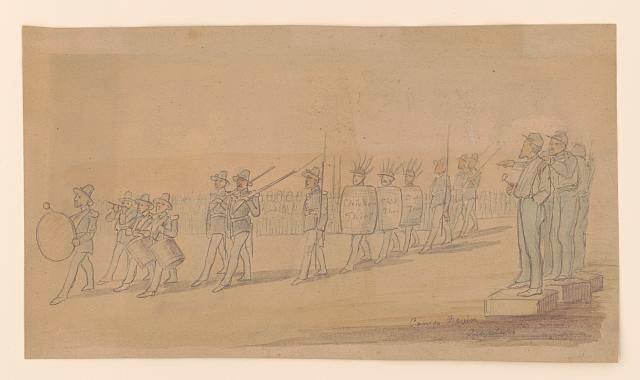
The image below was drawn at Camp Neven where meting out discipline was common place.
Chicken thieves being disciplined by General Alexander McDowell McCook, Camp Nevin, Kentucky, November 1861 (LOC)
Transcription
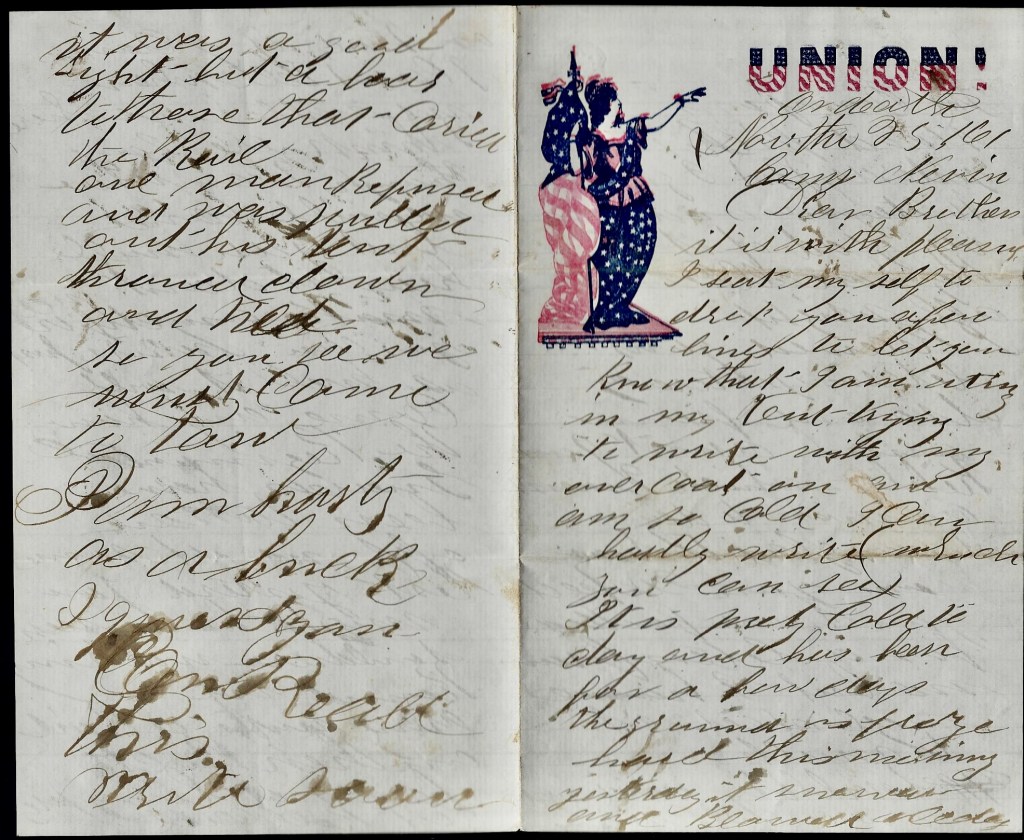
Union or Death! Camp Nevin [Kentucky] November 25, 1861
Dear Brother,
It is with pleasure I seat myself to drop you a few lines to let you know that I am sitting in my tent trying to write with my overcoat on and am so cold I can hardly write (which you can see). It is pretty cold today and has been for a few days, The ground is frozen hard this morning. Yesterday it snowed and blowed all day.
The company stood picket yesterday but I got to stay in and was very glad of it too. They have all come in all right. Received your letter yesterday. Also one from Aunt Jane Kihler [?] which I must answer today. I was glad to hear from you. I expect you have looked for a letter from me but I have neglected it too much. I will try and write one [ ] as [ ] if I can.
I can’t tell when we will leave here. I think ere long though I can’t [tell] where we will land, but you will hear it. Don’t make any difference. You can write just as well. It will come anyhow. The Regimental Guards have been taken off. We get some rest. Yesterday you might have seen soldiers walking round in army with a rail on their back for not being here at roll call. It was a good sight but a [ ] to those that carried the rail. One man refused and was pulled out his tent, throwed down, and tied. So you see we must come to toe.
I am harty as a buck. I guess you can read this. Write soon.
I can’t be certain of the signature but believe it to be B. F. Davis and my hunch is that it was written written by Baldwin F. Davis of Co. A, 14th Georgia Infantry who were part of the Wigfall’s Brigade at Dumfries, Virginia, in January 1862. See below.
“Although records are not complete, it is known the batteries blockading the Potomac were supported at least in part by a portion of the brigade of General W.H.C. Whiting, who was in charge of protecting the Potomac and Occoquan front. In January of 1862, General Johnston reported the forces near Dumfries under the command of Brigadier-General Whiting included: a brigade consisting of the 4th Alabama Infantry, 2nd Mississippi Infantry, 11th Mississippi Infantry, 6th North Carolina Infantry, 1st Tennessee Infantry, and Staunton Artillery (Virginia); Brigadier-General Wigfall’s brigade consisting of the 5th Alabama Battalion Infantry, 18th Georgia Infantry, 1st Texas Infantry, 4th Texas Infantry, and 5th Texas Infantry; Colonel Hampton’s brigade consisting of the 14th Georgia Infantry, 19th Georgia Infantry, 16th North Carolina Infantry, and Hampton’s Legion (South Carolina); and a Detachment including Reilly’s artillery (North Carolina), Rives’ battery (South Carolina), Shannon’s cavalry (South Carolina), and Thornton’s cavalry (Virginia; OR Series 1, Vol 5:1030).“
Transcription
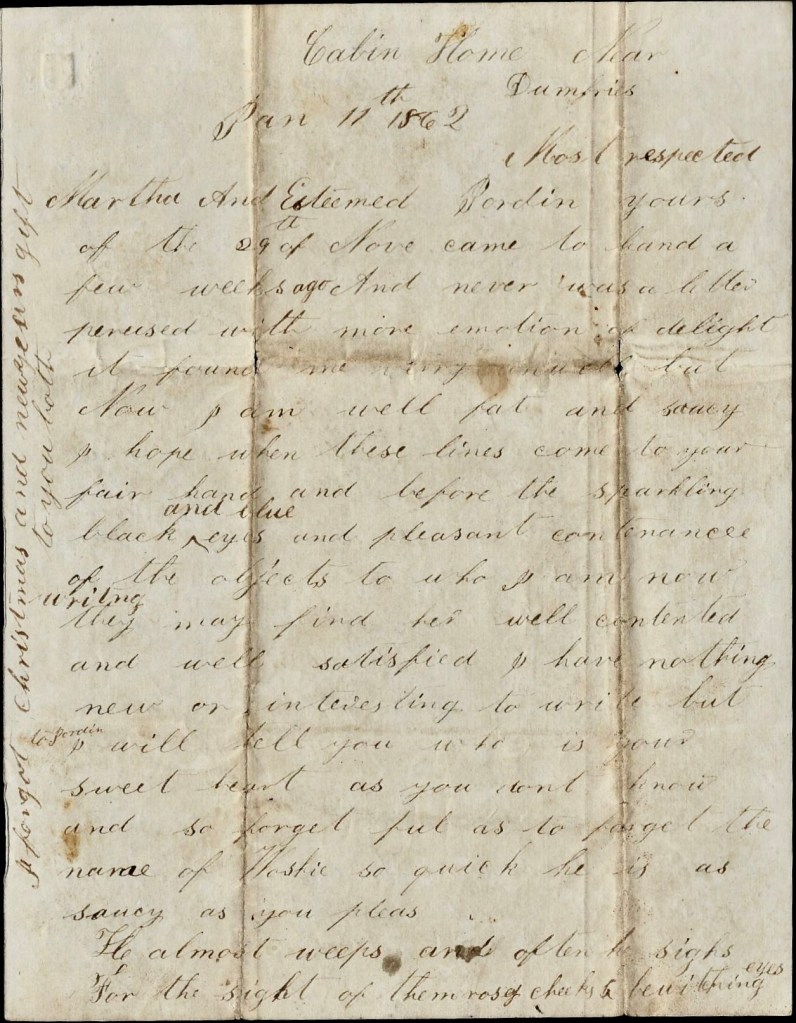
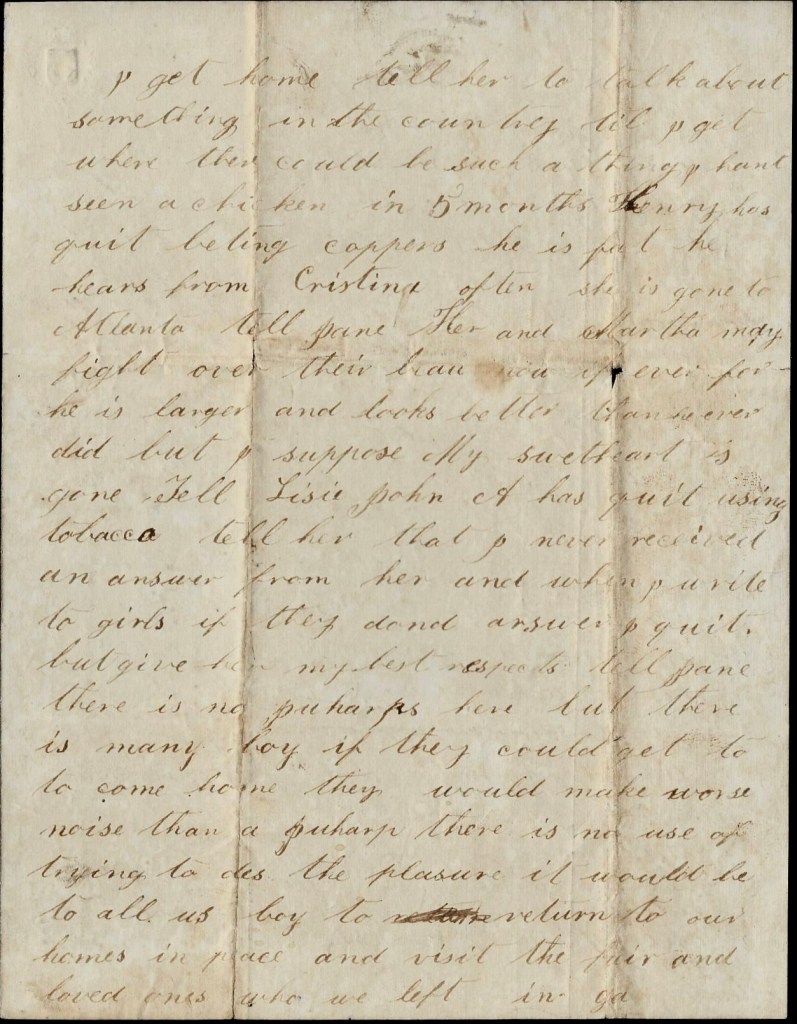
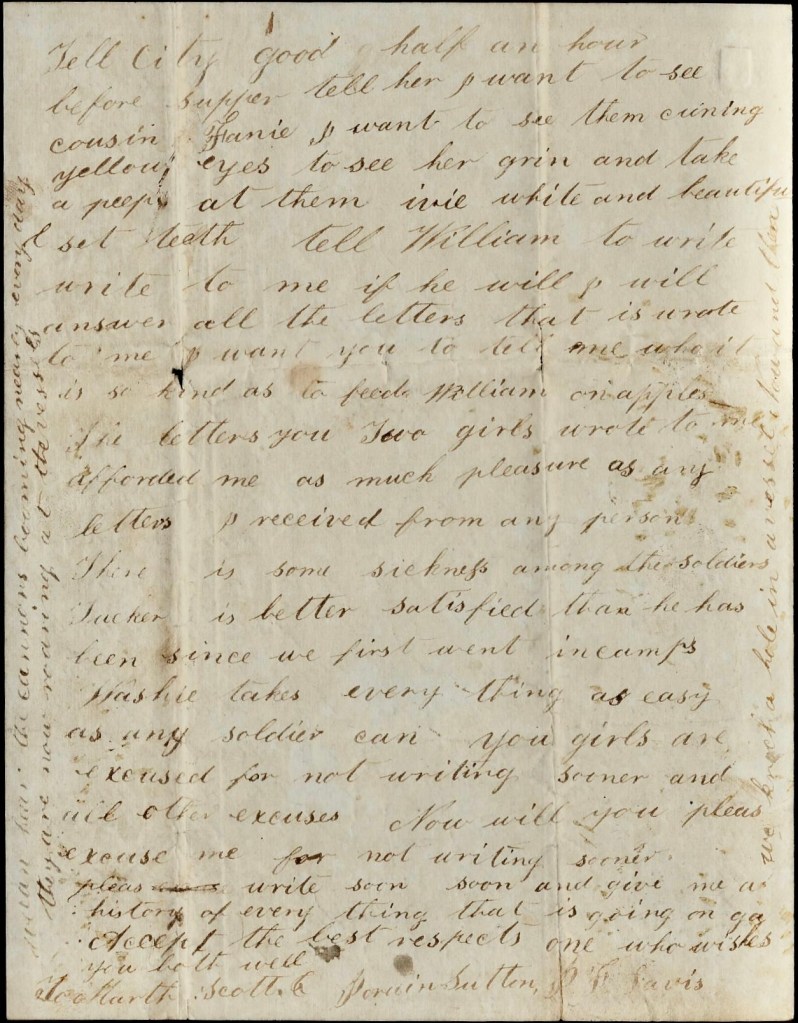
Cabin Home near Dumfries January 11th 1862
Most respected Martha & esteemed Jordin,
Yours of the 29th of November came to hand a few weeks ago and never was a letter perused with more emotion of delight. It found me very unwell but now I am well, fat and saucy. I hope when these lines come to your fair hand and before the sparkling black and blue eyes and pleasant countenances of the objects to who I am now writing, they may find her well contented and well satisfied.
I have nothing new or interesting to write but to Jordin I will tell you so is your sweat heart as you don’t know and so forgetful as to forget the name of Washie so quick. He is as saucy as you please. He almost weeks and often he sighs for the sight of them rosy cheeks & bewitching eyes.
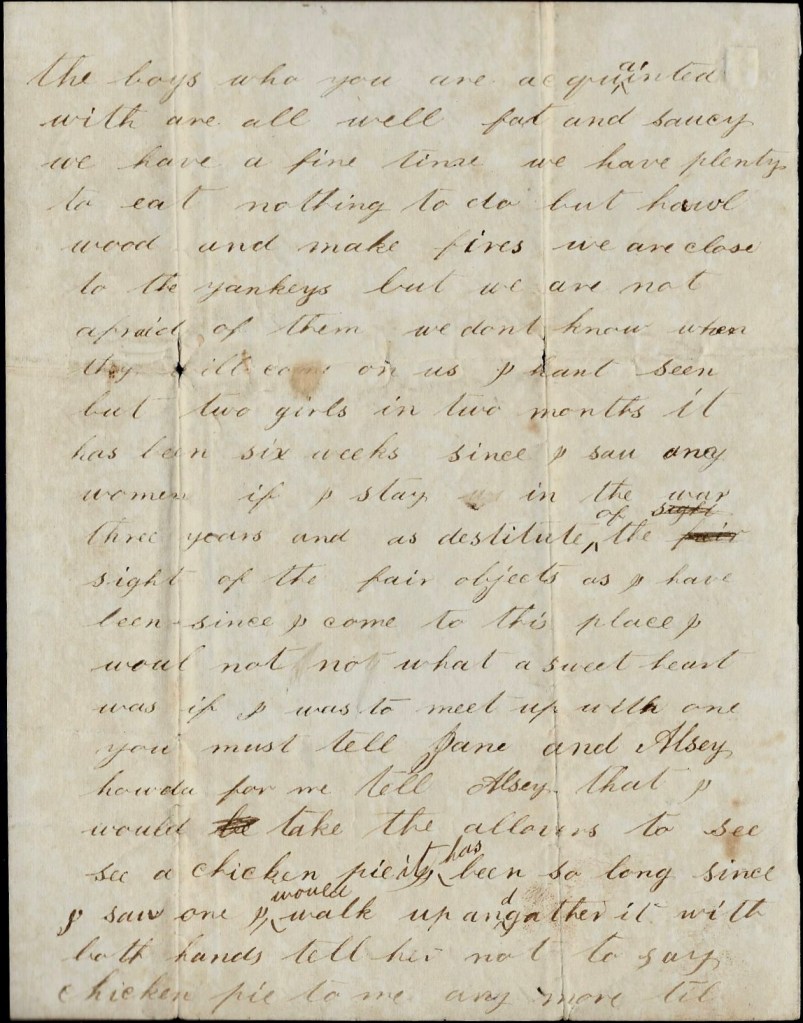
The boys who you are acquainted with are all well, fat and saucy/ We have a fine time. We have plenty to eat—nothing to do but haul wood and make fires. We are close to the Yankees but we are not afraid of them. We don’t know when they will come on us.
I han’t seen but two girls in two months, It has been six weeks since I saw any women. If I stay in the war three years and as destitute of the sight of the fair objects as I have been since I came to this place, I would not know what a sweet heart was if I was to meet up with one. You must tell Jane and Alsey howda for me. Tell Alsey that I would take the allovers to see a chicken pie—it has been so long since I saw one. I would walk up and gather it with both hands. Tell her not to say chicken pie to me any more till I get home. Tell her to talk about something in the country till I get where there could be such a thing. I han’t seen a chicken in 5 months.
Henry has quit beating coppers. He is fat. He hears from Cristina often. She is gone to Atlanta. Tell Jane her and Martha may fight over their beau now if ever for he is larger and looks better than he ever did but I suppose my sweetheart is gone. Tell Lisa, John A. has quit using tobacco. Tell her that I never received and answer from her and when I write to girls, if they don’t answer, I quit. But give her my best respects. Tell Jane there is no jews harps here but there is many boys if they could get to come home they would make worse noise than a jews harp. There is no use of trying to des the pleasure it would be to all us boys to return to our home in peace and visit the fair and loved ones who we left in Georgia.
Tell City good half an hour before supper. Tell her I want to see cousin Fannie. I want to see them cunning yellow eyes, to see her grin, and take a peep at them ivy white and beautiful set of teeth. Tell William to write to me. If he will, I will answer all the letters that is wrote to me. I want you to tell me who it is so kind as to feed William on apples.
The letters you two girls wrote to me afforded me as much pleasure as any letters I received from any person. There is some sickness among the soldiers. Tucker is better satisfied than he has been since we first went in camp. Washie takes everything as easy as any soldier can. You girls are excused for not writing sooner and all other excuses.
Now you will please excuse me for not writing sooner. Please write son and give me a history of everything that is going on in Georgia. Accept the best respects [from] one who wishes you both well. — B. F. Davis
I forgot Christmas and New Years gift to you both.
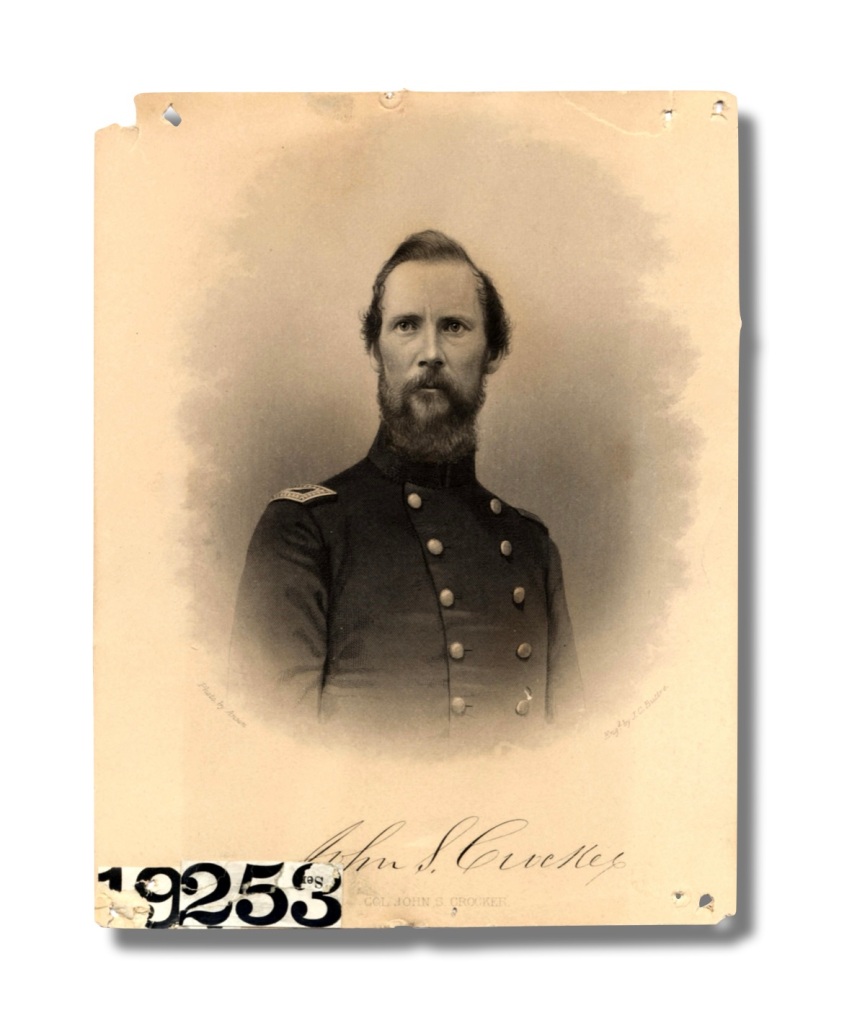
Col. John Simpson Crocker, 93rd New York Infantry New York State Military Museum
The following letters were written by John Simpson Crocker (1825-1890), the son of Francis W. Crocker (1790-1861) and Anna Woodworth (1795-1874). John was married to Harriett Sipperley in 1856 in White Creek, Washington county, New York. Crocker was 38 and working as a lawyer in Washington county when he volunteered his services and was commissioned Colonel of the 93rd New York State Volunteers.
In the Peninsula Campaign, Crocker was taken prisoner before Yorktown on 23 April 1862 and confined at Libby Prison for a time but was finally exchanged for Colonel Lorman Chancellor, 132nd Virginia Militia, in the late summer of 1862 in time to rejoin his regiment for the Battle of Antietam. At war’s end, Crocker was breveted a Brigadier General.
There are four letters in this collection; the first written in February 1862 from Riker’s Island in NYC where the regiment was being drilled and prepared to be sent to the battle front in Virginia. The second letter was written in late August 1862 after Crocker was exchanged as a POW but before he had rejoined his regiment. Letter three was written on the march to Fredericksburg in November 1862 and letter four was written less than two weeks before the Battle of Fredericksburg as the AOP prepared to lay down pontoon bridges.
[Antietam Md. Col. John S. Crocker Lt. Col. Benjamin C. Butler and adjutant of 93d New York Volunteers] Date: c. 1862 Civil War photographs 1861-1865 / compiled by Hirst D. Milhollen and Donald H. Mugridge Washington D.C. : Library of Congress 1977. No. 0283 Title from Milhollen and Mugridge.
Letter 1
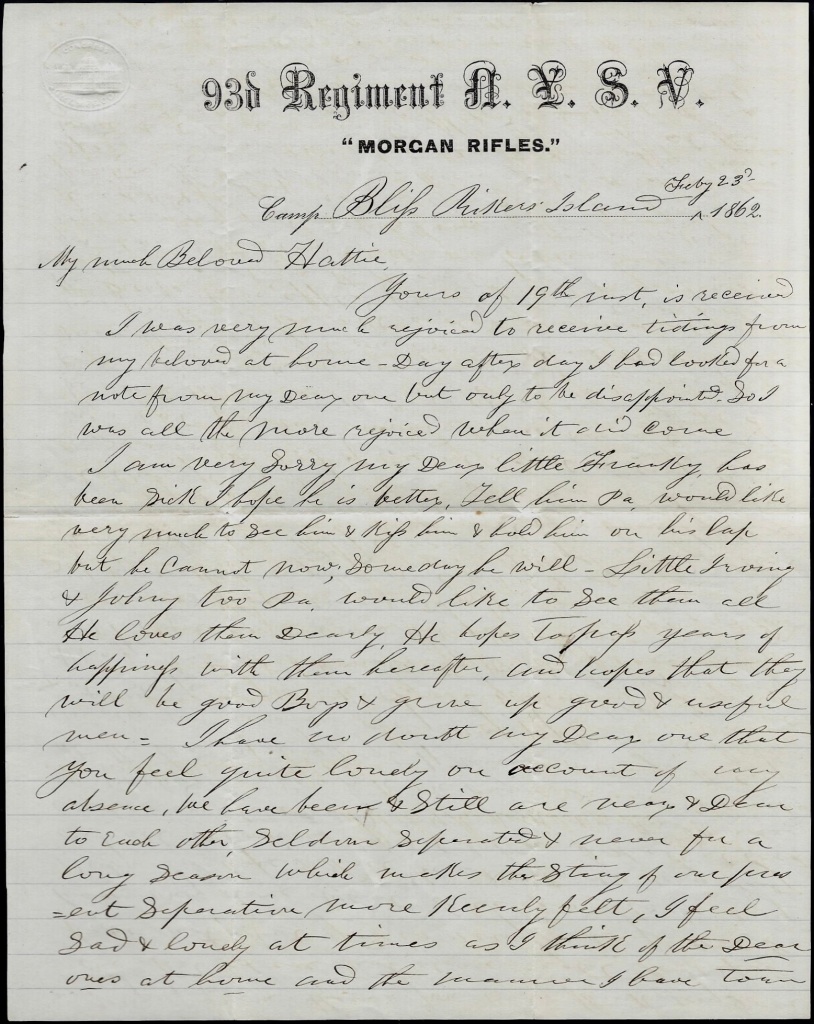
93rd Regiment NYSV “Morgan Rifles” Camp Bliss, Riker’s Island February 23rd 1862
My much beloved Hattie,
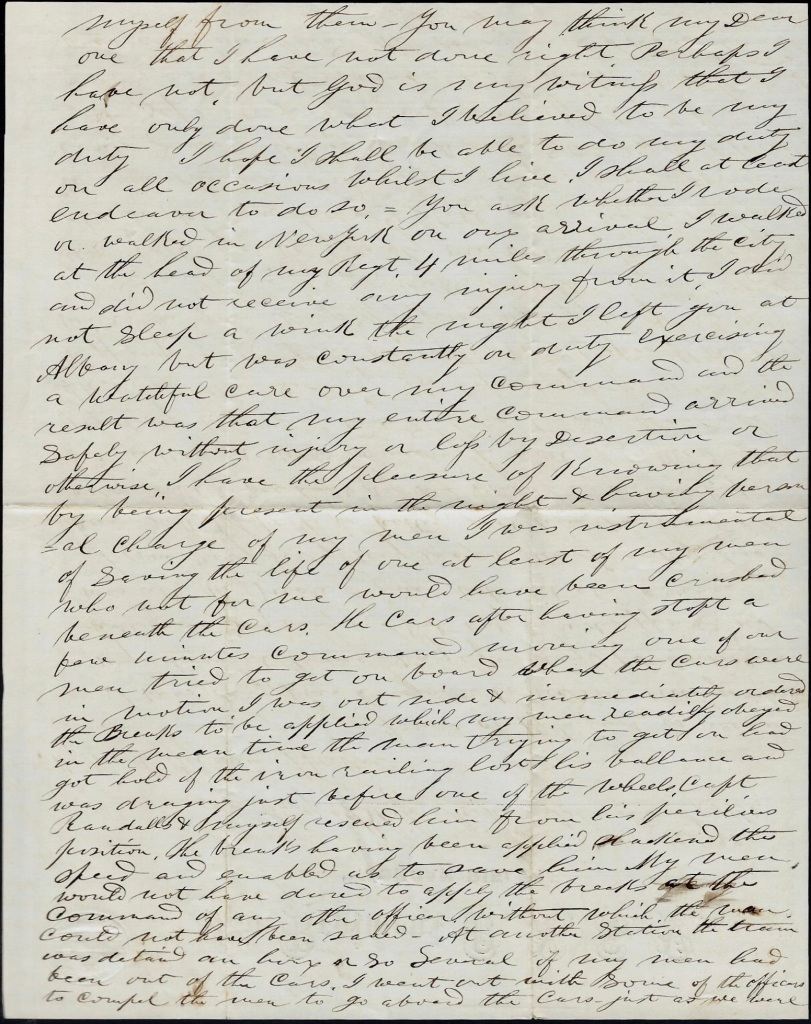
Yours of 19th inst. is received. I was very much rejoiced to receive tidings from my beloved at home. Day after day I had looked for a note from my dear one but only to be disappointed. So I was all the more rejoiced when it did come. I am very sorry my dear little Frankie has been sick. I hope he is better. tell him Pa would like very much to see him & kiss him & hold him on his lap but he cannot now. Someday he will. Little Irving & Johny too. Pa would like to see them all. He loves them dearly. He hopes to pass years of happiness with them hereafter and hopes that they will be good boys & grow up good & useful men. I have no doubt my dear one that you feel quite lonely on account of my absence. We have been & still are near & dear to each other. Seldom separated & never for a long season which makes the sting of our present separation more keenly felty. I feel sad & lonely at times as I think of the dear ones at home and the manner I have torn myself from them. You may think my dear one that I have not done right. Perhaps I have not, but God is my witness that I have only done what I believed to be my duty. I hope I shall be able to do my duty on all occasions whilst I live. I shall at least endeavor to do so.
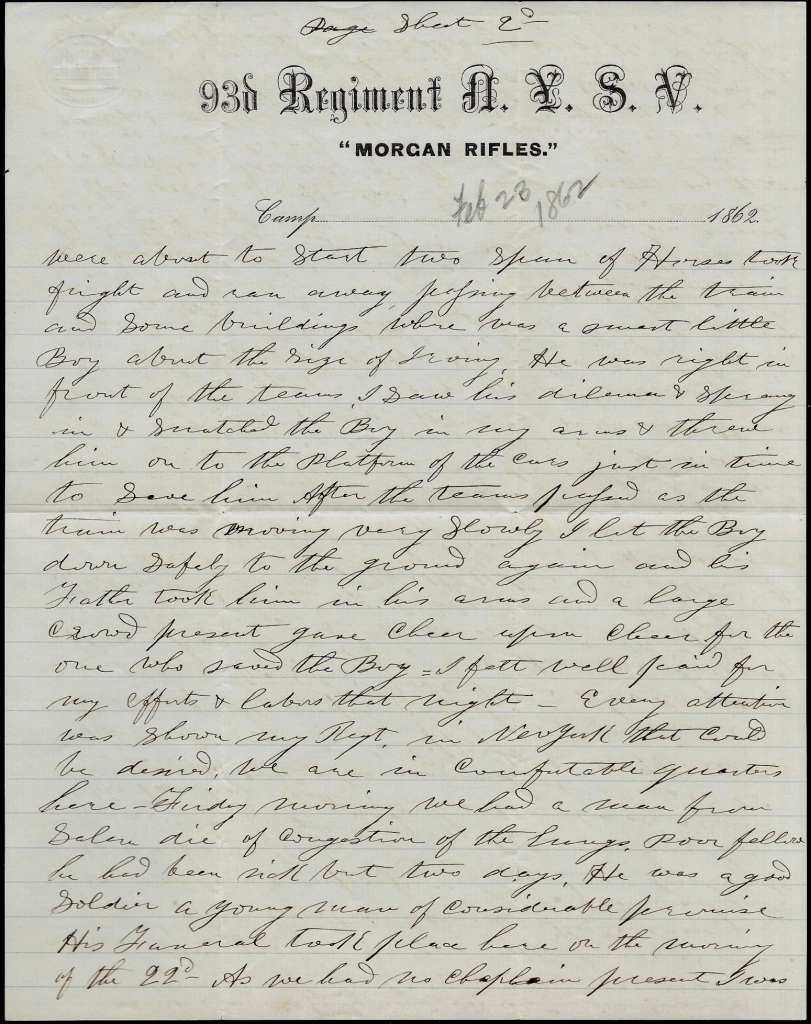
You ask whether I rode or walked in New York on my arrival. I walked at the head of my regiment, four miles through the city and did not receive any injury from it. I did not sleep a wink the night before I left you at Albany but was constantly on duty exercising a watchful care over my command and the result was that my entire command arrived safely without injury or loss by desertion or otherwise. I have the pleasure of knowing that by being present in the night & having personal charge of my men, I was instrumental of saving the life of one at least of my men who but for me would have been crushed beneath the cars. The cars, after having stopped a few minutes, commenced moving. One of our men tried to get on board when the cars were in motion. I was outside & immediately ordered the brakes to be applied which my men readily obeyed. In the meantime the man trying to get on board got hold of the iron railing, lost his balance and was dragging just before one of the wheels. Capt. [William] Randles & myself rescued him from his perilous position. The brakes having been applied slackened this speed and enabled us to save him. My men would not have dared to apply the brakes at the command of any other officer without which, the man could not have been saved.
At another station the train was detained an hour or so. Several of my men had been out of the cars. I went out with some of the officers to compel the men to go board the cars. Just as we were about to start, two span of horses took fright and ran away, passing between the train and some buildings where was a a sweet little boy about the size of Irving. He was right in front of the teams. I saw his dilemma & sprang in & snatched the boy in my arms & threw him onto the platform of the cars just in time to save him. After the teams passed, as the train was moving very slowly, I let the boy down safely to the ground again and his father took him in his arms and a large crowd gave cheer upon cheer for hte one who saved the boy. I felt well paid for my efforts & labors that night.
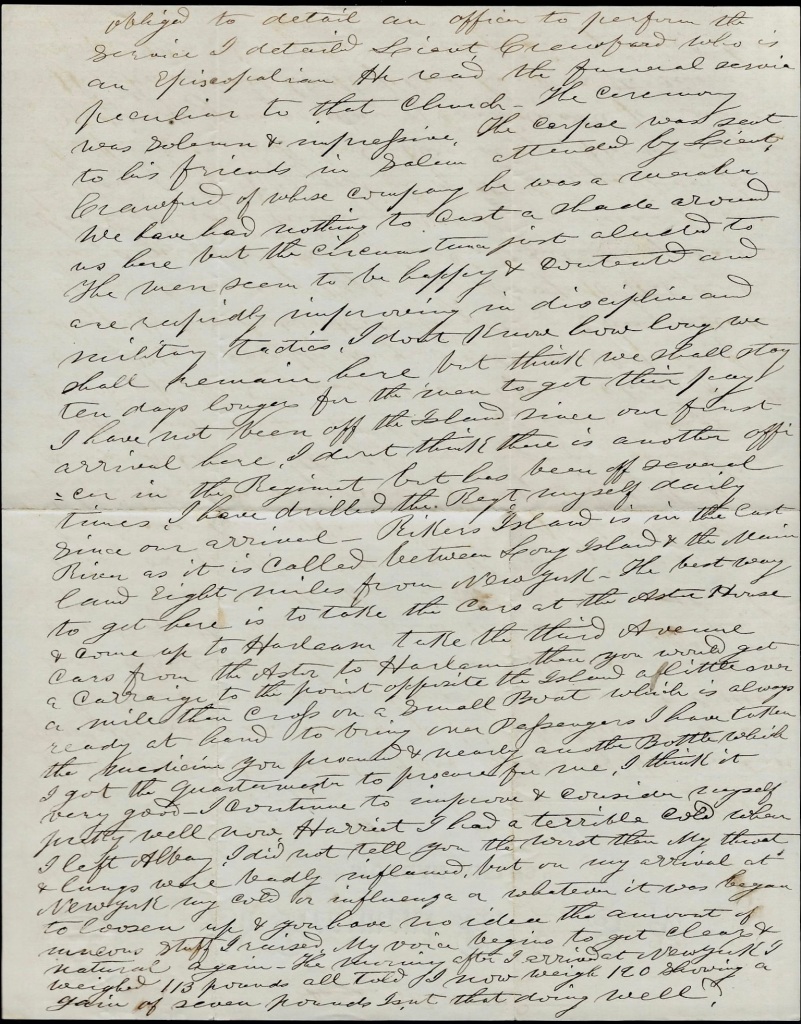
Every attention was shown my regiment in New York that could be desired. We are in comfortable quarters here. Friday morning we had a man [George Austin] from Salem die of congestion of the lungs. Poor fellow. He had been sick but two days. He was a good soldier—a young man of considerable promise. His funeral took place here on the morning of the 22nd. As we had no chaplain present, I was obliged to detail an officer to perform the service. I detailed Lieut. [James M.] Crawford who is an Episcopalian. He read the funeral service peculiar to that church. The ceremony was solemn & impressive. The corpse was sent to his friends in Salem attended by Lieut. Crawford of whose company he was a member.
We have had nothing to cast a shade around us here but the circumstance just alluded to. The men seem to be happy & contented and are rapidly improving in discipline and military tactics. I don’t know how long we shall remain here but think we shall stay ten days longer for the men to get their pay. I have not been off the island since our first arrival here. I don’t think there is another officer in the regiment but has been off several times. I have drilled the regiment myself daily since our arrival.
Rikers Island is in the East River as it is called between Long Island and the mainland, eight miles from New York. The best way to get here is to take the cars at the Astor House & come up to Harlam. Take the Third Avenue cars from the Astor to Harlam, then you would get a carriage to the point opposite the island, a little over a mile, the cross on a small boat which is always ready at hand to bring over passengers. I have taken the medicine you procured & nearly another bottle which I got the quartermaster to procure for me. I think it is very good. I continue to improve & consider myself pretty well now.
Harriet, I had a terrible cold when I left Albany. I did not tell you the worst then. My throat and lungs were badly inflamed, but on my arrival at New York, my cold or influenza or whatever it was began to loosen up & you have no idea the amount of mucous stuff I raised. My voice begins to get clear & natural again. The morning after I arrived at New York, I weighed 113 pounds all told. I now weigh 120 showing a gain of seven pounds. Isn’t that doing well?
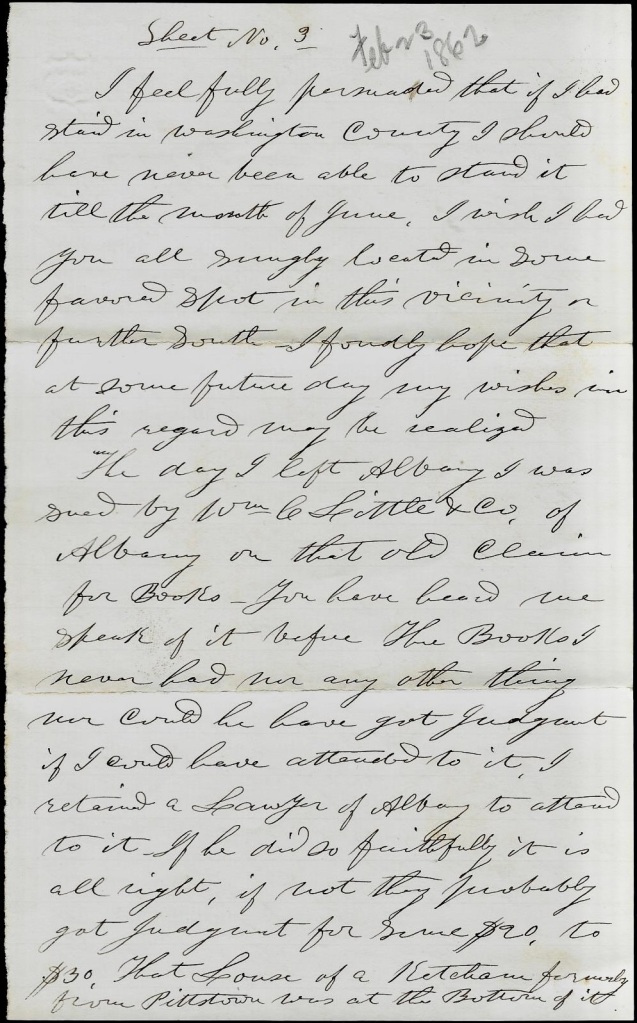
I feel persuaded that if I had stayed in Washington county, I should have never been able to stand it till the month of June. I wish I had you all snugly located in some favored spot in this vicinity or further south. I fondly hope that at some future day my wishes in this regard may be realized.
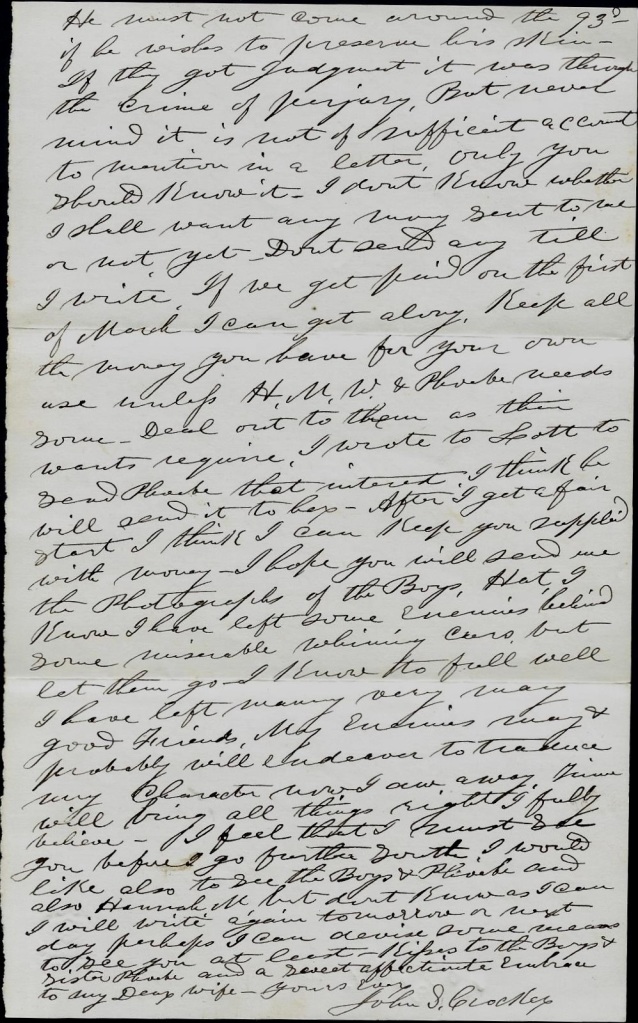
The day I left Albany I was sued by William C. Little & Co. of Albany on that old claim for books. You have heard me speak of it before. The books I never had nor any other thing nor could he have got judgment if I could have attended to it. I retained a lawyer of Albany to attend to it. If he did so faithfully, it is all right. If not, they probably got judgement for some $20 to $30. That louse of a Ketcham formerly from Pittstown was at the bottom of it. He must not come around the 93rd if he wishes to preserve his skin. If they got judgement, it was through the crime of perjury. But never mind. It is not of sufficient account to mention in a letter. Only you should know it.
I don’t know whether I shall want any money sent to me or not yet. Don’t send any till I write. If we get paid on the first of March, I can get along. Keep all the money you have for your own use unless H. M. W. & Phoebe needs some. Deal out to them as their wants require…I hope you will send me the photographs of the boys. Hat, I know I have left some enemies behind—some miserable whiny curs—but let them go. I know too full well I have left many very, very good friends. My enemies may & probably will endeavor to traduce my character now I am away. Time will bring all things right, I fully believe. I feel that I must see you before I go further south. I would like also to see the boys and Phoebe & Hannah but don’t know as I can. I will write again tomorrow or next day. Perhaps I can devise some means to see you at least. Kisses to the boys and sister Phoebe and a sweet affectionate embrace to my dear wife. Yours forever, — John S. Crocker
Letter 2
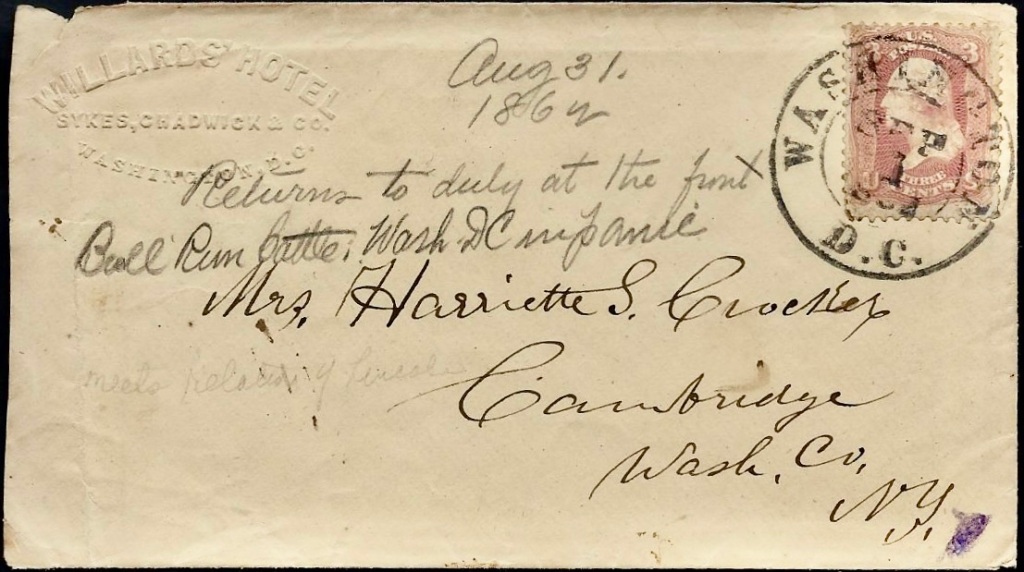
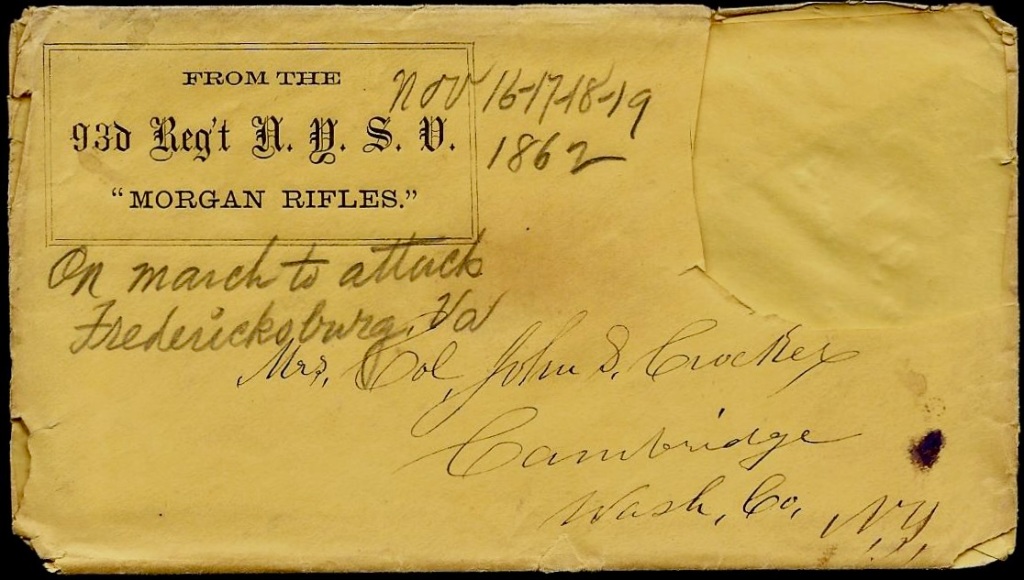
Addressed to Mrs. Harriette S. Crocker, Cambridge, Washington county, New York
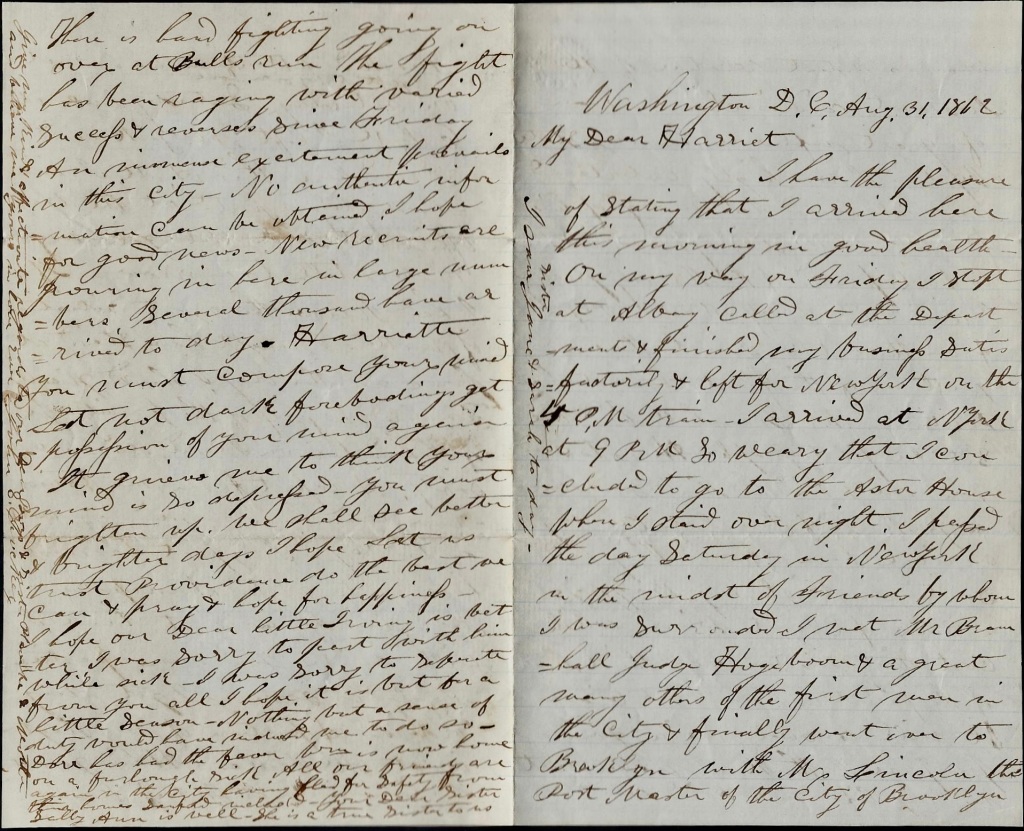
Washington D. C. August 31, 1862
My dear Harriet,
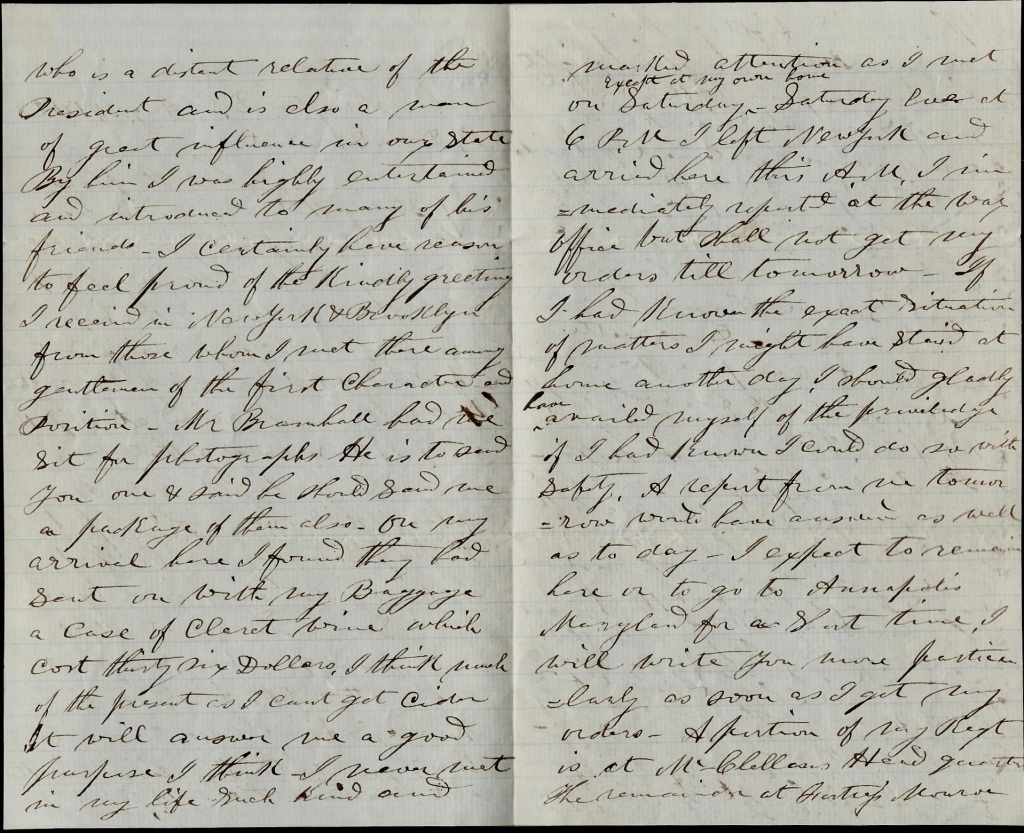
I have the pleasure of stating that I arrived here this morning in good health. On my way on Friday I stopped at Albany, called at the Departments, and finished my business satisfactorily & left for New York on the 4 p.m. train. I arrived at New York at 9 p.m. so weary that I concluded to go to the Astor House where I staid overnight. I passed the day on Saturday in New York in the midst of friends by whom I was surrounded. I met Mr. Bramhall, Judge [Henry] Hogeboom, & a great many others of the first men in the city & finally went into Brooklyn with Mr. [George Burt] Lincoln, the postmaster of the City of Brooklyn, who is a distant relative of the President and is also a man of great influence in our state. By him I was highly entertained and introduced to many of his friends. I certainly have reason to feel proud of the kindly greeting I received in New York and Brooklyn from those whom I met there among the gentlemen of the first character and position. Mr. Bramhall had me sit for photographs. He is to send you one & said he should send me a package of them also.
On my arrival here I found they had sent on with my baggage a case of claret wine which cost thirty-six dollars. I think much of the present as I can’t get cider. It will answer me a good purpose. I think I never met in my life such kind and marked attention as I met on Saturday except at my own home.
Saturday last at 6 p.m., I left New York and arrived here this a.m. I immediately reported at the War Office but shall not get my orders till tomorrow. If I had known the exact situation of matters, I might have staid at home another day. I should gladly have availed myself of the privilege if I had known I could do so with safety. A report from me tomorrow would have answered as well as today. I expect to remain here or go to Annapolis, Maryland, for a short time. I will write you more particularly as soon as I get my orders. A portion of my regiment is at McClellan’s Headquarters at Fortress Monroe.
There is hard fighting going on over at Bulls Run. The fight has been raging with varied success and reverses since Friday. An immense excitement prevails in this city. No authentic information can be obtained. I hope for good news. New recruits are pouring in here in large numbers. Several thousand have arrived today.
Harriette, you must compose your mind. Let not dark forebodings get possession of your mind again. It grieves me to think your mind is so depressed. You must brighten up. We shall see better & brighter days, I hope. Let us trust Providence. Don the best we can and pray and hope for happiness. I hope our dear little Irving is better. I was sorry to part with him while sick. I was sorry to separate from you all. I hope it is but for a little season. Nothing but a sense of duty would have induced me to do so. Dare has had the fever. William is now home in a furlough sick. All our friends are again in the city havung fled for safety from their homes—Sanford included. Your dear sister Sally Ann is well. She is a true sister to us. Give my kind & affectionate regards to our dear boys and sister Phoebe & Mother and believe me yours in love ever, — John S. Crocker
I saw sister Jane & Sarah today.
Letter 3
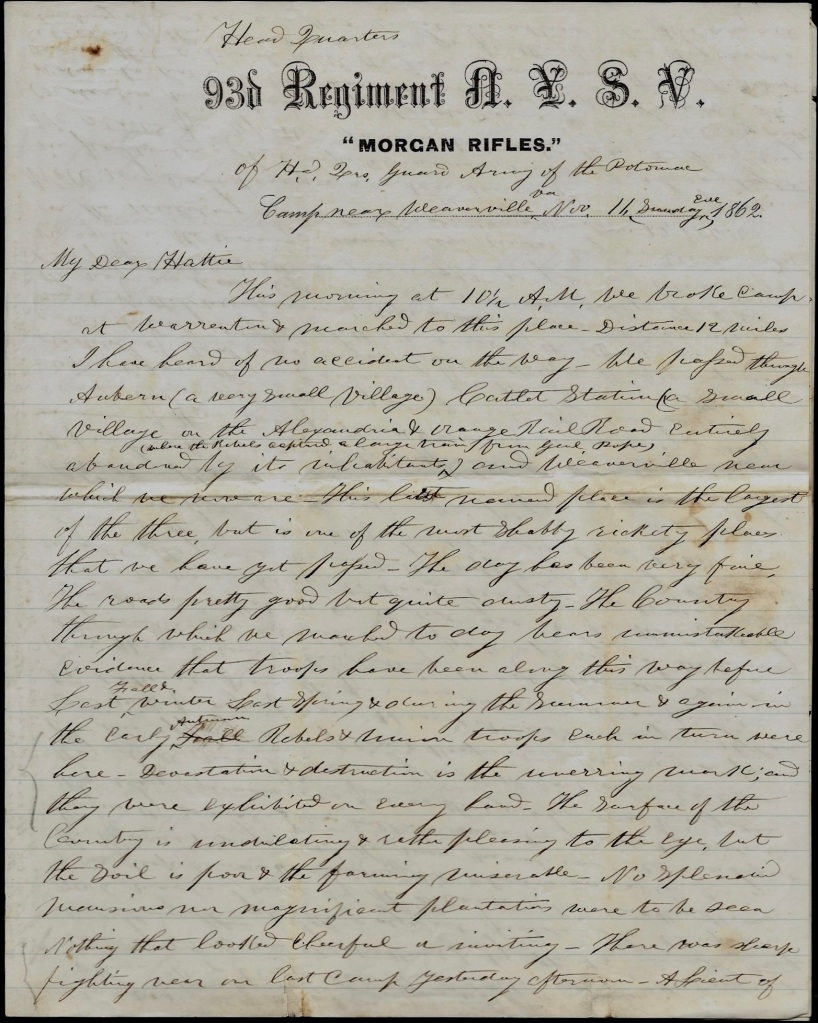
Headquarters 93rd Regiment NYSV “Morgan Rifles” Grand Army of the Potomac Camp near Weaverville, Va. November 16th, Sunday eve., 1862
My dear Hattie,
This morning at 10:30 a.m., we broke camp at Warrenton & marched to this place, distance 12 miles. I have heard of no accident on the way. We passed through Auburn (a very small village), Catlett’s Station (a small village on the Alexandria & Orange Railroad entirely abandoned by its inhabitants) and Weaverville near which we now are. This last named place is the largest of the three, but it is one of the most shabby, rickety places that we have yet passed. The day has been very fine. The roads pretty good but quite dusty. The country through which we marched today bears unmistakeable evidence that troops have been along this way before. Last fall & winter, last spring & during the summer, and again in the early autumn, rebels and Union troops each in turn were here. Devastation and destruction is the unerring work; and they were exhibited on every hand. The surface of the country is undulating and rather pleasing to the eye, but the soil is poor and the farming miserable. No splendid mansions nor magnificent plantations were to be seen. Nothing that looked cheerful or inviting.
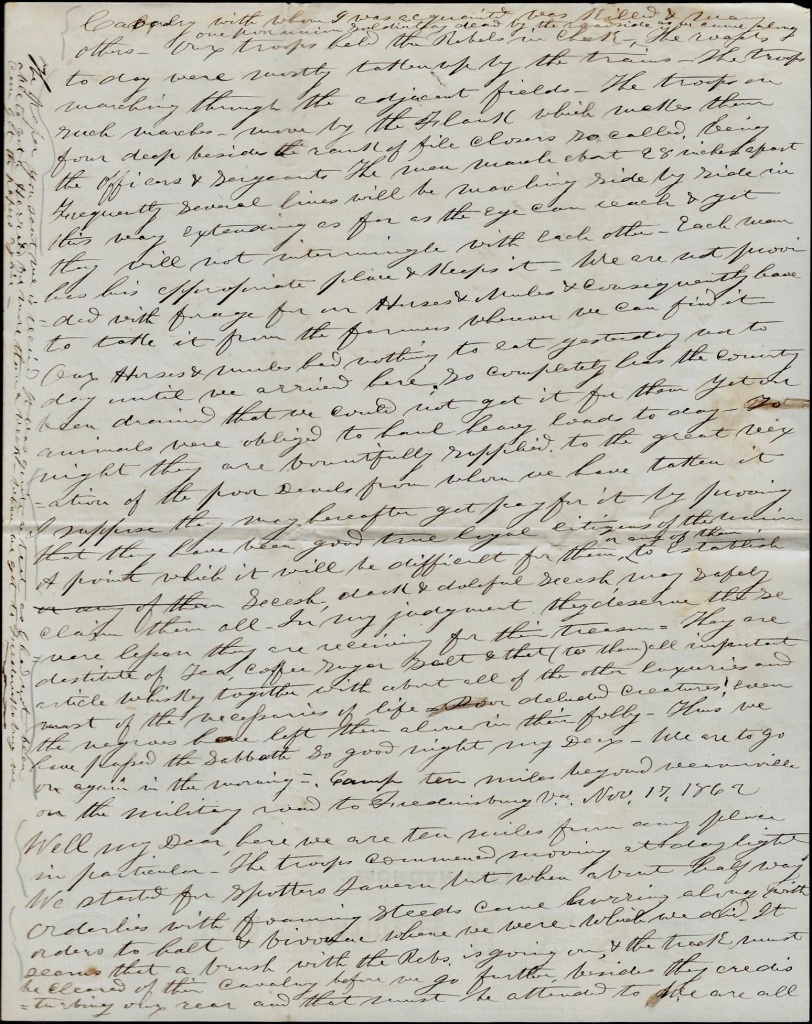
There was sharp fighting near our last camp yesterday afternoon. A lieut. of cavalry with whom I was acquainted was killed & many others. Our poor Union soldiers lay dead by the roadside as we came along. Our troops held the Rebels in check. The roads today were mostly taken up by the trains—the troops marching through the adjacent fields. The troops on such marches move by the flank which makes them four deep besides the rank of file closers so called, being the officers & sergeants. The men march about 28 inches apart. Frequently several lines will be marching side by side in this way extending as far as the eye can reach & yet they will not intermingle with each other. Each man has his appropriate place and keeps it.
We are not provided with forage for our horses and mules and consequently have to take it from the farmers wherever we can find it. Our horses and mules had nothing to eat yesterday and today until we arrived here, so completely has the country been drained that we could not get it for them yet. Our animals were obliged to haul heavy loads today. Tonight they are bountifully supplied to the great vexation of the poor devils from whom we have taken it. I suppose they may hereafter get pay for it by proving that they have been good, true, loyal citizens of the Union—a point which it will be difficult for them or any of them to establish. Secesh—dark & doleful secesh—may safely claim them all. In my judgment, they deserve the severe lesson they are receiving for their treason. They are destitute of tea, coffee, sugar, salt, and that (to them) all important article whiskey together with about all of the other luxuries and most of the necessaries of life. Poor deluded creatures! Even the negroes have left them alone in their folly.
Thus we have passed the Sabbath. So good night my dear. We are to go on again in the morning.
Camp ten miles beyond Weaverville on the military road to Fredericksburg, Va. November 17, 1862
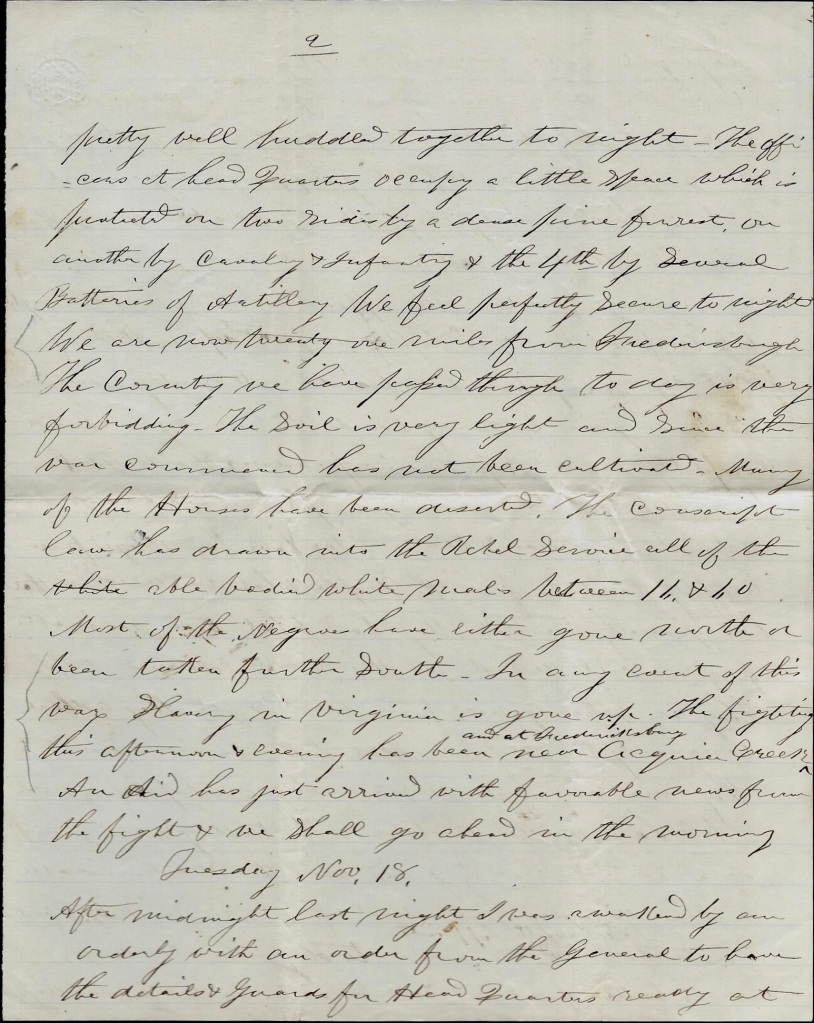
Well, my dear, here we are ten miles from any place in particular. The troops commenced moving at daylight. We started for Spotter’s Tavern but when about half way, orderlies with foaming steeds came hurrying along with orders to halt & bivouac where we were which we did. It seems that a brush with the Rebs is going on & the track must be cleared of the cavalry before we go further. Besides, they are disturbing our rear and that must be attended to. We are all pretty well huddled together tonight. The officers at headquarters occupy a little space which is protected on two sides by a dense pine forrest, on another by cavalry and infantry, and the 4th by several batteries of artillery. We feel perfectly secure tonight.
We are now twenty-one miles from Fredericksburg. The country we have passed through today is very forbidding. The soil is very light and since the war commenced has not been cultivated. Many of the houses have been deserted. The Conscript Law has drawn into the Rebel service all of the able-bodied white males between 14 and 60. Most of the negroes have either gone North or been taken further South. In any event, of this way, slavery in Virginia is gone up.
The fighting this afternoon & evening has been near Acquia Creek and at Fredericksburg. An aide has just arrived with favorable news from the fight & we shall go ahead in the morning.
Tuesday, November 18th
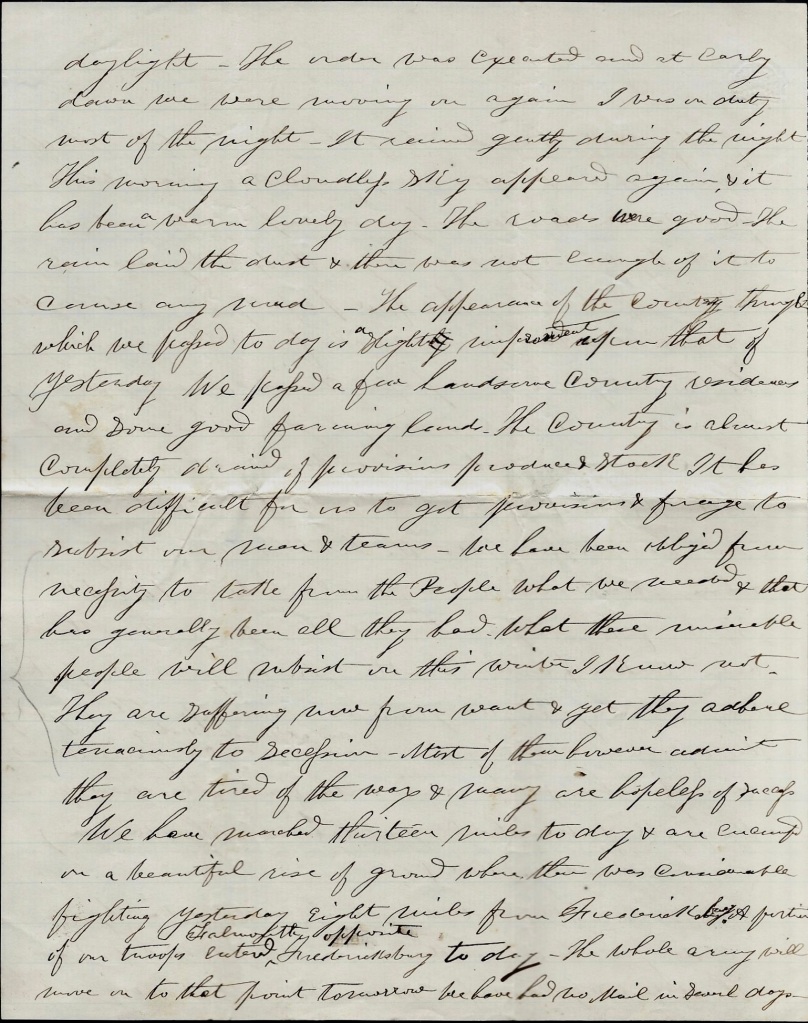
After midnight last night I was awakened by an orderly with an order from the General to have the details & guards for headquarters ready at daylight. The order was executed and at early dawn we were moving on again. I was on duty most of the night. It rained gently during the night. This morning a cloudless sky appeared again & it has been a warm, lovely day. The roads were good. The rain laid the dust and there was not enough of it to cause any mud. The appearance of the country through which we passed today is slightly improved upon that of yesterday. We passed a few handsome country residences and some good farming lands. The country is almost completely drained of provisions, produce and stock. It has been difficult for us to get provisions & forage to subsist our men and teams. We have been obliged from necessity to take from the people what we needed & that has generally been all they had. What these miserable people subsist on this winter, I know not. They are suffering now from want & yet they adhere tenaciously to secession. Most of them, however, admit they are tired of the war and many are hopeless of success.
We have marched thirteen miles today & are encamped on a beautiful rise of ground where there was considerable fighting yesterday eight miles from Fredericksburg. A portion of our troops entered Falmouth opposite Fredericksburg today. he whole army will move on to that point tomorrow. We have had no mail in several days.
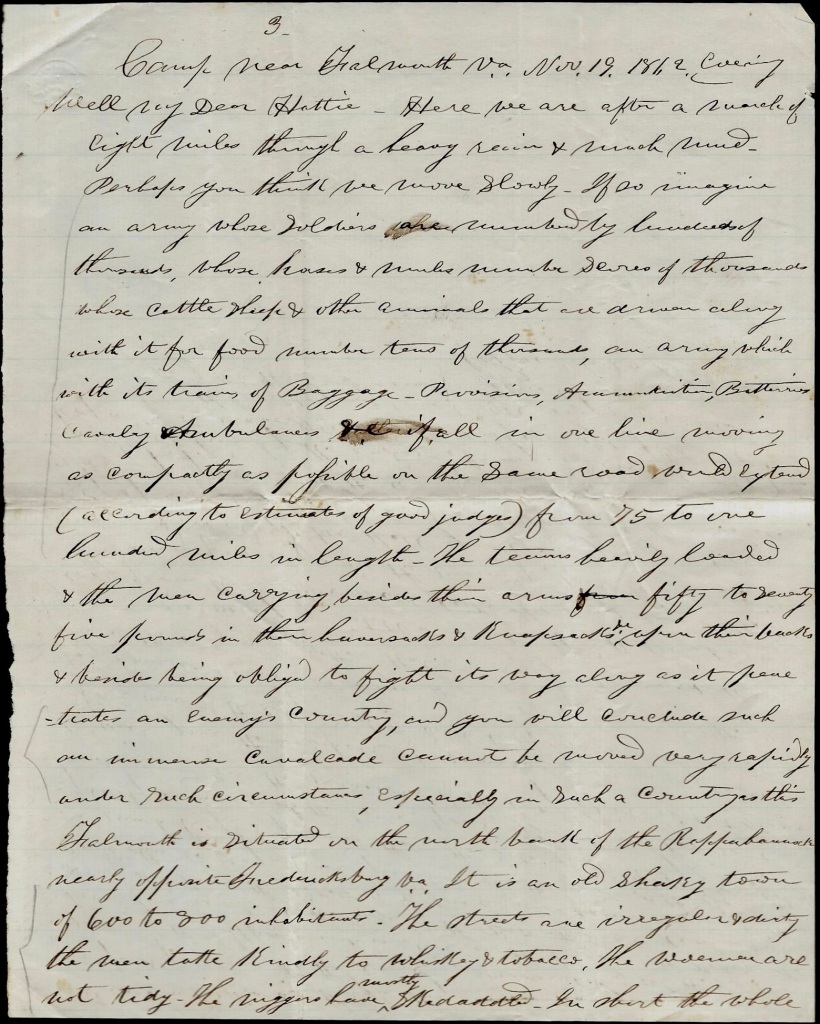
Camp near Falmouth, Va. November 19, 1862 evening
Well, my dear Hattie, here we are after a march of eight miles through a heavy rain & much mud. Perhaps you think we move slowly. If so, imagine an army whose soldiers numbered by hundreds of thousand, whose horses and mules number scores of thousand, whose cattle, sheep & other animals that are driven along with it for food number tens of thousands, an army with its train of baggage, provisions, ammunition, batteries, cavalry, ambulances, &c. if all in one line moving as compactly as possible on the same road would extend (according to estimates of good judges) from 75 to one hundred miles in length. The teams being heavily loaded and the men carrying besides their arms from fifty to seventy-five pounds in their haversacks and knapsacks, &c. upon their backs & besides being obliged to fight its way along as it penetrates an enemy’s country, and you will conclude such an immense cavalcade cannot be moved very rapidly under such circumstances—especially in such a country as this.
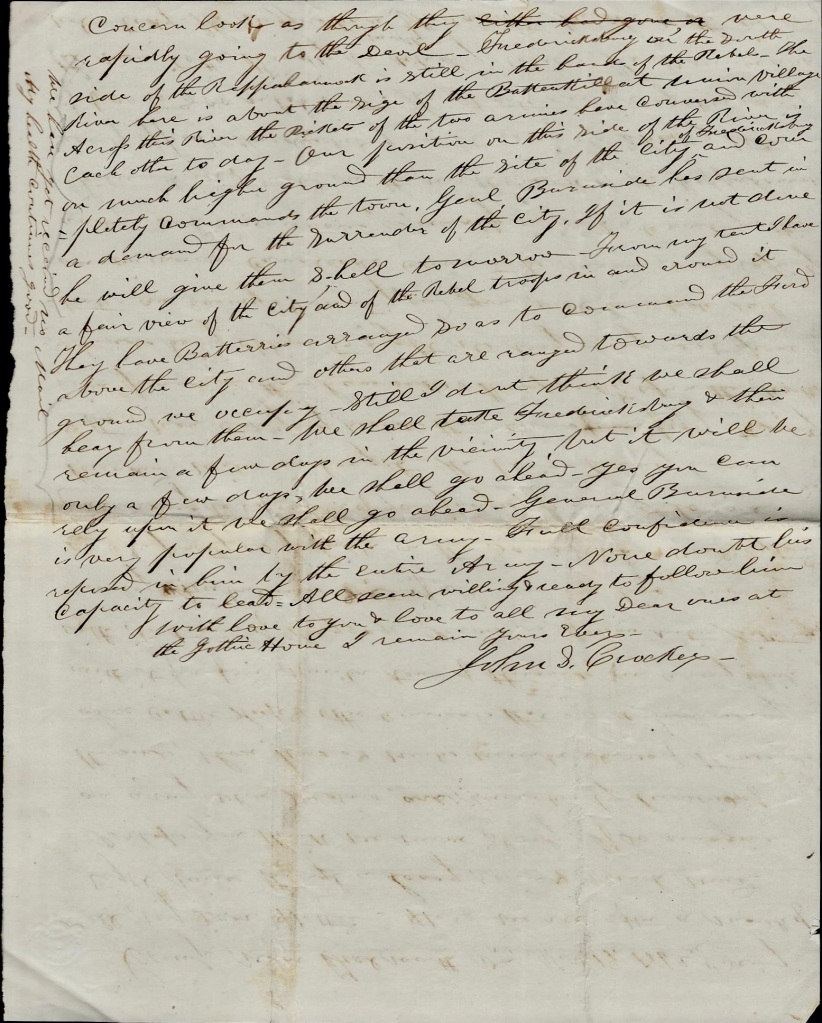
Falmouth is situated on the north bank of the Rappahannock nearly opposite Fredericksburg, Va. It is an old shaky town of 600 to 800 inhabitants. The streets are irregular & dirty. The men take kindly to whiskey & tobacco. The women are not tidy. The niggers have mostly skedaddled. In short, the whole concern looks as though they were rapidly going to the devil. Fredericksburg on the south side of the Rappahannock is still in the hands of the Rebels. The river here is about the size of the Battenkill at Union Village. Across this river the pickets of the two armies have conversed with each other today. Our position on this side of the river is on much higher ground than the site of the city of Fredericksburg and completely commands the town. General Burnside has sent in a demand for the surrender of the city. If it is not done, he will give them shell tomorrow. From my tent I have a fair view of the city and of the rebel troops in and around it. They have batteries arranged so as to command the ford above the city and others that are ranged towards the ground we occupy. Still I don’t think we shall hear from them.
We shall take Fredericksburg and then remain a few days in the vicinity, but it will be only a few days. We shall go ahead. Yes, you can rely upon it. We shall go ahead. General Burnside is very popular with the army. Full confidence is reposed in him by the entire army. None doubt his capacity to lead. All seem willing & ready to follow him.
With love to you and love to all my dear ones at the Gothic House, I remain yours ever, — John S. Crocker
Letter 4
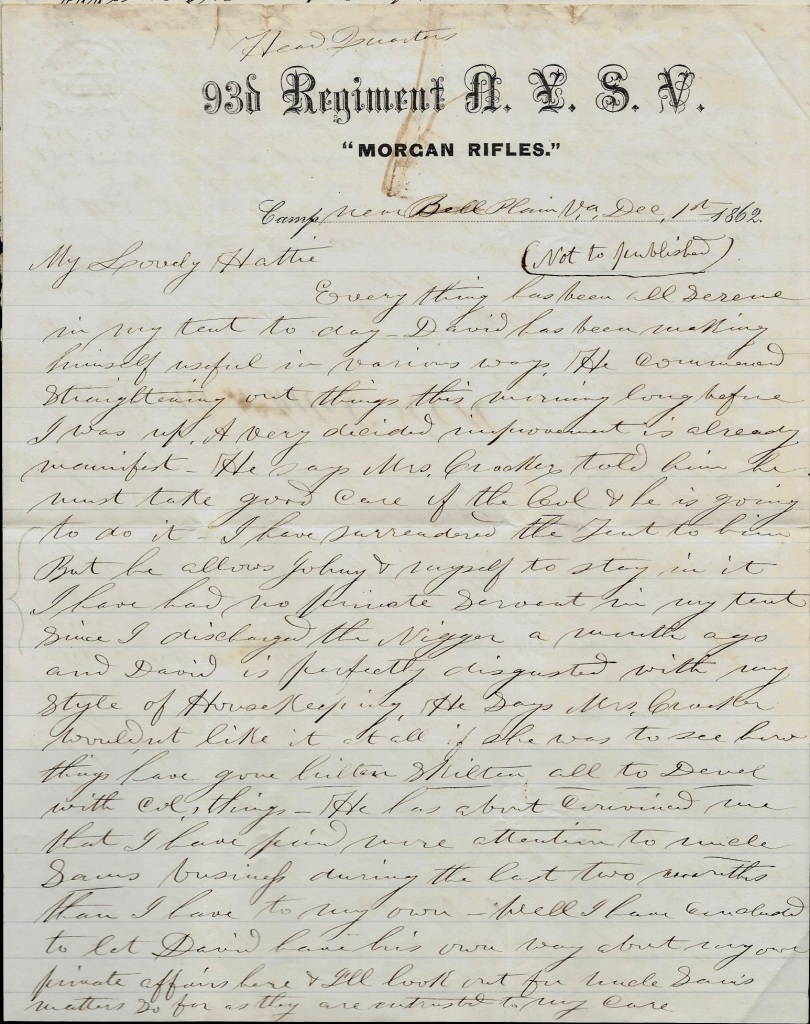
Headquarters 93rd Regiment NYSV “Morgan Rifles” Camp near Belle Plains, Va. December 1st 1862
My lovely Hattie,
Everything has been all serene in my tent today. David has been making himself useful in various ways. He commenced straightening out things this morning long before I was up. A very decided improvement is already manifest. The says Mrs. Crocker told him he must take good care of the Col. & he is going to do it. I have surrendered the tent to him. But he allows Johnny & myself to stay in it. I have no private servant in my tent since I discharged the nigger a month ago and David is perfectly disgusted with my style of housekeeping. He says Mrs. Crocker wouldn’t like it at all if she was to see how things have gone hilter skilter all to Devil with Colonel’s things. He has about convinced me that I have paid more attention to Uncle Sam’s business during the last two months that I have to my own. Well, I have concluded to let David have his own way about my own private affairs here and I’ll look out for Uncle Sam’s matters so far as they are entrusted to my care.
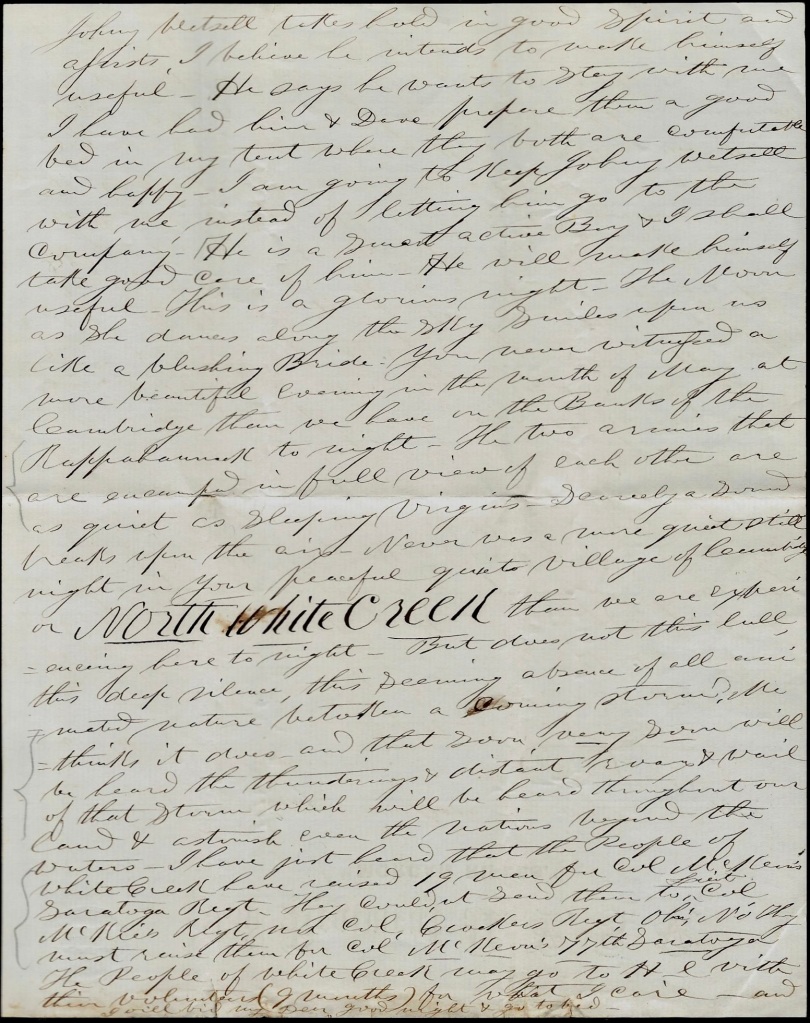
Johnny Wetsell takes hold in good spitit and assists. I believe he intends to make himself useful. He says he wants to stay with me. I have had him and Dave prepare a good bed in my tent where they both are comfortable and happy. I am going to keep Johnny Wetsell with me instead of letting him go to the company. He is a smart, active boy & I shall take good care of him. He will make himself useful.
This is a glorious night. The moon as she dances along the sky smiles upon us like a blushing bride. You never witnessed a more beautiful evening in the month of May at Cambridge than we have on the banks of the Rappahannock tonight. The two armies that are encamped in full view of each other are as quiet as sleeping virgins—scarcely a sound breaks upon the air. Never was a more quiet still night in your peaceful, quiet village of Cambridge or North White Creek than we are experiencing here tonight. But does not this lull, this deep silence, this seeming absence of all animated nature betoken a coming storm? Methinks it does and that soon—very soon—will be heard the thunderings and distant roar & wail of that storm which will be heard throughout our land & astonish even the Nations beyond the waters.
I have just heard that the people of White Creek have raised 19 men for Col. [James B] McKean’s Saratoga Regiment. They couldn’t send them to Lieut. Colonel McKean’s Regiment nor Col. Crocker’s Regiment? Oh no! They must raise them for Col. McKean’s 77th Saratoga. The people of White Creek may go to Hell with their volunteers (9 months) for what I care. And I will bid my dear goodnight & go to bed.
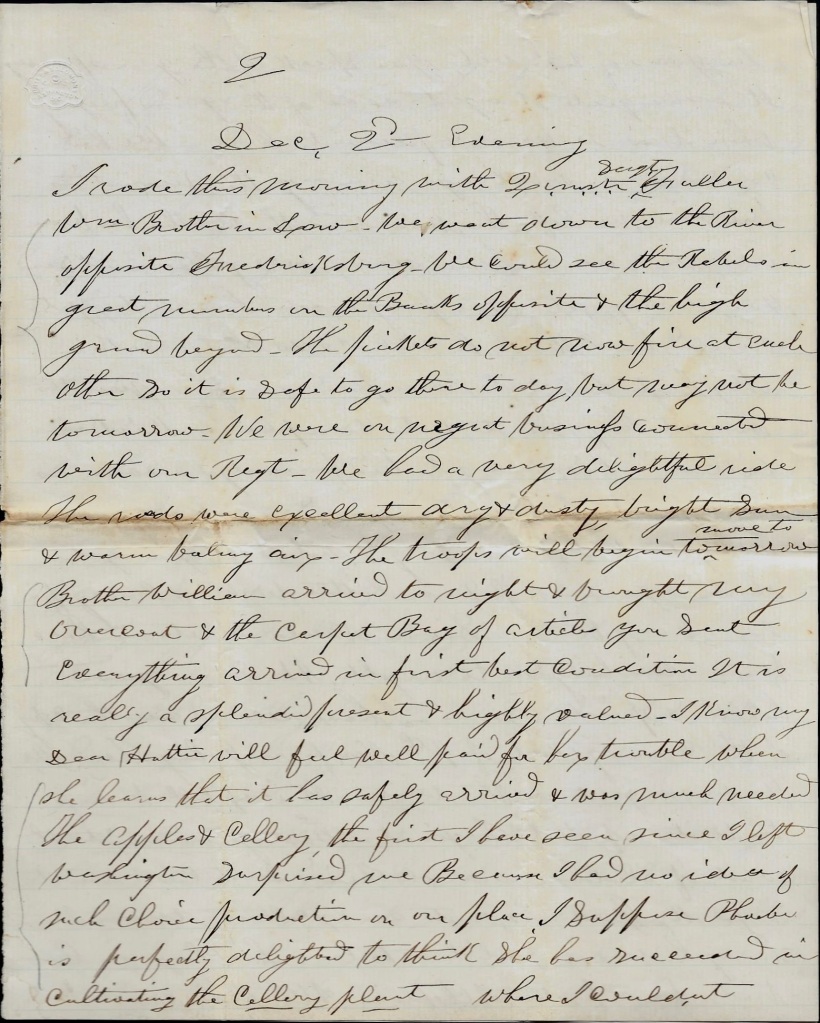
December 2nd, evening. I rode this morning with Quartermaster Sergeant Fuller, William’s brother-in-law. We went down to the river opposite Fredericksburg. We could see the Rebels in great numbers on the banks opposite & the high ground beyond. The pickets do not fire at each other so it is safe to go there today but may not be tomorrow. We were on urgent business connected with our regiment. We had a very delightful ride. The roads were excellent—dry & dusty, bright sun & warm balmy air. The troops will begin to move tomorrow.
Brother William arrived tonight and brought my overcoat and the carpet bag of articles you sent. Everything arrived in first best condition. It is really a splendid present & highly valued. I know my dear Hattie will feel well paid for her trouble when she learns that it has safely arrived & was much needed. The apples & celery—the first I have seen since I left Washington—surprised me because I had no idea of such choice production on our place. I suppose Phoebe is perfectly delighted to think she has succeeded in cultivating the celery plant where I couldn’t.
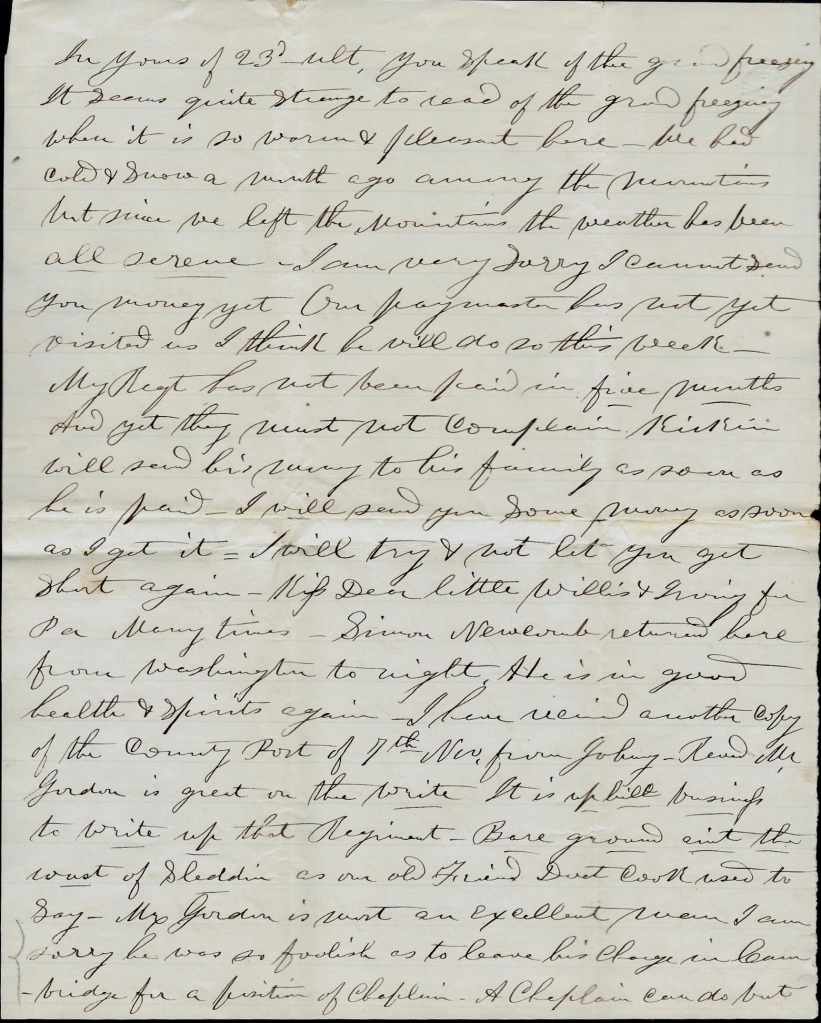
In yours of 23rd ult., you speak of the ground freezing when it is warm & pleasant here. We had cold & snow a month ago among the mountains but since we left the mountains, the weather has been all serene.
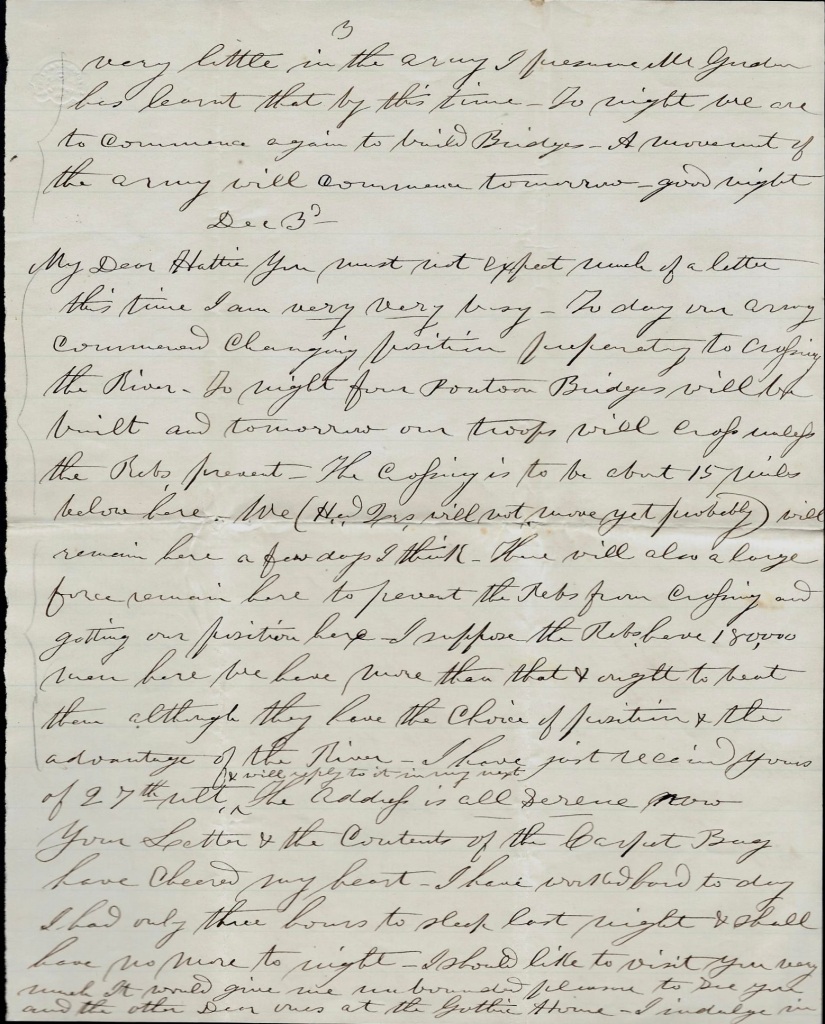
I am very sorry I cannot send you money yet. Our paymaster has not yet visited us. I think he will do so this week. My regiment has not been paid in five months and yet they must not complain. Kickin will send his money to his family as soon as he is paid. I will send you some money as soon as I get it. I will try and not let you get short again. Kiss dear little Willis & Irving for Pa many times. Simon Newcomb returned here from Washington tonight. He is in good health & spirits again. I have received another copy of the County Post of 7th November from Johnny. Rev’d Mt. Gordon is great on the write. It is up hill business to write up that regiment. “Bare ground ain’t the worst of sleddin” as our old friend Doct. Cook used to say. Mr. Gordan is most an excellent man. I am sorry he was so foolish as to leave his charge in Cambridge for a position of chaplain. A chaplain can do but very little in the army. I presume Mr. Gordon has learnt that by this time. Tonight we are to commence again to build bridges. A movement of the army will commence tomorrow. Good night.
December 3rd. My dear Hattie. You must not expect much of a letter this time. I am very, very busy. Today our army commenced changing position preparatory to crossing the river. Tonight four pontoon bridges will be built and tomorrow our troops will cross unless the Rebs prevent. The crossing is to be about 15 miles below here. We (Headquarters will not move yet probably) will remain here a few days I think. There will also a large force remain here to prevent the Rebs from crossing and getting our position here. I suppose the Rebs have 180,000 men here. We have more than that & ought to beat them although they have the choice position & the advantage of the river.
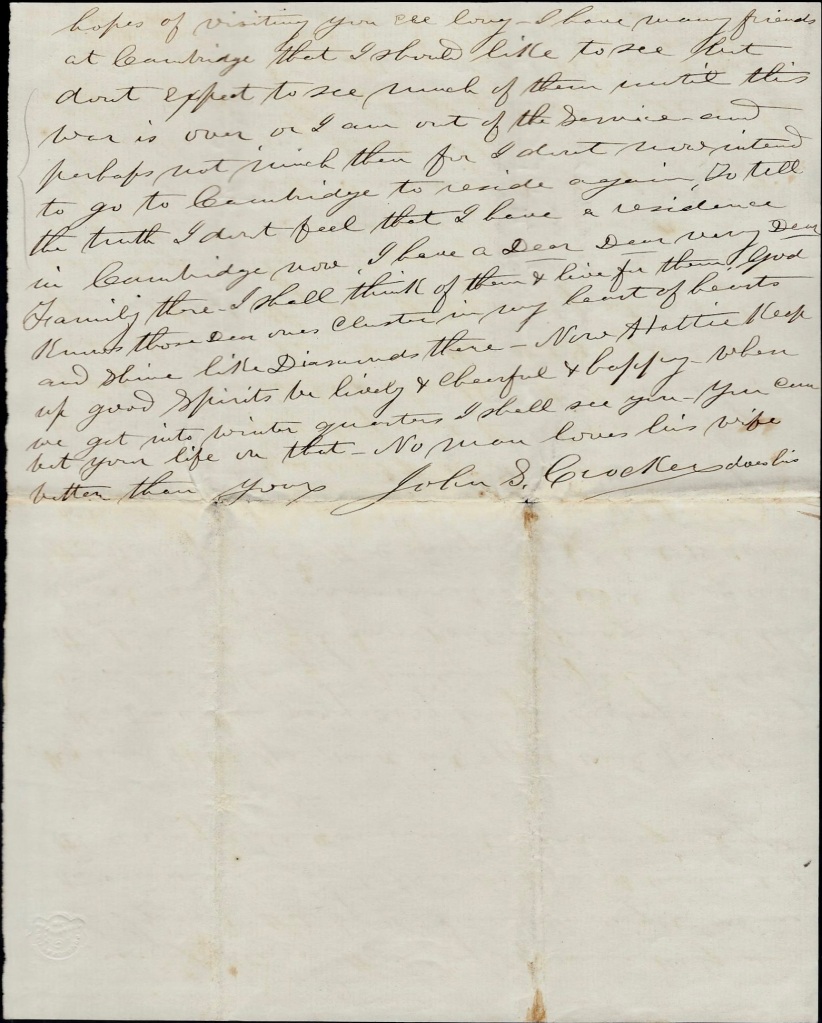
I have just received yours of the 27th & will reply to it in my next. The address is all serene now. Your letter and the contents of the carpet bag have cheeered my heart. I have worked hard today. I had only three hours to sleep last night & shall have no more tonight. I should like to visit you very much. It would give me unbounded pleasure to see you and the other dear ones at the Gothic House. I indulge in hopes of visiting you ere long. I have many friends at Cambridge that I should like to see but don’t expect to see much of them until this war is over, or I am out of the service and perhaps not much then for I don’t now intend to go to Cambridge to reside again. To tell the truth, I don’t feel that I have a residence in Cambridge now. I have a dear, dear, very dear family there. I shall think of them & live for them. God knows those dear ones cluster in my heart of hearts and shine like diamonds there.
Now Hattie. keep up good spirits. Be lively & cheerful & happy. When we get into winter quarters, I shall see you. You can bet your life in that. No man loves his wife better than your John S. Crocker does his.
The following interesting letter was written by William T. Early (1817-1874), the son of Joab B. Early (1792-1845) and Betsy Thompson (1792-18xx) of Fredericksburg Parish, Virginia. William was a well-educated lawyer, politician, and owner of the Pen Park plantation of 410 acres near Charlottesville on the Rivanna river. The slave schedules of 1860 inform us that he was the owner of 36 slaves. At the time this letter was written in November 1860, he was serving as the mayor of Charlottesville.
From William’s letter, we learn that he considered the results of the 1860 Presidential election ruinous, believing that it would only lead to secession and the destruction of the Union. William’s political leanings were with the Whigs until the Republican Party emerged, strengthened by the anti-slavery extremists of the party. Though he hated to see the Union dissolved, he makes it clear in the letter that “my destiny is with the South, come what may.” Indeed, he remained in Virginia during the Civil War and in the summer of 1864 served as the captain of Co. A, 1st Battalion Virginia Reserves in the trenches near Chaffin’s Farm near Richmond. The Daily ProgressJuly 1, 1902 issue listed Capt. W. T. Early among the Confederate Soldiers interred in Maplewood Cemetery.
Apparently William did his best to bind up the wounds of the Nation after the war. In a post-war article he was quoted as saying, “The sentiment of the people throughout this region is one of entire submission to the result of the contest. Slavery is universally regarded as extinct, and there is a general and absolute acquiescence in its fate. Indeed, may people rather rejoice at this result, as it cuts the Gordian knot of a vexed question, which morally, socially, and politically, like Banquo’s ghost, appeared before us everywhere, and frightened us from our propriety, and which swallowed up every other question, as Aaron’s rod swallowed up all other rods. Of course, at first, there will be much disorganization of labor, but not so much as anticipated, and the result will be that the negro will make a very good laborer, and will take his proper place in the social scale, or he will go elsewhere, which is probably his fate. There is no spirit of further resistance…disunionists are now perfectly satisfied with the experiment made.” [27 September 1865, The New Hampshire Patriot & Gazette.]
William wrote the letter to Septimus (“Sep”) Douglass Cabaniss (1815-1889), the son of Charles Cabaniss (1773-1825) and his wife Lucy Ingram (1775-1827), who moved from Lunenberg County, VA to Madison County, AL in 1810. In his early years, Septimus was educated at Green Academy in Huntsville, AL. He attended the University of Virginia between 1832-1835, and returned to Huntsville to read law with a local attorney. He passed the Alabama Bar in 1838 and practiced law, primarily dealing with estates, in Huntsville until his death. Septimus served the Confederacy as a member of the Alabama State Legislature from 1861-63 and a Colonel in the Confederate Intelligence Division during the Civil War.
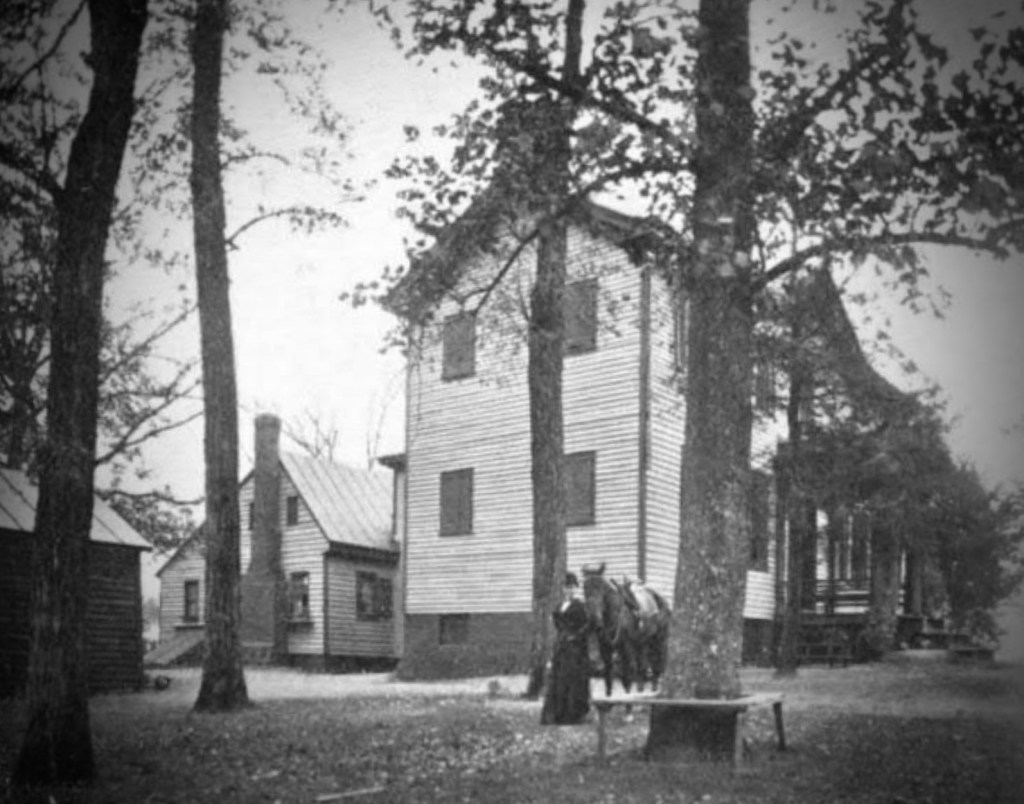
Pen Park Plantation House at it appeared in the late 19th Century. The older part of the house is the smaller structure behind the newer addition.
Transcription
Pen Park near Charlottesville November 10th 1860
S. D. Cabaniss, Esqr.
My dear friend—I have delayed answering your very highly esteemed favor of the 18th ultimo in the hope of being able to attend your sale in Jackson county. But the result of the Presidential election has made it impossible. The effect of that disastrous event is to chain everybody here to the soil for the present as fast as Prometheus was chained to the rock. In the course of a few months, I hope to change my location for Huntsville, or its vicinity. So far as I can see now, I can’t discern any probable satisfactory solution of our present troubles without many throes and convulsions.
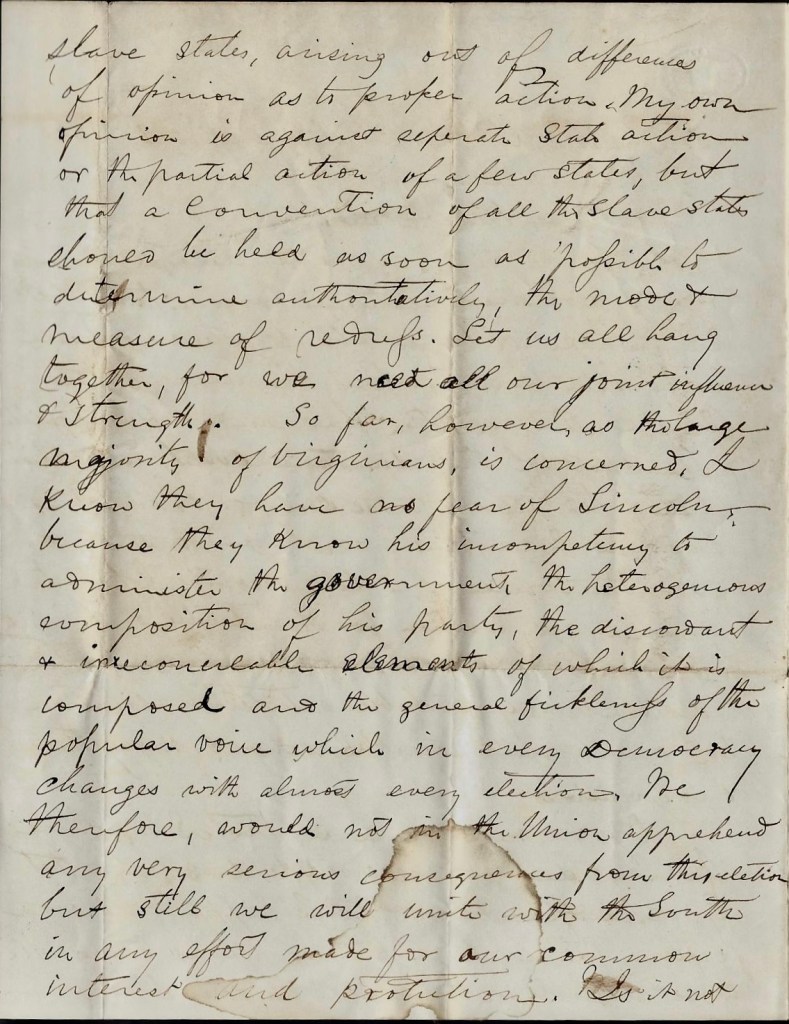
Our news here is that South Carolina has seceded—or resolved to do so—and that Georgia, Alabama, & Mississippi will soon follow. In such a state of affairs, there will be great trouble in this and the other border slave states arising out of differences of opinion as to proper action. My own opinion is against State action or the partial action of a few states, but that a Convention of all the slaves states should be held as soon as possible to determine authoritatively the mode and measure of redress. Let us all hang together, for we need all our joint influence and strength.
So far, however, as the large majority of Virginians is concerned, I know they have no fear of Lincoln because they know his incompetency to administer the government, the heterogenous composition of his party, the discordant & irreconcilable elements of which it is composed, and the general fickleness of the popular voice which in every Democracy changes with almost every election. We, therefore, would not in the Union apprehend any very serious consequences from this election, but still we will unite with the South in any effort made for our common interest and protection. Is it not therefore all important that our counsels should be joint and our action the same?
I fear that there are extremists at the South who will precipitate action and thus introduce the seeds of division at the South, whereas there should be unanimity from the Pennsylvania border to Mexico on that part of every state; and there will be, if a southern Convention is held, and firm, and at the same time, judicious measures adopted.
Before this reaches you, however, the die may be definitively cast and states committed to instant or unqualified secession. In that event, though I can see nothing but ruin ahead, my destiny is with the South come what may. With a melancholy but firm & undaunted spirit, I will take up arms against the sea of troubles trusting that Providence will vouchsafe us a happy issue out of all our afflictions. Such will be the sentiment of Eastern Virginians but I fear that west of the Blue Ridge we should have trouble for there the slaves are few and far between.
I regret much my inability to attend the sale, and indeed suppose it will be impossible to effect one in the present condition of the public mind, but hope in the course of a month or two to get some funds that will enable me to visit Alabama and invest at least enough to buy a home in or near Huntsville.
The public sentiment here is extremely feverish and excited and I would like to know your opinion of the action of Alabama. Hoping to hear from you at an early day. I am truly your friend, — W. T. Early
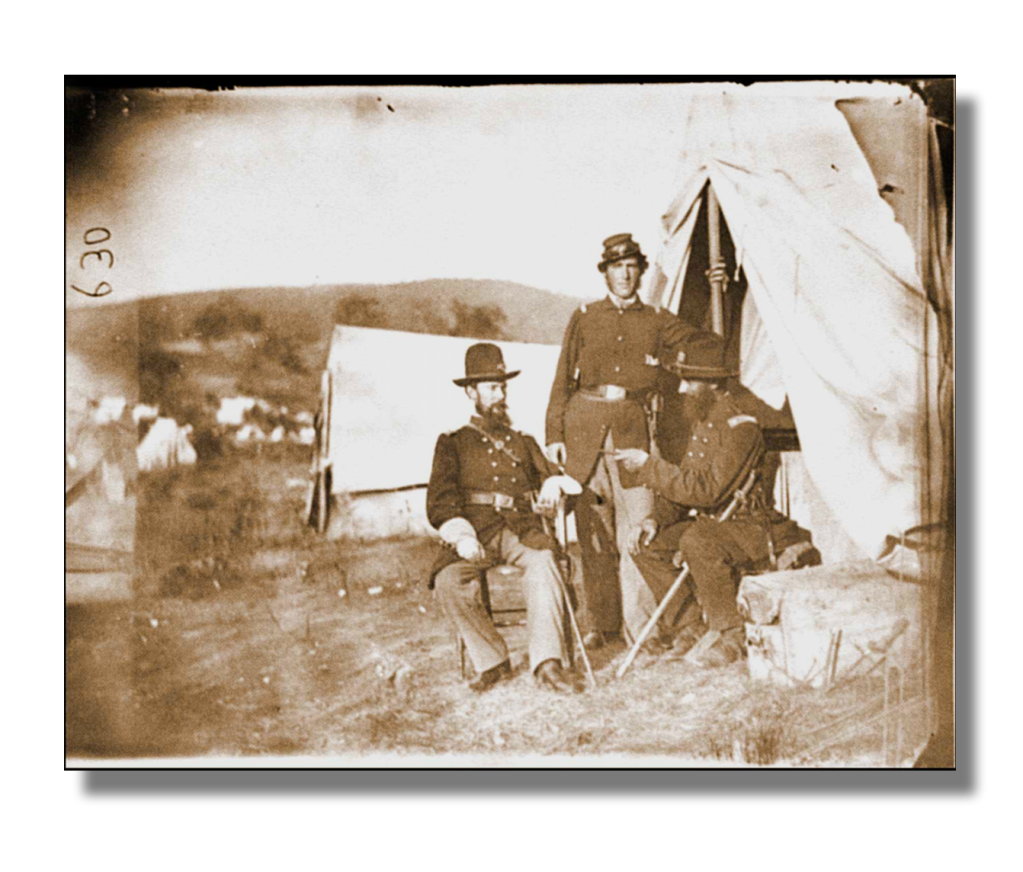
I could not find an image of Gorgas but here are some member of the 90th Pennsylvania, taken after the Battle of Antietam. Franklin Beerer (Co. B) sits at left, Carson at right. At Antietam, Beerer was shot through the left knee, left elbow, and suffered a contusion on left shoulder. (The Horse Soldier)
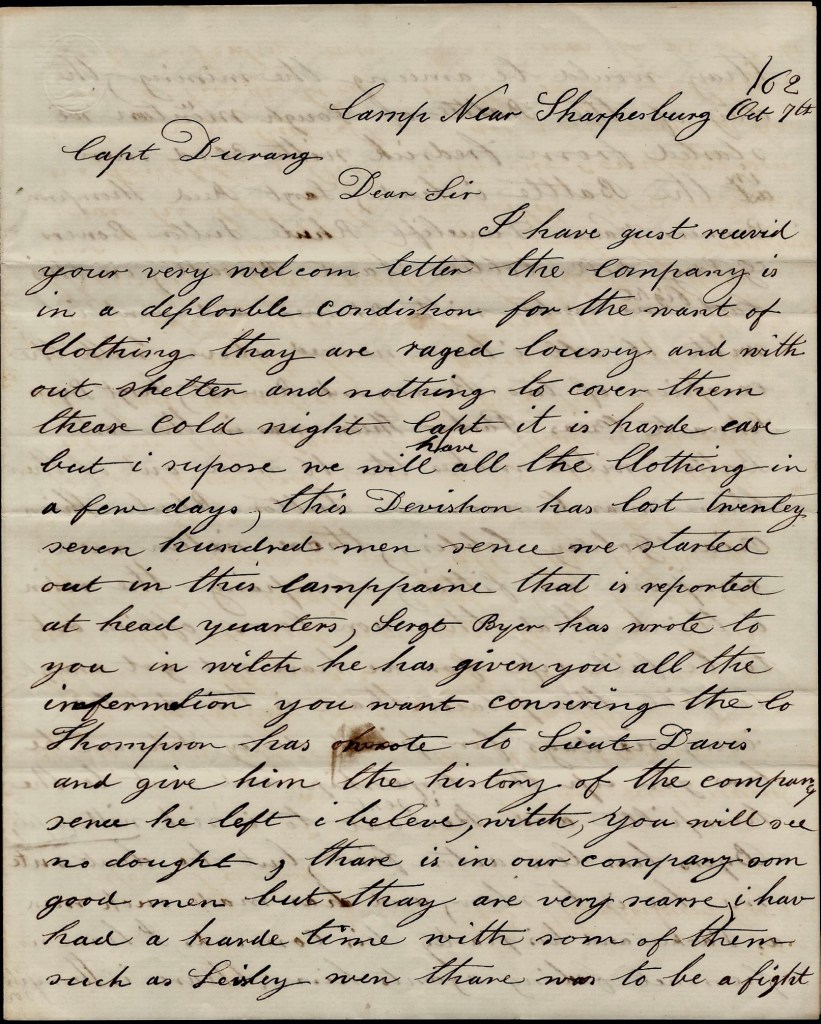
The following letter was written by 43 year-old Edmund J. Gorgas (1819-1901) of Philadelphia who began his service in May 1861 as a sergeant in Co. K, 19th Pennsylvania Infantry. He was mustered out of that 3-month’s regiment on 29 August 1861 and the following March was commissioned a 2nd Lieutenant in Co. A, 90th Pennsylvania Infantry. He was wounded in the Battle of Fredericksburg but returned to his regiment in time for the Battle of Gettysburg where he was taken prisoner and confined at Macon, Georgia. Following his exchange he was promoted to 1st Lieutenant of the company.
Before and after the Civil War, Edmond worked as a “coach trimmer” in Philadelphia—good with his hands but so great with the pen. His spelling was atrocious and I have done my best to interpret his meaning in the following letter to his Captain written just three weeks after the Battle of Antietam in which he claimed his company in “deplorable condition.” We learn from his letter who among the members of Co. A actually fought in the Battles of South Mountain and Antietam.
Transcription
Camp near Sharpsburg October 7th 1862
Capt. Durang,
Dear Sir—I have just received your very welcome letter. The company is in a deplorable condition for the want of clothing. They are ragged, lousy, and without shelter and nothing to cover them these cold nights. Captain, it is [a] hard case. But I suppose we will have all the clothing in a few days.
This Division has lost twenty-seven hundred men since we started out in the campaign that is reported at headquarters. Sergt. [Hillary] Beyer has wrote to you in which he has given you all the information you want concerning the company. [William L.] Thompson has wrote to Lieut. [William P.] Davis and given him the history of the company since he left, I believe, which you will see no doubt. There is in our company some good men but they are very scarce. I have had a hard time with some of them such as [David] Leslie. When there was to be a fight, they would be among the missing.
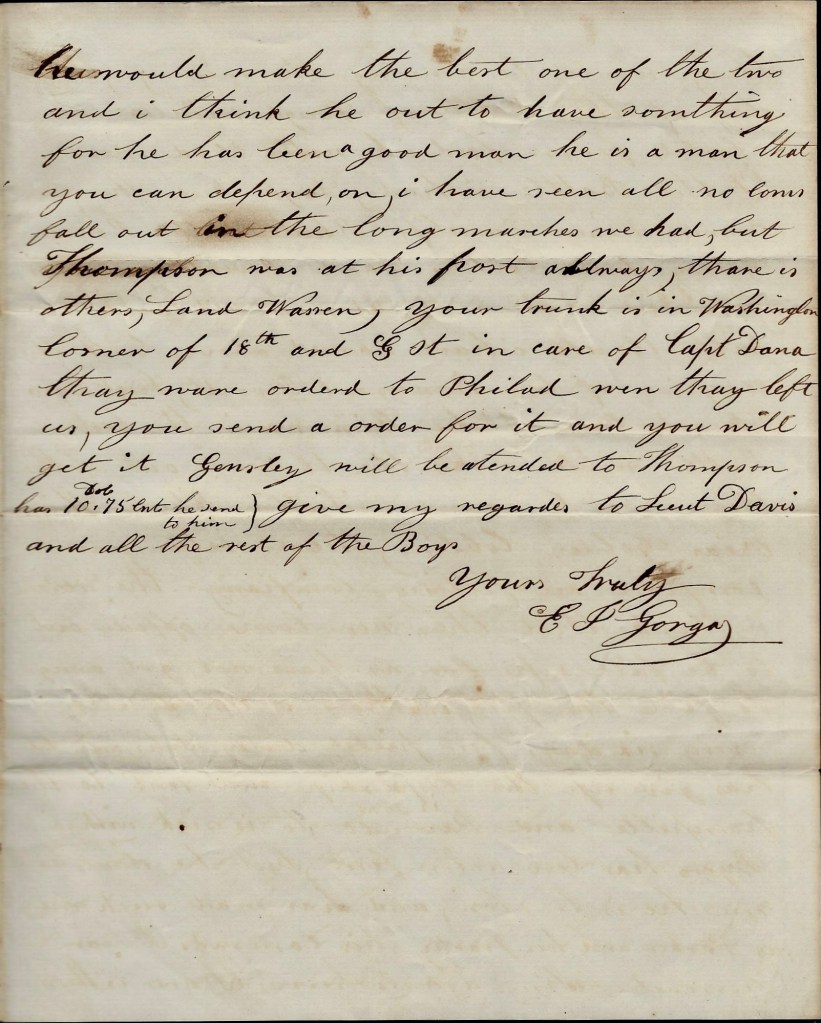
The day of the Battle of South Mountain we started from Frederick with 30 odd men. In the battle, I had Sergeant Roodt, [Wm. L.] Thompson, [Thomas] Benner, [Isaac]Warren, [E. A.] Dunnecliff, [John] Ruhl, [George W.] Sutton, [Joseph] Bowers, [James H.] Gouldy, [David] Diehl, [Emile] Coblentz, [George] Land, [William] Revoudt. In this last fight we started with 21 men and went in with 16—-all I have named above with the exception of [Joseph] Bowers and [William] Revoudt. Sergt. [Hillary] Beyer, [Henry] Schwartz, [Albert] Ozias, [Henry] Parker, [Augustus M.] Theiss was in the last battle which makes the 16 men, Out of them, there was six wounded—[George] Sutton, [John] Ruhl, [Augustus] Theiss, [Albert] Ozias, [James H.] Gouldy, [&] [Emile] Coblentz. Those sixteen men compose our fitting company.
The reason, I think, that that the non-com officers ought to be filled up—for we have not got enough to fill their places—there is two detailed every six days for picket duty. [Henry] Schwartz—he has give up the corporalship and sent to the hospital and Revoudt is sent too—is sick with a [ ]. [Hillary] Beyer has been acting first, but he don’t [suit?] me. He is too slow and has made such men as [Henry] Parker and his party his comrades. I have no personal feelings against him. There is [William L.] Thompson. He would make the best one of the two and I think he ought to have something for he has been a good man. He is a man that you can depend on. I have seen all non-coms fall out in the long marches we had, but Thompson was at his post always. There is other, [George] Land [& Isaac] Warren.
Your trunk is in Washington, corner of 18th & G Street in care of Capt. Dana. They were ordered to Philadelphia when they left us. You send an order for it and you will get it. Generally will be attended to. Thompson has got 10 dollars 75 cents he sent to him. Give my regards to Lieut. Davis and all the rest of the boys,
The following letter was written by 1st Lieutenant William Garner Harris (1830-1901) of Co. H, 36th Georgia Infantry. He was promoted to Captain of the company in mid-April 1863 and resigned his commission on 19 March 1864, having been elected as Sheriff of Murray county, Georgia. William was married to Eugenia (“Jennie”) Carter (1841-1910) in 1861 and the baby referenced in this letter was Lucy A. Harris, born on 22 March 1861. William wrote the letter to his younger sister, Mary Sophronia Harris (1847-1922). William had a younger brother, Robert Harris, who served in Co. E, 60th Georgia Infantry who was mortally wounded at the Battle of Antietam; he died at the Grove Farm on September 18, 1862.
Glenn’s 36th served first in Tennessee, then in Mississippi where it was a part of T. H. Taylor’s Brigade, Department of Mississippi and East Louisiana. The regiment was engaged in the battle of Champion Hill (Baker’s Creek), Miss. May 16, 1863, and in the bombardment of Vicksburg, Miss. from May 18 to July 4, 1863. where it surrendered. After being exchanged, the regiment was brigaded under General Cummings and fought with the Army of Tennessee from Chattanooga to Nashville, Georgia, and the Carolina’s Campaign. In January, 1865, it was consolidated with the 56th Georgia Regiment. As originally organized, the regiment had 930 men. It suffered 43 casualties at Chattanooga, and reported 267 men and 213 arms in December of 1863.
POW Record when surrendered at Vicksburg, MS
Transcription
Camp Hatten Grainger County [Tennessee]
July 2, 1862
Dear Sister M. S. Harris,
I take the present opportunity of answering your letter sent by Potest. I was truly glad to hear from you and Martha. You said if I needed anything to let you and Martha know what I needed and I should have it. I need nothing in the clothing line. I didn’t start with much and have sent half of that home and have wished several times I had nothing here but what I have on. There is always a fuss when we go to start about carrying baggage we have so much running around to do. Though I am very thankful to you for the offer.
I want you to go down and stay some with Jennie and the baby. I expect they are lonesome as Cate don’t stay there much since I left. I don’t know when I can come home but when I do, I will try and bring you some present if I can find anything you will have.
Give Martha my best thanks for her kind offer and tell her I will remember if I ever get home, I can’t tell you where to write but direct to Knoxville, Glenn’s [36th] Regiment, Georgia Volunteers, and I will get them some time. There are a great many old acquaintances in this Brigade. Gus Simmons & his brother is in Col. Harris’ Regiment, this Brigade.
Capt. Jacob F. Mader, Co. H, 61st OVI (L. M. Strayer Collection)
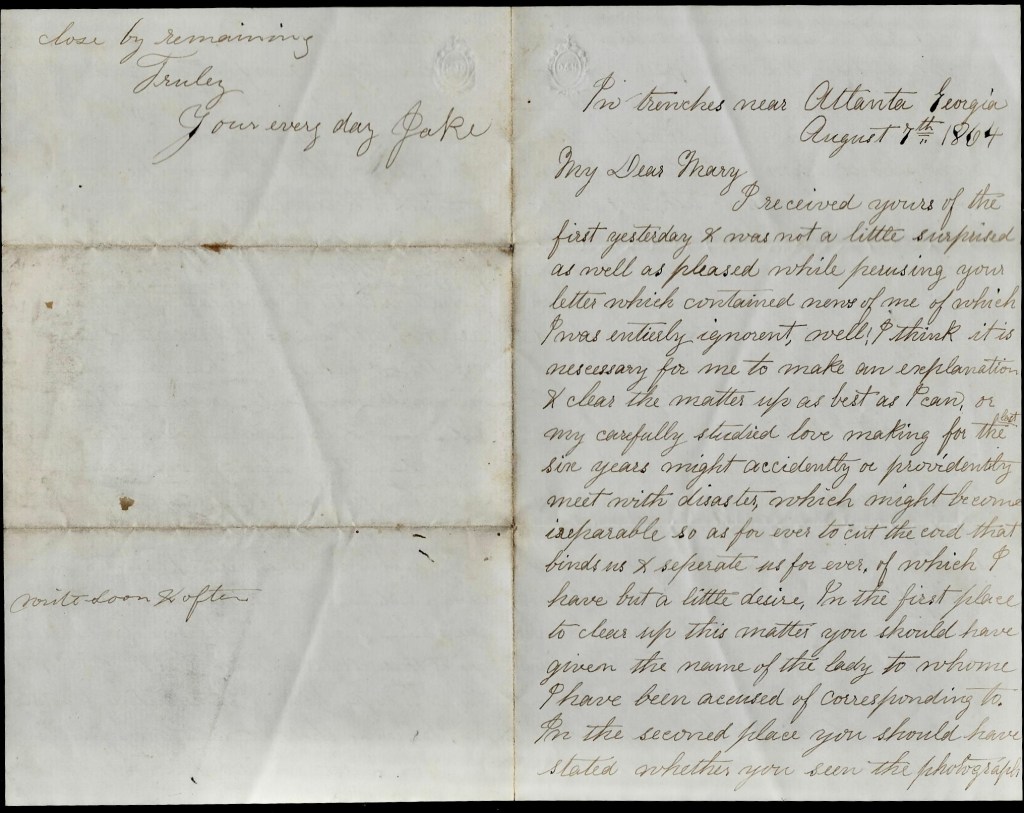
The following letter was written by Jacob Frederick Mader, Jr. (1840-1922), the son of German emigrants J. F. Mader (1808-1888) and Johanna Sterr. Jacob was born in Chillicothe, Ohio, but came to Circleville when he was only 12 to learn the carriage painting trade. He then relocated to Zanesville where he partnered with brothers in the carriage making business.
In mid-February 1862, Jacob enlisted at Circleville in Co. H, 61st Ohio Volunteer Infantry and was mustered in as fourth duty sergeant. He was commissioned 2nd Lieutenant on 9 October 1862, and on 28 October 1863, he was transferred to Co. B which he commanded in the absence of its captain until 29 April 1864 when he was promoted to captain of the company and served as such until he was mustered out of service at Goldsboro North Carolina. He was slightly wounded at the second battle of Bull Run and also at Peach Tree Creek. He was engaged in the battles of Cedar Mountain, Freeman’s Ford, White Sulphur Springs, Waterloo Bridge, second Bull Run, Chancelorsville, Gettysburg, Hagerstown, Wauhatchie, Lookout Mountain, Missionary Ridge, Ringgold, Knoxville, those of his regiment were in the Atlanta campaign, March to the Sea, and the Campaign of the Carolinas.
On his way home, he stopped at Washington D.C. and was in Ford’s theater on the night of April 14, 1865 when President Lincoln was assassinated.
Though he addressed the letter to “Mary,” most likely Jacob wrote his letter to his future wife, Maria L. Hartmeyer of Circleville, Ohio.
Transcription
In trenches near Atlanta, Georgia August 7th 1864
My Dear Mary,
I received yours of the 1st yesterday & was not a little surprised as well as pleased while perusing your letter which contained news of me of which I was entirely ignorant. Well! I think it is necessary for me to make an explanation & clear the matter up as best as I can, or my carefully studied love making for the last six years might accidentally or providentially meet with disaster, which might become irreparable so as forever to cut the cord that binds us and separate us for ever, of which I have but little desire.
In the first place, to clear up this matter you should have given the name of the lady to whom I have been accused of corresponding to. In the second place, you should have stated whether you seen the photograph or not & if it was mine, for as it is now, you only have the sensationist’s word for it & neither you or I are convinced that the photograph is mine. So as the thing now stands, I am not the guilty one & have no forgiveness to ask. But when it is proven that I have deceived, or tried to deceive you, then I will most sorrowfully ask your pardon.
I am very grateful for praising me so highly to my correspondent in Lebanon, Ohio, & will try at any future time to reciprocate in a like manner but I hope more & I know more deserving than I am of the compliment bestowed on me. You say that your confidence in me is shaken—that it had been laboring in a great mistake. Now I don’t think that you have as yet any reason to make such a remark. You have had no substantial evidence that I am corresponding with a lady in Lebanon, Ohio, & have sent her my photograph with the intention of making love to her. You say that you should like to hear from me soon again if it is consistent to the happiness of my lady love & correspondent in Lebanon, Ohio. As for that, I know she would not think any the less of me. So you can depend on hearing from me often without giving her any trouble whatever. I will now halt for the present and commence on some other subject.
I see by your last letter that you are not yet aware of the death of Paul but ere this reaches you I have no doubt that you will know all. We are shelled by the enemy & in return shell the enemy every day. They throw over sometimes sixty-four pounder shells about the size of a gallon jug thirteen inches long, six inches in diameter 18 inches in circumference. It has powder in them the grains of which is the size of a hazel nut. One of these shells exploded near the trenches of the 14th Corps killing & wounding fourteen men.
Hoping that this letter may find you in good health, I will bring it to a close by remaining truly, your every day, — Jake
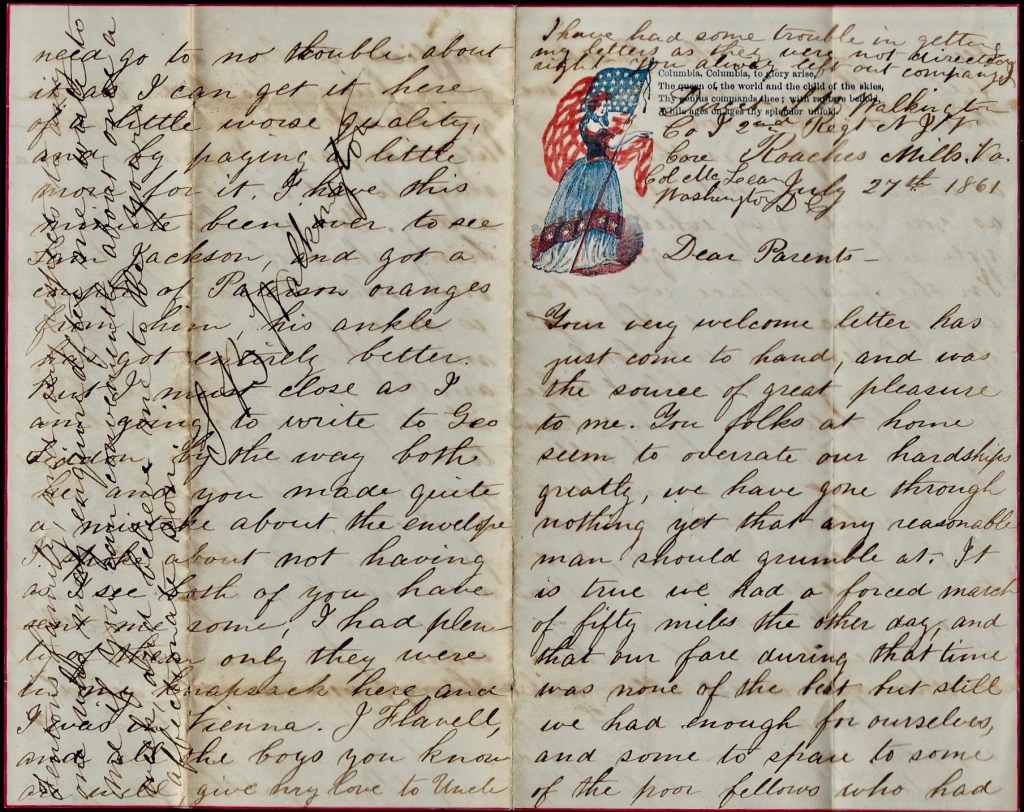
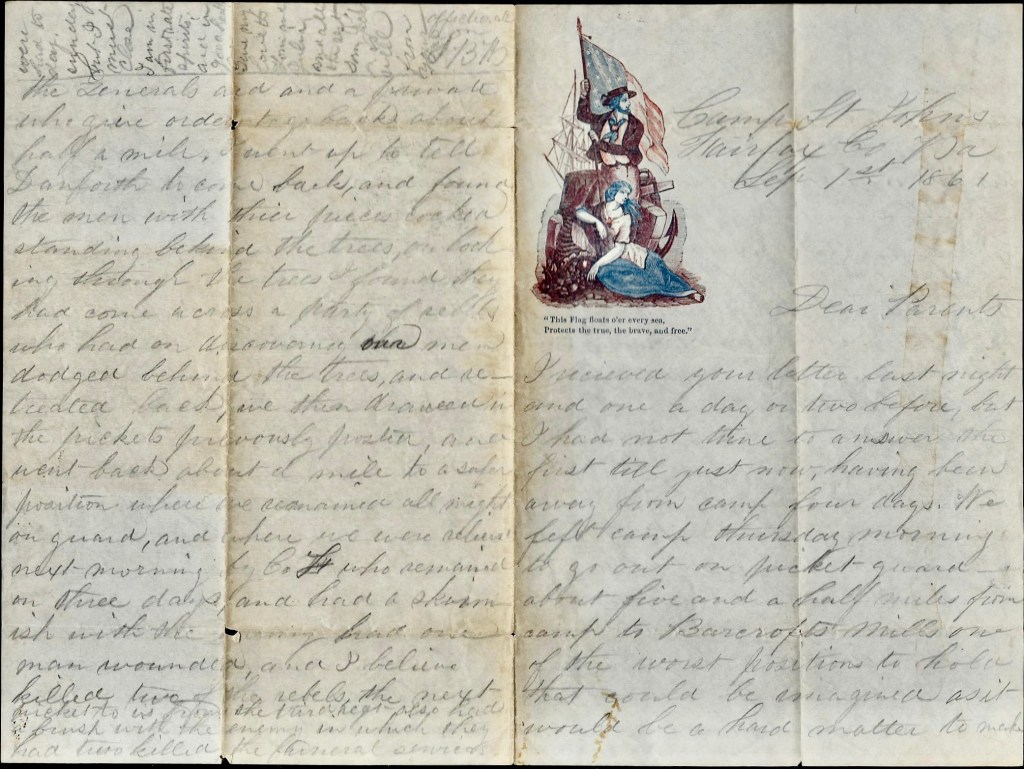
Samuel’s letter was written on patriotic letterhead typical of early-war letters.
The following letters were written by Samuel Beatty Walkington, Jr. (1840-Aft1882) of Paterson, Passaic county, New Jersey, who enlisted on 30 May 1861 as a private in Co. I, 2nd New Jersey Infantry. He was promoted to a corporal in October 1862 and to 1st Sergeant in June 1863. At some point during his service, Samuel was taken prisoner and was exchanged though his records don’t say when.
Samuel was the son of Irish emigrants Samuel and Eliza Walkington. Like his father, Samuel was a machinist and after the war, Samuel relocated to California where he worked as an engine builder in Alameda county. He was enumerated among the registered voters there through at least 1882.
Having had little opportunity to become engaged during the 1st Battle of Manassas, Samuel’s letters share extraordinary detail about picketing and skirmishing activities typical of early-war letters.
Letter 1
Roaches Mills, Virginia July 27th 1861
Dear Parents,
Your very welcome letter has just come to hand and was the source of great pleasure to me. You folks at home seem to overrate our hardship greatly. We have gone through nothing yet that any reasonable man should grumble at. It is true we had a forced march of fifty miles the other day, and that our fare during that time was none of the best, but still we had enough for ourselves and some to spare to some of the poor fellows who had been engaged on the battlefield all day, and since we have got settled down once more our fare is the same as usual, and not very bad as you will say when I tell you what we have generally.
In the first place, we get a loaf of bread about the size of a baker’s six cent loaf every day, for breakfast either field beefsteak or fried ham together with as much coffee as we want. For dinner we have either fresh or corned beef, or vegetable soup, and to make it go better we often go out and gather tomatoes or green corn, which taken together you must allow makes no very mean dinner. For supper, coffee and bread, and sometimes rice or beefsteak, suffices to keep us from going hungry to bed. We can get blackberries in any quantity here and I generally manage to eat about a quart a day.
You speak about my being short of money. It is true what I had with me is done, for whenever we move from one place to another, we are generally short of rations and have to buy something to eat. But you need not send me any as I can borrow it here from time to time as I need it. If you hear of anyone coming out here with whom you can send anything, you might send me a pound or two of smoking, and a little chewing tobacco, although you need go to no trouble about it as I can get it here of a little worse quality and, by paying a little more for it. I have this minute been over to see Sam Jackson and got a couple of Paterson oranges from him. His ankle has got entirely better. But I must close as I am going to write to George Seddon. By the way, both he and you made quite a mistake about the envelope I spoke about, not having as I see both of you have sent me some. I had plenty of them, only they were in my knapsack here and I was in Vienna.
I, Flavell, and all the boys you know are well. Give my love to Uncle Fenton’s family and my respects to anyone who may enquire after me. Write to me if you can conveniently about once a week and believe me to be your affectionate son. — S. B. Walkington
I have had some trouble in getting my letters as they were not directed right. You always left out company. Direct to S. B. Walkington, Co. I, 2nd Regt. N. J. Vols., Care of Col. McLean, Washington D. C.
Letter 2
Camp St. Johns Fairfax county, Va. September 1st 1861
Dear Parents,
I received your letter last night and one a day or two before, but I had not time to answer the first till just now, having been away from camp four days. We left camp Thursday morning to go out on picket guard about five and a half miles from camp to Barcroft’s Mills—one of the worst positions to hold that could be imagined as it would be a hard matter to make a safe retreat from it in case of an attack from a large force of the rebels as the mill is situated in a ravine surrounded on all sides by very steep hills from the tops of which anybody in the ravine might be blowed to pieces. But to resume.
Our company arrived there at about twelve o’clock and immediately proceeded to post pickets along all the roads leading to the mills. We went along the road to the right of the mill about a quarter of a mile and were about to post a picket of four men when on suddenly looking to our left we found that we were immediately under a rebel battery on a high hill only about half a mile distant, and which commanded the road on which we were, and also Baileys Cross Roads about three quarters of a mile from where we were. We were under command of Charley Danforth and turned right back and posted our picket under cover from the battery, and then the rest of us turned back and proceeded up the road to the left of the mill till we came near a toll gate where we posted another picket of four men, of which I was one. The rest then proceeded to the toll house about twenty yards distant and enquired of the man if there were any rebels around. He said there was not and the Lieut. proceeded to post a picket back of the house. At this minute I spied an officer and a man coming across a field. They proved to be the Generals and a provate who gave orders to go back about half a mile.
I went up to tell Danforth to come back and found the men with their pieces cocked standing behind the trees. On looking through the trees, I ground that had come across a party of rebels who had on discovering our men, dodged behind the trees and retreated back. We then drawed in the pickets previously posted and went back about a mile to a safer position where we remained all night on guard and where we were relieved next morning by Co, F who remained on three days and had a skirmish with the enemy. had one man wounded and I believe killed two of the rebels. The next picket to us from the Third regiment also had a brush with the enemy in which they had two killed. The funeral services were had today, Sunday.
But I must close. I am in first rate spirits and in good health. Give my love to Tom and Julia and all the rest. Sam Hicks [?] is well. From your affectionate son, — S. B. W.
This letter was written by Joseph Edwin Folkes (1842-1916), the son of Elisha Knibb Folkes (1794-1849) and Mary Wynne Epps (1792-1851) of Charles City, Virginia. By 1863, when this letter was penned, the only survivors in the family were Joseph and his older sister, Rebecca Epps Folkes (1832-1866).
According to his obituary, Joseph was born at Bermuda Hundred on the James river. At the age of 19 in May 1861, he joined the Confederate Army “as a member of Pickett’s Second Brigade of Volunteers, Mahone’s Division, A. P. Hill’s Corps. He fought with the brigade until August 19, 1864 when he was wounded while on the line of battle. To the day of his death he carried a minié ball in his shoulder blade as a memento of the fight.”
Though Joseph’s obituary (Richmond Times Dispatch) suggests a glorious service in Pickett’s Brigade, we learn from regimental muster rolls that he did not enter the service until late in 1861 as a private in Co. B, 41st Viginia Infantry but was quickly promoted to 5th Sergeant (he had excellent hand writing). However, a year later he was reduced to ranks just after the Battle of Fredericksburg and he had two months pay deducted by order of court martial. In 1863 we know that Joseph was with his regiment at Gettysburg where he was quoted: “On the eve of the 2nd, all the night long, our brigade worked on the breastworks; for we knew the 3rd of July was to be another just like the one ended, and we were willing to work now and hard.” [see: Account of Joseph E. Folkes, by Kate Folkes Minor, on file at the Fredericksburg and Gettysburg National Military Parks.]
In June 1864, he was reduced in ranks again from Sergeant to Private but then promoted to Segt. Major by order of Major Eterage on 1 August 1864 (he appears to have been promoted while absent due to his wounds). At war’s end, he was still serving in Co. B, 41st Virginia, and never received the commission he felt he deserved. Maybe criticizing his Colonel publicly in the home newspapers had something to do with that,
After the war, Joseph settled in Richmond where he was a sales clerk for Levy Brothers. Afterwards he was an assistant librarian at the State Library Building.
Transcription
Camp 41st Virginia Regiment Near Fredericksburg City, Virginia Bright and Sunny, February 7th, 1863
Devoted and Fondly Remembered Mary,
As nothing can afford me more pleasure than writing to you, I will devote the leisure hours of this sweet morning in so doing for when I am writing to you, the lively and bright bye gone days loom up before ]me], and I almost think it is reality. But when I come to think where I am, it causes a sigh to escape my heart. Why, oh why, does cruel fate allot such to be my destiny. Oh that I could say I was happy and contented with my lot, but I cannot. I am not contented and cannot be. But I forget. Let that pass.
We are now quite comfortable in our tents, with chimneys more so than our friends imagine at home. It is true that we have long been without tents, or any other kind of shelter and exposed to the wintry winds and rains, but that cause could not be helped as we were continually on the march. But we are now, and have been for the past six weeks, in good tents and within the last two weeks we have almost erected a little city, with its nice little streets and side walks. If I am not to get any nearer home this winter, I would like as much to stay where I am. I wish I was an artist to draft my quarters so you could see them. I know you would admire them—but not because I made the building after my own fancy. What a beautiful site at the close of evening when the glorious sun is setting behind the western hills does our camp and the landscape around present. You remember I am a great lover of nature, but ungifted to catch the beauties of a landscape and transfer them to canvas, unpracticed in the simplest movement of the artist’s duties. I can only stand and admire what Providence has spread around us soldiers who are battling for our country’s honor and liberties, and as colors deepen or fade, and the beauties augment or diminish, I bow with admiration at the object and increased love to Him whose hand has garnished the Heavens and whose goodness is as manifest in these his lower works, as in the constellated glories of the firmament, whose sisters combine to enrich, with heatless light worlds of space, and the infinite seems exhausted to give with starry luster earths evening canopy. Equally [ ] am I with that genius which passes on some [ ] the interesting and the sublime, in the simple and the ordinary. I have no such gifts but I have the love for such gifts. Sometimes the skill of an artist, press upon me till I wish I had the genius and skills to fix the picture, which nature has drawn, and show that our camp [illegible—paper fold] come in turn, the stimulate to taste.
Our regiment was thrown in great excitement not long ago since. The alarm drum was sounded and the Yankees as well as we fell immediately in line of battle and for some time great excitement prevailed on both sides of the Rappahannock. The cause was occasion[ed] by the burning of a dwelling by our pickets and three or four bombs that had been thrown in it on the last fight exploded and we, as well as the enemy, thought that they were signals. But all is quiet now. It is the general impression that a fight is inevitable and that our furloughs have been stopped, and those who are on them are ordered to report to their companies as soon as time will admit. Our next fight will prove to be grandest ever fought on the Rappahannock river, for since the last fight they have been preparing for another fight. A great many batteries are visible that have been recently erected. For the last few days they have been moving large bodies of troops up and down the river. If we are to fight in the quarter, the sooner the better. I want to see it end as soon as it can be done.
You will be surprised to hear that I have been elected from sergeant of Co. B to 1st Lieutenant in Co. G of the regiment and because I stayed over my time at home, the Brigadier General has a board of officers, West Point graduates, to examine and see if I was qualified for the position, and because I missed one word, they reported me incompetent and they have ordered me again to Co. B. This is imposition and I will have redress if it cost me my own life. The fact of this business, they are not willing to see a sergeant promoted to a commission. But I was Co. G’s preference and was duly elected their 1st Lieutenant and even elected by acclimation. I have written to some of my influential friends—one in the Senate and the other a member of the House of Delegates. These friends have written me word that they would see the Secretary of War on the subject and if they can get me off, they will, and I can then join any company I may choose. If I get off, I will join some other company—perhaps the City Battalion. I will never serve in any regiment to which I am by law entitled to a commission. I have faithfully been serving my country and always worked for the promotion of her good. The men know this fact and want me their officer, and I mean to have justice done them as well as myself. I have never since I have been in the service arose in any position that I did not work my way up. Favors have never carried me a step. This regiment works by favors altogether.
Since I have written, the Colonel has found it out and thinks that the secretary of war will decide with me that I am entitled to be relived from further duty with this regiment and he wishes me to take my old position as Sergeant Major. I politely told him I was not going to hold any office below the one I was entitled to and [ ] not get my rights, I declined any positions he could give. He finally wound up by saying I was not old enough to be a 1st Lieutenant of any company while in active service, and admitted I might be competent, but said the Captain wanted to resign and the 1st Lieutenant would be promoted up to his rank. I told him he knew that if justice was dealt out to me, I would get my office, but as I was not his or the Lieutenant Colonel’s favorite, I would not have justice. He walked off as haughty as a prince and we have had no words on the subject as yet and I do not care if he never says a word to me again about it.
We have had a terrible snow storm up here, but stood at better than I had anticipated we would. We have not had much suffering in our regiment as we all the men seem pretty well supplied with clothes and shoes. A Louisiana Brigade and ours used to fight snow balls while the snow lasted, officers and all. Our Brigade used to whip them everyday. You just ought to have seen them charge us. Our brigade would repulse them every time.
Your kind and affectionate letter came safe to hand on last evening and I embrace this the first opportunity of writing an answer to your highly appreciated letter. Nothing can afford me more pleasure than writing to you and I assure you that they are always received with the deepest emotions of gratitude. Often when I am lonesome and wearied out with camp and the old familiar scenes of the soldier’s life, I read and re-read those old letters written by yourself, and they always cheer me up, that I can go about my military duties with a light and cheerful face, knowing that one, sometimes thinks of absent of absent Joe. If I knew that you ever thought of me half so often as you are thought of, Mary, the world might frown but I would heed it not so long as I was remembered by lovely Mary. Time would then roll on faster and not drag on as the present. Things would in general present a sweeter view. The world would then look happy and I would be happy if anything in this life could make me so. But what I have written you treat as nothing, knowing who it comes from. But nevertheless, it is true. But I beg and entreat you not to get offended at what I have said and treat me with contempt by not writing to me again. Then indeed, would I be unhappy.
Enclosed you will find an article relative to my treatment received at the hands of my Colonel, which I had published in the Richmond Whig to show the public what mean and unjust laws are enforced upon the soldiers. If I was a colonel, I am sure I would feel quite cheap after seeing such a piece in a public news paper which referred to me. I hear that our Brigade General is to be promoted to a Major General and his old Brigade to form part of his division as Major General, and that our command will be sent to Tennessee or down to Waverly Station, Sussex County, Virginia. Nearly all of the companies in the regiment are from down that portion of the state and they are raving to be sent there, but our company and Co. G are for staying this side of Richmond. I had rather stay up in the Blue Ridge Mountains than go down in that sickly country, though we could hide in the Dismal Swamp from the Yankees.
I must now finish writing for the morning as my duty will not admit of my writing any more. I must now go and drill, as the drum is rolling for Battalion drill which will not be over until late in the evening. But in the morning I will finish this long letter if such it can be called You will be tired of reading by the time you get through with it this mess, so goodbye until morning.
Well, according to promise I will end this letter. I received one from home this morning which brought sad intelligence. It said the small pox was in the county and that it was at Mr. Stagg’s. I heard that I had a nephew down with it and worst of all my only sister is there and if she was to have that hateful disease, I would almost go mad for she could not survive such an attack. I would not care to live on an other day if she was taken from me. She is all I live for and if I was to lose her, all—,”all,”—would be gone and Joe would be left, the only one of his fathers family. May the Supreme Being forbid such to be my destiny in this world, with no father, mother, brother, or sister—horrible. I could give all up but not my sister, for no one could love a sister better than I love mine. And I know she thinks more of me than many sisters think of their brothers, for as the old adage says; the narrower the brook, the stronger does its current flow. She has but one to love and I have the vanity to say it is all centered on one object (myself). I have never received a line from her since I returned from Charles City. I have received letters from all around the county, and no one said a word about it thinking how unhappy it would make me, and the reason that she has not written to me was because that hateful disease was around her. I cannot imagine how it could get so far in the country.
I hope, Mary, from the heart that your home will not be visited by such a monster. I hear that it is all over Richmond, raging in families as well as in the hospital. One of our regiments was sent off this morning to encamp by itself for fear that some of them had it and that it might spread all over our Brigade. I believe I has as live die as have it. and unless great care is taken, it disfigures anyone so much by leaving so many scars. Enough on that unpleasant subject, hoping again it may not infest your home.
Well, this sheet has almost given out so I will have to finish on another sheet, If you are very busy you will have to take this down several times before you finish it.
The following letter was written by Eugene Allen Dye (1854-1896), the son of Ledyard Dye (1819-1886) and Clarinda Fletcher (1826-1900) of Chautauqua county, New York. Eugene datelined his letter from Millette, Spink county, South Dakota, in 1886 where he was a school teacher and the first superintendent of public instruction for the Dakota Territory. Three years later, South Dakota and North Dakota became the 39th and 40th States in the Union.
Millette, Spink county, South Dakota in early 1900s
Transcription
Millette, Spink county, Dakota [Territory] July 16, 1886
Dear John,
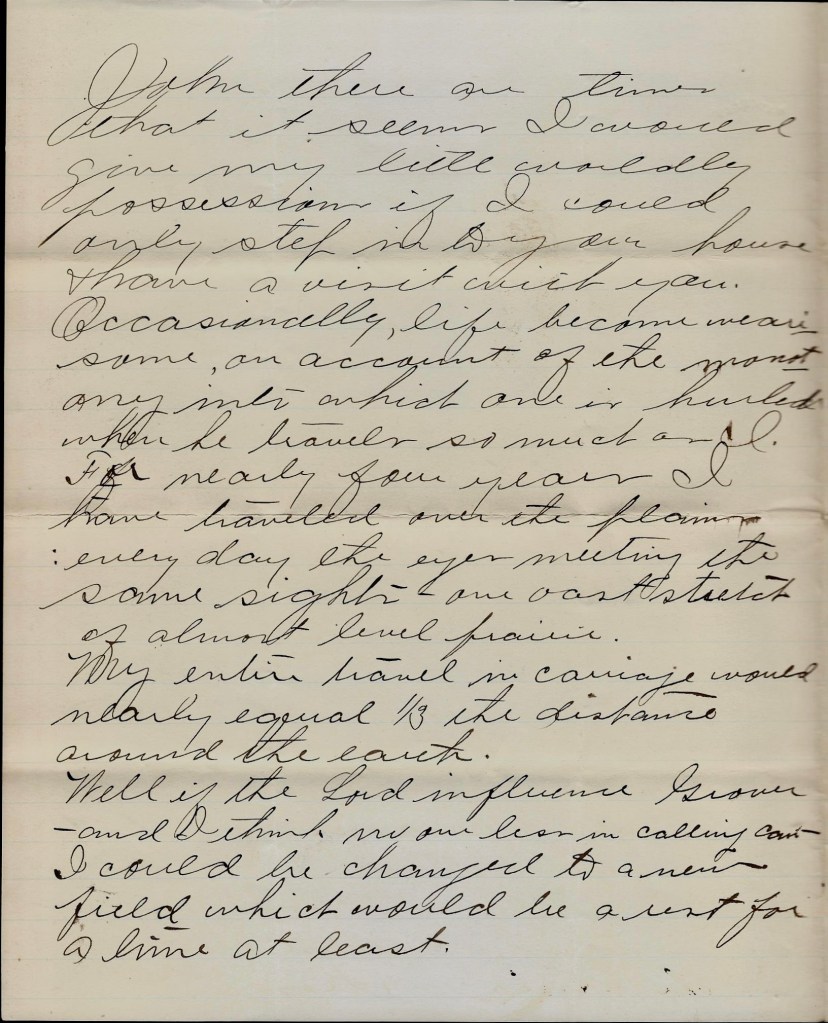
Some weeks have passed since I heard from you. Up until July 6th I have been more busy than I ever was before here. Since then I have spent my time in keeping life in my carcass—battling against excessive heat and dry scorching air (don’t say anything about for it is not favorable to country). Not a day has passed but I have thought of you & wondered how you & family were passing the summer. John, there are times that it seems I would give my little worldly possessions if I could only step into your house & have a visit with you. Occasionally life becomes wearisome on account of the monotony into which one is hurled when he travels so much as I. For nearly four years I have traveled over the plains, every day the eyes meeting the same sights—one vast stretch of almost level prairie. My entire travel in carriage would nearly equal one-third the distance around the earth. Well, if the Lord influence Grover—and I think no one less in calling can—I could be changed to a new field which would be a rest for a time at least.
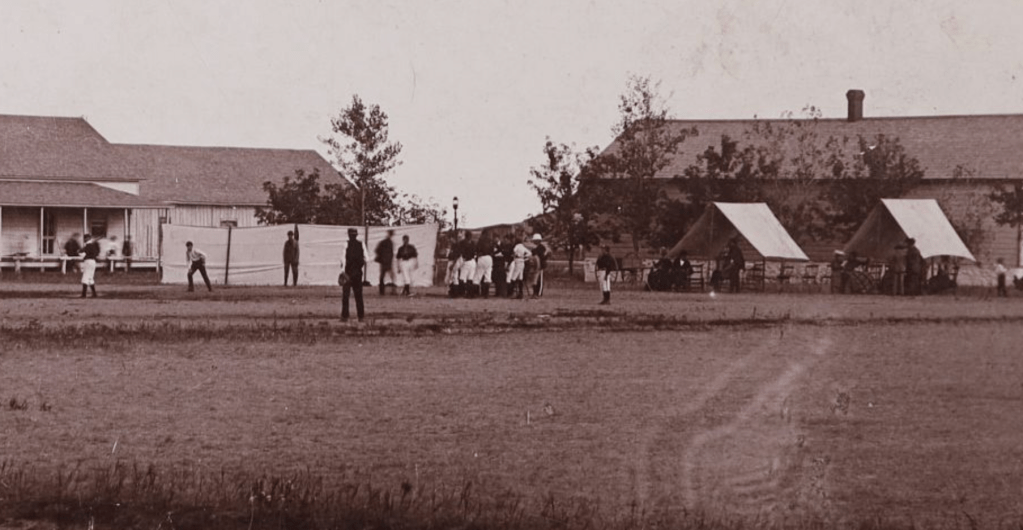
John, I took a most interesting trip among the Sioux Indians recently & perhaps you may be interested in a brief account of the trip. I enclose a programme which will explain much. Well about 40 of us—women and men—started from Pierre 44.250 north latitude at about five o’clock a.m. After driving 25 miles north along the Missouri, we reached Ft. Sully which is located on a beautiful plateau overlooking the river. Only about 200 soldiers are kept there but everything is in the very finest shape. It is one of the most beautiful places I ever visited. Everything that Uncle Sam’s money could do to beautify & make pleasant has been done.
Soldiers playing baseball at Fort Sully in the 1870s.
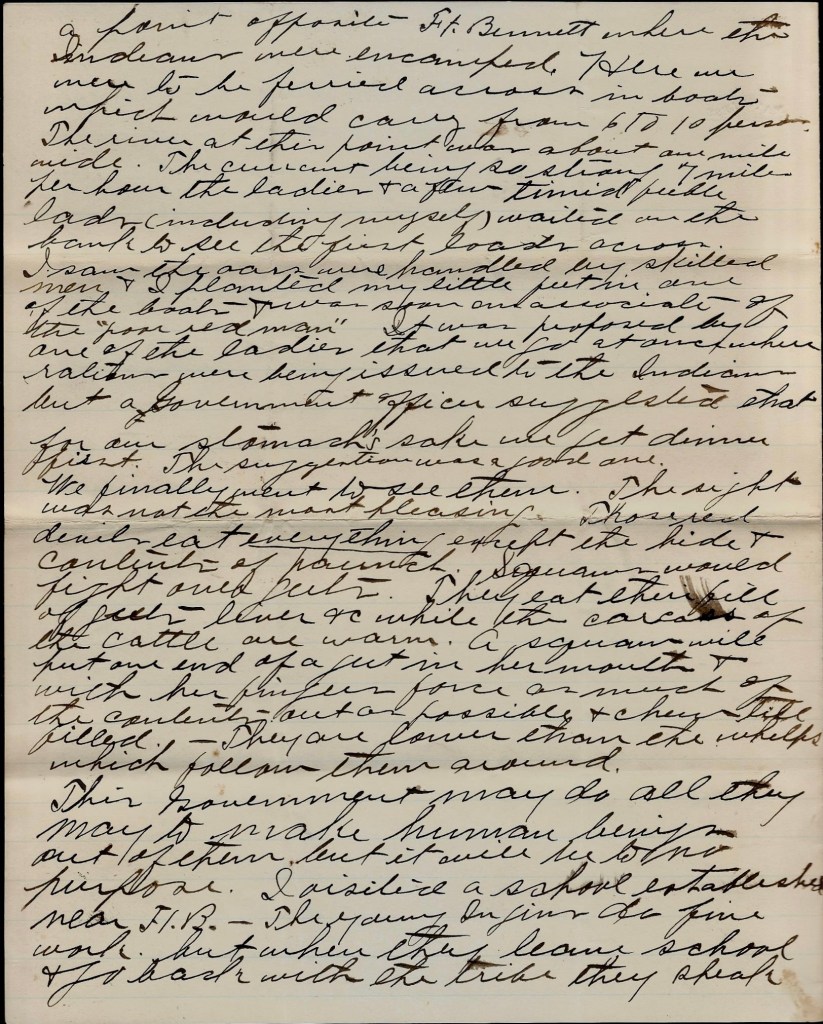
After a splendid breakfast with the soldiers, who were not only soldiers but gentlemen, we seated ourselves in the carriages & drove 8 miles to a point opposite Ft. Bennett where the Indians were encamped. Here we were to be ferried across in boats which would carry from 6 to 10 persons. The river at this point was about one mile wide. The current being so strong—7 miles per hour—the ladies and a few timid, feeble lads (including myself) waited on the bank to see the first loads across. I saw the oars were handled by skilled men and I planted my little feet in one of the boats & was soon an associate of the “poor red man.”
Fort Bennett, ca. 1886 (South Dakota State Archives)
It was proposed by one of the ladies that we go at once where rations were being issued to the Indians but a government officer suggested that for our stomach’s sake, we get dinner first. The suggestion was a good one. We finally went to see them. The sight was not the most pleasing. Those red devils eat everything except the hide and contents of the paunch, Squaws would fight over guts. They eat their fill of guts, liver, &c. while the carcass of the cattle are warm. A squaw will put one end of a gut in her mouth and with her fingers force as much of the contents out as possible and chew till filled. They are lower than the whelps which follow them around. This government may do all they may to make human beings out of them but it will be to no purpose.
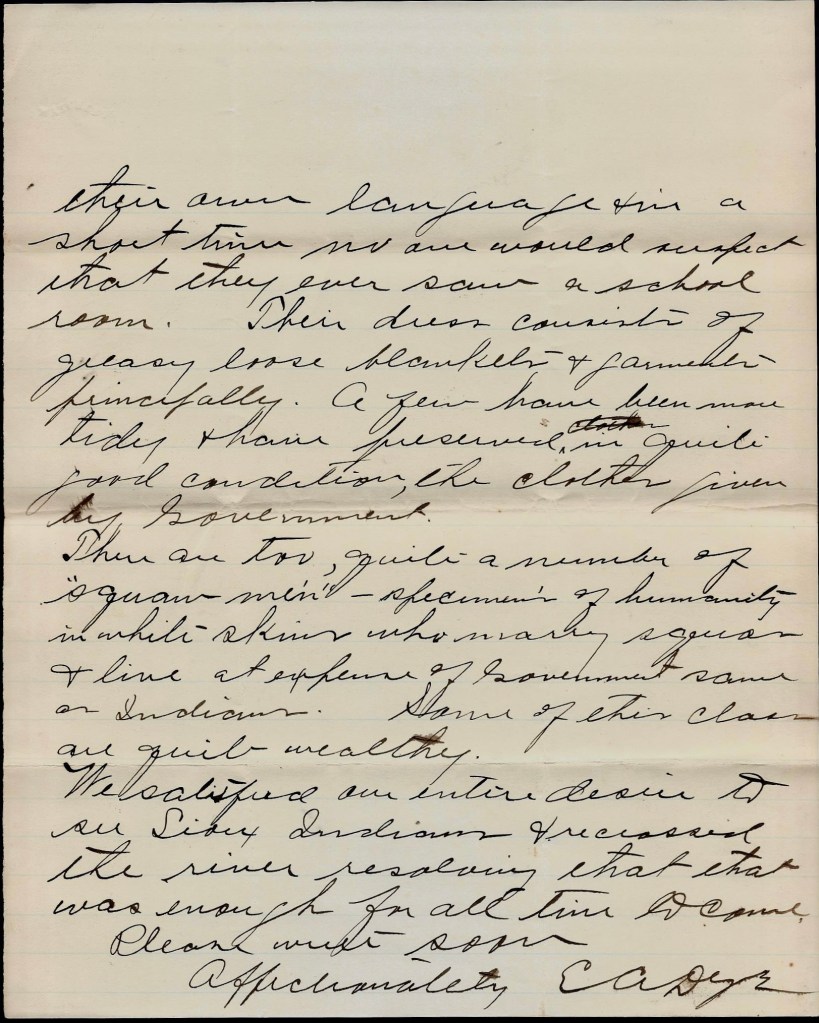
I visited a school established near Ft. Bennett. 1 The young Indians do fine work but when they leave school and go back to the tribe they speak their own language & in a short time no one would suspect that they ever saw a school room. Their dress consists of greasy loose blankets and garments principally. A few have been more tidy and have preserved in quite good condition the clothes given by government. There are too, quite a number of “squaw men”—specimens of humanity in white skins who marry squaws & live at the expense of government same as Indians. Some of this class are quite wealthy. We satisfied our entire desire to see Sioux Indians and recrossed the river resolving that was enough for all time to come. Please write soon. Affectionately, — E. A. Dye
1 The Cheyenne River Agency was established at Fort Bennett in 1878. The Cheyenne River Agency Boarding School for Indian Boys was sited there and St. John’s—a school for girls—was sited nearby.