My passion is studying American history leading up to & including the Civil War. I particularly enjoy reading, transcribing & researching primary sources such as letters and diaries.
This letter was written by Joseph Chauncey Van Marter (1840-1913) of Barton, Tioga county, New York whose name sometimes appears on the muster rolls of Co. H, 3rd New York Infantry as James C. Van Marter for some strange reason. Joseph enlisted on 14 May 1861 to serve two years in the regiment. He mustered out on 21 May 1863 at Albany. He later reenlisted in Co. G, 5th New York Cavalry.
Joseph was the son of Elijah Van Marter (1811-1891) and Sarah E. Van Martin (1817-1890) of Barton, Tioga county, New York.
Transcription
Fort McHenry December 13th 1861
Dear Cousin,
I received your letter tonight about 8 o’clock and was glad to hear from you. You wanted to hear all the good news. The good news is that I feel very good tonight. The news is that we are a going to Georgia or to Florida on the fleet. Then we will hear the bomb shells snap and crack. I am getting as fat as a rail. I cannot think of much to write.
Mate, I shall soon be my boss if that if wasn’t in the way. I think that I shall spend a happy birthday that I am 21 years old. I shall spend it in Baltimore if we don’t go to Florida, I have had some fine times in Baltimore City as I ever see. Your dance that you spoke of I should like to be there but as I cannot, you must dance twice for me. I have been to a dance three times in Baltimore and I danced with as pretty a girl as you ever see. I think that I shall fetch one of them home with me if I don’t miss of it. Tell Aunt that I should like to see her and I shall if I don’t miss of it. Aunt put a Christmas present in my socks. I had a roasted turkey this morning. I have had more fun since I left home than I would if I had stayed at home. Still I was as gray as a rat. Write as soon as you get this.
From your cousin, — Joseph C. Van Marter
Direct your letters to Fort McHenry, Maryland, Co. H, 3rd Regt. N. Y. V.
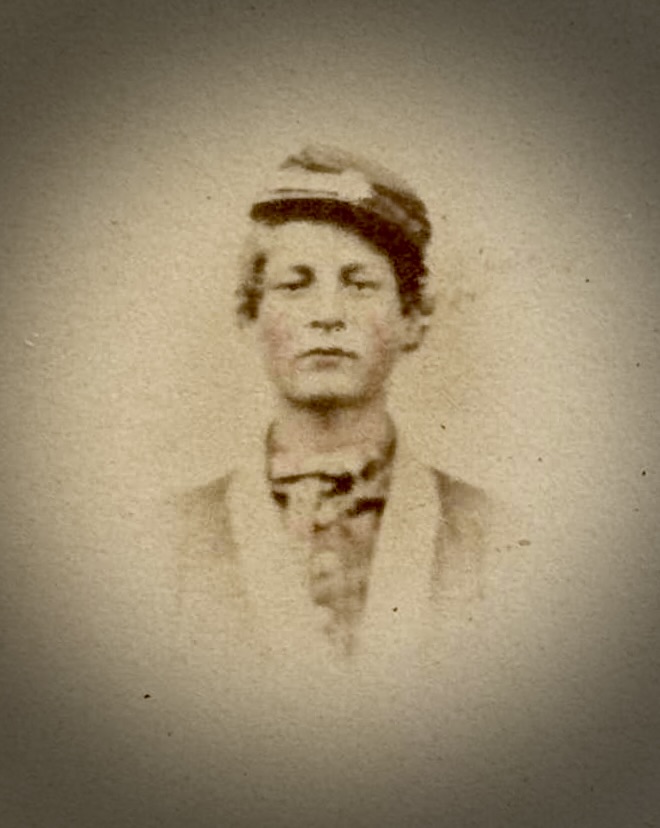
I could not find an image of Elkins but here is Linus T. Squire of Co. H, 11th Michigan Infantry (Ancestry)
The following letter was written by 36 year-old Elkins Babbitt (1826-1862), a private in Co. G, 11th Michigan Infantry. Elkins was the son of John Mendell Babbitt (1785-1840) and Orra Asenath Carpenter (1796-1864) of Monroe county, New York. He was married to Rosalia Young (1832-1911) in January 1853 in Trowbridge, Allegan county, Michigan, where he was engaged in farming prior to his enlistment. The couple had at least three children when he left to join the regiment.
We learn from Elkins’ letter that he had been sick for some time with “bilious pneumonia” and though he expressed optimism for his recovery in this letter to a friend named Stanley C. Foster (1832-1903), he must have had a relapse for he died ten days later. Stanley was a farmer in Trowbridge who also came to the Michigan from New York State.
Transcription
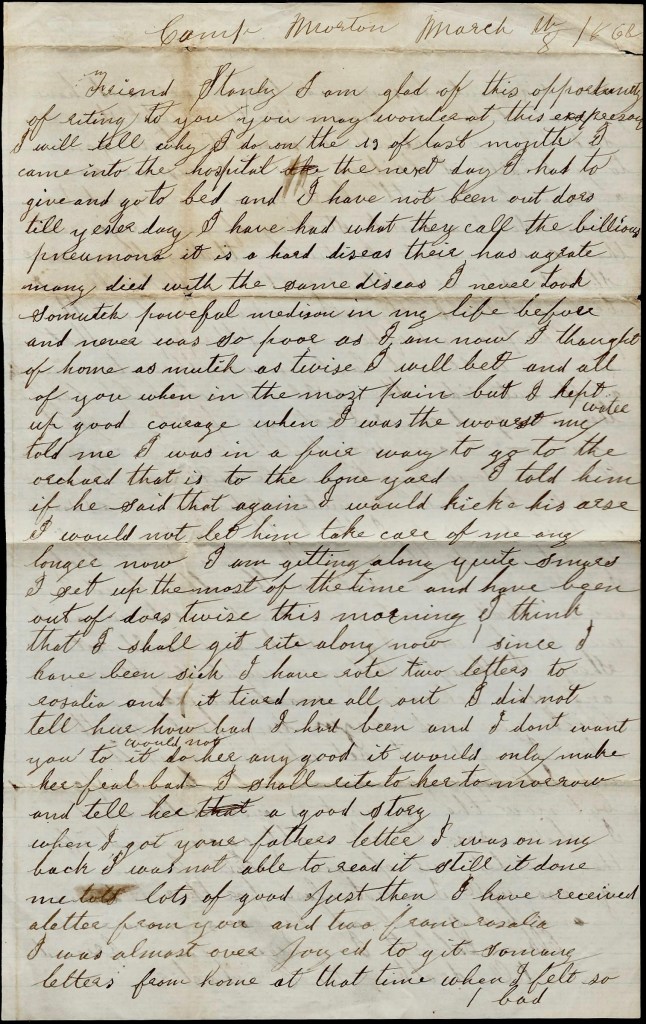
Camp Morton [near Bardstown, Nelson county, Kentucky] March 8th 1862
Friend Stanley,
I am glad of this opportunity of writing to you. You may wonder at this expression. I will tell you why I do. On the 13th of last month I came into the hospital. The next day I had to give and go to bed and I have not been outdoors till yesterday. I have had what they call the bilious pneumonia. It is a hard disease. There has a great many died with the same disease. I never took so much powerful medicine in my life before and never was so poor as I am now. I thought of home as much as twice I will bet and all of you when in the most pain but I kept up good courage. When I was the worst, my waiter told me I was in a fair way to go to the orchard—that is, to the bone yard. I told him if he said that again, I would kick his arse. I would not let him take care of me any longer. Now I am getting along quite smart. I get up the most of the time and have been out of doors twice this morning. I think that I shall get right along now. Since I have been sick, I have wrote two letters to Rosalia and it tired me all out. I did not tell her how bad I had been and I don’t want you to. It would not do her any good. It would only make her feel bad. I shall write to her tomorrow and tell her a good story.
When I got your father’s letter, I was on my back and was not able to read it. Still it done me lots of good just then. I have received a letter from you and two from Rosalia. I was almost overjoyed to get so many letters from hime at that time when I felt so bad.
Our regiment has moved from here and have gone about twenty-five miles. They left the sick till we got able to move. They have gone to guard railroad bridges and towns. We as a regiment have the best name in regard to being civil and not stealing of any regiment that ever came into Kentucky. That is all we ever shall do is to be held as guards and that will not be long. I think it is the opinion of all the people and officers and the papers that the war will not last more than two months at the outside. The rebels do not half fight. They are good on retreat. Yes, first rate to run.
I am sorry that there is so many that are so willing to meddle with our business and try to make so much disturbance as some of them devils so. I think the best way is to not mind them at all. When I get back, I will give them fits on the other hand. I never shall forget your kindness to me and my family. When I was sick and could not sleep, I thought that you might see them and give a cheering word. Chick, you can imagine my feelings then when I could not sit up one month and I do hope you never will by experience. But now the worst is over with and I shall soon be all right again. And if they much out of me, I will lose my guess. Well, I must close for this time and bid you goodbye once more. — I remain your friend till death — Elkins Babbett
This letter was written by Joshua Stevens (1842-1882), the son of Alonzo Stevens (1812-1877) and Mary Judkins (1821-1902) of Phillips, Franklin Co, Maine, who migrated to Wisconsin in the late 1840s. Joshua enlisted in Co. K, 12th Wisconsin Infantry but was discharged due to illness in mid-1862. He later enlisted in Co. K, 30th Wisconsin Infantry. He died in 1882 in Richland Co, Wisconsin. The letter is unusual as it was written on a sheet with a printing of the Co. K roster although Joshua was not included in that list for some reason. The letter describes the journey taken by the regiment from Camp Randall to the Missouri river port town of Weston, Missouri—just a few miles below and on the opposite bank from Fort Leavenworth.
The 12th Wisconsin proceeded as far as Fort Riley, Kansas, on a journey they imagined would take them as far as New Mexico, but their orders were countermanded and they returned to Leavenworth and were subsequently sent to Tennessee.
[Note: This letter is from the personal collection of Craig Albrechtson and was made available for transcription and publication on Spared & Shared by express consent.]
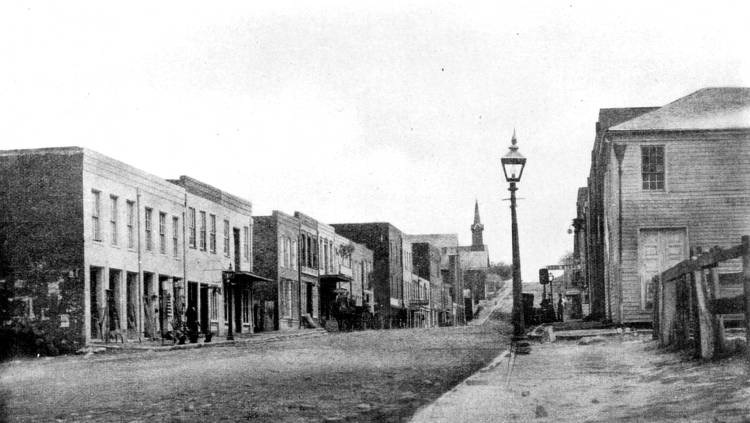
Weston, Platte county, Missouri
Transcription
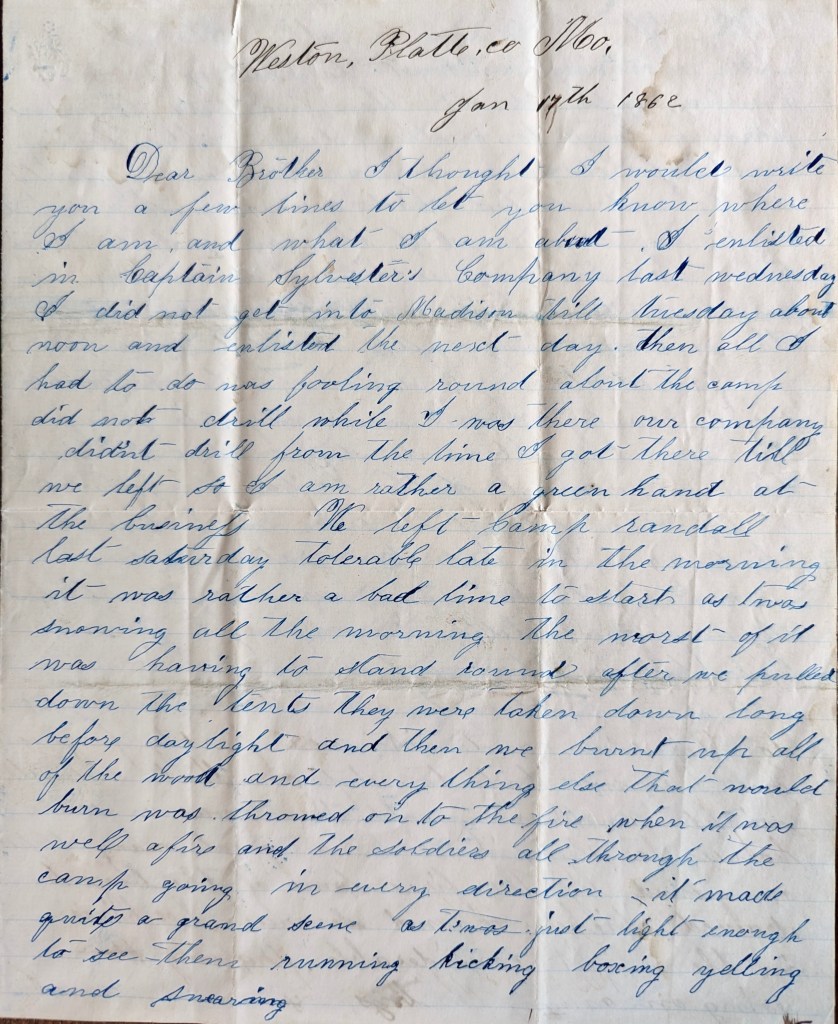
Weston, Platte county, Missouri January 17th 1862
Dear Brother,
I thought I would write you a few lines to let you know where I am and what I am about. I enlisted in Captain Sylvester’s Company last Wednesday. I did not get into Madison till Tuesday about noon and enlisted the next day. Then all I had to do was fooling around about the camp. Did not drill while I was there. Our company didn’t drill from the time I got there till we left so I am rather a green hand at the business.
We left Camp Randall last Saturday tolerable late in the morning. It was rather a bad time to start as ’twas snowing all the morning. The worst of it was having to stand round after we pulled down the tents. They were taken down long before daylight and then we burnt up all the wood and everythig else that would burn was throwed onto the fire. When it was well afire and the soldiers all through the camp going in every direction, it made quite a grand scene as ’twas just light enough to see them running, kicking, boxing, yelling, and swearing.
We left Madison rather late in the morning and got to Chicago in the evening after dark. Then we had to march through town to another depot. After fooling around for some time, we got some coffee to drink and started. Had a very good ride but went very slow. Most of the way we rode in one train. Had two engines hitched on and one to go ahead to see if everything was right. The next morning after we left Chicago, we passed through some of the prettiest country I ever saw. We got to Quincy the second night and stopped there till morning. Then on account of the bridges being burnt on the other side of the river, we had to march 24 miles and had rather a hard march of it. The roads were very hard and slippry. One soldier in Company I fell and broke his leg before we had marched five miles.
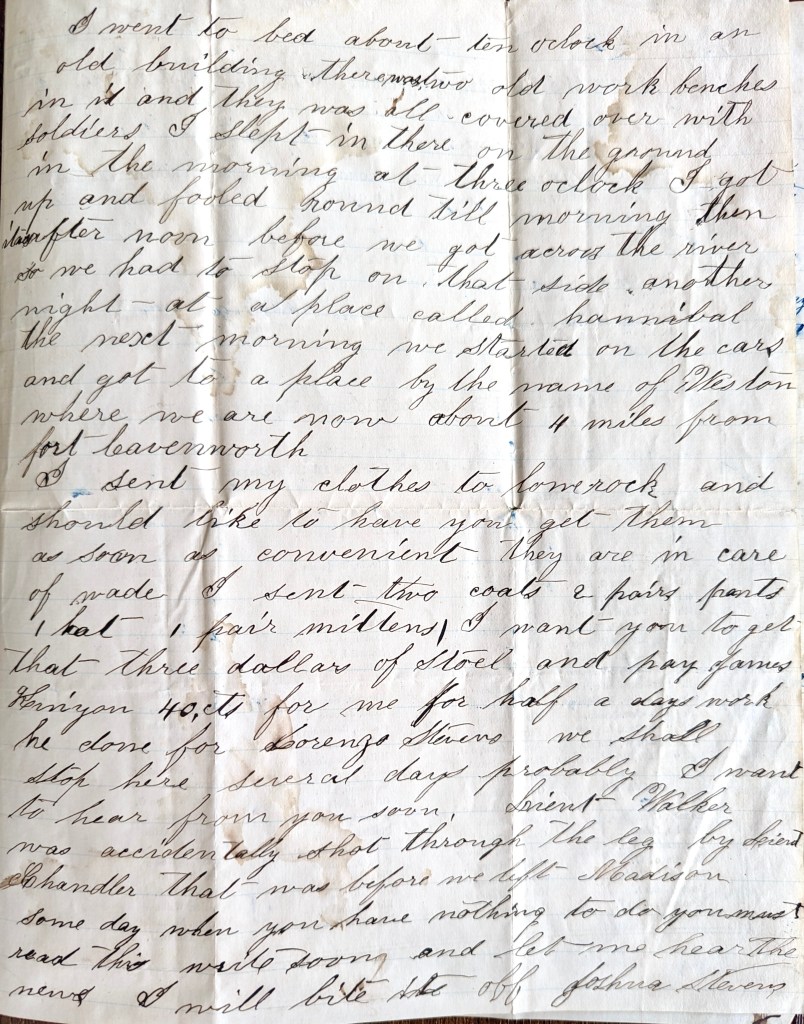
Well, we got through a little before night to the [Mississippi] river and it was partly froze over so we had to stop on that side all night and it was very cold. There was a few houses to sleep in but a great many slept on ground by the fire. Some of the boys drawed chickens and several beehives. In the night, [there was] considerable drawing going on among the boys. I went to bed about ten o’clock in an old building. There was two old work benches in it and they was all covered over with soldiers. I slept in there on the ground.
In the morning at three o’clock I got up and fooled around till morning. Then, it was afternoon before we got across the river so we had to stop on that side another night at a place called Hannibal. The next morning we started on the cars and got to a place by the name of Weston where we are now, about four miles from Fort Leavenworth.
I sent my clothes to Woodstock and should like to have you get them as soon as convenient. They are in care of Wade. I sent two coats, two pairs pants, 1 hat, 1 pair mittens. I want you to get that three dollars off Stoel and pay James Kenyon 40 cents for me for half a days work he done for Lorenzo Stevens.
We shall stop here several days probably. I want to hear from you soon. Lieut. [Isaac] Walker was accidentally shot through his leg by Lieut. [Almon N.] Chandler. That was before we left Madison. Someday when you have nothing to do, you must read this. Write soon and let me hear the news. I will bid thee off, — Joshua Stevens
This letter was written by Adelbert V Stevens (1839-1919), the son of Alonzo and Mary (Judkins) Stevens. “Del” came to Wisconsin with his family from Phillips, Franklin Co, Maine. He served in Co. K, 12th Wisconsin Infantry, Co K, rising in rank to 1st Sergeant.
Del datelined his letter from Natchez, Mississippi on December 17th, 1863. It includes a lengthy description of the arrest of his cousin Gustavus Stevens who was arrested for robbery and sentenced to confinement for ten months. “Gus” did not survive the war, however. He died of disease in Vicksburg in 1864.
[Note: This letter is from the private collection of Craig Albrechtson and was transcribed and published on Spared & Shared by express consent.]
Transcription
Natchez, Mississippi December 17th 1863
Dear Brother,
I take this opportunity to write you a few lines to let you know that I am alive and well with the exception of rather a bad cold. I received a letter from you dated November 11th directed to Gustavus. I read it according to his directions and will send it to him as soon as I find out where he is. I suppose you have heard about his trouble here. I will give you a slight description of it. He went out into the country with three other men and searched a house for arms and when they came back, they were arrested by the pickets and taken to the Provost Marshal. He had charges preferred against him and was put into the jail to await trial. This was about the 14th of September. In about a month, he had his trial but was still kept in jail to await his sentence and thus it went until [he] left here and went to Vicksburg. The night that we left here, he got out and stayed around here about a week and when the 33rd Regiment came up to Vicksburg, he came with them and as soon as he got to our camp, he was put under arrest again.
The next morning we was ordered to march and they took him in to Vicksburg and turned him over to the Provost Marshal and I have not seen him since. He promised to write to me as soon as he found out where he was going to and as soon as I find out where to direct, I shall send all his letters to him. I forgot to mention that while Gus was with the regiment, his sentence came. He is to remain in confinement till the expiration of his term of enlistment and a stoppage of pay of ten dollars a month for ten months. I think that is rather rough.
I received a letter from Mother a few days ago. The folks were all well at home. She said she expected you was coming home on a furlough until she heard that you was gone. I understand that Jeff Thompson was wounded at the Battle of Chickamauga. Perhaps you will get a chance to see him. He belongs to the 11th Battery Indiana Volunteers. If you see him, tell him to write to me.
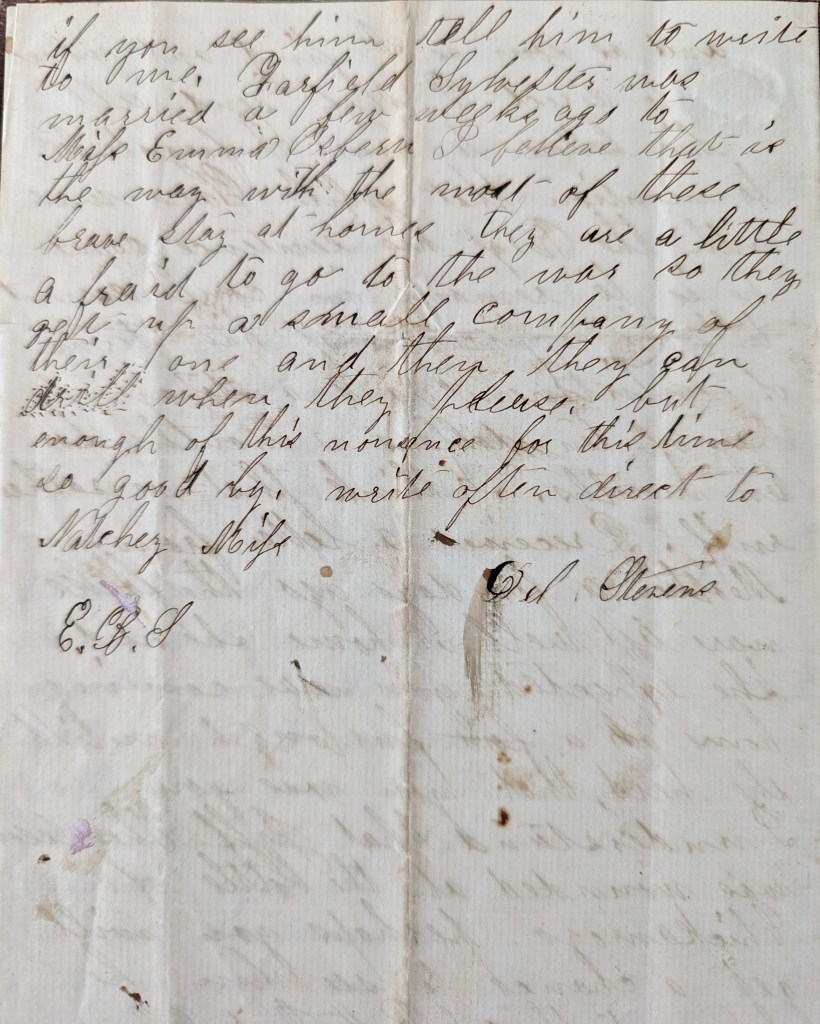
Garfield Sylvester was married a few weeks ago to Miss Osbern. I believe that is the way with the most of these brave stay-at-homes. They are a little afraid to go to the war so they get up a small company of their own and then they can drill when they please. But enough of this nonsense for his time. So goodbye. Write often. Direct to Natchez, Miss. — Del Stevens
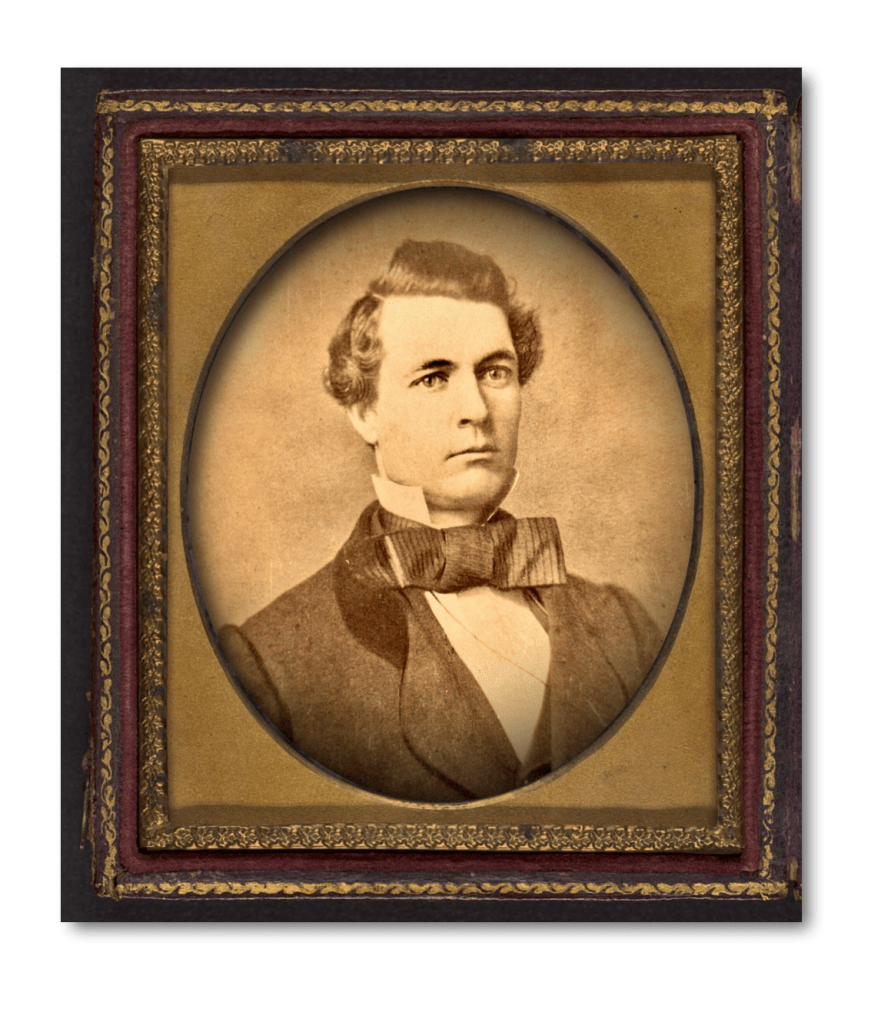
Dr. Peter Randolph Reamey(1829-1892), ca. 1853, Martinsville, Henry county, Virginia
The following letters were written by Peter Randolph Reamey (1929-1892) while serving as Captain of Co. H—“The Henry Guards”—24th Virginia Infantry. The company had previously organized, were uniformed and given arms in the fall of 1860 so that when the Civil War began in April 1861, they were the first company from Henry County to join the Confederate Army. In June 1861, their company was assigned to the 24th Virginia Regiment under the command of Col. Jubal Early and designated Co. H. They were present on the field at the Battle of Bull Run in July 1861 and though these five letters do not describe the battle, they were were all written in the days just before and after that engagement near Manassas.
The Daily Dispatch of 18 October 1860 (Richmond) informs us that the “Henry Guard” was organized in the fall of 1860 and P. R. Reamey was named their Captain.
Peter was a prominent figure in Henry county, Virginia, where he practiced medicine almost a decade before the Civil War, having graduated from the Medical College at Hampden & Sydney College in 1850. He began his education in his father’s school he kept a diary in his formative years that inform us he by the age of five he was studying English and Latin grammar, besides his other school branches. At seven, he entered Patrick Henry Academy under the late Joe. P. Godfrey, the principal. Here he added Greek, Sacred History and took examination on Caesar and Sallust. Before he was twelve years old he had finished practically all Latin and most of the Greek offered in the Colleges. He was a student at Sullivans College, at Columbus, Ohio, before moving on to medical school.
Biographical sketches of Peter’s wartime experiences are vague but imply that he served in the 24th Virginia until “after peace was declared” but a review of his military record at the National Archive reveals that Brig. Gen. Jubal A. Early accepted Peter’s resignation at Camp Pryor on 13 August 1861, just a week after the last of these four letters. He was succeeded by 1st Lieutenant H. H. Dyer. Those who knew Reamey claimed that he had “charming manners, a splendid physique, and a great vocabulary to display a brilliant intellect that soared beyond the heights of average men.” (The History of Henry County, Virginia.)
Two of Peters brothers served with him in the 24th Virginia and both of them died of typhoid fever near Manassas. John Starling Reamey (1830-1861) died on 6 August 1861 (his death is described in these letters), and Henry Clay Reamey died on 18 September 1861.
Peter’s letters make references to his slaves, some of whom were named Sooky, Perk, Dock, and Joannah. The 1860 Slave Schedules reveals that Reamey owned eight slaves ranging in age from 12 to 72, 4 males and four females.
Letter 1
[Note: The following transcript was found on Ancestry but there were no images of the letter so I cannot verify the accuracy of the transcript. There clearly were more of Reamey’s letters in a collection at one time but where they are now remains a mystery.]
June 11, 1861 Camp near Davis’ Ford on the Occoquan River Prince William Co., Virginia
My Dear Sallie—dearer to me now than ever,
I know Darling that you and our little ones have anxiously looked for a letter from me, and have felt some disappointment in not getting one, but I know that you will excuse me when I tell you that I could not write. I commenced a letter or so, but the thoughts of home blinded my eyes, & I had to ask Sam Shelton to write. Well! I need no say any more for if I commence it, I shall not be able to write atall.
You have doubtless heard of us as far as Lynchburg at which place we received many flattering notices as a company, &c., &c. and great attention from the ladies. We were quartered in a large tobacco factory in the midst of a terribly nasty population for want of a better place. A good many troops had been quartered there before and left behind them all the evidences of dirt & filth imaginable. Well our blankets were spread and our rolls called, sentinels posted, &c., &c, our provisions of bread & meat, with coffee & sugar & rice were dealt out, and with an unusual appetite all hands fell to work upon them, cooking & serving as a wagoner from Patrick—with your fingers. The captain’s tent was a negro quarter of the factory, occupied by them at the time, where the convenience of a table could be found and our chairs of trunks & boxes placed around it. To this our friends were invited to partake of the luxuries of fried fat meat & bread (bakers) with coffee from tin cups. It was right rough, but most of the boys fell to, with a better will than you would suppose. Our amusements at night were fiddling, dancing, singing, &c., &c. among the younger, & serious thoughts of home, wife, & children among the older. I hardly knew whether to laugh or cry. The fun at times was irresistibly ludicrous. But to see men who were used to a better society, to books, to ladies, to all the comforts of home compelled to eat and sleep as we did in Lynchburg was indeed painful. We couldn’t help thinking of what we had left.
To add to our distresses, our bowels were affected, and the greater part of us sick from one cause or other, mostly from the water which being limestone, and well water which percolated through the filth of the city before we drank it. We were greatly rejoiced therefore to receive orders to march to Manassas Junction, or rather to this place which is six miles in advance and to the right or east, immediately in a line between Acquia creek & Manassas. So out we marched Saturday morning to the depot, but in consequence of something on the part of the railroad officers, we had to be marched back to the Factory and didn’t get off until Sunday. We passed through Charlotteville, Orange CH, Culpepper CH, Gordonsville &c., and all along the road were cheered by the waving of handkerchiefs & flags & every demonstration of patriotism. Water was furnished us, bouquets given, &c., &c. At Gordonsville, our baggage car was detached and Holt & Buckner left as a guard, & we proceeded to Manassas Junction, at which place Gen. Beauregard is in command with some 10,000 men. Fortifications have been thrown up and are being thrown up all round for several miles. The Danville companies are there, several of whose members visited us and we them.
A cdv of Peter’s wife, “Sallie,” who died in 1866.
We stayed all night at Manassas, sleeping in a meadow of clover, in the open air, eating crackers and boiling meat (beef and bacon) on sharp sticks in the fire, our baggage tents, cooking utensils, &c. not getting in in time. Well, some few fellows, though who had no coffee nor could get any for love nor money, felt pretty blue and down in the mouth. On yesterday, we marched to this place through the hottest sun I ever felt. Our Maj. [J. P. Hammett] being on horseback it seems to me never thought of our being on foot & forced us very (unnecessarily too) fast, resting twice only by the wayside. The Henry Guards stood it better than any other company, Companies from Patrick, Mercer, Giles, Montgomery, &c. gave out, their men growing sick & faint & dropping by the roadside. Ah! It was awfully hot. Finally, we reached here and commenced work. We drill several times a day, & call the roll and report the sick & cook & eat and throw up fortifications, &c., &c. And this morning I believe most every man feels better than usual. The water here is pretty good but right scarce from the spring while at Manassas they had to dig wells & the water is miserable and very scarce. We had to beg for water at times like starving men for bread. Near this place there is small stream which is perhaps half as large as Smith River which is said to have a great many fish in it. I think I shall try it soon if we can remain here long enough. The country about Manassas is flat & level rather poor, but about this place it is rather more hilly & very full of pines.
I do not want you to think that we are dissatisfied. We are all pretty well and in right good spirits. Sam, Harry, John, and all are enjoying themselves, and Sam says he will write home this evening or tomorrow. He says that “he’d come back again if he was at home now.”
I have no time to write any more. The courier is about to start. There is heavy firing within hearing—perhaps within or near Fairfax C. H. 12 miles off & this letter may never reach you [but] perhaps it may. If so, it brings to you, Darling, & the little children, all the love a husband & a father can send to his family- Kiss the children & Dearest wife, remember me as always yours, P. R. Ramey
G. H. & the “boys” all send love to you, once more adieu, P. R. Reamey
Letter 2
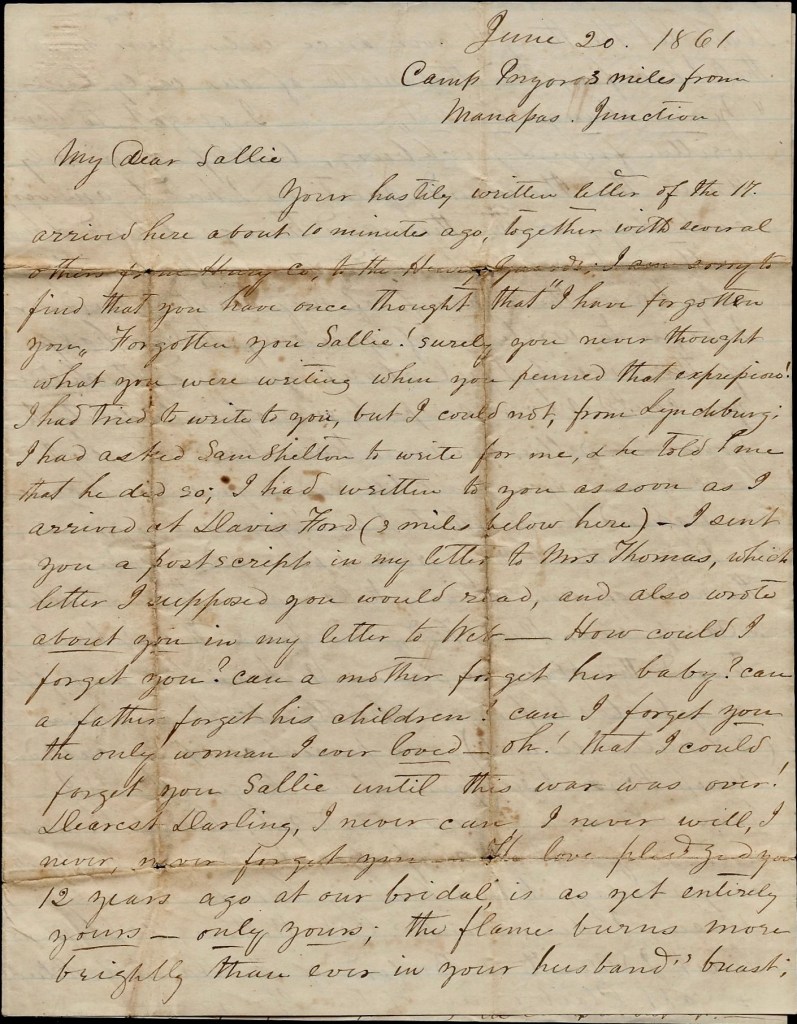
June 20 1861 Camp Pryor 3 miles from Manassas Junction 1
My dear Sallie,
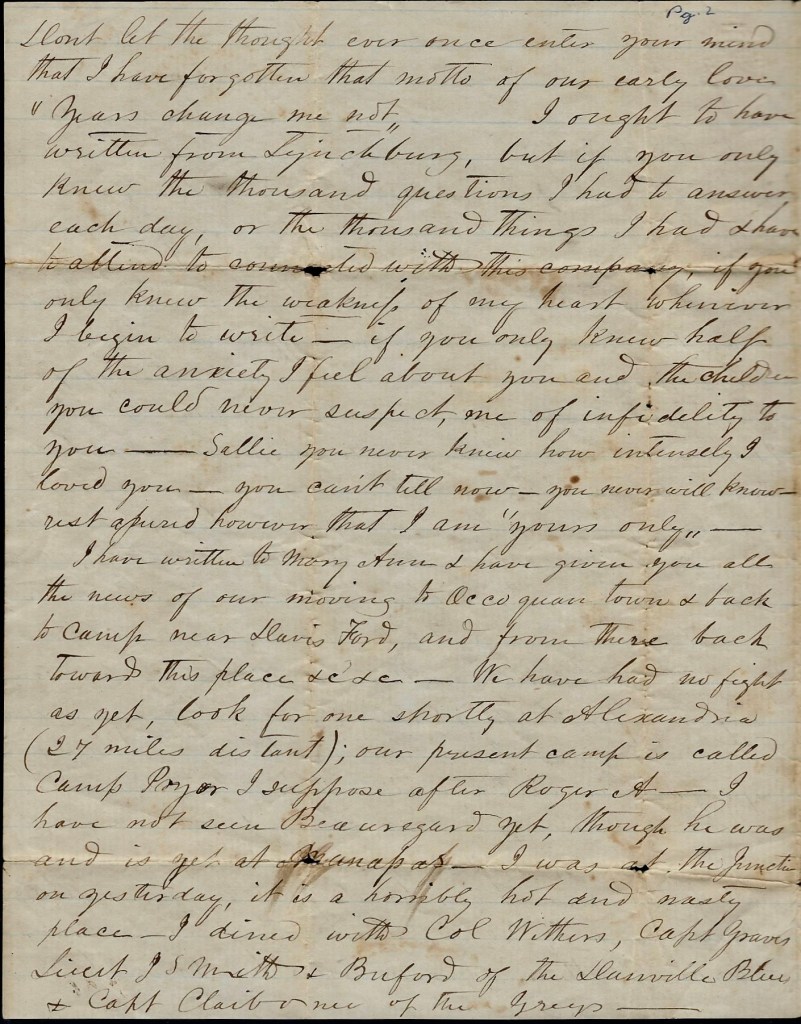
Your hastily written letter of the 17 arrived here about 10 minutes ago, together with several others from Henry Co. to the Henry Guards. I am sorry to find that you have once thought that “I have forgotten you.” Forgotten you Sallie! surely you never thought what you were writing when you penned that expression! I had tried to write to you, but I could not, from Lynchburg; I had asked Sam Shelton to write for me & he told me that he did so; I had written to you as soon as I arrived at Davis Ford (3 miles below here). I sent you a postscript in my letter to Mrs. Thomas, which letter I supposed you would read, and also wrote about you in my letter to Web. How could I forget you? Can a mother forget her baby? Can a father forget his children? can I forget you—the only woman I ever loved? Oh! that I could forget you Sallie until this war was over! Dearest Darling, I never can, I never will, I never, never forget you. The love pledged you 12 years ago at our bridal, is as yet entirely yours—only yours; the flame burns more brightly than ever in your husband’s breast. Don’t let the thought ever once enter your mind that I have forgotten that motto of our early love, “years change me not.” I ought to have written from Lynchburg, but if you only knew the thousand questions I had to answer each day, or the thousand things I had & have to attend to connected with this company; if you only knew the weakness of my heart whenever I begin to write—if you only knew half of the anxiety I feel about you and the children, you could never suspect me of infidelity to you. Sallie you never knew how intensely I loved you. [If] you can’t tell now, you never will know. Rest assured, however, that I am “yours only.”
I have written to [sister] Mary Ann 2 & have given you all the news of our moving to Occoquan town & back to camp near Davis Ford, and from there back toward this place &c., &c. We have had no fight as yet. Look for one shortly at Alexandria (27 miles distant). Our present camp is called Camp Pryor, I suppose after Roger A. I have not seen Beauregard yet, though he was and is yet at Manassas. I was at the Junction on yesterday. It is a horribly hot and nasty place. I dined with Col. Withers, Capt. Graves, Lieut. J. Smith, & Buford of the Danville Blues & Capt Claiborne of the Greys. Chas Irving has just left our camp for the Junction. He belongs to the Danville Greys. Maj. [Jubal] Early arrived here last night. He is Colonel of the Regiment now.
Dr. Semple is a sort of Hospital Steward, attends the sick to some extent, and superintends the medicine department of the Hospital which is as yet a mere pine bush shanty. John is the Quarter Master of our company, talks & “rips & rears” about wasting food, &c., &c., &c. much as usual. Harry and Sam and Buckness, Eli, & Bob, Barrows, Bullington, West, Gregory &c., &c. & Bryant are all well.
John Reamey, [William F.] Bullington & I have all been a little sick today—not much however. I am sort of afraid of the sun, it is awful hot here in middle of the day, but cool at night. The land here is very poor, & the people very far from feeling much interest in the war. We see but few people and those few very common stock. At Manassas there are about 15,000 men, well drilled & ready for a fight. About 200 were killed or disabled at a bridge near here the other day. You will see some recount of it in the papers, I suppose. Instead of 7 killed as reported at first, there were 200 of the enemy. Great rejoicing in camp about it!
Dr. [James] Semple sends his love to you & Mrs. Thomas. Says his spirits are better than any man’s in camp, he believes. Sam Shelton also. John [T.] Hamlett says he has written to you about the ring. [Brother] Harry got a very affectionate letter from Web a day or so ago. We both wrote back to him yesterday. Poor Daniel. I expect he is very lonesome. How is Ed’s practice? I hope he may do well. Tell him to read and study and think much—stay in his office and go to see any sort of a case that sends for him—to keep my books and journals all straight & write to me. Tell Aunt P[atsy] and Uncle S. and Obe & Sallie, and Mr. Putz & wife, and Old “Critur” & all the folks that I am well & often think of them. Respects to all who enquire. Love to Web & Mary and Kate if she be with you. Kiss our dear children. Make them say their lessons every day. Tell them to be good and kind to each other & to obey their mother.
Darling, what more shall I say to you. Think of me as still in every respect your own. Think, that while mountains may rise between us & rivers divide us, our eyes may watch the self same star [and] our prayers may ascend to the same “Father in Heaven.” Pray for me Sallie, that I may be spared to see you all again. Oh that I could this night clasp you to my bosom. Oh that I could see our little “darlings.” Does Johnny ever muster now? Kiss him especially for me. Give my love to Sooky, Perk, Dock, Joannah and all the negroes. Bill is fat & fine and sends his love. He wants to hear from home. Darling, good night. — P. R. Reamey
1 Camp Pryor was located at the junction of Davis’ Ford Road and Spring’s and Bland’s Fords Roads, three miles south of Manassas Junction.
2 Mary Ann (Reamey) Thomas (1834-1911) became the wife of Christopher Yancey Thomas (1818-1879) in 1858.
Letter 3
The village of Occuquan on Occoquan River
Prince William County, Va. June 27, 1861
Dear Sallie,
From the hills of the Occoquan, whence the noble Potomac is in full view, I seat myself darling to write you a few lines. We are now encamped near the same spot at which some 10 days ago we were located. It is upon the hills of the Occoquan River, immediately above the town of Occoquan which I am told was once a flourishing village but which now, in consequence of the war, is almost deserted. It is a noted resort of the Lincolnites as it is only three miles from the Potomac, and is visited occasionally by small boats, or sloops, on trading purposes, As a village, it is low down at the foot of the hills, immediately upon the river and inhabited by a most ordinary population, as far as my observation has extended. In the last Presidential election, it gave Lincoln a considerable majority, but since the approach of the Southern forces to the neighborhood, the friends of the Federalists have fled to parts unknown—though last night it was reported that there were spies around our camp.
Our march to this place was not disagreeable as it was when we came here before. The weather, though hot, was not so warm, nor did we travel as fast. And besides, we were allowed more water. You can scarcely imagine how we sigh for the good free stone water we have left behind us, for while the water here is not exactly limestone, yet it very impure and milky in its look, warm, and I should suppose 9from its appearance) abounding in animalculae! By the way, do you ever microscope it now? Have you found any new animals this summer?
This is one of the poorest counties I ever saw. The soil is white and sandy and vegetation is very far behind us in Henry [county]. Corn here is nothing like knee high upon an average. Clover and “hay grapes” are very indifferent and oats by no means good. Wheat and rye are better. I should suppose that they use guano upon their wheat.
We have seen but few ladies about here occasionally and but very rarely, some one of the fair sex wave us a handkerchief. But as large majority of the men and women too view us with seeming indifference—-
(Just here I was interrupted by a general cry of a ship upon the Potomac and when I stepped out, I was amused to hear the comments of our country fellows upon her passage—speed, business, &c., &c. “Boys, if we had a cannon, couldn’t we give her fits” &c., &c. “That’s a ship going up after a load of Yankees” says a fourth, &c., &c.
We are to have a sort of holiday today (I hear). We will have no drilling & I am glad of it for I am rather tired of the monotony of the camp. I long to be with you darling at times, and with those dear little ones who call my name so often. Duty alone brought me here and duty keeps me here else I should long since have flown to the arms of her whose
“Whose love is more than life to me And the one treasure that I prize above All else that earth can give—the one rich boon So dear, that if I lost it I should soon Lie in the grave’s cold bosom, is thy love! Love me then, ever, for I fain would be All unto thee love, that thou art to me.”
I wrote to you on yesterday as we were leaving Camp Pryor and I placed my hasty note within Sam’s letter to you. I do not know how it is that some of our letters go home & others do not, unless it be the fact that whenever we send our letters & postage to be mailed, our messengers destroy the letters & use the money for other purposes. From the Colonel down to the humblest private there has been a general complaint of the mails. I subscribe to the Daily Dispatch & have received but one number. I have written to you again and again, not less I think than six times, but I discover from your letter to Sam that you have received none or but one, and that you are disposed to think me neglectful of my promises! I can appreciate your feeling when others get letters & you do not, for I have experienced the same even here in camp. You may rest assured that so long as I am from you, I will endeavor to write every week at least. But if the mail fails to bring you a letter, don’t think that I have forgotten you so soon.
Well, taking all things into consideration, this rough roll & tumble life I think will suit me pretty well, but the weather is very hot and I suffer very much from the heat at times. I frequently wet my head, or wear green leaves in my hat in order to avoid sunstroke. This morning my throat is quite sore—perhaps from being caught in a slight shower on yesterday evening, but mostly from the fact that I stuck a fishbone in my throat in Lynchburg & it has been slightly sore ever since.
We have a prayer meeting every night, either in my tent or somebody else’s and I assure you, you hardly ever attended more quiet and orderly meetings than these are. I hope they may be productive of great good and result in the salvation of us all. I am trying to serve God, Sallie. I feel the need of all the religion in the world and I do hope that you will pray earnestly that all of us may be both valiant soldiers of our country but especially of the Cross of Christ.
I should be glad to hear from you oftener. Try and be cheerful and contented. Be resigned to the will of God in all things. Pray earnestly and constantly for that faith and confidence in Divine Providence that will enable you to say, “Not my will but thine, Oh Lord, be done.” Teach the children properly and teach them regularly. Take time for it. Don’t fret, don’t scold, be calm, but firm, gentle but inn earnest. Let them know that you mean what you say. Don’t hurry them over their books too fast. Let them learn well, whatever they do learn. Teach them, Sallie, to love each other, to be kind to each other, more particularly to Florence whom I think the boys are disposed to slight. If Johnny is still sick, tell Ed to make Condie’s powder eactly after the formula in his work on children. Don’t give him too much physic. Be cautious in his diet and make him wear a flannel bandage by belt around his bowels. You will find it of great service I think. I shall reserve the balance of my paper until I look around & see what can be seen about here, or until I get a chance to mail this letter to you safely. So now I bid you farewell. — P. R. R.
I have just walked some eighteen miles from Occoquan to Camp Pryor and the first duty I shall discharge after fixing up my tent is to write to you my darling “wifie.” I left Occoquan this morning (28th) and had a very pleasant march. On yesterday when I left off writing, I went down to the village a few hundred yards off & we caught a great many little catfish & perch & with good coffee and cornbread, we made a most capital dinner. Just above Occoquan village, the hills are very rough and full of the finest stone which has been quarried in order to furnish Washington and other places with materials for building. The Occoquan above these falls is but small. Below these rocks, however, the tide flows and it is navigable for small boats. It is quite a picturesque place. There is a cool spring, a dense shade, and thousands of rocks all over the river, with thousands of fish swimming around—perch, catfish, &c. The water is clear and very deep and you can see them swimming around everywhere. I should think it a delightful place to spend a few weeks and I was really sorry to leave there so soon. The Potomac looked really grand and our boys enjoy the sight as those wanderers through the desert enjoy the Nile to which you know I have eloquently alluded in days of yore.
Ed’s letter to Sam has just reached here. I am very glad to hear as favorably of Ed’s practice. Tell him to read and study and he is bound to succeed. Never mind who employs him and who does not, it will all come right after a while if he will do his part. He promises to write to me which I hope he will. He must excuse me if I do not always write back to him. My letters are I suppose generally read by the family and friends and as paper is very hard to get, and postage obliged to be paid in change, I really can’t afford it, even if I had time which I have not, for I assure you that I have but few moments to spare. I am applied to for everything and almost at every hour night and day. Indeed, to be Captain of a volunteer company is a post by no means desirable.
Poor C. I am told has lost nearly half of his men. Joe A. Allen has just landed here. He joined Capt. [William W.] Bentley’s company from Pulaski in Lynchburg. He is a very sober & I am in hopes he will make a good soldier. I got a very affectionate letter from Jimerson this evening. He writes as if it was very lonely about home. He says he can’t see my children without shedding tears! I hope you will send him by Ed or Web my kindest regards for his letter to me & John. George Jimerson stands it pretty well considering his fat. He is in pretty good spirits. Hardin [H.] Hereford is about as independent as a wood sawyer. He stands it right well but is awfully lazy. Sam Waller has never been sick atall since we left. John Hamlett is sick today. Also Bryant Charles & B. Rolin. Rolin is right sick. The hot weather is the cause of it I think—diarrhea mostly. Hale is yet sick. Bob Dandridge right sick last night but is out today.
Tell [sister] Mary Ann that her letters to Harry and me and John came through in due time [and] that I will try & write to her shortly. I should feel better if you would write. Surely I shall get a letter from you tomorrow night (Saturday). You have no idea how glad I should be to hear from you directly. I am very sorry that you have an idea that I am neglecting you, or forgetting my promises. I know that I have written to you frequently, and long letters generally, but as yet I have had but two from home. Rest assured that as long as I am able to write, or can mail a letter, that I shall write to you. This make a third letter to you in four days!!
My health is first rate today except a sun burnt neck, which pains me some. The country around here is extremely dry. There has been no rain about here for several weeks. The dust and heat are of course very oppressive for the soil is white and sandy & I think very poor. I met with the Prince William Cavalry today a a well some 10 miles below here. During our stop at that well on the day before yesterday I met a very intelligent lady who treated us very kindly. Today I found amongst the cavalry her husband who was a very clever fellow. The ladies hereabouts are very scarce, not much admired by our boys, as nice women are not often seen. Occasionally at our dress parade at 6 o’clock p.m., or upon our march to and fro, we meet some very nice ones who ride their horses admirably.
I suppose from all accounts that the crops in Henry [county] are very fine. I hope so. It seems to me as if Providence is evidently upon our side in everything. In the last fights heard of, it seems that the Yankees have been defeated again. I heard today that Maryland and Kentucky have both wheeled into line and that the Lincolnites are withdrawing from the State of Virginia. I hope it may be true but I am afraid it is too good to be true!! You all at home can form a better idea of the probable events of the future than we can. We get a dispatch once in a while and it is rather amusing to see the fellows sitting around to hear the news—to hear their comments, &c. &c.
Sam and I subscribed to the Daily Dispatch between us and at this moment, Sam is reading out here upon the grass, and Bob and Eli & Gregory & Sam Fontaine & Sam Sheffield & John & Isom are sitting around to listen. Bill Harris sends his love to his wife and children & to George & Starlie. How does Perk & Sooky & Dock and all of them come on! Do they seem to feel any interest in hearing from us? Except our own negroes in the regiment, I hardly ever see any negroes about here.
I hope you have a good garden. Oh! Sallie, how I could enjoy one of your dinners—a few snaps, a few potatoes, and such other vegetables as you have at home! I don’t know why it is I have never got a potato since I have been about here. I had a few snaps a day or so ago at Manassas. I get a few onions once in a while, and I tell you, I never knew how good onions are until here of late. And then I don’t have anybody to complain of my breath! A chicken is hardly in camp before his head is cut off and he is cooked in a “jiffy.” Our boys will all learn to be pretty good cooks during this campaign, I guess, for they have it to do every day three times. Bill Harris makes us splendid coffee for our tent, and so great is his reputation for good coffee, that we hardly ever eat a meal without company. James Waller of Patrick has two [illegible due to paper tear] in the Patrick Co. (Capt. A. M. Lynbrook). I have only seen one of them as yet. He seems to be a pretty good fellow.
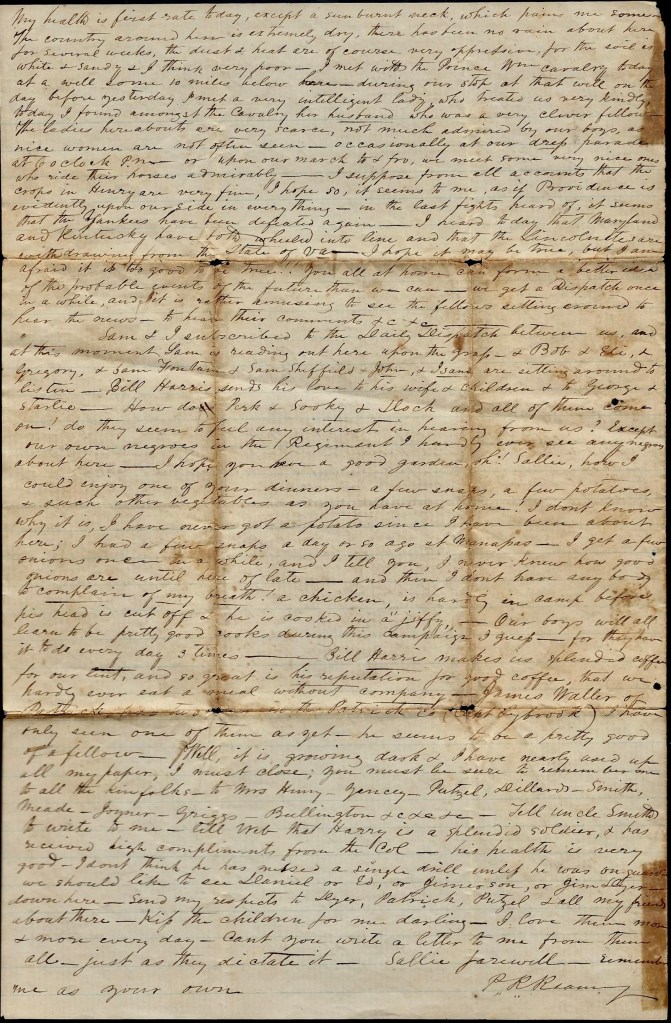
Well, it is growing dark and I have nearly used up all my paper. I must close. You must be sure to remember me to all the kinfolks—to Mrs. Henry, Yencey, Putzel, Dillards, Smith, Meade, Joyner, Griggs, Bullington, &c. &c. &c. Tell Uncle Smith to write to me. Tell Web that Harry is a splendid soldier and has received high compliments from the Colonel. His health is very good. I don’t think he has missed a single drill unless he was on guard. We should like to see Daniel or Ed, or Jimerson or Jim Dyer down here. Send my respects to Dyer, Patrick, Putzel, and all my friends about there. Kiss the children for me darling. I love them more and more every day. Can’t you write a letter to me from them all, just as they dictate it? Sallie, farewell. Remember me as your own, — P. R. Reamey
Letter 4
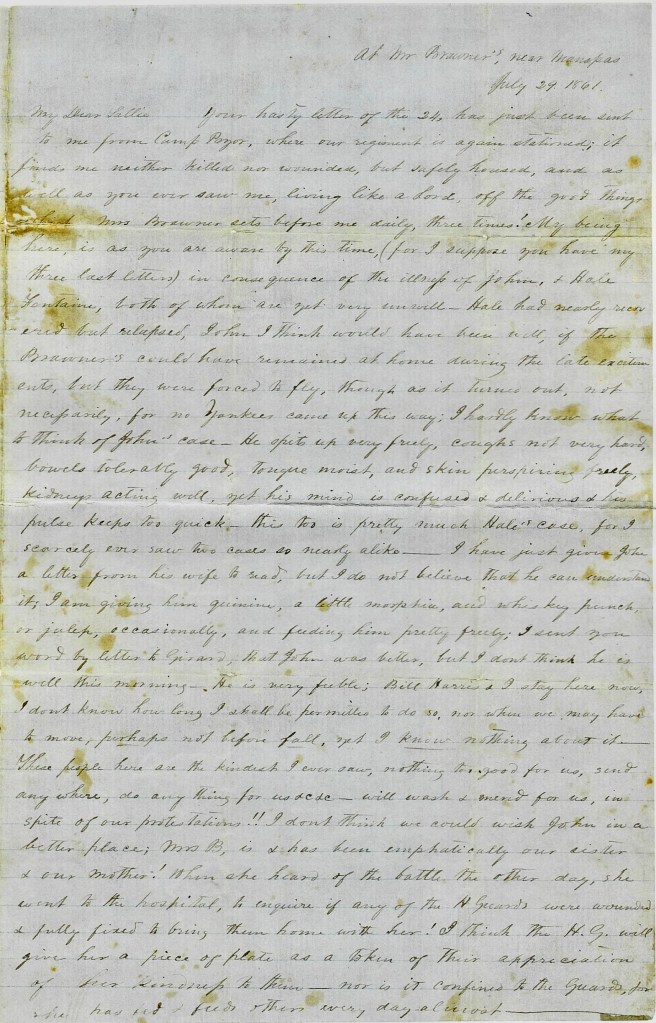
At Mr. Brawner’s 1 near Manassas July 29, 1861
My Dear Sallie,
Your hasty letter of the 24th has just been sent to me from Camp Pryor where our regiment is again stationed. It finds me neither killed nor wounded but safely housed—and as well as you ever saw me—living like a Lord off the good things which Mrs. Brawner sets before me daily, three times! My being here is, as you are aware by this time (for I suppose you have my three last letters) in consequence of the illness of [brother] John 2 and Hale Fontaine, both of whom are yet very unwell. Hale had nearly recovered but relapsed. John, I think, would have been well if the Brawners could have remained at home during the late excitements but they were forced to fly, though as it turned out, not necessarily, for no Yankees came up this way. I hardly know what to think of John’s case. He spits up very freely, coughs not very hard, bowels tolerably good, tongue moist, and skin perspiring freely, kidneys acting well, yet his mind is confused & delirious & his pulse keeps too quick. This too is pretty much Hale’s case for I scarcely ever saw two cases so nearly alike.
I have just given John a letter from his wife to read but I do not believe that he can understand it. I am giving him quinine, a little morphine, and whiskey punch or julep occasionally, and feeding him pretty freely. I sent you word by letter to Girard that John was better but I don’t think he is well this morning. He is very feeble. Bill Harris & I stay here now. I don’t know how long I shall be permitted to do so, nor when we may have to move—perhaps not before fall—yet I know nothing about it. These people are the kindest I ever saw. Nothing too god for us, send anywhere, do anything for us, &c. &c. [They] will wash and mend for us in spite of our protestations!! I don’t think we could wish John in a better place. Mrs. B[rawner] is and has been emphatically our sister & our mother! When she heard of the battle the other day, she went to the hospital to enquire if any of the Henry Guards were wounded and fully fixed to bring them home with her! I think the Henry Guards will give her a piece of plate as a token of their appreciation of her kindness to them. Nor is it confined to the Guards for she has bed and feeds others every day almost.
I have written you so many little battle sketches that I will forbear at this time. Report here says that we have captured 67 pieces of artillery, and these certainly counted. Besides that, we have taken something like 3,000 prisoners! I have no idea when or where another battle will be fought—not shortly I presume! Col. [Jubal A.] Early has been promoted Brig. General! I am sorry that Bro. Joyner has lost the Chaplaincy. A Mr. Jones who preached at camp yesterday has been appointed I hear. I received a long letter from Joyner today. He speaks of coming down to see us anyhow. His letter gave me the first news of Web’s arrival at home. What sort of a tale does Daniel tell about the war? Harry was here on yesterday and says that the sick ones at the hospital are getting better. I suppose Jimerson will start home shortly as George is better. Charles B. is going about & nearly well. John Hamlett has been at the hospital for a week. I believe he is about well. I never thought that he was sick much.
Poor John. I feel sorry for him, Detested by everybody in the company, he is without friends & without means. He tries to some extent to ingratiate my favor but loses no opportunity to injure me and sow disaffection among my men. I understand he has written a piece about free negroes, &c. in the Whig. Have you seen it? He is meaner, Sallie, that I ever thought he was, unprincipled as he can be I am afraid. But I can’t help feeling sympathy for the poor fellow. Yet I scarcely think him deserving any. Just here I was agreeably interrupted by the appearance of Carter France and Col. Hughes from Stoke’ company who has a son in [A. M.] Lynbrook’s Company. Mr. Armstrong & Bill Bouldin also came up here today to see us.
Today (July 30th), John is very had. He lies in a dull stupid condition with a muttering delirium. I hardly think he will live without great change 24 hours! Perhaps before I close this letter his death may be announced. It is a mournful thing to die away from home but his condition with so many of his friends around him is infinitely better than two-thirds of the sick men. I neglected to tell you when speaking of Hamlett that he told me that his sister Julia had your ring & to tell you to apply to her for it. I told Web to tell you & told Sam to write to you about it. I have forgotten it whenever I was writing.
The weather here is extremely hot and we have a shower every evening or two. The crop of corn here is growing very fast, I am glad to hear of the fine crop in Henry county. I hope you are economical with your grass. You ought not to feed it away very fast. You ought to get rid of some of your cattle as you have too many. I doubt the propriety of more than one horse on the place as I think one will do all your necessary hauling. It would give me great pleasure to visit Martinsville even for a few days. Often indeed in imagination I am there & can see things just as I suppose they are. But htis pleasure must be denied until peace is declared or we are disbanded.
You can’t imagine what pleasure peace would give us. We are all sick of war and its horrors, although we are victors. Nothing but duty keeps us here. I have sent to the Examiner a reply to Mr. Wootton’s card. You will see it perhaps on Wednesday 31st, or in Saturday 3rd August. Please preserve it for future use. Show it to my friends that the reply may be as public as his attack. I don’t think he has made much out of the “flippant Captain” do you? If you should see it, write me word how it takes with the people generally. I can’t imagine what has become of Thomas? Why didn’t he write a card too? Hamlett’s card is signed “Taylor” I understand in the Whig and dated from Henry [county]. I shall stop here and await John’s case before closing my letter. I have written you three letters and Girard Jone since the fight. I hope you all are & will keep calm and quiet.
[July 31st] I have purposely kept my letter open until this morning in order that I might write you more favorable news about John. I am sorry that I cannot. Last night I thought he would certainly die before day but he is still alive though but little if any better. He lies in a stupor, muttering constantly about home. The C. H., and scenes in Henry [county]. His pulse is very feeble but I have hopes of his getting well as long as his bowels keep quiet. His condition is one of extreme danger however and I am afraid that before I can start this letter, that I shall have to speak of his death. The issues of life & death are with our Heavenly Father & I earnestly pray that his life may be spared, but not my will, but Thine oh Lord be done.
Hale Fontaine is considerably better I think. If he is prudent, he may get well. I entertain strong hopes of his recovery today. The rest of our sick at the Hospital are I hear improving, but I am sorry to say that one of the Henry Guards died last night. Tis [Peter Lane Creasy], a grandson of old Dutton Lane Norman from Irisburg. He had been laboring under pneumonia for several days I learn from Harry & Semple, the last of whom has been attending him. Harry stays here with me & John nearly very night & makes a good nurse. Bill [Harris] is also with us & John has everything in the way of attention that he would or could have at home. I buy ice for him every day and Mrs. Brawner cooks anything for him that he needs. I cannot do justice to this good woman. She is a thoroughly business lady with as kind a heart as ever beat and her husband is almost exactly like her—attentive to our every want. Our boys frequently come up to see John and our friends from Henry [county] have called several times to see him but he has never been well enough to enjoy their company. He barely recognizes them & drops off with a stupor again.
I received a letter from Mrs. Joyner with yours. I wish you would express my acknowledgements for the favor when you see him and tell him that I will try & write shortly. Say to Mr. & Mrs. Putzel that if I had my pen, ink and paper along, I should have written to them before now, but that while on the march our tents, trunks, knapsacks, and all were left behind and we could not write even when we had time for want of these articles. There are a good many to whom I should like to write but I am really unwilling to discriminate and have but little opportunity to write to anybody—not even to you. I steal the time, however, to do this as it affords me always a pleasure (a melancholy one though frequently) to write to you. I feel much disappointed too when I fail to get a letter from you. How much pleasure would it be to see you darling. Remember me to all my friends in and about town—especially old C. folks. I am your own, — P. R. R.
1 John C. Brawner and his wife Jane (Clark) Brawner were tenant farmers on the property which consisted of approximately 160 acres on the turnpike near Groveton. The farm was actually the property of George Douglas who purchased it in the late 1840s but who died in October 1855 at the age of 36, leaving it in the possession of his wife, 20 years-old Augusta Gaines and her father, Thomas Gaines. Augusta moved in with her mother in Gainesville and began to rent to the Brawners in 1857. It is common knowledge that the Brawner’s were forced to leave their home during the fighting on 28 August 1862, but it was not known they also vacated the house a year earlier at First Manassas.The property was referred to as “Bachelor’s Hall” in land tax records in 1851. It has been described as a two-story, four-room Georgian-style house.
2 John Starling Reamey (1830-1861) “had the reputation of possessing more native talent, the strongest sense, and keenest insight into character, of any member of his family: was ordinarily intelligent, a pleasant companion, impressing strangers favorably, and, in his family circle, much beloved. When in 1861, the war broke out, he was, like all his brothers, conservative, and anxious to have the Union preserved, but, having a great deal of sectional feeling and State pride, when Virginia went out they went with her. When his brothers and the friends and companions of his youth started for the army, John would not remain behind, yet was strangely impressed with the believe that he would never return. The hardships and exposures of camp life soon told upon his health, and he was prostrated by that dreadful typhoid scourge which destroyed so many young men upon that fatal Manassas ground. He lay sick in a private house which was betwixt the two armies, and too sick to be removed to the general hospital, on the day of the first Manassas battle. His brothers, by military necessity, were obliged to leave him and assume their own positions. The house, being in range of the battle, was deserted by all its occupants save an old negress, who remained with John. What were the feelings of the poor fellow as he heard the quick artillery and the bursting shells as they flew around the lonely house in the roar of battle, the cries of the wounded and dying, the whirling, mingling, sounds and shouts of the victorious or the vanquished, will never be known, for when, after the battle, his brothers Peter and Henry hastened to him, he was in a raging delirium and knew them not. Death soon released him from his sufferings, and on that famous battleground, “He sleeps on in the grave where his comrades have laid him.” He married in 1853, Mrs. Elizabeth Harston Dillard, by whom he had four children. [A Genealogy & Family Memorial, page 214]
Letter 5
Brawner’s near Manassas August 7th 1861
My Dear Darling,
You have no doubt been somewhat prepared for the sad announcement I have to make of John’ death! He died on yesterday, Tuesday morning, Aug 6th, about half after six o’clock. He had scarcely been conscious except for a few moments at a time, for a week, and even then hardly to be called so. There was no opportunity therefore to “send a message to friends” nor to make any preparation for Eternity! His only expression in regard to religion was that he was willing to die in his Universalist faith, but this was made I fear without that reflection which men would like to have at such a time. He had become seriously inclined & no doubt prayed during his illness often for he was a man of prayer as I know from various remarks in camp. This barely affords a hope of his salvation. God alone can tell the result. I had been with him for the past 10 days, and Harry much of the time. Dr. Semple & [Surgeon Sterling] Neblett also visited him frequently. I think he died from gangrene of the lungs, as a consequence of the fever. You may rest assured that we used every exertion to save him, that he did not suffer for anything we could obtain.
The family as I have written you before were remarkably kind & attentive, supplying everything in the way of diet &c., &c. I sent to Richmond for a metallic coffin and have just received a telegraph dispatch that it will reach here this evening. He will be buried in Mr. Brawner’s family ground and when we can remove him, we will bring him home to be buried at Marrowbone [Plantation].
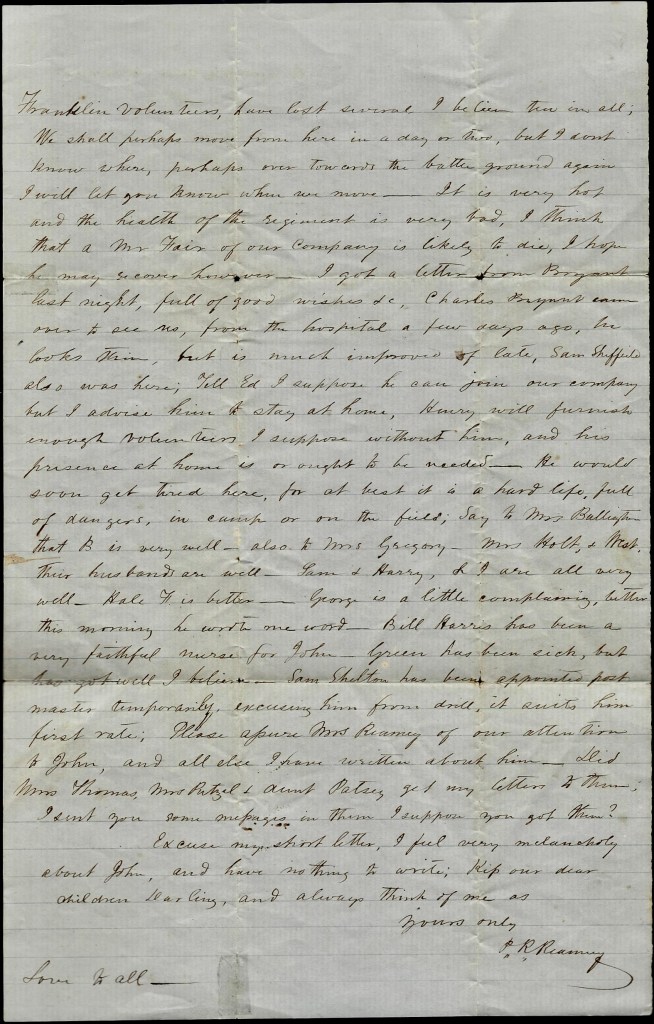
George & I tried to get Gen. Early to let us carry him home, but he wouldn’t consent, I suppose for the reason that too many applications similar might be made & it takes too many healthy men to go with a corpse home! & they need the soldiers here. Some of these times, I hope we can remove him. It may fall to others to discharge this duty after the war is over, and it may have to be done for us; I hope not however. I hope we may live through the war. We have just lost another one of the [Henry] Guards named “General Purdy”—this makes three. [The] Franklin [Rifles] volunteers [of Co. B] have lost several. I believe ten in all. We shall perhaps move from here in a day or two, but I don’t know where—perhaps over towards the battle ground again. I will let you know when we move.
It is very hot and the health of the regiment is very bad. I think that a Mr. Fair of our company is likely to die. I hope he may recover, however. I got a letter from Bryant last night full of good wishes, &c. Charles Bryant came over to see us from the hospital a few days ago. He looks thin, but is much improved of late. Sam Sheffield also was here.
Tell Ed I suppose he can join our company but I advise him to stay at home. Henry [county] will furnish enough volunteers I suppose without him and his presence at home is or ought to be needed. He would soon get tired here for at best, it is a hard life—full of dangers in camp or on the field. Say to Mrs. Ballington that B is very well. Also to Mrs. [James F.] Gregory, Mrs. Holt & [Thomas L.] West their husbands are well. Sam & Harry & I are all very well. Hale F[ontaine] is better. George is a little complaining—better this morning he wrote me word Bill Harris has been a very faithful nurse for John Green has been sick, but has got well I believe. Sam Shelton has been appointed post master temporarily, excusing him from drill. It suits him first rate.
Please assure Mrs. [Elizabeth Hairston Dillard] Reamey of our attention to John and all else I have written about him. Did Mrs. Thomas, Mrs. Putzel, and Aunt Patsy get my letters to them? Excuse my short letter. I feel very melancholy about John, and have nothing to write. Kiss our dear children, Darling, and always think of me as yours only. — P. R. Reamey
Corporal Warren B. Thorndyke of the 19th Maine Infantry
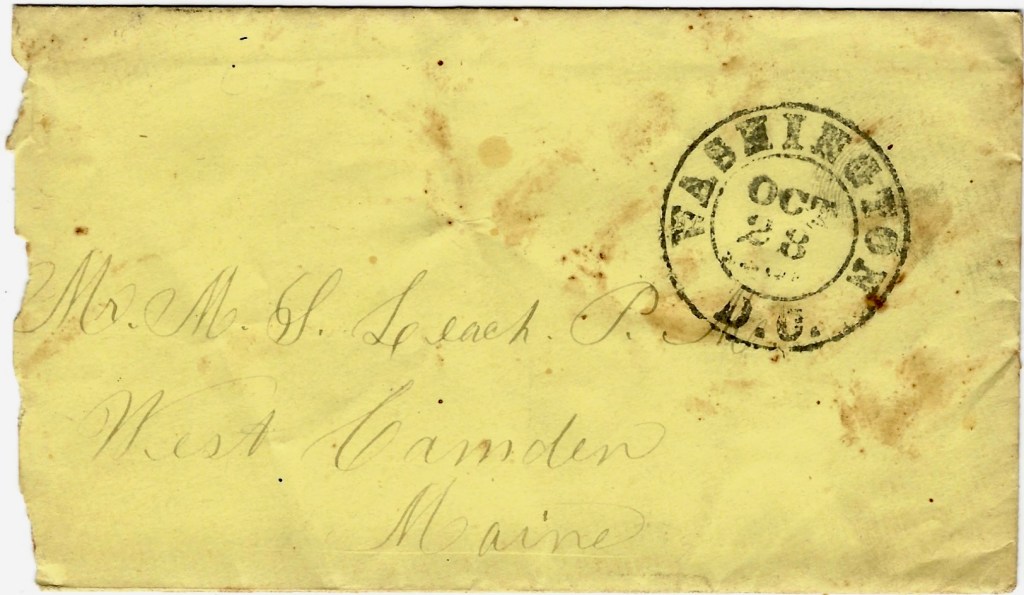
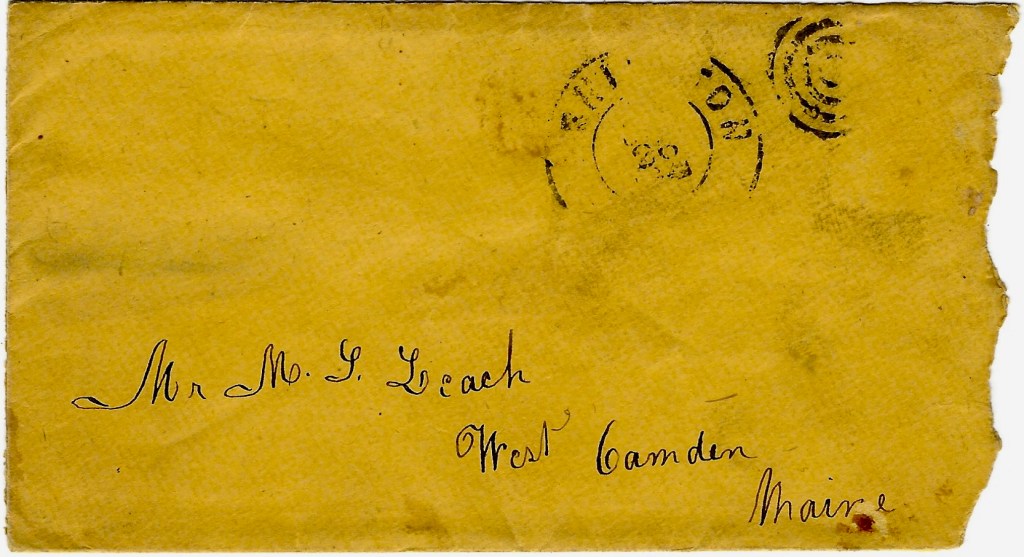
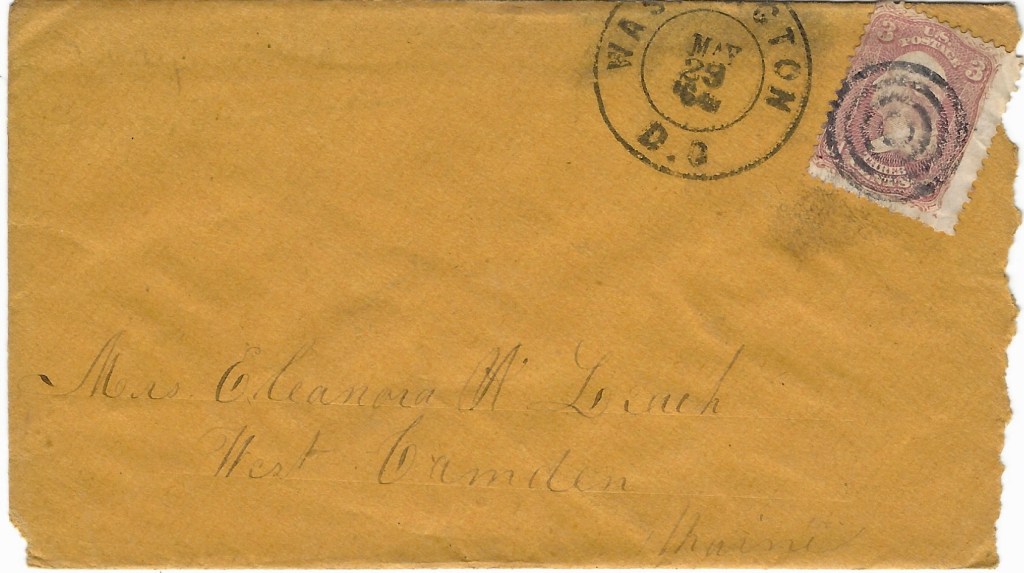
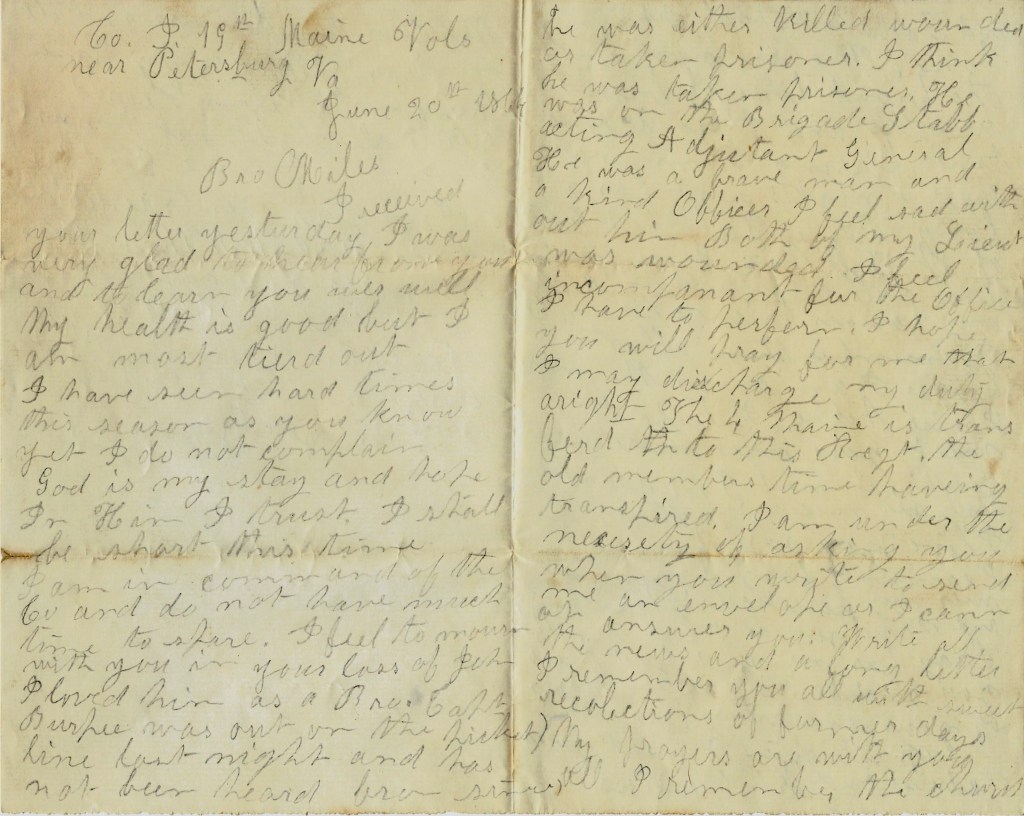
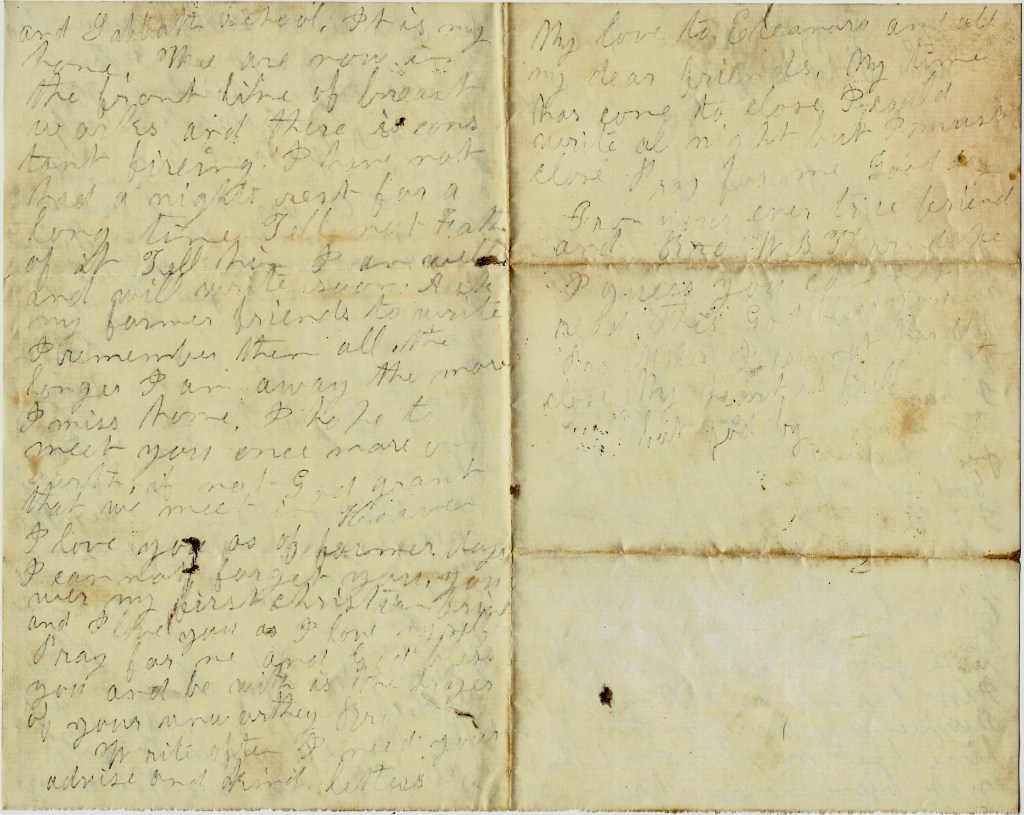
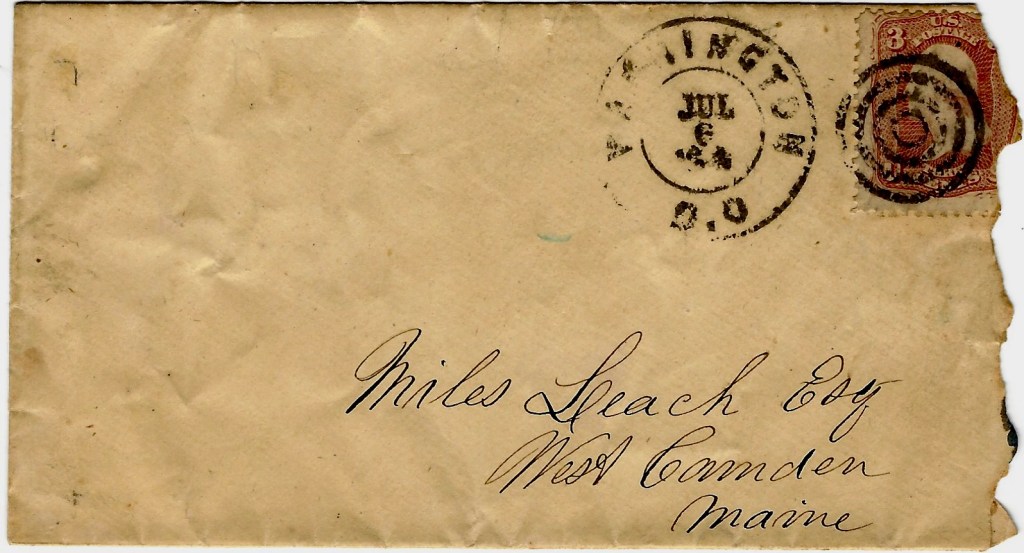
These letters were written by Cpl. Warren B. Thorndike (1840-1865) of Co. I, 19th Maine Volunteer Infantry. Warren was the son of Larkin Thorndike (1809-1893) and Abigail (Hall) Grant (1804-1863) of Camden, Knox county, Maine. He wrote the letters to members of his family, including his sister, Harriet Eleanora Thorndike who married Roscoe “Miles” Carter in March 1863, and to his brother-in-law, Miles.
As a member of the 19th Maine, Thorndike saw action at Fredricksburg, Chancellorsville, Bristoe Station, Gettysburg, the Wilderness, Spotsylvania, the North Anna River and Cold Harbor. On June 23, 1864, Cpl. Thorndike and 133 other Union soldiers were taken prisoner along the Jerusalem Plank Road near Petersburg and marched off to Andersonville Prison. He died of scorbutus in March 1865 and is buried at Andersonville National Cemetery—grave marker 12716.
[Note: Most of these letters are from the private collection of Greg Herr and were made available for transcription and publication on Spared & Shared by express consent.]
Letter 1
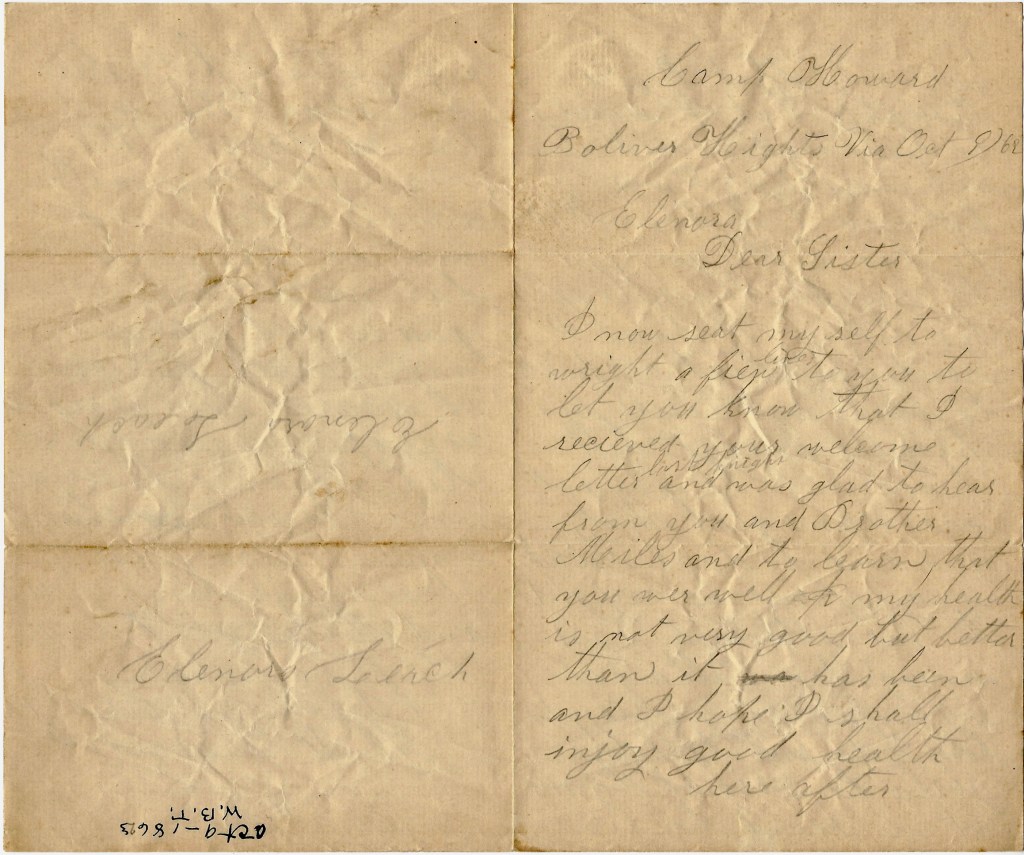
Camp Howard Bolivar Heights, Va. October 9th 1862
Dear Sister Eleanora,
I now seat myself to write a few lines to you to let you know that I received your welcome letter last night and was glad to hear from you and brother Miles and to learn that you were well. My health is not very good but better than it has been and I hope I shall enjoy good health hereafter.
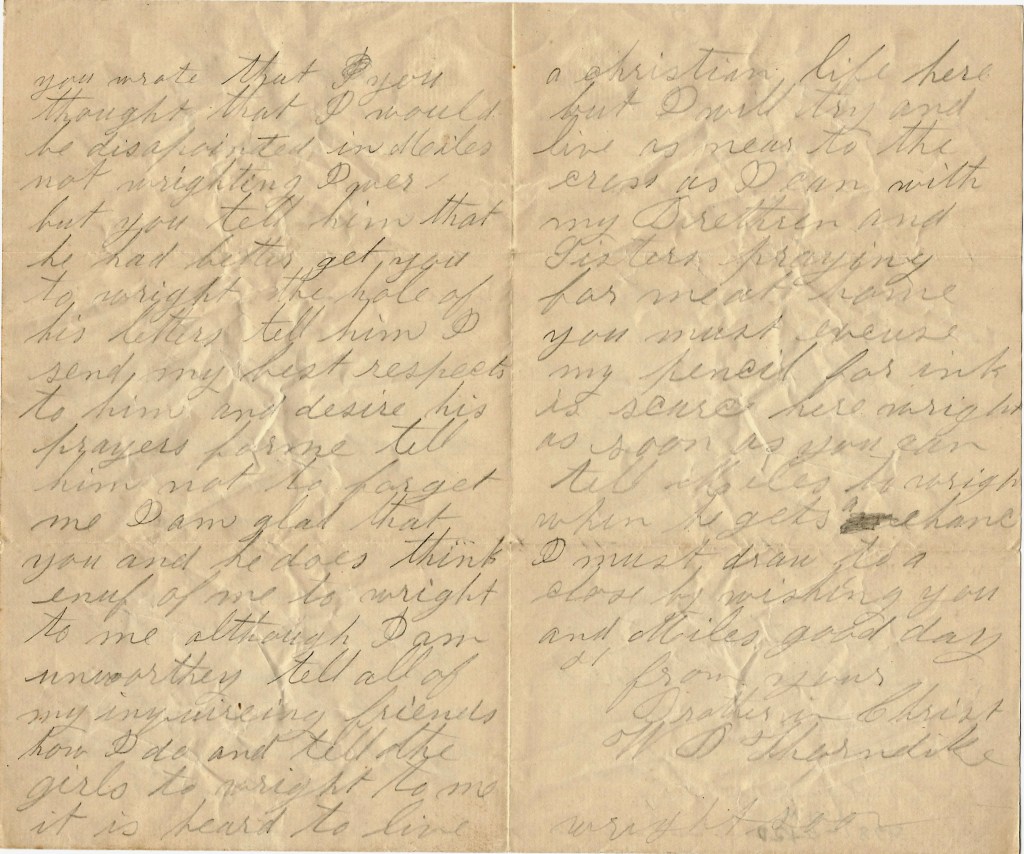
You wrote that you thought that I would be disappointed in Miles’ not writing. I was but you tell him that he had better get you to write the whole of his letters. Tell him I send my best respects to him and desire his prayers for me. Tell him not to forget me. I am glad that you and he does think enough of me to write to me although I am unworthy. Tell all of my inquiring friends how I do and tell the girls to write to me.
It is hard to live a Christian life here but I will try and live as near to the cross as I can with my brethren and sisters praying for me at home. You must excuse my pencil for ink is scarce here. Write as soon as you can. Tell Miles to write when he gets a chance. I must draw to a close by wishing you and Miles good day. From your brother in Christ, — W. B. Thorndike
Letter 2
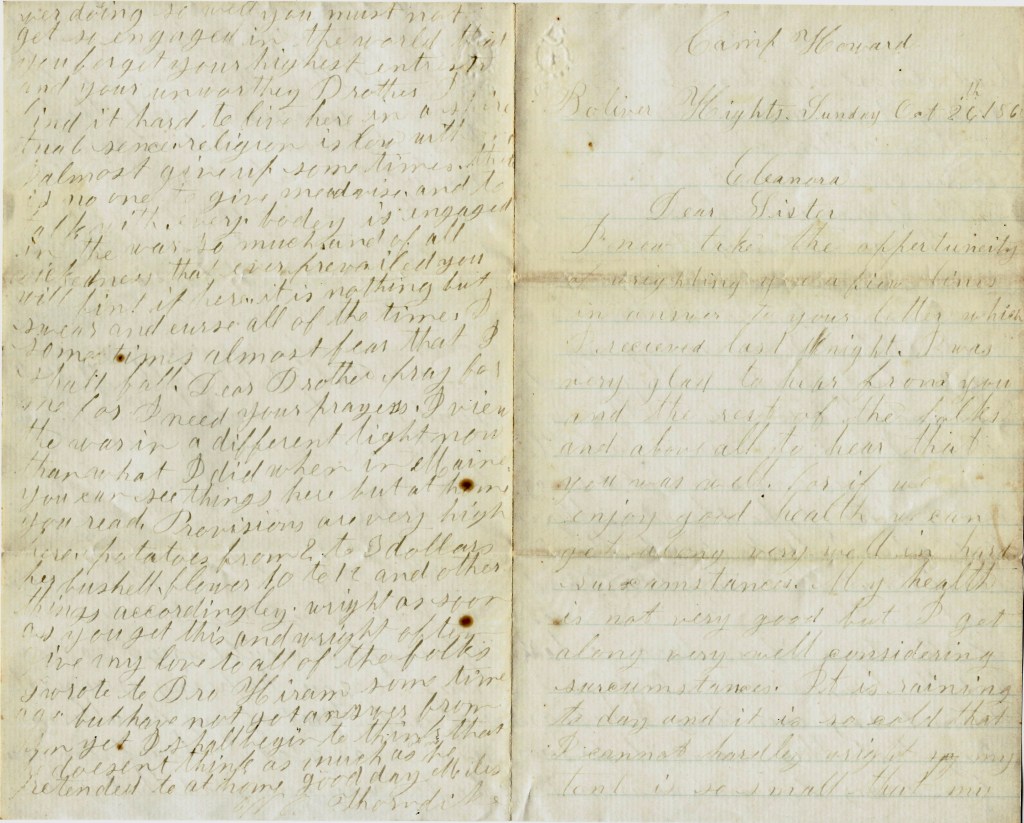
Camp Howard Bolivar Heights, [Virginia] Sunday, October 26th 1862
Eleanora, dear sister,
I now take the opportunity of writing you a few lines in answer to your letter which I received last night. I was very glad to hear from you and the rest of the folks and above all to hear that you was well for if we enjoy good health, we can get along very well in hard circumstances. My health is not very good but I get along very well considering circumstances. It is raining today and it is so cold that I cannot hardly write. My tent is so small that my head almost reaches the top sitting down and it is made of thin cotton cloth and it is rather cold some of the time. I wish you could see me sitting on the ground writing for that is the way I have to do it. Seems so strange to what I have been used to. When I was eating my supper last night, I thought of you and Miles. I will tell you what I had for supper—a little piece of fresh meat about two [ ] and a piece of hard bread as big, and that, when I broke it up, the crumbs scrambled all over my plate. And that is the way we live most of the time. It is hard to bear and the laws are very strict so I dare not say anything. I hope and pray that this war will soon close. Pray for me. We are not allowed to was sometimes for a week. It seems hard to go hungry and dirty both. I have not been in battle yet but they think we shall go soon. You may think that I am homesick but it is not so. But I am about sick of this war. There is no news of any importance that can be relied on. I am glad to hear from you by the way and glad that you are doing so well. You must not get so engaged in the world that you forget your highest interest and your unworthy brother. I find it hard to live here in a spiritual sense. Religion is low with us. I almost give up sometimes. There is no one to give me advice and to talk with. Everybody is engaged in the war so much and of all wickedness that ever prevailed you will find it here. It is nothing but swear and curse all of the time. I sometimes almost fear that I shall fall. Dear brother, pray for me for I need your prayers. I view the war in a different light now than what I did when in Maine. You can see things here but at home you read. Provisions are very high here. Potatoes from two to three dollars per bushel, flour 10 to 12, and other things accordingly. Write as soon as you get this and write often. Give my love to all of the folks. I wrote to Bro. Hiram some time ago but have not got answers from him yet. I shall begin to think that he doesn’t think as much as he pretended to at home. Good day, Miles. — W. B. Thondike
Letter 3
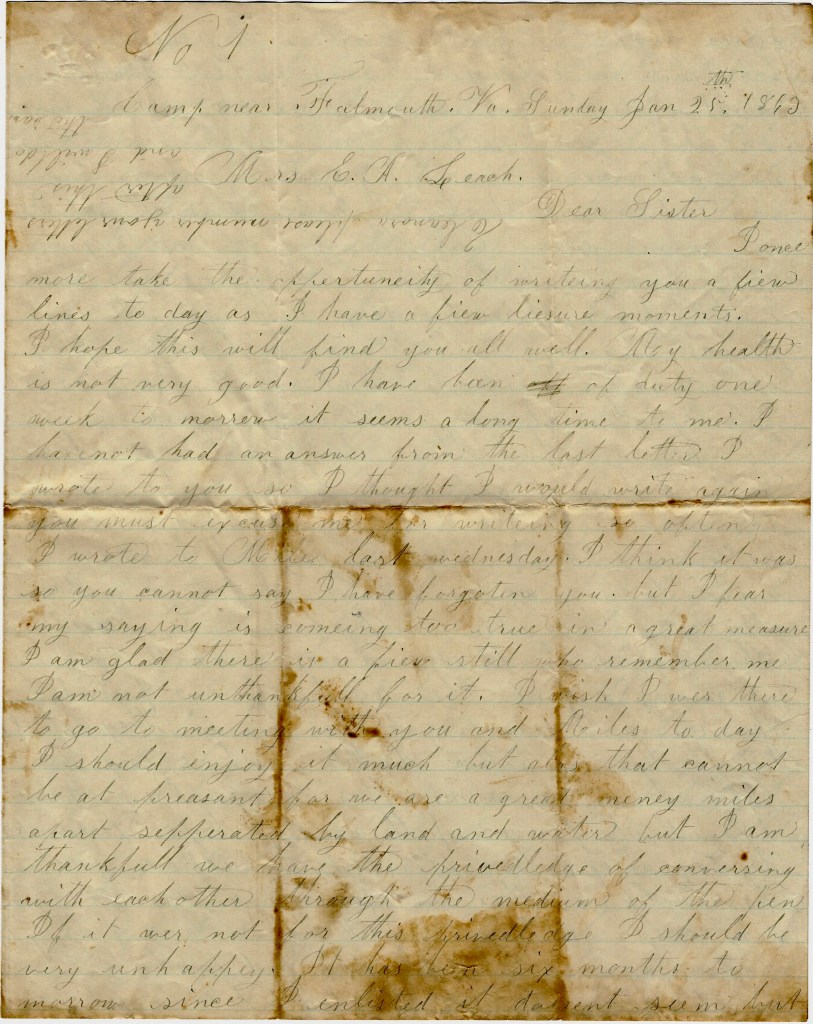
Camp near Falmouth, Virginia Sunday, January 25, 1863
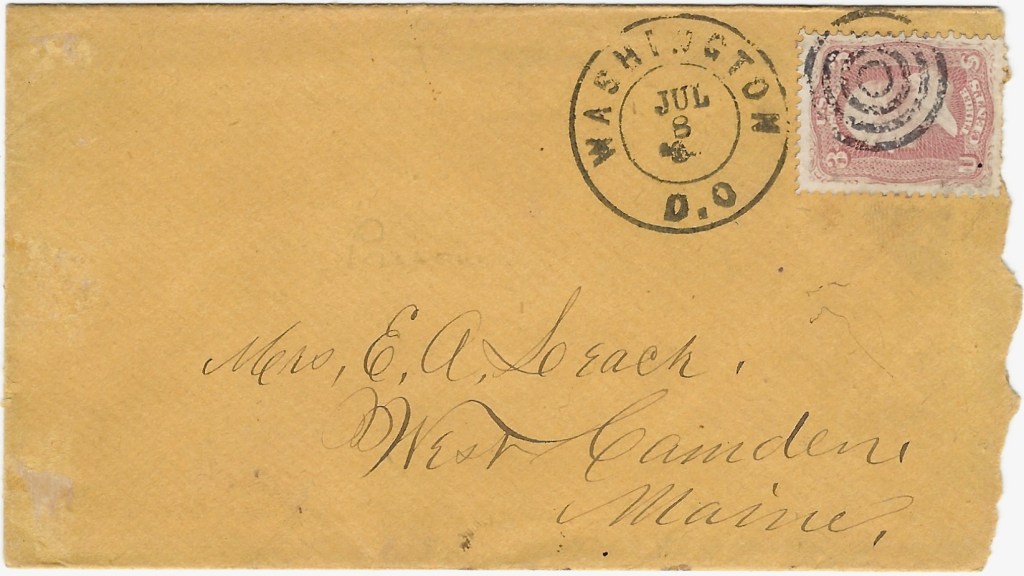
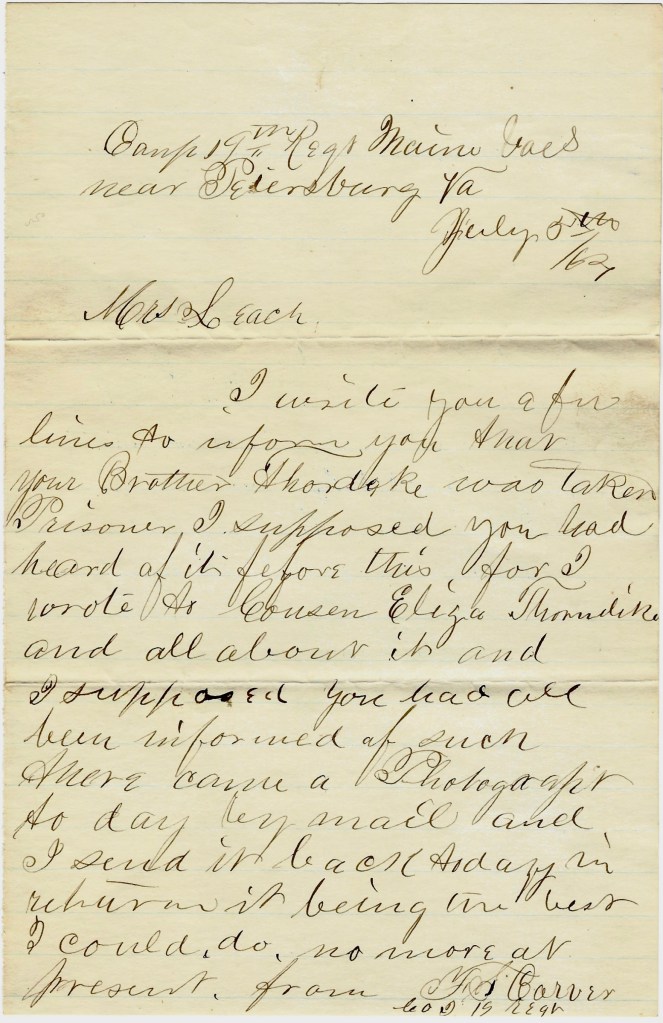
Mrs. E. A. Leach,
Dear sister, I once more take the opportunity of writing you a few lines today as I have a few leisure moments. I hope this will find you all well. My health is not very good. I have been off duty one week tomorrow. It seems a long time to me. I have not had an answer from the last letter I wrote to you so I thought I would write again. You must excuse me for writing so often. I wrote to Miles last Wednesday I think it was, so you cannot say I have forgotten you. But I fear my saying is coming too true in a great measure. I am glad there is a few still who remember me. I am not unthankful for it. I wish I was there to go to meeting with you and Miles today. I should enjoy it much but alas, that cannot be at present for we are a great many miles apart, separated by land and water. But I am thankful we have the privilege of conversing with each other through the medium of the pen. If it were not for this privilege, I should be very unhappy.
It has been six months tomorrow since I enlisted. It don’t seem but a few days to look back upon. I haven’t but two years and a half longer to stay. That isn’t a great while. It will soon pass away and then, oh the joy of meeting once more. But whether we shall meet on earth again or not, who can tell. But sister, I hope we shall meet in realms above. Oh the joy of meeting there where there will be no parting nor sorrow. I wish I were there to dine with you today for all we have to eat is hard bread today. It is rather hard. To think that there is a plenty to eat at home and we have to go hungry. But these days will not always last.
I haven’t got your box yet but expect to in two or three days. I long for the time to come. How I shall enjoy it. I shall write to you again when I get it. I am glad you thought enough of me to take the pains to do so. I never shall forget it in you and the rest of my friends. The reason I did not get the box is they calculated to have another battle but owing to the storm or some other cause, they have delayed it for a spell and I hope forever,
Today is quite pleasant. I suspect you have cold weather in Maine. We do not have very cold weather here. I was reading your paper you sent me today and wishing I had a later one to read. I should like to get home in the spring time to go to Sabbath School but that is improbable. It causes me to sigh when I think of it. Sister pray for me that I may be spared to get home once more. I think I can be contented to do so.
I wish you could see my house I live in. I guess you would laugh. Give my love and best respects [to] your Mother and Father and Henry and Fanny and all the folks. Tell Miles I want his prayers for me. Tell him to write to me punctually. You must write often, Eleanora, for I like to hear from you. Tell Edward and Emily I send my love to them. When you write, tell me all the news you can think of for I like to hear what is going on at home. Tell all of the folks to write for I should be happy to hear from them. I sometimes almost get discouraged and ready to give up but that will never do. I find it never will do to look on the dark side. Religion is low with me but still I have a hope in God’s mercy and hope I shall never be left to deny the cause [of] Christ.
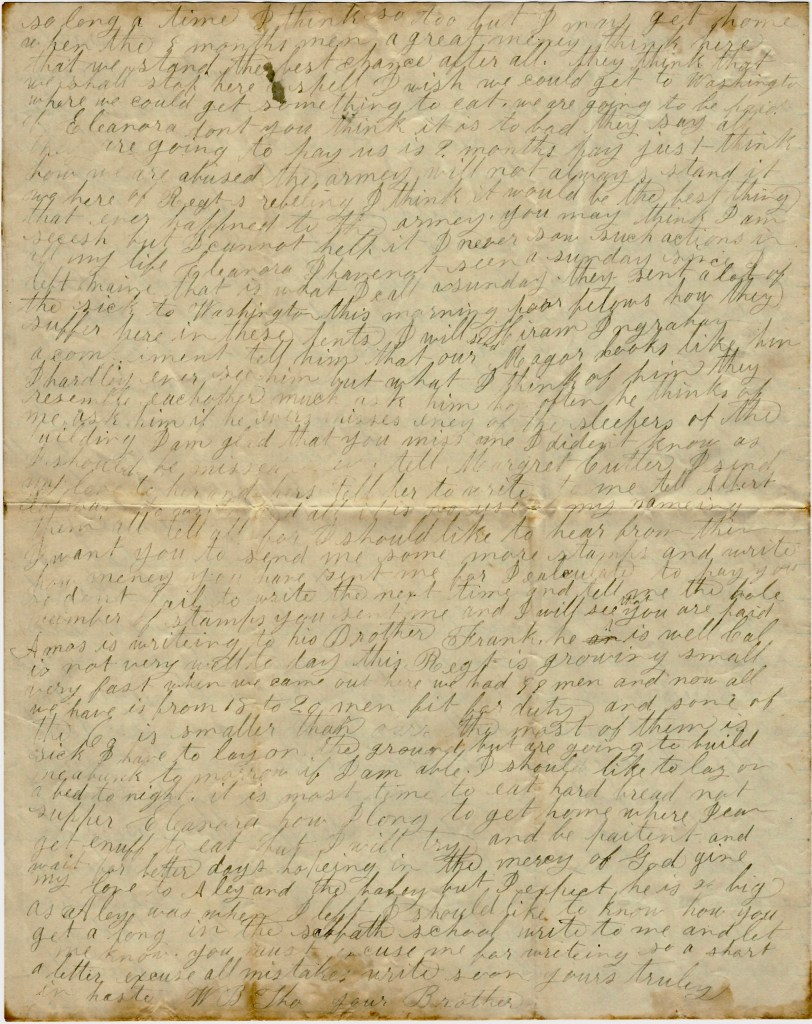
I had a letter from Mrs. Jane Ingraham last week and was glad to hear from her. She spoke about my box. I also had a letter from Roscoe Carter the same day. He thought I was foolish for enlisting for so long a time. I think so too but I may get home when the 9 months men [do]. A great many think here that we stand the best chance after all. They think that we shall stay here a spell. I wish we could get to Washington where we could get something to eat. We are going to be paid off. Eleanora, don’t you think it is too bad they say all they are going to pay us is two months pay? Just think how many are abused. The army will not always stand it. We har of regiments rebelling. I think it would be the best thing that ever happened to the army. You may think I am secesh but I cannot help it. I never saw such actions in all my life.
Eleanora, I have not seen a Sunday since I left Maine—that is, what I call a Sunday. They sent a lot of the sick to Washington this morning. Poor fellows. How they suffer here in these tents. I will send Hiram Ingraham a compliment. Tell him that our Major looks like him. I hardly ever see him but what I think of him—they resemble each other much. Ask him how often he thinks of me. Ask him if he ever misses any of the sleepers of the gilding. I am glad that you miss me. I didn’t know as I should be missed. Tell Margaret Cutler I send my love to her and hers. Tell her to write to me. Tell Albert [illegible].
I want you to send me some more stamps and write how many you have sent me for I calculated to pay you so don’t fail to write the next time and tell me the whole number of stamps you sent me and I will see that you are paid. Amos is writing to his brother Frank. He is well. Cal is not very well today, This regiment is growing small very fast. When we came out here we had 99 men [in our company] and now all we have is from 18 to 20 men fir for duty and some of the [ ] is smaller than we are. The most of them is sick. I have to lay on the ground but we are going to build knee bunks tomorrow if I am able. I should like to lay on a bed tonight.
It is most time to east hard bread—not supper. Eleanora, how I long to get home where I can get enough to eat but I will try and be patient and wait for better day, hoping in the mercy of God. Give my love to Alex and the baby but I expect he is as big as Alex was when I left. I should like to know how you get along in the Sabbath School. Write to me and let me know. You must excuse me for writing such a short letter. Excuse all mistakes. Write soon. Yours truly. In haste. Your brother — W. B. Tho
Letter 4
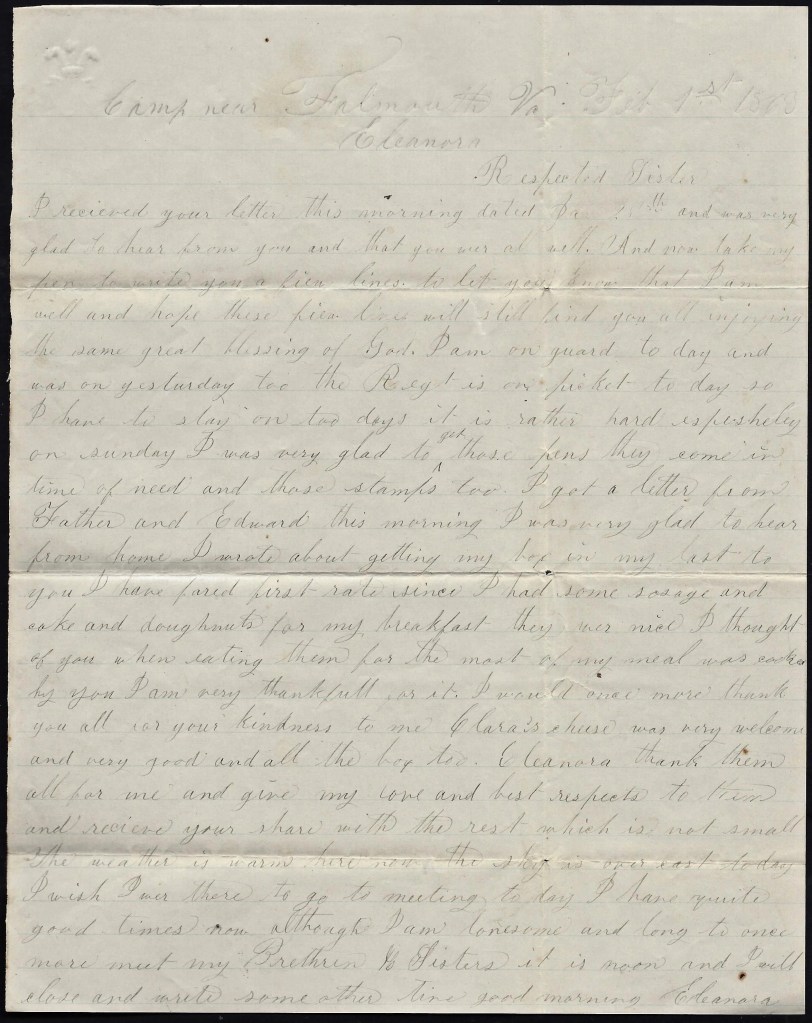
Camp near Falmouth, Va. February 1, 1863
Eleanora — respected sister,
I received your letter this morning dated January 28th and was very glad to hear from you and that you were all well. And now take my pen to write you a few lines to let you know that I am well and hope these few lines will still find you all enjoying the same great blessing of God.
I am on guard today and was on yesterday too. The regiment is on picket today so I have to stay on two days. It is rather hard — especially on Sunday. I was very glad to get those pens. They will come in time of need and those stamps too. I got a letter from Father and Edward this morning. I was very glad to hear from home. I wrote about getting my box in my last to you. I have fared first rate since I had some sausage and doughnuts for my breakfast. They were nice. I thought of you when eating them for the most of my meal was cooked by you. I am very thankful for it. I would once more thank you all for your kindness to me. Clara’s cheese was very welcome and very good and all the box too. Eleanora, thank them all for me and give my love and best respects to them and receive your share with the rest which is not small.
The weather is warm here now. The sky is overcast today. I wish I was there to go to meeting today. I have quite good times now although I am lonesome and long to once more meet my brethren and sisters. It is noon and I will close and write some other time. Good morning, Eleanora.
Sunday afternoon, Feb. 1st.
I take my pen to write a few more words. I have been on guard since I wrote this forenoon. It rains now. I shall not have to stand guard tonight in the rain. Hain’t I lucky? I am as fat as a pig [and] enjoying myself well. Coming home in the spring if not greatly mistaken. Why did you not write how many stamps you had sent me? The next time you write, tell me how many and you can have your pay. Tell Miles to remember me. Tell him I send my love to your mother and the rest of the folks. Good afternoon sister, — W. B. Tho.
Monday morning, Feb. 2nd
Sister Eleanora,
Good morning. I should like to see you this morning but [it is] impossible. The weather is cold today. I have just been to breakfast. I had hard bread, apple sauce and butter and doughnuts. I fared nicely. You must excuse me for so short a letter for I have 4 letters to write and finish before the mail goes so good day. Write soon. Yours in haste.
— W. B. T.
Send me some stamps.
Letter 5
Camp near Falmouth, Va. February 15th 1863
Sister Eleanora,
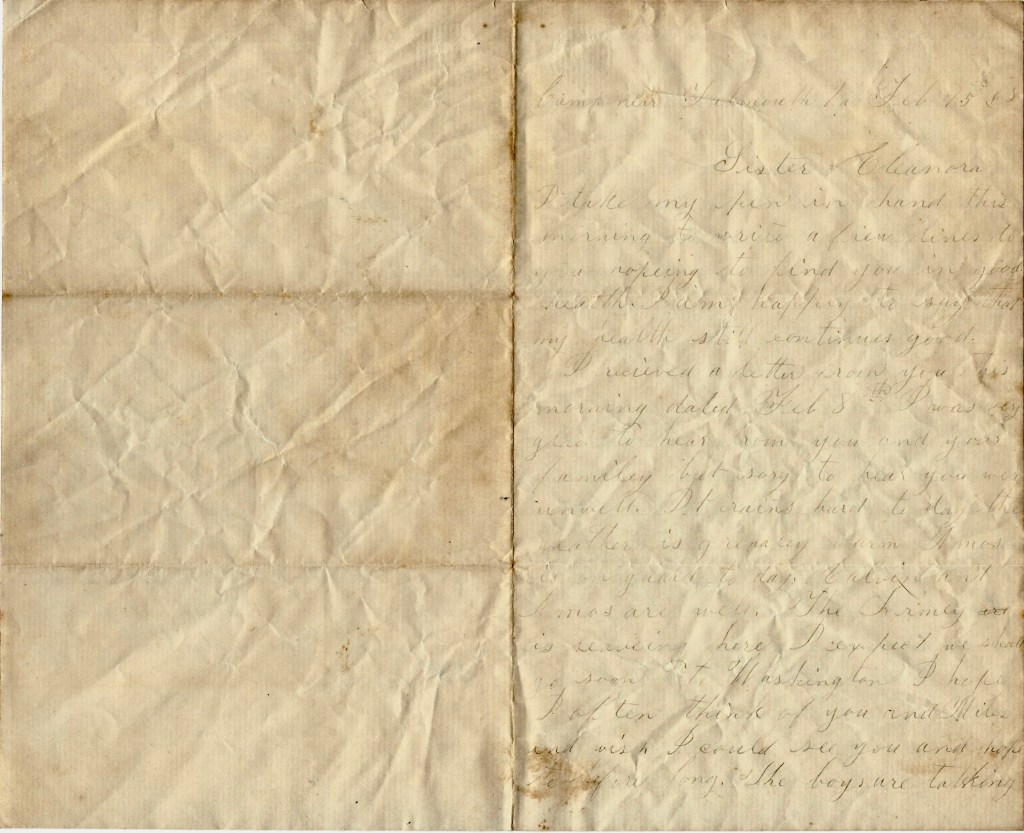
I take my pen in hand this morning to write a few lines to you hoping to find you in good health. I am happy to say that my health still continues good. I received a letter from you this morning dated February 8th. I was very glad to hear from you and your family but sorry to hear you were unwell. It rains hard today. The weather is generally warm. Amos is on guard today. Calvin and Amos are well.
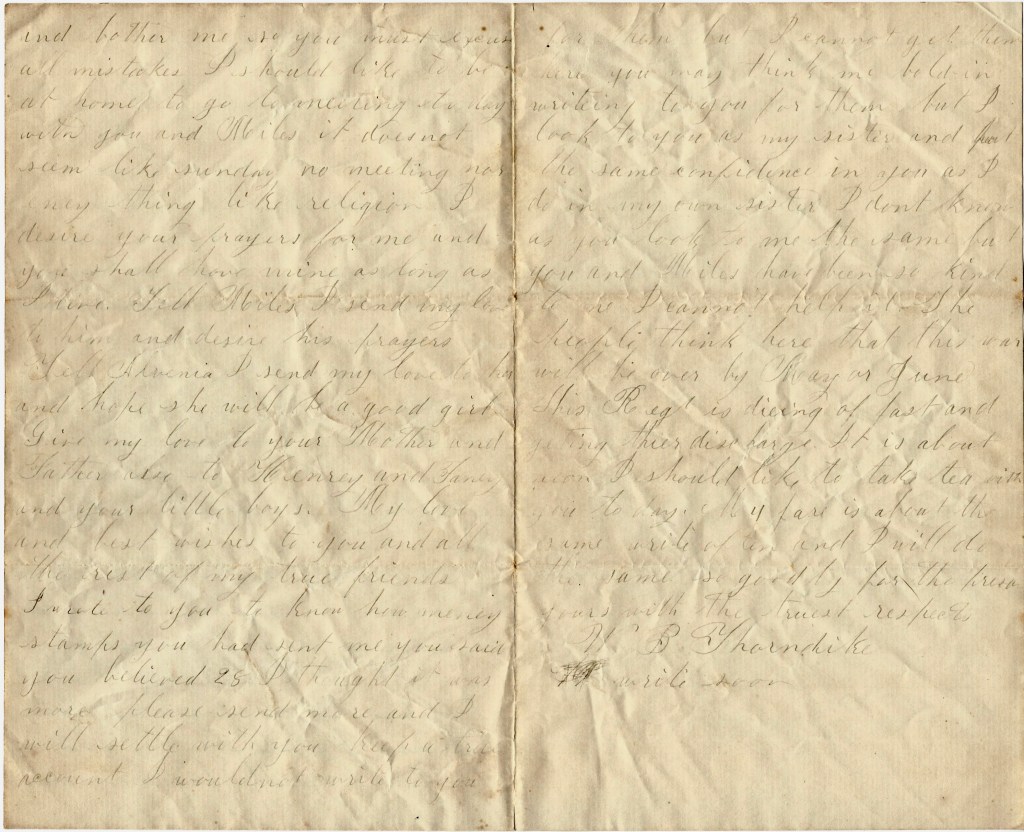
The army is leaving here. I expect we shall go soon to Washington, I hope. I often think of you and Miles and wish I could see you and hope to before long. The boys are talking and bother me so you must excuse all mistakes. I should like to be at home to go to meeting today with you and Miles, It does not seem like Sunday. No meeting nor anything like religion. I desire your prayers for me and you shall have mine as long as I live. Tell Miles I send my love to him and desire his prayers. Tell Alvenia I send my love to her and hope she will be a good girl. Give my love to your Mother and Father, also to Henry and Fannie and your little boys. My love and best wishes to you and all the rest of my true friends.
I write to you to know how many stamps you had sent me. You said you believed 28. I thought it was more. Please send more and I will settle with you. Keep a true account. I wouldn’t write to you for them but I cannot get htem here. You may think me bold in writing to you for them but I look to you as my sister and put the same confidence in you as I do in my own sister. I don’t know as you look to me the same but you and Miles have been so kind to me, I cannot help it.
The people think here that this war will be over by May or June. This regiment is dying off fast and getting their discharge. It is about noon. I should like to take tea with you today. My fare is about the same. write often and I will do the same. So goodbye for the present. Yours with the truest respects, — W. B. Thorndike
Write soon.
Letter 6
Still in Camp Saturday evening, April 11th 1863
Brother Miles,
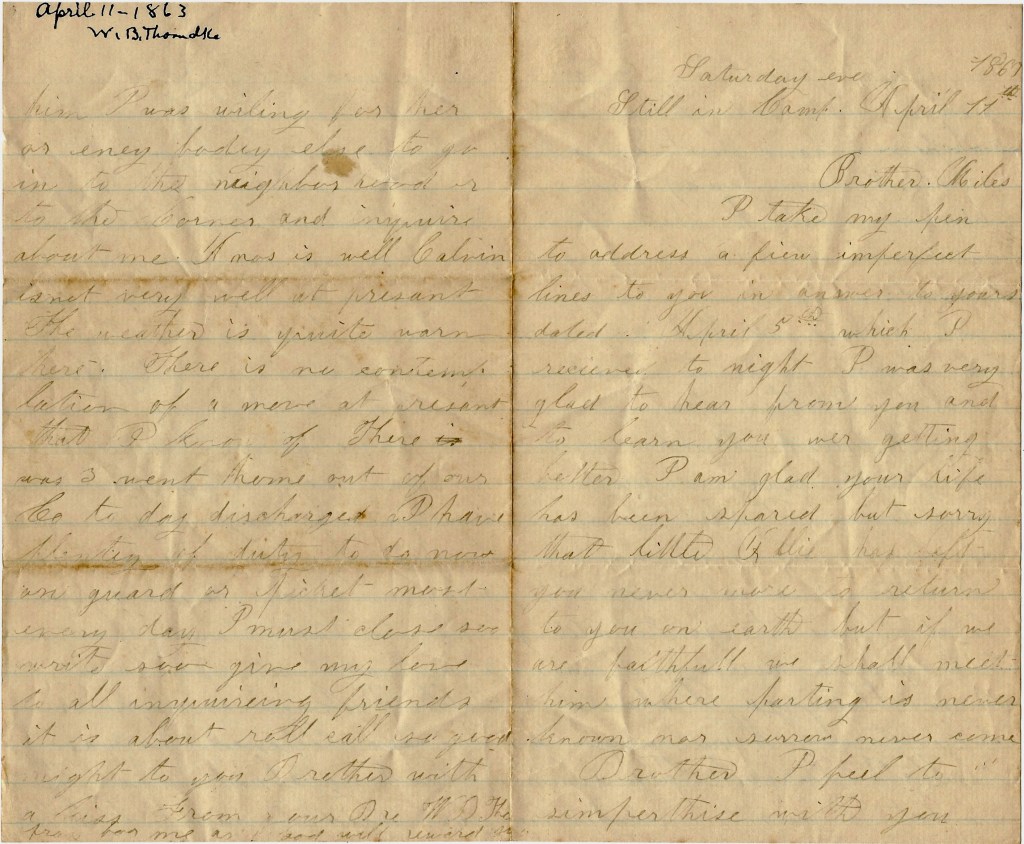
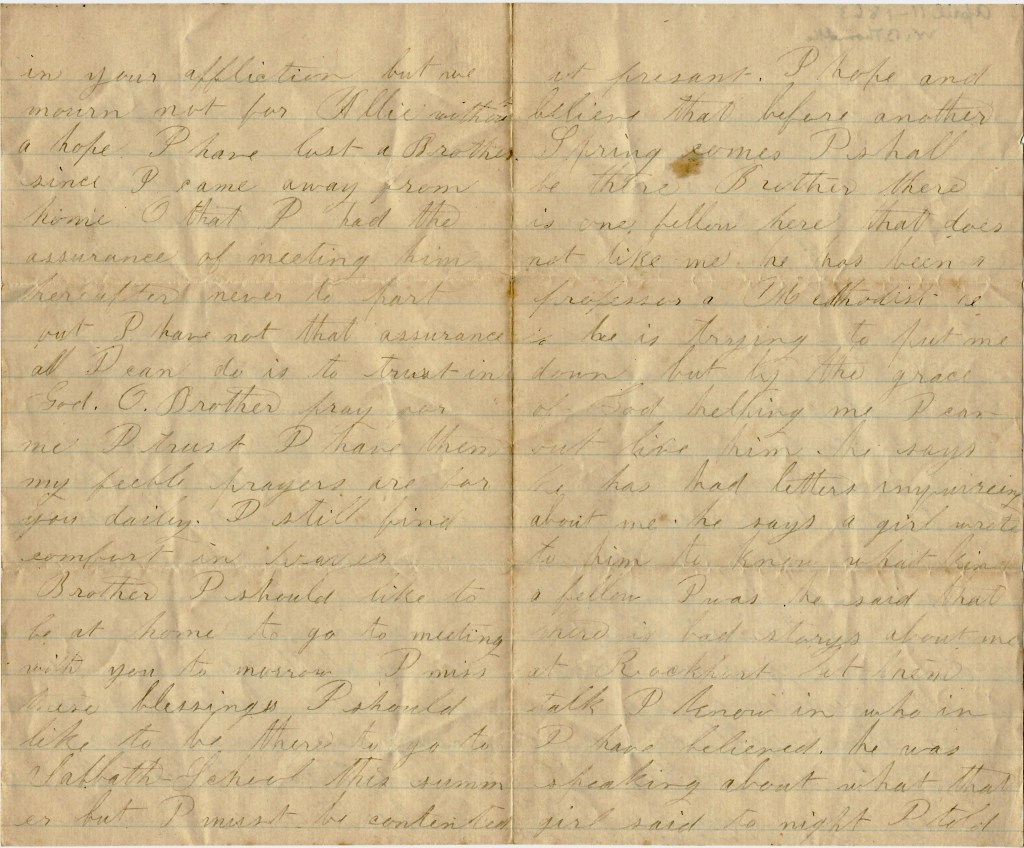
I take my pen to address a few imperfect lines to you in answer to yours dated April 5th which I received tonight. I was very glad to hear from you and to learn you were getting better. I am glad your life has been spared but sorry that little Allie has left you never more to return to you on earth. But if we are faithful we shall meet him where parting is never known nor sorrow never comes. Brother, I feel to sympathize with you in your affliction but we mourn not for Allie without a hope. I have lost a brother since I came away from home. Oh that I had the assurance of meeting him hereafter never to part but I have not that assurance. All I can do is to trust in God. Oh brother, pray for me. I trust I have them. My feeble prayers are for you daily. I still find comfort in Heaven.
Brother, I should like to be at home to go to meeting with you tomorrow. I miss these blessings. I should like to be there to go to Sabbath School this summer, but I must be contented at present. I hope and believe that before another spring comes, I shall be there. Brother, there is one fellow here that does not like me. He has been a professor—a Methodist. He is trying to put me down but by the grace of God helping me, I can out live him. He says he has had letters enquiring about me. He says a girl wrote to him to know what kind of a fellow I was. He said that there is bad stories about me at Rockport. Let them talk. I know in who in I have believed. He was speaking about what that girl said tonight. I told him I was willing for her or anybody else to go in to the neighborhood or to the corner and enquire about me.
Amos is well. Calvin is not very well at present. The weather is quite warm here. There is no contemplation of a move at present that I know of. There was three went home out of our company today discharged. I have plenty of duty to do now in guard or picket most every day. I must close so write soon. Give my love to all enquiring friends. It is about roll call so good night to you, Brother. With a kiss from your brother, — W. B. Tho.
Letter 7
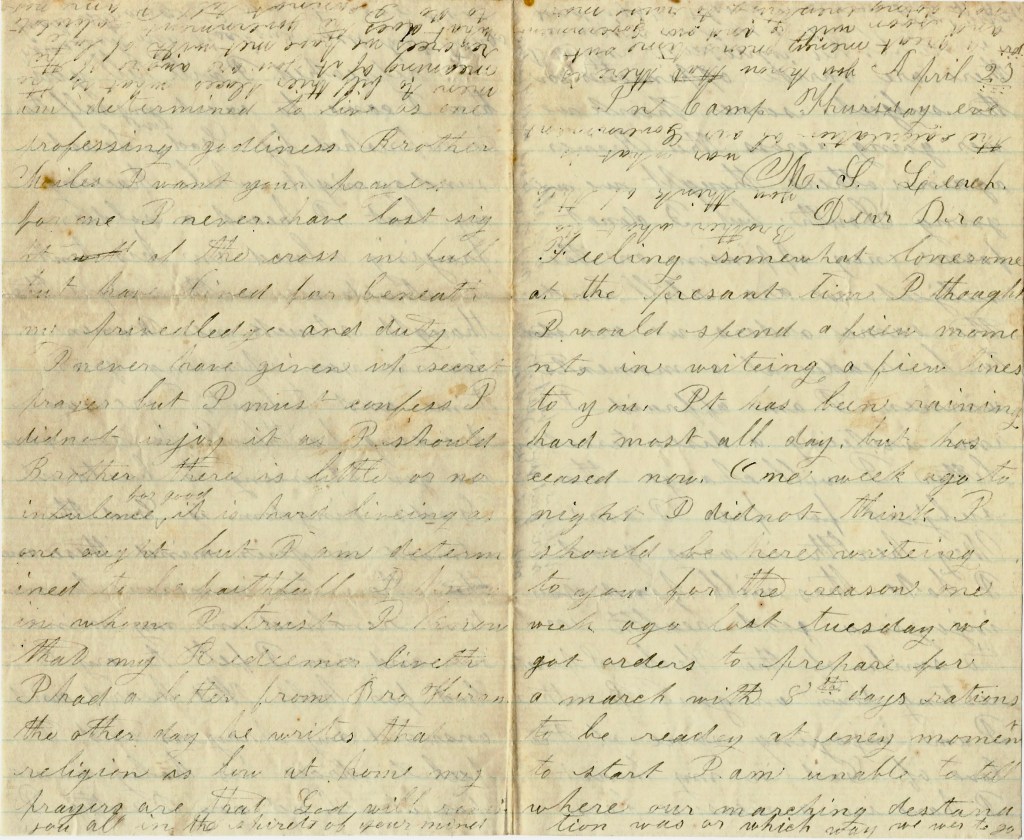
In Camp Thursday Eve, April 23rd 1863
M. L. Leach,
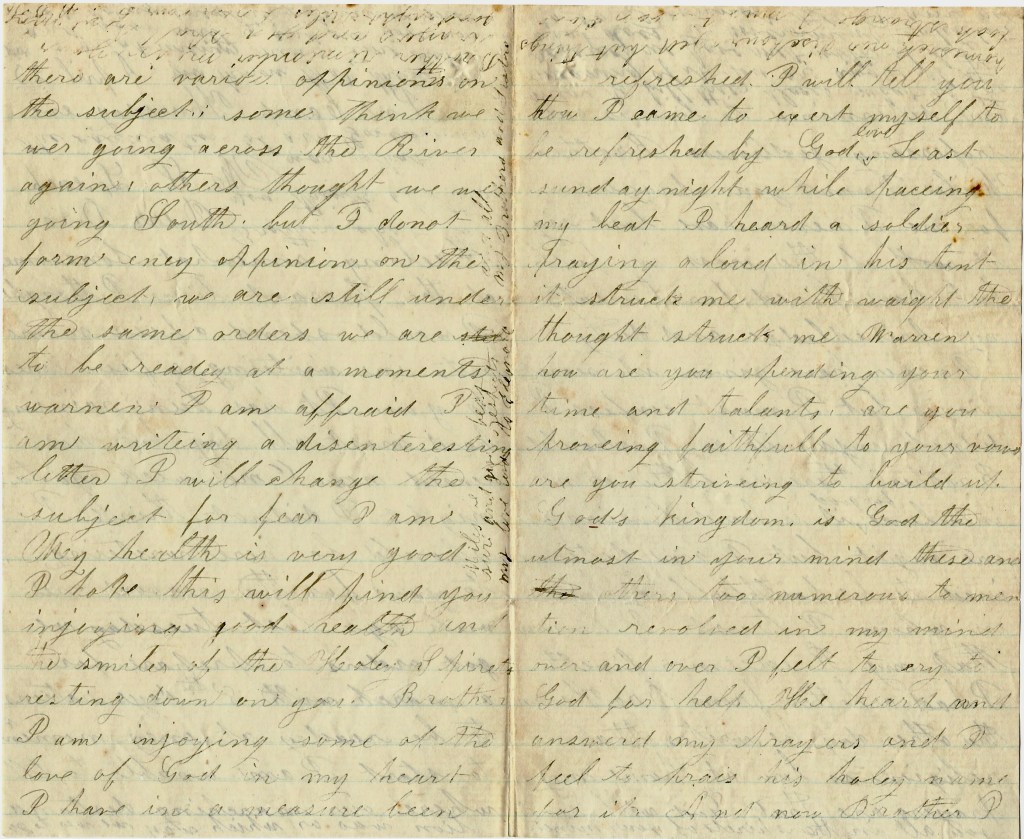
Dear brother. Feeling somewhat lonesome at the present time, I thought I would spend a few moments in writing a few lines to you. It has been raining hard most all day but has ceased now. One week ago tonight I did not think I should be here writing to you for the reason one week ago we got orders to prepare for a march with 8 days rations to be ready at any moment to start. I am unable to tell where our marching destination was or which way we were to go. There are varied opinions on the subject. Some think we were going across the [Rappahannock] river again. Others thought we were going south but I do not form any opinion on the subject. We are still under the same marching orders. We are to be ready at a moment’s warning. I am afraid I am writing a disinteresting letter. I will change the subject for fear I am.
My health is very good. I hope this will find you enjoying good health and the smiles of the Holy Spirit resting down on you. Brother, I am enjoying some of the love of God in my heart. I have in a measure been refreshed. I will tell you how I came to exert myself to be refreshed by God’s love. Last Sunday night while pacing my beat, I heard a soldier praying aloud in his tent. It struck me with weight. The thought struck me, “Warren, how are you spending your time and talents? Are you proving faithful to your vows? Are you striving to build up God’s Kingdom? Is God the utmost in your mind?” These and others too numerous to mention revolved in my mind over and over. I felt to cry to God for help. He heard and answered my prayers and I feel to praise His holy name for it.
And now, brother, I’m determined to live as one professing Godliness. Brother Miles, I want your prayers for me. I never have lost sight of the cross in full but I have lived far beneath my privilege and duty. I never have given up secret prayer but I must confess I didn’t enjoy it as I should. Brother, there is little or no [ ] for good. It is hard living as one ought but I am determined to be faithful. I know that my Redeemer liveth.
I had a letter from Bro. Kiran [?] the other day. He writes that religion is low at home. My prayers are that God will reach you all in the spirits of your mind.
There is a great many men’s time out and soon will go and our government is not doing anything to raise more men to fill their places. What is the meaning of it> You are aware of the reverses we have met with of late. What does the government [plan] to do. I cannot tell. I am not homesick nor discouraged yet but things look strange. I must soon close… — W. B. Tho.
Letter 8
Friday Morning, April 24, 1863
Dear brother Miles,
I should like to see you this morning. It has cleared off quite cool. I go on picket tomorrow. I hear that Bro. J. G. __berton has got home. Give my love to him. Tell him to write to me. I hope you will have a good Sabbath School this summer. I should like to attend but I have other duties to attend to at present. Calvin has gone to the hospital. Amos is well. I have faith to believe that I shall one day get home and I wish so to live that you will not be ashamed to call me brother.
Tell Eleanora I remember her in my prayers. Give my love and best respects to Mr. and Mrs. Howard and to Edward and all enquiring friends and accept a Bro. for yourself from me. Write soon and all the news. I will close by wishing you good health and the love of God in your heart.
From your brother and friend, — W. B. Thorndike
Letter 9
Sunday, May 10th, 1863
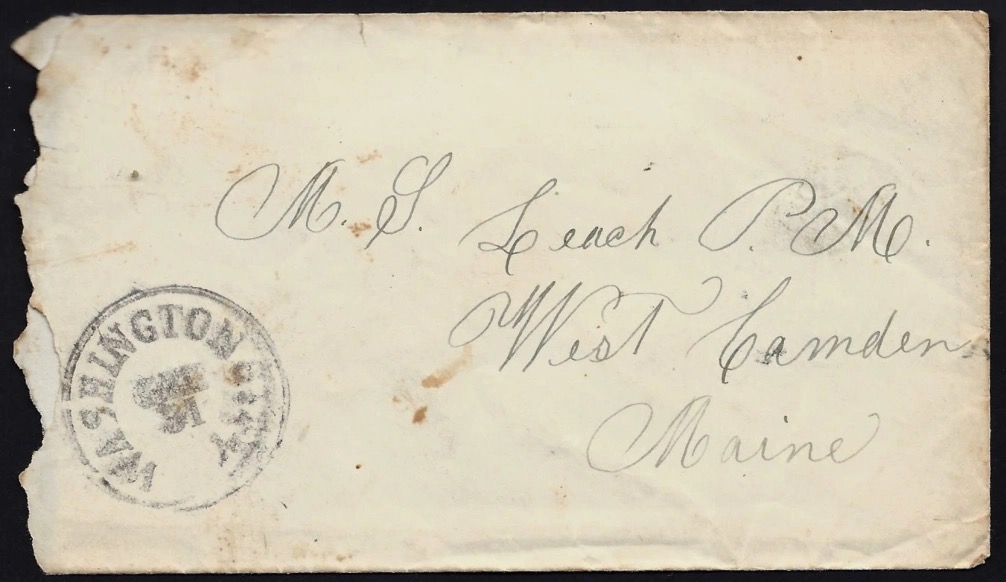
M. S. Leach, dear brother,
I take my pen to write you a few lines to let you know that I am well and hope these few lines will find you in good health. It is Sunday and I am on picket. It seems a good deal different what it does to go to meeting, I tell you. I should like to be at home to go to meeting today. I thinkI could enjoy it. I said I was well. I am—all but a bad headache. My hand trembles so I cannot hardly write atall. It is very warm today and marching down here almost beat me out. I find I am not so tough as I was in the winter. I am losing flesh every day. Warm weather does not agree with me and we have very sudden changes in the weather here. My head aches so I guess I will stop for the present. So good day, bro. Miles
In camp abreast of Fredericksburg May 11th, 1863
Bro. Miles, I again take my pen to write you a few more lines. It is now about 6 o’clock in the afternoon. Our regiment moved this morning at half past 6 o’clock so we are in new camp now. It is very pleasant here. I have been very busy in washing and fixing my tent. I should like to see you very much tonight. I feel as well as common. I wish you could see us in camp here. You would laugh I guess. I am a sitting in the back of my tent now. Has the Sabbath School begun yet? I hope you will have a good school.
We are within a few rods of headquarters and also of the railroad. Bro., I still am trying to struggle on in the way of well doing. Eleanora wrote that you told her to tell me you thought there was some signs of a revival. My prayer is that it may be so. It would be a great encouragement to me to hear so good news. Bro., labor hard to aid it on and may God bless your endeavors. Give my love and best wishes to Sister Eleanora. Also to Mr. and Mrs. Howard and Henry & Fanny and to all enquiring friends and receive a unworthy bro. to yourself.
It would be useless to write anything about the battle for you know more by this time that I do about it. I will close by asking your prayers for me. Good night. From your brother in [ ] and fellowship. — W. B. Tho.
P. S. Give my love to all the Brethren and Sisters. Tell them to pray for me. Good night, bro.
Letter 10
Bakersville [Maryland, near the Potomac river] July 10th 1863
Sister Eleanora,
Reuben D. Martin of Co. H, 19th Maine, was wounded in the thigh and back in the fighting late in the evening of 2 July 1862 in front of the Codori House.
I take this favorable opportunity to write you a few hasty words. I just received a letter from you dated July 6th. I was more than glad to hear from you. I also got one with them stamps a few days ago. I got a paper from Miles today.
My health is very good but I am most beat out. I was on picket night before last, last night throwing up breastworks most all night. We expect a battle here. In the last battle Amos [B.] Oxton was wounded in the hand. Joseph [W.] Wilson was killed. We lost our captain, two sergeants, and two men besides Wilson and a lot wounded. We went into battle with 45 guns and came out with 19. [Sergt.] William [E.] Barrows of Blackings Corner was killed. I have not time to write much. I will tell you how I spent the 4th of July. I was digging rifle pits with my bayonet and plate. The evening I was burying the dead. Oh, I cannot describe my feelings there.
Give my love to all, Tell them to write to me. Pray for me. Write soon. Yours in haste, — W. B. T.
Letter 11
In Camp near Culpeper, Va. September 14, 1863
Brother Miles,
I take my pen to answer your letter of the 6th inst., which I received the 11th, but owing to having to march the next morning, I haven’t had a chance to answer it before. I was very glad to get a letter from you once more for your letters always encourage me to persevere on.
We crossed the river yesterday morning. We are expecting to move forward every moment. I hear heavy cannonading in front. Our cavalry was engaged by spells yesterday. We drove them and took a lot of prisoners and some artillery. The news is that the Rebs have crossed the Rapidan and burned the bridge but how true the report, I cannot tell. The negroes here say that most of Lee’s force has gone to South Carolina.
My health is good for me and I hope these few hasty written lines will find you in good health. I am still trying to pray as of former days but I am far from enjoying what I have enjoyed of former days. I find it hard to maintain my Christian principles for I have everything to fight against but I have not time to write about that now. Brother, pray for me. I desire to be a true Christian. I hope soon to see you and enjoy the blessing of prayer and other privileges of home. Give my love to [sister] Eleanora and to all enquiring friends and accept a brother’s [love] yourself.
You spoke about sending out boots. I don’t know what to say but as we are now, it would be no use. What price do you get for those boots you spoke about to me at home? If I see a chance to do anything, I will write you. I think there will be a sight when we settle again. Write often as you can and I will do the same. I will close by wishing you good day.
I still remain your brother in Christian love, as ever—W. B. Tho.
Letter 12
Camp 19th Maine Vols. Sunday morning, April 10th 1864
M[iles] L. Leach,
Dear Brother, I once more take my pen to write a few lines to you thinking perhaps you would like to hear from me. I know I have no right to think so but I can never give up your friendship. I love you as of former days. I can never forget your kindness to me and always so and always shall remember you in my prayers, feeble though they are. We still continue our meetings and we now have prayer meetings at one o’clock in the afternoon. It rained yesterday and there were only four of us, two corporals, and two privates, but we had our prayer meeting just the same and God met with and I had my spiritual strength renewed. Two weeks ago today there were 10 baptized. I thought of the time when I took upon me that solemn vow, and took new courage to persevere. I have found religion to be the one thing needful. I sometimes wonder why only God ever looked upon me in mercy and saved me from endless misery and when I then feel to pour out my heart in prayer and thank God that I am saved by His grace.
I must stop writing and get ready for inspection. I will write more some time today. I do not like to do such things on the Sabbath but I have to obey orders.
Good morning. I once more take up my pen to try and finish my letter. It is now ten minutes to one. I have been to meeting this forenoon. Chaplain Hathaway of the 19th Maine Volunteers preached, or rather read to us. His text was Acts 26-28 and 29. I never liked to hear sermons read. I think that if a man is called to preach, that God will not let him lack of words when he is to preach. I suppose this the last Sabbath we shall have the privilege of attending meeting in the chapel for we are to turn in the covering this week for a all sutlers and everything else that is a stoppage to the moving too. The army is ordered to the rear by the 16th of this month. I shall not have many more privileges of going to meeting this spring nor of writing much. I ask you to write to me every time you can and I will not forget you while away. I think of you often and of the Sabbath School. I think often with much pleasure. I wish I could be with you some time as I have of former days which are now in the past, never to return. I know not as I shall ever again make one of your number or tread those sacred aisles of the church or look upon those scenes I love to look upon in former days. Death is certain and life is uncertain.
There is to be hard fighting this summer and I have seen enough of war to know that many must fall, never to rise until the resurrection day. I am as likely to fall as anyone and again I am as likely to live. No one can sit and wait God’s own time. If I never return, I hope to meet you above where we shall never part. I ask you to pray for me. I have great faith in prayer. I think that I shall live to get home. It seems that there is something telling me so continually. I feel whether I do or not that my life is hid from God.
It is a beautiful day like the last of May in Maine. But there is a shower coming. It has rained most all of this month so far. I was on picket one week ago today. We have to stay there three days. It rained two of them while I was out. But I have got so that I do not mind laying on the ground in a snow or rain storm.
I wrote to you the 13th of last month and have received no answer. I wrote to you for a dollar’s worth of stamps. I am all out and cannot get them here. I wish you would send them as soon as you possibly can. You may have sent them. If so, send as many more, and tell father to pay you. I want you and Caleana to have your minatures taken and send them to me. I wrote to Eleanora about it some time ago. I will pay all bills. I want to see your faces once more before I start on the march. I may never see you again, but if I do fall, I want you near me—that is, your picture. Tell Edward I want his and his wife. Be sure and send them. Do not forget, will you? I know that some of my folks do not do as I wish they did, but that does not make me any the worse. I feel sometimes as if I was forsaken by my friends. They do not write as they did when I first left home and I cannot help thinking so. I know I had not ought to write to you about it but I want you to be my friend as you was when I left home. I always was willing to tell you all of my trials and troubles, doubts and fears, and I still want to do the same. Shall I have the blessed privilege of putting confidence in you? …
Give my love to Eleanora and Mrs. Howard, to all my brothers and sisters; also to all enquiring friends. Remember me when you meet to worship—especially at conference and prayer meeting. I love those places. I shall never forget our parting when I came away…. [W. B. Tho.]
Letter 13
Camp 19th Maine Vols. Thursday, April 14th [1864]
Bro. Miles
I thought I would write a few lines to you to let you know that I am well and on praying ground. Roll call is over. It is now 8 o’clock. I should like to see you much tonight. Everything is all astir here now. We were paid off today and the sutlers are getting ready to leave tomorrow and the next day for they have got to all leave by the 16th. I have just ate my supper. I bought it to the sutler’s. I will give you a few of their prices. Butter 60 cents, ham 30 cents, eggs 50 and 60 per dozen, apples 5 cents apiece, oranges 10 cents and everything accordingly.
Yesterday there was a Brigade Review. Today General Inspection, Tomorrow Division Review, and next day Corps Review, and I cannot tell what will follow that. There was not any meeting tonight. There was a lyceum instead. There is a fellow here that wants me to get him a dollar’s worth of stamps so I thought I would write to you. I will send the money in this and you will greatly oblige by sending the stamps by the next mail.
My trust is still in God and in Him also do I trust. I shall have to close for it is taps. I will write more tomorrow if I get time. Good night, — W. B. Tho.
Friday morning, April 15th
Good morning Bro. Miles,
As I have a few moments to spare, I will improve my time by writing to you. I have got ready for review and now wait for the order to fall in. We are to fall in at 10 o’clock and it is now 20 minutes to eight. I suppose that some think that we live a degraded life and lose sight of all the finer morals of society. That is false…I have talked with some that have been at home and they tell me that a great many look upon the soldier as a low, mean being and call them nothing but an old soldier. I for one am proud that I am a soldier and do not think I am any worse for being a soldier, but am earning an honor that will last as long as time. So you can see how I look upon such talk and I also learn that many of the young ladies (if such they are) say that they never want a soldier for a husband. I for one do not want to be a husband to such nice things. I will not say any more on this subject.
I wish you could see our company this morning. We look nice, I tell you. I pride myself that we look the best in the regiment. Our boots and everything we wear that is proper to black is blacked and we make a fine appearance. You may think me a brag but I speak the truth.
I should like to be at home tonight to go to meeting with you. I should enjoy them better than any other meeting we have. I have made the acquaintance of a nice young man out here. He has experienced religion this winter. He belongs to this regiment. I think much of him. He is a sergeant and belongs to Co. D. I should like to see you all but we are separated far from each other and may never meet. If we do, it will be a happy meeting, and if we do not meet here on earth. I hope and trust we shall clasp hands on the other shore and sing the song of deliverance forever. If I do meet you again, it will not be long before that time will come—only 16 months and a few days longer, and that will soon pass away. I expect that I shall hardly know West Candor by the time I get home. I hear that there is to be built two more stores there and such a change in the people. Many have passed away never more to be seen on earth. and it seemed as if everything was changed…
Give my love to Eleanora and to all enquiring friends. My love to the Church and to you. I will close by hoping you are enjoying good health. My health is good. Write soon. From your Bro. in Christ, — Corp. W. B. Thorndike
Letter 14
Co. I, 19th Maine Vols, On picket at Po River, Va. May 19th 1864
Sister Eleanora,
I received your [letter] today. I was glad to hear that you were well. My health is good. I have but a few moments to spare as the mail soon goes out. I have been in several fights but as yet unharmed I remain. I suppose you have heard of John Leach’s death. I cannot describe my feelings. I sympathize with you all. I saw Henry last Sunday. He was not very well then. We have lost most all of our regiment. I am acting Orderly of my company so you see we must be very small.
I got 8 letters today. I must soon close. Pray for me, My love to all. Your bro. in great haste, — W. B. Thorndike
Letter 15
Co. I, 19th Maine Vols. near Petersburg, Va, June 20th 1864
Bro. Miles,
I received your letter yesterday. I was very glad to hear from you and to learn you were well. My health is good but I am most tired out. I have seen hard times this season, as you know. Yet I do not complain. God is my stay and hope. In Him, I trust.
I shall be short this time. I am in command of the company and do not have much time to spare. I feel to mourn with you in your loss of John. I loved him as a brother. Capt. Burpee was out on the picket line last night and has not been heard from since. He was either killed or wounded or taken prisoner. I think he was taken prisoner. He was on the Brigade staff acting Adjutant General. He was a brave man and a kind officer. I feel sad without him. Both of my lieutenants was wounded. I feel incompetent for the officer I have to perform. I hope you will pray for me that I may discharge my duty aright.
The 4th Maine is transferred to this regiment, the old members time having transpired. I am under the necessity of asking you when you write to send me an envelope or I cannot answer you. Write all the news and a long letter. I remember you all with sweet recollections of former days. My prayers are with you all. I remember the church and sabbath school. It is my home.
We are now in the front line of breastworks and there is constant firing. I have not had a night’s rest for a long time. Tell not father of it. Tell him I am well and will write soon. Ask my former friends to write. I remember them all the longer I am away the more. I miss home. I hope to meet you once more on earth. If not, God grant that we meet in Heaven. I love you as if former days. I cannot forget you. You were my first Christian friends and I loved you as I love myself. Pray for me and God bless you and be with you is the prayer of your unworthy bro. Write often and send your advice and kind letters. My love to Eleanora and all my dear friends. My time has come to a close. I could write all night but I must close. Pray for me. Goodbye.
From your ever true friend and bro., — W. B. Thorndike
Letter 16
Armory Square Hospital (Ward I) Washington July 5, 1864
Mr. Leach—Sir,
I received intelligence from my company on Saturday of the capture of some of my comrades and death of others. Among those taken prisoners was an intimate friend and tent mate, Warren B. Thorndike. My informant, Francis Carver, said he was the only one of the original boys in Co. I which was present at the time he wrote and I felt it a duty due my comrade and his friends at home to forward the unpleasant news believing that, however sad it may be to hear of his misfortune, it is better than suspense. Carver did not mention any circumstances but the mere announcement that he was taken prisoner.
I trust he may soon be exchanged or recaptured and enjoy the blessings which he has so nobly and faithfully [ ] his comfort and life. With respect, — Wm. H. Little, Jr.
Letter 17
Camp 19th Regiment Maine Vols near Petersburg, Va. July 5, 1864
Mrs. Leach,
I write you a few lines to inform you that your brother Thorndike was taken prisoner. I supposed you had heard of it before this for I wrote to cousin Eliza Thorndike and all about it and I supposed you had all been informed of such. There came a photograph today by mail and I send it back today in return., it being the best I could do. No more at present. From F. S. Carver, Co. I, 19th Regt.
The following letter was written by Enos Ayres Axtell (1843-1906), the son of Timothy Clark Axtell (1796-1869) and Rachel DeBow (1808-1888) of Nassau county, New York. Axtell entered the service in April 1861 as a private in the “14th Brooklyn,” a State militia united that was later designated the 84th New York Infantry. He was later promoted to a corporal. He also served in the Navy for three years as an Engineer. At the battle of Fall’s Church in 1861 he was on the skirmish line that ran across a yard where a Southern home had just been wrecked by the explosion of a shell. Axtell stopped long enough to help a 17-year-old girl who was fleeing from the home. Here a romance began, and in spite of parental opposition, it resulted in an elopement and a marriage after the close of the war. Catherine Taylor of Fairfax, Virginia (a cousin of Zachary Taylor) and Enos’ dramatic battlefield meeting and romance furnished the basis for Marie Correlli’s “A Romance of Two Worlds.” The couple lived in Kansas City for 35 years and Enos became an influential Republican Ward Leader. He was killed by a street car in front of his own home in Kansas City on April 5, 1906. Catherine died in Kansas City in March 1925.
But the story of Axtell’s life doesn’t end there, according to the Regimental history, he was taken prisoner on 1 July 1863 as his regiment retreated through the town of Gettysburg. He was caught with a number of his comrades in a “high-walled yard” but before capture, he tore the guidon he was carrying from its pole and wound it around his leg inside of his stocking so that it would not be taken, and kept it on his person during his 6-month stay at Belle Isle prison in Richmond. [Axtell’s story can be found in “The History of the Fighting Fourteenth” with a section called “The Guidon in Prison and Enos A. Axtell“, page 198]
Once Axtell’s enlistment ran out in 1864—not long after the following letter was written—he joined the Navy and served as a 3rd class Ships Engineer on a number of steamers. By 1870 he and Katie were living in Kansas City.
This letter and Axtell’s image (a period clear ambrotype copy of a tintype of him in his uniform) surfaced at a Riverside, California, flea market a short while ago, along with some late 19th Century tintypes and letters from a James R. Oldham. Oldham married Enos and Katie Axtell’s daughter, Amelia Elizabeth Axtell, in 1909 at Katie’s home in Kansas City, then moved to Whittier California later in the century. Amelia passed away in 1943, James lived until 1965.
1856 Seated Liberty Half Dime
In addition to the 1864 letter, there are two letters from 1882—one of which speaks of his plans to go and see bank robber Frank James in prison—and an 1856 Seated Liberty half dime Enos or Katie might have worn as a pendant.
Of the men Axtell mentions in his March 1864 letter home, “John Cook” is likely “John E. Cook,” Co. D; “John Brown” is “John C. Brown,” Co. D, and William Smith is “William W. Smith,” Co. D who was later WIA at Spotsylvania Court House. They all appear to have transferred to the 5th New York Veteran Infantry except Axtell, who was discharged and went into the Navy.
This letter and the other items mentioned are from the collection of Charles Joyce who gave his consent to have it transcribed and published on Spared & Shared. He informs me that the grouping is available for trade or sale if any readers are interested in it.
Transcription
Addressed to Mrs. R. Axtell, 262 Raymond Street, Brooklyn, New York
Headquarters 14th Regt. N. Y. S. M., Culpeper, Va. Sunday morning, March 6th 1864
Dear Mother,
Two months and seventeen day. Oh dear, it seems a long time ahead, but not near so long as three years. Well, I am endeavoring to worry it out to the best of my ability. What a day it will be to the citizens of Brooklyn and also what a day it will be to the scums of (B) the demoralized scum.
I received a letter from John Brown am pleased to hear he has been to see you. Also that he is having a good time. I sent him a recommend for a commission approved by the Captain and Colonel. I hope he may be successful in procuring it. I am sure I have done all in my poor power to assist him. He is a good boy in camp or on the Field of Action. He is also a friend of mine for whom I would do almost anything. Tell the girls to handle him careful.
I was a little surprised to hear of Tillie’s wedding coming off so soon. I would dearly love to be there but as the thing now stands, I am to consume nearly 80 loaves of bread, several barrels of pork, and other articles too numerous to mention before I can again visit home. But as you see as I can not be present, at least I trust it will pass off pleasant. She has my best wishes. By the time you get this, she will be in a home of her own. Mother, you are too well aware of the past for me to say anything but for Tillie’s sake, and in fact for the future happiness of the family. Let it pass. We will all look forward to I hope a brighter and more happy life. I hope everything hereafter will pass off smooth. Hannah spoke of Mrs. Brown thinking I would reenlist. Although I think a great deal of Johnny yet, I will not reenlist just for the very reasons. I will not break my promise to you all. Tell Hannah if I am not mistaken I have my senses yet.
I have nothing to say concerning your not answering my letters. I see you have as usual been on an errand of what shall I call it. I am sorry that he—Mr. Ely, although I was not acquainted with him, is dead. I have been expecting to hear from you. I also want you to send me one of those cards as I want it for a special purpose. I am going to send in a few days a parcel to you and by all means, don’t let anyone take it. Keep it for me as I value it very highly. The field glass was found here in town and in all probability it was the property of some Confederate officer. But I don’t value it so much for that as I do for its real value. The revolver is also valued by me at $40. Keep them where they will be safe. Wm. Smith will bring them on, he having reenlisted.
The day is beautiful. I never heard of such weather before in March. I have no news to write—only there are flying rumors as to Kilpatrick’s whereabouts. He has gone somewhere, that is certain, and I bet the Rebels will find him when he strikes a blow.
Remember me to all my friends, Hattie, and Mary Bennett. I guess I will not mention names as you may tell the parties and there I would be in a fix. I mean Hattie and Mary’s brother. My love to all the folks with much love to you. I remain your son, — Enos A. Axtell
John Cook has arrived. He gave me the letter. I am pleased to hear you are all well. John feels sick since he has come back.
The following letter was written by Byron Densmore Paddock (1833-1920), the son Henry Paddock, Jr. (1791-1854) and Silence Hard (1800-1850). He wrote the letter to Harriet A. Crippen (1839-1903) with whom he would marry on 27 December 1865.
Byron enlisted in the 1st Michigan Light Artillery Regiment, Battery F, at Coldwater, Michigan, in October 1861. He was formally mustered into the Union Army on January 9, 1862, and served with the regiment until receiving his discharge on April 6, 1865. Paddock was promoted to quartermaster sergeant, lieutenant, and captain during the course of his service.
[Note: This letter is the property of Michigan’s Military Heritage Museum and was transcribed and published on Spared & Shared by express consent.]
TRANSCRIPTION
Bowling Green, Kentucky March 22nd 1863
Dear Hattie,
It is Sabbath morning and one of those bright and beautiful ones that the Sunny South is so famous for. All nature looks gay, and seems striving to make me for get that this once happy country is now involved in a civil war. But I have only to listen and can hear the beating of the drums at guard mounting. Have only to look around me and can see the tents of the soldiers scattered in all directions.
Out yonder a few hundred yards from out in front of my camp is that of the 25th Michigan [Infantry]. 1 In one place I can see a squad of them playing ball. In another wrestling and jumping seems to be the order of the day. Then half a dozen or more are lying and sitting upon the ground enjoying the bright sunshine. But yonder in another part of the camp a different scene is being enacted. A hearse bearing the remains of a deceased soldier is moving along proceeded by a band with muffled drums and followed by a squad of soldiers with their guns reversed who are thus following their late comrade to his last resting place. Thus numbers are buried and soon forgotten by all save some dear ones at home.
But to change the subject or you will think that I was oppressed with gloomy feelings whilst writing this letter. Such is not the case, however, but I could not help picturing to you the varied scenes of camp life that one can see at almost any hour of the day.
I have been rejoicing ever since I received your letter yesterday to think my matrimonial prospects are so exceedingly bright (according to Mrs. Brown’s report). Why just think of it—to marry a middle aged lady with numerous children and she your step mother. O tempora!! O mores! 2 Well, may you call mankind fickle. But I guess she has made a slight mistake in a part of the name.
I wish those that are reporting that I am coming back to Coldwater soon would cease to do so, for I know that it must be disagreeable to you to be looking for me daily and be as often disappointed. I must tell you candidly that there is but little if any prospect of my being able to get leave of absence for the coming summer at least.
To say that I want to see you very much would be only to repeat what you of course are well aware of. Another fall I shall try hard to get leave of absence for a few weeks and hope we may have a pleasant visit.
What has induced Capt. Andrews to move to Three Rivers? Lieut. Andrews nor Brown have as yet returned but Capt. Hale wrote me that he was expecting them daily. Norman also wrote me that they would come here. Said he was sorry that I signed that petition but to keep cool and it would all come out right soon. The facts of the case are these. They expect to bring about a reconciliation between Brown and I thinking that we three can do as we please with the Battery. And without me they are satisfied they can effect but little for they know that I have more influence over the men than any officer in the Battery.
I am sorry that Lieut. Andrews has taken such a course for hitherto I had esteemed him highly as a gentleman and a friend and should he conclude to drop Brown, I shall still continue friendly toward him. But he cannot return my esteem and friendship and uphold such a man.
I am convined that if both return there will be trouble. Time will tell.
Whatever I say to you on the subject I would not wish to have go farther as it might get me into trouble. Court martials are easily instituted against officers in the slightest pretext sometimes. But I shall take care that none of them get the advantage of me—you being the only one to whom I express my mind freely.
Did you receive your commission as commander in chief of the kitchen from Gov. Blair. If so, you may expect that he will commission Brown’s wife over you, judging from the course he took with me. Guess the world would make a better soldier than he would.
Tomorrow our new General has a Brigade Review. His arrival upon the field will be the signal for a salute of eleven guns by my artillery, half of which I give in honor of the commander of the kitchen.
I received a letter from Bennie yesterday saying that Perry and his wife were going out West but did not say where. My box came through by express. There appears to be no trouble in sending that far. Almost daily some of my men get packages from their friends by express and they generally come through in good condition. How is it at Nashville, I am unable to say. Lieut. Holbrook has again been to Nashville. Stopped here on his return. Said he saw Bradley and that he was well.
You say you are commander of the kitchen? Well I am commander of the artillery at this post. Therefore, why should you be excused from writing any more than myself? I am Senior Officer and you must obey orders and write regularly. Yours as ever with love of—Byron
1 The 25th Michigan Infantry was posted at Bowling Green, Kentucky from 8 January 1863 to 26 March 1863.
2 O tempora, o mores is a Latin phrase that translates literally as “Oh the times! Oh the customs!” first recorded to have been spoken by Cicero.
The following letters were written by Frederick I. Johnson (1848-1875), the son of Abizer Johnson (1806-1893) and Sarah Woodward (1816-1865) of Turner, Androscoggin county, Maine.
I could not find an image of Frederick but here is an unidentified drummer boy posted by Kevin Canberg recently.
Frederick was only 16 when he enlisted to serve as a drummer boy in Co. D, 31st Maine Infantry. He enlisted 19 February 1864 at the formation of the regiment and was not discharged until 27 July 1865. Though he entered the war as a musician, it seems clear from his letters that illness disabled him for periods of time and he was detailed as a cook’s assistant and a hospital nurse on occasions. One of his letters suggests that he had either damaged or lost his drum which may also account for his duty elsewhere.
Though he survived the war and returned home to work as a shoe salesman, he continued to have poor health and he was admitted to the Home for Disabled Soldiers in Togus, Kennebec county, Maine, in October 1871 suffering from “paralysis” and he died on 23 April 1875.
Letter 1
Addressed to Mrs. Sarah Johnson, Turner, Maine
Place near Petersburg [Virginia] June 19, 1864
My dear Father and [Mother],
I received your kind letter last eve and was very glad to hear from you but sorry to hear that your health is so poor. Oh, I should like to be with you, my dear Mother and hope that I may be able to by and by. If you will [do] what you can do for me, I think that you can manage to get me out of the show. We have been on a four days march and I am about used up, My dysentery does not get much better. I am very well. My leg aches all of the time and sometimes I think that I shall have to give it up but I keep up as well as I can for it is no place for a man that is sick, so I have to keep up as well as I can. But if I was at home, I should be abed half of the time. You at [home] do not realize anything about what war is. You can [sit] down by the lovely fireplace and talk about war, but you do not know anything about war when you lay on the field with dead Rebs and see the wounded go by on the stretchers. Then you can talk about war.
Oh Mother, if I can get out of this cruel war, it seems as if I never would murmur, let my lot be what it would. I would work early and late and for small pay and I think that by some exertion that I could get my discharge if Father would do all he can and get some good man to work for him. I think that it might be done. There is nothing like trying, you know. And now Mother dear, if you will prevail on Father to try and get some good man that he can trust to work for him on it, I think there might be a chance for my discharge. There was been a number applied for their discharge and I think that they will get them. I am tired and sick of this war and if I can get out of it, I think I should be happy and not murmur at all.
I was glad to read in that letter that you would help me and I hope and trust that you will for I think there is a chance for it and you must put it through and persevere in it. Mother, you know that perseverance conquers all things and I think if you persevere in this, you will conquer, You must talk with Flora and Lewis about it and I think that they will be willing to help all they can. And Lois and Dura, I think they would be willing all be willing and help all they can. I hope and trust that you will try and persevere and do the best you can for your darling boy. And if you conquer, you may rest assured that I will work and do all I can for you. I will work all the time. Oh, how I should like to be at home a looking around and hoeing corn and I hope that I shall be if you will help me all you can.
You spoke about Dan Harlow going back. I don’t think that he will come back. Do you think that Jed will ever come out again? I do not think that he will. Mother, I am getting tired so I must not write much more. Now you see that Father does something about that, won’t you? Be sure and have him do it without fail. From your obedient son, — F. I. Johnson
Remember and have Father do something about that, won’t you?
Letter 2
Addressed to Mrs. Sarah W. Johnson, Turner, Maine
In the Field near Petersburg [Virginia] July 24, [1864]
Dear Father and Mother,
I thought this afternoon that I would write you a [few] lines and let you know how I am getting along. I am not very well at the present and in facts have not been well since I came here. I have got the dysentery now and have had it for the last two months, but that is not all. My stomach is very lame but I still keep up with the regiment and am at cooks helping him what I can and it is pretty hard work to lug water in them big camp kettles, I tell you. I think I do full as much as I am able to and a little more. But when I get so I cannot lug at all, then I shall leave them.
There has been boys sent to the hospital that was not any sicker than I am but I shall stand it as long as I can. If Dr. Trafton was here, I think he would do something for me or else send me to the hospital. You said Benj. was at home. When did he get home and when is he coming back? Tell him when he comes back that I want him to come over to the 9th Corps and see me for I want to see him much. How is he—very poor or not? Is he fat or poor? and does he look just as he always did? I hope he does and I hope he feels better than I do too. If he does not, he does not feel very well nor I can assure you for I feel very poorly.
You said in your last letter that Father was at work down to Auburn. Who is he to work for down there? Is he able to [go] out haying? If he is not able to work, he had better not work much. Oh I wish I could be there at work in haying. I understand that Hiram Conant is at home at work out haying for three dollars a day.
Well there has got to be some more come out of Old Turner yet. This last call will take about all of them that is able bodied and I should not wonder it took [ ] and Lewis. If Lewis is drafted, what will Flora do? She will feel bad, won’t she. Anyone must feel bad to have their friends come into this awful war.
I received in your last letter a two dollar bill and I tell you, it done my soul good. But two dollars does not go very far here now I can tell you. I bought me a little butter and made me a little toast and I tell you it tasted good. Things are most high out here. If it was so you could send me a box, I should like [it] but I do not know as you could without costing considerable. But they say that a box will come right through straight to City Point and then come up on the teams, There has been boxes come. If you do not send a box. Please send me a five dollar bill and I will send you back as much more when we get paid off. They say we shall get paid now pretty soon and I shall send some home. I think you will get some anyhow on the allotment roll.
Ted Chase has come on and I thought strange that either you nor Lizzie did not send me anything to eat. I tell you that a biscuit from Maine would taste good or anything else, it would not matter much. I wonder if I would not like a piece of Flora’s cheese and a good piece of brown bread? If it would not, I do not know what would. When a man has money, he can make out to live. You can get cheese here but it is no such cheese as Flora makes now, I tell you. I should like to have a piece of her cheese to eat tonight. I believe it would taste good, but I can’t eat fat boiled pork and hard bread as I am now. That is decided. If I can’t get money nor grub from home, I will have to go without eating. Now you must send me some money or else send me a box of grub and I don’t know but I shall have to have a drum esnt from home if I can get it through and I guess I can. There is a drum that William Jones has got that Peroe says is sold cheap and is a good drum if it’s the one that I think it is.
How do the folks all get along round there? All right I suppose. I hope so enjoying themselves. Well, I am getting tired and must close. Now write as soon as you get this, won’t you? From your affectionate son, — F. I. Johnson
Letter 3
City Point Hospital August 1, 1864
Dear Father and Mother,
Having a few leisure moments I thought I would write you a few lines to let you know how I was getting along. I am at the hospital at City Point, detailed as nurse in one of the wards. Me and the other drummer in my company are in the same ward together as nurses. It is not very hard work but for a man that has got the dysentery, it is not so very easy. My dysentery is not any better as I see and my side and stomach pains me a good deal. The head nurse tells me to report to the doctor unfit for duty but I hate to as long as I can crawl round. But if I am no better soon, I shall have to quit it for I cannot stand it. It is hard work to lug water and as we have to take it up a big hill, it tires me all out to fetch so far.
Well mother, how is your health this summer. I hope it is so you can go around and see your friends. You have a good many in this world. You have one that if he had heard [listened] to his dear mother, he would been much better off than he is now. Oh, if I had heard to you in the beginning, how much better off that some of the poor soldiers that I see round here [who] come to see the wounded here—some with one leg off and some with one arm. It is a hard sight.
Well, there has been another big battle and our regiment has been in it and the report is they are all cut up. The quartermaster came down to the hospital this morning and stated that there was only thirty men left in our regiment. Our colonel was wounded and a great many taken prisoners. 1
The Turner boys are all gone. There has not been a Turner boy but myself in the regiment for a long time. They are in the hospital, I suppose. I do not know where else they can be, I mean of them that there are myself and Peru and other band boys left in the regiment. I don’t want you to think that any of us musicians [are] in the ranks for we are not. We are all in the hospital as nurses.
We do not get much to eat now, I tell you. All I got for my breakfast was bread and meat and coffee—hard fare [for] a man that has to be on their feet as we have to be. If we had any money, we could get along very [well] but we have not been paid off yet and I do not know when we shall be. I do not tell this to be a fact about there not being only thirty men left in our regiment, but that is the report.
If you have not sent me any money, I would like to have you send me some for then I can buy something at the sutlers that I can eat. It is getting about dinner time and I must close.
From your affectionate son, — Fred I. Johnson
Direct to City Point Hospital, Virginia
1 The “big battle” Fred refers to was the Battle of the Crater which took place on 30 July 1864. The 31st Maine was given the task of leading the initial charge into the Confederate works after the massive mine explosion. They sustained numerous casualties and a large number of them were taken prisoners—their colonel, Daniel White, among them.
Letter 4
Addressed to Mrs. Sarah W. Johnson, Turner, Maine
9th Army Corps Hospital City Point, [Virginia] October 24th [1864]
My dear Father and Mother,
I received your kind letter this morning and was much pleased to hear that you was so well and Father too. I am glad that his health is so good. My health is very good at the present time and I trust that it will remain so.
You said that you had not got any of my letters. I do not see why you have not got them. I wrote you the last time that I got a letter from you and I got his letter this morning and am answering it now and I shall answer every letter that I get from you. It does me good to he a letter from home now, I can tell you. I do not see why we do not get paid off. I have not been paid off since I left the state. What little money I got from home is all the money that I have had since I left home. You seem to be very anxious about that six dollars that you sent me, I got that all right and should like to have some more. I do not see any signs of my being paid off yet awhile but when it comes, it will be good and I shall send the most of it home. I hope that we shall get paid off soon anyhow. I am in need of a little money now for I am all out.
I got a letter from Benj. some time ago and answered it the same day but have not got an answer from it yet but still I hope o get one from him and from Horace also. I wrote to him some time ago but have received no answer from him but I think that they will both answer my letters sometime—at least they ought to. And I think they will sure for they must know that I want to hear from them and all the rest of my friends. I had a letter from Win Allen the other day and answered that the same day that I got his. I was very glad to hear from him and to hear that he was enjoying himself so well. I love to enjoy myself when I can and I enjoy myself here as well as could be expected but it is no pleasant job to nurse in the hospital when there are sick and wounded in the hospital. But then a man will soon get used to that and then they do not care anything about it. But I cannot help feeling for them poor sick fellows. I think that I ought to be thankful for so good health as I have where there are so many that are so much worse than I am.
Do you think that Jed will come out here again or not? Tell him that I am alright and that he must write to me often for that is all he has got to do is to write. And he must not think strange of not getting an answer from me for I have considerable and I shall write to him pretty soon. If you could send me three or four dollars, I think that I could get along with that till I get paid off. Tell the girls to write to me, all of them, and I will answer them. I cannot write any more this time. — F. J. Johnson
I want you to give this little book to Charlie and read it to him and let him read it too. Tell him that he must be a good boy and ming his mother and do all that he can to help her and he will be rewarded. I am going to send another one of these books in the next letter. I wrote to Lois the other day and expect to have one by and by. I guess that she is a good sister and she will write to her brother in the army, I know.
Well, mother, I must not write anymore this morning for it is getting late and I am getting tired so I guess I must close. So goodbye for the present. From your son, — F. J. Johnson
The following letters were written by Benson Miles Jones (1843-1876), the son of Lambert Jefferson Jones (1813-1894) and Mary Eliza McHardy (1822-1894) of Newberry county, South Carolina. It does not appear that Benson ever served in the Confederate army. We learn that he was working as a Government clerk in Richmond in 1863 and such personnel were routinely drilled with the local militia.
Benson wrote the letters to his cousin, Belton Oscar Mauldin (1839-1874), son of Samuel Easley Mauldin and Caroline McHardy Mauldin. Belton attended Furman University from 1852 to 1859. Belton’s orphaned mother and her siblings fell under the guardianship of John Belton O’Neall (1793-1863)—a chief justice of the South Carolina Supreme Court. At the beginning of the Civil War, Belton enlisted 12 June 1861 and was mustered into Co B, South Carolina (Hampton’s Legion Cavalry) and transferred 15 Aug 1862 to Co I, 2nd South Carolina Cavalry.
Letter 1
Addressed to Mr. B. O. Mauldin, Signal Corps, Care of General J. E. B. Stuart
Richmond [Virginia] August 9th 1863
My Dear Cousin:
A few days ago I was very much delighted to receive a letter from you as it had been a very long time since I had that pleasure before. But I thought the reason you did not write was because you were always on the march and could not write or could not get our letters. I am sorry you have been changed from your position, both on your account because you wished to remain, and on my own for I was in hopes I could get with you and I do not wish to go anywhere unless you are there. Can you not get me on the Signal Corps of Gen’l Stuart? I would like so much to be with you and in fact I do not want to go anywhere but with you if I can help it. I would not care if you were in a company just so I could be with you & have you as my bed fellow, &c.
I suppose you have written to Willie and told him not to come on as he intended riding his horse here. I saw Billy Maudin here about three weeks ago. He has left now tho’ with his brigade. I see by the papers that Gen’l Hampton is to be made Major Gen’l, and it is likely your former Major Butler will be Brig’ in his stead. I saw Butler when he was here. He did not seem to mind his foot being amputated for he said he always did suffer with cold feet, and now he would only have one foot to keep warm. I suppose it will be sometime before he can return. 1
How is Capt. Williams getting along? Col. Butler spoke very well of him to me. I asked him if he saw Pa to try & persuade him to let me go to the army in the cavalry. Thought he might have some place he could give me. Gen’l Hampton has also gone home wounded.
Tell Jno. Willingham I still have his overcoat in my room and if he wishes it this winter, he will know where to send for it. I also have your old sword still. Do you think you can get off any time and come down to see me? I would like very much to see you. Am living finely now, keeping Bachelors Hall. Jack & I [are] alone now and we live very well. Can get something to eat now—plenty of vegetables, &c. I have not received a letter from home this week but have heard through Joe Ward [that] all [are] well. I am standing this summer finely. Have not got sick yet and do not think I will. Hoping soon to hear from you, I remain as ever your loving cousin, — Benson
1 Colonel Matthew Caldwell Butler of Hampton’s Legion Cavalry Battalion was wounded in the Battle of Brandy Station on 9 June 1863 and had his foot amputated.
Letter 2
Addressed to Mr. Bo. O. Mauldin, Signal Corps, Care of Gen’l J. E. B. Stuart
Richmond, Virginia August 30, 1863
My Dear Cousin,
Your very long and kind letter was gladly received some day or two ago. I should have received it before but the P. O. was closed for four or five days in consequence of a rebellion among the clerks who “struck” for higher wages and that of course delayed all mail arrangements.
I was sorry to hear your corps, under Gen’l Jones, had been broken up, for I know you had a nicer time than you will have now. I have written to Pa as you told me about seeing Gen’l Hampton and I hope he will see him and get both of us on his corps when he returns to his command. Pa does not try to get me a place for he does not want me to go in the service, and he will wait till it is too late and I will have to go just any where, for I am confident that as soon as Congress meets, the first thing it will do will be to turn all Government Clerks out. Even if I did not think so, I think it is time now for me to go, and I must go, and I don’t wish to go any where, where I cannot be with you. So we must try and make arrangements to get together somehow.
I have been looking a little for you down this past week, and when you do come, you must come immediately to my room (same place) and stay with me, for I am keeping Bachelor’s Hall all alone now, for Jack and his brother-in-law could not agree & Jack has gone to boarding and Mr. Wolford goes up every Saturday night to see his wife and returns Monday morning about day & brings enough provisions to last him till the following Saturday and he only pays $25 for his eatables & the days he stays up there. So you see I am all alone now and I have a fine time, for I do not have to adapt my expenses in marketing to suit Mr. Wolford and live much more like I have been accustomed to. There are two beds in my room now. Have moved that lounge out, so you can have aplenty of room and we can have a fine time together.
Do you still think you will be sent down to learn telegraphing? I hope so. We were out on another soldering expedition Friday & Saturday. Came in Saturday afternoon. Did not have such a hard time as before, for they sent us blankets, cooking utensils, 3 skillets & 2 pots to a company and aplenty of bacon, crackers, peas & some sugar & salt and then carried our blankets & utensils back for us. I went out foraging Saturday morning for things to make a Brunswick stew. Got two haversacks full of tomatoes, irish potatoes & butter beans & my arms full of corn for $1.50 and two chickens for six dollars. We cleaned the chickens nicely & cut them up & cleaned all the vegetables & divided them in half & borrowed another pot, and putting a chicken & some bacon & half the vegetables in each pot, and then filling with water, we put them on to boil, seasoned with salt. It was a delightful dinner and there being ten of us, it only cost us seventy five cents each, and we have the two drummer boys in our mess. There were only six of us at first but we had to make ten so as to get a cooking utensil as there were only 5 to a company. I have all the nice men in our company in my mess. We had just finished our dinner when we were ordered back to town.
I do wish you could be down here with me, for I am very homesick now and if you could be here I would feel better & not so lonely. I never hear from your house now except through Mother. They have quit coming to town entirely. I don’t think I have got a letter this year—I know not since you went home. They were well the last I heard, except Helen who had the mumps. Sissie is up there now. With much love & hoping I hear soon, I remain your loving cousin, — Benson