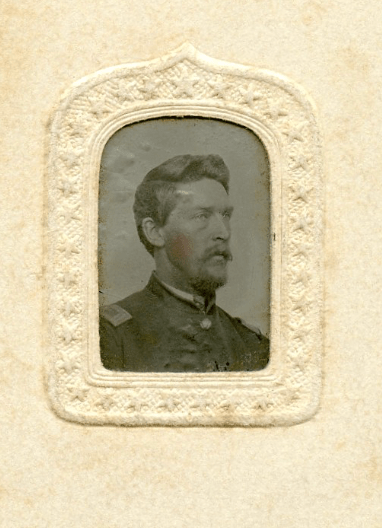
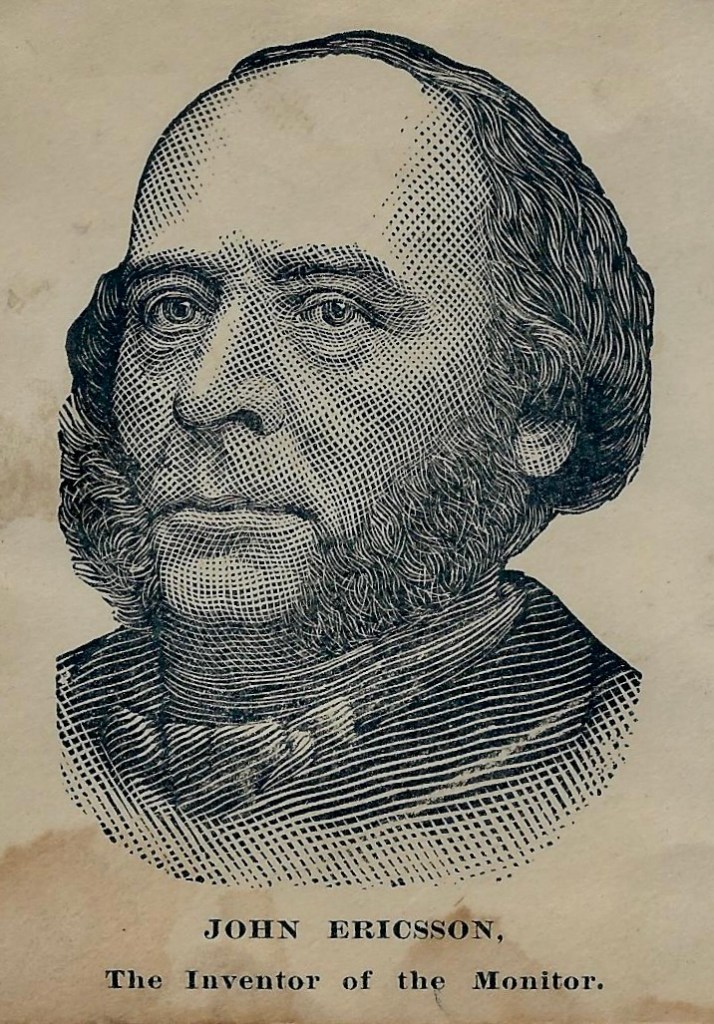
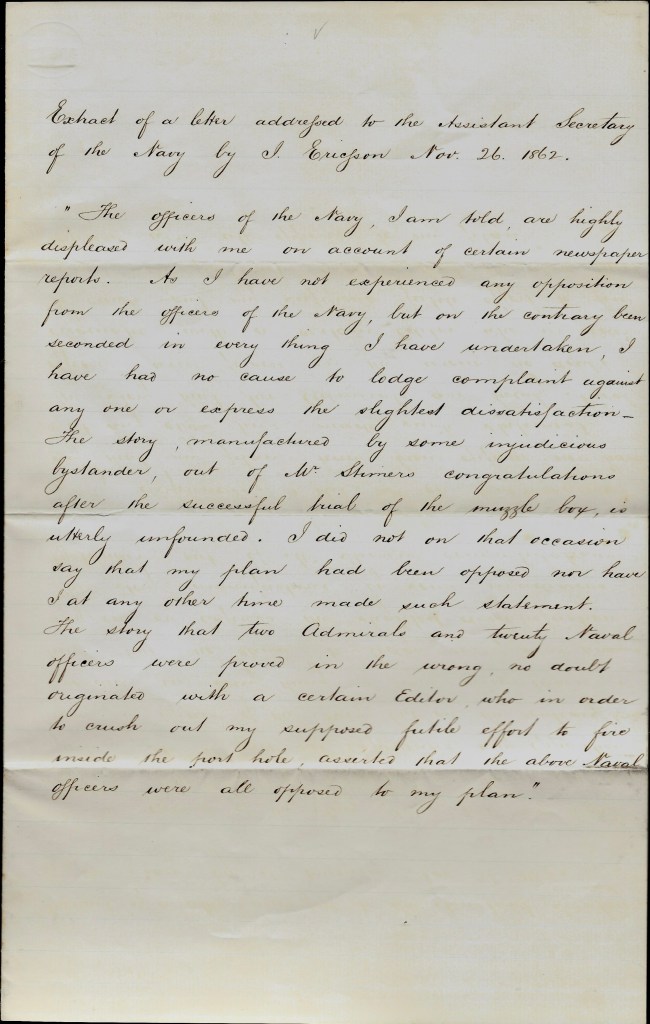
My passion is studying American history leading up to & including the Civil War. I particularly enjoy reading, transcribing & researching primary sources such as letters and diaries.
Richard Draper Douglass was born in Westport, Essex County, New York, October 23, 1836, the youngest child of William Stewart Douglass (1798-1860) and Jane G. (Arthur) Douglass (1803-1842). Richard studied at Phillips Academy, Exeter, New Hampshire; and Williston Seminary. He was a graduate of Amherst College (Class of 1860), and Bangor Theological Seminary (1863).
“As an agent of the U.S. Christian Commission, he served in Alabama, Tennessee, and Virginia before taking a position in the Commissary Department of the United States Army at City Point, Virginia, in early 1865, which position ended soon after the war was over. After a brief stint in business in Boston, Douglass became a special relief agent for the Brooklyn Children’s Aid Society (1867-1873) and general superintendent of the society (1873-1885). On September 13, 1864, Douglass married Mary Abbie Lawrence (1839-1931), daughter of Ephraim Appleton Lawrence. Richard Douglass died in Brooklyn, New York, April 2, 1885.” [See New York State Library: Richard Draper Douglass Papers, 1853-1875]
The News-Herald, 7 March 1931
In the March 6, 1931 issue of the New York Times, an article about the life of Mrs. Douglass, told of her Red Cross work with the Christian Commission at Lookout Mountain and later in Nashville, Tenn. during the Civil War. It also spoke of how she managed the Seaside Home for over 40 years at Coney Island in New York. Children from the city were cared for here over the summer. Presumably these kids had ties to the Childrens Aid Society which her husband had headed before his death. She attended Mount Holyoke Seminary (now a college) for several years and used that training to teach Sunday school for many years at the Plymouth church where she had been a member for over 60 years.
It should be noted that there are some newspaper articles claiming Rev. Douglass to be a physician, an officer, on Gen. Grant’s staff, etc., but I could not find evidence of any such claims. Neither could I find any evidence that Mary Douglass was commissioned a Major.
Transcription
Addressed to Mrs. R. D. Douglass, U. S. Christian Commission, Nashville, Tenn., Hospital No. 3, Lookout Mountain
City Point, Virginia October 5th 1864
My Dear Darling,
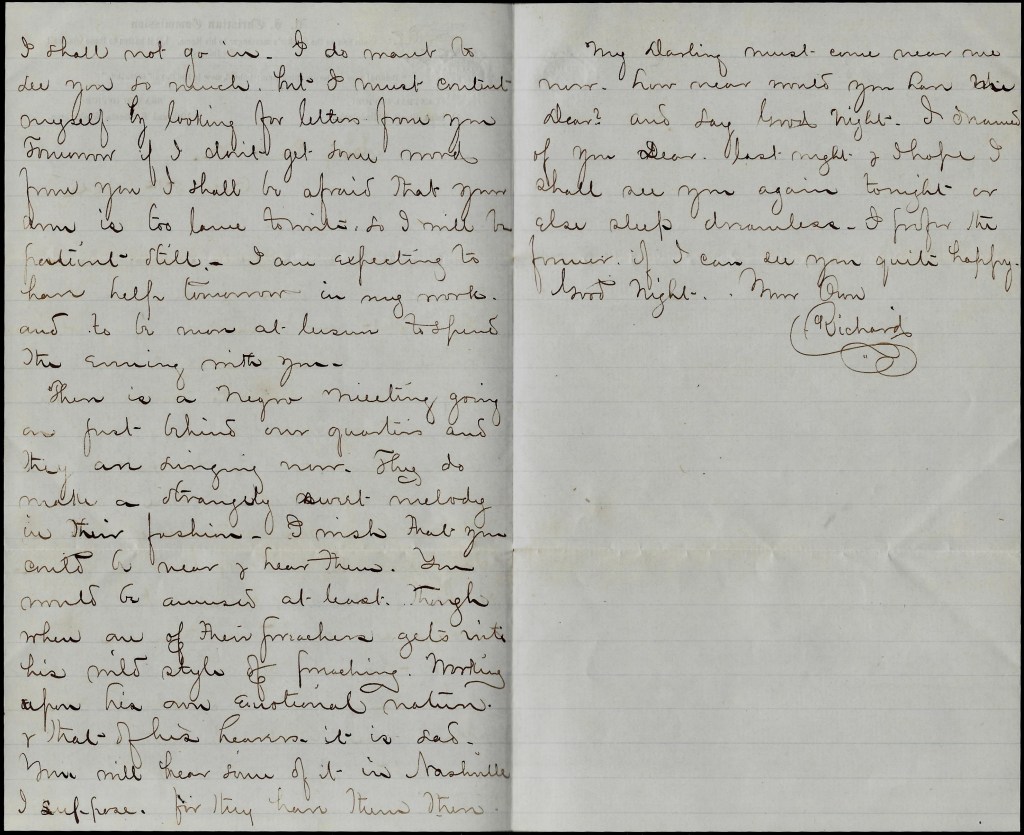
Would give so much comfort to her own if she were here tonight—for I am mangy—not in mind but in body, and I would like to put my head into your hands for a thorough cleaning, as you alone know how to do that for me in the way which I like best. It has been an extremely warm day and the labor of loading & unloading boxes and barrels into and out of wagons, of storing them in our warehouse, or overseeing a gang of hands & running about considerable, has kept me active and so quite happy most of the day.
This evening we have service but I shall not go in. I do want to see you so much but I must content myself by looking for letters from you tomorrow. If I don’t get some word from you, I shall be afraid that your arm is too lame to write, so I will be patient still. I am expecting to have help tomorrow in my work and to be more at leisure to spend the evening with you.
There is a Negro Meeting going on just behind our quarters and they are singing now. They do make a strangely sweet melody in their fashion. I wish that you could be near & hear them. You would be amused at least. Though when one of their preachers gets into his wild style of preaching, working upon his own emotional notion, and that of his hearers, it is sad. You will hear some of it in Nashville, I suppose, for they have them there.
My darling must come near me now—how near would you have me, dear? and say Good Night. I dreamed of you, dear, last night. I hope I shall see you again tonight or else sleep dreamless. I prefer the former if I can see you quite happy. Good night. Your own, — Richard
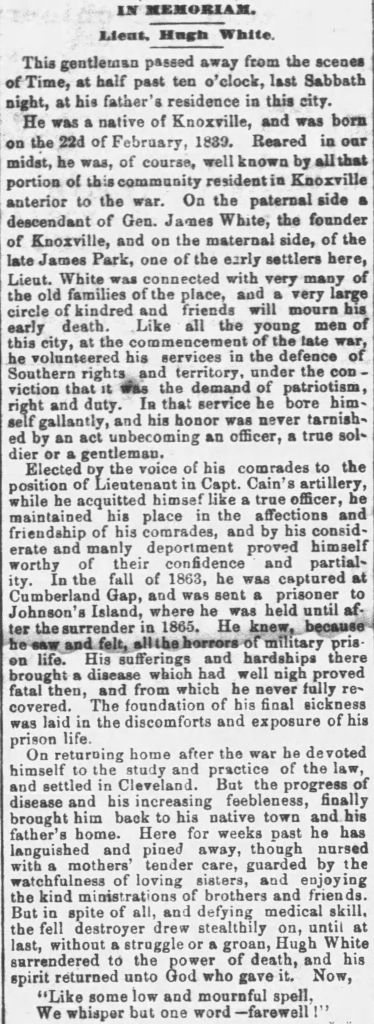
The following letter was written by Hugh Lawson White (1839-1871), the son of Judge George M. White (1800-1884) and Isabella McNutt (1780-1842) of Knoxville, Tennessee. When the Civil War began, “like all the young men of Knoxville,” Hugh volunteered his services “in the defense of Southern rights and territory under the conviction that it was the demand of patriotism, right and duty.” He was elected by his comrades as a Lieutenant in Capt. W. C. Kain’s Light Artillery Company. In the fall of 1863, he was captured at Cumberland Gap and sent a prisoner to Johnson’s Island where he was held until after the surrender in 1865. While in prison, he contracted a disease which impaired him and no doubt prematurely ended his life in 1871. After the war he studied and practiced law for a time but his health failed him.
Transcription
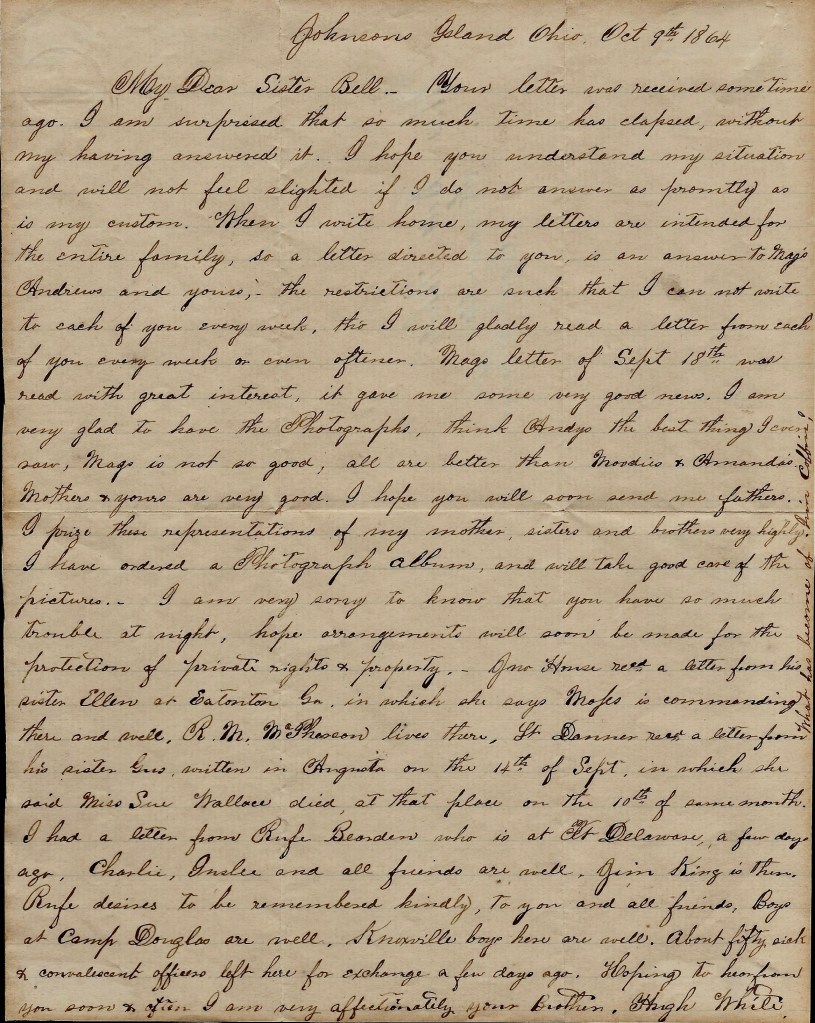
Johnson’s Island, Ohio October 9th 1864
My dear sister Bell,
Your letter was received sometime ago. I am surprised that so much time has elapsed without my having answered it. I hope you understand my situation and will not feel slighted if I do not answer as promptly as is my custom. When I write home, my letters are intended for the entire family, so a letter directed to you is an answer to Mag’s, Andrew’s and yours. The restrictions are such that I cannot write to each of you each week though I will gladly read a letter from each of you every week or even oftener. Mag’s letter of September 18th was read with great interest. It gave me some very good news. I am very glad to have the photographs. Think Andy’s the best thing I ever saw. Mag’s is not so good. All are better than Moodie’s and Amanda’s. Mother’s and yours are very good. I hope you will soon send me father’s. I prize these representations of my mother, sisters, and brothers very highly. I have ordered a photograph album and will take good care of the pictures. I am very sorry to know that you have so much trouble at night. Hope arrangements will soon be made for the protection of private rights and property. Jno. House received a letter from his sister Ellen at Eatonton, Ga., in which she says [brother] Moses [White] 1 is commanding there and well. R. M. McPherson lives there. Lt. Danner received a letter from his sister Gus, written in Augusta on the 14th of September, in which she said Miss Sue Wallace died at that place on the 10th of same month. I had a letter from Rufe Beardon who is at Ft. Delaware a few days ago. Charlie, Inslee and all friends are well. Jim King is there. Rufe desires to be remembered kindly to you and all friends. Boys at Camp Douglas are well. Knoxville boys here are well. About fifty sick and convalescent officers left here for exchange a few days ago. Hoping to hear from you soon & often. I am very affectionately your brother, — Hugh White
What has become of Jim Coffin!
1 Moses P. White (1829-1907) of Knoxville was the Colonel of the 37th Tennessee Infantry.
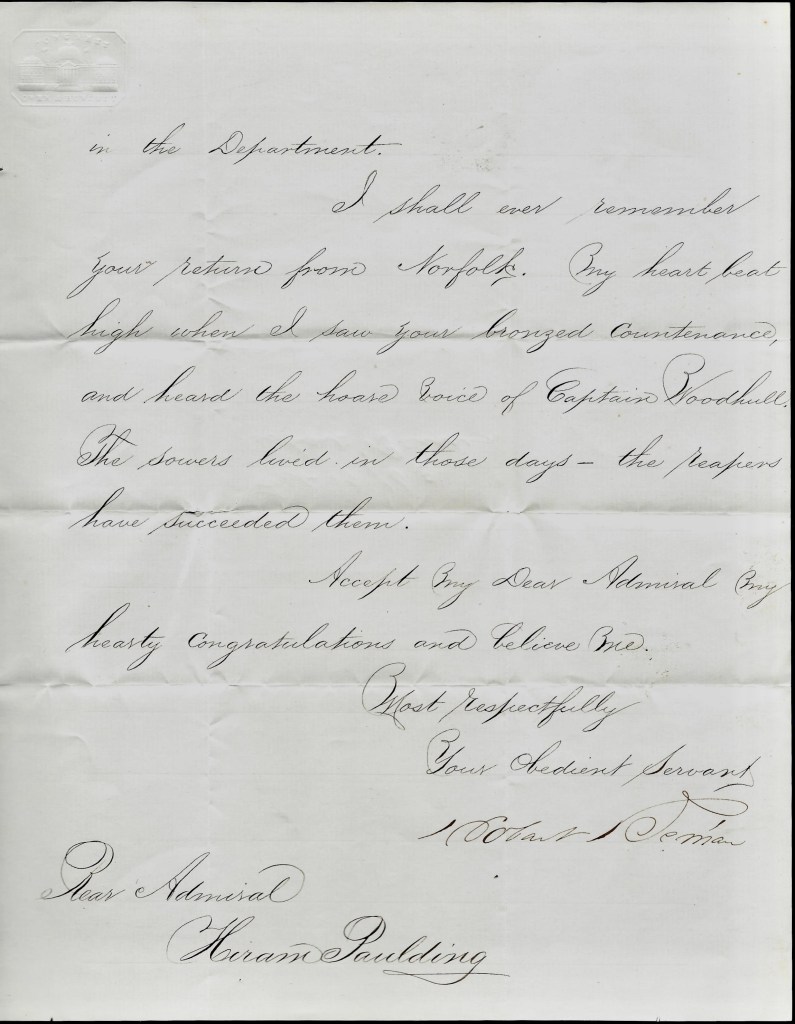
The following letter was written by Hobart Beman, an auditor in the Treasury Department assigned to the claims of Navy Department personnel. Clearly Hobart had a familiarity with the Hiram Paulding, the commander of the Brooklyn Navy Yard and the Navy commander tasked by Abraham Lincoln and Gideon Wells to go to the Gosport Navy Yard at Norfolk to try to save it and the US vessels in dock there from falling into the hands of the insurrectionists in 1861. In this friendly note, Hobart congratulates Paulding for his Senate confirmation to be promoted from a Captain to a Rear Admiral in the Navy.
Transcription
Treasury Department Fourth Auditor’s Office February 9, 1863
My Dear Admiral,
The announcement in yesterday’s paper of your confirmation by the Senate, was, I assure you, a subject of most sincere gratification. Its antecedents only embellish the compliment.
A period existed in the history of the Insurrection, when the “faithful among the faithless” was but few; and I shall always recur with heartfelt satisfaction, to the days and nights of toil and anxiety, when I had the honor to be associated with the Secretary [of the Navy] and yourself in the Department.
I shall ever remember your return from Norfolk. My heart beat high when I saw your bronzed countenance and heard the horse voice of Captain Woodhull. The sowers lived in those days—the reapers have succeeded them.
Accept my dear Admiral, my heart congratulations and believe me most respectfully, your obedient servant, — Hobart Beman
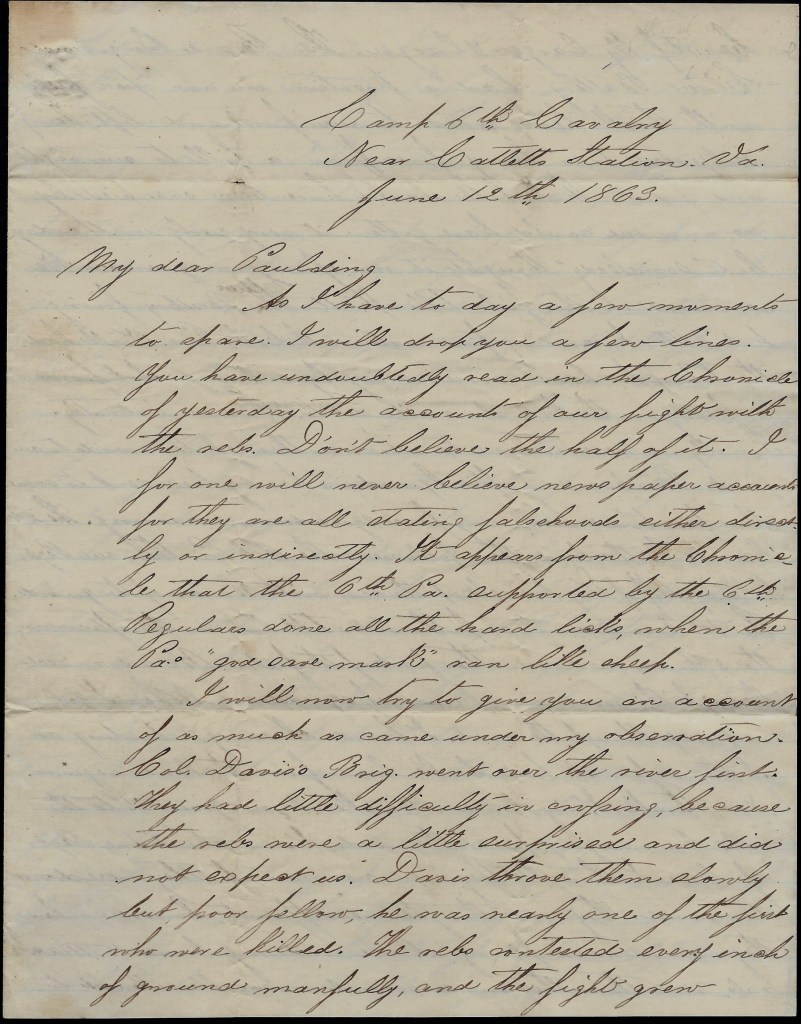
The following letter was written by Lt. Christian Balder of the 6th US Cavalry describing the Battle of Brandy Station. A few weeks after this letter was penned, Balder was killed at the Battle of Fairfield and his comrade, Tattnall Pauling—the recipient of this letter—was taken prisoner.
Lt. Christian Balder, 6th US Cavalry
Transcription
Camp 6th Cavalry Near Catlett’s Station, Virginia June 12th, 1863
My dear Paulding,
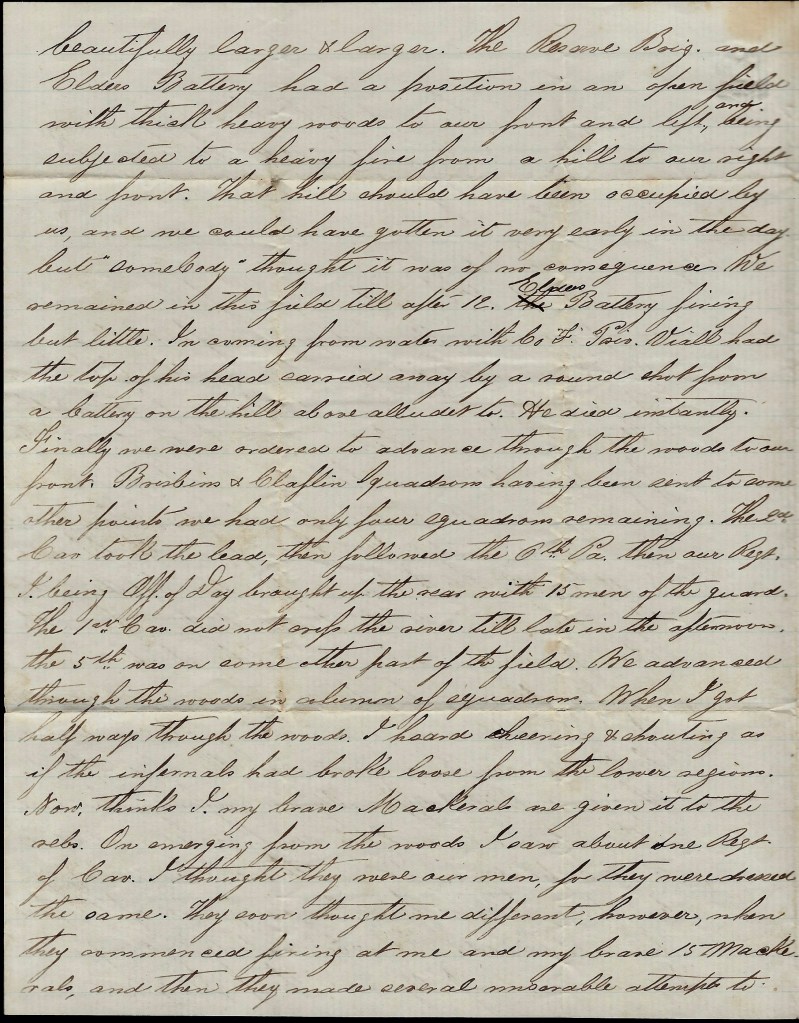
As I have today a few moments to spare, I will drop you a few lines. You have undoubtedly read in the Chronicle of yesterday the account of our fight with the rebs. Don’t believe the half of it. I for one will never believe newspaper accounts for they are all stating falsehoods—either directly or indirectly. It appears from the Chronicle that the & 6th Pennsylvania supported by the 6th Regulars, done all the hard licks, when the Pennsylvanians “God save mark” ran like sheep.
I will now try to give you an account of as much as came under my observation. Col. Davis’s Brigade went over the river first. They had little difficulty in crossing because the rebs were a little surprised and did not expect us. Davis drove them slowly but poor fellow, he was nearly one of the first who were killed. The rebs contested every inch of ground manfully and the fight grew beautifully larger and larger. The Reserve Brigade and Elders Battery had a position in an open field with thick heavy woods to our front and left, and being subjected to a heavy fire from a hill to our right and front. That hill should have been occupied by us, and we could have gotten it very early in the day but “somebody” thought it was of no consequence. We remained in this field till after 12; Elder’s Battery firing but little.
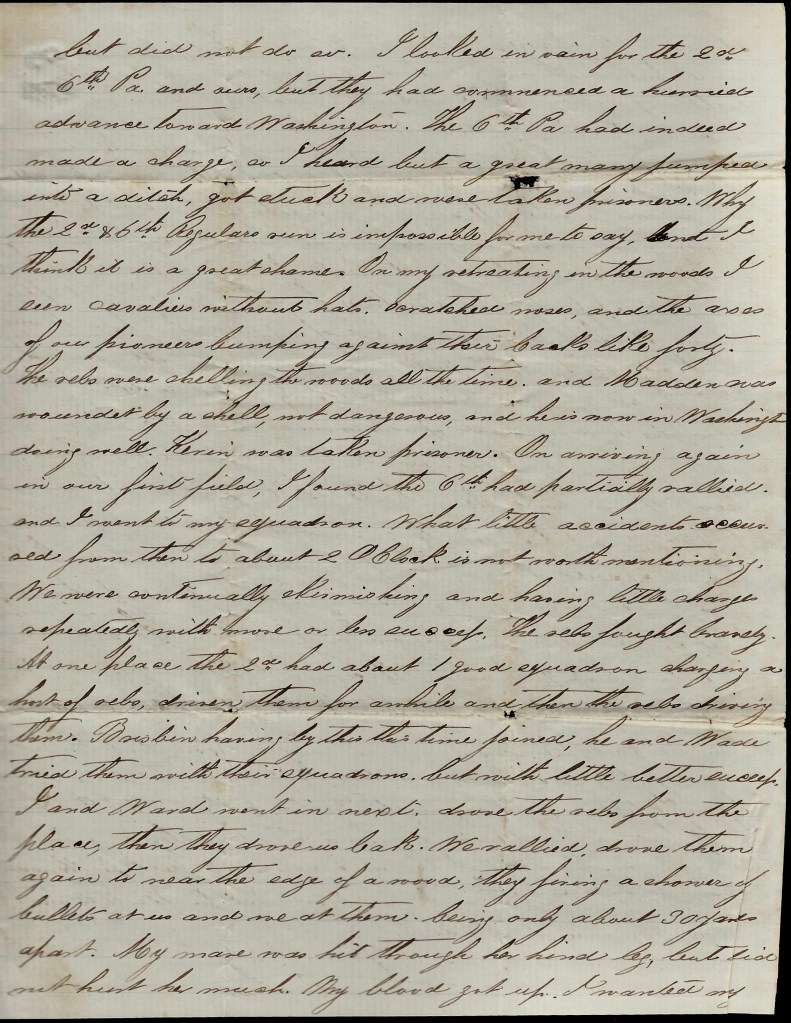
In coming from water with Co. F, Private Viall had the top of his head carried away by a round shot from a battery on the hill above alluded to. He died instantly. Finally we were ordered to advance through the woods to our front. Brisbin’s and Clafin Squadron having been sent to some other points, we had only four squadrons remaining. The 2d Cavalry took the lead, then followed the 6th Pennsylvania, then our regiment. I, being Officer of the Day, brought up the rear with 15 men of the guard. The 1st Cavalry did not cross the river till late in the afternoon. The 5th was on some other part of the field. We advanced through the woods in column of squadron. When I got half ways through the woods, I heard cheering and shouting as if the infernals had brook loose from the lower region. Nor, thinks I, my brave Mackerals are giving it to the rebs. On emerging from the woods, I saw about one regiment of cavalry. I thought they were our men for they were dressed the same. They soon thought me different, however, when they commenced firing at me and my brave 15 Mackerals, and then they made several miserable attempts to…[missing page?]
…but did not do so. I looked in vain for the 2nd, 6th Pennsylvania, and ours, but they had commenced a hurried advance toward Washington. The 6th Pennsylvania had indeed made a charge, so I heard, but a great many jumped into a ditch, got stuck, and were taken prisoners. Why the 2nd & 6th Regulars run is impossible for me to say and I think it is a great shame. On my retreating in the woods, I seen cavaliers without hats, scratched noses, and the axes of our pioneers bumping against the backs like forty. The rebs were shelling the woods all the time, and Madden was wounded by a shell, not dangerous, and he is now in Washington doing well. Herin was taken prisoner.
On arriving again in our first field, I found the 6th had partially rallied and I went to my squadron. What little accidents occurred from then to about 2 o’clock is not worth mentioning. We were continually skirmishing and having little charges repeatedly with more or less success. The rebs fought bravely. At one place the 2nd had about 1 good squadron charging a host of rebs, driving them for a while, and then the rebs driving them. Brisbin having by this time joined, he and Wade tried them with their squadrons but with little better success. I and Ward went in next. We rallied, drove them again to near the edge of a wood, they firing a shower of bullets at us and we at them, being only about 30 yards apart. My mare was hot through her hind leg, but did not hurt her much. My blood got up. I wanted my squadron to charge with me. Ward and Tupper done the same but would not get those dowboys to come on. They all fight very well with the carbine and pistol, but have no confidence in the sabre.
I was in front of the squadron waving my sabre and entreating and cursing them alternately when turning only for one moment to my men, trying to get them on, when all of a sudden, a rebel officer came dashing at me at full speed, making a tremendous right cut at me. But fortunately, I just perceived him in the nick of time. I parried his cut successfully and striking his sabre clean out of his hand. He fled by me and one of my men shot him through the heart. We stood fully 15 or 20 minutes opposite each other, the rebs afraid to charge, and only firing at us. I then seen about a regiment of rebs coming through a field on our right, and I thought it time to retire. But poor Ward had been killed. He worked like a Trojan to get his men to go in with the sabre, but could not succeed. About half an hour after that Stoll was killed whilst skirmishing with a part of that regiment. I had seen so many on my right. So you see we lost just one-third of our officers in killed, wounded and missing. Out of about 280 men, we had about 50.
I never gave the rebs so much credit before but I must now say they go in with a will. Is it not strange now that the papers never say anything about the 2nd & 6th who fought fine in the afternoon, no matter what they done in the morning. Their list of killed and wounded speak for themselves.
My dear Paulding, I must now stop. Write to me soon. My love to Nichols. Yours truly, — Balder
The following letters were written by Joseph Litchfield Locke (1841-1899) of Co. I, 33rd Massachusetts Infantry. Joseph was the son of Rev. William Sherburne Locke (1808-1896) and Caroline Dame Tibbets (1809-1893).
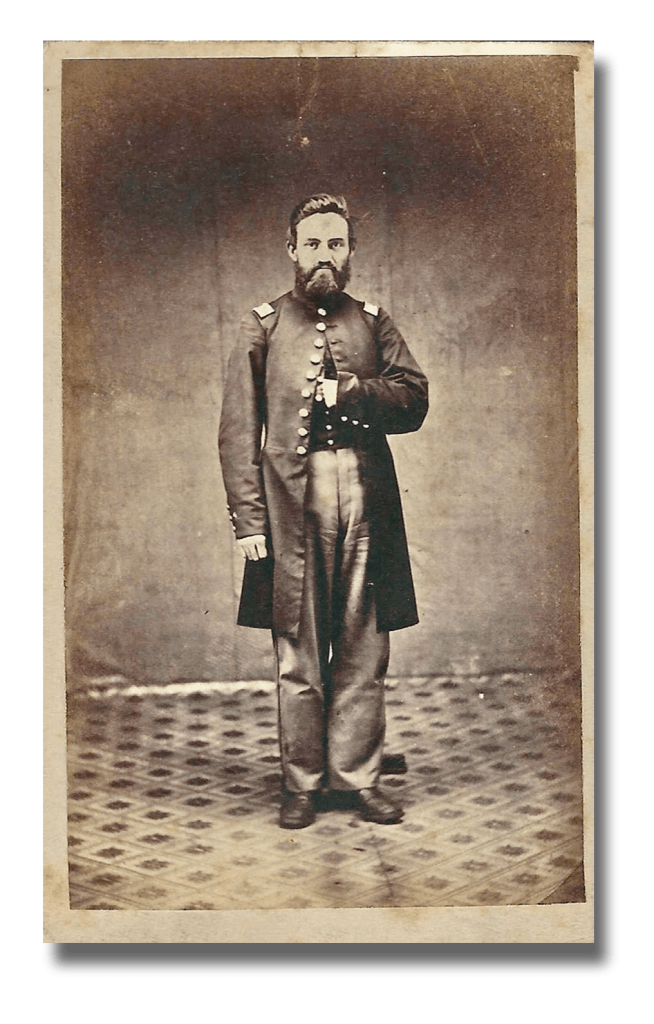
Lt. Joseph Litchfield Locke, 33rd Massachusetts Infantry (R. J. Ferry Collection)
According to his obituary, appearing in The Inter Ocean of 17 July 1899, Joseph was born in Canada in 1843 and came to Chicago twenty-five years ago. He was a member of the firm J. L. Locke & Co., cap manufacturers, at No. 254 Monroe Street. During the war, Mr. Locke served as a lieutenant in the 33rd Massachusetts Volunteer Infantry, gaining his promotion from the ranks by gallantry on the field. He was a charter member of the Menoken club. A widow, two brothers, and two sisters survive him. His brothers are Judge James [William] Locke of Jacksonville, Florida, who has been on the U. S. Supreme Court bench for many years, and Eugene O[lin] Locke, clerk of the United States Supreme court [should be the US District Court of the Southern District of Florida] in the same city.”
Joseph’s military record informs us that he mustered in to the regiment as a corporal in early August 1862. He was promoted to sergeant in early March 1863, and commissioned a lieutenant in September 1864. He mustered out of the regiment on 11 June 1865 at Washington D. C.
[Note: These letters are from the private collection of R. J. Ferry and were transcribed and published on Spared & Shared by express consent.]
Log Houses occupied by the 154th New York near Stafford Court House. Sgt. Marcellus Warner Darling Memoirs. Locke’s description of the winter quarters occupied by the 33rd Massachusetts sound similar.
Camp near Stafford Court House, Va. February 20th 1862 [should be 1863]
Shoulder Straps Rank
This sheet of paper is rather dirty and soiled but soldier’s things will get so & it must go. We are in our new houses, there being 14 for the company and five in each house. Their dimensions are as follows: 12 feet long, 6 wide, walls 4 feet high. Facing the street the door and fire place occupy the whole end. Our bunks are crossing at the rear, the lower one 6 inches from the ground, upon which 3 lie, the upper one 2.5 feet above that. They are made of small poles laid across larger ones and covered with boughs. Our fireplace is built up of sticks laid up in Virginia mud and lined with ditto two or three inches thick which bakes as hard as a rock—a perfect brick in a short time.
There is one piece of good news to me and will probably interest you. My friend Jacob Aling has received an appointment to the Military Academy at West Point and received his discharge and gone home. I was sorry to have him leave but am glad for his part. He is a young man who will make his mark.
I received a letter yesterday from home saying you would get my box off before long. Yes, I have received my old stocking, a lot of postage stamps, the paper in a paper besides a number of other papers which are very agreeably received in this out of the world place. I haven’t much of anything new to write and have a number of other letters to write. I got Letta’s letter and was glad to hear from her and to see that she can write some if not in writing letters.
I write to Gene and give him a talking to when I get time. Why doesn’t he like Mr. Wheeler? I’m most afraid the fault is a good deal on his own part. Ask any questions about soldier’s life, military affairs, &c. that any of you would like to know & I’ll try to give you what information I am able on any subject.
[Shoulder straps sketch]
We were reviewed a few days ago by General Hooker, Sigel & a number of other Major Generals were present.
Letter 2
The 33rd Massachusetts Infantry, part of the XI Army Corps, arrived on the field at Gettysburg on the first day of battle. Most of the XI Corps was deployed north of Gettysburg in an attempt to hold the Rebel advance in check. However, two brigades of the Corps (von Steinwehr’s Division), which included the 33rd Massachusetts, were ordered to remain on Cemetery Hill as a reserve to support the Federal artillery being placed there. For details of their actions over the course of the battle, see 33rd Massachusetts Infantry at Gettysburg by Patrick Browne posted on Historical Disgression on 11 May 2013.
The 33rd Massachusetts Infantry monument is located at the intersection of Slocum and Wainwright Avenues near Steven’s Knoll. It was placed in 1885.
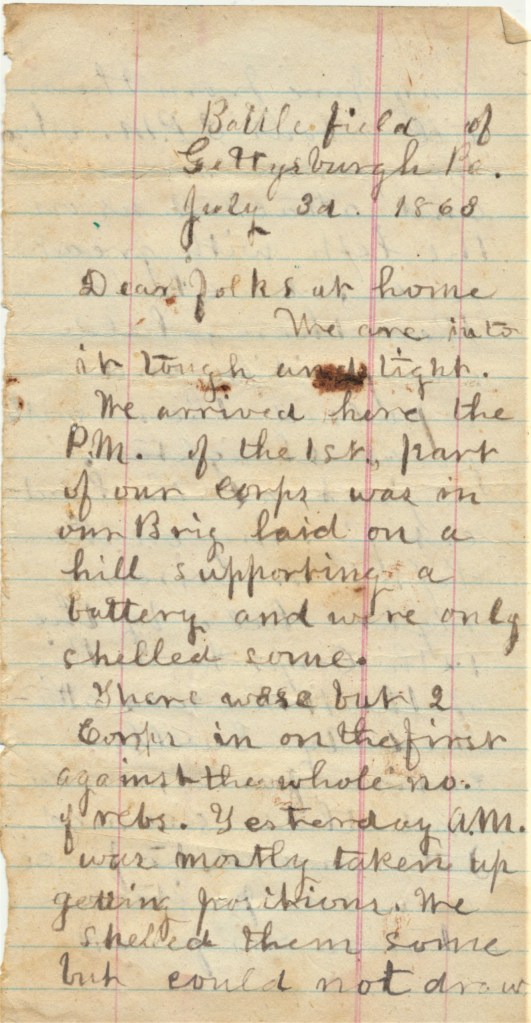
Battlefield of Gettysburg, Pa. July 3d 1863
Dear folks at home,
We are into it tough and tight. We arrived here the p.m. of the 1st. Part of our Corps was in. Our Brigade laid on a hill supporting a battery and were only shelled some. There were but two Corps in on the first against the whole number of rebs. Yesterday a.m. was mostly taken up getting positions. We shelled them some but could not draw any fire from them till about 3 p.m. when they opened on us and attacked us on the left with great force, but we held them there, held our position, and repulsed them with greater slaughter.
Just as the hardest fighting on the left, our extreme right held by the 12th Corp & our Brigade of the 11th was attacked by Ewell’s entire force, massed, and they seemed determined to force our position & turn our flank. Had they done it, it would have been all up with us but we held it handsomely & being reenforced by the 6th Corps about 6, kept our position & repulsed them & small [loss] to us as we were in good rifle pits. Our regiment has had quite a number killed and many wounded. ‘Tis uncertain how many.
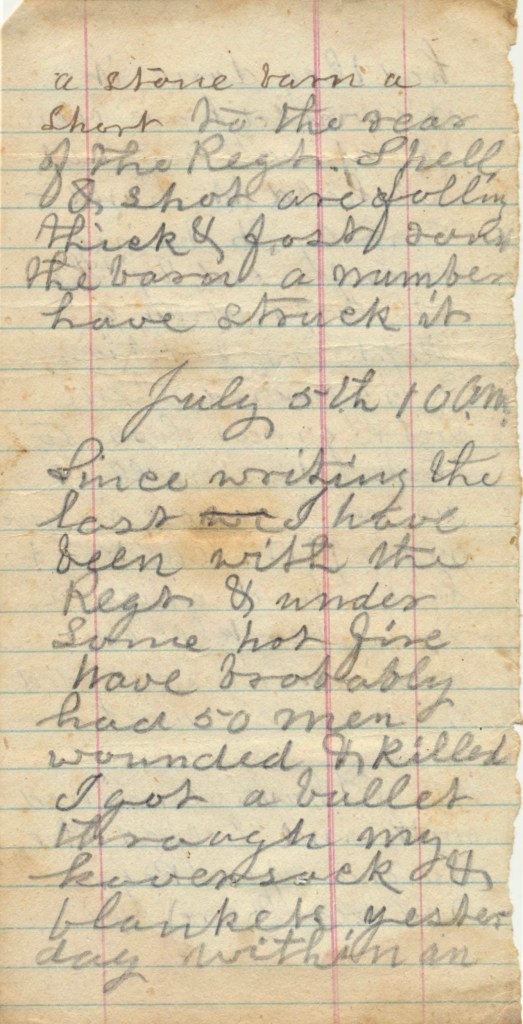
I have remained with and helped the Surgeon of our regiment. We were (and are) in a stone barn a short [distance] to the rear of the regiment. Shell and shot are falling thick and fast around the barn [and] a number have struck it. 1
July 5th, 10 a.m. Since writing the last, I have been with the regiment & under some hot fire. Have probably had 50 men wounded & killed. I got a bullet through my haversack & blankets yesterday within an inch of my side. It put a hole through my tin plate & broke a “hard bread” (the boys think it must have gone swift to do that). We have whipped the rebs with great slaughter. They made [a] desperate attempt to break our lines but couldn’t do it. Our loss was light compared with them. We think they skedaddled last night. — Jose
These flowers I picked in the cemetery where some of our heaviest batteries were planted & which were used rough by them shells & which was charged by them and defended by our Corps in which was our regiment.
1 The XI Corps Hospital took over the George Spangler farm in the middle of the afternoon on 1 July 1863 and remained there through the next two days of fighting and for several days afterward. “The wounded soon began to pour in, giving us such sufficient occupation that from the 1st of July till the afternoon of the fifth, I was not absent from the hospital more than once and then but for an hour or two,” said 26-year-old Dr. Daniel G. Brinton, surgeon-in-chief, Second Division, XI Corps, U.S. Volunteers. “Very hard work it was, too, & little sleep fell to our share. Four operating tables were going night and day. Many of them were hurt in the most shocking manner by shells. My experience at Chancellorsville was nothing compared to this & and I never wish to see such another sight. For myself, I think I never was more exhausted.” A Spangler surgeon who was approaching total exhaustion called the work “too much for human endurance.”
The hospital would use almost every inch of that Pennsylvania bank barn. Dr. Brinton estimated that 500 wounded and dying men filled it. A hospital worker guessed 400. Men were crammed so closely together that they passed deadly infectious diseases such as typhoid fever to one another. Many men died of these diseases rather than the battle wound that brought them to the hospital. Pvt. Reuben Ruch, age 19 of the Easton area, 153rd Pennsylvania, said: “This barn was full of wounded men from one end to the other. Where there was room for a man you could find one. The hay mows, the feed room, the cow stable, the horse stable and loft.” The hospital grew to about 1,900 wounded on July 4-5 after the Confederates retreated and it was safe for ambulances to search on and around the battlefield for wounded men left behind. Even though the hospital served the XI Corps and its 26 regiments at Gettysburg, it hosted Confederate and Union wounded and men from more than 50 regiments altogether. Many Confederates were placed in the barn’s wagon shed to separate them from the Army of the Potomac wounded. The barn and other outbuildings quickly filled, so men were then placed in the open because not enough tents were provided after the battle.
“At the doorway I saw a huge stack of amputated arms and legs, a stack as high as my head!” said Pvt. William Southerton, age 21, 75th Ohio. “The most horrible thing I ever saw in my life! I wish I had never seen it! I sickened.” Wounded Pvt. Justus Silliman of the 17th Connecticut said, “The barn more resembled a butcher shop than any other institution. One citizen on going near it fainted away and had to be carried off.” [See Restored George Spangler Farm tells grim stories of Gettysburg dead and wounded.”]
Letter 3
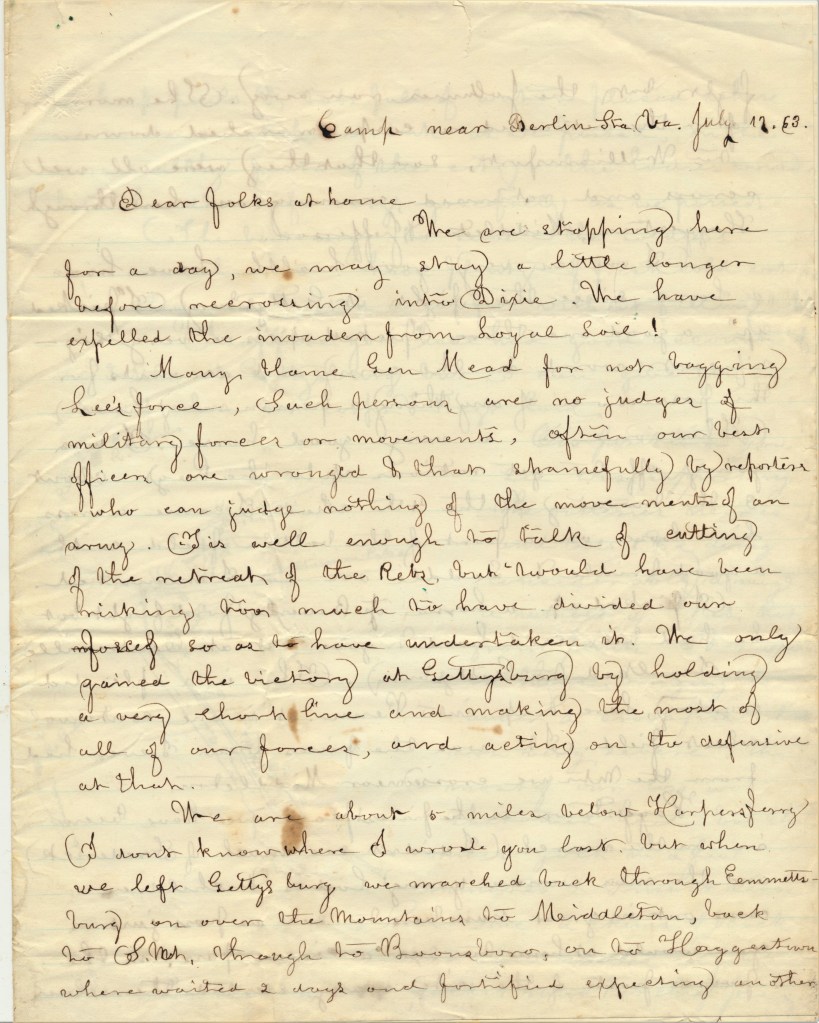
Camp near Berlin Station, Virginia July 12, 1863
Dear folks at home,
We are stopping here for a day. We may stay a little longer before recrossing into Dixie. We have expelled the invader from Loyal soil! Many blame Gen. Meade for not bagging Lee’s force. Such persons are no judges of military forces or movements. Often our best officers are wronged & that shamefully by reporters who can judge nothing of the movements of an army. ‘Tis well enough to talk of cutting off the retreat of the Rebs but ‘twoud have been risking too much to have divided our forces so as to have undertaken it. We only gained the victory at Gettysburg by holding a very short line and making the most of all of our forces and acting on the defensive at that.
We are about 5 miles below Harper’s Ferrry. (I don’t know where I wrote you last but when we left Gettysburg, we marched back through Emmettsburg on over the mountains to Middleton, back to South Mountain, through to Boonsboro, on to Hagerstown, where [we] waited two days and fortified expecting another fight, but the Johnnies ran away. The morning after they retreated, our Corps marched down to Williamsport, saw that they were all well across and returned coming on here through Hagerstown, Middleton & Jefferson.
I am in very good health. Have had a horse since the fight at Gettysburg. I “picked up” a good one there (“picked up” is a very significant word in the army and accounts for the possession of anything a person may have). This one is a very good horse. I was going off to get rations up to the regiment about 3 the morning of the 4th when I came across him loose on a part of the battlefield with a good bridle and saddle on so I mounted it. I picked up a horse at [the] Beverly Ford fight but he had been used hard & gave out at Centreville so I walked to Gettysburg.
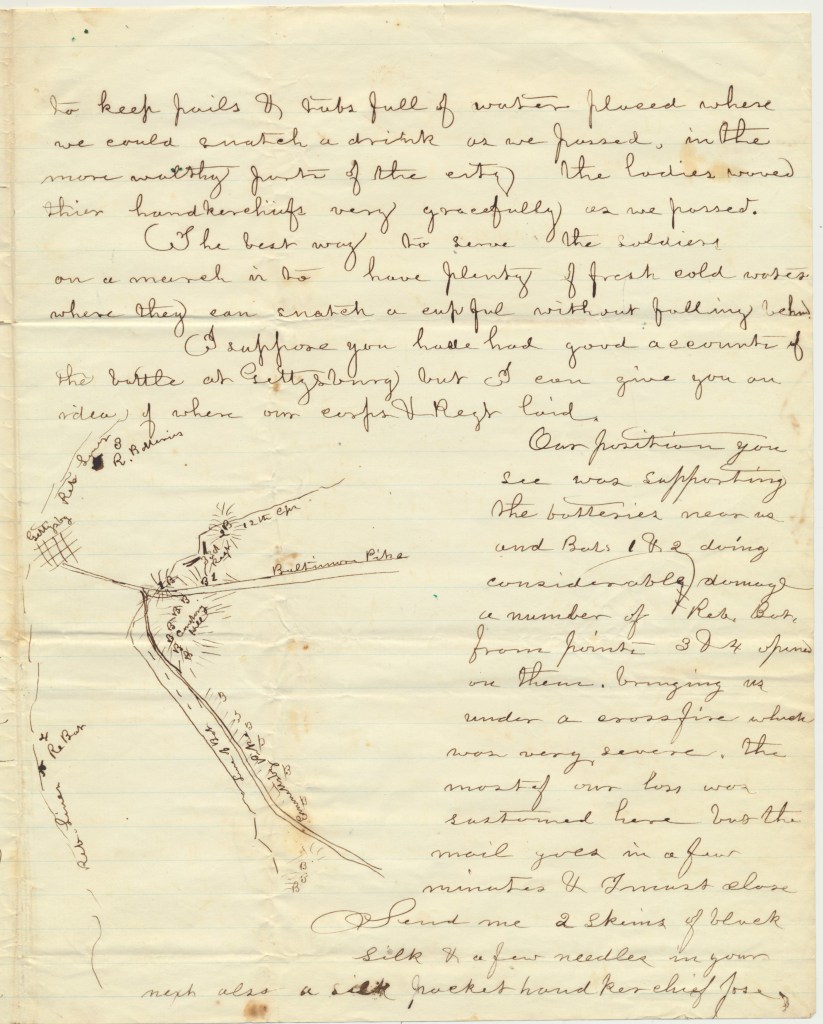
This is a splendid country, here and up into Pennsylvania. It is one continuous wheat field. It was the finest view I ever had from the mountains we crossed near Middleton. Hagerstown is the finest place we have been in on the march (I didn’t see much of Frederick) and the men, women, and young ladies & children came out in great numbers to see us pass just as you would at home to see a circus pass, in the porer parts of the city. Many exerted themselves to keep pails and tubs full of water placed where we could snatch a drink as we passed in the more worthy part of the city. The ladies waved their handkerchiefs very gracefully as we passed. The best way to serve the soldiers on a march is to have plenty of fresh cold water where they can snatch a cupful without falling behind.
I suppose you have had good accounts of the battle at Gettysburg but I can give you an idea of where our corps & regiment laid.
Locke’s Sketch of the 33rd Massachusetts’ position in Culp’s Meadow at Gettysburg
Our position, you see, was supporting the batteries near us and Battery 1 & 2 doing considerable damage. A number of Reb batteries from points 3 and 4 opened on them, bringing us under a crossfire which was very severe. The worst of our loss was sustained here.
But the mail goes in a few minutes & I must close. Send me two skeins of black silk & a few needles in your next. Also a silk pocket handkerchief. — Jose
Letter 4
Bristoe Station, Va. September 20, 1863
Dear folks at home,
We still remain at this place and probably shall for some time to come as our Corps is considerably scattered at present and we are doing duty which some one must do—viz: guard the railroad. Our Corps (what is here) now guards the railroad from Manassas Junction to the Rappahannock. One Division (the 1st) is at the siege of Charleston [and] one Brigade of our Division is in Alexandria.
I have been quite anxious lately for fear you did not receive my letter containing $50 in which I told about my box as I have not heard from you concerning it. We have received no boxes since the 10th inst. and I understand there is a lot of them now at Culpeper which will be sent here soon and probably mine is in it, if everything is right.
I got a letter from Gene a few days ago. He had not been there long but seemed to like.
We get but little news lately from anywhere but think everything is going on right. Our army has been for a long time and is now receiving great reinforcements. A great many conscripts besides over 30,000 men have lately returned from New York City who have been there from this army protecting and enforcing the law during the draft. We have received no conscripts and ’tis doubtful whether we get any for some time at least. Tis strange how a regiment will get reduced. Our regiment numbered (without the two companies which went into the 41st) 1,000 able bodied? men. We have had but few men killed in battle and we now draw rations for 461 men. Hardships pick off men faster than bullets. You may well believe that the most of the men we have now are tough.
Our regiment does a good deal of scouting now-a-days and under the direction of a boy 18 or 19 years old are quite successful. This young fellow (Doughty) came with the family when but five years old from the North somewhere so are good Union people. His father is in Richmond a prisoner. Young Doughty’s mother & sister live about 4 and a half miles from here. 1 He went as guide of a part a few days ago and alone took two cavalry Rebs prisoners and led our men to a house where there were 13 large trunks belonging to Reb officers and packed with their uniforms, &c. All of these our men opened and took everything out they wanted. There was a good deal of valuable property in them and our men came in loaded with booty.
We are having the weather very cool now and have had a long, cold storm for a few days past. Meg, postage stamps have “played out” as you may see by the envelope.
The bushwhackers are very bad and saucy around here. Not long ago they took a captain, five men and four horses—not long before they took Lieut. [Arthur C.] Parker of our regiment (he came out as Orderly Sergt. of Co. I) detailed on Gen. Meade’s staff as aide-de-camp. He visited the regiment, started off, and has not been heard from since. 2 They also took three teams out of a train of sutler’s wagons when the train was guarded by cavalry before & behind. They are very bold.
Write soon & I’ll let you know as soon as I get the box. — Jose.
1 My hunch is that the young man named Doughty was James R. Doughty (1842-1875), the son of Abraham Doughty (b. 1800) and Eunice Reynolds (180801872). This family came from New York to farm in Prince William county, Virginia, prior to 1850. After the war, James worked as a clerk in the Treasury Department for a time but in 1875 he was killed while working as a flagman on the Baltimore & Potomac Railroad when he fell under the wheels of the cars near Bowie Station.[Still need to verify his identity]
2 Arthur C. Parker was a 21 year-old student when he enlisted on 23 July 1862 as a 1st Sergeant in Co. I, 33rd Massachusetts. He was promoted to 2nd Lieutenant on 3 March 1863 and was killed by guerrillas on 16 August 1863 at Catlett’s Station, Virginia.
Letter 5
The following letter provides us with a riveting account of the 33rd Massachusetts’ participation in the Battle of Raccoon Ridge, Lookout Valley, Tennessee on 29 October 1863.
Camp near Lookout Mountain November 3rd 1863
Dear Folks at home,
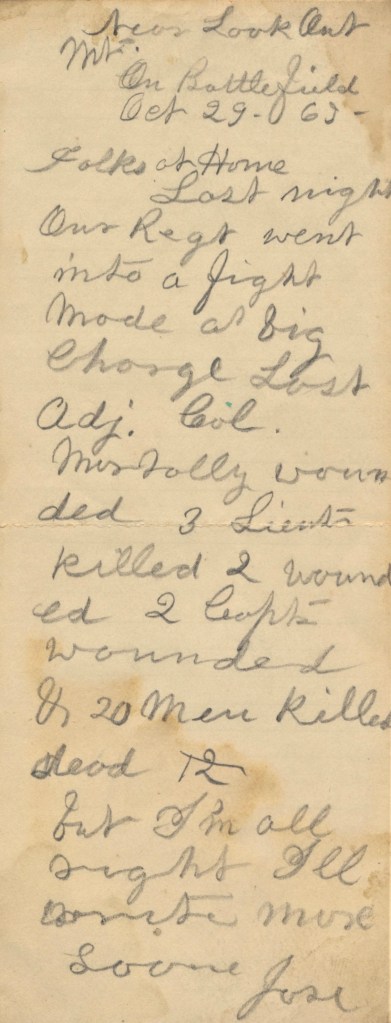
Locke’s cryptic note reassuring the folks at home he was yet alive.
I wrote you a few lines the morning after the gallant charge and heavy loss of the 33rd [Massachusetts] on the 29th ult., but you of course would like to hear further particulars. I’ll tell you how we came here from Stevenson.
On October 24th, we marched back to Bridgeport, staid one night, and then marched across the river and went about five miles to Stuart’s Store where we staid till the morning of the 27th when we went on. About noon we stopped two hours at Shell Mound where is a very large cave. A small river runs out of it of splendid cool and clear water. It is as large as the one running from the Massebesic to the Merrimack at Goffs Falls. I went into it most a mile. Boats can go up the stream a good many miles.
We kept on and staid that night among the mountains and the next p.m. came in sight of Lookout Mountain, advanced, drove in the reb pickets & kept on but were soon opened on from the batteries on the mountain & they shelled us pretty sharp before we fell back. We lost Sergt. Adams of Co. F from Lowell here. He was killed on the spot. This was at “4” on the map. From here we fell back round the hills and marched on towards the river & went in camp at “10.” Here we all went to sleep quietly (excepting Companies A, B, & G which went off scouting so were not in the fight).
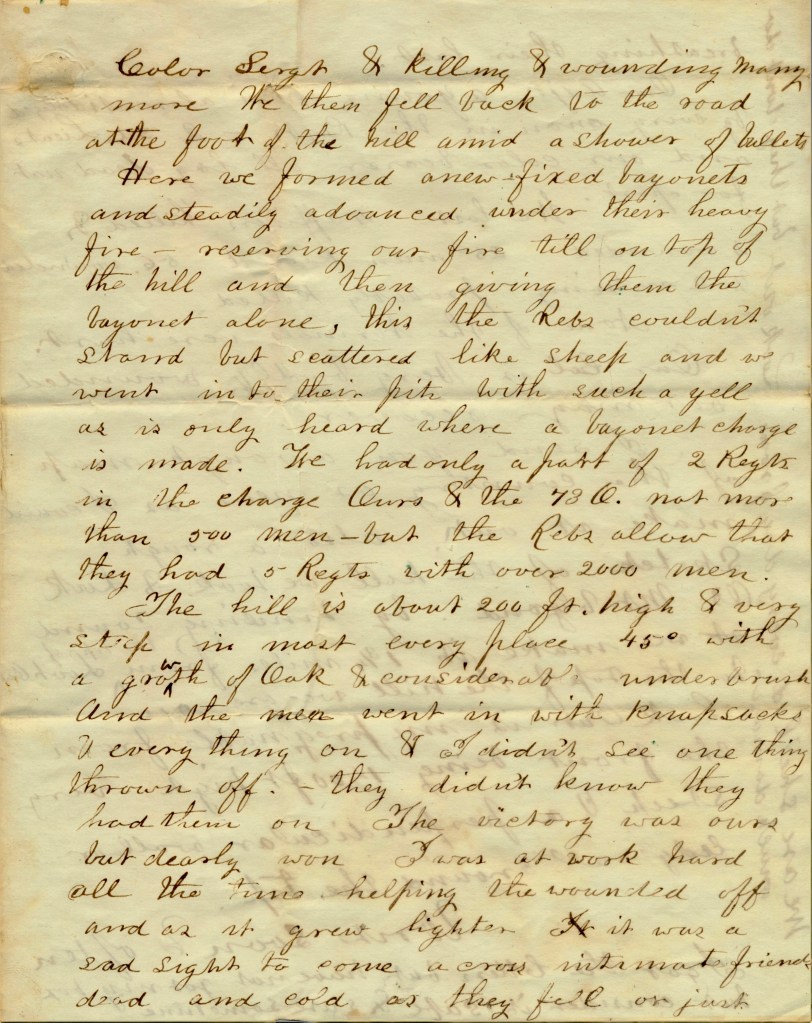
At 1 o’clock we were all [awakened by] firing about a mile off and soon we were turned [out] by the bugle and the regiment ordered off at double quick. The Chaplain & I followed hard after keeping close up to pick up any wounded. It was very dark—about 1:30 o’clock—and as we advanced up the hill in line of battle, there was some confusion and some of the officers thought the 73rd Ohio was partly ahead of us and when near the top of the hill, the adjutant hallowed and asked if the 73rd was ahead and the rebs cried out, “Yes! 73rd. Don’t shoot your own men!” and then gave us a terrible volley, wounding our Colonel, killing our Color Sergeant, and killing & wounding many more.
We then fell back to the road at the foot of the hill amid the shower of bullets. Here we formed anew, fixed bayonets, and steadily advanced under their heavy fire—reserving our fire till on top of the hill and then giving them the bayonet alone. This the rebs couldn’t stand but scattered like sheep and we went into their pits with such a yell as is only heard where a bayonet charge is made. We had only a part of two regiments in the charge, ours and the 73rd Ohio—not more than 500 men. But the rebs allow that they had five regiments with over 2,000 men. 1
The hill is about 200 feet high and very steep in most every place—45o—with a growth of oak and considerable underbrush. And the men went in with knapsacks & everything on & I didn’t see one thing thrown off. They didn’t know they had them on. The victory was ours but dearly won. I was at work hard all the time helping the wounded off and as it grew lighter, it was a sad sight to come across intimate friends dead and cold as they fell or just breathing their last.
Our adjutant—a young man almost idolized by every man in the regiment, two 2nd Lieutenants, and our Color Bearer all lay dead not far apart. We lost four officers killed and four wounded, 25 men killed, 56 wounded, and two missing—probably killed. None of the Normals were hurt. Our Colonel is very badly wounded but may recover.
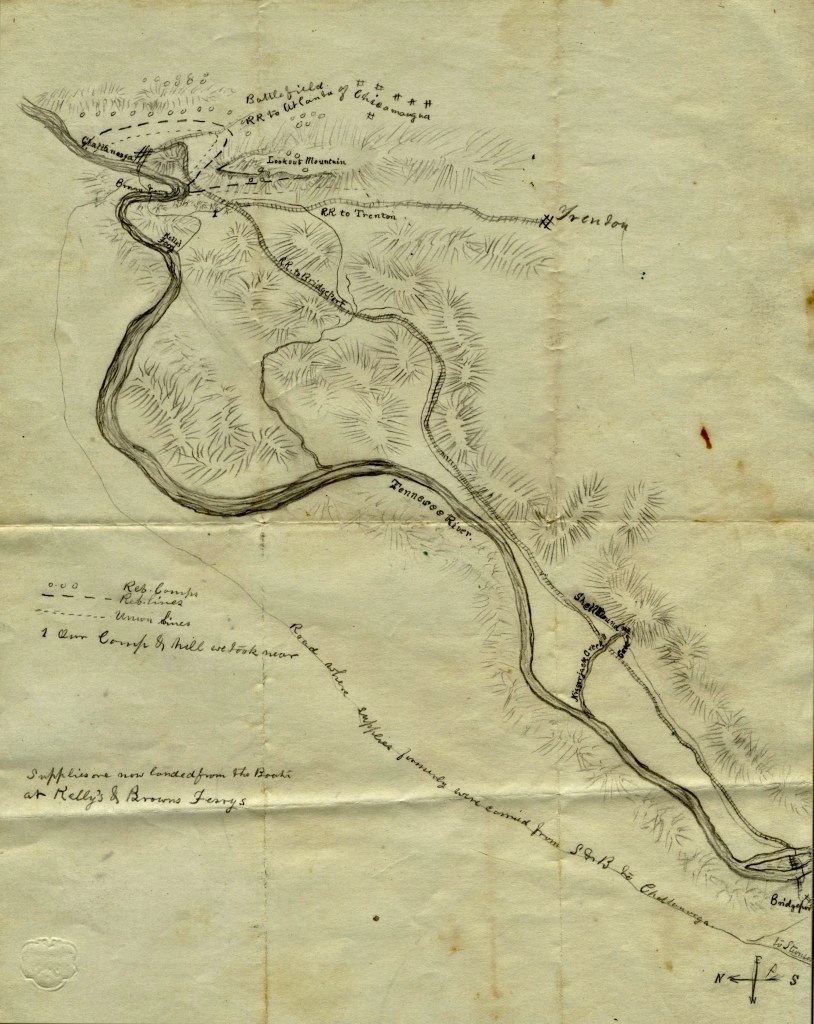
I send you a rough map of the country as near as I could make it out. Also a rough sketch of the hill we took & Lookout Mountain beyond. By timing sound, we make it 1.75 miles from the top of Lookout [Mountain] to the top of the hill we are on. Lookout is impregnable from the front, being 1400 feet hight—very steep & a perpendicular wall or ledge all round the top.
Write soon & often. I got the letters but have not got my box but consider it safe and sure sometime. We are shelled every day from Lookout but they don’t do much damage.
1 Locke’s account squares well with Samuel H. Hurst, 73rd Ohio Infantry. “When we had approached within 2 or 3 rods of the enemy’s breastworks there opened upon us a most murderous fire from a force on our right flank, completely enfilading our line. The appearance of this force on our flank seemed to forbid our farther advance. I knew we had no support on our right, and we had not held communication with the 33rd Massachusetts at any time during the engagement. Regarding the Seventy-third as the directing battalion, I had paid no attention to our support on the left, and it was impossible for me to learn whether Col. Underwood was advancing or not, while heavy and irregular firing, with cries of “Don’t fire upon your own men,” coming from the left of our front, only increased the confusion. Under the circumstances I deemed it rash to advance farther until I knew that one, at least, of my flanks was protected. I ordered the regiment to retire a few rods, which they did in perfect order, and lay down again, while I sent Capt. Higgins to ascertain the position and movements of the 33rd Massachusetts. Learning that, though they had fallen back, they were again advancing, I was preparing to go forward also, when information came that the 33rd had turned the enemy’s flank, was gallantly charging him in his breastworks, and driving him from the left crest of the hill.”
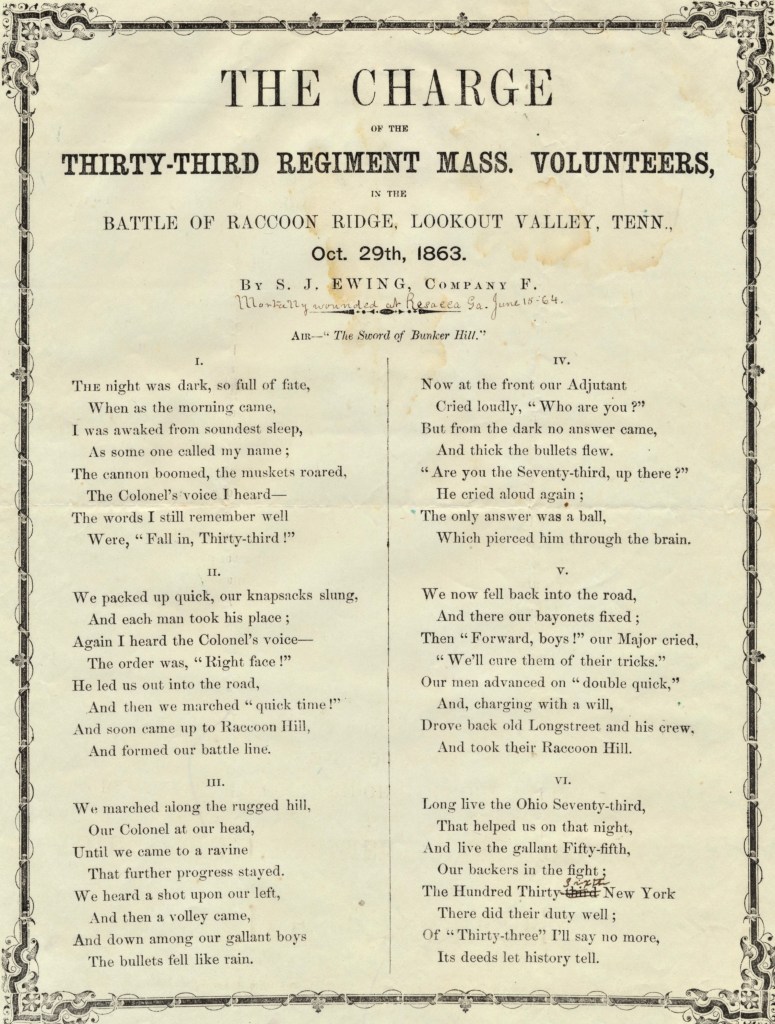
Poem composed by S. J. Ewing of Co. F, 33rd Massachusetts. Ewing was later mortally wounded at the Battle of Resaca,. Georgia, on 15 June 1864
Letter 6
This letter describes in detail the action of the 33rd Massachusetts and other regiments in their brigade during the Battle of Peachtree Creek that took place on 20 July 1864. It was a desperate hand-to hand struggle in which both sides incurred heavy losses.
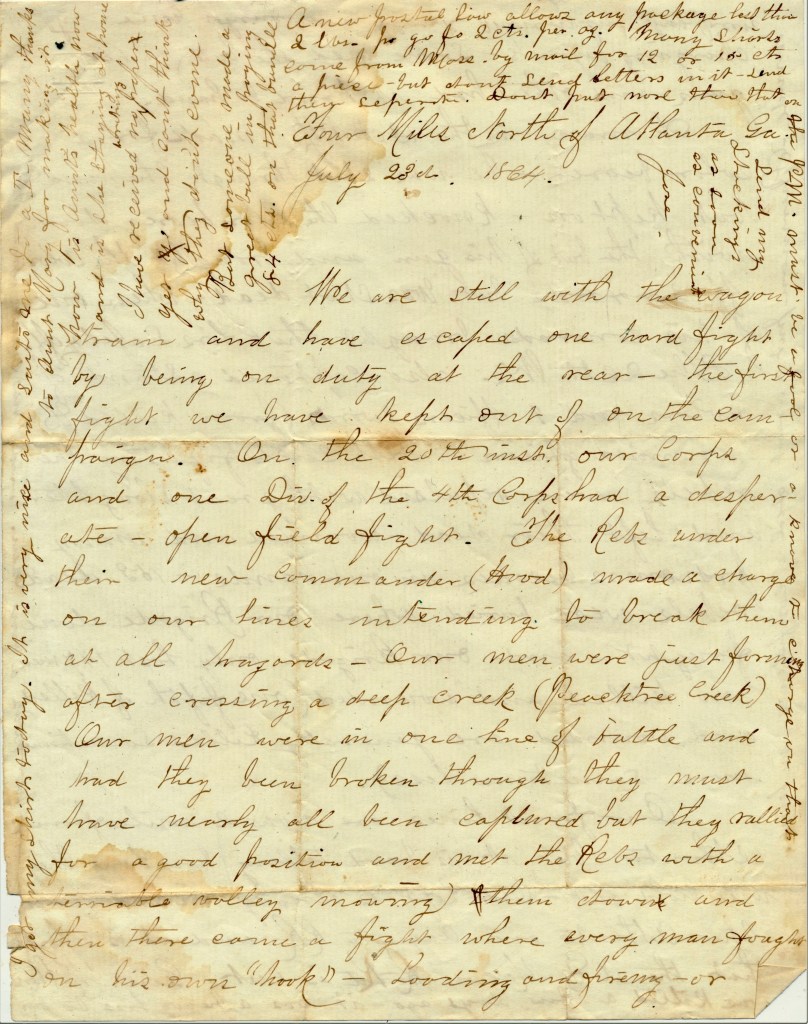
Four miles north of Atlanta, Ga. July 23rd 1864
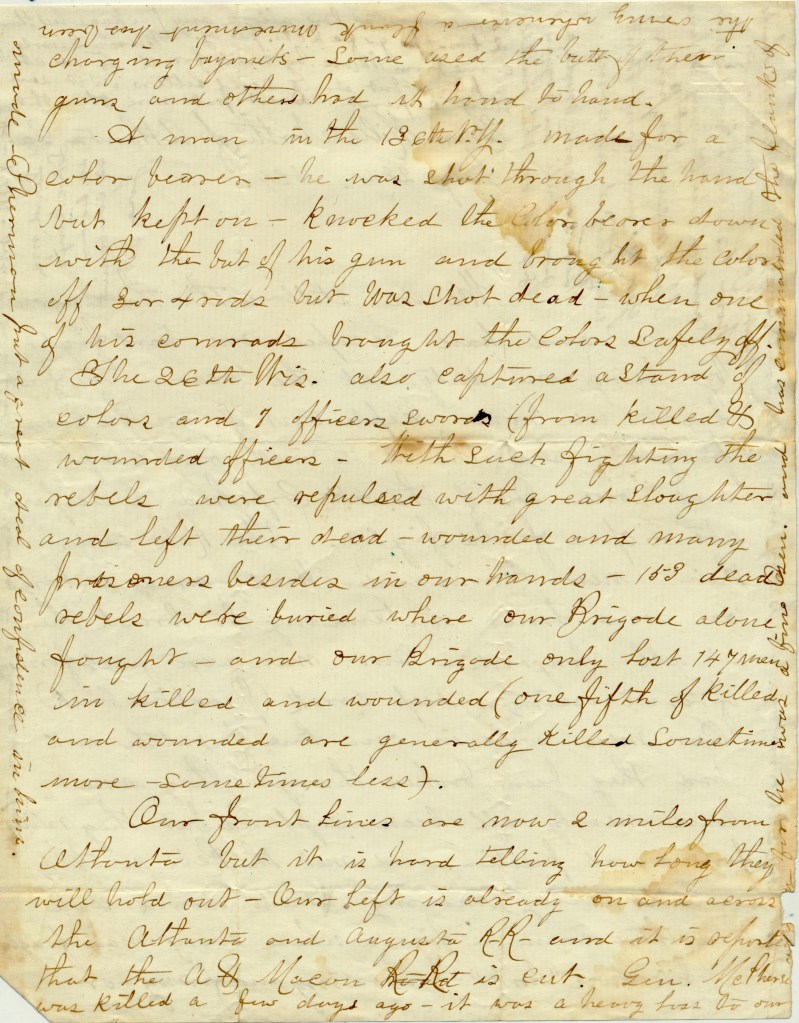
We are still with the wagon train and have escaped one hard fight by being on duty at the rear—the first fight we have kept out of on the campaign. On the 20th inst. our Corps and one Division of the 4th Corps had a desperate open field fight. The Rebs under their new commander (Hood) made a charge on our lines intending to break them at all hazards. Our men were just forming after crossing a deep creek (Peachtree Creek). Our men were in one line of battle and had they been broken through they must have nearly all been captured but they rallied for a good position and met the Rebs with a terrible volley mowing them down and then there come a fight where every man fought on his own “hook”—loading and firing—or charging bayonets. Some used the butts of their guns ad others had it hand to hand.
A man in the 136th New York made for a color bearer—he was shot through the hand but kept on—knocked the color bearer down with the butt of his gun and brought the colors off 3 or 4 rods but was shot dead—when one of his comrades brought the colors safely off. 1
The 26th Wisconsin also captured a stand of colors 2 and 7 officers swords (from killed and wounded officers). With such fighting the rebels were repulsed with great slaughter and left their dead, wounded, and many prisoners besides in our hands. 153 dead rebels were buried where our Brigade alone fought and our Brigade only lost 147 men in killed and wounded (one-fifth of killed and wounded are generally killed—sometime more, sometimes less).
Our front lines are now two miles from Atlanta but it is hard telling how long they will hold out. Our left is already on and across the Atlanta & Augusta Railroad and it is reported that the Atlanta & Macon Railroad is cut. Gen. McPherson was killed a few days ago. It was a heavy loss to our [ ] for he was a fine General and has commanded the flanks of the army whenever a flank movement has been made. Sherman put a great deal of confidence in him.
I got my shirt today. It is very nice and suits me to a “T.” Many a thanks to Aunt Mary for making it. How is Aunt’s health now? and is she staying at home? I have received no writing paper yet and can’t think why they don’t come. But someone made a great bull in paying 84 cents on this bundle. A new postal law allows any package less than two pounds to go for 2 cents per ounze. Many shirts come from Massachusetts by mail for 12 to 15 cents apiece. But don’t send letters in it. Send them separate. Don’t put more than that or the post master must be a fool or a knave to charge on that.
1 Locke’s post-battle rendition of this incident corresponds favorably to other post-war accounts, one of which states: “The men of the 136th New York Regiment bore an honorable part in this battle, during which one of their number, Private Dennis Buckley, of Co. G, captured the battle flag of the 31st Mississippi, knocking down the Confederate color bearer with the butt of his musket and wrenching the colors from his grasp. While Buckley was waving the captured flag defiantly at the ranks of the enemy a bullet fired at him struck the flagstaff, glanced, and hit him in the forehead, killing him instantly. A year or more after the war closed the War Department gave a Medal of Honor to be delivered to the mother of Dennis Buckley, in recognition of his heroism at the battle of Peach Tree Creek and the capture by him of one of the enemy’s flags.”
2 The 26th Wisconsin has always laid claim that they captured the colors of the 33rd Mississippi at the Battle of Peachtree Creek. Certainly Locke’s post-battle account confirms that claim though he does not provide any specifics. It has become a matter of dispute through the years as to who actually captured that flag. [See The Capture of the 33rd Mississippi Infantry’s Colors on Civil War Talk, 14 October 2013.]
Letter 7
The following letter was written soon after Sherman’s Army had passed through Milledgeville, Georgia, on its March to the Sea. [See Week 31: The sack of Milledgeville, by Michael K. Shaffer in the Atlanta Journal Constitution.
[Early December 1864]
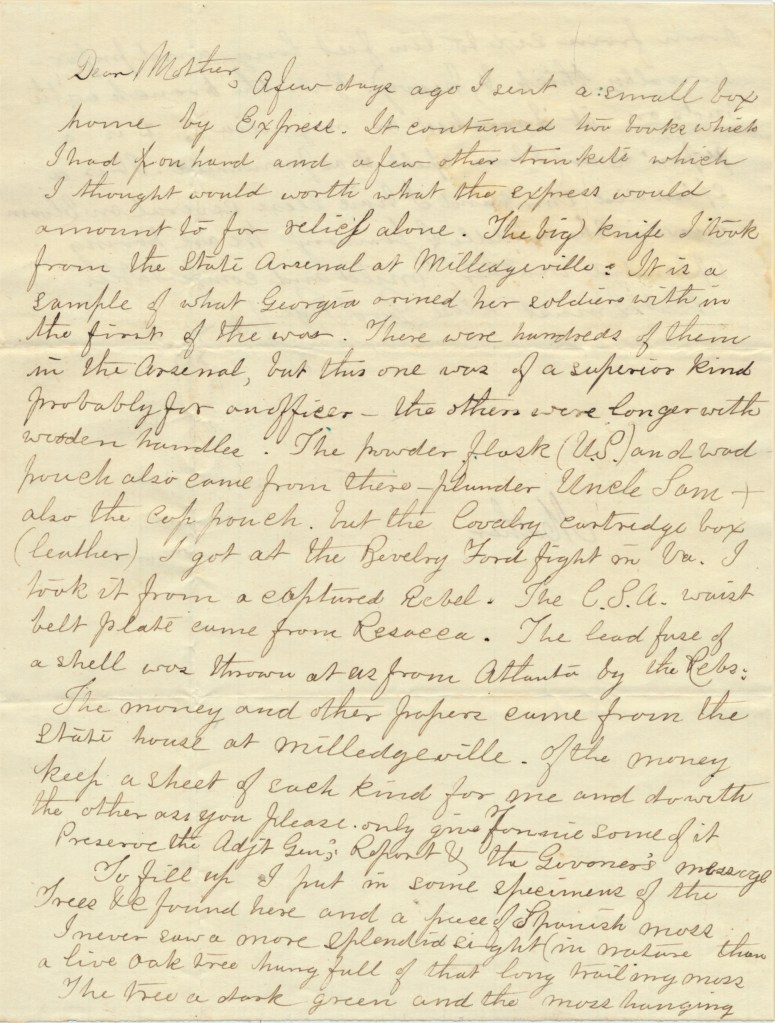
Dear Mother
A few days ago I sent a small box home by Express. It contained two books which I had on hand and a few other trinkets which I thought would [be] worth what the express would amount to for relief alone. The big knife I took from the State Arsenal at Milledgeville. It is a sample of what Georgia armed her soldiers with in the first of the war. There were hundreds of them in the Arsenal, but this one was of a superior kind—probably for an officer. The others were longer with wooden handle. The powder flask (U.S.) and wad pouch also came from there—plunder Uncle Sam + also the cap pouch, but the cavalry cartridge box (leather) I got at the Beverly Ford fight in Virginia. I took it from a captured rebel. The C.S.A. waist belt plate came from Resaca. The lead fuse of a shell was thrown at us from Atlanta by the Rebs.
The money and other papers came from the State House at Milledgeville. Of the money, keep a sheet of each kind for me and do with the other as you please—only give Fannie some of it. Preserve the Adjt. Gen. Report & the Governor’s Message. To fill up [the box], I put in some specimens of the trees &c. found here and a piece of Spanish moss. I never saw a more splendid sight in nature than a live oak tree hung full of that long trailing moss—the tree a dark green and the moss hanging down from six to ten feet long and proportionally thick and heavy. But the branch with buds on it I marked as Magnolia. It is a ge-pon’ icar (I have spelt it as pronounced) It is a splendid shrub and I have seen several in bloom now in the middle of January. We are having splendid weather, mild and comfortable.
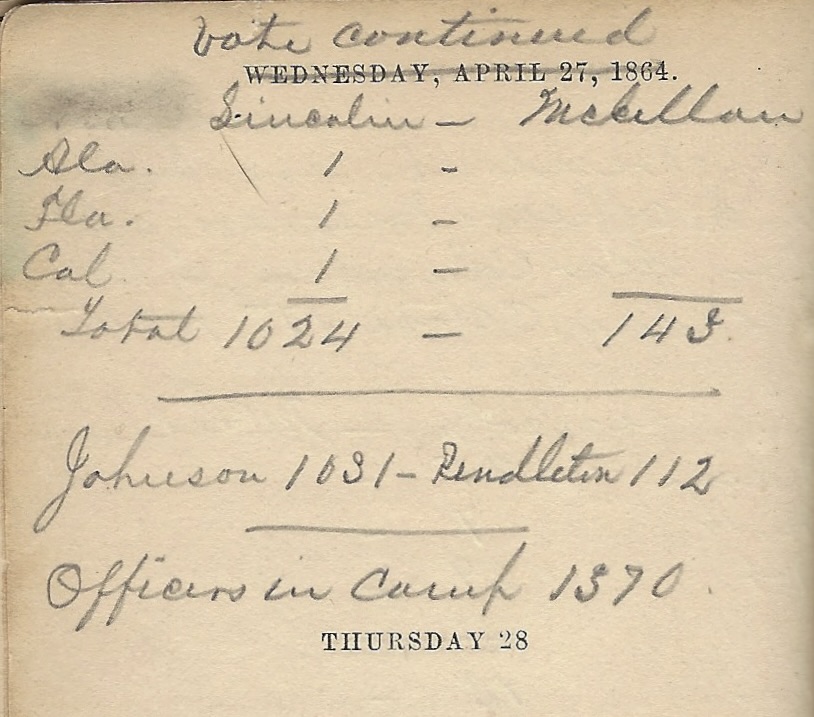
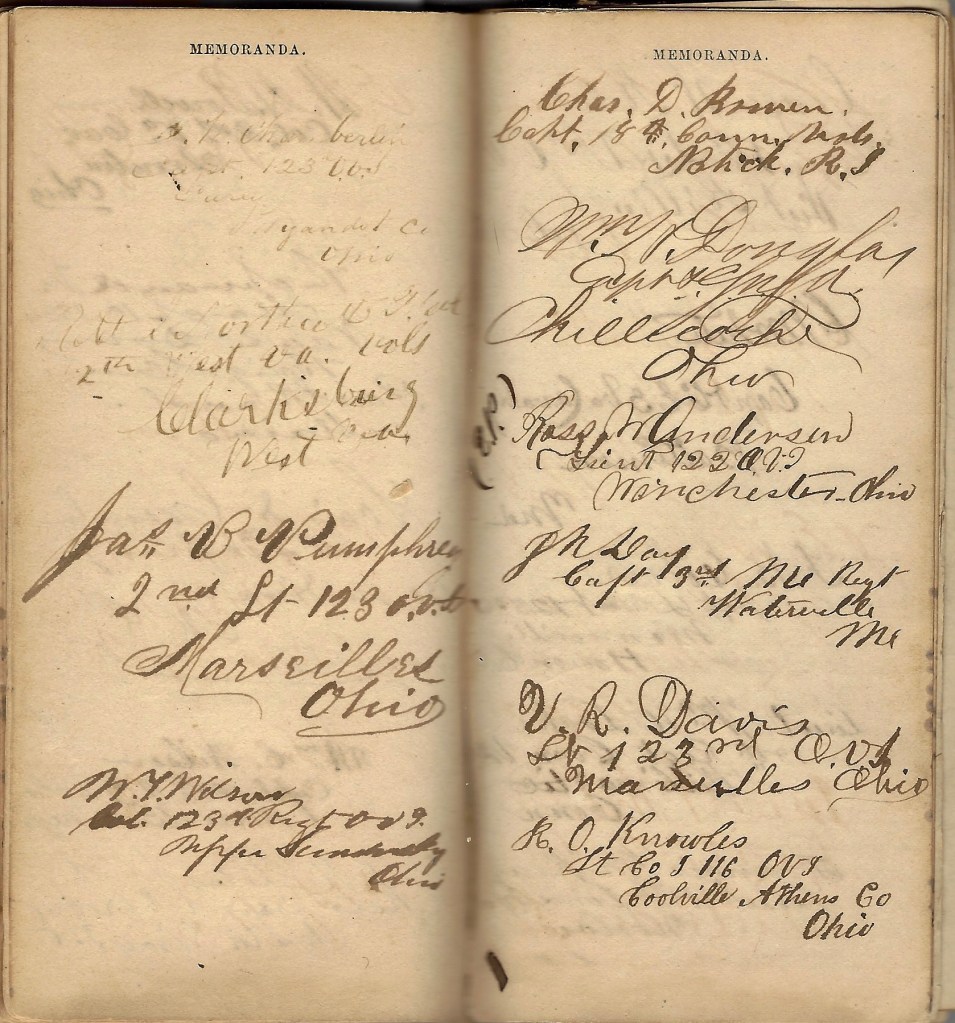
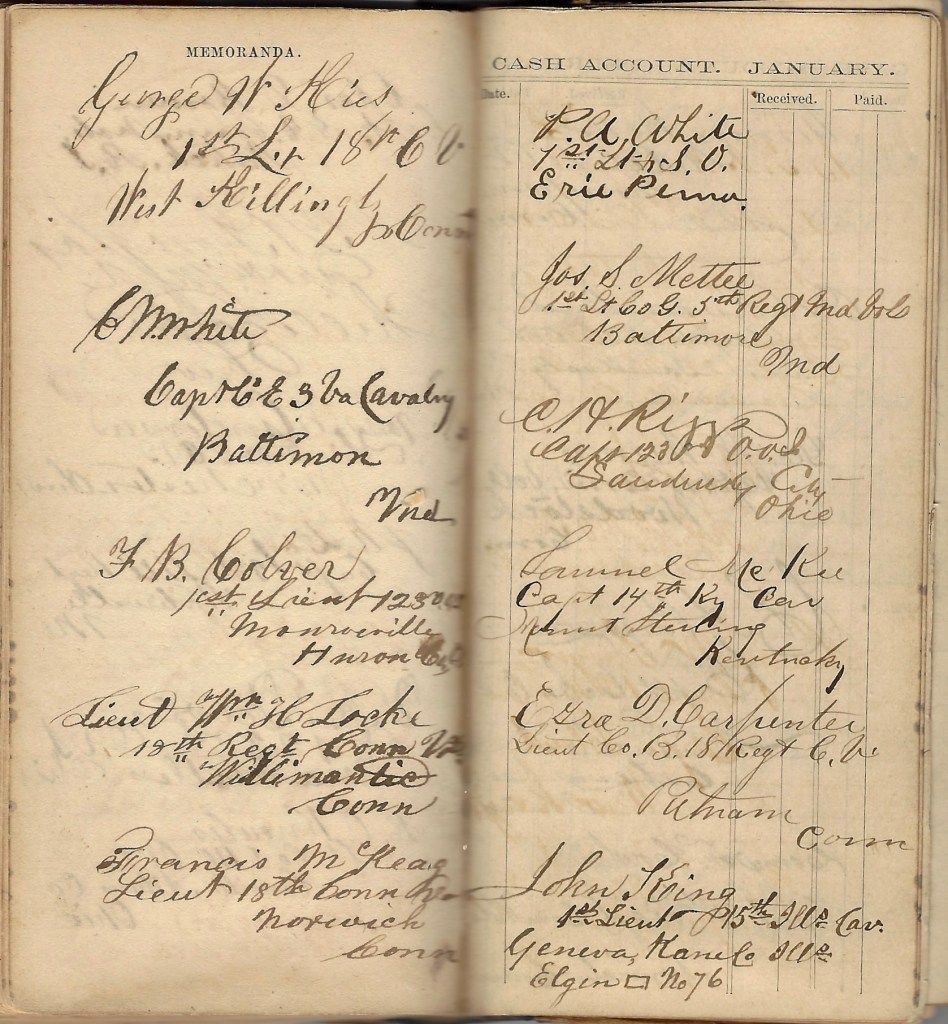
The following diary was kept by Hiram Luther Sibley who summed up his own war-time experience in the following, brief abstract.
Lt. Hiram Luther Sibley, 1862
“I was a lieutenant in Co. B, 116th Ohio Volunteer Infantry. I resigned [my position in] the County Common Pleas clerk’s office in Meigs County, Ohio, to go into the service under the second call for 300,000 men in 1862. I was captured with part of General R. H. Milroy’s command, near Winchester, Va., on June 15th, 1863, by the advance (Ewell’s corps) of Lee’s army. On June 22nd I went to Libby. May 7, 1864, I went out, going to Danville, Virginia, about a week, and thence to Macon, Georgia, where I stayed till July 30th, when I was taken to Savannah. There I was kept till September 13th, when I was carried to Charleston, S. C., and put “under fire” (from our bombardment of the city) until October 5th, when I was taken to what came to be known as Camp Sorghum, about three miles from Columbia, S. C. There I stayed until December 9th, 1864, when, as one of the sick or wounded, I was taken back to Charleston and the next day (the 10th) was exchanged, being a prisoner eighteen months, lacking five days.”
Sibley was the son on Rev. Ezekiel Sibley (1814-1885) and Phebe Simons (1815-1896). He was married to Esther (“Ett”) Ann Ellis (1835-1916) in April 1858 in Meigs county, Ohio, and after the couple had one boy, Willie (b. 1860) at the time that Sibley entered the service.
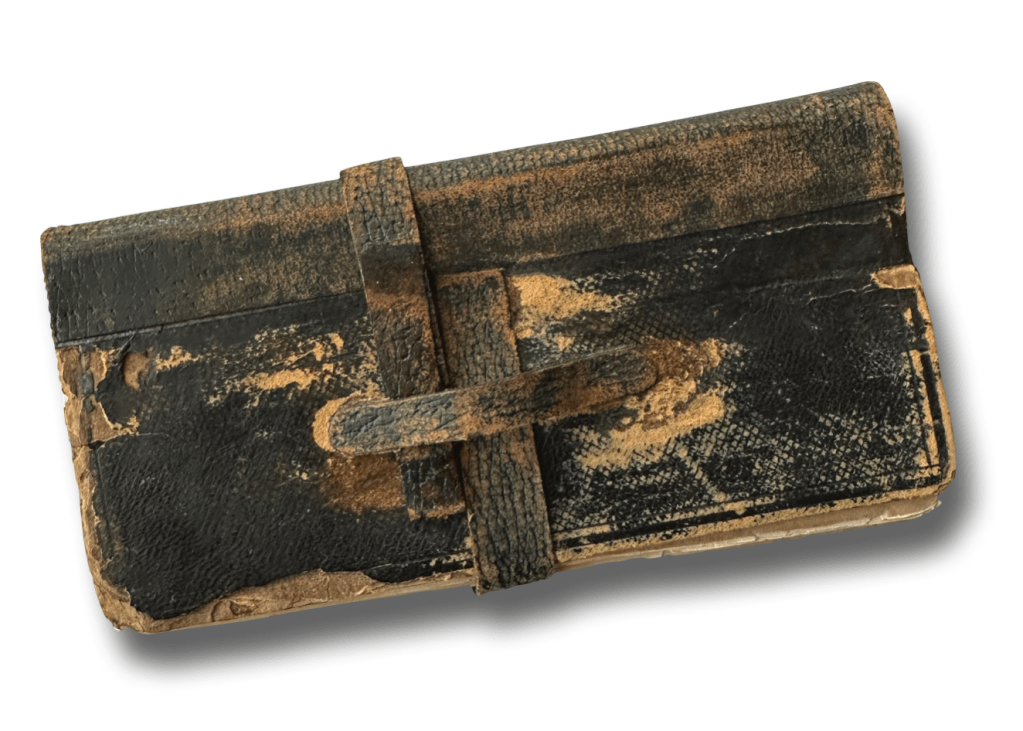
Sibley’s 1864 pocket diary measures 6×3 inches
[Note: This diary is from the personal collection of Don Andrew and was transcribed and published on Spared & Shared by express consent.]
Transcription
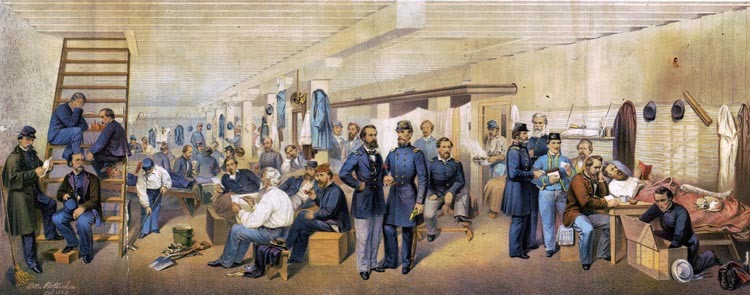
Officers in Libby Prison
January 1864
[intro. been in captivity 7 months—Other claim that the prison authorities granted the privilege of burning candles until midnight. Normally pitch black after nine at night.]
Friday, January 1, 1864—In Libby Prison, Richmond, Va. Still blessed with health. I opened my eyes on the first morning of the New Year. Weather is fine, but cool, and the atmosphere delightfully pure. Am still reading “Kent.” Day generally passed off quietly for New Year’s Day. 1
1 Sibley writes that day passed off “quietly for New Years Day” and perhaps it did in contrast to the customary day-long celebrations in peace time. One source, however, claims that at midnight, after the sentry shouted, “Twelve o’clock! Post No. 1—all’s well!” a solitary voice began singing the Star Spangled Banner which was joined by others until the “the swelling strain” rose from “every room in the building.” [Libby Life, page 125]
Saturday, 2—Health good. Last night the coldest of the season. Did not sleep warm. Very cold with sharp wind during the day. Water pipes frozen and all the water brought up in pails. Some “rumors” on exchange but, although good, they are little relied on. Still hope for the best.
Sunday, 3—Weather more pleasant today. Wrote letter to my wife and to A. E. McL. Passed the day pleasantly as could be expected. Read (as my daily pass time is) a portion of scripture. Did not read any law, although I did some miscellaneous reading. Am in fine health.
Esther (“Ette”) Sibley
Monday, January 4, 1864—Pleasant weather. Signs of rain toward night. Got two letters—one from Ett; the other from Will. Some rumors on exchange. They gain but little credit. Had a sermon in our room this evening by one of the officers. City papers in bad spirits on the “prospect.” Health good.
Tuesday, 5—Weather “murky” with some sprinkling in the morning. Lots in the day. Became quite pleasant. But little news. Papers despondent and gloomy over the prospects of Confederacy. My health good. Continue reading law.
Wednesday, 6—Weather cool and a light fall of snow—the first of the season. Wrote letter to Will and to Ett. A list of names verified by calling it over and having each officer answer as called. Some hope [that] it indicates exchange. Fear they will be disappointed but wish, most earnestly, the contrary.
Thursday, January 7, 1864—Cold night and pleasant morning. Very cool, however, this evening. But little news today. [Gen.] Early is said to be in the Valley with 9,000 men—foraging, I think. Rebels are hard pressed for food as the adjutant of the prison says the guards have not had meat for four days! Health good. No [exchange] boat up yet.
Friday, 8—Night cold with a light snow. Day also cool but pleasant in the afternoon. Col. [Abel Delos] Streight 2 and Capt. [J. E. B.] Reed 3 released from their cells. They look thin and careworn. No rumors today! But little news and no boat. Extracts from Northern papers look unfavorable for exchange. Health good. Am reading law.
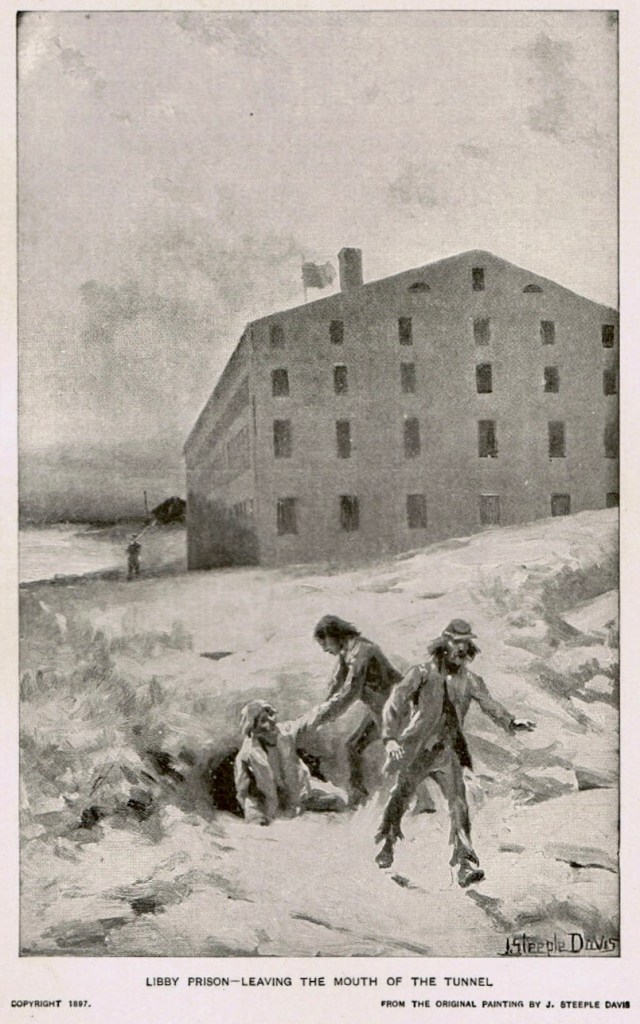
2 Col Abel Delos Streight (1828-1892) of the 51st Indiana Vols. commanded a cavalry raid (known as Streight’s Raid) in 1863 which was a failure. He was taken prisoner on 3 May 1863 at Cedar Bluff, Alabama, and taken to Libby Prison where he remained ten months. He was one of dozens of soldiers who escaped the prison on 9 February 1864 by passing through a tunnel that had been secretly dug below the prison and under the adjoining street.
3 Capt. J. E. B. Reed of the 51st Indiana Vols.
Saturday, 9—Cold night and pleasant day. Meetings called in each room to devise measures to prevent selling of U. S. Sanitary Commission goods at auction. A good deal of felling manifested. Generals John Morgan and A. P. Hill visited prison. Did not see them as they did not come in our room.
Sunday, January 10, 1864—Another cold night followed by a pleasant day. Papers say this is the coldest winter of many years. Read nine chapters in Isaiah and several Psalms. Also begun Capt. Szabad’s “Theory and Practice of War.” Harpers publisher. Rumored that Gen. Burnsides is in command at Fort Monroe.
Monday, 11—Warmer night and pleasanter day. Commenced 2nd Volume of “Phillips’ Evidence,” 4 for second reading today. Read 49 pages with my valued, highly esteemed, educated, and talented friend, Adj. B. F. Blair of 123rd OVI. I regard it as both a privilege and pleasure to study with such a friend.
4 The book Sibley was studying was “A Treatise on the Law of Evidence” by Samuel March Phillips. It was published in 1829. Sibley informs us that his studying partner was Lt. Benjamin F. Blair, the Adjutant of the 123rd OVI who was taken prisoner with his Colonel, William Tecumseh Wilson. In a letter dated 1 November 1863, Col. Wilson wrote his wife that About 1,000 of us are confined to seven rooms in which we cook, wash, eat, sleep, and do everything else, not being permitted to go outside the door for any purpose. The building is full of vermin and a portion of each day is devoted to skirmishing, as we call it, but which vulgar people would probably term “hunting lice.” We’re an interesting looking set of pets when this part of the daily labor is performed…Most of our time is spent in reading when matter can be had, playing cards, checkers, chess, fighting our battles over, and talking about the loved ones at home, that is, when not engaged in cooking or washing clothes. It is very monotonous, and as one of my companions frequently remarks, “a hard way of serving the Lord,” but the proud consciousness that we are suffering all this for our country enables us to bear it with comparative cheerfulness.” [See Dan Masters’ Civil War Chronicles, “A Hard Way of Serving the Lord.”
Tuesday, 12—Night still warmer and day more pleasant. Read 55 pages in Phillips. It is rumored that a fight is progressing at Wilmington, S. C. Some little snow yet on the ground and the canal is still frozen over though the river is cleared of ice.
Wednesday, January 13, 1864—Warm night and warm day. Promise of rain tonight. Read 70 pages of Phillips with my friend Blair. Rumored fight off Wilmington proved correct. Rebels lost another vessel. She was owned by Richmond. Rebel Major on parole here today. He has to return unexchanged.
Thursday, 14—Day warm and very like spring. Read 60 pages Phillips. Papers confess loss of another “Blockader.” Boat said to be up and I wrote a short letter to Ett. Rumors afloat about exchange. Am in fine health.
Friday, 15—A little colder today. Read 60 pages in Phillips. Boat did come up and also brought dispatches to the Rebel commissioner of exchange. He sent down to City Point. Seven months today since I was captured. Will it be as long before I am free? May God forbid!
Saturday, January 16, 1864—Cool morning and pleasant day. Boat load of boxes came up and a “monstor” mail is said to be on hand. This gladdens the hearts of all as it has been more than two weeks since we had any letters. Read 50 pages in Phillips. Exchange stock low; health good.
Sunday 17—Weather pleasant but cool—more like early spring than winter. Wrote a letter to “Ben” and Col. Wildes. Day passed off quietly. A rumor is afloat this evening favorable to an exchange. God knows I wish it may prove true!
Monday, 18—Weather warm, drizzly, disagreeable day. Bad for work, either of body or mind. I therefore rested; or more plainly, did nothing. Papers represent “Exchange Stock” as “gone up.” They are such notorious liars that I am half inclined to take them contra, or think stock good.
Tuesday, January 19, 1864—Weather cool, clear and windy. Papers say all the Sanitary Commission goods received per last boat are “confiscated.” Letters came once more this evening and I was so happy as to get two—one from home, one from W. City. Read 50 pages of Phillips.
Wednesday, 20—Weather pleasant but cool. Wrote letter to Ett and to Cons F. J. J. Also read 58 pages in Phillips completing 2nd Volume. Papers say boxes are not confiscated. Am glad to hear it. Got another letter from Ett of December 25th. Me well.
Thursday, 21—Morning warm and pleasant but evening cool. Wrote a “line” to Ett to be carried by Col. Powell, 2nd Virginia Cavalry, who goes North by first boat. Read 56 pages in 3rd Volume Phillips. Also McBeth. This is the fifth day since meat has been issued to us.
Friday, January 22, 1864—Morning cold and day very pleasant. Really like spring. Read 50 pages in Phillips and half of Hamlet. No meat today. Our only rations are half loaf of cornbread and a little rice. Am in good health and anxiously hoping for good news on exchanges.
Saturday, 23—Weather warm and spring-like. Read 50 pages Phillips and finished Hamlet. List of names of all the officers taken for the third or fourth time. Rumored that 400 of us go to Salisbury, North Carolina. Rebels moving troops on railroad.
Sunday, 24—Weather most delightful. As warm as a Northern April. Felt miserably bad all day. Read the “Sedges,” “Gleason’s Pictorial,” Burns, Shakespeare, Waverly Magazine, and the Bible. Day dragged heavily, however, and never felt a stronger desire to see the dear loved ones at home.
Monday, January 25, 1864—Again, most beautiful weather & little more breezy than yesterday. Read 45 pages of Phillips. Also a little more Shakespeare and a Tale or two. Do not feel quite as well as I did a few weeks back. Hope to keep along, however, till the good time does come.
Tuesday, 25—The finest sort of spring day if it had not been in the middle of winter. Read 53 pages Phillips besides some miscellaneous reading. Took a good gymnastic exercise in the evening along with Capt. Davis of 18th Connecticut. Have felt quite well today.
Wednesday 27—Day like yesterday. Capt. Sawyer son Ould today who says there is no prospect of exchange in consequence of refusal of government to parole the excess nigger as no bar and Butler would soon be disposed of if [ ] are paroled.
Thursday, January 28, 1864—Weather same as yesterday. Have “power of attorney” to Col. H. H. Powell, 2nd Va. Cavalry, to draw my pay from February 28th 1863 till January 31st 1864. He goes North tomorrow. Gave him note to Cons. J. W. City. Read 58 pages Phillips. Wrote letter to E. H. and to [ ]. Crossbars of wood taken out and iron bars put in our windows.
Friday 29. Weather still like spring. Did not read much owing to a chat with friend Blair which consumed most of my reading time. Major Bates and Capt. Porter escaped today. The former going by the guards in citizen’s dress and the latter in Confederate soldier’s clothes. 5
5 “Some officers in the Libby having, notwithstanding the vigilant eye of Major Turner and the fidelity of his guards, discovered some flaws in his precautions for the safe-keeping of his prisoners, arranged their plans accordingly—they were ready for the opportunity precisely at the critical moment when it was ready for them, and five in number, they coolly walked out of the prison one fine afternoon. The first flaw was this: that visitors, mostly citizens of Richmond, were permitted to enter the prison and to leave it without being challenged by the sentries. The next flaw was, that when the invalid officers attended “sick call,” every morning, they passed through the same door on their way to the doctor’s office, through which these visitors passed in and out unmolested. It was no difficult matter for them to attire themselves in citizen’s clothing, or like workmen, or Rebel soldiers, and to avail themselves of this door as a means of exit, not toward the doctor’s office, but up the nearest street into the city.” [Libby Life, pp. 139-140]
Saturday 30. Weather cooler with signs of rain. A good deal of excitement about escaping and three men gone! Rebs found it out, however, [ ] in the day and put [ ] out at once. Rumor that Maj. [Erastus Newton] Bates has been caught. Roll calls…[illegible]
Sunday, January 31, 1864—Weather a little cool with sprinkling in the morning. Roll call again by Major [Thomas P.] Turner, but it is said he found 40 too many! Maj. Bates, poor fellow, was retaken. He had gone 15 miles, was taken sick, went to a house and was there captured. He is in the cell sick. 6
6 Erastus Newton Bates (1828-1898) was a lawyer practicing in Centralia, Illinois, when he mustered into the 80th Illinois as Major. He was captured in May 1863 by Forrest’s cavalry and held in Libby Prison. He escaped briefly in January 1864 but was quickly recaptured. Illness prevented Bates from participating in the escape of 109 of his fellow officers from Libby on Feb. 9, and he was soon transferred to a prison in South Carolina. Released in Sept. 1864, Bates returned to his regiment as lieutenant colonel in Jan. 1865, and was mustered out in June with the rank of brevet brigadier general of volunteers.
Major Thomas P. Turner (left), former commandant of Libby Prison, sits with General Jubal A. Early in Havana, Cuba, in 1865
February 1864
Monday, February 1—Weather clear and warm. Read 70 pages in Phillips and began to read John Brent by [Theodore] Winthrop who was killed at Big Bethel early in the war. Order read by Maj. Turner limiting prisoners to one letter each per week to their friends.
Tuesday 2—Weather warmer and quite pleasant. Got two letters…[remainder illegible]
Wednesday, February 3, 1864—Finished John Brent—a book containing passages of great power and the most thrilling interest. [ ] Culp, one of the lately escaped prisoners was brought back today. He is the third one recaptured. The others are yet at large.
Thursday, 4—Weather clear, cold and pleasant. Read 42 pages Kent’s 1st Volume, 22 of 2nd Volume, and began The Life of Douglas Jerrold by his son [Blanchard Jerrold]. Papers say a boat is expected up today. Give “Peace Resolutions” to resolve the Negro exchange to Rebel Congress. Also Lincoln’s last call for 500, 000 men.
Friday, 5—Weather clear and pleasant. Read 42 pages [illegible]
Saturday, February 6, 1864—Cool. cloudy morning but rather pleasant mid-day with signs of rain in afternoon. Read 40 pages 1st, and 10 pages Kent’s 4th Vol. Also more of Jerrold. Maj. Sterling and Capt. Ives and Reed sent to Salisbury, North Carolina. Some letters were distributed today but I failed to get any to my great sorrow.
Sunday, 7—Weather cold and [ ]. Excitement in city [illegible]
Monday 8—[Illegible]
Tuesday, February 9, 1864—[illegible]
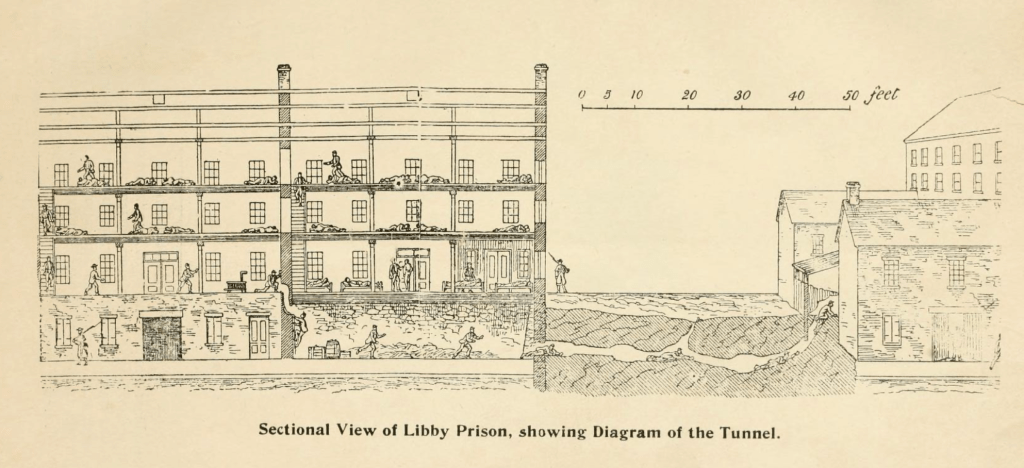
Escape from Libby Prison through a tunnel.
Diagram of the tunnel appearing in Col. Rose’s Story of the famous tunnel escape from Libby Prison.We see the tunnel length was approximately fifty feet.
Wednesday, 10—Weather clear and cold. One hundred and nine officers escaped last night by a tunnel from the prison under a street into a yard near. Only seven retaken this evening. As soon as roll was called, the escape was known and then another roll by name which occupied most of the day.
Thursday 11—Same kind of weather as yesterday. Twenty-two of escaped prisoners retaken and two killed up to date. Read 48 pages Kent’s 1st Vol. Am in fair health and spirits although chagrined that I knew nothing of the “escapade” until too late to take part.
Friday, February 12, 1864—Weather clear and rather warm toward evening. Read 42 pages Kent’s 1st, and 15 in 4th Vol. A few more of the escaped prisoners brought in and put with their recaptured comrades in the cells. Rumored that Meade is flanking Lee while force is gathering on Peninsula.
Saturday 13—Weather pleasant and warm. Read 43 pages Kent’s 1st and 14 of his 2nd Vol. Received two letters from Ett; one of 11. The other of 24 Jan. Forty of the escaped prisoners recaptured to date. Am in good health for such a life as this. Thanks to “Our Father.”
Sunday, 14—Weather pleasant and quite windy. Several more prisoners brought in today. Twenty released from their cells last evening and more tonight. Wrote a letter to Ett. Read no law today as it is contrary to “established rules” so to do.
Monday, February 15, 1864—Weather cool with slight fall of snow in the afternoon. Read 42 pages Kent’s 1st Vol. and 15 of 4th Vol. Prospects very gloomy as regards exchange. Have almost ceased to hope for it while the war lasts. Am in fair health.
Tuesday, February 16—Cool night and cold day. Snow melted however about the middle of the day. Read 40 pages Kent’s 1st Vol. and 15 of his 2nd Vol. Rebels claim in papers to have captured Gen. [Eliakim P.] Scammon and party on boat on the Great Kanawha. Feel decidedly “blue.” [See Capture of Gen. Scammon on the Ohio River, Feb. 2, 1864]
A sketch entitled “Paroled, a prison dream” appearing in the book, Libby Life.
Wednesday, February 17—Very cold night and day to correspond. Rebel guard patrolled the prison once an hour during the night. Evidently afraid of another tunnel. Read 44 pages Kent’s 1st Vol. Prospect of another cold night. Boat looked for.
Thursday, February 18, 1864—Weather very cold and quite windy. Read 40 pages Kent’s 1st Vol. and continued reading Kames’s Elements of Criticism.” Larger rations of bread with a few turnips and a little cabbage now issued. Brig. Gen. Scammon and staff arrived in Libby.
Friday 19—Cold morning but day more pleasant. Read 40 pages Kent’s and more of “The Elements.” Boat up this morning with 20 tons freight and news from North. Col. Streight and 17 others in our lines on 8th. Rebels evidently troubled about Mobile.
Saturday, 20—Weather warm and pleasant. Read 30 pages Kent’s and more of Kames’s Elements. Several surgeons ask to go North on boat now up. Sent note by one—Dr. Robinson. Rumors afloat about exchange. Do not rely on them.
Sunday, February 21, 1864—Very pleasant day. Air balmy as spring. Read considerably in the Bible—in Exodus. Boat that came up Thursday said to be still at City Point. Rumors of exchange rife. Wrote letter to Ett and to Milt.
Monday, 22—Morning cool but a pleasant day. Read 30 papers Kent which completes second reading of the first volume. Also more in Kames’s which, by the way, I like very much. Another boat said to be up though forst one not gone.
Lt. Col. John J. Polsley, 8th West Virginia played chess with Sibley in Libby Prison.
Tuesday, 23—Weather very pleasant. Added, if possible, to the [ ] one’s [ ] the “courts of freedom.” Read 40 pages, 2nd Vol. Kent and more after. Rebels claim to have captured 65 of the escapees, thus leaving 45 still at large.
Wednesday, February 24, 1864—Weather still like the finest spring. Read 40 pages, 2nd Vol. Kent. Also put out a washing of 1 pair drawers, two shirts, and 1 pair socks. Played chess evening with Lt. Col. [John J.] Polsley of 8th Virginia. Had word that L. Col. Powell had collected my pay, &c.
Thursday, 25—Pleasant, but not quite so warm. Read 40 pages Kent and more of Kames’s. Received a letter from Ben. Rumored in evening that a boat is up. Roll call about 11 o’clock last night. Rebels feared someone had escaped.
Major Alfred B. Wade, 73rd Indiana Vols.Released from Libby Prison by “special exchange” on 26 February 1864. (LOC)
Friday, 26. Weather cool and windy like a Northern March day. Read 42 pages Kent. Received several more letters—one from Father, two from wife, one from Flors, Ben, and Milt. They make my heart glad. Maj. [Alfred B.] Wade, 73rd Indiana Vols. went North today by special exchange. More to go soon. Boat up with ten tons freight.
Saturday, February 27, 1864—Weather very spring-like. Read but little as we ewre all confined in one room used as a kitchen, while all the other rooms were searched for arms. However, began Bulwer’s “Strange Story.” Col. N[ichols] received a box which adds materially to our comfort and well being.
Sunday, 28—Day unusually fine and warm. Finished the Strange Story which I regard as a powerfully written work. If I live, shall read more of Bulwer’s works hereafter. Was at prayer meeting in the evening. Forcibly carried back to similar meetings at home.
Monday, 29—Day warm, damp, and rainy. Willie’s birthday. God bless him. Col. N[ichols] got another box. It was a very good one from his wife. Was so interrupted by its arrival that I read but little law. Read some of Kames’s and finished Book of Exodus in the Bible.
March 1864
Tuesday, March 1, 1864—Day rainy and dismal. Papers give an account of large bodies on each flank of Lee, one of which had cut the Virginia Central Railroad. Read 40 pages of Kent and some of Kames’s.
Wednesday, 2—Day clear and cool.Union troops in vicinity of Richmond and great excitement prevailing in the city. The militia all out. Last night we went to bed prepared to stir at a moment’s warning in case our forces dashed in the city…
Thursday, 3—Weather very pleasant. Raiders said to be gone. From 50 to 150 prisoners brought in by rebs including several officers. Letters came today. I got one from Will. Read 40 pages Kent.
Friday, March 4, 1864—Late “raid” proves a failure as far as capturing Richmond is concerned. 7 Read 40 pages Kent and some of Kames’s. Heard by Col. Nichols that the prison is undermined and that we will be “blown to atoms” if we attempt to escape.
7 Sibley is referring to what has been called the Kilpatrick-Dahlgren Raid (February 28-March 3, 1864) which attempted to penetrate the light Rebel defenses around Richmond. It proved an utter failure due to weather delays and miscommunication between the separate forces and accomplished nothing but the minor destruction of railroad and buildings. One of the stated objectives of the raid was to release the Union prisoners at Libby Prison but the troopers never made it into the city. If anything, the raid worsened the relations between those responsible for brokering exchange of prisoners as papers found on Col. Ulric Dahgren’s corpse suggested that the raiders also intended to assassinate Pres. Jefferson Davis. Curiously, Sibley stops recording diary entries shorty after this raid for a period of time leaving us to wonder if he had lost all hope for securing his freedom once again.Years later, Sibley would write of the failed raid on Richmond, “The whole affair comes very vividly to my memory in going over the paper. Besides, the night following, we could at times hear the boom of cannon which told that the raiders were in the vicinity of Richmond, and if they got in, I with three others alone [Col. Nichols, General Neal Dow, and Gen. Eliakim P. Scammon] knew the facts which Dr. [W. A.] Smith gave Colonel Nichols expecting the springing of the mine. A more uneasy night I never yet have passed. [Source: Record of the 116th Ohio Infantry Volunteers, Thomas F. Wildes, page 130]
Saturday, 5—Weather clear and cool. Boat reported up with 80 men and 60 officers for exchange. Read 40 pages Kent. Raid entirely over and our forces away from the city. Dr. W. A. Smith—the man who said we will be blown up.
Sunday, 6 March 1864 through Tuesday, 3 May 1864—[no entries]
May 1864
Wednesday, 4—Read four letters from home—latest April 21st. All contained good news. Were most gladly received as they were the first for several weeks.
Friday, May 6, 1864—Rumored this evening that we are to go to Americus, Georgia, tomorrow. 8 Roused at 11 o’clock p.m. with orders to get ready for a march to Petersburg, Va. All confusion and bustle rest of day.
8 “Commonly known as Andersonville, the military prison facility was officially named Camp Sumter, in honor of the county in which it was located. Construction of the camp began in early 1864 after the decision had been made to relocate Union prisoners to a more secure location. This decision was made because of the battles taking place near Richmond, VA where many prisoners were being held, and as a way to procure a greater food supply. The first prisoners arrived at Camp Sumter in late February 1864. Over the course of the next few months approximately 400 prisoners arrived daily. By June 1864 over 26,000 prisoners were confined in a stockade designed to house 10,000. The largest number of prisoners held at one time was 33,000 in August 1864.” [Source: History of Andersonville Prison]
Saturday, 7—Left “Libby” forever, I hope. An hour after day[light], crossed river and took cars for Danville, Va. Here put into box cars like so many hogs, 50 to a car. Weather very hot and the confinement almost intolerable. Distance 140 miles. Two or three escaped from train.
Sunday, 8—Arrived at Danville a little before day. Here taken to two buildings and put 500 in each. Conveniences very few but rations better than at Richmond. Rumored news from Grant good. Same of Gen. Smith south of James River.
Monday, May 9, 1864—Weather very warm. News (by rumor) good so far as fighting is concerned. My health quite good. Rations better here than at Libby although we are more crowded and subject to many inconveniences. Wrote a letter home yesterday.
Tuesday, 10—Weather rather more pleasant than yesterday. Got “war news” from Richmond Enquirer of 9th. Think Grant will yet be victorious notwithstanding rebel “jubilations.” Rumors of our going to Georgia tomorrow.
Wednesday, 11—Still fine dry weather. News still seems good both north and south of Richmond. Received orders to be ready to move at 2 o’clock a.m. tomorrow. Destination not known, but suppose it to be Georgia. Heard shower late in evening.
Thursday, May 12, 1864—When called up as per notice, and, about 8:30 o’clock a.m., took cars for Greensboro, North Carolina. Found the road incomplete 25 miles from Danville which cost all a walk of 6 miles. Laid out on the wet ground till 12 M [noon] when took train and reached Greensboro at sunrise.
Friday, 13—Weather wet yesterday. Fair today. Passed through Salisbury, North Carolina, and saw rebel military prison there. reached Charlottesville, N. C., where we drew rations and changed cars. Left about 12 M after being several hours in the rain.
Saturday, 14—Weather fair again although night was rainy. Reached Columbia, S. C. today. Changed cars near there and proceeded, night being rather rainy. Country poorer and more sparsely settled than the section of N. C. which er passed through.
Sunday, May 15, 1864—Weather fair and quite warm. Reached Augusta, Georgia, toward night where we changed cars, with orders to remain until morning. Were guarded by “home guards” who treated us well. This is a very beautiful city with some 20,000 population—many Union.
Monday, 16—Weather quite warm. Left city about 9 o’clock a.m. in route for Macon or Americus, we know not which. Stopped about 10 miles out until 4 p.m. when we proceeded on our journey. Country swampy in places and evidently owned in large tracts.
Tuesday, 17—Reached Macon a little after sunrise. Here put into a new prisoners’ camp of about [ ] acres, without tents—no shelter if any kind. We numbered in all 801—a loss of 54 since we left Libby—mostly by escape. My health better than when left Libby though not very. 9
9 The lesser known Union officers’ prison established at Macon, Georgia, sometimes referred to as “Camp Oglethorpe,” was approximately 90 miles northeast of Andersonville. It was sited on the Bibb County fairground. It consisted of a tree-acre open field that would eventually be surrounded by a 12-foot high wooden fence. Any shelter for the prisoners would have to be constructed by the prisoners themselves with scrap lumber made available to them. Much of what is know of this prison comes from the letters of U. S. Army Chaplain Henry S. White, a recent captive who arrived at the camp a few days before Sibley in May 1864. He wrote of their arrival” “One day we saw a column of the roughest looking men pass us toward the stockade. They were the captives from Libby Prison, Richmond, Va. Toward night our company was turned into the stockade with them. A new class of suffering was before me. The men were old prisoners, and pale and haggard. They were ragged, and som partly naked. They were filthy, and covered with vermin. Prison life makes men hard, selfish and rough.” [Source: Ten Weeks in a Macon Prison, 1864: A New England Chaplain’s Account, The Georgia Historical Quarterly, Vol. 70, No. 4 (Winter 1986) pp. 669-702]
Wednesday, May 18, 1864—Weather quite warm. Camp becoming organized. Ten thousand ft. lumber given to make shelter and floor for 942 men! Most liberal Confeds. Day passed away without anything startling unless the rebel news that two brigades of Lee’s army had whipped Grant with 20,000 loss may be called so.
Thursday, 19—Weather warm and dry. Johnson still “falling back before Sherman. Rebels claim that Lee gained victory over Grant in Virginia in which we lost 47,000 men. They say our papers admit this. Don’t believe it!
Friday, 20—Weather warm and dry. Military [news] much as yesterday. Sherman is said to have come after evacuated it of course. Gold said to be $2.10 in New York by our own papers. Don’t believe it!
Saturday, May 21, 1864—Weather warm and dry. Military news much as yesterday. Very misty from Va., however, although rebels still claim the advantage. We believe they were whipped. Begin to build sheds to shelter prisoners today. Am studying Tactics and reading Draper’s Physiology.
Sunday, 22—Warm and dry again. Some new prisoners came in bringing cheering news from Grant and Sherman. Grant whipped Lee in all fights up to the 16th, taking from 15,000 to 20,000 prisoners, but no general engagement. Gold $160-1. Sherman after Johnston. Within 20 miles of Atlanta. Preaching which I attended.
Monday, 23—Weather still dry and warm. But little news. Some of the “escapees” recaptured and brought in. Lt. Wood of regiment died in the night.
Tuesday, May 24, 1864—Signs of rain but still none. Brig. Generals [Truman] Seymour and [Alexander] Shaler 10 with 109 other officers captured by Lee, came in. Funeral and burial of Lt. Wood today. News brought by prisoners still good—confirming what we heard from other sources.
10 General Truman Seymour was an 1846 graduate of West Point. He was serving under Major Anderson’s command at Fort Sumter in 1861. He was considered a brash officer—often successful in battle but at a severe human cost. He was captured in the Wilderness in May 1864. Alexander Shaler, was not a career military officer but had extensive militia experience before the war and proved a capable officer. Ironically, Shaler commanded the POW Camp at Johnson’s Island during the winter of 1863-64 while his regiment, the 65th New York Infantry, served as prison guards. During the Overland campaign, Shaler was captured early in the fighting in the Wilderness when his regiment was flanked.
Wednesday, 25—Weather pleasant although it rained during the night. News still favorable both from Grant and Sherman. Rebels call Grant a greater liar than Pope because he still claims victories over Lee. Their own accounts of the battles admit a substantial victory for us. Grant’s masterly strategy is also admitted.
Thursday, 26—Weather warm although a little rain during the night. Helped build shed today and went into one but not until I got a good wetting from a driving summer shower. Built a good bunk with help of Lieut. [Ezra D.] Carpenter, 18th Connecticut—one of my mess. 11
11 Ezra D. Carpenter was a 2nd Lieutenant in Co. B, 18th Connecticut Infantry who mustered into the regiment in August 1862. The regiment’s first major battle was at Winchester in mid-June 1863 where he was taken prisoner and marched to Libby Prison. His story and eventual escape from captivity after 21 months is described here: “Escape from Libby Prison.”
Friday, May 27, 1864—Very warm today. The thermometer has shown 90o in shade since we have been here. New comers still bring good news from Grant and Sherman.
Saturday, 28—Weather same as yesterday. Tunnel discovered which caused some stir amongst the rebels. good news from both armies by new comers. Wrote a letter home. Asked for box with coffee, sugar, molasses, flour, shoes, socks, and dried or canned fruit.
Sunday, 29—No change in weather. Attended preaching by one of our chaplains in forenoon. A good sermon. Subject: Trial of Abraham’s faith when he was ordered to sacrifice Isaac. Also attended service in the evening. Oh what would I not have given to be at church with my loved ones.
Monday, May 30, 1864—Weather warm and dry. No news of special importance. A few prisoners come in every day or two. All agree that the campaign is going favorably, north and south. Some new comers in from Sherman and Sigel. Learn that our regiment is with Sigel’s in the Valley.
Tuesday, 31st—Warm and dry weather. Some new comers from St. Johns, Florida. Two pieces artillery mounted so as to bear on the camp. Nobody scared, I guess! Stood picket first part of night.
June 1864
Wednesday, June 1—Morning quite warm with light rain afternoon. A fine day for the first of summer. Roll call showed 1,172 officers here this morning. Four of them are Brig. Generals to wit: Wessells, Scammon, Shaler, and Seymour. The last two from Gen. Grant’s army. War news good.
Thursday, June 2, 1864—Fair morning with wind and a dash of rain toward evening. War news good, both by forced admissions of rebel papers, and reports or prisoners. A new Captain (Gibbs) in command of prison. 12 A few letters came but none for me.
12 Capt. George C. Gibbs, former commander of the 42nd North Carolina Infantry, replaced Capt. W. Kemper Tabb of Maryland who ran the prison with an iron hand. Prisoners had nothing good to say about him; he even broke up religious services because the prisoners prayed for President Abraham Lincoln. When Gibbs took over command, he became convinced that the prisoners intended a breakout and so he hardened the perimeter and set up the cannon hoping to deter thoughts of escape. [See “That Thing of Infamy, Macon’s Camp Oglethorpe During the Civil War, by Morton R. McInvale, Georgia Historical Quarterly, Vol. 63, No. 2 (summer 1979), page 285]
Friday, 3—Weather a repetition of yesterday. Wrote a letter home. Am feeling deeply disappointed at the waning prospect for an exchange. Am led to think that prisoners have been most unjustly treated by our authorities. Thousands have already gone to premature graves in consequence.
Saturday, 4—A very rainy day. Our sheds kept water out when finished. War news good. Two officers escaped—one with a trowel in his hand by walking past the guard; the other by riding out under a wagon bed.
Sunday, June 5, 1864—Weather quite warm. Attended preaching in the morning and evening. Had good practical discourses from both services. Rose very early in the morning. Think I will try “early rising” for a while.
Monday, 6—Weather very warm. Upwards of sixty officers came in, chiefly captures from Butler and Grant. General tone of war news good. Wrote a letter home.
Tuesday, 7—Weather very warm with light shower in evening. Rebels claim to have destroyed 90,000 of Grant’s army since Va. campaign begun. They put their own loss in same time at 15,000!
Wednesday, June 8, 1864—Very warm day.
Thursday, 9—Very warm again. Began practice in sword exercise this evening. Some excitement caused by report that Gen. Fremont had been nominated for President by a “radical” convention at Cleveland, Ohio. Hope it is not true.
Friday, 10—Very warm with thundershowers in the evening. Five Brig. Generals, 7 Colonels, 9 Lt. Colonels, [and] 9 Majors ordered to be ready for taking train at 3:15 p.m. Destination unknown. Many hope it is for exchange and speculation is rife as to the real purpose of the move. Hope it is for the best for all.
Saturday, June 11, 1864—Pleasant morning with very heavy shower toward night. Rumored that the officers who left yesterday have [either] gone to Richmond, to Savannah for exchange, or to Charleston to be put in range of the batteries shelling that city. Don’t know which to believe but doubt the latter. An officer fired on the by the guard and mortally wounded.
Sunday, 12—Fair morning but wet evening and night. Wounded man died at 2 o’clock a.m. A foul murder. Attended preaching in the morning. Had good discourse on observance of the Sabbath. Nothing definite as to the officers taken away.
Monday, 13—Rainy day. Wrote letter home yesterday. A few letters came in and I got none. Have had none for nearly six weeks.
Tuesday, June 14, 1864—Cloudy and cool. About 40 officers came in from Virginia. Generally give good reports of fighting. Received a letter from my dear wife dated May 7th—the first for six weeks. Was both thankful and glad to hear that all my near and dear friends were then well.
Wednesday, 15—Clearer and warmer. Most beautiful moonlight evening. Anniversary of my capture. One whole year passed as a prisoner to traitor enemies of my country. God alone knows its sorrows and trials. Am most thankful that my life and health have been spared. Praise God from whom all blessings flow.
Thursday, 16—Weather fare and more like summer. Papers today say that the fifty officers lately taken from here have been sent to Charleston, S. C. to be put in range of the batteries which are shelling the city. One of them wishes all of us men sent there.
Friday, June 17, 1864—Rainy and disagreeable. Wrote a letter to my dear wife. God bless her and my darling boy. No papers permitted to come in. War news said to be bad for the rebels. Petersburg, Va., and Atlanta, Ga., reported to be in our possession. I await to hear it confirmed.
Saturday 18—Weather same as yesterday. Several prisoners came in from Virginia, among whom is Lt. [George W.] Jenkins of 9th West Virginia Vols. He was wounded in battle of Dublin Depot in Virginia & Tennessee Railroad, left of the field for dead, and subsequently made a prisoner. Was very glad to meet an old friend. Good war news received in camp.
Sunday 19—Fair most of day with showers in the afternoon. Attended preaching in morning and evening, Had very good practical discourse. But little news of any kind. Papers are still withheld. It is said, too, that our letters fail to get through.
Monday, June 20, 1864—Cloudy morning, but cleared up during the day. About 40 officers came in from Sturgis’ command, lately captured by Forrest [in the Battle of Brice’s Cross Roads]. Represent the affair as one of the most disgraceful of the war on our part, owing either to incapacity or drunkenness on the part of Gen. [Samuel Davis] Sturgis. Negro troops fought badly.
Tuesday, 21—Morning fair and evening rain. But little news. Rebel paper (Macon Telegraph) admits a loss of 43 general officers in killed, wounded, and disabled, since the first of May, Grant still maintains his new position on the “south side.”
Wednesday, 22—Weather warm and strange to tell—no rain! A few more “Fresh Fish.” Generally agree that Grant and Sherman are all right. Resolutions gather up by a portion of officers here asking privilege to send a commissioner to Washington, &c.
Thursday, June 23, 1864—Very warm and still no rain. One year today sinnce I entered Libby Prison at Richmond, Va. No news from Richmond in paper today. I think Grant has cut it off. Rumored that Sherman is in general engagement with Johnston.
Friday, 24—One of warmest days of the season. Rumored that Ewell’s Corps of Lee’s army has reinforced Johnston and that a battle is now going on. More new comers—mostly from Grant’s army. They are in fine spirits and represent Grant to be all right.
Saturday, 25—Weather very warm day. Lt. Col. von [ ], one of the old Libbyites came in today. He was captured by Forrest after being only eight days with his regiment. Not very well—my stomach and bowels bring out of order.
Sunday, June 26, 1864—Again very warm. Attended preaching in the evening by Rev. J. B. Williamson, formerly agent for Hollister & Co., of Marietta, Ohio. Feel better than I did yesterday although I sigh for the society of the dear loved ones at home.
Monday, 27—Very warm most of the day with a very refreshing thunder shower in the evening. Three tunnels which were nearly completed and would probably have let out 200 or 300 officers were found by the rebels—as is generally believed from information given by a traitor in our midst.
Tuesday, 28—Quite pleasant with showers after dark. News scarce owing to not bringing in any papers. One smuggled through and very gloomy in the tone. Prayer meeting in the evening which I was at.
Wednesday, June 29, 1864—Very warm with little news, it being difficult to get papers. Communication has been for some time cut off from Virginia by raiders. Am reading Humes’ History of England; Draper’s Physiology being completed.
Thursday, 30—Very warm day—the last of first summer month. Bummer month. But little news. Rebels claim to have gained great victory over Sherman but I don’t believe them.
July 1864
Friday, July 1—Very warm with a little rain afternoon. Rebels claim to be gaining advantages all round. Report gold at 240 in New York City on the 23rd ult. Am recovered from a light attack of flux.
Saturday, July 2, 1864—Very warm but a nice breeze made the day quite pleasant nonetheless. A few officers from Sherman represent affairs as going well in that army.
Sunday, 3—A warm summer day. I attended church in the evening. Heard some very sensible and timely remarks upon the necessity of individual to national morality and righteousness.
Monday, 4—Very warm day. Early in the morning an enthusiastic spirit began to manifest itself and a miniature American flag being displayed, it soon became evident that the day was to be celebrated. This was done in animated and patriotic speeches and songs. 13
13 Sibley’s characterization of the 4th of July celebratory events, including the presence of a homemade national flag, is corroborated by the diary of another Union officer, Abram Songer of Co. G, 21st Illinois Infantry. [See “A Hidden Gem of a Civil War Diary” by David T. Dixon published on Emerging Civil War, 23 March 2021]
Tuesday, July 5, 1864—A warm day but with a slight breeze, somewhat pleasant. Rumors afloat of a victory by Sherman over Johnston. Hope they may prove true and think it not improbable that they are. My health is very good considering my situation.
Wednesday 6—Hot July weather and gathering dry and dusty. Papers smuggled in admit that Johnston has had to leave Marietta and Kenesaw Mountain. It is said also that Gen. Foster is knocking at the door of Charleston. No communication yet with Lee.
Thursday, 7—Weather warm and dry. Papers say the gridiron waved over Kenesaw Sunday the 3rd. A couple of “Fresh Fish” came in from Grant’s raiders. They say Grant is all right.
Friday, July 8, 1864—Very warm. Signs of rain in evening but none fell. Some rumors but nothing of importance which is reliable.
Saturday 9—Very warm and dry. Rain threatened toward night but none fell. A few “Fresh Fish” came in from Wilson’s Raid. Represent Grant is all OK.
Sunday, 10—A very warm day with a very grateful and refreshing thundershower in the evening. Over 100 officers came. Collection at Richmond for a long time past. Generally bring good news.
Monday, July 11, 1864—Day warm although some signs of rain in morning. Sherman represented to be across the Chattahoochee. Early said to be into Maryland and Pennsylvania.
Tuesday, 12—Warm and dry. Early reported on a grand raid with his Corps in Pennsylvania. Rumors once more on exchange. Hope they may prove true but have the least possible confidence in them.
Wednesday, 13—Warm and dry. But little news of any kind. Supposed, however, that Sherman is still advancing and Grant besieging. Early is undoubtedly in Maryland, if not in Pennsylvania.
Thursday, July 14, 1864—Still dry and warm, Newspaper news generally good. Steele, however, has lost Little Rock (8,000 prisoners) and gold is reported at $2.70. North said to be greatly excited over Early’s raid.
Friday, 15—Warm until evening when a refreshing shower suddenly fell upon us. But little news and that not reliable. Thirteen months today since I was made a prisoner. May God in His goodness save me from as many more!
Saturday 16—Very warm in middle of day although morning and evening were pleasant. No news of any importance, except defeat of Forrest which can regard as reliable. Rumors of raid on August railroad.
Sunday, July 17, 1864—Cool morning. Windy but pleasant. Sermon in evening founded on the Scripture which declares that Godliness is profitable in all things, having promise of the life that now is, &c.
Monday 18—Warm and dry. Roll call most of forenoon. Gen. Johnston relieved from command and Gen. Hood appointed in his place by Gen. Bragg who has been visiting rebel army in Georgia.
Tuesday, 19—Warm and dry, except a slight shower about dusk. Several officers came in from Andersonville. They say about 29,000 of our soldiers are confined there. 4,000 are now sick in hospital and they die at from 70 to 75 per day. Their condition is represented as truly horrible.
Wednesday, July 20, 1864—Day warm and dry. No papers sent in. We hear from men who came yesterday that our troops are raiding on Columbus and Andersonville, Ga., and Montgomery, Alabama. Some exchange rumor from hospital. Not credited of course.
Thursday 21—Very warm and no news of consequence.
Friday, 22—Warm and dry. A few officers came in from Richmond. Came over the Danville Railroad which has been at last repaired. Do not bring much news.
Saturday, July 23, 1864—Cool and pleasant. Night almost cold. Some reports of great battle near Atlanta. Rebels clsaim to have defeated our right, taking 22 guns and many prisoners. Also claim that Hardee is in our rear with a Corps doing great execution!
Sunday 24—Very warm day, War news conflicting and unreliable. A great deal of anxiety about result of the battles around Atlanta. Preaching in evening. Oh! how I longed to hear a sermon once more at the old church with my loved ones at home.
Monday 25—Cool morning and not so hot during day. But little news. We believe, however, that Stoneman is gradually gaining ground. A few more officers came in after dark. Did not hear their news.
Tuesday, July 26, 1864—Warm and dry. One “Division” of the prisoners notified to get ready to start for Charleston, S. C. this p.m. A slight shower.
Wednesday, 27—Warm as usual. A few “Fresh Fish” came in. Say Sherman is all right. About 600 officers left for Charleston, as we suppose. As many more are to go tomorrow, But little news.
Thursday 28—Warm with light shower during the a.m. About 600 more officers called out, self among others. Heard of Capt. [Edwin] Keyes’ death and that my regiment has lost 300 killed & wounded in Hunter’s late movement against Lynchburg, Virginia. 14 Took cars about midnight.
14 Under the overall command of General David Hunter, the 116th Ohio Infantry was ordered on 18 June 1864 to attack the Confederate defenses at Lynchburg, Virginia. In that assault, Capt. Edwin Keyes of Co. B led his men into the Confederate works and saw his colors planted there before falling back with two wounds. Later that night Keyes had both is leg and arm amputated but he died the following day. To see a map of the battlefield and listen to eyewitness accounts of the Battle of Lynchburg, see Eyewitness Accounts.
Friday, July 29, 1864—Quite pleasant. Came to City of Savannah. Entered our pleasant camp at dark. Slept outdoors all night. Said we are going to stay here and not go to Charleston. Hope it may prove untrue.
Saturday, 30—Very warm. Papers say our forces have cut railroad between Macon and Atlanta and Macon and this city. Also says fighting is going on at Atlanta. “A” tents were given us today. Prospect of rain in evening.
Sunday 31—Very hot again. Warmest climate I was ever in. Very heavy thunder shower last night. Drowned out in our tent. The thunder grand beyond description—almost terrific. Rain fell in torrents.
August 1864
Monday, August 1, 1864—Warm with slight shower. Did considerable work about our quarters. Some rumor in reference to raids but nothing very definite. Occasionally an exchange rumor also, but it gained little credence. Five days rations hard tack.
Tuesday 2—Pleasant morning but hot in latter part of the day. A good large ration of fresh beef—the first since we left Libby. A real treat to all. Our mess had beef soup and steak enough left for a nice “fry.” Surely a better day is coming.
Wednesday 3—Very hot. Cooked today and had three meals which is unusual for our mess. Wrote a letter to my dear wife. News that the 50 officers sent to Charleston are to be exchanged today.
Thursday, August 4, 1864—Very hot and getting dry. Fresh beef again in good quantity and quality. But little news in camp as the papers are strictly prohibited the officers. Are getting domiciled in our new camp and are anxiously awaiting exchange.
Friday 5—Very dry and exceedingly hot. Bacon today with promise of beef tomorrow. list of 50 officers who were lately exchanged at Charleston, S. C. as published in city papers. God grant it may be the beginning of better things.
Saturday 6—Hot and dry. But little news. Some rumors on exchange but little credit given them. I intend to exchange myself if everything works well for a few days. Am in first rate health and good spirits.
Sunday, August 7, 1864—Cool enough to be pleasant and a little rainy. Firing [has] been heard most of the day apparently from heavy guns or mortars and in direction of the coast. It is rumored that our forces attacked Fort McAllister this morning.
Monday 8—Rainy and frequently cool. Firing distinctly heard again. Rumored that 600 prisoners are at Charleston from New York City for exchange. Got all ready to go out through a tunnel last night but a line of guards interposed and defeated the plan.
Tuesday 9—Quite rainy. Much such a day as yesterday. But little news. Said our attack on Mobile is in part successful, Raid again in Pennsylvania. Our papers claim that Atlanta has fallen. Rebels don’t believe it but admit they don’t know who possesses it.
Wednesday, August 10, 1864—Weather about same as yesterday. Lt. [Ezra D.] Carpenter of 18th Connecticut Vols. and I formed mess alone in consequence of insulting conduct of one of the old mess. I hope he will do well and I am sure I shall not regret the change. Papers say Ft. Gaines is captured.
Thursday 11—Pleasant most of the day. But one hard shower about noon. But little news. Rebel Surgeon says they have begun to release Chaplains and Surgeons at Richmond.
Friday 12—Fair weather. No rain for one day after so many wet days. Reported in camp that this is a point of exchange. No papers and but little news of any kind.
Saturday, August 13, 1864—Fair weather one day more. Spent most of the day in making a chair. But little news. Rebs find it hard to hear from Mobile since surrender of Ft. Gaines.
Sunday 14—Clear and very hot. Two surgeons taken out to go to Charleston to be sent into our lines. Sent a line by one of them—Dr. Robinson—who promised to write home for me. Sermon in evening by Chaplain Dixon. Very good.
Monday 15—Warm and dry. Fourteen long, dreary months ago I was made a prisoner of war, far away in the Valley of Virginia. Oh, may I see my home before many more such months have passed away.
Tuesday, August 16th 1864—Dry and very hot. Real tropical sure. Many rumors afloat on exchange. Some of them seem to be well founded. It is said 600 officers are going to Charleston for an exchange. God grant it may be so and that we may go soon.
Wednesday 17—Very warm with a slight thunder shower. Papers say 600 officers have arrived in Charleston it is supposed for exchange. Hope it may be so.
Thursday 18—Very warm day. Some more rumors on exchange but nothing definite or reliable.
Friday, August 19, 1864—Very dry and hot again. Two or three escaped prisoners brought in. Papers represent Grant as having virtually failed at Petersburg and that Wheeler has got in Sherman’s rear and destroyed Etowah bridge.
Saturday 20—Very hot. No news of importance. Begin to read the American Statesman by A. Y. Young.
Sunday, 21—Very hot in early part of the day with a heavy thunder shower toward night. No news of any consequence. Read book Esther in Bible which I am reading daily in course.
Monday, August 22, 1864—Warm day. But little news of importance. Papers seem to think there is some prospect of an exchange being affected. Armies about status quo. Am not very well. Some indications of an attack of bilious fever.
Tuesday 23—Warm with shower in afternoon. Took a dose of calomel and felt seriously unwell and applied for medical aid.
Wednesday 24—Warm with rain again in afternoon. Took some quinine for the first time in my life. Wrote letter home but fear it will never get there. Very good exchange news if true–which may God grant.
Thursday, August 25, 1864—Very warm—one of the hottest days of season. Sick
Friday, 26 through Tuesday, 30, 1864—Sick
Wednesday, August 31, 1864—Weather very warm. Feel very badly today and began to think will have to go to hospital. Chaplains and surgeons notified that their release will take place soon.
September 1864
Thursday, September 1—Weather cool and pleasant and quite like autumn. Chaplains and surgeons notified to be ready to leave at 4:30 a.m. for the North. My health some better today.
Friday, 2—Morning cool but warmer in middle of day than yesterday. Chaplains did not go this morning but were called and went his evening. I feel a little better today.
Saturday, September 3, 1864—Morning cool and pleasant but warm in middle of the day. My health seems materially to improve. War news good from Sherman who is represented to have attacked Hood and cut his army in two.
Sunday 4—Hot day. Health still seems to be slowly improving. We miss our chaplains more especially today, Oh that I were with them!
Monday 5—Very warm. Good war news. Sherman has taken Atlanta (on 2nd) after whipping Hardee and cutting Hood’s army in two.
Tuesday, September 6, 1864—Not quite so hot as yesterday although still quite warm. Correspondence shown us on “Exchange” in which rebels propose a “man for man” exchange. Hope the proposition will be accepted by our authorities as it is fair and honorable.
Wednesday, 7—Cooler and more pleasant. All papers absolutely cut off. Hence hear but little news. Rumored that Hood is again whipped and John Morgan killed and his command of 200 men captured. Health better.
Thursday 8—Cool morning with middle of day quite warm. Papers came in from hospital with lots of good news. Hood defeated and 30 miles from Atlanta which is in our hands. Early in retreat and Wheeler whipped. Best of all, the draft will be enforced,
Friday, September 9, 1864—Cool morning and warm day. No news of any importance. Do not feel very well. May God grant me a speedy release from this long and tiresome imprisonment.
Saturday 10—Cool morning but hot day, But very little news.
Sunday 11–Warm and dry. News good from North. Said that recruits are arriving at Washington City at rate of 3000 per day.
Monday, September 13, 1864—Very warm day. News good. Rapid recruiting North and war spirit high. Notified to cook two days rations (notice after dark) and be ready to move at 4 a.m. Notice received with wild shouts, many hoping it means exchange.
Tuesday 13—Dry and warm. Started for Charleston, S. C. where we arrived about 9 o’clock p.m. there put into the jail yard without shelter. It is one of the dirtiest holes I was ever in—an abominable place. 15
15 The Union officers arriving from Savannah were confined in the enclosed yard of the City Jail–a massive octagonal fortress guarded by a 40 foot tower on Magazine Street “in the southeast part of the city, directly in te line of fire from the mortars across the harbor. Before long, the inmates included nearly 600 officers, more than 300 enlisted men both black and white, as well as local criminals and deserters from both sides. All were jammed into A-frame tents set up in the courtyard. An officer inmate described the yard as ‘A dirty filthy place unfit for human beings to live in.’ Another Federal, Lieutenant Louis Fortescue, wrote of the ‘intolerable heat’ that he endured in the cramped courtyard, which did not have a ’single shade tree.’ The full heat of high summer made the interior of the jail stifling, and yellow fever began to take a frightening toll. General Jones reacted to the outbreak of disease by issuing orders to his provost marshal to remove all of the sick and wounded prisoners who were able to travel and have them sent back to the prison at Andersonville. Furthermore, he ordered that only extreme cases be allowed to enter Roper Hospital in Charleston.Food for the Federals was poor and scarce; sanitation was nearly nonexistent. Most of the men were exposed to the elements all day and night, and the constant crash of artillery was unnerving.” [Source: Immortal 600: Prisoners Under Fire at Charleston Harbor During the American Civil War, by History Net, 12 June 2006.]
Stereoscopic View of Charleston City Jail and walled prison yard
Wednesday 14—Warm day, windy and dirty. Wrote a letter home. Spent a most miserable day. Heard that Lieut. [Levi] Lupton is dead. He died since Sunday, Poor man. I hope and believe he is in a better world.
Thursday, September 15, 1864—Very hot, windy, and dirty. One year and a quarter today since I was made a prisoner. God grant me an early release. New from North cheering and good. Gold $2.19 only on 14th and Lincoln stock high. Hurrah for Abe!
Friday 15—Day same as yesterday. A good many shell go over us and burst near us day and night. We are :under fire” of our own arms in the accursed jail of Charleston. But little news. Health is better.
Saturday 17—A little cooler but dirty as ever. Quite an exciting turn this p.m. A fire started in this part of the City, the smoke of which our batteries seeing, they opened at a lively rate. A shell soon started another fire and the third one was burning before firing ceased.
Sunday, September 18, 1864—Day warm, dry and dirty as usual. But little news aside from rumors on exchange. It is reported that we are placed in this abominable hole in retaliation for the [Immortal] 600 Foster has on Morris Island—that Jones has proposed to exchange us for them &c. &c.
Monday 19—Lowry weather and a storm evidently threatening. Some conformation of yesterday’s reports but nothing very definite. Truce boat to be up today. Reported that she did not come. My health a little better. Some rain towards night.
Tuesday 20—Showery. Considerable rain fell. No truce boat up yesterday but one to be off the harbor on the 23rd. But little war news. Rebels evidently looking for a terrible blow soon from Grant. Things seem to be working well in the Valley.
Wednesday, September 21, 1864—A cloudy day without rain. But little news. We are still left in this nasty, miserable place, many without any kind of shelter and all compelled to sleep on the ground with nothing but a blanket under us. Such is Southern Chivalry!
Thursday 22—A clear pleasant day. But little news from seat of war. About 50 officers are sent out on parole to better quarters, with some of the other officers here. Hope we will all get out soon.
Friday 23—Pleasant again. News good from Virginia. Early whipped in the Valley. Flag of truce went out at 8 a.m. to meet one of ours in the Harbor. A few officers called out for Sherman’s late exchange. Rather trying to see some prisoners only a few weeks in and I remain.
Saturday, September 24, 1864—Weather clear and warm. A lot of officers called out to “take part” in Sherman’s late exchange, Rumors afloat which say we will all soon go home, God grant that may prove true. Good war news. Early was “completely defeated.”
Sunday 25—Clear and pleasant, But little news.
Monday 26—Pleasant again. By efforts of friends, and by looking out for myself, got transferred from the abominable Jail Yard to the Marine Hospital. Good quarters.
Tuesday, September 27, 1864—Pleasant day. Formed mess with Lieutenants Hudson and Carpenter. Wrote a letter to Ett. Good news. Early driven from strong position at Fishers Hill in Valley of Virginia. Health only tolerable.
Wednesday 28—Fine weather. But little news. Am well pleased with my new quarters. Got money to amount of $10 gold from Rev. T. C. Rice who is soon going North. have draft two days after eight on brother Ben.
Thursday 29—Pleasant again. I felt quite poorly in health.
Friday, September 30, 1864—Felt quite weak and bad.
October 1864
Saturday, Oct 1—Much as yesterday.
Sunday, 2—Passed a miserable day.
Monday, October 3, 1864—Felt a little better.
Tuesday 4—Improving slowly although much debilitated.
Wednesday 5—Early in morning were ordered to be ready to start for Columbia, S. C. in an hour. Health a little better.
Thursday, October 6, 1864—Arrived in city at an early hour. Were turned into a lot like a drove of hogs and left without anything to eat, any shelter, and without prospect of latter unless we took parole not to escape—that is, unless we would guard ourselves.
Friday, 7—Marched about three miles into the country and turned into an open field without shelter or conveniences of any kind. A small growth of pines furnish some shade.
Saturday 8—Cool and windy. Still without shelter and with short rations.
Sunday, October 9, 1864—Cool but more pleasant. No changes about camp. I feel better in health than when I left Charleston.
Monday 10—Warmer and more like Indian Summer. But little news. No papers yet and no meat isssued us since our arrival in Columbia.
Tuesday 11—Nights cold with frost. Days quite warm. Feel badly this p.m. Headache with some aguish symptoms. Hardly able to be around. Escaping from camp considerably. I would try it myself if able.
Wednesday, October 12, 1864—Pleasant. Passed bad night and am really sick today. Hope soon to be better. Rather bad news per rebel accounts which by the way, I don’t believe. Still escaping.
Thursday 13—Again pleasant and health improving. Wrote to C. W. Dennis & Co. , Hilton Head, S., C. for a small box of provisions.
Friday, 14—Warm and pleasant. Wrote to Ben for box of provisions.
Saturday, October 15, 1864—Weather as usual. Notice of an election or Monday next, in camp, for President and Vice President. Felt badly today. Suffer greatly from general debility.
Sunday 16—Pleasant as usual. Papers say Oho, Pennsylvania, and Indiana have gone Republican by large majorities. Good! Nothing, however, more than I expected. Still feel weak and bad.
Monday 17—Pleasant but a little cooler than yesterday. Good war news from Sherman and Sheridan. Election resulted as follows. Lincoln 1024, McClellan 145, Johnson 1031, Pendleton 112. Number officers in camp 1370. See back to April 24.
Tuesday, October 18, 1864—Pleasant again. Health poor.
Wednesday, 19—Weather continues remarkably fine. No rain since we came to this camp although it occasionally seems to be threatened.
Thursday, 20—Pleasant. Wrote to dear Ett. Feel weak and bad, Oh, for “rest at home.”
Friday, October 21, 1864—Pleasant and warm. But little news. No letters or boxes yet. Feel very weak and bad today. Exchange of 10,000 men soon to take place according to papers. Oh that I may be one!
Saturday, 22—Windy and cold. War news good. rebels confess themselves whipped again in the Valley of Virginia. Feel a little better in some respects but suffer very severely from rheumatism.
Sunday 23—Pleasant. No news of importance. Feel a little better. Hope improvement may be permanent.
Monday, October 24, 1864—Very pleasant. War news good. Early badly whipped. Losing 43 pieces artillery.
Tuesday, 25—Pleasant. Feel a little better although troubled with something like the flux.
Wednesday 26—Pleasant.
Thursday, October 27, 1864—Rained quite hard toward night. Stopped about dusk, however, and blew off cool, to the great rejoicing of the camp. Change was very sudden. I got quite wet while cooking some potatoes for supper. Wrote a letter home.
Friday 28—A very pleasant day with just wind enough to dry us from the wet of yesterday. Washed a pair of Lt. Hudson’s pants. Mine own having worn out entirely. Hope he is “safe at home” by this time.
Saturday 29—A very warm and pleasant day. Rumored that we are soon to be put into quarters and also that “exchange” is near at hand.
Sunday, October 30, 1864—Very warm and pleasant again. Health good except condition of bowels. But little news. Rebs claim to have repulsed Grant of course with heavy loss to latter.
Monday 31—Beginning to build “quarters” today in company with Captains Parker and McDonald and Lt. Carpenter—four of us for one house. Got out the timber.
The field where the Union prisoners were held three miles outside of Columbia was called Camp Sorghum. Prisoners were compelled to remain within a “dead line” perimeter.
November 1864
Tuesday, November 1—Fair day. Commenced the house. Failed to get cover on although nearly ready for it.
Wednesday, November 2, 1864—Began to rain in the night and continued nearly all day. Went to work, however, and got roof up temporarily, besides getting very wet. Health a little improved.
Saturday, November 5, 1864 through Wednesday, November 30, 1864—[no entries]
December 1864
Thursday, December 1—Weather warm and pleasant as spring. A most atrocious and brutal murder committed by one of the guard today. Lt. George Turbayne of the 66th New York Vols. was the unfortunate victim. 16
15 The muster rolls of the 66th New York Infantry state that Lt. George Turbayne was captured in action on 17 June 1864 at Petersburg and that he was “killed, December 1864, at Andersonville, Georgia, while crossing the dead line.” It should state that Lt. Turbayne was killed at Camp Sorghum three miles from Columbia.
Friday, December 2, 1864—Weather fully as pleasant as yesterday. A few out to be examined with a view to exchange as sick or convalescent. I failed to get out. Health continues poor. Sherman still stirs the rebs.
Saturday 3—Another pleasant day although rain was threatened at one time. Examination did not proceed for some reason and did not go out. So many escaped while getting wood that negroes now perform that duty,
Sunday 4—A very warm fine day—not in the least like winter. Rumored that we are soon to be removed to the City of Columbia. Wrote two letters—one to Ett and the other to Ben. Had a long walk and chat with friend Anderson.
Monday, December 5, 1864—Warm and pleasant. But little news. Thomas reported to have defeated Hood (who attacked him) with heavy loss. Said by some that we go to the City soon. Feel in only tolerable health/ Sherman reported at Milliken.
Tuesday, 6—Weather same as yesterday. But very little more news. Some rumors about our moving and more about boxes, money, and exchange.
Wednesday 7—Rainy morning but still quite warm and clear before night. Rumor from Foster, Sherman, and Hood all very favorable. Good news also about money and boxes. Felt badly most of day.
Thursday, December 8, 1864—Weather clear again and rather pleasant. A list for “special exchange” was called and to my astonishment and great joy, I was one of the “fortunates.” Was notified to be ready to go tomorrow at 4 p.m. Oh how thankful that I am thus favored.
Friday 9—Very cool and windy. Hour of starting changed to 10 a.m. got ready at once. While waiting, got letter from home which explains why I am among the “specials.” God bless the parents and friends who have saved me! Left Columbia this p.m.
Saturday 10—Night rainy, morning cloudy. Arrived at Charleston about 9 a.m. and were transferred to our own Truce Boat about 4 p.m. “Glory to God in the highest,” for this great blessing. What words could adequately express my emotions at once beholding and being under the protection of the Old Flag.
Sunday, December 11, 1864—Pleasant but windy. Expected to start for Annapolis today but did not for some reason unknown to me. Suppose, however, it was because of receipt of some more prisoners. Saw today some of most heart-rending sights I ever beheld. Curse rebels.
Monday 12—Fair weather. At 4 p.m. steamed out to sea on board the Crescent, homeward bound. Saw five monitors and a larger part of the fleet which blockades Charleston Harbor. The old John Adams was among them.
Tuesday 13—Pleasant again. Had a smooth sea all night and during day. Expect to pass Hatteras during the night.
Wednesday, December 14, 1864—Still pleasant. Passed Hatteras in the night and though there was a little blow and some “rocking about.” all went off nicely. Arrived at Fortress Monroe at dusk after passing fleet of 19 vessels going south. Passed them at mouth of Bay.
Thursday 15—Cold and wintry. Arrived at Annapolis. Reported at proper place and got mill to work to grind us a “Scare.” [?] Also got one month’s pay.
Friday 16—Still cool. Got leave and came to Washington to get rest of pay.
[no more entries]
The following pages contains the names of 91 fellow prisoners with Sibley that were all entered in their own hand.
Major, a 110-pound black, “Newfoundland cross-breed,” makes himself comfortable on the leg of Corporal William H. Wentworth in this December 1863 tintype. Sergeant Hezekiah Elwell, also of the 29th MaineInfantry, is on the left. (Nicholas Picerno Collection)
The poignant letter was penned by Ichabod Washburn Bicknell (1842-1864), a private in Co. G, 29th Maine Infantry. Washburn, or “Wash”—as he preferred to be called, hailed from the quaint, peaceful village of Bolsters Mills (first called Pinhook), which boasted no less than seven mills on the Crooked River as it meandered its way through Oxford county. He was a son of William Bicknell, a hardworking farmer who tended to rye, Indian corn, and oats on his 100 acres of improved land. Prior to the 1850 Census, Ichabod’s mother passed away, leaving his father to care for eight children between the ages of 4 and 20. Washburn and his twin brother Charles entered the world sometime in 1842.
According to draft registration records, Washburn was unmarried and worked as a farm laborer in Harrison, Maine, during the summer of 1863. On 16 December 1863, he was mustered into Co. G, 29th Maine Infantry, most likely having been drafted.
Washburn’s letter makes reference to the ill-fated Red River Campaign of 1864 in which the 29th Maine—a regiment filled with lumberjacks—played a significant role in constructing a tree dam on the lower rapids of the Red River above Alexandria, thereby saving the gunboats that would have otherwise been lost due to low water. Tragically, Washburn was wounded on 8 April 1864 at Mansfield (see Battle of Sabine Crossroads). He initially believed the wound to be minor and hoped to rejoin his regiment within a matter of days. However, the wound failed to heal and likely became infected, leading to his untimely passing on 4 June 1864.
The village of Bolsters Mills, Oxford county, Maine
Transcription
Addressed to Mr. George W. Bicknell. Bolsters Mills, Maine
New Orleans May 23, 1864
Brother George,
I now take my time to write you a few lines to let you know how I get along. I received a letter and paper from you the other day. Your letter was wrote the 17th of April and I got it the 19th of May. I was glad to hear from you and I was glad to have that paper and I should be glad to have you send me some papers for it is awful hard to get a Maine paper out here.
I arrived here last night. I suppose you heard that I got wounded up to Mansfield and so I come down on the boat and I am at the hospital until the regiment gets here. I was wounded in the left leg, just below my knee. It got all well once I thought, and [then] it broke out again and was pretty sore. It is getting pretty well now. The ball was poison, I suppose. I am well but I am pretty poor for we have had an awful hard time. But we have got into a place where we can recruit up and get better.
But I tell [you], we have marched a good many miles since we got out here. All the old soldiers says that we have had the hottest time that ever was known in the army and we have lost a great many men. We have not had but two men killed in battle. Bert Littlefield was wounded in the leg pretty bad. Sylvester Ricker is dead—that fellow you have got his picture with mine. He was my mate. He and [I] tented together ever since we have bin out here. He died at Alexandria, Louisiana. There at Alexandria, we built a dam across the Red River so to flow the water back so to get the gunboats down. That is all the news I have to write about the affairs here.
The Red River Dam under construction in May 1864
You wrote about the number of lambs and calves and boys. I can send you some little black boys if you want. Chute is here in the hospital. He is a nurse. He has not been with the regiment for a good while. Chute tells me that Ben Stanley is discharged and sent home.
You say that they are a going to draft in Maine I hope you will not be drafted and I think that they would not take you. You say that you had a heavy snow in Maine in April. I would like to see some snow here. I suppose you are all done a planting. You must not work too hard if you have to do your work alone. Give my best respects to your wife. Also the old lady. I don’t think of any more to write now. You must write often and write all the news. I have not had but one letter from Melvina since I have been out here. So good luck to you until I hear from you.
You direct your letter to U.S. Barracks, General Hospital, New Orleans, La., Co. G, 29th Maine Regiment.
Recognizing the haphazard administration of the various POW camps in the Union, Colonel William Hoffman attempted to impose order through a uniform set of regulations. Of particular interest is the decision to withhold rations, sell the resulting surplus, and create a general prison fund with the proceeds, to improve the conditions for the prisoners.
The controversial Col. William Hoffman stands at right under the Office sign. (LOC)
Transcription
CIRCULAR.
The following regulations will be observed at all stations where prisoners of war are held:
I. The Commanding Officer at each station is held accountable for the discipline and good order of his command, and for the security of the prisoners, and will take such measures as will best secure these results. He will divide the prisoners into companies, and will cause written reports to be made to him of their condition every morning, showing the changes made during the preceding twenty-four hours, giving the names of the “joined,” “transferred,” “deaths,” &c. At the end of every month, commanders will send to the Commissary General of Prisoners a Return of Prisoners, giving names and details to explain “alterations.” Where rolls of “joined” or “transferred” have been forwarded during the month, it will be sufficient to refer to them on the Return.
II. On the arrival of prisoners at any station, a careful comparison of them with the rolls which accompany them will be made, and all errors on the rolls will be corrected. When no roll accompanies the prisoners, one will immediately be made out, containing all the information required, as correct as can be from the stater ents of the prisoners them-selves. When the prisoners are citizens, the town, county, and State from which they come will be given on the rolls under the heads—rank, regiment, and company. At the same time they will be required to give up all arms and weapons of every description, and all moneys which they may have in their possession, for which the Commanding Officer will give receipts.
III. The Hospital will be under the immediate charge of the senior Surgeon, who will be held responsible to the Commanding Officer for its good order and the good condition of the sick. The “Fund” of this Hospital will be kept separate from the fund of the Hospital for the troops, and will be disbursed for the sole benefit of the sick prisoners, on the requisition of the Surgeon, approved by Commanding Officer. When the fund is sufficiently large, there will be bought with it, besides the articles usually purchased, all articles of table furniture, kitchen utensils, articles for policing, shirts and drawers for the sick, the expense of washing, and all articles that may be indispensably necessary to promote the sanitary condition of the Hospital.
IV. The Commanding Officer will cause requisitions to be made by his Quartermaster, on the nearest depot, for such clothing as may be absolutely necessary for the prisoners, which requisition will be approved by him after a careful inquiry as to the necessity, and submitted for the approval of the Commissary General of Prisoners. The clothing will be issued by the Quartermaster to the prisoners, with the assistance and under the supervision of an officer detailed for the purpose, whose certificate that the issue has been made in his presence, will be the Quartermaster’s voucher for the clothing issued. From the 30th of April to the 1st of October, neither drawers nor socks will be allowed, except to the sick.
V. A general fund for the benefit of the prisoners will be made by withholding from their rations all that can be spared without inconvenience to them, and selling this surplus, under existing regulations, to the Commissary, who will hold the funds in his hands and be accountable for them, subject to the Commanding Officer’s order to cover purchases. The purchases with this fund will be made by or through the Quartermaster, with the approval or order of the Commanding Officer, the bills being paid by the Commissary, who will keep an account book, in which will be carefully entered all receipts and payments, with the vouchers; and he will keep the Commanding Officer advised, from time to time, of the amount of this fund. At the end of the month he will furnish the Commanding Officer with an account of the fund for the month, showing the receipts and disbursements, which account will be forwarded to the Commissary General of Prisoners, with the remarks of the Commanding Officer. With this fund will be purchased all such articles as may be necessary for the health and comfort of the prisoners, and which would otherwise have to be purchased by the Government. Among these articles are all table furniture and cooking utensils, articles for policing purposes, bedticks and straw, the means of improving or enlarging the barrack accommodations, extra pay to clerks who have charge of the Camp Post Office, and who keep the accounts of moneys deposited with the Commanding Officer, &c., &c.
VI. The Sutler is entirely under the control of the Commanding Officer, who will see that he furnishes proper articles, and at reasonable rates. For his privilege, the Sutler will be taxed a small amount by the Commanding Officer, according to the amount of his trade, which tax will make a part of the general fund.
VII. Prisoners will not be permitted to hold or receive money. AIl moneys in possession or received will be taken charge of by the Commanding Officer, who will give receipts for it to those to whom it belongs. They will purchase from the Sutler such articles as they may wish, which are not prohibited, and on the bill of the articles they will give an order on the Commanding Officer for the amount, and this will be kept as a voucher with the individual’s account. The Commanding Officer will keep a book in which the accounts of all those who have money deposited with him will be kept; and this book, with the vouchers, must be always ready for the inspection of the Commissary General of Prisoners.
VIII. All articles contributed by friends, for the prisoners, in whatever shape they come, if proper to be received, will be carefully distributed as the donors may request; such articles as are intended for the sick passing through the hands of the Surgeon, who will be responsible for their proper use. Contributions must be received by an officer, who must be held responsible that they are delivered to the persons for whom they are intended.
IX. Visitors to these Stations, out of mere curiosity, will in no case be permitted. Persons having business with the Commanding Officer or Quartermaster, may, with the permission of the Commanding Officer, enter the camp, to remain only long enough to transact their business. When prisoners are seriously ill, their nearest relatives, parents, wives, brothers or sisters, if they are loyal people, may be permitted to make them short visits; but under no other circumstance will visitors be allowed to see them without the approval of the Commissary General of Prisoners.
X. Prisoners will not be permitted to write letters of more than one page of common letter paper, the matter to be strictly of a private nature, or the letter must be destroyed.
XI. Prisoners will be paroled or released only by authority of the War Department, or by direction of the Commissary General of Prisoners.
W. HOFFMAN, Colonel 3d Infantry, Commissary General of Prisoners.
OFFICE COMMISSARY GENERAL OF PRISONERS, Washington, D. C., , 186 .
I could not find an image of Sam, but here is one of Lt. Jay Cushing of Co. G, 53rd Penn. Vols. (Photo Sleuth)
The following letter was written by 2nd Lieutenant Samuel (“Sam”) M. Royer (1838-1921) who mustered into Co. C, 53rd Pennsylvania Infantry on 17 October 1861. Samuel was the son of Samuel Royer (1792-1856) and Martha Patton (1802-1881) of Springfield Furnace, Blair county, Pennsylvania.
Sam was promoted to 1st Lieutenant on 9 May 1862 and he resigned his commission on 1 December 1862 to return home and pursue a career in medicine. By the time of the 1870 Census, he was practicing as a physician in Martinsburg, Pennsylvania.
In March 1862, the 53rd Pennsylvania joined in McDowell’s advance toward Manassas Junction where they passed through the battlefield of 1st Bull Run. They were then transferred into Gen. Israel B. Richardson’s Division in the II Corps and sent to the Peninsula to take part in McClellan’s drive on Richmond which began with the siege of Yorktown. Royer penned this letter shortly after landing at Ship Point but not before he had a good look at the celebrated ironclad Monitor at Hampton Roads which he describes in detail.
USS Monitor engaged at Hampton Roads with CSS Virginia
[Note: This letter is from the private collection of Greg Herr and was transcribed and published on Spared & Shared by express consent.]
Transcription
Addressed to Mrs. Martha Royer, Springfield Furnace, Blair county, Pennsylvania
Camp near Ship Point Sunday, April 13th 1862
Dear Mother and all,
I wrote you while on board the steamer Robert Morris but felt doubtful as to your receiving the letter though I hope you have read it ere this. We were four days on the water and to me it is altogether the preferable mode of traveling. On the afternoon of the 7th we reached Fortress Monroe and right sorry was I when we were ordered to put back. At the fortress is all life and activity and more. The place is beautiful. Here we had a fine look at the wonders of the world—the Monitor and Steven’s Battery. The Rebels said well when the Monitor was called “A cheesebox on a raft.” It looks very like a raft. The deck is flat and only about two feet of the vessel can be seen above the water, but I was told it draws thirty feet. On the deck is a round iron-plated kind of a coop about five feet high and large enough to contain four guns. This is the only armament on board. The two boiler smoke stack, whistle, and pilot house are merely seen above the deck so that it is impossible for balls to strike anything but the iron-plated coop and in the fight with Rebels, it was struck [ ] times, but was hurt none. Received a slight ding on the eight. It does seem impossible for such a machine to be hurt. There are no sails or any other fixins about it except what I have mentioned.
On the evening of the 7th, we headed up the bay and when about fifteen miles up, the bay grew rather boisterous and we anchored for the night. Early in the morning we again weighed anchor and moved on the Ship Point a short distance below the York River. Here we landed and moved across the country to our present camp, two miles from Ship Point.
The country here is altogether different from any I have yet seen—all one level begins—no mountains or hills. Yet there is an abundance of timber—all of one kind, pitch pine. The soil is sand and you may imagine the condition of the roads. I have seen the teams drawing their wagons along very smoothly when in an instant they would go down to the hub and when left, would go over the wheels. The principal agriculture productions of this region are corn and sweet potatoes.
I have written you heretofore of the many troops I have seen, but now I might say I have not seen many troops till [ ] from Ship Point to Crockett’s Mill three miles in the direction of Yorktown and as great a space north and south is one mass of infantry, cavalry, and artillery. There are a few inhabitants yet remaining in the region, all bitter secesh. They are awfully frightened at our forces. They cannot be made to believe that all the troops are from the north but really believe some are foreign. What can be the idea of concentrating such a force here is altogether a mystery. The supposition is that Yorktown is to be besieged and all the troops made prisoner. This it is reported can [ ] moving up as the road is being made and no doubt ere a week, the advance will be [ ] the rebels. The secesh here think their forces will evacuate and burn the town. What the effect of the news from the defeat in the West will have upon Yorktown is yet to be seen. It is to be hoped that a surrender equal to days of yore will be expected of the enemies of our country at Yorktown.
Monday morning, 14th
Today we are having the usual beautiful weather. Part of the artillery was moved yesterday in the direction of Yorktown. We will, I hope, hear in a short time of the end of the rebellion, no doubt yet. I am anxiously looking for the captain. The [ ] been called in and will certainly report this week. I am sending a root and some seeds of a beautiful evergreen. They should be planted in a box filled with moist sand. If the root does not grow, perhaps the seeds will. I am also sending a ring for Dot. It is made of a button which I found at Manassas on a coat belonging to Sergt. Finch of the 12th Alabama. 1 The shells I send also [which] I picked up yesterday on the shore of the York River. Also a piece of pine I have just picked from a little tree at my tent door.
We get oysters in superabundance. The boys are in the river all hours of the day and bring any bushels. We also get an abundance of sweet potatoes. Did you get your [ ]. Write me all the news. Tell [ ] to write. Yours, &c., — Sam
We are sending our letters by chance but hope they will reach you. Direct to Ship Point, Co. C, 53rd Penn. Vols., Richardson’s Division
1 I believe Sam has written the 12th Alabama but if he did, then Fitch did not die from wounds received from the Battle of First Manassas because they didn’t participate in that engagement. They did spend the fall and winter encamped near Manassas, however, and so may have died from sickness. Searching for soldiers named Finch in the 12th Alabama has not revealed the button owner, however. Only one John W. Finch appears in the muster rolls and he was a musician who did not die at Manassas. It’s also possible that the button was taken from a garment that did not belong to a dead soldier, found on the site.
Extract of a letter addressed to the Assistant Secretary of the Navy by J. Ericsson, November 26, 1862. Though these are purported to be the words of John Ericsson, I can confirm it is not his handwriting. The document dates to the Civil War period, however.
“The officers of the Navy, I am told, are highly displeased with me on account of certain newspaper reports. As I have not experienced any opposition from the officers of the Navy, but on the contrary been seconded in everything I have undertaken, I have had no cause to lodge complaint against anyone or express the slightest dissatisfaction. The story, manufactured by some injudicious bystander, out of Mr. Sterner’s congratulations after the successful trial of the muzzle box, 1 is utterly unfounded. I did not on that occasion say that my plan had been opposed not have I at any other time made such statement. The story that two Admirals and twenty Naval officers were proved in the wrong, no doubt originated with a certain Editor, who in order to crush out my supposed futile effort to fire inside the port hole, asserted that the above Naval officers were all opposed to my plan.”
1 The Passaic Class of iron-clad monitors that followed the success of the Monitor featured guns mounted in a round turret. In battle, the smoke resulting from the firing of these guns made the environment inside the turrets highly undesirable. Ericsson was tasked with attempting to engineer a solution for this problem which he termed the “muzzle box.”