All posts by Griff

My passion is studying American history leading up to & including the Civil War. I particularly enjoy reading, transcribing & researching primary sources such as letters and diaries.

1858: Unidentified “John” to his Mother

How John, the fruit stand man, might have looked in 1858. (W. Griffing Collection)

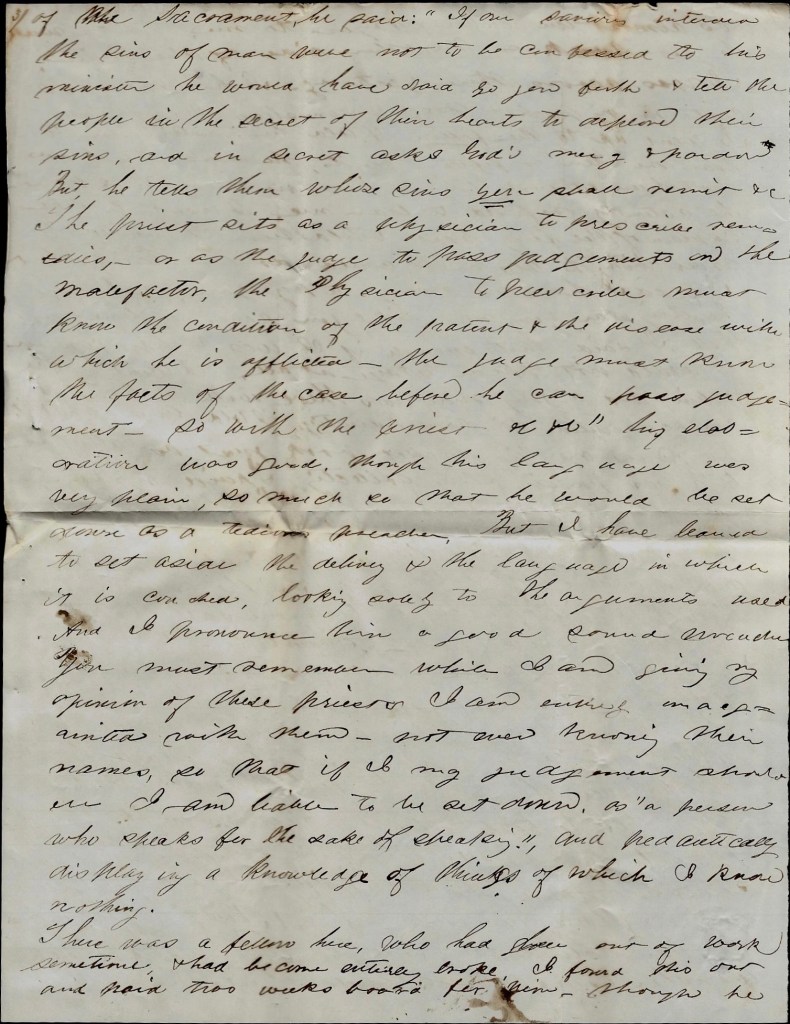
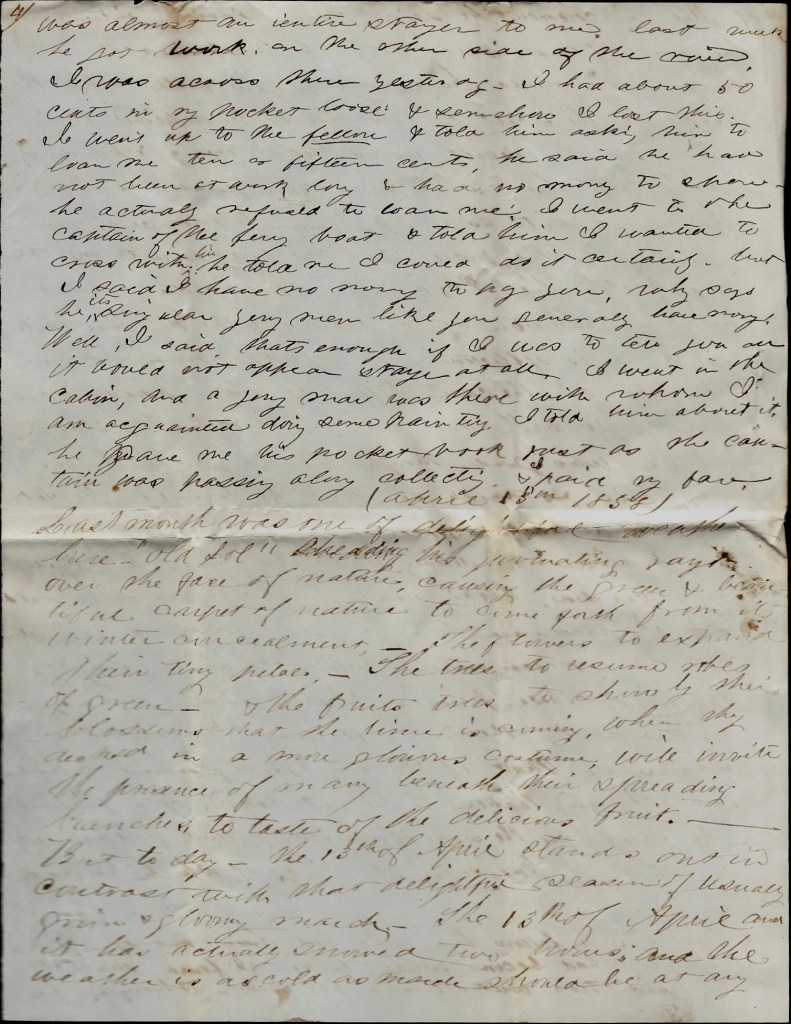
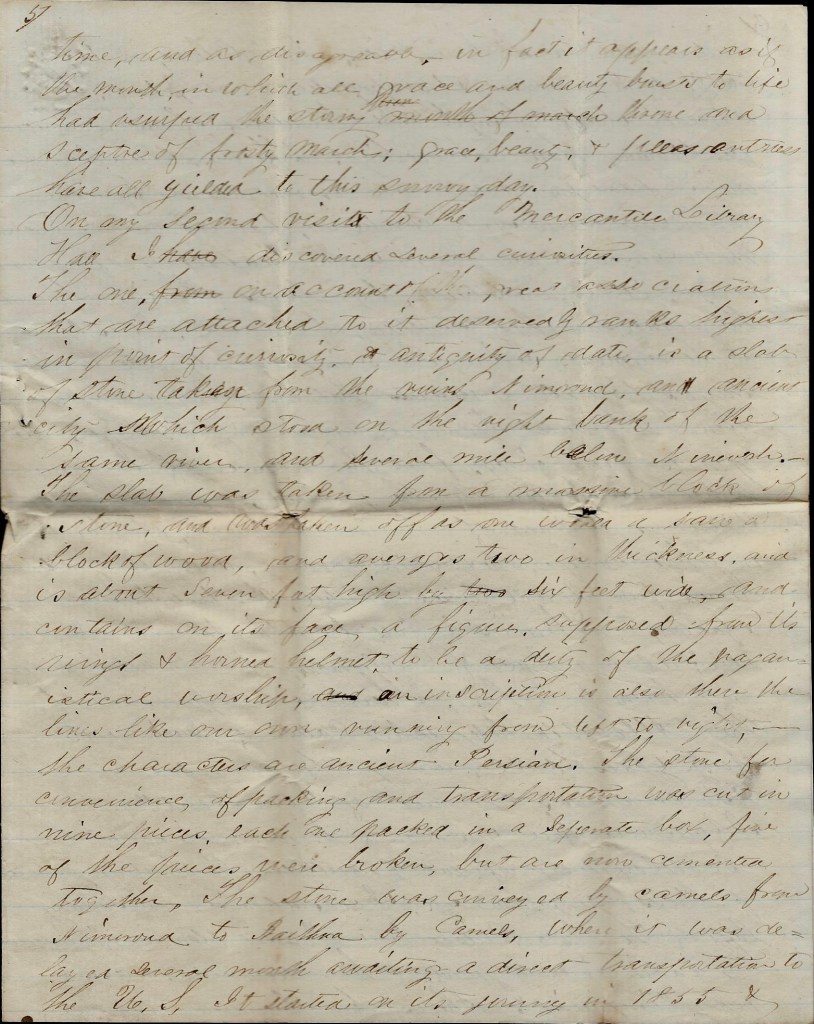
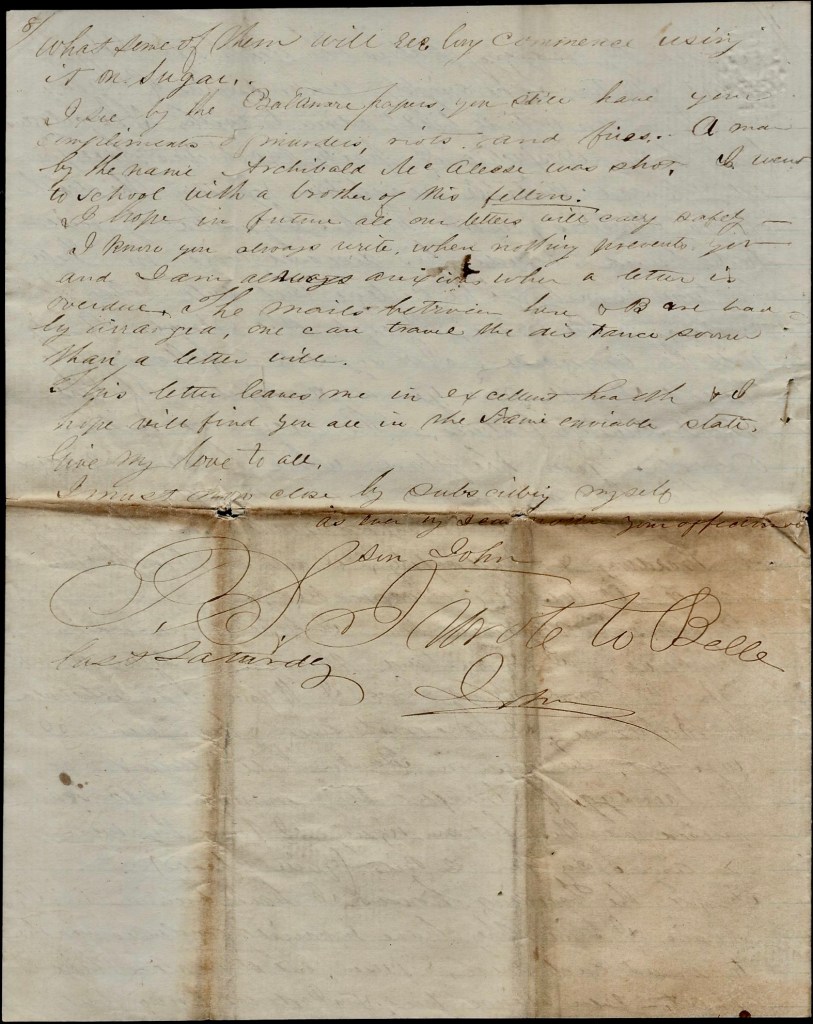
With a lot more time it might be possible to identify the author of this letter but for the time being he will remain simply “John.” The letter contains a great description of Saint Louis, Missouri, in the spring of 1858. From the letter we learn that John is contemplating opening a fruit stand in the city. The content also informs us that he was from Baltimore and that his mother still lived there.

From a description of the Mercantile Library Hall and its curiosities, to the “floating palaces” on the Mississippi, the interior and services at St. Patrick’s church, to the death of Thomas Hart Benton, John’s 8-page letter is bursting with “newsy” details.

Transcription

St. Louis, [Missouri]
April 11th 1858

My Dear Mother,

I received your letter on Friday, April 9th. The letter you speak of, my dear Mother, I never received, or I should have answered immediately. I had become extremely anxious as to the reason of your not writing and on yesterday week sat down & wrote you a letter telling you I had not received one from you for at least five or six weeks. My letters here have been so far irregular & hereafter when I do receive a letter from you at the regular time, if I am in the city, I will write, taking it for granted you have written & the letter miscarried.

I think it very likely I will soon leave off my wandering life and settle down in St. Louis for a time at least. If I can get what little money together I have, I will open a small retail fruit store, which business from what I have seen I am satisfied will pay, so that I can make not only a good living, but save something over besides to carry home & settle me in a small business near you & Belle and all those I love.
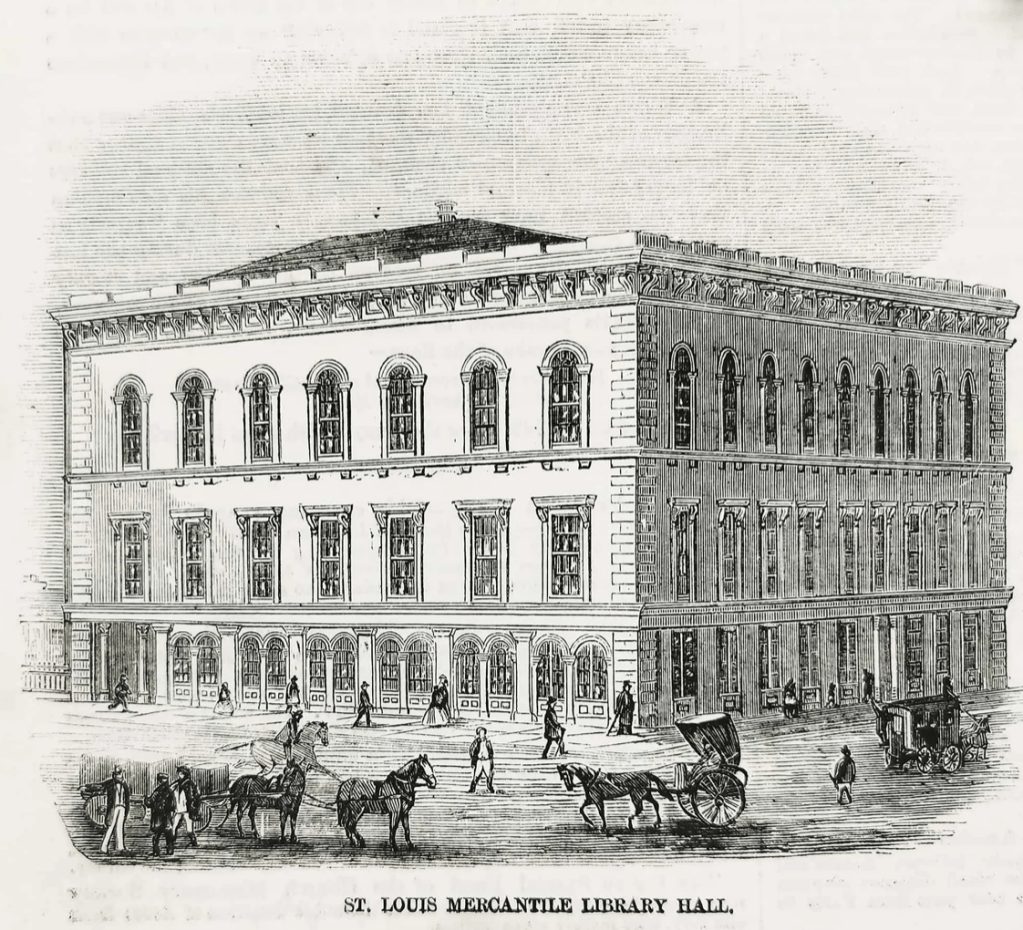
St. Louis Mercantile Library Hall, ca, 1858

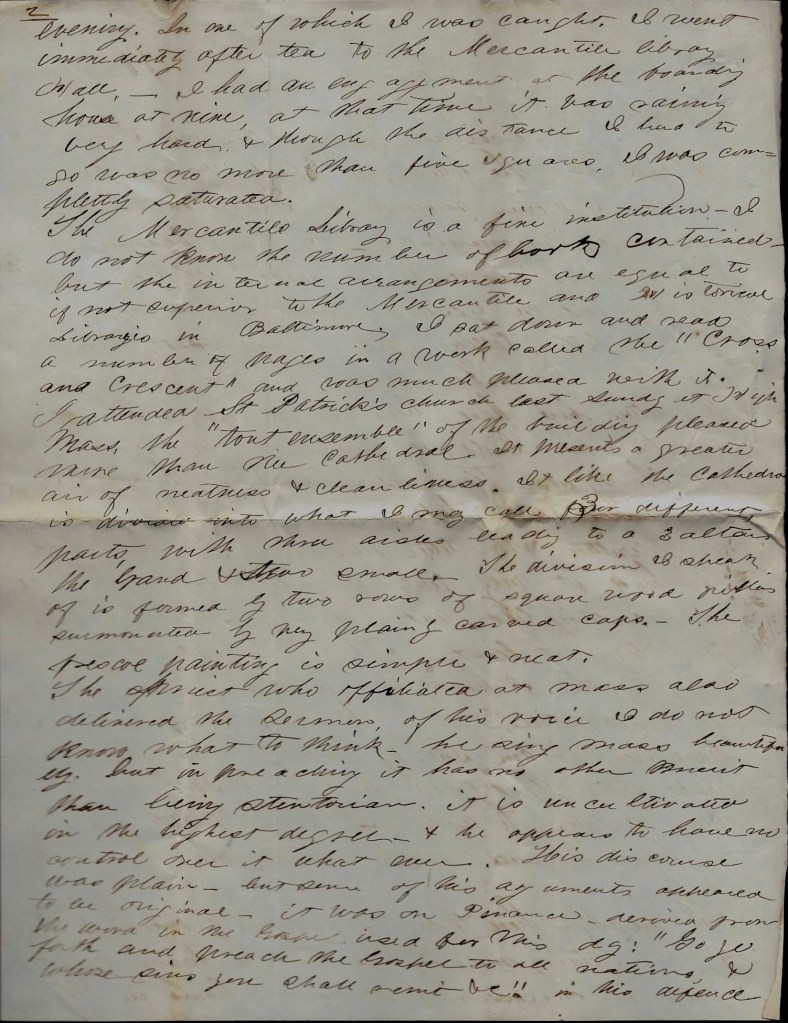
The weather here today is extremely warm and sultry. On Saturday morning we had a heavy gust, and gusts in succession for at least three hours in the evening, in one of which I was caught. I went immediately after tea to the Mercantile Library Hall. 1 I had an engagement at the boarding house at nine. At that time it was raining very hard & though the distance I had to go was no more than five squares, I was completely saturated.

The Mercantile Library is a fine institution. I do not know the number of books contained, but the internal arrangements are equal to, if not superior to, the Mercantile and Historical Libraries in Baltimore. I sat down and read a number of pages in a work called the  “Cross and Crescent” and was much pleased with it.

I attended St. Patrick’s church last Sunday at High Mass. The “tout ensemble” of the building pleased more than the Cathedral. It  presents a greater air of neatness & cleanliness. It, like the Cathedral, is divided into what I may call 3 different parts, with three aisles leading to three altars—the grand & two small. The division I speak of is formed by two rows of square wood pillars surmounted  by very plainly carved caps. The fresco painting is simple & neat. The priest who officiated at mass also delivered the sermon. Of his voice, I do not know what to think. He sings mass beautifully, but in preaching it has no other merit than being stentorian; it is uncultivated in the highest degree & he appears to have no control over it whatever. His discourse was plain, but some of his arguments appeared to be original. It was on penance—derived from the word in the gospel used for [ ]: “Go ye forth and preach the gospel to all nations &whose sins you shall remit, &c.” In his defense of the sacrament, he said, “If our Saior intended the sins of man were not to be confessed to his minuster, he would have said, go you forth & tell the people in the secret of their hearts to deplore their sins, and in secret ask Go’s mercy & pardon.” But he tells them whose sins you shall remit, &c. The priest sits as a physician to prescribe remedies, or as the judge to pass judgments on the malefactor. The physician, to prescribe. must know the condition of the patient & the disease with which he is afflicted. The judge must know the facts of the case before he can pass judgment. So with the priest, &c. His elocution was good, though his language was very plain, so much so that he would be set down as a tedious preacher. But I have learned to set aside the delivery & the language in which it is couched, looking solely to the arguments used, and I pronounce him a good, sound preacher. You must remember while I am giving my opinion of these priests, I am entirely unacquainted with them—not ever knowing their names, so that if I my judgment should err, I am liable to be set down as “a person who speaks for the sake of speaking,” & pedantically displaying a knowledge of things of which I know nothing.

There was a fellow here who had been out of work some time & had become entirely broke. I found this out and paid two weeks board for him though he was almost an entire stranger to me. Last week he got work on the other side of the river. I was across there yesterday. I had about 50 cents in my pocket loose & somehow I lost this. I went up to the fellow & told him, asking him to loan me ten or fifteen cents. He said he had not been at work long & had no money to spare. He actually refused to loan me. I went to the captain of the ferry boat & told him I wanted to cross with him. He told me I could do it certainly, but I said I have no money  to pay you. “Why,” says he, “it’s singular. Young men like you generally have nary.”

“Well,” I said, “that’s enough. If I was to tell you all, it would not appear strange at all.” I went in the Cabin and a young man was there with whom I am acquainted doing some painting. I told him about it. He gave me his pocket book just as the captain was passing along collecting & paid my fare.

April 13th, 1858

Last month was one of delightful weather here. “Old Sol” shedding his penetrating rays over the face of nature causing the green and beautiful carpet of nature to come forth from its winter concealment; the flowers to expand their tiny petals; the trees to resume robes of green; and the fruit trees to show by their blossoms that the time is coming when they decked in a more glorious costume, will invite the presence of many beneath their spreading branches to taste of the delicious fruit.

But today, the 13th of April, stands in contrast with that delightful season of usually grim & gloomy March. The 13th of April and it has actually snowed two times and the weather is as cold as March should be at any time, and as disagreeable. In fact, it appears as if the month in which all grace and beauty bursts to life had usurped the stormy throne and scepter of frosty March; grace, beauty, and pleasantness have all yields to this snowy day.

On my second visit to the Mercantile Library Hall, I discovered several curiosities. The one, on account of the great associations that are attached to it, deservedly ranks highest in point of curiosity & antiquity of date, is a slab of stone taken from the ruins of Nimrud—an ancient city which stood on the right bank of the same river and several miles below Nineveh. The slab was taken from a massive block of stone and was taken off as one would saw a block of wood, and averages two in thickness and is about seven feet high by six feet wide and contains on its face a figure, supposed from its wings & horned helmet to be a deity of the paganistical worshippers. An inscription is also there, the lines like our own, running from left to right. The characters are ancient Persian. The stone, for convenience of packing and transportation, was cut in nine pieces, each one packed in a separate box. Four of the pieces were broken, but are now cemented together. The stone was conveyed by camels from Nimrud to B_____a by camels, where it delayed several months awaiting a direct transportation to the U. S. It started on its journey in 1855 & arrived in St. Louis, via New Orleans, in 1857. Cost of wor, in ruins, & transportation, cost $150. The stone of itself, through the kindness of an American gentleman there, cost nothing.

The next, unlike the one I have just mentioned, is not food for the devouring curiosity of virtuous, but one on which the connoisseur can gaze with sentiments of admiration. It is a statuette by Miss Harriet [Goodhue] Hosmer, the American lady sculpture of Verona. It is taken at the moment when Paris, impelled by the soothsayer’s prediction that he should in Greece find the most beautiful woman of the ages, departs from Troy; from the violence of her grief, she has fallen to the ground.
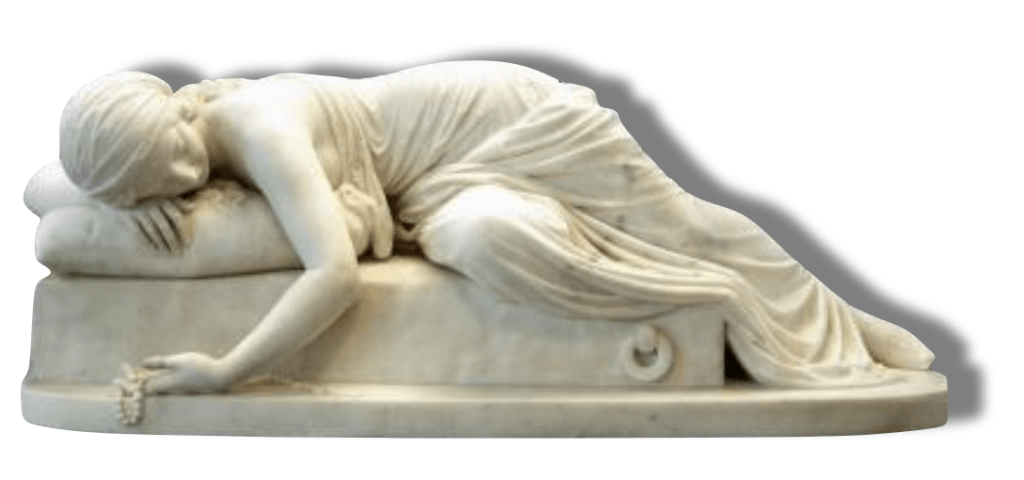
Harriet Hosmer’s sculpture of Beatrice Cenci (1857)

There is a of bust of Dr. [Joseph Nash] McDowell of this city in whose college she [Hosmer] studied anatomy and in gratitude hewed from the dull marble this bust of her benefactor. There is a full length statue of Daniel Webster. Also a bust of Christopher Columbus. The two latter I do not know by whom. There is a specimen of the Atlantic telegraph cable, banks notes forty years old, &c., among the number one for the enormous amount of “one cent.”

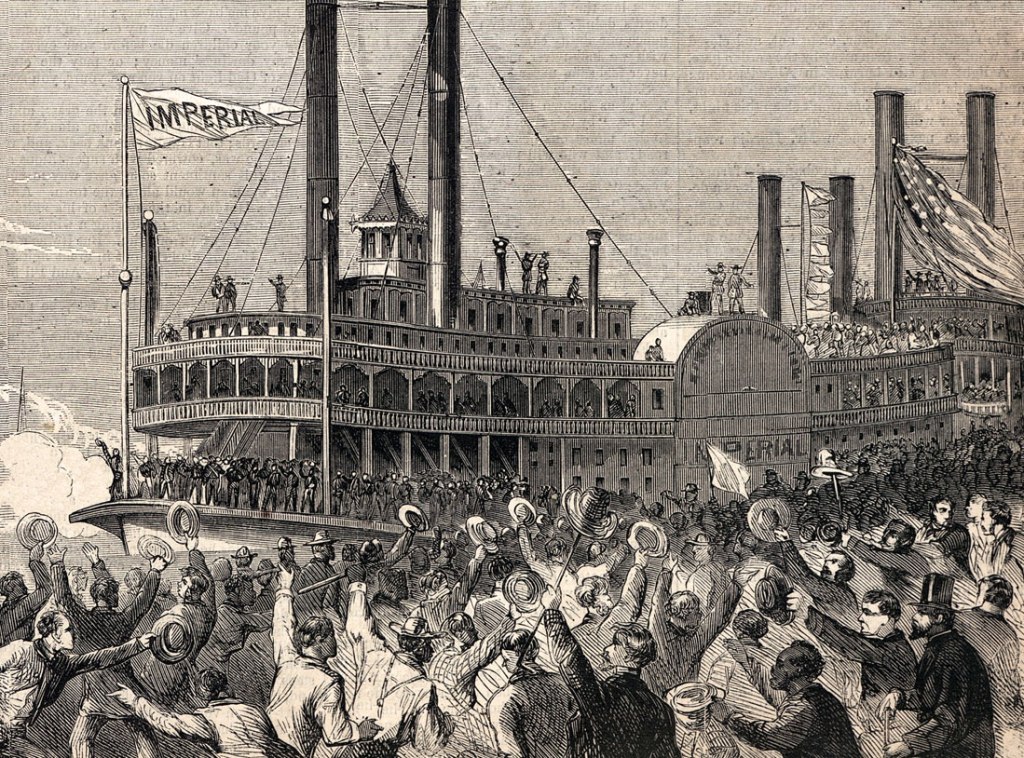
If you were here, you would be astonished at the scale of magnificent grandeur the floating palaces of Mississippi are gotten up. I was aboard on Sunday last of the New Railroad line Packet steamer “Imperial.” Her cabin is really grand & her decorations are really “imperial.” She is three hundred feet long.
I see by the papers the death of Col. Thomas Hart Benton. The mighty contemporaries of Clay & Calhoun are rapidly bidding adieu to earth. The citizens of St. Louis irrespective of party proclivities have joined and passed a suitable resolution regretting the death of an illustrious person; he has bequested by will to be buried beside his deceased wife in Bellefontaine Cemetery. The cortege that will follow his remains to the grave through the streets of the city will be immense. In my letter following the event, I will give you a description of the most striking features. He will rest within 6 miles from the place where he sent two men to their last account & to an eternity.

I have removed to my old quarters on the corner of Broadway and Mulberry. I did not like the other place. It was very disagreeable.

Business is very dull here. I hope it will soon brisk up. I understand through a letter from W. P. Cam___ that Joe I. Wynn has returned to Baltimore. I have not seen him since I was out. He was in Bunker Hill, Illinois.
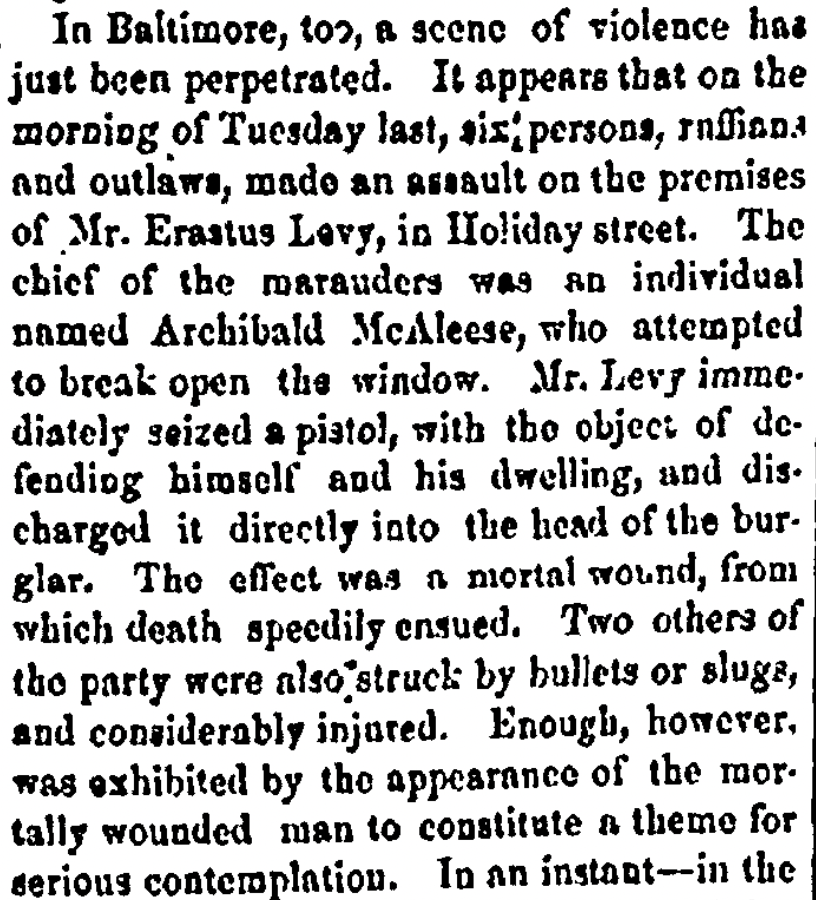
Philadelphia Inquirer, 9 April 1858. Archibald McAleese shot by storekeeper Erastus Levy, the keeper of a drinking shop on Holiday Street in Baltimore.

We have eggs for breakfast every morning. I was surprised at this, but on inquiry I found they were selling 3 dozen for 2 bits (quite cheap). In all the boarding houses I have been in in St. Louis, I find they have invariably molasses on the table at each meal, & persons eat it on all things most—even mince pies—and I do not know but what some of them will before long commence using it on sugar.

I see by the Baltimore papers you still have your compliments of murders, riots, and fuss. A man by the name Archibald McAlesse was shot. I went to school with a brother of his felon.

I hope in future all our letters will carry safely. I know you always write when nothing prevents, yet I am always anxious when a letter is overdue. The mails between here and Baltimore are badly arranged. One can travel the distance sooner than a letter will.

This letter leaves me in excellent health & I hope will find you all in the same enviable state. Give my love to all. I must now close by subscribing myself as ever, my dear Mother, your affectionate son, — John

P. S. I wrote to Belle last Saturday.


1 In December 1845 a group of civic leaders and philanthropists joined to establish a membership library with the intent of creating a place “where young men could pass their evenings agreeably and profitably, and thus be protected from the temptations to folly that ever beset unguarded youth in large towns. The library officially opened on April 19, 1846, and became chartered by the State of Missouri that year. At the time, public libraries were not a standard institution. The St. Louis Mercantile Library, with a reading room, meeting rooms, book stacks, and the largest auditorium in the city, became a primary hub of cultural and intellectual interchange in the city in the years preceding commonplace public and academic libraries. [Wikipedia]

1862: Willard Morse to Hobart Bradley Ford

I could not find an image of Willard but here’s a tintype of Almeron Bickford (1829-1904) who served in Co. E, 11th Vermont (1st Vermont Heavy Artillery).

The following letter was written by Pvt. Willard Morse (1833-1864) who enlisted in Co. F, 11th Vermont Infantry in the summer of 1862. Being assigned duty in the defenses of Washington D. C., this regiment was soon changed to heavy artillery and renamed the 1st Vermont Heavy Artillery. Once in Washington, this regiment remained for the next 20 months garrisoning Federal forts. Following the Battle of the Wilderness in May 1864, the regiment was sent sent to the field as infantrymen, joining the Old Vermont Brigade in Grant’s army at Spotsylvania.

Willard was the son of David Sunderland Morse (1805-1882) and Mary Willard (1805-1845). He was married to Martha “Elizabeth” Cummings (1838-1906) in October 1847, had two young daughters, and was living in Morgan, Orleans county, Vermont when he enlisted. He was taken prisoner “while on a raid on the Weldon Railroad near Petersburg” on 23 June 1864 and held at Andersonville Prison in Georgia where he died of chronic diarrhea and starvation some six weeks later on 3 August 1864. Willard’s death on 2 August was described in George W. Dewey’s diary.

The letter was addressed to Willard’s cousin whom he called “Ford.” I believe this was Hobart Bradley Ford (1826-1910) who married Lucy Ann Morse (1829-1908), Willard’s cousin.

Willard’s letter was written from Fort Lincoln where they had recently been digging rifle pits to augment the fort’s defenses in the event that Lee’s army had turned on Washington rather than attacking Harper’s Ferry and heading into Western Maryland. Willard praises McClellan’s performance at South Mountain (“He done well, didn’t he?”) and describes seeing the smoke and hearing the artillery 70 miles away from their defenses at Fort Lincoln. Little could he have imagined the carnage that would occur at Sharpsburg the day after this letter was written.

Transcription

Fort Lincoln, Washington [City]
Tuesday morning, September 16, 1862

Absent cousin,

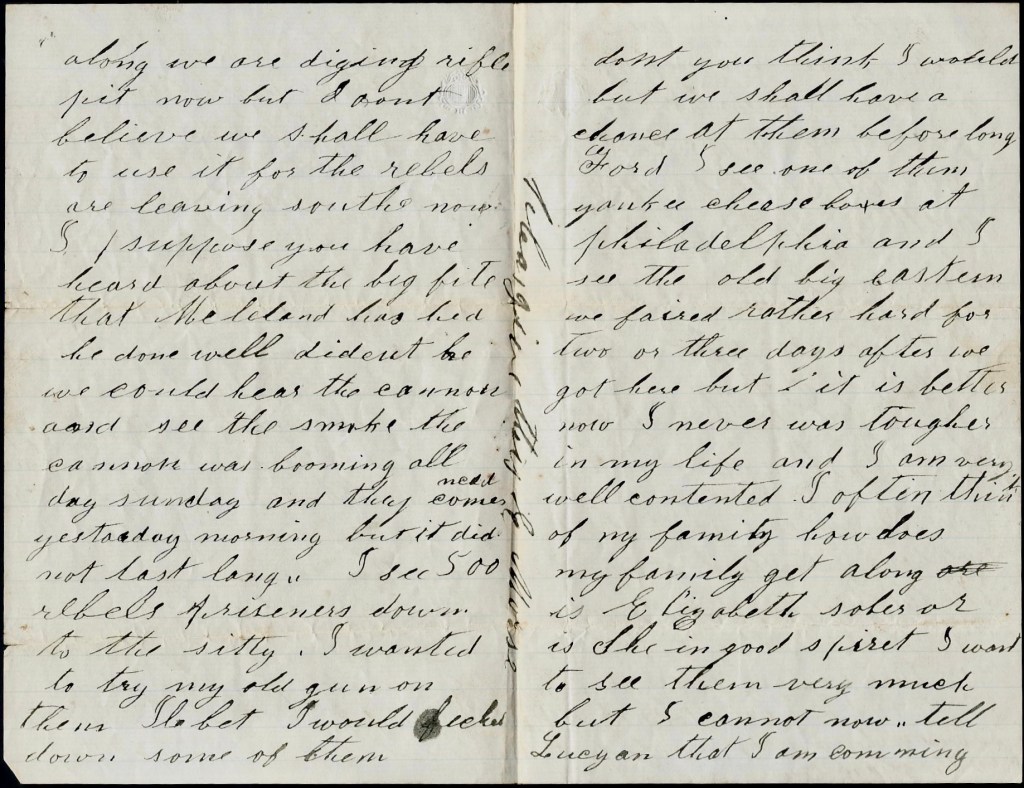
I now take my pen to write a few lines to you to let you know that I am yet alive and well and hope this will find you the same. I guess you began to think that I was not agoing to write to you but we have had so much to do that I could not write so you must excuse me this time. I guess Elizabeth has forgot me for I have not had a letter from her for a long time.

I suppose you want to know how we are getting along. We are digging rifle pits now but I don’t believe we shall have to use it for the rebels are leaving south now. I suppose you have heard about the big fight that McClellan has had. He done well, didn’t he. We could hear the cannon and see the smoke. The cannon was booming all day Sunday and they commenced yesterday morning but it did not last long. I see 500 rebel prisoners down to the city. I wanted to try my old gun on them. I’ll bet I would [have] fetched down some of them, don’t you think I would. But we shall have a chance at them before long.

Ford, I see one of them Yankee cheese boxes at Philadelphia and I see th old big Eastern. We fared rather hard for two or three days after we got here but it is better now. I never was tougher in my life and I am very well contented. I often think of my family. How does my family get along? Is Elizabeth sober or is she in good spirit? I want to see them very much but I cannot now tell Lucyann that I am coming in with my dirty feet to step on her clean floor. How does Orren and Townsend get along? I wrote to Orren and Elizabeth Sunday.

Well, Ford, I must close for we have got to go to work. Write as soon as you get this. Direct to Washington, 11th Regiment, Co. F, in care of Capt. [James] Rice. We have got the best captain in the regiment. The first day we dig rifle pits, they said we dug more than any regiment ever dug in 3 days and our captain told us if [we] worked so another day, he would put us in the guard house.

Goodbye, — W. Morse

Write soon.

1862: Virginia (Ellison) Bonner to Macon Bonner

This letter was written by Virginia Neville Alderson Ellison (1842-1907). the daughter of Henry Alderson Ellison (1801-1863) and Eliza Ann Tripp (1818-1880) of Beaufort county, North Carolina. Virginia married in 1860 to Macon Bonner (1836-1908) and was residing in Washington, North Carolina when the Civil War began in 1861. The couple had two small children, Elizabeth and Richard.

Confederate service records inform us that Macon Bonner was 25 years old when he enlisted in September 1861 as a 1st Lieutenant in Capt. William H. Tripp’s company (McMillan Artillery). By 1862 this unit was known as of Co. B, 40th Regiment N. C. Troops (Artillery) or the 3rd North Carolina Artillery. Macon was taken prisoner at Fort Anderson on 19 February 1865 and transferred to Washington D. C., and then to Fort Delaware where he remained until his release in mid-June 1865.

In the letter “Bettie” Blount is mentioned. Bettie was Elizabeth Watkins (Perry) Blount, the wife of Lieut. John Gray Blount (1831-1914) of the the same unit that Macon served in. He was acting quartermaster for a time and then in March 1863 he was promoted to Captain in the Quartermaster’s Department. He later rose to Major.

At the time this letter was penned in May 1862, Washington, North Carolina, was occupied by Federal forces and the 3rd North Carolina Artillery was posted at Fort Hill a few miles below Washington on the Confederate side of the Pamlico river. It appears that Virginia Bonner was visiting the Satterthwaite family elsewhere in Washington county when she wrote this letter to her husband who must have been stationed with or somewhere near his children. The Ellison and Satterthwaite families were related by marriage.

The letter itself is of considerable interest as it includes discussion of the large group of contraband presently in Washington, North Carolina, as well as multiple mentions of “the colonel”—a Union leader residing in the area whose jurisdiction included deciding who among the inhabitants got their “property” (slaves) back and who didn’t. Although technically not a colonel at the time of the letter, it would not have been surprising for him to portray himself as such to the local population, given his expectation that he would likely soon be a regiment commander.

Edward Elmer Potter

It’s very likely the “colonel” was Edward Elmer Potter who enlisted (from NY) as Captain in the US Commissary Department and was known to be in Washington, North Carolina, at the time, assigned to Gen. Foster’s command. Turns out that at the time of this letter, Potter was also heavily involved in fostering connections with local citizens having Union sentiments (of which there were quite a few). Based on these contacts, Potter was a major recruiter the 1st NC Infantry Regiment (Union), with himself as a Lt. Col (one month later as Col., and subsequently Brigadier Gen. and finally being discharged in 1865 as Brevet Major Gen.). The formation of this unit had been authorized by Gen. Burnside the same month as the present letter.

The Bonner family was considered the first family of Washington, NC, with the town formed and named in 1776 (1st city in U.S. to be so named in honor of Gen. Washington) by James Bonner (probably related to Macon), a local landowner and politician who fought as an officer in the Revolutionary War. Macon’s father, Richard Hardison Bonner, was a soldier in the War of 1812. Macon himself would go on to become postmaster of Washington, NC following the war.

Many more of Virginia’s letters can be found in the Wilson Special Collections Library at the UNC Library under the title: Macon Bonner Papers, 1862-1864.

[Note: This letter is from the personal collection of Richard Weiner and was transcribed and published on Spared & Shared by express consent.]

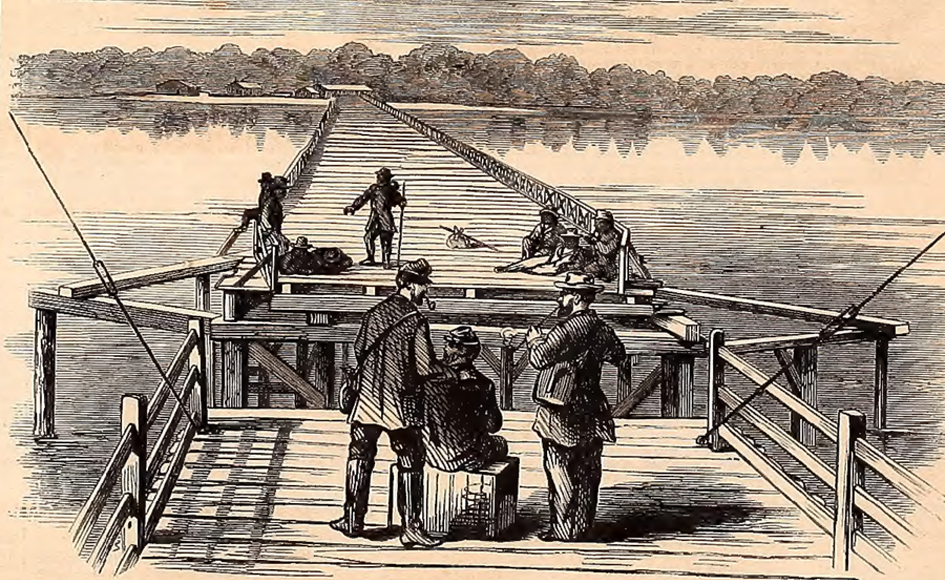
Drawbridge over the Tar River at Washington, NC, June 1862

Transcription

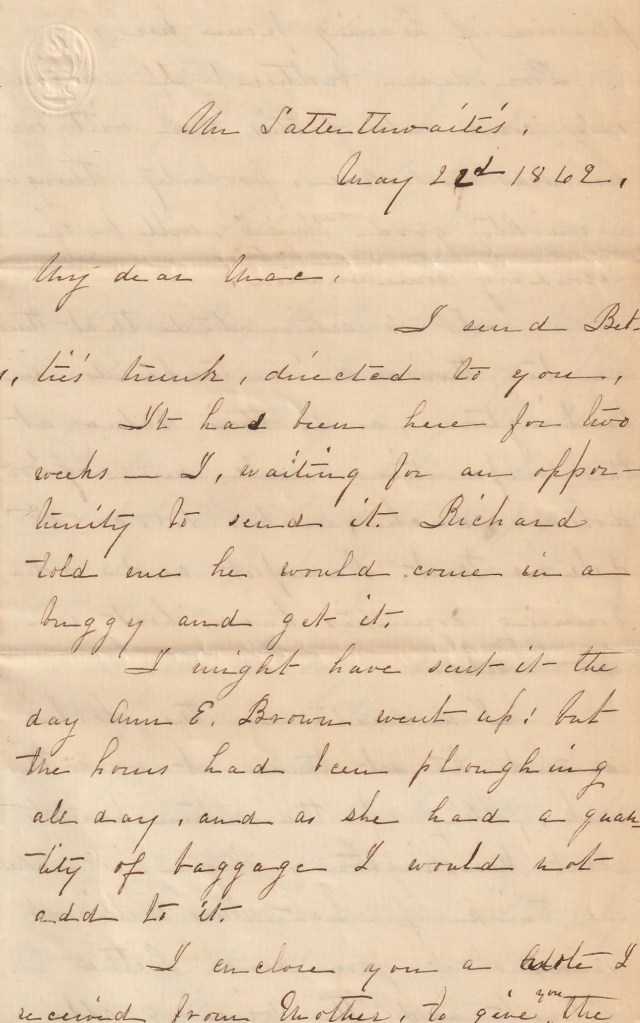
Mr. Satterthwaite’s
May 22d 1862

My dear Mac,

I send Bettie’s trunk, directed to you. It had been here for two weeks, I waiting for an opportunity to send it. Richard told me he would come in a buggy and get it. I might have sent it the day Ann E. Brown went up, but the hours had been ploughing all day, and as she had a quantity of baggage I would not add to it.

I enclose you a letter I received from Mother to give you the pleasure of hearing from her.

Poor dear brother! If we can only come out of this war with our numbers unbroken, property—though a mighty good thing—will be of secondary consideration. It is estimated that there are two thousand ‘contrabands’ in Washington and their value at the comparative small sum of 500 dollars each, makes 1,000,000 dollars that Beaufort and adjoining counties have lost in two weeks. I understand the Col. intends to set them at work this week filling up the entrenchments about Washington.

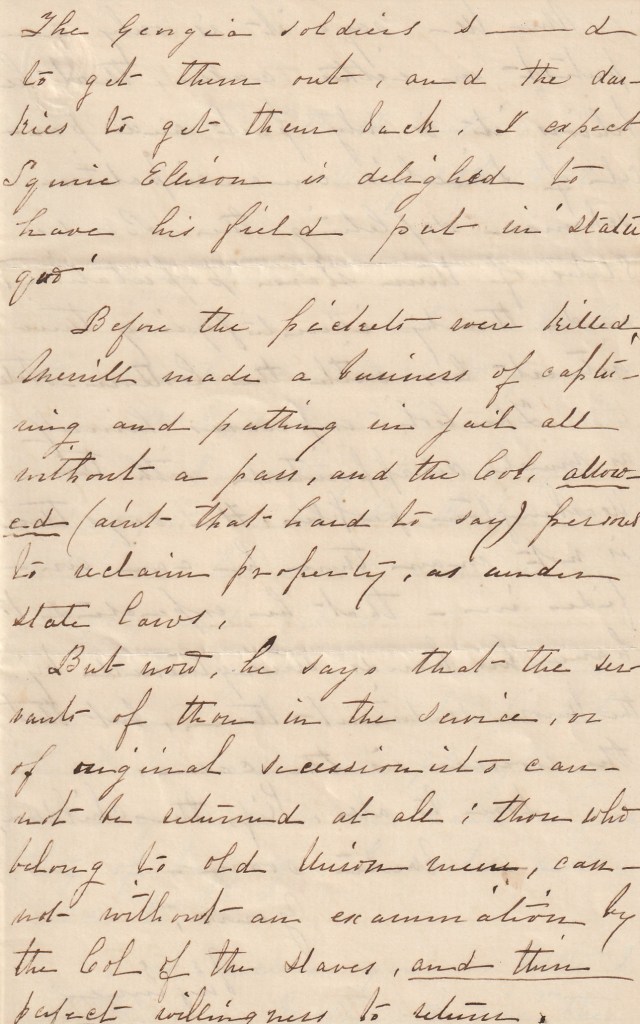
Mac, it makes me think of what Mrs. Williams said about you and Bettie Blount and the wire-grass. The Georgia soldiers s________d to get them out, and the darkies to get them back. I expect Squire Ellison is delighted to have his field put in status quo.

Before the pickets were killed, Merrill made a business of capturing and putting in jail all without a pass, and the Col. allowed (ain’t that hard to say) persons to reclaim property as under State laws. But now, he says that the servants of them in the service, or of original secessionists cannot be returned at all. Those who belong to old Union men cannot without an examination by the Col. of the slaves, and their perfect wilingness to return.

Mr. Williams says it is only a pretext in either case, that he believes it is only part and parcel of Lincoln’s emancipation scheme—depleting the Border States of their slave population and thereby identifying their interest less with the Cotton States.

The Col. expresses himself as much disappointed with the Washington people. He says there is not a man there he can confide in—that he expected to have his hands strengthened by the Union sentiment there but that the reverse is the case.

Love to all. Kiss the children. Write soon. Yours, — Virginia

1861: Asa Gillett to Savilla Gillett

I could not find an image of Asa but here is a CDV of William Ulrich who also served in Co. A, 2nd Illinois Cavalry (Cowan’s Auctions)

The following letter was written by 19 year-old Asa W. Gillet (1842-1891) who enlisted at White Rock, Illinois, as a private in Co. A, 2nd Illinois Cavalry on 4 September 1861. Asa reenlisted after three years and on 25 June 1865 he was transferred to Co. E as a corporal. He mustered out of the regiment at San Antonio, Texas, on 22 November 1865.

In the 1850 Us Census, 10 year-old Asa was enumerated in his parents home in Chagrin Falls, Cuyahoga county, Ohio, with his older sister Savilla and three younger siblings. His parents were John Gillet (b. 1812) and Lucy Wheeler (1819-1851). In 1860, the family was still living in Chagrin Falls but Asa’s father had remarried and there were additional younger siblings.

After the war, Asa returned to Cuyahoga county, Ohio, where he found employment as a canal boatman. He was married to Minerva C. Hawkins (1845-1908) in 1869. In 1890, the Gillett’s were living in Tuscarawas county Ohio.

Transcription

[Duquoin, Perry county, Illinois]
September 14, 1860 [should be 1861]

Dear Sister,

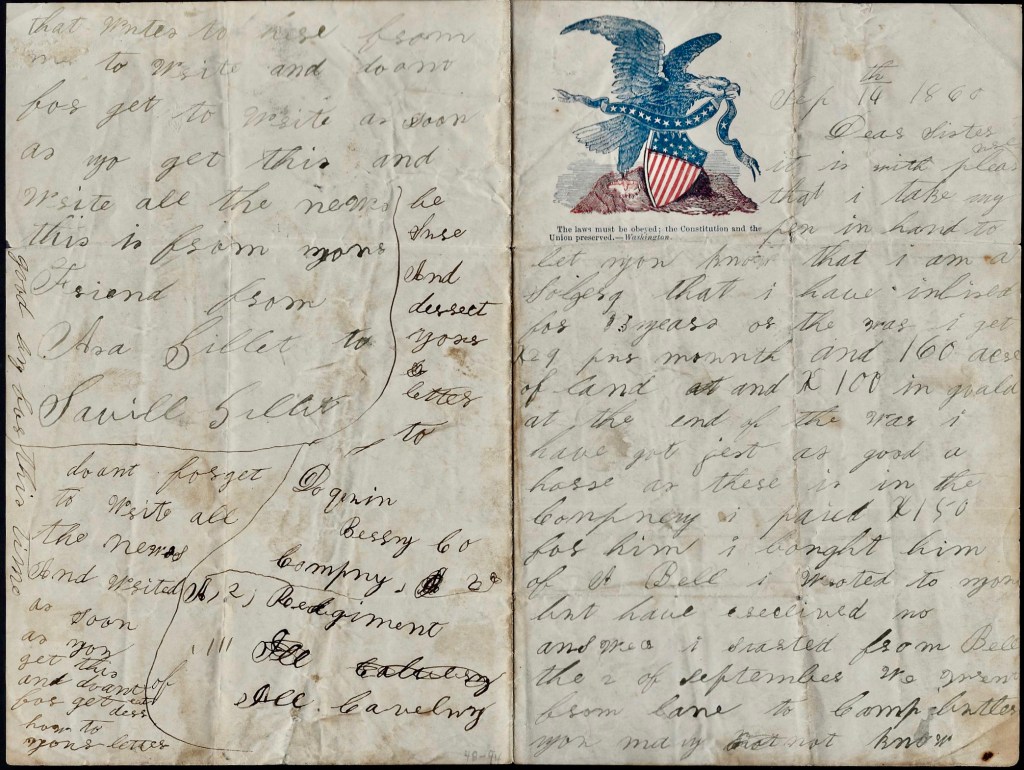
It is with pleasure that I take my pen in hand to let you know that I am a soldier—that I have enlisted for 3 years or the war. I get $28 per month and 160 acres of land and $100 in gold at the end of the war. 1 I have just as good a horse as there is in the company. I paid $150 for him. I bought him off A. Bell.

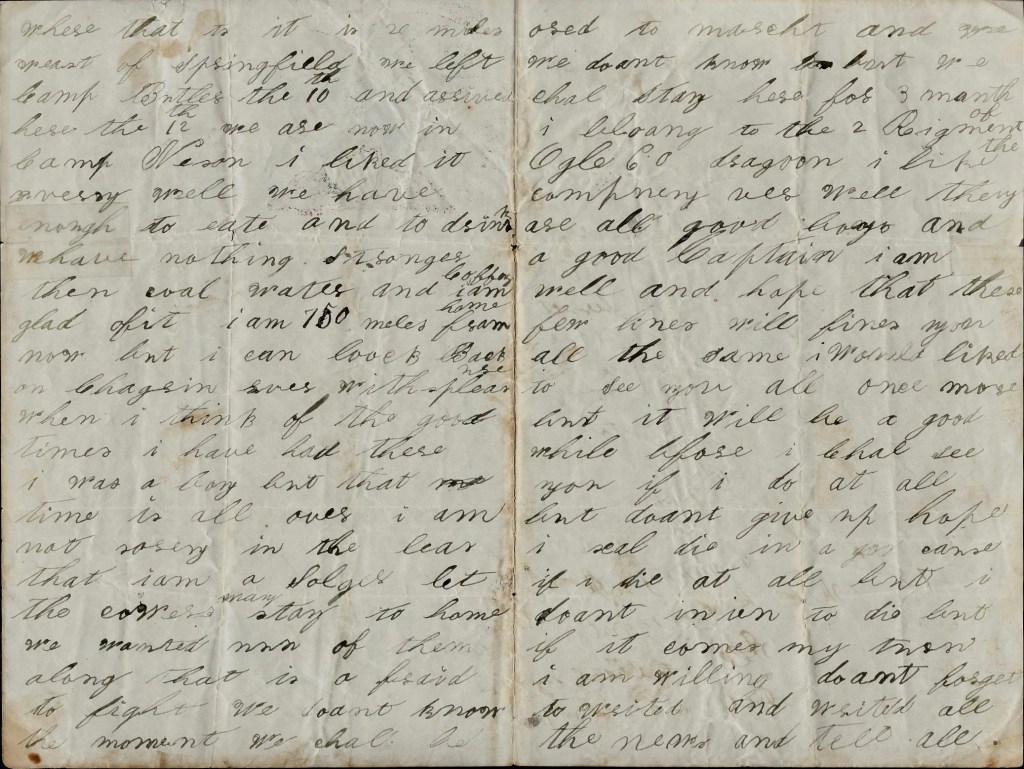
I wrote to you [before] but have received no answer. I started from Bell’s the 2nd of September. We went from Lane [Ogle county] to Camp Butler. You may not know where that is. It is 20 miles west of Springfield. We left Camp Butler the 10th and arrived here the 12th. We are now in Camp Nelson. I like it very well. We have enough to eat and to drink. We have nothing stronger that cold water and coffee. I am glad of it,

I am 750 miles from home now but I can look back on Chagrin [Falls] ever with pleasure when I think of the good times I have had there [when] I was a boy but that time is all over. I am not sorry in the least that I am a soldier. Let the cowards stay to home. We want none of them along that is afraid to fight. We don’t know the moment we shall be ordered to march and we don’t know but we shall stay here for three months.

I belong to the 2nd Regiment of Ogle County Dragoons. I like the company very well. They are all good boys and a good Captain. 2 I am well and hope that these few lines will find you all the same. I would like to see you all once more but it will be a good while before I shall see you, if I do at all. But don’t give up hope. I shall die in a good cause if I die at all but I don’t intend to die. But if it comes my turn, I am willing. Don’t forget to write and write all the news and tell all from home to write and do not forget to write as soon as you get this. This is from your friend, —Asa Gillet

To Saville Gillet

Be sure and direct your letter to Duquoin, Perry Co., Company A, 2nd Regiment, Illinois Cavalry


1 These promises of pay and land seem inflated to me. The 1862 Homestead Act allowed for anyone to get 160 acres of government land and gave priority to Civil War veterans. Veterans were also allowed additional land, up to another 160 acres, but one had to live on the land for 5 years and make improvements. Since this letter pre-dated the passage of the Homestead Act, it isn’t clear to me how this promise was made to Asa. The $29 per month included the government allowance for the feeding and care of the horses.

2 The Captain of Co. A, 2nd Illinois Cavalry was John R. Hotaling of Lane (now Rochelle), Illinois.

1863: Mathias Edgar Richards to George Richards

The following letter was written by Lt. Mathias Edgar Richards (1830-1876) who enlisted on 23 September 1861 in the 96th Pennsylvania Infantry and was made the adjutant of the regiment. He later served as the Aide-de-Camp to General Joseph J. Bartlett.

Mathias Edgar Richards was born in New Hanover township, Montgomery County, Pennsylvania. His parents were George Richards (1788-1873) and Maria Matthias (b. 1885). He came from Pottstown, Pennsylvania, to attend college at Penn’s 9th Street campus and graduated as one of twenty members of the Class of 1851. After graduation he became a lawyer in Pottsville. During the Civil War, Richards was a member the Army of the Potomac, serving first (in 1861) with the 25th Pennsylvania Regiment of U.S. Volunteers, then with the 96th Pennsylvania Regiment U.S. Volunteers, and finally, in 1864, as an assistant adjutant general on the staff of General Bartlett. [Source: University of Pennsylvania]
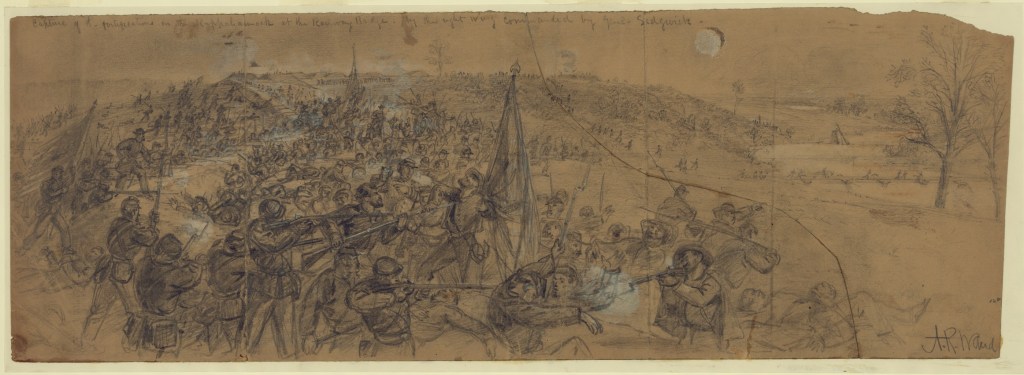
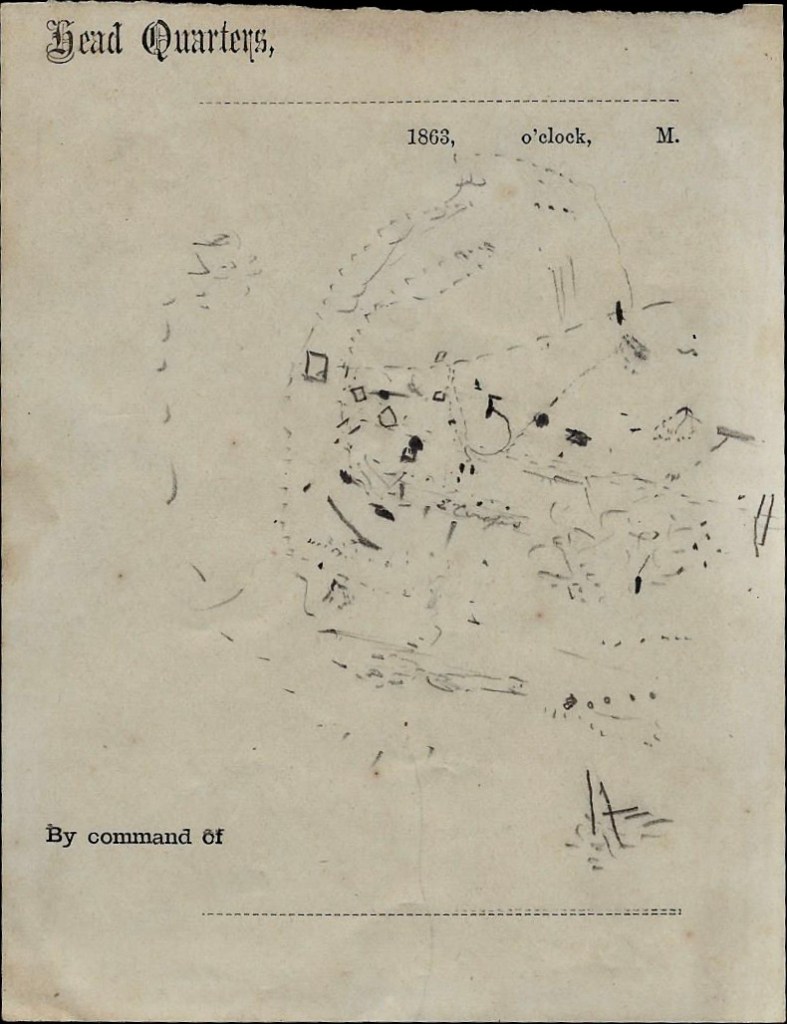
Richards’ letter contains a brief reference to the surprise attack at dusk on Saturday, 7 November 1863, in which the Union army forced their way across the Rappahannock and overran the Confederate bridgehead at Rappahannock Station, capturing about 1,600 Confederates, and forcing the balance of Lee’s army to retreat below the Rapidan river. This engagement is sometimes referred to as Rappahannock Station II. Richards’ letter also includes a rather crude hand-drawn map.

Artist Alfred Waud called this drawing “Capture of the fortifications on the Rappahannock at the Railway Bridge–by the right wing commanded by Genl. Sedgwick” (Library of Congress).

Transcription

Addressed to George Richards, Esqr. Pottstown, Montgomery county, Pennsylvania

Camp near Kelly’s Ford
November 10, 1863

Dear Father,

I take the opportunity of dropping you a few lines to let you know that I am safe and well. The 5th and 6th Corps attacked and took the fortifications at Rappahannock Station on Saturday by storm, taking 4 guns and 1580 prisoners. Gen. Bartlett has been assigned to command the 1st Division of the 5th Corps, and of course has taken me with him, so can direct all mail matter that way. Of course, I do not know how long we will stay here.

At present our division and the 3rd Division in the 6th Corps are stationed at Kelly’s Ford. The balance of the corps are on the other side of the river.

I have no news to write of our future movements. No one seems to have the least idea of what we are going to do. Our advance on the Rebs was a complete surprise but the trouble was there was no large force of them to attack this side of the Rapidan.

Your affectionate son, — M. E. Richards

I will write more fully when we get settled.

1847: Aura M. Hugunin to Elizabeth Gladwin

I could not find an image of Aura but here is a young woman whose image dates to the late 1840s.

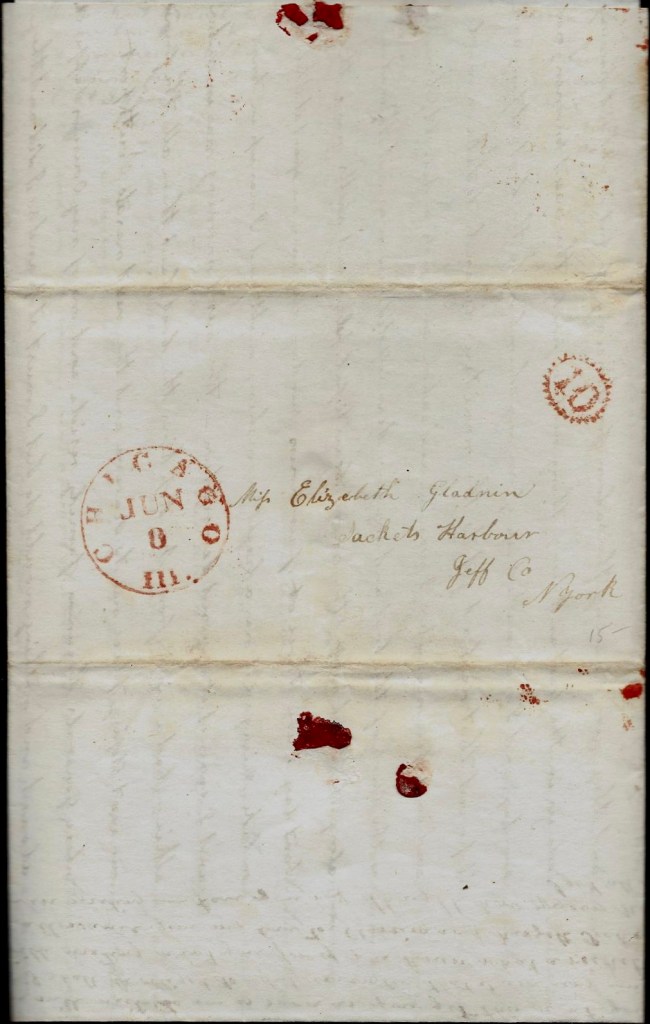
The following letter was written by 19 year-old Aura M. Hugunin (1827-1914), the daughter of Robert H. Hugunin (1792-1862) and Eleanor Waring (1804-1873) of Chicago, Cook county, Illinois. Aura’s father was a veteran of the War of 1812, a ship owner, and also a ship captain, sailing out of Chicago. Aura was married twice; first to Calvin D. Bristol (1817-1852), and second to Ephraim Holton (1814-1865). Both husbands were born in New York State.

From the letter we learn that Aura had only recently relocated from New York State to Chicago with her family which included not only her parents, but younger siblings named William (b. 1829), Robert (b. 1835), and Caroline (b. 1839). On the passage down Lake Michigan, the steamboat stopped at Southport (which is present day Kenosha) where Aura was persuaded to spend a few days with her uncle “General Hugunin” and his family. I believe this was Daniel Hugunin, Jr. (1790-1850) who served as a US Congressman from New York State in the late 1820s.

Aura wrote the letter to her friend, Elizabeth Gladwin (b. 1830), the daughter of William H. Gladwin (1797-1876) and Eleanor M Daniels (1802-1874) of Sacket’s Harbor.

Aside from her description of the trip from Sacket’s Harbor, New York, to Chicago Illinois, by way of railroad and steamboat, Aura shares her fist impressions of Chicago which were not very favorable. “It is a very large city but not a very genteel one. Everything looks so common to me—the streets so dirty. But it is all hurly burly. The greatest business place you ever saw. Everyone seems to be about crazy-looking and running every which way. ” And then she added, “The gentlemen look about as the city does—rather unpolished. You needn’t think that I am going to fall in love with the hoosiers here, I can tell you, for I have stood unmoved in more polished circles.”

Transcription

Chicago [Illinois]
Sunday, June 6th 1847

Dear Elizabeth,

Agreeably do I fulfill the promise we contracted when we last parted; and having somewhat recovered from the fatigue and excitement of our journey and once more get set down and collecting scattering thoughts, my mind wanders back to Sacket’s Harbour and happily do I say that I left you all reluctantly and with feelings of soul felt gratitude to most of you for while we lived at your place I was dependent upon the treatment of others for my enjoyment and I was perfectly satisfied that in my case, the old adage was more than verified (that merit meets with its own reward). And if my conduct was worthy to warrant kindness and friendship from my acquaintances, it shows plainly that they are charitable; and do by others as they would wish others to do by them, and I will try to do justice to their feelings.

Now I must tell you, Libbie, how we all are and how we enjoyed our [journey] through the lakes. You will know that we enjoyed ourselves when I tell you that we were not sick a bit the whole way and that was almost a miracle for I never went the length of Lake Ontario without being very seasick before. We were just a week and one night getting to Chicago.

Monday evening we left Sacket’s and the next morning if I did not have my lunch [ ] to Oswego. I went up to Cousin Henry’s where I visited last summer and took breakfast and returned to the boat to receive calls as the news got there before we did that we were on our way to Chicago and we had the pleasure of seeing all our relations and friends and to bid them goodbye and I left Oswego very tired but pleased that we had seen all our friends. We had a delightful time to Lewiston with but one exception—that is we had to get up in the morning about three o’clock (and oh, I was so sleepy) to take the morning train of cars to Buffalo.

We got to Niagara Falls at sunrise. We stayed to breakfast and had a tramp or a regular romp over and round about the falls for there was a great many of us. Tore off one of the souls to my shoes and returned to the hotel where in a minute, our came the roaring iron horse a puffing and blowing with all vengeance, and into the box or whatever it is, we all tumbled and on we went as though we were never to stop and in an hour and a half we were in Buffalo. We spent the day there—was all over the town. Was shopping all day a buying a little of nothing. Had a call—a good long one—from Dr. Hunter, and in the evening went aboard of the steamboat Oregon, there to remain till we got to Chicago. We found the very steamboat we were anxious to take. She had only five hundred passengers but there was plenty of room. The Upper Lakes boats are magnificent. They are nicer than I imagined. There are indeed a “floating palace.” They always carry a band of music with them and a beautiful piano and an elegant sounding one. But they go to such an extreme in dissipation; they dance aboard every night and such bewitching music. It is such a temptation one can hardly refuse—[especially for] one that is as fond of dancing as I be.

We were disappointed in our visit to Cleveland for the boat was belated at Buffalo half a day so we remained in Cleveland only an hour. It was almost a calm, the lakes was, till we got to Lake Huron when it poured down rain as though we needed it on the lake. But my only trouble was that it would blow for it was just dark and they were clearing the saloon for dancing. But it did not discommode us in the least and everything went on finely.

The next morning was Sunday and I was waked up from my slumbers by the boats stopping and it proved that we had got to the Manitou Island to take on wood and in a few minutes I was up and ashore. And such a delightful walk as the clerk of the boat and my own dear self did have was not to be beat. We went along the beach where the most beautiful pebbles and shells was. The boat lay there three or four hours. Sunday evening was spent at Sheboygan on Lake Michigan. It was a bright moonshiny night and I was up in town and I enjoyed it beyond description. The next morning was in Milwaukee. Had a visit from Mr. Hopkins. The boat laid there all the forenoon. Our next stopping place was to Racine and the next was to Southport where General Hugunin’s family reside and one of my cousins happened aboard and nothing would do but I must stop and so I did and they kept me till last Monday [when] cousin escorted me to Chicago.

We come from Southport on the Hendrick Hudson—the most elegant boat of the whole and never did I behold so much splendor. We went aboard Monday at two o’clock and Tuesday morning was in Chicago to breakfast. Danced all the evening as a matter of course. I never was more pleased with a visit than I was at Southport.

Goodbye and ever remain your affectionate friend, — Aura M. Hungunin

Now Elizabeth, you will write to me as soon as you get this, won’t you? It seems as though I could hardly wait as long but I shall be obliged to. But remember that I am very impatient and not delay. You will forgive this horrible writing, won’t you, for if you know what a rickety old pen I have got, you would make all due allowance. Give my love to Clarissa and Maryett Pickering, if you please. Tell them to fulfill their promise in writing. Have you not thought how queer Maria treated me that night? I got all over it after the boat left the wharf two minutes and had a hearty laugh at her expense. Such child-like freaks but they are most intolerable. Ma says give my love to Mrs. Gladwin and Elizabeth, and Caroline says give mine too. I spent the evening with Dr. Hudson and his sister and Miss Luff Friday. It was indeed a Sacket’s Harbour party. They were over to see Emma Wilder. They said she was larger than her mother. No doubt.

I have become acquainted with Mr. Root, Samuel Root’s brother, and I am as much fascinated with his appearance as I was his brother and you know how much I was captivated they other way. The gentlemen look about as the city does—rather unpolished. You needn’t think that I am going to fall in love with the hoosiers here, I can tell you, for I have stood unmoved in more polished circles. I want you should remember me with a great deal of love to your mother. Tell Walter that I think Robert would appreciate his society now if he could have the privilege of enjoying it again. He is rather lonely but will soon commence school. Ma will go East in August so you will see her. Goodbye. — Aura

Since I saw you I have been in [ ] with the toothache but had it extracted last Saturday so I am happy again…

I have yet said nothing about how I liked Chicago for I have not been long enough in the city to know but one thing. I think I am quite certain that I do not like very much the appearances. It is a very large city but not a very genteel one. Everything looks so common to me—the streets so dirty. But it is all hurly burly. The greatest business place you ever saw. Everyone seems to be about crazy-looking and running every which way. Mother and I have both been homesick and Father makes all sorts of fun of us. Father comes in every day [and says,] “Mother, do you want to go back.” “Yes,” we cry. “Well,” he says, “you may go” (next Christmas, I suppose) but after we get acquainted perhaps we shall like it better. Dr. Maxwell and his lady were over to see us last week.

1862: Charles E. Walbridge to George Walbridge

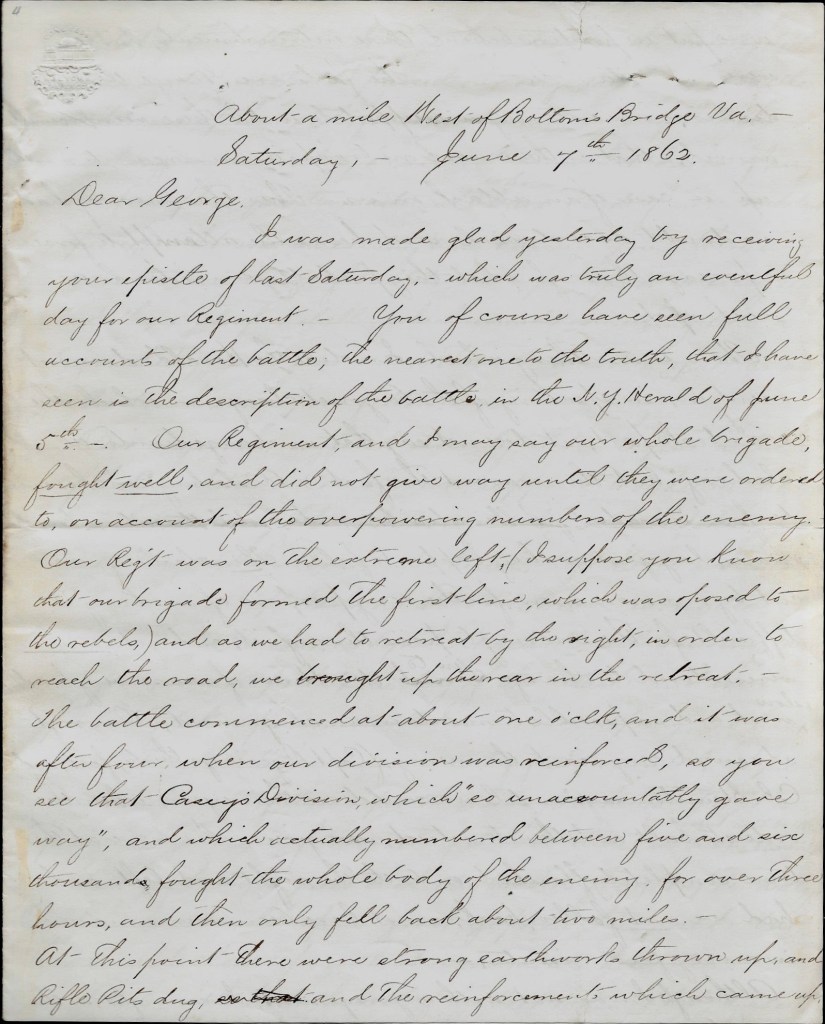
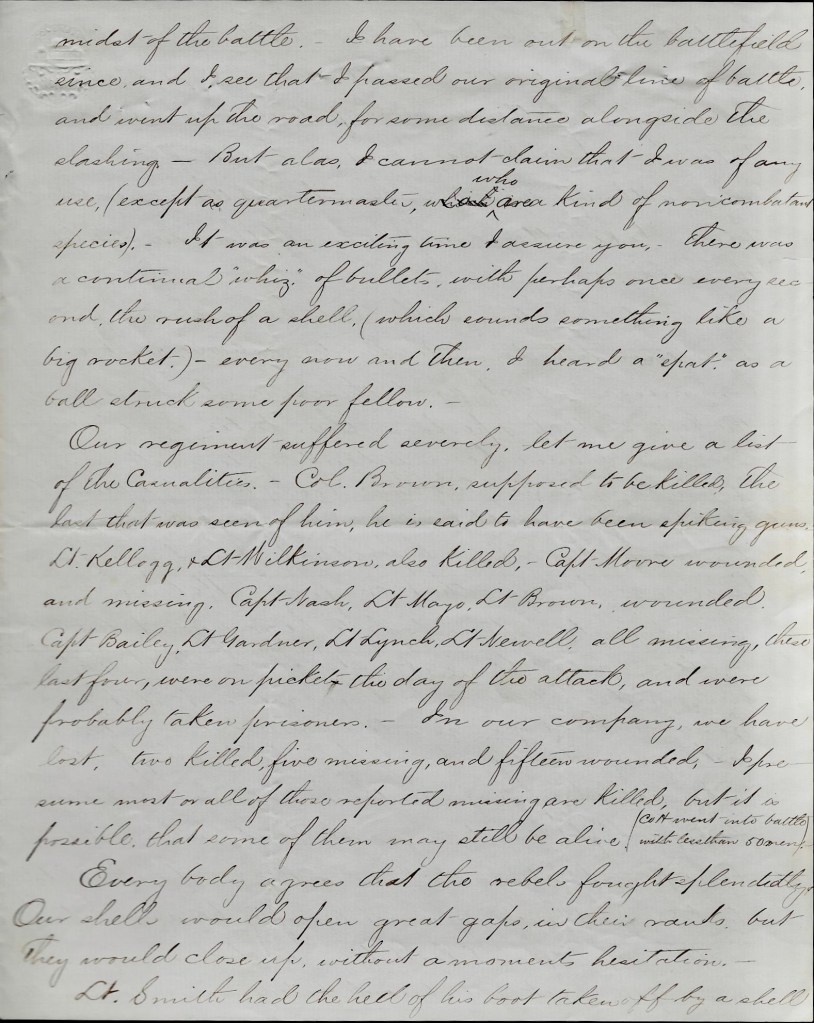
This letter was written by Charles Eliphalet Walbridge (1841-1913) to his brother, George Walbridge, while serving in Co. H, 100th New York Infantry and later as the Assistant Quarter Master at Bermuda Hundred in Butler’s Command.

Charles E. Walbridge was born in Buffalo on 24 July 1841. Shortly after the death of his father—George B. Walbridge, a well known merchant of Buffalo—Charles left school and entered the employ of Pratt & Co., who were at that time the most extensive hardware dealers in the city. He remained with them until September, 1861, when he enlisted in the 100th Regiment, New York Infantry, and was made second lieutenant of Co. H. He served with this regiment until 1864, being promoted to first lieutenant in July, 1862, and to captain in January, 1863. In February, 1864, he was commissioned by the president as captain and Assistant Quarter Master (AQM) of volunteers. In February, 1865, he was brevetted major, and shortly after was appointed chief quartermaster of the Tenth Army Corps, with the rank of lieutenant colonel. After receiving his discharge Walbridge stayed for several months in the South. He purchased surplus horses and mules from the army and sold them to Southerners who were affected by Sherman’s march.

In 1866 he returned to Buffalo and re-entered the service of his former employers, remaining until 1869, when he engaged in business for himself. In 1884 the firm of Walbridge & Co. was formed and it became one of the largest hardware establishments in Buffalo. He married Annie F. Noble of Brooklyn in 1868 and they started their lives together in Buffalo. The Walbridges left a considerable paper trail dating from the 1840s up to 1913, the year of Charles Walbridges death.

In this lengthy letter, Charles gives a description of the Battle of Fair Oaks (or Seven Pines) in which the 100th New York participated and in which they suffered severe losses. The regiment was in Casey’s Division of Keyes’ 4th Corps and were among the first troops engaged, having been overwhelmed and driven back through their encampment, losing most everything but what they wore and carried with them into battle that morning. Charles’ account attempts to put the best spin on their performance but other Corps and Divisions had much less complimentary things to say about Casey’s Division. It would be Hooker’s and Kearny’s Divisions of Heintzelman’s 3rd Corps that had to make the charge through the “slashing” referenced in Charles’ letter.

To read more of Charles’ Civil War Letters published on Spared & Shared, go to 1862-64: Charles Eliphalet Walbridge to George Walbridge.

Waud’s sketch of bayonet charge made by Sickle’s Excelsior Brigade at Fair Oaks on 1 June 1862

Transcription

About a mile west of Bottom’s Bridge, Va.
Saturday, June 7th, 1862

Dear George,

I was made glad yesterday by receiving your epistle of last Saturday which  was truly an eventful day for our regiment. You of course have seen full accounts of the battle. The nearest one to the truth that I have seen is the description of the battle in the N. Y. Herald of June 5th. Our regiment—and I may say our whole brigade—fought well, and did not give way until they were ordered to, on account of the overpowering numbers of the enemy.

Our regiment was on the extreme left (I suppose you know that our brigade formed the first line which was opposed to the rebels) and  as we had to retreat by the right in order to reach the road, we brought up the rear in the retreat. The battle commenced at about one o’clock, and it was after four when our division was reinforced, so you see that Casey’s Division, which “so unaccountably gave way,” and which actually numbered between five and six thousand, fought the whole body of the enemy for over three hours and then only fell back about two miles.

At this point there were strong earthworks thrown up and rifle pits dug and the reinforcements which came up were put in position behind these entrenchments, but then were not attacked. The facts are, George, that our division was entirely  unsupported until these reinforcements arrived; that is—there were no troops in our rear to march up in case of an attack on us. This the enemy had no doubt ascertained and hence the attempt to force a passage through what they probably considered a  weak spot.

There is one thing which I notice the Herald does not mention in speaking of the bayonet charge in which the 100th took part. It does not say that we charged into a “slashing” but this was the fact. A “slashing” or “cheveaux de fris” is made by felling timber and just letting trees, branches, and leaves, lay just as they happen to fall.  This slashing was cut by our own men for the purpose of making it difficult for the enemy to pass through it; and yet our men were ordered to charge into it. It was of course very hard & slow work and impossible to maintain an alignment. Our regiment advanced very near to the enemy (Capt. Dye says thirty feet, and Col. Staunton says “until we could very see their eyes.”) when the orders to halt, and then to retreat, were given. We were at this time completely flanked on both the right and left and had we not fallen back, must have been surrounded in a very few minutes.

Although I was not with my regiment, I was right in the midst of the battle. I have been out on the battlefield since and I see that I passed our original line of battle and went up the road for some distance alongside the slashing. But alas, I cannot claim that I was on any use (except as quartermaster who are a kind of noncombatant species). It was an exciting time I assure you. There was a continual “whiz” of bullets with perhaps once every second, the rush of a shell (which sounds something like a big rocket) and every now and then I heart a “spat” as a ball struck some poor fellow.

Our regiment suffered severely. Let me give a list of the casualties. Col. Brown [is] supposed to be killed. The last that was seen of him, he is said to have been spiking  guns. Lt. Kellogg & Lt. Wilkinson, also killed. Capt. Moore wounded and missing.  Capt. Nash, Lt. Mayo, Lt. Brown, wounded. Capt. Bailey, Lt. Gardner, Lt. Lynch, Lt.  Newell, all missing. These last four were on picket the day of the attack and were  probably taken prisoners. In our company we have lost two killed, five missing, and  fifteen wounded. I presume most or all of those reported missing are killed, but it is possible that some of them may still be alive (Co. H went into battle with less than 50  men).

“Everybody agrees that the rebels fought splendidly. Our shells would open great gaps in their ranks but they would close up without a moment’s hesitation.”

— Charles E. Walbridge, Co. H, 100th New York Infantry, 7 June 1862

Everybody agrees that the rebels fought splendidly. Our shells would open great gaps in their ranks but they would close up without a moment’s hesitation.

Lt. Smith had the heel of his boot taken off by a shell and the heel of his foot somewhat bruised by the same missive, but was hurt in no other way. Capt. Dye was not hurt. The latter is now quite unwell. I have taken him to a house about five miles from here where, although there is no family but the owner himself, he can take better care of himself than he could in the field.

I am still acting Q. M. and I can assure you I have enough to do. The Quartermaster’s Sergeant and Commissary Sergeant are both sick and absent from the regiment so that I perform their duties as well as my own. I have been intending to write home for a long time but have truly been too busy to do it. Your letter has been the  first I have received for a good while. Before that, I had one from Louise, and before that one from Mother.

I was quite astonished to hear about the volunteering excitement in Buffalo.  That would have indeed been “a bully regiment” if it had gone. Don’t you go into any such thing without asking my advice first, which I shall be happy to give when called  upon. I think you would enjoy being a Light Guard very much, besides which it will be very useful to you to have a knowledge of military tactics for America must hereafter be a military nation, and for at least ten years to come, every other man you meet will be well posted in all military matters.

You cannot imagine how surprised I was to see my letter to Mother after the battle of Williamsburg published in the Commercial. I would prefer not to have any more published as they are not fit “for the public gaze.”

There is glorious news today from Halleck’s Army though you probably heard it day before yesterday, and by this time have probably received full particulars. Ten thousand prisoners and fifteen thousand stands of arms is a big thing.

I am looking for the Paymaster to show himself before long. You know I haven’t been paid yet for March & April. Will you please ask Butler if he ever paid Tryon anything on my account? Please get a bill of Tryon and also one of Metzger and send them to me, as I don’t remember the amounts but would know if I should see the bills. I do not know whether I am entitled to Q. M. pay for the time I have been acting or not but shall apply for it anyhow. I received a letter yesterday from Denniston of L  & I. J. White’s dated the 20th. I also received a paper from him some days ago. Please give him my sincere thanks for both. He wrote me a very kind brotherly letter, which it did me good to read.

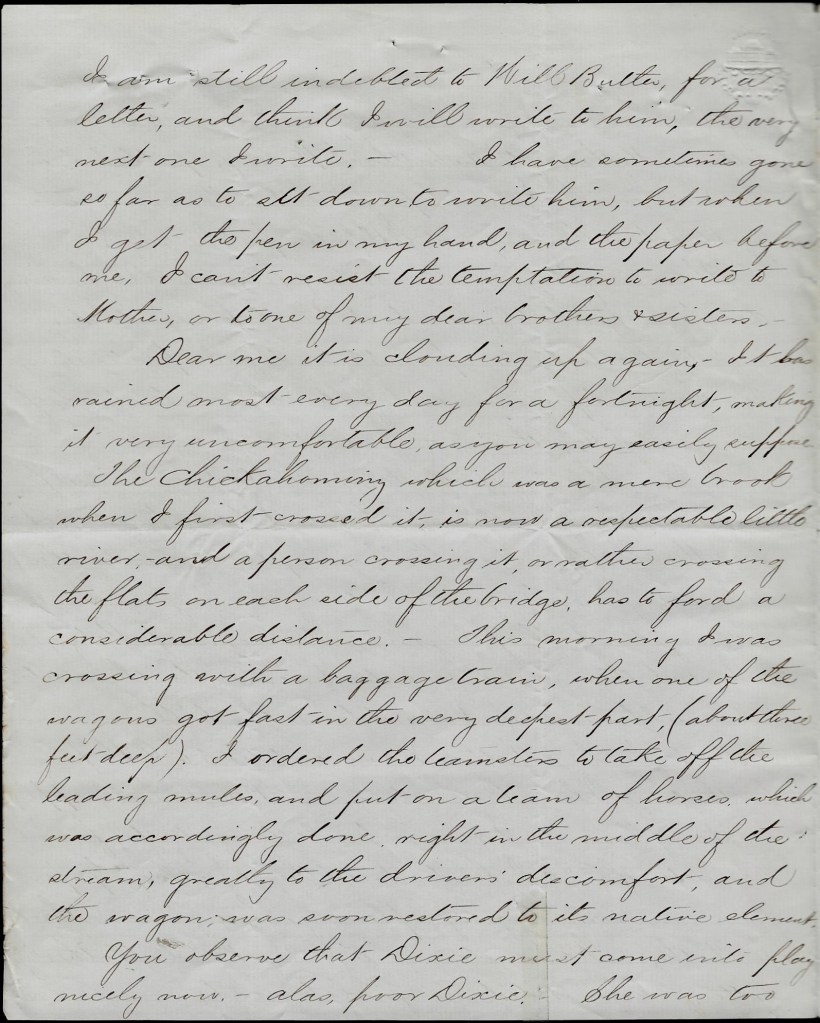
I am still indebted to Will Butler for a letter and think I will write to him the very next one I write. I have sometime gone so far as to sit down to write him but when I get the pen in my hand and the paper before me, I can’t resist the temptation to write to Mother, or to one of my dear brothers and sisters.

Dear me it is clouding up again. It has rained most every day for a fortnight,  making it very uncomfortable as you may easily suppose.

The Chickahominy—which was a mere brook when I first crossed it—is now a respectable little river and a person crossing it, or rather crossing the flats on each side of the bridge, has to ford a considerable distance. This morning I was crossing  with a baggage train, when one of the wagons got fast in the very deepest part (about three feet deep). I ordered the teamsters to take off the leading mules and put on a  team of horses which was accordingly done right in the middle of the stream, greatly to the drivers discomfort and the wagon was soon restored to its native element.

You observe that Dixie must come into play nicely now. Alas, poor Dixie. She was too young to be ridden much. Besides, I have a government horse, so I left Dixie in the company when I became Quartermaster to carry the Captain & Lieutenant’s baggage. I had  several offers to buy her, but didn’t care to accept any of them. The day of the battle, Washington had turned her loose to graze and when the balls began to fly pretty thick, he tried to catch her but she was inclined to be frisky  and wouldn’t be caught, so she had to be “abandoned to the enemy.” Lieut. Smith &  the Capt. lost their overcoats, blankets, etc. and the Capt. lost his knapsacks. Lieut.  S’s fortunately was across the Chickahominy with the balance of the baggage.

I suppose that the “Michigan Estate” will prove to be a substantial benefit to our finances. Has Mr. Miller been around lately to see about it? Oh George, you don’t know how much I would like to see you all again. Well good bye for this time. Give Mother a kiss for me and my love to all the rest. Yours affectionately,  — Charlie

I am much obliged for the envelope and stamp you have sent me in the last few letters. I have received just now. I have no lack of the former. Keep an account of stamps in which you send me. You know my salary is a good deal larger than yours & of course  I want to pay all that you spend for me.

1864: Samuel Welch to his Brother

A post war image of Samuel Welch

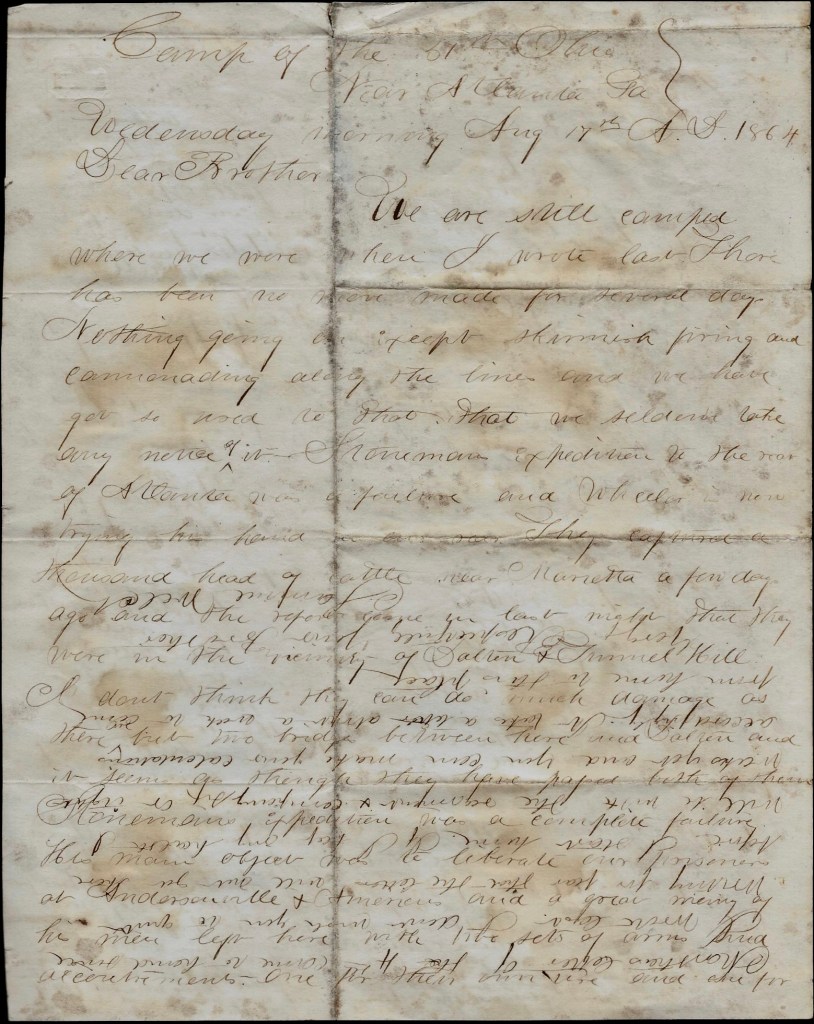
This letter was written by Samuel Welch (1837-1918), the son of Robert Walsh and Elizabeth Maxwell of Uhrichsville, Tuscarawas county, Ohio. Samuel enlisted on 3 October 1861 as a private in Co. E, 51st Ohio Volunteer Infantry (OVI), was promoted to corporal in April 1862, and mustered out of the regiment on 17 October 1864. Samuel’s younger brother, Josiah Welch (1841-1877), also served in the Civil War as a 2nd Lieutenant in Co. E, 161st OHVI, mustering out on 2 September 1864.

Much of Samuel’s brother described the ill-fated attempt by General Stoneman to liberate the Union prisoners at Andersonville prison in Americus, Georgia. The plan was proposed by Stoneman to Sherman who finally consented because he thought “the execution was within the bounds of probable success.” In responding to Stoneman, Sherman was quoted as saying, “if you can bring back to the army any or all of those prisoners of war, it will be an achievement that will entitle you, and your command, to the love and admiration of the whole country.” For a good article describing the expedition, see “Sherman Inability to Liberate the South’s Most Notorious Prison” by Jerry Staub.

Transcription

Camp of the 51st Ohio
Near Atlanta, Georgia
Wednesday morning, August 17th 1864

Dear Brother,

We are still camped where we were when I wrote last. There has been no move made for several days. Nothing going on except skirmish firing and cannonading along the lines and we have got so used to that that we seldom take any notice of it.

Stoneman’s Expedition to the rear of Atlanta was a failure and Wheeler is now trying his hand on our rear. They captured a thousand head of cattle near Marietta a few days ago and the report come in last night that they were in the vicinity of Dalton & Tunnel Hill, I don’t think they can do much damage as there are but two bridges between here and Dalton and it seems as though they have passed both of them.

Stoneman’s Expedition was a complete failure. His main object was to liberate our prisoners at Andersonville & Americus and a good many of his men left here with two sets of arms and accoutrements—one for their own use and one for the prisoners. The plan was a very good one but instead of putting arms into the hands of the prisoners, they got their arms taken from them and were taken prisoners themselves. However, only a small portion of the command was taken and Stoneman with them and the general opinion among speculating men now is that it was a good thing that Stoneman was taken. But this is always the case when a general fails. No one ever heard tell of any good that he had ever done before. But if reports are true, he certainly got justice. It is said that he suffered his men to scatter in all directions, to forage and pillage, and while his men were out every fellow for himself, he was attacked.

It is hard to tell what the program is for taking Atlanta. The rebels are fortified along the Macon Railroad for several miles so that our lines will have to be very long to reach it. Our right wing is within shelling distance of the railroad and the cars have not come in for ten or twelve days. Our spies say that the women and children are all removed from the city and that every man that stays there carries a musket. The dwelling houses are all empty and the lost valuable furniture removed. There are some reports in circulation since yesterday evening that our corps is to be taken to the extreme right but they are only reports and it is hard to tell whether there is any truth in them or not. There is no doubt that a corps is needed on the right if Sherman expects to cut the Macon road, but if our corps is withdrawn from its position, our railroad will be exposed to raids as there will be but few troops left on the east side of the road.

I have not received a letter from Josiah for nearly two weeks. I suppose he will be at home in a few days if he gets his discharge when his time is up. An order came to the Colonel yesterday that all officers that had received promotions during their service and were re-mustered in were to serve three years from the date of their re-muster or promotion. This order will keep up the organization of the 51st Ohio Vet. Volunteers Infantry but it is very much to the dissatisfaction of the officers that expected to go home this fall. They swear that it is a conscript order, &c. &c. but I think a few days will reconcile them. The veterans had begin to complain that the officers were all going to leave and that they would be consolidated and transferred &c., &c., &c. and the order just suits the enlisted men. For my part, I have nothing to say, only that there were but few of the officers but what influenced the veteran cause last winter and it is nothing more than right that they should stay with them during their second term.

[Sister] Martha’s letter of the 4th came to hand since I wrote last. I don’t wish you to quit writing for fear that the letter will not get here before I start home. If I keep my health, I will be with the regiment & company six or eight weeks yet and you can make your calculations accordingly. It takes a letter about a week to come from home to this place.

Very respectfully your brother, — Samuel Welch

1862: Unidentified “Josie” to his Parents

An unidentified member of Co. K, 1st US Chasseurs (65th NY Infantry) wearing the distinctive uniform and M1858 Hardee Hat (W. Griffing Collection)

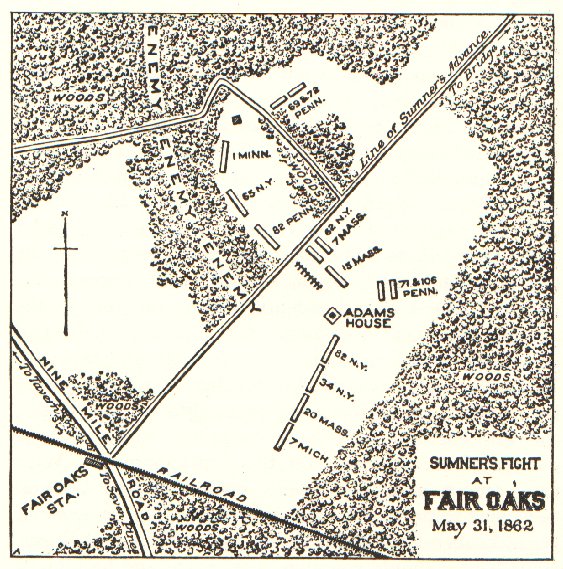
The following letter was written in pencil by a soldier who served in the 65th New York Infantry, otherwise known as the 1st U. S. Chasseurs. The companies in this regiment were recruited principally as follows: A, C, G and I in New York City; B in Maine, Rhode Island and the Hudson river counties; D in New York city and Troy; E in New York City, Connecticut and Rhode Island; F and H in New York City and Rhode Island, and K in New York City and Ohio. The Chasseurs faced their baptism of fire at the Battle of Fair Oaks on 31 May-June 1, 1862 during McClellan’s Peninsula campaign. In addition to wearing a chasseur uniform, the regiment were distinct for choosing to wear M1858 uniform hats (more popularly known as Hardee hats) rather than the kepis.

Though it is certain the author served in the 1st US Chasseurs—most likely in Co. D or Co. K—he only signed his name “Josie” and there is no accompanying envelope nor additional identifying information in the letter itself to state with certainly who he was. The letter came to me for transcription attributed to Joseph P. Baugher [Actually Joseph T.] (1844-1921) of Co. K but a search of the company records reveals that Joseph was detached from the regiment in February 1862 “on western gunboat service and was discharged therefrom.” This record could have been an error, however. Joseph lived his entire life near Tiffin, Ohio, and his burial record only lists his service in the 65th New York Infantry—nothing else.

Regardless of who wrote the letter, it is a great first hand account of the Battle of Fair Oaks from the perspective of a member of the 1st US Chasseurs who “covered themselves with glory” and where “not a man flinched” on the field.

Transcription

Camp on battlefield of Seven Pines
June 7th 1862

My dear parents,

I suppose by this time you have heard of the great battle near Richmond which commenced at one o’clock on Saturday [31 May] and ended about noon the next day [1 June] by the enemy skedaddling & leaving the field in possession of the brave soldiers of the North. I received a letter from home on Saturday a short time after writing & mailing an answer.

The noise of cannons and musketry was heard directly to the front of our camp. We were soon under arms, ready to take part in the encounter with the hated rebels. Our Colonel was ordered to take the regiment to the right of the [York River] railroad to prevent being flanked. At this place the shell flew over our heads like fun, doing no damage however as the range was too high. The noise as they came whizzing by sounded rather unpleasant at first, causing the men as well as officers to bob their heads, but we soon became used to that & we stood like men & soldiers ready to do our best for the glorious cause in which we had enlisted.

The Union line after Sumner’s troops arrived to join the 65th New York Infantry who were deployed behind a fence from which they “were loading and firing like demons.”

We soon received news that the Union forces were being driven back & that the rebels were at that time in the camps we had occupied not thirty minutes before. Such news made us feel of course rather low spirited. We fell back about half a mile and awaited anxiously for the rebels to make their appearance. After remaining at this place about 15 minutes, the right of Sumner’s line of reinforcements could be seen coming through the woods to the rear. This I can assure you was a welcomed sight. As soon as Sumner’s men had reached the field, we were ordered to double quick & take position in front of the woods on our right. We had no sooner halted than we received a sharp volley from the rebels who were at that time concealed in the woods. Without waiting for orders, we gave one in return.

“After I had fired, I hardly knew what to do but a second volley from the enemy brought me to my senses & I came to the conclusion that I had better reload. After this, I became perfectly cool and we let them have it thick and heavy for over two hours and a half…”

After I had fired, I hardly knew what to do but a second volley from the enemy brought me to my senses & I came to the conclusion that I had better reload. After this, I became perfectly cool and we let them have it thick and heavy for over two hours and a half—the enemy attempting several times to charge upon us but we would reserve our fire and when they came near, let them have it again & back they would go. I fired over 30 rounds, several times taking deliberate aim. The enemy skedaddled a little after dusk & the Chasseurs have the satisfaction of knowing that their first fight has been a victory.

After the firing was over, we turned our attention to our dead and wounded comrades. Our company lost three in killed and seven wounded; the regiment about forty & the brigade 650. The man to my right was killed; the one in front of him wounded, & I came so near that there was no fun in it—my cheek being grazed. It did not hurt me, however, so I am ready for the next battle which we expect will take place before the week is out. McClellan says it will no doubt be more bloody than the last. 1

After I had assisted in removing the wounded to the hospital and placing the dead together, I took a smoke out of the pipe which Pa gave me before leaving home & lay down where I had stood fighting and slept sound until morning—or at least daybreak when we stood under arms until about six o’clock when the rebels made their appearance intending to give us a second trial. Our regiment fired a couple of volleys when we were relieved by another regiment that had not been engaged the day previous & took a position in the woods where we remained during the day. The engagement ended about noon, the enemy being defeated.

For over 24 hours I had nothing to eat as our rations were left in camp. The next day a few crackers were brought to us and I can tell you they tasted good. We have lost all our clothes, &c. except what was on our backs as our knapsacks were left behind & destroyed by the rebels when they entered our camps. The government is going to make them good to us, I believe. I can tell you soldiering is a hard life. After our next battle, if I live through it & we reach Richmond, I shall try to get my discharge if it is possible. I can then retire with honor as I think I shall have done my share of duty in the way of fighting, &c.

When I write again, I shall no doubt have a bloody battle to describe. I hope I may come out of it safe but I am ready for it. My powder is dry, my musket (my best friend at present) in perfect order, & I shall have to take my chance with the rest. The enemy have commenced shelling us again so we will have to stand under arms again I suppose. So I must close. Goodbye. Love to all. Write very soon and often to your son, — Josie


1 According to Capt. William Halsted of Co. D, 65th New York Infantry, “Capt. Higgenbotham’s Co. [K] and mine took the worst of the fight….I lost in killed and wounded more than one-fifth of my company. Our regiment lost in killed and wounded 32 [actually 9 killed and 22 wounded]. Our men have covered themselves with glory. Not a man flinched in the field….We held our post for nearly two hours under a terrific fire. Not a cartridge was wasted. We went to work with 60 cartridges and my company averaged 40 left at night.” [Calvin Packard Civil War Battlefield Collection]

1865: Darwin Nichols to Orpha Jane Waters

The following letter was written by Darwin Nichols (1841-1901), the son of Cheney M. Nichols (1810-1892) and Almena Edson (1814-1883) of Attica, Wyoming county, New York. He wrote the letter to Orpha Jane Waters (1844-1906) with whom he married in 1865.

Darwin enlisted on 9 August 1862 as a private in Co. C, 130th New York Infantry but this regiment was converted to cavalry on 28 July 1863 and known as the 1st Dragoons or the 19th New York Cavalry. At the time of his enlistment he was described as 5 feet 7.5 inches tall, with blue eyes and light hair. He was wounded on 30 June 1864 but recovered and mustered out with his regiment on 30 June 1865. During its service, the 1st New York Dragoons fought in 64 battles, captured 19 pieces of artillery and four Confederate battle flags.

Darwin had an older brother named Edwin A. Nichols who served in Co. G, 160th New York Infantry who did not survive the war. He died at a hospital in New Orleans of an illness in December 1863.

A colt revolver that was carried by Corp. Chauncey J. Fox of the 19th New York Cavalry during the Civil War.

Transcription

[Note: This letter is from the private collection of Greg Herr and was transcribed and published on Spared & Shared by express consent.]

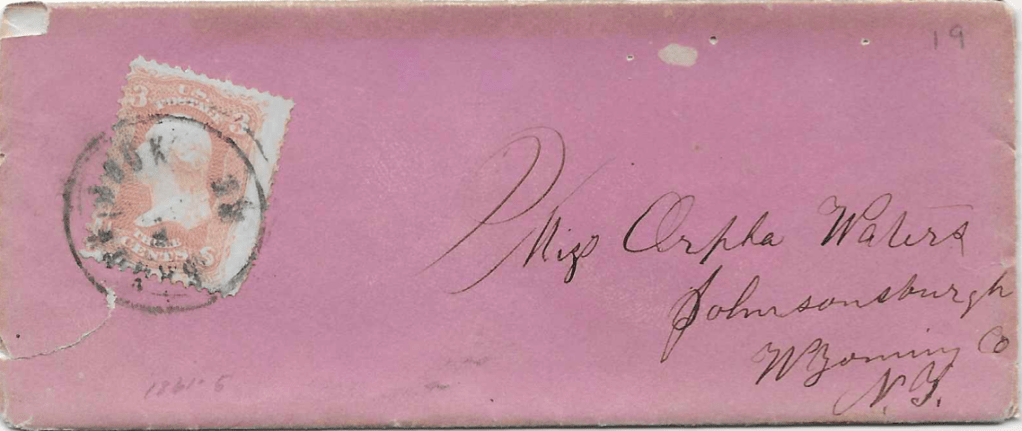
Addressed to Miss Orpha Waters, Johnsonsburgh, Wyoming county, New York

Remount Camp
Pleasant Valley, Maryland
Tuesday, April 18, 1865

My dearest Orpha,

Words nor tongue can express my delight at receiving your much welcome letter of April 14th which came duly to hand last night & also one of the 12th that has just arrived today. It being directed to Harper’s Ferry, I did not get as soon as I should if it had been directed as the other was. Under the present circumstances I shall be obliged to answer them both in one.

You will see by this that I am again at Remount Camp & shall be very likely to stay here until I am discharged. The regiment left camp at Halltown morning of the 14th. I was on a pass to Summit Point, Va., where I had been to visit my brother. I found him in good health & had a good visit with him & many others of my acquaintance. My health is about as usual. The Dr. still excuses me from duty & shall be as long as I can make the Dr. believe that I am unable to do duty.

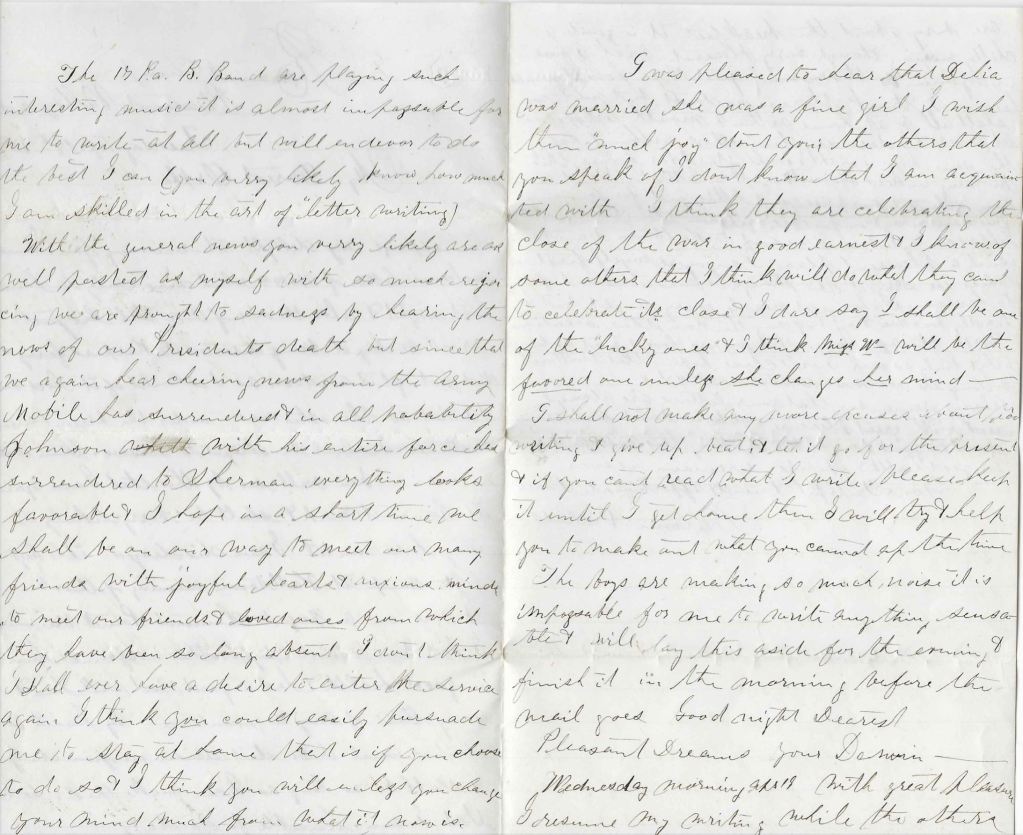
The 17th Pennsylvania Brass Band are playing such interesting music, it is almost impossible for me to write at all but will endeavor to do it the best I can (you very likely know how much I am skilled in the art of letter writing).

With the general news you very likely are as well posted as myself. With so much rejoicing we are brought to sadness by hearing the news of our President’s death. But since that, we again hear cheering news from the army. Mobile has surrendered & in all probability Johnston with his entire force has surrendered to Sherman. Everything looks favorable & I hope in a short time we shall be on our way to meet our many friends with joyful hearts and anxious minds to meet our friends & loved ones from which they have been so long absent. I don’t think I shall ever have a desire to enter the service again. I think you could easily persuade me to stay at home—that is, if you choose to do so, and I think you will unless you change your mind much from what it now is.

I was pleased to hear that Delia was married. She was a fine girl. I wish them “much joy,” don’t you? The others that you speak of I don’t know that I am acquainted with. I think they are celebrating the close of the war in good earnest & I know of some others that I think will do what they can to celebrate its close & I dare say I shall be one of the “lucky ones” & I think Miss W. will be the favored one unless she changes her mind…

The boys are making so much noise it is impossible for me to write anything sensible & will lay this aside for the evening & finish it in the morning before the mail goes. Good night dearest. Pleasant dreams, — Your Darwin

Wednesday morning, April 19

With great pleasure I resume my writing while the others are busy about the breakfast. It is quite a chilly morning though very pleasant. Wish I was in Wyoming County this morning just to see how it would seem. I think there is no doubt but what we shall all be at home within a month. I hope so at least & I dare say there are others wishing and hoping the same. How I wish I could start for home this morning instead of writing this letter. I would remain silent & surprise you a little just for fun.

We have very comfortable quarters now though I am not half contented as I was up to Halltown, Va. It was such a pleasant place. I enjoyed myself first rate while we stayed there though it was not much fun to have camp alarmed nearly every night. But I hardly ever went out of my tent on those occasions.

With the assurance that you are loved just as tenderly and truly as ever, I will close by hoping that it will not be long ere we meet to part no more. Always remember that your letters are always received with great pleasure & delight. Don’t fail to write soon and a good long letter. Hoping this will find you in good health and spirits, I remain as ever your faithful friend and affectionate lover, — Darwin Nichols