My passion is studying American history leading up to & including the Civil War. I particularly enjoy reading, transcribing & researching primary sources such as letters and diaries.
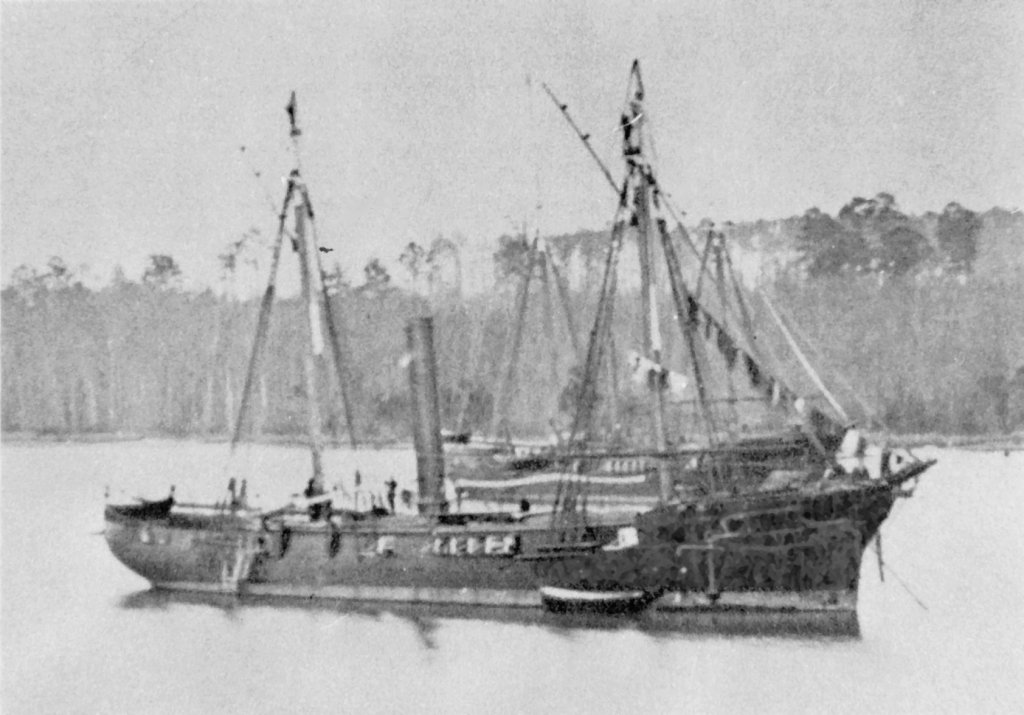
The following letter was written by James F. Smith while serving in the US Navy aboard the USS Grand Gulf assigned to the North Atlantic Blockading Squadron. I could not find anything more on Smith except that his wife filed a widow’s pension after his death and that his rank was “Captain after Guard” while aboard the USS Grand Gulf. This vessel was a wooden-hulled, propeller-driven steamer dubbed the Onward that was purchased by the Navy in September 1863 and renamed the USS Grand Gulf. Her first duty was to join the blockading squadron off Wilmington, North Carolina. She remained there until October 1864.
Smith wrote the letter to his friend, Allan McDougall Campbell (1835-1874), the son of Allan McDougall Campbell and Martha Matternley (1802-18xx) of Nova Scotia. At the time of the 1850 US Census, Allan was living under his mother’s roof in Westchester county, New York, his mother an apparent widow. At the time of the 1860 US Census, Allan was living in a New York City boarding house with his younger brother Donald working as a postal carrier. His brother Donald was working as a sign painter. It appears that Allan received his naturalization papers in August 1857. Allan enlisted in the US Navy in August 1863 and served aboard the USS Montauk, a single-turreted Passaic-class monitor launched in 1862 and part of the South Atlantic Blockading Squadron.
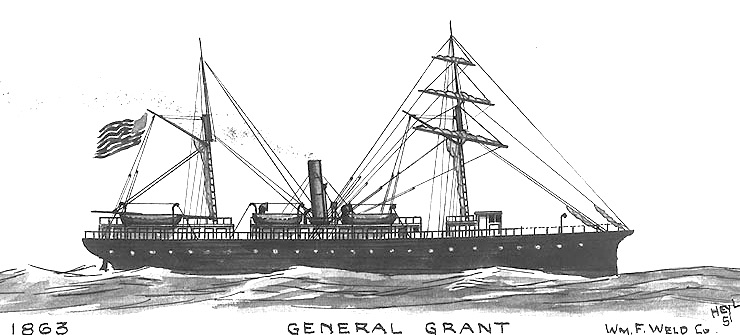
This is the vessel the author was on when he wrote the letter in November 1863. She was renamed the “General Grant” after she was returned to the merchant service after the Civil War.
Transcription
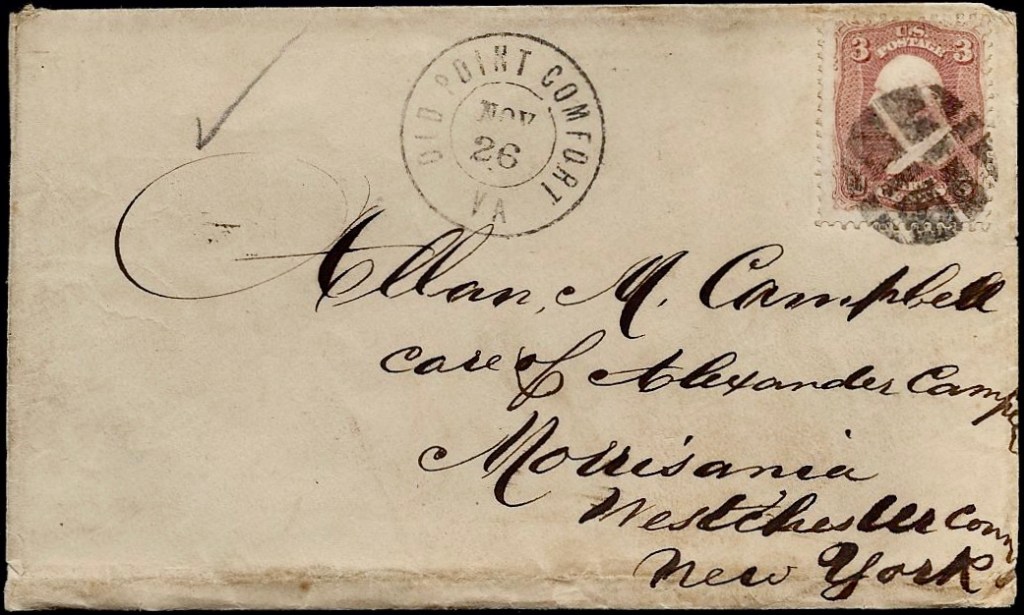
Addressed to Allan M. Campbell, care of Alexander Campbell, Morrisiana, Westchester, New York
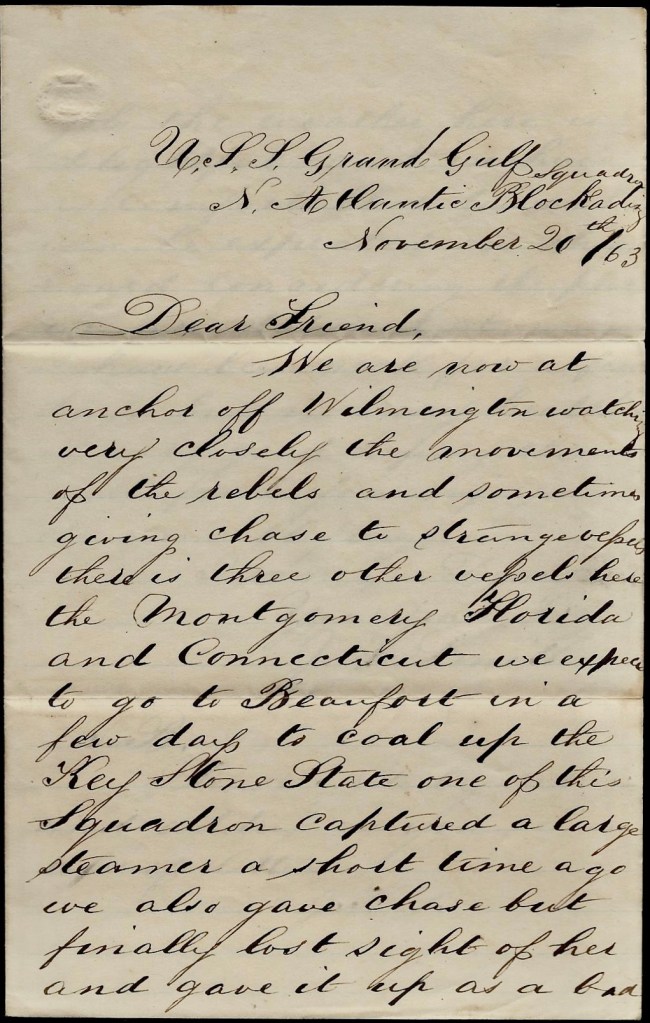
USS Grand Gulf N. Atlantic Blockade Squadron November 20, 1863
Dear Friend,
We are now at anchor off Wilmington watching very closely the movements of the rebels and sometimes giving chase to strange vessels. There is three other vessels here—the Montgomery, Florida, and Connecticut. We expect to go to Beaufort in a few days to coal up.
The Keystone State, one of this squadron, captured a large steamer a short time ago, We also gave chase but finally lost sight of her and gave it up as a bad job.
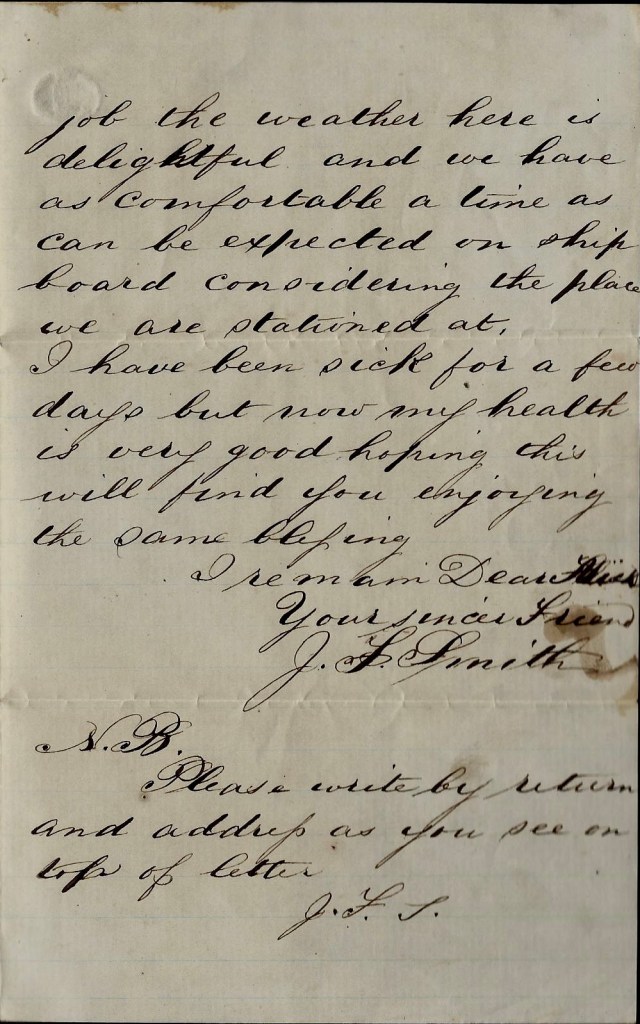
The weather here is delightful and we have as comfortable a time as can be expected on ship board considering the place we are stationed at.
I have been sick for a few days but now my health is very good hoping this will find you enjoying the same blessing. I remain, dear Mack, your sincere friend, — J. S. Smith
N. B. Please write by return and address as you see on top pf letter. — J. F. S.
The following letter was written by William H. Smith who served in Horse Battery C, 3rd U. S. Artillery during the Civil War. This battery was organized in October 1861 under the command of Capt. Edward O. C. Ord and participated in the Peninsula Campaign in the spring and summer of 1862. This letter was penned from White House Landing in mid-June 1862 just prior to the 7 days battles before Richmond. The Battery played a major roll in the Battle of Antietam in September 1862 and then later at Fredericksburg, Chancellorsville, Brandy Station, Gettysburg, the Overland Campaign, and Cedar Creek.
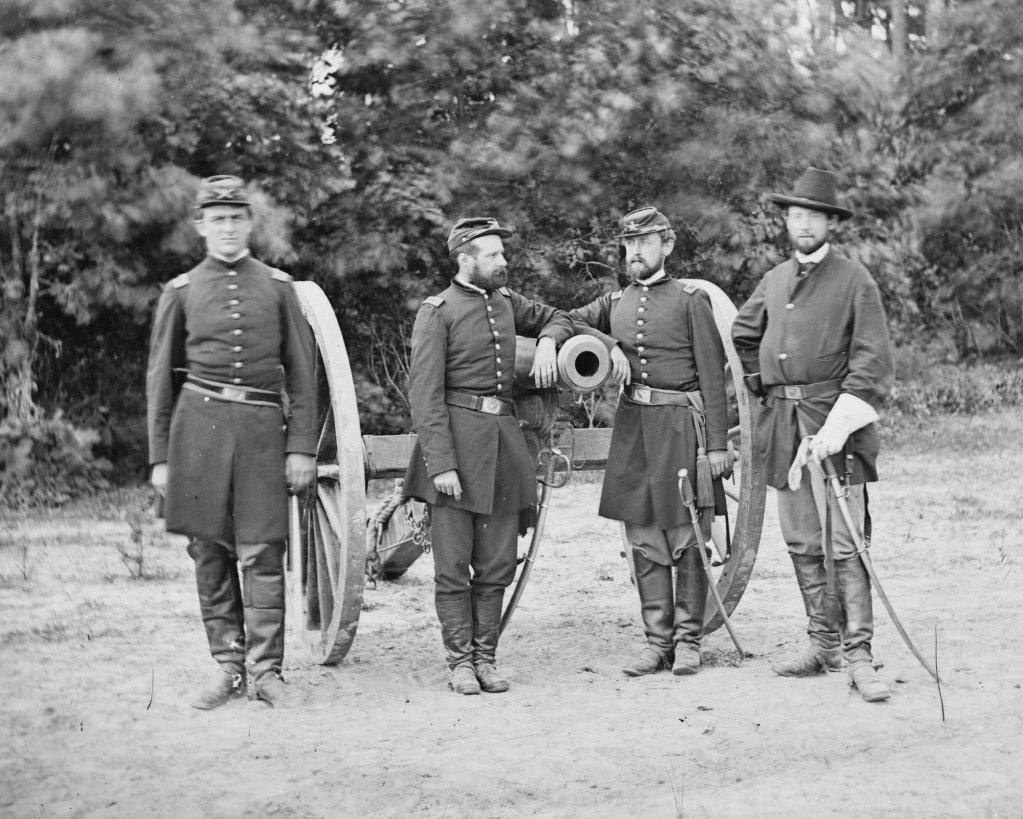
The officers of Horse Battery C, 3rd US Artillery; Capt. Horatio G. Gibson 2nd from left. Taken at Fair Oaks in June 1862
Transcription
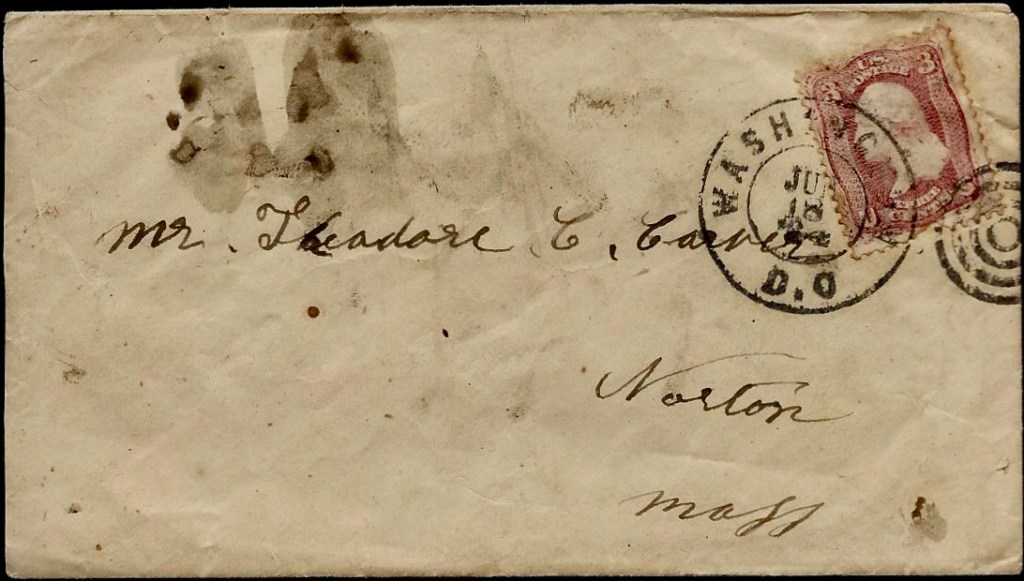
Addressed to Mr. Theodore C. Carver, Norton, Mass.
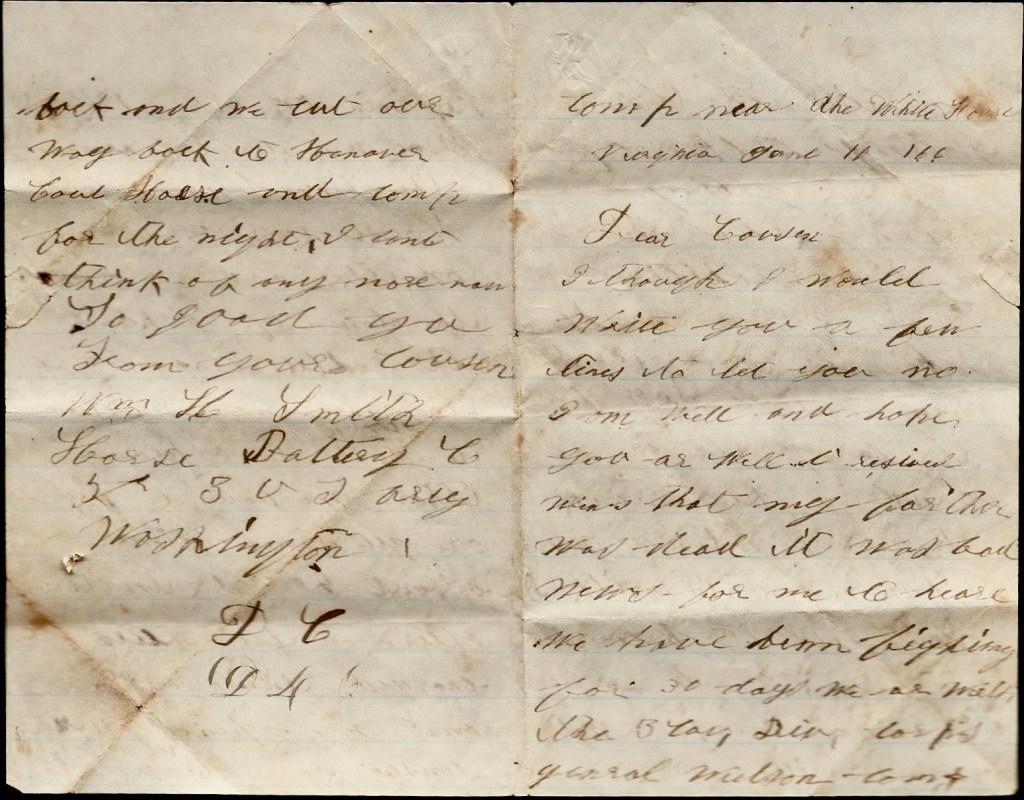
Camp near the White House [Landing], Virginia June 11, 1862
Dear Cousin.
I thought I would write you a few lines to let you know I am well and hope you are well. I received news that my father was dead. It was bad news for me to hear.
We have been fighting for 30 days. We are well, the 3rd Cavalry Division Corps, Gen. Nielson commanding.
How are all the young folks of Norton getting along? Tell me in your [next] letter when you write. When are you 100 days men with a day’s grub to carry along and a big trunk to carry along with theme? How is Milk. B. Brow? Is it better than it was?
We was camped within 15 miles of Richmond, Virginia, on the 1st of June. We started from the town of Hanover Court House and as we was on the road to the town of Ashland, the rebels charged up in rear and we had to get up and dust to Ashland. There we had to fight or get taken prisoner. About 5 o’clock in the afternoon the rebels charged into Ashland and we opened with canister and drove them back and we cut our way back to Hanover Court House and camped for the night.
I don’t think of any more now so good bye from your cousin, — Wm. H. Smith. Horse Battery C, 3rd U. S. Artillery, Washington D. C.
The following letter was written by William Nelson Lane (1843-1924), the son of William Henry Lane (1804-1882) and Lavina Wakefield (1809-1877) of Brownsville, Oxford county, Maine. In his letter, William mentions his older brother Simeon Pease Lane (1841-1921) who served in Co. H, 20th Maine Infantry.
William was 21 when he enlisted on 1 March 1864 as a private in the 3rd Maine Light Artillery. He survived the war, mustering out of the service on 1 September 1866. William was a farmer; his composition and spelling suggest a limited education.
When William wrote this letter from their encampment near Petersburg, the 2rd Maine Light Artillery had only recently joined the 9th Corps. Until 9 July 1864, they had been stationed at Camp Barry in the defenses of Washington D. C. Their commander was Capt. Ezekiel R. Mayo. During the siege of Petersburg, the battery participated in the 9th Corps’ infamous effort to mine and then blow up the Confederate defenses on 30 July 1864—just ten days after this letter was penned.
The boys of 3rd Maine Light Artillery in 1865 (Maine Memory)
Transcription
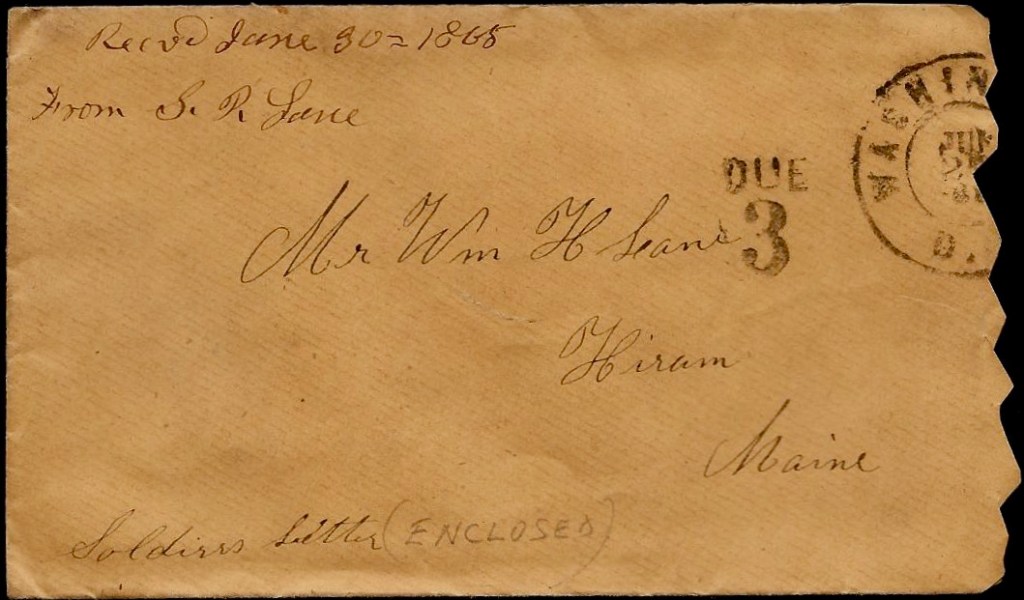
Addressed to Mr. Wm. H. Lane, Hiram, Maine(letter mismatched with envelope)
Near Petersburg, Virginia July 20, 1864
Dear Parents,
As I received a letter from you and was glad to hear from you and to hear you was well but father, I am sorry to hear that you are not well. I am well today and I hope these few lines will find you the same.
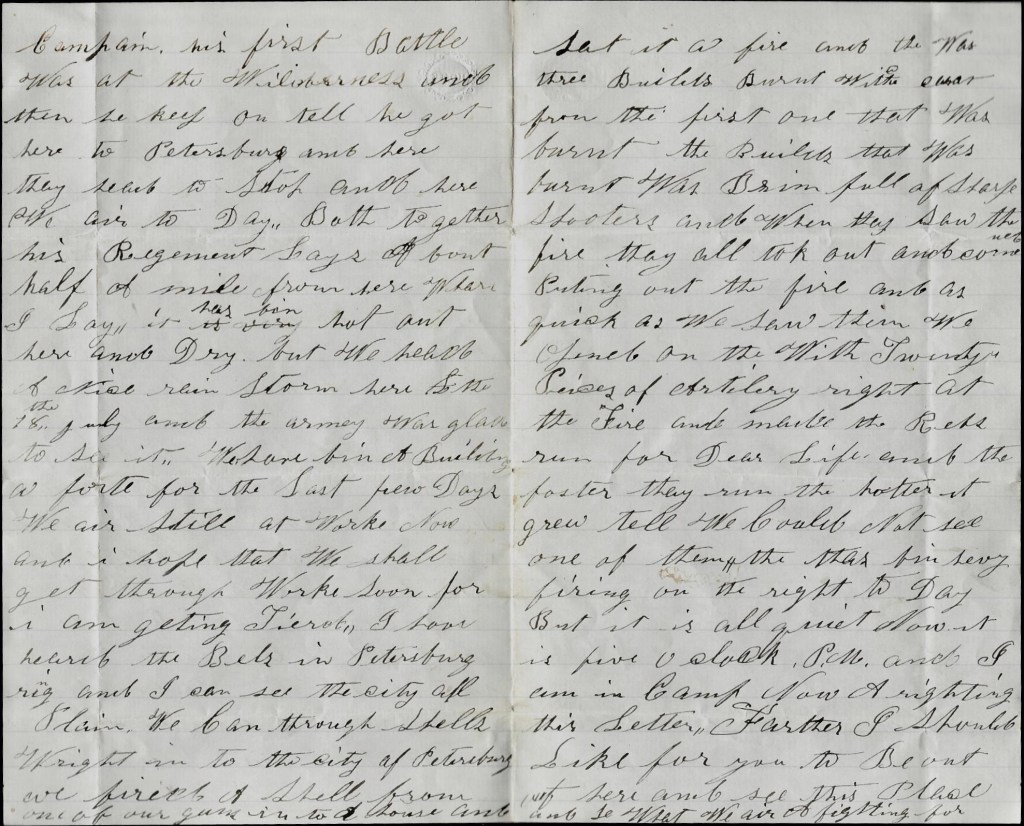
I saw Simeon yesterday and he as well then and he looked very well. But he said that he should like to be to home and see the folks. But he said that as long as the war [is going on and he is] so far away from home, he must be contented where he is. He has seen hard times since he left home. He has been in every battle since Grant’s [Overland] Campaign. His first battle was at the Wilderness and then he kept on till he got to Petersburg and here they had to stop and here we are today, both together. His regiment lays about half a mile from here where I lay,
It has been hot out here and dry but we had a nice rainstorm here the 18th of July and the army was glad to see it.
We have been a building a fort for the last few days. We are still at work now and I hope that we shall get through work soon for I am getting tired. I have heard the bells in Petersburg ring and I can see the city all plain. We can throw shells right into the city of Petersburg. we fired a shell from one of our guns into a house and set it on fire and there was three buildings burnt [that caught fire] from the first one that was burnt. The building that was burnt was brim full of sharpshooters and when they saw the fire, they all took out and commenced putting out the fire and as quick as we saw them, we opened on them with twenty pieces of artillery right at the fire and made the rebels run for dear life. And the faster they run, the hotter it grew till we could not see one of them. 1
There has been heavy firing on the right today but it all quiet now. It is five o’clock p.m. and I am in camp now a writing this letter. Father, I should like for you to be out here and see this place and see what we are a fighting for. Father, I received the money that you sent me and it come in a good time, you better believe.
I am in hopes that we shall get paid off soon for I want some money to buy something to eat. I do not get enough to eat out here and if we could only get paid off it would do us some good. We can et anything out here we want if we have money to pay for it.
I have no more news to write today. Write as soon as you get this. From your son, — Wm. N. Lane
Direct your letters to Mr. Wm. N. Lane, 9th Corps, 3rd Division, 3rd Maine Battery, Washington D. C.
Write soon as you get this letter. W. Nelson Lane
1 This shelling probably occurred on Saturday, July 16, 1864 as I journal entry written on that day by Charles Campbell, a civilian in Petersburg, reads: “The shelling today as usual. In afternoon heard the fire bells ringing twice, probably on account of houses set on fire by shells.” [See—Charles Campbell Journal, July 1864]
I could not find an image of Orman but here is Pvt. Joseph B. Dickinson of Co. M, 6th New York Heavy Artillery
This letter was written by 34 year-old private Orman Smith of Carmel, Putnam county, New York, who enlisted in Co. G, 135th New York Infantry on 30 August 1862. The letter was written from Camp Millington near Baltimore, Maryland before the designation of the regiment was changed to the 6th New York Heavy Artillery on 3 October 1862. This regiment was also known as the “Anthony Wayne Guard.”
In the 1860 US Census, 32 year-old Orman was enumerated as a “hatter” in his father’s household, William A. Smith, a 52 year-old “Master hatter.” Residing in the same household was his younger brother, 23 year-old Samuel Smith (also a hatter) to whom Orman addressed this letter.
In transcribing the letter I have had to make significant corrections to the spelling. Clearly Orman had a limited education. I was surprised to discover that he was actually 34 years old as his letter suggests the maturity more like that of a teenager.
Transcription
Camp Millington Saturday, September 13, 1862
Dear Brother,
I have just received your letter & am glad to hear that you are all well. I am well with the exceptions of a cold.
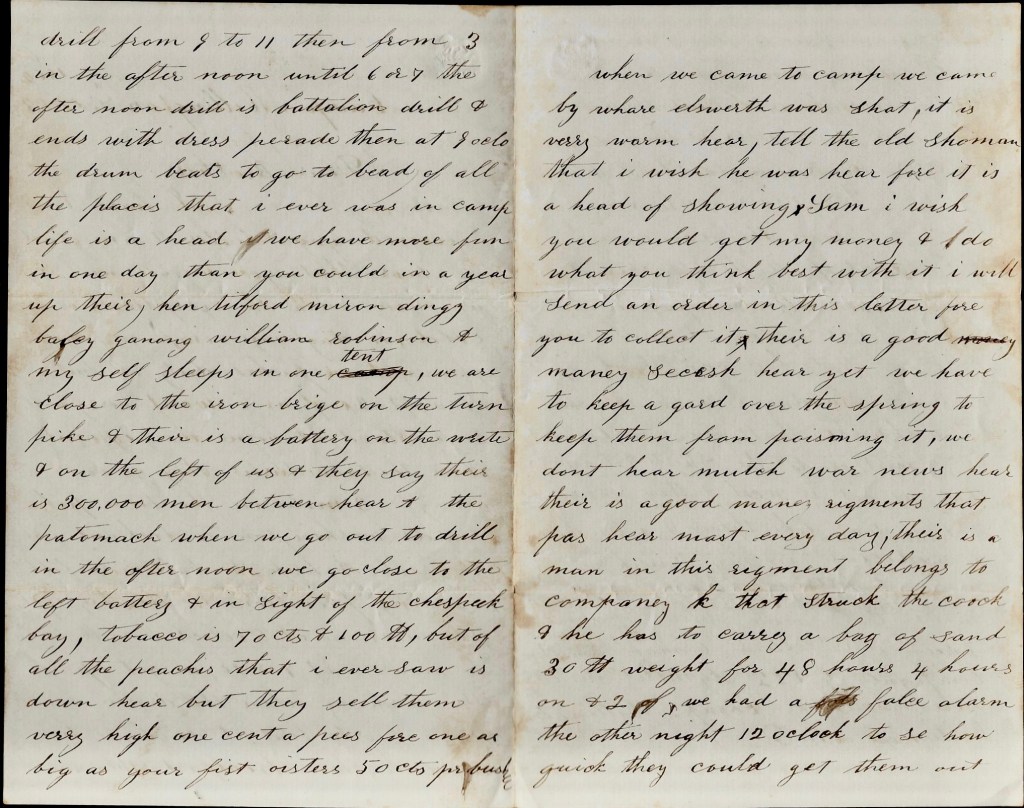
Today my company has been out on picket duty—all but about twenty of us. I wasn’t very well so I stayed at home. The regiment has to take turns. The got out about three miles on the turnpike towards Washington to look out for the rebels & keep the Baltimore folks from carrying provisions to them. They left this morning at 8 o’clock & will be in tomorrow at 9 or 10. We get up in the morning when the drum beats & that ought to beat at daylight to roll call, then breakfast, then we drill from 9 to 11, from 3 in the afternoon until 6 or 7. The afternoon drill is battalion drill & ends with dress parade. Then at 8 o’clock the drum beats to go to bed. Of all the places that I ever was in, camp life is ahead. We have more fun in one day that you could in a year up there.
[William] Hen[ry] Tilford, Myron Dingee, Bailey Ganung, William Robinson, & myself sleeps in one tent. We are close to the iron bridge on the turnpike & there is a battery on the right and on the left of us & they say there is 300,000 men between here and the Potomac. When we go out to drill in the afternoon, we go close to the left battery & in sight of the Chesapeake Bay,
Tobacco is 70 cents and 1.00 a pound, but all the peaches that I ever saw is down here, But they sell them very high—one cent apiece for one as big as your fist. Oysters 50 cents per bushel.
When we came to camp, we came by where Ellsworth was shot.
It is very warm here. Tell the old showman that I wish he was here for it is ahead of showing. Sam, I wish you would get my money and do what you think best with it. I will send an order in this letter for you to collect it.
There is a good many secesh here yet. We have to keep a guard over the spring to keep them from poisoning it. We don’t hear much war news here. There is a good many regiments that pass here most every day. There is a man in this regiment belongs to Company K that struck the cook and he has to carry a bag of sand 30 pound weight for 48 hours, 4 hours on and 2 off.
We had a false alarm the other night 12 o’clock to see how quick they could get them out and such a time you never see. The boys thought that the rebels was here in earnest. The boys seem anxious to see a fight but I guess that they never will. Vincent Barrett says damn the war. He don’t like it. But of all the speeches & capers that ever was poke or cut up is played here. It don’t seem possible that boys can think of so much Sunday.
I wish if you get a chance that you would send me a shirt or two. The shirts and drawers that we get is wool and they scratch so that I don’t like them & a tin box of medicine in my trunk. So no more at present.
From your brother, — O. J. Smith. Write soon. Direct your letters to Orman Smith, Company G, 135th Regiment, United States Volunteers, Camp Millington, Baltimore, Maryland
The following letter was written by Andrew Wallace Johnson (1826-1887) of the US Navy. He was appointed midshipman in 1841, and commissioned lieutenant, 15 September, 1855. He was made lieutenant-commander, 16 July, 1862, and in 1864-‘5 served with the South Atlantic blockading squadron, being on the iron-clads “Lehigh” and “Montauk ” in their engagements with Confederate batteries in Stono river, South Carolina, in July, 1864. He was commissioned commander, 2 February, 1869 and captain, 5 April, 1874, and served as chief of staff of the South Atlantic squadron from 1869 till 1870. After being assigned to special duty for several years at Washington, D. C., and at Portsmouth, New Hampshire, Captain Johnson was retired by operation of law.
Andrew wrote the letter from the gunboat USS Unadilla which was patrolling the coast off Tybee Island, Georgia, conducting frequent reconnaissance surveys, and reporting on both suspected Confederate troop movements in the area and the construction and movements of the ram CSS Savannah. In January 1864, she underwent repairs at Port Royal and, in March, was dispatched to St. Johns River, Florida, for reconnaissance and convoy duties. After striking a sand bar, Unadilla returned to Port Royal in May where carpenters discovered that the battle-weary vessel needed an extensive overhaul. Unadilla was detained briefly in Ossabow Sound but, on 19 June, 1864, finally received orders north to the Philadelphia Navy Yard.
USS Unadilla
[Note: This letter is from the private collection of Greg Herr and was transcribed and published on Spared & Shared by express consent.]
Transcription
U. S. S. Unadilla, Tybee Roads, Georgia January 27th 1864
My dear Colonel,
Sincerely do I sympathize with yourself in the difficulties which have so suddenly and so singularly come upon you, but, feeling that you are the man for emergencies, I am hopeful whatever the future may develop for either you or I—for it seems that I too am in the melee and my friend Chaplin 1 also—let us meet it as cooley as possible and in our patience, possess our soul. There are always two sides to a question, and ours may be the bright side, notwithstanding all our misgivings and repinings. So far as General S. 2 is concerned, I presume his [ ] and conscience is not so topological as to be beyond one’s access.
I had intended to drop in on you this morning but the exercises of the vessel prevented me. I hope to do so tomorrow if the weather and the rules of the Army will permit me to communicate with you. Believe me, whatever the result of this affair may be.
Truly and sincerely your friend, — Johnson
1 J. C. Chaplin was the commander of the USS Dai Ching, a steam gunboat built in Shanhai that was purchased by the US Navy and was assigned duty in the South Atlantic Squadron at Tybee Roads with the USS Unadilla in 1864.
2 I suspect this is Gen. Truman Syemour who was placed in charge of the newly created District of Florida and was preparing for an expedition to Florida in February 1864 in which he planned to capture Jacksonville. The “melee” may have been related to some disagreement between the Army and Navy who often found difficulty working constructively together.
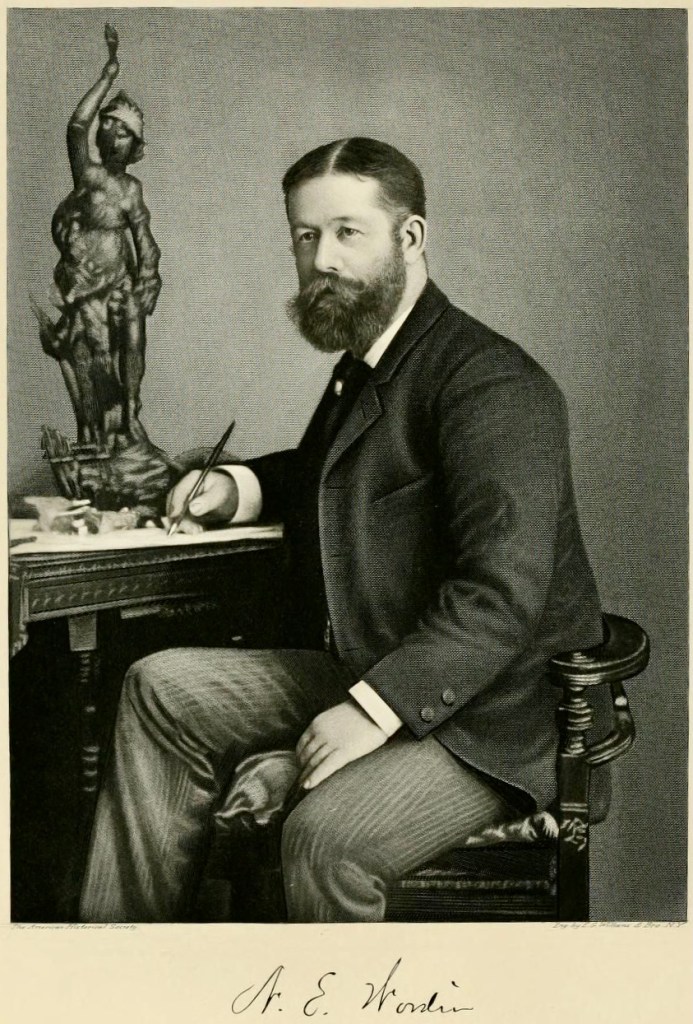
The following letter was written by Nathaniel Eugene (“Gene”) Wordin (1844-1915), the son of Nathaniel Sherwood Wordin (1813-1889) and Francis Augusta Leavenworth (182-1892) of Bridgeport, Connecticut. He wrote the letter to his older sister, Helen (“Nellie”) Caroline Wordin (b. 1842).
Gene enlisted on 28 August 1862 as a private in Co. I, 6th Connecticut Infantry. He was promoted to a corporal on 27 April 1864 and mustered out of the regiment on 3 June 1865. After the war he married Eliza Woodruff Barnes (1841-1921) and earned a medical degree from the Jefferson Medical College of Thomas Jefferson University in Philadelphia in 1875. He practiced allopathic medicine in Bridgeport, Ct.
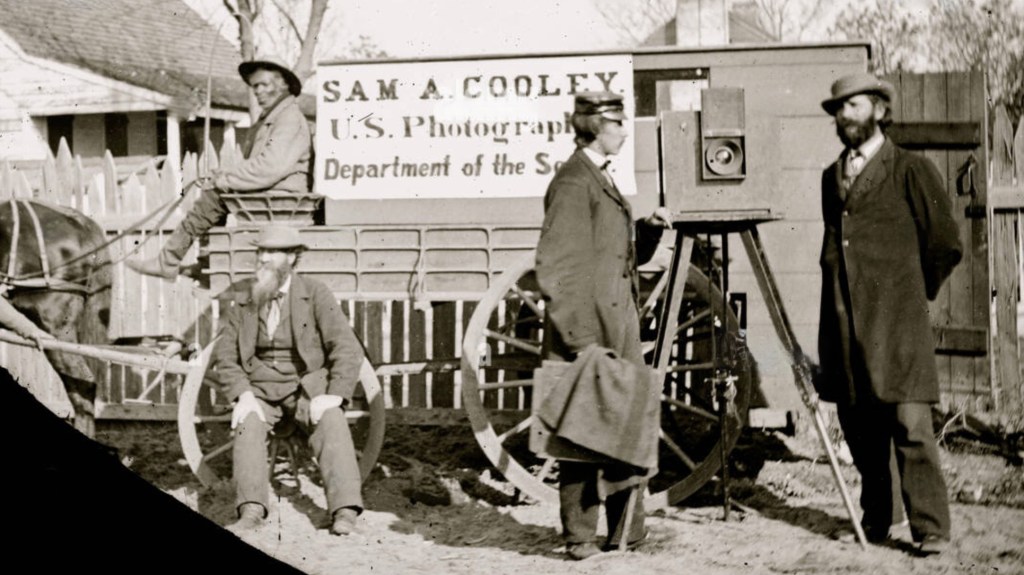
In this lengthy letter to his older sister, Gene responds to numerous questions directed to him from prior correspondence with her and then brings her up-to-date with news of military affairs at Hilton Head in March 1864, including a long description of Gen. Truman Seymour, for whom he briefly worked as a clerk on the island. He also mentions the presence of Sam Cooley, the renowned photographer in the Department of the South who was setting up a studio on Hilton Head at the time.
Addressed to Miss Nellie C. Wordin, Care of N. S. Wardin, Esq., Bridgeport, Conn.
Hilton Head, South Carolina March 23rd 1864
Dear Sister,
It is just one week today since I received a large mail from home, a part of which—and no small part either—was a letter from yourself dated March 1864. With what pleasure it was received and read, you will never know. The most remarkable thing about it was its length, which for you was certainly very long, and as it was dated on no particular day but only the month, I could only infer thay you had been a month in writing it. Am I right in this? or will it do for me to draw my own inferences? As I said before, what the letter contained did not surprise me half as much as the length.
At the time of receiving it, I was very busy indeed on government work as you have since been informed, by two small notes from me and could not conveniently find time to make a suitable reply. As the time of writing my last note, I contemplated soon getting through with my reports and getting over my hurry and promised you an answer or a letter. I don’t know which. Well, I finished the last of my long reports last Friday and sent them to Washington on the Arago the same day. I have since written up my diary to the date for I keep every page in it filled, have had a little rest, and this is the beginning of the promised note. I am almost sorry now that I made such a promise for when you get to the end, if ever you do, I am afraid you will think it nought but nonsense. However, having made the promise, I shall keep it.
I have said that I received a large mail from home one week ago today. Besides your letter, I also received a long one from father which pleased me much—especially as it was the first one he had written since my unceremonious departure from home. He gave me a summary of news and some instructions which I needed and by which I shall profit. He seems to have a natural gift at writing—not only of letters but sentiment, both poetry and prose. I think it was too bad that he has not cultivated it and written more. I think this the more as I see more of his writings, many of which are to be found in the house.
He speaks of having made you a handsome present of furs. You told me about a part of it but not all. You were very fortunate in receiving such a splendid present, and of course you will wear them upon every possible occasion as they will be very warm and comfortable this cold winter. Besides that, if you do not make good use of a present, the giver naturally thinks that it is not appreciated. The mystery of the 10 dollar check is at length satisfactorily explained both by yourself and father. I was almost certain that it had been received but wanted to be positive. I made more trouble over it than the whole thing was worth. I have $50 more to send and will forward it at the earliest convenience; perhaps will enclose a few greenbacks with this before I get through, but everything is as yet uncertain.
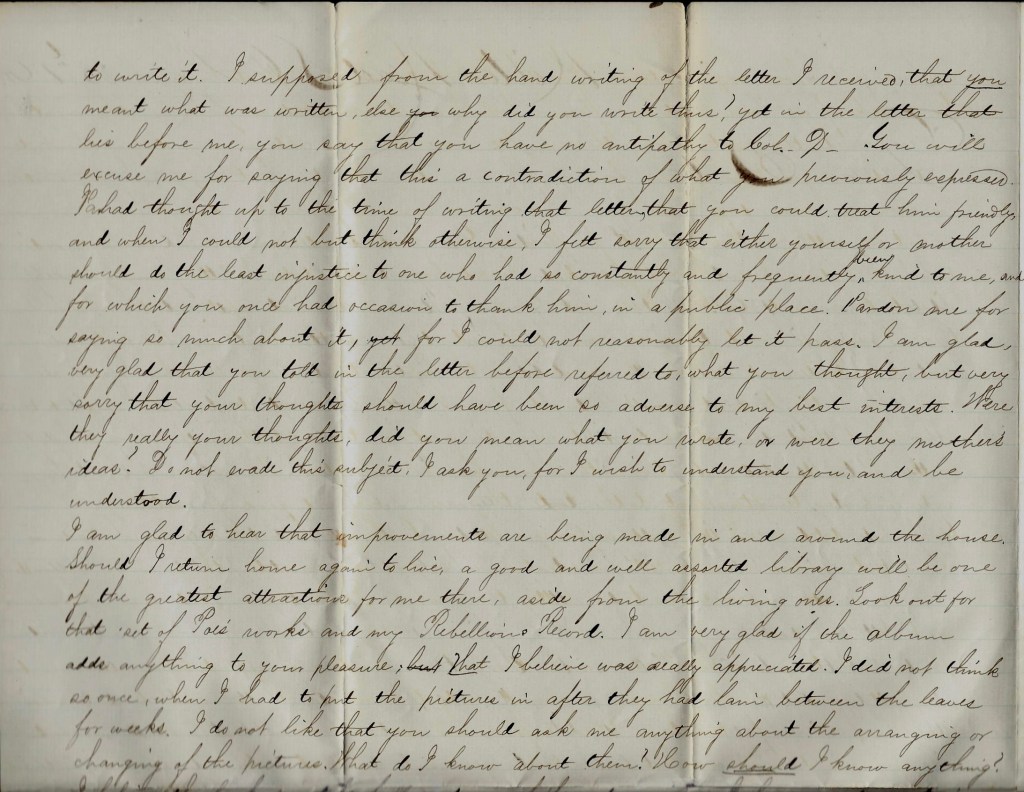
Now I want to say something in regard to that little affair that you claim “roiled” me so much a few weeks since. I wish to simply say that I was not in the least “roiled.” My feelings were rather sorrow and grief than “roile”; the contents of the letter had been contemplated and studied on for several days and I went alone by myself to write it. I supposed from the hand writing of the letter I received, that you meant what was written, else why did you write this? Yet in the letter that lies before me, you say that you have no antipathy to Col. D. You will excuse me for saying that this is a contradiction of what you previously expressed. I had thought up to the time of writing that letter that you could treat him friendly and when I could not but think otherwise, I felt sorry that either yourself or mother should do the least injustice to him who had so constantly and frequently been kind to me, and for which you once had occasion to thank him in a public place. Pardon me for saying so much about it, for I could not reasonably let it pass. I am glad, very glad, that you told in the letter before referred to what you thought, but very sorry that your thoughts should have been so adverse to my best interests. Were they really your thoughts? Did you mean what you wrote? Or were they mother’s ideas? Do not evade this subject. I ask you, for I wish to understand you and be understood.
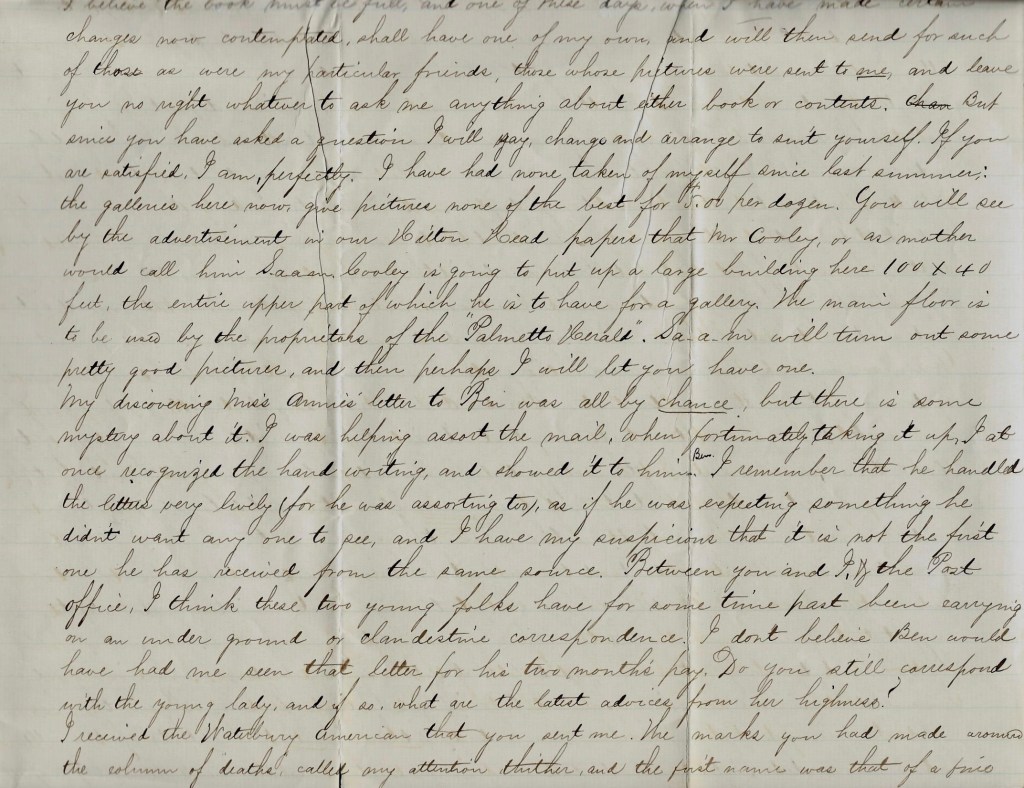
I am glad to hear that improvements are being made in and around the house. Should I return home again to live, a good and well assorted library will be one of the greatest attractions for me there, aside from the living ones. Look out for that set of Poe’s works and my Rebellion Record. I am very glad if the album adds anything to your pleasure. That, I believe, was really appreciated. I did not think so once, when I had to put the pictures in after they had lain between the leaves for weeks. I do not like that you should ask me anything about the arranging of changing of the pictures. What do I know about them? How should I know anything? I believe the book must be full and one of these days when I have made certain changes now contemplated, shall have one of my own and will then send for such of those as were my particular friends, those whose pictures were sent to me and leave you no right whatever to ask me anything about either book or contents. But since you have asked a question, I will say, change and arrange to suit yourself. If you are satisfied, I am perfectly. I have had none taken of myself since last summer. The galleries here now give pictures none of the best for $5 per dozen.
You will see by the advertisement in our Hilton Head papers that Mr. Cooley, or as Mother would call him, Sa-a-m Cooley, is going to put up a large building here 100 x 40 feet, the entire upper part of which he is to have for a gallery. The main floor is to be used by the proprietors of the “Pametto Herald.” Sa-a-m will turn out some pretty good pictures and then perhaps I will let you have one.
Sam A. Cooley and his traveling studio wagon
My discovering Miss Annie’s letter to Ben was all by chance, but there is some mystery about it. I was helping assort the mail when fortunately raking it up, I at once recognized the hand writing and showed it to him (Ben). I remember that he handled the letter very lively (for he was assorting too), as if he was expecting something he didn’t want anyone to see, and I have my suspicions that it is not the first one has received from the same source. Between you and I and the post office, I think these two young folks have for some time past been carrying on an underground or clandestine correspondence. I don’t believe Ben would have had me seen that letter for his two month’s pay. Do you still correspond with the young lady, and if so, what are the latest advices from the highness?
I received the Waterbury American that you sent me. The marks you had made around the column of deaths called my attention thither, and the first name was that of a fine young girl whose acquaintance I made last winter while in Waterbury.
You ask if we had any flowers here. I must say that as far as the weather is concerned, the past two or three nights have been as cold as any during the winter and cold enough, I imagine, for any of you in Connecticut. But supposing the weather as warm as some says have been, as warm as some of your fine days there, is no rumor, but very little on this island for flowers. You have no idea how much business and traveling is done here. Why the sand is kicked from one end to the other, from creek and river to ocean and back. There are, however, a few untouched spots on the island and there I suppose wild flowers can be found. I have neither time nor horses to ride around outside and see South Carolina in the spring time. Large bunches of oranges, fresh from the trees, are brought from Florida by every steamer, and sold at the wharf, but they can be handled only with great care to prevent them from falling off or else I would send you two or three for curiosities. The oranges are very large and look very tempting, but to the taste they are sour and good for nothing.
Your note dated March 14th and enclosing a letter of Cook’s was received today. I am glad to know that he has commenced his vacation in so good a way and with such a long letter. I guess he improves his time better than when I was home. Tell him I will write to him soon.
It will be three weeks Friday since the [smallpox] vaccine virus was applied to my arm and it is now getting well. The huge scab is almost ready to come off. It has caused me some trouble, of course. For two days I had a fever and my arm pained me so that I could scarcely use it. This was so much the worse as it came at a time when I was most busy, and could not stop work. However, I am all right now, and glad that it has been done, and is all over. The scab, I think, I shall give to one of the surgeons as it is quite valuable down here.
Cook writes me that Mr. Day is to have his exhibition in Franklin Hall, which is rather a stretch for him. I suppose, though, that he has something very fine this time. He has given some very fine exhibitions. I may well say the best of any school in the city—those that displayed most talent and originality, and in now making them public, he is but doing what he ought to have done three years ago. I suppose he is tempted to do this from the fact that the High School do not exhibit themselves this season. I wish him the best of success and have no doubt but that he will have it, and have a fine display of talent. Be pleased to send me a bill of fare.
You have enclosed the sample of ladies cloth which you ought to have done two months ago when you first mentioned it. After what I wrote in my last letter, I supposed you would purchase the article in question ready made, but since you prefer to make them up yourself, I too wish you to be busy, doing some good. There is not much preference in cloth as all of it shrinks. I hesitate in choosing between the samples sent as the heaviest is the poorest color for such use as I give it. One of my mess mates has some made of the same kind and color as the dark and as they look well, I will choose that too. His shrunk, however, and I would suggest that you shrink the cloth before making it up. Do not be sparing of cloth, for it is wanting most in length, both of the skirt and sleeves. I want a collar on them so that I can wear a coat without a white collar—that is, if you can make one that will fit. Put a pocket on each side, outside instead of in, of the same material as the whole, and I guess you will need no further instructions. Send then by mail and I will get them the quickest.
I believe now that I have answered all questions and touched about all the points mentioned in your two letters, and will now say something for myself, as perhaps I can interest you a little with what is transpiring in this Department. The general news you get in the papers that I weekly send you and which I suppose you receive, although you say nothing in regard to them. I am situated the same as when I wrote you last, and enjoy myself very well, stopping with the company, although the conversation is not of a style that I altogether prefer. I have not received any of my extra duty money yet as the quartermaster is out of funds. Twenty-five dollars per month and “found” is not doing very badly pecuniarily and scarcely a day passes in which I do not learn something new. I believe that I am in about as good a school as I ever went to, and shall try to learn my lesson well.
Alfred Bishop Beers (1845-1920) of Co. I, 6th Connecticut, was promoted to Captain of Co. B in March 1865.
Corporal [Alfred Bishop] Beers went home about one week ago as a veteran volunteer—three years more in the army. He makes quite a stay this time, having a furlough of thirty days in the State. The Orderly Sergeant of our company, John Waters, has also re-enlisted and gone home. It is said by the boys in the company (and I think with some shadow of truth too) that he has received a commission as 2nd Lieutenant in Co. B. Now don’t run after the corporal, but if you should chance to meet him on the street, please ask him to tell the fact to Sergeant Waters as a kindness to him, that he may be prepared to put on the traps when he gets back. I did not ask either of them to call at the house. You will easily guess from a former letter why not.
We all wonder at the long stay our chaplain is making and want to see him back once more. The 6th Regiment think a wondrous deal of their chaplain [illegible] is well. Edy Lyon is still on the Cosmopolitan.
I forgot to say, while speaking about carte-de-visits, I wish I could in some way get Father’s, but he has had none taken. If you or any one else can persuade him to visit an artist, I wish you would send me a picture. Fan’s, I must have too.
I do not know what conclusion you came to in regard to the flute. If you send it, send also that green music book containing the “Lancer’s,” “Miserere,” &c. Send the book anyway. As I said before, I have $50 to send home and for want of other means, shall send the greenbacks. Twenty dollars you will find enclosed, as I do not wish to trust so much as $50 at once. Will send more in my letter to Father and at different times. Please be so kind as to acknowledge receipt. You will appropriate a part of the expenses you or anyone else have been at for me and pay for the shorts which you are about to make up.
Gen. Truman Seymour—a “man of moderate size and height, rather thin in the face which is somewhat wrinkled, and betokens that the owner has seen much care. A bright discerning eye, a rather lofty and manly bearing—his harir is mixed with gray.”
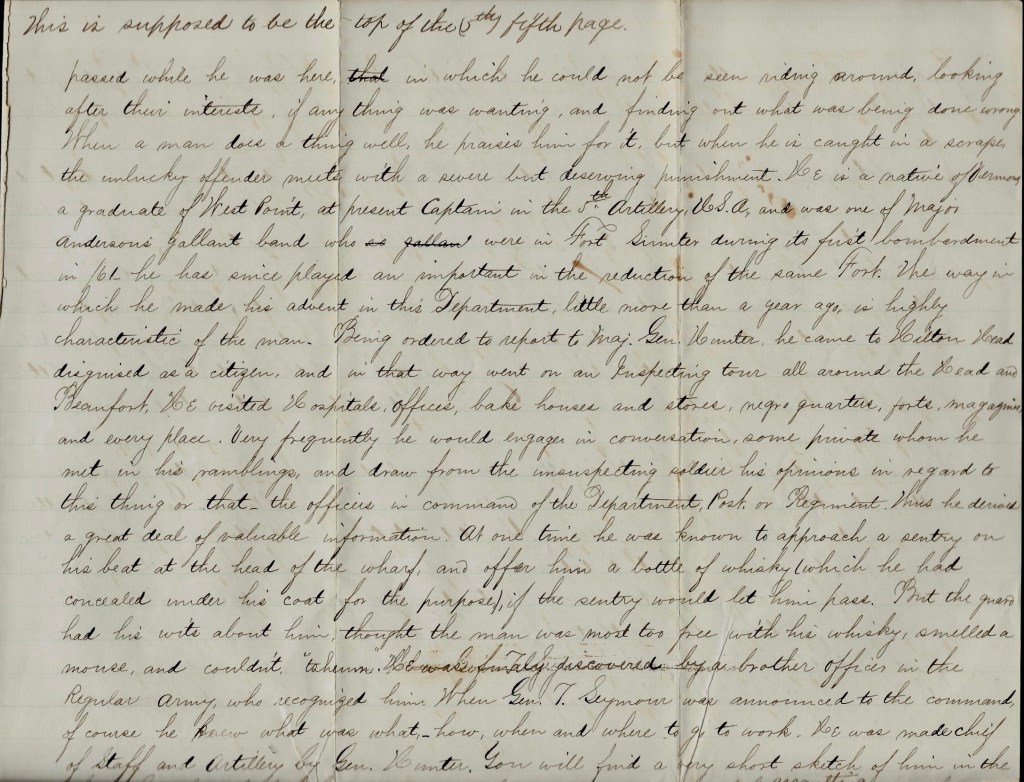
I see by the northern papers that the affair at “Olustee” Florida is creating considerable talk, and that many different reports are given, laying the blame of it upon innocent persons’ heads. I have seen also many sketches and remarks upon Gen. [Truman] Seymour; the commander of the Union forces in Florida. Perhaps you will be somewhat interested in him, as being one under whom I served, though, but for a short time. He had command here for several months while the expedition was being organized. I send his photograph but to tell the truth, it really does him not justice. Mounted, he is a fine looking officer, and a splendid rider. He is a man of moderate size and height, rather thin in the face, which is somewhat wrinkled, and betokens that the owner has seen much care. A bright, discerning eye, a rather lofty and manly bearing—his hair is mixed with gray. He is attentive to the wants of his men and scarcely a day passed while he was here in which he could not be seen riding around, looking after their interest, if anything was wanting, and finding out what was being done wrong.
When a man does a thing well, he praises him for it, but when he is caught in a scrape, the unlucky offender meets with a severe but deserving punishment. He is a native of Vermont, a graduate of West Poit, at present Captain in the 5th Artillery, USA, and was one of Major Anderson’s gallant band who were in Fort Sumter during its first bombardment in ’61. He has since played an important [part] in the reduction of the same fort. The way in which he made his advent in this Department, little more than a year ago, is highly characteristic of the man. Being ordered to report to Maj. Gen. Hunter, he came to Hilton Head disguised as a citizen, and in that way went on an inspecting tour all around the Head and Beaufort. He visited hospitals, offices, bake houses and stores, negro quarters, forts, magazines, and every place. Very frequently he would engage in conversation [with] some private whom he met in his ramblings, and draw from the unsuspecting soldier his opinions in regard to this thing or that, the officers in command of the Department, post or regiment. Thus he derived a great deal of valuable information. At one time he was known to approach a sentry on his beat at the head of the wharf and offer him a bottle of whiskey (which he had concealed under his coat for the purpose), if the sentry would let him pass. But the guard had his wits about him, thought the man was most too free with his whiskey, smelled a mouse, and couldn’t [ ]. He was finally discovered by a brother officer in the Regular Army who recognized him. When Gen. T[ruman] Seymour was announced to the command, of course he knew what was what—how, when and where to go to work.
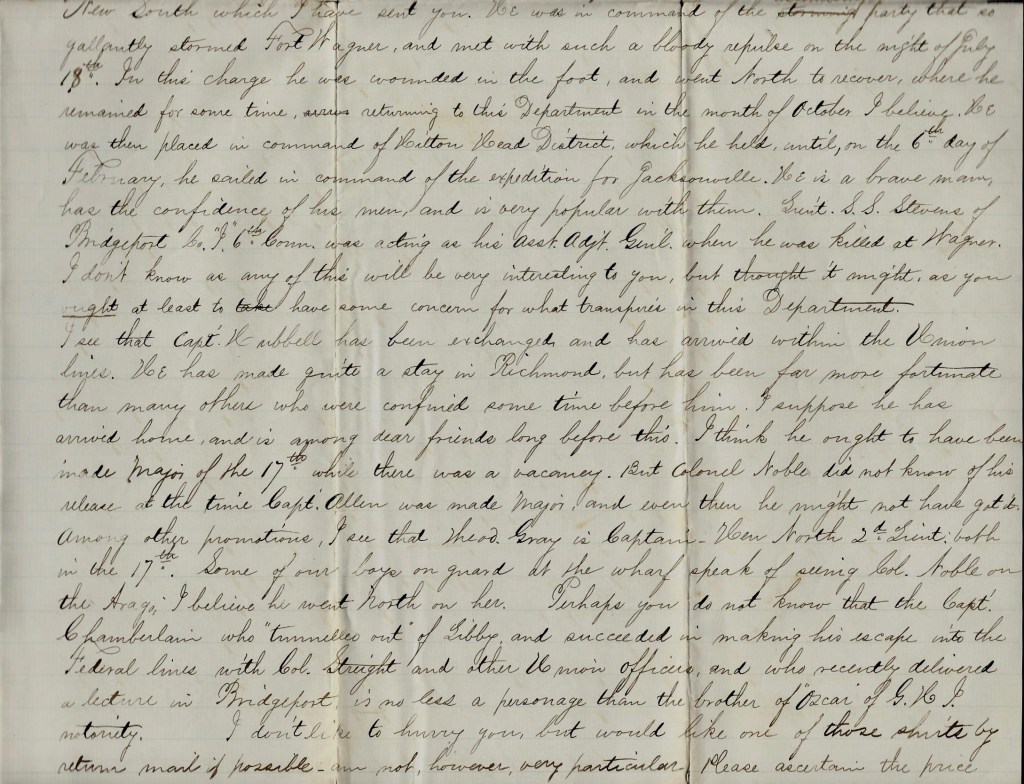
He was made Chief of Staff and Artillery by Gen. Hunter. You will find a very short sketch of him in the New South which I have sent you. He was in command of the part that so gallantly stormed Fort Wagner, and met with such a bloody repulse on the night of July 18th. In this charge he was wounded in the foot and went North to recover, where he remained for some time, returning to this Department in the month of October, I believe. He was then placed in command of Hilton Head District which he held until the 6th day of Februry, he sailed in command of the expedition for Jacksonville. He is a brave man, has the confidence of his men, and is very popular with them. Lieut. S[tephen] S. Stevens of Bridgeport, Co. I, 6th Connecticut was acting as his Asst. Adjt. General when he was killed at Wagner. I don’t know as any of this will be very interesting to you, but thought it might, as you ought at least to have some concern for what transpires in this Department.
I see that Capt. [William Lewis] Hubbell 1 has been exchanged and has arrived within the Union lines. He has made quite a stay in Richmond, but has been far more fortunate than many others who were confined some time before him. I suppose he has arrived home and is among dear friends long before this. I think he ought to have been Major of the 17th while there was a vacancy. But Colonel [William H.] Noble did not know of his release at the time Capt. [Henry] Allen was made Major and even then he might not have got it. Among the promotions I see that Theod. Gray is Captain. Hen. North 2nd Lieutenant; both in the 17th.
Some of our boys on guard at the wharf speak of seeing Col. Noble on the Arago. I believe he went North on her. Perhaps you do not know that the Capt. [Henry B.] Chamberlain [97th NY] who “tunneled out” of Libby and succeeded in making his escape into the Federal lines with Col. [Abel Delos] Streight and other 16 Union officers and who recently delivered a lecture in Bridgeport is no less a personage than the brother of Oscar of G. H. I. notoriety.
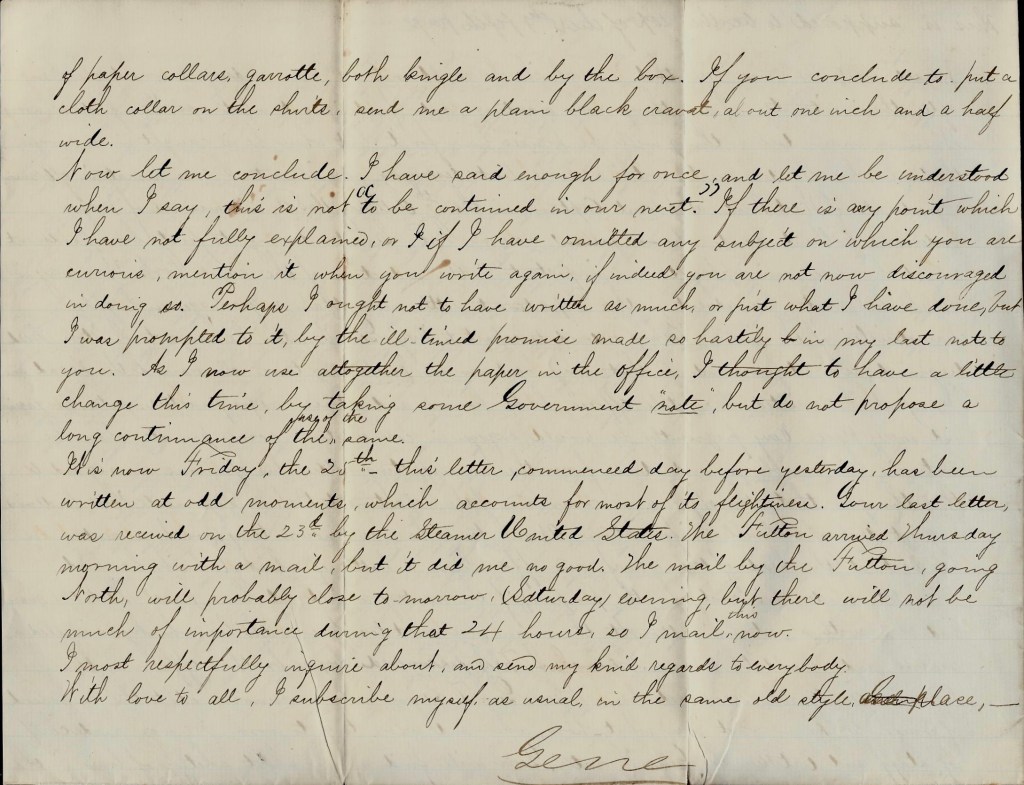
I don’t like to hurry you but would like one of those shirts by return mail if possible. Am not, however, very particular. Please ascertain the price of paper collars, garrotte, both single and by the box. If you conclude to put a cloth collar on the shirts, send me a plain black cravat about one inch and a half wide.
Now let me conclude. I have said enough for once. And let me be understood when I saw, this is not “to be continued in our next.” If there is any point which I have not fully explained, or if I have omitted any subject on which you are curious, mention it when you write again, if indeed you are not now discouraged in doing so. Perhaps I ought not to have written as much, or just what I have done, but I was prompted to it by the ill-timed promise made so hastily in my last note to you. As I now use altogether the paper in the office, I thought to have a little change this time by taking some government “note”, but do not propose a long continuance of the use of the same.
It is now Friday, the 25th. This letter commenced the day before yesterday, has been written at odd moments, which accounts for most of its flightiness. Your last letter was received on the 23rd by the steamer United States. The Fulton arrived Thursday morning with a mail, but it did me no good. The mail by the Fulton, going North, will probably close tomorrow.
I most respectfully inquire about, and send my kind regards to everybody. With love to all, I subscribe myself as usual in the same old style and place, — Gene
1 William Lewis Hubbell of Bridgeport, Connecticut, served in the 17th Connecticut Infantry. He was taken prisoner at Gettysburg while serving on the staff of Brig-General Francis Barlow. He was held prisoner at Libby Prison in Richmond until 7 March 1864 when he was exchanged.
This letter was written by Asa Howard (“A. H.”) Battin (1829-1896), the son of John Battin (1800-1875) and Sarah Dew Howard (1804-1875). From an obituary we learn that:
Asa was born on a farm one mile west of Hanover, Columbiana County, Ohio, March 16, 1829. His boyhood and youth were spent upon a farm in the vicinity of his birthplace, and his early education was obtained in the district school. Later he attended a private school under the auspices of the Quaker church, of which both his parents and grandparents were members. He was studious and ambitious, and, at the age of eighteen years, he became employed as a teacher. The next five years he taught in the district schools of Columbiana County, and during that time he took up and pursued the study of law. He was admitted to the bar at New Lisbon in May, 1853, and in April, 1854, he began the practice of his chosen profession at Salem, Columbiana County. In December, 1858, he removed to Wellsville, where he opened an office and practiced law for ten years, with the exception of the time he spent in the army during the Civil War. He enlisted April 19, 1861, shortly after the rebellion began, as captain of Company K, Third Regiment, Ohio Volunteers. He returned home from the field about May 1, 1862, broken in health. His one year’s service was chiefly performed in West Virginia and Kentucky.”
Asa was married to Eliza Atkinson (1834-1871) in 1855 and their oldest daughter was Anna Gertrude (“Gertie”) Battin (1856-1920), both of whom are mentioned in the final paragraph.
Transcription
Wellsville [Ohio] April 21, 1861
Folks at Salem,
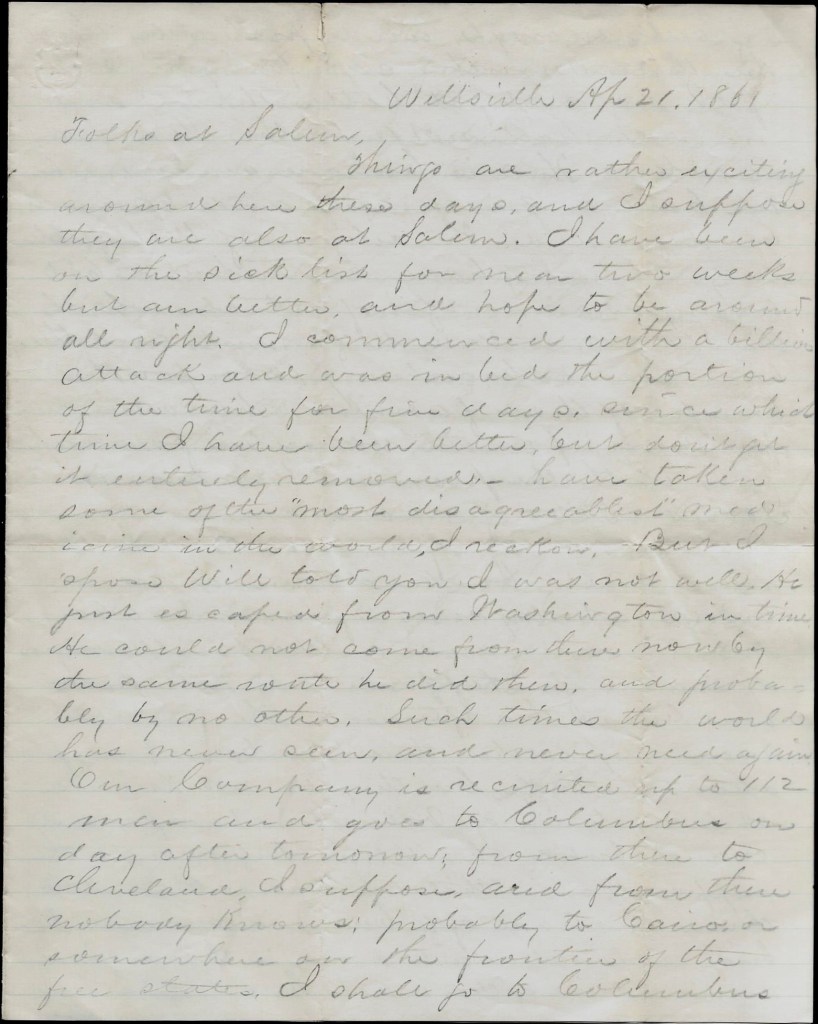
Things are rather exciting around here these days and I suppose they are also at Salem. I have been on the sick list for near two weeks but am better and hope to be around all right. I commended with a bilious attack and was in bed the portion of the time for five days since which time I have been better but don’t get it entirely removed. Have taken some of the “most disagreeable” medicine in the world, I reckon. But I suppose Will told you I was not well. He just escaped from Washington in time. He could not come from there now by the same route he did then and probably by no other. Such times the world has never seen and never need again.
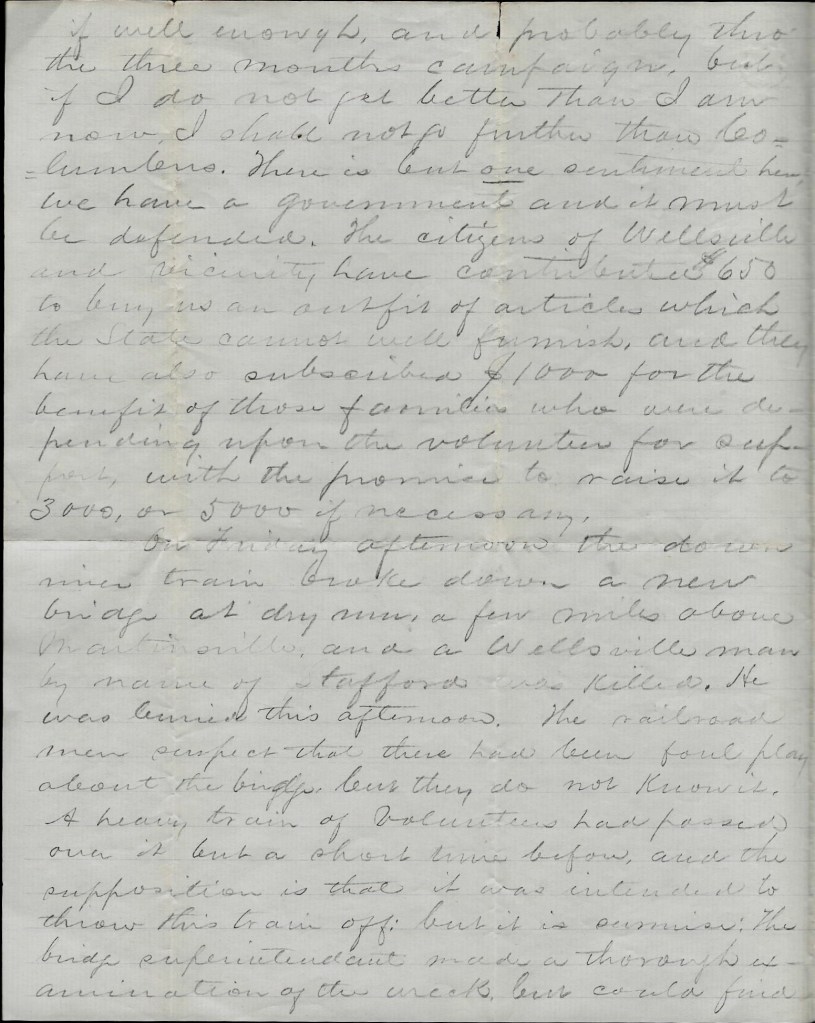
Our company is recruited up to 112 men and goes to Columbus on day after tomorrow; from there to Cleveland, I suppose, and from there nobody knows; probably to Cairo or somewhere on the frontier of the free states. I shall go to Columbus if well enough and probably through the three months’ campaign, but if I do not get better than I am now, I shall not go further than Columbus. There is but one sentiment here. We have a government and it must be defended. The citizens of Wellsville and vicinity have contributed $650 to buy us an outfit of articles which the State cannot well furnish, and they have also subscribed $1,000 for the benefit of those families who were depending upon the volunteers for support with the promise to raise it to 3,000 or 5,000 if necessary.
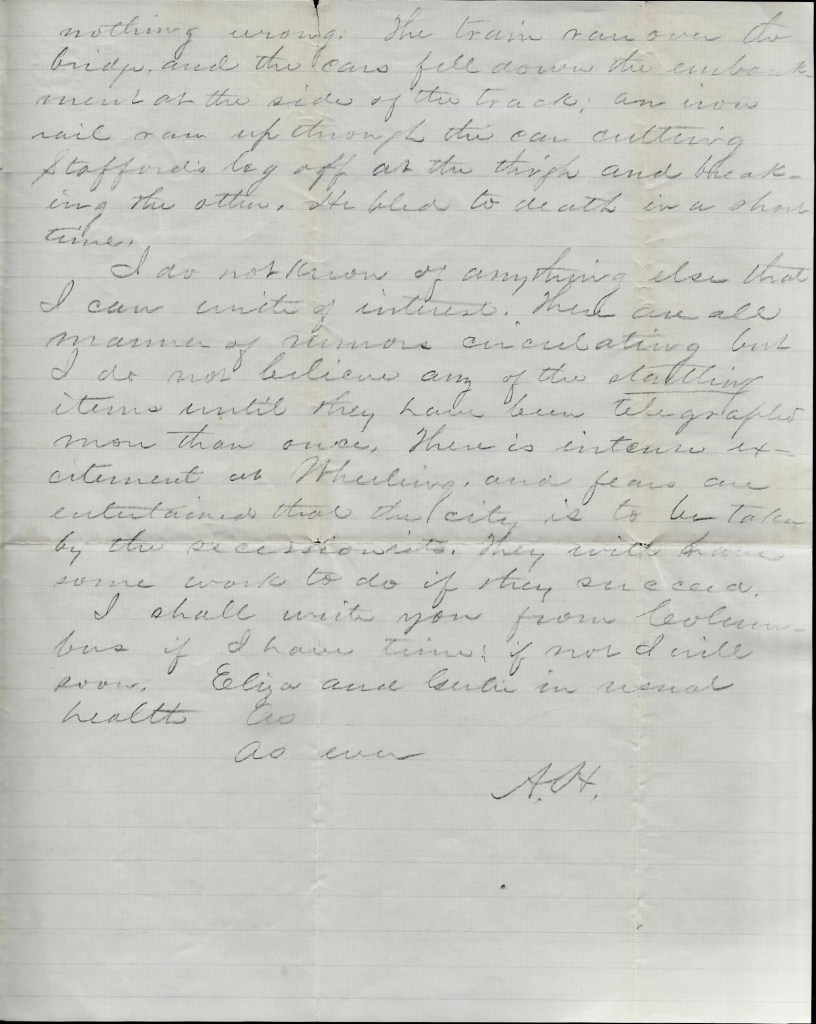
On Friday afternoon, the down river train broke down a new bridge at dry run a few miles above Martinsville and a Wellsville man by name of Stafford was killed. He was buried this afternoon. The railroad men suspect that there had been foul play about the bridge, but they do not know it. A heavy train of volunteers had passed over it but a short time before and the supposition is that it was intended to throw this train off, but it is surmise. The bridge superintendent made a thorough examination of the wreck but could find nothing wrong. The train ran over the bridge and the cars fell down the embankment at the side of the track. An iron rail ran up through the car, cutting Stafford’s leg off at the thigh and breaking the other. He bled to death in a short time.
I do not know of anything else that I can write of interest. There are all manner of rumors circulating but I do not believe any of the startling items until they have been telegraphed more than once. There is intense excitement at Wheeling and fears are entertained that the city is to be taken by the secessionists. They will have some work to do if they succeed.
I shall write you from Columbus if I have time. If not, I will soon. Eliza and Gertie in usual health. As ever, — A. H.
The following letter was written by 18 year-old William (“Will”) Dare Garrison (1826-1847), the eldest child of at least six born to Edmund Fithian Garrison (1802-1858) and Rebecca Dare (1808-1845) of Swedesboro, Gloucester county, New Jersey.
When war was declared on Mexico in May 1846, Will enlisted in Co. D (“Cambria Guards”), 2nd Pennsylvania Volunteers. Although he traveled with the volunteers in 1846 he did not officially enlist until 21 Jan. 1847. William would pass away on 11 July 1847 from illness at the Castle of Perote in Mexico City, aged twenty-one.
In this incredible letter, Will provides us with rich detail of the 4th of July events in Camden, New Jersey, in 1844 which happened to coincide with the Presidential campaign of Whig candidate Henry Clay and his running mate, Theodore Frelinghuysen. We learn that a political barbecue with food and speeches was held in the afternoon of the day’s events on Smith Island, in the middle of the Delaware river between Camden and Philadelphia. The letter was written on 6 July 1844, just one day before a major riot erupted across the river in Philadelphia between the Nativists and Roman Catholics.
A view of Camden from Philadelphia in 1844. Smith’s Island is in the middle of the Delaware river at left where all the trees are shown.
Will wrote the letter to his sister, Harriet Fithian Garrison (1831-1919) who married John W. Kirby (1826-1897) in 1854. That the family admired the statesman Henry Clay seems to be of little doubt as Will had a younger brother named Henry Clay Garrison (1835-1913) who humorously wrote his own epitaph: “Poor old Garry, Here he lies. Nobody laughs, And nobody cries; Where he has gone, Or how he fares, Nobody knows, Nobody cares.”
[Note: to see a map of Lobos Island drawn by Will in April 1847 during the Mexican-American War, see Manuscript Map.]
Transcription
Camden [New Jersey] July 6th 1844
Dear Sister,
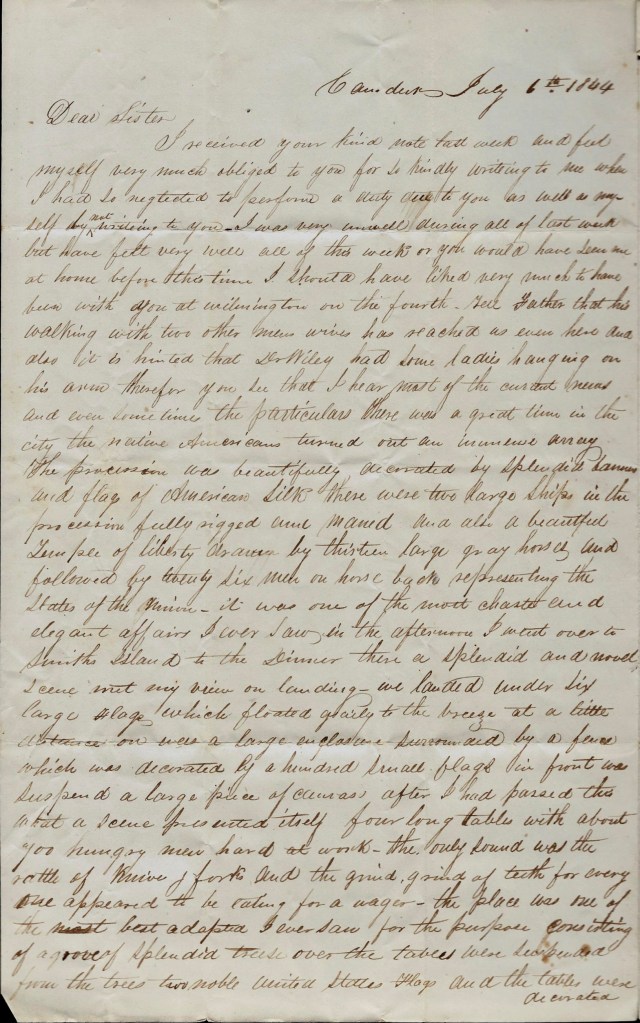
I received your kind note last week and feel myself very much obliged to you for so kindly writing to me when I had neglected to perform a duty due to you as well as myself by not writing to you. I was very unwell during all of last week but have felt very well all of this week or you would have seen me at home before this time. I should have liked very much to have been with you at Wilmington on the fourth. Tell Father that his walking with two other men’s wives has reached us even here and also it is hinted that Dr. Wiley had some ladies hanging on his arm. Therefore, you see that I hear most of the current news and even sometimes the particulars.
There was a great time in the city. The native Americans turned out an immense array. The procession was beautifully decorated by splendid banners and flags of American silk. There were two large ships in the procession fully rigged and manned and also a beautiful Temple of Liberty drawn by thirteen large gray horses and followed by twenty-six men on horseback representing the States of the Union. It was one of the most chaste and elegant affairs I ever saw.
“…what a scene presented itself. Four long tables with about 700 hungry men hard at work—the only sound was the rattle of knife and fork and the grind, grind of teeth for everyone appeared to be eating for a wager.”
— William Dare Garrison, 6 July 1844
In the afternoon, I went over to Smith’s Island to the dinner. There, a splendid and novel scene met my view on landing. We landed under six large flags which floated gaily to the breeze. At a little distance on were a large enclosure surrounded by a fence which was decorated by a hundred small flags. In front was suspended a large piece of canvas. After I had passed this, what a scene presented itself. Four long tables with about 700 hungry men hard at work—the only sound was the rattle of knife and fork and the grind, grind of teeth for everyone appeared to be eating for a wager. The place was one of the best adapted I ever saw for the purpose consisting of a grove of splendid trees. Over the tables were suspended from the trees two noble United States flags and the tables were decorated with numerous small flags bearing the names of Clay and Frelinghuysen. At one end and against the screen was an elevated platform and a table for the officers and speakers. Over them hung a portrait of Henry Clay with U. S. flags festooned over it and two splendid banners hung on either side of it. Opposite to it at the other end of the table, hung a splendid banner surmounted by a gilt eagle festooned with flowers. Upon the side nearest the water was erected a stand for the speakrs, gaily decorated with flags. After dinner we had some toasts and very good speaking interrupted only be cheers and the roar of cannon.
The afternoon concluded with cheers, the firing of cannon, and the bursting of rockets and other fireworks. In the evening there was a splendid display of fireworks.
Give my best respects to all my friends and kiss the family all around for me. There has been a great number of persons over here since the fourth and yesterday there were several fights in the [beer] gardens and a good deal of hard fun. The Dutch [Germans] brought over a band and they danced all the afternoon. Altogether the fourth has gone off with less trouble than was anticipated. I hope that the fourth at Swedesboro went off without any new sprees. Tell Mother that I aim to get up at 5 o’clock after this in order to take exercise and hope by that means to keep from getting sick any more. Give her my love. Tell Father I am looking for him every day in order to make some arrangements. I must now conclude for business calls me to attend to something else. Therefore, I subscribe myself your affectionate brother, — Will D. Garrison
Write back soon.
Burn all my letters for I do not want them kept as monuments of my foolishness and tell John to do the same. — WDG
Programme of Events, Pennsylvania Inquirer, 4 July 1844
The following letter was written by Jonathan F. Harrington (1835-1916), the son of Ralph Harrington (1802-1863) and Anna Paxton (1809-1884) of Groton township, Erie county, Ohio.
Capt. Jonathan F. Harrington, Co. A, 72nd OVI
His on-line obituary claims that “he grew up in a time when Erie county, Ohio, was still in a pioneer condition. He was reared on the home farm and secured his educational training in some of the early schoolhouses familiarly known only to the oldest residents now living. After getting the advantages offered by the schools of Groton township he also spent one year attending school at Detroit, Michigan.
His vocation since early manhood has been that of farming and soon after getting started in that vocation, he went away to help fight in the battles of the Union. Capt. Harrington enlisted in May 1861 in Co. A, 72nd regiment OVI ad his first duty was in recruiting the company for that regiment, and after getting its quota mustered in he took his place in the ranks as a private soldier. A year later he was made 2nd Lieutenant, and later promoted to 1st Lieutenant and during the last two years of is service to his country was captain of the company. He continued in the war four years until his honorable discharge in September 1865. Capt. Harrington fought in the great battle of Shiloh, participated in the siege of Corinth and also in the campaign ending in the fall of Vicksburg.
On January 1st 1868, he was married to Miss Sarah E. McKesson (1845-1935) who also represents some of the pioneers of Erie county.”
In this letter datelined from the regiment’s encampment 8 miles in the rear of Vicksburg, Mississippi, Capt. Harrington informs his younger brother Lionel E. Harrington (1841-1895) of their location, the health of the regiment, and reacts to the recent gubernatorial election results in the regiment and at home in Ohio in which the “Peace Democrat” Clement Vallandigham lost in a landslide to the pro-Union War Democrat John Brough.
Field Desk used by Capt. Jonathan F. Harrington during the Civil War
[Note: To read Harrington’s account of the Battle of Shiloh, go to: Civil War Talk.]
Transcription
Addressed to L. E. Harrington, Esq., Groton, Erie county, Ohio
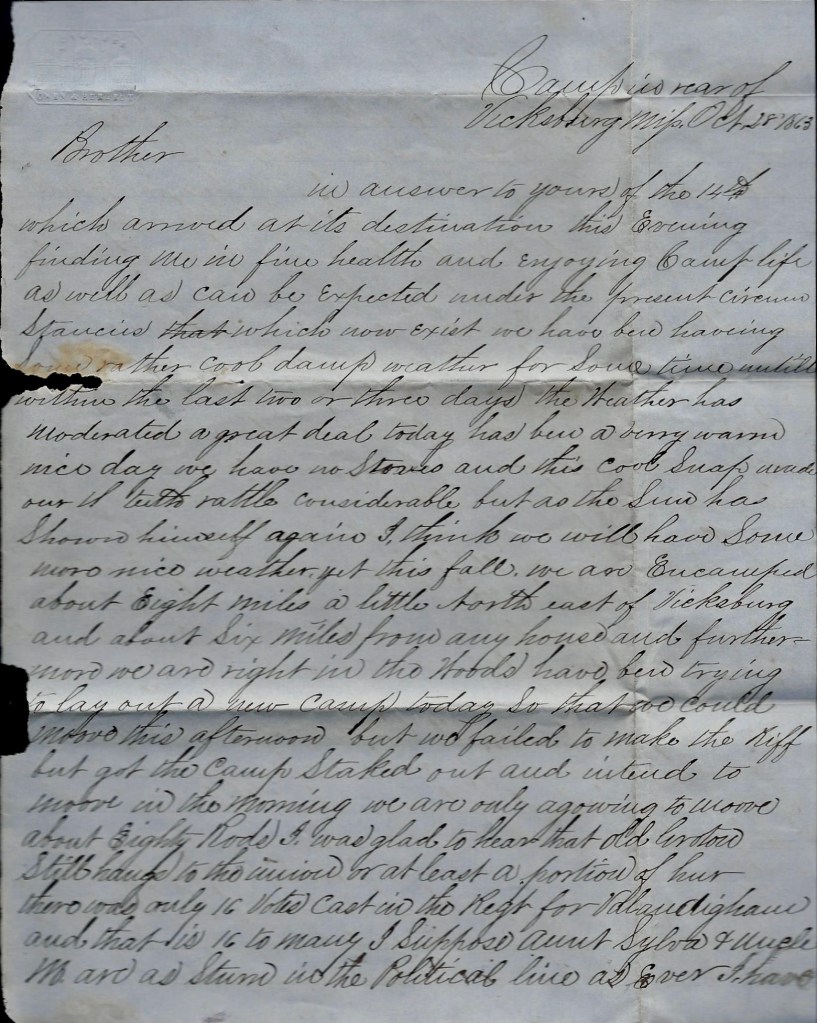
Camp in rear of Vicksburg October 28, 1863
Brother,
In answer to yours of the 14th which arrived at its destination this evening finding me in fine health and enjoying camp life as well as can be expected under the present circumstances which now exist, we have been having some rather cool damp weather for some time until within the last two or three days. The weather has moderated a great deal. Today has been a very warm day, nice day. We have no stoves and the cool snap made our teeth rattle considerably but as the sun has shown himself again, I think we will have some more nice weather yet this fall.
We are encamped about eight miles a little northeast of Vicksburg and about six miles from any house. And furthermore, we are right in the woods. Have been trying to lay out a new camp today so that we could move this afternoon but we failed to make the riff [?] but got the camp staked out and intend to move in the morning. We are only a going to move about eighty rods [quarter mile].
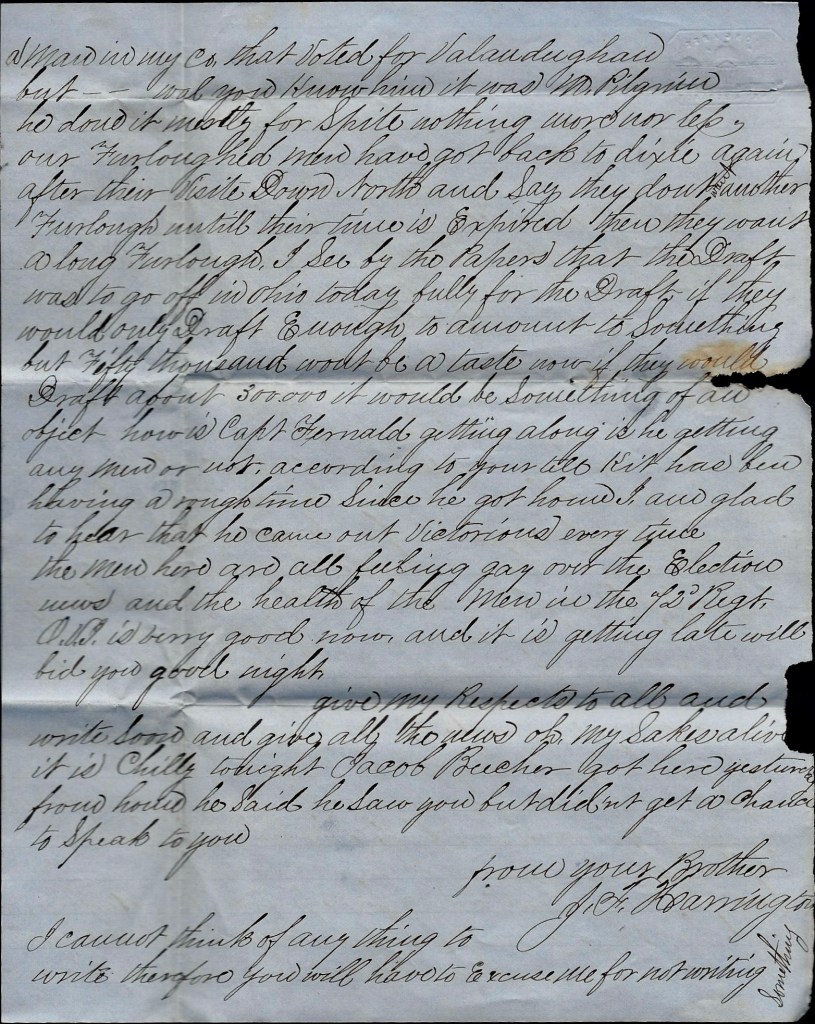
I was glad to hear that Old Groton still hangs to the Union, or at least a portion of her. There was only 16 votes cast in the regiment for [Clement] Vallandigham and that is 16 too many. I suppose Aunt Sylvia & Uncle M. are as stern in the political line as ever. I have a man in my company that voted for Vallandigham but—well, you know him. It was M. Pilgrim. He done it mostly for spite—nothing more nor less.
Our furloughed men have got back to Dixie again after their visit down North and say they don’t want another furlough until their time is expired. Then they want a long furlough.
I see by the papers that the draft was to go off in Ohio today. Bully for the draft if they would only draft enough to amount to something, but fifty thousand won’t be a taste. Now if they would draft about 300,000, it would be something of an object. How is Capt. Fernald getting along? Is he getting any men or not? According to your tell, Kit has been having a rough time since he got home. I am glad to hear that he came out victorious every time.
The men here are all feeling gay over the election news and the health of the men in the 72nd Regiment OVI is very good now and it is getting late. Will bid you good night.
Give my respects to all and write soon and give all the news. Oh my sakes alive, it is chilly tonight. Jacob Beecher got here yesterday from home. He said he saw you but didn’t get a chance to speak to you.
From your brother, — J. F. Harrington
I cannot think of anything to write. Therefore, you will have to excuse me for not writing something.
I could not find an image of Ira but here is a tintype of John L. Cleveland of Co. B, 3rd Vermont Infantry
The following letters were written by Ira E. Morse (1837-1862) of Co. D, 3rd Vermont Infantry. Ira enlisted on 1 May 1861 and was mustered into the regiment on 16 July 1861. He received a gunshot wound on 16 April 1862 at Lee’s Mills, Virginia, but recovered only to die of disease on 29 November 1862. It appears that Ira, weakened from chronic diarrhea, had fallen out of the ranks while on a march and that a Boonsboro, Maryland, resident named Cornelius Wertz found Ira by a tree in the woods near his home and took him in and cared for him until he died. He was buried “in front of the church in Boonsboro where several Union soldiers had been buried.” David Trull claimed to have received Ira’s diary and bible from Mr. Wertz and delivered them to Ira’s parents.
Ira was the son of David Morse (b. 1807) of Charleston, Vermont, who was said to be physically unable to support his family financially. David and his wife Fanny’s net worth in 1860 was only $400 and they had come to rely on the money that Ira sent home to his family. By the time of his death, Ira had sent home $200 between his wages and the bounty he received for enlisting.
While researching Ira, I discovered in the “Widow’s Pension” claim filed by Ira’s mother following his death, that two of Ira’s letters written during the Peninsula Campaign in the summer of 1862 had been sent to the Pension Office as proof of Ira’s having sent money home to his parents for their use. I have transcribed these and added them with the 3rd Letter describing the Battle of Antietam.
Letter 1
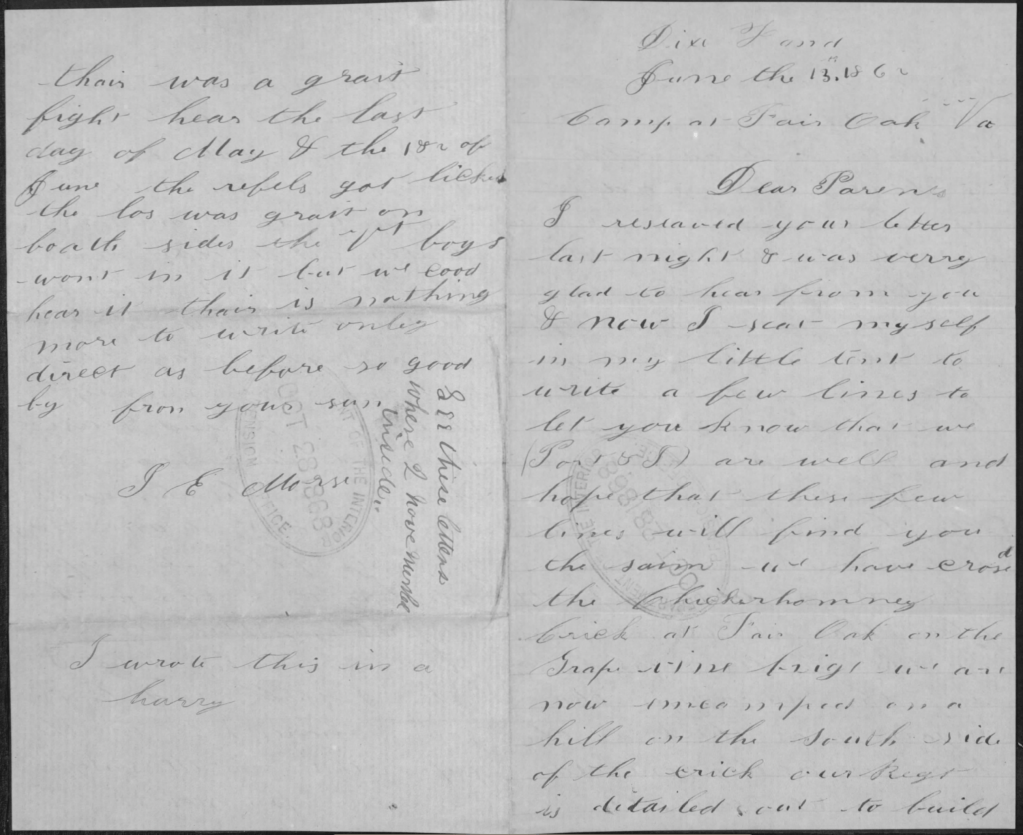
Dixie Land June 13, 1862 Camp at Fair Oak, Va.
Dear Parents,
I received your letter last night & was very glad to hear from you & now I seat myself in my little tent to write a few lines to let you know that we (Port & I) are well and hope that these few lines will find you the same.
We have crossed the Chickamoniny Creek at Fair Oaks on the grapevine bridge. We are now encamped on a hill on the south side of the creek. Our regiment is detailed out to build a bridge across the crick. The rest of the [Vermont] Brigade is 1.5 miles ahead. There is heavy cannonading up there this morning. Our picket is so close to the Rebs that they have to post themselves in the night & lay flat on their bellies until the next night. Our men are a building forts all along the lines. We shall have Richmond before long.
This is a very pretty place here. It is all oak on the hills and pine in the swamps. The niggers is as thick as the hair on a dog. One old nigger is 106 years old. Little niggers from 10 to twelve will carry a pail of water on their heads and not touch a hand to it.
I am sorry to hear that Dan ain’t so well. I don’t think he had ought to work at all. You may take any of my money that you need and use it and get Dan some clothes too if he needs them. I don’t want any of my folks to suffer as long as I can work. We probably shall be paid off again before long & then I shall send home some more.
I see in the papers that the Mississippi River is open now.There was a great fight here the last day of May & the 1st of June. The Rebels got licked. The loss was great on both sides. The Vermont boys weren’t in it but we could hear it. There is nothing more to write—only direct as before. So goodbye from your son, — I. E. Morse
I wrote this in a hurry.
Letter 2
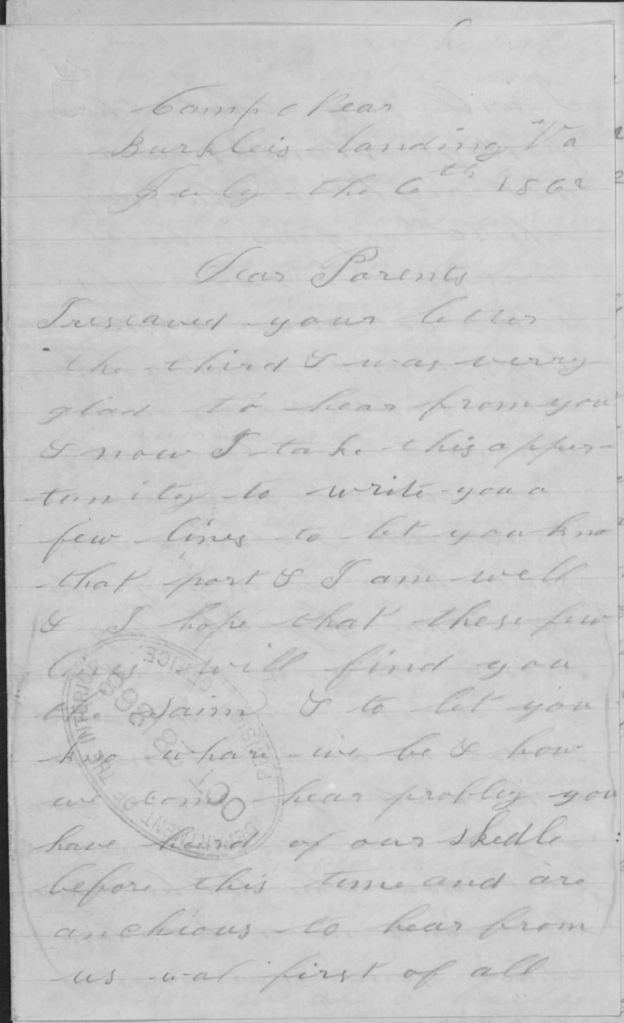
Camp near Berkeley’s Landing, Va. July 6th 1862
Dear Parents,
I received your letter the third. I was very glad to hear from you. i now take this opportunity to write you a few lines to let you know that Port and I are well and I hope that these few lines will find you the same & to let you know where we be & how we come here. Probably you have heard of our skedaddle before this time and are anxious to hear from us.
Well, first of all I will say that them postage stamps was all right.
Thursday the 26th of June, a battle was fought on our right & we got news that our boys was a licking them. Cheers after cheers was given all along the lines. We was paid off the same day & Port & I sent home our money the next day by the pay master…
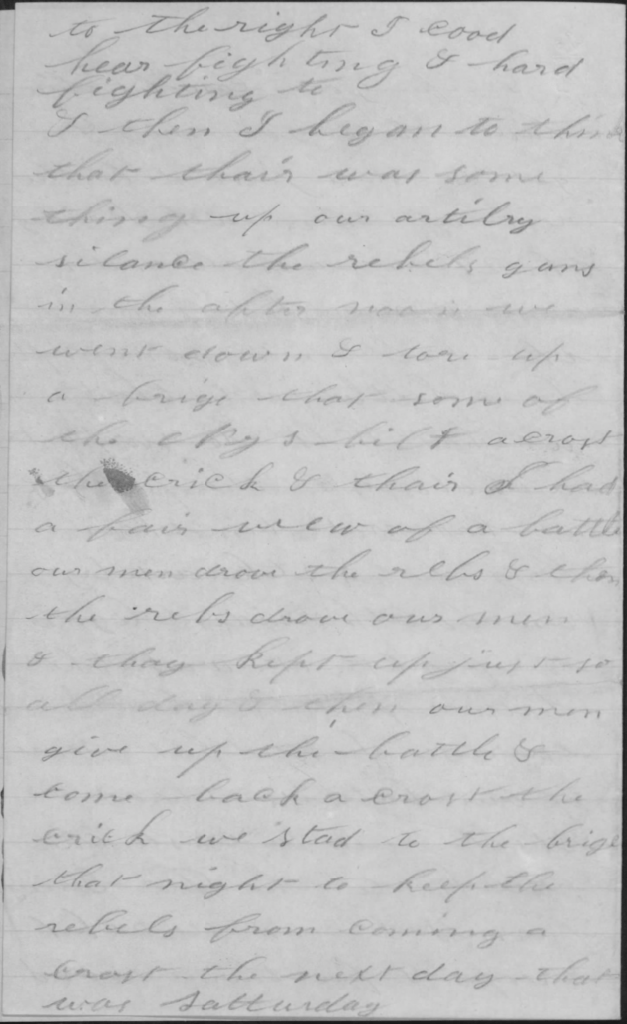
Well. Friday the 27th we was all under arms & marched up onto the hill into some rifle [pits] by a little fort that we had built to support a battery & the pickets. We had not been there long before the artillery on both sides began to fight. It was the hottest place that I ever see. I see that some of our batteries throwed shell over across the crick to the Dr. Gaines’ farm & I could see rebel troops & further around to the right I could hear fighting & hard fighting too.
And then I began to think that there was something up. Our artillery silenced the rebel guns. In the afternoon we went down & tore up a bridge that some of the nigs built across the creek & there I had a fair view of a battle. Our men drove the rebs & then the rebs drove our men & they kept up just so all day and then our men give up the battle & come back across the creek. We stood to the bridge that night to keep they rebels from coming across. The next day—that was Saturday—our troops wrecked the rebels all out and took a lot of prisoners. We was completely cut off twice but forces come up in the rear from the James river and drove the rebels back. The 2nd day we arrived at this landing. It rained all day hard & the mud was half a knee deep & we all got wet as rats & our legs was all mud up to our bodies.
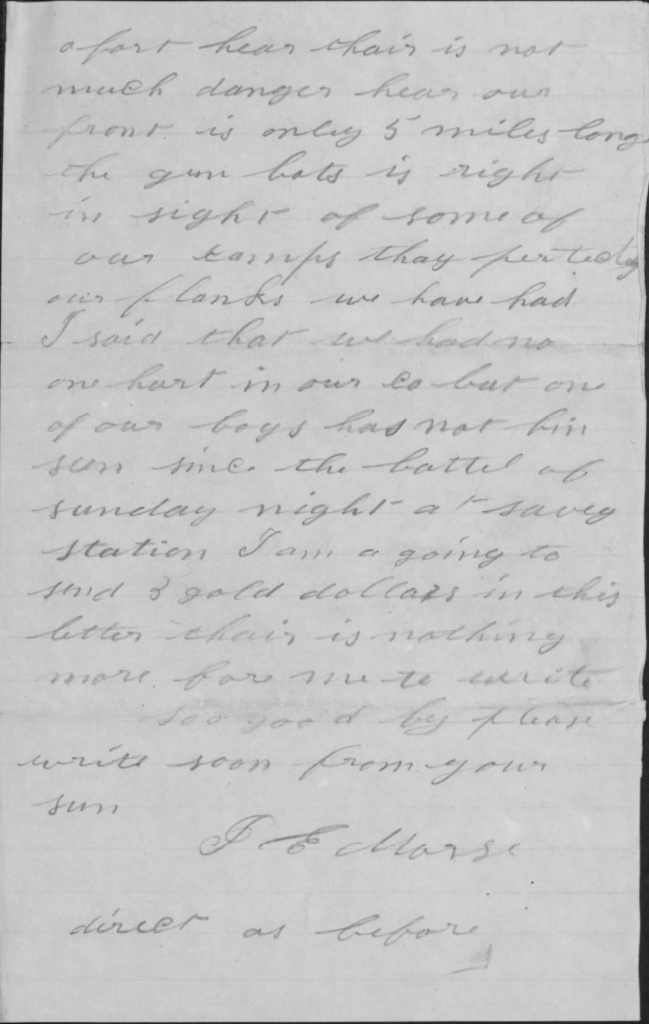
The next day the rebels got into a hill and began to shell some of our camps. The cavalry went up and drove them off & took their guns & then we loved to the place that we are now. We lost everything on this retreat almost. We are a building a fort here. There is not much danger here. Our front is only 5 miles long. The gunboats is right in sight of some of our camps. They protect our flanks. I said that we had no one hurt in our company but one of our boys has not been seen since the Battle of Sunday night at Savage Station. I am a going to send 3 gold dollars in this letter. There is nothing more for me to write. So goodbye. Please write soon. From your son, — I. E. Morse
Direct as before.
Letter 3
Camp near Hagerstown, Maryland October 13, 1862
Dear Brother & Sister,
It is with pleasure that I can have time to write you a few lines to let you know that I am some better than I have been. I had had the diarrhea for two months but I am on the gain now. I shall be all right before long now.
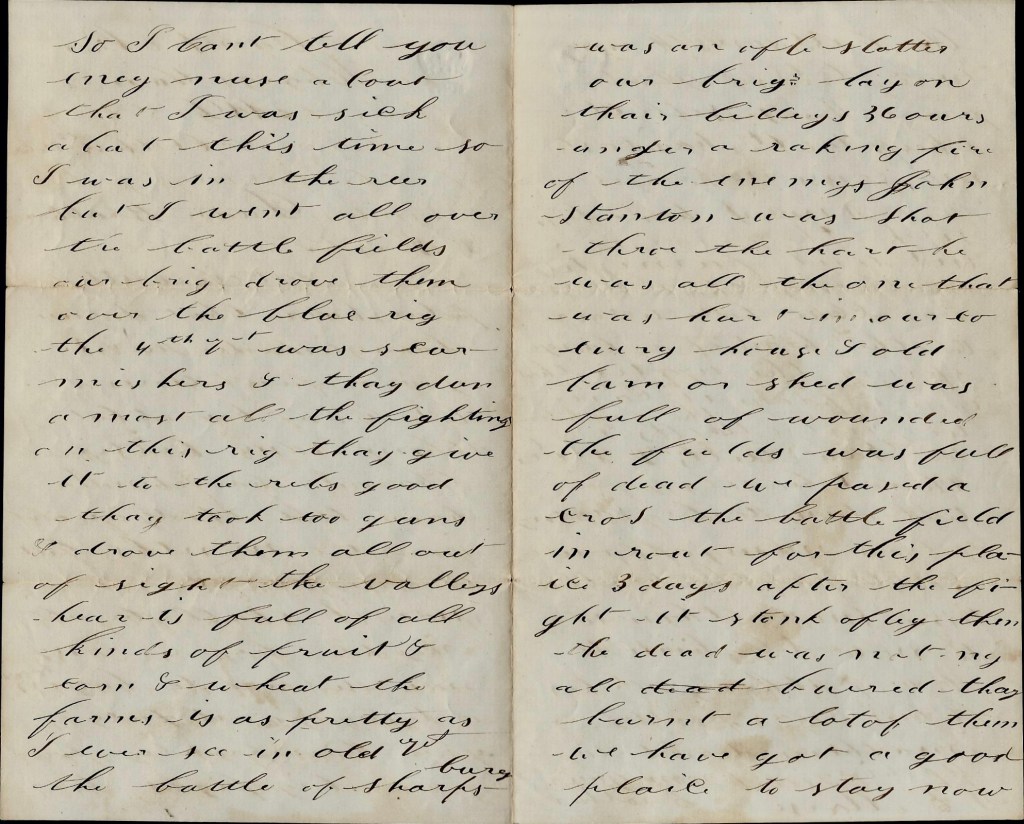
We are to Hagerstown a doing guard duty. You have probably heard of our big fight here so I can’t tell you any news about that. I was sick about this time so I was in the rear but I went all over the battlefields. Our brigade drove them over the Blue Ridge. The 4th regt. was skirmishers & they done a most all the fighting on this ridge. They give it to them Rebs good. They took two guns and drove them all out of sight.
The valleys here is full of all kinds of fruit & corn & wheat. The farms is as pretty as I ever see in old Vermont.
Ira’s account of the battlefield—the stench, the unburied soldiers and animals, & the houses filled with wounded are described in detail in Steven Cowie’s new book, “When Hell Came to Sharpsburg”
The Battle of Sharpsburg was an awful slaughter. Our Brigade lay on their bellies 36 hours under a raking fire of the enemy [guns]. 1 John Stanton was shot through the heart. He was all the one that was hurt in our company. Every house & old barn and shed was full of wounded. The fields was full of dead. We passed across the battlefield en route for this place three days after the fight. It stank awfully then. The dead was not nye all buried. They burnt a lot of them.
We have got a good place to stay now. The citizens bring in a lots of good provisions & sell it cheap too. It has cost me some money to live since I have been sick. The government don’t furnish one thing that a sick man can eat. We are to the head of a large spring. The water that comes from it carries two grist mills & two saw mills & several small shops.
Tell Dan to be saving of his money for we shall need it sometime more than we do now. Tell him to let father get his clothes and have mother mail them. Direct to Washington. From your brother, — I. E. Morse
1 The 3rd Vermont, being in Brooks’ Brigade, left its camp in Pleasant Valley at 6 A.M. of the 17th, crossed the Antietam at Pry’s Ford and reached the field about noon. It was ordered to the support of Sedgwick’s Division, Second Corps, on the Union right but, before getting into position, was ordered to the support of French’s Division and formed in Mumma’s Cornfield, on ground vacated by the 14th Connecticut, its left connecting with French, its right resting on Mumma’s Lane, facing south parallel to and about 170 yards from the Bloody Lane. It was subjected to a galling fire of both Artillery and Sharpshooters, causing some loss. It remained in this position until the morning of the 19th.





















 Spared & Shared 23