My passion is studying American history leading up to & including the Civil War. I particularly enjoy reading, transcribing & researching primary sources such as letters and diaries.
The following letter was written by Elijah Nye Harvey (1842-1903), the son of Enoch Dole Harvey (1811-1888) and Mary Hubbard Nye (1812-1859) of Lake Mills, Jefferson county, Wisconsin.
Elijah was a blacksmith by trade when he enlisted as a private in the 3rd Independent Battery, Wisconsin Volunteer Light Artillery on 22 August 1862 for three years service. At the time that Elijah wrote this letter in late March 1864, the battery was on garrison duty in the defenses of Chattanooga. They later moved to Murfreesboro and had garrison duty there until mustering out in July 1865.
Elijah wrote the letter to his younger brother, William Riley Harvey (1845-1917).
[Note: This letter is from the private collection of Greg Herr and was transcribed and published on Spared & Shared by express consent.]
Transcription
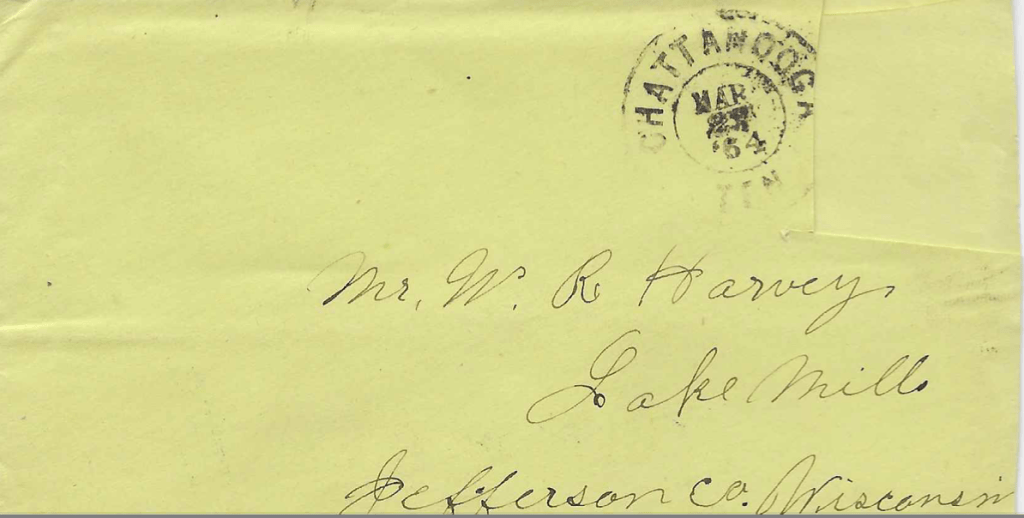
Addressed to Mr. W. R. Harvey, Lake Mills, Jefferson county, Wisconsin
Chattanooga, Tennessee March 25, 1864
Dear Brother,
I have been looking for a letter for a long time but it does not make its appearance as yet. Your 4 papers reached their destination on the 20th so I made up my mind that you were still on earth. I was very glad you sent them and like the paper very much.
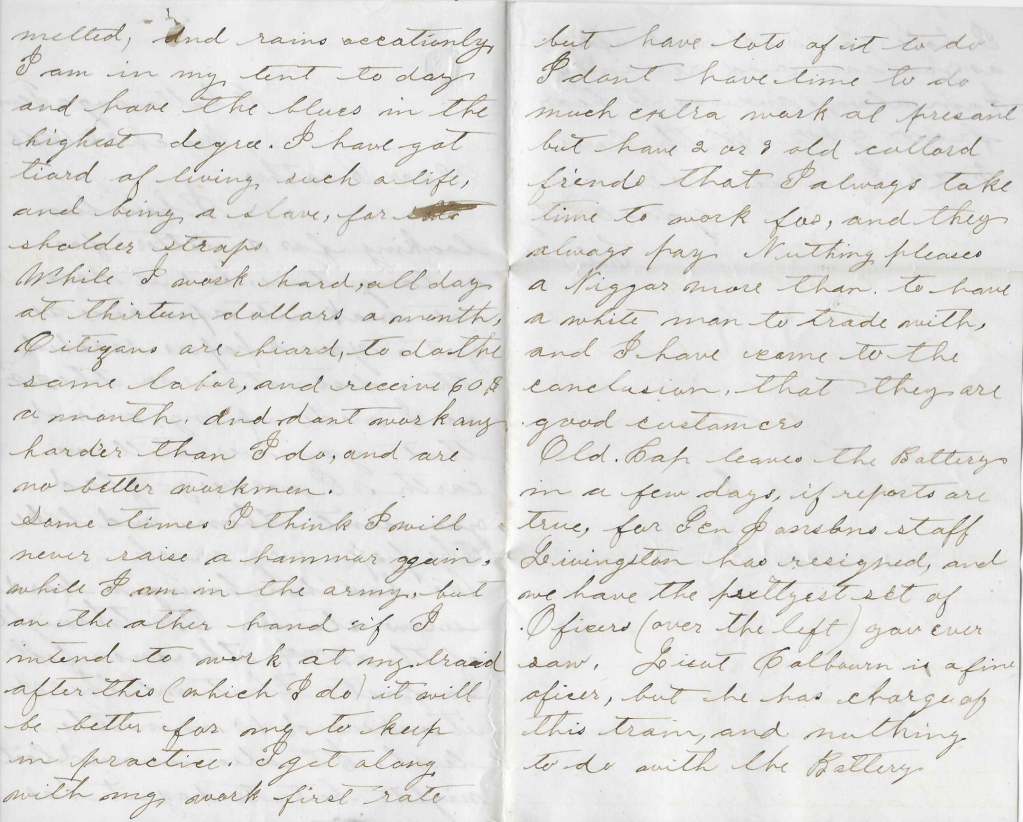
We have been having a hard snowstorm. On the night of the 22nd, the snow fell so fast that on the 23rd, it measured 10 inches on the level. It also snowed last night but today, it has melted, and rains occasionally. I am in my tent today and have the blues in the highest degree. I have got tired of living, such a life. and being a slave for shoulder straps.
While I work hard all day at thirteen dollars a month, citizens are hired to do the same labor and receive $60 a month and don’t work any harder than I do and are no better workmen. Sometimes I think I will never raise a hammer again while I am in the army, but on the other hand, if I intend to work at my trade after this (which I do), it will be better for me to keep in practice. I get along with my work first rate but have lots of it to do. I don’t have time to much extra work at present but have 2 or 3 old colored friend that I always take time to work for and they always pay. Nothing pleases a Nigger more than to have a white man to trade with, and I have come to the conclusion that they are good customers.
Old Cap leaves the Battery in a few days, if reports are true, for Gen. Johnson’s staff. Livingston has resigned and we have the prettiest set of officers (over the left) you ever saw. Lieut. Colburn is a fine officer but he has charge of this train and nothing to do with the Battery.
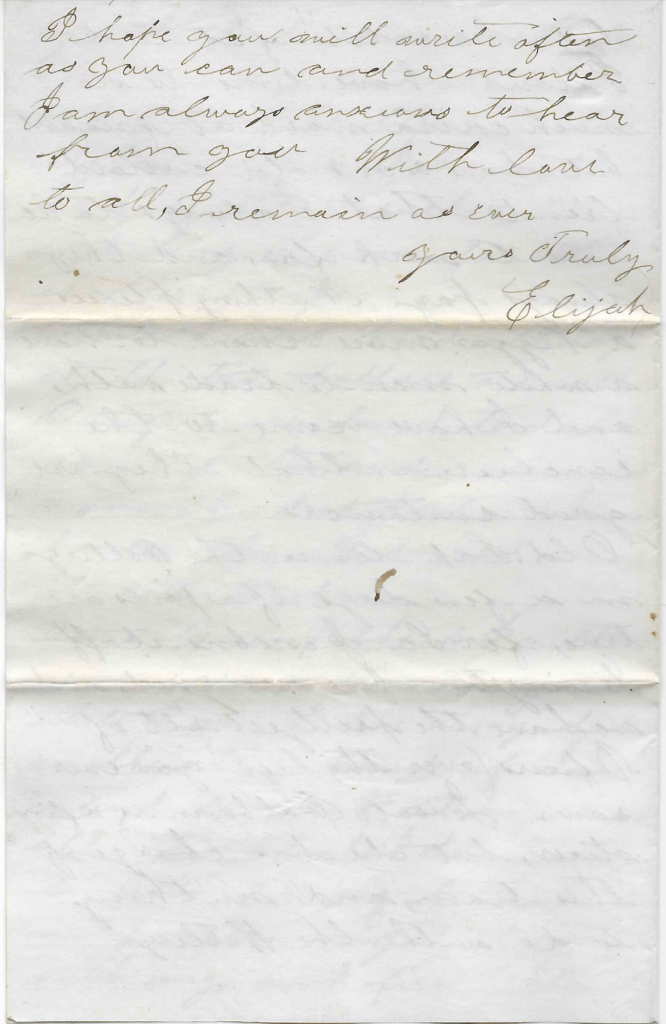
I hope you will write often as you can and remember I am always anxious to hear from you. With love to all, I remain as ever yours truly, — Elijah
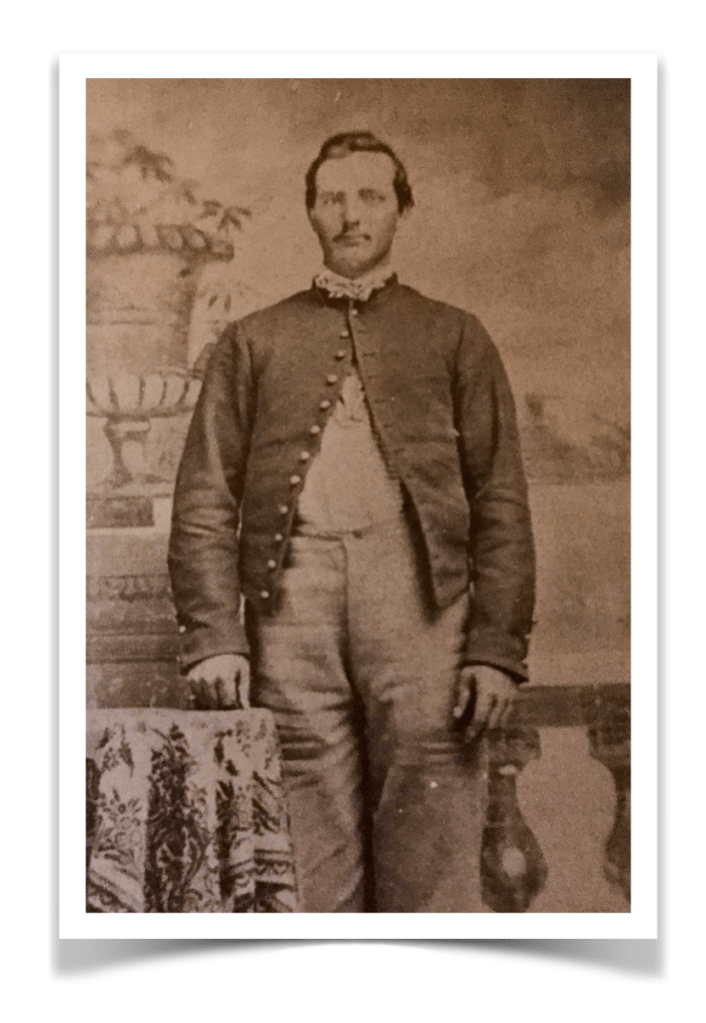
The following letter was written by Frederick P. Rowe (1842-1907), the son of John N. Rowe (1807-1880) and Sarah Electa Wilson (1813-1889) of Hurley, Ulster county, New York. At the time of his enlistment, he was described as a 5 foot, 10 inch tall farmer, with dark eyes, dark hair, and a dark complexion.
Frederick mustered into Co. A, 120th New York Infantry on 22 August 1862 as a private. He was mustered out of the regiment on 3 June 1865 as a corporal. According to muster roll records he was taken prisoner at Gettysburg on 2 July 1863 and was sent to Camp Parole at Annapolis to await exchange where he wrote the following letter in May 1864.
At Gettysburg, the 120th New York fought in Humphrey’s division. It became involved in the disaster of the second day’s battle on the Union left, but like the rest of the 3d corps, it fell back in good order to the second line, fighting as it went. Its casualties in this battle aggregated 30 killed, 154 wounded and 19 missing; total, 203. Eight officers were killed and 9 wounded in that battle.
Transcription
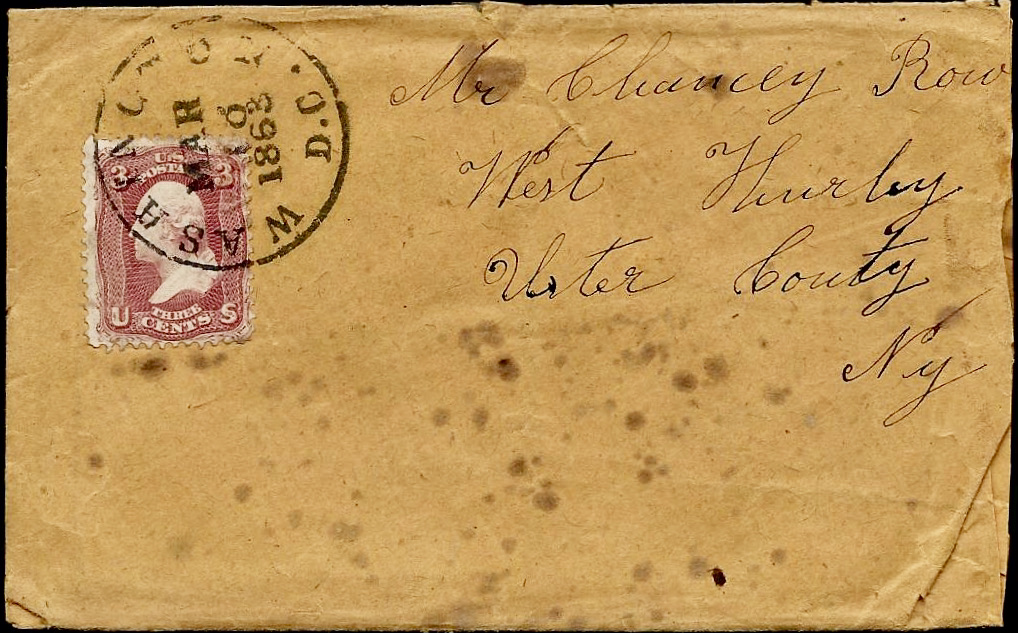
Addressed to Mr. Chauncey Rowe, West Hurley, Ulster county, New York
Camp Parole Annapolis, Maryland May 7th 1864
Dear cousin,
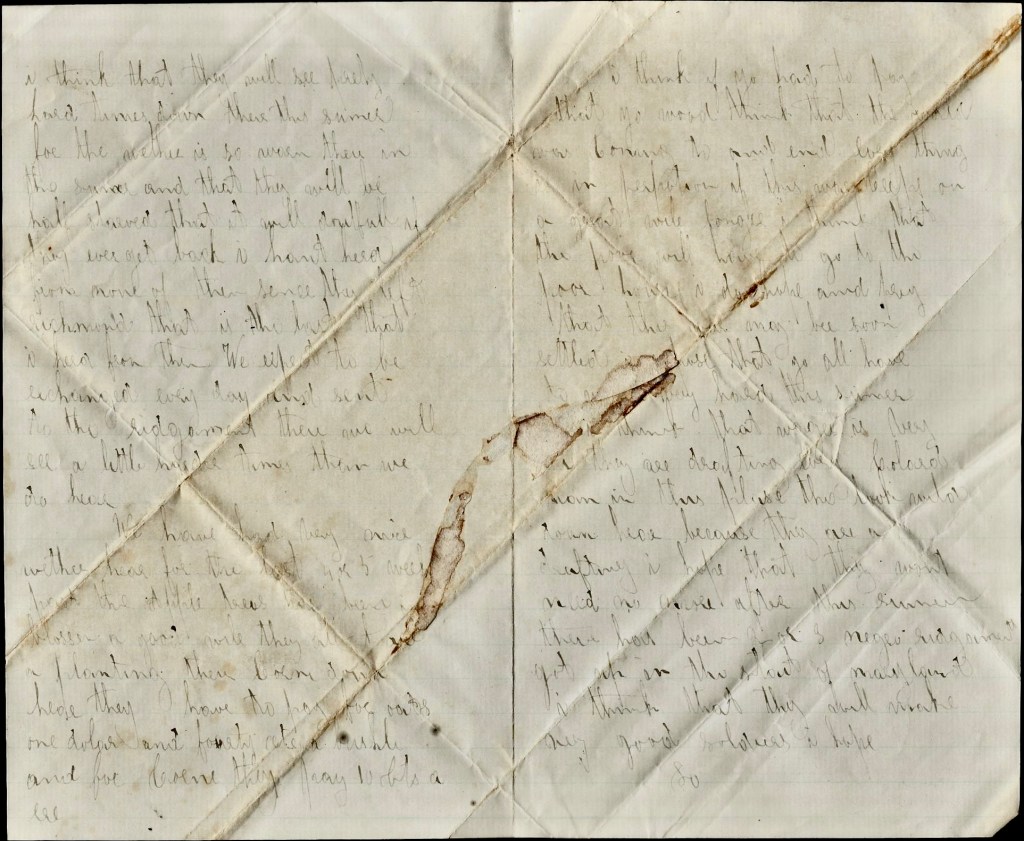
I now sit down to answer your welcome letter which I received the other day. I have neglected writing on the account of cleaning house. I have had my house painted and it makes lots of work for me. I have a barracks all alone by myself and I have got to keep that clean. The reason that I took it was because it was getting rather warm weather and there was so many in the old barracks that it wasn’t healthy.
There is a great many soldiers that dies here. There was 15 buried yesterday. They was those that just came from Richmond. There is more or less buried every day. I wish that those boys that is in Georgia was here. It think that they will see pretty hard times down there this summer for the weather is so warm there in the summer and they will be half starved. It will be doubtful if they ever get back. I hain’t heard from none of them since they left Richmond. That is the last that I heard from them. We expect to be exchanged every day and sent to the regiment. Then we will see a little harder times than we do here.
We have had very nice weather here for the last 4 or 5 weeks past. The apple trees has been in blossom a good while. They are out a planting their corn down here. They have to pay for oats one dollar and forty cents a bushel and for corn they pay 10 bits an ear. I think if you had to pay that, you would think that the world was coming to an end. Everything is in proportion. If this war keeps on a great while longer, I think that the poor [soldier] will have to go to the poor house. I do hope and pray that the war may be soon settled. I suppose that you all have to work very hard this summer. I think that wages is very high.
They are drafting every colored man in this place. Thy look wild down here because they are a drafting. I hope that they won’t need no more after this summer. There has been two or three negro regiments got up in the State of Maryland. I think that they will make very good soldiers. I hope so.
I have written you all the news so I shall have to close. Give my love to Chancy and Mary and all the rest. Please write just as soon as you get this. This is from your affectionate cousin, — Fred P. Rowe
The following letter was written by William J. Rowe (1840-1904), the son of Jacob and Jane (Campbell) Rowe of Kingston, Ulster county, New York. William enlisted at the age of 22 on 9 August 1862 to serve as a private in Co. B, 120th New York Infantry. At the time of his enlistment, William was described as a 5 foot 11 inch tall farmer with gray eyes, brown hair, and a dark complexion.
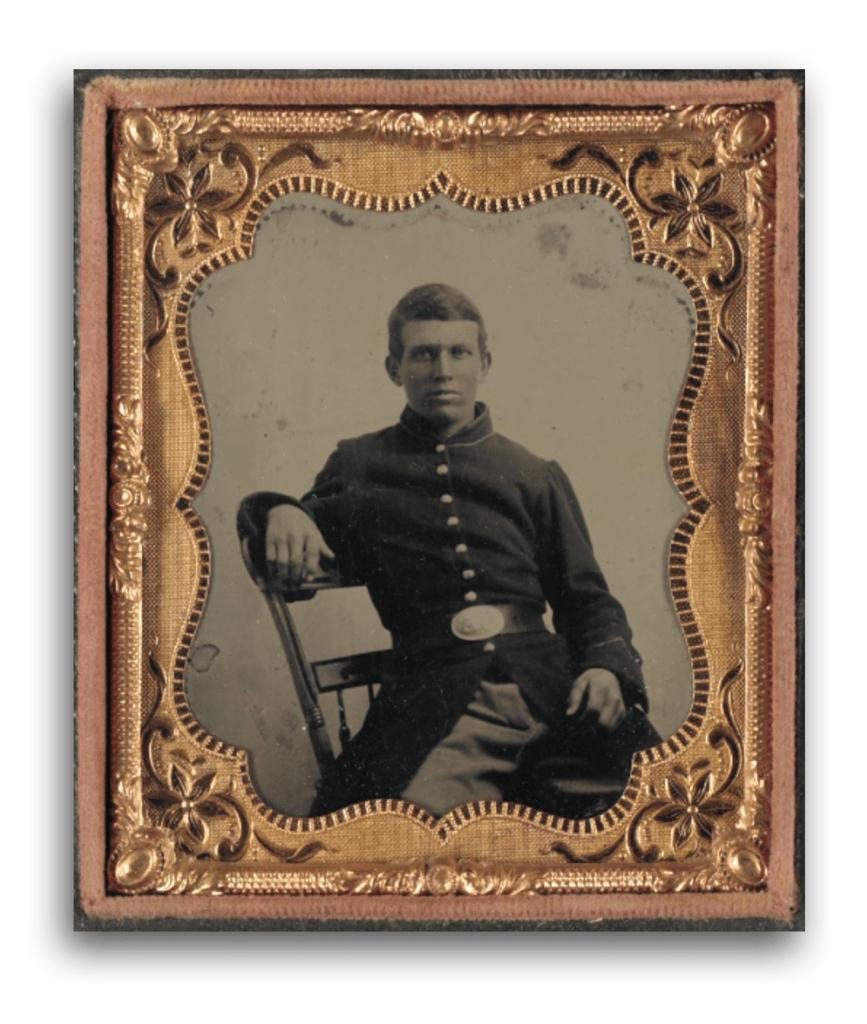
I could not find an image of William but here is one of Gordon B. Swift who also served in the 120th New York Infantry (Photo Sleuth)
He was taken prisoner at the Battle of James City, Virginia, on 10 October 1863 and eventually taken to Andersonville Prison in Georgia where he died of disease on 13 June 1864. He was buried in Grave No. 1940.
During the time that William was with the regiment, they fought in several important battles, including Fredericksburg, Chancellorsville, Gettysburg, Mine Run, Spottsylvania, North Anna, Totopotomy, and Cold Harbor. During its service the 120th New York Infantry lost by death, killed in action, 10 officers, 87 enlisted men; of wounds received in action, 1 officer, 54 enlisted men; of disease and other causes, 3 officers, 181 enlisted men; total, 14 officers, 322 enlisted men; aggregate, 336; of whom 69 enlisted men died in the hands of the enemy—including William.
William wrote the letter to his cousin, William Rowe (b. 1840), the son of William and Margaret Rowe of Hurley, Ulster county, New York.
Transcription
February 28, 1863
Dear Cousin,
I now take my pen in hand in order to answer your kind letter which I just received. We are both enjoying good health at present and I hope that when this reaches you, it will find you the same. I enjoy a soldier’s life very well but I think I like home the best. You wanted to know how I or what I had to sleep on. You don’t think Uncle Sam would have his brave soldiers sleep on feathers, do you? No siree horsefly. We sleep on mahogany sofas and have pie and cake and sweet meats. But the best thing we get is pork and hard tack. We get coffee and sugar too.
You talk about girls. There is none out here where we are now but I saw lots of them at the Battle of Fredericksburg. I saw a fine black wench there that weighed about 300. I think I shall go in for her if I can get her. That is all the nice girls that I have seen since I have been out here.
The weather is rather unsettled out here. It storms most every day. The most of the boys are well now but they have been quite sickly. I don’t think we will stay here long. We have been building corduroy roads for the army to move. I think I am able to stand the blunt and get home yet.
So no more at present. From your affectionate cousin, — W. J. R.
Write as soon as you get this. Yours truly, — William J. Rowe
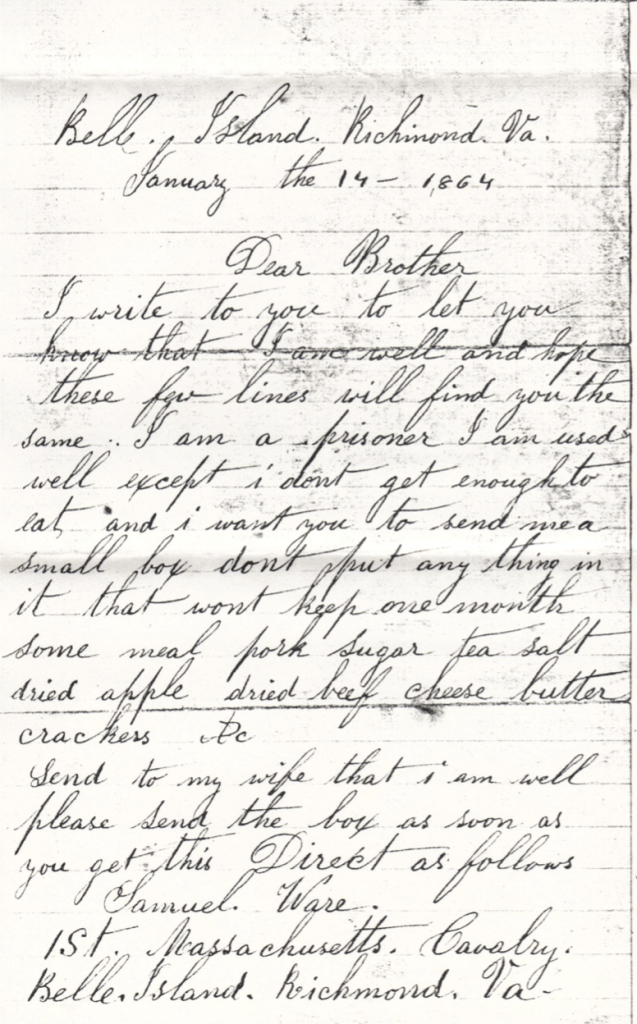
The following letter was written by Samuel Ware (1835-1864), a 27 year-old farmer from Conway, Massachusetts, when he enlisted and was mustered into service on July 10, 1862 as a private in Co. H, 1st Massachusetts Cavalry. Samuel was the son of Willard Ware (1799-1845) and Anna Edson (1811-1891). He was married to Jane Elizabeth Payne (1836-1909) in 1855. At the time of the 1860 US Census, Samuel and his wife were enumerated in Buckland, Franklin county, Massachusetts. The couple had two children—Lucy War, born 19 September 1857, and Mary Ware, born 8 February 1860.
Samuel was taken prisoner at Parker’s Store on the Orange plank Road in western Spotsylvania county, Virginia, on 29 November 1863, Samuel was held a prisoner at Belle Island in Richmond, VA prior to being transferred to Andersonville where he died of diarrhea and scurvy on August 10, 1864 after nine months of captivity.
In the following letter, written from Belle Island where he was being held a prisoner, Samuel lets his brother-in-law, Alonzo Payne (1839-1886) know that he was well and but hungry and requests a box of victuals be sent to him. Confinement on Belle Isle would have been particularly brutal in the wintertime. As was customary with prisoner of war letters, it was limited to one page in length.
Belle Isle Prison on island in James River opposite Richmond, Virginia
[Note: The photocopy of the letter was sent to me for transcription and publication on Spared & Shared by Lin Robinson who is Samuel’s g-g-granddaughter.]
Transcription
Addressed to Mr. Alonzo Payne, Conway, Massachusetts
Belle Island, Richmond, Virginia January 14, 1864
Dear Brother,
I write to let you know that I am well and hope these few lines will find you the same. I am a prisoner. I am used well except I don’t get enough to eat and I want you to send me a small box. Don’t put anything in it that won’t keep one month. Some meal, pork, sugar, tea, salt, dried apple, drief beef, cheese, butter, crackers, &c.
Send to my wife that I am well. Please send the box as soon as you get this. Direct as follows: Samuel Ware, 1st Massachusetts Cavalry, Belle Island, Richmond, Virginia.
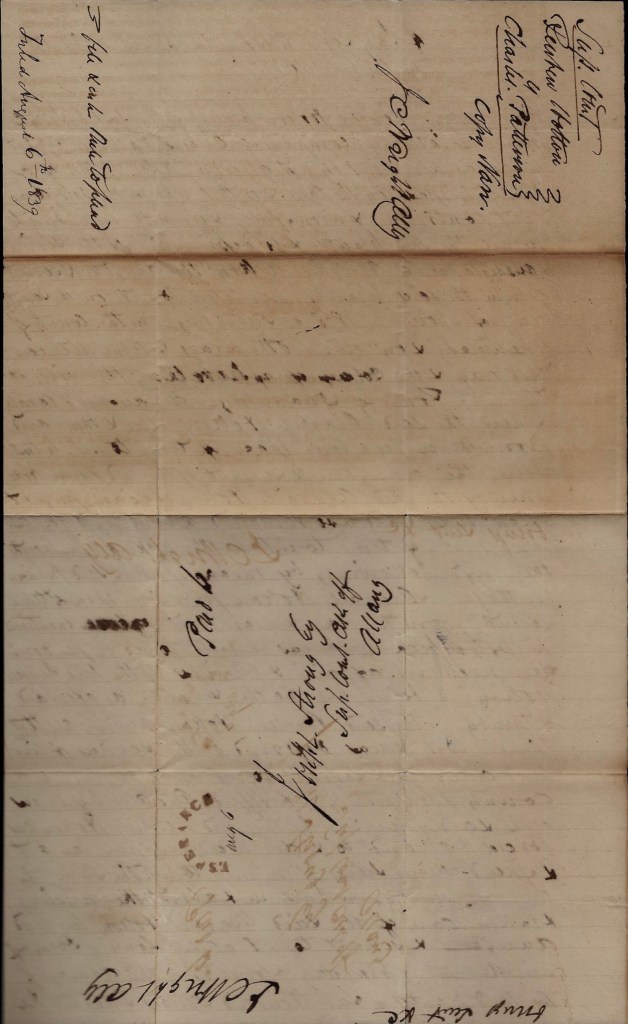
In the following 1839 lawsuit, the plaintiff Reuben Holton, brought suit against the defendant, Charles Patterson, for having made his unwed daughter Abigail pregnant, thus depriving him of the services of his daughter—and servant. Yes, under New York law, and apparently the English courts before, a parent was entitled to their child’s services, and compensatory damages were often awarded for the loss of services of the person seduced. Evidence that the defendant offered to marry the child seduced was not to be taken into consideration in mitigation of the damages. A defendant’s only recourse in fighting the suit would be to show that that the child was not seduced but was unchaste and promiscuous in her intercourse with men. [New York Law of Damages]
Transcription
Superior Court of July Term of the 6th Day of August 1839 Schenectady county
Reuben Holton, Plaintiff, in the suit by John C. Wright, his Attorney, complains of Charles Patterson, defendant, by declaration & not by [ ] according to the statute of a plea of trespass on the case. For that whereas the said defendant contriving & wrongfully & [un___] intending to injure the said plaintiff & to deprive him of the service & assistance of Abigail Holton, the daughter & servant of him, the said plaintiff heretofore to wit, on the seventh day of November 1838 at Duanesburg in the County of Schenectady & on divers other days & times between that day and this…debauched and carnally knew the said Abigail Holton there and then and from thence for a long space of time to wit, hitherto being the daughter and servant of the said Reuben Holton, where the said Abigail Holton became pregnant & sick with child & so remained & continued for a long space of time, to wit, for the space of nine months.,,from the day & year mentioned hitherto became & was unable to do or perform the necessary affairs & business of the said Reuben Holton, so being her father & master as aforesaid, & thereby hem the said Reuben Holton during all that time lost and was deprived of the services of his said daughter & servant [and was] forced and obliged to and did unnecessarily pay, lay out, and spend divers sums of money…one hundred dollars in and about the nursing & taking care of the said Abigail Holton…To the damage of the said plaintiff of two thousand dollars…
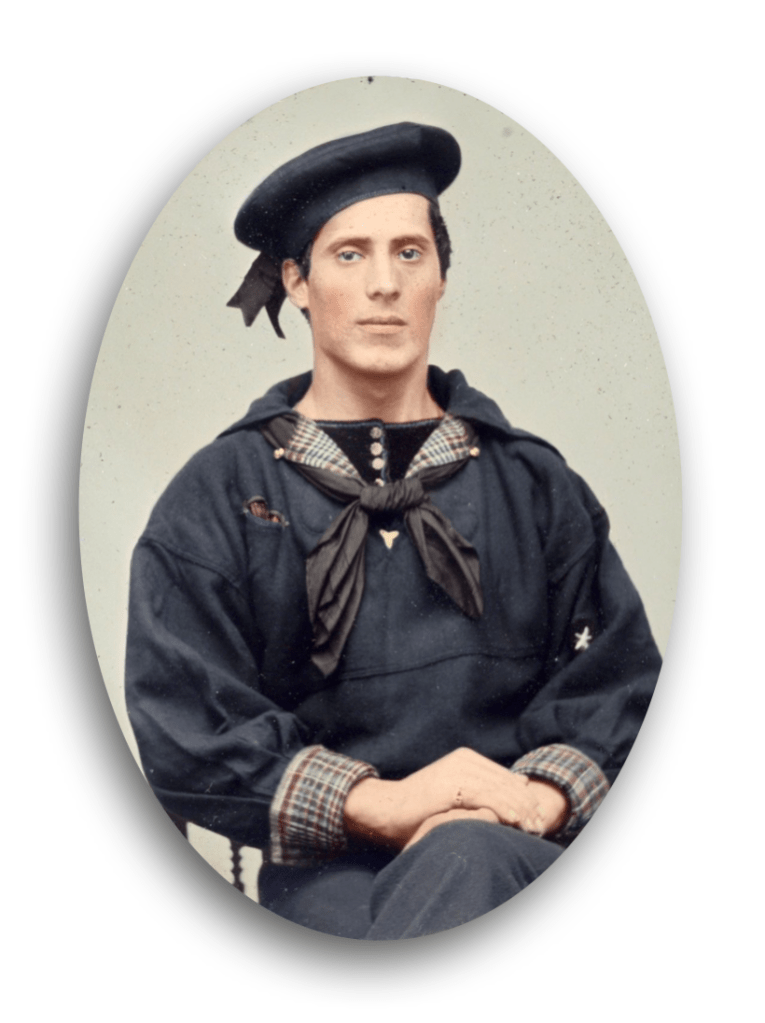
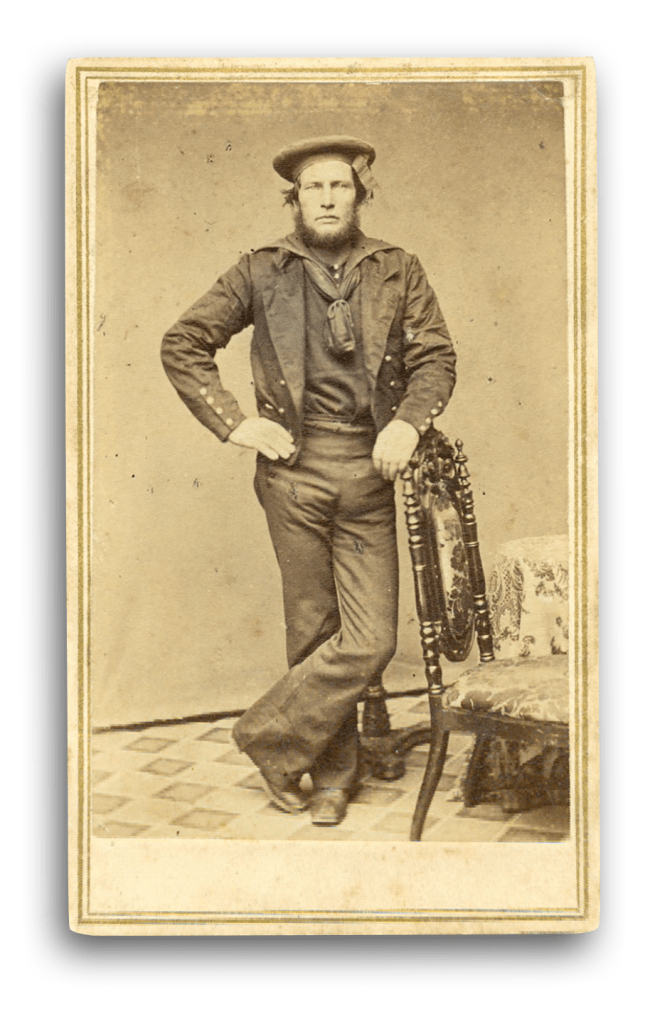
An unidentified sailor from the Liljenquist Collection in the Library of Congress
The following letter was written by Andrew Donald (“Don”) Campbell (1836-1890), the son of Allan McDougall Campbell and Martha Matternley (1802-18xx) of Nova Scotia. At the time of the 1850 US Census, Don was living under his mother’s roof in Westchester county, New York, his mother an apparent widow. At the time of the 1860 US Census, Don was living in a New York City boarding house with his older brother Allan working as a sign painter. His brother Allan was working as a postal carrier.
It appears that Don enlisted as a landsman in the US Navy in September 1864, giving his occupation as jeweler at the time. He was later promoted to a sergeant’s steward. As far as I can learn, Don only served aboard he USS Shawmut—a 593-ton steamer acquired by the U.S. Navy and put to use by the Union during the American Civil War. Shawmut served the Union Navy primarily as a gunboat with howitzers for bombardment, and various other rifles and cannon for use at sea in apprehending blockade runners attempting to “run” the Union blockade of the Confederate States of America. he was sent to Nova Scotia in 1864 in search of the iron-sided Confederate steamer Tallahassee which had preyed on merchant ships in the North Atlantic and often seeking refuge in the neutral British port of Halifax. She was cornered in Halifax Harbor at one point but escaped under cover of darkness out the eastern passage at high tide.
After cruising in Nova Scotian waters without seeing or hearing of her quarry, Shawmut returned to the Portsmouth Navy Yard on the 20th. On 9 January 1865, the gunboat was ordered to proceed to Wilmington, North Carolina, to join the North Atlantic Blockading Squadron. She participated in the attack on and capture of Fort Anderson, North Carolina, from 18 to 20 February. On the latter day, a boat from Shawmut was destroyed by a torpedo as it swept waters in the area.
Don Campbell served aboard the USS Shawmut during the Civil War
Transcription
Addressed to Allan M. Campbell, Corner 7th and Clinton Streets, Morrisania, Westchester county, New York
On board Receiving Ship Roebuck December 14th, 1864
Brother Allan,
Your letter of the 7th I received yesterday afternoon for which accept my thanks. I began to think you had forgotten me. I wrote two letters to mother, one dated at Yarmouth, Nova Scotia, but which I had no chance to post until we got to this place, and the other I wrote the first week we were here, You asked me if Halifax looked like what I had imagined. There is a picture of it in the house. Well you just take that a put a few blockade runners in the stream and you have Halifax to a “T.” I knew the place as we were steaming into the harbor from that picture. I recognized the Citadel and Government House at once. There is a little steam ferry boat that runs between Halifax and Dartmouth which you would laugh at if you saw [it]—about as much like the Fulton Ferry boats as a dung boat is like a 60-gun frigate.
I should have liked to have gone ashore but I had no chance. The harbor is a beautiful one—long and narrow, but deep. They say there has been great improvements within the last ten years but every house looked to me as if it had stood a thousand years—they are so black and gloomy. But still I should think it’s a very handsome town in summer time. We could not buy any grub as no bum boats would come alongside; our greenbacks being worth only 30 cents and they will only take them at the exchange offices. When the gig’s crew run away, the Captain had to hire some of the blue noses to pull him on board and he was obliged to pay them in gold.
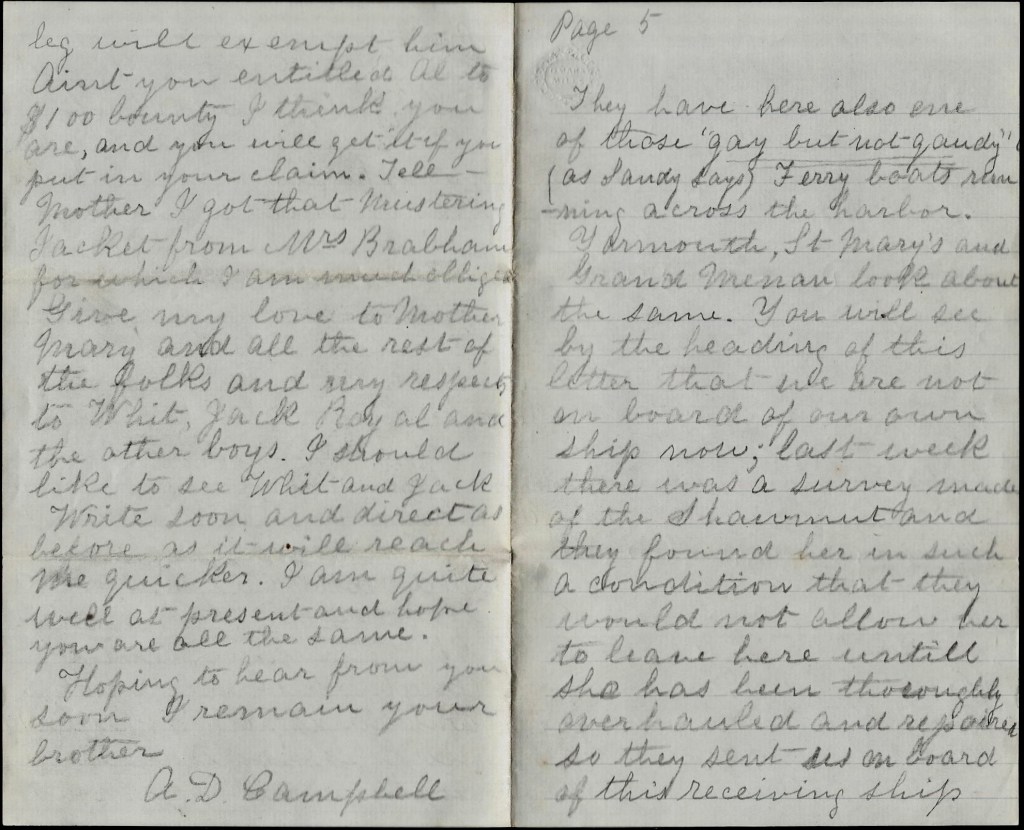
They are bitter secessionists—so much so that at St. Johns, they offered to stow our men away if they would come ashore. I think our ship looked more trim and neat on the outside than the British men-of-war I saw laying at Halifax. St. Johns, New Brunswick, looks something like Halifax—gloomy and black—but the tide has a tremendous rise and fall (about 30 feet) as it lies in the Bay of Fundy. When it is flood tide, you will see the vessels almost on top of the docks, and at ebb [tide] they will be high and dry on the beach, showing their keels and the water 60 fathom away. They have here also one of those “gay but not gaudy” (as Sandy says) Ferry boats running across the harbor. Yarmouth, St. Mary’s, and Grand Menau look about the same.
You will see by the heading of this letter that we are not on board of our own ship now. Last week there was a survey made of the Shawmut and they found her in such a condition that they would not allow her to leave here until she has been thoroughly overhauled and repaired, so they sent us on board of this receiving ship.
There are two guardo’s 1 here—the old Sloop-of-War Vandalia, and the bark Roebuck. They are both lashed together but the substitutes are kept on board the Vandalia and the volunteers on the Roebuck. The first night after we left the Shawmut, we bunked on the Vandalia. Hell is a paradise to her. There was nothing but drunken rows and knifing and robbing on her the whole night while the officers and guards were afraid to stop it. I never passed such a night and hope never to pass such another.
On this ship, it is quiet but it is very cold. We have had a foot of snow here already and it looks like more coming. I don’t know how long we shall be here—some say two or three weeks and others two or three months. But I would rather be on board of my own ship. You want to know if there is any chance to get on the Shawmut. Take my advice and stay ashore. I think you have had enough of Uncle Sam and if the draft takes place and you are caught, why “skedad.” Tell Jack he need not be afraid of the draft for his leg will exempt him. Ain’t you entitled, Al, to $100 bounty. I think you are, and you will get it if you put in your claim.
Tell Mother I got that mustering jacket from Mrs. Brabham for which I am much obliged. Give my love to mother, Mary , and all the rest of the folks, and my respects to Whit, Jack Royal, and the other boys. I should like to see Whit and Jack. Write soon and direct as before as it will reach me quicker. I am well at present and hope you are all the same.
Hoping to hear from you soon, I remain your brother, — A. D. Campbell
1 A guardo was a receiving ship or vessel on which enlisted men were temporarily quartered until drafted to sea-going vessels. Don’s letter informs us there were two of these ships lashed together off shore, one for quartering volunteers who were quiet and manageable; the other for substitutes (accepting a bounty to serve for someone who was drafted) who were unruly and unmanageable. The latter had to be guarded closely lest they desert (“bounty jumpers”).
An unidentified Union Navy Sailor (Ron Field Collection)
These two letters were written by Allan McDougall Campbell (1835-1874), the son of Allan McDougall Campbell and Martha Matternley (1802-18xx) of Nova Scotia. At the time of the 1850 US Census, Allan was living under his mother’s roof in Westchester county, New York, his mother an apparent widow. At the time of the 1860 US Census, Allan was living in a New York City boarding house with his younger brother Donald working as a postal carrier. His brother Donald was working as a sign painter. It appears that Allan received his naturalization papers in August 1857.
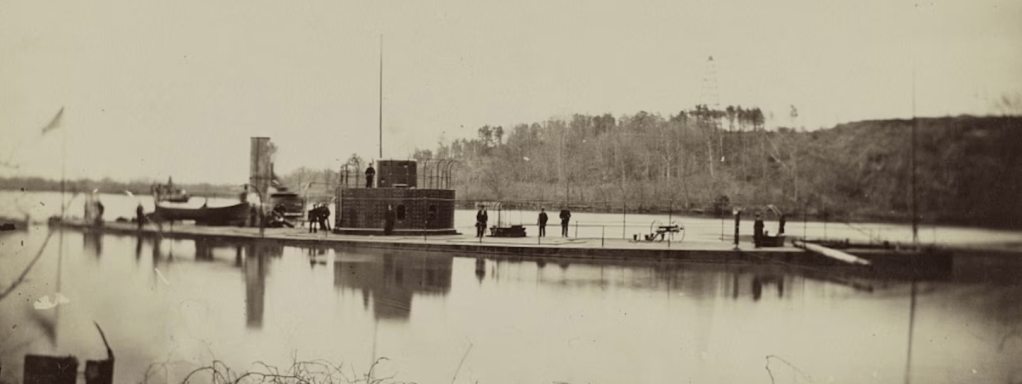
It was in August 1863 that 29 year-old Allan enlisted in the US Navy. At that time he was described as standing just shy of 5 and a half feet tall, with grey eyes and auburn hair. He may have been the same Allan Campbell who served earlier in the Navy aboard the USS North Carolina, enlisting in August 1861. Both of the following letters were written while Allan served aboard the USS Montauk, a single-turreted Passaic-class monitor launched in 1862 and part of the South Atlantic Blockading Squadron. She may be best remembered as the vessel on which the autopsy of John Wilkes Booth was performed in late April 1865.
After he was discharged from the Navy, Allan returned to New York State, settling in Morrisania, Westchester county, where he found employment as a brick mason and married Annie Walker Fisher (1845-1938).
Letter 1
Iron Clad Montauk Off Charleston, S. C. December 3rd 1863
Dear Mother,
I received Don’s letter on Sunday I think it was, but could not get a chance to write till today for I have been made cook of our mess which takes most of my time. I took [the position] because it adds seven dollars and a half to my month’s wages and that you know is something [in] these times although I scarcely [have] any time to myself. The work is not hard nor warm.
I was very glad to hear from you. I wish you folks would write oftener for you don’t know how nice it is to get a letter here. Every mail that comes I stand coveting every letter that is called off. Do write—any of you. Don’t wait for an answer. Tell Johnny to write and tell me what the fire department are doing, &c
Two sailors play the banjo and the bones.
Mother, tell George to write something about his wife & Willie. Tell him they have found out that I play a little on the banjo and I was taken on board of the Massachusetts with the officers to buy a banjo from the young fellow that sent you my letter from Philadelphia. I seen him and bought the banjo from him. The chief paid ten dollars for it so we have music every night by order of the Lieut. There is a young fellow by the name of Charley Wicks—a regular comical genius. He plays the bones like sixty. The way they found me out was I heard a guitar in the officer’s room one night. The next night I asked one of the men to borrow it. The Chief, whose it was, brought it out. I sung the Duck Song which I had to repeat for the Captain & then for the Lieutenant and there was nothing but bothering all the time. We are going to get up a kind of a concert for New Years night so you see we are not without some fun.
December 4th. I had to leave off yesterday to get supper ready.
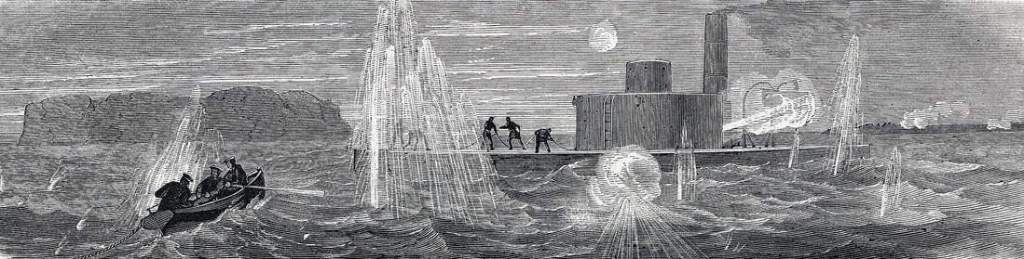
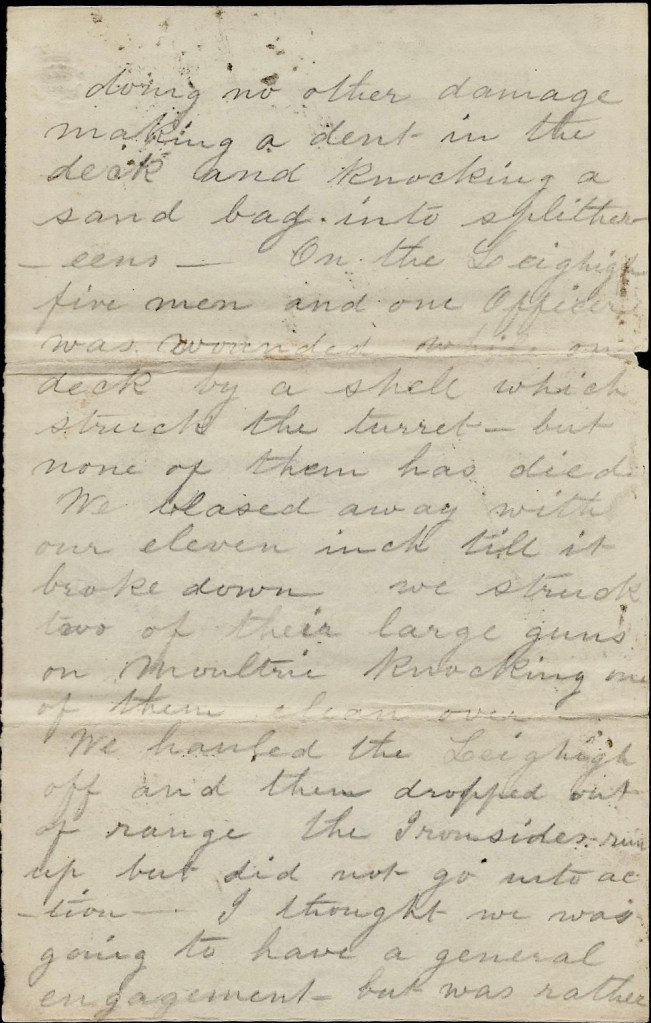
On the 18th of last month, we saw [Forts] Moultrie and Johnson firing on the [USS] Lehigh the first thing in the morning. She, being up on picket, had got aground during the night. The rebels discovering her fix opened fire on her. We were ordered up to tow her off. We went up and engaged Moultrie, and sent a boat under cover of our smoke with a line to the Lehigh. While going, a shell burst over it but fortunately hurt no one. The struck our deck once on the deck with a round shot right alongside the fire room hatch, doing no other damage, [but] making a dent in the deck and knocking a sand bag into splithereens.
The USS Lehigh aground near Fort Sumter, Frank Leslie’s Illustrated Newspaper, December 12, 1863, p. 177.
On the Lehigh, five men and one officer was wounded while on deck by a shell which struck the turret but none of them has died. We blasted away with our eleven inch till it broke down. We struck two of their large guns on Moultrie, knocking one of them clean over.
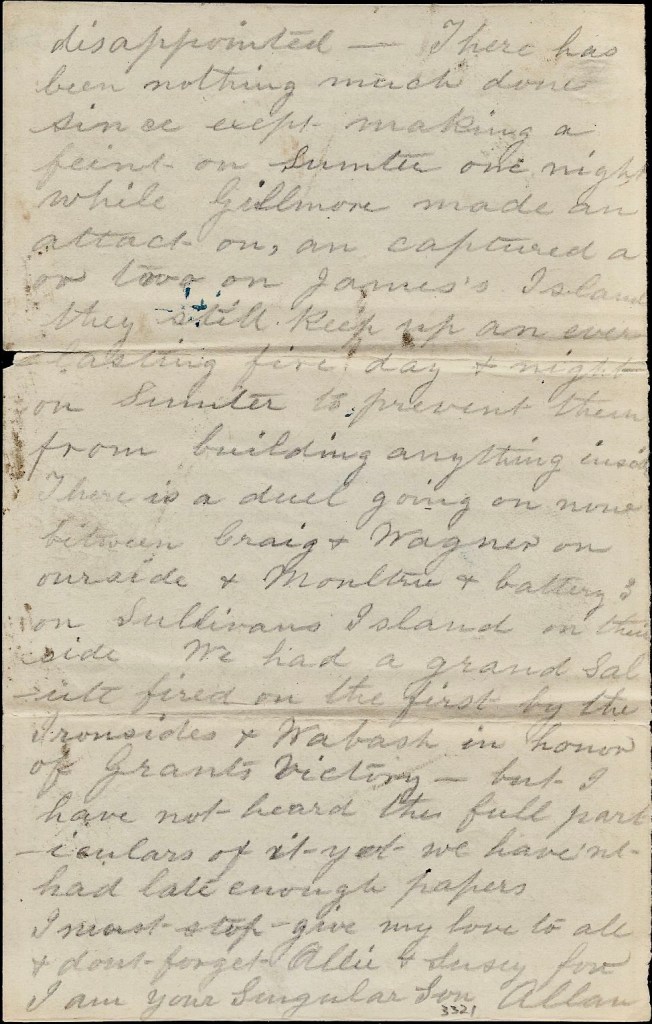
We hauled the Lehigh off and then dropped out of range. 1 The [USS] Ironsides run up but did not go into action. I thought we was going to have a general engagement but was rather disappointed. There has been nothing much done since except making a feint on [Fort] Sumter one night while [Gen. Quincy] Gillmore made an attack on and captured one or two [rebel forts] on James Island. They still keep up an ever-lasting fire day and night on Sumter to prevent them from building anything inside. There is a duel going on now between [Forts] Gregg and Wagner on our side and [Fort] Moultie and Battery No. 3 on Sullivans Island on their side.
We had a grand salute fired on the first by the Ironsides and Wabash in honor of Grant’s victory but I have not heard the full particulars of it yet. We have not had late enough papers. I must stop. Give my love to all and don’t forget Ollie and Susey for I am your singular son, — Allan
1 Allen’s letter claims it was the USS Montauk that rescued the USS Lehigh—not even mentioning the presence of the USS Nahant—but history has recorded that both the Montauk and Nahant came to Lehigh’s rescue and that it was a launch from the Lehigh that succeeded in attaching a tow line to the Nahant who in turn pulled them off the sandbar. The full story can be found here: The Sailors Who Saved USS Lehigh.
The USS Lehigh in the James River. The Lehigh and the USS Montauk were sister ships.
Letter 2
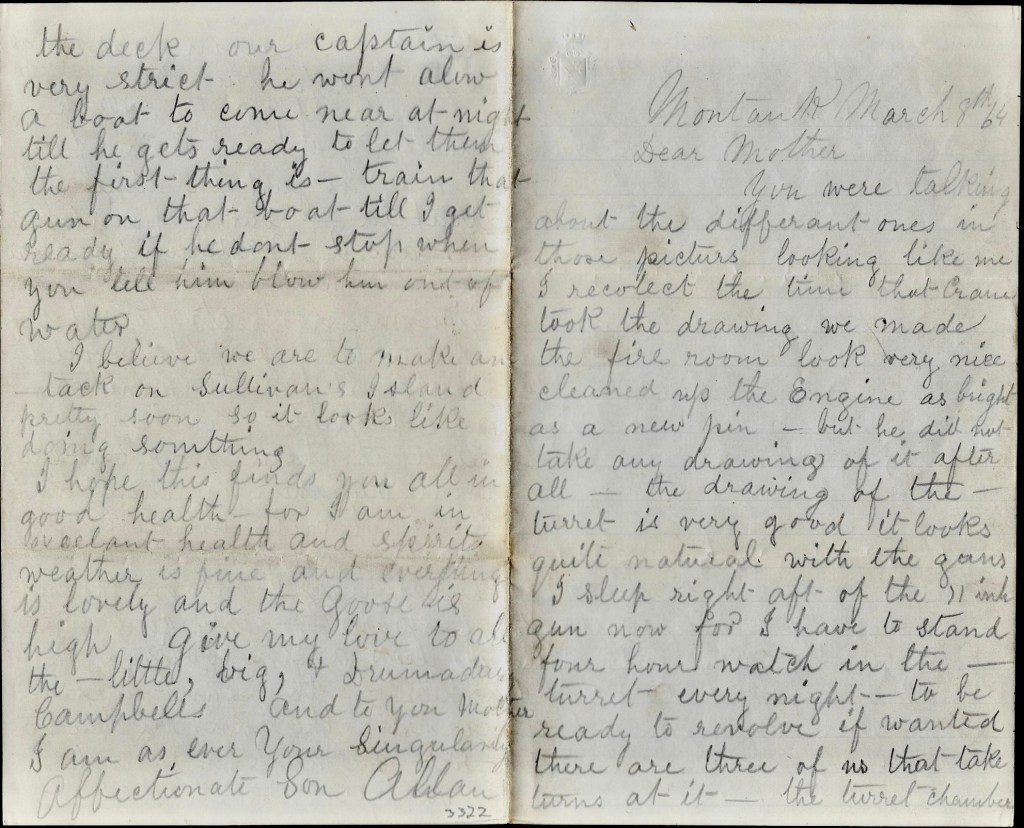
Montauk March 8th 1864
Dear Mother,
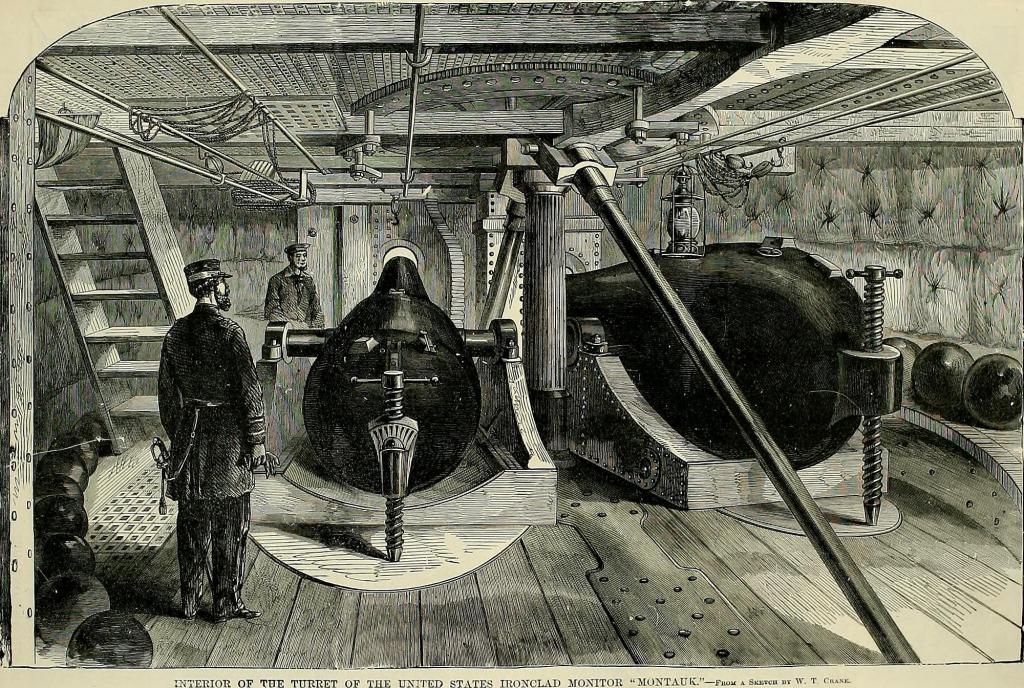
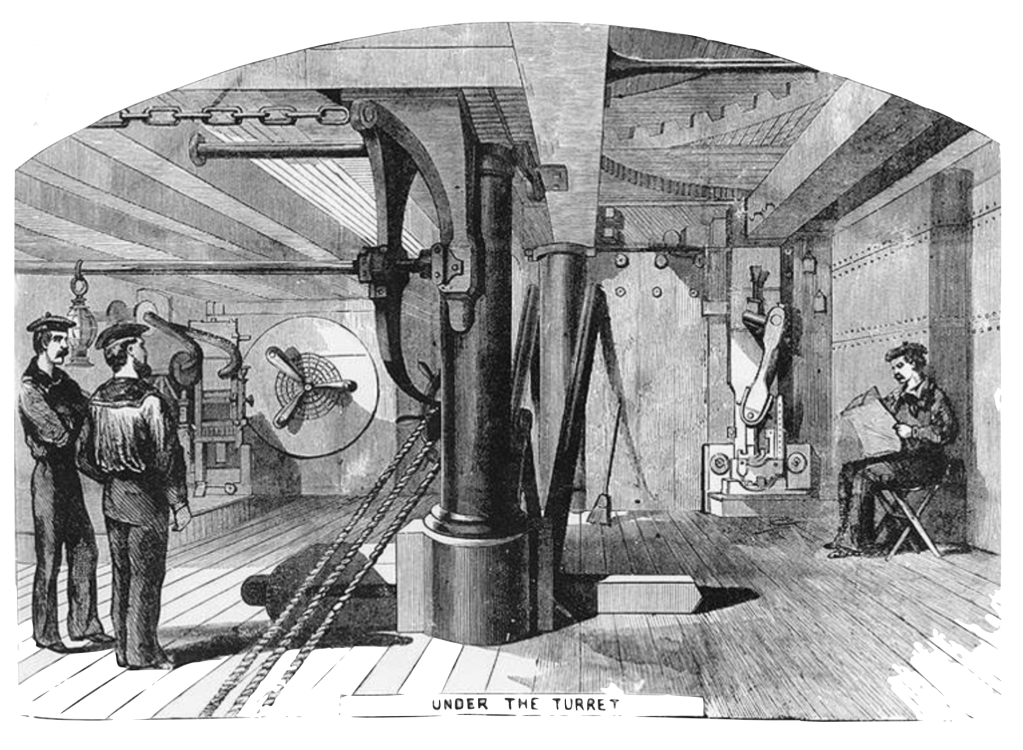
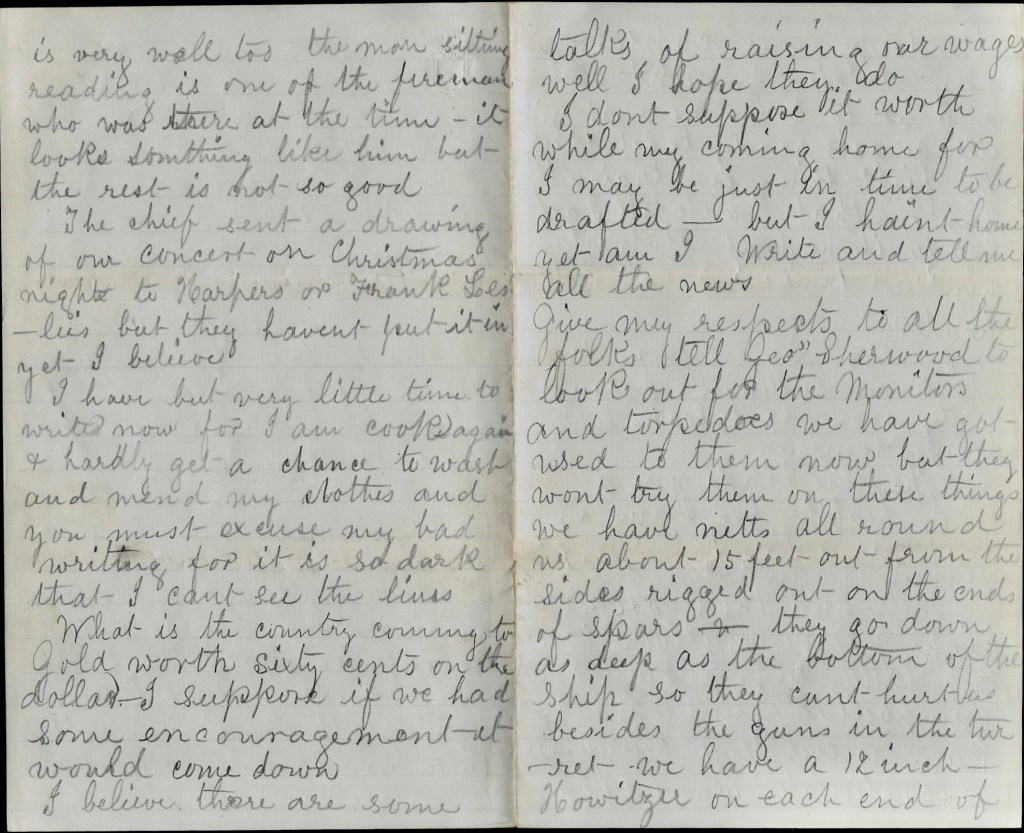
You were talking about the different ones in those pictures looking like me. I recollect the time that [William T.] Crane 1 took the drawing. We made the fire room look very nice, cleaned up the engine as bright as a new pin, but he did not take any drawing of it after all. The drawing of the turret is very good. it looks quite natural with the guns. I sleep right aft of the 11 inch gun now for I have to stand four hours watch in the turret every night to be ready to revolve if wanted. There are three of us that take turns at it. The turret chamber [drawing] is very well [done] too.
William T. Crane’s sketch of the “Interior of the Turret of the USS Ironclad Montauk”published in Frank Leslie’s Illustrated Newspaper on 13 February 1864.
The man sitting reading is one of the firemen who was there at the time. It looks something like him but the rest is not so good. The chief sent a drawing of our concert on Christmas night to Harper’s or Frank Leslie’s but they haven’t put it in yet, I believe.
Under the turret in the USS Montauk; a fireman sits reading newspaper at right.
I have but very little time to write now for I am cook again & hardly get a chance to wash and mend my clothes and you must excuse my bad writing for it is so dark that I can’t see the lines.
What is the country coming to? Gold worth sixty cents on the dollar? I suppose if we had some encouragement, it would come down. I believe there are some talks of raising our wages. Well i hope they do. I don’t suppose it worth my while my coming home for I may be just in time to be drafted. But I hain’t home yet, am I? Write and tell me all the news.
Give my respects to all the folks. Tell George Sherwood to look out for the Monitors and torpedoes. We have got used to them now but they won’t try them on these things. We have nets all around us about 15 feet out from the sides rigged out on the ends of spars. They go down as deep as the bottom of the ship so they can’t hurt us. Besides the guns in the turret, we have a 12-inch Howitzer on each end of the deck. Our captain is very strict. He won’t allow a boat to come near at night till he gets ready to let them. The first thing is to train that gun on that boat till I get ready. If he don’t stop when you tell him, blow him out of the water.
I believe we are to make an attack on Sullivan’s Island pretty soon so it looks like doing something.
William T. Crane’s Sketch of a rebel encampment on Sullivan Island in 1863
I hope this finds you all in good health for I am in excellent health and spirits. Weather is fine and everything is lovely and the goose is high. Give my love to all—the little, big, & Drumaday Campbells. And to you Mother. I am as ever your singular affectionate son, — Allan
1 William T. Crane worked as a “special artist” for Frank Leslie’s Illustrated newspaper which published 244 of his drawings. In addition, under orders from General Quincy A. Gilmore, Crane drew a series of sequential views of Fort Sumter in Charleston Harbor in the summer of 1863 depicting the stages of the fort’s demolition during a prolonged Union bombardment.
The following letter was written by Thomas Henry Stones (1844-1921), the son of Thomas Stones (1803-1846) and Joanna G. Edwards (1807-1880) of Atlanta, Logan county, Illinois.
Thomas enlisted on 7 August 1862 as a private in Co. A, 117th Illinois Infantry. He remained in the regiment for three years, mustering out on 5 August 1865. At the time of his enlistment he was described as a 5 foot 6 inch tall single 17-year-old farmer with brown hair and black eyes. After the war, in 1867, Thomas married Elvira Cunningham (1848-1927) and lived out his days as a wagon-maker in McLean county, Illinois.
Thomas wrote the following letter in February 1863 while the regiment was on duty in Memphis, Tennessee. From there they would occasionally go out on scouts, looking in particular for bushwhackers who would fire on Union ships as they carried troops and materials up and down the Mississippi. The “little town” that Thomas describes having seen “in ashes” was most likely the village of Hopefield which Major General Stephen A. Hurlbut, commander of the 16th Army Corps headquartered at Memphis, ordered to be destroyed as he judged it to be “a mere shelter for guerrillas” who had attacked Union boats for several weeks above and below Memphis. It was destroyed on 19 February 1863.
Members of Co. C, 117th Illinois Infantry; drummer William H. Ashley lays at right.
Transcription
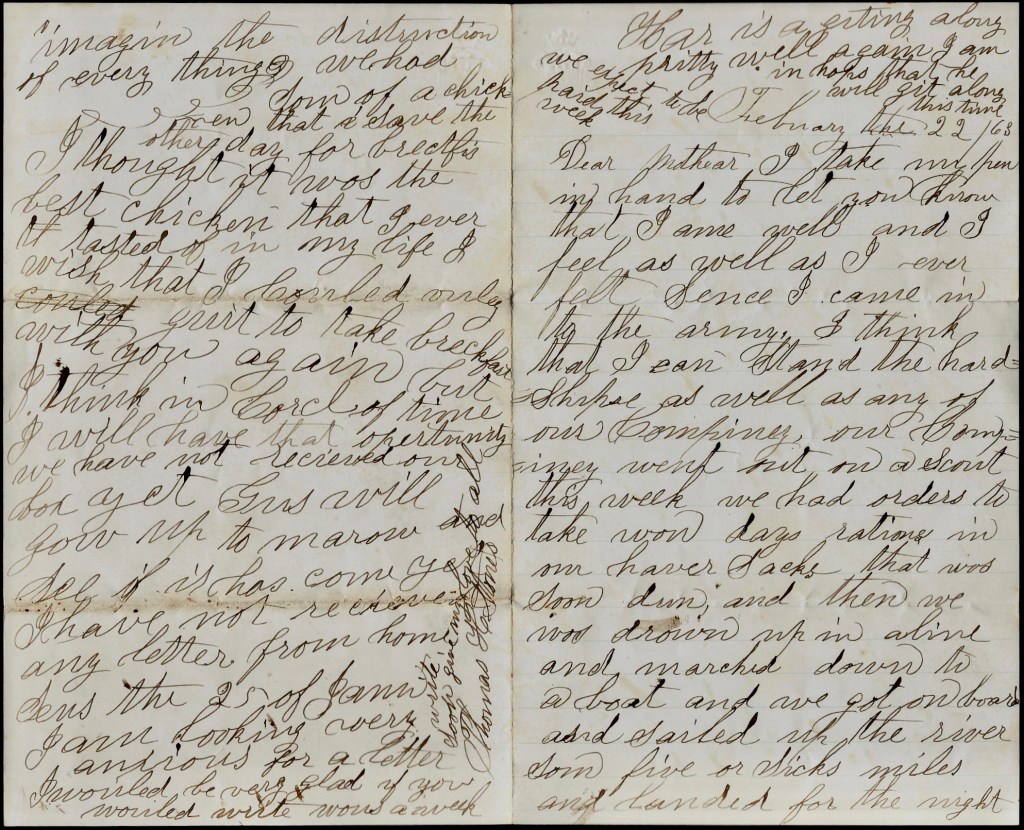
[Memphis, Tennessee] February 22, 1863
Dear Mother,
I take my pen in hand to let you know that I am well and I feel as well as I ever felt since I came into the army. I think that I can stand the hardships as well as any of our company. Our company went out on a scout this week. We had orders to take one days rations in our haversacks. That was soon done and then we was drawn up in a line and marched down to a boat and we got on board and sailed up the river some five or six miles and landed for the night and in the morning after looking around awhile we started again. We crossed the river and went about five miles and we surrounded a house and closed in and demanded a search of the house. There was no men folks at home [and] the women did not like it very well but all in vain. Our Lieutenant-Colonel [Jonathan Merriam] and Captains searched the house [while] the boys made a charge on the chickens and smoke house. They made a terrible charge on the chickens. I think that we got at least seventy-five hens and honey, hams, sweet potatoes, butter, milk, and other things in proportion and two mules. The officers came pretty near burning her house but they did not. The woman was rank secesh—she did not deny it at all. She said that she had three sons in the Secesh army. One is a captain and the other two are lieutenants. I think that she ought to be burnt out of house and home.
Our gunboat burnt a little town that day. I seen the town after it was laid in ashes. The women and children did look awful. I could not help feeling bad to see them without house or home. Oh how glad I feel when I think you are so far from the army and the destruction of everything. You can’t hardly imagine the destruction of everything.
We had some of a chicken that I saved the other day for breakfast. I thought it was the best chicken that I ever tasted in my life. I wish that I could only quit to take breakfast with you again but I think in course of time I will have that opportunity. We have not received our box yet. Gus will go up tomorrow and see if it has come yet. I have not received any letter from home since the 25 of January. I am looking very anxious for a letter. I would be very glad if you would write once a week. Write soon. Give my love to all. — Thomas H. Stones
The following letter was written by Alexander Miller (1832-1864) who enlisted as a private in Co. D, 25th Wisconsin Infantry on 8 August 1862. Alexander was born in Beaver county, Pennsylvania, the son of Hugh Miller (1806-1880) and Mary Lockhart (1813-1876). He was married in 1855 to Sarah J. Phillips and with their first born child relocated from Pennsylvania for Wisconsin. Their route took them down the Ohio river to the Mississippi and and then upriver to La Crosse, Wisconsin. From there they went by stage to Burns and then by ox team out to Big Creek Valley near Sparta where they established their home.
Alexander was with his regiment all through the war, including the Atlanta campaign, during which time he became seriously ill in early July 1864. He was taken to the Division hospital in Marietta. Later he was taken to Rome, Georgia, where he finally died on 10 October 1864. He kept a diary during his time in the service and he made his last entry on 9 October, “I am dying. God’s will be done. Oh God, look over and protect my dear wife and children from all the trials and temptations of the earth and finally let them meet me in heaven where we shall never more be parted.”
The following day, after his death, someone wrote in Alexander’s diary, “Alexander Miller died at half past 3 o’clock this morning. He did not seem to be in any pain. We have lost from among us one who was a true Christian, a Gentleman, and a Soldier. Farewell. God’s will be done.”
Alexander’s letter of 16 August 1863, transcribed below, gives the “particulars” of the death of one of his closest comrades, David H. Campbell, also of Co. D. David died of disease on 14 July 1863.
Alexander Miller’s Certificate of Service with his image in the banner above the words, “I love my Country.”
Transcription
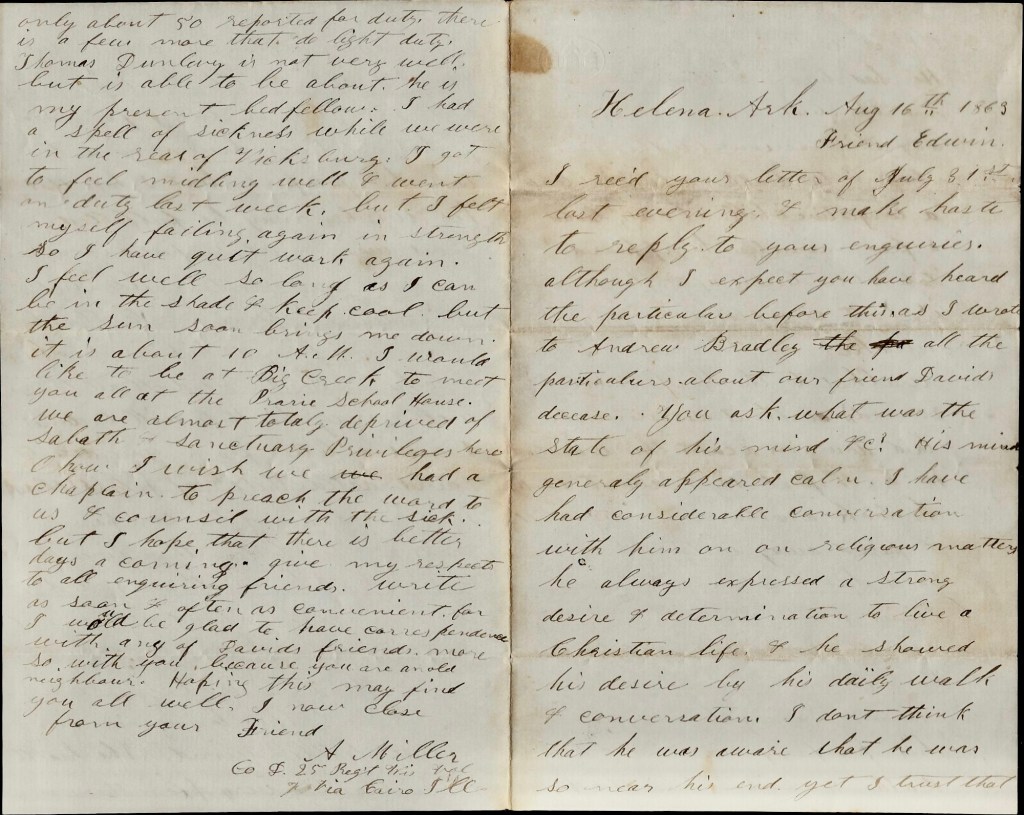
Helena, Arkansas August 16th 1863
Friend Edwin,
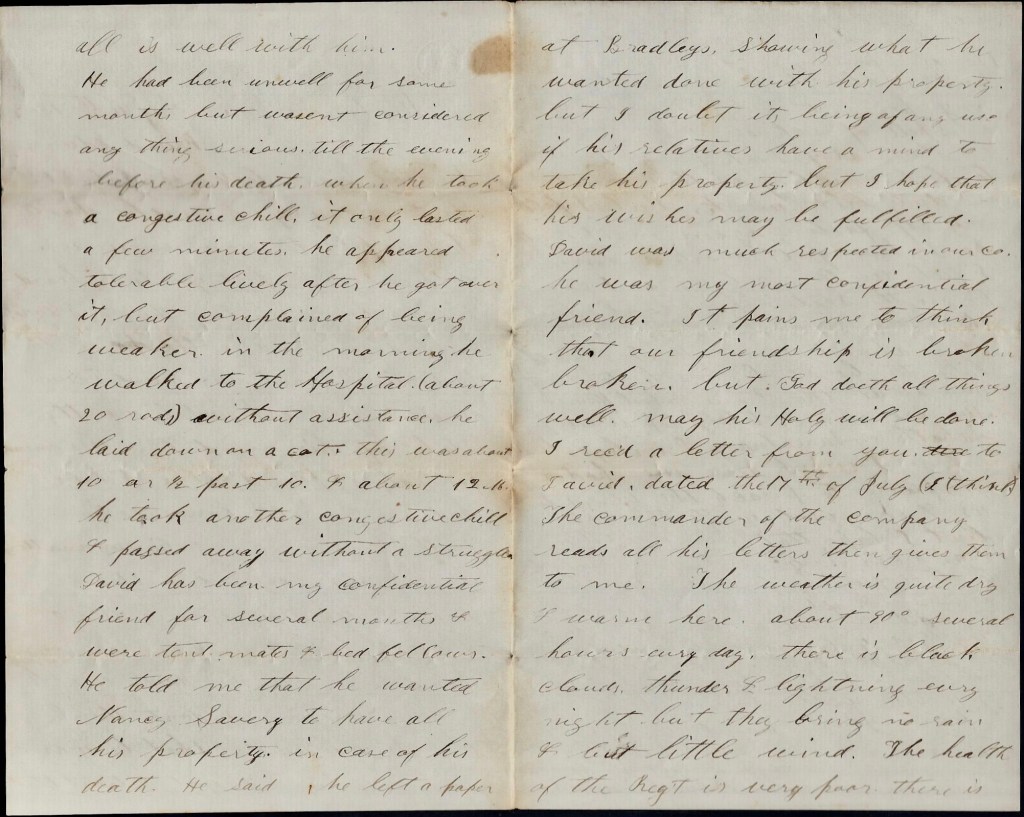
I received your letter of July 31st last evening & make haste to reply to your enquiries although I expect you have heard the particulars before this as I wrote to Andrew Bradley all the particulars about our friend David’s decease. You ask what was the state of his mind, &c. His mind generally appeared calm. I have had considerable conversation with him on religious matters. He always expressed a strong desire & determination to live a Christian life & he showed his desire by his daily walk of conversation. I don’t think he was aware that he was so near his end yet I trust that all is well with him. He had been unwell for some months but wasn’t considered anything serious till the evening before his death when he took a congestive chill. It only lasted a few minutes. He appeared tolerably lively after he got over it but complained of being weaker in the morning. He walked to the hospital (about 20 rods) without assistance. He laid down on a cot. This was about 10 or half past 10 & about 12 M he took another congestive chill & passed away without a struggle.
David has been my confidential friend for several months & we were tent mates and bed fellows. He told me that he wanted Nancy Savery to have all his property in case of his death. He said he left a paper at Bradley’s showing what he wanted done with his property but I doubt it being of any use if his relations have a mind to take his property. But I hope that his wishes may be fulfilled.
David was much respected in our company. He was my most confidential friend. It pains me to think that our friendship is broken but God doeth all things well. May His holy will be done.
I received a letter from you to David dated the 17th of July (I think). The commander of the company reads all his letters, then gives them to me.
The weather is quite dry and warm here—about 90 degrees several hours a day. There is black clouds, thunder and lightning every night but they bring no rain and but little wind. The health of the regiment is very poor. There is only about 50 reported for duty. There is a few more that do light duty. Thomas Dunlevy 1 is not very well but is able to be about. He is my present bedfellow.
I had a spell of sickness while we were in the rear of Vicksburg. I got to feeling middling well & went on duty last week but I felt myself failing again in strength so I have quit work again. I feel well so long as I can be in the shade & keep cool but the sun soon brings me down. It is about 10 a.m. I would like to be at Big Creek to meet you all at the Prairie School House. We are almost totally deprived of Sabbath & Sanctuary privileges here. Oh, how I wish we had a chaplain to preach the word to us & council with the sick. But I hope that there is better days a coming.
Give my respects to all enquiring friends. Write as soon and often as convenient for I would be glad to have correspondence with any of David’s friends—more so with you, because you are an old neighbor. Hoping this may find you all well, I now close. From your friend, — A. Mill
Co. D, 25th Regiment Wisconsin Volunteers via Cairo, Illinois
1 Thomas Dunlevy of Co. D, 25th Wisconsin Infantry, died of wounds on 23 July 1864.
I believe this letter was written by 22 year-old Tabitha Duvall (1838-1920), the daughter of slaveholders Tobias H. Duvall (1806-1856) and Rebecca C. Onions (1808-1875) of Collington, Prince George’s County, Maryland. Tabitha’s younger brother, Tobias Duvall (1841-1915) enlisted in Co. C, 2nd Battalion Maryland Infantry and fought for the Confederacy during the Civil War.
Tabitha wrote the letter to her “dear friend” John Goring (1839-who served early in the war as a private in the Co. A of the 1st Michigan Infantry for three months and then reenlisted as the Sergeant Major of Co. D (later a 2nd Lieutenant in Co. A) in the 1st Michigan Infantry (three year) regiment. During the Battle of Gaine’s Mill on 27 June 1862, Goring was wounded and taken prisoner. He was exchanged in August 1862 for Lewis S. Chitwood of the 5th Alabama Infantry, and was soon after transferred to the Veteran Reserve Corps (VRC), 2nd Regiment, City of Detroit.
Goring was born in England and came to the United States sometime after the death of his father in 1854. He did not marry until July 1865 when he took Mary Elizabeth Reiger (1845-1906) as his wife, and worked as a life insurance agent in Detroit.
Transcription
Addressed to Sergeant Major Goring, 1st Regiment Michigan Infantry, Camp at Annapolis, Md.
Collington December 13 [1861]
Dear Friend,
Your very welcome letter has been duly received and I assure you it was perused with great pleasure. I had almost come to the conclusion that you had been ordered from good Old Maryland to the fiery land of South Carolina but am pleased to learn that you are not in such danger as you would there be exposed to as they have the black flag floating. I should think the Federals would not receive much mercy at their hands.
I have read a few extracts from the President’s Message and like them very much. I see a part of the Cabinet & Congress are trying for emancipating & arming the slaves. What do you think of it? As far as I am able to judge, they will not do their country any good by it. Enough of politics for I abominate them although I cannot help speaking on the subject sometimes. 1
I received a letter from Lizzie Duvall last week. She was very well & says they have had two regiments stationed on their farm since yours left but only remained a few days, burning all their fencing. Poor Uncle Duvall has had some heavy losses in his time & they seem to follow him up but I do not blame the soldiers. I expect I would do the same were I in their places encamped out & could not get fuel.
“The Soldier’s Return” (1848) song sheet dates to end of the Mexican War
I passed by the junction about two weeks ago on my way to Baltimore. I did not see anyone I knew except the Chaplain & Mrs. Wise. She went up to Baltimore on the same train I did. I kept a strict look out for a glimpse of you but looked in vain. Have you any relatives in Louisiana by the name of Goring. I am acquainted with a very elegant family there by that name. One of their daughters married Hon. Charles L. Scott who was a congressman from California & is now a private in the Rebel army. 2 I am not acquainted with any Duvalls at the Junction nor did not know any were living there but there are so many Duvalls in Prince George’s County that I think if you were to call every other person you meet here Duvall, you would not make a mistake.
We are having some charming weather now and I hope it will continue warm for the poor soldiers’ sake for I know they will suffer this winter. I am practicing a piece of music called the “Soldier’s Return” on the piano & I hope soon to have the pleasure of playing it for my friends who have gone to the war. I must now come to a close. Accept the best wishes from your sincere friend, — T. Duvall
1 The “war powers of the National government” to emancipate slaves were openly discussed in Northern newspapers as early as September 1861 but most editors cautioned against it for either one of two reasons (sometimes both) which were: doing so would only convince Southern states that it was Lincoln’s intent (as they claimed) to emancipate the slaves from the very outset of his administration. The second reason was probably the most widely adopted, which was to query the American public, “What is to become of the slaves supposing they are freed? Would it promote the welfare of the now struggling border States, if they were filled with roving bands of ignorant, untrained, partially irresponsible blacks? Who is to feed and clothe them, and educate their sluggish powers, and employ their reluctant services, and fit them gradually for self-dependence?” Arming the slaves did not become a topic for newspaper columns until a few months later when the “quarrel” between President Lincoln and Secretary of War Simeon Cameron was leaked to the media—Cameron taking the position that the former slaves ought to be armed and used against the Confederates.
2 Charles Lewis Scott (1827-1899) was born in Richmond, Virginia. He went to California in the gold rush of 1849 and the entered a law office in Sonoma. He served in the State Legislature in the mid 1850s and then was elected to the 35th US Congress, serving until 1861. When the American Civil War began, he resigned his seat in Congress and joined the Fourth Regiment, Alabama Volunteer Infantry, of the Confederate Army, serving as major. He never returned to California. In 1861 he suffered a serious leg wound at the First Battle of Bull Run. The severity of his leg pain caused him to resign his commission in 1862, after the Battle of Seven Pines. Charles was married to Anne Vivian Gorin (1836-1862) in Mobile, Alabama, in 1857. Anne Gorin (not Goring) never lived in Louisiana as far as I can learn. She seems to have grown up in Mobile, Alabama.




















 Spared & Shared 23