All posts by Griff

My passion is studying American history leading up to & including the Civil War. I particularly enjoy reading, transcribing & researching primary sources such as letters and diaries.

1861: George Mickle Brown to his Parents

This picture is presumably George M. Brown and his father; there was no caption with it but it was found on his Find-A-Grave.

The following letter was written by George Mickle Brown (1843-1927), the son of Clayton Brown (1813-1887) and Sarah Jane Hildreth (1819-1878). In mid-July 1861, George enlisted in Co. A, 34th Pennsylvania Infantry, also known as the 5th Pennsylvania Reserves. Company A, or The Jersey Shore Rifles, were recruited from Lycoming county, Pennsylvania and commanded by Capt. H. C. Ulman. He was wounded at Mechanicsville on 26 June 1862 in the Seven Days Battles before Richmond and was later transferred to the Veteran Reserve Corps in November 1863.

The letter was datelined from the Georgetown Hospital on 11 August 1861 shortly after the regiment’s arrival in the District of Columbia.

Transcription

Georgetown Hospital  District of Columbia
August 11, 1861

Dear Parents,

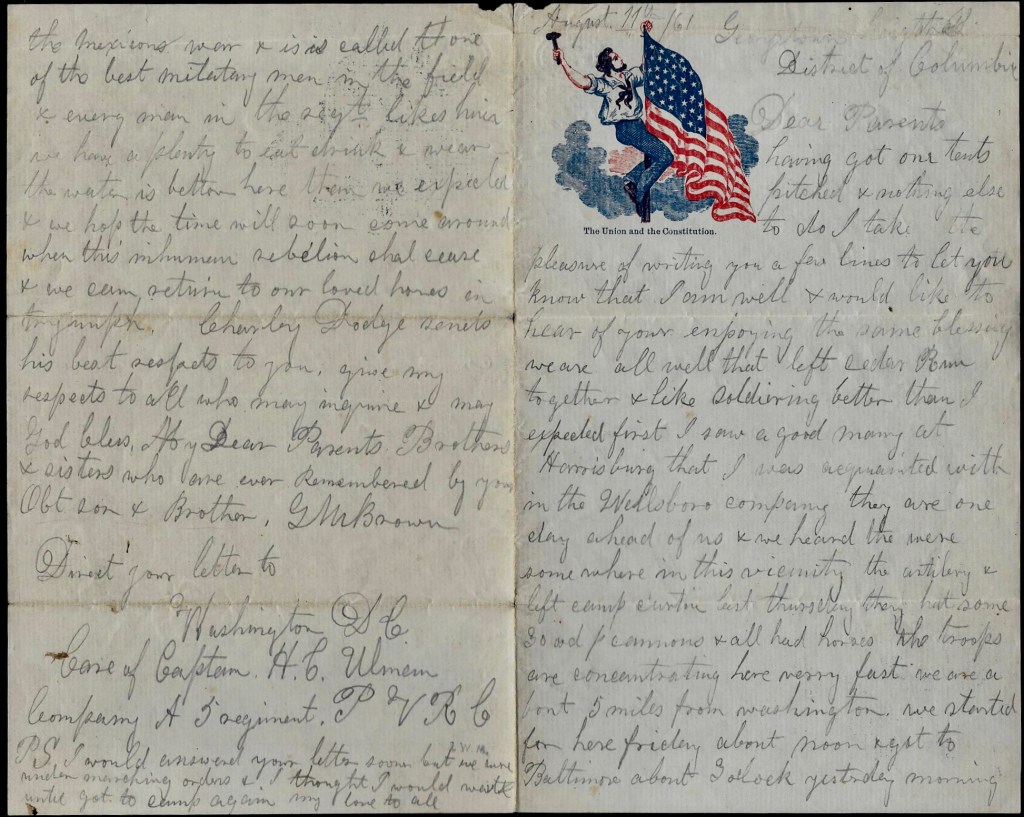
Having got our tents pitched and nothing else to do, I take the pleasure of writing you a few lines to let you know that I am well and would like to hear of your enjoying the same blessing. We are all well that left Cedar Run together and like soldiering better than I expected first. I saw a good many at Harrisburg that I was acquainted with in the Wellsboro company. They are one day ahead of us and we heard they were somewhere in this vicinity. The artillery left Camp Curtin last Thursday. They had some 30 odd cannons and all had horses.

The troops are concentrating here very fast. We are about 5 miles from Washington. We started for here Friday about noon and got to Baltimore about 3 o’clock yesterday morning and staid there until daylight and then started for Washington and got there about 11 o’clock yesterday. While there, Daniel Foster and myself got a chance to go and see our National Capitol. We went through a large portion of the capitol and was up on top where we could see the whole city and miles around. We could see Georgetown, Alexandria, Arlington Heights, and no doubt where a 100 thousand troops were encamped in circle of miles around  the city. It was the most magnificent scenes I ever saw. And the capitol and grounds around are the best laid out and the best ornamented of anything I ever saw. The capitol building and sights to be seen therein—the statues of Washington and others—would make any patriotic young man volunteer in our country’s  service.

We marched out here last night. It is about 5 miles from Washington and on the road to Manassas Junction. How long we will stay here is not known but it’s rumored that the rebels have a large force within 20 miles of here and an attack is soon expected.

The country here is very uneven. The hills are not high but there is the least level land of any country I was ever in. Back from the city, it is not settled and cleared up near as much as it is around the cities in upper Pennsylvania and the crops are not near as good through Maryland as they are up in our country. From the looks of this place I should judge  the people were not very enterprising. The timber is pretty  much oak woods and other hard timber. I have seen no hemlocks but plenty of cedar.

Col. Seneca G. Simmons, 5th Pennsylvania Reserves“A first rate officer.”

We have got a pretty good company and good officers. Our colonel [Seneca G. Simmons] is a very nice, plain, and a first rate officer. Yesterday when we came to Washington they wanted him to march us right out here after riding all night. “No sir,” says he. “My men shall rest and get something to eat before they stir from here,” and so they did. He served the Mexican War and is called one of the best military men in the field and every man in the regiment likes him. We have a plenty to eat, drink, and wear. The water is better here than we expected and we hope the time will soon come around when this inhuman rebellion shall cease and we can return to our loved homes in triumph.

Charley Dodge 1 sends his best respects to all who may inquire & may God bless my dear parents, brothers, and sisters who are remembered by your obedient son & brother, — G. M. Brown

Direct your letter to Washington, D. C., Care of Captain H. C. Ulman, Co. A, 5 Regiment P. V. R. C.

P. S. I would have answered your letter sooner but we were under marching orders & I thought I would wait until we got to camp again. My love to all.

1 Charles B. Dodge survived the war but lost a leg. Discharged 17 March 1863.
1861: Albert Hayes to George D. Demeritt

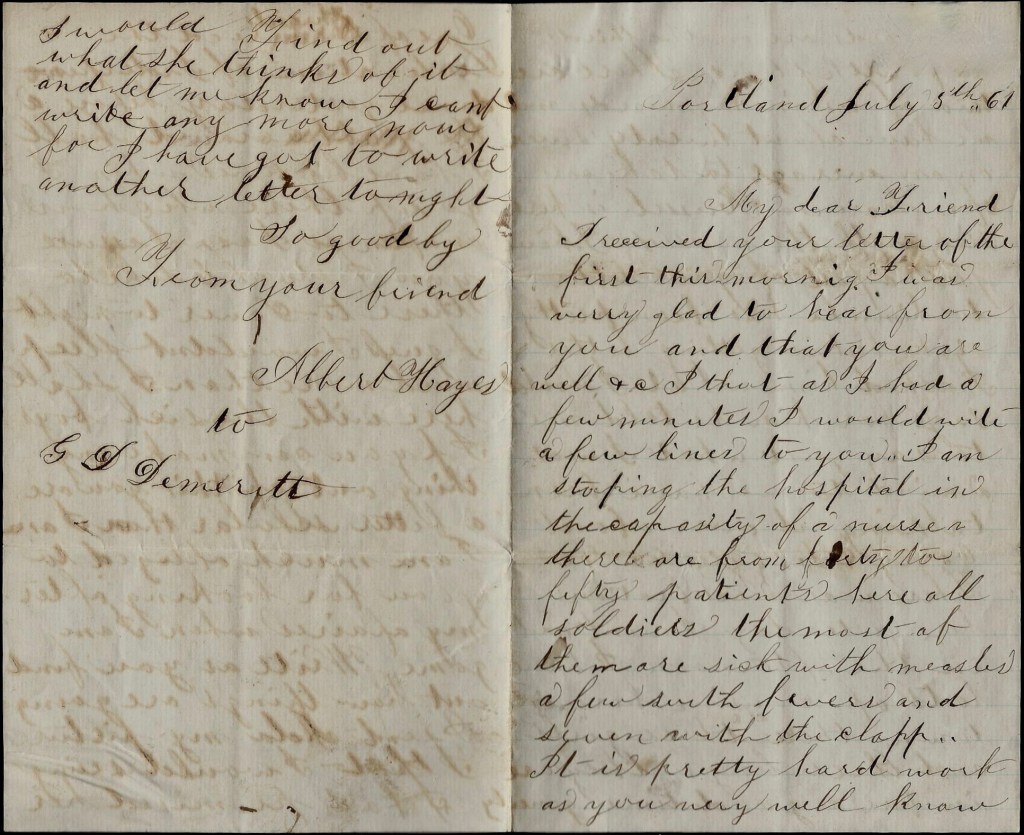
This letter was written by Albert Hayes (1839-1906), the son of James Hayes (1801-1871) and Juliana Berry (1808-1874) of Dover, Piscataquis county, Maine. Albert was enumerated in his father’s household at the time of the 1860 US Census and his employment was recorded as “blacksmith.” Albert would enter the service of his country in the Civil War but we learn from this letter that prior to his enlistment he had taken a situation as a nurse in a Portland military (unnamed) hospital where soldiers were being treated for typical camp diseases.

Military records indicate that 24 year-old Albert enlisted on 17 December 1863 as a private in Co. E, 1st Maine Heavy Artillery. He was wounded in the fighting at Cold Harbor on 4 June 1864 and again at Petersburg where the regiment—used as infantrymen—charged across an open field toward entrenched Confederate soldiers on 18 Jun 1864, resulting in the greatest single loss of life in a Union regiment in the war, with seven officers and 108 men killed, and another 25 officers and 464 men wounded. These casualties constituted 67% of the strength of the 900-man force. Somehow Albert survived the war and was discharged on 16 June 1865.

[Note: for a great documentary short film on the 1st Maine Heavy Artillery’s assault on the Confederate position at Petersburg, see “Forlorn Hope” on HistoryFix.]

Albert died in Stockton, California in 1906. More biographical material can be found on Find-A-Grave.

Albert wrote the letter to his friend, George D. Demeritt (1840-1881), the son of Daniel Chesley Demeritt (1800-1862) and Elizabeth G. Longfellow (1799-1853) of Dover, Piscataquis county, Maine. George later became a physician, married and settled in Sangerville, Maine.

Transcription

Addressed to Mr. George D. Demeritt, West Dover, Maine

Portland [Maine]
July 5, 1861

My dear friend,

I received your letter of the first this morning. I was very glad to hear from you and that you are well &c. I thought as I had a few minutes I would write a few lines to you.

I am staffing the hospital in the capacity of a nurse. There are from forty to fifty patients here. All the soldiers—the most of them—are sick with measles, a few with fevers, and seven with the clap [gonorrhea]. It is pretty hard work as you very well know. My wards are on the third and fourth floors. There are two of us in my wards and we have about twenty-seven on an average to take care of.

The 4th of July Program at City Hall in Portland in 1861. Unfortunately the “Young Lady of this City” who read the Declaration of Independence isn’t identified. (Portland Daily Advertiser, 4 July 1861)

Lorenzo Russell is here sick with the measles. I have just read a part of your letter to him. He has been pretty sick but is getting better. I asked him what I should say for him. He told me to say just what I was a mind to. We have been talking it over about Cory and Lizzie, &c.

There was a celebration here yesterday. I went out in the afternoon. I have lots of cousins here in town—there are three girls and three boys. They are in for a good time generally. One of the girls read the Declaration of Independence yesterday before a crowded hall. I have big times when I go up there which is as often as I can, I assure you.

I should like to [be in ] Dover tonight. I guess I wouldn’t sleep much more than I shall here with the sick boys. If you can make anything out of this, you are a better scholar than I am. I am much obliged to you for looking after my affairs when I am gone. Write as you find out how things are going. I sent Ada my picture. I thought I would seeing I had promised her I would. Find out what she thinks of it and let me know.

I can’t write anymore now for I have got to write another letter tonight. So goodbye. From your friend, — Albert Hayes

to G. D. Demeritt


1861: David H. Hillman to his Siblings

This letter was written by David H. Hillman (1843-1891), the son of Robert T. Hillman and Mary Shalke of New Lisbon, Columbiana county, Ohio. David enlisted in Co. I, 78th Ohio Volunteer Infantry (OVI). David served as a private in the regiment from 4 December 1861 until 12 January 1865.

David addressed the letter to his brother, most likely his older brother John H. Hillman (b. 1836) who was employed as as teacher until entering the war in August 1862 as a private in Co. K, 104th OVI. He also added a note to his older sister Rachel, b. 1842.

The 78th Ohio Infantry was organized from October 1861 to January 1862, to serve for three years. It left by rail for Cincinnati on Feb. 11, and then by steamer for Fort Donelson on the Tennessee river. At daylight on the morning of the second day at Shiloh it went into the battle on the right and was under fire throughout the day, but with slight loss — 1 man killed and 9 wounded. In August it was in the brisk engagement near Bolivar, but in this affair the loss was slight. For several months it was engaged in movements preliminary to the Vicksburg campaign; participated in the battle of Raymond, losing in killed and wounded, about 80 men; was also engaged in the battle of Champion’s Hill, where it lost 116 men killed and wounded. At Vicksburg it participated in the general charge on May 22, with slight loss, and later was sent to Bovina, where it remained until after the surrender. In January 1864, it reenlisted as a veteran regiment and after its furlough home joined Gen. Sherman’s army at Acworth, Ga. It participated in the battle of Kennesaw mountain and at Atlanta on July 22 it lost 203 in killed and wounded. Of 13 flag and color-bearers of the regiment in the latter engagement, all were either killed or wounded. The regiment participated in the subsequent movements of the Army of the Tennessee till the fall of Atlanta and later was with Sherman’s forces on the march to the sea. It marched up through the Carolinas, then to Washington, and was mustered out on July 11, 1865.

Letter 1

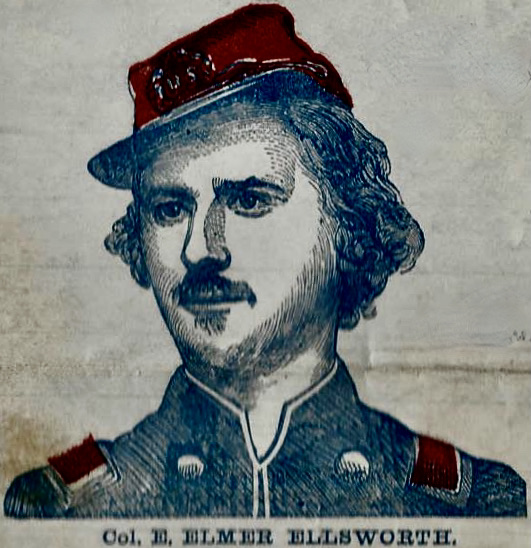
The patriotic imagery of Col. Ellsworth was a frequent subject for soldier’s envelopes in 1861

Camp Gilbert
December 25, 1861
Christmas Day

Yes, my brother, it is Christmas Day in camp and I hardly know how to describe things to you. I will first speak of my letter. I received yours of the 18th last night and I was in just about as good a humor as I generally get into, Well, the reason was because it came from home I suppose. I had begun to think you was not going to write until you got a good ready, but it is all right now. I was very glad to hear that you are all well. You didn’t say anything about Axe’s folks, but I suppose they are well.

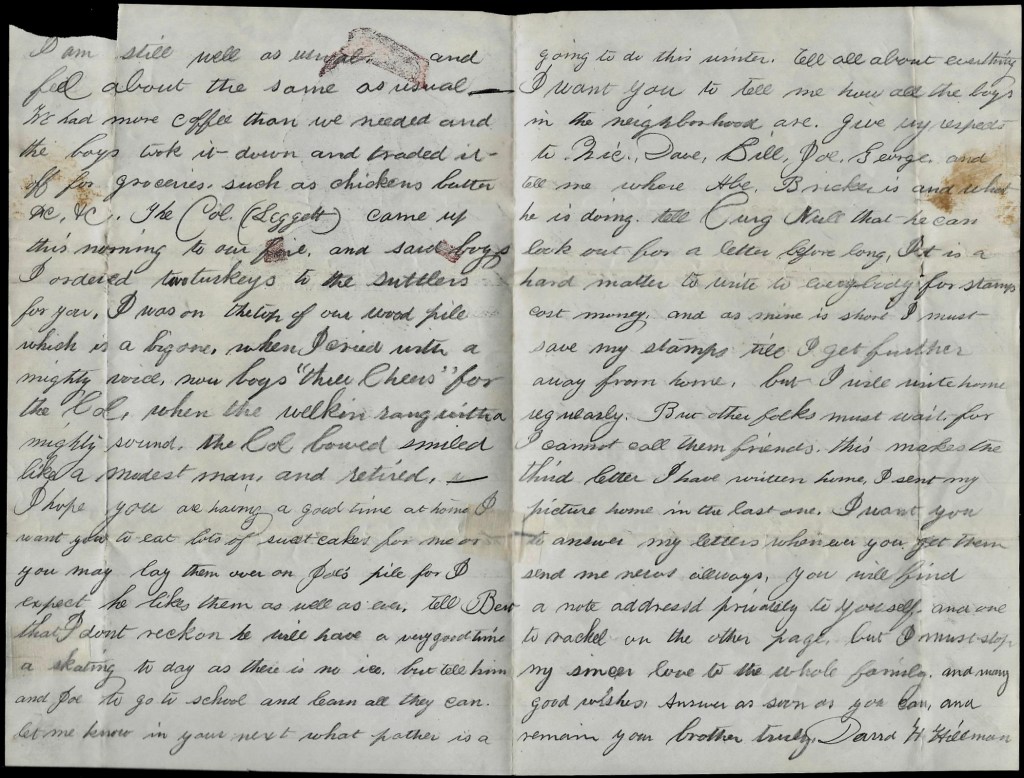
I am still well as usual and feel about the same as usual. We had more coffee than we needed and the boys took it down and traded it off for groceries such as chickens, butter, &c. &c.

Mortimer D. Leggett (left) and his Aide de Camp later in the war when Leggett had risen to a General.

The Colonel (Leggett) came up this morning to our fire and said, “Boys, I ordered two turkeys to the sutlers for you. I was on the top of our wood pile—which is a big one—when I cried with a mighty voice, “No boys, ‘three cheers’ for the Colonel” while the welkin rang with a mighty sound. The Colonel bowed, smiled like a modest man, and retired.

I hope you are having a good time at home. I want you to eat lots of sweet cakes for me or you may lay them over on Joe’s pile for I expect he likes them as well as ever. Tell Bert that I don’t reckon he will have a very good time a skating today as there is no ice but tell him and Joe to go to school and learn all they can.

Let me know in your next what father is going to do this winter. Tell all about everything. I want you to tell me how all the boys in the neighborhood are. Give my respects to Nic, Dave, Bill, Joe, George, and tell me where Abe Bricker is and what he is doing. Tell Craig Null that he can look out for a letter before long. It is a hard matter to write to everybody for stamps cost money and as mine is short, I must save my stamps till I get further away from home. But I will write home regularly. But other folks must wait for I cannot call them friends. This makes the third letter I have written home. I sent my picture in the last one. I want you to answer my letters whenever you get them. Send me news always. You will find a note addressed privately to yourself and one to Rachel on the other page. But I must stop.

Good wishes. Answer as soon as you can and remain your brother, — David H. Hillman

To my dear sister [Rachel],

I received your accompanying note to George. I was glad to hear from you. I hope you will look over all mistakes. Tell Mary H &c. I am going to write a letter to her sometime today. I had heard that Amanda Gedders was married. The news came in one of the other boy’s letters. But the news of Alec Snodgrass’s death surprised us all. But I must stop. Write me again. I am in a hurry as I want my letter to go to town at eleven o’clock. Talk to all the girls for me.

From your brother, truly, — Dave Hillman


Letter 2

Bolivar, Tennessee
August 27th 1862

Dear Sister,

It is sabbath afternoon & I will write you a few lines to let you know I am well. I received your letter of the 24th last night. Was glad to hear that you were all well. It has been a good while since I wrote home but I will tell you why. We have had another brush with the enemy. Yesterday, one week ago, the enemy attacked us 8,000 strong. It was all cavalry. There was one colonel of the 11th Illinois Cavalry killed. He had $1500 in his pocket & a gold watch, all of which the rebels took. They threw his body in a farm yard and the hogs eat his face off. Some negroes dug a hole in the field & were just burying him when our cavalry made a charge & took his body and brought to town. 1

Lt. Col. Harvey Hogg of the 2nd Illinois Cavalry was killed in a gallant sabre charge.

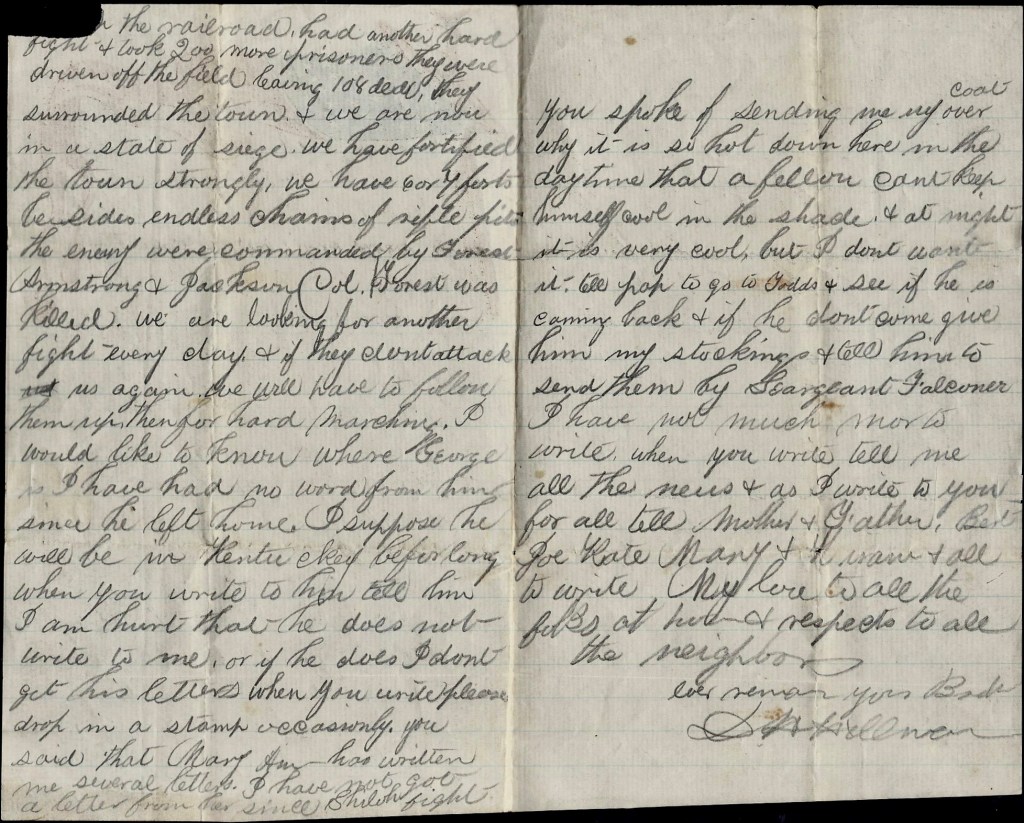
The loss on our side was 10 killed, 30 wounded, and 60 prisoners. I did not learn their loss but it is supposed to be higher than ours. After we drove them from here, they proceeded up the railroad to Toombs Station, cut the telegraph, and tore up the railroad, had another hard fight, and took 200 more prisoners. They were driven off the field leaving 108 dead. They surrounded the town & we are now in a state of siege.

We have fortified the town strongly. We have got 6 or 7 forts besides endless chains of rifle pits. The enemy were commanded by Forrest, Armstrong, & Jackson. Col. Forrest was killed. We are looking for another fight every day & if they don’t attack us again, we will have to follow them up then for hard marching.

I would like to know where George is. I have had no word from home since he left home. I suppose he will be in Kentucky before long. When you write to him, tell him I am hurt that he does not write to me, or if he does, I don’t get his letters. When you write, please drop in a stamp occasionally. You said that Mary Ann has written me several letters. I have not got a letter from her since the Shiloh fight.

You spoke of sending me my overcoat. Why, it is so hot down here in the daytime that a fellow can’t keep himself cool in the shade and at night it is very cool but I don’t want it. Tell Pop to go to Todd’s and see if he is coming back & if he don’t come, give him my stockings and tell him to send them by Sergeant Falconer.

I have not much news to write. When you write, tell me all the news as I write to you for all. Tell Mother and Father, Bert, Joe, Kate, Mary and Hiram and all to write. My love to all the folks at home & respects to all the neighbors.

Ever remain your brother, — D. H. Hillman

1 I believe Hillman may be inaccurate in his facts describing this incident. While the 11the Illinois Cavalry were engaged, so too were the 2nd Illinois Cavalry and I believe it was Lieut. Colonel Harvey Hogg of Bloomington, Illinois, who fell “in a bold and gallant sabre charge.” Hogg’s body was retrieved from the battlefield and brought home but I’m thinking the story of Lt. Col. Hogg’s face being eaten off by hogs appears ludicrous.

1862: Thomas Ruffin Blalock to Susan (Whitefield) Blalock

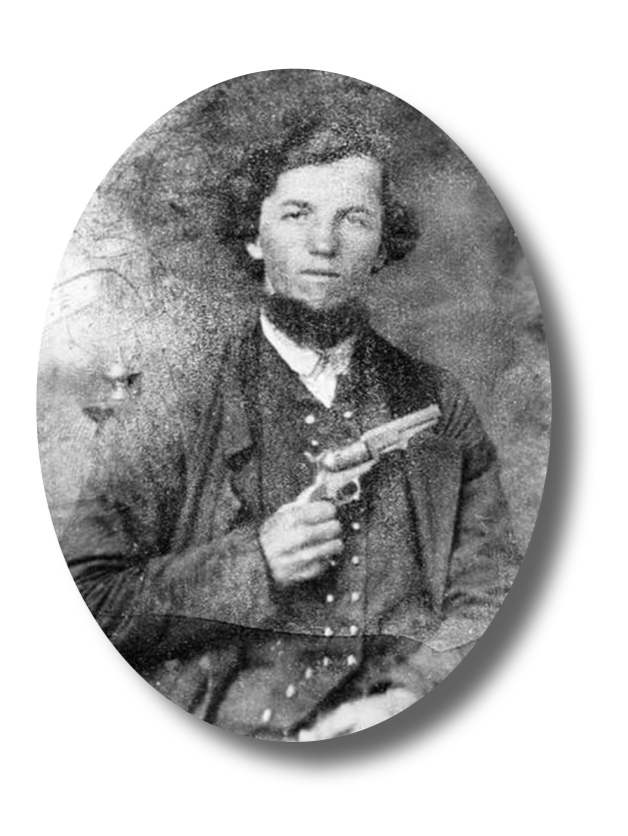
I could not find an image of Thomas but here is one of Pvt. Francis Marion Long of Co. G, 50th North Carolina, who also died of disease during the war. (Greg Mast Collection)

The following letter was written by Thomas Ruffin Blalock (1836-1863), of Person county, North Carolina. He wrote the letter to his “dear companion” of six years, Susan (Whitefield) Blalock, the mother of his three children, Albert, George and James.

The letter was datelined from Camp Mangum near Raleigh, North Carolina, where the 50th North Carolina was being drilled and equipped for military service. Thomas had accepted a bounty to enlist as a private in Co. A of that regiment in early March 1862. The regiment served in Virginia from June to December 1862, primarily around Drewry’s Bluff. They returned to North Carolina in January 1863 and remained there until late in 1864, serving in the eastern part of the state. Thomas, however, became seriously ill in May 1863 from pneumonia and he died on the 26th of May.

Transcription

Camp Mangum, 1 North Carolina
April 19th 1862

Dear Companion,

It is with great pleasure that I seat myself to drop you a few lines to let you know that I am well as to health but I am pestered in mind very much for I have wrote to you but have not received a single line from you and I am pestered about it. But I hope that I will hear from you in a few days. I would be glad to see you and I hope I will get to come home in a few days for we will get our bounty today or on Monday and then I will try to come home and see you.

I want to know whether William has to leave or not. If he does, tell him to come to this company and if you can get anybody to do the work till I get there, you can employ them till I get there and then I can make better arrangements for something to eat is going to be an object of importance next year.

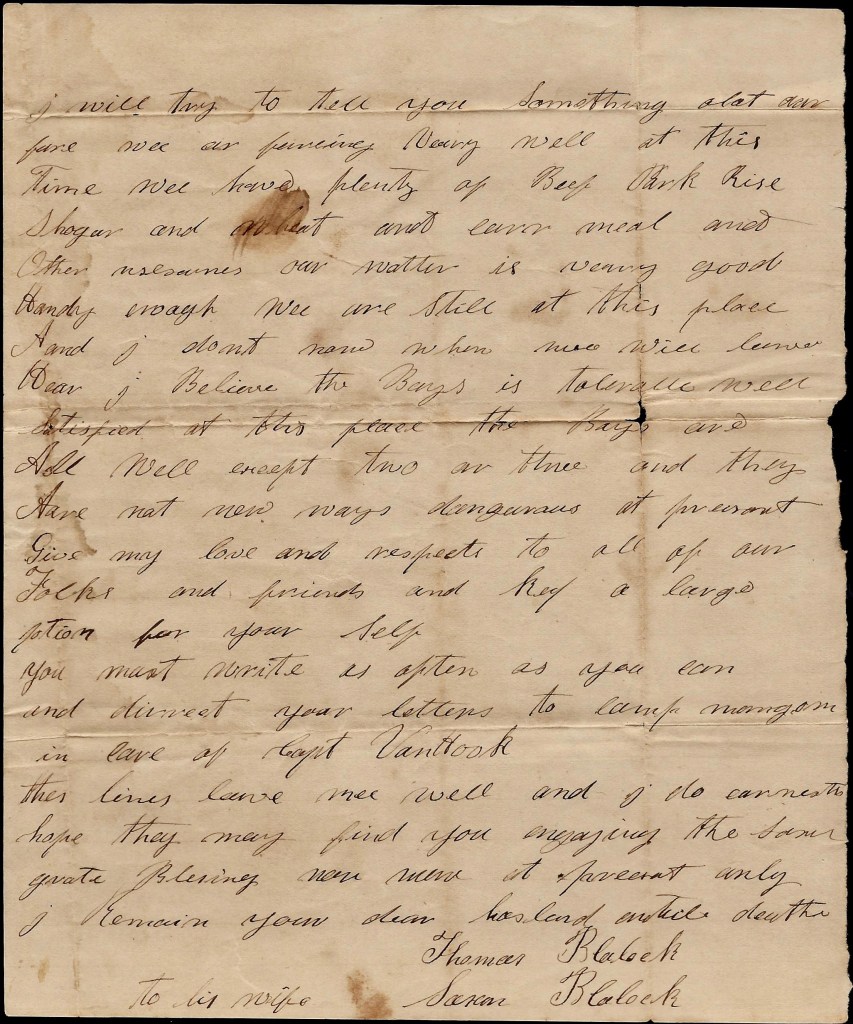
I will try to tell you something about our fare. We are faring very well at this time. We have plenty of beef, pork, rice, sugar, and wheat, and corn meal and other [ ]. Our water is very good, Handy enough. We are still at this place and I don’t know when we will leave here. I believe the boys is tolerable well satisfied at this place. The boys are all well except two or three and they are not anyway dangerous at present.

Give my love and respects to all of our folks and friends and keep a large portion for yourself. You must write as often as you can and direct your letters to Camp Mangum in care of Capt. [John Campbell] Van Hook. 2

These lines leave me well and I do earnestly hope they may find you enjoying the same great blessing. No more at present—only I remain your dear husband until death, — Thomas Blalock

To his wife, Susan Blalock


1 Camp Mangum was located just outside of Raleight, North Carolina. Thousands of North Carolinians passed through this camp between 1861 and 1863 where they were drilled and equipped for military service. [See Camp, Combat, and Campaign: North Carolina’s Confederate Experience, by Peter R. Thomas, Jr.]

2 John Campbell Van Hook was the captain of Co. A, 50th North Carolina Infantry. He was born in North Carolina on July 10, 1831, where he farmed prior to enlisting at age 31. He served as the captain in command of a militia company in the Van Hook district of Person County. The company met for drill at Paynes Tavern before the War Between the States began. Van Hook had previously served as first lieutenant in the 44th Regiment, North Carolina Militia. The 50th North Carolina Regiment was organized on April 15, 1862, at Camp Mangum, near Raleigh, and Captain Van Hook was put in charge of Company A. He brought with him the largest volunteer company from Person County. Van Hook was promoted to major on December 1, 1862, and to lieutenant colonel on November 10, 1863.
1863: Philip Josiah Overcash to his Family

The following letter was written by Philip Josiah Overcash of Rowan county, North Carolina, who at age 30 enlisted as a private in Co. B, 57th North Carolina on 4 July 1862. Co. B, 57th North Carolina Infantry. In May of 1863 he was reported hospitalized in Richmond and then transferred to the hospital in Lynchburg, Virginia. While enroute to Lynchburg, he seems to have been taken a prisoner of war on 24 May 1863 by Union troops raiding the rear of Lee’s army. He was immediately paroled and sent to Farmville suffering from acute nephritis.

Finally, in August 1863, he was furloughed for 60 days and in April 1864 he was absent from the regiment. My assumption is that he never returned to the regiment as he was reported sick at home in Rowan county in September 1864.

Philip’s letter is directed primarily to his wife Margaret I. (Blover) Overcash, but he also adds a few lines to his son Eli Overcash (1857-1924) who was six years old at the time.

Transcription

Addressed to Mrs. Margaret Overcash, Laurel Branch P. O., Rowan County, North Carolina

Farmville, Virginia
July 24th 1863

Dear and affectionate wife and loving children, and affectionate Mother and  sisters,

I state to you that I received your kind and welcome letter yesterday, 23d, dated July the 17th (No 21) and I was truly glad to hear from you once more and to hear that you were all tolerable well—only Seth, you said, still  has the bowel complaint yet, but he didn’t seem to mind it. And I hope it is only a little brush and that he will get better of it again.

I now state to you that would have answered your letter yesterday but I was too sick to sit up to write. My breast and back hurt me too bad and my bowels were running off very bad and pained me very much. But I feel a great deal better this morning but am barely able to sit up long enough to answer your letter. And I have no appetite to eat much. And I hope if I don’t take a backset, that I may soon get better again.

I am glad to hear that you have your wheat all hauled up and in the barn and have your oats all cut and that you think you will make enough to do you if you didn’t have to give the 10th of all you made, which I can’t think you will have to do now.

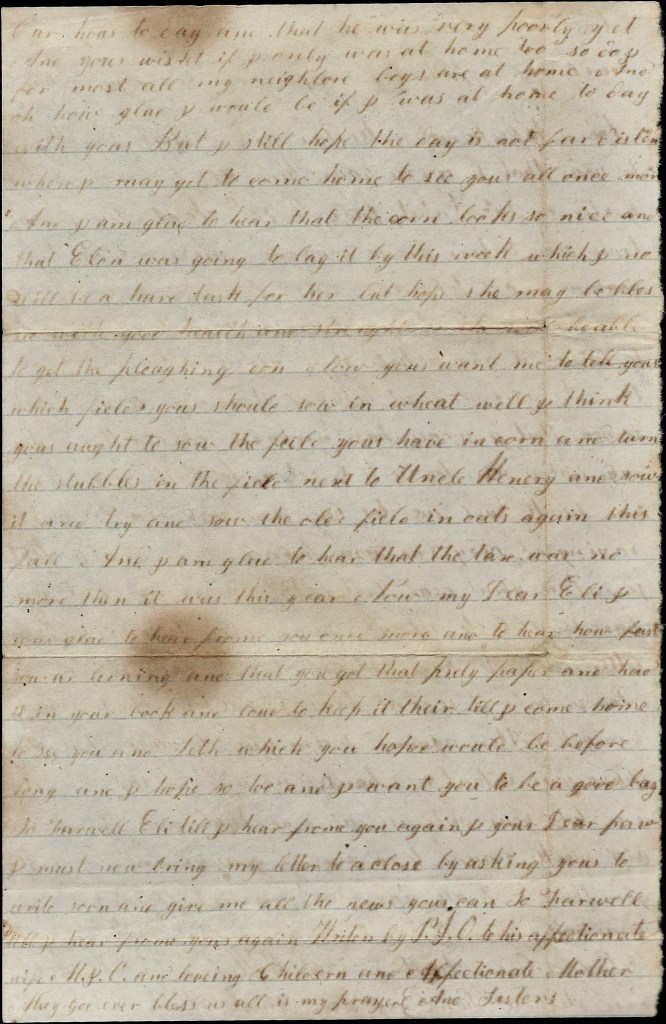
You said that L. F. R. and F. L. & T. O. & A. M, and that H. W. O. & P. L. O. & J. A. R. were still at home yet and that H. W. O. was at our house today and that he was very poorly yet. And you wished if I only was at home too. So do I, for most all my neighbors boys are at home today with you. But I still hope that the day is not far distant when I may get to come home to see you all once more. And I am glad to hear that the corn looks so nice and that Elon was going to lay it by this week which I know will be a hard task for her but hope she may be blessed with good health to get the plowing done.

Now you want me to tell you which field you should sow in wheat. Well, I think you ought to sow the field you have in corn and turn the stubble in the field next to Uncle Henry and sow it and try and sow the old field in oats again this fall. And I am glad to hear that the tax was no more than it was this year.

Now my dear Eli, I was glad to hear from you once more and to hear how fast you are learning and that you got that pretty paper and had 2 in your book and [ ] to keep it there till I come home to see you and Seth which you hope would be before long and I hope so too. And I want you to be a good boy. So farewell, Eli, till I hear from you again. I must now bring my letter to a close by asking you to write soon and give me all the news you can.

So farewell till I hear from you again. Written by P. J. O. to his affectionate wife, M. I. O. and loving children, and affectionate mother and sisters. May God bless us all is my prayer.

1862: Charles Lafayette Osborne to Mariah (Merrill) Osborne

Charles Lafayette Osborne in later years

The following letter was written by Charles Lafayette Osborne (1834-1920) of Transylvania county, North Carolina. He enlisted at the age of 27 on 8 September 1861 as a private in Co. E, 25th North Carolina Infantry. He was promoted as ordnance sergeant in May 1862 and appointed 2nd Lieutenant on 23 July 1862 and 1st Lieutenant one week later. The 25th North Carolina served in Gen. Ransom’s Brigade of Gen. Longstreet’s Corps. The regiment fought at Antietam and near the famous stone wall on Maryes Heights at Fredericksburg. Charles was present and accounted for until 10 February 1865 when he was transferred to the 65th North Carolina (6th N. C. Cavalry) because of his inability to “stand infantry service in the summer season.”

Charles was the son of Jeremiah Osborne (1802-1890) and Mary Rebecca Fletcher (1807-1887). He was married to Mollie Killian (1841-1924) in August 1863.
Charles wrote the letter to his sister-in-law, Mariah (Merrill) Osborne (1831-1914)—the widow of Joseph McDowell Osborn (1832-1859).

[Note: I have spelled Charles’ surname “Osborne” because that’s the way it appears on his headstone but it might also be found in records as “Osborn.”]

Transcription

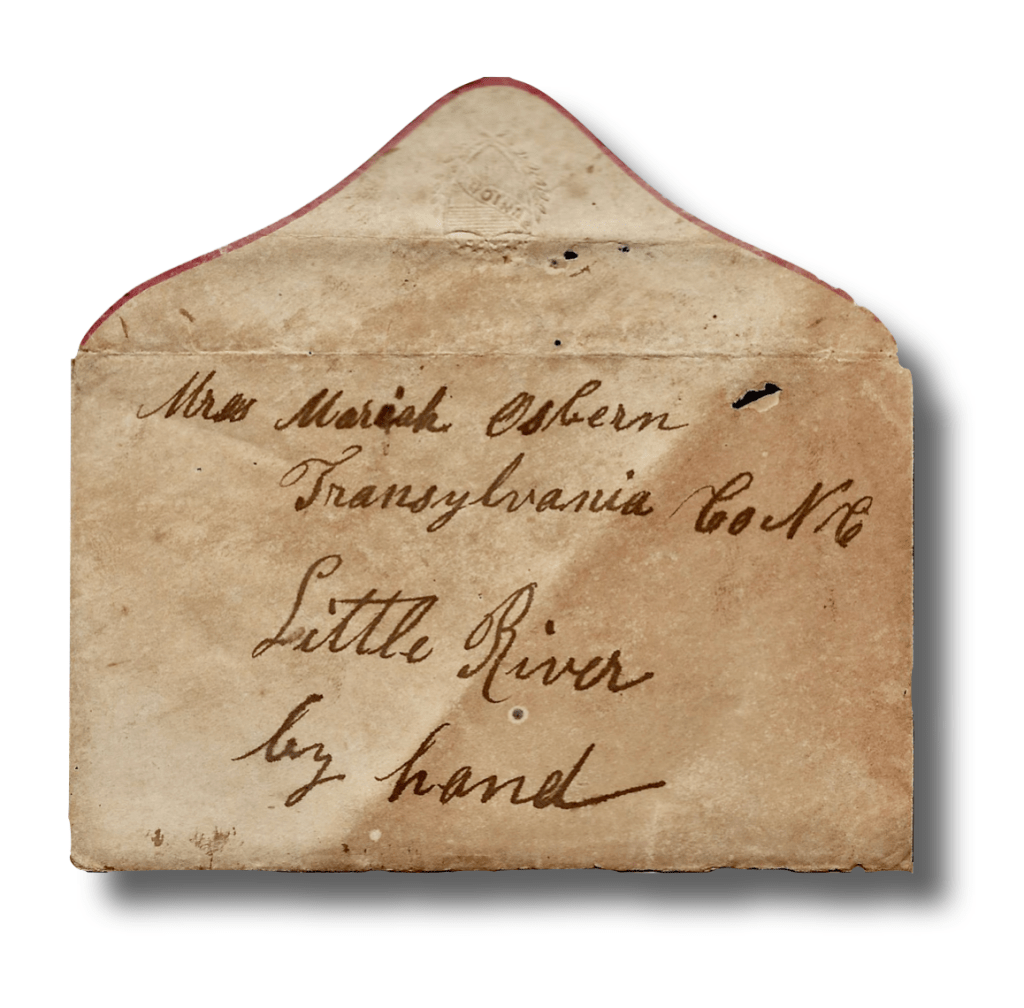
Addressed to Mrs. Mariah Osborn, Little River, Transylvania county, North Carolina,
by hand

Pamlico Station, Lenoir county, N. C.
Camp Ransom
April 6th 1862

Sister Mariah,

Having some leisure hours, I take the pleasure of penning you a few lines hoping they will safely each you and find you enjoying good health, and getting on prosperously in this time of pressure. I have hither to been neglectful in writing to you together with other friends, but it has not been by any design or ill will on my part, but nearly neglect.

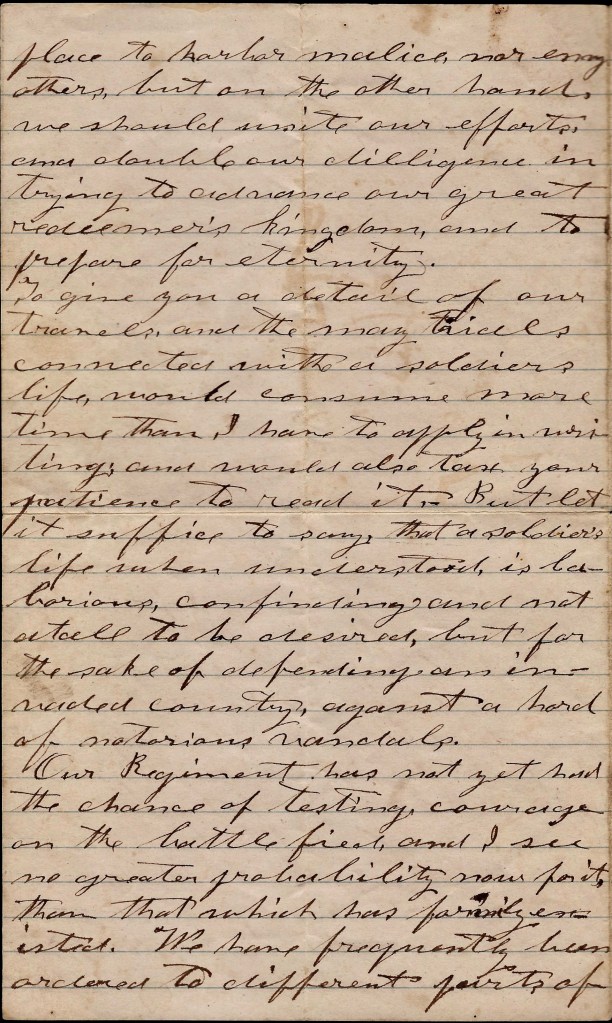
If I know my heart, I feel interested in your prosperity, love you as a sister, because you was married to one of my best brothers and has ever treated me with respect. I hope if there is any disrespectable feelings existed between you and any of us that they may be quickly obliterated and erased from memory’s page, and crushed into oblivion to appear no more. This is no time nor place to harbor malice, nor any others, but on the other hand, we should unite our efforts and double our diligence in trying to advance our great redeemer’s kingdom and to prepare for eternity.

To give you a detail of our travels and the many trials connected with a soldier’s life would consume more time than I have to apply in writing, and would also task your patience to read it. But let it suffice to say that a soldier’s life when understood is laborious, confining, and not at all to be desired, but for the sake of defending an invaded country against a hoard of notorious vandals.

Our regiment has not yet had the chance of testing courage on the battlefield and I see no greater probability now for it than that which has formerly existed. We have frequently been ordered to different parts of the state (and even out of their state) where a fight was pending, but always get there too late to see any bloodshed, but we cannot tell what another day may bring forth, under such critical times.

Our regiment has recently been united with some others in forming a brigade under the command of General Ransom. We find a great many soldiers here, some infantry, some cavalry, and some artillery, and with their drums, bugles, and brass bands together with the constant chattering of mischievous soldiers, would present quite a terrifying aspect—especially to those who have never witnessed such a scene.

We are now stationed close to the Neuse River about thirty miles from Newbern, though we have troops along the road to Goldsboro. Our pickets go daily near Newbern and occasionally pick up a Yankee or a disloyal citizen. This is a fine country and susceptible of producing almost any sort of grain. The bottoms are extensive and rich and possessed by good farms. Water is tolerably good and the weather is moderate.

Provisions are scarce and high. Salt is hardly to be purchased at any price. It is quite evident that poor people will soon begin to suffer.

Most of our regiment have enlisted for the war and are getting several recruits. The fight at Newbern is not yet definitively reported. It is rumored that our side lost near few hundred and the Yankees about fifteen hundred but I suppose without accuracy.

How does Person enjoy himself since his second choice of married life? I suppose well. I must close. Let us here how you are doing. Letters directed to Goldsboro will come to us. Give respects to all my friends. Fraternally, — C. L. Osborn

1885: William Henry Harrison Lancaster to Sophia E. Eastman

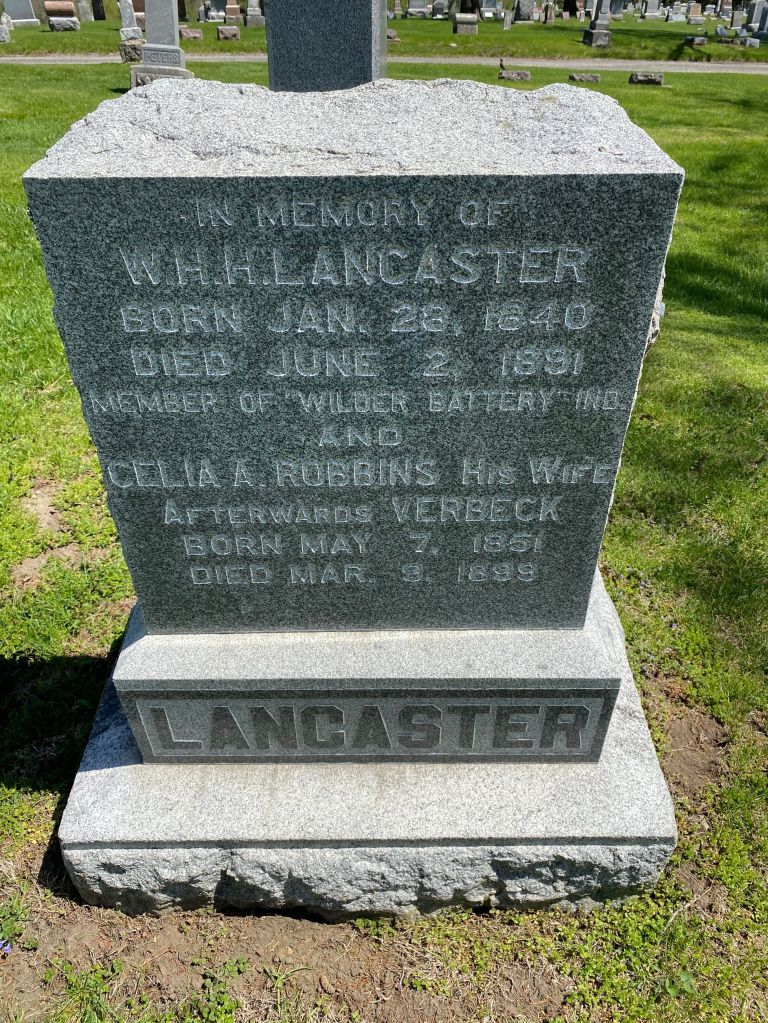
This letter was written in 1885 by William Henry Harrison Lancaster (1840-1891) who first entered the Civil War in June 1861 as a member of Co. A, 17th Indiana Infantry. The regiment first saw combat at Greenbrier, Virginia in October of that year, then transferred to Don Carlos Buell’s Army of the Ohio where they took part in the western theatre. Co. A, however, was retained in the Cheat Mountain District of West Virginia and used as artillerists in Wilder’s Battery, Co. G.

From William’s letter we learn that at some unspecified point in time he transferred out of Wilder’s Battery into the military’s telegraph service where he worked as a telegraph operator and repairer. While posted at the New Creek Station in November 1864, he and others connected with the telegraph office were robbed, taken prisoner by Confederates under Rosser’s command, and taken to Castle Thunder where he endured some 15 weeks of captivity and nearly starved to death. His letter chronicles that experience.

William wrote the letter to Miss Sophia E. Eastman, an 1864 graduate of Wheaton Female Seminary (Norton, Mass.), in response to a request for information pertaining to his captivity at Caste Thunder. Sophia wrote a number of children’s and religious books in the latter half of the 19th century but I have not been able to determine why she was collecting stories of this nature. The letter was sent to 8 Mason street in Cambridge which was a boarding house.

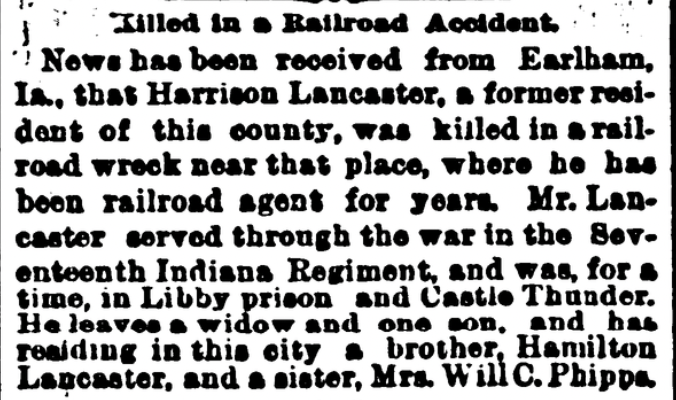
As he states in his letter, William lived out his days in Earlham, Madison county, Iowa, working for the railroad. Sadly, William was killed in a horrific railroad accident near Earlham on 2 June 1891 at the age of 51 (see clippings below).

A photograph of Caste Thunder taken after the fall of Richmond. The former tobacco warehouse was converted into a prison during the war. (LOC)

Transcription

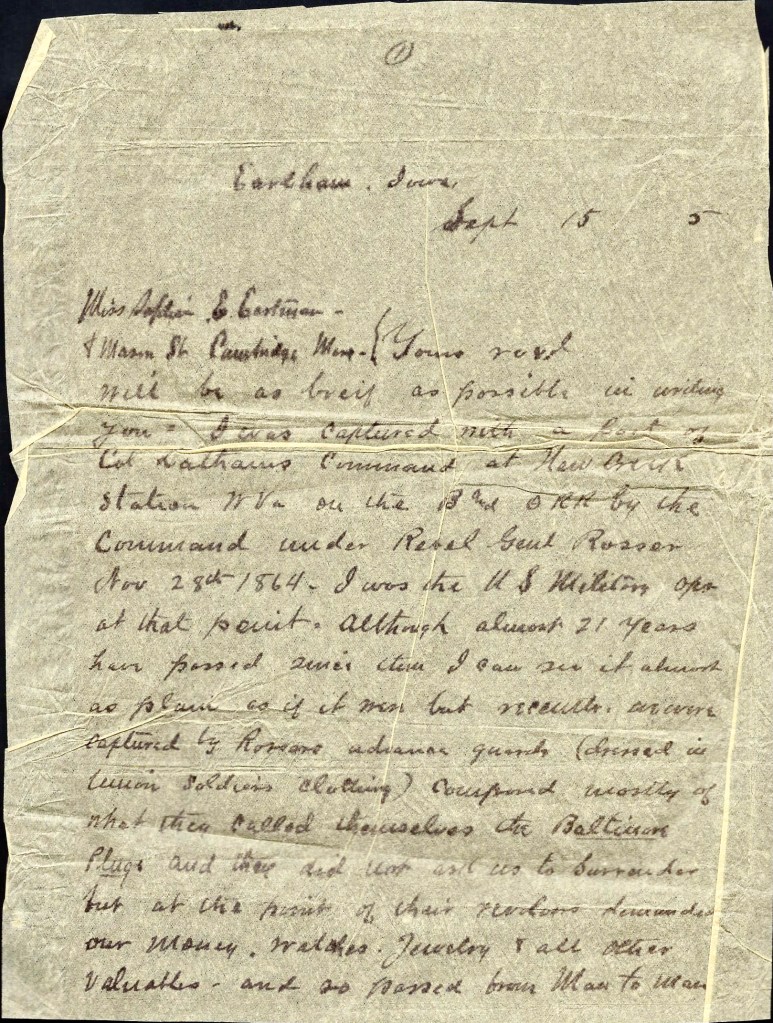
Earlham, Iowa
September 15, 1885

Miss Sophia E. Eastman
8 Mason Street, Cambridge, Mass.

Yours received. Will be as brief as possible in writing you.

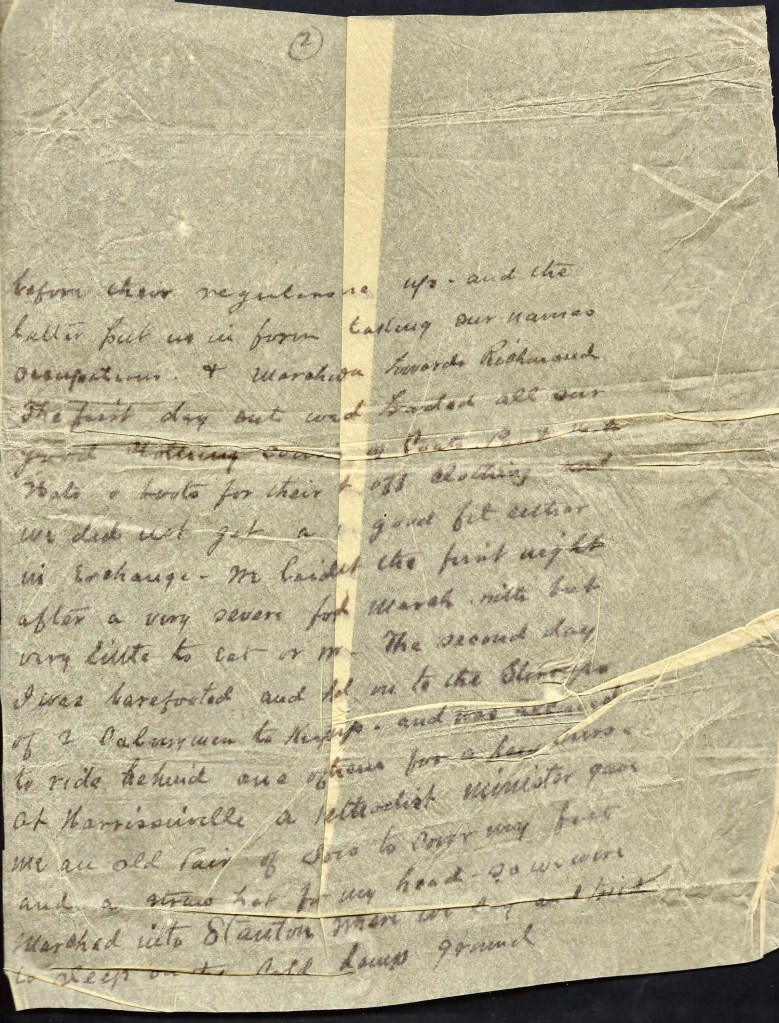
I was captured with a part of Col. Latham’s command at New Creek Station, W. Va. on the Baltimore & Ohio Railroad by the command under Rebel General Rosser November 28th 1864. I was the U. S. Miltary Operator at that point. Although almost 21 years have passed since then, I can see it almost as plain as if it were but recent. We were captured by Rosser’s advance guards (dressed in Union soldier’s clothing) composed mostly of what they called themselves the Baltimore Plugs and they did not ask us to surrender but at the point of their revolvers surrender our money, watches, jewelry, and all other valuables—and so passed from man to man before their regulars come up and the latter put us in form[ation] for taking our names and occupation & marching on  towards Richmond.

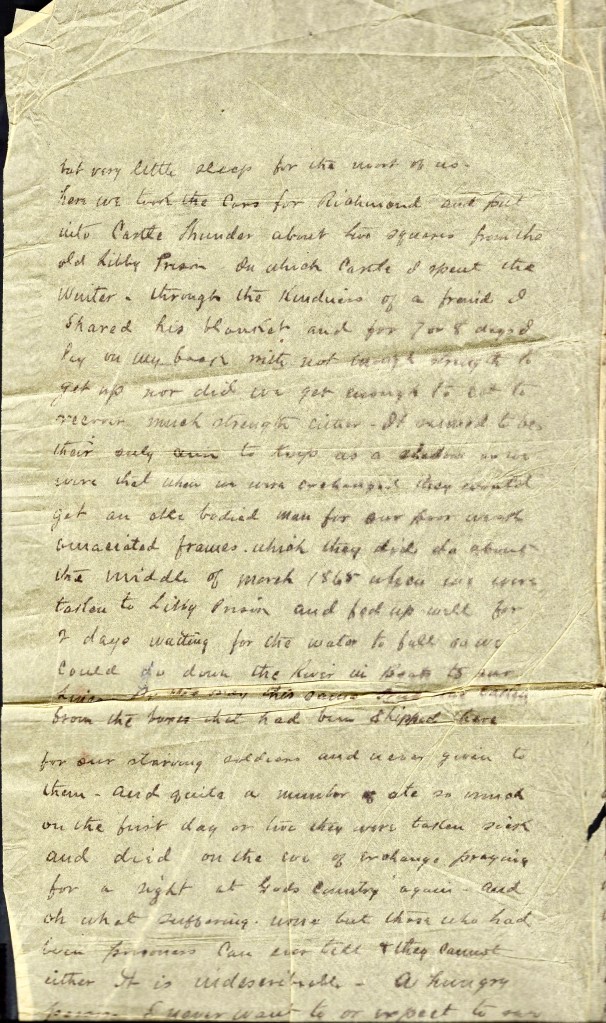
The first day out we had traded [probably forcefully] all our good clothing, consisting of coats, pants, vests, hats, and boots for their cast off clothing and we did not get a very good fit either in  exchange. We laid out the first night after a very severe forced march with but very little to eat or  wear. The second day I was barefooted and held on to the stirrups of two cavalrymen to keep up and was allowed to ride behind one of them for a few hours. At Harrisonville, a Methodist Minister gave me an old pair of shoes to cover my feet and a straw hat for my head. So we were marched into Staunton where we lay and tried to sleep on the cold damp ground, but very little sleep for the most of us. Here we took the cars for Richmond and put into Castle Thunder—about two squares from the old Libby Prison, in which castle I spent the winter.

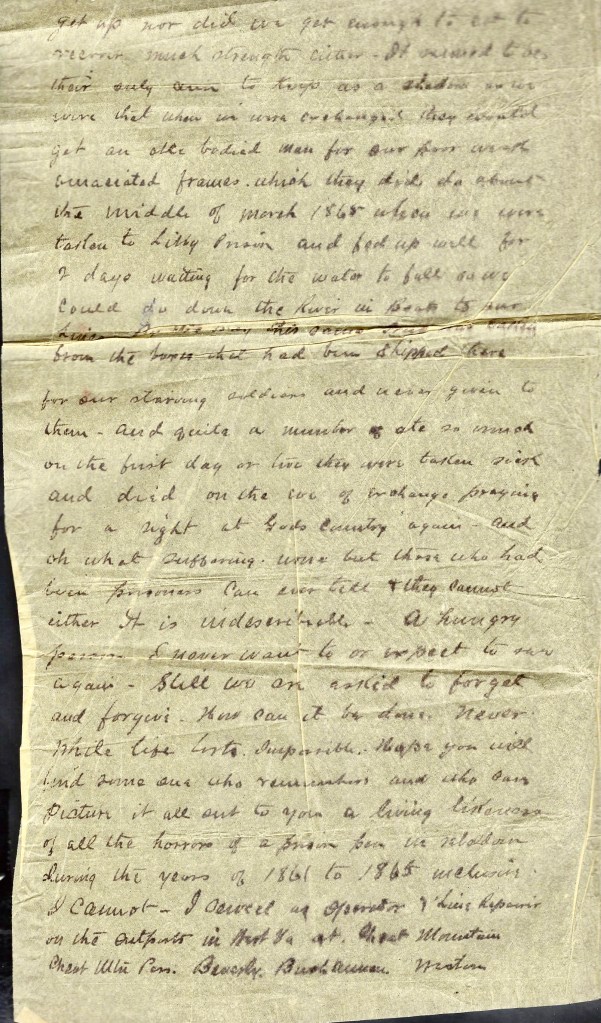
Through the kindness of a friend, I shared his blanket, and for 7 or 8 days I lay on my back with not enough strength to get up. Nor did we get enough to eat to recover much strength either. It seemed to be their only aim to keep us a shadow as we were—that when we were exchanged they would  get an able bodied man for our poor weak emaciated frames, which they [finally] did do about the middle of March 1865 when we were taken to Libby Prison and fed up well for two days waiting for the water to fall so we could go down the river in boats to our lines.

By the way, this same grub was taken from the boxes that had been shipped there for our starving soldiers and never given to them, and quite a number ate so much on the first day or two, they were taken sick and died on the eve of exchange praying for a sight at God’s country again. And Oh! what suffering. None but those who had been prisoners can ever tell—and they cannot  either. It is indescribable. A hungry person I never want to or expect to see again. Still we are asked to  forget and forgive. How can it be done? Never while life lasts. Impossible. Maybe you will find someone who remembers and who can picture it all out to you a living likeness of all the horrors of a prison pen in rebeldom during the years of 1861 to 1865 inclusive. I cannot.

I served as operator and line repairer in the outposts in West Virginia at Cheat Mountain, … Bull town, and Charleston. We did not have all the delicacies of the season at any place but fared about the same as our soldiers and we did not complain at that. I lost everything I had, unfitted for any service that would command good wages. I am making a living for myself, wife, and boy, and that is about all as agent or operator on the CRJ&PRR, and have been for the last 15 years. I never cared much  about a pension but there are but a few of us who would like in some honorable way to get back what we had made, saved, and lost by capture. I left out about 1000 dollars worse than nothing. No clothes. No work. No  money and in bad health and yet every Fall, Winter, Spring I suffer a great deal with neuralgia or rheumatism  contracted during captivity by hunger and exposure.

I believe you would get a good deal of information as regards the military operations by looking over Plumb’s  History of the U. S. Military Telegraph Company. It is too late in the day for a great many of us to remember much that should be written & remembered by the future generations of what we did do and suffer without  a complaint, as well as without a reward from the Government. I was in rebel prison but three and a half months—yet they  passed as so many years. I suppose after we are dead and gone a grateful people will kindly mention our names and likely give our children a tin medal as a reward for the services rendered by their Fathers. You will pardon me for not being able to write the information you desire. I do not know why you want the  information but hope whatever you do will be to the interest of all of us. I remain yours truly, — W. H. H. Lancaster.

[The second smaller note reads]

Earlham, Iowa
Sept 26th 1905

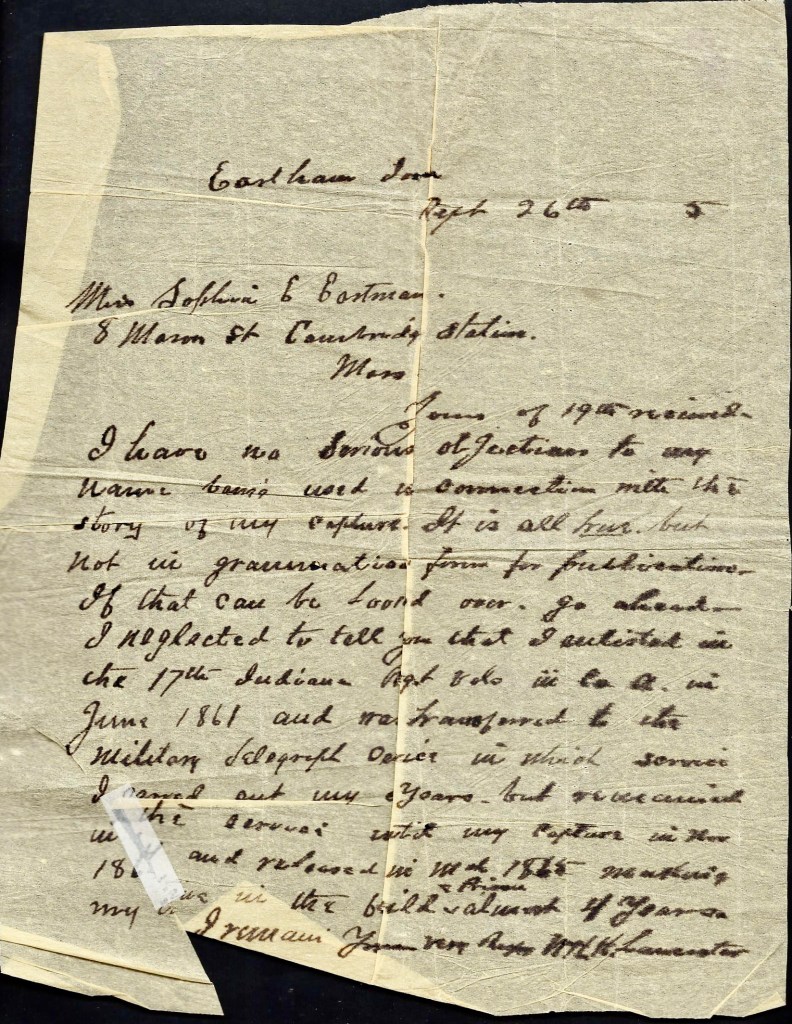
Yours of 19th received. I have no serious objections with [your use of] the story of my capture. It is all true, but not in grammatical form for publication. If that  can be looked over, go ahead. I neglected to tell you that I enlisted in the 17th Indiana Regt. Vols in Co. A. in June 1861 and was transferred to the military telegraph service in which service I served out my 3 years but remained in the service until my capture in Nov 1864 and released in March 1865, making my time in the field and as prisoner almost 4  years. I remain yours very respectfully, W. H. H. Lancaster.

1864: Jacob Stiles Cockerill to Ellie Doster

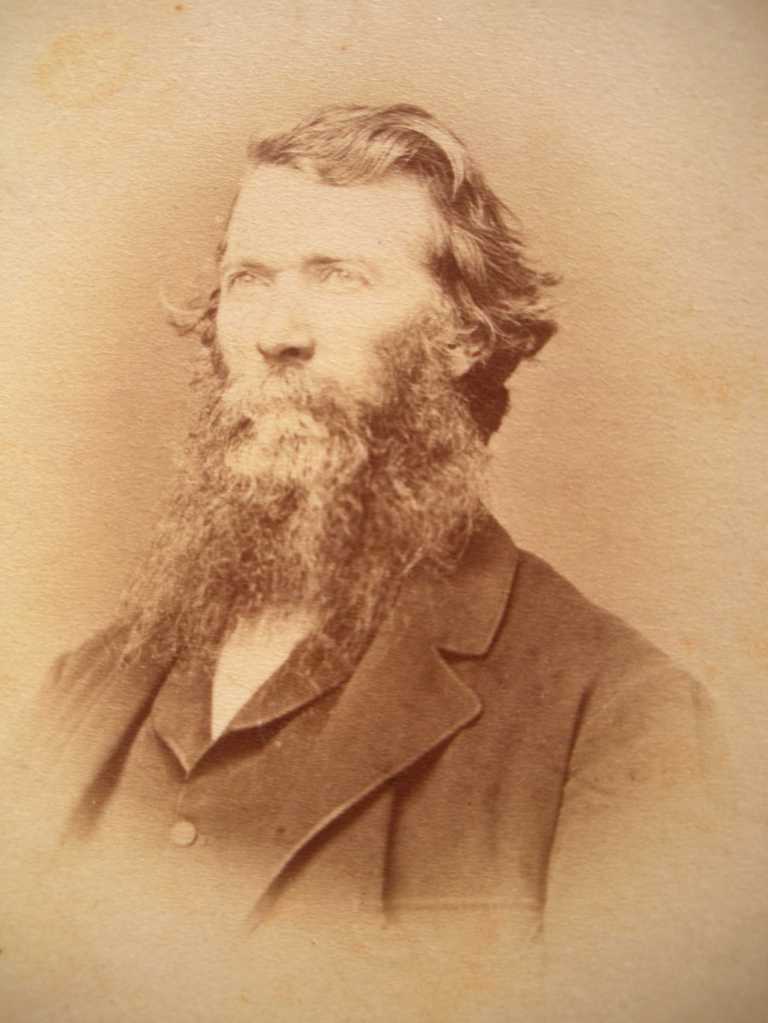
I could not find a war-time image of Jacob but here is one of John S. Shorr who served in Co. F, 90th Ohio Vol. Infantry (Ancestry.com)

This letter was written by Jacob Stiles Cockerill (1839-1936) who served in Co. C, 90th Ohio Volunteer Infantry (OVI). A biographical sketch composed for his 64th wedding anniversary claimed that Jacob entered the service as a private in April 1861; that he was forced to leave the army on account of sickness; returning to the ranks in July 1862; winning promotion to the rank of corporal in October 1862; sergeant in March 1864; and being mustered out in June 1865. He fought at Stone River, Kenesaw Mountain, and elsewhere. He married his wife, Hannah Roberta Limes (1849-1935) when he returned from the war; he was 27 and she was 17.

Jacob wrote the letter to Elma (“Ellie”) Doster, the 16 year-old orphaned daughter of John Doster (1803-1857) and Catherine Mooney (1807-1846). She was the younger sister of Lydia (“Lydy”) Doster (1839-1886) and Jacob Todhunter Doster (1837-1863)—both mentioned in this letter—of New Martinsburg, Fayette county, Ohio.

Transcription

Addressed to Miss Ellie Doster, Greenfield, Highland county, Ohio

Bridgeport, Alabama
January 17, 1864

Friend Ellie,

Your kind letter written January 7th is at hand [and] is contents perused. I will take this Sabbath evening to respond. This is a beautiful day overhead. It is warm and nice. It gives me the blues to have to stay in camp today. I would like to go to Cochran’s to church. Going to church has played out with me.

Ellie, you spoke of going to school. I wish I was at home to go to school too. I see the need of a good education. I wish I had the opportunity to go to school 2 years. I think that I shall go if I ever get home again.

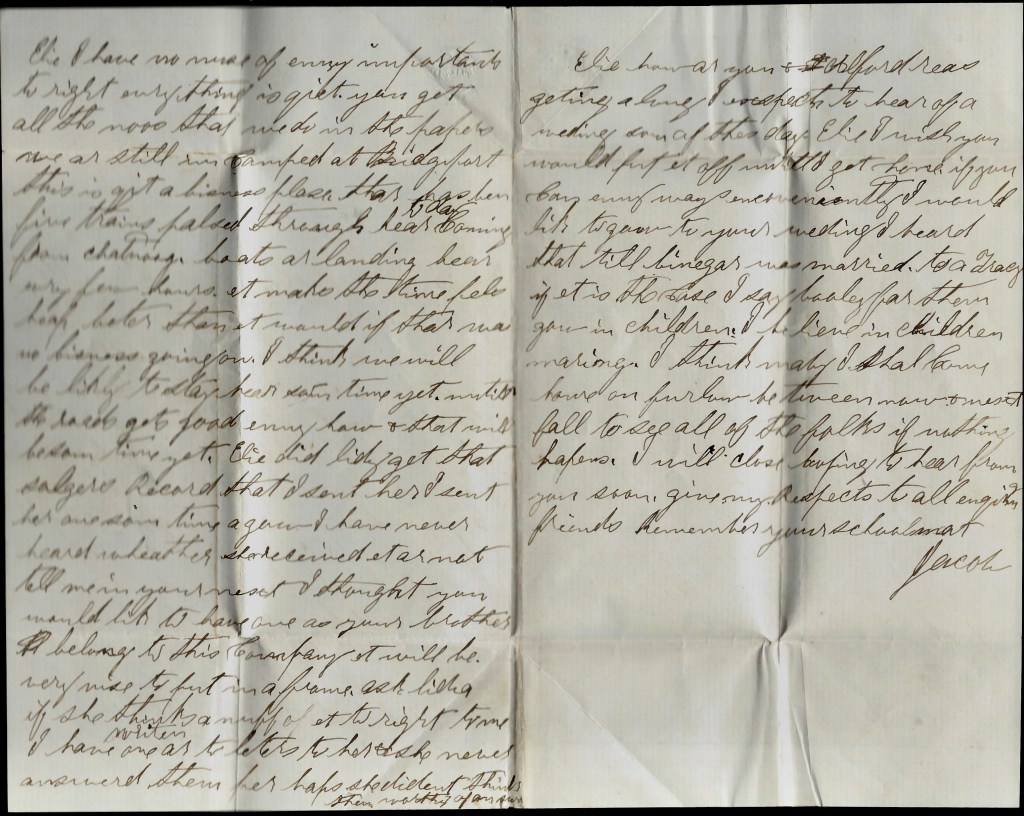
Ellie, I have no news of any importance to write. Everything is quiet. You get all the news that we do in the paper. We are still in camp at Bridgeport, This is quite a business place. There has been five trains passed through here today coming from Chattanooga. Boats are landing here every few hours. It makes the time pass a heap better than it would if there was no business going on. I think we will be likely to stay here some time yet—until the roads get good anyhow and that will be some time yet.

Ellie, did Lidy get that soldier’s record that I sent her? I sent her one some time ago. I have never heard whether she received it or not. Tell me in your next. I thought you would like to have one as your brother belonged to this company. 1 It will be very nice to put in a frame. Ask Lida if she thinks enough of it to write to me. I have written one or two letters to her and she never answered them. Perhaps she didn’t think them worthy of an answer.

Ellie, how are you and Alford Rease getting along? I expect to hear of a wedding one of these days. Ellie, I wish you would put it off until I get home if you can anyway conveniently. I would like to go to your wedding. I heard that Till Binegar [Matilda Jane Binegar] was married to a [James W.] Tracy. 2 If it is the case, I say Bully for them. Go in children. I believe in children marrying. I think maybe I shall come home on furlough between now and next fall to see all of the folks if nothing happens. I will close hoping to hear from you soon. Give my respects to all enquiring friends. Remember your school mate, — Jacob


1 Ellie’s brother who served in Co. C, 90th OVI was Jacob Todhunter Doster (1837-1863) who died on 10 February 1863 at Murfreesboro, Tennessee.

2 The couple were married on 3 January 1864 in Fayette county, Ohio.

1862: Mitchell Campbell Lilley to Amanda (Brooks) Lilley

The following letter was written by 43 year-old Mitchell Campbell Lilley (1819-1897), the proprietor of a moderately successful bindery and printing firm in Columbus, Ohio, at the time that civil war erupted in 1861. Having served previously in the Mexican War, and being a member of the local militia, Lilley was quick to offer his service as Captain of Co. H, 46th Ohio Volunteer Infantry (OVI). Ill health, however, forced Lilley to resign from active service in January 1863 but he returned to Columbus to command a home guard militia for the duration of the war. 

Mitchell Campbell Lilley

Following the war, Lilley convinced the Ohio General Assembly that deaf students at the state institution for the deaf could be trained in bookbinding skills which enabled him to expand his business and branch out into other endeavors, such as manufacturing and distributing fraternal regalia.

Lilley was married in 1849 at Paris, Illinois, to Amanda C. Brooks. They had 13 children, five of who died in infancy.

The 46th OVI took part in Grant’s first attempt to seize Vicksburg which was to march his army overland from La Grange, Tennessee, following the Mississippi Central Railroad south toward Vicksburg. He imagined that a supply line could be maintained from Columbus, Kentucky, but this proved impossible. Once Grant’s forces had made it as far as 35 miles south of Grand Junction, the large supply depot he had established at Holly Springs in his rear was swiftly and unexpectedly attacked by Earl Van Dorn’s Cavalry, destroying $1.5 million of supplies, capturing the Federal garrison quartered there, and destroying track and bridges. The damage inflicted by Van Dorn’s troopers caused sufficient harm for Grant to withdraw his forces to Memphis and rethink his strategy.

In this letter, Capt. Lilley describes their return to Holy Springs and what they found when they got there.

For an interesting article by my friend Dan Masters, see “Crank” Worthington’s Boys at Shiloh, published on 28 June 2020.

See also—Letter dated 31 December 1862 by Capt. Lilley from Holly Springs, Mississippi.

Transcription

Yocknapatufa, Mississippi
December 18th 1862

Dear Wife,

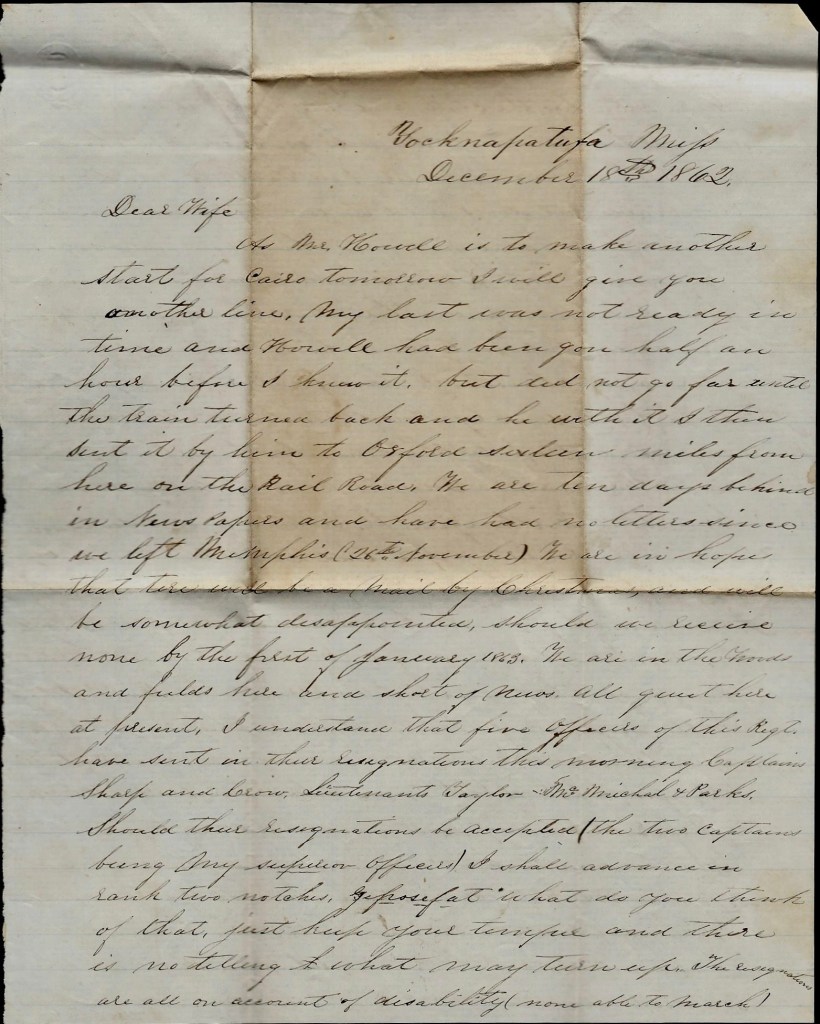
As Mr. Howell is to make another start for Cairo tomorrow, I will give you another line. My last was not ready in time and Howell had been gone half an hour before I knew it, but did not go far until the train turned back and he with it. I then sent it by him to Oxford sixteen miles from here on the railroad. We are ten days behind in newspapers and have had no letters since we left Memphis (26th November). We are in hopes that there will be a mail by Christmas and will be somewhat disappointed should we receive none by the first of January 1863.

We are in the woods and fields here and short of news. All quiet here at present. I understand that five officers of this regiment have sent in their resignations this morning—Captains [A. Grant] Sharp and [Philip A.] Crow, Lieutenants [Charles E.] Taylor, [Harrison] McMichael, and [Amos L.] Parks. Should their resignations be accepted (the two captains being my superior officers), I shall advance in rank two notches. Jehoshaphat! What do you think of that? Just keep you temper and there is no telling what may turn up. The resignations are all on account of disability (none able to march).

Our boys are all well enough to keep about. George Aston has the chills and William Taylor is lame yet with his toe but will be well in a week. John and Bub are well as usual. Our table is made of clapboards outdoors and it is a little cool on the fingers today and gives me the rheumatism in my hands, and I am troubled with it some all over in damp weather. Our cook is improving and we shall have to train him to it as that is our only chance. I have packed Henry’s clothes in a box to send by Howell to his mother. Louis can send it up by the omnibus to Worthington His mother’s name is Dolly Turk. Everybody knows her about Worthington. 1

Lt. Beckett is out superintending the building of a railroad across the creek by order of General Denver. The flat is about one mile wide and they are making a corduroy road through it. Adjutant found some relatives two miles from camp by the name of Morgan. Col. [Charles C.] Walcutt is well and all the other officers.

If you get into any trouble about horses or cows, Mr. Mosberry will tell you what is best to do with them. Send letters to Cairo and they will find us some time. There is some talk of our marching tomorrow from this camp, I suppose we will go towards Grenada. Write and give us all the news. I did not put Tom’s handkerchief in the trunk but will try and take care of it for him. Yours, — M. C. Lilly


1 I infer from the preceding paragraph that Henry Turk was the black cook brought with the regiment to cook for the officers. Henry (or Hendrick) was the 27 year-old son of Henry and Dolly Turk of Worthington, Franklin county, Ohio. Dolly and her husband had been born in Virginia—most likely former slaves. In the same paragraph that “Henry’s clothes” are mentioned, it is stated that they are training a new cook.

1861: Mary Gifford (Richmond) Brown to Joseph Brown

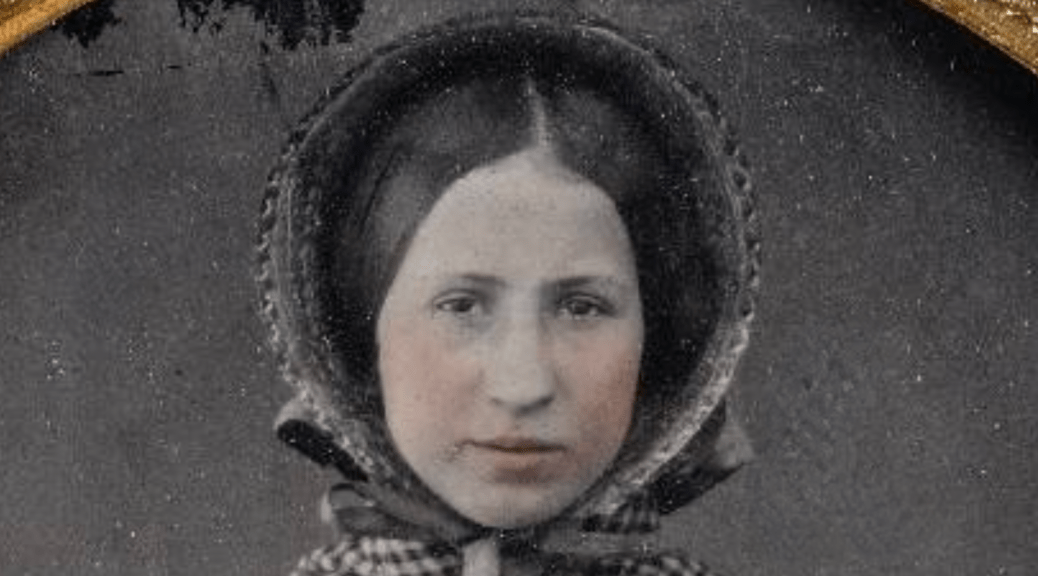
The following plaintive missive expresses the pangs of an anticipated long separation experienced by the wife of a Union soldier who has just enlisted for three years. It was written by 35 year-old Mary Gifford (Richmond) Brown (1826-1891), the daughter of Allen Richmond—who passed away on 1 November 1861—and his first wife, Betsey Dennison Jones (1799-1830). Mary and her husband were married in March 1844. Because she was under the legal age to get married in Ohio and her parents opposed the union, they eloped to Bedford, Pennsylvania where a local Justice of the Peace solemnized their marriage. Once hitched, they settled in Newton Falls, Trumbull county, Ohio, where Mary’s husband made a living as a wagon maker. By the time of the 1860 US Census, the couple had three children—Libbie (age 14), Allen (age 10), and Joseph Denison, or Denni (age 7 months).

Mary’s husband was 43 year-old Joseph Brown who enlisted as a sergeant in Co. D of the 6th Ohio Volunteer Cavalry (OVC) in October 1861. This unit was organized at Camp Hutchins in Warren, Ohio; its members drawn mostly from the Western Reserve. They remained in Warren until January 1862 when they were sent to Camp Dennison for drill instruction. In March they were assigned to Camp Chase to guard Confederate prisoners. In the spring of 1862, they operated in the Shenandoah Valley, Virginia, and in June participated in the battle of Cross Keys, and again at Cedar Mountain and second Bull Run. They joined Burnside’s advance on Fredericksburg and went into winter quarters, guarding the Rappahannock. In the spring of 1863, they fought under Hooker at Kelly’s Ford, joined Stoneman’s raid, and followed Lee’s movement into Maryland, having several severe actions. The regiment took an active part at Gettysburg and followed Lee’s retreat, capturing many men and wagons. They participated in many engagements in Meade’s advance on the Rapidan and spent the winter fighting Mosby’s guerillas.

Before the Overland campaign began in 1864, however, Joseph became ill. Apparently he was with his regiment until about the 15th of March when he was taken sick and left the company encamped at Warrenton, Virginia, for Lincoln Hospital in Washington D. C. In early May, Lincoln Hospital was ordered to relocate convalescents in order to open up bed space for the anticipated wounded arriving from the Battle of the Wilderness and Joseph was sent with others to Lovell General Hospital in Portsmouth Grove, Rhode Island. His military record indicates he died there of erysipelas on 19 May 1864 after 2 years and seven months of service and separation from his beloved Mary—just five months short of his term of enlistment.

The sale of Joseph Brown’s property in Newton Falls following his death in 1864

Transcription

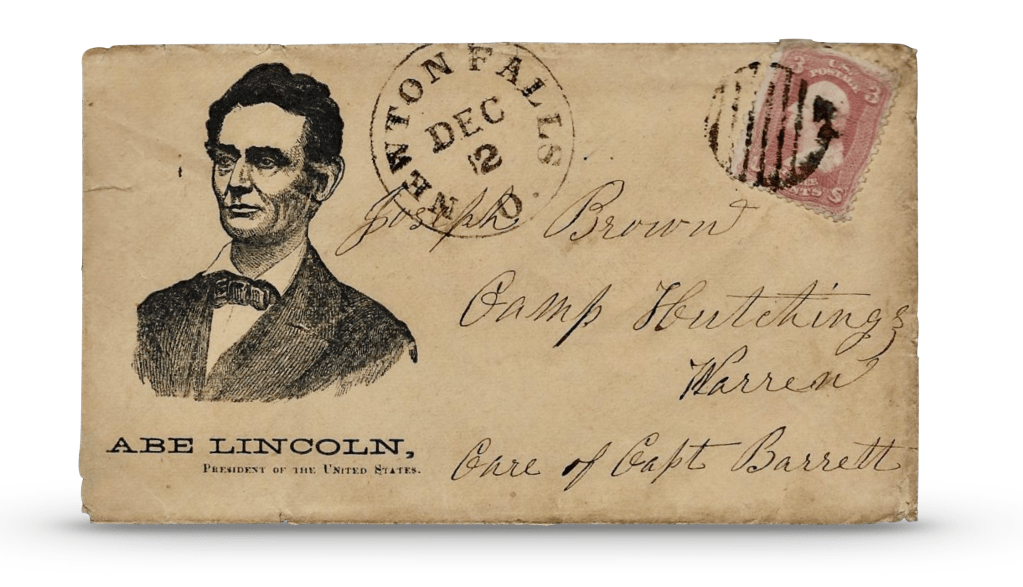
Addressed to Joseph Brown, Camp Hutchins, Warren, [Ohio], Care of Capt. Barrett
Postmarked Newton Falls, Trumbull county, Ohio, December 2, 1861

December 1st 1861

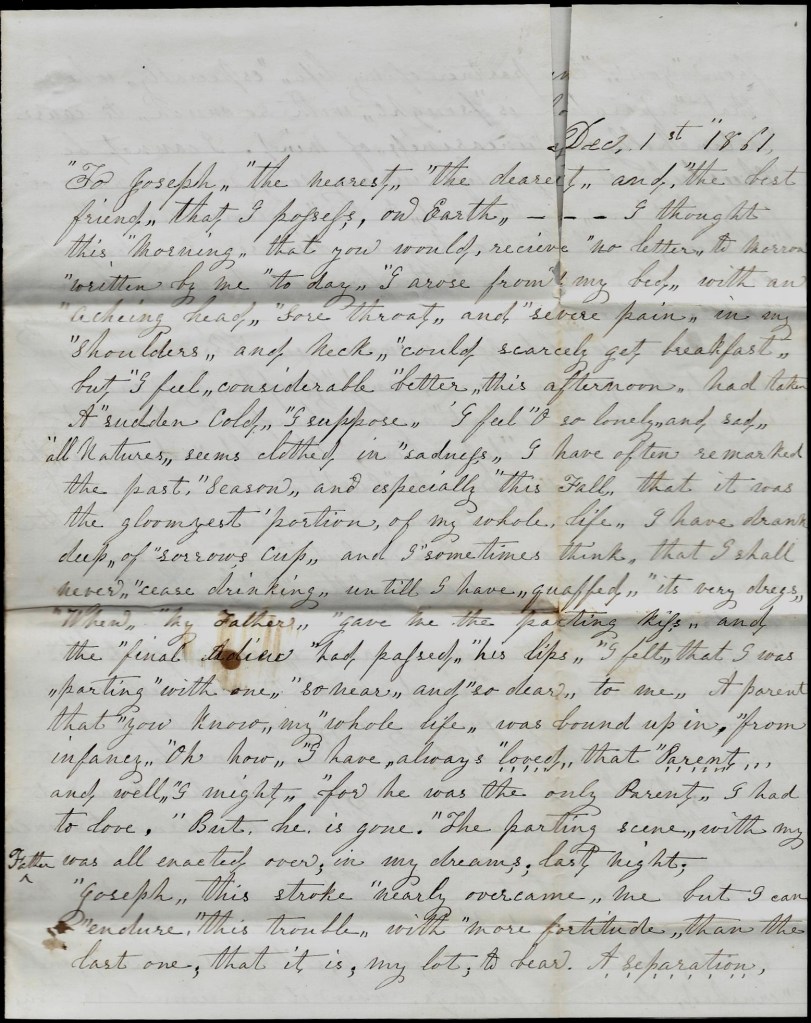
To Joseph—the nearest, the dearest, and the best friend that I possess on Earth,

I thought this morning that you would receive no letters tomorrow written by me today. I arose from my bed with an aching head, sore throat, and severe pain in my shoulders and neck, could scarcely get breakfast but I feel considerably better this afternoon. Had taken a sudden sold I suppose. I feel Oh so lonely and sad. All nature seemed clothed in sadness. I have often remarked the past season, and especially this fall, that it was the gloomiest portion of my whole life. I have drank deep of sorrow’s cup and I sometimes think that I shall never cease drinking until I have quaffed its very dregs.

When my father gave me the parting kiss and the final adieu had passed his lips, I felt that I was parting with one so near and so dear to me—a parent that you know my whole life was bound up in from infancy. Oh how I have always loved that parent I had to love. But he is gone. The parting scene with my father was all enacted over in my dreams last night.

Joseph, this stroke nearly overcame me but I can endure this trouble with more fortitude than the last one that it is my lot to bear. A separation from you—the partner of my life, especially where that separation is fraught with so much to cause melancholy and uneasiness of mind. I cannot be cheerful or enjoy life in any way when I know or feel that you are exposed to the inclemencies of the weather, to all the contagious diseases incident to camp life, and also to the fare which many of our soldiers are compelled to bear. You may fare tolerably well now whilst you remain in Warren, but you cannot always stay there. And Joseph, you cannot imagine with what awful dread I anticipate the time of your departure.

The old adage is that every back is fitted for its burthen, but I fear that mine will prove treacherous. I could endure it better if there was no compulsion. But to think that you are compelled to stay and endure the fatigue, the hardships, and the privations which I know you will have to endure, and if sick, left to the mercy or and care of others, no friend near to administer to your wants or to assuage in any way your mental or physical suffering. Oh Joseph, I cannot bear to think. It almost sets me crazy, and still I cannot stop thinking were it not for our children, it would be better for me were I in my grave than to life and suffer so much torture of mind.

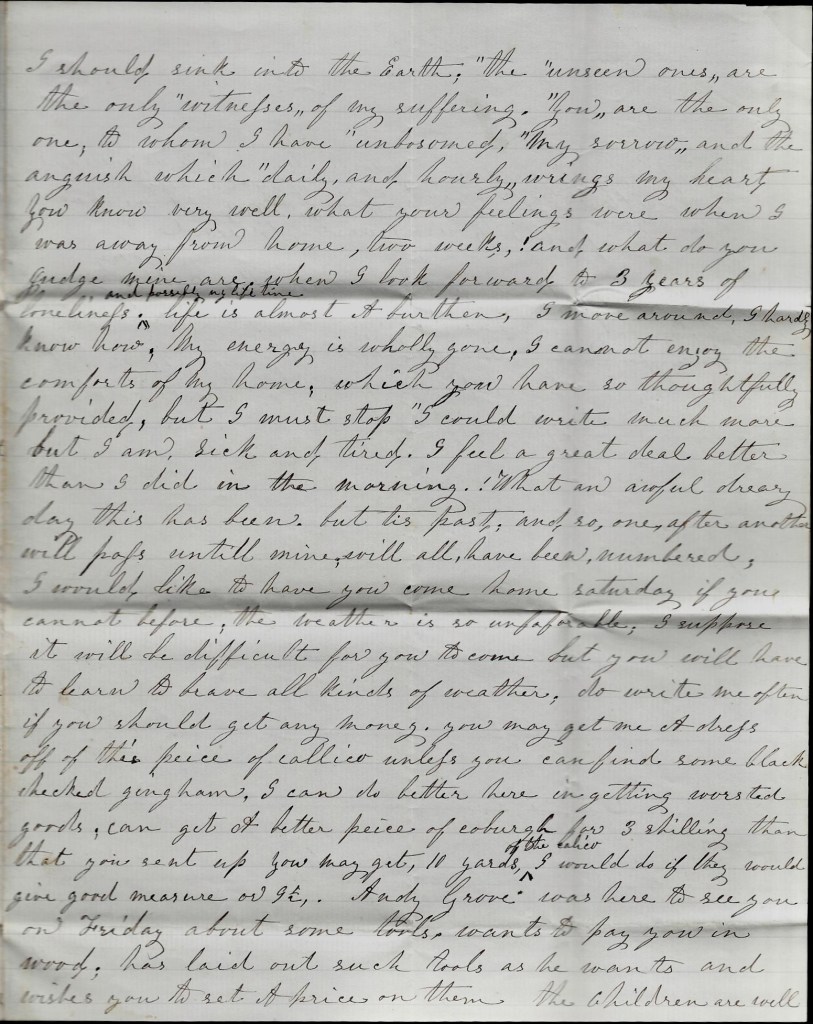
My nervous system has become so deranged that it is hard for me to govern myself. But I have managed to so far—have smothered and crushed down my feelings when it seemed as though I should sink into the Earth. The unseen ones are the only witnesses of my suffering. You are the only one to whom I have unbosomed my sorrow and the anguish which daily and hourly wrings my heart. You know very well what your feelings were when I was away from home two weeks! and what do you judge mine were when I look forward to 3 years of loneliness and possibly my lifetime.

Life is almost a burthen. I move around I hardly know how. My energy is wholly gone. I cannot enjoy the comforts of my home which you have so thoughtfully provided. But I must stop. I could write much more but I am sick and tired. I feel a great deal better than I did in the morning. What an awful dreary day this has been. But tis past, and so one after another will pass until mine will all have been numbered.

I would like to have you come home Saturday if you cannot before. The weather is so unfavorable, I suppose it will be difficult for you to come. But you will have to learn to brave all kinds of weather. Do write me often. If you should get any money, you may get me a dress off of this piece of calico unless you can find some black checked gingham. I can do better here in getting worsted goods. Can get a better piece off Coburgh for 3 shillings than that you sent up. You may get 10 yards of the calico. I would do it if they would give good measure or 9 and a half.

Andy Grove was here to see you on Friday about some tools. Wants to pay you in wood. Has laid out such tools as he wants and wishes you to set a price on them. The children are well.

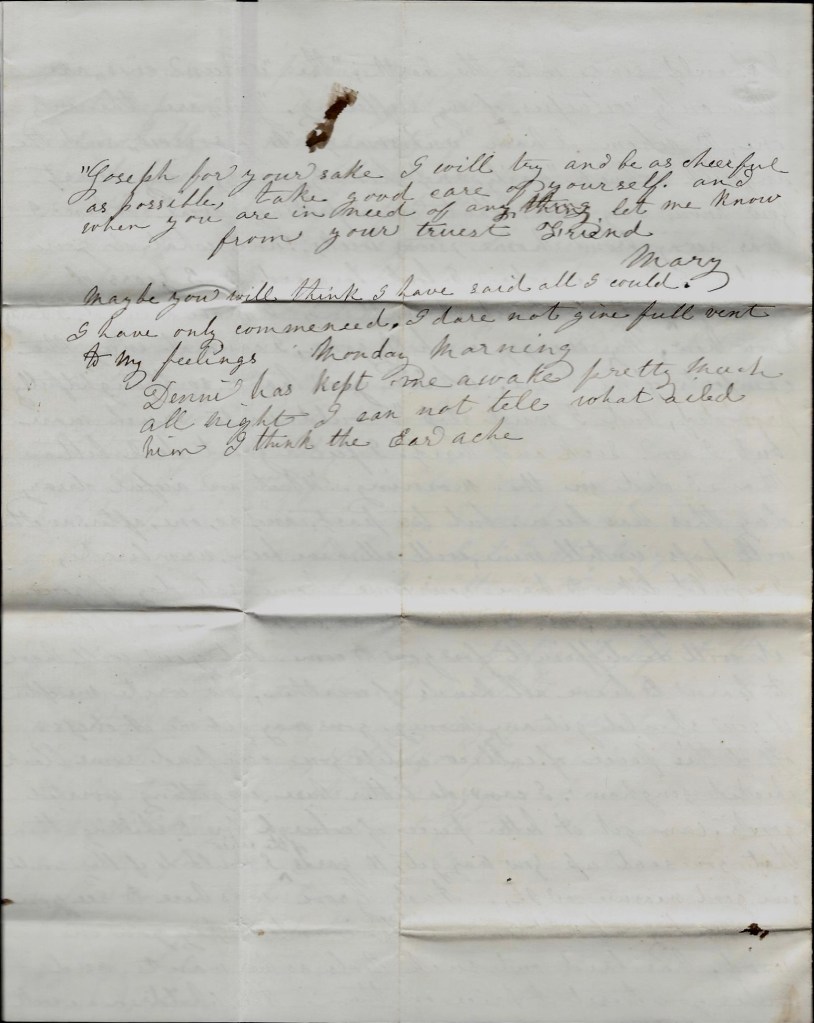
Joseph, for your sake, I will try and be as cheerful as possible. Take good care of yourself and when you are in need of anything, let me know. From your truest friend, — Mary

Maybe you will think I have said all I could. I have only commenced. I dare not give full vent to my feelings.

Monday morning. Denni has kept me awake pretty much all night. I can not tell what ailed him. I think the earache.