My passion is studying American history leading up to & including the Civil War. I particularly enjoy reading, transcribing & researching primary sources such as letters and diaries.
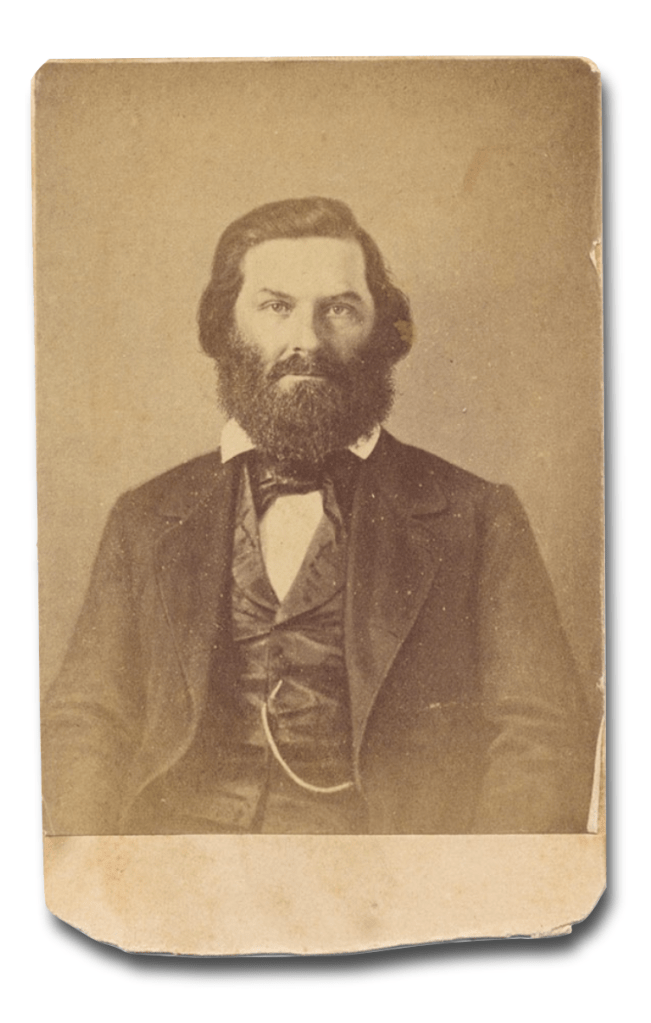
The following letter was written by Calvin H. Orcutt (1836-1921), the son of John Loomis Orcutt (1793-1855) and Elizabeth van Gorder (1812-1885) of Chemung county, New York. The letter was written in late July 1863, just after Lee’s army was turned back by defeat at Gettysburg, and at roughly the same time that Calvin had to register for the draft at his place of residence—Towanda, Pennsylvania. In that registration, he identified himself as a 26 year-old “clerk”, yet unmarried, and yet without any military service. If Calvin was drafted, he must have paid for a replacement for there is no military record of his having served in the Civil War despite the claim in his obituary that he was a “Civil War Veteran.” I don’t think that employment as a sutler exempted him from the draft, but I may be mistaken.
From this letter we learn that Calvin was employed by grocer Daniel V. Barnes of Barnes & Co., 481 9th street in Washington City. It appears that Daniel was assigned by his employer to serve as a sutler to the 141st Pennsylvania Infantry. Sutlers were civilian merchants who sold provisions to an army in the field, in camp, or in quarters. Typically, when an army expected to be engaged in battle, the sutlers were ordered to the rear or some safe location until after the battle was over. To read more about sutlers, see “Sutlers of the Civil War” by Claire Prechtel-Kluskens.
After the war, Calvin worked in the real estate and insurance business in Harrisburg, Pennsylvania.
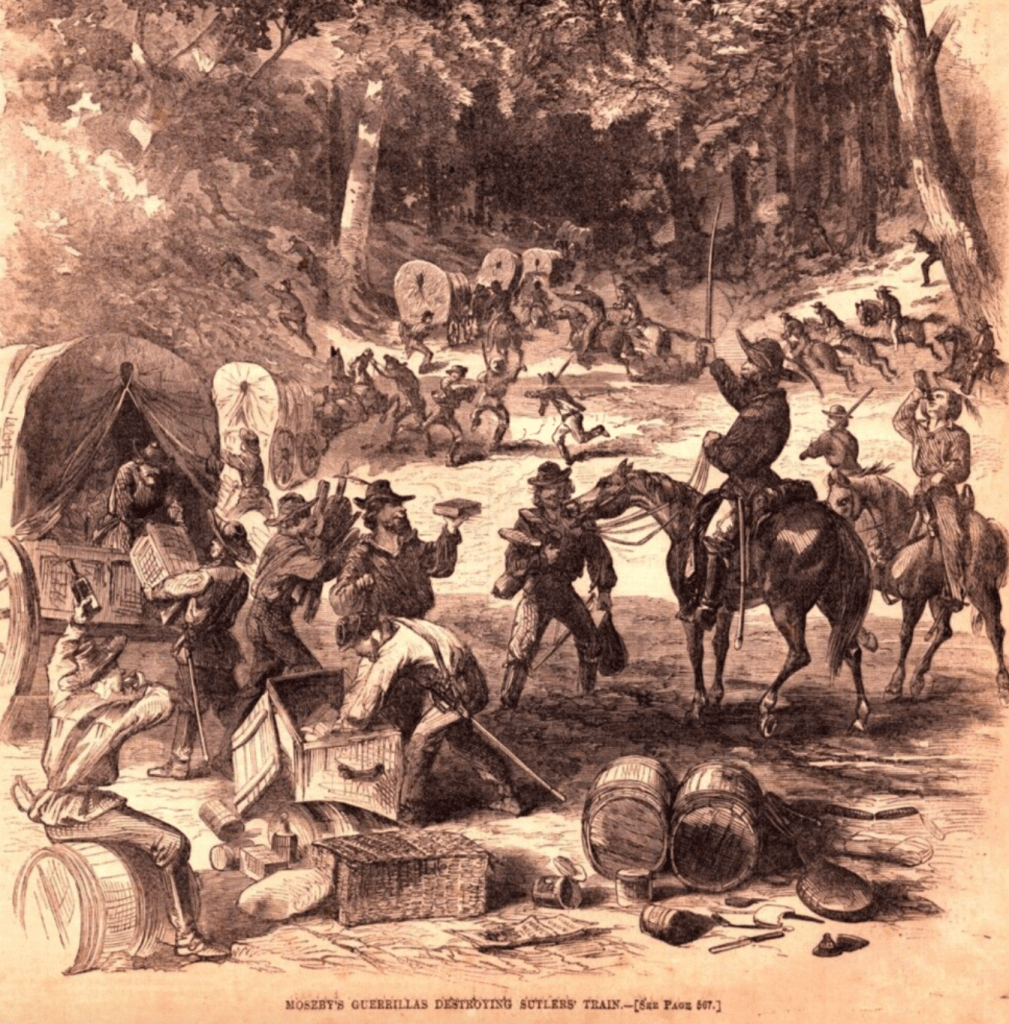
Being a sutler was not without its dangers. Sutlers often traveled in wagon trains for mutual protection against attack by guerrillas.
Transcription
Addressed to D. L. Orcutt, Box 446, Elmira, New York
Washington D. C. July 28th 1863
Brother Daniel,
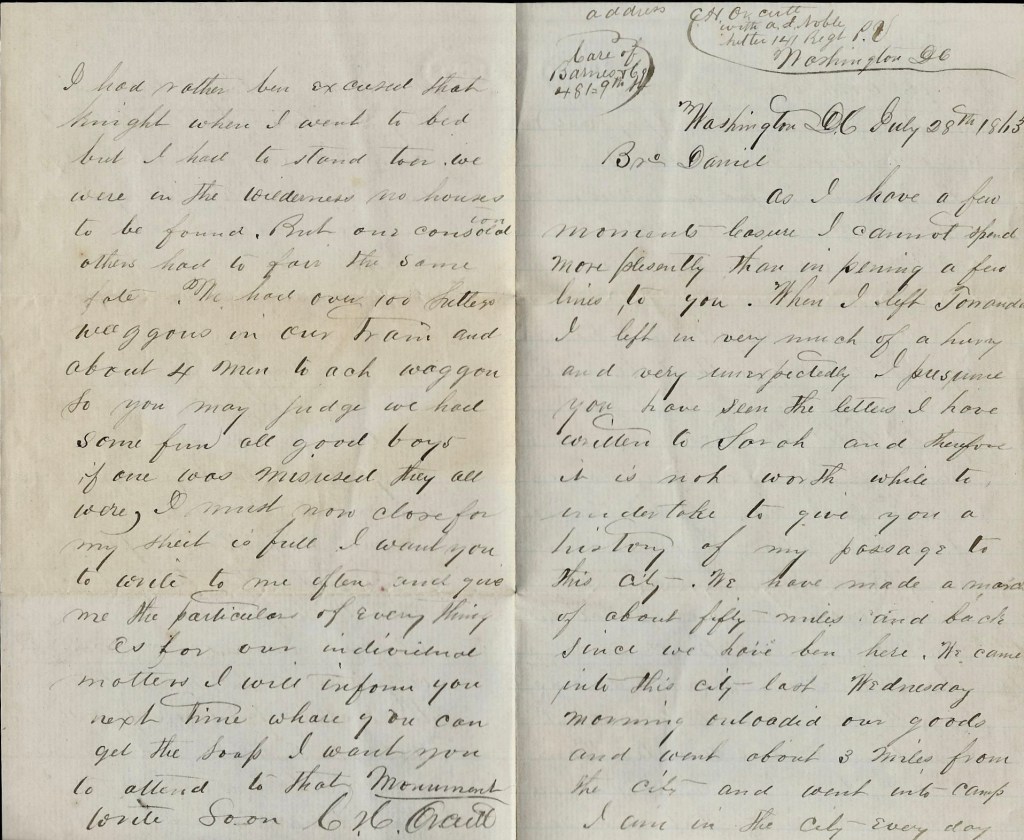
As I have a few moments leisure, I cannot spend more pleasantly than in penning a few lines to you. When I left Towanda, I left in very much of a hurry and very unexpectedly. I presume you have seen the letters I have written to Sarah and therefore it is not worth while to undertake to give you a history of my passage to this city.
We have made a march of about fifty miles and back since we have been here. We came into the city last Wednesday morning, unloaded our goods, and went about three miles from the city and went into camp. I am in the city every day. I have to walk about one mile and then take the street cars (pay 5 cents) to come down here (9th St. 481).
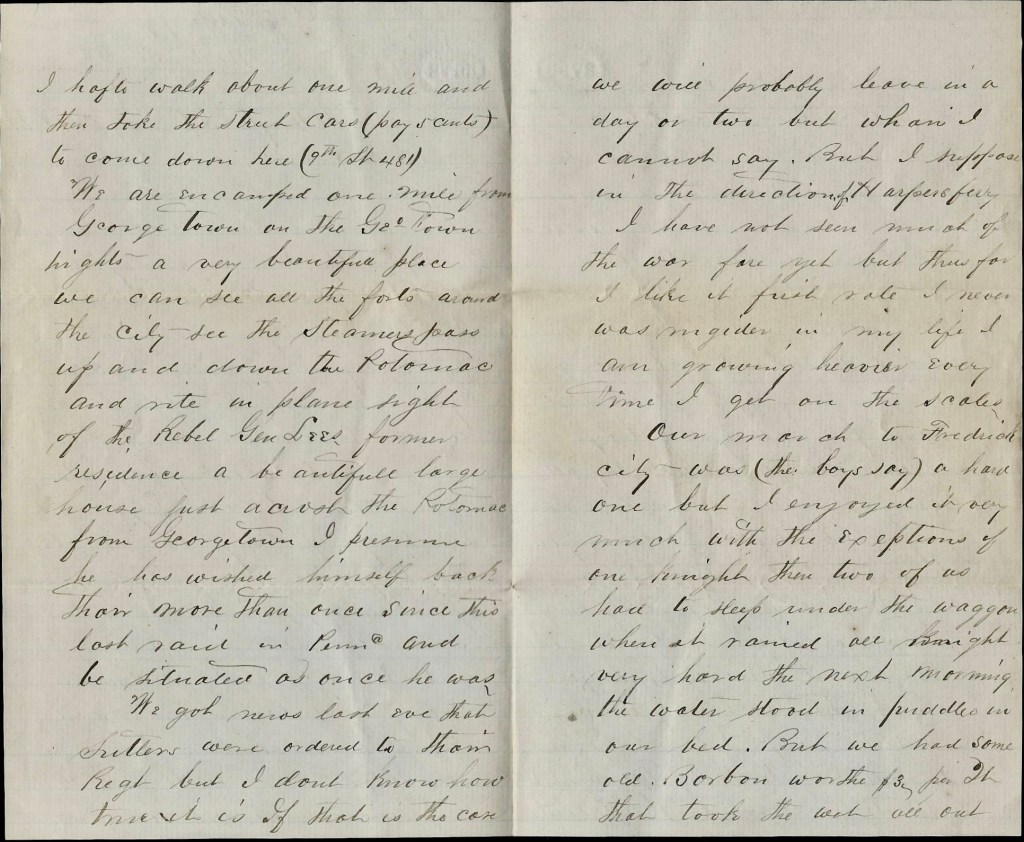
We are encamped one mile from Georgetown on the Georgetown Heights—a very beautiful place. We can see all the forts around the city, see the steamers pass up and down the Potomac, and right in plain sight of the Reb. Gen. Lee’s former residence—a very beautiful large house just across the Potomac from Georgetown. I presume he has wished himself back there more than once since this last raid in Pennsylvania and be situated as once he was.
We got news last eve that sutlers were ordered to their regiments but I don’t know how true it is. If that is the case, we will probably leave here in a day or two but when I cannot say. But I suppose in the direction of Harpers Ferry.
I have not seen much of the warfare yet but thus far I like it first rate. I never was ruggeder in my life. I am growing heavier every time I get on the scales.
Our march to Frederick City was (the boys say) a hard one but I enjoyed it very much with the exceptions of one night there two of us had to sleep under the wagon where it rained all night very hard. The next morning the water stood in puddles in our bed. But we had some old Bourbon worth $3 per quart that took the wet all out. I had rather been excused that night when I went to bed but I had to stand to her. We were in the wilderness—no houses to be found. But our consolation, others had to fare the same fate. We had over 100 sutlers wagons in our train and about 4 men to each wagon so you may judge we had some fun. All good boys. If one was misused, they all were.
I must now close for my sheet is full. I want you to write to me often and give me the particulars of everything. As for our individual matters, I will inform you next time where you can get the soap. I want you to attend to that monument. Write soon. — C. H. Orcutt
Address C. H. Orcutt with A. I. Noble, Sutler, 141st Regt. P. V., Washington D. C., Care of Barnes & Co., 481 9th Street
This incredible letter was written by Dr. James McFadden Gaston (1824-1903), the son of John Brown Gaston (1791-1864) and Mary Buford McFadden (1805-1886) of Chester county, South Carolina. Gaston graduated from the University of South Carolina in 1843 and then attended medical lectures at the University of Pennsylvania in Philadelphia. He then earned his Medical Degree from the Medical College at Charleston in 1846. He practiced medicine with his father in Chester District for a time and then moved to Columbia in 1852 where, and at which time he also married Susannah Greening Brumby.
When civil war broke out in 1861, Gaston initially entered the service of his state as a private in the Columbia Grays but he was soon elevated to Assistant Surgeon and served in that capacity at Morris Island and Fort Sumter. In July 1861, he was promoted again to Surgeon and Medical Director of Gen. D. R. Jones’ 3rd Brigade. He wrote the following letter from Manassas Junction on the day after the Battle of Bull Run.
Gaston organized medical services while serving as Chief Surgeon of South Carolina Forces and later as Divisional Surgeon General of the South Carolina Volunteers during campaigns in Virginia and Pennsylvania, which included the battles of Manassas and Gettysburg. Immediately after the conclusion of the Civil War, Gaston left the United States and settled his family in Brazil where he practiced medicine in the city of Campinas. After almost two decades, Gaston returned with some of his family to Atlanta, Ga., where he successfully re-entered American medical life, teaching at the Southern Medical College, publishing articles, and carrying out research. He died in 1903.
Gaston’s papers are not posted on-line but are housed at the University of North Carolina Library.
Transcription
Manassa Junction [Virginia] July 22, 1861
My dearly loved wife,
To say that I am safe and well, is no common place intelligence after the terrible reports of yesterday. The great battle has been fought and won by us here, and though our forces suffered to a large extent, the destruction which was dealt out to the enemy’s columns, and the entire routing of their troops, with the capture of men and munitions of warm is far beyond what the most sanguine could have anticipated. The Hampton Legion has just arrived the night previous and were among the first to be engaged with the enemy, without being supported in the encounter until they had sustained very serious losses; but it gives me pride to say that the honor of South Carolina was nobly vindicated by their unflinching firmness.
Lt. Col. Benjamin J. Johnson of Hampton’s Legion, killed at Bull Run, 21 July 1861 (The Horse Soldier)
The Lieut. Col. B[enjamin] J[enkins] Johnson was killed early in the action, and Col. Hampton received a shot in the face which unhorsed him, but not proving serious. He returned to the command of his men and led them throughout the engagement. A Mr. Haynesworth 1 from Sumter had his ankle shattered by a cannon ball and I removed his leg at the temporary hospital on the field.
Our gallant 2nd Regt. South Carolina Volunteers were located some distance from the scene of the battle and did not reach the ground until others had been exhausted in the attempt to repel the foe, when our boys were brought fresh into the field, and made a charge upon the enemy lines of the army (which proved to be their [ ] for the last) which turned the day in our favor, and ended in a complete rout of their forces, with ours in close pursuit of them over the hills and hollows of the surrounding country. My friend, Capt. John [S.] Richardson, 2 was slightly wounded, and a number of other men seriously, while but few deaths resulted from this bold move of Kershaw’s regiment.
I think Mrs. Glover 3 may not be afraid that no harm has befallen her son, who I saw on the day previous and found in good health and good spirits, It is very remarkable that with a superior force, the enemy should have been beaten back without causing more loss to our side than has occurred, but one thing is very notable—that the proportion of officers killed and wounded is much greater on our side than on theirs, and indeed they kept themselves out of the way of danger much more than our officers who went in person with their commands upon the field. General Beauregard went out in the very thickest of the fight and urged the troops forward, telling them he intended to share their perils, and fall or conquer with them. President Davis also came upon the field while the enemy were still making resistance, but the tide had turned very decidedly in our favor previous to his arrival.
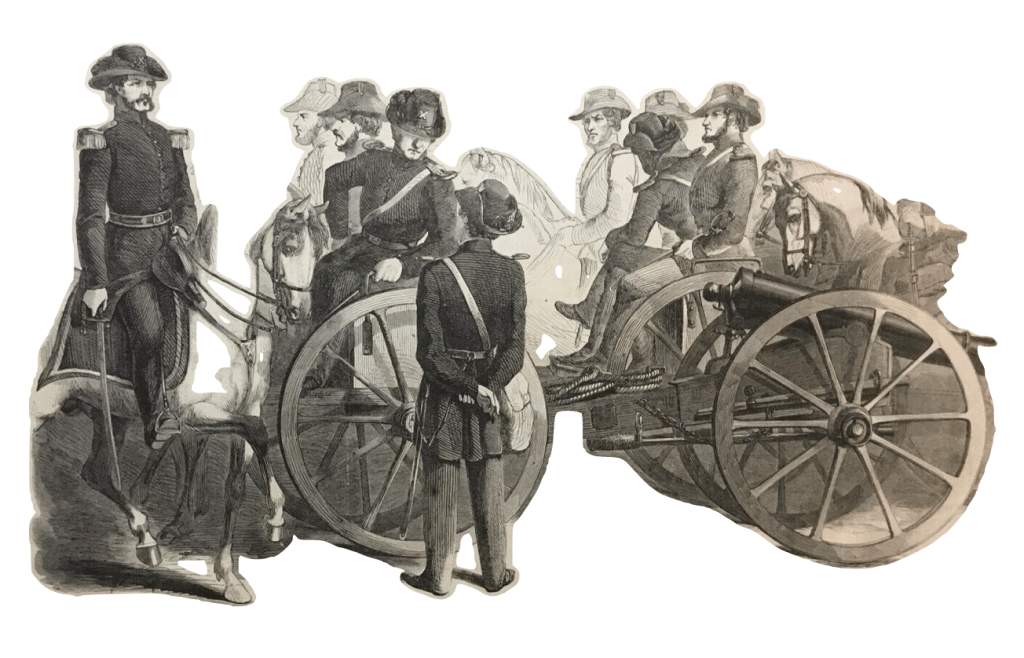
Sherman’s Light Artillery Battery, illustration from Harper’s Weekly.
The famous Sherman’s Battery was captured entire from the enemy, all the horses having been killed and in all we have taken about thirty-five pieces of cannon, with perhaps two thousand stand of superior arms, with ambulances, camp equipage, and stores amounting it is thought to maybe half a million dollars worth. The number of prisoners taken is near five hundred while their dead will perhaps reach that number and the wounded cannot as yet be calculated with any certainty, but it is shocking to see them huddled together at the four (4) different hospitals over which we have placed their own surgeons who were taken prisoners, and thus relieved us of much trouble, yet many of their wounded are still being brought in to the junction from the field of battle which is near stone bridge, about five miles distant from here.
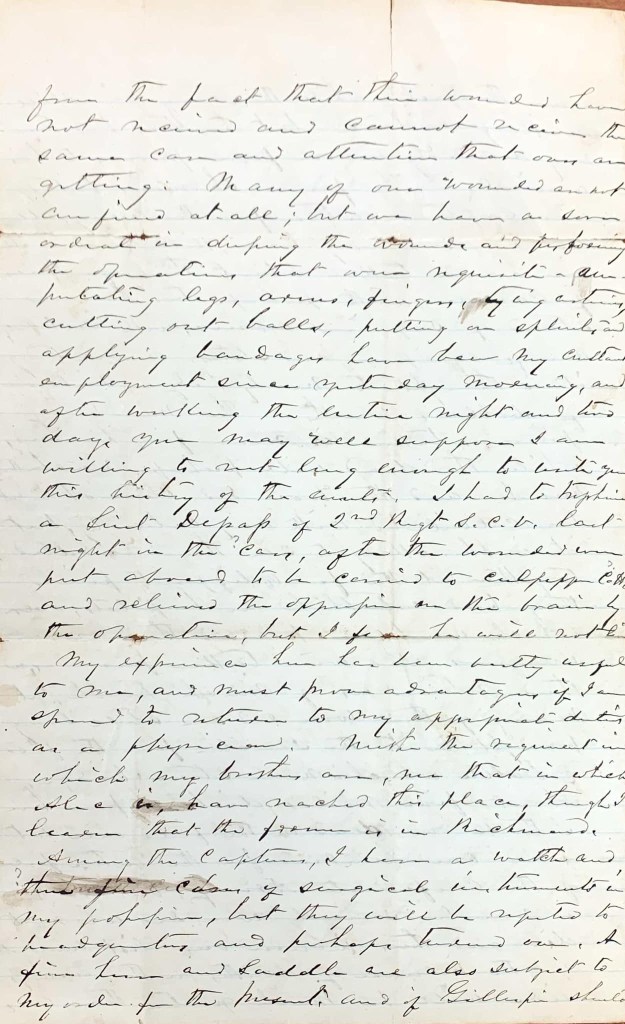
I think our dead on the field will not extend one hundred for the entire force of the Confederate Army, but we have a number seriously wounded who must die and thus increase our list considering yet the increase of deaths on the enemy’s side will be much greater than ours from the fact that their wounded have not received and cannot receive the same care and attention that our are getting. Many of our wounded are not confined at all; but we have a severe ordeal in dressing the wounds and performing the operations that were requisite—amputating legs, arms, fingers, tying arteries, cutting out balls, putting on splints, and applying bandages have been my constant employment since yesterday morning, and after working the entire night and two days, you may well suppose I am willing to rest long enough to write you this history of the events.
I had to trephine a Lieut. [William Lambert] Depass of [Co. E,] 2nd Regt. S. C. Vols. last night in the cars, after the wounded were put aboard to be carried to Culpeper Court House and relieved the oppression on the brain by the operation, but I fear he will not live. 4
My experience here has been vastly useful to me and must prove advantageous if I am spared to return to my appropriate duties as a physician. Neither the regiment in which my brothers are, nor that in which Alec 5 is, have reached this place though I learn that the former is in Richmond. Among the captured [items] I have a watch and a fine case of surgical instruments in my possession, but they will be reported to headquarters and perhaps turned over, a fine horse and saddle are also subject to my order for the present, and if Gillespie should…[page not posted]
But to return to the war, it was thought Saturday that the enemy would make the attack on that day and every arrangement was made to meet them, but failing to come against us, it was determined by Gen. Beauregard to move upon them yesterday morning by three columns and orders were issued accordingly to put the troops in motion early. But before it was commenced, he learned that the enemy had taken the initiative and he prepared to put our force in a condition to resist the attack which was made on the extreme left of our line of defense, extending along Bull Run for six or eight miles. This made it necessary to march troops up from the other points to the left wing and yet not to remove all from any of the points lest the enemy should throw in a column at an unguarded passage. Our reinforcements were therefore slow in coming into action from the distant points and did not represent our full strength, but the very fact of our body of men following another at considerable intervals into the field had no doubt a better effect than to have there the whole army before the enemy at one time as they could not tell when we would ever exhaust our supply of men and as we knew they outnumbered us greatly it was proper to keep them from knowing our strength it possible. Thank God the victory is ours and I trust this may end the war as the army have retired into their former lines with the conviction that we did intend to yield.
Your kind husband, — J. M. F. Gaston
1 2nd Lieut. John R. Haynsworth of Sumter, South Carolina, served in Co. C of the Manning Guards in Hampton’s Legion.We learn from this letter that his shattered ankle necessitated amputation but he did not survive. He died on 21 August 1861 at Warrenton, Virginia, one month after the battle.
2 Capt. John S. Richardson commanded the Sumter Volunteers, Co. D, 2nd South Carolina Infantry. One source says he was slightly wounded in the leg at the Battle of Manassas; another source says slightly in the arm.
3 Possibly referring to J. B. Glover who was a private in Capt. George B. Cuthbert’s Company—Co. I, 2nd South Carolina Infantry. J. B. enlisted at Charleston on 22 May 1861.
4 William Lambert Depass (1836-1881) survived the Civil War and died of heart disease in 1881. William was from Kershaw, South Carolina, and served as a 2nd Lieutenant in Co. E, 2nd S. C. Infantry (2nd Palmetto Regiment).
5 “Alec” refers to Gaston’s brother-in-law, Dr. Alexander Brevard Brumby (1831-1879).
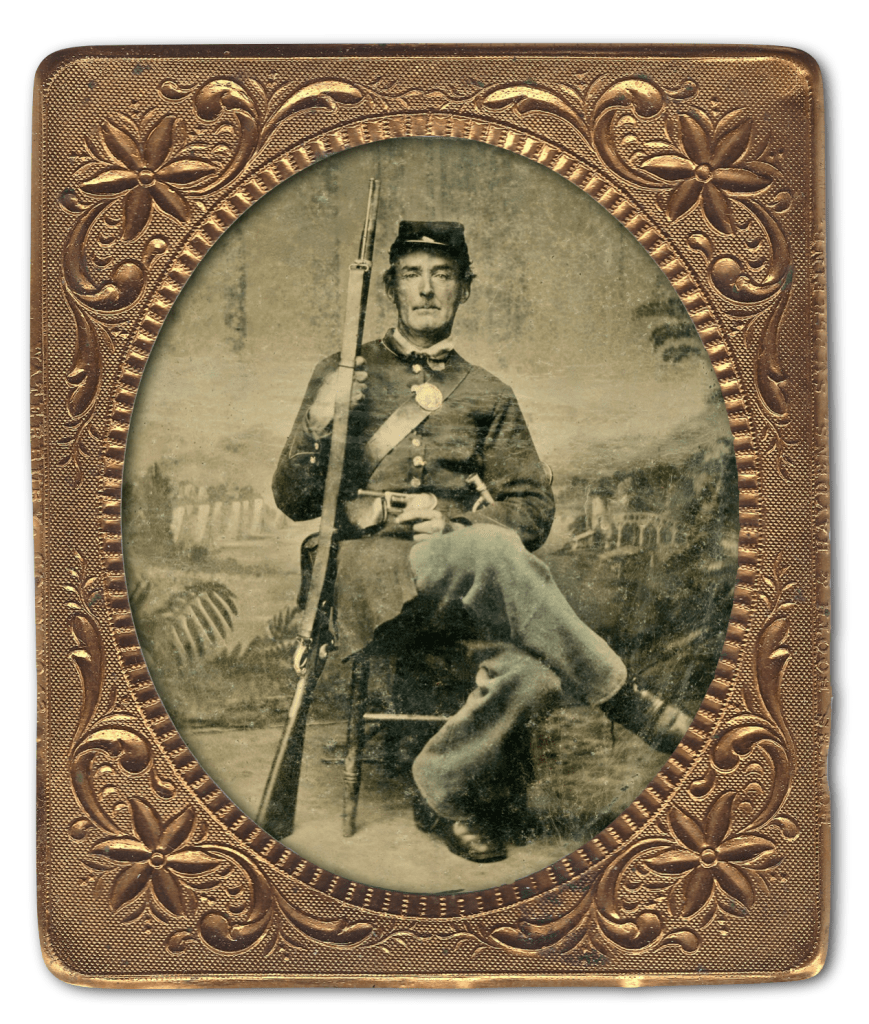
I could not find an image of Samuel but this long lanky soldier probably bore some resemblance to him. Samuel’s tall, slim figure and dark hair no doubt made him appear younger than his actual years.(Megan Kemble Collection)
This diary was kept by Samuel Brown Beatty (1818-1863) of Co. E, 57th Pennsylvania Infantry. Samuel was 44 years old when he enlisted as a private in October 1861. At the time of his enlistment, he was described as a 5 foot 11 inch tall shoemaker with dark eye color and black hair. When he joined his comrades in arms, he left a wife—Susan M. (Walker) Beatty (1823-1899) and at least eight children in Delaware Grove, Mercer county, Pennsylvania. Samuel’s parents were Francis G. Beatty (1789-1872) and Isabella Williamson (1792-1879).
Also serving in the war was Samuel’s oldest son, David “Walker” Beatty (1844-1863)—a member of Co. K, 63rd Pennsylvania Infantry. David’s letters to his mother may be found at the following URL—1861-62: David Walker Beatty to Susan (Walker) Beatty.
An extremely pious man, Samuel often urged his wife to pray for him such as the following passage: “Now I want you to always remember me in your prayers that I may not falter in well doing and that I may be preserved from evil and sin of every kind. That I may be prepared to stand my lot and always be found at my post let that be what it may.” Tragically, Samuel never returned home from the war. He died at the Union Hotel Hospital in Georgetown on 18 January 1863 from wounds that he received in action at the Battle of Fredericksburg on 13 December 1862. Likewise, Samuel’s son Walker died in a Georgetown hospital less than a month later on 7 February 1863 and was interred at the Soldier’s Home Cemetery (Grave 3344).
Samuel’s diary with some newspaper clipping and pressed Holly leaves. All entries are in pencil.
Transcription
S. B. Beatty’s Memorandum Book. If I should be killed or die of disease, you would confer a great favor by sending this by mail to Mrs. M. S. Beatty, Delaware Grove, Mercer county, Pennsylvania.
January 7, 1862—Commenced nursing in the hospital.
February 18, 1862—Left camp Merced today for the other side of the Potomac and it being very muddy and we had a hards march but got along very well, all but some that got drunk. We got our tents up by dark and slept in them and the mud was two inches deep in them.
Wednesday, February 19th—We were all day carrying brush and fixing up our hospital and it was still muddy and sad but we done the best we could but we had but few in it.
Thursday, February 20th—Nothing of interest today. I am well and saw Daniel Young today.
Friday, February 21st—It is still wet and muddy.
Saturday, 22nd—-The birthday of Washington and we can hear the booming of cannon all around commemorating the day. Nothing of interest.
Sabbath, 23rd—This is the first that I have spent on the sacred soil of Virginia and it was wet and muddy as usual and there was nothing done.
Monday, 24th—It was clear in the morning till about ten o’clock and then there was a shower of rain and the wind rose and it sleeted and it blew a hurricane and blew down all the tents in the regiment and one of our hospital tents and it looked like desolation.
Tuesday, February 25th—It does not blow so hard this morning and we made ready to put our tent and we got it up. I am still well and in good spirits.
Wednesday, February 26th—Got case of varioloid [small pox] in the hospital but I will not run from it but will do my duty and trust my God [that] all shall be well. Nothing else of interest.
Thursday, February 27th—Very busy preparing for inspection. Feel tired but that is nothing new.
Friday, February 28th—The day of inspection. Fixed upon it and got everything ready but they did not come to the hospital at all. Feel all right today, thanks to God for his mercy to me.
Saturday, March 1st [1862]—In the hospital. There was regimental drill today, the seventh time since we left Camp Curtin. In the evening, General Jamison put them through a while and scared our officers and got [ ] up some but they soon got their wits again and then they were all right again. The colonel [William Maxwell] resigned today and left the command.
Sabbath, March 2nd—The Colonel started home this morning and was quite a touching sight to see him bid goodbye to the boys. Got dinner and then went down to the 63rd to see the boys and it snowed like fury for a while. Came back to the regiment, went to prayer meeting, and then came back to the hospital. I feel well in my mind and of course in body.
Monday, March 3rd—The snow is soft with a crust on it and it is foggy and dark. It rained this afternoon. There was regimental drill today and there is a great wonder who will be our Colonel. Nothing else of interest. I am still well. Got vaccinated on Sunday and my arm is some sore and it makes me think of my family at hoe. God has been very gracious to me this day in upholding and comforting me and in drawing me near to Himself. Oh that I may be enabled always to trust Him and take Him for my [ ].
Tuesday, March 4th—It is clear this morning. Our patients are all better in the hospital. Regimental drill this forenoon. Nothing else of interest today. I am well. My arm’s quite sore today. It makes me almost sick.
Wednesday, March 5th—It is clear this morning and cold. It clouded up about noon. I am well today. There was a Captain [Charles W.] Chapman of the 63rd Regt. shot on picket this morning. Nothing else of interest.
“A detachment of the regiment consisting of one hundred men, under command of Lieutenant Colonel Morgan, while out upon the picket line beyond the Occoquan, near Pohick Church, on the night of the 5th of March, 1862, was attacked by a party of the enemy. A skirmish ensued in the midst of the darkness, in which Captain Charles W. Chapman, of company K, and Quartermaster James M. Lysle, were killed.” [63rd Regiment Pennsylvania Volunteers]
Thursday, March 6th—It is a fine day and it looks like spring. Our new Colonel came on today. His name is [Charles Thomas] Campbell, Regimental drill as usual.
Friday, March 7th—It is clear but cold and windy. Nothing of interest.
Saturday, March 8th—Clear and fine this morning and I think of going to Mount Vernon today and I went and saw what was to be seen. This is a barren and desolate-looking country. The fences are all out of repair and the land looks poor. The houses are old and small and the barns are miserable. It looks as if there was a curse upon it but it might be a fine country. Mt. Vernon is a fine looking farm but it looks neglected and forlorn. I saw the tomb of Washington and Martha, his wife, and several of his family relations and the old mansion and some trees that he planted and the old garden and the fountain and everything that was to be seen. Came back and feel tired but don’t begrudge my tired legs for it was worth all and more too.
Sabbath morning, March 9th—warm and pleasant-looking. Like spring. There is a general inspection this morning. I am well today. I have been mercifully preserved thus far amidst all the hardships of camp life. I have not been one day sick thanks be to God for his goodness to me and I am still encouraged to put my trust in Him for time to come.
Monday, March 10th—It is raining this morning and it was most of the day. We drew oil cloth blankets for tents when we march. The Division on the right of us moved today and we expect to move tomorrow. Nothing else of interest.
Tuesday, March 11th—It looks like spring. There is some excitement today about movement but i guess we will not move today, The day passed and we are here yet.
Wednesday, March 12th—It is clear and fine this day. There is review today and I went to the Potomac River and it is a noble looking stream. I am well today and in good spirits. There is a report that our army has possession of Manassas.
Thursday, March 13th—It is clear and war and it looks like spring. The spring birds are singing and the leaves are beginning to start on the elders and briers and the grass.
Friday, March 14th—Last night got orders to prepare immediately for a march and today we were all ready for a move but we were not commanded to march and we are here yet.
Saturday, March 15th—There is quite an excitement in camp today about where we are to go but we know nothing about it. But we are to go on steamers down the Potomac somewhere. I am well and in good spirits. We had a very wet day.
Sabbath morning, March 16th—Well and in good spirits. It is fair this morning and there is nothing of much interest. There is still troops coming in for to go down the river. We had preaching today.
Monday, March 17th—we marched to Alexandria and went aboard the Elm City—a large and good boat, the best that is here, and where we are going, I do not know.
Tuesday, March 18th—We are here on the Potomac and when we will leave this, none of us knows. It is just one month today since we crossed the Potomac. I am well as usual. We started down the river about noon. There was nothing of interest until sunset and it was a grand sight to me.
Wednesday, March 19th—A beautiful morning. We are in the Chesapeake Bay and it is so broad that I cannot see land—only on one side, and it looks fine to see so many sails on the water. We landed at Fortress Monroe about sunset and loaded our goods on a horse car, moved them from the wharf and then unloaded them in the middle of the street and I slept for the first time in the street and it rained all the night and the water ran all around.
Thursday, March 20th—Morning, it is still raining and I had to help load the regiment’s stuff and the hospital stuff and then went to hunt the regiment and it was quite a job. After a while, found them quartered in a stable.
Friday, March 21st—Slept in a stable last night for the first time and I did not sleep much. We are just beginning to be soldiers. I am still well and i desire to be thankful for mercies past and the blessing that I now enjoy. The regiment moved their quarters and tented out in the open field in their dog tents and it rained in the evening and I stayed and guarded the stuff.
Saturday, March 22nd—Still on guard till noon and then went to the regiment and then got some dinner. Our quartermaster is a poor excuse. I am well and in good spirits.
Sabbath, March 25th—It is a beautiful morning and is as still as if there was but one regiment here but I believe there is about thirty thousand here and more coming. Nothing of interest till evening. Then it rained. It is quite cold at night.
Monday, March 24th—We got orders this morning to be ready to move again at seven o’clock. The regiment started at eight and we did not get off till about twelve. We went about two miles and pitched our tents. We went through the old town of Hampton that the Rebels burnt last summer. It has been a nice place but it is all burnt. We are about four miles from Fortress Monroe.
Tuesday, March 25th—It is clear and the wind feels cold. I am well as usual. Nothing of interest.
Wednesday, March 26th—It is cloudy this morning and it spit snow this afternoon. I am well and I got a letter from my wife and it was a comfort to me.
Thursday, March 27th—It was clear again this morning and it looks like summer. There is nothing of interest. I am well, thanks to God for His goodness to me.
Friday, March 28th—It is clear and beautiful this morning. I washed some this forenoon and I am in the hospital. I am well and in good spirits. Nothing else but the usual montage of duty.
Saturday, 29th March—The wind is in the east and it’s cold and chilly this afternoon. It is raining and sleeting. It is hard to see the soldiers camped in these small tents when it is cold and disagreeable, Got a letter from A. Walker today.
Sabbath morning, March 30th—It rained all night and when I woke up this morning, I was lying in the water about two inches deep but I am still well. There seems to be no regard for the Sabbath here. While I write, the boys are playing ball and some are building fire places and walling up the front of their tents and some are at prayer meeting and some are lying in their tents.
Monday, March 31st—It is clear and fine this morning. It is as warm as summer today and it makes me feel lazy but I am alright. I am still in the hospital but do not know how long I am going to stay but will know by tomorrow. It is two at night and I am on duty in the hospital.
Tuesday, 1 April—It is clearcut not as warm as it was yesterday. I am going to stay awhile longer in the hospital. I am well but feel sleepy and tired. Went to bed at six.
Wednesday, 2nd April—Up at twelve and I did not sleep more than two hours last night and I feel kind of used up but I am in good health.
Thursday, 3rd April—Morning on duty in the hospital. I feel almost used up for the want of sleep but I am in good health. There is eleven in the hospital today but there is none of them dangerous. This is a beautiful day. We had a thunder shower last night and it started the grass to grow and it looks quite refreshing.
Friday, 4th April—We have marching orders this morning to march on Yorktown. We started at seven and marched to Great Bethel and the Rebels lead left just before we got there and I was very much disappointed in the place. There is but one house beside the Meeting House and the fortifications are but very slight. There is nothing but mud works and we went on about two miles and encamped for the night and slept under the wagon. Slept very well and feel well this morning.
Saturday, 5th April—I am well this morning. Our men started for Yorktown and I saw General McClellan this morning for the first time and he is a very plain looking man but is bold as a lion. It is a bad day for a march. It is raining but I am with the train and we can hear the sound of the cannon ahead of us towards Yorktown as if there was a skirmish. It is twelve and we have not started yet. This evening it cleared up and we have not started with the train yet.
Sabbath morning, 6th April—It is clear and fine. We are here yet and the regiment is some six or eight miles ahead. Our train started at 6:30 o’clock for the camp. This is a very sandy country and there is more timber than in Mercer county and more swamp. We came to the place about noon that the skirmish was yesterday but do not know any of the particulars, We are beginning to soldier it now. It does not seem much like the Sabbath. We had very bad roads part of the way. Got to the camp about sunset and found all safe and sound, The Rebels threw some shells into our camp and killed a few of the artillery horses.
Monday, 7th April—Don’t feel very well today and took some medicine. Got our hospital in big. There is nothing of interest in camp today worthy of note.
Tuesday, 8th April—I am still unwell but am able to attend to my duty. I am very bilious but hope to be all right soon. It is a very wet day and nothing doing.
Wednesday, 9th April—It is still wet and cold. Got orders this morning to move the hospital and it was a hard job for me and the work all fell on [1st Sergt. Thomas O.] Collamore and I. There was about ten or twelve in and they were moved out about one and a half miles and there was no provision made for them and we had no hands to put up our tents and we had to depend on the charity of our neighbors for their night’s lodging but we got along some way. I feel some better now.
Thursday, 10th April—It is cold and spitting snow a little. We are here beside a Meeting House and there has been a Rebel camp here and there is several of their soldiers buried in the graveyard. It is a very flat and wet [place] and I should think unhealthy, I am some better today but do not feel right yet.
Friday, 11th April—It is clear and fine this morning and it is quite refreshing. I am some better today and the boys are all doing well. Our regiment had a skirmish today with the enemy and there was three of them wounded and they killed about fifty or sixty of the Rebels.
Saturday, 12th April—It is still clear and pleasant. All is quiet in camp as if nothing had happened. I am still able for duty. There is nothing of interest thus far.
Sabbath morning, 13th April—It is clear and it makes me think of home that I left and my wife and children and a wish to be with those to spend if but one day with them and enjoy one Sabbath at home. All is quiet this morning. Nothing of interest. Our regiment went out on picket this evening.
Monday, 14th April—Still clear. I am as well as common. All is quiet. Our pickets brought in one prisoner this morning. Nothing else of interest.
Tuesday, 15th April—Cloudy this morning. I am well and feel thankful for my returning health. Our men are in god spirits. It is clear this afternoon. All is quiet except some shells flying back and forth from one camp to the other. Nothing else of interest.
Wednesday, 16th April—It is clear and fine today, It is very warm. I am well and in good spirits. There is some cannonading today. There is no stir in camp. Nothing of moment today.
Thursday, 17th April—It is very warm today, Our men are throwing some shot and shell today at the enemy. Our regiment is out on picket today. We moved our hospital again today. This evening there was the first of our regiment killed by the bursting of a shell. Nothing else of interest. Frederick Varick [of Co. G was killed].
Friday, 18th April—It is clear and would be pleasant if I was at home. It is just one month since we left Alexandria and not much done yet. Our men are besieging Yorktown.
Saturday, 19th April—It is cloudy this morning but pleasant. There is not much a doing. It is raining a little this afternoon. There was a ball threw over our camp. Nothing else of note.
Sabbath, 20th April—It is raining and cold and all is quiet except an occasional cannon shot, I am well. Nothing else of note.
Monday, 21st April—It is raining this morning. I am well. Got a letter from my wife and wrote one to her, All is quiet. Nothing else of interest.
Tuesday, 22nd April—It is clear and beautiful. I am in good health and spirits. There is no fighting today. The soil here is good but it is wet and marshy.
Wednesday, 23rd April—It is still clear and pleasant. All is quiet as if there was no army here. I am as usual. It is a beautiful place here in the woods. Nothing else of interest.
Thursday, 24th April—It is clear and cold this morning. I am well. Drew new pants today. Was down at the regiment today. All is quiet.
Friday, 25th April—It is cloudy and cold and chilly. I am well this morning. All is quiet in camp.
Saturday, 26th April—Is wet and cold. There was a small skirmish this morning and our men took twenty prisoners. Our regiment was called out but was too late. It was wet all day and there was nothing of interest.
Sabbath, 27th April—It is still cold and cloudy. I am well and hope that I may have good health.
Monday, 28th April—It is cloudy this morning. At noon it cleared up and it is pleasant. There is nothing of interest in camp today.
Tuesday, 29th April—It is foggy and dark this morning. Cleared away about ten. Our regiment moved their camp today.
Wednesday, 30th April—It is cloudy this morning. All is quiet as usual. I am well at present. Our regiment on picket. Nothing else.
Thursday, 1st May—It’s warm and foggy. Still in the hospital. I am in good health. Went over to the regiment and was mustered for pay. There is four months pay due us now. All is quiet. The siege is still progressing but silently.
Friday, 2nd May—It is clear and warm. The Rebels are throwing shot and shell quite rapid today. Our men don’t answer them but work away. I am well.
Saturday, 3rd May—There is nothing of much interest yet today, The Rebels are throwing shells pretty rapid this evening and some think they are leaving.
Sabbath morning, 4th May—The Rebels have evacuated Yorktown and our men are on the march to take possession. I am well and in good spirits. Henry Eberman died last night in the Church Hospital and was buried today. We got orders to march about 2. Yorktown is very strongly fortified and I think they missed it by leaving. It does not seem much like the Sabbath to me, one the quiet days at home.
Monday, 5th May—It rained last night and it still rains today. Our Brigade stands to pressure the Rebels this morning and we soon heard firing and it was kept up all day. We do not know the result. The roads are very bad and the road was full of teams all day. Our teams went about two miles. it still rains.
Tuesday, 6th May—morning is clear and there is still more troops coming. Soldiering is hard business. We have different reports about the fight yesterday. our regiment was not in the engagement. We are stopped for the night. I wish we were with them.
Wednesday, 7th May—Is clear and fine. We are about four miles from Williamsburg and no prospect of us getting on today. Some of our army went back to Yorktown this afternoon. Our team stayed. I stayed to guard the balance of the stuff. It is a beautiful day and I would like to be with the regiment.
Thursday, 8th May—It is clear and pleasant. Our teams are here and I am going on to the regiment and I am glad of it. There is very bad roads. We went past the battle ground and it was a strong position. Our men could have held it against one hundred thousand of the best troops but it was a hard fought battle. It is a fine country around Williamsburg.
Friday, 9th May—It is clear and pleasant. We are under marching orders. We started at ten from Williamsburg for some place up river. We saw plenty of rebel clothes thrown away in their flight from us. This is an old town, It was settled long before the Revolution. I saw wheat out in head today. We were all day going six miles. Camped for the night in the road, Went o bed at 12.
Saturday, 10th May—Up at daylight making ready for a march. It does not seem much like the days at home for there is a train of wagons on the move ten miles long. After going four miles through a dense forest of pine to an improvement and it is the best I have seen in Virginia. The road is bad. I am well and wish I was at home to spend the day with my family but I must be contented and act the soldier. I spent last night in the middle of the road and slept very ell. Got to the regiment at sundown.
Sabbath, 11th May—It is clear and warm. Are making ready for a march. I am well and it does not seem much like the day of rest. It is hard to spend the day in the army for there is so much noise and confusion.
Monday, 12th May—Is still clear and beautiful. We are camped on the road forty miles from Richmond. I am well. Got a letter from my wife today. I was glad to hear from home and wish I was ready to go there but that is out of the question.
Tuesday, 13th May—Clear and fine. Up at five. Slept under the wagon. Got orders to be ready to march at ten. All ready. This is a beautiful place. Started at the hour. It is slow traveling in the army. Saw corn four inches high. Marched about one mile and camped for the night and got two months pay.
Wednesday, 14th May—Up at three. Started to march at four. Saw an orchard in the woods and several places where whole farms were overgrown with timbers of quite large trees. This wound be a fine country if it was not for slavery. Marched seven miles, then camped adn pitched our tents and stayed there all night.
Thursday, 15th May—Is raining this morning. Got orders to march at six. Our train went half a mile and I stood about three hours. Saw more land that has been farmed overgrown with timber. Stopped for the night at Cumberland Landing and it is a very nice place. If it was in the North, there would have been quite a town. I am well but partly wet.
Friday, 16th May—It is cloudy but not wet. I am well as usual. Nothing of interest today in camp. I saw some steam adn sailing vessels today. Sent home twenty-five dollars to my wife by Adams Express. Sent it to J. K. Hamblin.
Saturday, 17th May—It is clear and warm. Washed some today. Sent off all the sick today in a boat. I am in good health. Nothing else.
Sabbath, 18th May—Up at five. I am well as usual. It is the quietest Sabbath we have had for some time. There is nothing else of interest.
Monday, 19th May—Our Brigade left—all but our regiment and we stayed to guard the Landing. The name is Cumberland on the Pamunkey River—the south branch of the York river—and it is about 70 miles from the bay and the tide rises at least two feet.
Encampment of Army of Potomac at Cumberland Landing on Pamunkey River, May 1862
Tuesday, 20th May—We are still here. I am not well today but think I soon will be. It is warm and dry.
Wednesday, 21st May—It is clear and warm. I am some better today. We are still at the landing and I do not know how long we will stay here. Commenced to write a letter to my wife today. The Locust trees are white with blossom. All is quiet and nothing of interest.
Thursday, 22nd May—Morning is clear and there is a fine breeze. It is quite refreshing. Wrote to my wife today. I am well and in good spirits and I am thankful.
Friday, 23rd May—Got orders to march at six. All ready and on the march. Went eight miles and pitched our tents and got dinner and then got orders to pull up and be off again all on the march and it is slow going. I saw roses today for the first I have seen. Ten at night. We are still on the road as good boys working for Uncle Sam. Came through a fine country but it is like all the rest of Virginia—cursed with slavery. Fields overgrown with bushes and briers.
Saturday, 24th May—Up at five. Slept by the side of the road. Slept about three hours, Feel all right. it is pleasant. We are ready for a move. Got to the Brigade at nine o’clock. At ten it commenced raining till evening.
Sabbath morning, 25th May—Up at five. I am well, thanks be to god for His mercies to me. Got orders to march. Started at 7 o’clock towards Richmond. Crossed the Chickahominy and camped within 12 miles of Richmond for the night. All is quiet. the same curse rests on the country now. Within ten or twelve miles of the Capitol and it looks like the vineyard of the sluggard.
Monday, 26th May—It is clear and cold for the place. I am well. Got orders to send everything back but the shelter tents and one blanket. I went back with the doctors things across the Chickahominy.
Tuesday, 27th May—It is raining. The teams went back for the rest of the stuff. I am well and would like o be with the regiment. There is about one thousand wagons in sight of this place. There is some cannonading on our right this afternoon. Our regiment is on picket.
Wednesday, 28th May—It is clear and fine. I am still guarding the doctor’s goods four miles in the rear of the regiment. I am well. Wishing the war was over that I could go home to my family. I long very much to see them.
Thursday, 29th May—It is clear. I am still guarding. It is very lonesome away from the regiment. I wish I was relieved so that I could go forward to the boys. I am well. Butter is selling at 40 cents and cheese at 35 and eggs at 40 per dozen. Small round ginger cakes 2 cents apiece adn everything else in proportion.
Friday, 30th May—It is cloudy this morning. I am still on the north side of the Chickahominy guarding the doctor’s traps. I am well as usual. Our Brigade moved back two miles and took up position on the railroad to guard it.
Saturday, 31st May—It rained last night and there was thunder and lightning. All is quiet. Still in the same place. I am well. It is very warm. There is a battle going on in front. it has lasted all afternoon. Our Brigade is called out. there is conflicting reports about the fight.
Sabbath morning, 1st June—It is cloudy and misting rain. The fight has commenced again. It is 5:15 o’clock and it was a hard fight for 5 or 6 hours but our men drove them back. Our army were attacked both days and they fought bravely doing honor to themselves and their country. There was several of our regiment killed and some wounded on Saturday. Today no particulars.
Monday, 2nd June—I am still in the same place. Moved back about sixty rods to get better ground. There is quite a number of our men in. The most of them are wounded in the hand. The river has risen by some means not known to us about two feet so that it is hard for the wagons to cross. All quiet but the water is still up. Nothing else.
Tuesday, 3rd June—I am well and in good spirits. We had a thunder shower last night. It is very warm this morning. We are still away from the regiment guarding the medicine and other hospital stuff. Crossed the Chickahominy and I went to the regiment and slept out in the open air and it rained all night.
Wednesday, 4th June—It is still raining and there is many of our men that have neither blankets nor tents and it seems hard to haven exposed without shelters of any kind. I am well.
Thursday, 5th June—It is still cloudy and cool. there is not much of interest—only that our men are still fetching in the wounded rebels and it is a horrid sight to see men that have lay on the field wounded for four days all fly blown. But war is cruel.
Friday, 6th June—It is cold and chilly and I am very unwell today. All is quiet. Nothing else of interest.
Saturday, 7th June—It is clear this morning. I am still sick. It rained this afternoon. Nothing of much interest in camp today.
Sabbath, 8th June—It is clear and nice. I am in the wood away about 1.5 miles from the regiment and it is the quietest Sabbath I have seen for some time. I am still quite unwell. There is nothing else of interest.
Monday, 9th June—I am still sick. We are going to move the hospital up to the regiment. Started to ride in the wagon but I could not stand it. Got there all safe [but] do not feel any better.
Tuesday, 10th June—It is raining and is quite cold. I am still under the weather. I am able to walk around. Went over part of the battle field and the balls must have flew thick and fast. I saw little bushes not more than two inches through that had sixteen balls in them.
Wednesday, 11th June—It is clear and cold. The Regiment marched back about one mile. All is quiet. i am still not well but think i am some better.
Thursday, 12th June—It is still clear but warm. I am some little better. There was picket firing today. How I wish for the sight of my home and wife and children. I think I would soon recruit up again but it will take me some time here
Friday, 13th June—It is clear and warm. Up at five. Got breakfast and started for the regiment. The Rebels are throwing shells at our men. I am some better but still have that oppression in my left side. I am almost done soldiering.
Saturday, 14th June—It is very warm today and the water is poor and scarce and the land literally stinks and I cannot help but be unhealthy. i am still better and think that I am going to get well. Went to the regiment for a letter but was disappointed again. Did not get any.
Sabbath, 15th June—It is clear and warm this morning. It makes the sweat run free. I am still at the hospital. There is about fifty under the doctor’s care. I am about well now. This is a quiet day. One of the quietest I have spent in the service.
Monday, 16th June—It is clear and cold this morning. I feel quite well, thanks be to God for continual blessings. All is quiet today.
Tuesday, 17th June—It is clear and cold. Up at sunrise. Feel well. I am at the hospital. There is some heavy cannonading on the James River. there is nothing else.
Wednesday, 18th June—It is clear and warm. I am well and able for duty. Wrote a letter to my beloved wife today. There is seventy here under the doctor’s care at this time. All is quiet.
Thursday, 19th June—All is quiet. I am well today, thanks to the Giver of every good for HIs goodness to me.
Friday, 20th June—It is still clear. There is nothing new. The same monotonous life. Oh how I wish I was at home with my family. I am about satisfied with a soldier’s life. It is not the life for me.
Saturday, 21st June—Clear and warm. All is quiet. I am well. Wrote to my wife. There is nothing of interest today.
Sabbath, 22nd June—It is still clear and warm. This is the quietest Sabbath I have spent for a long time. There is no stir of any kind. I am well and think I feel truly thankful to God for His goodness and mercy to me. This evening there was a small skirmish on which the Rebels lost about seven hundred in killed, wounded and prisoners and our men lost in all forty.
Monday, 23rd June—It is warm and beautiful. All is quiet. I am well and able for duty. It rained this evening and there is some picket firing this evening. Nothing else.
Tuesday, 24th June—It is clear but it looks like rain. I am still well and at the hospital we have 92 men here but they are all doing well except three and I think they will get well. There is nothing of interest.
Wednesday, 25th June—It’s clear and pleasant this morning. There was an advance of our army today and there was quite a hard fight but our men drove the Rebels about 1.5 miles and held the position all night.
Thursday, 26th June—All is quiet this morning but it may not last long. I do not know any particulars of yesterday’s fight. I am well and in good spirits. The men are getting along very well. Heavy cannonading on our right this evening is heavy and has continued about three hours. 6 o’clock, the firing still continues. At 9 the firing slackens a little. At 10, it has ceased and there is great cheering. [See Battle of Mechanicsville. Lee lost 1,475 men; Union losses were only 361. But Lee had stunned McClellan, who then began to fall back away from Richmond.]
Friday, 27th June—The cannonading has commenced at three o’clock and it has continued till four in the evening. I am well and on duty at the hospital. [See Battle of Gaines’ Mill]
Saturday, 28th June—There was some picket firing last night. All is quiet this morning. Got orders to move our hospital to the Division Hospital. Moved there and put up our tents. Got orders to move again. Traveled all night.
Sunday, 29th June—Put up our test and got our sick in them. There is some very sick. Our men were retreating before the enemy. They are going to James River this morning. There is some fighting today on the right and there was some slaughter on both sides. [See the Battle of Savage’s Station]
Monday, 30th June—This morning aroused at there and ordered to be ready for a move. Ready and started and the rebels followed close in our rear and they had our army drove back. The enemy got to the river.
Tuesday, 1 July—This morning the wounded men begin to come in and I had a very busy day helping to dress the wounds and there was a great many that could not be attended to.
Wednesday, 2 July—There was a general move of the army this morning and the surgeons all left last night and gave no orders what to do with the men and we all left as I was only a volunteer. I thought I would not stay but go to my regiment.
Thursday, 3 July—Got orders to move from City Point. Went out about three miles and camped for the night.
Friday, 4th July—All quiet this morning. At ten there was some picket firing and some thought there would be a general engagement but it soon blowed over, Nothing else of interest.
Saturday morning, 5th July—This is a fine day. All is quiet thus far. I am well and with the regiment. Went to the hospital.
Sunday, 6th July—It is a fine day. All is quiet. I am still well. We are still in the woods and it seems the most like the day of rest of any that I have spent for some time.
Monday, 7th July—It is clear and warm. All is quiet. I am in good health. There is nothing else of interest thus far. I am well and in good spirits.
Tuesday, 8th July—It is very warm for us fellows here. It makes us sweat lying in the shade. All is quiet along the line. I am still well and able for duty.
Wednesday, 9th July—Still fine and warm. I am well, all but a little diarrhea,. Got along very well today. Nothing of note.
Thursday, 10th July—Is warm but looks like rain. It rained this evening. I am not very well. Still in the woods. the water is bad. All is quiet.
Friday, 11th July—Cloudy and warm. I am sick this morning but still trying to do all that I can. There is nothing new.
Saturday, 12th July—Moved our hospital today. A new surgeon came to the regiment today. I am well. All is quiet.
Sabbath, 13th July—It is cool this morning. I am well and in good spirits. I feel thankful to God for his goodness and mercy to me. I would like to be at home to spend the day with my family.
Monday, 14th July—It is clear and warm. I am well and feel like staying through the war but that will be some time yet by present appearance. All is quiet today.
Tuesday, 15th July—Clear and warm. All is quiet. There is nothing new today, I am well today.
Wednesday, 16th July—It is very warm today. It makes the sweat run sitting in the shade. I am well. At the hospital. Nothing else of note.
Thursday, 17th July—We had the biggest rain last night I have seen in Virginia. It is warm and sultry today. I am well. All is quiet.
Friday, 18th July—Rained last night again. It is cooler today. Signed the pay roll. I am well. Nothing else of note.
Saturday, 19th July—It is cloudy and warm. Got my pay $52 and sent $50 home to my wife. All is quiet. Nothing else.
Sabbath, 20th July—This is a fine morning. I am well. Wrote a letter to my wife. It is a very quiet day. All is quiet and no alarm of any kind.
Monday, 21st July—Up at five. It is very warm. All is quiet. There is nothing doing.
Tuesday, 22nd July—It is cloudy and pleasant this morning. I am well. Our sick are doing first rate. All is quiet in camp. Our regiment’s out on picket today.
Wednesday, 23rd July—There is nothing of interest. I am well as usual.
Thursday, 24th July—Our regiment moved their camp today. I am well. Nothing else.
Saturday, 25th July—It is still clear and warm. This evening it rained. It is cooler since.
Sabbath morning, 26th July—This is a beautiful day. I am well, thanks to the Giver of all good for His goodness to me.
Monday, 28th July—Morning 5 o’clock, I am well. On duty today in the hospital. We have two more nurses today and I will not have it quite so hard.
Tuesday, 29th July—It is clear and warm today. There is three very sick men here today. I am all right and on duty.
Wednesday, 30th July—It is still warm. I am well, thanks to God for His goodness to me. There was one died in the hospital today.
Thursday, 31st July—All is quiet. There is some sick here in the hospital. One more died today.
Friday, 1st August—It is cloudy and cool this morning. There was an attack on our gunboats last night about 1 o’clock but it did not last long. All is quiet now.
Saturday, 2nd August—It is clear and pleasant and all is quiet, I am well and on duty at the hospital. Our sick are doing very well. Nothing else.
Sabbath, 3rd August—It’s cloudy and threatens rain. There was another man died today. All is quiet. There is nothing worthy of note.
Monday, 4th August—It is cloudy and warm at noon clear. I am well. All is quiet yet. There is nothing of interest today.
Tuesday, 5th August—It is warm and almost insufferable. We sent off some of our sick today. I am well. There is nothing else.
Wednesday, 6th August—It is very hot today. All day fixing up our hospital. I am well. Nothing of interest.
Thursday, 7th August—All is quiet. There was some of our prisoners returned last night. Wrote a letter to my wife today. I am well.
Friday, 8th August—It is very warm and that is no name for it. It is hot! I am well. All is quiet. There is nothing of interest. Captain Maxwell us under arrest for disorderly conduct.
Saturday, 9th August—Ordered to move. Went about half a mile. Al fixed up. I am well.The captain came back this evening.
Sabbath, 10th August—All doing well at the hospital. All is quiet. This is one of the stillest days i have seen since we left Washington.
Monday, 11th August—All is bustle and confusion. We got orders to be ready for a move at two. I am going to stay with the sick and I expect to go to Richmond in a few days as a prisoner.
Tuesday, 12th August—The regiment has not moved yet. They are ready at a moment’s warning. They do not know where they are going. I am well and in good spirits.
Wednesday, 13th August—Our regiment was put into Birney’s Brigade. All our officers come back. It is cool and pleasant. We have not marched yet. We are still here yet and no hopes of us getting any.
Thursday, 14th August—It is clear and warm this day. Still here and I think will be sent off before the regiment yet. I am well.
Friday, 15th August—Got orders to move at four in the morning. All ready and on the way. Marched ten miles down the James river. Camped for the night 1.5 miles from the county home [?]. Nothing of interest. I am well.
Saturday, 16th August—Marched at five in the morning. Marched ten miles again 11 o’clock to the Chickahominy. Stopped for dinner. Camped there till the next morning. There was nothing of interest. I am well.
Sabbath, 17th August—It is clear and cool at five and got breakfast. We are within 20 miles of Williamsburg. 7 o’clock got orders to march. went ten miles out of the direct road, We marched twenty-one miles. I am pretty tired but well.
Monday, 18th August—On the march at six. Feel all well. Marched to Williamsburg. The roads fine and the men march well. Camped for the night. Slept in the open field.
Tuesday, 19th August—Up at four and got breakfast. Got orders to march at seven. It is a desolate looking place here. On the march. Passed over the old battle ground. It looked quite familiar, Got to Yorktown at seven. Camped for the night.
Wednesday, 20th August—It is cloudy and cool Seven and not on the move yet. Moved at ten. Got on board boats to go down the river, Nothing else of note.
Thursday, 21st August—Steaming down the York river. It makes me feel sorry to retreat and leave all the ground that we had gained. This is a noble river. Cast anchor at the mouth of Aquia Creek for the night.
Friday, 22nd August—Started down the river. Got to Alexandria at nine. I am well but feel sleepy. I have slept but little for three nights. It looks like home here. Landed near our old camp after an absence of more than six months. Went on the cars and started for the Shenandoah. All night on the road.
Saturday, 23rd August—Got off the cars at Warrenton Junction and camped for the night.
Sabbath, 24th August—Got orders to move. Went back to the station and then moved along the railroad five miles and camped.
Monday, 25th August—Still in camp resting and rest is sweet to the weary. We are almost worn out with fatigue but my health is good, thanks be to God for His goodness to me.
Tuesday, 26th August—It is clear and fine. Still in the same camp. I am well. Think long to hear from home. I have not wrote home for two weeks and there has been no chance to mail a letter. Marched two miles and camped for the night on a very fine farm.
Wednesday, 27th August—I am in good health. Have orders to march at any minute. On the march. Started back on the same route we came. Marched hard all day and went about 24 miles and camped for the night.
Thursday, 28th August—Up at two. Started for Manassas. Got there at 11 and we had a hard march, It was warm and we marched from seven till eleven without halting fifteen minutes and our men were very much fatigued. At three started for Centreville. met the Rebs. No harm done. Went on and camped in the town for the night. Put at three and on the march at five.
Friday, 29th August—Started for the Rebs. Had quite a fight. It lasted from eleven till after night. It was near the old Bull Run Battle Ground but we worsted the Rebs. [See Second Manassas]
Saturday Morning, 30th August—Our regiment had quite a little skirmish and there was two or three wounded. There was a solid shot went within one foot of my head. Retreated back to Centreville. It was a hard march. We waded streams up to our hips and camped about 11 at night.
Sabbath, 31st August—We are still at Centreville. Saw Walker today. Stayed all day.
Monday, 1st September—Left Centreville this afternoon and had quite a fight but we drove the Rebs and lay all night on the field till three in the morning. [See Battle of Chantilly]
Tuesday morning, 2nd September—At Fairfax Court House. Got breakfast, then started and went to Fairfax Church, thence to the railroad station, then turned to the right and marched till night and camped.
Wednesday morning, 3rd September—18 miles from Alexandria. Started at five, marched by Pohick Church. Got to Alexandria at 12 and camped for the night. I am well. Nothing else of interest.
Thursday, 4th September—I am well. Still in camp and it looks as if we were going to stay a while and I hope it may be so. On guard today. I feel very much fatigued. My feet is so sore I can hardly walk. Nothing else of importance.
Friday, 5th September—Still in camp. I am well. Nothing else of importance.
Saturday, 6th September—I am well. On guard today. Again it sets pretty hard on me for I have not been used to it. I have been in the hospital but the regimental hospital is broken up and all the nurses are sent to the ranks, It is almost eleven months since I left [home] and seems as if I would never see it again. But I still live in hopes that i get home some of these days but it looks dark at this time. But it may be all for the best. Now I want you to keep this till I get home for I want to see it and I can tell you a good many things that I did not write. So no more nonsense. Good evening. From your husband, — S. B. Beaty
August 25, 1862—Within five miles of Warrington Station, Virginia Dear Susan, as we were not on the march today, I thought I would write a few lines to let you know that we have left the Peninsula and abandoned all the ground that we have been fighting for for the last six months for which so many of our brave soldiers have lost their lives. We started on our march Friday the 15th and we marched every day for five days and my feet got very sore and my heart was sad to think that we had to retrace our steps and take a new start. I think it was a grand mistake in somebody—our going there at all—for it has cost a great many valuable lives and gained nothing by it. But we have proven to the world that the Army of the Potomac will fight and that they never leave the ground without orders.
On our march we went over the battle ground of Williamsburg and saw the old encampments at Yorktown and we slept under the guns of the old fort that we besieged so long. It looked quite natural. Then we went on board the boats and went down the York river into the Bay and then went up the Potomac to the City of Alexandria and landed near our old camp. On the same day we landed, we got on the cars and started for Pope’s army and we were so crowded that I could not sleep for three days and nights and I was almost used up. But on Saturday night, we got off the cars and camped for the night and I slept very well.
On Sabbath we marched six miles and camped in a very nice grove and we are resting today and rest is sweet to the weary.
August 26th—We are still encamped in the same place and we can hear the sound of battle to our right but we will not be in this fight. Our regiment is in General Birney’s Brigade now and we get along better than we did in Robinson’s. I have not seen Walker since we left Yorktown but he is still in the same Division with us yet and he was well when i last saw him and I hear from him often. This is a better country here than the Peninsula. Still the curse of slavery rests on it too and the fences are all gone, the fields all untilled, the forest is all destroyed, and it looks like a desolation.
August 27th—This morning we took the back track and we had a hard day’s march and it sets hard on me as we are not rested yet but we will have to try and stand it. We marched about 21 miles and camped for the night. Started the next morning at four and out it through till eleven o’clock and we stopped two hours and we have been expecting a fight all day but the Rebs are still on the move and we will still follow them up, We went across Bull Run and formed a line of battle and stood a little while and then started for Centerville, Got there about ten at night and camped. Up at three and ready for a march. We look for a fight and it is fight or die now with both armies. Still we have one side open yet.
Now Susan, we have had a hard time of it, having been on the march every day for six days, but we are not out of heart yet for we have every confidence in our General Kearny but he only commands one division and that is but a small portion of the army.
August 29th—Moved up to the battle ground today and there was quite a hard fight but we lost none of our regiment.
August 30th—This is the second day of battle and it was a terrible day to those that were engaged. It was one continual roar of artillery mixed in with musketry. Our division was not engaged but the cannon balls flew thick around us but there was but few of us hurt. There was one came within less than a foot of me but I suppose you know more about the battle than I can tell you. But still I think I can tell you something when I get home that you have not heard.
September 19th [1862]—Dear Susan, I am still alive and notwithstanding the hard marches that we have went through, sleeping on the ground in the open air, and in the rain. We were at Alexandria four or five days after the fight at Bull Run. On Monday night we left for the land of Mary. We are now near Balls Bluff on the Maryland side watching the Rebs to keep them from making a raid into the country. We marched 60 miles in two days and a half and it set hard on us. My feet and legs are so swelled that I can hardly get on my shoes at all but they are not sore—only stiff. But I am in good health and spirits. I have great reason to be thankful to God for his goodness and mercy to me. Since I left home, I have not been one day but what I have been able to take care of myself and I still put my trust in Him for life and health.
September 22nd—I am still well. We are doing picket duty. Our company was out yesterday. We did not see any Rebs. There is none of our brigade here but our regiment. I hope we may be left here for some time as it is a nice place and out of danger. Now I suppose you think that I do not write very often to you but my excuse is the want of time and chance of sending letters as we are on the move almost every day. I have wrote you two letters since we left the Peninsula and I sent you five dollars in each letter and I have not got any letter from you for a month. But we expect a mail today and I think I will get one then. Write often to me for I think the time long. No more. Goodbye. Your husband, — S. B. Beaty
The following letter was written by 19 year-old Nancy Jane Gallaway of Mina, Chautauqua county, New York. I believe Nancy was the daughter of Martha Gallaway (1817-Aft1880), a widow who lived with her two daughters Nancy and Elizabeth, in the same household as Andrew R. Johnson (1802-1882).
The letter was addressed to Mike Johnson who was most likely Andrew’s son by a former marriage. Martha Gallaway is supposed to have married Andrew in October 1860 but, curiously, her surname appears in later census records as Gallaway so I can’t be certain of the relationships. Instead of cousins, Nancy and Mike may actually have been step-siblings.
Nancy’s letter conveys news of the war casualties of Chautauqua county, New York—particularly from Mina where companies serving in the 111th and 112th New York Infantry as well as the 15th New York Cavalry were recruited. She also speaks of a counterfeit money scandal that took place in the county implicating a number of men. These scandals were not so unusual during the war when paper currency came into widespread use but the government lacked resources to regulate it.
[Note: This letter is from the private collection of Austin Sundstrom and was transcribed and published on Spared & Shared by express consent.]
Transcription
Mina, [Chautauqua county, New York] August 5, 1864
Now, Mike Johnson, I take my pen in hand to let you know that we are all well at present time and I am in hopes that these few lines may find you in good health. I have not much to write this time but I thought that must write a little. I got a letter from Mr. Wilson July the 14th. He was well then. It was dated July the 9th. I will give you the names of the killed and wounded. I hope you don’t know them but I will tell who they are.
Daniel Johnson, left arm; Mr. Clive’s cousin Robert [Amos] Corbett, 1 hip; Mr. Calvin’s cousin’s husband Charles [H.] Munger, 2 right breast and left arm; Charles Pratt, left arm; James [D.] Findley, 3 left arm broke off; Oren Sweet, 4 arm. They have all been to home but two or three and they are coming home. Frank McIntosh 5 in the knee and a prisoner. Wm. H. Greenman, foot. Rubin Stafford, arm prisoner, death.
James Scidmore6, Henry [Barber] Findley7, Ishmer Babcock wounded. The report is that Albert Shinn 8 is killed. He was seen falling off from his horse and the blade a raising.
There is lots of men taking up for passing counterfeit money. I will tell you their names—Doctor Phillips, James McIntosh, Jacob Fields, Mr. Beish. Henry Dugels took up Money Daves and cleared him. Mr. Broadhead, Mr. Busherl and a young man I have not learned his name and three or four more is reported to be in the scrape but I don’t know where they are or not but I can tell their names, Anna Raymond, Orrin Dunn, Henry Schalley.
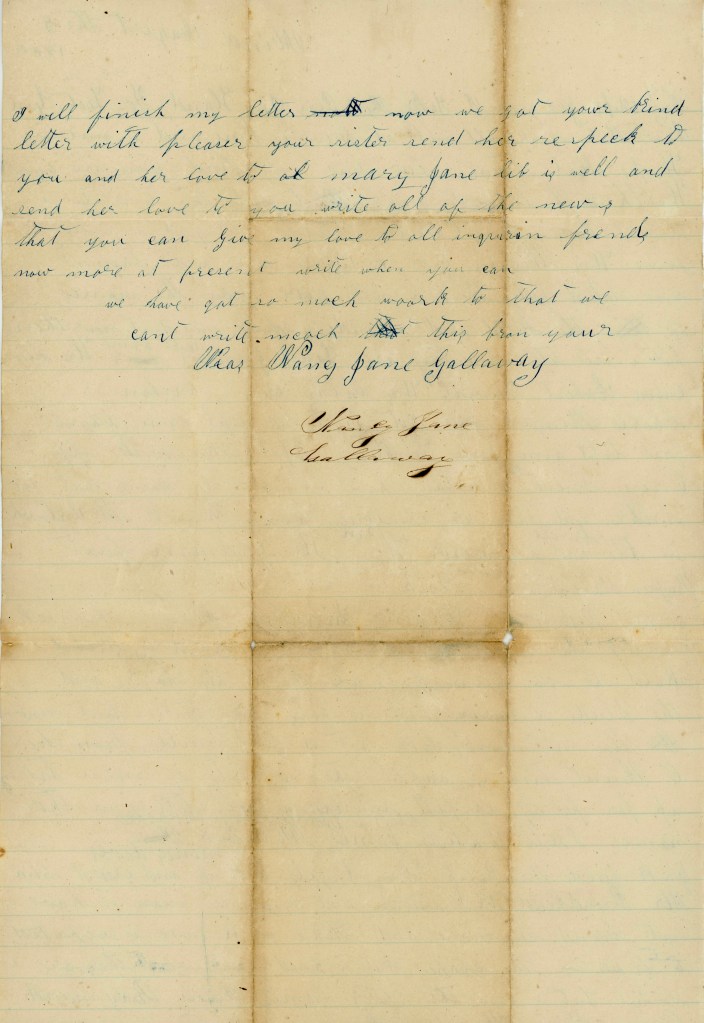
I will finish my letter now. We got your kind letter with pleasure. Your sister sends her respects to you and her love to Mary Jane. Lib is well and send her love to you. Write all of the news that you can. Give my love to all enquiring friends. No more at present. Write when you can.
We have got so much work to do that we can’t write much. This from your cousin—Nancy Jane Gallaway
1 Robert Amos Corbett (1829-1895) was a 1st Lieutenant in Co. D, 112th New York Infantry. He enlisted at Mina in August 1862 and was wounded in the hip at Cold Harbor on 1 June 1864. He was discharged for disability on 17 October 1864.
Lt. Robert Corbett’s sword
2 Charles H. Munger was 39 years old when he enlisted in Co. D, 112th New York Infantry. He was a corporal when he was wounded in action at Cold Harbor on 1 June 1864. He mustered out with the company at Raleigh, N. C. on 13 June 1865.
3 James D. Findley was 25 years old when he enlisted in August 1862 to serve in Co. H, 112th New York Infantry. He was transferred later to Co. K and was wounded severely on 24 June 1864 near Petersburg, Virginia. He was discharged for disability on 11 September 1865.
4 Oren or Orrin Sweet (1843-1892) served in Co. B, 111th New York Infantry. He was wounded on 29 October 1863 at Wauhatchie, Tennessee, and again on 25 May 1864 at Dallas, Georgia. He was taken prisoner and held until 13 April 1865.
5 Frank McIntosh of Mina enlisted at the age of 19 in 1863 to serve in the 15th New York Cavalry.
6 James C. Scidmore (1838-1864) served as a private in Co. B, 111th New York Infantry. He was wounded at Wauhatchie, Tenn. on October 29, 1863; killed at Culp’s [Kolbs] Farm, Ga. on June 17, 1864.
7 Henry Barber Findley (1846-1864) was a private in Co. D, 112th New York Infantry. He was mortally wounded at Cold Harbor on 2 June 1864.
8 23 year-old Albert Shinn enlisted at Mina in January 1864 to serve in the 15th New York Cavalry. He deserted at Lynchburg, Virginia, on 19 June 1864 according to military records. Albert was born in Germany and was a farmer by occupation.
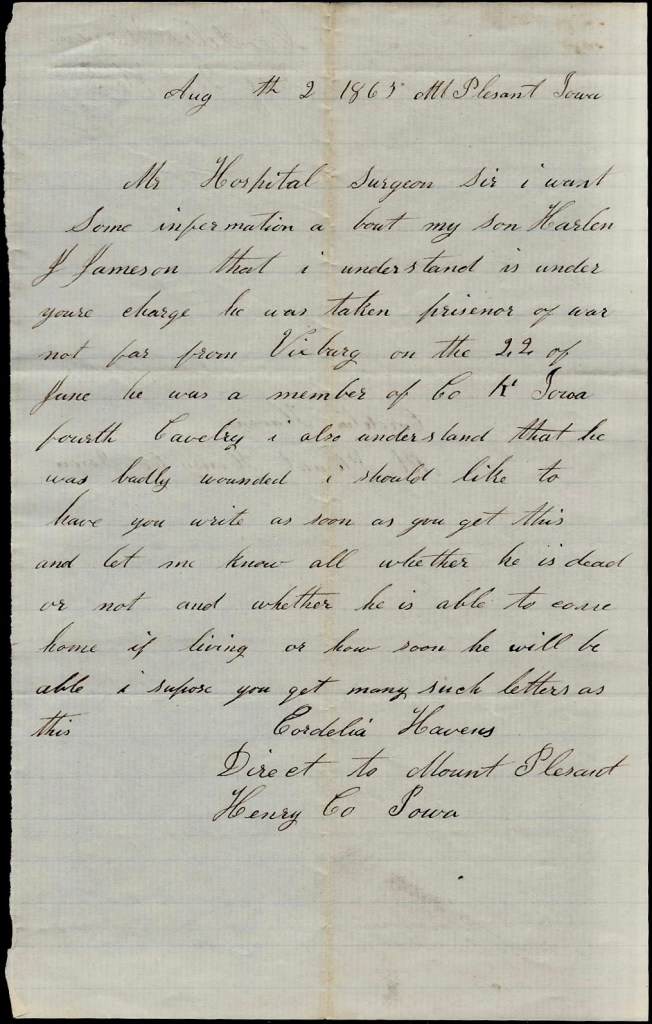
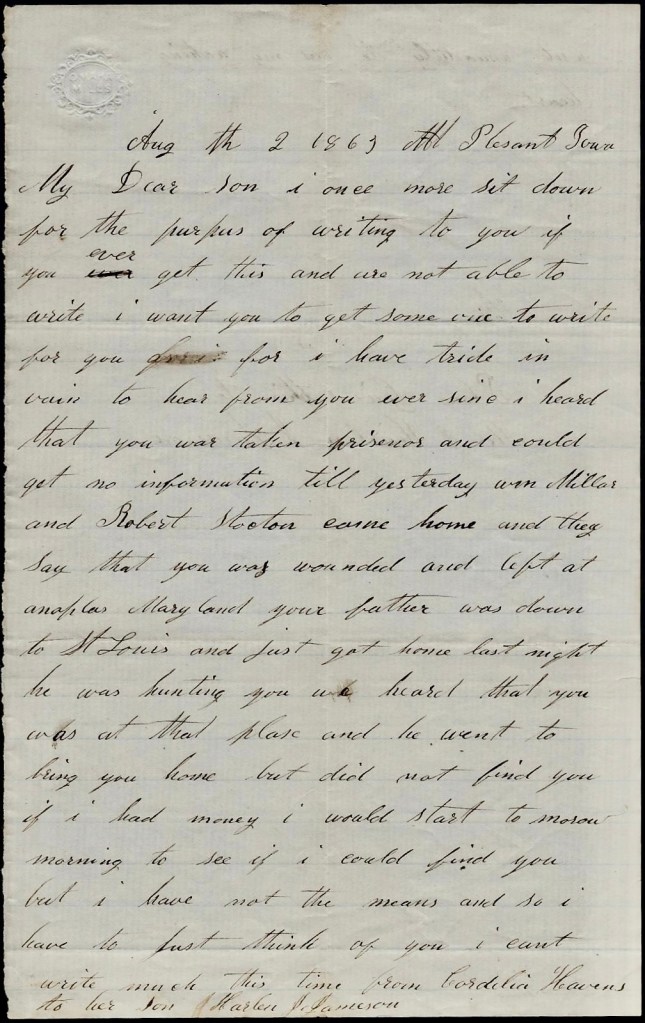
The following distressing letter was written by 37 year-old Cordelia [Scovell] Havens (1826-1898), the wife of Thomas Havens (1812-1875) whom she married after her first husband, James Jameson (1819-1845) died in 1845. Cordelia and her 2nd husband moved to Henry county, Iowa, in 1854 and to Cherokee county, Kansas in 1866. Her letter implores of an unidentified hospital surgeon the fate of the only son by her first marriage—Harlan J. Jameson (1843-1886). I believe the letter was sent to Annapolis, Maryland, where paroled soldiers were exchanged.
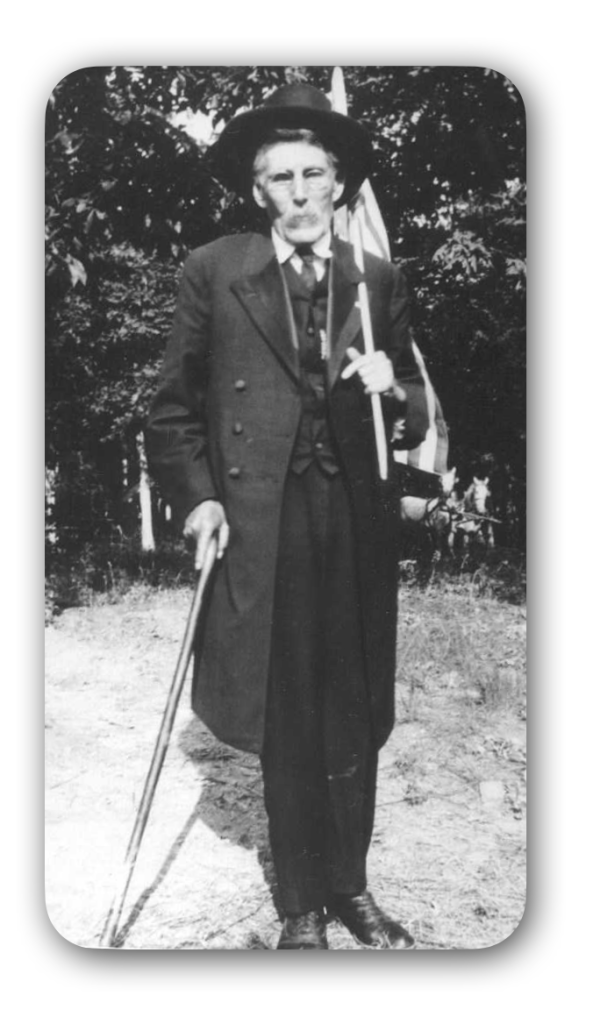
Harlan Jameson enlisted as a private when he was 18 years old in Co. K, 4th Iowa Cavalry. He was mustered into service on 25 November 1861 and was taken prisoner at Bear Creek, Mississippi, on 22 June 1863. He was exchanged and returned to service on 14 October 1863 at Vicksburg. He mustered out of the regiment on 4 December 1864 when his term of service expired.
Harlan J. Jameson, Co. K, 4th Iowa Cavalry Iowa Civil War Images
Harlan’s obituary, published in the Cherokee Sentinel on 21 January 1887, claims that he was seriously wounded in the Battle of Helena (Arkansas) and “subsequently captured and carried to Castle Thunder and Libby prison in which places he was confined for nine months, when he was exchanged and again joined his command and served till the expiration of his term of service in December, 1864, at which time he received an honorable discharge.” Clearly there is a discrepancy between the military record and the obituary record, and I’m inclined to believe the obituary was fabricated out of half-truths and exaggerated tales told by the old warrior, especially given that Co. K was, indeed, on Hill’s Plantation near Bear Creek on 22 June 1863. On page 557 of his book, The Story of a Cavalry Regiment, William Force Scott informs us that Harlan was among several men of the 4th Iowa Cavalry captured, exchanged, and returned to service in October 1863. While he may have been sent to Richmond as a POW, he did not languish there for nine months.
Harlan met his death by falling from the tramway at the Cherokee coal shaft, where he was employed as night watchman and while in the discharge of duty, between 10 and 11 o’clock at night Jan. 17th, 1887.
Letter 1
Mt. Pleasant, Iowa August the 2nd, 1863
Mr. Hospital Surgeon,
Sir, I want some information about my son Harlen J. Jameson that I understand is under your charge. He was taken prisoner of war not far from Vicksburg on the 22nd of June. He was a member of Co. K, Iowa Fourth Cavalry. I also understand that he was badly wounded. I should like to have you write as soon as you get this and let me know all—whether he is dead or not, and whether he is able to come home if living, or how soon he will be able.
I suppose you get many such letters as this. — Cordelia Havens
Direct to Mount Pleasant, Henry county, Iowa
Letter 2
Mt. Pleasant, Iowa August 2nd 1863
My Dear Son,
I once more sit down for the purpose of writing to you—if you ever get this—and are not able to write, I want you to get someone to write for you for I have tried in vain to hear from you ever since I heard that you were taken prisoner and could get no information till yesterday when [William] Miller and Robert [S.] Stockton came home and they say that you was wounded and left at Annapolis, Maryland.
Your father was down to St. Louis and just got home last night. He was hunting you. We heard that you was at that place and he went to bring you home but did not find you. If I had money, I would start tomorrow morning to see if I could find you but I have not the means and so I have to just think of you. I can’t write much this time.
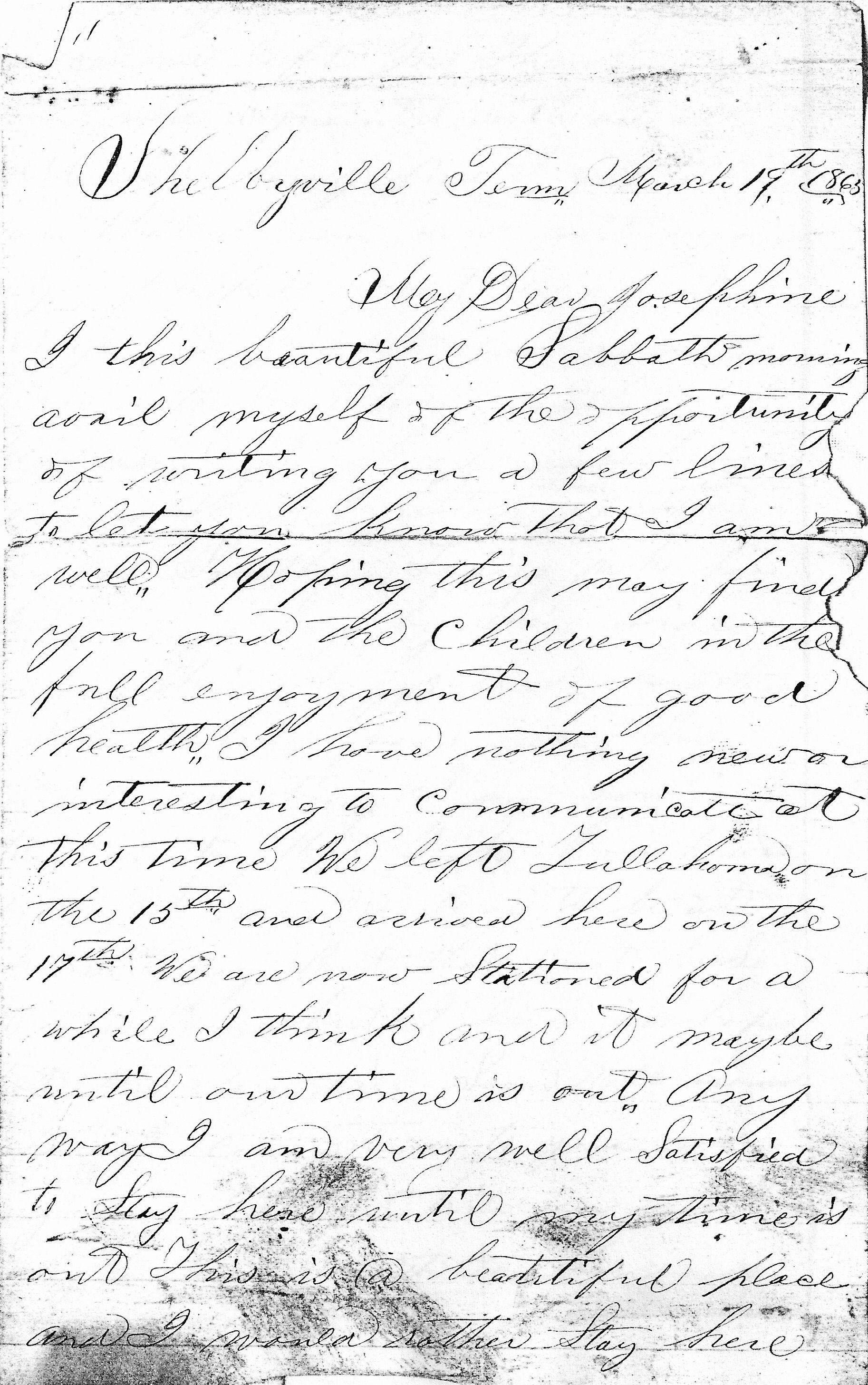
The following late war letter was written by William Wiley Jones (1839-1918), the son of John and Susan (Emberton) Jones who came to Sullivan County, Missouri from Monroe County, Kentucky in the early 1840s.
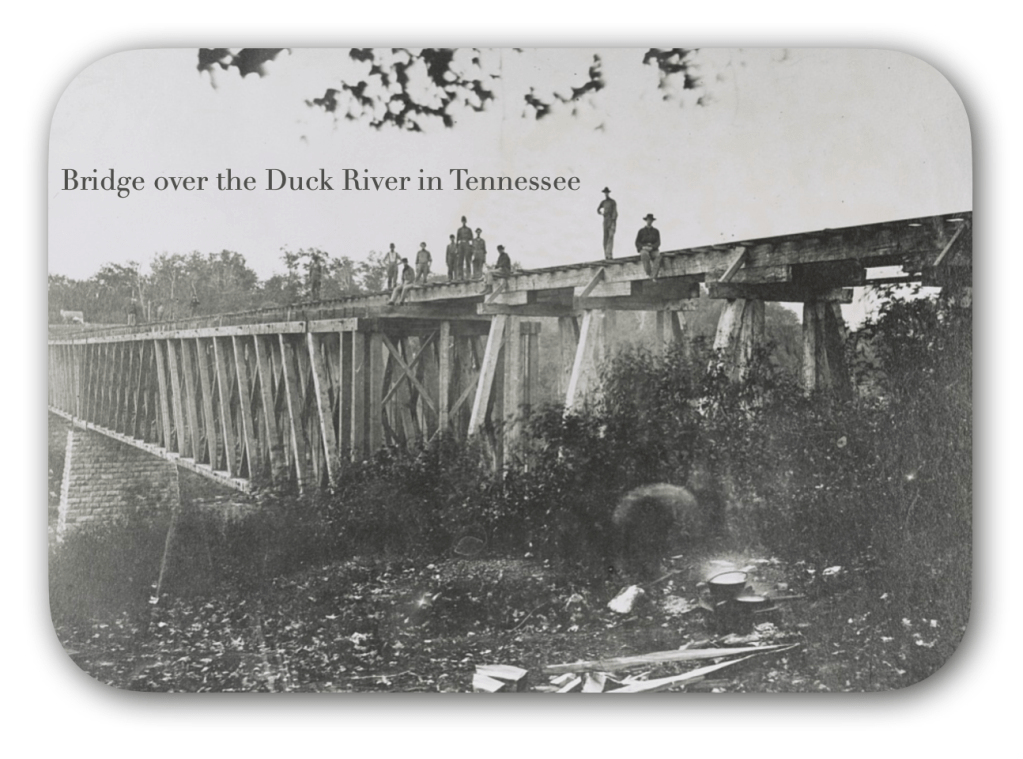
William enlisted in Co. E, 42nd Missouri (Union) Infantry at the time of its organization in September 1864. The regiment was sent to Tullahoma, Tennessee in the Department of the Cumberland in December 1864 and assigned as an unattached unit to the 20th Army Corps. In March, 1865, when this letter was written, the regiment had just arrived in Shelbyville, Tennessee, where they were garrisoned for the remainder of the war and performed picket duty on the Duck River Bridge. They mustered out in late June 1865. During its service, the regiment lost six enlisted men killed or mortally wounded and 124 to disease for a total of 134 casualties.
[Note: The scans of this letter were provided to Spared & Shared for transcription and publication by Reta McCollum Riley, a 2nd great-granddaughter of the soldier.]
Transcription
A man on picket duty prepares the mess in foreground.
Shelbyville, Tennessee March 19, 1865
My dear Josephine,
I this beautiful Sabbath morning avail myself of the opportunity of writing you a few lines to let you know that I am well [and] hoping this may find you and the children in the full enjoyment of good health.
I have nothing new or interesting to communicate at this time. We left Tullahoma on the 15th and arrived here on the 17th. We are now stationed for a while I think and it may be until our time is out. Anyway, I am very well satisfied to stay here until my time is out.
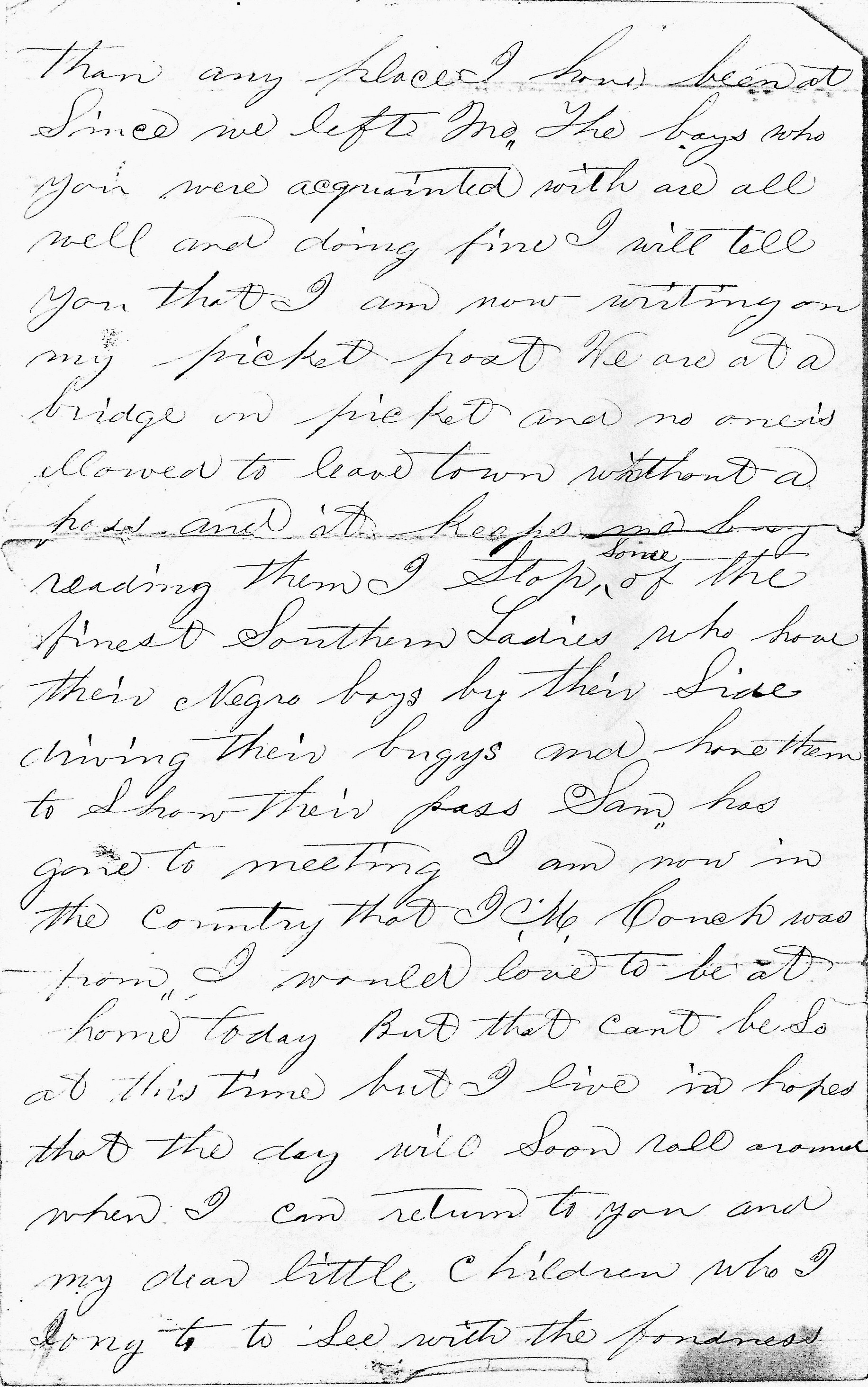
This is a beautiful place and I would rather stay here than any place I have been at since we left Missouri. The boys who you were acquainted with are all well and doing fine. I will tell you that I am now writing on my picket post. We are at a bridge on picket and no one is allowed to leave town without a pass and it keeps me busy reading them, I stop some of the finest Southern ladies who have their Negro boys by their side driving their buggies and have them to show their pass.
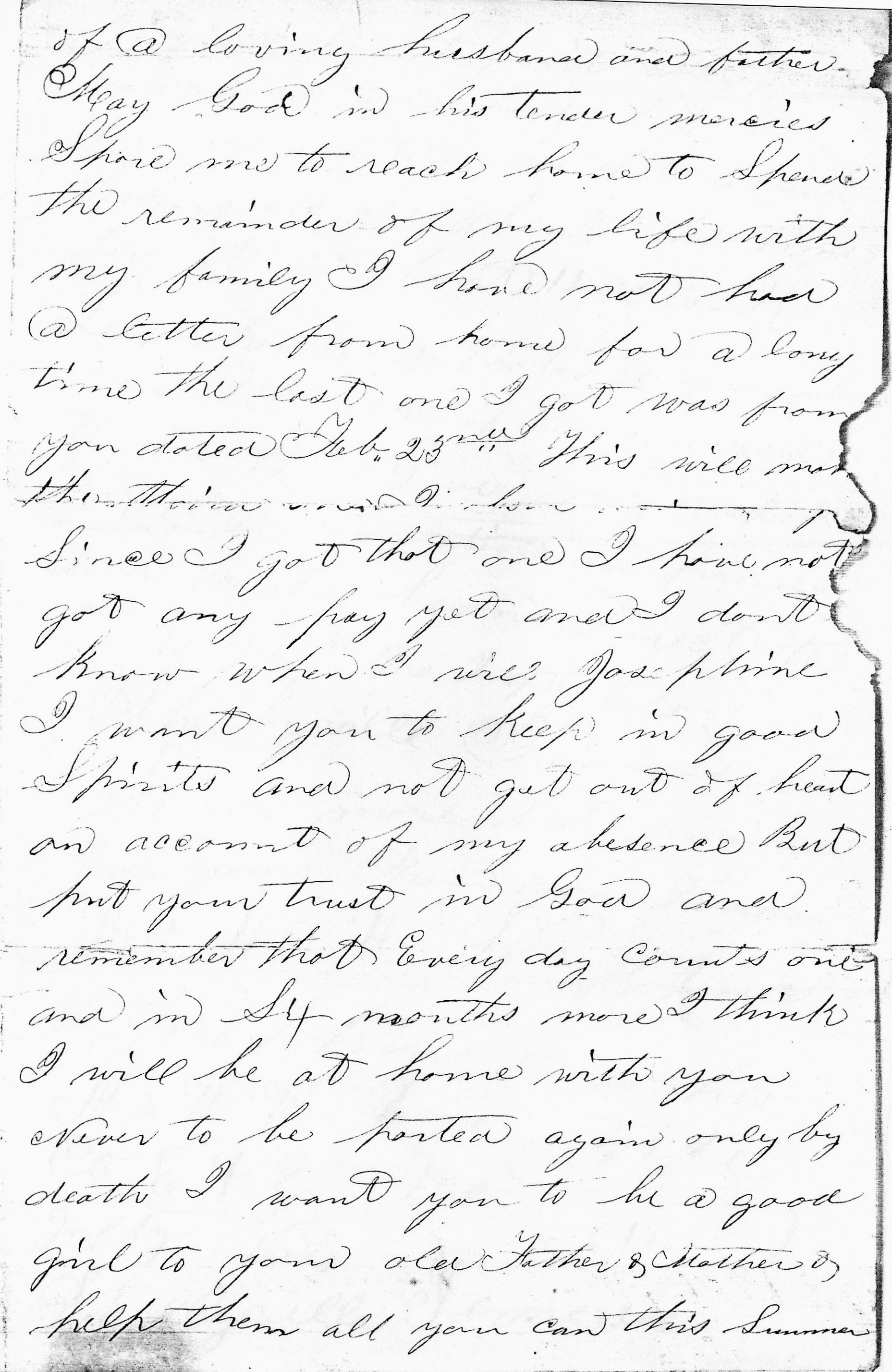
Sam has gone to meeting. I am now in the country that J. M. Conch was from. I would love to be at home today but that can’t be so at this time, but I live in hopes that they day will soon roll around when I can return to you and my dear little children who I long to see with the fondness of a loving husband and father. May God in His tender mercies spare me to reach home to spend the remainder of my life with my family.
I have not had a letter from home for a long time. The last one I got was from you dated February 23rd. This will make the third one I have written since I got that one. I have not got any pay yet and I don’t know when I will.
Josephine, I want you to keep in good spirits and not get out of heart on account of my absence. But put your trust in God and remember that every day counts one and six months more I think I will be at home with you, never to be parted again—only by death. I want you to be a good girl to your old Father & Mother & help them all you can this summer.
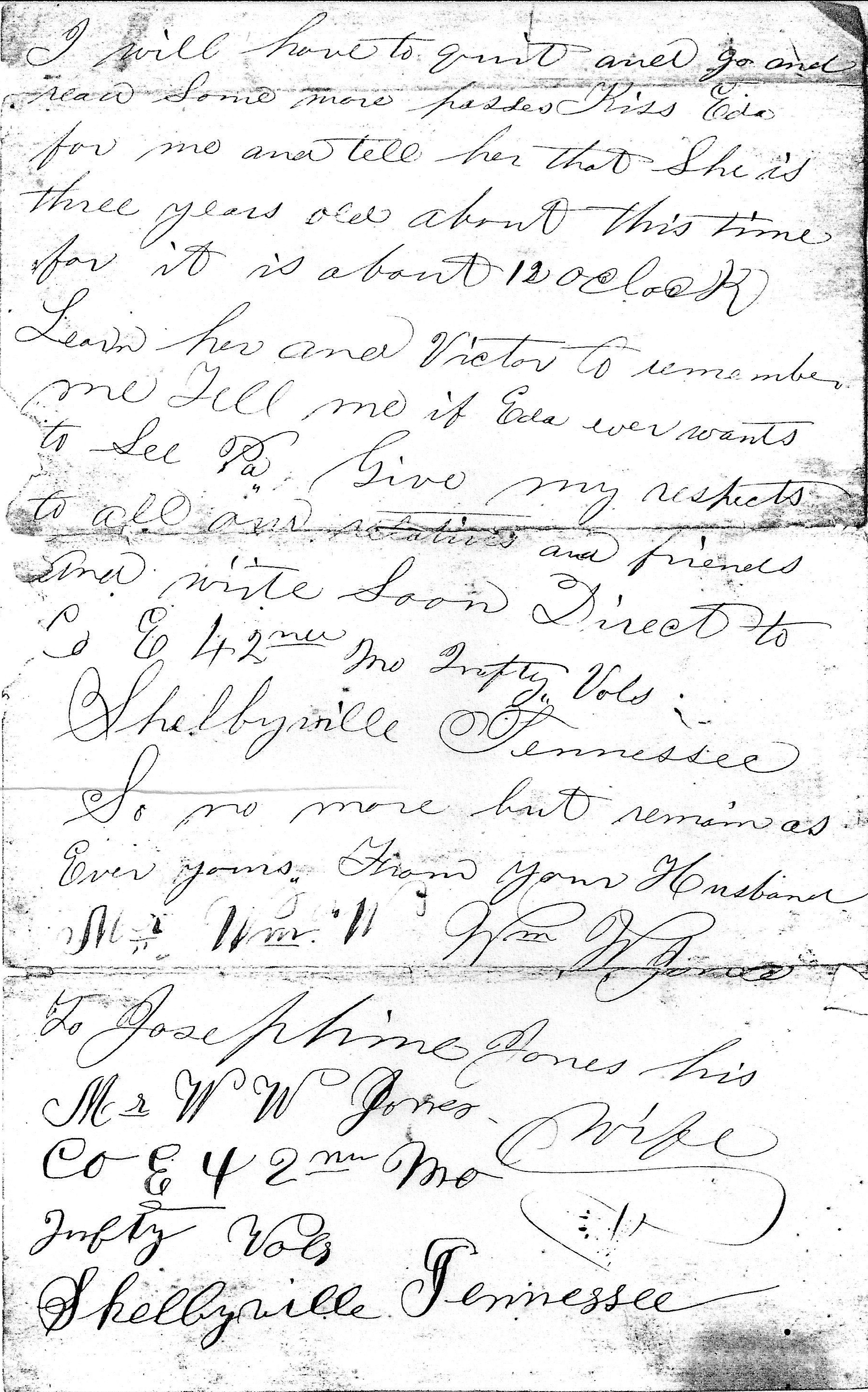
I will have to quit and go and read some more passes. Kiss Eda for me and tell her that she is three years old about this time for it is about 12 o’clock. Learn her and Victor to remember me if Eda ever wants to see Pa. Give my respects to all our relatives and friends and write soon. Direct to Co. E, 42nd Missouri Infantry Vols., Shelbyville, Tennessee
So no more but remain as ever yours, from your husband, 00 Mr. Wm. W. Jones
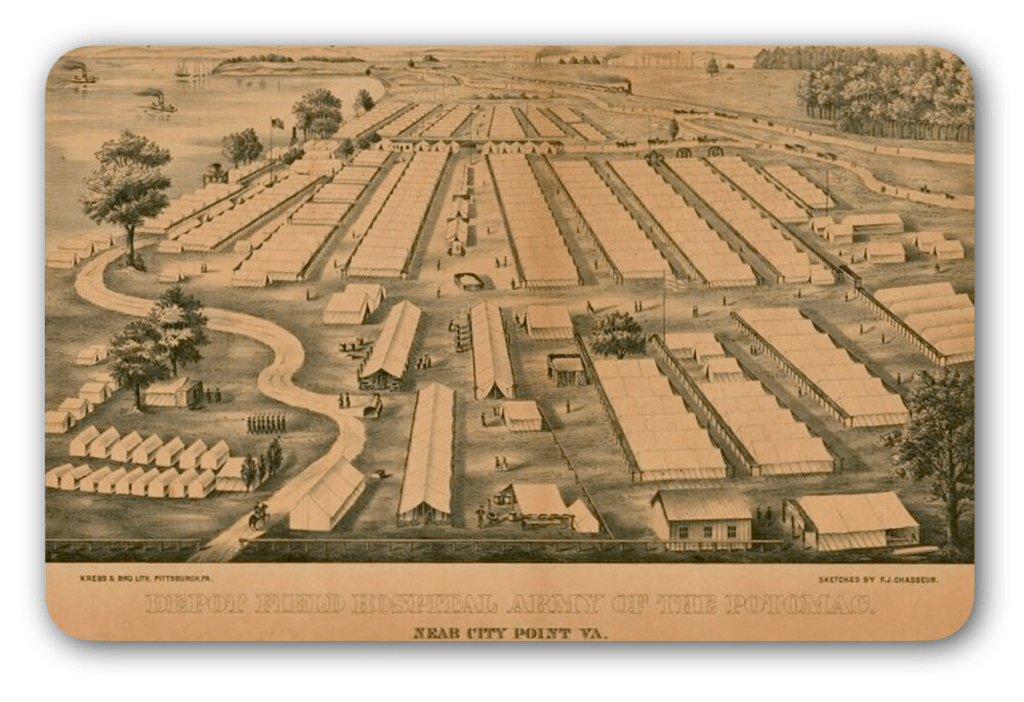
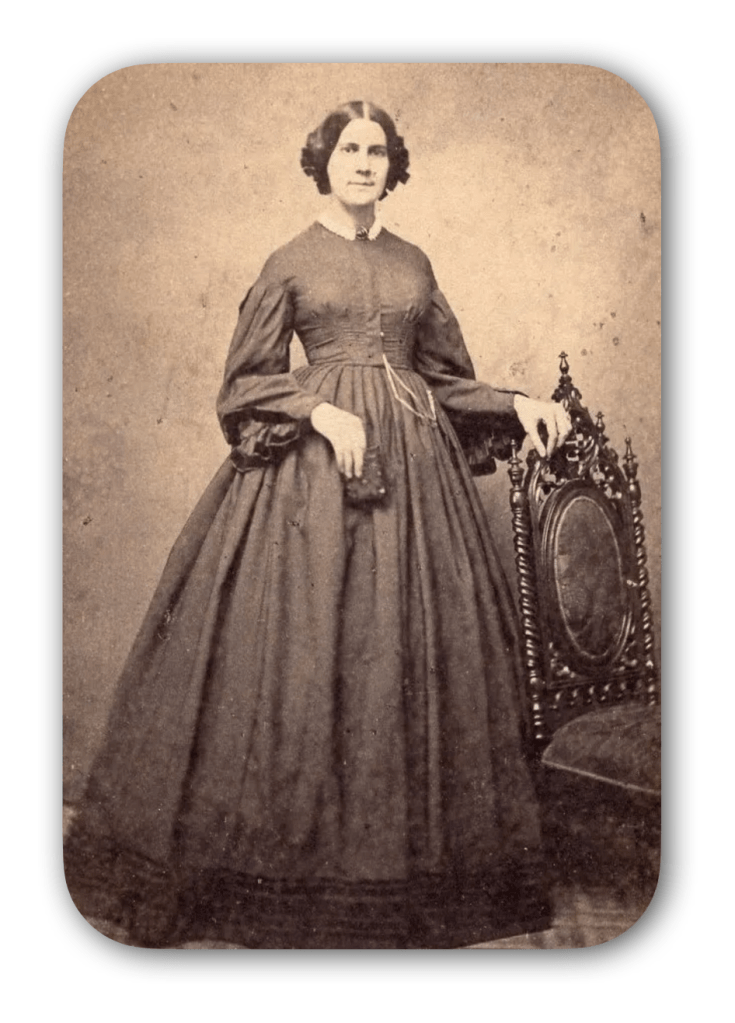
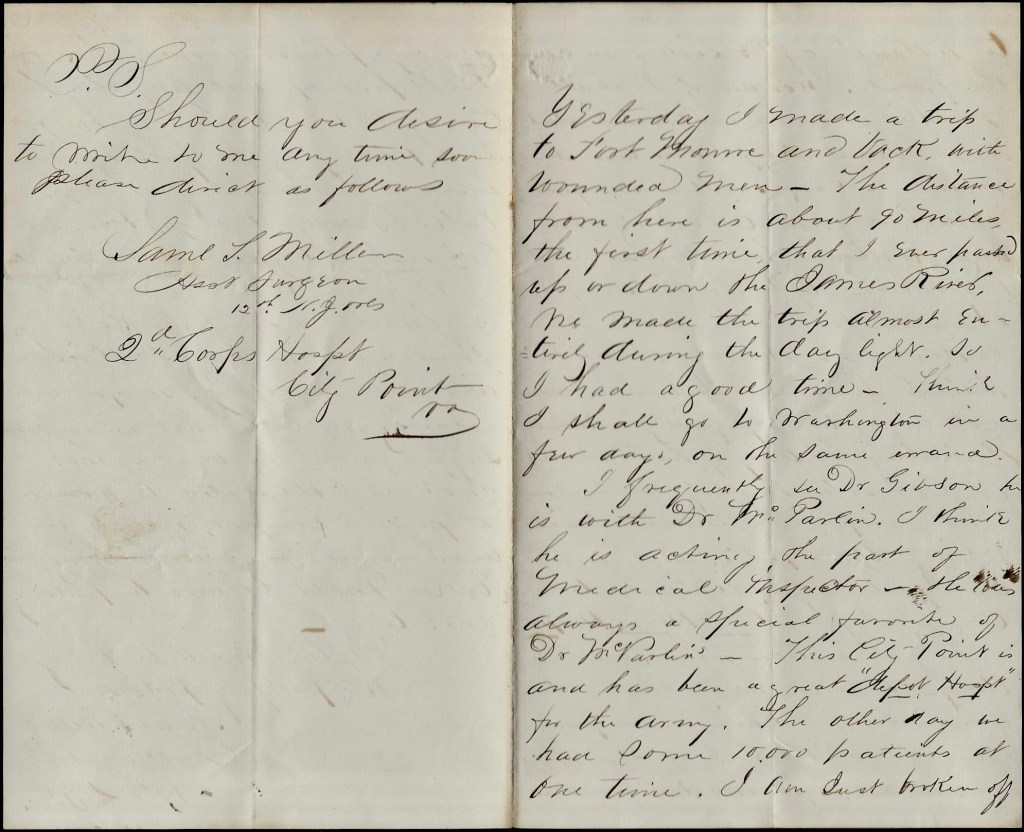
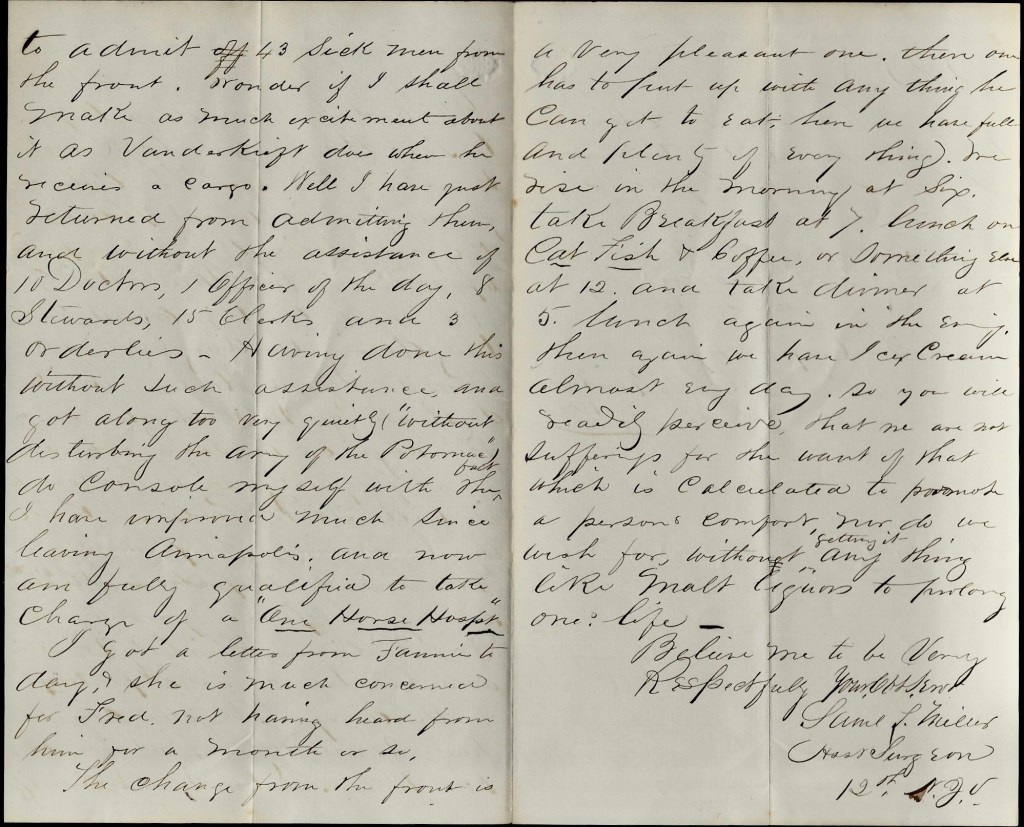
The following letter was written by Samuel Tyler Miller (1826-1905), the son of John B. Miller (1797-1858) and Elizabeth A. Tyler (1800-1889) of Paulsboro, Gloucester county, New Jersey. Samuel attended the University of Pennsylvania School of Medicine and was practicing allopathic medicine in Paulsboro, Gloucester county, New Jersey at the time of the 1860 US Census. In August 1862, he left his wife Fannie M. Price (1834-1879) of five years to accept a commission as an Assistant Surgeon, Field and Staff, 12th New Jersey Volunteer Infantry. He remained in that capacity until he resigned due to disability 8 November 1864.
Samuel wrote the letter to “Steward Knapp” who was otherwise unidentified in the letter but an internet search yielded the following information on Knapp: “The Edgar Knapp Letters span the years 1862-1864 and are comprised of 40 letters received by Edgar Knapp while he was working as a hospital steward at the U.S. military hospital in Annapolis, Maryland.” These letters were purchased by Special Collections at Virginia Tech in April 2002 with the following biographical note. “Lieutenant Edgar R. Knapp (ca. 1836-?) of Adrian, Lenawee County, Michigan, was a steward at the United States military hospital in Annapolis, Maryland from 1862-1864. His brother H. Knapp was probably Henry Knapp (1813-1893), who is listed in the 1860 census as a doctor in Adrian, Lenawee County, Michigan. Randolph Knapp, whose death is the subject of some of the correspondence, was born in 1840 in Michigan and died at the Battle of Gettysburg.”
Transcription
The Depot Field Hospital near City Point, Virginia
Hospital 2nd Division, 2nd Army Corps City Point, Virginia July 9th 1864
Steward Knapp,
Sir, when last I saw you, who would have thought that so long a time would have elapsed before one or the other of us would have written. For my own part, there is the best excuse in the world, having been on the most active campaign that has taken place during the war, with a good disposition, but no facilities but a lead pencil & my knee for a writing desk.
Mrs. Rebecca Lane (Pennypacker) Price
There is no use in me in relating any incidents that have taken place during this time. Suffice it to say that my regiment is reduced from 420 muskets to about 100. Have run clear myself so far (only having been struck once upon the spur) but do not intend to have them in so close proximity again if I know myself. About two weeks since I detailed to this place and have virtually been running the machine. Mrs. Price 1 is with me as one of my female nurses. I have three more, one of which is rather an interesting young lady—“Nuff Ced.”
I have met the Lieutenant who accompanied us to the Depot the night I went home in April and if I may judge from his statement, I think the service would be doing you a favor in removing you to some other place where attractions are not so liberally displayed and inducements not constantly staring you in the face. A word of caution may not be out of place. Young man, be cautious and hold a tight rein.
That you have not written to me, I must acknowledge that I am somewhat ashamed of you, surrounded as you are with all the facilities for writing and neglecting a friend who would volunteer advice as the above. I forget the Lieutenant’s name but you doubtless recollect him. He is a patient in the 9th Corps Hospital about 100 yards from here and over which Dr. Wheeler presides.
I might say during this campaign, many friends have fallen & more disabled I fear for life. May God hasten the time when this unholy warfare shall cease.
Yesterday I made a trip to Fort Monroe and back with wounded men. The distance from here is about 90 miles, the first time that I ever passed up or down the James River. We made the trip almost entirely during the daylight so I had a good time. Think I shall go to Washington in a few days on the same errand. I frequently see Dr. Gibson. He is with Dr. [Thomas Andrew] McParlin. I think he is acting the part of Medical Inspector. He was always a special favorite of Dr. McParlin’s.
This City Point is and has been a great “Depot Hospital” for the army. The other day we had some 10,000 patients at one time. I am just broken off to admit 43 sick men from the front. Wonder if I shall make as much excitement about it as Vandergrift does when he receives a cargo. Well I have just returned from admitting them and without the assistance of 10 doctors, 1 officer of the day, 8 stewards, 15 clerks, and 3 orderlies. Having done this without such assistance and got along too very quietly (“without disturbing the Army of the Potomac”) I do console myself with the fact I have improved much since leaving Annapolis and now am fully gratified to take charge of a “One Horse Hospital.”
I got a letter from Fannie today & she is much concerned for Fred, not having heard from him for a month or so.
The change from the front is a very pleasant one. There one has to put up with anything he can get to eat. Here we have full and plenty of everything. We rise in the morning at six, take breakfast at 7, lunch on cat fish and coffee, or something else at 12 and take dinner at five. Lunch again in the evening, then again we have ice cream almost every day. So you will readily perceive that we are not suffering for the want of that which is calculated to promote a person’s comfort, nor do we wish for, without getting it, anything like malt liquors to prolong one’s life.
Believe me to be very respectfully your obedient servant, — Samuel T. Miller, Hospital Surgeon, 12th New Jersey Volunteers
P. S. Should you desire to write to me anytime soon, please direct as follows:
Samuel T. Miller Asst. Surgeon 12th N. J. Vols, 2nd Corps Hospital City Point, Va.
1 Mrs. Rebecca Lane (Pennypacker) Price (1837-1919) was a native of Phoenixville, Pennsylvania. She married Edwin Price in 1853 and volunteered as a nurse during the Civil War. She came to City Point after working at White House Landing with Mr. Ritz and Miss Sayles. “While at City Point, she was often seen helping with the organization of the wounded onto the hospital steamers using a state agent’s pass that Governor Curtin has issued her.” Rebecca came from the prominent Pennypacker family of eastern Pennsylvania. First cousin Galusha Pennypacker was a Civil War brigadier general by the time he was 20 years old and was awarded a Medal of Honor for his bravery at the Second Battle of Fort Fisher, North Carolina, in January 1865. She was second cousin to Samuel Whitaker Pennypacker, governor of Pennsylvania from 1903 to 1907, and her mother, Elizabeth, ran a Union Army hospital in Chambersburg, Pennsylvania.Source: The Women of City Point, Virginia” by Jeanne Marie Christie, pp.183-4.
The following letters were written by John McLaughlin (1837-1863) who enlisted on 22 April 1861 at the age of 24 to served three years in Co. A, 74th New York Infantry. Prior to mid-December 1861, however, the regiment was known simply as the 5th Regiment of the Excelsior Brigade. Companies A and B were recruited in Pittsburg and in New York City—John joining in Pittsburg. These two companies were known as the U. S. Zouave Cadets, wearing a dark blue Zouave jacket with yellow trimming, a dark blue Zouave vest with yellow trimming, a sky blue sash, a red Zouave cap with yellow tassel, red pantaloons with yellow trimming, and white gaitors. John entered the regiment as a private but was later promoted to corporal. He was killed in action on 2 July 1863 in the Battle of Gettysburg and was originally buried on the south side of Nicholas Cordori’s farm but was later reinterred at the Gettysburg National Cemetery.
A knapsack from the 74th New York Infantry
The 74th New York Infantry mustered into the U. S. service at Camp Scott, Long Island, June 30 to Oct. 6, 1861, for a three year term. It left New York Aug. 20, for Washington; was attached to Sickles’ Excelsior Brigade and stationed along the Lower Potomac in Maryland during the first winter; embarked in April, 1862, for the Peninsula with the brigade, as part of the 2nd division, 3d corps; shared in the siege operations before Yorktown; took a prominent part in the battle of Williamsburg, for which the brigade won the highest praises, the loss of the regiment in this battle being 143 killed, wounded or missing, and in the ensuing engagements of Fair Oaks and the Seven Days’ battles it was constantly in action. Upon its withdrawal from the Peninsula in August, the regiment was sent to the support of Gen. Pope at Manassas, after which it retired to the Defenses of Washington. In November it marched to Falmouth; participated in the battle of Fredericksburg; returned to its camp at Falmouth for the winter; was engaged at Chancellorsville in May, 1863; returned again to camp at Falmouth; marched in June to Gettysburg and there experienced the hard fighting of the second day on the Emmitsburg road, with a loss of 89 killed, wounded and missing.
John wrote all three letters to his sister’s family. Eleanor (“Ellen”) McLaughlin (1833-1907) was married to a “coal agent” named William D. McMasters (1825-1877) in the early 1850s. The couple lived in McKeesport, Allegheny county, Pennsylvania, and had several children, the oldest four being Robert (“Bobby”) born in 1853, Jacob (“Jakey”) born in 1855, Emma (“Annie”) born in 1858, and Grace born in 1860. They are all mentioned in these letters.
The 74th New York Infantry drilling in camp in 1861
Letter 1
Camp Good Hope September 6, 1861
William McMasters,
Dear sir, I received your welcome [letter] while we were at Camp Scott and was glad for to hear from you all and we have been changing camps since then but we have not got as nice a place as we had on Staten Island. It is hard for to tell how long we will remain here. We have orders for to have two days rations cooked and to have our clothes packed up ready for to leave in a moment’s notice. We are also throwing up entrenchments as fast as we can. I do not know what it means but they must be going for to put other regiments in here if they take ours out. The place that we occupy is said for to be a strong position for to protect the City of Washington.
We are about five miles from the city across the eastern branch of the Potomac, right on the line between the District of Columbia and State of Maryland. They are all secessionists about here. Ask a negro where his massa is, the answer is massa is away at de war. We have one contraband in our company and it is quite laughable for to hear him talk about his Old Massa who he says goes by the name of Col. Naylor.
The bridge across the Eastern Branch of the Potomac (now called the Anacostia River) river between Washington City and Maryland. Library of Congress.
Well, Bill, it is very hard for to get a pass to pass over the bridge to get to Washington. It is not like it was at Camp Scott. We are kept down to the work here. One of our men was drunk yesterday. When he got sober they filled a knapsack with stones, strapped it to his back, and marched him around for two hours. After they took it off, he commenced swearing for which they put a ball and chain to him for four hours. If one gets a pass to go out and is five minutes behind time getting in, on goes the knapsack & stones. But for my part, I get along very well.
Our commissary [sergeant] has been away since before we left Camp Scott on leave and I have been acting in his place. I have been over for to see Sam three times and he has been over here several times. I seen him yesterday. He is well and looks well. He is getting quite fat.
James Burns was over for to see me. He heard where we were encamped and not having no uniform, he had no difficulty in getting over the bridge. He staid with me till the afternoon. I got a pass from the captain and went with him to the bridge. I do not expect that I will ever get over to see their company for even the officers must have a written pass from Gen. Sickles for to get across the bridge.
Well, Bill, I think that the Excelsior Brigade has about the best uniforms and [best] equipped soldiers in the field. We have the best of Minié rifles [and] two uniforms (and have only one of them for to pay for). We have also got splendid overcoats that were made purposely for the brigade. Mine comes nearly down to the ground and is very heavy and warm and one can stand out in the rain and not get wet.
Give my love to Ellen & the children—Bobby, Jakey, Annie, Grace. I am tired writing, it is so warm. So nothing more at present. Yours as ever, — John McLaughlin
Letter 2
Camp near Fair Oaks, Virginia June 20th 1862
Dear Bobby and Jakey,
I am now sitting down to have a little chat with you from the battle field—that is, if we can call pine woods and swamps a field; but it is called battle field and by that name I’ll let it go. It is now nine o’clock at night and the frogs are croaking round me and added to that is the everlasting shrill croaking voice of the whippoorwill. How I hate it at night when I am on picket. But I have to just let them rip.
Well, Bobby, no doubt you will say I am a sad, naughty uncle for not having written to you & Jakey but you must remember that time is very scarce. I would often like to have a little chat with you but we have so much duty to do that I can hardly get time. It is not but that I often think of you all. Tell your mother that she was so long about writing that I am going to try you, Jakey, Annie, and little Grace this time. I want you to send me a long letter with all of the news. I received your mother’s letter adn Jane’s letter of the 14th today. Cousin Abraham McLaughlin is in Philadelphia and George is with his regiment which is handy to us at the present time. Your cousin Sam McLaughlin is hearty and well.
I want you and Jakey to be good boys and learn all you can. Remember the little verse from wisdom and knowledge pleasure springs. But it is time that I was in bed so I’ll have to bring my chat to a close. The weather is very warm here at the present time. I suppose by the time this reaches you, you will have had a mess of new potatoes. They are a luxury that I don’t expect to indulge in.
Enclosed I’ll send you a letter which I picked up on the battle ground in which you will see that they [the Rebels] too want to put their trust in God. See how the young soldier’s mother wants him to read his bible?
Give my love to your Pap and Mother, Annie, Grace, and all.
— John McLaughlin
Letter 3
Camp near Falmouth, Va. December 30th 1862
Mrs. Ellen McMasters,
Dear sister, I now sit down to pen you a few lines to let you know that I am well as I hope this may find you all. I expect you have began to think that I have forgotten you but no so. Sometimes it is so cold that one cannot write but of late I have had no paper, money, or anything else. There is nothing of importance going on here at the present time. We have orders to be ready for to march at a moment’s notice but where, none of us of course knows. A soldier is never supposed to know where he is going. He may imagine that he is going to this and to that place, but his imaginations may all dissolve in smoke. Such is a soldier’s life.
We had a very dry time of it on Christmas. It was saucy to get a tin-full of bean soup for my dinner. Barney was to see me and him and I took dinner with Sam after which we went to the 63rd [New York Regiment] to see the boys there but the regiment was out on picket so we did not see many of them. Sam was to see Henry. He is well and when Sam was there, he was looking for John back to the regiment every day. The last letter that I had from home was written on the 14th except one that had been written by mother on the 2nd day of October. But I will bring this to a close for the present. From your brother, — John McLaughlin
Bobby, Jakey, Annie & Grace, I am now going to talk awhile with you. I hope you all had a Merry Christmas of it and I hope the New Year may begin merry with you. You do not know how glad I would be to see you once more and to spend my New Years with you.
Well, Bobby, sometimes when we go into a fight there is some fellows who are too big [of] cowards to go into a battle but stay in the rear where they are safe and when the battle is over, they come up and talk and blow round about the dangerous places that they have been in. But such fellows are getting fixed now. [In] some places, squads of them are to be seen with their hands tied together and a log tied to them and the word “Coward” in large letters on his back. And some places you can see them with a knapsack on their back with the world “Shirk” upon it. But the 1st regiment of our brigade has a still more severe way of treating them. The whole regiment is drawn out in line, then woe to the man who was not with the company when it was expected to go into a fight. The Sergeant Major calls out the name of the man who was absent from his company when he bound to step out before the whole crowd. The instance, the Sergeant Major calls out, “James Shields!” [and] out steps James. Then says the Colonel, “Run away from Fredericksburg!” “That’s so!” says the Major. Then goes the drums—rip, tip, tap, the dum—and thus the coward has to come out before the whole regiment. They were going through it when I began to write this. But I must close by telling you to be good boys and girls to your Father and Mother. Learn to read and write as fast as you can. But I must close and bid you goodbye. From your uncle, — John
The following letter was written by Thomas A. Sanders (1840-1910), the son of Thomas Sanders and Ellen Leonard (1818-Aft1850) of Clermont county, Ohio. It’s probable that one or both of Thomas’s parents were deceased before the Census of 1860.
I could not find an image of Thomas but here’s a tintype of a member of the 12th OVI (Greg McMahon Collection)
Thomas wrote the letter while serving in Co. C, 12th Ohio Volunteers Infantry (OVI. He enlisted in the 12th OVI on 22 April 1861 when it was a 3-month’s regiment and then reenlisted as a private in the same company for three years and was discharged at Fayetteville, West Virginia on 31 December 1863 as a 1st Sergeant. In July 1864 he reenlisted as a 1st Sergeant in Co. C of the 23rd OVI.
Thomas’s letter informs us that the regiment spent the 4th of July quietly, without celebration, at Flat Top, Virginia (now W. Va.) in the Kanawha Valley where they were attached to the 1st Brigade, Dept. of the Mountains. They had seen combat in the Battle of Carnifex Ferry in the fall of 1861 but they would not see serious action again until the Maryland Campaign a year later at South Mountain and the Otto Farm at Antietam.
Thomas wrote the letter to his comrade John McNair of the 12th OVI who was at his home in Nicholasville, Ohio, apparently recuperating from a severe illness. John was discharged for disability on 9 February 1863. He later served in the 53rd Ohio Vol. Infantry (National Guard) in July 1863 for 100 days. The main theme of the letter is to communicate an order by the War Department directing all sick men at home to report to the Medical Director of the nearest military hospital.
Transcription
Addressed to Mr. John McNair, Nicholasville, Clermont county, Ohio
Flat Top, Va. Sunday, July 6th 1862
Friend John,
The fourth of July—always sacred to Americans—has passed away at this place without any demonstration worthy to be recorded in memory’s book. Everything was quiet except at the other Brigade. About noon the fired twenty-six rounds. There is no news of importance to communicate to you. We have heard that McClellan has been fighting for six days and we are impatiently awaiting to hear the result.
I suppose that you have had fine times at home on the fourth. I should have liked to of been with you very much. I have to communicate news to you that will not I suppose be very pleasant to you. By a late order issued at the War Department, all men at home on sick or furlough if near enough to any city where there is a government hospital is required to report themselves there to the Medical Director. If they are not well enough to be sent on to their respective regiments, they will have to remain at the hospital there until they are well. This law is imperative and anyone who does not comply with it will be reported as a deserter and will be sent after. Therefore you will if not well enough to come on here have to report yourself at Cincinnati to the Medical Director.
The order is published I believe in all county papers but I have thought it best to give you notice by letter for fear you would not see it in the papers. I know it will not be very pleasant for you to leave home and go to any hospital, but it will be better for you to do so. I hope that you are much better by this time. I should like to hear from you often if it will be convenient for you. The boys all join me in love to you. Please write soon.
I could not identify the author of this letter whose name appears to read “William Mawhorr.” He gives his location as Taylor’s Station which was a whistle stop on the railroad east of Columbus, Ohio—just east of the present day Columbus International Airport. William’s letter beseeches the US Military to send him some word of his son Joseph, having not heard from him in 15 months. William states his believe that Joseph was serving in the 6th US Cavalry, Co. C.
I do not have access to a roster to enable me to check for Joseph so for now, Joseph and his father will remain identified in name only.
Transcription
Taylor’s Station June 15th 1863
Dear Sir,
I request of you to let me know if you can find any tidings of Joseph Mawhorr, Co. C, 6th U. S. Cavalry. Please, sir, investigate about him as we as you can. He is my son and I am trouble mind about him because I cannot find out whether he is dead or alive. The last account I got from him was last March a year ago. Then he was in Washington.
Please, after trying to find him out, in a few days write to me and direct to Wm. Hawhorr, Blacklick P. O., Franklin county, Ohio