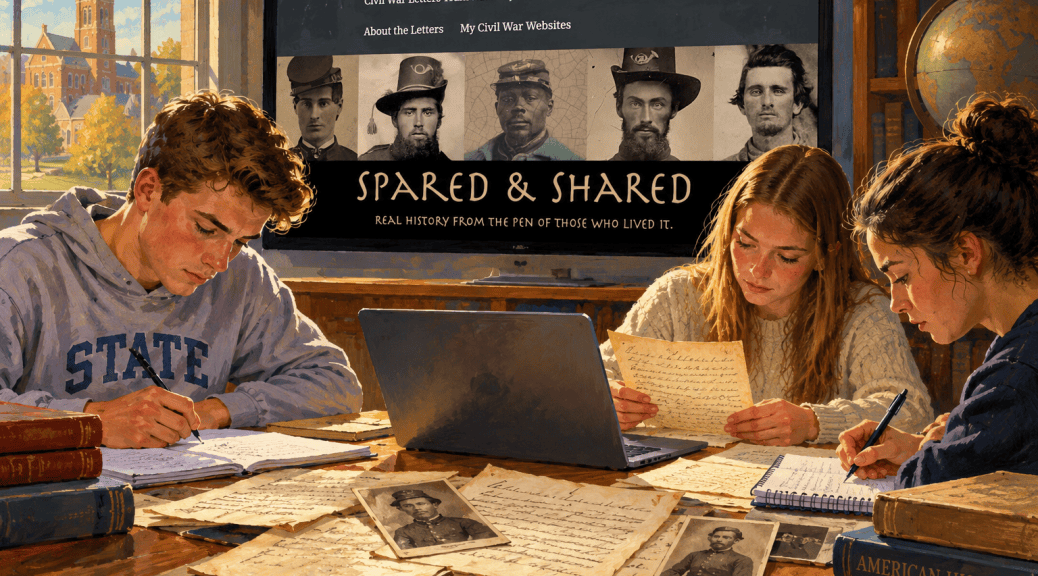
In September 2026, I received the following email from MaryBeth Allison, a professor at Charleston Southern University in North Charleston, South Carolina.
“I just wanted to thank you for what you do. While I teach World Civilizations III, we do cover the Civil War. As a homework assignment, my students are reading letters from your blogs and writing reflection essays on their findings. They are just getting started, but so far, it’s been a very positive experience. Your work helped me so much while I was completing my dissertation, and to be a professor now, sharing your work with students is amazing. Thank you, Griff! Sincerely, —MaryBeth Allison“
I found it gratifying to know that teachers were utilizing the materials I had spent countless hours making available on Spared & Shared website in my retirement years. I asked MaryBeth if I might share her idea with others on my Spared & Shared Facebook page so that other teachers at the High School or College level might consider doing the same thing or something comparable and she heartily supported the idea, clarifying:
“It’s a survey class with mostly college freshmen, but I have a few upperclassmen sprinkled in both sections. The course is World Civilizations III (Enlightenment to Globalization), but I do provide some Civil War history since we are in South Carolina, and I go over how European nations viewed the American Civil War. I focus on familiarizing students with the importance of primary sources and going beyond the textbook. As with survey classes, I have some who aren’t necessarily “history enthusiasts.” But, I believe in the incorporation of primary sources to help light a spark. I organize assignments more as reflection papers/essays or “journaling” essays to remove the AI temptation; humanize history; and to let them know critical thinking and analysis are wonderful skills and I want to know what they think, not what AI tells them to “say.”
She shared with me what her assignment instructions were:
In the words of General Sherman, “War is hell.” To cope with their wartime experiences, many men wrote letters. Letters and mail were everything to soldiers. They were a bridge to home, a source of comfort or amusement, a feeling of normalcy during the chaos of war. Some men wrote incredibly detailed accounts of battles and conditions. Others wrote of mundane moments and mentions of the weather or what they ate. Think about it: many of these Southern men had never experienced colder Northern climates while many Northern men learned about how scorching Southern summers could be.
I want you to read a few letters written during the Civil War. Before you panic about the handwriting, I got you covered. William Griffing has transcribed thousands of Civil War letters and has made them available for anyone interested in researching Civil War letters. What started as a hobby has become a treasure for Civil War enthusiasts and historians. I will warn you—you may have to go through several before you find ones that really grab your attention. Also, some language may be disturbing. History is messy, and we read the good, the bad, and the ugly in order to learn.
1) Go to the following website: https://billyyankjohnnyreb.wordpress.com/2015/12/05/list-of-soldiers-letters/
2) Scroll down until you see a list of states and links. You choose by state and then by regiment.
3) Read through a few letters and choose 4 letters—preferably 2 Union and 2 Confederate.
4) Identify your 4 sources. For example:
Letter #1 – Confederate
1861: William Turner Smith (6th South Carolina Infantry) to Betty Ford
Letter #2 – Union
1863: Tattnall Paulding (3rd U.S. Cavalry, 6th U.S. Cavalry) to Hiram Paulding
5) Write a 300-350-word post about the letters. Were you shocked or surprised by anything? Did you find the letters interesting? Were the letters sad, amusing, boring, angry? How did they talk about the war/did they talk about the war? Was there anything in the letters that you knew or perhaps you had family members fight in the war. Tell me about the letters. I’m not looking for perfection in grammar and spelling. I want to see that you actually did the assignment. Show me those critical thinking skills. As always, NO AI, ChapGPT, etc.”
I then asked MaryBeth if she would share some of the responses submitted by her students (with their permission but with their names omitted) and she wrote me:
“….I had a hard time narrowing them, so I decided to let you choose. I chose a good variety, too. I have a few adult students in my class and a few veterans. The range of their reflections are really cool, and I found those who really “got into” the assignment, kept going and read more letters….”
Here are a few of the responses:
Student #1
Letter #1 – Union
1861: Henry H. Howard (1st Minnesota Infantry) to Friend Lydia
Letter #2 – Union
1861: Joseph W. Warr (2nd Minnesota) to family
Letter #3 – Confederate
1861: John Calhoun Clemson (1st South Carolina) to his Uncle
Letter #4 – Confederate
1862: John Lewis Elliott (1st South Carolina) to Ann Elliott
The biggest thing I noticed across the letters, regardless of if it was from a Confederate or a Union soldier, that deep down they truly only cared for their families and loved ones and were trying to protect their homes and ways of life. I wouldn’t say I was shocked by anything, since the letters were fairly similar and described the war in ways I already had heard it described. If anything, I was surprised to see that some of the letters weren’t really full of stories of action and fighting, but maybe that’s because they were written before anything happened. I found the letters very interesting, and when it came to the emotions of the writers, they consistently seems like they were sad, longing only to be home with their families and loved ones. After all, that’s what truly matters. There was one instance where they talked about how they were camped or stationed so close to the enemy that they could hear them talking. I’m assuming this was before the big fighting really broke out, like when the Union was still trying to cool things down and not be in all out war, but being able to hear those that you are potentially there to kill would be unnerving at best, I mean it only humanizes them more and could result in hesitation when the time came for action. It was interesting to see very similar style of language between the letters, even though they were on opposite sides of a war, and typically people adopt the thinking that the other side is so different and sometimes even barbaric, when in reality they were just all American men.
Student #2
Letter #1: Union
August 1862: Harvey Scribner Wood 16th Ohio Infantry to Sarah (Phillips) Wood
Letter #2: Union
July 1864: Augustus B. Frazier 137th Ohio Infantry (one of the 100 men) to Kate R. Frazier
Letter #3: Confederate
January 1863: James Andrew Johns (Uncategorized) to Samual Henry Johns
Letter #4: Confederate
June 1861: John Thompson Baskin 7th South Carolina Infantry to his sister
Reading these letters, it really puts in perspective the soldiers that go to war and their views on who the “bad guys” and “good guys” were. How they see themselves and the other side, but more importantly how they were all men. With wives and families. With a mission to fight for their side. One thing that shocked me was reading the 2nd union letter and how Frazier talked so highly of a woman’s opinion and care. From history we are taught how men were seen as superior to women. It never occurred to me that not all men thought this way. It was refreshing seeing a husband so in love with his wife. Most of the letters talked about the upcoming plans and money for the soldiers’ families. The phrasing of words is different from how we talk today, so it took some rereading to understand the scenarios. But these made me sad, talking about if instead of when coming home. There was a contrast between the two letters. One letter from the union side talked about reuniting with his wife and having a happy ending. While another letter from the confederate side talked about the possibility of not returning home. I could not imagine my brothers or my love being away, living every day in preparation that it could be their last. These were brave men with a reason to fight. Seeing these first-person documents makes it feel more personal and authentic rather than just reading from a secondary source. It has emotion and thought into it, not just a textbook teaching a classroom of the event like it is nothing. There were multiple mentions of lost mail in every letter I read, and it had me thinking about all the lost mail that families expected to receive or have delivered. How nerve-wracking it must have been hearing nothing but silence while waiting for that sliver of hope on paper. It makes me appreciete letters more.
Student #3
Letter 1 – Union
1861: James Morris (Co. F, the Erie Regiment Pennsylvania Volunteers) to His Parents
Letter 2 – Union
1861: Nicholas Taylor Dixon (Co. E, 2nd Rhode Island Infantry) to John Taylor Dixon
Letter 3 – Confederate
1862: Harvey Lindsey (13th Regiment Texas Volunteers) to Martha Saline (Cowsar) Lindsey
Letter 4 – Confederate
1861: William Dunlap Simpson (13th South Carolina Infantry) to Jane (Young) Simpson
The letters I chose were all pretty detailed in what they wrote about. Most of them wrote mostly about or included things about what they and their fellow soldiers did when they weren’t fighting. The letter from Nicholas Dixon did not share much about his personal life. His letter was about the Battle of Bull Run and how he watched Colonel Slocum die before his eyes. He claimed to try to stop the bleeding, but it was not enough. He couldn’t do anything but shoot at the Confederates. He also mentioned in his letter to his parents others who have died. Other letters, like William Simpson’s and Harvey Lindsey’s talk a little about their situations of the war, but they asked a lot about their families. William asked how much his sons weigh now, and he told his wife about their Christmas dinner. I can’t even imagine what that would be like, having to be apart from your family and not knowing if you’d make it back. And for their families, having to raise their children without them, would also be tough. I just hate how quickly simple, happy lives could become devastated because of war.
James Morris told a story in his letter about how some soldiers had been served spoiled bacon, and they hung it up on a wooden board, and how another set of soldiers did the same thing with some rotten beef. He had written a long letter, talking about life as a soldier in a Pennsylvania regiment. He talked about how the cooks were treated, which was pretty badly, and he also talked about Monday’s weather. He mostly talked about the mundane parts of his new life, and he says the only thing exciting around there was talk of a man who drowned in a river.
But I think that these letters are all very sad. Like I said before, all of these men had their own lives before the war, yet they had a sense of duty, as Lindsey said in his letter. Some of their little stories they told were amusing, and some of them made me smile because of how much they loved their families.
Student #4
Letter 1- Union
1861: ARIEL STANDISH NOYES TO DANIEL PARKER NOYES
Letter 2- Union
1862-63: CHARLES ABIAL WRIGHT TO HIS FAMILY
Letter 3- Confederate
1863-64: ALONZO ADAMS VANDERFORD TO CYNTHIA (MOORE) VANDERFORD
Letter 4- Confederate
1861: STEPHEN STANLEY CRITTENDEN TO ELIZA JANE (LYNCH) CRITTENDEN
After reading all four letters, I was honestly surprised by how much less sad they were than I expected. I thought they would be filled with stories about death, fighting, and how terrible the war was, but a lot of the letters focused on normal everyday life. I actually wonder if the soldiers tried to keep their letters less sad because they did not want their families to worry about them. Even when they mentioned the war, they would quickly go back to talking about family, food, money, or things happening at home.
One thing I noticed was how much they all seemed to miss their families. Ariel Noyes ended his letter by saying that he was putting his soul in God’s hands and his body in his country’s hands, which showed that he understood the danger he was in. Charles Wright’s letters had some of the most random but interesting details. He talked about getting a box of pies from home, being homesick over money, and even complaining about having to live on “salt horse.” He also talked about wanting to take care of his sick brother, which showed how much he cared about his family.
Alonzo Vanderford’s letters stood out because he was writing from places like Fort Wagner and Fort Sumter, so he gave a little more detail about what was actually happening around him. At the same time, he was telling his wife to kiss their daughter Sallie for him and talking about things like crops and chickens. Stephen Crittenden also wrote about his wife and children, but he was also talking about things like the food she sent him and whether she might be able to visit him.
Overall, I found the letters interesting because they made the war feel more personal. The Union and Confederate soldiers had different sides, but they still worried about many of the same things. They missed their families, wanted to go home, and tried to keep some normalcy in their lives. I expected the letters to be much more depressing, but I think their effort to stay positive actually made them more meaningful.
Student #5
Letter #95 – Union Civilian
1863: Daughter Mary Ann Izenour to Father Arthur J. Izenour (Co. F, 39th Pennsylvania)
Letter #2-Union
1862: Frederick Kinsman Bailey F&S, 20th Illinois) To Cousin Elisabeth (Patrick) Gookin
Letter #12-Conferderate
1864: Robert Alexander Garner (Co. B, 21st South Carolina) to Father
Letter #2-Confederate
1864: David Crockett Joyce (Co. F, 1st Confederate Engineers) to Wife Harriet Martin Joyce
Reading these letters provides great insight into the conditions, events, and emotional landscape of the Civil War. By examining a vast array of perspectives, clear commonalities emerge. Men on both sides worried deeply about their families, who in turn worried about them. While both factions initially expected a quick conflict, prolonged time wore everyone down. Each writer had to confront their own mortality, never knowing if a letter would be their last. Additionally, the correspondence highlights the heavy burden of domestic management and how these messages served as a brief escape from reality. Ultimately, facing death and separation was a universal hardship—a heavy reality still experienced by military families today.
Though actively living through the conflict, most writers barely mentioned the battlefield. Instead, they focused on day-to-day survival and emotional well-being. It appears soldiers either wanted to shield their families from the violence or simply could not bring themselves to write about it. This communication was further strained by the fact that many letters were lost in transit.
When the war was mentioned, the focus shifted by region. Union writers often expressed disdain toward the government and the war itself, while Confederate writers highlighted the brutal scarcity of food and supplies. For example, Union writer Mary Ann Izenour told her father, “I just think that as long as they can get men to fight they intend keeping this war in progress… there is too much money made by this war for it to end soon” (letter 100). Similarly, Dr. Frederick Kinsman Bailey noted, “War is a dreadful thing—even if justifiable and necessary” (letter 2). On the Confederate side, soldiers faced severe physical deprivation. Joyce wrote to his wife that they had eaten nothing but “rotten meat and rotten meal for five days” (letter 2), while Garner suffered from anxiety-induced insomnia, writing, “my bones ache so bad that I can’t lay any longer” (letter 2). Garner also tracked the growing exhaustion of his peers, noting that a fellow soldier was “very tired of the war” and anxious for its close (letter 10). Ultimately, while divided by allegiance, soldiers on both sides were united by the identical hardships of survival.

