My passion is studying American history leading up to & including the Civil War. I particularly enjoy reading, transcribing & researching primary sources such as letters and diaries.
This letter was written by 32 year-old William H. Doster. He and Quartermaster Sergeant Edward P. Paul, also mentioned in the letter, were members of Hilliard’s Legion, Alabama Volunteers. This command went into camp at Montgomery, Alabama, and served in eastern Tennessee.
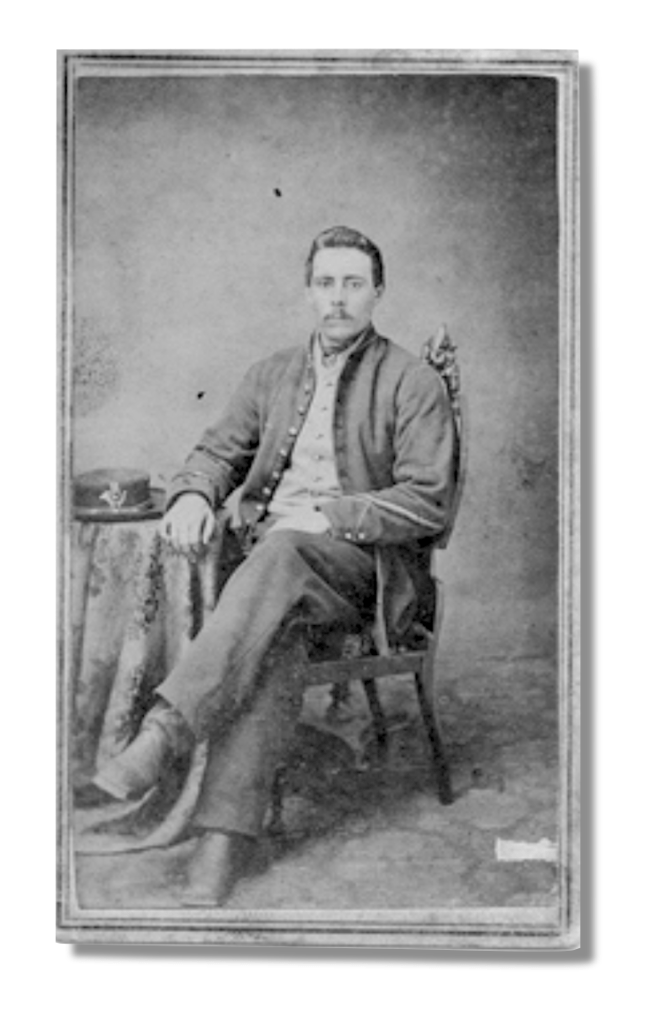
I could not find an image of William but here is one of Francis M. Sconyers of Coosa County who served with William in Hilliard’s Legion and later in the 59th Alabama Infantry. (Case Auctions)
After fighting in the Battle of Chickamauga, Georgia, Sept. 19-20, 1863, the 59th Alabama Infantry was created in November, 1863, at Charleston, Tennessee, from remnants of the 2nd and 4th Battalions, Hilliard’s Alabama Legion. Many of the men from Coosa county who served in Capt. Walden’s Co. B (like Doster) were placed in Co. K of the 59th Alabama. The regiment was assigned to General Gracie’s Brigade, took part in the Knoxville Campaign, then moved to Virginia where it lost heavily at Drewry’s Bluff and in June, 1864, had a force of about 240 men. Later it participated in the long Petersburg siege north of the James River and in various conflicts around Appomattox.
This letter was datelined in early September 1864 from Dinwiddie County. The battle reports of the regiment inform us that “the last two fights” in which the regiment suffered 14 men killed, wounded, and missing referred to skirmishes at Petersburg and the Battle of the Crater.
[Note: This letter is from the private collection of Greg Herr and was transcribed and published on Spared & Shared by express consent.]
Transcription
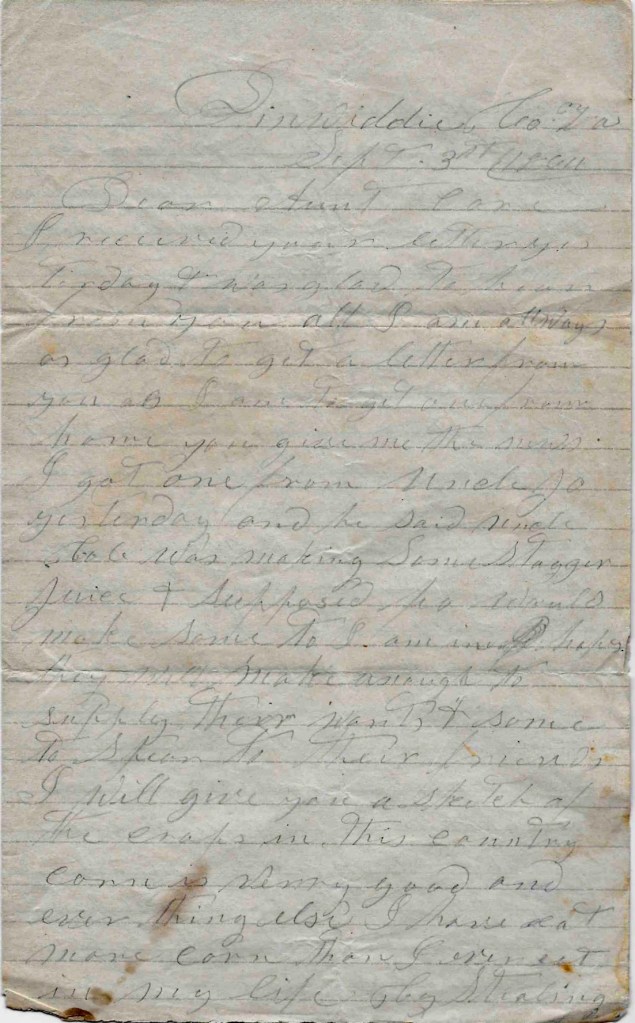
Dinwiddie County, Virginia September 3rd 1864
Dear Aunt Cole,
I received your letter yesterday and was glad to hear from you all. I am always glad to get a letter from you as I am to get one from home. You give me the news. I got one from Uncle Jo yesterday and he said Uncle Cole was making some Stagger Juice & supposed Pa would make some too. I am in hopes they will make enough to supply their wants & some to spare to their friends.
“I got [a letter] from Uncle Jo yesterday and he said Uncle Cole was making some Stagger Juice & supposed Pa would make some too. I am in hopes they will make enough to supply their wants & some to spare to their friends.”
—William H. Doster, 59th Alabama Infantry, 3 Sept. 1864
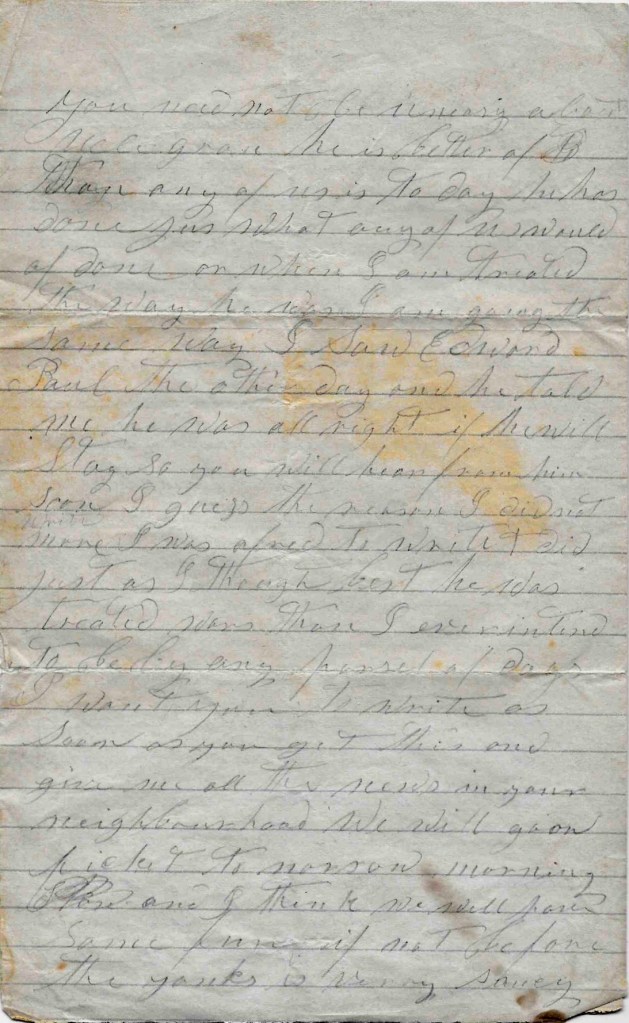
I will give you a sketch of the crops in this country. Corn is very good and everything else. I have not eat more corn than I ever eat in my life. The stealing you need not be uneasy about. Uncle Gran [?] he is better off than any of us is today. He has just what any of us would of done. And when I am treated the way he was, I am going the same way.
I saw Edward Paul the other day and he told me he was all right if he will stay. So you will hear from him soon, I guess. The reason I didn’t write more, I was afraid to write & did just as I thought best. He was treated worse than I ever intend to be by any passel of dogs.
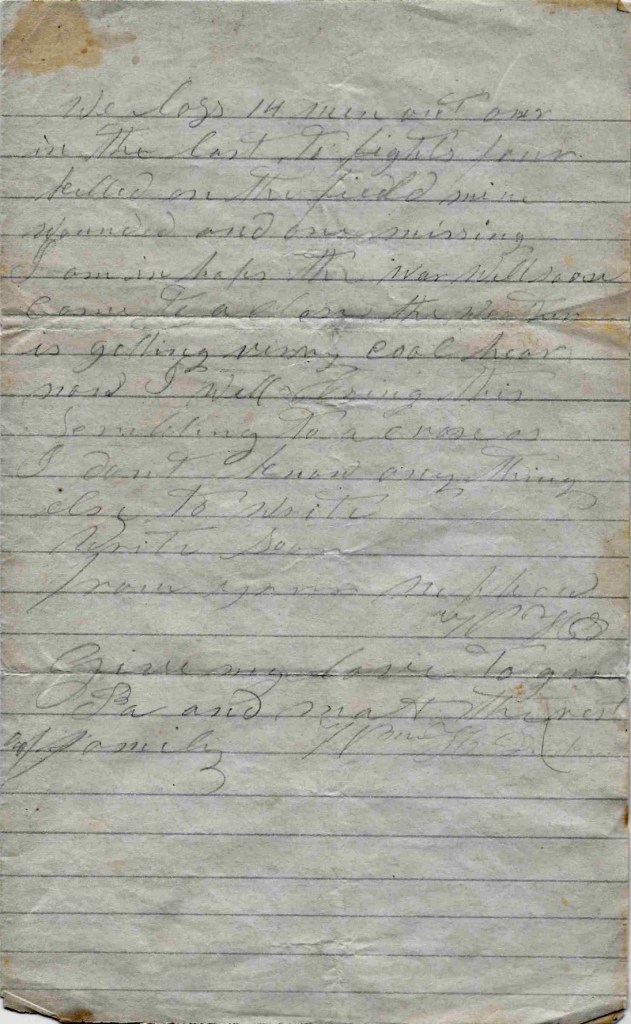
I want you to write as soon as you get this and give me all the news in your neighborhood. We will go on picket tomorrow morning and I think we will have some fun if not before. The Yanks is very saucy. We lost 14 men out in the last two fights—four killed on the field, nine wounded and one missing. I am in hopes the war will soon come to a close.
The weather is getting very cool here now. I will bring this scribbling to a close as I don’t know anything else to write. Write soon. From your nephew, — W. H.
Give my love to your Pa and Matt & the rest of the family.
I could not find an image of Gilson but here is a cdv of Samuel A. Bagley who served in Co. H, 9th Maine Infantry (Photo Sleuth)
This letter was written by Gilson Mendall (1837-1887), the son of Sylvanus Mendall (1807-1872) and Mary Soule (1805-1874) of Canton, Oxford county, Maine. Gilson was married in March 1860 to Elmira Foye. According to enlistment records, Gilson entered Co. F, 9th Maine Infantry as a private in mid-September 1861 and was mustered out as a corporal after three years and 10 months service in July 1865.
The 9th Maine Infantry was organized at Augusta and mustered in September 22, 1861. It proceeded to Washington and briefly served in the Washington Defenses before joining the expedition to Port Royal, SC, attached to the Department of the South. The 9th Maine participated in a number of minor combined operations resulting in the capture of Forts Walker and Beauregard and later occupied Fernandina, Florida. The regiment then shifted to operations at Charleston arriving at Hilton Head in January 1863, assigned to the 10th Corps.
Transcription
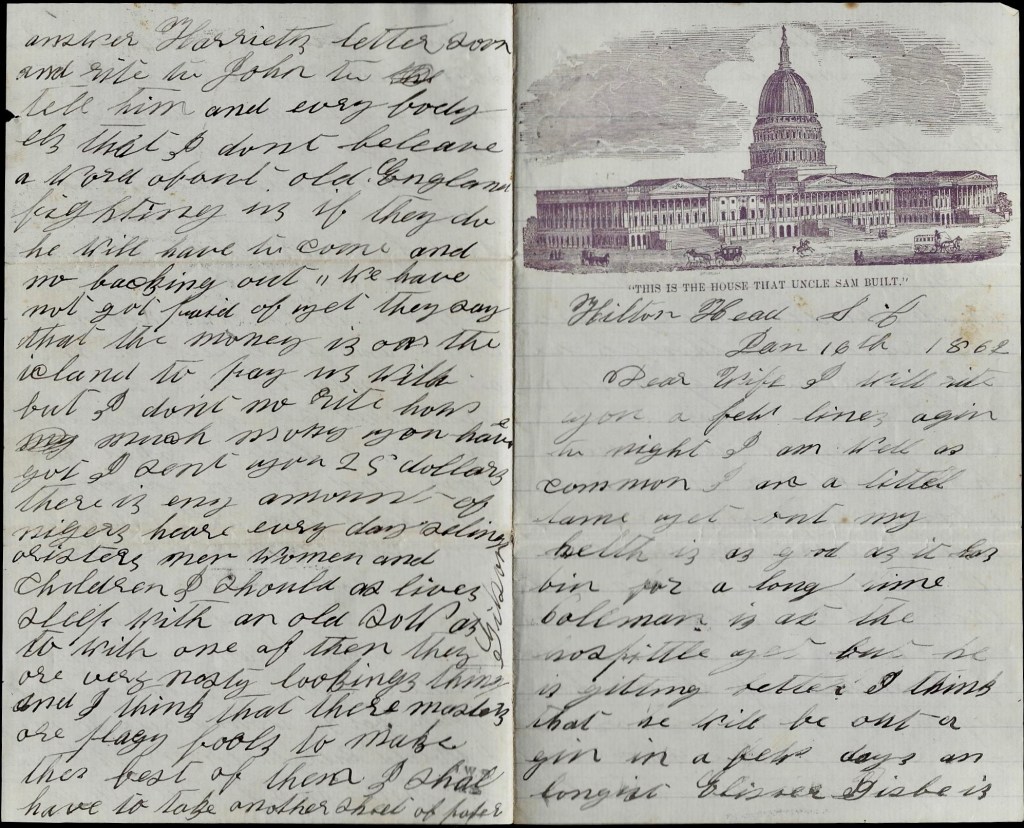
Hilton Head, South Carolina January 16th 1862
Dear Wife,
I will write you a few lines again tonight. I am well as common. I am a little lame yet but my health is as good as it has been for a long time. Coleman is at the hospital yet but he is getting better. I think that he will be out again in a few days at longest. Elisha Bisbee is dead. He died last Monday night. I think they said that it was the typhoid fever that he died with. He was not sick but a few days. I can imagine how his mother will feel. He died very easy—the same as though he was going to sleep. 1
It is very rainy and cold tonight. It seems like October. It rains about half of the time now. The niggers say that it will for about a month. There is a lot of them on the island—a number of hundreds of them.
The report is that we are a going to move soon and I hope we shall for I thought they should be doing something to close this thing up (they won’t let me go into battle for I am lame). They want that I should cook and I think that seeing I have cooked so long that I shall keep. [I also] help on the mail some and we expect it in a few minutes so I will wait and see if I get any letters. I hope I shall. The last that I got from you was dated December 29th. I want you should number your letters on the lower corner. Begin at 1, then 2, 3, 4 and so on. I will do the same. I am expecting a letter from Father. I wish your folks would write to me. I would write to them if I could get time and I will try to answer Harriet’s letter soon and write to John to tell him and everybody else that I don’t believe a word about Old England fighting us. If they do, he will have to come and no backing out.
We have not got paid off yet. They say that the money is on the island to pay us with but I don’t know. Write how much money you have got. I sent you 25 dollars. There is any amount of niggers here every day selling oysters—men, women and children. I should as leave sleep with an old sow as to one of them. They are very nasty looking things and I think that their masters are plagey fools to make the best of them. I shall have to take another sheet of paper. — Gilson
1 Elisha Bisbee of Canton, Maine, was 18 years old when he enlisted as a corporal in Co. F, 9th Maine Infantry. He died on 14 January 1862.
An image of George Hodges on the 7th Michigan Infantry. (Charles Joyce Collection; now in Dale Niesen Collection)
The identity of the soldier from Co. H, 7th Michigan Infantry who wrote this letter cannot be confirmed but my hunch is that it was penned by Elijah C. Eldred (1835-1921) of Oakland county, Michigan. More research would be required to confirm this.
The 7th Michigan Infantry was organized at Monroe, Michigan, in August 1861 and were sent to the Army of the Potomac in September where they were attached to the 3rd Brigade, 2nd Division, 2nd Corps for the duration of the war. The following letter was written in Maryland when the regiment was posted along the upper Potomac.
The 7th was one of the first regiments to cross the Rappahannock River on Dec. 11th, 1862 while under fire from Confederate sharpshooters hidden in the buildings of Fredericksburg.
Transcription
Headquarters Camp Benton 7th Regt. Michigan, Co. H October 18th 1861
Dear Brother,
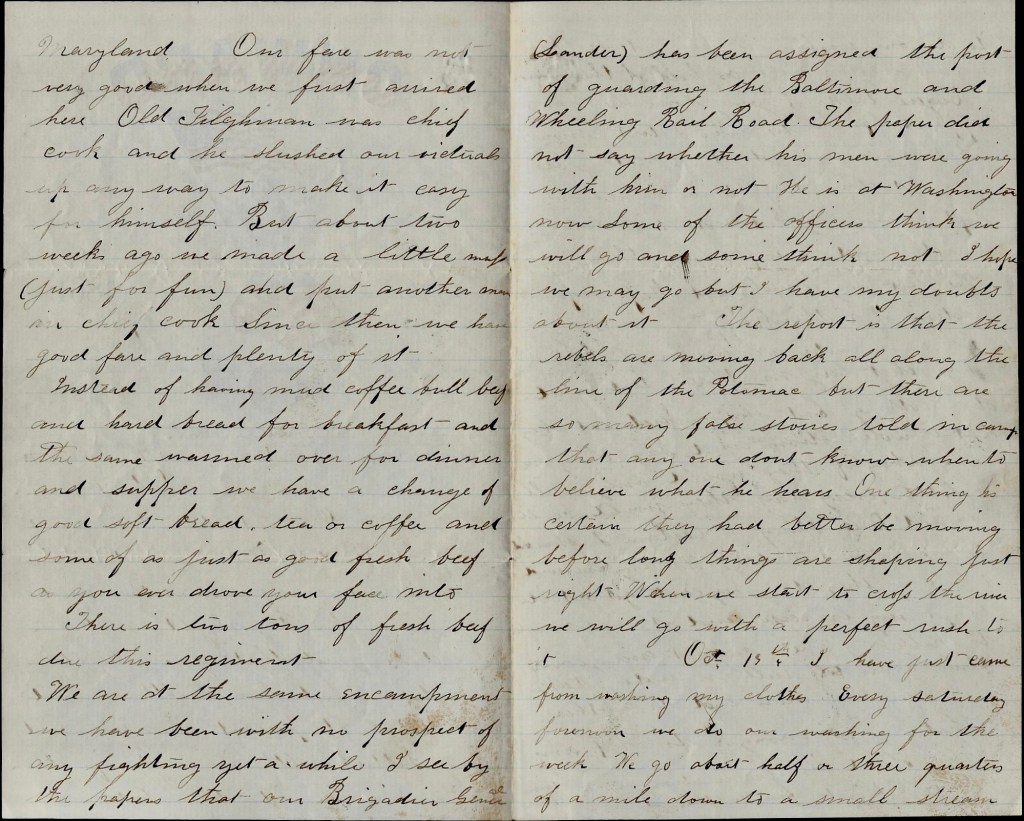
I received your kind letter a short time since and one from Mother and Melvin Tuesday night and am glad to find that your health continues good. My health is good as usual at present. I never had any better health in my life than since I came into the state of Maryland. Our fare was not very good when we first arrived here. Old [James M.] Tilghman was chief cook and he slushed our victuals up any way to make it easy for himself. But about two weeks ago, we made a little mess (just for fun) and put another man in as chief cook. Since then we have good fare and plenty of it.
Instead of having mud coffee, bull beef, and hard bread for breakfast and the same warmed up for dinner and supper, we have a change of good soft bread, tea, or coffee, and some of as just as good fresh beef as you ever drove your face into. There is two tons of fresh beef due this regiment.
We are at the same encampment we have been with no prospect of any fighting yet awhile. I see by the the papers that our Brigadier General (Lander) has been assigned the post of guarding the Baltimore and Wheeling Railroad. The paper did not say whether his men were going with him or not. He is at Washington now. Some of the officers think we will go and some think not. I hope we may go but I have my doubts about it. The report is that the rebels are moving back all along the line of the Potomac but there are so many false stories told in camp that anyone don’t know when to believe what he hears. One thing is certain, they had better be moving before long. Things are shaping just right. When we start to cross the river, we will go with a perfect rush to it.
October 19th. I have just come from washing my clothes. Every Saturday forenoon we do our washing for the week, We go about half or three quarters of a mile down to a small stream to do our washing. I have got so that I can wash as well as half of the women.
Eugene [Clark] talks of going home. He has applied for his discharge. I don’t know whether he will get it or not. He has not done anything since he left Monroe. He did not drill only one day and a half while there. He don’t say much but keeps up a devil of a thinking.
There is quite a number of our boys that lay in their tents and do nothing but sleep and eat. They eat double rations and say they are sick when if they would only drill a little every day, the would be all sound. One thing is certain, I should be sick in two days to lay around the way they do. They can’t get outside to get any exercise and it is enough to kill anyone.We don’t average over two hours drill in a day, take it from one week’s end to another. That is just enough to keep anyone’s blood in circulation.
I will try to finish this at some other time. [unsigned]
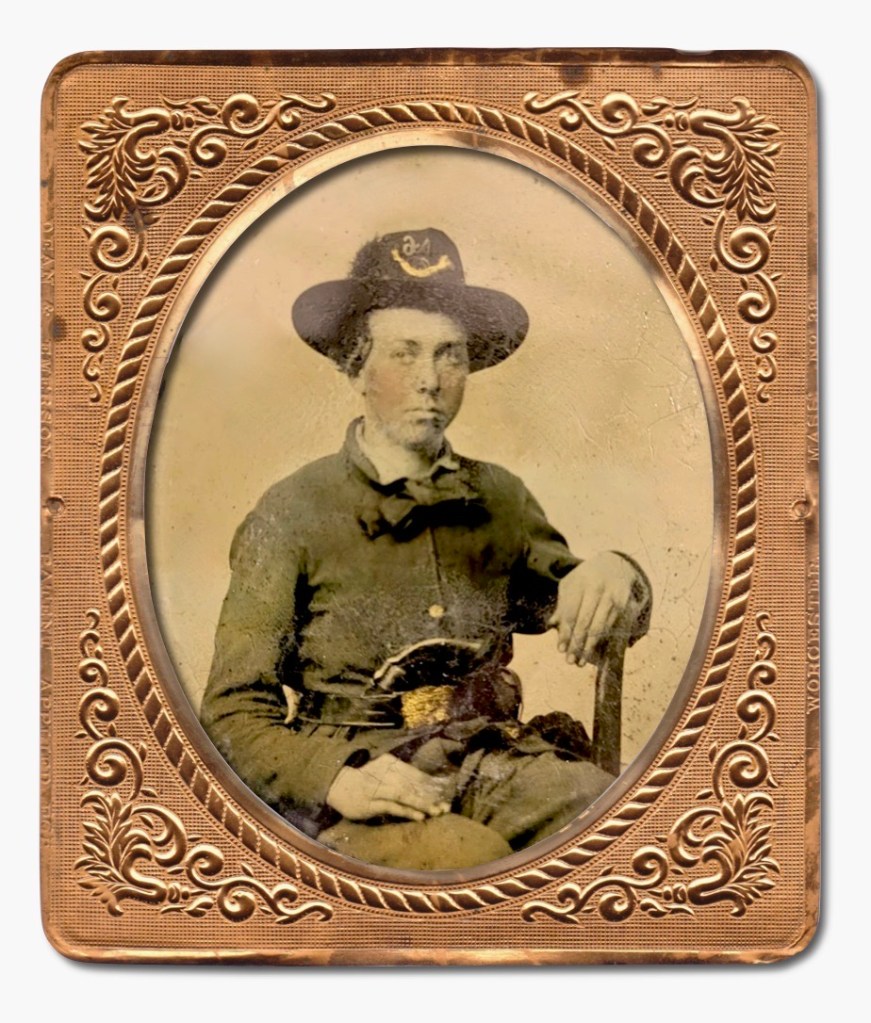
A young, unidentified member of the 46th Ohio appears ready for action. (Carl Fogarty Collection)
The following letter was written by 18 year-old William “Henry” Brink (1843-1920), the son of Calvin B. Brink (1820-1880) and Cornelia Caroline Butts (1823-1903) of Rome, Athens county, Ohio. The family moved to Coatsville, Adams county, Ohio in the 1850s. After the war, Henry married Sarah Amanda Weaver (1854-1938).
Henry enlisted in Co. B, 46th Ohio Infantry on 5 October 1861 and was with the regiment throughout the entire war, mustering out in July 1865 at Louisville, Kentucky. The regiment was organized at Camp Chase in Ohio but were ordered to Paducah, Kentucky, in mid-February 1862, and then taken to Savannah, Tennessee, where they went on an expedition to Yellow Creek, Mississippi, and then to Pittsburg Landing where they took part in the Battle of Shiloh. Following that, they marched on Corinth with Halleck’s army throughout the month of May when this letter was written.
Transcription
U.S. Camp No. 7 May the 24th 1862
Dear Uncle,
I take my pen in hand to inform you that I am well at present and hope that these few lines will find you all the same. We received our pay last week and I sent 15 dollars home. I will send the receipt to you and you can go to the same place when you want for the money.
We have not had any battle since the Battle of Pittsburg [Landing]. There has been skirmishing and I have had the chance to try my gun by myself. We are but a short distance from Corinth where we expect a hard fight. The pickets have been skirmishing five days when we came here on the 21st and put up breastworks. We worked until nearly twelve o’clock at night throwing dirt. We will move tomorrow half a mile farther and throw up some more works. There is a great many men here and our works are 17 miles long and still making them longer. There is five siege guns right close to us. They are 24 pounders and other things called a mortar ( 4 pound shells).
“We cut all the trees down as we go along and tear all the houses down and take the boards to sleep on.”
—Henry Brink, Co. B, 46th Ohio Infantry, 24 May 1862
I have written to John Walton two weeks ago today. Tell him to write. I have not had any letter for a long time. Everything looks very well here. It is a very pretty country. The apples are more than half grown as plenty of them and peaches too. But we cut all the trees down as we go along and tear all the houses down and take the boards to sleep on.
It rained very hard last night and we just had to stay out in it for we had no tents to sleep in and have not had for a month. But I must not tell you all until I get home. Write soon. Tell me how all the folks is a getting along. Tell our folks that I am well. I send my best respects to all enquiring friends—if I have any. Excuse this scribbling for it was a very bad pen. No more at present.
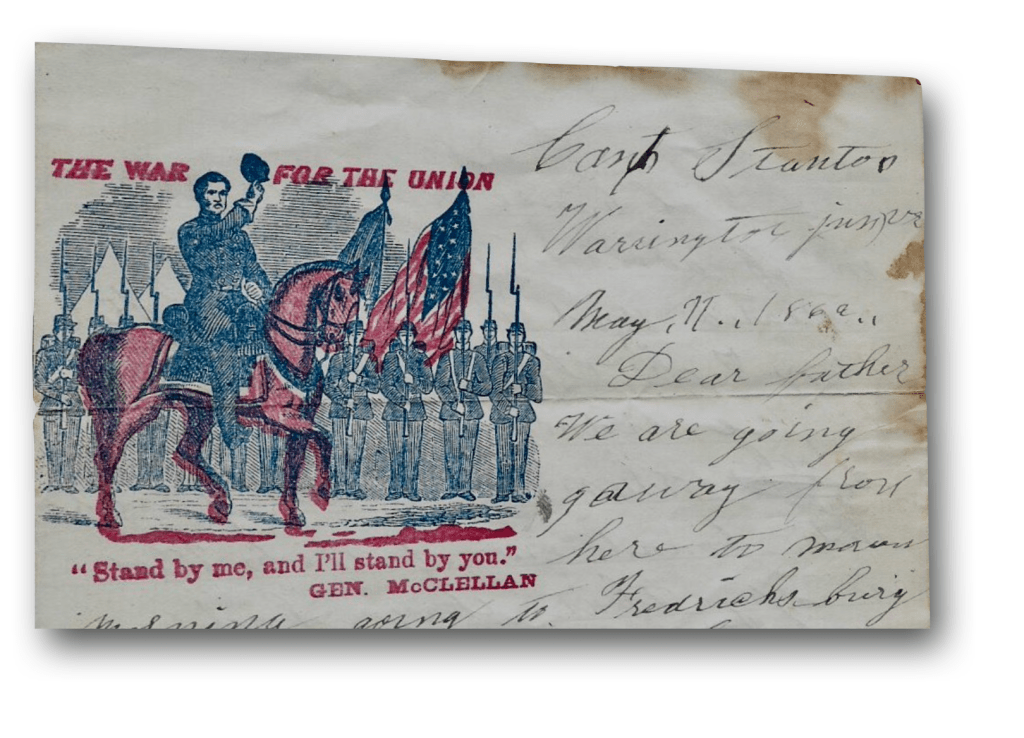
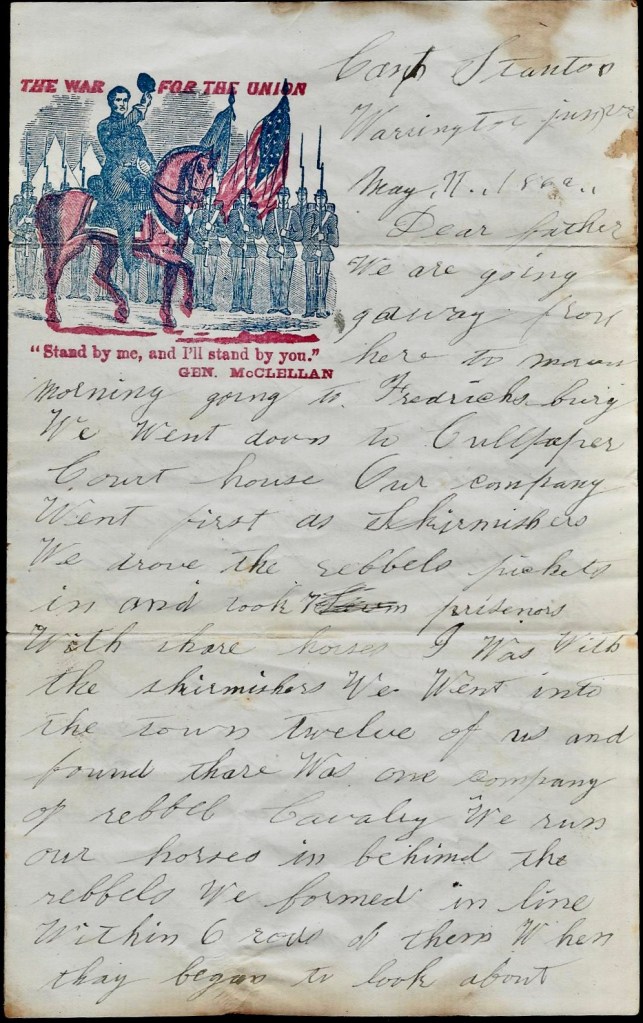
The following letter was written by Henry H. Folsom (1844-1911), the son of Sumner Folsom (1812-1893) and Eliza Sewall Lemont (1816-1894) of Fayette, Kennebec county, Maine. Henry entered his country’s service as the bugler of Co. L, 1st Maine Cavalry in November 1861. Service records indicate he was with his company throughout the war, mustering out at Petersburg, Virginia, in August 1865.
Henry mentions two of his younger brothers, Frank (b. 1846) and Freddie (b. 1852).
Transcription
Patriotic Letterhead in Henry’s letter
Camp Stanton Warrenton Junction, Virginia May 11, 1862
Dear Father,
We are going away from here tomorrow morning, going to Fredericksburg. We went down to Culpeper Court House. Our company went first as skirmishers. We drove the rebel pickets in and took seven prisoners with their horses. I was with the skirmishers. We went into the town—twelve of us—and found there was one company of rebel cavalry. We run our horses in behind the rebels. We formed in line within 6 rods of them when they began to look about for a chance to retreat. In about 5 minutes they retreated and we right after them. Seven of them we got and 70 we did not get.
We took them to headquarters and found one of them was a spy that they had taken before and swore allegiance. They will hang him. They sent him to Washington.
I have been paid but not so much as I expected. I lost some things coming from Augusta. I dare not send any money for I have wrote three letters and have not got an answer yet. Give my love to Mother and Frank and Fred and tell them I shall be home soon. Tell Frank to write. From your son, — Henry H. Folsom
Camp Stanton, Virginia
Sumner Folsom
I am in a hurry or I would write more. Let me know whether you have got your pay or not.
The following letters and diary track the movements of Pvt. Gustavis (“Gus”) Davis Bates (1823-1903) of Plymouth, Massachusetts, who enlisted in Co. D, 38th Massachusetts Infantry. He was discharged from the University Hospital in New Orleans, Louisiana, for disability on 5 August 1863.
Gus was well educated—an 1850 graduate of Brown University—and was enumerated in the 1850 US Census as a lawyer in Plymouth, Massachusetts but in August 1862 when he enlisted to serve his country he was a 38 year-old county school teacher. His regiment was transported to Louisiana in the Bank’s’ Expedition and fought at Fort Brisland in March 1863, where a large contingent from the regiment were captured and briefly held as prisoners of war. “Gus” was admitted to University Hospital at New Orleans on April 9, 1863 and remained there until medically discharged from the army on Aug. 5, 1863. His diary entries from May and June 1863 suggest that though he might have been marginally capable of being returned to service in the field, his doctors found his nursing skills to be of greater value to the military and so he was kept at University Hospital until his discharge.
Gus was the son of Comfort Bates III (1791-1876) and Elizabeth Pierce (1792-1878) of Plymouth, Massachusetts. Gus was married in 1848 to Nancy Doten Finney (1828-1896) and had at least three boys living at the time of his enlistment—Charles Hubbard Bates (1849-1918), Josiah Finney Bates (1851-1918), and Alfred Merton Bates (1858-1933). After the war, Gus returned to teaching school in Plymouth.
There are four documents in this archive: A letter dated 19 November 1862 written from Fortress Monroe enroute to Louisiana; a diary fragment from the passage from Baltimore to New Orleans; a letter dated from New Orleans on January 7, 1863; and a diary fragment written at University Hospital in New Orleans in May and June 1864 during the fighting at Port Hudson.
1
Adams Express Co. Fortress Monroe, Va. November 19th 1862
Dear Wife,
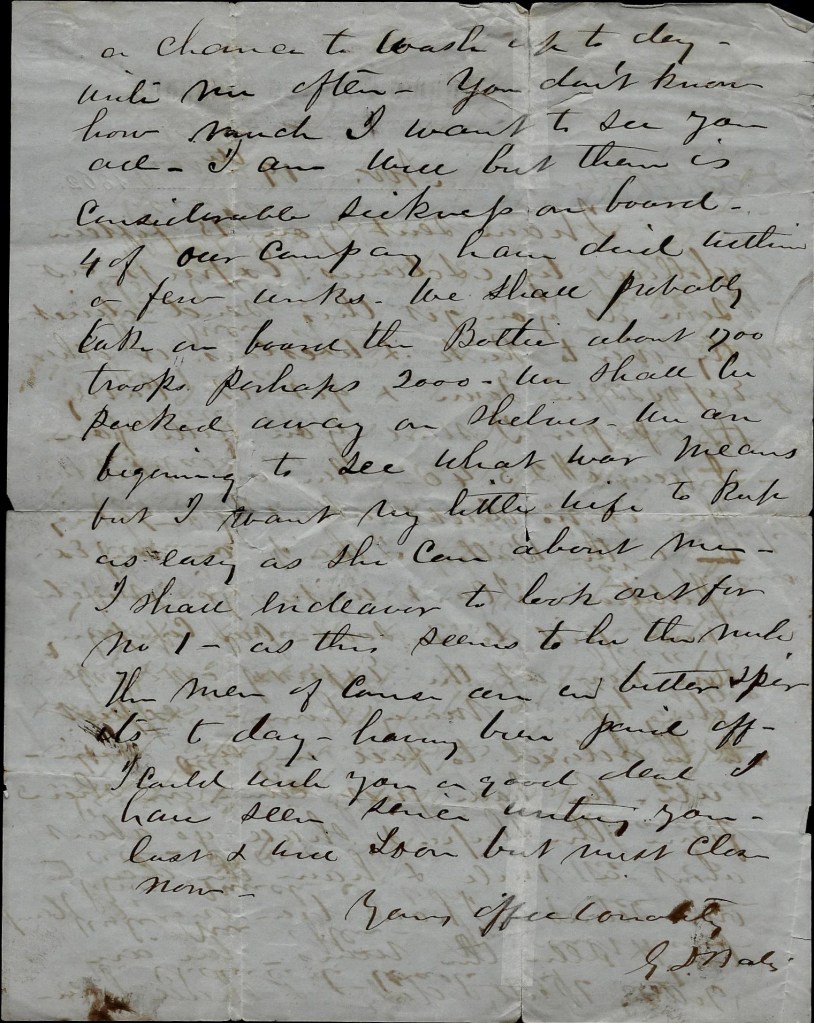
I have sent you $15 (fifteen dollars) by Adams Express. As soon as you get this, send directly over to Rich & Westars or other express in town & get it. Carry the paper I send you with you. I received $23.40.
We are still here. There is no doubt about our going in the Baltic, I think on an expedition. I can’t write you much now. Will do so soon. Our company are now at the Express Office sending their money home. Expect to be ordered to fall in any minute. We have just come on here from the ship & shall go about a mile to hair the day to ourselves. I have been over to Hampton and also the rivers. We are getting pretty dirty & shall have a chance to wash up today. Write me often. You don’t know how much I want to see you all. I am well but there is considerable sickness on board. Four of our company have died within a few weeks.
We shall probably take on board the Baltic about 1700 troops—perhaps 2,000. We shall be packed away on shelves. We are beginning to see what war means but I want my little wife to keep as easy as she can about me. I shall endeavor to look out for No. 1 as this seems to be the rule.
The men of course are in better spirits today having been paid off. I could write you a good deal I have seen since writing you last & will soon but must close now. Yours affectionately, — G. D. Bates
2
The U.S.S. Steam Ship Baltic
Steam Ship Baltic, Fort Monroe
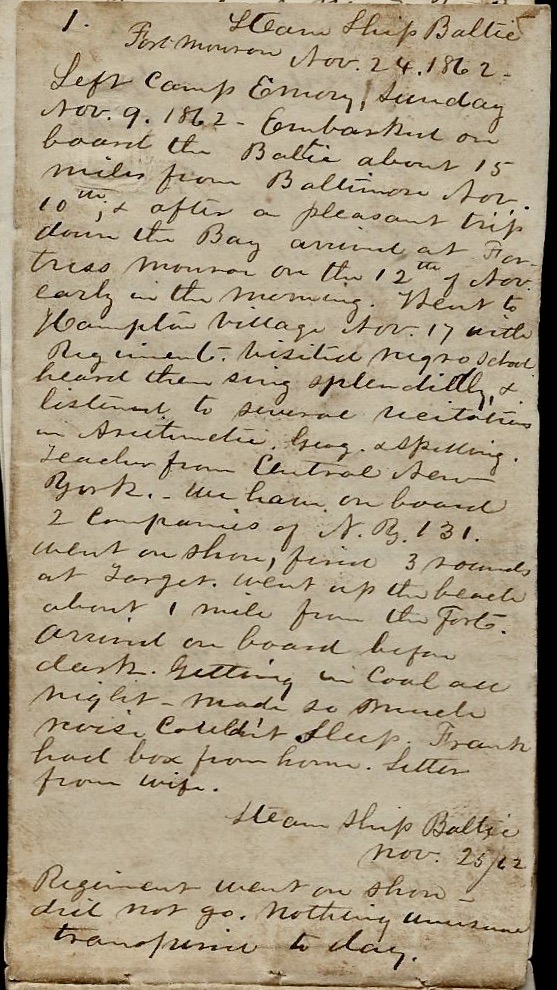
November 24, 1862—Left Camp Emory Sunday November 9, 1862. Embarked on board the Baltic about 15 miles from Baltimore November 10th; and after a pleasant trip down the Bay, arrived at Fortress Monroe on the 12th of November early in the morning. Went to Hampton Village Nov. 17th with regiment.
Visited Negro School. Heard them sing splendidly & listed to several recitations in Arithmetic, Geography, & Spelling. Teacher from Central New York.
We have on board two companies of New York 131st. Went on shore. Fired three rounds at target. Went up the beach about 1 mile from the fort. Arrived on board before dark. Getting in coal all night. Made so much noise, couldn’t sleep. Frank [Bates] had box from home. Letter from wife.
Steamship Baltic—November 25, 1862—Regiment went on shore. Did not go. Nothing unusual transpired today.
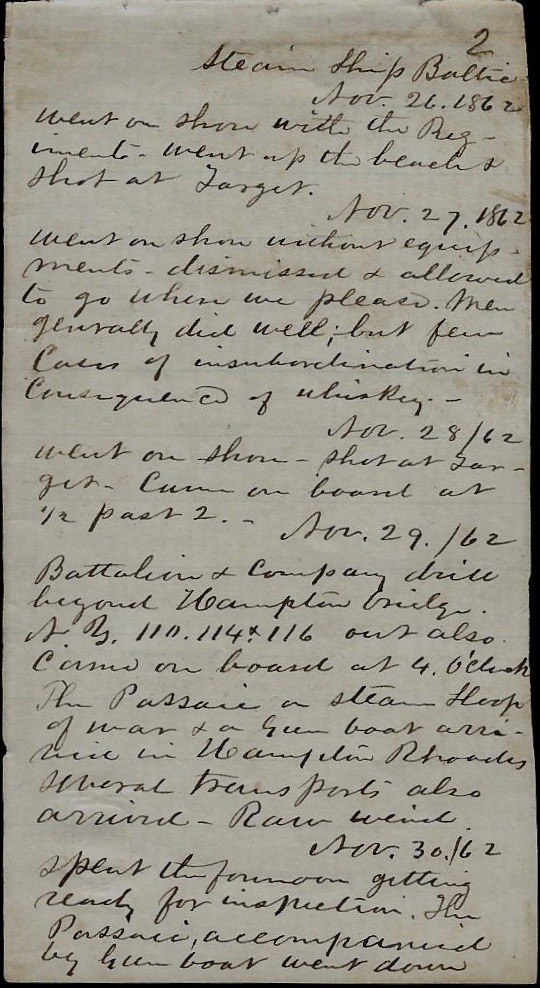
November 26, 1862—Went on shore with the regiment. Went up the beach and shot at target.
November 27, 1862—Went on shore without equipments—dismissed and allowed to go where we please. Men generally did well, but few cases of insubordination in consequence of whiskey.
November 28, 1862—Went on shore. Shot at target. Came on board at half past 2.
November 29, 1862—Battalion & Company drill beyond Hampton bridge. New York 110th, 114th, and 116th [regiments] out also. Came on board at 4 o’clock. The Passaic—a steam sloop of war, & a gunboat arrived in Hampton Roads. Several transports also arrived. Raw wind.
November 30, 1862—Spent the forenoon getting ready for inspection. The Passaic accompanied by gunboat went down the Bay about noon. Quite a stir among the gunboats.
December 1, 1862—Inspection this forenoon. Very Pleasant.
December 2, 1862—On board all day. Indian rubber blankets delivered to the regiments this afternoon. 80 rebel prisoners arrived from Baltimore [who] were well dressed. Gave up cartridges today. Commenced raining about noon. General inspection of quarters by physician. Complaints made & remedies promised. Member of company buried.
Steam ship Baltic, Fort Monroe—December 3, 1862—On board all day. Rainy. The fleet ordered to be in readiness to sail and are making preparations to go to sea.
December 4, 1862—A. S. Russell came on board. Fleet got under way this morning. Men securely fastened & preparations are being made for the coming storm.
Steam Ship Baltic at Sea
December 5, 1862—Wind dead ahead. Ship labors hard. Deck very wet. Spray covered the forward part of the ship blowing a gale. A great deal of seasickness on board. Off Hatteras, encountered a severe gale. The sea breaking completely over the starboard wheelhouse & drenching the men forward, accompanied with vivid lightening & crashing thunder. The rain poured down in torrents & at one time the ship was in great peril—the ship running very high and ship straining every timber to keep on her course.
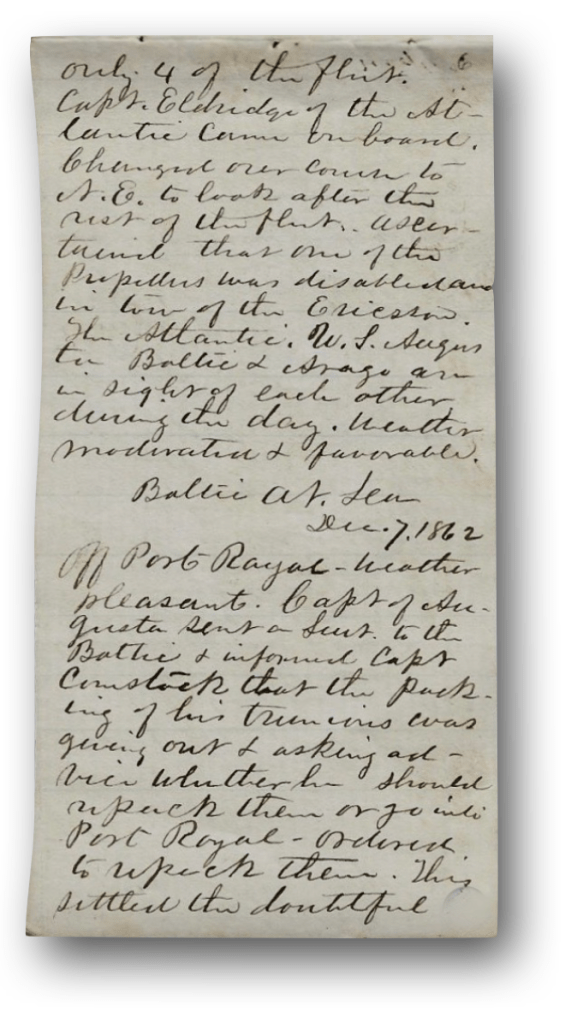
December 6, 1862—At sea. In the morning signaled only 4 of the fleet [in sight]. Capt. Eldridge of the Atlantic came on board. Changed our course to northeast to look after the rest of the fleet. Ascertained that one of the propellers was disabled and in tow of the Ericsson. The Atlantic, U. S. Augusta, Baltic & Arago are in sight of each other during the day. Weather moderated & favorable.
Baltic at Sea
December 7th 1862—Off Port Royal—weather pleasant. Capt. of Augusta sent a Lieutenant to the Baltic & informed Capt. Comstock that the packing of his trunchions [?] was giving out & asking advice whether he should repack them or go into Port Royal. Ordered to unpack them. This settled the doubtful point whether we were going into Port Royal or not. Sent up rockets in the night. Several responses. Having pleasant view. The living on board is very poor & our accommodations are very contracted. The men are scattered over the deck reading, writing, playing cards & chattering together, most of them having recovered from sea sickness & being in good spirits.
At Sea on Baltic
December 8, 1862—Weather fine. Course S. S. W. The remainder of the fleet do not come up. general inspection aft. Inspection of men took off right boot & stocking. Saw three sail towards night. off St. Augustine towards night.
[Page missing, December 9-11, 1862]
At Sea, December. 12, 1862—Warm and pleasant. Fine run last night & today. Nothing unusual has occurred.
At Sea. December 11 [should be 13th], 1862. The Baltic hove to above 4 o’clock in the night. saw the land early in the morning. Arrived at Ship Island at 1 o’clock today. Atlantic went over the bar first. Baltic struck heavily on the bar going in. Gunboat Augusta came in soon after the Baltic. The U. S. Arago, S. R. Spaulding, arrived before us. Some 15 or 20 sail were in port. The U. S. left soon after we arrived. Mataras [?] arrived at 2 o’clock p.m. Capt of Augusta came on board & accompanied General Emory on shore. S. R. Spaulding left in the afternoon. Several vessels left and several arrived during the day.
Ship Island
December 14th, 1862—Commenced going on shore this afternoon. General Banks with the 41st Massachusetts left in the North Star at noon. On board the Baltic all night.
41st Massachusetts soldiers on board the North Star while anchored at Ship Island in December 1862
December 16, 1862—Ship Island. Went on shore this morning in boats ay Ship Island. Encamped about half mile from the wharf on the sand. 23rd Connecticut encamped here. 16th New York and two companies of 13th Maine doing garrison duty. There are about 50 rebel prisoners here. Drew rations of coffee & sugar. Went down the beach and got a good stove. Saw Robert Finny of The Kensington.
From December 16 to 27 [1862]—At Ship Island drilling, Had frequent conversations with rebel prisoners, most of whom were anxious to have the war brought to a close & join the Union. Others would settle on [nothing] but recognition. Six men from each company was detailed to cut wood on the Island about 4 miles from camp. Israel Thrasher 1 of our company went.
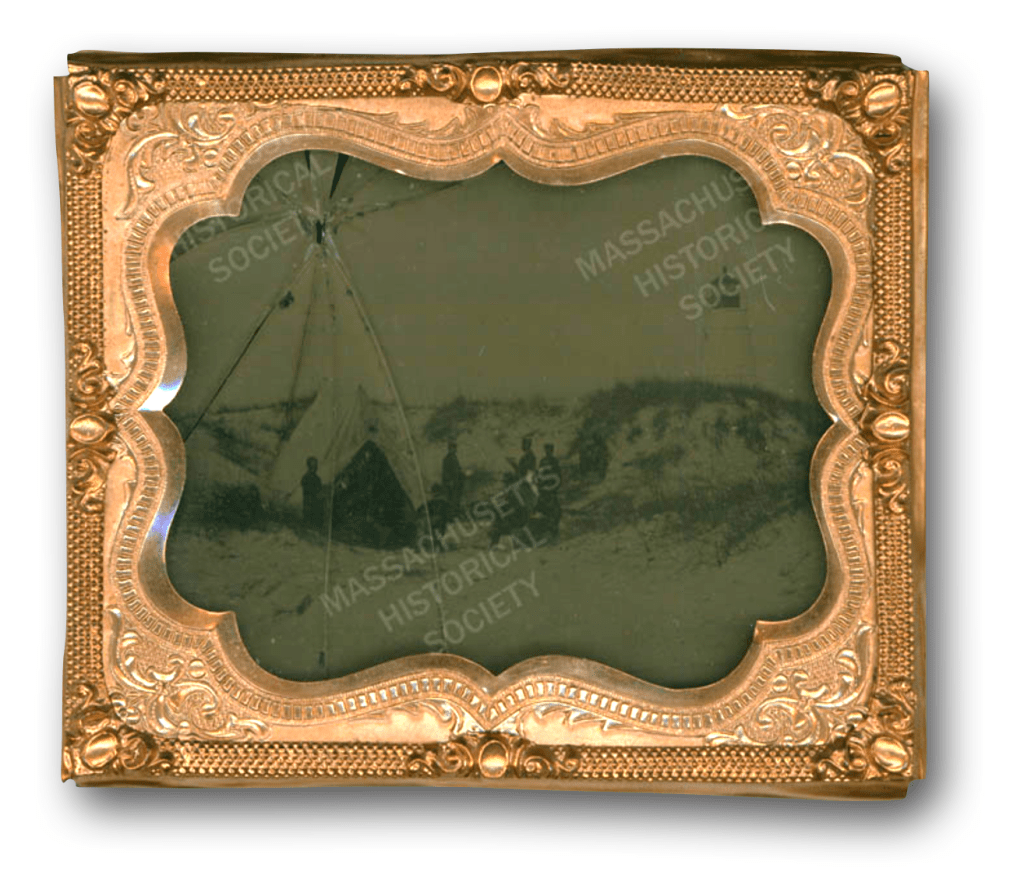
This ambrotype depicts members of the 38th Massachusetts Volunteer Infantry Regiment at camp on the beach of Ship Island, Miss. during the Civil War. The photograph was taken in Dec. 1862 by an unknown photographer and probably was owned by Francis William Loring, a lieutenant with the regiment; an inscription on the verso of the image reads, “Field & Staff 38th M.V. FW Loring Ship Island, Miss. Dec. 25, 1862.” Photo. 2.97 Removed from the Francis William Loring papers[Digital Commonwealth, Massachusetts Collection On Line]
Ship Island, December 27, 1862—Went up the beach with Israel Thrasher, gathered shells & visited the graveyard. Most of the names were between 18 and 25 year old. Mostly from Maine. Indiana, Wisconsin, Connecticut, Vermont, New Hampshire, & Massachusetts were represented among the dead.
Ship Island—December 29, 1862—The North Star, Northern Light, & Illinois came in this morning. Had orders to move. Went on board the Northern Light about 12 o’clock at night.
Steamship Northern Light
December 30, 1862—After some delay in getting off, left Ship Island this morning at 8 o’clock in the Northern Light. Quartered in the forehold. Better accommodations than in the Baltic. Several cases of measles on board. Had a fine run all day & during the night.
Steam Ship Northern Light, Mississippi River. December 31, 1862—Entered the [river] about 9 o’clock this morning. Had a good passage up the river and arrived at New Orleans not far from 7 o’clock in the evening.
1 Israel H. Thrasher was also from Plymouth. He died on 29 June 1863 at New Orleans from wounds received in the fighting at Port Hudson on 14 June 1863.
3
Camp Kearney At Greenville near New Orleans January 7, 1862 [should be 1863]
Dear Wife,
I send you within $20 (twenty dollars) by Adams Express. I can’t write you much now. Shall write you by mail. We are encamped here 4 miles from the city and about 8 by the river. We like the camp better than any camp we have been in. The weather here is pleasant most of the time, not comfortably cool night, so that I am not cold with overcoat & blanket.
We have three days rations ordered to be cooked & 10 days on hand all the time. I think I can send you 4 or 5 dollars now. Shall do so in my letters. It costs 65 cents to send this to Plymouth. I received two letters from you dated 7th and 16th of December. Your Uncle Henry is right, I think about the wood. Pay it.
Lt. Col. David K. Wardwell—“When Wardwell went, the fighting talent went also.”
We arrived here last Thursday, laid over one night in the city, and came up here next day. Whether we shall go up or down the river is uncertain. I shall endeavor to write you once a week about Sunday. If we move, I shall write about the time of moving. Should anything unusual take place, I shall let you know. I think the Colonel will try to have us stay at New Orleans. Col. [Timothy] Ingraham is acting as Brigadier General and the 38th is commanded by Lieut. Col. [William L.] Rodman. When [David Kilburn] Wardwell went, the fighting talent went also.
But I must close. Frank [Bates] 1 and I are well. Tom Savery 2 is sick with the measles [which are] prevalent in camp.
Your affectionate husband, — G. D. Bates
1 Francis (“Frank”) Bates was also from Plymouth. He served as a musician in Co. D, 38th Mass., until 30 January 1864 when he was discharged at Baton Rouge for disability.
2 Thomas G. Savery of Plymouth survived his bout with the measles only to be wounded at Port Hudson on 14 June 1863 and discharged at Boston for disability on 28 December 1863.
4
The remaining diary entries were all penned in the University Hospital at New Orleans
University Hospital, New Orleans
May 27, 1863—About 150 men from this hospital ordered away to their respective regiments. Packing up in the afternoon. Showers during the day.
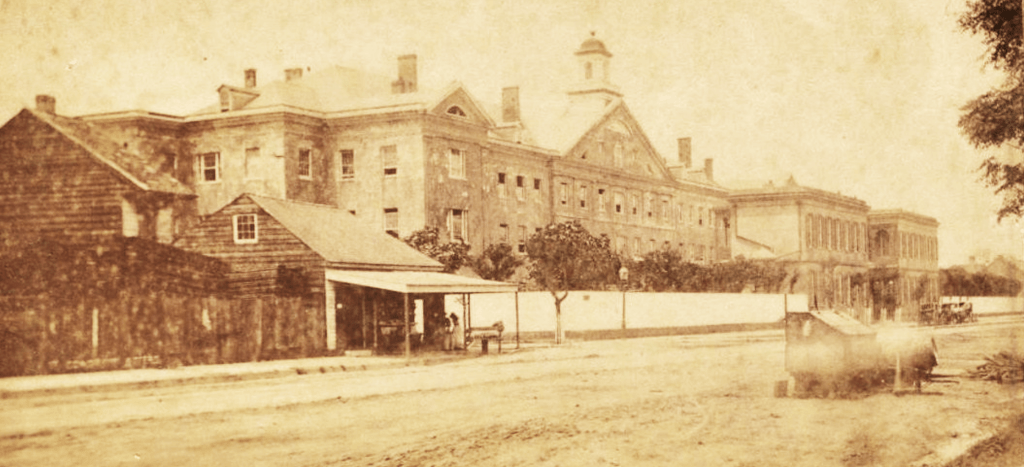
Thursday, [May] 28th, 1863—Packed my knapsack & put things in readiness to go to the regiment. All the men were ordered into the front hall to answer to their names. No questions were asked me by [Asst. Surgeon] Dr. [Samuel H.] Orton but he ordered me back to room. Unpacked knapsack & put things in [ ] for a further sojourn at this institution. Removal into another war. Saw several wounded pass the hospital. Among them General [Thomas W.] Sherman. Reported also that Neal Dow is killed & General [Christopher C.] Augur wounded at Port Hudson. Several doctors came round at 10 o’clock in the eve and took names to send off. About 120 went today. Papers contain accounts from rebel sources of fights at Port Hudson & Vicksburg. Sent letter home, No. 12. Fletcher, Nye & Laws of the 38th in Ward K went off today. [George H.] Fish of Co. D & H[oratio] Sears of Co. G. [George W.] Belcher of [Co. A], 38th [Mass.] sent back. [Albion] Leavitt of 26th Massachusetts went off also who was in Ward K. Become acquainted with Mr. Burbeck of East Abington.
Friday, May 29th, 1863—Rained last night. Pleasant this morning. Became acquainted with George Bates of Worcester, Co. 130. Wounded, came from Baton Rouge. [Was] on the fight at Port Hudson. Heard of the death of Lt. Col. [William L.] Rodman of the 38th [Massachusetts]. No one could be found to take charge of the regiment. Rumored death of Gen. Paine. Shower in the afternoon accompanied with thunder and lightning. About 70 men left the hospital this afternoon. Joe Loring, Otis Foster, & Israel H. Thrasher went off [back to the regiment] today. Only one left of Co. D in this hospital. Seven transported in the evening.
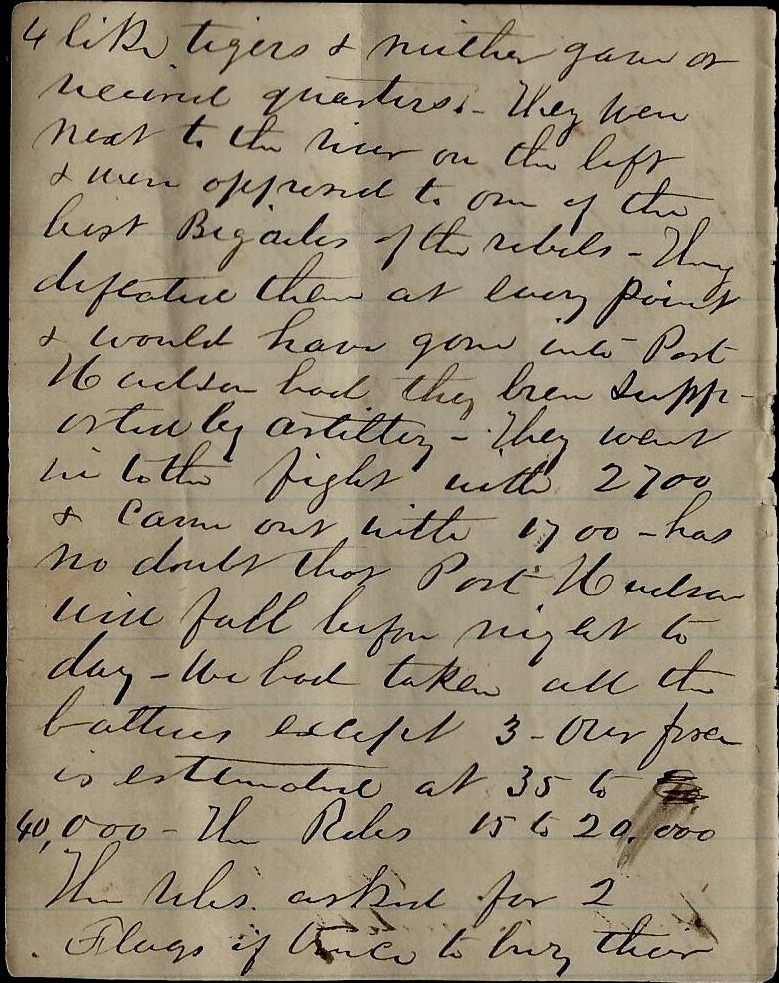
Saturday, May 30th 1863—Hard thunder and rain this morning. Talked with wounded sergeant of 131st New York. 1 Thinks when he left [Port Hudson] there were 3,000 killed & wounded on our side. Represents the fighting as the most desperate of the war. The Negro Brigade fought like tigers & neither gave or received quarters. They were near to the river on the left & were opposite to one of the best brigades of the rebels. They defeated them at every point & would have gone into Port Hudson had they been supported by artillery. They went into the fight with 2700 and came out with 1700.
1 The wounded sergeant was probably one of four men: 22 year old Hector Sears of New York City was 1st Sergeant of Co. I. He was wounded in the fighting at Port Hudson on 27 May 1863; 23 year-old Sgt. Paulis Van Version of Co. F thought the date of his wound was not given; 27 year-old Sgt. James Devlin of Co. F, who was wounded at Port Hudson; or 31 year-old Sgt. William Boxberger of Co. D who was wounded on 27 May 1863 at Port Hudson. One of them would have been the source of the information provided Bates about the “the Negro Brigade.” See poem by John A. Morgan entitled, The Black Brigade at Port Hudson.
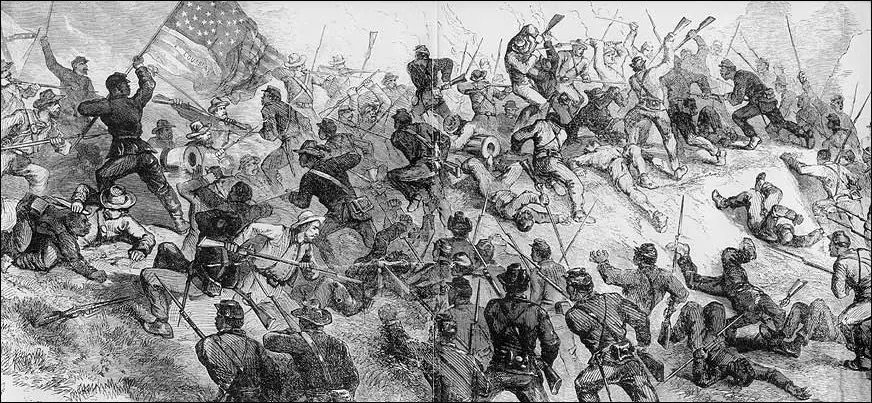
“In May 1863, the 1st and 3d Corps D’Afrique attacked the Confederate stronghold of Port Hudson, Louisiana. After previous units failed to break through the Confederate defenses, Brig. Gen. William Dwight ordered the African American units to attack a strong point along the western edge of the Confederate line. The units crossed a short bridge, bordered on their right by the Mississippi River and on their left by entrenched enemy sharpshooters and cannons. The Louisiana troops, led by freedman Capt. Andre Cailloux, assaulted the position under withering fire. Cailloux, wounded twice, led his soldiers until mortally wounded by a cannon ball just outside the breastworks. The assault withdrew and successfully laid siege to the Confederate garrison until it’s surrender six weeks later. Cailloux’s gallantry under fire became a rallying cry for African American and white Soldiers alike throughout the rest of the war.“
Black troops attack the Confederate line at Port Hudson
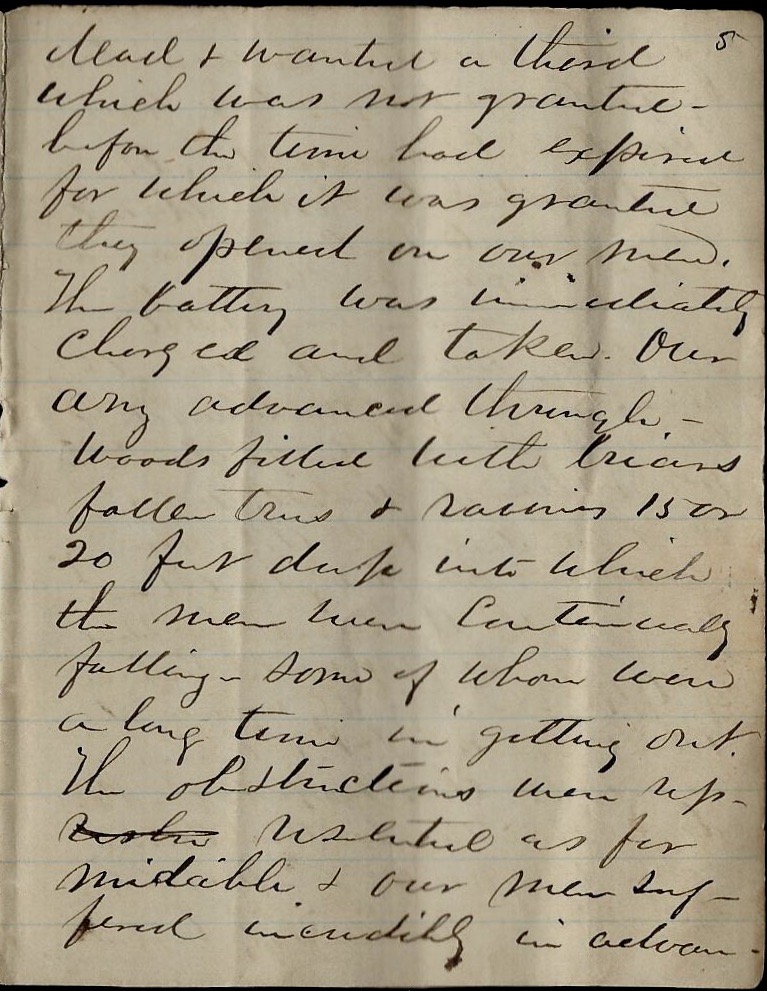
Has no doubt that Port Hudson will fall before night today. We had taken all the batteries except three. Our force is estimated at 35 to 40,000. The Rebs at 15 to 20,000. The Rebs asked for two flags of truce to bury their dead and wanted a third which was not granted. Before the time had expired for which it was granted, they opened on our men. The battery was immediately charged and taken. Our army advanced through woods filled with briars, fallen trees, ad ravines 15 or 20 feet deep in which the men were continually falling—some of who, were a long time in getting out. The obstructions were represented as formidable & our men suffered incredibly in advancing on the enemy who are strongly posted in every advantageous position, commanding the approaches to Port Hudson. No doctor came round today. Warm and pleasant.
Sunday, May 31, 1863—The tables were full again this morning, many of the wounded being well enough to go down. Went through wards where the wounded are this morning. Saw but one very bad case wounded in the head—looked very bad. Talked with [Corp. Lewis M.] Bailey of Co. G, 38th [Mass.] [who was] slightly wounded [at Port Hudson]. About 200 wounded have arrived at this hospital. Hot day. Dr. McLellan came round—No. 452, Ward E, 3rd Story, University building.
University Hospital—June 1, 1863, New Orleans. Hot day. Siege of Port Hudson still going on. General Banks receiving reinforcements. All the wounded men concur in the opinion that Port Hudson must fall soon. Dr. Conner in charge of the Hospital, having returned from Baton Rouge. Quince arrived 26 days from New York.
June 2, 1863—Continues hot. Letter from home [dated] May 17th. A few wounded continue to arrive from Port Hudson.
January 3rd 1863—Warm and pleasant. Letters from home [dated] April 26th, also April 30th. B. F. Hathaway called.
June 4th 1863—Wrote letter No. 13 home. Hot day. Nothing unusual. Papers contain nothing.
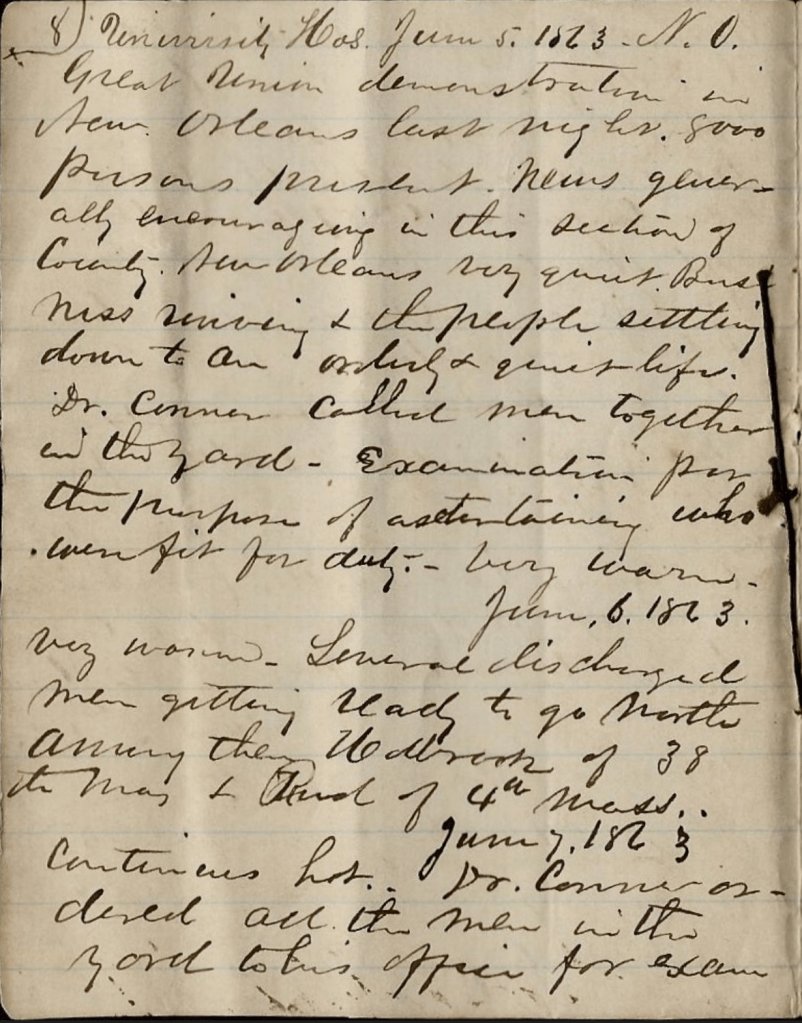
University Hospital, June 5, 1863, New Orleans. Great Union demonstration in New Orleans last night. 8,000 persons present. News generally encouraging I this section of the county. New Orleans very quiet. Business reviving and the people settling down to an orderly & quiet life. Dr. Conner called men together in the yard. Examination for the purpose of ascertaining who were city for duty. Very warm.
June 6th, 1863—Very warm. Several discharged men getting ready to go North. Among them [Corp. Nathaniel O.] Holbrook of [Co. C], 38th Mass. and [Jedediah M.] Bird of the 4th Mass.
June 7th, 1863—Continues hot. Dr. Conner ordered all the men in the yard to his office for examination. 15 or 20 men from the hospital North discharged.
Monday, June 8th 1863—Very hot. 40 or 50 men discharged to regiment today. All the men at supper table ordered to Dr. Conner’s office after supper. Went. Was told to go back to Ward & keep quiet. Took a large number of names for regiment & for light duty about the hospital.
Tuesday, June 9th 1863—Continues hot & dry. Sixty men packed up to leave for regiments. Ordered back & remained over night. Doctor did not come round until after supper.
University Hospital, June 10th, 1863—Continues very warm. 40 or 50 men left this morning for up the river. General Wentzel’s Division defeats the Rebs in rear of our forces at Port Hudson & droves them to Liberty.
June 10th 1863—Cooler. Nothing of importance.
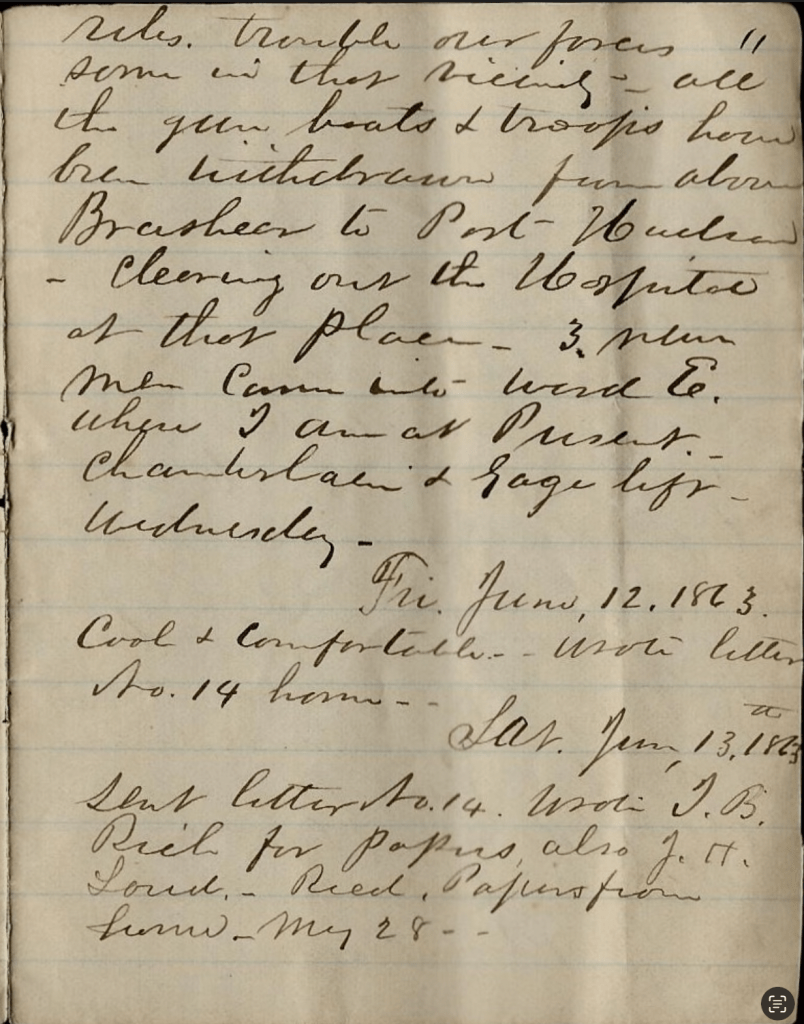
June 11th 1863—Showery. Cooler. Some thunder. Put up cistern in the hospital. Fifty men arrived at hospital from Brashear City. Learn from them that the Rebs trouble our forces some in that vicinity. All the gunboats and troops have been withdrawn from above Brashear to Port Hudson. Clearing out the hospital of that place. Three new men came into Ward E where I am at present. Chamberlain and Gage left Wednesday.
Friday June 12th, 1863—Cool and comfortable. wrote letter No. 14 home.
Saturday, June 13th 1863—Sent letter No. 14. Wrote T. B. Rich for papers. Also J. H. Loud. Received papers from home date May 28th.
University Hospital, June 14, 1863—Comfortable weather. Dr. Conner came round this morning and notified several that he was going to send them home. Said but little to me. Was accompanied by Dr. McLellan who is now practicing in Ward E where I am at present. Had a talk with Quince. Informed me that Israel H. Thrasher & Foster had left Barracks Hospital. Col. [Timothy] Ingraham went home [to New Bedford] today. Several came to the hospital from Brashear City. Had a long talk with Petra of Co, B, 38th [Mass.] Read the scriptures most of the day. Place my dependence on God and try to do my duty & be reconciled to my situation.
Monday, June 15th 1863—Shower in the afternoon. Some thunder. Quite comfortable. Read New York Herald‘s first account of fight at Port Hudson. Some chill today. Received letter from wife of May 31st.
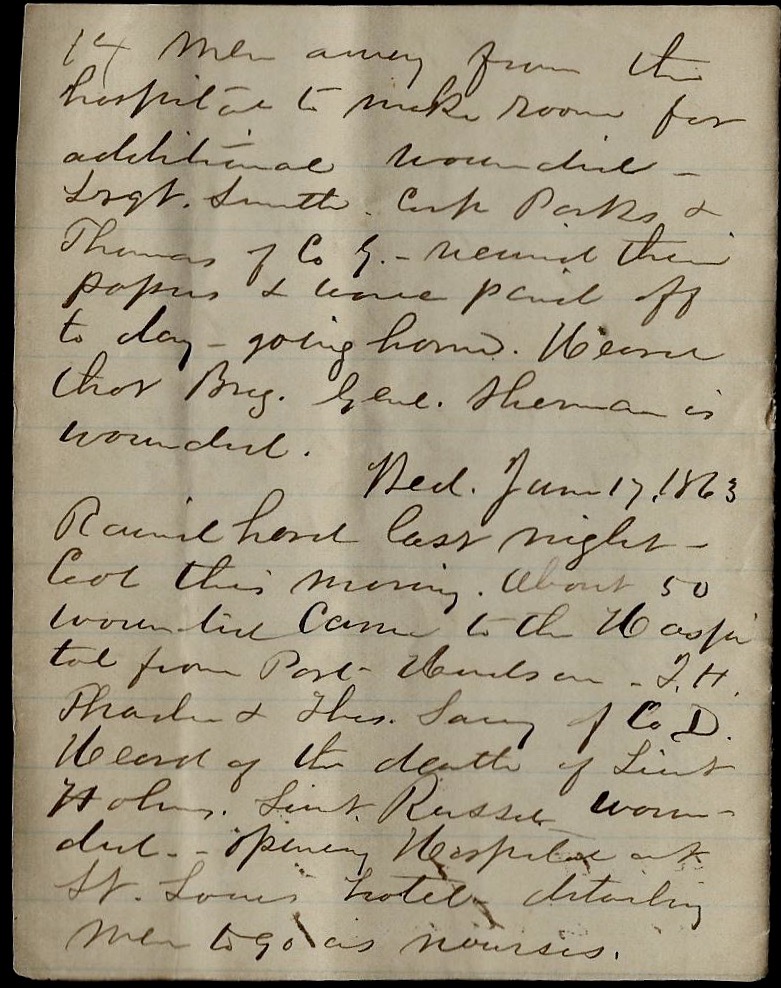
Tuesday, June 16th 1863—Cool this morning. Exciting news from Port Hudson. Few particulars. Sent letter No. 15 home. Rained hard in the eve. Some thunder and lightning. Exciting rumors from Port Hudson. 4th Wisconsin Infantry entirely used up. Talking about sending men away from the hospital to make room for additional wounded. Sergt. [Joseph] Smith, Corp. Parks, & [George W.] Thomas of Co. G received their papers & leave, paid off today & going home. Heard that Brig. General Sherman is wounded.
Wed., June 17th 1863—Rained hard last night. Cool this morning. About 50 wounded came to the hospital from Port Hudson [including] Israel H. Thrasher & Thomas Savery of Co. D. Heard of the death of Lieut. Holmes, Lieut. [George B.] Russell wounded. Opening hospital at St. Louis Hotel. Detailing men to go as nurses.
University Hospital, June 18th 1863—Clear, hot day. About 60 wounded from Port Hudson came to hospital yesterday and today. Thirty or more discharged men left in Matensas for the North, among them [George W.] Thomas of Co. G, and Sergt. [Joseph] Smith of the 38th Mass. Several men left to go as nurses at the St. Louis Hospital. Doctor did not come round today. Reinforcements from Key West, 26th and 47th Mass, went up the river to Port Hudson. Papers contain nothing of movements, successes or reverses in this department. All the information to be had is derived from wounded men whose stories differ so much that but little can be relied on them. Weitzel had has got within fortification at Port Hudson & holds his position.
Friday, June 19th, 1863—Hot day, Several men detailed for St, Louis Hospital. Sent for in the morning by Dr. Conner. Wished me to send down my cord [?] which I did. [George W.] Belcher & [John] Peters were also sent for by the Doctor.
Saturday, June 20th 1863—Sent letter No. 16. Received letter from home [dated] May 24th. Rumors of the Rebs burning 4 or 5 steamers on the Bayou Plaquemine. Heard firing Thursday night up the river. Boats going up the river take on board guns and protect themselves with plating around the pilot house.
The following letter was written by Henry S. Olney (1831-1907), a 2nd Lieutenant in Co. G, 3rd Rhode Island Heavy Artillery from February 1862 to August 1862, six months and 5 days, serving as the regimental quartermaster. When this letter was written in November 1863, Henry had been discharged from the service for 15 months and was working as a manufacturer in South Scituate, Providence county, Rhode Island.
Henry was the son of Amos Atwell Olney and Elizabeth Williams. He wrote the letter to Col. Edwin Metcalf of the 3rd Rhode Island Heavy Artillery. At the time of this letter, the 3rd Rhode Island Heavies were still stationed on Morris and Folly Islands near Charleston, South Carolina.
[Note: This letter is from the private collection of Greg Herr and was transcribed and published on Spared & Shared by express consent.]
Transcription
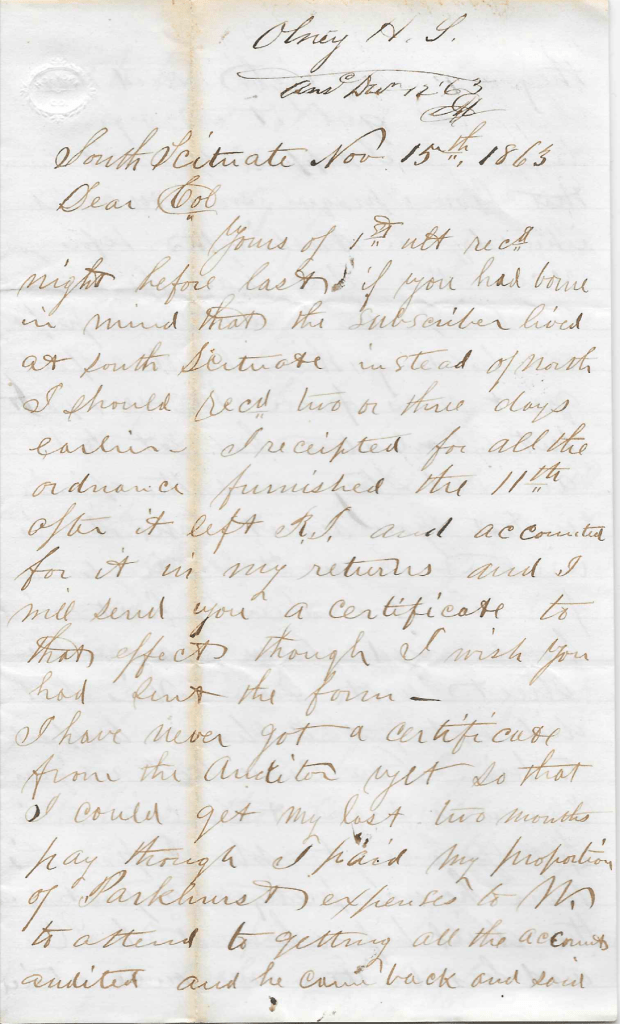
South Scituate November 15th 1863
Dear Col.,
Yours of the 1st ult. received night before last. If you had borne in mind that the subscriber lived at South Scituate instead of North, I should have received it two or three days earlier. I receipted for all the ordnance furnished the 11th after it left Rhode Island and accounted for it in my returns and I will send you a certificate to that effect though I I wish you had sent the form.
I have never got a certificate from the auditor yet so that I could get my last two months pay though I paid my proportion of Parkhurst expenses to W. to attend to getting all the accounts audited and he came back and said they are all right and that I should get it in a few days.
I suppose you will. know that Gov. Sprague was married Thursday in Washington before you receive this. That is all the news of much importance just now. People are holding their breath expecting great news from Meade & Grant but Charleston has got to be an old story and the opinion is that you won’t take it this winter.
I saw Lt. Col. [Charles R.] Brayton a few minutes when he first arrived home and I saw Day in the street with some ladies but did not get a chance to speak to him. How came he to resign?
There is a Sergeant [James W.] Slocum in Co. L of your regiment who is from this town. He was pretty well posted in the drill before he went to South Carolina and has written me once or twice to try and get him promoted. I wish if you can you would give him a lift. He is a pretty good fellow & more deserving of shoulder strop than many that wear them. If you don’t want him there, please recommend him for the 14th [Corps]. Some of the 11th [Corps] are going out in the 14th & some in the 3rd Cavalry.
Thomas, I see, has a 1st Lieutenancy—this is wonderful, isn’t it. I should have thought Parkhurst would have kept him out. I was sorry I could not have seen you and had a long talk when you were North & intended to have done so but I was starting the old mill & did not have much time to stay in town. Write me again sometime. Please remember me to Brayton. Tell [him] he owes me a letter.
The following letter was written by Pvt. Manly N. Hoyt (1831-1862) of Co. G, 6th Vermont Infantry. Manley was born in Bolton, Vermont. He enlisted in October 1861 and died of chronic diarrhea on 18 July 1862.
The 6th Regiment, recruited from the state at large, was mustered into the U. S. service for three years at Montpelier, Oct. 15, 1861, and immediately ordered to Washington, where it arrived on the 22nd. It proceeded at once to Camp Griffin, where it was attached to the Vermont Brigade. The command remained at this post during the winter and broke camp on March 10, 1862, for the Peninsula Campaign. On April 6, 1862, at Warwick creek, Va., the regiment was first in action, fortunately without loss. The brigade was first a part of the 4th and later of the 6th Corps, with which it was generally known. In the battle of Golding’s farm the 6th won complimentary mention from Gen. Hancock. The loss at Savage Station was severe.
Transcription
Patriotic Stationery used by Manly Hoyt
Camp Griffin Fairfax county, Virginia February 13, 1862
Kind friends,
I embrace this opportunity to drop you a few lines to let you know that I am well and wish those few lines will find you all the same.
9 February, the rebels come in sight of our pickets. Our cavalry give chase [and ] captured 15 of them.
The 12th, 26 negro slaves come into camp. It would have done you good to seen those animal kept people free [?] We have not been out on any scout lately.
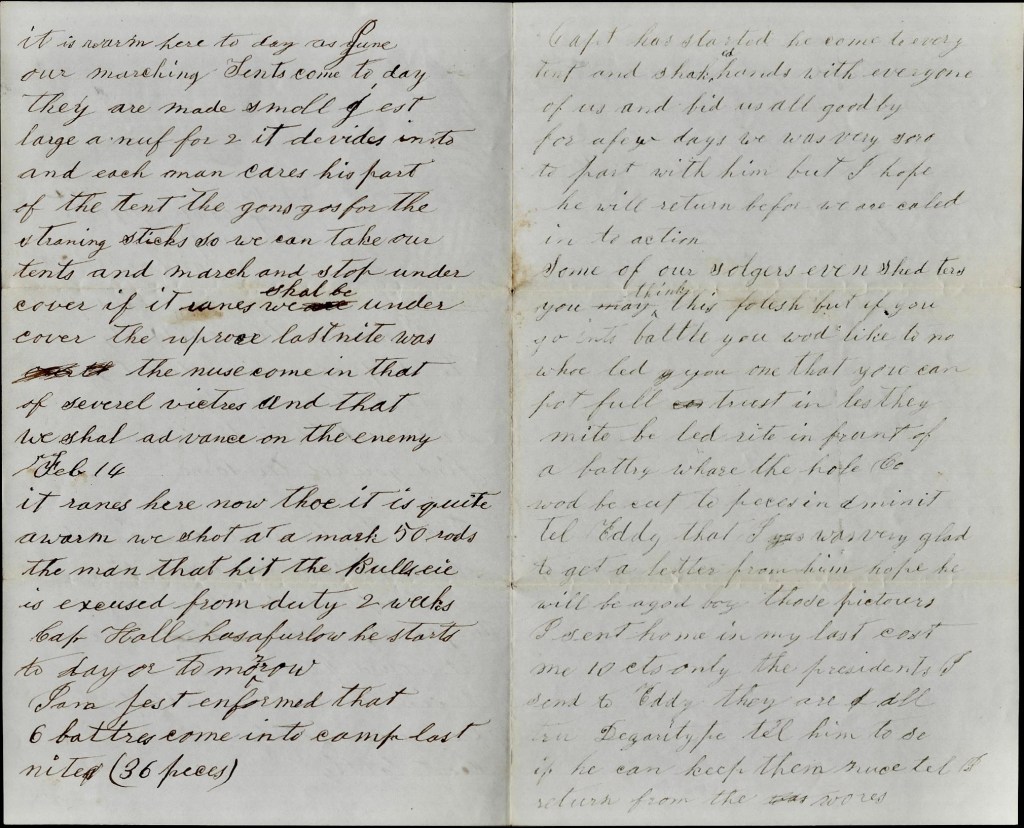
It is warm here today as June. Our marching tents come today. They are made small. Just large enough for two. It divides into [two halves] and each man carries his part of the tent. The gons gos [?] for the straining sticks so we can take out tents and march and stop under cover. If it rains, we shall be under cover.
The uproar last night was the news came in that of several victories and that we shall advance on the enemy.
February 14. It rains here now though it is quite warm. We shot at a mark 50 rods. The man that hit the bullseye is excused from duty two weeks. Captain [William Henry Harrison] Hall has a furlough. He starts today or tomorrow.
I am just informed that 6 batteries come into camp last night (36 pieces). Capt. has started. He come to every tent and shake hands with everyone of us and bid us all goodbye for a few days. We was very sorry to part with him but I hope he will return before we are called into action. Some of our soldiers even shed tears. You may think this foolish but if you go into battle, you would like to know who led you—one that you can put full trust in lest they might be led right in front of a battery where the whole company would be cut to pieces in a minute.
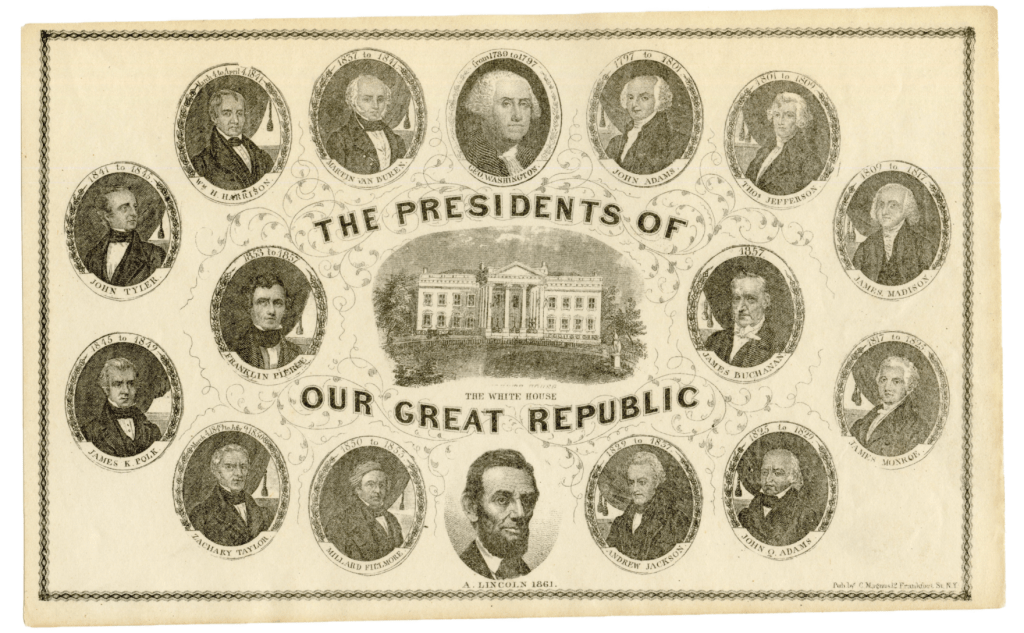
Tell Eddy that I was very glad to get a letter from him. Hope he will be a good boy. Those pictures I sent home in my last cost me 10 cents only. The Presidents I send to Eddy. They are all through daguerreotype. Tell him to see if he can keep them nice till I return from the war.
The picture of the Presidents may have been one like this CDV that sold recently on Fleischer’s Auctions for $850
Those rings are some I whittled out when I han’t nothing to do. So I thought I would send them to you. It has stopped raining. Write often. Don’t be discouraged. write how times is and all the news you can.
The following letter was written by Pauline DeForest (b. 1840) of Pennsylvania. Paullin enlisted in 1866 at Philadelphia to serve three years in the 3rd US Cavalry. He was discharged at Fort Wingate, New Mexico in 1869 and then reenlisted in 1869 at Santa Fe, New Mexico for three more years in the 3rd US Cavalry. He was discharged on February 17, 1872 at Indianapolis, Indiana, as a first class private. This does not appear to be his final stint in the service, however, as there are subsequent military records for him. He claims to have been a soldier since 1861 but I cannot find any Civil War record for him.
Paullin wrote the letter to Miss Florence H. Crowell of Newark, New Jersey. The content of the letter suggests to me that the correspondents barely knew each other. I believe this may be an example of a “pen pal” arrangement wherein Florence responded to an advertisement placed by Paullin in a New York newspaper seeking a correspondent.
Transcription
Addressed to Miss Florence H. Crowell, 37 East Broad Street, Newark, New Jersey
Fort Bayard, New Mexico January 9th 1867
Miss Florence H. Crowell, Newark, N.J.,
Your letter came to hand on the 29th of last month. You can scarcely imagine the pride it has given me to hear from you but do not deem me impudent for writing again to you. I consider it very fortunate for myself when I get any letters to wile away time. Possibly you may think I am very trifling when I say “wile away time” but you can scarcely imagine the influence a letter from the States has over me. It seems as if I were conversing with one personally and goodness knows that a verbal conversation is more to my taste than that of writing. I have always heretofore considered letter writing a bore. That was the conclusion I had arrived at when I was in the Army before. But now the case is entirely different.
Here one is isolated from friends and civilization entirely while on the other hand only a few hundred miles intervened betwixt myself & friends and communication easy, mails more regular than here. Mails from this Post has to have an escort of not less than ten men, well-armed, and always detailed from the company to which I belong on account of the depredations the Indians commit. They are famous for stealing and shooting who may be on the road and if there were a smaller party with the mail, it would be jumped very quickly. It is only the force that prevents and Indians in this country dread the seven shooters that cavalrymen are armed with. The Indians have been roaming in small parties and are very much enfeebled at present. In fact, the late war in the States has played them out considerably. A great many of them joined the Confederate army in Texas and in this territory and they have been cut up to a great extent.
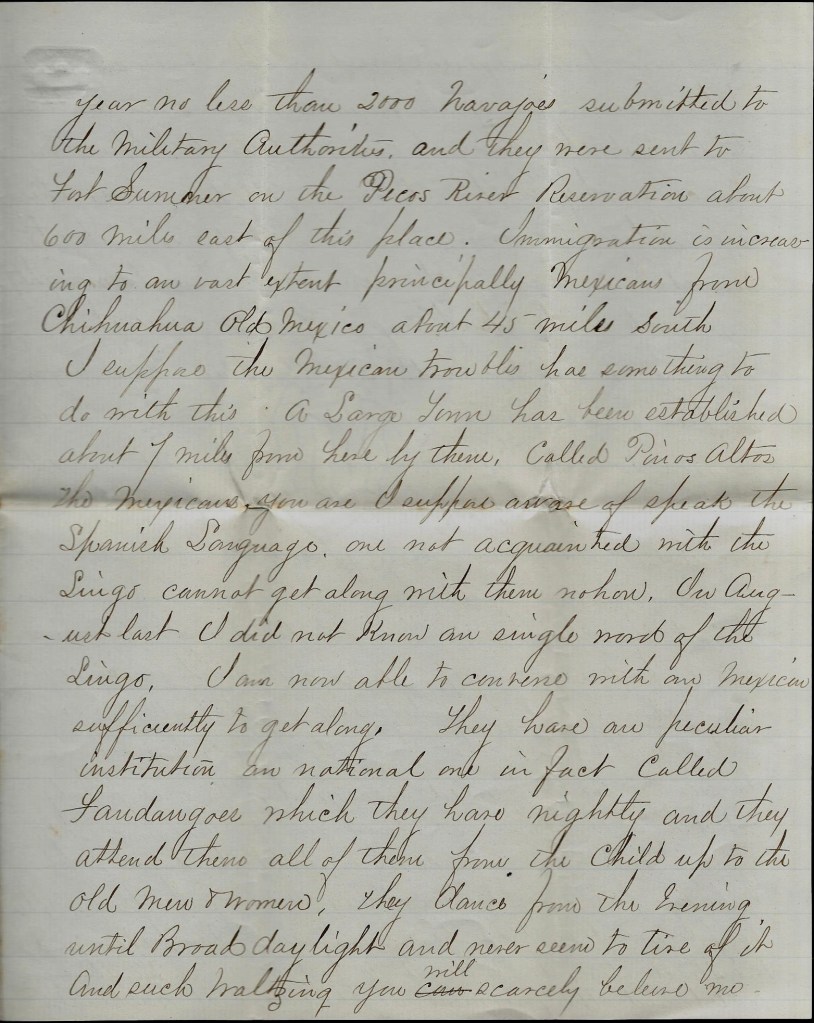
The late Civil War is in a manner beneficial to the Indian. It has helped to get rid of them and one thing they do know—that the Great Father in Washington is able to clean them out. This accounts for the little or no depredations on the citizens last year. No less than 2000 Navajos submitted to the military authorities and they were sent to Fort Sumner on the Pecos River Reservation about 600 miles east of this place.
Immigration is increasing to a vast extent, principally Mexicans from Chihuahua Old Mexico about 34 miles south. I suppose the Mexican troubles has something to do with this. A large town has been established about 7 miles from here by them called Pinos Altos. The Mexicans you are, I suppose aware of, speak the Spanish language. One not acquainted with the lingo cannot get along with them nohow. In August last, I did not know a single word of the lingo. I am now able to converse with a Mexican sufficiently to get along.
They have a peculiar institution—a national one in fact—called fandangoes which they have nightly and they attend them, all of them from the child up to the old men & women. They dance from the evening until broad daylight and never seem to tire of it. And such waltzing. You will scarcely believe me when I say it is unequaled, not in the States at least. I have seen some of the finest of dancing in the States but they cannot come up to the Spanish dancing. They chiefly dance among themselves. The reason why the Americans do not dance with the señoritas is because the señors have such weighty arguments in the shape of stilletos. They—the Mexicans—are proverbial for their jealousy in regards to their female portion of friends and look with hatred towards all foreigners, and will not allow if they can help it any interferences from Americans.
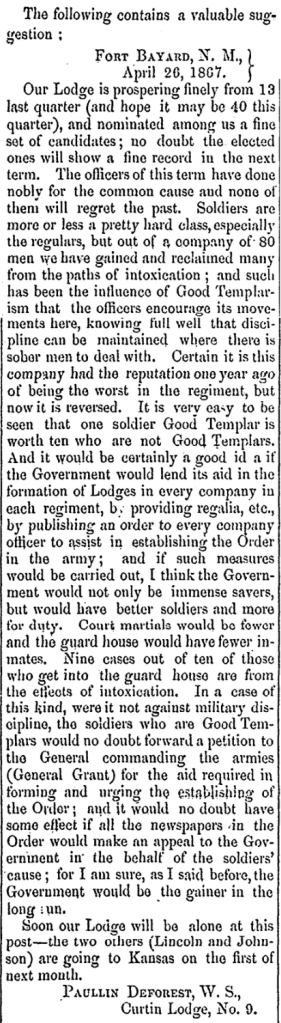
Article appearing in the Weekly Rescue on 20 July 1867 (Sacramento, California) pertaining to DeForest’s activities in the Good Templars.
I am sure no explanation was needed in reference to Mr. McDonald, and I do assure you that I had thought that no young lady of any education would have any correspondence with such an uncouth youngster as he appeared to be, and I think you are justified in saying that he ought to be where [he] belongs. The service does not need renegades; there is plenty yet, I hope, that has an interest in the welfare of this country and that have cause to desert the same. Yet I always feel sorry to hear of any deserting the flag after the government is at an heavy expense to equip them and to instruct them. Then to desert is just as much of an act to defraud the government as those who at Washington or elsewhere are doing by the wholesale. Since January last, there has been 63 deserted from this company alone, and the proportion is just the same throughout the whole Regiment. Now there is 12 Companies and say the average desertion since the beginning of last year is 50 to each company. That would be 600 men in the regiment who have deserted. [If] each one of these deserters generally disposes of his horse & arms, very nearly $400 worth of material belonging to the government, the sum total is a very great loss not only to Uncle Sam but to the citizens tax paying.
I am quite sorry that I have nothing of very importance to write about and as to being an hero, that is entirely out of my range. I have no ambition for such a title. To obtain [it] would cost too much time and too much hard labor. As Artemus Ward says, it is not my forte. There is certain kinds of heroism that is never looked at. Now there is the ball rom dandy. He is a hero who suffers more than he does not near the tightest of calf skin boots and does he not suffer from the fashion that prevail and never so much complains. There is a hero. Again I might write pages concerning heroes both great and small. But my true ideal of an hero is a moral hero who neither mingles with the wine bibbers or bible scoffers—a true, upright, conscientious, God-fearing person, one who loves his enemies who hates him. Very few army men especially. You can scarcely hear of them in the army. General Howard is a true pattern & example for all soldiers.
Another thing before I am done with this letter is to state for your benefit before hand it this: I am afraid I will prove but a sorry correspondent and not knowing any of the people of New Jersey so one cannot gossip is too bad. I only wish I did because there is nothing I am so fond of as gossip. What I mean—news about this person and that person.
You caused me to smile when you alluded to the title of madam. I was not aware that the same is improper for a young lady, but always supposed that it covered all when addressed to the fair sex. Al least I was taught that all ladies, whether old or young, were supposed to be addressed madam as a matter of courtesy. But I hope you will forgive me for my error. I suppose it is the effect of living in this outlandish country and another fact— that of soldiering since 1861. Well, I am supposing & guessing like an down Easter, so suppose you will.
As ever, Paullin Deforest, Co. M, 3rd U. S. Cavalry, Fort Bayard, N. M.
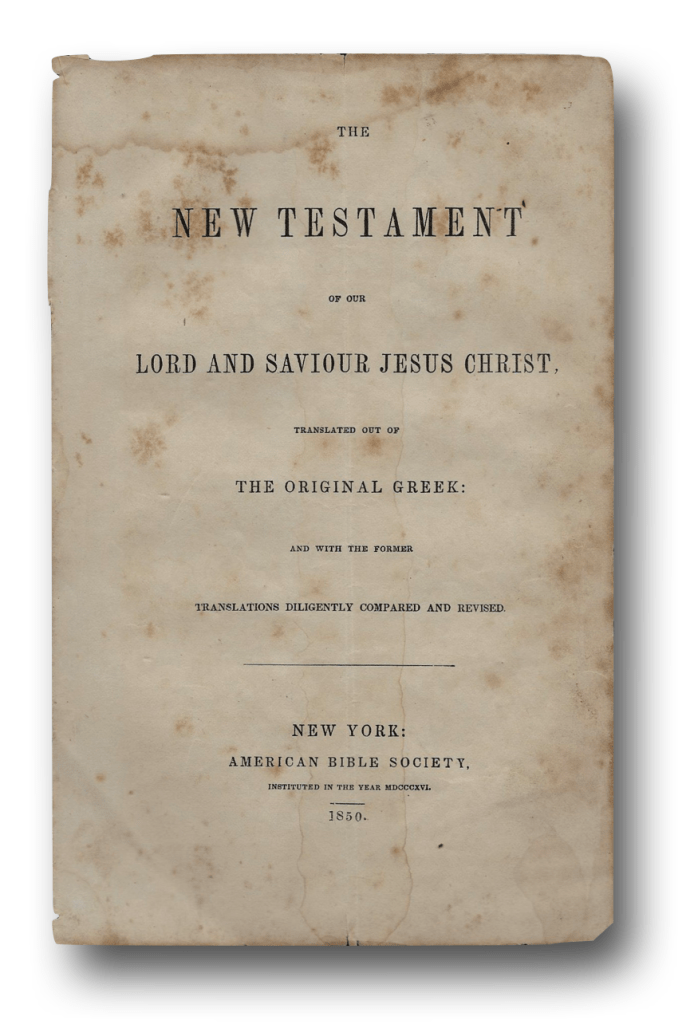
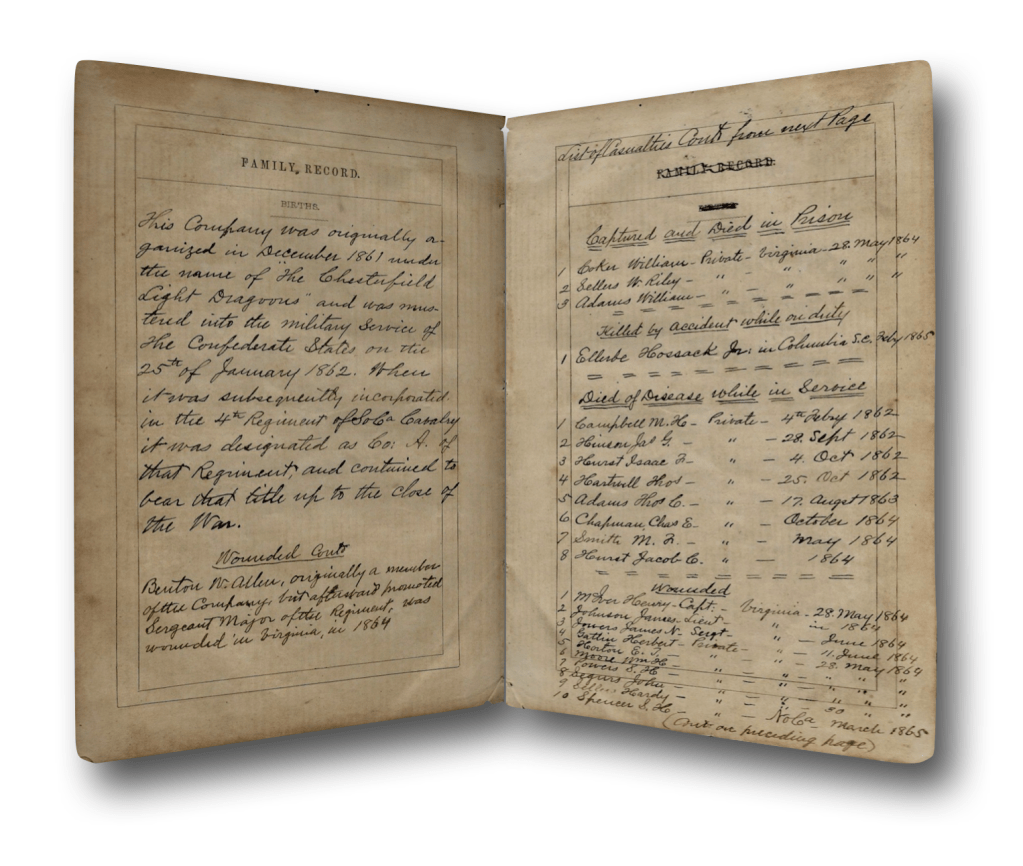
Handwritten notes pertaining to the Chesterfield Light Dragoons who were subsequently incorporated into the 4th Regiment of South Carolina Cavalry as Company A. These notes were recorded in the Holy Bible.
Notes include a list of those captured and died in prison, those killed by accident, those who died of disease, those wounded in action, those killed in battle, and those who were mortally wounded in battle.

































 Spared & Shared 23