Category Archives: Camp Griffin

1861: Joseph W. Luxford to Dinah E. Luxford

The following letters were written by British emigrant Joseph W. Luxford (or Laxford) (1838-1862) of North Troy, Orleans county, Vermont. Joseph enlisted as a private in Co. D, 6th Vermont Infantry on 29 August 1861 and was mustered in on 15 October 1861. Within two weeks of his muster, as can be seen in Letter 1, he was transported with his regiment to Camp Griffin in Virginia where they spent the winter of 1861-62. Before spring, however, Joseph had died. Muster rolls record his death as having taken place at the Broad & Cherry General Hospital in Philadelphia on 23 February 1862. The cause of death was Diphtheria.

Descriptions of Joseph’s illness and death were captured in two letters written by Moses Abbott who served in the same company with him. These letters are housed at the University of Virginia and have been transcribed on-line. See:

(6624) [writer] ~ Moses Abbott to Dinah Luxford, 1 February 1862

(6625) [writer] ~ Moses Abbott to Dinah Luxford, 26 February 1862

Joseph was the son of Henry Luxford and Mary Tabitha Turner of Kent, England. It appears the family must have emigrated to the US in the 1840s. Joseph wrote the letter to his sister Dinah.
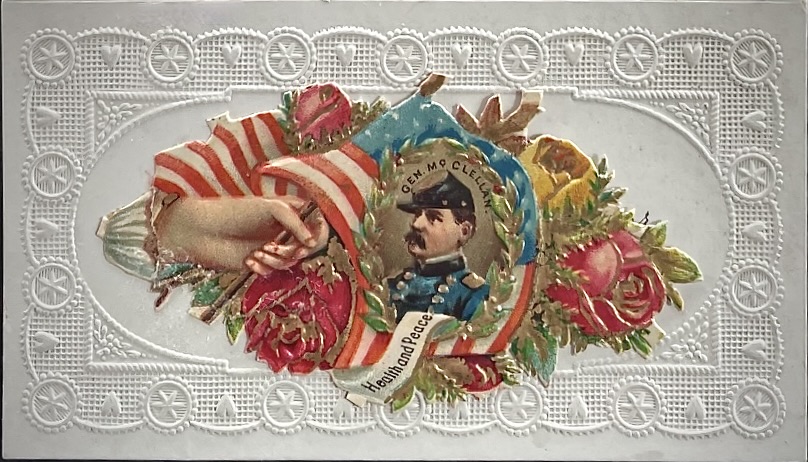
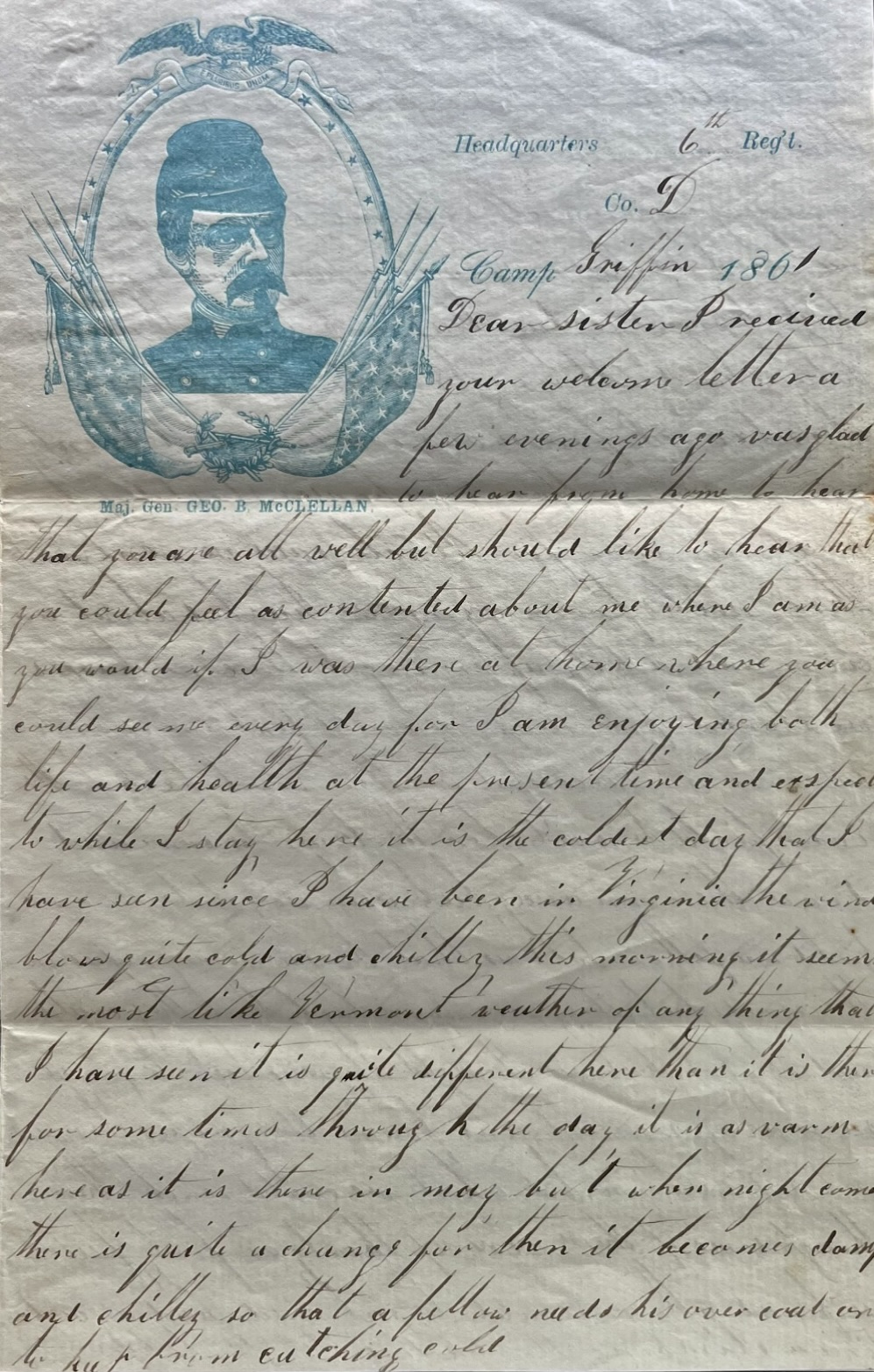
Enclosed with Letter 2 was this calling card with the words, “Health and Peace” and the visage of Gen. McClellan.

[Note: These letters are from the private collection of Greg Herr and were made available for transcription and publication on Spared & Shared by express consent.]

Letter 1

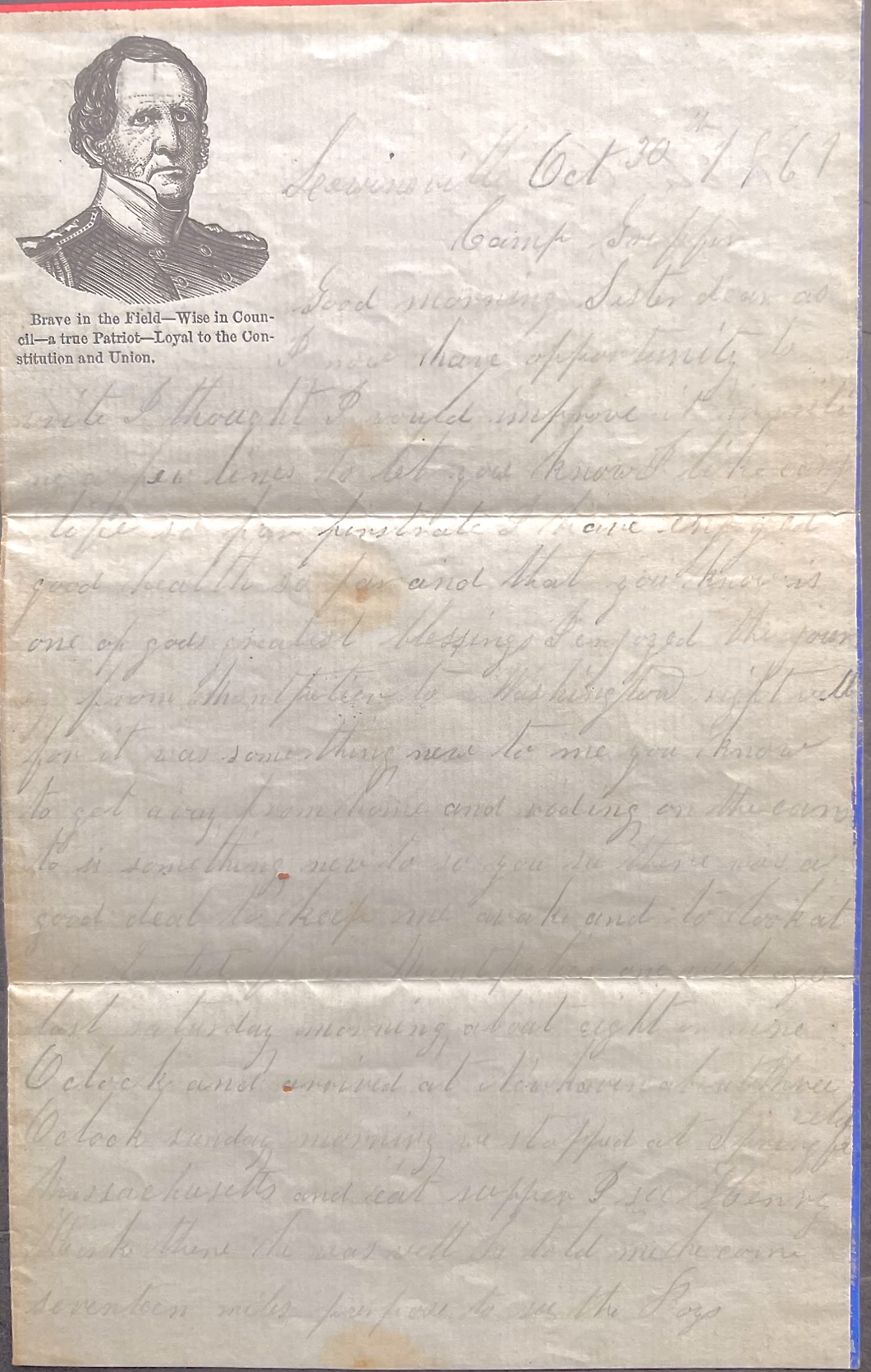
Lewinsville
Camp Griffin
October 30th 1861

Good morning sister,

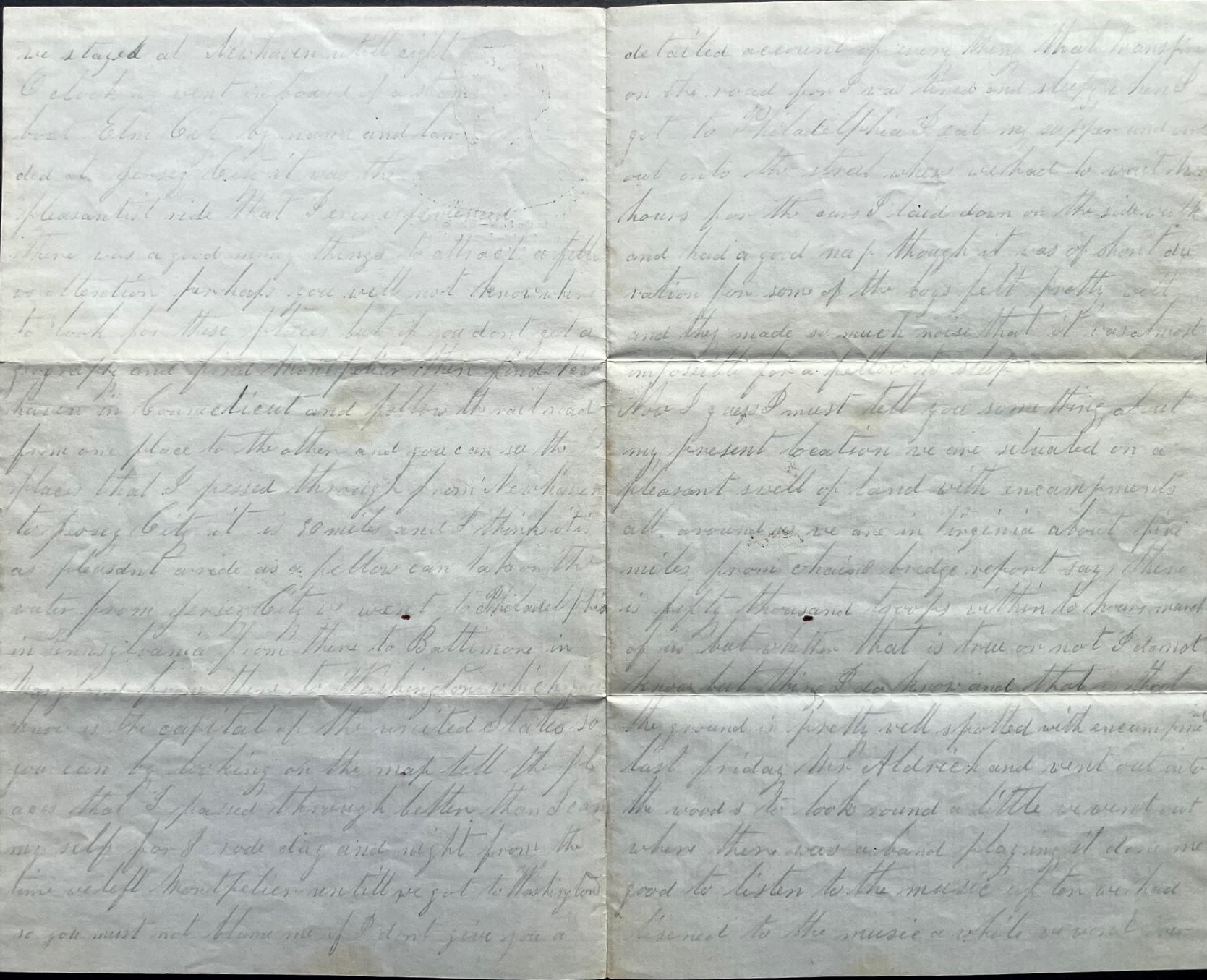
As I have opportunity to write, I thought I would improve it and write you a few lines to let you know I like camp life so far first rate. I have enjoyed good health so far and that you know is one of God’s greatest blessings. I enjoyed the journey from Montpelier to Washington right well for it was something new to me, you know—to get away from home and riding on the cars—to see something new too. So you see there was a good eal to keep me awake and to look at.

We started from Montpelier one week ago last Saturday morning about eight or nine o’clock. Sunday morning we stopped at Springfield, Massachusetts and eat supper. I see Henry Kirk there. He was well. He told me he come seventeen miles [for the] purpose to see the boys. We stayed at New Haven until eight o’clock, went on board a steamboat—Elm City by name—and unloaded at Jersey City. It was the pleasantest ride that I ever experienced. There was a good many things to attract our attention. Perhaps you will not know what to look for [in] these places but if you don’t, go to Geography and find Montpelier. Then find New Haven in Connecticut and follow the railroad from one place to the other and you can see the places that I passed through. From New Haven to Jersey City it is 90 miles and I think it’s as pleasant a ride as a fellow can take on the water.

From Jersey City we went to Philadelphia in Pennsylvania. From there to Baltimore in Maryland. From there to Washington which you know is the Capitol of the United States. You can, by looking on the map, tell the places that I passed through better than I myself for I rode day and night from the time we left Montpelier until we got to Washington so you must not blame me if I don’t give you a detailed account of everything that transpired on the road for I was tired and slept. When we got to Philadelphia, I eat my supper and went out into the street where we had to wait two hours for the cars. I laid down on the sidewalk and had a good nap though it was of short duration for some of the boys felt pretty well and they made so much noise that it was almost impossible for a fellow to sleep.

Now I guess I must tell you something about my present location. We are situated on a pleasant swell of land with encampments all around us. We are in Virginia about five miles from Chain Bridge. Report says there is 50,000 troops within two hours march of us but whether that is true or not, I do not know. But one thing I do know and that is that the ground is pretty well spotted with encampments.

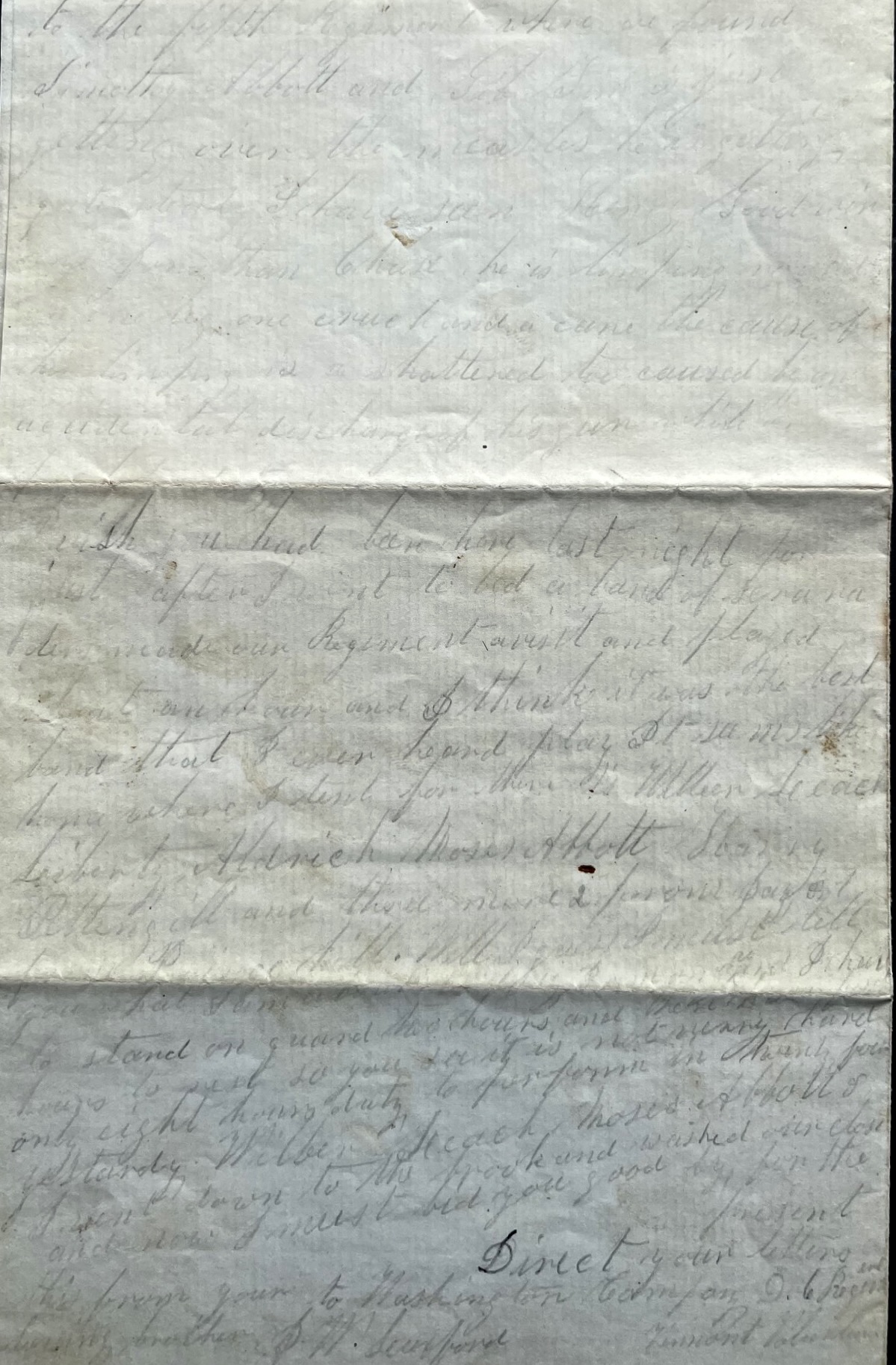
Last Friday, Mr. [Liberty] Aldrich and [I] went out in the woods to look around a little. We went out where there was a band playing. It done me good to listen to the music. After we had listened to the music awhile, we went over to the 5th [Vermont] Regiment where we found Timothy Abbott and he was just getting over the measles. He is getting quite strong. I have seen Goodwin…one by one crutch and a cane, the cause of …fingers is shattered too caused by an accidental discharge of his gun while on…

I wish you had been here last night for just after I went to bed, a band of serenaders made our regiment a visit and played about an hour and I think it was the best band that I ever heard play. It seems like home where I tent for there is Wilbur Leach, Liberty Aldrich, Moses Abbott, Harry Pettingill and three more. Two persons from P____Hill.

Well. I guess I must tell you what I am now [illegible]…to stand on guard two hours and then…

Wilber Leach, Moses Abbott and I went down to the brook and washed our clothes and now I must tell you goodbye for the present. This from your loving brother, — J. W. Luxford

Direct your letters to Washington, Company D, 6th Regiment Vermont Volunteers.

Letter 2
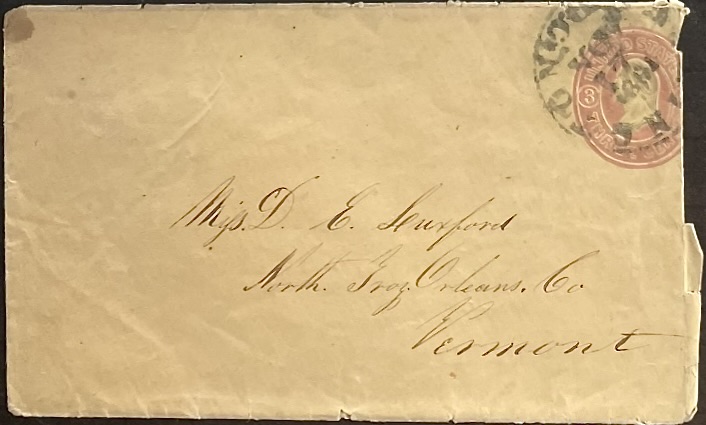
Directed to Miss D. E. Luxford, North Troy, Orleans county, Vermont

Headquarters 6th [Vermont] Regiment, Co. D
Camp Griffin
[mid November] 1861

Dear Sister,

I received your welcome letter a few evenings ago. Was glad to hear that you are all well but should like to hear that you could feel as contented about me where I am as you would if I was there at home where you could see me every day for I am enjoying both life and health at the present time and expect to while I stay here.

It is the coldest day that I have seen since I have been in Virginia. The wind blows quite cold and chilly this morning. It seems the most like Vermont weather of anything that I have seen. It is quite different here than it is there for some times through the day, it is as warm here as it is there in May. But when night comes, there is quite a change for then it becomes damp and chilly so that a fellow needs his overcoat on to keep from catching cold.

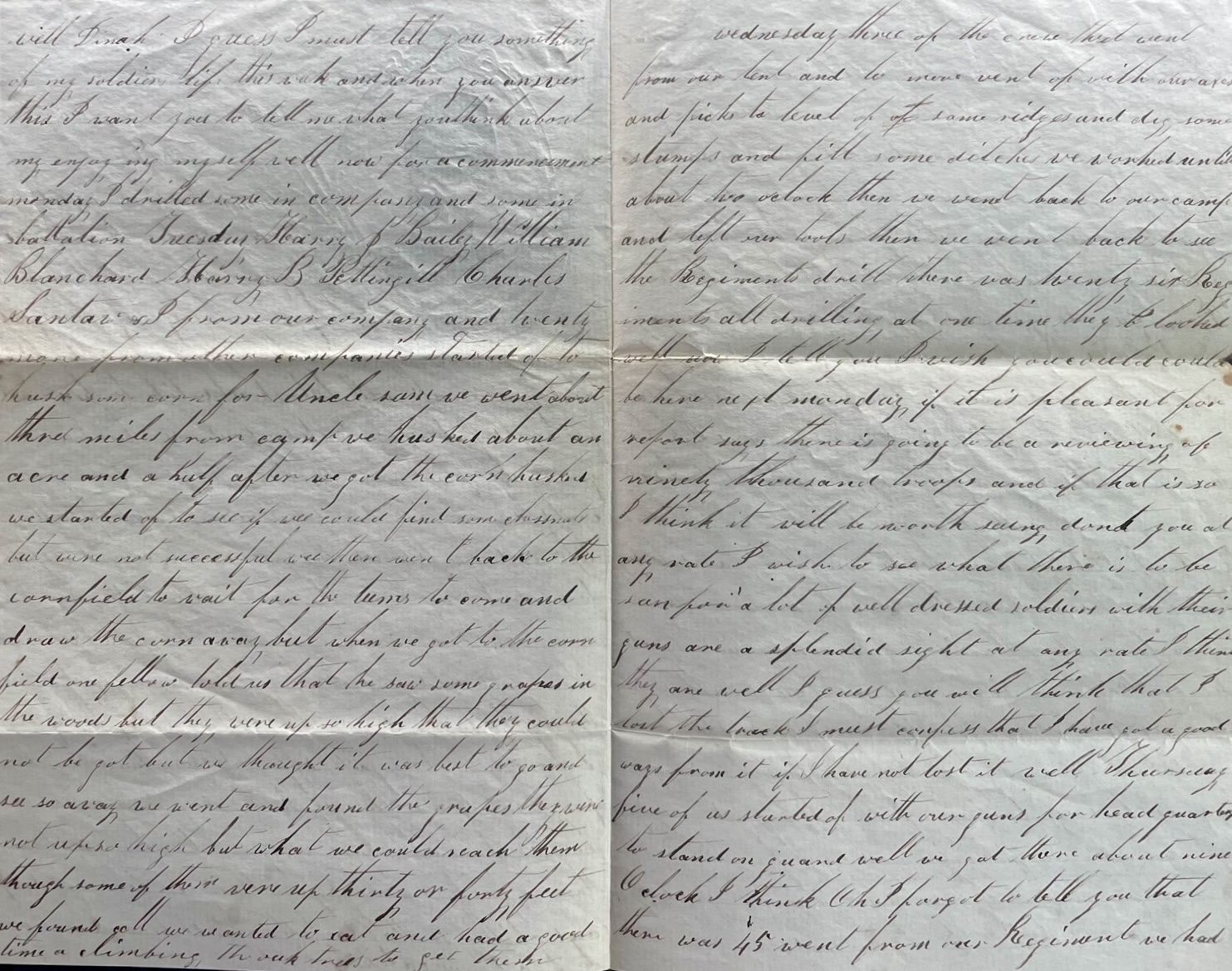
Well, Dinah, I guess I must tell you something of my soldier’s life this week and when you answer this, I want you to tell me what you think about my enjoying myself. Well now, for a commencement, Monday I drilled some in company and some in battalion.

Tuesday, Harry J. Bailey, William Blanchard, Harry B. Pettingill, Charles Santau and I from our company and twenty more from other companies started off to husk some corn for Uncle Sam. we went about three miles from camp, We husked about an acre and a half. After we got the corn husked, we started off to see if we could find some classmates but were not successful. We then went back to the cornfield to wait for the teams to come and draw the corn away but when we got to the cornfield, one fellow told us that he saw some grapes in the woods but they were up so high that they could not be got. But we thought it was best to go and see so away we went and found the grapes. They was not up so high but what we could reach them though some of them were up thirty or forty feet. We found all we wanted to eat and had a good time a climbing through trees to get them.

Wednesday, three of the crew that went to our tent and two more went up with our axes and picks to level off some ridges and dig some stumps and fil some ditches. We worked until about two o’clock. Then we went back to our camp and left our tools. Then we went back to see the regiments drill. There was 26 regiments all drilling at one time. They looked well now, I tell you. I wish you could be here next Monday if it is pleasant for report says there is going to be a reviewing of 90,000 troops and if that is so, I think it will be worth seeing, don’t you? At any rate, I wish to see what there is to be seen for a lot of well-dressed soldiers with their guns are a splendid sight. At any rate, I think they are. Well, I guess you will think that I lost the track. I must confess that I have got a good ways from it if I have not lost it.

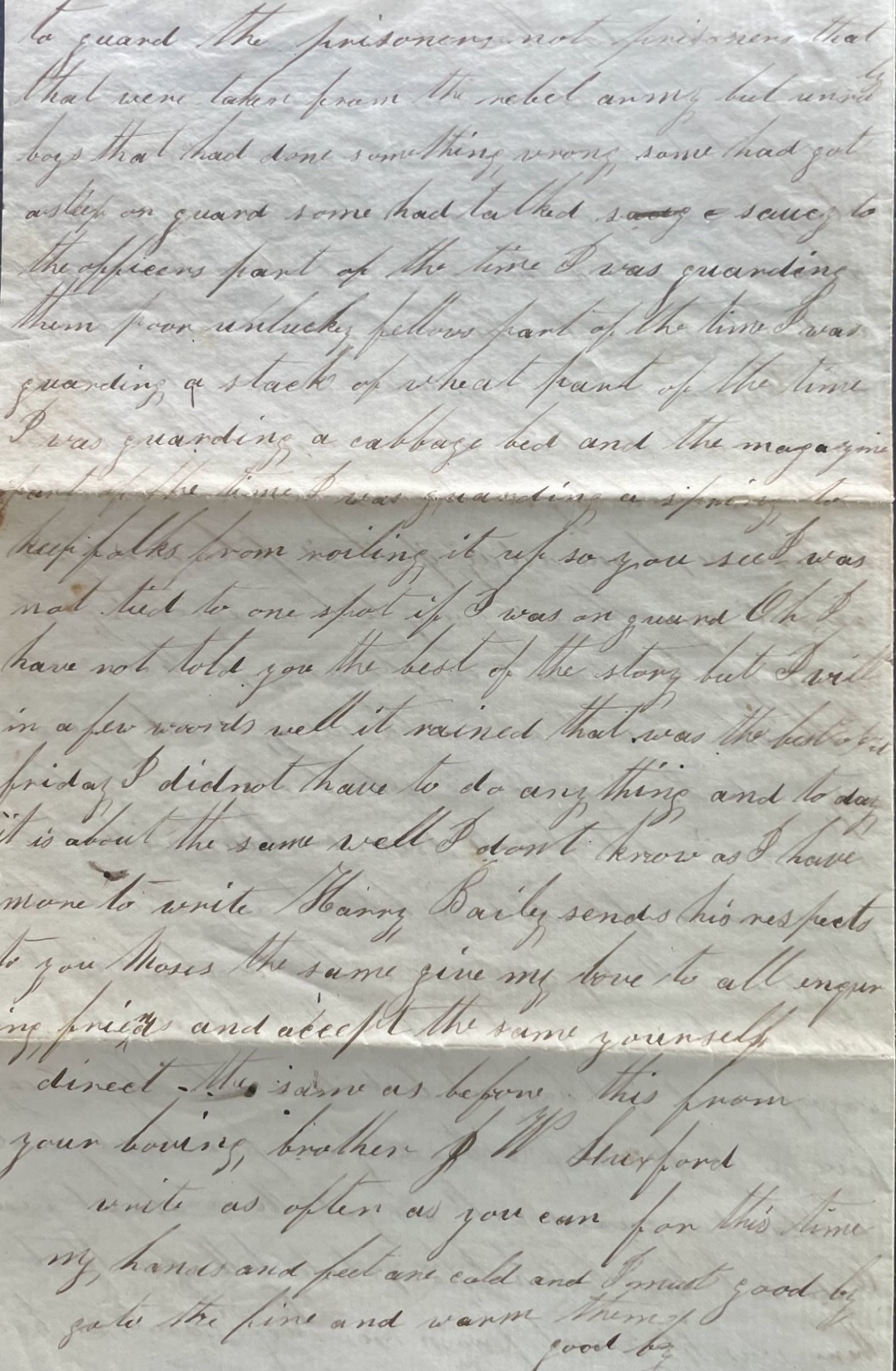
Well Thursday five of us started off with our guns for headquarters to stand on guard. Well, we got there about nine o’clock, I think. Oh, I forgot to tell you that there was 45 went from our regiment. We had to guard the prisoners—not prisoners that were taken from the rebel army but unruly boys that had done something wrong. Some had got asleep on guard, some had talked saucy to the officers. Part of the time I was guarding them poor unlucky fellows, part of the time I was guarding a stack of wheat, part of the time I was guarding a cabbage bed and the magazine, part of the time I was guarding spring to keep folks from roiling it up. So you see I was not tied to one spot [even] if I was on guard. Oh, I have not told you the best of the story but I will in a few words. Well, it rained—that was the best of it.

Friday I didn’t have to do anything and today it is about the same. Well, I don’t know as I have more to write. Harry Bailey sends his respects to you. Moses [Abbott] the same. Give my love to all enquiring friends and accept the same yourself. Direct the same as before. This from your loving brother, — J. W. Luxford

Write as soon as you can for this time my hand and feet are cold and I must [say] goodbye and go to the fire and warm them up, Goodbye.
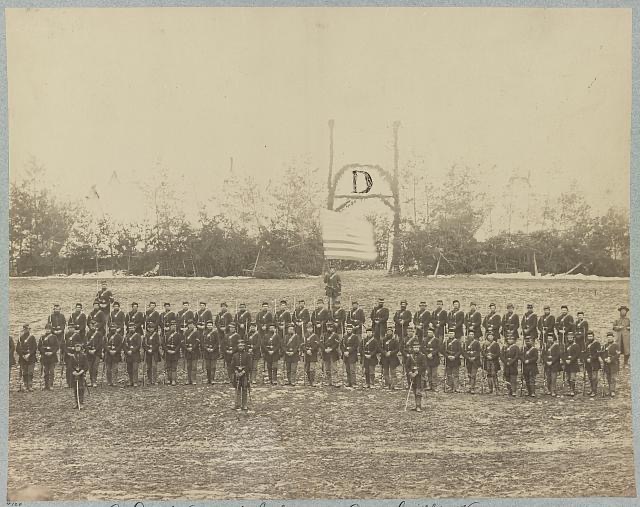
Co. D, 6th Vermont Infantry at Camp Griffin, Virginia. (LOC)

1861: Hiram Greenland to William Greenland

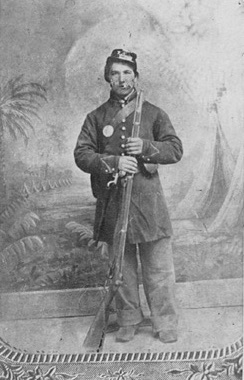
I could not find an image of Hiram but here is one of Jacob Wagner who served in Co. I of the 49th Pennsylvania Infantry (Photo Sleuth)

The following letter was written by Hiram Greenland (1839-1873), the son of Nathan Greenland (1805-1880) and Matilda Ramsey (1810-1865) of Calvin, Huntingdon county, Pennsylvania. Hiram was 21 years old, a single farmer living with his parents when he enlisted in September 1861 at Harrisburg in the 49th Pennsylvania Infantry. He was mustered into the service on 24 October 1861 at Camp Griffin in Virginia (near Lewinsville) where he wrote this letter to his cousin three weeks later. Muster records indicate that Hiram was in Co. D when he began his service but was later transferred to Co. B and then eventually deserted and was dishonorably discharged in November 1864. After the war he settled in Chester county and died in 1873. There is a soldier’s marker on his grave in Cassville, Pa.

T R A N S C R I P T I O N

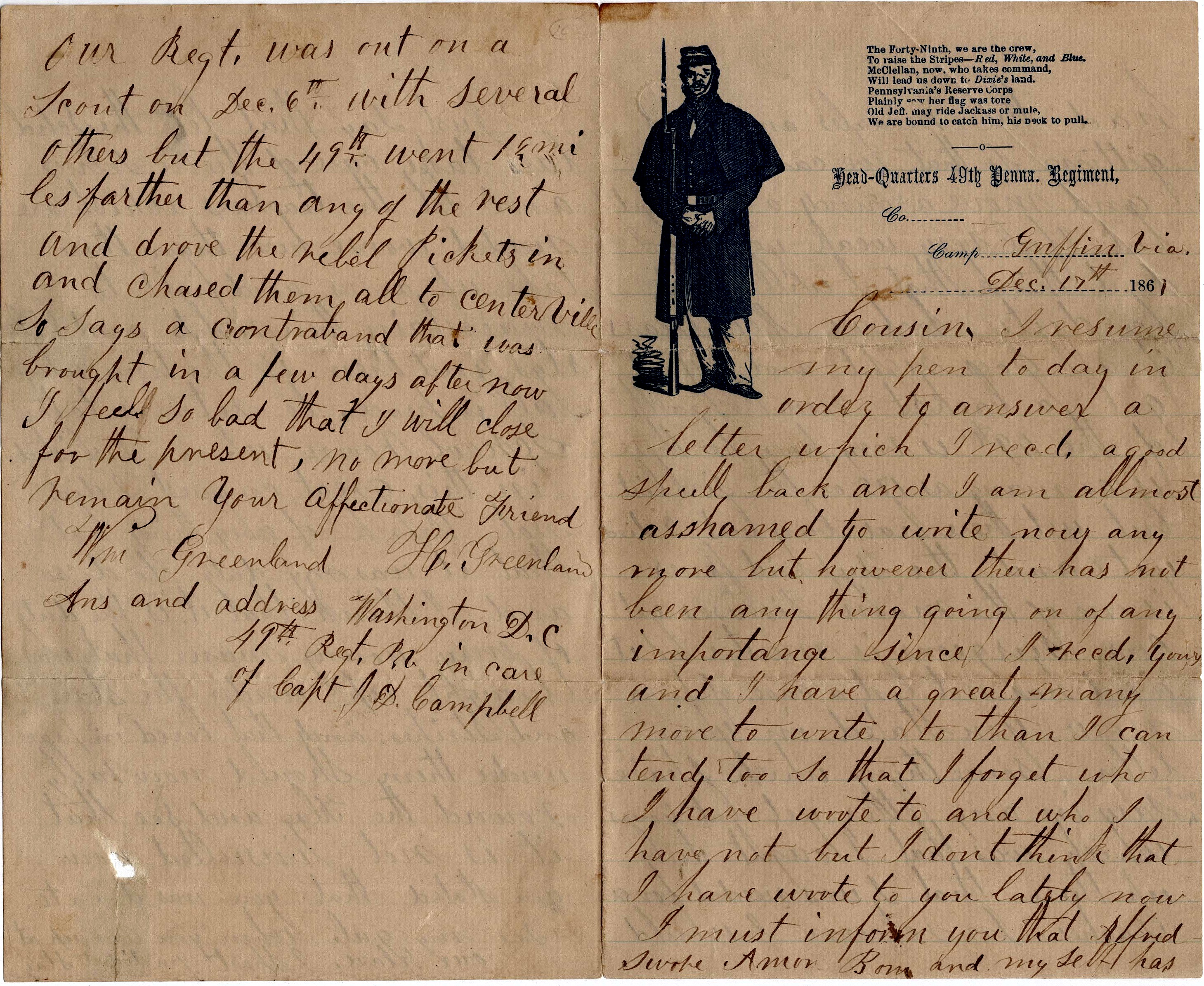
Patriotic stationery (with Poem to the 49th Penna. Regiment) used in Hiram’s letter.

Headquarters 49th Penna. Regiment
Co. [D]
Camp Griffin, Va.
December 17, 1861

Cousin,

I resume my pen today in order to answer a letter which I received a good spell back and I am almost ashamed to write now any more but, however, there has not been anything going on or any importance since I received yours and I have a great many more to write to than I can tend to so that I forget who I have wrote to and who I have to but don’t think that I have wrote to you lately.

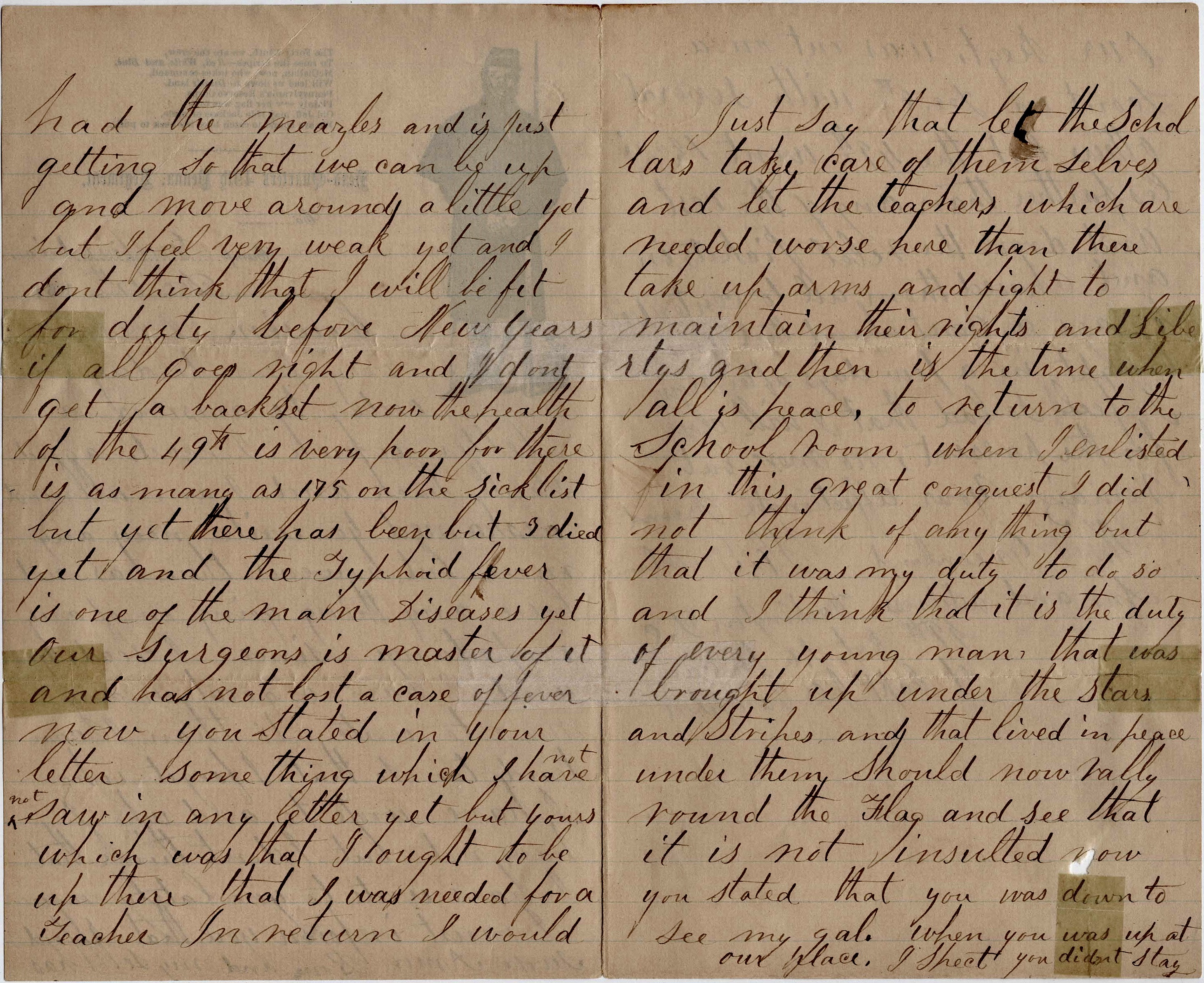
Now I must inform you that Alfred Swope, Amos B[ ] and myself has had the measles and is just getting so that we can be up and move around a little yet but I feel very weak yet and I don’t think that I will be fit for duty before New Years if all goes right and I don’t get a backset now. The health of the 49th is very poor for there is as many as 175 on the sick list but yet there has been but three died yet and the typhoid fever is one of the main diseases. Yet our surgeons is master of it and has not lost a case of fever.

Now you stated in your letter something which I have not saw in any letter yet but yours which was that I ought to be up there—that I was needed for a teacher. In return I would just say that let the scholars take care of themselves and let the teachers, which are needed worse here than there, take up arms and fight to maintain their rights and liberties and there is the time when all is peace to return to the school room.

When I enlisted in this great conquest, I did not think of anything but that it was my duty to do so and I think that it is the duty of every young man that was brought up under the Stars & Stripes and that lived in peace under them should now rally round the flag and see that it is not insulted.

Now you stated that you was down to see my gal. When you was up at our place, I spect you didn’t stay.

Our regiment was out on a scout on December 6th with several others but the 49th went 12 miles farther than any of the rest and drove the rebel pickets in and chased them all to Centreville. So says a contraband that was brought in a few days after. Now I feel so bad that I will close for the present. No more but remain your affectionate friend, — H. Greenland

[to] William Greenland

Answer and address to Washington D. C., 49th Regt. P. V. in care of Capt. J[ames] D. Campbell


1862: Clark Benjamin Ely to Cornelia (Mattocks) Ely

A post war image of Clark B. Ely (ancestry.com)

This letter was written by 24 year-old Clark Benjamin Ely (1837-1926) who enlisted, August 26, 1861, at Jamestown, to serve three years in Co. K, 49th New York Infantry. He mustered into the service on September 18, 1861; was wounded in action, September 17,1862, at the Battle of Antietam; and was discharged for his wounds, November 13, 1862, at a hospital in New York City. Records from later in life reveal that Clark received gunshot wounds to the right hip and right ankle.

Clark was the son of Samuel Ely (1786-1886) and Artless Clark (1808-1903) of Chautauqua county, New York. His younger brother, mentioned in the letter, Samuel Ely, Jr. (1839-1923) also served in the same company of the 49th New York. Clark was married in 1859 to Cornelia Adele Mattocks (1837-1912) and was residing in Poland, New York, at the time of the 1860 US Census and employed as a “farm laborer.”

T R A N S C R I P T I O N

Camp Griffin [Langley, Virginia]
January 12, 1862

Dear Cornelia,

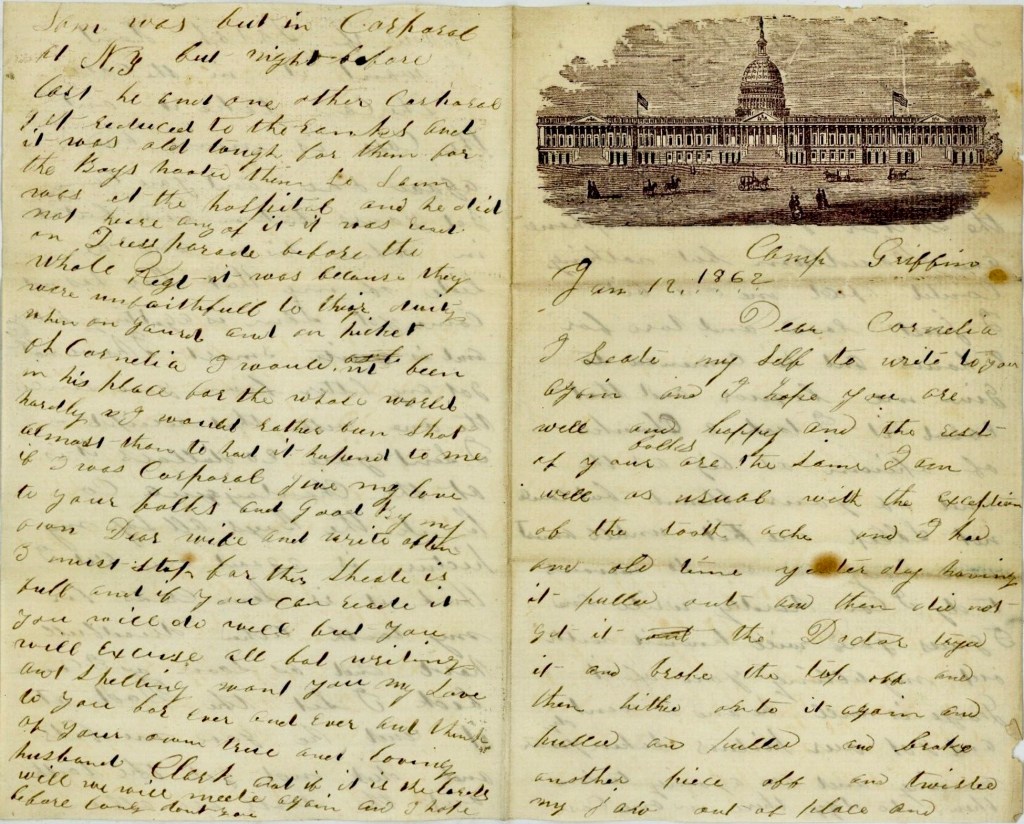
I seat myself to write to you again and I hope you are well and happy and the rest of your folks are the same. I am well as usual with the exception of the toothache and I had an old time yesterday having it pulled out and then did not get it. The Doctor tried it and broke the top off and then hitched onto it again and pulled and pulled and broke another piece off and twisted my jaw out of place and I guess he split it. I can’t open my mouth hardly any and can’t chew one bit. Oh Cornelia, I never was in such misery in all my life. The Doctor gave me morphine and laudanum but nothing could affect me one bit. I just raved and tore for two hours and he commenced to give me liquor and that eased it. I took two chunks of opium as big as the end of your thumb but could not sleep one bit until this morning and am so nervous today I can hardly write. I guess you will know it without my telling you of it.

George is well. He and I went and got our pictures taken yesterday morning and are going to send them today. They’re in one case and if Sarah don’t want it in the case, she can take it out. The case is mine and is a good one and you can get yours taken and put it in where his is and beside of me. That box has not come yet. Sam [Ely] is a getting better and is quite smart. I have not got any letter from you since the one with that receipt in. I sent you twenty dollars. It is at the Chautauqua County Bank.

The Boys all say my picture is a good one but I think it is some cross for my tooth ached dreadful hard and as soon as I came back, I let the Doctor at it and he gave me fits and [still] did not get the tooth out. The roots are all in [yet].

Sam [Ely] 1 was put in Corporal at New York but night before last he and one other corporal got reduced to the ranks and it was old tough for them for the Boys hooted them so. Sam was at the hospital and he did not hear any of it. It was read on Dress Parade before the whole regiment. It was because they were unfaithful to their duty when on guard and on picket. Oh Cornelia, I wouldn’t been in his place for the whole world hardly as I would rather been shot almost than to had it happened to me if I was Corporal.

Give my love to your folks and goodbye my own dear wife. And write often. I must stop for this sheet is full and if you. can read it, you will do well. But you will excuse all bad writing and spelling, won’t you? My love to you forever and ever, and think of your own true and loving husband, — Clark

But if it is the Lord’s will, we will meet again and I hope before long, don’t you?


1 Samuel Ely, Jr.—Age, 22 years. Enlisted, August 26,1861, at Jamestown, to serve three years; mustered in as corporal, Co. K, September 18, 1861; returned to ranks, January 10, 1862; promoted corporal, January 14, 1863; re-enlisted as a veteran, December 14, 1863; promoted sergeant, September 1, 1864; transferred to Co. D , September 17, 1S64; mustered out with company, June 27, 1S65, at Washington, D . C.

1862: Manly N. Hoyt to “Kind Friends”

The following letter was written by Pvt. Manly N. Hoyt (1831-1862) of Co. G, 6th Vermont Infantry. Manley was born in Bolton, Vermont. He enlisted in October 1861 and died of chronic diarrhea on 18 July 1862.

The 6th Regiment, recruited from the state at large, was mustered into the U. S. service for three years at Montpelier, Oct. 15, 1861, and immediately ordered to Washington, where it arrived on the 22nd. It proceeded at once to Camp Griffin, where it was attached to the Vermont Brigade. The command remained at this post during the winter and broke camp on March 10, 1862, for the Peninsula Campaign. On April 6, 1862, at Warwick creek, Va., the regiment was first in action, fortunately without loss. The brigade was first a part of the 4th and later of the 6th Corps, with which it was generally known. In the battle of Golding’s farm the 6th won complimentary mention from Gen. Hancock. The loss at Savage Station was severe.

Transcription

Patriotic Stationery used by Manly Hoyt

Camp Griffin
Fairfax county, Virginia
February 13, 1862

Kind friends,

I embrace this opportunity to drop you a few lines to let you know that I am well and wish those few lines will find you all the same.

9 February, the rebels come in sight of our pickets. Our cavalry give chase [and ] captured 15 of them.

The 12th, 26 negro slaves come into camp. It would have done you good to seen those animal kept people free [?] We have not been out on any scout lately.

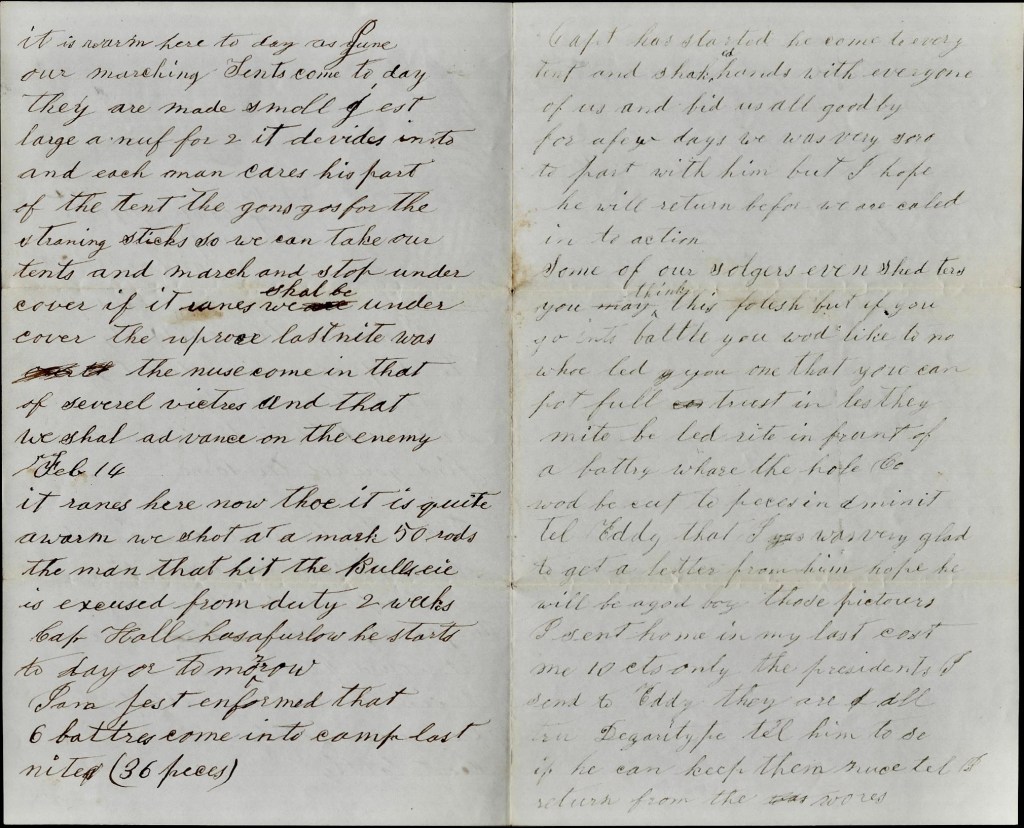
It is warm here today as June. Our marching tents come today. They are made small. Just large enough for two. It divides into [two halves] and each man carries his part of the tent. The gons gos [?] for the straining sticks so we can take out tents and march and stop under cover. If it rains, we shall be under cover.

The uproar last night was the news came in that of several victories and that we shall advance on the enemy.

February 14. It rains here now though it is quite warm. We shot at a mark 50 rods. The man that hit the bullseye is excused from duty two weeks. Captain [William Henry Harrison] Hall has a furlough. He starts today or tomorrow.

I am just informed that 6 batteries come into camp last night (36 pieces). Capt. has started. He come to every tent and shake hands with everyone of us and bid us all goodbye for a few days. We was very sorry to part with him but I hope he will return before we are called into action. Some of our soldiers even shed tears. You may think this foolish but if you go into battle, you would like to know who led you—one that you can put full trust in lest they might be led right in front of a battery where the whole company would be cut to pieces in a minute.

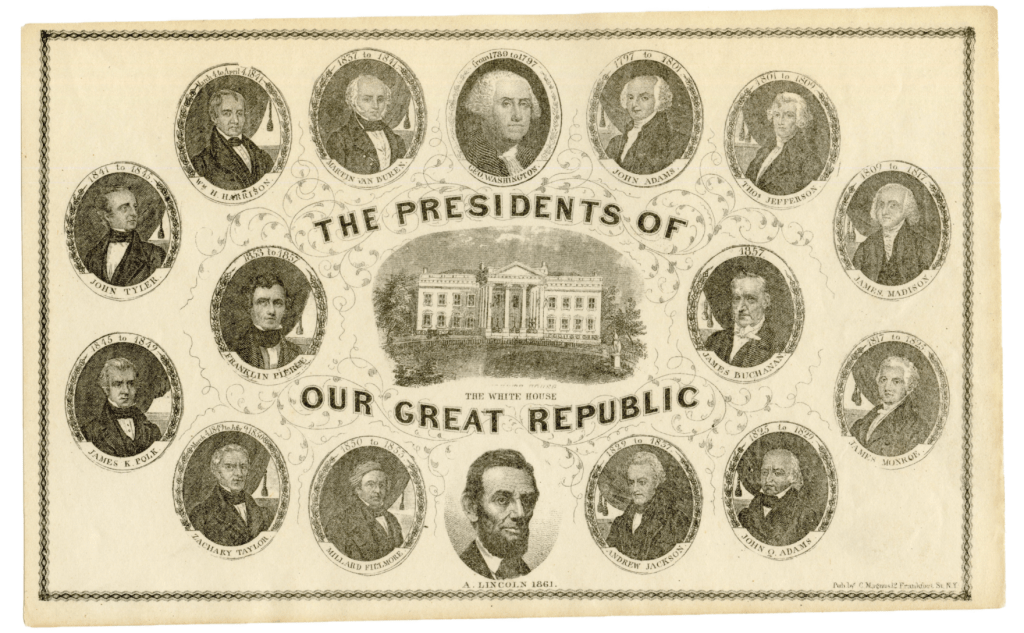
Tell Eddy that I was very glad to get a letter from him. Hope he will be a good boy. Those pictures I sent home in my last cost me 10 cents only. The Presidents I send to Eddy. They are all through daguerreotype. Tell him to see if he can keep them nice till I return from the war.

The picture of the Presidents may have been one like this CDV that sold recently on Fleischer’s Auctions for $850

Those rings are some I whittled out when I han’t nothing to do. So I thought I would send them to you. It has stopped raining. Write often. Don’t be discouraged. write how times is and all the news you can.

Yours truly, — Manly M. Hoyt