My passion is studying American history leading up to & including the Civil War. I particularly enjoy reading, transcribing & researching primary sources such as letters and diaries.
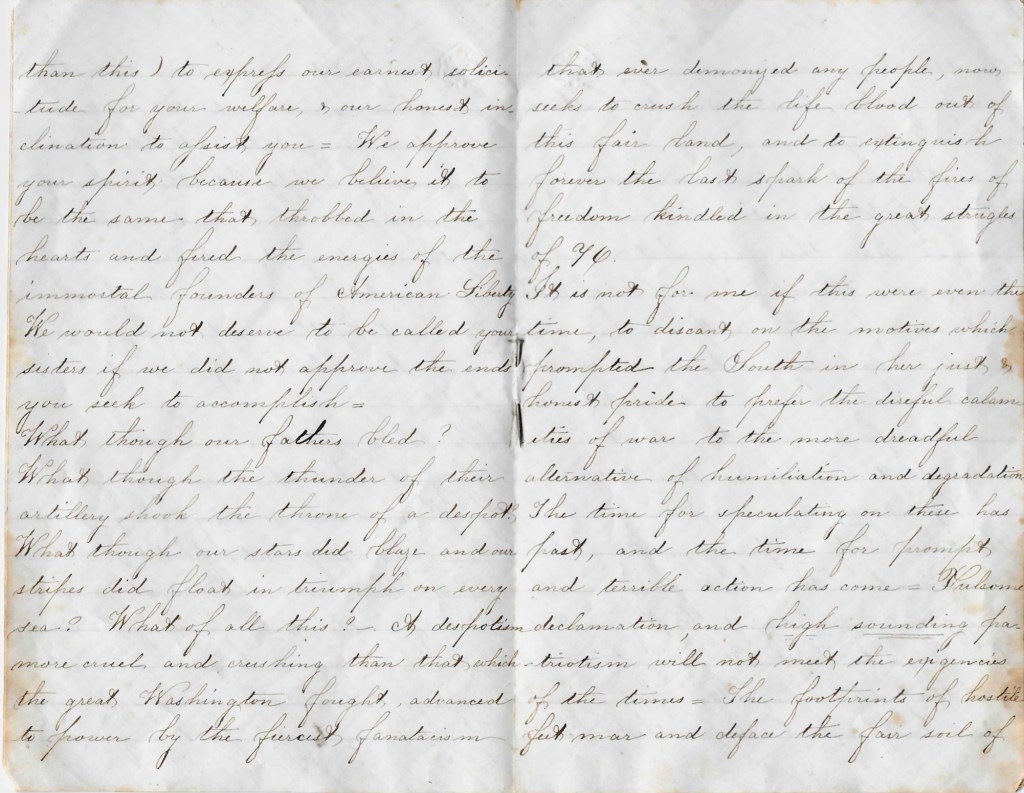
The following speech was delivered in the summer of 1862 to Col. Richard Waterhouse and members of his regiment—the 19th Texas Infantry. The speech was written from the perspective of a woman and was, in my opinion, most likely written by a woman for the purpose of a flag presentation ceremony to be held on the eve of the newly-formed regiment’s departure for Arkansas.
Fanny Benners Grave in Oakwood Cemetery, Jefferson, Texas
The Nineteenth Texas Infantry Regiment, organized in the spring of 1862 under the Confederate States of America’s Trans-Mississippi Department, consisted of men from the counties of Northeast Texas, including Davis (now Cass County), Franklin, Harrison, Hopkins, Marion, present-day Morris (was Titus during the war), Panola, Rusk, San Augustine, Titus, and Upshur. Richard Waterhouse, a prominent merchant from Jefferson in Marion County, held the commission from the state of Texas for the contingent’s creation and oversaw the establishment of the original ten companies (A through K) between February and May. When the mustering was complete, elections were held among the 886 men that made up the Nineteenth on May 13, 1862. The field officers selected were Col. Richard Waterhouse, Lt. Col. Robert H. Graham, and Maj. Ennis Ward Taylor. With elections complete, the men assembled at Camp Waterhouse near Jefferson, Texas, and formed into two battalions. Here they drilled until they received orders to march to Little Rock, Arkansas, in August 1862 where they eventually became part of Walker’s Texas Division in the Trans-Mississippi.
Hoping to learn more about the flag presentation and to discover who wrote the speech, I found the following: “Before leaving Jefferson [Marion county, Texas], politicians and local leaders organized festive banquets where the men were fed, patriotic speeches were delivered, and regimental colors were presented by fetching young women from the community.” This quotation comes from the thesis written by David J. Williams in 2014 on Co. A, Nineteenth Texas Infantry in which he cites for reference Joseph P. Blessington’s book, The Campaigns of Walker’s Texas Division: By a Private Soldier (Austin: Eakin Press, 1968), 29-35.
The only references I can find to the battle-flag received by the regiment comes from Lt. Henry N. Fairbanks’ memoirs of the Red River Expedition of 1864. Fairbanks was a member of Co. E, 30th Maine Infantry. At the severe Battle of Pleasant Hill, Fairbanks recorded in his diary that “the Confederates lost two battle flags in this fight—those of the 11th Missouri and 19th Texas. On the Texas flag were the words, ‘Texans can never be slaves.'” Another account of that same battle claims that it was the 16th Indiana Infantry that captured the Texas battle flag which was described as an “elegant banner, gorgeously trimmed, on white sides appeared the words, ‘Texans Can Never be Slaves.’ Silk streamers in abundance fluttered beside it, and its capture was considered a valuable trophy of a hard-fought battle.” [See Representative Men of Indiana, page 10] Yet another source claims that the Texas battle flag was captured by the 119th Illinois Infantry. Where the flag is now—if it still exists—I haven’t a clue.
In one final desperate search I finally stumbled on a website hosted by folks in Jefferson, Texas, that spoke of an annual reenactment of a speech written and delivered by Fanny Benners in June 1861 to a local militia called the Jefferson Guards. Fanny represented the ladies of the Christ Episcopal Church in Jefferson who had handmade the banner. I’m currently pursuing the possibility that she wrote this speech as well. Fanny Benners (1845-1866) was the daughter of Edward Graham Benners and Helen Donaldson of Jefferson. Fanny’s father was the lay leader and eventual Priest of the Episcopal Church. Until I learn otherwise, I’m going to attribute the speech to 17 year-old Fanny Benners.
[Note: This speech is from the personal archives of Greg Herr and was transcribed and published on Spared & Shared by express consent.]
Transcription
Colonel [Richard] Waterhouse and gallant members of this regiment!
The presentation of flags, having been so often witnessed in this community since the advent of the terrible war which is now raging with such fury in our fair land—some may be disposed to regard the present instance as one of mere ceremony. But on behalf of those I represent, it becomes my pleasure and my duty to assure you that with us, this is not merely a ceremony, but our mode, inspired by the purest patriotism, & highest appreciation of the noble spirit which animates our hearts, of indicating our love and esteem for you, and our confidence in your brave & determined wills, to live the free sons of the “Lone Star State” or nobly perish battling for that freedom.
“Already have thousands of happy Southern homes been made sorrowful, and vacant places in thousands of domestic circles may be seen, which can never be filled, all caused by this most unholy war waged to enslave a free and generous people.”
— Fanny Benners, Jefferson, Texas, July 1862
We trust we are not so constituted as to lose our interest, in our brothers and friends whom we love, merely because we are frequently called upon to give them up. Moreover the present is an occasion to us, if possible, more interesting and solemn than any that has preceded it. When on former occasions our gallant defenders left us to repair to the scene of conflict, a father, an husband, or a brother was still left to cheer our domestic circles. But when you leave, a father leaves, an husband leaves, and the last brother leaves. There is another consideration that adds a somberness to the present interview. Many of the brave sons of the South from whom we have parted on occasions like this have already sunk into the stillness and darkness of death. Already have thousands of happy Southern homes been made sorrowful, and vacant places in thousands of domestic circles may be seen, which can never be filled, all caused by this most unholy war waged to enslave a free and generous people.
With these reflections connected with the fact that this war has assumed proportions and a sanguinary character never originally contemplated, is it any wonder that we who cannot share with you the toils, privations, and dangers which you will soon have to undergo, should seek in some appropriate way—and what may more so than this—to express our earnest & solicitude for your welfare, & our honest inclination to assist you. We approve your spirit because we believe it to be the same that throbbed in the hearts and fired the energies of the immortal founders of American Liberty. We would not deserve to be called your sisters if we did not approve the ends you seek to accomplish.
What though our fathers bled? What though the thunder of their artillery shook the throne of a despot? What though our stars did blaze and our stripes did float in triumph on every sea? What of all this? A despotism more cruel and crushing than that which the great Washington fought, advanced to power by the fiercest fanaticism that ever demonized any people, now seeks to crush the life blood out of this fair land, and to extinguish forever the last spark of the fires of freedom kindled in the great struggles of ’76.
It is not for me if this were even the time to discant on motives which prompted the South in her just & honest pride to prefer the direful calamities of war to the more dreadful alternative of humiliation and degradation. The time for speculating on these has passed and the time for prompt and terrible action has come. Fulsome declaration and high sounding patriotism will not meet the exigencies of the times. The footprints of hostile feet mar and deface the fair soil of the South. Then much as we love you as fathers, husbands, and brothers, entwined as you are around our hearts by a thousand tendrils, summoning all our fortitude and resolution, we bid you go! bear this flag aloft amid the smoke, thunder and fire of battle, and remember the motto we have seen fit to inscribe upon its sacred folds—one which I am confident meets with a deep response in the heart of every man that hails from this state:
Texans can never be Slaves
Let this liberty inspiring motto be engraved upon the heart of each and every member of the 19th Regiment of Texas Infantry. It will help to remind you that the immortal founders of Texas Independence bequeathed liberty to their sons, and although their blood streamed in the Alamo, and enriched the soil of San Jacinto, when dying, they whispered in the ear of Mexico, “Texas can never be Slaves.”
But it were a selfish feeling and one unworthy the enlightened daughters of the South to be willing to make the sacrifice which we now make in thus pointing you to our Country’s Altar, only regarding our own protection and security. No gentlemen, it is not for the sake of ourselves but fr the sake of posterity, knowing that the sacrifices now made by us will meet with a sufficient reward in the happy consciousness, that, by sacrificing our friends and kindred to the noble cause, we are contributing largely to maintain for generations yet to come the priceless heritage we have received from our patriot fathers.
Therefore as we emulate in ’62 the spirit which animated our mothers in ’76 in humble imitation of those illustrious ones, with our tears and our prayers we now consecrate you to God and to Liberty.
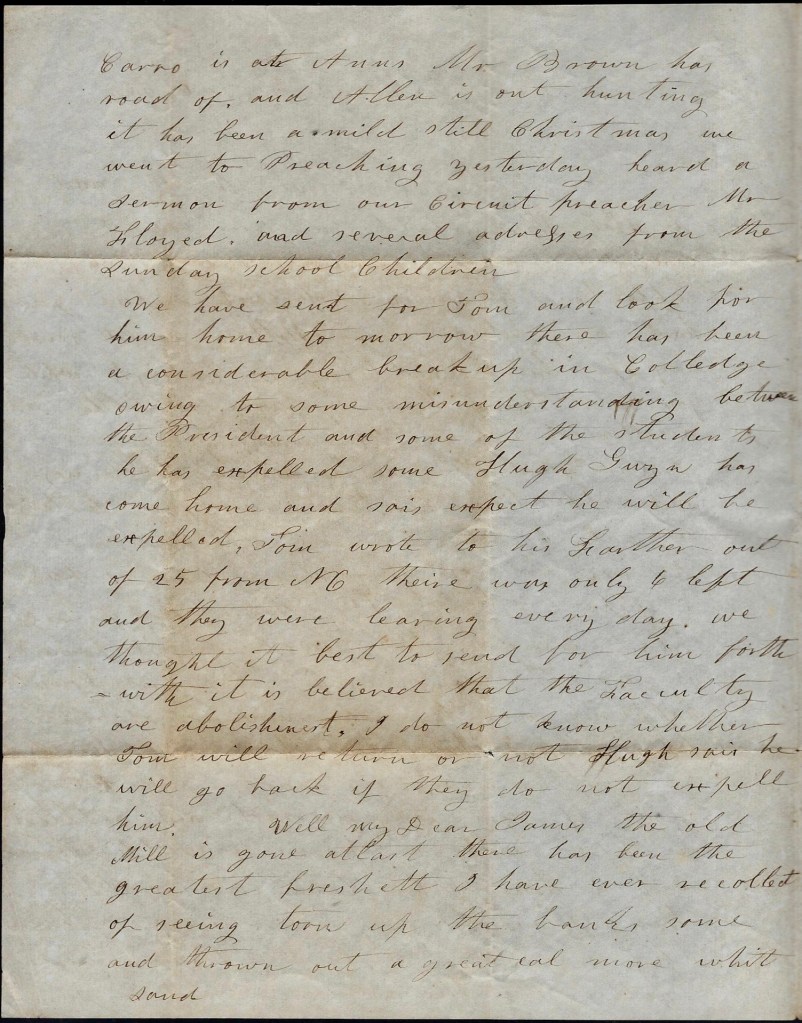
The following letter was written by Sarah H. (Gwyn) Brown (1798-1889), the wife of Hamilton Brown (1786-1870) of Wilkesboro, Wilkes county, North Carolina. Sarah’s first husband was Nathaniel Gordon (1784-1829) who died when her son, James Byron Gordon—the recipient of this letter—was only six years old.
Sarah (Gwyn) Brown’s Grave, Wilkesboro, N. C.
Some readers may recognize James Byron Gordon (1822-1864), having gained a name of distinction while serving as a Confederate Brigadier General in the Civil War. He began his service under the command of General J. E. B. Stuart as Major of the 1st North Carolina Cavalry and was promoted as its Colonel. In September 1863 he was promoted to Brigadier General an assigned command of the North Carolina Cavalry Brigade, taking over a higher command when General Stuart was killed in the Battle of Yellow Tavern. He was mortally wounded in May 1864 north of Richmond. He never married. When this letter was written, James was representing Wilkes county as a Member of the N. C. General Assembly House of Commons (HC) at Raleigh, as indicated on the cover.
Sarah mentions James’ half brother, Hamilton “Allen” Brown (1837-1917) in her letter as well. Allen also served the Confederacy as Colonel of the 1st North Carolina Regiment. She also mentions another half-brother named Hugh Thomas (“Tom”) Brown (1835-1861). After graduating at Chapel Hill and receiving his lawyer’s license, Tom had only just begun to practice law in Van Buren, Arkansas, when the Civil War began and he was elected Captain of the Van Buren Frontier Guards (3rd Arkansas). He was killed on 10 August 1861 at Wilson’s Creek.
Transcription
Oakland December 26, 1850
Being alone today and as usual thinking about my dear son, I concluded I would commit some of my reflections to writing. I do not suppose you had any idea your Mother would send any of her scribbling to Raleigh while you. were there knowing I am so little accustomed to letter writing.
James Byron Gordon (ca. 1850)
I was glad to see so much tenderness and affection breathed in your letters to Cal. Oh, how dear my children are to me and as I advance in life, I feel a deeper interest in their happiness. But where is the jewel to be found on earth. Some writer has said domestic happiness was the sole surviver of the fall. But this you have not tried yet. Neither do I see much prospect of it. If you were married and settled in life with a pious, sensible woman and a true Christian yourself, then I would say you were a happy man. We pass by the flowers and gather the thorns.
Carro [Caroline] is at [her sister] Ann’s. Mr. [Hamilton] Brown has rode off and Allen is out hunting. It has been a mild, still Christmas. We went to preaching yesterday. Heard a sermon from our circuit preacher Mr. Floyd. Had several addresses from the Sunday school children.
We have sent for Tom and look for him home tomorrow. There has been a considerable breakup in College owing to some misunderstanding between the President and some of the students. He has expelled some. Hugh Gwyn has come home and says [he] expects he will be expelled. Tom wrote to his Father [that] out of 25 from North Carolina, there was only 6 left and they were leaving every day. We thought it best to send for him forthwith. It is believed that the faculty are abolitionist. I do not know whether Tom will return or not. Hugh says he will go back if they do not expel him. 1
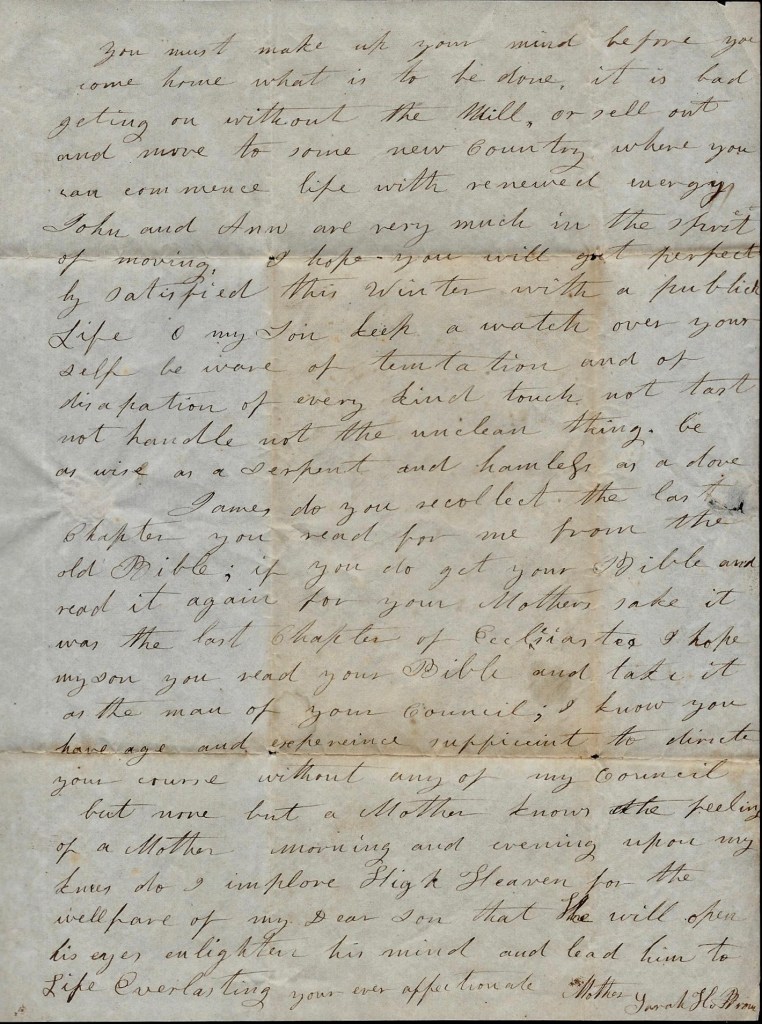
Well, my dear James, the old mill is gone at last. There has been the greatest freshet I have ever recollected of seeing. [It] tore up the banks some and thrown out a great deal more white sand. You must make up your mind before you come home what is to be done. It is bad getting on without the mill, or sell out and move to some new country where you can commence life with renewed energy. John and Ann are much I the spirit of moving. I hope you will get perfectly satisfied this winter with a public life.
Oh my son, keep a watch over yourself. Be aware of temptation and of dissipation of every kind. Touch not, taste not, handle not the unclean thing. Be as wise as a serpent and harmless as a dove.
James, do you recollect the last chapter you read for me from the old bible? If you do, get your noble and read it again for your Mother’s sake. It was the last chapter of Ecclesiastics. I hope, my son, you read your bible and take it as the man of your council. I know you have age and experience sufficient to direct your course without any of my council but none but a Mother knows the feeling of a Mother morning and evening upon my knees do I implore High Heaven for the welfare of my dear son that He will open his eyes, enlighten his mind, and lead him to life everlasting.
Your ever affectionate Mother, — Sarah H. Brown
1 I believe the unnamed college involved in this incident was Emory and Henry College where James B. Gordon had previously attended but not graduated. Tom Brown may have initially begun his college courses there as well before attending Chapel Hill. Hugh Alexander Gwyn (1830-1861) of Janesville, N. C., the author’s nephew, did attend the school and was a Senior (Valedictorian) in the Class of 1851. After graduation he took at position as a teacher at Woodlawn Academy in Salisbury, Tennessee, and died there on 16 June 1861.Unfortunately I cannot find anything in the school history or period newspapers describing the incident.
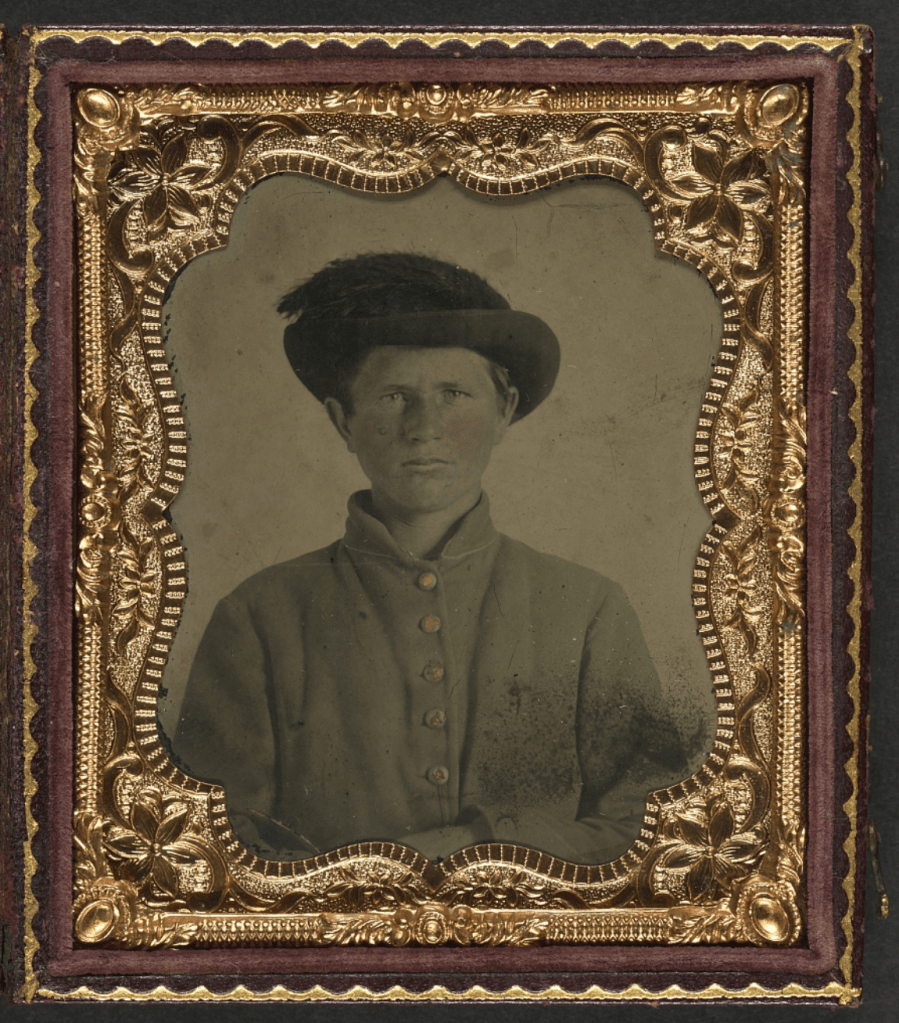
I could not find an image of Cyril but here is one of Russell Townsley who served in Co. C, 7th Michigan Infantry (Ancestry.com)
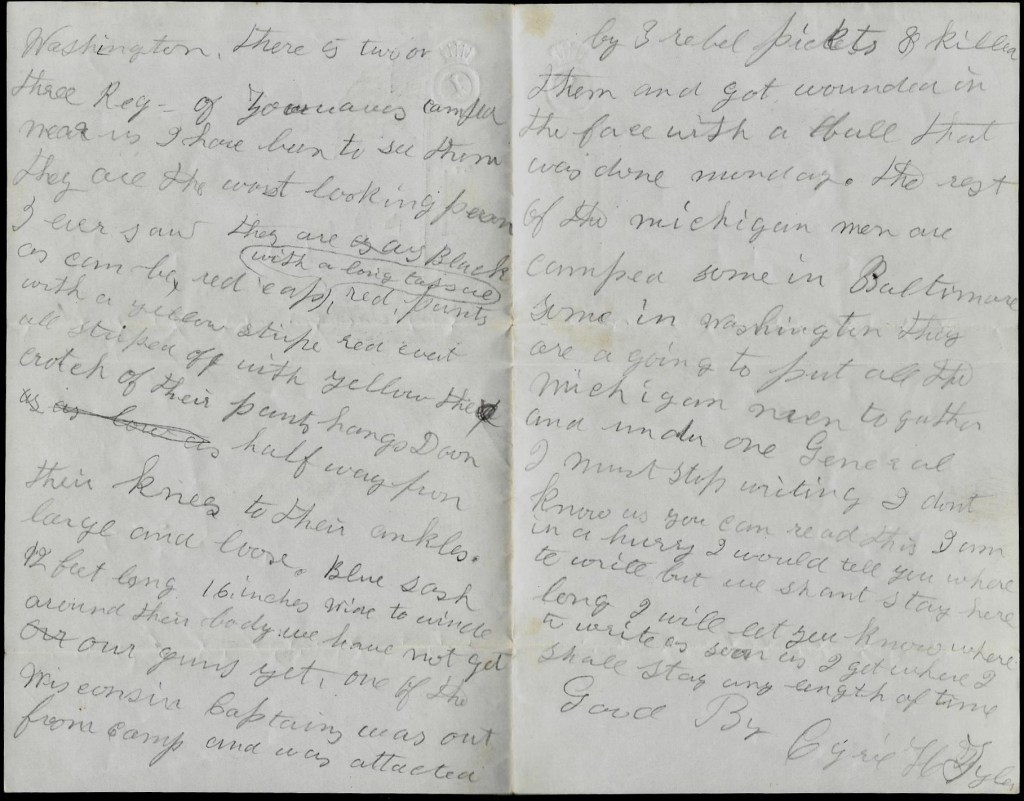
The following letter was written by Cyril H. Tyler (1841-1913) of Co. I, 7th Michigan Infantry. Cyril was the son of Rufus Tyler (1816-1894) and Amy Farnum (1818-18xx) of Waukesha, Michigan. Just days before enlisting, he married Mary Eliza Foote (1839-1924). The location and date of this letter is missing and my hunch is this was the second sheet of a two-sheet letter which may have been sent to his wife. Cyril mentions that a fort was being constructed at the Chain Bridge which I presume was either Fort Marcy or Fort Ethan Allen. Construction on these forts began in late September 1861 so I would date this letter in October 1861 when they were attached to Lander’s Brigade and bivouacked somewhere near or on Meridian Hill outside Washington D. C. Cyril entered the war as a private and was discharged on 22 August 1864 at Petersburg, Virginia, as a sergeant.
The 7th Michigan Infantry left the state in late August and arrived in Washington D. C. on 5 September 1861. They were assigned guard duty along near Edward’s Ferry in October and moved to Muddy Branch on 4 December where they remained until March 1862. They later participated in the Peninsula Campaign, the Battle of Antietam, the Battle of Fredericksburg (being the first regiment to cross the Rappahannock river in pontoon boats under the fire of Confederate sharpshooters), the Battle of Gettysburg (repulsing Pickett’s charge), the Mine Run Campaign, the Overland Campaign, the Siege of Petersburg and Appomattox Campaign.
Transcription
[Camp near Meridian Hill, October 1861]
The ground around here is not much of it tilled. It is all overrun by the soldiers. Lots of farms here was owned by disunion men and their property was confiscated. The District of Columbia is half covered with camps. The rebel pickets are within 8 or 9 miles from here. Our men are making a large fort at Chain Bridge. A number of picket guards is killed most every day near Chain Bridge. There is a telegraph line that extends from Washington as far as our lines go—that is about 8 miles around Washington.
Winslow Homer’s painting of Zouaves
There is two or three regiments of Zouaves camped near us. I have been to see them. They are the worst looking persons I ever saw. They are as black as can be, red cap with a long tassel, red pants with a yellow stripe, red vest all striped off with yellow. The crotch of the pants hangs down halfway from their knees to their ankles, large and loose. Blue sash 12 feet long, 16 inches wide to wind around their body. 1
We have not got our guns yet. One of the Wisconsin captains was out from camp and was attacked by three rebel pickets and killed them and got wounded in the face. That was done Monday. The regiment of the Michigan men are camped some in Baltimore and some in Washington. They are a going to put all the Michigan men together and under one general.
I must stop writing. I don’t know as you can read this. I am in a hurry. I would tell you where to write but we shan’t stay here long. I will let you know where to write as soon as I get where I shall stay any length of time.
Goodbye, — Cyril H. Tyler
1 I cannot identify the Zouave unit based upon Henry’s description alone. My assumption is that the “blue sash” he is referring to was the scarf commonly tied around the midsection of the uniform.A Zouave regiment known to be in the vicinity of Meridian Hill at the time was the Anderson Zouaves which was the 62nd New York Infantry.Their uniform was described as baggy red breeches, leggings, gaiters, blue scarf worn around the waist, wiastcoat, short jacket, and red fez with blue silk tassel.
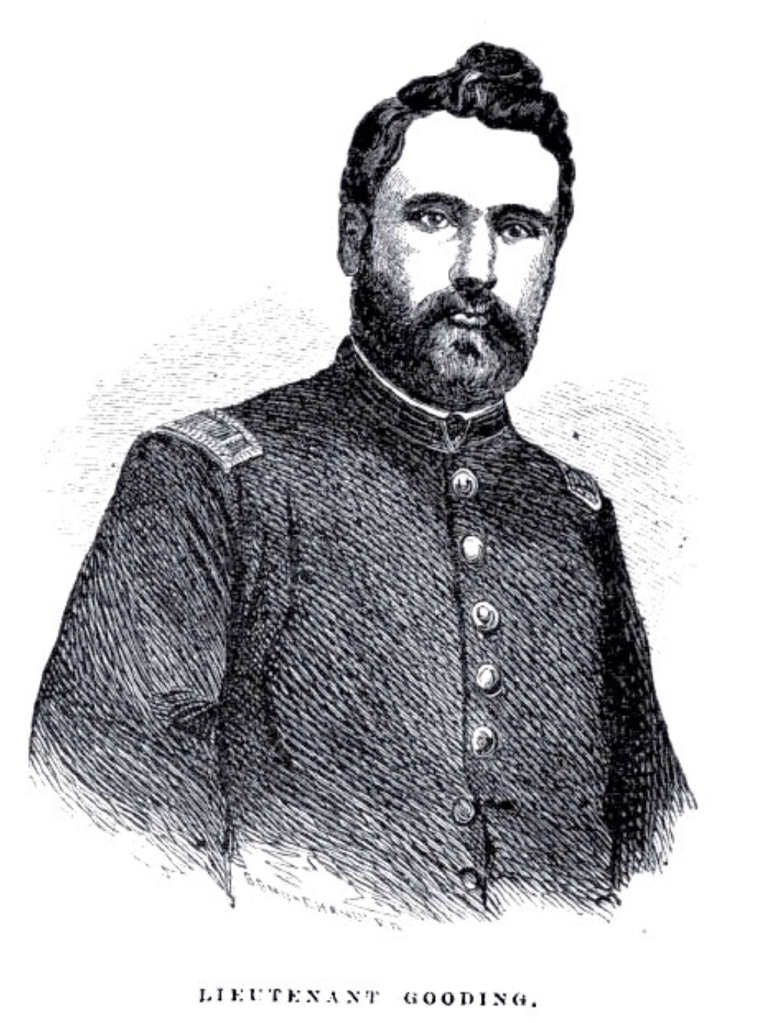
The following letters were written by Robert Gooding (1834-1864) of Co. E, 59th Illinois Infantry. Robert was 25 years old when he first enlisted at Marine, Illinois, as a private in Co. D, 59th Illinois Infantry. Upon his enlistment in July 1861, Robert was described as a 5’9″ tall, brown-haired, brown-eyed farmer. He was later promoted to 2nd Lt. on 15 March 1862 and to 1st Lt. on 30 January 1864. He was killed in action on 16 December 1864 at Overton’s Hill during the Battle of Nashville.
A large number of Robert’s letters are housed at the State Historical Society of Missouri. See Robert Gooding Letters (C0323) but they are not published on-line.
Robert Gooding was the son of Robert Gooding (1791-1885) and Mary Frances Jones (1795-1872) of Clinton county, Illinois. He was married to Frances (“Fanny”) Collins Shepard (1839-1860) in August 1858 but she died in July 1860 leaving him without any children.
Battle of Pea Ridge or Elkhorn Tavern
Letter 1
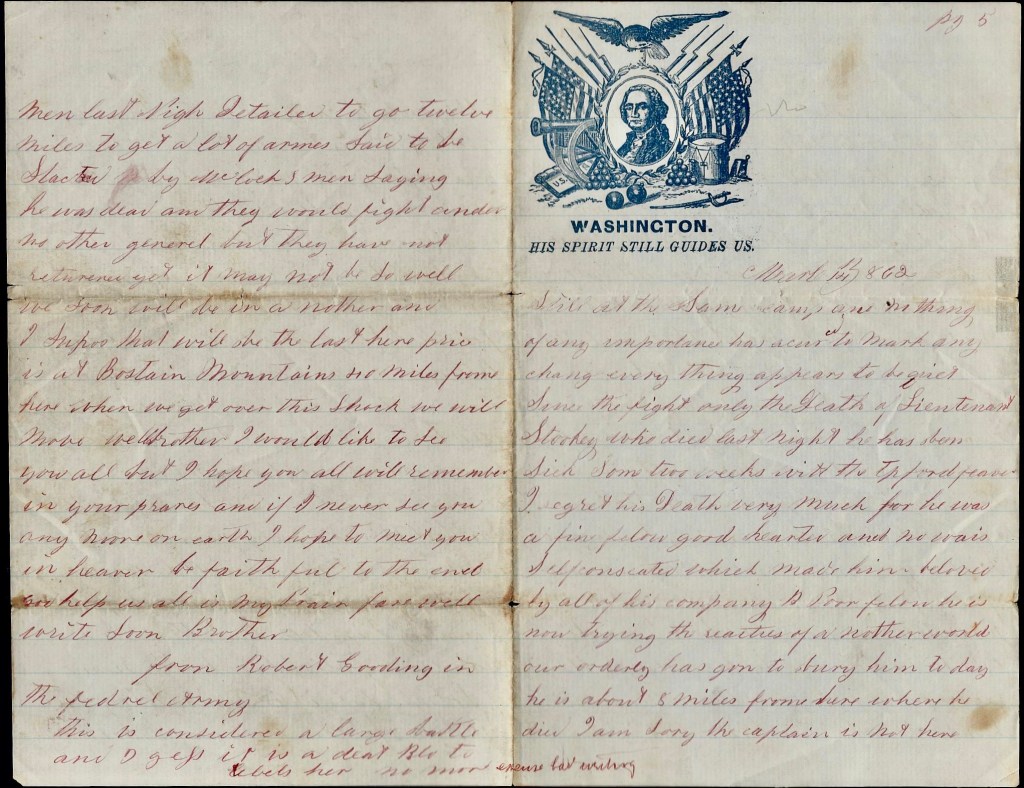
[Benton county, Arkansas] March 14, 1862
Still at the same camp and nothing of any importance has occurred to make any change. Everything appears to be quiet since the fight [see Battle of Pea Ridge]—only the death of Lieutenant [Albert H.] Stookey who died last night. He has been sick some two weeks with the typhoid fever. I regret his death very much for he was a fine fellow, good hearted, and no ways self conceited which made him beloved by all his company. Poor fellow. He is now trying the realities of another world. Our Orderly has gone to bury him today. He is about 8 miles from here where he died. I am sorry the chaplain is not here.
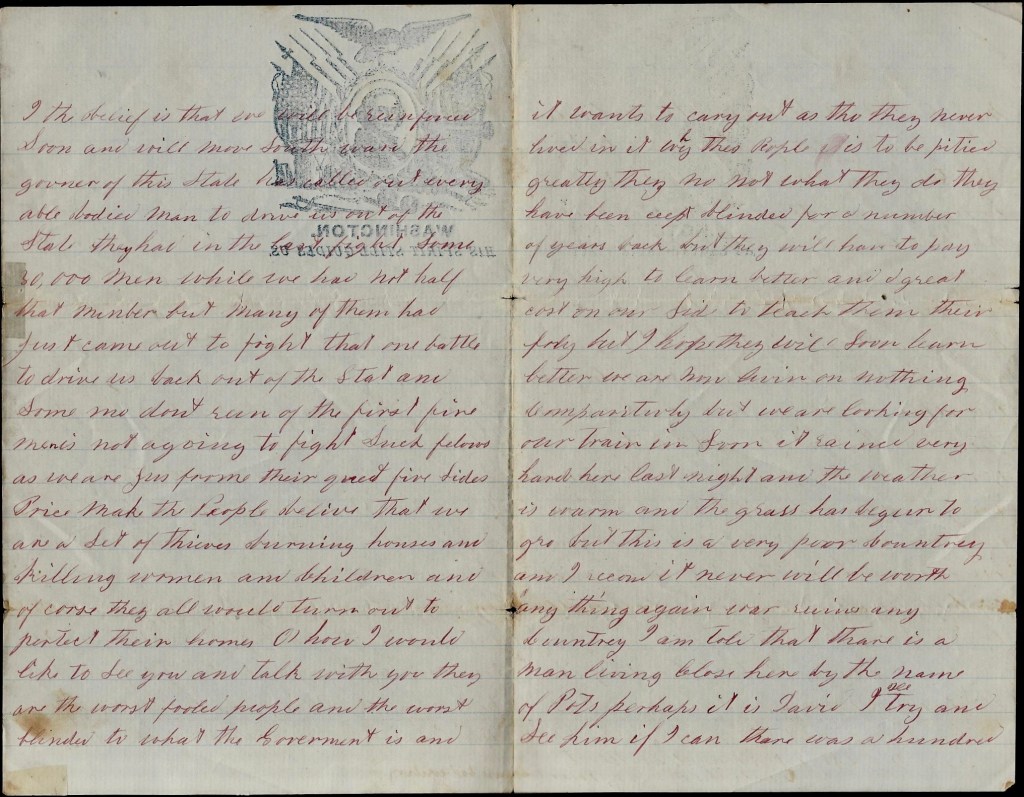
The belief is we that we will be reinforced soon and will move Southward. The governor of this state has called out every able-bodied man to drive us out of the state. They had in the last fight some 30,000 men while we had not half that number but many of them had just come out to fight that one battle to drive us back out of the state and some men don’t run off the first fire. Men is not going to fight such fellows as we are just from their quiet firesides. [Gen. Sterling] Price makes the people believe that we are a set of thieves, burning houses and killing women and children and of course they all would turn out to protect their homes.
Oh, how I would like to see you and talk with you. They are the worst fooled people and the worst blinded to what the Government is and it wants to carry out as though they never lived in it. Why, these people is to be pitied greatly. They know not what they do. They have been kept blinded for a number of years back but they will have to pay very high to learn better and a great cost on their side to teach them their folly. But I hope they will soon learn better.
We are now living on nothing comparatively but we are looking for our train in soon. It rained very hard here last night and the weather is warm and the grass has begun to grow. But this is a very poor country and I reckon it never will be worth anything again. War ruins any country.
I am told that there is a man living close here by the name of Potts. Perhaps it is David. I’ll try and see him if I can. There was a hundred men last night detailed to go twelve miles to get a lot of arms said to be stacked by [Benjamin] McCulloch’s men saying he was dead and they would fight under no other general but they have not returned yet. It may not be so well. We soon will be in another [fight] and I suppose that will be the last here. Price is at Boston Mountains 40 miles from here. When we get over this shock, we will move.
Well, brother, I would like to see you all but I hope you all will remember [me] in your prayers and if I never see you any more on earth, I hope to meet you in heaven. Be faithful to the end. God help us all in my prayer. Farewell. Write soon brother.
From—Robert Gooding, in the Federal army.
This is considered a large battle and I guess it is a death blow to Rebels here. No more. Excuse bad writing.
Letter 2
[Note: The following letter was published in the White River Valley Historical Quarterly, Vol. 35, No. 2 (Fall 1995) and published here to add context to the previous letter.]
Camp near Forethought on White river, Stone Co, Missouri April 13, 1862
Dear Brother,
I must try and write to you again to let you know that I am well and hearty though there has been nothing transpired of any note since I last wrote but we have moved from where we were our first days march on the road back towards Springfield. Then we turned to the east marched some 60 miles in this direction over a horrible mountains country and through pine forests and nothing but one mountain after another and no settlement at all, but it was somewhat interesting to the soldier, the beautiful pine and cedar and high cliffs of rock and many other curiosities. This is one remarkable country for fine streams of pure running water, James river is one of those clear streams. We crossed it on a bridge made of wagons. You can see the bottom 5 & 6 feet deep when that is said all is said of its good qualities.
Our army is in good health and a jocular set of fellows you never saw. They have got harden to everything that is hard. They have made up their minds there is nothing too hard for a soldier and I believe it. We are all in good hopes now that the war will soon be to an end from the great victories on our side lately.
We would think so indeed was that not a telling thing at Island No. 10 that rather beat Pea Ridge. Tell those Secesh at home for me that I have tried their brother’s pluck and tell them that one Secesh is not enough [for] 5 union men. But on the other hand, 5 is not enough for one of us, but it is a fact that we can fight 5 times our number. I am not surprised at their not fighting any better. It is the cause that makes a man fight the most. [Those] that I talked with do not know what they are fighting for. They are impressed that the government wants to set the Negro free among them. Well, let them think what they may. They are about played out. A few more blows will satisfy them that coercion is strong medicine administered with powder.
I believe it is thought that Price has gone down the Arkansas River. He undoubtedly started that way the last we heard from him. I suppose we will follow him as long as we can fix a way to get across White River which will not be long, but we cannot move fast in this rough country. There is a great many creeks to cross which impedes infantry very much but we can move as fast as he can.
Since the battle [Pea Ridge], we have been reinforced several thousand. Our strength is plenty strong for all the Butternuts that can be brought against us—that is a name the boys has given them since the battle, their dress looks so much like the nut.
You better believe we have some wild boys in the army. As a general thing they are brave and noble-hearted fellows. This is Sabbath evening and today by order of Secretary Chase that every chaplain of every regiment offer prayer to the God of hosts for the great victories over the traitors of our once happy government. So our chaplain responded to the request and I enjoyed it very much.
Monday morning and evening. I feel this morning as though I would like to see you all and to be on my farm and see my stock—especially the horses. I would like to take a ride on old grey and see old Herk [Hercules]. Tell Frank to take good care of them and the trees in the yard and I will make him a good present when I get home, if ever.
Vin Stookey has been after his brother. He came the morning before we left that place. I went with him to take up his brother [and] we went over the battlefield. He picked up some of the canon balls to take home. It was a great sight to them and to anyone to see the timber rent all to pieces. A person would wonder how any escaped. It is true the balls was as thick as hail, but for my part I did not feel a bit alarmed; all I thought about was to clean them out and we knew then was a big job ahead of us. [James M.] Mcintoch & [Benjamin] McCulloch was killed by our division, that is Jeff Davis’ [Division]. He is an old bully and is well thought of as a General. Lieutenant Stookey died on the 3rd of March, he was a fine fellow. He give me his pistol before he died which I will keep as long as I live. Poor fellow. He has gone to try the realities of another world. I hope he is better off than we are.
That left a vacancy for a Lieut. and the boys said they was a going to have a say so in it. It justly belong to the orderly Benee Goodner and they told the captain that I had to be the 2nd Lieutenant. So it was left to a vote and I was elected by a big majority. The orderly could not stand it and he applied for a transfer to the 3rd Illinois Calvary and he got it so he is not in our company anymore.
I think this is the best office in the company. You get big pay and have nothing to carry but your saber, and can pass any lines that a captain can and are a perfect gentleman in every sense; a little strap on your shoulder makes a good deal of difference in a man’s position in the army. I have found that to be a fact.
I must brag a little on our captain. He is a noble fellow and he is very sorry that he was not in the battle with us. We had no idea of a fight when he left and he I know did not think of such a thing or he would not have left. Don’t any of you think that he left us for fear of a fight; if you do it is a mistaken idea, he is a lovely young captain.
I believe I got nothing more to write. Give my love to all. You must write oftener. I wrote to you before about seeing David Potts and that he was coming back there and he wanted you to tell Loami [?] to save some of his land for him. So no more, but remain your affectionate brother.
— R. Gooding, 2nd Lieutenant, Co. E, 59th Illinois Vols.
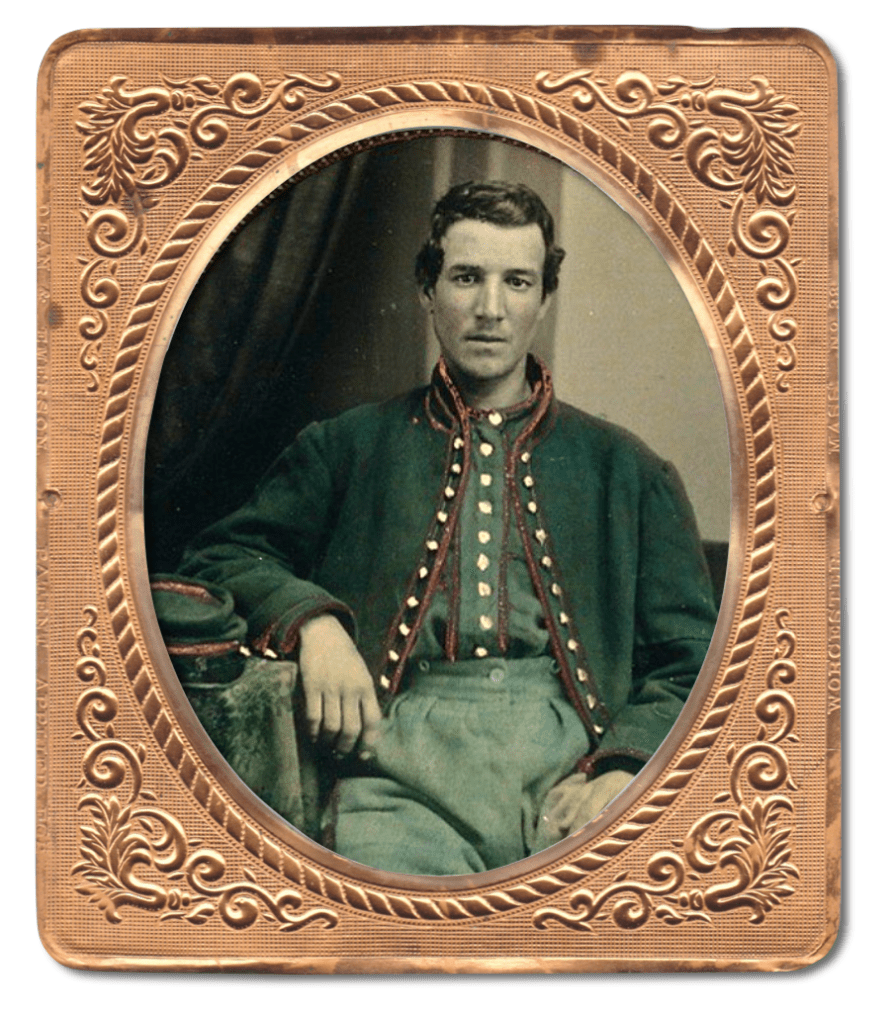
An unidentified member of the 72nd Pennsylvania Volunteer Infantry (Baxter’s Fire Zouaves) shown wearing the distinctive Zouave uniform which consisted of a Zouave jacket trimmed with red, sky-blue trousers with a red stripe down the leg, and a dark blue kepi.
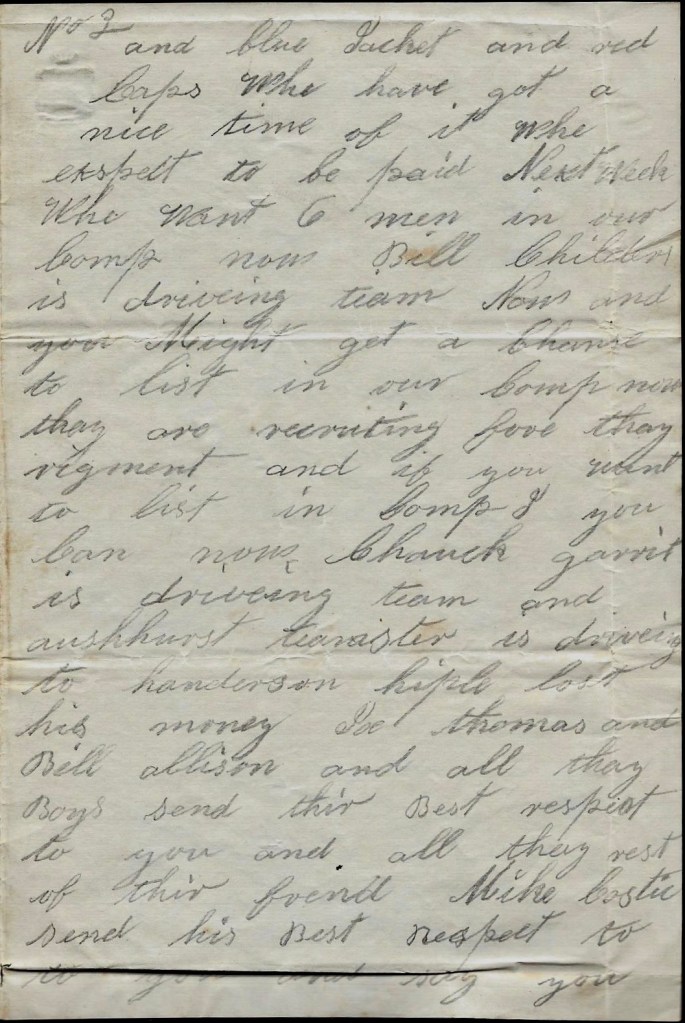
The following letter was written by Henry Green (1841-1914), a barely literate member of Co. I, 72nd Pennsylvania, Baxter Fire Zouaves who enlisted and mustered into the regiment on 10 August 1861 and was discharged at Falmouth on 11 April 1863. Presumably he was with the regiment through the Battle of Fredericksburg. His reason for a discharge was not given on the muster rolls.
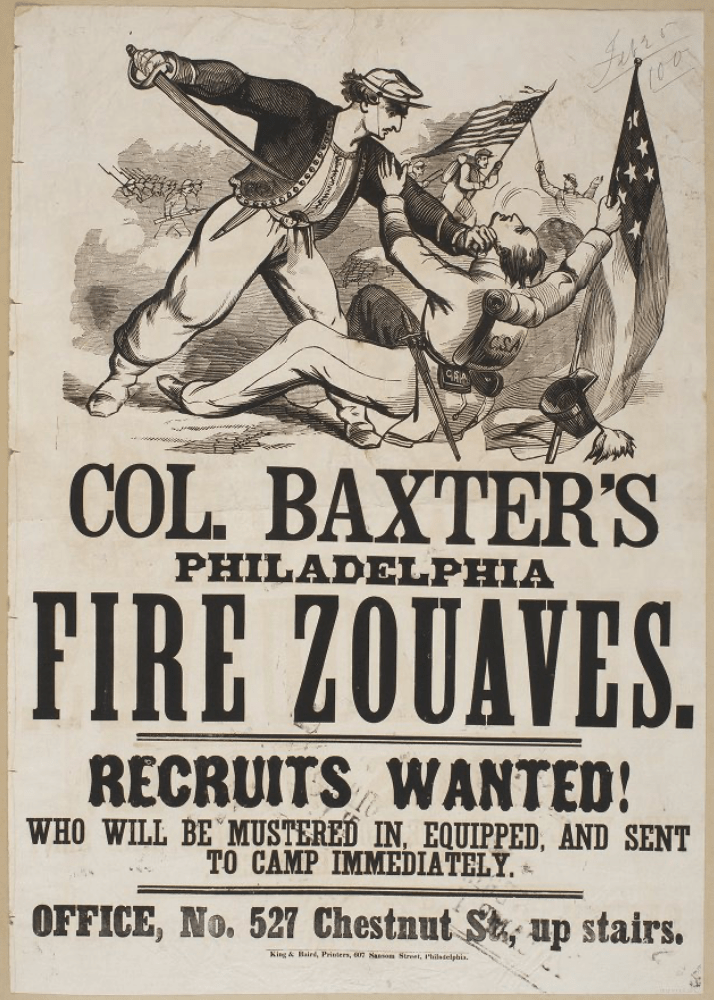
“The regiment was recruited from fireman from various points throughout Philadelphia and would go on to earn themselves an admirable war record. Taking part in the Peninsular Campaign, they would see their first bit of fighting during the Battle of Seven Pines. It would be followed up in rapid succession with the battles of the Seven Days before Richmond, Savage Station and the Peach Orchard, Malvern Hill and Chantilly. The regiment would suffer relatively light casualties despite the constant fighting. They would not be so lucky at Antietam. Fighting along the West Woods, nearly half of the regiment engaged would be lost losing over 200 men in the hotly contested fight. The 72nd would end the year with the Battle of Fredericksburg and the loss of a handful more men from the regiment.” [Civil War Image Shop who sold the image]
Transcription
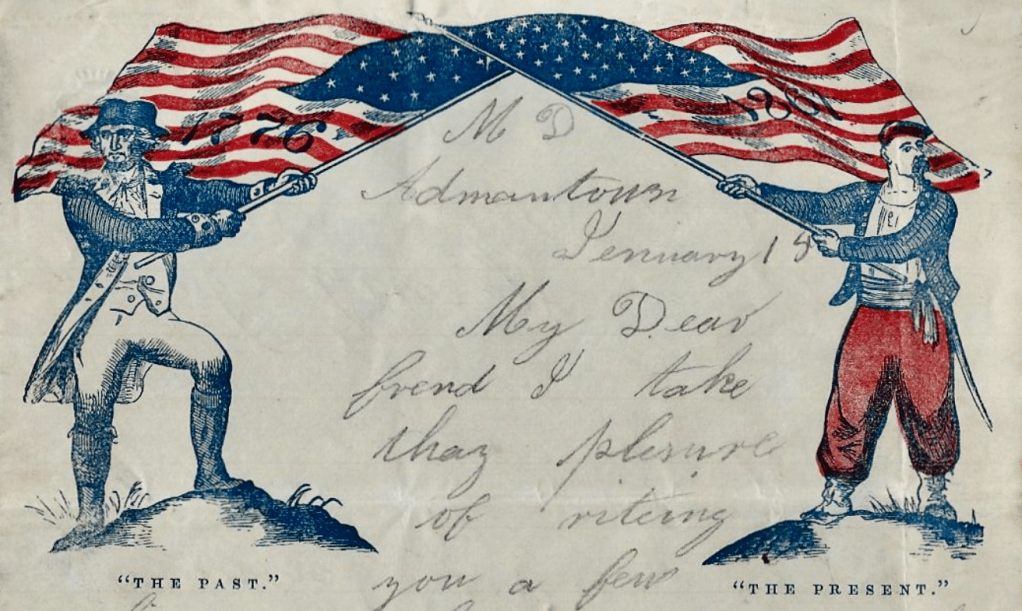
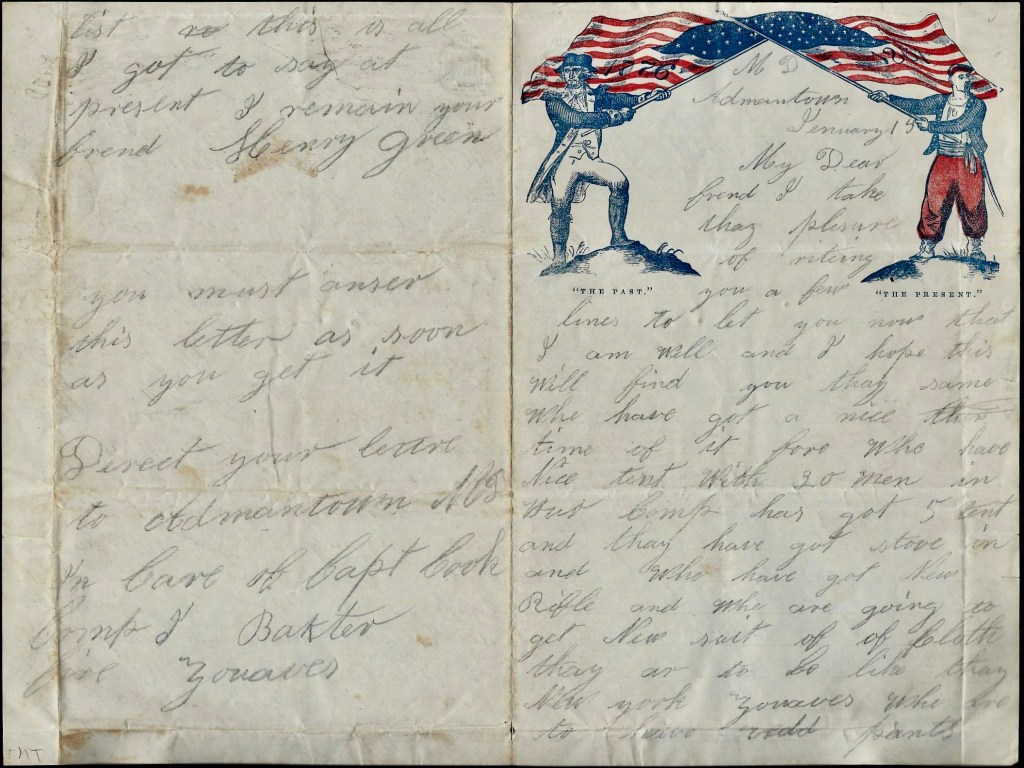
The patriotic heading of Henry’s Stationery
Adamstown, [Frederick County,] Maryland January 15 [1862]
My Dear Friend,
I take the pleasure of writing you a few lines to let you know that I am well and I hope this will find you the same. We have got a nice time of it for we have [a] nice tent with 20 men in. Each company has got 5 tents and they have got a stove in [them]. And we have got new rifles and we are going to get new suits of clothes. They are to be like the New York Zouaves. We are to have red pants and blue jackets and red caps.
We have got a nice time of it. We expect to be paid next week. We want 6 men in our company now. Bill Childress is driving team now and you might get a chance to [en]list in our company now. They are recruiting for the regiment and if you want to [en]list in Company I, you can now. Chalkley Garret is driving team and Aushurst teamster is driving too. Handerson Hipple lost his money. Joe Thomas and Bill Allison and all the boys send their best respects to you and all the rest of their friends. Mike Costic sends his best respect to you and says you [should en]list. This is all I’ve got to say at present. I remain your friend, — Henry Green
You must answer this letter as soon as you get it. Direct your letter to Adamstown, Maryland in care of Capt. [Henry A.] Cook, Company I, Baxter Fire Zouaves
Recruiting Poster for Co. Baxter’s Philadelphia Fire Zouaves (The Library Company of Philadelphia)
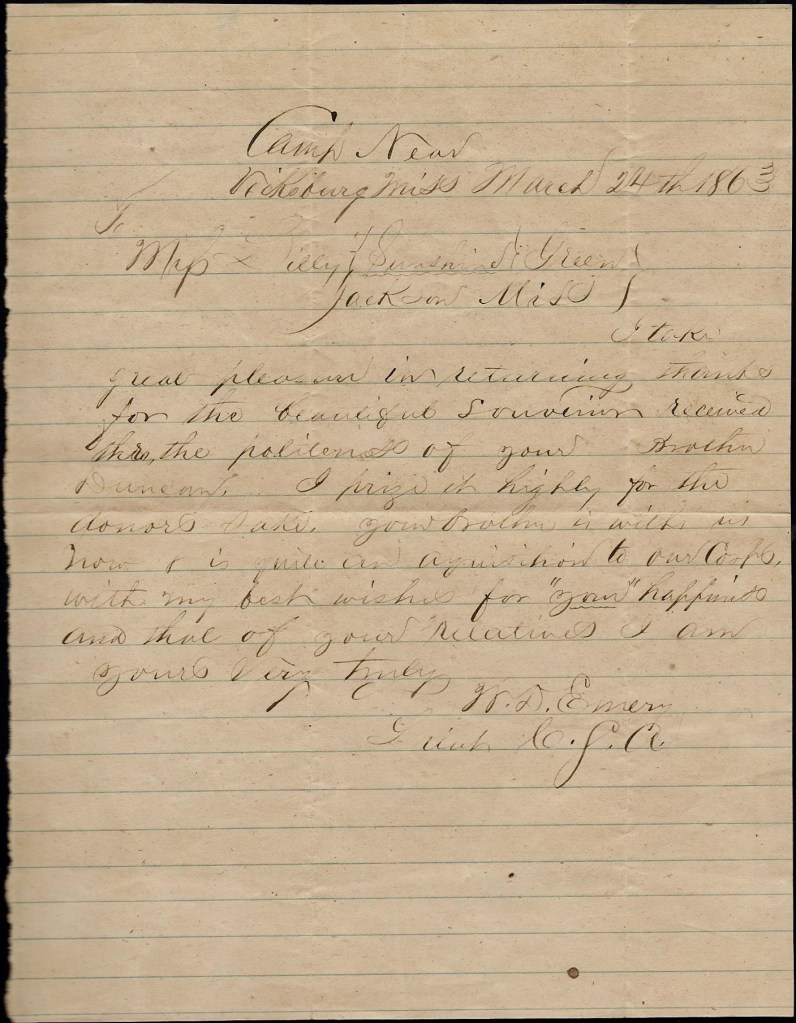
The following letter was written by 1st Lieutenant Winslow D. Emery (1825-Aft1870) who served in Waddell’s Alabama Battery. The battery of six guns was commanded by James Fleming Waddell and nearly destroyed at the Battle of Champion Hill on 16 May 1863. He was later taken prisoner at the surrender of Vicksburg on July 4, 1863 but soon after exchanged. He later rose in rank to Captain and commander of his own battery in Waddell’s Battalion. Winslow initially enlisted in May 1861 in Co. E, 6th Alabama Infantry at Montgomery. In the 1850 US Census, Winslow was identified as a native of Vermont and enumerated as a 23 year-old clerk residing in the household of W. T. Mitchell, a Montgomery merchant. He was still residing in Montgomery in 1870.
Emery wrote the letter to Sallie S. Green (1845-1917), the daughter of Bishop William Mercer Green (1798-1887) and the brother of Duncan Cameron Green (1844-1878) who was mentioned in this letter. Duncan was only 17 years old when in June 1861 he first enlisted in Co. K, 18th Mississippi Infantry. His name, “D. C. Green” was enumerated as a sergeant on the list of members in Waddell’s Battery submitted by their commander, J. F. Waddell, following the surrender at Vicksburg. Later in the war, Duncan was elevated to a 1st Lieutenant in Emery’s Battery A, 20th Alabama Light Artillery Battalion. Like his father, the Bishop of the Episcopal Church in Mississippi, Duncan was devout and after surviving the war became a minister of the gospel.
Transcription
Camp near Vicksburg, Mississippi March 24th 1863
Miss Lilly (Susan S.) Green Jackson, Miss.
I take great pleasure in returning thanks for the beautiful souvenir received through the politeness of your brother Duncan. I prize it highly for the donor’s sake. Your brother is with us now & is quite an acquisition to our Corps. With my best wishes for “your” happiness and that of your relatives, I am yours very truly,
The following letters were written by Samuel Green who served as a private in Co. E, 1st Confederate Battalion (Forney’s). The seven companies that made up this regiment were drawn from Alabama, Florida, Georgia, and Tennessee. Their service started at Port Hudson but their first engagement was at Corinth. They were then assigned to Loring’s Division and fought at Grand Gulf and Vicksburg. They were then assigned to the Army of Mobile and fought at Port Hudson, Champions Hill, Jackson, and Fort Pillow. In June 1863, they were assigned to Gen. Johnston’s Army of Relief, Department of the West. They were ordered to Virginia in March 1864 where they joined Heth’s Division of Hill’s Corps, Army of Northern Virginia, and participated in the fighting at Petersburg and Appomattox.
According to his muster records, Samuel enlisted at Fort Morgan, Alabama, in January 1862. He appears to have been with the regiment most of the time until he became ill in the fall of 1864 and was a Richmond hospital for several weeks until 1 November 1864.
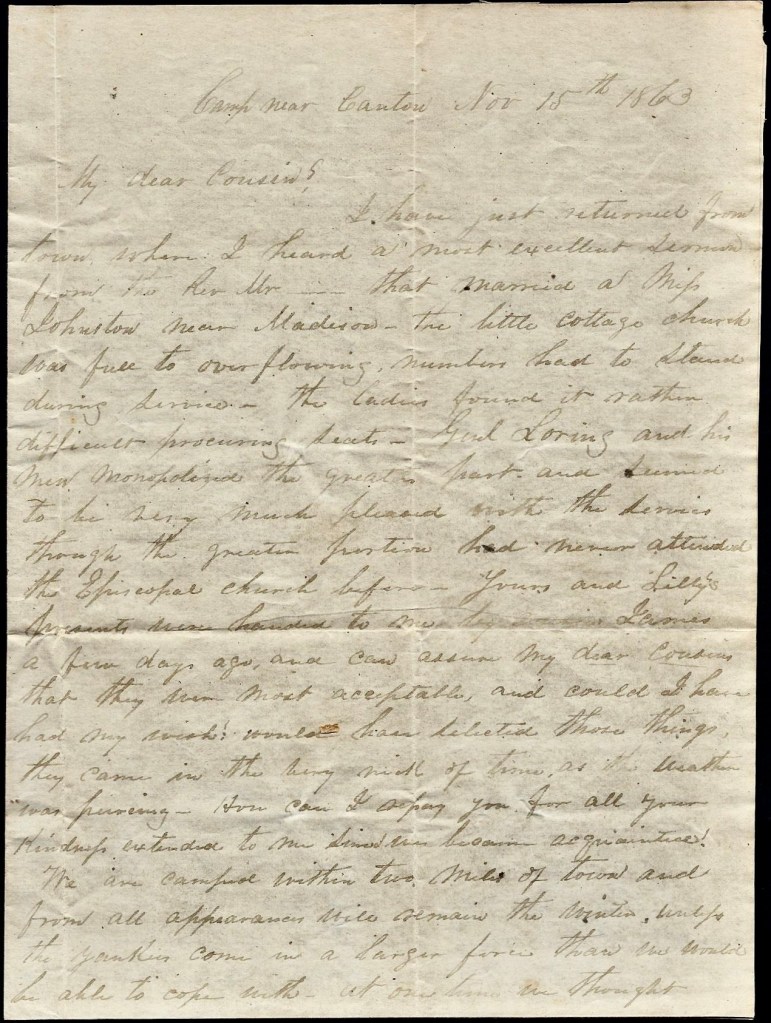
He wrote the letter to his cousins in Jackson, Mississippi—the children of Rt. Reverend William Mercer Green (1798-1887), the Bishop of the Episcopal Church in Mississippi.
Letter 1
Camp near Canton [Mississippi] November 15th 1863
My dear cousins,
I have just returned from town where I heard a most excellent sermon from the Rev. Mr. —– that married a Miss Johnston near Madison—the little cottage church was full to overflowing, numbers had to stand during service. The ladies found it rather difficult procuring seats. General [William W.] Loring and his men monopolized the greater part and seemed to be very much pleased with the services though the greater portion had never attended the Episcopal Church before. Yours and Lilly’s presents were handed to me by cousin James a few days ago and I can assure my dear cousins, that they were most acceptable. And could I have had my wish, would have selected those things. They came in the very nick of time as the weather was [ ing]. How can I repay you for all your kindness extended to me since we became acquainted.
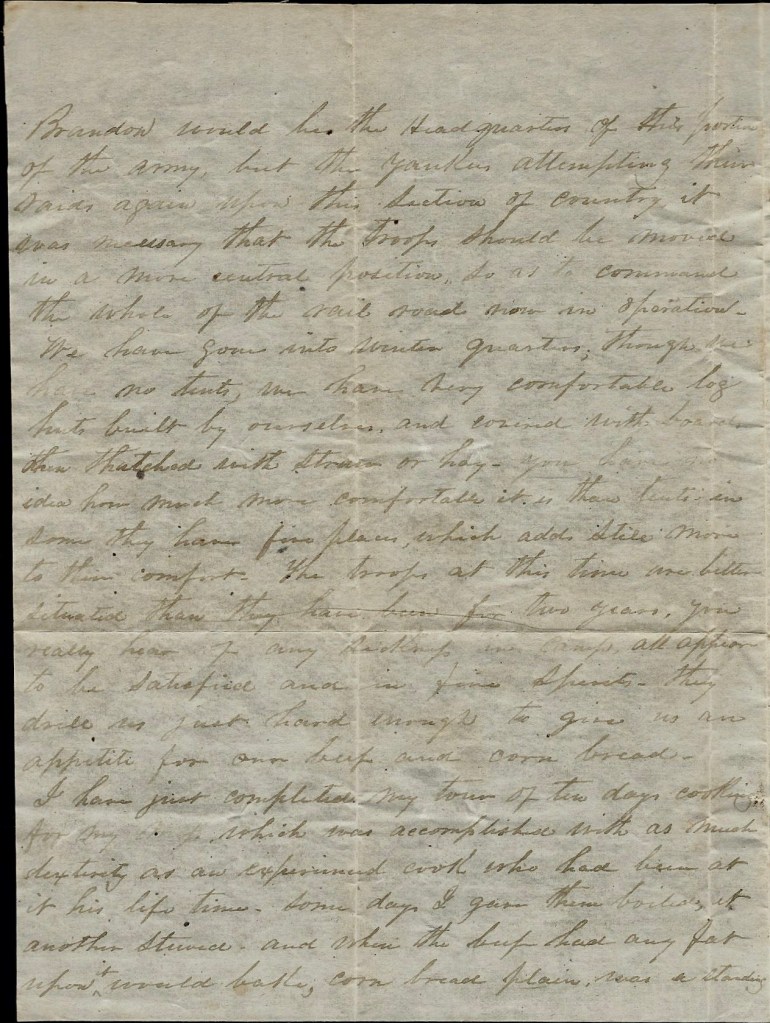
We are camped within two miles of town and from all appearances will remain the winter unless the Yankees come in a larger force than we would be able to cope with. At one time we thought Brandon would be the Headquarters of this portion of the army, but the Yankees attempting their raids again upon this section of country, it was necessary that the troops should be moved in a more central position so as to command the whole of the railroad now in operation. We have gone into winter quarters though we have no tents. We have very comfortable log huts built by ourselves and covered with boards, then thatched with straw or hay. You have no idea how much more comfortable it is than tents. In some they have fireplaces which add still more to their comfort.
The troops at this time are better situated than they have been for two years. You rarely hear of any hardship in camp; all appear to be satisfied and in fine spirits. They drill us just hard enough to give us an appetite for our beef and cornbread.
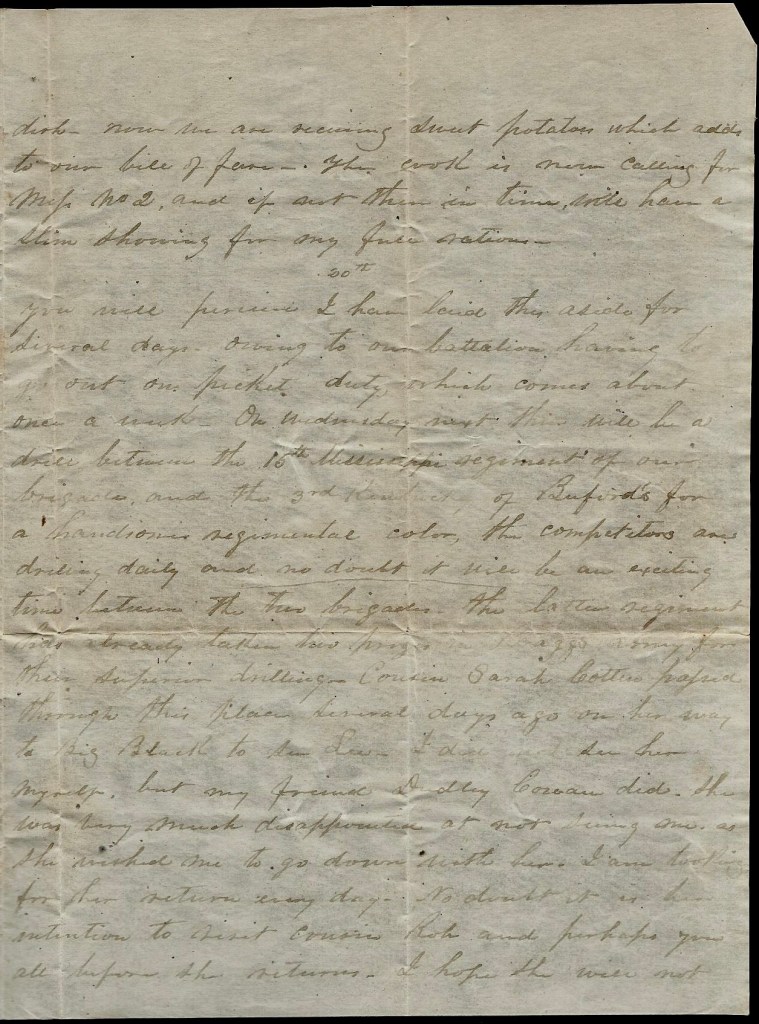
I have just completed my tour of ten days cooking for my mess which was accomplished with as much dexterity as an experienced cook who had been at it his life time. Some days I gave them boiled, yet another stewed and when the beef had any fat upon it, would bake. Corn bread plain was a standing dish. Now we are receiving sweet potatoes which adds to our bill of fare. The cook is now calling for Mess No. 2 and if not there in time, will have a slim showing for my full ration.
20th.
You will perceive have laid this aside for several days owing to our battalion having to go out on picket—duty which comes about once a week. On Wednesday next there will be a drill between the 15th Mississippi Regiment of our brigade and the 3rd Kentucky of Buford’s for a handsome regimental color. The competitors are drilling daily and no doubt it will be an exciting time between the two brigades. The latter regiment has already taken two prizes in Bragg’s Army for their superior drilling.
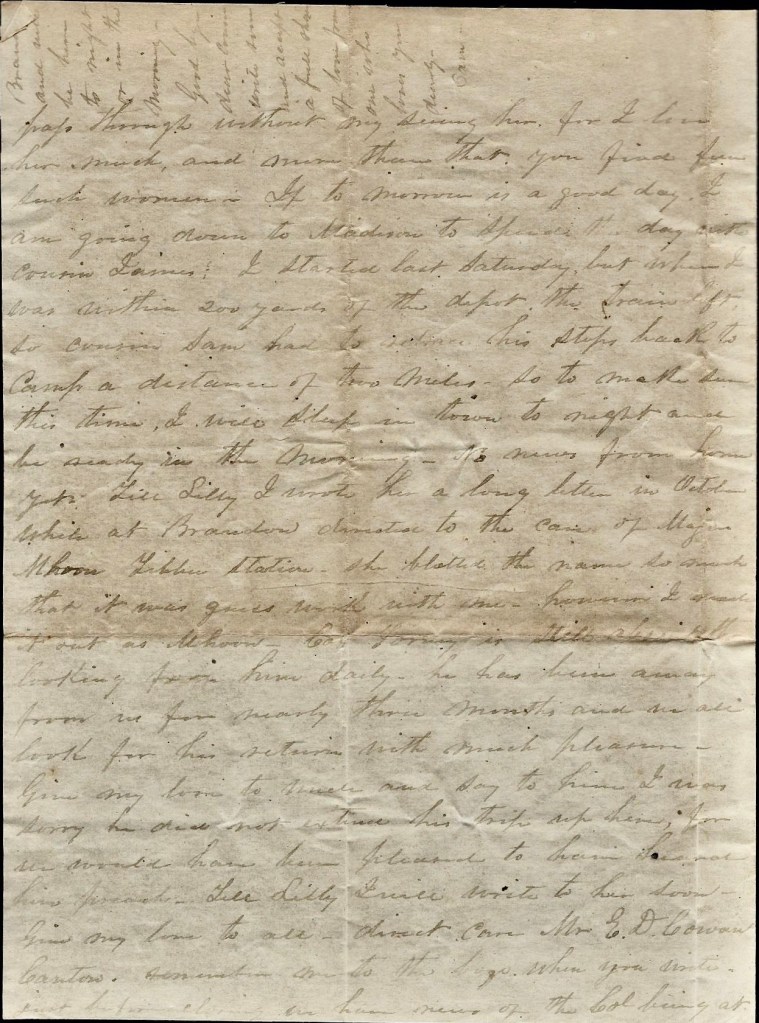
Cousin Sarah [Green] Cotten passed through this place several days ago on her way to Big Black to see Lew. I did not see her myself but my friend Dudley Cowan did. She was very much disappointed at not seeing me as she wished me to go down with her. I am looking for her return every day. No doubt it is her intention to visit cousin Rob and perhaps you all before she returns. I hope she will not pass through without my seeing her for I love her much and more than that, you find few such women.
If tomorrow is a good day, I am going down to Madison to spend the day with cousin James. I started last Saturday but when I was within 200 yards of the depot, the train left so cousin Sam had to return his steps back to camp a distance of two miles. So to make sure this time, I will sleep in town tonight and be ready in the morning.
No news from home yet. Till Lilly, I wrote her a long letter in October while at Brandon directed to the care of Major Mhoon, Libbie Station. She blotted the name so much that it was guess work with me. However, I made it out as Mhoon. Col. [George H.] Forney is still [ ] looking for him daily. He has been away from us for nearly three months and we all look for his return with much pleasure.
Give my love to Uncle and say to him I was sorry he did not extend his trip up here for we would have been pleased to have heard him preach. Tell Lilly I will write to her soon. Give my love to all. Direct care of Mr. E. D. Cowan, Canton. Remember me to the boys when you write. Just before closing we have news of the Colonel being at Brandon and will be here tonight or in the morning. Goodbye dear cousin. Write soon and accept a full share of love from one who loves you dearly, — Sam
Letter 2
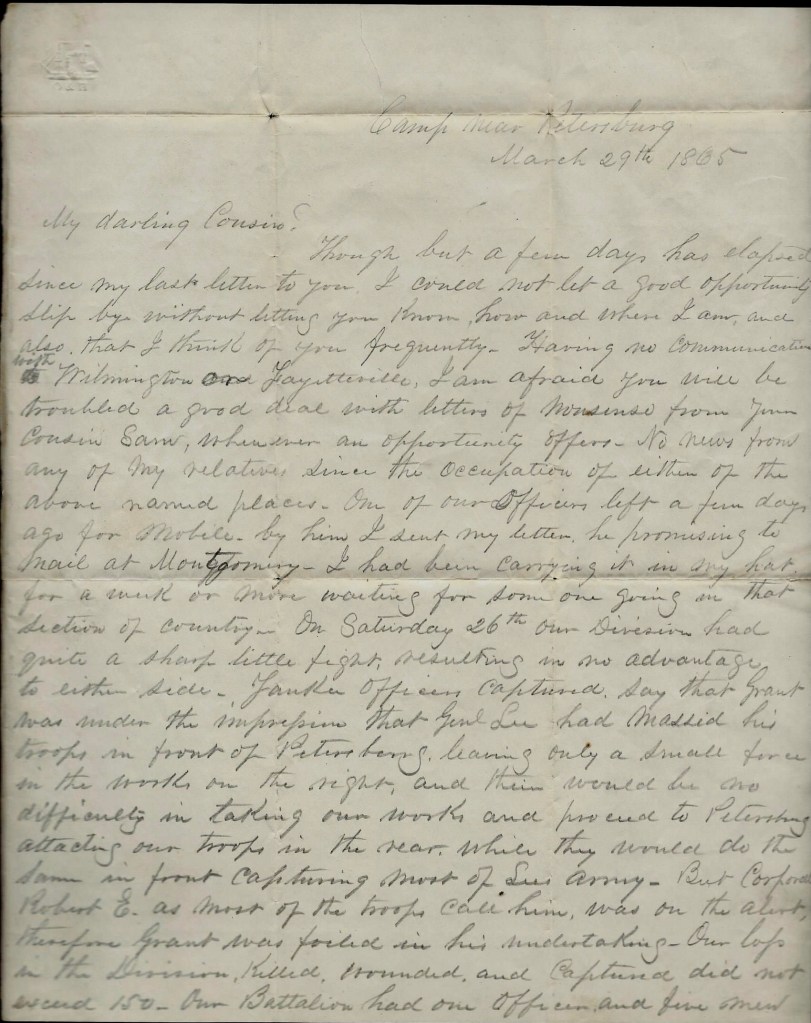
Camp near Petersburg March 29th 1865
My darling cousin,
Though but a few days has elapsed since my last letter to you. I could not let a good opportunity slip by without letting you know how and where I am, and also, that I think of you frequently. Having no communication with Wilmington or Fayetteville, I am afraid you will be troubled a good deal with letters of nonsense from your cousin Sam, whenever an opportunity offers. No news from any of my relatives since the occupation of either of the above named places. One of our officers left a few days ago for Mobile. By him I sent my letter, he promising to mail at Montgomery. I had been carrying it in my hat for a week or more waiting for someone going in that section of country.
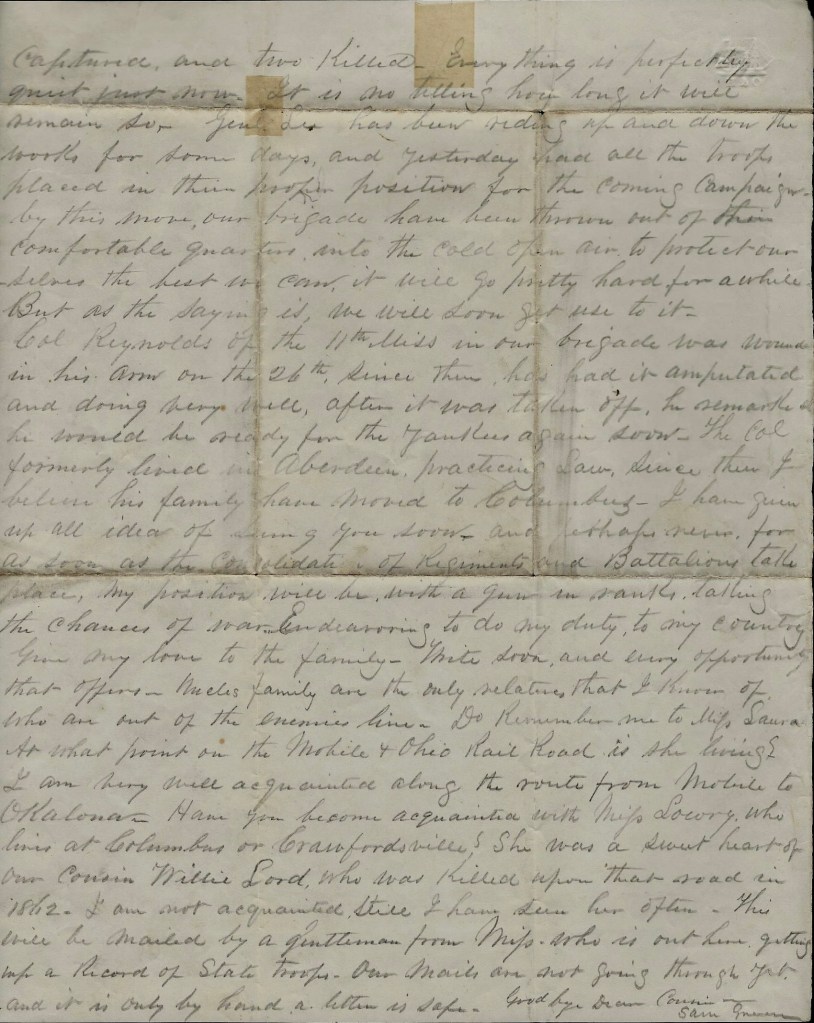
On Saturday 26th our division had quite a sharp little fight resulting in no advantage to either side. Yankee officers captured say that Grant was under the impression that General Lee had massed his troops in front of Petersburg, leaving only a small force in the works on the right and there would be no difficulty in taking our works and proceed to Petersburg, attacking our troops in the rear, while they would do the same in front, capturing most of Lee’s army. But Corporal Robert E.—as most of the troops call him—was on the alert. Therefore, Grant was foiled in his undertaking. Our loss in the Division, killed, wounded, and captured, did not exceed 150. Our Battalion had one officer and five men captured, and two killed. Everything is perfectly quiet just now. It is no telling how long it will remain so.
“Gen. Lee has been riding up and down the works for some days, and yesterday had all the troops placed in their proper position for the coming campaign.”
—Samuel Green, Co. E, 1st Confederate Brigade, 29 March 1865
Gen. Lee has been riding up and down the works for some days, and yesterday had all the troops placed in their proper position for the coming campaign. By this move, our brigade have been thrown out of their comfortable quarters into the cold open air to protect ourselves the best we can. It will go pretty hard for awhile. But as the saying is, we will soon get use to it.
Col. [Reuben O.] Reynolds 1 of the 11th Mississippi in our brigade was wounded in his arm on the 26th. Since then, has had it amputated and doing very well. After it was taken off, he remarked he would be ready for the Yankees again soon. The colonel formerly lived in Aberdeen [Mississippi] practicing law. Since then I believe his family have moved to Columbus {Mississippi].
I have given up all idea of seeing you soon and perhaps never for as soon as the consolidation of regiments and battalions take place, my position will be with a gun in ranks, taking the chances of war, endeavoring to do my duty to my country.
Give my love to the family. Write soon and every opportunity that offers. Uncle’s family are the only relatives that I know of who are out of the enemy’s line. Do remember me to Miss Laura. At what point on the Mobile & Ohio Railroad is she living? I am very well acquainted along the route from Mobile to Okalona. Have you become acquainted with Miss Lowry who lives at Columbus or Crawfordsville? She was a sweetheart of our cousin Willie Lord 2 who was killed upon that road in 1862. I am not acquainted; still I have seen her often. This will be mailed by a gentleman from Mississippi who is out here getting up a Record of State troops. Our mails are not going through yet and it is only by hand a letter is safe.
Goodbye dear cousin, — Sam Greene
1Reuben Oscar Reynolds began his service as a Captain of Co. I in the 11th Mississippi Infantry. He was wounded at the Battle of Gaines’s Mill (27 June 1862). He was promoted to Major on 3 October 1862. At Gettysburg, Major Reynolds was wounded a second time in Picket’s Charge while commanding the regiment. When Col. Green was mortally wounded on 12 May 1864 at Spotsylvania Court House, Reynolds was promoted to Colonel. In the skirmish at Hawk’s Farm, Reynolds was wounded a third time, losing his right arm.He was a graduate of the University of Georgia and University of Virginia (law school). After law school he set up his practice in Aberdeen, Mississippi. He married Mary (Mollie) Branch English on February 20, 1855.
2 William Ancrum Lord (1837-1862) was killed on 19 March 1862 at or near Okolona in a train wreck on the Mobile & Ohio Railroad. He was the son of William Campbell Lord (1793-1847) and Eliza Jane Hill (1794-1875)of North Carolina.In the 1860 US Census, he was enumerated as a “conductor” living in Mobile.
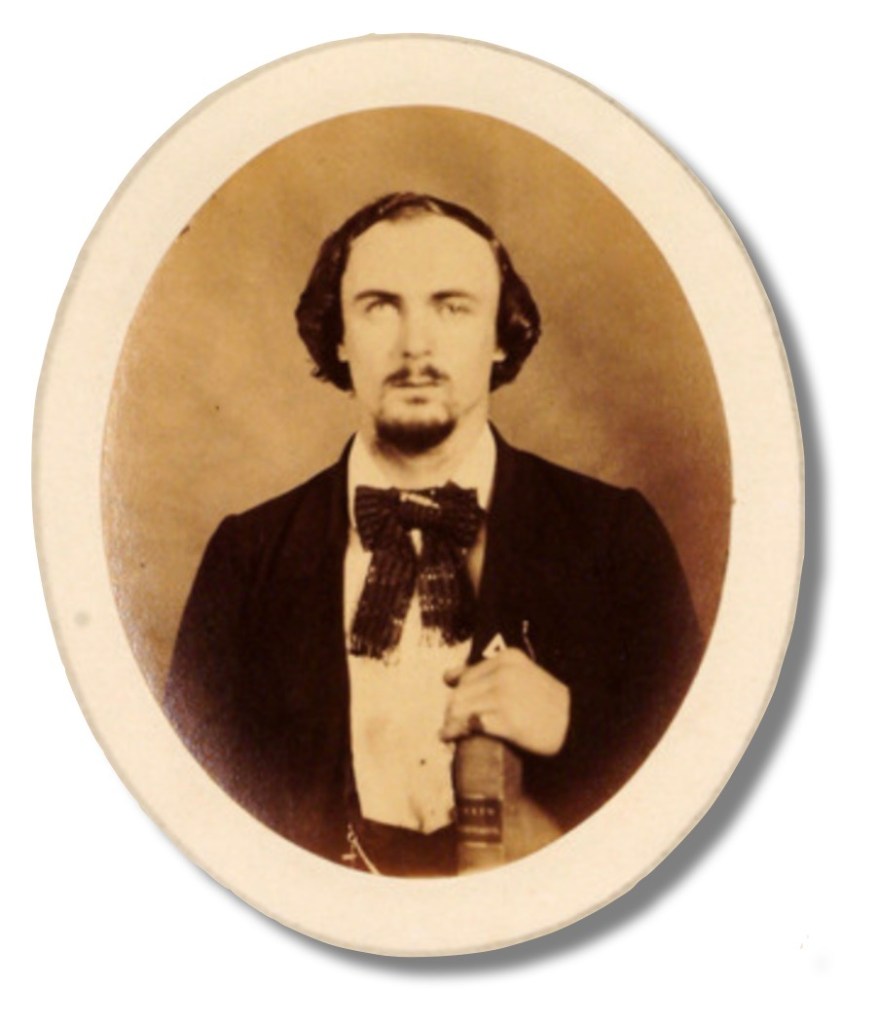
G. Berkeley Green (University of Mississippi Archives)
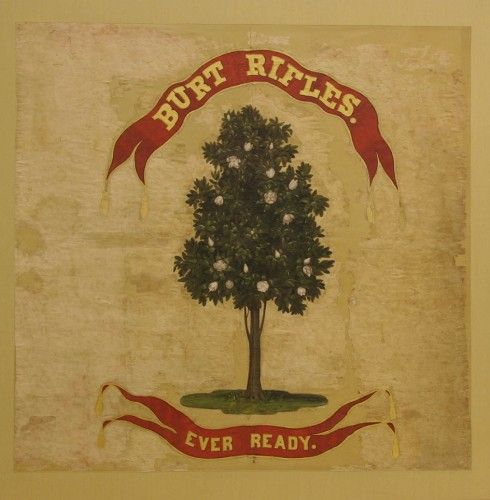
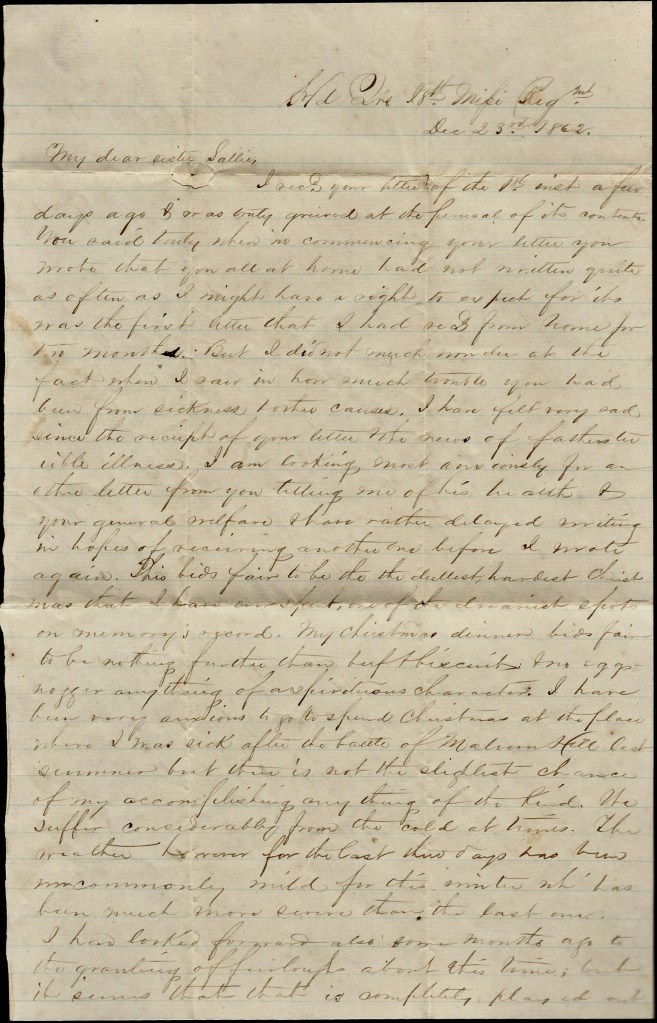
The following letter was written by G. Berkeley Green (1841-1893), the son of Bishop William Mercer Green (1798-1887) and Charlotte Isabella Fleming (1810-1860) of Jackson, Hinds county, Mississippi. Berkeley was attending the University of Mississippi at Jackson when the State of Mississippi seceded from the Union on January 9, 1861. On 4 May, nearly the entire student body (most of them sons of large slave-holding families) and many of the professors at the University formed ranks, left, school and enlisted in the Confederate Army. Only four students reported for classes in the fall so the university closed temporarily. The “University Grays” became Co. A, of the 11th Mississippi Infantry. When the company was ordered to leave, his father attempted to have Berkeley discharged so that he could finish his studies and graduate in May 1861. It was an unusual request but successful no doubt because of his father’s station as Bishop of the Episcopal Church in Mississippi. Within days of his graduation in late May 1861, Berkeley enlisted again, this time in the “Burt Rifles” or Co. K, 18th Mississippi Infantry.
Burt Rifles—Co. K, 18th Mississippi
During the next four years of service, Berkeley saw plenty of action. He was captured at Fredericksburg, Virginia, on May 3, 1863, and exchanged just in time to rejoin his unit and fight at Gettysburg. In that battle he was again captured, and sent to Fort Delaware prisoner of war camp. He was released on May 22, 1865, after taking the Oath of Allegiance to the United States.
Berkeley Green later married Sarah Joanna Hillyer of Natchez, Mississippi. In 1880, Berkeley and his family resided in Vicksburg where he worked as a clerk.
In his letter, Berkeley mentions his brother “Rave” several times. This was John Ravenscroft Green (1830-1890), sometimes referred to to as “J. R.” and named after Bishop John Ravenscroft. He married 1st to DeLainey VanDusen McGahey, and 2nd to Hannah Lavina Lee. He became a physician after the Civil War and lived in southern Indiana for a time.
The letter was addressed to Sallie S. Green (1845-1917) who would later marry John Mercer Cotten (1842-1915), a veteran of Co. G, 7th Tennessee Infantry and Co. K, 7th Tennessee Cavalry.
Transcription
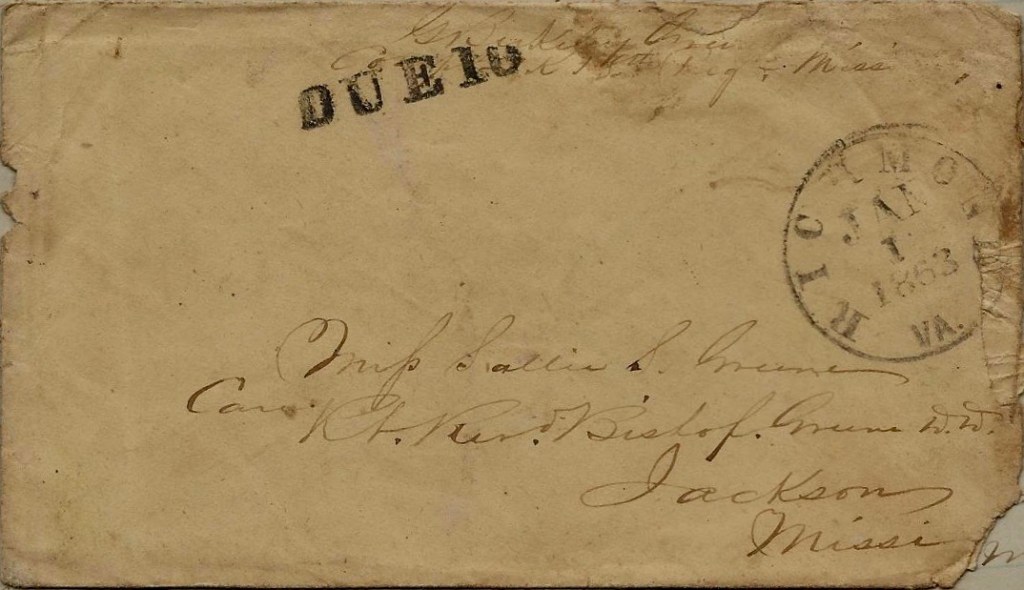
Miss Sallie S. Greene, Care of Right Rev. Bishop Greene, D. D., Jackson, Mississippi
Headquarters 18th Mississippi Regiment December 23rd 1862
My dear sister Sallie,
I received your letter of the 1st inst. a few days ago & was truly grieved at the perusal of its contents. You said truly when in commencing your letter to wrote that you all at home had not written quite as often as I might have a right to expect for it was the first letter that I had received from home for two months. But I did not much wonder at the fact when I saw in how much trouble you had been from sickness & other causes. I have felt very sad since the receipt of your letter & the news of father’s terrible illness. I am looking most anxiously for another letter from you telling me of his health & your general welfare. I have rather delayed writing I hopes of receiving another one before I wrote again.
This bids fair to be the dullest, hardest Christmas that I have ever spent—one of the dreariest spots on memory’s record. My Christmas dinner bids fair to be nothing further than beef & biscuits & no eggnog or anything of a spiritous character. I have been very anxious to go to spend Christas at the place where I was sick after the battle of Malvern Hill 1 last summer but there is not the slightest chance of my accomplishing anything of the kind. We suffer considerably from the cold at times. The weather, however, for the last three days has been uncommonly mild for this winter which has been much more severe than the last one.
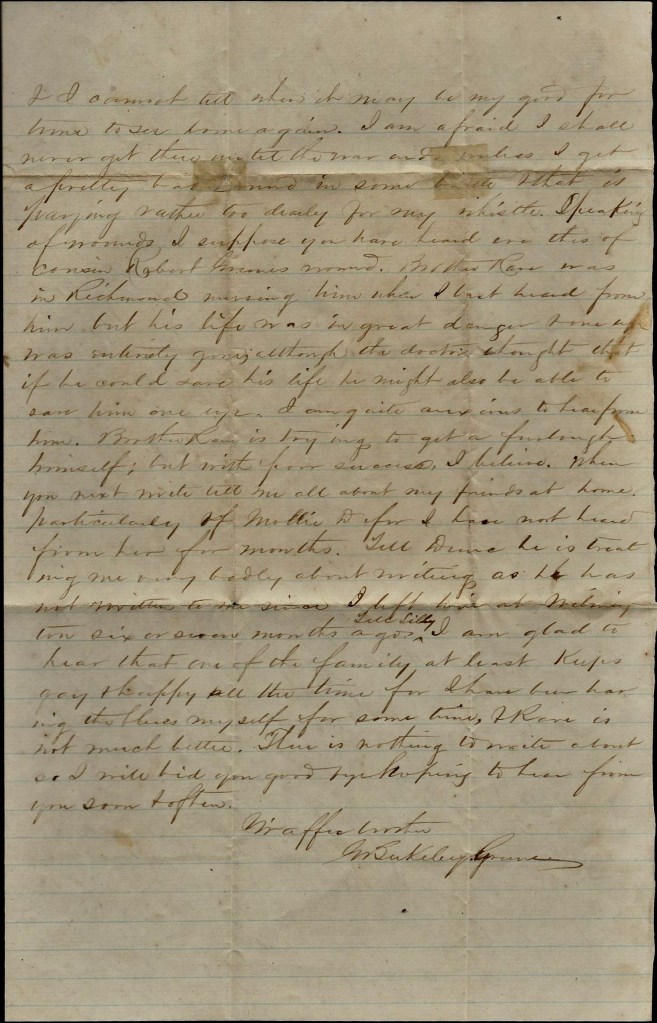
“I cannot tell when it may be my good fortune to see home again. I am afraid I shall never get there until the war ends unless I get a pretty bad wound in some battle. That is paying rather too dearly for my whistle.”
I had looked forward also some months ago to the granting of furloughs about this time but it seems that that is completely played out & I cannot tell when it may be my good fortune to see home again. I am afraid I shall never get there until the war ends unless I get a pretty bad wound in some battle. That is paying rather too dearly for my whistle.
Speaking of wounds, I suppose you. have heard ere this of cousin Robert Greene’s wound. Brother Rave was in Richmond nursing him when I last heard from him but his life was in great danger & one eye was entirely gone, although the doctor thought that if he could save his life, he might be able to save him one eye. I am quite anxious to hear from him. Brother Rave is trying to get a furlough himself but with poor success, I believe.
When you next write, tell me all about my friends at home—particularly of Mollie D. for I have not heard from her for months. Tell [brother] Dunc[an] he is treating me very badly about writing as he has not written to me since I left home at Wilmington six or seven months ago. Tell Lilly I am glad to hear that one of the family at least keeps gay and happy all the time for I have been having the blues myself for some time. And Rave is not much better. There is nothing to write about so I will bid you goodbye hoping to hear from you soon.
Your affectionate brother, — G. Berkeley Greene
1 The 18th Mississippi Infantry participated in the Battle of Malvern Hill on 1 July 1862. They were part of the evening attack and lost 16 killed and 126 wounded.
I could not find an image of Nelson but here is one of Harrison Clark who also served in the 125th New York Infantry. Clark’s image is actually a CDV but I have shown it matted. (Al Niemiec Collection)
The following seven letters were written by Nelson L. Bullis (1835-1864), the son of John Hiram Bullis (1783-1861) and Sally Parish (1790-1873) of Schuyler Falls, New York. “Nell” enlisted on 15 August 1862 at Troy to serve three years in Co. G, 125th New York Infantry. At the time of his enlistment, he was described as a 26 year-old, grey-eyed, black-haired farmer who stood 5 feet 5 inches tall.
Nelson was among the Union troops who were surrendered at Harpers Ferry to Stonewall Jackson’s men on 15 September 1862 and was paroled later that year. Some six weeks before Grant’s Overland Campaign in the spring of 1864, Nelson wrote, “I hope in one year & 5 months more to be so I can go where I choose—that is, providing a rebel bullet does not find me.” Sadly he was killed in action on 16 June 1864 in front of Petersburg.
Nelson’s brother, Mefflin Smith Bullis, served in Co. G, 26th New York Cavalry.
Nelson wrote the letters to his friend, Merritt L. Pierce (1842-1869) of Schuyler Falls, New York.
Nelson Bullis is listed among the killed of the 125th NY Infantry in the fighting at Petersburg on 16 June 1864. (Troy Daily Times, 22 June 1864)
[Note: These letters are from the personal collection of Carolyn Cockrell and were transcribed and published on Spared & Shared by express consent.]
Letter 1
Annapolis, Maryland September 26th, 1863
Friend Merritt,
George Parson Farnsworth (1842-1902), seated next to his brother Charles H. Farnsworth. (Find-A-Grave)
Yours of the 21st was received today. It surprised me some though. I heard from Saff[ord Taylor] you were intending a western tour, but how happens it, old fellow, that Miranda was entrusted to your care? Where was George Farnsworth? 1 How would he have once felt & talked & still later that schoolteacher who is now in the 9th Vermont or was when I was in Chicago. They would have objected perhaps had they been near. But being in the army is a certain method of being forgotten of the girls. Take care Merritt that going West does not have the same effect.
I no longer belong to Cousin Jeff. I am exchanged & have allegiance only to Uncle Sam & my correspondents. I will not give in yet that I had the blues that time but I may be too much like Charlie, not willing to own any displeasure. But receiving letters from or writing to you has an effect of rendering me silent & sad or perhaps homesick would be a better term.
But if you could enter our reading room you would not wonder. To see a couple play chess or checkers for hours without as much as a smile & to think of the way we used to enjoy it. Then the readers, such faces, some emaciated, others lame or lost a limb, some showing marks of wounds & all wearing a look of such sadness. I never saw it equaled. They act more like prisoners for life & are undergoing repentance for crimes committed. Then the knowledge that your own face wears the same woe begotten look–is it not enough to make a fellow have the blues.
I shall be glad to get back to the regiment & still dread to join it so late in the season. I have had no opportunity to have my likeness taken but if I can get a pass next week, I shall have it all right. I did not suppose you intended staying west but I hope you will be home when I get there if I ever do make out to get home. I am glad to hear from Mark. I did not know but he like many another had gone to the wars.
So you are in the land of Hoosiers. By the time you answer this you will have had a better opportunity of judging of the society. I think one always on his first appearance in a place thinks it worse than it is. I hope you will find it so.
I am gaining rapidly. I shall be able to leave if the powers-that-be see fit to send me off, but still I do not expect to be sent away for 2 weeks unless there is a rush of sick into this hospital.
I hope you will have good success in your western trip & will not be homesick. The other boys made a mighty short stay not [as long?] as I did. You will think my letter rather unconnected. I am talking and reading, have been playing cards and two of the boys are now playing. If it were not for cards, soldiers would find some long hours. I will wait a while to finish this.
1 George Parsons Farnsworth in Beekmantown in 1860 census, served in Co. A, 2nd Wisconsin Infantry Regiment. Married Emily Miranda Moore of Schuyler Falls.
Letter 2
Annapolis, Maryland October 3rd 1863
Friend Merritt,
Yours was received in due time with a little astonishment for the address though that was somewhat lessened by Saff[ord Taylor]’s writing me of your intentions of taking a western trip so I was looking for some account of your departure to the land of Hoosiers & prairie chickens. So, you expect to stay until you get homesick. My hope is that you will get homesick before you get the ague. My thoughts of the West may be erroneous, but I think 5 out of 6 who go from [New] York State to Indiana or Illinois have the ague before they have been there 2 years in spite of what the acclimated say.
You do not seem to wholly like the society. Did you ever visit a strange church & notice how homely the women were & by often going & becoming acquainted finding them as good looking as the generality of people? It is the same in judging of the society. We are apt to see & hear of the worst part first. There are few who do not in giving a description of persons or places or societies who do not give evil side the greatest notice & do not qualify it be telling of good acts or feelings or beauties. But when they speak of praiseworthy things, qualify them by their ifs & buts & evil actions so as entirely to overcome the effects of their praises. So you see I think in my extreme wisdom you will change somewhat your opinion of the society & find many worthy associates if not friends.
I wrote one letter a number of days ago but delayed sending it [un]til I could send my picture but I was refused pass & have tried every day since but the paymaster has been here & payed off those who had been here over 2 months & as soldiers will get drunk when they have money & drunkenness is against the law so our doctor means to stop it by stopping all passes for a few days. I hardly think it will do more than delay the evil & I am afraid it will like waters rage the worse for being confined.
You think I had the blues. It might have [been] so. I own I am thinking of home & its friends more when I write to you or receive a letter from you than any other time. This might have given a coloring or tone to my letter, but I assure you I was not troubled with what I should call the blues. Today I have been somewhat lonesome but no wonder—nothing to do but read & gaming. It is enough to ennui anyone. I always believed myself lazy & no friend of working but here I have often wished to be working on the farm or at the least working so as to take of[f] that sense of feeling that I am a deadbeat to the government & myself as well.
I dread the consequences of exposure on my return to the regiment before my system has recovered its natural tone & may not have to, but I am in a hurry to be of some use to somebody or something. There is no use denying it the exposures. Scant food or something else have had a great effect on my body. It does not recover its strength & tone after being sick as it used to. I feel but a very little stronger that when I came but still am around on the move most of the time. I will send my likeness in the next if not in this. I shall try again tomorrow for a pass.
So, Miranda accompanied you a part of the way—bully for you that George Farnsworth & that schoolmaster who is in the 9th Vermont were not at Morrisonville. They would have given Merritt a severe talking about. Did you talk to her as you used to when we used to spend some of evenings there and more of them kicking dirt. I wish we could do it tonight if it did not rain. And Mark is not.
I could not get to town so will send this & the first one & have a mind to write a 3rd & send it.
Letter 3
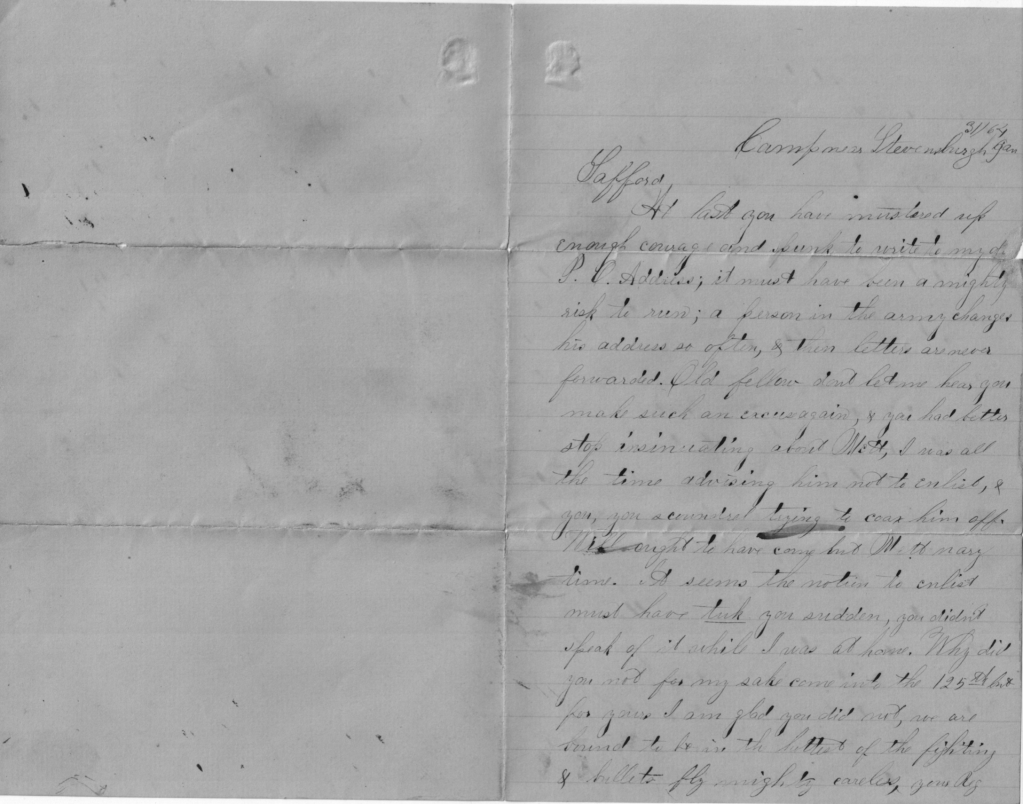
Camp Stevensburg January 31, 1864
Safford [Taylor],
At last you have mustered up enough courage and spunk to write to my dull P.O. address. It must have been a mighty risk to run. A person in the army changes his address so often & then letters are never forwarded. Old fellow, don’t let me hear you make such an excuse again & you had better stop insinuating about Merritt [Pierce]. I was all the time advising him not to enlist & you–you scoundrel–trying to coax him off. Will [Beckwith] ought to have come but Merritt nary time.
It seems the notion to enlist must have took you sudden. You didn’t speak of it while I was at home. Why did you not for my sake come into the 125th, but for yours I am glad you did not. We are bound to be in the hottest of the fighting & bullets fly mighty careless. Your regiment will not be apt to see man or very hot fighting. You had better remain where you are as long as you can. You have you a soft thing but as for me, give me my regiment as long as they are as friendly as now. There is a feeling as deep as among one family & we feel lonely to be separated as to leave home. But you have not that feeling & camp life will be hard for you to endure.
I understand we have some recruits there [Elmira] for our regiment. I hope you will have them well drilled before you send them along for if the regiment has any recruits the whole of us will be obliged to drill.
I have not played chess in quite a while. There is but one to play with & he is on duty most of the time. If I were there, I believe I could beat you—what do you say?
I expect a letter from Merritt this week. I’ll tell him how you talk. You were casting insinuations when you said there were two chaps who took strange freaks. You did not mean me for I always told everybody what I was going to do & then done as I had a mind to. I think Mart will teach a good school, but it will be his last one. He will not like it. I am not in very good humor for writing & so shall quit. Write soon & oblige, — Nelson Bullis
Company G, 125th New York Infantry Vagabonds, 3rd Brigade, 3rd Division, 2nd Corps, Washington, D.C.
Letter 4
Camp near Stevensburg, Virginia February 10th, 1864
Friend Safford,
Yours was received in due time & I will try & answer it. We are about 40 miles from Washington, 2 miles from Brandy Station on the Orange & Alexandria Railroad. Perhaps you can get a pass from the Provost Marshal at Washington in Alexandria. The last I knew of [unreadable] he was head clerk in the office at Alexandria. He could furnish you with a pass if he is still there. If my advice can influence you any, you will stay where you are as long as you can. There is not much of fun in that, but too much of severe earnest, you could not content yourself in the army at all.
I can adapt myself to circumstance as well as anybody I ever saw & still there are times it seems as though I must go crazy or get away from the monotony of camp life; when the boys are all in it is well enough but sometimes all but one or two are out on detail, then it is terrible. Yesterday every able man not on other duty were out digging rifle pits. They seem to expect an attack from Lee in return for us going to visit him.
I believe 126th New York Regiment recruited there. If so, you must have heard great stories about their bravery. I think so by the colored accounts I have seen and heard. When the Corps got to the Rapidan, our Regiment—the 125th— was in the advance. 100 of our boys, including Co. G of course, were taken from the left of the regiment and told to cross. They forded the river, took 25 prisoners and were the first to form a skirmish line & the last to recross the river & we were not driven over by the bayonets of the 126th. I don’t think it would be very healthy for that regiment to try force with us either. It is true that there was not one of our men hit but the Rebs fired at them enough. It makes us swear some to see the accounts in the papers giving the praise of crossing the river first to the 126th. [See the Battle of Morton’s Ford]
We were ordered to have an inspection today, but the rain & wind has stopped it so far & I think it will for the rest of the day. I don’t believe you can read this, but I am sitting or lounging on the bunk & cannot write any better. I guess I shall not scold you again–you answered so promptly that time.
I understand that 18 men have got to come from Schuyler Falls for the last quota. Smith is recruiting officer. I don’t how they can raise the men. I think Merritt & the Beckwith boys will yet have to come. I hope it will never take Merritt. If he is obliged to come, I wish he would join Co. G. I supposed Orville [Stickle] and Steve [Stickle] were in the regiment with Israel [Stickle]. He is out in the Potomac Army. If you hear where Orville is, give me his Corps, Division, Brigade, & Regiment. We can then find each other sometime. I will close hoping to hear from you again.
— Nel[son] Bullis
3rd Brigade, 3rd Division, 2nd Corps, Company G, 125th New York Volunteer Infantry, Washington, D.C.
Letter 5
Camp near Stevensburg, Virginia March 14, 1864
Friend Safford [Taylor],
Yours was received in due time & I cannot tell whether it is answered or not. If not, here goes for what it is worth. If yes, why the loss is small for Amelia sent me the paper & envelope and [my brother] Levi the stamp. It only cost me the time & that is a drug. Besides it rains & I have nothing to read. I got a letter from Merritt the other day. He will run the South school this summer. Fannie is to teach it.
I wish Tim Newcomb was with his regiment. They lay about 80 rods from here. Never mind the grammar but the Johnnies hold him fast. We would have some sport I’ll bet. Well, do you still stick to your resolution of going to your regiment. I believe I have answered yours, but I shan’t back out. The boys I heard of enlisting in our regiment did not go to Elmira. They went to Fort Schuyler, New York Harbor. Elvin was still teaching at Plattstown. I thought he would be disowned before the first month was past but he seems to stick to it. I wish you could be in our regiment for 3 months now & then if you chose could go back to Elmira. You would be contented to remain there, I think.
The summer campaign will commence soon if the weather remains as fair as the past month. Then for a tramp—a long tramp—& we will some of us tramp never to return ary once. Well, never mind. There will be enough left for the good of community as long as I remain in the rear, & I think a good ways in the rear will be the best.
Well, old fellow, how do you look dressed up in soldier’s toggery or do you wear citizens clothes yet? I motion (excuse my boldness & lack of maidenly reserve) that in course of the ensuing ages we exchange photo-, daguerreo-, ambro-, ferro-, basso relievo printing or some other kind of types in which we can cogitate on the innumerable changes caused by the fingering of old Time’s own self & Uncle Sam’s hard tack—which by the way you know but little about. I sent mine home—that’s a lie for it is not mailed yet but it is ready to send. I look as “sojerfied” as Polly Cresset. We do not belong to the dignified division now.
Oh, by the way (in secret you know), do you correspond yet [with] Delia Annie? She has somehow forgotten or purposely refrained from writing to me. I did not know but the charms of yourself of letters or something had changed the direction of the current of her affections. Now I don’t want to scare you into a lie but just tell me, won’t you? If you don’t, I will tell Merritt. He says you want my address. I am glad Add has got more than one. As for mine, they are lousy & you don’t want to mix the Potomac & conscript lice together. They would not agree as well as veterans & bounty jumpers. Don’t forget to tell me Orville [Stickle]’s regiment & where stationed if you know.
Say Saff, I am sleepy & it is now noon. What shall I do? Can you read this? I can’t near do as I want to. Is that the way with you? I heard a fellow make that remark about a letter he received. He did not like to get long letters. It was too much work to read them. Are you corresponding with C. Bidwell now? I wrote to him. He did not answer in 2 months. I wrote again & got a letter the same night & answered it. He has not written again. — Nel[son Bullis]
Letter 6
Camp 125th [New York] Regiment near Stevensburg Culpeper Court House March 20th, 1864
Friend Merritt [Pierce],
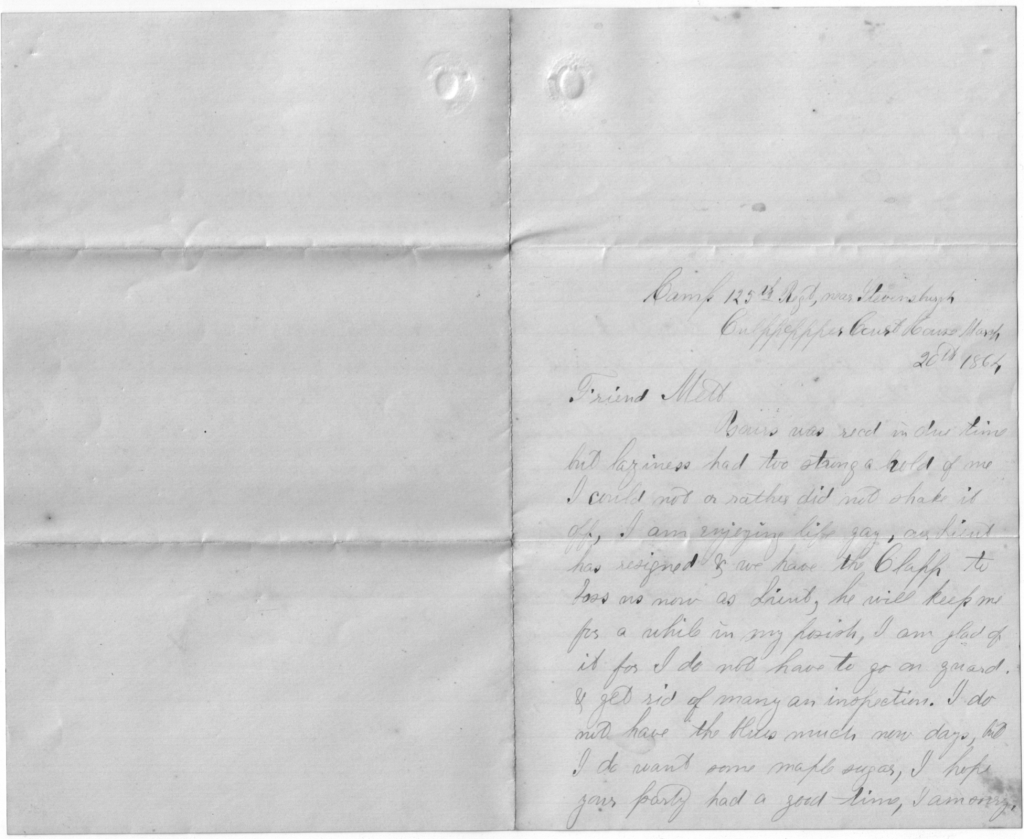
Yours was received in due time but laziness had too strong a hold of me. I could not, or rather did not, shake it off. I am enjoying life gay. Our lieutenant has resigned & we have the [Lt. Elam S. P.] Clapp to boss us now as lieutenant. He will keep me for a while in my position. I am glad of it for I do not have to go on guard & get rid of many an inspection.
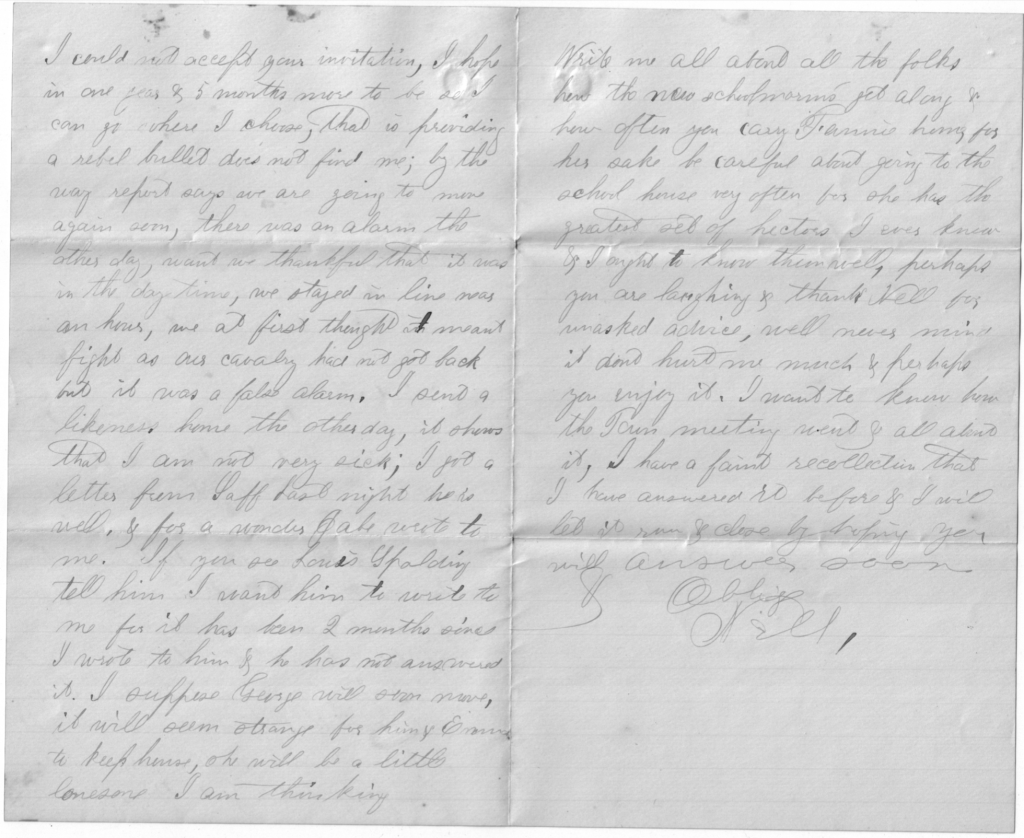
I do not have the blues much now days, but I do want some maple sugar. I hope your party had a good time. I am sorry I could not accept your invitation. I hope in one year & 5 months more to be so I can go where I choose—that is, providing a rebel bullet does not find me. By the way, report says we are going to move again soon. There was an alarm the other day. Wasn’t we thankful that it was in the daytime. We stayed in line near an hour. We at first thought it meant fight as our cavalry had not got back, but it was a false alarm.
I sent a likeness home the other day. It shows that I am not very sick. I got a letter from Saff[ord Taylor] last night. He is well & for a wonder, Jabe wrote to me. If you see Lewis Spalding, tell him I want him to write to me for it has been 2 months since I wrote to him & he has not answered it. I suppose George [Pierce] will soon move. It will seem strange for him & Emma to keep house. She will be a little lonesome I am thinking.
Write me all about all the folks, how the new schoolmarms get along, & how often you carry Fannie home. For her sake, be careful about going to the school house very often for she has the greatest set of hectors I ever knew & I ought to know them well. Perhaps you are laughing & thank Nell for unasked advice. Well, never mind. It don’t hurt me much & perhaps you enjoy it. I want to know how the town meeting went & all about it. I have a faint recollection that I have answered it before & I will let it run & close by hoping you will answer soon & oblige, — Nel[son Bullis]
Letter 7
Camp 125th Regiment New York Volunteers April 6th, 1864
Friend Merritt [Pierce]
Yours was received in due time. Then I knew I had answered yours twice though while writing the 2nd there was a remembrance of an answer made, but it is as well. I received a paper from you. It was like a stranger or an old friend in a strange country to see a [Plattsburgh] Sentinel in Virginia. We [get] a great many of them, but they are not printed. Your mother [Huldah Ann Reed Pierce] enclosed a piece. Tell her it was first rate & I wish that all York State felt the same.
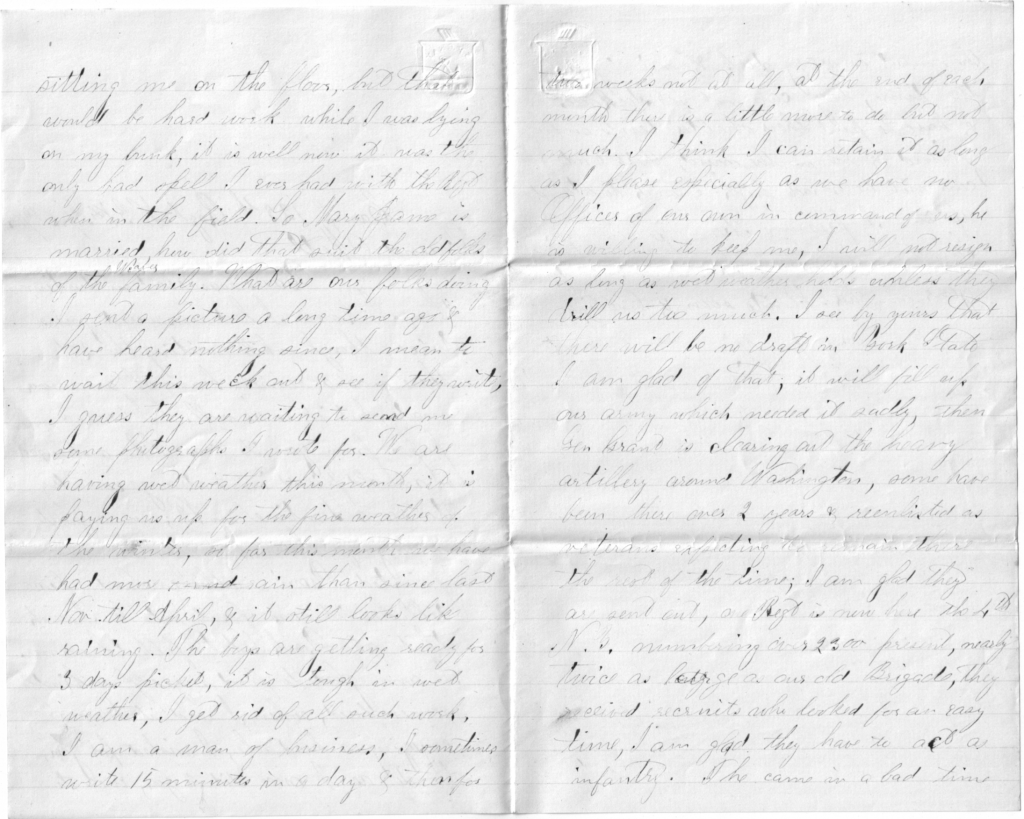
I am glad to find myself so kindly remembered. When I received it, I was enjoying a headache. I wished for you to do as I once did to you even to sitting me on the floor but that would have been hard work while I was lying on my bunk. It is well now. It was the only bad spell I ever had with the regiment when in the field.
So, Mary Jane is married? How did that suit the old folks of the Weaver family? What are our folks doing? I sent a picture a long time ago & have heard nothing since. I mean to wait this week out & see if they write. I guess they are waiting to send me some photographs I wrote for.
We are having wet weather this month. It is paying us up for the fine weather of the winter. So far this month we have had more rain than since last November [un]til April & it still looks like raining. The boys are getting ready for 3 days picket. It is tough in wet weather. I get rid of all such work. I am a man of business. I sometimes write 15 minutes in a day & then for two weeks not at all. At the end of each month there is a little more to do but not much. I think I can retain it as long as I please—especially as we have no officers of our own in command of us he is willing to keep me. I will not resign as long as wet weather holds unless they drill us too much.
I see by yours that there will be no draft in York State. I am glad of that. It will fill up our army which needed it sadly. Then General Grant is clearing out the heavy artillery [soldiers] around Washington. Some have been there over 2 years & reenlisted as veterans expecting to remain there the rest of the time. I am glad they are sent out. One regiment is now here—the 4th New York [Heavy Artillery—numbering over 2300 present; nearly twice as large as our old brigade. They received recruits who looked for an easy time. I am glad they have to act as infantry. They came in a bad time. The mud is very deep & [it is] raining all the time. They cannot get stockades & have to put their shelter tents on the ground & lie in the mud. Their tents cannot be made high enough to stand up in. I presume Fannie will soon commence her school. Remember me to your mother. Write soon & oblige. — Nel[son Bullis]
The following letter was written by Andrew Russell Barrows (1832-1871) of Philadelphia, Pennsylvania. He was the son of Warren Barrows (1800-1868) and Philinda Smith (1800-1838) of Cheshire county, New Hampshire. He wrote the letter to his older brother, Warren Snow Barrows (1824-1888) of Hinsdale, Cheshire county, New Hampshire.
The subject of the letter pertains to the purchasing of substitutes to meet State enlistment quotas or face a draft. From the letter we learn that the “going rate” for substitutes was rising dramatically by this final year of the Civil War and the urgency was heightened by Gen. Early’s raid into Maryland in the summer of 1864. The letter is datelined from Philadelphia on 28 July 1864—two weeks after the Battle of Fort Stevens on the outskirts of the Nation’s Capitol so it is somewhat surprising that he did not seem to be aware that Early had already been defeated and had withdrawn to the Valley.
A Wartime Sheet Music Cover (LOC)
Transcription
Philadelphia [Pennsylvania] July 28, 1864
Warren,
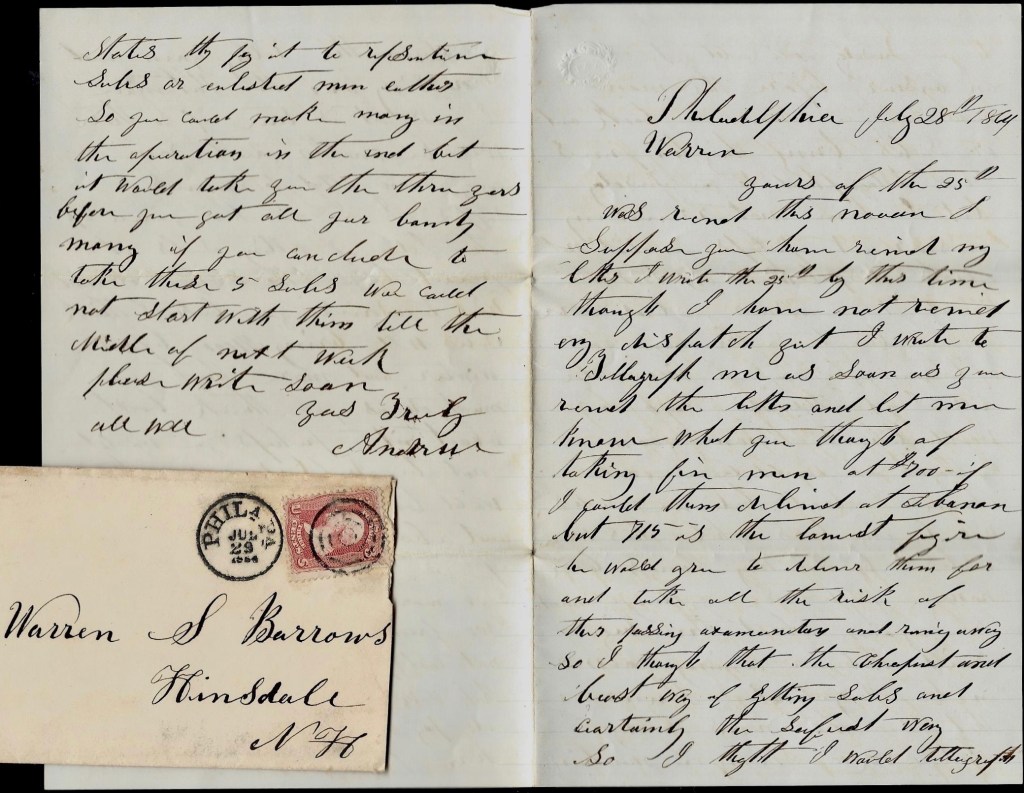
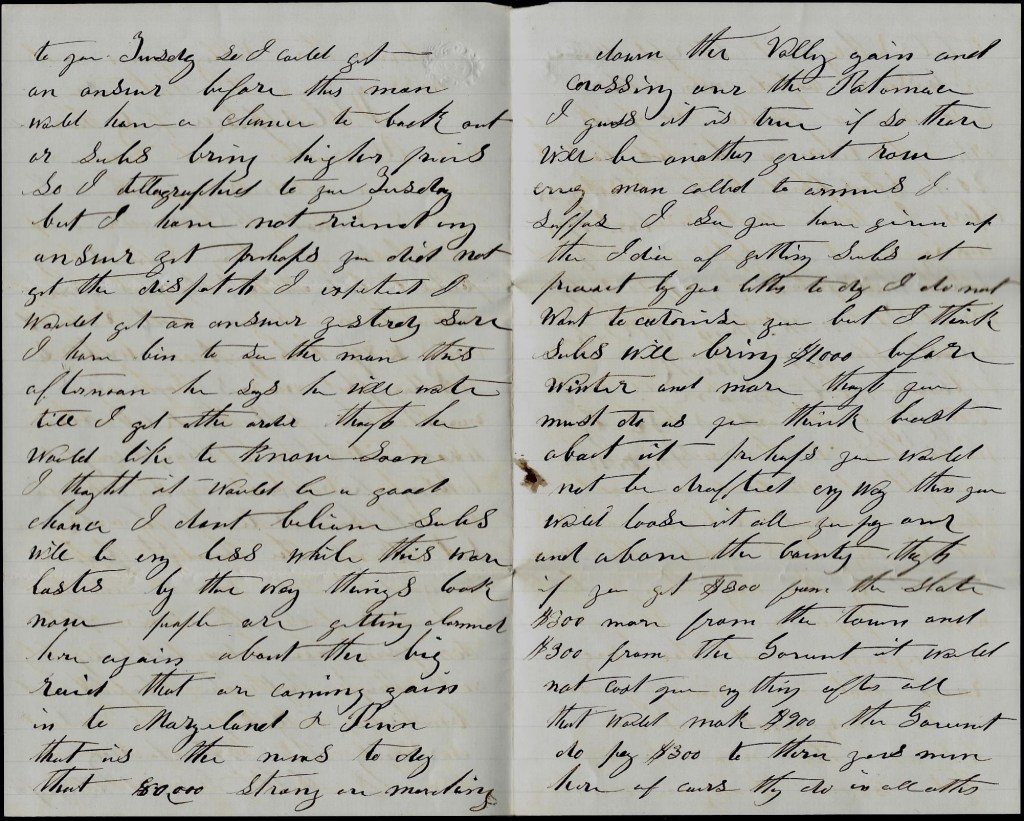
Yours of the 25th was received this noon. I suppose you have received my letter I wrote the 25th by this time though I have not received every dispatch yet. I wrote [you] to telegraph me as soon as you received the letter and let me know what you thought of taking five men at $700 if I could get them to enlist at Lebanon but 715 is the lowest figure he would agree to deliver them for and take all the risk of their passing [physical] examinations and running away so I thought that the cheapest and best way of getting subs and certainly the safest way. So I thought I would telegraph to you Tuesday so I could get an answer before this man would have a chance to back out or subs bring higher prices so I telegraphed to you Tuesday but I have not received any answer yet. Perhaps you did not get the dispatch. I expected I would get an answer yesterday sure.
I have been to see the man this afternoon. He says he will wait till I get the answer though he would like to know soon. I thought it would be a good chance. I don’t believe subs will be any less while this war lasts. By the way, things look, people are getting alarmed here again about the big raid that are coming again into Maryland and Pennsylvania. That is the news today—that 80,000 strong are marching down the Valley again and crossing over the Potomac. I guess it is true. If so, there will be another great raise of every man called to arms.
I see you have given up the idea of getting subs at present by your letter today. I do not want to criticize you but I think subs will bring $1,000 before winter and more though you must do as you think best about it. Perhaps you would not be drafted anyway. Then you would lose it all—your pay and the bounty, though if you get $300 from the State, $300 more from the town, and $300 from the government, it would not cost you anything at all. That would make $900. The government does pay $300 to three-year’s men here, of course they do. In all other States they pay it to representative subs or enlisted men either. So you could make money in the operation in the end but it would take you the three years before you got all your bounty money.
If you conclude to take these 5 subs, we could not start with them till the middle of next week. Please write soon. Your truly, — Andrew
















 Spared & Shared 23