My passion is studying American history leading up to & including the Civil War. I particularly enjoy reading, transcribing & researching primary sources such as letters and diaries.
Stephen “Chase” Hill (1841-1903) was working as a pilot in Boston Harbor when he was only 19 years old. From these letters we learn that he shirked responsibility and resorted to sea duty whenever he needed to make money. During the Civil War he enlisted on 13 May 1863 as Acting Ensign in the US Navy and was assigned to the crew of the “USSWater Witch.” He was aboard the ship when she was boarded and taken captive almost without a fight by Confederates in June 1864. He was wounded and taken prisoner by the Confederates but exchanged later in 1864. He resigned his commission on 25 April 1865. In 1870, he was still enumerated in his parents East Boston residence, still single and employed as a “mariner.”
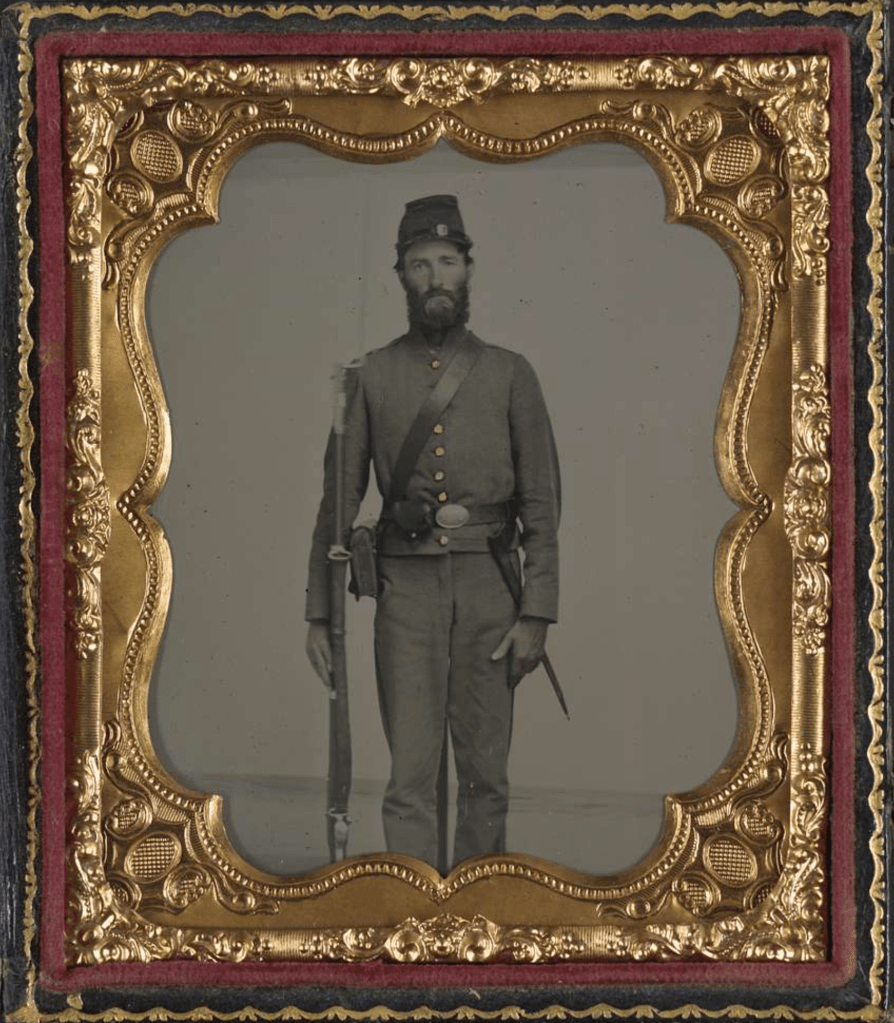
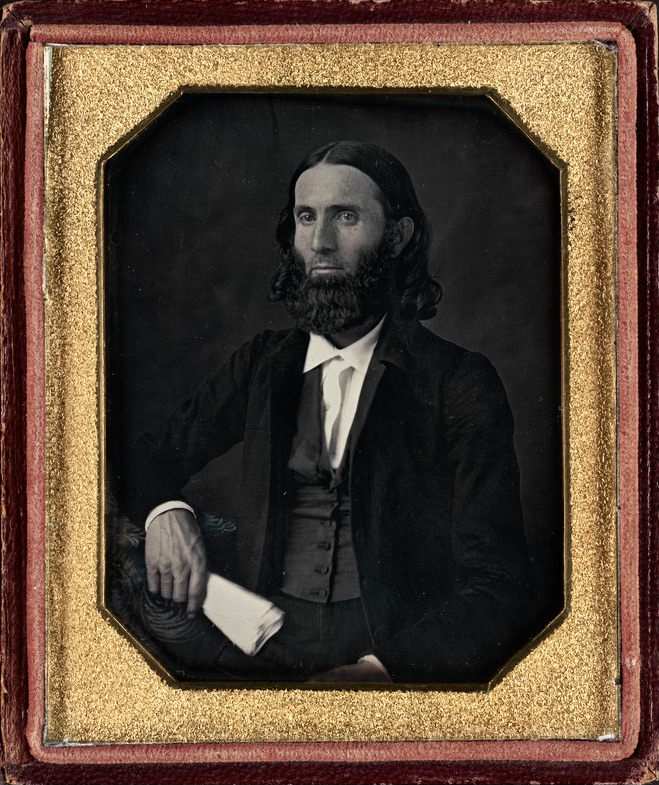
I could not find an image of Acting Ensign Chase Hill but here is an albumen of Abner Dodge Stover who served as Acting Ensign with him on the Water Witch when she was captured in June 1864. (Herman Kinder Collection)
He was married to Emma Laura Gay (1855-1920), the daughter of Charles Royal Gay and Laura A. Young, sometime in the late 1870s and in the 1880 Census, he was enumerated on Liverpool Street in Boston, working as a “Ship Keeper.” By that time, he and Emma had a young daughter named Laura M. Hill, age 1. Stephen died in 1903 at the Home for Disabled Soldiers in Togus, Kennebec county, Maine, where he was buried. His admission papers at the Home indicate that he had received a “gunshot wound in his right side on June 3rd 1864.” When he entered the Home in September 1891, he was 50 years old, stood 5’10” tall, had blue eyes and gray hair. He told them he was an “Engineer” by profession and that he was married and had been living in Wollaston, Massachusetts, just before admitting himself to the Home. He gave his brother John Hill of Dorchester, Massachusetts as nearest relative.
Chase’s letter gives a great description of the capture on 2 June 1864 of the wood-hulled, side-wheel gunboat, USS Water Witch, on which he had been serving as an Acting Ensign. The gunboat was anchored on the Little Ogeechee River near Racoon Key—part of the South Atlantic Blockading Squadron—where it had been patrolling in Ossabow Sound for many months. The Water Witch was captured by a squadron of small boats led by 1st Lt. Thomas Postell Pelot who stealthily approached the anchored Union gunboat with padded oars on a dark and drizzly night and surprised the ship before they could react.
Addressed to Acting Ensign John Hill, Flag Ship “Malvern,” Hampton Roads, Va.
East Boston, [Massachusetts] December 8th 1864
My Dear Brother,
I received a letter from you yesterday in which you state you were at Norfolk, Va. I am sorry you did not like the service. I don’t like it myself but I don’t see as I can do any better. I have a great mind to shove in an application for Acting Master. When I was in Washington, I told Secretary [Gideon] Welles I wanted to be attached to a cruiser after I had recruited my health. I want you would ask Kidder if he had to stand an examination for promotion. Before I was captured, Secy. Welles issued orders that no one would be promoted only for bravery. I think he ought to promote me. I am afraid if I should get an Acting Master’s appointment that I should have to act as “Exec” on some ship and I wouldn’t like that much. I would sooner have command.
I am not well today. I have been on the go ever since I got home and yesterday p.m. I had a slight attack of chills and fever [malaria]. I contracted the damn disease down in Georgia. I was very sick there with chills and fever.
You state you would like to know who had the deck at the time of our capture. I don’t wonder you ask. I wish most anyone had of had the deck except the one that did have it. You know that we got short of officers—some of them having been detached—leaving two Ensigns and two Mater’s Mates for naval officers. We use to have a Masters Mate in the watch with us until we got short. The Master’s mate that had the deck was the damndest fool that you ever see. We were laying at anchor once in Port Royal and he had the deck. It came on to blow, the old Water Witch commenced to drag and the damn fool, instead of letting go the second anchor, he come down off the hurricane deck and lifted up the wardroom skylight and and yells out, “All hands!” waking up every officer in the ship instead of rousing up the men.
Well, my noble Mr. [Eugene D’W.] Parsons had the deck when we were captured. The quartermaster reported the boats or something he said looked like boats fifteen minutes ere we were attacked. It was an awful dark and squally night. I had the deck from 8 until 12 M. Parsons relieved me at 12 and at 2 the boats came and attacked us. They hailed the ship and Parsons was so damn frightened that he fell off the hurricane deck and landed pretty close to the rattle. He made out to spring the rattle. After that I don’t know where he was [but] he took damn good care to keep out of the way of the bullets.
Chase was shot while at the starboard gangway just aft of the ladder where the black star is located.
By the time we got on deck, they were nearly alongside and I got up pretty damn quick. I think I was one of the first on deck. I couldn’t see anyone at my gun, but heard the Rebs give a yell to “Board her.” There was some one of our side a firing at them with muskets on the port gangway. I called out to the watch on deck [but] couldn’t see a damn man. The boats got alongside, forward and nearly aft. By the time the officers were up, they were alongside. We wounded a great many before they got alongside. I was in the starboard gangway when I was shot. I got wounded before many of them got aboard. Most of the officers were wounded with cutlass wounds. The Captain was cut down very soon after he got on deck. The officers—with the exception of the one that had the deck and Engineers—done all the fighting with 4 or 5 of the men. We killed their leader, Lieut. [Thomas Postell] Pelot of the Rebel Navy [and] also their pilot and eight others, wounding some 25. We only had one killed and 13 wounded. They would have killed more of us but they could not get their pistols off, being wet.
If anybody else had of had the deck and got the crew to quarters, they never would have got aboard, or if the Engineers had have been armed. Each boat had just such a part of the ship to board and they brought engineers with them. Our engineers all piled into the Engine room and started her ahead but when the Rebel Engineer made his appearance with a revolver, they all surrendered—so I was told.
I have not seen Capt. [Austin Pendergrast] nor any of them except Mr. Weston. He was cut over the head. They tried the Capt. & Executive for [court martial]. I haven’t learnt the particulars yet but one of our men that was on the trial told me in Washington the Captain was honorably acquitted. We had a pretty desperate fight but they overpowered us. There was 150 of them and half of our crew was below and couldn’t get on deck. They got aboard forward and guarded the hatches. Finding but little resistance, they soon got aboard but not so easy aft. I think it all lays to Parsons. I see by the Army & Navy Journal that he is ordered to report to Admiral Paulding. 1 None of the rest have received orders to report yet. I am on the sick list [and] have orders to report every 15 days to the department. If I don’t feel any better than I do today, I shall be home a good while.
I wish you was here but you have got a better place than I had stuck in Ossabaw [Sound] for 12 months [where I] never saw anything. But I suppose that would have suited you better than being where you are. As for myself, I never want to see a “flag ship.” Too much signaling going on.
I suffered a great deal with my wound. 2 The ball was in me a month before they extracted it. I was pretty low at one spell. I am awful weak now. I have been drinking too much ale lately. Sum[ner] went to Washington last evening to see about his appointment. There is something in the way and he may not get it. I hope he will. I think if he has a change of climate, it will do him good. I suppose you are a going to attack Wilmington soon, ain’t you? I should think the Navy ought to cooperate with Sherman. He will take Savannah, I think. They were damn frightened when I left.
I was treated very kindly there, being under the C. S. Navy authority. I think it was lucky I was wounded so I could remain in the hospital.
Well, Jack, I must wind up for today. I don’t feel very smart. Excuse the writing. The folks are as usual and send love. Tell Kidder to write. Do you ever see Billy Bangs in Norfolk? Tell him to write also.
Yours affectionately, — Chase
1 Eugene DeWitt Parsons (1835-1903) was appointed Acting Master’s Mate on 19 November 1862. He resigned his commission on 20 January 1865—six weeks after this letter was written.In 1865, after his resignation, he was enumerated in New Lebanon, Columbia county, New York, where he worked as an Engineer. By 1870 he had relocated with his wife Harriet and two small children to Rochester’s 8th Ward where he was employed as a bookkeeper. Eugene was the eldest son of Anson Parsons (1792-1871) and Louisa H. Hull (1816-1903) of New Lebanon, Columbia county, New York. He attended Williston Seminary in the early 1850s.
2 The post incident report files by Acting Asst. Surgeon W. H. Pierson, US Navy, claims that after Chase Hill was shot, he “came limping into the wardroom with a dangerous looking wound…”
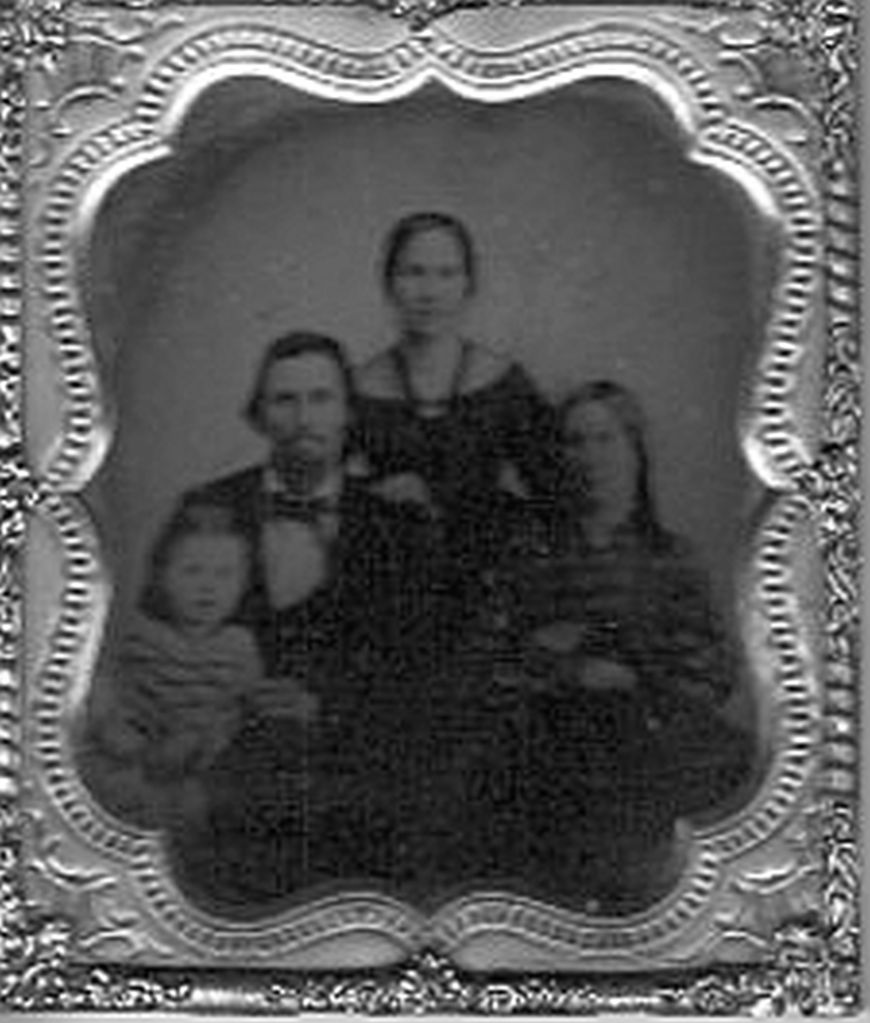
How Increase Sumner Hill might have looked during the Civil War
These letters were written by Increase Sumner Hill (1806-1873), husband of Mary S. Perkins (1806-1878) and an Boston Engineer by trade. Toward the end of his career, Increase worked as a government inspector of steamboats and boilers. Known children of the couple, who married in 1829, were John Hill (b. 1836) to whom he addressed this letter, Sophronia E. Hill (1832-1876) and Stephen “Chase” Hill (1841-1903). The 1860 US Census enumerates the family in Boston’s 2nd Ward and besides John and Chase, were Anne Hill (b. 1844), and George Hill (b. 1848). In the 1850 US Census, the family resided in Salem’s Ward 3 where Increase was identified as a “Machinist.”
In one of his last major assignments, Increase was given the heavy responsibility of co-leading the investigation into the explosion of the Staten Island ferry steamer Westfield that took place in New York Harbor on 30 July 1871, killing 125 passengers. When he died in 1873 at the age of 65, he left a “wife and four sons.”
Increase wrote the letter to his 24 year-old son John Hill who was 2nd Mate of the crew on the clipper Golden Fleece.
One of Increase S. Hill’s last major assignments was to co-lead the investigation into the explosion of the Staten Island ferry steamer Westfield that took place in New York Harbor on 30 July 1871, killing 125 passengers.
Letter 1
Addressed to Mr. John Hill, Ship Golden Fleece, Capt, Mandon, San Francisco, California
East Boston, [Massachusetts] 20 October 1861
My dear son John,
We have written you several letters, some of which have not been directed right, & you had better call to the post office & see if any remain there. Our family are at present not very well. Your mother is rather more poorly than usual, and Anna is rather slim. She has had some trouble with her lungs lately and has spit some blood. She may recover, however, her usual health but I fear she will pass away as Lizzie did before long. She is quite liable to take cold and is not so careful as she might be.
Phronia is tolerable well but is at present suffering from swelled face, bad teeth, &c. Dony is well as usual & so is George & Eliza.
Hattie is well and was up here a few days since. Susan Hill’s beau at their house.
My own health is about as usual. I have had two slight attacks of bleeding since you left. I think on the whole I am not so strong to endure fatigue as usual. The store is vacant & has been for three months past. Brown has moved into Morgan’s store on the corner so we are now losing the rent. I have had it painted and cleaned and signs put up to let but the times are so hard that no one wants it unless I would let it for a grog shop which of course I will not, so it must remain vacant.
I hope you will be able to get along and not go before the mast any longer as it seems to me almost like throwing away your time—and besides, you are quite capable if you will only put yourself ahead.
The war seems to absorb all people and all things at the present time. We now have an army of 300 thousand and more, & the secessionists have nearly as many more. we are expecting every day that the army under McClellan will move down towards Richmond and a tremendous battle must be fought. The old flag will be triumphant this time, you may depend on that. The papers will give you all the news.
Write often and let us know all particulars. Sumner is all right at Salem and his boy is a fine child.
Affectionately yours, — I. S. Hill
Letter 2
Addressed to 2nd Mate John Hill, Steamer Golden Fleece, San Francisco, California per Wm. Burnette, Esq.
45 Niles Block, Boston [Mass.] November 17, 1862
My dear son John,
The Niles Block Building in Boston where Increase wrote the letter. It stood near the corner of School Street and City Hall Avenue.
You will perceive I have altered my room. I now have a room to myself & have to pay 50 dollars more a year but it is the best room in the building on the corner of school street. As Mr. Burnett was going to leave with his family for San Francisco next Monday, I thought I would commence a letter to you today and finish it the last of the week.
So far as my health is concerned, I am about as usual. Your mother is ditto. Dony do, & Liza do. Anna is still under Dr. Birmingham’s [care], the Indian doctor, and has decidedly improved. She goes out every day when it is pleasant and I think will get patched up pretty well if she is careful. Susan has got about again, and has discharged the doctor, but is still feeble. She will with care I hope soon get strong. Sophronia got over her womb difficulties some weeks since, but was found to have an ulcer formed in the back passage & has now to undergo an operation for fistula and expects the doctor every day to perform the operation. It will be very painful but this is the only way it can be healed. Poor thing—she has suffered dreadfully the last two months but we hope so soon as the operation is performed that in a few weeks she will get about again.
Chase left the pilot boat because the 1st boat keeper left and they did not give him the boat. He loafed round a few weeks and I succeeded in getting him a 3rd Mates berth on the steamer Mississippi—one of the 2,000 ton iron steamers built at Loring’s for the New Orleans line. His captain’s name is [Charles H.] Baxter. 1 I being acquainted with the captain, I pressed him to take Chase although he never had a 3rd Mate before. But as the other steamers carried one, I persuaded the captain to take him. He gets 30 dollars a month and has made one trip to New Bern, North Carolina with troops and is now down there on another similar trip. I expect him back in a few days and will try and get him to write you & enclose his letter in this.
When they returned from their first trip, I asked Capt. Baxter how he liked Chase. He told me he was well pleased with him and if he did not get to be a Master of a vessel in due time, it would be his own fault. The Chief Mate and 2nd Mate also like him. The other mates are not sailor men and the Captain & Chase have to look after everything of that sort so I think Chase is fairly under weigh now and if he don’t stick this time, I shall abandon him to his fate. Chase says he likes it first rate and well he may. He has a good state room with one of the quartermasters and messes in the mess room with all the officers & lives first rate. I expect both these steamers will be sent by the government with troops to Texas for General Banks’ expedition now fitting out at New York. If so, he will be gone a month or two. Thus far for Chase.
Sumner and Phronia will both write you in season so that you may expect a good budget of letters on your arrival in California. I hope that Young America [14 year-old George Hill] has been a good boy and given you no particular trouble. Your mother was very sorry she forgot to put into your things or George’s any towels but I told her she need not be uneasy—that you would contrive well enough till you got to California, and then you could buy a few for George & yourself. I shall write George by mail and you also by & bye. When Mr. Burnett arrives, he will probably take rooms in San Francisco and you and George will undoubtedly call on them.
I shall not say much about the war as all the newspapers will give you more particulars than I can write. I will merely mention that the monitor [USS Nahant] at South Boston will be ready for service in about 3 weeks. Willie Neal has been ordered to her as 3d Asst. Engineer so he is in a fair way to see war service. I expected that 3 or 4 of these monitors will be sent down to Charleston, Savannah, & perhaps Mobile in the course of a month so you may expect to hear something in the way of war music from the ironclads for service this winter and these are the things now most wanted.
November 21st 1862
I resume your letter to say that Chase has not yet arrived from his second cruise but one of the steamers which went with them—the Saxon—has arrived two days since in Philadelphia. I suppose the 2 large steamers were detained at New Bern, N. C. & will be here in due season.
Sophronia has not yet had the operation performed as she was not well enough and the doctor has set next Wednesday for the operation. I hope she will soon get about after that is done. I have no special news to communicate today but shall keep you informed by the mail in due season.
Remember me to Capt. Manson and Mr. Baxter. And believe me most affectionately yours, — I. S. Hill
We shall expect a good long letter from you on your arrival in California.
1 Charles H. Baxter was born in Baton Rouge, Louisiana, in 1835, was educated there and also in Calcutta, India. He joined the East India Company as an officer of engineers, and served in the Crimean War and Indian mutiny. In 1857 he fought in the second Anglo-Chinese War as a lieutenant of engineers. He served in Madagascar, worked for the Portuguese government, then worked in Uruguay and participated in a rebellion in Argentina, before working as a surveyor in Mexico in 1859. Returning to the United States, Baxter bought land in the Bronx, New York, but then went back to Mexico and built barracks in Vera Cruz. In 1861 he joined the United States Navy and was sent to Cairo, Illinois, where he joined the Mississippi fleet. Baxter is mentioned in the Official Record of the Union and Confederate Navies in the War of Rebellion as an ensign assigned to the Union gunboat “Genesee” under Commander William Macomb. In a report, Macomb refers to acting Ensign Baxter and commends him “for celerity and attention to supplying powder” during the Battle of Port Hudson on March 14, 1863. On March 29, 1864 he was promoted to acting master of the “Genesee” and in that capacity commanded his ship as part of Admiral Farragut’s fleet at the Battle of Mobile Bay in October 1864, and was honorably discharged with that rank on September 16, 1865. He returned to New York and was involved in numerous Bronx and veterans’ organizations. Baxter died in New York on January 18, 1917.
Letter 3
East Boston, [Massachusetts] January 18, 1863
My dear son John,
As the mail leaves New York on the 20th, I thought you would expect a letter from home & so I sit down to write you a few lines. I have written you by Mr. Burnett & by the last mail. So has Phronia & I believe Sumner and Phronia intends to write George by this mail so I shall omit writing to him. But I want you to assure him of my great anxiety concerning him & I hope he will be a smart, active, obedient & good boy, & get well posted in all his nautical duties whether he intends to follow the sea for a living or return to go to a trade. In either case, knowledge even of a sailor stamp will be found useful in after life on many occasions.
My own health is comparatively feeble. I am much troubled by the pain in my back, preventing my sleep & otherwise preventing me from labor of any kind but that which is light. Besides I have had recently within two months two slight attacks of bleeding which has weakened me considerably & confined me at home several days on each occasion.
I am now, however, out every day and yesterday went down to Salem and inspected a boiler for the county in the Court House.
Phronia is still confined—scarcely goes the length of a block out doors. Her case is destined to be a long one, I fear, & she may never recover fully, but we hope she may. Anna is getting along pretty well & is quite smart for her. Your mother is about as usual & Dony the same. Lizzy as usual. Chase is down in the Gulf [of Mexico]. The last news of him was in the paper. He wasspoken going up the Mississippi River with troops. I expect him home soon. Susan is pretty well and has discharged her doctor. I am glad of this for I have had to assist her with the others. It has cost me some 350 dollars—a pretty heavy bill for one year’s doctoring. To meet this, I had to draw on my life insurance which I was loath to do & must now try to pay it up if possible.
I am about moving my office into our store. Got it parted off so as to have the office in front & store room for the instruments back & intend to move over this week. This will save the rent of the City office & be quite as well for the steamboat interests.
I want you to write every opportunity. Don’t let a mail leave without a letter to me as I shall look for one. And tell George to write also. If you can procure some of the California Angelica sweet wine—say a keg of 10 or 15 gallons—get it if you can find some dealer who will warrant it pure, and if you go to Manilla, don’t fail to get some of the chocolate they raise on that island, It is the best in the world and there is none to be had here. The preserves I imported from Manilla spoiled coming out. They were not put up well. They were called lemoncetas.
I do not know of any particular news to give you as the papers will tell all about the war and you can get the latest by telegraph. Mr. Burnett will be found at the custom House. If he does not know of your arrival, you must call on him. Give us all particulars of your voyage & how you get along with officers, men and boys.
George Williams sent Anna a letter the other day & says he shall call on you soon as you arrive, or soon as he hears of your arrival.
The Lord bless you & keep you & in His own good time return you both to meet us all well is the prayer of your affectionate father, — Increase S. Hill
Letter 4
Addressed to Mr. John Hill, Acting Ensign, U.S. Steamer Daylight, Hampton Roads, Va.
East Boston [Massachusetts] Sunday, [October] 23rd 1863
My dear son John,
George has written you today & I will just add a line also to say that we hope you will be ordered to Baltimore & get a furlough to come home. We all long to see you. If you should be ordered to another vessel, it is likely you will be sent to the attack on Wilmington which we all dread as it will be a very hard place to take.
Friday, July 29, 1864 Plain Dealer, Cleveland, Ohio
Judge how disappointed we all were to see all the officers of the Water Witch on the exchange list of prisoners at Fort Monroe 3 days ago and Chase’s name not there. I got a letter from Chase yesterday dated at the hospital the 8th of this month. In that he says the Rebel papers there say the exchange was to have taken place at Charleston on the 1st inst. and he was disappointed that he had not been called for.
I am afraid for some reason he was overlooked but we hope he will be sent along in the next batch. You may have a chance to see him if you could be near when the flag of truce boats arrives at Fort Monroe.
Our family are in usual heath. Sum[ner] will not get off for a month yet as the steamer will not be ready. Her engine is not completely in yet.
Try hard & get off for a furlough & write oftener so that we may know how you are. Sherman [he means Sheridan] give the Rebs Jessie in the Shenandoah Valley the other day. I think they won’t trouble him again this fall.
Affectionately tours, — I. S. Hill
The USS Water Witch performed blockade duty at several points along the coasts of South Carolina, Georgia, and northern Florida, but most frequently at Ossabaw Sound between Ossabaw Island and the Georgia mainland about 15 miles due south of Savannah, Georgia. That remained her primary duty station well into 1864. On the night of 3 June of that year, a Confederate Marine boat force under the command of First Lieutenant Thomas P. Pelot, CSN, succeeded in boarding and capturing Water Witch in Ossabaw Sound after a brief scuffle which cost the Union ship two killed and 12 wounded—Chase Hill, acting ensign, among them. (13 officers and 49 men were captured). Confederate losses were 6 killed and 17 wounded. African-Americans were killed on both sides, Confederate river pilot Moses Dallas and Union landsman Jeremiah Sills. The only Union man to escape was a “contraband” named Peter McIntosh.
Letter 5
Addressed to Mr. John Hill, Acting Ensign, U. S. Steamer Daylight Malvern, Turkey Bend, James River, Fort Monroe, Va.
East Boston, Mass. November 15, 1864
My dear son John,
I duly received your note on the back of the paymaster’s letter to you concerning Chase. Capt. [Austin] Pendergrast informed us that Chase was not well enough to stand the journey to Richmond where they were liberated or he would have been exchanged with them but he said nothing about his having had the dysentery not did Chase either in his letter of the 8th last month. So I expect Chase did not want to let us know he had been sick with any disease except his wound and that he was said was all healed up. I hope he will get comfortable quarters on the transport but it will take but a few days to make the passage to New York and I expect him home in a week or two at farthest as the fleet of transports have been sent to Port Royal and Savannah some days since.
I see by the papers that a fleet of iron clads and gunboats are up the James river. I suppose they are near you. Let us know what they are up to. I expect now Lincoln is elected for another term by such an overwhelming majority that the Rebels will see we mean to prosecute the war until ew overcome & subdue their armies, &take their principal cities & sea ports. Then if Jeff Davis and his accomplices don’t escape to Mexico, or some other foreign country, & we take them prisoners, they will have to swing & serve them right enough.
We have a glorious country now & we mean to leave it to posterity cost what it may, and from the Southern papers I think they know it for they seem to be in a very unsettled state of mind. Some are coming back. Some for arming the slaves, and some for fighting it out, and as many the opposite way of thinking. There is unmistakeable evidence that they are sadly disappointed in not having McClellan elected on th basis of the Chicago Platform. If that had been done, the rebels would have got an armistice & then goodbye to the Union, for England and France would then have stepped in & broke the blockade by acknowledging their independence. But now these nations know what we mean & will keep hands off till we settle the matter by force of arms, & this is the only way we shall ever have a permanent peace and United States of America—the glory of the World, and the asylum of the oppressed for all Nations to flee to.
When we have once settled our difficulties on this base, there will be no fear of any one or two foreign nations daring to attack or insult us. We shall be stronger than any other people on the face of the earth, and if we only grow a better, and more law loving and law abiding people, we shall never again be at war with any Nation or among ourselves. Slavery is dead—no fear of that. And the South knows it.
A few days ago, in the early evening as I was walking down the square, I felt the blood coming up—my old trouble. I walked quietly home, took some salts, lay by for a day or two, and it stopped as it did a year ago. It is alarming to have it occur without the least notice but my lungs are like your old boiler—a little extra strain and a leak follows. The you and I have to stop, blow off and patch, and carry less pressure in future. The fact is, John, I am sensibly ging down the other side of the hill and consequently expect to be a long time before I reach the bottom. I dread the cold winter more than anything else & have tried to prepare for it by plenty of coal and wood in the cellar and war clothing for the body, & hope to weather it comfortably. I intend to be outdoors more this winter than I have been the last summer. I have confined myself too much to my office. I have done more work than for 10 years before in making instruments and tools, &c. Probably it would have been better for e to have kept out more.
I wrote you about saving your money. You must try and save up 20 or 30 a month out of your 60. Certainly $1 a day ought to support you. I want you to get ahead. Look out you don’t get gobbled up going ashore hunting. All send love. Write often. Give me all the news. Affectionately yours, — I. S. Hill
[In a different hand]
My dearest brother—I think I could add a line or two in this page as my stamps are getting short. Mother and I are anxious about this hunting business. You will be gobbled up the firs thing you know if you are not careful. I am worried to death about those horrible guerrillas and Rebels. Now look out for yourself and do your hunting in the boiler room! You know the poor prisoners suffer untold horrors some of them, and we don’t want you among them. Poor Chasy! I believe if he doesn’t come soon, he shall be crazy. We feel must more anxious since hearing he had been sick with dysentery. God grant he may soon be home once more so we can nurse him up again. I hope he will reign. He will have a good excuse, feeble as he must be now.
A ten cent stamp from the National Sailor’s Fair held in Boston in November 1864
There is a great Fair in Boston now for the benefit of “Poor Jack” 1 and I hope they will raise two millions! It is held at Boston Theatre. I haven’t been—want to go bad enough, but tis $100 a ticket. Can’t afford it. Sum[ner] and Carrie were up Friday and they went. Mother went with them. was perfectly delighted. There will be a full description of it in the Weekly. Capt. and Nelly called the other day. He always speaks in the highest terms of you. He doesn’t care to go to sea this winter. Will keep house at Situate. His typhus [?] troubles him a good deal so it is not cured as he thought. Too bad. I hope you will lay up enough this winter to resign in the spring and go into business with Henry in the spring. All send lots of love. Now do take care of yourself. I shall write again in a day or two. With love as ever, — [sister] Phronia
Young America [brother George] expects to sail tomorrow and will probably return Master of the Ship! Get $20 a month—ordinary steamer.
1 “Poor Jack” was a general reference to sailors or mariners. It probably derived from the lyrics of a song composed by Charles Dibdin entitled “Poor Jack” in 1789. The National Sailor’s Fair was held in Boston from 9-22 November 1864.
Letter 6
Addressed to Mr. John Hill, Acting Ensign, U. S. Flagship Malvern, Commodore Porter’s Expedition, Via Fort Monroe, Va.
East Boston, Mass January 8, 1865
My dearest John,
I received yesterday yours of the 2nd inst., dated Beaufort, & was very glad to hear you was well. I am sorry your whiskey got damaged by breakage of 2 bottles. Hope they were the small ones but suppose they were the large ones or you would have mentioned it.
I expect from appearances that your Naval Expedition will again be called on to battle Fort Fisher in company with a land force under some other general than Butler but I hope it is a flag ship you may be required to go in and around the fleet in an engagement to give orders &c. We trust you will get through the war without injury & settle down at home in some kind of business which suits you better than going to sea.
Sum[ner] has been quite unwell for two weeks past by inflammation of the bowels. He is now better and we think will soon be out again. He hears nothing more about the consulate but expects to shortly. I think they will both be off to California in the course of a month & on the whole, it may be the best for him.
Chase is still on the court martial at Philadelphia. Expects to get through this week. 1
I shall buy another government bond for you tomorrow although I have not enough of your money by $25 to get it. Still I shall try to make it up. Then you will have $400 in government bonds bearing interest. And Chase has the same if he can keep it, but he spends his money altogether too freely, after taking such risks to get it.
Write often as possible. Keep me posted up. All send love. Affectionately yours, — I. S. Hill
P. S. I am glad you mean to redeem your Mass. Bill. I would not pay such a bill in future. Get a furlough soon as you can. — I S. H.
1 Stephen Chase Hill was no doubt called to testify in the naval general court martial proceedings held in the naval yard at Philadelphia to examine the charge against Lt. Commander Austin Pendergrast for “culpable inefficiency in the discharge of duty” for not having taking adequate precautions to secure his vessel (the Water Witch) against a surprise night attack, neither “by stationing picket boats nor leaving the charge of the deck in the hands of a vigilant and competent officer (Acting Master’s Mate, E. D. W. Parsons)” Pendergrast was found guilty of not posting picket boats and suspended from duty for two years, on half pay, with loss of rank during the suspension.
Letter 7
Addressed to Mr. John Hill, Acting Ensign, U.S. Steamer Malvern off Wilmington, N. C., via Fort Monroe, Va.
Office 43 Maverick Street East Boston, Mass. January 29, 1865
My dear son John,
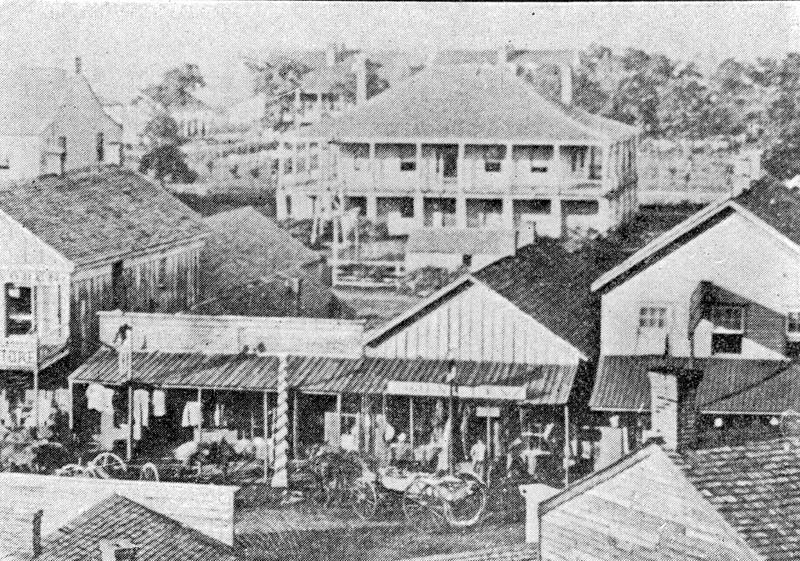
Increase Hill’s boiler inspector business/office may have been in a gambrel roofed brick building such as can be seen at right in this photo from the early 1900s. This building was at 33-39 Maverick. Hill’s was at 43 Maverick in East Boston.
We received two letters from 20th & 21st inst. addressed to Phronia & Sum[ner[ yesterday and we were happy to learn you were well and that your vessel had taken two prizes though we suppose that all the gunboats which were within sight would participate in the awards. Please let us know exactly how this case stands, who took the prizes, and how many vessels & their names will have a claim on them, &c. &c.
Both these prizes have arrived at New York & they will be condemned & sold there which is a pity, as all the prizes are better sold here. The expenses here are less than in New York. In some cases I hear that the officers & crews of some of our naval vessels have been assessed to pay the expenses of selling the prizes they took, as all the proceeds were used up and more too by the marshal in New York. Hope you will get something out of these vessels.
Let me know what you are about and where you are going & when you expect to get off for a furlough.
Chase is still at home & is ow quite smart. He is out all the time & we see no more of him than though he was a transient boarder. He spends two or three hours at home every day and thinks the bedroom downstairs rather too common a place for him so he goes out to lodge with some of his chums about every night. His wardrobe was rather scant when he came home which he has replenished & with his theatre & horse ride expenses, he has made way with about 500 dollars, leaving only his 400 in government bonds which I expect will go before he goes & then Jack -like, when he is run out [of money], he will go to sea for more to spend in the same foolish way. No more of my talking about him. 1
I have hard work to keep the wheels ground at home, now the government has taken off all my fees for tug & ferry boats, and compel me to inspect them under a new law and pass all fees into the treasury of Uncle Sam so that I get now only $800 a year, & what little I can pick up outside by private inspection & yet I have some 6 or 8 dependents on me for grub, fuel, and clothing. I don’t know what Chase would do if he had a wife to support. Perhaps he would then be prudent. He has tried to get promoted but he’s received no orders yet for examination. I expect he will be ordered to report for duty any day.
Sum[ner] is still here with his wife [Carrie] waiting to see if anything will turn up as Micawber says, or to get well. He has been down with a bowel complaint for 4 or 5 weeks but is some better. He will probably be off with his wife to California in a few weeks, if some other door don’t open. I shall miss him much as he will be absent some time wherever he goes. I hope you may be able to see him before he starts.
Well, John, be careful of yourself & don’t on any account volunteers for any of those dangerous expeditions likely to come off in the taking of Wilmington, such as searching for torpedoes & cutting out vessels & the like. Let them go that wants to. Don’t you go unless positively ordered, in which even be exceedingly careful & not too venturesome. We long to see you and have you at home with us. I could probably get you into some kind of business if you were disposed to stop at home, but enough. You know how we all feel about it. Do right and do your duty to your country & the Lord will take care of you in any event. All send love. Affectionately yours, — I. S. Hill
1 Stephen “Chase” Hill (1841-1903) was working as a pilot in Boston Harbor when he was only 19 years old. From these letters we learn that he shirked responsibility and resorted to sea duty whenever he needed to make money. During the Civil War he enlisted on 13 May 1863 as Acting ensign in the US Navy and was assigned to the crew of the “Water Witch.” He was aboard the ship when she was boarded and taken captive almost without a fight by Confederates in June 1864. He was wounded and taken prisoner by the Confederates but exchanged later in 1864. He resigned his commission on 25 April 1865. In 1870, he was still enumerated in his parents East Boston residence, still single and employed as a “mariner.” He was married to Emma Laura Gay (1855-1920), the daughter of Charles Royal Gay and Laura A. Young, sometime in the late 1870s and in the 1880 Census, he was enumerated on Liverpool Street in Boston, working as a “Ship Keeper.” By that time, he and Emma had a young daughter named Laura M. Hill, age 1. Stephen died in 1903 at the Home for Disabled Soldiers in Togus, Kennebec county, Maine, where he was buried. His admission papers at the Home indicate that he had received a “gunshot wound in his right side on June 3rd 1864.” When he entered the Home in September 1891, he was 50 years old, stood 5’10” tall, had blue eyes and gray hair. He told them he was an “Engineer” by profession and that he was married and had been living in Wollaston, Massachusetts, just before admitting himself to the Home. He gave his brother John Hill of Dorchester, Massachusetts as nearest relative.
These letters were written by Sumner Hill (1838-1878), the son of Increase Sumner Hill (1806-1873) and Mary S. Perins (1806-1878) of East Boston, Massachusetts. Increase S. Hill made his living as a steamboat engineer and later as an inspector.
A post-war CDV taken in San Francisco of an unidentified man about Sumner’s age. (Will Griffing Collection)
Sumner was married on 19 March 1860 in Boston to Caroline A. Keith (1839-1917), the daughter of Elbridge Gerry Keith (1804-1870) and Lucy Howland (1807-1883). In 1861, he appears to have been serving as chief clerk in the Salem Post Office. The Salem Observer posted a notice in the 27 February 1864 issue announcing the appointment of Sumner as a Justice of the Peace for the county of Essex. Sometime after the Civil War, he resigned his position on account of ill health and went to the Pacific coast where he regained his strength and took a position in the service of the Pacific Mail Steamship Company, making frequent trips between San Francisco and Hong Kong. In the 1870 US Census, Sumner and Carrie were enumerated in the household of her father in San Francisco’s 7th Ward—her 66 year-old father laboring as a house carpenter and Sumner employed as a purser. Indeed, in 1874 there is notice of him serving as purser aboard the steamship Japan.
Sumner wrote the letters to his brother, John Hill (1836-?) who, in 1861, appears to have been on the crew of the Golden Fleece, a commercial clipper ship bound for San Francisco at the time. Other known siblings included Sophronia E. Hill (1832-1876) and Stephen C. Hill (1841-1903), the latter having served as an Ensign in the Navy during the Civil War.
Hill’s letter contains a description of the devastating fire in East Boston that destroyed several business establishments and over 100 dwellings on 4 July 1861. Frank Leslie’s Illustrated Newspaper.
Letter 1
Salem, Massachusetts September 18, 1861
My Dear Brother,
Nearly three months have passed since you left us and I presume by this time this arrives in san Francisco, your ship will not be far off from the same place. I expect however we shall have to allow 140 days for the passage. I see some ships are five months getting there but I hope you will not be so long. I was up to Boston two or three days of last week. Father wrote you while I was there. I am sorry, John, that Hattie is so inclined to go with other men during your absence but such is the case and you must now act the man—not a boy—for if she acts thus before you are married, God only knows how bad she may do after. I do not wish to meddle myself with your business but at the same time I feel as though I ought to advise you. The way I should act in this case would be to let her go. Don’t for heaven’s sake, John, marry a woman of that kind.
Another thing, there is time enough for you to think of getting a wife. You know you have got to get started in your profession before you can support one. Your aim now should be to go ahead as fast as possible. Work solely for the interests of those who employ you and when you get home, hold your head up like a man and have an independent feeling accompanying it. Damn this sorrowful look. It don’t amount to a red [cent]. I know it from experience. Now Johnny, take a fool’s advice and think of nothing but strive hard to get ahead and come home an officer if tis nothing but 3rd Mate.
Advertisement for the Golden Fleece that sailed from Boston to San Francisco
My health is about the same as when you left us. One day I feel first rate and the next one all used up. Thus passes life with me. My lungs trouble me some. I am going to Boston next week to consult with a Doctor in regard to them. Carrie got through her sickness after a hard trial. We have a fine boy. I hope when you go home he will be able to walk a little. His name is Sumner Atherton. 1 Carrie sends her love to you. Be sure and call upon Mrs. Keith and tell her we have not heard from her for two months. Ask her to write me, also Carrie.
We had an awful fire in East Boston on the 4th of July. It commenced down on the point below the new Ferry and sweeped through New Street taking the Salt Factories, Iron companies, Union Guard’s Armory, Clifton’s Lumber wharf, and about 100 dwelling houses. I thought one time Father’s would go sure. Such a sight I never saw before from the top of our house. Every engine in Boston, also Charlestown, Cambridge, and as far off as here were there. The loss was estimated at about one million, I believe. Clifton’s loss was heavy as he had his wharf full of lumber. 2
Father seems pretty well now. He has been off to the lake for three or four weeks and I think he gained very much. I hope he will feel better now.
Everything is war now. I tell you, Johnny, they are at it in earnest. We have hd two or three hard battles and I am sorry to say lost the largest—I mean the Battle of Bull Run. Our loss was 6 or 8 hundred. You can bet that this is the first and the last we will lose for we have a man now to lead our troops—Gen. McClellan.
The coast guard has broke up and the state has their guns—thus you see it did not amount to much.
I am somewhat of a hurry now or else would write more. Will write again, however, before you sail. Tell George Williams I will write him in a few days. Don’t fail to write me sure as soon as you arrive. Direct to Salem as I am here yet. See Chase if possible and don’t let him leave the ship. I wrote him today. With much love, I remain your affectionate brother, — Sum
1 Sumner Atherton was born on 19 August 1861 and died on 21 August 1863 at Salem. Massachusetts Death Records attributed the child’s death to “Dropsy in head.”
2 According to the book, “A Complete History of the Boston Fire Department,” by Arthur Wellington Brayley, “The first destructive fire which visited East Boston was on July 4, 1861, and was caused by a fire-cracker. A large fire was then in progress on Albany street, Boston proper, and the assistance could not be given which was need. The fire started on Week’s wharf, at the foot of Sumner street, and burnt an area of eleven acres. At this time was consumed the sectional Dock—one of the finest dry-docks in the country, also numerous dwelling houses, planing mills, stores, mills, etc.”
Letter 2
Post Office, Salem, Massachusetts November 14, 1864
Dear Brother John,
Your favor of the 10th inst. was received this morning.
My time for P. O. Business grows “beautifully less” as I quit here tomorrow night, then goodbye post office for me fora spell anyway, for if I can earn my grub at outside business, you can bet that a P.O. won’t fetch me up very soon. I have my auction sale on Thursday and shall probably get up to Boston by the latter part of the week. I am not able to state now when the “D Cavannah: will get away but presume it will not be far from the first of December. Between now and that time I shall try for a consul’s berth but I am keeping it very quiet so don’t write home anything in regard to it as Father and myself only are in the secret of our family. Mr. Ryan who was the postmaster here when I came here, lives in Washington, and is now here on a visit but returns on Thursday and I am to send my documents on with him and he is a going to put them through the best he knows how. Of course there is nothing sure but you can’t tell what you can accomplish until you try. It don’t cost anything to try. I have got some 3 weeks before the Carannah sails and if anything can be done in that short space of time, I am bound to try it on. If I do nothing, why of course I got to China as at first anticipated.
We are all up in a heap at home, cleaning house, packing up &c. I shall be glad when I get all settled up down here so I can have a comfortable loaf in Boston. I wish you could get out of the Navy, but as you say, tis no use loafing. And as chances for officers in our merchant service are slim. I think on the whole (pecuniarily speaking) that you are better of where you are, I have no doubt that the time is only a little way distant when all you volunteer officers will have your “heads taken off” for in my opinion this rebellion will soon wind up. The overwhelming majority which “Old Abe” has received is the worst blow the rebs have yet received and as soon as they see this, they will conclude that a united North is against them adn all hopes of compromise, and all questions of peace, are settled, except upon our terms. The result of this election to the rebs has inflicted upon them more damage than the capture of 2 Richmonds would. I tell you, Johnny, that there is no way in which to bring them to terms except to whip them and I trust with the faithful leaders we now have, this will soon be accomplished and all enemies of our country, both South and North, will be on their knees pleading forgiveness. The mass of the people South desire peace, and on our terms also, but the damnable leaders are the men which we have got to subjugate. Those men once in our power and Southern Confederacy will be but a bubble.
Write us often and I’ll do the same. I enclose you the 24 stamps as you requested. Carried is well and sends love. I got a letter from Father this morning. He is better.
In this letter, 32 year-old Capt. William Thomas Marsh (1830-1862) of the “Bloody 4th” North Carolina, writes his cousin Maggie just seven weeks prior to being mortally wounded while commanding the decimated 4th in the “sunken road” at Antietam.
This is Capt. Edward Stanley Marsh of Co. I, 4th North Carolina Infantry, who took over as captain after the death of his older brother William. Edward & William farmed together in the South Creek District of Beaufort county assisted in their work by more than twenty slaves. The two brothers probably bore a resemblance to one another.[See State Troops & Volunteers]
A wealthy planter and 1851 Yale law school graduate, Marsh was a Whig representative of Beaufort County in the North Carolina General Assembly in 1861. He enrolled for war service on 6 April 1861 and was commissioned Captain of the “Pamlico Rifles,” Co. I of the 4th Regiment on 10 May 1861 as the regiment was first organized. He was reelected to the legislature shortly before the Battle of Antietam but decided to remain with his men. He was in command of the regiment in the Sunken Road at Sharpsburg on the morning of 17 September 1862 as the senior officer present, and was mortally wounded in action there. The fighting in or near the sunken road resulted in over 5,600 casualties (Union 3,000, Confederate 2,600)—including Marsh—during a 3.5 hour period from 9:30 a.m. to 1:00 p.m.
Marsh died of his wounds at Shepherdstown, VA on 25 September 1862. The news of his death was carried home by his servant who returned to North Carolina carrying the captain’s watch which had been struck by the bullet that caused his death. “The watch is a small gold one, and was in the overshirt pocket on his left breast. The ball struck the lower part of the watch, crushed and bent it, and passed into his body.” [The Standard of Raleigh, 8 October 1862]
According to the survey of Antietam field burial graves done a few years after the war (available online), Capt. W. T. Marsh’s body was found buried alongside those of others from the 4th and 14th NC near an apple tree in Ben Graves’ garden on the north side of the Shepherdstown Road. Sometime later these remains were exhumed and buried at the Washington Cemetery at Hagerstown, Maryland. Capt. Marsh, it seems, was transported to Bath, North Carolina for burial in the Palmer House graveyard. A tall white memorial column in his honor stands in the shade of a giant oak behind the historic Palmer-Marsh House (the family residence) in Bath. It reads: “Fell mortally wounded on the field of Antietam, Sept. 17, 1862, gallantly leading his veteran regiment to battle and to victory. He breathed his last eight days thereafter in the home of strangers, who yet soothed his final hours with their sympathy and kindness.”
The 4th North Carolina’s regimental history described the fighting at the sunken road as follows:
“About nine o’clock the enemy’s line of battle appeared, moving in magnificent style, with mounted officers in full uniform, swords gleaming, banners, plumes and sashes waving, and bayonets glistening in the sun. On they came with steady tramp and confident mien. They did not see our single line of hungry, jaded and dusty men, who were lying down, until within good musket shot, when we rose and delivered our fire with terrible effect. Instantly the air was filled with the cries of wounded and dying and the shouts of brave officers, trying to hold and encourage ‘ their men, who recoiled at the awful and stunning shock so unexpectedly received. Soon they rallied and advanced again; this time more cautiously than before. Our men held their fire until they were within good range again, and again they rose to their feet and mowed them down, so that they were compelled to retire a second time; but they rallied and came again, and the battle now became general all along the line. The roar of musketry was incessant and the booming of cannon almost without intermission. Occasionally the shouts of men could be heard above the awful din, indicating a charge or some advantage gained by one side or the other. Horses without riders were rushing across the field, occasionally a section of artillery could be seen flying from one point to another, seeking shelter from some murderous assault, or securing a more commanding position. Soon Captain Marsh was mortally wounded and borne from the field.”
In the letter, Marsh describes how he contracted pneumonia following the Battle of Williamsburg in early May 1862 and was sent to a hospital in Richmond for recovery, fortuitously enabling him to miss the Battle of Seven Pines on 31 May. He returned to his regiment in time for the Battle of Gaines Mill, VA on 27 June where the much smaller regiment lost another 23 killed and wounded. Marsh also describes the gallant, though reckless death of Captain Thomas M. Blount of the 4th North Carolina who was serving as Asst. Adjutant to Gen. George Burgwyn Anderson.
In his letter to his cousin, Marsh also reflects on the effects the war is having on him: “I have been so often under fire with the missiles of death falling around me, seen so many friends and companions slain that my sensibilities have become callous. Such is war.” He also goes on to discuss the hard life of the Confederate soldiers: “This is exceedingly to be deplored as our brave men are making every sacrifice in defense of this country, abandoning home and all its comforts and should not want for sufficient food if in the power of the Government to provide it yet it is often the case.” Towards the end of his letter Marsh concludes by expressing his ardent desire for peace and his belief that that desire is also felt by other soldiers, not just on the Confederate side, but on the Yankee side as well: “None can hope or wish for peace more ardently than myself. Or than the army generally and if I may judge from the language used by Yankee prisoners, the same sentiment prevails in the army of the enemy. Their letters found in the camps disclose the same sentiment among the people of the North.”
[This letter is from the private collection of Richard Weiner and is published on Spared & Shared by express consent.]
Artist’s rendering of Confederate troops fighting in the Sunken Road at Antietam
Transcription
Camp 4th Regt. N. C. State Troops Near Richmond [Virginia] July 29th 1862
Dear Cousin Maggie,
Your oft looked for letter of the 27th ult. was received a few days since after many delays in the Post Office to which those of us in the army are particularly subject—especially those whose letters have to pass through the Richmond Office. The pressure upon it for so vast an army in addition to the usual business of that office is the excuse. It is often the case that our letters remain in the office there two or three weeks before they are distributed—another source of annoyance tending to render he life of the soldier more intolerable. To those whose homes are free from the dominion of our invading foe, this inconvenience is a serious discomfort, but to those situated as myself, it only affects a temporary or transient correspondence with a few friends in the army or elsewhere, and a few home folks who are like yourself refugees.
I can well conceive of the condition Washington and New Bern are in. I have seen several places after the enemy has been driven from them. A blight of famine and age rested upon them. I have seen the horrors of this war, though, so much more sadly exhibited in other respects, that those seemed to be light. Where a country is occupied by the enemy without resistance or any irritating causes to arouse the most passions, or give excuse to the basest for the commission of outrage and devastation, it cannot suffer, as where two great hostile armies confront each other, and where the localities alternately are occupied by first one, then the other. Where such is the case, scarce a sign of civilization is left—scarce a green shrub—or herb—everything bears the evidence of devastation.
On the day your letter was written—the [June] 27th—we were having stirring times here. The series of battles on the Chickahominy which resulted in such signal success to our arms were upon that day inaugurated. They commenced the evening before but on the 27th the enemy were routed and commenced retreating. A fortunate fatality—or more properly, the protecting care of a kind Providence—has shielded me from the dangers which environed and brought me through so far untouched. I have been so often under fire with the missiles of death falling around me, seen so many friends and companions slain, that my sensibilities have become callous. Such is war.
Capt. Jesse Sharpe Barnes of Co. F, 4th North Carolina Infantry lost his life at Seven Pines. He’s wearing his South Carolina Militia Uniform (he initially joined the militia in S. C. before N. C. seceded). (LOC)
The Battle of Seven Pines in which our regiment suffered so severely, to which you refer, I was unable to participate in. 1 The Battle of Williamsburg, fought May 5th was upon a very cold, rainy day. The exposure to which I was there subjected, made me quite sick. I was sent forward to Richmond laboring under a severe case of pneumonia or pleurisy, and was still sick there when this battle was fought and for two weeks after, since which time my health has been as well as could be expected under the circumstances though delicate.
Our friend Perry met a brave and gallant death. He fell in the midst of the battle in the full discharge of his duty. Was taken to Richmond but his wound being mortal, he died the next day. He was but one among many noble friends of mine who fell upon that occasion. Also, it would almost seem that our bravest and best men are the first to fall. In my own company I have lost in battle the best men I had. Other officers remark the same thing. Thirteen of my company have thus fallen and eighteen others been wounded, many of them so as to be unfit for service again, crippled for life.
In the last battle, our regiment did not suffer so seriously as others. We were only once ordered to charge and then the enemy did not stand but fled before us, only firing a few shots. In this charge, we lost one of our best officers—as brave and gallant a man as there was in the army—Capt. Thos. M. Blount [Jr.]. He was a cousin of the Maj. T. H. Blount’s family, the Miss Hoyts & Treadwitt’s. Perhaps you have met him in Washington, N. C. just before my company and Capt. [David M.] Carter’s left there last spring 12 months and joined Capt. Carter’s Co. as a private. Was promoted to be Asst. Quartermaster, and at the time of his death was acting as Asst. Adjutant General on the staff of Gen. G. B. Anderson.
Our Brigade being ordered to charge, one of the regiments—the 30th N. C.—seemed to hesitate or did not move forward promptly as he thought it should. Riding up to the standard bearer, he seized the colors of the regiment and called upon it to follow them. Spurring his horse forward, dashed among the enemy far in advance of any of our forces. This act of rash gallantry cost him his life as he was instantly shot from his horse, pierced by several bullets. No man belonging to our regiment has fallen whose death has been more generally lamented.
I might give you many incidents which came under my personal observation during the six days consecutive fighting on the Chickahominy but doubtless you have seen many of them noticed in the papers and he small space allotted to such a purpose in a letter cannot admit of it. I think I wrote you of the destruction of the confederate property at Manassas when we evacuated that point, but there was no comparison between what I then saw and what I witnessed in the many Yankee camps. Their fairly equipped army feeling secure had gathered around them every necessary and many luxuries. In their precipitate flight, these were hastily destroyed or damaged and abandoned. In some instances, we succeeded in getting articles we needed much for our personal comforts and many of those little delicacies to which we had long been strangers, such as cheese, West India fruits, wines &c.
The Union wounded at Savage’s Station. This image was taken the day before Confederate troops overran the location, taking prisoner those wounded soldiers who could not hobble along on their own. Vast stores of provisions were ordered to be set to the torch by McClellan when the location was vacated.
At present all is quiet with us and we are allowed for the first time since we left Manassas to get some repose though our living is very hard. The country is devoid of gardens or any marketing. We pay 50 cents a pound for fresh meats. One dollar apiece for chickens not larger than a partridge. Irish potatoes 50 cents per quart. Onions 15 cents apiece. Small ones 75 cents per quart. Butter from one dollar to one and a half. All other things in proportion. The provisions furnished to the army are very scanty and of inferior quality. This is exceedingly to be deplored as our brave men are making every sacrifice in the defense of their country, abandoning home and all its comforts, and should not want for sufficient food if in the power of the government to provide it. Yet it is often the case.
We do not anticipate any fighting here soon. McClellan cannot get ready to make an offensive demonstration before some time in November. We indulge the hope that e’re that time, there will be intervention or mediation which will bring with it peace. None can hope or wish for peace more ardently than myself, or than the army generally, and if I may judge from the language used to me by Yankee prisoners, the same sentiment prevails in the army of the enemy. Their letters found in the camps disclose the same sentiments among the people of the North.
Give my kind remembrance to cousins Martha and Mary and let me hear from you again sooner.
Yours sincerely, — W. T. Marsh
1 The regiment’s first major battle was at Seven Pines, in which they took part in the attack on Casey’s Redoubt, losing 369 men and officers out of 678 engaged, or 54%. In June 1862, the 4th was placed in an all-North Carolina brigade under their former colonel and now brigadier general George B. Anderson, consisting of the 2nd, 4th, 14th, and 30th North Carolina Infantry Regiments. They would see action throughout most of the major battles in the Eastern Theater, among them Gaines’ Mill and Malvern Hill, the Sunken Road at Antietam, May 1-3 at Chancellorsville, Oak Ridge at Gettysburg, the Bloody Angle at Spotsylvania, the 1864 Valley Campaign, and the Siege of Petersburg. Only 8 officers and 101 men were present when surrendered at Appomattox.
This letter was written by A. John Camblein (1826-1859). He was married to Elizabeth Jane Sroufe (1832-1863) and together they had three children—Margaret Josephine (1853-1924), David Anthony (1856-1935) and George (1859-1863). In the 1850 US Census, John was enumerated in Diamond Springs, El Dorado county, California. According to the mortality schedules in California, John froze to death in November 1859 when he was 33 years old. John’s wife Elizabeth died of breast cancer in 1863.
Transcription
Minersville, [California] July 3rd 1858
Dear Mother,
Your kind letter of the 24th of April has come safe to hand. I had almost despaired of ever receiving another from you but thank God, through the kind dispensations of His providence, it come, and upon breaking the seal and glancing quick as lightning over the heading and discover it commences, “Dear Son”—Oh! what an inexplicable thrill of happiness bursts like a tornado upon my soul. My mother is yet alive! I am glad to hear Mary and William and family are well but I would much rather have them coming West than going to Robinsons and as he has no disposition to come to California, you had better persuade him to come to Missouri—Kansas—or Nebraska. If Peter moves to where Patrick lives and William would move to either of the above mentioned places, you could come with them and you would in all probability not be as far apart as you are now. And in either of these three states, there is thousands of acres of vacant land to be entered at one dollar and twenty-five cents per acre and better land than ever was in Ohio.
I am glad to hear that Jonathan is doing so well. He is in a money making part of the world. I am well acquainted with all that country. I helped build a Fort the winter of 1847 where Nebraska City now stands. The site of the city and the surrounding country is delightful during the summer but the winters are extremely cold.
But now a few words in regard to California. As for the mines, I see but little difference to what they were eight years ago. For health and pleasant sleeping, she is unsurpassed on the habitable globe. For morality and religion she has no equal of her ago. I am still living in Trinity county. We are all well. Margaret Josephine is getting to be quite a smart girl. She will be five years old the first of September. Is fat and very healthy. She is quite a scholar. She can read the Bible or any book or paper you give her. David Anthony was two years old the 11th of last month. Is stout and hearty. Talks plain.
There is a great many leaving California at present and going to some new gold mines which have been discovered on Frazier River. This river is in the fifty-fourth degree of North latitude. The mines is said to be very rich. However, I shall not go to see them as I am perfectly satisfied with a comfortable living and intend to spend the remainder of my life with my family.
Eliza Jane and the little ones send their love to you and long to see you, if such a thing could be.
[A sheet follows addressed to Mr. and Mrs. Shimers]
A squad from the 21st Ohio Infantry with their Colt Revolving Rifles (David K. Parks Military Antiques posted on CW Faces)
These two letters were written by Samuel J. Marshall (1844-1864), the orphaned son of James Marshall (1816-1860) and Martha Jane Wartenbe (1825-1850) of Milford township, Defiance county, Ohio.
Samuel enlisted in Co. E, 21st Ohio Volunteer Infantry (OVI) when the company was formed in Defiance county in September 1861 and was with them until September 1863 when he was taken prisoner at the Battle of Chickamauga and died of dysentery ten months later, 26 July 1864, at Andersonville Prison in Sumter county, Georgia. He was a corporal at the time of his death, having been promoted in February 1863.
It’s worth noting that Samuel was only one of 96 prisoners who died at Andersonville on that date. At the time, the prison population was 31,693.
Samuel wrote the letters to his hometown friend Addis E. Smith who served in the 38th OVI and died of disease in April 1862 at Bardstown, Kentucky.
More more letters by members of the 21st OVI transcibed & published on Spared & Shared, see: David Harness Randall, Co. D, 21st Ohio (1 Letter) Levi M. Bronson, Co. E, 21st Ohio (1 Letter) Joseph H. Hornback, Co. K, 21st Ohio (1 Letter)
It is with the greatest pleasure that I sit down this fine Christmas morning to let you know that I received your letter yesterday that was dated the 19h and I was very glad to hear from you all. I am well at present.
After we left you, we went to Lexington where we stayed a couple of days and then we marched from there to Hazel Green where we stayed a couple of weeks. We had such bad water there that about half of the regiment took sick so we left there and marched to Prestonsburg and stayed there a couple of nights and then we was ordered to Piketon and there we had a battle with the ornery cusses.
But when our artillerymen throwed some of them old bomb shells amongst them, it made them run like the devil. There was about seven hundred of the rebels and about four thousand of us and in crossing the river there was six horses drowned and the cannon went to the bottom. But they got the cannon and harness out again and then we marched down the Big Sandy about forty miles and then we took the steamboat and run down to the mouth of Big Sandy and then we took the boat there and run down the Ohio River and arrived at Cincinnati again—distance one hundred and fifty miles. And there we was ordered to get on to another boat and go to Louisville, Kentucky—one hundred and fifty miles further down the river—and there we camped two weeks.
And then we was ordered to march to Elizabethtown—distance forty miles further towards Green river. We stayed there one week and was paid off there and then we left there and went about twenty miles further down the railroad to this camp. We are now within eight miles of Green river. The Rebels burnt the railroad bridge at Green river and they are repairing it as fast as possible. They think they will finish it in a couple of weeks and then we calculate to try Old Buckner a crack.
But i don’t expect that the 21st will ever get to see much of the fun for there is about sixty thousand Union troops ahead of us. But there is no telling. They [may] be fixed so that they may stand us a pretty good brush after all. But they have got to be whipped out—there is no mistake in that.
No more at present but excuse bad writing and bad spelling. Write as soon as possible. I send my best respects to you all and I hope I shall see you all again. From your friend, — Samuel J. Marshall
Direct your letters to Kentucky, 21st Regiment, OV[I], USA in care of Capt. J[ames] P. Arrants, Co. E
Letter 2
Bacon Creek, Kentucky January 1, 1862
Friend Addis,
I take a seat to inform you that I received your letter this evening of the 19th. I was very glad to ear from you all. I am as well as usual and have had a very Happy New Years. But I don’t expect to have as fine a sleigh ride or as good times tonight as we had together last New Years night as we had the privilege to cross the guard line backwards and forwards just as we pleased.
We went up the creek about a mile and went through a tunnel that was about sixty rods [330 yards] long. It was worth going to see, I can tell you. If I was to home tonight, I can tell you I would have better times than I expect to have tonight. But I am very well satisfied where I am.
The new bridge across the St. Joseph river is finished and the widow boy has had a bussing bee since the bridge was finished and all of the boys and girls in the neighborhood was there and they had a big time of it. But just wait, if we ever get home safe, won’t we have a jolly old time of it, though I think we will.
General Buell was here inspecting the different regiments. He was also down to Green river inspecting the regiments down there. I heard that we was to remain where we are for sixty days but I don’t [know] whether we will or not. But I think that we will move about the same time you do. But won’t we give Old Buckner the devil though I think we will.
We have very nice weather here at present. I send my best respects to you and all the boys that I am acquainted with. Write soon and oblige.
Charles R. Mosher, 3rd Assistant Engineer (Ronald S. Coddington Collection)
This letter was written by Charles R. Mosher (1842-1867) who served in the U.S. Navy as a Third Assistant Engineer from 20 May 1863 until 3 March 1866. He was the son of John William Mosher (1811-1863) and Eliza Ann Meek (1812-1882). He is buried in Fishkill, Dutchess County, New York.
Mosher wrote the letter to Augustine Sackett (1841-1914), the son of Homer Sackett (1801-1871) and Flora Skiff (1808-1859). Sackett served in the Regular Navy, as an assistant engineer, doing duty on the ships Wissahickon, Chippewa, Ascutney, and Mattabesett. He was with the Gulf Squadron in the blockade of Mobile and capture of New Orleans; was with the North Atlantic Squadron in the sounds of North Carolina; was in the Roanoke River service, and in the conflict with the Confederate ram Albemarle. At the close of the war he resigned from the service and has since resided either at Lee, Massachusetts, or New York City.
TRANSCRIPTION
Addressed to 2nd Asst. Engr. Augustine Sackett, U. S. Gunboat Ascutney, New York City
U. S. S. Chippewa Broad River, South Carolina January 28, 1864
Friend Sackett,
Your kind letter of the 19th and 20th ultimo have arrived today. I am glad to hear you are so well pleased with your ship for I am sure that adds much to the comfort of one in this life. To be pleased with the ship and officers makes the time go smoothly by.
We are still down at Broad River doing our old duty—viz: going up and down the river—though last week we had a little fun shooting at the Rebs up at their picket station. We ran up within about 1,000 yards and anchored. Soon we commenced firing. We fired about an hour and a half. When failing to receive a reply, we ceased firing and started down the river to our anchorage.
Things remain about the same as they did when you was here. Our cabin affair turned out all right. We go up the river a short distance, anchor, go ashore, and dig clams, shoot birds, and yesterday we tried to fish a little but our net is too small so we did not get any fish.
I am still on the Glorious old Mid, but I think I will soon have a Dog watch so that the other Engineers will not think that I wish to do them out of the fun of standing the “Mid.” I saw by the papers that [Henry P.] Gregory was on the “Vicksburg.” [Thomas] Heenan ¹ thinks with you that Greg swore when he found who was in charge—“But such is life.”
Augustine Sackett (1841–1914) (Src: Anne Murray)
Sackett, you must not expect a long letter this time for I have so many letters to write and a very short time to do it as the mail boat is behind time.
You had a good time home and are still having a good time. Well, old boy, I wish you success though I hope they won’t send you off on the Chickopee for I want to see you enjoy yourself in New York as long as you can. Our mail is not all distributed yet. And I want a letter from Myra Burr to find out whether she is home or not. If I find she is home, I will send you a letter of introduction and where she lives so that you can call on her which I wish you to do if you have time for my sake as well as for your own amusement. She will give you some music and sing for you. Besides that, you can give them my history. ²
Oh, I almost forgot. Mr. [Robert B.] Hine who went out with this boat on the first cruise wrote to Heenan to find out where Mr. [William] Musgrave was as he (Hine) says Mr. M. owes him the sum of $50. It seems Mr. M, got in debt with all who knew him and run off without paying them. But you know more about him already than I can tell you, so I may as well stop for I can hear but little good of him.
Last Sunday I went on a visit to the Wabash. Had a good time for almost 2 hours. After leaving the Wabash, we went to a revenue cutter which had just come in on the previous day from New York here. We had a good time. (I say we, for there was four of us here.) Each of us found someone that he knew. The only fault I could find with the officers was that they “drink strong drink” which I don’t like to see.
I must close though. Before this leaves the ship, I will add a P.S. Success and the best wishes of — C. R. Mosher, Chippewa
P. S. Well Sackett, I have had a letter from my cousin. She is still at Washington so I cannot send you to see her. She will not be home for some time yet. We are having splendid weather down here now. In fact, have had all winter.
You spoke about those pictures. Don’t forget to send one. Give my kindest regards to Mr. Nones. The steerage officers all send their respects to you. Sackett, please excuse this for I don’t know when I ever wrote a letter so full of blunders. Yet I must say, I have been in a great hurry. Please write soon again and I will try to give you a better letter the next time. This is my sixth letter by this mail and I have one more to write. So you will see I have been kept quite full of business since the mail arrived. Excuse this for I have not another moment to spare. Write soon and oblige.
Yours truly, — C. R. Mosher, U.S.S. Chippewa
Part Third. Mr. [Robert H.] Thurston has just come down in the Engine Room. I asked him if he has any word to send to you. He says he wishes to be remembered to you and waits patiently to hear from you. He says he thinks the letter must have gone astray. Write to him for he is a good fellow.
— C. R. Mosher, U. S. Navy
¹ Thomas Heenan entered the US Navy as an Acting Third Assistant Engineer from 23 November 1861. He was promoted to Acting Second Assistant Engineer on 17 October 1863 and to Acting First Assistant Engineer on 28 April 1865. He was honorably discharged on 4 February 1866.
² Myra Clarke Gaines Burr (1844-1907) was the daughter of Samuel Jones Burr (1809-1885) and Caroline Chickering Read (1812-1877). They resided in Williamsburgh, Kings County, New York on Long Island. She married Dr. Henry Harrison Lowrie (1841-1916) on 16 November 1864 at Garden City. From the letter, we learn that Mosher was Myra’s cousin.
In this 1847 letter to his agent in NYC, Mr. Durand, William Brown Hodgson (1801-1871), an African ethnologist, who had several years previously married Georgia Telfair, the youngest daughter of Georgia Governor Edward Telfair, flaunts his new wealth and states his disapproval of abolitionist legislation being entertained in Congress: “We are ready for a Southern Confederacy rather than submit to have our property stigmatized.” In doing so, he presages the beginning of the Civil War, not to take place for another 14 years.
William Brown Hodgson
Hodgson, who did not himself come from a wealthy family, displayed an early academic interest in Africa and traveled extensively there in the 1820’s when Secretary of State Henry Clay secured him an assignment to the Barbary States of northern Africa. He published multiple scholarly works, particularly on the history and ethnology of black muslim Africans, as well as developing an interest, mainly after moving to the South with his new bride, Margaret Telfair, in the early 1840’s, where he became quickly involved in the family’s financial dealings (as evidenced by the present letter). Hodgson based much of his ethnological and linguistic scholarship on his contacts with the enslaved people of the Telfair plantations. He found a great deal of ethnic diversity within this population and could distinguish among the Mandingo, Ebo, Gullah, Fula (according to Hodgson, a powerful, warlike nation), and people from Guinea. Through his knowledge of African languages, he was able to converse with the Africans in their native tongues.
Despite his interest, Hodgson was very much a racist, believing the negro to be inferior and unworthy of freedom.
[Note: This letter is from the personal archives of Richard Weiner and is published on Spared & Shared by express consent.]
Transcription
Savannah, [Georgia] January 22, 1847
My dear Mr. Durand,
This morning I have your esteemed letter & enclosures of the 14th inst. It is the first mail that we have had for 6 days. Between Charleston & Wilmington the boats are hors de combat, unseaworthy, &c., &c.
The ladies send you a thousand thanks for the House notices, and for your orders to Genoa. We adopt at once the offer of Mr. Habricht’s house, if it has water, bathes, &c., as you suggest. We will pay the amount in cash, whatever it may be. You think $10,000 will not purchase it. If you fail to get it at that price, for cash, then, we will take it at any of the hundreds above that mark. Please look at it for us—make the best bargain—and send us the decision. Just let it depend upon the few days that may elapse before you can get a final answer from us. The $10,000 will be remitted to you instanter, or as soon in the Spring as Mr. Habricht may wish to leave the house when the bargain is made. We will ratify it here so as to relieve yourself from all responsibility. The Habricht House is what we want.
Your purchase of N. York T’s is entirely satisfactory. Mr. Habersham will deliver the scrip to me.
At this moment of writing, Mrs. Hunter & Miss Sarah are on a visit to Mrs. Hodgson who is an invalid in bed from muscular rheumatism. She is doing better. Miss Sarah is looking remarkably well. Your daily reports keep you advised of all this. The ides of March will soon be here & we hope again to greet you here.
This day is one of the coldest of the season. You must have had cold to your heart’s content, after leaving the evergreens and the camellias of the South. I have just sold a plantation in Carolina for $30,000, on terms equal to cash. Cotton is uppish and our receipts this year from that quarter will be very favorable.
The Slavery restrictions in Congress are making us haul in our sails for future events. We are ready for a Southern Confederacy rather than submit to have our property stigmatized. The gentlemen of your firm will understand the force of this argument. Our property must not be stigmatized by act of Congress. We can carry on our commerce as heretofore, if we are driven out of the Union, and our property will be as secure as formerly.
Believe me, my dear sir, sincerely, — W. B. Hodgson
An unidentified hospital steward (William T. Campbell Collection)
These two letters were written by a hospital steward in Hospital No. 2 at Bardstown, Kentucky. He only signed his name “J. L. Stewart” and gave no military affiliation so I am not even certain that he was in the military. My hunch is that he was. Many volunteers who became ill and were unable to stand the rigors of camp life were officially detached from their regiments and kept on by surgeons as hospital stewards to assist them as nurses, dispensing medicines, feeding patients, and otherwise caring for their needs. But there were also some civilian volunteers who worked in their local hospitals. (see Seven Hospital Stewards by William T. Campbell)
These two letters highlight one of their other duties which was to assist in the burial of those who died in the hospitals and to inform the next of kin, when possible. In this case, the deceased soldier was Addis E. Smith of Co. A, 38th Ohio Volunteer Infantry (OVI) who died on 9 April 1862. Notice that the author of the letter has drawn a black line around the perimeter of the sheet, indicating the pronouncement of a death. The first letter was written to Addis’s sister, Mary Ellen Smith, because—as he explains—he found a letter from her to Addis among his personal effects. The second letter, addressed to Addis’ mother, appears to be in response to an enquiry asking him to clarify the date of Addis’ death, to provide more details on the progression of his disease, and whether Addis had any money owed to him for his service.
General Hospital No. 2 Bardstown, Kentucky April 10th, 1862
Miss Mary E. Smith,
I am very sorry to be under the necessity of conveying the sad news of the death of your brother [Addis E. Smith] at this place. He died on the 9th inst. of typhoid fever. His illness had been of considerable duration. He was brought here sick. As to how long he had been sick, I know not. After being here a few days he appeared to improve and got able to walk about but took relapse and only lived a few days.
I made his acquaintance when he came here and felt a great interest in him on account of the statement he gave me when in conversation. One day he told me that when he got well, he would like to stay with me in the hospital and assist in anything that I might wish him to as he said he did not think that he would be able to stand camp life for some time and that he could be making [ ] wages here than in camp. He said that he wanted to make as much money as possible to send to his mother. He spoke of his mother and sister very affectionately to me in conversation which assured me that he was a noble boy. This was while he was able to walk about. After he was taken down the second time, he was delirious most of the time and said nothing about home or friends.
He had some property here that is worth something to someone, such as his army shirts, drawers, socks, &c. He was buried in his full dress uniform suit and as decently as possible [with] a good plain coffin and head board having his name, company and regiment inscribed on it so as to designate his grave for the present.
I must close as I am in a great hurry. At any future time, I would with pleasure give you any information that you may request. My only source of information as to his address was through a letter from you. Please answer my note. nothing more at present but remain yours with much sympathy. May God reconcile you to his providence.
— J. L. Stewart, Steward of Hospital No. 2
Letter 2
Hospital No. 2 Bardstown, Kentucky April 27, 1862
Mrs. Smith,
Having written to you concerning the death of your son, I still feel under obligation to give you any information that I may be able to obtain. I received your answer in due time in which you state that you have obtained information from some other source conflicting with my statement as to the date of his death. I have only to say that I know my statement is correct concerning the date of his death as I have it on record taken on the day of his death. As to how long he was ill after his relapse, I am not able to say with certainty but I think it was about six or seven days. His relapse was gradual and at first was thought not to be serious.
As to his effects, he had nothing that was of any value, having been buried in his full uniform suit. As to him not having the means to write home, I think that was not the case as I found one postage stamp in his pocket book. It is true that he had no money but he did not suffer in consequence of that. He had all the care that could be given, both medical aid and nursing.
As I have told you, I became somewhat familiar with his circumstances at home which gave me an interest in him that I might not have felt otherwise. As to when he was paid or how much was due him, I did not learn. As to his pay, his Captain is the proper one to draw that as he has his account on his books.
I can think of nothing else that would be of interest to you except that his grave is marked with a head board, his name, company, regiment on it so that if you wish to have tombstones put up, you can do so with perfect certainty. I will assist you in that as much as can if you send them while I am here.
Praying God to reconcile you to His will, I remain yours with respect.
These letters were written by 19 year Addis E. Smith who enlisted as a private on 26 August 1861 to serve three years in Co. A, 38th Ohio Volunteer Infantry (OVI). He died of typhoid fever on 9 April 1862 in the general hospital at Bardstown, Kentucky. His remains now lie buried in the Lebanon (KY) National Cemetery, Grave No. 26.
Two boys from the 38th OVI, one of whom was George Gray of Co. K—not sure which. (LOC)
Addis was the son of Irish emigrant Peter Smith (1816-1861) and his wife, Eleanor Smith (1821-1871), of Salt Creek township, Wayne county, Ohio. It appears the couple were married in Wayne county in 1840 and Addis was their oldest child. The family was enumerated in Wayne county in the 1850 US Census where Peter appears to have been running a boarding house. His children at that time were Addis (age 8) and Mary Ellen. (less than a year old). He had six boarders at the time. Eleanor’s maiden name was also Smith; she was the daughter of Nicholas Smith (1789-1839) and Abigail Teaff (1791-1871) of Wooster, Wayne county, Ohio.
After Addis’ death, Eleanor attempted to obtain a pension for her son’s service but apparently was unsuccessful for some reason. She was still trying in 1866. She died in 1871 while living in Milford township, defiance county, Ohio. She willed the farm they were living on to her three surviving children at that time—Mary Ellen, Elizabeth Emma, and Henry Lee. The farm was identified as eighty acres in the east half of the northwest quarter of section no. 3 in Milford township.
There are seven letters that follow written by Addis after he enlisted in the 38th OVI. His handwriting was much better than your average soldier suggesting he took full advantage of the schools available in Defiance county where he was raised. His letters provide good observations of the movements of his regiment in Kentucky early in the war. The final letter is a “gut-wrencher” penned by Addis’ mother to his captain begging for some news of her son whom she had not heard from in some time. “Oh God, can it be possible that he is dead? If so, let me know the worst,” she pleaded.
To read other letters from member of the 38th OVI that I have transcribed & published on Spared & Shared, see: Eli Crosby, Co. F, 38th Ohio (2 Letters) Andrew S. Williams, Co. H, 38th Ohio (1 Letter) Edward D. A. Williams, Co. I, 38th Ohio (1 Letter) Brice Hilton Jay, Co. K, 38th Ohio (1 Letter)
Letter 1
Milford, Defiance county, Ohio September 10th 1861
Dear Sir,
I take this opportunity of writing you a few lines to inform you that we are all well at present and hope these few lines may find you and family in enjoyment of good health. I wrote to you some time ago but as I have heard nothing from you since, I have concluded to write again.
I have volunteered for three years service in the army and am now at home on parole. I go into Camp Trimble at Defiance again on the 12th. Mother would like to have you all out and stay awhile this winter as she and the children will be alone when I leave. If you wish to move out West, there is a first rate chance of buying land here now. Unimproved land is selling at the rate of about $10 per acre. There is an hundred and sixty acres of first rate timbered land for sale near Edgerton and I think that it can be bought very cheap by taking the whole quarter. It is within a half of a mile of Edgerton—a nice little village situated on the Northern Indiana & Southern Michigan Railroad. It contains [2?] dry goods stores, 1 hard ware store, and 1 tin shop, 3 groceries, 2 steam saw mills, 1 church, and 1 seminary, 2 select schools of very good size, and 1 Sunday School of over 200 scholars, 1 cooper shop, 2 shoe shops, 3 blacksmith ships, 1 cabinet and 1 saddler and harness shop, 1 Asbury Hotel, 1 silver smith shop and a telegraph office. If you should take a notion to come out and buy, you could rent mother’s place until you could get some cleared for yourself. There is plenty chances of buying out here now.
But as it is getting late, I will have to draw my letter to a close. I believe I said we were all well at present. I should have excepted Henry and Elizabeth for they have been quite unwell for a few days. They are getting some better now.
No more at present but remain your friend, — A. E. Smith
P. S. I received orders this evening to be in camp tomorrow. Hence, will leave in the morning.
Letter 2
Camp Calvert Laurel County, [Kentucky] November 7th [1861]
Dear Mother,
It is [with] pleasure that I now seat myself to write you a few lines to inform you that I am well at present and hope these few lines may find you and the children in the enjoyment of life and good health. I received a letter from Dr. Andrews a short time since which I stated that you had the Diphtheria but I hope these few lines may find you entirely recovered.
I believe that the last letter I wrote you was mailed at Dick Robinson. We left that camp on the same morning that I mailed the letter. After a march of about 20 miles, we camped over night on Dick [Dix] River. The next morning after we had been on the road a short time, the word came to us the Rebels under Zollicoffer had made an attack upon the Union boys at Camp Wild Cat about 22 miles ahead. Upon [hearing] this, our regiment was put through on a forced march but arrived about 24 hours too late to take part in the engagement. But we were not badly needed for the Rebels were repulsed three times in succession with great loss.
Their loss in killed at the lowest estimate cannot be less than 150 besides a great number of wounded. They retreated taking the most of their killed and wounded with them. It is reported that Zollicoffer told some of the inhabitants along the road that he had lost about 1,000 men. Our men lost in all 3 killed and between 10 and 20 wounded.
After we had rested awhile, several of us went out to view the battle ground which is on the side of a steep wooded hill. The trees gave every evidence of a pretty sharp fight. We saw several places where the Secesh were buried 3 & 4 in a hole. We stopped at that place several days and then came on to our present camp on what is called Rose Hill near London, the county seat of Laurel county. We are pretty well fortified here and ready to receive any number the Rebels have a mind to bring on. But there is no danger of them attacking us here for the cowardly whelps retreat every time that we are advancing on them.
There are about 7 regiments in camp at this place at present. Last Sunday evening the two flanking companies of each regiment formed together and started off in the direction of Barbourville to meet about 1200 Rebel cavalry who had been prowling about and robbing the Union people of that vicinity. We marched nearly all night and all next day on the muddiest kind of a road expecting to have a little fun as the boys termed it and to come back on horseback. But when we were within 7 miles of Barbourville, we camped over night and some time during the night the word came to our officers….[end of letter missing]
Letter 3
Danville, Kentucky Monday, December 2nd 1861
Dear Mother,
It is [with] pleasure that I now seat myself to write you a few lines to inform you that I am pretty well at present and hope these few lines may find you and the children in good health and comfortable circumstances.
We left London over 2 weeks ago and after marching one night and two days we arrived at Crab orchard where we rested 3 or 4 days and then came on to this place where we pitched our tents to encamp a few days. Here our company was chosen by Gen. Thomas as his body guard so we packed up and left the regiment which was encamped about a mile and a half from town and took up our quarters in town. Here I was taken with the quinsy and had to go to the hospital where I am at present. The sore in my throat broke a few days ago and is nearly well now. I feel pretty well now except that I am very weak but I think that I shall be able to march in about a week. I shall not try it before that at any rate for we have a very comfortable place here and plenty to eat.
The regiment left a few days ago for Lebanon but after they had been on the march about two days, they received orders to march back to Somerset—a distance of 45 miles—to which place they went on a forced march. It is reported here that they arrived there and had a fight yesterday but I could not learn the particulars. Our company went on to Lebanon with the General and did not have a chance to try themselves on the Rebels. I suppose our company with go with the General hereafter.
We were oaid off about a week ago, We got 28 dollars for two months wages. I will send home $15 dollars. I think it would be advisable for me to keep the rest for my boots are giving out and I shall want another pair and as winter is coming on I shall need several little articles which the government does not furnish.
I received your letter from Wooster today and was glad to hear that you was well. Please write as soon as you receive this so I will know whether you are at home or not and I will send you fifteen dollars in my next letter. Also my likeness. If I do not stay here long enough to hear from you again, I will express the money to you. But I must close now. Please answer as soon as you get this for I have only got one letter from you since I left Defiance.
Direct your letters the same as you did the other one. No more at present. From your son, — Addis. E. Smith
Letter 4
Lebanon, Kentucky December 23rd 1861
Mary Ellen, and Elizabeth Smith Dear sisters,
It is with pleasure that I now seat myself to write you a few lines to inform you that I am well at present and hope these few lines may find you the same. I received your letter in due time and was glad to hear that you was well and had a good visit back East.
We are staying at Lebanon, Marion County, Kentucky. When we got to Danville, Boyle county, our company was promoted to the position of body guard for Gen. Thomas. We had to leave the regiment then and have not been with it since. Col. [Edwin D.] Bradley wrote to Capt. [Charles] Greenwood to have us come back to the regiment. He said that he could not get along without us but the General thinks too much of us to let us go back. He seems to be very proud of us and calls us his company of regulars.
We have good times for soldiers and instead of staying out in the tents, we have a nice story and a half house with one room above and three below. I expect we will stay here all winter but there is no telling. We may have to move when we least expect it.
But I must close. Write soon. No more at present but remain your brother, — Addis. E. Smith
Letter 5
Lebanon, Kentucky December 24th 1861
Dear Mother,
It is with pleasure that I now seat myself to write you a few lines to inform you that I am well at present and hope these few lines may find you enjoying the same blessing. I received your letter of the 17th in due time and was glad to hear that you were all well. Also that the money and likeness which I sent from Danville had went through safe. I left Danville the day after I wrote my last letter from that place. There was four of us left the hospital on the same morning. We traveled 14 miles the first day and stopped overnight with a man who was said to be a good Union [man] but when we came to pay our bill in the morning, it was 50 cents apiece for supper and breakfast of the Missouri stripe and the privilege of sleeping on the floor. We made no complaint however but hauled out our pocket books, handed over he tin, and went our way rejoicing. But our rejoicings were doomed to be short duration for we have not traveled more than a mile till our knapsacks began to get heavy and we felt decidedly like taking a rest, which we did. After a short rest, we took up the line of march again but our load kept growing heavier and heavier until finally we resolved unanimously to take the stage at the next town, which was only 4 miles from where we stayed all night.
So when we got to Haysville, which was the next town, we took the stage and rode the remaining ten miles which cost us 50 cents, but we were so tired and sore that we did not begrudge the money. We arrived at this place at about half past one. We were met at the tavern by the first and second lieutenants and some of the boys who took our knapsacks and escorted us to our quarters where we had a general round of shaking hands, &c. &c.
We have comfortable quarters here and pretty good times. We drill 3 times a day when the weather is pleasant. When it is not, we do not drill at all. We have a plenty to eat and wear and but very little duty to do except guarding ammunition and provision stores and patrolling the streets at night to arrest drunken and disorderly soldiers.
I received a letter from Dr. Andrews yesterday. He said he heard that I had the small pox but that is a false report. I have had nothing like it. There is two or three cases of it in town but they [are] kept in a small room in the court house yard and strictly guarded. You spoke of sending me some clothing if I needed it, but I do not need any at present.
[rest of letter missing]
Letter 6
Somerset, Kentucky February 5th 1862
Kind Sir,
It is with pleasure that I now seat myself to write you a few lines to inform you that I am well at present and hope these few lines may find you the same. I received yours of the 29th last evening and was glad to hear that you were well.
I don’t know as I have anything very interesting to write as I wrote to you some days ago concerning the battle fought near this place [see Battle of Mill Springs] in which the enemy were so badly defeated. Their loss is estimated at from three to five hundred killed. I cannot tell how many wounded for I have never found anyone that knew. We have a number of their wounded in the hospitals of this place and between 40 and 50 prisoners that are not wounded.
There are several regiments camped in the vicinity of this place at present. There is a good deal of sickness in the camp and every empty house and church in town have been turned into hospitals for the sick soldiers. There is a scarcely a day that the ground is not opened to receive the lifeless remains of a soldier and sometimes there are three or four funerals in a day.
We have had several days of rainy, disagreeable weather since we came to this place but it has been clear and pleasant today. I hope that it may continue so for it is not a very pleasant chore to stand guard every other night in the rain as we have had to do since we came here.
But I must close for it is getting late and I want to mail this letter this evening. Give my respects to all enquiring friends and answer soon. no more but remain yours truly, — Addis E. Smith
Direct to Somerset, Kentucky, care of Capt. Greenwood, Gen. Thomas’ Headquarters
Letter 7
Somerset, Kentucky February 5, 1862
Dear Mother,
It is with pleasure that I now seat myself to write you a few lines to inform you that I am well at present and hope these few lines may find you the same. I received yours of the 17th a day or two ago and was glad to hear that you were all well.
I don’t know as I have anything interesting to write as I wrote to you several days ago concerning the battle fought within 8 miles of this place on the 19th of last month [see Battle of Mill Springs] in which the enemy were so badly defeated. The loss of the enemy is estimated at from three to five hundred killed. I cannot tell how many wounded for I have saw no one yet that knew. It is supposed that they carried a great number of wounded off with them. There is a number of their wounded in the hospital at this place. There are also between 40 and 50 of their men here as prisoners that are not wounded. Among them is a Lieut.-Colonel and two brigade surgeons.
You said that Mr. Knight wished to know whether I was in the retreat from London to Crab Orchard. You can tell them that I was. It was the hardest marching I ever done and the Boys that were in the three months service said that it was the hardest marching they ever done. But I rather guess from what I can hear that the account in the papers is a little exaggerated for it could hardly be called a retreat for there was nothing to retreat from as there was no force of the enemy within 60 miles of us and if there had been, we would not have retreated for we had a strong and beautiful position ad could easily have defeated three times our number. But as it is near bed time, I will lay the paper aside for tonight. I will commence again in the morning and give you a kind of history of our retreat.
February 6th 1862
I will now endeavor to give you a history of our march from London to Crab Orchard. I have forgotten the date but we started at 8 o’clock in the evening and marched all night through the mud and water and at about an hour before day, we arrived at the Wild Cat Battle Ground and halted on account of some teams having stalled on the hill ahead of us. A great many were so tired that they flung themselves on the ground where they first stopped and were soon asleep. I wrapped myself in my blanket and laid down beside the road and was soon asleep with the rest of them.
In about a half an hour we were ordered to build fires and make ourselves as comfortable as possible for we would move no farther until daylight. We soon had the woods alive with fires and began to broil meat over the coals until daybreak when it began to rain and we huddled closer to the fires. As soon as it was light enough, we resumed our march again and the rain began coming down in perfect torrents. Our overcoats were soon soaking wet but we trudged on climbing hills and rocks. We crossed the Rock Castle River at about 10 o’clock. I got somewhat behind by stopping to rest and on coming up to the river I found hat if I waited till my turn came I would be the last one over so I edged my way through the other companies and jumped onto the boat just as they were shoving off from shore and hurried on to my company.
At about noon the rain slacked up and we halted to make some coffee for dinner. All that we had to eat from the time we started from London up to this time was two crackers and a small piece of raw pork which we warmed over the coals at Wildcat and a great many had not even that. After we had drank some coffee, we marched on again. That afternoon the road was lined with fatigued and worn-out soldiers of other regiments that had gone on ahead of us. Every fence corner was occupied by them—even a solid rock appeared to be a soft bed for some and some had got some liquor from the citizens as they passed along and were so drunk that they laid right down in the road and were half buried in mud and a great many of our regiment gave out and were left behind.
I got somewhat behind myself but I was determined to go as long as I could get one foot before the other and at about dark I caught up with the regiment again which was camped near a place called Mount Vernon. The next day was pleasant and we got along very well and arrived at Crab Orchard at about 9 o’clock at night. We camped there 3 or 4 days and then went on to Danville where we were promoted to body guard and since then we have had pretty good times.
But I must close for you will get tired of reading this bungled up letter. Give my respects to all enquiring friends and answer as soon as you get this. So no more at present. From your son, — Addis. E. Smith
Letter 8
Edgerton [Defiance county, Ohio] April 5th 1862
Capt. [Charles] Greenwood, Sir,
I take the liberty to write you a few lines in order to find out something about A. E. Smith. I have not had a letter from him since the 24th of February. He then stated that he was at Bardstown, Kentucky, and was not well. I since learned that he was left there in the hospital. We have written a number of letters to you and to Addis but received no answer. I can’t understand why I don’t hear from him. There was a report here that he was dead. I cannot express to you my feelings or what I have suffered in my mind. Not it cannot be possible he has been left without even a friend to write us of his sickness or death. Now if he is living and unfit for duty, I beg of you to send him home until he gets better. Oh God, can it be possible that he is dead? If so, let me know the worst. We have all been sick of diphtheria. We are getting better. Please answer as soon as this comes to hand. Let me know all about my dear son & oblige.