
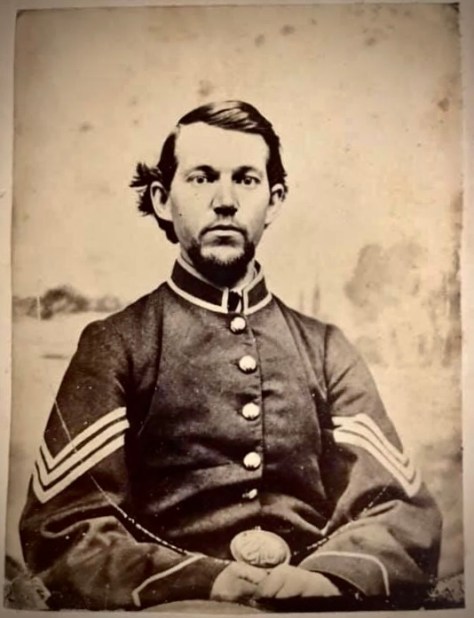
The following letter was written William (“Bill”) H. Debell (1844-1864) who accepted a $70 bounty and enlisted when he was 18 as a private in Co. A, 109th New York Infantry. He was the son of Daniel W. DeBell (1810-1881)—sometimes spelled Dibble—and Phebe Ann Fairchild (1814-1910) of Danby, Tompkins county, New York. Bill was not close to his father. His father and mother separated in January 1858 leaving Phebe without property and offered no further support to his wife and the four children (including Bill) who were left in the household. In the 1850 census, the DeBell family was enumerated in Shandaken, Ulster county, New York, where Bill’s father worked as a millwright. At that time, there seven children in the family ranging in age from 1 to 16.

Company A of the 109th New York Infantry was primarily recruited from the towns of Newfield, Caroline, and Danby in Tompkins County, New York. Bill took his place in the ranks with other young men from Tompkins county, many of whom were his friends from Danby. The Regiment began its assignment during the first week of September, 1862. A few days later several companies were detached to garrison Laurel, MD (about 8 miles SE of Annapolis Junction) to guard the main railroad junctions located there. The 109th remained at this assignment but was reassigned in October 1862 to the 22nd Army Corps as railroad guards and part of the 22nd’s overall defense of the Capital at Washington, DC against the threat of Gen. Robert E. Lee’s Army of Northern Virginia’s presumed invasion. The invasion never came. Their job was tedious and boring and they saw no military action of any kind.
The 109th did its duty from September 1862, the remainder of 1862, all of 1863 and through the end of March 1864. Then in April, 1864 the 109th was ordered to join the 9th Army Corps then assembling at Annapolis, MD in preparation for action against General Lee at Petersburg, VA. The 109th Regiment became part of Hartranft’s battle-tried 1st Brigade, Wilcox’s 3rd Division, 9th Army Corps, Army of the Potomac. The 9th Corps left Annapolis on 23 April, 1864 headed for the crossing at the Rapidan arriving there on the 4th of May, 1864. The next morning, 5 May, 1864, the 109th, after crossing the Rapidan as one of the lead units, were immediately fully engaged with the enemy in the Battle of the Wilderness. Though they had been in the service 1 year, 8 months, and 9 days since they organized in the late summer of 1862 at Binghamton, New York, it was their first taste of battle.
Bill would go on to fight in eight major pitched battles with the 109th New York until he was finally cut down in the Battle of Weldon Railroad on 19 August 1864. there are seven letters presented here by Bill DeBell and two by William A. Hance, a comrade in Co. A who wrote letters to Bill’s family informing them and providing some details of Bill’s death.
These letters are from the personal collection of Don Andrew who sent them to me for transcription and publication on Spared & Shared by express consent.
Those interested in the 109th New York may find any of the following published on Spared & Shared equally good reading:
George W. Roe, Co. A, 109th New York (3 Letters)
James M. Williams, Co. E, 109th New York (1 Letter)
Amos Avery, Co. F, 109th New York (1 Letter)
Samuel John Vail, Co. F, 109th New York (1 Letter)
John H. Warner, Co. G, 109th New York (1 Letter)
Almon W. Gould, Co. H, 109th New York (1 Letter)
Uriah Wright Stratton, Co. H, 109th New York (1 Letter)
Letter 1
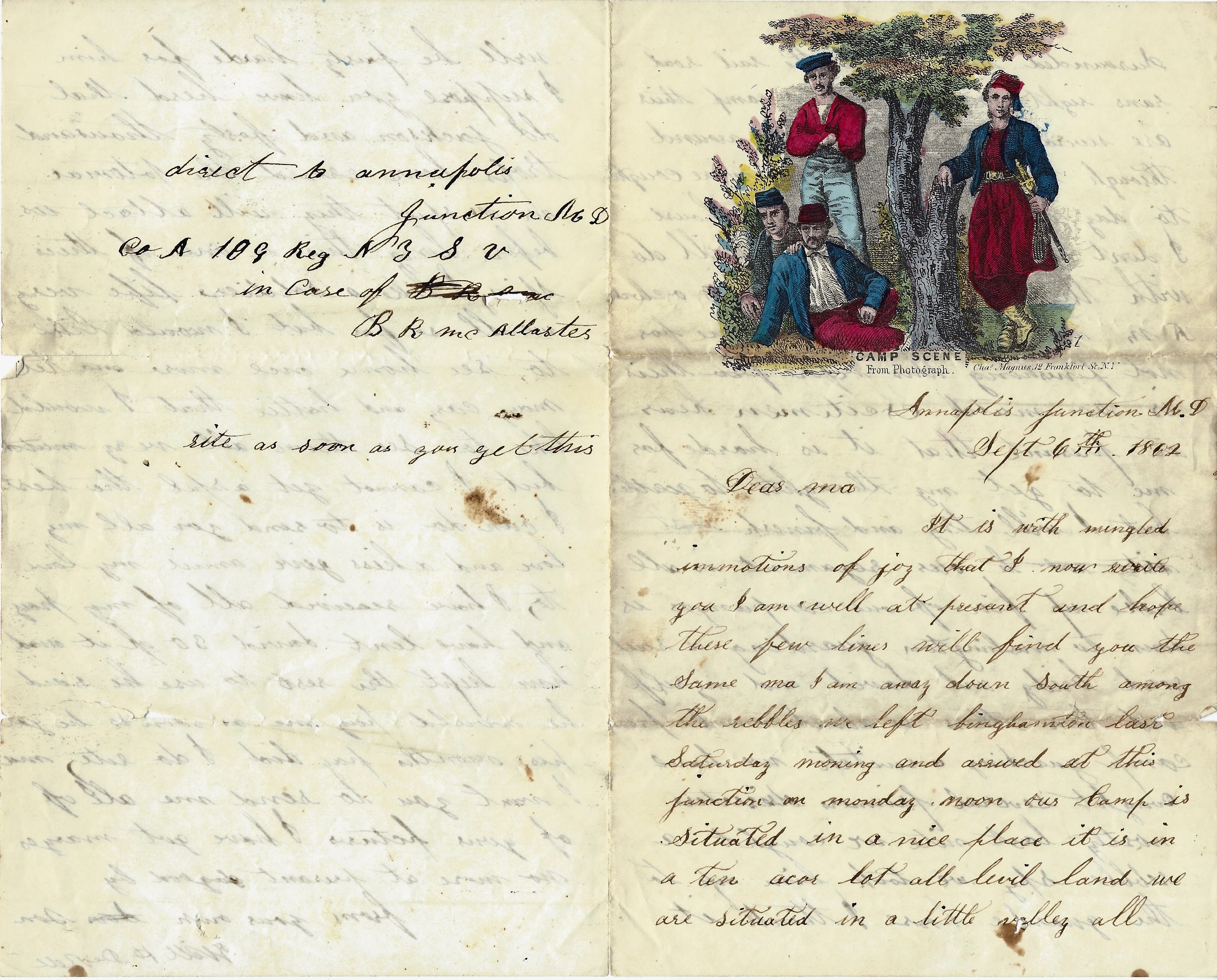
Annapolis Junction, Maryland
September 6th 1862
Dear Ma,
It is with mingled emotions of joy that I now write you. I am well at present and hope these few lines will find you the same. Ma, I am away down South among the rebels. We left Binghamton last Sauturday morning and arrived at this Junction on Monday noon. Our camp is situated in a nice place. It is in a ten-acre lot, all level land. We are situated in a little valley all surrounded with woods. The railroad runs right in front of our camp. There are several of the rebels around through the woods. Two of them were caught today and put in the guard house. I don’t know what they will do with them.
Monday morning, 8 o’clock a.m. Ma, you must excuse me for not finishing this before for there is so much excitement here at present that it is hard for me to get my thoughts together but I will try and finish. Our regiment is all broke up. Five of our companies is down to Washington guarding a railroad bridge and David and myself and ten others is about a mile from camp guarding a switch. We have caught several prisoners—[Union] deserters mostly. Last night we caught a rebel spy. We took him up to the guard house. I think it will be pretty hard on him. I suppose you have heard that Old [Stonewall] Jackson and forty thousand troops have crossed the Potomac. We expect they will attack us before long. This is one of their spies.
I like a soldier’s life very well so far but I would like to see home once more and tell Mary, Carrie, and Hattie that I would like to see them all very much but I cannot yet a spell. The best I can do is to send you all my love and a kiss. Give Annie my love too. I have received all of my pay and have lent David 30 of it and have kept the rest to use. He said he would pay me as son as he got his month’s pay. Did I do right, Ma? I want you to send me all of your pictures. I have got Mary’s. No more at present so goodbye from your own son, — Will H. DeBell
Direct to Annapolis Junction, Maryland
Co. A, 109th Regt. N. Y. State Volunteers in care of B. R. McAllaster.
Write as soon as you get this.

Letter 2
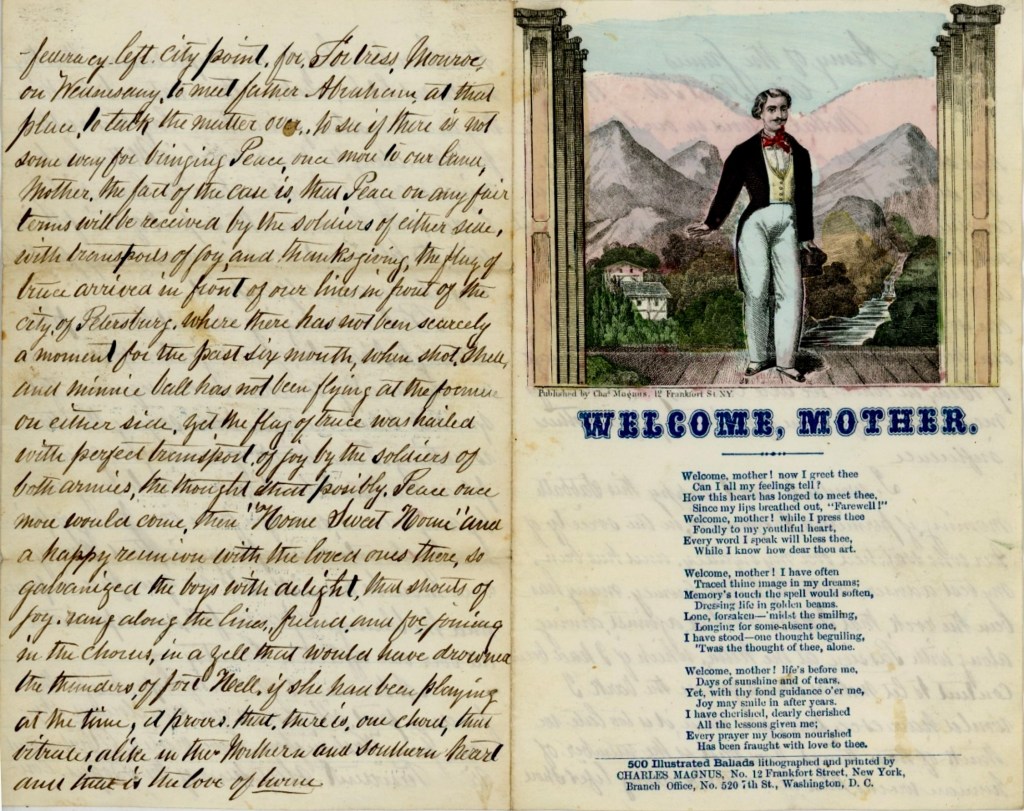
[Not transcribed. Words to Just Before the Battle, Mother.]


Letter 3
[Editor’s Note: In this 16 page letter to his mother of 17 May, 1864, Bill describes seeing the elephant for the first time.]
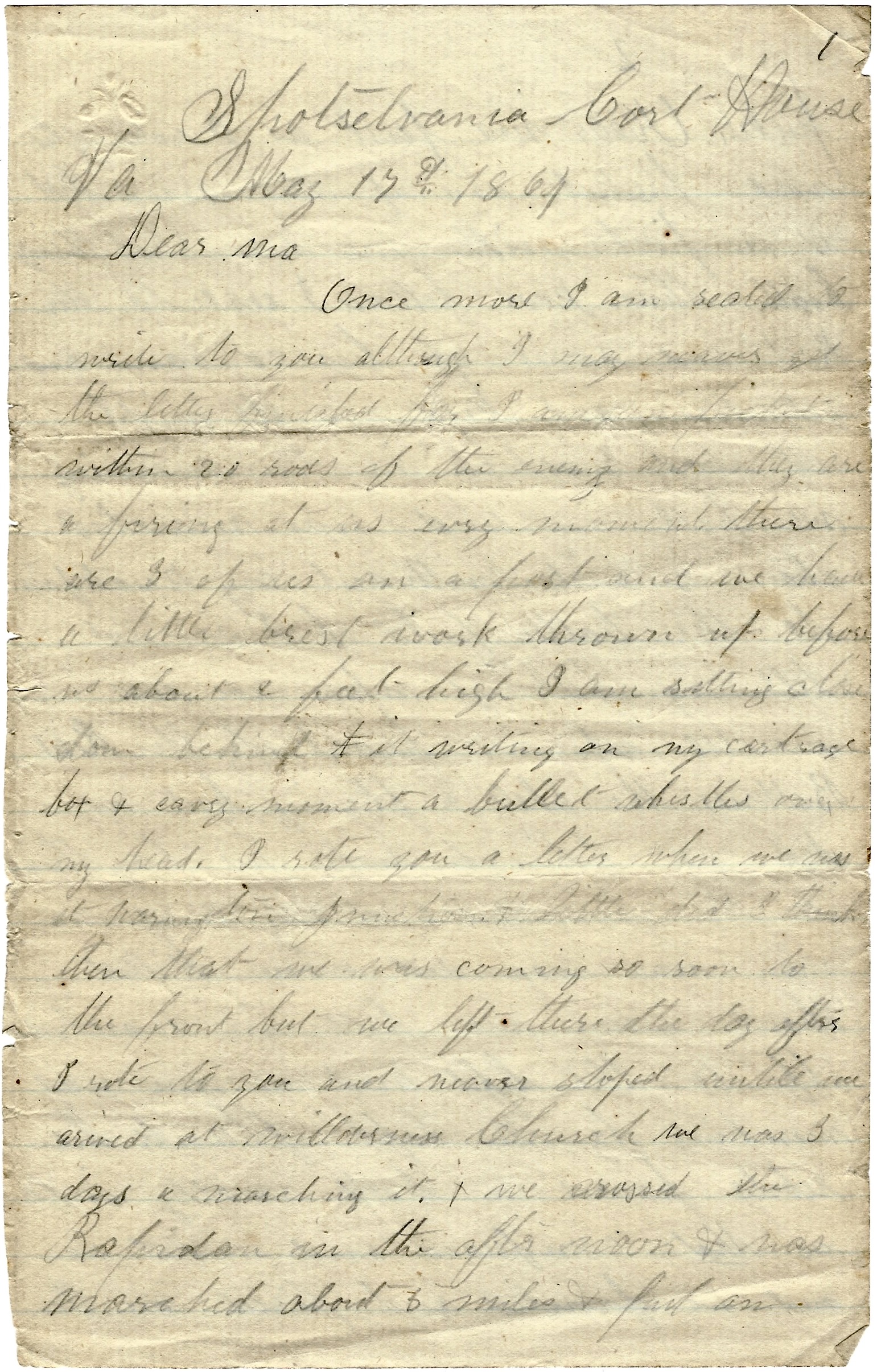
Spotsylvania Court House, Va.
May 17th 1864
Dear Ma,
Once more I am seated to write to you although I may never get the letter finished for I am on picket within 20 rods [@ 100 yards] of the enemy and they are firing at us every moment. There are three of us on a post and we have a little breastwork thrown up before us about two feet high. I am sitting close down behind it writing on my cartridge box & every moment a bullet whistles over my head. I wrote you a letter when we was at Warrington Junction. Little did I think then that we was coming so soon to the front but we left there the day after I wrote to you and never stopped until we arrived at Wilderness Church. We was three days a marching it. We crossed the Rapidan in the afternoon & was marched about 5 miles & put on picket—
Dear Ma, just as I wrote the word picket, one of the men that was on post with me was shot through both thighs [?]. Poor fellow. I sent to the regiment and some of his company came and got him.
—and kept on all night and about 5 o’clock in the morning we fell in and was marched about 3 miles without any breakfast to the battlefield. Oh! I cannot tell my feelings when we was marched up in front of the Rebel batteries, the shell a flying. but we did not flinch and only 8 of us men was wounded, none killed.
About noon we fell in [and] marched off to the left. As we was marching by the left flank, the rebels poured a whole volley into us that confused and excited us and we fronted and fired on them and we fought there all the afternoon and only three got wounded out of our company, none killed. We made four charges and drove the enemy out of their rifle pits and captured about 5 prisoners. Our firing ceased about dark and we built breastworks and lay in them two or three days and held our position. Then one night the rebels set up a terrible hootin’ and hollerin’ and we thought they was agoing to charge on us but it was [only] to blind a movement. They moved off to our right so that night about 2 o’clock we was ordered to fall in and was marched until daylight and made a halt for breakfast after which we took up the line of march again & marched until about 4 p.m. and made a halt and drew 5 days rations.
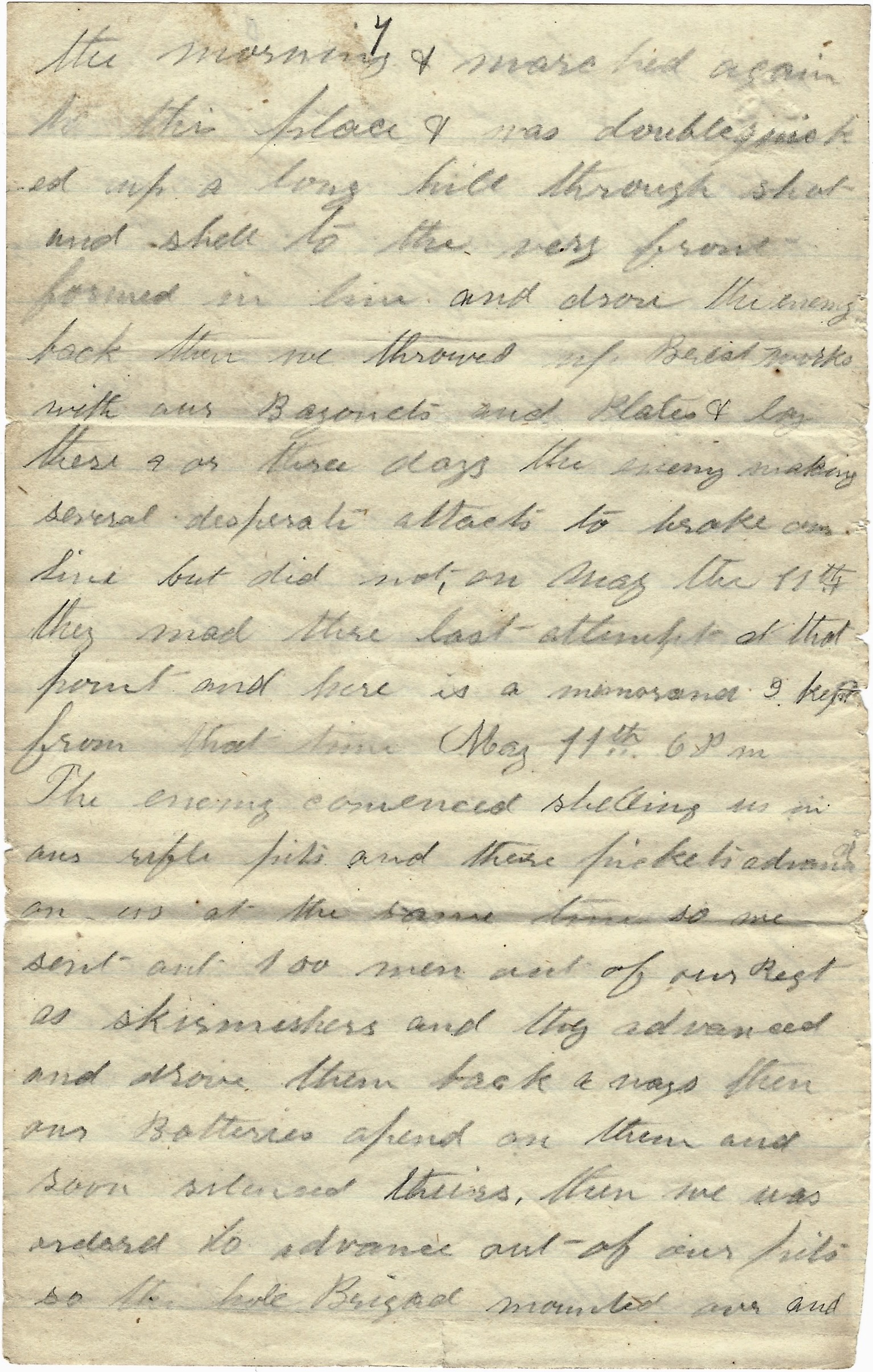
Stayed there until 5 in the morning and marched again to this place & was double quicked up a long hill through shot and shell to the very front, formed in line, and drove the enemy back. Then we throwed up breastworks with our bayonets and plates & lay there two or three days, the enemy making several desperate attacks to break our line but did not.
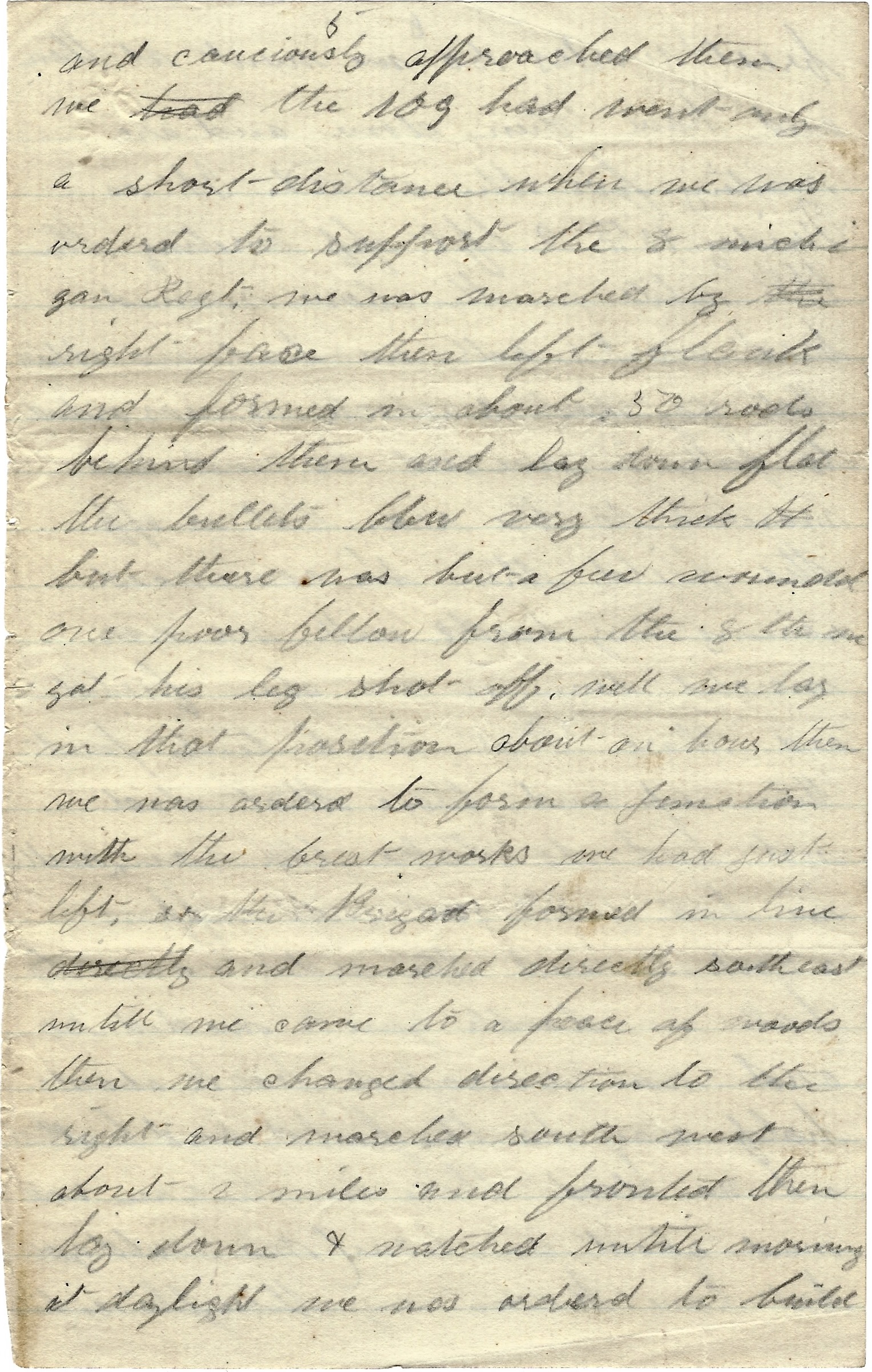
On May 11th, they made their last attempt at that point and here is memoranda I kept from that time. “May 11th, 6 p.m. The enemy commenced shelling us in our rifle pits and their pickets advanced on us at the same time so we sent out 100 men out of our regiment as skirmishers and they advanced and drove them back a ways. Then our batteries opened on them and soon silenced theirs. Then we was ordered to advance out of our pits so the whole Brigade marched over and cautiously approached them. We—the 109th—had went only a short distance when we was ordered to support the 8th Michigan Regiment. We was marched by the right face, then left flank and formed in about 50 rods behind them and lay down flat. The bullets flew very thick but there was but a few wounded. One poor fellow from the 8th Michigan got his leg shot off.
Well, we lay in that position about an hour. Then we was ordered to form a junction with the breastworks we had just left, so the Brigade formed in line and marched directly southeast until we came to a piece of woods. Then we changed direction to the right and marched southwest about a mile and fronted, then lay down & watched until morning. At daylight we was ordered to build breastworks so we went at them and have them done and are waiting for the attack.
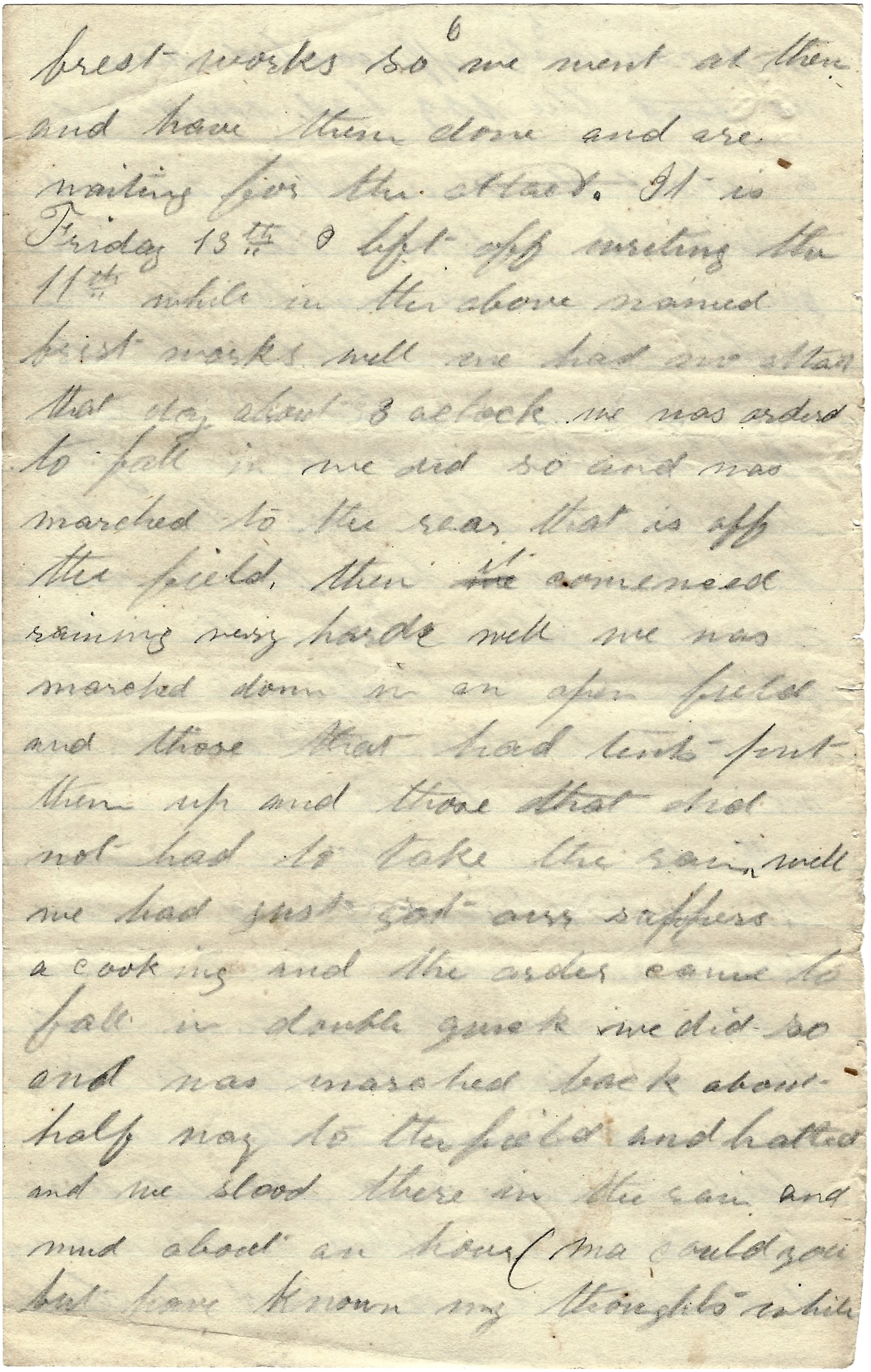
It is Friday, 13th. I left off writing the 11th while in the above named breastworks. Well, we had no attack that day. About 3 o’clock we was ordered to fall in. We did so and was marched to the rear—that is, off the field. Then it commenced raining very hard. Well, we was marched down in an open field and those that had tents put them up and those that did not had to take the rain. Well we had just got our suppers a cooking and the order came to fall in double quick. We did so and was marched back about halfway to the field and halted and we stood there in the rain and mud about an hour (Ma, could you but have known my thoughts while standing there, cold and wet. Be it ever so humble, there is no place like home!) Then the order came to about face and was marched back where we started from and camped down. Our things was all wet and it was quite cold.
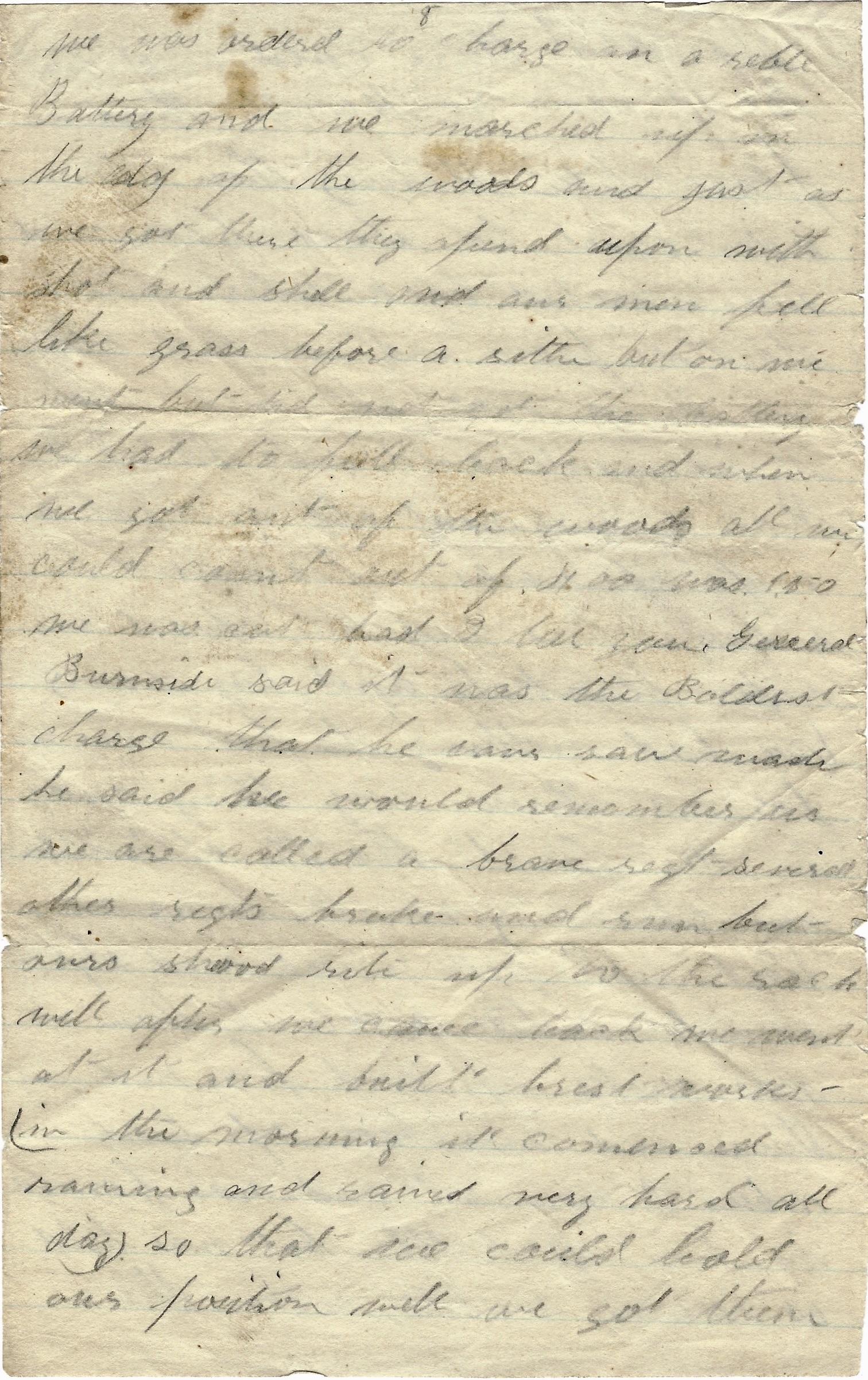
Well [Daniel] Mc[Pherson] & G[eorge] Roe & me went off and got a couple of rods of rails apiece and built a large fire and we spread our rubber blankets and lay down. (We had nothing to put over us for we threw everything away in the first battle at Wilderness Church.) We all being very tired, soon fell asleep and slept sound until 2 o’clock. Then we was woke up and packed our things and marched up here where I now sit and was formed in line of battle but was held in reserve until noon. Then we was ordered to charge on a Rebel battery and we marched up in the edge of the woods andjust as we got there, they opened upon [us] with shot and shell and our men fell like grass before a scythe. But on we went, but did not get the battery. We had to fall back and when we got out of the woods, all we could count out of 400 was 150. We was cut bad, I tell you. General Burnside said it was the boldest charge that he ever saw made. He said he would remember us. We are called a brave regiment. Several other regiments broke and run but ours stood right up to the mark.
Well, after we came back, we went at it and built breastworks—(in the morning it commenced raining and rained very hard all day)—so that we could hold our position. Well we got them done and got in them, mud up to our knees, but we had to lie down and we lay there all night and are here yet and this is the 3rd day.
May 15th—Well here we are yet and still it rains and the mud. Last night the enemy’s pickets bothered us all night and it was so cold and it rained so hard that it was very uncomfortable. It is morning now and we are still in the mud and rain but there is some very encouraging news and it [illegible]…Colonel told us that we had taken 8,000 prisoners and 40 pieces of artillery and also Richmond was in our possession. I hope it is so. I just heard from our chaplain that there was two Corps down to the rear that was agoing to relieve us and I must say I hope they will for this is the tenth day we have been out to the very front of the battle. I never heard of such a thing before—keeping men out on the front so long without a relief. Our men are getting very tired and wore out (tell Sarh she would not know the 109th if she should see it now. The regiment looks when it’s all together about like a good company).
It is Sunday the 15th. We are still in the pit and we begin to think we are agoing to stay in them for all being relieved. The enemy was very quiet in our front last night, but on our left they had a heavy battle. Yesterday afternoon the Johnnies charged on one of our batteries & they opened on them with 16 pieces and cut them full as bad as they did us the 12th. The Rebel sharpshooters troubles us very much for every time one of us raises our heads or stirs around, they shoot at us too and there was two men from some other regiment got killed yesterday, the 12th, and one today. Every man that goes out has to go on his hands and knees or go half double. The officers is the main thing they are after.
May 16th. Still in the entrenchments. The sharpshooters trouble us yet but they do not advance. We sent out a heavy line of skirmishers today so as to advance our pickets. Done t without much trouble. Last night our Corps fetched us up a kettle of beef stew. It was good, I tell you, for we was all very hungry.
May 18th. There is my memoranda from the 11th to 17th. I am back in with the company. I was relieved last night about six o’clock from picket. Came here and George Roe 1 had my supper ready for me. I eat it and we spread our rubber [blankets] and lay down. Slept until morning when we was woke up for our coffee. After we drank that and eat our crackers, we was startled by the rattle of musketry on our front. We jumped to our places, sat there a spell, and found it was nothing but the pickets. But about half an hour and our batteries opened, the enemy’s replied, and they kept up all the forenoon. It has ceased now but expect every moment when they will open again but it is hopeful that they will keep still for them shells are very disagreeable—especially when they come so close that the wind of one will blow your hat off as one did me the 12th in that battle. I have always heard say it was an awful feeling to go into battle but never thought it was such a feeling as it really is. I can’t begin to tell nor explain but after you have been in a little while, you don’t mind it so much.
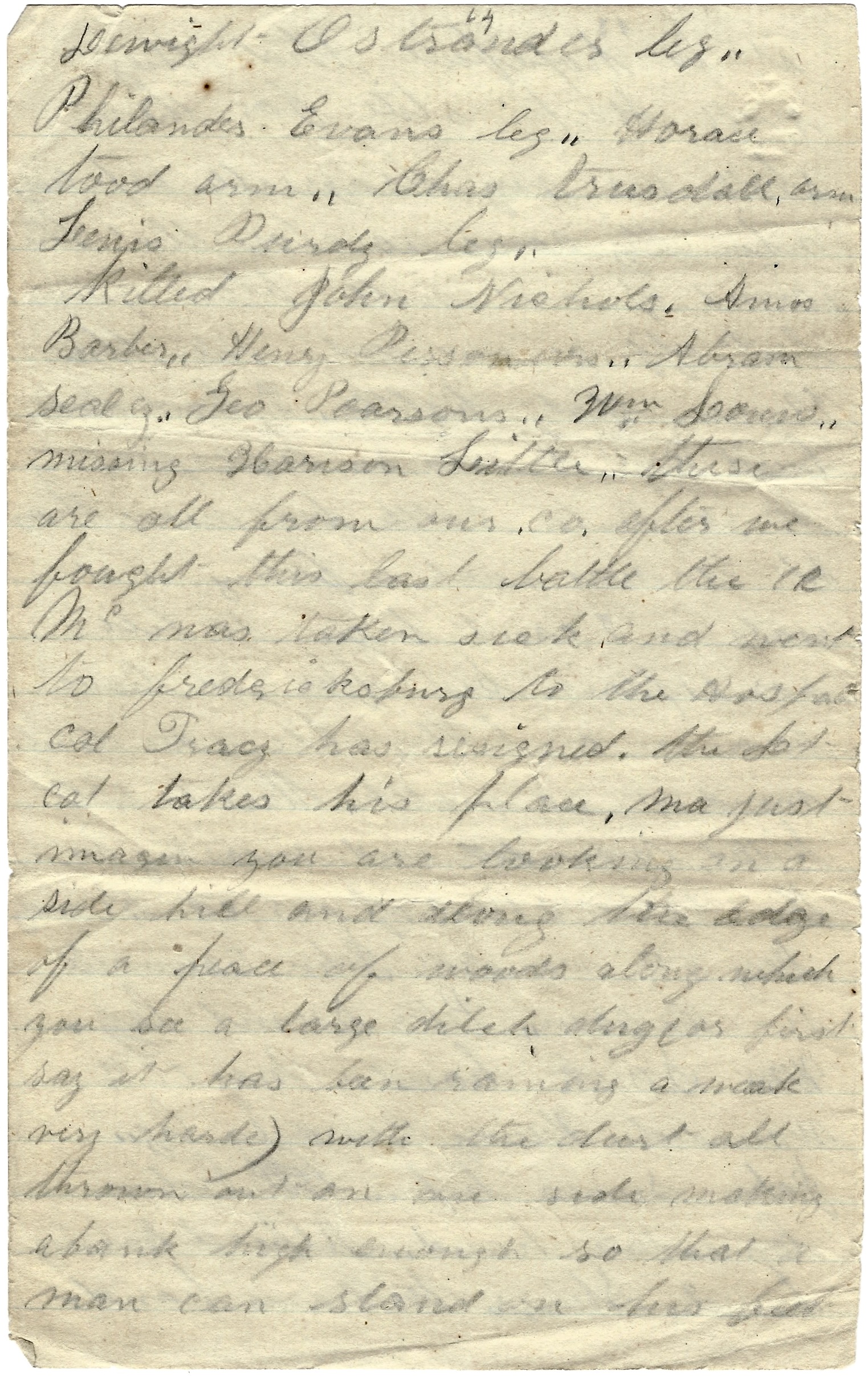
There is 230 killed, wounded and missing in the battle, 21 out of our company. Namely: May 6th, wounded, John Conners in the arm; Peter Swint [in the] leg, and William Smith [in the] hand. May 12th, wounded, Henry Beardsley [in the] leg. John Sumers [in the] hip, Colins Causdale [in the] hand, Alfred Earsley [in the] hand, Sturgis Williams [in the] hand, Dwight Ostrander [in the] leg, Philander Evans [in the] leg, Horace Todd [on the] arm, Charles Truesdell [in the] arm, Lewnis Purdy [in the] leg. Killed, John [G.] Nichols, Amos Barber, Henry Person, Abram Scales, George Pierson, William Lours. Missing, Harrison Little. These are all from our company.
After we fought the last battle, the Capt. Mc[Allister] was taken sick and went to Fredericksburg to the hospital. Col. [Benjamin F.] Tracy has resigned. The Lt. Colonel [Isaac S. Catlin] takes his place.
Ma, just imagine you are looking on a side hill and along the edge of a piece of woods along which you see a large ditch dug (or first say it has been raining a week very hard) with the dust all thrown out on one side making a bank high enough so that a man can stand on his feet and look over and occasionally you will see a small piece of [ ] stuck up. Well down in this pit or ditch you will see all along against the bank a row of guns with bayonets on and down in the bottom you will see men dying in all shapes in the mind. In imaging this, you will see the 109th and about the center of the pit you will see one with a small piece of board on his knee with pencil & paper writing. You may guess who it is. This paper I picked up in the battlefield. Some of the boys said that they saw David go through Chancellorsville the other day. You will, perhaps, know more about it than I would for I presume you hear from him and I don’t. I hope he has not been in this last battle for there was a large number of cavalry captured and poor Franky might have been one of them.
Ma, I will have to bring this to a close for the muskets begin to rattle and I am afraid I cannot send it at all. Goodbye. Write soon. — Will H. DeBell
Goodbye all until you hear from me again. Write soon.
1 George Roe (1831-1864) served with Bill DeBell in Co. A, 109th New York. They were both from Danby in Tompkins county, New York. Three of his letters were published on Spared & Shared in April 2025 (see 1863: George W. Roe to Sarah Adeline (McPherson) Roe.) In his letter of 9 September 1863 written from Annapolis, George mentions William DeBell as follows: “Reuben Youngs got his face severely burned this afternoon. It happened in this way. William DeBell—one of our tent mates—got a cannon cartridge while on patrol down to Savage & brought it to camp & hung it up in the tent. While he was out, Harrison [Tompkins] and Reuben thought they would come a joke on Bill so Rube took the powder & some matches & went out back to explode it. He placed a piece of paper on the powder & placed fire at the other end. He thought it was not going & so he moved the paper so that the wind would blow it towards the powder [and] at that instant, sparks blew into the powder & it exploded & burned his face quite badly. I think, however, he will get along without much trouble as it is not burned very deep.”







Letter 4
Near Petersburg, Virginia
June 20, 1864
Dear Ma,
Again I am seated to write a few lines to you. Since I last wrote to you, we have [illegible due to crease in paper] marching and fighting. The night of the same day I wrote my last letter, we evacuated our position & started we knew not where. We started as soon as it was dark & marched all night and all day, stopping just long enough to make a little [illegible due to crease in paper]…all we had to eat was corn & coffee and when we got to the James River we made a half of one day & drew rations and started again just night and they marched us all night and next day until about 3 o’clock when we halted and made a little coffee.
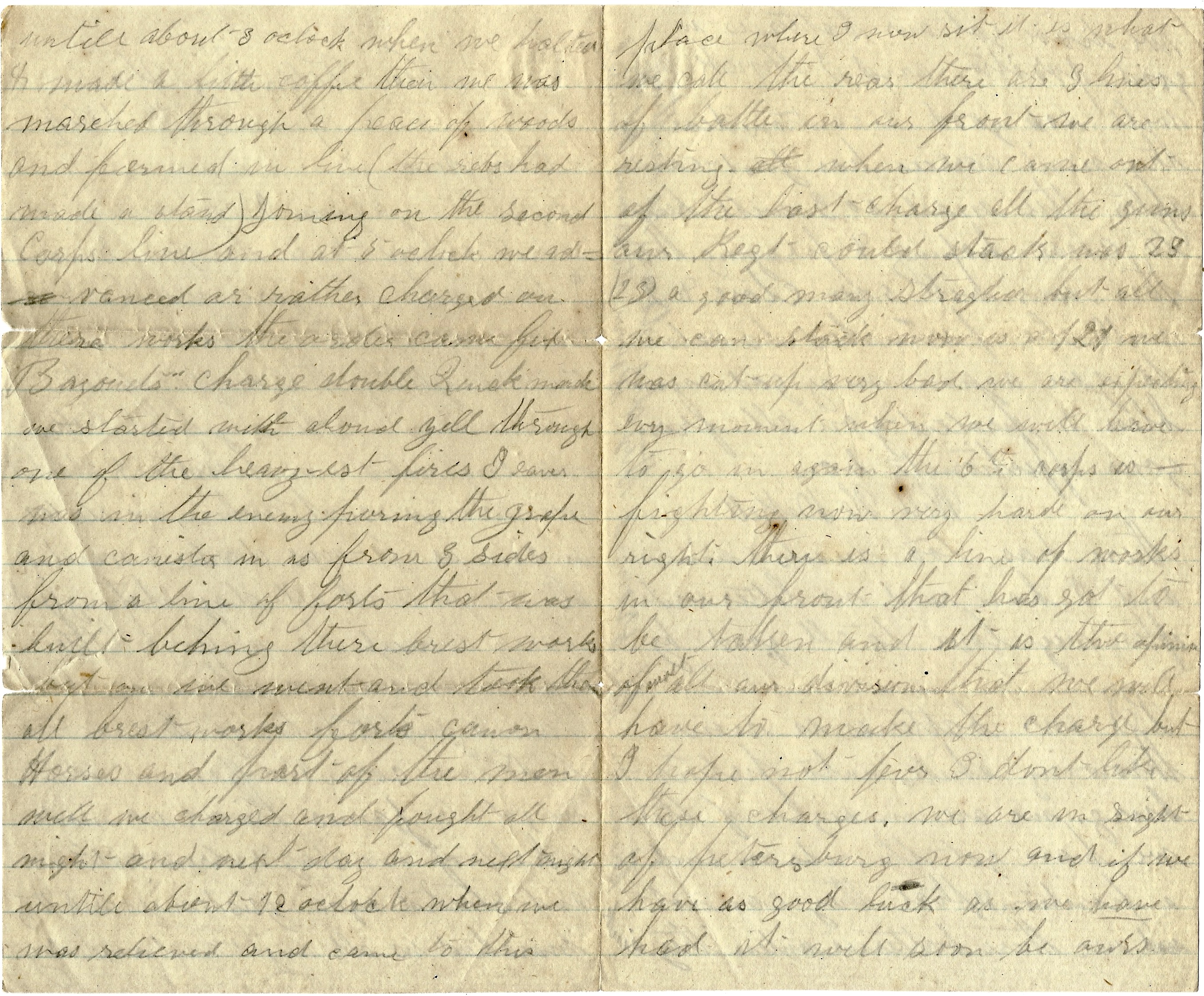
Then we was marched through a piece of woods and formed in line (the rebs had made a stand), joining on the 2nd Corps line, and at 5 o’clock we advanced or rather charged on their works. The order came “Fix bayonets, charge double quick” made, we started with a loud yell through one of the heaviest fires I ever was in, the enemy pouring the grape and canister in us from three sides from a line of forts that was built behind their breastworks. But on we went and took them all—breastworks, forts, cannon, horses and part of the men. Well we charged and fought all night and next day and next night until about 12 o’clock when we was relieved and came to this place where I now sit. It is what we call the rear.
There are three lines of battle in our front. We are resting. When we came out of the last charge, all the guns our regiment could stack was 23. A good many straggled but all we can stack now is [ ]. We was cut up very bad. We are expecting every moment when we will have to go in again. The 6th Corps is fighting now very hard on our right. There is a line of works in our front that has got to be taken and it is the opinion of most all our division that we will have to make the charge but I hope not for I don’t like these charges.
We are in sight of Petersburg now and if we have as good luck as we have had, it will soon be ours. We have got our batteries in a good position and I think they will do good execution.
Dear me, the mail carrier has just come after the mail so I will have to close hoping and praying that war will soon close & I will be permitted to return to you again. May God save, bless and protect you all. From your affectionate son. — Will H. DeBell
There has two mails come in and I have received no letter. Write often. My love to you all.
P. S. Our batteries is now throwing shells into Petersburg. We are in sight of there. We have got the rebs in such a position so that they cannot use their batteries unless they sink them in the ground so that nothing is above ground but the muzzle.

Letter 5
On picket near Petersburg, Va.
June 28, 1864
Dear Ma,
Again I am seated to write you a few lines to inform you that I am still alive and well and hope this will find you all the same. I have written two letters to you since I have received any. Our mail comes in regular every day & I can’t imagine why I don’t get them. I can’t think but what you have written but maybe I will get one tomorrow so I will wait patiently.
I came on picket night before last & have been on nearly 48 hours. I was to be relieved last night but the whole regiment came out on the picket line to stay 48 hours so I had to stay with them so that will keep me on 84 hours. I was on the advance line yesterday which is within a stones throw of the reb’s main line. They have got a very strong line. Every little ways they have a piece of artillery planted. Both armies are building and strengthening their works. Our men are preparing to siege them and I hardly think there will be much infantry fighting unless they attack our lines and that is just what we want so we don’t feel much alarmed.
The rebs have got two large forts in sight of us & our men are digging under one of them to blow it up. They are half way now and I think in the course of a week, they will lift it with powder. Our armies has got an awful strong position here. Artillery siege pieces & mortars—there is no end to them. We all expect a hard time when they commence the siege. The rebs are getting the range of us with their mortars now. Every once in a while a large fifty to a hundred pound shell will come over in our lines and burst.
In the 2nd Corps joining on our corps there is brass band playing “When this Cruel War is Over.” Oh it does sound splendid. The sun is down and it is cool & pleasant. All is quiet except the picket firing. Oh, if it was only in time of peace and I was sitting in the door of our house, just had my supper, and all the work done, oh how we could enjoy ourselves. Oh, then if I could hear a band play, I could enjoy it. But here it sounds so lonely and brings afresh all the ties of home. Sometimes when I am sitting all alone and get to thinking of my loves ones at home, then the thought of where I am comes back again. Well I won’t try to tell the feeling that comes over me for a few moments. Then after that, it will be three or four days, perhaps a week, before I think of it again. But enough of this.
I expect we will have a lively time tonight with the mortars from both sides for our men has got ever so many of them (mortars) planted and I think they will open them as soon as it is dark & it is so near that now I will have to stop writing until tomorrow. So good night.
Wednesday, June 29th & 4 p.m. Again I am seated. I have just had a good nap and finished a part of a can of beans that I had left from my dinner and I feel some better. It was not as I expected last night—about the shelling. All was quiet except the pickets. The Rebs kept up a steady fire all night which made it very disagreeable for their bullets come fairly closae—especially to where I lay. I have got a little post about ten feet from the company all alone by myself. It would be very pleasant if it was not for them (the bullets). It is a little hole dug in the ground about two feet deep and long enough to lie down in with the dirt all thrown upon one side for a breastwork. Then up on the top of that, I have a heavy log laid with holes under to look through. Then I have my piece of tent & rubber blanket put together for a shelter or shade and my wool blanket under me.
Our regiment grows smaller and smaller as the time passes on. Most every day, one or more of our men is killed. Last Saturday a man in our company by the name og John Cortright [of Owego] was killed and one in Co. K day before yesterday by the name of Edward [Edwin] Wilber [of Owego] and another wounded. I did not hear his name. And today one of Co. F was shot through the right eye and was killed instantly. Take our sick and all together our regiment won’t number over 400 and when we came in the field, it was 1015 strong so you can see that we have been cut up pretty bad.
Our men has just sent mortars and the rebs is replying but the shells from both sides goes over us. Well Ma, it is getting late and I will have to close for we are to be relieved as soon as it is dark and I will have to get my supper and pack up my things. I wish you all could take supper with me tonight. I am going to have fried pork, fried hard tack, ad coffee. But I think I had rather take supper with you but I hope you will eat just as though I was there & I will try and eat just as though you was here. Do all of you write to me often. I bid you all an affectionate goodbye until you hear from me again. I remain your affectionate son, — Will H. DeBell
Washington D. C.
Co. A, 109th N. Y. S. V.
1st Brigade, 3rd Division, 9th Army Corps
P. S. I give my love to all the girls and tell them to write. It is quite lonesome here in the company for me now for all of my old tent mates is away. George is sick, off to the hospital. Also [William] H. Forsyth and D[aniel] McPherson is Co. cook. He only comes to the company once in a while.


Letter 6
Still on the Front Line near Petersburg, Va.
July 3rd 1864
Dear Ma,
Again I am seated to write to you. I received your long looked for letter yesterday and was very glad to hear from you and hear you was well. I am well and doing as well as can be expected. It is all quiet in our front but on the right and left, there is some fighting every day. But perhaps you hear of the news as quick or quicker than we do. I hear it rumored that the siege is to commence tomorrow but we can’t tell much about it. I hardly know how to commence or finish this unless I commence back and give you the details of my diary from the time we left Cold Harbor.
Sunday, June 12th. Still on duty as supporting picket of the fort. There is great excitement today and it is said the 9th Corps evacuates their position.
13th—As I expected, last night as soon as darkness covered our movements, moved out in a southern direction. Marched all night.
14th—Today crossed the Chickahominy and at night found ourselves near the James River where we encamped for the night.
15th—Today are lying where we camped last night, resting out. D[aniel] H. McPherson and me have just been down to the river bathing. Swam to the island, Then drew 4 days rations—coffee, pork, hard tack.
16th—Last night was routed out just dark, crossed the [James] River on pontoons, traveled all night and all day today—a forced march. Have reached the rebs’ works near Petersburg & formed in line of battle.
Friday, 17th—It will never be forgotten by the 9th A. C. Fought all day and charged on the Rebs four times and lost nearly all the remainder of the regiment. After the fight, we had only 37 men to stack arms.
18th—Still fighting and gradually gaining ground although it costs heavy and blood and life. Petersburg is plain to be seen from the parts we took from the Johnnies.
19th—Have been lying in the woods facing the enemy. No fighting in our corps today except the pickets.
20th—Last night charged across the railroad and took the heights beyond but again fell back into the woods where we now are.
21st—Today have had general inspection and every regiment in our Brigade has orders to be ready to move at a moment’s notice.
22nd—Moved some distance to the right last night but still on the same line of works.
23rd—We are still holding our position. I was on picket yesterday and was relieved last night. All quiet along the lines. Under marching orders.
24th—Last night were relieved by the 10th Corps and moved some distance to the left. We are next to the front line and are supported by our Colored Division.
25th—Started constructing a new line of works or rather pits. The enemy’s sharpshooters annoy us incessantly.
26th—This morning a man in our company by the name of John Cortright 1 was shot on picket line and died in two hours. I helped carry him off the picket line.
27th—Today our Colored Division has been busy filling bags with sand. They are to be used for breastworks.
1 John Cortright (1816-1864) was a 40 year-old farmer from Owego, Tioga county, New York, when he enlisted in December 1863 in Co. A, 109th New York Infantry.


Letter 7
Near Petersburg, Virginia
August 10th 1864
Dear Sister,
I am seated in a bomb proof to write you a few lines as it is raining and it is very lonesome here on the picket line. We came here last Saturday night and expect to stay until next Saturday night. We are all in great fear here on the line for the rebs is undermining us as we did them. Our men are countermining as fast as they can but the rebs has several days the start of us and we are all afraid they will blow us up before we can stop them. But we have got stay and run our chances the same as in battle.
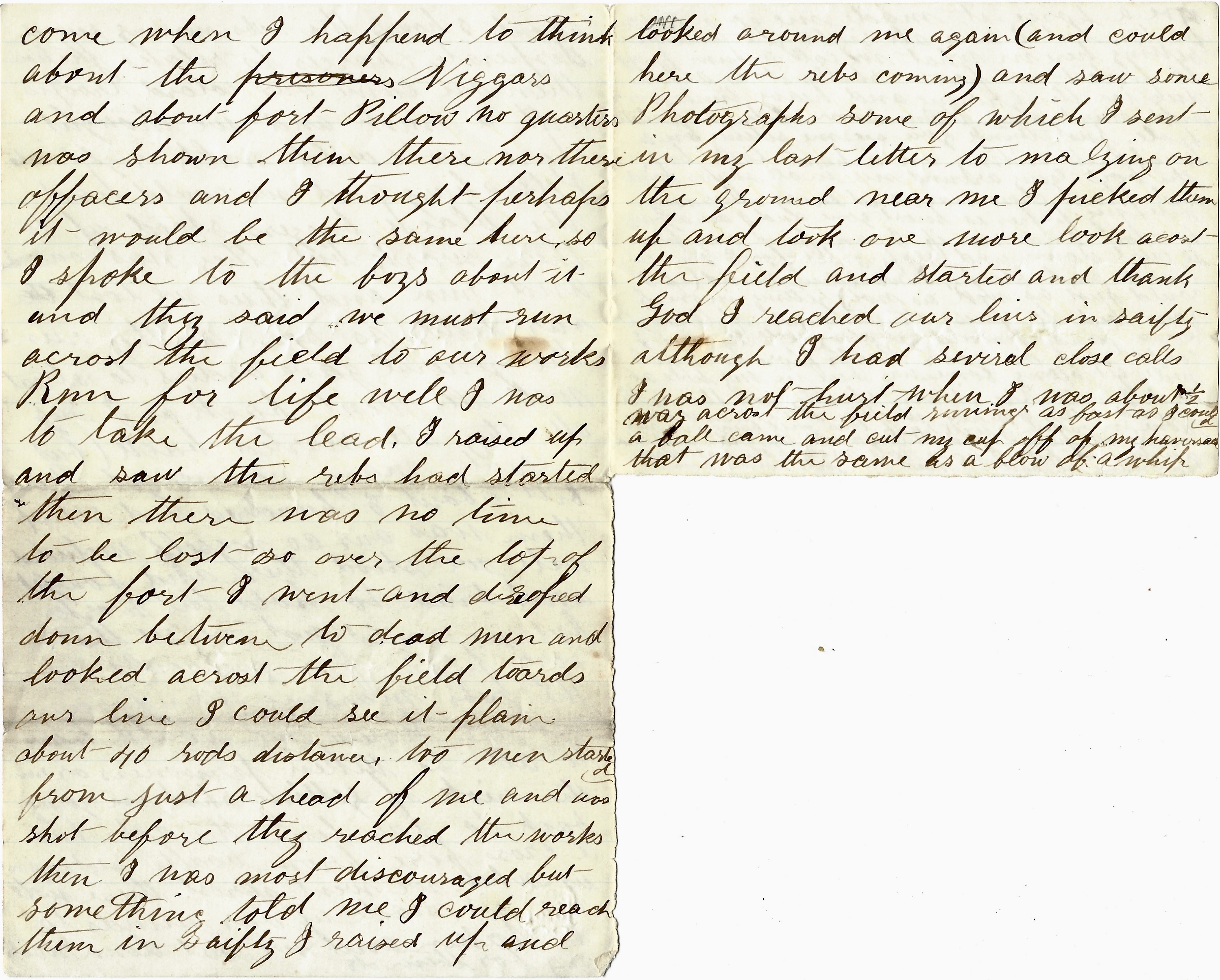
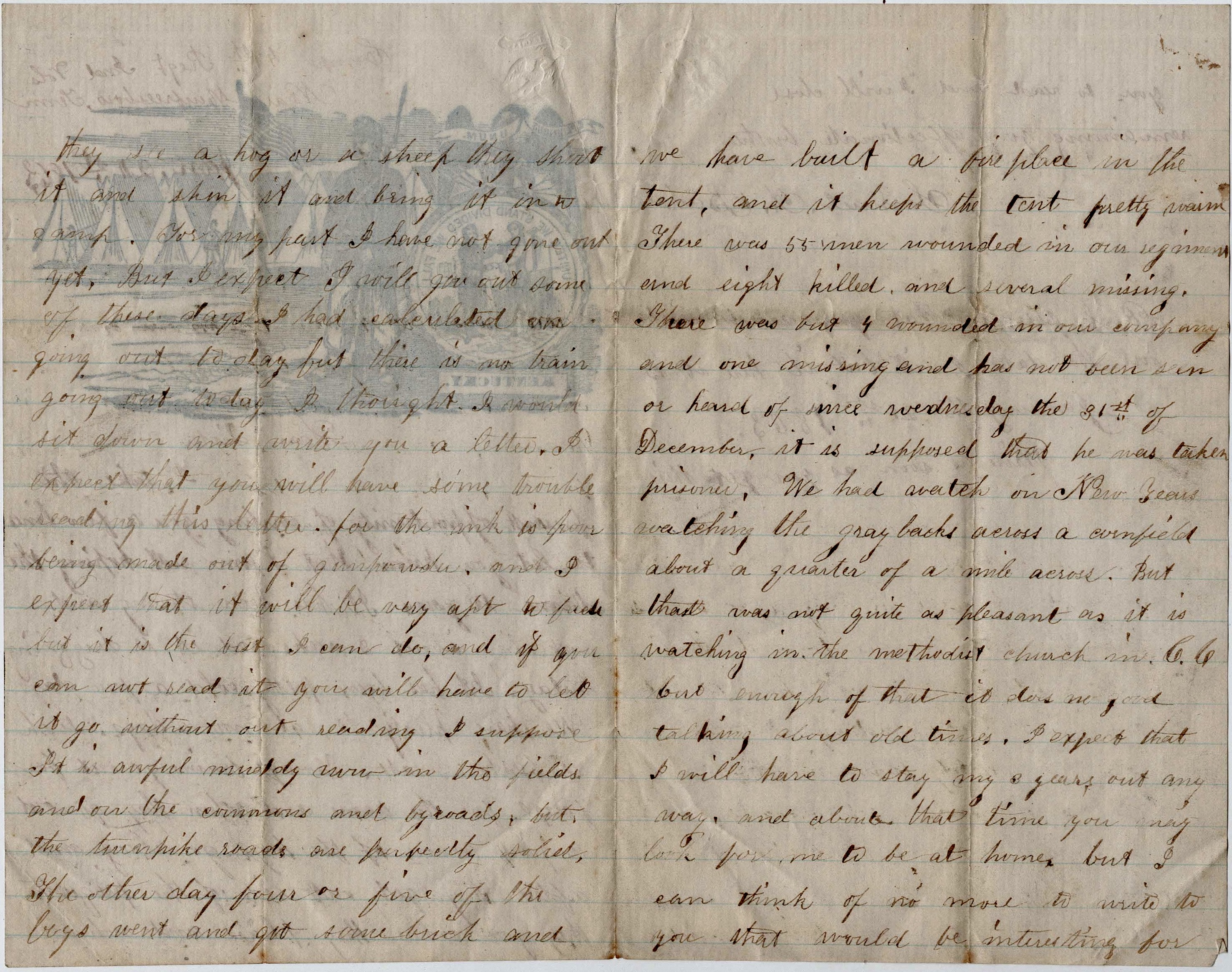
I presume you have read in the papers before this time about the undermining of the reb fort. Well our regiment was on the picket line at the time it was hoisted (the same line we are on now). Well the night before is was hoisted, as I said before, about 5 o’clock in the afternoon, we had orders to be ready to move at a moments notice and we supposed we was agoing to be relieved for we had been on the line 15 days. Well we got ready and sat around until dark and the expected relief did not come. Some of the boys fell asleep and some sat talking and wondering why the relief did not come. I was numbered with the sleepers.
Well, about 11 o’clock p.m., I was woke up and ordered to report to Headquarters. I did so and found a squad there and we was sent to Brigade Headquarters after spades and picks. Well then I began to smell the rat (I knew that the fort was all ready to blow up.) Well, we got them (the spades & picks), came back, and distributed them among the companies. Then I lay down and soon fell asleep with my things all on and when I awoke, it was 3 a.m. and there was a line of men formed in our rear in the same pits and we all thought sure they was the long wished for relief. But not so.

We had just got in line when to our astonishment we felt the ground rise up under our feet but we looked over the works and —– oh —— the awfullest sight that ever man beheld was there to be seen. Men’s heads, legs, arms, hands and whole bodies, artillery rails, mortars flying in the air. I took but one look and turned my head. But to see a sight which made another chill run through me, I saw a heavy line of battle moving forward. Then I knew for certain that we had to charge. On they came over our works. They went with a terrible yell (as soon as they got over our works in the line of battle, all the artillery along our line opened) and into the heap of ruins they went. And they had just got there when the rebs recovered from their panic and they opened all along their line.
Then the order [came] to our ears, “Forward 109th!” I looked in the direction the order came from and saw Col. [Isaac] Catlin 1 up on the breastworks swinging his sword, crying out, “Forward Boys!” and over we went. Well, I have been in several battles and I never was under such a heavy fire before. Well, a great many never reached the fort and oh! another such a sight. Men cut in all sorts of pieces and twisted in all shapes, some with their heads sticking out of the dirt, some with a hand and arm out, some with their legs out. It was awful. But we went to work and made good use of the “shubels & picks” in rescuing some of the rebs from being buried alive. Well, we got out several and took a number of others prisoners. Then we rallied on the next line and stood and fought about three hours, the rebs making several desperate charges to retake the line.

Then on came our colored troops with a rush and we thought sure we could walk right into Petersburg and we could [have] had the black buggers stood up to their work, but they was cowards and run and thus we lost our hold. As soon as they run, the General gave orders to retreat. Well, all went back or I say all. They all started back (but a great many never got there) but about 8 hundred, and six of them was our company, myself included. Well we stood there and fought and tried to hold the works but we could not see that very plain for we could see the rebs massing their forces and we knew we would have to all be taken prisoners or run the risk of getting shot in going back to our line. The rebs had a cross fire from both sides on us when we went across there.
Well, we six made up our minds to be taken and we sat down waiting for them to come when I happened to think about the niggers and about Fort Pillow [where] no quarter was shown them there nor their officers and I thought perhaps it would be the same here. So I spoke to the boys about it and they said we must run across the field to our works. Run for life, [indeed]. Well I was to take the lead. I raised up and saw the rebs had started. Then there was no time to be lost so over the lot of the fort I went and dropped down between two dead men and looked across the field towards our line. I could see it plain—about 40 rods [over 200 yards] distance. Two men started from just ahead of me and was shot before they reached the works. Then I was most discouraged but something told me I could reach them in safety. I raised up and looked around me again and could hear the enemy coming and saw some photographs, some of which I sent in my last letter to Ma lying on the ground near me. I picked them up and took one more look across the field and started and thank God, I reached our lines in safety and although I had several close calls, I was not hurt. When I was about halfway across the field, running as fast as I could, a ball came and cut my cup off of my haversack. That was the same as a blow of a whip on a horse. It made me go a little faster.
But I am alright and am sitting here in what we call a bum [bomb] proof to protect us from shells. It is a whole dug in the ground and heavy timbers over and dirt on them, some like a potato hole. Just think you see me sitting on a knapsack writing on a hard tack box, the boys lying around me in all shapes, heads and pints cross ways and every other way.
Well my paper is most gone and I am agoing to close and see if I can find ay place to curl down and sleep. I wouldn’t mind (if I could just as well as not getting in one of your beds to pass the remainder of the night. I bet I could sleep onyour parlor floor but I guess I will get along some way here in my hole. At least I will try it very shortly. Now this is the 2nd letter I have written to you and have none in return…
I like to forgot to say that the other 5 boys got out safe into our lines. If you want me to write again, you must send me some stamps as it is very hard to get them here. Write and tell me all the particulars concerning the fair maids &c. &c. of Ithaca. David & Frank also. I wrote to them some time ago but have received no answer. When you answer this, you must think up enough to full up two sheets at least. Now remember. Well here goes for a sleep so good night. May God protect you all. Goodbye.
1 Isaac Catlin was Promoted to full colonel on July 29, 1864, he led the 109th New York in the Battle of the Crater at Petersburg, Virginia, the next day. During the battle, he was seriously wounded but returned to the field and continued to lead his regiment until being struck a second time. The second wound necessitated the amputation of his right leg. For this action, he was given a brevet promotion to major general on March 13, 1865, and awarded the Medal of Honor several decades later, on January 13, 1899.


Letter 8
[Editor’s Note: The following letter was written by William A. Hance, the son of John L. Hance and Almira Bruster, who also served in Co. A, 109th New York Infantry. He enlisted at Danby on 12 August 1862 and mustered out with the company on 5 June 1865. His letter informs Hattie DeBell of the death of her brother Bill, killed in the Battle of Weldon Railroad on 19 August 1864 and of his burial on the battlefield.]
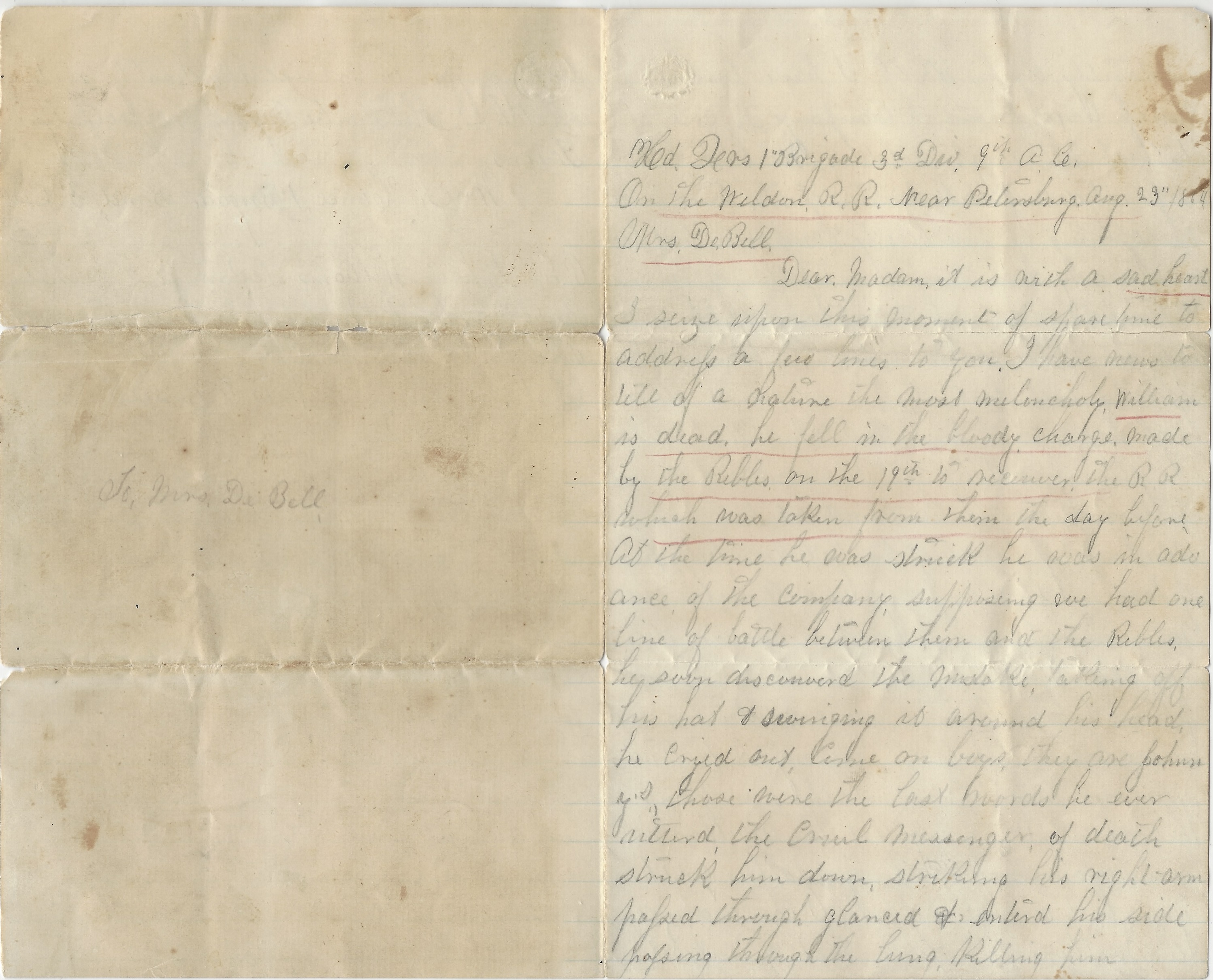
Headquarters Ist Brigade, 3rd Division, 9th A. C.
On the Weldon R. R., near Petersburg, Va.,
August 23, 1864
Mrs. DeBell,
Dear Madam, It is with a sad heart I seize upon this moment of spare time to address a few lines to you. I have news to tell of a nature most melancholy. William is dead. He fell in the bloody charge made by the Rebels on the 19th to recover the railroad which was taken from them the day before.
At the time he was struck, he was in advance of the company, supposing we had one line of battle between them and the Rebels. He soon discovered the mistake. Taking off his hat and swinging it around his head, he cried out, “Come on boys, they are Johnnys!” Those were the last words he ever uttered [before] he cruel messenger of death struck him down. Striking his right arm, [the ball] passed through, glanced and entered his side, passing through his lung, killing him instantly. By his death, I have lost a much loved friend and Co. A one of its best and bravest soldiers. We have been separated a great portion of the time since the opening of this bloody campaign but have occasionally met and spoken together of home and friends far away and anticipated the happiness in store for us when this cruel war should end. But alas, he is gone and all our bright hopes with him. And I am left to tell the gloomy intelligence.
William was a good soldier—always to be found at his post, discharging his duty nobly and manfully. His place in the company, as well as in the memory of those who knew him in this life, can never be filled until we have followed him to that same mysterious end. Allow me in behalf of Co. A to tender you our heartfelt sympathies in your bereavement. Having lost two brothers in the same manner, I can sympathize with you. But I suppose I cannot realize a mother’s feelings on such a subject. Asking you to excuse this hastily written sketch, I subscribe myself, respectfully yours, Wm. A. Hance, 1st Brigade Band, 3rd Division.
P. S. I have William’s testament and pocket book which I will forward to you the first opportunity. — W. A. Hance.

Letter 9
[Editor’s Note: The following letter was written by William A. Hance who also served in Co. A, 109th New York Infantry. He enlisted at Danby on 12 August 1862 and mustered out with the company on 5 June 1865. His letter informs Hattie DeBell of the death of her brother Bill, killed in the Battle of Weldon Railroad on 19 August 1864 and of his burial on the battlefield.]
Headquarters, Ist Brigade, 3rd Division, 9th A. C.
Near Petersburg, Va.
September 13, 1864
Miss Hattie,
Having a few moments to spare, the first I have had since the receipt of yours containing inquiries concerning your poor brother, I concluded to devote them in answering them as well as I can. I was out to the regiment the 11th and made inquiries of all I saw that I thought would know anything of him. All I could learn was that another regiment were detailed to bury the dead, but that Will was buried by our pioneers & who they were, I could not find out. There are but few of the boys left and nearly all of my acquaintances are either dead or wounded or sick. I shall try and find where his grave is. I do not know whether the Rebels or our men hold the ground for since the battle, things have changed. Our lines have been formed on the most advantageous ground and our division has moved several times since. We are now about three miles from where he fell.
But rest assured Miss Hattie, I will make every effort to find his resting place and will mark it so in case you should ever want to find the spot, there will be something to show you the spot where your brave soldier brother sleeps.
You ask how many battles Will was engaged in. There were eight pitched battles, 1 Wilderness, 2 Spotsylvania, 3 Bethesda Church, 4 near Hanover Church, 5 Cold Harbor, 6 near Petersburg, June 18th, 7 July 30th near Petersburg [The Crater], 8 Weldon R. R. Aug. 19th, besides numerous skirmishes on the picket line. After all he had passed through unharmed, it seemed doubly hard to believe that he could be taken down by a traitor’s bullet. You inquired about D[aniel] H. MePherson. The last I saw of him was the 17th of July. Your brother was helping him to the hospital. He was taken with typhoid fever [and] he died a short time after. I will inform you of whatever I learn concerning Will. Asking you to excuse this, I will close by presenting my best respects to your mother. I remain your friend, — W[illiam] A. Hance















 Spared & Shared 23