All posts by Griff

My passion is studying American history leading up to & including the Civil War. I particularly enjoy reading, transcribing & researching primary sources such as letters and diaries.

1863-64: William H. Van Iderstine to Phebe (Birdsall) Simon

These letters were written by 19 year-old Pvt. William H. Van Iderstine (1844-1920) of Co. D, 13th New Jersey Infantry. William enlisted on 11 August 1862 and was with his regiment at Antietam five weeks later. He was wounded in the hand in action before Atlanta on 30 July 1864 and was sent to the XX Corps Hospital where his hand was amputated. He recovered at a hospital in Nashville, TN, and the Ward Hospital, Newark, NJ. He was discharged 30 January 1865.

William was the son of Jeremiah P. Van Iderstine (1822-1896) and Catherine K. Birdsall (1822-1855). After the war he married Hattie Bannister (1837-1918) and worked in South Orange, New Jersey, for the firm of T. Van Iderstine & Sons, boots and shoes.

William wrote the letters to his aunt, Phebe (Birdsall) Simon (1830-Aft1890), the wife of John K. Simon who served in the 5th New Jersey Infantry (Part of the Jersey Brigade). John enlisted on August 19, 1861, and mustered in as a sergeant in Co. D on August 22. He was promoted to the rank of 2nd Lieutenant on May 26, 1862 and later promoted to 1st Lieutenant on May 19, 1863. He was promoted to the rank of Captain in May 1864. He mustered out of the service on September 7, 1864.

The first three letters were all written in the days and weeks following the Battle of Gettysburg in which the 13th New Jersey played a relatively minor role, losing 1 killed and 20 wounded out of the 360 men brought to the field. The regiment reached this battlefield at 5 p.m. on 1 July 1863, and with the brigade went into position on the north side of Wolf Hill. During the night, they occupied a position in support of Battery M, First N.Y. Artillery. July 2, in the morning, they held a position near Culp’s Hill. In the afternoon, they marched to relief of the Third Corps near Round Top. At night they returned to right of the army. July 3, they occupied a position supporting the Second Massachusetts and Twenty-seventh Indiana in their charge on Confederate flank. In the evening, they moved to extreme right to support of Gregg’s Cavalry. In the weeks that followed, they pursued Lee’s army to Manassas Gap and on to Kelly’s Ford.

The fourth letter was written from Tennessee after the regiment was sent to the western theatre to join Sherman’s army for the Atlanta Campaign in 1864.

13th New Jersey Monument at Gettysburg

Letter 1

Addressed to Mrs. John K. Simon, 107 Warren Street, Newark, New Jersey

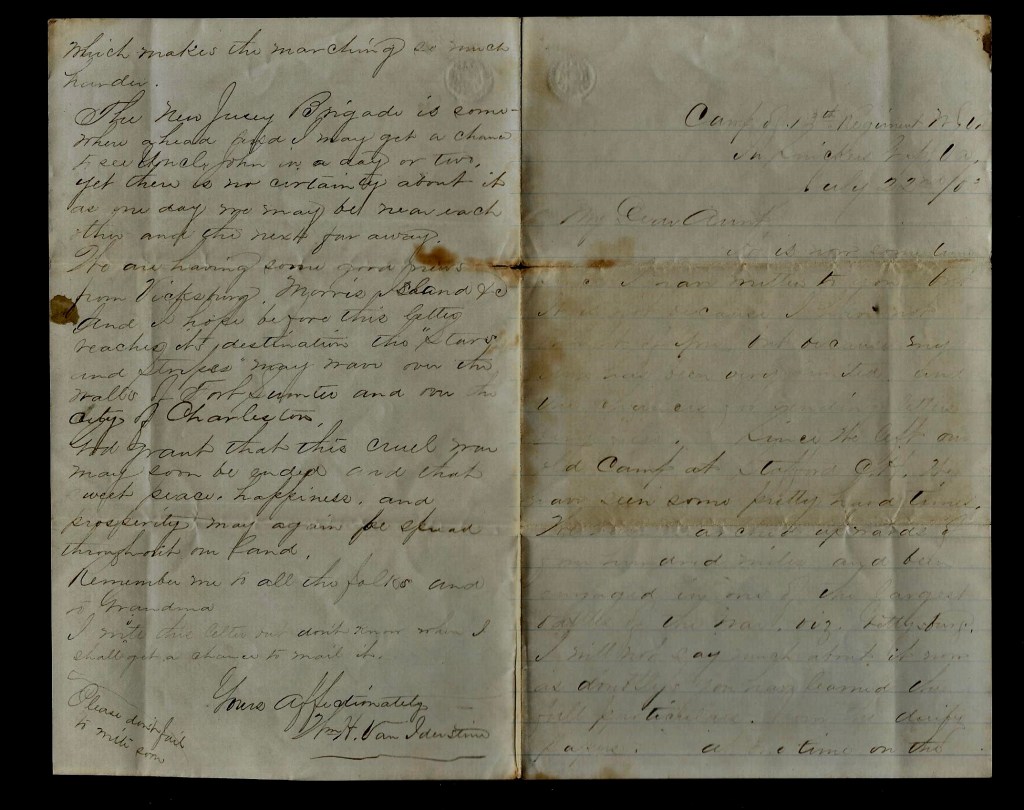
Camp of the 13th Regiment N. J. Vols.
In Snicker’s Gap, Va.
July 22, 1863

My Dear Aunt,

It is now some time since I have written to you but it is not because I have not thought of you but because my time has been very limited and the chances for writing letters very few.

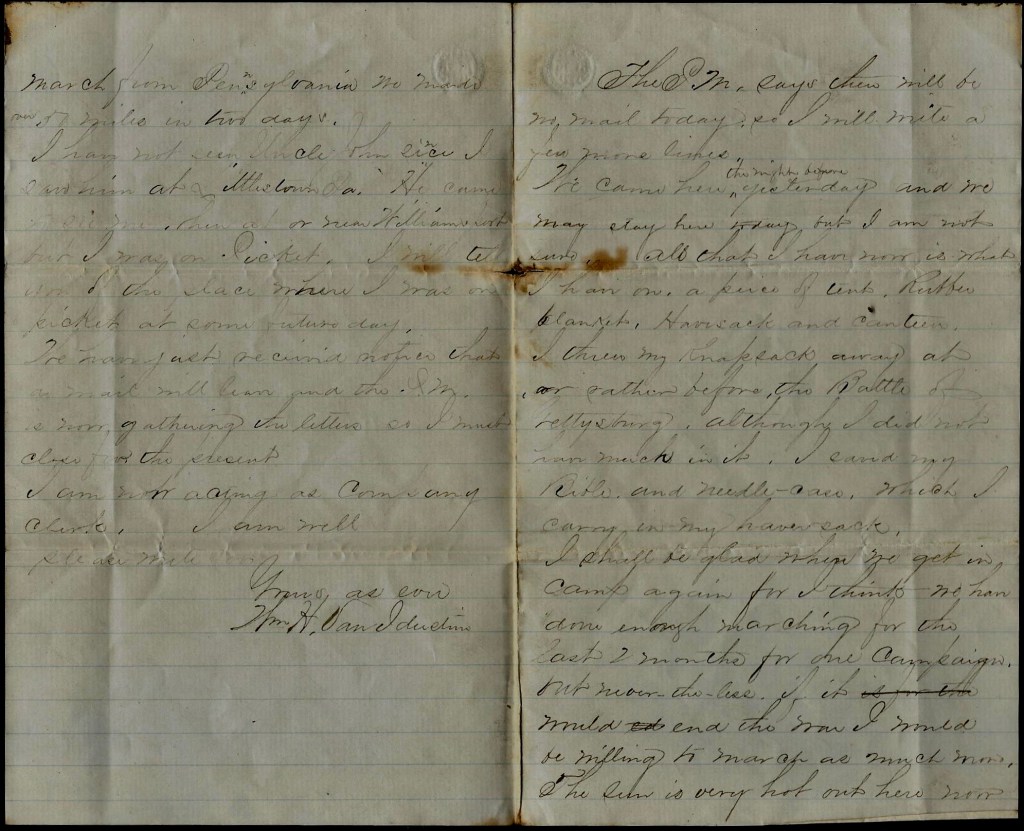
Since we left the old camp at Stafford Court House, we have seen some pretty hard times. We have marched upwards of four hundred miles and been engaged in one of the largest battles of the war–viz: Gettysburg. I will not say much about it now as doubtless you have learned the full particulars from the daily papers. At one time on the march from Pennsylvania we made over 50 miles in two days.

I have not see Uncle John since I saw him at Littlestown, Pa. He came to see me when at or near Williamsport but I was on picket. I will tell you of the place where I was on picket at some future day. We have just received notice that a mail will leave and the Quartermaster is now gathering the letters so I must close for the present. I am now acting as company clerk. I am well. Please write.

Yours as ever, –Wm. H. Van Iderstine

The Quartermaster says there will be no mail today so I will write a few more lines.

We came here the night before yesterday and we may stay here today but I am not sure. All that I have now is what I have on, a piece of tent, rubber blanket, haversack, and canteen. I threw my knapsack away at, or rather before, the Battle of Gettysburg, although I did not have much in it. I saved my bible and needle-case which I carry in my haversack. I shall be glad when we get in camp again for I think we have done enough marching for the last two months for one campaign. But never-the-less, if it would end the war, I would be willing to march as much more. The sun is very hot out here now which makes the marching so much harder.

The New Jersey Brigade is somewhere ahead and I may get a chance to see Uncle John in a day or two, yet there is no certainty about it as one day we may be near each other and the next far away.

We are having some good news from Vicksburg, Morris Island, &c., and I hope before this letter reaches its destination the “Stars and Stripes” may wave over the walls of Fort Sumter and over the City of Charleston.

God grant that this cruel war may soon be ended and that sweet peace, happiness, and prosperity may again be spread throughout our land.

Remember me to all the folks and to Grandma. I write the letter out. Don’t know when I shall get a chance to mail it. Yours affectionately, Wm. H. Van Iderstine

Please don’t fail to write soon.

Letter 2

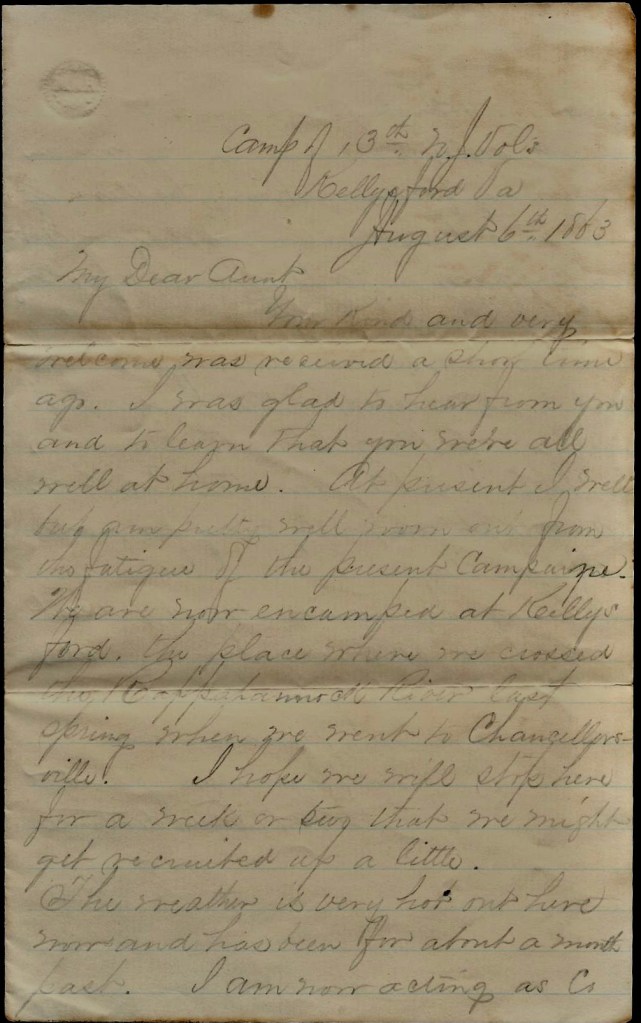
Camp of 13th N. J. Vols.
Kelly’s Ford, Va.
August 6th, 1863

My Dear Aunt,

Your kind and very welcome [letter] was received a short time ago. I was glad to hear from you and to learn that you were all well at home. At present I [am] well but am pretty well worn-out from the fatigue of the present campaign. We are now encamped at Kelly’s Ford—the place where we crossed the Rappahannock River last spring when we went to Chancellorsville. I hope we will stop here for week or two that we might get recruited up a little.

The weather is very hot out here now and has been for about a month past. I am now acting as company clerk which position I like very well and it gives me an opening for something better.

Our captain is acting Major and I suppose he will get it before long. Lieut. James L. Carman, a brother to the Colonel [Ezra A. Carman], is now acting as Captain. I was selected by the Adjutant when at Warrenton to serve as clerk of a Regimental Court Martial which kept me pretty busy for portions of two days.

I have no more to say at present except to be remembered to all the folks and friends and I remain your affectionate nephew, — Wm. H. Van Iderstine

Letter 3

Camp 13th N. J. Vols
Kelly’s Ford, Va.
August 23rd 1863

My Dear Aunt,

I take the pleasure again of writing you a few lines to inform you that I am well and hearty. I hope these few lines may find you all well at home. I was agreeably surprised to find, or rather learn, that Uncle John had the good fortune to get home on recruiting service.

You must excuse me for not writing more often since we have been in camp as I have been very busy in company the company books and making our reports, returns, rolls, &c. &c. The year is up the 20th of this month and the clothing accounts must be balanced which I am busy with now and as soon as I get through with that, pay rolls are to be made out so that I am kept busy. I don’t have to do any duty but attend dress parade & answer roll call if not engaged at that time.

Three regiments of our brigade left us a few days ago. The length of time that they are to be gone or their destination I cannot tell at present. Some think they are bound for New York City, others that they have gone on the transports to Yorktown on the Peninsula. On their leaving, Col. E. A. Carman took command of the remaining three regiments. If I had been half smart, I might have had the position as clerk, I think.

I think something of accepting a commission in a colored regiment. What think you? If Uncle John is there, just ask his opinion on the subject.

It is now Saturday night and tomorrow will be Sunday and we expect to have a sermon preached (for the first time I believe in about 6 months quite) by the chaplain of the 107th New York in our brigade. We have some very excellent prayer meetings here three or four times a week and our labors have not been in vain for some have come from darkness into light and others are serious and ask to be prayed for. For the last few days we have had a missionary from or belonging to the U. S. Christian Commission with us in our prayer meetings. Our meetings are attended by a large number—sometimes as high as 100 or more. The 107th New York, attached to our brigade, also have a goodly number of christians in it who take an active part. Sometimes we go to their meetings and at other times they come to ours. Though surrounded by vice and sin of all kinds, we have many precious seasons of praying and singing praises to God. I hope soon to hear the lips that now use profane language to be turned to sing the praise of God.

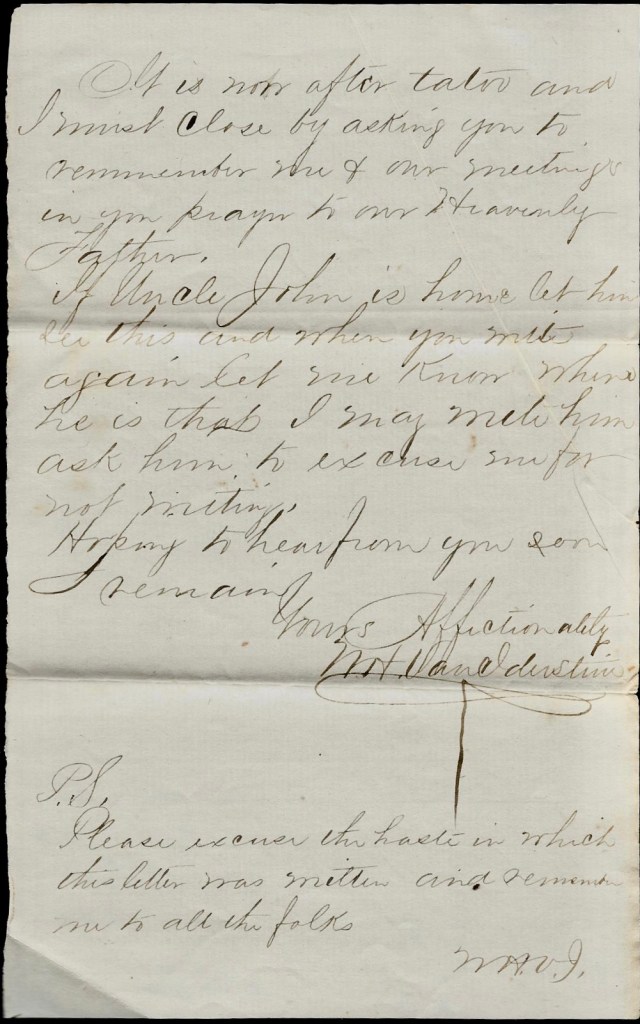
It is now after tattoo and I must close by asking you to remember me & our meetings in your prayer to our Heavenly Father,

If Uncle John is home, let him see this and when you write again, let him know where he is that I may meet him. Ask him to excuse me for not writing. Hoping to hear from you soon, I remain yours affectionately, — W. H. Van Iderstine

P. S. Please excuse the haste in which this letter was written and remember me to all the folks — W. H. V. I.

N. B. Aunt Phebe, won’t you please send by mail the soft felt hat I left home as soon as possible. It will cost but about 25 cents and it will be a great comfort out here in the hot sun. — W. H. V. I.


Letter 4

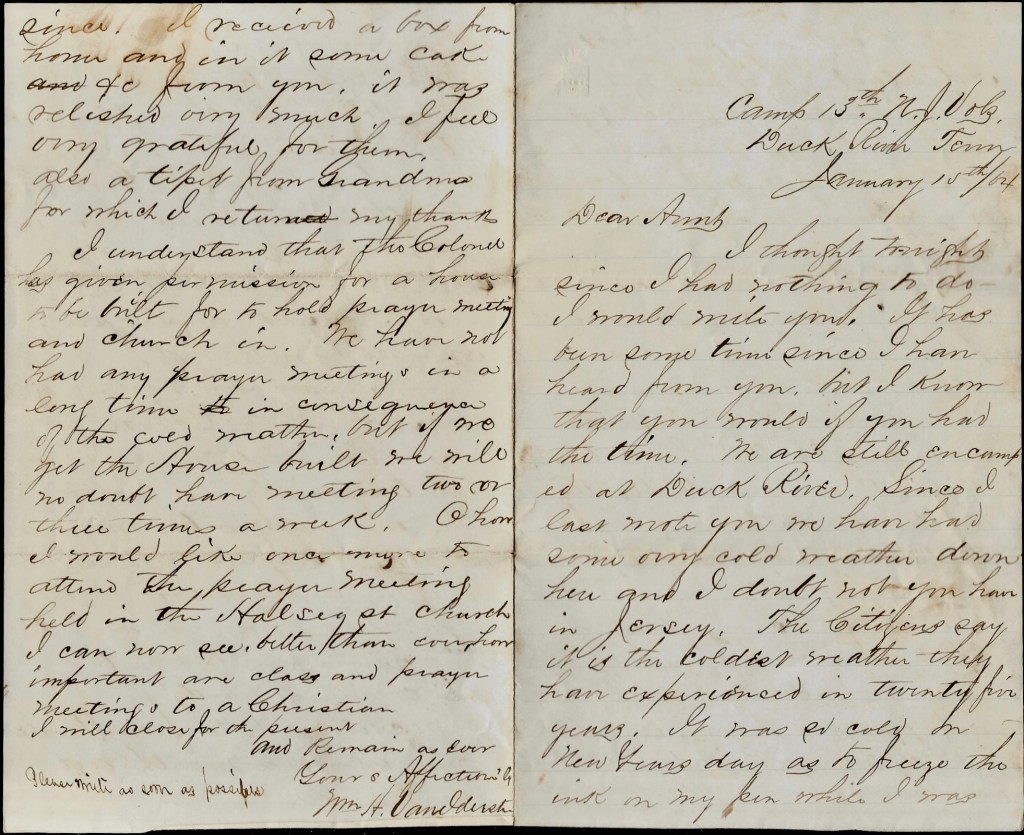
Camp 13th N. J. Vols.
Duck River, Tennessee
January 15, 1864

Dear Aunt,

I thought tonight since I had nothing to do I would write you. It has ben some time since I have heard from you but I know that you would if you had the time.

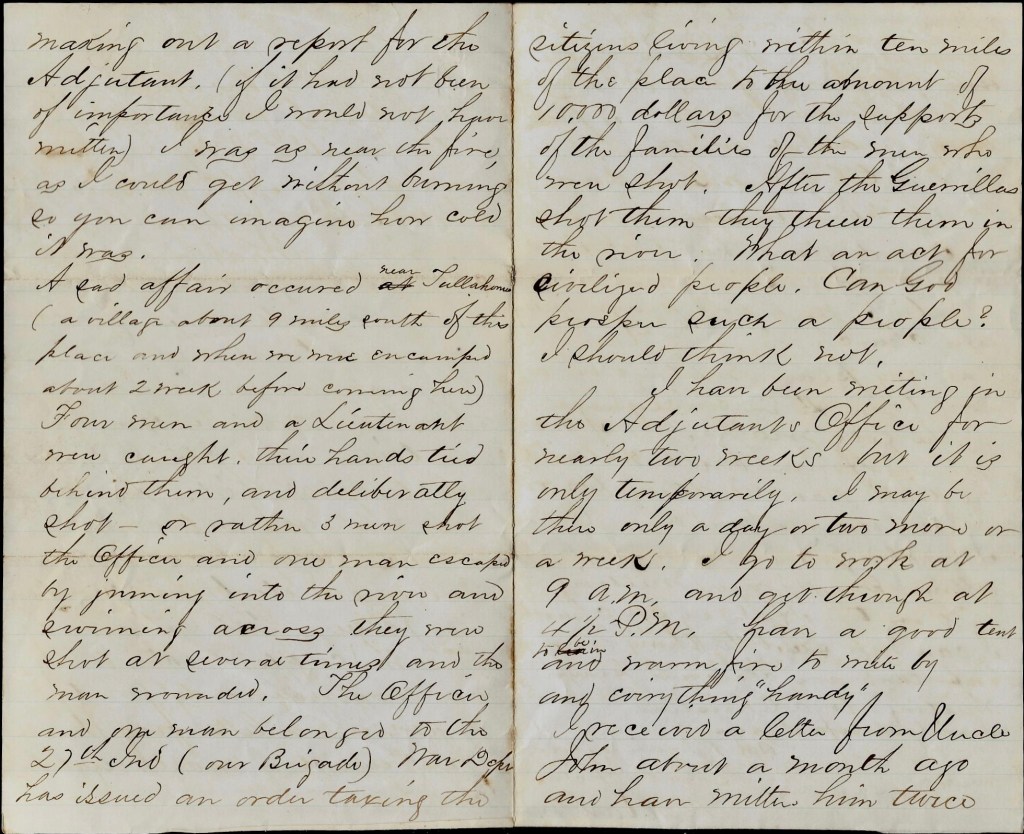
We are still encamped at Duck RIver. Since I last wrote you, we have had some very cold weather down here and I doubt not you have in Jersey. The citizens say it is the coldest weather they have experienced in twenty-five years. It was so cold on New Years Day as to freeze the ink in my pen while I was making out a report for the Adjutant (f it had not been of importance, I would not have written). I was as near the fire as I could get without burning so you can imagine how cold it was.

A sad affair occurred near Tullahoma (a village about 9 miles south of this place and where we were encamped about two weeks before coming here). Four men and a Lieutenant were caught, their hands tied behind them, and deliberately shot—or rather 3 men shot. The officer ad one man escaped by jumping into the river and swimming across. They were shot at several times and the man wounded. The officer and one man belonged to the 27th Indiana (our Brigade). The War Department has issued an order taxing the citizens living within ten miles of the place to the amount of $10,000 dollars for the support of the families of the men who were shot. After the guerrillas shot them, they threw them in the river. What an act for civilized people. Can God prosper such a people? I should think not.

I have been writing for the Adjutant’s Office for nearly two weeks but it is only temporarily. I may be there only a day or two more or a week. I got to work at 9 a.m. and get through at 4.30 p.m. I have a good tent to be in and a warm fire to write by and everything “handy.”

I received a letter from Uncle John about a month ago and have written him twice since. I received a box from home and in it some cake, &c. from you. It was relished very much. I feel very grateful for them. Also a tipet [a hat] from Grandma for which I returned my thanks.

I understand that the Colonel has given permission for a house to be built for to hold prayer meetings and church in. We have not had any prayer meetings in a long time in consequence of the cold weather but if we get the house built, we will no doubt have meetings two or three times a week. Oh how I would like once more to attend the prayer meeting held at Halsey St. Church. I can now see better than ever how important are class and prayer meetings to a Christian.

I will close for the present and remain as ever yours affectionately, — Wm. H. Van Iderstine

Please write as soon as possible.

1863: John W. Farnum to Frank W. Farnum

This letter was written by John W. Farnum (1842-1915) who enlisted on 7 October 1862 as a private in Co. D, 15th New Hampshire Infantry—a nine months’ regiment. He mustered out of the service on 13 August 1863,

John was the son of Timothy Walker Farnum (1814-1892) and Rebecca Sabrina Bartlett (1816-1889). of Northwood, Rockingham county, New Hampshire. He wrote the letter to his brother Frank Walker Farnum (b. 1850). After the war John worked as a shoemaker.

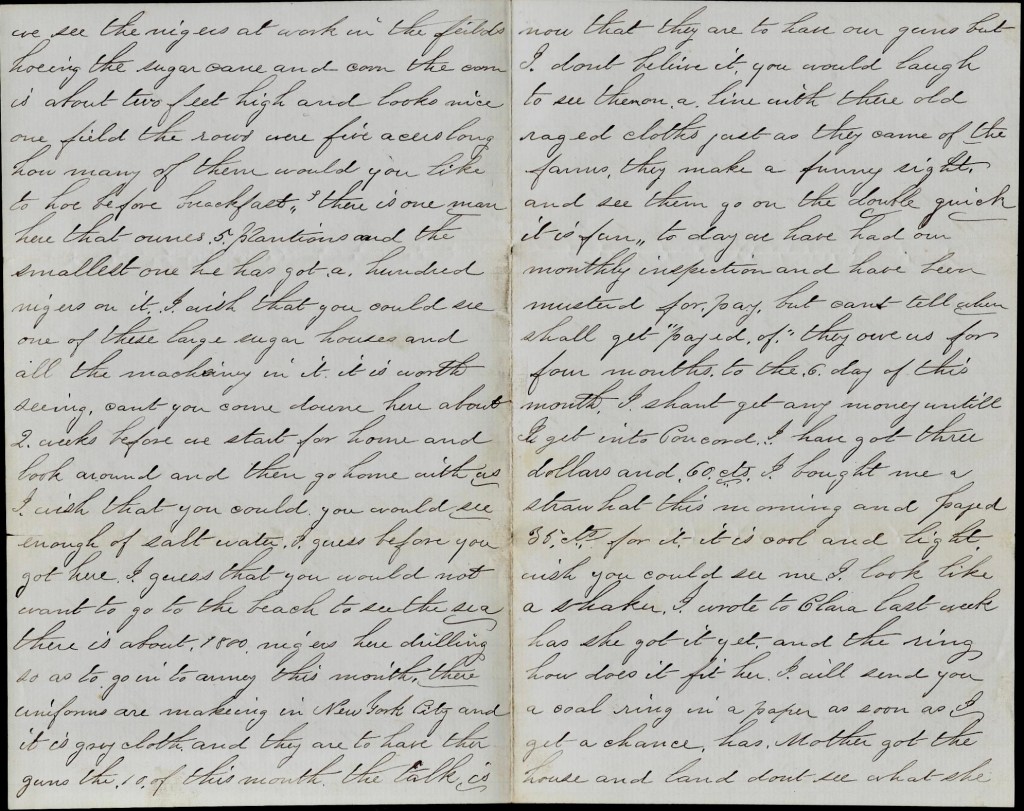
John’s letter speaks of visiting some nearby Louisiana plantations while encamped at Carrollton and also of the drilling of black soldiers being organized and outfitted for the Union army.

I could not find a picture of John but here is one of an unidentified member of Co. D, 15th New Hampshire Infantry (LOC)

Transcription

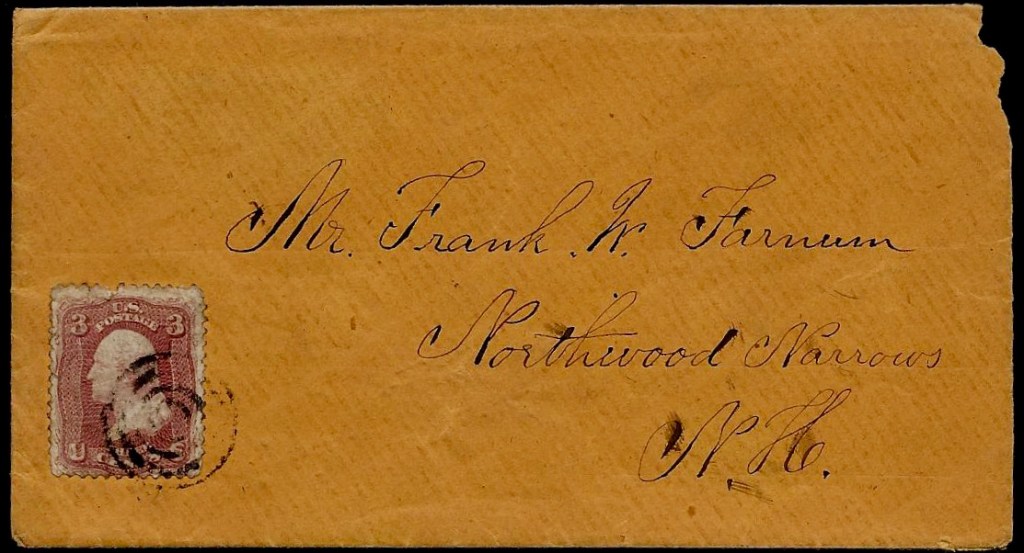
Addressed to Mr. Frank W. Farnum, Northwood Narrows, N. H.

Camp Parapet
Carrollton, Louisiana
May 1st 1863

Dear Brother,

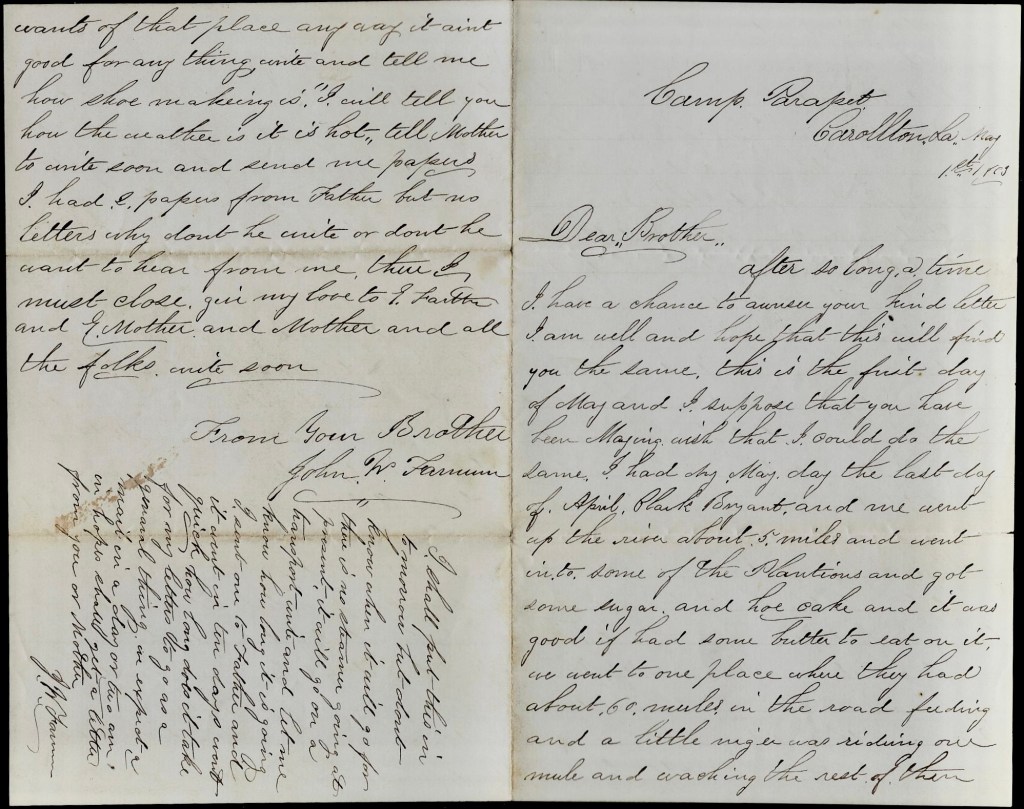
After so long a time I have a chance to answer your kind letter. I am well and hope that this will find you the same. This is the first day of May and I suppose that you have been Maying. Wish that I could do the same.

I had my May day the last day of April. Clark Bryant and me went up the river about 5 miles and went into some of the plantations and got some sugar and hoe cake and it was good if had some butter to eat on it. We went to one place where they had about 60 mules in the road feeding and a little nigger was riding one mule and watching the rest of them. We see the niggers at work in the fields hoeing the sugar cane and corn. The corn is about two feet high and looks nice. One field the rows were five acres long. How many of them would you like to hoe before breakfast?

There is one man here that owns 5 plantations and the smallest one he has got a hundred niggers on it. I wish that you could see one of these large sugar houses and all the machinery in it. It is worth seeing. Can you come down here about two weeks before we start for home and look around and then go home with us? I wish that you could. You would see enough of salt water, I guess, before you got here. I guess that you would not want to go to the beach to see the sea.

There is about 1800 niggers here drilling so as to go into the army this month. Their uniforms are made in New York City and it is gray cloth and they are to have the guns the 10th of this month. The talk is now that they are to have our guns but I don’t believe it. You would laugh to see them on a line with their old ragged clothes just as they come off the farms. They make a funny sight. And [to] see them go on the double quick, it is fun.

Today we have had our monthly inspection and have been mustered for pay but can’t tell when we shall get paid off. They owe us for four months to the 6th day of this month. I shan’t get any money until I get into Concord. I have got three dollars and 60 cents. I bought me a straw hat this morning and paid 35 cents for it. It is cool and light. Wish you could see me. I look like a shaker.

I wrote to Clara last week. Has she got it yet? And the ring—how does it fit her? I will send you a coal ring in a paper as soon as I get a chance. Has Mother got the house and land? Don’t see what she wants of that place anyway. It ain’t good for anything. Write and tell me how shoe making is. I will tell you how the weather is—it is hot! Tell Mother to write soon and send me papers. I had two papers from Father but no letters. Why don’t he write or don’t he want to hear from me? There, I must close. Give my love to grandfather and grandmother and Mother and all the folks. Write soon.

From your brother, — John W. Farnum

I shall put this in tomorrow but don’t know when it will go for there is no steamer going at present. It will go on a transport. Write and let me know how long it is going. I sent one to Father and it went in ten days. Went quick. How long does it take for my letters to go as a general thing? We expect a mail in a day or two. Am in hopes shall get a letter from you or Mother. — J. W. Farnum

1861: J. G. C. to his Cousins

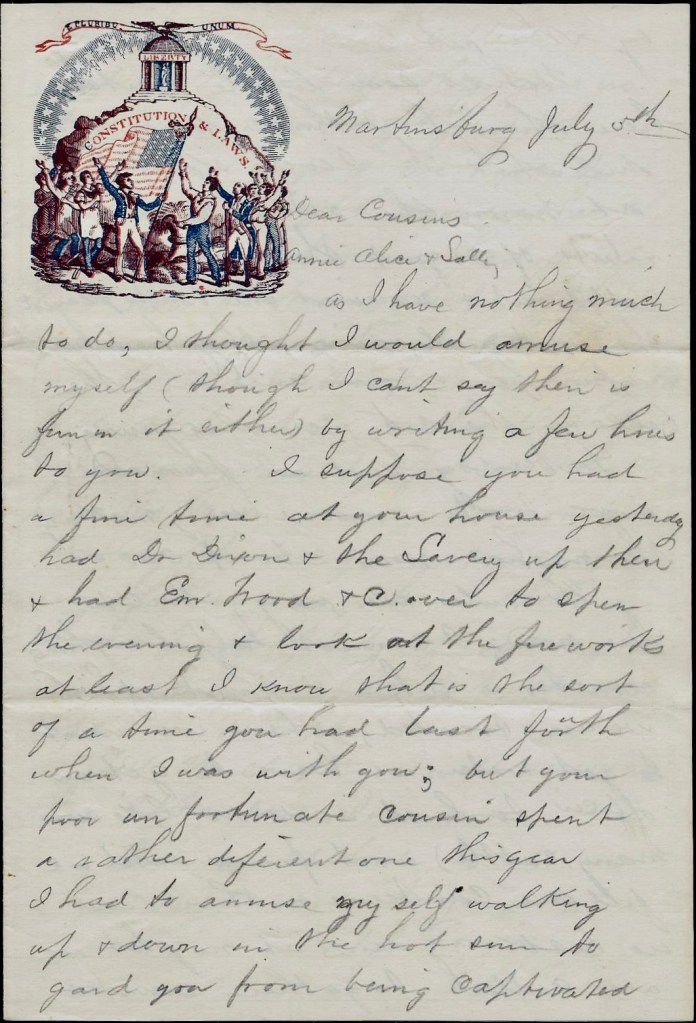
This early war letter was datelined from Martinsburg, Virginia, on 5 July 1861, by a Union soldier who signed it with only his initials, “J. G. C.” and addressed it to his cousins, Annie, Alice, and Sally, location unknown. There is very little in the letter that would help to identify the author as he was among several thousand soldiers then occupying the strategic center of the Baltimore & Ohio (B&O) Railroad.

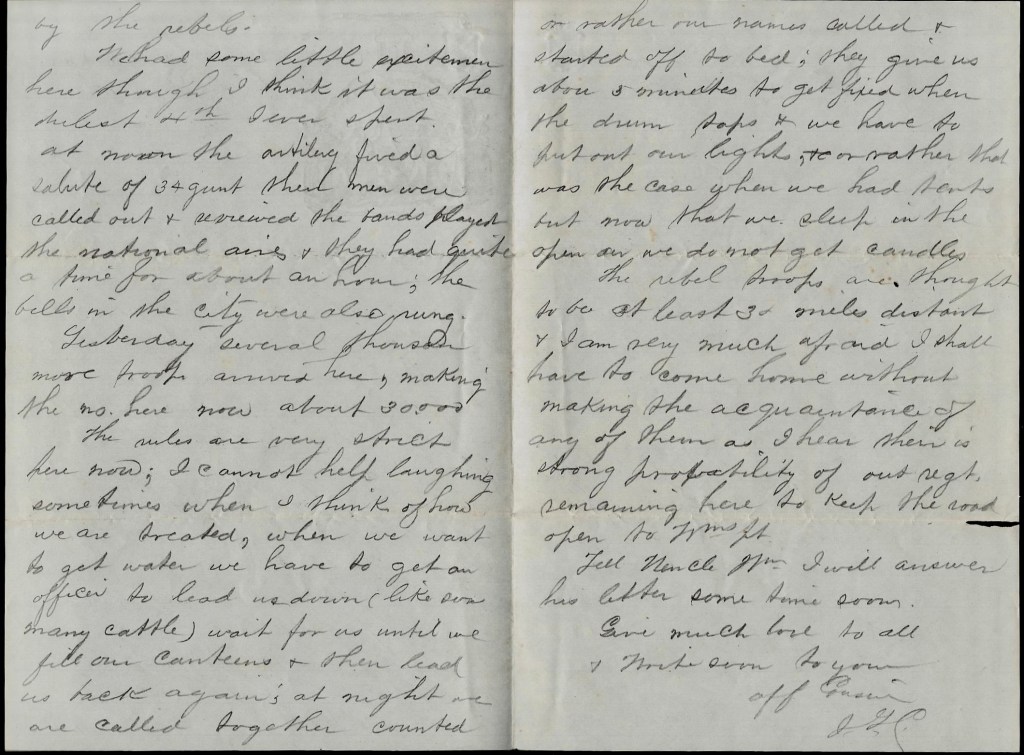
The author writes of the camp discipline that has been imposed that requires soldiers to be be escorted by officers to and from their water source “like so many cattle.”

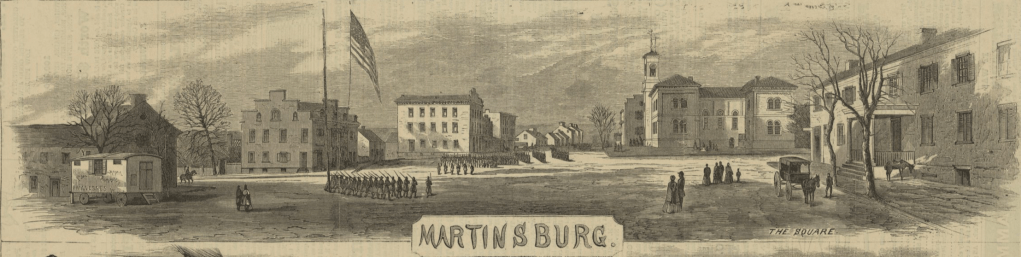
Martinsburg, Virginia (Harper’s Weekly Magazine)a city with more pro-Union residents than Secessionists.

Transcription

Martinsburg [Virginia]
July 5th [1861]

Dear Cousins—Annie, Alice, and Sally,

As I have nothing much to do, I thought I would amuse myself (though I can’t say there is fun in it either) by writing a few lines to you. I suppose you had a fine time at your house yesterday, had Dr. Dixon and the Savery up there, & had Em. Wood & C. over to spend the evening & look at the fireworks? At least I know that is the sort of a time you had last fourth when I was with you. But your poor unfortunate cousin spent a rather different one this year. I had to amuse myself walking up and down in the hot sun to guard you from being captivated by the rebels.

We had some little excitement here though. I think it was the dullest 4th I ever spent. At noon the artillery fired a salute of 34 guns. Then men were called out & reviewed, the bands played the national aires, & they had quite a time for about an hour. The bells in the city were also rung.

Yesterday several thousand more troops arrived here making the number here now about 30,000. The rules are very strict here now. I cannot help laughing sometimes when I think of how we are treated. When we want to get water, we have to get an officer to lead us down (like so many cattle), wait for us until we fill our canteens, & then lead us back again. At night we are called together, counted—or rather our names called, & started off to bed. They give about five minutes to get fixed when the drum raps & we have to put out our lights, &c. or rather that was the case when we had tents. But now that we sleep in the open air, we do not get candles.

The rebel troops are thought to be at least 30 miles distant & I am very much afraid I shall have to come home without making the acquaintance of any of them as I hear there is a strong probability of our regiment remaining here to keep the road open to Williamsport [Maryland].

Tell Uncle William I will answer his letter some time soon. Give much love to all & write soon to your affectionate cousin, — J. G. C.

1862: Samuel G. Shackford to Alfred Bunker

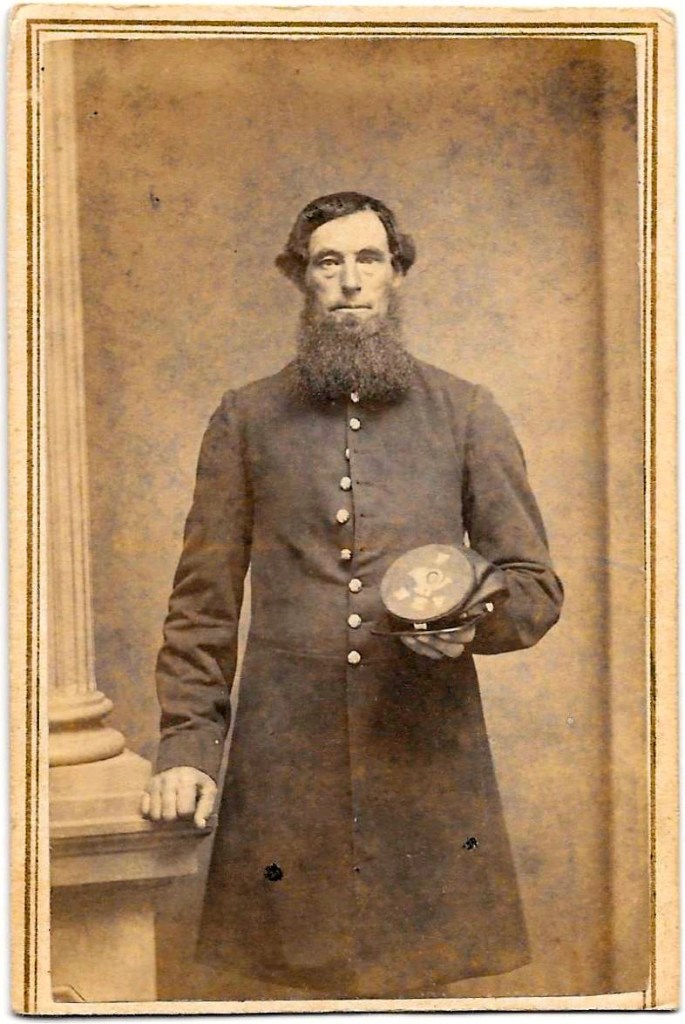
I could not find an image of Samuel but here’s an unidentified New Hampshire soldier who appears to be about Samuel’s age. (Dave Morin Collection)

This letter was written by 41 year-old shoemaker and innkeeper Samuel Garland Shackford (1821-1885) of Barnstead who enlisted on 30 November 1861 in Co. G, 8th New Hampshire Infantry. Samuel remained with the regiment until 18 January 1865 when he mustered out.

Samuel’s parents were Josiah Ring Shackford (1796-1874) and Mary Garland (1796-1867) of Barnstead, Belknap county, New Hampshire. Samuel’s first wife, Margaret Bean Foss (1816-1859) died in July 1859 leaving him with four young children, ages 2 to 13 who were cared for by the Thomas Muzzey Huse family while he was in the service. He did not marry again until after the Civil War, taking Esta L. Higgins as his second wife in 1872.

The Notre Dame Rare Books and Special Collection includes a collection of twenty-two letters which Samuel wrote to the Huse family while they cared for his children during the war. 

The letter was addressed to Alfred Bunker (b. 1811), a farmer in Belknap county, New Hampshire.

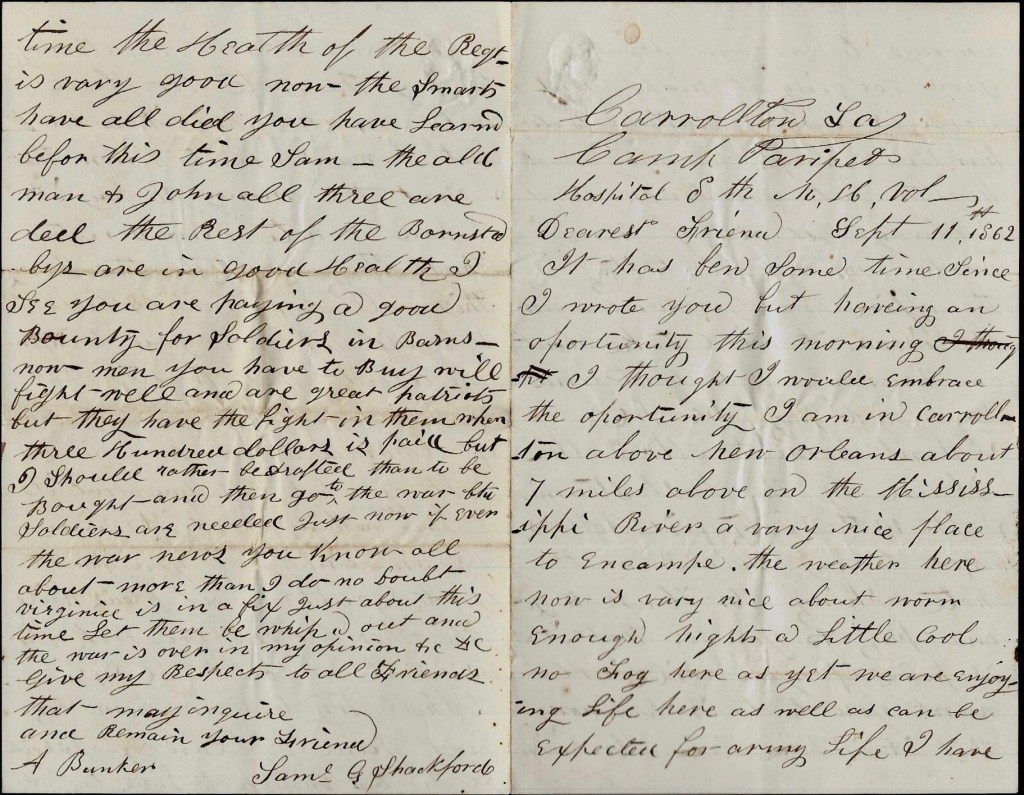
Camp Parapet, 8 miles above New Orleans

Transcription

Carrollton, Louisiana
Camp Parapet
Hospital, 8th N. H. Vol.
September 11, 1862

Dearest Friend,

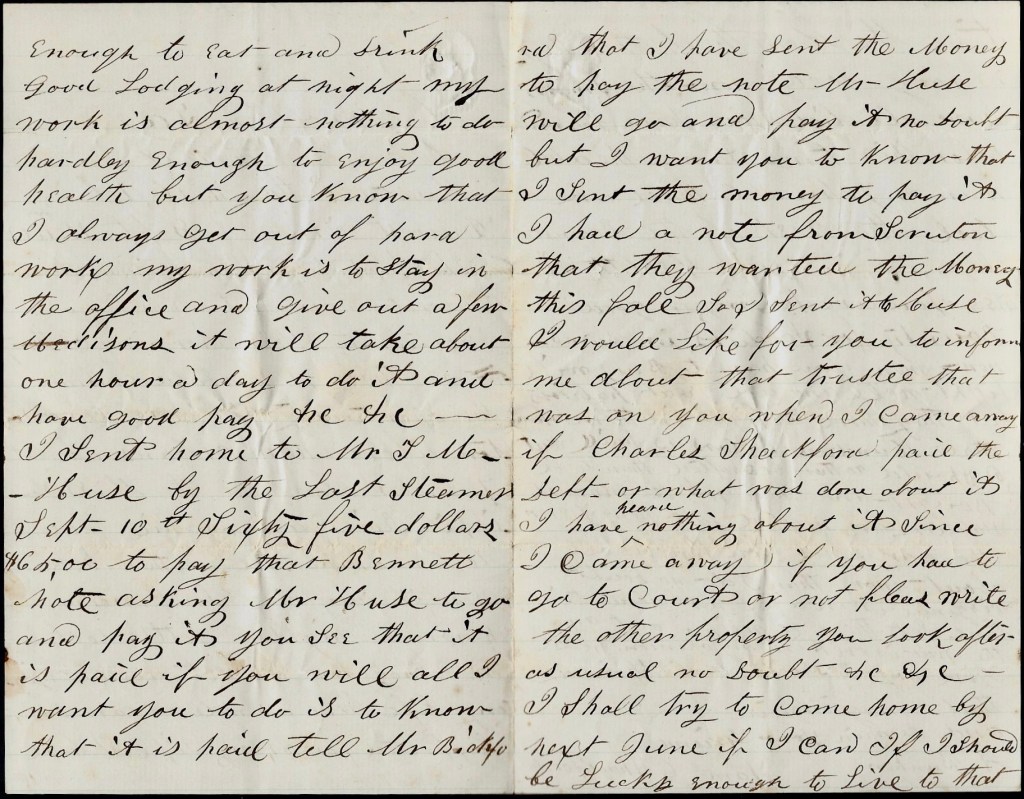
It has been some time since I wrote you but having an opportunity this morning, I thought I would embrace the opportunity. I am i nCarrollton above New Orleans about seven miles on the Mississippi River—a very nice place to encamp. The weather here now is very nice—about warm enough, night a little cool. No fog here as yet. We are enjoying life here as well as can be expected for army life. I have enough to eat and drink, good lodging at night. My work is almost nothing to do—hardly enough to enjoy good health but you know that I always get out of hard work.

My work is to stay in the office and give out a few medicines. It will take about an hour a day to do it and have good pay &c. &c.

I sent home to Mr. T[homas] M. Huse by the last steamer, September 10th, sixty-five dollars ($65) to pay that Bennett note asking Mr. Huse to go and pay it. YOu see that it is paid, if you will. All I want you to do is to know that it is paid. Tell Mr. Bickford that I have sent the money to pay the note. Mr. Huse will go and pay it no doubt but I want you to know that I sent the money to pay it.

I had a note from Scruton that they wanted the money this fall so I sent it to Huse. I would like for you to inform me about that trustee that was on you when I came away. If Charles Shackford paid the debt, or what was done about it. I have heard nothing about it since I came away. If you had to go to court or not, please write. The other property you look after as usual no doubt, &c. &c.

I shall try to come home by next June if I can—if I should be lucky enough to live to that time.

The health of the regiment is very good now. The Smarts have have all died. You have learned before this time Sam—the old man to John—all three are dead. The rest of the Barnstead boys are in good health.

I see you are paying a good bounty for soldiers in Barnstead now. Men you have to buy will fight and are great patriots but they have the fight in them when three hundred dollars is paid but I should rather be drafted than to be bought and then go to the war. But soldiers are needed just now if ever.

The war news you know all about—more than I do no doubt. Virginia is in a fix just about this time. Let them be whipped out and the war is over in my opinion, &c. &c. Give my respects to all friends that may inquire and remain your friend, — Samuel G. Shackford

A. Bunker

1865: Francis Denison Avery to David Avery

I could not find an image of Frank, but here is one of Sergt. Lyman A. Holmes who served with him in Co. C, 27th Massachusetts (Photo Sleuth)

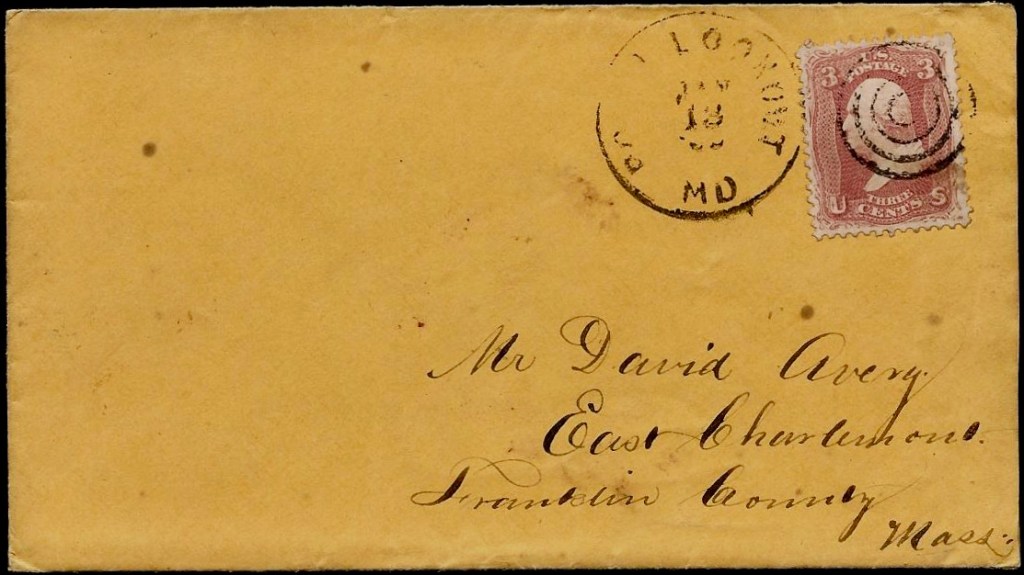
This letter was written by Francis (“Frank”) Denison Avery (1843-1869), the eldest son of David and Prudence (Dean) Avery of East Charlemont, Franklin county, Massachusetts. Frank enlisted in September 1861 as a corporal in Co. C, 27th Massachusetts Infantry and was promoted to a sergeant in February 1863. Just after he was promoted to 1st Lieutenant of Co. C, he was wounded at Drewry’s Bluff, Virginia, on 16 May 1864 and was still at the Point Lookout Military Hospital when he wrote this letter in January 1865. He mustered out of the regiment on 8 July 1865 but died four years later from complications associated with the “rifle ball wound.”

Mentioned in the letter was Frank’s younger brother, Henry “Gardner” Avery (1845-1904) who served earlier in the war as a private in Co. B, 52nd Massachusetts.

Transcription

Addressed to Mr. David Avery, East Charlemont, Franklin county, Mass.

Point Lookout
January 13th 1865

My Dear Father,

As I have nothing to busy myself with today I though I would write you a few lines. I am getting along quite well now and am as well as when I left home. I guess that box is what did the good. I received a letter from Mother this morning that said that Capt. Welting was at home. I think I shall write to him if he would come this way. His influence might help me about getting transferred. If I can’t get transferred, I am a going to try and go to the regiment. Then thy may keep me as long as they want to. I don’t think I shall take my discharge now this year.

Dr. Hager has been relieved from duty on this Point and is going to Philadelphia. I don’t know the doctor’s name that takes his place.

The weather is quite warm today and it seems as though I never saw a more pleasant day. I suppose that you are having good sleighing. How I should like to be in Mass. and have a good sleigh ride. Mother spoke about Gardner’s thinking about enlisting. Isn’t he afraid of being drafted? I think he should be. I think that if I was in his place, I should go up to the frontier and perhaps get a little over the line rather than be drafted. A drafted man is of no account in the army.

Did you get out the pine lumber that you was talking of? If my back keeps getting better as fast as it has for a few days back, I shall begin to think it is going to get as well as ever sometime.

Well, I can’t think of anything more to write this time. Give my love to all enquiring friends and write as soon as convenient. From your son, — Frank

I was mustered for 10 months pay a few days ago but don’t know as I shall get it for two months. Excuse poor writing.

1862: Romanzo A. Harris to “Friend Mira”

This letter was written by Romanzo A. Harris (1842-1930) who enlisted in January 1862 as a private in Co. H, 8th Vermont Infantry. He remained with the regiment until mustering out at Washington D. C. in late June 1865 after three and a half years. He was the son of Christopher Harris (1814-1886) and Elvira C. Holden (18xx-1884) of Townsend, Windham county, Vermont.

Romanzo wrote his letter from Ship Island in the Gulf of Mexico where the 8th Vermont was encamped from April 7th until early May when they were ordered to New Orleans.

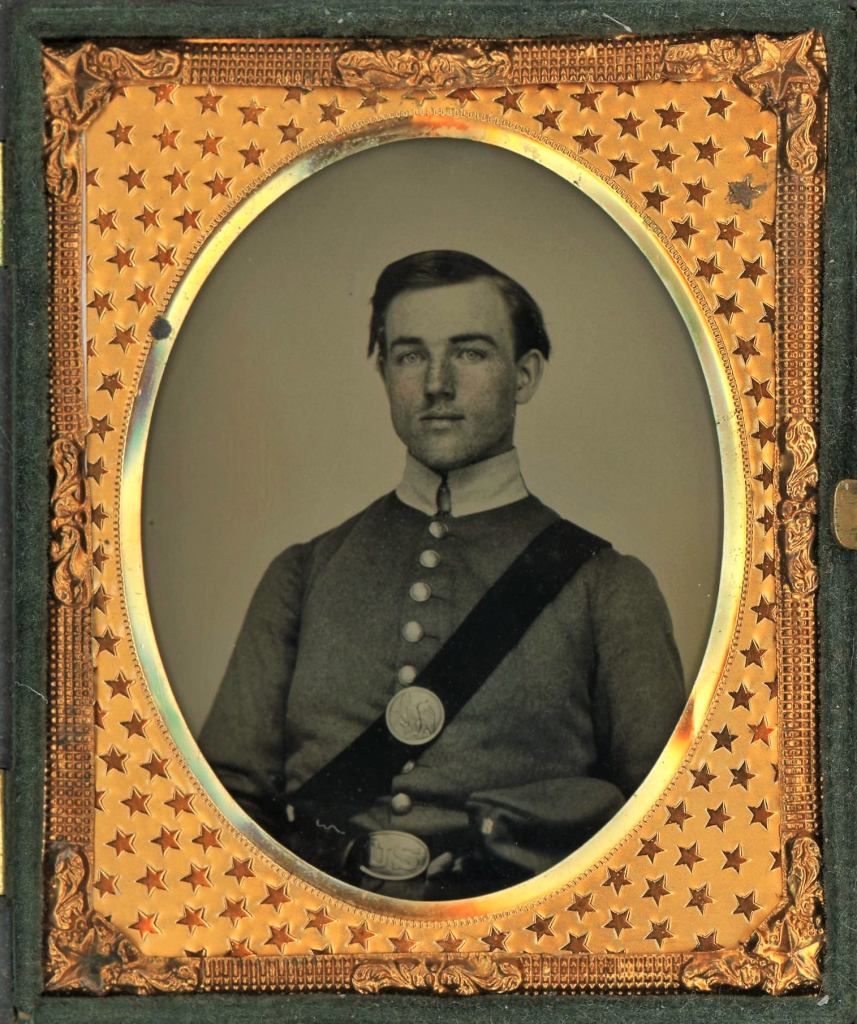
I could not find an image of Romanzo but here is a ninth-plate ambrotype of a private from the 8th Vermont still wearing his state-issued uniform. New Federal uniforms were issued to the men at Camp Holbrook prior to embarking for Ship Island, however. (Dan Binder Collection)

Transcription

Ship Island
April 16, 1862

Friend Mira,

I am well and hope this will find you and your folks the same. We anchored off Ship Island the 5th of April. We came on the island the 7th. The 10th we went six miles and got some rushes for our beds. We fetched a great big bundle. My bundle was a little heavy before I got to camp. We get our wood on the upper end of the Island. The wood is rafted down to within half a miles of the camp. We thought that we made very good horses.
There has been 21,000 soldiers here until yesterday. 12,000 of them was ordered off. We have heard heavy firing this afternoon off in the direction that the troops went. The boys hear it now. I have been to work at the cook house for a few days. We have had orders to pack our things and be ready to march at a moments notice.

We have some nice times [even] if we are on the sand. The island is covered with white sand and swamps and some woods. We shall have some fighting to do before long—before you receive this.

It is getting late and I must close for it is getting to be late. Give my respects to your Father and Mother. Please write your friend R. A. H. Direct your letters to R. A. Harris, Co. H, 8th Vermont Vol. in care of H. F. Dutton, Ship Island

1863: Henry Lancaster to “Brother Byron”

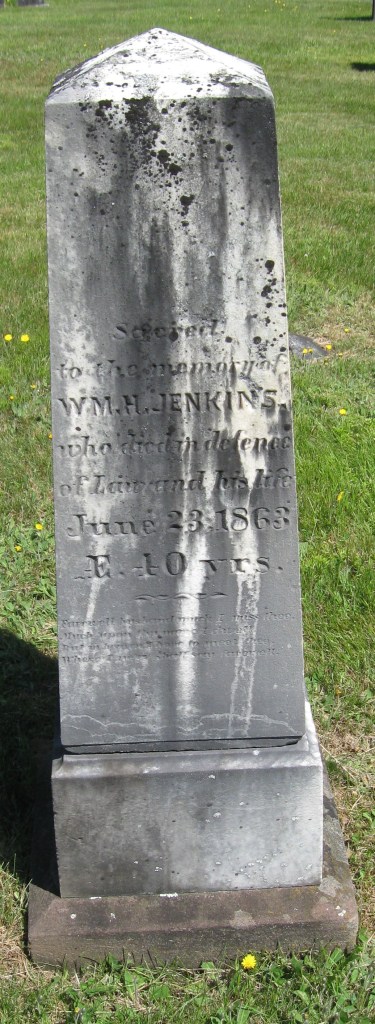
Grave of William H. Jenkins, member of posse killed hunting down deserters who shot local police office in 1863

This letter was written by Henry Lancaster (1825-1865), a farmer in Detroit (Palmyra P. O.), Somerset county, Maine. He was married to Sarah Jane Crosby (1828-1898) in 1851. The letter was addressed to “Brother Byron” but I could not find any family record indicated that Henry had a brother by that name though the records could be incomplete, he may have been a brother in law, or Byron may have been member of the clergy or simply a fellow parishioner.

Henry’s letter describes the fracas caused by two local boys who were described as “deserters” from the army when they went on a spree in Belfast, Waldo county, Maine, stealing horses and robbing stores. A modern-day synopsis of the event appears on the Belfast (Maine) Police Department website which captures the most comprehensive record and I will not repeat it here.

The two deserters were Isaac N. Grant (1837-1863) of Co. G, 5th US Cavalry who deserted on 25 January 1862. He was born in Somerset county, Maine, and had been hiding out from the Provost Marshal for almost a year and a half. The other was Charles E. Knowles (1844-1863) and he deserted on 30 August 1862. Knowles is buried in Rogers Cemetery in Troy.

[Note: This letter is from the personal collection of Richard Weiner and is published by express consent.]

Transcription

Detroit [Somerset county, Maine]
June the 26, 1863

Brother Byron,

We have been having a great fight here for a few days past—perhaps you may have heard of it before this time but I will write you the particulars. The case was this. There was two deserters from the army came here & commenced horse stealing & store breaking. They sold their horses in Belfast. The officers came up last Sunday & then the battle commenced. The thieves was well armed, having three revolvers apiece. They fought desperately. The result of that day’s fight was one of the officers [Chief of Police, Charles O. McKenney of Belfast] was mortally wounded & the thieves escaped to the woods.

Monday there was a great turnout to hunt them. Men could be seen marching in every direction with guns in their hands. The names of the thieves was [Isaac N.] Grant of Palmyra & [Charles E.] Knowles of Troy. We did not find them that day.

Tuesday three men from Detroit village went down to the [Sebasticook] river to the point & landed on the other side of the river & came upon them. The thieves rushed upon & fired & killed one of our men dead on the spot. They returned the fire & wounded Grant in the head—put a ball into one ear & out the other. But he then fought desperately. They came to close quarters and fought with the butts of their guns. They killed Grant & beat Knowles so [much] that he died yesterday. The names of the three men was William Jenkins, Lyman Hurd & Joseph Myrick. Jenkins was killed. He was buried yesterday. 1 Sarah and I attended the funeral. Heard is some relation to Mr. Hanscom’s folks. He fought like a tiger. There has been a great excitement here. They think there is more engaged with them. We are all well.

Yours, — H. Lancaster 

1 William H. Jenkins (1823-1863) was killed on 23 June 1863. He is buried in the Detroit Village Cemetery beneath a headstone that reads, “Sacred to the Memory of Wm. H. Jenkins who died in defense of Law and his life, June 23, 1863, aged 40 years.”

1861: Mary C. Stewart to Sarah Elizabeth Russell

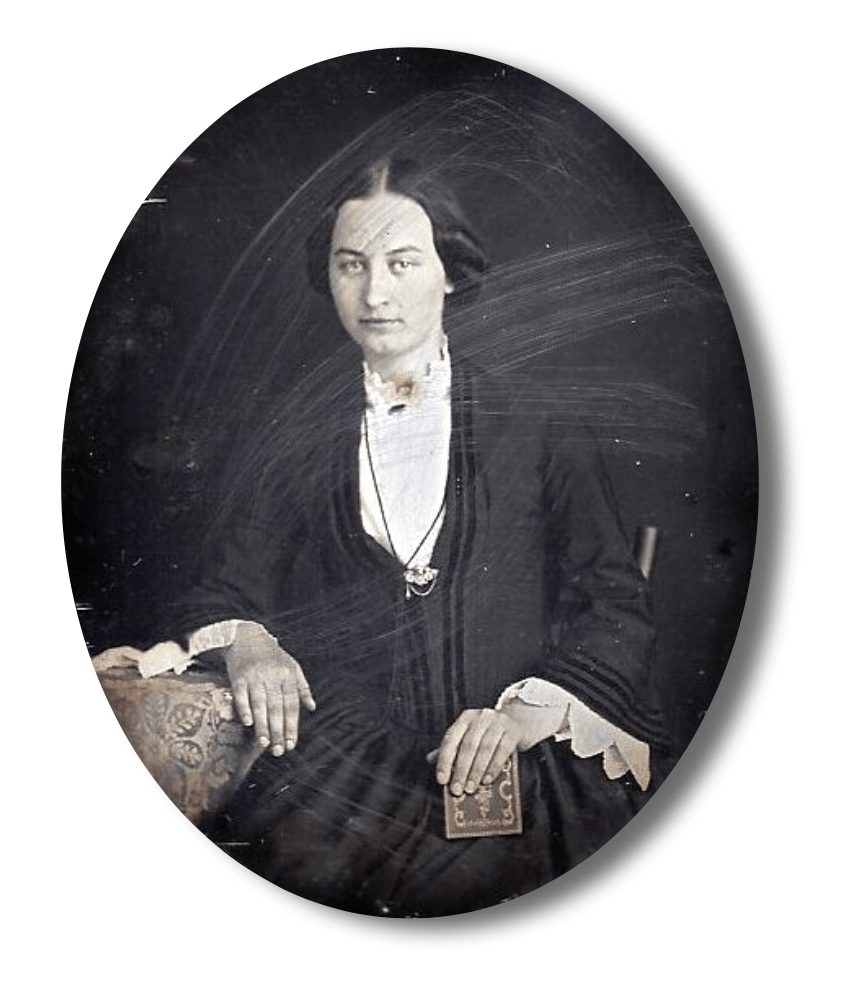
Libby Russell, ca. 1855

This letter was penned in June 1861 by a young school teacher who signed her name “Mary.” The content of the letter suggests to me that she was actually from the same same village as the young woman she was writing to which was her friend, Sarah Elizabeth (“Libbie”) Russell (1834-1925), the daughter of Luther Russell (1802-1878) and Polly E. Russell (1806-1896) of Streetsboro, Portage county, Ohio. The 1860 US Census for Streetsboro reveals a school teacher by the name of Mary C. Stewart (b. 1832) who was single and living with her parents. Since it was not uncommon for school teachers to leave their hometowns and teach in rural school districts while boarding with families of the students, my hunch is that this letter was written by Mary C. Stewart though of course I cannot confirm that by anything in the letter.

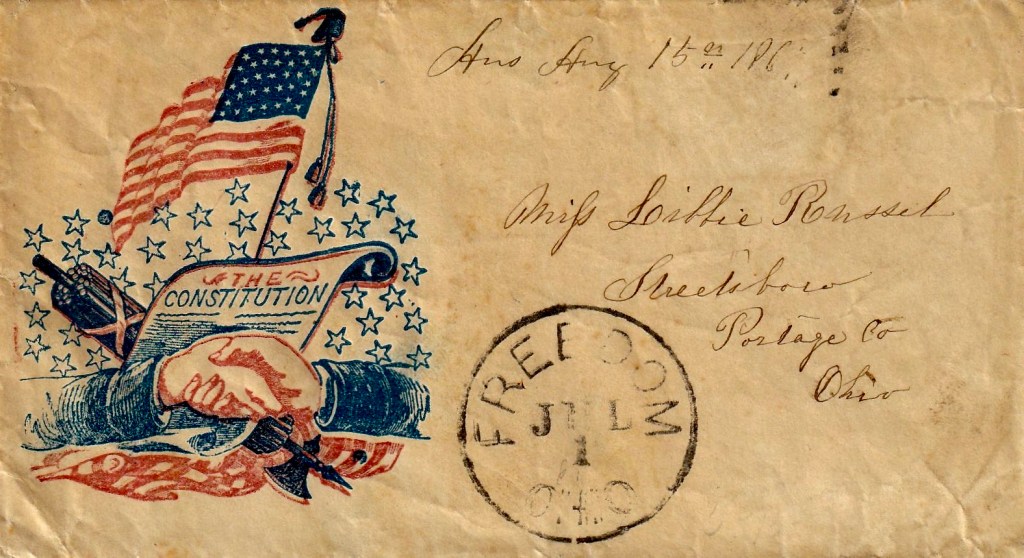
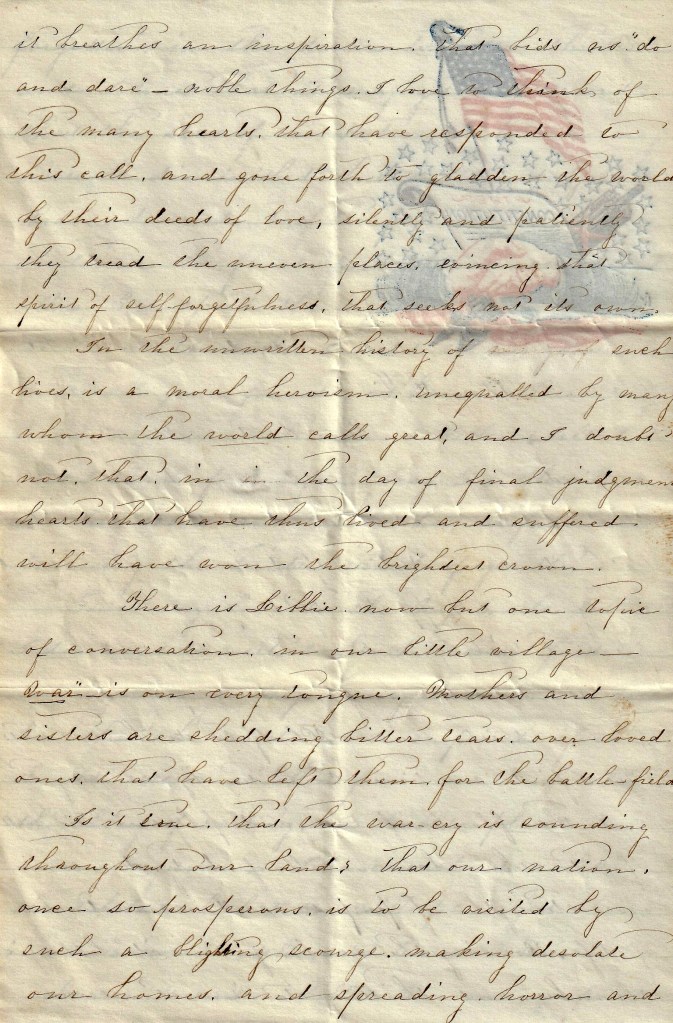
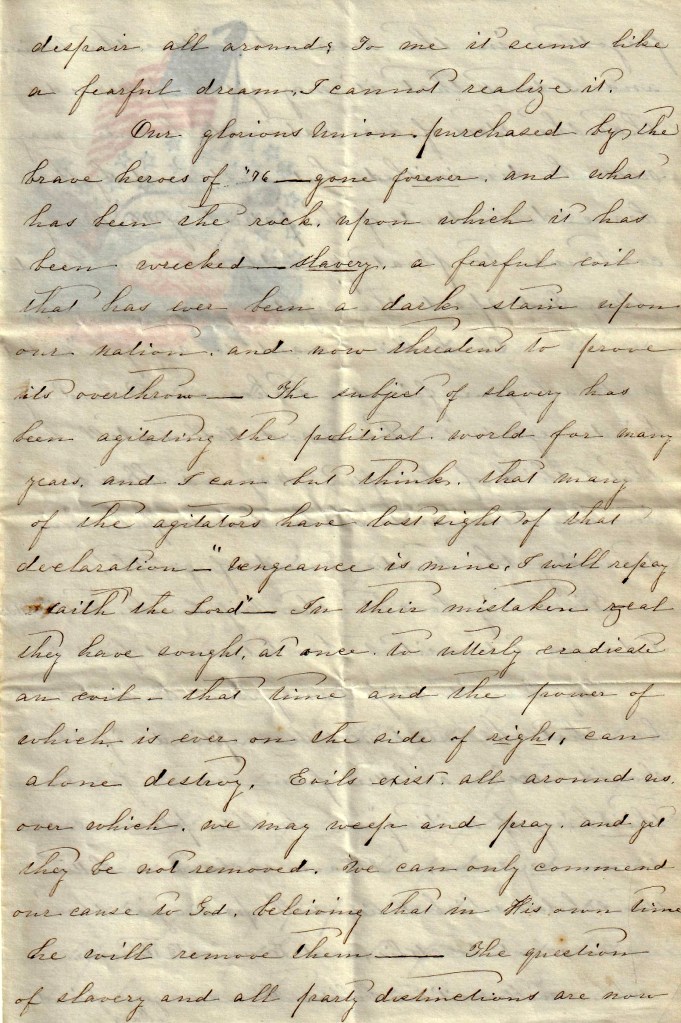
Mary’s patriotic envelope and stationery immediately arrest the eye but what is most interesting and appropriate is the postmark “Freedom, Ohio” given the content of her letter. Written prior to any major battle, Mary’s letter foreshadows the “blighting scourge” that is about to descend on the Nation, delivering “horror and despair” to the mothers and sisters who are already “shedding bitter tears over loved ones that have left them for the battlefield.” Mary lays the cause of the war on the evil “Slavery!” but also expresses her belief that the “agitators” (abolitionists) are as much to blame for sparking the war because they “sought at once” to eradicate the evil rather that trust that task to God.

The recipient of this letter (Libbie) never married. Her younger sister, Helen M. Russell (1841-1881), was betrothed to Corp. James (“Jimmie”) Fitzpatrick of Co. D, 104th OVI. He was shot in the head in the fighting near Dallas, Georgia on 28 May 1864 and died two days later.

[Note: This letter is from the personal collection of Richard Weiner and is published by express consent.]

Transcription

Addressed to Miss Libbie Russell, Streetsboro, Portage County, Ohio
Postmarked Freedom, Ohio, July 1 [1861]

Freedom [Portage county, Ohio]
June 21, 1861

Dear Libbie,

Your kind letter was received long since and would ere this have been answered had not time laden with its many duties sped so swiftly onward giving me no opportunity to perform the pleasant task of writing to you.

I am teaching. Have a pleasant school of about thirty scholars. Plenty to do have I not? Yes, I find no time to loiter by the way to cull the flowers of ease and pleasure. Tis well for to the clarion call of duty so we owe strength of purpose and earnestness of life. Rousing the soul from its lethargic slumber and thrilling its inmost recesses, it breaths an inspiration that bids us, “do and dare”—noble things. I love to think of the many hearts that have responded to this call and gone forth to gladden the world by their deeds of love, silently and patiently they tread the uneven places, evincing that spirit of self forgetfulness that seeks not its own.

In the unwritten history of such lives, is a moral heroism, unequaled by many whom the world calls great, and I doubt not that in the day of final judgment, hearts that have thus lived and suffered will have won the brightest crown.

There is Libbie now but one topic of conversation in our little village. “War” is on every tongue. Mother and sisters are shedding bitter tears over loved ones that have left them for the battlefield. Is it true that the war-cry is sounding throughout our land? That our nation, once so prosperous. is to be visited by such a blighting scourge, making desolate our homes and spreading horror and despair all around? To me it seems like a fearful dream. I cannot realize it.

Our glorious Union, purchased by the brave heroes of ’76—gone forever. And what has been the rock upon which it has been wrecked? Slavery! a fearful evil that has ever been a dark stain upon our nation, and now threatens to prove its overthrow. The subject of slavery has been agitating the political world for many years and I can but think that many of the agitators have lost sight of that declaration—“Vengeance in mine. I will repay saith the Lord.” In their mistaken zeal they have sought at once to utterly eradicate an evil—that time and the power of which is ever on the side of right can alone destroy. Evils exist all around us over which we may weep and pray, and yet they be not removed. We can only commend our cause to God, believing that in His own time He will remove them. The question of slavery and all party distinctions are now forgotten in the desire to “save the Union” and I trust that it may yet be preserved, that the stars of our national banner may never be diminished but sustained by the brave descendants of the patriots of ’76—may continue to float proudly over our land. May God speed the right.

Oh Libbie, I want to see you “so bad” and all your friend at home. Present my kind regards to them and Helen. Tell her that I think of her often. May God bless her in her labors and make her useful in training the tender mind of youth.

Give my love to the Miss Combs. Tell Addie I do want to write to her but cannot find time. My love to Nancy Russell and tell her that she need not be surprised if she should receive a letter from me for I am thinking of writing. Libbie, please write soon—very soon. I have enclosed a letter to the scholars which Hellen will please give them. Also a note to Addie and Emma Patterson. When will [you] visit me Libbie? Ever your friend, — Mary

1863: Unidentified Deserter to Nelson Goodrich

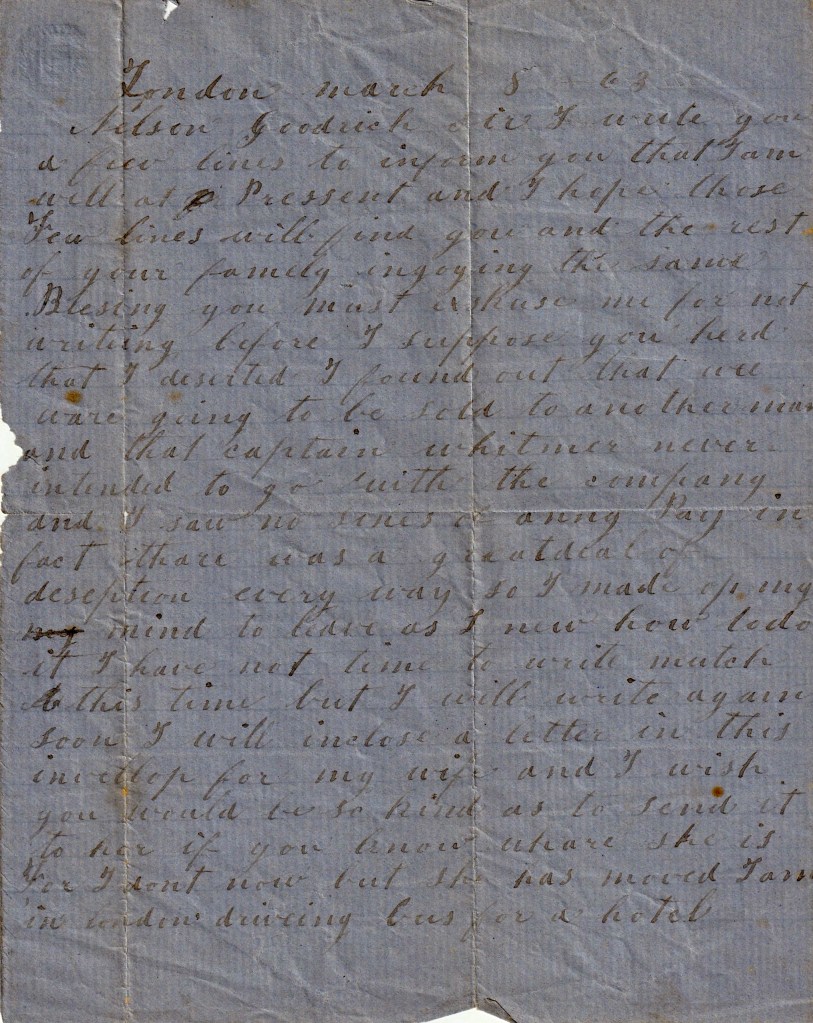
This letter is unsigned and since there is no accompanying envelope to provide us with the location of its recipient—Nelson Goodrich—we can only speculate on their identity. We learn from the letter that the author is a Union deserter who has gone to London where he has found employment driving an omnibus in the city. He has left a wife and slipped a separate letter to her in the envelope with this letter. My hunch is that it was addressed to the Rev. Nelson Goodrich, A methodist clergyman in New London, Connecticut, who may have been a trusted friend that would assist him while keeping his location a secret.

The author implies that he was deceptively enticed into the service but deserted when he realized what was happening. He may have been a former sailor and had the means to readily sign onto a crew bound for London.

[Note: This letter come from the private collection of Richard Weiner and is published by express consent.]

An omnibus in London, ca 1860

Transcription

London [England]
March 8, 1863

Nelson Goodrich, Sir

I wrote you a few lines to inform you that I am well at present and I hope these few lines will find you and the rest of your family enjoying the same blessing. You must excuse me for not writing before. I suppose you heard that I deserted. I found out that we were going to be sold to another man and that Captain Whitmer never intended to go with the company and I saw no signs of any pay. In fact, there was a great deal of deception every way so I made up my mind to leave as I knew how to do it.

I have not time to write much this time but I will write again soon. I will enclose a letter in this envelope for my wife and I wish you would be so kind as to send it to her if you know where she is for I don’t know but she has moved.

I am in London driving bus for a hotel.

1857: Daniel Sanderson Lamson to Henry Elias Howland

I can’t be certain of this author’s identity but I think it may have beenDaniel Sanderson (“San”) Lamson (1828-1912), an 1853 graduate of the Harvard Law School. The letter only bears the signature “San.”

He wrote the letter to Henry Elias Howland (1835-1913), a graduate of Yale College and of the Harvard Law School in 1857. He was admitted to the bar in New York in October following and partnered with two associates in the firm of Anderson, Howland, & Murray; after Anderson’s death in 1896, the firm became Howland, Murray and Prentice.

Transcription

Addressed to H. E. Howland, Care of John Sherwood, Esq., 142 Broadway, New York

Queen City of the West
June 13th [1857]

Dear Beloved

I am the man for your money. My spirits have taken a sudden rise since the mail came in. The 7th day brought the first tidings to me from those I hold most dear. You deserve & shall have my first letter. I should have been flat down with homesickness before this if such a thing been possible in such a glorious city. My eyes have been feasted ever since I arrived & then the cool breezes like those from a fan savor strong of Asiatic luxury. One connection was missed on the journey & Wednesday night found me disconsolate on a cot in the gentleman’s parlor at Cincinnati. (You were saved a rapid run down Broadway of 3 miles & half hours waiting by not walking.)

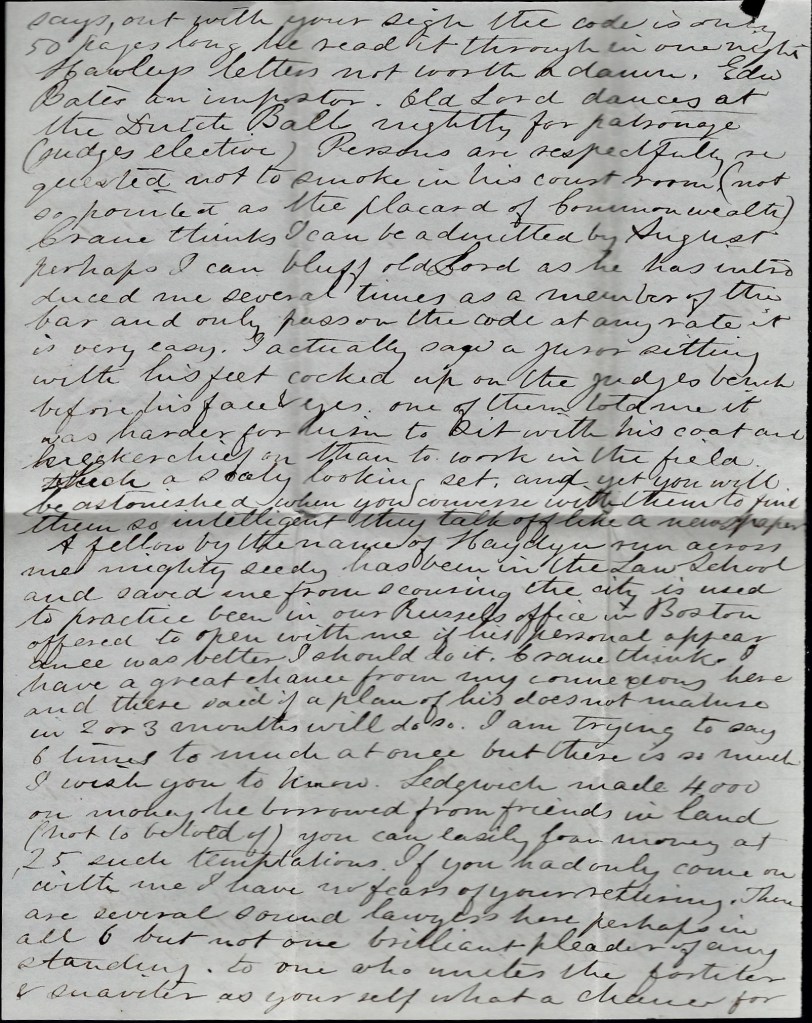
Our woe begone faces would have been mirrored in each others eyes. I wrote home a graphic account of the excursion train here & I will not repeat. Put after Sedgwick immediately a place to sleep to be found before night. Sedgewick gone to Europe to be married—German lady—back in October. Found Crane, 1 a modified French. He opened his heart to me for your sake & we have not broke yet. I am afraid he begins to tire of my importunities. All the lawyers here from the first to the last so all their own scrub work. No chance for pay. Crane says, out with your sign. The [Law] Code is only 50 pages long. He read it through in one night. Hawley’s letters not worth a damn. Edward Bates an imposter. Old Lord dances at the Dutch Ball nightly for patronage (Judge’s election). Persons are respectfully requested not to smoke in his court room (not so pointed as the placard of Commonwealth). Crane thinks I can be admitted [to the bar] by August. Perhaps I can bluff Old Lord as he has introduced me several times as a member of the bar and only pass on the code. At any rate, it is very easy. I actually saw a juror sitting with his feet cocked up on the judge’s bench before his face & eyes. One of them told me it was harder for him to sit with his coat and handkerchief on than to work in the field.

Such a scaly looking set and yet you will be astonished when you converse with them to find them so intelligent. They talk off like a newspaper. A fellow by the name of Hydyn run across me mighty seedy—has been in the Law School and saved me from scouring the city—is used to practice—been in our Russels office in Boston—offered to open with me. If his personal appearance was better, I should do it. Crane thinks I have a great chance from my connections here and the said if a plan of his does not mature in 2 or 3 months, will do so. I am trying to say 6 times too much at once but there is so much I wish you to know.

Sedgwick made 4,000 on money he borrowed from friends in land (not to be told of). You can easily loan money at 25 [percent]. Such temptations. If you had only come on with me I have no fears of your returning. There are several sound lawyers here—perhaps in all six—but not one brilliant pleader of any standing. To one who writes the [ ] & [ ] as yourself, what a chance for [missing page?]

Did you know that St. Louis was nearest alike New York of any city in the world? The value on money is perhaps more apparent than there even/ I never felt the want of it before. You can indulge every taste with it. Its theaters are fully equal to the Boston, Crane says. I have felt a peculiar pleasure in gratifying my longings. There is something that everybody remarks in the evening air as if it been expressly to cool. Howland, in ten years from now in St. Louis, you could not help being a rich man. I have perhaps written all really more than you will read but I want to tell you of 2 or 3 encounters I have had & I will do so if you will answer this immediately.

In a word, I shall probably next week go into an office & share the expense with some young man already in practice, try to scape up a case or two, & with Crane for a Godfather, commence putting out my shingle before admitted, if it is proper. I shall not deliver your letter to Crane. You did not say where you boarded. Fred Hall went East with my ticket. Mrs. S is terrific, I do believe. Snuggle in with the Hawley’s. If you were here there would be nothing left to be wished for. You had no more idea of it than I had. I shall do Holland Brydge & Co. in my next.

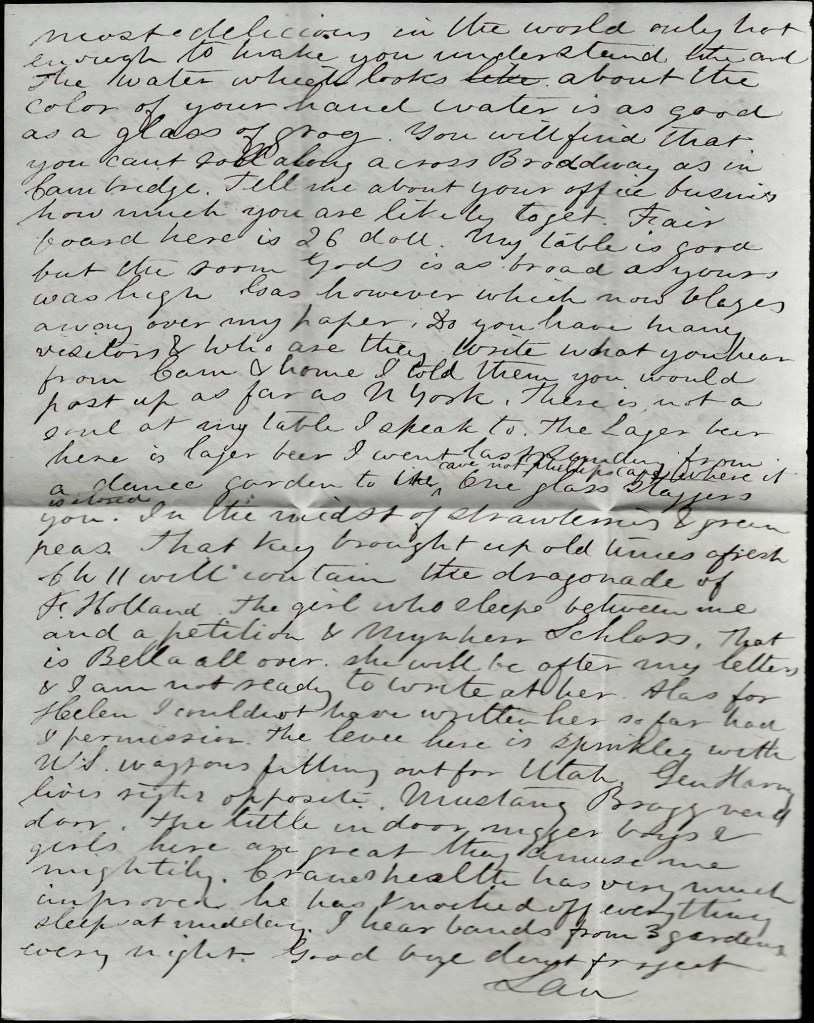
The climate is the most delicious in the world—only hot enough to make you understand [ ] and the water which looks about the color of your hand. Water is as good as a glass of grog. You will find that you can’t fool along across Broadway as in Cambridge. Tell me about your office business. How much you are likely to get. Fair board here—26 dollars. My table is good but the room—God’s is as broad as yours was high. Gas however, which now blazes away over my paper. Do you have many visitors & who are they? Write what you hear from Cambridge and home. I told them you would post up as far as New York. There is not a soul at my table I speak to.

The lager beer here is lager beer. I went last Sunday from a dance garden to a cafe where one glass staggers you. In the midst of strawberries and green peas. That key brought up old times afresh. [ ] will contain the dragonade of F. Holland. The girl who sleeps between me and a petition & Mynhew Schloss. That is Bella all over. She will be after my letters & I am not ready to write at her. Alas for Helen. I couldn’t have written her so far had I permission.

The levee here is sprinkled with U. S. wagons fitting out for Utah. Gen. [William S.] Harney lives right opposite. Mustang Bragg next door. The little indoor nigger boys & girls here are great. They amuse me mightily. Crane’s health has very much improved. He has knocked off everything. Sleeps at midday. I hear bands from 3 [beer] gardens every night. Goodbye. Don’t forget — San


1 Arba Nelson Crane was an 1856 graduate of the Harvard Law School. He died in St. Louis on 6 December 1904.