My passion is studying American history leading up to & including the Civil War. I particularly enjoy reading, transcribing & researching primary sources such as letters and diaries.
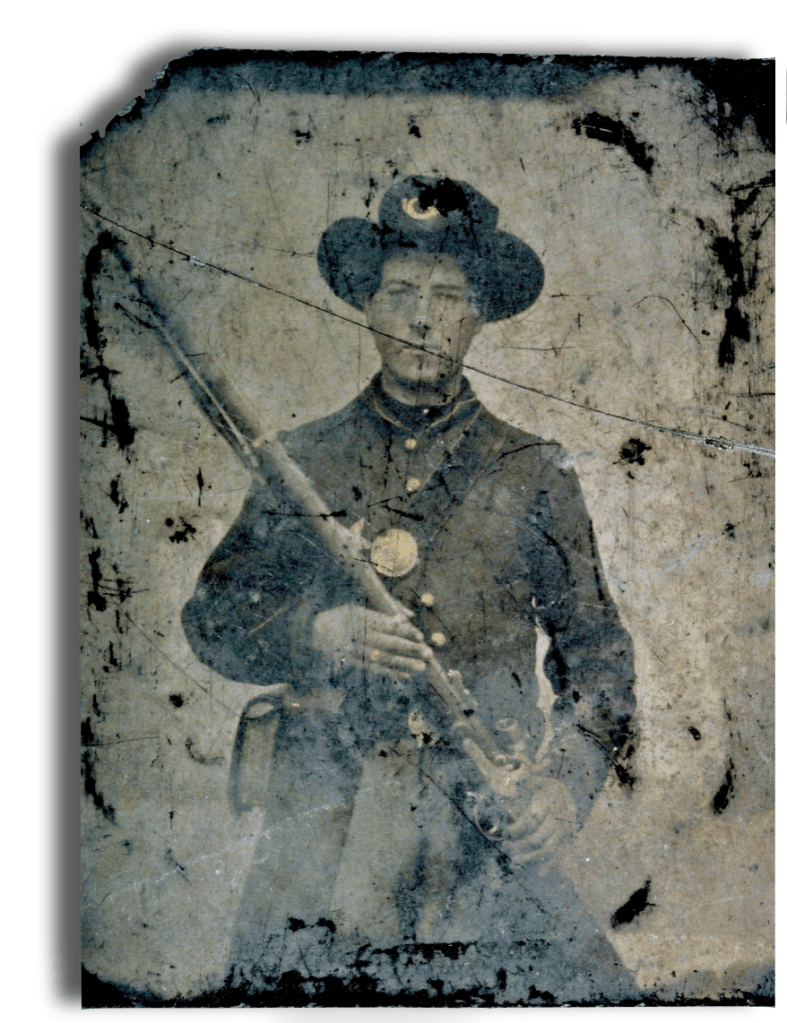
This letter was written by John Pittenger, Jr. (1838-1923) of Wayne county, Ohio. He came to Delaware county, Indiana, with his family in the 1850s. He wrote the letter to 19 year-old Mary E. Shafer, the daughter of German emigrants Adam and Eleanor Shafer of Muncie, Delaware county, Indiana. She married George N. Barrow in 1886.
John enlisted in Co. D, 84th Indiana Infantry on 13 August 1862, entering the service as a corporal. He was mustered out on 14 June 1865 at Nashville, Tennessee. According to the Indiana CW Database, John (or Jonathan) was taken prisoner at Chickamauga on 20 September 1863.
After the war he moved to Wayne, Kosciusko county, Indiana, and married Clarissa E. Jones in December 1868. There is another Pittenger to Shafer letter dated 28 January 1863 housed in the William Henry Smith Memorial Library in Indianapolis.
To read other letters I have transcribed by members of the 84th Indiana Infantry, see:
[This letter is from the personal collection of Rich Condon and is published on Spared & Shared by express consent.]
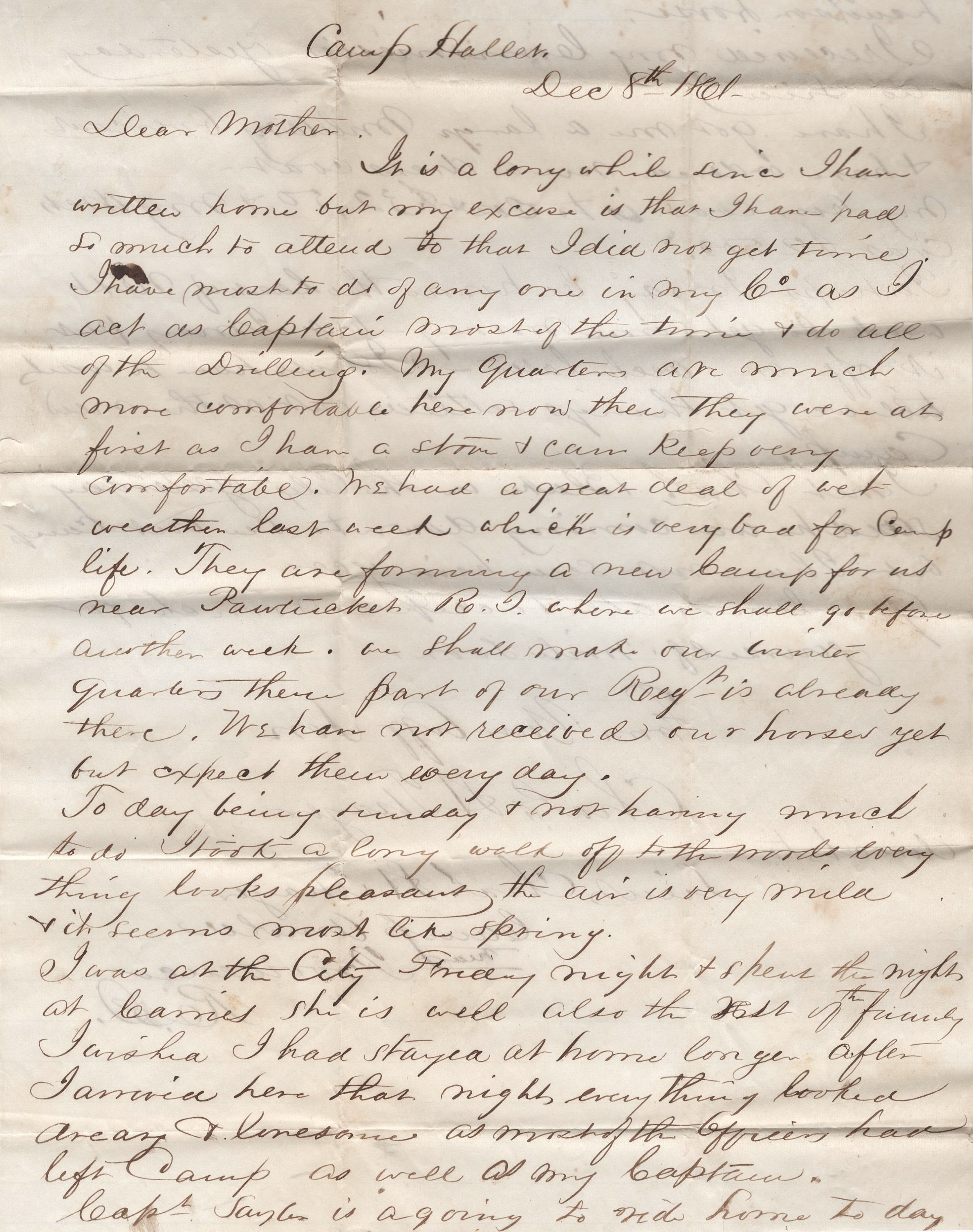
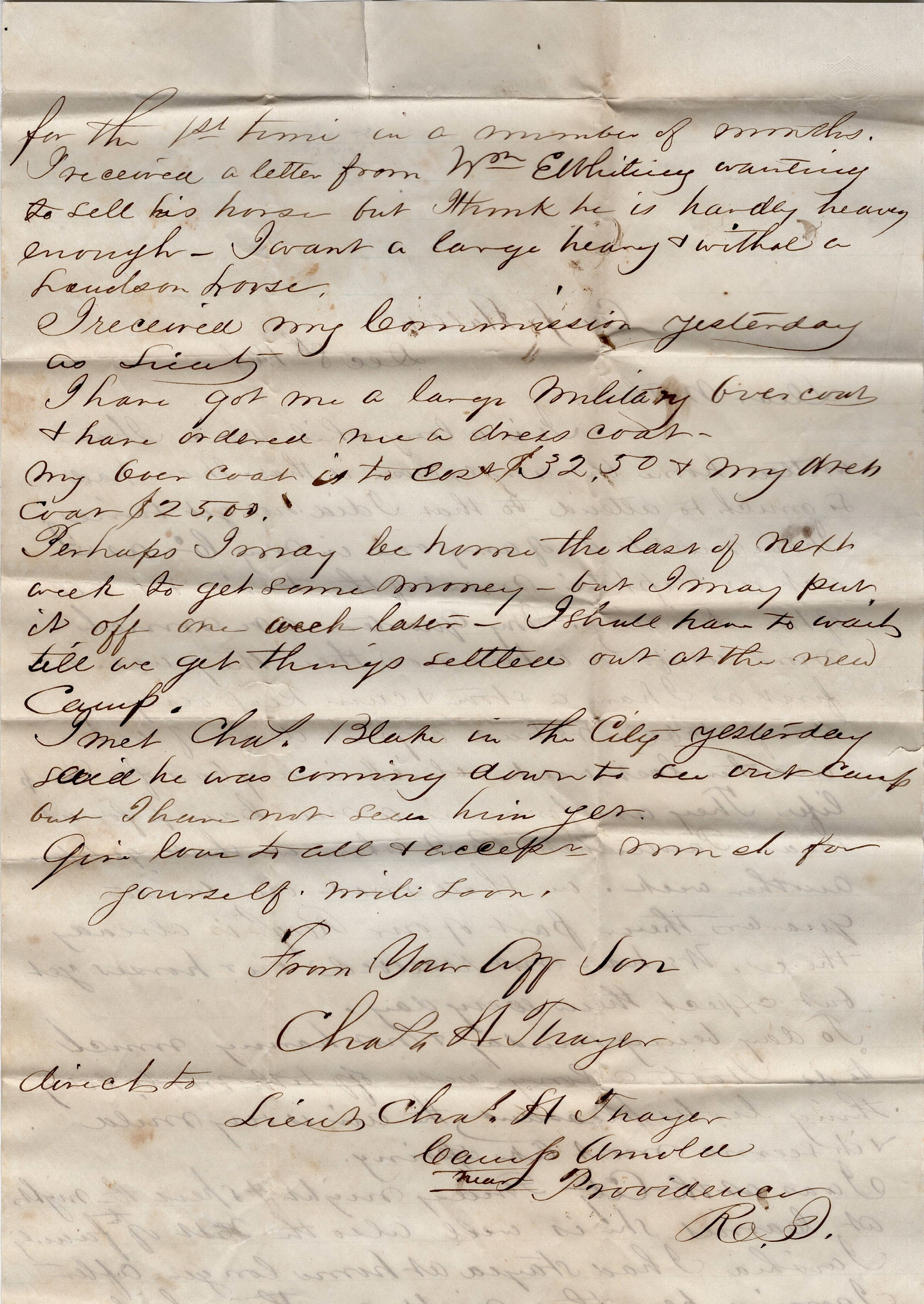
Transcription
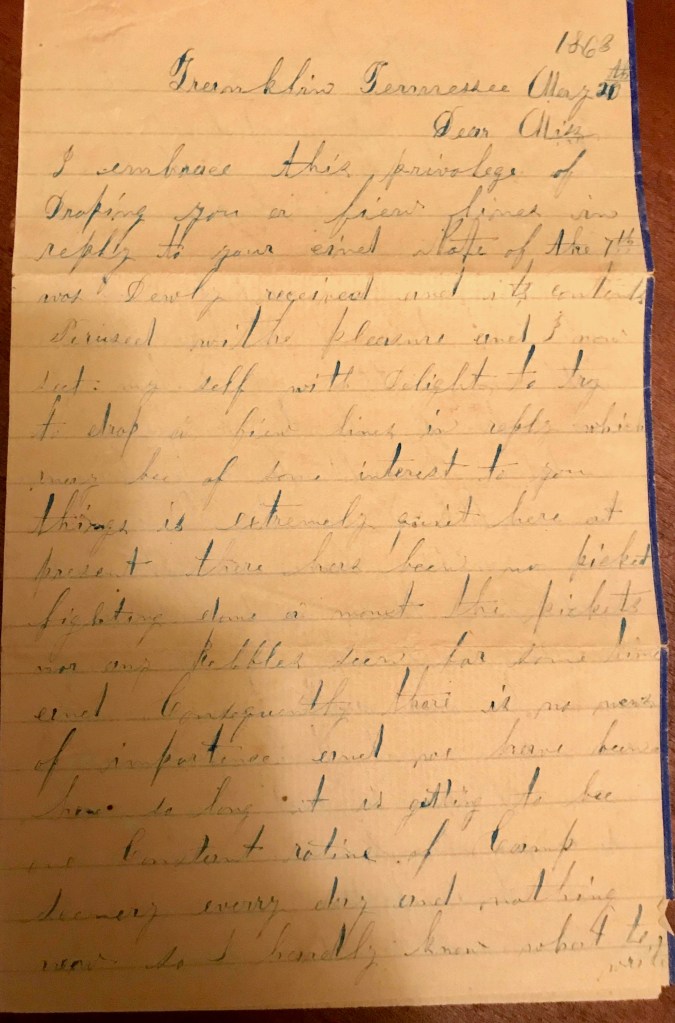
Franklin, Tennessee May 20th 1863
Dear Miss,
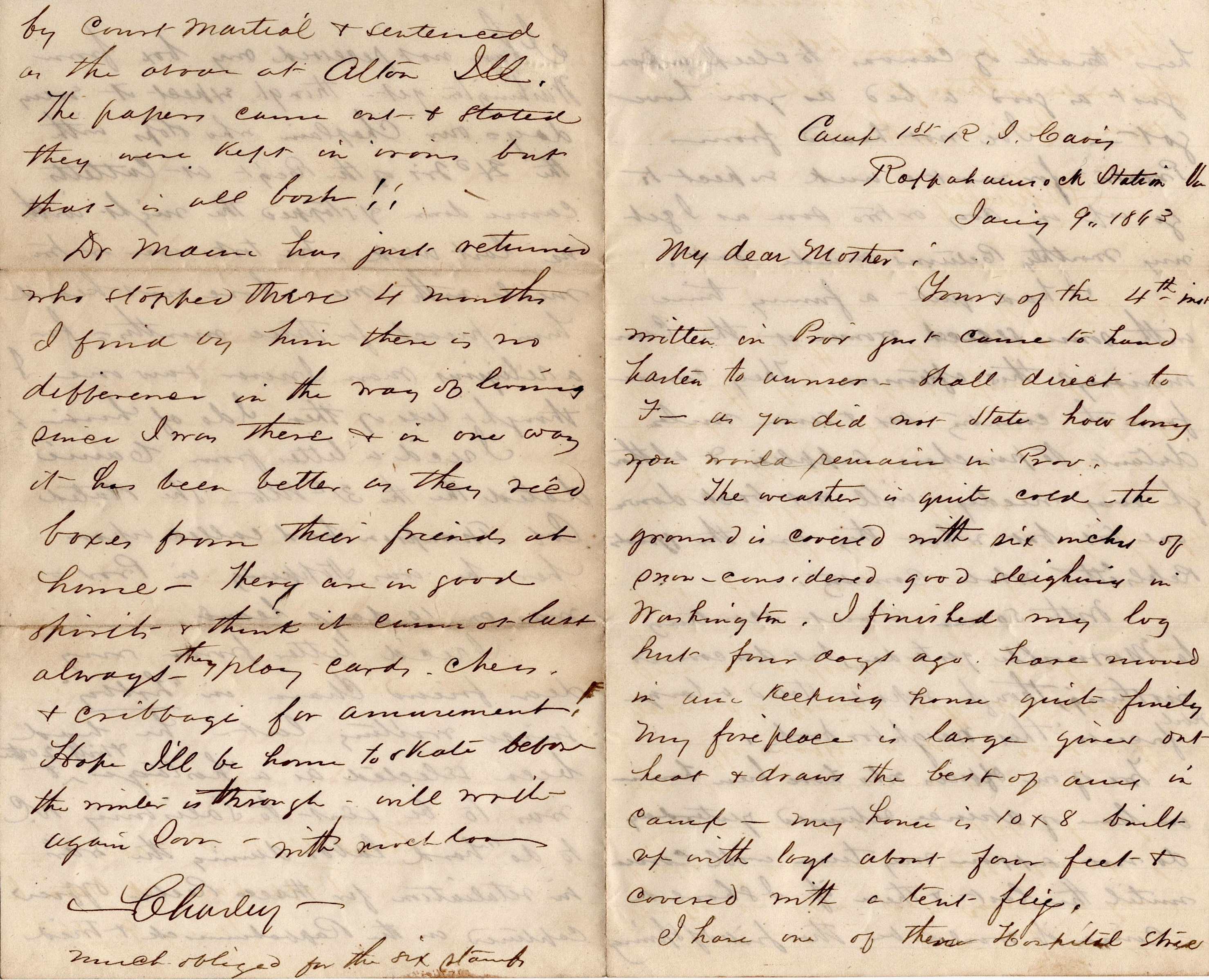
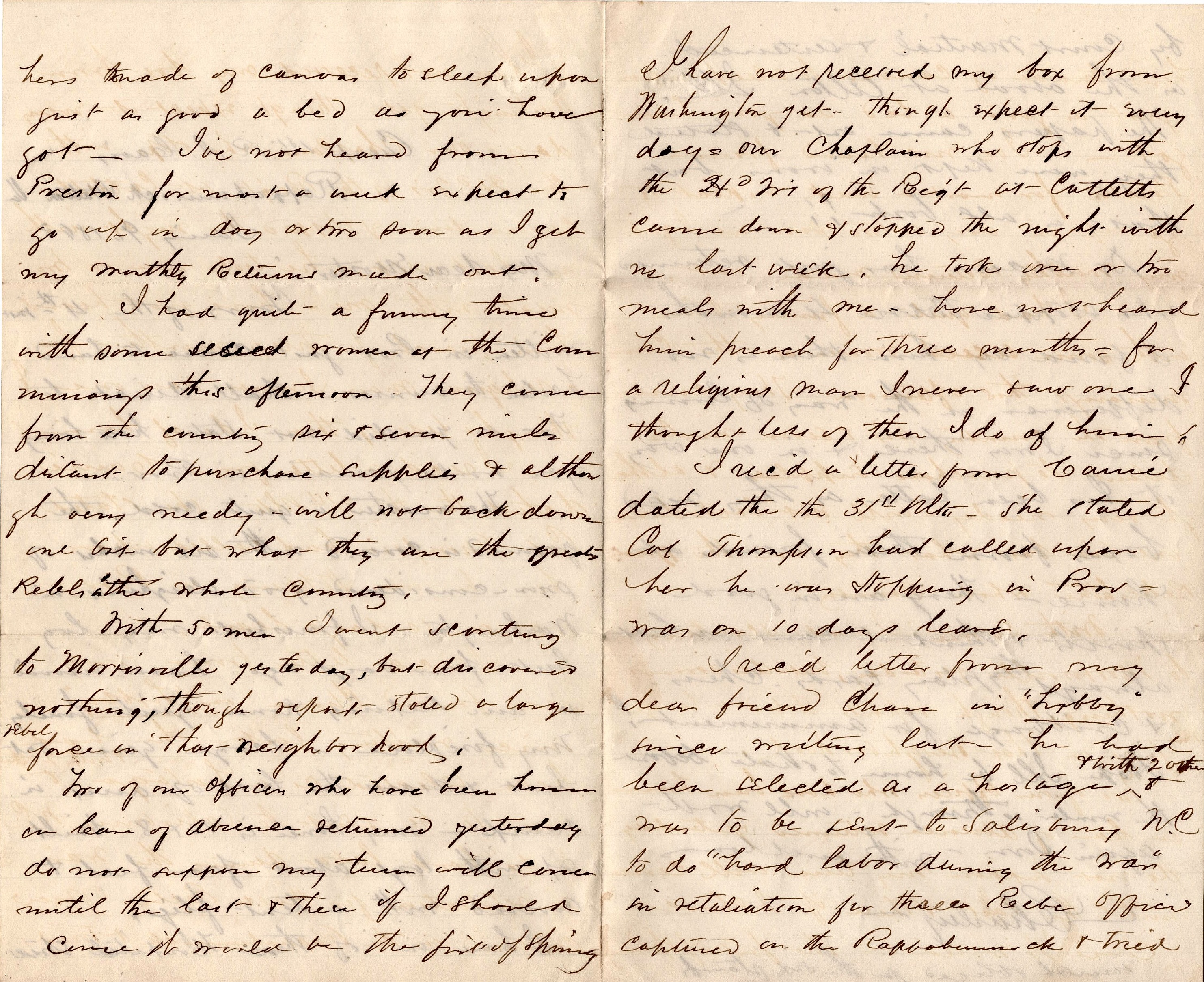
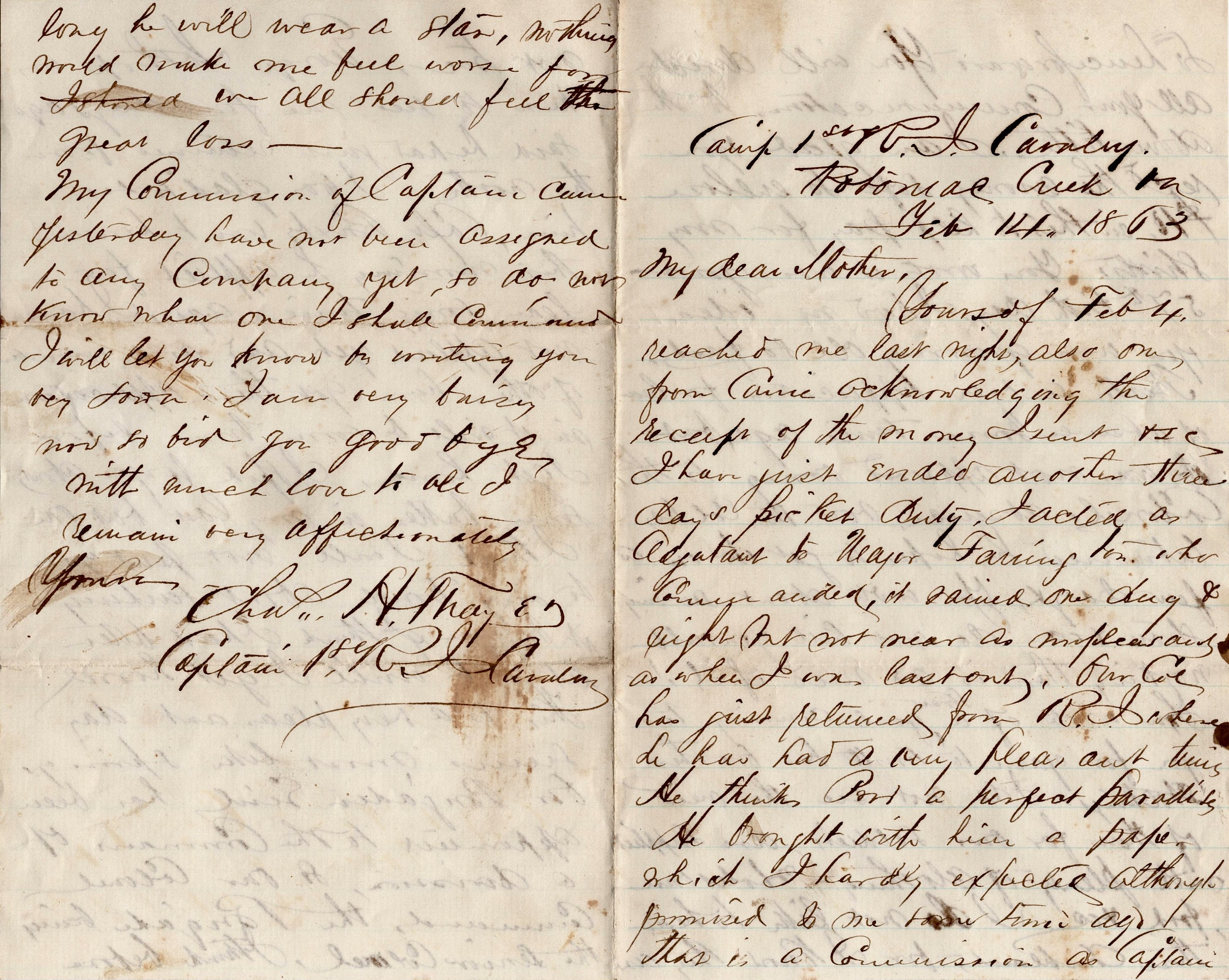
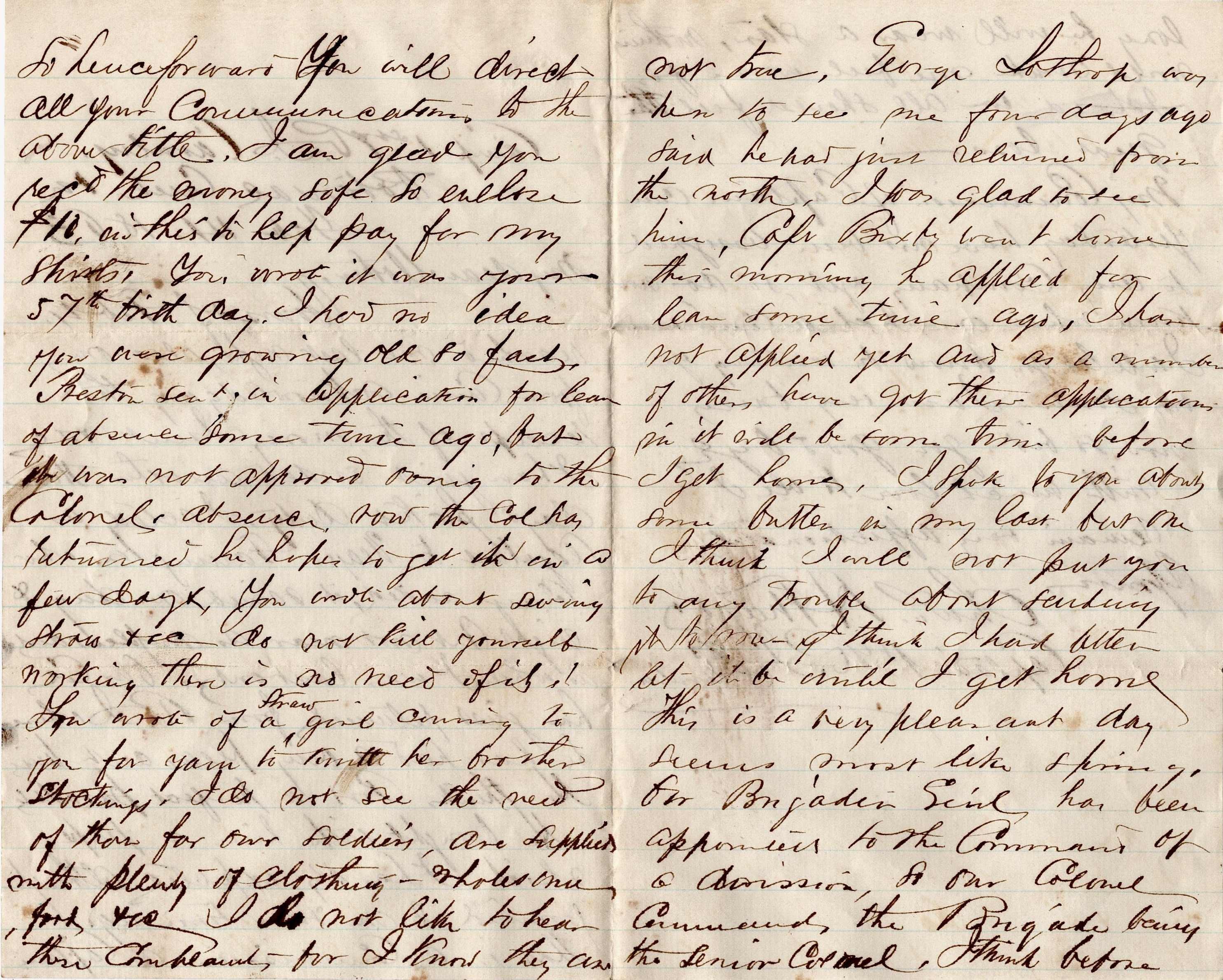
I embrace this privilege of dropping you a few lines in reply to your kind letter of the 7th [which] was duly received and its contents perused with pleasure and I now sit myself with delight to try to drop a few lines in reply which may be of interest to you.
Things is extremely quiet here at present. There has been no picket fighting done amongst the pickets nor any Rebels seen for some time and consequently there is no news of importance and we have been here so long it is getting to be one constant routine of camp scenery every day and nothing new so I hardly know what to write.
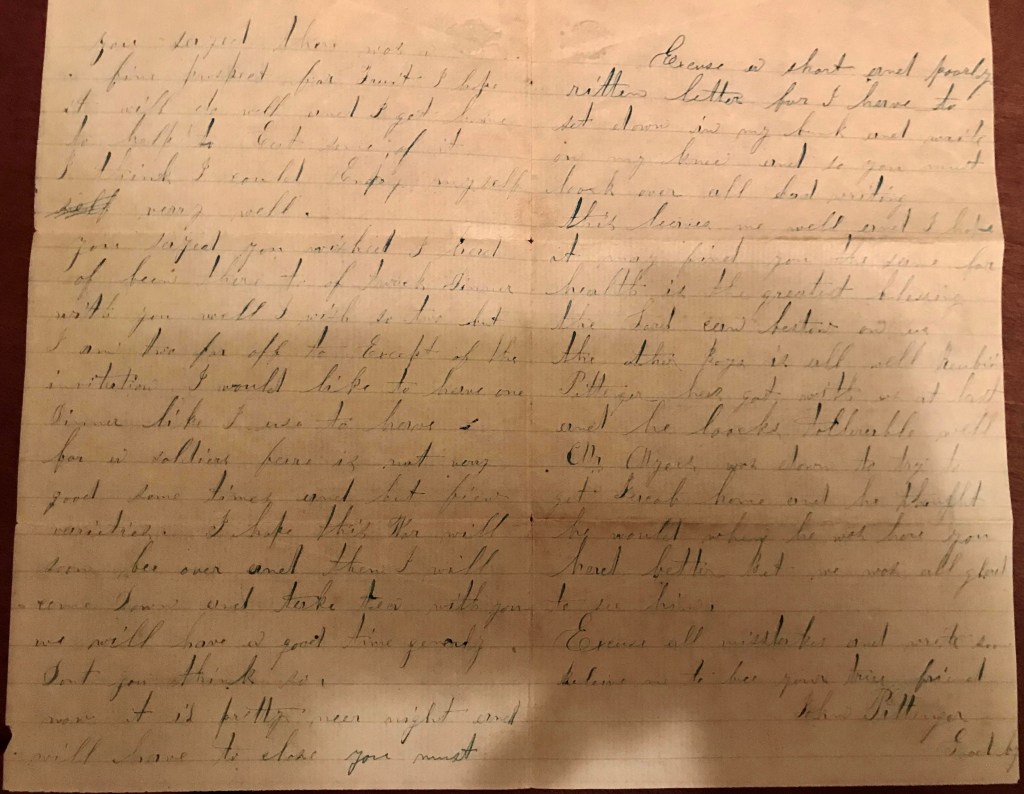
You said there was a very fine prospect for fruit. I hope it will do well and I get home to help eat some of it. I think I could enjoy myself very well.
You said you wished I had of been there to of took dinner with you. Well I wish so too but I am too far off to accept of the invitation. I would like to have one dinner like I use to have for a soldier’s fare is not very good sometimes and but few varieties.
I hope this war will soon be over and then I will come down and take tea with you. We will have a good time generally, don’t you think so?
Now it is pretty near night and I will have to close. You must excuse a short and poorly written letter for I have to sit down in my bunk and write on my knee and so you must look over all bad writing. This leaves me well and I hope it may find you the same for health is the greatest blessing the Lord can bestow in us. The other boys is all well. Rueben Pittenger 1 has got with us at last and he looks tolerable well.
Mr. Myers was down to try to get Jacob home and he thought he would when he was here. You had better bet we was all glad to see him. Excuse all mistakes and write soon. Believe me to be your true friend, — John Pittenger
Goodbye.
1 Reuben Pittinger (1838-1864) also served in Co. D, 84th Indiana Infantry but died in the service at the Battle of Kennesaw Mountain in Cobb county, Georgia.He may have been John’s cousin.
The following two letters came to me for transcription from Jen Foley with the following request:
I could not find an image of Vincent but here is one of Patrick Monaghan of Co. K, 22nd Iowa Infantry. He was wounded in the same battle where Vincent was killed.[Iowa Civil War Faces]
“I recently came across your page on Facebook and it’s really amazing what you are doing. Not too long ago I acquired the pension files of my great-great-granduncle, Vincent Lilly, who served in the 22nd Iowa Infantry and was killed at Vicksburg in 1863. The file included a few letters he had written to his mother and brother. I have been in the process of transcribing one letter he wrote to his mother, my great-great-great-grandmother Elizabeth Mills Lilly. The ink is mostly legible and it’s just a matter of trying to read the handwriting. But I have been at a loss as to what to do with the other letters because the handwriting is so faded that I can’t make it out in most places. This is an important piece of my family history and it’s especially important to me to honor Vincent, who was just 21 when he died. His younger brother James was my great-great-grandfather. James was too young to enlist though another brother, Charles, also served in the 22nd Iowa Infantry. Fortunately Charles survived the war and lived on until 1911.“
Vincent Francis Lilly (1841-1863) was the son of Francis Lilly (1812-1872) and Frances Elizabeth Mills (1821-1898) of College, Linn county, Iowa. The Lilly family resided in Lancaster, Ohio, until sometime in the 1850s when they relocated to Iowa. Vincent and his younger brother Charles (“Charley”) E. Lilly (1844-1911), enlisted on 9 August 1862 in Co. H, 22nd Iowa Infantry. Charley survived the war, Vincent did not. He was killed on 22 May 1863 in the “suicidal frontal assault” on the Railroad Redoubt (or “Fort Beauregard”) near Vicksburg. Several members of the 22nd Iowa actually made through a ditch of the redoubt, up the side and through a hole blasted in the parapet by Union artillery fire where they fought hand to hand and planted their flag on the ramparts, but they were eventually driven back.
Both of these letters were written from the camp of the 22nd Iowa Infantry as they awaited transports to cross the Mississippi River below Vicksburg in mid-April 1863.
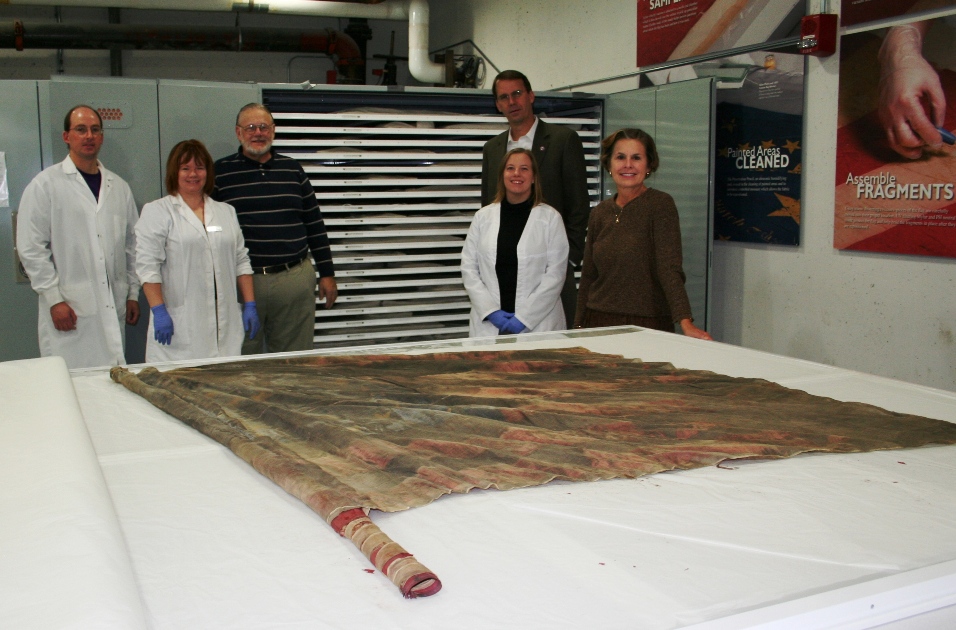
The 22nd Iowa National Flag that flew over Vicksburg on May 22nd, 1863 rests in the basement of the Iowa State Historical Building at Des Moines, Iowa. This flag is one of over 200 Civil War battle flags in the Civil War Battle Flag preservation project at the State Historical Society of Iowa in Des Moines. Due to damage, the flag is not fully unfurled and represents only a portion of its original size. Pictured above: Flag preservation staff from Iowa State Historical Society (Sheila and Sarah), 24th Iowa Re-enactor, Terry Folkerts – Iowa Ghost Town Project videographer, Jeffry Burden – 22nd Iowa Infantry historian and editor of Vanishing Footprints, and Kathy Baker, Marshall County Recorder. Lt. Nick Messenger was the Marshall County Recorder from 1872 through 1880.
Letter 1
Camp near Carthage, Louisiana April 17th 1863
Dear brother Sam,
We have moved 20 miles below Vicksburg I do not know what we are going to do. It is supposed that we will work our way in the rear of Vicksburg. We have march through this state here. We had been within 6 miles of Vicksburg. This is the beautifulest country I ever seen. The land is level and rich. We are camped in a large cotton field. As we moved down here, the inhabitants leave everything and flee. The most of them burnt their cotton and grain. Most every plantation has a saw mill and cotton gin on. Our boys uses the saw mills to saw lumber for flat boats to cross steams in and to fix the roads with. We are within 5 or 6 miles of 4 or 5,000 rebels that is on an island and they can’t get out and yet we can’t get them for water and swamp, but we are building boats as fast as we can so that we can get at them. They are getting reinforcements from Vicksburg and I think it will make that place easier to take. They do not want to lose the island for they save all the stock that was in this county there and I guess we will fool them.
Well Sam, Charley is detached from our company to a 1st Iowa Battery. He is cannoneer of a 6-pounder. That battery is in our Brigade near the rear. A great many troops are here now. I don’t know how many there is—somewhere in the neighborhood of 100,000. We have plenty of negroes to do our work. We don’t have any fatigue duty to do and are getting lazy as dogs. I seen Charley last night. He is well and likes his exchange very well. They do not have to march; they ride o the cannon [caissons]. We just come here yesterday from Richmond and cut a cross a short bend in the river.
Well, Sam, I guess you can’t get this letter til after the. battle for they have stopped the mail at present and I don’t know whether we can get any or not. They stop our mail….
Yesterday we marched 16 miles and over the prettiest country I ever seen. We are going to stay over here two or three days. A[ddison J.] Booth is well and fat as a pig. He is cook for his mess of 4. John Carmichael and Anderson Purcell is sick. They was left at Richmond. They had the mumps pretty bad but are getting better. They was walking around yesterday morning.
Sam, our regiment has some 50 nigger waiters and we find them awful handy. Sam, A[ddison] Booth commenced to write on this sheet and spill the ink on it so he tore it off. I commenced this letter the 17th. It is now the 18th. It rained last night and is awful muddy this morning. Everything is still except we send the rebels a shell once in a while. We have got them where we want them. Our troops is camped on the island and more going over to camp. There is also several gunboats watching them.
Well, Sam, I forgot to tell you that I am well and enjoying myself very well and hope you are enjoying the same blessing. The 24th [Iowa] is here. I am going to see them so I will have to close for this time by requesting you to write as soon as you get this letter.
P. S. I received the package of papers and book you sent to us. We are going to draw our pay this week and will send it home by James Shrader. No more. This from you affectionate brother, — V. F. Lilly.
Give my love to all the girls.
P. S. Sam, we have marching orders. We have to march at 2 o’clock this morning with 2 days rations in our haversacks and the boys is up cooking. I will enclose $20.00 and Charley will send $20.00 by Jim Shrader. He is coming there. I went to see Charley to get his [money] and it was dark as the devil and muddy as hell. We will have a nice time marching in the dark. No more.
Letter 2
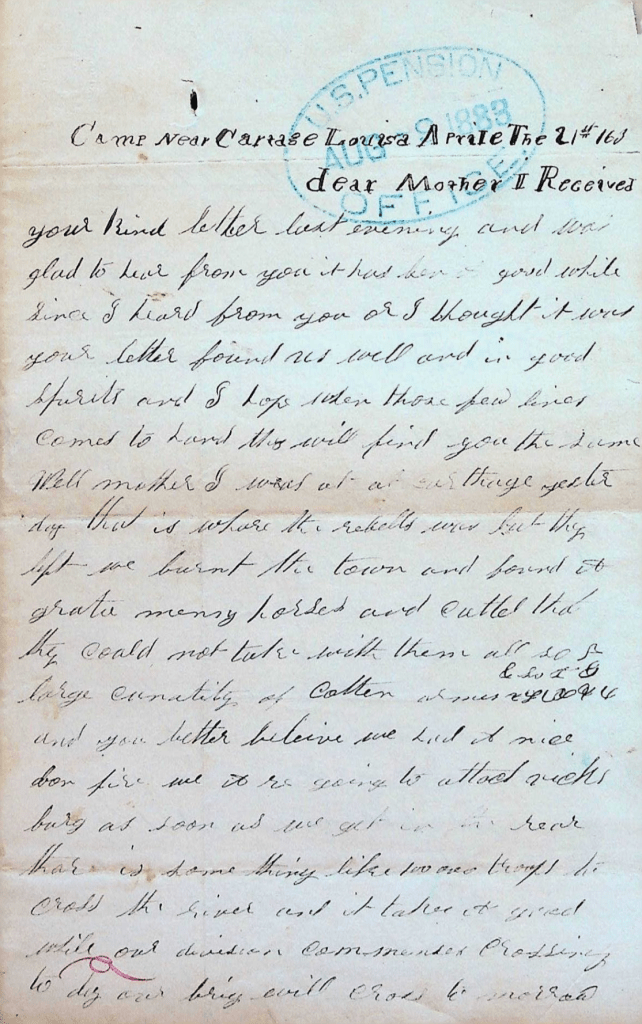
Camp near Carthage, Louisiana April 21st 1863
Dear Mother,
I received your kind letter last evening and was glad to hear from you. It has been a good while since I heard from you, or I thought it was. Your letter found us well and in good spirits and I hope when these few lines comes to hand, they will find you the same.
Well Mother, I was a Carthage yesterday. That is where the rebels was but they left. We burnt the town and found a great many horses and cattle that they could not take with them. Also a large quantity of cotton and you better believe we had a nice bon fire. We are going to attack Vicksburg as soon as we get in the rear. There is something like 100,000 troops to cross the river and it takes a good while. Our Division commenced crossing today. Our Brigade will cross tomorrow and as soon as we take Vicksburg, we are coming North to tend to the traitors there.
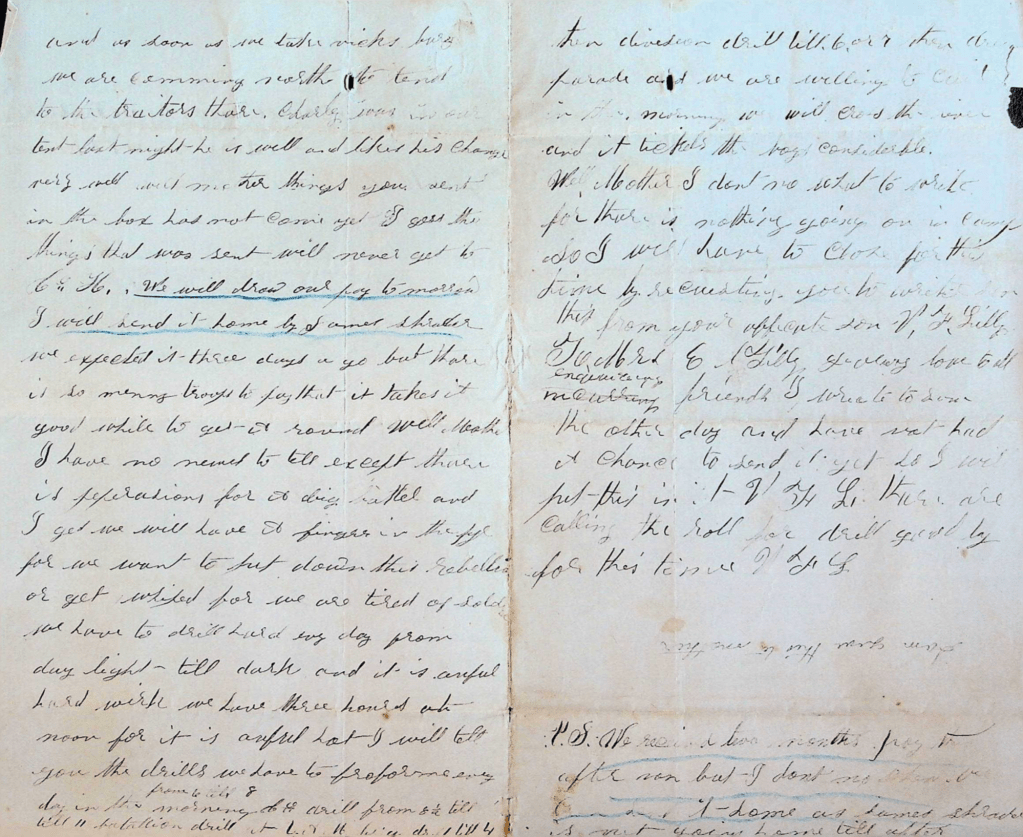
Charley was in our tent last night. He is well and like his change very well.
Well, Mother, things you sent in the box has not come yet. I guess the things that was sent will never get too Co. H. We will draw our pay tomorrow. I will send it home by James Shrader. We expected it three days ago but there is so many troops to pay that it takes a good while to get around.
Well, Mother, I have no news to tell except there is preparations for a big battle and I guess we will have a finger in the pie for we want to put down this rebellion or get whipped for we are tired of soldiering. We have to drill hard every day from daylight till dark and it is awful hard work. We have three hours [off] at noon for it is awful hot. I will tell you the drills we have to perform every day. In the morning from 6 till 8 company drill, from 8:30 till 11 Battalion drill. Brigade drill 11 till 4. Then Division drill till 6 tor 7. Then dress parade and we are willing to quit. In the morning we will cross the river and it tickles the boys considerable.
Well, Mother, I don’t know what to write for there is nothing going on in camp so I will have to close for this time by requesting you to write soon. This from your affectionate son, — V. F. Lilly
Send along love to all enquiring friends. I wrote to Sam the other day and have not had a chance to send it yet so I will put this in it.
They are calling roll for drill. Goodbye for this time. — V. F. L.
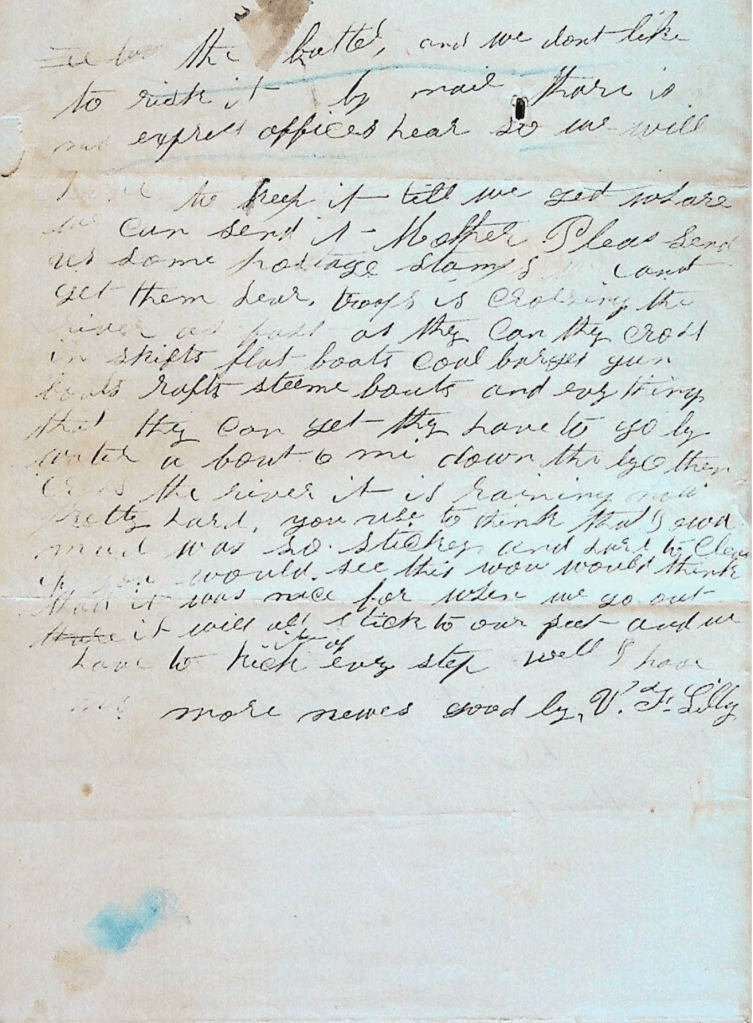
P. S. I received two months pay this afternoon but I don’t know how to get it home as James Shrader is not going home till after the battle and we don’t like to risk it by mail. There is no Express Office here so we will have to keep it till we get where we can send it. Mother, please send us some postage stamps and get them here.
Troops is crossing the river as fast as they can cross in skiffs, flatboats, coal barges, gunboats, rafts, steamboats, and everything they can get. Thy have to go by water about 6 miles down the bayou, then cross the river. It is raining now pretty hard. You use to think that Iowa mud was so sticky and hard to clean up. You should see this [mud] when we go out. It will stick to our feet and we have to kick off every step.
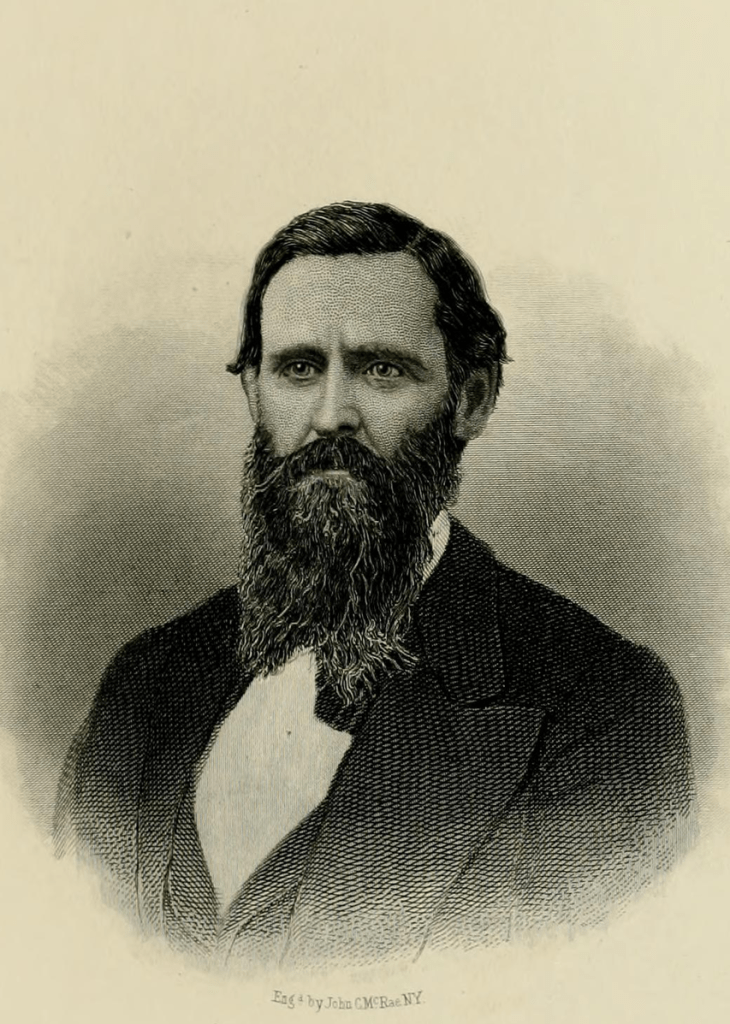
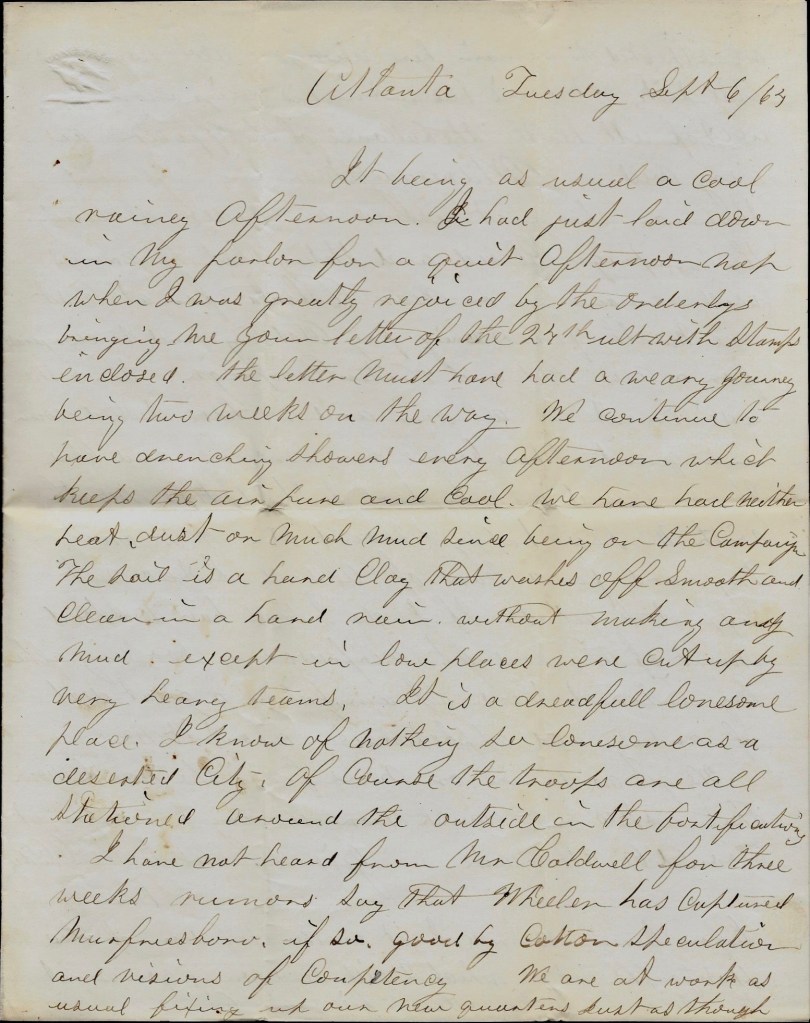
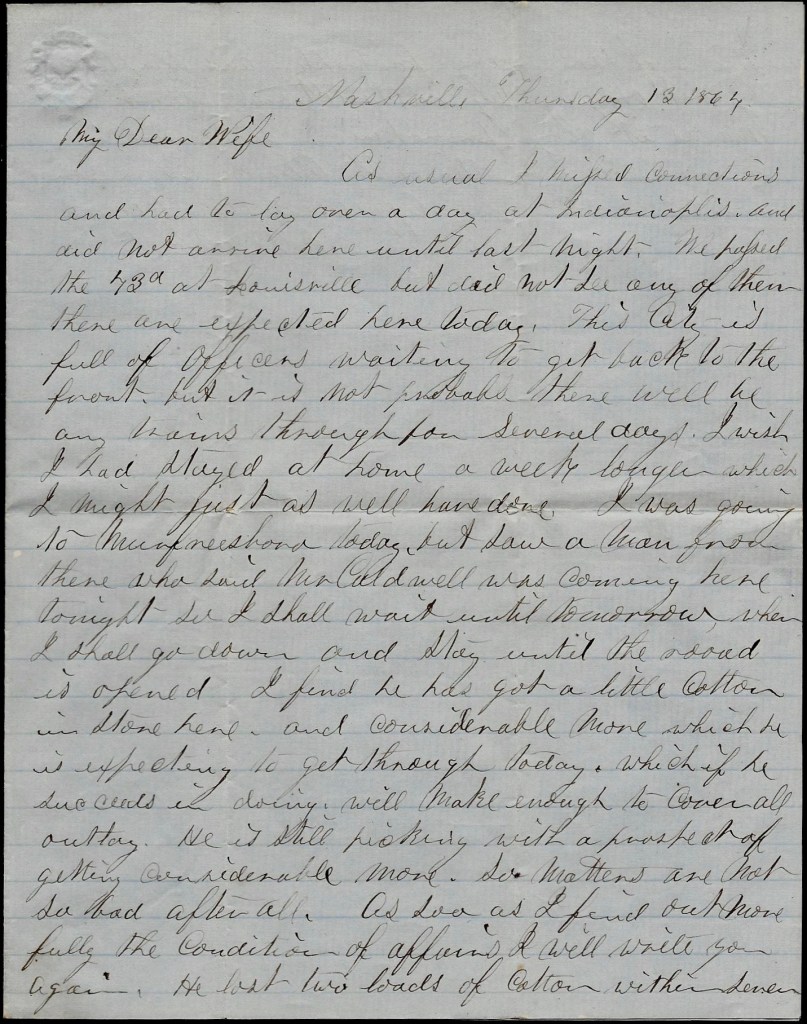
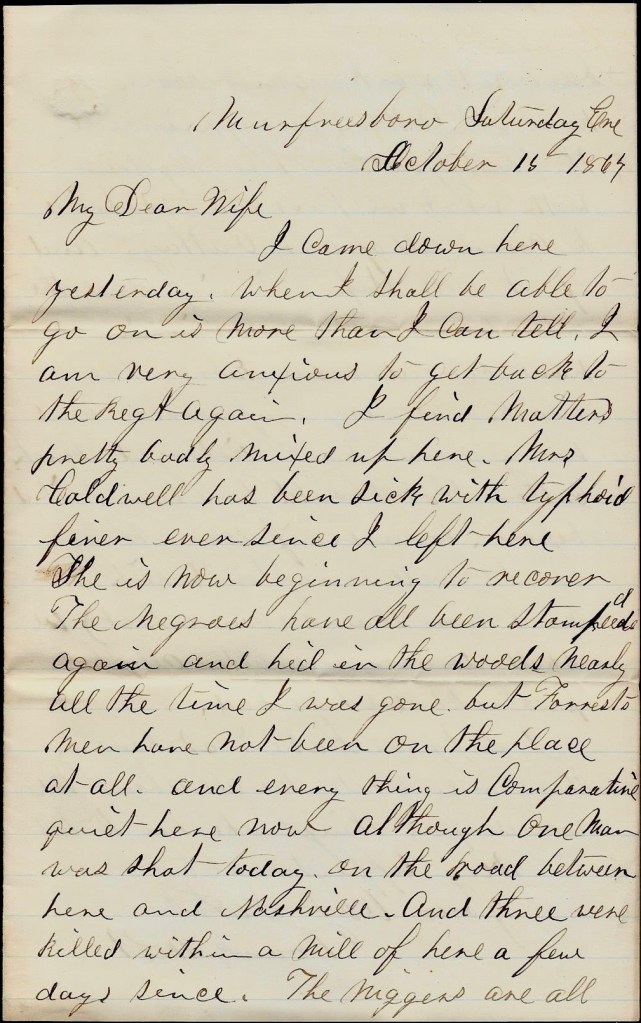
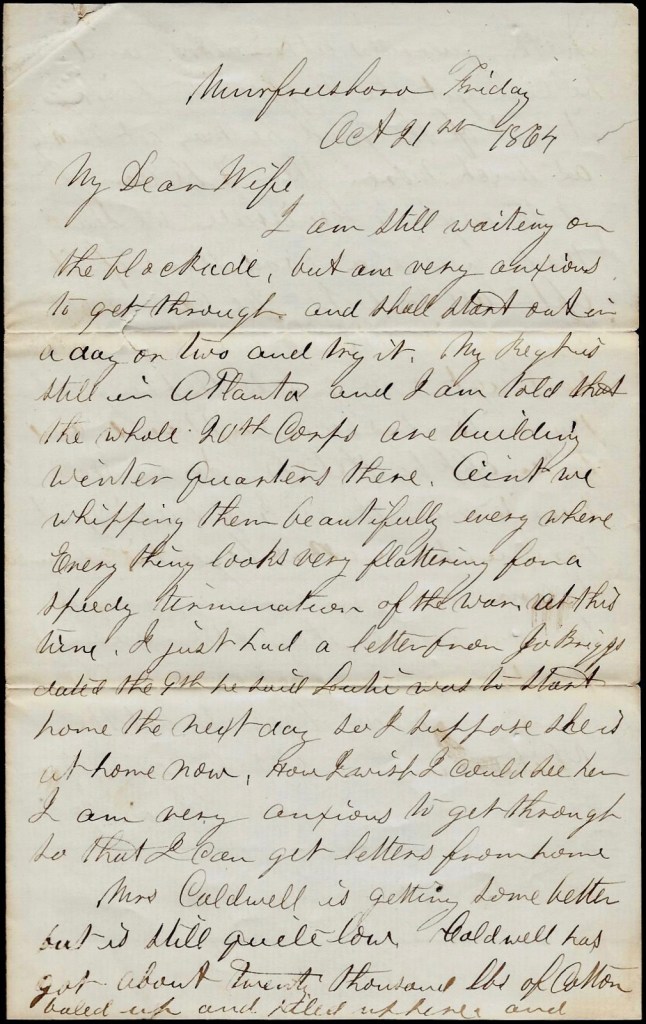
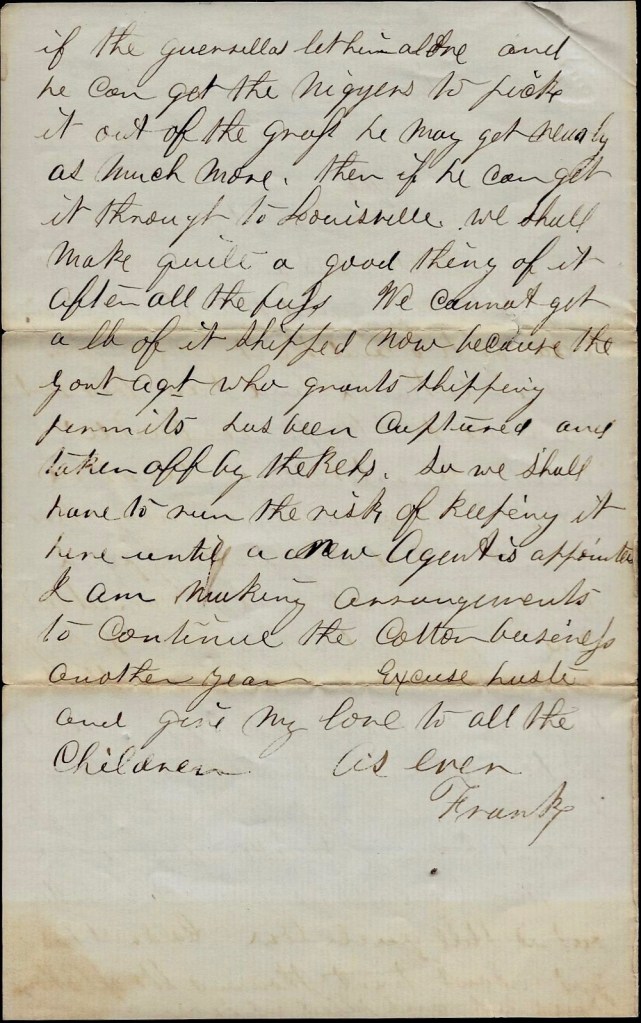
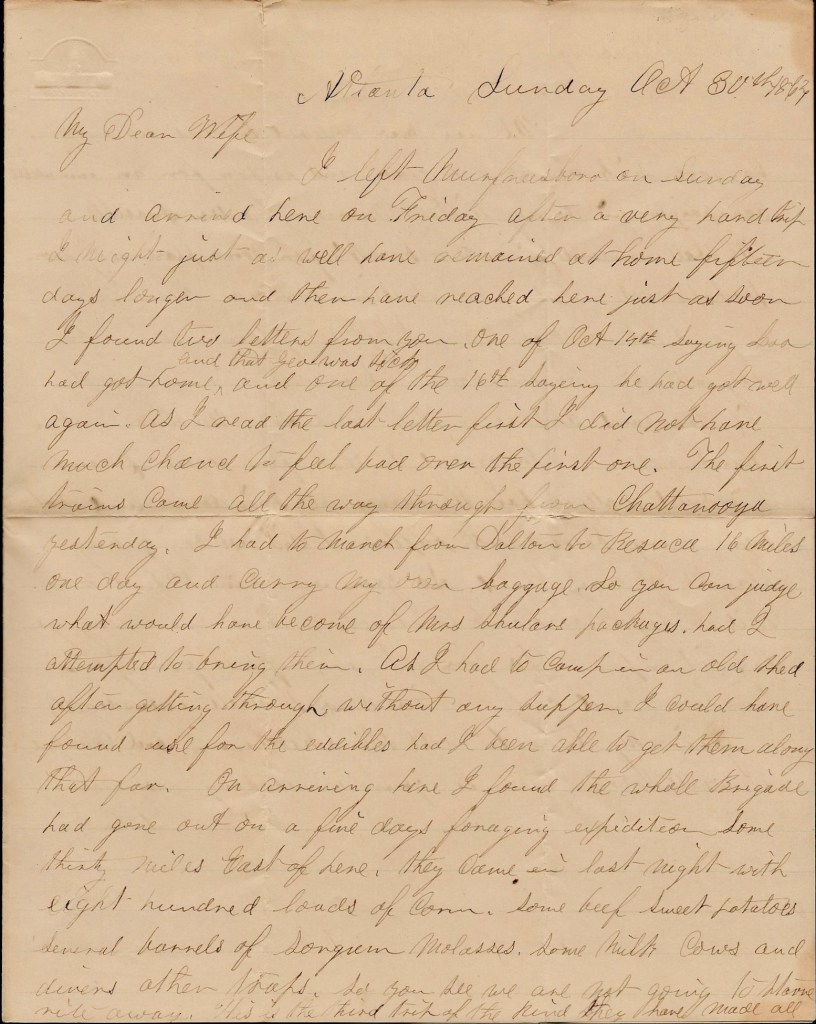
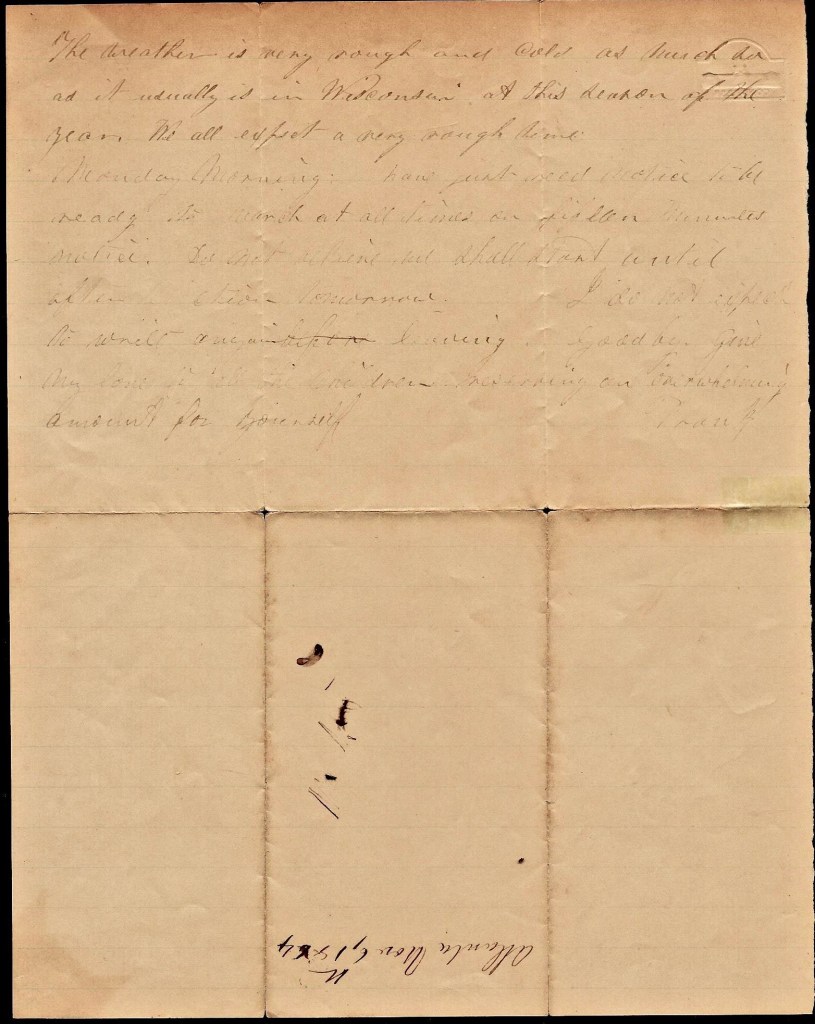
These Civil War letters were written by Francis Henry West (1825-1896), an American businessman, politician, and Wisconsin pioneer. He was a member of the Wisconsin Legislature for three years, and served as a Union Army officer during the American Civil War, earning an honorary brevet to brigadier general.
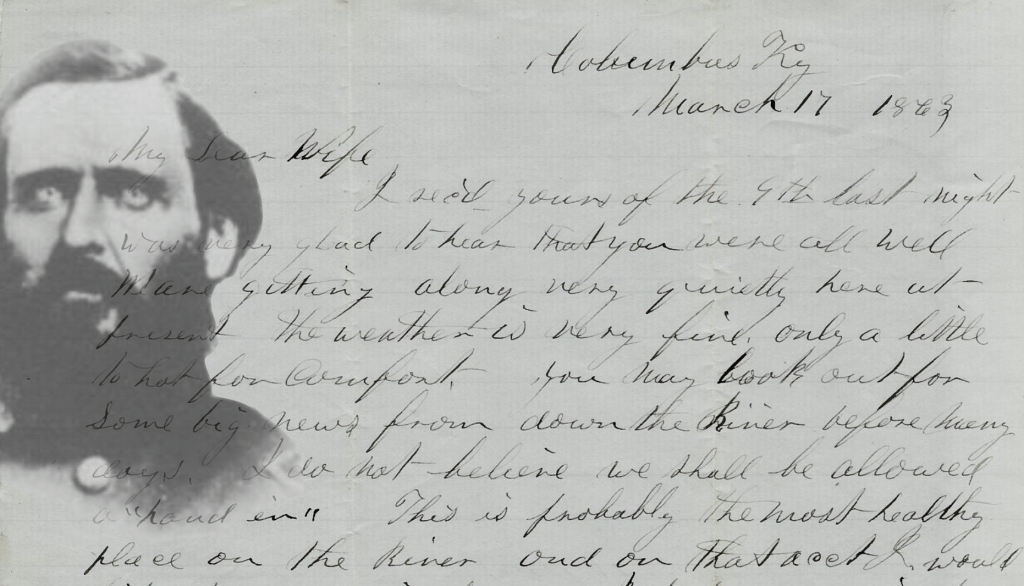
Francis Henry West, US Biographical Dictionary & Portrait Gallery
West was born in Charlestown, New Hampshire. He moved to the Wisconsin Territory in 1845, eventually settling in Monroe, in Green County, in 1846. In Green County, he worked in the lumber industry. In 1853, he was elected as a Democrat to represent Green County in the Wisconsin State Senate for the 1854 and 1855 sessions. In 1855, he was the Republican nominee for Bank Comptroller, but was not successful. In 1859 and 1860, he accompanied parties of migrants from New York to California.
West joined the Army on August 28, 1862, and was commissioned a lieutenant colonel with the 31st Wisconsin Volunteer Infantry Regiment, which was still being organized in Wisconsin. The 31st Wisconsin was created from two volunteer battalions from Crawford County and Racine. The 31st mustered into service in October 1862 and left Wisconsin in March 1863, traveling to Kentucky via Cairo, Illinois, where they were attached to the XVI Army Corps. They spent the summer of 1863 on patrols and picket duty in southern Illinois, western Kentucky, protecting supply routes along the Mississippi River.
In September 1863, they were ordered to Nashville. Here, their colonel, Isaac E. Messmore, resigned, and, on October 8, Lt. Colonel West was promoted to colonel of the regiment. Through the winter of 1863–64, the regiment was stationed at Murfreesboro, Tennessee, and continued to serve as protection for logistics and supplies. In April 1864, the 31st was attached to the XX Corps and split into detachments to protect a long stretch of railroad lines in Tennessee. In June, the regiment was ordered to consolidate and return to Nashville.
On July 5, the 31st Wisconsin was ordered by General William Tecumseh Sherman to proceed to the front of the ongoing Atlanta campaign. The 31st traveled by train to Marietta, Georgia, and reached its position on the line July 21. The regiment worked on constructing siege fortifications around Atlanta and came under frequent enemy fire due to their proximity to the enemy lines. They did not take part in the actual battle, but were one of the first units to enter the city. The regiment was assigned to provide security in the city and protect foraging operations in the surrounding area.
On November 15, 1864, the XX Corps broke camp and marched out of the city to begin their part in Sherman’s March to the Sea. They advanced without encountering any resistance until ten miles outside Savannah where, on December 9, they encountered two small enemy fortifications. The 31st Wisconsin, along with the 61st Ohio, were ordered to flank the position through a thick swamp. They passed the swamp and charged the enemy, taking the position with light casualties. For their action, they received the compliments of General Sherman. The regiment joined the siege of Savannah, and after capturing the city were assigned quarters there.
On January 18, 1865, the 31st Wisconsin departed Savannah and marched for Purrysburg, South Carolina, at the start of the Carolinas campaign. The regiment proceeded through South Carolina, burning enemy facilities, tearing up railroad tracks, and pushing the enemy’s rear guard toward North Carolina. On March 1, the 31st advanced toward Chesterfield, South Carolina, near the border with North Carolina. They forced a small confederate force to flee north, then stopped in the village. On March 16, the 31st took position on the front line for Averasborough, where they were shelled and took casualties. Three days later, they were in the advance on approach to Bentonville, along with two other regiments, where they encountered significant Confederate opposition and found their flanks exposed. They fell back and formed a defensive position with elements of the XIV and XX Corps. The Confederates attacked their position five times and were repelled in fierce fighting. This was the worst fighting that they saw during the war, and suffered ten killed and forty-two wounded.
On March 24, they reached Goldsboro, North Carolina, where they stopped to rest and re-equip. While the 31st was camped at Goldsboro, Ulysses S. Grant accepted the surrender of Robert E. Lee at Appomatox. On April 10, the 31st marched out to continue their advance toward Raleigh, pursuing Joseph E. Johnston and the remnants of the Army of the South. But before they reached Raleigh, they received word that Johnston had surrendered to Sherman and the war was effectively over.
The 31st was ordered back to Washington, where they participated in the Grand Review of the Armies in May, and West mustered out on June 20, 1865.[2] While in Washington, U.S. President Andrew Johnson nominated Colonel West for an honorary brevet to brigadier general of volunteers for gallant service in the field, effective back to March 19, 1865, the day of their combat at Bentonville. The United States Senate confirmed the brevet on March 12, 1866.
After the war, General West moved to Milwaukee County and entered a partnership—Fowler & West—with James S. Fowler in the grain commission business. He served for six years on the board of directors of the Milwaukee Chamber of Commerce, including two years as president.
In 1873, he was elected on the Reform ticket to represent Northern Milwaukee County in the Wisconsin State Assembly for the 1874 session. The Reform Party was a short-lived coalition of Democrats, reformers, Liberal Republicans, and Grangers. Their signature accomplishment was the 1874 “Potter Law,” 1874 Wisconsin Act 273—named for Republican state senator Robert L. D. Potter—which established a new state Railroad Commission to aggressively regulate railroad and freight fees. In the Assembly, Colonel West served on the Committee on Railroads and the Committee on State Affairs. General West did not seek re-election in 1874.
During Grover Cleveland’s first presidential term, West was appointed United States Marshal for the Milwaukee district. After completing this final public service, Colonel West retired to Alabama, where two of his sons lived.
While on a trip to New York, in 1896, West slipped while attempting to step off of a street car and was severely injured. He was confined to his bed for several days before he was healthy enough to return to Alabama. He died a few weeks later, on March 6, 1896, at Bessemer, Alabama.
Francis H. West and his wife, Emma M. Rittenhouse, had several children. They included, Louise Ellen (1850-1878), Caroline (“Carrie”) (1852-1934), Edith (1854-1940), Susan (1859-1910), Grace (1866-1938), Benjamin F. (1868-1957), and Josephine (1872-1876). [Wikipedia]
To read other letters and diaries that I have transcribed by members of the 31st Wisconsin Infantry, see: John Sine, Co. F, 31st Wisconsin (3 Diaries) John A. McClure, Co. K, 31st Wisconsin (Diary & Letters)
Letter 1
Racine [Wisconsin] February 27, 1863
My dear wife,
We leave for Cairo Sunday morning at eleven o’clock. I am sorry I did not know it when I left home so as to have bid you all a final farewell. I wish my dear wife you would kiss each one of the children and say goodbye to them for me. I find on paying all my bill and subscriptions that I have left barely $5 to start on a campaign with. I do not know what I shall do for money unless you send me some. I suppose I can borrow some for awhile. You must be more particular in directing your letters hereafter. At present, direct your letters to Cairo. Put on 31st Regt. Wisconsin Cols. I have not time to write more today. We shall [go] by way of Freeport.
My sweet little wife, you must find time to write very often to your loving husband. — F. H. West
Letter 2
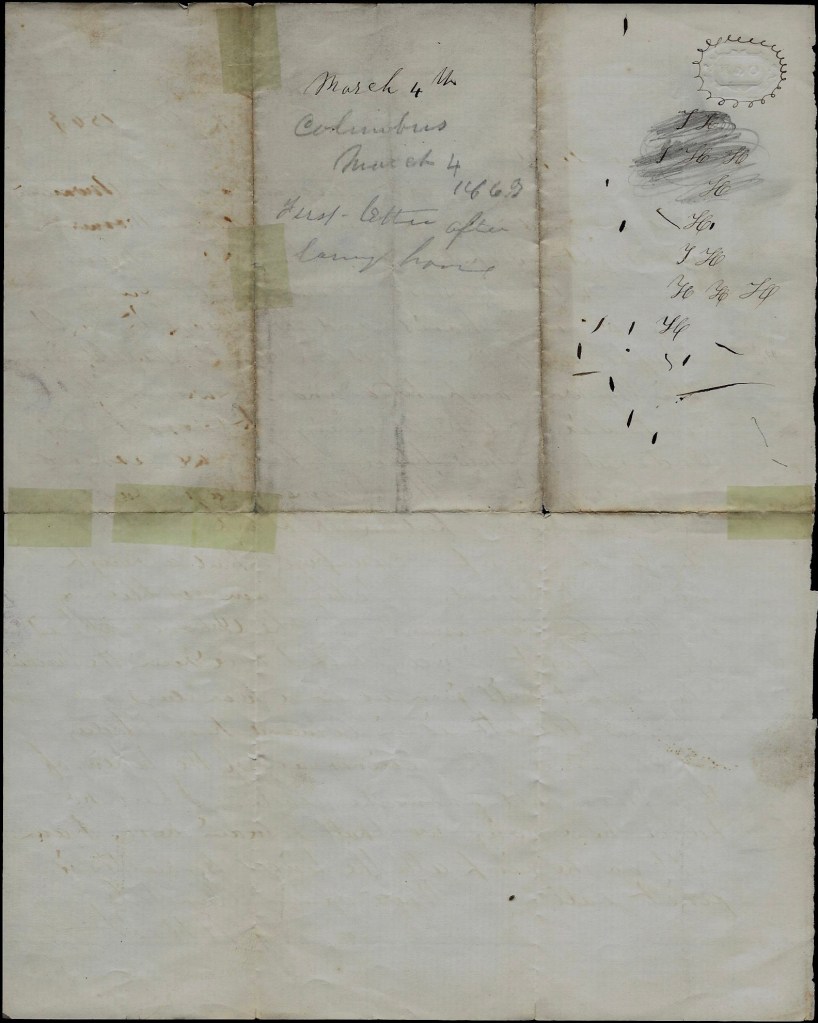
Columbus, Kentucky March 4th 1863
Dear Wife,
We left Racine Sunday morning and arrived Cairo on Tuesday morning all right except the loss of one man’s leg who was run over by the cars. His name is [Joshua] Davis and he belongs to Capt. [Robert B.] Stephenson’s Co. Davis on Dr. Roster’s farm. His leg was amputated and he was left at Centralia. On arriving at Cairo, I was ordered to this place where we arrived last night on the steamer Minnehaha.
We camped on the bluffs without tents or camp equipage. Had a rough time as it snowed. Today I am establishing my camp permanently. The Colonel left us for Freeport since which I have run the machine. The Colonel will join us in a few days.
General [Alexander] Asboth is in command here. Today we celebrate the anniversary of the taking of this stronghold from the rebels. I have no idea how long we shall remain here. I am kept on the jump all the time. My health is first rate.
Write often, dear wife, — F. H. West
Letter 3
View of Fort Halleck on the bluff above Columbus, Kentucky
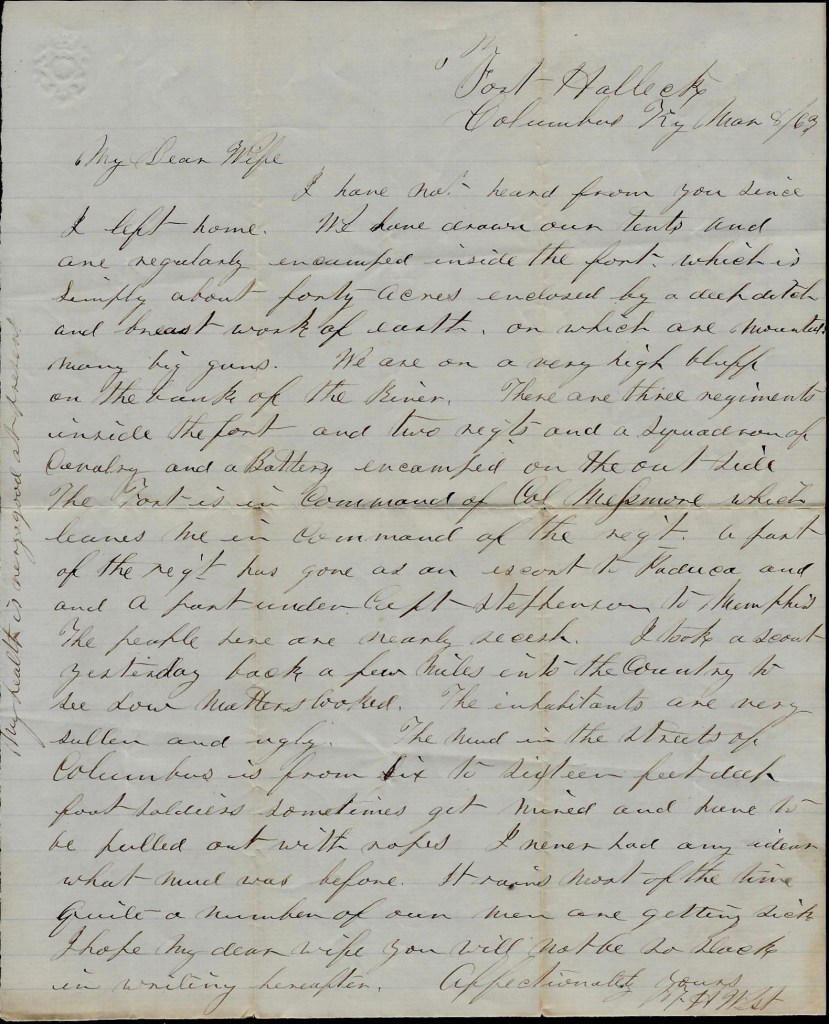
Fort Halleck Columbus, Kentucky March 8, 1863
My Dear Wife,
I have not hear from you since I left home. We have drawn our tents and are regularly encamped inside the fort which is simply about forty acres enclosed by a deep ditch and breastwork of earth on which are mounted many big guns. We are on a very high bluff on the bank of the river. There are three regiments inside the fort and two regiments and a squadron of cavalry and a battery encamped on the outside. The fort is in command of Col. Messmore which leaves me in command of the regiment. A part of the regiment has gone as an escort to Paducah and a part under Capt. [Robert B.] Stephenson to Memphis. The people are nearly [all] secesh. I took a scout yesterday back a few miles into the country to see how matters looked. The inhabitants are very sullen and ugly. The mud in the streets of Columbus is from six to sixteen feet deep. Foot soldiers sometimes get mired and have to be pulled out with ropes. I never had any idea what mud was before. It rains most of the time. Quite a number of our men are getting sick. I hope, my dear wife, you will not be so slack in writing hereafter.
Affectionately yours, — F. H. West
Letter 4
Columbus, Kentucky March 14, 1863
My Dear Wife,
I have just received your kind, affectionate letter of the 5th & 7th. I was beginning to feel very much troubled because I did not hear from you and was just sitting in my tent thinking about it when in passed the post master with your letter. I am sorry you did not send Willie’s letter. Have them all write as you propose. Hope you and little George will not hurt your eyes looking at each other. You never need to wait about sending your letters because you do not know where we are. Send them to the last place where you have heard of us and if we have left, the letters will follow us.
The weather is now very pleasant and the mud drying up very rapidly and we are getting along very pleasantly. Nearly all the forces except our regiment left here yesterday for Ft. Donaldson expecting to participate in a fight with Van Dorn. We wanted to go but were not allowed to. We are liable to have work to do at anytime and feel ready for it.
J. W. Stewart writes me that he has bought Thomas Millman’s place and wants to pay up the mortgage. Says you say there is $20 due on it. I think there is about $50 interest and all due. You had better get Mr. Bloom or someone to figure the interest all up just according to the endorsements and no other way and whatever it is, have it paid. He wants me to send a receipt against the mortgage as I can not discharge it from record. The fact is the mortgage was never put on record and only has to be surrendered up on payment in full. But you need not let them know that as they might not be as likely to pay. So I will enclose a receipt for you to draw the money on and when you get it, you can give up the mort. If they do not like to pay on the receipt, you can let them know that the mortgage is not recorded and it is probable they will pay on that.
I have borrowed thirty dollars of George and spent every cent of it so that I have not a cent of money on hand. Everything costs an enormous price in this country and a little money does not go far. I wish you would send me immediately a fifty dollar draft payable in Chicago or New York to my order.
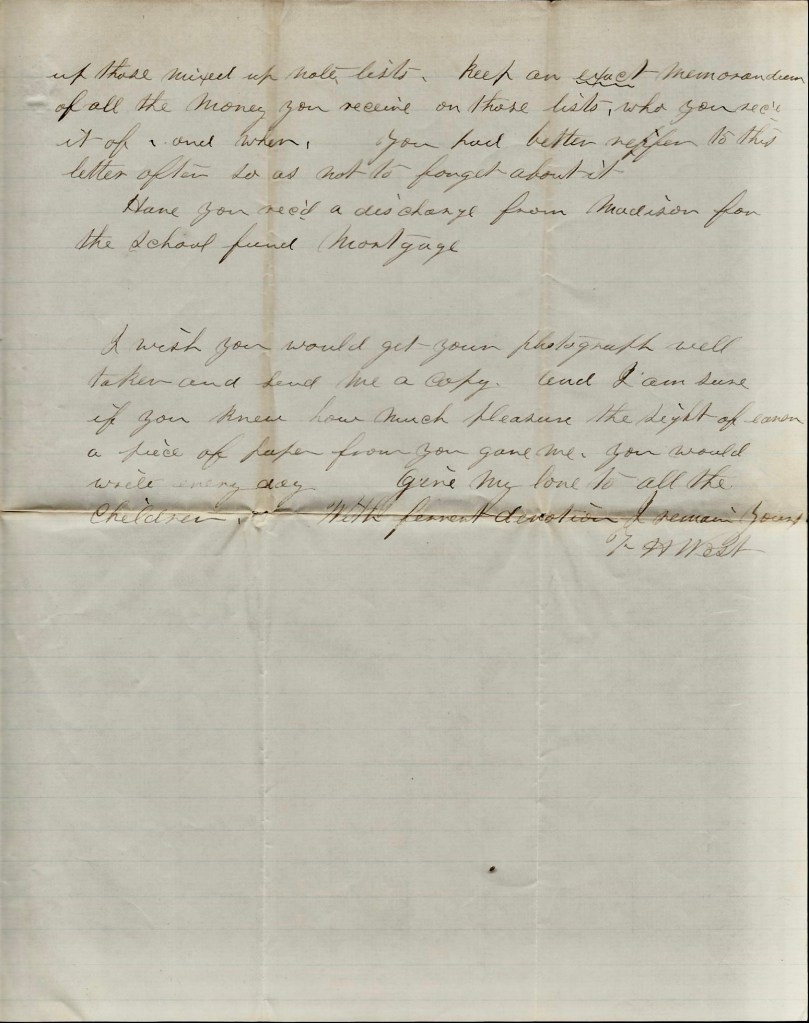
I want you to keep me well posted up on your money matters and get that note taken up at the Bank as soon as possible. You will have to go personally to see about it and make no delays in any business transactions. You also want to see Mr. Rood frequently and keep posted up as to how he gets along collecting. Mr. Carpenter left notes with different parties in the mines to collect and send the money to the Bank. See if they are sending in any money and be careful not to make any mistake in settling up those mixed up note lists. Keep an exact memorandum of all the money you receive on those lists, who you received it of and when. You had better refer to this letter after so as to not to forget about it.
Have you received a discharge from Madison for the school fund mortgage?
I wish you would get your photograph well taken and send me a copy. And I am sure if you knew how much pleasure the sight of even a piece of paper from you gave me, you would write every day. Give my love to all the children. With fervent devotion, I remain yours, — F. H. West
Letter 5
Columbus, Kentucky March 17, 1863
My dear wife,
I received yours of the 9th last night. Was very glad to hear that you were well. We are getting along very quietly down here at present. The weather is very fine—only a little to hot for comfort. You may look out for some big news from down the river before many days. I do not believe we shall be allowed to “hand in.” This is probably the most healthy place on the river and on that account I would like to remain here. I hope you will have the shade trees fixed up in good shape this spring and also the vines and shrubbery. You had better have some maples set in place of those elms that are dead or else get some smaller open land elms. I do not see how you will get along without Mike.
Em, I wish you would write to Mother occasionally. I do not need anything to make me comfortable at present except the $50 draft I wrote you about & hope the children will write that promised letter.
I hope my dear wife you will not continue to feel so disconsolate. I am sure I never felt less like being killed in my life. You may depend upon it, I shall come out all right. — F. H. West
Letter 6
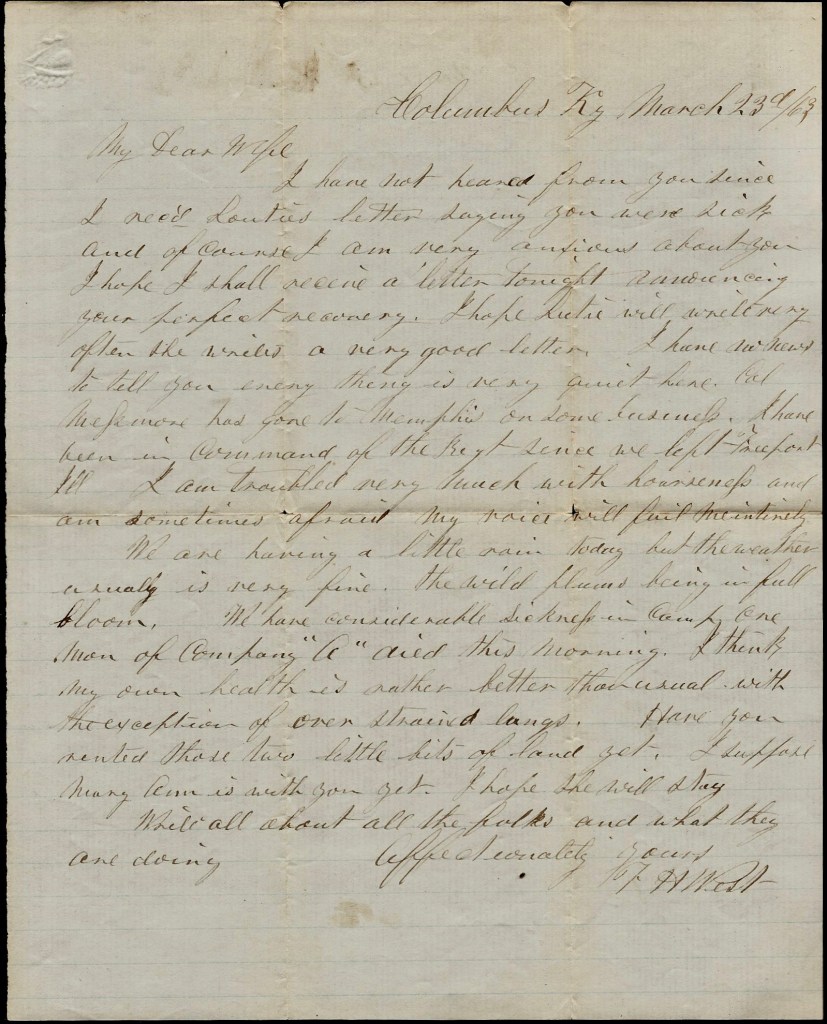
Columbus, Kentucky March 23rd 1863
My Dear Wife,
I have not heard from you since I received Loutie’s letter saying you were sick and of course I am very anxious about you. I hope I shall receive a letter tonight announcing your perfect recovery. I hope Lutie will write very often. She writes a very good letter.
I have no news to tell you. Everything is very quiet here. Col. Messmore has gone to Memphis on some business. I have been in command of the regiment since we left Freeport, Illinois. I am troubled very much with hoarseness and am sometimes afraid my voice will fail me entirely.
We are having a little rain today but the weather is really very fine, the wild plums being in full bloom. We have considerable sickness in camp. One man of Co. A died this morning. I think my own health is rather better than usual with the exception of over strained lungs.
Have you rented those two little bits of land yet? I suppose Mary Ann is with you yet/ I hope she will stay. Write all about all the folks and what they are doing. Affectionately yours, — F. H. West
Letter 7
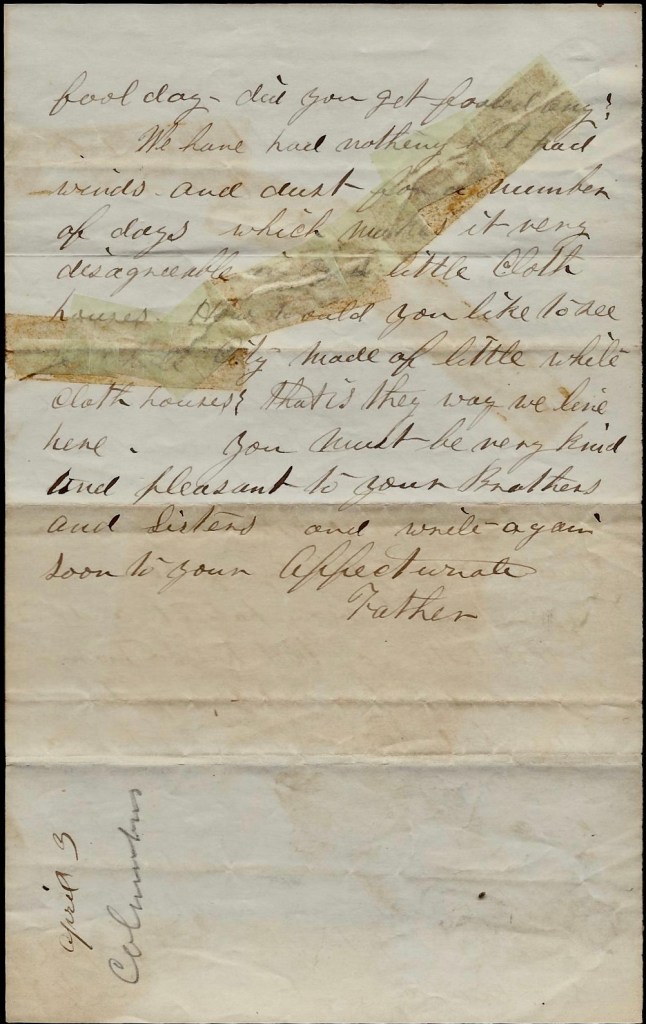
Columbus, Kentucky April 3rd 1863
My dear daughter Carrie,
I have just received your welcome letter of March 29th. I am glad to hear that you are taking music lessons and hope you will try and improve all you possibly can. I also expect you will learn to do all kinds of work so as to be of great help to your kind mother who has so much to do to take care of you.
You must be very patient and kind to that little boy that has so many teeth and take good care of him. I am glad you are going to have a nice garden. It makes one’s home so pleasant to have nice flowers and shrubbery. You will have to be very industrious and keep the weeds down. Do not let Dick (the rabbit) get away. I suppose you had a great time on April Fool Days. Did you get fooled any?
We have had nothing but bad winds and dust for a number of days which makes it very disagreeable in our little cloth houses. How would you like to see our hill city made up of little white cloth houses? That is the way we live here. You must be very kind and pleasant to your brothers and sisters and write again soon to your affectionate, — Father
Letter 8
Columbus, Kentucky March [April] 5th 1863
My dear wife,
I have just received yours of April 1st. You seem to be getting along first rate for which I am very glad. We have had a little excitement in the way of a small scare, but it has about all blown over. Night before last it was reported that a large force were attacking Hickman twenty miles from here. I was ordered to have my men ready with ammunition and rations to start on a moment’s notice for the scene of action. I got them ready and have held them so since, but have had no orders to leave. I think it all a false alarm.
We occasionally lose a man by sickness. We buried one today but generally the health is good. I understand that the remainder of the 22nd have been captured. Have you learned what became of Capt. [James] Bintliff? 1
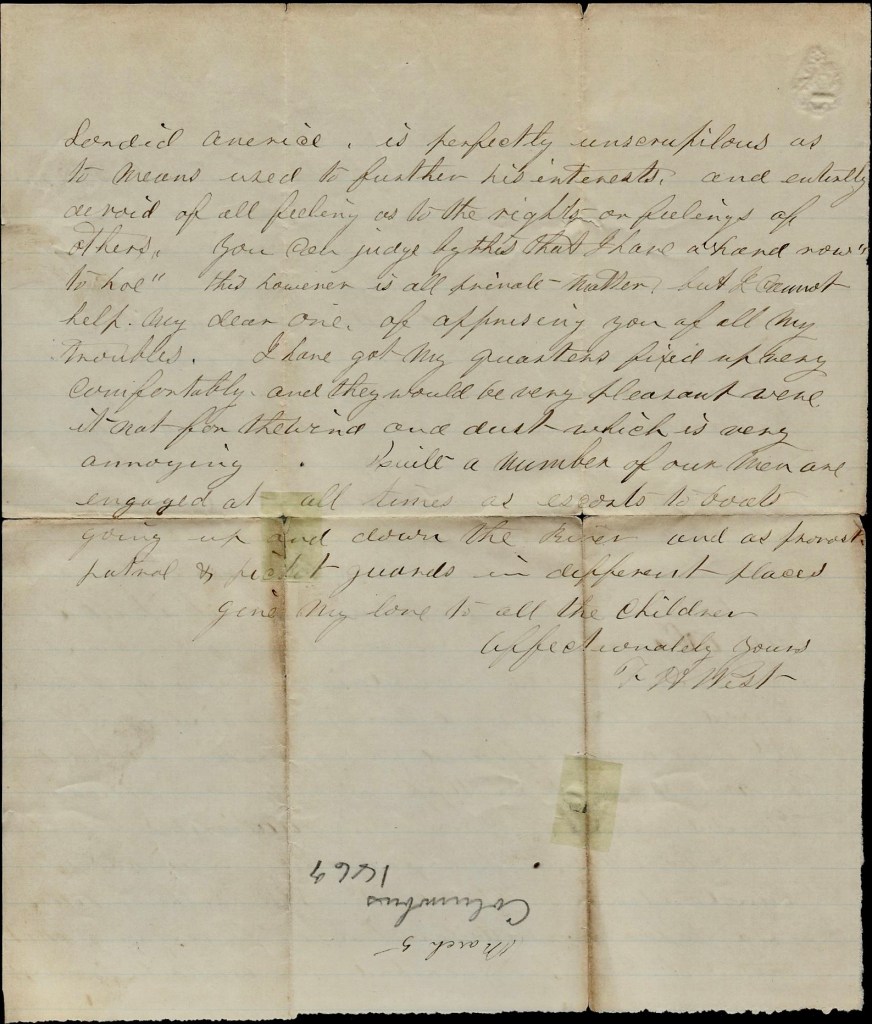
I am very unpleasantly situated in this regiment owing the peculiarities of our Colonel [Isaac E. Messmore] but I have stood it so far and am in hopes I can continue to stand it. He has the ambition of a Napoleon with ten times the jealousy that Old Dr. Fisher ever had, together with the most sordid avarice. He is perfectly unscrupulous as to means used to further his interests and entirely devoid of all feeling as to the rights or feelings of others. You can judge by this that I have a hard row to hoe. This, however, is all private matter but I cannot help, my dear one, of apprising you of all my troubles.
I have got my quarters fixed up very comfortably and they would be very pleasant were it not for the wind and dust which is very annoying. Quite a number of our men are engaged at all times as escorts to boats going up and down the river and as provost patrol and picket guards in different places.
Give my love to all the children. Affectionately yours, — F. H. West
1 The 22nd Wisconsin saw action at Thompson’s Station March 4–5, 1863 where nearly 200 of the regiment were captured by Bragg’s Cavalry forces under Van Dorn, nearly 18,000 strong. The regiment was then ordered to Brentwood Station on March 8. They saw action at Little Harpeth, Brentwood, on March 25 where the remainder of the regiment were surrounded and surrendered to Nathan Bedford Forrest. They were exchanged May 5, 1863.
Letter 9
Columbus, Kentucky April 9th 1863
My dear wife,
It is five or six days since I have had a letter from you. I am sorry you are getting negligent about writing. I learn that the scarlet fever is prevailing at Monroe. I hope our family will escape. Mrs. Messmore & Mrs. Mason came down yesterday and have gone to keeping house in a fine large house that is in the fort. If it was not for leaving so many children at home, you could come down here and stay as well as not. It is not over two days travel from Monroe and a very accessible place. Everything is very quiet in this part of the country at present and we are having a very dull time.
We were paid off yesterday up to the first of March. Enclosed I send you Paymaster’s draft for $300 payable to the order of Ludlow Bingham & Co. Take it down to them and have them give you credit for it. You can certainly take up that note now. It being a government draft, it does not need to have any stamp on it. We are having plenty of wind and dust as usual. I am getting so black and dirty you would not know me from an Indian.
Affectionately yours, — F. H. West
Letter 10
Fort Halleck Columbus, Kentucky April 18th 1863
My dear little daughter Edith,
I was very much pleased last night to receive a letter from you. Your describing Freddie as such a funny little boy makes me feel homesick. I would give a good deal to see the saucy little fellow “toddling” around.
I am delighted to hear that Willie is such a nice, industrious boy. He shall have a nice gentle little saddle pony as soon as he gets large enough to take care of him. What does George fin to busy himself about? I suppose he and “Little Dame Crump” keep very busy about something. I hope you make yourself as agreeable and useful as possible as I have no doubt you do. Are you and Mrs. Mosher as good friends as ever?
The weather is very nice and warm here. The trees and shrubs are in full foliage and there are many and beautiful flowers. I think you would like to live here very much. We have chased all the rebels away from here so we do not have any fighting to do at present. We have about two hundred of them that we have captured from time to time shut up in our prison here and a sorry looking set of fellows they are.
Your affectionate father.
Letter 11
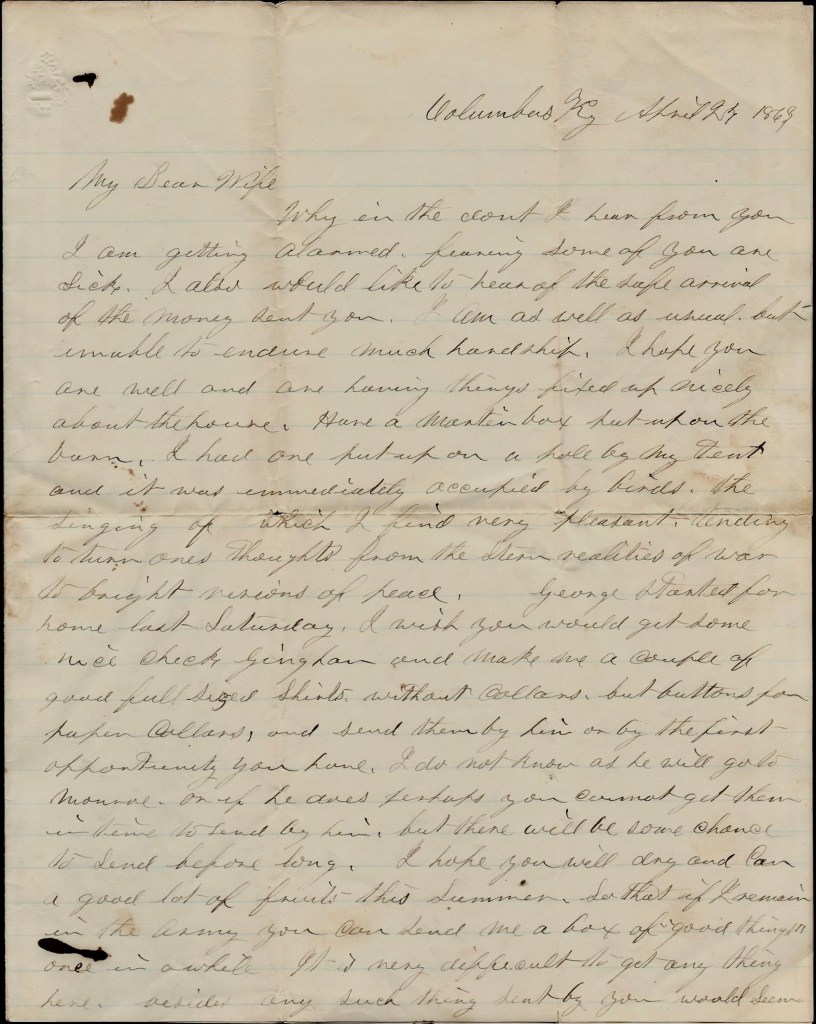
Columbus, Kentucky April 27 [25], 1863
My dear wife,
Why in the [ ] don’t I hear from you. I am getting alarmed, fearing some of you are sick. I also would like to hear of the safe arrival of the money sent you. I am as well as usual but unable to endure much hardship. I hope you are well and are having things fixed up nicely about the house. Have a martin box put up on the barn. I had one put up on a pole by my tent and it was immediately occupied by birds, the singing of which I find very pleasant, tending to turn one’s thoughts from the stern realities of war to bright visions of peace.
George started for home last Saturday. I wish you would get some nice check[ed] gingham and make me a couple of good, full-sized shirts without collars, but buttons for paper collars and send them by him on the first opportunity you have. I do not know as he will go to Monroe or if he does perhaps you cannot get them in time to send by him, but there will be some chance to send before long. I hope you will dry and can a good lot of fruits this summer so that if I remain in the Army you can send me a box of good things once in awhile. It is very difficult to get anything here. Besides, any such thing sent by you would seem much better.
Sunday morning, 26th
I have just received yours of the 21st and feel much relieved. I was getting very uneasy knowing that there was much sickness at Monroe. Do not fail to have the Monroe Sentinel sent to me regularly.
I judge by your letter that you received the $300 although you do not say so as you should have done if you received it. I wish you would send your letters to the office as soon as written. I see that many of them are not mailed for two or three days after they are written.
My proposition to the Dutchman is simply this—he can have the 30 acres by paying $300 down in money and $100 a year for three years with seven percent interest, interest payable annually. The last $300 to be secured by mortgage on the land.
I spent a very pleasant day in the country yesterday. The ten captains of the regiment, Mr. Bartlett and myself, took some saddle horses and ambulances and went out to Clinton, the county seat of Hickman County where the 21st Missouri Regiment are stationed and spent the day getting a good dinner at a Secesh hotel, the landlord of which had an arm shot off while in the rebel army at the Battle of Shiloh. The country about Clinton is beautiful but the inhabitants are the most wretched, shiftless, worthless looking set of white beings I ever saw. They do not seem to be one degree above the idiotic, ragged negroes who are loafing around in perfect swarms doing nothing. A large share of the farms are remaining uncultivated and everything going to destruction. — Frank
Letter 12
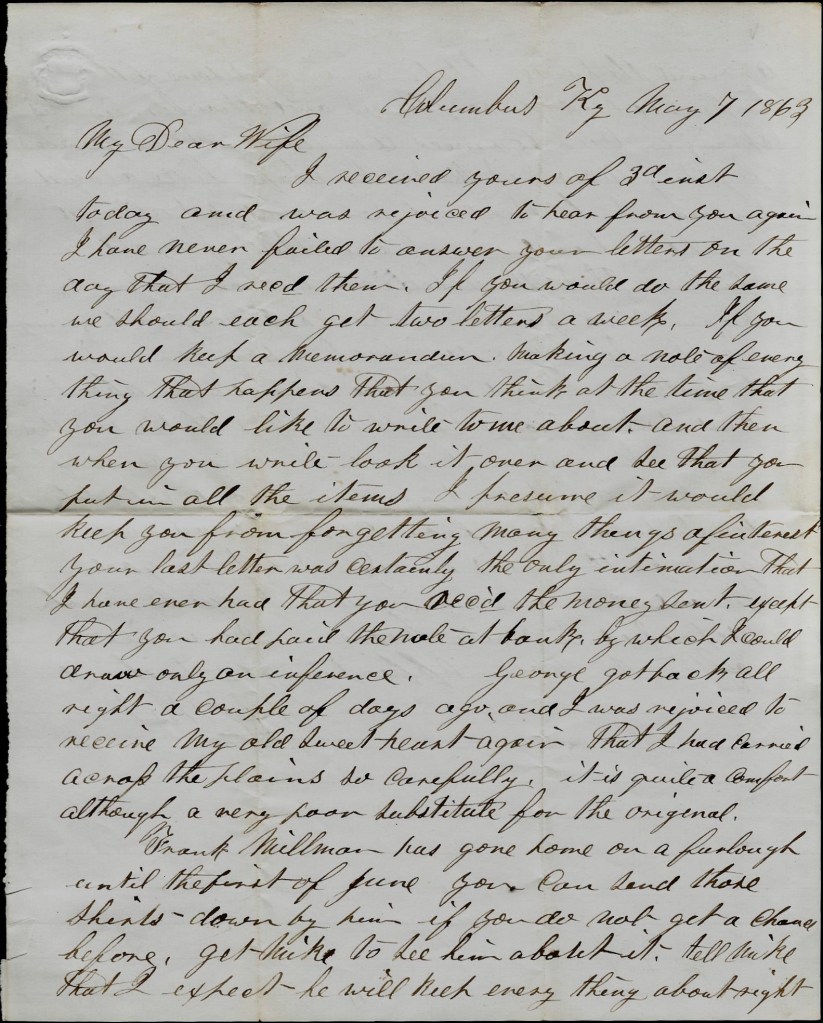
Columbus, Kentucky May 7, 1863
My Dear Wife,
I received yours of 3rd inst. today and was rejoiced to hear from you again. I have never failed to answer your letters on the day that I received them. If you would do the same, we should each get two letters a week. If you would keep a memorandum making a note of everything that happens that you think at the time that you would like to write to me about, and then when you write, look it over and see that you put in all the items, I presume it would keep you from forgetting many things of interest. Your last letter was certainly the onl intimation that I ever had that you received the money sent except that you had paid the note at bank by which I could draw only an inference.
George got back all right a couple of days ago and I was rejoiced to receive my old sweet heart again that I had carried across the plains so carefully. It is quite a comfort although a very poor substitute for the original.
Frank Millman has gone home on a furlough until the 1st of June. You can send those shirts down by him if you do not get a chance before. Get Mike to see him about it. Tell Mike that I expect he will keep everything about right around the house. I hope you will get some of the improved kind of raspberries and strawberries this spring.
Our armies are doing some glorious fighting now. It makes me chafe like a caged hyena to be tied up here and not allowed to take a hand in [it]. I am still of my old opinion that the rebellion will be broken by the first of June.
We have had very cold, rainy weather for a few days back. Have you written to Mother yet? And what are Joe and Ellen about? And how is George Campbell suited with his new place?
We have just heard the terrible news of hooker’s defeat, contrary to our expectations. I can hardly keep from crying. I had such great faith in his success. What in God’s name are we coming to? I am too much depressed to write more. Do write often to your affectionate husband, — F. H. West
Letter 13
Columbus, Kentucky May 13, 1863
My Dear Wife,
I have not written you for some time for the simple fact that I do not have a thing new to write about. The conflicting war news has kept us somewhat excited lately. Yesterday nearly everybody got drunk on the strength of Richmond’s being taken and so it goes. I am on detached service at present, being detailed on a general court martial in session in this place. It will probably occupy us for some time, during which time I have nothing to do with the regiment.
I am moving my quarters today into a couple of quite comfortable log houses. If it were not for the fleas, mosquitoes, heat, dust, and various other annoyances, I should be in favor of your coming down here. As it is, you are certainly much better off at home although it would be a great comfort to me to have you here. There are seven or eight of the officers’ wives here but it is rater a sorry place for them to stay. I received a letter from Fred today. He talks of coming down here soon.
I received a letter two or three days since. Will answer it soon. I hope little Freddy has got well by this time. Give my love to all the children and tell the boys I will write them a letter some day. — Frank
Letter 14
Columbus, Kentucky May 18, 1863
My Dear Wife,
As I was eating breakfast this morning thinking what a pleasant house I had, I made up my mind that I must send for you. Just then an orderly came in with your very kind letter of the 10th in which you say you wish to come. You must stay here at least three or four weeks. If Mary will keep house for you, everything will go on just as well as though you were at home. The only trouble will be that you will get sick and tired of staying in this God-forsaken place before you have been here three days and I shall not enjoy your visit so much as I otherwise should knowing how sick you are. Some of the ladies here ride on horse back and some take rides out into the country in ambulances (a kind of stage) and I suppose manage to kill time some way.
Mrs. Capt. Burdick with two little children stops next door to me. The log huts are all close together and there is not a spear of grass to be seen from one of them. I have one large square room for office and sleeping room, and a room across the street for a dining room with a cook and wash room attached. Here my ostler and his wife—a very nice young woman from Darlington—stop, she doing the cooking and washing.
I do not want you to bring any of the children with you. You cannot bring any more than baggage enough for yourself and I want you relieved from all care of children once just to see how it will seem. And I want you to be able to pay proper attention to your own personal appearance which you will not have time to do if you have to rig out children. Besides, we cannot afford the expense of bringing any of the children. The fare down and back for yourself will be about forty dollars.
If you will get Fred to take you to Freeport, you could there take the cars through for Cairo without change of cars or stops. and I would meet you there when we could have a pleasant boat ride down here. Perhaps Fred is coming down and you can coe with him. I must now all about when and how you are going to start and which way you are going so as to make calculations accordingly and you must be sure and be up to time.
I think you had better come soon before the weather gets very warm. I suppose Freddie is old enough to get his own living now. You can start just as quick as you are a mind to—only write at least four days beforehand all about your starting. I hope you will come immediately while there are so many other ladies here. Stop in Cairo at the St. Charles Hotel (don’t forget this).
With unbounded affection, I remain as ever your devoted husband, — F. H. West
Letter 15
Columbus, Kentucky Sunday, May 24, 1863
Dear Wife,
I have just received your very cool reply to my letter of invitation to you to come down here and am very much disheartened that you are not coming immediately to see me. You say you do not know as you have given me any encouragement that you would come. I will give an exact quotation from your letter which I certainly took as encouragement, “If you cannot come home, I must come and see you.” It is quite certain that I shall not be able to go home until after the war. We have not got long to live anyway and we might as well enjoy ourselves as much as possible while we do live. And I know of nothing that would afford me so much pleasure as a visit from the person that I love more than all the world. Besides, I had taken a great deal of pains and got everything fixed up as nice as possible to make your visit pleasant. And I am so disappointed that you are not coming.
I am going to send George to Cairo tomorrow thinking that possibly on the receipt of my other letter, you may have changed your mind and started. As for the mumps, they never hurt children. You might as well wait because one of them had caught a louse.
We have news that Vicksburg is captured with forty thousand prisoners but dare not believe it at all yet. If it should prove true, which God grant, it will pretty much end the rebellion.
All the ladies of the camp with their husbands have gone out to the woods today to have a picnic. I presume they will have a fine time. I am having a very lonesome day of it all alone. I wish you could have been here to have gone also.
Mrs. Capt. Rogers is going to start down on Monday the first day of June. She will take the cars at Warner so as to leave Freeport on the evening train Monday. Perhaps you can come then. If so, write instantly. Capt. Rogers would have her go by Monroe if there was any such arrangement.
I had supposed that this was quite a healthy place but it is not. It has the reputation of being one of the most sickly places in the South. We have over a hundred sick all the time. I am some afraid to have you come down on that account. It is also the reason I am anxious to see you come early in the season. I wish you would be more particular in dating your letters and not put on simply “April” or “May” as I always want to know what day they are written.
Your affectionate husband, — F. H. West
Letter 16
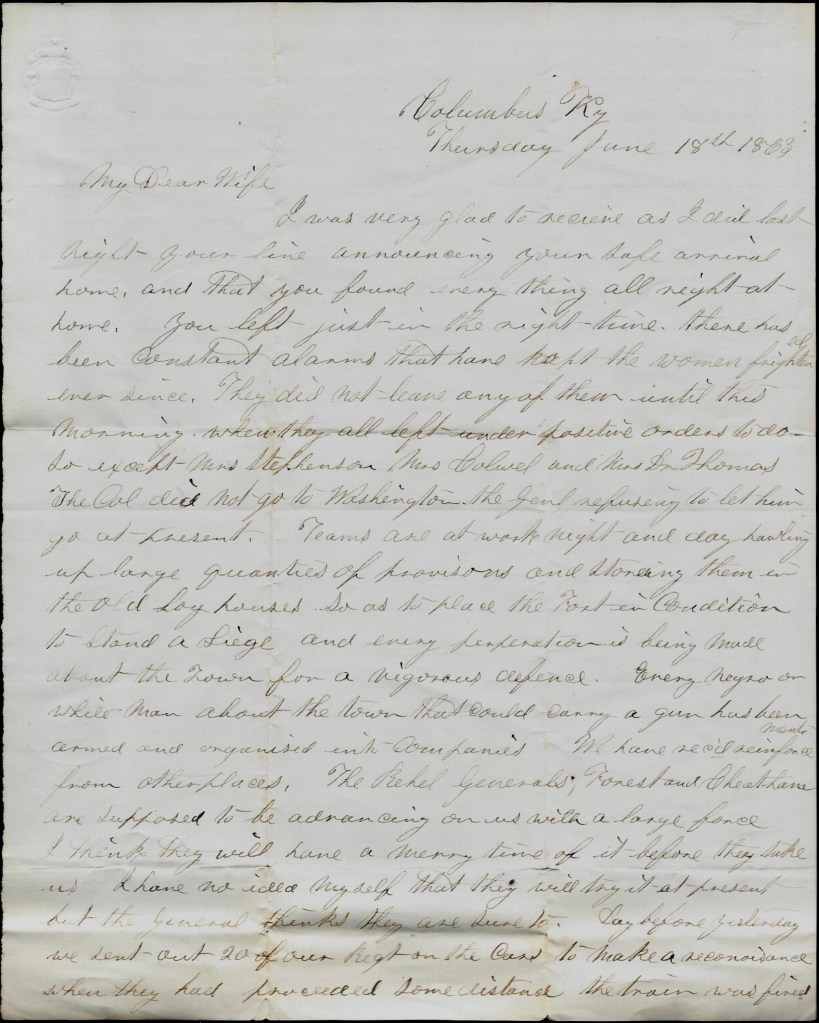
Columbus, Kentucky Thursday, June 18, 1863
My Dear Wife,
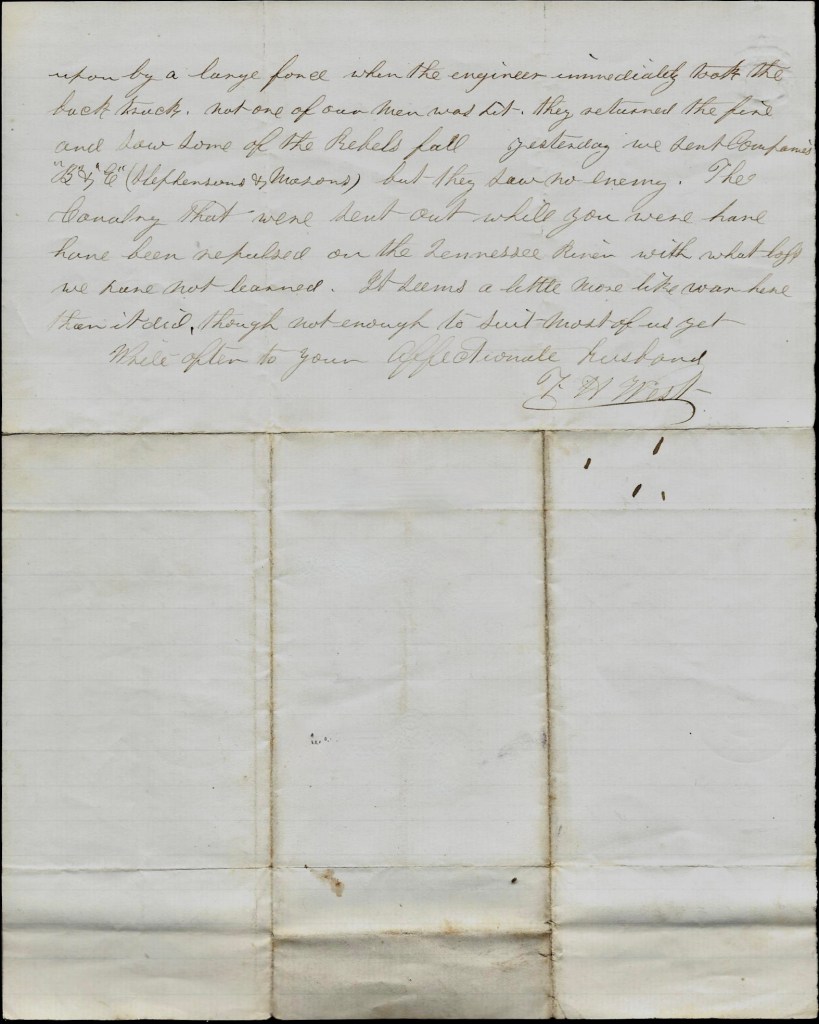
I was very glad to receive as I did last night your line announcing your safe arrival home and that you found everything all right at home. You left just in the right time. There has been constant alarms that have kept the women frightened ever since. They did not leave any of them until this morning wen they all left under positive orders to do so except Mrs. Stephenson, Mrs. Colwel and Mrs. Dr. Thomas. The Colonel did not go to Washington, the General refusing to let him go at present. Teams are at work night and day hauling up large quantities of provisions and storing them in the old log houses so as to place the fort in condition to stand a siege and every preparation being made about the town for a vigorous defense. Every negro or white man about the town that could carry a gun has been armed and organized into companies. We have received reinforcements from other places.
The rebel generals Forrest and Cheatham are supposed to be advancing on us with a large force. I think they will have a merry time of it before they take us. I have no idea myself that they will try it at present but the general thinks they are sure to. Day before yesterday we sent out 20 of our regiment in cars to make a reconnaissance. When they had proceeded some distance, the train was fired upon by a large force when the engineer immediately took the back track. Not one of our men was hit. They returned the fire and saw some of the rebels fall. Yesterday we sent Companies B & E (Stephenson’s and Mason’s) but they saw no enemy. The cavalry that were sent out while you were here have been repulsed on the Tennessee river with what loss we have not learned. It seems a little more like war here than it did, though not enough to suit most of us yet.
Write often to your affectionate husband, — F. H. West
Letter 17
Columbus, Kentucky Saturday, June 27, 1863
My Dear Wife,
I have just received yours of the 21st inst., the anniversary of all my past happiness and future joys. I am glad your visit to me is pleasantly remembered. I was fearful it would be otherwise. I was quite unwell for about a week since you were here but am feeling better now than I have done for a long time. Major Olmstead of the 27th Wisconsin is lying very sick in Col. Messmore’s quarters. I think he will die. We sent for his wife today.
It has rained nearly all the time for a week. I wish you had some of it in Wisconsin. Everything is very quiet here just now. We sent another expedition out to look for rebels day before yesterday but they all “skedaddled” on the approach of our boys. They ascertained that our boys of the first expedition in returning their fire killed a captain and one man of the rebel party.
I would like to have seen Edith representing an angel. I think she would come about as near a perfect representation as anything they could be got up on earth. I wonder you did not have “little George” representing a cupid. What part did Lou & Carried take?
You do not say a word about the collecting business. How is Mr. Carpenter getting along with it? You must look out for it sharply all the time. Also look after that Roberts and C__ Murphy notes and save every cent you get so that I can have money enough to start business with in Chicago when I get out of the army, if I want to, and I believe I will if we can sell out in Monroe.
We are going to have a great celebration here on the Fourth [of July]. I hope we can celebrate the fall of Vicksburg at the same time. I am glad the rebels are changing around a little in Pennsylvania. I am in hopes they will stir some of the Copperheads of the North up to a lively sense of their duty.
Did the trees live that Mike set out this spring? I have got my gray horse yet. I wish I could send him home for carriage horse for you. I am under the impression that we shall not remain in this but a very short time longer. We are all very anxious to get away. As ever, — Frank
Letter 18
Columbus, Kentucky Sunday, June 28, 1863
Dear Wife,
I have just received yours in pencil of last Monday, I am surprised at the perfect fright you seem to be in. Everything is perfectly quiet here now. The Rebels never will occupy this place by force of arms again. As for general apprehension, I see no cause for it at all. In less than three months I believe we shall have driven out or captured every thing in the shape of a large force west of Georgia and the Alleghany Mountains and if the people of the middle and eastern states cannot take care of what is east of these, they are to be pitied. I am far from being discouraged at present.
As for our own regiment being mustered out, that is all a humbug. It is well understood here that it is the best drilled and best disciplined regiment in this district. Things are just as pleasant as every about headquarters. I have been compelled to put Lt. Lewis under arrest for disorderly conduct towards myself. It is generally believed in the regiment that he was instigated by the Colonel.
We are expecting to be sent down the river somewhere tomorrow but have got no orders yet. I shall not send this until I ascertain whether it is so or not. I hope you will continue to be scared if that will make you write very often.
Monday. I have just received yours of last Tuesday. You speak of our own dear little pet boys. Tell them their father expects them to be nice good boys. We have not got any marching orders yet although boats are still held here to take us off if necessary. We are expecting to go down to New Madrid to repel Price who is reported advancing on that place. It is probably all a scare. I still think we shall leave here for some place soon. I am sure I don’t care how quick. I hope you will not worry yourself on my account, my dear kind wife, for I am sure I shall come out all right.
Do the girls improve any in playing on the piano? I am going to write to Lou to see if you continue to wear your curls. If you do not, I shall make a fuss. With the most abiding affection, I remain devotedly yours, — F. H. West
We continue to have heavy showers and it is getting very muddy. I have got no money and unless I can sell y grey horse in a day or two, must send for some. Have you got any on hand?
Monday night. Everything all quiet. No prospect of getting away immediately. No letter from you tonight.
Letter 19
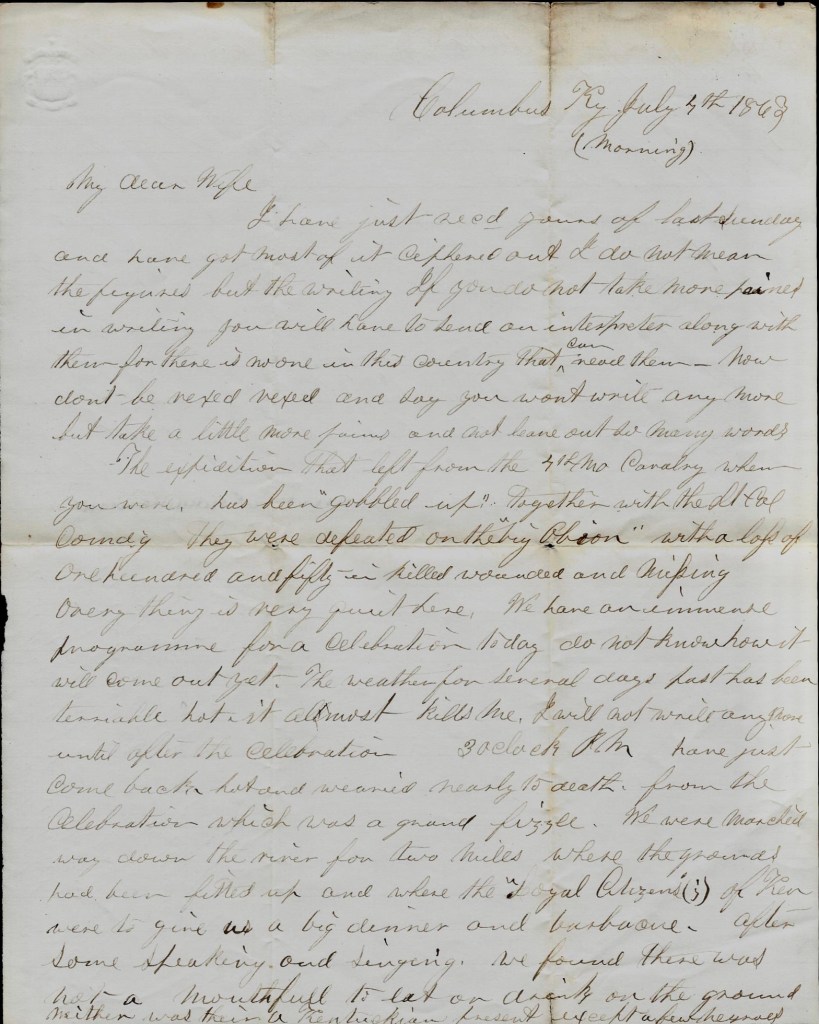
Columbus, Kentucky July 4th 1863 (morning)
My dear wife,
I have just received yours of last Sunday and have got most of it ciphered out. I do not mean the figures but the writing. If you do not take more pains in writing, you will have to send an interpreter along with them for there is no one in this country that can read them. Now don’t be vexed and say you won’t write anymore but take a little more pains and not leave out so many words.
The expedition that left from the 4th Mo. Cavalry when you were here has been “gobbled up” together with the Lt. Col. commanding. They were defeated on the “Big Obion” with a loss of one hundred and fifty in killed, wounded, and missing.
Everything is very quiet here. We have an immense program for a celebration today. Do not know how it will come out yet. The weather for several days past has been terrible hot. It almost kills me. I will not write any more until after the celebration.
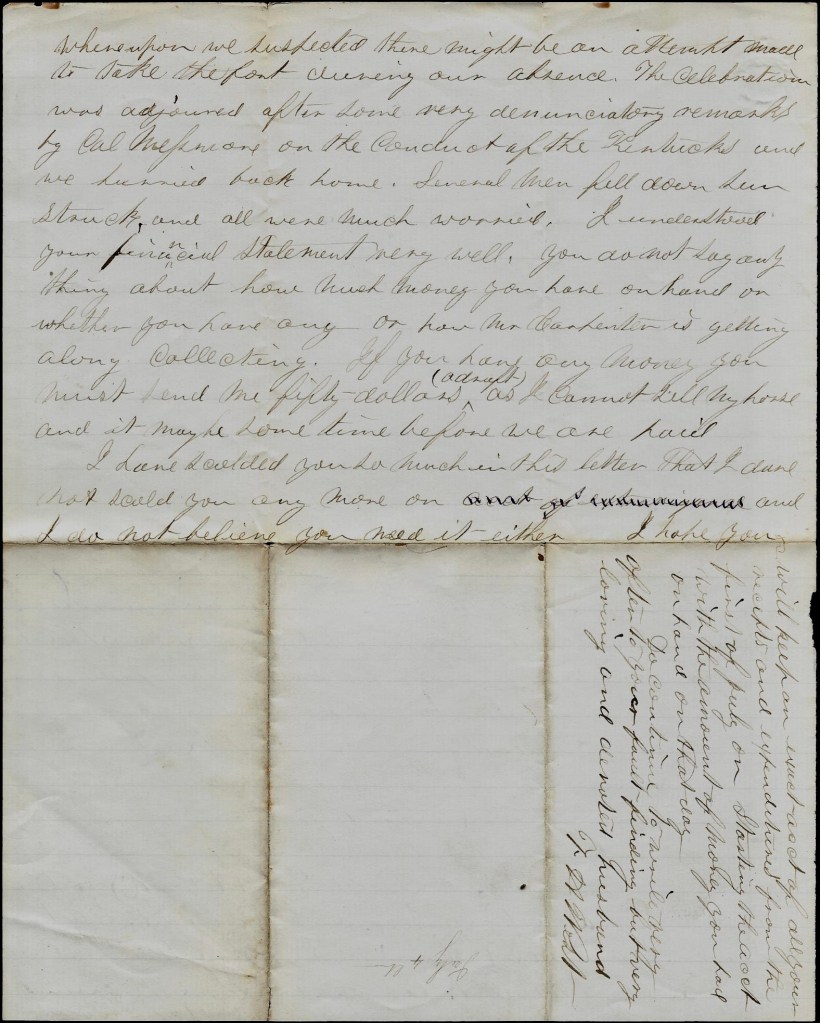
3 o’clock p.m. Have just come back, hot and wearied nearly to death from the celebration which was a grand fizzle. We were marched way down the river for two miles where the grounds had been fitted up and where the loyal citizens of Kentucky were to give us a big dinner and barbeque. After some speaking and singing, we found there was not a mouthful to eat or drink on the ground. Neither was there a Kentuckian present except a few negroes whereupon we suspected there might be an attempt made to take the fort during our absence. The celebration was adjourned after some very denunciating remarks by Col. Messmore on the conduct of the Kentucks and we hurried back home. Several men fell down sun struck and all were much worried. 1
I understood your financial statement very well. You do not say anything about how much money you have on hand or whether you have any or how Mr. Carpenter is getting along collecting. If you have any money, you must send me fifty dollars (a draft) as I cannot sell my horse and it may be some time before we are paid.
I have scolded you so much in this letter that I dare not scold you anymore and I do not believe you need it either. I hope you will keep an exact account of all your receipts and expenditures from the first of July on, starting the account with the amount of money you had on hand in that day.
Do continue to write very often to your fault-finding but very loving and devoted husband. — F. H. West
1 In the diary of Corp. John Sine of Co. F, 31st Wisconsin, his entry for the 4th of July stated: “Attended celebration at Columbus, Kentucky, today. Speech by Col Messmore did not amount to much. Got back to camp a little after noon. Very hot today.”
Letter 20
Columbus, Kentucky July 5, 1863
Dear Wife,
Owing to a change in post quartermasters, I have been called upon to pay for the horse that I bought immediately. You must send me a hundred as soon as possible (a New York draft). We have not been paid off yet. I have about one thousand dollars due me from the government and individuals in the regiment which I am in hopes to get soon. It is so much hotter than it has ever been before. I am sorry I have ever said anything about warm weather. It is terrible now.
No letter from you yet. Make some arrangement for the money at the bank if you have not got it. In haste, — Frank
Letter 21
Columbus, Kentucky Sunday, July 5th 1863
My Dear Em,
Although I mailed a letter to you this morning written yesterday, I cannot resist the desire to write you a line today, I am so lonely since you left and think of you so much as the only real true sympathetic friend I have on earth, It does seem too bad that we cannot remain together. The time seemed so short when you were here and so long since you left.
My situation continues to get more unpleasant (if possible) than ever. Unfortunately there seems to be entirely too few officers in the army that seem to have any appreciation for honor, honesty, or even decency. Still I have no thoughts of anything but “standing my hand” until the end. Everything seems to be on the move now and there certainly can be no complaints of inactivity on the part of the army at present and it seems as though the present crisis must result favorably for us. I hope, my dear pet companion, you will write me very kind and very frequent letters I hope.
Give my love to our dear little children and learn them to think a great deal of their papa. Mrs. Thomas, Colwel, and Stephenson still remain in camp. Affectionately yours, — Frank
Letter 22
Columbus, Kentucky Thursday, July 9, 1863
Dear Wife,
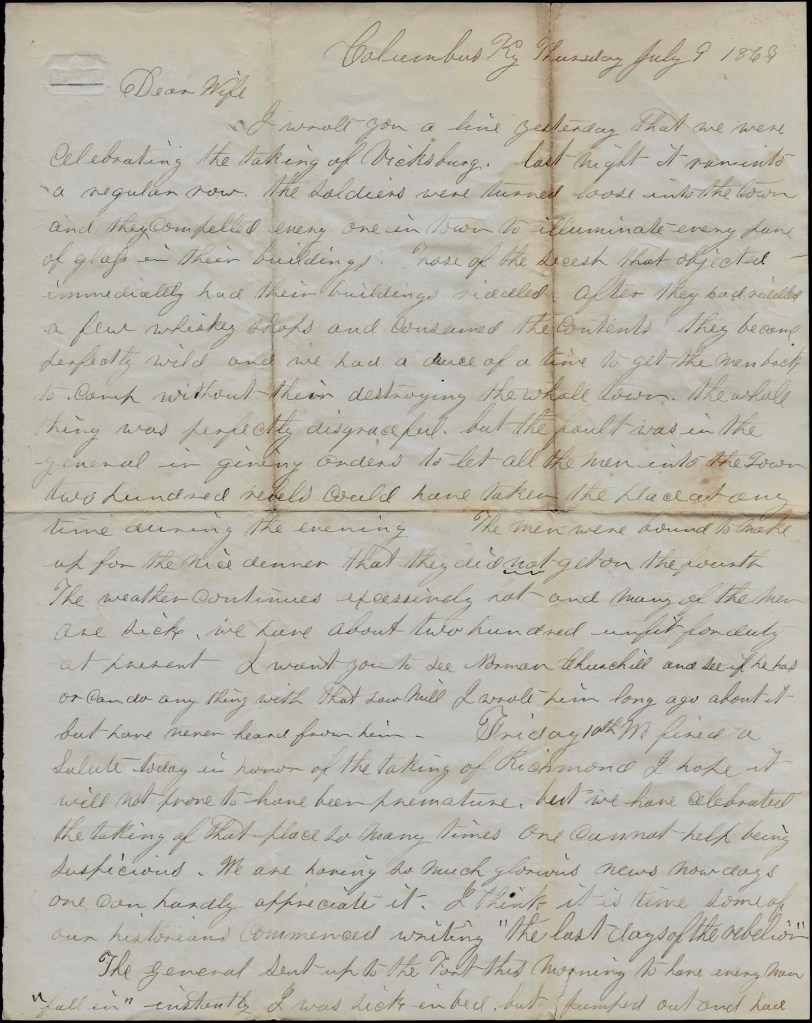
I wrote you a line yesterday that we were celebrating the taking of Vicksburg. Last night it run into a regular row. The soldiers were turned loose into the town and they compelled every one in town to illuminate every pane of glass in their buildings. Those of those of the Secesh that objected, immediately had their buildings riddled. After they had riddled a few whiskey shops and consumed the contents, they became perfectly wild and we had a deuce of a time to get the men back to camp without their destroying the whole town. The whole thing was perfectly disgraceful but the fault was in the general in giving orders to let all the men into the town. Two hundred rebels could have taken the place at any time during the evening.
The men were bound to make up for the nice dinner that they did not get on the fourth. The weather continues excessively hot and many of the men are sick. We have about two hundred unfit for duty at present.
I want you to see Norman Churchill and see if he has or can do anything with that sawmill. I wrote him long ago about it but have never heard from him.
Friday, 10th. We fired a salute today n honor of the taking of Richmond. I hope it will not prove to have been premature but we have celebrated the taking of that place so many times, one cannot help being suspicious. We are having so much glorious new now-a-days one can hardly appreciate it. I think it is time some of our historians commenced writing, “the last days of the rebellion.”
The general sent up to the Fort this morning to have every man “fall in” instantly. I was sick in bed but jumped out and had the long roll sounded and the men in fighting shape in short order. I was really in hopes we were going to have a “little brush” at last but was disappointed. The enemy not showing themselves, the 32nd Iowa were sent out to look for them and have not returned yet. We understand the Rebs have gobbled up two more companies of the 4th Missouri Cavalry. I wish they would let me after them with the 31st. I feel first rate since there was a prospect of a fight. It did me more good than a dose of medicine. I don’t think, however, that there is the slightest probability that they will attack this place. I have not heard from you since yours of July 1st. Why don’t you write?
2 o’clock Saturday morning. As I have to be up all night in command of the firt, I want to kill a little time in writing to you. I have just received yours of the 4th. Our whole force is standing to arms through the night expecting an attack. I do not think there is any danger of our being attacked here immediately, however. The general continues to send small squads out scouting who are not strong enough to sustain themselves and of course are captured.
The 32nd Iowa sent out today arrived too late to assist the two cavalry companies spoken of before. The Rebels killed or captured every man of them and had just left when our force got there as they were all mounted and 2,000 strong. Our force did not pursue them. This was at Union City out on the railroad 20 miles from here…
Letter 23
Columbus, Kentucky Sunday eve., July 12, 1863
Dear Em,
I did not think I would write to you again so soon but I could not get through the day without writing a few lines. We have had a great change in the weather today. It is as cold as Greenland. I think this is a terrible sickly hole. We have about two hundred sick and only one surgeon, Dr. Thomas. Dr. Galen has gone home sick. Dr. Mason left about the time you did and has not returned. The most interesting thing we have had today was a big “nigger” meeting on the bank of the river under our quarters. Nine of the black damsels were baptized in the river. They out did any Methodist meeting you ever saw in the way of shouting, clapping of hands, &c.
I received a short letter from Mother today. She sent her love to you.
We have five regiments of infantry here at present and a little cavalry and artillery, besides part of a negro regiment. Everything is all quiet. I believe the general intends fitting out an expedition for the interior in a day or two. I hope he will send me out.
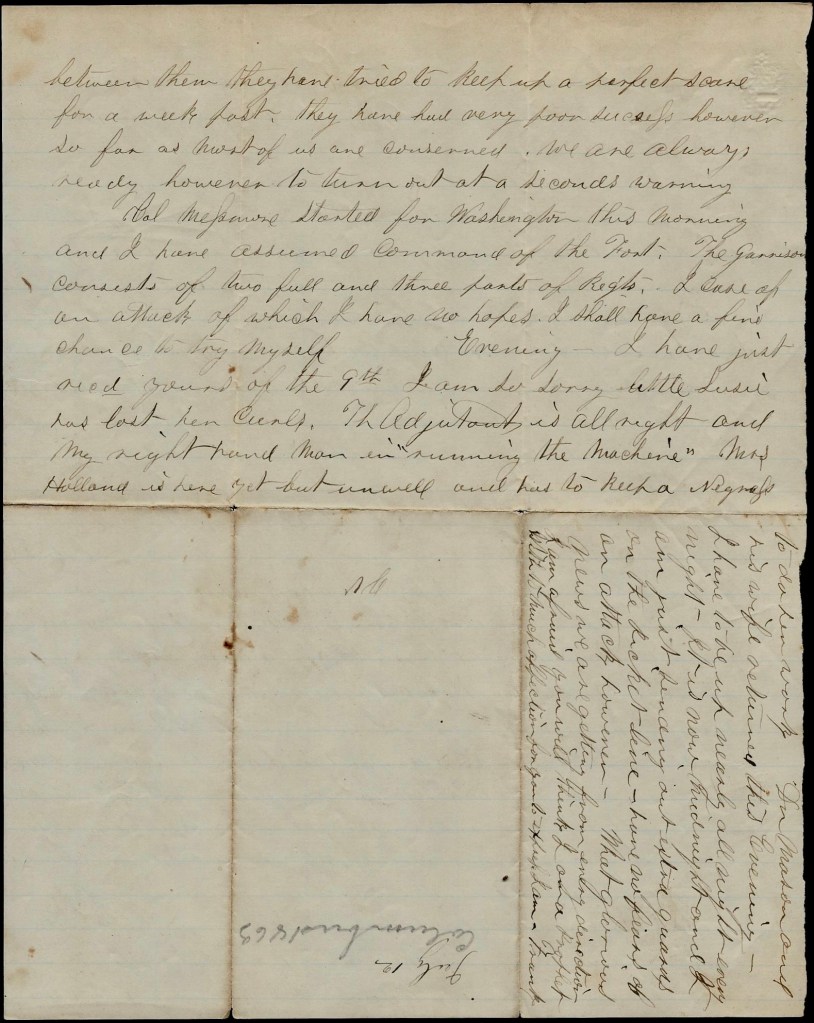
Wednesday, July 15th. We have not been “gobbled” yet expect by fleas, and they have done about annihilated me. To every one that was here when you were here, there is now a hundred. Our men are pretty worn out by being called out nights. The old general is very excitable and scary and everytime he hears of a rebel within twenty miles has us out under arms. Col. Messmore is still worse. Between them they have tried to keep up a perfect scare for a week past. They have had very poor success however so far as most of us are concerned. We are always ready, however, to turn out at a second’s warning.
Col. Messmore started for Washington this morning and I have assumed command of the fort. The garrison consists of two full and three parts of regiments. In case of attack—of which I have no hopes—I shall have a fine chance to try myself.
Evening. I have just received yours of the 9th. I am so sorry little Susie has lost her curls. The Adjutant is all right and my right hand man in “running the machine.” Mrs. Holland is here yet but unwell and has to keep a Negress to do her work. Dr. Mason and his wife returned this evening. I have to be up nearly all night every night. It is now midnight and I am just sending out extra guards on the picket line. Have no fears of an attack, however. What glorious news we are getting from every direction. I am afraid you will think I am a prophet. With much affection for you to express. I am, — Frank
Letter 24
Columbus, Kentucky Sunday, July 19, 1863
Dear Wife,
I received yours of the 12th last night. I forgot to acknowledge the receipt of the handkerchief sent in a newspaper. I suppose the reason I forgot it was that the handkerchief was so small. Since you left, I have roomed alone, the adjutant stopping with the Major. The Major has gone out to Union City today with four companies to see what he can find. THere are just reels enough a raiding around here to keep the general scared to death without being enough so that we can corner them and get up any fight. They are well mounted and in this timbered country it is impossible for infantry to catch them. They simply prowl around and “gobble” any small squad they can find away from the main force.
The weather is quite hot again but the sun does not affect me much as I have got so thin that it shines right through me without making any shadow. I do not know whether I shall be able to get a leave of absence i September or not. Field officers for duty are so very scarce here now, it will be difficult for me to get away.
I hope you will not get slack in money matters again. We must save some to commence business with when the war is over. If we do not get paid by the first of August, you will have to send me some money, but do not send only until I send for it.
Evening. The regiment has got back. No enemy found. Everything dull, hot and tedious. Affectionately yours, — Frank
Do write. Tell about the children and everything else.
Letter 25
Columbus, Kentucky September 8, 1863
My dear wife,
Yours of last Wednesday has been received. I am very glad that you can find time to write i the middle of the week. You say you were at a party “last night.” Why did you not tell me where it was and who was there and what was said and how the ladies were dressed and all about it? I am sure you might have written a very entertaining letter in that subject along.
The Fort headquarters are turned into a hospital. Dr. [Darius] Mason being sick in one room, the adjutant [James F. Suddith] in another, and the Major—who is very dangerously sick—in another. We telegraphed yesterday for his wife to come immediately. I went to bed day before yesterday not expecting to get up again for a month but it worked off in a fit of sick headache and I am all right again. The weather is as hot as it has been any time this summer.
Wednesday morning. The Major [William J. Gibson] has been given up by the surgeons. I fear he will die before his wife gets here. Still he may recover. The adjutant and Dr. Mason were sent to the Post Hospital this morning. Captains [Edward K.] Buttrick and [Edwin A.] Bottum and Lieuts. [George R.] Peck and Stevens were there before. I think none of them are dangerously sick. I have demanded a court of inquiry to investigate the conduct of the officers in relation to certain charges that have long been made by the enlisted men of the regiment. I have done this in order that the innocent, which includes a very large share of the officers, might be cleared of the stigma, as well as that the guilty—if there are any—might be exposed and punished. There is a terrible squirming among the very small Messmore clique.
It is thought that the Major has Yellow Fever. If so, we may expect a terrible scourging here before we get through with it.
Wednesday evening.
Another victim to this cursed rebellion. The Major is dead. He died at seven o’clock this evening. His wife has not arrived yet. He was a noble hearted man, greatly loved by the regiment who are now mourning. It is dark times for the 31st. I remain, my dear wife, as ever, — Frank
Letter 26
Columbus, Kentucky Wednesday evening September 16, 1863
My Dear Wife,
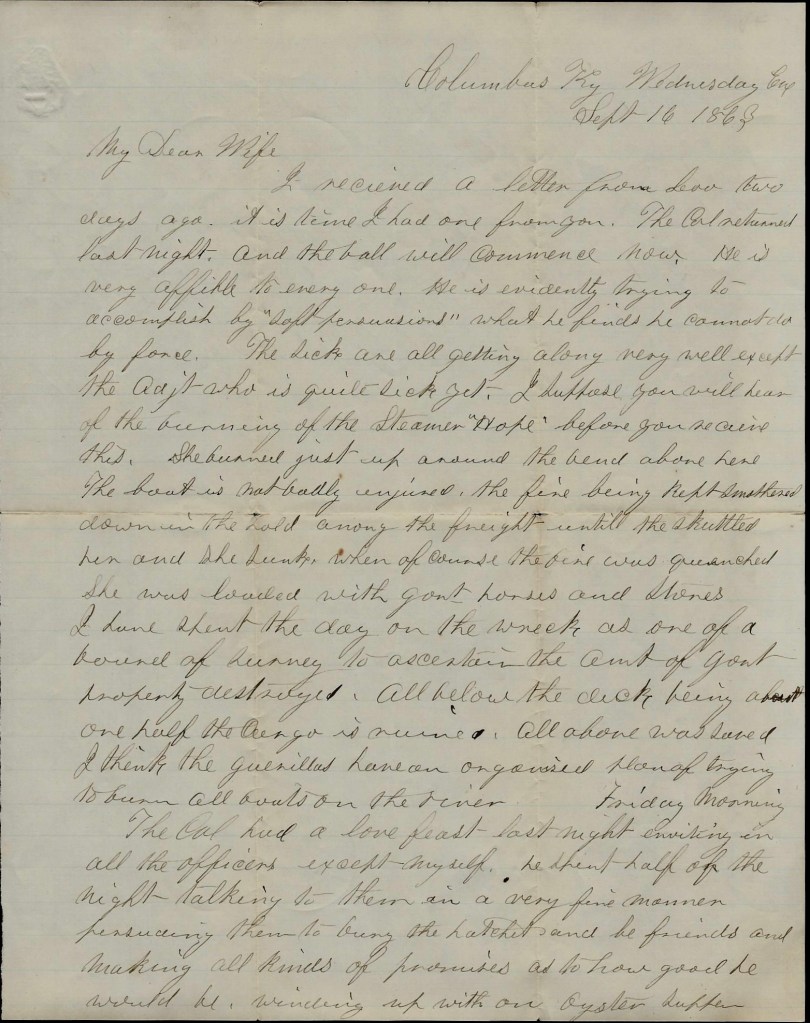
I received a letter from Lou two days ago. It is time I had one from you. The Col. returned last night and the ball will commence now. He is very affable to everyone. He is evidently trying to accomplish by “soft persuasions” what he finds he cannot do by force. The sick are all getting along very well except the adjutant who is quite sick yet.
I suppose you will hear of the burning of the steamer Hope before you receive this. She burnt just up around the bend above here and she sunk when of course the fire was quenched. She was loaded with government horses and stores. I have spent the day on the wreck as one of a board of survey to ascertain the amount of government property destroyed. All below the deck being about one half the cargo is ruined. All above was saved. I think the guerrillas have organized a plan of trying to burn all boats on the river.
Friday morning. The Colonel had a love feast last night inviting in all the officers except myself. He spent half of the night talking to them in a very fine manner persuading them to bury the hatchet and be friends and making all kinds of promises as to how good he would be, winding up with an oyster supper. He completely swallowed more than half of them (I mean the officers—not the officers). He said yesterday he was going to have me arrrested but has not done it yet. I am liable to get a leave of absence any time after the middle of next week although I do not much expect it, and if the Colonel can manage to trump up any charge as an excuse for having me arrested (which is doubtful), I cannot come home if I get one. However, you need not be surprised to see me at home any time after a week.
Affectionately yours, — F. H. West
Letter 27
Columbus, Kentucky Sunday, September 20, 1863
My Dear Wife,
I received yours of last Sunday on Friday morning immediately after having mailed a letter to you. It was all a humbug about there being any yellow fever in camp. It was only some virulent cases of jaundice. The health of the regiment continues about the same. Why did you not tell me something about what George did about the fanning mill business when he was out?
The prospect of my coming home has pretty much faded out. There is little doubt but what we shall be ordered to the front in a very short time but where to, I have no positive knowledge as yet. As I am the only field officer for duty, of course I would not leave if I could. I wish you were down here now to make me a visit while it is possible to do so but I think it is too late now. Still we may not get off for some time and I may possibly get a chance to go home.
In regard to that land, I do not think I would care to sell less than twenty acres together, however if I go home, I will see how it lies and if it takes all that the timber is cut off of I will let it go. Or you can ascertain and write about it. I am afraid that fifteen acres would not come down low enough to take all that is cleared. Give my respects to Mr. Rutledge when you see him. Also to Mr. Bloom and family. I suppose Allen has moved away.
The Messmore imbroglio has assumed a new feature today. Two days ago I preferred a series of very grave charges against him which entirely overwhelmed him. He has got down on all fours and crawled after me ever since. Today he plead ill health and physical inability to stand a trial and asked me to withdraw the charges and give him a chance to resign which he promised to do immediately and I have done so, but have no confidence in his word that he will do so if he can find any dodge to get out as I shall look after him very closely. 1
Write very often, my loved one, to your own, — Frank
1 In the diary of Corp. John Sine of Co. F, 31st Wisconsin, his entry for Sunday, September 20, 1863 read: “Col. I. E. Messmore made short speech today on dress parade. Said he was going to resign.“
Letter 28
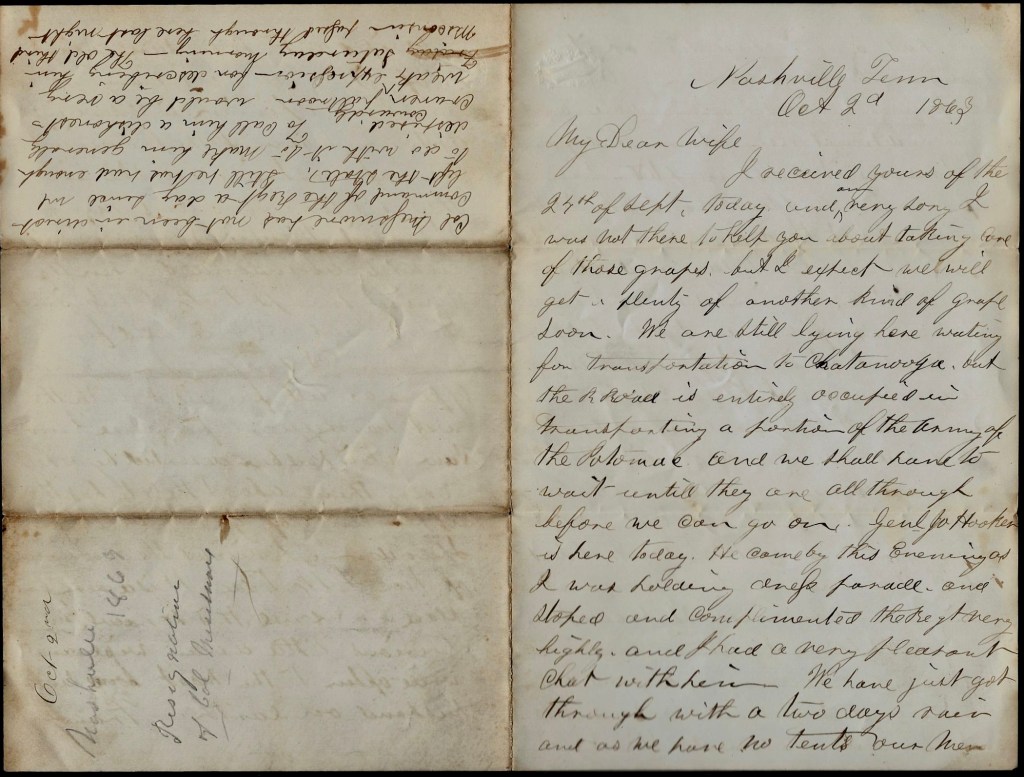
Nashville, Tennessee October 2nd 1863
My Dear Wife,
I received yours of the 24th of September today and am very sorry I was not there to help you about taking care of those grapes, but I expect we will get plenty of another kind of grape soon.
We are still lying here waiting for transportation to Chattanooga but the railroad is entirely occupied in transporting a portion of the Army of the Potomac and we shall have to wait until they are all through before we can go on. General Joe Hooker is here today. He came by this evening as I was holding dress parade and stopped and complimented the regiment very highly and I had a very pleasant chat with him.
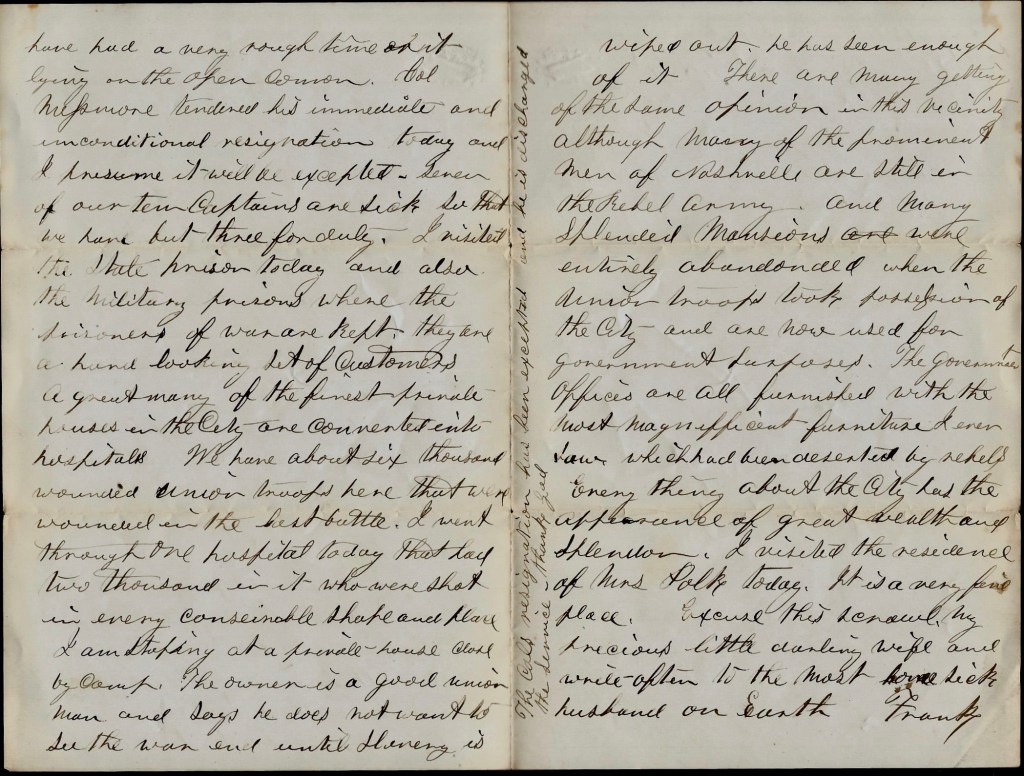
We have just got through with a two days rain and as we have no tents, our men have had a very rough time of it lying on the open common. Col. Messmore tendered his immediate and unconditional resignation today and I presume it will be accepted. Seven of our ten captains are sick so that we have but three for duty. I visited the State prison today and also the military prisons where the prisoners of war are kept. They are a hard looking set of customers. A great many of the finest private houses in the City are converted into hospitals. We have about six thousand wounded in the last battle. I went through the hospital today that had two thousand in it who were shot in every conceivable shape and place.
I am stopping at a private house close by camp. The owner is a good Union man and says he does not want to see the war end until slavery is wiped out. He has seen enough of it. There are many getting of the same opinion in this vicinity although many of the prominent men of Nashville are still in the Rebel army and man splendid mansions were entirely abandoned when the Union troops took possession of the city and are now used for government purposes. The government offices are all furnished with the most magnificent furniture I ever saw which had been deserted by Rebels. Everything about the City has the appearance of a great wealth and splendor. I visited the resident of Mrs. Polk today. It is a very fine place.
Excuse this scrawl, my precious little darling wife, and write often to the most homesick husband on earth. — Frank
The Colonel’s resignation has been accepted and he is discharged from the service—thank God.
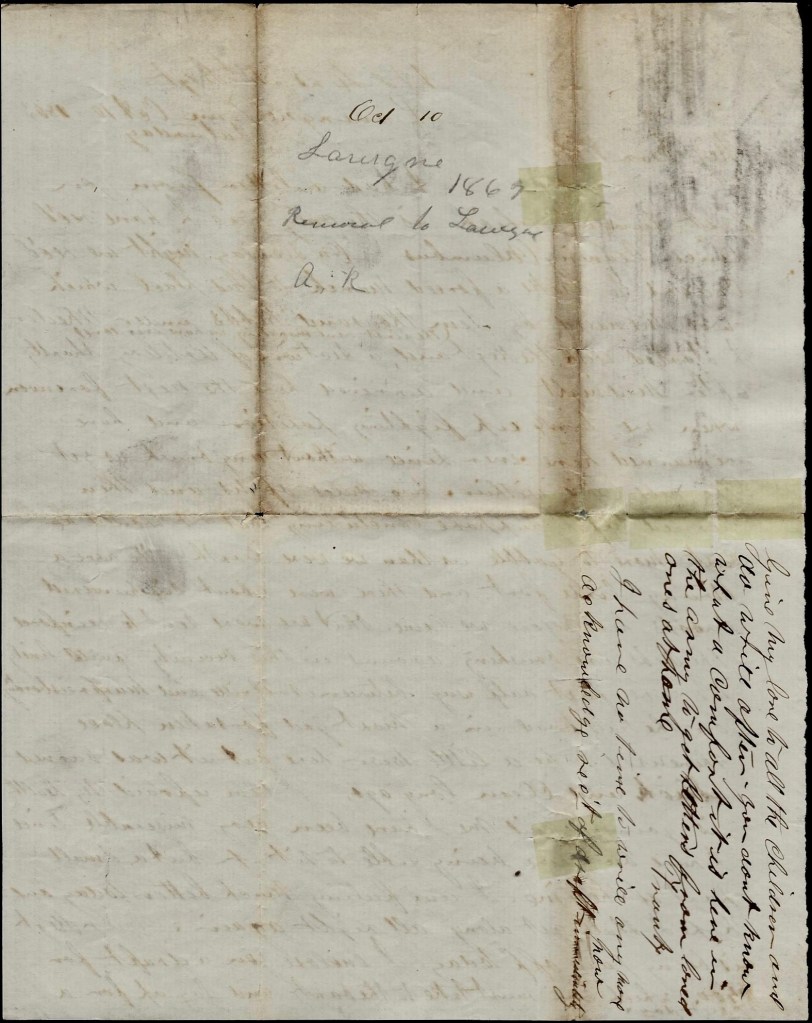
Col. Messore has not been in direct command of the regiment a day since we left the state. Still he has had enough to do with it to make him generally despised. To call him a dishonest, crave, cowardly poltroon would be a very weak expression for describing him. Saturday morning. The old Third Wisconsin passed through here last night.
Letter 29
Headquarters 31st [Wisconsin] Regiment Lavergne, Tennessee Saturday, October 10, 1863
My dear wife,
I had a letter from you last Sunday which is the only one I have received since leaving Columbus. On Sunday night we received orders to make a forced march to this place which was menaced by ten thousand Rebels under Wheeler. I started with the regiment and a section of artillery (the first real marching we have ever done) shortly after midnight and arrived here the next forenoon when we took up fighting position and have remained here ever since without any brush as yet. The Rebs came within two miles of us and then turned off, I suppose concluding that it would cost more to gobble us than we were worth. We have a strong little fort and there were about six hundred troops here before we came that we were sent to reinforce. The Rebs are bushing around in this vicinity quite lively. We are just half way between Nashville and Murfreesboro in the railroad in a most God-forsaken place. There used to be a little town here but it was burned slick and clean long ago.
I am afraid my health is going to fail me. I have been very miserable since I have been here, being unable to sit up but a small part of the time. I am feeling much better today and hope I shall get along all right again. Our regiment is being paid off today. I enclose you a draft for $400 which you must take to the bank and lay up for a wet day.
Give my love to all the children and do write often. You don’t know what a comfort it is here in the army to get letters from loves ones at home. — Frank
I have no time to write anymore now. Acknowledge receipt of draft immediately.
Letter 30
Nashville, [Tennessee] Friday, October 23, [1863]
My Dear Wife,
I came here last night partly on business and partly to recuperate thinking a few days in town at a good hotel might do me good—especially as I have come to my appetite again. And although I have to pay four dollars per day and have not much but corn meal to eat, still I think I can keep about even with the landlord.
I suppose you have heard of the death of Captain Mason. He died here in the hospital last Saturday night. We did not hear of it at the regiment until Monday when we were perfectly thunderstruck as we had no idea that he was dangerously sick. His body has been embalmed and sent home.
I received orders last night to start tomorrow morning for Chattanooga with my regiment. This morning they are countermanded and I am ordered to report for temporary duty at Murfreesboro where we shall march tomorrow. I shall have to go back to Lavergne tonight. I guess I am getting strong enough to stand it. The 22nd [Wisconsin] is still at Murfreesboro so I shall find friends there. It is not likely we shall remain there long.
I received a letter from you yesterday that was dated back in September. It had been sent to the 21st Regiment and returned. I also received yours stating that you were going to Woodman. I hope you have had a pleasant time. When George was down at Columbus last, I sent him $120 expecting to collect it back out of his sutler accounts on pay day. I only succeeded in getting about 50 of it so far and I don’t believe there can ever be enough collected to pay it all. If anything happens to me before I get it collected, you must make him pay it to you. If we are paid again soon, it may all be collected.
It is raining hard as usual. We are getting some of the delights of soldiering now. Give my love to all the children and accept a great amount for yourself, my own precious darling. From your most devoted husband, — F. H. West
Letter 31
Murfreesboro [Tennessee] Sunday eve, October 25, 1863
My Dear Wife,
We marched into this place today. Had a very pleasant march, the weather being fine. It being my birthday, I though I must write you a line. I have not seen you lately to ask you how old I am, but I believe I am thirty-eight (quite an old man). Saw Bentliff this eve and some of his men. They are looking finely—much better than my men. Have not seen John Demiston yet.
We are camped in a beautiful place on the bank of Stone River opposite the town. I have taken possession of a beautiful octagon mansion that has been deserted by some rebel who has gone in search of his rights for my headquarters. It is very much like our house—only much larger and very magnificently finished. There is no certainty of our remaining here twenty-four hours. It is a nice place to be allowed to stay in longer. Still we may remain here some time. I am feeling first rate now.
The rebels are raiding around here so that we have to be on the alert all the time and frequently have to turn out in line of battle at night. But no fight yet.
The adjutant is still at home sick, as are quite a number of other officers, and we have still nearly two hundred men back in hospitals.
My all. on earth, do write often. — F. H. West
Letter 32
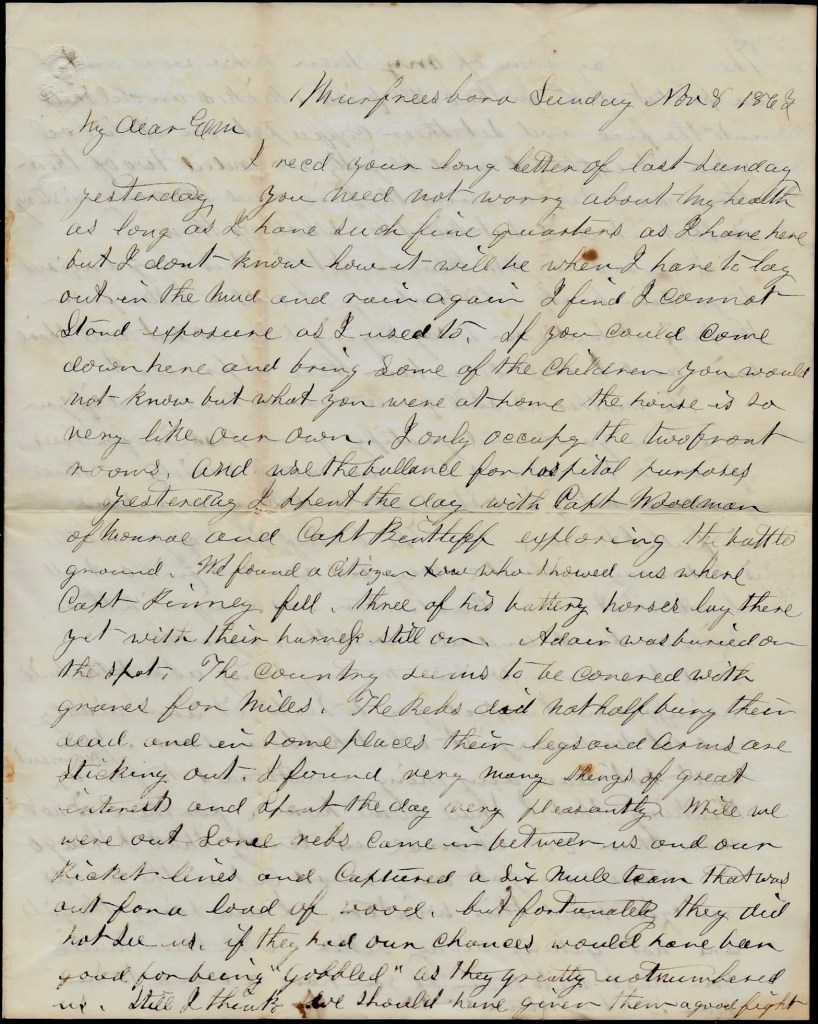
Murfreesboro [Tennessee] Sunday, November 8, 1863
My Dear Em,
I received your long letter of last Sunday yesterday. You need not worry about my health as long as I have such fine quarters as I have here but I don’t know how it will be when I have to lay out in the mud and rain again. I find I cannot stand exposure as I used to. If you could come down here and bring some of the children, you would not know but what you were at home. The house is so very like our own. I only occupy the two front rooms and use the balance for hospital purposes.
Yesterday I spent the day with Capt. Woodman of Monroe and Capt. Bintliff exploring the battleground. We found a citizen who showed us where Capt. [Oscar] Pinney [of the 5th Wisconsin Light Artillery] fell. 1 Three of his battery horses lay there yet with their harness still on. [Charles] Adair was buried on the spot. The country seems to be covered with graves for miles. The Rebs did not half bury their dead and in some places their legs and arms are sticking out. I found very many things of great interest and spent the day very pleasantly. While we were out, some Rebs came in between us and our picket lines and captured a six mule team that was out for a load of wood, but fortunately they did not see us. If they had, our chances would have been good for being “gobbled” as they greatly outnumbered us. Still I think we should have given them a good fight.
The other day, some of our men who were out on picket duty on the battlefield kicked an old shell into the fire and sat their coffee pot on it to boil when it exploded and slightly wounded two of them. There were six around the fire and the only mystery is that it did not kill the whole of them.
In regard to Wm. Bloom, Lt. Treat is very anxious to get him back to his company. I received a letter from the Major at Madison today saying he could not well spared him and I shall leave him there at present.
The weather is still quite warm here and if you were here, you could gratify your passion for roses of which there seems to be an endless variety in those gardens not yet destroyed, and many are now in full bloom.
The business part of your letter is not very explicit. Why did you not find out all about what Mr. Carpenter was doing with those mills in hand, and also with the wagon, &c. Fred has never written me anything about the mill business and I expect you to see to it immediately and let me know just what has been done. You must not leave anything unattended to for a moment thinking that I shall come home for there is not more than one chance in twenty that I shall go.
Have you got any wood cut in the woods ready to haul this winter? I am sorry the girls are not getting along better with their music. You must see to them. If you have a chance to send Lou to Charleston, do it. You must “buckle on your armor,” my dear wife and as Father used to say, “Stand heavy” and keep the machine a running all right until I get home again and when that will be, the Lord only knows.
As ever devoted yours, — Frank
1 On December 31, 1862, Captain Oscar Pinney was severely wounded at Stone’s River, Tennessee and died on February 17, 1863 and buried at the Greenwood Cemetery in Monroe, Green County, Wisconsin.
Letter 33
Murfreesboro [Tennessee] Friday, November 20, 1863
My Dear Wife,
I have just received your long and very satisfactory letter of last Sunday. In reply to what is to be done with the money in Bank, I would say nothing at present—only to let it alone and add as much to it as possible. I think we will find chances enough to use it by and by. If I could get everything we have got into money, I believe I would go to banking. You say Mr. Carpenter has collected $1,115. Do you mean that he has that much for my share or that much in all? I am glad he has set Pinney at work. I hope they will rush things to a focus. What is being done with the mills that were on hand? Do not fail to acknowledge the receipt of the draft sent you yesterday. You did not acknowledge the receipt of the last one at al except by an incidental remark in a letter from Woodman.
I am glad your own farming has turned out so well. You must look after all little matters as sharp as a weasel. I believe you are improving in that respect and will make quite a financier yet. What has become of Mike? You do not mention him anymore. You must get someone to see that there is no wood stolen from the land west of town. Thomas Millman used to see to it but I believe you said he went to California last spring. I suppose you can get Jimmy Conner or Con Murphey to get your wood and look after the land as they both live right there.
Will Willie have a chance to go to school at Woodman? If I should come home, I could not stand it without seeing him. I am afraid he will get the diphtheria or some other fatal disease by staying up in that sickly place. You do not say anything about Mary Ann or the other girls. Are they staying with you or where are they? How I would like to hear “little agreeable” (Susie) tell some of her funny stories. I suppose Little George continues to be his “Mother’s Delight” yet. Has Freddy got any better health than he had? I expect every day to hear that some of them are burned up by their clothes taking fire. I hope you are very careful about it.
I have received a commission as Colonel but it is of no use as a regiment that has not got as many as 842 men is not entitled to a higher officer than Lt. Col. unless they have him on hand. Consequently I cannot get mustered in as Colonel. We are about fifty men short of the requisite number.
Sunday 22nd. I have delayed sending this until today thinking there might be something new to add, but there is not. I have not made up my mind yet whether to try hard for a leave of absence or not. What do you think about it?
Affectionately yours, — F. H. West
Letter 34
Murfreesboro [Tennessee] Sunday, December 6th 1863
My Dear Wife,
have just received your long and well written letter of the 1st together with monthly account of expenses. I am not going to scold any more about expenses as I know you get along the best you possibly can. You must get Fred to go down to Clarno and pay your taxes. You had better get him to pay all of your taxes as soon as the rolls are made out. If they are paid before Christmas, you can save 3 percent. The rolls will probably be made out a few days before that time so that there will be time to pay before the 25th. I saw Bryant yesterday on his way to Monroe. He promised to call on you.
Everything continues very pleasant here. The weather is perfectly lovely and we have the gratification of seeing thousands of Butternuts passed to the rear as prisoners. They have been badly thrashed in the late fights. Our sick are gradually recovering and rejoining the regiment. I suppose you gave orders to have the bank pay John Holland’s father the $40 as I directed.
We are now commanded by General Van Cleave who is under General Rousseau at Nashville, whose immediate commander is General Thomas who is under General Grant who is the Chief of all this country. I expect to send a recruiting party home soon when I am in hopes to fill up the regiment so that I can avail myself of the Colonel’s commission.
— Frank
Letter 35
Murfreesboro [Tennessee] December 9th 1863
My Dear Em,
Your very long letter of last Friday (four lines) has just been received. Even one line letting me know that you are well is a great satisfaction. I have pretty much given up all idea of going home soon. When you wrote me that you had over three thousand dollars in bank, I concluded that with what I sent after that and with what you must have collected afterwards, that it must amount to over four thousand and I had a good many castles conjured up as to what great things I was going to do with that next spring. But since learning the true state of the case, I have subsided—in fact, collapsed, and shall probably keep along as I am for some time to come.
It is excessively [dull] here—no excitement at all. It seems as though it was always going to be our luck to be kept in the rear. But I suppose it is of no use to try to make you. feel bad on that account.
I would like so much to be at home even for two weeks (which is a long a time as I could get anyway) but I know I should feel so much the worse to leave again, the constant dread of which would nearly spoil the visit. It is nearly a year since I have [seen] the children which is longer than I ever was absent before. They must have grown almost out of my knowledge—especially little Fred (I think you said you had such a little boy).
Do you know whether Father has given his Western land to George? I understand he has bought a nice farm adjoining the village of Darlington by which I suppose he must have had some help from home. And by your writing that Fred was out there surveying, I concluded that he was disposing of the land.
The weather continues warm and pleasant with occasional rains. The birds are still singing as pleasantly as they do in our country in the spring. I am afraid I shall never want to winter in a frozen country again.
You ought to require Lou to write me long letters if for nothing else than to improve herself in composition. When I come home, I shall bring a saddle horse for the girls to ride. I suppose Willie is about large enough to take care of one now. Very affectionately your devoted husband, — Frank
Letter 36
Murfreesboro [Tennessee] Wednesday, December 16th [1863]
My Dear Wife,
I received your very short but kind letter of the 10th this morning. You once wrote that you thought I had forgotten I had any children. I think that you must now have forgotten that I have any or you would occasionally mention them in writing to me. You ought in every letter to tell me of some smart thing that little Fred has done or that “Little Dame Crump” has said. And what that “wonderful” little boy is up to. And how honest Billy gets along. I suppose the young ladies are growing more agreeable, accomplished, and useful every day.
As to going home, if I go at all, it will be in January. I made an application a few days ago for leave o take effect the 1st of January but as I did not take the pains to get the General here to make a favorable endorsement on it, it will not be very likely to be granted. It takes three or four weeks to hear from any such application even if you ever hear from it, which is quite doubtful. If it was not for leaving the children to freeze to death at home, I would rather you would come down here and then we could have a longer visit. Although I am dying to see you, I do not much like the idea of hurrying up there to freeze a few days and have to hurry back again. Ten days would be as long as I could stay anyway and that would not give me time to do any business or make much of a visit.
I suppose you recollect of hearing Mrs. Holland say a great deal about John Parker. He died last night. His wife is here.
The Adjutant, Major, and myself mess and room together and get along as pleasantly as it is possible to under the circumstances but it is becoming terribly dull and monotonous and we are anxious for some move or change. I have to write short, uninteresting letters from the fact that I have nothing to write about unless I continue to tell over and over how much I love my dear little wife at home, and this is all that makes me write at all.
— Frank
P. S. The weather continues quite warm. I think this is about the right climate to live in. And immediately about here is much the finest country I have ever seen in the South.
I suppose you think you saw a great many “niggers” at Columbus but there are a million here for every one there. The whole place is fairly swarming with them. And the sentinels have positive orders not to let another one inside the lines as it is impossible to keep so many here. Besides, hundreds of them have the small pox and it is a great wonder that we do not all get it.
Letter 37
[Murfreesboro, Tennessee] Sunday, December 20th 1863
My dear wife,
am again under the necessity of writing without having any letter to answer. I believe you like to hear from me often [even] if you don’t think enough of me to write very often. I suppose I ought to consider, however, that you do not have as much leisure time as I do. Since I commenced making an effort to get home, I cannot think of anything else but you and I already count the hours up to the time I shall be likely to go—if I go at all. I feel quite sure I shall be there sometime between the 7th and the 10th of January. I suppose you will get this about Christmas so I will wish you a very Merry Christmas. Tell the children in their great joy on that day not to forget their Father. I wish I could be there to help you fill their stockings on Christmas Eve.
We are losing more men by death lately than we have ever lost before in the same length of time. Four died last week. It seems to be the winding up of the old cases of last summer which are terminating one way or the other. Yesterday Richard Manley—who was in apparent good health—fell dead in the street, cause unknown. He will be buried today. Send word to his mother.
Hoping to see you soon, I remain your devoted, — Frank
Letter 38
Murfreesboro [Tennessee] Wednesday, December 23d 1863
My Dear Em,
After having mailed my letter last Sunday, I received a letter from you. I now feel quite sure that I shall start home sometime between this and the 5th of January, but cannot tell anything about the exact time and shall be unable to give you any definite notice of my coming as I shall start immediately or receiving the order and I am liable to receive that any day after next Saturday although I do not much expect to receive it before the first of January. So you need not be disappointed to see me any night after you receive this. And you must not be much disappointed if you do not see me at all. But I am expediting an order sending Captain Burns, myself, and six men to Wisconsin to take charge of drafted men in which case the first thing we do will be to go home.
I expect another order to send an officer and ten non-commissioned officers home as a recruiting party but do not know when. It may be tomorrow or it may be any other day within the next three weeks. I shall send Lieut. Treat. Hogans will also be of the party. I hope you anticipate having a good time when I come home as I know I do and I trust our anticipations may be fully realized. I shall not write again unless I find I cannot go.
Thursday. From information just received, I think I shall be able to start home next Tuesday or Wednesday. This will bring me home on Friday or Saturday as it takes four days from here. I ought to have had a letter from you this morning but did not. If I could only be at home tomorrow, what a Merry Christmas we would have. The birds are singing beautifully this morning so you may judge what the weather is.
Letter 39
[Murfreesboro, Tennessee] Tuesday, December 28, 1863
My Dear Wife,
The whole program “is busted.” I got all ready to start home tomorrow. An order has just arrived saying I must not go as I was the commanding officer of the regiment. I am terribly disappointed. I have been counting the minutes for ten days past when I should be able to see you. I send this by Hogans who will tell you all the news. Write immediately. The Lord only knows when we shall met again.
— Frank
I have sent to Washington for a leave of absence which there is about one chance in a thousand may be granted.
Letter 40
Murfreesboro [Tennessee] January 1st, 1864
My dear Daughter,
I received a letter from you some time since but did not answer it as I expected to go home but have been woefully disappointed. This however does not prevent my wishing you a very Happy New Year which I have no doubt you will have. As for myself, I do not expect much joy for a year to come, or at least, until the war is over. You must tell me all about your New Years and Christmas presents and what you all did for amusement. I have no doubt you have had very “high times” and I expect you have nearly set your mother crazy. I expected to have gone to the next military post today to a New Year’s party that I was invited to, but it is so awful cold I did not go. The weather has been warm and springlike until last evening when it grew very cold so fast. Several soldiers from an Indiana Regiment froze to death before morning. It seems as though I had never seen a colder day in Wisconsin than we are having here today. Our soldiers who are out on picket duty suffer very much. I am afraid some of them will freeze to death tonight.
I see by the Monroe Sentinel that you have had a school exhibition in our district. I suppose you were on hand as usual to take a distinguished part. How does your mother manage to get along with little George now-a-days? It used to be as much as she could do to “stand it” with him. How I would like to spend an evening lounging on the sofa listening to your playing and singing and have all the other children playing around. Of course I should want to have your mother around not very far off. Hoping that you are very kind and affectionate to your brothers and sisters as well as to your very kind mother.
I am your affectionate father, — F. H. West
Letter 41
Murfreesboro, Tennessee Wednesday, January 6, 1864
My Dear Wife,
I am very anxious to hear from you but do not expect to before Sunday. I am most afraid some of you have frozen to death as I see by the papers that you have had most extreme cold weather since New Years. It still continues quite cold here. Everything is so very dull here. It is enough to kill a person to stay here. I am in very much the same state of mind now that a certain young man was who was in the pinery some fifteen years ago and who came all the way down to Monroe over horrid bad roads to see a certain young lady that had nearly set him crazy. I feel as though I would travel to the ends of the earth to see that same lady now.
I have just sent another application to Washington for a leave of absence. It will take about twenty days to get an answer. I have but very little idea that it will be granted and shall try hard and not make any calculations on going but you need not be so very disappointed if you should see me the last of the month or the first of February. And you certainly need not be disappointed if you do not see me at all.
I have got the promise of being sent to the front in the Spring if there is any chance for a good, active campaign. I shall not think of leaving the army until it is over. I think I will not send this or write more until I hear from you.
Thursday. It’s cold and snowing today. It is too cold to snow hard. I am afraid you will be buried up in snow. Capt. Burns and Vliet with six sergeants started home today as a detail to bring down drafted men. As there are no drafted men to bring, it only amounts to a leave of absence to go home and have all expenses paid. This was the detail I expected to go on but had to send the papers back and have them made over again with someone else’s name on. It renewed my homesickness to see them starting off. I feel as though I must see you before we start out for the Spring Campaign. There is a bare possibility that my leave of absence may be granted by General Thomas at Chattanooga and not be sent to Washington in which case I might be at home by the 16th or 20th but as I said before, I do not expect to go at all and I only write about it so that in case I should happen to go, you would not think I intended to surprise you and you need not delay writing to me a day at any time on account of supposing I may come home.
Friday. Not getting any letter from you today, I have concluded to send this without waiting any longer. I suppose the trains have stopped running on account of the snow. I hope you have got someone to get wood and keep up fires on. I am sure you will freeze to death in that cold house.
The castle we stop in here is the coldest place I ever was in. There is a large old-fashioned fireplace in every room in the house, in each of which we keep the biggest fire that it is possible to but the rooms are so large and airy that it is impossible to keep warm. We have the whole house to ourselves now. The Adjutant has gone to Nashville to attend a great military ball that was to come off there last night. I don’t think they were able to get any of the Tennessee belles to attend.
I shall expect some very long letters from you soon. Of course you will send your regular monthly statement of accounts the first letter. Also statement about taxes. It is as cold as ever today but there is not snow enough for sleighing. Every third day I have to visit the pickets in a line seven miles long. It is not very pleasant this cold weather.
Devotedly yours, — F. H. West
Letter 42
Louisville, Kentucky Thursday, February 4, 1864
My Dear Wife,
I arrived here yesterday afternoon all right and put up at the “Gault House” here. I found Maj. Generals Grant, Rosecrans, Hunter, Crittenden, McCook, Stoneman, Commodore Porter and a host of lesser note were stopping so I concluded to stay over a day and draw my pay and see the sights generally. Different bands were serenading about the house nearly all night on account of some of the distinguished guests.
I have drawn my pay to the first of February (3 months) and sent it all in a draft to the Bank of Monroe. It amounted, after deducting for my absence, to $448.31. There is no snow this side of Chicago. Here the mud is knee deep. I shall go to Nashville tomorrow and to Murfreesboro Saturday when I hope to find everything all right. I am sure I shall feel very much better for my visit but it would have been much more satisfactory if I could have stayed a week longer. I would have some photographs taken today but as I have no straps on my coat, I shall let it go.
Hoping to hear very often from my precious wife, I remain as devoted as ever, — Frank
Encourage land sales as much as possible whenever you have a chance. I am going to be very economical myself now to make up for past expenses.
Letter 43
Murfreesboro [Tennessee] Tuesday, February 9, 1864
My Dear Wife,
I went from Louisville to Nashville on Friday where I remained until Saturday evening when I rejoined the regiment here. I found everything all right except that the regiment is very scattered on detached service of one kind or another. We have only had the one case of small pox—Lt. Fayette—and he has got well. I have been very busy since I got back in getting matters straightened up.
We have all got mustered in our new grades of office so we are all right on that score. The weather is very fine. People are making gardens. There has been no frost since I left. It was to bad that I could not have remained at home a few days longer at least. I was so frustrated that I ever realized that I had got home until the evening before I started back. If I could have remained after that, I should have enjoyed it very much. It seems as though I had hardly set eyes on any of you. And then to think, we never visited one of our friends except at Fred’s. It is a great pity you could not come down here and enjoy this beautiful weather. There are a number of officers wives here now. they appear to have fine times riding round on horseback. If we remain here, you must come down in the spring before the weather gets very warm. The trouble will be, however, that by the time you get your garden made, it will be hot enough to roast eggs here.
Tell Lou to write to me soon. I anticipate so much pleasure with her and I hardly saw her. And then I feel so bad to think that I did not “pet” my dear precious little wife more when at home, but next time I go home it will be for a visit and not on business. Do try and write often to, — Frank
If you come down here, you must bring George as he is so small, he will not cost anything.
Letter 44
Murfreesboro, [Tennessee] Monday, February 15, 1864
My Dear Wife,
I have just received your long interesting letter of the 7th with vignette of my precious wife enclosed. You have no idea what a fascinating charm the word “wife” has for me. I never see it in print without emotion which causes me to pause and take a second long look at the precious word. I think the vignette a very beautiful likeness but you will excuse me for not returning the photograph for I am in love with that also. I like it on account showing the form.
Everything is quiet here with no prospect of our leaving. There is no case of small pox in the regiment and never has been but one. The officers had a big supper on the occasion of my assuming the “eagles.” Everything went off very pleasantly. Dr. Thomas has just sent for his wife to come down. I think you can come down if we remain here.
I return the deed direct to Judge Dinwiddie. Mark on the real estate book the twenty acres sold, it being “20 acres next the South 10 acres on the South end of the West half of the NE Quarter of Section 25, T1, R7.” Nothing has been done yet in regard to chaplain for the regiment as seven of our captains are absent on duty at present. Elder Morris had made an application. I think I shall tender it too Mr. Fairbanks, however, you need not say anything about it. Keep my memory fresh in the minds of the children.
Our photograph man has moved away so that I do not expect to have a chance to have my likeness taken. I have not heard from the money I sent to the bank yet. — Frank
Letter 45
Murfreesboro [Tennessee] Tuesday evening, February 23, 1864
My Dear Wife,
I have not written for eight or nine days because I was expecting every day to hear from you. I have had but one letter since I left home and that was dated the 7th. Neither have I heard anything from the money that I sent to the Bank from Louisville on the 4th. I am afraid it is lost.
As there seems to be a prospect for our remaining here through the summer, I have a great mind to go into the cotton speculation. Immense fortunes were made last year in raising cotton on abandoned lands. The cost of raising a hundred acres is from four to five thousand dollars, and an average crop at present prices brings fifteen or sixteen thousand. Of course there is some risk to run from guerrillas and rebel raids, but I do not think the risk very great here. We are about making up a company of four persons with a cash capital of twenty thousand dollars ready only with which we expect to raise six hundred acres of cotton (paying a little of the expense of raising out of the crop). If everything is favorable and crops good, we expect to make sixty thousand dollars. Mr. Colwell is one of the firm and is to do all the business. The rest of the firm are all army officers and of course cannot give the matter any personal attention, and only put in their money and let Mr. Colwell do the work under a salary. We have not fully. determined on the matter yet but expect to decide one way or the other within the next three days as we have to commence operations immediately if we do anything at all. If I go in, I shall have to sell the bonds and scrape up everything to make up my five thousand and get it down here at once, as most of the expense has to be incurred at the outset in buying teams, took, provisions, &c.
The weather has been very fine the past week and I have taken long rides nearly every day out into the country and visited the planters and taken items generally on matters and things. If I remain here you must come down as early as you can prepared for a long visit when we will have a glorious time riding around the country. I have got the nicest saddle horse for a lady to ride you ever saw and John is already fixing him up for you to ride. I tell him that you never ride on horse back but he insists that you will if you come down. So you must bring a riding dress and hat. I can get a side saddle here.
The 22nd [Wisconsin] Regiment is to leave here in two or three days when we shall have to leave our fine quarters here and move up into the fortifications where they now are and live in tents, but if you come down we will go in town and board at some private house. How soon do you think you could leave home and for how long a time? I should not consent to your coming to stay less than six weeks. I don’t know how in the world you could ever get here without someone to come with. I should expect to go as far as Louisville after you, but I don’t know how you would get that far. It takes two days now to get from Louisville here. It is two days and one night’s travel from Monroe to Louisville. Perhaps there will be someone coming down that you can come with.
Wednesday eve. No letter from you yet but I expect one in the morning as I am told a large mail came in tonight. We made arrangements for our cotton speculation today and commence work with fifty niggers tomorrow morning. So you must make calculations on sending me all the money that we can possibly raise. I will write to the Bank folks about it in a few days. You need not mention anything about it in Monroe (I mean the cotton speculation). I wish you would see Mr. Carpenter and ask him to get in all he possibly can as I want to use it all at once in some speculation down here. You need not know what it is. I hope you will sell some more of that land. Write me what you get on the division of you land. The 22nd [Wisconsin] Regt. left here today.
Thursday morning February 25. Yours & Louis’s letter of the 14th I have just received. It seems to take about ten days for a letter to get down here lately.
I will answer Luty’s letter soon. We shall not move into the fortress at present—perhaps not at all.
I cannot get over mourning over my not being able to make more of a visit while at home. I want to see you all worse than ever now. The next time I go home I hope I shall have a chance to visit all my old friends. Don’t fail to tell me all about what you think about coming down and when. Now is the time you ought to be here—it is so very pleasant. But you don’t see how you could leave very early in the spring unless you got Mary Ann to see to everything for you. — Frank
Letter 46
Murfreesboro [Tennessee] February 29, 1864
My Dear Daughter,
You all seem very slack about writing since I was at home. I have not received any letter since yours of the 14th. I was very glad to hear that Mr. Emerson had got home in such good shape. He had been gone nearly five years. I would rather die at once than to know that I should have to remain away from home so long a time.
There is a general movement of troops in every direction and great activity prevails in all quarters. My regiment is not ordered to move yet but the regiment is being got together—those companies that were stationed at other places being ordered to report to me. We may be sent off to some other place any day. I have been making great calculations for your Mother’s making me a visit but from the enclosed notice which I clipped from the Louisville Journal today, I am afraid she will not be able to get down here. Still, if we remain here, I think I can get her a pass.
The weather has been very unpleasant for a few days. High winds and a great amount of dust until today it has rained all day. I presume we shall have much unpleasant weather now for some time. I am afraid to have you go to Charlestown for fear I shall not see you again for a long time. I want you to ride I horse back every chance you can get so as to learn to ride as I am making calculations on having fine times riding with you when I get home.
I am very anxious to get a letter from your Mother, hoping she will express a desire to come down here immediately. She might come with Capt. Treat when he returned but she must not start without first having a pass from here and I do not want to send one until I know when she wants to come. We have just sent five hundred dollars to Boston to buy a set of silver instruments for the band. When they arrive, we expect to have some very fine music. I [wish] you could be here to take a ride with me out to the plantation and see all the “little & big” niggers at work preparing the “cotton land.” Give my respects to Mr. Emerson. I don’t know of anyone that I would rather see than him.
Your affectionate, — Father
Tuesday morning. I have just received your Mother’s and the girl’ letters of a week ago last Sunday. Will answer them soon.
Letter 47
Murfreesboro [Tennessee] Wednesday, March 2d 1864
How terribly slow the mails are lately. Your letters are forever coming. I have received but two from home since I left. I am sure you must have written several. Going home has spoiled me entirely. I feel as though I could not live away from you and if you don’t come down very soon and stay with me, I am sure I shall die with a broken heart.
You must not write anything but the most affectionate letters. A cold, formal kind of letter reminds me too much of the first letter that I ever received from a certain young lady long ago.
My regiment has been divided up again today which does not look much like ever getting away from here. Two companies have been put into the forts to man the big guns as heavy artillery and one company—Co. B—is placed on horseback as mounted infantry. They are to scour the country for guerrillas. Lt. Col. Rogers was thrown from his horse this morning and had his face pretty badly jammed up but is not seriously injured.
I have written to the Bank to send me all the money on hand and also to sell 800 hundred of the bonds and send the money. I shall also have to sell the other bonds after awhile in order to carry on the cotton “crop.” I am bound to “make a horn or spoil a spoon.” 1
Friday. I have waited a couple of days in hopes to hear from you and see what you thought about coming down soon—say the first of April with Capt. Treat and Mrs. Stephenson. If I knew that you would want to come, then I would send you a pass. I suppose, however, the Captain could get you a pass on arrival at Louisville. However, you must not come at all unless you think you can leave for a long time as well as not and come put up with very rough camp fare. I presume it would be much more agreeable for you to stay at home. Perhaps you will think you can not leave so early in the spring. You must use your judgement about these matters. Of course it would be a great delight to me to have my precious little wife with me but it would be so disagreeable for you to live here it might seem like selfishness on my part to ask you to come.
The weather is windy and unpleasant lately. I see you are not inclined to write but once a week lately so I shall adopt the same rule, much against my inclination however. — Frank
1 Frank has stated the idiom incorrectly. It should be “to make a spoon or spoil a horn” which is to achieve or accomplish something, even if it ruins something as a result. This of course is an allusion to the former use of cattle horns for making cutlery.
Letter 48
Murfreesboro [Tennessee] Monday, March 7, 1864
My Dear Em,
I received from Mr. Hogans a precious little note from my precious little wife although written long ago (February 22nd). I was delighted with it because it expressed the deep affection that my darling wife has for her husband.
About one hundred of our new recruits have arrived here at last, as has also Dr. Ball. The Dr. is going to send for his wife soon. I am surprised that you do not say more about coming down. I suppose you could get Mary Ann and Harriet to move up and keep house for you. It is a big undertaking for you to leave home as you are situated and must do as you think best about it, but it seems to me that as we have but so short a time to be together on this earth at the most, that we ought not to be separated a moment that could be avoided. As for the expense, I do not care to save a few dollars at the expense of happiness which ought to be one great object in this life.
The weather for some time back has been wet and unfavorable for farming operations and we have got very little done on our plantation as yet.
Tuesday morning. I have just received yours of the 29th and March 1st. Why don’t you direct to Murfreesboro and not too Nashville? Where time is given on land, I would prefer to give a contract (or bond for a deed as it is called) to giving a deed and taking a mortgage. On mortgages there is no escaping being taxed “out of existence.” I am tired of paying all the taxes in the country which is one reason I am so anxious to sell the land but in this case it cannot be changed now. I also dislike having the payments run so long (four years). Two or three years at the outside is long enough. I want it so it can be closed up some time. As to who does my writing when I am at home, you might have told Mr. Shobor that I did it myself. He can get anyone he chooses to do it making the parties purchasing pay all expenses, which arrangement I made with him when I was home. Recollect that the interest on all dies must be paid annually and always be stated in the notes or contract.
If Mr Foster wants fifteen acres, tell him or Mr. Shobor (or both) to fill up a couple of contracts as he wants it and send them down for my signature. One year is as long time as he will want for payment I suppose. It is long enough for a little amount like that.
I wish you would ask Fred to try and sell those two forty-acre lots in Section 29 in Monroe. He can sell them to some Irishman by trying price $6.25 per acre. John Drumney wants to buy some land. See if you can sell it to him. It is very cheap. I am also anxious to sell any that I have in Section 32 (Monroe) for 12.50 per acre. Sell the large piece at Hurlbut’s for $250 and the small one for $150 if you have a chance. I guess you will think you have got business advice enough for once.
Our Spring Campaigns do not open very favorably so far but I am greatly in hopes we shall come out all right yet. I wish you would not be so saving of paper when you write and do find time, my dear wife, to write very, very often to your devoted husband, — Frank
When I get a letter from you, I count the hours that it will probably be before I get another one. [Rest of the letter is missing]
Letter 49
Murfreesboro [Tennessee] Friday evening, March 11th [1864]
My Dear Wife,
My heart leapt with joy this morning when the post master handed me one of your familiar envelopes but I was sorely disappointed on opening it to find nothing but a horrid congressional speech. Do not squander any more stationery in sending me such things for I never shall look at them. If you had sent me a piece of blank paper with nothing but you own name on it, it would have been much more satisfactory. If you don’t write oftener, I am going to stop writing entirely and see if I cannot for get you entirely.
Mrs. Dr. Thomas arrived tonight. I have not seen her yet. I am very anxious to hear that you want to come down immediately although I don’t know where you would stay if you did as we commenced moving into the Fortress today and shall all move tomorrow when I shall have to move into my small tent or put up some kind of a little shanty to live in. However, I suppose you would be willing to stay in a tent a few days for the sake of being with your husband. The weather is very pleasant again now and Mr. Coldwell is getting along finely with his plowing.
Saturday morning. I have just seen Mrs. Thomas and she has given me a glowing description (which she is capable of doing) of her visit to you. I hope you [enjoyed it] as well as you could. I am delighted to learn from her that you are anxious to come down. I shan’t have a moment’s happiness until you do. Let someone else see to the garden or let it go entirely (I expect you must think I am getting reckless which is a fact). She tells me that Freddy has had a terrible fall and broken his nose. If you can get Mary Ann to keep house for you, you will be all right. You must have the Bank save you enough money for expenses. I want you to bring me a pair of No, 8 slippers, half dozen pair white cotton socks, 2 handkerchiefs, and a fine comb. Bring a plenty of traps for yourself. You must not try to come alone. I think Capt. Treat will come about the 1st or 10th of April. How good it would have been if you could have come with Mrs. Thomas. She said she would write you today and tell you what to bring. I suppose you will bring George with you and possibly Willie but I am afraid it will make too much trouble and too much plunder to bring more than one. You can do as you like, however.
We have got neither spoons, knives, dishes, bedding or anything else here and consequently not very well provided for keeping many boarders. We can hardly get enough to eat here now o keep soul and body together. Don’t you bring any boy down here without having him fixed up in good shape so that I will not be ashamed of him. It is probable that I will send you a pass in a few days. If you come with [paper torn]
…Don’t lumber up your trunk with anything to eat except what you want for lunch on the road. I wish you had my carpet sack but you can get one. Perhaps you can make arrangements with Mrs. Dr. Ball to come together. Your horse is getting so wild and [ ] that I don’t think you can ride him. I shall expect you to stay a long, long time. I am glad to learn that Mr. [James] Bintliff is made Colonel of the 38th [Wisconsin] Regiment.
Give my love to the young ladies. Miss Louise does not write us often as she promised to. Mrs. Thomas was greatly pleased with the “little dame.” Don’t ever have the boys hair cut short again. I think I have made suggestions enough for once. So hoping my dear little wife will write every day or two that I will know what her arrangements are. I remain her devoted, — Frank
Bring me a long, long-sleeved, lose linen cambric coat or something as near the description as you can get.
Letter 50
Murfreesboro [Tennessee] Sunday, March 20, 1864
My Dear Wife,
I have an opportunity through the kindness of Capt. Vliet who starts for Madiso today to send you a line which he will mail at Janesville. He will also endeavor while at Nashville to get your pass extended until the 10th of April in which case he will send it to you with this ( sent you a pass yesterday go to March 30th). The Captain has some expectations of returning to the regiment immediately in which case he says he will go out to Monroe and escort you down if you have not [already] got an arrangement to come with Capt. Treat. So I think your chance to come with one of them is good. You must be ready to start on a moment’s notice. If my friend Capt. Vliet comes out to Monroe, you will entertain him the nest you can at our house. He will consult with Capt. Treat at Madison and make arrangements for you to come with one of them. Can’t you get Elizabeth to take care of some of the children while you are gone? I have got everything nicely fixed for you and expect you to bring both boys and stay three months and let everything else go.
Dr. Abbott came last night. I was down at the cars quite certain that you would come with him. You can “farm out” most of the children so as to nearly break up housekeeping for the summer. I received yours of the 12th this morning. Nearly all the officers are trying to get their families down here.
Dart around lively and be on hand ready to start. Charley is still in hospital quite sick with neuralgia. — Frank
If you are not here by the first of April, I shall be badly April fooled.
Letter 51
Nashville [Tennessee] Friday evening, June 10th [1864]
Dear Wife,
The regiment came in in fine style yesterday about two o’clock and went into camp in their “pup” tents since which it has rained nearly all the time and this afternoon it has fairly poured down, nearly drowning the boys. I have pitched my tent and moved in. We have got fairly established on provost duty. Company B take charge of the military prison. We will all have to work constantly. Mrs. Thomas has not got a house yet. She has got house “on the brain” and does not talk of anything else. I have got perfectly sick of hearing of it. She and Mrs. Stephenson are thinking they will have to go home.
I wish you had stayed a day longer. We had a grand celebration, illumination, &c. at the Saint Cloud last night in honor of the nominations. Gov. [Andrew] Johnson made a speech. Mr. Leeber and Elder Miner came down here today on a Sanitary [Commission] expedition with stores for the soldiers that went from Bruc___. General Wonder left for home this morning. If you had waited a day, you would have had company, but I think you will get along all right.
Tell Billy his gun came through all right. I am going to send it to him if I have a chance. I expect the boys will both want to come back bad enough. Give my love to the girls and tell me all about how you found Little Fred and the Little Dame. I am horrid lonesome since you left.
Affectionately yours, — Frank
If it does not stop raining soon it will ruin the cotton. Mrs. White charged me sixteen dollars for what we stayed there. Pretty steep.
Letter 52
Nashville [Tennessee] Saturday, June 18, 1864
My Dear Wife,
I have just received yours of Monday announcing your safe arrival home which was a great relief to me. I wish you could send us some of your cool weather for it is hot enough here to kill a person. The men are still laying out with their “pup tents” and many are getting sick. We shall have barracks built in a few days out beyond the prison where there is a fine spring and plenty of shade. There is to be a large [prisoner] exchange camp built there which it is intended at present to place under my command. We shall be fitted out with new guns and equipments and dressed up in fine style for fancy duty—a kind of duty by the way that does not suit my taste at all. I had much rather be out in the field. The Lt. Col. & Adjutant have consolidated their mess with mine with Kate and Jane for cooks (Kate is a first rate cook) and we are living first rate. I wish you had stayed here and had Joe and Ellen made us their visit here. I would like so much to see them but you will certainly be much more comfortable at home this hot weather.
Mr. Caldwell was up yesterday. Says we have got the best cotton there is in Tennessee. The price of everything has gone up so lately that the expenses are enormous and is going to take everything I can rake and scrape to get through with my share. But if it should come out all right, it will bring a “pile.” I enclose a slip from the paper to show you the unpleasant job we had to do yesterday.
I am sorry little Fred did not care to see “his Ma” after she had worried so much about leaving “the poor little fellow.” Why did not Lutie come home with Aunt Nell? What do they say about her? Love to all the children.
Affectionately yours, — Frank
Mrs. Thomas says she has something funny to write you.
Letter 53
Nashville, [Tennessee] Friday, July 1st 1864
My Dear Wife,
I have just received yours of last Sunday and Monday. I am glad you are homesick and want to come back here again. I think I will get a furlough for John in September so that you can come back with him.
Our big camp arrangement has “busted” are are going to move back near the prison again tomorrow. It is so very hot I am unable to stir at all. It seems as though I Neve could live through three months of such weather. I have heard nothing from Mr. Shobus but am in hopes to as the cotton expenses are so enormous I must have more money. I shall send today to have the other bonds sold. The cotton is growing splendidly, It is knee high and will be in blossom by the middle of the month. We have great difficulty in procuring food for the Negroes at any price.
Capt. [John B.] Vliet [of Co. I] 1 was captured by the Rebs on the 18th of last month since which he has not been heard of. He was near Acworth, Ga., in charge of beef cattle at the time of his capture. Capt. [Edwin A.] Bottums’ [Co. K] resignation was accepted yesterday.
I shall answer every letter that you write instantly so you can have me write as often as you please. I have not heard from Lou since you left. As Willie is the only one that thinks enough of his Pa to send him any word, I send my love especially to him and generally to all the rest. as ever, — Frank
Dr. [James M.] Ball is very uneasy about his family. He has not heard from them since the evening they arrived at Judd.
You have no replaced that photograph you were so kind as to give to Mrs. Murray yet.
1 At the start of the American Civil War, John Black Vliet enlisted as a volunteer and was commissioned captain for Company I of the 31st Wisconsin Infantry Volunteers. He served throughout the war, including briefly visiting Fort Leavenworth, and was taken prisoner of war in 1864. He later escaped, was wounded, and was in early 1865 commissioned as lieutenant colonel of the 50th Wisconsin Infantry Volunteers. After mustering out in August, Vliet started for Lawrence, Kansas. Once there he presented himself to General James Lane and was quickly engaged as chief engineer of the Leavenworth, Lawrence, and Fort Gibson Railroad, later renamed the Leavenworth, Lawrence, and Galveston. By 1870 Vliet was engaged in surveying for the Paola and Fall River Railroad and thereafter he returned to Wisconsin.
Letter 54
Nashville [Tennessee] Thursday, July 7th 1864
My Dear Em,
I thought I would not write until I got a letter from you but I have got tired of waiting and cannot resist the desire to write any longer. I have not a thing in the world to do and it is so very lonesome out here that I can hardly live. I spend most of my time reading.
The weather is so very warm it is almost impossible to stir. I have not seen Mrs. Thomas since she went to the hospital. Mrs. Stephenson is here in a little tent. The Major is trying every way in the world to get her to go home but it is of no use. She is more amiable and agreeable than ever. I suppose you will have learned by the time this reaches you that Dr. [James M.] Ball has resigned and gone home. He started yesterday morning. He has been running down ever since his wife left. I meant to have sent you. a paper containing an account of the celebration here on the 4th but they were all gone before I could get one. All the troops here turned out in procession. The 31st had the post of honor in the advance and your humble servant being the Senior Officer present took command of the whole.
We wee invited out by the mayor and council of the city who represent that the citizens were all a going to turn out and have a big time. But “nary” citizen showed his rebel head. They were all denned up as still as mice. A paymaster is here to pay off the regiment.
There is a constant stream of wounded and used up men and officers coming back from the front. I am satisfied from what I can learn from them that Sherman’s losses are more than double what they have been reported and that his army is vanishing like dew (this kind of news however is contraband). I have no doubt, however, but that he will succeed in taking Atlanta. The campaign is frightful both here and on the Potomac.
We have a couple of guerrillas to hand tomorrow. It is very unpleasant business. I would much rather kill them in a fight in the woods.
I shall go down to Murfreesboro next week to see how the cotton gets along. The weather seems very favorable for it. We have plenty of fruit now—ripe apples, blackberries, &c., as well as all kinds of vegetables, so we are in no danger of starving here. Gold is getting so very high, or rather paper is getting so very low, that I do not feel as anxious to sell land as I did. I do not want to sell unless I get a big price unless it is some poor price.
Give my best regards to George & Susan as often as you write them. What discoveries did George make in Kansas? How do you feel about coming down here again in the fall? If you come down, perhaps I will go home with you by the way of New Hampshire and get Louise.
Friday 8th. I expected a letter today but I did not get it. Capt. Treat hung the two men this morning according to agreement. Killing men seems to be a very trifling matter now-a-days. Tell Willie to write me a letter. Give my love to all the children and see if you cannot find time to write oftener to your, — Frank
Letter 55
Nashville, [Tennessee] Monday, July 10, 1864
My Dear Wife,
I have not heard from you for ten days and am getting very much alarmed thinking you or some of the children must be very sick. We are relieved from duty here and ordered to the extreme front, We go by cars on Wednesday. We are assigned to the 1st Brigade, 3rd Division, 20th Corps, Army of the Cumberland—all of which description you must put on the address of your letters in future. The last report I had from our brigade they were seven miles from Atlanta where we are ordered to join them.
Mr. Caldwell writes me that he will have to commence picking cotton in six or seven weeks. My cream horse burst a blood vessel in his head yesterday and has bled until he cannot stand up. He will die of course. I got disgusted with the little black and traded him off for a poor grey a few days ago so I am now about out of a horse.
Tuesday morning. No letter from home yet. Mrs. Stephenson started home this morning. We leave tomorrow. — Frank
Letter 56
Nashville, [Tennessee] July 13, 1864
My Dear Wife,
I received yours of the 6th this morning. I had become very much alarmed not having heard from you for twelve days. I am almost sorry you were not sick as then I could have excused your not writing for so long. I believe I would rather know that my dear little wife was sick than that she would neglect her husband.
If any man wants that Audrick lot for four hundred dollars inn paper money or one hundred and fifty in gold, let them have it. I do not care about selling any land at present prices and take pay in money that is not worth more than ten cents per bushel although I have every confidence that the money will be good eventually.
Dr. Peter Arndt, Surgeon of the 31st Wisconsin
We are held here a few days for the purpose of running prisoners through to Nashville, large numbers of which are being sent up by Sherman. Nearly all the boys are on the road to Louisville now. As soon as the present rush is over we shall start for the front—probably on Sunday. Mrs. Thomas will go to Darlington. Jane is going to live with Mrs. Caldwell at Murfreesboro. If anything happens to me at the front, you must get Fred or George Campbell to take that cotton contract and come down and see the cotton speculation out for you. It now promises fair to pay from forty to fifty thousand dollars for my share. Mr. Caldwell is here today and says it is all in full bloom. I have paid in $2800 so far and expect to pay in a thousand more as soon as I hear from the bank. That will take us through until we begin to pick cotton and have some ready for market.
I wish Deacon Clinton would pay you that $115 so you could have it to live on. Whenever you get that short, you must call on Fred for what he owes. I send enclosed Dr. [Peter] Arndt’s photograph.
Friday noon. We go at six this evening. I heard from our brigade last night. It was within three miles of Atlanta. I was in hopes to get a letter this morning but did not. William Brown & G___ are here. Goodbye for the present. — Frank
Letter 57
Camp near Atlanta [Georgia] July 21, 1864
My Dear Wife,
We arrived here yesterday and found a terrific fight going on. We did not get into position in time to do anything. Neither party gained any advantage. Our brigade suffered very much losing about 500. We are busy today helping to bury the dead. We are now in the front line.
We had a bad mash-up on the cars near Kingston day before yesterday in which twelve of my men were wounded and one killed. Two or three others must be dead by this time. Lt. [Byron] Hewett & [Lt. Samuel J.] Hooker [of Co. H] are among the injured.
I received your letter of the 11th this morning. I am sorry you made little George feel bad. Give him my special love. Also give my love to all the other children. I have no time to write now. We shall have a good deal of rough work before we get into Atlanta.
— Frank
Letter 58
Camp in front of last ditch in front of Atlanta Saturday, July 23, 1864
My Dear Em,
I have just received your very kind note of the 15th. You must not think of coming down here under any circumstances. It would be utterly impossible to get further than Chattanooga and we are nearly one hundred and fifty miles from there. We advanced to this place yesterday, driving the enemy before us. I formed the regiment on a ridge in front of the enemy works (which are immensely strong) under a most infernal screaming of shell and set them to digging themselves into the ground. In a few moments, they were all burrowed in ditches with a los of but three me—one killed & two wounded. These were shot by sharp shooters from the top of a house in the suburbs of the city. Lt. [Alexander F.] Cook [of Co. K] was one of the wounded. The other regiments in my vicinity suffered as little comparatively.
My men behave splendidly. On our extreme left east of Atlanta we suffered a repulse yesterday in which Gen. McPherson was killed, I fear we are going to have a tough time before we get the place. The roar of artillery and the rattle of musketry has not ceased for a moment, day or night, since we joined the army. As I write, the shot are constantly whistling over our heads without doing any damage. We are having it pretty rough but I never felt better in my life. Give my love to all the children and recollect that you are as ever all and everything to me. — Frank
No one at the North has the slightest idea of the immense difficulties we have encountered in conquering this country, or of the hardships our army has endured and is [still] enduring in this campaign.
Letter 59
Camp near Atlanta [Georgia] Sunday, July 24th 1864
About the time I finished my letter yesterday the Rebs set up a big yell and made a dash on our lines directly I front of our brigade. They were handsomely repulsed with very little loss on our side. My loss was two killed and three wounded—all from Co. E. 1 Since then there has been nothing done except to keep up a constant artillery duel and sharp shooters at work whenever a man shows his head.
Today the Rebs have kept a better playing directly on my headquarters without any effect so far except wounding one Co. C man and killing four horses, all close to my tent. We find it necessary to stick very close to the rifle pits. Company B had a little fun today at the expense of their dinner. Just as the company cooks brought up their dinners and set it down outside the pits, a solid shot struck the kettles and knocked them all too flinders. The boys had a good laugh over it thinking it quite a joke.
We have had to leave all of our baggage behind and our accommodations for living are very limited. Still we shall get along some way.
Monday morning. Everything is perfectly quiet here this morning. I would not wonder if we had to lay here for a month yet. We certainly can not take their works by a direct assault and I don’t think we shall ever try it. We had a good display of fine works last night. At precisely ten o’clock every gun on our line opened on the rebel works simultaneously and kept up the fire for an hour. The night was beautiful and nothing could exceed the grandeur of the fiery shell as they screamed through the air on their way to Atlanta.
Write very often, my dear wife, — Frank
Give my love to all the children. I may not write again for some time.
1 The two killed in action go 23 July 1864 from Co. E were Sgt. Charles H. G. Bailey and Pvt. David A. Coble.
Letter 60
Camp near Atlanta Tuesday morning, July 26, 1864
My Dear Wife,
Since closing my last letter yesterday morning we have lost but one man—Sergt. [Michael] Van Norman of Co. E, severely wounded by a sharp shooter. Shot through the shoulder. [Lt.] Col. [George D.] Rogers’ nigger Joe got a shot in the mouth knocking his front teeth out and injuring his beauty very much. Capt. [Thomas Eugene] Orton of Darlington (a brother of Harlow Orton of Madison) and one of the 3rd [Wisconsin] Regiment was killed yesterday by a shell and two lieutenants wounded at the same time. I had just been over to the 3rd making a call and had not left the group of officers more than three minutes when the shell burst in their midst.
Everything is comparatively quiet just at present. The weather has been quite cool ever since we came down and the nights are nearly cold making it very uncomfortable with our very scant amount of blankets, many of the men not having any, having thrown them away on the hot march down here.
The Rebs make a dash somewhere on our lines every night but without much effect so far. We have just got orders to be ready to move but don’t know which way yet.
Wednesday morning. We moved half a mile to the left and took a new position last night square in front of the north side of the city. Today a grand move is to be made to try and envelope the whole city. Since yesterday morning nothing but skirmishing, sharpshooting, and shelling has taken place and everything has been comparatively quite. I have had three more men wounded—all from Co. I. I had a message direct from Atlanta yesterday in the shape of a small shell that tore a big hole in the top of my tent. As it is raining this morning, it makes my house rather leaky.
We had a big mail last night and I got several letters but none from home. I believe I shan’t write any more soon unless you write oftener to — Frank
Letter 61
Union earthworks before Atlanta
[Before Atlanta] Thursday morning, July 29, 1864
My Dear Wife,
Since writing you last we have not changed our position and have lost only one man wounded although we have been shelled continually day and night. I make the men keep close under their works which we have now got made very strong and although the “johnnies” make the earth fairly quake from their forts along immediately in front of us, they do us but little damage. The mens’ “pup tents” which are pitched immediately back of the ditch were terribly riddled yesterday. The extreme right of our Army made an advance around towards the south side of the city yesterday and had a severe fight, repulsing the enemy in three successive assaults [see Battle of Ezra Church]. I suppose by the time you get this, you will have seen Gen. Thomas’s order giving an account of the battles of the 20th and 22nd, showing how badly the enemy were worsted on those days. They seem bound to hold this place at all hazards and as their works are immense and we have not got men enough to surround them, I don’t know how we shall get them out but this I do know, they have got to be got out some way. Our shells have set the city on fire several times.
I gave you the wrong description of the brigade and division that are in. It is the 3rd Brigade of the 1st Division of the 20th Corps. Perhaps this is the reason I do not get letters from you.
Give my love to the children and let me hear from you often. This is the eighth say we have been under constant fire. I begin to feel as though it was time we had a rest. Jo Hooker left us yesterday. Our Corps is now commanded by Gen. Williams.
Affectionately yours, — Frank
Letter 62
Camp 31st Wisconsin near Atlanta Saturday morning, July 30th 1864
My Dear Wife,
We had a very quiet day yesterday. Very little done except to throw shells into the City. The Rebs kept very still and hardly fired a gun except their sharpshooters who never cease. This morning our skirmishers had a splendid little brush along the whole line of our division, capturing quite a number of prisoners. The 31st [Wisconsin] did beautifully. A squad of them made a dash on the rebel rifle pits and captured and brought in twenty-three prisoners including an officer. I lost but one wounded.
The weather is getting very hot again. We are terribly annoyed by insects. The common housefly swarm about the army in legions [and] a very small insect called a chigger pretty nearly eats us all up alive.
We don’t get a mouthful of anything to eat except hardtack and pork. I am afraid I shall get so poor the surgeons will be unable to tell when a bullet hits me. I have not had a letter from you for over a week. It seems really cruel in you not to write oftener.
5 p.m. I was interrupted this morning by a heavy skirmish in front which with shelling has been kept up all day. We have forced our skirmish lime up to within 150 steps of the rebel forts. Since morning I have had two killed and three wounded. I have just received yours of the 22nd with vignette. I see some ludicrous accounts in the papers of the capture of Atlanta, the character of the country, &c. You need not place any reliance on the newspaper reports that you get from this army. Although we have not yet taken Atlanta, we have thrashed them severely everywhere. Not less than twenty thousand rebels have been put out of the field since we crossed the Chattahoochee.
Sunday morning. Very quiet and so not a person can scarcely catch breath. Do you hear from Lutie yet? Continue to write very often. — Frank
Letter 63
Near Atlanta Monday morning, August 1, 1864
My Dear Wife,
I write a few lines every morning and send every other day which is as often as the mail goes. We had a very quiet and very rainy Sunday. It came near drowning the boys in the ditches yesterday afternoon. We had a little skirmishing in front in which I had one man severely and one slightly wounded. We are laying quiet here now awaiting events and movements from other portions of the arm that are figuring on either flank. Our line of battle is about twelve miles long and I think we lack at least four miles of surrounding the town. Some moves are now being made that you will hear about soon that will astonish the natives some “I reckon.”
The [bank] sent me a thousand dollars from the bank sometime since which was all we had there after selling the bonds, except about eighty-five dollars which was left for your expenses. I shall have to have more money the last of September but don’t know where it is to come from. You had better write to the Clinton’s and tell them you are out of money on account of the cotton speculation and see if they will not pay that amount due. Gather up every little sum that you can from any source.
Tuesday morning. It rained heavily yesterday and it is cold this morning. Nothing going on but the usual cannonading and skirmishing. I had one man killed and two wounded yesterday. This continual picking off of men without any general engagement is very annoying. Men and officers are getting sick by hundreds. The whole army looks worn out. Dr. Thomas has gone to the rear sick which leaves us with but one surgeon when we need at least three.
We get a mail every day now and everybody gets letters but me. I am in hopes to get at least one soon. Give my love to the children. Your affectionate, — Frank
Don’t write such doleful letters. I am not dead yet although I must say that the chance for going anyway is very fair.
Letter 64
Near Atlanta Wednesday, August 3rd 1864
I received yours of the 25th last night and was very much surprised to learn of Dr. Young’s arrival. Would give anything to see him. If you see him or Mrs. Young again, please give them my very best respects and tell them I hope to see them soon. Do not forget to alter the address of your letters from 1st Brigade, 3rd Division to 3rd Brigade, 1st Division, and also to put on 31st Regt. Wisconsin Vol. as there is a 31st Regt. from every state.
You speak of meeting me at Murfreesboro. I could get a leave to go to Monroe [Wisconsin] as easily as to Murfreesboro which is between two and three hundred miles from here but a not likely to get one for either place soon. A great many of my officers and men are laying around sick owing to exposure and lack of proper diet. We cannot get even a particle of vinegar, pepper, or anything else but wormy hardtack and salt pork.
Everything is perfectly quiet in front of us today—hardly a shot fired. From the heavy cannonading far to our right we think heavy fighting is going on there. When we first came here we were on the right of the army. The different corps have been gradually moving from the last and passing in our rear and forming on the right until we are now nearly on the left and the army in place of being on the northeast side of Atlanta are now in the north and west sides and running down south parallel with the Macon road which we are bound to have soon.
Thursday morning. All quiet. One man wounded on skirmish line last night. — Frank
Letter 65
Near Atlanta Friday, August 5, 1864
My Dear Wife,
Everything quiet as usual. Had a day of big expectations yesterday without any results. The whole line was ordered into fighting trim and notice given that at 4 p.m. the right would make a desperate assault to capture the Macon road and perhaps the city, but for some reason the ball did not come off. But I suppose it will ere long. I had one man in Co. A very badly shot in the face yesterday. David Watts’s son of the 22nd [Wisconsin] Regiment (cousin of Capt. Ball’s) was killed yesterday.
I see the papers pronounced this a level, clear country. The fact is it is a very broken, hilly, miserable country, being a succession of sharp hills crowned with scrub, pitch pines and other brush. I have not seen a place inn Georgia fit for a white man to live in. And a more infernal country to fight over could not be imagined. There is one good thing about it, however; the men have plenty of dense shade, otherwise they would be unable to stand the heat. I would not give one good white man for all of Georgia that we have captured so far, for for all the balance of the State unless it is much better.
We are already suffering for a change of diet. I would give anything for even a drink of buttermilk (which I always did abhor). I am getting so poor that were it not for my clothes, I should be invisible to the naked eye.
Saturday evening. We got a big mail this evening and also last evening but nothing for me and I am both provided and disgusted. There is no particular change in affairs yet. We had one more man wounded. It is raining now and bids fair to be a cold rainy night.
Sunday. It is a very pleasant day and very quiet. Hostilities have ceased apparently by mutual consent. There has been three hard fights around on the railroad on our right and nearly opposite us within the last two days in which from the meagre reports that reach us I fear we get the worst end of the bargain. Evening. The mail is in and nothing for me which makes me too blue to write any.
Monday morning. Everybody about headquarters of the regiment even to the last orderly [is] sick. Nothing doing. — Frank
I wish you would jot down the incidents of the day together with your thoughts each evening and mail me every other day.
Letter 66
Near Atlanta Tuesday Evening, August 9th 1864
My Dear Em,
After looking anxiously for a letter ten days and until I was almost sick abed with the blues on account of not receiving any, I had the joyous good fortune to receive two this evening—yours of August 1st and 2nd. If you knew what an immense satisfaction it gave me to hear from my precious wife, I am sure you would write every day while I am in this God abandoned place.
There has been several pretty sharp battles on the right without much success. I think, however, we are bound to smoke them out ‘ere long. The first ladies I have seen since leaving Chattanooga I saw yesterday standing on the rebel parapets and defiantly waving a rebel flag. We fired a blank cartridge on two of them by way of compliment but this only made them wave the more. We then sent a shell near them when they skedaddled.
The Ponder house near Atlanta was used as cover by Confederate sharpshooters until Union artillery targeted.
Today we have sent about five thousand solid shot and shell into the rebel works and into the City, with what effect the rebels know better than we do. They have not replied to our artillery at all today from which it is conjectured that they are moving their artillery. Their sharpshooters, however, have kept busy. One man in our Co. E had his nose shot off by one of them today (rather a close call).
It rains a great deal lately. I suppose it is occasioned by the great amount of cannonading. My quarters are a few steps in rear of a heavy battery that keeps “booming” away night and day. I have already got so used to it that their firing doe not disturb my sleep at night in the least.
I have not heard from Mr. Caldwell since leaving Murfreesboro on the way here. There is a poor prospect of my going after Lutie unless she should stay until winter or late in the fall when it is probable I might. We have not tasted soft bread or vegetables since leaving Chattanooga. I don’t know how much longer I can stand this kind of diet in this climate with poor water. I am feeling pretty well used up now as are a great many others.
Give my love to each one of my precious little boys and darling little girls and try and appreciate, my own dear loved one, what a great consolation it must be to me to hear from you continually.
As I write, the Rebs commenced throwing us over a few shells just to let us know that they are there yet and not all dead.
Wednesday evening. It has been showery today as usual. We could hear a good deal of fighting around on the opposite side of Atlanta on the railroad last night and this morning. It is reported that we have whipped the Rebs and got possession of the railroad. If this is so they will have to skedaddle soon.
James Van Wagenen of Monroe (Co. B) lost a foot today by an accidental shot. [Regimental record states, “Wounded 11 Aug 1864, Atlanta; left foot amputated. Discharged May 30 1865]
I have just received a letter from Mr. Caldwell. The cotton is doing finely. He will commence picking in two weeks. He has got a gin, the bailing, and rope and everything on hand ready for operations. The expenses continue very heavy. I am just going on duty for the next 24 hours as General Division Office of the Day. During the time I have charge of the skirmish line in front of the brigades (a division). Also general supervision of all matters in the division.
[in pencil]. Thursday morning. Dark, rainy and quiet. Tell me everything that is going on at Monroe and at home and do not write such little pitiful letters.
Letter 67
Near Atlanta Friday, August 12, 1864
My Dear Em,
It is a fine warm day with a showery appearance. Nothing doing in our immediate front but a gradual noise on other parts of the line. I am quite rheumatic today from the exposure on the skirmish line yesterday in the rain. Lt. [Gilbert N.] Rogers (the [Lt.] Col’s brother), died last night of typhoid fever. I am afraid [Orville] Strong, the Sergt. Major, will go the same way. Lt. [James R.] Raynor is also quite sick. The other officers that were sick are recovering rapidly.
As I expect a letter from you this evening, I will not write anymore now.
Saturday morning. No letter yet. It is very pleasant, very quiet & very dull this morning. We seem to be making very little headway towards capturing the city. Do not try to send any box of traps for it is not likely I shall ever get it if you do. I hope you will put up a good lot of canned fruits and make a good deal of domestic wines so we will have plenty to eat and drink when I come home this winter. I shall want to make up for lost time. Does Freddy learn to talk any?
Sunday morning. No letter yet. I fear you do not direct your letters with enough care. We receive a number every day that are for the 31st Illinois and 31st Iowa &c. From the appearance it is going to be very hot today. We have escaped excessive heat so far very fortunately owing to there being so much rain. There was not much cannonading last night owing to which I could not sleep as well as usual. We have got so used to it that it is like a baby that is accustomed to being rocked in its cradle and wakes up as soon as the rocking ceases.
Love to all the children. Devotedly yours, — F. H. West
Letter 68
Near Atlanta Tuesday, August 16, 1864
My Dear Wife,
I am going to continue writing to you if I do not get any letters from you for I am certain it cannot be your fault. If you write any letters, I have no idea what becomes of them unless they are sent to Col. West of the 21st Wisconsin. He is now at home in Wisconsin and they may be sent to his regiment and then emailed to him in Wisconsin. This is not very probable, however.
It is getting terrible dull here. On other parts of the line they are maneuvering and skirmishing to get a nearer and better position but we crowded close up to the Rebs works in the first place and have not stirred for a long time. The pickets of our brigade have made a truce with the Johnnies and they do not shoot at each other anymore but occasionally cross over and have a chat or trade a little in tobacco. This is just as well as keeping up a constant firing, which is very annoying and never attended with any “beneficial results” to either party. This skulking around in the brush trying to shoot a man in an unguarded moment is most too much like murder.
The general impression now seems to be that we shall not be able to figure the Rebs out of Atlanta but that we shall eventually have to storm them out. Our line of battle is twelve miles long reaching from northeast of the City around to the west and south and extending six or eight miles along parallel with the Macon railroad. But we are everywhere confronted by the Rebs with heavy works between us and the City. Although it would be attended with great loss, but if successful, we should be able to nearly annihilate the Rebs.
The weather continues showery.
You never write a word about Monroe folks or Monroe gossip, or the gander on the smart or cunning things that the children do, or any of those little things that I like to hear about.
We captured seven hundred Rebs on the right day before yesterday. We are catching little squads nearly every day. I learn this morning that Wheeler has cut our communications near Dalton. If that is so, it may be some time before this reaches you. Yours as devoted as ever, — Frank
Letter 69
Near Atlanta Thursday, August 18, 1864
My Dear Wife,
I have not written for two or three days on account of our communications being cut by the Rebs and I know nothing about how soon I shall be able to send this. I feel much better on account of not getting any letters from home now that it is impossible to get than I did before the road was cut and had reason to expect them. I presume I shall get a fine lot all together one of these days. It would be much pleasanter to receive them regularly and in due time.
The weather is nearly pleasant—only a little warm. We have had very quiet times for a few days and expected our Corps to march this morning to try our fortunes in some new locality. Our artillery commenced moving out at four o’clock this morning. The Rebs soon discovering what was going on commenced shelling us with all their artillery so furiously that we had to get into “position” again as quick as possible and put ourselves on the defensive. Consequently our contemplated move is postponed for the present. Fortunately the 31st [Wisconsin] sustained no damage this morning if we except a dozen or two of “pup tents” torn up by shells (they being empty, the boys having taken to the ditch). I was on the picket line at the time as General Division Officer of the Day and had the fun of hearing the shot whistle as they flew over from both ways, not knowing which to fear most—friend or foe.
My health is much better now than it was ten days ago. Everyone, however, seems to feel week and miserable in this debilitating climate.
I have never had any letter from Lutie yet. She ought to be ashamed of herself for not writing.
I hear that the guerrillas are committing some depredations about Murfreesboro. I am afraid they will drive Caldwell out before he gets his cotton picked. I should not be surprised if Wheeler got up there again with his force. If he does, we are “gone up sure.” I wonder if I could get George Campbell to come down and spend two or three months in attending to my cotton interest, shipping it to New York, selling it, &c. I do not like to trust so large an interest in a stranger’s hands. If the campaign remains active so that I cannot get a chance to attend to it myself, I must have someone to see to my interest after the picking season is fairly at hand which will not be much before the first of October although we will have to commence picking the early bowls very soon and continue picking a little all the time. From some blunders that have already occurred, I am getting afraid to trust the closing up of the matter to Mr. Caldwell. I don’t know of anyone that I could get to attend to the business (that I would consider fit) unless per chance I could get Mr. Campbell. Of course I should expect to have to pay anyone pretty liberally for such a job. Perhaps. Dr. Arndt will be able to get out of the army and see to it. He will if he can.
Friday morning [19 August 1864]. Everything has settled down into perfect quiet again. This monotony is becoming very irksome. We had a little episode this morning, however, by way of variety. At four o’clock this morning every piece of artillery on our lines opened at the same moment and threw 25 shells each. It must have made a perfect pandemonium in Atlanta. The flash and roar of the bursting shells over the city was perfectly sublime and what made it the more pleasant for us was the Rebels never replied with a single shot.
[In pencil] Saturday evening. We are out of ink. The mail has just got through and everyone is rejoicing. I received four from you of the 6th, 9th, 12th, and Mother’s with your note without any date. Also a bag of currants and a can of jelly. The deeds I have not received. You need not take the trouble to send me any packages as I am not in want of anything more than letters. I had rather have one of your kind, loving notes than forty cans of eatables. I never had a better appetite than at present and eat my hard tack like a veteran.
You speak of sending a short. I have not received it. Do not need it. Could not carry it if I had it. Am not allowed anything but a carpet sack. What land were the deeds for? Please write more at length and explicitly.
This is a cold, dull, rainy day. We expect to move from here very soon. Movements are being [made] constantly on the right with considerable fighting in most of which we are decidedly successful. We are daily losing, scattering men all along the line by stray shot and shell which in the aggregate amount to thousands since we have been here. There is a constant wearing away of the army in this manner that you get no account of up North as they are not killed in big battles.
I am surprised at your confidential note. The reputation of one of the parties has always been very hard. — Frank
I hope you will continue to remain at home and attend to your own affairs as you always done so that not a breath of this horrid scandalous times may pass near you.
Letter 70
Near Atlanta Monday, August 21, 1864
My Dear Emma,
No mail yesterday. The road reported cut again, however the large lot of letters that I got on Saturday made me feel so well that I can stand it a few days again without any mail. The weather still continues cool and showery. It is so cold sometimes as to be nearly uncomfortable. I am thankful we do not have the hot weather that we had reason to expect. you know it is almost impossible for me to exist when it is very warm. As it is, I am feeling first rate. The greatest hardship is our having to lay here inactive so long. I feel sometimes as though I had rather charge the Rebel works alone than lay here any longer but to get into those [works] immediately in front we would have to have ladders at least forty feet long.
Those currants are splendid. They were so damp that the sack and handkerchief that you put in was colored a bright scarlet and I guess some letters that were in the mail must have got stained some. I don’t know whether it will wash out of the handkerchief or not. Have not opened the jelly yet. We have nine in our mess now—cooks andall—so that any small not of edibles does not last long. We are getting plenty of everything now but vegetables so that we live pretty fair.
A portion of the army has truck off south on a raid for the purpose of conquering the Macon road at some point which I have no doubt they will accomplish.
I wrote Mother a long letter yesterday. Does Luty ever write to you or is she so much engaged in “bossing” her theatricals that she cannot get time. I expect she will be a very important personage when she gets back. I had a letter from George dated. the 8th. He said Charlotte was going East in a week. Did not say how long she was going to stay. If she is coming back soon, it will be a good chance for Leuty to come.
I cannot help thinking of that horrid scandal. I think it is about time you quit patronizing that fancy church. There is no religion enough in the whole church to have one Guinea Nigger. I should rather a hundred times have my head blowed off with a shell than to be in WOC place though I knew there was nothing more than talk. I hear the. mail has just come in. I will wait for the news before writing more.
Evening. I have just received yours of the 15th. Why don’t you write longer letters telling me what everybody is doing and saying? How many shade trees are alive? How the grapes are doing? What our young soldiers are about and how our young ladies put in their time? What you have for dinner, &c.?
I have just learned that we have captured both the railroads south of the east port junction and that the rebels are now taking up the rails from Atlanta to East Point and taking them over to Augusta road to repair that road which they now have possession of, we having abandoned it to make the big flank one around to the right. If we could only have a couple of hundred thousand more troops at once, we could annihilate their whole concern in a very short time and end the war in less than three months. We have got force enough now to occupy the attention of every man they can raise and if we only had two hundred thousand more we could go to Mobile, Charleston, and in the rear of Richmond—in fact, cut the Confederacy all to pieces without opposition. But I fear we will not raise that many out of the whole call for five hundred thousand more as every person North seems to be contriving every plan on earth to avoid going and to diminish their quota by furnishing niggers, cripples, or anything on God’s earth that will count without regard to the service they can perform. The only quick, sure, and cheap way to end the war now is to furnish a big and effective army for a short time where it must terminate in such a way as never to be revived again. If the dallying peace influence is allowed to prevail, it may be years before the war will end, and then only in dissolution in which case each party will have to keep a large standing army costing as much each year as it would to squelch the whole thing now if the means could be vigorously and properly applied. I would be glad to be one of a sufficient number to pay two thousand dollars each to hire two hundred thousand extra men for six months and am sure we would end the infernal war by so doing. As ever, — Frank
Letter 71
Camp near Chattahoochee Sunday morning, August 28th 1864
My Dear Wife,
I have not written for several days for the reason that I have not had time. Last Thursday night we (20th Corps) quietly pulled up stakes and fell back here to the railroad crossing to hold our communications while the balance of the army took twenty days rations, cut loose from the base, and started off south on a rampage since which we have not heard from them. We arrived here just at daylight in fine shape, the enemy following us up at a very respectable distance. They attacked [William T.] Ward’s [3rd] Division of our Corps yesterday and got handsomely repulsed.
I am stationed out by myself together with Briggs [Bridge’s?] Chicago Battery to guard a very important pass. It is considered a very important, critical and dangerous position. We have been at work night and day since arriving and have built a thousand yards of as strong works as those around Fort Halleck [at Columbus, Ky.]. The weather is perfectly delightful. The health of the regiment has improved very much and the men are in fine spirits.
We took position on the finest cotton plantation I have seen in Georgia, or anywhere else in fact. The mansion stood on an eminence where it was necessary to place the battery, which with all the out buildings, including eight nice large frame houses for negro quarters, I was compelled to destroy—a thing I disliked to do but military necessity overrides everything else. This place like all others had been entirely abandoned by the owner.
I have received one letter from you since arriving here. Also a box of pepper for which I am much obliged although I never use the article and the army is now furnished an abundance of it.
I had one of the worst spells of sick headache last week that I ever had, but got over it just in time to make the move for which I was very thankful. [Lt,] Col. Rogers is quite sick this morning. I am afraid he is going to have a fever.
Mr. Caldwell writes me that I shall have to furnish a thousand dollars more the first of October. You must see Fred and have him pay what he borrowed and scrape in every dollar that you can from any source and have it in the bank subject to my order. I enclose two deeds which Mr. Shoban sent for me to sign. I did not quite like the terms that he made with the parties and have written him stating my terms which if the parties agree to, you are to sign and deliver to deeds, either to Mr. Shobar or the parties as he directs. If they do not comply, the deeds are to be destroyed. I require that for the twenty acres all cash down shall be paid. For the 35 acres that half or more if possible shall be paid down with balance in one year, or possibly a little to remain for two years unpaid as Mr. Shobar can agree with the party. Mr. Shobar will see you about it. I would not sell even in this way did I not want more money immediately to run the cotton business.
The weather has been so cool I am afraid that the cotton is not ripening very fast. We are in such a wild tumult, I find it very difficult to write. All are at work making every kind of defense. The enemy reconnoitered our position last evening but apparently not liking the looks of things, have retired for the present at least.
Give my love to the children. Hoping to hear from you every day, I remain, my dear wife, as ever your very devoted husband, — Frank
Letter 72
Chattahoochee Monday, August 29, 1864
Dear Em,
I received yours of the 17th & 20th this morning. I received the Ladies Book some days since. Was very glad to get it. I wish you would subscribe for three or four of the best magazines for your own benefit and as fast as you and the girls get through reading them, send them to me.
It looks now as if we might settle down here on the defensive and remain for some time. Everything depends, however, on Sherman’s success south of here. We have not heard from the main army since it cut loose from us. General Slocum commands the 20th Corps now. We are still hard at work on defenses. When we get through, if the enemy let us alone, I expect we shall settle down and die with ennui again. I like active operations much the best. As long as there is any excitement spiced with a little danger, I feel first rate.
The weather continues lovely. Today I have some of my men cutting down a splendid orchard of peach, fig, and many other choice kinds of fruit trees that obstruct our line of fire. We can see a few Johnnies reconnoitering in front, but they have not annoyed us any as yet.
I want you to see if you cannot get that money from the Clinton’s immediately. I must have more money soon. It costs us now fifty cents per lb. for bacon and other things in proportion on the cotton farm. As soon as this campaign is over, I shall try to get up to Murfreesboro. The next two weeks must determine past all doubt whether Sherman is to be eminently successful on the campaign or a whole be a failure.
I hope you will make a good lot of wine and put up a lot of fruit and if you have any grapes, pack away a lot in kiln-dried sawdust and I will help you eat them next winter. I am in hopes to spend the winter with you at home. It is astonishing how cold the nights are here. There has not been a night for a long time that person could keep warm with less than two blankets.
Wednesday morning. I received Lutie’s letter with the few postage stamps (about one fourth as many as I have already borrowed of the boys) yesterday. I wish you would send at least fifty stamps more immediately. Lou seems to be perfectly carried away with her theatricals.
All of our labor here is lost. I have just got orders to fall back a quarter of a mile to a new and stronger position and make new works. I wanted to take that position in the first place and urged it strongly but the generals could not see the advantages of it then but now they see it. And all the consolation I get for the extra work is a remark from General Williams that I had a “better eye for a military position that all of them.”
Affectionately yours, — F. H. West
Letter 73
Chattahoochee River Saturday morning, September 3rd 1864
Dear Em,
Everybody is excited by the good events transpiring. Day before yesterday a great battle was fought south of Atlanta in which the Rebels were badly whipped and their losses very heavy. Our loss five thousand. This compelled them to evacuate Atlanta which they did night before last, first blowing up their magazines and ammunition trains. This they commenced doing about one o’clock in the morning. It is said they burnt ninety carloads of shells and cartridges, the continual explosions of which led us here to suppose that a terrible fight was going on. Two divisions of our Corps went in and occupied the City at eleven a.m. yesterday. We are expecting to follow today.
Sherman and Hood are supposed to be running a race for Macon. If the northern people would only stand up to the work two or three months longer and furnish one half the number of men called for, we could occupy every inch of the whole Southern Confederacy in the time. From this point of view where we can see how nearly subdued the Rebels are, it seems perfectly awful to see the northern people holding submission conventions and talking about peace on any terms. I think Sherman’s great success must take the wind out of the sails of the Chicago Convention somewhat.
We had a very heavy shower last night. It is clearing off fine this morning. I received a letter from you yesterday dated the 10th of last month. Yours of the 20th received some days since is the latest I have received from you. Do not delay a day in hurrying up all collections and money matters. I must have a thousand dollars by the first of October. If we get the two months now due I can make up half of it here but we do not expect to be paid again for a long time as all the balance of the army here is eight months behind on pay and we have been paid up to the last two months. I have not heard from Caldwell lately.
The health of the regiment has improved lately. [Lt.] Col. Rogers is so as to be around camp a little. We sent some men and a team back to Marietta a few days since and made out to secure a small variety of vegetables together with a few peaches since which we have lived like princes.
Give my love to all the children accepting a large share for yourself, my precious little darling wife. — Frank
Letter 74
Atlanta Sunday, September 4, 1864
Dear Em,
We marched in here this morning in fine style and spirits. Everyone seemed to feel the highest exultation in marching into a place that had been the object of all their ambition for so long. It is a fine, large city situated on high rolling hills and although there are but few costly buildings, there is such a profusion of beautiful shrubbery that it gives it a very beautiful appearance.
The entire business portion of the City is deserted and everything moved away. There is not a business place of any description “in running order.” In the suburbs, about one half of the houses seem to be occupied—mostly by women and children with some few darkies. I should [think] that about one fourth of the regular inhabitants were remaining.
There is scarcely a house in the City that has not been torn, more or less, by our shells. Still most of them can be easily repaired. Some few were burned. The inhabitants had places fixed like root houses in their yards where they crept in and remained whenever we were shelling the City.
It rained very hard yesterday and last night and we had a muddy tramp of it today. The Rebs built immense fortifications all around the city for us to occupy. We are now stationed on the northeast side of the City in a very pleasant place with plenty of very good houses for all the officers and shanties for all the men. I am afraid we are fixed most too comfortable to be allowed to remain long. We have got no mail for several days. It is reported that the bridge is burned at Stevenson.
It is reported here that our forces are already in Macon and that Sherman has taken a large number of prisoners. The rebellion is pretty well thrashed out in this vicinity. We have just received a big mail but nothing for me. I have got a nice little brick cottage with green blinds for my quarters. It is torn to pieces some by a shell but still very comfortable. If you were only here now, we would keep house in fine style. We are the most pleasantly situated now that we have ever been since being in the service but may have to “pull out” and leave everything before night.
Affectionately yours, — Frank
Monday. The taking of Macon was a hoax of course. Our army is thirty miles south of this.
Letter 75
Atlanta Tuesday, September 6, 1864
It being as usual a cool, rainy afternoon, I had just laid down in my parlor for a quiet afternoon nap when I was greatly rejoiced by the Orderly’s bring me your letter of the 24th ult. with stamps enclosed. The letter must have had a weary journey being two weeks on the way.
We continue to have drenching showers every afternoon which keeps the air pure and cool. We have had neither heat, dust, or much mud since being on the campaign. The soil is a hard clay that washes off smooth ad clear in a hard rain without making any mud except in low places where cut up by very heavy teams. It is a dreadful lonesome place. I know of nothing so lonesome as a deserted city. Of course the troops are all stationed around the outside in the fortifications.
I have not heard from Mr. Caldwell for three weeks. Rumors say that Wheeler has captured Murfreesboro. If so, goodbye cotton speculation and visions of competency.
We are at work as usual fixing up our new quarters just as though we expected to remain here always. [Lt.] Col. Rogers is still sick. Lt. Lewis has sent in his resignation on account of ill health. The balance of the officers are very well.
Wednesday morning. General Sherman has just issued an order declaring the campaign closed and stating that the armies will remain in or near Atlanta for at least a month for receiving pay, clothing, and to reorganize for a new fall and winter campaign. Since the excitement is all over and we have settled down into quiet, I have become very lonesome and blue. If you could only be here to spend this month with me, how happy I should be. I mean to try hard for a leave of absence but do not expect to get it. If I do, I shall have to spend most of the time at Murfreesboro looking after my interest there. I am feeling a great deal of anxiety and apprehension about it now.
We get no papers or news from the North now. That makes it much more dreary here than it would be otherwise. Give my love to the children. — Frank
Before leaving Nashville, I got another half dozen of those photographs taken which I will send you if you want them to exchange for others to fill your album.
Letter 76
Atlanta Sunday eve, September 11, 1864
My Dear Em,
We received the first mail today that we have had for about two weeks. I expected several letters from you but received only one—that of August 28th. You speak of sending three deeds. I have received none except two from r. Shobar some time since which are the ones you have reference to perhaps.
We have had a very busy day today. There is a great activity in the army in making every preparation for a fall campaign. We had just got our camp fixed up splendidly. Every man had a nice little shanty and I had spent the whole forenoon in making a minute inspection to see what each man wanted to fit him for the campaign when I received orders to march in fifteen minutes to go into camp in a new position about a half mile distant. Promptly to the time, the men were in line and marched out and abandoned the camp they had worked so hard to build without a murmur. They are all at work again fixing up and will soon have things comfortable. As good luck would have it, there is a magnificent house in rear of the camp which I am using for headquarters. There is a fine carriage and harness in the carriage house so we have nothing to do but hitch up and ride when we want to—that is, we would have provided we had any horses. But the railroad has been cut so long the army is out of forage and we have not got a mouthful to feed our horses on and they can barely browse around enough to keep the breath of life in them if they are not worked any.
I suppose you have seen that Gen. Sherman has taken entire possession of the city for the use of the army and ordered all other persons to leave immediately.
I hear that Rebs have been carrying on with a high hand about Murfreesboro and as I cannot hear a word from Mr. Caldwell, I expect that he is “gobbled.” I have made an urgent appeal for a leave of absence and may possibly get it very soon. In fact, I may get to Monroe before this does. Should I get it (and I expect to), if the Rebs permit, I shall go first to Murfreesboro and see how matters are there and perhaps stop there two or three days to get things in shape id there is any shape to them and then go on to Monroe to stay a few days. I wish I knew for a certainty about it so as to have you meet me in Chicago. If the cotton business is still all right, I may may go to New York. — Frank
You need not be surprised to see me any day after receiving this.
Letter 77
Nashville, [Tennessee] Thursday, October 13, 1864
My Dear Wife,
As usual I missed connections and had to lay over a day at Indianapolis and did not arrive here until last night. We passed the 43rd at Louisville but did not see any of them. They are expected here today. This city is full of officers waiting to get back to the front but it is not probable there will be any trains through for several days. I wish I had stayed at home a week longer which I might just as well have done.
I was going to Murfreesboro today but saw a man from there who said Mr. Caldwell was coming here tonight so I shall wait until tomorrow when I shall go down and stay until the road is opened. I find he has got a little cotton in store here and considerable more which he is expecting to get through today which if he succeeds in doing, will make enough to cover all outlay. He is still picking with a prospect of getting considerable more so matters are not so bad after all. As soon as I find out more fully the condition of affairs, I will write you again. He lost two loads of cotton within seven miles of here very foolishly and simply by not obeying my instructions which makes it very provoking. The crowd here is intolerable.
Direct to Atlanta when you write. Affectionately yours, — F. H. West
Letter 78
Murfreesboro Saturday eve, October 15, 1864
My Dear Wife,
I came down here yesterday. When I shall be able to go on [to Atlanta] is more than I can tell, I am very anxious to get back to the regiment again.
I find matters pretty badly mixed up here. Mrs. Caldwell has been sick with typhoid fever ever since I left here. She is now beginning to recover. The Negroes have all been stampeded again and hid in the woods nearly all the time I was gone but Forrest’s men have not been on the place at all and everything is comparatively quiet here now although one man was shot today on the road between here and Nashville. And three were killed within a mile of here a few days since.
The niggers are all back at work again now. We have got cotton enough inside the fortifications here together with what we have in Nashville to cover all of our outlay and if it will stop raining and the Rebs leave us alone, we will soon have considerable more. The weather is very unfavorable and heavy rains have destroyed much cotton that should have been picked before. However, if everything works well hereafter (which is much more than we can expect), we shall do very well after all the pullbacks we have had.
I suppose Lutie is at home by this time. Write me all about the wonderful things she has to tell. Very affectionately, your humble servant, — Frank West
Give my love to all the children.
Letter 79
Murfreesboro [Tennessee] Friday October 31, 1864
My Dear Wife,
I am still waiting on the blockade, but am very anxious to get through and shall start out in a day or two and try it. My regiment is still in Atlanta and I am told that the whole 20th Corps are building winter quarters there. Ain’t we whipping them beautifully everywhere? Everything looks very flattering for a speedy termination of the war at this time. I just had a letter from Jo Briggs dated the 9th. He said Lutie was to start home the next day so I suppose she is up home now. How I wish I could see her. I am very anxious to get through so that I can get letters from home.
Mrs. Caldewell is getting some better but is still quite low. Caldwell has got about twenty thousand lbs. of cotton baled up fitted up here and if the guerrillas let him alone and he can get the niggers to pick it out of the grass, he may get nearly as much more. Then if he can get it through to Louisville, we shall make quite a good thing of it after all the fuss. We cannot get a pound of it shipped now because the government agent who grants shipping permits has been captured and taken off by the Rebels. So we shall have to run the risk of keeping it here until a new agent is appointed. I am making arrangements to continue the cotton business another year.
Excuse haste and give my love to all the children. As ever, — Frank
Letter 80
Atlanta [Georgia] Sunday, October 30, 1864
My Dear Wife,
I left Murfreesboro on Sunday and arrived here on Friday after a very hard trip. I might just as well have remained at home fifteen days longer and then have reached here just as soon. I found two letters from you—one of October 14th saying Lou had got. home and that George was sick and one of the 16th saying he had got well again. As I read the last letter first I did not have much chance to feel bad over the first one.
The first trains came all the way through from Chattanooga yesterday. I had to march from Dalton to Resaca 16 miles one day and carry my own baggage so you can judge what would have become of Mrs. Shular’s packages had I attempted to bring them. As I had to camp in an old shed after getting through without supper. I could have found use for the edibles had I been able to get them along that far. On arriving here I found the whole brigade had gone out on a five days foraging expedition some thirty miles east of here. They came in last night with eight hundred loads of corn, some beef, sweet potatoes, several barrels of sorghum molasses, some milk cows, and divers other traps. So you see we are not going to starve right away. This is the third trip of the kind they have made all equally successful.
I find the health and spirits of the men first rate. There is not a sick officer in the regiment.
We are now ordered to send all surplus baggage, sick men &c. to the rear and prepare for an immediate campaign in the very lightest marching order possible. We shall undoubtedly make a break for some place very soon—perhaps not until after election however. Where we are to go is yet a mystery.
I left everything going on very well at Murfreesboro. I have now paid in exactly six thousand dollars to that concern; the others not so much yet. In regard to that five acres of land, I would rather have the money all paid down and not have any bother with papers. I did not bring any blanks of any kind so you will have to send me a deed to sign or blank contracts, whichever way you fix it up. Do you get any offers for your timberland yet? Tell Lou to write immediately. Give my love to all the children and continue to write very often to your worshipping subscriber, — Frank
My own impression is that we shall go to Macon and that we shall not leave until after election. And also that it will be a very rough campaign.
Letter 81
Atlanta, Georgia Thursday, November 3, 1864
My Dear Wife,
I have just received yours of the last Thursday. I am very glad to hear that you have no more diphtheria in the family. All personal baggage of the officers of the Corps except a change of underclothing together with all books, papers, &c. have been sent back to Nashville (I am going to try and stick to my trunk) preparatory to the approaching campaign or raid. Our brigade was t have started this morning on a reconnaissance to feel for and ascertain the whereabouts of the enemy, but owing to a terrible storm that has been raging for two days, we did not go. I cannot tell now how soon we may start out for good. We shall probably cut loose from all supplies and depend upon the country for subsistence. We shall undoubtedly see rough times and probably bring up on salt water somewhere. If we don’t it the spot we intend to, we may by the resistance of the Rebs reach Charleston.
The worst feature in the whole thing will be the impossibility of hearing from home. The Lord only knows when I shall hear from you again after we start. Continue to write regularly whether you hear from me or not. Perhaps I shall get them sometime. I presume I shall have a chance to write again before leaving. I do not believe now that we shall leave until after election as all the paymasters have just got here to pay off the troops. I was careless enough not to get any rubber clothing when at home and it is impossible to get any here and almost impossible to live at this rainy season without.
You will have to fix up some kind of a verbal contract with Mr. Niles about that land until there is a chance to fix it up permanently. He must pay the taxes this fall. Dr. Arndt expected to have ben mustered out and have gone to Murfreesboro to look after the cotton but he was a little too late in sending in his papers and will have to go along with us. The arrangements made with Mr. Caldwell while I was in Murfreesboro was that the cotton was to be sent to J. G. Briggs at New York, he to dispose of it and hold 2/5 of the money subject to ny order, 2/5 to Caldwell’s order, and 1/5 to Dr. Arndt’s order. No one to have power to draw out any more than his own interest. I have paid in my full share of the stock six thousand dollars. When I left Mr. Caldwell had paid in about forty-three hundred leaving him still about seventeen hundred to pay. Dr. Arndt has paid in twenty-four hundred leaving him six hundred still to pay. This together with what is due from Caldwell it is expected will be paid in making sufficient to finish picking the crop and send it to Louisville and pay the government taxes which are six cents per pound. If [ ] ($15000.) is paid in, it may lack in the neighborhood of a thousand dollars of setting our cotton down free of all charges in Louisville. The company had ten or a dozen horses on hand, one cotton gin, some plows, hoes, harness, &c. on hand. If this property is sold and the avails used in addition, it will make ample means for everything (provided the other parties pay up). There will also be three or four thousand bushels of cotton seed that ought to be worth a thousand dollars.
I am sorry that I shall not be able to help settle the matter up as Mr. Caldwell makes a great many blunders in his accounts, being a very poor accountant. I will send you a copy of his balance sheet to October 22nd, the time I left here, together with as plain a statement as possible of his maters stand so that you will be able to get home one to settle with him if necessary. Give my love to all the children and remember how devoted I remain. Your affectionate husband, — Frank
See Solomon Roth and have him keep my suit of clothes until I know where to have them sent. I wish I had not ordered them as it is quite likely I shall never want them or if I do, not be able to get them. You might as well pay for them at once. I received the Fitzgerald letter.
Letter 82
Atlanta, Georgia Sunday, November 6th 1864
My Dear Wife,
Corp. Asa Bailey served in Co. G, 31st Wisconsin. He received a pension for his service for a wound described in his pension file as a ruptured left groin, caused “by throwing a cannonball over his head…for exercise and [to] pass time.” (Melissa Hacker Winn Collection)
My present writing is rather unexpected to me especially from this place. At 2 o’clock p.m. yesterday we received orders to match in twenty minutes (the first intimation we had had that we were to leave very soon). The bugle sounded the march at the same time and we started leaving. Nearly everything for want of time to pack up marched out towards Macon three or four miles and camped for the night, not expecting to see Atlanta again for at least six months if at all. This morning the Rebs drove in our pickets and at the same time made such a demonstration on Atlanta which was left with a very small force for defense that we were ordered back on much less notice than we left on, and have now gone into camp exactly in out old position where we may remain a week before starting out again. Of course we were gone long enough to lose everything we left behind on leaving. I hope the next time we shall have a little more notice for preparation. I have not heard from you for some days.
The weather is very rough and cold, as much so as it usually is in Wisconsin at this season of the year. We all expect a very rough time.
Monday morning. Have just received notice to be ready to march at all times on fifteen minutes notice. So not believe we shall start until after election tomorrow. I do not expect to write again before leaving so goodbye. Give my love to all the children reserving an overwhelming amount for yourself.
This letter was written by Aaron C. Young, Jr. (1825-1903), the son of Aaron C. Young (1778-1859) and Mary Pickett (1779-1834). Aaron was born in Hocking county, Ohio, never married, and lived within half a mile of the place of his birth all his life, according to his obituary. During the Civil War, he served in Co. G, 151st Ohio Volunteer Infantry (OVI) for 100 days. Companies C & G were posted at Fort Stevens during Gen. Early’s attack on Washington D. C. and helped blunt the Confederate offensive, saving Washington D. C. from capture.
Aaron wrote this letter from Fort DeRussy which factored into the Battle of Fort Stevens in July 1864. Fort DeRusssy was sited upon high ground on the west bank of Rock Creek to control movement along and across the valley. The fort coordinated its fire with Fort Stevens on the east and Fort Kearny on the west. It was built originally in the shape of a trapezium, armed with 7 guns, and afterwards expanded to mount 11 guns and mortars, including a massive 100-pounder Parrott rifle located at reshaped northeastern angle.
Aaron wrote the letter to his nephew, William Young (b. 1840) who served in Co. I, 159th Ohio National Guard. This regiment was organized at Zanesville and sent to garrison the forts at Baltimore during the summer of 1864. The regiment was activated for 100 days from May through August 1864.
The landscape beyond Fort Stevens from whence Gen. Jubal Early’s men approached the City in July 1864. The house in the foreground was demolished prior to the attack so as to open the field of fire for Federal guns. (War Views No. 1995 E&HT Anthony Real Photo Stereoview)
Transcription
Addressed to William Young, Co. I, 159th Regt. O. N. G., Baltimore, Md. Care of Capt. [Elliott] Griffith
Fort DeRussy June 15, 1864
Dear Nephew,
I have just received your favor of the 12th and am glad to hear from you. I have been on detached duty for the last two weeks at the Great Falls, fourteen miles above the city. When we first came here, our regiment was stationed at Fort Sumner, seven miles above Washington on the Potomac. Since then we have moved to Fort Reno, a little nearer the city. Here the main part of the regiment are stationed at present while our company quarters are at Fort DeRussy—still a little nearer. I suppose from what I can learn, we are about four or five miles from the city in a northwest direction perhaps.
We have no chance to go to the city to look around any. The day we got there, I was in a couple of hours. I put in the time looking at the Capitol and surroundings. It is a magnificent structure, but it is no use trying to describe it. Perhaps you will have an opportunity of seeing it for yourself. As we marched through, we passed in front of Old Abe’s house but didn’t see the occupant. We also passed the Treasury Building which is a grand affair.
I must tell you of a dinner that we got in the city. We arrived about nine in the morning and lay round in the hot sun till noon when we were marched up town for dinner. The tables were set in a magnificent hall and the bill of fare for each soldier was as follows—viz: a slice of light bread, a piece of fat middling meat that had been boiled at but not boiled—most of it stunk—and some kind of drink they called coffee but the true nature of which I know nothing at all about and never expect to. I could detect no taste of coffee in it. I considered it the longest range dinner that I had seen. It would kill a man about four hundred yards.
Our fare here consists of beef, bread, and coffee and I don’t feel disposed to complain as long as I can get plenty of that. My health has been pretty good with the exception of a very severe cold that I caught about a week ago. I was pretty poorly for two or three days but I am some better now.
If you should pass through here and have an opportunity seeing me, I should be very glad to see you and whether you do or not please write whenever convenient and I will give you whatever items of news I can. Yours truly, — Aaron Young
P. S. Change the address to Reno instead of Sumner.
These letters were written by Charles Henry Thayer (1840-1903), the son of Nathanial Thayer (1795-1866) and Caroline Taft (1806-1885). Charles lived in Franklin, Massachusetts, until just before the war when he moved to Providence, Rhode Island, and enlisted in Col. Ambrose Burnside’s 1st Rhode Island Infantry (3 months), Co. D. He was sent along with the other soldiers in his regiment to fight at Bull Run—the first major battle of the Civil War.
Charles mustered out of the 1st Rhode Island in August 1861 and reenlisted in the 1st Rhode Island Cavalry. After changing regiments, he was promoted to 2nd Lieutenant and then placed in charge of the recruiting station in Cranston, Rhode Island. He was moved back into combat at the end of 1862 and was promoted to 1st Lieutenant. He was transferred to the Army of the Potomac in 1863 and elevated to the rank of Captain in Co. C. His regiment fought in Kelly’s Ford where Charles was wounded and taken prisoner to Richmond. He was honorably discharged on 31 December 1864 after 3 ½ years of service.
Following the war, Charles became a doctor of dental surgery graduating in 1869 from the Baltimore College of Dental Surgery. He came to Chicago, Illinois in 1870 and opened his office.
A photograph of eleven members of the First Rhode Island Infantry wearing their distinctive “Burnside blouses.” These boys fought at First Bull Run.
Letter 1
Franklin, [Massachusetts] May 5, 1861
Dear Charlie,
I was glad to receive your good long letter and to know where you were and how you had got along. I suppose before this reaches you, you will have changed your quarters, perhaps engaged in battle, or perhaps fallen before the enemy. You wrote of having warm weather where you were but we have had very cold weather here—frost every night since May. I suppose you have learnt that the President has called for 40 thousand more volunteers for land service and 18 thousand for naval. The country everywhere is in the greatest state of excitement. Franklin men have had a meeting and voted to raise $3,000 and also to form a company to drill for service if needed. George W. Nason, Jr. went out in the 5th Massachusetts Regiment and was in Washington when he last wrote home. His wife is here at his father Nason’s. She had several letters. I do not know of any other one that is gone from Franklin.
Charlotte and Amos was in Providence last Thursday and dis some shopping. Charlotte said Preston was tending store for a man in his old store. I was glad to receive your picture. It is worth everything to me for I feel I will be a long time before we shall meet. I think you had quite a good time getting to Washington. I [think] Providence preserved you all for some important service to our country. I hope you will prove yourselves good and faithful soldiers. I hope you may never be left to do any act of cruelty to anyone under any circumstances.
Do you have a chance to see any of the daily papers? If so, perhaps you have seen a piece in them saying there was a plot being laid to cut off the water from the cities of Philadelphia, New York, and Boston, and then to set fire to them. I hope it is not so but it will be the means of those places being more carefully guarded.
I want to know what we or I can do for you any way to add to your comfort. The ladies of Franklin are going to have a meeting this week to consider what to do. Now if you know of anything I can do for you or anyone else, I should be very glad to do it. We do not want you men to do and suffer everything and we stay at home and enjoy ourselves and do nothing. Would you not like some woolen socks for your feet? They will be much better for your feet than cotton hose very short ones. Your feet will not be so likely to be sore. I have been to church all day. Emily came home with me to attend the evening concert for prayer for missions, and you may be assured that prayers are being offered up daily for the soldiers. I have carried you to the mercy seat daily since you left home. Took your life in your hand to serve your country. May you be kept by the Almighty power of God.
Be as careful as you can in your circumstances of your health. I am afraid the hot weather will be more than you can endure. I suppose you will have to encamp on the ground. I suppose Governor Sprague has returned before this or will soon. I am sorry for I think he ought to stay. They are taking measures in Providence to send out ten good men to look after the sick and wounded. I presume many women will come to you. Miss Martha Horton has offered her services to go when wanted so you may see her possibly.
Milton Whiting had his Eagle factory burned yesterday. It will almost ruin him as to property. I do not think you can realize the interest the neighbors take to hear or see your letters. All the ladies and some men want to know what Charlie writes so you may be as particular as you please. George Nason’s [letters] have been read in the stores. They say they are very good letters. You know we cannot always rely on the papers and when we can have a letter from one we know, it is much more satisfying. So you must not neglect to write as often as you possibly can and not wait for a reply always from me. I shall answer yours as soon as I possibly can. The girls are very anxious to hear. They have all read your letter and some of them will write soon. I hope you will write Carrie. She will feel very anxious to hear from you. I have not had but one letter from father. He has not had very good luck. Business is not good. You must write me how you spend your time and everything you think will interest me.
Albert D[eane] Richardson 1 returned home from the South one week yesterday. Traveled in six of the secession states. He is reporter for Tribune. He had some narrow escapes from detection. We expect him to give us a lecture tomorrow Monday evening. He is going to Washington soon. He is intending to be on the field of action to witness all that is going on. He runs some risk, I think.
Emery Thayer came to Franklin last week. He did not stop long. Gone to Barre [?] He had better staid South. I guess Samuel Hunt has joined a military company to drill in order to be ready to go some future time if necessary. George Claflin is at home yet. He does not seem to go to any business yet. I don’t think of anything more to write you this time and I am going to write Father. I must close for this time. So good night CHarlie.
Monday morning. We are all well. It is a beautiful sunny morning. As I have nothing in particular to write except to thank you very much for your picture you left for me. It is a great comfort. I hope these few lines will find you well and happy. Your sisters all send love. Accept much [love] from, — Mother
1 Albert Deane Richardson (1833-1869)—“Journalist and Civil War Union spy. Albert Deane Richardson, journalist and author, was born in Franklin, Massachusetts, October 6, 1833, the son of Elisha Richardson and his second wife, Harriet Blake. He attended the public schools of Franklin, then Holliston Academy, and afterwards taught school for a few terms. In 1851 he went to Pittsburgh where he worked on a newspaper, wrote a farce which was produced by Barney Williams, and himself appeared on the stage a few times. In 1852 he went to Cincinnati where he wrote for the Daily Unionist and various other newspapers for five years. In April, 1855, he married Mary Louise Pease of Cincinnati, and by her had five children. In 1857 he went to Sumner, Kansas, and acted as correspondent for the Boston Journal. He was secretary to the legislature for a while, and in 1859 accompanied Horace Greeley and Henry Villard to Pike’s Peak, then at the height of the gold excitement. He returned by himself through the then rather unknown southwestern territories, and wrote up his travels for the journals. With Thomas W. Knox and George West he edited, in 1860, The Western Mountaineer of Golden City, Colorado. After that he went to New York and was on the staff of the New York Daily Tribune, going for them to New Orleans as secret correspondent to report on the conditions in the South just before the Civil War. The next year he was their chief war correspondent, and on the third of May, 1863, with two other reporters, he attempted to run the Confederate batteries at Vicksburg but was captured and spent a year and a half in Confederate prisons. On December 18, 1864, he and one of the other correspondents escaped from the Salisbury, N. C., prison, and four weeks later reached Strawberry Plains, Tennessee, and the Union lines. During his imprisonment his wife and infant daughter had died in Massachusetts. In 1865 “The Secret Service, the Field, the Dungeon and the Escape” was published, and in 1866 “Beyond the Mississippi,” an unusually well written and interesting description of the western territories. In 1868 “A Personal History of Ulysses S. Grant” appeared. In 1867 he became acquainted with Abby Sage (Mrs. Daniel McFarland),(1) and his attentions to her, after she had separated from her husband, led the latter to attempt to kill him, March 13, 1869. Mrs. McFarland obtained a divorce October 31, 1869, and upon learning of this McFarland, on the 25th of November, 1869, shot Richardson in the Tribune office. Richardson died a week later, but a few days before his death on the second of December, 1869, he was united in marriage to Mrs. McFarland by the Rev. Hen Ward Beecher. McFarland, after a trial lasted about eight weeks, was, on May 10, 1870, acquitted of murder on the grounds of insanity, although the evidence seemed to show that the murder was premeditated. After his death, Abby Sage Richardson published a book entitled “Garnered Sheaves from the writings of Albert D. Richardson,” which contains a memoir and a portrait.”
Letter 2
Camp Sprague Washington D. C. Sunday, May 26, 1861
Dear Mother,
I received your letter last night with another from my friend Joe Luther just as I was agoing to bed. Yesterday was a day of great excitement for they expected an attack on Alexandria or Washington. Yesterday morning at 10 o’clock a courier arrived & said that ten thousand secessionists were marching on Alexandria and had already fired on the advance posts. We were all ordered to pack our things & take only those [things] that would be absolutely necessary. We were formed in line & 40 rounds of cartridges and caps, bread, beef &c. distributed. Our canteens filled with water. Our muskets and pistols loaded and everything made ready for a fight. We had commenced our march when a U.S. Dragoon rode up and said we were not needed then but to hold ourselves in readiness to march at a moment’s warning anytime in 24 hours. We slept on our arms last night and today we are kept near our quarters so as to march as soon as we get the warning. The signal of the attack on Washington is to be the firing of three large cannons & all the bells to ring. Every man seems eager for the fight. They want to meet Jeff Davis & his boasting soldiers who say one southern man is equal to 10 northern men. All are ready & impatient for the fight.
A service was held in the rear of our camp this morning. The chaplain of the Ohio Regiment preached to us. The service was opened by reading the 19th, 20th, and 21st Psalms & the 8th Chapter of Romans. We have a small melodeon furnished by the citizens of Washington. Books are furnished to them than can and want to sing. Dr. Swain of Providence is here and will address us this afternoon if we are not marched off. Quite a number of the Providence folks are here.
When will those that have volunteered from Franklin start and what kind of a uniform are they to wear? I should not think William Nason was capable of going as an officer. They need a great deal of experience & military knowledge. They have drilled us since we have been here on the average of five hours a day and I have not learnt all of the drills yet. If he’s not ever drilled any, I do not see what kind of an officer he can make. I guess he & most of the other young fellows will get sick of it before they have got a great way toward Washington for when they are enlisted for three years, they do not fare so well as those for only three months although we fare bad enough.
The chaplain is organizing a Young Man’s Christian Union. All those that wish to join can. THey are to make arrangements for it his afternoon.
Troops have been leaving Washington for Virginia every day the past week & more will be sent there next week. It is estimated there is 30,000 there already. One of our scouts has gone to Harpers Ferry to find out the number of troops there & the most accessible point of attack. It is surrounded by hills and strongly fortified. They say ten thousand could defend it against 60,000—so we have heard. But now we are to know certain.
Our camp is situated on the road to Harpers Ferry only 40 miles distant. The Ohio regiments are encamped about 1 mile from us directly opposite. One of them is sitting at this table now eating dinner with us. He finds a great deal of fault with his quarters & food & says they are not all equipped and what are, very poorly so.
It is a splendid scene from our camp to see the smoke and fires of other different camps at night and then men moving around. We had for dinner today very tough roast beef, hard cracked rice & molasses—better than we have had before for we have not had molasses till now. I spoke about the boys from Franklin getting sick of soldiering before they get to Washington. I don’t want you to think by that that I am sick of it myself—not in the least. If my country needs me after my three months have expired, I shall go. But I hope things will get settled before that time.
Write soon and give my love to all. I want all my sisters to write although I do not get time to write them. From your affectionate son, — Charles H. Thayer
Co. D, [1st] Rhode Island Militia, Camp Sprague, Washington D. C.
Write just as often as you can & I will do the same. Five of our men are to be sent home this week on account of sickness & one or two others that belong to another company on account of drunkenness.
Letter 3
Greencastle, Pennsylvania [Wednesday] June 12th 1861
Dear Mother,
We left Washington Monday morning [June 10th] at 5:30 o’clock on the Baltimore & Ohio Railroad & arrived at Baltimore about 2 p.m., then took the Northern Central Railroad for the above place where we did not arrive till the next morning, being 1.5 days & one night on the way. The distance was over 200 miles. We passed by the Relay House on our way to Baltimore where General Butler is posted with a large body of men. It is situated on a very high hill & is very easy to defend. Before we arrived at Baltimore, we were told to load our piece & be in readiness of an attack. The people did not give us a very hearty reception. Some called us Northern Sons of Bitches & other names and sung out three cheers for Jeff Davis. We expected every moment they would attack us. We did not see only one Union flag in the whole city. It was suffocating hot. The march was 1.25 miles long. 14 of the men fainted in the ranks & 6 others when we got aboard the cars. We had our knapsacks, canteens, haversacks, cartridge boxes, and quite a number of other articles. The whole what we had to carry was 36 pounds.
All the bridges in this section of the country have been burnt. They have been rebuilt & have troops stationed every half mile to guard them. We passed through Little York, Mechanicsburg, Chambersburg, &c. where they all gave us a hearty reception & brought us out some good, cold water which was the best thing we had, having only salt junk & hard crackers for our food which we carried in our haversacks. As soon as we arrived here, our cooks prepared us some hot coffee. we then went to work cleaning up the grounds preparatory to pitching our tents. They did not get our tents unloaded so we slept on the ground. Had a very good night’s rest. I washed myself all over before going to bed & rubbed myself hard & dry so was nice & warm.
We have got our tents all up now. They are 6 feet square on the ground & slant up to the ridge pole which is 8 feet from the ground. They expect 6 of us to sleep in one of them but I do not see how we are to do it. I guess one of us will have to sleep out doors.
Our camp is situated on the edge of an oak forest in front of a large clover field. We are about a quarter mile from the road. A small stream of water flows to the rear of us which we have dammed up in a number of places to bathe. We are two miles from Greencastle & only one from Hagerstown, Maryland, where there is secession troops just across the river from them in Virginia. We are the advance guard of the whole army—the post of honor. Troops are concentrating here fast. 30,000 here already. We are to take Harpers ferry & shall probably march in a few days. General Patterson commands the division of the army—an able and gallant commander from what I have heard said.
When we were at the Patent Office 1, I wrote about our taking a spy who was concealed in the building. They let him go then with the warning never to be seen near our quarters again. Yesterday the U.S. Cavalry captured a spy with the plan of our camp & all the other camps around & the number of men in each. He was to be shot this forenoon in Greencastle. No one can enter this part of the country without first getting a pass from some officer in command.
Greencastle is in Franklin county in the Great Cumberland Valley—splendid country, rich land and rich farmers—a great country for horses and other kinds of cattle.
I commenced to write this with a pencil but one of the men was kind enough to lend me his pen and ink. There is so many people around me talking and working that it confuses me & I can not think or write half what I want to. I write this on a drum which the drummer was kind enough to loan me. If we attack Harpers Ferry, I hope to be one of the [soldiers] who live though it. I will do my duty & fight bravely till the last & be no coward. I hope God will protect me and bring me safe home again to my kind mother, father, sisters, & all.
From your affectionate son, — C. H. Thayer
1 Company D of the 1st Rhode Island Infantry was quartered in the Patent Office when they first went into Washington D. C. Col. Burnside ordered Capt. N. W. Brown and his company (D) to move his command and camp equipage from the Patent Office on 14 May 1861.
Letter 4
Cavalry Camp October 14th 1861
Dear Mother,
I have been to the City but once since you left & that on Thursday night to carry a sick man to the hospital. They keep me very busy. I am still acting as Quartermaster Commissary &c. We have got 160 men now in camp and expect more this week. They come in by small squads every day. I have to attend to Guard Mounting, Roll Calling, Give out the rations, &c. It keeps me very busy so that I have hardly time to get my meals. We expect to have our horses here this week. They talk some of sending us when our Battalion is full down to Carlisle Barracks, Pennsylvania, where we could have good accommodation for both men and beast.
We have had very poor weather so far for camp life. A good many of the men have taken cold and some are sick. We have very large nice tents—much better than the infantry—and quite warm. the men are supplied with good straw beds, one woolen and India rubber. They sleep 16 in one tent. I have accommodations of my own. Have all the blankets & covering I want, so sleep very comfortably. When the Captain comes to take up his quarters here, I shall have more liberty & not so much to see to.
Has any of the Franklin boys enlisted yet? I am so busy I do not get time to read the papers so do not know much of recent events. Write soon & give my love to all enquiring friends. From your affectionate son, — C. H. Thayer
I shall come home if I have time before we go off. That will not be for some time to come. Direct your letters to Charles H. Thayer, Cavalry Camp, Providence, R. I.
Letter 5
Camp Hallett [Cranston, R. I.] December 8th 1861
Dear Mother,
It is a long while since I have written home but my excuse is that I have had so much to attend to that I did not get time. I have most to do of anyone in my company as I act as Captain most of the time and do all of the drilling. My quarters are much more comfortable here now than they were at first as I have a stove and can keep very comfortable. We had a great deal of wet weather last week which is very bad for camp life. They are forming a new camp for us near Pawtucket, Rhode Island, where we shall go before another week. We shall make our winter quarters there. Part of our regiment is already there. We have not received our horses yet but expect them every day.
Lawrence Gibney was a Farrier in Co. D, 1st Rhode Island Cavalry (1st R. I. Military History)
Today being Sunday & not having much to do, I took a long walk off to the woods. Everything looks pleasant. The air is very mild & it seems most like spring. I was at the City Friday night and spent the bught at Carrie’s. She is well. Also the rest of the family. I wished I had stayed at home longer. After I arrived here that night, everything looked dreary & lonesome as most of the officers had left camp as well as my captain. Capt. Sayles is a going to ride home today for the 1st time in a number of months.
I received a letter from William E. Whitney wanting to sell his horse but I think he is hardly heavy enough. I want a large heavy & withal a handsome horse.
I received my commission yesterday as Lieutenant. I have got me a large military overcoat & have ordered me a dress coat. My overcoat is to cost $32.50 and my dress coat $25. Perhaps I may be home the last of next week to get some money, but I may put it off one week later. I shall have to wait till we get things settled out at the new camp.
I met Charles Blake in the City yesterday. Said he was coming down to see our camp but I have not seen him yet. Give love to all and accept much for yourself. Write soon. From your affectionate son, — Charles H. Thayer
Diret to Lieut. Charles H. Thayer, Camp Arnold near Providence, R. I.
Letter 6
Camp Arnold [Pawtucket, R. I.] December 19th 1861
Dear Mother,
I received your letter ofthe 8th inst. saying you had not heard from me. I wrote you about the same [time] that you wrote me but perhaps you did not receive it. We have now got our new camp in order. Came down here week ago Monday. I had command of the men and marched them through the City. We are much more comfortable here in barracks than we were at the other camp in tents. Four buildings are provided for our company—1 for the captain and lieutenants, and three for the privates. They commenced to build us stables here for our horses but the order has been countermanded. They got one done, however. We have got one hundred horses here & expect more soon.
I received my commission two weeks ago and have been sworn in & should have been home before this to raise some money if I had not been so busy. We are having very pleasant weather now for December—very warm and mild.
I have got me a nice over and dress coats. I shall buy one of the government horses as I can have a much larger selection, get a better horse, and then get it cheaper.
Chaplain Frederick Denison
Our Colonel has just taken his quarters here today. We are situated much pleasanter here than at the old camp. Only half mile to Pawtucket & can take the cars for Providence every half hour. We have services here every Sunday. Our Chaplain—Mr. [Frederick] Denison 1 officiating. Carrie wanted me to write and have you come in but I told her I should rather have you stay at home until I have been there for I want you there when I come. How is Amos & Lottie? I have not heard of them since Thanksgiving. Are Nancy and Emily well? Has Nancy heard from Mr. Fisher lately? Did it not surprise you to hear that Preston was a going off? I knew he was trying for a commission but did not think he would get it. He has sold out & settled up his store business & given Carrie the notes, I believe.
What is Father doing? Has he sold all the cheese &c. that he got in New York State? If he has and has got some money to spare, he would oblige me much by sending me $10 until I get time to raise some. Send it in the 1st of next week if you can. I don’t know when I shall come home now but will write and let you know when I do.
Father, do you think I can raise any money of Davis for I shall want it very soon if I can. Write soon and give my love to all. From your affectionate son, — Charles H. Thayer
Direct to Lieut., 1st Battalion Rhode Island Cavalry, near Providence, R. I.
Headquarters 1st Regiment N. E. Cavalry Camp Arnold (near Pawtucket) February 16th 1862
Dear Mother,
I received your note by sister Nancy & should have answered & returned by her but did not have time that day.
We have been very busy in camp this last few days. Six of our mounted companies made a parade through the streets of Providence escorting the Governor and staff on Friday last. Made a very fine appearance. We gave a reception & supper to our New Hampshire officers on Wednesday night at one of the hotels nearby. Had a very good time. They are all quartered at camp now—a very fine set of men. Only two Irishmen in the whole battalion.
We expect to receive all our horses soon as the men are off buying them. My horse suits me exactly. Is very gentle & can do anything with him. He will stand to music and I can swing my sabre all around his head. Our men are getting very impatient at not being paid off before this. Hope we shall be soon as everyone is in want of money. I like my shirts very much. They fit me very well.
I hope Mr. Fisher is not to return as he wrote Nancy for she has hard enough work to get a living without him. If he comes, I hope she will not live with him. If she does, I want nothing to do with her. How is business in Franklin? Anything doing at straw work yet? Has George W. Claflin left town yet? If not, what does he find to do? Is Samuel Hunt at home?
It snowed very hard here last night for about two hours. Just enough to make it good sleighing. We have had more good sleighing this winter than for a number of years past, I think.
How is Emily and Josie? Are they well? Give my love to them.
I hope father got home safe as he left here when it had just commenced to snow. I knew he had got to walk part of the way. What is there going on in town this winter? Do you hear any lectures. singing schools, &c. How does Isa go to school?
If we should not leave here before a month or two & when the ground gets clear, I may ride out a horse back to see you & let you see my horse. I have named her Fanny & make a great pet of her.
We have not held a service on the ground here lately but send our men off to Pawtucket to church under the charge of a sergeant. I have been once with them & heard a very long service in an Episcopal Church.
It is warm and pleasant here today. We have a great many visitors. That makes it a little more sociable. Answer this soon & tell the rest to write. Much love to all. I will write oftener. From your affectionate son, — Chas. H. Thayer
Lieut. 1st Regt. N. E. Cavalry, Camp Arnold (near Pawtucket), Rhode Island.
Letter 8
Camp east of the Capitol Washington D. C. April 3, 1862
My dear Mother,
I wrote you a few days ago we were ordered to proceed to Harpers Ferry to join Gen. Banks’ Division. The order has been countermanded. They have changed our destination. We go to Warrenton, Virginia to join Gen. [John J.] Abercrombie’s Brigade. Warrenton is a short distance southwest of Manassas. We start tomorrow (Friday morning) by daybreak. They do not allow us to take our trunks but as little baggage as possible.
Last night the weather looked very threatening & betokened a storm, but it cleared off this morning & we are having a nice, warm day. We do not take any tents with us but have to sleep on the ground with only our woolen and rubber blankets for covering. I shall try to take my old bed quilts along as they are a great protection. They say they will send our trunks after us in a few days. If they do not, I shall leave orders for mine to be sent home by Express.
The men are grinding their sabres & the quartermaster is giving out cartridges and everything betokens war. Although we have not drilled long, we are about as efficient as any regiment of volunteer cavalry. I wish they would keep us here about one month longer as we could make such improvement in drill in that time. Our horses are in good condition—all except seven which are lame.
I went down to the city yesterday & bought me two printed flannel shirts—dark grey with a stripe almost black. They are very warm and do not soil easy—just what I need to sleep on the ground with. It would have been a good thing if I had left my white shirts at home as they are only an encumbrance to me and fill my trunk up.
The Governor of New Hampshire is here to visit his men of the 3 battalions. He was highly incensed to think they had not received their pay. Our men feel very hard as they have received only $20 since they joined the service which is now six months. The paymaster came out to see us yesterday. Said we should not be paid off for some time to come as there was no money in the Pay Department. Some of the officers have been to the city & got pay in their commissions by discounting 5 percent. I thought if they paid us off anytime within a month, it would be better to wait as twenty dollars or more would be a good sum to lose—that it could be put to better use.
We have got to discharge three now from our troop who have got disabled since they joined the service. One had his knee sprained by fooling [around] and it grows worse instead of better. Another hurt his back by falling from a horse. Another ruptured himself by riding—not being used to it.
I got my “visites” take before I left Providence & called to get them the day I came away but they were not done. I will get some more taken when we get back to Washington & will send them on if everything is all right.
There was a man just in who came from New Hampshire who said when he left home last Monday, there was four feet of snow there. Here today the weather is like June. But it is very changeable—sometimes very warm and the very cold. I cannot stop to write more now but write soon. Direct your letters here and they will be forwarded to me all right. Love to all. Write soon. From your affectionate son, — Charles H. Thayer
Lieut., 1st Regt. Rhode Island Cavalry, Camp east of the Capitol, Washington D. C.
Letter 9
Warrenton Junction, Virginia April 8th 1862
Dear Mother,
We left our camp near Washington Friday morning & reached Fairfax the same night. The weather [was] pleasant. We picketed our horses & got supper by sunset. The men rolled themselves in their blankets & went to sleep.
Fairfax was most deserted, the troops having left a few days before. I got a good supper of ham and eggs and a good bed in the old dilapidated hotel which has just been opened by a man from New York. I awoke in the morning and found it raining very hard—a hard look for a day’s march. It stopped raining by noon but remained cloudy all day. The road was very bad & so muddy that the teams got set every half hour & would take more than that time to get them out.
We reached Manassas Junction about sundown and picketed our horses in the deserted fortifications. It is a deserted looking place. Only a few houses and fewer inhabitants. The place is very strongly fortified & could be held with a few men against strong forces.
After leaving Fairfax, the 1st place you come to is Centerville. That was very strongly fortified & had barracks enough for 50,000 men. They are made of logs and chimneys made of wood covered with clay. I should think it was a stronger place than Manassas. In the embrasures were placed wooden logs with the end painted black. Only a few inhabitants remain here.
The road from here to Manassas was perfectly awful. It is not a regular road but one cut through fields & woods. The roads are all the same from Fairfax to this place. We started from Manassas the next morning & reached Weaversville, Lancaster county, at sunset. We encamped in low land near Cedar Creek. I made my bed on the ground & was soon asleep. The road from Manassas was over hills and woods, mud up to the hub. We were only four miles from our destination but the roads were so bad we had to wait until the rear of our train came up. We started from here the next morning & reached our destination about noon. It commenced to rain and before we could get orders to encamp, the mud and water was very deep. We picketed our horses out in the rain with their saddles on without any blankets. We were not allowed to take any tents—only small rubber blankets. Three of them put together made a small tent. We took a tent with us but when we got it put up, the mud was knee deep. We brought leaves from the woods nearby to put on top of the mud & then spread our blankets on them. I slept very soundly & awoke the next morning & found myself wet through with water which had leaked through the tent & had come through the blanket.
It snowed five inches last night, turned to rain, and then hailed & then rained again & has kept up so all day. The men feel very depressed & wish they had not enlisted. We are in Gen. Abercrombie’s Brigade. 50,000 men are concentrating here. We shall probably see service in a few days. We are encamped nearest the enemy and furnish a picket guard every night. We occupy a camp which was vacated by the rebels only two days ago. We are near the Rapphannock River. The country is devastated. Nothing remains of the inhabitants or habitations. Our men shot three oxen on the way so we have got a little fresh beef. My feet are wet and have been so for three days past. It is now getting dark so I must leaf off. [unsigned]
Letter 10
Camp Mud near Warrenton Junction, Fauquier County, Va. Monday noon, April 15th 1862
Dear Mother,
I received your last with a letter from Carrie this morning—the first letters since arriving here. I was “right glad” as the people say here in receiving them as I had not received a letter from home for a long time.
It is very pleasant. Seems most like a June day. We with other regiments of this division were reviewed this morning by General Abercrombie. The display was very fine. Two regiments of cavalry and four of infantry. He is quite an old man—near sixty I should think. He with his large staff of officers looked very handsome. There is two regiments of cavalry encamped near us, one from Illinois and the other from Maine. Both fine looking men. A captain of the New Hampshire Battalion resigned his commission last week on account of trouble with the Colonel who is not liked very well. The officers find a great deal of fault with him. He is not as efficient as he might be. I wish a good many of the officers were different that they are but suppose I cannot help it. My captain I do not think the best man that ever lived. I hope things will be changed before a great many years. Paymaster Potter of the USA came down to pay us off yesterday (Sunday). It put the men in good spirits for they were somewhat depressed for the privations they have been through with this last week.
Gov. Sprague has appointed a commissioner to visit the troops of Rhode Island so that when they are paid off they can send the money home by him without any expense to themselves & have it delivered safely. I did not receive much as they paid me only from the 14th of December to the 1st of March. I sent $200 on by Paymaster Knight to have it deposited in the Mechanics Savings Bank & the bank book sent to Carrie for safe keeping.
Great many of our horses are sick or lame from the hard usage they have received this last week. Also good many of the men—four or five dangerously so. My horse stands hitched nearby me. He is a large, heavy horse. Does not seem to look or feel the worse for the hardships he has gone through. I hope he will be tough & strong enough to carry me through.
I went to a house about a mile from camp last night where a woman lived with six small children, her husband and oldest son being in the Rebel army. Some of our army had killed four of her cows, some sheep, and stolen 10 hives of bees or taken the honey from them. I had a long talk with her, bought some milk and corn bread, and made a nice supper. If you get the milk without being watered, it is very rich. She charged 15 cents per quart of milk. Provisions of all kinds are very high here. Coffee and tea $1 per pound, calico 50 cents per yard, and everything in like proportion.
The people live in log houses, mostly one room with a kitchen outside. Some of them look mean and dirty but still own two or three niggers. Yesterday a large number pf contrabands came inside our lines. They were taken to the General who sent them to Washington.
When the rebels left here, they tore the railroad track & sleepers up & built large fires and put the rails in them [and] so warped them they will not be fit for use again. They burnt all the bridges and did all the damage they could &c. so as to retard our progress into their territory. A large number of men are working on it now & have got as far as a large bridge about one mile from our camp which is nearly done. It will be done to here in a few days. Capt. [Edmund Clark] Burt was fording a stream near our camp with a bag of grain on his back yesterday when the horse slipped & both horse and rider came near being drowned. The Captain gort a good ducking. He has now got a fever and severe cold.
I have just written a long letter to Carrie. Saw Preston [M. Farrington] a little while ago. He is well and has just finished a log hut for himself & plastered the cracks with mud. It is very comfortable.
Our company goes on picket dity tonight so shall have to have my eyes open all night looking sharp for men who try to run our guard. I wrote to Emily last week but have not received any answer. I want to hear from all of you & very often. I remain your affectionate son, — Charles H. Thayer
Lieut. 1st Rhode Island Cavalry. Direct as before to Washington
Letter 11
Camp Mud, Warrenton Junction, Fauquier county, Va. Saturday, 3 o’clock p.m, April 19th 1862
My dear Mother,
I was very glad to receive your letter of the 15th inst. by today’s mail—the frst one for a week. I went to the depot which is two miles from camp on hearing the whistle blow in hopes of getting something to eat. I did not succeed very well for all they had was crackers, molasses, cakes & cheese. I bought some crackers 40 cents per lb., molasses cakes three for 5 cents, cheese 30 cents per pound. Bought also one bottle whiskey for $1. You need not be alarmed about my buying whiskey because I like it & because I want to drink it. I bought it in case we should take a march & should have to be exposed to the weather as much as we were when we first came out here.
I wrote you yesterday about the expedition we sent out the night before. They returned yesterday afternoon. It was an entire success. They came upon the rebels who were having a Guard Mounting. Their bands were playing and drums beating. They knew nothing about our being there until we had fired a shell amongst them. We fired twelve times before they responded, it took them so by surprise. We fired about 50 rounds of shot and shell & had a chance to look around and examine the fortifications all we wanted to and then came away. Not one of us was hurt in any way. This reconnoissance was got up for kind of a ruse. Four Brigades marched on Fredericksburg & so we went up to the Rappahannock to keep the attention of the rebels there so they could not send reinforcements to Fredericksburg.
It is raining very hard & has set in for a northeaster. I dread it for it takes so long a time for the mud to dry up. I saw Preston [M. Farrington] this morning. He is well and looks rugged and healthy, having plenty to do. You expected we had seen a battle before this in your letter. No, we have not & do not think we shall until the affair at Yorktown is settled. If we beat them there, we shall probably march on to Richmond.
A great many of our men are sick owing to the bad effects of the water. I am glad to say I enjoy good health & fel very happy when I can get all I can eat. I detest so much of this salt meat. I bought a canteen full of syrup yesterday which goes very well with hard crackers.
You wrote about a lecturer in physiognomy who had traveled through Virginia & told you what a retched looking set of men the rebels were and about their being drunk on whiskey, &c. I think he was greatly mistaken. I have seen a large number of prisoners & cannot see what they look about the same as we do and dress as well. And about them being drunk is all humbug for they are very strict & have good discipline in the Confederate Army. I know this from the inhabitants & from a number of orders found here. The country looks much better here than above Manassas. It will improve as we go farther down & not look so devastated. We went foraging yesterday & brought in a whole set of carpenter & blacksmith’s tools, and one bushel of potatoes—the first vegetable since coming here.
One of my men just came in to me feeling very badly saying he had lost his pocket book with $12 init—quite a loss. Our men after getting paid off sent home most of their pay. Our company sent home most of any company in the regiment, that is $1700.
My colored boy did some washing for me yesterday but they did not look much better than before he commenced so I sent some off to a negro woman to try her. Large numbers of contrabands come in every day from over the Rappahannock. All want to get work of some kind. Some are quite intelligent.
I know of nothing more to write. I remain your affectionate son, — C. H. Thayer
1st Regt. Rhode Island Cavalry. Direct as before to Washington D. C.
Write me very often & all the news. I want a letter by every mail from some one of you. — C. H. T.
Letter 12
Camp Warrenton Junction, Fauquier County, Virginia Thursday noon, May 1st 1862
My dear Mother,
I have just finished Nancy’s letter & will answer yours of the 27th inst. which I just received. I answer pretty promptly in hopes others will do likewise. I was very sorry & greatly surprised to hear the deaths of Mrs. Hunt and Theron Hill. A great affliction to their families.
The weather has been pleasant for the few days past but it is cloudy and has rained a little this morning. The slightest rain makes it very muddy. Preston [M. Farrington] was around my quarters to get nails this morning to make a box to send home a poor fellow of his company who died with the lung fever a day or two ago. Four men are sick with the small pox. One belongs to my Troop. He had not got out of the hospital being sick with the fever. I think it will go hard with him being so weak.
Our Colonel left for Washington yesterday. He has been troubled with the dysentery for a long time. It has worn upon him greatly. The officers say they wish nothing bad of him but hope he will not return here as he is not hardly competent to command a regiment.
We have had trouble with our surgeon & he has been asked to resign. The railroad is finished up to this place & in a short time will be up as far as Warrenton City. The Rebels cause a good deal of trouble by burning bridges & firing into the cars between here and Manassas. A party of our men have gone to Fredericksburg today on escort duty. That place was taken by General McDowell only a few days ago. A man was in camp yesterday having butter & fresh meat to sell. He got 40 cents per pound for the butter. I don’t know how much for meat. I bought some potatoes yesterday. Quite a luxury. First since coming here.
Have you heard from Father since going to New York? I hope he will do well & not lose money with those potatoes. I have one of my men making me some soup. Says he can get along very well but thinks some pepper would be an addition. Every regiment ought to have a sutler. Then you can get all these little things. If a man could bring a cargo of salt and dry goods down here, he would make his fortune. The inhabitants are destitute of these things and will buy them at any price.
I am greatly obliged to you for those letter stamps as I cannot get any here. Do lay by your work on straw and live an easier life. You won’t starve nor want, I don’t believe. Is the straw business good this season?
We are waiting very anxiously to hear the fall of Yorktown for then we shall go forward—so we think. A scouting party of Rebels came very near our lines last night. There was some firing but not anyone was hurt as I have heard yet.
We expect tents for our men in a few days. Then they will live more comfortable. We brought a tent with us so have good quarters. I have got a bed made of rails raised from the ground so sleep well. This short letter must suffice for this time as I have written Nancy & you can read hers. I am much obliged to Isa for her short letter & will call this an answer to hers. Write soon and believe me to be your very affectionate son, — Chas. H. Thayer
Lieut. 1st Rhode Island Cavalry, Direct as before to Washington D. C.
Letter 13
Camp Stanton near Warrenton Junction Friday Morning, May 9th 1862
My Dear Mother,
I received yours of the 5th, Nancy’s of the 1st inst. this morning by the first mail we have received in several days. Since I wrote you last, they have changed the location of the whole Brigade, moving us back one and a half miles on higher & more elevated land. We are encamped in a splendid location, our camp laid out in fine style. We received our tents just before coming so the men feel cheerful and happy and take comfort.
The General named our camp in compliment to the Secretary of War “Stanton.” He has made quite a number of improvements. He is a regular army officer and has been General only a short time. He is a fine looking man, thirty-two years old.
8 o’clock p.m. I commenced writing this morning but business prevented finishing then. We are kept very busy drilling. I will give you the orders of the day. Reveille 5 o’clock, Breakfast 6 o’clock, Watering the horses 7.30 o’clock.Guard Mounting 9. Drill from 10 to 11.30. Dinner 12. Battalion Drill from 3 to 4.30 o’clock. Watering call 5 o’clock. Dress Parade 6.30 o’clock. So you see one’s time is very nearly taken up.
We have had fine weather these last few days & have enjoyed a very beautiful one today.
Our Colonel went to Washington week or two ago sick with the dysentery. We heard today he was no better and had gone home to Newport, Rhode Island. Preston went to Washington last week to see about some of his men & to get some tents. He returned yesterday with new clothes, &c., in fine spirits & health.
8 o’clock p.m. I have just attended the last roll call which finished my duties for the day. Our General was looking around this morning & seems to take great deal of interest. We have a great many sick ones yet. Three cases of small pox. One of our men has had it but is now recovering. He had it lightly.
I am tired & so must retire bidding you good night. From your affectionate son, — C. H. Thayer, Lt. 1st Rhode Island Cavalry
I shall write again in a day or two. Write often as you can.
Letter 14
“Camp Reliance” near Warrenton Junction, Va. Thursday afternoon, May 22, 1862
My dear Mother,
I received your letter of the 11th ult. day before yesterday and now answer my first opportunity. I do not have as much time for writing as I did a week or two ago before we commenced drilling so much. I get very tired & go to bed early. I am in the saddle about six hours a day & have a great deal to see and attend to. We have a Brigade drill once a week. All the regiments of infantry and artillery are out. We go through sham fights, &c. Since I wrote you last, General Hartsuff & Brigade has left. General Duryee & Brigade has taken their place. General Shields’ Division passed here yesterday on their way to Fredericksburg. The 2nd Battalion of our Regiment has got orders & will go tomorrow morning and join Shields’ Division.
Major Robert C. Anthony, F&S, 1st Rhode Island Cavalry (Stephen Heinstrom Collection)
We were alarmed yesterday by reports coming that the Rebels were shooting our pickets. We sent out fifty men commanded by Major Anthony to see & find the cause. It was only a party of men looking after stray horses and had accidentally fired their guns.
Nothing of much interest is going on here. We get the papers once a week so have the news and try to keep up with the times.
Two of Preston’s men in the hospital sick with the typhoid fever died last night. Makes four deaths in his troop since leaving Rhode Island. We have not as many sick as a month ago. We are encamped in a healthier location and the men have got acclimated. I stand it first rate. Have been troubled with the diarrhea only a very little. Have got it now the worst I have had it but does not make much difference to me for I am generally the opposite. One of our men has been doing quite a profitable business by sending for “Perny Dan’s Pain Killer” and selling it. One of our surgeons was requested to resign last week but he has not seemed inclined to yet. Must dissatisfaction was found with him. They thought he was not competent and did not do his duty.
Three others of our officers are a going to resign. One Capt. Wood disobeyed an order of the Colonel who put him under arrest. He has since sent in his resignation. Another, Lieut. Dennis, also disobeyed an order. The Colonel put him in arrest and he resigned. Lieut. Greene is a going to resign on account of ill health.
Thursday, May 22, 1862
There was a Brigade drill yesterday so did not get time to finish this. This a beautiful morning, only rather warm. They sent us some fresh bread from Washington the 1st of the week which was quite a treat. Farmers come to camp bringing eggs, butter, pies, cakes, &c. but ask exorbitant prices. I received a letter from Agnes Hunt last week. Was very happy to hear from her. I feel extremely dull hardly knowing what to write. Write soon. Give my love to all. From your affectionate son, — C. H. Thayer
Lieut. 1st Rhode Island Cavalry. Direct as before to Washington D. C.
Letter 15
Camp near Manassas Junction, Virginia Monday morning, July 7, 1862
My dear Mother,
Your letter of June 26th came to hand last Friday. Was glad to hear the safe arrival of the long letter and money.
The weather is extreme,y hot—very uncomfortable if you move around much. I take frequent baths in Bull Run which is only a short distance from camp.
We celebrated the 4th by each officer giving $5 to furnish a dinner of lamb and green peas. Twenty-five of the men had a mock dress parade in the afternoon. Everything passed off very quietly—the most quiet 4th [of July] I ever passed. Gov. Sprague came on and stopped two days with us last week, promoted some officers, &c. My Captain—that is, Sayles—was promoted to Major. Also Capt. Thompson to be Major of the N. H. Battalion. I am in command of the Troop now. The Captain has been promoted.
You spoke about those horses I captured as if they were stolen. I took them in the mountains back of Luray while out scouting. We came across five men who were saddling their horses back of a barn. Three of them got away but two of them we captured with everything complete. I had the horse as I had charge of the advance guard. I sold one of them the other day for $65, not near what he was worth. He was not a very good saddle horse; better fitted for a carriage.
I received a letter from Carrie two days ago and answered it this morning. Preston is in good spirits & health. Although it was extremely warm yesterday, the chaplain had services under the trees.
The war news has not been very encouraging for the last few days—the retreat from Richmond & the falling back of the forces before Charleston, South Carolina. It is hot. I cannot stop to write more now but will again very soon. I am greatly obliged for those stamps. Write soon. Love to all. I remain your affectionate son, — C. H. Thayer, Lt. 1st R. I. Cavalry
Letter 16
Headquarters 1st Rhode Island Cavalry Camp near Manassas July 14, 1862
My dear Mother,
Since I wrote you last our regiment has passed through many changes. Gov. Sprague was on here last week, promoted quite a number of officers, among them Capt. L. Sayles to be Major. Col. Lawton who went home sick has since resigned. Lt. Col. Sayles has had command since. Gov. Sprague appointed A. Duffié [as our new] Colonel in consequence of which Lt. Col. Sayles & Major Anthony resigned as they thought they ought to be promoted to fill the vacancies.
Our new Colonel we like very much and the contrast is great between our old & new. Great improvements have taken place since the short time he has been here. He is one of the finest cavalry officers in the U. S.
We received orders last night to be ready to march at a moment’s warning by the Colonel says we shall stay here a month longer to recruit, get more men, &c. I shall try to get a furlough to go to Washington in a week or two to get new clothing, &c. which I need very much.
I think our regiment has but little [hurt] in the resignations of those officers who went home. I am very glad they went home—the best thing they could have done for the regiment. The weather is very pleasant but extremely hot in middle of the day.
Being in camp so long, I have no news to write, so goodbye. Write soon from your affectionate son, — Charles H. Thayer, Lt. 1st Rhode Island Cavalry, direct to Washington D. C.
Letter 17
Camp near Manassas July 31st, 1862
My dear Mother,
I received your letter of the 26th day before yesterday apprising me of a box you sent the same day. The box reached me yesterday. Was very glad to receive it although not in a starving condition. I was greatly surprised to think I was remembered by so many kind friends. Give them my thanks and tell them I feel under great obligation to them. The officers of our Battalion have just established a mess and they bestowed high praise upon the cakes, preserves, and &c.
The weather is very warm. They keep us very busy drilling and as I am the only officer in my Troop, I get very tired. We move from here next Monday for Warrenton, the Headquarters of McDowell’s Division. Major Sayles, who went home with Col. Sayles and Major Anthony and had sent in his resignation, came back last week I think with the expectation of staying, supposing his resignation would not be accepted. But it was and he left here Sunday morning for Rhode Island. I do not know as I feel very sorry about his going for he was as much of an enemy as a friend to me. I think it an interposition of divine providence for all the mean men have left and better and braver men fill their places.
While at Washington I got a new suit of clothes and complete outfit of under clothing. I received my photograph last night and send you one. I sent my trunk by express day before yesterday but did not send money to pay the express so send five dollars to you for that purpose.
I am greatly obliged to Isodore for her envelopes and paper. Lt. Col. Thompson who has been on a furlough returned last night. All were very glad to see him. Preston is in good health and is a going to answer your letter very soon he told me last night.
I hope the Government will not wait for the brave stay at home men to volunteer but commence a drafting as they can fill the regiments up and form new ones at much less expense. Who is there in Franklin that I know who is going? Has Samuel Hunt decided to yet?
Give my kind regards to all friends. Much love for yourself. I remain your affectionate son, — C. H. Thayer, Lt., 1st Rhode Island Cavalry
Letter 18
Camp 1st Rhode Island Cavalry Thoroughfare Gap, Va. August 10, 1863
My dear Mother,
Major Farrington with 100 men arrived here yesterday from Warrenton. He left Alexandria most week ago but was delayed on the route. We are all together again when those men arrive from Centerville and those who are at Parole Camp. Our chaplain brought a mail—the 1st one for me in three weeks. I received one from you dated August 1st and one from Captain Chase dated Libby Prison, July 19. He was in good health although two of the other officers were sick. Said he had passed four weeks of perfect bliss. Pity the poor fellows and hope they will soon be exchanged.
It seems by your letter you met with a very serious accident—or your house did. I am thankful you all escaped unharmed. I hope it did not cause any serious damage so but that it can be soon repaired.
Capt. George N. Bliss (Stephen Heinstrom Collection)
I hope they will not exempt all the conscripts you spoke of. William Gilmore and Henry Say, Capts. Wyman and [George N.] Bliss, and Lieut. [George W.] Darling went to Washington yesterday on their way East after our conscripts. I hope to have the pleasure before long of drilling some of them and if they prove to be as good as our first men were, will have a splendid regiment.
I am sorry to hear of the sickness of Aunt Thayer. Hope she may recover. How does George Chaflin spend his vacation? Cannot they draft him in Franklin? You spoke of Harriet Richardson & Isadore Gay saying they would like to correspond with me. Tell them I should be most happy but they would have to do most of the writing. Probably Carrie has returned home before this and told you of her pleasant experience in Alexandria. I was sorry to hear of the poor health of little “Willie.” Hope he is not dangerously sick.
I received a letter from sister Lizzie while you were at Dudley and have neglected to answer. Tell her the next one will be for her.
The General has just been blown in the regiment adjoining us which means they must pack up for the march. I expect an order every moment but had much rather remain than to move. Does Samuel Hunt expect to go into the army again? What is he doing since his return?
I wish you would send in your next letter half dollars worth of postage stamps. Find it most impossible to get them out here. I enclose 50 cents for that purpose. Preston is in good health and all the rest. Write soon!
With much love, I remain your affectionate son, Charles H. Thayer, Captain, 1sty R. I. Cavalry
Letter 19
[Poolesville, Maryland] [October 6, 1862]
My dear Mother,
Yours of the 30th reached me last night, which you wrote in a state of great anxiety which I think was hardly warrantable from the letter I wrote you. I was sick only a few days and have now entirely recovered and in my usual state of health.
We left Seneca Creek Friday and joined the regiment. Have received 20 new recruits and new horses so are kept very busy. Chaplain held services yesterday—the first time since leaving Manassas and read an address from the Colonel complimenting us on our soldierly bearing and good conduct at the Battle of Bull Run, Gainesville, &c.—and saying we were appreciated by those high in command and our services asked for a number of generals. But I hope we shall have the good luck to stay in camp to rest ourselves and enjoy some of the comforts of peace and quietness.
Preston is in good health but looks rather seedy with an old slouched hat, heavy mustache and whiskers. Hopes he will soon see the end of this awful war.
You wrote my “Visite” looked as if I was growing old and war worn. I can assure you the contrary for if you would see a “Visite” of me now with my hair cut close to my head with small jacket, &c., would say I looked more youthful than when I left home.
I have not heard from the army in a number of days but think McClellan will go into winter quarters without doing much more fighting. There is very strong talk here of his incompetency to lead a large army and about his not being cool under fire and losing his mind completely in one of the late battles.
We are under General Stoneman who has command of Gen. Kearney’s Division—a man who has held a great many prominent offices and was Chief of Cavalry on Gen. McClellan’s staff last winter. Great enmity exists between them now. I should think those poor fellows who live at Reidville must suffer of they have Nason and the kind people of Franklin to provide for them. I should really like to see what kind of soldiers they make and the discipline they are under.
I received a letter from one of my men who was taken prisoner at Manassas who was paroled a few days and now waiting at Annapolis, Maryland, to be exchanged. He had a severe time of it—very little eat and that of the poorest quality with no salt and other essentials. Numbers of them died, officers &c.
Poolesville is the largest town in this county. Contains about five hundred inhabitants, three stores, two churches and a saddle manufactory but seems dull and dead from what some New England towns do.
Write soon. Give my kind regards to kind friends and acquaintances and accept another “Visite” which I hope looks younger than the old. Your affectionate son, — Chas. H. Thayer, 1st Rhode Island Cavalry
Poolesville, Maryland, October 6, 1862
Letter 20
On picket near Haskins Ford North Branch Rappahannock River Saturday evening, November 8th 1862
My dear Mother,
This is my first opportunity of writing you since leaving Poolesville, Maryland. We let there on the morning of October 28th, crossed the Potomac at Conrad’s Ferry, reached Leesburg about 1 o’clock p.m.—a place nearly the size of Milford. Te people, all secesh, would put down their curtains and close the blinds whenever we passed. My company with one other was then sent five miles north to a small village called Waterboro [Waterford] on picket duty. We arrived there about 10 o’clock p.m., placed sentinel on all the roads leading from it, &c. A man then invited the officers into his house and got us a very nice supper and gave us a chance to sleep on the floor before his fire for the night. The ladies could not do enough for us and seemed worried when they were not doing something for our comfort.
When we went through the streets in the morning, the ladies would wave their handkerchiefs and small boys wave flags. The people were very patriotic and all for the Union. A large part of the inhabitants are Quakers. The would invite our men into their house and give them everything they wanted to eat and drink. They were very sorry to have us leave and I can assure you we were. I most wanted to be taken sick and so be left behind and have the kind people take care of me. They have raised one company of cavalry here who act as guides, &c, and are very useful to the army. You probably have heard of the rebel White’s guerrilla company that was raised mostly in and around this place and had a fight with the Union company here about a month ago capturing 40 horses and 20 men whom they paroled. Our men fought in a church and defended it until their ammunition ran out and then had to surrender. I send you a Visite of the Captain who commands the company. His name is Samuel [Carrington] Means, Capt. [of Loudoun Rangers]—a good and brave man as ever wore an uniform.
We stayed at Waterford two days when the advance of General Burnside entered the town and even were ordered back to Leesburg. Our regiment was put out in picket on all the roads leading to Leesburg.
On last Thursday nearly night (Co. I), Capt. Gove was surprised by 1500 rebel cavalry under General Stuart. He was mortally wounded and 50 of his men taken prisoners—a great loss to the regiment. Capt. Gove died next day and was buried by a Dr. Mount to whose house he was carried. I have seen his grave. He was a brave man and much liked by all the regiment.
We left Leesburg on Saturday and marched to the front ten miles to Mount Gilead where we did picket duty, &c. We left there on Monday and marched through Middleburg to Thoroughfare Gap, from there to White Plains, and Salem. From there to the Rappahannock. My company is here doing picket duty. There is a great many little incidents I could write that would be of interest to you but I am in a great hurry as the regiment has marched off and we shall be ordered in from here any moment. I suppose we shall cross the river.
The 35th Massachusetts Infantry passed by here a few minutes ago. I saw George Farrington and a man named Day. The were in good health and spirits but I think would a little rather be at home, &c.
I live just the same now as I did in the summer. Have no tent. Live on salt pork, hard bread, and coffee. A very hard fare for a steady diet. We have been on picket here two days. When I last saw Preston, he was in good health and had received a letter from Carrie. I received one from Carrie same date with $20 enclosed which she drew from the bank for me. I wish I had some money to send you for my shirts but shall have to wait a short time until the Paymaster comes. When you send my shirts, send my overcoat, woolen stockings, &c. But do not put anything in the box that would spoil my clothing.
I have plenty of blankets so do not feel sleeping out of doors much. Snow fell to the depth of 3 inches yesterday and looks much like storming today. Where our army passes, it looks like devastation for everything in the eating line is taken—chickens, turkeys, sheep, cattle, &c. A great disgrace to our army for in some cases the families are not left enough to live on. They say they do not know how they will live this winter as both armies have taken everything.
Gen. McClellan has issued very stringent orders against foraging and has punished men severely for it but it cannot be stopped at once. I am in great haste, dear Mother, so cannot stop to write more nor read this over to correct the many mistakes but will write you again as soon as possible. I write this on top of a small ammunition box. My love to all and write soon. I remain your affectionate son, — C. H. Thayer, 1st Rhode Island Cavalry
Letter 21
Camp near Waterloo, Farquier county, Va. November 13, 1862
My dear Mother,
We returned to the regiment yesterday after being absent three days on picket dity near Haskin’s Ford. I wrote you my last letter there. We were very glad to join the regiment again as it was hard to find forage for our horses. Our wagons returned from White Plains yesterday loaded with rations. They were attacked by rebel cavalry which were driven off by the infantry which acted as escort. We have ben very short of rations for three days. I had only a small piece of pork and a little corn meal which I mixed with water and baked on a stone. Coffee & sugar impossible to get. Now our teams have got back, we have our full rations.
Capt. Baker who has been sick in Rhode Island returned today. Brought Preston a small box of eatables from Carrie which was very nice. We have to lay on the ground so much that very many of the officers and men have got lousy. I hope you will not be ashamed of your son when he tells you he found quite a number on his under clothes this morning. I have changed my clothes and flung away the offending clothes, &c.
I went to Warrenton yesterday. Saw General Burnside, Hooker, King, and a great many Brigadier Generals. It makes it very busy there is so many troops there.
I send you a Visite of Major Whipple. He used to be Lieutenant in company with me. Was promoted to Captain and then to Major. I have nothing more of interest to write. Love to all. Write soon. From your affectionate son, — Chas. H. Thayer, Lt., 1st Rhode Island Cavalry
Letter 22
Headquarters 1st Rhode Island Cavalry Camp Potomac Creek, Va. December 4, 1862
My dear Mother,
Lt. Chace has just returned from Washington bringing our long detained mail and my much wished for box. You cannot imagine how happy I was to receive those fine shirts for I had got down to the last one and that on my back. They fit me nicely—as well as if I had been measured. I like your taste for selecting. I feel sorry I am not able to send you any money yet. The government is very dilatory in paying off the soldiers. I thank you & Lottie and every one who was so kind to send me the cakes and apples. They were very nice and fully appreciated. The silk handkerchief I like very much for they do not soil any and are soft and wear out to the skin.
Since I wrote you last, we have changed commanders—that is, we have been transferred from Stoneman’s Division to Gen. Averill’s Cavalry Brigade and have moved over to near the Brigade Headquarters. We are encamped in a thick piece of woods near the Potomac Creek—a very pretty location. I sit writing this in my tent door holding the paper on an old board, a bright blazing fire of logs before me. I think often of home and the many kind & dear friends whom I long to see. I thought a month or two ago the army would go into winter quarters & some of us be lucky enough to get furloughs, but that is an impossibility now. I gave Preston the letters and things sent in the box. He is in good health but I think would like to be at home. The letters I received tonight are dated November 30 and 19th. I will commence by answering the first.
Capt. Allen Baker, Jr. (Stephen Heinstrom Collection)
It seems by that you had just returned from Providence, had seen Captain [Allen] Baker, [Jr.] who has since returned, &c. How did you like him? I think him a perfect goose and so does everyone who knows him. You wrote that Samuel Farrington’s wife had received a letter from her husband and that he had seen me, &c. And how she had sent him a steel vest, &c. I think her very foolish for I think if a man is in battle, he stands no more chance with one of those than he would without. I’d not give a sixpence for one. 1
I see by your letter that the Franklin Boys had sailed for Newbern and had probably arrived there ‘ere this. I do not think Sam Hunt gets a very honorable situation—that is, nurse, for we have two or three men in Washington now acting in that capacity who are too cowardly & lazy to do anything else. Probably a different motive animates him though. Has William Thayer been elected as Representative from Franklin? I received a letter from Pawtucket written by Annie Gay while there. I shall answer soon as I get the time. I will answer Lottie’s letter she sent in the box very soon.
It is not very pleasant getting up these cold mornings as early as 6 o’clock which is the time we have reveille. I should think by [ ] buying so many cattle he must be in a prospering condition. I write this in haste as I have business to attend to. My love to all. From your affectionate son, — C. H. T., 1st Rhode Island Cavalry
1 44 year-old Samuel Farrington enlisted as a private in Co. G, 146th New York Infantry in September 1862. He was transferred to the Veteran Reserve Corps a year later and remained with the 33rd Company, Second Battalion until war’s end in June 1865.
Letter 23
Headquarters 1st Rhode Island Cavalry Camp Potomac Creek, Va. December 5, 1862
My dear Mother,
I have just received yours of November 30 and hasten to answer thinking a few lines, although hastily written, would be acceptable. I thank you for the postage stamps I receive by almost every letter & shall when I get paid off send home & buy a quantity for they would save friends to whom I write trouble. I have been working quite hard today. Was up at 6 o’clock, drilled for two hours, then had quite a number of things to attend to. It commenced raining about one o’clock quite hard. Since has been snowing and raining alternately. I have got a good tent with a large log fire before it and very well situated. Have just eaten my supper of hard bread fried in pork grease with a cup of strong coffee. Our darkies are now getting their supper and are as happy as you please. My boy is named Winston. Has been with me since we first came to Warrenton Junction in the spring. He is a contraband. Used to work in the rebel army. Although he thinks a great deal of me, he says he would like a good warm home to go to and plenty to east these cold nights.
Adjutant Treat of our regiment has resigned his commission & went home yesterday morning. I was sorry to have him leave, being associated with him so long. Seems like a brother. He had trouble with the Colonel was account of his resigning. Another one of our officers named Lt. Richard Waterman sent in his resignation today. He was a friend of the Adjutants but not very popular officer. His folks are amongst the most wealthy of Providence so thinks winter quarters at home pleasanter than out here.
Since I wrote you nothing has occurred of interest. We have not tried to cross the river nor to bombard the place. The rebels are erecting new batteries & throwing up breastworks in rear of Fredericksburg. They will not allow us to cross without strong resistance.
I wrote you yesterday acknowledging the receipt of box & that everything came safe. I wrote you in my last but one about my two horses being sick. One has entirely recovered and the other some better so think shall not have to lose either. I am sorry to hear that Franklin is losing so many of her soldiers by sickness—that is, George Brown and young Gilmore.
I should liked much to have been with you Thanksgiving and thought of you often. I had a very good dinner that day of roast beef baked in the ground by one of my boys. I have had beans four times & they were very nice, most equal to those baked at home. I should think they were asking a great deal of Franklin, if it [has] taken more men to fill her quota. I hope they will not have to draft. You tell Amos to give any sum of money rather than come. I do not want any more of our family in the war. I think we have got our full force in the field—that is, one Major [Preston M. Farrington], and my humble self. I am sorry my poor little nephew Robbie should get sick. I hope he will soon recover. I’d like to see him very much.
Two of our companies have gone on picket duty near Harewood Church where last week a whole Battalion of the 3rd Pennsylvania Cavalry belonging to our Brigade were captured. They had to stay on picket duty these days without tents and no fires allowed to but the reserve. My turn will come before long, but it does not seem so hard to me as I am used to being awakened at all times of night to saddle up and ride any number of miles & then lay down in mud and dirt & sleep as sweetly as if in bed. If you look for us now in the paper, you will always look for the 1st Cavalry Brigade of Gen. Averell’s Cavalry. Our Brigade is composed of the 1st Mass. Cavalry, 3rd Pennsylvania, 4th Regular Cavalry, & our own regiment. Our chaplain who acted as Post Master being absent, one of our Majors (Burt) has taken the mail in charge, and I hope wewill receive it with more regularity than we have the past month.
The 2nd Lieutenant of my company has been sick all day. Complains of chills and sickness at the stomach. I guess will not prove anything serious. Preston is in good health as usual. The 2nd Rhode Island Infantry are encamped near us. They received their pay yesterday. I do not see the reason we do not have ours. I send you the “Visite” of Capt. [Charles N.] Manchester of our regiment. He is a very fine officer. I want all the Visites I send you kept safe for perhaps I may not be lucky enough to get another copy.
What is Father doing this cold weather? Chopping wood as usual? How does Emily & Nancy get along? They must write to me & I would answer. I think if nothing that would interest to write so bid you goodbye. With much love I remain your affectionate son, — Chas. H. Thayer, 1st Rhode Island Cavalry
P. S. Please find enclosed “Visite” of Capt. Manchester. — C. H. Thayer
Letter 24
Camp 1st Rhode Island Cavalry Potomac Creek, Va. December 7, 1862
My dear Mother,
Yours of December 1st came tonight & one of November 23rd last night. I hasten to announce the $10 came safely. I hope you did not put yourself to any inconvenience to procure it for me for I could have waited until Carrie went home. It makes it very inconvenient for us now having to buy everything we get to eat for it takes one all the time providing. I hope poor little Robbie will soon recover. I should like to see him very much.
You state in your letter that Preton wrote he had been acting Colonel and that our Lt. Colonel was absent. I did not know of either and keep well informed on all subjects connected with the doings. I wrote in my last about Lt. Chace returning from Washington bringing my box, &c. The shirts came all safe and fit me nicely.
The day has been rather cold and windy. The ground covered with two inches of snow. The Colonel came around this morning and said he was looking for a good place for us to make our winter quarters; that we should build log huts for ourselves & horses. I think it uncertain about it yet for we may be ordered forward any moment. The roads are very muddy and most impassable for wagons and especially loaded ones. I do not think the army can advance much farther this winter. Lt. Waterman whom I told you in my last letter had sent in his resignation received word tonight that it had been accepted so he will probably return home in a day or two.
Our surgeon [J. B. Greeley] who was wounded at Rappahannock Station has got his discharge. He was wounded in the left arm which has become stiff so he cannot move it. A man named [William H.] Wilbur has been appointed to fill his place. The Colonel offered me the Adjutancy of the Regiment if I wanted it but I declined preferring to remain in my company. Lt. Parker has been appointed and acted in that capacity for the first time tonight. Our regiment is extremely healthy now. Nit more than half dozen in the hospital. I see by the Providence papers the 2nd Rhode Island Cavalry are going with Banks Expedition. I think the reason we do not advance is because they are waiting for some movement along the coast. My love to all. Write soon. I remain your affectionate son, — C. H. Thayer, Lt., Rhode Island Cavalry
Letter 25
Camp 1st Rhode Island Cavalry Rappahannock Station, Virginia January 9, 1863
My dear Mother,
Yours of the 4th inst. written in Providence just came to hand and I hasten to answer. Shall direct to Franklin as you did not state how long you would remain in Providence.
The weather is quite cold—the ground is covered with six inches of snow. Considered good sleighing in Washington. I finished my log hut four days ago. Have moved in and keeping house quite finely. My fireplace is large—gives out heat and draws the best of any in camp. My house is 10×8 built up with logs about four feet and covered with a tent fly.
I have one of those hospital [ ] hers trade of canvas to sleep upon. Just as good a bed as you have got. I’ve not heard from Preston for most a week so expect to go up in a day or two soon as I get my monthly returns made out.
I had quite a funny time with some secesh women at the Commissary this afternoon. They came from the country 6 or 7 miles distant to purchase supplies & although very needy, will not back down on bit but what they are the greatest rebels in the whole country.
With 50 men I went scouting to Morrisville yesterday, but discovered nothing, though reports stated a large rebel force in that neighborhood.
Two of our officers who have been home on leave returned yesterday. Do not suppose my turn will come until the last and then if I should come, it would be the first of spring. I have not received my box from Washington yet though expect it every day. Our chaplain [Frederic Denison] who stops with the Headquarters of the regiment at Catlett’s came down & stopped the night with me last week. He took one or two meals with me. Have not heard him preach for three months. For a religious man, I never saw one I thought less of than I do of him.
I received a letter from Carrie dated the 31st ulto. She stated Col. Thompson had called upon her. He was stopping in Providence. Was on 10 days leave.
I received a letter from my dear friend Chase in “Libby” twice writing last he had been elected as a hostage & with two others was to be sent to Salisbury, North Carolina to do “hard labor during the war” in retaliation for three Rebel officers captured on the Rappahannock & tried by court martial and sentenced as the above at Alton, Illinois. The papers came out and stated they were kept in irons but that is all bosh!
Dr. Mann has just returned who stopped there 4 months. I find by him there is no difference in the way of living since I was there and in one way it has been better as they received boxes from their friends at home. They are in good spirits & think it came at last always. They play cards, chess and cribbage for amusement. Hope I’ll be home to skate before the winter is through. Will write again soon. With much love, — Charley
Much obliged for the six stamps.
Letter 26
Camp 1st Rhode Island Cavalry Potomac Creek February 14, 1863
My dear Mother,
Yours of February 4th reached me last night. Also one from Carrie acknowledging the receipt of the money I sent, &c. I have just ended another three days picket duty. I acted as Adjutant to Major Farrington who commanded. It rained one day and night but not near as unpleasant as when I was last out. Our Colonel has just returned from Rhode Island where he has had a very pleasant time. He thinks Providence a perfect paradise. He brought with him a paper which I hardly expected although promised to me some time ago—that is a commission as Captain. So henceforward, you will direct all your communication to the above title. I am glad you received the money safe so enclose $10 in this to help pay for my shirts.
You wrote it was your 57th birthday. I had no idea you were growing old so fast. Preston sent in application for leave of absence some time ago but it was not approved owing to the Colonel’s absence. Now the Colonel has returned, he hopes to get it in a few days. You wrote about sewing straw, &c. Do not kill yourself working. There is no need of it. You wrote of a straw girl coming to you for you to knit her brother stockings. I do not see the need of that for our soldiers are supplied with plenty of clothing, wholesome food, &c. I do not like to hear those complaints for I know they are not true.
George Lathrop was here to see me four days ago. Said he had just returned from the North. I was glad to see him. Capt. Bixby went home this morning. He applied for leave some time ago. I have not applied yet and as much as a number of others have got their application in, it will be some time before I get home.
I spoke to you about some butter in my last but now I think I will not put you to any trouble about sending it to me. I think I had better let it be until I get home.
This is a very pleasant day. Seems most like spring. Our Brigadier General has been appointed command of a Division so our Colonel commands the Brigade, being senior Colonel. I think before long he will wear a star. Nothing would make me feel worse for we all should feel a great loss.
My commission of Captain came yesterday. Have not been assigned to any company yet so do not know what one I shall command. I will let you know by writing you very soon. I am very busy now so bid you goodbye. With much love to all, I remain very affectionately yours, — Chas. H. Thayer, Captain, 1st Rhode Island Cavalry
Letter 27
Libby Prison Richmond, [Virginia] April 2nd 1863
Dear Mother,
I arrived this 6 p.m. from Gordonsville, wounded through fleshy part of right thigh. Doing well. 10 privates of my regiment are with me. A flag of truce boat is here and will take them off tomorrow. No chance for officers to be paroled or exchanged. Two from my regiment are here before me. I can write only 6 lines. Write soon, all of you. Goodbye, love to all.
— Charles H. Thayer, Capt. 1st Rhode Island Cavalry
Letter 28
Libby Prison, Richmond, Virginia April 22nd 1863
My Dear Mother,
I am in good health. Wound doing well. Am happy as could be expected in place of this kind. 100 officers in one room including two generals. The 2nd Lieut. of my company is with me. Very few are sick. We are waiting very anxiously to hear news of an exchange. Hope something will be done soon. I have received no letters from you yet. Love to all.
Very affectionately yours, — Charles H. Thayer, Capt. 1st Rhode Island Cavalry
Letter 29
Alexandria, Virginia Monday, June 15, 1863
My dear Mother,
When I last wrote you I had just arrived at Potomac Creek. I tried to find transportation for myself and baggage but found it impossible—the regiment was so far away. All my property except my trunk was with Preston. Capt. Baker very kindly lent me some blankets & took me into his mess so I suffered no inconvenience for want on account of food or sleep.
We received orders on Saturday p.m. to be ready to move at 30 minutes notice [and] to destroy all property that could not be taken away on the persons of the men. All the property of our Brigade was put into log houses with hay, board, &c and then set on fire. This property was very valuable and consisted of carbines, pistols, sabres, ammunition, clothing and commissary stores worth a great many thousands of dollars.
We left then 12 o’clock at night for Acquia Creek. My trunk I carried before me on the saddle which weighed about 100 pounds. My carpet bag Capt. Baker kept on one of his horses. We reached Acquia Creek next morning 6 o’clock very tired, the men having to walk all the way carrying their heavy packs. Took the boat from there and reached this place at 5 p.m. last night. The men are camped about one mile from here. I am stopping at the City Hotel with Lt. Wilbur of my regiment. Also a number of officers of our Division.
I was unwell for a few days last eek but am better now. Shall be as well as ever soon as I get my habits regulated. We shall probably be sent to our regiments in a few days. Do not expect to stop here but very short time. Direct your letters to Washington as before & they will be forwarded to the regiment where I shall find them on my return. Love for all the family. I remain as ever your affectionate son, — Chas. H. Thayer, Capt. 1st Rhode Island Cavalry
Letter from the First Rhode Island Regiment, written by an officer in Co. D. Providence Evening Press, 22 June 1861
Letter 30
Frederick City, Maryland July 8, 1863
My dear Mother,
I had just time enough to write a very short note this morning & send by an officer who was waiting. We left Alexandria two days ago and arrived at this place last night after two days of severe marching, it raining part of the time. We have 100 men with us—all of the effective & well equipped men of the regiment. Capt. Gould is in command. I the next in rank under him. Shall leave here tomorrow morning at 5 o’clock a.m., probably march towards Boonesboro or Williamsport. The army has been passing us all day. Everyone feels jubilant at the success we have met with the last few days. Probably the rest of the regiment will remain at Alexandria as they are not in a condition to move.
The country looks most beautiful here—large fields of ripe wheat on every side. There is more people in this place than I have seen in any other part of Maryland. A spy was captured only a short distance from here day or two ago and hung to a tree only a short distance from our camp last night.
It is growing dark and cannot see to write so good night. Direct your letters same as ever to Washington & they will forward them to me from the regiment. From your affectionate son, — Charles H. Thayer, 1st Rhode Island Cavalry
Letter 31
Camp Detachment, 1st Rhode Island Cavalry Bristoe Station on the Orange & Alexandria Railroad 8 miles below Manassas July 25th 1863
My dear Mother,
Your letters of the 24th of June & the 5th of July reached me yesterday—the first mail since we left the regiment. We left Gainesville yesterday morning and reached this place in the p.m. Shall probably stay here a day or two to get forage for our horses and help protect the road in this direction.
The Headquarters of the Army when last heard from was at Piedmont near Fort Royal in the Valley. The weather is extremely hot which makes the marches terribly fatiguing for both horses and men. My health has been good since I came out but one of the officers had had a breaking out upon his body which has troubled him greatly. Dr. says it is some kind of rash.
The sergeant who brought our mail stated Carrie was in Washington with Preston who was on a leave of absence while she was there. I should thought they would have sent me a letter as they had so good a chance.
I hear another portion of our regiment has been sent out beyond Fairfax Court House & is doing picket duty. I hope it will not be long before we shall come together again. I hear Lt. Col. Thompson has been promoted to Colonel, Major Farrington to Lt. Colonel, & Wyman to be Major. These men will not be able to hold any higher positions that they now occupy unless we receive new recruits & make our regiment up to the maximum number.
I suppose you were very glad to see the 9-months heroes who have just returned. Some of their kind friends should advise them to enlist again & perhaps they might get with the Army of the Potomac where they might be of service. I think there is no more patriotism in the North than there is in Russia as far as this war is concerned for you are fighting amongst yourselves to see whether you shall be made to come out and help repel the invaders of your soil. I hope we shall fight the enemy again soon but am afraid of the issue for we have been so often whipped on Virginia soil. Everything looks different at a distance and so this war does to people so far away who would not hardly know we existed except for the newspapers who magnify the smallest skirmish when we have a little advantage to a great victory. I should think by what the newspapers said that Lee’s army left Maryland totally routed and no more organization to it then as not. But I found it different and so did many of our poor soldiers who lost their lives in trying to follow them up. We found it so at Shephardstown where the whole of Gregg’s Division got driven back the other day.
I am willing to fight as long as anyone, but it is very discouraging to read the reports of mobs in our cities and to think the City Council should appropriate so much money so as to keep the men at home, while if we could raise one more small army after such a victory as Vicksburg & Port Hudson, we could soon put them down.
Write me soon and send all the news possible for we are to a certain extent isolated from the rest of the world having no newspapers. I forgot to mention I received a Congregationalist with my letters. Goodbye, with much love to you all. I remain your affectionate son, — Charles H. Thayer, Captain, 1st R. I. Cavalry
Letter 32
Camp 1st Rhode Island Cavalry near Warrenton, Virginia August 20, 1863
My dear Mother,
2 o’clock yesterday morning we left camp with two days ration & one of forage. The night was extremely dark. Found it very hard marching as our way led through thick woods. The men were continually getting their caps knocked off or else hit in the face by the branches. It would have been impossible to have gone the route we did if we had not men with us who understood the country. We reached the town of Salem by 5 o’clock where we got breakfast & fed our horses. My bugler got me a very nice breakfast of fried spring chicken & hoe cake—the best meal for a long time.
We searched all the houses. Got one prisoner just home to see his friends and was at the breakfast table. He belonged to the 6th Virginia Cavalry—a fine gentlemanly fellow, well educated and intelligent. I gave him tobacco to smoke and a good dinner when we stopped at noon which pleased him greatly!
The next place we reached was Markham, a small place on the Railroad. Here we got two more prisoners. One had a mail he was just going away with. Our advance guard chased ten more out of the town but having something of a start, got away. We stopped here one hour, sent parties out in different directions, but did not find much of importance. We had passed through quite a number of small towns but the names I cannot remember.
After leaving Markham a short distance behind, our advance guard charged on three of Mosby’s guerrillas and took them prisoners. They did not make much of a resistance. We passed through a small place called Ashby’s Crossroads. From there to Orleans. A short distance from there were our cavalry pickets. We got inside of those and encamped for the night, having made a march of 42 miles & been in the saddle since two in the morning.
We left there 6 o’clock this morning. The distance to camp was 15 miles which we reached about noon. I have had a bath, changed my clothes, so feel now just as good as new.
I have received no letter from you since I wrote you last. As the mail is due at 5 p.m., shall expect one. The weather has been extremely hot these last few days. Preston [Farrington] is in good health. Suppose Carrie is with you. Tell her I have written her twice since her return & shall expect an answer soon. Have you heard of General Duffié and he has been in Rhode Island, Write soon. With much love, I remain your affectionate son, — Charles H. Thayer, Captain, R. I. Cavalry
Letter 33
Camp 1st Rhode Island Cavalry near Culpeper Court House, Va. September 21st 1863
My dear Sister,
Your letter of August written in Mother’s absence to Dudley was received a long time ago. I have neglected to answer until the present time on account of my time being constantly occupied and as I write Mother often, you get all the news just as well as if I answered you promptly. Quite a number of our officers are absent—some sick, wounded, &c., and others at Libby Prison, which makes the duty for those present much harder. I have had the charge of two companies for the past two months and now command the whole Battalion, being the senior captain present.
We moved back from our advanced position near the Rapidan River four days ago to our present location where I hope we shall stay until we get our poor horses recuperated, which are greatly worn down from not receivinf their proper amount of grain and forage.
We are encamped here on the top of a hill. The rest of the Brigade in the valley beneath. The most beautiful location we had since we left Alexandria. Our men are unusually healthy. I have only two men unfit for duty. They are afflicted with boils which prevents them from riding. The Colonel commanding the Brigade issued the complimentary order last night extolling the gallantry and bravery of the men since our advance. Says no troops could have done better. I think the 1st Rhode Island can take a good share of the credit for we led the advance most of the way.
Two days ago Granville Morse called to see me. Was in good health. He drives an ambulance for which capacity he is peculiarly fitted on the account of his excitable nature. Today William Adams has been to see me. Looks the best I ever saw him—very fleshy & in the best of health. I have been writing all day helping my clerk make out returns for ordnance, quartermaster and other stores for which property I am responsible to a large amount.
Major Preston Metcalf Farrington (1825-1925) was married to Caroline (“Carrie”) Thayer (1823-1918)—Charles’ older sister.
We have heard very conflicting reports about the number of the enemy across the Rapidan. Their force is much larger than we first expected or they have received reinforcements. It was reported last night we should move forward tomorrow but I think probably untrue. When “Meade” moves, he will go very cautiously if we can judge from past experience. Report came last night that all our officers in Libby prison would soon be released but I see by today’s papers it is untrue. We have got some fine fellows there. They have my greatest sympathy.
We have not received our conscripts yet as they fill the infantry regiments first. In my last battle near Rapidan River, we had 13 wounded and two killed. Amongst the wounded was our Adjutant who received a frightful wound in the face, taking nearly all the left cheek away. Preston [Farrington] stood near him at the time, the same shell grazing his sleeve. We all had very narrow escapes and that God spared our lives, we should be very thankful.
I have written Carrie, Mother and Em all within a few days. Please answer this short note soon. With love for friends & acquaintances & my dear sister Lizzie & nephew, I remain your affectionate brother, — Charles H. Thayer, 1st Rhode Island Cavalry
Letter 34
Camp 1st Rhode Island Cavalry Catlett’s Station, Va. November 24, 1863
My dear Mother,
Yours of the 9th inst. came o hand yesterday. Hasten to answer. We left Fayetteville 7.30 o’clock on the morning of the 20th, marched to Bealton Station, waited there most of the day, when we marched for this place, leaving at Bealton one squadron & sending one squadron to Rappahannock Station three miles below. Maj. Farrington has charge of the part of the force here. The 4th Pennsylvania Cavalry are above us at Bristoe Station & Manassas. So we help guard the railroad with one division of infantry from Manassas to Rappahannock. Our duties are very hard for men and horses for we are constantly scouting & doing picket duty. The rest of our Division has gone to Morrisville this side of Fredericksburg.
The Army advanced yesterday supposed to be across the Rapidan though have heard nothing as yet. I think Meade is trying to flank them and if he does we shall have Acquia Creek the base for supplies. Our quartermaster has gone to Washington and expect when he returns he will bring my wished for box and valise.
We have had only one hard storm this season though last season we had to wade in mud.
I am sorry you poor women have to work so hard and have to bow down & supplicate a few money making Yankee jews, and hope you will never have to go around with another paper. That is, if I am able to help you any. I have a $2 note which I send you. That will be as good as two days work of bonnets. I do not know whether it is good or not but for it for a debt. Think it is though. I hope Amos will find a good market for his cranberries. I am glad Samuel such good success in his school &c. Hope Isa[belle] has improved her time. Wish she would write me a letter.
Two of our officers who have been absent sick since the summer have just returned so to be with us after all our hard work is done.
Have received no letters from Capt. Chase since I last wrote you. As to the stories you read in the papers about the prisoners suffering for want of proper food, &c, I think are true though in some cases they may be exaggerated. We expect our Assistant Surgeon back in a few days as all the Rebel surgeons we held have been sent South for exchange. I owe Emily a letter and shall write the next one to her. My love to all. I remain your affectionate son, — Charles H. Thayer
Lyman Aylesworth of the 1st Rhode Island Cavalry. He enlisted in the unit when it first formed in the early Fall of 61 and served with it all the way through to the end of the War. He participated in over 30 battles. He barely escaped capture at the Battle of Middleburg (VA) on June 17/18, 1863 when most of his comrades were taken prisoner. His family donated his uniform, sword, enlistment papers and other various accoutrements to our museum in the 1920s. We recently conserved his shell jacket.— at Varnum Armory Museum.
Letter 35
Camp 1st Rhode Island Cavalry Catlett’s Station, Virginia December 2, 1863
My dear Mother,
Yours of the 27th ulto. with two papers came to hand one hour ago—the first mail we have received since leaving Fayetteville as it all goes to Headquarters at the front. The way we got this was by sending our Chaplain to Washington who now has it directly to us.
Two days ago while some infantry men were chopping wood half mile from camp, one of their number was taken prisoner by three guerrillas. The rest came to camp, gave the alarm. Two companies were sent to the rescue. They followed the guerrilla party nearly a mile. When close up to them, the guerrillas shot their prisoner through the head and then skedaddled. Same night a picket post of 21 men at Licking Run Bridge 5 miles below us was attacked, three men wounded, and five taken prisoners. Orders were sent to us and I at 12 o’clock at night had to go to the place & find the direction the Rebs had taken & try to overtake them. The was intensely cold. We went towards Germania, Fayetteville & Warrenton but could find no traces. Got back to camp by light in the morning, almost frozen.
Capt. Vose who is at Rappahannock Station 15 miles below here has had 9 men captured. I have just received orders to start to reinforce him tomorrow morning at 8 o’clock. I do not like this splitting up a regiment so. Had rather be all together. Then find it to be much pleasanter. News reached us tonight that Meade was falling back and that his headquarters were back to Brandy Station.
I wrote you soon after receiving my valise. Everything suited me. The shirts are a perfect fit. One of the socks fell in the fire the morning after I received them and got burned up. We have had great chances here for living well. The people bring in loads of milk. eggs, chicken, butter, &c to sell. Preston bought a turkey, had it roasted and invited a party of us to dinner. I do not think it could have tasted much better at home!
The news from the West is very encouraging and was in hopes it would be so from us if Meade had not fallen back. Perhaps Meade made this forward movement with the intention of falling. Probably we have saved Burnside at Knoxville.
The weather is growing cold and soon it will be very muddy. Am in hopes if the news we received from the front is true that the army will go into winter quarters. Then hope to get furlough. Preston is in good health, Has written to Carrie. In the tent above me some of the officers have got a violin and are singing hymns, &c. I am going to help them now so bid you good night. Will write soon as I get to Rappahannock. With much love I remain your affectionate son, — Chas. H. Thayer
Letter 36
Camp 1st Rhode Island Cavalry Rappahannock Station, Virginia December 11, 1863
My dear Mother,
Yours of the 6th inst. just came to hand. Happy to learn you are getting over your lameness. Hope you will not be troubled with it again.
You will see by the heading we remain in our old position guarding the railroad. Do not know how long we shall remain as our Brigade passed by us today going in direction of Warrenton. Suppose we shall hold the country to keep the enemy from coming onto our flank. Think we may be ordered to join them as we shall not be of much good here. I have been very busy all dasy making out my return for Quartermaster Stores for the month of November. Although I have a sergeant to do all my writing, I occasionally help for fear he may make mistakes.
You spoke about my valise. It is not hurt—only in looks. Only the lining was damaged. I place papers inside so my clothes are not soiled. The clothes Carrie sent in the box came nicely, not damaged at all. The weather is getting cold. Snow fell this morning, not of any consequence however. I commenced a fireplace day before yesterday and finished last night. Made it by placing small logs upright on half circle, then filling the cracks with mud to keep from taking fire. I am sitting before it now just as warm and comfortable as you in your sitting room.
Preston and Capt. Vose with 50 men returned from a scouting expedition in vicinity of Morrisville, Kelly’s Ford, last night. Discovered nothing of importance except guerrillas. Two infantrymen were captured yesterday while a short distance from camp cutting wood. One of my men while out cutting wood this morning let slip his axe. It struck his right foot, cutting through the boot, splitting the large toe half way down.
Our paymaster has paid off that part of the regiment at Catlett’s Station. Expect him to come here tomorrow morning. I received a letter from my 2nd Lieutenant at New Haven who went to get conscripts last fall. He had just returned from South Carolina where he had gone to take conscripts for the 3rd Rhode Island Artillery. He expects to stay north all winter. I wish all our officers who have been absent so long would return as it would make our duty much easier. We receive plenty of hay and grain for our horses, not having to work so hard as they did two months ago begin to look quite well. Our quartermaster has gone to Washington in hopes of getting supplies of all kinds needed in the regiment. Our chaplain returned from there a few days ago. He went for two days and stayed eight. I am glad Sammy Hunt was successful in teaching. Think him peculiarly fitted for that profession. Hope Isa[dore] has improved her tune. Should be happy to hear from her. Who is this Dr. Briggs you spoke of who rendered such services to Samuel and received in return valuable present of a book. Id he the new Homeopathic physician?
The postage stamps came safe just in time. I received a letter from Carrie dated the 6th the same as yours. Robbie had accidentally hurt one of her eyes which inflamed and troubled her greatly. I will write again soon. With much love to all, I remain your affectionate son, — Charley
To my dear mother.
Letter 37
Camp 1st Rhode Island Cavalry Rappahannock Station, Va. December 15th 1863
My dear Mother,
Yours of the 10th inst. reached me last night. Happy to hear from you once more. Yesterday our paymaster gave us another call and paid us up to the 1st of November. The Allotment Commissioner was along so most of us had a chance to send our money home. My company sent over two thousand dollars. I sent Carrie $250 to pay my debt and the rest to be put in the bank. One of my men has sent home $25 every two months since entering the service. Is not that pretty good for one of the $13 “Defenders”.
Preston, with one Lieutenant and 25 men went on a scout to Sulphur Springs this morning. Has just returned but discovered nothing of importance.
An order was issued a few days ago allowing two officers out of a regiment and one enlisted man out of a hundred to receive furlough for ten days. I have sent one in for my Orderly Sergeant and should have sent one in for myself if my clothes had been fit for the journey, but I wrote to Providence and ordered a new jacket and boots, &c. so when they are done, hope to come home if no one objects. I think Preston will be home before long.
You wrote of the straw men advancing the price of work 20 percent. Makes no difference if they do. I hope you will not be foolish enough to work even for that much advance for you will find health much better than wealth. You will find you will reach the first much poorer and not increase the latter. I send you $5 as a Christmas present. The pattern of Isa[dore]’s dress you sent me I thought very pretty. You wrote of Horace Morse daughter being married to Henry Peake’s cousin. I do not know who he is. Does he live in town and what in his business?
The Franklin Boys must look out for the next draft. Money won’t save them? I hope Amos has been successful with the cranberries since last I heard. I received Lottie’s letter of the 8th inst. Shall answer soon. Tell Emily I wrote her only a few days ago and I expect an answer soon. What is Father doing this winter? Wish he would write and inform me as I have never received a letter from him since entering the Army. This has been a most beautiful day. Warm as the Indian summer.
When we last heard from our Brigade it was at Warrenton protecting the right flank and rear of the Army, by picketing Thoroughfare Gap, &c.
I bought 1 lb. butter today for 75 cents. Cheese 50 cents, and 1 mackerel for 25 cents. You have no idea how high everything is—especially that which sutlers bring. I hope to hear from home again in course of day or two. Shall continue to write often. With love to all and much for you. I remain affectionately your son, — C. H. Thayer
Letter 38
Camp 1st Rhode Island Cavalry Rappahannock Station, Va. December 25, 1863
My dear Mother,
I wish you a Merry Christmas. Hope the day is warm and pleasant in Massachusetts as it is here in Old Virginia. The sun shines bright and as there is no wind stirring, seems like Autumn. Yours of the 20th reached me two days ago. Happy to hear as usual.
Messrs. Vose and Finch, who came on to get the remains of Lt. [H. L.] Nicolai killed at [the Battle of] Kelly’s Ford [on] March 17th, have been unsuccessful. They visited the battlefield yesterday and dug the ground marked as the spot where he was said to have been buried but no one was ever buried there they judged from the appearance of the ground. They tried a number of other places but with no success. Mr. Finch has been stopping with me. Shall be glad when he goes for I have suffered martyrdom since he has been here for we sleep together on my bed not over two feet wide. I’ll thank heaven when he goes!
Lt. Col. Thompson went to Washington last night on 15 days leave. Expect Preston will be ordered up to take his place at Warrenton Junction. It being Christmas, the men are trying to enjoy themselves. A sutler not far from camp, they have been patronizing very largely this morning. This has always been a great day with the Darkies down South, being allowed to visit, &c. My two come to me last night and wanted the days to themselves. Wished an order for whiskey.
I’m glad the men come forward and enlist. Hope they will not have to draft in Franklin. There has been some talk about our regiment reenlisting but think it doubtful if we do. Shall know by the time I write again.
I have not heard Preston say when he expects to go home—probably after the return of the Colonel. I finished reading the three Congregationalists you sent me last night. Found them very interesting. Shall be happy to receive more. Preston received a letter from Carrie last night. Was in good health. I know of nothing more to interest you so bid you goodbye. Love to all. Affectionately yours, — Charley
Letter 39
Camp 1st Rhode Island Cavalry Rappahannock Station, Va. December 31, 1863
My dear Mother,
Yours of the 24th written on my birthday came to hand last night and gratefully received as usual. The weather is very unpleasant. Has rained for the three last days. The ground is now so muddy it is impossible to move around—even from one tent to another. Col. Thompson went home on furlough last week. Preston has gone to Warrenton Junction to take his place while absent. I have been very busy making out pay rolls for November and December. Have just got them finished.
Messrs. Vose and Finch who came here to get the remains of Lt. [H. L.] Nicolai have returned without them. We searched the battlefield two days but could not find his grave.
Has Franklin filled her quota? I should think the men would come forward and accept the large bounty and not want to be drafted. Has Amos heard from his cranberries yet?
I received a long letter from Carrie last night. She was in good health. I wrote Emily a long while ago but have received no answer. Just remind her. Getting a furlough does not look so favorable as it did two weeks ago as so many will have to go before I. Has George Claflin been in Franklin this winter? Why don’t they draft him? He’s just the fellow I’d like to see go and have to [ ] and sleep in Virginia mud.
A large number of regiments are reenlisting for three more years. Do not think the 1st Rhode Island will as they will have seen service enough if they finish out their present term. We expect our conscript officers at New Haven will soon be ordered back. They have had a long time of playing soldier. Now they had better come & relieve some of us who are tired. Tomorrow is New Years. Hope it will be pleasant. That is about all we can ask for. Christmas we had a very fine time. Capt. Vose got up a turkey dinner just as good as it looked at home. I have nothing more of interest to write so bid you goodbye. With much love, I remain yours affectionately, — C. H. Thayer
Letter 40
Camp 1st Rhode Island Cavalry Detachment Rappahannock Station, Virginia January 19th 1864
My dear Sister,
Yours of the 6th inst. is at hand. Should have answered sooner if I’d not been so busy looking after the reenlisting of my company. We got the papers finished today (13 have to be made for each man) and the men mustered out and into the service. Received their pay, bounty, &c. amounting to over $200 for each man. I have 45 men in my company that is in the field, not including those absent sick in hospitals of which number 29 have reenlisted. We cannot send them all at once—only a detachment at a time. The number that has reenlisted in the regiment is 270 in all. Expect to send a small detachment in a few days. The men having received the promise of going home & now being mustered & received their money feel impatient to be going, and I do not blame them for they are liable to be killed or captured most any day while out scouting.
Lt. Robbins of our regiment has command of a company stationed at Bealton. He was attacked between 12 and 1 o’clock on the night of the 8th by a party of 60 of Mosby’s men just [3] times the number of his company. The Lt. happened to be awake and when the rebels came up to the abatis which surrounds the camp (made of trees & brush), gave them a volley of about 20 carbines from his men who ran out of their quarters in their night clothes, not having time to dress. The Rebels finding our men awake and meeting with such strong resistance scampered away leaving two pistols, one carbine, and other property & the ground covered with blood in a number of places. We had two men wounded, one considered dangerous and six horses just grazed by bullets.
I was ordered out the next day with my squadron to scout the country. Could find no traces of them except at a house where they had left 8 men wounded the night previous. The General commanding the Division has issued an order complimenting Lieut. Robbins for his gallantry in repulsing the Rebels as his safety relied in that of the cavalry for if they had been captured, he and his wife would most assuredly gone to for he stops in a home not more than quarter mile from the lieutenant’s camp.
Granville Morse called to see me soon after his return from Franklin. Thought some of reenlisting though had not decided.
Have not seen Preston for over a week. Shall go up and stop the night with him in a day or so. I do not see any prospect of coming home right away though I’m very impatient to. The weather has been very pleasant and warm until day before yesterday when it rained in torrents. Cleared off this morning. Has been blowing furiously since. The mud so deep dislike to step out of doors. With much love for Austin and yourself and the family, I remain as ever, — Charley
Letter 41
Washington D. C. April 15, 1864
My dear Mother,
We arrived here yesterday 3 p.m. being two days on the way from New York here. Feel very tired and dirty. Our men are stopping at the Soldier’s Rest and we officers at the Metropolitan Hotel. Shall go to Camp Stoneman 6 miles from here soon as arrangements are made.
Edwin Forrest in the Broker of Bogota
We all went to the theatre last night and heard Edwin Forrest in play of the Broker of Bogota. Thought it very fine.
Since we left Rhode Island, my valise has not been seen though I have had the whole regimental baggage searched twice. Our baggage was taken in mistake by the 3rd Rhode Island Artillery so hope I shall find it amongst them. If not, I shall have to send home for more clothes.
I am in great hurry so will write no more now. Write often & direct to Washington D. C. as usual. With much love to all, I remain your affectionate son, — Chas. H. Thayer, Capt., 1st Rhode Island Cavalry
to Mrs. Caroline Thayer, Franklin, Massachusetts
Letter 42
Camp 1st Rhode Island Cavalry Giesboro Point, D. C. April 21st, 1864
My dear Mother,
Your letters of the 13th and 17th inst. are at hand. Should have answered before but have been very busy since entering camp. Have quite stormy weather which made it very disagreeable. Have got everything now in good shape and situated very comfortably about seven miles from Washington. I wrote you from Washington soon after my arrival and stated my valise was lost, I have done everything in my power to find it since but have been unsuccessful. It is a great loss besides a great inconvenience. The officers have kindly loaned me handkerchiefs & towels so I get along very well. I expect to go to Washington in course of a few days shall then be able to get all necessary articles. If I cannot get them reasonable, shall send to Carrie and have them sent by express.
The weather is very fine though not so warm as to do without fires. We have received no arms or equipments yet. Expect it will be some time before we do. We have three hours foot drill daily which keeps us very busy.
I have nothing of importance to write so will close with much love to all. I remain your affectionate son, — Charles H. Thayer
Letter 43
Camp 1st Rhode Island Cavalry Giesboro Point, D. C. April 25th 1864
My dear Mother,
This is a most beautiful morning. If not for the slight breeze, would be most as near comfortable as July for it is the warmest day we have had yet. Chaplain Clarke returned Saturday night, He preached to us yesterday morning. It seems natural to hear camp preaching but something unusual to hear him. We are very pleasantly encamped on the north bank of the Potomac on one of the highest elevations about seven miles from Washington. The men are in good comfortable “A” tents. The officer tents are all together on three sides of a hollow square, the Major in the centre of the upper line [see sketch].
We drill our men three hours every day. The band practices while drilling so you see we are all busy. It is uncertain when we shall obtain horses or equipments. Of course we cannot go to the front until we do. Still we may receive them all in a hurry as Grant is sending regiment and man that is fit to go to the front.
I feel bad about losing my valise. Have given up all hopes of ever seeing it again and have sent to Carrie to send me another which I hope will reach me soon as I am in much need of certain articles.
We have a very pleasant place to board near camp with a lady whose husband is Ordnance Sergeant at Fort Greble. She gives us very fine living for $4.50 per week. Major [Preston] Farrington with his staff officers mess in camp, not so pleasant as to board at a private house as we do. We have a good many men in hospital since we returned—colds, fevers, &c. Warm weather will soon get them better. I know nothing interesting to write so will bid you goodbye with love to all. I remain most affectionately yours, — Charles H. Thayer, Capt., 1st R. I. Cavalry
Letter 44
Camp 1st Rhode Island Cavalry Belle Plain, Virginia May 24, 1864
My dear Mother,
I wrote to you Sunday 12 M. just before starting to escort wagon train to Fredericksburg. The distance there is thirteen miles. I arrived there & reported with my command consisting of fifty men from 1st Rhode Island and 100 from the 13th Ohio to Col. Shriver, Military Governor, who ordered me to bivouac my men in some half demolished & uninhabited houses near his headquarters & be ready at 9 o’clock next morning to return with another train. We passed the night very comfortable & left next morning at 9 a.m. with the return train consisting of 30 wagons partially filled with wounded and men belonging to the Christian & Sanitary Commissions. Also twenty Rebel prisoners. The country through which I passed is filled with guerrillas, a train having been attacked only the night before. I arrived back here in safety last night at 5 p.m. Took a good super and went to bed feeling as if I had done my duty & had a good right to sleep as anyone.
Maj. Farrington and Quartermaster Steere was to Washington on the 19th inst. to obtain ordnance stores &c. They returned last night with everything required. They are evacuating this place as rapidly as possible. Everything will have gone by this p..m. We are under marching orders and shall leave soon. Our destination is Port Royal which is the future base of supplies for the Army.
We have heard nothing new from the Army within the two past days. Reports are that Grant is only holding his own and is not driving them as reported in the papers. I saw a Colonel from the front last night who stated he thought Grant done well if he held his present position. We cannot tell yet. Things will turn a few days determine.
I just received a letter from Carrie stating she had just sent my boots, &c. Probably I shall not be able to obtain them in a long while as we move about so much. Preston is in good health & spirits and sends much love. With love to you all, I remain your affectionate son, — Charles H. Thayer, Capt., 1st Rhode Island Cavalry
Letter 45
Camp Stoneman Giesboro Point, D. C. June 10th 1864
My dear Mother,
I write again though I have received no answer to my last. The weather has been very changeable the past week—first a hurricane, then severe hail & rain showers. In one of the camps near here not a tent was left standing so severe was the wind.
I have been improving since my arrival here. With proper food and shelter, shall get along finely and be able to return to the regiment in course of a few weeks. One of the other officers who was unwell was sent to Annapolis. I have not heard from him yet. Both our assistant surgeons are here in camp. I am stopping with Dr. Mann, the one who was in Libby Prison so long. Capt. Sawyer, the one who was condemned tot be hung by the rebels while in Libby is here. Since his arrival here has been promoted to Major and received a fine present of horse and equipments from friends at home.
Everything is very quiet. No other excitement beside war news. Expect it will be some time before Richmond is taken!
I have received no letter from Chase since the one you sent me, I hear that all the Libby officers have been sent to Alabama. Has Amos found any chances to invest money in woodland yet? If he hears of any chances, I wish he would inform me. I received my boots last week. They suit very well. What has become of Mr. Fisher. Is he still around town? I wish you would write about him. Strawberries for 25 cents per box in Washington. Also cherries in abundance. Has Father returned from New York yet? And what success in business? I hope before next summer I’ll be out of the service so I can enjoy civilized life & society. Write soon. Tell the girls to write and I’ll answer. With love to all, I remain your affectionate son, — Charles H. Thayer
Letter 46
Headquarters 2nd Division Camp Stoneman D. C. June 24, 1864
My dear Mother,
I have waited long and patiently to hear from you but now have given up in despair and will write this as the last resort to get a response. If you write, your letters must be directed wrong or else they are miscarried.
The weather is most uncomfortably hot and with the thick swarm of flies makes it most intolerable to enjoy the least particle of comfort. I am in hopes of a shower or a storm to relieve the atmosphere as we have not had rain for most two weeks. Maj. Fry who commanded this Division when I came has been relieved & sent to the front and his place taken by Lt. Col. Young, a very fine officer and gentleman who has made great improvements in the camp since he came. I feel the loss of Dr. Mann greatly. There is only one other officer from my regiment here with me—that is Dr. Uttes who has charge of the Post Hospital. He calls to see me occasionally.
Cherries are very plenty here. Sell for 20 cents per quart. All kind of vegetables are now ripe. I enjoy them very much. One of our officers attended the Sanitary Fair at Philadelphia last week. I sent Isodore one of the papers he brought back which is published for the Fair! I have not been able to hear from the regiment yet. Probably they have been with Sheridan in his recent raid as the reason. I have not been to the city yet so have not been able to send my money to Carrie but expect to do so in course of a few days.
What is Isodore doing. Is she at school? I wish the girls would all write to me if not so busily engaged. I sent you an Army & Navy Journal last week and I shall continue to do so fast as I receive them. I have received no letter from Chase since the one you sent me. I hear though that he with the rest of the prisoners have been sent to Alabama. I wrote Carrie last week. Am waiting in hopes to get an answer. Please answer soon as possible and direct your letters to Capt. C. H. Thayer, Headquarters 2nd Division, Camp Stoneman, D. C. You must not put down the regiment for if you do, they will send it there. Direct as I have written & it will reach me. With much love, I remain your affectionate son, — C. H. Thayer
Letter 47
Headquarters 2nd Division Camp Stoneman, D. C. June 26, 1864
My dear Mother!
The first letter I have received since my arrival here was one from Carrie yesterday which made me so happy that I immediately sat down and answered it.
The weather has been terrible dry and hot until this afternoon when the wind commenced blowing a hurricane and with it came a little rain for which we are very thankful. Carried stated in her letter that you were going to visit her this week. I hope you will be enabled to do so, and stop as long as you possibly can and enjoy yourself as much as possible. I shall send her some money by Express next week and with it will be some for you.
I have not heard from Dr. Mann who went to the front last week. I guess he had hard work to find the regiment for he went to City Point supposing them to be there but I have since learned they were at the White House [Landing]. I hope to hear from the regiment soon. I send you a Harpers Weekly with this. Probably will reach you the same time. I sent Carrie a check yesterday for $500 to purchase me some of the government 10-40 [ ] which I consider a good investment just now.
I wrote Lottie last week but have got no answer yet. Capt. Wooster of the 7th Massachusetts Heavy Artillery stationed in Ft. Greble near here was sun struck yesterday. Our doctor attended to him. They thought first he would not recover but now is doing well I believe. The weather has been so hot for the past two days that we have hardly left our tents.
Has Father returned from New York yet? And was he successful in disposing of all his business? I thought his chances looked rather doubtful from what I heard while in New York. How does Emily get along with her school? And has Nancy been troubled with Mr. Fisher and what is he doing? I should think he would have to do something pretty soon or his money be all gone. I have nothing of interest to write so will close with much love to you all. Affectionately yours, — C. H. Thayer
P. S. If you will be particular and direct your letters according to direction underneath there will be no trouble in their reaching me.
Capt. C. H. Thayer, Headquarters 2nd Division, Camp Stoneman, D. C.
Letter 48
Headquarters 2d Division Camp Stoneman, D. C. July 8, 1864
My dear Mother!
Yours of the 3rd instant reached me two days ago. Should have answered immediately had I not received one from Nancy the day before which required my attention first. The weather has been very changeable for the past week. Very cool both nights and morning but extreme,y hot in middle of the day—which causes sickness. Some have the chills and fevers and others dysentery &c. I never heard of more sickness for the number of men in my life!
At Col. Gamble’s Headquarters, the commanding office, they had sent cards of invitation and had every arrangement completed for the celebration of the 4th when an order from the War Department came saying every effective man would be armed with muskets & be ready to march for Harpers Ferry the next morning. The officers instead of enjoying themselves had to work all night equipping their men &c. to be ready to march. They went the next morning numbering eighteen hundred in all under the command of Lt. Col. Young. The men belong to most every cavalry regiment in the service and were not very well pleased in the way they were armed. It will last no longer than the Rebs stay in Maryland for then they will return here & resume their cavalry equipments & soon as mounted, rejoin their regiments.
The people have been greatly alarmed at the magnitude of the rebel raid, A great many have fled from their homes and have come to Washington and to cities farther North.
Lt. Barnes’ wife has just come to stop with him. She came from Chambersburg, Pa. Said the citizens were all arming and would this time try to prevent the Rebels from occupying the town so easily. Their forces are estimated at thirty thousand strong. If so, they can seriously threaten Washington & Baltimore. More troops are forwarded immediately from the North. I am sorry you did not stop longer in Providence so as to receive your money for it must have reached there the Monday following. Blackberries are very plenty. I send my man out twice a day so eat them every meal. Probably they are not ripe with you yet. I send enclosed Visite of Lt. Col. Young who commanded this Division until the 5th inst. when he went in command of the dismounted men to Harpers Ferry. He is a very fine officer. I have known him this two years. He received a terrible wound in the right arm at the Battle of Sulphur Springs last fall. He will never obtain the use of his right arm again. They tried to put him in the Invalid Corps or have him discharged but he would not agree to it. I should like very much to be with you during this hot weather but know it to be an impossibility.
If I live, I’ll be with you next summer if nothing prevents. Write often and send all the news, &c. I wish Father would write and let me know how much he made off his trimmings. Love to all. Adieu—Charley
Letter 49
Camp 1st Rhode Island Cavalry near Harpers Ferry, Va. Monday, August 8th 1864
Dear Mother,
The 1st Division of Cavalry to which the 1st Rhode Island belongs arrived at Geisboro Point last Wednesday 3 p.m. and having recovered my health, I rejoined for duty. We left there 5 p.m. Friday, really Tennallytown & encamped 11 o’clock p.m.. Rained during the night. Left there 7 a.m. next morning, passed through Neilsville, Rockville, Readsville & encamped at 5 p.m. near Hyatstown.
August 7th, left Hyatstown 5 a.m. passed through Urbana, Buckeystown, Jefferson and Knoxville and encamped at 5 p.m. half mile this side of Harpers Ferry where we are now awaiting the arrival of rations & forage. The enemy when last heard from were at Charlestown across the river 10 miles & at Hagerstownm Maryland, 10 miles to the North. We shall probably move forward soon & learn their exact whereabouts.
I should have written you before leaving Camp Stoneman but was too busy. Did not find time. Hope to receive all the letters you may have sent there. In future, you will direct to Capt. C. H. Thayer, 1st Rhode Island Cavalry, Washington D. C.
Preston is in good health and grows fat every day. Hope if our army is large enough to drive the rebels down the valley so I can have one more look at the rich & pleasant valley of the Shenandoah.
I like our new Brigade very much better than I did the old one. We have very fine regiments here—all U. S. Regulars. Both good officers and men. I have not heard from Carrie since I sent the $200 and boots. If she is at home, please tell her to write as I want to know if they reached their destination. Has Isa[dore] commenced her school yet? Write when she requires any money. Write often. I will answer when possible. With much love, I remain. Yours affectionately. — C. H. Thayer.
Letter 50
Headquarters Cavalry Reserve Brigade Shepherdstown, Virginia August 23rd 1864
My dear Mother,
I wrote you last of the 18th inst. which I hope you received. Yours of the 14th came safe. On the morning of the 21st our regiment was ordered to report to Gen. Torbet’s Headquarters, commanding cavalry in this Department. Left Berryville same date. The rebels having attacked our pickets in heavy force, were driving them back fast. Our Brigade was ordered to saddle & be ready to meet the enemy. They drove us from the town & fought our division quite hard all the way to Charlestown where we bivouacked for the night, neither unsaddling or taking off our arms.
August 22nd. In the saddle, marched to Shepherdstown where we are now in line of battle awaiting the attack of the enemy. The weather has been stormy the past week making it rather uncomfortable marching in the drizzle. Think we shall have a wet fall after so dry a summer. I live much better here than I did with the regiment as we have conveniences for carrying everything we require. I had for breakfast this morning chicken stew, potatoes, biscuit, coffee & milk, green corn and honey.
Though the regiment is at Headquarters now, I shall be able to see Preston quite often though I wish they had remained in the Brigade. I have not been able to hear from Carrie since leaving Camp Stoneman and feel anxious to hear the safe arrival of $200 and pair boots which I sent her before leaving there. If she has not returned to Providence, ask her is she has received them and will write to that effect.
Shepherdstown is a very pretty place of about 2,000 inhabitants. Has four churchesm court house, two stores, &c. The people mostly secesh though occasionally an Union family. We are receiving rations & forage this morning. Do not know whether we fall back to Maryland or not, though I think this campaign has been a failure so far as results are concerned.
I suppose Isa[dore] will need some money soon for her schooling. When she does, I will send her all she requires. The rain cleared off this morning & the sun has come out scorching hot. I wrote Lottie three days ago but have not been able to send before this morning but hope it will be accepted though rather old. I am glad Amos succeeded in purchasing me some land. I sent him a check for the required amount. I have just turned over my ink stand so must close for want of ink. Much love for all, I remain as ever yours, — C. H. Thayer, Capt. R. I. Cavalry
Letter 51
Headquarters Cavalry Reserve Brigade Four miles from Berryville, Virginia August 31st 1864
My dear Mother,
I wrote you yesterday just before leaving Charlestown & sent by an officer who was going to Washington. We commenced our march 2 p.m. and reached this place 8 p.m., posted our pickets, ate supper, and in bed at 12 p.m. Was alarmed during the night by the rebels firing on our pickets. Turned out but found it was done only by guerrillas and no use to go out after them. The weather is quite cool & fall like. We have driven thus far up the Valley but do not know how much farther we can follow them without their turning and driving us back as they did before. When we retreated from here two weeks ago we destroyed all the hay and grain possible by burning &c. so we have only that brought up by the supply train.
September 2d 1864. I recommend this letter yesterday but did not have time to finish. We still remain the same place. The pickets had slight skirmishing today with the enemy. Probably will weave forward tomorrow to find out their force & drive them back.
Preston callled to see me this morning. He is acting Provost Marshal on Gen. Torbert’s staff who commands all the cavalry in the Valley. They are encamped about half a mile from me. I was out inspecting the picket line this afternoon when some of my men went out to a hoise a short distance from the line when they were fired on by guerrillas. I sent a hasty chase but could not overtake them, their horses being the fleetest.
I have not heard from you for quite a long while nor from Carrie or the rest of the family! We live much better here than with the regiment for we have plenty of transportation to carry crockery, &c. Two of our officers have just returned from foraging. Brought in one sheep, 12 chickens, 3 turkeys, honey and milk. We have a good cook so we have all the luxuries you can get at home—only our meals are very irregular—sometimes eating 3 a.m. and 12 p.m. We are very tired from constant work and need rest as also do our horses, many of which are dying daily. I am very tired & cannot stop to write more tonight so will bid you good night as it is now 10 p.m. Why cannot the girls write oftener for I have answered every letter.
Respectfully your affectionate son, — C. H. Thayer, Capt., 1st R. I. Cavalry, Inspector Cavalry Reserve Brigade
Letter 52
Camp 1st Rhode Island Cavalry Harrisonburg, Virginia October 4, 1864
My dear Mother,
Do not think for my seeming negligence in not writing that I have in the least forgotten or do not think of you. The reason is we have been kept so constantly busy and so far from our based of supplies, that if I had time to write, I could not send.
Gen. Sheridan’s decisive Battle of Opequon (3rd Battle of Winchester) occurred on 19 September 1864. It marked a major turning point of the war in securing Northern control of the Shenandoah Valley.
We left our camp bear Berryville on the 19th of September at 4 o’clock a.m. and marched for the Opequon Creek where we met the enemy and after a severe fight, crossed over and drove their cavalry to the main body of their infantry when we fought them until 3 o’clock p.m. when we totally routed & defeated them & drove them beyond Winchester where we stopped for the night. Was up until 11 o’clock at night helping the Provost Marshal of the Cavalry (Major [Preston] Farrington( turn over the prisoners 800 in all to the Provost Marshal at Army Headquarters. It was a most glorious day with us—one of the most brilliant battles in which I was ever engaged. Had a fine chance to witness the fight as I served as Aide on the staff of Gen. [Alfred] Torbert all day.
Gen. Alfred Torbert and staff on a porch at Light House Point, Va. in July, 1864
We stopped the remainder of the night. Capt. Emmons, Assistant Adjutant General on staff of Reserve Brigade where I used to be as Inspector General, was severely wounded through the thigh. Thirteen men who had been sent back through Front Royal to carry dispatches to General Sheridan were attacked by a large party of guerrillas & mostly killed & captured—only one returning to tell the tale.
23rd. Left position at crossroads at might, marched back through Front Royal across the Shenandoah River & went into camp three miles from the town at 10 a.m. On our way back, Lieut. [Charles] McMaster of the 2nd U. S. Cavalry who had charge of the advance guard, came across a body of Mosby’s guerrillas & charged them. He got so far from the main column that he was cut off and he with four of his [men] taken prisoners. Our main body soon coming up & the enemy finding they could not escape & take their prisoners with them, shot them in the cold blood, killing the four men and mortally wounding the Lieutenant who lived for three hours & told us how he was treated after he had surrendered. We soon captured five of the scoundrels, two of whom we shot down & the other three we hung to a tree on a hill where they could be seen at a long distance & labeled thus: “Hung in retaliation for shooting a Federal officer after he had surrendered.” “The fate of Mosby’s gang.” [see John Mosby’s Retaliatory War by Kevin Pawlak]
General Torbert told one of them before hanging if they would lead a party to Mosby’s quarters that night that they should be treated as prisoners of war but they said no—that they had taken the oath to support the Confederate States and that they would not turn traitors. They said they did not know of our men being killed after surrendering and would not believe it, saying they never heard of such a thing.
At 5 p.m. we received news from Sheridan that he had whipped the enemy at Fisher’s Hill & that we must push on this side of the mountains to Luray. We commenced march immediately & passed again through Front Royal to our old position at the crossroads where we stopped for the night at 2 o’clock a.m.
24th. Started at light. Reached Luray beautifully situated amongst the hills at 2 p.m. Had skirmishing with the enemy all the way. Captured 75 prisoners, marched on & crossed the Shenandoah again & camped at 7 p.m. Place called Amburgh at foot of the [Massanutten] mountain. The country through which we passed was most beautiful.
Map of the Shenandoah Valley
25th. Marched at 4 a.m. up through the gap in the mountains. The road was a fine pike all the way over to New Market where we arrived at 8 a.m. and found Gen. Sheridan and the Army just moving forward. Crossing the mountains was most beautiful—the scene on each side was splendid. We here found our supply train had arrived and gave our half famished horses some oats, had them shod, &c. I received letters from you & Carrie which were just in time. Ought to have written you then but was so tired & played out, could not do it. After resting three hours, started on. Our train left us then, going back to Harper’s Ferry. We marched to Harrisonburg & camped for the night with the infantry.
26th. Left Harrisonburg 6 a.m., passed through Mt. Crawford & Mt. Solon—very small places—and arrived at Staunton, a place of 6,000 inhabitants, at 6 p.m. with the Provost Guard, took possession of the town, and posted guards on all the stores and warehouses. We found stores filled with all kinds of goods the same as at the North, and government arehouses filled with tobacco, hard bread, tents, &c., and large numbers of saddles & horse equipments. The stores of the citizens we protected, but the government stores we destroyed, giving the tobacco to our men and what they did not want to the negroes.
27th. In Staunton, held possession of the town with Provost Guard to keep men from destroying property of citizens, &c. Marched at 3 p.m. to Waynesboro 12 miles distant, a place of 600 inhabitants. Reached there and in camp at 7 p.m.
Staunton, Virginia, as it looked just before the Civil War.
28th. At 5 p.m., were attacked on the other side of the town by a large force of cavalry who flanked us and drove us back in confusion back through Staunton, across Middle river where we arrived at 4 a.m., having marched all the night. I had a great many narrow escapes that night—shells exploded all around me. One came into the General’s staff and killed three horses that were not 10 feet from me. I had to carry an order down a certain road. The rebels had flanked us and had just got to the fence by which the road ran. They fired at me all the way down their whole line. I thought I was a dead man but got off without a scratch. Lt. Estabrook of the 1st N. H. Cavalry was severely wounded in the thigh—third time he had been hit. 1
29th. Marched at 7 a.m., passed through Bridgewater and arrived at Gen. Sheridan’s Headquarters at Harrisonburg at 4 p.m. near which we went into camp, We brought in 57 prisoners which I turned over to Provost Marshal of Gen. Sheridan.
30th. Nothing of importance going on. Glad of a day of rest. Slight rain in evening.
October 1st—Raining hard. Feel near sick from my hard privations of the past two weeks.
2nd. Paymaster arrived & paid me for the month of August. Never expected to find him so far away from Washington.
3rd. Sent $150 to be put in bank. Sent it by State Allotment Commissioner. Also $20 for Jolene’s schooling. Whatever more she requires she will please write me for.
4th. Capt. Meigs, son of Gen. Meigs at Washington, Engineer of Sheridan’s staff, was killed today by guerrillas. Probably some terrible retaliation will be given for that. I think every day this war is growing more & more dreadful. Hope I can get out in December if not before which I shall try to do. I forgot to mention that Capt. Bliss of my regiment was wounded and taken prisoner at Waynesboro. He was a good fellow & one I liked very much. Preston is kept constantly busy with his duties of his office. He has asked to be relieved as he does not like it, so probably will be before this reaches you.
The people of the town & through all the country we have passed are staunch Rebels, finding only occasionally a Union man & he calling himself so only while we are about him. If you take your map & look at the routes and country through which we passed, you can estimate the number of miles and know the long distance we have traveled. All our supplies have to be brought all the way from Harper’s Ferry by wagons which is 125 miles distant. The country being infested by Mosby, it requires a large escort so necessarily wearing out horses, men, wagons, &c. Have no idea how long we shall remain here. If we receive reinforcement, shall push forward and take Lynchburg. If not, shall be obliged to move back nearer our base of supplies for it will be impossible to keep an army here a great while.
I have your last letter now in my pocket & will now take it out and re-read it & see what if there is any questions to answer. It is dated the 18th of September. Your camp meeting held near Amos’s farm did not turn out very nicely I should think from what you wrote. We are expecting a train up tomorrow by which I hope to get letters from you & my sisters. Write me often as possible & I will do the same. With much love, I remain. Your affectionate son, — C. H. Thayer, Capt., 1st R. I. Cavalry
1 Following Sheridan’s defeat of Early at the Battle of Fisher’s Hill (September 21 – 22, 1864) Union cavalry advanced through Harrisonburg, Staunton and into Waynesboro, destroying Confederate military supplies and rail lines as they went. (This was shortly before Sheridan gave orders to burn the valley.) Early’s command, reinforced by Kershaw’s Division, moved to halt the Federal raiding. The skirmish in Waynesboro occurred as Early advanced.
Letter 53
Camp 1st Rhode Island Cavalry October 23rd 1864
My dear Mother,
Your letter of the 13th & 16th inst. was duly received. Probably those I have written since have reached you before this. On the morning of the 19th inst., we were attacked by the enemy on both flanks [see Battle of Cedar Creek]. It was such a surprise & they attacked us in such large force that the infantry got demoralized and stampeded, leaving their camps adn everything in them. I thought the skedaddle would equal Bull Run but Gen. Sheridan who had been to Washington came up just at the right moment & turned what seemed defeat into victory for we drove the Rebels back in great confusion, captured 1200 prisoners, 48 pieces of artillery, and many wagons, and encamped the same night in the camp we left in the morning. I lost one of my horses in the morning during the excitement. My Boy got frightened so let him go. During the skedaddle in the morning, we lost 24 pieces of artillery so by capturing the 48 pieces in the afternoon, we got back just as much again as we lost. I think we are about even on wagons for we lost a great many in the morning and I think recovered about as many as we lost. I had a number of very narrow escapes that day for we were constantly under a very heavy artillery fire & had quite a number of horses wounded but luckily the men escaped. Since then we have been laying in camp and nothing unusual has transpired.
Three men of my company were mustered out yesterday, their three years having transpired. I have ben very busily engaged the last few days making out my ordnance & quartermaster returns.
Preston is very busily engaged as Provost Marshal of the Cavalry Corps in Gen. Torbert’s staff. I aid him in every possible way though he seems not equal for that place. I am sorry to hear that George Farrington had lost an arm. You did not mention the circumstance & the cause & what battle he lost it.
I heard this evening some changes in the army would take place, probably Sheridan with the large portion of the Army go to the assistance of Grant. If he does, we shall have to fall back behind Winchester [and] perhaps resume the position we left before we came forward. Quite a number of officers have gone home on furloughs. I shall try for one next month & if not successful, shall resign for as the cold weather comes on & our living very poor, makes me think of the comforts of civil life more than ever. Major [William H.] Turner hopes to leave the service next month. Quartermaster Steere and Lt. [Lothrop B.] Shurtliff, Capt. Von and others expect to go soon so there will be hardly no one present with whom I would wish to remain with. I have been troubled greatly with rheumatism so the doctor thinks he can give me a certificate on that. I have not answered Lottie’s letter yet but will do it soon. With much love to all, I remain your affectionate son, — C. H. Thayer
I enclose $5 for Isa. I hope you received the $5 I sent in the letter before this.
Letter 54
Camp 1st Rhode Island Cavalry Sunday evening, October 30th 1864
My dear Mother,
I was sadly disappointed this evening to find that when the mail was opened, there was nothing for me for I have been looking for a letter for a number of days. The day has been very warm and pleasant. I have not had much to do besides cleaning up, &c. This afternoon I took a short ride to Middletown about two miles to the rear of our camp with Capt. Kinney of Gen. [William] Dwight’s staff—not a very pleasant place to visit as it has become much dilapidated on account of the war—the wealthier class having gone south and only the poorer class of citizens left. Maj. Farrington and I mess together and as we had quite an extraordinary dinner composed of chickens, fresh vegetables, &c., we invited Quartermaster Steere and Surgeon Wilbur to dine with us which passed off very pleasantly, the band playing, &c.
Gen. Torbert went to Washington on Monday to take charge of the captured property consisting of cannon, wagons, &c. taken from the enemy on the 19th inst. Major Turner & 20 men from our regiment went as escort as far as Martinsburg. Shall expect them back tomorrow. Two days ago while men from our regiment were out foraging for hay or corn fodder, they were attacked by a party of rebels, our regimental wagon and three men captured. One man from my company was amongst the number. He came into camp last night saying the rebs had let him go after robbing him of his coat, hat, pants & boots & money. The reason they did not wish to keep him was they would have so much difficulty in guard while taking him to Richmond!
A large number of rebel prisoners have passed through our hands the last month but in no way have I seen them maltreated or abused. I myself have divided my last rations with Confederate officers and to have them treat my men in that way makes me feel no ways pleasant toward them!
Our sutler went to Washington over three weeks ago. By him I sent to get me some shirts and a few other necessary articles but as he has not returned and we have heard nothing of him, I have most given him up as captured. I put my clerk to making out the payrolls for the last two months today so hope when we get them in to get out our pay in course of two or three weeks.
Probably you imagine how we keep warm out here this cool fall weather. Well, I will tell you. Before our tents we build a half circle of stone wall about three feet high & build our fires on the inner side of the circle towards the tent which holds and reflects the heat and makes our tents quite comfortable!
We do not expect another movement of the army will take place unless we are attacked until after election when we expect to go back near to Harper’s Ferry. We have given the rebels three of the best whippings they have received during the war and I don’t think they will much try to drive us from our present position unless it be to effect the election.
In my last letter to you I enclosed the last letter received from Chase. Also $5 for Isodore’s schooling. Lt. Robbins of the 1st N. H. Cavalry was down here yesterday. He stated that my old friend Capt. Rhodes who used to belong to the 2st Rhode Island had been home sick a long while and had tendreed his resignation on account of physical disability. That Capt. Vaughan of the 1st New Hampshire was a going to do the same thing, &c. There seems to be an unusually large number of officers who are determined to leave the service this winter. They say Capt. Thayer is trying hard to leave and I hope he will succeed between now adn the 14th of December. Don’t you? Preston’s time will be out just on that day mentioned above.
In your last you wrote of Albert Mason being very sick with yellow fever. I hope to hear by your next that he is at home and has entirely recovered. Do you expect he and Annie Gay will marry this winter? I traded my gold watch off two days ago with Dr. [Augustine] Mann of our regiment. I got a silver one and $100 difference. I was glad to get rid of it for I have seen times when I felt it was in a very safe position as well as its owner. We expect a wagon train up tomorrow. By that I hope to receive a letter from you. I send $5 to Isa. for schooling which makes $15 total I have sent in different letters. I hope she may have received it all. With much love to you all, I remain as ever your affectionate son, — C. H. Thayer, Capt. 1st Rhode Island Cavalry
Letter 55
Camp 1st Rhode Island Cavalry Kernstown, Virginia November 25, 1864
My dear Mother,
Your letter of the 13th inst. with one from Nancy & Lottie came to hand on the 23rd inst. on my return from a three days reconnoissance up the Valley. I will give you and extract from my diary for the time we were away. Left camp 7 o’clock a.m. on the 21st with four days returns & forage. The weather rainy & extremely unpleasant. Were admonished to make our rations & forage last as long as possible for it was uncertain the length of time we should be absent.
We had heard through scouts and deserters that the rebel army had left the Valley and we were sent up to see if that was the fact. We passed through all the intervening towns from here to Woodstock where we arrived at 7 p.m. The General took up his quarters in the hotel & the regiment placed in the yard of a burnt down church. Were about froze when we arrived from the frozen sleet which covered us. Was soon made comfortable by going into a house where two old widow ladies got me a good supper, &c. and gave me a good bed to sleep in. They were thoroughly Union. Had sons working in Washington. I gave them some coffee and sugar which pleased them. Woodstock was a very pretty place before the war of 1,000 inhabitants but now it looks very desolate—the up[town] part having been destroyed by fire by our soldiers when we retreated from Harrisonburg last month.
22nd—Marched at light, the weather very cold. It had snowed slightly during the night which made the mountains beautiful in the rising sun. We passed through Edinburg, Morristown, and another small place, reached Mount Jackson 11 a.m. While there heard sharp skirmishing in the front, marched about a mile further. When we came in plain sight of the enemy posted on Rude’s Hill—one of the strongest places in the Valley. I think it is deemed stronger than Fisher’s Hill at Strasburg. We skirmished with them & used our artillery but they displayed such a heavy infantry force that we soon drew off and fell back to Woodstock where we stopped the night. We brought away thirty of our wounded but many had to be left in the enemy’s hands on account of transportation. The weather was so cold that the men’s fingers became so numb it was hard work capping their pieces.
We left Woodstock at light on the morning otherwise 23rd and arrived back to camp about 3 p.m. I never felt better in the world about returning to camp for if we had remained out 8 days as was expected, men and animals would have suffered terribly. But as we found the enemy & found they had not left the Valley, we returned as the object of the expedition was accomplished.
Yesterday as [it was] Thanksgiving, everyone was supplied with turkeys, chickens, &c. for the kind citizens of Philadelphia supplied this army with its dinner. Commissary Pratt had a very fine dinner & invited Preston and myself. We had everything you could have at home I guess & cooked very nicely. I had two turkeys for my company. They cooked them with potatoes &c. and made very nice soups.
When I last wrote, Major Turner had not returned from Rhode Island. He came back on the 19th inst. and as his time had expired, he was mustered out of service. He expects to get married soon and go into business in Washington. I feel sorry to have him leave for I like him as well as anyone in the regiment. I am waiting anxiously for December to arrive to know what will then be done with the regiment. I hope to be able to leave the service soon. Would like to do so this minute if possible. Preston did not go with us on the expedition as he was quite unwell. Is now all right, having recovered. My saddler has just made me a new bridle and brought it in tonight. It looks very finely.
I hope you have passed Thanksgiving pleasantly. Should like to have been with you & hope to be next year. Write often for I look for letters by every mail with anxiety for there is nothing more pleasant to me than to receive letters from yourself. Will write Nancy & Lottie tomorrow. Your affectionate son, — C. H. Thayer
Letter 56
Camp 1st Rhode Island Cavalry December 16th 1864
My dear Sister,
Your welcome letter of the 14th came to hand only a moment ago. I hasten to answer although I have little of importance or interest to communicate, having written Mother so recently. Probably you will have learned long before this reaches you that Preston is out of service & on his way home. He left three days ago. May be delayed a few days to settle his accounts &c. but it will be only a few days before he will be with you.
The day has been unpleasant—raining quite hard at intervals.
100 guns were fired this p.m. by order of Gen. Sheridan for Thomas’ victory is repulsing the rebels at Nashville. Probably Sherman is in Savannah before this time.
Capt. Rogers who has been on the staff of Gen. Merritt for the past four months returned this morning & took command of the regiment. Seventy-five of our men who have been out on picket two days returned this evening. Lieut. Blanchard whose term of three years expires tomorrow expects to be mustered out & go home. Although he took the 35 days furlough last spring but that does not hold him as he did not state his willingness to remain in the service three years longer in writing as I did.
Our men have built themselves good comfortable houses. Govt. has just issued us canvas coverings for our houses, something which we have not heretofore been supplied with. They are a great protection to the horses. We receive our mail every evening at 7 p.m. & send it away every morning at 7 o’clock. I should like very much to be in Franklin on Christmas to attend your festival, &c. but that is entirely out of the question for I see no chance of my leaving except a furlough & that a long ways in the future. Am surprised to hear Annie Gay is going south before she is married. Should think she would rather that important event take place while amongst her friends. Is Sweeney Hunt paying attention to the same young lady that he was a year ago? …. Much love for yourself and Arthur & believe me your affectionate brother, — C. H. Thayer
Letter 57
Camp 1st Rhode Island Cavalry December 28, 1864
My dear Mother,
Yours of the 17th and 20th inst. were received yesterday. Should have answered immediately but waited for the Brigade to return which started out on the raid against Gordonsville on the morning of the 19th inst. The regiment has just returned and a more worn out looking set of men & horses you could not imagine. They were absent 9 days. The objet of the raid was to capture Gordonsville but for its being reinforced by two divisions of infantry would have been captured. They had some hard skirmishing [and] captured two cannon. Many horses had to be left with their saddles & equipments becoming worn out, and many of the men that got dismounted were captured. Only one man of our regiment was lost & he belonged to my company. He was taken prisoner. Having a slight cold, I did not think it advisable to go out, so remained in camp.
I have forgotten to mention heretofore that your Congregationalists have always been received. The two last I found especially interesting.
Yesterday they were breaking up the hospital in Winchester and sending the sick and wounded to the rear. Expect we shall move back in a few days & take a position nearer Winchester where I hope we can settle down into winter quarters. It is hard on the men as they have made two sets of winter quarters this year thus far.
You have no idea how lonely I feel since Preston left and I was made to feel still lonelier by the muster out of Lt. Blanchard. Before going out on the raid, the Chaplain made application for leave of absence so as to be home and marry his daughter which was to have taken place Christmas but as the regiment was ordered out, he had to go.
I should have been pleased to have been with you Christmas & should have enjoyed the festival. It is so lond since I have seen anything of the kind. Am happy to hear Father has disposed of his trimming machine. I think he did well in selling after keeping it so long. I suppose Preston will have visited you before you receive this. Give my kindest regards and hope he will enjoy himself. Probably will be a long while before I get home.
I am happy to acknowledge letters from Isadora, Nancy, Emily, but not from Lottie who is still the delinquent. I suppose I had not ought to write Emily immediately. She made me wait so long for an answer but I will return good for evil & write to her tonight. My best love to all. Your affectionate son, — C. H. T.
Letter 58
Nashville, Tennessee April 7, 1865 Friday, 5 o’clock p.m.
My dear Mother,
I have been to the post office twice every day in hopes of getting a letter from home but as yet have been unsuccessful. I like my situation very well this far & hope I shall continue to. My boarding place is much better that I anticipated getting. We have lettuce, asparagus, and onions &c. which are just large enough to eat now. The trees are leafed out and everything looks finely.
Mr. Lincoln with whom I board returned from New York two days ago where he had been to settle his business with a new New York Banking ouse which failed and he lost 46 dollars by the operation. While coming in the New York Central Railroad, the cars ran off the track and some six or eight persons lost their lives. He had his left arm sprained so that he has been confined to the house since his return. What little I have seen of him, I should think he was a very fine man. He was originally from Vermont but married a southern woman.
Besides myself there boards here Mr. Maynard and wife. He does not belong to the Assembly as I wrote but is trying to go a U. S. Senator, a Mr. Breast and wife also board here. He does business in the city—hardware &c. I think. I have not seen today’s paper so know but little that is going on.
The news from the seat of war is very encouraging and I hope it will continue so until thre is not a rebel left in one of the seceeded states.
I suppose you work as hard as ever on straw and other ways & do not think anything I could say could prevent it. But I do wish you would work less and try to enjoy yourself more. I suppose Father is as busy as ever about his trimmins. I hope he will make money.
I have not heard from Preston yet but am in hopes to soon. You will have to excuse this letter for I know of nothing of interest to write—only that I am in good health. I want to hear from all the girls soon as possible as I have written them all a letter. With much love to you all, I remain as ever your affectionate son, — Charlie
Letter 59
Nashville, Tennessee April 10th 1865 Monday, 6 o’clock p.m.
My dear Mother,
Yours of the 1st inst. reached me two days ago. Should have answered yesterday had it not been so cold & stormy that it was too cold to sit in my room and write. There was a great change in the weather since last week for then it was extremely warm. It was so rainy that I did not get out to church yesterday but confined myself to the house reading Harper’s Magazine for a portion of the time. I was lonely enough I assure you.
I received a letter from Preston this morning. He was in good health and was going to Stevenson, Alabama for two or three days on business. They have organized their oil company and are selling their stock. His friend Col. Merrill is going to leave and will stop at Headquarters, Army of the Cumberland in this city. He will miss him greatly for they have messed together since Preston has been there.
The news of Lee’s surrender reached here this morning. It was very electrifying. I think we must soon look for peace although I suppose we have two more armies to crush—those of Johnston & Kirby Smith. The last one mentioned has a force of arms seventy thousand in Texas.
Mr. Tallicot, the treasury agent in whose employ I am, went to Cincinnati last week and has not returned yet. I have been kept very busy thus far but always during the first of the month have more to do than at any other time.
I am glad Mr. Hunt had so pleasant a reception in Franklin. I think they made him a very pretty pleasant. I am sorry to hear Julia Bacon’s health is so poor. I was in hopes the warm days of spring would help her. I can imagine you sitting near the stove working hard as you possibly can on straw and Iso. at one of the windows making trimming and Father in the kitchen cutting paper. I should like to look in upon you and stop awhile. But perhaps it is for the best that I should be away from home. But I hope one of these days if successful to have enough money to make you all comfortable and then settle in Franklin.
I hope before this reaches you to have received another letter from you and perhaps one from the girls…
I learned today that the recent heavy rain has caused a freshet and had swept away all the bridges of the railroad leading south from here. If it is so, the communication between me and Preston is cut off. I think Preston feels lonely being so long and far away from his family. I should have not commenced my letter on this large sheet had I known before I sat down that I had no other.
An old gentleman whose acquaintance I made soon after my arrival here has been sorely afflicted. At the breaking out of the war, he was forced to leave the city by the Vigilance Committee & sacrificed his property. His only son went into the rebel army & is now pay master in the rebel navy at Mobile. He hopes his son will soon be made a prisoner. He was formerly from Massachusetts, educated at Harvard College, and was superintendent of the public schools, Seminary, &c. before the war. He has commenced a suit against the members of that committee for $30,000 damages and will probably be successful.
Write to me often, Mother, and tell the girls to do the same and I shall answer immediately. With much love to you all. I remain your affectionate son, — Charlie
Letter 60
Treasury Department Office, Supervising Special Agent Nashville, [Tennessee] April 20th 1865 Thursday, 9 o’clock a.m.
My dear Mother,
Yours of the 13th inst. came to hand yesterday morning and most happily received as usual. Yesterday all business offices & stores were closed, the houses draped in mourning and everyone turned out to pay a tribute of respect to our lamented President. The Military, Fire Companies, and different secret orders with the Governor and Legislature marched through the streets in procession with a catafalque drawn by twelve horses. It was the handsomest parade & longest procession I ever witnessed. At the grave, Gov. Brownlow made a short address and a citizen of Nashville delivered a poem. 1
I did not participate. I waited in the office until the procession had passed, then went to my boarding place & passed the remainder of the day in reading. In the evening, played a few games of euchre with the family. We had a heavy rain storm last night. It cleared off warm and pleasant this morning. We have had a great amount of rain thus far this season.
I received a letter from my friend Capt. Rhodes two days ago. He has obtained a situation as bookkeeper in an office in New York. Gets three hundred dollars the first year. Boards with his relations in Brooklyn. He thinks it rather poor salary for a gay Dragon but as he is happy and has a prospect of doing better in future, he does not complain…
I took a walk up to the Capitol a day or two ago. It is situated in the highest elevation in the city. is a very fine structure built of marble. The view from it is magnificent. You can see to every part of the city. The city is surrounded by a succession of small hills, some of which are fortified. The Cumberland river flows through a small portion of the city. The freshness of vegetation, the fine trees, houses &c. in the distance make a fine picture in the distance.
Our office has been thronged with applicants for supply stores. If we had granted half of them, it would have kept us busy for the month, but this morning we have but a notice that no more application will be granted this month, probably those that have come from a distance will go back greatly disappointed and think this is really a very hard world to live in…
Yours affectionately, — Charlie
1 A celebration had been planned for April 15th 1865 in Nashville but it was cancelled upon word of President Lincoln’s assassination. “The dry goods stores were opened so that black crepe could be distributed to hang on the houses and commercial buildings. Those who did not join the observance were threatened with military orders to do so. Houses that were not decorated for mourning were confiscated by the army within days. Respectful mourning was expected. The potential consequence for not? In the days that followed, six or seven people who showed joy over Lincoln’s death were shot and killed where they stood.
On Wednesday April 19th, the day of Lincoln’s funeral, President Andrew Johnson declared a national day of mourning. In Nashville, as in many cities throughout the nation, all businesses were closed… At 10:00 a.m., citizens and freedmen gathered…to watch a solemn funeral procession, conducted in absentia, wind its way through the city. At the head, an elaborate catafalque built in three tiers covered with black fabric was drawn by twelve horses and followed by an estimated 50,000 people. The procession went out Harding Pike to an open field where a platform had been erected for the speakers. The crowd gathered at the platform just as a burst of “forked lightning” shot thru the sky followed by the “low rumbling sound of Heaven’s artillery.” [Nashville in the Dark Hours After President Lincoln’s Assassination.]
Letter 61
Nashville, Tennessee August 3rd 1865
My dear Mother,
I returned from my journey to Alabama yesterday p.m. and found your letters of the 9th, 17th, and 24th ulto. awaiting my arrival…
I left Nashville on the morning of the 12th ulto. for Decatur where I arrived during the p.m., met the late rebel General Roddy there who is now in Washington applying for pardon. I made his acquaintance.
Left there the following morning horseback with a six mule wagon containing forage and rations and an escort of seven men. We traveled through a sandy & poor country, crossed the Tuscaloosa range of mountains, almost inaccessible roads, crossing deep ravines and muddy creeks. We marched very slow, making only twenty miles a day. Camped generally at a farm home where I could obtain food and lodging for myself. The people were very inhospitable being afraid of Yankees. Thought we might commit depredation, stealing, &c. We passed through one forest of twenty miles in extent without passing a single house. Houses were generally four or fives miles apart. The people keep large packs of hounds to hunt with. The country is full of game consisting of deer, wolves, foxes, turkeys &c. We had all the peaches and melons we could eat. The first costing on 5 per day and the last from 10 to 20 each.
Reached Tuscaloosa on the 6th day out—very fine city of six thousand inhabitants. The Black Warrior River runs through it. That portion of the city on the north side is called Northport. The streets are very wide, have rows of trees on each side and in the middle. There is a large number of religious schools here. Also Methodist College, Military Academy [University of Alabama] said to be the nest in the South. Persons owning large plantations in the country live here. Have handsome residences.
Soon after my arrival I called on Capt. [Benjamin P.] Shuler, 9th Minnesota Vols., Post Commander. Also upon R. G. Knott, late rebel cotton agent. I found that he he had been re-appointed by the [ ] Agent at Mobile & had shipped a large portion of the cotton and as his arrangements were all made, I thought it best not to interfere & told him he might continue though my instructions from the Secretary of the Treasury were such that I could do as I pleased.
While there I stopped with Mr. Avery, 1 a gentleman from New York who has lived south for 15 years, probably quite wealthy. Carries on a foundry [the Leach & Avery Foundry] and hat manufactory. Has a very pleasant family. His wife is a very accomplished woman. She nursed a Mr. Clarke of the 1st Rhode Island Infantry taken prisoner at the Battle of Bull Run and died of consumption there in 1861. She had his clothing &c. I took a small package which I intend to give his family when I come North.
The people of Tuscaloosa are inveterate rebels—the worst place I was ever in. The ladies do not appear on the streets—they hate the Yankees so bad. There is only three Union families in the place. A family from Newport, Rhode Island, Mrs. Avery informed me were the strongest rebels in the place. Had a son killed in the rebel army.
The negroes here are the best dressed & most intelligent I ever met. The people tyrannize over them terribly, telling them they are not free, &. Four negroes was shot while I was there and the people say they will kill them all off soon as the Yankees leave. I think if the troops were withdrawn, there would be terrible work there for the negroes would rise up and massacre all the inhabitants.
I remained there four days, then left for Marion in an ambulance 47 miles distant. Reached there after two days traveling. Remained over night, took the cars at 6 a.m. for Demopolis, from there to Meridian, Mississippi, to Corinth, through Iuka, to Eastport where I remained three days. Then down the Tennessee river to Johnsonville, then home. I wish you could see me now. My face and arms being crimson and swollen from the effects of mosquito bites. During my absence Mr. Dilliin has been to Macon, Georgia. Thinks of returning Monday. Wants me to go with him. Will write again before starting. Probably I’ll have to remain South until the 1st of September when I hope to come home. All the clerks of the office except three have been discharged—viz, Kempson, Boylin and myself.
Preston says in his letter he tried to purchase Mr. Hunt’s house with oil stock. Contemptible isn’t it? I hope he will not try to scatter his oil fever any further for I think he is nearly cured of it…
I close in haste as I have to write Preston and a number of others. Much love to all. I remain as ever your affectionate son, — Charlie
1 Daniel Avery Humphry(1818 – 1866)and his family were residents of Tuscaloosa, Alabama from 1852 until 1868. Avery was the junior partner in the firm of Leach and Avery, an agricultural supply business involved primarily in the operation of a foundry for making plows. Before coming to Tuscaloosa, Avery had sold plows made in the family foundry in Louisville, Kentucky. Avery and his wife, Julia (m. 1948), were from upstate New York (Aurora and Albany, respectively) and during the Civil War they remained staunchly, if quietly, loyal to the Union. Federal troops under B. G. Croxton destroyed the facilities of Leach and Avery during the raid on Tuscaloosa (3-5 April 1865). The partners attempted to rebuild, but Avery died in December 1866 and his widow and sons soon returned to the north (1868), first to Providence, Rhode Island, and then to Geneva, New York.
This letter was written by Rev. John Williams Proudfit, D. D. (1803-1870), a retired professor of Greek and Latin at Rutgers University, who volunteered to serve as the union army chaplain at Fort Wood on Bedloe’s Island—now the site of the Statue of Liberty—where he ministered to the needs of thousands of wounded or sick soldiers.
An 1821 graduate of Union College, John Proudfit pursued theological studies at Princeton and accepted his first call to the ministry in 1827 at Newburyport, Massachusetts. After several years there he accepted a professorship in the University of New York and then at Rutgers College in New Brunswick. During all these years as a professor, however, Dr. Proudfit continued his ministerial labors. He preached in “college chapels, vacant pulpits, asylums, jails, among canal boatmen, soldiers at the front during the war, to the galley slaves in Toulouse, France, and in Foreign chapels. He was ever on the alert to preach Christ in out of the way places and unoccupied fields.” Besides conducting religious services in the Lunatic Asylum on Blackwell’s Island, he voluntarily served as the chaplain at Fort Wood, “conducting daily religious services for a long period, laboring in the hospitals, and in various ways ministering to the physical, mental, and spiritual wants of the soldiers.” [Newburyport Daily Herald, 7 April 1870]
Rev. Proudfit wrote the letter to Temple Edwards (1816-1875), a cabinet maker and master carpenter of Clay township, Wayne county, Indiana. Temple Edwards and his wife Rebecca Pierce (1819-1914) were the parents of at least seven children—-the eldest being their son Edom H. Edwards (1841-1865). According to family records, Edom initially entered the war in the 16th Indiana Infantry but was discharged for disability after only three months. In November 1863, he enlisted in Co. K, 124th Indiana Infantry and died of typhoid fever on 15 March 1865.
In his letter to the Edwards family, Rev. Proudfit conveys the sorrowful news of the death of their son from typhoid fever, only one of dozens that he must have written every week in his duties as the post chaplain. The letter attempts to answer all of the questions his experience had told him the soldier’s grieving parents would want to know about their son’s death—was he properly cared for? did he suffer? was he prepared for death spiritually? did he speak of his family or leave any last words? where may his body be found? Though painful news to process, the chaplain’s words must have provided some comfort to the soldier’s parents who were devout members of the United Brethren church.
Trash and remnants of the US Military post on Bedloe’s Island did not get cleaned up until well into the 20th Century. Fort Wood was converted into a base for the Statue of Liberty which was dedicated in 1886.
Transcription
Fort Wood, Bedloe’s Island New York Harbor March 17, 1865
Temple Edwards, Esq. Dear Sir,
It becomes my painful duty to inform you that Edwin [Edom] H. Edwards, Co. B [K], 124 Indiana Vols. departed this life at this post yesterday of Typhoid fever. Your name has been given me as that of his nearest relative. I beg to tender to you and to his other bereaved relatives my sincere sympathy in the calamity which it is my duty to announce to you.
He was admitted into the hospital of this post on the 12th and died on the 15th. I can assure his sorrowing friends that he had the attendance of skillful surgeons and kind nurses and everything to soothe his sufferings and promote his recovery. I was in the hospital almost or quite every day and spoke the words of Christian counsel & comfort in his hearing, accompanied by prayer. His death was so sudden that I was not with him at the moment and none of his nurses have been able to report to me anything that he said in his last hours. He was, in fact, extremely feeble & occasionally delirious & passed away in unconsciousness.
His funeral service has just been performed & his interment will take place in Cypress Hills Cemetery where the place of his burial will be marked so as to be recognized by his friends. May God support you all under the sorrow of his early departure & enable us all to accept the grace of that divine Redeemer who saith, “I am the Resurrection and the Life!”
Respectfully & truly yours, — J. Proudfit, Chaplain, USA at Fort Wood
I could not find an image of Simeon but here is Sgt. Thomas H. Morris of Co. H, 8th Iowa Infantry. Thomas died of wounds he received at Jackson, Mississippi in July 1863. (John Wernick Collection)
This letter was written by Simeon Oscar Johnson (1838-1912), the orphaned son of Simeon Johnson (1786-1849) and Rachel Cruzen (1804-1845). He wrote the letter to his younger sister, Helen Elizabeth Johnson (1841-1923) and her husband, Abraham Bailey (1828-1910) of Oskaloosa, Mahaska county, Iowa.
During the Civil War, Simeon volunteered to serve in Co. H, 8th Iowa Infantry. He mustered into the regiment on 12 September 1861 and mustered out three years later on 28 September 1864 at Davenport, Iowa.
The 8th Iowa Infantry left the state for St. Louis in September 1861 and was attached to Department of Missouri until March, 1862. The regiment was assigned to the 3rd Brigade, 2nd Division, Army of Tennessee for one month and then transferred to the 1st Brigade, 2nd Division, until July, 1862. Following the fighting in SE Tennessee and NE Mississippi, the regiment was assigned to the District of Corinth, Dept. of the Tennessee, 1st Brigade, XIII Army Corps. Following the exchange of Shiloh prisoners (most of the regiment was captured at Shiloh), the regiment returned to Davenport for reorganization December 20, 1862-January 4, 1863. They were assigned to the District of St. Louis, Dept. of the Missouri, January-April, 1863. The Iowans returned to the Army of the Tennessee in the 3rd Brigade, 3rd Division, XV Army Corps, until December, 1863. They transferred to the 3rd Brigade, 1st Division, XVI Army Corps, until June, 1864, following which they moved to the District of Memphis, District of West Tennessee, until February, 1865.
Transcription
Camp near Big Black River, Mississippi February 9th 1864
Dear Brother & Sister,
I now take my seat to answer your kind letter of the 11th of January which come to hand some time ago while on the march. I would have answered it sooner but I was at Memphis (when I received it) on our way down here, and we have been fixing things around so as to be as comfortable as possible, and we also had to leave our knapsacks at Memphis with everything in them so that we could not write until we could get some paper and pens to write with.
This is written in good health and I hope when it comes to hand, it will find you all enjoying good health. I don’t know when this regiment will get to go home on their promised furloughs as we have rather moved south than north, but I think that they will get to go home sometime between now and May. But it is my opinion that they will have to stay here until this expedition returns (that started from here as we came) and goes home and returns. I can’t tell much about what the intentions are of the officers in command of this army that left here but I think that they are going to Meridian and from there to Mobile, and it may be some time ere they will return. Therefore it may be some time before our regiment gets their veteran furlough. It may be possible that they will not go home until in August and if they are put off that long, I am inclined to think that those that has not reenlisted will get to go home at the same time and stay there unless they choose to enlist again as veterans.
For my part, I am a going to have a month or two to myself before I try my luck at dodging rebel bullets again. I don’t know but I may enlist again after I am at home long enough to get tired of a civilized life, but I will then take my choice of the branches of the service which will be either heavy or light artillery.
I hear that the President has called out five hundred thousand 500,000 more men and if that is the case, I would like to be out of the service now and at home and I would try to get up a light field battery if I could get any encouragement from the proper authorities to do so.
The weather down here is very warm at present, so much so that I am now sitting in my tent without either fire or coat, boots or any under clothes in me, and I am as comfortable as I want to be. I seen peach blossoms in Vicksburg on the 3rd of this month. You may think it strange but notwithstanding, it is so. It is by this season of the year that you may judge the difference in the summer between here and the North.
I want you to write as soon as get this and give me the news. Direct to Co. H, 8th Iowa Infantry, 3rd Division, 16th Army Corps, via Memphis, Tennessee. Our Division has been transferred to the 16th Army Corps. No more at present but write as soon as you get this and oblige your brother, — S. O. Johnson
William Henry Holmes, 6th Vermont Infantry (Ed Italo Collection)
This letter was written by William Henry Holmes (1844-1912), the son of Lewis Holmes (1817-1901) and Lucinda Clark Pope (1814-1897) of Caledonia county, Vermont.
William enlisted in August 1862 and was mustered into Co. E, 6th Vermont Infantry where he served until 2 January 1864. Ten years after the war ended, William married Frances Melanie Goddard and the couple made their home in DuPage county, Illinois, where William made his living as a clergyman.
After the Battle of Fredericksburg, the 6th Vermont went into winter quarters at White Oak Church, where it remained until camp was broken for the Chancellorsville movement in the spring of 1863. In the Chancellorsville campaign of 1863, the regiment did gallant service at Marye’s Heights, and especially at Bank’s Ford, where, in a gallant charge, it drove back the enemy and captured 250 prisoners—a charge that William mentions in the following letter. Curiously, from William’s fresh perspective, he characterized the Battle of Chancellorsville as “the greatest victory that the Army of the Potomac ever won” and though the passage of time has characterized the battle as a defeat, it may have indeed been one of the best fought battles by the Army of the Potomac up until that date.
Transcription
Addressed to Mrs. Lewis Holmes, Sheffield, Vermont
Camp near White Oak Church, Virginia Wednesday, May 27th 1863
Dear Mother,
I received yours of the 17th in good time and with it the stamps and envelopes which I was very much in need of. My box has not come yet. What the reason is, I do not know. Other boys are getting boxes every now and then of maple sugars sent since mine was.
We have to drill two hours per day now—one in the morning & one at night. We drill the skirmish & bayonet drill. There is now present for duty in this company 16 privates, two sergeants, 5 corporals—one of which is corporal of pioneers, and another is a tailor. So you see that we have not got a very heavy company just now.
Oh, our captain Thomas Clark is in North Carolina in the Signal Corps so the command comes on Lieut. [William Joseph] Sperry—a fine little fellow who looks as though he was about 17 years old.
Julia wrote that Mrs. Lougee thought that George [Lougee] was a nine-month’s man. George says that she knows that he is in for three years and that his folks would not try to make her think that [he] was a nine-month’s man.
I see that you think we got whipped over there [at Chancellorsville]. Not so. [It] is the greatest victory that the Army of the Potomac ever won and as to all of the troops not being engaged, it is not so. They were all in & seen hard fighting but the 1st Corps that passed us Saturday to help Hooker but was too late. If they had crossed here with the 6th Corps, we should not be this side of the river & don’t you see that by engaging them here and drawing their force from the south that they have gained a victory there & in my opinion the Rebs never was so hard up as today.
But don’t think the Rebs starved yet for they have enough to eat and as good as we get. I should like to [hear] a man say that he wished the Capitol burned to the ground. Why do not the folks at the North take care of such traitors? Tell Frank to write all about the bees.
I did not mean that I came any nearer to being taken prisoner than any of the rest. It was the Vermont Brigade that saved the Corps. If the Rebs had been successful in that charge, they [would] have gone to the river and taken the whole of us.
Father spoke of my clothes. I have my 2nd pair of pants, have worn out one blouse. The rest of my clothes are good. All the fault there ever was in my boots was that they was too narrow for marching. If I was on a summer campaign, I should throw them away and wear shoes. We are all well. (Tophan is well). Goodbye, — Wm. H. Holmes
I could not find an image of George but here is an eighth plate tintype of Cortez Daily who served in Co. H, 2nd New York Veteran Cavalry(Peter Knepton Collection)
These letters were written by George H. VanDusen (1845-1905), the son of Carmi VanDusen (1815-1901) and Delia Ann Williams (1819-1887) of Warren county, New York. George wrote the letters to his wife, Emma C. Adams (1848-1923). The couple were quite young when they married in 1863.
George wrote the letters while serving as a private in Co. K, 2nd New York Veteran Cavalry (nicknamed the “Empre Light Cavalry”). He was mustered into the regiment on 10 November 1863 and mustered out 8 November 1865 at Talladega, Alabama.
The regiment was mustered into the U. S. service at Saratoga from Aug. 15 to Dec. 30, 1863, for three years, and left the state by detachments from August to December. It was stationed at Washington during the ensuing winter, whence it embarked for New Orleans, and there joined the Department of the Gulf. Its entire term New York Regiments 203 of service was spent in the South, where it formed part of Arnold’s cavalry division, 19th corps. Assigned to the 5th cavalry brigade, it took part in Banks’ Red River campaign, in which it was 18 times in action and suffered a loss of TJ killed, wounded and missing. It was assigned to the 4th cavalry brigade on its return and through June, July and August was engaged in a number of raids and scouting expeditions, meeting with some losses. In the fall, attached to the 1st cavalry brigade, it was active at St. Francisville, Bayou Sara and Fausse river. La., and in November, attached to the separate brigade, cavalry reserve, it skirmished at Clinton, Liberty creek and Pascagoula, Miss., at state line, and at McLeod’s mills. La., where it lost 11 killed and wounded. Its last active service was with the 1st brigade, cavalry division, in March and April, 1865, at College Hill, Pine Barren creek, Cotton creek and Bluff Springs, Fla.; Pollard, Fort Blakely, Mt. Pleasant and Whistler’s station, Ala.
Letter 1
[Note: This first letter was transcribed by Excelsior Brigade & listed for sale on their webpage.]
U.S. Marine Hospital New Orleans, LA April 14, 1864
Dear Wife Emma,
I now take this present opportunity to let you know how I am getting along. I am not well yet. But I think I am gaining slowly so that I feel quite encouraged. If I continue to improve I think I shall be fit for duty in two or three weeks at the longest. I hope these few lines will find you all enjoying good health and spirits. I suppose Father is making sugar by this time. How I should like some maple molasses just now. It seems as if it would taste good but a soldier must not think of dainties. I suppose you will save me a large piece and eat it for me too. It would do me some good to know that you was having something good to eat if I can’t. But oh dear Emma, how I do want to hear how you are getting along and whether the baby lived or not. Oh, how I hope that it is alive to comfort you while I am in the Army. I have dreamed of seeing you with a baby for two or three nights. Last night I dreamed that I went home and found you in bed with a little might of a baby. I thought that its head wasn’t as big as my fist and I asked you if it was a boy or girl and you told me that you didn’t know which for it was so small that you couldn’t tell. You must write all the particulars and all the news.
How do you get along with our folks? Do they use you well or not? How did you get used while you were sick? Did they take good care of you dearest? I hope so, for I would if I had been there with you. I shall feel uneasy until I hear all about it. Oh Emma, do you think that we shall take as much comfort ever again as we used too. I hope so and may the good Lord in his great mercy grant that we may live together again and that this rebellion be put down and this cruel war comes to an end so that the soldiers can return to their families. Emma don’t fail to pray for me and that we may soon be united, never to part again on earth until we part to meet in heaven. It seems as though your prayers would be answered. I pray for you every time. Oh how I should like to clasp you to my breast. It would be the most joyful moment in my life but we must wait and pray. But I must close my letter for this time. I will write again very soon if nothing happens in the mean time. Take courage and hope for the best. Write soon and often. Give my love to Father and Mother and all of the children and I will remain your truly affectionate husband,
George H.. Vandusen
Goodbye and may God bless you all. Direct: 2nd Veteran Cav, Co. K
N. Y. S. V. U. S. Marine Hospital, Ward S New Orleans, LA
Letter 2
Addressed to Mrs. Emma C. Vandusen, Creek Center, Warren county, New York
Warrington, Florida March 1865
Dear wife,
I now take this opportunity to write a few lines to you. I received your kind and affectionate letter of February 22 and was very glad to hear from you,It found me well and in Florida. We left Naval Cove yesterday morning and got here at night. We are encamped about a mile from the harbor. As we came into harbor there was Fort Pickens on the right, Fort Brancas on the left, and Fort McRoy in front. We are about 40 miles in the rear of Mobile. They are fighting about there now. Yesterday our loss was 500 killed and wounded. We are not far from where there is plenty of rebs. A reb captain came in t’other day and his whole company and gave themselves up.
The morning that we left Naval Cove, the fleet left for Mobile so you may hear from there soon. We expect to start before long. The sooner the better. The water here is good. We have plenty to eat and the weather is none too warm to suit me. The woods is mostly pine with oak shrubs that I have seen yet. The soil is sandy. All the news we get is good lately. Flour is 400 dollars per barrel and beef 4 dollars a pound in Mobile and other things according. They will have to give up soon or starve.
There is somewheres near 6,000 troops at this place. There is about 80 men in my company so we can make quite a fight although the weather is terrible hot in the summer time. It has been none too hot for comfort this winter to say nothing about the mud and rain.
There is a chance for more fighting here than I like the prospect of. I hope that they will make up their minds to give up without fighting. I hope that this war will end before long so I can come home and see you again but I hain’t got much longer to stay—a year and a half. I don’t call that long for time goes off fast to me.
Write often and all the particulars and I will try to do the same. The boys are all well. If you hear from Zina, let me know how he is getting along and where he is. Keep up good courage and pray for me. Give my love to all and trust in God and I will remain your affectionate husband, — George H. Vandusen
This letter was written by H. N. Clark of House Creek, Irwin county, Georgia. I cannot confirm his identity though he may be Horatio N. Clark (b. @ 1815) of Troy, Rensselaer county, New York, who was in Georgia prior to the Mexican War and enlisted as an artificer at the Augusta Arsenal. Another person—perhaps the same individual—with those same initials and a native of New York, is enumerated in the 1850 US Census at Notasassa, Hillsborough, Florida.
Clark wrote the letter to William Whitford Reynolds (1816-1876), son of Parley and Esther Reynolds. William was about the same age as Clark. He was born in Petersburg, Rensselaer county, New York, on Sept. 25, 1816. William received a common school education, and at the age of fifteen had completed his studies. About this time he settled on a farm with his parents, following the occupation of a farmer and receiving his property from his father. He married Mary, daughter of Braddock Peckham, of Grafton, by whom four children were born, of whom one only, Charles W., is living. Mrs. Mary Reynolds was born in Grafton.
Both Clark and William Reynolds were staunch supporters of the Democratic party.
Polk & Dallas Campaign Banner 1844
Transcription
Irwin county [Georgia] Tuesday morning, October 29th 1844
Dear Sir,
Yours of September 20th came duly at hand stating your health was not very good at present. I am very sorry to hear that you have not got rid of that sore throat yet. If you will make a cup of strong sage tea and put eight or ten drops of egg fortes to it and gargle it for three times a day, you will soon get rid of it. My health is very bad at present.
Judge Lott Warren of Georgia warned fellow members of Congress in 1841, “…no power, earthly, can can control them [Georgians] in their resistance to the death of any interference with their property rights.”
I attended court in the city of Hawkinsville [Pulaski county, Ga.] last week and as court adjourned, I proposed that we have a meeting for political discussion. Accordingly a meeting was appointed on Saturday. N. V. Johnston being present [and] he being a Democratic Candidate for elector, he was first called for I never heard a more powerful speaker than he was. He was then replied to by Judge [Lott] Warren, ex member of Congress, for two hours. We then adjourned for dinner. After dinner, my having called for the meeting, I was called on and spoke for three hours and a half. My lungs having failed me, I was obliged to sit down for I commenced bleeding at the lungs. A doctor being present, it was soon stopped. I was replied to by William H[arris] Crawford who had been beaten for Congress by Seaborn Jones, a thorough Democrat. It has been said by many who are good speakers that my speech was the most powerful speech ever delivered in Georgia and N. V. Johnston has requested me to write the speech. I shall comply with his request.
I have made 78 speeches since I started on the campaign and never exerted myself as I did on the last occasion. I promised Johnston to meet him in the city of Savannah next Saturday to speak at a meeting held by the Whigs. I am sorry that my lungs cannot hold out till the Presidential Election to speak daily.
“The Whigs may talk and sing over their Clay and Frelinghuysen. Harry may go home to Ashland and stay there and his Frelinghuysen may sing psalms and shed his tears in sympathizing over the unfortunate Indians that were in Georgia while he preaches and prays to his Abolition brothers for the slaves of the South. Georgia knows them both too well.”
— H. N. Clark, 29 October 1844
Since our October election, it seems that Federalism has no resting place in Georgia. The triumph is overwhelming for the cause of Democracy. Georgia is safe-sure for Polk and Dallas. The Whigs may talk and sing over their Clay and Frelinghuysen. Harry may go home to Ashland and stay there and his Frelinghuysen may sing psalms and shed his tears in sympathizing over the unfortunate Indians that were in Georgia while he preaches and prays to his Abolition brothers for the slaves of the South. Georgia knows them both too well. This Indian government they wanted to establish within the limits of Georgia is too well recollected if they were not Federalists and tariffites and not opposed to Texas and the South, for the voters of Georgia to support them for President. It would be with affectation to conceal the sincere and heartfelt gratification which pervades the bosom of every friend of the Republican cause on the glorious triumph that has crowned the efforts of the Democracy.
We had confidently anticipated a majority favorable to our cause. But when the gales brought on their wings the glad tidings of a radical and overwhelming Revolution, we experienced a thrill of joy which we are proud to acknowledge. The result is one of transitory importance but has decided issues of transcendent magnitude. It is not investing it with too great importance to say that it decides the question as to the vote of the state in November next for the Presidency. It proves that 1844 is not 1840, and that the coons [Whigs] of that period “fat and sleek” have dwindled down to a lean, lank, decrepit animal—a fair representation of Federal Whiggery. It demonstrates too that Henry Clay is not Harrison, and that hundreds and thousands who enlisted under “Tip and Ty” have now returned to their first love.
All recollect the chilling influence pronounced upon the Democrats of 1840 by their unexpected defeat in Georgia. All acknowledge the encouraging effect of the glorious triumph now. It has inspired the patriot with renewed confidence in the stability and prosperity of our happy institutions affording the most cheering evidence of the increasing attachment of the people of Georgia to the principles of the South and of the firm devotion to the constitution of the government. We are entitled to eight members to Congress and two Senators. We now stand equal 4 & 1.
When I commence writing upon politics, I don’t know when to stop. For fear of saying too much on politics, I will close by saying that you must excuse my bad writing. You know that I never was a writer.
I am glad to hear that Noyes is at the study of law. He must also make politics his study. I am likewise very sorry to hear of Stiles meeting with such a misfortune. You never have let me into the mystery of your own case. I hope you will not withhold it from me any longer. You did not write whether any of those young married people have children yet nor whether you have had anymore marriages. I suppose Emily has an heir by this time. Write what the people are all doing. I expect M. child is walking about and talking. Write me when you have seen her and what she is doing. Tell M. C. and the old man they must go for [ ] for I have a thousand dollars but that they are elected and will stake another thousand.
You must write as soon as you receive this for soon after election which comes the same day yours does, I shall start for East Florida to my plantation and from there if my health continues bad, I will either go to Key West or Texas. I want to wind up my business so that I can come North to spend some four months at Saratoga or Lebanon [Springs]. My partner tells me we can do it is people won’t [ ] on us as they have this year.
Give my respects to your father’s family and Z. M. C. I remain yours till death, — H. N. Clark
Send me the names of your candidates for electors and of the county officers.
I intend coming North in time to spend the Fourth of July if you should have a celebration. You might perhaps give me a chance to speak for you on the occasion if you should think me worthy. I would endeavor to do my best. I have no doubt but Noyes is a good speaker by this time. Direct your letters as you have done before at House Creek Post Office.
Last year the Whigs elected their Governor by 3,000. We now have a popular vote of 3,000 and will enlarge it in November.
This letter was neglected to be mailed by my servant until I arrived home from Savannah. This letter was mailed in Jacksonville in consequence of my being attending court.