All posts by Griff

My passion is studying American history leading up to & including the Civil War. I particularly enjoy reading, transcribing & researching primary sources such as letters and diaries.

1860: Peter J. Miller to George Miller

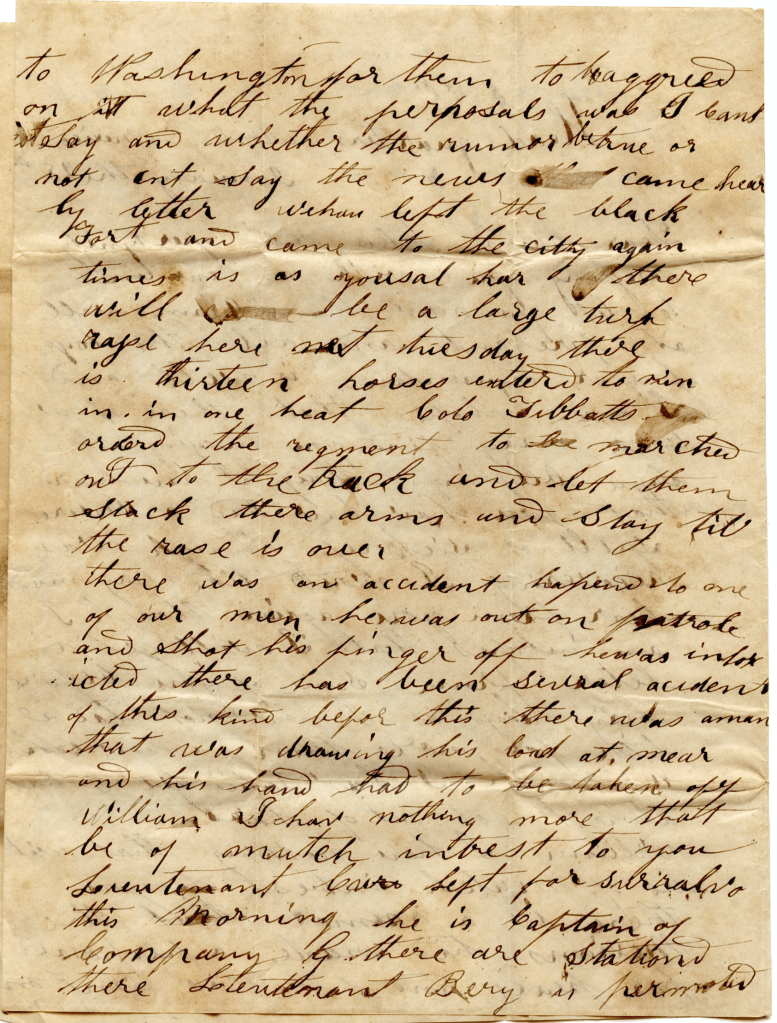
This letter was written by Peter J. Miller (1841-1910) who married Anna N. Warstler (1838-1910) on 6 September 1860 in Stark county, Ohio. In the 1860 US Census, taken in June, Peter was enumerated in the household of Mrs. M. Shellenberger of Marlboro, Stark county, Ohio. Peter’s occupation was given as “laborer.” Anna was enumerated in the same village living with her parents, Jonas and Elizabeth Warstler. By the time of the 1870 Census, Peter and Anna had relocated from Ohio to Monroe, Kosciusko county, Indiana, where Peter earned his living as a farmer.

Peter appears to have been the son of John P. Miller (b. 1813) and his wife Maria (b. 1819), both natives of Pennsylvania who resided in Bethlehem, Stark county, Ohio, in 1860.

Peter wrote the letter to his uncle George Miller (1804-1867) who was married to Lydia Newhard (1811-1890). George and Lydia had several children, to include: Christianna (b. 1837), Tilghman P. (b. 1939), William (b. 1841), Eli (b. 1844), and Peter (b. 1849). The couple lived out their days there, raising at least seven children.

Peter’s letter to his paternal uncle and family shares a reaction of Ohioans to the election of Abraham Lincoln and expresses some fear that the country will face “hard times” if the South does not “cool down” before the President’s inauguration. He informs them that the life of the president-elect has been threatened and suggests that Old John Brown is to be blamed for making the South “spunky” and emboldened them to carry out their threats of dissolution.

[This letter is from the private collection of Adam Ochs Fleischer and has been published on Spared & Shared by express consent.]

Transcription

Addressed to Mr. George Miller, Jr., Laurys Station, Lehigh County, Pa.
Postmarked Lake County, Ohio

Bridgeport, Stark County, Ohio
December 23, 1860

Dear Uncles and Aunts and Cousins,

I sit down to try to write a few lines to you to let you know that we are all well at present and so are all the rest of the friends as far as I know. And I hope these few lines will find you all well. I ought to have write to you for some time but I didn’t get at it. But I will let you know that I received your letter and I was very glad to read it and to read in it that you were all well for the times are mighty hard in Ohio at the present time for there is no money that goes except Ohio and the Old Pittsburgh Bank. That is all that goes here at the present time.

And there is a great excitement about the President that was elected. Some are almost scared to death while others only laugh at them. But for my part, I didn’t lose any sleep about it yet. But I don’t know but what we will have hard times if the South don’t cool down before the fourth of March for the way the papers say, they are going to kill the new[ly] elected President and if they will do that, then it will give hard times. But I guess they will cool down yet before that time. But all this fuss would not have been if that Old John Brown would have kept his fingers out of the Harper’s Ferry scrape. But that made the South spunky and now they are determined to dissolve the Union, and I, for my part, can’t blame them much for the black republican party used the South very mean so that I can’t blame them very much. But still it would be better to cool down than to dissolve the Union.

Further, I will let you know that I commenced to keep house and I guess we have plenty to live on for I butchered three hogs and have a quarter of a beef and I have some wheat and some buckwheat and corn. And so I guess we can get along very fine if we keep our health. And I think that it was most time for Christian[na] to catch one or else she will be in the bachelor line. That was the reason why I got married. I was afraid that they would turn me over to the bachelors and I didn’t like that. And if Christian[na] can get one in there if she will come out here, I will help her to [find] one for they are plenty here—and some old bachelors [too].

Further the weather is very agreeable. We have had some good sleighing but it didn’t last long and about the market prices, I don’t know anything. Well I guess I must bring my letter to a close for this time and I want you to write soon and not wait so long as I did. So no more but I remain your friend and well wisher till death. Excuse me for my bad scribbling and misspelling.

Peter J. Miller to George Miller
Ana M. Miller to Lydia and Christian[na] and Tilghman and William and Elias.

And all the rest of the friends and so forth. Goodbye to you all.

1862: William Hallam Tuck to Eleanor B. M. Hilleary

This letter—no doubt a draft—was prepared by 54 year-old William Hallam Tuck (1808-1884), a politician and lawyer from Annapolis, Anne Arundel county, Maryland. William wrote the letter to Eleanor Beanes Mullikan Hilleary (1806-1886) of Bladensburg, Prince George’s County, Maryland—the daughter of Clement Trueman Hilleary (1784-1859) and Mary Eleanor Mullikan (1783-1816). Eleanor never married and upon the death of her father in 1859, she being the only beneficiary, inherited his property which included several slaves, most of whom were hired out and may have been working in the District of Columbia.

The event that caused “the most uncertain & ruinous state” of things in Washington D. C. referred to in the opening paragraph of the following letter was the signing by President Lincoln of the D.C. Compensated Emancipation Act of 1862 that Congress had passed in April 1862. Largely through the urging of Charles Sumner, a Republican congress determined that the federal government was empowered in the US Constitution to “exercise exclusive legislation” over the federal district. Though this interpretation of the federal government’s constitutional power was a source of conflict, abolitionists used it as a way to end slavery in the national capital.

Titled “An Act for the release for the release of certain persons held to service or labor in the District of Columbia,” it freed the 3,100 women, men and children who were still enslaved in 1862. The act also allowed for slaveowners to be compensated up to $300 for each individual they had legally owned. In addition, newly-freed African Americans could receive up to $100 if they chose to emigrate to another country.

A three-member Emancipation Commission was established to determine who could legally claim compensation and disburse funds. The claimants had to show papers proving that they had legally owned the formerly enslaved people, and were required to pledge loyalty to the Union. Though the majority of claimants were white, there were African Americans who received compensation for family members whose titles they had purchased in order to keep them from being sold. At the end of the compensation process, the federal government had spent close to $1 million dollars to compensate individuals for their “property.” [Source: DC Emancipation Day]

Transcription

Annapolis [Maryland]
9 May 1862

Dear Miss Eleanor,

I received Mr. Duvall’s letter today. I intended to have written to you by this mail. I returned from Washington last evening where I had been two days. Things are in a most uncertain & ruinous state there, as far as regards servants. I understood that hundreds are already there and crowds arriving every day. I saw several persons from this county and Prince George’s county there hunting for runaway negroes and quite uncertain whether thy would recover them or not. I saw Mr. Gilma and collected Juliet’s hire. He said he had paid Spencer to you up to a time which I don’t remember. Spencer [Snowden], he says, had gone to Virginia with a regiment and promised to let me know the regiment and Col. & place where they are. I also saw Mr. Burr and Robert. Robert appeared to be occupied but today Mr. Burr wrote me that he had given him permission to go to see you. I also collected oe month’s wages for him. He said he had the last month’s wages at his wife’s and promised to bring it to Mr. Burr for me, or carry it to you. I collected a month’s wages for Charles. 1

In the present state of things, I don’t see that anything better can be done than to file a claim for their value under the late law. Those who are confident that the law is unconstitutional and might be voided by the courts, still thing that the safer plan is to proceed under its provisions and obtain all that can be had. These negroes might be obtained again, possibly, but what will they be worth? If they go away or become dissipated, nothing can be done with them. Others are constantly running away. They will not command as much hire in the county as they so in the District, and if you let them go there to hire themselves, they will be free and cannot be recovered. But if they run away, they might be reained provided the Fugitive Slave Law applies to the District, but I understand that the administration has decided that it does not and will not allow the Marshall to serve process under it. Every facility is furnished there for their escape and nothing allowed to be done for their return to masters.

It is the opinion of persons with whom I talked that the commissioner will allow good prices for men and women and I hope they may.

I am going to Calvert County Court Monday, and will see you immediately on my return and leave the necessary papers prepared provided you determine to proceed under he law. If Robert comes home, you had better keep him in the county until you determine what to do. I shall certainly see you before I go to court again and will have everything ready at the proper time. There are twenty days from today to file the claim.

Yours very truly, — W. H. Tuck


1 One of the slaves referred to in this letter was 18 year-old “Spencer” Snowden who ran away to Washington D. C. and apparently joined a Union regiment. He is mentioned in the following petition that was filed by Eleanor B. M. Hilleary in response to the Compensation act. His value was placed at $1,000. See also Petition of Eleanor B. M. Hilleary & William H. Tuck.

Dennis Headlee’s Collection of Partisan Rangers

Recently I interviewed Dennis Headlee of Xenia, Clay county, Illinois. As a follower of facebook sites where collectors often post pictures of Civil War-era soldiers, sailors, and citizens from their personal collections, I found myself frequently drawn to those images Dennis posted which I would categorize generically as Partisan Rangers. Now historians who study the Civil War require no explanation on what is meant by this term, but for those unfamiliar with it, I will simply refer you to a much sounder head on the subject than myself, Robert Naranjo, who wrote the following article for The Ohio State University eHistory publication, entitled Partisan Warfare in the American Civil War.

Griff:

Dennis, I’ve noticed that you have an amazing collection of Partisan Ranger images. Tell me a little bout yourself and your interest in collecting these images.

Dennis:

I grew up in Southern Illinois—Copperhead Country—and developed an interest in the Civil War during 5th grade history class. Our school district sponsored a competition requiring that we complete a project about the war. My project included a scrapbook developed from articles and clippings about the life of Abraham Lincoln. I won the competition receiving a blue ribbon and two silver dollars. My mother asked me to share my project and award with relatives during a family Sunday dinner. I received congratulatory responses from aunts and uncles. My grandmother, who I was always close to me, held back and approached me when I was alone. She informed me of my Southern roots and told me that gg grandfather joined the Confederate army and had fought against “Old Abe.” This previously unknown intelligence planted a seed of interest that survives to this day.

Griff:

Interesting. I can see how that information triggered your interest to learn more. How did you educate yourself further on the Civil War and when did you actually begin collecting?

Dennis:

I began collecting images and artifacts in the mid-1970s. During this time I continued to study and joined our local Civil War Round Table, Sons of Confederate Veterans, and the Mississippi Valley Re-enactment Battalion. I attended Eastern Illinois University as a social science major with a concentration in Anthropology. My military service was in the US Army, (69-71) and I served on an all-volunteer team conducting irregular combat missions in Vietnam. As a collector, I began to focus on Confederate images and artifacts and gravitated increasingly toward the Western Theater and the irregular partisans and guerrillas of Missouri. This is due, in part, to the geographic area I live in, the nature of my service in the US Army, and the fact that the West has often take a “back seat” to the study of the Army of Northern Va. and the Army of the Potomac.

Griff:

What are your aspirations?

Dennis:

My hope is to be a contributor to the preservation of American history and to spark interest in our younger generation of Americans.


Image 1

Marion Francis (“Dave”) Pool

Capt. Marion Francis (“Dave”) Pool was one of three brothers who fought for the Confederacy in Missouri. He served as a mounted leader under Quantrill and participated in much of the fighting and raids during the war. Sources vary as to Pool’s birth and death dates, but it is generally accepted that he was born in 1838 and died in 1899, at age 61. Following the war, Pool went to Texas and became wealthy as a cattleman and bank investor. Over the years he lived in various states including AZ, NM, MT and from time to time back in MO. He married, raised a family, and participated in veterans reunions. He was a very close friend to Frank James.
See “Dave” Pool After the War by Nancy B. Samuelson.


Image 2

James “Homm” Thompson

Missouri, Western Theater Irregular: Pictured in this 1/6th plate, cased ambrotype is Partisan Cpl. James “Homm” Thompson who rode with Quantrill during the raid and destruction of Lawrence, Kansas on Aug. 21, 1863. He is pictured with his side knife, multiple revolvers, and wearing a “battle shirt” and beard; typical of many of the so called “bushwackers” of the Partisan ranks in Missouri. Homm Thompson was killed in Franklin County, Kansas during Quantrill’s withdrawal from the raid. This is one of two known images of Thompson taken two days before the Kansas raid.


Image 3

Cole and Jimmie Younger

Cased 1/6th plate ferrotype of the Younger Brothers, Cole left and Jimmie right. The image was said to be a reunion photo in the autumn of 1865. Cole had returned from California, where he was sent for recruiting duties late in the war. Jimmie was paroled after being captured in Ky. during Quantrill’s flight from Missouri. The image is believed to have been taken in November 1865. The brothers went on, becoming a part of the James/Younger Gang known for their bank and train robberies. They were both severely wounded and captured following the Northfield, Minn. bank robbery and spent twenty five years in prison. Jimmie committed suicide following his release after hopes fell through to marry a journalist who had befriended him during his imprisonment. Cole went on to enjoy celebrity status and toured with Frank James relating stories of their exploits in public appearances.

Image 4

John Nichols

John Nichols was the first partisan tried, convicted and executed by Federal and provisional Missouri authority in the state. Pictured in this 1/8th plate, back marked cdv. is the image of young Nichols as a prisoner in chains shortly before his execution. On the left of the photograph a Colt revolver is visible being held by the guard just out of the picture. John Nichols, a Kentucky transplant, participated as a member of a small band of partisans and raiders in Northwest Missouri until his capture in April of 1863. Thereafter, he was tried and convicted by military court and sentenced to hang on October 20, 1863. The sentence was reviewed by the Missouri Military Governor and President Lincoln, both declining intervention. The execution was carried out on the prescribed date. After climbing the scaffold with assistance, due to a bullet wound to his leg sustained in an earlier escape attempt, John Nichols was said to have appeared unemotional and commented to the spectators, “Gentlemen, now you will see how a Rebel Soldier dies.” He was 22 years old when executed.


Image 5

William R. Stewart

Missouri Irregular, William R. Stewart is depicted in this 1/6th plate cased ferrotype. Time has taken a toll on the condition of this image, yet there is sufficient clarity to reveal an armed young man exhibiting a strikingly serious pose. Through research of limited records available, I’ve learned there were two William Stewarts who rode with Quantrill. Through concern that sources may confuse or misidentify references between the two William Stewarts, I’ve included only the limited information that accurately represents the soldier pictured here. In 1863, at age 18, young William Stewart joined Quantrill’s Partisans and participated in the August 21, 1863 raid on Lawrence, Kansas, that same year. In 1864, sources indicate that Stewart was with “Bloody Bill” Anderson and was slightly wounded in the attack on Fayette, three days before the battle at Centralia, Missouri where Anderson was killed. References indicate that William R. Stewart was born on August 5, 1844; that he survived the War and died on November 10, 1924 at age 80.


Image 6

Unidentified

Sometimes an image comes along with no identification, or specific ties to regiment or state. In such cases, conclusions must be based upon content of the photograph, it’s mountings, and any knowledge of history that supports the image’s content. Such is the case with this image and I offer conclusions only as possible, and in my opinion probable. Pictured is a well armed, neatly dressed subject in this 1/6th plate, tinted and gold accented ambrotype. This is obviously not a “Sunday go to meeting” image, but rather a depiction of a man planning to go to war. His weapons; including a Smith, Model 1 cartridge revolver, two percussion revolvers and a blade; are consistent with the story that Missouri Mounted Partisans were required three revolvers, an edged weapon and a good mount. Behind the image in the case is a notation, part of which is borrowed from Shakespeare’s Play, “Julius Caesar.” The notation is as follows: May the 10th, 1861 “My Darling F…ss… May the Lord of heaven and earth protect and bless thee. There is a tide in the affairs of men which taken at the flood leads to fortune. Shall I ever see my darling anymore.” The notation acknowledges this soldier’s separation from a loved one and the uncertainty of what is ahead. Most significant is the date of May 10, 1861 which is the date of the Camp Jackson Massacre near St. Louis. Learning of a Secessionist training camp, Brig. Gen. Nathan Lyons surrounded the camp with a regiment of Union Volunteers and marched the prisoners toward the city. Secessionist protestors along the way were fired on by the regiment resulting in 28 civilian deaths and scores of wounded. This action secured St. Louis but further polarized the Missouri population. The image content; the notation in the case and the date of the notation lead me the opinion the the image is that of a Missouri Partisan. Should that opinion fail to withstand further scrutiny, I believe this image at the very least could be considered as a “classic” example of a Missouri Partisan.


Image 7

James Bray

Partisan Ranger James Bray in this cased 1/6th plate ferrotype; There is a hand written notation on the paper under the image: “……… This was cousin James Bray rode with Bill Anderson killed Missouri 1863” No additional information has been discovered in a search of records. Hopefully, continued search will provide additional information.


Image 8

Greg Maddox

George Maddox, Missouri Guerrilla (1831-1901) is pictured in this backmarked CDV. A farmer before the War, Maddox joined Quantrill’s Partisans In 1862 and took part in their forays and raids. By the time of the Lawrence, Kansas raid in Aug. 1863, Maddox had become Quantrill’s chief scout. Four years following the Lawrence raid, Maddox became the only Partisan to be tried for murdering a man during the raid. The dead man’s mother attended the trial concealing a derringer. She planned to kill Maddox if he was not convicted. When the jury retired to deliberate, the mother left the courthouse believing it would be some time before a verdict was reached. The jury took only ten minutes to reach a verdict of not guilty. Maddox’ wife was waiting outside with a spare mount and the couple immediately rode for Missouri to avoid any chance of retaliation by the Kansans.


Image 9

Unidentified

Young Partisans; it is unlikely that these young boys (probably brothers) were, by any stretch, riding with the Missouri guerrilla bands when this 1/6th plate tintype was taken, but their checkered plaid and adorned shirts are similar of those appearing in some photographs of known Missouri guerrillas. It is fair to believe the shirts pictured were made by their mother as she produced one or more for their father, older brother or members of a local band of partisans who had joined the Southern cause. As shown in numerous photographs and supported by some historic references, printed and decorated shirts were commonly associated with guerrilla fighters and in instances served to identify individuals to certain units or commands.


Image 10

George M Todd

REBEL IN YANKEE CLOTHES: Pictured in this back-marked CDV is Captain George M. Todd (9-17-1839 to 10-21-1864) guerrilla leader, raider and Missouri Partisan Ranger. Captain Todd participated in numerous fights and raids including Lawrence, Kansas. He was a favored lieutenant of Quantrill until a falling out between them during a card game. Todd was quoted as saying, “I know I’ll be killed, but it is just as fitting for me to die for my country as any other man.” Soon after the Captain was fatally shot in the throat by a Yankee sniper during the battle of Second Independence. He is pictured in this photograph in a Federal lieutenant’s uniform, not an uncommon practice among Missouri Guerrillas, depending on circumstances.


Image 11

Archibald Clements

“LITTLE ARCHIE” Archibald Clements (1-1-1846—12-13-1866) was one of the most controversial and feared of the Missouri guerrilla fighters. Little Archie, with a height of 5 ft. and weighing only 130 lbs., joined Bloody Bill Anderson’s Partisan Rangers and became a favored lieutenant at age 17. He has been called the “brains” of Anderson’s band and was referred to as “Anderson’s Head Devil” and “Anderson’s Scalper.” He took part in Bloody Bill’s major engagements and earned a reputation as being calculating, deliberate and brutal. Following Anderson’s death in the battle at Centralia, Missouri, Clements took command of the irregular partisans. At war’s end Archibald Clements refused to take the oath of allegiance, and left with other vengeful veterans to continue the fight through raiding, robbing and killing. He and his gang are credited with the first daytime bank robberies in Missouri. Many of their activities occurred in Lafayette County and a posse was dispatched to put an end to their rein of lawlessness. On Dec. 13, 1866, a major gun battle took place between Clements and members of the posse in Lexington, Mo. The ensuing gun fight began in a bar and led into the streets where Archie gained his mount to escape and possibly to get additional weapons. Archie Clements died after receiving a total of 33 or 34 wounds. Witness stated that he emptied 11 revolvers in the fight and although gravely wounded he was attempting to cock a 12th revolver with his teeth before dying at age 20. His gang which, included the James and Younger brothers, went on to earn their place as one of the most infamous outlaw groups in history. It is noted that this image has been published in previous early articles about Archie Clements. There are some who feel the image is that of Archie’s brother. I remain in support of the earlier published accounts.


Image 12

“Jeff” Thompson

Brigadier General Meriwether “Jeff” Thompson (1826-1876) is pictured in this early full-plate ferrotype. Denied appointments to West Point and the Virginia Military Institute, Thompson left his native Virginia working west in various locations and finally arriving in Liberty, Mo. in 1847. He was successful in railroads, business ventures and politics where he was elected Mayor of St. Joseph In 1857. At the beginning of the War, Thompson was already a Col. in the Missouri Militia and was promoted to the rank of Brigadier in command of the 1st Missouri State Guards. His command took him to the swamps and marshes of S.E. Missouri where he waged a number of successful skirmishes against Union forces as a guerrilla leader. Here he became known as the “Swamp Fox of the Confederacy” a label placed on him by Gen. U.S. Grant. Thompson’s service took him as far south as Louisiana and included his fighting as a partisan guerrilla, a commander of more conventional forces, directing river naval engagements and two unsuccessful attempts to reestablish Confederate dominance in Missouri. Perhaps Thompson’s greatest contribution came in the form of his written proclamation to execute a Yankee for every Missouri Partisan and pro-Confederate civilian executed by Federal authorities as was Gen. Freemont’s plan. In response, Abe Lincoln intervened and had Freemont’s order rescinded. Gen. Thompson’s retaliatory order undoubtedly saved lives on both sides. At War’s end Gen. Meriwether Jeff Thompson took the Oath of Allegiance and moved with his family to Louisiana.

Image 13

Jesse Woodson James

Jesse Woodson James, ( b. Sept. 2, 1847- d. Apr. 3, 1882 ) pictured in this back marked CDV of the image taken shortly before his death. By age 17, Jesse was in the ranks of Blood Bill Anderson’s Mounted Partisans. During this time, Jesse further cultivated relationships with the Younger brothers, Quantrill, Archie Clements and others who remained “unreconstructed” at War’s end. His real fame, or infamy, really occurred following the war with his varied robberies of banks, trains and stage coaches as part of the James/ Younger gang.

Although some sources have labeled Jesse as the leader of the gang, his fame and credits, as a leader, are more likely the result of his letters and desire to seek public attention. Without question, the name Jesse James ranks among the most known of the criminal elements in history. Whether his service and exploits were motivated by vengeance, a desire to continue the war or for personal gain will undoubtedly continue as a source of debate from this time on.


Image 14

Unidentified

A very interesting 1/4 plate ferrotype image of four unidentified individuals which bears further study. A number of informed persons with backgrounds in uniforms, accouterments and Western history, have studied and discussed the image and agree on characteristics which support probable conclusions. Observations, supporting conclusions include: A) the image was purchased in Texas in recent years; B) each individual pictured is wearing some item or items designed for military issue including trousers, kepi, shirts, and Federal belt rig with hooded holster and 1851 pattern eagle belt plate. Some of the trousers and shirts appear clean and without significant wear suggesting they are recent acquisitions to the men; C) three of the soldier’s are wearing hats, likely from civilian sources. The hats are noted to be of medium to light color; D) two of the soldiers appear to be wearing boots. Based upon these observations and a final characteristic in the image, it is the belief that Missouri Partisan Rangers are depicted in this photograph: A) many Missouri Partisans are known to have gone to Texas for winter quarters and some fled to Texas following the war. B) Partisan Rangers were not regularly supplied through Confederate sources and relied on relatives, sympathizers and raids against Union forcers. C) civilian hats were commonly worn by soldiers on both sides. The individual forming and positioning of the hats in the image is very consistent with Southern soldiers. The choice of lighter colored hats is more consistent among Confederates than those worn by Federals who appear more often in darker hats. D) two of the men are pictured in boots, more characteristic of Mounted soldiers. Their trousers are unreinforced along the inner thigh and appear to be for infantry or unmounted soldiers. This mismatch easily supports that our subjects are wearing captured materials; E) Most noteable is the positions of the hands of the soldier seated on the left. The index finger on his upper hand, very subtly, is pointing downward toward his other hand. The fingers of the other hand are folded other than the thumb and little finger which are extended. It is believed that this represents a signal or hand sign associated with a group. The “Knights of the Golden Circle” were active in Missouri during and after the war as a pro-Confederate group. Many of the guerrillas were affiliated. Signals of identity were known to exist within the KGC. All factors considered, it is my opinion that this image is, indeed,of Missouri Partisan Rangers.

1861-64 Letters of Charles M. Heaton

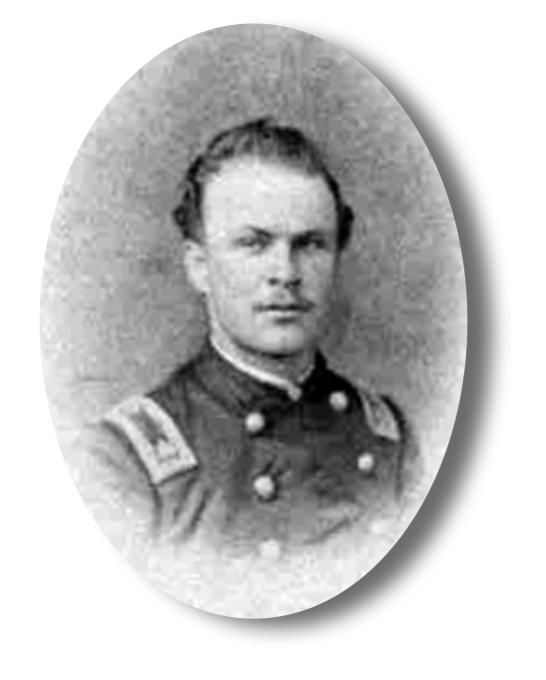
We don’t know what Charles M. Heaton looked like but this man appears to be an older brother to David Heaton. In South Bend, Hoosiers referred to him as “Squire Heaton” in later years. (Will Griffing Collection)

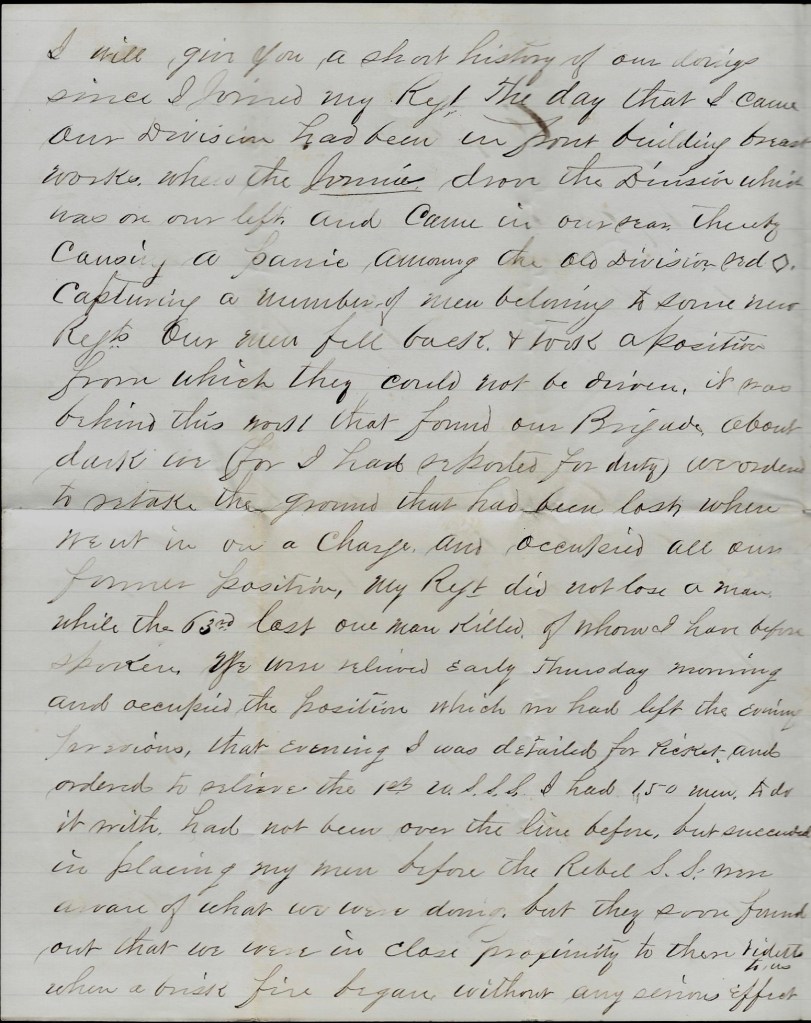
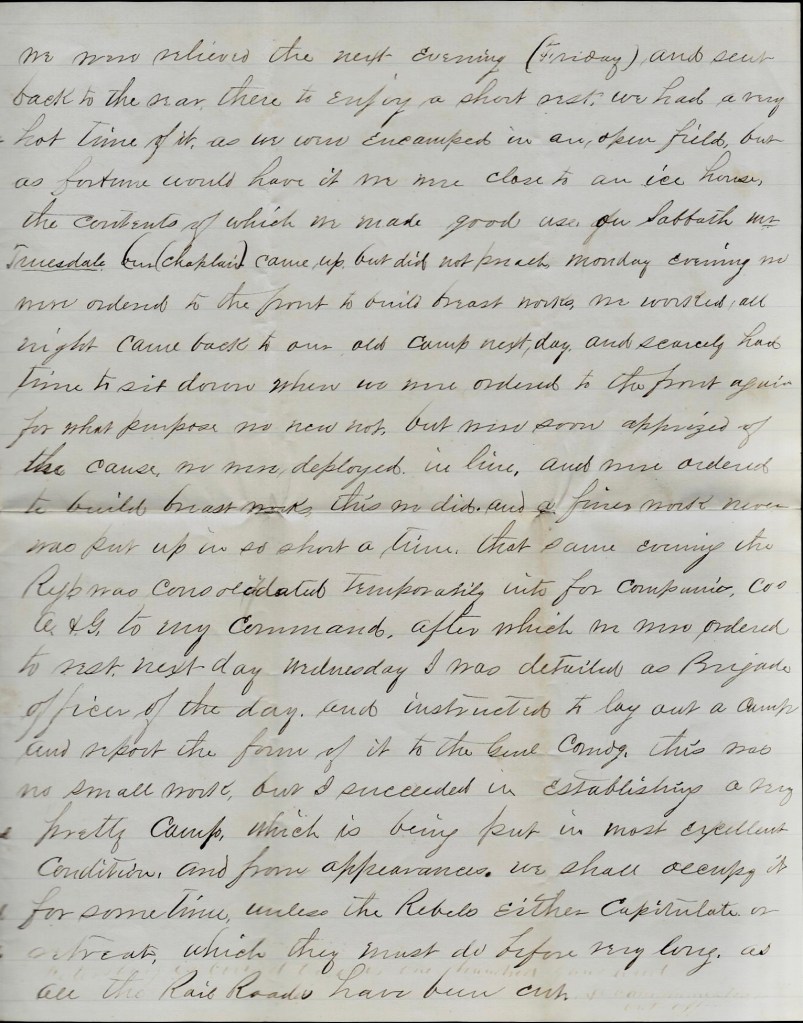
This collection of incredible letters were written by Charles M. Heaton (1805-1899), the son of James Heaton (1779-1841) and Mary Morrell (1782-1871). Charles was married to Ann Crane (1810-1899), a milliner, in June 1833.

Obituaries inform us that Charles was born and raised in Middleton (near Cincinnati), Ohio. He was married there but in a few years was left a widower with two small children. He relocated to Lafayette, Indiana, about 1830 and stayed there until 1833 when he came to South Bend, Indiana, when the population was less than 200. “He was a man of good education with fine business ability, which combined with a genial nature, energy and honesty of purpose made him a very useful man in the community.” Applying the skills of a surveyor which he had learned from his father—a civil engineer by trade, Charles surveyed the land for South Bend’s early settlers and mapped out the town lots. His prominence and reputation for honesty and fairness enabled him to be elected a justice of the peace in the burgeoning city. He also served as the town’s first express agent and telegraph operator.

In politics, Charles was a member of the Whig Party. He gave his first vote for President in 1828 to Henry Clay and campaigned hard for “Old Tip” in 1840. When the Republican Party emerged from the wreckage of the Whig Party, he leaned hard in that direction and threw his support behind fellow South Bend editor, journalist, and politician Schuyler Colfax who rewarded him with a good position in the government land office at Washington in 1860 where he remained for the next twenty years.

Senator David Heaton (1823-1870), much younger brother of Charles M. Heaton

Charles’ brother, David Heaton (1823-1870) was a practicing attorney when elected to his first public office, the Ohio State Senate (1855). Two years later he moved to Minnesota and was a State Senator there for six terms (1858 to 1863). The Civil War changed the course of his career. In 1863 Heaton was named a special agent of the Treasury Department and dispatched to the Union-occupied city of New Bern in Confederate North Carolina; he chose to remain there after the war, turning down a promotion in the US Treasury to do so. A staunch loyalist associated with the Union League, he was a leader of the state’s derisively called “carpetbagger” element, though his name was not associated with the corruption rampant among his more unscrupulous colleagues. He was a member of the North Carolina Constitutional Convention in 1867, after which he emerged as the Republican frontrunner for the state’s return to representation in the US Congress. Heaton was elected to the Fortieth and Forty-First Congresses, representing North Carolina’s 2nd District, and served from July 1868 until his death in office. He was buried in New Bern.

Charles M. Heaton’s Civil War Era Letters are all published on Spared & Shared 23 on three separate pages.

1861-62 Letters (posted below)

Letters 1 through 30

1863 Letters

Letters 31 through 49

1864 Letters

Letters 50 through 95


1861-62 Letters

Letter 1

Washington
December 12, 1861

Dear Wife,

I did not feel very well today. My head has ached some and somehow have felt very dull today and had concluded I would not write tonight, but after reading some and sitting before the fire toasting my feet before going to bed, now quarter past nine o’clock, I got to thinking about home and of the many miles that are between us and it seemed as though my desire for sleep had all vanished and that before I laid myself down to rest, I must write a letter home. I drew out my table drawer, got out my paper and am now at it.

For two or three days past the weather has been very heavy though but little rain has fallen. It rained, however, on Thursday night and on Friday morning a heavy fog rested upon the city. The fog continued all day on Friday & Friday night & all day Saturday. I never witnessed such a fog in all my life. Yesterday it was so dense you could not see the houses across the street, but last night it went off & today has been quite pleasant. But the streets and crossings are very muddy—worse than I ever have seen them since my arrival in this city.

I received Mary’s letter of 31st December [November], also one from Charles of 2nd inst., which I answered and directed to him. I also received another note from Charles of 7th inst. acknowledging the receipt of the $125 I sent you by Express, and that Mr. Burroughs was fully paid off. I was greatly rejoiced to know that we had that debt entirely paid and that too before the interest amounted to but little.

There is now quite an excitement here among the clerks. It is said that [John] Sherman of Ohio has introduced a Bill, among other things, if it passes, will reduce all our salaries 33 percent. If this should pass it will drive away many of the most meritorious clerks to resigns and leave the city for they cannot live here & pay house rent if their salaries should be so much reduced. We are all active in seeing our members and trying to convince them that it will be suicidal to us to pass the bill. I do not know what they may do but I doubt whether it can be passed. I have not seen Mr. [Schuyler] Colfax since it was introduced but Esqr. Matthews told me last night that he was opposed to it. I pitched into Mitchell, the member of the Elkhart District, and he thought it could not be passed. A friend of mine–Mr. Stailey, a clerk from Rochester, Indiana—proposes that if it passes that the clerks get up a large pewter cased watch and have a large Jackass engraved on it & presented to Mr. Sherman & that he will make the presentation speech. You will hear of some tall times if it passes.

It is hard to tell what our government is coming to. The army does not move forward and so far as the public can see, no preparations are being made to move. And it is yet believed by many that we will soon be in a war with England and much anxiety is manifest to hear the news from England, whatever the news may be, will have much to do about the movement of our troops. If England should accept the surrender of Mason & Slidell as satisfactory and consequently put a stop to any immediate prospect of a war with England, it will of itself crush out the prospects of our Southern rebels & a sudden forward movement may then be made by our troops & they may be easily routed while in despair of being favored by England. But if England should still be determined to make war upon us, they will also acknowledge the Southern Confederacy & we will then have them both to fight and there is no telling what the result may be. Even though we may succeed in the end, our government will be totally bankrupt & the people generally will see hard times. A few days more, however, will settle this English question & my opinion is that it will be all right.

I think it would be advisable for you, as early as you can, to secure a few bolts of muslin for shorts and other things at the best price you can, though the prices are now higher than they have been, yet it will be much higher. I should not be surprised if shirting such as could be bough six months or a year ago at a shilling a yard will be before a year two shillings per yard, and in the same proportion with all other cotton goods. Better have an eye on this.

Mary wanted to know something about the style of hat I mentioned in one of my letters. I do not know how to describe it but I think they are black velvet with rolling rims and ostrich feathers around both sides. Those that I noticed I thought looked very rich and nice. When our money matters get all right, I will see what I can do in that line. Next month I cannot send so much as usual having sent $125 last time. I kept nothing back to pay board with. I always like to have my board paid up at the end of every month & enough in my pocket to pay for the ensuing month for fear of accidents. After that is provided for, I will send you all the balance as usual.

A few days ago I called at J. D. Defrees. Mrs. Defrees & Julia went their love to Mary and express great anxiety for Mary to make a visit here. But after we hear from England, I will say more about the visit and I also want to know the fate of Sherman’s Bill before Congress.

Whenever you can spare the money, I would like to have you see Alfred Hale at the Printing Office & have him get me my I.O.O.F. card for the ensuing year as my card I have has run out & I can’t visit the Lodge room until I get a new one. It will cost for the Lodge card $5.45 and there may be in addition a funeral tax of 50 cents as I see Bro. [Daniel] Haight 1 is dead. The Encampment Card I can wait a little longer for that but I want them both soon as I can get them. If I should be sick here, they would be a benefit to me, and besides I would be entitled to weekly benefits from my Lodge. I hope however to have better luck that to get sick.

I hear that there is much sickness in the city though I have not seen it, yet it is said the small pox, typhoid fever, and measles are very prevalent in the city. I am very cautious not to expose myself for I should feel miserable to be sick so far from home. When you write, tell me how Mother stands the winter. Does her usual health keep up pretty well? I have no doubt she is much better off than she could have been anywhere else. How is Lib’s 2 children? Have they got over the measles? Was they pleased with those things I sent? My love to Mother, Lib & her children, to Mary & Charles, and the largest share for you.

Your husband, — Charles M. Heaton

I here send $5. I want you to hand this Mr. Barrett on balance I owe him on my watch. I will send him balance before long. I saved this out of my expenses for this month. I have just $2.25 left. Guess I can get along. Tell Charles to charge it to Barrett on his account in my book.

1 Daniel F. Haight (1814-1861) died at South Bend on 9 December 1861.

2 Here and throughout the letters are numerous references to “Lib” who was Elizabeth (Heaton) Davis (1827-1911), a daughter of Charles M. Heaton by his first marriage. “Lib” was married in 1851 to James Davis (1812-1883), a native of Pennsylvania who studied law in Pittsfield, Illinois, when he was 21 while working as the clerk of the Circuit Court. He was admitted to the bar in 1836 and practiced law until 1876 when he accepted a position at the U. S. Treasury Department in Chicago. James and Elizabeth (Heaton) Davis had three boys—James (b. 1852(, Charles (b. 1857), and Thomas (b. 1859). [History of St. Joseph county, Indiana, 1880]


Letter 2

Washington D. C.
July 8th 1862

Dear Wife,

I did not write you on Sunday last, for reason first, that Sunday was one of the warmest days of the season, and it was all I could do to sit in the shade and fan myself, and not only this, but for more than ten days past I had been very much troubled with diarrhea, and a good part of the time quite unwell. In my letter by Express I wrote you how I come to choose my boarding place a week ago last Monday. When I left W. Stokes’ house that morning, I determined I would not return & packed up my things accordingly, and having no place to go, I went to where Frank [Heaton] 1 was boarding & they not having any vacant rooms, I engaged temporary boarding at $3 per week and slept with Frank in the room where he had his things stowed away. I remained there just one week before I found a place to board.
I am now at Mr. [James] Mankin’s, 2 No. 398 on 9th Street, about 2.5 squares from the office. This is much more convenient on account of the distance from the office than any place I have had, and the eating there is better than any I have had since I have been in Washington. They have, I think, about 8 or 9 boarders, mostly from the southern part of Indiana. One, however, is a Presbyterian Minister, a chaplain to one of the hospitals in Alexandria. His name is Ulmsted from New Jersey. Mr. & Mrs. Mankin are both members of the M. E. Church. The house is a framed house three stories high and looks a little ancient. It has fine large sycamore shade trees in front. The furniture about the house is quite ancient also, and I think some of it might be kept in better order. They have a piano in the parlor. I do not know who plays on it yet but I wish Mary was here to shake its dry bones a little. Mrs. Mankin attends to the cooking herself—has a black woman to help her. They have a fair variety on the table and comes on in good order & very well cooked, and altogether I think I shall like it pretty well. I pay $20 per month & furnish my own lights. They have no gas about the house. I have a good lamp of my own & therefore did not care but little about it.

And another reason why I did not write on Sunday is, I had no letter to answer; have had no letter from home for nearly two weeks, and am getting a little uneasy for fear some of you are sick. If any of you get sick, you must not keep me in suspense by not writing but let me know it at once, and in the case of sickness, must hear the oftener, if only three lines at a time. I hope to get a letter by the next mail.

From the papers you have no doubt learned of the battle before Richmond. It lasted for about five days and various opinions exist as to the result, but no doubt McClellan had the best of it. Our loss, however, in killed, wounded, and missing is not less than twenty-five thousand & the rebel loss is at least fifty thousand. It was a terrible battle. The wounded have been sent to the various hospitals at New York, Philadelphia, Washington, and other places where they could be taken by water. Four or five vessels loaded with them have arrived here. Nearly all the churches in the city have been converted into hospitals, two of them close by where I board—one of them within fifty steps of the house. It is a terrible sight to see the wounded in every form possible to think of, and some of them dying daily at every hospital. And the surgeons are all the time at work amputating arms or legs. Oh! it is dreadful to hear the moans of the poor sufferers. But everything is done for them that can be done. These large churches are airy & everything is kept neat and clean. And every man has a mattress bed on a bedstead alone—no two together.

Gen. Lew Wallace of Crawfordsville, Indiana

Our committees are constantly at work looking out [for] the Indianians and furnishing them with every comfort they want. Frank Heaton is devoting himself to it manfully. I am on the Executive Committee as you have seen from the papers I sent you. And I see they have published it in last week’s Register. We intend to see that all our Indiana soldiers in the hospitals in and about this city shall be provided for. I have paid out eight dollars for their benefit & if necessary, will do more. There is now between eight and ten thousand wounded soldiers in the hospitals in & about this city. And all this suffering has been brought about on account of slavery. Slavery is the prime cause of it all. You read the speech of Mr. [Thaddeus] Stevens of Pennsylvania in the Globe of the 7th inst. He speaks my mind exactly about arming the slaves of the South to fight these infernal rebels—and before this war is over, this course must and will be adopted.

I am scratching this off in a great hurry in the office. The vest you sent me fit me to a T—a very nice one indeed. I think I will have to buy me a think coat & a hat. General Lew Wallace is here & is to be serenaded tonight, & will likely have a speech from him. My being so unsettled for a few days & not being well, have not got those pictures yet though I suppose they are ready. I may go and see this evening.

I seen James Sample yesterday evening. He is well & seems well pleased with his place. He has not got a permanent boarding place yet & where I board is too far off for him. My health is now very good considering the hot weather. For three days past the mercury stood at 92 to 95 in the shade—pretty hot, ain’t it? I hope to hear all is well at home. Love to all, all, all. Your husband, — C. M. Heaton

Frank M. Heaton in later years

1 Frank Miller Heaton (1834-1908) was a nephew of Charles’. He was the son of Charles’ brother James Heaton (1808-1882) and Sarah Castor (1810-1895) of Crawfordsville, Indiana. Frank was also employed as a clerk in the Land Office at Washington, beginning in 1860. He remained in that position until 1888 when he resigned to open a law office specializing in land claims. He was married to Harriet (“Hattie”) E. Bowen (1837-1869) and their first child, Edith L. Heaton was born in December 1863 (her birth is mentioned in Letter 46). The 1900 Census record erroneously gives Edith’s birth as December 1864. After his first wife died in 1869, Frank married again to Mabel Berthrong. Frank was killed instantly when he was struck by an automobile after stepping out of a street car in Chevy Chase, Maryland, on 30 October 1908.

2 The District of Columbia 1862 City Directory lists James Mankin, grocer, at the 398 9th west H (ditto, home). In the June 1860 US Census, James (age 58) and his wife Deborah D. (age 42) are enumerated (both natives of Maryland), with their children Deborah C. (age 19), James (age 18), Mary E. D. (age 15), Miriam (age 5), and Henry D. (age 2). At that time their boarders were A. Caldwell Singleton, a 22 year-old clerk in the G. P. Dept.; Sidney B. Deitzer, (age 20); Ellen Powell, a 35 year-old servant from Ireland; and Frank Powell (age 21). In the 1865 City Directory, James Mankin was still listed with his boarding house at 398 9th West.


Letter 3

Washington
July 20th 1862

Dear Wife,

No doubt you think it a long time between letters this time, but by the time you get through reading this letter, you will know that the apparent neglect was not intentional. For some time past, as I have before written you, I have been much troubled with diarrhea, and especially during the last week. Notwithstanding, however, I have been able to fill my place at the office regularly. Mr. [Schuyler] Colfax left for home on Thursday evening and I intended to have met him at the depot and seen him off, but that day I was particularly feeble and was not able to do it. And in addition to this an additional cause of excitement and warm blood occurred at my boarding house that day, and it was just at the time I should have gone to the depot if I could.

In the forenoon of that day, a Negro man was taken from my boarding house—the house of James Mankin 1—an account of which I sent you in the Daily Republican. I marked it so that you would understand as much of it as was true. Hope you have received it. I knew nothing of the matter until I came to the dinner table at four o’clock. Some of the boarders became much excited over it—especially a W. Ulmsted, a Presbyterian Minister. The act was denounced as an outrage in the warmest manner, but the Land Lady, Mrs. Mankin, was particularly severe in her remarks in justifying the act, although the men that took off the Negro was not officers of any kind & had no writ of any kind, and according to Mrs. Mankin’s own story, the Negro man was a free man and had been raised in this city as stated in the paper (cut out that article & put it with this letter so that it will always explain itself) and this excitement, together with my being very feeble in body, prevented me going to the depot to see Mr. Colfax off. I want you to see him & let him read this letter—or at least tell him why I was not there. And tell him also that this morning I received the letter he returned to me from Elmira.

Daily Republican, July 18, 1862

The following article was published in the Daily National Republican on 18 July 1862:

“Kidnappers at their Inhuman Business Again—An Outrageous Case.

Yesterday morning between 9 and 10 o’clock, two men drove to the boarding house of James Mankin, No. 389 Ninth Street, near I, and enquired for a colored man named Jim, who, at the time, was at the market, The landlady invited the men into the parlor, and when Jim returned, they seized him. He cried ‘murder’ lustily, whereupon they gagged him, dragged him out of the house and thrust him into the carriage, when he threw himself out on the other side. They then picked him up and ordered him ot step in. This he refused to do, whereupon they pushed him in and drove down Ninth street towards the river. Mr. Mankin was not at home at the time of the outrage, but the family made no resistance. The carriage was a dark colored barouche but was closed at the time—white horses, driven by a white man with drab or gray clothing, side whiskers.

The colored man says he was born free in this District and was raised by a colored woman named Smith. He was always known as good, orderly, and trusty servant. His color is pure black…

Quite a crowd had collected by this time, but the thing was managed so quickly there was no time to rescue the man. This man has worked for Mankin for several days, waiting on tables, &c.

Another case of the same character was reported to us yesterday. A contraband girl was taken from the residence of Mr. Fowler, No. 476 Seventh Street, at about ten o’clock in the forenoon, a few days since, in a manner similar to the above…

We are told that these outrages are occurring daily. How long shall our city be disgraced by such scenes? Unless the authorities take vigorous measures to put a stop to such proceedings, we fear that there will be some serious disturbance in our streets, for there are those here who cannot patiently stand by and see the capitol of the nation polluted by these thieves of human flesh and blood. Let the rascals be ferreted out and punished for their crime as its enormity deserves..”

On the same day, the Evening Star reported:

“In this morning’s Republican appears a local article headed, ‘Kidnappers…’ in which the grossest injustice is done to an eminently worthy and respectable family….The facts of the case are these. Yesterday morning two men drove to the residence of James Mankin, Esq., and inquired for a colored man named Jim, who was in the service of Mr. Mankin. They were informed that Jim was absent at the market with Mr. Mankin, but would return in a few minutes. The men waited until the negro returned, when they arrested him with a writ issued for that purpose by one of the commissioners lately appointed by the Circuit Court….Mr. Mankin did not return to his house with the negro, but went directly from the market to the criminal court where he was engaged as a juror.”

Well, the next morning, Friday, at half hour before breakfast, the morning papers were left at the house and behold, an account of the negro scrape was published. It was first discovered by the daughter of Mrs. Mankin, a stout, large girl. I was sitting in the parlor with this minister & another boarder, Capt. Latimore, when the girl came running into the hall asking for her mother, [and] found her just ascending the stairs. The daughter called to her to stop—that she had something to read to her, and she read it out so loud that we could hear that it was about the scrape the day before. But about this time, Mr. Ulmsted had gone to his room, Just then Mr. Mankin came in and was much out of humor and denounced the publication as false & said that he believed Mr. Ulmsted was the author of it & that he intended to go to the printing office & demand the author, and the daughter & mother were very worthy and free to denounce the author as a scoundrel & liar. The secesh blood began to show itself strong. They left, however—the daughter to her room and the mother to finish getting breakfast.

By this time Mr. Ulmsted had returned to the parlor & soon after Mrs. Mankin commenced singing & seemed to put on an extra effort to sing loud. Some of the boarders said, to listen, that it was a secesh song. We all listened. I could not hear distinctly but they all said it was a full-blooded secesh song & we all then determined to leave the house soon as we could find other places.

Well breakfast was announced & we all went in. The conversation at the table was exciting & pointed on both sides between the boarders & Mrs. Mankin. Mr. Mankin had not yet made his appearance and just as we were getting through breakfast, a Mr. [John D.] Bartlett—the son-in-law of Mr. and Mrs. Mankin (having married another daughter & lives somewhere in the city)—made his appearance at the dining room door, a stout young man, and without any previous notice, immediately remarked that, “The man who was the author of the article in the Republican was a liar, a coward, and a scoundrel.” Up to this time, the family all believed that Mr. Ulmsted was the man and those insults were all intended for him, but just then another boarder—a Mr. Tyner who had also been a captain in the one year’s service in the same regiment with Capt. Latimer (either the 13th or 16th Indiana Regiment, I think the latter as they are from near New Albany, Indiana, but now both clerks in the War Department)—was sitting with his wife & child on the opposite side of the table to me. By this time, Mr. Ulmsted had rose & left the table, but immediately after Bartlett—the son-in-law—made those insulting remarks, this Captain Tyner turned to Mrs. Mankin & said he, “Mrs. Mankin, I can tell you who wrote the article. I reported it to the editor and he wrote it down & I hold myself responsible for it. This took them and most of us by surprise, and he immediately rose from the table and stepped up to Mr. Bartlett who remained yet at the door, and said the captain, “Now, sir, if you have anything more to say, say it to me. I am ready, sir, for any emergency.

The lie was passed between them two or three times when the son-in-law made a pass at him with his fist and the captain kicked Bartlett & then the blows commenced. The captain nearly knocked Bartlett down two or three times & they clinched. Mrs. Mankin left the head of the table and rushed towards them crying at the top of her voice, “Hurrah for Bartlett! Give it to him—thrash the scoundrel!” and the daughter (the single one) came rushing in the room hollerin, “Kill him! Kill the scoundrel,” and they both pitched on to the captain trying to trip him up, pulling his hair, and scratching him in the face.

I tried to get to the men to separate them but could not for the women. They pitched in like tigers, hollering all the time for Bartlett. But when they clinched, they soon came to the floor, struck against the table, and the dishes flew in every direction. On coming to the floor, the captain was on top and soon had one knee on Bartlett’s breast & a thumb in each eye, & both eyes out on his cheeks. This soon caused Bartlett to holler “Enough!” most lustily, ad the captain, not forgetting that it was dishonorable to continue his castigation after his antagonist hollered enough, got up. All this time, however, both women was on him but he paid no attention to them. But just as he rose, Mrs. Mankin picked up a chair to strike him with. I caught the chair & told her she should not use it, but she stepped up to the captain and struck him a full blow on the side of the face with her open hand. The captain turned to her and gave her a disdainful look in the face, said not a word to her however, but turned and left the room & the women commenced to take care of the don-in-law & to get his eyes right again. The fellow looked badly used up as he was, but he swore vengeance—that he would shoot him, &c. &c. But he went home & went to bed where he remains to this day.

The captain was not hurt except the scratches given him by the women. All the boarders determined to leave the house and four of us started out to hunt a new boarding house. I soon found one and moved the same day. So did the other three. There were three others that could not leave immediately for he reason that they had not money enough to pay their board & could not until the end of the month when they will all leave.

I have not heard from this Negro man since and do not know what became of him but suppose he was run off out of the District. There was also a black woman there with a child about two or three years old. And I am just told that last night two men came there with a carriage and took her off in the same way. And there is considerable excitement in the neighborhood about it.

I am very sure I am at a good Union house now—at a Mr. Finney’s, 2 only one block from the Patent Office building where my office is. The family came here from Harrison county, Ohio. Mr. Finney is a clerk in the Treasury Department, came about the time I did. We are in a three story brick. I have a larger and better room than I have yet had & the whole house seems to be neat & in good order & very comfortably furnished. Mrs. Finney has a colored woman to help her but she oversees all her affairs personally & I think a very nice family. And the eating is good. They have five men boarders besides myself—all western men, mostly from Ohio and all good, staunch Union men—and still they have a spare room or two, My room is in the third story at $20 per month. He charges $25 for the lower rooms which are better furnished but I am well satisfied with mine—have a good closet in it for my clothes.

Hon. Schuyler Colfax as he appeared in 1865

Mr. [Schuyler] Colfax told me that Dr. [Louis] Humphreys 3 was ordered to report at Washington forthwith, but he thought he would just go to South Bend & visit his family. Mr. Colfax takes the Drs. commission with him. If the Dr. is there after you receive this, I want you to call and see him and tell him when he comes to Washington that ig it is not absolutely necessary for him to put up at some public hotel, that I have secured quarters for him here. And if he should bring Mrs. Humphreys with him, so much the better. If he only stays a short time, their board will be one dollar per day each. If they stay a month or more, then $25 per month each. I am very sure they will be satisfied with the place and the location is so central, it will be convenient for any part of the city—quite as much so as any location he could get away from the hotels. And then I would be so much pleased to have them here. And if he has time to drop me a line when he will be here, I will meet him at the cars & conduct them right to the house. But if I should miss them, tell them to come to No. 414 9th Street, corner of H Street. I have spoken to Mr. Finney about it and he says if they come, he will have them well taken care of. You may let the doctor read this letter.

Since yesterday morning I have felt much better and I think this troublesome diarrhea is about to leave me entirely. I am so glad I have got away from that secesh house—the table however was pretty fair, but still about the kitchen everything looked sluttish & dirty. I noticed this as I had to pass the kitchen door sometimes, and I think it would have been a miserable place in case of sickness. There was one man sick there a few days and if it had not been for the boarders, he would have suffered for the want of attention. His friends on the day of the fuss got him another place & took him away.I am quite sure where I am now, it would be much better in case of pickup for they are very kind and attentive.

I have only got now to where I must answer Charles’ two, and Mary’s last letters of the 14th and 15th inst. Charles enclosed me two land certificates for land locations for Milford Leonard to obtain his Patents for him. In 15 minutes after I received them I had the Patents and I here enclose them. Tell Charles to hand them to Mr. Leonard the first time he sees him & to tell Mr. Leonard I was glad to have the opportunity to serve him. He is a very poor man but has always been a good friend of mine. And I am glad to see that the Express & Telegraph business keeps up so well. I see they are increasing. And although the business is very confining and requires the utmost care & attention to give satisfaction to the public & to the companies, yet it is the best paying business he could engage in. I know of none that pays better, and besides this, the pay is always sure. And so long as the business is properly attended to, there is no danger of any change being made. And I am much pleased to hear from all quarters that it is attended to so promptly and faithfully. The greatest care is in looking after hte safety of money packages and the prompt collection & return of notes & accounts sent for collection.

At this time I suppose he is much troubled about the kind of money in circulation and about silver change. I suppose also the Express Company continues to issue circulars in regard to the kind of money to be taken. Always follow the instructions to the letter. Silver change here is very scarce & many, to obtain it, have to pay from 10 to 15 percent to get it. I find it very difficult to get along without being subject to this charge. I suppose our bank continue to pay coin on their notes. I would be glad to have Charles to save all the silver he can. You can keep it at the house, or he could make a special deposit in the bank—that is, to wrap up a package of silver or gold, put his name & amount on it, and have it laid in the bank vault to be called for when wanted. Tell Dr. Humphreys to provide himself with silver change for it will be difficult to obtain it here.

Charles also writes me that a Dr. W. Wright holds my receipt for two notes, one on A. T. Stevenson for $10 and one on C. W. Card for $8.34, and wants to find the notes. They are among my papers somewhere, either in some package in the safe, or in that box he mailed or packed up. I remember them well but cannot say where he will find them If it is necessary, you can look for them. They are worthless, however. They are receipts for medicine & not notes & anyhow they are worthless & could not be collected, and Stevens said he would contest if sued. And even if a judgment could be obtained, it could not have been collected for Stevens told me he was determined that he would never pay it. And about the time I got the papers, Card left South Bend. If the man Wright would leave my receipt with someone in South Bend until I come home, I can find the papers but they are good for nothing. I would not give him five cents for both of them.

Did you see my Sunday School letter? Tell Bro. Brownfield I should like to have a letter from him [and] that I think he is indebted to me one.

John Woodworth is still here engaged in the Post Office. He wishes to be remembered to you all. He says he wants you to tell Mrs. Byerly he wants her to write him. He has written her & the family two or three times but has not had a line from them. John looks well & is getting along very well. I send you herewith a couple little packages of flower seeds, Johnny jumpups, the different kinds are marked. You might put a part of each in the ground now and keep the balance for next spring. They are very beautiful & larger than any I ever seen.

And now, Mary, I have come to your last letter of the 14th inst. It is a good letter & I was rejoiced to get it. When you wrote, you seemed all to be enjoying yourselves so much after a good refreshing shower after a hot day. But it was sad to hear that even a poor little child must perish from the lighning. But she has gone to rest, poor thing, and will be relieved from all the cares and troubles that might have been her lot to endure in passing through this wicked world.

I do not think you need be troubled about Charles or I having to go to war. In the first place, I do not think Charles would even be accepted in the ranks as a volunteer on account of his once having his collar bone broken & not very stout at best. And I am too old. And again I think there will be in due time plenty of volunteers to fill the present call. But as old as I am, if at any time, I should happen to be where an attack should be made, I would not run but procure a musket and throw myself into the ranks and fight [to] my death for the glorious flag of my country, and do all I could to preserve and save the government under which we live.

We now think, however, that the war will progress with more spirit. The late movements & orders of General Pope is infusing new spirit & zeal everywhere, and if they are only half carried out, the rebels in & about Richmond will soon have to “skedaddle.”

I am glad to hear that Capt. Sweet was lodged at Camp Douglas and I should think he would feel so disgraced to be taken a prisoner fighting against his country & brought to the very spot where he used to split his throat with hosannahs to Douglas & the Democratic Party that he would fairly sink into the earth to meet an old acquaintance. How I should like to see him and give him my opinion of a Northen man now a Southern rebel traitor. I have a mind to send him my opinion of such a monster through Mr. Wright of Chicago where he used to board. When this war broke out, had he have come North and entered the service of his country under the old Revolutionary flag, he might have gained to himself some honor. But now he is eternally disgraced & will die a traitor to his country.

Frank Heaton was just in to see me. Says he just got a letter from Hatty. She is in Crawfordsville on a visit & enjoying herself to the full. He is going after her in September. You must go to Mr. Layton’s & buy yourself one of those albums. I want you to have one. Get one that just suits you. I went to get those pictures of yours yesterday & one of them did not suit me & I would not take them until they done it over & they cannot do it only when the sun is right. Soon as I can get them, will send them.

I am looking forward with all the patience I can master for October to roll round, when I shall start for home, sweet home, and will come through as fast as steam can carry me. Sometimes I hardly know how to wait but I will still try. I am getting along in my office very satisfactorily. Mr. Duffield has gone home & will likely call & see you. You must continue to fix for coming here next winter so that when the time arrives, you will be ready without any extra effort. I had a line from Mother the other day. She is still at Valparaiso but will go to Minnesota before long. She says she left a small book at our house & wants it sent to her. Have Charley send it by express man free through. Tell Charles to make it go through without charge.

My love to Lib & to each & all. Your husband, — Charles M. Heaton

1 Find-A-Grave records reveal that James Mankin (1802-1885) was married in February 1838 to Deborah Dent (1817-1905), both from Charles county, Maryland. An obituary for James Mankin claims that at one time, he was an employee of the General Land Office, first as a messenger and then as a clerk. He was described as “an upright, conscientious citizen and during his quiet, unobtrusive life he made many friends.” The couple had at least seven children that died as infants or very young. Those that survived to be at least young adults included Deborah Cookman Mankin (1839-1913), James D. Mankin (1842-1919), Mary Eveline Mankin (1844-11 October 1862), Miriam Mankin (1855-1935) and Henry Dent (1857-1928). It was Mary Eveline Mankin who was the wife of John D. Bartlett. She died on 11 October 1862, less than three months after this letter was written. The “stout, large” daughter living at home with her parents in July 1862 was 22 year-old Deborah Cookman Mankin who later married Zachariah Berry Brooke (1837-1878).

2 William G. Finney, a clerk in the Treasury Department and a native of Ohio, was registered as being 45 years of age at the time of the 1863 Draft Registration in the District of Columbia. An on-line family tree informs us that William Guthrie Finney (1818-1905) was married to Margaret (“Maggie”) Carnahan (1816-1894) in Harrison county, Ohio, in December 1842. Just prior to coming to the Nation’s Capitol to take a job in the Treasury Department, the Finney’s kept a store in Cadiz, Ohio. Unfortunately for Mr. Finney, he made front page news in the Washington papers in 1869 when he was accused of an extramarital affair and again in 1871 when his libel suit came to trial and correspondents covered the scandalous affair. The Finney’s oldest child was James Rea Finney (b. 1846) whose first job was a newsboy selling the Evening Star. Family tradition has it that James was present at Ford’s Theatre the night Lincoln was shot and remembered how the family sat up all night until morning hoping for his recovery. Late in the war he served in Co. K, 170th Ohio Infantry.

An 1862 Map of Washington D. C. showing the location of the Interior Department & Patent Office Building (shaded in yellow at center) and the proximity of the Finney Boarding House (blue star) where Heaton took board & lodging in July 1862.

Letter 4

Washington
July 21st 1862

Dear Charles,

Yours of the 18th inst. enclosing your Uncle Johnson’s letter this moment received. Yesterday I mailed your Mother a long letter enclosing the Patents for Mr. Leonard. When Mr. [Schuyler] Colfax left here, he informed me that Dr. [Louis] Humphreys had been ordered to report to the Department at Washington immediately, but he supposed he would come by the way of South Bend, and may be there by this time. I will write him however today at South Bend and should he miss it there, I will see him here. I will also write your uncle.

I see that your Grandmother has gone to St. Anthony [Minnesota]. The book I mentioned in my letter yesterday you will please send to St. Anthony by Express. See that it goes through free to her.

Mr. Colfax will be in South Bend today or tomorrow and will be at the Congressional Convention himself. If you can arrange your business so as to go to the convention, I wish you would do so. I have attended every convention since Mr. Colfax was before the people for Congress and now that I cannot be there, I want you to be there in my place. If it is possible, I want you to go and do all you can for Mr. Colfax’s nomination. One hundred dollars would be no sacrifice if it would secure his nomination. Encourage every man to go that you possibly can.

I am glad your Uncle Ira has been to see you and & am very sorry I could not be there to meet him & hope you had a good time. Nothing new since my letter yesterday. Your father, — Charles M. Heaton


Letter 5

Washington D. C.
July 27, 1862

Dear Wife,

I received the Register last evening and I see that Mr. [Schuyler] Colfax has made a most magnificent subscription to aid in raising volunteers in our county $500. What a noble offering that is. I see also that others are doing considerable in the same direction and I feel that we ought to do what we can in advancing the same cause. Consequently I have addressed a letter to Mr. Wheeler offering $5 each to the first five persons who may volunteer after the issue of the next Register. I would have enclosed it to you but I was fearful it might cause a delay so that Mr. Wheeler would not get it in time for the next Register. You will see from the notice that I have directed Gilbert Hathaway, Esq., the Commander of the Camp [at the old fairgrounds (CampRose)], to call on you for the $25 & you would pay it to him and he will see that he proper persons get it. I think we should encourage volunteering and thereby prevent a resort to drafting. And if you should feel disposed, I would be very willing when a proper opportunity offers, for you, Mary & Charles, to add $5 each, in any way to promote this noble work. The men must be raised in some way & I hope it will be done by volunteers.

I have no time to write more now as I want to get this in the mail this afternoon & the time is up. I am quite well.

Your affectionate husband, — Charles M. Heaton

When Mr. [Gilbert] Hathaway calls, invite him to dinner. I have not heard whether Colfax was nominated or not. Hope he was. And I have not heard from Humphreys yet.


Letter 6

This letter was written by Mary Heaton of South Bend, Indiana, to her father, Charles M. Heaton, in Washington D. C. I have only transcribed portions of it.

South Bend
July 28th 1862

My dear father,

We received your long letter not until last Friday evening…It was a very interesting letter but dreadful to hear of such horrible scenes going on at your boarding house. I hope and pray you will be spared anything of the kind again. I hope those scoundrels that took that poor negro away will have justice done to them and that Mankin family ought certainly to be arrested. I am so glad that you are away from that miserable place and have obtained a better one. Those women ought certainly to put on pantaloons and go into the Confederate army. I would be afraid to spend a night at the house of such dreadful creatures for fear of getting my throat cut. We are rejoiced to know that you are away from them. We have not seen Mr. Colfax to show him the letter but I think Mother will go and see him sometime today. Dr. Humphrey has not come yet and Mother saw Mrs, Humphrey last Saturday and she did not know when he would be home for the last she heard from him, he did not yet know that he had received the appointment. She said that if the doctor wanted her to go to Washington with him, she would go…

July 29th (continued)…After I was through reading [your letter to our guests], the conversation was all about the war and of the dark days that we are now passing through. Words in favor of [Gen.] McClellan were few, and the president was not much in advance in the estimation of the company. Music followed and thus the evening passed away.

…Mother and I talked almost all day yesterday, about going to Washington, and it was not to go there to make a short visit, but we talked of going to keep house for you and keep boarders enough to pay our way, and perhaps make something by it. Lucy 1 says she will go along and you know she would be excellent help. Mother is putting up all the fruit she can, and if ew should go, it will be very useful. Other Clerks live there in that way, and why couldn’t we? But when you come home, we and talk the subject over and make all arrangements.

Uncle Ira stayed just a week with us. He seemed to enjoy his visit very much. We took him out to visit Morrell’s and Aunt Harriet. You never saw a man more delighted than Morrell was to see him. You would have laughed if you could have seen them meet. Morrell did not know him at first but after he found out who it was, he turned him round and round to look at him on all sides. We had a very pleasant visit in the country…

…The day before Uncle Ira left we took him over to St. Mary’s and Notre Dame. They were very polite to us and took us all over to see the sights. We went up into the tower to see the chimes and I think Uncle Ira was much pleased. He thinks it was very unfortunate that he did not settle down here instead of at Crawfordsville…

1 Lucinda (“Lucy”) Smith (b. 1836) was most likely the “hired girl” working for the Heaton family in South Bend at the time. Her father, Garrett Smith (1808-1879)—a “mulatto”—was a farmer and teamster in St. Joseph county, Indiana. Her mother’s name was Mary Jenks (b. 1810). Garret and Mary were married in Knox county, Indiana, in 1827. They moved to South Bend in 1841. Family tradition has it that Garret was born near Vincennes, Indiana, “the son of an Irishman, and a negro mother.” He was familiarly called the “General” and was always “a welcome addition to any corner or grocery store assembly.” Garrett lived in the west half of lot no. 11 in the original plot of South Bend.


Letter 7

This letter was written by Charles M. Heaton, Jr. to his father.

Sound Bend
July 28, 1862

Dear Father,

Your long letter enclosing the patents was only received last Saturday night. It had been laying in the Post Office here for three or four days, Mr. Farnam made a mistake and put it in the wrong box. It was very intersting indeed—especially that part in regard to the nigger fuss at your boarding house. I should liked to have been there about the time the captain had his thumbs in Barlett’s eyes.

I went down to Plymouth to the convention & had quite a nice time. Of course it is needless for me to tell you that Mr. Colfax was nominated by acclimation and no opposition whatever. Dr. Sherman was nominated for Senator over John Reynolds. Mr. Colfax made a good speech. I send you today a paper in which you will see an account of the convention.

We are all well. I only write today to let you know we are still in the land of the living as you have had no letter from us for so long. Mary will write you a long letter tonorrow. I am no just in the middle of my reports.

Your son, — C. M. Heaton, Jr.


Letter 8

Washington D. C.
August 1, 1862

Dear wife,

I herewith enclose you one hundred dollars. Yesterday I received a line from Charles saying my long letter had been detained in the P. O. at South Bend by a mistake of Mr. Farnam in putting it in the wrong box, and also promising that Mary would write me a long letter the next day. I am expecting Mary’s letter very soon. I am glad Charles went to the Convention at Plymouth. I received a letter from Mr. [Schuyler] Colfax saying that under the circumstances, his nomination was one of the most gratifying he ever received. Do you hear Mr. Brownfield saying anything about how he will vote on Congressman? When he writes me, he don’t say anything about elections.

I also here enclose you a paper of flower seed. I seen them growing & thought they were nice. The are called “Canterbury Bell.” You may now have the same kind in the garden but I don’t recollect. I also send you a secesh 25 cent shinplaster as a curiosity.

I have not heard a word yet from Dr. [Louis] Humphreys. Hope not only to hear from him but to see him soon.

My health for two days past has been very good. When I receive Mary’s letter, I will write you again. Your husband, — Charles M. Heaton

N. B. I will not pay the charges on this to New York for the reason it is so difficult to make change here & I have not got any just now. I still like my new boarding house very well.


Letter 9

Washington
August 2nd 1862

Dear Wife,

I thought I would write you a few lines tonight as I had been invited by Mr. Defrees 1 & Mr. [John P.] Ushur, the Assistant Secretary of the Interior, to take a ride on the Potomac tomorrow and expect to leave in the morning immediately after breakfast. I am not fully aware where they intend to go but suppose it will be to Mount Vernon. Mr. Defrees told me that 8 or 10 gentlemen would make up the company, but I do not know who they are. In my next I will give you an account of our trip.

Yesterday just as I was starting to the Express Office to ship a package of $100 to you, I received Mary’s excellent and long letter commenced 28th ult. Oh how glad I was to get it for it was so full of interest and one of the very best letters she has written and hope she will repeat it again and again. But now I think it most time for you to write again, and hope by this time you have another girl so that you can have a little more time to write.

I continue to like my new boarding place first rate. Everything we have to eat is got up in very good order and the variety is quite sufficient for me. My health is quite good again. Have had no diarrhea for three or four days. You say Mr. Duffield thinks I have fallen off in flesh very much. In this he is mistaken. I have not fallen off more than usual in hot weather. I was aware that Mr. Duffield thought so before he left but the reason for him thinking so I can tell you in one word. I shaved off my long beard. I know when he first seen me after shaving he was astonished how thin I had got. Others though the same thing and that is the whole of it.

I see you and Mary are quite anxious that I should come home this month, it being considered the hottest month, instead of October. How glad I would be to do so. It would be a great relief to me to get out of this city for a few weeks, but I will give you my reasons for waiting until October. I have three of them. 1st, I am fishing for another promotion. Our disbursing clerk [Peter Lammond] 2 has recently got into some difficulty, not only with a number of other clerks, but with Secretary [Caleb B.] Smith & Commissioner of General Land Office, and it is thought it will end on his dismissal. If so, a number has expressed the wish that I should get his place. Today I had a talk with Mr. Defrees about it, & you know he is in high favor with Secretary Smith & he is going to see Mr. Smith in my behalf. But at present, Mr. Smith is absent—expected home however in a few days. But my success in this I think is very doubtful. Still, I think it best to try for it. The salary is $2,000.

The next reason is that more clerks have left than usual & in fact there are but four left in my division besides myself & it was generally understood that I was not to leave until October & I encouraged the others to go now so as to be back in time for me. And the third reason is I must be home to vote at the October election. We do not know but the election may be close & I want every vote possible to count for Mr. Colfax. I am keep back all the clerks in our district & urging them all to go home and vote in October. There has so many gone into the army from our district that it may make the result doubtful, and it would be a dreadful thing to have Mr. Colfax beaten at the election. These are the reasons why I think I had better stay until October. And when I tell you that my health is now as good as it usually us in warm weather, I am satisfied you will agree with me, it is only two months longer to wait. And in addition to this, can bring home $200 more. The days will be long and tedious, but will try and stand it provided we all keep well.

I hope by this time Dr. [Louis] Humphreys has returned and that he and Mrs. H. will soon be here. Give them my number 414, corner of 9th & H Street, so that if I should not hear when they will be here, they will know where to come. But I hope they will give me notice & we will have his room all ready.

When I sat down to write, I found I had but two half sheets to write on. I did not notice this in time to bring more from the office but this will answer as the afternoon is quite warm and I am now all in a perspiration.

Mother did not give me any particular descriptions of that book—only that it was a little book, but as you cannot find it, it is of no matter. She will doubtless find it among her things. I do not know whether she took her things to St. Anthony or not, but I think more than likely she did. All i know about her going is from Johnson’s letter Charles sent me. It is so warm I think I must lay this aside until morning. I will get up early in the morning & finish it before breakfast.

August 3rd. I did not finish before breakfast and it is now after dinner. We did not take our contemplated trip on the Potomac as it looked much like rain and it is now raining finely and the air has become very pure and fresh. I want you to call on Mr. Wheeler and get J. M. Plummer’s address. I remember from the Register he has moved down East somewhere & want to write him. My teeth are giving way very much & I will be compelled to get a new set & I want to advise with him about it.

In one of my letters I spoke about Charles saving all the silver and gold he can. It is very hard work to procure change here. The common postage stamps are used here nearly altogether for change. The new stamps designed by the late act of Congress for circulation is not out yet but will be in a week or two. I will send you some the first I see for a sample. It is very seldom we see silver or gold in circulation now & when I first came here there was hardly anything else in circulation. 3

It does seem to me that the state of the country is in a very critical condition—perhaps more so than heretofore. The latest news from England is very ominous and I would not be surprised that before 90 days, England will acknowledge the Southern Confederacy & then France will soon follow. Nothing will prevent this but a vigorous forward movement of our army & the capture of Richmond. McClellan has been so slow in his operations that it has given the Rebels all the time they want to fortify and reinforce their army and from all accounts they are stronger at Richmond than ever and many think that this city is in more danger now than at any former period. But I do not think so. Nothing can put this city in immediate danger but a complete route and surrender of McClellan’s army, and also Pope’s army, and I don’t think it can be possible for them to be whipped.

If McClellan is not good for an attack, he is good for defense, and he is now being reinforced & strengthened with many additional armed vessels and I do not believe our army can be routed. And I believe some other general will be in command over McClellan before the country is aware of it. Before this month is out, I believe we will be in possession of Richmond. But it will cost many lives but it is necessary for the safety of the country that this sacrifice be made and our army is eager for the conflict.

The sick and wounded in the hospitals in this city are doing well. The hospitals are all kept very neat and clean & loyal ladies are unremitting in their attentions and caring for every little comfort to the sick and wounded in their power, and giving their personal attention both night and day.

I sent you those pictures of yours—3—the other day. Hope you have got them. Give one to Lib. I want you to put up all the fruit you can of every kind but I insist that you must not do the work yourself. Get Lucy to do it. Did you make any wine? And when I come home, we will talk about keeping house here, but it does not strike me favorable now. You must not feel elated about my promotion as it is very problematical. Keep yourselves in the shade as much as possible. Hope you have got a good girl to do your work. Don’t expose yourselves in any way and I will take care of myself. And if I find my health failing, I will come home. My love to Lib and the children, to Mary & Charley.

Your affectionate husband — Charles M. Heaton

1 Probably John D. Defrees, Superintendent of the National Printing Office.

2 Peter Lammond did not lose his job as Disbursing Officer at the Interior Department until June 1865 wen he was replaced by Mr. Goodwin of Indiana, a veteran in the Union army.

Postage currency with five 5-cent stamps.

3 “By 1862, greenbacks were being used more frequently, as coins disappeared from circulation. Eventually, small change vanished completely, and greenbacks were the only currency being used. Since much of what people needed cost less than a dollar, they found themselves faced with an unusual dilemma: how to pay for things without using their precious coins. Soon people were buying a dollar’s worth of stamps and using them as change instead. But the resulting wear and tear made it difficult for postal clerks to tell unused stamps from those that had been washed for reuse. This led to the creation of postage currency, which was approved by Congress on July 17, 1862. The first postage currency was issued a month later, on August 21, 1862. As a substitute for small change, U.S. Treasurer Francis Spinner began affixing stamps, singly and in multiples, to Treasury Paper. Although this was not considered actual money, it made stamps negotiable as currency. Eventually, the Treasury began printing the stamp designs on the paper, rather than using the stamps themselves. Postage currency remained in use until 1876, when Congress authorized the minting of silver coins.[Source: Mystic Stamp Company]


Letter 10

Washington
August 9, 1862

Dear Wife,

I this moment received Mary’s of the 7th inst.—a pretty quick passage. Glad to hear you were all well. The heat yesterday and today has been exceedingly oppressive. Now while I write, the mercury stands at 92 in my room (office) notwithstanding the walls are at least 4 feet thick and stone at that. And we hear also that a part of Pope’s army are having a severe fight near Gordonsville [see Cedar Mountain (or Slaughter’s Mountain)]. The poor soldiers will suffer much this hot weather and anything like a severe wound will be certain death. We are anxiously waiting for further news from the fight.

It is so warm today & will likely be the same tomorrow that my letter will be short, but I thought I must answer Mary’s letter right off. She says you was just starting to walk out to Mrs. Byerly’s. I hope you will not undertake such long walks. Why don’t you get Ireland to take you any place you want to go? Must do so in future. To walk out to Mrs. Byerly’s & back is too much for this hot weather.

Two important things Mary forgot to say anything about. First, she did not tell me whether the money I sent last had been received. And second, not a word about Dr. Humphreys. I have not heard a word from him yet.

As to the pictures, you must remember they were only copied from a very small picture. Those taken from life are always better. But after they are framed & hung up, they look very well. I am glad to hear that recruiting is going on bravely. I sent you a paper the other day containing an order from the War Department which excepts from the army all telegraph operators. This will put you and Mother at ease in relation to Charley. I would be willing to have him go if I believed he was able to stand the duties of a soldier but I am satisfied he is not and his present position will make an honorable excuse for him.

Now Mary, about that word diarrhea—ha, ha. You criticize me pretty severely. I remember well that I did not spell the word correctly. The fact is, I hardly ever had any use for the word and am glad you called my attention to it. But it does seem to me if I should undertake to call in question such a thing, I would be sure that I was correct myself. I see you did not write it correct at first, then you corrected it, and finally left it “diarrhoea.” Now according to Webster’s large dictionary that I have just consulted, spells it thus, diarrhea. Now although you have given me your word that it is according to Webster, “Please notice how I have spelled it” above, thus “diarrhea” & I will give you my word that it is according to my Webster, which I have just consulted. Ha ha ha. Don’t you think that will do?

Now it is time to shut up this office & I must close. Now I want you to write me a good long letter. Frank goes to Crawfordsville next week.

W. G. George is in the city. His health is not very good. He is trying to get a furlough to go home a few weeks but it is doubtful whether he will succeed. He has been here a week & his health has improved. He is not confined to his room nor has not been, but all he wants is a few days rest. My health notwithstanding the hot weather is now very good.

My love to all. Your husband, — Charles M. Heaton

No time to read over this letter to make my corrections.


Letter 11

This letter was written by Mary Heaton of South Bend, Indiana, to her father, Charles M. Heaton, in Washington D. C. I have only transcribed portions of it.

South Bend [Indiana]
August 13, 1862

My dear Father,

Yours of the 9th we received last evening. I did not expect to receive an answer to my letter quite so soon, but we were very glad to hear from you and learn that you were well. You though my letter went very quick. I guess the reason it seemed quicker than usual was because I wrote it on the same morning that it was mailed. As a general thing, I write the day before, and that makes the letter seem longer on the way. We walked out to Mrs. Byerly’s that day but found it rather warmer than we expected. There was a fine breeze blowing which made it quite pleasant in the house but out into the sun, it was very warm. I don’t think we will try it again this summer…

Charley, since the [73rd Indiana] Regiment has been quartered here, has been just as busy as he could be. He has a great deal of telegraphing to do, and you know it is a long ways for him to go to deliver messages down to the camp ground. It would surprise you to see what hosts of volunteers are piling in here every day. There are over two thousand in camp now. They came in fast yesterday and day before that, that the town could not supply them with bread, and they were obliged to send to Chicago and Laporte. Mother has been baking this morning for them. Our regiment will leave here very soon—probably some time today.

There is a general rush down to the camp ground every afternoon. The ladies are doing all they can in the way of carrying eatables down, and taking care of the sick. There are eight or nine in the hospital now. Old man [Thomas W.] Pray’s house has been taken for that purpose. Col. [Gilbert] Hathaway was here to dinner yesterday but he did not say a word about the money for the five volunteers that you were to donate. Mother was going to speak about it but he went off so soon after dinner that she did not have a chance. He didn’t even sit down after he came out of the dining room and was gone before Mother could get in. You know he has a great change upon him and but little time to spare.

Col. Gilbert Hathaway (1813-1863) of LaPorte served as the commander of the 73rd Indiana Infantry. He died in battle on 2 May 1863 while chasing Bedford Forrest’s cavalry in “Streight’s Raid.”

Thursday, August 14th. I concluded yesterday not to finish my letter until this morning. I have not heard a word about Dr. Humphreys since I last wrote you about him…

We had quite a hard rain last night which laid the dust but I guess some of the poor soldiers had to be out in it all night. They have not tents enough to supply all of the men…

You will have to excuse Mother from writing this time for she is very bust. She has gone to town now to see something about getting up a dinner for the soldiers. I heard this morning that the regiment would not leave before Monday…

We received a paper last evening in which we see that you have joined a military operation and are treasurer. We were delighted when we saw the President’s Order that all telegraphers were exempt…

Your affectionate daughter, — Mary


Letter 12

Washington
August 17th 1862

Dear Wife,

Yesterday evening I received Mary’s written on the 9th & 14th inst. As the time draws nigh for me to start home, my anxiety becomes greater and greater to often hear from home, for every hour when I am not asleep, I am thinking of home and of the happy time that soon awaits me. Sometimes it seems as though I could not wait for the full time to expire, and yet I must do it for my office arrangements are now such that I cannot leave before the time I have set. But as Mary says, the time has now dwindled down to weeks instead of months and it only remains for us to be patient yet a little longer. And if the good Lord will only spare all our healths, it will not be long before we shall see each other face to face.

When you was out to Mrs. Byerly’s, what did she say about writing to John Woodworth? He has had no letter from her and is anxious to hear from them. Next time you go there you must ride.

I did not pay the charges on the last money I sent. What did it amount to? I expect to ask a good many questions in this letter & I want Mary to answer them all in her next. I am glad you had Col. [Gilbert] Hathaway to dinner. Who else did you have with him? I wrote to Mr. [Schuyler] Colfax to tell the Colonel to call especially for the money or if the Colonel is gone, that he—Mr. Colfax—will see that it is properly applied, & also want to find out who gets it. I suppose it makes everything look very lively to see so many soldiers about South Bend. But when they are gone, everything will be equally dull. Charles should employ someone, either a good boy or man, to carry messages for him at such a time, for often when he is out, he may be wanted in the office badly.

How has the Dutch [German heritage] turned out for the war? 1 Does John think of going? But I suppose the next Register will give all the names. Mary, don’t forget to answer about Dr. Plummer. And I am sorry you have no news yet from Dr. [Louis] Humphreys.

My position in the army is not a very dangerous one unless Jeff Davis makes an attack on this city. Then I am in for a fight, but I guess General Pope & his army will keep him at bay until our new soldiers get into line & then I think there will be a crushing out time in rebellion. Neither is my position lucrative but I think our organization will have a good morale effect on the community.

The artist’s rendering of the Great War Meeting at Washington, District of Columbia, August 6, 1862, as published in Harper’s Weekly

I will send you Harper’s Weekly containing a picture of the Great War Meeting in front of the Capitol—a most excellent & truthful view. At this meeting the President spoke. I sent you the speech, & at this meeting it was determined to raise $200,000 to provide for volunteers & other war measures in the district. To this fund the Land Office Clerks alone of their meetings voted to tax themselves one percent on their salary. This amount for me $16. This with other similar expenses amounts to at least $25 within a few weeks past & consequently my money I saved for shirts is gone. I kept putting off buying shirts because I had no time to look after them. Now I think I will only buy two and you will have time to cut me some after I get home, and Anne or someone else can make them.

I am very fearful you will exert yourself too much these exciting times. You must take everything very patient & be sure & keep plenty of good help on hand all the time. Have you a new gal and how does she suit you? How does the peach crop prosper? And how many will we have? The same about the apples & pears and grapes. Did you have those new grapes staked and tied up? How many will they bear this year? Will any of that box grow? How does Lilly grow? Mr. George has gone, left here Monday. Expected to get home last night. Promised he would call and see you. Did you make any wine? We have had ripe peaches here for three weeks past but not very good until within a few days. Green corn time nearly over here. Plenty of fine tomatoes for some time & plenty of melons of all sorts but I don’t indulge in those things very much as I fear they might bring on the diarrhea. I may not send you any money next month and save the expense sending it as I suppose you will not need it & I can bring it with me.

I fear that so many of our Republican & Union men are volunteering in our Congressional District that it will make hard work for Mr. Colfax’s election Tell Charles he must work for him all he can. It would be a great calamity for him to be beaten for he is doubtless the best worker for the war that comes from Indiana and his loss in Congress would be more felt than any other man from our state or any other state in Congress. 2 I shall do all I can to induce every clerk here from his district to go home in October and vote. Mr. [William A.] Lake from Mishawaka told me yesterday he intended to go when I did. He married [in 1858] Esquire [Harris E.] Hurlbut’s daughter, [Mattie Hurlbut]. It is yet doubtful whether his wife will go along. Mrs. Defrees & Mrs. Butts are off visiting their friends this hot weather.

Troops are beginning to pour in strongly. They were moving across the river all night last night and we will again soon have a hundred times as many here as you have had at South Bend. Every train brings a regiment or two, but their movements are kept out of the papers as it should be.

This being Sunday & I have no postage stamps nor change to buy any, I will send this in a letter to Mr. Colfax who will hand it to you. The new postage stamps for change & small bills [are] not out yet but will be during the present week.

Have you built that outhouse? I don’t have so many papers to send you since the Globe has stopped being printed. Do you find time to read what I do send? It is now just six weeks from next Wednesday when I expect to start for home. I intend to get a full months leave of absence if I can. You must have matters arranged during October so you will have nothing to do for I shall want you all the time. Did Mary Davis get the letter I sent her? Give my love to Lib & the children. How is Aunt Harriet and Morrell’s folks and Aunt Charlotte? My love to them all. Love to Mary & Charles & any quantity to you. Your affectionate husband, — Charles M. Heaton

1 According to the 1860 US Census, South Bend’s population of 3,832 citizens “included 68 African Americans. Germans constituted 50 percent of the foreign-born population. The next largest group was the Irish at 24 percent.” [Source: “South Bend: Crossroads of Commerce,” page 71, by John Palmer]

2 Schuyler Colfax served in the House of Representatives until he resigned to become vice president in 1869, and he was elected Speaker of the House in 1863. Speaker Colfax was an effective leader who successfully united the different factions of the Republican Party.


Letter 13

This letter was written by Mary Heaton of South Bend, Indiana, to her father, Charles M. Heaton, in Washington D. C. I have only transcribed portions of it.

South Bend
August 21, 1862

My dear Father,

I have been spending all my time in the Office this week, helping Charley. There has been such a rush of business that he could not get along without someone to assist him and I have just finished making out his Express Report. He has been obliged to show me some but I think I can go through myself next time. I am going to try and learn hoe to do Express business and telegraphing so that I can be some help to him, and in that way we will not have to hire anyone. I expect the girls will have to take the places of the boys now for they are most all going to war. Mr. Chess has lost every clerk including his own son William and he says his wife and daughter will have to go into the store. You know Henry Baird clerked for him. They are going into an Artillery Company. Ben Coonley and VanDoren’s oldest boy are going and ever so many others that I cannot think of now. I am glad Charley is tied at home so that he cannot go. Charley received a dispatch from Dr. [Louis] Humphrey to his wife this morning saying that he will be home next Saturday. He is now in Louisville.

The 73rd [Indiana] Regiment left here this morning at seven o’clock for Indianapolis. I must say that I was glad when they were gone for the town has been so thronged, and with such a rough set, that on some accounts it was rather unpleasant. There are now in Camp [Rose] about fifteen hundred men. I could not realize as I saw them passing this morning that many of them were on the road to death and they did not seem to, for they looked in good spirits, and I suppose were glad to be moving. They made a good appearance as far as size and ability were concerned, but looked rather rough as they were not equipped. I was in hopes they would have their arms before they left for I would like to have seen them. 1 I heard that the other regiment [87th Indiana Infantry] leaves tomorrow. After they are gone, Mother will not feel so uneasy about her peaches for we have been afraid every night that they would be taken. There is one tree that is hanging almost full of peaches that are almost ripe and will be fit to eat in a very few days. They look red and tempting from the street, and we felt quite uneasy but we hope they may escape notice.

I am getting very hungry now and I guess it is about time we were going to dinner. I will finish when I come back.

Back to the office just 4 o’clock. I was surprised when I went home to find a letter from you. Mr. [Schuyler] Colfax had been down and handed it to Mother. I looked for one on this evening’s train but did not dream of one coming sooner. I am glad it came for now I can answer your questions…

Only six weeks from today and you will start for home. Oh how happy we will be when the time comes. We will have everything in order so as not to have anything to do but to sit down and talk. We have got a very good girl and she can do all the work…

We had no one but Col. Hathaway the day he was at our house for dinner. We might have had Colfax but was afraid that it might offend Mrs. Colfax if we should invite him without her, and Mother did not feel like having so many.

The Dutch have not turned out very well from this town for the war. John Elbel has not gone, and Mother says she heard him say that he would not fight in such a war. I guess he is not any too loyal. I hope when the drafting comes that it will hit some of them. I will here give you Dr. Plumer’s address—“Dr. J. M. Plumer, Clifton Springs, N. Y.” The charges on the money you sent was fifty cents. The peaches, apples, and pears are doing finely. Mr. Frazier says we will have at least ten bushels of peaches, and on one apple tree, I think it is called the “Northern Spy,” he says there will be ten bushels. other has had the limbs propped up of all the trees that needed it. The grapes are not going to do very well. The frost was a little too much for them…

I think Mr. Colfax is quite uneasy about his election this fall. He told me the other day that he thought his chances were very slim. Charley will do all he can for him We have not built that outhouse yet. We have got along so far and I expect the old one will last now until you come home. Anyhow, wouldn’t you feel bad to come home and find the old one gone?

We miss the Globe very much but we have more time to read the other papers now. It was a little more than we could do to keep up with it and the Chicago Tribune too.

Thursday morning…I forgot yesterday to tell you about a dinner that the Ladies of South Bend, Mishawaka and country around got up for the twenty-five hundred men that were in Camp [Rose] last week. 2 I guess we had the largest table that was ever set in this part of the country. It was in the form of a square and large enough to accommodate the whole number at one time. The provisions were brought inside of this square and from there put on to the table. Mother and Mrs. Tutt were the getters up of it and I think if it had no been for Mother, it would have been a failure for Mrs. Tutt didn’t do much. It was not thought of until last Thursday and Saturday the dinner came off. Rather a short time to get up such a big dinner, don’t you thin? All we did was to set the young ladies going to every house in town to notify the people and tell them to bring all they could to the dinner. The young men, a few of them, saw all the country people they could that were in town and told them to go home and go to cooking for the “Great Dinner for the Soldiers.” We sent up to Mishawaka and in that way we got it up. The notice was so short that we were fearful that there would not be enough to feed so many, but to our great satisfaction there was plenty and anough for everyone to take a plate full to camp for their suppers. Every fellow brought his tin plate and cup with him. It was food enough for the rest of us to see the poor fellows enjoy their dinner and they did so right hearty. After they were trough, such a screaming and hurrahing you never heard which seemed to be the only way for each one to express his gratitude. I thought it was a splendid sight to see them march in such fine order to the table. They marching in at the entrance of the square two and two, and then divide, one going each side of the table, and in that way those that came first had to march around to almost where they started from. There was not room enough for it into the Fair Ground so we went to Curling Grove [Carlin’s Grove?], a delightful place. I suppose you know right where it is. We did not have much encouragement from the gentlemen of the town but to the contrary, we thought they tried to discourage us all they could by saying that it could not be done—there would not be half enough for them to eat. And some of them went so far as to say that they would not have anything to do with it, that the ladies had commenced it, and they must go through with it and take the brunt and blame of it. But to their surprise, the thing went off splendidly and they were willing to acknowledge it afterwards. Mr. [Jarvis] Stokes, [Ethan] Reynolds, and Hunter were all the men we had to take an active part and give us encouragement. Col. Hathaway had many compliments for us…

Your affectionate daughter, — Mary

1 Not only were the 73rd Indiana Infantry unarmed and poorly drilled when they left South Bend, but they were sent to Camp Buell in Kentucky in the same way, prompting Pvt. Edmund Woods to write his father of their abuse by Col. Hathaway on 14 September 1862: “In the first place, why was we sent out of Indiana without arms or drilled in the least. All of our officers thought that we would stop at Indianapolis not less than ten days to three weeks and get a little drilled and receive our equipment and them as good as any other regiments have received. Lt. Col. Bailey said that he would never have left Indianapolis without our just dues if he had been colonel. He is a noble man, and he is liked by the whole regiment. But the old colonel [Gilbert Hathaway] receives many curses from the men. When he was at Lexington some of the men was sick in Co. E, and they heard there was some cheese owned by an old planter in sight of the camp, so the boys went over to buy some but the old fellow would not sell them a pound though he had twenty large ones. They came back satisfied he was a rebel, and the cheese was for the rebel army, so the next night the boys went out and killed a hog, two sheep and all of the chickens there was, and he complained of them, and the Old Colonel chimed right in with him, and gave orders not to take even a rail. There they were, all secessionists around us, at least they proved themselves so, after we left. That was great generalship sending us 130 miles south of the River and then retreat back on the double quick, many of the men falling by the roadside exhausted. Some fell senseless and had to be brought to with spiritous liquors.”

2 A letter dated 19 August 1862 from Camp Rose by Edmund B. Woods, 73rd Indiana Infantry, includes the following description of the dinner for soldiers as follows: “I almost forgot to tell you of the picnic dinner that the people of St. Joseph County gave us last Saturday. It was a splendid dinner, just the best they could afford, said the tables were 1200 feet long. They were built in a square, and our company marched all the way around and at the head of our company there was a cake about 18 inches high, and all coated with red, white and blue in sugar, and a flag in the center. It was splendid. There were about two thousand of us.”


Letter 14

Washington
August 26th 1862

Dear Wife,

Mary’s magnificent letter of 21st inst. was duly received. I had become a little gloomy waiting a day or two longer than I expected but its length and consequently its interest, amply repaid me for the delay. Mary, I am glad you have taken hold of the Express books. It will help Charles along very much for I know it must keep him busy to attend to the ordinary business of the office & keep up his books and reports. And now since the soldiers have left I have no doubt but you think times have wonderfully changed, and all kinds of business very dull. But here everything is full of life and animation. The new troops are arriving by thousands every day—at least thirty thousand have already arrived, nearly all of them passed over the river into Virginia & occupy the old camping grounds of Gen. McClellan’s army where they are being thoroughly drilled.

I was very glad to hear that Dr. [Louis] Humphreys was so near home. I shall expect to hear from him in a day or two, or indeed, I should not be surprised if I should see him here by the middle of the week as Mr. [Schuyler] Colfax told me that he was ordered to report here immediately & I have not heard that the orders have been changed.

I suppose you hear many rumors about the movements of the Rebel army and that Washington is again in danger, &c. &c. You must not put any reliance in such wild reports. We have them here [too], plenty of them. And sometimes some think that Jeff Davis will certainly be down upon us before sundown. The rebel army however has not been permitted to advance very far. Our army (Pope’s) only fell back far enough to prevent being flanked until reinforcements could reach them. McClellan’s army are now arriving on the ground and Pope is now so strongly reinforced that the whole of the rebel army could not move them. I seen a man today, Capt. Hunt from Lafayette. He left the army near Warrenton last evening. He says to all appearances the rebels are again falling back to Gordonsville.

You will see but little reliable news about the movements of the army for some time as all newspaper reporters have been excluded from within the lines and soldiers are not allowed to write to anyone—not even to their families—for very often the contents of these letters get into the newspapers and then the enemy gets it and in this way the enemy profits by information obtained in this way and our plans frustrated. In time of war, this seeming oppression must be borne with.

I am glad you was so successful with your large sinner for the soldiers. When you get started in a thing of that kind, the only way to succeed is to persevere & think of nothing but success. I wish I could have been there to have assisted in getting it up. I think I could have done a little good. Mary’s answers to my numerous questions were very satisfactory. I was anxious to know the prospects for fruit in our garden. I fear the peaches will be nearly gone before I get home yet I should think some of them would not be ripe until then. I hope you will can all you can & if our trees does not produce enough for house use & to out up besides, then buy & get Lucy to help put them up. And also put up what other fruit you can.

I do not expect to write a long letter this time for I have had other letters to write and then our company has another war meeting this evening to finish up our organization. Our organization is more intended to give a moral tone and effect in this city & the country than anything else. The Secretary of War has granted us arms & we shall probably commence to drill in a day or two. Still, if the rebel army should attack the city, then we shall pitch in.

I just received a letter from Mr. Crocker. He got home safe & found his family all well.

I have just been to dinner & supper and have but a few moments to spare before our meeting and I want to get this in this evening’s mail. I will write again in a day or two. We are having new sweet potatoes but the price is at the rate of four dollars per bushel. I have not been able yet to get hold of any new postage stamps. A few are in circulation. I will send you some next time.

Frank Heaton writes me that they talk of returning by way of South Bend to spend a day or two. I wrote him & urged him to do so but told him if he did that he must write you in advance. I hope he will come. They have always done all they knew how to make me comfortable. Give them a good visit.

Remember it is only five weeks until I start home and Oh! how glad I will be to get started. I shall aim to get four weeks leave of absence & I know I shall have a good time & long for the time to roll around. Be patient & keep in the shade. Save your health. Love to all. Your husband, — Charles M. Heaton


Letter 15

Washington
August 28th 1862

Dear Wife,

I write you this hasty note to tell you that Dr. [Lewis] Humphreys 1 is here. This morning I received a line from Mr. [Schuyler] Colfax saying that the Dr. would leave on Tuesday and be here today. I just had time to go to the Depot to meet him and took him to my boarding house where I had engaged him a comfortable room. I just left him eating his breakfast. Then he goes to my room to rest until I return for dinner. By that time his room will be ready. I see the Dr. has had some hard times & much reduced in flesh, but his general health is good. He told me the last house he was in at South Bend except his own, was ours, and that he had eaten some fine peaches off our trees. I hope they will not all be gone before I reach home.

The Dr. will not be apt to write today, therefore soon as you receive this, I wish you and Mary would call on Mrs. Humphreys & tell her he is here safe & sound, and that I will see that he is made comfortable during his stay here. The Dr. says he is so tired that he will not report himself until tomorrow. Until then he does not know how long he will remain. But I tell you, it looks good to see him here and I know I shall enjoy his visit very much.

I was sorry Mrs. Humphreys could not come along. The Dr. said it was so uncertain how long he should stay and when and where he would have to go that it might not be best for her to come this time.

Postage Currency issued in 1862

I have nothing further new to write you as it is only two days since I wrote you. I intend to insist on every clerk from our Congressional District to go home to vote for Mr. Colfax in October & I think the most, if not all. will go.

I have enclosed you a 25 cent postage stamp such as are now being put in circulation. They afford every convenience for change. This is all I have to write now.

Love to all. Your husband, — Charles M. Heaton

1 Lewis Humphreys (1816-1880) was a South Bend physician who enlisted in September 1861 as a surgeon in the 29th Indiana Infantry. In June 1862 he was commissioned Lt. Colonel and assigned as a Medical Inspector. He remained in the service until October 1866. He was married to Margaret Pearson (1821-1904).


Letter 16

Washington
August 31st 1862

Dear Wife,

This is Sunday morning and Dr. Humphreys and myself are sitting at the same table in my room writing home. How strange it seems and yet how pleasant to have him here. It will very much help to pass away the time when I shall take up my line of march for home. It now looks as though the Dr. may have to remain here some time, yet it is impossible to say how long. He has ben ordered to report for duty tomorrow morning with a view of temporarily taking charge of the hospitals in this city in a few days. If he finds that his tay here will be protracted any length of time, he will likely send for Mrs. Humphreys to come here before I leave for home.

Very likely before you receive this, you will see many exciting rumors about the safety of Washington but you must not let them make you uneasy for I assure you Washington is safe. But yesterday was the most exciting day I have seen since I have been here. When the rebel army at Richmond found that McClellan was evacuating hs camp in their front, they also commenced making a new move, and nearly all their army left Richmond and came out to Gordonsville to meet our army under Gen. Pope and had quite a fight near there some ten days ago. The rebels retreated and changed their course, and knowing that our government had called for 600,000 new troops & that they were fast being raised, they (the rebels) determined they would at once make a bold & strong push towards Washington before our new troops could be brought into service. And they having many among them fully acquainted with all the byroads in that part of Virginia, they started and through these byroads & mountain passes, they succeeded in getting around Pope’s army & in this way suddenly made their appearance at Manassas and Bull Run. They supposed our forces near Washington was not strong enough to resist them but they found themselves mistaken and their headway was checked and in the meantime our forces under Pope, Banks, Burnside, & other generals returned and commenced closing in upon te rebels & found themselves surrounded & unable to get back the way they come in. Consequently some of the heaviest fighting during the war has been going on immediately on the old battleground of Bull Run and vicinity.

Yesterday we could distinctly hear the cannon in this city nearly all day and or course the excitement was great. Couriers we constantly passing and repassing to & from the War Department with great rapidity, and the wildest excitement prevailed through the day. About two p.m., a call was made from the War Department on all the clerks in the different departments to volunteer & go to the battlefield to take care of and assist the wounded. This call was also extended to the citizens, not only here but in Philadelphia and everyone who felt themselves able responded at once to this call & placed themselves under orders. This of course increased the excitement very much & in a very short time thousands were on the spot ready to march.

At first I made ready to go but finding such a rush, & finding also that it was impossible to provide conveyance for so many, and really not feeling able to withstand the fatigue that must necessarily be underwent, I returned home. And throughout the night and this morning many arrived from Philadelphia and other places for the same purpose, & among them was a company of over two hundred physicians from Philadelphia. All these were sent forward this morning. 1 It is thought that towards evening the wounded will commence to arrive & what adds to the labors is that our forces has driven the enemy from the field & we not only have our wounded to care for but also the wounded of the enemy.

It is understood that we have routed them & taken a large number of prisoners & killed two or three to their [our] one, and it is also reported that Stonewall Jackson—their greatest general—is among the prisoners, but these are only rumors. We have no reliable particulars yet—only that we have whipped them and that not less than twenty thousand on both sides & very likely more that that number have been killed or wounded. Oh! what a terrible slaughter. It will be several days yet before particulars will be learned sufficient to know the exact result. In fact, it is not yet known that the battle is yet over. The rebels are making a desperate struggle. They know that now was their last chance to strike & they have doubtless risked their all in this bold strike. They well knew that soon as our new troops were organized and ready for the field, that their days were numbered.

By this evening or tomorrow the wounded will begin to arrive & the hospitals have all been cleared of the convalescent and are being made ready for the arrival of the wounded. [Brigadier] General [Robert] Schenck of Ohio was brought in badly wounded during the night and is now at Willard’s. I do not know whether he is considered dangerous or not—hope not, for he is a very good officer. 2 Dr. Humphreys could not go to the field for the reason he is under orders to report here tomorrow morning and he will have his hands full soon as the wounded are brought in. The Dr. looks and feels that he is improving since he has got some rest. He has had some times and many dangerous scenes to pass through & I am glad he has now a position more suitable to his taste and not so much personal exposure—and not only so, he gets more pay.

I have no letter from home since Mary’s good long letter over a week ago. I went to the Post Office last night & this morning sure I would get one, but was disappointed. But think I will certainly find one tomorrow.

I suppose you have kept so busy on account of so many soldiers being about there that you hardly can find time to write. And I hear that still another regiment [99th Indiana Infantry] is being made up there. The nearer the time approaches for me to start for home, the greater my anxiety to hear from you. Only just think of it, only about four weeks more & I shall be off. As I mentioned in one of m last letters, I shall not send any more money until I come myself. You will not need it & I can save the expense of sending it.

The Dr. is writing his wife a good long letter. He commenced it last evening & he tells me he just conclude the tenth page. I think I shall not come up to him this time for I have some other letters I must write—especially to Frank Heaton. I drew his pay for him and must send it to him. And having written you so recently, a long letter is not necessary this time.

Tell Mary I gave her message to John Woodworth & he said he would write her soon.

Mary wrote some time ago that she was about buying an Album of Layton’s to hold these card photographs. Has she got one? If not, I want her to hold on until she writes me & gives me a full description of them & how many they are designed for, and then if I think I can do better here, I will bring her one from here. They have various sizes here & some splendid ones.

Let me just suggest another thing for I suppose you are preparing your wardrobes for a visit here next winter. Now just let me say that it would be advisable to have your dresses intended for the street so they will not drag on the pavements. The streets here when dry are very dusty and when wet, very muddy. And I see so many fine dresses ruined by being too long that it makes a person’s heart ache to see it. Write me now very soon. I want a letter from you. You must take tome to write me a good log letter & only think, a mont hence & I will start for home.

I just heard from James Sample. He is at Portland, Maine. I heard through Henry Matlock. Henry is well and is looking for a letter from Charles. Tell him not to fail to write him.

My love to all. Your affectionate husband, — C. M. Heaton

1 Late editions of the Washington papers on Saturday announced the request by the War Department for male surgeons and nurses to attend to the wounded. They were dispatched from Alexandria and told to be prepared to spend several days near the scene of action. It was estimated that about a thousand clerks and other civilians who rendezvoused at Alexandria that evening were packed in cars that did not leave until 9 p.m. They did not reach Centreville until early the next morning and once there, discovered that no provision had been made to transport them from there to the battlefield. Many were advised to return to Washington which they did.

2 Brigadier General Robert Schenck 1809-1890) was struck in the lower right arm by a bullet leaving him permanently disabled. Apparently Schenck remained at Willards for quite some time. Fellow Ohioan Salmon P. Chase, Treasury Secretary, wrote in his journal on Monday, September 15, 1862, that he called on the general at Willard’s who was being attended by Schenck’s daughter and helped dress his wound “which looked very bad but the surgeons say he is improving rapidly and will be able to sit up in two or three days.”


Letter 17

Washington
September 2nd 1862

Dear Wife,

The city is still in a terrible state of excitement. The wounded are arriving by thousands, and the clerks are all out assisting them from the cars to the hospitals, and I am left here to take care of the office as I do not feel able to do much good in carrying wounded men, and it is necessary that someone should stay here. It is impossible for me to give you particulars of the present state of affairs owing to the thousand and one rumors not only concerning the fight—which has been going on for two or three days past in the neighborhood of Bull Run—but in relation to the decisive battle that is expected to go off today. The citizens, although in a blaze of excitement, are calmly waiting the result. Those that ought to know how matters now stand and who have the best means to determine the prospects before us, have every confidence of our success. A day or two, however, will decide the fate of Washington.

The enemy is in large force at Bull Run but have no means of giving their numbers. But it is believed that our forces are much larger than the enemy. But it is [also] generally believed that our generals are not as able generals as those of the enemy. The rumor that the rebel rebel General Jackson has been killed or wounded is all a farce. He is in command today and is a very able general & his men under him will fight terribly. Our generals have not proved themselves as able as could be hoped for, and they are jealous of each other, and consequently that harmony that should exist at such a time as this is wanting. Yesterday General Banks formed a junction with the main army and I believe it would be a good thing if he had supreme command. It is believed by many that he is the best field officer now in command.

Col. Sol Meredith, 19th Indiana Infantry

You remember of hearing me speak of Col. Sol Meredith of the 19th Indiana Regiment. This regiment was in the fight on Saturday & was badly cut up. His son, a lieutenant, was shot in the neck and will die, and Col. Meredith had his horse shot under him & when he fell, fell on the colonel and injured him considerably but not mortally. He is yet on the field at the head of his fragment of a regiment that is left. 1

Col. [William Lyons] Brown [of the 20th Indiana Infantry] from Logansport & a brother to Rev. W. Brown that was at our place, was killed—shot through the head. 2

You must not become alarmed for my safety for I yet have full confidence in our success and do not believe the enemy will be able in any event to approach the city. But let the result be what it may, I shall calmly wait the result. Two days more will certainly determine the whole affair.

Yesterday Dr. [Lewis] Humphreys was ordered aboard a vessel loaded with convalescent soldiers from the various hospitals & to proceed with them to an Island 3 where there is a large hospital for convalescent soldiers in the harbor at New York. He expects to be back the last of this or first of next week. He wanted me to have you let his wife know it as he had no time to write. He is in good health & spirits. He left his trunk with me until he returns.

It has been a week last Saturday since I heard from you. Am getting anxious to hear. Perhaps your letter has been detained somewhere. Now be calm & trust to providence for the future. I believe all will come out right. I will write you daily until the great crisis is passed. Love to all. Your affectionate husband, — Charles M. Heaton

1 Solomon (“Sol”) Meredith and his son were both injured in the fighting at the Brawner Farm near dusk on 28 August 1862. During the fighting, “Meredith’s horse, Old Roan, was hit by a ball and fell, pinning the colonel. Meredith was pulled free by two officers, but was stunned. The colonel’s son, Samuel, a lieutenant in one of the 19th’s companies, was also shot in the neck at about the same time. For 90 minutes, until it was too dark to see, both sides fired at each other at murderously close range during what would evolve into the three-day Second Battle of Bull Run. [Brigade Commander John] Gibbon, who’d see much fighting during the coming months, said later that ‘the most terrific musketry fire I have ever listened to rolled along those two lines of battle. It was a regular stand up fight during which neither side yielded a foot.’ As a result of his injury, Meredith missed the remainder of the battle, but was back in command when the brigade saw action at South Mountain, Md., on September 14, 1862.” [Source: Lance J. Herdegen, “Long Sol: The Pugnacious 6-foot 7 Solomon Meredith Cast a Long Shadow over the Iron Brigade.” Sol’s son, Lt. Samuel Hannah Meredith was wounded in the neck, as stated, at Brawner’s Farm but it was not a mortal wound. He survived to be wounded again in the first day’s fighting at Gettysburg and was discharged from the regiment in January 1864 suffering from lung fever. He died less than two weeks after his discharge.

2 Col. William Lyons Brown (1817-1862) was described by Brig. Gen. Philip Kearny as “Brave, skillful, a disciplinarian, full of energy, and a charming gentleman.” He was received a mortal gunshot wound to the left temple during the fight at Groveton on 29 August 1862. Prior to taking command of the 20th Indiana Infantry, Col. Brown had been a merchant and banker in Logansport, Indiana.

3 Governors Island in New York Harbor.


Letter 18

Washington
September 3, 1862

Dear Wife,

In my letter yesterday I promised to write you daily until the crisis was passed. Our army is falling back toward Washington. We had supposed that the great fight would go off yesterday but was mistaken. There was some skirmishing but no general fight.

This morning the President has ordered that all the clerks in the different departments form themselves into companies & that they be armed to do duty in defense of the Capitol. Under this order, I fall into line at 11 o’clock—one hour from now. But you must not be alarmed as we suppose we will not be required only to perform guard duty in the city so as to relieve soldiers who are now on that duty. I shall do my duty the best I can. I do not know how arduous it will be. My health is good.

No letter from home yet. I will write again tomorrow but no further time now. Love to all. Your affectionate husband, — C. M. Heaton

We have no fears for the city. It cannot be taken.


Letter 19

Washington
September 4, 1862

Dear Wife,

Everything is more quiet this morning. Our army has fallen back to where they were a year ago. This places Washington in a secure position again. When our army was before Richmond, they became so reduced from casualties & disease that they could make no further advances there. Consequently retreated & are now before Washington. The enemy in the mean time had been strongly reinforced and they determined to make a bod push and bring on a general engagement if they could whilst our forces were unusually weak, and before our new troops could be brought into service. Now we are just where we were a year ago—in our trenches before Washington—and there I presume we will remain until our new forces are drilled & made ready for active service.

In the late battles, we have lost many valuable officers and men. We cannot learn what course the powers that be will take. Their intentions and opinions are not allowed to be published. I send you this morning’s paper which will give you all the particulars known to us up to this hour but you need have no uneasiness as to my safety for I apprehend no danger whatever.

Our company are put under drill every day and I have so far done my share. I think if you and Mary could peep around some corner and see me shoulder and order arms, and come the quick step on the right and left wheel, you would laugh. All the trouble is, the musket gets monstrous heavy before we get through. But all together it gives us a good appetite for dinner and the night’s rest is sweet.

When this month is up, however, I shall ask for my leave of absence to go home and if no unforeseen circumstances should occur, I shall be there at the time. Only think, the month is whittling away and in a few days more I will be there.

No letter from home yet since a week ago last Saturday. I fear one letter has been lost. I wrote you yesterday and day before & will write you again tomorrow for I know just at this time you are anxious to hear often. I hope to hear from you soon and that all is well. But do not let so much time intervene between letters. It makes me uneasy for fear all is not well at home.

I have had no word from the Dr. [Humphreys] since he left but expect him back by the first of the week. The name of the vessel he went on is “Forest City.” I forgot to give you the name in my letter yesterday. My health is very good. Love to all.

Your affectionate husband, — Charles M. Heaton


Letter 20

Washington
September 5, 1862

Dear Wife,

According to my letter you will doubtless be looking for another line from me today. I can give you no additional news of the movements of our army since yesterday excepting regiment after regiment are moving through the streets but I cannot find out where they are going to, but they seem to be moving up the river on the Maryland side where it is apprehended that the rebels intend to make a dash. But they will be foiled in that as our forces in that quarter are becoming very strong.

Maj. Gen. Nathaniel P. Banks

I do not think there will be any general engagement near this city soon. Our forces have been concentrated around this city so strong that the enemy will not dare to attack us. But it is very humiliating to think that we have been driven from before Richmond & forced to put ourselves in position before Washington just where we were one year ago, all because we lack generals of the right caliber. We have the men and those that will fight when properly led into battle. Oh! how we need some Napoleon to spring up that is able for the crisis. And I yet think that [Nathaniel P.] Banks will be the great man. He has so far proved himself to be the best commander in the field, but it will take time to bring him forward. 1

This afternoon I go again into ranks for drill. We have a very fine company commanded by Capt. J[ames] M. Edmunds, our commissioner of the General Land Office. We have not been ordered into any particular service but only hold ourselves in readiness for any orders that may come from headquarters.

But little business is doing in the office today, however we are doing some. Our hours for drill is from 5 to 7 o’clock p.m.

No letter from home yet. What can be the matter? I fear some of you are sick. Mary’s long letter, last one received. Love to all.

Your affectionate husband, — Charles M. Heaton

1 Nathaniel P. Banks was a political general with no prior military training when he offered his services in 1861 and was a made a major general of volunteers. He enjoyed some early success in the Shenandoah Valley but when he was given higher command and greater responsibilities in the Mississippi Valley in 1863, and the Red River Campaign in 1864, he faltered considerably.


Letter 21

This letter was written by Ann (Crane) Heaton of South Bend, Indiana, to her husband, Charles M. Heaton in Washington D. C.

South Bend [Indiana]
September 6th 1862

Dear Husband,

Your three letters written this week came through very quick and I tell you we felt more than glad to hear from you. We saw by Monday’s paper that the clerks were going as nurses to the battlefield and that our army was whipped came by telegraph, and we did not rest much on Monday night. I was afraid you had gone to the battlefield and I knew you could not stand the fatigue and the horrible sights you would have to see there. And we knew there were other dangers attending the battlefield. But when we got your letter of last Sunday, we all felt much better. I hope you will not have to drill too much for the Washington guard. I am sure you could not stand it.

I go in for arming the blacks. I don’t believe the South can be conquered in any other way and I can’t see why negro blood should be held more sacred than the white mans. If I had fifty sons, I would oppose every one going to war under this rule of the administration. It would be much better to have the negro killed off than the white man. The President wants to get clear of the negro by sending him off to some other country. I think he had better put him in the battle and save white man. It’s awful to think of the condition of our country. 1

I have been thinking it would be best for Mary to go back with you and make a good long visit this winter. I think it would do you more good to have one at a time and I want her to go first. We will have plenty of peaches when you get home. Charlie did well with his telegraph the last month. His part of profits was ninety three dollars and ten cents.

I must stop writing for I want to get this in this morning’s mail. Tell Dr. [Lewis] Humphreys his wife and family are well. I saw them yesterday [and] took your letter there and read it to them. Mrs. Morrell is very sick and not expected to live. I have not been there but will go soon. Lib and children are well. Henry Baird has gone to war. Aunt Harriett send me three nice young chickens. Tom just brought them in. We will have them for dinner. Can’t you come and eat with us! or is it your time to drill? If nothing happens, you will take dinner with us just four weeks from today and perhaps a little sooner that that.

Mary often talks of what we will have good to eat when Pap gets home. — Ann

I will write tomorrow, — Mary

1 Ann was no doubt reacting to a position announced by the Lincoln Administration during the previous month that the government “did not intend to arm negroes unless some new or more pressing emergency arises.” It was public knowledge by this time that Lincoln advocated the recolonization of Blacks to Africa.


Letter 22

Washington
September 8th, 1862

Dear Wife,

The excitement still continues as a matter of course. It is reported—and perhaps with some foundation—the enemy has crossed the river into Maryland and occupy Frederick, a town of some five or six thousand inhabitants, and where a strong secession feeling prevails. They may in time interfere with some of our railroads and telegraph lines. The government has sent out a strong force to intercept them & we expect soon to hear that the rebels has retreated back across the river or else there will be a heavy battle again. It will be impossible for the rebels to proceed far in that direction.

What i am about to tell you, you must keep it to yourselves for the present so that Mrs. Humphreys will not hear of it for the present. This morning the Dr. has been ordered to proceed with a train of ambulances to the late battlefield at Bull Run under a flag of truce to bring away a large number of wounded, yet on the field. This is yet within the enemy lines. It will take him two or three days to make the trip unless he should be detained longer by the enemy. The Dr. does not want his wife to know it until he returns. I will keep you advised about it. He nor none of us think there will be any danger in it for the rebels will certainly respect a flag of truce under such circumstances. It is horrid to think so many of our brave soldiers are yet on the battlefield unprovided for. It is said there are some five or six hundred of them there yet.

If I was stout and able to stand such a trip, I should be strongly tempted to go along. One or two of our clerks will go with him. There will be over one hundred ambulances in the train.

I had a letter from Frank Heaton the other day. He will not return via South Bend and thinks of leaving his family at Crawfordsville until this excitement is over and I have advised him so to do.

The Dr. often seen Frank Morrell down near Corinth. He is in one of the Illinois regiments. I suppose Jacob hears from him occasionally. I am still under drill every day from 5 to 7 p.m. and stand it very well though the gun becomes quite heavy by the time we get through. I have no idea we will be called out into the field unless an attack is made upon the city and that is ot likely to occur for the enemy knows right well that our forces & batteries are too strong around htis city. But if they should attack us, you may surely count me in the fight. I shall do my duty to the utmost of my power. We have all our equipments ready, even to ammunition.

The city is now full of soldiers and the streets crammed with army wagons carrying munitions of war in every direction and this is kept up day and night. The Dr. starts at 5 this p.m.

My health is first rate and hope nothing will be in the way of my coming home at the end of the month. Love to all.

Your affectionate husband, — Charles M. Heaton


Letter 23

Washington
September 10, 1862

Dear Wife,

This morning I was more than rejoiced to receive your good letter of the 6th inst. and shall expect to receive another from Mary tomorrow as she promised to write the next day. It may seem very exacting for me to desire letters so often from home but having been absent so long, and the time for my starting for home drawing so close at hand, somehow increases my desire to hear from home more and more. There is not an hour passes from the time I get up in the morning until I retire at night without thinking of home. But we must be patient for a few days longer and then I will be there.

I intend to start soon as I can draw my pay for this month. I cannot name the day yet, for they are not always uniform as to the day in making payment. Sometimes payment is made on the last day of the month—sometimes the day before—and sometimes the day after. But if nothing prevents, I will start the first train after I get my pay. If our city is to be besieged by the enemy, I think it will be before the month is out but I do not believe it will be for we have too many troops around the city and I cannot think they will undertake to interfere with us. I believe that those rebel troops now making a raid towards Pennsylvania will soon retire again into Virginia and will then scatter and collect again at or near Richmond. Our army are after them in every direction and will drive them back.

Dr. Humphreys returned this morning about 8 a.m. and had a perfect success. I only had a few minutes with him. He is now making his report to headquarters. He went with his train of ambulances under a flag of truce to the battlefield and brought away every wounded man that was left. Some of our own physicians were with them. The flag of truce was duly respected by the rebels & the Dr. went where he pleased and collected every man and brought them off. Many were badly wounded and he succeeded in getting every one in the hospital without losing a man. 1

As he has returned all safe you can tell him wife or any others you please. The Dr. was out two nights. The first night he traveled until one o’clock, then rested until daylight, and then went on the battlefield. But last night he traveled all night & after making his report, will rest the balance of the day. His health is first rate and feels finely on account of his signal success. He found only one company of rebels there. They might easily be driven off but unless our forces should desire to occupy the place, it would not pay to do it. From all he could learn, there were no other rebel troops there.

As to your visit here next winter, we will settle on nothing until I see you. I am truly glad to hear that the telegraph last month turned out so well. According to your report, Charles has done full as well as I have. tell him to save all he can. Tell him not to boast of it among his associates but to keep his good success to himself. Such times as these it is better to do so.

I am sorry to hear that Mrs. Morrell is so ill. Have Ireland take you out to see her as often as you can. Yes, I would like first rate to step in and help you eat those chickens Aunt Harriett sent you but when I come perhaps she will send us some more. As you say Tom brought them in, I suppose he is at home now. Has he come to stay? Tell Mary I shall want some sweet potatoes when I get there. Suppose you have them by this time.

We drill four times a week—Mondays, Tuesdays, Wednesdays & Thursdays, from 5 to 7 p.m. I stand it so far first rate. We have not made our appearance in the street yet but suppose we will soon. We drill in what they call the court—a large square in the centre of the Patent Office Building; sufficiently large & a a very pleasant spot.

The city is full of troops moving day and night from point to point and I do not see how they provide for so many mouths, but they do it.

You must keep cool these exciting times and do as little work as possible. My health is first rate now and always ready for full rations & am well pleased with my boarding house. Have plenty to eat and that, that is good.

My love to Lib & children, to Mary & Charles, & an ocean of it to you. Your husband, — Charles M. Heaton

1 It has been reported that “the Federals were ten days removing their wounded under a flag of truce” which would be about the time of Dr. Humphreys trip into Virginia. Richard H. Coolidge, US Army Medical Inspector filed a report on 10 September 1862 that claimed that, under a flag of truce, all of the wounded from the battlefield “near Groveton, and from the field hospitals at Bull Run, Manassas Junction, Bristoe Station, and Centreville” had been successful in retrieving them to at least Centreville. The Union loss between June 26 and September 1 in killed, wounded, and missing was placed at 32,750 men.

The south facade of the U. S. Patent Office where Charles had his office during the Civil War.

Letter 24

Washington
September 13, 1862

Dear Wife,

I received Mary’s good letter of the 7th inst. on the evening of the same day that yours came to hand. Together with her two photographs—they are both pretty good, but I like the one with the front view the best. Tell Mary not to buy an Album—that I will bring her one, and will also get some pictures of our generals to put into it. Mary wanted me to bring her back with me but I am not certain but what I shall give them to some friends provided I can get theirs in return. Do you think I had better bring Mr. Crocker’s picture home or shall I keep it here to hang up in my room? I will only bring such clothing as may need repairing.

Mary asks whether we wear uniforms on drill? We do not but they are talking about getting up some kind of a cheap uniform. But as I do not expect to meet with them next month, I shall not go to that expense. We are progressing in our drills first rate and I stand it full as well as I expected. Sometimes I get pretty tired but so far I have done my share and will continue to do so until I leave for home.

Our streets continue to be full of troops day and night and government wagons—there is no end to them. They are going all the time. The excitement is not so great as it has been and it seems as though the rebel ary are working further off their course—seems to be up the Potomac River. The news this morning say they have evacuated Frederick & that our troops now have possession of that place. And I think it doubtful whether they will give us general battle. Their object seems to be for plunder. They are quite destitute of everything. And after they do what plundering they want, will retire into Virginia again.

The Dr. [Humphreys] is here yet. He and I room together. Ain’t that nice? But the Surgeon General told him this morning that he was about to give him orders to report for duty to Gen. McClellan and will likely, for the present, be assigned to some corps in Gen. McClellan’s command. Does not know what hour he will have to leave but probably not before morning. He has been in hopes that he would be assigned to duty in the hospitals in this city so that he could have Mrs. Humphreys here with him, but at present it seems he will have no special location. But soon as he does, he intends to send for her. He is very anxious about it and wants her with him but think the time for her to come so that she could enjoy herself not quite arrived yet.

Tell Lib I received her letter enclosing one from James & Mary—all good letters. I will try and answer them in a few days. I have so much to do now that I have but little time to write letters but I will answer them if I can.

Oh! just think of it. In three week more and I will be at home. Won’t that be nice. Be patient, and the time will soon roll round. I feel much better after hearing from home & to know that all is well. Write often, Mary.

Love to all. Your husband, — Charles M. Heaton


Letter 25

Washington
September 16, 1862

Dear Wife,

I did not write yesterday because I had some rheumatism in my neck and shoulders and did not feel very well but this morning it is nearly gone.

The excitement is dying off gradually—that is, the symptoms of fear are giving way to those of exultation on account of the reported success of our army on the Upper Potomac. I think this raid of the rebels into Maryland has not paid them very well and no doubt they will regret having made it. Their losses are reported to be very heavy and that their Gen. Lee is mortally wounded. I think this will be the last effort they will make in this direction.

The Dr. [Humphreys] is here yet though he is expecting every hour to receive orders to go to the late battle grounds to aid in looking after the wounded. But the danger will be over before he gets there and not only so we have possession of the field. I shall be sorry to have him leave for he & I now room and sleep together, & we are having just as good a time as we can, and it helps to pass away the time very much. He is very anxious, however, to have it determined where his final location is to be so that he can have Mrs. Humphreys come to him. He will however be sent to the West soon as the wounded in this late battle is cared for. His health is very good and we both enjoy the dinner table very much. We sit side by side.

Capt. William J. Speed of Co. D, 24th Michigan Infantry was killed in the 1st days fighting at Gettysburg while acting as Major of his Regiment.

The Dr. just received a letter from Mrs. H. this morning. She says she ad just been over to see you and that she participated in a fine dish of oysters. When I come home, I think we will have a few more.

I learned yesterday that William J[ohnson] Speed of Detroit is Captain in the 24th Michigan Volunteers. That regiment is just over the river. Arrived here a few days ago. I have not seen him yet but sent word to him today that I was here.

Not feeling very well, I did not drill yesterday, nor shall I today. And when Frank Heaton gets back, I will give him my place & will quit it altogether. As the time for me to go home is so near, it is no use for me to continue in the drill. Now only think, it has got so that I can say week after next I start for home and it won’t be long before I can say—next week I go home. The fact is if I could get my pay, I would make it next week anyhow, but there is no chance to do that and will have to wait. And to wait will only add to the time for me to stay when I do come.

Mary, write often. It will help the time to pass away. Hope all will keep well. Love to all. Your affectionate husband, — Charles M. Heaton

The Dr. just come in. Will leave in the morning for McClellan’s Headquarters.


Letter 26

Washington
September 19th, 1862

Dear Wife,

Only think how close the time approaches when I shall leave for home. I intend to start on the first train after I receive my pay and will hurry through as fast as possible.

Last evening Frank Heaton returned and brought me a few nice pears & apples sent me from Crawfordsville—best I have seen this season. He did not bring his family with him. They will come on sometime next month. Says all our folks are well at Crawfordsville.

We have not yet heard whether battles that have been raging between McClellan & the rebel armies have terminated or not. These battles, no doubt, have been more terrible than any since the war commenced, but up to this time, from all we have heard, our army has had the better of the conflict. But hte loss has been terrible and among them are many of our best officers. Should we succeed in gaining a decided victory, it will go far toward breaking up the rebellion. We are anxiously looking for a final result within the next 24 hours.

Should McClellan succeed in routing the enemy this time, he will have regained a large portion of his popularity. But his success, to be complete, must be followed up immediately with another rush upon Richmond. The new volunteers are pouring in very fast and are eager for a forward move.

I have not heard from Dr. Humphreys since he left but expect to hear from him soon. He has not gone to the battlefield for the purpose of performing the heavy labor f taking care of the sick and wounded but to inspect and report on the condition of things in such portion of the army of McClellan as may be assigned him. He is in company with Dr. [William H.] Mussey of Cincinnati.

We have had some cool, damp weather for a few days past which has affected my neck very much and shoulders somewhat. But this morning the sun shines out again & I feel better, and hope when I get out into the pure air of old South Bend, and get some good things you will have to eat, all will be right again. As Frank is here, I shall give up my drilling to him.

Mary, I have given Frank one of your pictures & have got his & wife’s in return. I am going out to buy your Album this afternoon. Love to all.

Your affectionate husband, — Charles H. Heaton


Letter 27

Washington
September 22nd, 1862

Dear Wife,

Tomorrow I intend to see our paymaster & ascertain the precise day he will pay off the clerks and the very first train after I get my pay, I will be off. At all events, I shall be with you some time during next week. As the time approaches, my anxiety increases to be on the road, so much so, that I can hardly eat or sleep. This may be foolish but I confess, I cannot help it. I shall brace up my feelings the best I can.

The aspect of affairs, so far as our army is concerned, is I regret to say, distinctly more unfavorable than it seemed two or three days ago. The enemy has crossed the Potomac with all his trains & artillery untouched, with all his wounded except a few hundreds, and with the loss of only and insignificant number of stragglers. He is said to be now well posted on the south bank of the river with his artillery in position and prepared to dispute our passage. That he thus escaped substantially without damage is i itself a serious misfortune for us. And furthermore, it admits of but one interpretation and that not favorable as to the character of the battle of Wednesday.

A battle must be conceded to be a drawn one from which one party withdraws in perfect order, the other party being disabled from moving until movement is too late. It may have been the moral effect of a victory for us, and I still think it has, but that is only because a drawn battle is defeat to an advancing and hitherto successful army, which such a battle is a victory to an army which has been suffering continuous reverses. This battle of Antietam (the name of the stream on which it was fought) was a victory for us in that sense only.

It is gratifying, however, to find that the reports continue uniform of the good conduct of the whole army. Every division, every brigade, every regiment, and so far as appears, every man did well. The new regiments vied with the old. The battle has also left our troops in good order & in good heart. It has strengthened their confidence in themselves rather than impaired it. This is of great moment in future operations.

Frank Heaton has been detailed with many others to go to the battlefield to assist in looking after the wounded and especially those from Indiana. Comparatively speaking, we had but few Indiana troops in this battle but what few there were, were brave as lions & consequently suffered severely. The wounded are coming in by hundreds and the hospitals are being filled up rapidly. Frank left yesterday afternoon. I have not yet heard from the Dr. [Humphreys] since he left but expect to hear from him by tomorrow. I have a letter for him from South Bend. Suppose itis from Mrs. Humphreys. Will forward it soon as he informs me where and how to send it.

Mary’s letter informing me of the death of Mrs. Morrell was received. From what she wrote in a former letter, I was not much surprised to hear of her death. No doubt she must have suffered much. Jacob will feel her loss very much.

My health continues good and hope all are well at home. Love to all.

Your affectionate husband, — Charles M. Heaton


Letter 28

Washington
November 18th, 1862

Dear [son] Charles,

Your letter to Mary was received yesterday. Glad to hear everything was getting along so well. Suppose you have received her two letters written since yours which gave you a full account of how we are situated.

Before we left left home, your Mother was talking with Lucy Smith about coming here to work for her, provided we needed her. We have concluded to make her an offer to come and want you to go and see her immediately and tell her we would like to have her come. Tell her if she will come, we will pay her the highest wages that is paid here with is eight dollars per month, or we will say eight and a third which will be at the rate of one hundred dollars per year. And we will also pay her railroad fare here. Tell her we will have seven or eight in family—two of them besides our family. She knows James Sample & Henry Mattlock. If she comes, she better come at the same time Capt. Saunders comes who will if you speak to him about it, assist her in buying her through ticket at Toledo and Baltimore and also see that her check for her baggage is managed properly.

I wrote Capt. Saunders how to manage about his checks and tickets for himself which will answer for both. The railroad fare will be $5 to Toledo and from Toledo to Baltimore $15.55 & from there to Washington $1.50. There will be no omnibus fare except in Baltimore which will be for herself & trunk 50 cents, making in all $22.55. If she comes, when she starts give her $25 & tell her she better give Saunders the money to buy her through ticket at Toledo. And you will also go to Elias V. Clark and get him to make out a certificate for her showing who she is—that she is now, and always has been since her birth a free person, that she was born and raised in the State of Indiana, that she is now on her way to Washington to work for me who now resides in Washington, and request all conductors of railroads to assist her in getting through. And attest the certificate with the county seal. As Mr. Saunders will be on the same train, there will be no trouble about her getting through.

If she concludes to come, she better get ready at once and start when Mr. Saunders come. Let Mr. Saunders read this letter and give it to Lucy to bring with her. We hope she will come. It would also be cheaper and better for her to prepare something to eat along the road & carry it in a little basket and except this, she better put everything she brings in her trunk & then she will not be bothered with anything along the road. And if she has room in her trunk, we would like to have her bring our two Britannia tea pots we left. You see to this. Perhaps she can pack them in the middle of her trunk & be sure and have her get good leather strap to buckle tight around her trunk. Tell her also not to undertake to fix up any new clothing. If she has stuff to make up, she can put it in her trunk & make it up here. Better give her this letter to look over at her leisure. Soon as she determines whether she will come or not, write at once & let us know. 1

Your Father, — Charles M. Heaton

She should show the certificate she gets from Elias V. Clark to all the conductors and if necessary also them this letter. See that her trunk is a good strong one & if she has not enough to fill it, then fill up with one or two of our pillows.

Since writing the within I have been making further enquiries about the price of hired help and I am told it varies from $5 to $12 per month. At some places where they have from 15 to 25 or 30 boarders they pay $10 per month and at the large hotels they pay some extra cooks $12 and taking it all together we have concluded that we will pay her $9 per month and pay her way here as before stated.

I also enclose a pass for her from Mr. Slade. This pass is for her to show to the conductor on the cares between Baltimore and Washington. If it should be necessary to show it, it will be, when she gets on the cars at Baltimore. But as Mr. Saunders will be along, it may not be necessary to show it to anyone. She should keep this letter and other papers where she can easily get at them should it be necessary to use the. This pass from Mr. Slade is not intended to save the paying of the railroad for the fare will have to be paid under all circumstances.

Lucy’s daughter, Sarah (Bainter) Anderson
ca. 1906

1 Lucinda (“Lucy”) Smith (1836-1879) was the daughter of Garrett Smith (1808-1879)—a “mulatto”—was a farmer and teamster in St. Joseph county, Indiana. Her mother’s name was Mary Jenks (b. 1810). Garret and Mary were married in Knox county, Indiana, in 1827. They moved to South Bend in 1841. Lucy was first married to Adam Bainter (1827-1856) by whom she had one daughter, Sarah C. Bainter (1854-1937). Lucy must have decided to come to Washington to serve as the “hired girl” of the Heaton family for she married on 11 September 1866 in the District of Columbia to Noah Hubbard Herbert (1834-1875). Lucy and Noah were still residing in Washington’s 4th Ward at the time of the 1870 US Census, her eldest daughter Sarah living with them. Lucy died in November 1879, leaving four young children by her second marriage.

The pass for Lucy

Letter 29

Washington
November 24, 1862

Dear [son] Charles,

The letter you remailed from St. Joseph, Mo., was received this morning. Mary will answer it shortly. The weather here is a little cooler than usual and it goes a little tough for you Mother and Mary to sleep on a husk mattress, and we have come to the conclusion to have you send the three feather beds that we left upstairs—two large and one small one. Also two pillows that was left upstairs. And also a bolster that Lib took over to her house. Tell Lib we shall need it here to make us comfortable for it is rather hard sleeping the way we are now. We also want you to send those brass fixings for the tops of windows. Your Mother forgets whether those were taken down in the little bedroom. And do not forget the iron hooks at the bottom of the windows. We forget whether they were taken out but you will find them. They are shaped thus “L.” We also want the two Britannia teapots spoken of in a former letter and a tumbler we used on the table for teaspoons.

Now for packing. First find a little box or get one made large enough to take in the two teapots so they will be on top of each other lengthwise, perhaps the tumbler will go inside the larger teapot. Then fill the inside of teapots and vacant spaces in the box until it is completely full of good white beans & then nail up. Roll this up & the brass fixings, pillows & bolster as compact as possible inside of the beds and around it have a quilt which you will have to get off the girls bed, and when all is rolled up and tied as compact as possible, then canvas it same as you did the carpets. All together will weigh about 100 pounds. Direct it thus:

“Charles M. Heaton, No. 435 8th Street, Washington City, D. C.” 1 and on one end say “From Agent U.S. Express Co., South Bend” “Paid through $4” even if it should weigh over 100 pounds, do not make the price but $4, but mark it distinctly “paid through,” but you need not put the weight on it anywhere.

We want you to attend to this right off for we need it very much. I suppose you will be very busy about the time you receive this making up your reports but with a little extra exertion, we think you can start the bundle by Monday or Tuesday next. If so, we will get it next week.

We are living quite closely. Henry Matlock and James Sample are with us which makes it quite pleasant for us all & most every evening Dr. & Mrs. [Lewis] Humphreys come over. They board just two squares from us & then all together we have quite a South Bend entertainment.

Your Mother says she does not know how to stand it until next spring when we expect you to come and see us, but the time will soon slip around. Your business will be sufficient to employ your mind & keep you from getting lonesome. Let nothing divert you from a strict attention to business and let pleasure only come in after business is fully attended to.

I hear that a division has been effected in the St. Jo Hotel. Let me know just how it is divided. Who gets the post office & room where you are? Wm. R. Butts that used to keep the St. Joseph Hotel is dead. We expect to attend his funeral at 2 p.m. tomorrow. When you see Rev. W. Corwin and A. L. Dunbar, let them know it.

Remember us very kindly to Mr. & Mrs. Lowell. Our love to Lib & all the children and also to yourself. Your affectionate father, — Charles M. Heaton

Don’t forget the cow and puppy.

1 The address given was the location of the Post Office in the District in 1862.


Letter 30

Washington
December 30th 1862

Dear Charles,

I take the time to say to you that the box of turkeys and chickens only came to hand last evening. We understood from your letter that they started one week ago last Saturday. Consequently they were ten day on the road. The turkeys were not spoiled but the chicken seemed to be a little “riled.” When you got them they must have been splendid & even yet the turkeys were very fine–since I wrote you to send them however.

Your Mother having been very unwell for four weeks past and not able to look after things about the house, I determined to change our mode of living, and one week ago I determined to quit keeping house and go to boarding again, and on yesterday I carried it into effect. Yesterday we broke up and moved to a boarding house, to a Mr. Appleby’s at 448 E. Street between 6th & 7th Streets—a very pleasant location—and I think your Mother and Mary will enjoy themselves much better. 1 And your Mother is improving fast. Yesterday she walked four squares to our new boarding house. The turkeys and chickens we turned over to our new landlord. As yet I do not know how much they will allow us for them. If the butter has not been started or purchased, you need not send it but if you have bought it and cannot dispose of it without a loss, let it come along. I can dispose of it here and make something on it.

A few days ago I procured for and sent to John T. Linsey $250 in postage currency. I wrote him he must exchange with you ten or fifteen dollars worth should you need them. If anyone speaks to you about sending money to me to procure stamps, tell them not to send it for it is so difficult to get them. You mentioned about Mr. Davis having $125 coming to him from Estate of Coquillard. I wrote to Mr. Lindsey to see Mr. Chandonai and for them to try and secure it so as to have it apply on his house. Advise with them & if you see anything that can be done to aid them in securing it, I want you to do it. Mr. Davis ought to turn it over at once. If Mr. Liston is there, say to him for me that I wish he would procure an assignment from Davis to me for whatever may be coming from Coquillard’s estate.

Tell James Sample that Henry Matlock boards where we do at $4 per week and sleeps where he did when he left. Mrs. Williams has agreed to let him sleep there at $4 per month and has arranged for him at the same rates. Tell him when he returns to take his trunk to the same place with Henry and he also can board where we do at $4 per week. I think it will be hard for him to do better.

The chickens came through free. I want you to find out what the claim of Mr. Davis is for against Coquillard estate & when it will probably be paid and let me know.

Mary will write you in a day or two. Love to Lib & children. Your father, — Charles M. Heaton

1 I can only identify him as “B. Appleby” whose home was at “448 E north” in the 1863 City Director. His occupation was given as “claim agent.” I do not find him in either the 1860 or 1870 census records.

An 1862 Map of the District showing the approximate location of the boarding house (blue star) that Charles moved to in December 1862. His place of employment was at the Patent Office shaded in yellow near center.

View of the National Mall in 1863, looking southwest from the Capitol. The Smithsonian castle is prominent at center, just behind the Armory Square Hospital (rows of white buildings). The Washington canal cuts across the Mall, and the unfinished Washington Monument appears dimly in the distance along the line of the canal. The Botanical Garden greenhouse is in the foreground. (Library of Congress)

1861-62 Diary of Frederick Hammerly, Co. B, 12th Illinois Infantry

A sixth plate tintype of an unidentified member of the 12th Illinois Infantry, famously known as the 1st Scotch Regiment. He’s wearing the early-war state-issued tunic cut from gray fabric with blue cuff facings, six button front, and the Scotish tam or bonnet widely worn by the regiment. (This image was sold on WorthPoint)

[Insert bio] of J. Frederick Hammerly, born 1834 in Koenigreich, Wirtemberg, Germany. Came to America on 3 October 1852.

Jacob Hammerly. Enlisted 25 August 1861 in Co. B, 12th Illinois Infantry. Drowned 15 September 1861 Residence place give: Amboy, Illinois.

Frederick Hammerly’s pocket diary measures 3 x 5 inches and contains 90 pages of diary entries and an additional ten or more of pages with miscellaneous notes. The diary entries range from August 1861 to 22 April 1862.

This diary is from the private collection of Greg Herr and has been transcribed and published on Spared & Shared by express consent.


Diary of Frederick Hammerly

Enlisted for the United States Army the 26th of August 1861.
Arrived at Bird’s Point (Mo) August 28th.
Camped at Belmont, September 4th.
Came back to Bird’s Point, September 6th.
Landed at Paducah, Ky. September 7, 1861.
Brother Jacob Hammerly drowned the 14th day of September. Was found and buried the 16th of September near the Kentucky shore.

Paducah, October 2nd. We are expecting an attack. The advance guard was attacked last night. One was killed, two wounded, one or two taken prisoners. Later the 9th Illinois Cavalry came in last night from the Cumberland river with about thirty prisoners, 2 mules, 2 horses.

November 1861

Paducah, November 5, 1861. Dress parade. Orders to be ready at any hours warning to march.
November 6th. 1:30 o’clock p.m. Ready to start, destination unknown.
November 7th. Moving towards Columbus. We heard great cannonading.
November 8th. Paducah news come in, Our gunboats silenced two batteries.
November 9th. Heard bad news. several regiments from Bird’s Point and Cairo badly cut up. Were ordered back to Paducah and arrived at two o’clock p.m. One of Co. B badly wounded in the breast through an accidental discharge of a musket and left with R[obert] Hale and [Bradford K.] Harrington in the country.
November 10th. Weather fair.
November 11th. It is cloudy and cold. Hale & Ackertt [Eckert] came back.
November 12th. Weather fair and warm. Harrington taken prisoner.
November 13th. Quite warm.
November 14th. Warm. John Ackert died.
November 15th 1861. Quite fresh this morning but clear and pleasant.
November 16th. Weather fair but air chilly. 41st Regt. went away.
November 17th. Cloudy and cold.
November 18th. 41st came back again.
November 19th. Moderate but windy.
November 20th. Quite warm.
November 21st. Quite warm.
November 22nd. Very stormy. A real time over the three flag presentation from the citizens of Chicago.
November 23. Cold and cloudy. Froze.
November 24. Cold and cloudy.
November 25. More moderate. The 11th Indiana hoisted a flag over a secesh house against the orders of General Smith.
November 26. A little warmer.
November 27. Cold rain.
November 28. Rain and cold. Warmer in the evening. Three companies of our boys from Smith land again are going to stay with us.
November 29th, 1861. Paducah. Very rainy and mingled with snow.
November 30. The ground covered with snow. Froze hard.

December 1861

December 1, 1861. Paducah. Cold and cloudy.
December 2. Very cold and snowing hard.
December 3. Cold and stormy.
December 4. Cloudy but moderate.
December 5. Weather fine.
December 6. Weather excellent. Martin and I went up in town.
December 7. Weather fine. Col. McArthur received [ ].
December 8. Raining in the morning. The remaining day fine.
December 9. Warm
December 10. Warm and fine. Rain in the evening.
December 11. Clear and cold.
December 12. Clear and warmer.
December 13. Warm. Heard cannonading in a southern direction.
December 14. Weather fine.
December 15. Sunday. Weather very fine. Went to meeting to Paducah.
December 16. Warm and dry.
December 17. Weather excellent. Martin went to the hospital.
December 18. Weather fine and warm.
December 19. Weather fine. Receive a letter from Elias Conderman.
December 20. A change in the weather this morning cold and cloudy all day. H. Harrington back again.
December 21. Growing colder. Snow in the evening.
December 22. Sunday. Rain all this a.m. Rain and snow p.m. Martin very sick.
December 23. This morning is very cold, ground frozen hard. Cold all day.
December 24. A little warmer this morning remaining day clear. One of Company A shot in the hand by another while on guard. Martin is better.
[December 25] Christmas. Weather foggy. Rain toward night. One of Co. H shot himself through the hand whilst on picket. Received an Amboy Times from R. M. Birgham
December 26. Weather very wet and disagreeable. Hard rain.
December 27. Clear, but very cold. Frozen hard. Received a letter from brother George H. was detailed to pump water on the coal barges. Went on the island on the steamer Wilson after lumber belonging to the pontoon bridge. We had a general and prize inspection. Fo. F was the best company. Received the 25 dollar prize. Co. B’s officers offered 3 [ ] for the three best guns in their company. The disinterested inspectors were Co. G’s officers and awarded the prizes to A[ndrew] B. Warner, J. B. Vesbitt [?] and J. F. Hammerly. Christmas was the day of inspection.
December 28. Weather fair. Received a paper from christian and letter from cousinWilliam.
December 29. Weather fair. Two letters, one from Christian. Another from John M. Hammerly with two dollars.
December 30. Weather fine. Sent off two letters. One to Christian H. and [ ].
December 31. Weather fine. At one o’clock, company B was ordered to guard the breastworks south of Paducah.

January 1862

New Year’s Day. Spent the forenoon in guarding the breastworks. The Indiana 11th, Iowa 9th, a company of artillery, a few companies of cavalry, came back from their expedition to Mayfield. Weather excellent.
January 2, 1862. Weather fair in the forenoon. Cold in the afternoon. Some rain mixed with snow.
January 3. Weather disagreeable. Very wet and chilly. Thunder toward evening. Sent a letter to St. Louis/
January 4th. Very wet.
January 5th. Very disagreeable. On guard in the stable.
January 6th. Dry and cold. Sent a letter to Earlville.
January 7th, 1862. Pretty sunshine.
January 8th. Rain
January 9th. Wet and muddy. Heavy marching orders at 3 o’clock p.m.
January 10th 1862. Paducah. Foggy and most awful muddy. Instead of marching yesterday 3 o’clock p.m., we started today at 7 o’clock a.m. All the troops of Paducah were on a move except the 40th Illinois and a company of Pioneers. Standing in the streets of Paducah in the mud (one half of a foot deep) waiting for the teams to clear our track but instead of “forward march,” heard the command, “Right, about face,” when we countermarched to our encampments with the order of starting anew at 8 o’clock a.m. the coming day.
January 11th. Weather very unpleasant. Air very damp. We are still under marching orders. Time unknown. These were the orders last night and after the 8 o’clock orders.
Sunday, December 12. On guard. Quite warm last night but is now growing cold (evening). Golly how cold it is.
January 13th. Very cold and stormy. Freezing hard and snowing fast. Orders to march the next morning. Orders countermanded.
January 14th 1862. Freeze hard. Snowing.
January 15th. Left Paducah, destination unknown. Went about 12 miles. Snow one inch deep. Snowing in the afternoon. Co. B stood picket.
January 16th. Froze hard. Got some muddy towards evening. Camped one mile north of Mayfield. Marched 15 miles.
January 17th. Passed the Second Brigade at Mayfield. From Mayfield we took and eastern direction (before we were marching toward the south). Got a little muddy towards evening. Camped in a swamp. Commenced raining right after we camped (and marched through a little town called Farmington).
January 18th. Rained pretty much all last night. I was on picket. We started late in the morning, went about 5 or 6 miles through water and mud knee deep. Camped 5 miles west of Murray.
Sunday, January 19th. Stayed over. Quite warm all day. Washed my feet in a rivulet and changed some of my clothes.
January 20th
. Looked like rain all day and kep a growing colder. Marched through Murray—a small town. Did not see but a few citizens. Marched about ten miles. Weather looked rather unpleasant but had fair marching. The Second Brigade passed us at camp.
January 21. Arrived at William Ferry where we camped and stayed two days. The steamer Wilson and gunboat Lexington brought the news of the defeat of Zollicoffer. Drawed rations for to march back again (cold).
January 23. Started back the same road, got about 2 miles when we took a new road. The sun appeared in full glory for the first time in a long while. Marched about 15 or 16 miles.

January 24. we had a very nice day and excluding the low places, pretty fair marching, although very hard for teams. Went about 22 miles. Marched through Bryantsburg. Had a little rain last night.
January 25th. Weather like spring. Marched about 15 miles. When we arrived at our old home of Paducah again, found the 55th Illinois Regiment encamped here [and] our camp surrounded with water. Camped near the 41st. Company I arrived from Smithland. Two regiments passed by in a big steamer bound for Smithland. Received 3 letters.
Sunday, January 26th. Quite cold and winter-like again. Made a bridge of the old pontoon bridge timber across the slough and moved out things in the old place. Quite cold and cloudy.
January 27th. Considerable rain last night. river keeps rising. I was on fatigue duty.
January 28th. Cloudy but warm. Hard wind. Sent off two letters—one to Ansel Brigham, the other to cousin Lucinda. received pay. 52 dollars for four months.
January 29th. Hard rain last night. River still keeps rising. It snows and rains together. The patrol guard shot one of the Indiana 23rd for running away from them.
January 30th. Cold and wet. Was up in town. Trading going on brisk.
January 31st. Weather the same as yesterday.

February 1862

February 1, 1862. Air damp. Growing warmer.
February 2nd. Rather wet. Afternoon a little sunshine. 6 or 7 gunboats came up last night, among them the St. Louis and S-X. Sent off two [letters], one to John Dykeman, the other to St. Louis.
February 3d. Weather disagreeable. Received marching orders. Sent off another to Herrick.
February 4. Growing warmer. Most awful muddy. We are all ready to march.
February 5. Weather foggy and damp. Waiting for marching. 5 companies have left this evening. Later the balance of the regiment went on board the Minehaha. The 41st [Illinois] were with us.
February 6th. Arrived about 5 miles from Fort Henry this morning at 10 o’clock. General Smith’s forces were landed on the Kentucky side, General Grant on the Tennessee side. Smith’s consisting of the 9th, 12th, 28th, 41st Illinois, 8th Missouri, 11th & 23rd Indiana. Smith’s & Buell’s Batteries, the 2d & 4th Illinois Cavalry. Grant’s [forces] I cannot describe. I think his forces were more than Smith’s. As we came within 3 miles of the fort, we were halted when one cannon was heard. We were at once ordered forward. Pretty soon we heard whole broadsides and for an hour the fire was kept steady. This was about 1 o’clock p.m. We all were eager to see the fight and marched nearly double quick when we were halted again soon after the bombarding stopped. After we had started again, we heard that the enemy had left Fort Henry and the encampment on the opposite side. It was night when we arrived in the enemy’s encampment. Found many of their tents and other things but the 11th Indiana were guarding everything and did not allow spectators. Camp Heiman.
February 7th. This morning I went all over the enemy’s quarters to see their breastworks and in tents, fort, their barracks, and headquarters. It is evident that they intended to stay here. Their fort is called Fort Heiman.
February 8th. We are here yet. It is cold and wet. We are getting our things over from the steamer but with much difficulty on account the river being so high and the low places overflowed with water. It seems we may stay here awhile. The Minehaha has brought up our things.
Sunday, February 9th. It looks like spring this morning but is rather fresh. Co. B went on picket. Rations very short.
February 10th. We are on picket yet. Te sun shines pretty fair but is cold. We have nice fires. We are gathering up everything for to make a meal. One of the 9th was killed by a tree falling on him.
February 11th. Had a little rain last night mixed with snow. Have plenty of rations. The clouds have disappeared and the sun shines fine. We are intending to leave this place tomorrow at 8 o’clock a.m. Have our rations ready for 3 days.
February 12th. Left Camp Heiman this morning, landed at Fort Henry, marched through it, saw the busted cannon and five graves, marched through a large piece of pine. The country is quite hilly and stony. Camped in a valley in the woods. had first rate roads to march and the sun shone warm.
February 13th. We were roused last night to fill our canteens, left our camp at one o’clock, and marched about two or three miles by moonshine. The cannons are playing towards Fort Donelson at intervals. They are throwing shells in some of our camps. There is ever so may troops with us, Yesterday our cavalry had a skirmish with the secesh scouts and several killed on both sides. Saw two cavalry horses laying in the woods—the killed and the other wounded. 10 o’clock, now the cannon are playing on both sides and the infantry dropping in their fire. What a horrid noise. 6 o’clock p.m., pretty hard fighting has been done today. The number of killed and wounded uncertain. Our brigade has done nothing yet but had several shells thrown at us. Two bursted some distance above our heads.
February 14th. Commenced raining last night after sundown but later in the night turned into a snow storm. I went on fatigue all night throwing up entrenchments for our artillery. Had a hard time of it. Not much fighting this forenoon [but in] p.m. cannonading and musketry is now heard again. 5 o’clock were ordered to the right wing. Was quite dark when we camped. Snow over one inch deep.

February 15th. This is the day I long shall remember. This morning at day break, a high discharge of musketry was heard. For a moment it ceased. When it again was heard, it was heavier and still heavier it growed as we formed in line. It was a steady crackling when we marched as reserve back of the Illinois 9th and 41st. As the 41st gave way, we—or a part of our regiment—had to take their places. Companies A and B were thrown out as skirmishers to the extreme right to receive the fire and to test the strength of the enemy. We soon found the enemy as thick as Juniper berries concealed in the bushes, and in the act to growl upon us. We then opened the fire on them but soon their fire proved to be too heavy for us (for as we now hear, there were two regiments concealed there) and a retreat was ordered by Capt. Fisher of Co. A. A little before, our captain [Hale] said, “Boys, let us show the cowards that we are 9 months in service.” A few seconds after, he fell motionless to the ground. Seven more of Co. B followed him, I could hear Capt. Fisher’s command and consequently retreated with them. The next on my left was shot in the leg (since amputated), the second was shot in the arm, the third was killed. The three next to my right escaped as I—unhurt. These are the names of our company killed and wounded. Killed, Sergeant [Joseph] Lee (Mendota), Corporal [Charles] Irving (Penn.), [William] Atwood (Mendota), [Henry] Doyle (Decatur), [William H.] Cumpston (Iowa), [William] Culver (west of Amboy), [John] Willsey (Troy Grove), Captain [I. Tyler] Hale (from Troy Grove). Wounded, [Allen] Buffington, [William] Banks, Draig [?], Hale, R. [Philander] Dowd, H[enry] Harrington, Corp. [Brad] Harrington, Corp.[Miletus] Blodgett, Mortimore Messinger, [Stephen] Spencer, [George D.] Stinebough, [Henry A.] Stephens, [Charles L.] Dewey, Corp. [Daniel] Wilbur, [John] Cochran, West, [Henry] Mills, [Daniel W.] Moffitt, S[idney B.] Pease.
Sunday morning, February 16th 1862. Before daylight this morning we left our place, moved a little to the right, built some fires, and got our breakfast. One hour later the troops are again getting around the enemy’s entrenchments. The hour of surrendering the fort soon will be over and if not surrendered, will be stormed. They have surrendered. Great enthusiasm among the Union troops. 9 o’clock, we are now marching towards the fort. An immense number of Union troops are here. There seems to be no end to them. The number of prisoners are twelve thousand. The gunboats and steamers loaded with troops passed by in order to overtake the runaways. General Buckner is here among the prisoners. Floyd and Pillow escaped. Floyd is said to be shot by one of his captains whilst going on board the boat. Martin went home on furlough.

The Surrender of Fort Donelson on 16 February 1862

February 17th. It is cold and wet and awful muddy. Helped bury our dead. Sergeant [Joseph] Lee, Corporal [Charles] Irving, and [Henry] Doyle are buried in separate graves. [William] Culver and [William] Atwood are in one, and [John] Willsey, and [William] Cumpston in another. I went all over the battlefield and oh! what a horrid sight. Full of dead. Bodies laying around. A few rods above Dover there is hardly anything visible but riddled timber, broken down carriages, and dead horses and mules.
February 18th. Rained most all last night. Wet and cold all day.
February 19th. Weather disagreeable. Went on fatigue. Received marching orders. Many citizens arrived here from Evansville.

February 20th 1862. Fort Donelson. Had company inspection this morning. Coffee and pancakes for our breakfast. Some citizens from Springfield had been here this morning. They went to see the battlefield.
February 21. Wet and rainy.
February 22. Rained nearly all last night. Left Fort Donelson, went on board the Memphis, passed John Bell’s cannon manufactory about 6 miles south of Donelson which has been destroyed by our gunboats. Arrived at Clarksville at 10 o’clock in the night. Stayed on board the boat until morning.
Sunday, February 23rd. Marched to the fort. It is now quite warm. Can do without fires and overcoats. The town lies on a side hill, has very nice buildings, and had one day 10 thousand inhabitants. We found the 7th Illinois here. The 9th Illinois arrived this morning. The town of Providence lies one mile north of Clarksville. Fort Sevier lies between the two towns.
February 24th. It was quite windy last night but pleasant through the day. Troops kept passing here on the river all day and last night.
February 25th. Chilly it was last night but now overcoats are sparable. A letter from [ ].
February 26. Weather fair. Quite cold towards night. Hard wind. Was on guard. Sent a letter to R. M. B. Received marching orders.
February 27th. Fresh but clear weather. 11 o’clock a.m. went on board the Woodford. arrived at Nashville, Tenn., at night.
February 28, 1852. Weather quite fair. Were mustered for pay this morning on board the boat. Happened to meet Mayor Stevens from Amboy [Illinois]. Had quite a chat with him. Two bridges over this river are destroyed by the secesh. Was up in town after bread Found it to be as nice a town as ever I saw one before. Several regiments are stationed here. I hear we are going back again.

March 1862

March 1, 1862. It is chilly and cloudy this morning. we are on board the Woodford yet. The 9th Illinois is on her too. 9 o’clock a.m. We are now pushing out. Arrived at Clarksville 2 p.m. Damaged our boat going through the bridge.
Sunday, March 2. Raining pretty much all day. Received a letter from Ch. Hammerly.
March 3d. Cold it is today. It snows at intervals. Had election. Stevenson is elected Captain, Towner First [Lt.] and Orderly, Cook 2nd Lieut. Sent away three letters—one to Rolla, one to Amboy, and one to Christian Hammerly. Received an old letter from George H.
March 4th 1862. Froze hard. Went to town. It seems to be clearing off.
March 5th. Froze hard. This morning sky clear but cold.
March 6th. We had as stormy a day and as cold a day as I have seen in Dixie. At 12 a.m. received marching orders. Went on board the Commercial and stayed all night. Had a poor sleep on account of the room and my cold.
March 7th. Left the Commercial and went on the Sir Wm. Wallace. Went up to levee at Clarksville, loaded on some artillery and provisions. Afternoon pushed out and now we are going down the river. 5 o’clock arrived at Fort Donelson. It is getting warmer. Almost night when we left Donelson. Arrived at Smithland midnight. Laid over until daybreak. Arrived at Paducah.
March 8th. 7:30 a.m. got shaven and my hair cut. Then sent away a few lines to Martin. Left about 10 o’clock p.m. Stopped for coal when we pushed out on the Tennessee River and with many other boats arrived at Fort Henry at mid or a little after midnight. Weather had been quite fair all day.
Sunday, March 9th. It is again clouding up and growing cold. Left Fort Henry at 8 o’clock a.m. Arrived at camp 4 miles above Fort Henry. I counted 26-27 boats around here all loaded with troops. Probably others are out of sight but not far from here. After the rumors. The gunboats are said to be above. Received two mails whilst we halted. Got one from Rosa (Franklin Grove). 4 o’clock saw the boys of the 46th on board the Aurora. went only about 3 miles today.
March 10th. It rained nearly all last night. Went about 1 mile when we laid over all night. This morning it is raining yet. We are again pushing out. Now we are going faster. We have not halted but once. A little above Dover Dale, we stopped again where we took in wood. Had to pass over a burned secesh boat. A crazy man jumped over board. He said he belonged to the 13th Missouri.
These are the names of steamers on our expedition:
(1) Aurora (2) Boston (3) Continental (4) Commercial (5) Diamong (6) Empress (7) Emerald (8) E. H. Fairchild (9) Eugene (10) Edward Walsh (11) Fanny Bullit (12) Glendale (13) Gladiator (14) Goody Friends (15) Hannibal (16) Hazel Dell (17) Horizon (18) Hastings (19) Hiawatha (20) Iatan (21) J. B. Ford (22) John Rain (23) John J. Roe (24) J. W. Cheesman (5) John Warner (26) Lady Pike (27) Leonora (28) Lancaster (29) Minnehaha (30) Memphis (31) Maringo (32) Masonic Jim (33) New Uncle Sam (34) New Gold State (35) Ohio No. 1 (36) Ohio No. 2 (37) Ohio No. 3 (38) Poland (39) Prairie Rose (40) Rocket (41) Rose Hambleton (42) Sir Wm. Wallace (43) Silver Moon (44) Saline (45) South Wester (46) Shenengo (47) Sally Gest (48) Sunny South (49) Shingiss (50) Saint Louis (51) Tigress (52) T. S. McGill (53) Universe (54) White Cloud (55) Argyle (56) Alick Scott (57) B. J. Adams (58) Baltic (59) Chortean (60) Clara Poe (61) Chancellor (62) Champion No. 3 (63) Champion No. 4 (64) Crescent City (65) Conewago (66) City of Memphis (67) D. A. January (68) Dunleith (69) Telegraph No. 3 (70) Anglo Saxon (71) Bostona No. 2 (72) Allen Collier (73) Iowa (74) Madison (75) Meteor (76) Bay City (77) Queen of the West (78) War Eagle (79) Florence (80) Fort Wayne (81) J. [ ] Bell (82) War Eagle (83) Lancaster No. 3 (84) Planet (84) D. G. Taylor (85) Tecumseh (86) Sunshine (87) City of Madison (88) N. W. Thomas. The gunboats Tyler and Lexington. Many others went by of which I could not get their names.
Savannah, March11, 1862. Weather fine all day. Arrived here at 5 o’clock p.m. Found two gunboats and a number of steamers landed here. Steamers are arriving here constantly.
March 12th. Quite warm today. Had a review of arms 2 p.m. Marched through the town of Savannah with martial music. Afternoon C Company and I went out to the fairgrounds. Stopped to get some water in house. They wanted us to take supper with them. We consented!!! of course.
March 13th. Rain most all night. Considerable rain in the morning. Afternoon clear and nice and warm.
Savannah, Tennessee. March 14th. It is quite warm this morning. Took a promenade along through town. After noon, our boat pushed out and landed a few rods above where they unloaded a few pieces of artillery. I went to see the 46th [Illinois] boys on the Aurora when I was left but found our boat again on the same old place. Commenced raining about 4 o’clock p.m. Rained nearly all night and has not got over it yet. This evening the 15th, received two letters from Penn. One from Ch. The other from J. M. H.
March 15th. Sent up a letter to J. M. Hammerly.
March 16th Sunday. Wet cloudy and cold. Sent away a letter to Ed Bridgman.
March 17th 1862, Monday morning. We are on board the Sir Wm. Wallace yet and landed at Savannah, Tennessee ever since the 11th inst. We went on board of her at Clarksville the 7th inst. It is quite warm today. Had company drill and dress parade up on the hill opposite the landing place.
March 17. Left Savannah about noon. Came up about 8 miles and landed [at Pittsburg Landing] where they had a fight the 1st of March. Graves are found scattered around our camp. Weather fine and warm also.
March 18th. We landed our boats at the Pittsburg Landing on the Tennessee River.
March 19th. I went through the different camps and regiments. Found quite a number of graves of the Union army, part of them killed in a skirmish the 1st of March. Others died by disease. Also numbers of secesh army are buried here.
March 20th. Weather fair. Evening growing colder.
March 21st. Received marching orders. Quite cold.
March 22. I was quite unwell all day. I think of account of eating warm bread baked in a hurry and in an army oven.
March 23rd. Sunday. Left our camp and went into the woods 1.5 miles. Got a nice camping place. It’s getting warmer.
March 24th. Weather quite fair, only a little cloudy. Received a letter from R. M. B. and Martin. Clink arrived.
March 25. Weather fair.
March 26. Quite warm today. Went over to see the 46th & 15th Illinois volunteers.
March 27th. Weather fair. A. Warner arrived. Sent a letter to Indianapolis to Hirge.
March 28th. Pittsburgh. Weather fine. Three more of our company arrived here. Then all three were wounded.
March 29th. Weather fine. Sent a letter to Martin.
Sunday March 30, Weather fine.
Monday March 31. Rain in the morning. Sunshine in the afternoon. Had a general inspection.

April 1862

Tuesday, April 1, 1862. Weather very fine. Companies A & F with some of the 9th [Illinois] went up the river. Three gunboats and several other steamers loaded with troops went ahead of them. Co.’s A & F and the 9th came back in the evening. They had foraged lumber.
Wednesday, April 2d. We had quite a shower last night but cleared off in the forenoon.
April 3d. Weather fair. Received a letter from Alfred and one from Ed Bridger.
Friday, April 4. Rain last night. A severe hard showers through the day. Went up to a part of our Company. C, D, K up the river after lumber. Got back after dark when we hear the news that Beauregard had with a portion of his force driven in our advance. Sent a letter to C. Alfred Hammerly.
Saturday, April 5th. Some rainfall last night. It is quite cool this morning but clear. Weather fine the remaining day.
Sunday, April 6th. Early this morning we heard some cannonading. Soon after the long roll was heard in some of our camps. About 8 o’clock it was all over heard and soon we had the word to fall in. About that time, musketry and cannon fire was heard over a great portion of our line. Marching toward the fire, it grew heavier and soon it was a continual roar from our right to left. After we halted at several places, we got orders to take the extreme left. We watched for the enemy when we soon found him, firing a few rounds on us. We had a hard struggle with, got him on a retreat, but soon come on to us again with reinforcements when we lost quite a number killed and wounded. Firing was kept up until night. Towards evening light and heavy artillery played alone and such a noise I never expected to hear. Through the night the gunboats throwed shells to the enemy’s line every half hour. I was on guard. It commenced raining very hard at midnight. After the rain, the wounded in the field and in the hospitals around us kept up a continual shriek and groan until morning. Buell began landing his troops at 4 o’clock p.m.
Monday, [April] 7th. Daybreak. The firing is heard again and close by. Yesterday the enemy gained two-thirds of our camping ground, but Buell’s coming is so fast with his reinforcements encouraged our men and we kept on driving the enemy slowly until 4 o’clock p.m. when they started to run. It was as desperate a day as Sunday and any were the killed and wounded. Night rain again.
Tuesday, 8th of April. Our officers gathered up all the men in the regiment and ordered us to fall in. We marched out about two miles over the battlefield, laid around there till late in the afternoon when almost night our teams brought the two days rations. But before we had a chance to get them, new orders arrived to march us back to our camp which were immediately obeyed.
Wednesday, April 9th. Rained again last night and is now growing cold. Several of us went as far over the battlefield as we could, found an immense number dead—men, horses, mules laying over the field. Our men had two graves filled with death in a place where the hardest fight was Monday. In one of them were 147 Confederates. In the other 38 Union men. It is evident that we killed more of them than tey did of us although they wounded perhaps a greater number of us than we did of theirs.
Thursday, April 10th. Weather quite cool. Went on guard again. Was quite cold through the night. Got a letter from New York,
Pittsburg [Landing] April 11th. Weather cold and wet. Got a letter from Martin by R. Hale. [Andrew] Morrow, [Harlan] Brewer, and Cairwell came from the Saint Louis Hospital.
Saturday, 12th. Commenced raining at midnight and kept on until afternoon. It seems to be clearing up now. Sent away two letters—one to R. M. B, Amboy and another to J. F. Blocker. Penn. General Halleck arrived here.
Sunday, April 13th. Rained again last night but has been nice, warm, and clear all day. Had a prayer and thanksgiving to the victories of Pea Ridge, Arkansas, Island No. 10 on the Mississippi River and Pittsburg, Tennessee. This was done according to Gen. Halleck’s orders.
Monday, April 14th. Pittsburg [Landing] Weather quite pleasant. Lieut. [Wright] Seaman, 1st Lieut. of Co. C was dug up and sent home in a metallic coffin. He was killed Sunday the 6th 1862.
Tuesday, April 15th. Weather fine. Looked cloudy in the morning.
Wednesday, April 16th. Weather fair. Cloudy in the morning.
Thursday, April 17th. Quite warm it has been today. went to visit Dixon’s Battery. D___ and [Doct.] Adams arrived here this morning.
Friday, April 18th. It has been warm all day but commenced raining towards evening.
Saturday, Pittsburg, April 19th. Rained most all last night and nearly all today.
Sunday, April 20th. Rain last night and most again all day. Martin and Herring arrived here this morning. Doct. Adams came to see us, Went over with him to the 45th [Illinois] and got things which he brought from Amboy. Left $5 for the Amboy boys for their comfort.
Monday, April 21st. It is raining yet and the fire in our tent feels comfortable.
Tuesday, April 22. It cleared off last night and today it has been quite pleasant weather.

1864: William R. Bennet to Joseph O. Jones

This letter was written by 43 year-old William R. Bennett (1821-1896) of Ascension (now Farmersburg), Curry township, Sullivan county, Indiana. William’s parents were Thomas Bennett (1797-1865) and Miranda Coffin (1803-1848). William was married in 1842 to Lucinda Terry (1824-1913) in Ripley County, Indiana.

I could find no image of William but here is a tintype from the period of a man that looks to be about his age. (Will Griffing Collection)

William wrote the letter in late September 1864 from his home in Sullivan county, Indiana, where he was most likely a member of the Home Guard. Some two weeks later he accepted a bounty to enter the service as a substitute in Co. E, 43rd Indiana Infantry. He was discharged at Terre Haute in mid-June 1865.

The letter was written to Joseph O. Jones who served as the post master at Terre Haute at the time. The content hints at the violence that prevailed in Sullivan and Clay counties during the Civil War caused by the strong presence of Southern sympathizers residing there—particularly in Eastern Clay county where the Knights of the Golden Circle factored prominently and who terrorized the loyalists.

Transcription

Ascension, Sullivan county, Indiana
September 28th 1864

Mr. J. O. Jones
Dear Sir,

There is a good deal of uneasiness among the Union men here on account of the assemblage of the rebel sympathizers at Hooker’s Point in Clay County. 1 Reports are so conflicting that we can form no just conclusions. We are anxious to get information from Terre Haute daily until things are brought to a focus. Will you please get some reliable person to send a few lines to our post master (E. Hunter) every mail giving us any information that would be useful to us. If you should see Dr. Baldridge, he would write us about the news if requested. He will be likely to be about the Provost Marshal’s office.

Respectfully yours, — Wm. R. Bennett

1 Hooker’s Point was located on the Eel River in Clay county, Indiana. It was named for Lucius Hooker who built a watermill on the river about 1860. It was located about ten miles due east of Ascension (Farmersburg).

Tom Frew and Rose Gates reveal the remains of the flag that was given to Sullivan county’s Home Guard by Gov. Oliver P. Morton. “Sullivan County contained many Southern sympathizers and there was a strong presence of what was called the Knights of the Golden Circle, a pro-Southern secret society that was the forerunner of the Ku Klux Klan,” said Frew, president of the Sullivan County Historical Society Inc.
“They shot down the flag and tore it to pieces. The main thing they sought to get rid of is the field of stars, which was the symbol of the union. They wanted a separate country of the confederate states,” Frew said. “To me, it is an example that you can’t destroy the United States. You can’t destroy the flag; it will hang on, just like this one,” Frew said. See Enduring Symbol: Torn, tattered Civil War-era flag.

1865: Elizabeth C. Shirley to Ezra Paul Koontz

This letter was written by 22 year-old Elizabeth (“Bettie”) C. Shirley (1842-1873), the daughter of Zachariah Shirley (1819-1908) and Mary Polly Koontz (1815-1856) of Massanutten, Rockingham county, Virginia. Bettie married William E. Gaines (1833-1893) in 1866.

Bettie wrote the letter to her cousin, Ezra Paul Koontz (1846-1926), the son of Michael Koontz (1818-1870) and Hannah Fitzmoyer (1811-1882) who had a farm on Millcreek in Rinkerton near the town of Mt. Jackson, Shenandoah county, Virginia.

Transcription

Addressed to Mr. Ezra P. Koontz, Mt. Jackson, Virginia

Massanutten, Virginia
Sunday evening, February 5, 1865

My Dear Cousin,

Your very kind and welcome letter of January 30 was received with a great deal of pleasure yesterday. I just returned from Lexington a few days ago. I found them all well at home. Also left them well.

We have a great deal of talk here about peace…I hope and pray it may be so. I am indeed tired of this cruel war. I know you all will be glad when you will be done looking at Yankees. I for one never want to look at another one as long as I live.

Bettie Shirley, Massanutten, Va., 5 Feb. 1865

We have a great deal of talk here about peace. There are a great many people think we will have peace soon. I hope and pray it may be so. I am indeed tired of this cruel war. I know you all will be glad when you will be done looking at Yankees. I for one never want to look at another one as long as I live.

I have no news to write that would interest you and the girls must come up to see me if we have peace. I am so very anxious to see you all. Tell Cousin Milly she has never answered the last letter I wrote to her. I am glad to hear you have a chance to stay at home for awhile. I really hope you will never have to go in the army again but if you do have to go, be cheerful with the thought that you are fighting for a good cause and that through God’s providence, it will all be right some day.

Cousin Ezra, when you write again, I want you to let me know what you think about the times. I think it as bad as it can be.

Give my love to Cousin Milly [Emelia] & Addie [Adeline] and your Mother & Papa and tell them I would like to see them. I will now close my badly written letter as I have nothing of importance to write. I want you to write to me whenever you can. I will always be glad to hear from you. I have been looking for a letter from you for a long time. I began to think you did not intend to write to me when at last I got one. Goodbye and believe me your ever affectionate cousin, — Bettie C. Shirley

N. B. I will send you an obituary of sister Eveline’s death. I hope you will excuse all mistakes for you see they are plenty. I don’t know when I have made as many before, — B. C. S.

1864: Isaac Newton Haldeman to his Sister

I could not find an image of Isaac but here is one of Patrick Monoghan of Co. K, 22nd Iowa Infantry (Hinkletown Comm. History Project)

This letter was written by Isaac Newton Haldeman (1840-1922), the son of Isaac Haldeman (1812-1885) and Marie S. Miller (1823-1910) of West Liberty, Muscatine county, Iowa. Isaac enlisted in Co. F, 22nd Iowa Infantry as a corporal in September 1862. This letter was written in January 1864 when the regiment was mounted and comfortably situated in Indianola, Texas, where they encountered the enemy in small reconnoitering parties from time to time.

In his letter, Haldeman refers to a detachment of mounted infantry that encountered a full company of rebel cavalry belong to Wall’s Legion (formerly known as the “Texas Rangers”) that fought fifteen miles in the interior and captured six men—John Fleming, William Bechtel, Philip Huzer, Gabriel Huffman, Karl Bednar, and William Franklin.

After their winter in Texas, the 22nd Iowa was sent east and was one of only three regiments from Iowa to serve in Virginia. Isaac was with his regiment at Cedar Creek, Virginia, when he was taken prisoner in October 1864. He mustered out of the regiment on 12 July 1865.

The captain of Co. F, 22nd Iowa Infantry was Alfred B. Cree. I previously transcribed three of Capt. Cree’s letters on Spared & Shared 7 which can be found at 1864-65: Capt. Alfred B. Cree to Martha (Smith) Cree.

This letter is from the private collection of Michael Huston and is published on Spared & Shared by express consent.

Transcription

Addressed to I. N. Haldeman, Funkville P. O., Pa.

Camp 22d Iowa Infantry
Indianola, Texas
January 23, 1864

My dear sister,

I received your very kind letter dated December 27th a few days ago and this is Saturday I concluded to try & reply. Whether I shall succeed in making mine as interesting as yours, I shall leave you to judge. I will do as you did in answering mine which is answer yours first and then, as you said, “let the rest bring up the rear.” You had a turkey dinner, did you? Well I should like very much to have been there & shared a portion of it with you. I am pretty confident I could have done the turkey justice. You speak of your own individual self & “friend” attending the “Fireman’s Fair.” So you have a friend, have you? When you answer, just tell me who that friend is—whether a male or female, I expect some fellow will have you “gobbled” too before I return.

It seems to me those fellows back there are getting very impudent by taking the advantage of our absence. Well, all I have got to say is for them to go ahead if they think there is no hereafter. There is Ida, Amanda, & I expect the next thing will be Betsy will come up missing. Let them go I say for it don’ make a great deal of difference now as we about begin to think they will be of no consequence to us at all. You know we can get along without the “gals” while you girls would pine away & finally “go up the spout.” But as I will not swear what I have said to be a fact, I will quit.

Now as you are getting very inquisitive in regard to my love affairs, I shall insist on knowing who you are “making love to,” and I would very much like to see some of their letters. I will tell you what I will do. If you will send me one of “his” letters, I will send a letter to you to read that I got from a certain young lady. It is not [ ]. You must not think she is the only “gal” I correspond with. It is a first rate one, also good and long.

You ask me if I still receive any letters from [ ] or Betsy. I did receive one from her a couple of weeks ago, it being the first one I have received since leaving Rolla, Mo. She said the reason she remained silent so long was she did not know how to direct. That is not all. Don’t you believe she is going to send me a photograph of herself. She said that one she sent me was a poor one. In speaking of photographs, made me think of receiving Cousin Lida & Winne’s a few days ago. I think I will send them home for you to put in that nice album father got you.

You also ask me if I have formed an attachment for any of my companions. I can say that there is one that I think considerable of. His name is Hopwood. 1 He is not only a first-rate fellow, but he possess that particular feature so necessary to gain the good wishes of the ladies, “good looking.” He is slightly acquainted with Uncle Patton & lives not far from Millersburg. Was it not the McClean farm Uncle Levi bought & then sold just about the time he went into the oil business? It was his uncle that owned that farm. His grandfather also lives near Minerva. His name is Latell. He is well acquainted in Columbiana County & near Minerva. Now if you have formed anything of the kind yourself, just let me know.

Min, I was sorry to hear of mother Elmore’s ill health. I wish you all enjoyed as good health as I do at present. I never felt better.

We are now quartered in our tents & get plenty to eat and nothing to do but drill twice a day. Yesterday 36 men detailed from our division, went out on a scout yesterday, and came back with 7 men less than they went with. They went out too far and the rebs having so much the best horses they “gobbled” them.

Give my love to all. Affectionately your brother, — I. N. Haldeman, Co. F, 22nd Iowa

To Muss Minnie Haldeman

Mr. I. N. Haldeman
Co. F, 22nd Iowa Mounted Infantry
13th Army Corps
Dept. of the Gulf


1 There were two Hopwoods in Co. F, 22nd Iowa Infantry—James W. Hopwood and William D. Hopwood.

1865: Joseph Springer Hersey to Susie (Reynolds) Hersey

I could not find an image of Joseph in uniform but here is one of Barney Houser of Co. A, 1st Maryland PHB

These two letters were written by Joseph Springer Hersey (1829-1911) who enlisted on 26 February 1864 to serve in Co. C, 1st Maryland Infantry Regiment, Potomac Home Brigade. This unit was transferred into Co. C, 13th Maryland Infantry after the cessation of hostilities.

Joseph was the son of Solomon Hersey (1790-1834) and Hannah Ball Springer (1799-1884). He was married to Susan (“Susie”) L. Reynolds (1841-1900) and together they had two child named Sophia Isabella Hersey (1864-1894) and John Foster Hersey (1863-1953) during the war, and four more afterwards.

I find it curious that the second letter, opened on 15 April 1865, the day after Lincoln was shot, and closed three days later, makes no mention of the President’s assassination. It rarely passes without notice in the letters written by soldiers and citizens alike if they had heard of it. I can only assume that Joseph had not received word of it which is odd given that their location was not isolated.

Letter 1

Martinsburg, Virginia
April 4th 1865

Esteemed wife,

Having a little leisure time this evening I will try for the second time this week to indite you a few lines as I am aware they will be welcome to you. I am well with he exception of a very bad cold.

You will perceive by the heading of my letter that we are still at this place yet and I hope we may get leave to stay here the balance of the war. Our duty is pretty heavy but I would sooner stay and do it than to go into hard fighting all summer. Some of our green recruits are very desirous of getting into battle but we have been out long enough to know what powder smells like and to experience the danger of ball and shell, but some if the boys that came here heard the shriek of a shell or the whiz of a minié ball, if such were drawn up in line of battle now before the rebs, they would tremble like an aspen leaf. But if it is my lot to be taken into the field of blood and carnage, of course I am willing and ready to do my duty. 1

Well, Susie, before this reaches you, I suppose you will hear of the glorious news of the fall of Richmond. Before I close, perhaps I can be able to give you a little more information in regard to it after the mail comes in. I received a letter from [your brother] Milton [Reynolds] 2 last evening. He says he is perfectly willing to stay where he is if they will only let him. He said he was like some of our boys after he went out—anxious to go [to the] front, and in the fight. But after he was in, that was plenty for him for it was not a very comfortable place to be.

John Loyd was asking me if Mrs. Barnes was staying at home now for he said she was there when he was there. I told him I thought he was mistaken. He said not for she had a baby in her arms. I thought since perhaps it might of been one of the girls with little Sophia Isabel in their arms.

Well, Sue, Richmond and Petersburg are both ours. Gen. Lee has left with his whole army—or what he could get away with him. But our forces captured about forty thousand prisoners from them. I am not able at present to give you a definite detail of the affair but it was a grand success to our arms and I think a death blow to Rebellion. Oh, how many a happy heart has this news made. I think before long we will hear of more cheering news. Perhaps there may be a heavy battle, and perhaps a bloody one before the final day of peace is declared. I still have hopes of getting home this fall to share the comfort of home and the blessings of a sweet little family.

I must now stop writing for it is pretty near dark. Tell Grandmother I have not forgotten her. I was going to answer her letter today but I thought I would write to you while I had time as the letters all go to one family. And when I speak of one, I mean all, for I hold you all near and dear to me. I feel as though the whole family were father, mother, brother and sisters toward me.

Well now, Susie, it is raining and I think I will be lucky enough to be in the dry tonight. Charles Gove is on picket tonight out of our tent. It goes very hard with him to do a little duty for he is too lazy to do anything if he could help it. Now, Susie, I want you to write often and I will write as often as opportunity affords. As ever your loving husband, — Joseph S. Hersey

Co. C, 1st Maryland Regt. P. H. B. [Potomac Home Brigade], Martinsburg, Va.

1 Joseph is probably referring to the Battle of Monocacy that took place on 9 July 1864 in which the Potomac Home Brigade Infantry took an active part.

2 Milton Brown Reynolds (1845-1910) served in Co. B, 187th Pennsylvania Infantry. He was a guard for Lincoln’s Funeral Train arrival in Philadelphia.


Letter 2

Camp at Noland’s Ferry
April 15, 1865

Beloved wife,

As I had nothing to do I thought I would commence a letter to you to let you know how we are getting along. We are all well at present and sincerely trust you are enjoying the same blessing. I wrote a letter to you the first of this week. I have been looking for one from some of you every day this week but have got none yet. I wrote Tommy Wiley a letter this week. Perhaps he will get it tomorrow.

We are here along the river guarding the ferry and bridge but are looking for marching orders every day. We live pretty well here now. Some of our boys went a fishing the other day and caught a mess of very nice fish which we cooked for supper. We went out and bought a pound of butter and took pretty near the half of it to cook the fish. Our Lieutenant has gone to Sandy Hook to get his commission and as soon as he comes back, we intend to apply for a furlough home. I would like to be at home with you all again and do hope the time will soon come when we will all meet again.

The camp will sing sometimes, “Who will Care for Mother Now?” which is enough to bring tears to any person’s eyes to think of it. This is the day the draft comes off. I would like to hear from old Fann how she comes “making up her quota.” If the draft comes off, I want you to let me know who is drafted.

I feel glad that you have found out where Sally is. If she is at home, I want you to give my love to her as I do respect and regard here as a sister. But as for her husband, I have no particular love for him as I am confident he is not the right kind of a man. I have found since I come down here that he is nothing but a common private, getting his 13 dollars per month. Those shoulder straps and stripes and sword harness were all to show off. He would have to throw them all away when he went back so you may know how the money went. I think Sally need not look for him or his money anymore after this (I am sorry to say it).

April 17th. I will begin again. Yesterday was wet and disagreeable with us and this morning is not much better. I got very cold in our tent this morning and there was a canal boat lying here so we went in and it was very comfortable in there. It is now hailing considerable—lumps down on us. Last night and night before last was very disagreeable to stand guard. Our turn comes tomorrow night. We have none out only at night. I cannot tell you when I will be at home. Perhaps before this reaches you and perhaps not for some time. We are going out fishing this evening to put in time. There are a great many fish here—very large ones too.

I was sitting on a plate of an old warehouse along side of the canal that the Rebs burned when Charles Grove made a jump to get on it and went into the canal out of sight. He come up and as luck would have it swam ashore. There is some talk of us going down to Sandy Hook but I think we will stay where we are awhile as it is a necessary point. Our Colonel was to [have] been here yesterday but on account of the weather, he did not get along. As soon as he comes, I think we will get home.

You said you received a letter from Solomon. I was glad to hear it. I want you to please answer it. I wrote to him when we were in Camp Lafayette but have received no answer. You said David Pyle had gone to the army. I was surprised to hear it as Huddy was so chicken-hearted, and as for little Abe, I was glad he did not come with us and we have a very good crowd. We [are] allow[ed] to go over into Virginia some of these times on a raid for eggs and chickens as it is just on the other side of the river. We cross in canoes.

It is cleared up now very pretty and I am glad to see it for if it rains an hour here, it makes the roads knee deep with mud. On the opposite side of the river a ridge of mountains with valleys through them but no farming done on account of the armies.

April 18th. Monday morning. The sun has come out very nice. We are all about to do our washing. We all took our clothing off and a grand hunt for greybacks [lice]. They all found plenty of them but John Howitt and me. We were clear of them. I must quit scribbling as I have no more room unless I put in another sheet. My love to you all and a kiss to Foster for me. Give my best respects to Mary A. Hersey for me. When I come home, I will bring you them tings you spoke of if we come through Baltimore, which I want to do on account of my certificate.

Susie, I must draw these few lines to a close in order to get it to the office in time for the train. You said mother and Mary talked of going over the river the last of next month. I would like to get hime before they went fr I want to see all my friends. I would like to fill this sheet but I have not time.

Yours with love and respect, — Joseph S. Hersey

To Susie L. Hersey

My love to all enquiring friends.

Directions: Point of Rocks, Md., 1st Maryland Regt. P. H. B., Co. C, in care of Capt. Faithful

1863: John M. Lancaster to his Parents

I could not find an image of John but here is an unidentified member of the 44th North Carolina Infantry (LOC)

This letter was written by 2Lt. John M. Lancaster (1841-1863) of Co. I (the “Eastern Tigers”), 44th North Carolina Infantry. He enlisted as a private on 8 March 1862, was promoted to sergeant a year later, was commissioned a 2nd Lieutenant in December 1862, and was with his company on the 14th of October 1863 at Bristoe Station when the 44th was ordered to advance upon the enemy through an open field into a line of Federal artillery and musketry from the Union’s 2nd Corps where it sustained a heavy loss. During the advance, John received a mortal gunshot wound and died a week later at Hospital No. 4 in Richmond, Virginia. [see Botched Battle at Bristoe by Todd S. Berkoff]

John was the oldest son of Lacy Lancaster (1810-1881) and Nancy Coleman (1819-1907) who worked a farm in the Swift Creek section of Craven county north of the Neuse river, North Carolina. In 1860, census records inform us that Lacy owned eight slaves between the ages of 3 and 15. John’s younger brother, George Frederick Lancaster (1842-1901) also served the Confederacy as a private in Co. I, 1st North Carolina Light Artillery.

This letter is archived at Eastern Carolina University. It has been digitized and graciously made available to the public though it does not appear to have been previously transcribed. Their catalogue description of the letter reads;

This letter from John M. Lancaster to his parents (Lacy and Nancy Lancaster of Craven County, N.C.), was written from his position along the Rappahannock River, Virginia, during the Civil War. He writes of troubles at his training camp, and of missing home.

Transcription

[Camp near Rapidan Station, Virginia]
Saturday Morning, September 19th 1863

Dear Father & Mother,

I take the present opportunity of writing you a few lines informing you the news & such like. Affairs are about as they were when you left—gloomy. The enemy on the opposite side of the river show themselves very plainly at certain times. I can’t give any idea whether they intend to fight us or not. As you have been here & know how things are, you can give a guess. There may not be any advance in a week or more, or they may fight it out before then.

We are at the very place you left us but liable to move at any time. I will write you again the first of next week if nothing prevents more than I know at present. I will take with luck to the last of next week to reach you and I know you will look for one them.

The air is some cooler this morning than it was when you was here. It rained very hard yesterday.

The news from Charleston is about so. We have a report on camp that General Bragg has whipped Old Rosecrans—I hope it is so—[from a] soldier brought in from Richmond. You must write me when you get home and how you made out on the way. With luck the way we was counting, you will reach home this evening. I hope you will safely. I know they all will be eager to hear you relate over your travels, &c. I hope to have more to write the next time. So no more. — John M. Lancaster

Mother, I feel that I must say something about those nice clothes & things you sent me. They suited me in every respect and thankful am I that I can say that I have a good mother who take a delight in administering to the wants of her boys, even if they are far from home & in the war. Still I hope the day is rolling fast when we can be permitted to sit around the old homestead and family circle as we have done in time past. I feel that the debt I owe thee cannot be paid in this world by this worthless trap. I hope there is a brighter day awaiting us all. I hope to go and see you all between now and Christmas if life lasts, and I can possibly get off on any fair terms.

Tell [Lacy] Norman & Jacob that I will write them next time, just as soon as I can get something to write. Oh, Norman, I expect you have lost Deborah. If I was you, I would not like it. You say that her father has sold her land &c. Nothing more. — John M. Lancaster

John M. Lancaster, 19 September 1863 Letter (Eastern Carolina University)