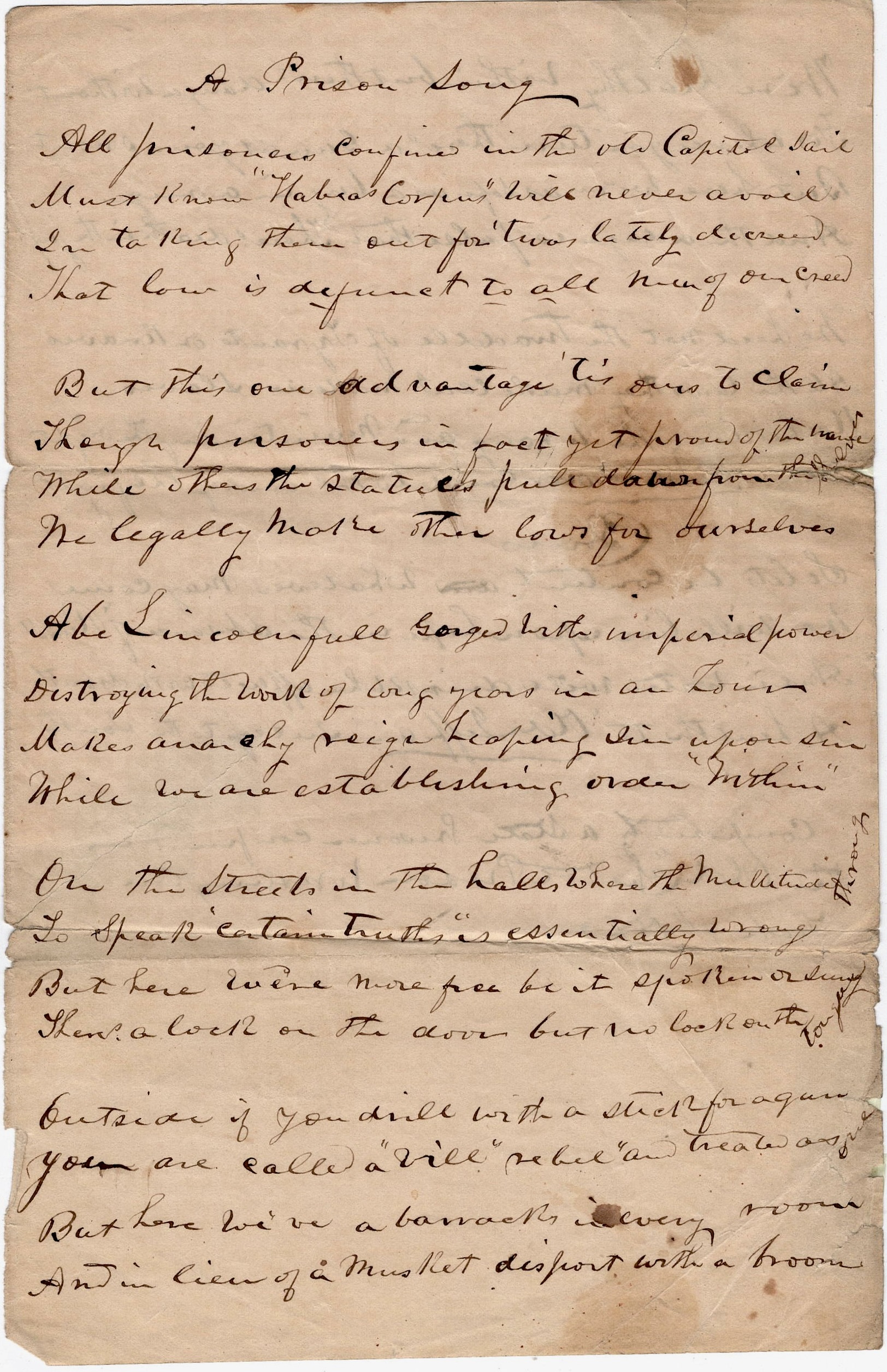
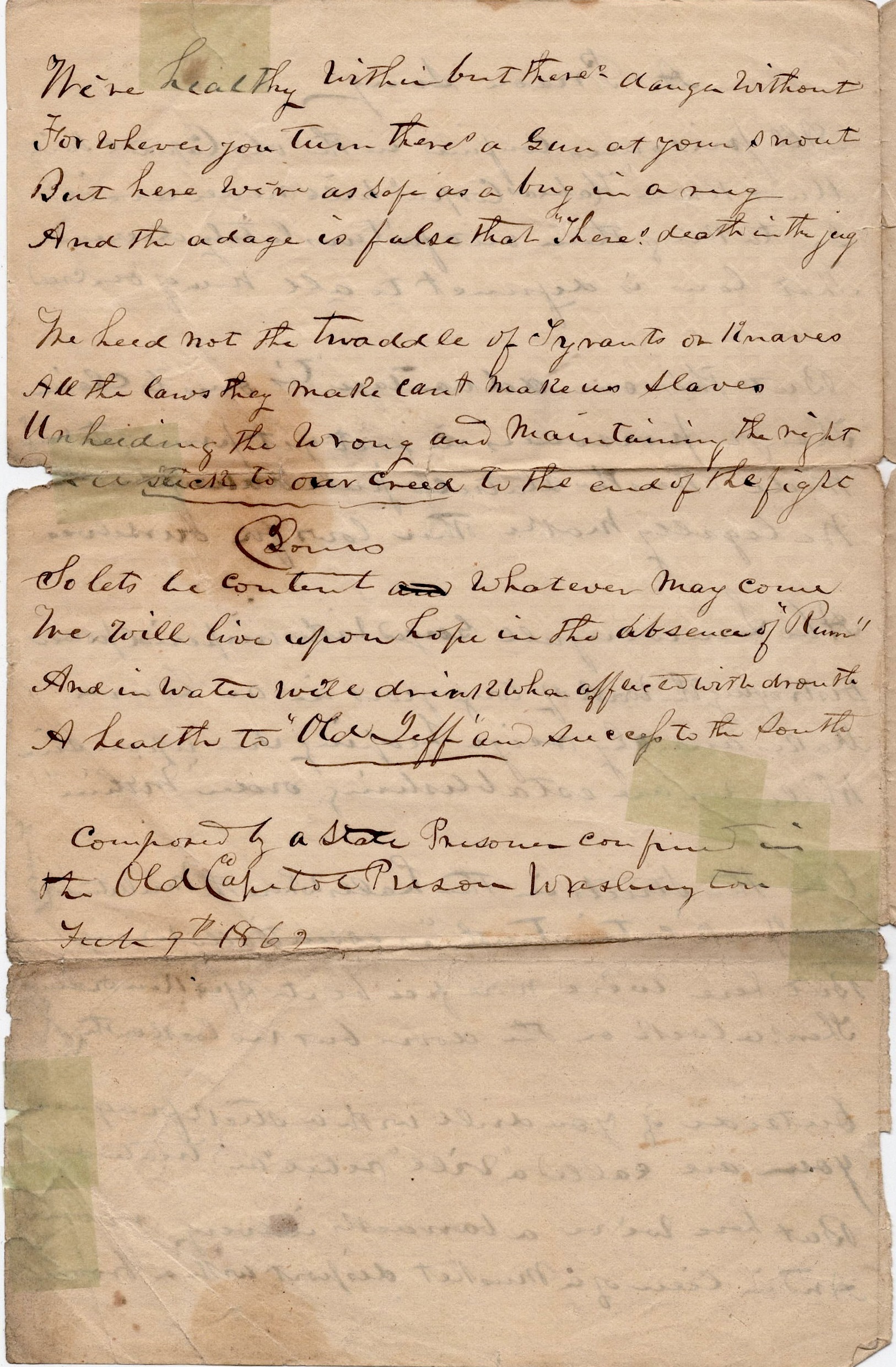
Regrettably there is no signature by the author of this poem entitled “A Prison Song.” Since it contains no strikethroughs or other editing marks, I’m going to conjecture that it was copied from somewhere—perhaps a Baltimore newspaper. If this version was actually handwritten by the author of the poem, it is likely a copy. It was found among the Bestor family papers but I have not yet been able to identify the handwriting.
I searched the internet for a printing of this poem and found it in only one source so far, that being the book published in 1911 by James J. Williamson entitled, Prison Life in the Old Capitol and Reminiscences of the Civil War. It appears on pp. 48-49 in his book with slight variations in the wording and without the final stanza. Curiously the hand written version is actually precisely dated as Feb. 9th 1862. Williamson was not imprisoned in the Old Capitol Prison until 1863 and in introducing it in his book, he states that it had been written before his arrival by someone whose name he did not know.
Because this item was found among the Bestor family papers, I dug deeper suspecting a connection to the family. I discovered that Maria Louisa Bestor (1819-1891) of Harpers Ferry—a relative of the Baltimore Bestors—was married in 1836 to Aaron Amasa Van Camp (1816-1892). Dr. Van Camp was trained in dentistry and when the Civil War broke out, he was practicing dentistry in Washington D. C. He quickly aligned himself with the South, as did many of his Bestor family cousins, and he became a prominent operative in the Rose O’Neal Greenhow Spy Ring. Using his dental office as a cover, he funneled military information across Union lines to Confederate forces. He routinely gathered military information from strategic sources including John Callan, a clerk for the US Senate Military Committee. This spy ring was sniffed out by Allan Pinkerton leading to his arrest and imprisonment in the Old Capitol Prison as a suspected spy, one of his accusers writing that the doctor was “a bitter and dangerous malignant against the government.”
Following his arrest on 31 December 1861, the doctor remained in the Old Capitol Prison until mid March 1862 when he was released after signing an oath of allegiance to the Union. This did not stop him from cooperating with the Confederate Secret Service, however. In 1864, he was discovered to be aiding the Confederacy in the destruction of steamers and foundries in locations between St. Louis and Vicksburg under the guise of being a cotton trader. [Source: Wikipedia]
Given the connection to the Bestor family and the timing of his captivity at the Old Capitol Prison, I’m going to attribute the poem to him but I can’t prove it. Perhaps it was left unsigned intentionally so as to avoid self incrimination as the doctor professed his innocence. He may have been the same “Dr.” whom the Bestor twins credited for having encouraged them to join the Confederate service. See: 1861-65: The Bestor Brothers of Baltimore.
T R A N S C R I P T I O N
A Prison Song
All prisoners confined in the old Capitol jail Must know “Habeas Corpus” will never avail In taking them out for ’twas lately decreed That law is defunct to all men of our creed.
But this one advantage ’tis ours to claim Though prisoners in fact yet proud of the name While others the statues pull down from the shelves We legally make other laws for ourselves.
Abe Lincoln full gorged with imperial power Distroying the worth of long years in an hour Makes anarchy reign heaping sin upon sin While we are establishing order “within.”
On the streets in the halls where the multitude throng To speak certain truths is essentially wrong But here we’re more free be it spoken or sung Here a lock on the door but no lock on the tongue.
Outside if you drill with a stick for a gun You are called a “vile rebel” and treated as one But here we’ve a barracks in every room And in lieu of a musket disport with a broom.
We’re healthy within, but there’s danger without For wherever you turn, there’s a gun at your snout, But here we’re as safe as a bug in a rug And the adage is false that “There’s death in the jug.”
We need not the twaddle of Tyrants or knaves All the laws they make, can’t make us slaves Unheeding the wrong and maintaining the right, We’ll stick to our creed to the end of the fight.
So lets be content, whatever may come, We will live upon hope in the absence of “Rum.” And in water we’ll drink, when afflicted with drouth A health to Old Jeff’ and success to the South.
Composed by a State Prisoner confined in the Old Capitol Prison Washington Feb 9th 1862
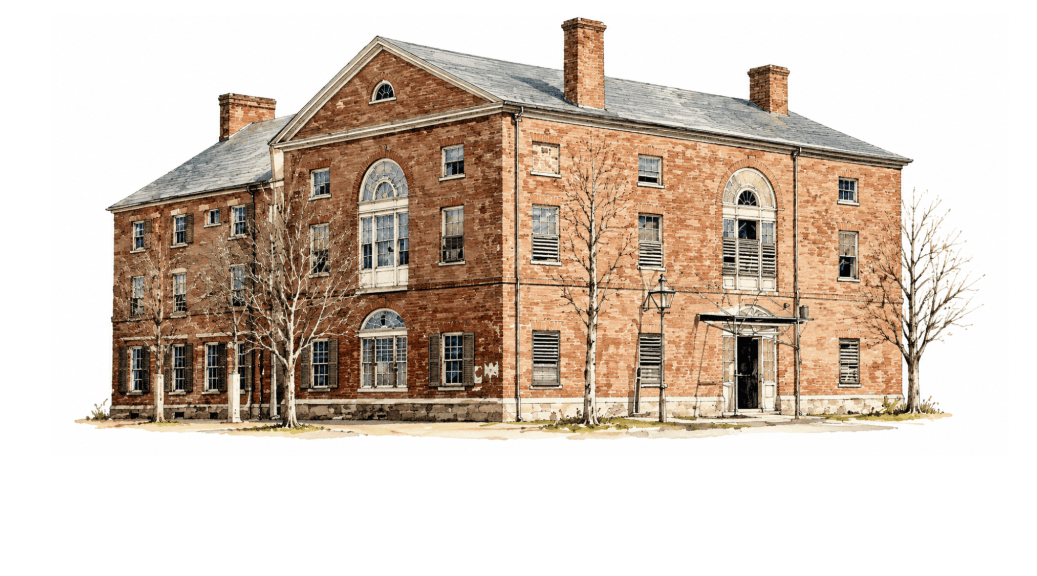
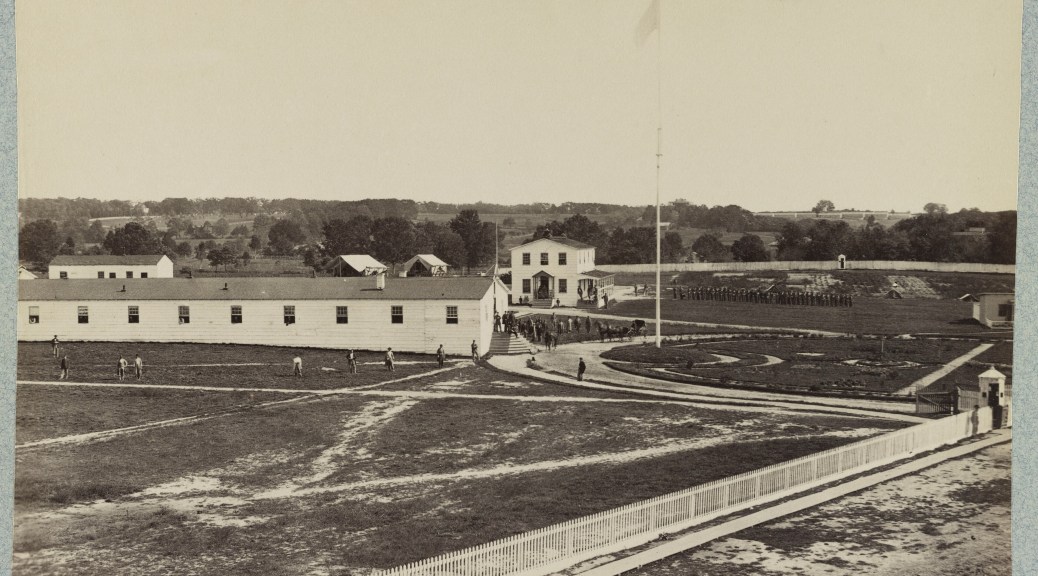
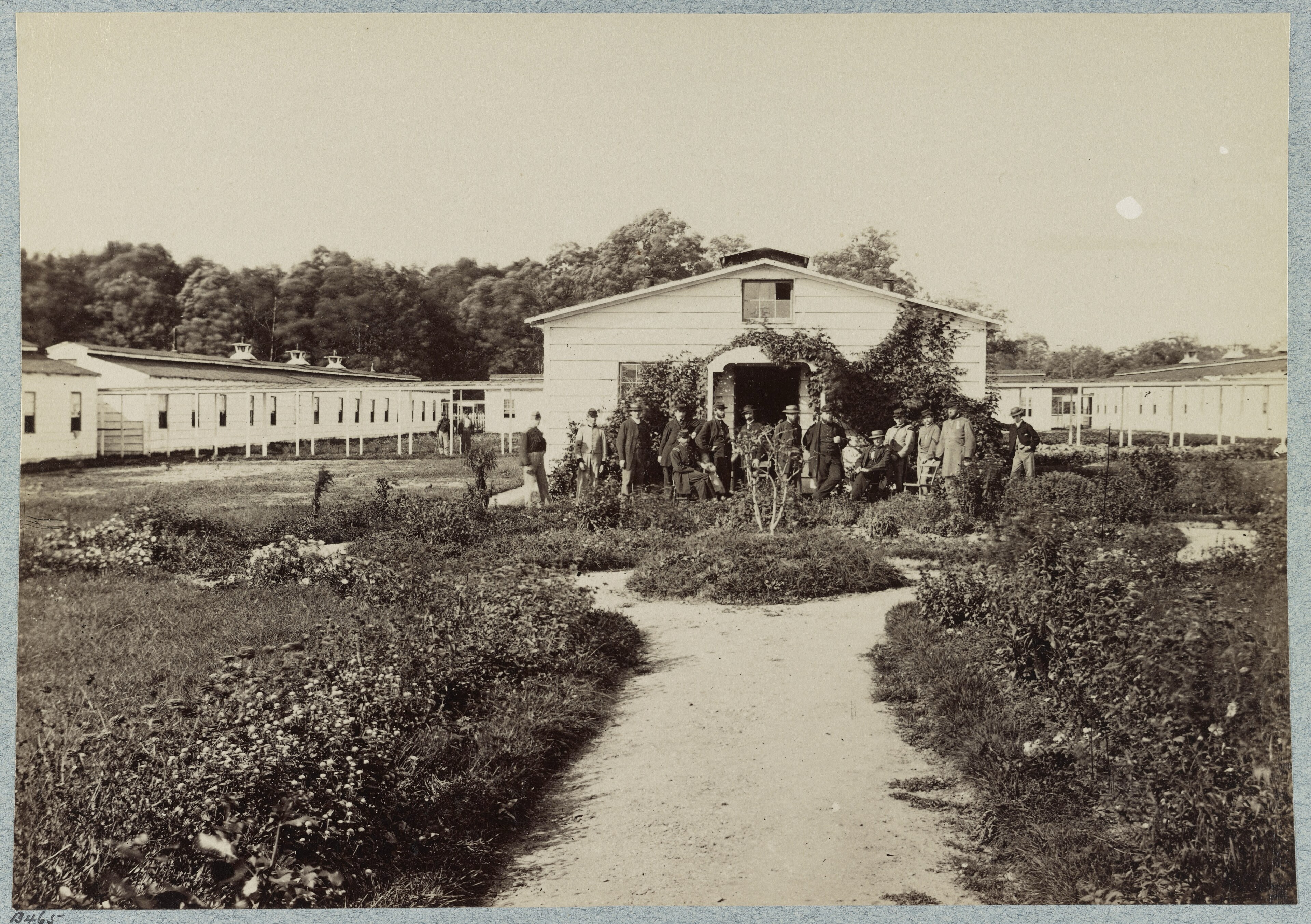
The following letters were written by Stewart C. Allen (1843-1918), the son of Edward Allen (1799-1848) and Harriet Ann Foland (1811-1885) of Hudson, Columbia county, New York. Stewart enlisted on 14 February 1862 as a private in Co. B, 93rd New York Infantry. He received a severe wound in the right shoulder during the Battle of Spottsylvania Court House on 10 May 1864 and wrote the letters of 30 October 1864 and 19 May 1865 while recuperating from that wound at Campbell General Hospital (pictured in header of this web page) in Washington D. C. That hospital was located on Boundary Street NW (now Florida Avenue NW) between 5th Street NW and 6th Street NW. It was built with 900 beds. In December 1864, 633 beds were occupied. The Freedmen’s Hospital took over the facility and grounds in January 1865.
Stewart did not marry until 1899 when he was 46 years old. He married 22 year-old Edith Carter and she lived on her husband’s war pension until her death in 1968.
All but Letter #4 are from the personal collection of Jim Doncaster and were made available for transcription and publication on Spared & Shared by express consent.
Letter 1
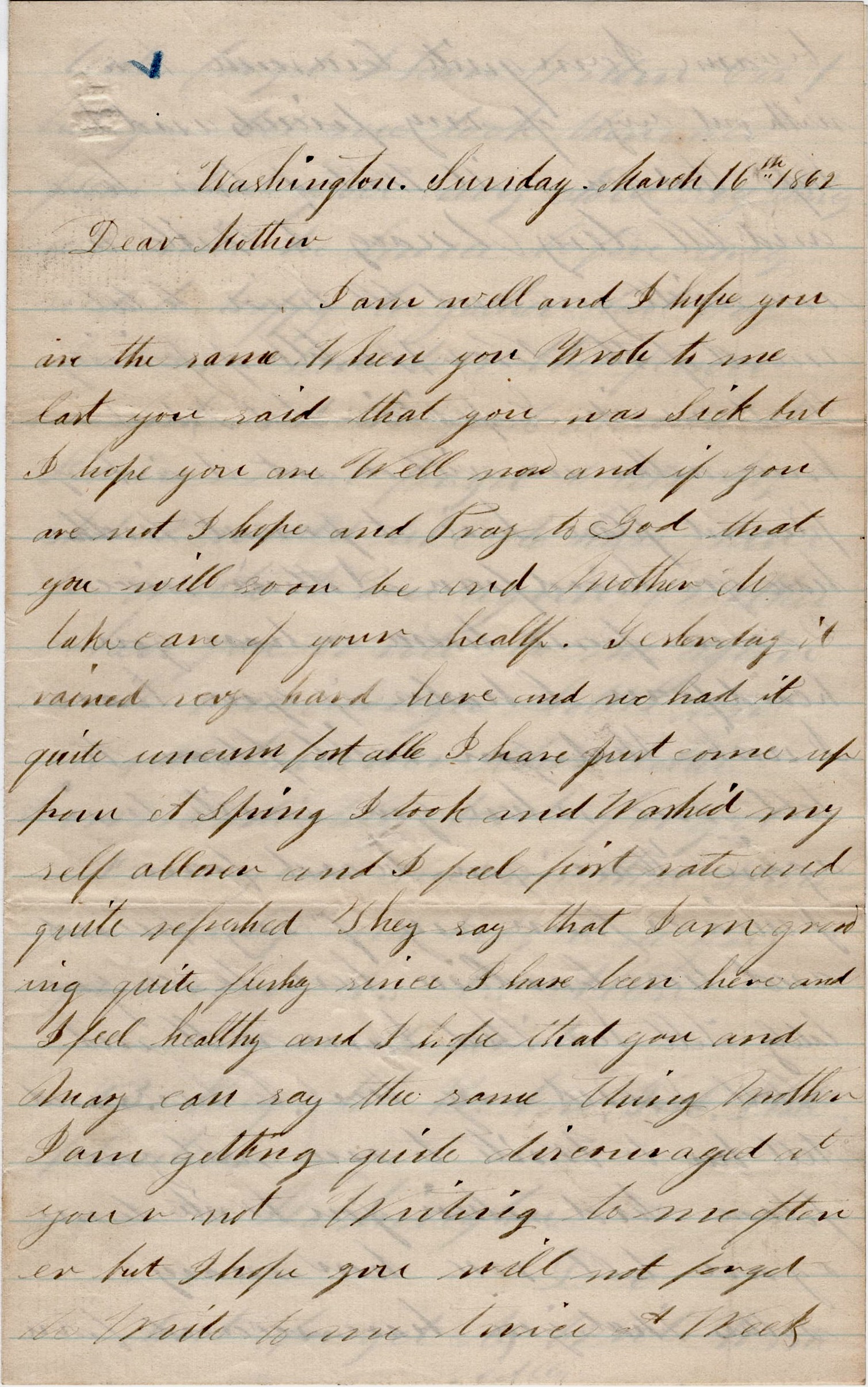
Washington [D. C.] Sunday, March 16, 1862
Dear Mother,
I am well and I hope you are the same. When you wrote to me last, you saud that you was sick but I hope you are well now and if you are not, I hope and pray to God that you will soon be. And Mother, do take care of health.
Yesterday it rained very hard here and we had it quite uncomfirtable. I have just come up from a spring. I took and washed myself all over and I feel first rate and quite refreshed. They say that I am growing quite fleshy since i have been here and I feel healthy and I hope that you and Mary can say the same thing.
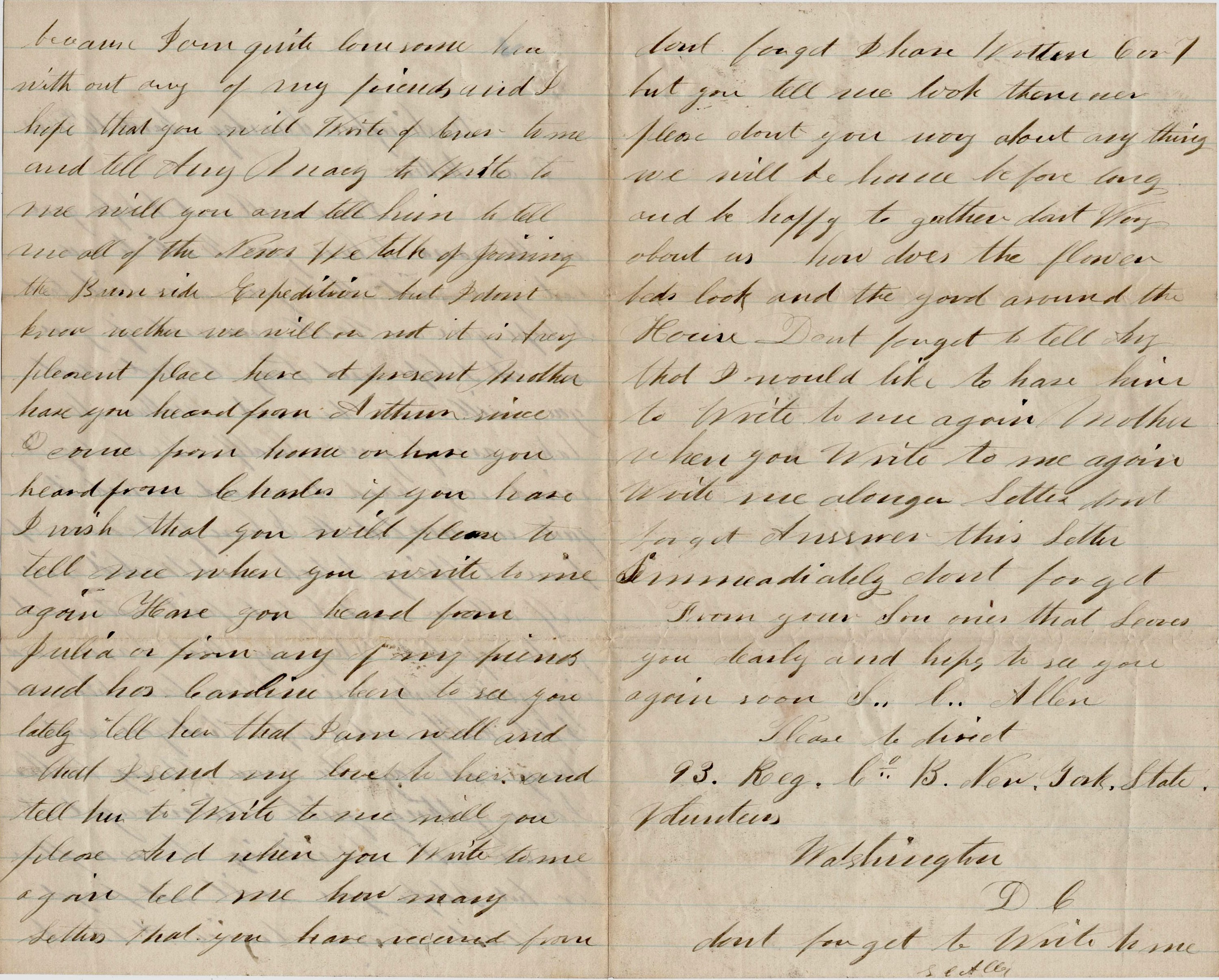
Mother, I am getting quite discouraged at your not writing to me oftener but I hope you will not forget to write to me twice a week because I am quite lonesome here without any of my friends and I hope that you will write oftener to me and tell Aug Mach to write to me, will you. And tell him to tell me all of the news.
We talk of joining the Burnside Expedition but I don’t know whether we will or not. It is a very pleasant place here at present. Mother, have you heard from [brother] Arthur since I came from home or have you heard from Charles? If you have, I wish that you will please tell me when you write to me again. Have you heard from Julia or from any of my friends? And has Caroline been to see you lately? Tell her that I am well and that I send my love to her. And tell her to write to me, will you please? And when you write to me again, tell me how many letters that you have received from [me]. Don’t forget I [think I] have written 6 or 7 but you tell me.
Please don’t you worry about anything. We will be home before long and be happy together. Don’t worry about us. How does the flower beds look? and the yard around the house? Don’t forget to tell Aug that I would like to have him to write to me again. Mother, when you write to me again, write me a longer letter. Don’t forget to answer this letter immediately. Don’t forget.
From your son—one that loves you dearly and hopes to see you again soon. — S. C. Allen
Please to direct [to] 93rd Regt. Co. B, New York State Volunteers, Washington D. C.
Don’t forget to write to me. — S. C. Allen
Letter 2
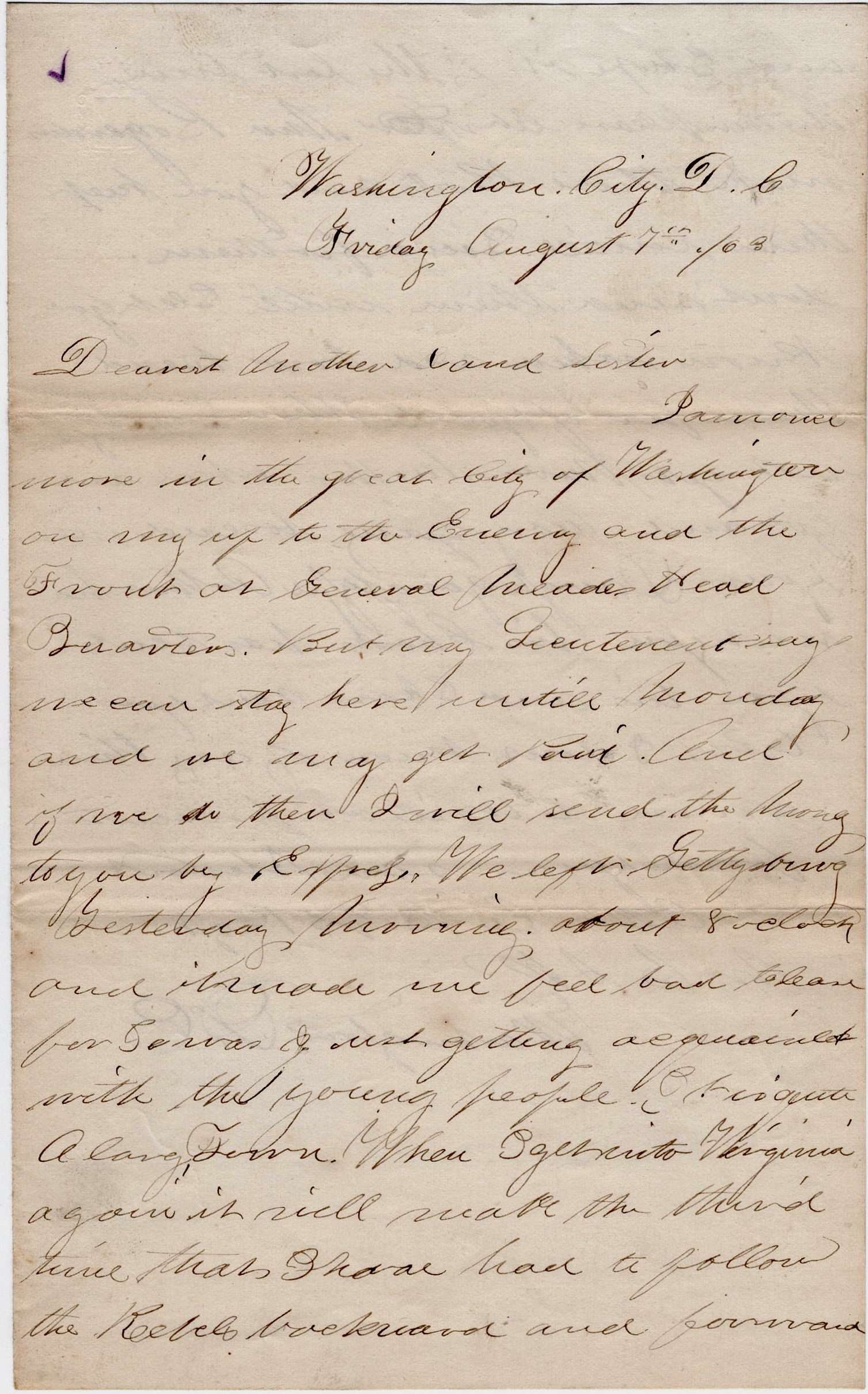
Washington City, D. C. Friday, August 7th 1863
Dearest Mother and Sister,
I am once more in the great City of Washington on my way up to the enemy and the front at General Meade’s Headquarters. But my Lieutenant says we can stay here until Monday and we may get paid. And if we do, then I will send the money to you by Express.
We left Gettysburg yesterday morning about 8 o’clock and it made me feel bad to leave for I was just getting acquainted with the young people. It is quite a large town. When I get into Virginia again, it will make the third time that I have had to follow the Rebels backward and forward and I hope it is the last time.
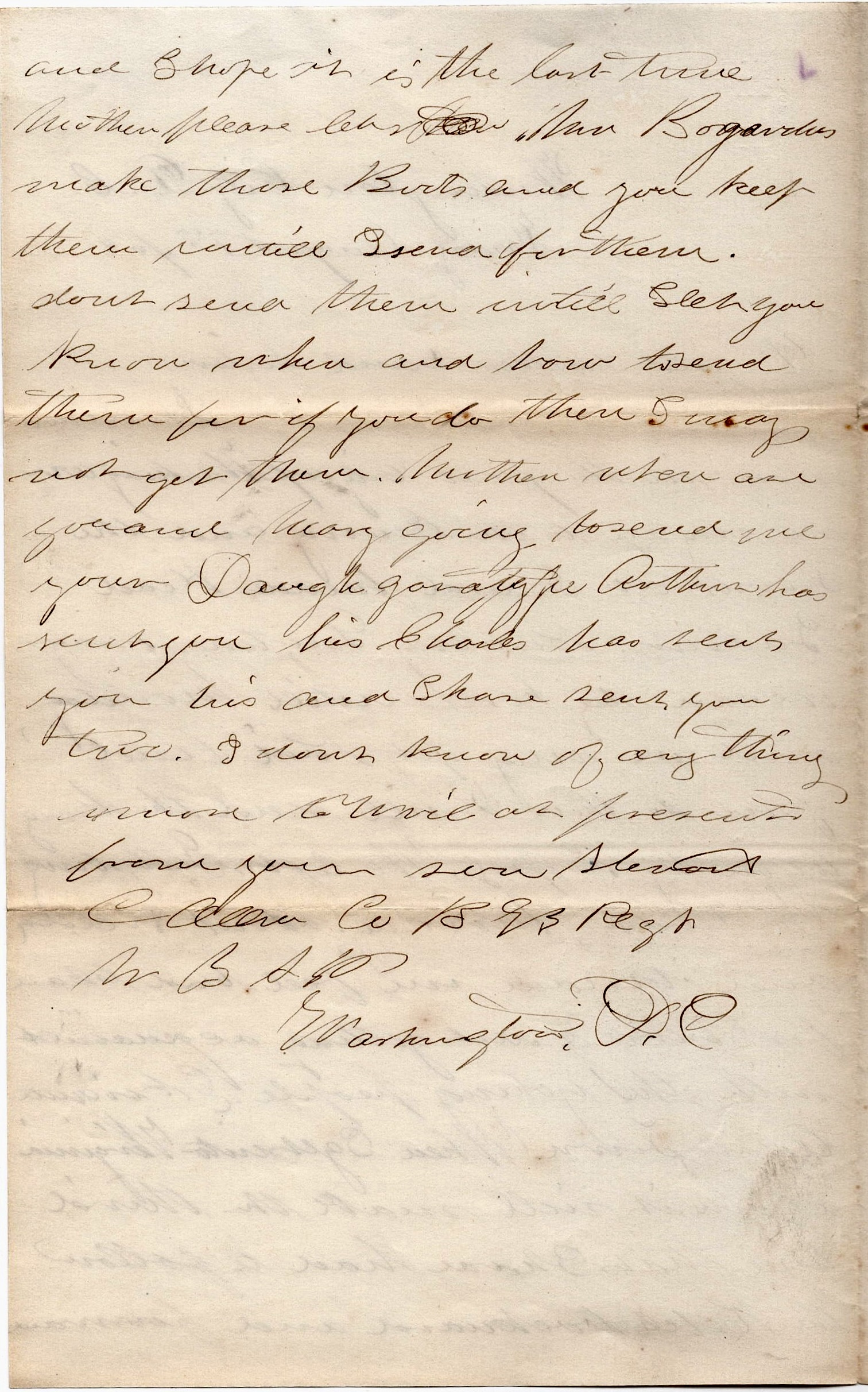
Mother, please let Mr. Bogardus make those boots and you keep them until I send for them. Don’t send then until I let you know when and how to send them. Mother, when are you and Mary going to send me you daguerreotype? Arthur has sent you his. Charles has sent you his and I have sent two. I don’t know of anything more to write at present. From your son, — Stewart C. Allen
Co. B, 93rd Regiment New York State Vols., Washington D. C.
Letter 3
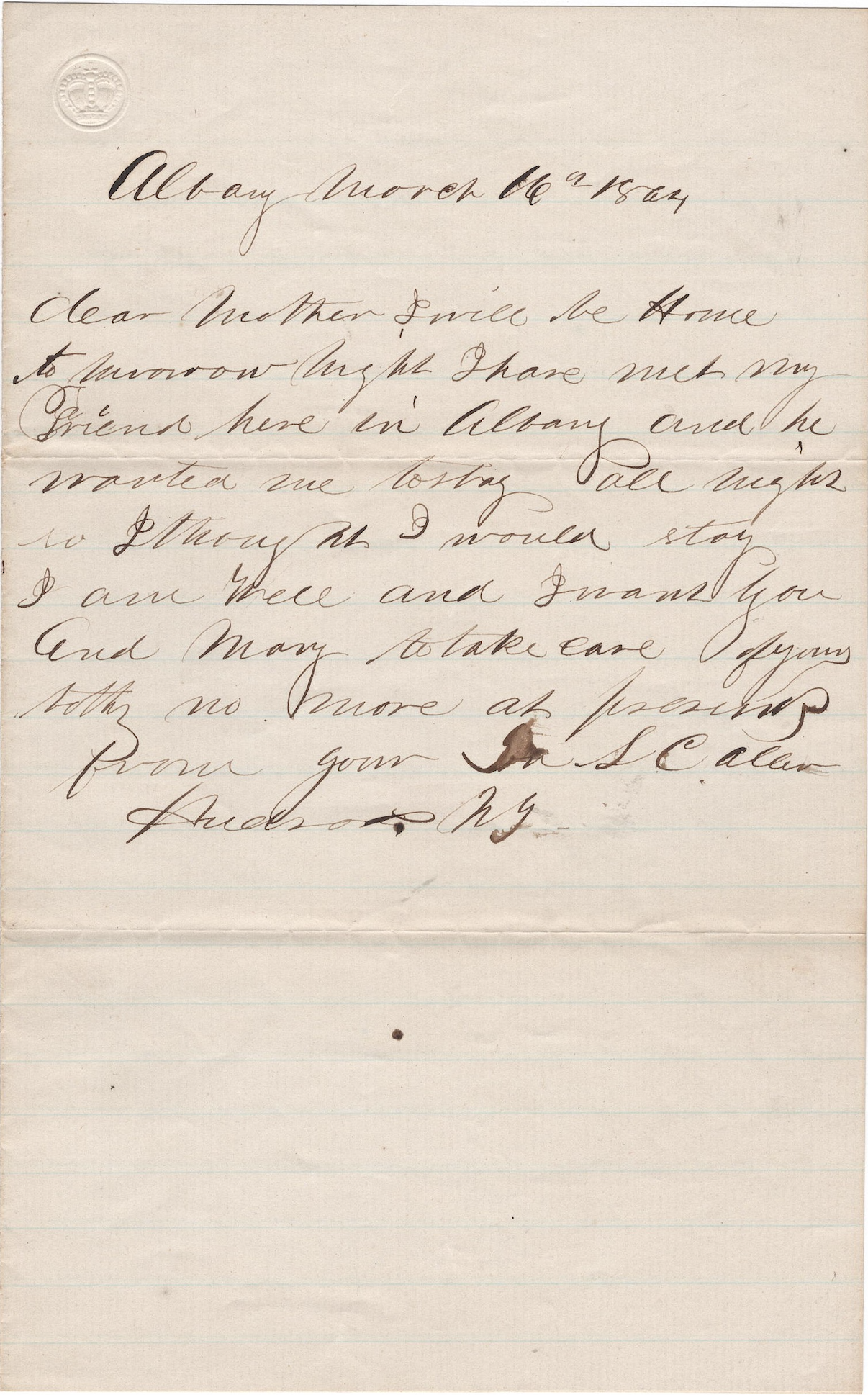
Albany [New York] March 16, 1864
Dear Mother,
I will be home tomorrow night. I have met my friend here in Albany and he wanted me to stay all night so I thought I would stay. I am well and I want you and Mary to take care of [ ]. No more at present. From your son, — S. C. Allen
Hudson, New York
Letter 4
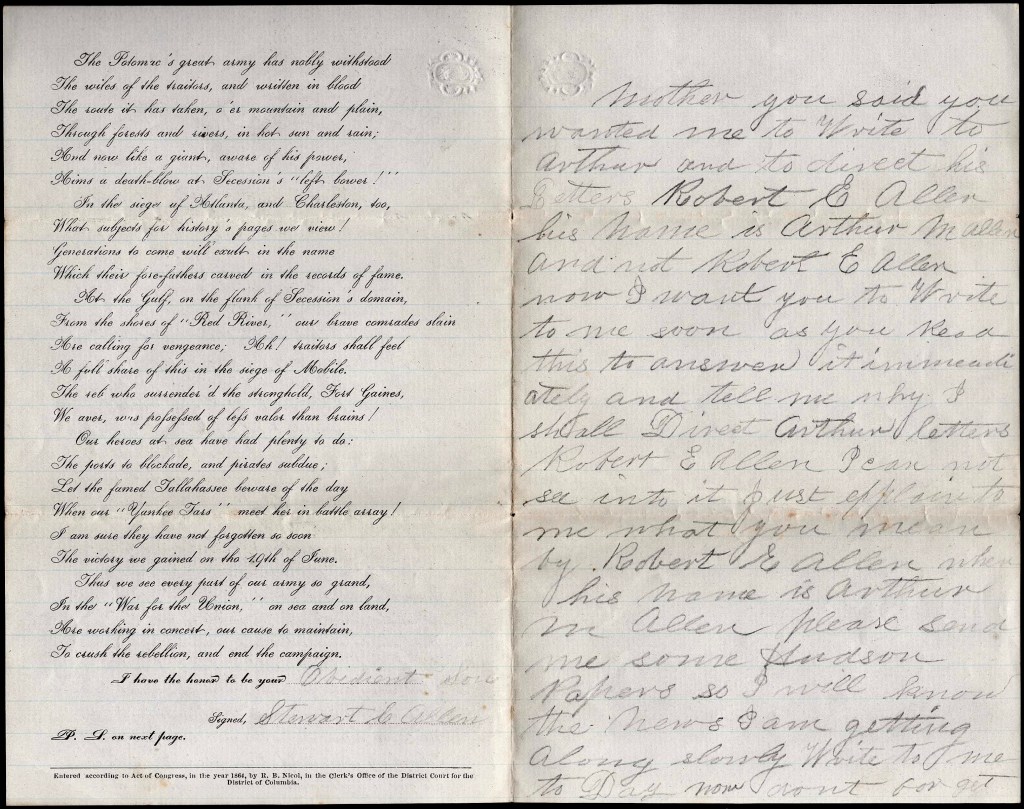
Editor’s Note: The following was a pre-formatted letter, written in prose, enabling the soldier to merely fill in a few blanks and then add a personal note as a post script. The bold lettered font is what Stewart wrote; the italicized font was pre-printed.Stewart’s post script begs his mother to explain why he should address letters to his younger brother (Arthur M. Allen, b. 1845) by some name other than his given name. Apparently he was operating under an alias for some reason. I have searched for the poem on the internet and could not find it published so have transcribed it in entirety.
Campbell Hospital Ward Nine October 30th1864
DearMother and Sister,
As writing materials often are scarce, I purpose to write you a letter in verse; To condense my ideas, save paper and time, Is my object for writing the letter in rhyme. Of course you will now it is one of my pranks! It will take but a minute to fill up the blanks.
I received your kind letter justone dayago, Which found me a member of “Uncle Sam’s Show,” And fortwo monthsor better, expect to remain, Unless like full many, I chance to be slain; Should this be my fate, the last boon I crave Is to mark on my tomb-stone, “A Patriot’s Grave!”
In the hist’ry of wars, as we carefully scan, Since the first one was waged by man against man, In all the fierce conflicts no records remain Which will be compared to the present campaign. The war has been general, on both land and sea, And many have fallen for “Liberty’s Tree!” It would fill many volumes to pass in review What our various armies this year have been through, Though my space is not large, yet ’twill not be amiss To give a slight sketch on a small sheet like this.
The Potomac’s great army has nobly with stood The wile’s of the traitors, and written in blood The route it has taken, o’er mountain and plain, Through forests and rivers, in hot sun and rain; And now like a giant, aware of his power, Aims a death-blow at Secession’s “left bower!”
In the siege of Atlanta and Charleston too, What subjects for history’s pages we view! Generations to come will exult in the name of which their fore-fathers carved in the records of fame.
At the Gulf, on the flank of Secession’s domain, From the shores of “Red River” our brave comrades slain Are calling for vengeance; Ah! traitors shall feel A full share of this in the siege of Mobile. The reb who surrender’d the stronghold Fort Gaines, We aver, was possessed of less valor than brains!
Our heroes at sea have had plenty to do: The ports to blockade, and pirates subdue; Let the famed Tallahassee beware of the day When our “Yankee Tars” meet her in battle array! I am sure they have not forgotten so soon, the victory we gained on the 10th of June.
Thus we see every part of our army so grand, In the “War for the Union,” on sea and on land, Are working in concert, our cause to maintain, To crush the rebellion, and end the campaign.
I have the honor to be yourobedient son. Signed,Stewart C. Allen
P. S. on next page.
Mother, you said you wanted me to write to Arthur and to direct his letters Robert E. Allen. His name is Arthur M. Allen and not Robert E. Allen. Now I want you to write to me soon as you read this to answer it immediately and tell me why I shall direct Arthur letters, “Robert E. Allen.” I cannot see into it. Just explain to me what you mean by Robert E. Allen when his name is Arthur M. Allen. Please send me some Hudson papers so I will know the news. I am getting along slowly. Write to me today. Now don’t forget.
Letter 5
The Garden At Campbell Hospital
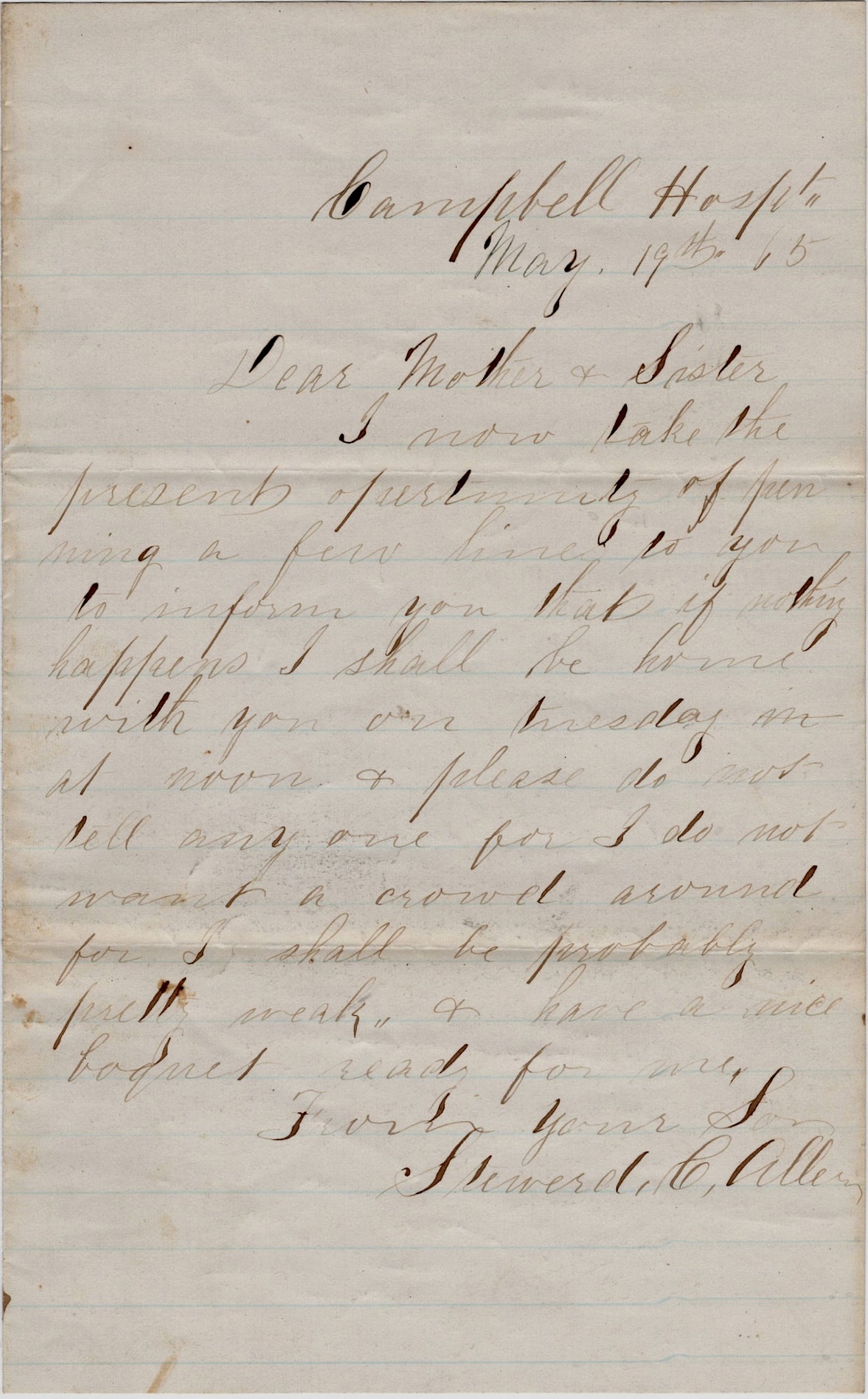
Campbell Hospital May 19, 1865
Dear Mother & Sister,
I now take the present opportunity of penning a few lines to you to inform you that if nothing happens, I shall be home with you on Tuesday at noon & please do not tell anyone for I do not want a crowd around for I shall be probably pretty weak & have a nice bouquet ready for me. From your son, — Stewart C. Allen
Letter 6
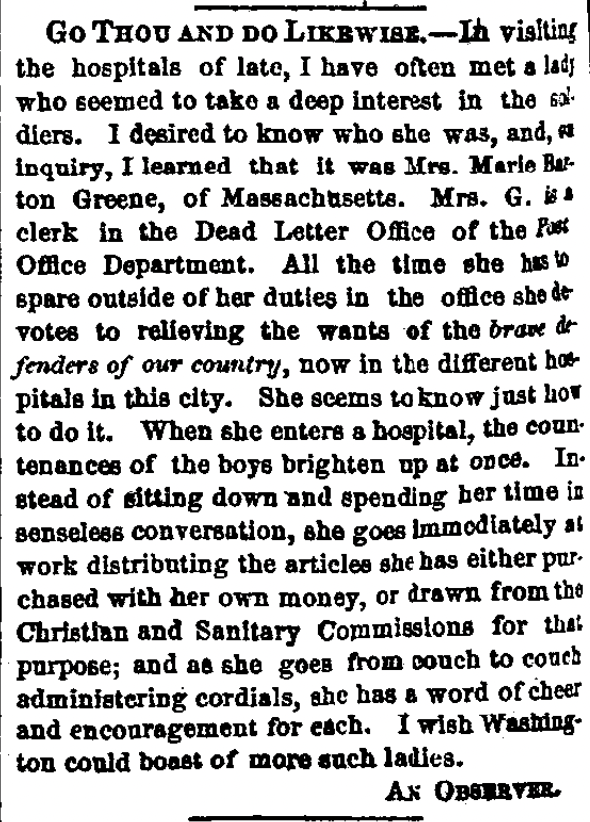
Extracted from the Springfield Daily Union, 13 August 1864.
Ladies employed in Dead Letters Office
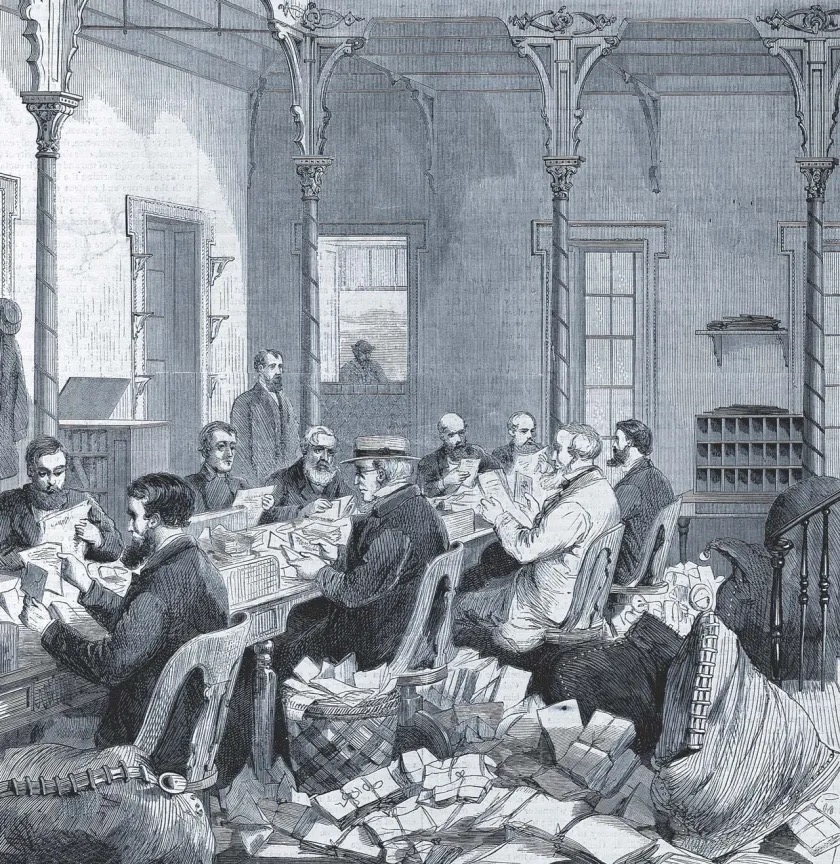
The Dead Letter Office atr Washington, a wood engraving sketched by Theodore R. Davis and published in Harper’s Weekly, February 22, 1868. Were the ladies all replaced by men by 1868?
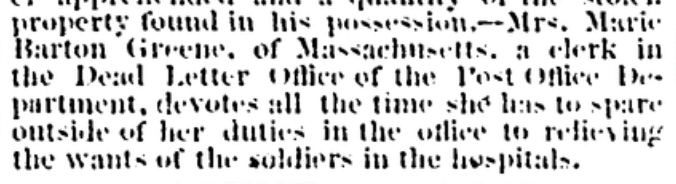
[Editor’s Note: The following two letters were written by Mrs. Marie Barton (White) Greene (1828-1907), a clerk in the Post Office Department who we learn worked in the “Return Letter Office.” She wrote both letters to Stewart after he left Campbell Hospital to return home. The letters reveal that she met Stewart while visiting her brother Lt. Alonzo Augustus White (1833-1905) of Worcester, Massachusetts, who was also an inmate of Campbell Hospital at the same time, having been severely wounded at Spotsylvania in May 1864. Alonzo served in Co. I, 36th Massachusetts Infantry. He was discharged from the hospital on 11 November 1864. Marie was the daughter of Mason White (1789-1839) and Rhoda Wood (1800-1859) of Uxbridge, Massachusetts. Marie was married in 1859 to James W. Greene (1825-18??). No additional information can be found about him. According to the Litchfield Historical Society, Marie Barton Greene served with the Sanitary Commission and as a volunteer nurse in the Medical Department. Congress appropriated her with a pension in 1901 for $12 a month. Marie and Clara Barton who was a nurse and opened the Missing Soldier’s Office in Washington were cousins.]
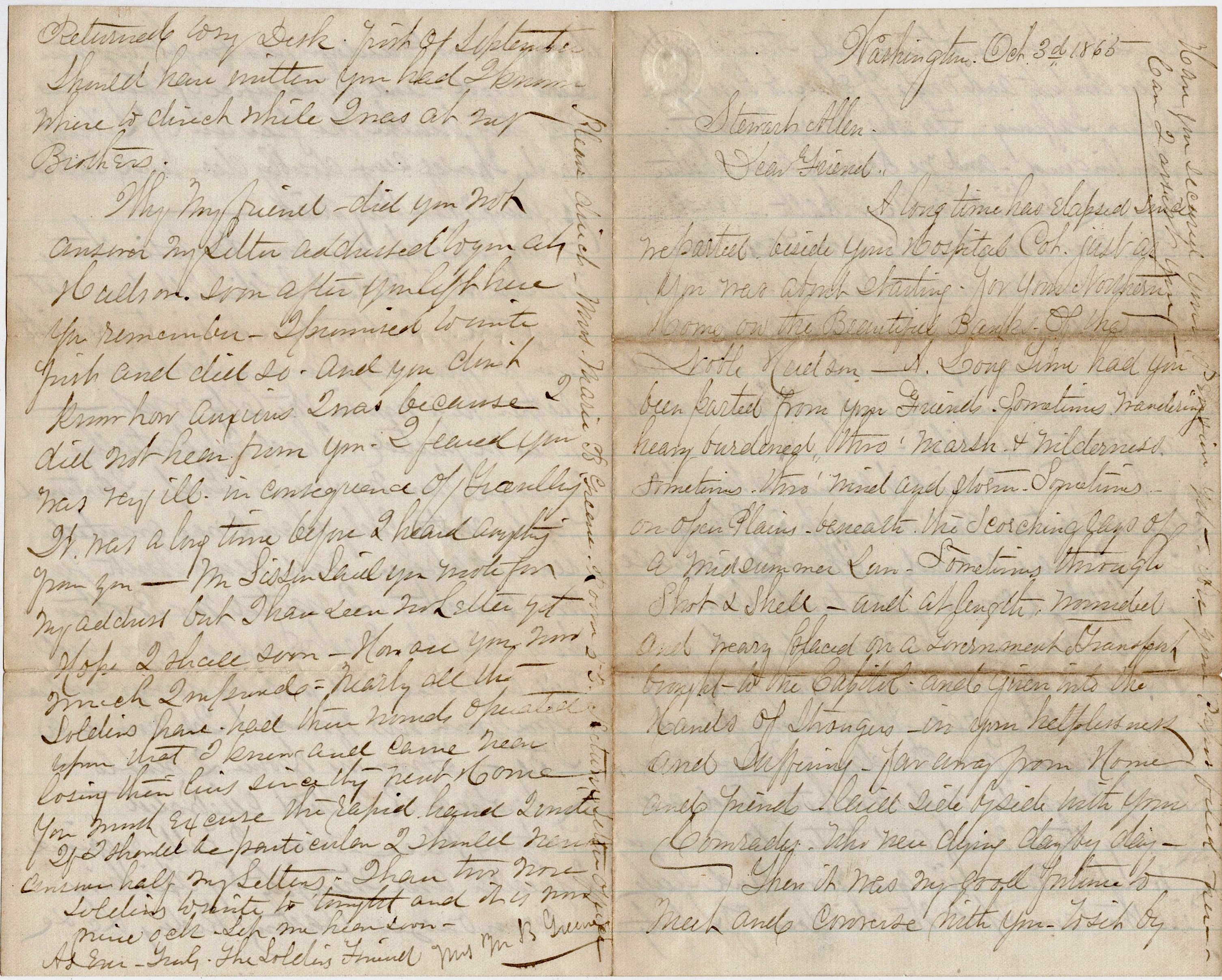
Washington [D. C.] October 3rd 1865
Stewart Allen Dear Friend,
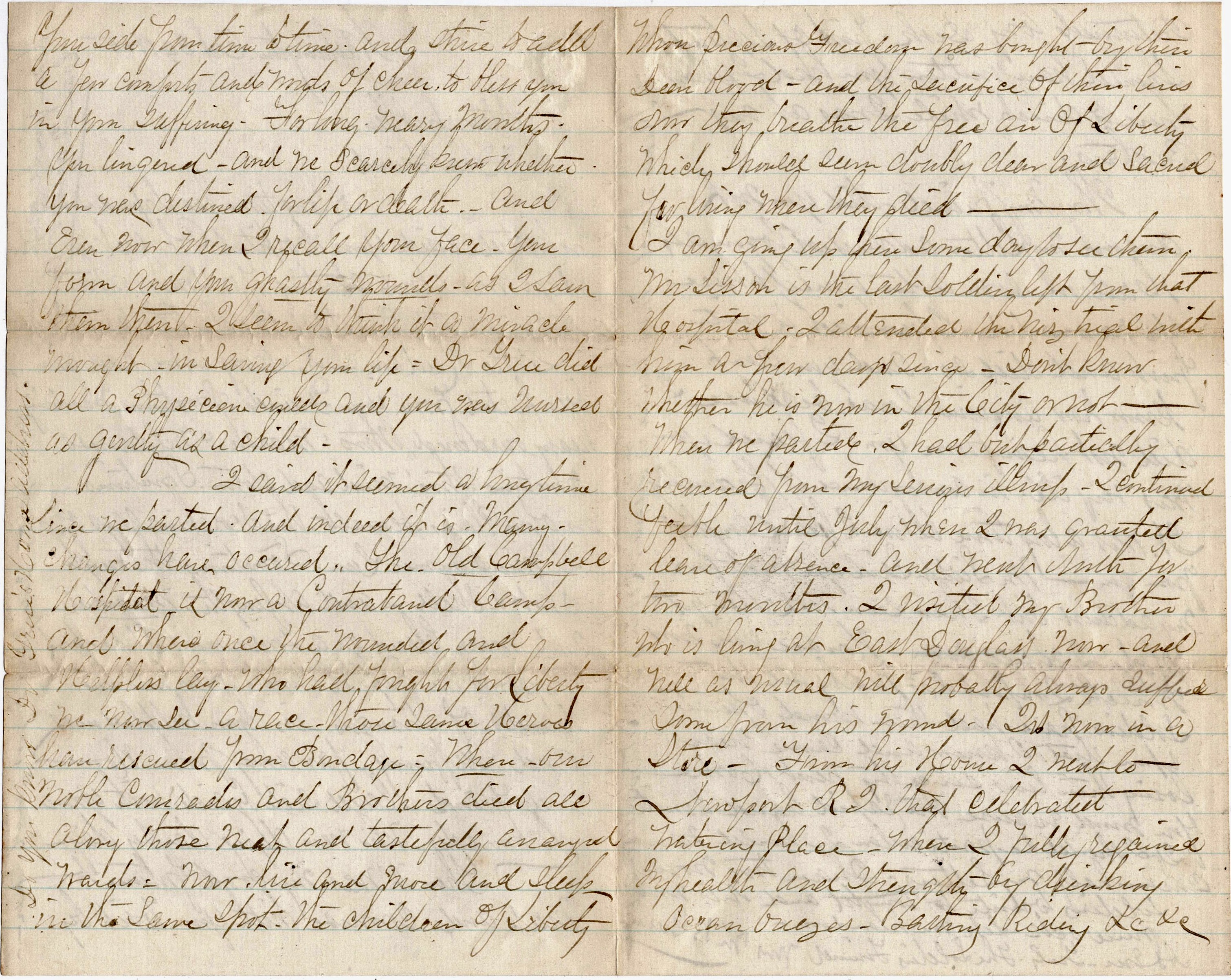
A long time has elapsed since we parted beside your hospital cot. Just as you was about starting for your Northern home on the beautiful banks of the noble Hudson river. A long time had you been parted from your friends. Sometimes wandering, heavy burdened thro’ wind and storm. Sometimes on the open plains beneath the scorching rays of a midsummer sun, sometimes through shot and shell, and at length, wounded and weary, placed on a Government transport, brought to the Capitol, and given into the hands of strangers. In your helplessness and suffering, far away from home and friends, laid side by side with your comrades who were dying day by day. Then it was my good fortune to meet and converse with you, to sit by your side from time to time. and strive to add a few comforts and words of cheer to vless you in your suffering.
For long, weary months you lingered and we scarcely knew whether you was destined for life or death. And even now, when I recall your face, your form and and your ghastly wounds as I saw then then, I seem to think it a miracle wrought in saving your life. Dr. True 1 did all a physician could and you was nursed as gently as a child.
I said it seemed a long time since we parted and indeed, it is. Many changes have occurred. The Old Campbell Hospital is now a Contraband Camp and where once the wounded and helpless lay who had fought for libery. we now see a race those same heroes have rescused from bondage, where our noble comrades and brothers died all along those neat and tastefully arranged wards, now live and move and sleep in the same spot the children of Liberty whose precious freedom was bought by their dear blood—and the sacrifice of their lives [ ] they breathe the free air of Liberty which should seem doubly dear and sacred for living where they died.
I am going up there some day to see them. Mr. Sisson is the last soldier left from that Hospital. I attended the [Henry] Wirz trial with him a few days since. Don’t know whether he is now in the City or not.
From the Daily Morning Chronicle, Washington D. C., 11 August 1864
When we parted, I had but partially recovered from my serious illness. I continued feeble until July when I was granted leave of absence and went North for two months. I visited my Brother who is living at East Douglass now and well as usual [but] will probably always suffer some from his wound. (Is now in a store). From his house I went to Newport, Rhode Island—that celebrated watering place—where I fully regained my health and strength by drinking ocean breezes, bathing, riding, &c. &c. Returned to my desk first of September. Should have written you had I known where to direct while I was at my Brother’s.
Why, my friend, did you not answer my letter addressed to you at Hudson soon after you left here? You remember I promised to write first and did so. And you don’t know how anxious I was because I did not hear from you? I feared you was very ill in consequence of traveling. It was a long time before I heard anything from you. Mr. Sisson said you wrote for my address but I have seen no letter yet. Hope I shall soon. How are you? I’m informed that nearly all the soldiers have had their wounds operated upon that I knew and came near losing their lives since they went home.
You must excuse the rapid hand I write. If I should be particular, I should never answer half my letters. I have two more soldiers to write to tonight and it is near nine o’clock. Let me hear soon. As ever, truly, the soldier’s friend, — Mrs. M. B. Greene
Please direct [to] Mrs. Marie B. Greene, Room 53, Return Letter Office 2
Have you secured your pension yet? Are your papers filed yet? Can I assist you?
1 Dr. William Henry True (1825-1897) of Freeport, Maine, served early in the war as a surgeon in the famed 20th Maine. In 1863 he was assigned to Campbell Hospital and was described by one souce as “one of the most faithful and efficient surgeons to be found in any of our hospitals. When any under his charge were dangerously ill, he would often visit them four and five times during a single night, watching every symptom and noting every change, whether for better or worse, and only relinquishing hope with the last expiring breath. Oh, how much the world needs such humane, Christian physicians!” Source: Page 128 in “The Boys in White.”
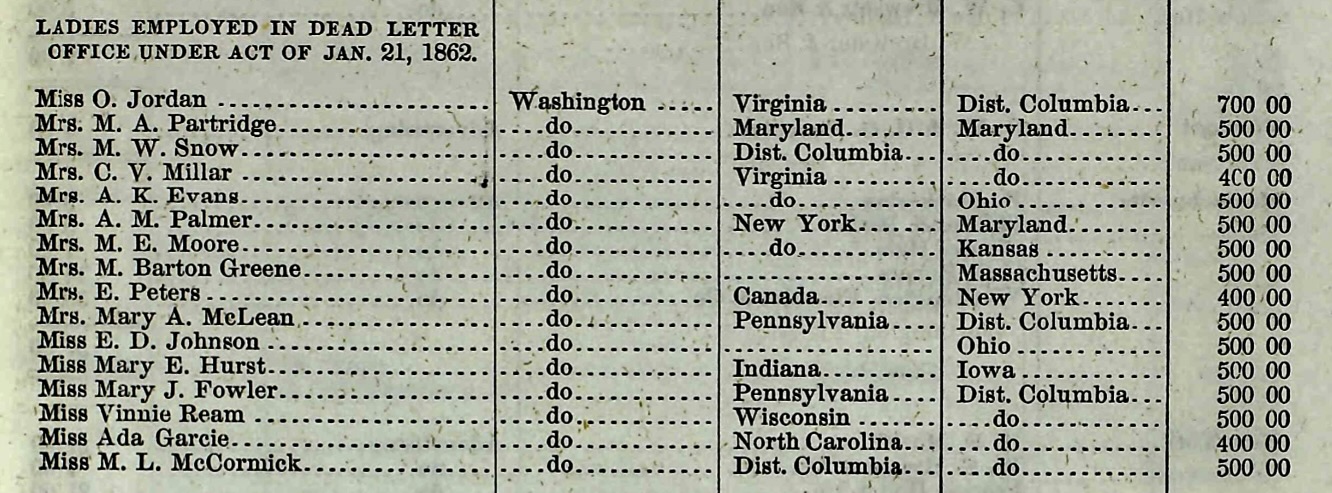
2A Register of Civil, Military, and Naval Service, 1863-1959 list Mrs. M. Barton Greene of Massachusetts as one of the “Ladies Employed in Dead Letter Office Under Act of January 21, 1862” She was paid a salry of $500/year.
Letter 7
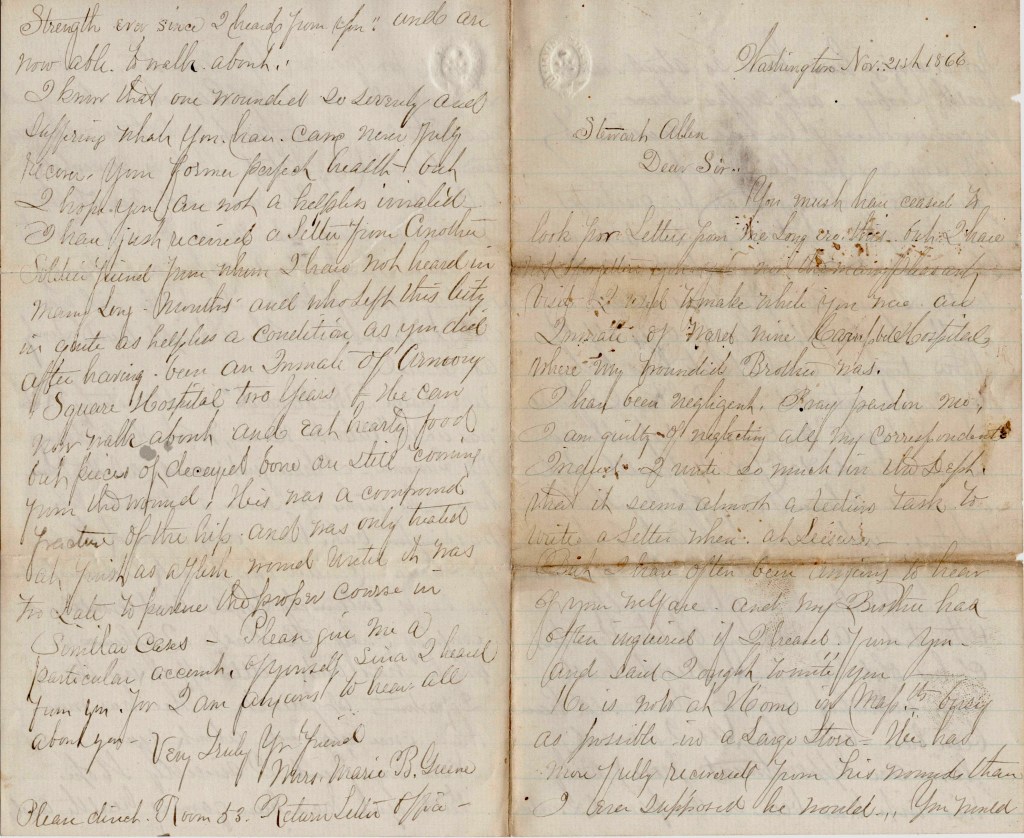
Washington [D. C.] November 21st 1866
Stewart Allen Dear Sir,
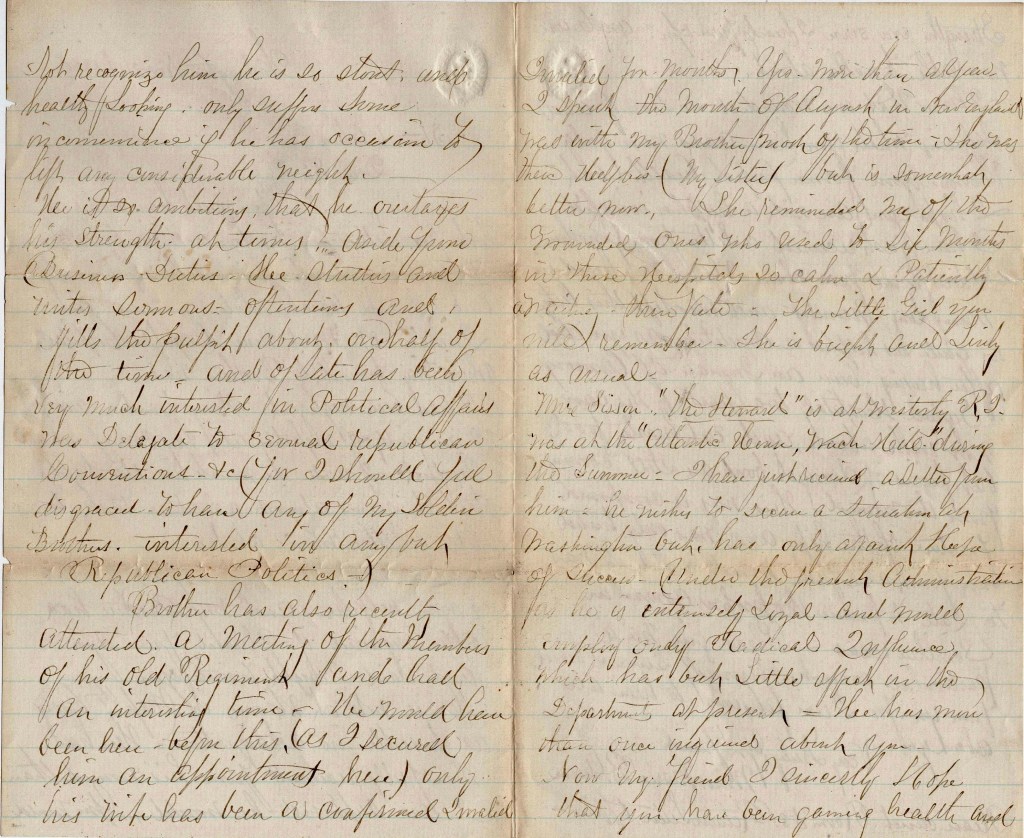
You must have ceased to look for letters from me long ere this but I have not forgotten you nor the many pleasant visits I used to make while you were an inmate of Ward 9, Campbell Hospital, where my wounded Brother was. I have been negligent. Pray pardon me. I am guilty of neglecting all my correspondents. Indeed, I write so much in the Dept. that it seems almost a tedious task to write a letter when at leisure.
But I have often been anxious to hear of your welfare and my Brother [Alonzo] has often inquired if I heard from you and said I ought to write you. He is now at home in Massachusetts busy as possible in a large store. He has more fully recovered from his wounds than I ever supposed he would. You would not recognize him—he is so stout and healthy looking. Only suffers some inconvenience if he has occasion to lift any considerable weight. He is so ambitious that he overtaxes his strength at times. As iside from business duties, he studies and writes sremons, ofentimes and fills the pulpit about one half of the time. And of late, has been very much interested in political affairs. Was delegate to several Republican Conventions &c. (for I should feel disgraced to have any of my soldier Brothrs interested in any but Republican politics).
Brotther has also recentlyattended a meeting of the members of his old regiment and had an intersting time. He would have been before this (as I secured him an appointment here) only his wife has been a confirmed invalid for months. Yes, more than a year.
I spent the month os August in New England. Was with my Brother most of the time. She was then helpless (my Sister) but is somewhat better now. She reminded me of the wounded ones who used to sit months in these hospitals so calm and patiently awaiting their fate. The little girl you will remember. She is bright and lively as usual.
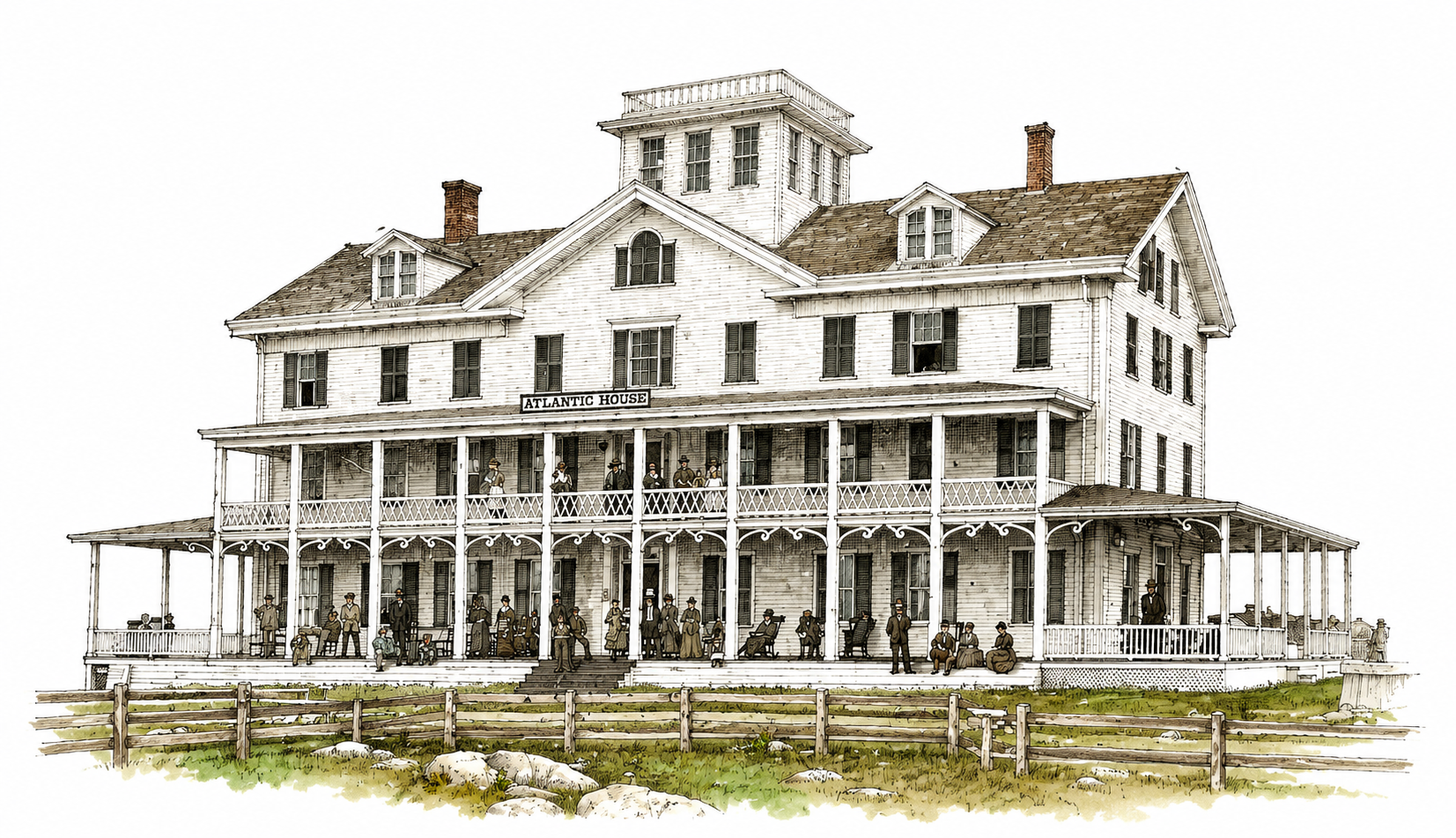
Mr. Sisson—the “steward” is at Westerly, Rhode Island. Was at the “Atlantic House, Watch Hill” duringthe summer. I have just received a letter from him. He wishes to secure a situation at Washington but has only a faint hope of success under the present administration as he is intensely loyal and would employ only radical influence which has but little affect in the Department at present. He has more than once inquired about you.
The Watch Hill Atlantic House, c. 1878. It was built in the late 1850s and burned in 1916.
Now my friend, I sincerely hope that you have been gaining health and strength ever since I heard from you and are now able to walk about. I know that one wounded so severely and suffering what you have can never fully recover your former perfect health. But I hope you are not a helpless invalid.
I have jusr received a letter from another soldier friend from whom I have not heard in many long months, and who left this City in quite as helpless a condition as you did after having been an inmate of Armory Square Hospital two years. He can now walk about and eat hearty food but pieces of decayed bone are still coming from the wound. His was a compound fracture of the hip and was only treated at first as a flesh wound until it was too late to pursue the proper course in similar cases.
Please give me a particular account of yourself since I heard from you for I am anxious to hear all about you. Very truly your friend, — Mrs. Marie B. Greene
Please direct to Room 53, Return Letter Office
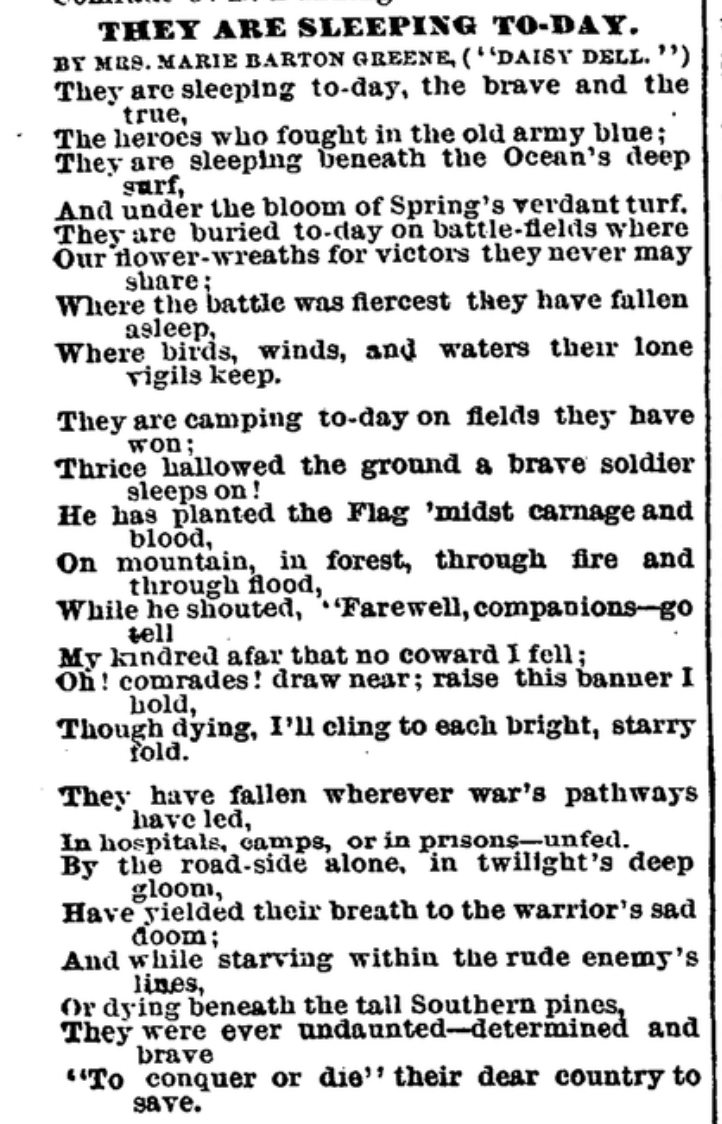
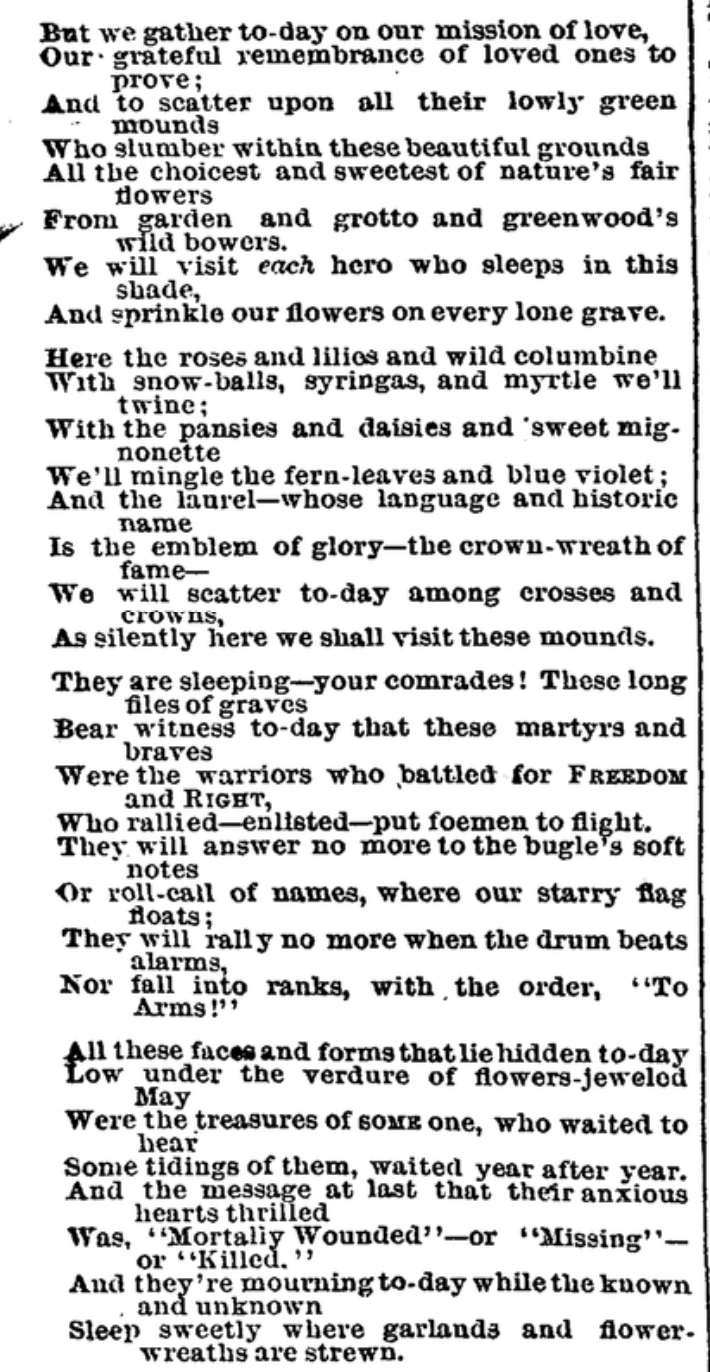
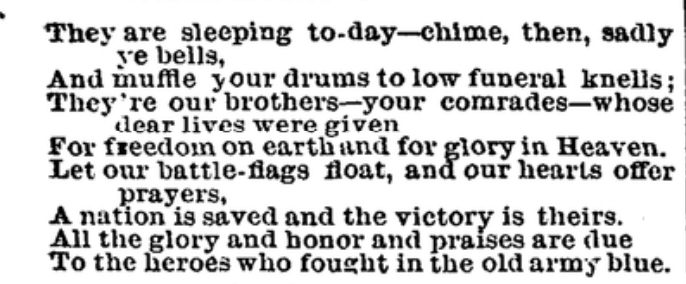
A poem written by Marie Barton Greene (under pseudonym Daisy Dell) that was read every memorial day by her in ceremonies at Washington D. C. during the 1870s. It was titled, “They Are Sleeping Today.”
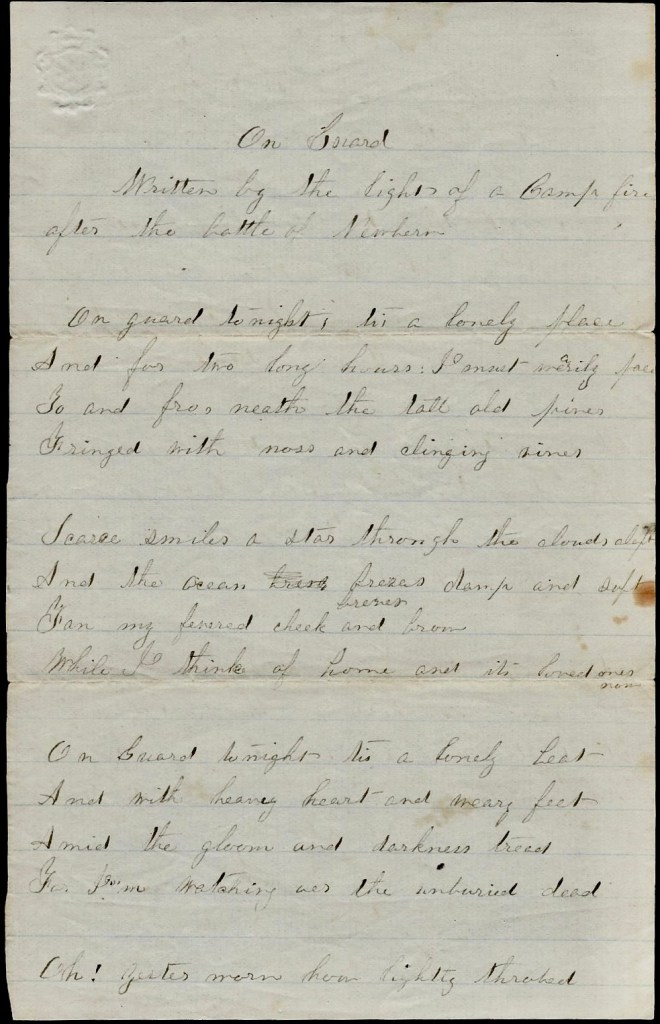
The following piece was sent to me for transcription and research. It was represented to be an original poem “written by the light of a fire after the Battle of Newbern” which took place on 14 March 1862. The poem was signed by the initials “H. C. W.” but there was no date nor indication that H. C. W. was even a soldier. It may have been copied from a newspaper or some other publication and passed off as original. It has the appearance of being a copy—there are no line-outs or word substitutions which would suggest original composition. The question is, was it a copy made by the author of his original composition, or did he (or she) copy it from some publication of another’s work.
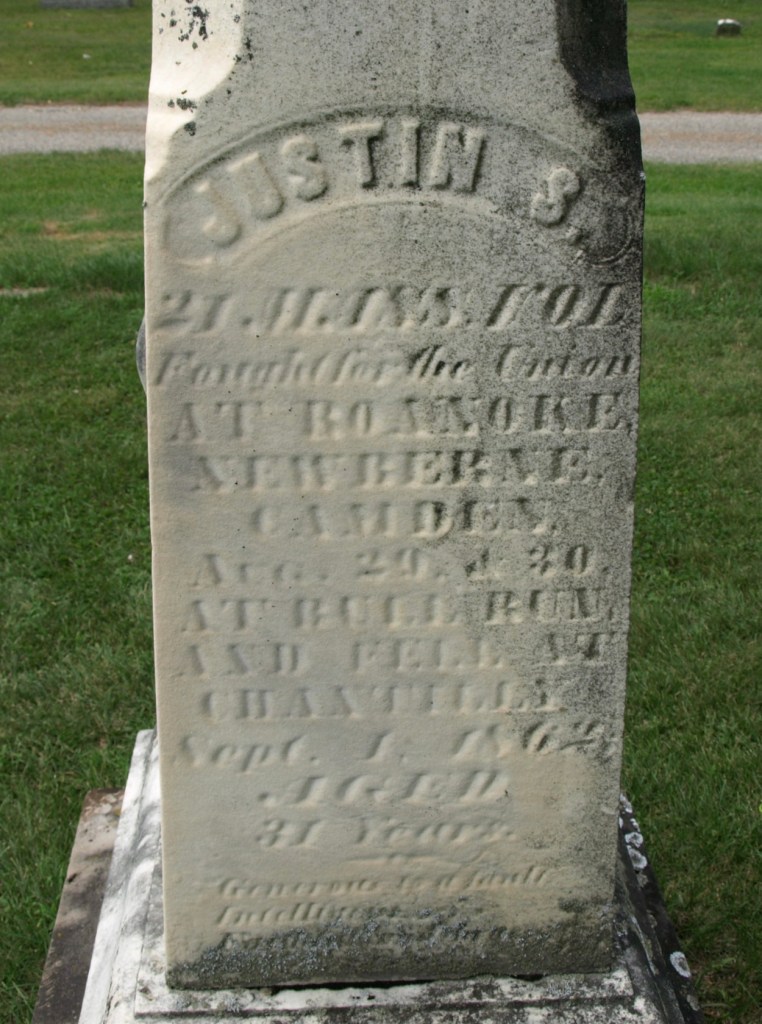
Grave marker of Justin Smith Cressy
I have found at least one publication of the poem that appeared in the Pittsfield Sun (Pittsfield, Berkshire county, Mass.) on 11 December 1862. That publication credited its authorship to Justin Smith Cressy (1831-1862). * Justin was a sergeant from Berkshire county who served in the 21st Massachusetts Infantry. He was the son of Alonzo and Sophia Mariette (Smith) Cressy and was married in Pittsfield to Harriet Elizabeth Stevens in April 1856. Prior to his enlistment, Justin was a telegraph operator so he must have been educated beyond average. The 21st Massachusetts was one of the regiments participating in the Battle of Roanoke Island and the Battle of New Bern before being recalled to Virginia in July 1862. Justin was mortally wounded in the Battle of Chantilly and died on 24 September 1862. His authorship of this poem cannot be ruled out though I might note that unless the company was shorthanded, typically a sergeant would not have stood guard in the manner suggested by this poem. Justin began and ended his service as a sergeant in Co. I and so if he was on guard detail, he would have been the sergeant of the guard and not typically confined to a post. On the other hand, sergeants or corporals who oversaw the posts generally had time to write letters (or compose poems) during the time they were on guard duty whereas the privates had to walk the beat.
I have also found the entire poem published in the True Flag (Boston, Mass) on 3 January 1863—attributed to Annie Hathaway; in the Norwich Morning Bulletin (Norwich, VT) on 28 September 1910—attributed to Thomas Francis Dowd, Camp Ferris, Barrancas, Florida, 30 April 1863; in the Palmetto Herald (Port Royal, S. C.) of 24 March 1864—submitted by anonymous contributor claiming to have seen it published in a small New Hampshire village newspaper; in the Rockland County Messenger (Haverstraw, NY) on 11 June 1863—no attribution given; and in the Lewistown Gazette (Lewistown, Pa.) on 14 December 1864—attributed to an unnamed soldier who fell in the first day’s battle of the Wilderness, supposedly penned in camp on the Potomac near Belle Plain, Va. on 24 March 1864. There are more instances of newspaper publications I am sure.
I also found a portion of the poem appearing in the History of the Seventh Illinois Regiment published in 1868 by Daniel Leib Ambrose (see page 202). The last two stanzas of the poem were included in a diary entry made on 30 October 1863 as if it were an original composition by the author.
And finally I found the words of the poem appearing in a letter penned by John D. Cottrell, Co. D, 48th New York datelined from Palatka, Florida, on 28 March 1864. In a most shameless plagiaristic manner, “Jersey Jack” Cottrell broke the poem apart into sentences, disrupting the rhythm and rhyme so as to disguise the source. This letter was included in the 2000 publication, “Brothers ’til Death” by William Jones, Richard M. Trimble, and Thomas Jones.
* The Grand Traverse Herald of 4 July 1862 also published this poem, crediting Sergt. J. S. Cressy. They claimed to pick the poem up from the Janesville Independent.
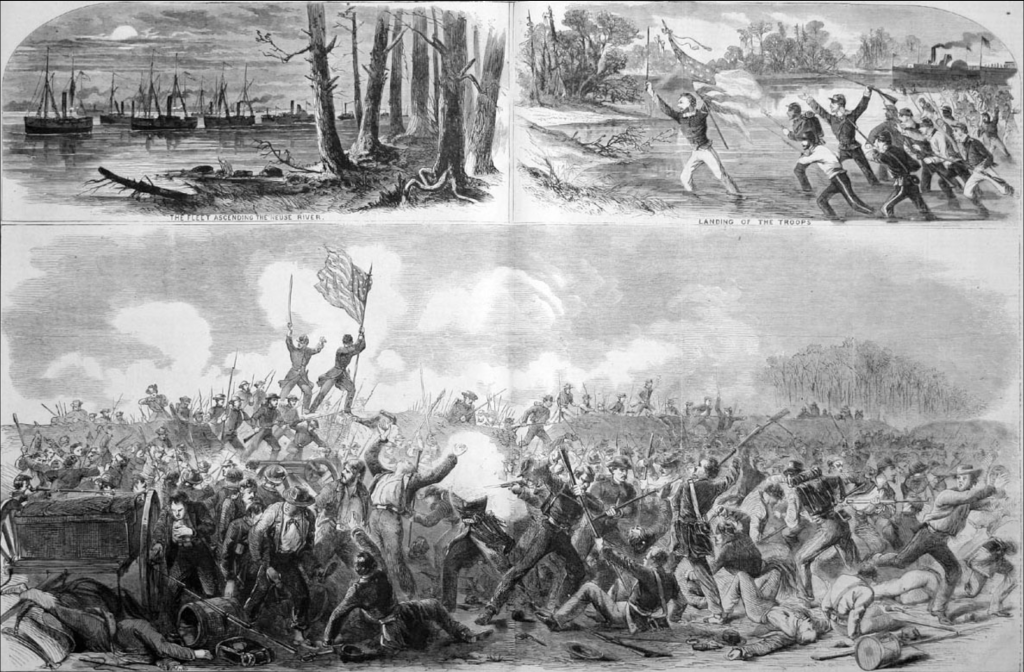
From Harper’s weekly, 5 April 1862
Transcription
On Guard
Written by the light of a camp fire after the Battle of Newbern
On guard tonight; tis a lonely place And for two long hours I must wearily pace To and fro, neath the tall old pines Fringed with moss and clinging vines
Scarce smiles a star through the clouds aloft And the ocean breezes damp and soft Fan my fevered cheek and brow While I think of home and its loved ones now
On guard tonight tis a lonely beat And with heavy heart and weary feet Amid the gloom and darkness tread For I’m watching o’er the unburied dead
Oh! yester morn how lightly throbbed Full many a heart that death has robbed Of its pulses warm, and the caskets lie As cold as the winter’s starless sky
How sad the thought that another day Will bring again the battle fray And ere the close of tomorrow’s light I too may sleep like those tonight
Past midnight hour and I long to hear The step to the soldier’s heart most dear A sound that banishes all his grief The welcome tread of the next relief
Ah hear they come and now I can keep The next four hours in the land of sleep And dream of home and its loved ones there Who never may know a soldier’s care.
This morning I saw a post on Yankee Rebel Antiques by my friend Ron Coddington, author and editor of Military Images Magazine, in which he referred to a poem entitled “Soldier’s Tear” that was published by James Gates of Cincinnati during the Civil War. He described the piece as having been folded, suggesting that someone had possibly carried it with them—perhaps a soldier given to him by a loved one.
As I read the poem it occurred to me that I had read at least a portion of it before but couldn’t remember where. Thinking was on an envelope, I searched Civil War envelopes and found one with the familiar words (though retitled “Soldier’s Farewell”) and an engraving of a soldier waving goodbye to his family. The poem and stationery was sold by James Gates, the proprietor of the Union Envelope Manufacturing company located at the southeast corner of 4th & Hammond Streets. While there were many manufacturers who produced stationery with patriotic scenes on them during the war, Gates took his marketing to a new level, even going so far as selling entire “kits” of not only paper and envelopes (a set of 12), but a pen, a pencil, and a “Union pin or other piece of jewelry” suitable for gifting to a loved one. Soldiers often purchased these kits as they passed through Cincinnati and early war letters are commonly found on his stationery. [See Union & Confederate Soldiers’ Stationery, Their Designs & Purposes, by Steven R. Boyd]
What I found to be most unusual about this piece, however, is that it was written not by an American, but by an Englishman named Thomas Haynes Bayly (1797-1839) whose songs and ballads, including this one, were published in Philadelphia under the title, “Songs and Ballads, Grave & Gay” in 1844. If you are observant, you will notice that he also died in 1839, more than twenty years before the Civil War. I don’t know for sure when Thomas wrote the piece “Soldier’s Tear,” but it was published in the New Yorker in June 1837 so it had to be prior to that. The preface to Songs & Ballads defines him as “unquestionably the most popular English song-writer of his age…unequalled as he is for graceful imagery and delicately turned expression…”
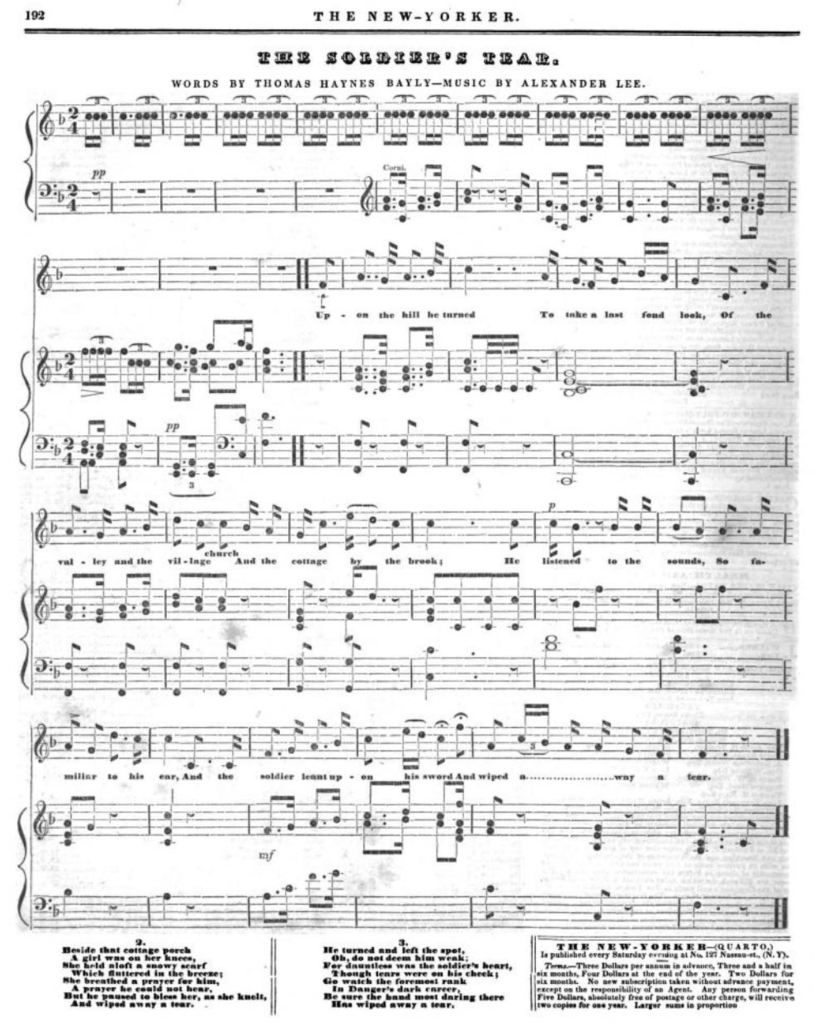
Thomas wrote the lyrics for a tune written by Alexander Lee which was also published in the New Yorker:
The Soldier’s Tear
Wanting to hear the tune played and sung, I found the following clip on YouTube: