My passion is studying American history leading up to & including the Civil War. I particularly enjoy reading, transcribing & researching primary sources such as letters and diaries.
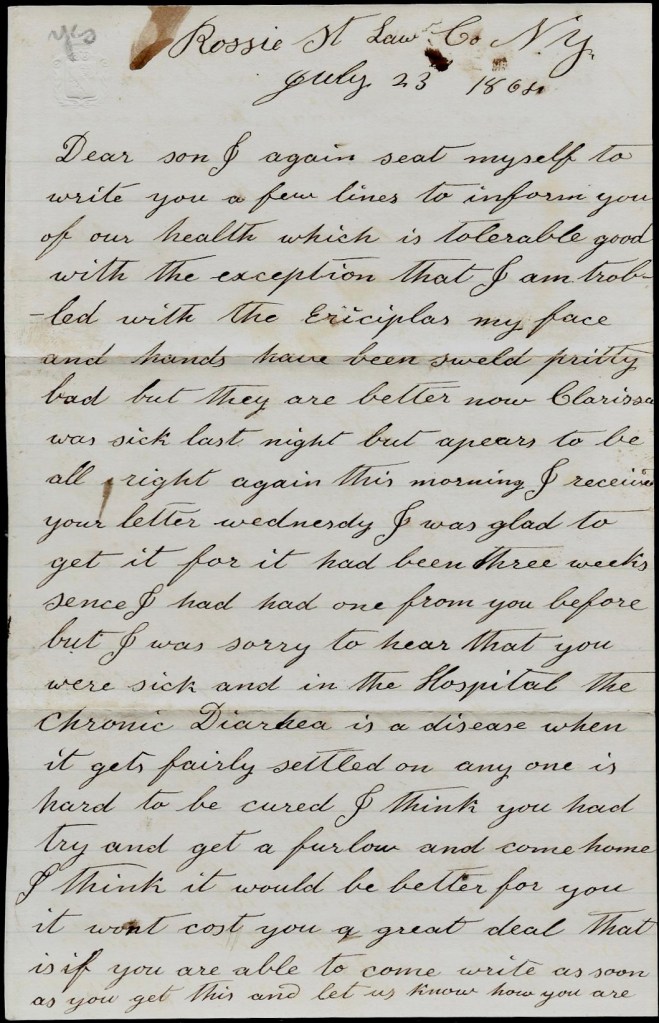
This letter was written by Charles Gordon Austin (1814-1899)—a Canadian by birth—and his wife Pamelia Anna Tyler (1817-1897) of Rossie, St. Lawrence county, New York. Several of their children are mentioned in the letter, including: Benjamin M. Austin (1840-1885) who enlisted as a corporal in Co. C, 60th New York Infantry and transferred in November 1862 to the 6th US Cavalry; Elizabeth Tirzah Austin (1835-1909) who would later marry Charles F. Northrop; and Lucy Maria Austin (1843-1914).
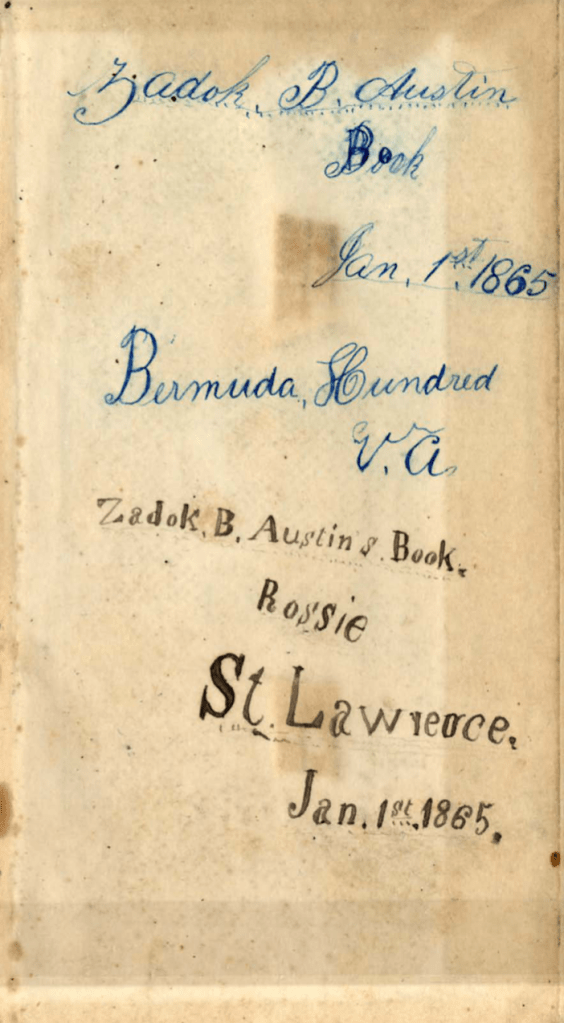
Charles wrote the letter to his son Zadok Baldwin Austin (1837-1925) who enlisted on 7 August 1862 as a private in Co. F, 10th New York Heavy Artillery (106th New York State Volunteers). At the time of his enlistment he was described as 24 years-old, with blue eyes, light hair, and standing 5 feet 7.5 inches tall. Zadok mustered out of the regiment on 23 June 1865 with his company at Petersburg, Virginia.
Transcription
Rossie, St. Lawrence county, New York July 23, 1864
Dear Son,
Digital images of Zadok’s 1865 Diary & a transcript are available at the Auburn University Digital Library
I again seat myself to write you a few lines to inform you of our health which is tolerable good with the exception that I am troubled with the erysipelas. My face and hands have been swelled pretty bad but they are better now. Clarissa was sick last night but appears to be all right again this morning.
I received your letter Wednesday. I was glad to get it for it had been three weeks since I had had one from you before but I was sorry to hear that you were sick and in the hospital. The chronic diarrhea is a disease when it gets settled on anyone is hard to be cured. I think you had [better] try and get a furlough and come home. I think it would be better for you. It won’t cost you a great deal—that is, if you are able to come. write as soon as you get this and let us know how you are.
I received a letter from Benjamin last week Wednesday. He was well when he wrote. That was July 6th, 1864. He was twelve miles from Richmond. He said they would stay there a spell to rest their horses. I have received two letters from Tirzah since I write to you last. Robert is killed. He was out on a raid forty miles from camp when he was shot by a rebel through the neck and killed instantly. He was carried back to Newbern and buried. Tirzah is well and so is Priscilla and George Gibson. The folks in Hammond are well. Lucy is at home now and is well. I have not got your things yet. Write as soon as you get this. We remain your loving father and mother.
I could not find an image of William but here is a CDV of Lt. Joseph B. Abbott who served as the Adjutant of the 137th New York Infantry (Photo Sleuth)
This letter was written by William Henry Taft (1827-1862), a carriage maker from Caroline Centre, Tompkins county, New York, who enlisted in September 1862 and was made 2nd Lt. of Co. K, 137th New York Infantry. In this 8 October 1862 letter to his wife, Phebe Robins, William shares some information about the regiment’s location and of an anticipated fight with Stonewall Jackson who had long since re-crossed the Potomac River returning to Virginia after the Maryland Campaign.
William’s military career was incredibly brief. He died of typhoid fever on 30 October 1862 at Knoxville, Maryland (see telegram below).
William was the son of John Taft (1795-1876) and Arethusa Gould (1794-1868).
Telegram relaying the news that “Wm. H. Taft is dead. His wife has started with corpse. Will be at Caroline Depot Monday morning. — R. Pierson
Transcription
Addressed to Mr. John Taft, Caroline Centre, Tompkins county, New York
Pleasant Valley, Maryland October 8, 1862
Dear Father,
As I have about ten minutes leisure time, I thought that I would write you a few lines to let you know that I am well and enjoying myself first rate. Our boys are all very well and like it down here in Maryland. We have to lay down on the ground to write.
I went up on Maryland Heights day before yesterday. There you can look all around for twenty miles and see perhaps 200,000 soldiers in camp. We could see McClellan’s army and Burnside’s division and just above here Burnside’s army lays in wait for [Stonewall] Jackson’s force. They expect to have a big fight in a few days with Jackson. They have got him surrounded so that he has got to fight or surrender soon. They say here that Jackson lost thirty thousand in killed & wounded at the least when he came into Maryland before.
The weather is very warm and dry here—about like our warm Augusts.
Tell the folks to write often. Direct to 137th Regt. New York State Volunteers, Washington D. C.
I could not find an image of Alfred but here is Franklin D. Cornish who served in the same regiment. (Photo Sleuth)
This letter was written by Alfred L. Edwards (1841-1918) who enlisted on 26 August 1861 as a private in Co. E, 50th New York Engineers and remained in the regiment until mustering out on 20 September 1864 at Elmira, New York.
Alfred datelined his letter from New York City on 20 September 1861 two days after his arrival. He shares the news with his mother that they were ordered to encamp on the battery overlooking New York Harbor which was still occupied by members of Ellsworth’s New York Fire Zouaves (11th New York Infantry) despite their having been ordered to Fortress Monroe. A newspaper article described the situation as follows:
“The New York Fire Zouaves—the “Pet Lambs”—have again been distinguishing themselves. On Thursday last they were assembled on the battery, New York, where they indulged in a series of free fights, at one time assuming the proportions of a riot. They also tossed in blankets a number of inoffensive laborers, and seizing a reporter of the Times tossed him in a tent cloth, and otherwise maltreated him, and finally robbed him of fifteen dollars. When appealed to Col. Lozier to behave in a more orderly, and to go without further difficulty to Fort Monroe, but twenty-five out of three hundred were willing to go—the others, on various pretenses, utterly refusing to leave New York. It is high time that these cowardly miscreants—the terror of all peaceable and unarmed citizens, the disgrace to the profession of arms, and the butt for the ridicule of the fie—were treated as mutineers or deserters; reduced to order or shot. It is idle to waste more time or more words on them.” — The Daily Gazette and Republican, Trenton, NJ 23 September 1861
Alfred wrote the letter to his mother, Rumina (Gates) Merrill (1818-1895). The envelope was addressed to Rumina’s second husband, Philander Merrill (1795-1883) of Ketchumville, Tioga county, New York. Rumina’s first husband, Cyrus Edwards, died prior to the 1850 US Census at which time the widow Rumina was enumerated with her two boys, Alfred and Cyrus, in Maine, Broome county, New York.
To read other letters I have transcribed and posted on Spared & Shared that were written by members of the 50th New York Engineers, see: Cornelius Van Huysen, Co. A, 50th New York Engineers (1 Letter) Abner G. Hill, Co. B, 50th New York Engineers (1 Letter) William H. Lunn, Co. E, 50th New York Engineers (1 Letter) Halsey Amos Rhodes, Co. H, 50th New York Engineers (1 Letter)
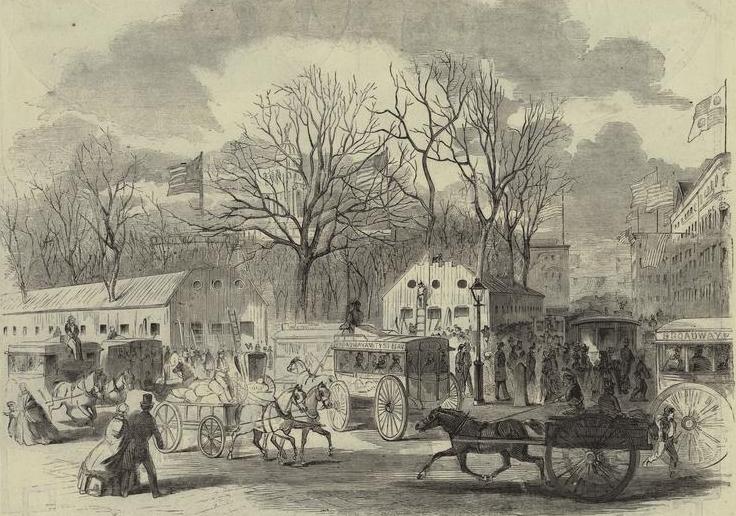
Temporary Barracks erected in Battery Park in NYC in 1861
Transcription
Addressed to Philander Merrills, Ketchumville, Tioga county, New York
Camp Lesley New York City [Friday,] September 20th [1861]
Dear Mother,
We started from Elmira [on Tuesday,] the 17th at four o’clock p.m. in a train of 24 cars, 17 with soldiers. We got [here] next day [Wednesday] at 8 a.m. We are camped on the Bay. Last night we slept on our arms. We expected to be attacked by the New York Fire Zouaves. There was some 300 or 400 on the ground when we came here and they were not going to leave. They had been ordered to leave in the morning at six o’clock but swore they would not, but the Mayor sent the police force in the afternoon and they left. We expected they would return but they did not.
We leave here today at two o’clock. Where to I don’t know. We are all well. I have [seen] more here than I ever seen in my life. Ships and boats are moving all the time. I counted two hundred and sixty-three in view. I am laying flat on my belly and nothing to write on but a board and can’t write good. I will let you know where I be in a day or two.
— A. L. Edwards
I will direct my letters after this in this style, — Alfred L. Edwards, Ketchumville
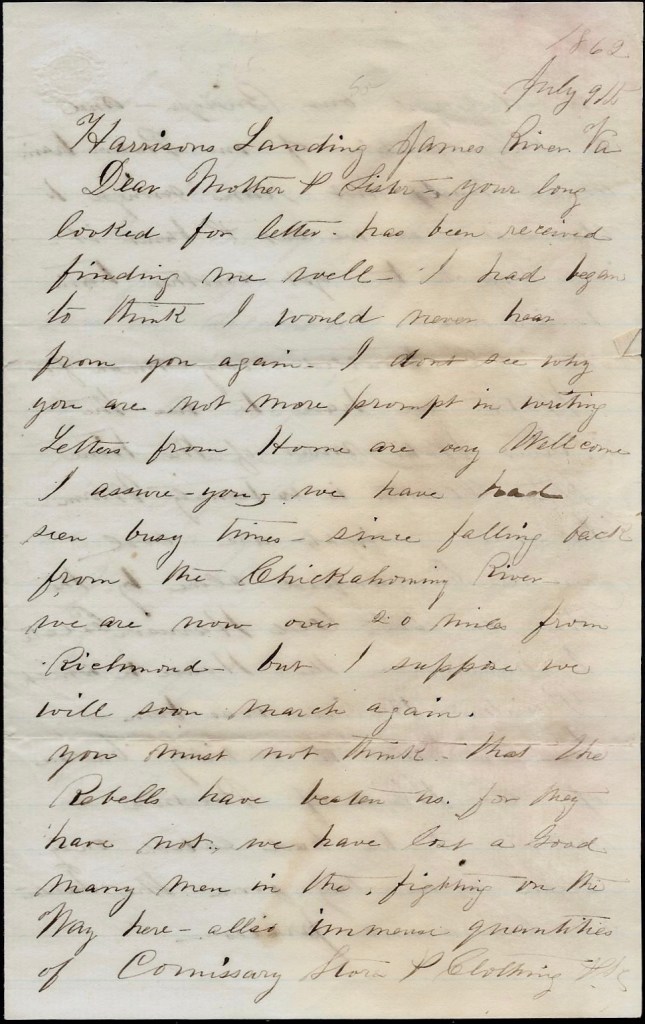
This letter was written by a soldier named J. W. Scott but I am unable to definitively place him in a particular regiment. In his letter, Scot writes of having to burn “our” pontoon bridges and of expecting another train while at Harrison’s Landing. This leads me to conjecture that he served in either the 15th or 50th New York Engineers—both regiments being attached to McClellan’s Army of the Potomac during the Peninsula Campaign. The former has two soldiers by the name of James Scott but neither gives a middle initial on the muster rolls.
Transcription
Harrison’s Landing James River, Virginia July 9th 1862
Dear Mother & Sister,
Your long looked for letter has been received finding me well. I had began to think I would never hear from you again. I don’t see why you are not more prompt in writing. Letters from home are very welcome, I assure you.
We have had some busy times since falling back fro the Chickahominy River. We are now over 20 miles from Richmond but I suppose we will soon march again. You must not think that the Rebels have beaten us for they have not. We have lost a good many men in the fighting on the way here. Also immense quantities of commissary stores & clothing, &c. We destroyed our bridges and a large portion of our pontoon train as we had not teams enough to draw it so we cut & burnt it. We expect to get another train while here.
We are troubled very much for water. We have to use the river water most of the time. The weather is extremely warm but the nights are cool. We are encamped close by the river on the Old Harrison Estate. I have seen the house [Berkeley Plantation] to which President Harrison was born. The country is entirely barren of all kinds of produce. Nothing to be had eatable—only such as we buy from the sutler’s at enormous prices.
I will send Mother $10.00 when we get our pay which will be in about a month. I think the young ladies are marrying right smart. I don’t know what we soldiers will do.
I don’t think of much else to write [in] this except to have you tell John I will write soon. Give my love to all and accept a good share for yourself. Jim & George send their best wishes.
Write often. From your affectionate son & brother, — J. W. Scott
I could not find an image of Gillam but here is a CDV of Capt. William J. Garland, Co. C, 28th Illinois Infantry (Al Niemiec Collection)
This poignant letter pertains to the death of Pvt. Cornelius Tyson (1839-1861) of Co. G, 28th Illinois Infantry who suffered from a “nervous fever” and expired on 24 October 1861 after only two months’ service. Cornelius was the 22 year-old son of Henry Tyson (1806-1887) and Sarah E. Berry (1800-1863) of Rushville, Schuyler county, Illinois.
The letter was penned by Barclay Clayton Gillam (1820-1888) of Rushville who received his education in the common schools of Pennsylvania. After leaving school, he learned the blacksmith trade. At the age of twenty-one he was married to Miss Mary A., daughter of William Beatty, Esq. In the spring of 1844, he moved to the city of Rushville, Ill. Here he established his own blacksmith shop. During the Civil War, he recruited a company of 86 men, was elected its captain, and immediately repaired to the seat of war. After being in the service four months, he was promoted to the rank of major. He was engaged in several battles, among which were Fort Donaldson, Fort Henry, Little Bethel, Shiloh, Hatchie, and others. At the battle of Shiloh he lost a horse and was badly wounded. He resigned his commission and came home in November 1862.
Transcription
Camp Holt, Kentucky October 27, [1861]
Mr. Henry Tyson Dear Sir,
It becomes my sad duty to communicate to you the news of the death of your son. He departed this life on Thursday evening, October 24th at about 8 o’clock in the evening after a painful illness of about two weeks. His disease was nervous fever.
One of my men ([James M] Mitchell) was in the hospital at the time of his death. He seemed to suffer considerable until a few minutes of his death [illegible] wildly most of the time praying and singing.
We feel his loss and can sympathize with you in his loss. He has been a good soldier. But we all must die and though it seems hard to die so young, yet it is the will of the Supreme ruler of our universe.
I believe I have no more to write. I remain your friend in affliction, — Capt. B. C. Gillam
P. S. He is buried about one mile and a half above Mound City [Illinois]. If you should wish to remove the body, I will render all the assistance possible. There was $4.55 cents paid him the day before he died. He told Lieut. Col. [Louis H.] Waters to send it home. Col. Waters has it in his possession.
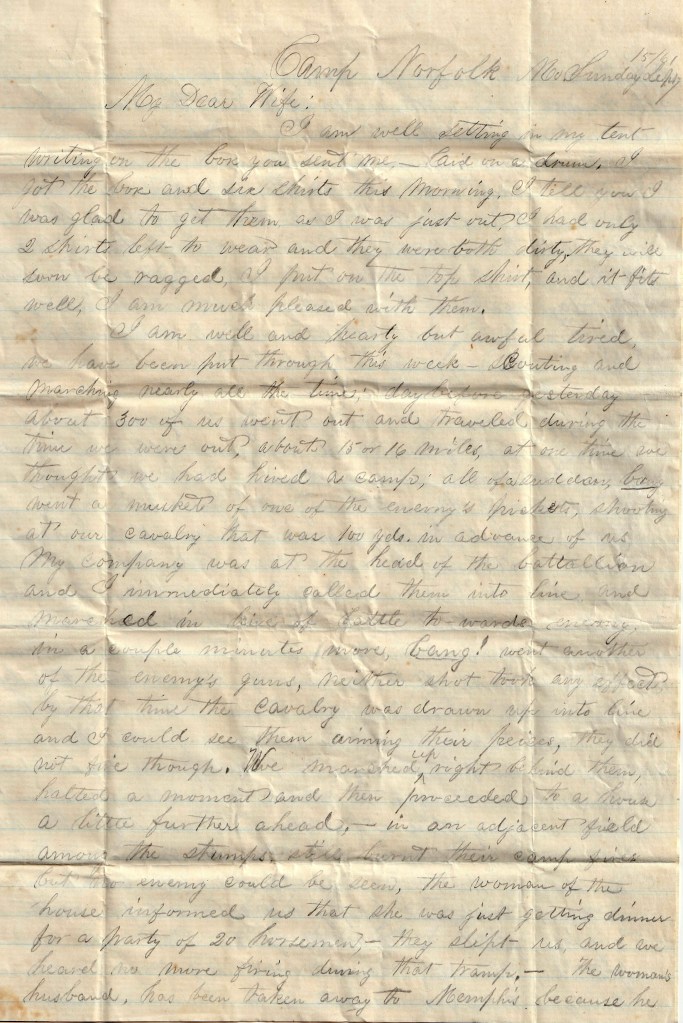
This letter was written by John Seaton (1834-1912), a son of John M. Seaton (1804-1847) and Elizabeth Jones (1810-18xx) of Cincinnati, Ohio. When John was three weeks old his parents removed from Cincinnati to Louisville, Kentucky, where his boyhood days were spent. He was eleven years of age when his father was killed on the field of battle in the War with Mexico. He attended school until he was fifteen years of age, and then began learning the trade of a machinist. A few years later finds him working as a journeyman machinist in St. Louis, Missouri. In 1856 with a cash capital of $2.50, John Seaton started a foundry at Alton, Ill. A natural aptitude for mechanics and machinery appliances, combined with pluck, energy and perseverance, enabled him to make a success … and the enterprise prospered. He was married in 1857 to Charlotte Ellen Tuthill (1840-1925), to whom he addressed this letter.
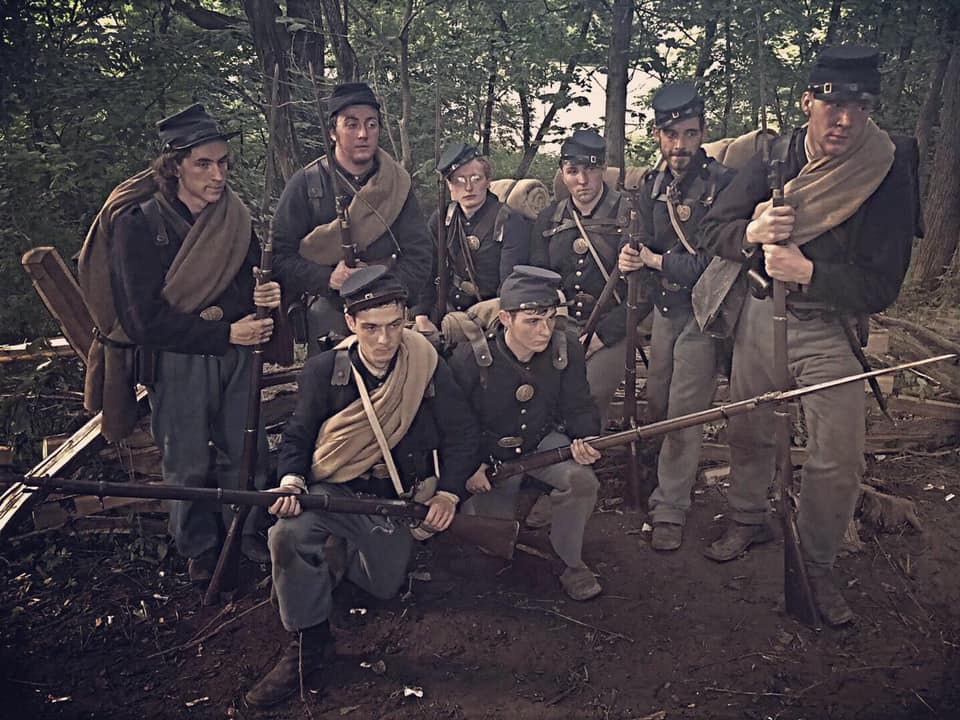
At the outbreak of the Civil War, John Seaton offered his services in defense of the Union and was commissioned a captain of Co. B, 22nd Illinois Infantry. The regiment trained in Belleville until 25 June 1861, outfitted in the grey uniform of the Illinois militia; and equipped with a .69 caliber converted flintlock musket that fired buck & ball.
Their first serious engagement was the Battle of Belmont (7 November 1861) under General Grant and Captain Seaton was in command of the skirmish line that opened this engagement. Before he advanced, Captain John Seaton of the 22nd Illinois told his men, ‘If I should show the white feather, shoot me dead in my tracks and my family will feel that I died for my country.’ [See Battle of Belmont on HistoryNet] One of the precious possessions of his family at this day is the personal letter he received from the famous commander, commending him for the efficient manner in which he performed the task allotted to his command. He served for one year and then resigned his commission and returned to Alton to take charge of his business.
A letter that John wrote to his wife following the Battle of Belmont and published in the Alton Telegraph on 15 November 1861 was beautifully summarized and transcribed by my friend Dan Masters on Civil War Chronicles under the title, “Standing Up to the Work: A Captain’s View of Belmont.”
After the war, John Seaton remained in Alton in charge of his foundry until 1872, when he removed to Atchison, Kansas, with his entire force of fifty employees. In addition to general architectural work, he filled orders for the Santa Fe, Missouri Pacific and Ft. Scott and Gulf railroads, such as casting locomotive wheels, smoke stacks, steam cylinders, etc., …. The business of his large establishment in Atchison was built up until it amounted to over $250,000 annually, and the plant covered an area of 700×400 feet. Mr. Seaton was in business continually from 1856 until the time of his demise, January 12, 1912.
[Note: This letter is from the personal collection of Richard Weiner and is published on Spared & Shared by express consent.]
I am well sitting in my tent writing on the box you sent me laid on a drum. I got the box and six shirts this morning. I tell you I was glad to get them as I was just out. I had only two shirts left to wear and they were both dirty. They will soon be ragged. I put on the top shirt, and it fits well. I am much pleased with them.
I am well and hearty but awful tired. We have been put through this week—scouting and marching nearly all the time. Day before yesterday about 300 of us went out and traveled. During the time we were out, about fifteen or sixteen miles, at one time we thought we had arrived to camp; all of a sudden, bang! went a musket of one of the enemy’s picket’s, shooting at our cavalry that was 100 yds. in advance of us. My company was at the head of the battalion and I immediately called them into line and marched in line of battle towards [the] enemy. In a couple minutes more, bang! went another of the enemy’s guns. Neither shot took any effect. By that time the cavalry was drawn up into line and I could see them aiming their pieces. They did not fire though.
We marched up right behind them, halted a moment, and then proceeded to a house a little further ahead. In an adjacent field among the stumps, still burnt their camp fires but no enemy could be seen. The woman of the house informed us that she was just getting dinner for a party of 20 horsemen. They slipped us and we heard no more firing during that tramp. The woman’s husband has been taken away to Memphis because he known to be a Union man. It is supposed he will be made away with or pressed into their army. He is a slaveholder too. We saw several of his negroes.
On our way coming back, we came around by another road and when within 2½ miles of Norfolk, we came to a fine large, white, two-story frame house. Here was the residence of another sound Union man by the name of Blanchard. He was seized upon about ten days ago, his house ransacked, and himself, Negroes, horses and cattle conveyed southward. His family, they say, have fled to Cairo. Here was a scene to nerve the patriotic arms of Union men to deeds of valor. A fine family living in a quiet place having a fine farm, and living in affluence, scattered to the four winds of heaven, property torn up, front door of house standing open, fine furniture laying scattered and broken, women’s garments of various kinds scattered here and there, beds look as though the sleepers had just turned out of them, the large cistern all torn off on top, dead cats and other articles thrown in the water, the front of the house riddled with bullets, some of the shingles torn by the leaden missiles, fine fields of corn left without one to take care of them, negroes quarters broken up, and in fact outrages on property of every conceivable shape meet the eye, no matter which way you turn. After stopping there a few moments we left. The place as we left was as silent as the grave, and looked as though the place might be haunted.
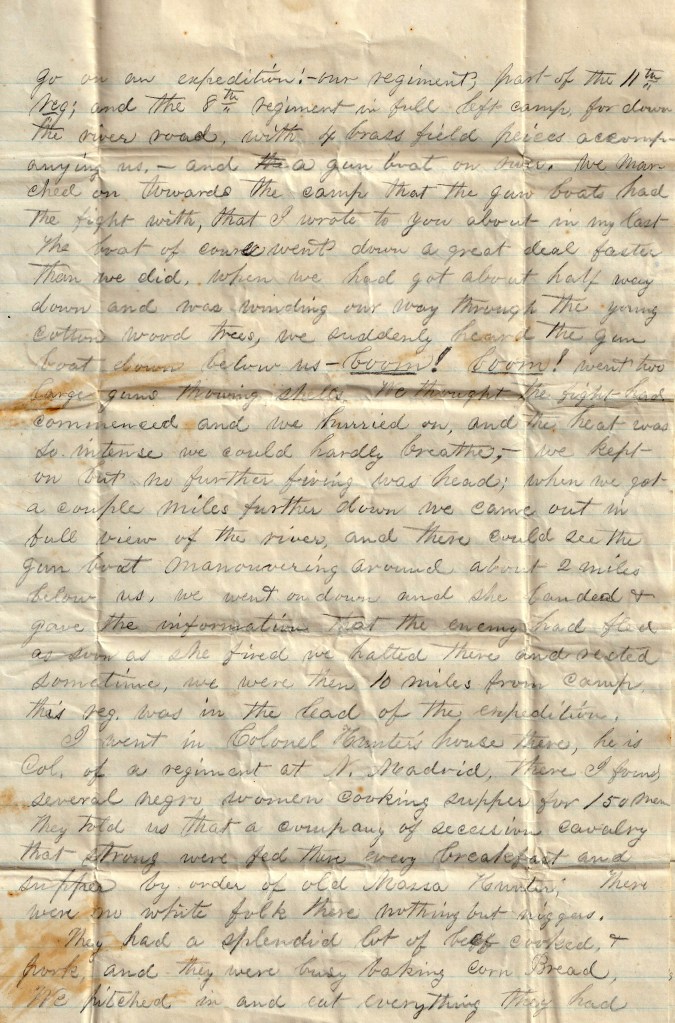
We came back to camp tired and hungry and eat our supper with a great gusto. We rested quietly that night and yesterday morning received orders to get our companies ready with 24 hours rations in their haversacks to go on an expedition. Our regiment, part of the 11th [Illinois] regiment, and the 8th [Illinois] regiment in full left camp for down the river road with 4 brass field pieces accompanying us, and a gun boat on river. We marched on towards the camp that the gun boats had the fight with, that I wrote to you about in my last. The boat of course went down a great deal faster than we did. When we had got about half way down and was winding our way through the young cottonwood trees, we suddenly hear the gun boat down below us—boom! boom!—went two large guns throwing shells. We thought the fight had commenced and we hurried on, and the heat was so intense we could hardly breathe. We kept on but no further firing was heard. When we got a couple miles further down, we came out in full view of the river and there could see the gun boat maneuvering around about 2 miles below us. We went on down and she landed and gave the information that the enemy had fled as soon as she fired. We halted there and rested some time. We were then 10 miles from camp. This regiment was in the lead of the expedition.
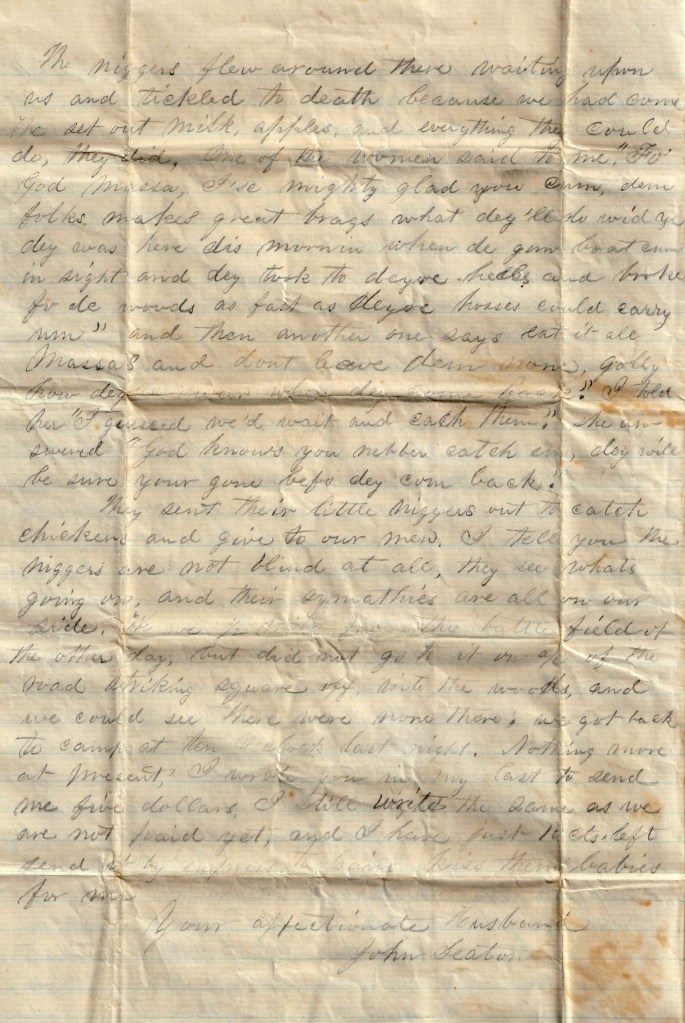
I went in Colonel Hunter’s house there. He is colonel of a regiment at New Madrid. There I found several negro women cooking supper for 150 men. They told us that a company of secession cavalry that strong were fed there every breakfast and supper by order of old Massa Hunter. There were no white folk there—nothing but niggers. They had a splendid lot of beef cooked and pork and they were busy baking corn bread. We pitched in and eat everything they had. The niggers flew around there waiting upon us and tickled to death because we had come. They set out milk, apples and everything they could do, they did. One of the women said to me, “Fo’ God, Massa, I’se mighty glad you cum. Dem folks makes great brags what dey’ll do wid yo. Dey was here dis mornin’ when de gun boat cum in sight and dey took to deyre heels and broke fo de woods as fast as deyre hosses could carry um.” And then another one says, “Eat it all, Massas, and don’t leave dem none. Golly how dey’ll swear wan dey come back.” I told her, “I guessed we’d wait and catch them.” She answered, “God knows you nebber catch em, dey will be sure your gone befo dey com back.”
They sent their little niggers out to catch chickens and give to our men. I tell you the niggers are not blind at all. They see what’s going on and their sympathies are all on our side. We are half mile from the battlefield of the other day, but did not go to it on account of the road striking square off into the woods, and we could see there were none there. We got back to camp at ten o’clock last night. Nothing more at present. I wrote you in my last to send me five dollars. I still write the same as we are not paid yet, and I have just 10cts left. Send it by express to Cairo. Kiss them babies for me.
This letter was written in 1849 from Independence, Jackson county, Missouri, by Benjamin Franklin Wallace (1817-1877). Benjamin was the son of Thomas Wallace (1777-1858) and Mary J. Percy (1785-1874) who came from Virginia to Missouri in 1833 by way of interim residency in Kentucky. Benjamin married Virginia Johnston Willock (1824-1908) at Independence on 1 August 1847 and their first child, mentioned in this letter, was Mary Albina Wallace (1848-1854) who was born on 2 May 1848. Their second child, David Willock Wallace was born on 15 June 1860. [I should mention here that when David W. Wallace grew up, he married Madge Gates in 1883 and their first child was Elizabeth Virginia (“Bess”) Wallace—the future wife of Harry S. Truman—Bess Truman!]
In the 1850 Slave Schedules, Benjamin was enumerated among the slaveholders. He owned three slaves—a female aged 22 and two young children, ages 5 and 2. In the 1860 US Census, Benjamin was identified as a “Bank Clerk” in Independence. In 1869, Benjamin served as the Mayor of Independence. By 1870, he was employed as a dry goods merchant.
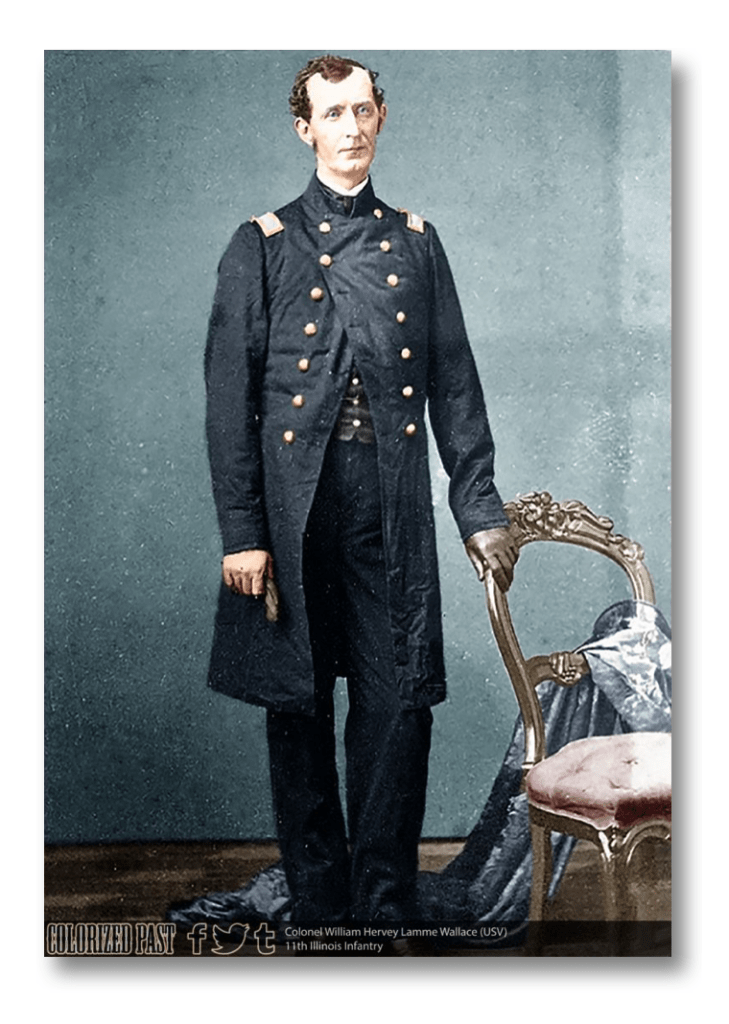
Col. William H. L. Wallace, 11th Illinois Infantry
Benjamin wrote the letter to William Hervey Lamme Wallace (1821-1862) of Ottawa, LaSalle county, Illinois. William’s obituary on Find-A-Grave informs us that prior to the Civil War, he served as the District Attorney for LaSalle County. When he entered the service, in 1861, he was commissioned the Colonel of the 11th Illinois Infantry. For his gallantry at the February 1862 Battle of Fort Donelson, he was promoted to Brigadier General and placed in command of the Army of Tennessee’s 2nd Division. Though he was a new division commander, yet he managed to withstand six hours of assaults by the Confederates, directly next to the famous Hornet’s Nest, or Sunken Road. When his division was finally surrounded, he ordered a withdrawal and many escaped, but he was wounded in the head by a shell fragment and only later found barely alive on the battlefield by his troops. He died three days later in his wife’s arms in a hospital near Savannah, Tennessee. [See “The Death of General W. H. L. Wallace at the Battle of Shiloh,” Iron Brigader.]
William’s younger brother, Martin Reuben Merritt Wallace (1829-1902) was also a Brigadier General during the Civil War, having begun as Colonel of the 4th Illinois Cavalry.
Trails leaving Independence, Missouri in 1849, Charles Goslin
Transcription
City of Independence, Missouri August 9th 1849
W. H. L. Wallace Dear Cousin,
Altho I may have written last, still I do not intend you shall forget me. I trouble you with another letter by way of reminding you that your unknown cousin has not forgotten you.
I have nothing of any great interest to write about, but feel quite grateful that I am alive and still able to correspond with my old friends & relatives whilst death has been abroad & taken many—very many—of my acquaintances. Still myself & mine still live altho death has spread quite a gloom over our beautiful city. Myself & family have remained well. None of your relatives here have been sick with the scourge (the cholera). Altho our next door neighbors have been taken of [it] in a few hours, we have been preserved. Our beautiful city has suffered to a greater degree than even the ill-fated St. Louis according to the amount of population. At present, we have but little I have heard of but one case in the last four days which occurred today and proved fatal in about eight hours (t’was that of a child).
We have had one continual excitement the present year. First the California emigrants & secondly the cholera. These were quite different. The first was pleasant & the last terrifying. A vast number of gold seekers have passed through our place during the last spring & present summer & among the number who have passed recently was some of our old friends from Illinois—Thomas Bassney & others. Bassney told me he knew you well & said you was to have been one of their party 1 but from some cause or other, you had not come on. I told him I suspected Old Zack [Zachery Taylor] had given you an office for I see he appointed W. H. Wallace to be “Register of Lands from Illinois” and suspected it was you (if you have gone to Iway [Iowa], you may never get this). I have but one fault to find to Old Zack’s Administration—I.E., he don’t turn out Locofoco’s fast enough [from such appointed offices] & fill the same with decent Whigs.
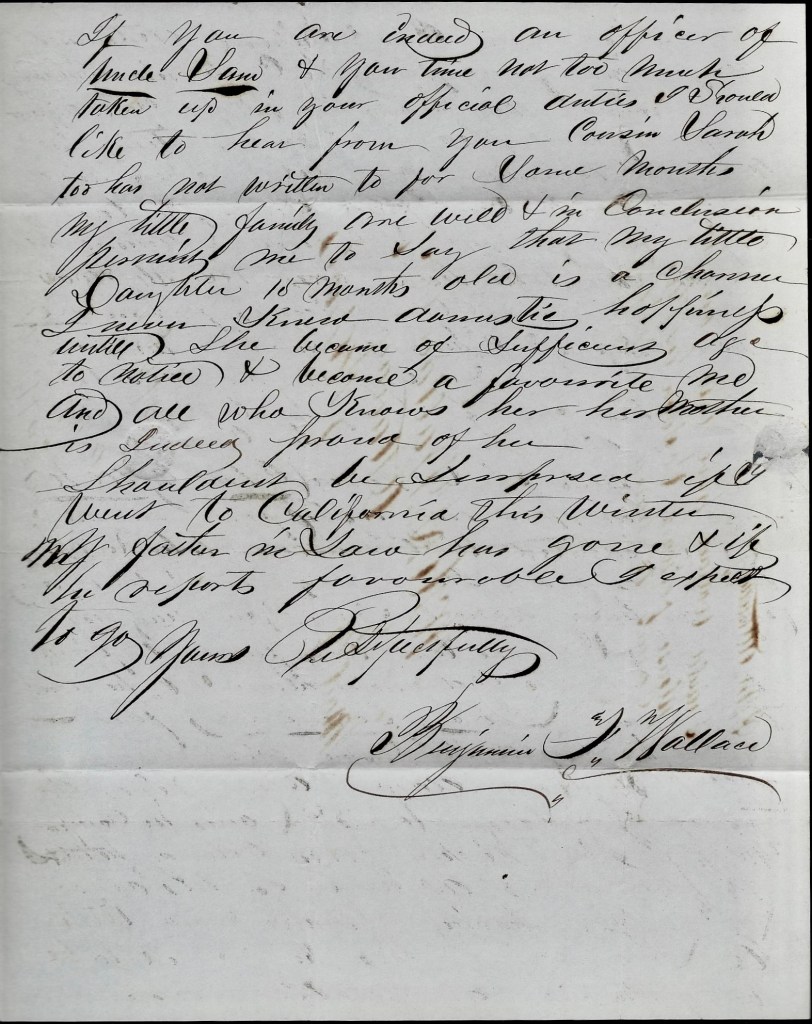
I went down our river the first of June to St. Louis in company with Mr. Fisher from Ottoway [Ottawa]. He told me you was as one of his own sons, you having studied law with a son of his [see George Smith Fisher (1823-1895)]. He seemed to be very much of a gentleman. If you are indeed an officer of Uncle Sam & your time not too much taken up in your official duties, I should like to hear from you. Cousin Sarah too has not written to [us] for several months. My little family are well & in conclusion, permit me to say that my little daughter 15 months old is a charmer. I never knew domestic happiness until she became of sufficient age to notice & become a favorite [to] me and all who knows her. Her mother is indeed proud of her.
Shouldn’t be surprised if I went to California this winter. My father-in-law has gone & if he reports favorable, I expect to go. Yours respectfully, — Benjamin F. Wallace
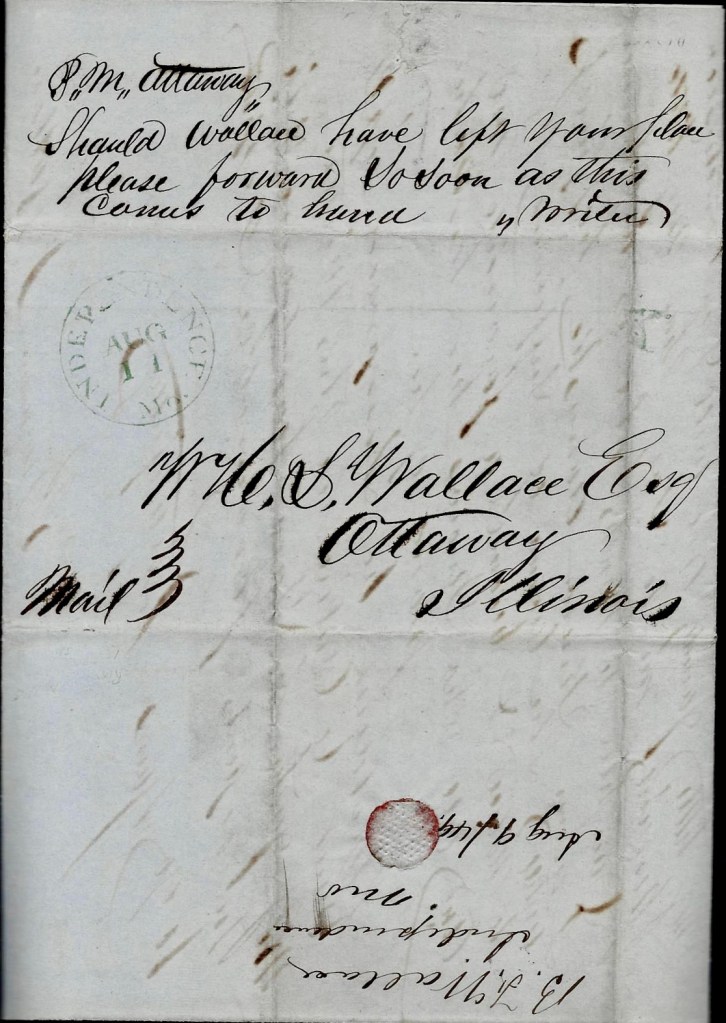
Postmaster Ottoway: Should Wallace have left your place, please forward so soon as this comes to hand.
1 This “California Party” was probably the “Dayton Party” formed at Dayton (near Ottawa) under the command of Captain Jesse Greene. Their rendezvous was to be at St. Joseph on the Missouri in April 1849. One of the party, a store clerk in Ottawa named Alonzo Delano (1806-1874) and his record of the journey can be found at “Life on the plains and among the diggings.”See also “Dayton and the Greens.”
According to newspaper articles published in December 1861, there were only four infantry regiments at Camp Curtin being raised at the time—the 57th Penn, the 101st Penn., the 54th Penn., and the 56th Penn. Only the first two of these were nearly full and about ready to be sent to the front. The only name of those mentioned in the letter than is recognizable is Lt. George Supplee who served as the 1st Lt. in Co. I, 57th Pennsylvania Infantry. I could not find any of the enlisted men’s names in this company, however. Perhaps their company was split up and reassigned to fill out the other companies. There was a Thomas Hamilton in Co. F, for example.
I could not make out the signature at the bottom of the second page—if in fact it is a signature.
Transcription
Camp Curtin [Near Harrisburg, Pennsylvania] December 8th 1861
Dear Brother and Sister,
When I last wrote you I did not expect to address you again from Camp Curtin. The Colonel went to see the Governor and then he was ordered to remain in camp till each of his companies were filled to the number 83. We have now 11 companies in the regiment and by breaking up one, will fill the rest above that complement.
We were ordered out of camp yesterday and have to leave tomorrow afternoon or Tuesday. Where we are going, I don’t know, but will leave this week for certain. I have no particular news that would interest you. Since my last we had the painful duty of sending two corpses home out of our company and three out of the regiment. They were very rugged men when they first came. they all leave families behind them. It is still sickly. Five out of our company are in the hospital, two are dangerous, 12 others are unable to do duty.
Thomas Hamilton has been poorly for the last three weeks but is some better. [First] Lieut. George Supplee has had the quinsy. He took it the day after he came to camp, was very bad. He was taken to the city [and] is well now but looks slim after starving a week. Going home was the cause of it. The rest of us are well. Some are getting as fat as hogs. William Zah has gained 16 lbs. I have 8. So I suppose that you would not believe me if I did tell you that we did not get enough to eat. But a great many complain.
Last week William Zah and James Elbert and myself went in the mountains in pursuit of apples and persimmons. The latter I never heard of till I came to camp. They grow in the mountains and are cultivated by some of the farmers. They are larger than crab apples, are not good till they have been frozen once or twice. They they get very soft. They have a sweet taste. They are very delicious. The tree grows taller than the apple.
We saw the nicest farms and barns that I ever beheld. The barns look like some splendid mansions. Oh! but the farmers do hate the soldiers and not much wonder. Some of the soldiers draw more from the farmers than they do from Uncle Sam, particular in the line of chickens, turkeys, sheep, hogs, cabbage, potatoes, and all such dainties as these. But I must say to the credit of our company that they have not brought one thing into camp that was stole. But few can say that. Some of the boys boast that a rooster can’t crow within four miles of camp. Not infrequently will two or three boys of a company break guard and bring in 15 or 20 chicks and a couple of turkeys. It is diverting to hear some of the farmers tell their stories about the way they are treated by the soldiers. They told us “Dat when de come, we gives dem apples, and suppers, and den dey go away and steal mine chickens and gobblers already.” We got a good supper and were invited back.
We were all through the [illegible] the Capitol [of Harrisburg]. Oh! but this is a nice place. Here is where the rich and wealthy are buried. Monuments and tombstones are here that cost 4,000 dollars. We visited the Insane Asylum and was all through it. Oh! it would pay a man to go 200 miles to see this building. There are 258 inmates. Oh! but they are kept as nice and clean. No city hotel is kept nicer. They are very obliging. They do their washing by steam and heat the house the same way.
But I am spinning this longer than I intended. Simeon Cameron, Secretary of War, was in camp on yesterday and it is reported that he ordered this camp to be evacuated in two weeks on account of the sickness and that they need this camp in Kentucky more than here. I can’t vouch for the truth of this rumor but the Colonel has ordered us to be ready to [illegible].
Tombug? [illegible]
I will drop you a line when we stop. We have had very pleasant weather for the last week.
This letter was written by Augustus William Cowan (1837-1913), the son of William Cowan (1803-1851) and Emeline Coffeen (1809-1867) of Watertown, Jefferson county, New York. Augustus (or “Gus”) married Mary H. P. Christian (1832-1914) in 1867.
Mary Christian of Watertown, New York—to whom the letter was addressed and who would marry Gus in 1867.
From a county history we learn that Gus “remained in Watertown until eighteen years of age, and was educated at the Jefferson County Institute. He came west in 1854 and the following year took up his residence in Pontiac, where he clerked in a general store for some years. He then formed a partnership with Judge Jonathan Duff in the banking and real-estate business, conducting it with such success that in a few years the firm had a together a considerable fortune, invested mainly in lands in this section. In 1870 the partnership was dissolved. Although the business relations were discontinued there still remained such warm personal feeling as exists between brothers and the closest friends, until the Judge’s death in 1881. Bound together by ties not only of personal friendship but that of political affinity and the brotherhood of secret societies, the two members of the firm were regarded as almost members of one family, and it was natural that the living member of the firm should be deeply affected at the departure of one he loved so well. Mr. Cowan continued in the real-estate business until 1882, when he was elected county treasurer and for four years held that office, discharging its duties in a commendable and satisfactory manner. Since 1889 he has been owner of the Livingston county title abstracts and has devoted his time and attention to that business, meeting with good success.”
Transcription
Addressed to Miss Mary P. Christian, Watertown, New York
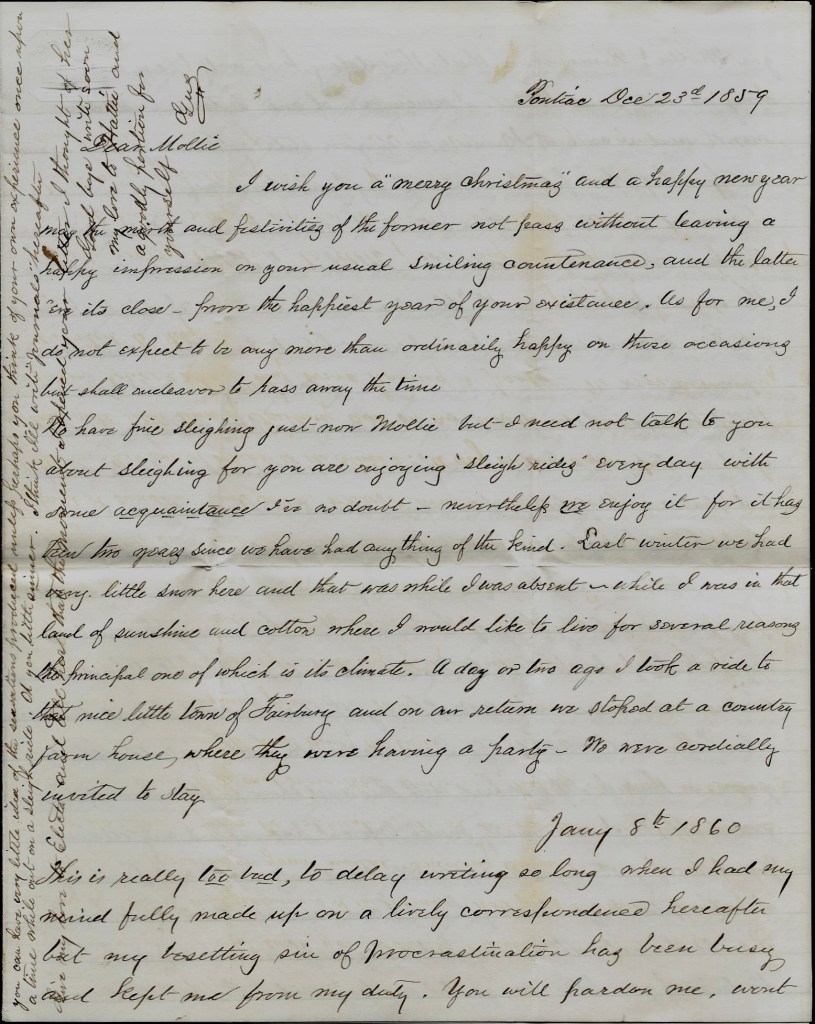
Pontiac [Illinois] December 23rd 1859
Dear Mollie,
I wish you a “Merry Christmas” and a Happy New Year. May the mirth and festivities of the former not pass without leaving a happy impression on your usual smiling countenance, and the latter ‘ere it closes from the happiest year of your existence. As for me, I do not expect to be any more than ordinarily happy on those occasions but shall endeavor to pass away the time.
We have fine sleighing just now Mollie but I need not talk to you about sleighing for you are enjoying “sleigh rides” every day with some acquaintances I’ve no doubt. Nevertheless we enjoy it for it has been two years since we have had anything of the kind. Last winter we had very little snow here and that was while I was absent—while I was in that land of sunshine and cotton where I would like to live for several reasons, the principal one of which is its climate. A day or two ago I took a ride to that nice little town of Fairbury and on our return we stopped at a country farm house where they were having a party. We were cordially invited to stay.
January 8, 1860
This is really too bad to day writing so long when I had my mind fully made up on a lively correspondence hereafter but my besetting sin of procrastination has been busy and kept me from my duty. You will pardon me, won’t you Mollie? Remember that this delay has not been as long as they used to be. I remember of ine intervals of six months and I cannot blame you if you still retain a grudge against me for that but for this I must beg your forgiveness.
I received a letter from Ran about the same time I did your own but have not yet answered it. Tell him I will write sometime. He seemed to be having the “blues” when he wrote. I wish I could ret Ran a good situation here. I would like to have him with me.
Only Jany. 17th 1860
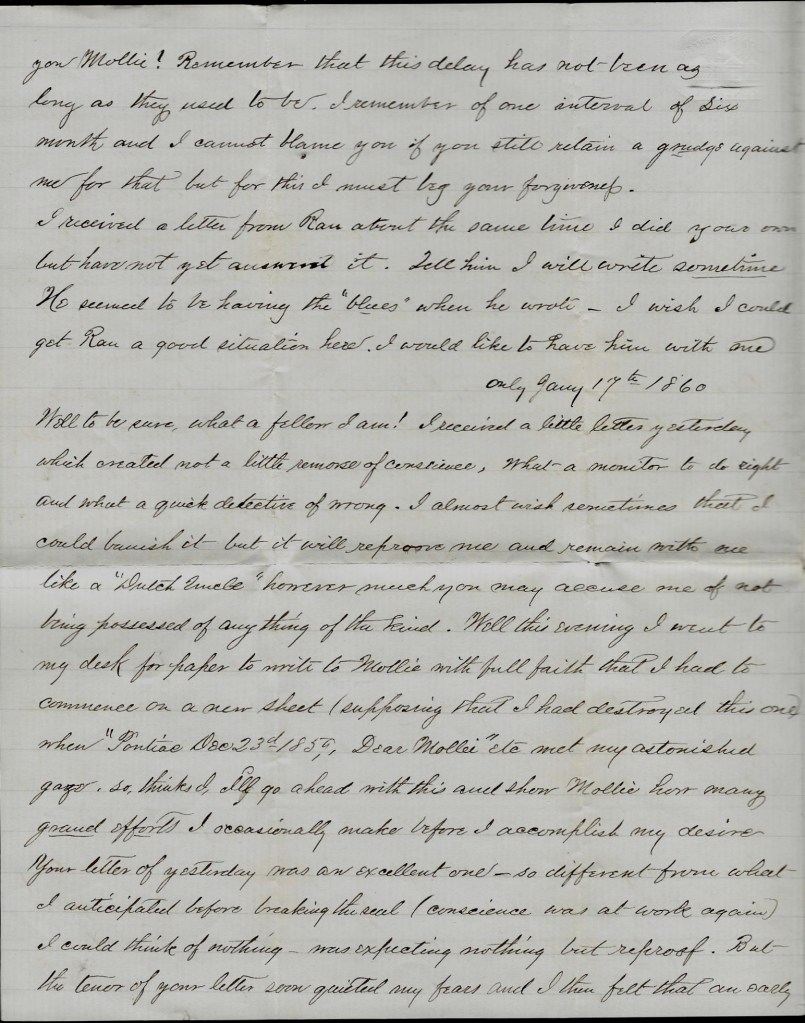
Well to be sure, what a fellow I am! I received a little letter yesterday which created not a little remorse of conscience. What a monitor to do right and what a quick detective of wrong. I almost wish sometime that I could banish it but it will reprove me and remain with me like a “Dutch Uncle” however much you may accuse me of not being possessed of anything of the kind. Well this evening I went to my desk for paper to write to Mollie with full faith that i had to commence on a new sheet (supposing that I had destroyed this one) when “Pontiac, Dec. 23rd 1859, Dear Mollie” etc. met my astonished gaze. So thinks I, I’ll go ahead with this and show Mollie how many grand efforts I occasionally make before I accomplished my desire. Your letter of yesterday was an excellent one—so different from what I anticipated before breaking the seal (conscience was at work again). I could think of nothing—was expecting nothing but reproof. But the tenor of your letter soon quieted my fears and I then felt that an early reply would effect that peace of mind so desirable to us both and cause you to grant the prayer of your humble petitioner as expressed in his petition of January 8th, 1860, namely: that of forgiveness.
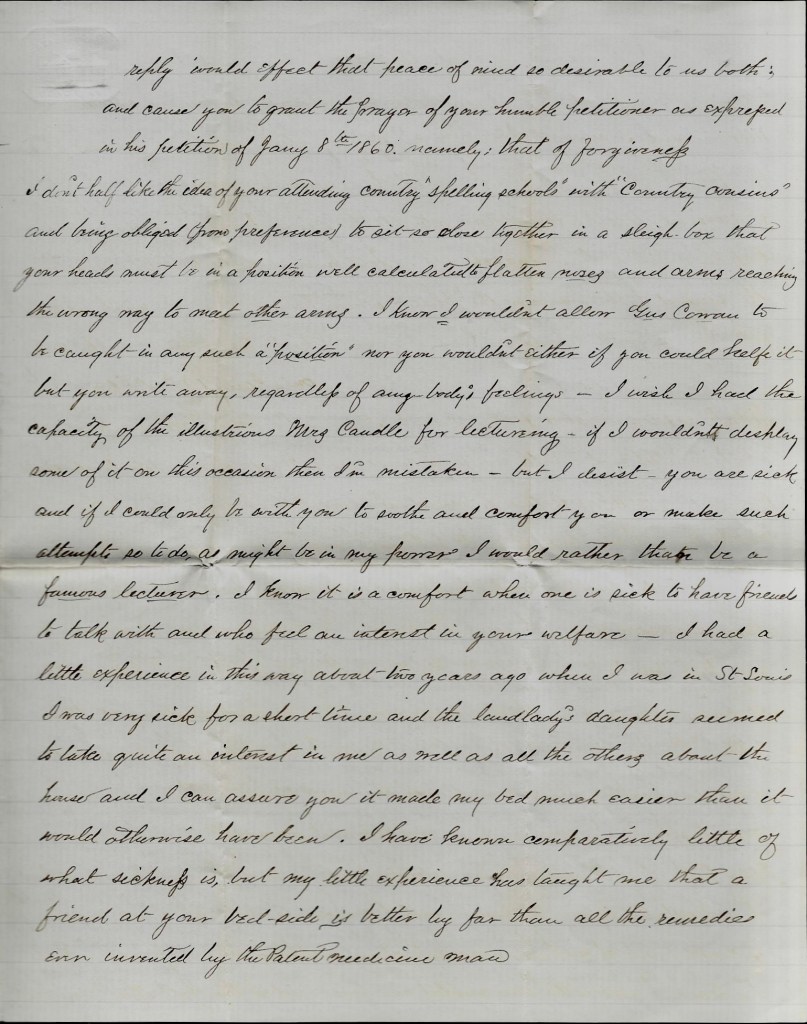
I don’t half like the idea of your attending country “spelling schools” with “country cousins” and being obliged (from preference) to sit so close together in a sleigh box that your heads must be in a position well calculated to flatten noses and arms reaching the wrong way to meet other arms. I know I wouldn’t allow Gus Cowan to be caught in any such a “position” nor you wouldn’t either if you could help it but you write away, regardless of anybody’s feelings. I wish I had the capacity of the illustrious Mrs. Candle for lecturing. If I wouldn’t display some of it on this occasion, then I’m mistaken. But I desist. You are sick and if I could only be with you to soothe and comfort you, or make such attempts so to do as might be in my power, I would rather than be a famous lecturer. I know it is a comfort when one is sick to have friends to talk with and who feel an interest in your welfare.
I had a little experience in this way about two years ago when I was in St. Louis. I was very sick for a short time and the landlady’s daughter seemed to take quite an interest in me as well as all the others about the house and I can assure you it made my bed much easier than it would otherwise have been. I have known comparatively little of what sickness is, but my little experience has taught me that a friend at your bedside is better by far than all the remedies ever invented by the patent medicine man.
January 20th. I have this day received a letter from my dear Mother in which she tells me of the marriage of M. Louisa Clark and talks on how much I have lost etc., just as you did. I’d like to know how anything is to be lost until first having been obtained. I am satisfied and hope she will be. Did I ever tell you my experience in that matter while at home or by letter since I have been West? If not, I will some time. Louisa is a good girl and I hope she has a husband who will appreciate her. I once thought her the nearest perfect. What’s the use for me to be telling you about my boyish love. I won’t! No Mam, I won’t wont! She is married and gone. She is to me like a dead issue in politics. The party that has been successful is welcome to all the benefits.
In your next you must give me more definite news about the “lady in black,” or did you say, “woman?” That is, if there is anything definite about her. I used to know “a ____ in black,” you know, but whether she could be termed “mysterious” or not, I don’t know. I have not forgotten how she looked and all about her but am in no wise anxious to renew the acquaintance.
Mollie, we had such a good time at the “Sociable” night before last. How I wish you had been there. After the minister and all—no not all, but some—of the old folks had gone home, we started some old-fashioned plays wherein error was followed with penalty and most righteous judgements pronounced. This was the first public exhibition of the kind I have entered into since I’ve been West and I tell you, Mollie, I rather “like it.” Such amusement makes me feel younger. There was one pretty girl there too (our deputy sheriff’s sister, late of Buffalo, N. Y. 1) and when I was obliged to kiss her (I say “obliged” because our Judge was very stern and I had no friends to intercede for me on that occasion, neither money to induce him to change his mind, or rather didn’t offer any money or try to get any of my friends to intercede in my behalf as I thought there would be no use, and then again my early education has always been to be “obedient to the laws that be“). Well, if I digress from my theme, I am certainly excusable when the subject is such a “glorious” one that my mind has no affinity with paper and ink but rather with bright eyes, pretty hair, fair complexion, and pouting lips. Well, I am back very near to kissing. Well, when I was obliged to approach her, obliged to place my unwilling arm (why I nearly had the palsy) around her waist, obliged to let the other arm go where it had a mind to whether around her neck or not, obliged to place my quivering lips to those pouting ones of hers, obliged to make a noise (usually termed “smack”) with my lips loud enough so that there could be no mistake or doubts in the minds of those present about what I had done and whether I had fulfilled the requirements of the law, you can have very little idea of the sensations produced unless perhaps you think of your own experience once upon a time while out on a sleigh ride. Oh you little sinner. I think I’ll write “journals” hereafter.
Give my love to Electa and tell her that the moment I opened your letter, I thought of her. Goodbye. Write soon. My love to Hattie and a good portion for yourself. — Gus
1 The Deputy Sheriff in Pontiac, Illinois, at the time of the 1850 US Census was Edwin R. Maples (1832-1877) who was married to Eliza Jane Houser (1836-1905) in 1856. He was from Chautauqua county, New York, and the son of David J. Maples (1809-1892) and (1811-1843). His unmarried younger sister with the pouty lips was Alice Victoria Maples (1839-1901), not yet 21 years old, who became a school teacher in Livingston county, Illinois, and married Capt. John Jay Young (1836-1894) in September 1862. Capt. Young was the commander of Battery G, Pittsburgh Heavy Artillery during the Civil War and spent most of his time at Fort Delaware.
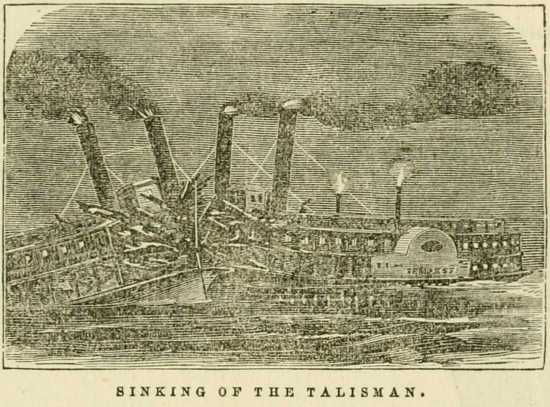
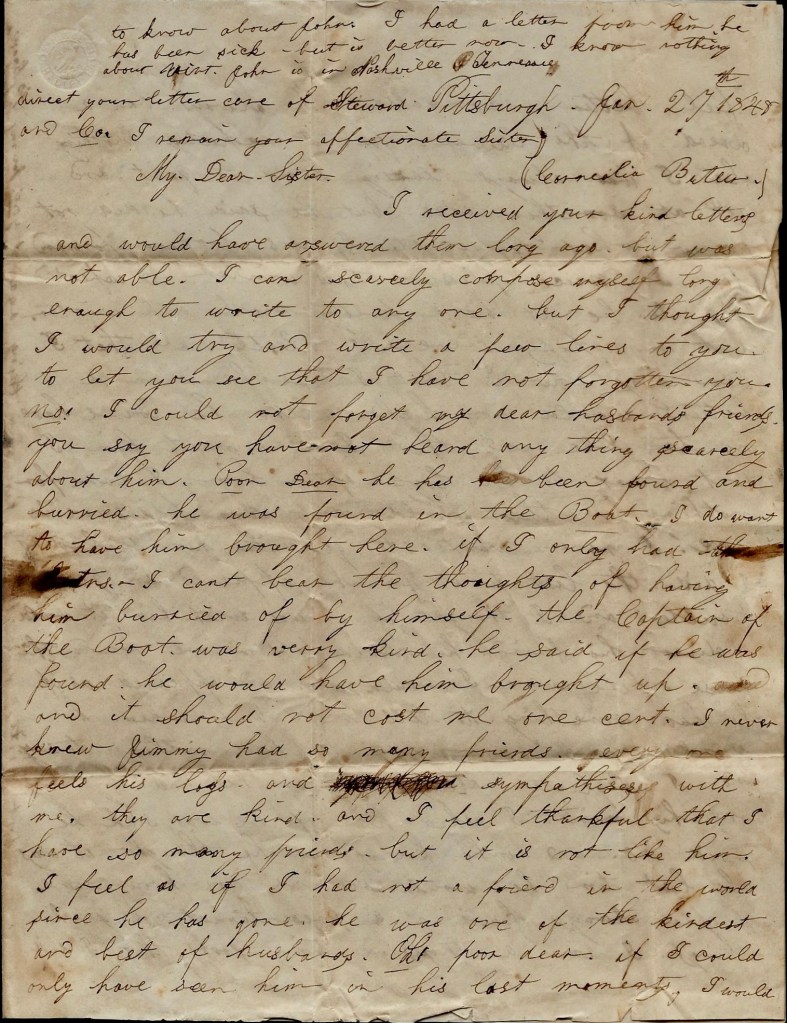
In this January 1848 letter, 30 year-old Cornelia (Smith) Butler (1817-1907) relates in detail the accidental death of her husband James Thomas Butler, when the steamboat Tempest collided with the steamboat Talisman on the Mississippi river a half mile below Cape Giradeau on 19 November 1847.
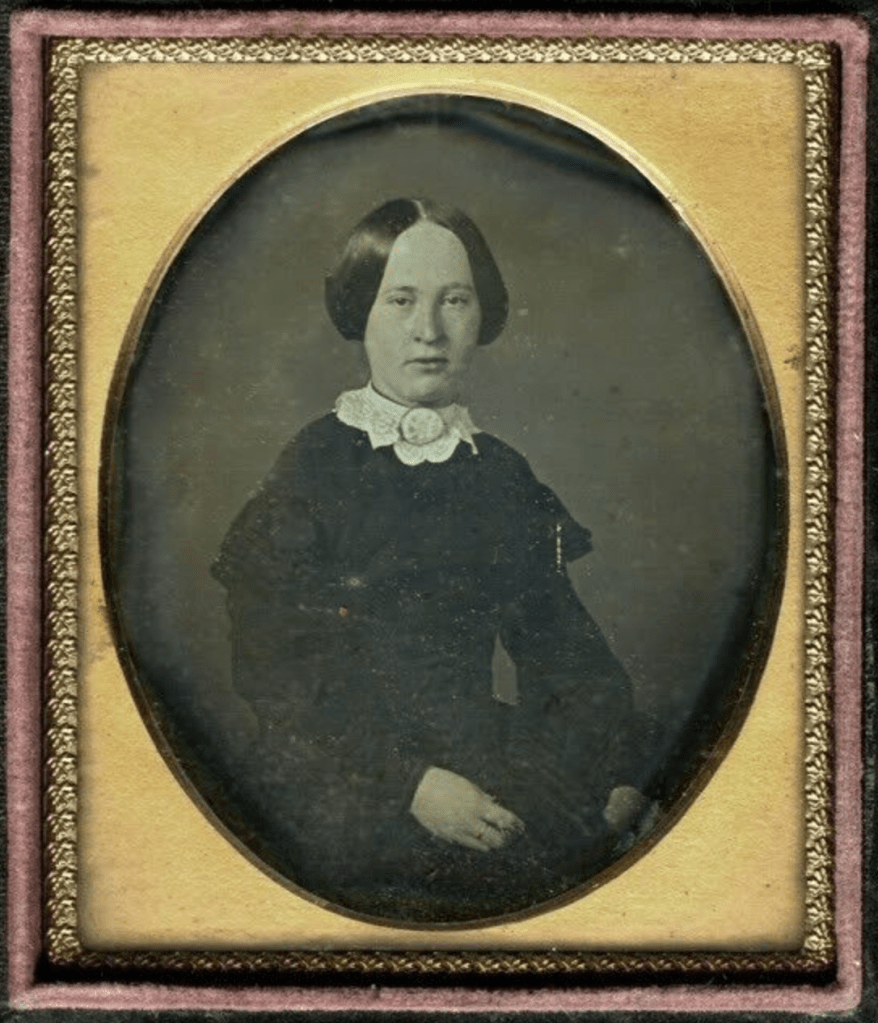
How Cornelia might have looked in 1848
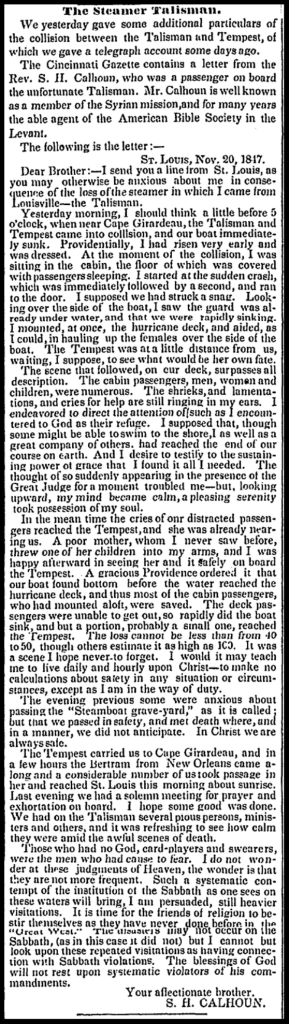
James Butler was the chief engineer on the Talisman. According to newspaper accounts, the Talisman was struck forward of the boilers and sunk within ten minutes. The Tempest was only slightly damaged and managed to come to the relief of the Talisman‘s crew and passengers. However, several of the crew and many of the deck passengers were drowned. Two or three families of German emigrants numbering about 25 persons were among the passengers. “The fate of Mr. Butler, the engineer, was particularly distressing. He was on watch and although he sasw at once and was told that the boat was sinking, he refused to leave his post until the water was up to his waist. It was then too late to save himself, and being unable to withstand the rush of water, he was borne back among the machinery and drowned.” His body was later recovered by the use of a diving bell.
Sadly there were some unidentified people who saw the wreckage and came into the river in small boats but instead of assisting the accident victims, seized the opportunity to plunder and recover the floating baggage. It was estimated that at least 100 persons—men, women and children—were drowned though no final number was ever published.
A 1907 obituary notice for “Mrs. Cornelia Butler” claims that she was born in 1817 in Carlisle, Pennsylvania, the daughter of Capt. George Smith, a prominent merchant of Carlisle and a veteran of the War of 1812. She was married to James T. Butler on 5 July 1843. He was the chief engineer on the steamboat Talisman and saved his sister-in-law and two small nieces before returning to his post and drowned. His body was never recovered. The Pittsburgh Press, 28 June 1907.
Transcription
Pittsburgh [Pennsylvania] January 27th 1848
My Dear Sister,
I received your kind letters and would have answered them long ago but was not able. I can scarcely compose myself long enough to write to anyone but I thought I would try and write a few lines to you to let you see that I have not forgotten you. No! I could not forget my dear husband’s friends. You say you have not heard anything scarcely about him. Poor Dear, he has been found and buried. He was found in the boat. I do not want to have him brought here. If I only had the [ trs]—I can’t bear the thought of having him buried off by himself. The Captain of the boat was very kind. He said if he was found, he would have him brought up and it should not cost me one cent.
New York Spectator, 4 December 1847
I never knew Jimmy had so many friends. Everyone feels his loss, and sympathizes with me. They are kind and I feel thankful that I have so many friends, but it is not like him. I feel as if I had not a friend in the world since he has gone. He was one of the kindest and best of husbands. Oh! poor dear, if I could only have seen him in his last moments, I would feel better reconciled. I always had a dread of the river for I expected nothing else. I was always teasing him to quit and get at something else, but he said he did not know what to get at. I was looking forward so so much pleasure this winter. I expected him to be at home pretty much all winter but my hopes were all blasted. All that I can say now is that I hope he is in a better world on high where he will have no trouble and that I can meet him. I don’t want to be long after him. I care for nothing in this world. All my pleasure is done.
I never wanted to go with him so bad as I did the last time for he appeared in so much trouble and I thought if I was with him, it would divert his mind. He would follow me round the house wherever I would go and appeared as if he had something to tell me. But when he would come near me, he had nothing to say and I neglected asking him if he had anything on his mind. I asked him if he was sick. He said no. And who knows but he thought it was the last time he would see me. You know some people always have a presentiment of such things. I am a thousand times sorry that I did not go for I never wanted to go so bad in my life. It appeared to me that I must go and I think if I had of been there, it would of saved him because he would have seen to me or I would to him. I must stop for it is too painful to talk about it.
I would love dearly to see you and talk about him for I could talk better than I can write. My eyes are so bad I can scarcely see. The last words he ever said to me was, “Now really, don’t fret.” If I was to write all day, I could not tell you the half about him. But I am in hopes to see you some day and then we can talk over everything. Nothing would delight me more than to see you. I shall always feel the same towards you as a nearer and kind sister. I have left the house and am at cousin Full’s. He says I shall have a home as long as he has one. All I have to depend on is my own industry. I am taking in sewing. My health is not at all good. I have a miserable cough and my eyes are so bad I can scarcely see. But whenever I am able, I will sew and when I am not, I will have to get along the best way I can.
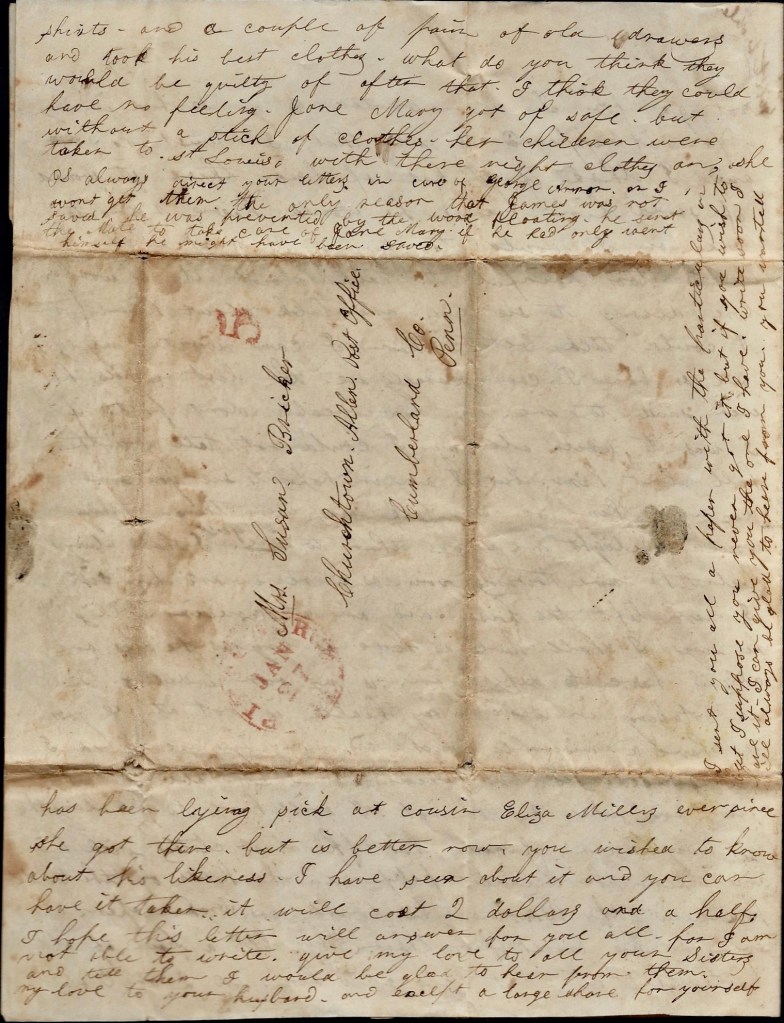
Jimmy had his best clothes with him and when the accident happened, the hands of the tempest plundered the boat, and his trunk was broken open and even to his breast pin taken. They left a pair of old pants that did not belong to him and 2 or 3 old shirts and a couple of pair of old drawers and took his best clothes. What do you think they would be guilty of after that? I think they could have no feeling. Jane Mary got off safe but without a stitch of clothes. Her children were taken to St. Louis with their night clothes on. She has been lying sick at cousin Eliza Mills ever since she got there but is better now.
You wished to know about his likeness. I have seen about it and you can have it taken. It will cost two dollars and a half. I hope this letter will answer for you all for I am not able to write. Give my love to all your sisters and tell them I would be glad to hear from them. My love to your husband and accept a large share for yourself. I sent you all a paper with the particulars in but I suppose you never got it but if you wish to have it, I can give you the one I have. Write soon. I will always be glad to hear from you. You wanted to know about John. I had a letter from him. He has been sick but is better now. I know nothing about Vint. John is in Nashville, Tennessee.
Direct your letter care of Steward & Co. I remain your affectionate sister, — Cornelia Butler