My passion is studying American history leading up to & including the Civil War. I particularly enjoy reading, transcribing & researching primary sources such as letters and diaries.
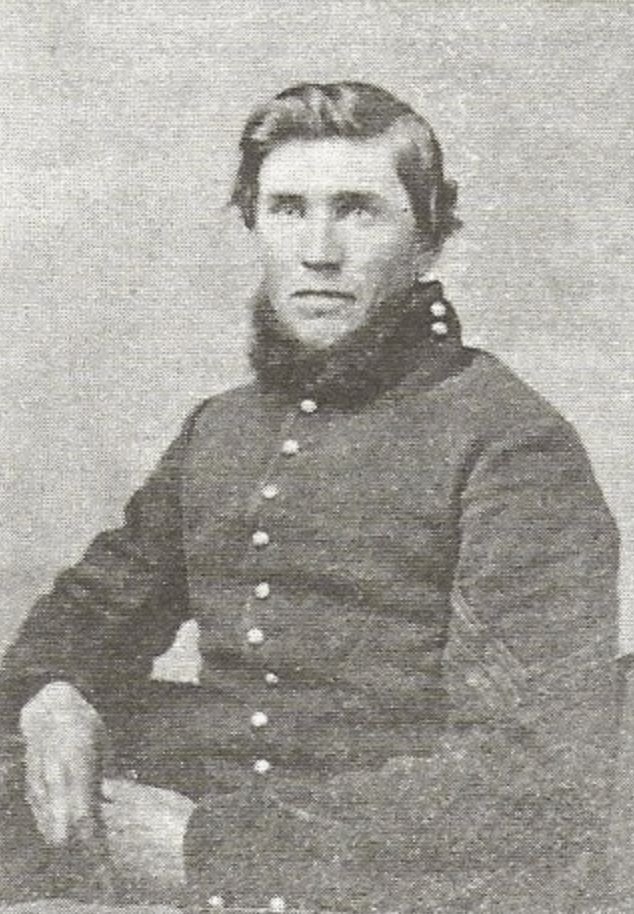
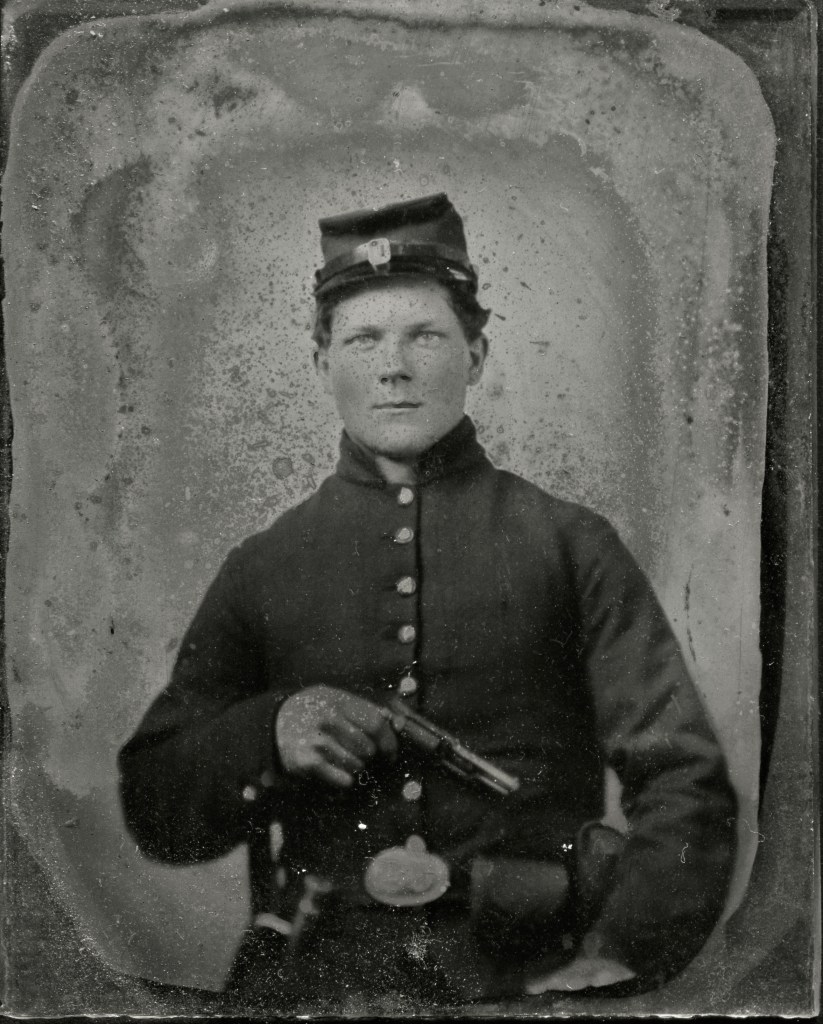
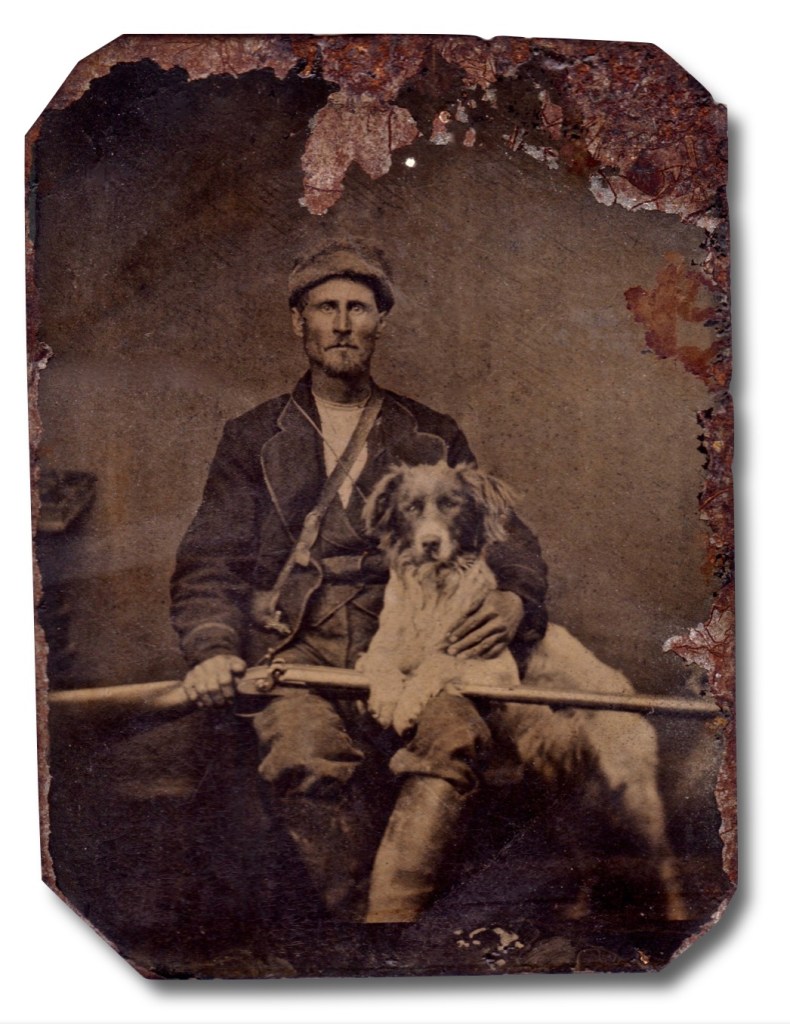
I could not find an image of Henry but here is one of Alfred R. Wilson who served in Co. H, 9th Iowa Cavalry (Photo Sleuth)
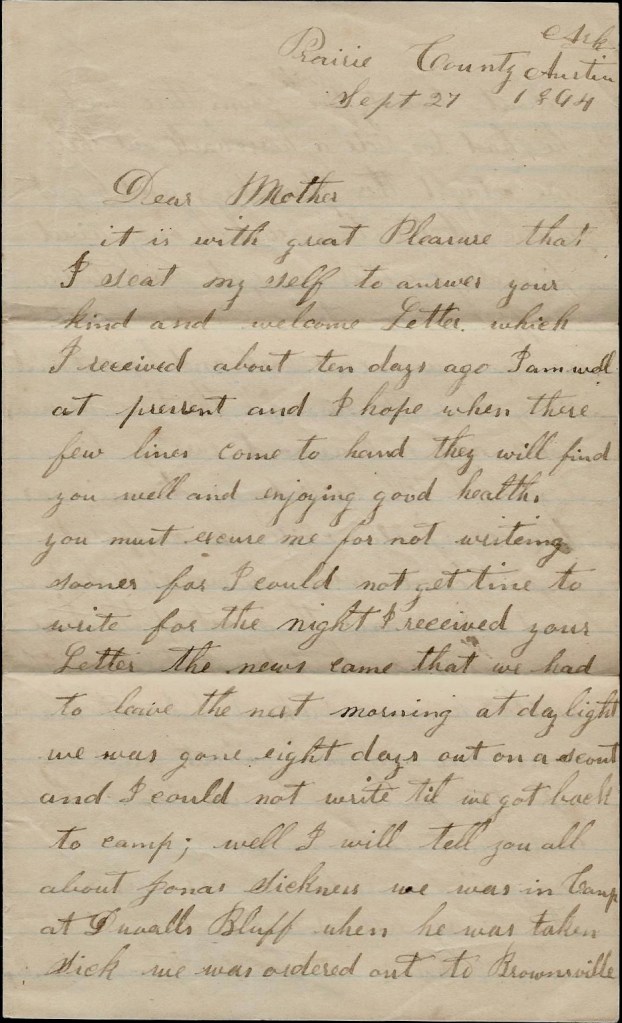
This letter was written by Henry Clay Thompson (1846-1930), the son of John Quincy Thompson (1814-1856) and Melinda Phillips (1824-1914) of Linn county, Iowa. Henry enlisted on 21 September 1863 as a musician in Co. K, 9th Iowa Cavalry. In April 1864 he was promoted to 8th corporal and mustered out as 3rd Corporal in February 1866.
Henry enlisted at the same time and in the same company with his older brother Jonas William Thompson (1843-1864). Sadly, Jonas died while in the service and the “particulars” of his death are described in the following letter though the exact date is not given. According to a family record, Jonas died on 5 August 1864 at DeVall’s Bluff, Arkansas, at the age of 21.
Transcription
Austin, Prairie county, Arkansas September 27, 1864
Dear Mother,
It is with great pleasure that I seat myself to answer your kind and welcome letter which I received about ten days ago. I am well at present and I hope when these few lines come to hand, they will find you well and enjoying good health. You must excuse me for not writing sooner for I could not get time to write for the night I received your letter the news came that we had to leave the next morning at daylight. We was gone eight days out on a scout and I could not write till we got back to camp.
Well, I will tell you all about Jonas’ sickness. We was in camp at DeVall’s Bluff when he was taken sick. We was ordered out to Brownsville about twenty-five miles from there and he had to ride a horseback out there. We stayed there three days and he got worse all the time and he only lived five days after we got back to the Bluffs. He was taken to the hospital as soon as we got back and I went and stayed with him all the time he was sick and took as good care of him as I could till he died. His disease was the congestive chills. He suffered a great deal while he was sick but he had his senses the most of the time he was sick. He did not talk much while he was sick. I did not hear him say anything about you or any of the family. He was so sick he could not talk much.
He was buried in his uniform the way all soldiers are buried. Well, I have wrote all the particulars concerning his sickness and death.
Well, about that note of Hearts, I believe he left that note with Bryan. You can write to Bryan and have him collect it and send the money to you. I believe the note was 18 dollars with ten percent interest.
The time seems very lonesome since Jonas died but his time had come and he was called away very sudden. Well, it is getting late and I will have to bring my letter to a close by sending you my love and best respects to all the family. So goodbye. write soon and don’t forget to write all the news.
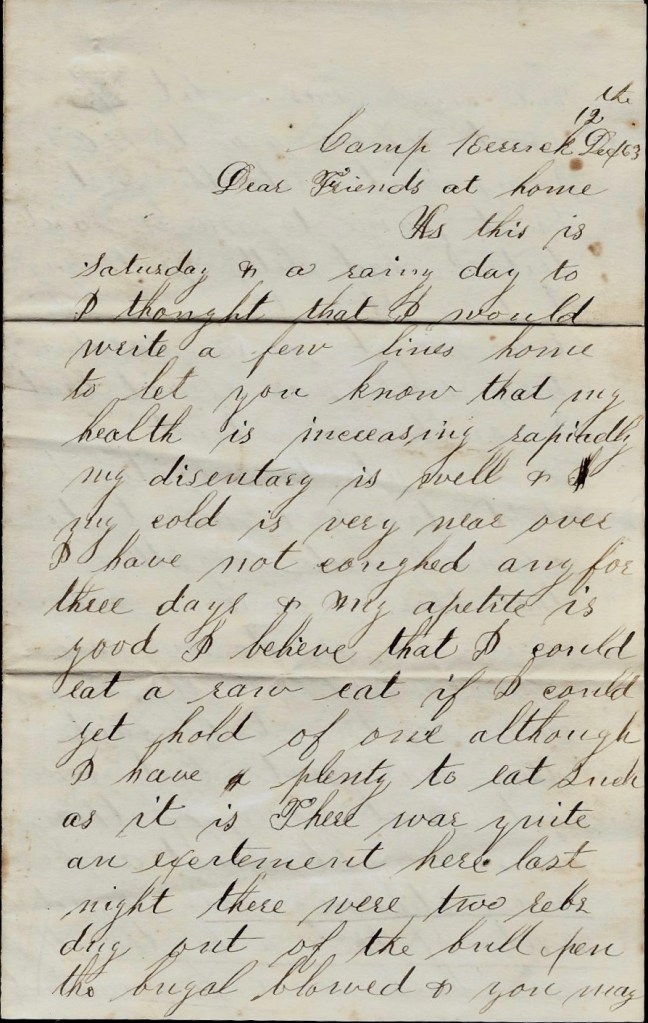
This letter was written by a soldier named “Willy” who served in Co. F, 12th Ohio Volunteer Cavalry (OVC) while serving as a guard at Johnson’s Island, near Sandusky, Ohio. Unfortunately there are many soldiers by the name of William in the company and he gives no further clues to his identity.
The 12th OVC was organized at Camp Cleveland and mustered into federal service on 24 Nov. 1863. From Dec. 1863-Feb. 1864, the 12th was on duty at Camp Chase in Columbus, Ohio. Half of the regiment was on detached duty at Johnson’s Island near Sandusky, Ohio, during that period. In Feb.-Mar. 1864, the 12th was on duty at Camp Dennison near Cincinnati, Ohio.
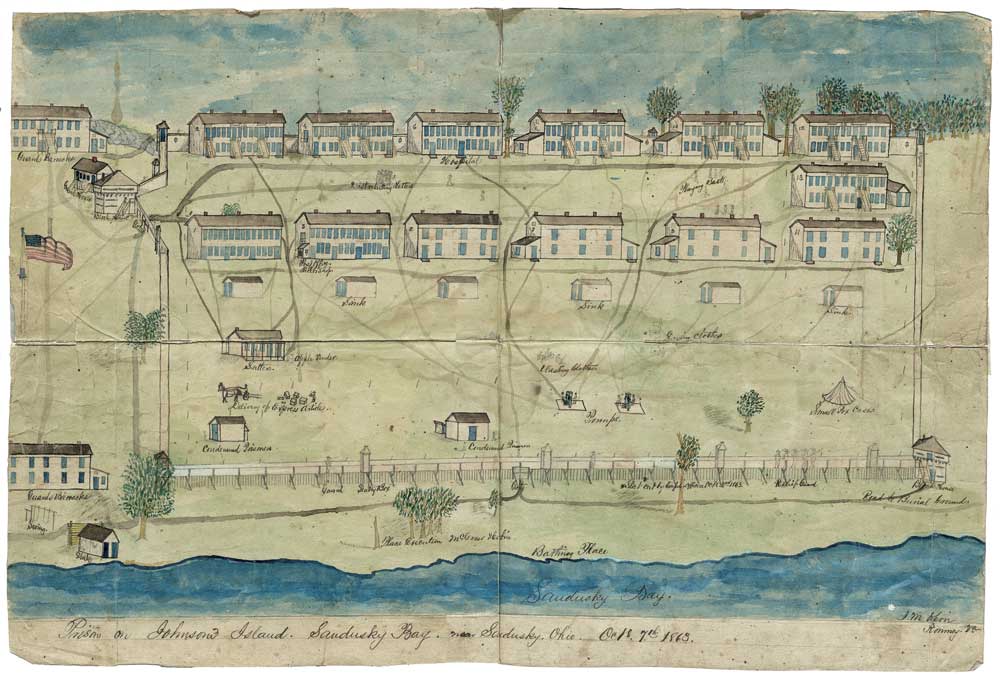
Willy datelined his letter from Camp Herrick which was no doubt named after John F. Herrick, the Lt. Colonel of the 12th OVC. His letter contains a description of an attempt by two prisoners to escape the prison yard by tunneling in mid-December 1863.
Rendering of Prison at Johnson’s Island in October 1863
Transcription
Camp Herrick December 12th 1863
Dear Friends at Home,
As this is Saturday & a rainy day too, I thought that I would write a few lines home to let you know that my health is increasing rapidly. My dysentery is well & my cold is very near over. I have not coughed any for three days & my appetite is good. I believe that I could eat a raw cat if I could get hold of one although I have plenty to eat—such as it is.
There was quite an excitement here last night. There were two rebs dug out of the bull pen. The bugle blowed & you may bet there was a lot of scart officers in the 12th OVC. I [was] up and out the first [when] Lieut. came to me and said that I had better go to my tent & stay there for fear there might be a hard time & he was afraid that I could not stand it so I went to my tent, laid down, & went to sleep. I had forgotten that there was any rebs out. In about an half of an hour, the companies came to their tents [and] said there was not but two got out. One of them was caught just as he was sticking his head out of the hole. The other came back in a few minutes & gave himself up so then that great scare was over.
I have not done any duty yet and the Orderly [Charles H. Sherburne] says that I need not until I get stout although I feel as well as I ever did. But I hant got my full strength yet.
Our Captain [Merville L. Saunder] has just got back from Columbus. He went to see what he could do about our pay. What he made out I cannot tell.
As this little sheet is most full, I shall have to close. This is from your son & friend, Willy. Address to Camp Herrick, 1st Battalion, 12th O. C., Co. F, Johnson’s Island, Ohio
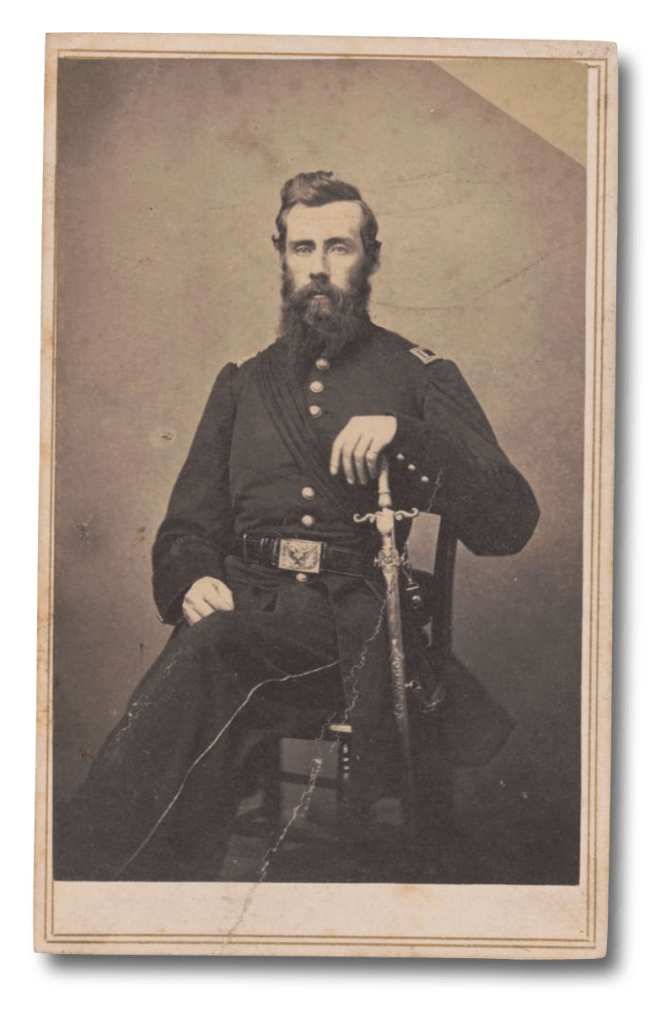
I could not find an image f Zachariah but here is a CDV of Asst. Surgeon Edson E. Boyd of the 112th N. Y. Infantry holding a Medical Service sword.
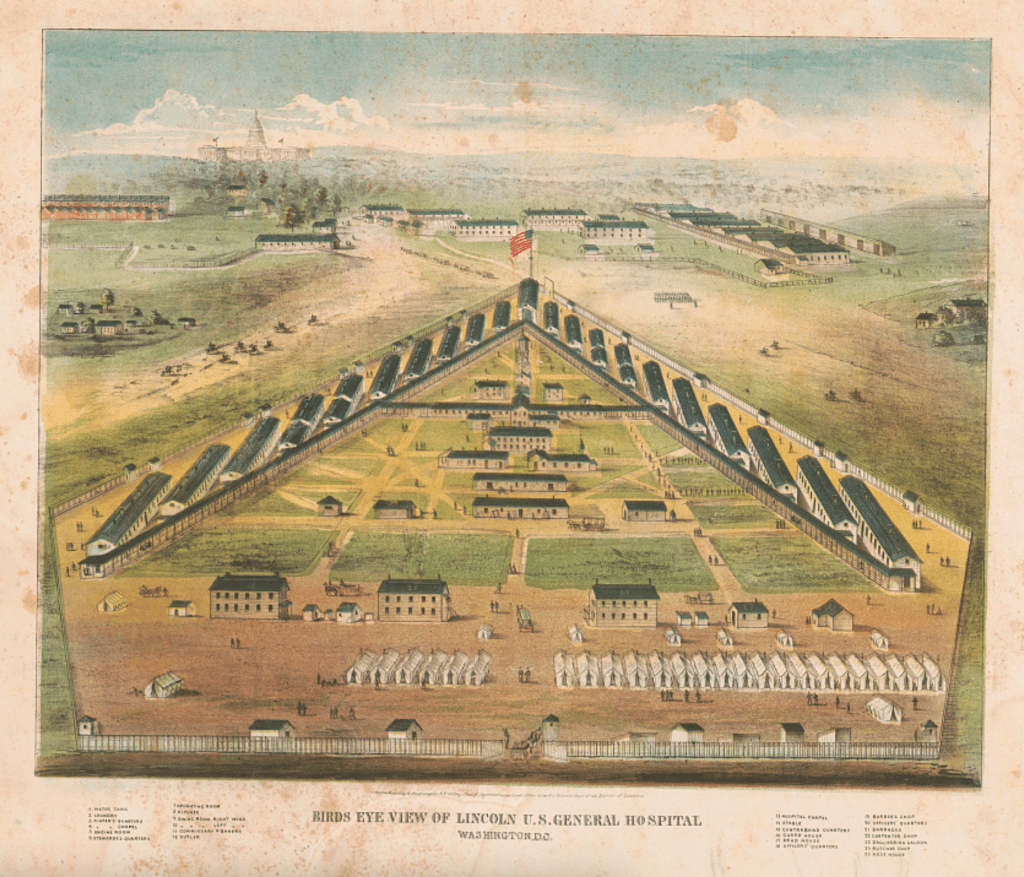
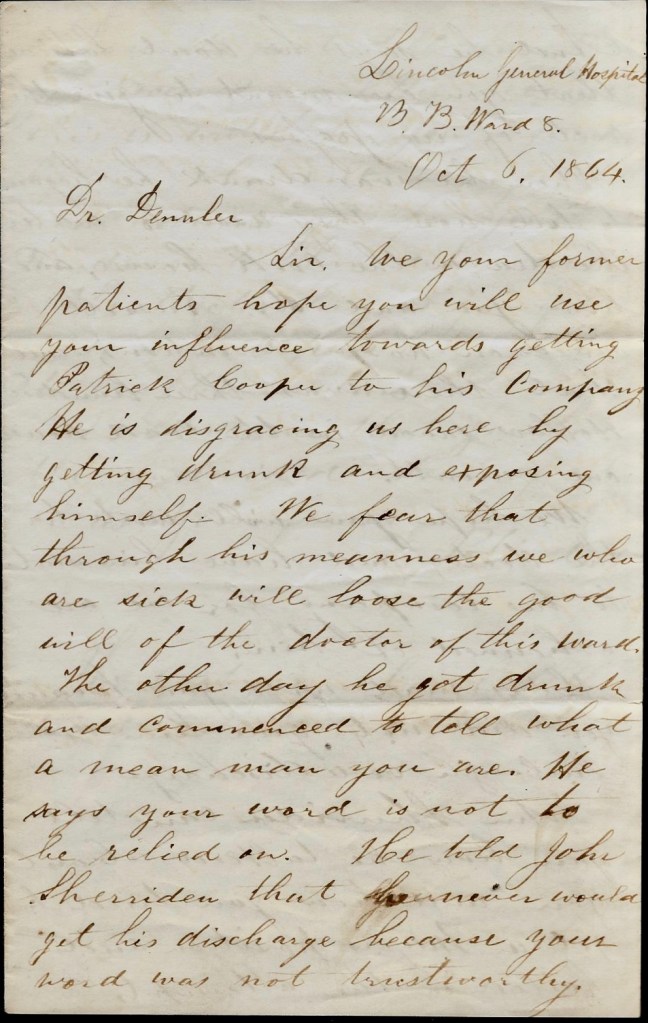
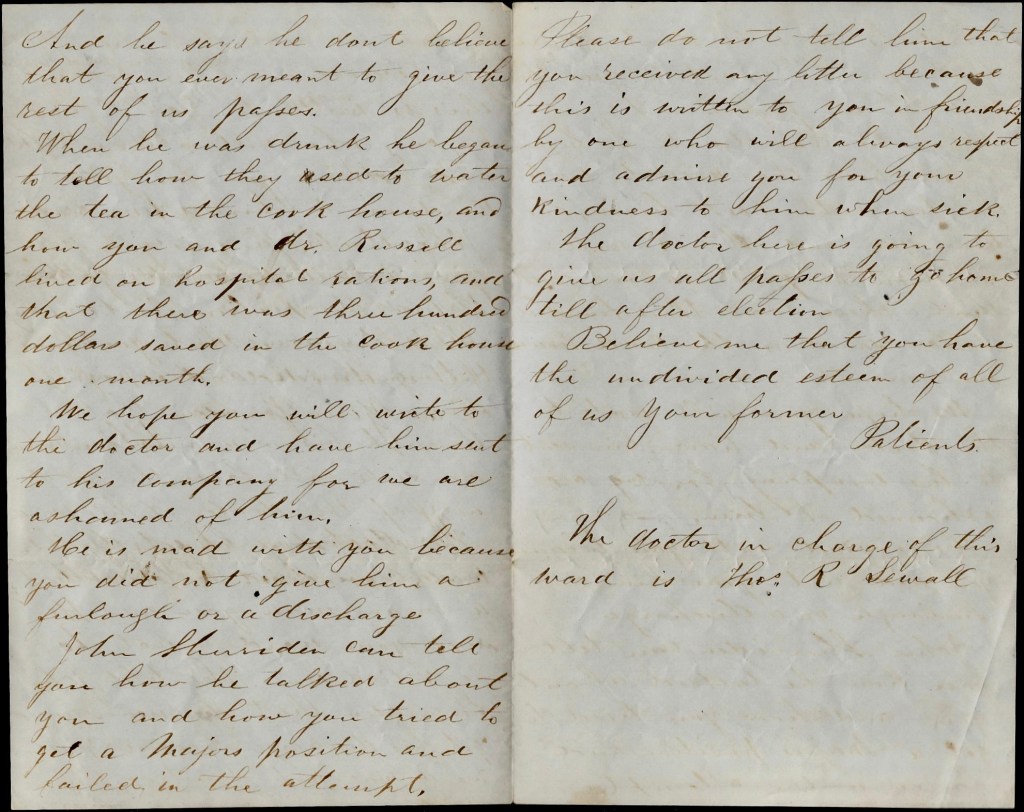
This letter was written by an unidentified patient of the Lincoln General Hospital that was located at East Capitol and 15th Streets in Washington D. C. It was opened in December 1862 and was the largest of the military hospitals built by the army to take care of Civil War casualties. It was located on Capitol Hill, 15 blocks east of the Capitol building.
The unidentified patient of the hospital addressed the letter to Dr. Zachariah Philip Dennler (1838-1890), the son of Rev. Philip H. Dennler of Lyons, Wayne county, New York. Rev. Dennler was a Lutheran minister from Germany. He married Jane E. Moore of Rheinbeck, Dutchess county, New York. Zachariah was an 1862 graduate of the Geneva Medical College and served as an asst. surgeon with the 10th New York Heavy Artillery from 29 August 1863 until 3 April 1864 and then later in 1865-66 with the 7th USCT.
It should be noted that Dr. Dennler’s medical probe was claimed to have been used to extract the bullet from President Lincoln’s brain. This claim appears in the book, Maple Grove Cemetery (p. 88) authored by Nancy Cataldi in 2006 though the source for this claim is not given, nor can I find any other independent source to corroborate it. It isn’t clear where or what Dr. Dennler was doing at the time of Lincoln’s death which was a couple of months before Dennler signed on with the 7th USCT. Three separate obituary notices for Dr. Dennler in 1890 fail to mention the “probe” claim. Further, the National Museum of American History claims that the surgical instruments used at Lincoln’s Autopsy belonged to Dr. Alfred D. Wilson. See also: Visible Proofs.
Transcription
Lincoln General Hospital B. B. Ward 8 October 6, 1864
Dr. Dennler Sir,
We your former patients hope you will use your influence towards getting Patrick Cooper to his company. He is disgracing us here by getting drunk and exposing himself. We fear that through his meanness, we who are sick will lose the good will of the doctor of this ward. The other day he got drunk and commenced to tell what a mean man you are. He says your ward is not to be relied on. He told John Sheridan that you never would get his discharge because your ward was not trustworthy. And he says he don’t believe that ever meant to give the rest of us passes.
When he was drunk he began to tell how they used to water the tea in the cook house and how you and Dr. Russell lived on hospital rations, and that there was three hundred dollars saved in the cook house one month.
We hope you will write to the doctor and have him sent to his company for we are ashamed of him. He is mad with you because you did not give him a furlough or a discharge.
John Sheridan can tell you how he talked about you and how you tried to get a Major’s position and failed in the attempt.
Please do not tell him that you received any letter because this is written to you in friendship by one who will always respect and admire you for your kindness to him when sick. The doctor here is going to give us all papers to go home till after the election.
Believe me that you have the undivided esteem of all of us your former patients.
The doctor in charge of this ward is Thomas R. Sewall
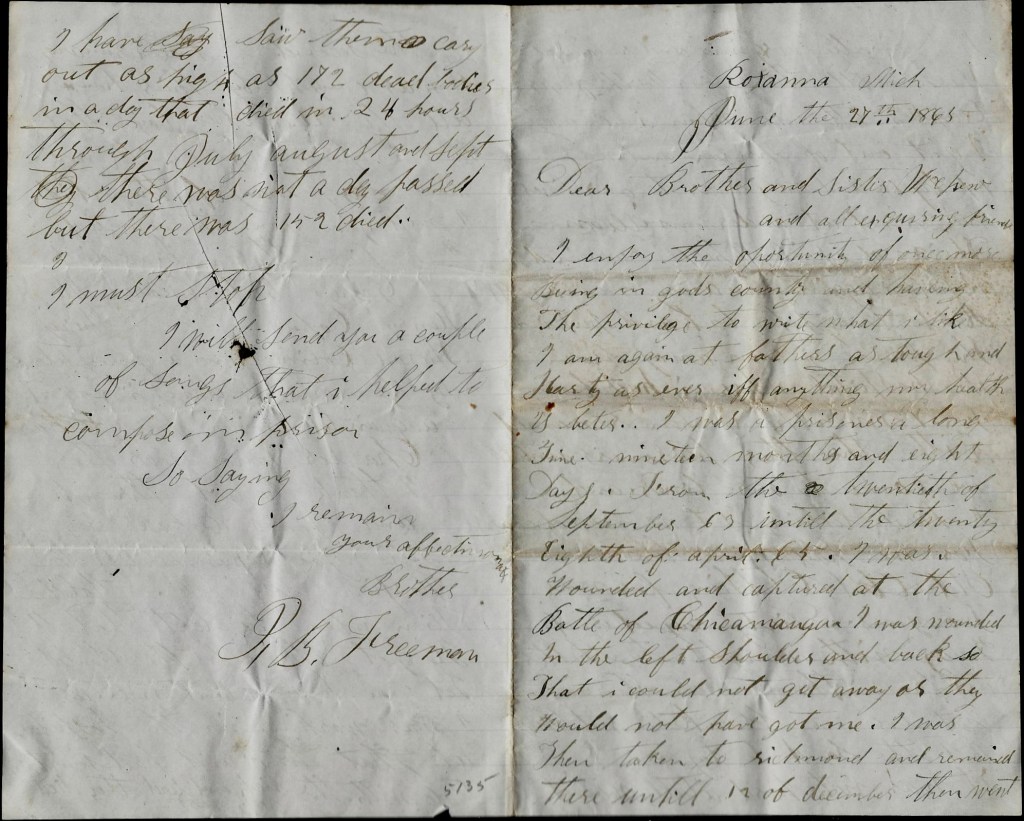
This letter was written by John B. Freeman (1840-1868), the son of Job Tarleton Freeman (1810-1891) and Eveline Barnes (1820-1896) of Roxanna, Eaton county, Michigan. Prior to their relocation to Michigan, the Freeman’s lived in Allen township, Hancock county, Ohio, where they were enumerated in 1850. John probably wrote the letter to his sister Mary Kay (Freeman) Goit who was married to William Goit, had an young son named LaQuinnis (b. 1862), and still resided in Ohio where she must have known many of the soldiers who volunteered in the 21st Ohio Infantry who were also former friends of John’s.
I could not find an image of John but here is one of Henry Fox who served in Co. C, 13th Michigan Infantry. (Osman Collection in Photo Sleuth)
John enlisted in Co. H, 13th Michigan Infantry which mustered into service for three years in January 1862. The regiment performed well in many engagements in the western theatre. One of the prominent battles in which the 13th served was the battle of Chickamauga where they were under the command of Col. J. B. Culver, and where they helped to hold the rebels in check from early in the morning until 12 noon. When the thermometer stood at 90 degrees, the regiment charged upon the enemy in a most spectacular movement. In this engagement 107 officers and men were lost, either killed, wounded or missing. 217 took part in the engagement. Such a loss tells how the 13th Michigan sustained its part in this historic engagement far more eloquently than words can describe.
In his remarkable letter, John chronicles his time in captivity from the time of his being wounded and taken prisoner at Chickamauga until he was released at the end of the war, including time spent at Richmond, Danville, and Andersonville, and two escape attempts. And though he claims that he was as “tough and hearty” as ever following his release, he died three years later at the age of 28.
Dear Brother and Sister, nephew, and all enquiring friends,
I enjoy the opportunity of once more being in God’s country and having the privilege to write what I like. I am again at Father’s as tough and hearty as ever. If anything, my health is better. I was a prisoner a long time—from the twentieth of September ’63 until the twenty-eighth of April ’65. I was wounded and captured at the Battle of Chickamauga. I was wounded in the left shoulder and back so that I could not get away or they would not have got me. I was then taken to Richmond and remained there until the 12th of December, then went to Danville, Virginia, and remained there until the fourteenth of April except a little while when I ran away. I got out of prison and was 14 days and very near to our lines.
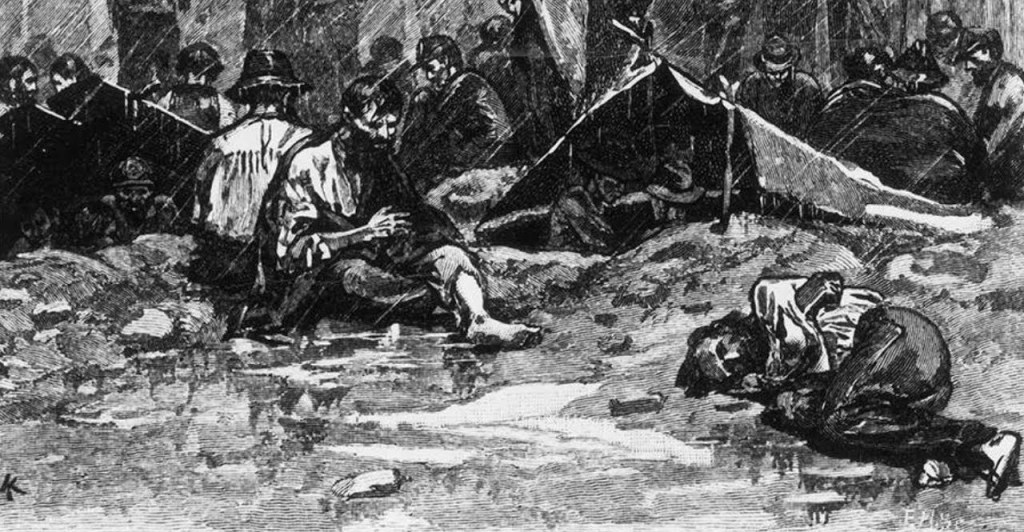
We arrived at Andersonville on the 20th of April where I remained until I again ran away, was caught, and brought back and put in the prison. I run away from the hospital where I had been for 7 months. I then remained with the other prisoners until we came to our lines and a hard-looking set we was of course for we had wore the same old clothing for near two years—dirty, ragged, and lousy with naught to shelter us from the sun or storm—not even a blanket—nothing but the sand to lay on. It was not hard atall, was it? The second time I run away I was caught by their hounds.
Prisoners at Andersonville
All the 21st Ohio boys that were in prison were with me and many of them died. I will give you the names of a few that I know died. George Brets [Co. G], George McMurray [Co.G], Henry Copus [Co. G], and a young fellow by the name of Davis. I was not acquainted with him. Charles Tonoe was there. I think he got through. And James Copus’s boy, little Joe Copus [Co. G]—he left the hospital last fall. I told him when he left that if he got through, he should let you know about me as I was working in the hospital at that time and had something to do with the sick and dead. They died very fast. I have saw them carry out as high as 172 dead bodies in a day that died in 24 hours. Through July, August, and September, there was not a day passed but there was 152 died.
I must stop. I will send you a couple of songs that I helped to compose in prison. So saying I remain your affectionate brother, — J. B. Freeman
This letter was written by John Wesley Daniels (1832-1915) of Grants Lick, Campbell county, Kentucky. Daniels served as a private in Co. C, 1st Kentucky Cavalry (Butler’s). He was married to Cynthia Bryant Colvin (1834-1909) in 1850 and divorced during or soon after the war. He married his second wife, Mary Ann Bravard in 1868.
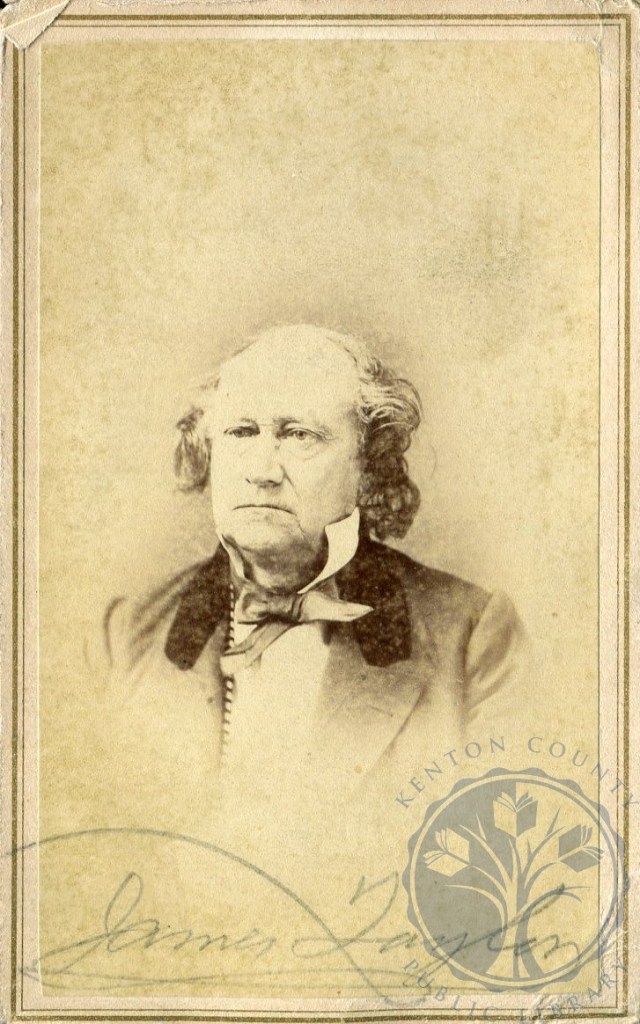
Daniels wrote the letter to Col. James J. Taylor of Campbell county, Kentucky, a wealthy man who may have been sympathetic to his pro-Confederacy neighbors but remained a Union man throughout the war. (Kenyon County Public Library)
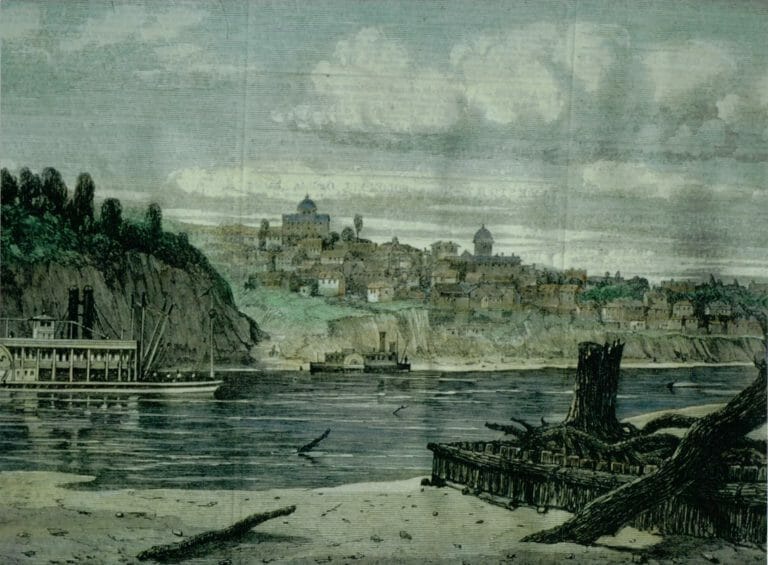
Daniels wrote the letter while serving as a prisoner of war at Camp Morton near Indianapolis. The camp was located on a tract of land bordered by 22nd Street, Talbott Avenue, 19th Street and Central Avenue. The land had been established as state fairgrounds. In 1861 it was converted to a military training camp, and named after the governor. In 1862 the facilities were used to house Confederate prisoners of war. Approximately 4,000 prisoners arrived in February of that year. In the summer of 1864 the prisoner population reached nearly 5,000. Weary of fighting many took the oath of allegiance to the United States Constitution and to the Union according to Lincoln’s Proclamation of Amnesty and Reconstruction of 8 December 1863. On 1 April 1865 1,408 prisoners were at the camp. In June 1865 the last of the Confederate prisoners were released. In 1868 the State Fair returned to this location, where it continued to be held until 1892.
Daniels wrote the letter to Col. James Jones Taylor (1802-1883) of Campbell county, Kentucky.
Camp Morton in Indianapolis, Library of Congress
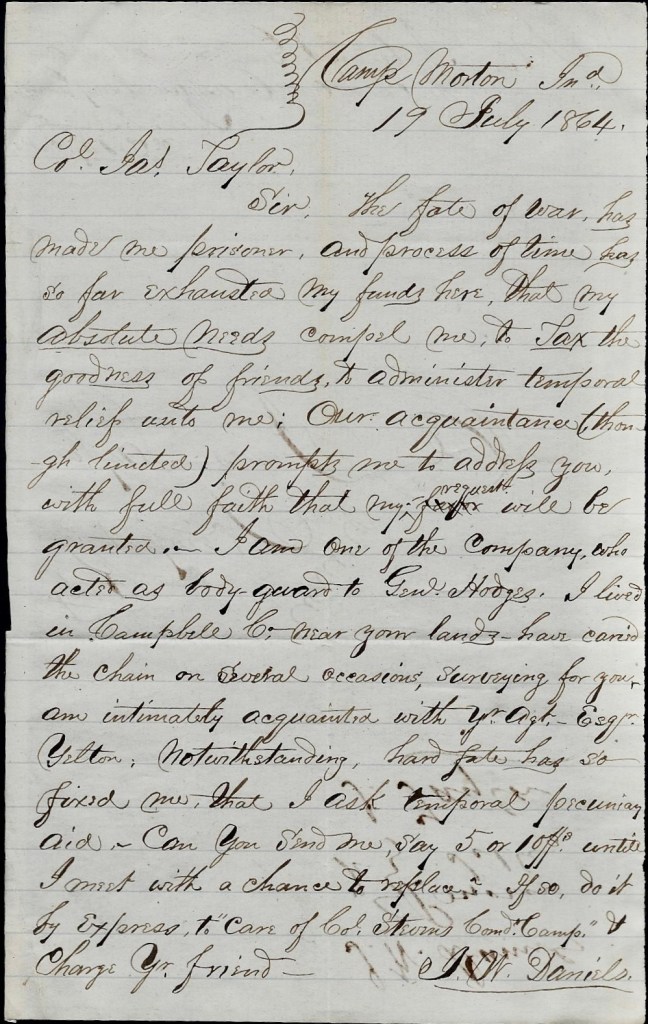
Transcription
Camp Morton, Indiana 19 July 1864
Col. James Taylor Sir,
The fate of war has made me prisoner and process of time has so far exhausted my funds here that my absolute needs compel me to tax the goodness of friends to administer temporal relief unto me. Our acquaintance (though limited) prompts me to address you with full faith that my request will be granted.
I am one of the company who acted as body guard to General [George Baird] Hodge. I lived in Campbell County near your lands, have carried the chain on several occasions surveying for you, [and] am intimately familiar with your agent, Esqr. Yelton. Notwithstanding, hard fate has so fixed me that I ask temporal pecuniary aid. Can you send me say 5 or $10 until I meet with a chance to replace? If so, do it by express to “care of Col. [Ambrose A.] Stevens 1 Command & Camp” and charge your friend, — J. W. Daniels
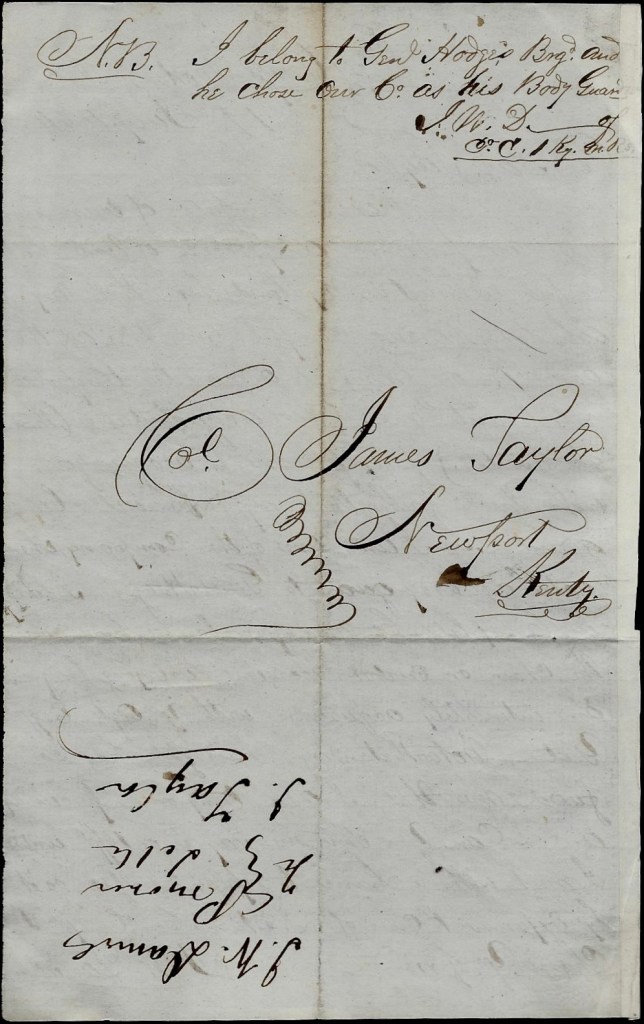
N. B. I belong to General Hodge’s Brigade and he chose our company as his body guard. — J. W. D of Co. C, 1st Ky.
1 Col. Ambrose A. Stevens of the 5th Indiana Regiment became the commandant of the Camp Morton Prison near Indianapolis in November 1863. He found the camp “a disgrace to the name of military prison—filthy in every respect.” Camp Morton had the third highest number of dead for both January and February among Union prisoner of war camps. Almost twenty-five years after the war controversy over the condition at Camp Morton during that winter surfaced again in the form of an article in The Century Magazine written by a former prisoner of war, Dr. John Wyeth. Entitled “Cold Cheer at Camp Morton” the article charged camp officials with deliberate cruelty.
The prison lacked the order, discipline, and cleanliness found among properly managed soldiers. The April 29 inspection report by A.M. Clark, Surgeon and acting inspector of prisoners of war reported that the barracks had been whitewashed and improved through ridge ventilation, but that the sinks were simply open excavations and needed improvement. Rations were sufficient but scurvy was still common due to a lack of vegetables. Over the next three months 2,500 prisoners arrived as Col. Stevens continued to try to improve the camp. In mid May he reported to Hoffman that he had “commenced a thorough cleansing” of the barracks and grounds and planned to build a bathhouse, a laundry and a cookhouse.
An increase in the mortality rate over the summer drew the attention of the federal authorities and on 30 July Charles J. Kipp, Surgeon, U.S. Volunteers, replied to a request for an explanation regarding the number of recent deaths among the prisoners. Dr. Kipp wrote that the lack of vegetables, the overcrowded, poorly ventilated barracks and the crowding of almost 5,000 men into 4.5 acres accounted for the mortality rate. He calculated that the prisoners had approximately 80 cubic feet of air space. The reply is forwarded to the U.S. Medical Director’s office with a note by Tripler that unless these conditions improves “the large mortality of last year will occur again.”
“I find this camp in anything but a favorable condition.” was the conclusion reached by C.T. Alexander in his August 6 inspection report which also determined that the camp was too small with 4,885 men held in less than 5 acres. The barracks were “overcrowded and not sufficiently well policed,” the tents old and worn, and prisoners clothing bad and deficient. He found the hospital in relatively good condition and blamed the 81 deaths (9% mortality) of the previous month on the “crowded state of the camp, quarters, and tents, the want of change in the positions of the tents, the foul condition of the sinks, the want of good police, the want of vegetables…, and is influenced some what by the inevitable nostalgia existing among the prisoners.'” [Indiana Archives & Record Administration]
This lengthy letter was written by Bela Metcalf Hughes (1817-1902), the son of Andrew S. Hughes and Rhoda Dent of Carlisle, Kentucky. Bela came to Liberty, Missouri, with his parents in 1829. While attending Augusta College in Kentucky in the late 1830s, Bela dropped his studies for a short time to participate in the Black Hawk War with the Missouri Volunteers. After graduation in 1838, he returned to Missouri and was elected as Platte county’s representative to the Missouri House of Representatives in 1844. He later resigned his seat to to take the office as Receiver of Public Monies at the US Land Office in Plattsburg. “After resigning as Receiver at Plattsburg in 1849, Hughes moved to St. Joseph, Missouri to practice law there. In St. Joseph, he formed the law firm Woodson & Hughes together with Silas Woodson, a fellow Kentucky-born lawyer involved in the local Democratic party, who was later in 1872 elected to serve as 21st Governor of Missouri.
Hughes and Woodson were alleged to be involved in electoral irregularities in the Kansas Territory at the beginning of the violent civil confrontations called Bleeding Kansas. In May 1854, the Kansas-Nebraska Act had organized the Kansas and Nebraska Territories in the lands west of the Mississippi River. Congressional proponents of the act had assumed that Kansas would permit slavery while Nebraska would prohibit it and therefore preserve the balance between slave and free states. Immediately, immigrants supporting both sides of the slavery question arrived in the Kansas Territory to establish residency and gain the right to vote. In November 1854, thousands of armed pro-slavery men known as “Border Ruffians,” mostly from Missouri, poured into the Kansas Territory and swayed the vote in the election for a non-voting delegate to Congress in favor of pro-slavery Democratic candidate John Wilkins Whitfield.
On March 30, 1855, the Kansas Territory held the election for its first territorial legislature. Crucially, this legislature would decide whether the territory would allow slavery. Just as had happened in the election of November 1854, “Border Ruffians” from Missouri again streamed into the territory to vote, and pro-slavery delegates were elected to 37 of the 39 seats. Bela Hughes and Silas Woodson were both mentioned in multiple testimonies in front of the congressional committee investigating the elections as well-known public figures from Missouri who were present at the election at Burr Oak precinct in 14th district of the Kansas Territorial legislature. Hughes or Woodson were not witnessed actually participating in the illegitimate voting on that day. Hughes personal stance on slavery is unclear [and he does not show his hand in this letter either]. Silas Woodson, on the other hand, was actually well known as an abolitionist. At the 1849 Kentucky Constitutional Convention, Woodson was the only member to introduce language for the gradual emancipation of the state’s slaves. During the Civil War, both Hughes and Woodson were Unionists.
On April 26, 1861, Bela Hughes was chosen as president and general counsel of the Central Overland California and Pikes Peak Express Company. He was at the time still a resident of St. Joseph, which was the eastern terminus of the company’s Pony Express stagecoach line. In the years prior, the company had successfully operated the Pony Express as the fastest way to transmit information from east to west before the advent of the first transcontinental telegraph in October 1861.
Hughes wrote this letter to his friend, Capt. James William Denver (1817-1892) who moved to Platte City, Missouri in 1845 after completing law school in Cincinnati and beginning a practice in Xenia, Ohio. In 1847 he recruited a company for the 12th US Volunteer Infantry and served under General Winfield Scott in the War with Mexico. We learn from this letter that Denver returned to Platte City after the war where he apparently tried his hand as a newspaper editor which did not appeal to him. Shortly after receiving this letter, he relocated to California where he found employment as a trader. While there he killed newspaper editor Edward Gilbert in a duel in August 1852 and then was elected to the California State Senate. In 1854, he was elected as a US Representative from California. In 1857, President Buchanan appointed Denver as the Territorial Governor of Kansas Territory.” [Wikipedia]
St. Joseph, Missouri
Transcription
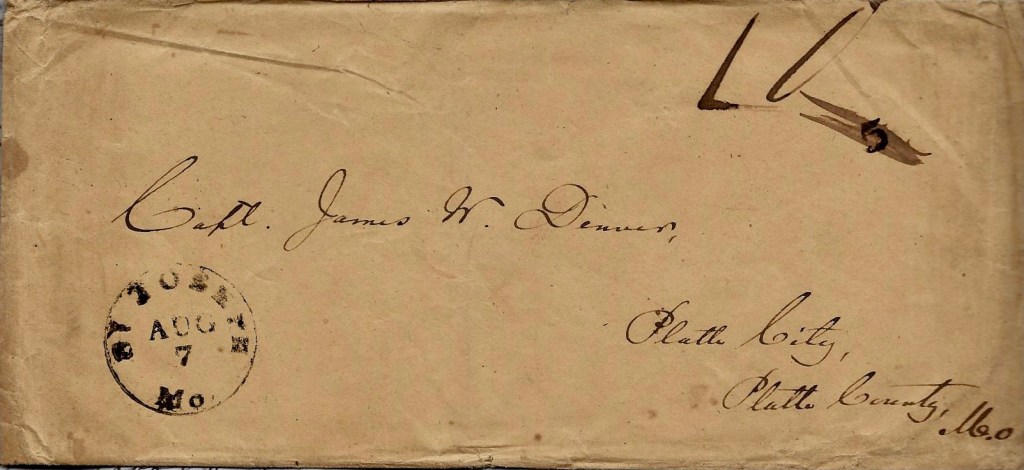
Addressed to Capt. James W. Denver, Platte City, Platte county, MO.
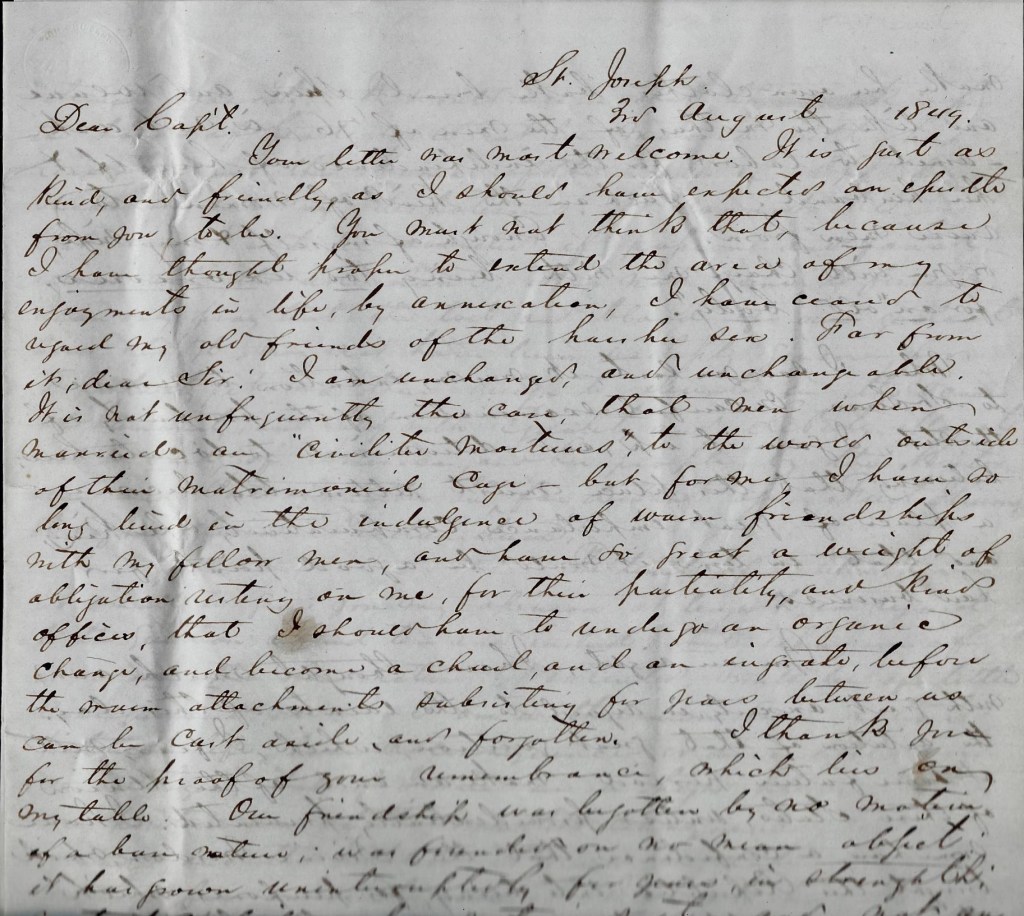
St. Joseph, [Missouri] 3rd August 1849
Dear Capt.,
Your letter was most welcome. It is just as kind and friendly as I should have expected an epistle from you to be. You must not think that because I have thought proper to extend the area of my enjoyments in life by annexation I have ceased to regard my old friends of the harsher sex. Far from it, dear Sir! I am unchanged and unchangeable. It is not infrequently the case that men when married are “civilized mortems” to the world outside of their matrimonial cage, but for me, I have so long lived in the indulgence of warm friendships with me fellow men and have so great a weight of obligation resting on me for their partiality and kind offices, that I should have to undergo an organic change and become a ch___, and an ingrate, before the warm attachments subsisting of years between us can be cast aside and forgotten.
I thank you for the proof of your remembrance which lies on my table. Our friendship was begotten by no motive of a base nature; was founded on no mean object. It has grown uninterruptedly for years in strength. Mutual confidence has restrained it, and not any slight circumstance shall ever shake it.
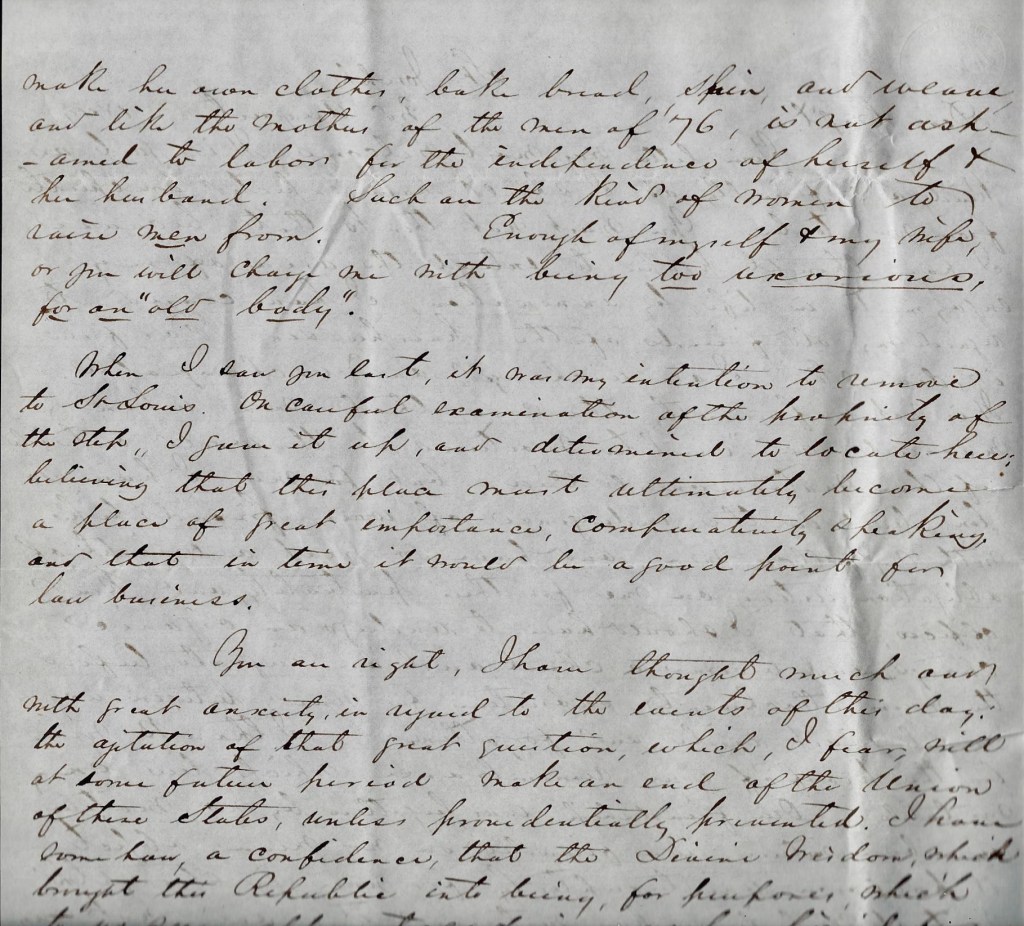
With regard to the change in my domestic affairs, I am wholly persuaded it was the wisest step of my late years. I needed a wife—not a sickly sentiment and ninny without health, sense, or capacity for the duties of wife. I have one, selected by my cool judgement and endorsed or course by my heart’s fullest approval. I have one who can make her own clothes, bake bread, spin and weave, and like the mother of the men of ’76, it not ashamed to labor for the independence of herself & her husband. Such are the kind of women to raise men from. Enough of myself and my wife, or you will charge me with being too uxorious for an “old body.”
When I saw you last, it was my intention to remove to St. Louis. On careful examination of the propriety of the step, I gave it up and determined to locate here believing that this place must ultimately become a place of great importance, comparatively speaking, and that in time it would be a good point for law business.
You are right, I have thought much and with great anxiety in regard to the events of this day: the agitation of that great question, which, I fear will at some future period make an end of the Union of these States, unless providentially prevented. I have somehow a confidence that the Divine Wisdom which brought the Republic into being for purposes which to us seem apparent; as glorious, as beneficial for man—that that Divine Wisdom which has guided us to such greatness, such true greatness, in the happy condition of so many millions of mankind under a mild and efficient system of social union, that it will protect the ship of our State through years of tempest and fury, as dark and threatening as the gloomiest hours of the Revolution, and guide it into an harbor of eternal security. It would seem that the work of the hands of God could not be moored with his consent and this home of the exiles of oppression made the worst of despotisms. It cannot be!
“I have thought much and with great anxiety in regard to the events of this day: the agitation of that great question, which, I fear will at some future period make an end of the Union of these States, unless providentially prevented…I can only pray that the toil and blood of our gallant lives of ’76 may not have been uselessly given for a posterity it was their design to elevate in the scale of humanity and bless with equality and liberty.”
— Bela M. Hughes, 3 August 1849
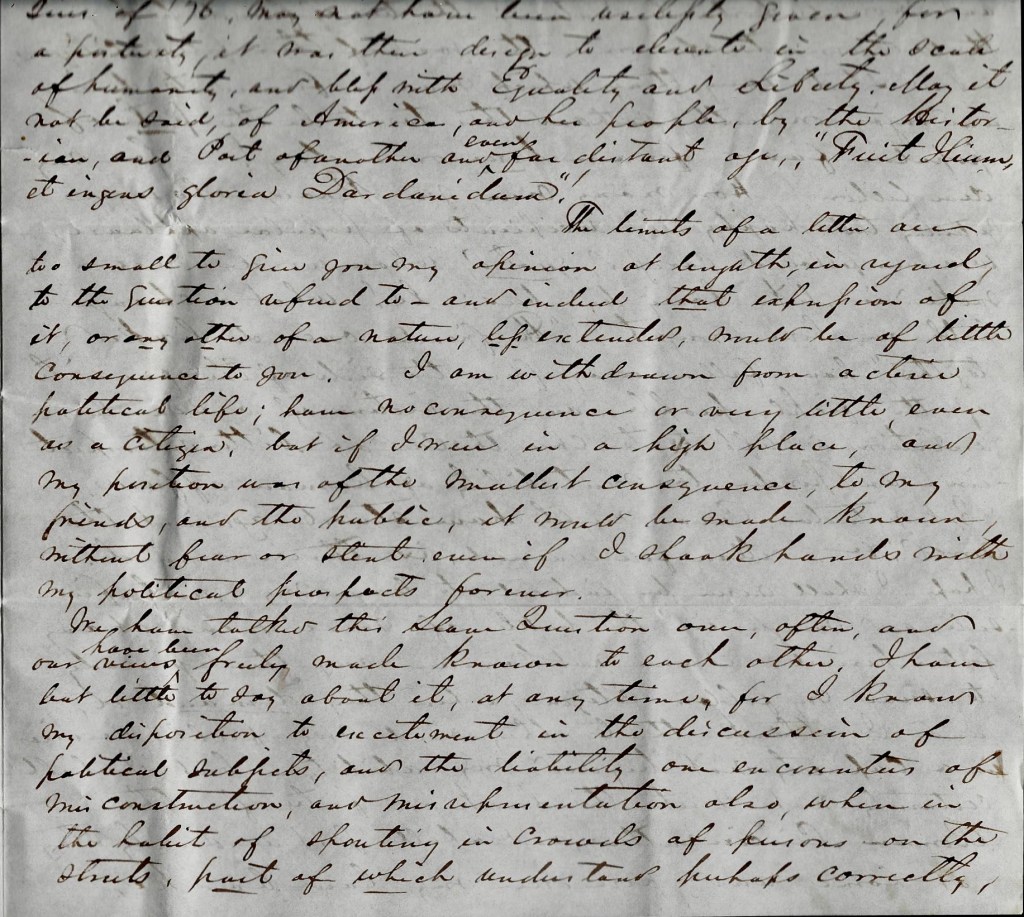
But how it is to be avoided, if passion and fanaticism rule the ascendant, it is not mine to foresee. I can only pray that the toil and blood of our gallant lives of ’76 may not have been uselessly given for a posterity it was their design to elevate in the scale of humanity and bless with equality and liberty. May it not be said of America and her people by the historian and post of another and even far distant age, “Fuit Hium et ingens gloria Dardainidusa!” [This was the great glory of Dardsnidusa!]
The limits of a letter are too small to give you my opinion at length in regard to the question referred to, and indeed that expression of it, or any other of a nature less extended, would be of little consequence to you. I am withdrawn from a active political life; have no consequence or very little even as a citizen, but if I were in a high place, and my position was of the smallest consequence to my friends and the public, it would be made known without fear or stint even if I shook hands with my political prospects forever.
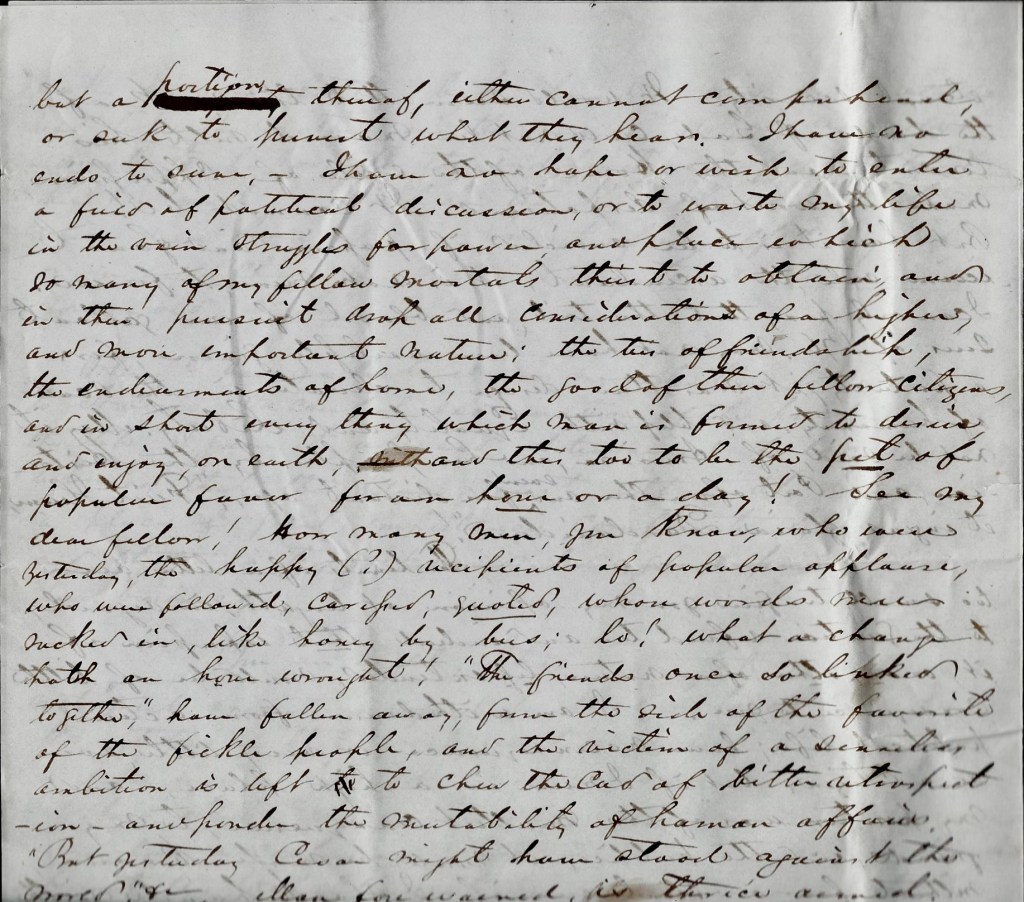
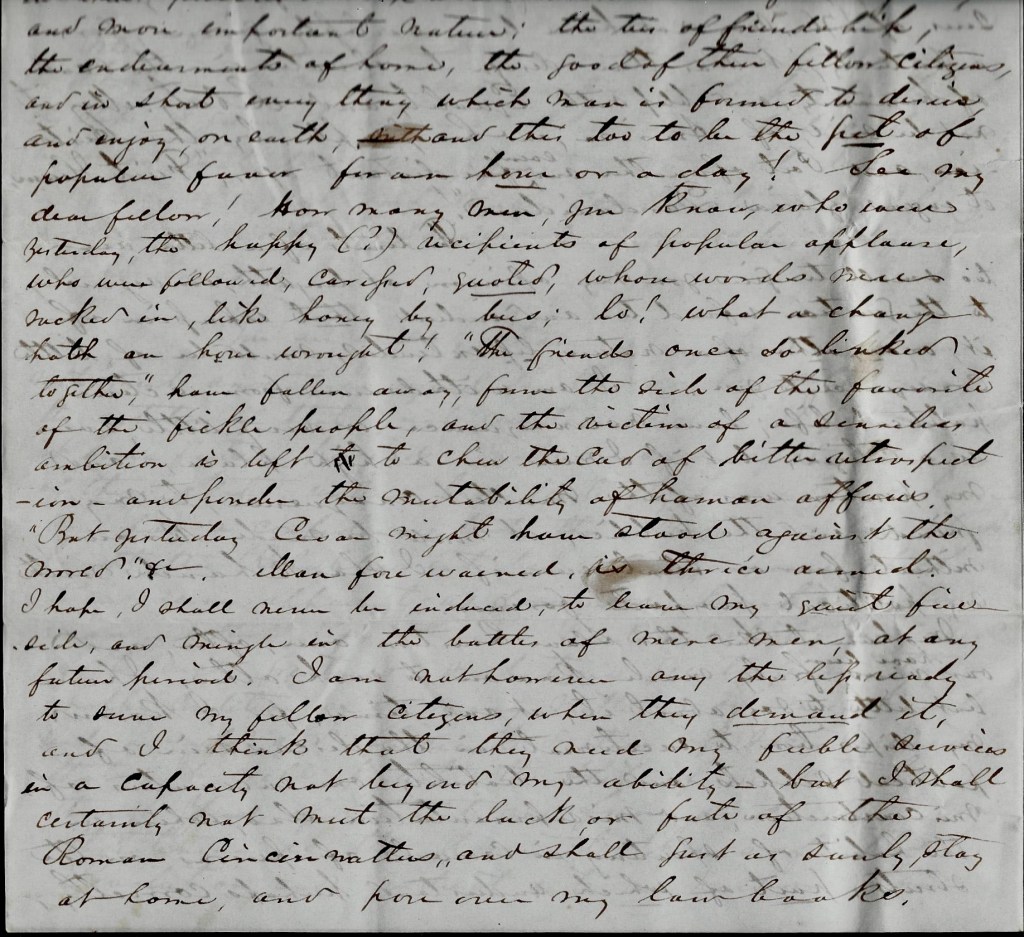
We have talked this Slave Question over often and our views have been freely made known to each other. I have but little to say about it at any time for I know my disposition to excitement in the discussion of political subjects and the liability one encounters of misconstruction and misrepresentation also, when in the habit of shouting in crowds of persons on the streets, part of which understand perhaps correctly but a portion thereof, either cannot comprehend or seek to prevent what they hear. I have no ends to cure. I have no hope or wish to enter a field of political discussion, or to waste my life in the vain struggles for power and place which so many of my fellow mortals thirst to obtain and in the pursuit drop all considerations of a higher and more important nature: the ties of friendship, the endearments of home, the good of their fellow citizens, and in sort, everything which man is formed to desire and enjoy on earth, and this too to be the pet of popular favor for an hour or a day!
See my dear fellow! How many men you know who were yesterday the happy (?) recipients of popular applause who were followed, caressed, quoted. whose words were sucked in like honey by bus. Lo! what a change hath an hour wrought! “The friends once so linked together,” have fallen away, from the side of the favorite of the fickle people. and the victim of a senseless ambition is left to cheer the cad of bitter retrospection and ponder the mutability of human affairs. “But yesterday Cesar might have stood against the world,” &c. Man fore warned is thrice armed. I hope I shall never be induced to leave my great fireside and mingle in the battles of mere men at any future period. I am not however any the less ready to serve my fellow citizens when they demand it and I think that they need my feeble services in a capacity not beyond my ability, but I shall certainly not meet the luck or fate of this Roman Cincinnatus and shall just as surely stay at home and pour over my law books.
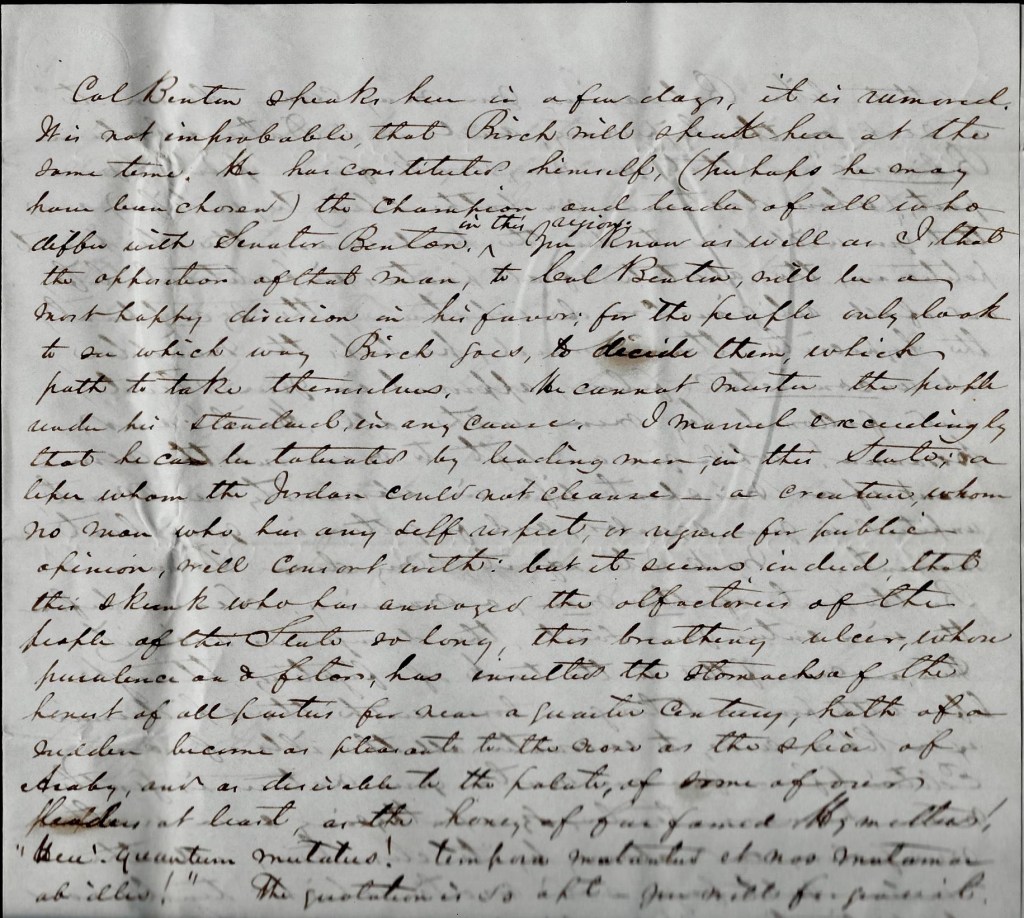
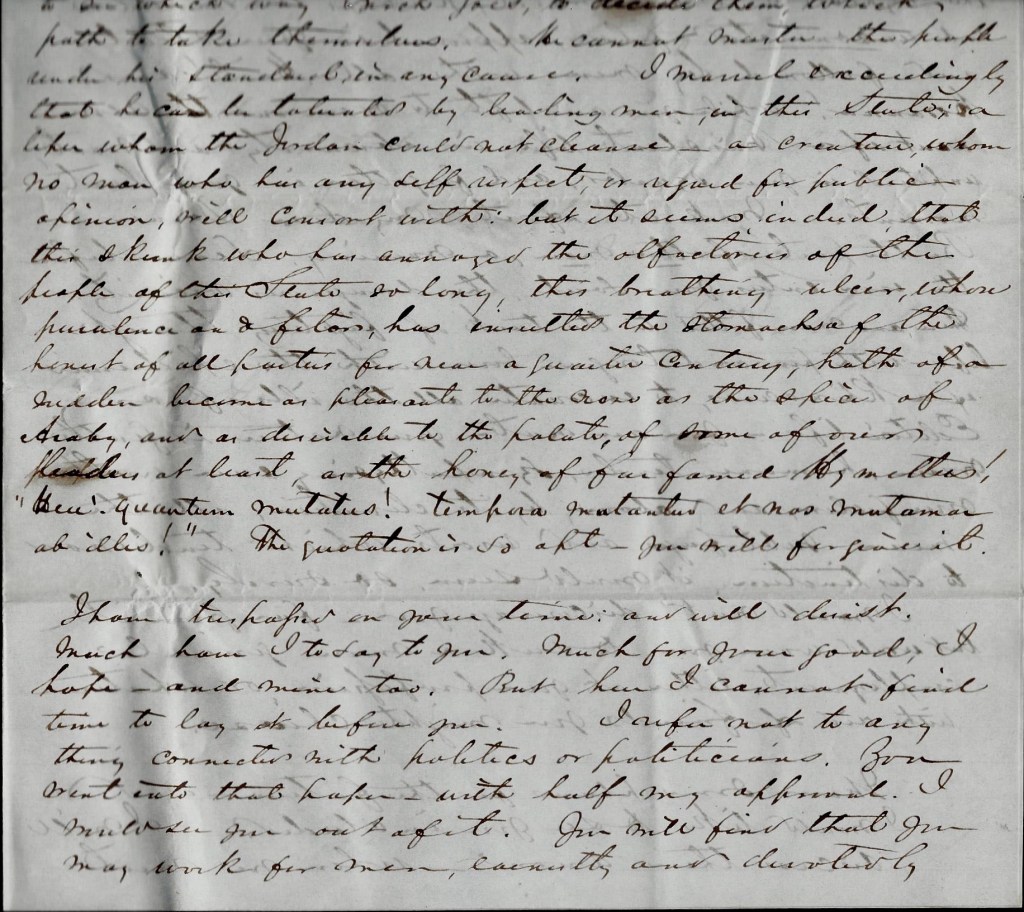
Col. Benton speaks here in a few days, it is rumored. It is not improbable that Birch will speak here at the same time. He has constituted himself (perhaps he may have been chosen) the champion and leader of all who differ with Senator Benton in this region. You know as well as I that the opposition of that man, to Col. Benton, will be a most happy division in his favor; for the people only look to see which way Birch goes to decide them, which path to take themselves. He cannot muster the people under his standard in any cause. I marvel exceedingly that he can be tolerated by leading men in this State; a leper whom the Jordon could not cleanse—a creature whom no man who has any self respect or regard for public opinion will consort with. But it seems indeed that this skunk who has annoyed the olfactories of the people of this State so long, this breathing ulcer whose purulence has insulted the stomachs of the honest of all parties for near a quarter century, hath of a sudden become as pleasant to the nose as the spice of Araby, and as desirable to the palate of our [ ] at least, as the honey of far famed Hymethos…
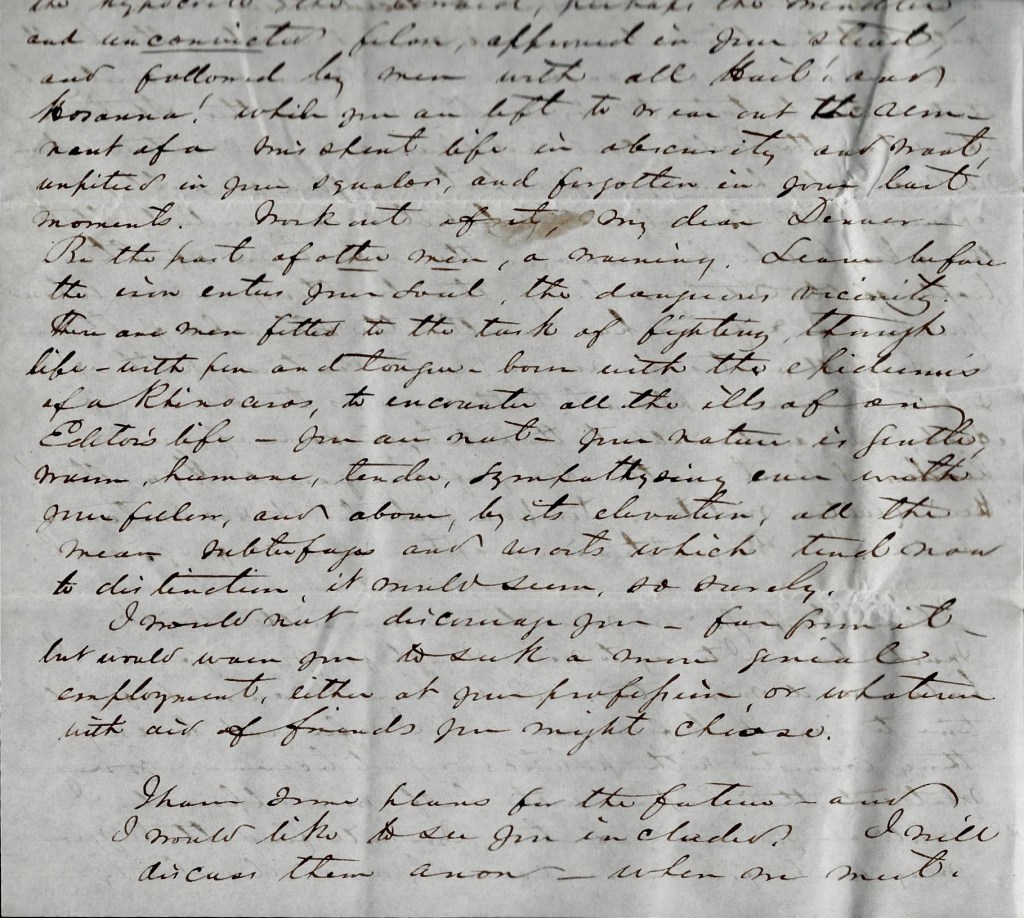
I have trespassed on your time and will desist. Much have I to say to you. Much for your good, I hope, and mine too. But here I cannot find time to lay it before you. I refer not to anything connected with politics or politicians, You went into that paper with half my approval. I would see you out of it….Work out of it, my dear Denver. Be the part of other men, a warning. Leave before the iron enters your soul, the dangerous vicinity. There are men fitted to the task of fighting through life with pen and tongue, born with the epidermis of a rhinoceros, to encounter all the ills of an Editor’s life. You are not. Your nature is gentle, warm, and humane, tender, sympathizing…I would not discourage you—far from it—but would warn you to seek a more genial employment either at your profession or whatever with aid of friends you might choose.
I have some plans for the future and I would like to see you included. I will discuss them anon when we meet. I have resolved to make a competence if my health is spared me, and place myself above the frowns of men or fear of power. If my Creator is kind to me, I shall do it and endeavor to deserve it. The first case of us all should be to make ourselves independent. Think of it.
Send my paper here. Don’t fail. Shall I see you here ever? I shall hope to be in your town in a few weeks. I am, dear Capt., as ever yours sincerely, — B. M. Hughes
This never before published letter by 45 year-old Senator Salmon Portland Chase (1808-1873) comes from a private collection. It was datelined from Cincinnati in mid-October 1853 after the recent election in which the Whig party disintegrated. In his letter, Chase laments that the Liberty Party with the antislavery platform he had helped to create was unable to win over the influence of all of the Democratic Party—still populated by both progressives and conservatives. Chase considered himself an Independent Democrat (or “Free Democrat”) and though he indicates in this letter he was about ready to give up politics, he was later inspired to unite the remnants of the Whig Party with the anti-slavery members of the Free Soil Party to form the Republican Party and win election as the first Republican Governor of Ohio in 1855.
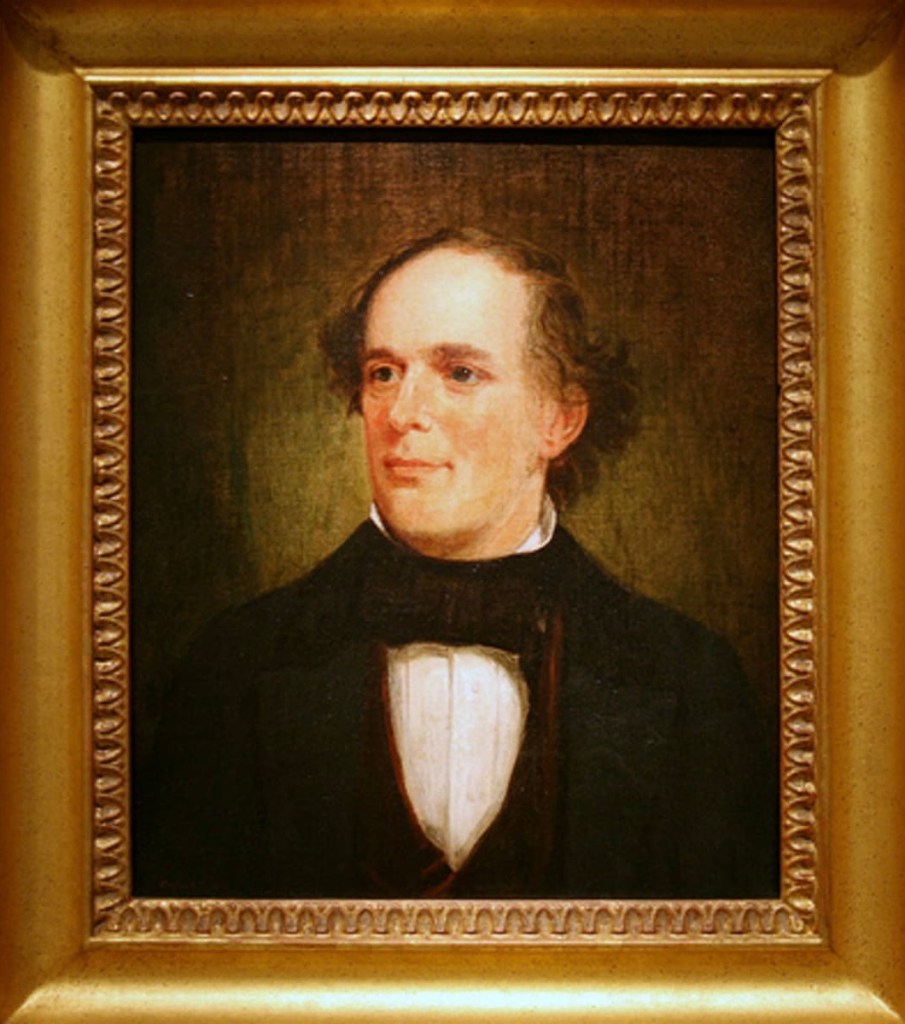
Salmon P. Chase (ca. 1850)
Four months after writing this letter, Chase and Joshua Giddings co-authored the “Appeal of the Independent Democrats in Congress to the People of the United States” that was published in the New York Times in late January 1854 and which manifesto is regarded to be the earliest draft of the Republican Party creed. In 1861, Chase was selected by Abraham Lincoln to serve as his Secretary of the Treasury.
Chase wrote the letter to Alexander Sankey Latty (1815-1896), an Irish emigrant by way of Canada, who came to the United States in 1837. His first job was to oversee the workforce building the Miami and Erie Canal between Defiance and Toledo. Later he managed the construction of the Paulding Reservoir. He was then elected Auditor of Paulding County—his position when this letter was written in 1853.
Transcription
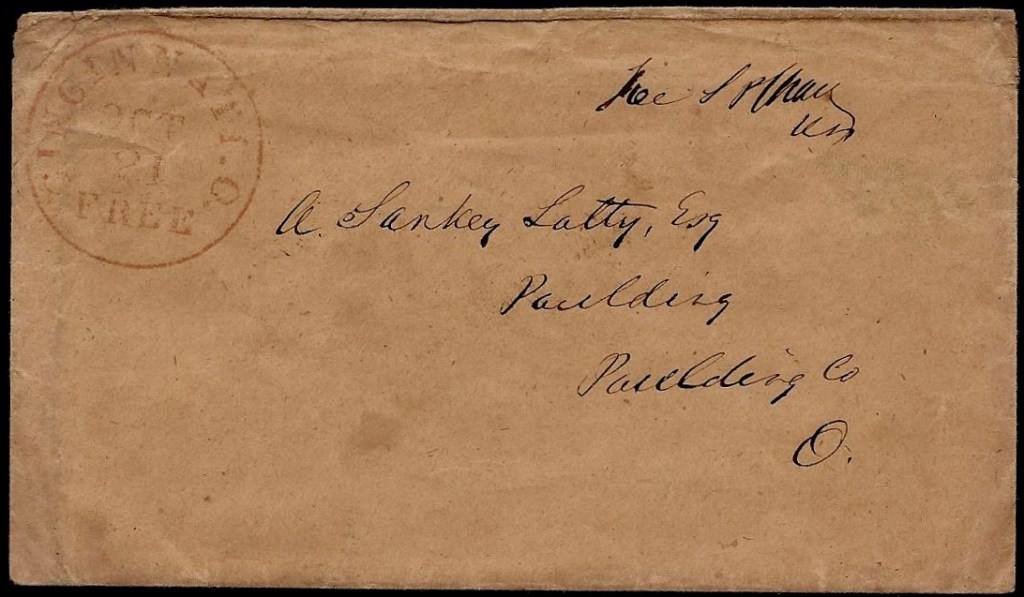
Addressed to A. Sankey Latty, Esq., Paulding, Paulding county, Ohio
Cincinnati, Ohio October 19, 1853
My Dear Sir,
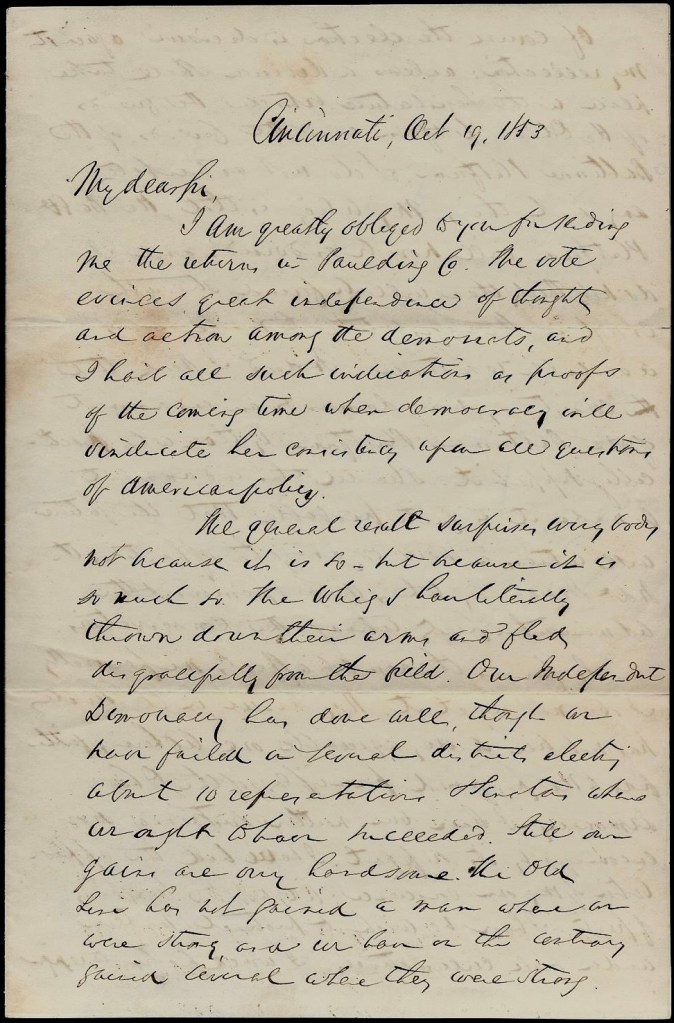
I am greatly obliged to you for sending me the returns in Paulding county. The vote evinces great independence of thought and action among the Democrats, and I hail all such indications as proofs of the coming time when democracy will vindicate her consistency upon all questions of American policy.
The general result surprises everybody not because it is so, but because it is so much so. The Whigs have literally thrown down their arms and fled disgracefully from the field. Our Independent Democracy has done well, though we have failed on several districts electing about 10 Representatives & Senators where we ought to have succeeded. Still our gains are very handsome. The Old Line has not gained a man where we were strong, and we have on the contrary gained several where they were strong.
Of course the election is decisive against my reelection unless a division shall take place in the legislature between the friends of the Ohio Platform and the friends of the Baltimore Platform. I do not anticipate any such thing. My belief is that the Baltimore Platform will now be endorsed and I do not think there will be found strength enough in the legislature to make any available resistance. Indeed, I think that consistency now demands an endorsement of the Baltimore Platform bu those who practically support it. Should this advancement be made, it is quite probable that the future will witness a new organization of parties; the Independent Democracy taking the progressives & the administration party taking the conservatives.
So far as the result affects me personally, I do not regret it. My service in the Senate has not been a very agreeable one. Adhering faithfully to the professed principles of the Ohio Democracy, I have been neither sustained nor encouraged by its support. I have had the approbation of my own conscience; but not the backing of party. I have no wish to protract my term under such circumstances. I would prefer to resign the term I now hold; and, indeed, I seriously think of doing so before the rising of the next legislature. Once out of office and I do not know that any consideration will tempt me again out of the private ranks.
[John Ikirt] Cable of Carrollton writes me that he will probably leave that place & that his son [Fielding Cable], now editor of the [Ohio] Picayune, will sell out and accompany him. I have written him about your wish for a press in Paulding. He could be the very man for you.
You say nothing of your health. I hope most earnestly that it has improved. Do take care of yourself. True manhood is scarce.
While I do not desire to be again a candidate for any office, I do not mean to abandon the cause of freedom, progress, & living democracy. No: “fight on & fight on,” is still my motto.
My God bless you & yours. Most sincerely your friend, — S. P. Chase
How Charles might have looked (W. Griffing Collection)
This letter was written by Charles Henry Morrell (1839-1907), the 23 year-old son of Henry K. and Mary G. (Carter) Morrell of Caroline Centre, Tompkins county, New York. Less than two months previous to the date of this letter, Charles was married to Susan F. Speed and came to Augusta, Hancock county, Illinois. In the 1870 US Census, Charles was identified as a farmer. In the 1880 Census he was identified as a fire insurance agent. In the 1900 Census, he was a life insurance agent.
Charles wrote the letter to his boyhood friend, William Henry Taft (1827-1862)—a carriage maker from Caroline Centre, Tompkins county, New York. William enlisted in September 1862 and was made 2nd Lt. of Co. K, 137th New York Infantry but his military career was incredibly brief. He died of typhoid fever on 30 October 1862 at Knoxville, Maryland. There is little doubt that William never had the opportunity to read this letter before his death.
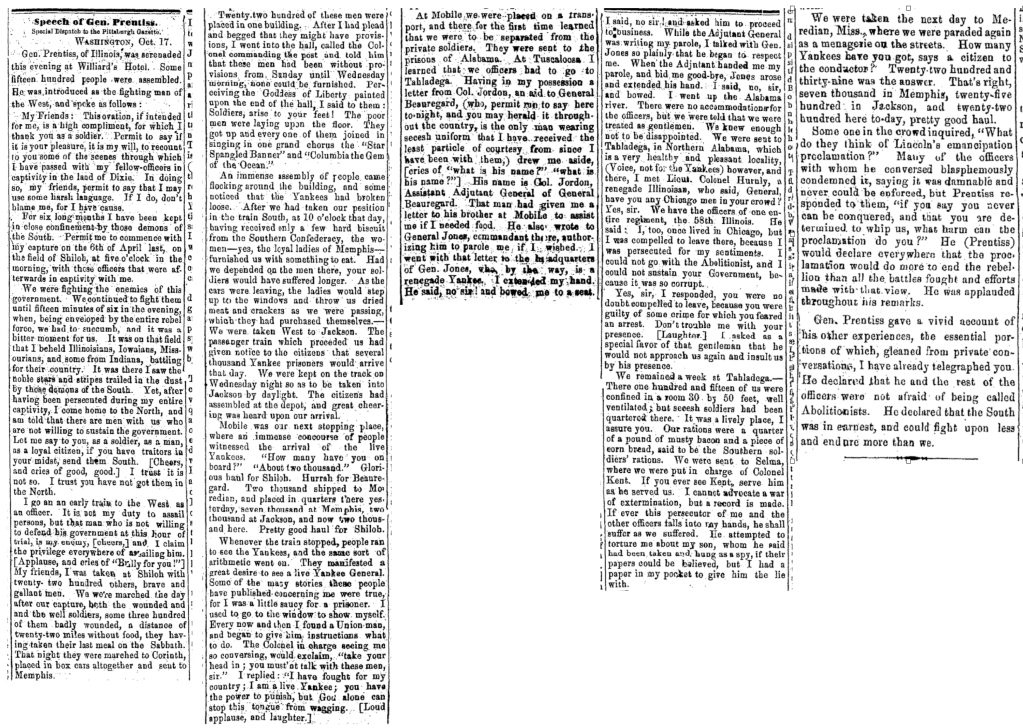
Much of Charles’ letter pertains to the reception at Augusta, Illinois, given to Brig. Gen. Benjamin Prentiss after his release from captivity in October 1862. It was Prentiss’s Division that was first attacked at Shiloh and which suffered greatly during the opening hours of that battle. Though he was able to reform his command with reinforcements from Gen. Lew Wallace and put up a spirited fight in the “Hornet’s Nest,” he eventually surrendered with 2,200 other soldiers. After the battle he was considered a hero, having held off the rebel army long enough to allow General Grant to organize a counterattack and win the battle.
The substance of Gen. Prentiss’s speech given in Augusta, IL, and elsewhere in October 1862 (Wooster Republican, 23 October 1862)
Transcription
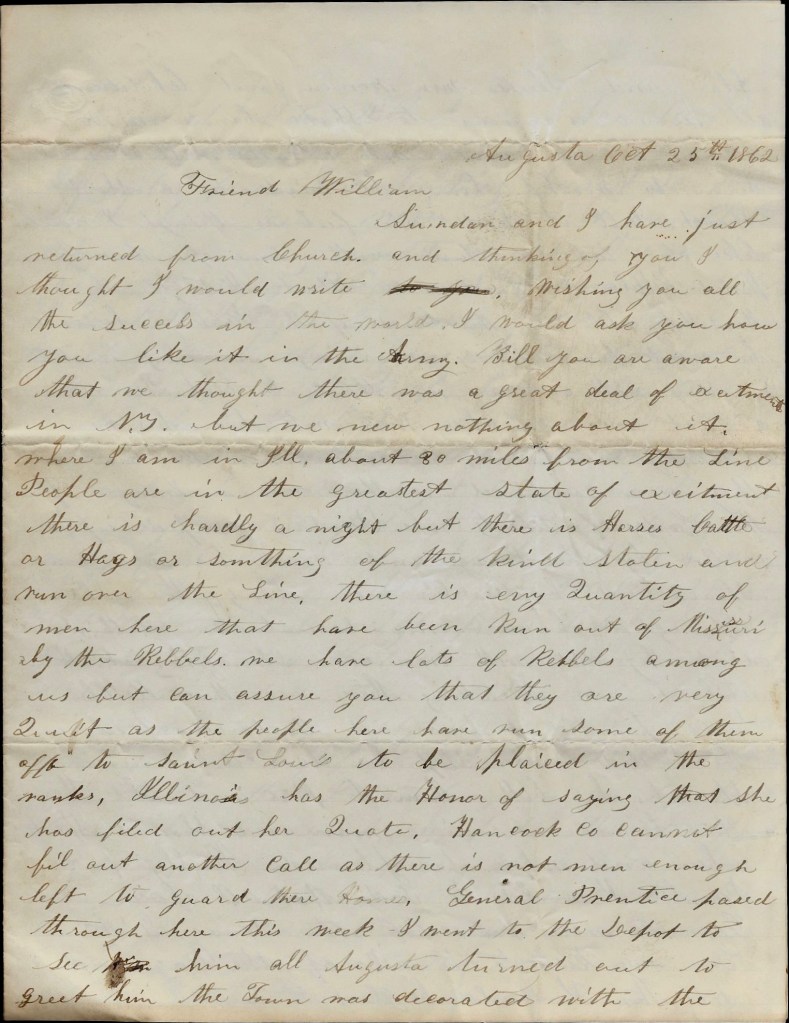
Augusta [Illinois] October 25th 1862
Friend William,
Susan and I have just returned from church and thinking of you, I thought I would write wishing you all the success in the world. I would ask you how you like it in the army. Bill, you are aware that we thought there was a great deal of excitement in New York but we knew nothing about it. Where I am in Illinois—about 80 miles from the [State] line—people are in the greatest state of excitement. There is hardly a night but there is horses, cattle or hogs or something of the kind stolen and run over the line. There is any quantity of men here that have been run out of Missouri by the rebels. We have lots of rebels among us but can assure you that they are very quiet as the people here have run some of them off to St. Louis to be placed in the ranks. Illinois has the honor of saying that she has filled out her quota. Hancock county cannot fill out another call as there is not men enough left to guard their houses.
Gen. Benjamin M. Prentiss—-“I would to God that all of our generals were possessed of the same grit.”
General [Benjamin Mayberry] Prentiss passed through here this week. I went to the depot to see him. All Augusta turned out to greet him. The town was decorated with the Stars & Stripes. Men, women & children all seemed as anxious to shake hands with him as a son would with a father. All Illinois seem to worship him. He made us a short speech. Will, it made me feel as though I would like to take a turn with some of those black-hearted rebels. He gave us a short history of his hardships while in the hands of the rebels. He said [at Shiloh] he went from Sunday morning until Tuesday without a mouthful to eat. There was a great many of his men with him. His men on Tuesday were nearly worn out in the boat that they were confined in. There was an image of the Goddess of Liberty [and] he (Prentiss) jumped upon a box by the image and made his men a Union speech and bade his men sing the Star Spangled Banner and several other national airs which they did with renewed strength. While he was speaking, there was three rebel guns pointed at him and threatened to fire if he did not stop his damned Union speech. He bid them to fire and told them that he was a Union men and should speak when and where he pleased. Bully for Prentiss! I would to God that all of our general were possessed of the same grit.
Give my respects to all of the boys and tell them I should be glad to hear from any of them them.
Well since I have been here, I have been to a little lake about twenty miles from here hunting geese and ducks. Such fun you never saw. It was shooting from morning until night. There was a great many pelicans and swans on the lake. Will, I imagine in ten miles square black with ducks and geese dotted here and there with a flock of swan. They look to be about the height of a man as they sit on the water as white as snow. We went up on Monday and came back on Saturday. We camped in the woods ten miles from any house. Such fishing as would make a York boys eyes stick out. We caught catfish that would weigh from ten to fifty pounds. They say that it is no uncommon thing to catch them that will weigh one hundred & fifty. I can go out on the prairie most any frosty morning and shoot all the game that I can bring in on my back.
Bill, what the devil are people thinking about to stay in New York among the hills and rocks when three is such a vast extent of western country unsettled and far richer than the best garden in New York and as level as a house floor and free from stone. I am only surprised that you ever went back to New York after your visit West. If I can persuade my wife to stay here, you will never see me back to Caroline [Centre, Tompkins county, NY] again.
Will, write to me. I should be very glad to hear from you. Tell me all the news, how you are getting along, and how the boys like it, and what you are all doing. Tell John Cantine to write to me.
From your most affectionate friend, — C. H Merrill
This letter was written by Robert Downs (1835-1907), the son of Leverett Downs (1796-1859) and Anna Atwater (1801-1895) of New Haven county, Connecticut.
Robert enlisted on 8 August 1862 as a private in Co. H, 15th Connecticut Infantry. He mustered out of the regiment at Newbern, North Carolina, on 27 June 1865. The regiment served in the defenses of Washington D. C. before participating in the Battle of Fredericksburg, the Mud March, the Siege of Suffolk, &c. They were ordered to Newbern, North Carolina in January 1864 which was their base of operations until the close of the war.
The 15th Connecticut Marker at the Newbern, N. C.National Cemetery
Robert’s letter datelined from Newbern in September 1864 speaks of his own sickness and of the large number of sick citizens and soldiers in Newbern where “a good many are dying.” So many of the 15th Connecticut soldiers died at Newbern during the time they were quartered there that a monument was erected by the state honoring their service. In the dedication of that monument in 1894, Senator O. H. Platt said, “We erect monuments, not to the living, but to the dead. A century from now the State and Nation will still be seeking some way in which to testify an increasing regard for the men who saved the Union from dissolution, who made its flag one flag, and its boundaries to encompass one—only one—country. Heroism, achievements, sacrifice are the grand fruitage of humanity, worthy of all honor; but grander yet and worthy of supreme honor is patriotism…Other regiments may mark with their monuments positions on battlefields where their comrades met the enemy in a fierce and deadly struggle to retain their position and beat the enemy back from the field. These your comrades battled with the death angel on a field which they would have gladly abandoned but from which there was no retreat; their struggle involved no passion, none of the accessories of battle strife bore them up, no word of command, no cheer of comrades, no bugle note, no drum, so sound of cannon or rattle of musketry to life them out of themselves and to inspire them to heroic deeds, but in silence and in darkness, alone with themselves, and with the invisible destroyer, far from the homes of love, uncheered and unattended, they met their foe and their fate…”[See Platt Address at Newbern, N. C.]
To read other letters by members of the 15th Connecticut that I’ve transcribed and posted on Spared & Shared, see: Eli Walter Osborn, F&S, 15th Connecticut (1 Letter) Charles Griswold, Co. E, 15th Connecticut (1 Letter) Charles H. Taylor, Co. F, 15th Connecticut (1 Letter) Henry C. Baldwin, Co. H, 15th Connecticut (1 Letter) Henry D. Lewis, Co. H, 15th Connecticut (1 letter) Henry D. Lewis, Co. H, 15th Connecticut (1 Letter) Walter Howard Lord, Co. I, 15th Connecticut (1 Letter) John Harrison Hall, Co. K, 15th Connecticut (1 Letter)
Transcription
Addressed to Miss Clarissa F. Downs, Naugatuck, Connecticut
New Bern, N. C. September 17th 1864
Dear Sisters and all at home,
I received two letters yesterday from you, one from home from Clarissa, and one from Laura then at Bethany. But I suppose that Laura is at home by this time. I am very happy to hear that you are all pretty well. I am a good deal better than I have been but I don’t feel as well as I did before I was sick. I have got over the shakes, but I am in the hospital yet for I don’t feel well enough to do guard duty. We have now and then a cool day and night but the weather is mostly very warm and it is getting to be pretty dry. It is quite sickly here both among the citizens and soldiers and a good many are dying, but the weather will be cooler before long and then it will be more healthy, I think.
Another boy from our company and from Naugatuck died yesterday here in the hospital. His name was Henry Lord. Perhaps you knew him. He was a good, steady boy. He came out with the regiment and he has enjoyed pretty good health till lately. He died quite sudden.
Both of your letters was dated September the 4th. I think they have been a good while coming though I had been looking for a letter from home for some days. But we heard that one of our mail boats had been taken by the rebs and burnt and I thought that I might have a letter on that boat but I guess I didn’t for you was not at home, the reason that you did not write any sooner. I am glad that you went to the camp meeting. I hope you enjoyed it to your best good. I would liked to have been there too for they have such good times and the place is a very pleasant one for a camp meeting.
I should have written to Laura again but I didn’t think that she was going to stay there so long so I thought I would not write to her for I didn’t think she would get the letter and I knew that you would send the letters to her as soon as you could.
I think it is the best thing that Mother could do to fat[ten] that heifer for I don’t want that you should have the bother of an unruly creature for you have enough to see to without that.
I am glad to hear that you are getting along so well and that things on the farm are in pretty good condition. Some say that the war will be over this fall and I think if things work as it appears, that it will now. I say I think that the war will be over sometime this fall. I hope it may be so so that we can all come home for good some time next winter. But this is uncertain for we can’t tell what is before us. Therefore we must trust in the Lord and be consigned to his Holy will. I know that many times the way looks dark ahead and we can see no way how that we are going to get over the difficulties which appear to lay before us, but three is One who can see through all the future, who will guide us in the right path (when we appear to be in the dark) if we ask Him in faith, trusting to His knowledge, mercy, and goodness. I hope that we shall all trust in the mercy and tender love of Jesus, our blessed Saviour and Redeemer, and ask Him to fit us for a more glorious home than the one we possess on earth. I hope these lines will find you all well. Please write soon.
From your sincere and affectionate brother, — Robert Downs
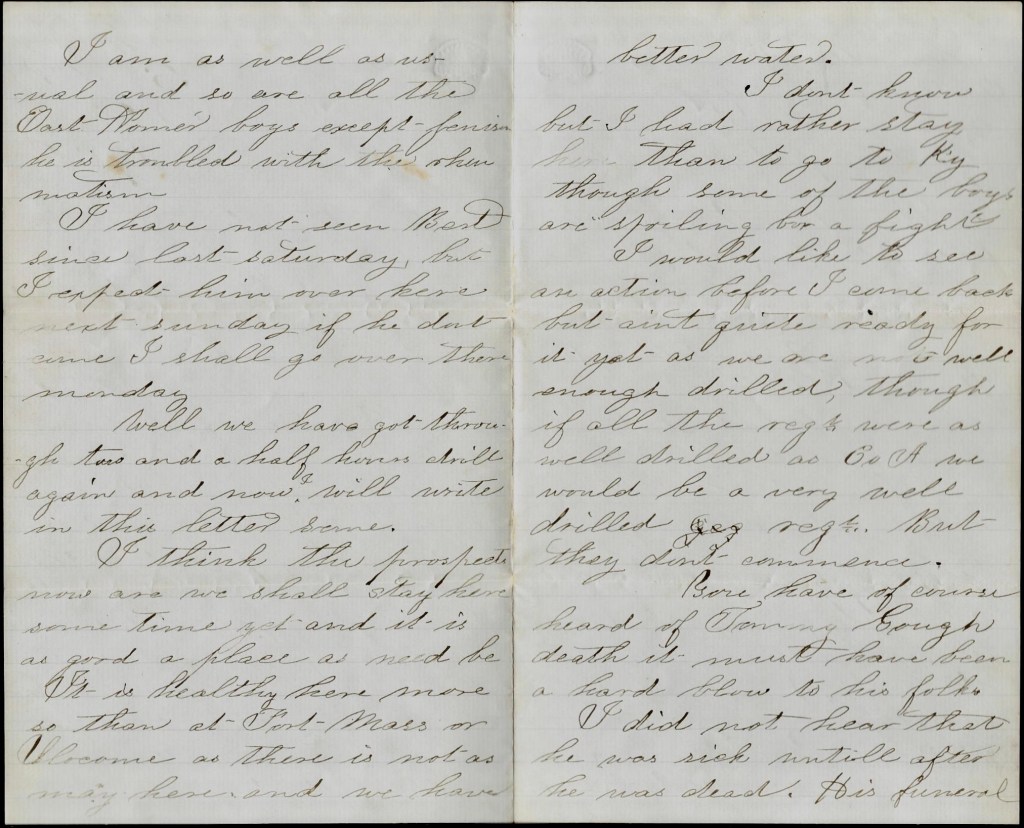
This letter was written by Eugene Albert Burnham (1840-1925) of East Homer, Cortland county, New York, who enlisted as a private on 4 October 1861 in Co. A, 76th New York Infantry (the “Cortland Regiment”). Eugene was sent to a hospital on 11 September 1862 and was absent from the regiment from then until his transfer to Co. C, 14th Veteran Reserve Corps in July 1863.
I could not find an image of Eugene but here is one of his brother Uberto who served in the same regiment. (Find-A-Grave)
Eugene wrote this letter to his parents, Marvin Burnham (1811-1891) and Caroline Webster (1813-1894) of East Homer. Eugene’s older brother, Uberto Adelbert Burnham (1837-1930) also served in the same regiment as Eugene. He enlisted as a private in Co. D, October 4, 1861, and on the organization of the Regiment, was made First Sergeant. He held this position until February, 1863, when he received a commission as First Lieutenant, and was soon after appointed Acting Regimental Quartermaster, by Colonel Wainwright. Uberto Burnham was a prolific writer, and many of his letters and diaries are preserved in the New York State Archives at Albany. The collection consists of 222 items, 114 of which are letters written to his family and friends between 1857 and 1864.
Eugene wrote the letter in April 1862 from Fort DeRussy—one of the forts defending the Nation’s Capitol—where the regiment was garrisoned and drilled until May 1862. The fort was built in 1861 by the 4th New York Heavy Artillery and named for the regiment’s commander, Colonel Gustavus A. DeRussy. The fort was sited on the high ground of the western bank of Rock Creek and controlled movement along and across the valley. The fort coordinated its fire with Fort Stevens on the east and Fort Kearny on the west. It was built originally in the shape of a trapezium, armed with 7 guns, and afterwards expanded to mount 11 guns and mortars, including a massive 100-pounder Parrott rifle located at reshaped northeastern angle. The fort was heavily engaged during the Battle of Fort Stevens on July 11-12, 1864.
Transcription
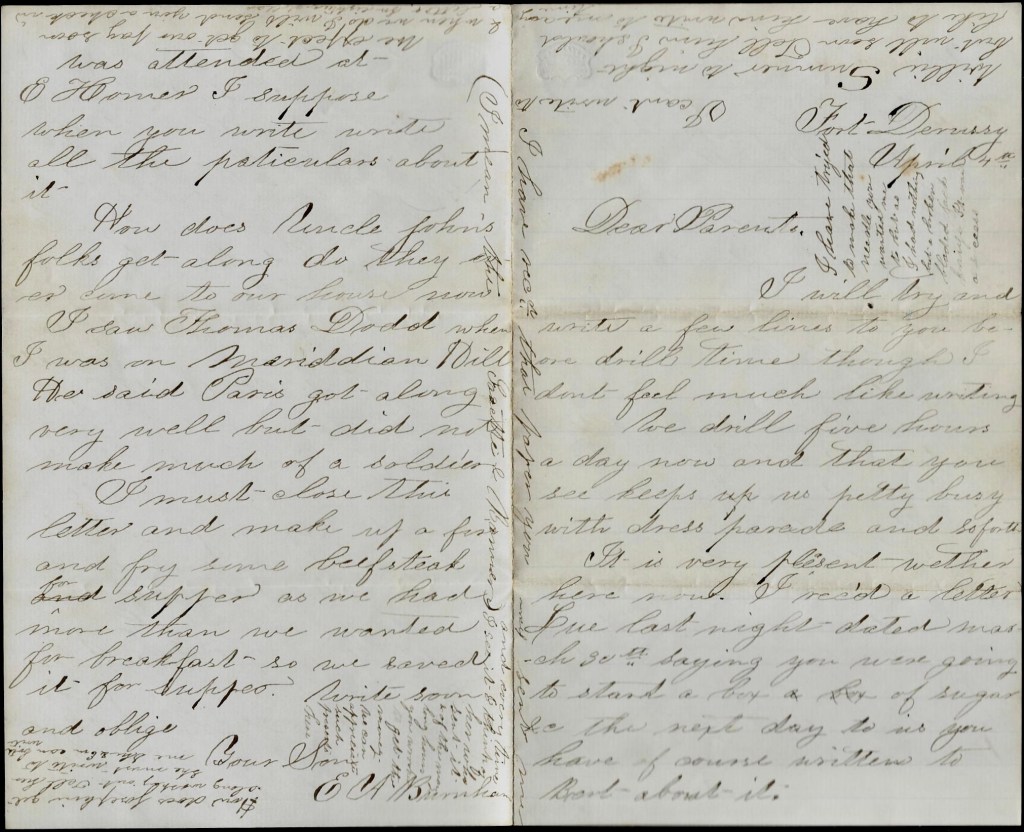
Fort DeRussy [Washington D. C.] April 4th [1862]
Dear Parents,
I will try and write a few lines to you before drill time though I don’t feel much like writing. We drill five hours a day now and that you see keeps us pretty busy with dress parade and so forth.
It is very pleasant weather here now. I received a letter last night dated March 30th saying you were going to send a box of sugar &c. the next day to us. You have of course written to Bart about it.
I am as well as usual and so are all the East Homer boys except Jenison. he is troubled with the rheumatism. I have not seen Bert since last Saturday but I expect him over here next Sunday. If he don’t come, I shall go over there Monday.
Well we have got through two and a half hours drill again and now I will write in this letter some. I think the prospects now are we shall stay here some time yet and it is as good a place as need be. It is healthy here—more so than at Fort Massachusetts or [Fort] Slocum as there is not as many here and we have better water. I don’t know but I had rather stay here than to go to Kentucky though some of the boys are spoiling for a fight. I would like to see an action before I come back but ain’t quite ready for it yet as we are not well enough drilled though if all the regiments [companies?] were as well drilled as Co. A, we would be be a very well drilled regiment. But they don’t commence.
You have of course heard of Tommy Gough’s death. It must have been a hard blow to his folks. I did not hear that he was sick until after he was dead. His funeral was attended at E. Homer, I suppose. When you write, write all the particulars about it.
How does Uncle John’s folks get along? Do they ever come to our house now? I saw Thomas Dodd when I was on Meridian Hill. He said Paris got along very well but did not make much of a soldier.
I must close this letter and make up a fire and fry some beef steak for supper as we had more than we wanted for breakfast so we saved it for supper. Write soon and oblige. Yours son, — E. A. Burnham
How does Josephine get along washing out? Tell her she must write to me. She & Em can both write.
I have received that paper you sent me (I mean the Gazette & Banner) and every time I see it, I think of her who sent it & of the many long hours you worked to get the money. We can appreciate such presents here.