My passion is studying American history leading up to & including the Civil War. I particularly enjoy reading, transcribing & researching primary sources such as letters and diaries.
The following letter was written by Garret Alonzo Empie (1832-1906), the son of John Isaac Empie (1807-1878) and Magdalena Becker (1804-1840) of Schoharie county, New York. Garret was married in 1853 to Emma Pool (1829-1880) and they had at least two children prior to 1860.
According to his military records, Garret enlisted on 27 September 1864 at Albany, New York, to serve one year in Co. E, 175th New York Infantry. He was 32 years old and employed as a laborer at the time of his enlistment. He stood 5 feet 9 inches tall, had grey eyes and brown hair. He gave his birthplace as Sharon, New York. He mustered out of the service with his company at Savannah, Georgia, on 30 June 1865. In the 1872 Schoharie County Gazetteer, he was listed as a farmer in Argusville.
Garret was killed in a street car accident en route to his home near Dayton, Ohio, in 1906.
Transcription
Addressed to Emma Empie, Argusville, Schoharie County, New York
Camp Sherman Blairs Landing, South Carolina 1 March 23, 1865
Dear Emma,
How do you and the children do today? I am well and hope that when this reaches you that you are all well. We are at the Camp Distribution yet but I wish that I was to my regiment. I would feel more at home with my own boys. The reason that they call this Camp Sherman is that he camped on this ground two days and two nights with his army a few days before he took Charleston and Fort Sumter—that is 60 miles from here by water. I don’t [know] how far it is by land. We came by Fort Sumter and Charleston when we came here. It is quite a place but it ain’t as nice as Fort Monroe. That is a nice place and so is Hilton Head a nice place, but this place ain’t much. At the landing is the only house that is here. On the plantation, they was a lot of nigger huts but them are all tore down. The man that did own this mansion and this plantation is in the rebel army. He is the General Beauford. He owns four large plantations but now our folks has confiscated it and they will sell it so I think that he won’t make much by it.
Oh Emma, what do you think? I have quit chewing tobacco! I can’t afford it. It cost $2.50 and 3.00 per pound. That is to much for me. But it goes tuff. But I will try to tuff it out.
Now about the weather, it has been very nice and warm since we have been here but yesterday afternoon—then it rained quite hard, but today it is nice and clear—not quite as hot at it was before the rain. I don’t know when we shall leave here but they say we will go in a few days. I want to get there for I want to hear from home. There must be some letters there for me by this time. But I suppose that I will have it harder there than here for here we have nothing to do—only cook, eat, sleep, read. We have no guns so we can’t stand guard nor picket nor drill so we ain’t got to be out nights.
Some say that our brigade has left Savannah and gone to North Carolina to do provost duty at Morehead City. How it is, I don’t know. Some says that they are at Savannah yet. We hear so many camp stories, we don’t know which to believe, but it don’t make no difference about your writing. Direct to Washington to Co. E, 175 New York Vols. Regiment, 19th Army Corps, 2nd Division, 3rd Brigade. From pa pa G. A. Empie
Tell George to eat maple sugar for me.
1 A couple weeks earlier than Empie’s letter, B. Van Raalte of Holland, Michigan wrote that he was at Blair’s Landing. He said that he had arrived there by taking a tugboat up the Broad River about 25 miles to the landing. He said the convalescent camp was called Camp Blair’s Landing because “Blair landed here first with his troops.” At that time there were about six to seven thousand men there—all convalescents for Sherman only.
This letter was written by a member of the 11th Massachusetts Independent Light Artillery who signed his name “William” but left us with few other clues to his identity. He mentions a number of Charlestown, Massachusetts friends and an “Uncle Child” but little else. Some time ago I transcribed a couple of letters by a member of the regiment named William Hazen Flanders (1841-1905) and there is an outside chance that he authored this one as well but the handwriting varies too widely for me to safely conclude it was his. Thinking his correspondent might have been a future wife, I learned that Adeline (“Addie”) Augusta Fifield (1840-1909) was the daughter of Daniel Fifield (1809-1896) and Elizabeth Russell Locke (1816-1902) and that she lived with her parents in Charlestown, Massachusetts, where her father worked in the furniture business and she worked as a seamstress. But she never married and died in 1909.
The battery was reorganized during December 1863 to serve a new term of three years. Reenlisted members of the 11th Massachusetts Battery formed the core of the new iteration. They were joined by new recruits to fill out the ranks. Capt. Edward Jones again served as commanding officer. The members of the battery were mustered in on January 2, 1864, trained at Camp Meigs, and departed Massachusetts on February 5. Reaching Washington, the battery was attached to the Second Division (commanded by Major General Robert B. Potter) of the IX Corps, assigned to the Army of the Potomac. The battery took part in the major battles of the Overland Campaign, though they were not heavily engaged until moved to the front lines on June 19 during the start of the Siege of Petersburg. On August 21 and 22, the battery took part in the Battle of Weldon Railroad while temporarily attached to the II Corps. The battery was in action at various points on the siege line at Petersburg during the fall and winter. On March 25, 1865, the battery played an important role during the Battle of Fort Stedman. As Confederate troops overtook Fort Stedman and temporarily broke through Union siege lines, the 11th Massachusetts Battery, posted in nearby Fort Friend, rendered key service in pushing back the assault. When the Confederates abandoned Petersburg and retreated towards Appomattox Court House, the 11th Massachusetts Battery joined other elements of the Army of the Potomac in pursuit. They were present for the surrender at Appomattox and were detailed with other artillery units to take charge of surrendered Confederate cannons.
Transcription
Addressed to Miss Addie A. Fifield, No. 26 Allston Street, Charlestown, Mass.
Fort Howard Near Weldon Railroad September 25, 1864
Augusta,
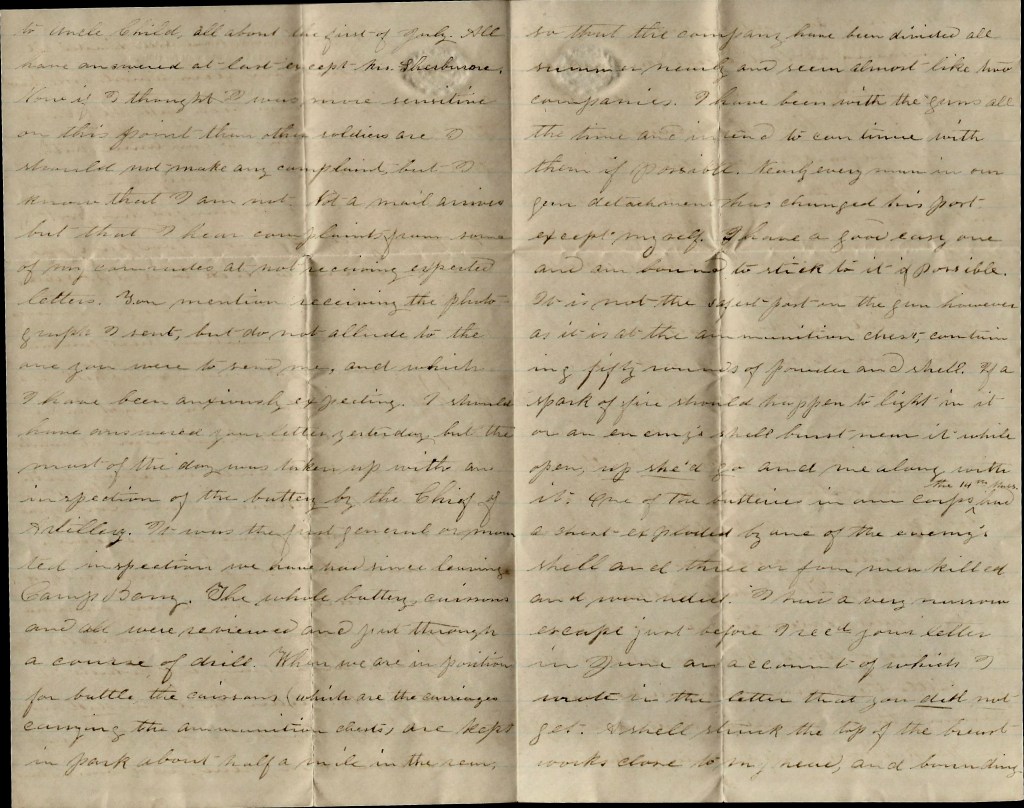
You long looked for and most welcome letter reached me yesterday morning. I thought it very strange that you did not write. Both your letters, written in April and June were received and answered, the last immediately after its receipt. I directed it as usual and it is strange that it did not reach you. I came to the conclusion that you had lost all interest in the army and those composing it. Indeed, I began to feel grieved at the seeming neglect of all the Charlestown folks to whom I had written, and had almost made up my mind to trouble them no more. I thought if friends were to be judged by their promptness in answering letters, I certainly had not many about Charlestown. I wrote to you, to John, to Sarah Jane, to Eliza Morse, and to Uncle Child, all about the first of July. All have answered at last except Mrs. Sherbourne. Now if I thought I was more sensitive on this point than other soldiers are, I should not make any complaint but I know that I am not. Not a mail arrives but that I hear complains from some of my comrades at not receiving expected letters. You mention receiving the photograph I sent, but do not allude to the one you were to send me, and which I have been anxiously expecting.
I should have answered your letter yesterday but the most of the day was taken up with an inspection of the battery by the Chief of Artillery. It was the first general or mounted inspection we have had since leaving Camp Barry. The whole battery, caissons and all, were reviewed and put through a course of drill. When we are in position of battle, the caissons (which are the carriages carrying the ammunition chests) are kept in park about half a mile in the rear so that the company have been divided all summer nearly and seem almost like two companies. I have been with the guns all the time and intend to continue with them if possible. Nearly every man in our detachment has changed his post except myself. I have a good easy one and am bound to stick to it if possible. It is not the safest post on the gun, however, as it is at the ammunition chest containing fifty rounds of powder and shell. If a spark of fire should happen to light in it or the enemy’s shell burst near it while open, up she’d go and me along with it. One of the batteries in our Corps—the 14th Massachusetts—had a chest exploded by one of the enemy’s shell and three or four men killed and wounded.
I had a very narrow escape just before I received your letter in June an account of which I wrote in the letter that you did not get. A shell struck the top of the breastworks close to my head and bounding up, burst nearly over me, the pieces flying in every direction. You had better believe we were glad enough to get away from our position there which we held forty-five days under a constant fire of pickets, and mortar shelling. But we had wonderful good fortune and lost but two killed and seven wounded. Compare our losses with some of the infantry regiments and see how much cause we have to be thankful for our preservation of life and limb.
The 56th, 56th, 58th, and 59th [Massachusetts] Regiments entered the campaign with us with nearly 1,000 men apiece. They cannot muster 150 men now. The 58th which is in our [Potter’s] division has only 125 for duty. They have many in the hospital sick, however, and so have we. Six of our men have died of disease, one deserted, two enlisted men and one Lieutenant have been discharged for disability, and we have a dozen or fifteen sick in the hospital so that in all we have lost thirty or thirty-five, many of whom will probably come back.
We had divine service this forenoon. We were addressed by the Rev. Mr. Stark, Chaplain of the 58th Regiment. We have had Sunday services but three or four times since we left Camp Barry. I wish I had some news to write but as I have written twice to John within as many weeks, and as you have probably seen both letters, I can think of nothing that will interest you. It is said there is a fight going on up on the right and heavy cannonading has been heard all day & some of the infantry are preparing to march, and in anticipation of orders I must bid you goodbye and close my letter. Please write soon. Your friend as ever, — William
Though it is only signed Thomas, I feel confident this letter was written by Thomas C. Edwards (b. 1835) who served in Co. B, 8th New York Heavy Artillery. The regiment was organized at Lockport, New York as the 129th New York Volunteer Infantry and mustered on August 22, 1862, for three years service under the command of Colonel Peter Augustus Porter. Because heavy artillery regiments were needed for the defenses of Baltimore, the regiment was converted from infantry on October 3, 1862, and became the 8th New York Heavy Artillery on December 19, 1862. Companies L and M joined the regiment at Baltimore in February 1864.
Thomas C. Edwards—Age, 25 years. Enlisted, July 29, 1862, at Lockport; mustered in as corporal, Co. B, 129th Infantry, July 29, 1862 (which became the Eighth Heavy Artillery, December 19, 1862), to serve three years; promoted sergeant, April 25, 1863; quartermaster-sergeant, February 1, 1865; mustered out with company, June 5, 1865, at Munsons Hill, Va., as Thomas C. Edwards.
I have transcribed a large number of Thomas’s letters and posted them at:
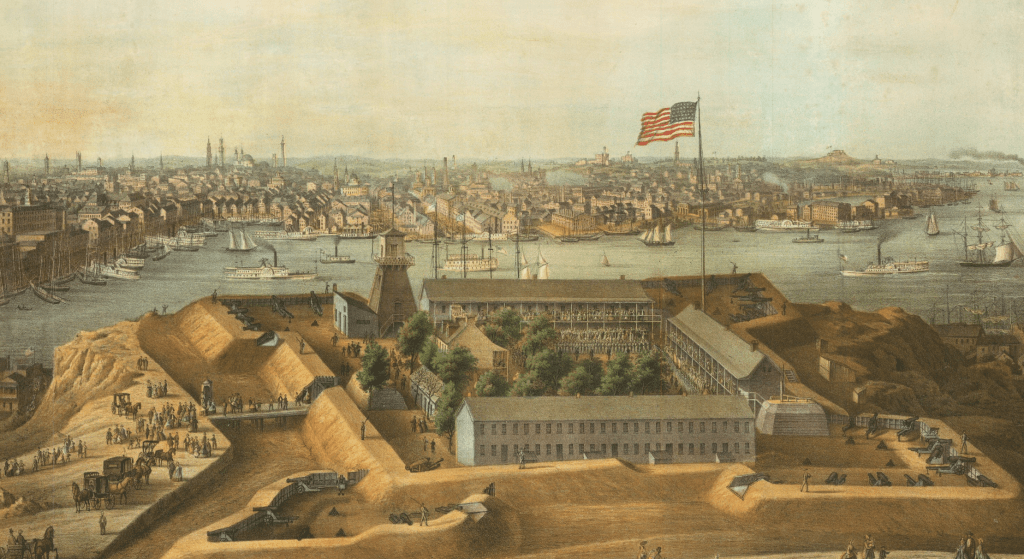
Fort Federal Hill and the commanding view of the Bay and the City of Baltimore
Transcription
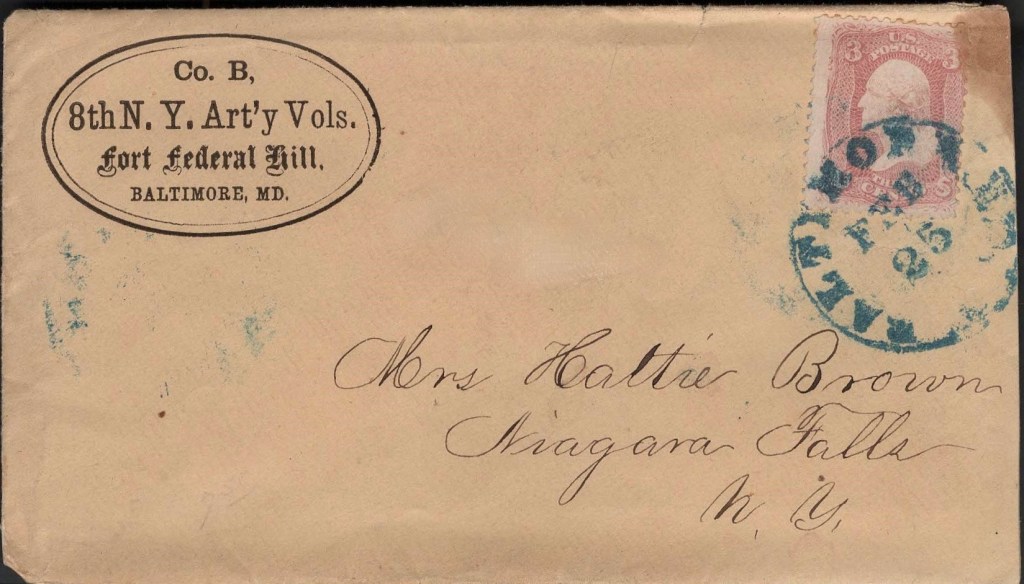
Addressed to Mrs. Hattie Brown, Niagara Falls, New York
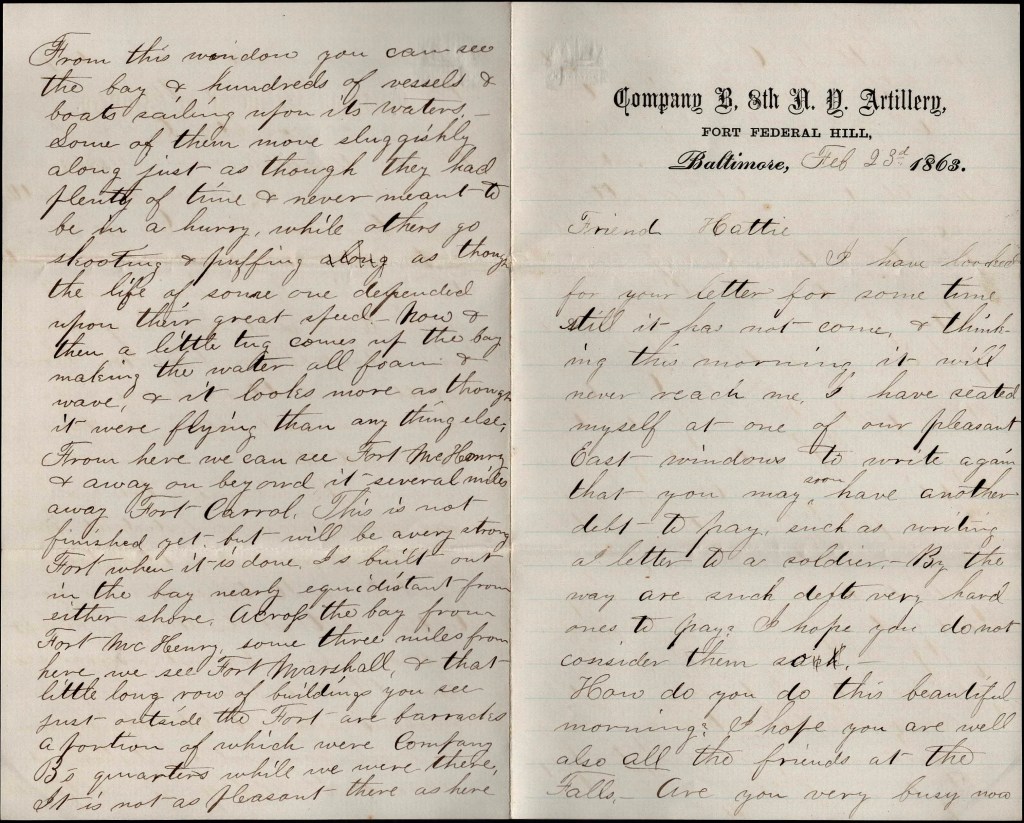
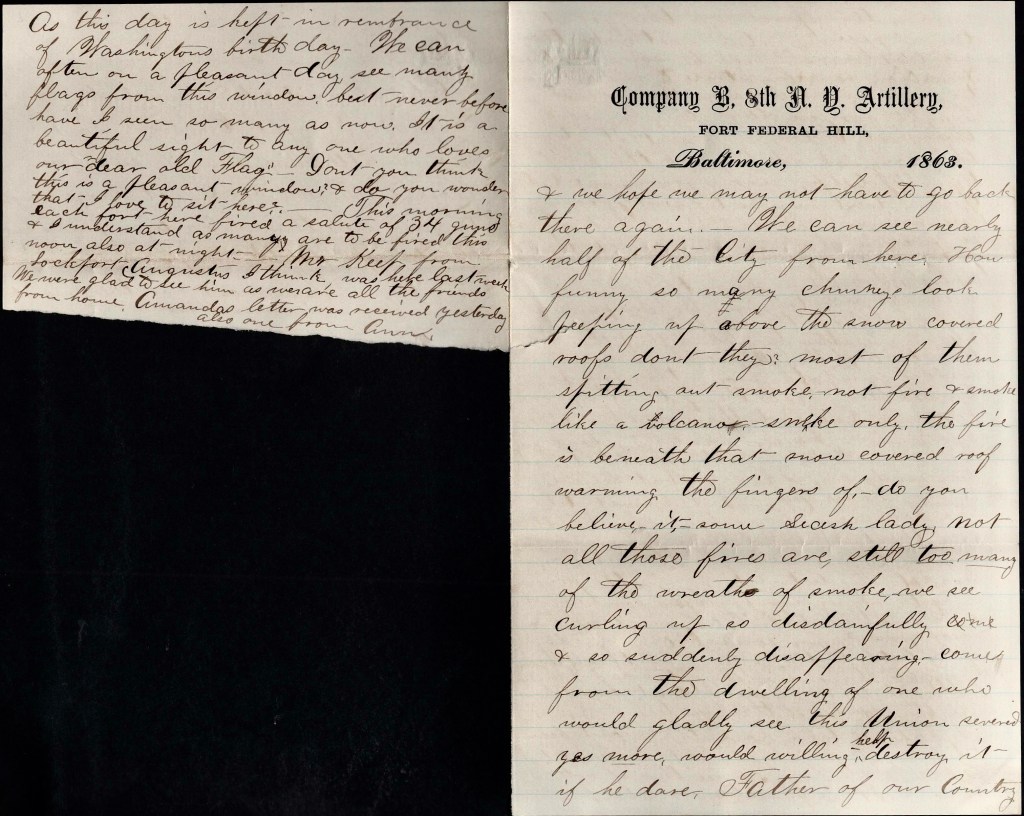
Company B, 8th New York [Heavy] Artillery Fort Federal Hill Baltimore, February 23rd 1863
Friend Hattie,
I have looked for your letter for some time. Still it has not come & thinking this morning it will never reach me, I have seated myself at one of our pleasant east windows to write again that you may soon have another debt to pay, such as writing a letter to a soldier. By the way, are such debts very hard to pay? I hope you do not consider them so.
How do you do this beautiful morning? I hope you are well. Also all the friends at the Falls. Are you very busy now? I think Amanda wrote me you were washing dishes & doing housework now days, or were when she wrote. Wouldn’t you like a little help occasionally? If so, I would like to be there to help you—especially to wash dishes for I think I have made a great proficiency in that branch of housework of late. Did Amanda ever tell you how we do that work here? I think all of us soldier boys would make great housekeepers if we stay in the army our three years.
Yesterday was a very snowy cold day. The snow commenced falling very early in the morning & it continued falling until almost night & the air was so cold we were glad to keep in doors all day. The snow is six or eight inches deep this morning but the sun is shining so brightly today I think it will soon leave us. I wish you could be here a little while this morning. Do you wish so too? Well may by your work for a little time & just imagine yourself here. Our seat is just wide enough for two. My friend Charlie is sitting by my side just now but he is a very accommodating boy & will willingly give you his seat. There, he has gone already & I didn’t say a word to him. Isn’t he very good to vacate the seat for you? After all that isn’t why he left but because Sergeant Burns says he with out er boys must go out and shovel snow—that’s the reason he is so accommodating just now.
Isn’t this a pleasant place? From this window you can see the bay and hundreds of vessels & boats sailing upon its waters. Some of them more sluggishly along just as though they had plenty of time & never meant to be in a hurry, while others go shooting and puffing as though the life of someone depended upon their great speed. Now and then a little tug comes up the bay making the water all foam & wave, and it looks more as though it were flying than anything else. From here we can see Fort McHenry and away and beyond it several miles away Fort Carroll. This is not finished yet, but will be a very strong fort when it is done. It’s built out in the bay nearly equidistant from either shore. Across the bay from Fort McHenry some three miles from here we see Fort Marshall & that little long row of buildings you see just outside the fort are barracks, a portion of which were Co. B’s quarters while we were there. It is not as pleasant there as here and we hope we may not have to go back there again.
We can see nearly half of the city from here. How funny so many chimneys look peeping up above the snow covered roofs don’t they? Most of them spitting out smoke, not fire & smoke like a volcano—smoke only. The fire is beneath that snow-covered roof, warming the fingers of—do you believe it”’some secesh lady. Not all those fires are, still too many of the wreath of smoke, we see curling up so disdainfully, come from the dwelling of one who would gladly see this Union severed. Yes more, would willing help destroy it if he dare. Father of our Country, where is thy spirit on this great day of rejoicing. Ah! methinks thou wouldst harshly rebuke some of those who are now trying to sever the union thou so nobly fought for in days gone by were thou here today. I think it strange that anyone should ever think of trying to destroy such a government as this. I don’t wonder the smoke from those chimneys is glad to get out of sight so quickly. I almost wonder it doesn’t put out the eyes of any who dare call themselves secesh.
Something like a week ago, our company took some Rebel prisoners from the depot to Fort McHenry & while we were marching them through the streets of the city, we heard many words of sympathy from the brave females here. How they pitied the poor prisoners. One lady gave a hurrah for Jeff Davis & I never wanted to shoot anyone so much in my life. Would it have been wicked if I had? I don’t believe it would have been. But I must tell you how some of our boys chuckled over the kindness of these friends. Several boxes of cigars were given to one of our sergeants to distribute among the prisoners & he thinking our boys knew how to smoke as well as they, distributed most of them among us, & for several days our boys would testify to the excellency of these cigars. I might have had some too had I wished but as I don’t smoke, I don’t know how good they were so the boys tell me.
I haven’t told you the most neautiful sight here yet. It is beautiful & I wish you could see this if nothing more. It is the stars & stripes so proudly waving in the breeze which we can see all over the bay and city. Hundreds and hundreds of flags are in sight. On every boat, big or little, one may be seen, even those little row boats not large enough to carry more than half a dozen persons have the “Star Spangled Banner” proudly waving over them. Then, most of the Unionists have a flag waving over their dwelling. I hope your letter will reach me next time & that you will write soon. With much love, I am your true friend, — Thomas
As this day is kept in remembrance of Washington’s birthday, we can often on a pleasant day see many flags from this window, but never before have I seen so many as now. It is a beautiful sight to anyone who loves our “dear old flag.” Don’t you think this is a pleasant window? And do you wonder that I love to sit here? This morning each fort here fired a salute of 34 guns & I understand as many are to be fired this noon, also at night. Mr. Keef from Lockport (Augustus) was here last week. We were glad to see him as were all the friends from home. Amanda’s letter was received yesterday. Also one from Ann.
The following partial letter is unsigned and though I can’t be certain of his identify, I suspect he was a member of the 85th New York Infantry, possibly from Rushford, Allegany county, New York. The 85th New York was known to be camped at Fort Warren in December 1861 and Charley Merrill of the 64th New York Infantry (mentioned in the letter) was from Rushford so he would have been known locally to the correspondents.
Transcription
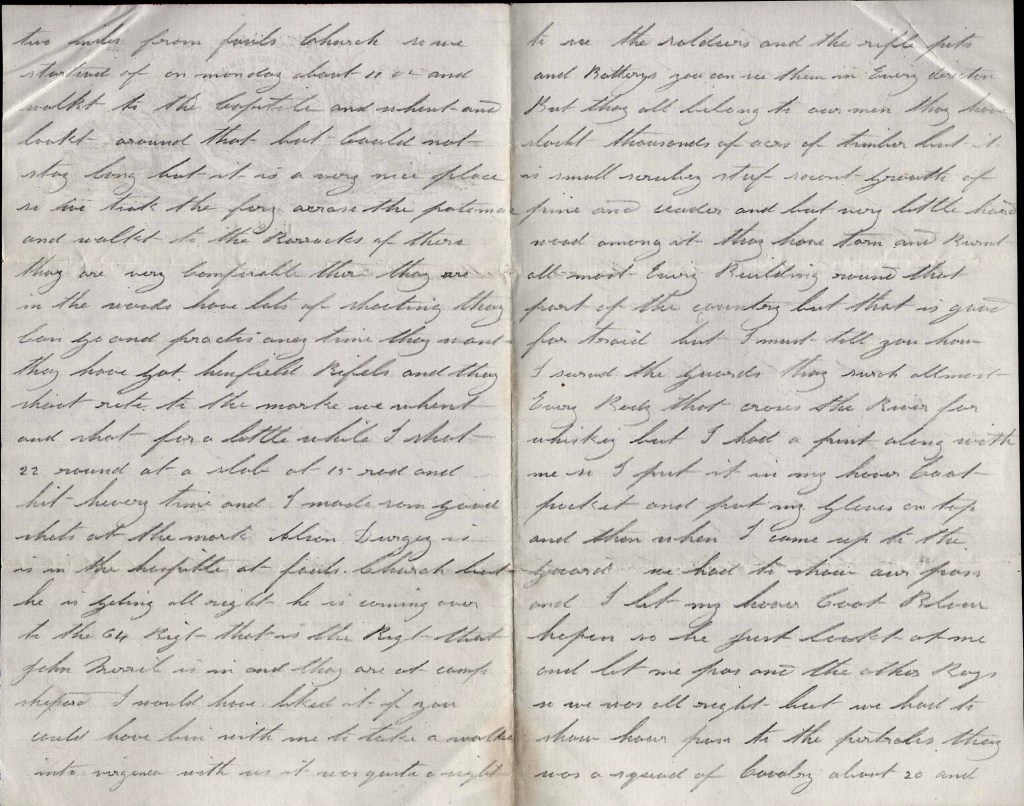
Camp Warren [Meridian Hill] Washington D. C. December 21, 1861
Dear Friend Ed,
I am happy to say that I received your letter last night and was very glad to hear that you are quite well and I hope that you had a good time with the girls but I am sorry to say that I don’t have much chance to have any fun with the girls here for I can’t get out. I had a pass last Monday for two days but Hank Merrill was out here with Otis Kingsbury and he had to go back on Sunday but I got them to stay till Monday and then I went back with them. They are about 12 miles from Washington at Upton’s Hill, two miles from Fall’s Church so we started off on Monday about 10 o’clock and walked to the Capitol and went and looked around that but could not stay kone but it is a very nice place. So we took the ferry across the Potomac and walked to the barracks up there. They are very comfortable there. They are in the woods, have lots of shooting. They can go and practice any time they want. They have got Enfield Rifles and shoot right to the mark. We went out and shot for a little while. I shot 22 rounds at a slab of 15 rods and hit every time and I made some good shots at the mark.
Alson Durgey is in the hospital at Fall’s Church but he is getting all right. He is coming over to the 64th Regiment—that is the regiment that John Merrill is in and they are at Camp Shephard. I would have liked it if you could have been with us. It was quite a sight to see the soldiers and the rifle pits and batteries. You can see them in every direction but they all belong to our men. They have slashed thousands of acres of timber land. It is small scrubby stuff recent growth of pine and cedar and but very little hard wood among it. They have torn [down]and burnt almost every building round that part of the country but that is good for trade but I must tell you how I served the guards. They search almost every rock that crosses the river for whiskey but I had a pint along with me so I put it in my overcoat pocket and put my gloves on top and then when I came up to the guard, we had to show our pass and I left my overcoat blouse open so he just looked at me and let me pass and the other boys so we was all right. But we had to show our pass to the patrols. There was a squad of cavalry about 20 and they have to stop people and see their pass.
A soldier can’t go about Washington without a pass and so you see that we have not got much chance to run around but after we got by them, we met a regiment of cavalry that was returning from a foraging party. They have been out to Fairfax Court House and had found one man there and he was drunk and very easy and they took him out and shot him but they brought mack 27 baggage wagons full of corn and hay and some cattle but my pass was dated from the 16th to the 17th but I wanted to stay longer so I turned the 7 into a 9 and that made it the 19th so I had a good stay and the guards could not tell the difference and Captain did not say anything so I had it all right.
Now Ed, about Zib Wheeler, I don’t think that it will pay to see him for I have not got any chance to go to town to do anything so you can tell him to kiss your ass for me. [rest of letter missing]
The following letter was written by Erskine Herbert Dickey (1841-1910) who served in Co. B, 1st New Jersey Light Artillery. His obituary notice informs us that he was born in Acworth, New Hampshire, but served in the 1st New Jersey Light Artillery during the war, taking part in “14 battles besides many other engagements.” In this letter to his friend, Erskine writes of Lincoln’s reelection, the hanging of Union deserters, and the prospects for war ending soon.
After the war he settled in Brooklyn and became a dentist.
Some of the veterans of Co. B, New Jersey Light Artillery at the regiment’s Gettysburg Monument.
Transcription
Addressed to Mr. Edward A. Warner, Acworth, New Hampshire
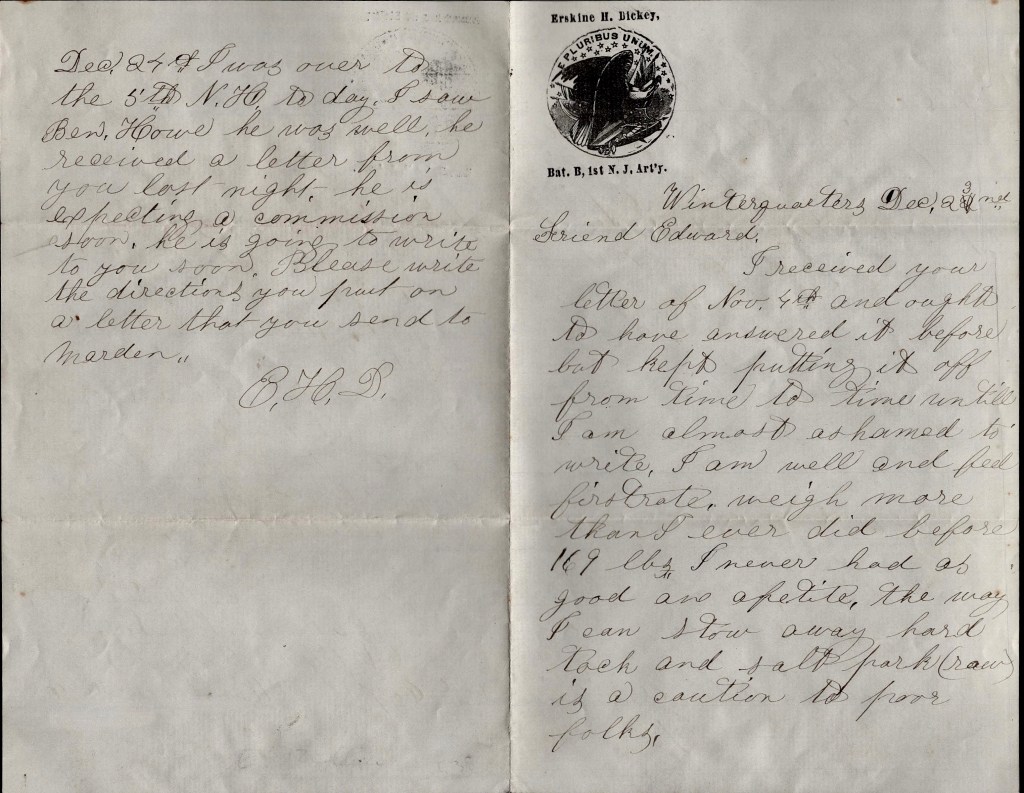
Winter Quarters [near Petersburg, Va.] December 23, [1864]
Friend Edward,
I received your letter of November 4th and ought to have answered it before but kept putting it off from time to time until I am almost ashamed to write. I am well and feel first rate, weight more than I ever did before 169 lbs. I never had as good an appetite. The way I can stow away hard tack and salt pork (raw) is a caution to poor folks.
Well, Ed, old Uncle Abe did get a healthy old majority didn’t he? And old Uncle Jeff is getting some pretty hard pills from Thomas & Sherman. And I think the old devil will die before he can digest them. And I think before spring you will either hear of the old gentleman’s death or of his leaving for a safer country.
The deserters from our army are getting just what they deserve. There was three hung last Friday which I see—the gallows stands within 20 rods of our camp. Four of them were from the 5th New Hampshire, two from the 7th New York. There is to be 21 more to be hanged at the same place. There will be three hung every Friday noon until the whole lot is finished and it serves them just right. When I see something worth sending, I will send it to you with pleasure.
Where is Ward now? I sent a letter to Frank sometime ago. This is about all the news. Write soon. From your friend, — E. H. Dickey
Battery B, 1st New Jersey (Artillery Brigade), 2nd Corps, Washington D. C.
December 27th. I was over to the 5th New Hampshire today. I saw Ben Howe. He was well. He received a letter from you last night. He is expecting a commission soon. He is going to write to you soon. Please write the directions you put on a letter that you send to Marden. — E. H. D.
The following letter was written by John Ingerson (1837-1913), the son of Alvin C. Ingerson (1815-1857) and Tirza A. Palmer (1816-1895) of Sycamore, Wyandot county, Ohio. John’s obituary, published in the Marion Star on 2 July 1913, states that he was a “veteran of the Civil War who was wounded and disfigured for life in the battle of Gettysburg…when a shell hit him in the face, cutting his upper lip and terribly disfiguring him.” He served three years and eight months; was with Sherman on his march to the sea. After the war, he followed the occupation of a farmer in Sycamore. John served in Co. G though his grave marker says “Co. C.”
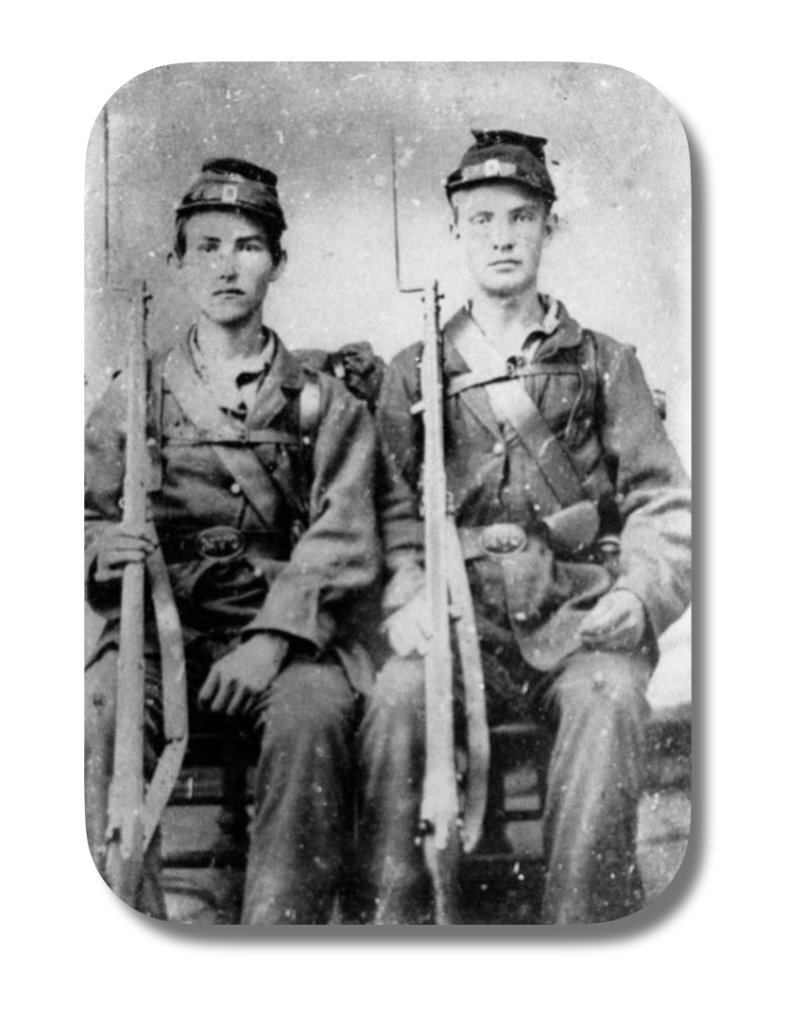
I could not find an image of John but here is a tintype of Winfield “Scott” Stevens (left) and Samuel Oscar Chamberlain (right) who were cousins and served together in Co. E, 49th Ohio Volunteer Infantry (OVI). Scott was wounded in the Battle of Stones River on 31 December 1862 and be discharged in May 1863. Samuel served out his entire term and reenlisted as a veteran.
Transcription
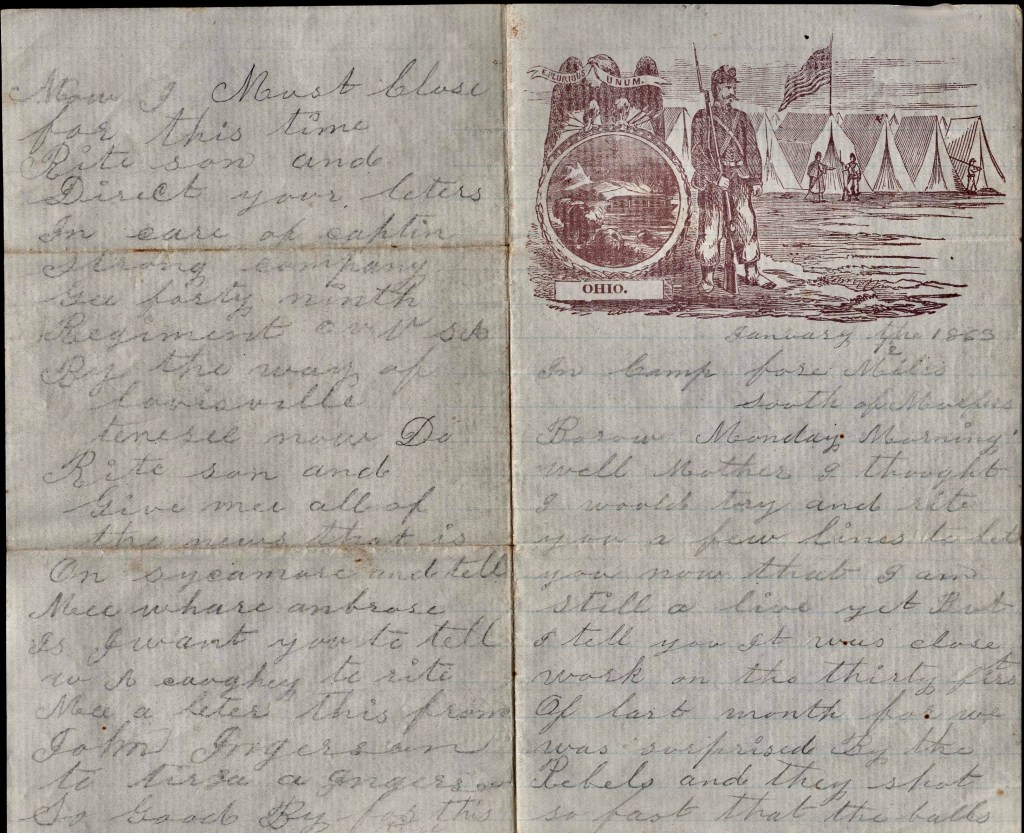
In camp four miles south of Murfreesboro, [Tennessee] Monday morning, January 12th 1863
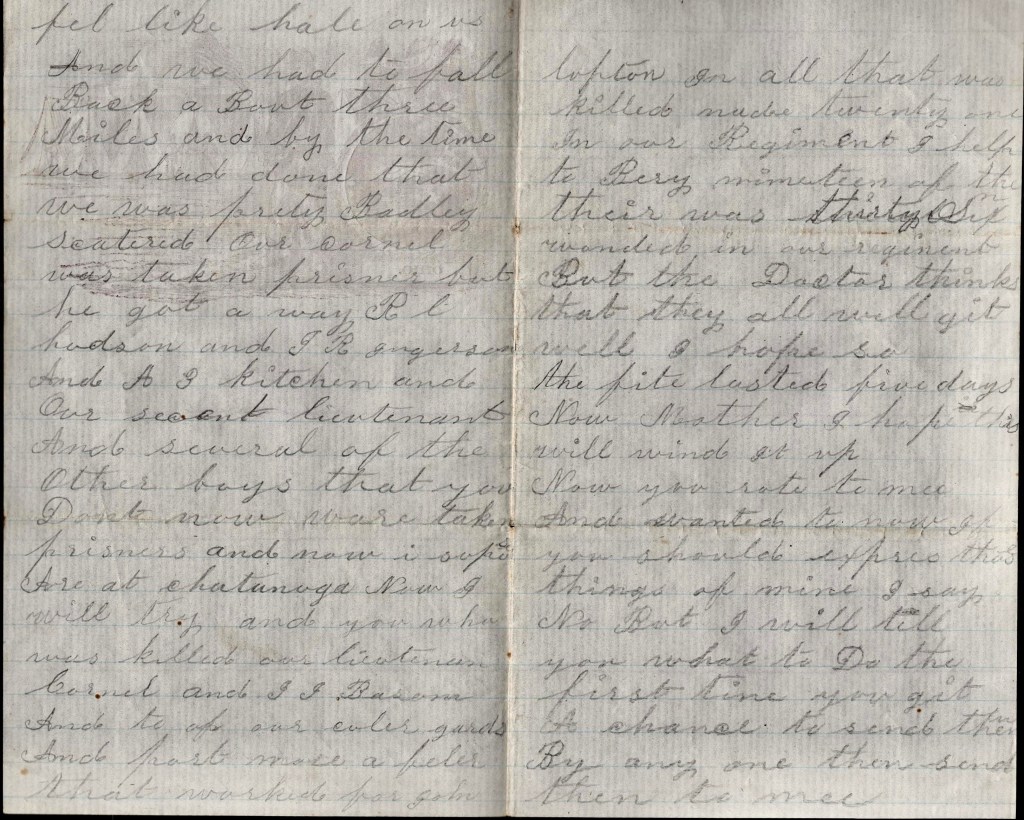
Well, Mother, I thought I would try and write you a few lines to let you know that I am still alive yet but I tell you, it was close work on the 31st of last month for we was surprised by the Rebels and they shot so fast that he balls felt like hail on us and we had to fall back about three miles and by the time we had done that, we was pretty badly scattered. Our colonel was taken prisoner but he got away. R. L. Hudson and J[ames] R. Ingerson and [Amos E.] Kitchen and our 2nd Lieutenant [Isaac H. White] and several of the other boys that you don’t know were taken prisoners and now is supposed are a Chattanooga.
Now I will try and [tell] you was killed. Our Lieutenant-Colonel [Levi Drake] and J[oseph] J. Basom and two of our color guards and Post Wate, a feller that worked for John Lofton. In all that was killed made twenty-one in our regiment. I helped to bury nineteen of them. There was thirty-six wounded in our regiment but the doctor thinks that they all will get well. I hope so.
The fight lasted five days. Now, Mother, I hope this will wind it up. You wrote to me and wanted to know if you should express those things of mine. I say no, but I will tell you what to do the first time you get a chance. Send them by anyone, then send them to me. Now I must close for this time. Write soon and direct your letters in care of Capt. [Luther M.] Strong, Company G, 49th Regiment Ohio Volunteers, USA, by the way of Louisville, Tennessee. Now do write soon and give me all of the news that is on Sycamore and tell me where Ambrose is. I want you to tell to A. Coughey to write me a letter. This from John Ingerson to Tirsa A. Ingerson. So goodbye for this time.
I could not find an image of Judson but here is one of his younger brother Pasqua who served in the same company. Pasqua was killed at Thompson’s Station in March 1863.
The following letters were written by Judson Lloyd Austin (1836-1924, the son of Isaac G. Austin (1812-1882) and Susan Ann Van Winkle (1812-1867) of Allegan county, Michigan. Judson wrote the letters to his wife, Sarah Elizabeth (Colburn) Austin (1843-1908).
Judson volunteered as a private in Co. B, 19th Michigan Infantry on 13 August 1862 and mustered out of the service on 26 May 1865. Enlisting at the same time and serving in the same company was his younger brother, Pasqua L. Austin (1839-1863) who did not survive the war. Pasqua was killed at Thompson’s Station, Tennessee on 4 March 1863.
The 19th Michigan was organized at Dowagiac and left for Cincinnati in mid-September 1862. After duty at Covington, they made the overland trip to Nicholasville by mid-November and remained there until moving on to Danville, Kentucky.
Letter 1
[Dowagiac, Michigan] September 5th 1862
Dear wife,
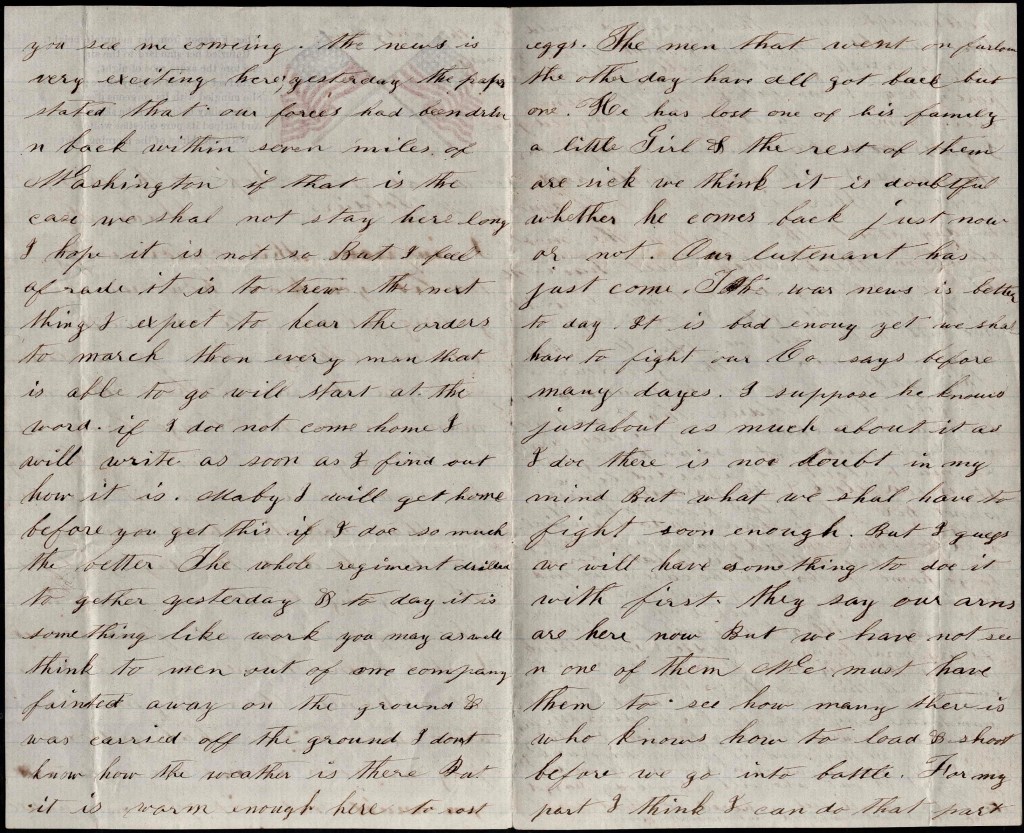
I improve this opportunity to let you know how we are getting along. We are well. at present. May these few lines find you the same. There has one man gone to his long home out of this regiment without hearing the sound of a cannon it was the one that had the chill when you was here. He died the day you left. We are going to be mustered in this afternoon at four o’clock. I shall come home then if I can get a chance. Our paymaster is also here so we shall get our pay as soon as we are mustered. You must not look for me until you see me coming.
The news is very exciting here. Yesterday the papers stated that our forces had been driven back within seven miles of Washington. If that is the case, we shall not stay here long. I hope it is not so but I feel afraid it is too true. The next thing I expect to hear the orders to march. Then every man that is able to go will start at the word. If I do not come home, I will write as soon as I find out how it is. Maybe I will get home before you get this. If I do, so much the better. The whole regiment drilled together yesterday & today it is something like work you may as well think. Two men out of our company fainted away in the ground & was carried off the ground. I don’t know how the weather is there but it is war, enough here to roast eggs.
The men that went on furlough the other day have all got back but one. He has lost one of his family—a little girl—and the rest of them are sick. We think it is doubtful whether he comes back just now or not. Our Lieutenant has just come. The war news is better today. It is bad enough yet. We shall have to fight, our captain says before many days. I suppose he knows just about as much about it as I do. There is no doubt in my mind but what we shall have to fight soon enough. But I guess we will have something to do it with fists. They say our arms are here now but we have not seen one of them. We must have them to see how many there is who knows how to load and shoot before we go into battle. For my part, I think I can do that part well enough now. The command would be the only thing that would bother me. I think that I could shoot a secesh just as well as I could a porcy hog. I can fetch me one of them every time or used to with my old gun. I guess I have written enough for this time. I will wait a little and see what is going on.
There is lots of talk among he soldiers today about the furlough. The most of them think they will have one at any rate. I don’t know how it will come out yet. I feel in hopes we all will have one. The Colonel has sent two men to the Governor of this state to see if he would consent to give all the soldiers that had not been home a chance to go. They have not got back yet so we know just as much about it as we did before.
It is four o’clock and the mustering officer is not here yet/ I don’t know what it means any more than you. do. I am inclined to think the old chap wants to keep us waiting here until it is too late for us to go home. If that is the case & we find it out to be a fact, I guess there will be some kind of a row kicked up among some of us so we will get a chance to go home. As a general thing we soldiers don’t think much of these big men. Our big men are the cause of all this trouble or have been & seem yet to be by the way things work. They don’t seem to care anymore about a soldier’s life than we do of a mosquitoes. They have got the thing to going & all they want us just to have us boys fight it out on our own expense. If we do not fight it out, who will? Somebody has got it to do. We all feel assured of that fact. If it is not whipped out, what will?
Letter 2
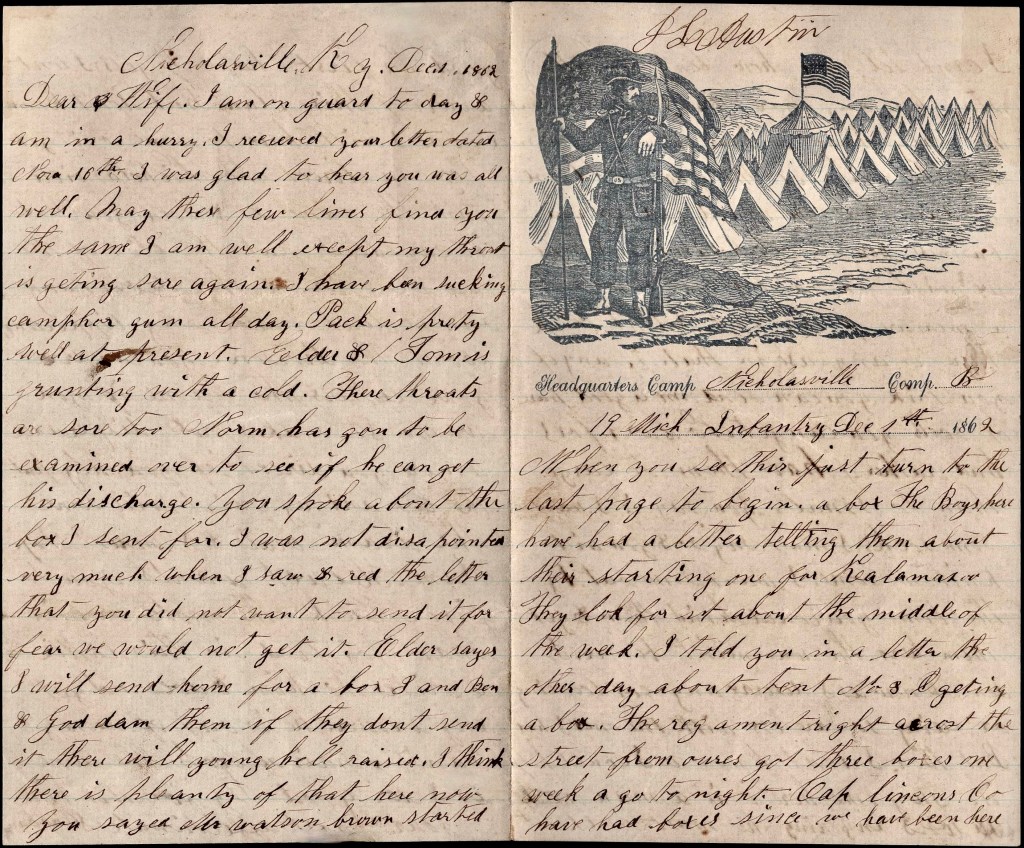
Nicholasville, Ky. Co. B, 19th Michigan Infantry December 1st 1862
Nicholasville Ky
Dear Wife,
I am on guard today & am in a hurry. I received your letter dated November 16th. I was glad to hear you was all well. May these few lines find you the same. I am well except my throat is getting sore again. I have been sucking camphor gum all day. Pack is pretty well at present. Elder & Tom is grunting with a cold. Their throats are sore too. Norm has gone to be examined over to see if he can get his discharge. You spoke about the box I sent for. I was not disappointed very much when I saw & read the letter that you did not want to send it for fear we would not get it. Elder says I will send home for a box I and Ben & God damn them if they don’t send it. There will (be) young hell raised. I think there is plenty of that here now.
You said Mr. Watson Brown started a box. The Boys here have had a letter telling them about their starting one for Kalamazoo. They look for it about the middle of the week. I told you in a letter the other day about tent No 9 getting a box. The regiment right across the street from ours got three boxes one week ago tonight. Capt. Lincoln’s company have had boxes since we have been here.
I cant tell you how long we will stay here any more than you do but the only thing we hear is we will winter here. The officer of the guard told me today that we would end our war business here in Nicholasville. I hope we will. You wanted me to send me a measure of my foot. I dont think there is any use in that. If any of you think you can send me a good pair of boots, you can get no. 8 or 9 for I had rather have them too large than to small. You say if I want some socks, I must say so & you will knit me some. I want some, but by the time you could knit them & get them here, the war might be over. I don’t know as I deserve any for losing or being so careless with the ones I had, but then I don’t know as I could help it. The game here is if a man loses anything, he must make it good the first chance he gets. I don’t approve of this plan, but don’t know but I will have to come to it yet.
You can direct to Nicholasville just the same as I told you but be careful & put the no. of the reg & letter of the company on. It don’t make any difference about the division. You can direct your letters the same if you want to. It makes no difference where you direct if you only put the company and regiment on, it will come.
The drum beats & I must stop. Sam Hewett wants you to give Mack the note or line that you find in this letter he writes to him & does not get any answer. He is out of money & wants a pair of boots the same as I do. Goodbye for this time. Your most affectionate husband, — J. L. Austin
The following letters were written by John W. McClain (1834-1863), a barely literate private in Co. E, 2nd Ohio Cavalry. He was the son of Edward McClain (1792-1857) and Flora Fish (1812-1887) of Trumbull county, Ohio. According to Find-A-Grave, John died of “sunstroke” on 9 August 1863 at Fort Scott, Kansas. John had two other brothers who died in the Civil War, Robert T. McClain (1841-1864) and Richard H. McClain (1843-1864).
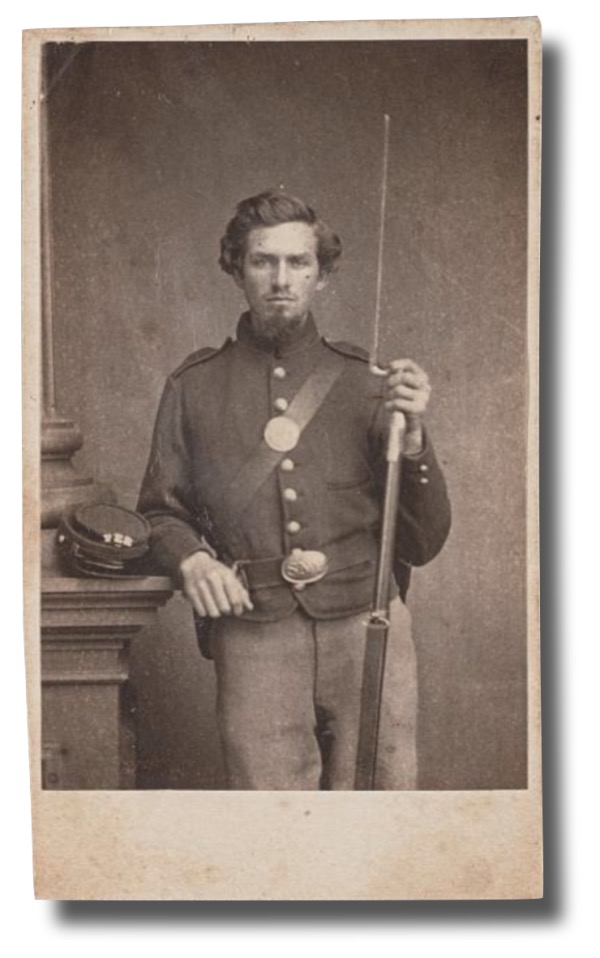
I could not find an image of John but here is one of Isaac L. Peirce of Co. B, 2nd Ohio Cavalry. (ancestry.com)
The soldiers of the 2nd Ohio Volunteer Cavalry Regiment came from Ashtabula, Columbiana, Cuyahoga, Geauga, Hamilton, Lake, Loraine, Mahoning, Medina, Portage, Richland (and neighboring counties), Summit, and Trumbull Counties. The 2nd O.V.C. was organized for three years’ service under Colonel Charles Doubleday, and afterwards commanded by Colonels Kautz, Nettleton, and Seward. Soldiers were mustered in from August to September of 1861 and trained at Camp Wade near Cleveland and Camp Dennison near Cincinnati. Nicknamed the “Wade and Hutchins Regiment” after Ohio Senators Ben Wade and John Hutchins who instigated the formation of the regiment, the 2nd O.V.C. moved to Missouri, scouting on the borders of Kansas, and in February 1862, drove the infamous bandit William Quantrill and his raiders from Independence, Missouri. In the summer, the 2nd O.V.C. served in Indian Territory, and in the fall joined General Blunt’s campaign in Arkansas and Missouri, fighting at Pea Ridge, Carthage, and other points. It moved to Kentucky, and four companies raided East Tennessee. It joined in the pursuit of Confederate General John Hunt Morgan and followed him twelve hundred miles until captured. In September, the Regiment again raided East Tennessee and operated on Longstreet’s flank at Knoxville, fighting continuously with severe loss. In April 1864, it was transferred to the Army of the Potomac with Ulysses S. Grant, and moved with Grant’s army towards Richmond, fighting with Sheridan’s Cavalry Corps around the flanks of the army. In August the Regiment moved to the Shenandoah Valley and engaged Early, fighting at Opequan, Front Royal, and Cedar Creek. In March 1865, it joined in the pursuit of Confederate General Robert E. Lee, and after the surrender was reviewed at Washington and mustered out September 11, 1865. The 2nd Ohio Volunteer Cavalry Regiment made one of the most brilliant records of any regiment in the service.
Letter 1
Patriotic stationery “Pillar of Glory”
Fort Leavenworth February 19, 1862
Dear brother,
I take this opportunity to inform you that I received your letter yesterday and was pleased to hear that you was all well and doing well for that is all that can be expected for that is my style every time. As I have wrote to you but a few days ago, I have but very little to write this time. All I have to write is that we are all well and doing well as we can. We arrived here last Saturday about three o’clock in the afternoon and found good quarters for our horses but none for ourselves until dark when we found a mess room where a company of Hunter’s bodyguards messed which was very comfortable for us. But perhaps it would not appear to be so to everyone as it would to us but we are now tented out in tents which are as handy as a pocket in a shirt. We have a stove in each tent which will keep them as warm as there is a need for. This is the coldest place ever I stuck my head in. The wind will cut a fellow’s throat if he should be compelled to face it.
We are waiting to get the orders to march but we know not where. We have been told by our officers that we was to move on to Fort Scott but we know not where we have to go but direct to this place and it will be all right. — J. W. McClain
Letter 2
Fort Leavenworth, [Kansas] March 2, 1862
Dear friends,
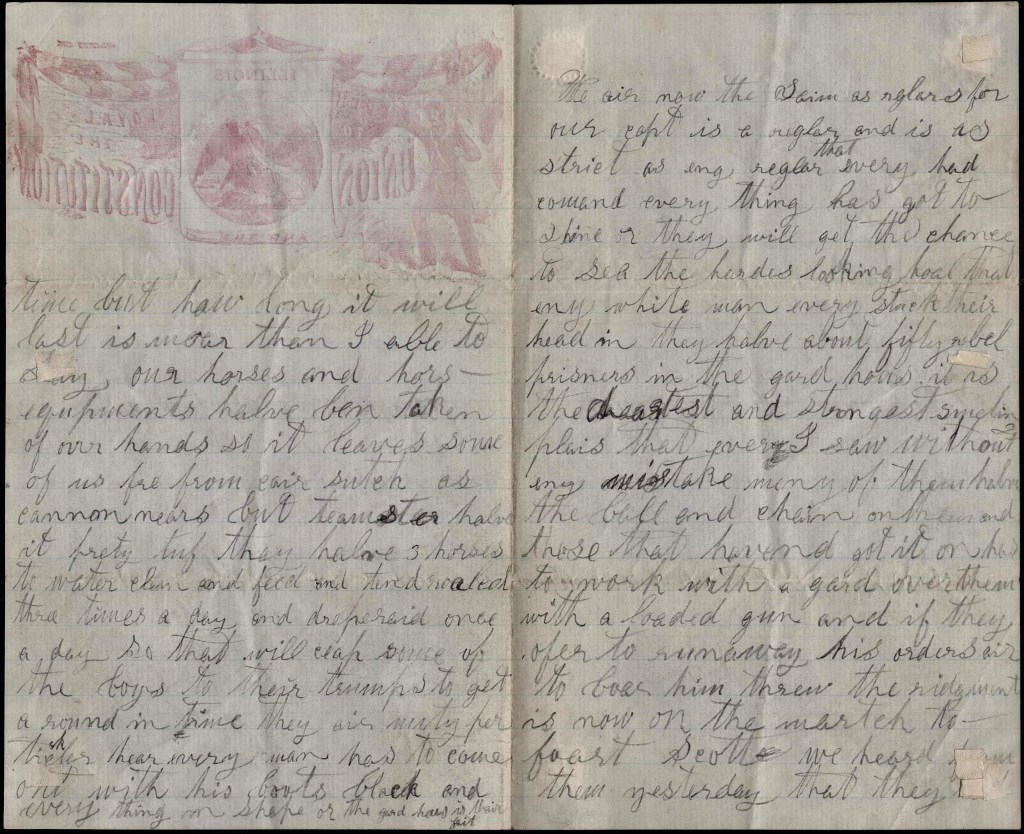
I take the opportunity to inform you that I am well and doing the best I can for the chance I have. I have changed my position since I last wrote to you. I suppose you have seen a detail made in the regiment to form a battery. There are twelve men taken from each company. We have the privilege to volunteer and if they couldn’t get volunteers in the Co., they should half to detail them. So rather than be detailed, I volunteered and we are quartered in nice barracks and are having a good time. But how long it will last is more than I [am] able to say. Our horses and horse equipments have been taken off our hands so it leaves some of us free from care, such as cannoneers, but teamsters have it pretty tough. They have three horses to water, clean and feed three times a day, attend roll three times a day, and dress parade once a day so that will keep some of the boys to their trumps to get around in time. They are mighty particular here. Every man has to come out with his boots black and everything in shape or the guard house is their fate.
The are now the same as regulars for our captain is a regular and is so strict as any regular that ever had command. Everything has got to shine or they will get the chance to see the hardest looking hole that any white man ever stuck their head in. They have about 50 rebel prisoners in the guard house. It is the dirtiest and strongest smellin’ place that ever I saw without any mistake. Many of them have the ball and chain on them and those that haven’t got it on has to work with a guard over them with a loaded gun and if they offer to runaway, his orders are to bore him through.
The regiment is now on the march to Fort Scott. We heard from them yesterday that they were in Kansas City last Thursday. This is all at present. I will send you a paper. Perhaps you would like to read one of the Kansas papers. When you write, direct to John W. McClain, Hollister Battery, Fort Leavenworth, Kansas
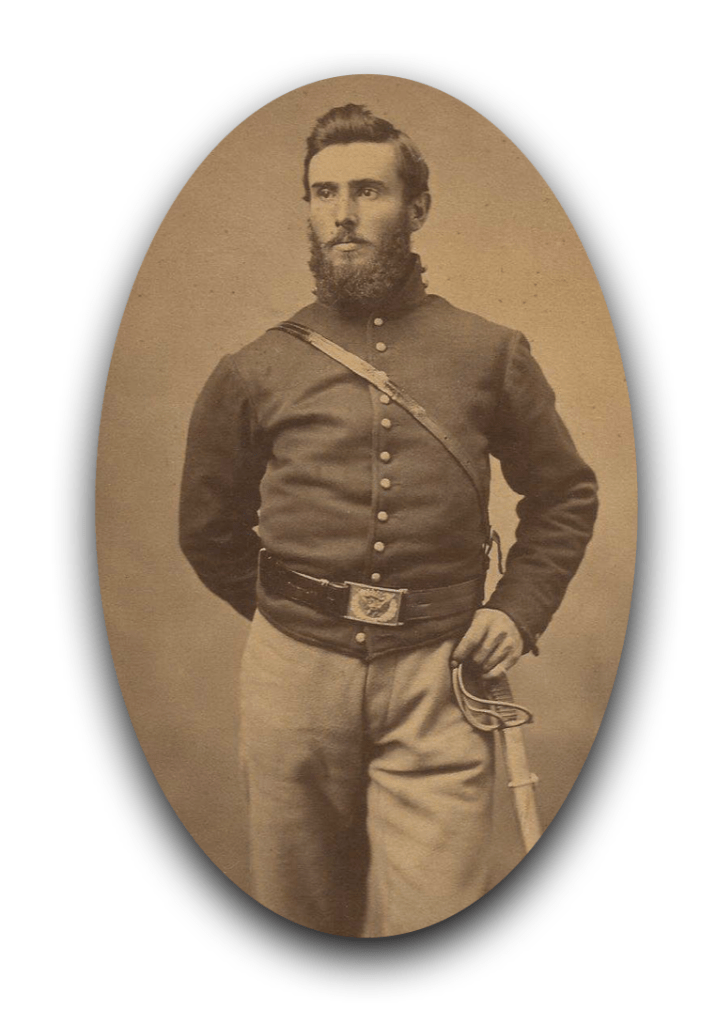
An unidentified member of the 44th New York Infantry (“Peoples Ellsworth Regiment), LOC
The following letter was written by William Eckerson, Jr. (1835-1864), the son of William Eckerson (1803-Aft1860) and Jeanette Miller (1818-1891) of Seward, Schoharie county, New York.
William enlisted as a private in Co. I, 44th New York Infantry in October 1861. During the 2nd Battle of Bull Run, William was taken prisoner on 30 August 1862. The date of his exchange is not given but later, during Grant’s Overland Campaign in 1864, after fighting at Cold Harbor, William was posted on picket on the night of 3 June and was killed instantly by a sniper’s bullet about 9 o’clock. He was buried on the battlefield by his comrades.
To read other letters I’ve transcribed by members of 44th New York Infantry and published on Spared & Shared, see:
Addressed to Miss Catharine Shaffer, Gardnersville, Schoharie county, New York
44th New York Volunteers Camp before Yorktown, Va. April 26th 1862
Dear Cousin,
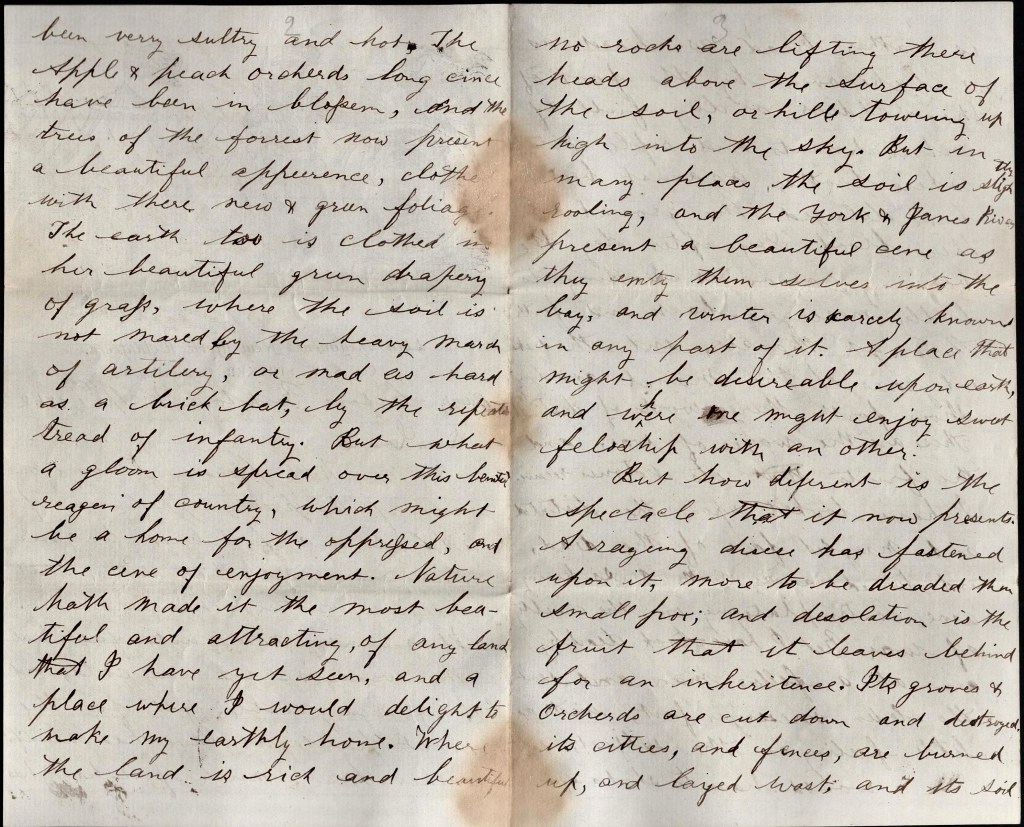
With pleasure I avail myself of the present opportunity of addressing a few lines to you, this being the third letter that I have written this morning. It is raining now quite fast and the wind is east and cold and very disagreeable. Yet for the most part, we have had beautiful weather here, much of which has been very sultry and hot. The apple and peach orchards long since have been in blossom and the trees of the forrest now present a beautiful appearance, clothed with their new and green foliage. The earth too is clothed in her beautiful green drapery of grass where the soil is not marred by the heavy march of artillery or made as hard as a brick bat by the repeated tread of infantry. But what a gloom is spread over this beautiful region of country which might be a home for the oppressed and the scene of enjoyment. Nature hath made it the most beautiful and attracting of any land that I have yet seen, and a place where I would delight to make my earthly home where the land is rich and beautiful. No rocks are lifting their heads above the surface of the soil or hill towering up high into the sky, but in many places the soil is slightly rolling and the York and James rivers present a beautiful scene as they empty themselves into the bays and winter is scarcely known in any part of iy—a place that might be desirable upon earth and where one might enjoy sweet fellowship with another.
But how different is the spectacle that it now presents. A raging disease has fastened upon it, more to be dreaded than small pox; and desolation is the fruit that it leaves behind for an inheritance. Its groves and orchards are cut down and destroyed, it cities and fences are burned up and laid waste; and its soil is either tread as hard as a bake oven by the foot of the soldier or dug full of entrenchments and rifle pits, where brother against brother have deluged the ground with their blood. Day after day the booming cannon is sending its deadly messengers back and forth through the air, and the shrieks and groans of the maimed and dying show forth their work of destruction. These are the wages of war, and the fruits that its victories receive.
I have looked upon the distorted and mangled face of the dead and turned away with a sickening awe, contemplating on the cruelty of war. Yet I have took deadly aim at a fellow man and sent the leaden messenger forth with as little feeling on the subject as one would have to shoot a squirrel. I have stood before the rattle of an enemy’s musketry and faced the mouth of the blazing cannon, when the bombs have burst and the pieces flew all around me, and the bullets whizzed past my head like hail, yet I felt nearly as secure from their harms as you do perhaps in your own peaceful dwellings. Yet when I have been alone and though on these things, I have wondered how it could be that one should be so fearless in the face of danger, and composed as it were right in the arms of the Angel of Death. Yet when I remember that God takes care of his creatures and that those that put trust in Him shall not be confounded, then I see how it is that a man can be fearless in the midst of danger, when the shafts of death are thrown around him.
I learned a few days ago that Emory A. Shaffer was dead! You can imagine the shock when the words fell on my ear. Thinks I, how can that be? Emra dead?! When we left Albany, none bid more fair to go through the war than he & I trusted that we should share the perils of war together, and one at least be left to tell the story over when the war should come to a close. Yet he has gone and that by the hand of disease, before he had a chance to fight his country’s battles, and I am left to go without him. He was a soldier beloved and respected as a man, and we trust that he has found a home in heaven—that land of peace where the weary are at rest. So dry your tears and live to meet him & dear old Aunt Rebecca in that better and heavenly land. We too must pass the chilling river, and perhaps it will be my lot very soon. Yet I shall rejoice in the hope of the glory of God. Be of good cheer for heavenly mansions await those that love our Lord, and He will comfort those that put their trust in Him. Were it not for this consolation, my life would be a dreary one, exposed daily to the shafts of the enemy.
I have seen many rough and tedious marches since we left Halls Hill and traveled many a day like this in the rain and mud. I have traveled over the fields of Centerville & Bulls Run, saw the smoke of Manassas as the rebels retreated from it and many other things which it would take me too long to narrate at this time, or merely hint at, for it would fill many sheets of paper. But I must skip over a long train of events till I come to the siege of Yorktown and then bring my letter to a close as I have already written more than I intended to when I commenced my first sheet. Yet I must write about a few things that happened though I shall have o commence on another sheet to get it all on.
While walking about the forts at Centerville, I saw a big log in one of the holes pointing to the place in which we came in, and made to represent a large cannon at a distance. Supposing perhaps that our artillery would fire at it and so waste their shots for naught before finding out the mistake. But it so happened that they marched right up into Centerville without firing a gun, and took some secesh prisoners who were unable to escape. They left us good quarters to go into which they in their haste to evacuate did not have time to destroy. The most sickening scene that I saw there was human skulls laying ever since the Bulls Run battle.
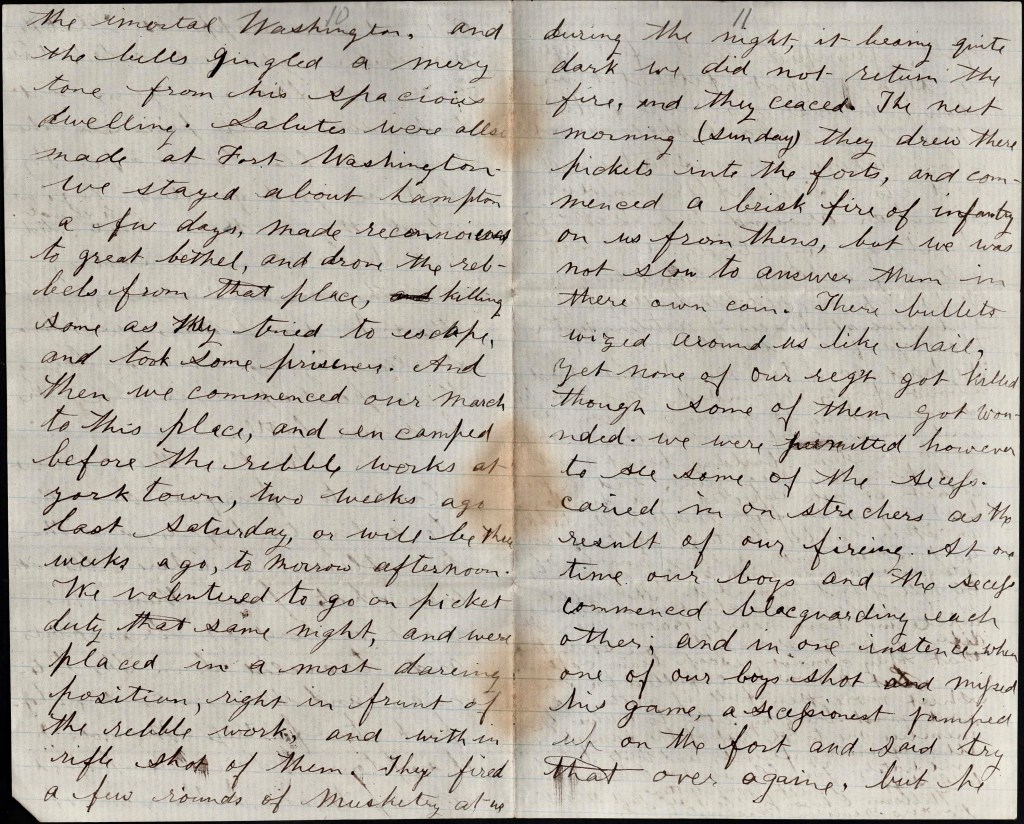
We then went back to Fairfax and then to Arlington Heights and then to Alexandria where Ellsworth was shot. From there we went on board of transports and traveled down the Potomac and then into the Chesapeake to Fortress Monroe & Hampton. When we passed Mount Vernon, I thought of the immortal Washington and the bells jingled a merry tone from his spacious dwelling. Salutes were also made at Fort Washington. We stayed about Hampton a few days, made reconnoissance’s to Great Bethel, and drove the rebels from that place, killing some as they tried to escape, and took some prisoners. And then we commenced our march to this place and encamped before the rebel works at Yorktown.
Two weeks ago last Saturday, or will be three weeks ago tomorrow afternoon, we volunteered to go on picket duty that same night and were placed in a most daring position, right in front of the rebel works and within rifle shot of them. They fired a few rounds of musketry at us during the night. It being quite dark, we did not return the fire and they ceased. The next morning (Sunday) they drew their pickets into the forts and commenced a brisk fire of infantry on us from them but we was not slow to answer them in their own coin. Their bullets whizzed around us like hail, yet none of our regiment got killed though some of them got wounded. We were permitted, however, to see some of the secesh carried in on stretchers as the result of the firing. At one time our boys and the secesh commenced blackguarding each other and in one instance when one of our boys shot and missed his game, a secessionist jumped up on the fort and said try that over again, but he fell, jumped and fell again. A second shot fetched him down to rise no more.
During this day, a bomb shell burst close where I was stationed and its missiles flew in every direction around me without hurting anybody. On Saturday all day a heavy cannonading was kept up, one rebel battery captured and several pieces of artillery with the loss of considerable many men. We had some ten men killed and about forty wounded. More or less skirmishing is going on every day and more or less men killed while we have been building breastworks and planting siege guns. And a grand attack is now expected in a few days. Last night the 5th Massachusetts Regt. took another rebel battery, captured some 40 prisoners with a large number of stands of arms, with a loss of about 50 killed and wounded. The rebels at this place are about 100,000 strong while we have nearly 180,000 men at different points around htem so we think they cannot escape being captured.
But I now have filled another sheet more than full and must bring my letter to a close. Remember me to the rest of the family & all enquiring friends and write to me immediately. Your cousin, –Wm. Eckerson, Jr. to C. Sheffer.
Direct your letters to William Eckerson, Jr., Co. I, 44th Regt. N. Y. V., Porter’s Division, Washington D. C.
The following letter was written by Evelina Margaret Harris (1820-1897), the daughter of Henry Tate Harris (1787-1845) and Mary Woods (1788-1875). She married her cousin Albert Wagstaff Harris (1814-1880) in October 1851 and was living in Roberts Mill, Nelson county, Virginia, when she wrote this letter in June 1862.
Evelina addressed her letter to her older brother, Henry St. George Harris (1816-Aft1880). In the 1860 US Census, Henry was enumerated near New Caton, Buckingham county, Virginia, where he had a large plantation and owned 54 slaves. After the war, Henry applied for a Presidential Pardon claiming that he was always a Union man at heart and would have gladly accepted Lincoln’s proposal for a gradual emancipation as a “basis for compromise.”
Transcription
Robert’s [Mills] June 24, 1862
My dear Brother,
I received your kind letter a few days ago and was glad to hear that you and family were well. I heard from Mama yesterday by Mr. Wailes who was at court and said he stopped Sunday night at Dr. Watson’s and Mama was there and very well. She attended preaching the same day. Mary has just returned from her Papa’s. She spent a week with them. I have not seen her since she returned. It is now difficult to get horses to go visiting much. I have postponed my visit to Covesville [Albemarle county] much longer than I intended but I still hope to go in a few days.
We have had very severe rains in this neighborhood. The water courses higher than they have been for twelve years and doing some damage to the crops. Some persons in this neighborhood have commenced harvest. It is thought the wheat crop is very indifferent. Mr. Wheeler was at court yesterday getting corn for the soldiers.
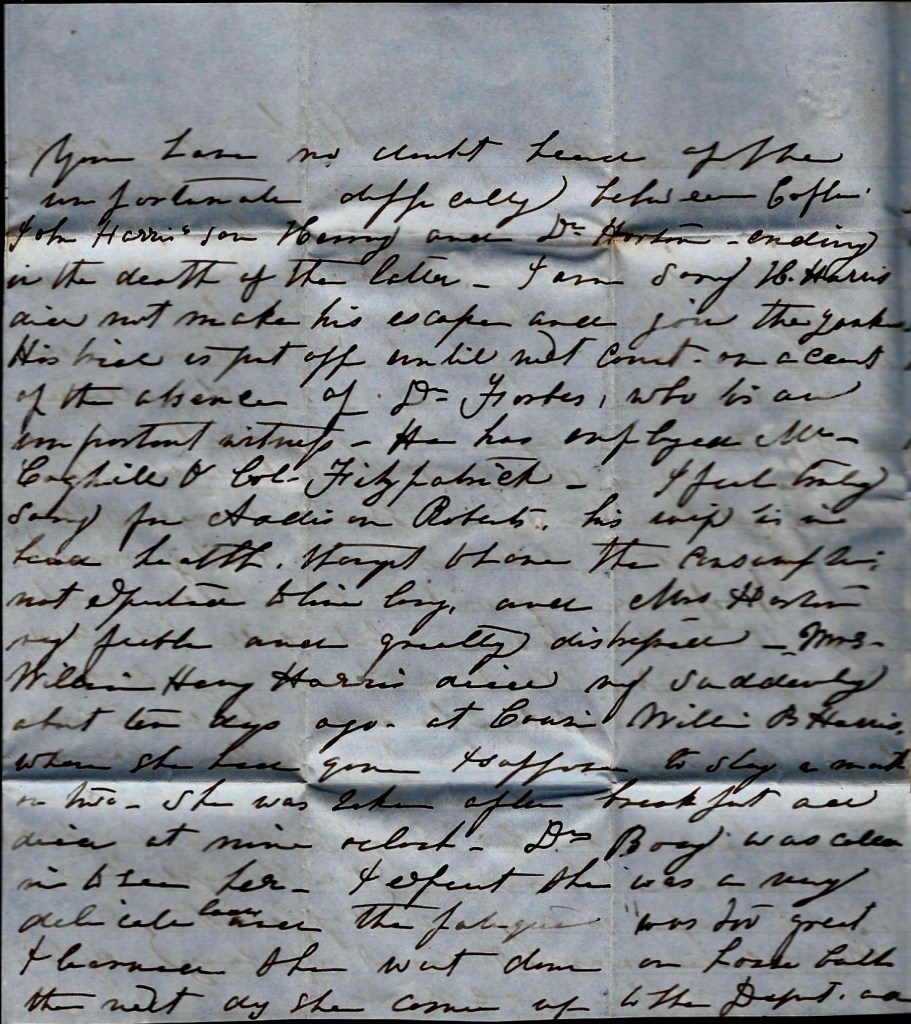
You have no doubt heard of the unfortunate difficulty between Capt. John Harris’s son Henry and Dr. Horton ending in the death of the latter. I am sorry Henry Harris did not make his escape and join the Yankees. His trial is put off until next court on account of the absence of Dr. Forbes who is an important witness. He has employed Mr. Coghill & Col. Fitzpatrick. I feel truly sorry for Addison Roberts. His wife is in bad health—thought to have the consumption, not expected to live long—and Mrs. Horton very feeble and greatly distressed.
Mrs. William Henry Harris died very suddenly about ten days ago at Cousin William B. Harris’ where she had gone I suppose to stay a month or two. She was taken after breakfast and died at nine o’clock. Dr. B__ was called in to see her. I expect she was a very delicate lady and the fatigue was too great & learned she went down on [ ] the next day she come up to the depot and on Sabbath attended church. Mrs. Ames spent Monday with her and she was very well Tuesday morning after breakfast.
I heard Aunt Rebecca’s son Henry was quite sick with the measles. Cousin George’s health has improved some. He still thinks he has dropsy but I hope he will recover. He is a [ ] manager. He is having all his servant’s clothes spun & [ ] at home with Mrs. Woody’s [ ]. Our overseer, Mr. Hamill, has left for C___ Shepherd’s. We are without any at this time. Albert has employed a Mr. Nash for next year at $175 dollars. He says he is afraid he will not hold out to [ ] to business and thinks it best to employ one. Col. [Alexander] Fitzpatrick is busy collecting suitable things to send the sick and wounded soldiers in Charlottesville. It is the first call that has been made on this neighborhood for assistance for them. Some of neighbors were killed in the late battles near Richmond. I expect the next battle will be an awful one.
I must conclude my letter by sending my love to Lide, Mary, and Ada, and the little children. You must come over. You ought to have time by when you were in the court was too near not to come. Your affectionate sister, — Evaline M. Harris
We are all well.
Albert says horses are very high and scarce in this country. The most indifferent looking horse sells at two hundred dollars. He says he needs horses but it is almost useless to buy as they will be pressed into service. I think the country will be ruined if this is a long war.





















 Spared & Shared 23