My passion is studying American history leading up to & including the Civil War. I particularly enjoy reading, transcribing & researching primary sources such as letters and diaries.
The following letter was written by James Alfred Jones (1824-1864), the son of Elias Jones (1797-1876) and Lydia Sweet (1802-1885). At the time of the 1860 Census, James was enumerated in Delavan, Tazewell county, Illinois, with his wife, Harriet (Hohton) Jones (1836-1903), and made a living as a medical doctor. Their first child Mary was born in 1857; their second child Minnie in 1861.
Jones was mustered in for 3 years into F&S, 115th Illinois Regiment Infantry on 3 October 1862 at Springfield as an Assistant Surgeon.
Isaac Royse, a 2nd Lieutenant in Co. E, wrote a history of the 115th Illinois Volunteer Infantry, published in July 1900. In it, he describes the events that led to James Jones death on page 215:
Very early on the morning of 11th July (probably 9th July 1864) a report was brought in by a citizen that a band of rebel guerrillas were crossing the country west of town (Tunnel Hill, Georgia) apparently intending to cut the railroad bridge about 2 miles north of the town. The Colonel at once ordered Lt. Royce with Company E to make double-time up the railroad and, if possible, intercept them. It was scarcely sunrise when the company reached the point of expected mischief, just in time to see the Confederates scampering up the hill to the right…The company at once made pursuit, but with the usual disadvantages of infantry trying to follow cavalry. Their route led over the hills to the valley east of the village, when it was learned that the rebels had made their escape after murdering Dr. Jones. Not knowing the nearness of the enemy the doctor with a few assistants, all of them armed, had hurriedly gone to the pastures in the valley to bring in the regimental horses that were out there grazing. As they were hastening towards camp with their charge the rebel band came dashing into the valley right upon them. Determined to make his escape if possible, Dr Jones put spurs to his horse and as he was riding at full speed attempted to make his horse leap a wide, deep ditch. It was wider than he had counted upon and his horse fell heavily against the opposite bank. While struggling to free himself the rebels overtook him and, though seeing his helpless condition, fired upon him, inflicting wounds from which he died soon after. After taking all the horses they could catch and capturing one or two men the rebels hastily left the Valley – going south east – just in time to avoid a contest with Company E which was rapidly approaching.
Harriet Jones was awarded a widows pension of $17 per month on 15thSeptember 1866 which was increased in September 1868. Harriet remarried in January 1869 to William J Scott and made a successful application for minors’ pensions for her two children in July 1869. The hearing was in front of a local Justice of the Peace in Tazewell County where an affidavit relating to the death of James Jones was provided by Captain Reardon of the 115th Illinois Infantry.
I am again seated under my tent fly as my only shelter to write to you. It rains, and has dine [so] for three days. Nonetheless I remain dry and comfortable as one in the army need to. I am well and as long as I continue so, I can scarcely have any cause of complaint, even though I should be called upon to undergo hardships and privations for a time.
I received your letter of the 28th on the 10th and though I wish they were not so long coming, I think they come as soon as could reasonably be expected under the circumstances. I fear that my letters to you are much longer in reaching you owing to difficulty in getting them off from Chattanooga. I received a letter from father this week. They are all well amongst brothers and sisters there. Brother Danford has been drafted, but when father wrote, he had not decided whether to go into the service or pay the commutation money.
I hope you may have a good time with Margaret & I am glad I am absent for I think you will enjoy her visit much more than if I were at home. I hope she will make you a good long visit.
We remain in camp just where we were when I wrote to you last, but we are expecting to be removed to the other side of the river soon. Rosecrans is reorganizing the army and aggregating the old brigades and we will now be in a brigade of about ten regiments under command of Gen’l. [James B.] Steedman and take position in Sheridan’s Division. I prefer remaining on this side of the river until the railroad is in operation to this place as forage is scarce and our horses fare much better here than on the other side. The roads, just at this time, are very bad in consequence of the rain, but a few days sun will soon dry them up and make them good again.
Since writing to you there has been no fighting though the rebels have been trying to hinder our supply trains by shooting our teams across the river, about six miles below here at a point where the road runs along the river bank, but we have planted a couple of guns there and shelled them out, and will have no difficulty in keeping them away in the future.
The rebels have had two battles among themselves within a few days, near enough to us so that we could distinctly hear the sound of their cannon, and it is reported at headquarters that their battles were really bloody ones, which I hope may be the case, for one of their battles will be as good as two of ours, as the loss will be all on one side, while we are unhurt. 1
Both sides have undoubtedly been largely reinforced but with the present state of the weather, there is no possibility of another engagement for some time, and in my opinion there will be no more fighting at Chattanooga, and the chances are pretty goo I think for us to remain in this vicinity for a good while unless we fall back to save transporting our supplies so far over bad roads.
Since commencing to write, it has stopped raining and the sun is now shining out beautifully for the first time for three days. I think the river here will raise rapidly after this rain so that the rebels will have no chance of crossing again at the fords, and we will consequently be troubled no more with raids upon the railroad in our rear, while we will have no difficulty in throwing over as many pontoon bridges as we may need. Our supplies are our only difficulty, and I shall expect the railroad open now in a very short time, and as we already have as much as three week’s supplies in advance, I have no fear on that score.
Our wounded are doing well—that is, those that remain here. The largest share of them have been sent to Nashville and about two hundred ambulances will go today with more of them, some of who are going home on furlough. If I was only wounded now there would be a chance for me to go home for a while, but as I have nothing more than a couple of boils, my chance is pretty slim—especially as they are nearly well. But we will not despair entirely for I may get a wound in the next battle and then my turn will come. I will soon be able to procure anything in the clothing line from the Commissary Department that I shall need in consequence of losing my baggage, but for the present I am scaarcely in need of anything.
I expect the balance of our things that we left at Bridgeport will be here today or tomorrow, and then I will have my tent again and many other conveniences that are more desirable than really necessary. Since leaving Bridgeport, I have learned that we were encumbering ourselves with many little conveniences that I can well dispense with and there were many things in my valise that I shall not think of supplying again as they were wholly unnecessary. The longer I remain in the service, the less things I want around me, and one suit of clothing with a simple change of underclothes is all I want as long as I remain in the field.
It is now twelve months since I left you and I can certainly say that is it the shortest year I ever saw in my life, though I presume it has not been so with you, as you are situated so as to be more lonely than I am, and you have never before been called upon before to depend upon yourself so that it is quite reasonable that time should drag with you, while it flies by swiftly with me. I have no idea that another whole year will go by without our having an opoortunity of seeing each other and with the prospect of the war closing before that time, I hope we may be as content as possible in view of “a good time coming.”
If you have that “check” yet, you may hold on to it till I write you in regard to it again. I would like to know of Mr. Lawton furnishes you any money now-a-days. Let me know also how much you have in bank. If you have a chance, buy five or six bushels of potatoes and put in the cellar. Also put up plenty of apples. At the same time, accept this imaginary kiss and the love of your husbandm — James
To Harriett
1 While I am aware that the Confederate commanders were quarreling among themselves and officers in the field were petitioning for the removal of Braxton Bragg, I have never heard of them waging actual warfare against each other.
The following letters were written Charles Pumpelly Bacon (1827-1884), the son of George Bacon (1804-1864) and Mary Ann Pumpelly (1806-1845) of Owego, Tioga County, New York. In the mid-1840s, Charles attended Wabash College in Indiana, and then became a civil engineer who gained experience building Erie Railroad. After the war he worked on the Ohio & Mississippi Railroad. During the Civil War, he served in the Quartermaster’s Department of the 15th New York Volunteer Engineers. He enrolled on August 10, 1861, at Camp St. John, Va.; mustered in as first lieutenant, Co. F, August 10, 1861, to serve two years; was made regimental quartermaster, to date April 15, 1863; and was discharged, July 14, 1863. He was commissioned first lieutenant, August 27, 1861, with rank from August 10; 1361.
After the war, he moved to Iowa where he was involved in the insurance business. He married Emma Pearl “Oakie”) Shockey (1842-1936) in 1867.
Charles wrote all of these letters to his aunt Stella Avery Pumpelly (1817-1894), the wife of John Mason Parker who was a U.S. Congressional representative and Justice of the New York Supreme Court. She was the daughter of Charles Pumpelly (1780-1854) and Hannah Bushnell Pumpelly (1756-1832) of Owego.
[Editor’s Note: I received only the fifth letter for transcription, but I found four other letters by Lt. Bacon online. I’ve included them here, though I can’t guarantee their accuracy since they were transcribed by others and full images of the letters aren’t available. I did correct some clear errors in the transcriptions, as I’m familiar with Owego, New York, and its 19th-century residents.]
Letter 1
Camp Alexander [near the Navy Yard] Washington [D. C.] November 28th 1861
My Dear Aunt Stella,
Lt. Charles Pumpelly Bacon, 15th New York Engineers, 1861
I was somewhat astonished and very much gratified by receiving a letter from you some time ago. And should have answered it before this. But was waiting to get my “Picture” to send at the same time. I got them yesterday and send you four. Please keep one and give or send one to Aunt Susan, Aunt Hat and Aunt Lilla. They are not as good as I wish. But the best I have. They look older (so everyone says) than I do. I hope you will not think I have grown bald in the service because that is the fault of the light striking on my head. The face I think is good. I will have some more taken if I am here next pay day. Then I hope to send you a better one.
I had a letter from Father this afternoon. He says he is invited to take a Thanksgiving dinner with you today. Last Thanksgiving, I dined with you. I wish I could have done so today. I sometimes get quite homesick when thinking of you all. How I wish some Sunday evenings I could drop in on you and make my usual call. You must Miss Mary Bosworth. She is a nice girl and a great favorite of mine. I had a letter from Fanny yesterday. She is well and seems happy. I have not seen Frank in some time but intend to next time I get away from camp. Jim Pumpelly has called on me once and so has George. I am afraid George will see hard times this winter. I hope he is with a good Captain. I think his enlisting as a private was a very foolish move and can’t understand why Uncle George consented to it.
Hinch was in this afternoon. He saw Jim [on] Tuesday at the review. He said he was staying with Frank at the Arsenal. I expect them both up every day. Hinch has made a man of himself and deserves great credit. By his own efforts, without the aid of friends, he has got for himself a fine position and is in a fair way for promotion. He seems determined to do right and merit advancement and I for one am very glad to see it. He talks a great deal about his mother and is very anxious to see her. He holds an important position in the Navy Yard and is obliged to conduct himself with perfect propriety. He looks older than he used to. Is quite dignified in his manners and is brilliant in his naval uniform with brass buttons and gold lace. He had his photograph taken the same time I did to send to his mother but he has not got it yet.
I hope you and Uncle John will come to Washington this winter. I think you would enjoy a visit at this time. I would like to show you how soldiers live and a model camp. General McClellan was here last Tuesday afternoon, inspected our camp and regiment, and complimented us very highly. He spent most of the afternoon with us. [He] stayed to our evening parade and stood on foot in front of the regiment until it was all through with—an honor he has never conferred on any other regiment in the service. He seemed very much interested and pleased with the regiment. Told the Colonel that he had reviewed regulars that day that did not equal the 15th. The New York Times of yesterday has a good notice of the review.
We have been appointed by Governor Morgan as New York State Volunteer Engineers and expect to be recognized by the U.S. when the next Congress meets. When a forward movement is made, you will hear of the 15th in the advance. Throwing out pontoon bridges, cutting roads, putting up fortifications, etc.. We held the advance for some time in Virginia and are perfectly familiar with picket duty. By the way, I have got a very nice secesh table cloth from Masons Hill, which I will send you the first opportunity as a trophy from the war.
It is dark, cold and rainy tonight. I am writing in my tent as comfortably as I would in your sitting room. I have a good floor, stove, bunk, table, shelf for books and pays to have heavy clothes on. Every stranger that comes in is astonished to see how comfortable a tent can be made. We have two or three ladies in camp who have been with us through the whole campaign. The Adjutant’s wife gave a Thanksgiving dinner to some of the officer in her (or his) tent today. You would be astonished to see how nicely some of the tents are fitted up. I was up all night before last on guard and yesterday got leave to go to town. I went through the Patent Office and Smithsonian Institute. Spent most of the day examining the curiosities and felt well paid for the trouble. I don’t leave camp very often as we have plenty to do here and will have an examination to go through with before long, that will thin out the officers some. Those that stay will stand a good chance to get into the regular service. If I should be fortunate enough to pass the examination, I shall try to get a furlough and pay you a visit. If I should not pass, I will have an indefinite furlough.
I hope to hear from you again soon. Although I know this is a very stupid letter. Still, I was determined to make an attempt tonight. I am unaccustomed to corresponding with ladies. So, my inexperience must be my excuse for this effort.
Jim Pumpelly can give you all the fashionable intelligence of the city. I know nothing about it and have no desire to go out of camp to see anyone, unless it is some old friend. I intend to go out and see George when I get a chance. I can’t help feeling troubled about his position. When you write, please give me the address of Aunts Hat and Lille and be sure to write for I am delighted to hear from you and will try to do better next time.
Remember me to Uncle John, Charles. Excuse this first attempt and believe me as ever,
Your affectionate Nephew, — Charles Bacon
I send Father, by this mail, photographs of General McClellan, Scott and Beauregard and two of my brother officers. Yours, CPB
Letter 2
U.S. Transport Columbia York River
May 11th 1862
Dear Aunt Stella,
Having a little time to myself this morning, I thought I would drop you a line and let you know that I am alright so far. I have been very busy for the last four days moving camp, etc., and we are now on the Steamer Columbia at anchor about 10 miles above Yorktown waiting for the rest of our Brigade and orders when to land. Over 300 of our regiment are with General Franklin’s Division at West Point. The balance are on this boat. We will probably land some where above West Point.
We have had exciting times for the last three weeks and are now going where we will see more of what the boys call fun. I don’t exactly see it in that light—especially when I see the boat loads of wounded and dead that are brought down to Yorktown. I was in Yorktown last Sunday morning, soon after the evacuation. Had a good chance to see all that was left behind and also see and come very near feeling the effects of those infernal machines.
That telegraph operator Lathrop was killed close by me. I was talking with him a moment before and had been walking all around the spot. I left Yorktown shortly after I saw the operation of that shell. I spent Sunday evening with Frank, who had been that day taking account of guns left behind for General McClellan’s dispatch. I suppose he has written all the particulars. General has now moved his headquarters and I suppose Frank is with him. He did not go as soon as the General but stayed behind with Colonel Kingsbury to form the siege trains. They are all gone now. We move them same day, last Friday.
Yesterday, I got everything shipped and we laid out in the stream last night. These moves make work for me as I have to get the transportation and see to all the property and keep the men in provisions at the same time. In camp, I issue for 3 or 5 days at a time. But now I have to provide for them like so many children.
Last night, General McClellan stayed at Kent Court House. We expect to be in Richmond this week. We have our tool train and pontoon trains with us ready to throw up our works around Richmond, if required. Our Brigade did an immense deal of work before Yorktown. Colonel Murphy, with this gallant three hundred, had charge of the landing of the whole of General Franklin’s Division. You will see a picture of his fleet in Harper’s Weekly in a short time.
Now Aunt, I have only time to say that I am well. Our men in the best of spirits and on the high road to Richmond. I am well satisfied with my position. Have to work hard at times but have no Captain Garrett to order me around and am as independent as anyone can be in the Army.
I have heard nothing from home in a long time. My last letter was from Fanny and I have not seen one Owego paper since I was home. I expect a letter from Charley every day. I shall write him soon. I wish he would have [Hiram A.] Beebe send me his paper [the Owego Gazette] to 15th New York Engineer Brigade, General McClellan’s Corps, U.S. Army.
Give my love to all at home and write soon too. Yours in great haste, — C. P. Bacon
Letter 3
Engineer Brigade Headquarters, 15th New York Volunteer Engineers Camp Alexander
September 21st 1862
Dear Aunt Stella,
I was very happy some days ago to receive a call from Frank and through him a letter from you containing a thing that I have wanted for some time, but never happened to get. I am sorry to say, that I have not had much use for your very acceptable present since I received it. As I have been living on boiled rice, tea and toast. But today I eat a good dinner and have use for the toothpick.
I have been quite unwell since we left Fortress Monroe. Have had a great deal of work to do and since we have been in this camp, I have hardly been out of my tent unless I was obliged to go on business. I have lost 36 pounds of flesh and been very weak. I have not had energy enough to answer your kind letter before today but have kept as quiet as possible in my bunk. I am feeling quite well today. Eat a good dinner and hope I am alright again. I don’t think you will be troubled with a sick nephew about my size this time.
Frank was ordered out with a large ammunition train shortly after he reported for duty. He was to leave with 240 wagons containing six million 100,000 rounds of ammunition—an immense train—enough to kill all the rebels. When I last saw him, he thought he could get most of it out by railroad as the Army was changing its position. I called at the Ebbitt House to see him and found he had gone out but they did not know which way.
There has been some terrible fighting the last week but you get it all in the papers as soon as I do. We sent from this Brigade yesterday morning a splendid pontoon bridge train out to the front. Our men are hard at work repairing, strengthening and enlarging the defenses on the Maryland side of the Eastern branch. General Woodbury has command of all the works on that side of the river. He is a Major General now and has 3 or 4 new regiments over there, where our men are learning the mysteries of gabions and fascines.
It looks now as if this would be our headquarters for the winter. As our repair shops and material connected with our bridges is all here and the bridge trains have to be made up here and sent out with detachments, as they are wanted. If our headquarters is here, I will remain here which will suit me much better than being in the field. I am perfectly willing to rest a while now for I have been continually on the move since last March and have seen all I want to of Virginia for the present.
The rebs are in a bad box now and I think our army is much nearer Richmond than when we were on the Chickahominy.
I want to ask Uncle John how that money was deposited and in what bank. Is it to my credit so I can draw it out by checks? I ask the question, as I owe Fred Platt a bill of $28 that I could give him a check for and unless we are paid before long, I may want to make a draw for my own use. I would like 2 or 3 blank checks in case I should want to use them. Uncle Sam is slow paying at present. If we are to stay here this winter, I will want my overcoat again. But if we take the field, I shall take a common one. By the way, did you ever get those clothes from General Yates? I have never heard whether they were taken to Owego or not. I want to get home a few days this fall if possible and make you a short visit. If they ever stop fighting long enough, I may be able to get away for a few days.
It is now about 3 p.m. Plenty of visitors and carriages are coming into camp. We have a large crowd here every Sunday afternoon to see dress parade. We have the Marine Band here to play for us, which adds a great deal to the show. Our Regimental band was discharged at Harrisons Landing.
I can write no more at present. Accept my thanks for your kind remembrance. I hope to use it after some of your good dinners yet. I am just getting my appetite again and am all the while thinking about the good things you have to eat at home and wishing I was there to enjoy them with you. I would like to take a Sunday dinner with you today. The succotash would suffer some. Give my love to Aunt Hattie, Carrie, Uncle John and all at home. The Band is playing close by my tent and a large crowd around it drives all ideas out of my head. Excuse this poor attempt at a letter and believe me as ever, your affectionate nephew,— C. P. Bacon
I wish you were here this afternoon to see the bright side of a soldier’s life. Carrie would enjoy the show and splendid music of the Marine Band.
Letter 4
Headquarters, 15th New York Volunteer Engineers Camp Alexander October 5th 1862
Dear Uncle,
Yours of September 24th was received on time but the promised letter from Aunt Stella has not yet arrived. I was very glad to hear from you and learn how things were going on at home. I am glad to know that the business concerning the house is settled. Will it be necessary for me to be at home before my term is out (next May) to attend to any business? Or can you do without me? It is very hard, almost impossible, to get a leave of absence at this time except in case of dangerous sickness. I would like very much to get away for a few days this fall and pay you a visit but hardly think it possible. Our movements are very uncertain.
There is rumor in camp today that we are to be ordered to the front in a few days. Our regiment is very busy now. Two companies are guarding the bridges over the eastern branch. One company is fitting out a pontoon bridge to go on the next call. The balance are out every day making gabions, fascines and instruction. New regiments in the artillery, also digging rifle pits, repairing forts, etc. Then we have over 200 recruits in camp that are being drilled every day and about as many more in New York to come on.
I draw now 879 rations for men here on the ground. I have been busy since we came here getting new clothing for the men, equipment for recruits. All kinds of camp equipage, new harnesses for horses. Have had my wagons all repaired and everything ready for another campaign. Then I have to get all provisions for the men, forage and grub and everything else that the regiment requires. So, you may imagine, I have enough to attend to. I am feeling very well again and have an excellent appetite. Since I received your, I have had letters from Albert and Fanny. Albert [Bacon] is still Lieutenant Colonel of the 30th [Illinois Infantry]. They were stationed, when he wrote, at Jackson, Tennessee. He was well. Have lately been to Carlyle [Illinois] and left Maggie and the children all well. I enclose an extract about him that Charley Ransom cut out of a paper and sent me a few days ago. He says Fanny’s health is much better this fall than it has been for some time before.
I have called at the Ebbitt House several times but Frank had not been in since he left so I suppose he is out at some depot attending to the delivery of ordnance stores. I will write you as soon as I hear anything of him. I heard of [Col. Benjamin] Tracy and [Lt.-Colonel Isaac] Catlin [of the 109th New York Infantry] in town the other day but did not see them. I have not happened to see any of the new men from home that have been here.
I hope you will see some safe place to invest that money there is in the Bank before long. It seems wrong to have it idle so long. If I had the friends, I would invest them. Some improved farms can be bought in Virginia in the neighborhood of Washington at 10 and 12 dollars an acre. The people are too frightened there. They will sell at most any price. There is some risk but a good chance I think to make money. When is the proper time for the division of our property? I suppose we will all three of us have to be present then.
I get no war news except from the papers. Read the NY Herald, Washington Star every night. The new troops are being sent out as fast as they come in. Well, I suppose something grand will be done before long.
My love to Aunts Stella, Hattie and Carrie. Tell Aunt Stella I am looking for her letter any day. Hoping to hear from you soon. I remain as ever, Yours, — C. P. Bacon
Letter 5
Headquarters 15th New York Vol. Engineers Camp Alexander October 12th 1862
Dear Aunt Stella,
Your promised letter has not yet arrived but I am expecting it every mail. I wrote Uncle John about a week ago and said I would write again when I heard anything of Frank. I called at the Ebbit House to enquirer about him and learned that he was at Frederick and sent in after his baggage last Tuesday which they sent out to him. That looks as if Frank expected to remain some time at Frederick. He would never have sent for his baggage if he expected to go right into the field. He probably has charge of Ordnance Stores at that depot.
Charley Sweet was here to see me las Friday. He was expecting to go home for a short visit in a few days. Paul Sweet and George Huntington are at Alexandria where Charley & Hyatt Ransom have also been stationed.
We have had beautiful weather since we have been in this camp up to today. Last night it commenced growing cold and today a regular old fashioned cold rain storm has set in and it looks now as though our pleasant weather was all through with and winter about to commence. I think it would be good policy for me to have my overcoat out here as I begin to feel the want of it. I wish you would get Charley or someone else to put it in a small box directed to me here and send it by express. The express charges will have to be paid in advance. It will go to Elmira and from there by Harnden’s Express to Washington. I have got a regular apple eating fever on and am continually wishing for some of them good apples out of Uncle George’s yard that I know are going to waste. I wish you would get some boy (with Uncle George’s permission) to put me up a barrel of them nice “Signofather’s” and send them to me with a box. I will be very thankful if you will get someone to do this for me and please send me the amount of the expense together with the express charges, which I will be most happy to pay. Poor apples in Washington sell for five cents each and good ones are sold at ten cents each. I never was so apple hungry before and eat a good many at those prices.
My health is pretty good but I am not altogether right yet. I have been making a survey for the purpose of connecting the chain of forts on the Maryland side by roads that would be altogether concealed from the enemy in case we are attacked on that side and should want to move troops or artillery from one fort to another. I worked three days with a large party and finished the survey and made a map of it. Now I am attending to my legitimate business again as Quartermaster Engineers and scarce in this regiment or I would not have much work to do. I had no idea but that I was about as strong as ever until I came to tramp over the hills for three days and then I found I could not work as I was accustomed before, and when I got through with the survey, I was about used up and have not rested yet. The Colonel would like to keep me at that kind of work during the week but I “can’t see it” and tell him the regiment is suffering for blankets, winter clothes, &c. that I must immediately attend to. I would never say anything about being too weak to do the work as long as I could get off on any other plea.
I have heard nothing about moving for two or three days and hope we may stay here but nothing is sure as yet. There is a great deal of very important work laid out for our Brigade to do and they are out every day. The fortifications on the Maryland side are being put in a perfect state of protection of Washington, and the defenses are being enlarged and improved. I hear we are to have seven new regiments in our Brigade. It will be a big thing then. If we prepare all these fortifications and at the same time fit out all the pontoon bridges that are wanted, we won’t get away from here for some time. Three companies are detached from the regiment now and I think the rest will go in detachments if at all which will leave me here at Headquarters to get supplies for them.
I hear but very little from home. I trust to the [Owego] Gazette for all local news which I read with great interest. I have not heard from Albert [Bacon] or Fanny since I wrote Uncle John [on 5 October 1862]. I do not see Albert’s regiment [30th Illinois Infantry] mentioned in this last Corinth fight so I suppose he was not in it.
I hope we will be able to catch [J. E. B.] Stuart and his cavalry before they get out of Pennsylvania but I hope think he is too smart to be caught. Our movements are too slow for him. You know he was near catching me when he made that raid [last June] between our army and White House [Landing on the Pamunky river]. I happened to get by Tunstall’s Station a short time before he got there. It was more good luck that good management that I did not have a chance to visit Richmond at that time. He got several quartermasters that time and plenty of sutlers on the road.
Washington is the same as ever—the same uncomfortable and expensive place. The only improvement is the street railroads which are now running from the Navy Yard down through Pennsylvania Avenue to Georgetown and a branch up Seventh Street. This war has been a great thing for Washington. The town will be poor enough after the war is over [but] now there is an immense business done here and the businessmen would hate to see the war ended. I got a very handsome suit of winter clothes yesterday, just in time for this change in the weather. I am going to get a stove up this week and be comfortable as long as I do stay here.
I am sory to trouble you about an overcoat and apples and hope you will only trouble yourself far enough to engage some man to do the work for me. Old Forsyth would put up the apples and be glad of the job. I am afraid I shall not be able to visit you this fall. It will be more difficult for me to get away than any other officer in the regiment as I am wanted all the time. I suppose Lilla has gone home. Give my love to Aunt Hat. I would write her if I knew what to write about. We have nothing new here and no news except from the papers. Give my love to Aunts Carrie & Susan, Uncle John, Charley. What has become of Jim Pumpelly and George? I have heard nothing of George or Nat Bosworth in a long time. Where are they? Still expecting your letter, I am your affectionate nephew, — C. P. Bacon
A soldier in Co. B, 3rd Mississippi Infantry (LOC)
The following letter came to me for transcription, author unknown. It was signed by a soldier named “Charles” and addressed to his mother. We know that he arrived with his regiment at the confederate stronghold of Columbus, Kentucky, in early December 1861 and that they had traveled up the Mississippi river on the steamer Scotland—a slow journey that took them ten days.
In the Memphis Daily Appeal of 3 December 1861, I was able to find a letter published by Zanoni (undoubtedly a pen name) that read:
“On board the steamer Scotland December 1, 1861
Here we are, bag and baggage, arms, men and all. The entire force and equipment of the 3d Mississippi regiment of volunteers, on our way to Columbus. We left New Orleans on Saturday night, November 24th, and making allowance for fogs, broken wheel, and requisite stoppages to provision the soldiers, have made fair progress. Our last landing below Memphis was on the Arkansas shore, at a place called Laconia, and while wooding the boat, and drilling the men, we had another instance of the womanly spirit of the South; Mrs. L. P. and C. H. Blackburn, Mrs. Johnson and Mrs. Flournoy, with some other ladies, who names I did not learn, finding we had some few invalids, and needed fresh provisions, sent to the boat a variety of meats, vegetables and delicacies, and extended a hospitable welcome to all (men and officers) who visited their residences. That young lady who so deftly touched her piano to amuse a few “soldier boys” moistened more eyes than perhaps she was aware of, for roam where we may, the needle of memory will vibrate toward the home magnet, and a familiar tune conjures up the figures of those we love. May the performer live to strike triumphant strains over invaders. defeat. [sic] God bless the women! was the general exclamation as we swung from the shore...”
According to the regimental history, the 3rd Mississippi was only briefly stationed in Columbus, Kentucky. They were summoned by a request from Confederate General Leonidas Polk following the Battle of Belmont (7 November 1861). As this letter confirms, Polk anticipated a battle at Columbus that would be “larger than Manassas.” The defenses at Columbus were so formidable, however, that Union forces never intended to assault the “Gibraltar of the West” and it was ultimately abandoned by the Confederates in March 1862. The 3rd Mississippi returned to the coast near Biloxi in January 1862.
Unfortunately, with a name like “Charles” and few other clues, it would be a difficult task to identify the author. Perhaps additional correspondence will turn up.
Belmont Battlefield. Lithograph by Thomas Hunter, Philadelphia. From The History of the Civil War in America by the Comte de Paris, 1876.
Transcription
Columbus, Kentucky December 6th 1861
Dear Mother,
After a long and tedious viyage of ten days we arrived here safely. We came on the steamer Scotland. She is a very slow craft. Our food was hard crackers and salt pork. Half the time we had no chance to cook the latter. This went on so for two or three days when Pat & I found our way to the kitchen where we messed until we landed. We stopped at all the principal towns on the river. While passing through Tennessee and Arkansas, the boat landed on the latter bank to wood and we all went ashore and found our way to a plantation which was situated near the river where we got pecans by the wholesale. They grow wild in that country. The proprietors of the plantation were very kind to us. They had coffee enough made to supply 500 made. There were several fine young ladies there.
We had very cold weather on our way but weather is very pleasant here. It was beautiful to see the river banks covered with snow and the fields white with cotton.
The battlefield of Belmont is visible from our camp. It is just opposite on the other side of the river. The graves where our men are buried is not 200 yards from us. We look for a larger battle than Manassas was to be fought here before long. Columbus is well fortified and a force of one hundred thousand men could not take it. I cannot give you a description of the fortifications as I have not visited them, which I will do in future time.
Gen. M. Jeff Thompson
The celebrated Gen. [Meriwether] Jeff T[h]om[p]son came up part of the way with us—that is, he got on at New Madrid, Mo., and came here. We landed on the banks of Missouri and he made a speech in which he described how he fougfht the Yankees in Old Mo. He is a very brave man and is always on the go. He is an original character. He wanted us under his command but at the same time he said he did [not] want men who could not march 40 miles a day. His men always fights like Indians.
I had my likeness taken yesterday and will send it by express. It is not a very good one, but it is the best I could do. I am very well and can eat as many flour dodgers and fat pork as the next one. The cold climate agrees with all the boys. Remember me [to] the Noble family. I think as much of them as I do my own relations. I must close as we are going to drill. Love to all the children and a kiss for Roberta. Remember me to the servants.
This letter was written by John M. Tures although he was carried on the Roster of the 70th New York Infantry as John M. Touris, Tours, or Turse. John enlisted on 24 April 1861, at Paterson, N. J., when he was 21 years old to serve three years in Co. I. He mustered in as private, and was later promoted to corporal. He was captured in action on 2 May 1863, at Chancellorsville and paroled five months later. He was seriously wounded in the battle of Spottsylvania Court House on 14 May 1864 and was mustered out on 1 July 1864, at New York city.
John wrote the letter to William Oland Bourne (1819-1901), editor of The Soldier’s Friend, who sponsored a contest in 1865-1866 in which Union soldiers and sailors who lost their right arms by disability or amputation during the Civil War were invited to submit samples of their penmanship using their left hands. The contest, which awarded a total of $1,000 in prizes for the winning entries, was followed in 1867 by a second contest, which awarded $500 in prizes. A very large number of letters were submitted to Bourne which are now housed in the Library of Congress along with some photographs on the contestants. Most likely the following letter was a personal copy (or first draft) of the letter that John submitted. It’s also possible that John never sent the letter or missed the deadline for submission. See Wm. Oland Bourne Papers. Readers hoping to learn more about “The Left Armed Corps” can listen to Episode 1932 of Civil War Talk Radio wherein Allison M. Johnson is interviewed by Gerry Prokopowicz regarding her book on the subject.
[Note: This letter is from the personal collection of Greg Herr and was offered for transcribed and publication on Spared & shared by express consent.]
Transcription
Waterbury [Connecticut] December 26, 1865
Friend Oland Bourne,
I see a chance for the “maimed” as some wish to call us. I are one whom has lost the right arm in the war. I lost my arm at Spottsylvania Court House, Va., the 12th day of May 1864 during Lieut. Gen. Grant’s Campaign on to Richmond. I participated in the following battles. The Battle of Williamsburg, Va. 1862; the Battle of Fair Oaks, Va., 1862; and the Seven Days Battle from Richmond to Harrison’s Landing, and a warm time too, you can bet. Malvern Hill the second under Fighting Joe Hooker as some calls him. The next at Bristoe, Va., fighting Stonewall Jackson & his grey backs; Battle of Second Bull Run—we got cut to pieces there so they left our trooops to protect Washington while the rest of the army was fighting the Battle of Antietam. The next was the Battle of Fredericksburg where I was engaged. Well, the next was I suppose you heard about Burnside stuck in the mud. I don’t suppose you will call that a battle. Well I don’t. I called it one time stuck in the mud.
The next was the Battle of Chancellorsville, Va. 1863 where I was taken prisoner by the grey backs. I was sent to Richmond. I was a prisoner five months & four days. I was sent to my regiment the time Maj. General Meade retreated from Culpeper & a nice march for a lean soldier to make from Culpeper to Centreville. I was in some skirmishes between the Rappahannock & Centreville. I was in the Battle of Locust Grove—I think that is the name, when Gen. Meade crossed the Rapidan in 1863 November.
We crossed the Rapidan the fourth or fifth of May in 1864 and then came that awful Battle in the Wilderness where many a good soldier but the dust. From there to Spottsylvania, fighting every day up to the 12th of May where I lost my right arm & that was the end of my soldiering. This is correct as nigh as I can think. I enlisted the 26th of April 1861 in the Excelsior Brigade, 1st Regiment, Co. I. Our regiment was numbered in the New York State Troops, 70th Regiment.
The rebels thought they had us when the war first begun When we had the misfortune at the battle of Bull’s Run; But they soon found out they had no earthly sight For we beat them two to one in a fair, field fight.
Chorus:
Hoist up the Flag and long may it wave Over the Union, boys, so noble and so brave; Hoist up the Flag and long may it wave Over he Union boys so noble and so brave.
Our troops on the march they were mighty lucky, They licked the enemy, two to one in Old Kentucky; Our troops on the march were of the right stamp They beat the enemy off the ground, and took all their camp
Our troops at Richmond 1 were under good training They were under the command of Gen. McClellan (but I don’t see it) The troops at Richmond 1 were anxious for a fight But the rebels they were cowardly and kept out of sight.
The little Iron Monitor went to Norfolk, well packed, She fought seven hours along side the Merrimac When she opened fire she made the Merrimac sound She crippled her with a ball weighing 480 pounds.
I did not see your reward until about a month ago so I have not had much practice and practice makes perfect. I was a corporal in the 7-th New York Vols., Co. I
My address is John M. Tures, Mianus Post Office, Connecticut
1 I think John must have meant Washington here, not Richmond.This poem appears to be original. I can’t find any evidence that it was copied from published sources.
The following letters were written by John Arndt Gundrum (1838-1894), the son of Jacob Gundrum (1812-1876) and Susanna Arndt (1812-1870) of North Annville, Lebanon county, Pennsylvania. John wrote the letters while serving as a private in Co. H, 3rd Pennsylvania Heavy Artillery. Before and after his enlistment, he was employed as a carpenter/joiner. His term of enlistment was from 23 September 1862 to 19 March 1863 which was 5 months, 23 days.
Letter 1
Camp Ruff, Battery H Camden, New Jersey November 29th 1862
Dear wife,
As I have nothing to do this evening, I thought I would take the opportunity to address you with a few lines to let you know how I am getting along at present, and further I will let you know that I expected a letter this evening but I was disappointed by not receiving one. So I thought it my duty to write to you again. I will let you know that I am well at time of writing this to you and further we are all contented. As far as it is with our clothing and eatables, we have plenty of that to make us comfortable altogether. It will be that they should give us money and stoves. We have no stoves yet and we need them badly as it is very cold here. Today we had rain sand snow.
The man that they caught at [ ], they took him to Fort Delaware today so the report is going amongst our men. I will further let you know that I will again be a guard tomorrow—our whole company. I will come to a close for this evening and will wait until tomorrow morning when I hope to give you some more news….
Dear wife, I will let you know that we just came from breakfast and now we are cleaning up our clothes and polishing our buttons and blacking our boots to make a fine appearance at guard mount as we will come on guards at 8 o’clock. It is very cold this morning and a clear sky and tat we are very fond of as we like fine weather to be on guard. Some of our men were put in the guard house last night. I will now again close for this morning and will wait until this evening when I hope to give you more news…
Dear wife,
Sunday evening, November 30th 1862. I will let you know that we just came in from dress parade and there was an immense crowd of citizens present to take a view at our parade. At the least calculation two thousand citizens were present at the dress parade this evening. I will further let you know that one man of our company was court martialed in Philadelphia. His name is James Steven, an Irishman, for running through the guard without a pass and he will be sent to Fort Delaware where he will be put to hard labor. For how long a time, I did not hear….
From your dear husband, — J. Gundrum
Letter 2
This envelope is mismatched with the letter that follows.
Camp Ruff, Battery H Camden, New Jersey December 6th 1862
Dear Wife,
Yours of the 3rd and 4th came in my hand this dinner and I was again very glad to hear from you and I read its contents with pleasure and lastly, I was glad to hear that you are all well. I will let you know I am well too at the time of writing this to you. And further I will let you know that we have very disagreeable weather here. Yesterday at dinner time it commenced raining and snowing and at about 1 o’clocxk it commenced snowing as fast as I ever saw it snowing—flakes nearly as big as a goose, that is if the goose is small enough. And it snowed until between 10 and 12 o’clock last night when it again cleared up. This morning there are prospects for a very fine day. But we were greatly disappointed for a 10 o’clock the sky was again overspread with clouds and then a regular snowstorm commenced to rage its fury over us and it lasted about half an hour and the worst of it was I was in it as I am on guard today again.
I came on guard at 10 o’clock and off at 12 o’clock, and now I will come on this evening at 4 o’clock and of at 12 o’clock, and then my last tour will be from 4 to 6 o’clock tomorrow morning when I will be clear again for one week. I will further let you know that it is very cold here and we have no stoves in our room yet.
You had in your letter that you want to know why I take my superior officers for rascals. That I can tell you with ease and a free and sound conscience. It is because they do not get stoves. All the other companies have got stoves in their rooms and live like gentlemen in nice furnished parlors, and we like a drove of hogs in our cold room. And to tell the full truth, we are kept a little worse than hogs. The hogs have straw to lie on which we Boys have not. And another thing, our officers did not keep their promises by half and so that is reason enough to call them not honest. But enough of this for this time.
You also want me to come home on Christmas but I guess that wish I cannot gratify for you as there are too many of our men that want to go home at that time, and another thing is we cannot do as we please here. We have to do as our officers tell us. But that much I will let you know that I will come home as soon as I can. I will now come to a close until this evening when I hope to give you some more news. Good day, my wife. From your husband, — John Gundrum
Saturday evening, December 6th, 1862
Dear wife, to come up to my promise, I will again sit down to drop a few lines to you to let you know how we are getting along this evening. I came off guard at 6 o’clock this evening and then I took supper and after supper I thought it proper to write to you some news again. For the first, I will let you know that it is very cold tonight and a high wind. And next I will let you know this evening I heard the first jingling of bells. The [rest of letter missing]
Letter 3
Camp Ruff, Battery H Camden, New Jersey Monday evening, December 8th 1862
Dear wife,
I will sit myself down to write a few lines to you again to let you. know that I am well at the time of writing this to you and to let you know how we get along today. We found out who had lice this morning. Two of our men had them and they had to go out in Copper’s Creek to wash and clean themselves. We made improvements in our room today. We made a partition around the stairs to keep the cold out of our room and now we live likeKings in their palaces in our room now. It is not as cold this evening as it was this morning. The sky is again overspread with clouds and I am coming to the conclusion that it will again snow before tomorrow morning. I will now come to a close for this evening as it is near bed time and I hope to write more in the morning. Good night ,y dear wife. From your true husband, — John Gundrum
Camp Ruff, Battery H Tuesday morning, December 9th, 1862
Dear wife,
I will again write a few words to you this morning as I have nothing else to do to pass away time. We did not do anything yet since last Friday. We have no drills on account of the snow that is on the ground. All we have to do is to go out on Dress every evening. On last Sunday morning we were inspected in our room. By all appearance, we will have a fair day today. It is not as cold and more as for a few days back. As I have no more to write this morning, I will come to a close until this evening when I will again give you the news of today. Good morning, my dear wife. From your true and affectionate husband, — John Gundrum
Camp Ruff, Battery H, 152nd Reg. P. V. Tuesday evening, December 9th 1862
Dear wife,
I will again commence writing to you this evening and let you know that I am well. We had a fair day today. Today we had again our regular drills. This evening at Dress Parade another sword presentation took place. It was presented to Captain Blake of Company F by his men. There is again something wrong in the Quartermaster’s Department. They again do not give us the allotment that is allowed to us. As I have to go on provost duty tonight, I must close for this evening and I hope by tomorrow morning I can give you some more news. Goodnight. From your true and affectionate husband, — John Gundrum
Camp Ruff, Camden, N. J. Wednesday morning, December 10th 1862
Dear wife,
I will again take my pen in hand this morning to let you know that I am well and I hope these lines will find you all in the possession of the same blessing. I was on provost guard last night in Camden City at the Market Street Ferry. We were out from 7 o’clock until 12 o’clock, under the command of Sergeant Glass. It again looks for a fair day. I will further let you know that you can look for a letter every Tuesday and Friday. I will now come to a close as the mail is soon going out. Good morning my dear wife. From your husband, — John Dundrum
Letter 4
Camp Ruff, Battery H 3rd Heavy Artillery, 152nd P. V. Camden, New Jersey Friday evening, December 12th 1862
Dear Wife,
Your kind and affectionate letter came to hand this evening and I was very glad to hear from you and more so to hear that you are all well. I am also very glad to hear that you have enough to eat too. I seen in your letter that you got coal. I want you to let me know what you have to pay for coal up there. Everything is dear and scarce in our part of the country. Fresh butter sells at 50 cents per pound, eggs sells at 22 and 25 cents per dozen, and so is everything that we look at.
The weather is very fine here. It is as fine as in the month of May, but how long it will keep on so, I cannot tell. This evening I sent a letter to Grandmother Arnett. I wonder what is the matter with your brother John that he does not write to me anymore. As I have no more to write to you this evening, I will come to a close until tomorrow morning when I hope to give you some more news. Good night my dear wife. From your dear ands loving husband, — John Gundrum
Saturday morning, December 13th, 1862
Dear wife, I will again take pen in hand this morning to let you know that I am well and I slept good last night. It is a very fine morning and middling warm. This morning we are polishing up our boots and our shoes and getting everything in a clean order for Regimental Inspection this afternoon or sometime tomorrow. We are all as busy and gay as larks this morning. Some of the Boys are singing since they are out of bed. I will now agin come to a close for this morning and I hope by this evening I can give you more news. We are all well except Moses Umberger. He has got the ague, and Lieutenant John A. Light—he is sick too. Good morning my dear wife. Your husband, — John Gundrum
Saturday, December 13th, evening. Dear wife, I again sit down to write a few lines to you this evening to let you know how we got along today. We had no drill until this afternoon when we had review and knapsack drill which was very hard work as it was very muddy. The mud is about 5 inches deep at some places. The cause of it is the snow melts so fast. We have not much snow here any more. If the weather keeps so warm a few days yet, the snow will all be gone.
While I am writing this to you, Kochenberger is playing the fiddle and some of the Boys are dancing for him to pass away the time. One of our sergeants, Uriah J. Bumberger, is very sick. He is in the hospital. His complaint is sore throat or Diphtheria—a bad complaint. I will now again come to a close for this evening and I hope by tomorrow morning I can give you some more news. Good night my dear wife.
Sunday morning, December 14th, 1862. Dear wife, this morning I sit myself down with a sorrowful heart to write to you a few lines. The messenger of death paid a visit to our company last night and took one of our men. It is one of our sergeants. His name is Uriah J. Bomberger.
Letter 5
Patriotic envelope used by Pvt. Gundrum, addressed to Mrs. Eve Gundrum, Annville, Lebanon county, Pennsylvania
Camp Ruff, Battery H 3rd Heavy Artillery 152nd Regt. P. V. Camden, New Jersey Wednesday morning, December 17, 1862
Dear wife,
As I came off guard at 8 o’clock and I now have nothing to do this forenoon, I thought it proper to set me down and take my pen in hand to let you know how I am getting along this morning. I will let you know that it rained on Monday night and yesterday forenoon, and at dinner it cleared off again with a high wind, and it became very cold, and it was very cold last night and this morning. But by all appearance we will have a pleasant warm day again.
Last night I again guarded the prisoners to keep them from breaking out. The man I had a fight with yesterday afternoon in the guard house was thrown out of camp by the Colonel last night. We could not keep him quiet. He was cursing and swearing all the time that he was under arrest. He is an Irishman by the name of Murphy and he was drummed out of camp a few weeks ago and he came back again.
I will also let you know that I slept about four hours last night on a wood pile. That is [not] a very soft bed to sleep on, but we are used to such things as them a good deal. I will further let you know that papers say this morning that our troops were driven with a great loss at Fredericksburg, but I do not believe it yet. I will further let you know that I am well and I hope you are the same.
As I have no more to write to you this morning, I will come to a close by hoping to give you more news this evening. Good morning my dear wife. From your dear husband, — John Gundrum
To Eve Gundrum and to Ellen Gundrum
Camp Ruff, Wednesday evening, December 17, 1862
Dear wife,
Yours of the 11th, 12th, 13th, 14th and 15th came to hand tonight and I was glad to hear from you as I was anxious to hear from you before. And I read its contents with pleasure and I was sad to hear that you had a sore throat, but as I read further on in your letter I have seen that you are better which again made me feel more glad. I will let you know that I am well and as hearty as a doe. I am glad to hear that your neighbors do not forget you. I will also let you know that we again have very disagreeable weather here in our part of the country. This morning I thought we would have a fine day but we were disappointed by not having it as the sky commenced to get cloudy this dinner and it snowed a little all afternoon and this evening it commenced snowing in full, hard and fast, and so we again have winter here.
You also had in your letter that I should write you the truth. Do you think I would be dishonest to you and not tell you the truth? If you are of that mind, you are greatly mistaken. If I would not write you the truth, I would not write to you at all. And you also had in your letter that I wrote to you that I like soldiering well, and, that I would not come home if I could, and you want to know whether I would not like it better at home to be with you and Ellen. That, for a truth, I must say to you that I would sooner be at home than in the Army, but you know I have no other way. I must like it better in the Army than at home—especially in the circumstances I am in now. I love you as much as I ever did, but I love my country and my Fatherland too, and as soon as the war is over, and have my “honorable” discharge, I will then come home in a hurry.
Letter 6
Camp Ruff, Battery H 3rd Heavy Artillery or 152nd P. V., Camden, New Jersey January 26th 1863
My loving and dear wife,
I will again avail some of my time this evening in writing to you to let you know that I am well, and also some other particulars. This morning at 9 o’clock we left camp for Philadelphia to be mustered in, but when we came to the mustering office, Colonel Ruff was not ready to muster us in on account that some of his men neglected the business. The mustering office is in Girard Street, No. 1102. Colonel Ruff is the name our camp goes, is the mustering officer of Philadelphia. When we could not be mustered in, we had then a street parade through 3rd Street to Green Street up to 6th Street and through 6th Street to Vine Street, and down Vine Street to the ferry and back to camp where we arrived at 1 o’clock, very hungry and tired. Now we have to go over to the city next Wednesday again at 9 o’clock to be mustered in.
This afternoon we were called in ranks three times by the Colonel to get our muster rolls right. There is a great deal of trouble with the drafted men and the substitutes on account that they did not get the 50 dollars City bounty of Philadelphia. I will also let you know that a private in our regiment died last night at 12 o’clock. He belonged to Battery. He died in the hospital, Drinking too much liquor was the cause of his death. I did not find out what his name was. We have the largest and best company in camp. We have 120 men present for duty. This is all I know for this evening except the weather—it is cloudy all day and warm. The streets of Philadelphia are very muddy. Good night. Your husband, — John A. Gundrum
Camp Ruff January 27, 1863
Dear wife,
As I came off guard around 12 o’clock and just had my dinner, and now nothing to do until 4 o’clock when I have to go on guard again, so I thought it proper to acknowledge the receipt of your letter which came in my possession today of which I was very glad as I did not receive any since the forefront of last week and I was glad to see that you are all well. I will let you know that I am well too with the exception of a slight cold and sore throat. I will also let you know that it is raining again since last night but it is warm. But I again have the good luck to have my post that I have to guard in the dry. I again have to guard the prisoners in the guard house so I am again not exposed to the rain. I will also let you know that we got a cannon this morning to practice on. Our company fetched it in the country. They got it from a farmer. It is five feet long and throws a four-inch ball. It is a great curiosity to us as it is the first cannon that we saw since we are in camp. I will now close by leaving you a husband’s respect and I also advise you to give my best respects to all enquiring friends and by hoping in conclusion this letter will find you in the enjoyment of good health and in the best of blessings, and I will ever remain your true and kind husband, — John A. Gundrum
Letter 7
Fort Delaware February 3rd 1863
Dear wife,
I will again avail some of my time this evening in writing to you to let you know that I am well. I am again over my old spell that I had yesterday. Last night and today it was the coldest that we had yet this winter and it is very cold yet this evening. The sky is cloudy all day. We did not do anything yet since we have been here. I do not know of any more particulars to write this evening so I will come to a close. Your husband, — John A. Gundrum
Fort Delaware February 4, 1863
Loving wife,
I will again spend part of my time this evening to write a few lines to let you know that I do not feel very well this evening. I got the cold and sore throat. I got it last night. It was too cold for a dog to be out of doors. It was the coldest night that we had this winter and so it was today too cold to be outside. The water froze to ice three feet from the red hot stove.
I was on guard last night four hours from 7 o’clock to 11 o’clock before midnight and from 3 o’clock till 5 o’clock after midnight and it is so cold that we hardly could stand it. It was a high and sharp wind all day yesterday and all last night, and so also today. This evening the wind is not so high and it is also not as cold as it was today.
There was a rumor this morning we will be taken to Fortress Monroe yet this week, but I will sooner see it than believe. We did not do anything yet since we are here except guard duty. Your husband, — John A. Gundrum
Fort Delaware February 5th 1863
Affectionate wife,
I will again write a few lines to you this evening to let you know that I am not very well. I have a sore throat. I did not eat much since yesterday My throat pains me so. But I hope it will again be [better] by tomorrow. This morning it was again as cold as it easily could be. Indeed, it was nearly too cold to poke out the nose. But this afternoon the cold again abated and commenced snowing at about 1 o’clock and it is snowing all the time. I will also let you know that I received a letter from your brother John and also one from cousin Elizabeth Bowman. She sent me her likeness. As I do not know any more particulars to write, I will come to a close for this time. From your husband, — John A. Gundrum
Fort Delaware February 6th 1863
Dear wife,
Enclose you will find 10 dollars which I will send with Lieutenant Nelson to Philadelphia to send it by mail from there. — John A. Gundrum
Letter 8
Fort Delaware February 19, 1863
Dear wife,
I will again set myself down this evening to let you know that we are yet at Fort Delaware and I do not know when we are to leave this place. Some say tonight and some say tomorrow and others again say on Saturday. It rained nearly all day and it is very muddy. I will also let you know that I still have got a bad cold and cough and a sore throat, and if it will not be better until tomorrow, I will go to the doctor.
I do not know what is the reason that I do not get letters from you anymore. It is two weeks now that I received the last letter from you and I was expecting a letter from you last week already to find out whether you got them ten dollars that I sent to you as I am very much troubled about that money.
I will let you know that we got our rifles and accoutrements. We got English Enfield rifles. They were captured from the Rebels as they were coming in from England to break the blockade. They are all brand new and carry a ball one thousand yards.
As I do not know any more to write this evening, I will come to a close and bid you my dear wife a good night, and will ever remain your true and loving husband, — John A. Gundrum
February 19th 1863
After roll call this evening. I will write another few lines to let you know that the rumor is now that we are to leave this place at 10 o’clock tomorrow morning. Your true husband, — John A. Gundrum
Letter 9
[This letter is from the private collection of Greg Herr and was offered for transcription and publication on Spared & Shared by express consent.]
Fort McHenry March 9, 1863
Dear Wife,
I will again avail myself of the opportunity in writing a few lines to you this evening to let you know that I am well, and I hope this letter may also find you in the enjoyment of the same blessing. Last night it rained heavily all night, but today the weather was fair. I will also let you know that I am on guard today. No more this time, and I will remain your true husband, – John A. Gundrum
March 10th, 1863
Dear and loving wife,
I will again write a few lines to you this evening to let you know that I am well by hoping that you enjoy the same blessing. The weather was again very disagreeable today. It snowed a little all day and [was] very cold, and by the time of writing this to you, it again raining. I will also let you know that I received a letter from cousin Henry Bow___ last night and one from Stephen Boltz this evening. I do not know how it is that I receive more letters and more regular [mail] from Virginia than I do from home. I get every week three and four letters from Virginia and from home it is good if I get one and two. But I guess they do not care much about me at home. If I would know that, I wouyld write very little home. I was again expecting a letter from home since last week and every time that I looked for a letter, my looks were vain. I do not find out whether some of you are dead or alive but my hopes are that you are all living, if I do not get any letters to find it out by them. I am not so far from home that the letters can go astray on their road coming here and there is also no enemy near to capture the mail. I will now close my writing for this evening by remaining your true husband, — John A. Gundrum
March 11th 1863
Dear wife,
I will take my pen in hand to let you know that I received your kind and ever welcome letter this evening and I was very much gratified in perusing its contents and it made me feel the most happy to see that you are getting well again. I am now greatly lightened of my troubles, and sorows again. This morning we had about two inches snow again, but the day was fair so the snow was again until this evening. I also received a letter from your brother John this evening. I am well and I hope you are the same.
March 12, 1863
Dear wife, I will write yet a few lines before closing up this letter to let you know that I had the toothache very bad all last night, and have it yet at the time of writing this to you. This morning is pleasant. I have to go on guard today. No more. Address correct. Mr. John A. Gundrum, Battery H, 1st Penn. Artillery, Fort McHenry, Baltimore, Maryland, In care of Capt. W. D. Rank
Answer this soon.
Letter 10
Fort McHenry Baltimore, Maryland March 14, 1863
Dear Wife,
I will again write a few lines to you this evening to let you know that I am well with the exception that my rupture mortifies me. I have an intention to go to the Doctor tomorrow morning to get me excused from duty. We are happy around our warm stove talking about the [war] and other things. The weather is still cold and the sky cloudy nearly all day. It looks like snow. I will now close for this evening by hoping you will sleep good tonight. your true husband, — J. A. Gundrum
March 15, 1863
Dear and loving wife,
I will again write a few lines to you this evening to let you know that I am well with the exception that I had the colic this afternoon. This morning I was up by the doctor to get me excused from doing duty but he did not put me off duty. Today was my day to go on guard but I did not do it. The werather is very disagreeable and cold. It is snowing and raining and storming all afternoon, and there is also thundering heard and lightning seen at a great distance from here towards the west.
There is also a great excitement here since last night among some of the Boys as there are heavy cannon reports heard at a great distance and that is the reason that some of them are so much excited. They are afraid that this place will be attacked but it is no danger for that. I guess we will see more excitement of it should happen that the rebels would come up this way. I will also let you know that I received a letter from Cousin John Mark today. He is well and hearty. I will also let you know that I do not know what is wrong with me. I am getting too lazy sometimes to fetch my grub. As I am writing this to you, I have a little cat sitting aside of me which we have here for a tent pet.
As there has not transpired much today, I will come to a close for this evening by remaining your true husband, — John A. Gundrum
We expect money this week.
Fort McHenry, Baltimore, Md. March 16, 1863
Dear wife,
I will again write a few lines to let you know that I am well and I will also let you know that we had snow all last night and today. And I will let you know that the rumor is that we will get our discharges tomorrow. I will now close for this evening. From your dear husband, — John A. Gundrum
These letters were written by James H. Smith who served in the 4th Indiana Battery during the Civil War. The battery was organized at Indianapolis, Indiana and mustered in for a three-year enlistment on September 30, 1861. It was mustered in under the command of Captain Asahel Kidder Bush. They were ordered to Louisville, Kentucky, October 4. Then assigned duty at New Haven and Munfordville, Kentucky, until February 1862. For a story of the 4th Indiana Battery’s fight along the Wilkinson Pike in the Battle of Stone’s River, see Dan Master’s Civil War Chronicles of 12 March 2024. Capt. Bush’s battery consisted of two six pounders, two 12 pounders, and two James rifled guns.
Letter 1
[Camp George Wood, Kentucky] December the 27, 1861
Well, Dick, I sit down to let you know that I am well and doing well. We are now at Camp George Wood right where they had their fight last week. Me and George was down and saw the place where our men was buried. There was ten of our men killed and about 75 of the rebels killed.
I don’t know how long we will stay here. It is good weather here. There ain’t any snow here. I would like to know what in hell is the reason that you don’t write to me. I hain’t had a letter for a month. I have wrote two letters to Wat, three to you. Now I want you to write and let me know all the news and what you are all a doing and where you went Christmas and I want Wat to write to me. I want you to tell Pa to take my things and do anything that he is a mind to with them.
Now you can write or not just as you are a mind to [but] I shan’t write any more till you do. — J. Smith to Willard Smith
Direct your letter in the care of Captain A. K. Bush, Michigan City Artillery, Camp George Wood
Letter 2
[Ten miles from Corinth, Mississippi] May the 12, 1862
Well Dick, I thought I would write a few lines and let you know what I am a doing. I ain’t a doing anything now. I hain’t never been well since I was first taken sick. We are in the State of Mississippi about ten miles from Corinth.
I hain’t had but one letter from you since I left Nashville. The officers won’t let us send letters only about once a month. I send this letter by one of our lieutenants. He is a going right to Michigan City.
Dick, I expect that you think I ought to send some money home to help pay my debts and I would if I was well. I was left once and didn’t have a cent and I know how it goes. I went two days and nights without a mouthful to eat.
I want you to write and let me know just how you are a getting along and tell what to write and write all the news. Henry Hall and Sam Folsom are are here in the 7th Iowa Regiment. I don’t believe that they will be any fight here at all. George is well and tough. I am a getting better. I will be fit for duty in a week or two. Write and tell me whether cane has took that note or not and whether you can get along without my sending any money. I can’t think of anything more to write—only that I would be glad to see you all. Goodbye, — J. Smith
To Willard Smith.
Dick, I send a five cent rebel bill in this letter to John. Direct your letters to Pittsburg Landing, A. K. Bush’s Battery in the care of Col. Barnett, commanding Artillery Reserve.
Samuel H. Huntington (1765-1817) served as the 3rd Governor of Ohio from 1808-1810.
This letter was written by Samuel H. Huntington (1765-1817), son of Rev. Joseph Huntington and Hannah Devotion of Coventry, Connecticut. Orphaned young, he was adopted by his uncle, one of the signers of the Declaration of Independence. He graduated from Yale in 1785 and, after studying law, was admitted to the bar in 1793. Huntington practiced law in Connecticut until 1800, then moved to the Northwest Territory in 1801, briefly living in Youngstown before resettling in Cleveland. Samuel dated this letter from Youngstown in October 1801.
Samuel was later appointed by Territorial Governor Arthur St. Clair as Lieutenant Colonel of state militia troops in the Western Reserve, which became northeast Ohio. He also served as Justice of the Peace and was a delegate at the Ohio State Constitutional Convention in 1802. When Ohio became a state in 1803, he was elected to the State Senate and became Speaker for a few months before being appointed an Associate Justice of the Ohio Supreme Court in April 1803. He became Chief Justice in 1804 upon Return J. Meigs, Jr. resigning and was elected as Ohio’s 3rd Governor in 1808. His administration dealt with issues like war with Great Britain and Ohio’s “Blue Laws.” Not seeking reelection in 1810, he ran unsuccessfully for the United States Senate against Thomas Worthington, then purchased a grist mill in Newburgh and later helped found Fairport in 1812. In 1813, General William Henry Harrison appointed him as a Paymaster and Colonel in the Army. Huntington also presided as Grand Master of the Grand Lodge of Ohio. He was killed in 1817 while supervising road construction to his estate in Painesville, Ohio.
Transcription
Youngstown [Northwest Territory] 8 October 1801
Dear Sir,
Yours by Mr. Devotion came safe to hand & though nothing new has taken place here worthy of notice, I cannot omit the opportunity of sending by Mr. D. When I wrote by Mr. Gardner I expected to have moved to Cleveland before he (Mr. Coit) set away, but he being a little [ ] a little later than was expected. We both set out for our respective home on the same day. In my last, everything respecting my proceedings here was mentioned. I have only to add that I have been to Cleveland since Gardner went away, erected a home 1 & got so much land cleared that I shall have about 10 acres of wheat in this fall, & ten acres ready for grass & corn next spring. Gardner went away not very well satisfied with the country. He expected somebody & indeed anybody would give him one or two hundred acres of land to encourage him to settle in the country. In this he was disappointed, so fat from land being a [ ], he found he could not buy now about two dollars per acre or on average. In addition to this, he got sick; as soon as he was taken, he set out to come home & this threw him into a fever from which he recovered in about a fortnight & went away disheartened, reporting no very favorable account of the country.
Mr. Crit [Crittenden??] will give you as impartial an account of the country (of which he has seen a great part) as any man & his representation may be relied on.
Our family continues to preserve a great share of health. George has had a litle sickness but is now well again. I expect Mr. Simon Perkins will bring out what monies may be collected for me before next spring. If you would have any such, I should be glad to receive it by him or any other safe opportunity. I think our account was not adjusted before I came away owing to the hurry and multiplicity of other business then on hand. I wish if convenient you would draw it off & send it by Mr. Perkins. I suppose it was not far from even. I should be glad to have it balanced as I know of none against me now in Norwich except that, and a little one Seth Minor has for a couple of [ ] head stalls which I [ ] of him after we had harnessed the horses, there being a couple I had of him missing. Spalding writes me he has called on him & charges me six dollars for them. Ten dollars is the extent of their value. They were old and come almost to pieces before we completed our journey. I did not pay him at the time because I had a note against him for which I wished them discounted.
With esteem & respect, I am yours, – Samuel Huntington
A. Huntington, Esq.
1 According to Whittlesey’s The Early History of Cleveland, Samuel Huntington removed with his family to Youngstown early in the summer of 1801. He soon determined to establish himself at Cleveland, and contracted with Amos Spafford to superintend the erection of a well built block house, of considerable pretensions near the bluff south of Superior street, in rear of the site of the American House. Huntington was then about thirty-five years of age. He was the protégé and adopted heir of his uncle and name-sake, Governor Samuel Huntington, of Connecticut. His education was very complete for those times. It would appear from his correspondence with Frenchmen, his knowledge of the French language, and the polish of his manners. that he had spent some time in France. His family consisted of his wife, Miss Margaret Cobb, a companion and governess; and two sons, Julius C. and Colbert, who still survive. Huntington belonged to the more moderate republicans, and does not appear to have lost the confidence of the Federalists.
The letters presented herein were composed by William B. Ireland (1848-1911), the son of John Ireland (1801-1899) and Catherine Jeffery (1802-1882) of Monmouth County, New Jersey. William participated in two distinct regiments during the American Civil War. He initially enlisted at the tender age of 15 in Company H, 24th New Jersey Infantry, a nine-month unit, in September 1862, and mustered out in late June 1863 after engaging in the Battles of Fredericksburg and Chancellorsville. Subsequently, he enlisted in Company F, 38th New Jersey Infantry, in mid-September 1864 and mustered out at City Point at the conclusion of June 1865. During his service with the 38th New Jersey, at the time these letters were written, William was assigned to garrison duty at Fort Pocahontas, formerly known as Wilson’s Landing, situated on the James River in Virginia.
I was unable to locate a biographical sketch for William B. Ireland; however, an obituary clearly indicates that he upheld his religious convictions throughout his life, conducting religious meetings in his residence. He was affiliated with the Masons and served as the principal of public schools in Tenlytown, near Washington D.C., in the early 1900s, where he died unmarried in 1911. He had been engaged in teaching at primary schools in Long Branch, New Jersey, at least as early as 1882. His remains were returned to Monmouth County, New Jersey, for burial alongside his family. His Find-A-Grave biography notes that he “was the principal of the Asbury Park high school 25 years ago” (as written in 1912), and that he was born in Oakhurst and was a graduate of Eatontown Seminary. [Note: His headstone gives his DOB as January 1847 but the 1900 Census gives it at January 1848. Either way, he was under age when he first enlisted in 1862.]
William Ireland later in life.
Letter 1
Wilson’s Landing December 1st 1864
Hello Belick,
How are you. Do you mean to write to me or don’t you. Henett has written to me twice and told you were going to write but I have [not] seen anything in the shape of a letter from you yet. You must write to me soon and relieve my anxiety. How do I know but what you have went a fishing and caught a whale and he has swallowed you?
I am well and I hope you are the same. If you “ain’t, you on to be.” But enough of this foolishness. Now I will tell you some news.
Accounts of the bravery of Private William Ireland—the courageous manner in which he defended his country in the recent battle of Fort Pocahontas on the James, Wednesday November 30, 1864.
At about 12 o’clock yesterday as I was eating my dinner, I was startled by hearing someone say the Fort is attacked by the Johnnies. I seized my gun and equipments and hastened out of my tent. The bugle sounded the call to arms and the drums beat the long roll. Orders were given for us to fall in immediately. We all fell in and were marched out to the parade ground and drawn up in line if battle. After the column was formed, the Major said one company must stay inside the fort for a reserve. The Adjutant General said we were the best company in the regiment so we were ordered to stack arms and wait until we were sent for. The remainder of the battalion marched out to reinforce the pickets. We laid on our arms until about 7 o’clock in the evening when the other companies returned from the scene of conflict with the same number they departed with less two. Our loss was 1 man and 1 horse killed and the same number. It seems when the rebels saw our men coming, they were firing at our pickets, but they retreated before we got to them, Our men pushed them for about six miles through the woods but could not bring them to any engagement. We do not know whether we killed any of them or not. If we did, they carried them with them.
Everything is now quiet in camp. I do not think they will be likely to attack us again. Give my love to Henett and the children. With love to you. Courageous coward, — Will Ireland
Write soon.
Letter 2
[Partial letter written to his sibling; The date is uncertain but I suspect it was in the spring of 1865. Appears to have been an expedition led by Major Tantum of the 38th New Jersey to root out guerrillas that were harassing the pickets at Fort Pocahontas, which was located at Wilson’s Landing on the north bank of the James river in Charles City County, Virginia.]
…We then started again and marched about 2 miles and we came to a river and caught 7 rebels a fishing. We got on them before they saw us. Then we went on and searched another house and got another Johnny Reb. Then we marched about 7 miles to a place where a rebel captain lived. It was about 8 o’clock when we got there. We surrounded the house—that is, we formed a line around it, one man in a place about 8 yards apart. We all got ready and the bugle sounded and we all charged on the house but when we got there, we found nobody but some women. We asked one woman if her husband was at home. She said there was no one there but rebel ladies. The Major [William H. Tantum] asked where her husband was. She said he had gone to kill some more Yankees. We searched the house and barn but could not find anyone so we fell back from the house and formed a line around it again. We left the road open which went into the house so as to let the captain go in and then as soon as he went in we were going to close in on him. We lay flat on our bellies in the woods with our guns in our hands till light the next morning. It was very cold and rained some and we had no blankets with us. Jim Gardiner and me lay in one place together. When it got day, we charged on the house again and searched it again but found nobody. The captain did not come home that night.
The first time we charged on the house in the night, some of the boys found a hive of bees. They turned it up and in it they went with their hands. I was not with the ones that got the honey but I was so close by that I could hear them blow the bees off the honey. They got stung a dozen times. [ ] went to eat and the bee stung him in the mouth. Some had bees in their hair and down their backs.
The next morning after we searched the house the last time, we started on the march again. We got 8 horses, 60 cows, and 100 sheep but the sheep and twenty of the cattle got away from us in the woods. They was so wild that we could not get them. We have plenty of good fresh beef now. We met two darkies with mules with loads of wood. They were slaves. They wanted to go with us and be free, they said, so we told them to throw off their wood and the next place we came to we stopped and shot some calves, sheep, turkeys and chickens and loaded the wagons with them and took them to camp with us. The property we took is estimated at three thousand dollars. The Major told us to take anything we wanted but we had enough to do to carry ourselves. Some threw away their boots and overcoats, they were so tired, but I stuck to mine. I never was so tired in my life. My feet were blistered, the bottoms of them all over, and my toes and ankles were all raw. I don’t think I could have went a mile further but I had to keep up with the rest or get catched by the rebs for the woods is full of them. But I am rested now and feel first rate.
We marched 60 miles in less than two days without resting an hour. The first rebel we shot will die, I think, for the bullet is in his side yet. We saw his girl to a house we stopped at and she came out and cheered him up. She told him to keep a good heart for he would get well and kill Yankees yet, and as soon as he killed twenty, his captain would give him a commission. But I think if he gets well, [he] will not kill any more Yankees for we have got him fast. The reason we went after them is because they come around at night and fire at us when we are on picket. They shot one of our pickets last week. They shot 7 holes right through him. It made the Major mad and so he said he would give them one rip and he has, whereon we went [and] we destroyed all we come to. We saw barns full of corn and wheat but we had no way to bring it. We are going again soon with wagons to get it and to see if we can’t catch that rebel captain.
I guess I will close my letter for I was tired of writing and I suppose you are getting tired of reading adn it is almost bed time now. Don’t never say I have not written you one long letter. Give my love to Billy, Tell him to answer my letter or I will break his head. Give my love to Mary, Lib, and the children. Write soon to your loving brother, — Will
It has been like summer until but it has set in very cold and looks like snow. But wood is plenty and when we are in our tents, we can keep warm enough. But it is very cold on picket. There is no danger but I will get things if they choose to send them…. — Will Ireland, the great lady killer
Letter 3
Fort Pocahontas May 6th 1865
Dear Mother,
I received two letters from you on Thursday last but I have not ha time to answer them until now for I got them Thursday night and I went on picket Friday morning and came off this morning. It is evening now. I have been cleaning up for inspection tomorrow morning.
The weather is very warm here today. It is the hottest day we have had this spring. The sun is hot enough to almost waste anyone. I am well. My health never was better than it is now and I hope through the blessing of God that it will keep good while I stay down here.
We had a pretty hard shower while I was on picket yesterday but it did not last long. My eyes does not hurt me any except when it lightens and they seem to be as strong as ever. The prospect of our getting home soon seems very good and I think we will be getting along before a great while longer.
I feel the love of God very precious to my soul tonight and I fel that I have great reason to praise and bless His hold name for His many mercies to me. For every day of my life he adds some new blessing to the many He is continually giving me. I feel myself to be unworthy of His many blessings ad I know I am not as thankful as I should be. But I try to do that which is right and well pleasing in His sight, and to depend entirely upon Him fr strength….
Your loving son, — Will Ireland, Co. F, 38th New Jersey
Letter 4
Fort Pocahontas Sabbath afternoon, May 7th 1865
Dear Sister,
Your kind and ever welcome letter came duly to hand last night and I was much gratified to learn that you was well. I am well and I sincerely hope these lines may find you the same….
You asked me my opinion [on the President’s assassination] and if it is anything which I do not wish to be found out, I need not sign my name to it. Well, I will tell you my opinion and I will put my name at the bottom of it for I am not afraid for anyone to know what I think of it. I think it was the most malignant and wicked crime that has ever been committed in America, and a crime at which all good and just persons must shudder at, and must entertain the utmost contempt and loathing for the perpetrator of such a crime, and for any person who would sanction the commission of such a deed. Although I did not favor the politics of President Lincoln, still to have him removed in such a manner is awful to think of and I should much rather he would have continued in the Presidential chair for 20 years. [rest of letter missing]
This partial letter was written by a member of Co. D, 72nd Illinois Infantry—the “First Chicago Board of Trade Regiment.” Raised in Cook county. The letter was addressed to his friend Rocelia Lucretia Hemingway (1808-1886), the daughter of Allen Hemingway (1808-1886) and Marietta Linsley (1808-1842) of Leydon, Cook county, Illinois. Mentioned in the letter are Rocelia’s two brothers, Rodney A. Hemingway (1835-1863) and (her half-brother) Anson Tyler Hemingway (1844-1926) who also served in Co. D. Rocelia was married to George Andrew Stoughton (1834-1914) in March 1855.
The letter pertains to the scouting expedition made by four companies in the 72 Illinois Infantry (240 men) from Columbus, Kentucky, to Covington, Durhamville, & Fort Radolph, Tennessee to rout out rebel guerrillas. For a full description of the orders and actions taken on this scout, see September 18, 1862-October 5, 1862, Anti-guerrillas expedition.
Harbridge & McMurray, two members of Co. D, 72nd Illinois (Al & Claudia Niemiec Collection)
Transcription
Columbus [Kentucky] Wednesday, October 9, 1862
Rocelia, dear friend,
You must excuse me for not writing to you sooner but if you would only stop to think of the conveniences that soldiers have to write, you would wait patiently for one to come if not oftener than twice a year. When we sit down to write we are sometimes called away three or four times before we get it wrote. But I suppose you won’t believe that I am writing the truth. But never mind. If you was a soldier you would find it out.
It is raining now almost as fast as it did the night that we was at your house when [your husband] George was home and there is a little river running through our tent. If it keeps on, we may make a small boat to keep us from getting drowned.
I have been down to Tennessee with a scouting party. Four companies of our regiment started down the river September 27th. When we got to Island No. 10, we took on 20 [from Co. L, 2nd Illinois] cavalry. Then we went to New Madras. There we took on 60 more [from Co. D, 2nd Illinois] cavalry & two pieces of artillery [from Capt. De Golyer’s Batter]. Then we went to Fort Pillow. We landed Monday morning [29 September]. Then we was joined by four companies of the 52nd Indiana Regiment. In the afternoon we started out in the country. We marched until 10 o’clock at night. Then we halted for the night in the road. 1 As soon as we stacked arms, we went to foraging. We took everything we could lay our hands on. We killed hogs turkeys, geese, ducks, & chickens and cooked them on a stick. We got sweet potatoes. Them we roasted in the ashes. I went through the house in the morning and everything that could be eat and things cooked were taken away. Someone even took the bucket that they drew water out of the well with. I did not touch anything in the house.
We took one prisoner. One of the boys went under the house to look for chickens and found a two legged chicken hid there. We brought him home with us. We took two mules, one barrel of sugar, and one barrel of molasses just so we done all along our journey.
We started on in the morning. As we went along, we could see where the rebel cavalry had been feeding their horses and had heard us coming and left. We got to a place called Covington about 11 o’clock. We marched on through the town and about two miles beyond there we stopped for dinner. When we had eat our dinner, the colonel ordered us to march. We went a little ways, then we met a man that told us that Jackson was only about 8 miles ahead of us. Then the colonel ordered a countermarch and we started for Fort Pillow. We stopped at night about 30 miles from the fort. This time we foraged just the same as we did the night before. Some of the boys broke a piano and sewing machine all to pieces.
We started for the fort in the morning. I was detailed for one of the rear guard to fetch up all those that fell back that was tired and worn out. We had to force them on and them that couldn’t walk put on the wagons for the rebels followed to pick up all the stragglers. We got to the Fort 10 o’clock at night. As soon as the regiment at the fort heard that we were coming, they sent out wagons to meet us & get the sick. When we got to the fort, we was all pretty tired. I stood the march as well as anyone in the regiment. We took on the march 42 mules and horses, 5 wagons, 4 or 5 barrels of sugar and molasses, two wagon loads of cotton, and about 12 prisoners, 1 rebel captain and one we shot dead. I had a pretty mule but it was so wild I could not ride him so I let him go. We slept 8 nights in the open air with half of our blanket under and half over us. We didn’t take our knapsack or dress coat or overcoat with us; just our blouse and blanket. Anson and Rodney [Hemingway] did not go with us for they were sick. [unsigned]
1 The party bivouacked for the night at the plantation of a notorious and avowed secessionist named Overall.
An unidentified soldier in Co. K, 127th New York Infantry (Facebook)
The following letter was written by Orlando S. Edward (1844-1863) who enlisted on 25 August 1862 in Co. K, 127th New York Infantry—a regiment known as the National Volunteers or Monitors that was raised on Long Island and in New York city. He was transferred to Veteran Reserve Corps, November 28, 1863 and died on 27 December 1863 at the age of 19. His parents were Abraham Edwards (1795-1858) and Lucy A. Downs (1819-1878).
Transcription
Addressed to Wm. C. Hemongway, McLean, Tompkins county, New York
Camp Bliss [Upton’s Hill, Virginia] November 13th 1862
Dear Friends,
I received a letter from you Tuesday night which was received as all others are, with a rush who has got a letter? I have got a letter! Until I get one, they may go to thunder with their letters. This is the way the soldiers are excited when the mail comes (I tell you they are God senders). There is not much excitement in camp at present. There was a death in the 127th [New York] last Tuesday. I attended the burial. It was a still time amongst the brigade, it being the first death that has been in. They took him to Falls Church and buried him about one mile west. There is a number of New York boys buried here that died last winter from this hill.
We fixed up our tents yesterday and you would have laughed to have seen us perform. In the first place, we went to the woods (Ha! I lied there for there hain’t any woods in sight). It was merely an old clearing and there we found some chestnut sticks. We found them that were about afoot through and split them in two and then flattened the other side and we had what we called a plank. We backed twelve of these to camp and staked out our ground which was 14 foot long and 8 wide and set our planks up edge ways, three on a side, and staked them to their place. We then put up two crotches in the center and put a ridge pole across and spread our canvas and then down to the sides. We then took some Virginia soil and made some mortar (which by the way is most grand on the account of its sticking qualities) and plastered up the holes and our shanty was finished and a nice one it was—the best one on the ground. Don’t we feel proud over it. We slept like pigs in the clover last night.
We are drilling pretty thorough about this time. We drill in company drill about two hours in the forenoon and two hours battalion drill in the p.m. We have brigade drill twice a week—four regiments drill together then. We had a severe snow storm here last week which lasted two days. The snow fell five inches deep. This is a splendid warm country.
If you are a mind to, you may send a pair of woolen stockings and a good pair of good buckskin gloves lined for it is most thundering cold down in Dixie. I must go to roost for it is 9 o’clock and the lights have been ordered out. So goodbye, — Orlando
Bully for the dry camp. We had election in our company. It went 22 majority Wadworth.



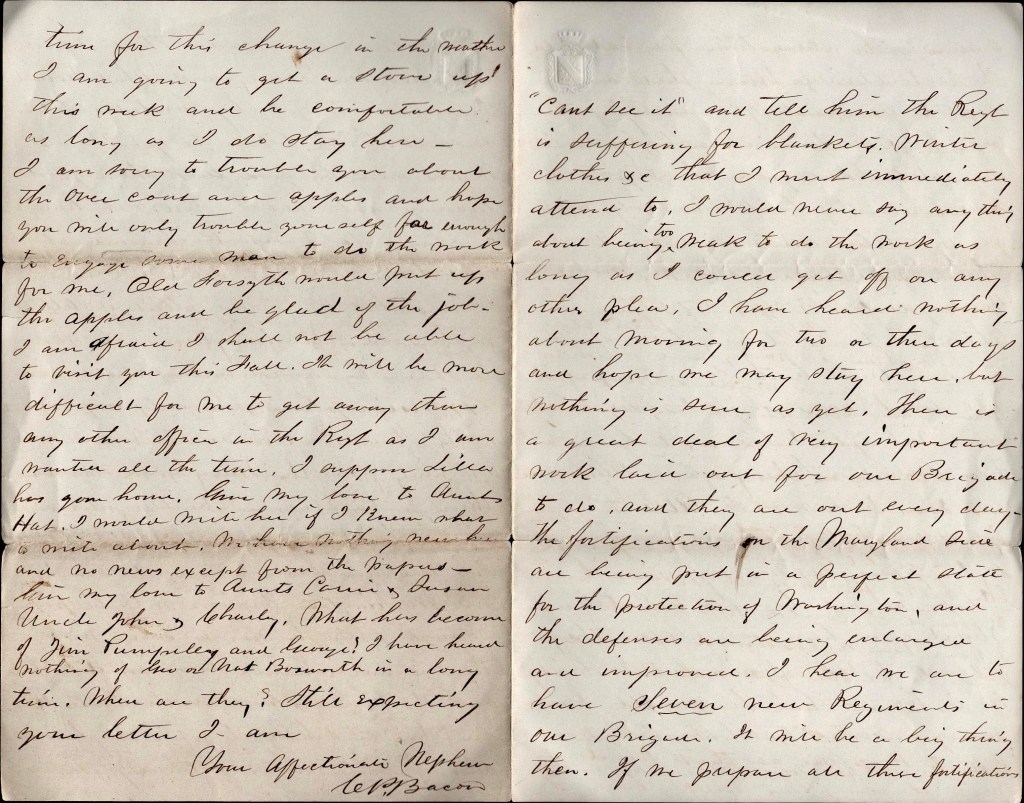


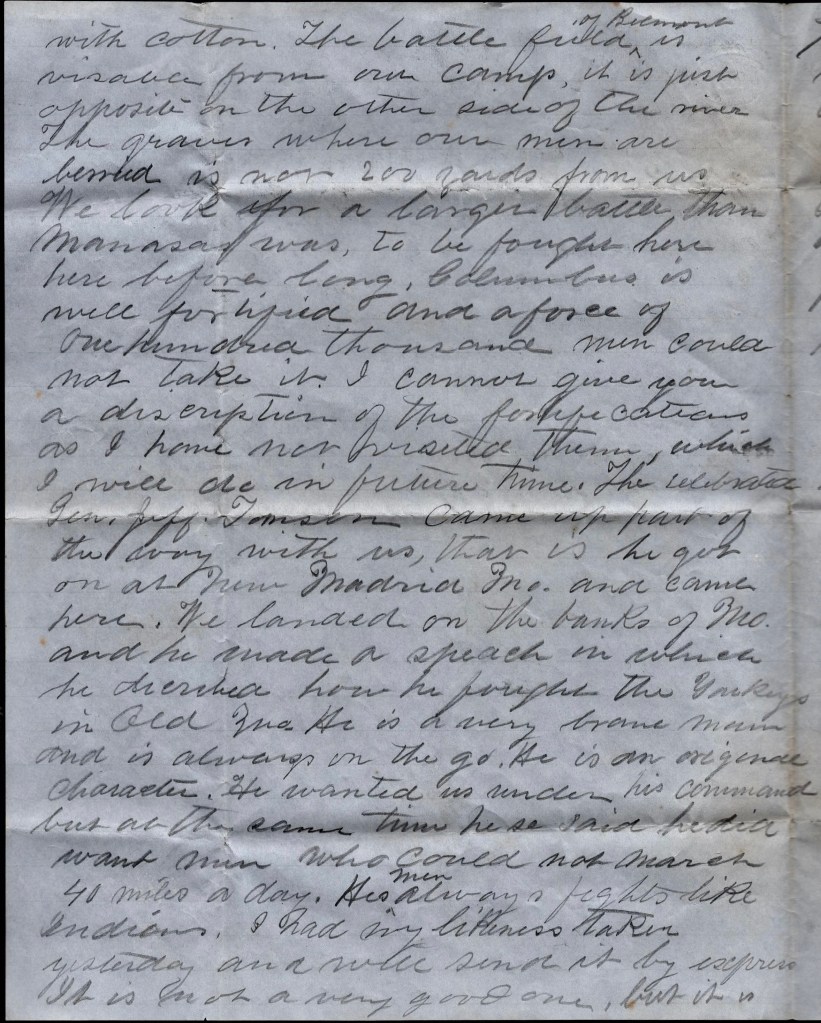
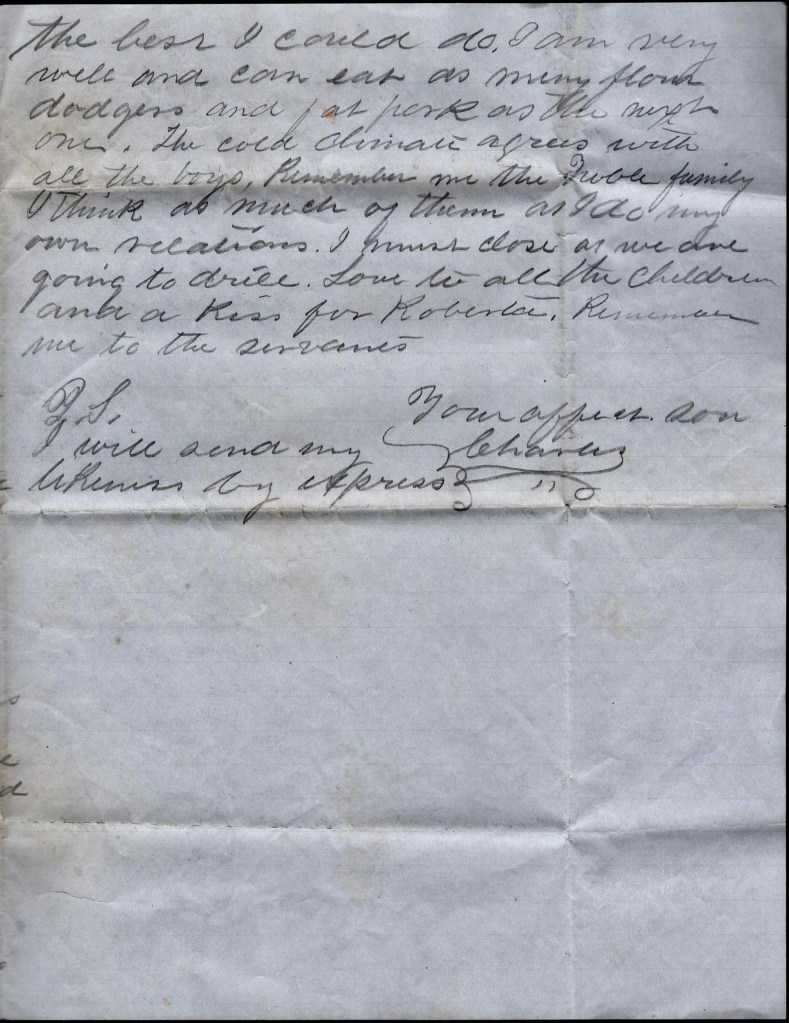

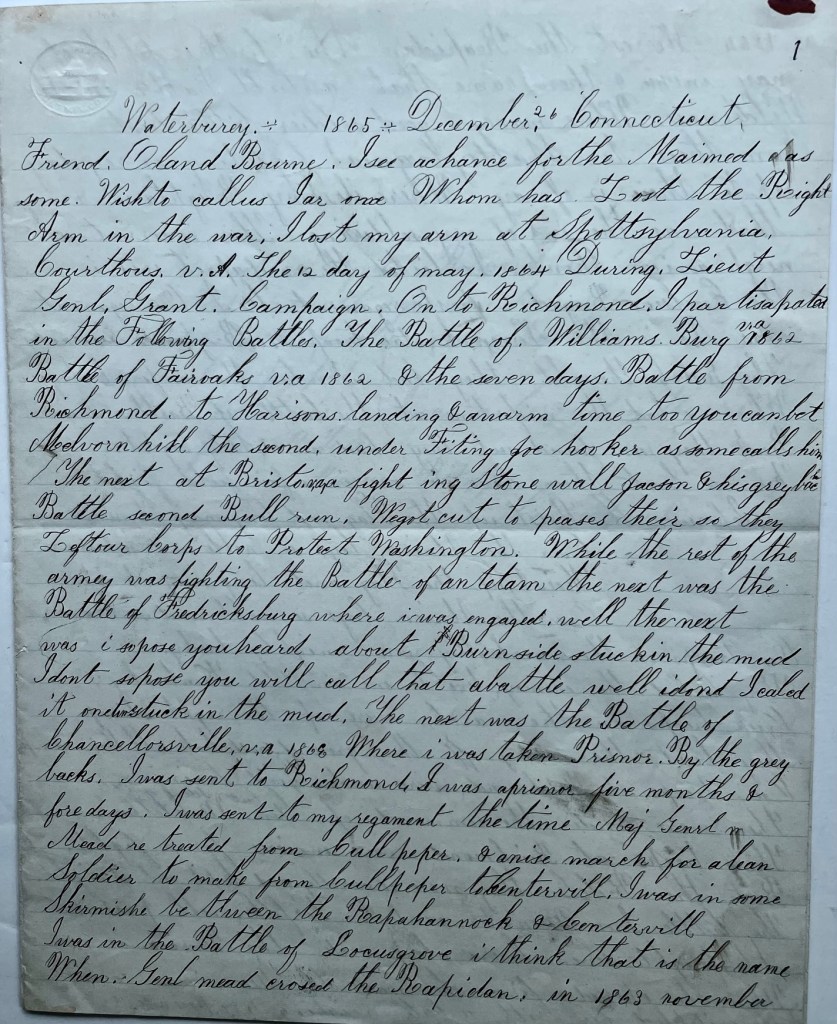


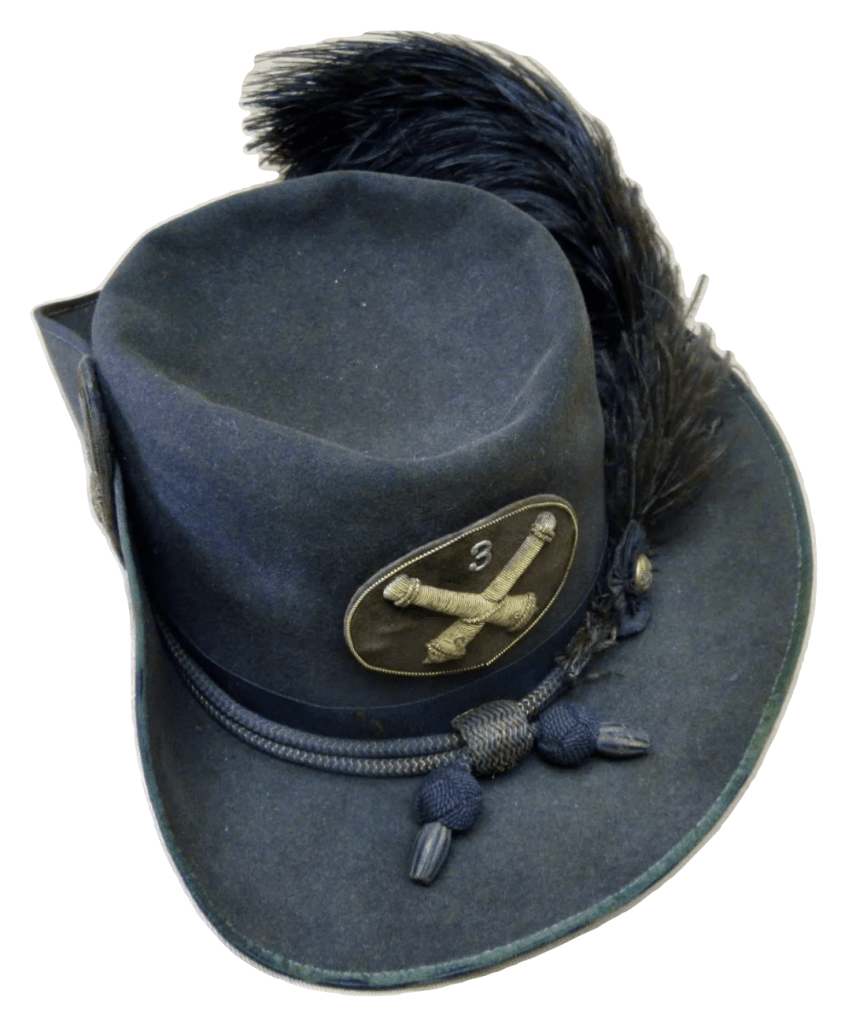


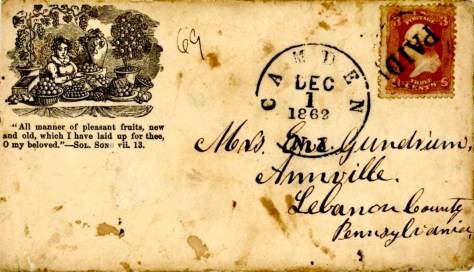


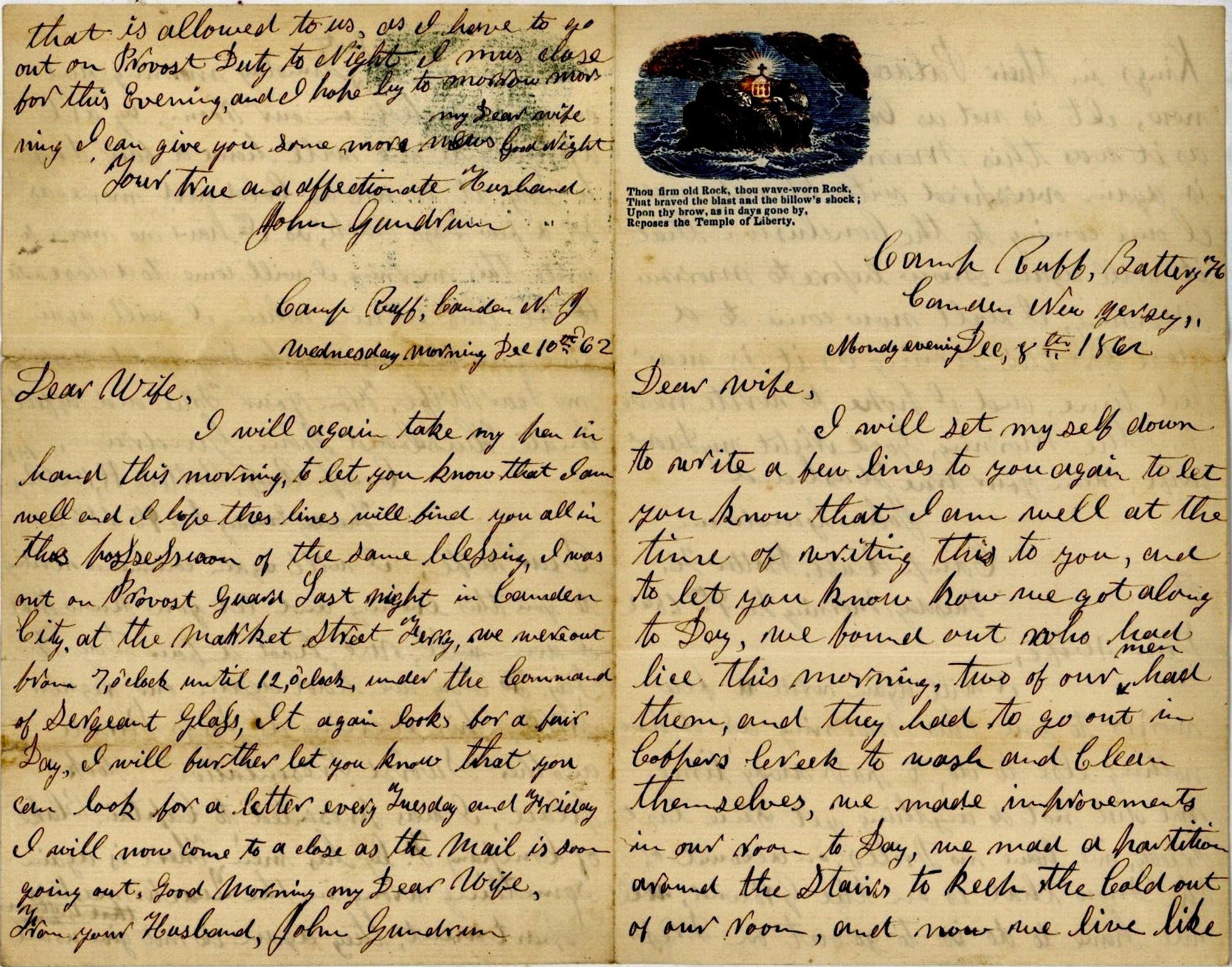
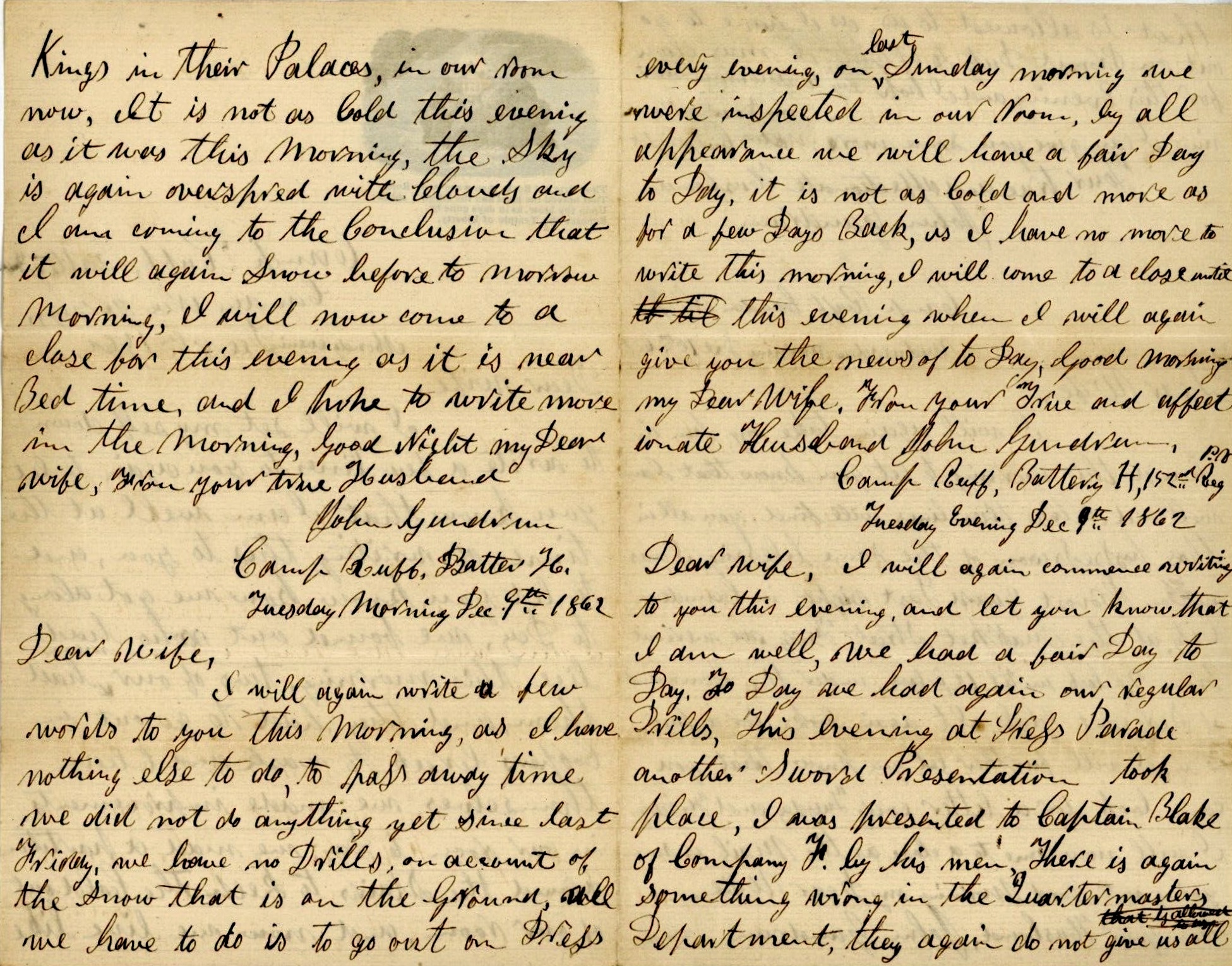
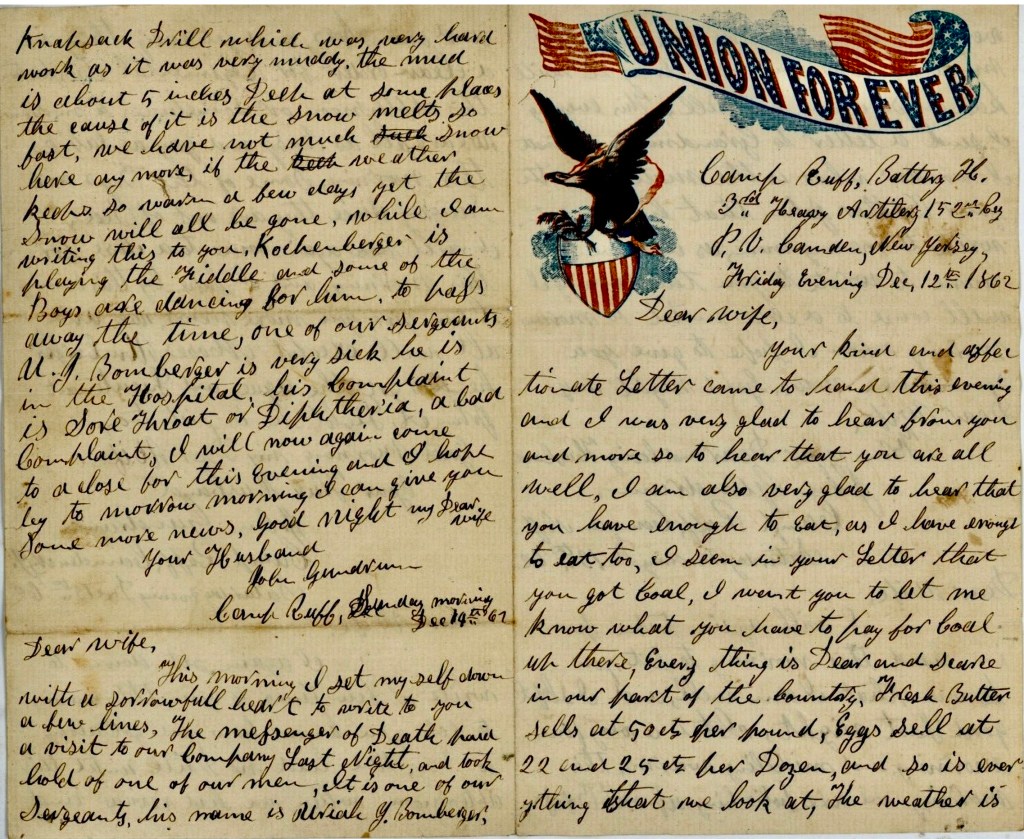
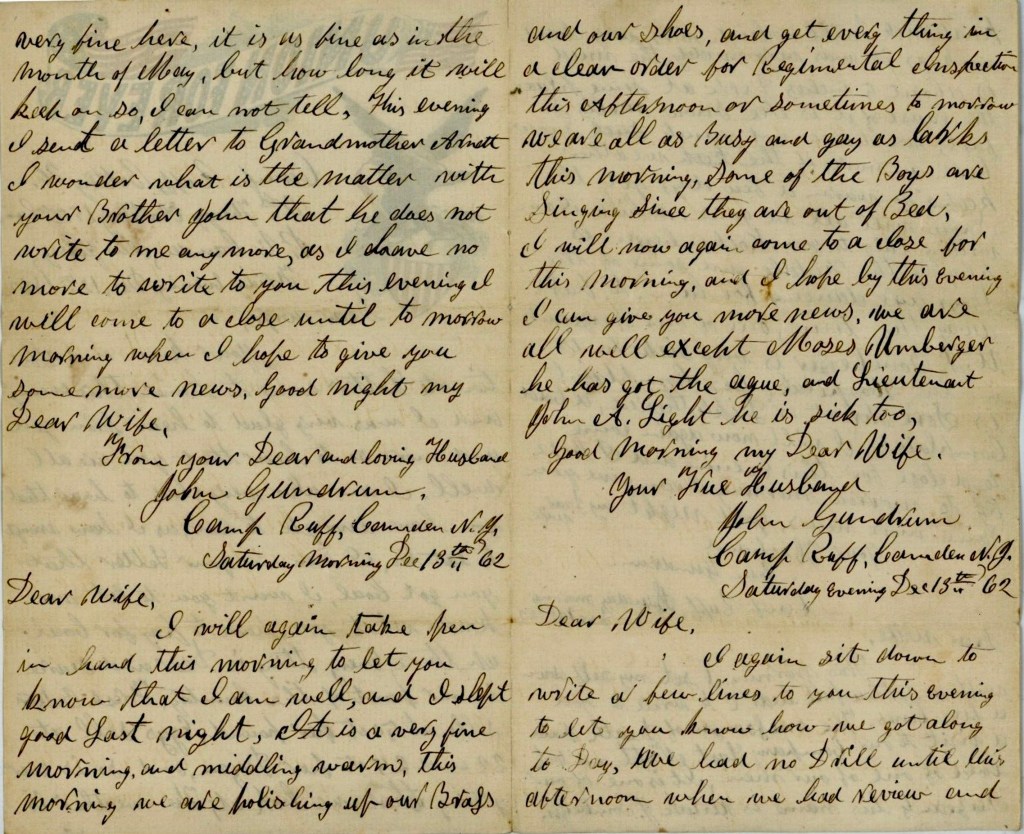


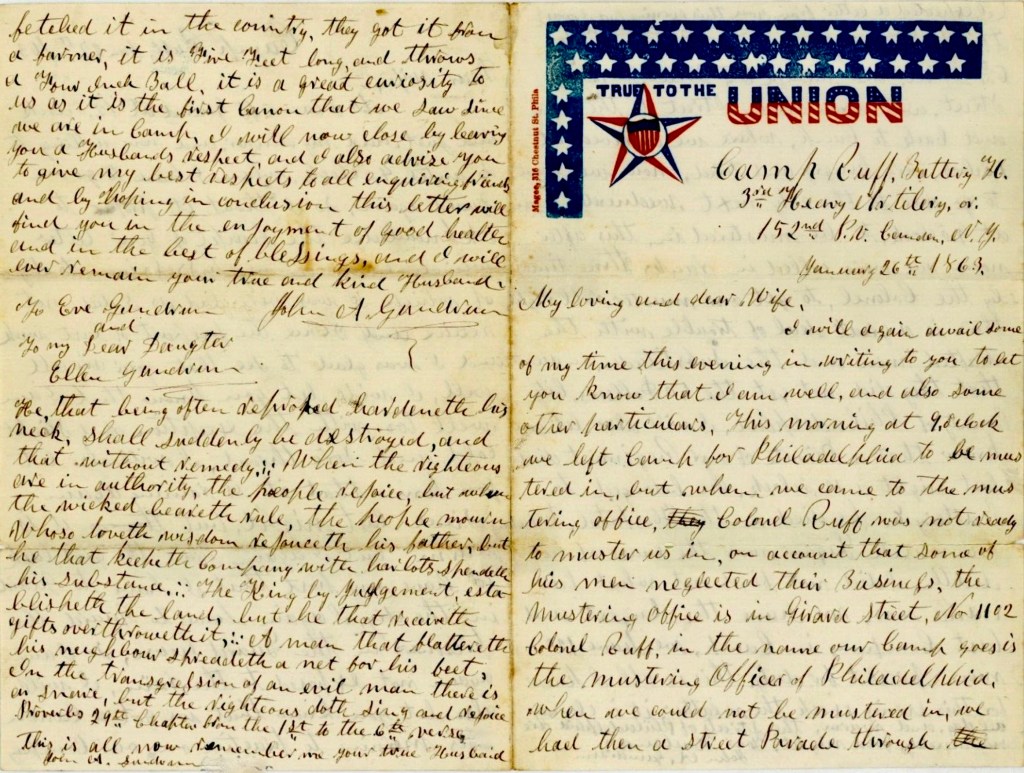
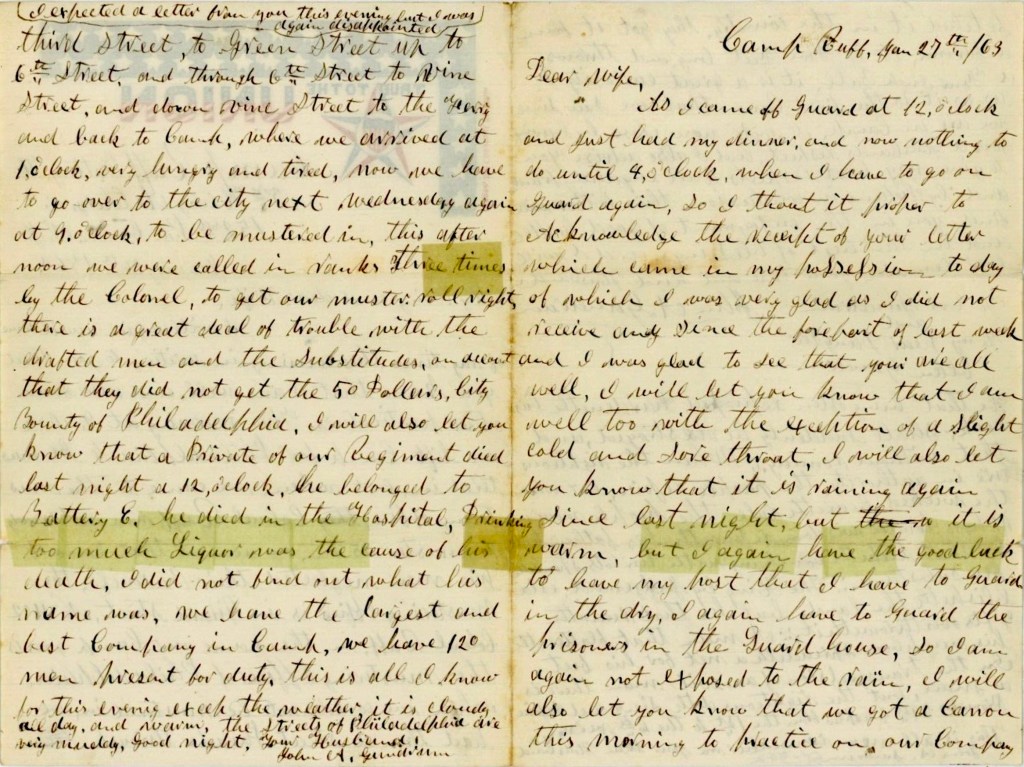
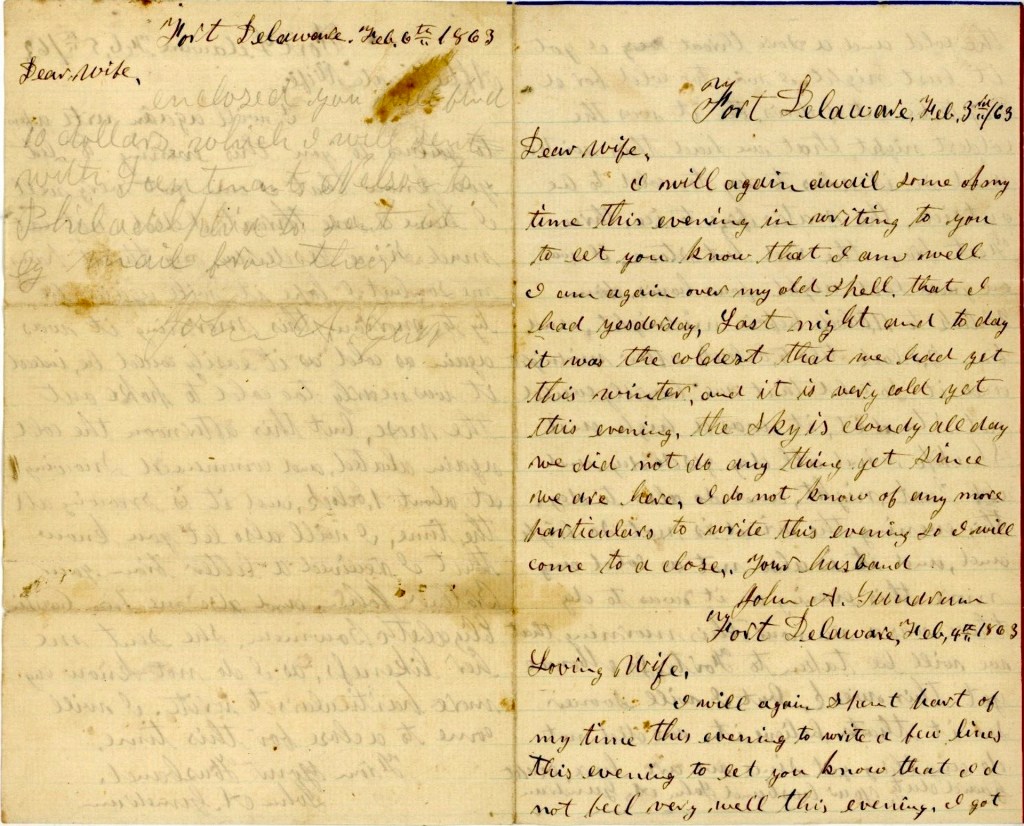


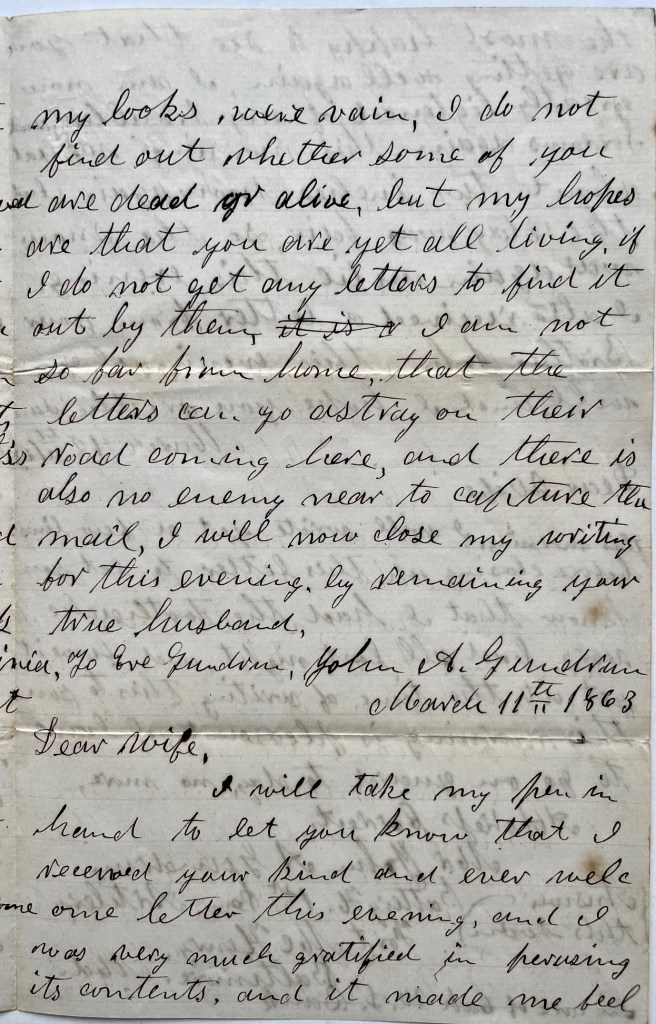

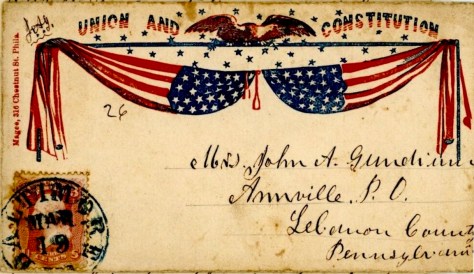
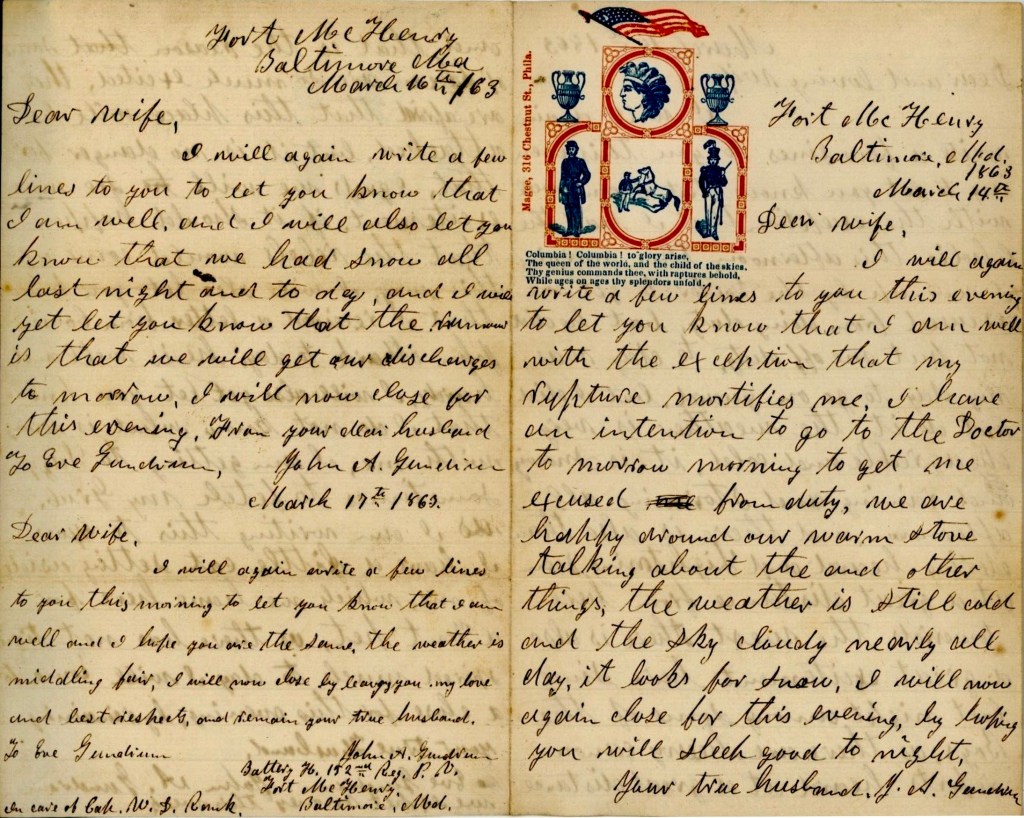
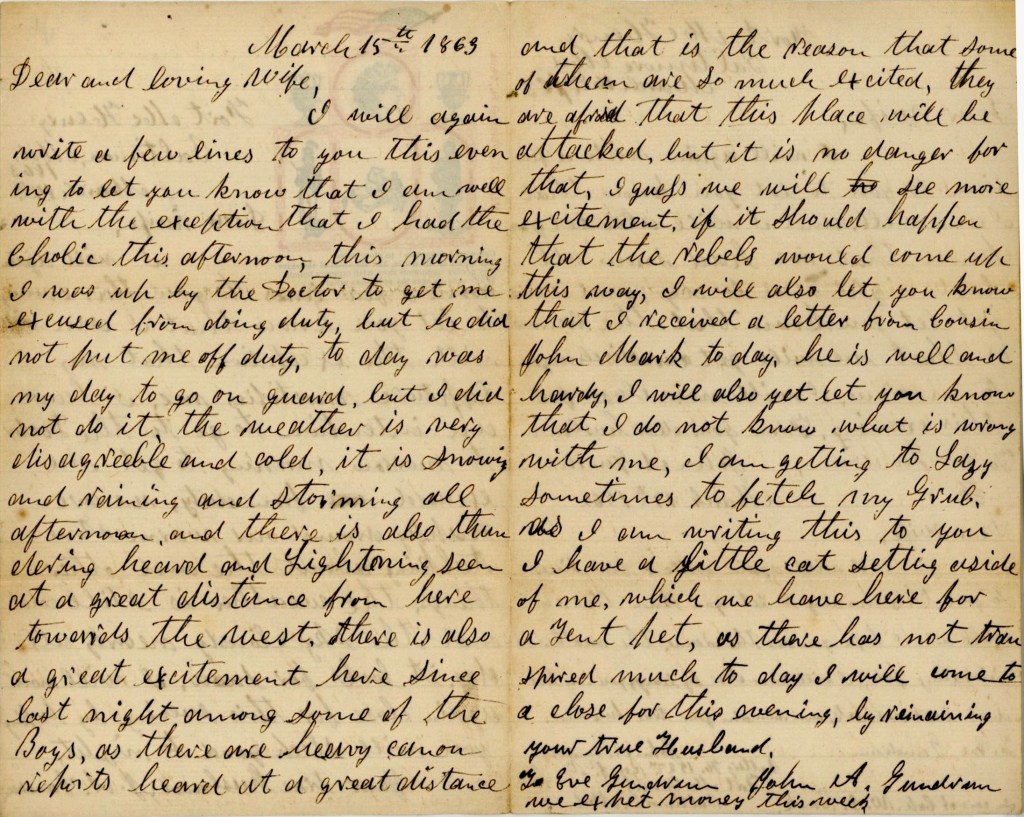


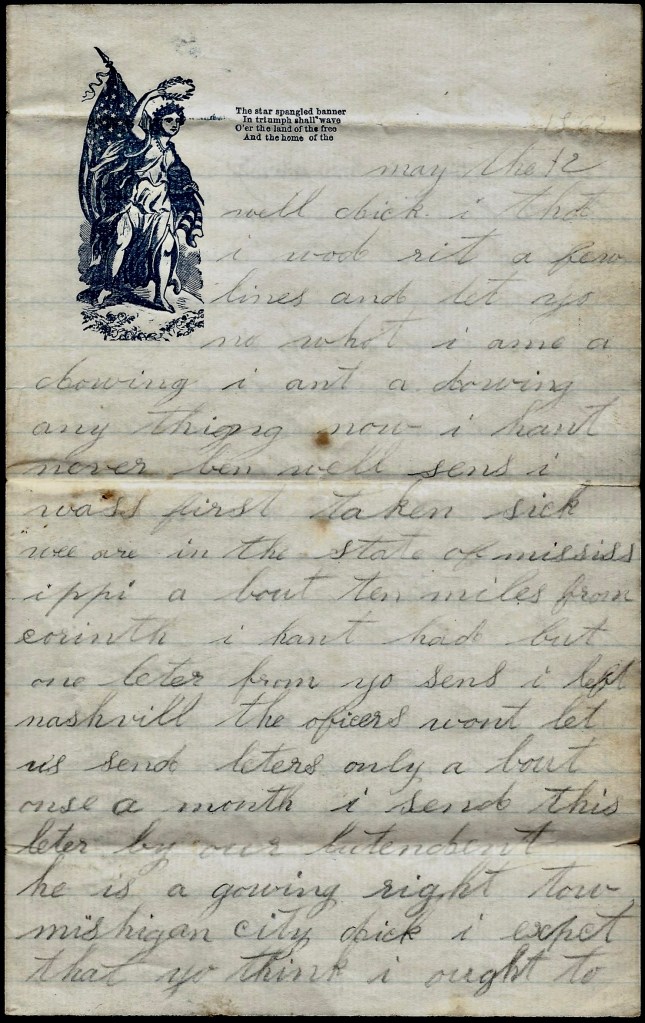


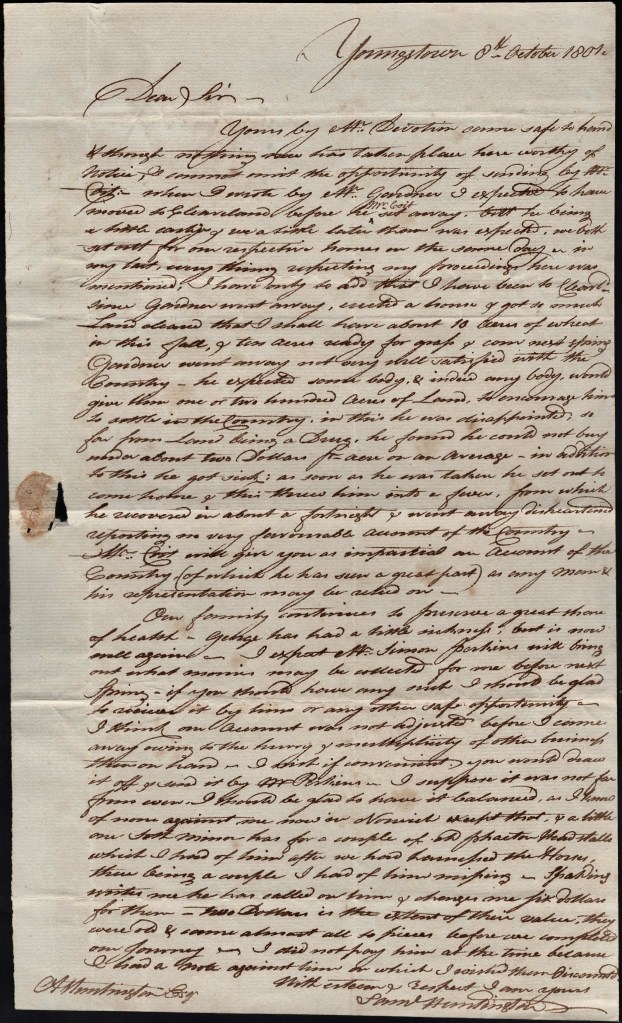


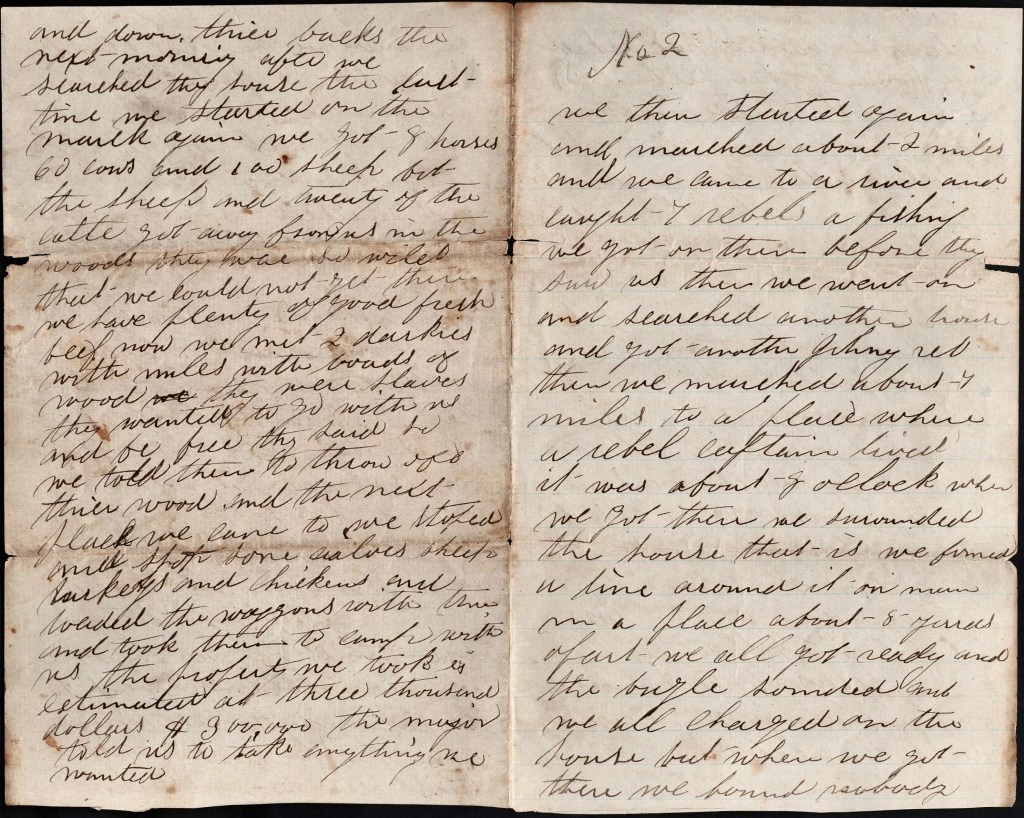
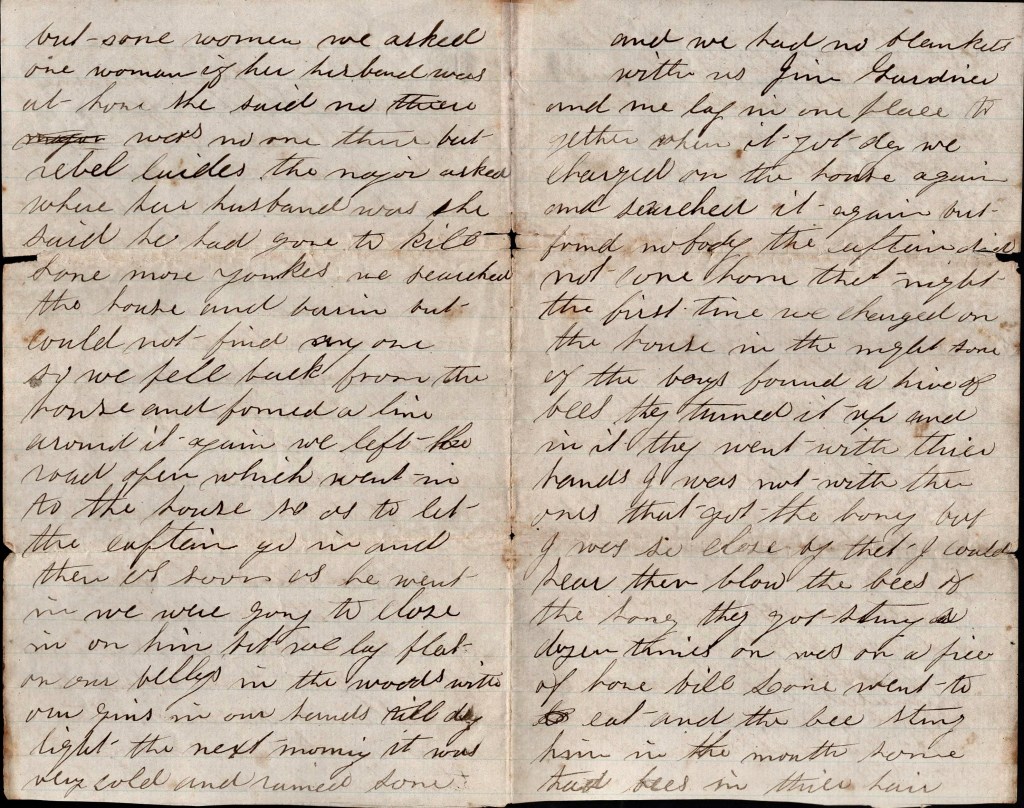

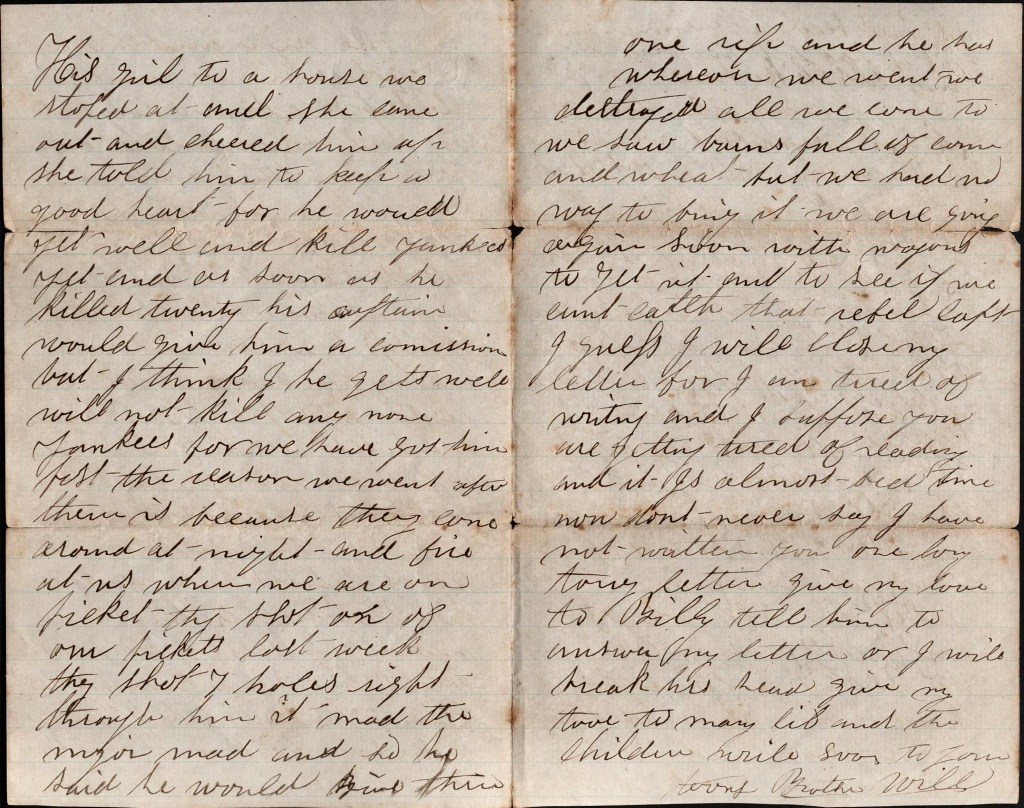


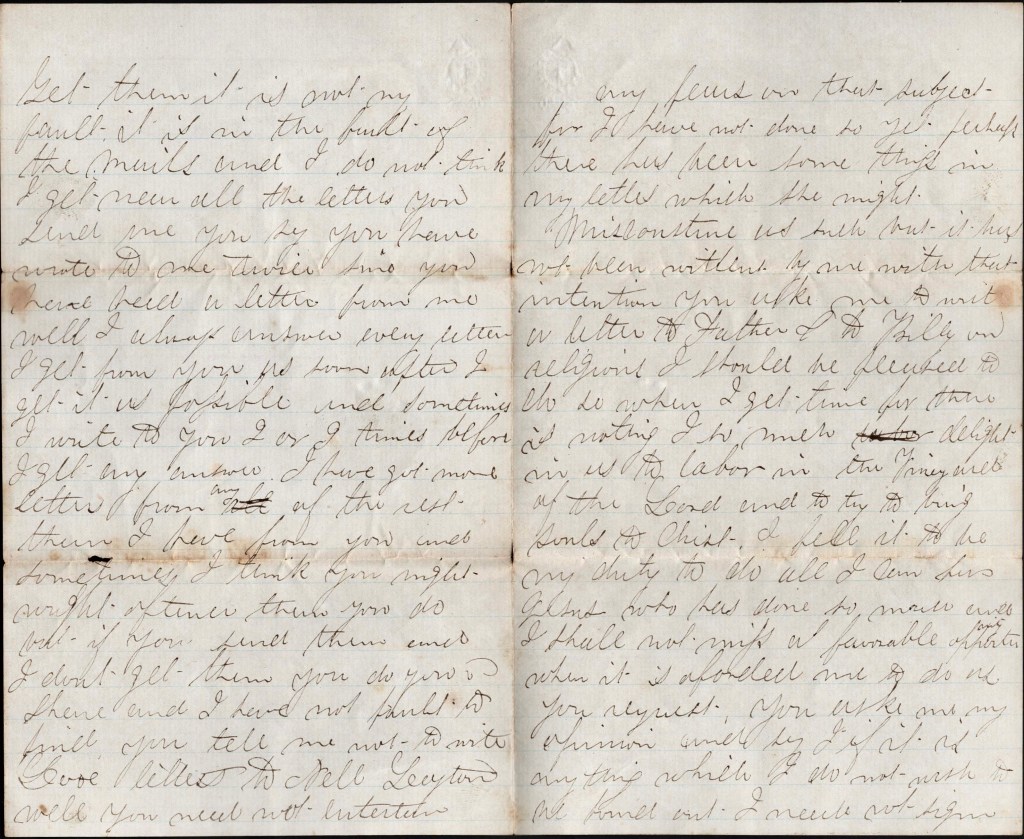
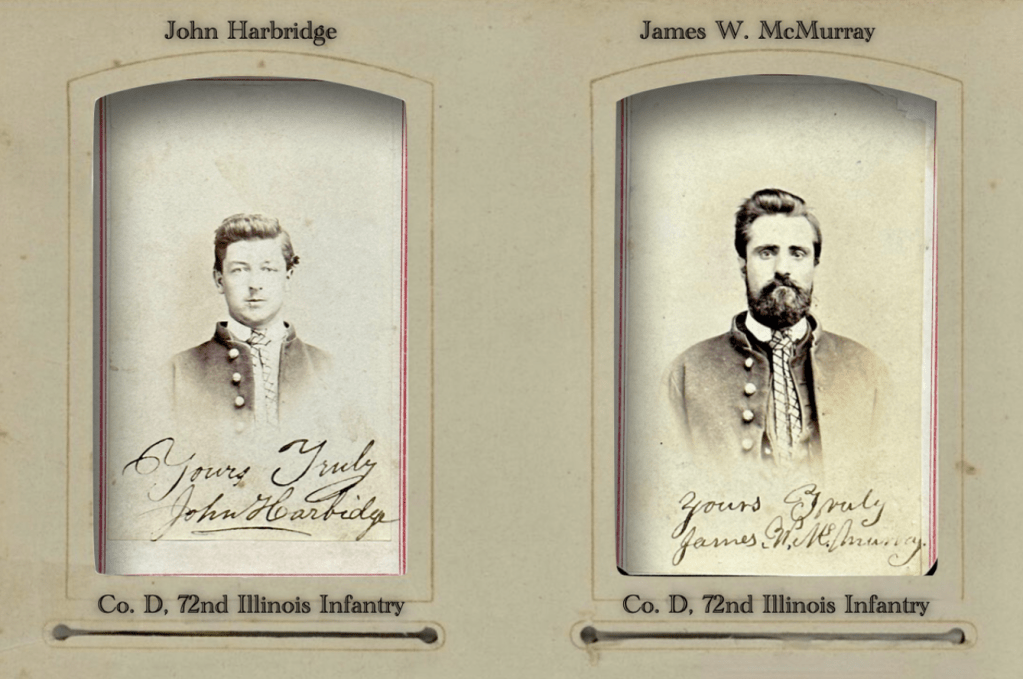

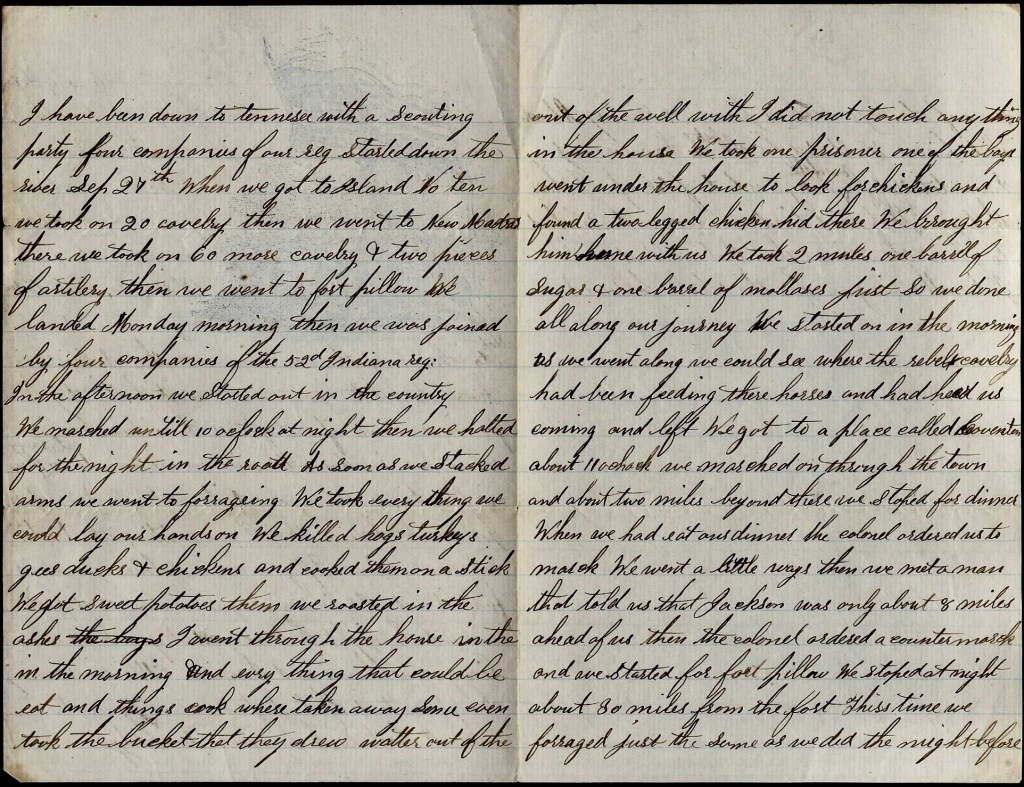


 Spared & Shared 23