My passion is studying American history leading up to & including the Civil War. I particularly enjoy reading, transcribing & researching primary sources such as letters and diaries.
The following letter was written by Amos B. Ludlow (1839-1863), the son of Frazer Ludlow (1801-1863) and Elizabeth Burgett (1807-1850) of Monroe, Holmes county, Ohio. Amos was studying to be a physician at the time of the 1860 US Census.
Amos enlisted as a private in Co. G, 102nd Ohio Volunteer Infantry (OVI) in August 1862 and he died in December 1862 of disease in Bowling Green, Kentucky. Records at the Nashville National Cemetery give his date as 23 December 1862.
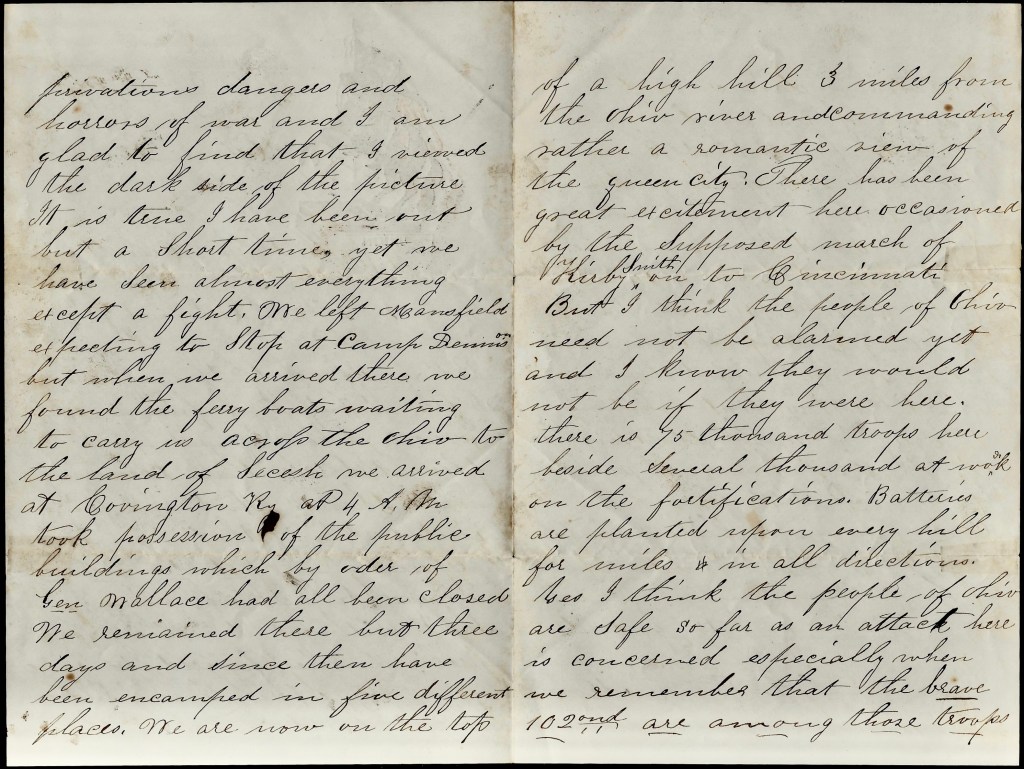
Transcription
Camp Wallace, Kentucky September 17th [1862]
Miss Liggett, esteemed friend,
Being off duty this afternoon & also mindful of friends at home, I know of no more pleasant pastime than conversing with them, And as I feel quite certain that every person especially in patriotic Holmes is eager to hear war news. I shall without dwelling on preliminaries proceed to give you my experience as a soldier.
I had heard much of the privations, dangers, and horrors of war and I am glad to find that I viewed the dark side of the picture. It is true I have been out but a short time, yet we have seen almost everything except a fight. We left Mansfield expecting to stop at Camp Dennison. But when we arrived there, we found the ferry boats waiting to carry us across the Ohio to the land of Secesh. We arrived at Covington, Kentucky, at 4 a.m., took possession of the public buildings which by order of Gen. Wallace had all been closed. We remained there but three days and since then have been encamped in five different places.
We are now on the top of a high hill 3 miles from the Ohio river and commanding rather a romantic view of the Queen City. There has been great excitement here occasioned by the supposed march of Kirby Smith on to Cincinnati, but I think the people of Ohio need not be alarmed yet, and I know they would not be if they were here. There is 75 thousand troops here beside several thousand at work on the fortifications. Batteries are planted upon every hill for miles in all directions. Yes, I think the people of Ohio are safe so far as an attack here is concerned—especially when we remember that the brave 102nd are among those troops.
The boys here are all in good spirits good health and anxious for a fight. Docor [Hamilton] McClurg is sitting my me as I write. He is Hospital Steward and well pleased with his position. I believe I have given you a general idea of the war here so I close for the present asking for a reply giving the news in general as news from home is quite an item to the soldier.
Recording my best wishes for your happiness & success in life, I remain a friend, — A. B. Ludlow
The following letters were written by 17 year-old David Kime (1845-1916), the son of Abraham Kime (1815-1902) and Barbara Noel (1816-1904) of Gettysburg, Adams county, Pennsylvania. David and his older brother, Franklin Levi Kime (1839-1918) both served in Co. K, 101st Pennsylvania Volunteers with their father, Abraham Kime (1815-1902).
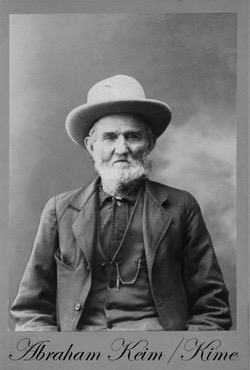
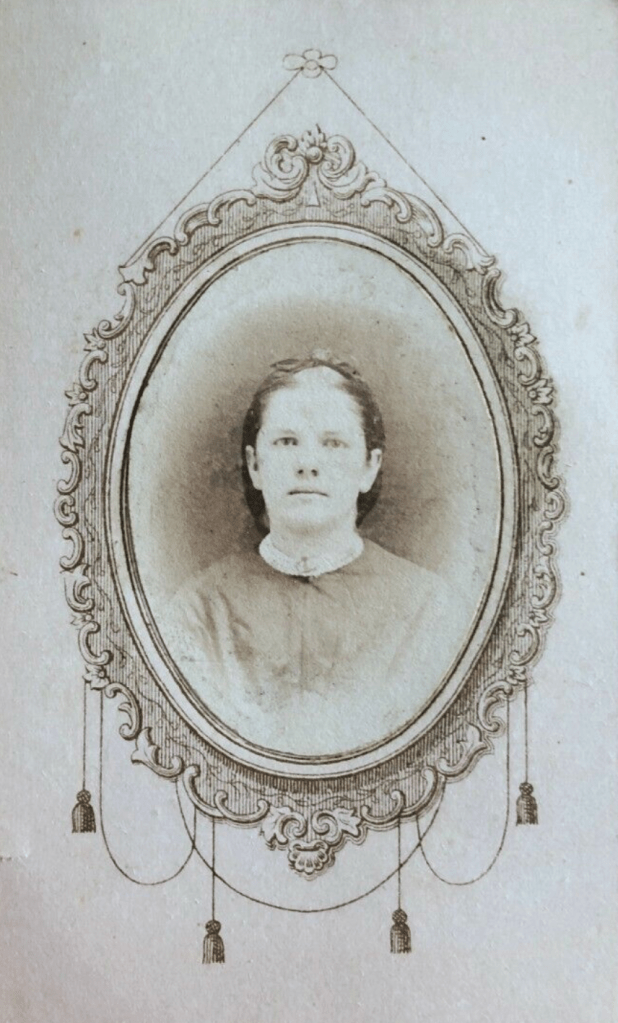
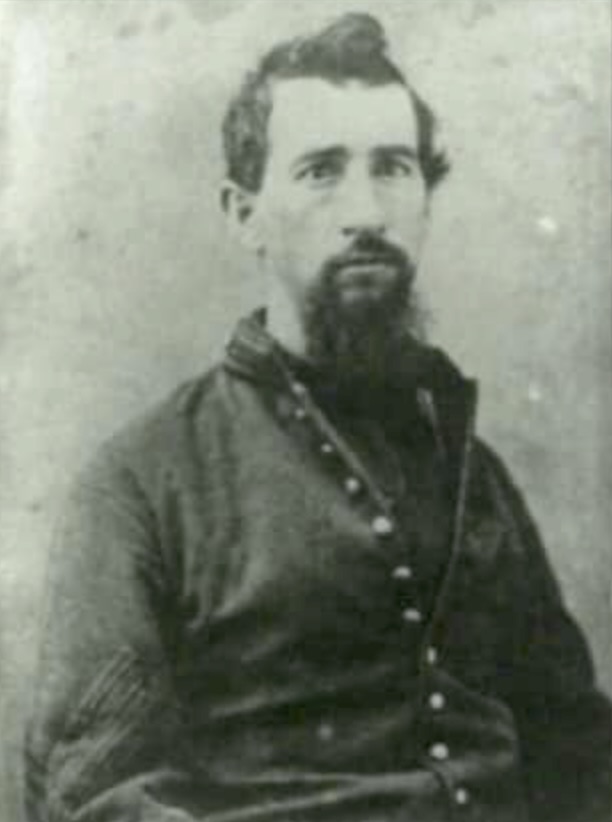
A post war image of David’s father, Abraham Kime.
Abraham was in his upper 40’s when he enlisted and was discharged on a surgeon’s certificate of disability in September 1862 after he was shot in the left elbow at the Battle of Fair Oaks. He was an older brother of Jacob Kime whose farm was three miles north of Gettysburg was overrun by Confederates in July 1863 and used as a Confederate hospital. There are even some Confederate soldiers buried there. Abraham made his home several miles north of Gettysburg in Menallen township.
In April 1864, the 101st Pennsylvania was a garrison that defended Plymouth, North Carolina, along with the 103rd Pennsylvania, two North Carolina units and three regiment of U. S. Colored Troops. Most of the 101st Pennsylvania were taken prisoner by Confederates when they overran the Union defenses at Plymouth on 20 April 1864, both David and Frank among them. Both were transported to Andersonville Prison where they remained over ten months, until late February 1865. Both survived to come home.
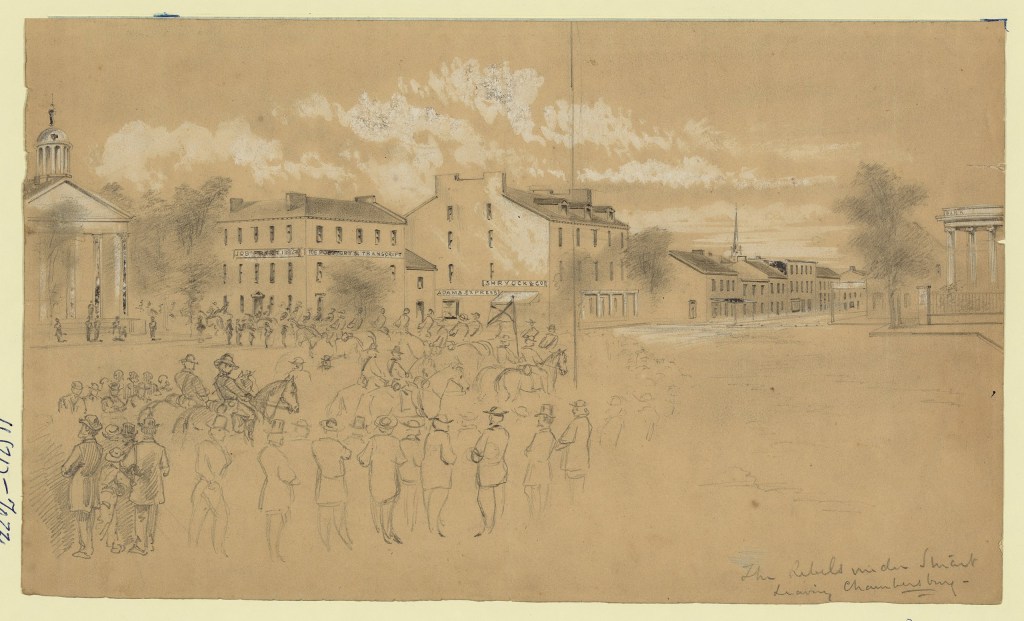
Rebs under J.E.B. Stuart leaving Chambersburg, October 1862
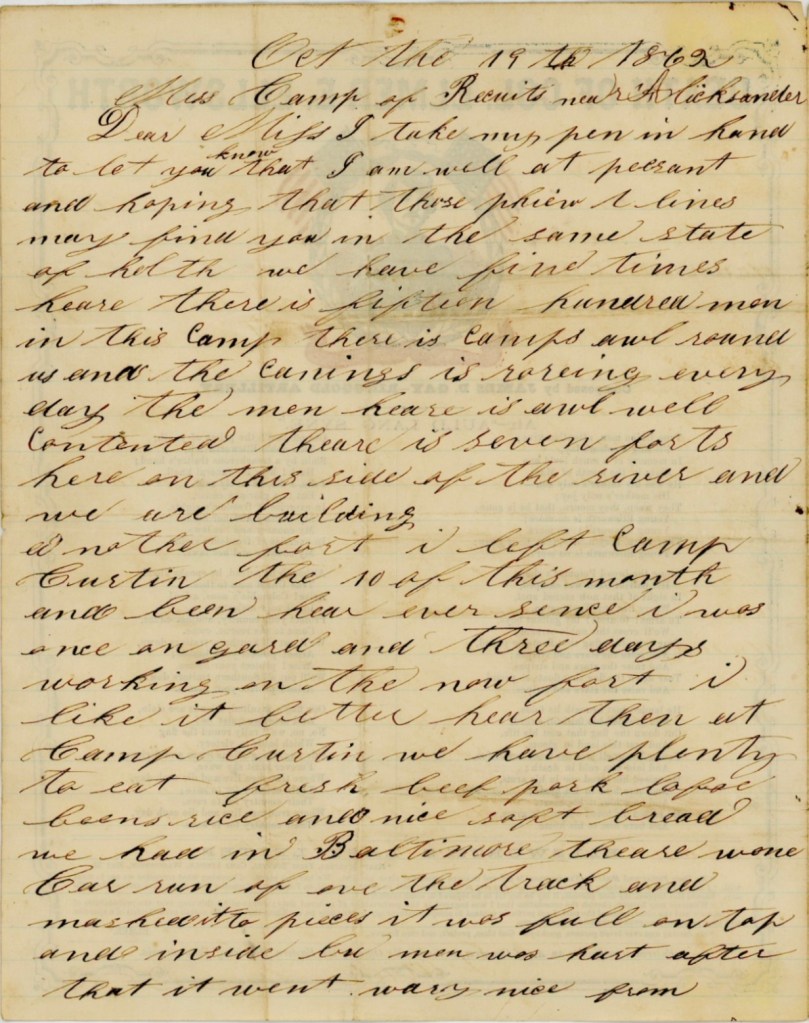
Letter 1
Mess Camp of Recruits near Alexandria October the 19th 1862
Dear Miss,
I take my pen in hand to let you know that I am well at present and hoping that these few lines may find you in the same state of health. We have fine times here. There is fifteen hundred men in this camp. There is camps all around us and the cannons is roaring every day. The men here is all well contented. There is seven forts here on this side of the [Potomac] river and we are building another fort.
I left Camp Curtin the 10th of this month and been here ever since. I was once on guard and three days working on the new fort. I like it better here than at Camp Curtin. We have plenty to eat, fresh beef, pork, coffee, beans, rice, and nice soft bread. We had [an accident] in Baltimore. There one car run off of the track and mashed into pieces. It was full on top and inside but [no] men was hurt. After that it went very nice. From Washington we took the steamboat and went down the Potomac River to Alexandria.
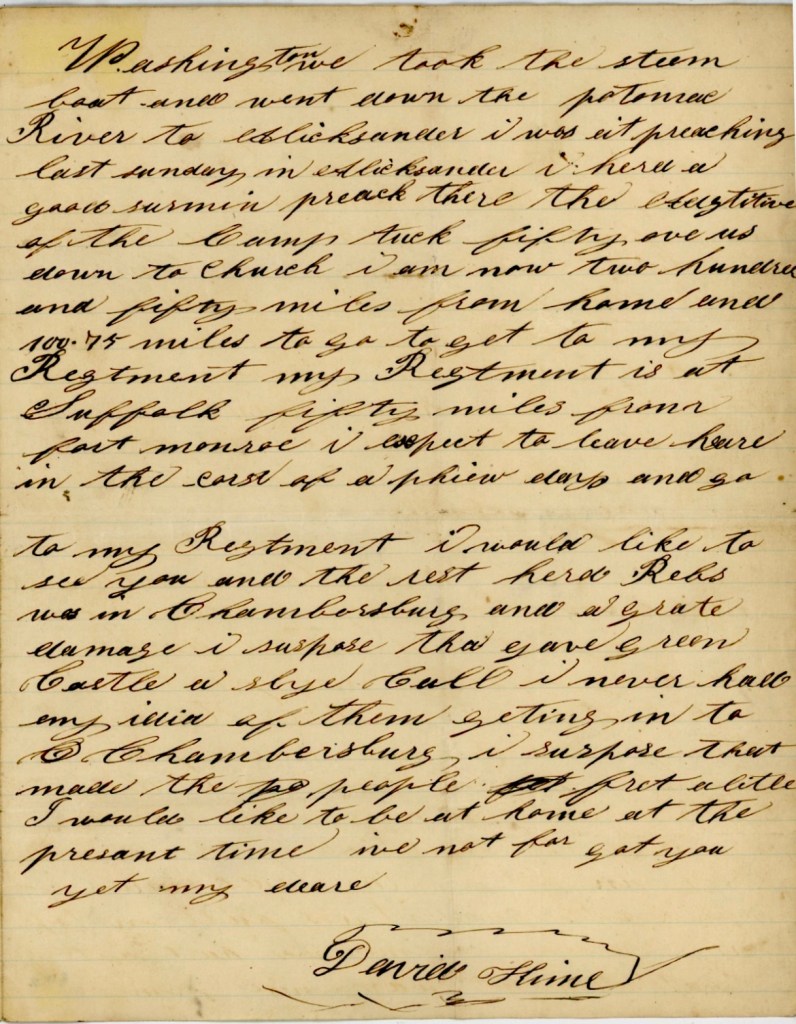
I was at preaching last Sunday in Alexandria. I heard a good sermon preached there. The [ ] of the camp took fifty of us down to church. I am now two hundred and fifty miles from home and 175 miles to go to get to my regiment. My regiment is at Suffolk, fifty miles from Fort Monroe. I expect to leave here in the course of a few days and go to my regiment.
I would like to see you and the rest. Heard the Rebs was in Chambersburg and a great damage [done]. I suppose they gave Greencastle a sly call. I never had any idea of them getting into Chambersburg. I suppose that made the people fret a little. I would like to be at home at the present time. I’ve not forgot you yet, my dear. — David Kime
Letter 2
[Note: I transcribed the following letter just as David wrote it, with poor spelling and a total lack of punctuation.]
Newburn, [New Bern] North Carolina 101st Regt. Co. K April 9th 1863
Dear Miss,
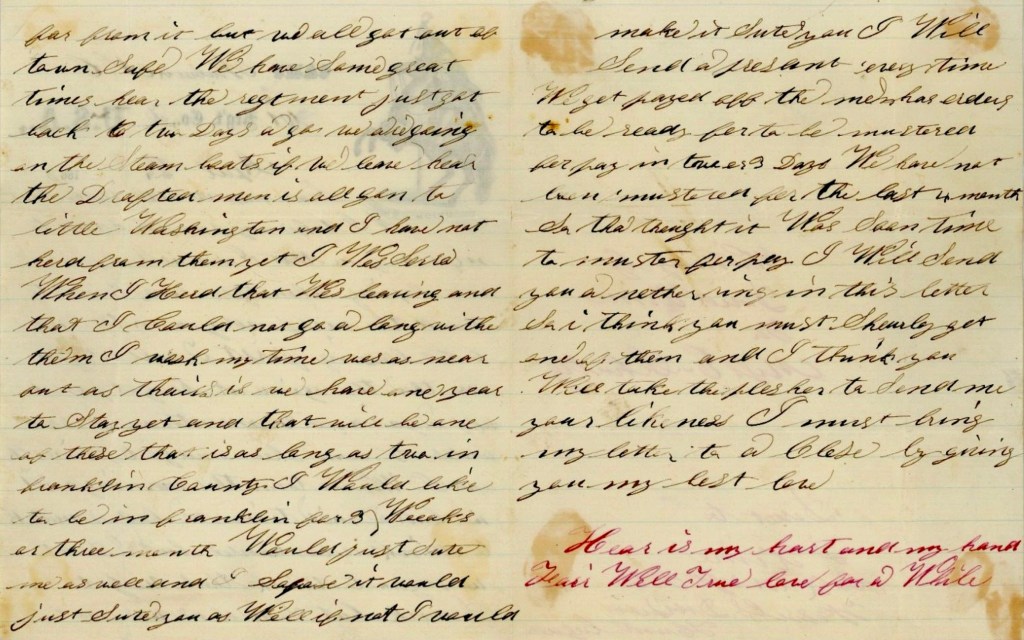
It’s with plesher that I take my pen in hand to inform you that I am well at present and hoping when these lines comes to hand tha will find you in the same blessing first I will let you no tha the regiment has got payed off a gain for a month and we have orders to come hear and go to plimeth [Plymouth] and I was in town this morning and we had a ince time we had as mutch to drink as we wanted but I dont want you to think that we got Drunk but some of us was not far from it but we all got out of town safe We have some great times hear the regiment just got back two days ago we are going on the Steam boats if we leave hear the Drafted men is all gon to little Washington and I was serra [sorry] When I herd that Wes leaving and that I could not go a long with them. I wesh my time wes as near out as thairs is we have one year to Stay yet and that will be one of these that is as long as two in franklin County I would like to be in franklin for 3 Weaks or three month Would just sute me as well and I Sepose it would just sute you as Well if not I would make it sute you I will send a present eney time We get payed off the men has orders to be ready for to be mustered fer pay in two or 3 days We have not been mustered fer the last 4 month So tha thought it Was soon time to muster fer pay I will send you a nether ring in this letter So i think you must Shurly get one of them and I think you Will take the plesher to send me your likeness I must bring my letter to a close by giving you my best love
Hear is my hart and my hand Fair Well True love for a While
Writing by David Kime to Miss E. Schultz
Direct to D. Kime, Co. K, 101 Regt. P. V., Wessels Division, Hunt’s brigade
The following letter was written by 19 year-old Henry Gordon Gibbs (1843-1915), the son of Ithamar P. Gibbs (1818-1897) and Juliette White (1822-1904) of Benson, Rutland county, Vermont.
Henry enlisted on 1 October 1861 as a private in Co. K, 1st Vermont Cavalry. He wrote the following letter from Camp Harris near Annapolis, Maryland, where we learn that he was chronically ill which led to his discharge for disability on 20 April 1862 without having seen any action.
Henry wrote the letter to his aunt, Emeline Jane (Gibbs) King (1822-1911), the wife of Moseley Frisbie King (1808-1888) of Benson, Rutland county, Vermont. Jane and Moseley were married in 1861; it being her second marriage.
Transcription
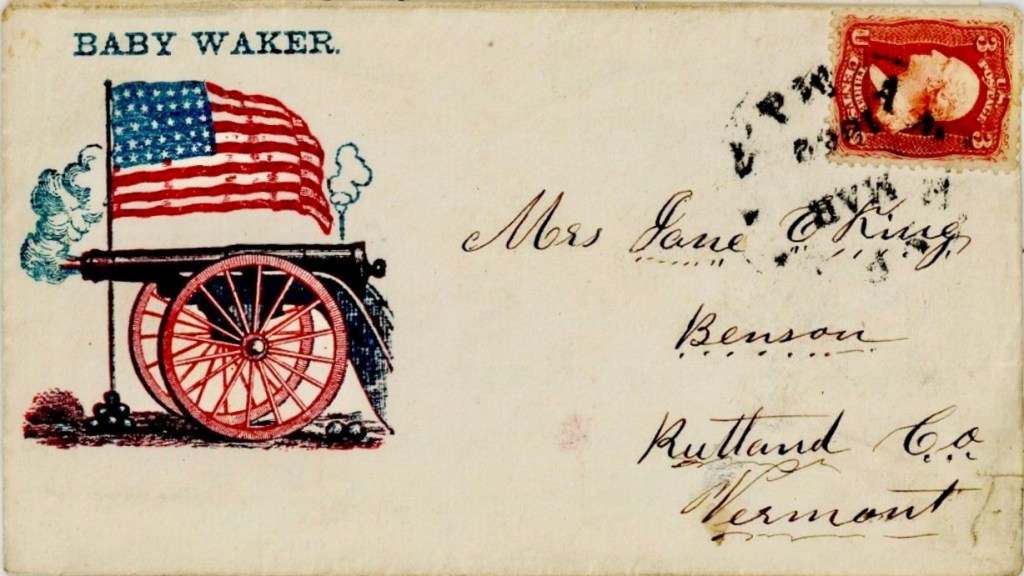
Addressed to Mrs. Jane E. King, Benson, Rutland county, Vermont
Camp Harris, Annapolis, Maryland March 7th 1862
Dear Aunt,
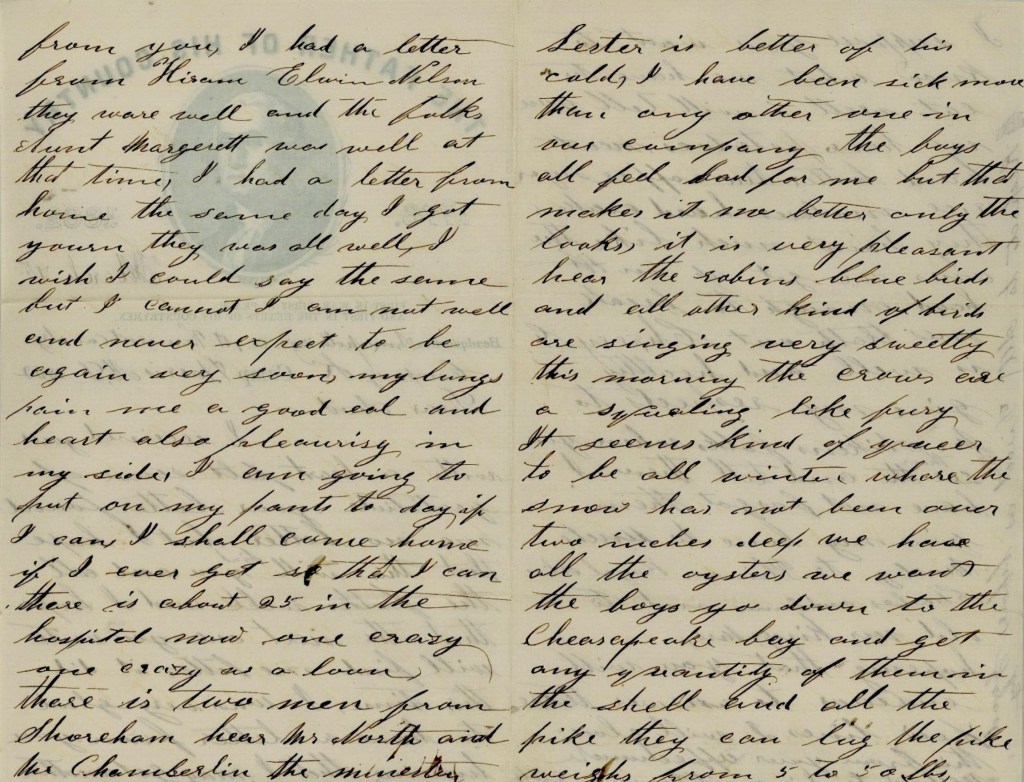
I received yours with a heartfelt sense of gratitude. Your letter found me no better but I hope that this will find you and all the folks well and I hope that the next one you write will find me better [than] it did this time. I was very glad to have a letter from you, hoping that I may get another from you. I had a letter from Hiram Elwin Nelson. They were well and the folks. Aunt Margaret was well at the time, I had a letter from home the same day I got yourn. They was all well. I wish I could say the same but I cannot. I am not well and never expect to be again very soon. My lungs pain me a good deal and heart. Also. pleurisy in my side. I’m going to put on my pants today if I can. I shall come home if I ever get so that I can.
There is is about 25 in the hospital now. One crazy—one crazy as a loon. There is two men from Shoreham here. Mr. North and Mr. Chamberlin, the minister. Lester is better of his cold. I have been sick more than any other one in our company. The boys all feel bad for me but that makes it no better—only the looks. It is very pleasant to hear the robins, bluebirds, and all other kinds of birds are singing very sweetly this morning. The crows are a squealing like fury. It seems kind of queer to be all winter where the snow has not been over two inches deep. We have all the oysters we want. The boys go down to the Chesapeake Bay and get any quantity of them in the shell and all the pike they can lug. The pike weighs from 5 to 50 lbs.
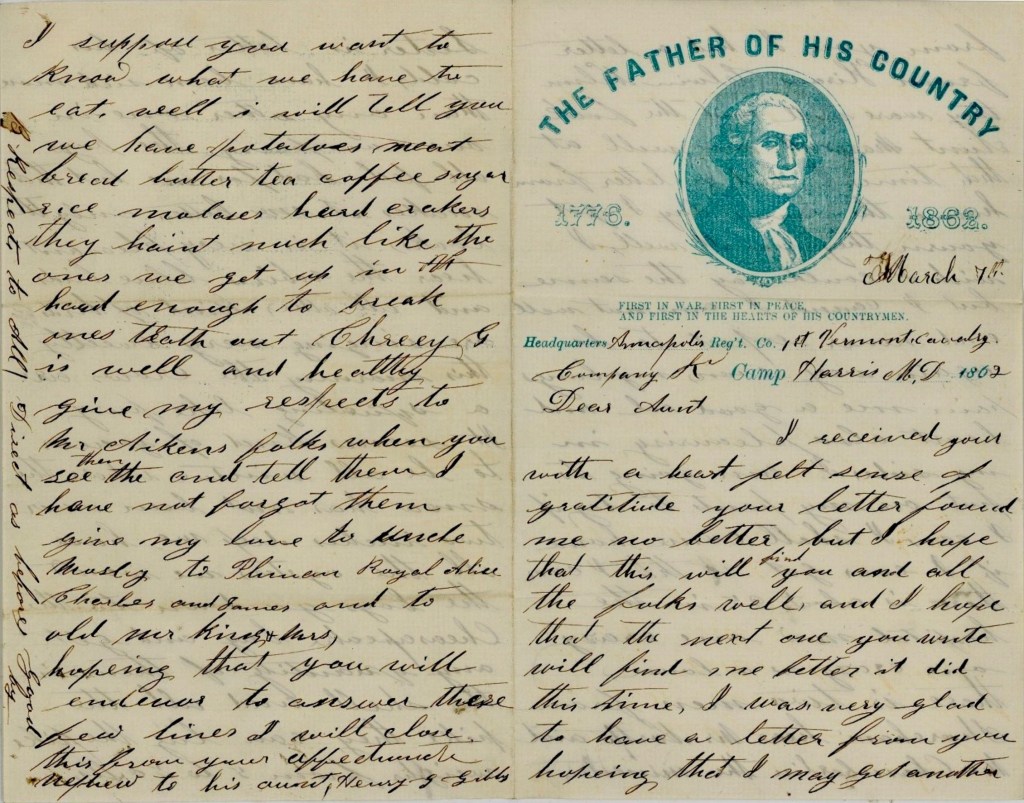
I suppose you want to know what we have to eat, Well, I will tell you. We have potatoes, meat, bread, butter, tea, coffee, sugar, rice, molasses, hard crackers. They haint much like the ones we get up in Vermont. Hard enough to break one’s teeth out. Chreey G. is well and healthy. Give my respects to Mr. Aikens’ folks when you see them and tell them I have not forgot them. Give my love to Uncle Moseley, to Phinan Royal, Alice, Charles, and James, and to old Mr. King, & Mrs.
Hoping that you will endeavor to answer these few lines, I will close. This from your affectionate nephew to his aunt. — Henry G. Gibbs
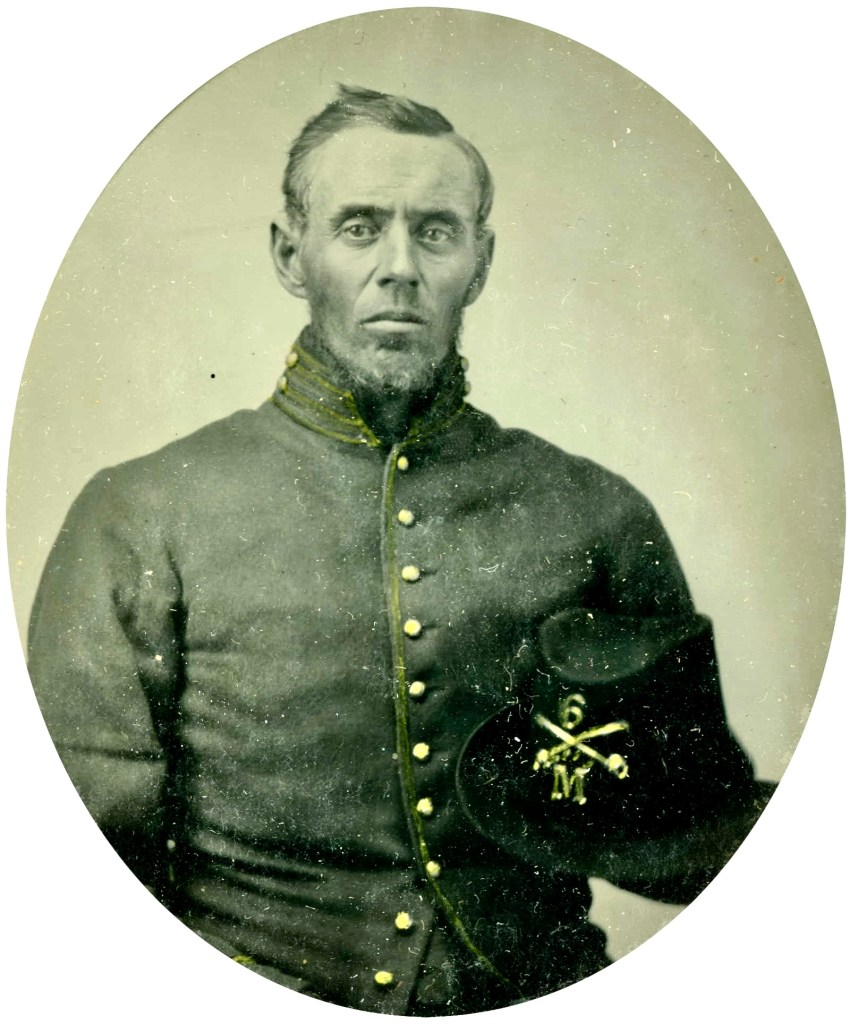
A Union trooper most likely from the 5th or 6th Michigan Cavalry holding his saber and 7-shot Spencer Rifle,
The following unsigned or partial letter was written by Samuel Sherburne of Co. D, 6th Michigan Cavalry. The troopers referenced in the letter include 18-year-old George Hopkins, 21-year-old John T. Van Dyke, 34-year-old William H. Rust, and 29-year-old George W. Botsford. All four soldiers hailed from Burns, Shiawassee County, Michigan. He addressed the letter to his brother.
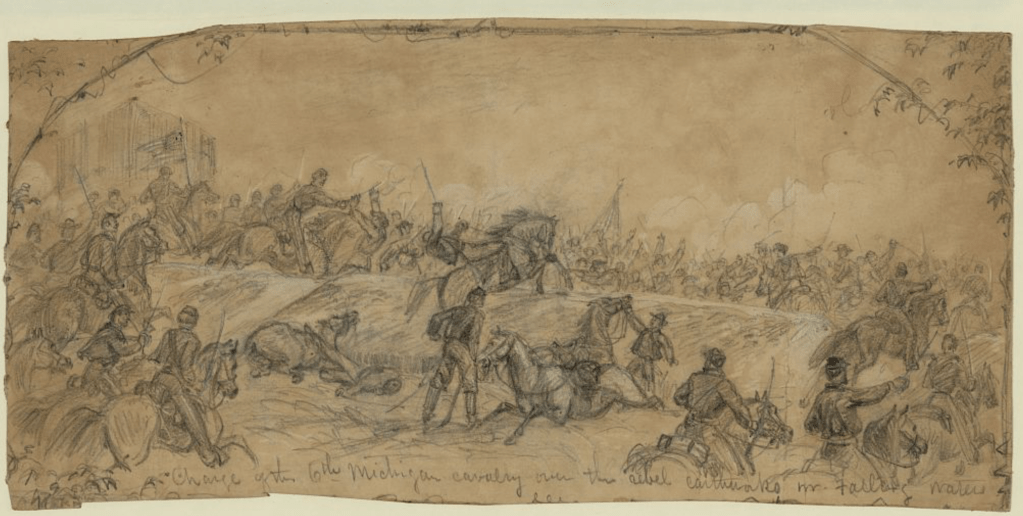
The 6th Michigan Cavalry mustered into service in October 1862 and saw duty in the defenses of Washington until June 1863. Their first action came in the Gettysburg campaign. While in Washington during the winter of 62-63, they served as body guard and escort to General Casey, as stated in the letter.
Charge of the 6th Michigan cavalry over the rebel earthworks near Falling Waters
Transcription
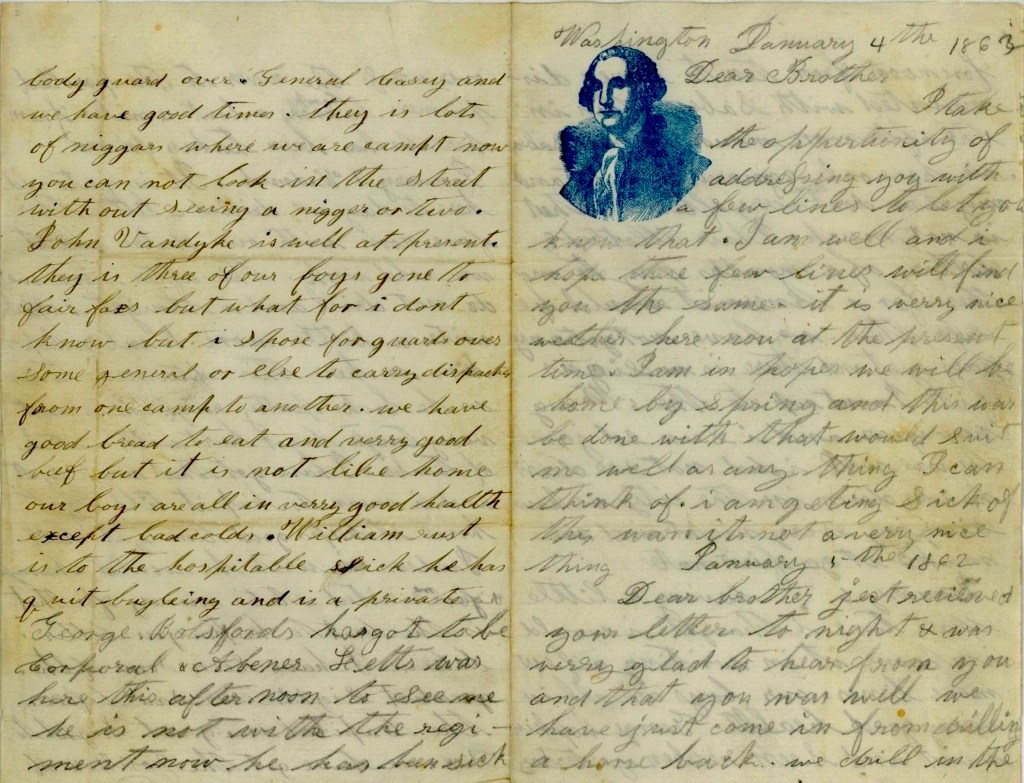
Washington January 4, 1863
Dear Brother,
I take the opportunity of addressing you with a few lines to let you know that I am well and I hope these few lines will find you the same. It is very nice weather here now at the present time. I am in hopes we will be home by spring and this war will be done with. That would suit me well as anything I can think of. I am getting sick of this war. It’s not a very nice thing.
January 5th. Dear brother, I just received your letter tonight and was very glad to hear from you and that you was well. We have just come in from drilling a horse back. We drill in the forenoon from ten to eleven dismounted with sabers, then in the afternoon mounted with sabers. We have only three guards a night and my turn don’t come very often so that is not much. I have allotted 8 dollars of a month pay to mother for I knew it would be safe then. We have not got any pay yet and there is no signs of it.
I went up to the 5th Regiment [on] New Years and I seen Ed James. He was well. I did not see Dan. He was down in the City. We have singing every night and we make it go first rate.
January 6. Having a little spare time, I thought I would improve it in writing a few more lines. Our boys are all in very good health. George Hopkins went and seen Reuben yesterday over across the river to the paroled prisoners barracks camp about 4 miles from here. He has been taken prisoner.
January 7, Wednesday. It is quite cold here today. We drilled a little this forenoon with our saber and it was cold work. This afternoon we did not drill and I thought I would write a little more. Reuben Hopkins 1 is here this afternoon to see us. He looks pretty rough. He is not very tough. He got hurt with a stick of timber.
I have got that watch yet and I mean to keep it till I get home. It keeps good time yet. Tell Judson I wish he would change and give me United States money for that is the best to keep.
You better believe I have seen some of the greatest sights ever saw before. The Capitol is a great sight to see. We have got the position of body guard over General Casey and we have good times. They is lots of niggers where we are camped now. You cannot look in the street without seeing a nigger or two. John [T.] Van Dyke is well at present. They is three of our boys gone to Fairfax but what for I don’t know but I s’pose for guards over some general or else to carry dispatches from one camp to another.
We have good bread to eat and very good beef but it is not like home. Our boys are all in very good health except bad colds. William [H.] Rust is to the hospital sick. He has quit bugling and is a private. George Botsford has got to be Corporal & Abner Letts was here this afternoon to see me. He is not with the regiment now. He has been sick… [unsigned or partial letter]
Bennajah Roswell Butler (1820-1888) of Cascade, Kent county, Michigan served in Co. M, 6th Michigan Cavalry.
1 Reuben Hopkins (1824-1901) served in Co. F, 10th Michigan Cavalry. He was discharged for disability on 19 October 1865.
The following letter was written by 27 year-old Mary (“Mollie’) Elizabeth Kramer (1835-1920), the daughter of James William Kramer (1806-1855) and Salina Engle (1815-1860), both deceased at the time of this letter. She wrote the letter from her home in Middlebourne, Tyler county—a county that borders the Ohio river in what is now West Virginia, where she wrote in October 1862, “We have great excitement with guerrillas, rebels, and so on. We have our hands full to keep our lives, property, or anything else.”
Mollie mentions all three of her younger sisters in the letter: Nancy Eliza Kramer (1840-1914), Margaret C. Kramer (1846-1910), and Frances S. Kramer (1849-1933). Nancy was married to Albert Gallatin Nicholson Swam (1834-1918) in August 1860 and the birth of their first child, Charles McClellan “Tip” Swan (1862-1944), on 22 September 1862, is mentioned as well.
Mollie was married in 1871 to Maj. Granville L. Lowther (1834-1908) and had two children.
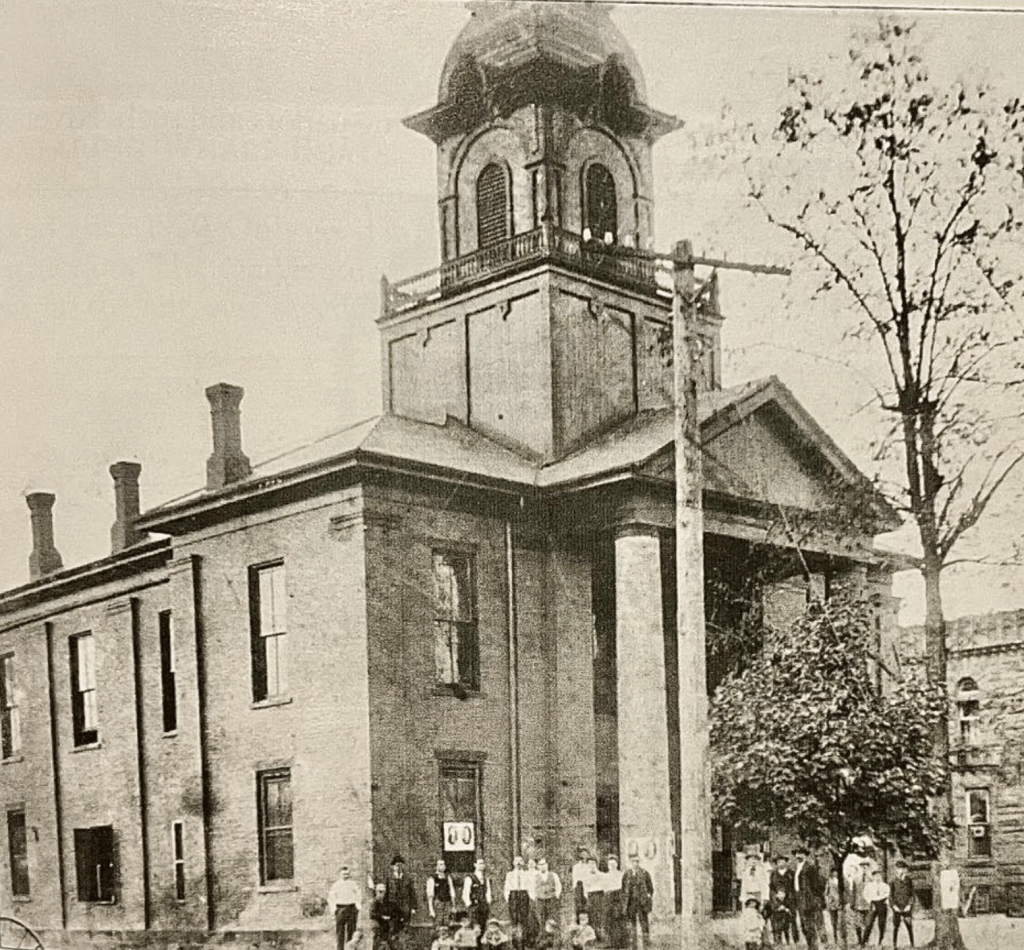
The Tyler County Courthouse in Middlebourne, built in 1854. This image probably dates to the late 1800s.
Transcription
Middlebourne, Tyler county, Virginia 1st October [1862]
Dear Cousin Annie,
I address you a few lines this evening according to Nancy’s request. She received the papers you sent and wishes me to say to you she would write if her eyes were not so weak that she cannot see to write. She has another baby two weeks old. It is a real pretty baby. It has brown hair, blue eyes, and very delicate features. Bert named it the day after it was born. He calls it McClellan.
We were very much surprised to hear of Uncle Christian’s marriage. When you write, please tell us if it was John Keener’s widow that he married and if Tilla and Mina are both at home yet.
We have great excitement with guerrillas, rebels, and so on. We have our hands full to keep our lives, property, or anything else. There is to be a wedding party in town tomorrow. Dr. Woodburn is to bring his bride home tomorrow evening.
One of my friends and a correspondent was killed in the late battle before Washington. His name was Will Guthrie. 1 I have his picture. Oh, Annie, how many hearts the rebels have caused to bleed and how many mourners they have made.
Marg has just returned from West Union and Frank is going to New Martinsville to Aunt Anne’s this week to stay awhile. I think she will be safer there than at home if the rebels come in so strong that we will have to fly from our homes and everyone here thinks we will have to leave sooner or later.
As it is quite late, I will have to close for the present promising ot write more at length next time. Nancy is nursing the baby. [Sister Frances] “Frank” is in bed asleep and [sister] Marg[aret] is hurrying me to go to bed. Please give our love to all the friends. Write soon and believe me to be as ever your affectionate cousin, — Mollie Kramer
When you write, please tell us where Kramer is and what his company and regiment is.
1 Most likely William H. Guthrie (1841-1862), the son of Rev. Frank Guthrie and Elizabeth Hughes of Gallipolis, Ohio. He served in Congress. A, West Virginia Cavalry. He was killed in action on August 29, 1862 at 2nd Bull Run.
This unsigned or partial was written by a soldier who most likely served in the 37th Illinois, the 9th Missouri Infantry 9changed to 59th Illinois), the 5th Iowa Infantry, or 1st Kansas Infantry as they were brigaded together in late September 1861 at Boonville, Missouri, under the command of J. C. Kelton.
Transcription
Syracuse, Missouri December 5th 1861
Friend Thompson,
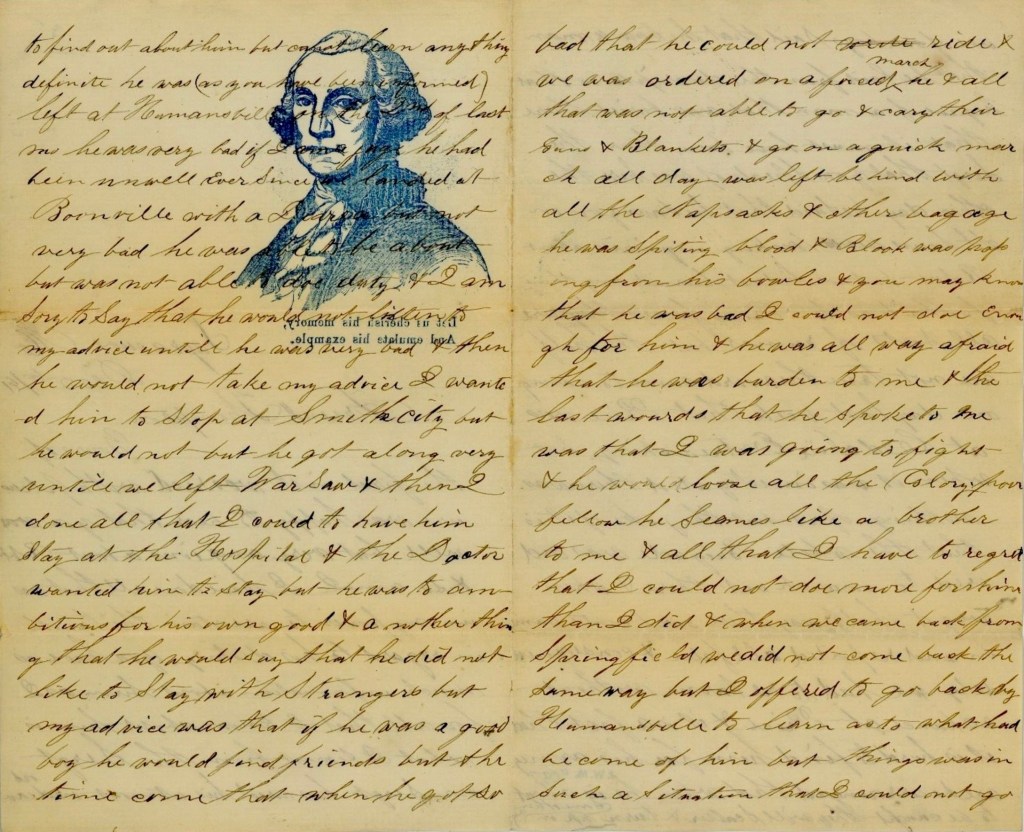
Yours of the 1st inst. was received with pleasure. Was happy to hear that you was well but very anxious about Robert & so am I. I have done all that was in my power to ascertain the truth in regard to his destiny. You have as much information about him as I for all that I know about him is what I learnt from the Sergeant. Our sergeant has used his utmost endeavors to find out about him but cannot learn anything definite.
He was (as you have been informed) left at Humansville 1 on the 2nd of last month. He was very bad if I can judge. He had been unwell ever since we landed at Boonville with a diarrhea but not very bad. He was able to be about but was not able to do duty & I am sorry to say that he would not listen to my advice until he was very bad & then he would not take my advice.
I wanted him to stop at Smith City but he would not, but he got along very [well] until we left Warsaw & then I done all that I could to have him stay at the hospital & the Doctor wanted him to stay but he was too ambitious for his own good and another thing that he would say that he did not like to stay with strangers, But my advice was that if he was a good boy, he would find friends. But the time come that he got so bad that he could not ride & we was ordered on a forced march. He and all that was not able to go & carry their guns and blankets and go on a quick march all day was left behind with all the knapsacks & other baggage.
He was spitting blood & blood was pooping from his bowels & you may know that he was bad. I could not do enough for him & he was always afraid that he was a burden to me & the last words that he spoke to me was that I was going to fight & he would lose all the glory. Poor fellow. He seems like a brother to me & all that I have to regret [is] that I could not do more for him that I did. And when we came back from Springfield, we did not come back the same way but I offered to go back by Humansville to learn as to what had become of him but things was in such a situation that I could not go.
One of our boys said that he saw a man that he said from the description that he gave of a man that was buried there that it must have been him. The Sergeant that you speak of was here the other day. He said that he saw you in St. Louis . He was making inquiries about Robert but we had not learned anything further.
And as to Price’s forces, there are all sorts of rumors but the half are not true. The word came to camp one day last week that Price was at Sedalia entrenching but when it was investigated, there was nothing of it. But the joke of it is that the whole brigade was ordered to march out there and when we got half way there, our scouts came in and reported all false & consequently we had to return without a chance at Price. And it is a fact that it is hard to find him for his army are so arranged that she he is about to be caught, they will scatter & turn up in some other way. [unsigned or partial]
1 In the regimental history of the 59th Illinois Infantry, Humansville was described as a “small town in Hickory County, Mo., and is the only place where any demonstrations were made, in honor of the stars and stripes, between Boonville and Springfield. Here the soldiers of the Union were welcomed by the waiving of flags and the smiles of the women, and the kindly greetings of the citizens generally. A portion of Price’s army had passed through this place, some three weeks before, and had carried off all the goods belonging to the merchants, and had mistreated the inhabitants of the town and vicinity to such a degree, that they were heartily tired of their presence, and were rejoiced at the approach of the Federal troops….The sick of the regiment, had been increasing for the last ten days, to such an extent, that now there was no means of conveying them any farther. Thus far, they had been transported in wagons, but it was now necessary to select such as could not, in a measure, provide for themselves, and leave them behind. The Surgeon, therefore, fitted up the Meeting-house in town, in the best possible manner, and removed the sick to it. A cook, some nurses, and several days rations, were left with them. Poor fellows! they all nearly starved to death before they could get away, and three did die from the effects of disease and want of proper nourishment. After the army left, the patriotism of the ladies and gentlemen of the town, oozed out at their fingers ends, and our sick boys could get nothing from them. One man, John Clemens, of Co. H, who was very sick when taken there, died on the 4th of November. Bromwell Kitchen, of Co. F, soon followed, and Nathaniel B. Westbrook, of Co. A, died on the 20th. The others eventually found their way to the regiment.”
The following letter was written by James Drury (1837-1919), a native of Limerick, Ireland. In 1860, James was enumerated in the household of 42 year-old Albert Baldwin in Chester, Windsor county, Vermont, where he worked as a farm hand. Living in the same household was his 62 year-old mother, Mary Drury.
It was on 21 September 1861 when James mustered into Co. C, 4th Vermont Infantry as a private. A month later he was promoted to corporal and eventually rose to the rank of sergeant. He was awarded the Congressional Medal of Honor for his bravery in action at The First Battle of Weldon Railroad, Virginia on June 23, 1864. His citation reads “He saved the colors of his regiment when it was surrounded by a much larger force of the enemy, and after the greater part of the regiment had been killed or captured.”
A description of the event was recorded in Deeds of Valor, page 368:
Drury replied: “They will have to kill this Irishman before they get it.”
The officer pointed to a road which seemed to offer some chance as an avenue of escape.
“Go that way and perhaps you may succeed in escaping the rebels,” the officer observed. Drury lost no time in following the advice. Wrapping the flag around the staff, he said to his command: ” Boys, I’m going to save this flag or die in the attempt.”
Privates Brown and Wilson called out: “We’ll be with you, Sergeant.” And then the three started across the open fields. They had not progressed far, however, when the rebels shouted to them: ” Halt, you damned Yankees ! ” but the Yankees did not halt. A shower of bullets was sent after them. Poor Brown fell. To their regret they had to leave the brave fellow behind. Sergeant Drury and his remaining companion, Private Wilson, ran as fast as they could and safely reached the timber. By this time darkness had set in and the fugitives were able to conceal themselves in the woods till daybreak, when they found the Federal pickets, and thus saved the flag from falling into the enemy’s hands.
I’m speculating on the recipient of this letter but presume it was Albert Baldwin for whom he labored and with whom he and his mother lived prior to the James’ enlistment.
The “Picture Gallery” at Camp Griffin where the Vermont Brigade spent the Winter of 1861-62. Langley, Virginia. (LOC)
Transcription
Camp Griffin November 28, 1861
Dear sir,
I received your letter last evening and was [glad] to hear that you all are in good health as I am now. I got the box last evening and your letter. Believe me, I was glad of it. I sent ten dollars to Bellow’s Falls Bank so that you can draw it with this receipt and I want you to pay yourself out of it and give the rest to mother. But want you should pay yourself for your trouble.
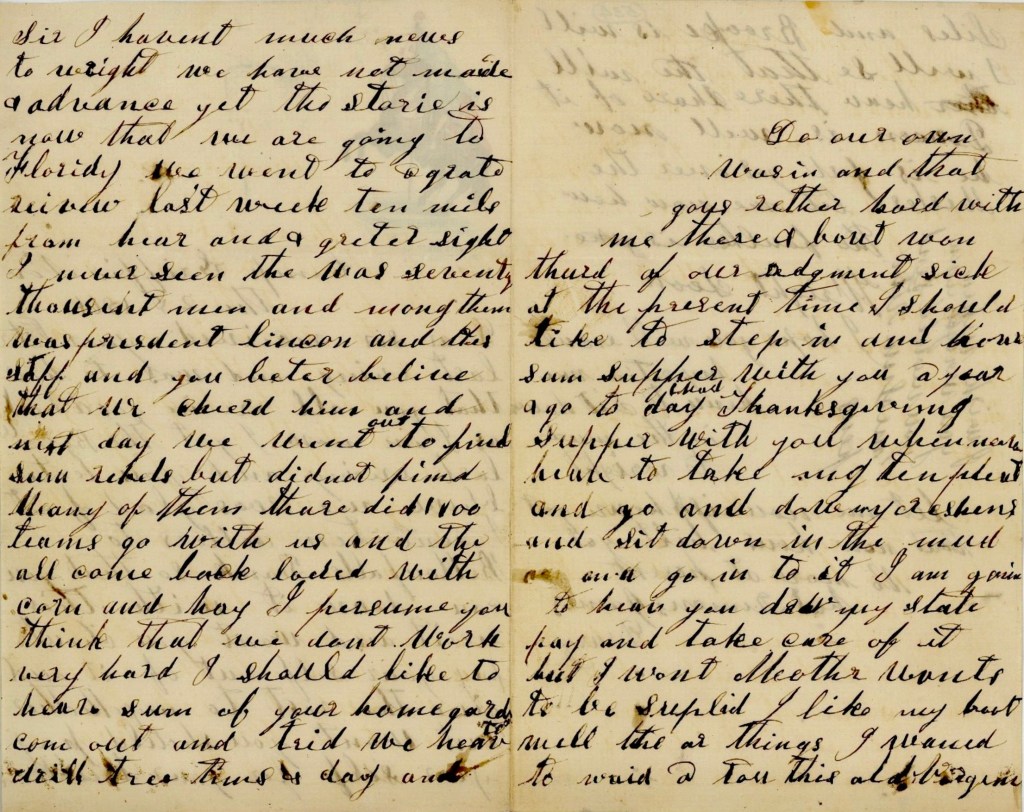
Sir, I haven’t much news to write. We have not made an advance yet. The story is now that we are going to Florida. We went to a Great Review last week ten miles from here and a greater sight I never seen. There was seventy thousand men and among them was President Lincoln and his staff and you better believe that we cheered him and next day we went out to find some rebels but didn’t find many of them. There did 100 teams go with us and they all came back loaded with corn and hay.
I presume you think that we don’t work very hard. I should like to have seen your home guard come out and try it. We have to drill three times a day and do our own washing and that goes rather hard with me. There [are] about one third of our regiment sick at the present time. I should like to step in and have some supper with you. A year ago today I had Thanksgiving supper with you. Suppose now I’ll have to take my tin plate and go and draw my rations and sit down in the mud and go into it. I am a going to have you draw my state pay and take care of it but I want mother wants to be supplied. I like my boots well and the other things…
Silas and Brook is well. I will see that they will have their share of it. Dansen is well now. He is just got over the measles. Let me know how the folks is. Write soon. I hope you will excuse my writing. We have to sit down in the mud to write. Let me know if [ ] got that new house built yet. No more at present but remain, — James Drury
The following letter was written by George F. Lanphear (1836-1863), the son of Reuben Lanphear (1806-1888) and Catherine Remington (1806-1847) of Hartland, Windsor county, Vermont. In the 1860 US Census, George was living in Rich Valley, McLeod county, Minnesota with his father and his step-mother, Amelia P. Messenger (b. 1811).
On 11 September 1861, George enlisted as a private in Co. K, 2nd Minnesota Infantry at Glencoe, Minnesota. He served with the regiment until 25 November 1863 when he was killed in the Battle of Missionary Ridge near Chattanooga, Tennessee. He was buried in Grave No. 383 at the National Cemetery at Chattanooga. He was buried under the name Lamphear.
George wrote the letter to his sister Eliza Jane (Lanphear_ Shattuck (1831-1914), the wife of Eliphalet Shattuck (1825-1881) of Hartland, Windsor county, Vermont.
Unfortunately I cannot find the full article of this clipping that appeared on Find-A-Grave.
Transcription
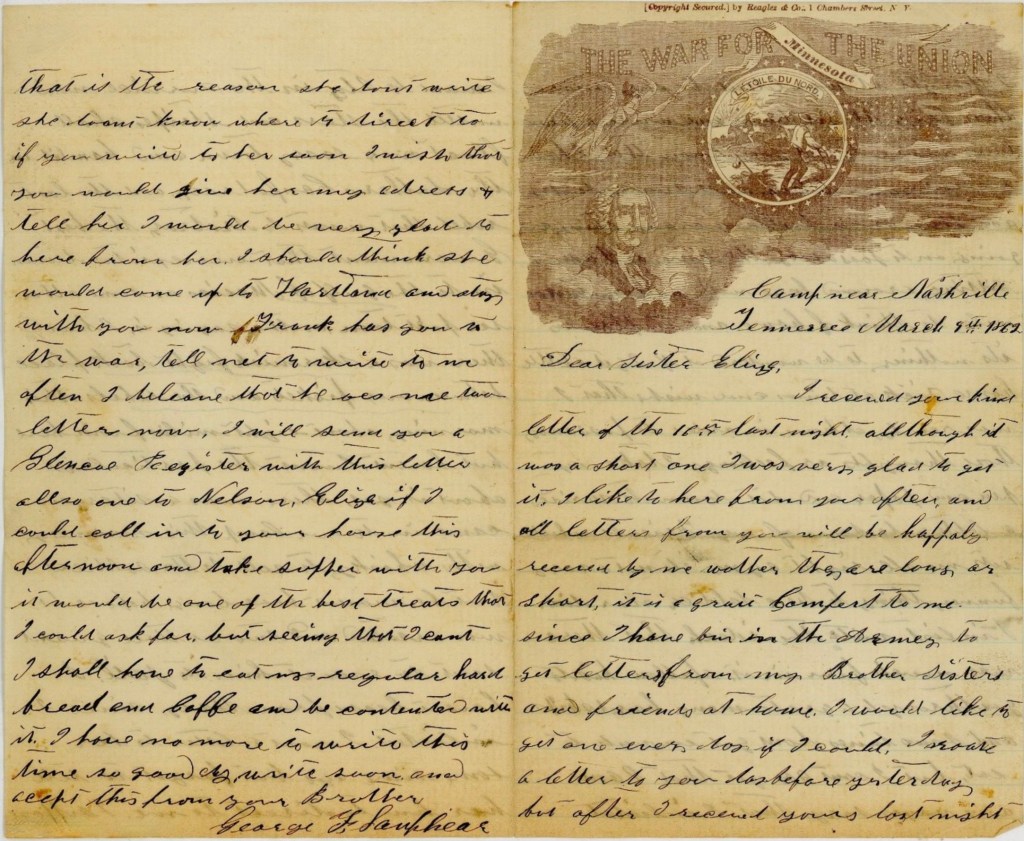
Camp near Nashville, Tennessee March 9th 1862
Dear Sister Eliza,
I received your kind letter of the 16th last night. Although it was a short one, I was very glad to get it. I like to hear from you often and all letters from you will be happily received by me whether they are long or short. It is a great comfort to me since I have been in the army to get letters from my brother, sisters, and friends at home. I would like to get one every day if I could. I wrote a letter to you day before yesterday but after I received yours last night I thought it wouldn’t be any more than fair to sit down and write a few lines more to let you know that I had received your letter.
It is Sunday today and there is no drilling or anything a going on to pass away the time. As I am sitting around here with nothing to do, only to think of home and its pleasures. It’s nothing to be wondered at, if I get a little homesick at times and wish that I was really at home. In order to pass away those thoughts or feelings, I take my pen and paper and sit down to write a letter to some of my friends which sets me all right again. It’s not a very funny thing to be a soldier nor did I enlist with the idea that there was fun in it. A fellow has to go through a great many hardships and sometimes don’t get enough to eat, but I can’t say yet that I am any ways sorry that I enlisted. I mean to stay in the service now until the stars and stripes shall float over every town and hamlet in the Southern Confederacy, and the last rebel that wants to destroy the best Government that ever existed driven into the Gulf of Mexico or some other sea port town, as the saying is.
I hear there was a skirmish fight took place between our pickets and the rebels this morning about eight miles from here but haven’t learnt the particulars about it yet. There was a citizen came in to our camp this morning with whiskey to see to the soldiers but he wasn’t here long before he was arrested and two or three guard sent to escort him to jail.
I haven’t heard from [sister] Mary since I enlisted. I wrote a letter to her some time ago but forgot to tell her how to direct to me. I suppose that is the reason she don’t write. She don’t know where to direct to. If you write to her soon, I wish that you would give her my address & tell her I would be very glad to hear from her. I should think she would come up to Hartland and stay with you now. Frank has gone to the war. Tell Net to write to me often. I believe that he owes me two letters now. I will send you a Glencoe Register with this letter. Also one to [brother Reuben] Nelson. Eliza, if I could call in to your house this afternoon and take supper with you, it would be one of the best treats that I could ask for. But seeing that I can’t, I shall have to eat my regular hard bread and coffee and be contented with it.
I have no more to write this time so goodbye. Write soon and accept this from your brother, — George F. Lanphear
These letters were written by Daniel Markham (1837-1910), the son of Uriah Markham (1803-1848) and Elizabeth Adams (1803-18xx) of Brown county, Ohio. Daniel and his brother, Archibald (“Archie”) H. Markham (1835-1911), both served in Co. H, 2nd Illinois Cavalry.
Daniel wrote all of these letters to his cousin, Sarah Annette Markham (b. 1840), the daughter of Horace Marcum (b. 1791) of Knox county, Illinois.
Transcription
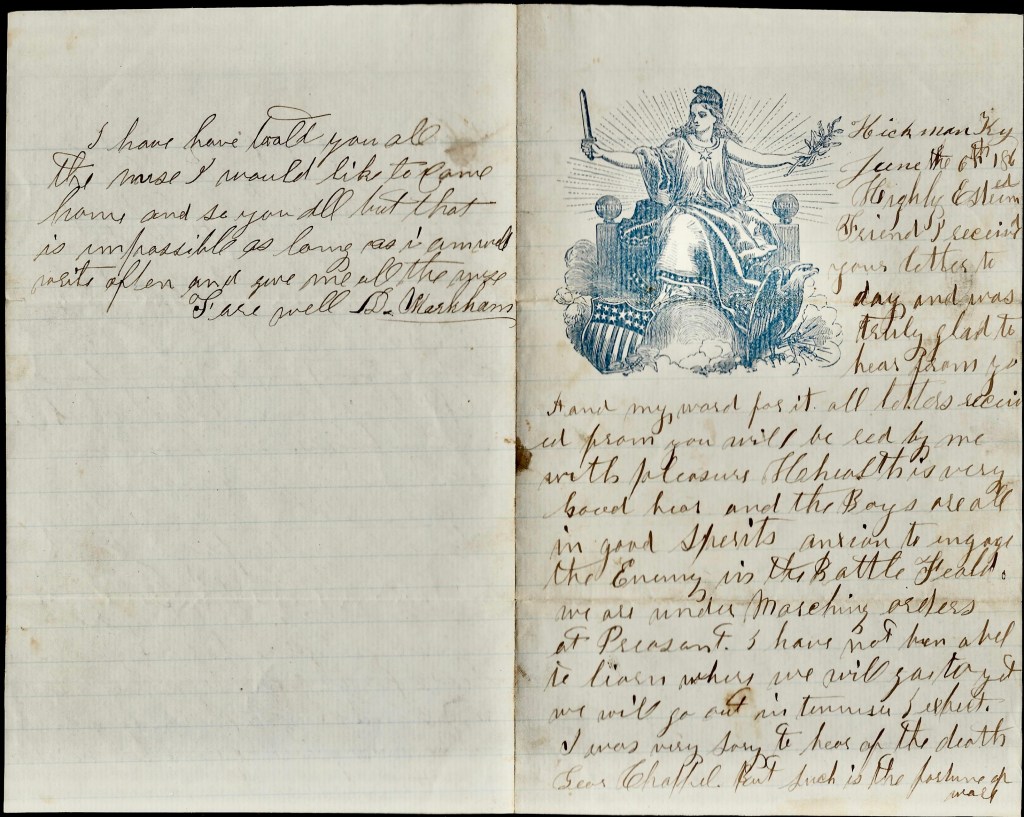
Patriotic Letterhead on stationery used by Markham
Hickman , Kentucky June 6, 1862
Highly Esteemed Friend,
I received your letter today and was truly glad to hear from you and [you have] my word for it, all letters received from you will be read by me with pleasure. My health is very good here and the boys are all in good spirits, anxious to engage the enemy in the battlefield. We are under marching orders at present. I have not been able to learn where we will go to yet. We will go out in Tennessee I expect. I was very sorry to hear of the death of George Chappel. But such is the fortune of many.
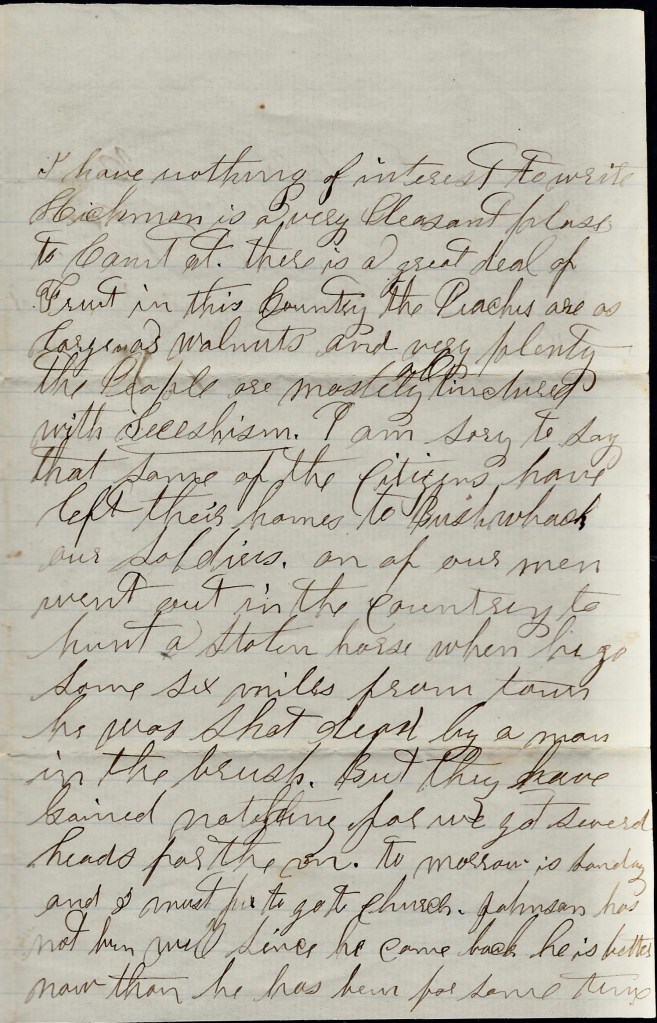
I have nothing of interest to write. Hickman is a very pleasant place to camp at. There is a great deal of fruit in this country. The peaches are as large as walnuts and very plenty. The people are mostly tinctured with seceshism. I am sorry to say that some of the citizens have left their homes to bushwhack our soldiers. One of our men went out in the country to hunt a stolen horse. When he had gone some six miles from town, he was shot dead by a man in the brush. But they have gained nothing for we got several heads for the one.
Tomorrow is Sunday and I must go to church. Johnson has not been well since he came back. He is better now than he has been for some time. I have told you all the news. I would like to come home and see you all but that is impossible as long as I am well. Write often and give me all the news. Farewell, — D. Markham
I could not find an image of Willard but here is one of Quartermaster Sergeant Erastus Holmes of the 5th Indiana Cavalry who also spent months in Andersonville Prison (John Sickle’s Collection)
These letters (some partial and unsigned) were written by Pvt. Willard J. Smith (1835-1868) of Co. I, 5th Indiana Cavalry. Willard enlisted in the regiment on 9 August 1862 and he mustered out of the regiment on 23 June 1865.
Willard wrote the letters to younger brother James Hall Smith (1839-1909), the son of John W. Smith (1808-1877) and Electa A. Jackson (1810-1864) of Boone township, Porter county, Indiana.
From Willard’s letter of May 22, 1865, we learn that he spent the winter of 1864/65 in Andersonville Prison with a number of other members of the 5th Indiana Cavalry—several of whom died there. Willard himself was reported to have died at Andersonville on August 15, 1864, but inconsistently also reports him to have been mustered out of the regiment on 15 June 1865. Most of the 5th Indiana Cavalry regiment was captured during Stoneman’s Raid at Sunshine Church, Hillsboro, between July 30-31, 1864.
Though Willard survived the ordeal of Andersonville Prison, his health must have been irreparably broken as he died on 14 October 1868 at the age of 33. His gravestone in Fleming Cemetery does not even recognize his military service, let alone his confinement at Andersonville.
Letter 1
November the 23, 1862
Well Jim, this is Sunday morning & I hain’t anything to do only to write to you. The first thing I have to tell you is that I am well & hope that these few lines will find you all the same. We are going to have an election this afternoon to elect another captain. Our captain [Ephraim N. Banks] has been promoted to regimental surgeon. He is going to the 54th [Indiana] Regiment. He will leave us tonight. I have to have him leave the worst way because he is the right kind of a man. We are going to put Dock Macon [John T. McKean] in his place and the orderly in [Arthur M.] Buell’s place. I think Mr. Buell will be shoved clear out of the company. I hope so at any rate. ¹
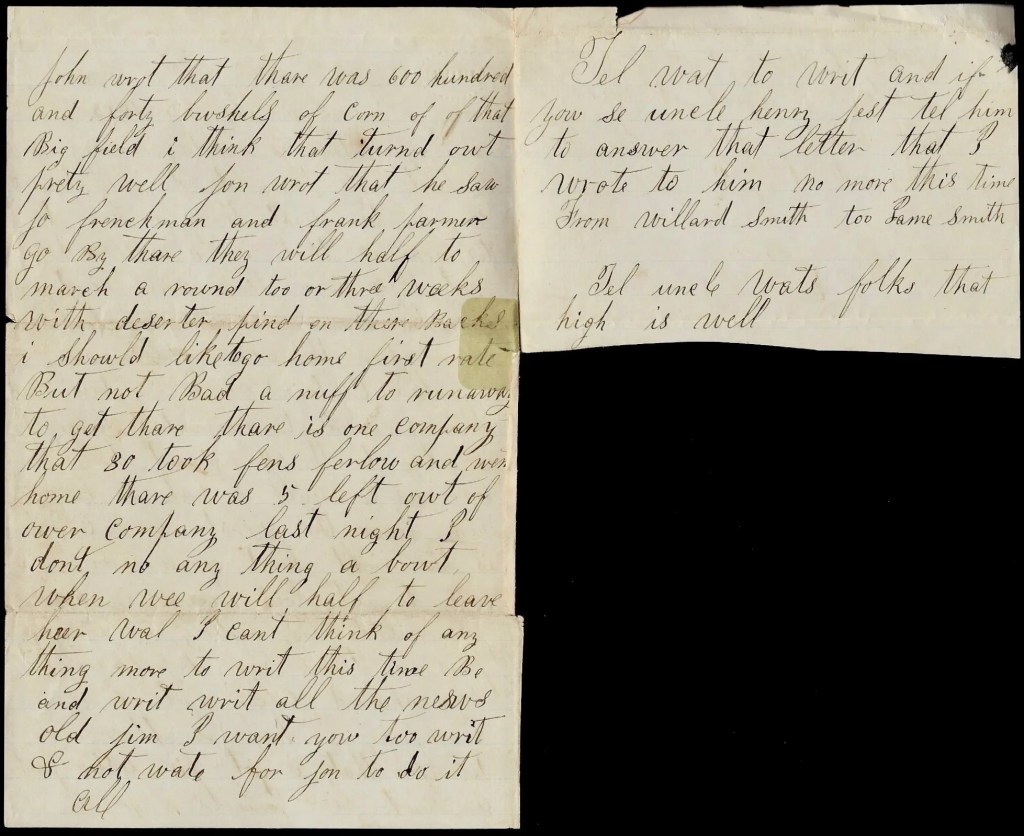
Tell John that I got his letter just about five minutes ago. John wrote that there was 600 and 40 bushels of corn off that big field. I think that turned out pretty well. John wrote that he saw Joe Frenchman and Frank Farmer go by there. They will have to march around two or three weeks with “deserter” pinned on their backs. I should like to go home first rate but not bad enough to run away to get there. There is one company that 30 took French furlough and went home. There was 5 left out of our company last night.
I don’t know anything about when we will have to leave here. Well, I can’t think of anything more to write this time. Be [good] and write all the news, old Jim. I want you to write & not wait for John to do it all.
Tell Wat ² to write and if you see Uncle Henry, just tell him to answer that letter that I wrote to him. No more this time.
From Willard Smith
to James Smith
Tell Uncle Wat’s folks that high is well.
¹ Arthur M. Buell resigned his 1st Lieutenant’s commission on 1 December 1862. Apparently he was roundly disliked by the men. He was replaced by Edgar L. Morse of Lowell, Indiana, and eventually became captain.
² Waterman J. Smith (1832-1901) was Willard’s older brother. “Wat” served in Co. D, 23rd Indiana Infantry.
Letter 2
December the 18, 1862
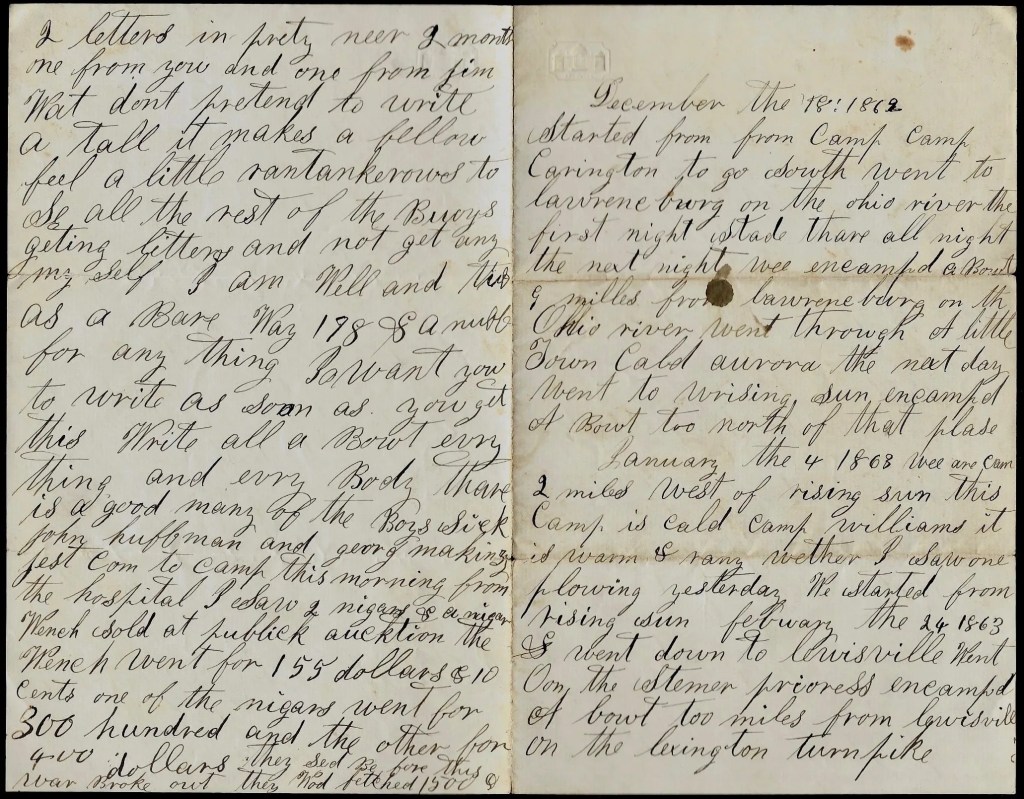
Started from camp Carington to go south. Went to Lawrenceburg on the Ohio River the first night, stayed there all night. The next night we encamped about 9 miles from Lawrenceburg on the Ohio River. Went through a little town called Aurora. The next day went to Rising Sun. Encamped about two [miles] north of that place.
January 4, 1863, we are camped two miles west of Rising Sun. This camp is called Camp Williams. It is warm & rainy weather. I saw one plowing yesterday. We started from Rising Sun February the 24, 1863 & went down to Louisville. Went on the steamer Princess. Encamped about two miles from Louisville on the Lexington turnpike.
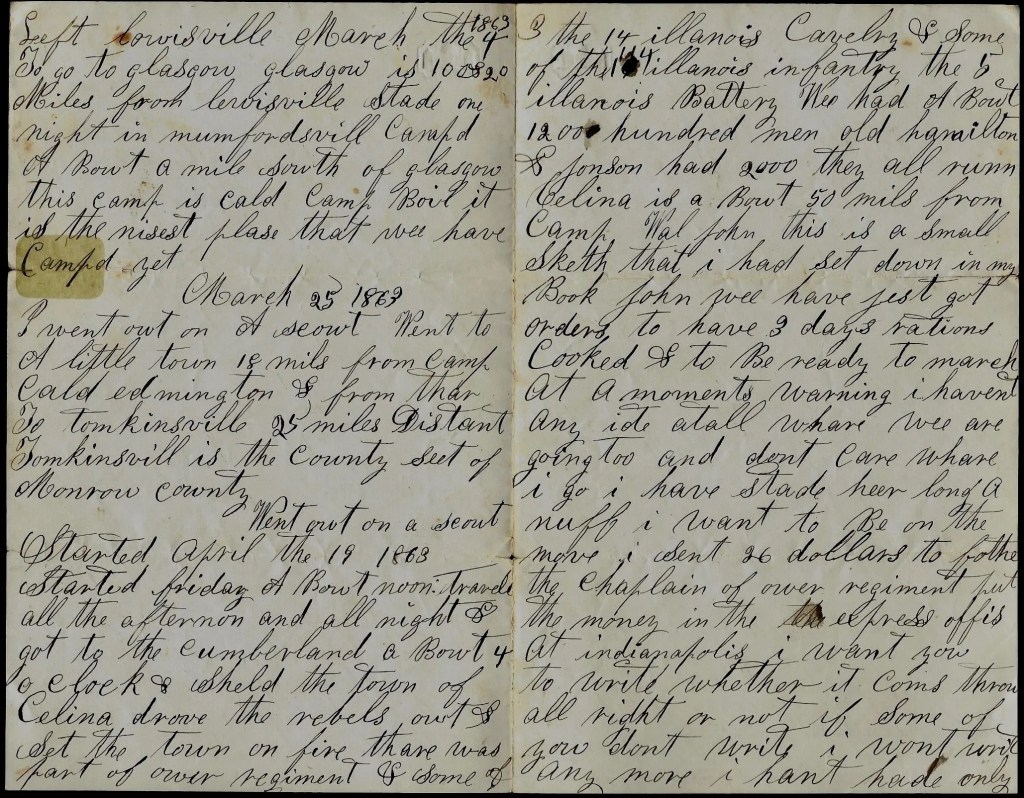
Left Louisville March the 4, 1863 to go to Glasgow. Glasgow is 100 & 20 miles from Louisville. Stayed one night in Mumfordsville. Camped about a mile south of Glasgow. This camp is called Camp Boyle. It is the nicest place that we have camped yet.
March 25, 1863, I went out on a scout. Went to a little town 18 miles from camp called Edmington & from there to Tompkinsville 25 miles distant. Tompkinsville is the County Seat of Monroe County.
Went out on a scout. Started April the 19, 1863. Started Friday about noon. Travelled all the afternoon and all night & got to the Cumberland about 4 o’clock & shelled the town of Celina, drove the rebels out & set the town on fire. There was part of our regiment & some of the 14th Illinois Cavalry & some of the 14 Illinois Infantry [and] the 5th Illinois Battery. We had about 1200 men. Old Hamilton and Johnson had 2,000. They all run. Celina is about 50 miles from camp.
Well, John, this a small sketch that I had set down in my book. John, we have just got orders to have 3 days rations cooked & to be ready to march at a moment’s warning. I haven’t any idea at all where we are going to and don’t care where I go. I have stayed here long enough.
I sent 26 dollars to Father. The Chaplain [Amos D. Cunningham] of our regiment put the money in the express office at Indianapolis. I want you to write whether it comes through all right or not. If some of you don’t write, I won’t write anymore. I hain’t had only 2 letters in pretty near 2 months—one from you and one from Jim. Wat don’t pretend to write at all. It makes a fellow feel a little rantankerous to see all the rest of the boys getting letters and not get any myself.
I am well and thick as a bear. Weigh 178 and enough for anything. I want you to write as soon as you get this. Write all about everything and everybody. There is a good many of the boys sick. John Huffman and George Mckinsey just came to camp this morning from the hospital. I saw 2 niggers & a nigger wench sold at public auction. The wench went for 155 dollars & 10 cents. One of the niggers went for 300 hundred and the other for 400 dollars. They said before this war broke out they would have fetched $1500 dollars.
Letter 3
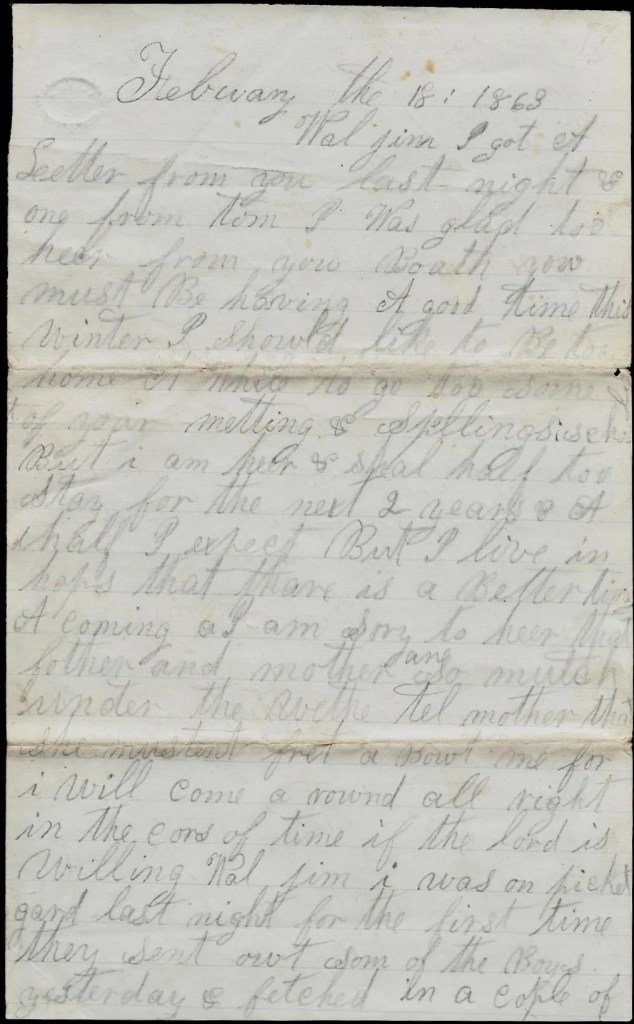
February 18, 1863
Well Jim, I got a letter from you last night & one from Tom. I was glad to hear from you both. You must be having a good time this winter. I should like to be to home awhile to go to some of your meetings and spelling schools, but I am here & shall have to stay for the next two years and a half, I expect. But I live in hopes that there is a better time a coming. I am sorry to hear that Father and Mother are so much under the weather. Tell Mother that she mustn’t fret about me for I will come around all right in the course of time if the Lord is willing.
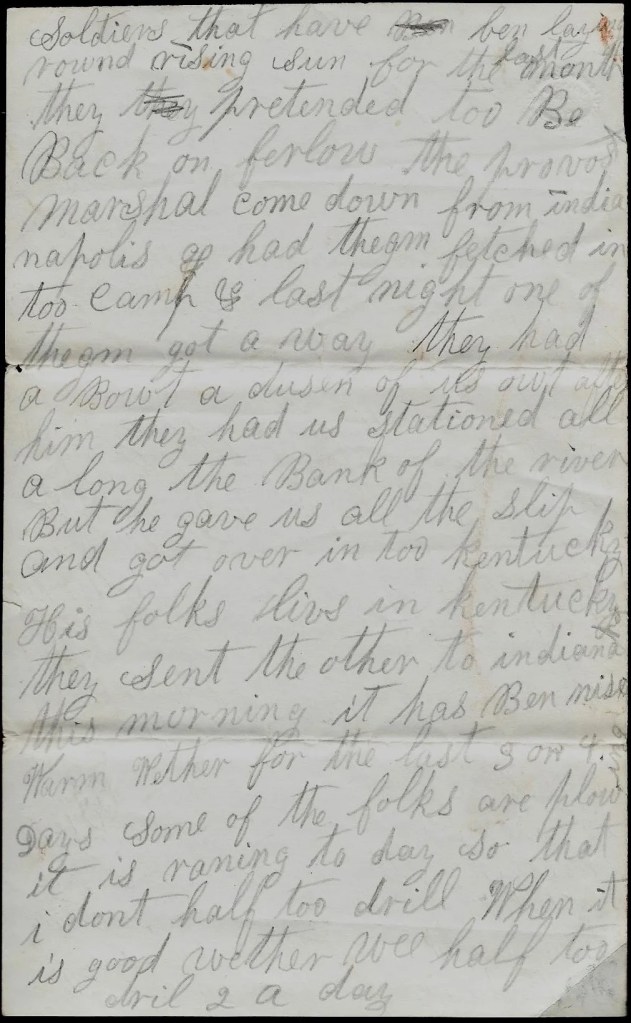
Well Jim, I was on picket guard last night for the first time. They sent out some of the boys yesterday & fetched in a couple of soldiers that have been laying around Rising Sun for the last month. They pretended to be back on furlough. The Provost Marshal came down from Indianapolis & had them fetched in to camp & last night one of them got away. They had about a dozen of us stationed all along the bank of the river but he gave us all the slip and got over into Kentucky. His folks live in Kentucky. They sent the other to Indiana this morning.
It has been nice warm weather for the last 3 or 4 days. Some of the folks are plowing. It is raining today so that I don’t have to drill. When it is good weather, we have to drill twice a day.
Letter 4
Camp Chase, Ohio May the 22, 1865
Mr. John,
It has been over a year since I have took a pen to try to write. I thought I wouldn’t write at all but I wanted to hear from home so bad that I couldn’t wait any longer, so I thought I would write. I don’t know whether they will discharge me here or give me a furlough. I may not have to stay here more than a week and I may have to stay three months. This military is rather uncertain business.
I landed here Saturday the 20th and who should I find but Jim Marsh and Frank Parmer. You can’t think how much good it done me to them and to hear from home. They say you all thought I had done up the spout. But thank the Lord, I am in the land of the living and able to eat my rations yet.
I was paroled and got through to our lines the 28th of April. Come into our lines at Jacksonville, Florida. That was the happiest day of my life. I staid in Andersonville, Georgia, last winter. Was sent to Jacksonville, to Annapolis, Maryland, and there I drew 9 months ration money—the hardest earned money that ever I got in my life. I drew 67 dollars and a half, the first money that I have had in a year. Jim Marsh says that [my brothers] Wat 1 and Jim have both enlisted and gone soldiering. I hope they may never have the misfortune to fall into the rebels hands. If they ever do, I hope they will fare better than I did.
Well John, it has been so long since I wrote that I can’t write. Write as soon as you get this and write all about everybody and everything. Write what regiment they belong to and how Uncle Henry’s folks get along and all about it.
From Willard Smith
to Brother John & all the rest of the folks.
1Waterman J. Smith (1832-1901) was Willard’s older brother. “Wat” served in Co. D, 23rd Indiana Infantry.
















 Spared & Shared 23