All posts by Griff

My passion is studying American history leading up to & including the Civil War. I particularly enjoy reading, transcribing & researching primary sources such as letters and diaries.

1861: George Washington Atwood to John Atwood

I could not find an image of George but here is Franklin Blanchard who served in Co. K. Franklin’s father was the captain of Co. K. (Tim Smith Collection, Civil War Faces)

The following letter was written by Pvt. George Washington Atwood (1831-1863) of Co. E (the “Sandwich Rifles”), 13th Illinois Infantry. Muster rolls inform us that he enlisted on 24 May 1861 and was discharged for disability at St. Louis hospital on 15 February 1863. They also inform us that he was born in 1831 in Belfast, Allegany county, New York, and that he was a 6 foot tall, light-haired, blue-eyed single farmer residing in Little Rock, Kendall county, Illinois, at the time of his enlistment. What the muster rolls don’t tell us is that the reason he was mustered out of the regiment is that he died and was buried in the Christ Church Cemetery at St. Louis, though he was later reinterred in the Jefferson Barracks National Cemetery (Grave No. 6550).

The 13th Illinois was part of General Fremont’s force that went to Springfield, Missouri, in the fall of 1861 where they became known as “Fremont’s Grey Hounds” for their rapid marching. They joined General Curtis on his long march to Helena, Arkansas, and they participated in Sherman’s attack on Chickasaw Bayou where their colonel was killed. They took part in the capture of Arkansas Post and later in the siege of Vicksburg. Most likely Atwood fell victim to disease at Young’s Point, opposite Vicksburg, where the regiment spent the winter of 1862-63.

To read more letters and diaries written by members of the 13th Illinois Infantry transcribed and published on Spared & Shared, see:

Frederick W. Partridge, F&S, 13th Illinois (1 Letter)
Abiather Webster Sutliff, Co. B, 13th Illinois (1 Letter)
Harvey R. Frazer, Co. C, 13th Illinois (1 Letter)
Enoch Benjamin Darnell, Co. E, 13th Illinois (1 Letter)
Wilson E. Chapel, Co. F. 13th Illinois (1 Letter)
Reuben Macy Hevenor, Co. F, 13th Illinois (1 Letter)
Oliver Willard Smith, Co. F, 13th Illinois (1 Letter)
Hiram L. Ketcham, Co. K, 13th Illinois (1 Letter)
Abraham L. Marks (“Charley Harris”), Co. K, 13th Illinois (Diary)
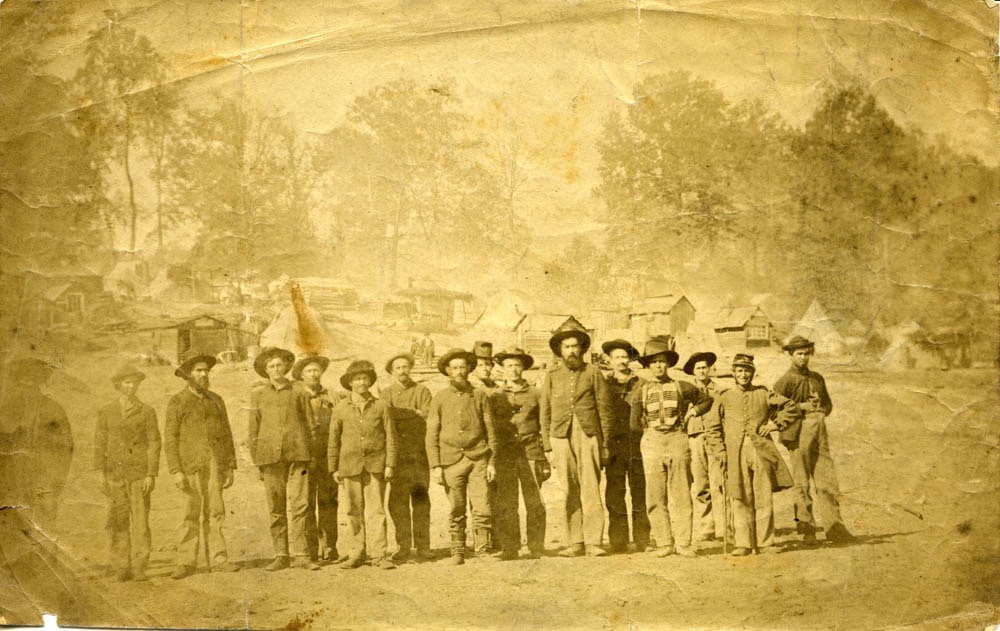
Members of the 13th Illinois Infantry at Helena, Arkansas, where the regiment was encamped from July through December 1862. (Courtesy of Wilson Creek National Battlefield)

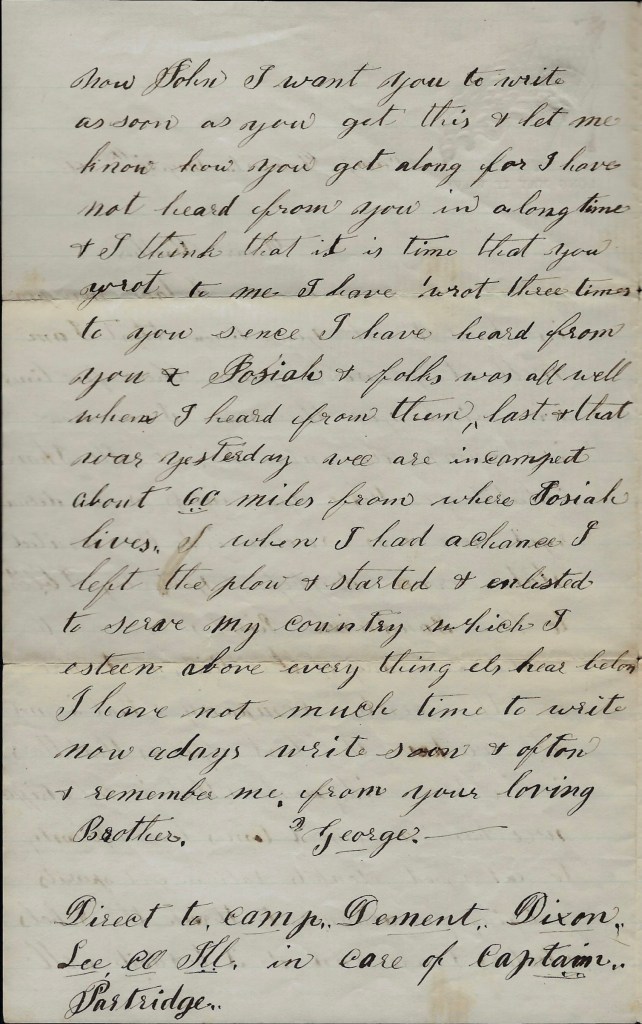
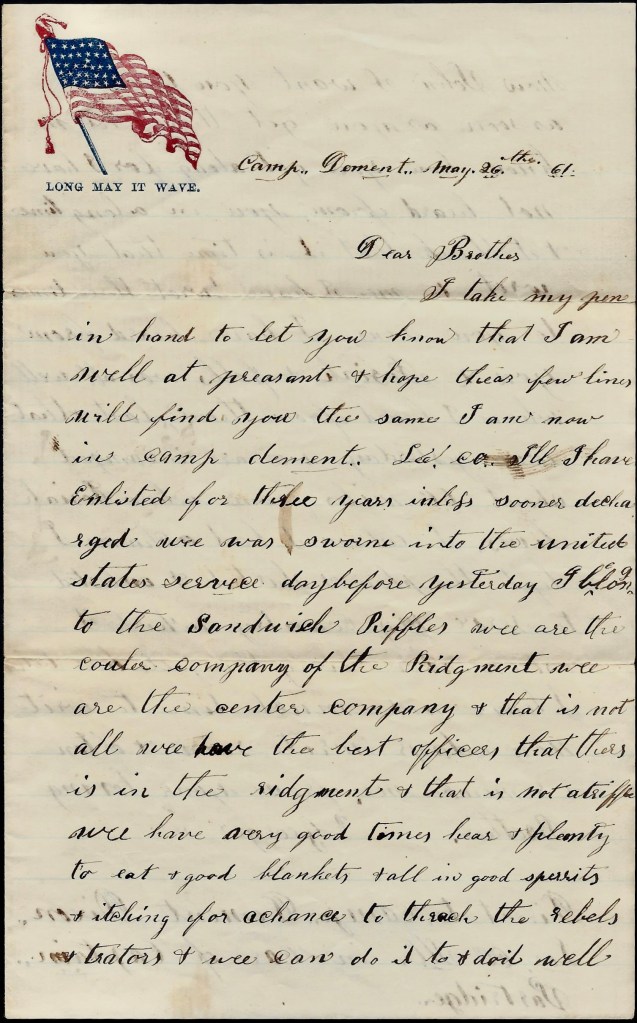
Transcription

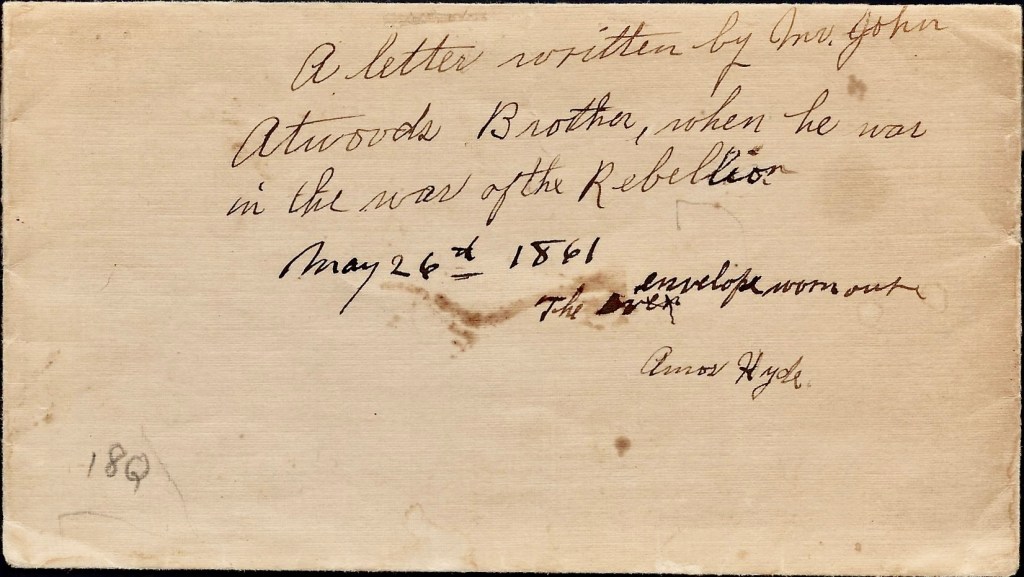
Replacement envelope with annotation of contents

Camp Dement [Dixon, IL]
May 26th 1861

Dear Brother,

I take my pen in hand to let you know that I am well at present and hope these few lines will find you the same. I am now in Camp Dement, Lee Co., Illinois. I have enlisted for three years unless sooner discharged. We were sworn into the United States service day before yesterday. I belong to the Sandwich Rifles. We are the color company of the regiment. We are the center company and that is not all. We have the best officers that there is in the regiment and that is not a trifle.

We have very good times here and plenty to eat and good blankets and all in good spirits and itching for a chance to attack the rebels and traitors and we can do it too and do it well.

Now John, I want you to write as soon as you get this and let me know how you are getting along for I have not heard from you in a long time and I think that it is time that you wrote to me. I have written three times to you since I have heard from you and Josiah and folks were all well when I heard from them last and that was yesterday.

We are encamped about 60 miles from where Josiah lives and when I had a chance, I left the plow and started and enlisted to serve my country which I esteem above everything else here below. I have not much time to write nowadays. Write soon and often and remember me.

From your loving brother, George

Direct to Camp Dement, Dixon, Lee Co. Illinois, in Care of Captain [Frederick William] Partridge
1862: William Willis to his Mother

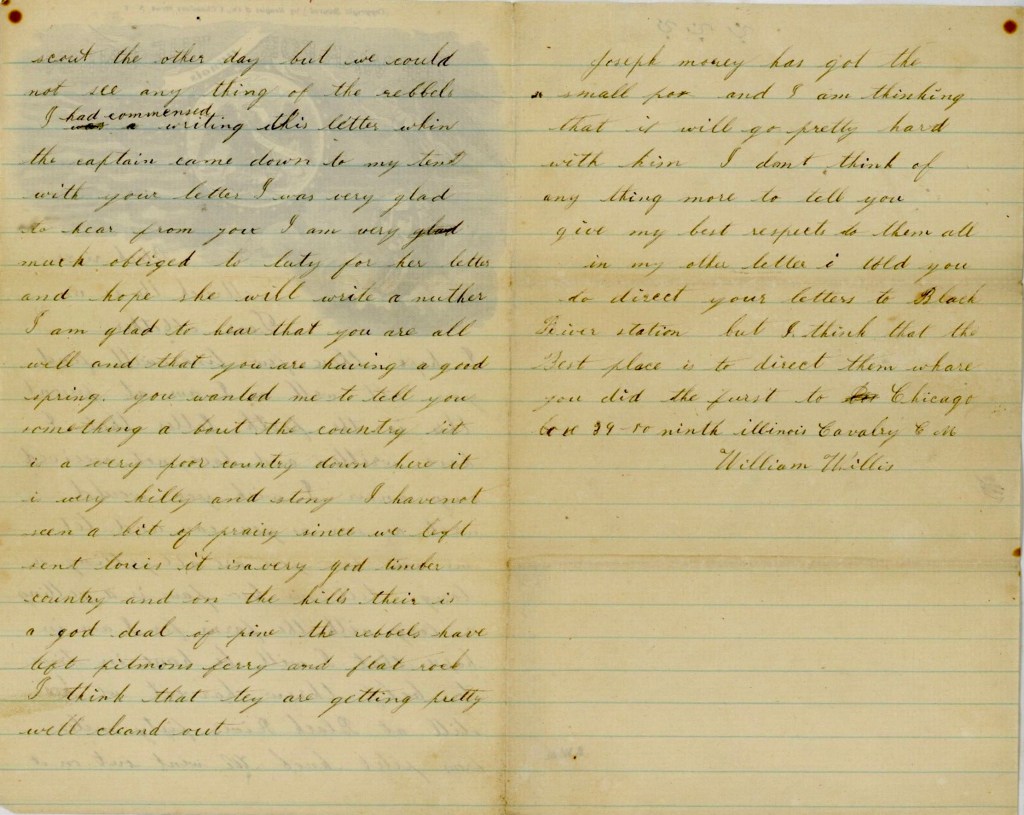
This letter was written by a member of Co. M, 9th Illinis Cavalry. His name seems to read clearly as William Willis but I cannot find a soldier on the muster rolls by that name. There was a soldier by that name in the 7th Illinois Cavalry but the letter being datelined from Black River Station and the mention of a comrade (Joseph Morey) in Co. M, 9th Illinois Cavalry suggests that he was indeed in the 9th. The 9th was organized in the Chicago area which is also consistent with the content of the letter.

Transcription

Black River
March 21, 1862

Dear Mother,

I hope these few lines will find you all well as I am ay present. This is the fourth letter that I have written and have not received any answer. I wish you would write as soon as you can and let me know how you are all getting along. Tell me how Pa is a getting along with the farm for I am in hopes that I will be home in time to help through harvest.

We are still at Black River, fifty miles from Pilot Knob. We went out on a scout the other day but we could not see anything of the rebels.

I had commenced this letter when the captain came down to my tent with your letter. I was very glad to hear from you. I am very much obliged to Luty for her letter and hope she will write another. I am glad to hear that you are all well and that you are having a good spring. You wanted me to tell you something about the country. It is a very poor country down here. It is very hilly and stony. I have not seen a bit of prairie since we left St. Louis. It is a very good timber country and on the hills three is a good deal of pine.

The rebels have left Pitman’s Ferry and Flat Rock. I think that they are getting pretty well cleaned out.

Joseph Morey has got the small pox and I am thinking that it will go pretty hard with him. I don’t think of anything more to tell you. Give my best respects to them all. In my other letter I told you to diret your letters to Black River Station. But I think that the best place is to direct them where you did the first to Chicago Box 39-50, Ninth Illinois Cavalry, Co. M.

— William Willis

1861: Unidentified Soldier to his Brothers

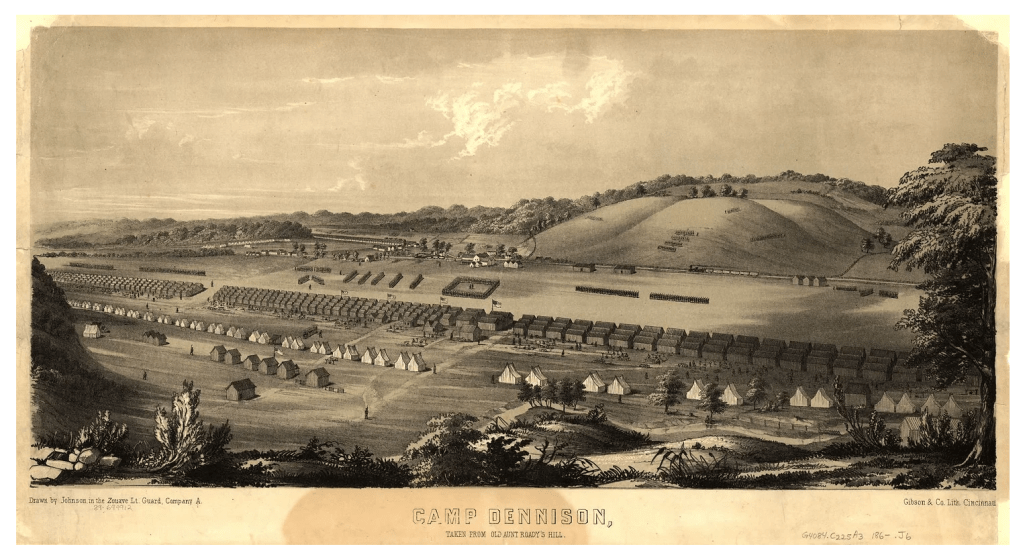
The following letter was written by a soldier at Camp Dennison in mid-December 1862. The Ohio regiment he was in was most likely organized there as it appears they were there for some time; not simply passing through.

Though I could not identify him, he provides good information on the timing of, and specifications on, the construction of stables built at the camp.

Transcription

Camp Dennison, Library of Congress

Camp Dennison
December 16th 1861

Dear Brothers,

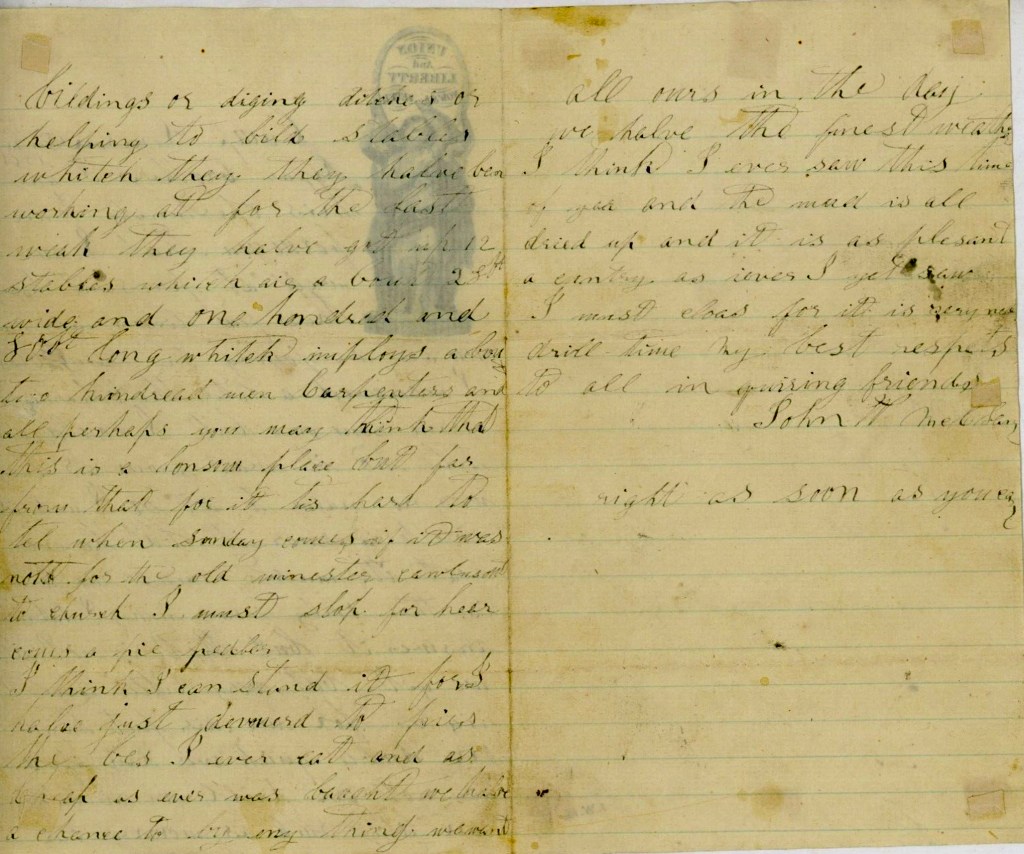
I take this opportunity to inform you that I am well at present, hoping these few lines may find you all enjoying the same blessing. I received a letter the other day from someone but I could not tell who it was from as there was no name to it so I wasn’t able to answer it but whoever wrote it must excuse me for that is the only reason why I did not answer it. But that is not all, We get but very little time to write for we are out through on double quick every day. If we are not on drill, we are detailed in fatigue, such as moving old buildings or digging ditches or helping to build stables which they have been working at for the last week. They have got up 12 stables which are about 28 feet wide and one hundred and 80 feet long which employs about two hundred men, carpenters and all. Perhaps you may think that this is a lonesome place but far from that for it tis hard to tell when Sunday comes if it was not for the old minister [ ] to church. I must stop for here comes a pie peddler.

I think I can stand it for I have just devoured two pies—the best I ever ate—and as cheap as ever was bought, We have a chance to buy anything we want all hours of the day.

We have the finest weather I think I ever saw this time of year and the mud is all dried up and it is as pleasant as country as ever I yet saw, I must close for it is very near drill time. My best respects to all inquiring friends. — John W. McC____

Write as soon as you can.

1862: Amos Avery to Friend Mark

The following letter was written by Amos Avery (1834-1903) of Groton, New York, who enlisted 13 August 1862 as a corporal in Co. F, 109th New York Infantry. He was later promoted to sergeant and was wounded on 17 June 1864 before Petersburg, Virginia. He was discharged for wounds on 18 May 1865.

Avery’s parents were Oliver Avery (1797-1877) and Hannah Webb (1806-1883) of Groton, Tompkins county, New York.

A post-war image of Amos Avery

Transcription

Annapolis Junction
Tuesday, September 30, 1862

Dear Friend Mark,

I received yours tonight and will answer the same without delay. I was glad indeed to hear from you and to hear that you still remember me. I was glad of your advice. You speak that some are not willing to receive it. What time I was with you, you can judge in what way I received it. I have had one chance to drink but I knew if I did not break over the first time, I certainly should not the second! I am glad that you are getting along well with the stores and also with the other jobs. I would like to be to work with you for a spell. Then I should want to be back here again.

I am well. I never was more healthy and pretty well contented though I would like to go farther south. The 137th [New York Regiment] passed by here night before last on their way to Washington and back again. Last night they stopped in front of our camp. We were all awake in a short time and down to the guard. Some of the officers passed our their men. Our Captain did not do so, however. The Major came down. I asked him to pass men by the guard and he did so. A good many run the guard. This I would not do. I did not see Crib, however, as he had been left at Washington for guard. I saw Tom Breeze, 1 Old Pap Scofield, 2 and some others. They most all felt well. Jim Eldridge 3 felt sick of it [soldiering].

The boys are all feeling well here but Orson Brokaw. 3 He is quite sick. There are a few that are complaining some. George Lanterman 4 is very sick and has been sent to Baltimore. Hoping to hear from you soon, I remain your friend, — Delos

P. S. I am not married nor have I had any thoughts of being is all a cussed lie. — M. H. Avery


1 BREESE, THOMAS E.~Age, 29 years. Enlisted, August 14, 1862, at Groton, to serve three years; mustered in as private, Co. K, 137th New York Infantry, September 2, 1862; deserted, January 14, 1863, at Fairfax Station, Va.

2 Not sure who “Old Pap Scofield” was unless he was the father of Isaac and Annias Scofield, both young men from Groton who served in Co. K, 137th New York Infantry.

3 ELDRIDGE, JAMES.—Age, 33 years. Enlisted, August 15,1862, at Groton, to serve three years; mustered in,as private, Co. K , 137th New York Infantry, September 20, 1862; discharged for disability, January 2,1863, at Baltimore, Md.

4 BROKAN, ORSON—Age, 22 years. Enlisted, August 8, 1862, at Groton, to serve three years; mustered in as corporal, Co. F, 109th New York Infantry, August 14, 1862; returned to ranks, no date; mustered out with company, June 4, 1865, at Delaney House, D . O; also borne as Brokaw.

5 LANTERMAN, GEOBGE S.—Age, 18 years. Enlisted August 12, 1862, at Groton, to serve three years; mustered in as private, Co. F, 109th New York Infantry, August 14, 1862; discharged for disability, December 4, 1862.

1861: John Byron Ruth to his Aunt Sarah

The following letter was written by 25 year-old John Byron Ruth (1836-1913) who enlisted on 25 April 1861 to serve three months in Co. A, 13th Pennsylvania Infantry. He mustered out of the regiment on 6 August 1861.

The service record of this regiment follows:
Moved to Greencastle June 14, thence advance on Williamsport June 15-16. 
Goose Creek, Edward’s Ferry, June 18. 
At Williamsport till July 4. 
Escort Rhode Island Battery to Martinsburg. 
Moved to Bunker Hill July 16, and to Charlestown July 17. 
To Harper’s Ferry July 21. 
Moved to Harrisburg, Pa., and mustered out August 6, 1861.

In the 1850 US Directory, John was enumerated as a 13 year-old bot residing in the boarding house managed by 65 year-old John McElroy, an engineer from Ireland. In the 1861 Pittsburg City Directory, John was listed as a machinist. A family tree was created for John in Ancestry.com but it does not name his parents. He was married in 1865 to Abigail H. Griswold (1836-1901) and the couple lived in Erie, Pennsylvania, in 1870 where he worked as a grocer. By 1880, the family had relocated to Omaha, Nebraska.

Transcription

Camp Scott, York, Pennsylvania
May 5th 1861

Dear Aunt Sarah,

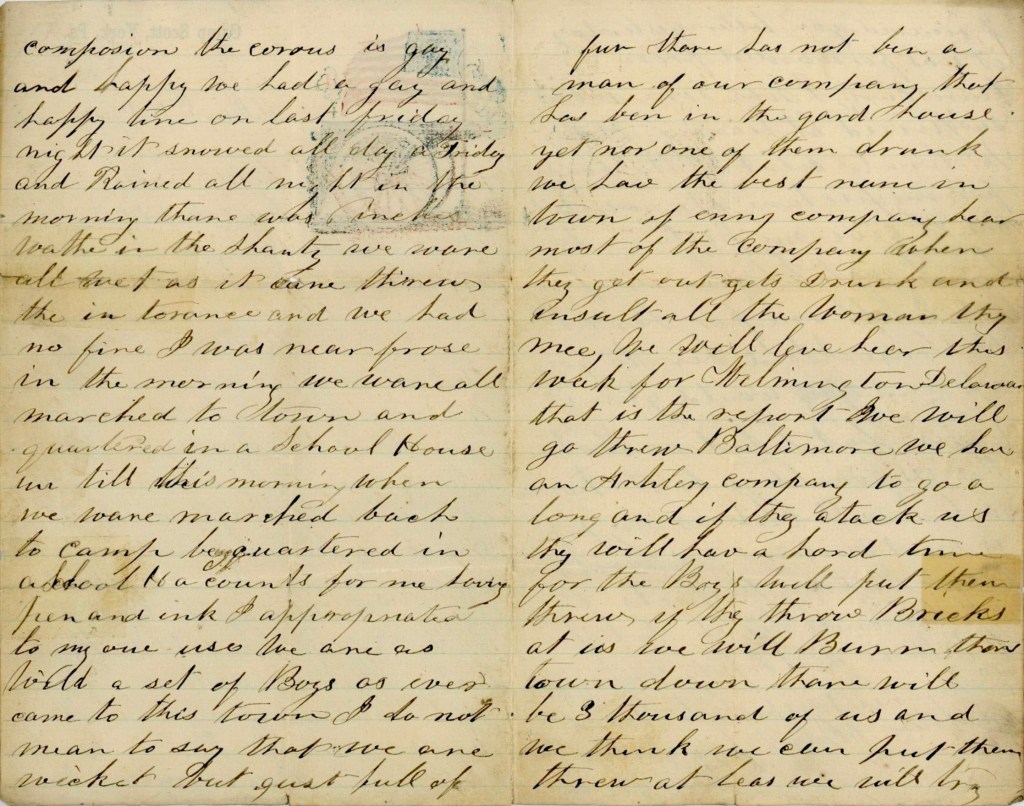
It is Sabbath evening. We have just got our supper. It was a very easy matter to get supper as we have but two articles to cook—that is meat and crackers. We fry the meat, then we fry the crackers in the grease. Our mess is composed of nine as gay Boys as in the company. Their names is as follows, C[harles] G. Edstrom, B. H. Coyle, W[illiam] G. Lang, W[illiam] Easton, B[enjamin] F. King, F. Alwood, G[eorge] W. Keifer, [James] M. Hoon, and your nephew, John B. Ruth—the finest in the mess (in a Horn). We have a morning and evening Salvo [?] of our one composition. The chorus is gay and happy. We had a gay and happy time on last Friday night. It snowed all day a Friday and rained all night. In the morning there was 6 inches water in the shanty. We were all wet as it came through the entrance and we had no fire. I was near froze in the morning.

We were all marched to town and quartered in a school house until this morning when we were marched back to camp. Being quartered in a school accounts for me having pen and ink [which] I appropriated to my own use. We are as wild a set of Boys as ever came to this town. I do not mean to say that we are wicked, but just full of fun. There has not been a man of our company that has been in the guard house yet nor one of them drunk. We have the best name in town of any company here. Most of the companies, when they get out, gets drunk and insult all the women they meet.

We will leave here this week for Wilmington, Delaware. That is the report. We will go through Baltimore. We have an artillery company to go along and if they attack us, they will have a hard time for the Boys will put them through. If they throw bricks at us, we will burn the town down. There will be three thousand of us and we think we can put them through—at least we will try.

I received your letter yesterday. It was forwarded from Harrisburg. I was somewhat surprised at hearing that E. McDonald went to the house for my picture. She wanted me to give my picture to her. I just told her that I left one for her at the house. I told her to go up and you would give it to her but I had no thought that she would go to the house.

Well, I will close as my paper is most written over. Write sure. Give my respects to all friends. Direct to Capt. D[avid] B. Morris, Wash[ington] Infantry, Company A, 13th Regiment.

Respects to Grandmother & Aunt. Farewell, — J. B. Ruth

1861: James H. Leggett to Gabriel T. Leggett

An unidentified soldier wearing a New York Uniform (Bob Celli Collection)

The first letter was unsigned and there is no accompanying envelope to aid us in the author’s identity. However, he does inform us that he served in the 30th Regiment and since it was datelined from Camp Keyes in September 1861, we know that he was in the 30th New York Infantry. He also informs us that he was in Co. D which was recruited principally in Saratoga county. Searching on the internet for letters by members of Co. D, 30th New York, I discovered that a number of them written by “J. N. Leggett” are housed at Williams College. There is another collection of his letters located at the Fort Pulaski National Monument under the name, “Jim F. Leggett, 30th New York,” Genealogical records this would have been James H. Leggett (1830-1864) of Sarasota Springs who was 30 years old when he enlisted on 20 June 1861 to serve two years. He was discharged for disability in 1862 but reenlisted later and died at Andersonville Prison. James was the son of Gabriel T. Leggett (1793-1883) and Sarah Robbins (1800-1890). In the absence of any other known authors from this company, I’m going to attribute the letter to Leggett but caution is advised and can only be confirmed by comparing handwriting samples. Unfortunately there are none on-line that I could find.

The second letter surfaced some time after the first which confirmed the handwriting belonged to James H. Leggett.


Letter 1

Camp Keyes [Arlington Heights, Va.]
30th Regiment, Co. D
September 5th, 1861

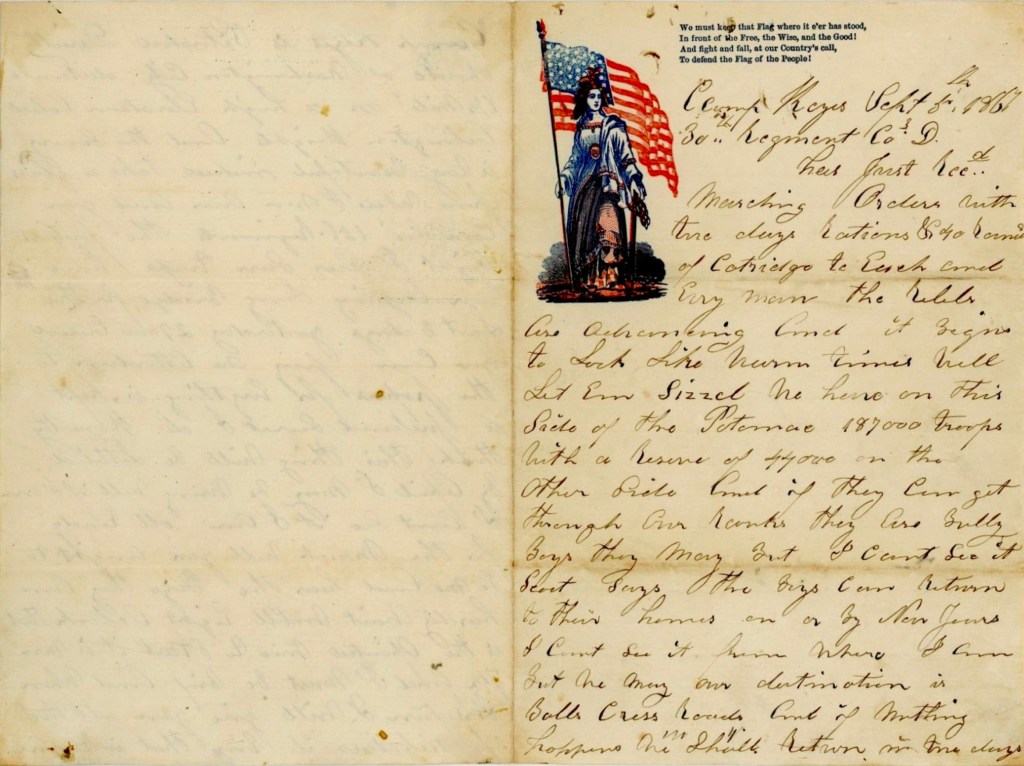
Have just received marching orders with two days rations & 40 rounds of cartridges to each and every man. The rebels are advancing and it begins to look like warm times. Well let ’em sizzle. We have on this side of the Potomac 187,000 troops with a reserve of 44,000 on the other side, and if they can get through our ranks, they are Bully Boys. They may, but I can’t see it. Scott says the boys can return to their homes on or by New Years. I can’t see it from where I am but he may. Our destination is Balls Cross Roads and if nothing happens, we shall return in two days.

Camp Keyes is situated directly opposite of Washington City, distance 1.5 miles, on a high elevation called Arlington Heights and the scenery is very beautiful indeed. Take a glass from where I now am and you can see 156 regiments—the prettiest sight I ever saw. Troops have been crossing Long Bridge for the last three days. Yesterday 27,000 crossed. You can pay no attention to the papers for everything is kept a profound secret. I do honestly think this thing will be settled by April. I may be wrong. Well, if I am, I can’t see it. I am all ready for the march. Well, you ought to see me and hear the Boys. They can hardly wait until eight o’clock. That is the appointed time to start. It is now 7:30 and I must be brief and when I return I will give you all the particulars if any, that is, to give.


Letter 2

Camp Keyes
Arlington Heights
30th Regiment, Co. D, N.Y. S V.
September 22, 1861

G. T. Leggett,

I received yours of September 17th and was very thankful indeed to hear from you and to hear that you was well and all hands in the same fix. This leaves me on top of this earth and I hope I will be permitted to remain on top until the war is over and the Stars and Stripes floats over every Confederate State—what say you?

You ask for war news. Well that is exactly what I want. You can get more news up to store than I can give you. Everything is quiet here and no prospect of anything else very soon. I came in off of picket duty yesterday from Munson’s Hill after a forty hour’s tramp but nothing turned up worthy of note. Several shots were fired but like [Fort] Sumter, nobody hurt. At Munson’s Hill the Rebels are throwing up great works adn planting cannon. I saw 6 cannon and that Rebel flag up there. The distance from here to their pickets is only a few miles. Beauregard has promised his men a chance to show their metal in less than 40 hours—so report days—but I don’t see it. Like all other reports, I presume is fake [?]

When I want current news from the seat of war, I get the Tribune and rely on what that contains as [ ] certain and true, don’t you? We have all northern papers brought in camp every morning and it is pleasing to read the news. Everything is so true. And the Washington Daily is as bad as any of them. You stick to Horace [Greeley] and you will be as well posted as anybody. But if I can get any news, I will forward it immediately to you. And at your leisure, please write and you will confer a favor on your obedient son, Jim. Remember me to all enquiring friends if I have any.

I [ ] Perry John has got a notion for [ ] that is the manner in which he has enlisted for he don’t know who will be his commanding officer and after the 32nd here enlisted, they will be transferred in another company. You tell him if he is bound to see the Elephant, that he can enlist in the Pet 30th and be sent on with dispatch and will have only 19 months to stay at the longest. There is room enough for 130 men in this regiment and if he wants to join and is bound, to tell his wife and I will give him all the particulars. The 30th is the regiment. I can make arrangements for 18 in Company D. More next time.

1861: Samuel Hamilton to John Hamilton

Samuel Hamilton was 20 years old when he enlisted on 28 August 1861 at Readville, Massachusetts, to serve three years in Congress. E, 20th Massachusetts Volunteers. According to muster rolls, he was wounded at Balls Bluff on 21 October 1861 (regimental history says he was captured). The only other entry in his muster rolls states that he deserted from Poolesville, Maryland on 15 January 1862, just five weeks after this letter was penned.

Samuel’s muster rolls do not state his place of residence. The regimental history gives his residence as “Chester, Delaware” which must mean Pennsylvania but I was unable to locate his family and there is no accompanying envelope to aid in further identification.

Transcription

Patriotic letterhead, “The Tomb and Shade of Ellsworth—His Spirit Lives”

Camp Benton 1
Poolville, Maryland
December 10, 1861

Dear Brother,

I received your last letter and I am very glad to hear that you are well and the rest of the family. We had a sham battle today and everything passed off without any accidents. I would have wrote to you sooner but I have been waiting for the certificate. Our colonel has gone off but as soon as he returns, I will get it off so as to send it next week.

Everything is very quiet round here. I do not think that our regiment will see any more fighting for there is but a few of us left. We are going to do picket duty this winter down to the river but our headquarters will be at the camp.

The last letter I received from sister, she wrote that she was going to send me some things but I have not received them yet. As soon as we get paid off I will send home every cent I get which will be the first of next moth.

Dear John, please tell Adam Sutton that I would like to hear from him. In my last letter I told you to tell him to write but I believe that you have delayed it for I have not heard from him. Tell sister that I have received but one paper from her yet. Tell her that I would like to have her send me the Ledger every week. Tell her when she writes again to put the direction on the letter very plain. I would like to hear from sister Elizabeth before I write to her.

Dear brother, I soon expect to be put in as a corporal. I am in very good health so far. You do not know how I would like to see you all which I hope will soon be. Give my love to Tommy. Tell him as soon as I get home I will give him a lot of pipes and tobacco. Give my love to father and mother and all the rest of the family. Tell them I would like to hear from them often.

Dear John, I will now close my letter by remaining your affectionate brother, Samuel Hamilton

My address is Samuel Hamilton, Company E, 20th Regt. M. V., Washington D. C.


1 Camp Benton was situated outside Poolesville, Maryland, on the east bank of the Potomac River, barely 35 miles from Washington. The camp was “laid out in a large wheat-field on the slope of a hill, surrounded by a beautiful running stream of clear, cold, water,—a healthy and lovely situation.” The regiment remained there for nearly six months.

1862: Robert Stuart Morrison to Mary H. Voorhees

The following letter was written by Robert Stuart Morrison (1822-1902), the son of Thomas and Mary (Jennings) Morrison of Mount Gilead, Morrow county, Ohio. Robert was born in Green county, Pennsylvania, in March 1822. He graduated at Miami University (1852) and the Princeton Theological Seminary (1854), and until 1879 was a teacher and a minister of the gospel at Chicago and Louisville. While at the Miami University, Morrison, with five other students, founded the Phi Delta Theta Fraternity.

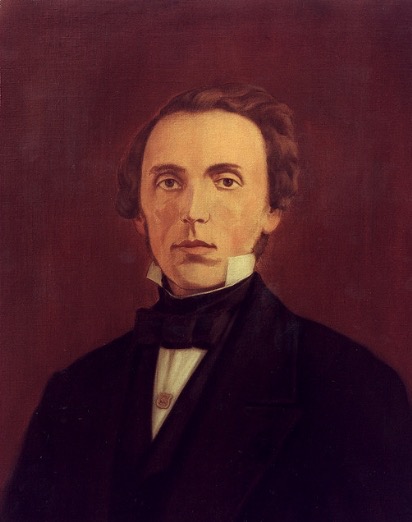
Robert Stuart Morrison, 1851

Morrison’s career as a minister, editor of religious publications, and teacher took him to Tennessee, Kentucky, Ohio, and Missouri. He edited the Louisville Presbyterian Herald from 1854 to 1860. He was also co-editor of the Louisville True Presbyterian, which was suppressed by Union military authorities in 1863, during the Civil War.

In September 1869, Morrison established Westminster Academy, a co-educational school in Waterford, Ohio, where he was principal for six years. He was also the principal of Poplar Grove Academy in Rutherford County, Tennessee. He combined his teaching duties with regular preaching. From 1879 to 1881 he worked as a financial agent to eliminate the debts of Westminster College and established the Phi Delta Theta Missouri Beta Chapter, in Fulton, Missouri. After this he preached at various locations around Missouri, and founded churches in towns such as Gravois Mills and Tuscumbia.

In his letter, Morrison speaks of the weekly newspaper recently purchased by himself, Andrew Davidson, and Stuart Robinson, which they named The True Presbyterian. The first issue of the publication was 3 April 1862. At the time, Morrison lived fifteen miles south of Louisville.

From Morrison’s letter, we learn that he made a trip out to Camp Chase for the purpose of seeing his friend, Col. Joel Allen Battle, 20th Tennessee Infantry. The colonel was taken captive during the Battle of Shiloh in early April 1862. After being held in Columbus, he was later taken to the prison at Johnson’s Island where he was not exchanged until September 1862. Two of Battle’s son’s were killed at Shiloh—William Searcy Battle (1835-1862) and Joel Allen Battle, Jr. (1838-1862).

The letter was addressed to Mary Helen Voorhees (1833-1908), the daughter of Peter Albert Voorhees (1802-1883) and Maria Suydam (1806-1883). She married John Calvin Hoagland (1827-1894) in January 1868.

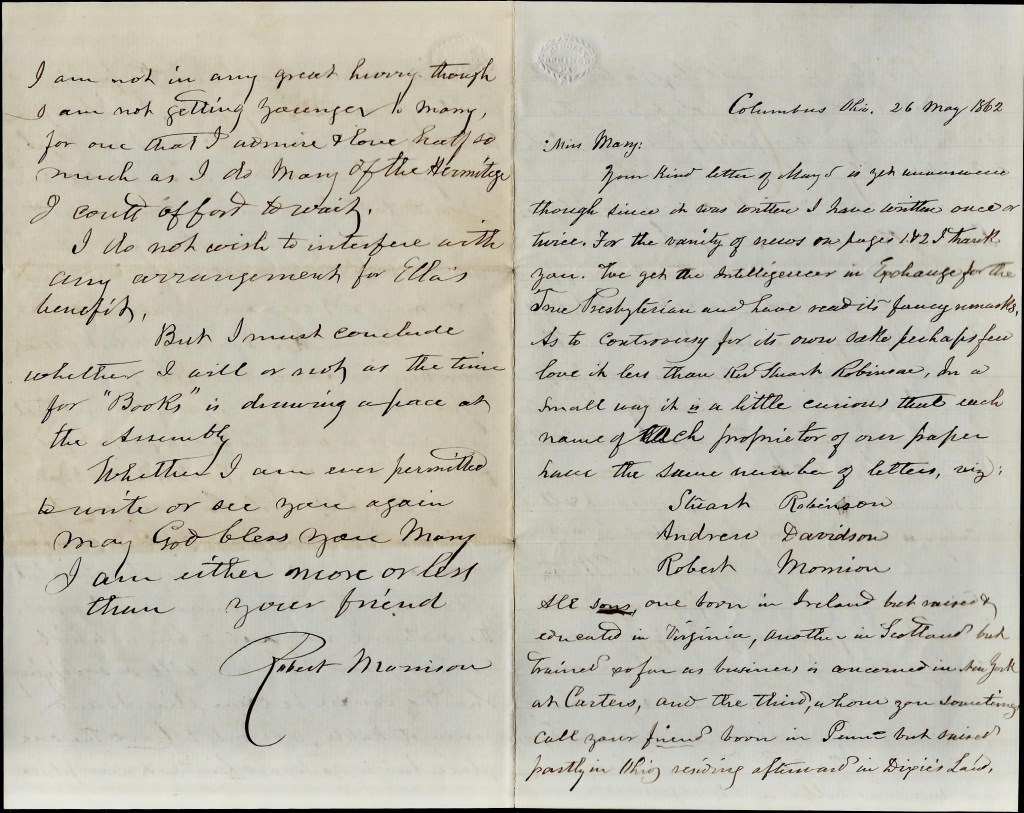
Transcription

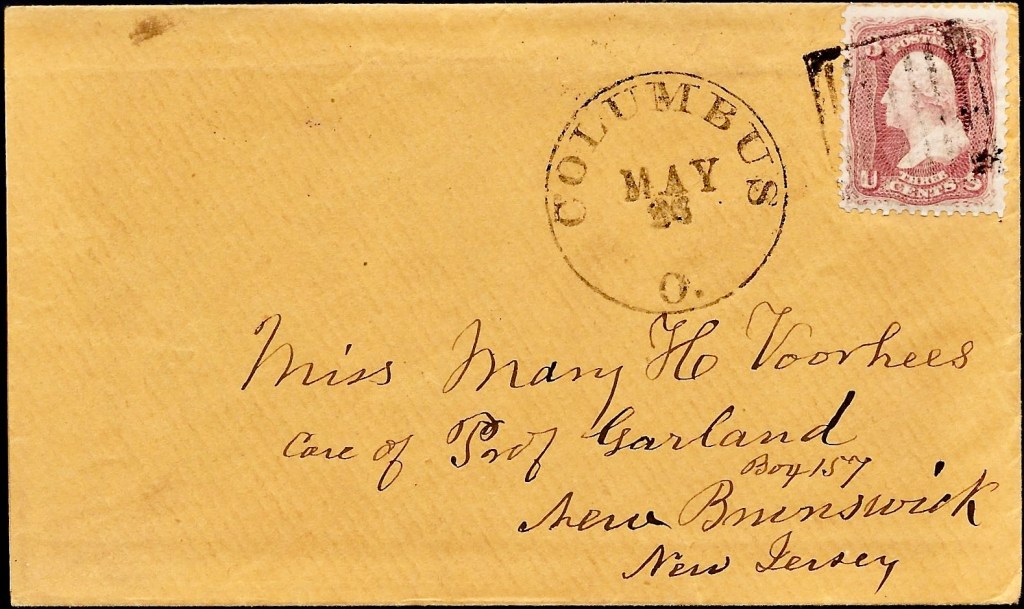
Addressed to Miss Mary H. Voorhees, Care of Prof. Garland, Box 157, New Brunswick, New Jersey

Columbus, Ohio
26 May 1862

Dear Mary,

Your kind letter of May 5th is yet unanswered though since it was written, I have written once or twice. For the variety of news on pages 1 & 2, I thank you. We get the Intelligencer in exchange for the True Presbyterian and have read its fancy remarks. As to controversy for its own sake perhaps a few love it less than Rev. Stuart Robinson. In a small way it is a little curious that each name of each proprietor of our paper have the same number of letters, viz:

Stuart Robinson
Andrew Davidson
Robert Morrison

All sons, one born in Ireland but raised and educated in Virginia, another in Scotland, but trained so far as business is concerned in New York at Carters, and the third, whom you sometimes call your friend born in Pennsylvania but raised partly in Ohio, residing afterward in Dixie’s Land.

I have been here for several days, a looker on in Venice, a listener and a note taker in the court, making out reports for the True Presbyterian. The assembly is large—somewhere between 230 & 240. Of course no delegates south of the Border States. Saturday evening they passed a paper destined, I suppose, to send the Presbyterian Church in Maryland, Kentucky, and Missouri, and by & by, in some places north of us. It was Dr. Breckinridge’s paper on the State of the Country. The vote was taken by calling the ayes and noes & the vote stood 199 to 20.

The weather has been pleasant & this city is a pleasant, beautiful place. I wish to go out perhaps this p.m. to visit some friends taken prisoner at Pittsburg Landing—some of the first men of their region I have found here on their way as prisoners to Johnson’s Island at Sandusky on Lake Erie. One, and a friend, a Colonel of the 20th Tennessee, was here who had two sons killed in his regiment.

And I may not have the privilege of visiting you. Sorry for it. It is a hard penance to which I am consigned but I am loyal and yield to direction. If “I have not time” I would take it for such a privilege as to see the light of your countenance. May I not call to see you when you are abroad if I may not see you at home? e.g. at your Cousin Rev. Voorhees Gulick’s or at Brooklyn or somewhere else?

The counselor I need is of the kind that God alluded to when he said it was not good for man to be alone. That was the kind I spoke of.

In this wide work, God uses a variety of laborers & whether they should be nuns or not, some should be “mission teachers” but of course before a woman should forsake the natural, normal orbit in which God has placed her, God’s will so signifying should of course be clear, direct and unmistakable, not only to leave the one place but to go to a definite & new place. I am not in any great hurry, though I am not getting younger to marry. For one that I admire & love half so much as I do Mary of the Hermitage, I could afford to wait.

I do not wish to interfere with any arrangements for Ella’s benefit. But I must conclude whether I will or not at this time for “Books” is drawing apace at the Assembly. Whether I am ever permitted to write or see you again, may God bless you, Mary. I am either more or less than your friend, — Robert Morrison

1863: Conrad Dumond, Jr. to Philip Dumond

The following letter was written by Conrad Dumond, Jr., the son of Johannes Conrad Dumond (1799-1877) and Jane Van Benschoten (1812-1839) of Kingston, Ulster county, New York. After his mother died, his father remarried to Silvia Warren. By the time of the 1860 US Census, Conrad was working as a farm laborer in Hurley, New York.

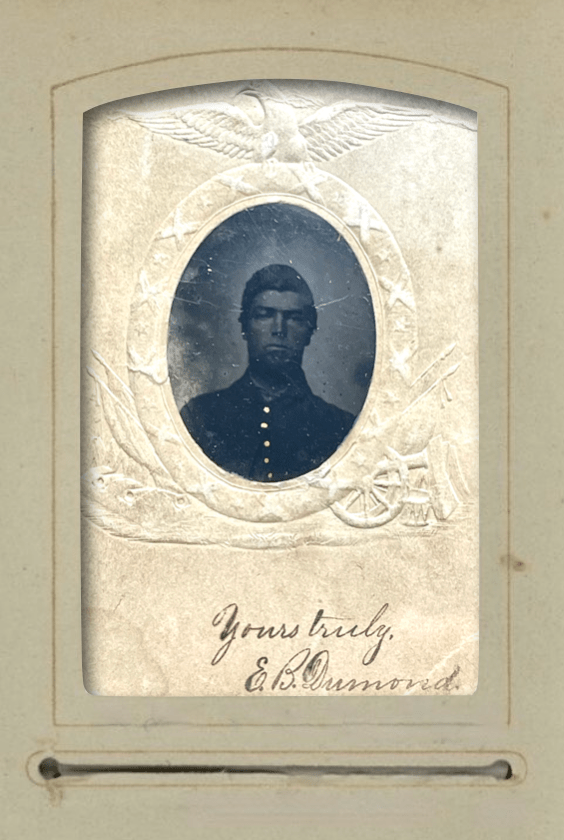
I could not find an image of Conrad but here is one of Edward B. Dumond, his cousin, who served in the same company (Kyle A. Williams Collection)

In August 1862, when he was 24 years old, he enlisted as a private in Co. A, 120th New York Infantry. When Conrad wrote this letter from Harewood Hospital in early May 1863, we learn he had suffered some type of injury that momentarily crippled him. His muster record confirms his absence from the regiment in April and May 1863 but yields no additional information. The following year, on 10 October, he was taken prisoner in action at James City, Virginia, and sent to Andersonville where he literally starved to death on 14 August 1864.

Conrad wrote the letter to his Uncle Phillip Dumond (1817-1892), a farmer of Hurley, Ulster county, New York. Phillip’s son, Edward Brown Dumond (b. 1843), also served with Conrad in the same company. Edward was wounded during the siege of Petersburg on 31 August 1864 and lost his left arm.

[Note: This letter is from the personal collection of Kyle A. Williams and was offered for transcription and publication on Spared & Shared by express consent.]

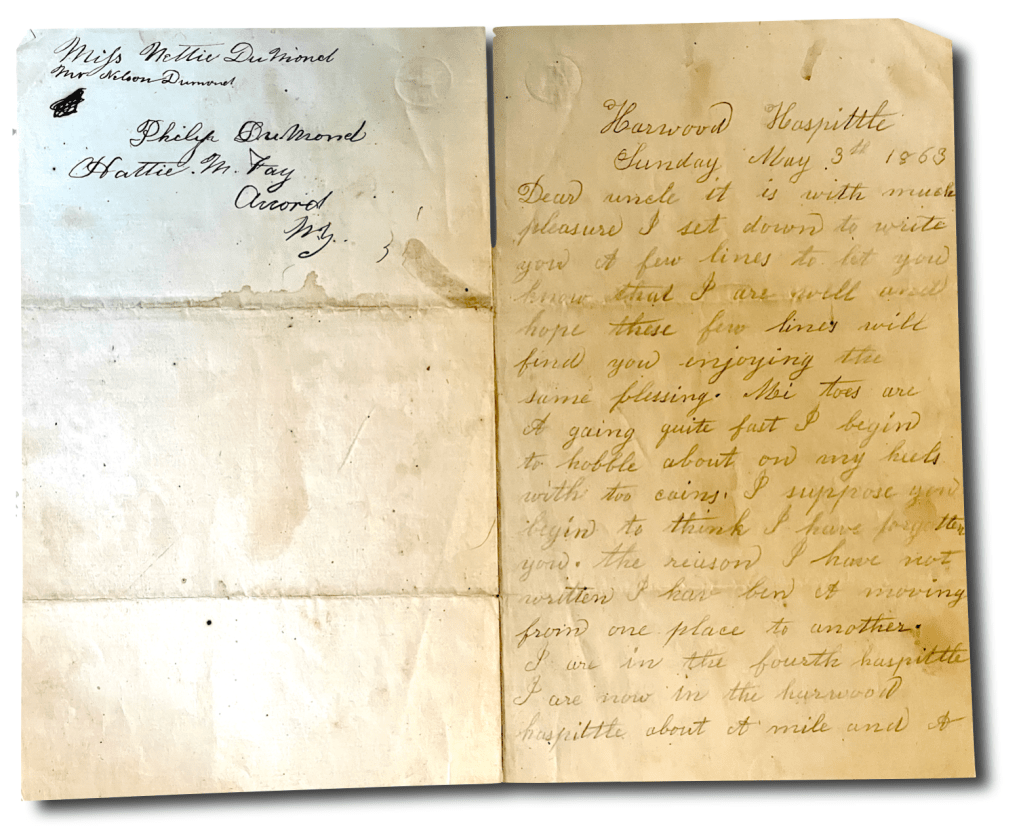
Transcription

Harewood Hospital
Sunday, May 3rd 1863

Dear Uncle,

It is with much pleasure I sit down to write you a few lines to let you know that I am well and hope these few lines will find you enjoying the same blessing. My toes are a gaining quite fast. I begin to hobble about on my heels with the canes.

I suppose you begin to think I have forgotten you. The reason I have not written, I have been a moving from one place to another. I are in the fourth hospital. I are now in the Harewood Hospital about a mile and a half from the village of Washington. It is a very nice place. I have good care taken of me and a plenty to eat. I have not been paid off yet. I have six months pay due now. I have not heard from Eddy in quite a while.

The news is the Army of the Potomac are a fighting. I would like to see you all very much. I wish I was there while I was lame. Tell grandfather I would like to see him very much and to have a smoke with him. I could tell him something about war if I was there but I live in hopes this time will soon come when I can come home and see peace again and to hear the sound of the church bell again and to be seated around the communing table again.

I must close by asking an interest in your prayers. Give my love to all my enquiring friends and keep a god share for yourself. Write as soon as you get this. So goodbye for this time. Hoping to hear from you soon.

From Conrad Dumond, Jr. to Philip Dumond

Direct your letters to Harewood Hospital, Barracks Number 2, Washington D. C.

1863: Isaac Cochran Richardson to Esther (Langdell) Richardson

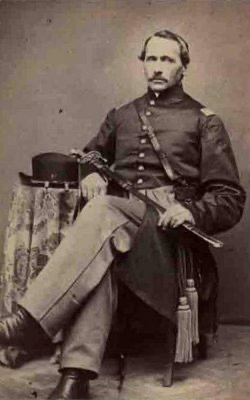
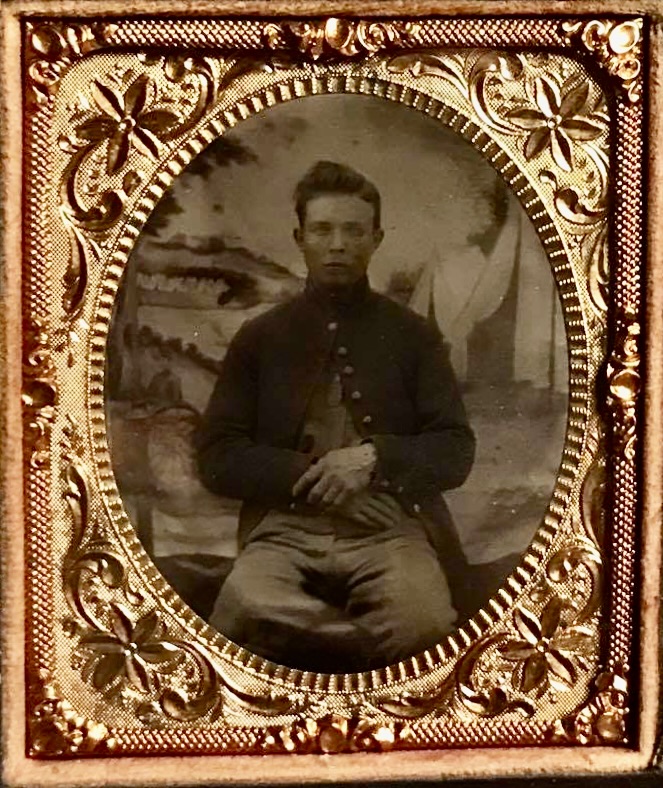
Lt. Isaac Cochran Richardson, 1865

The following letter was written by Isaac Cochran Richardson (1821-1911), the son of David Richardson (1781-1864) and Susan Cochran (1785-1863) of Londonderry, Windham county, Vermont. Isaac was married in 1846 to Esther Langdell (1822-1882) and the couple lived in Nashua, Hillsborough county, New Hampshire when Isaac enlisted as a corporal in Co. B, 10th New Hampshire Infantry. In early March 1864, Isaac was promoted to sergeant in Co. K, and in February 1865 he was commissioned a 1st Lieutenant.

When Isaac wrote the following letter from Fort Halleck (near Suffolk, Va.) in May 1863, he was still a corporal in Co. B.

[Note: This letter is from the private collection of Greg Herr and was offered for transcription and publication on Spared & Shared by express consent.]

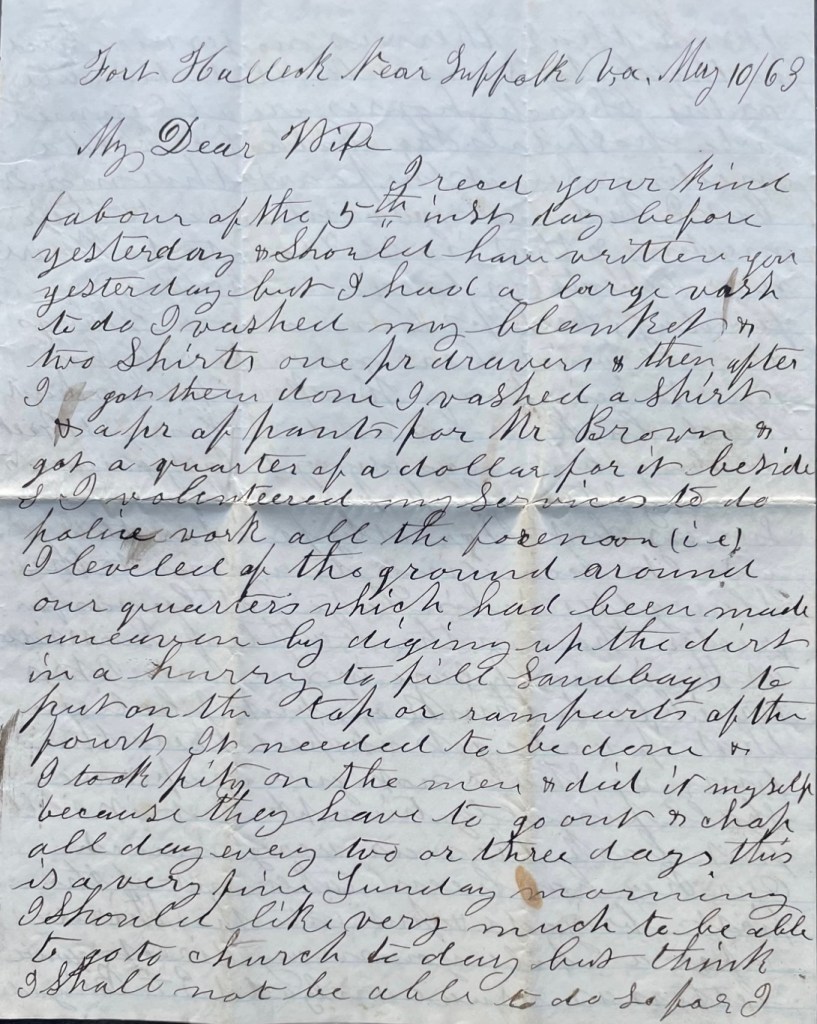
Transcription

Fort Halleck near Suffolk, Va.
May 10, 1863

My dear wife,

I received your kind favor of the 5th inst. day before yesterday & should have written you yesterday but I had a large wash to do. I washed my blanket and two shirts, one pair drawers, and then after I got them done, I washed a shirt and a pair of pants for Mr. Brown & got a quarter of a dollar for it besides. I volunteered my services to do police work all the forenoon, (i.e.) I leveled up the ground around our quarters which had been made uneven by digging up the dirt in a hurry to fill sandbags to put on the top or ramparts of the fort. It needed to be done & I took pity on the men & did it myself because they have to go out & chop all day every two or three days.

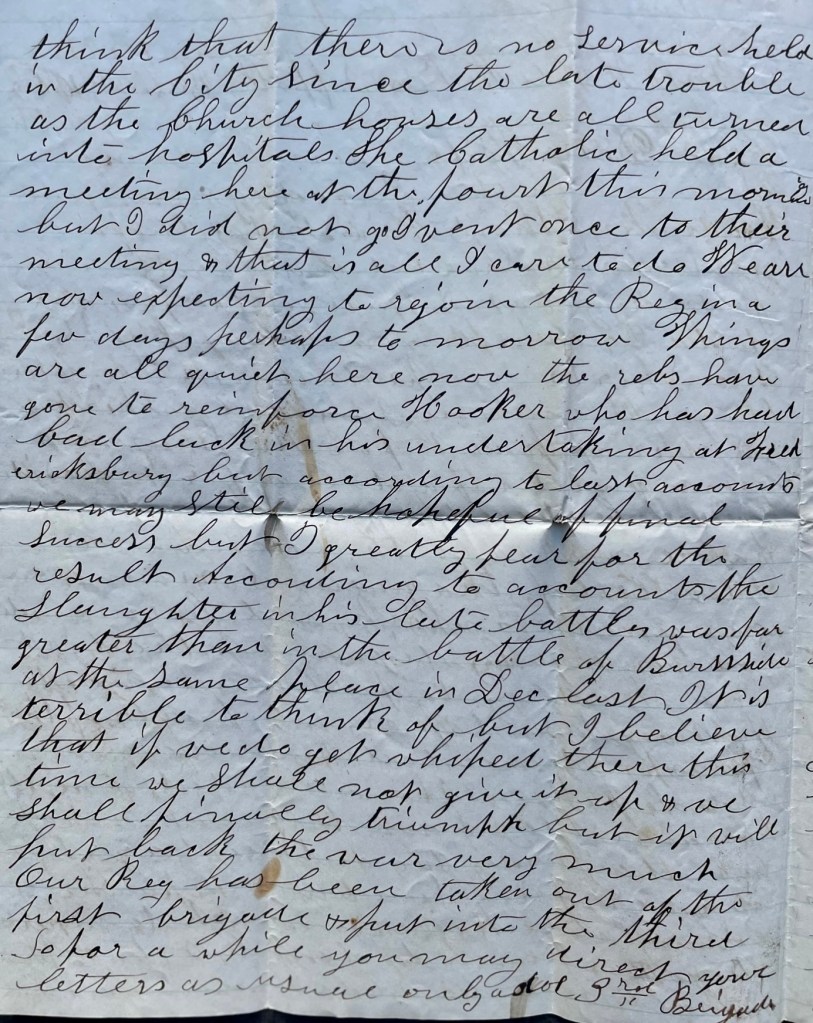
This is a very fine Sunday morning. I should like very much to be able to go to church today but I think I shall not be able to do so for I think that there is no service held in the City since the late trouble as the church houses are all turned into hospitals. The Catholics held a meeting here at the fort this morning but I did not go. I went once to their meeting & that is all I care to do.

We are now expecting to rejoin the regiment in a few days—perhaps tomorrow. Things are all quiet here now. The rebs have gone to reinforce Hooker who has had bud luck in his undertaking at Fredericksburg but according to last accounts, we may still be hopeful of final success. But I greatly fear for the result. According to accounts, the slaughter in his late battles was far greater than in the battle of Burnside’s. Terrible to think of. But I believe that [even] if we do get whipped there this time, we shall not give up & we shall finally triumph. But it will put back the war very much.

Our regiment has been taken out of the 1st Brigade and put into the 3rd. So for a while you may direct your letters as usual, only add 3rd Brigade, 3rd Division, 9th Army Corps. We are in the same brigade with the 13th [New Hampshire]. I think I shall visit the 13th this afternoon & perhaps ave another good sing with Charles Kittredge & others. We do not know yet whether we shall or not go to Kentucky.

When Mr. Eaton gets home, you may hand him that letter & let him do as he sees fit with it. I notice in the Telegraph a notice of Mr. Prescott’s Concert. How I should like to be there to hear & enjoy it & participate in it. I wrote to Calvin and Mother a few days ago. Also to Harvey & Sargeant. I received letters from Harvey & Calvin both on the same day. One of them I sent to you (Harvey’s). Calvin’s health is good. Weighs 200. Mr. Davis is very kind to send you The Watchman gratis. I wrote William since I wrote you last. I received all the papers you sent. Flora’s not excepted. Also three stamps & some envelopes, all of which were welcome, thrice welcome.

It seems good to have it still & quiet here once more but the Lord only knows how long it will continue. But I hope the enemy will trouble us no more here. But this place is of great value to them and they may try their luck again here but I think they will succeed just about as well as they did before.

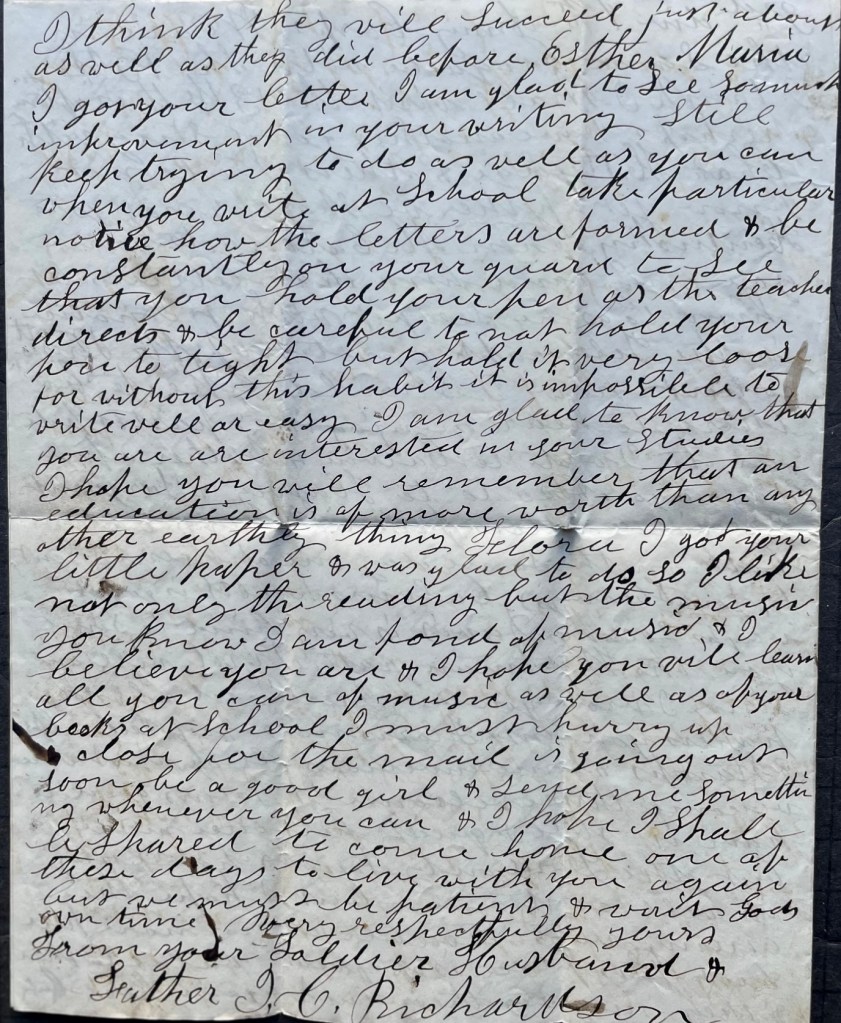
Esther Maria, I got your letter. I am glad to see so much improvement in your writing. Still keep trying to do as well as you can when you write at school. Take particular notice how the letters are formed & be constantly on your guard to see that you hold your pen as the teacher directs & be careful to not hold your pen too tight but hold it very loose for without this habit, it is impossible to write well or easy. I am glad to know that you are interested in your studies. I hope you will remember that an education is of more worth than any other earthly thing.

Flora, I got your little paper & was glad to do so. I like not only the reading but the music. You know I am fond of music & I believe you are & I hope you will learn all you can of music as well as of your books at school. I must hurry up and close for the mail is going out soon. Be a good girl and send me something whenever you can & I hope I shall be spared to come home one of these days to live with you again. But we must be patient and wait God’s own time. Very respectfully yours. From your soldier husband & father, — I. C. Richardson

P. S. After writing the first part of this letter, I thought I would take a stroll up to the 6th Massachusetts. I found Mr. Knight well & in good spirits, but he did not know me. But I made him know me & he made me stop to dinner. He has excellent quarters & tiptop fare. He cooks for the Colonel. I came across Charles Perkins on my way there and he went with me up to see a friend—one Mr. Keith. I had for my dinner fried ham & eggs, and plum pudding and potatoes & coffee.

The Rebs have all left & our troops are leaving now as fast as the cars can carry them off. 53 cars full have gone today and an empty train of 36 cars has just gone up after more. It is reported they are going to Norfolk, thence up the James River. It is currently reported (and I think it is so) that we are going soon to join or rejoin the 9th Corps in Kentucky. I think if we do, we shall get a healthier place. Mr. Knight sends his regards to all his friends in Nashua. Mr. Perkins is in the 17th Wisconsin Regiment. He got a paper from T. H. Richardson with some tobacco in it. I learn that our regiment had orders last night to go to our old camp near Falmouth but before they got started, the order was countermanded. But I think most likely that we shall go to Kentucky & if you don’t get letters as often as usual, you may think that it is because I am on a journey. If we go, we shall go in the cars. I understand that the 9th boys say it is a fine place there and they like it first rate.

It has been a very hot day today. The Capt. is well. He stops with the regiment. Is overseeing the building of the forts. I hope Mr. Eaten will come here but I don’t think it likely that he will. It is getting near night and I will close for tonight. So goodbye.

Good morning. We had a shower last night & storms this morning. I suppose you have heard that our regiment & company have been in a fight and got badly cut up. If so, I will relieve you of all anxiety for none of us have been in a battle or even skirmish at this place. One man, Sergt. [John A.] Hall of Co. D, was wounded (it is said mortally) by a sharp shooter from the other side of the river while about his business at Battery Connecticut. I am well. Co. K of our regiment did leave behind some 6 or 8 of their men one night when they were over the river. It is supposed they were taken prisoners. — I. C. Richardson