The following letter was written by Ephram Marsh (1842-1917) who served in Co. H, 104th Ohio Infantry. Ephram enlisted on 2 August 1862 and mustered out 17 June 1865. He was married in 1870 to Mary L. Wuchter (1850-1939) after the war.
Ephram may have been an orphan. He was enumerated in the 1850 US Census in the household of Daniel Waggoner of Franklin township, Summit county, Ohio. In the 1860 US Census, he was enumerated as a 16 year-old farm laborer/boarder with the Samuel Warner family in Green township, Summit county, Ohio. Neither the Waggoner’s nor the Warner’s appear to be relatives of Ephram’s.
T R A N S C R I P T I O N
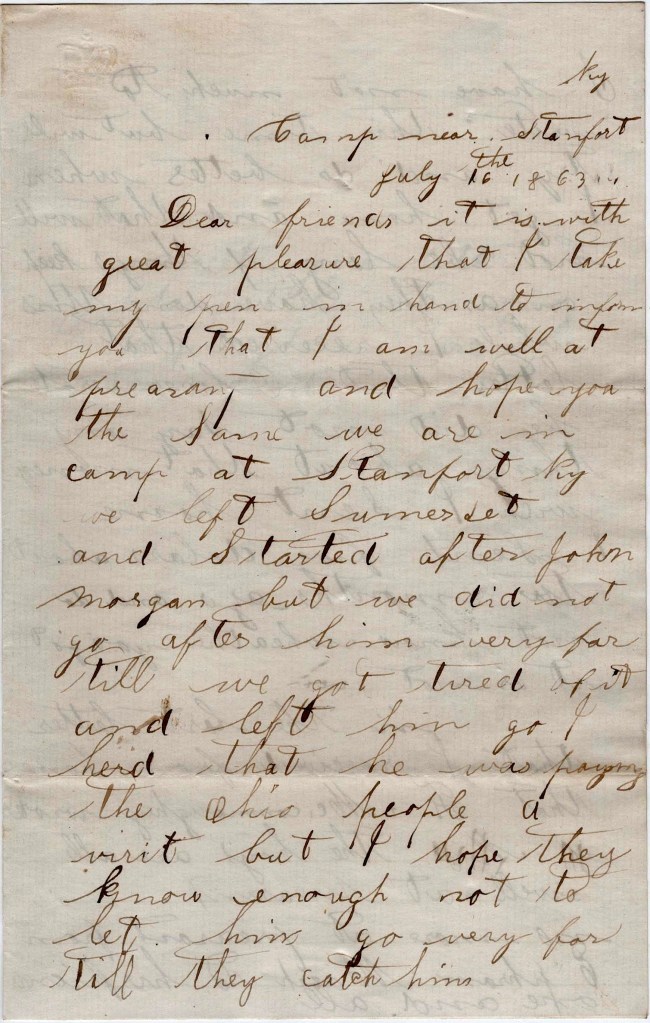
Camp near Stanford, Kentucky July 16, 1863
Dear Friend,
It is with great pleasure that I take my pen in hand to inform you that I am well at present and hope you [are] the same. We are in camp at Stanford, Kentucky. We left Somerset and started after John Morgan but we did not go after him very far till we got tired of it and left him go. I heard that he was paying the Ohio people a visit. I hope they know enough not to let him go very far till they catch him.
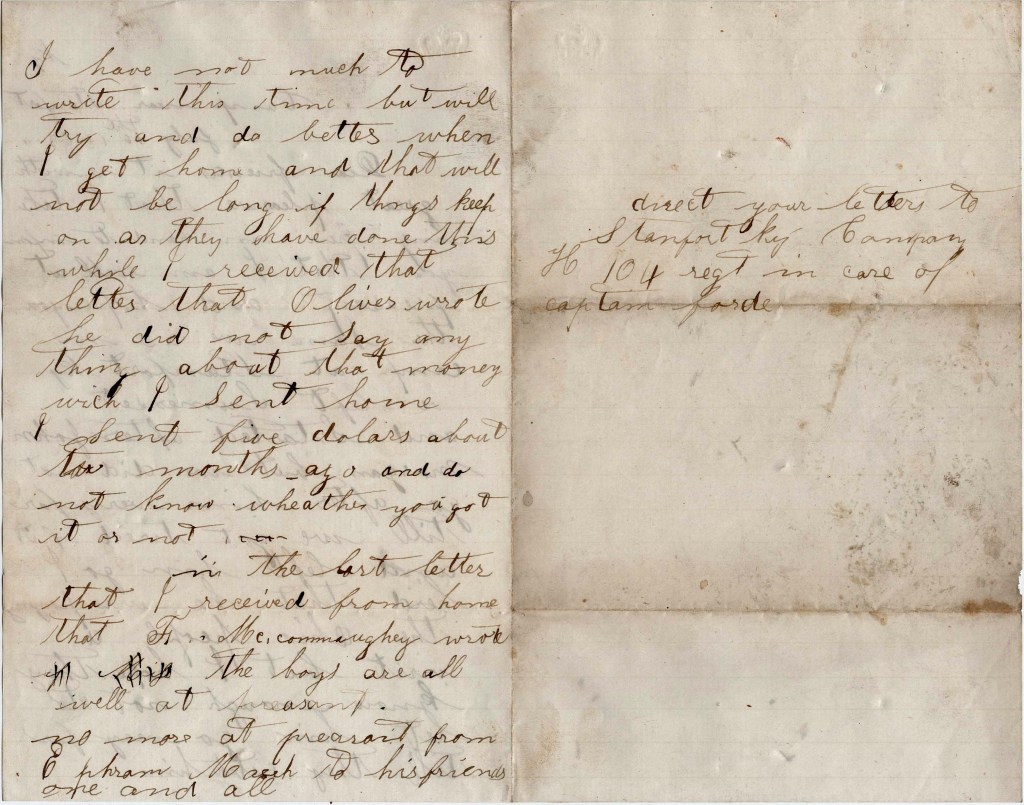
I have not much to write this time but will try and do better when I get home and that will not be long if things keep on as they have done this while.
I received that [letter] Oliver wrote. He did not say anything about that money which I sent home. I sent five dollars about two months ago and do not know whether you got it or not in the last letter that I received from home that F. McConnaughey wrote.
The boys are all well at present. No more at present. From Ephram Marsh to his friends, one and all. Direct your letters to Stanford, Kentucky, Company H, 104th [Ohio] Regiment in care of Captain Ford.
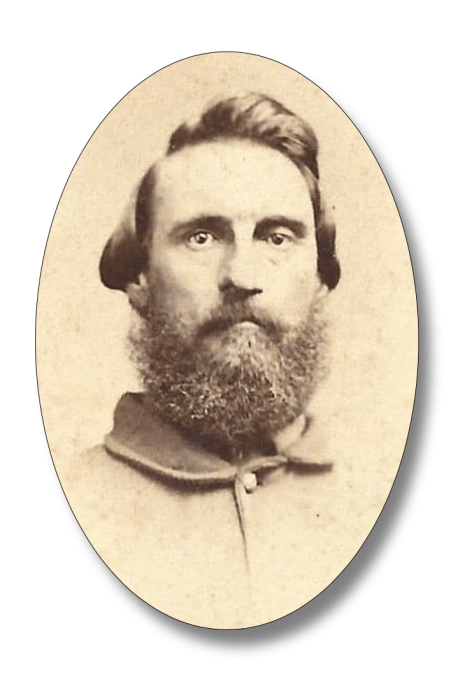
An unidentified member of the 104th OVI taken in Nashville (Jason Lynn Pate Collection)
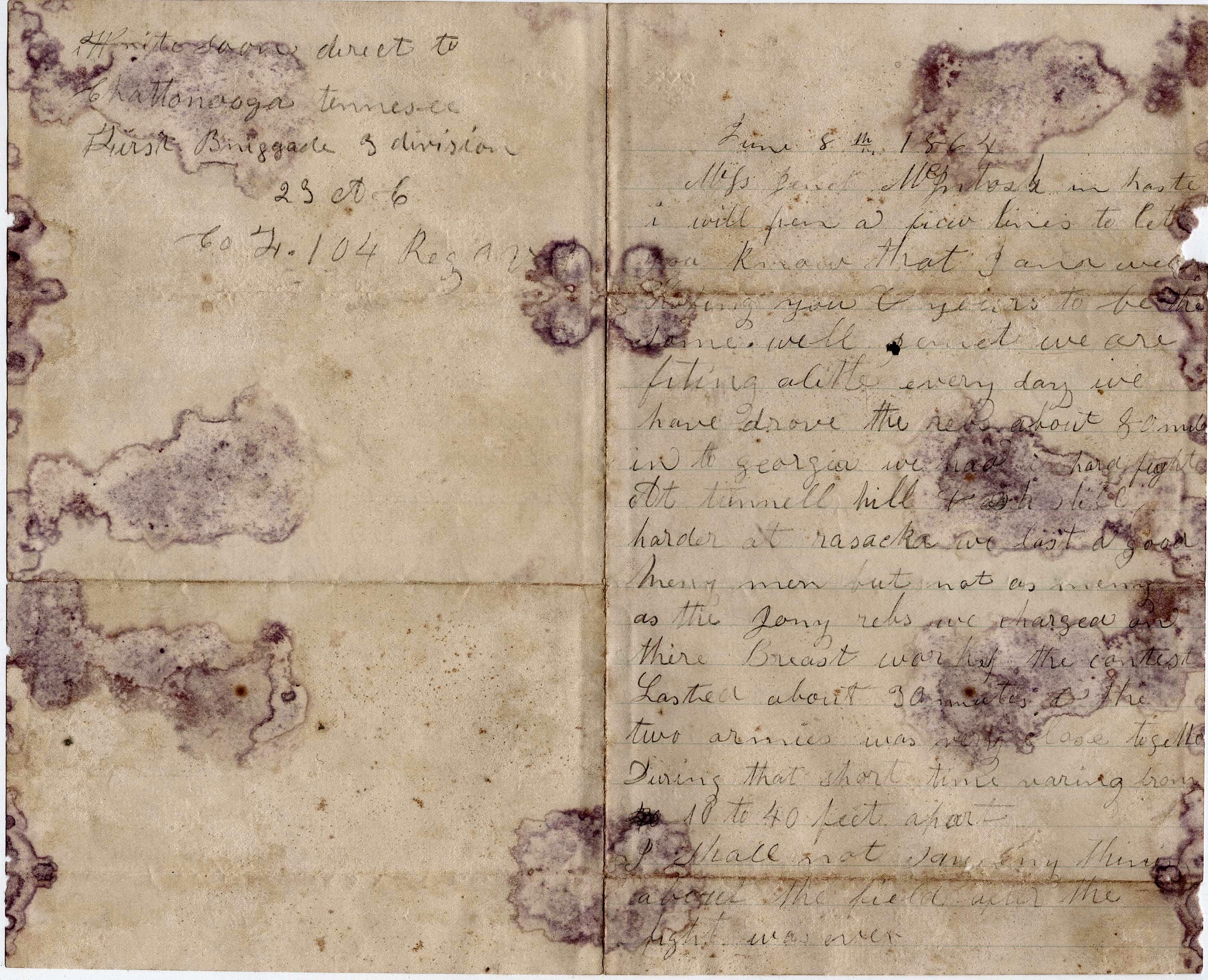
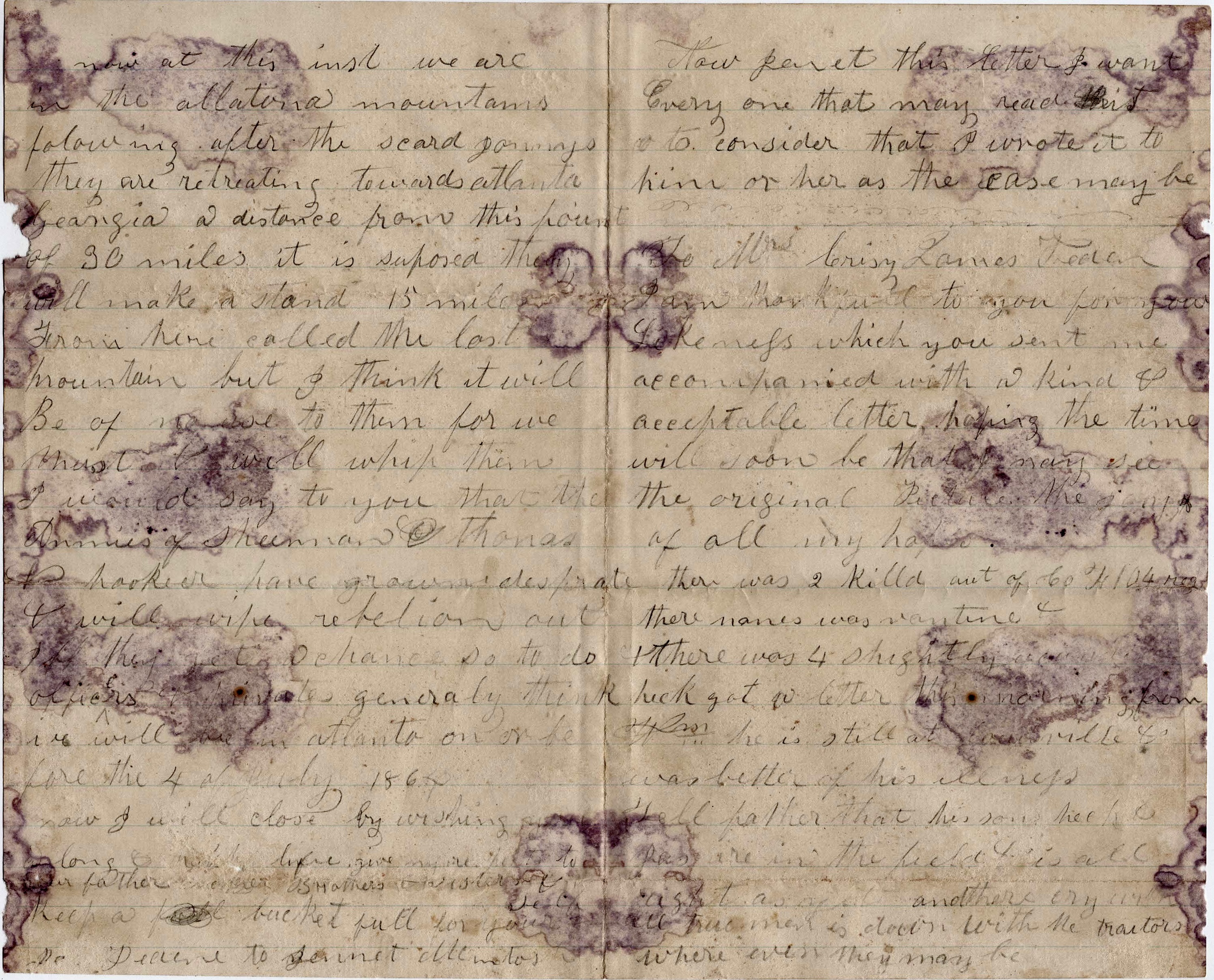
The following letter was written by James Peden (1828-1896) of Co. F, 104th Ohio Volunteer Infantry (OVI). He was the oldest son of William Peden and Elizabeth Richards of Wellsville, Columbiana, Ohio. Serving with him in the same company were his younger brothers, Hezekiah Peden (1831-1881) and William Peden (1841-18xx). James was married to Christina McIntosh (1808-1896).
James enlisted in Co. F, 104th OVI on 12 August 1862 and mustered out of the regiment on 17 June 1865 at Greensboro, North Carolina. “Co. F was recruited from Wellsville, and the towns adjacent, up and down the Ohio river, and along the line of the C & P Railroad with the disadvantage of having within its ranks an undue proportion of “toughs” and “dead beats.” Still Co. F always held its own with any other company in the regiment for efficiency and readiness for duty.
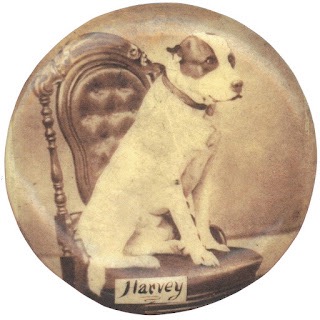
Harvey, the mascot of the 104th OVI
Co. F also rejoiced in the ownership of two dogs which became the pets of the regiment. “Old Harvey” had been in service before; was wounded in Virginia and again at Resaca. He was an aristocrat and wore a brass collar with the legend, “I am Lieutenant D. M. Steam’s dog; whose dog are you?” After Lieutenant Williamson’s death, “the blue pup” became a “child of the regiment.” By his antics, especially his tricks with fire, the boys were often thrown into convulsions of laughter. Unluckily, he tumbled off the train on which the regiment were going from Cincinnati to Washington.”
James’ letter speaks of the fighting by the regiment at Tunnel Hill and at Resaca. The 104th Ohio sustained a total of 183 fatalities (including those killed, mortally wounded, and died of disease) throughout its service, with Resaca being one of its earlier, significant battles in the 1864 campaign.
T R A N S C R I P T I O N
[In the Altoona Mountains] June 8, 1864
Miss Jenette McIntish in haste.
I will pen a few lines to let you know that I am well, hoping you & yours to be the same. Well, Janet, we are fighting a little every day. We have drove the Rebs about 80 miles into Georgia, We had a hard fight at Tunnell Hill & still harder at Resaca. We lost a good many men but not as many as the Johnny Rebs. We charged on their breastworks. The contest lasted about 30 minutes & the two armies was very close together during that time, varying from 10 to 40 feet apart. I shall not say anything about the field after the fight was over.
Now, at this instant, we are in the Altoona Mountains following after the scared Johnnies. They are retreating towards Atlanta, Georgia—a distance from this point of 30 miles. It is supposed they will make a stand 15 miles from here called the Lost Mountain but I think it will be of no use to them for we must or will whip them. I would say to you that the Armies of Sherman & Thomas & Hooker have grown desperate & will wipe rebellion out afor they get a chance so to do. Officers & privates generally think we will be in Atlanta on or before the 4th of July, 1864.
Now I will close by wishing you a long and happy life. Give my respects to your father and mother and mother’s sister [?]. Keep a bucket full for yourself.
[James] Peden to Jenette McIntosh
Now Jenette, this letter, I want everyone that may read this to consider that I wrote it to him or her as the case may be.
To Mrs. Crisy James Peden, I am thankful to you for your likeness which you sent me accompanied with a kind & acceptable letter, hoping the time will soon be that I may see the original. Pictures the [ ] of all my [illegible].
There was two killed out of Co. F, 104th OVI. Their names was Van Tyne & [blank] & there was four slightly wounded. Hick [Hezekiah Peden] got a letter this morning from William. He is still at [ ]ville & was better of his illness. Tell father that his sons Heck & James are in the field & is alright as yet and their cry with all true men is down with the traitors wherever they may be.
Write soon. Direct to Chattanooga, Tennessee. First Brigade, 3rd Division, 23rd Army Corps. Co. F, 104th Regiment O. V.
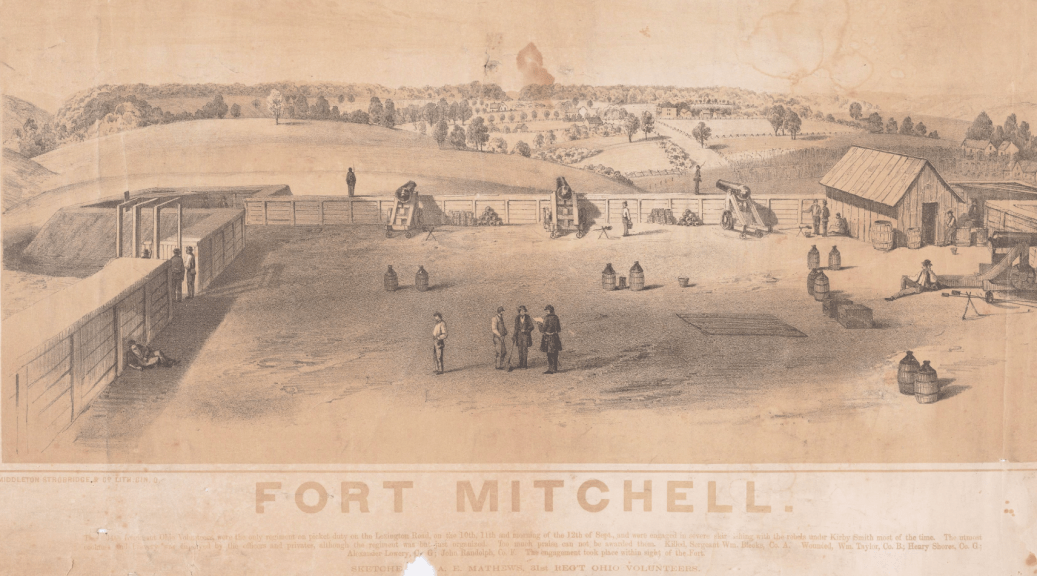
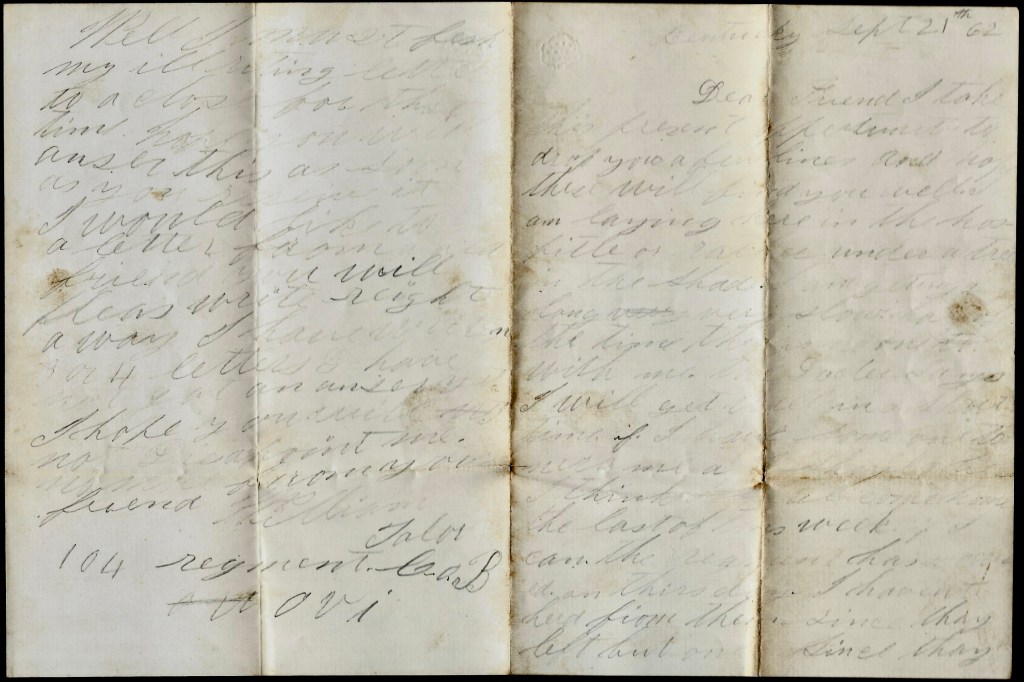
The following letter was written by William Taylor of Co. B, 104th Ohio Infantry. William wrote the letter from a Union hospital in Kentucky, where he was recovering from a shot through the bowels received during a skirmish at the Covington outposts known as Fort Mitchell overlooking the Lexington Pike.
As described in an article by Steve Preston published in 2019 on the 1862 siege of Cincinnati, the 104th Ohio was among these regiments mustered into action quickly in the fall of 1862 to confront the Rebel army marching on Cincinnati. “The outpost at Fort Mitchell received the brunt of the probing by the Confederate force…According to the Cincinnati Gazette, Saturday, September 13, 1862 edition, the 104th occupied the property of a local Southern sympathizer by the last name of Buckner. Just south of the Buckner residence was a wooded area that spread over both sides of the road. It had been filled with Confederates rumored to be from Texas. On Tuesday, September 9th, initial skirmishing began. The firefight between the companies of the 104th and the Texan troops reached its peak by Thursday the 11th. That afternoon would be the final action as heavy rains moved in and the Confederate forces withdrew. No known record of rebel casualties from the skirmishes is known…The 104th Regiment of the Ohio Volunteer Infantry suffered five casualties, the only known casualties from the Siege of Cincinnati caused by hostile gunfire. Private William Taylor of Company B was shot through the bowels. Private John Randolph of Company F was shot through the chest. Private Alexander Lowery from Company G was severely wounded in the leg. Another soldier, Private Henry Shants (or Shantz) supposedly of Company G, was shot in the right arm with the ball entering his side.”
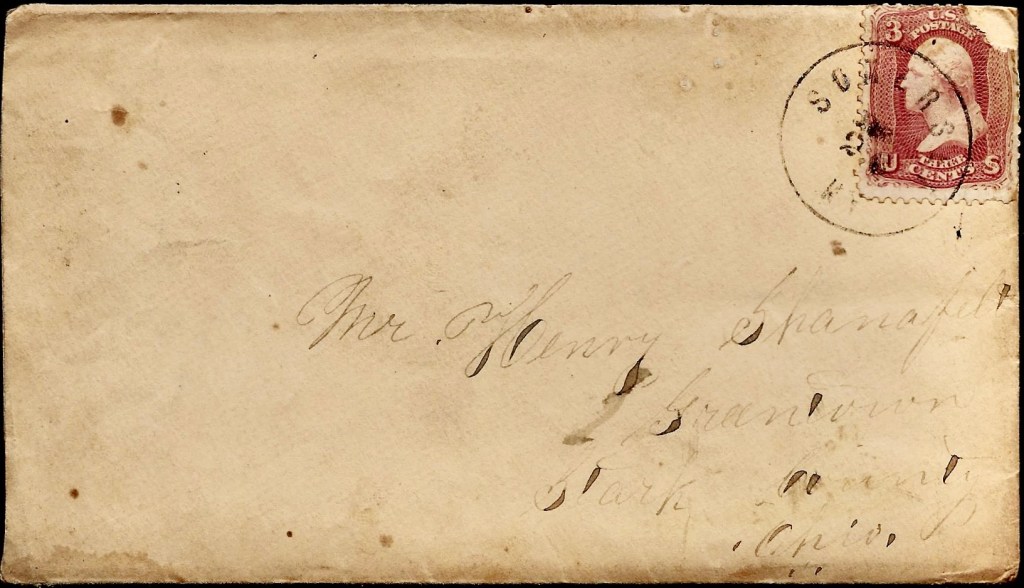
From the muster rolls we learn that William Taylor never returned to his regiment though he yearned for his “revenge.” I hope they shall all be killed or something else become of them,” he wrote his friend, Henry Shanafelt, Jr. of Stark county, Ohio. William was discharged at Cincinnati, Ohio, on 16 March 1863.
Transcription
Addressed to Mr. Henry Shanafelt, Greentown, Stark county, Ohio (but not certain the letter goes with the envelope)
Kentucky September 21st 1862
Dear Friend,
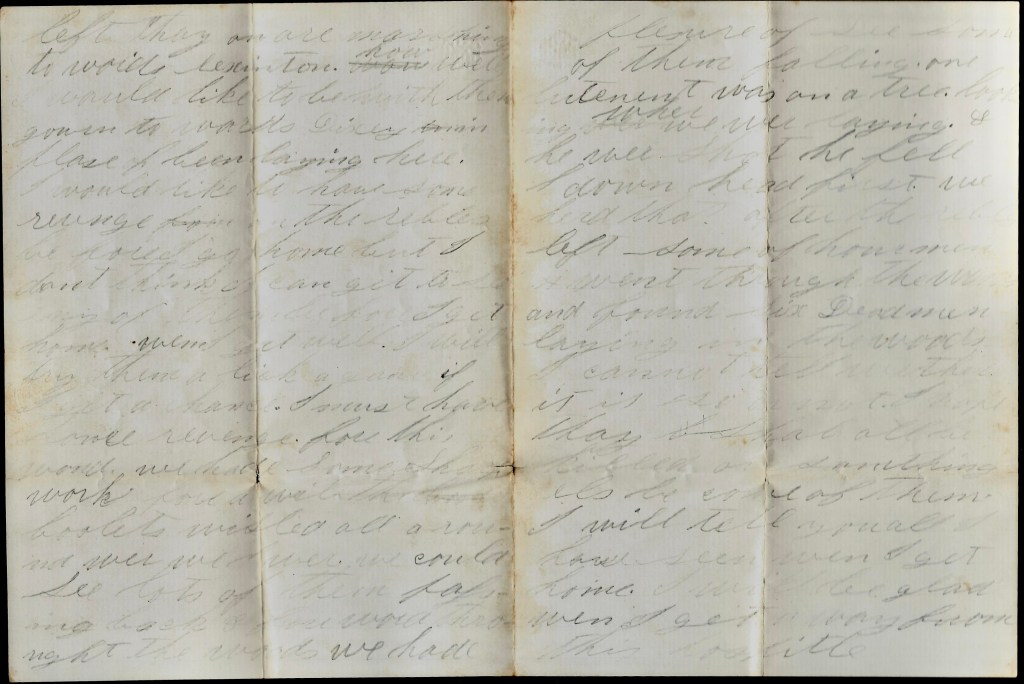
I take this present opportunity to drop you a few lines and hope these will find you well. I am laying here in the hospital, or rather under a tree in the shade. I am getting along very slow. Half of the time there is no one with me. The doctor says I will get well in a short time if I have someone to nurse me and I shall be [illegible.] I think I shall come home the last of this week if I can. The regiment has moved on Thursday. I haven’t heard from them but once since they left. They are marching towards Lexington. How well I would like to be with them going towards Dixie in place of laying here. I would like to have some revenge on the rebels before I go home but I don’t think I can get to see any of them before I get home.
When I get well, I will try them a lick again if I get a chance. I must have some revenge for this world. We had some sharp work for a while. The bullets whistled all around where we were. We could see lots of them falling back & forward through the woods. We had pleasure of see[ing] some of them falling. One Lieutenant was on a tree looking where we were laying & he were shot. He fell down head first. We heard that after the rebels left, some of our men went through them woods and found six dead men laying in the woods. I cannot tell whether it is so or not. I hope they shall all be killed or something else become of them. I will tell you all I have seen when I get home. I will be glad when I get away from this hospital.
Well, I must fetch my ill writing letter to a close for this time. Hope you will answer this as soon as you receive it. I would like to [get] a letter from an old friend. You will please write right away. I have written 3 or 4 letters & have not got an answer yet. I hope you will not disappoint me. No more. From your friend, — William Talor [Taylor]
A post war image of William W. Smith, veteran of the 104th OVI and survivor of the S. S. Sultana disaster.(Ancestry.com)
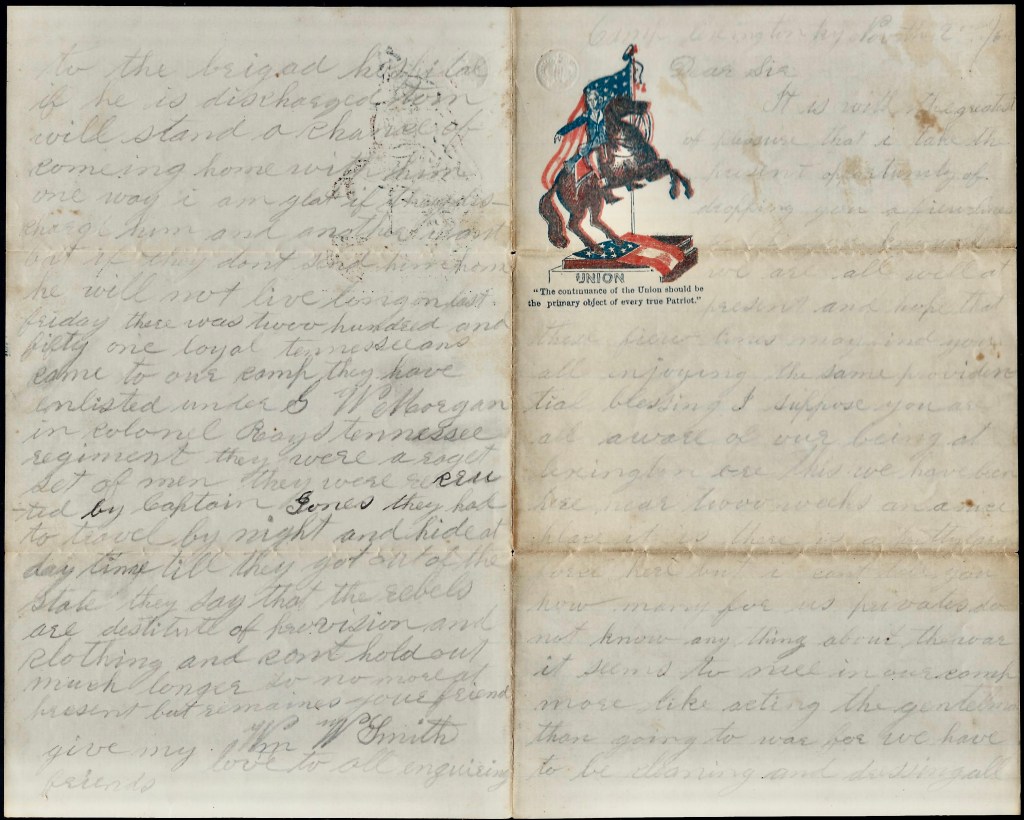
The following letter was written by William Wendel Smith (1842-1908), the son of Charles Smith (1807-1879) and Rebecca Weaver (1808-1885) of Stark county, Ohio—formerly of Perry county, Pennsylvania. William was 20 years old and working as an apprentice to learn the carriage maker’s trade from Robert Latimer in Canton when he mustered into Co. B, 104th Ohio Infantry in August 1862. On May 31, 1864, he was shot in the arm during the Battle of Dallas (Georgia). On Nov. 30, 1864, he was captured during the Battle of Franklin (Tennessee). Initially held at Cahaba Prison (Alabama), he was transferred to notorious Andersonville Prison (Georgia) in early 1865. He was freed as part of a prisoner exchange on April 1, 1865.
On April 27, 1865, he was among an estimated 2,400 home-bound Union soldiers, former POWs and other passengers aboard the badly overcrowded S.S. Sultana, a steamboat, when it exploded in the Mississippi River near Memphis, killing about 1,600. William Wendel Smith suffered burns but survived. After his return to Stark County, Ohio, he became a farmer.
The identity of the letter’s recipient is not revealed in the letter but it was found in a collection of letters addressed to Henry Shanafelt, Jr. (1827-1893) of Greentown, Stark county, Ohio, so we presume that he was the “Dear Sir.”
Transcription
Camp Lexington, Kentucky November 12th 1862
Dear Sir,
Posted on Find-A-Grave
It is with the greatest of pleasure that I take the present opportunity of dropping you a few lines to let you know that we are all well at present and hope that these few lines may find you all enjoying the same providential blessing. I suppose you are all aware of our being at Lexington ere this. We have been here near two weeks and a nice place it is. There is a pretty large force here but I can’t tell you how many for us privates do not know anything about the war. It seems to me in our camp more like acting the gentleman than going to war for we have to be cleaning and dressing all the time. One day we get orders to clean our brass and guns and put on our best clothes for inspection, and another for review, and so it goes. Instead of marching on and fighting the battles that must be fought before this war is over, we are kept here dress and fixing up for review or some other darned kind of view until our ranks are thinned by sickness and death. And the rebels are gone and we must march after them but far enough behind so as not to get any booty from them. It seems to me as if our generals was afraid of this war closing too soon and they not making enough to fill their pockets. But I think they have got a general [William S. Rosecrans] at the head of the Cumberland Army that will not fail to capture Bragg’s Army if he gets such a chance as Buell had.
We had a snow on last Saturday night six inches deep. It was pretty cold on Sunday but it cleared off on Monday and it has been pretty warm since. But today it is trying to rain. It looks as if it would succeed.
The talk is in our regiment that they are going to take our tents from us and give us little rubber tents large enough for three and them we must carry. About that time, I will sleep out in the big tent before I will carry one. Daniel France 1 has not been well for some time but he is now soon fit for duty. I think J[ohn] W. Raber 2 will be discharged from service for disability. He has been sent to the Brigade Hospital. If he is discharged, Tom will stand a chance of coming home with him. One way I am glad if they discharge him and another won’t but if they don’t send him home, he will not live long.
On last Friday there was two hundred and fifty-one loyal Tennesseans came to our camp. They have enlisted under G. W. Morgan in Colonel [Daniel Mack] Ray’s Tennessee Regiment. 3 They were recruited by Captain Jones. They had to travel by night and hide at daytime till they got out of the State. They say that the rebels are destitute of provision and clothing and can’t hold out much longer.
So no more at present but remain your friend. Give my love to all enquiring friends. — Wm. W. Smith
1 Daniel France was detailed as blacksmith in engineer battalion, 23rd Army Corps, April 4, 1864.
2 John W. Raber (1838-1930) was from Greentown, Stark county, Ohio, which is where Henry Shanafelt (believed to be the letter’s recipient) lived during the Civil War.
3 Daniel Mack Ray was born in Yancy County North Carolina on March 27, 1833. He grew up in Sevier County, Tennessee later receiving his academic education in Burnsville, North Carolina and Dandridge, Tennessee. After his education was complete, he worked as a school teacher, and was living in east Tennessee when the war broke out. With the outbreak of the Civil War, he remained loyal to the Union, and joined the Army after a year of clandestine work behind enemy lines in eastern Kentucky, blowing up bridges and obstructing the invading rebel armies. According to one obituary, Ray organized neighbors to burn several railroad bridges in order to delay pro-southern forces entering the state. He then made his way to Flat Lick, Kentucky, to enlist in the Union army, receiving a commission on October, 10 1862 as First Lieutenant and Adjutant of the 3rd Tennessee Infantry, U.S., part of the Army of Ohio, resigning from that unit six months later to take a commission as Colonel of the 2nd Tennessee Cavalry, U.S., on August 6, 1862 with whom he served with for the remainder of his extensive war service commanding a brigade in Sheridan’s Atlantic campaign under Major General David S. Stanley and Colonel Edward M. McCook.
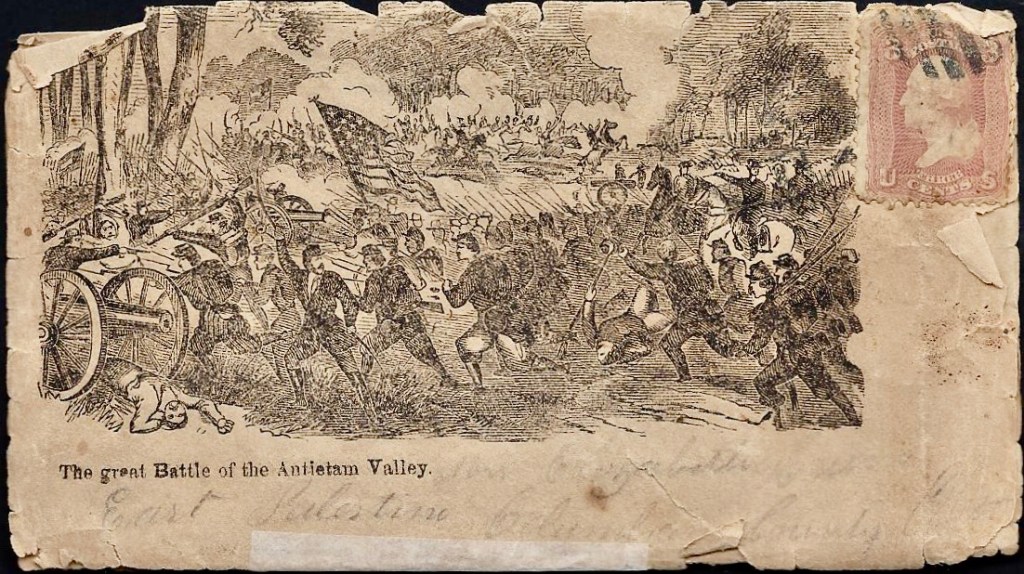
This letter was written by Isaac Zeigler (1834-1864), the orphaned son of John Adam Zeigler (17xx-1854) and Elizabeth Mary Dennis (1790-1848) of East Palestine, Columbiana county, Ohio. Isaac mentions in his letter an older brother, John Zeigler (1830-1915) who served in Co. H, 19th Ohio Volunteer Infantry (OVI). Isaac wrote the letter to his older sister, Elizabeth (Zeigler) Crum who was married in 1855 to Peter Crum (1833-1863). Elizabeth’s husband died of disease earlier in the war, in June 1863, while serving as a substitute in Co. D, 19th OVI.
Isaac enlisted on 11 August 1862 as a sergeant in Co. C, 104th OVI when he was 23 years old. The 104th OVI came to be called “the Barking Dog Regiment” during the Civil War and even had a mascot, a dog named “Harvey.” Harvey was wounded in the fighting near Kennesaw Mountain in the Atlanta Campaign but recovered in time to rejoin the regiment in Tennessee at Franklin and Nashville. Isaac was serving as the Orderly Sergeant of his company when he was cut down along with 60 of his comrades in the Battle of Franklin on 30 November 1864 while manning the Federal breastworks thrown up between the Carter’s cotton gin and the Columbia Pike late in the afternoon.
Transcription
Addressed to Elizabeth Crum, East Palestine, Columbiana county, Ohio
Camp near Decatur, Georgia September 11th 1864
Dear Sister,
Your kind and ever welcome letter came to hand sometime ago and I was glad to hear from you but I hadn’t time to write to you before this for we was on a raid when I got your letter and hadn’t time to write to you till now. But I han’t got much time to write at this present time for we have went into a regular camp and we have got a great deal to fix up at this present time.
We drove the Rebels 30 miles below Atlanta, Georgia, and then our army withdrew back to this place and to Atlanta to rest this army after so hard a campaign. We will rest 30 days before we go on a new campaign and get us clothed and equipped and let us rest for awhile for we needed it very much.
I han’t seen Brother John for some time but I heard from him the other day. He was in the hospital but is able to go about and was getting well fast. His time will soon [be] out and then he will come home.
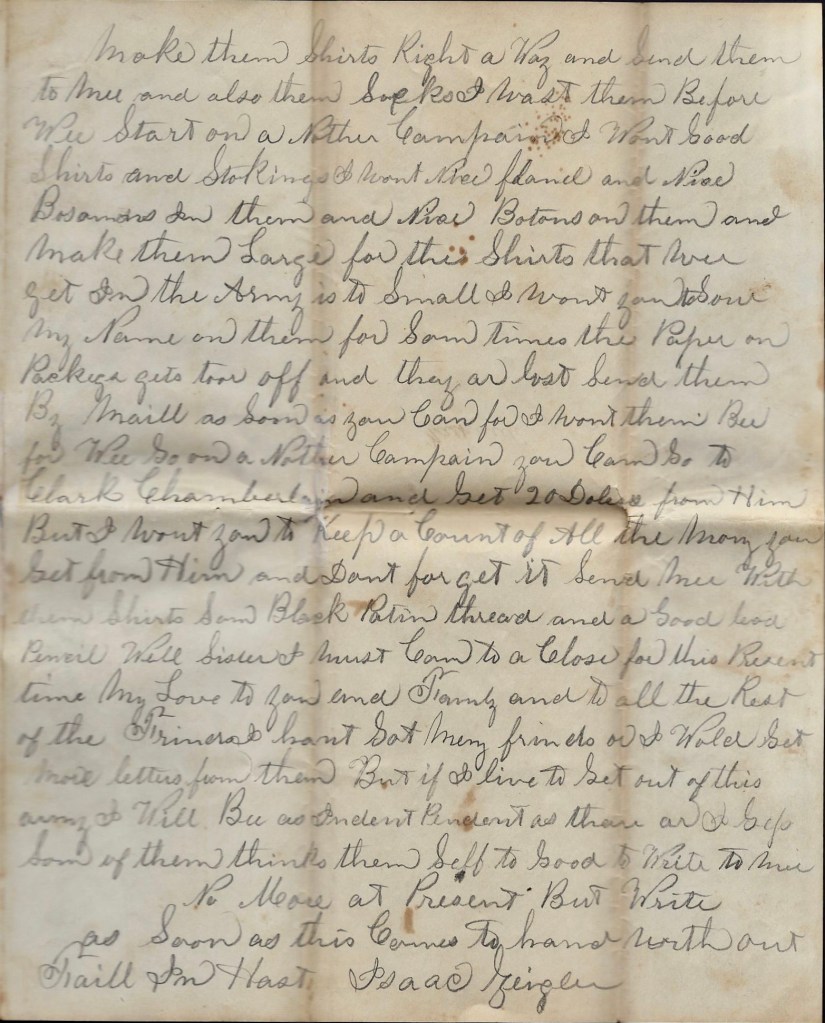
Well, sister, I want you to make them shorts right away and send them to me, and also them socks. I want them before we start on another campaign. I want good shirts and stockings. I want nice flannel and nice [ ] in them and nice buttons on them and make them large for the shirts that we get in the army is too small. And I want you to sew my name on them for sometimes the paper on package gets torn off and they are lost. Send them by mail as soon as you can for I want them before we go on another campaign.
You can go to Clark Chamberlin 1 and get 20 dollars from him but I want you to keep account of all the money you get from him and don’t forget it. Send me with them shirts some black satin thread and a good lead pencil. Well, Sister, I must come to a close for this present time.
My love to you and family and to all the rest of the friends. I han’t got many friends or I would get more letters from them. But if I live to get out of this army, I will be as independent as they are, I guess. Some of them think themselves too good to write to me.
No more at present. But write as soon as this comes to hand without fail. In haste, — Isaac Zeigler
1William “Clark” Chamberlin (1837-1918) was a general store merchant, banker, and assistant postmaster in East Palestine.
I can’t be 100% certain of the identity of these correspondents though I feel confident they were members of the household of Levi Kirk Taylor (1811-1901) and Emily Rosseter (1814-1896) of Randolph, Portage county, Ohio. I suspect that the unsigned letter was actually penned by Mary Elizabeth Taylor (1844-1874) who would have been 21 years old and unmarried at the time this letter was written in May 1865. She died young at the age of 30 and seems to have been an invalid. Alternatively it would have been written by her older sister, Louisa Jane Taylor (1841-1914) who was already married to Isaiah Samuel France (1842-1894) who served earlier in the war in Co. I, 104th Ohio Volunteer Infantry (OVI).
The letter was addressed to “Will” and “Bub” who were the author’s brothers. Clearly Will was Corp. William Kirk Taylor (1839-1905) who served in Co. I, 104th OVI and seems to have been transferred to the Veteran Reserve Corps in 1863. I can’t be certain who “Bub” was and can’t even conjecture based on census records.
Transcription
Randolph [Portage county, Ohio] Monday eve. May 15th 1864 [should be 1865]
My esteemed brothers, Bub & Will,
Your letter of the 9th inst. is just received. Was glad to hear that Erastus 1 is getting better but sorry to hear he would not be able to start home for so long but we are still living in hopes. Will, I am sorry that “Old Father Time” should deal out to so you so scrimped a portion of time that you could only write one half a small sheet of letter paper. You don’t write half particulars enough. What are the names of the inmates of the house in which brother Bub is? Has the regiment left yet?
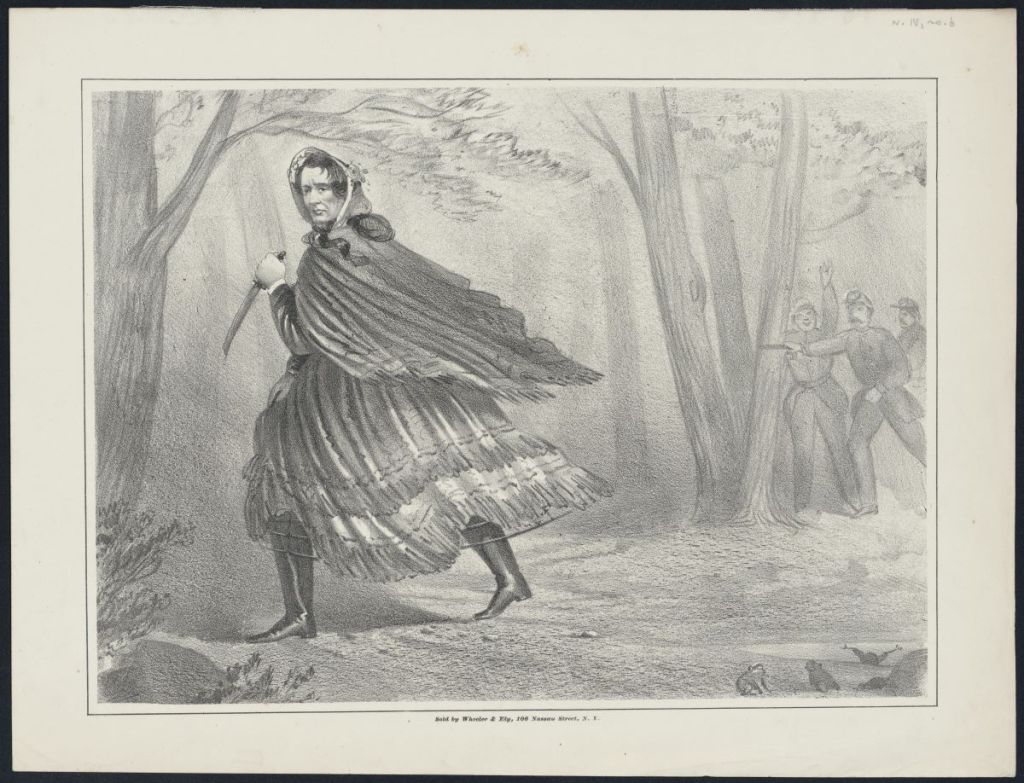
We’ve got Old Jeff Davis. He was found in his wife’s petticoat—Oh ho! He is coming up to Washington. Wonder if Johnson will make him Vice President, eh? Father says Old Jeff turned into a wizard after all, &c. &c. &c. 2
Northern cartoonists mercilessly depicted Jefferson in full women’s clothes after his capture. Library of Congress
Prent[ice] 3 & Wilber has just come. They are taking a couple of loads of household goods to Mecca for Ben Mason & are going to put up at Taylor House tonight.
Our folks attended Myron Collins’ funeral yesterday which was largely attended. 4 Poor Mrs. Collins feels dreadful bad so they say. She fainted at the graveyard.
The neighbors are making up a collection to get Mrs. Beans (widow of Henry Beans) a dress and other things which she needs. She is in reduced circumstances. Has a family of six little boys and one small girl. Mr. Bean’s funeral sermon is to be preached at Randolph one week from next Sunday. I wanted to have gone to the funeral but was not able. 5
Bub, you and I will have to be put in the “Invalid Corps.” I am getting better slowly and I hope I will be well enough to walk to the dinner table without crutches when you get here if we have that chicken pie. I have got tired enough of sitting still but there is one consolation and that is if you come home, I will have nothing to do but visit. I wanted to practice some on the melodian before you got home but tis little I can do towards it. Hence I have a good excuse for not playing for you, ain’t I?
Rosella was to have begun our school today but they are going to move the school house about ten feet further south. Elma 6 and Dode went out to school this morning but was disappointed & came back home. Father has been to Ravenna today. Took up load of oats. You must hurry up, Bub & Will, or the regiment will get home first & that won’t answer at all. We would have begun to look for you & Erastus home about next week had it not been for your last letter. You will not have time to stay at home long if you don’t start before two weeks. Perhaps you could bring Erastus up to Nelson’s if he was unable to come alone. Some of our folks would meet him there. Mother says for you not to start too soon with Erastus & not let him come alone, &c. &c. Write all particulars, &c. Goodbye.
Respected forwarded by Wm. H. France, 1st Sergt. Co. H is all O.K. Not gone yet.
Erastus R. Taylor
1 Erastus Roseter Taylor (1845-1915) was the son of Levi Kirk Taylor (1811-1901) and Emily Rosseter (1814-1896) of Randolph, Portage county, Ohio. Erastus enlisted as a private on 2 February 1865 in Co. H, 184th Ohio Infantry. He was mustered out of the service on 18 May 1865 at Bridgeport, Alabama.
2 “The story of Jefferson Davis’s capture in a dress took on a life of its own, as one Northern cartoonist after another used his imagination to depict the event. Printmakers published more than 20 different lithographs of merciless caricatures depicting Davis in a frilly bonnet and voluminous skirt, clutching a knife and bags of gold as he fled Union troopers. These cartoons were accompanied with mocking captions, many of them delighting in sexual puns and innuendoes, and many putting shameful words in Davis’s mouth. Over the generations, fact and myth have comingled concerning the details of Davis’s final capture. Had he borrowed his wife’s dress to evade the Union cavalry? How much of the unflattering post capture cartoons, news reports, and song lyrics sprang from the deep bitterness Northerners held for the man who symbolized the Confederacy?” [American Heritage, “Was Jefferson Davis Captured in a Dress?“]
3 Prentice A. Taylor (1838-1920) was the son of Levi Kirk Taylor (1811-1901) and Emily Rosseter (1814-1896) of Randolph, Portage county, Ohio. He served 3 months in Co. H, 162nd Ohio (National Guard) Infantry and mustered out on 4 September 1864 at Camp Chase.
4 Sgt. Myron Collins served in Co. H, 184th OVI. He died at Nashville, Tennessee on 25 April 1865. He was buried at the Nashville National Cemetery.In the 1860 US Census, Myron was the son of Austin Collins (1804-1880) and Delight Merriman (1807-1881) of Randolph, Portage county, Ohio. He was married to Lydia B. Berling (1832-1913) in November 1858. They had a little two year-old girl named Sadie at the time of his death.Lydia later remarried a second time to Henry Madison Woodruff (1828-1898).
5 Henry Beans (1829-1865) served as a private in Co. H, 184th OVI for seven and a half months before he died of chronic diarrhea on 24 April 1865 in General Hospital No. 15 at Nashville, Tennessee. Henry left a wife, Achsah (Abbott) Beans (1832-1908) and seven children, the oldest born in 1852.She received $8 per month as a pension for the loss of her husband.
6 Elma Livira Taylor (1855-1890) was the daughter of Levi Kirk Taylor (1811-1901) and Emily Rosseter (1814-1896) of Randolph, Portage county, Ohio.









 Spared & Shared 23