
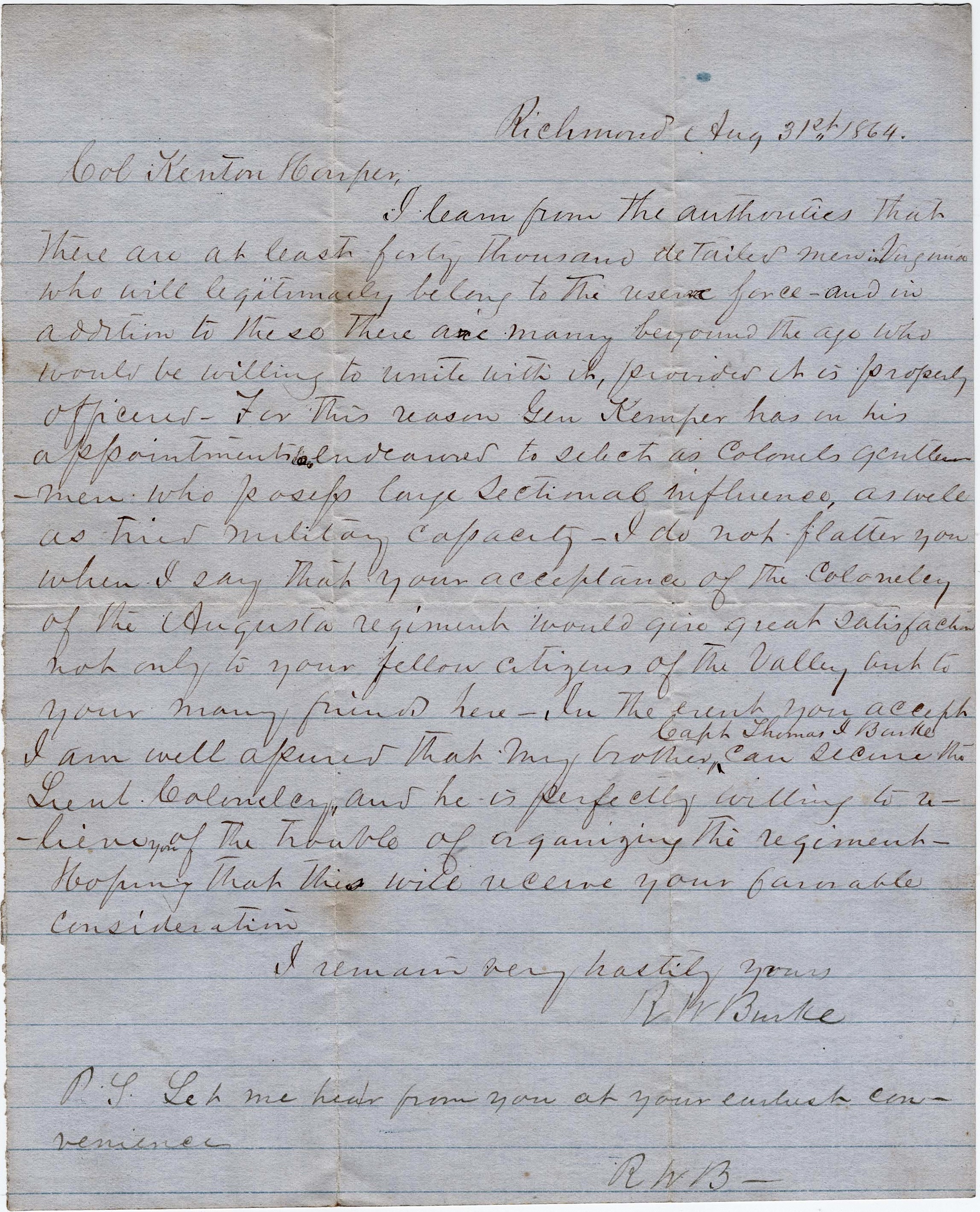
This letter by Robert William Burke (1835-1914) clearly illustrates the interplay between military operations during the Civil War and the pursuit of personal advancement. By August of 1864, the Shenandoah Valley—known as the breadbasket of the Confederacy—faced a dire threat from Union General Philip Sheridan. Although the Confederate forces under General Jubal Early had previously managed to maintain their position, they were now faltering under Sheridan’s relentless military strategies and total war tactics. In an effort to bolster Early’s army, Robert W. Burke highlights a plan by General James Kemper, commander of the Virginia Reserves, to dispatch a contingent of reserves to join forces with Early. Burke suggests that 63 year-old Harper of Augusta county, Virginia, who once led the 5th Virginia Regiment under Gen. Jackson at First Bull Run, and who retired in September 1861, lead the contingent. Burke also suggests that his older brother, Captain Thomas J. Burke (1833-1899) of the 5th Virginia, serve as Harper’s second-in-command. Such an elevation would have been questionable, given that Captain Burke had been reported as “Wounded leg, permanently disabled” following the 1862 Battle of Gaines’ Mill. Ultimately, Burke’s proposal yielded no results. Harper never took command of such a force, the Valley was decisively lost for the Confederacy after the Battle of Cedar Creek in October, and Thomas Burke departed from active duty that December.
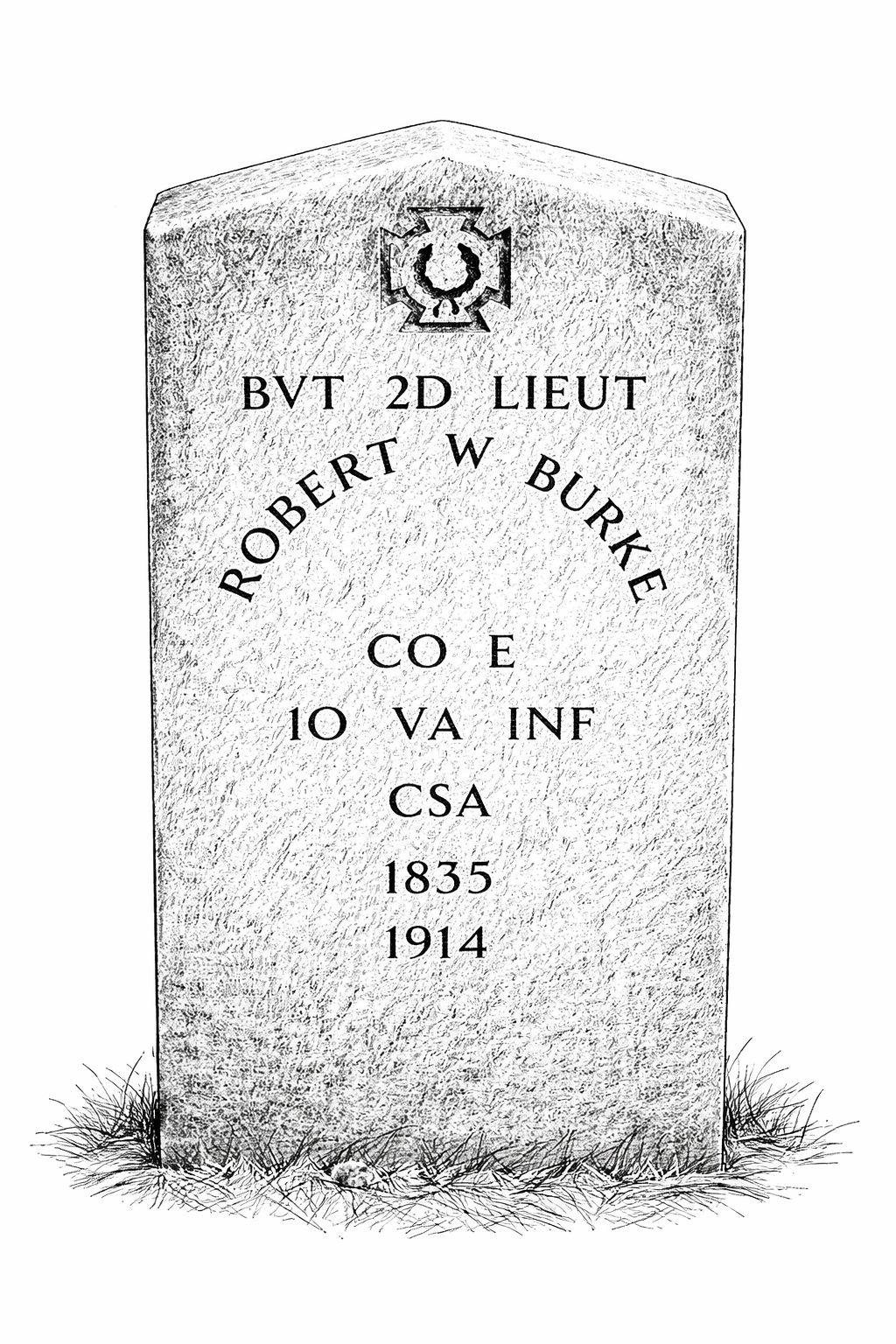
Robert William Burke is buried at the foot of a Confederate soldier’s headstone in Edinburg, Virginia. Engraved on the stone, Burke is identified as a Bvt. 2d Lieutenant who once served in Co. E, 10th Virginia Infantry.
T R A N S C R I P T I O N
Richmond [Virginia]
August 31st 1864
Col. Kenton Harper,
I learn from the authorities that there are at least forty thousand detailed men in Virginia who will legitimately belong to the reserve force and in addition to these are many beyond the age who would be willing to unite with it provided it is properly officered. For this reason Gen. Kemper has in his appointments endeavored to select as Colonels gentlemen who possess large sectional influence, as well as tried military capacity. I do not flatter you when I say that your acceptance of the Colonelcy of the Augusta regiment would give great satisfaction not only to your fellow citizens of the Valley, but your many friends here.
In the event you accept, I am well assured that my brother, Capt. Thomas I. Burke, can secure the Lieut. Colonelcy, and he is perfectly willing to relieve you of the trouble of organizing the regiment. Hoping that this will receive your favorable consideration, I remain very hastily yours, — R. W. Burke
P. S. Let me hear from you at your earliest convenience. — R. W. B.

 Spared & Shared 23