
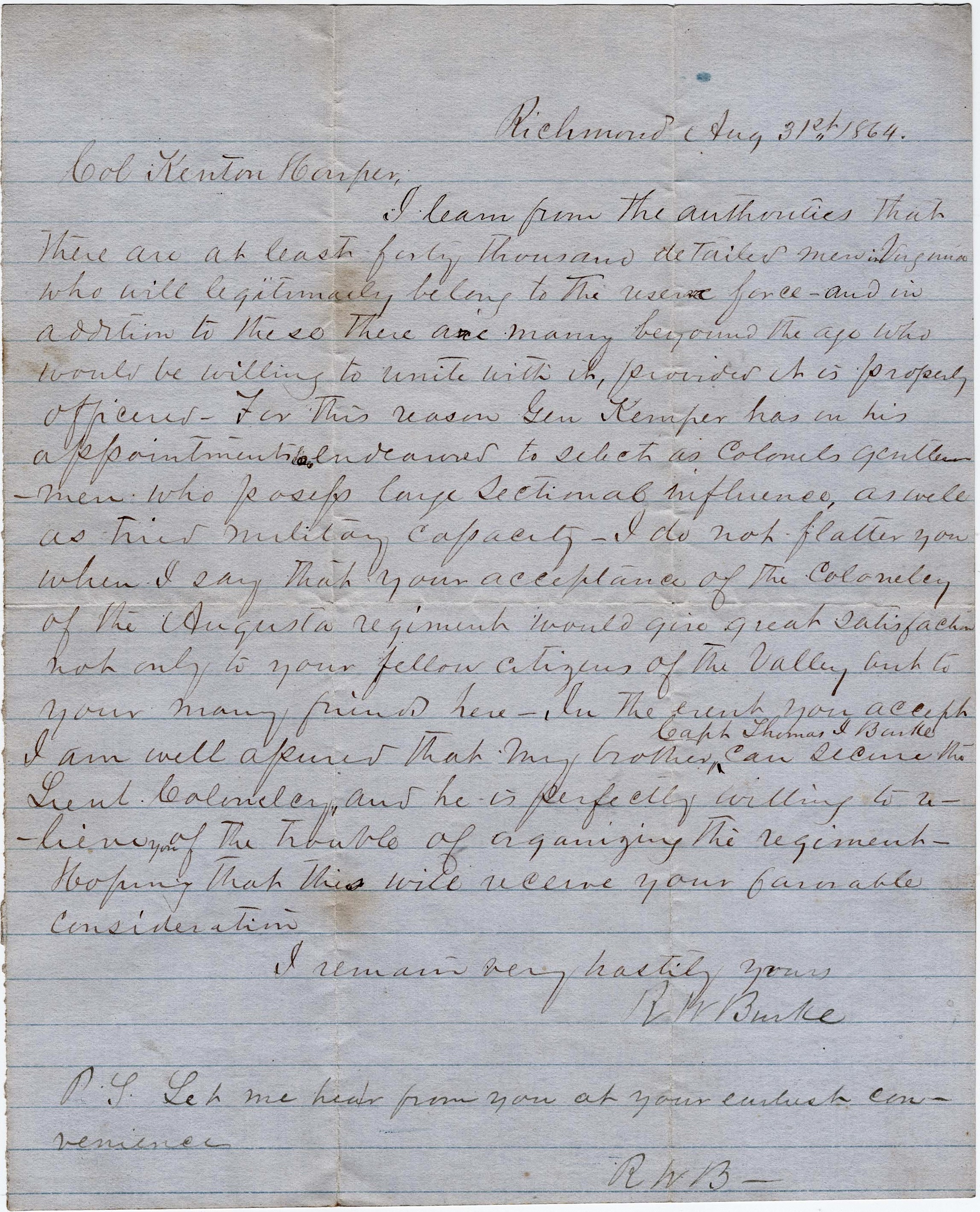
This letter by Robert William Burke (1835-1914) clearly illustrates the interplay between military operations during the Civil War and the pursuit of personal advancement. By August of 1864, the Shenandoah Valley—known as the breadbasket of the Confederacy—faced a dire threat from Union General Philip Sheridan. Although the Confederate forces under General Jubal Early had previously managed to maintain their position, they were now faltering under Sheridan’s relentless military strategies and total war tactics. In an effort to bolster Early’s army, Robert W. Burke highlights a plan by General James Kemper, commander of the Virginia Reserves, to dispatch a contingent of reserves to join forces with Early. Burke suggests that 63 year-old Harper of Augusta county, Virginia, who once led the 5th Virginia Regiment under Gen. Jackson at First Bull Run, and who retired in September 1861, lead the contingent. Burke also suggests that his older brother, Captain Thomas J. Burke (1833-1899) of the 5th Virginia, serve as Harper’s second-in-command. Such an elevation would have been questionable, given that Captain Burke had been reported as “Wounded leg, permanently disabled” following the 1862 Battle of Gaines’ Mill. Ultimately, Burke’s proposal yielded no results. Harper never took command of such a force, the Valley was decisively lost for the Confederacy after the Battle of Cedar Creek in October, and Thomas Burke departed from active duty that December.
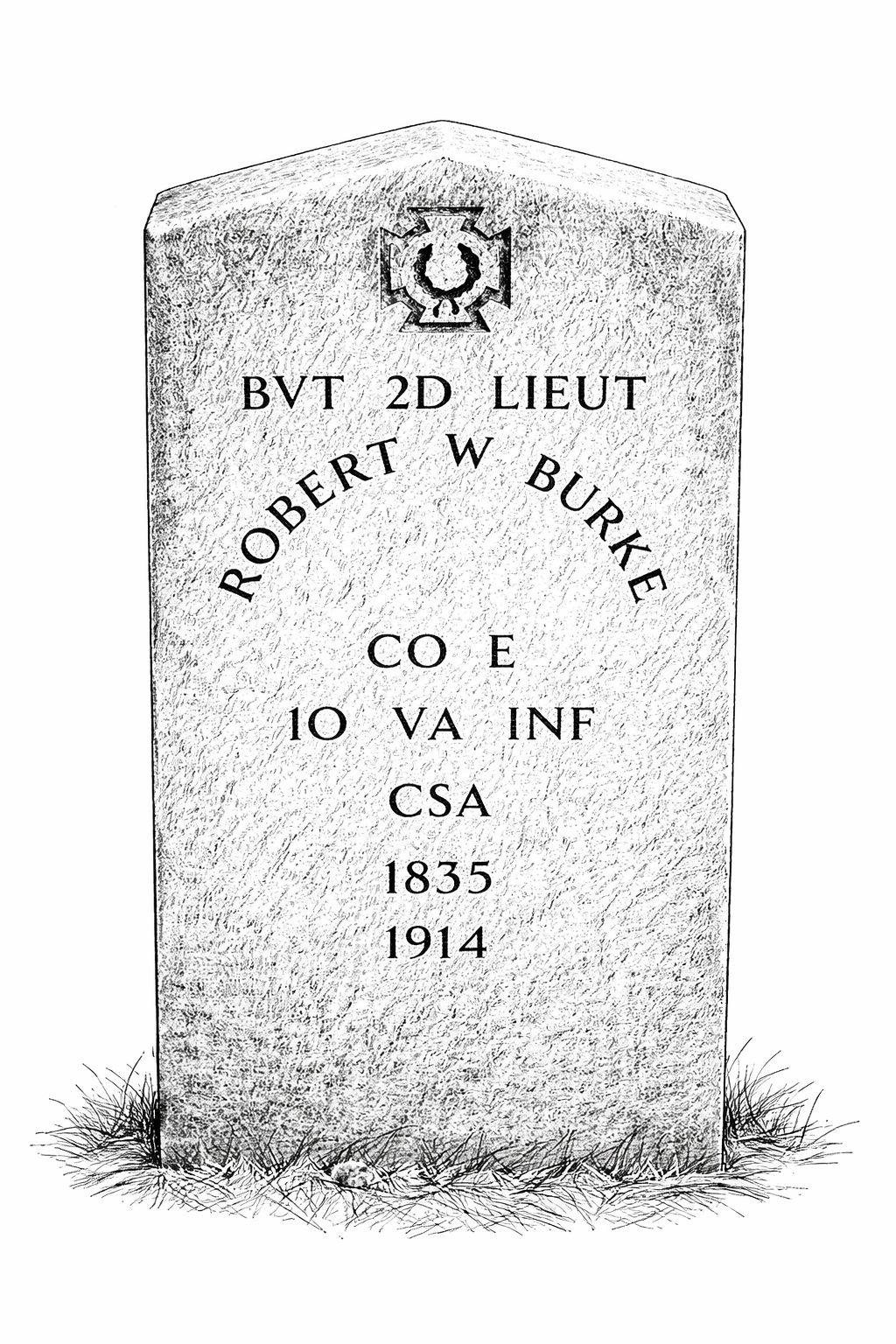
Robert William Burke is buried at the foot of a Confederate soldier’s headstone in Edinburg, Virginia. Engraved on the stone, Burke is identified as a Bvt. 2d Lieutenant who once served in Co. E, 10th Virginia Infantry.
T R A N S C R I P T I O N
Richmond [Virginia]
August 31st 1864
Col. Kenton Harper,
I learn from the authorities that there are at least forty thousand detailed men in Virginia who will legitimately belong to the reserve force and in addition to these are many beyond the age who would be willing to unite with it provided it is properly officered. For this reason Gen. Kemper has in his appointments endeavored to select as Colonels gentlemen who possess large sectional influence, as well as tried military capacity. I do not flatter you when I say that your acceptance of the Colonelcy of the Augusta regiment would give great satisfaction not only to your fellow citizens of the Valley, but your many friends here.
In the event you accept, I am well assured that my brother, Capt. Thomas I. Burke, can secure the Lieut. Colonelcy, and he is perfectly willing to relieve you of the trouble of organizing the regiment. Hoping that this will receive your favorable consideration, I remain very hastily yours, — R. W. Burke
P. S. Let me hear from you at your earliest convenience. — R. W. B.
The following letter was written by Daniel Green Martz (1839-1891), the son of Hiram Martz (1800-1861) and Hannah Asbury Mathews (1803-1861) of Harrisonburg, Rockingham county, Virginia. Daniel was married in April 1860 to Lydia Ann Sellers (1838-1924) and had a young son at the time he enlisted on 3 June 1861 at Lacey Springs, Virginia, to serve as a Lieutenant in Co. H, 10th Virginia Cavalry. After he failed to be reelected, he was discharged from the regiment in May 1862.
Martz later reenlisted as a private in Co. G, 10th Virginia Infantry and was taken prisoner in December 1863 and initially sent to Camp Chase in Ohio; then transferred to Fort Delaware on 15 April 1864 where he wrote this letter three weeks later. He was exchanged on 11 October 1864 and returned to his regiment for the remainder of the war. He was paroled on 20 April 1865 at New Market, Virginia.
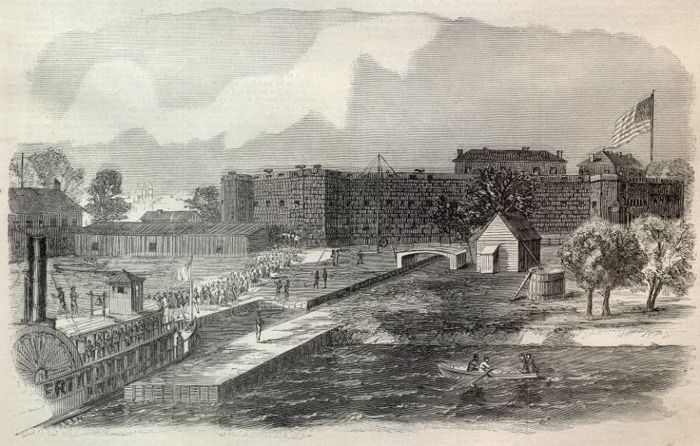
Transcription
Fort Delaware
May 5th [1864]
Mrs. Lydia A. Martz—dear Lydia,
I have just received your short note of 21st March and was much pleased to hear of your general good health but sorry to hear of you suffering with toothache. I am well—all except a slight sore on my neck coming from diphtheria, an enlargement of the gland. It is much better, nearly well. I have not let you know of my throat being sore on account of its making you uneasy. All danger is now past. Indeed, I hope this may find you entirely well. Also Sissie and all my relations and friends.
Louis Wood is well. Why don’t some of my relations write to me? I think they might. I am sorry to hear of Grandmother’s ill health. Hope she is well before this time. What has taken cousin Mikie to South Carolina? Get Uncle Dorilas 1 to see W. D. Liout and let me know whether I received the position I applied for, Wrote on larger paper and write me longer letters. I hope to see you soon. Be of good cheer. My love to all. Kiss and embrace Sissie for me, Many kisses for you. Affectionately your husband. — Daniel G. Marty
[to] Lydia A. Martz
Direct to Fort Delaware, Division 28.
1 Dorilas J. Martz (1802-1872) served in the 97th Virginia Regiment (Spitzler’s)


