Category Archives: 111th Pennsylvania Infantry

1863: Josiah W. Mead to Plympton A. Mead

The following letter was written by Josiah W. Mead (1827-1899) to his younger brother, Lt. Plympton A. Mead (1835-1910)—-a member of Co. B, 111th Pennsylvania Infantry. They were the sons of Charles Mead (1806-1883) and Rebecca Legett (1810-1869) of Ridgeway, Elk county, Pennsylvania.

Josiah was married to Nancy H. Weed (1823-1892) on the 4th of July 1852 and by the time this letter was penned in March 1863, they had at least three children—Lucie (b. 1856), Emma (b. 1859), and Plympton (b. 1861). Josiah’s occupation in 1860 and 1870 was given as “farmer” but we learn from this letter that he also earned income log driving during the winter months, which was to transport felled logs by floating them downstream to sawmills. The logs were driven down streams like the First Fork, the Driftwood Branch, and the Bennett’s Branch of the Sinnemahoning Creek in Elk County. These logs eventually reached sawmills situated along the larger rivers like the Clarion and Allegheny. According to Elk county sources, the lumber industry built the wealth of Ridgway and most of Elk County. The Allegheny Plateau was blessed with a tremendous resource of tree species mostly conifers that were prized by the early settlers and people back on the East Coast for ship building, and various forms of construction, especially homes. The “splash” refers to the dropping of logs from a log slide, or sluice, into a creek that led to larger and larger streams and eventually a river upon which a sawmill was sited.

See also—1862: Plympton A. Mead to his Parents.

[Note: This letter is from the personal collection of James Campbell and was transcribed and published on Spared & Shared by express consent.]

T R A N S C R I P T I O N

Addressed to Plympton A. Mead, Company B, 111th Regt. Pa. Volunteers, F. J. Osgood, Washington D. C.

March 29th 1863

Dear Brother,

I received yours some time ago and have not had time to answer it until now. We are all well at present. I was over to Ridgeway last Sunday. They were well then as usual. Mother’s health is not very good this winter, Father’s health is very good this winter. The people are generally well in this place this winter.

Leonard’s folks had a pair of twins last week but as luck would have it, whether good or bad, they both died. I think they are better off.

It is very cold and blustery today. The ground is covered with snow. The old snow is not all off yet. They are splashing their logs out of the creek. There is a great many logs gone past. They are not splashing today. It is most too cold for them. I suppose I have my logs about in. I would have been done but one of my horses has been sick two weeks so I have done nothing at them. I have eleven more to haul, then I am done, and have 96,500 in. It will take me one day to finish up, then Justus and me has to break the pile at the foot of the slide where we run them down. My logs run three & a quarter to the thousand. I sold some of them for four dollars per thousand [and] some for five—about half and half. I might of had five for the while of them if I had not been in such a hurry about selling. If I had waited one week longer, I could of had five for the whole.

I have just had a [playspa?] with the children. Plymp thinks he is as big as any of them. He is a great boy to play. He makes the girls stand about. He talks about the horses—Pete and Pine, he calls them.

Frank says he would not go if he was drafted. He thinks he might as well be killed at home as to be killed down South. Well, I don’t know but it would be as well for him to be killed at home for he would be of no use down there, such as him.

Nancy and the children sends their respects to you. The children has not forgot their Uncle Plympton yet. They talk about you a good deal and would like to see you. Clinton Bundy came yesterday in the stage. He got his discharge. He has a white swelling on his knee. Write often as you can. Come home if you can and see the folks. From your brother, — J. W. Mead

1864: Henry McKenzie to Phoebe B. Edy

The following letter pertains to Edwin Martin Whipple (1842-1904), the youngest son of Herman Whipple (1774-1842) and Phoebe Boa Lafferty (1816-1904) of Erie County, Pennsylvania. Edwin served in two different regiments during the Civil War. He first enlisted in enlisted in Co. C (the “Jackson Guards”) of the 23rd Illinois Infantry—the “Irish Brigade” led by Col. James A. Mulligan of Chicago. He marched with them on their expedition into Missouri and then was mustered out with the regiment in October 1861, after six months service. He then enlisted in late November 1861 to serve three years in Co. C, 111th Pennsylvania. As far as we know, Edwin remained with the regiment and was with them at the Battle of Gettysburg where he shot the hat off a rebel Colonel while skirmishing in the twilight of 2 July 1863. In the book, “Soldiers True; the story of the 111th Regiment Pennsylvania Veteran Volunteers” (page 181), Edwin is listed among the wounded at the Battle of Lookout Mountain on 24 November 1863. The company roster indicates he mustered out of the 111th in late November 1864.

The letter was penned by someone named Henry McKenzie who was most likely fulfilling the duties of a hospital warden or nurse. It appears that the content of the letter was dictated to him by Edwin and that he (Henry) was not a member of Edwin’s regiment. He may have been the sergeant in the 5th Ohio Infantry by that name who was transferred to the 2nd Battalion, Veteran Reserve Corps. It’s not possible to confirm his identity. The letter does provide us with more details of Edwin’s history following the Battle of Lookout Mountain, however. Edwin’s letters can be found at The Glorious Dead.


Transcription

Tullahoma, [Tennessee]
January 10th 1864

Mrs. Edy,

Madam, at the request of your son [Edwin], I address you to let you know how he is getting along. He received your letter of 30th December day before yesterday and was happy to learn that you were all in good health but thinks that Jim was foolish for enlisting.

I am sorry to inform you that his wound is much worse than it was. He got cold in it and in consequence, his shoulder is very much swollen. The doctor is under the impression that it will require to be lanced. He is unable to leave his bed but we hope that with the return of warm weather that he will speedily regain his strength. He wished you to write frequently to him and not await his replies as he is not personally able to do as yet. He wishes you to tell Jim to stay and see him as he passes. All the trains stop at Tullahoma and he cannot miss seeing the Hospital. It is the largest building here and immediately beside the Depot on the left hand side.

I remain, Madam, yours respectfully, — Henry McKenzie

P. S. He forgot to mention that he seen the Regiment going home but did not see Ben. He saw Capt. Todd and Jim Raymond of Co. H. Raymond would tell Ben the condition he was in when he saw him. — H. McK

1861-62: Edwin Martin Whipple to Phoebe B. Edy

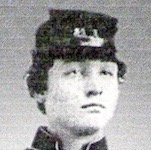
Edwin M. Whipple

This letters were part of a much larger collection at one time but somehow these were separated from the others I transcribed several years ago. They were written by Edwin Martin Whipple (1842-1904), the youngest son of Herman Whipple (1774-1842) and Phoebe Boa Lafferty (1816-1904) of Erie County, Pennsylvania. Edwin served in two different regiments during the Civil War. He first enlisted in enlisted in Co. C (the “Jackson Guards”) of the 23rd Illinois Infantry—the “Irish Brigade” led by Col. James A. Mulligan of Chicago. He marched with them on their expedition into Missouri and then was mustered out with the regiment in October 1861, after six months service. He then enlisted in late November 1861 to serve three years in Co. C, 111th Pennsylvania. As far as we know, Edwin remained with the regiment and was with them at the Battle of Gettysburg where he shot the hat off a rebel Colonel while skirmishing in the twilight of 2 July 1863. In the book, “Soldiers True; the story of the 111th Regiment Pennsylvania Veteran Volunteers” (page 181), Edwin is listed among the wounded at the Battle of Lookout Mountain on 24 November 1863. The company roster indicates he mustered out of the 111th in late November 1864.

There are at least 60 of Ed’s letters posted on the website I created to showcase his letters and two other soldiers who wrote to Ed’s mother, Pheobe B. Edy. You can find them on “The Glorious Dead” published in 2019. There is only one letter (see below) that has turned up so far that was written while Ed served in the 23rd Illinois Infantry but my hunch is more of them will eventually turn up.


Letter 1

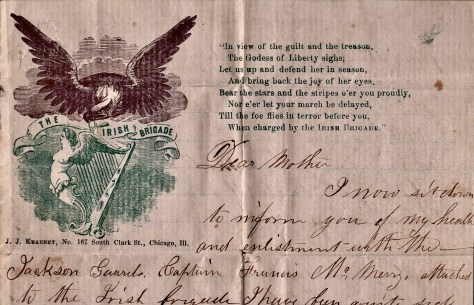
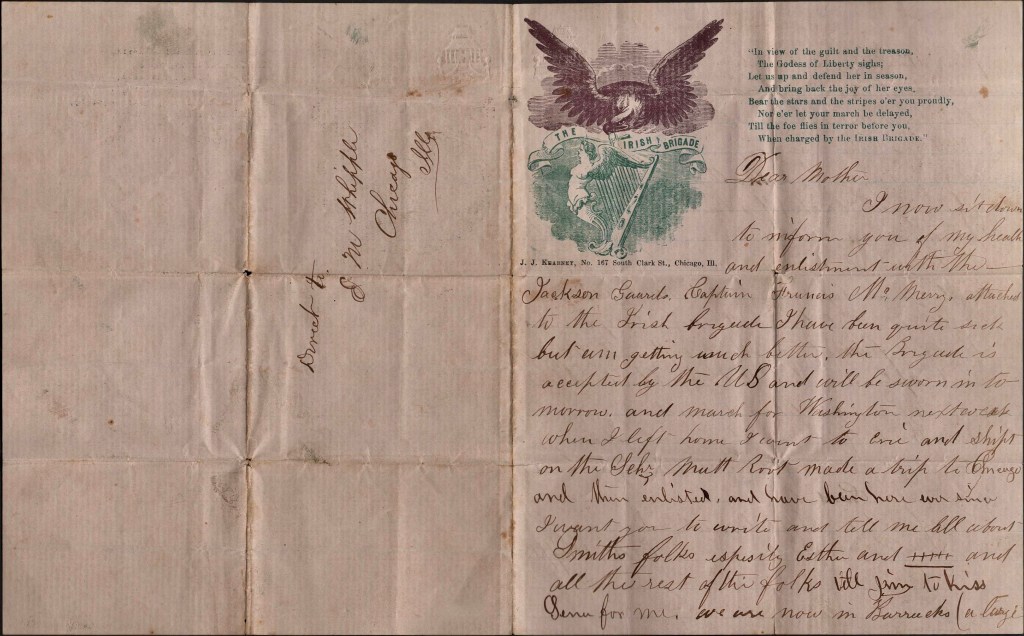
Stationery letterhead of Ed’s letter featuring “The Irish Brigade” harp and poem.

[Chicago, Illinois]
[mid June 1861]

Dear Mother,

I now sit down to inform you of my health and enlistment with the Jackson Guards, Captain Francis McMurray, attached to the Irish Brigade. I have been quite sick but am getting much better. The Brigade is accepted by the U. S. and will be sworn in tomorrow and march for Washington next week.

When I left home, I went to Erie and shipped on the schooner Mutt Root, made a trip to Chicago, and then enlisted, and have been here ever since. I want you to write and tell me all about Smith’s folks—especially Esther and [ ] and all the rest of the folks. Tell Jim to kiss Sena for me.

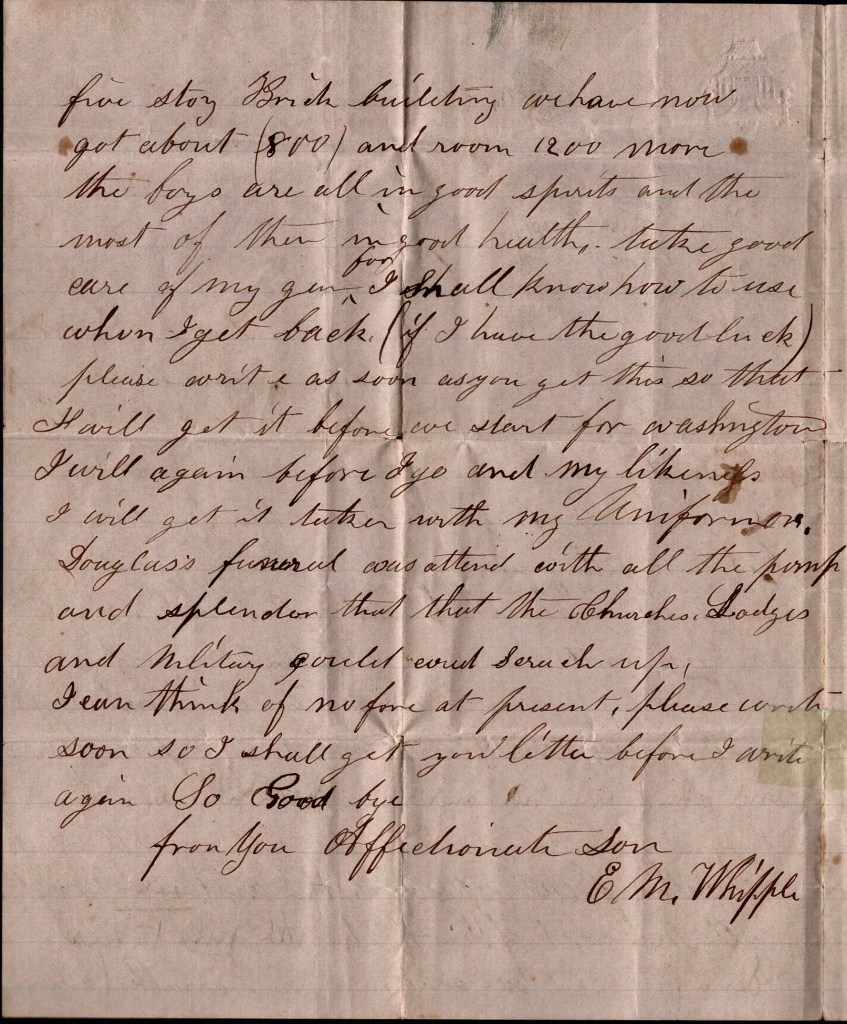
We are now in barracks—a large five story brick building. We have now got about 800 and room [for] 1200 more. The boys are all in good spirits and the most of them in good health. Take good care of my gun for I shall know how to use it when I get back (if I have the good luck).

Please write as soon as you get this so that I will get it before we start for Washington. I will [write] again before I go and [send] my likeness. I will get it taken with my uniform on.

[Senator] Douglas’s funeral was attended with all the pomp and splendor that the churches, lodges, and military could scratch up.

I can think of no more at present. Please write soon so I shall get your letter before I write again. So goodbye. From your affectionate son, — E. M. Whipple

Body of Stephen Douglas lying in state, Chicago, Illinois, June 4, 1861

Letter 2

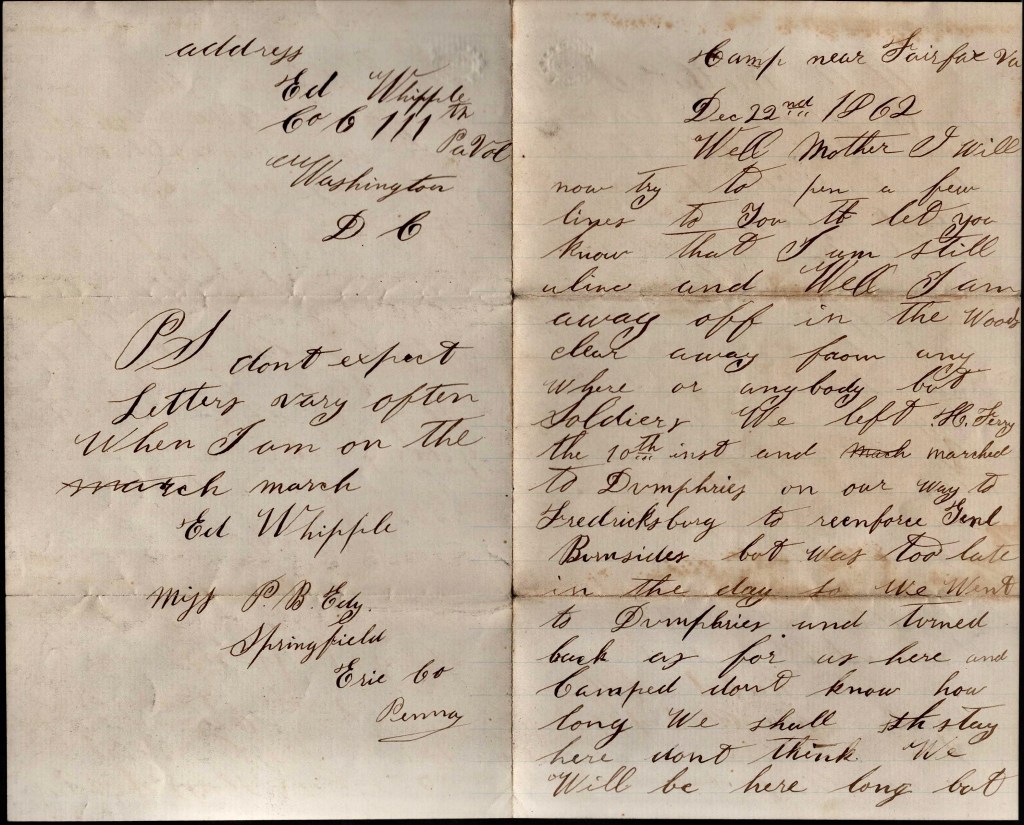
Camp near Fairfax, Virginia
December 22, 1862

Well, Mother, I will now try to pen a few lines to you to let you know that i am still alive and well. I am away off in the woods—clear away from anywhere or anybody but soldiers. We left Harpers Ferry the 10th instant and marches to Dumfries on our way to Fredericksburg to reinforce General Burnside but was too late in the day so we went to Dumfries and turned back as far as here and camped. Don’t know how long we shall stay here. Don’t think we will be here long but can’t tell for certain.

Well, mother, I talk pretty strong of coming home soon but if I do, it will be on a French pass. But durn the odds, only so that I get home. There is not an officer in the regiment that has not done it and I am as good as they are and I think I shall try it when we are paid which will be ‘ere long.

Well there is nothing to write about that you don’t know already. We are 25 miles down the Potomac from Alexandria and one an a half miles from the river in the pine woods where we can’t see the sun at noon—a splendid winter camp.

I had a letter from Willy the other day. He said he couldn’t get anything out of that box [and] that I must eat and drink some for him, so I did. I wish that liquor wasn’t gone yet. I would take a horn or two today. I got the box Thanksgiving day and a fine time I had of it. But it is all gone now. Well, there is no more to write now so goodbye for this time. From Ed Whipple to his mother, Phoebe B. Edy

Address Ed Whipple, Co. C, 111th Pa. Vol., Washington D. C.

P. S. Don’t expect letters very often when I am on the march. — Ed Whipple

1862: Plympton A. Mead to his Parents

The following letter was written by Sergeant Plympton A. Mead (1835-1910) whose signature is barely legible at the end of the letter. Plympton mustered into Co. K, 111th Pennsylvania Infantry in late December 1861. He was commissioned a 2nd Lieutenant in January 1863 and a 1st Lieutenant in October 1864. On 5 June 1865, he was promoted to Captain of the company. He was wounded at Lookout Mountain and at Ringgold, Georgia.

Plympton was the son of Charles Mead (1806-1883) and Rebecca Legett (1810-1869) of Elk county, Pennsylvania.

Transcription

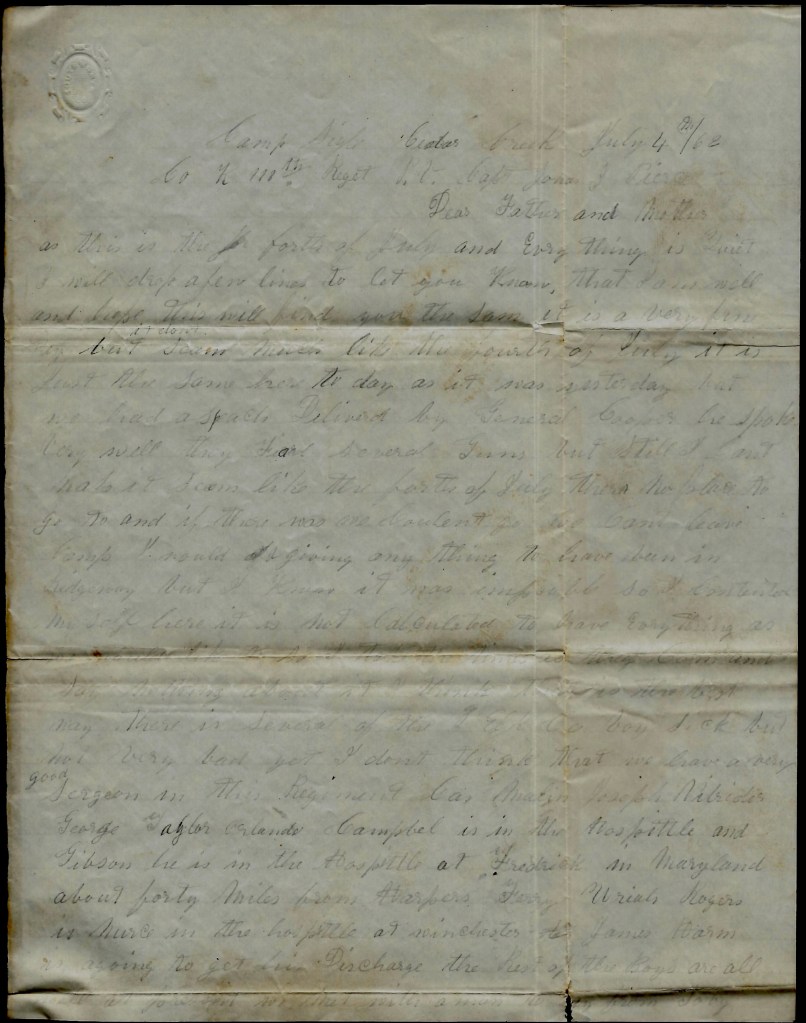
Co. K, 111th Pennsylvania Vol., Capt. Jonas J. Pierce
Camp Sigel, Cedar Creek
July 4th 1862

Dear Father and Mother,

As this is the Fourth of July and everything is quiet, I will drop a few lines to let you know that I am well and hope this will find you the same. It is a very fine day but it don’t seem much like the Fourth of July. It is just the same here today as it was yesterday. But we had a speech delivered by General Cooper. He spoke very well. They fired several guns but still I can’t have it seem like the Fourth of July. There is no place to go to and if there was, we couldn’t go. We cant leave camp. I would a given anything to have been in Ridgeway but I know it was impossible so I contented myself here. It is not calculated to have everything as we would like to so I take the time as they come and say nothing about it. I think this is the best way.

There is several of the Elk Co. boys sick but not very bad yet. I don’t think we have a very good surgeon in this regiment. Cas[tor] Maylin, Joseph Neiteriter, George Taylor, Orlando Campbell is in the hospital and [Israel] Gibson he is in the hospital at Frederick in Maryland, about forty miles from Harpers Ferry. Uriah Rodgers is nurse in the hospital at Winchester. James Harm is a going to get his discharge. The rest of the boys is all well at present.

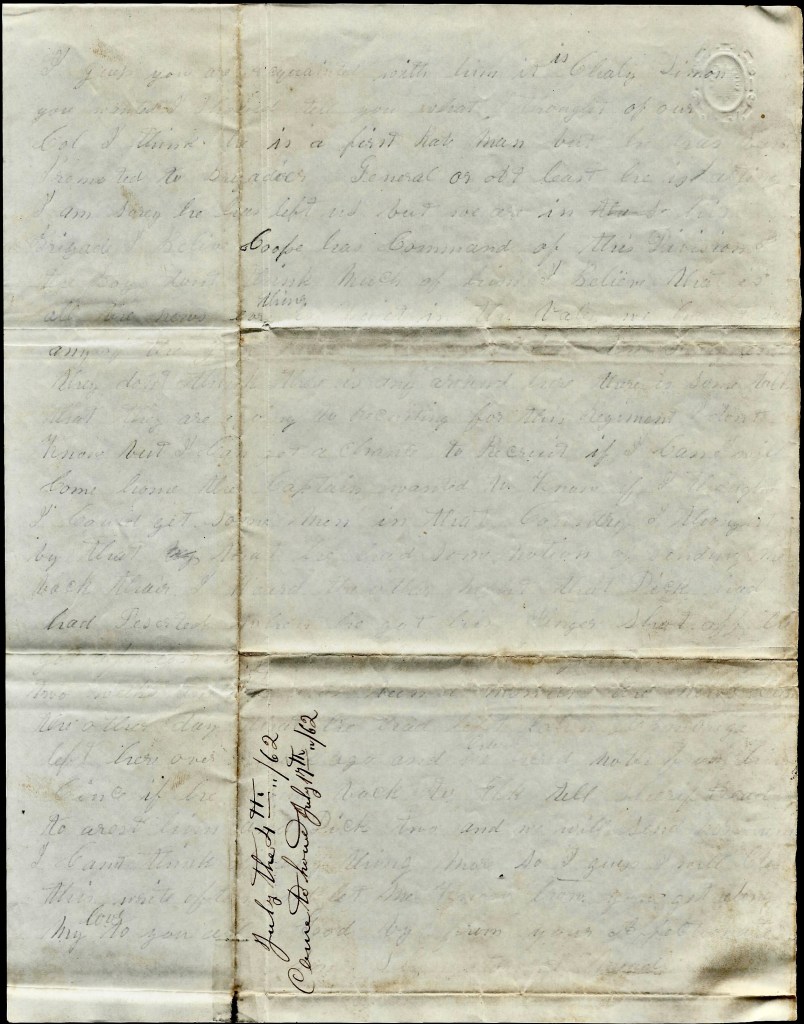
We met with a man to day from Toby. I guess you are acquainted with him. It is Charley Simon.

You wanted I should tell you what I thought of our colonel. I think he is a first rate man but he has been promoted to Brigadier General—or at least he is acting. I am sorry he has left us but we are in his Brigade I believe Coope has command of this Division. The Boys don’t think much of him. I believe that is all the news for things are quiet in this valley. We haven’t seen any of the Johnnys here. [paper crease] They don’t think there is any around here. There is some talk that they are a going to recruiting for this regiment. I don’t know but that I can get a chance to recruit. If I can, I will come home. The captain wanted to know if I thought I could get some men in that country. I thought by that he had some notion of sending me back there. I heard the other night that Dick had deserted when he got his finger shot off. [paper crease] the other day that he had left….

I can’t think of anything more so I guess I will close this. Write often and let me know how you get along. My love to you all. Goodbye from your affectionate son, — Plympton A. Mead