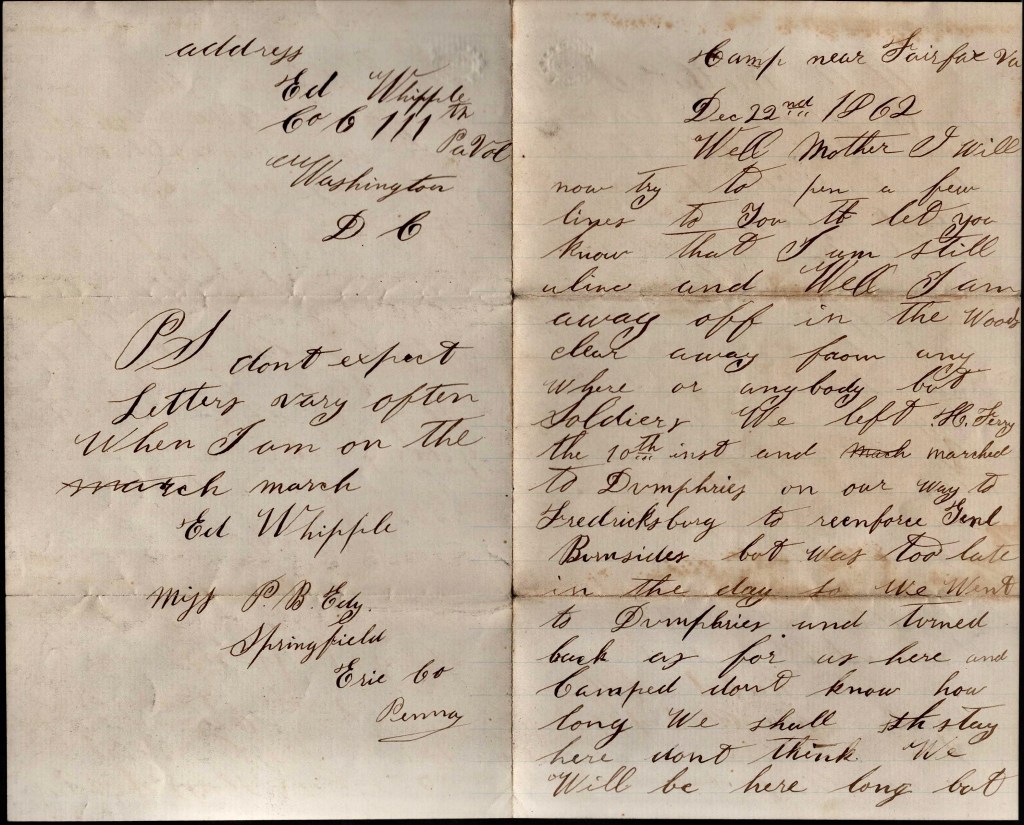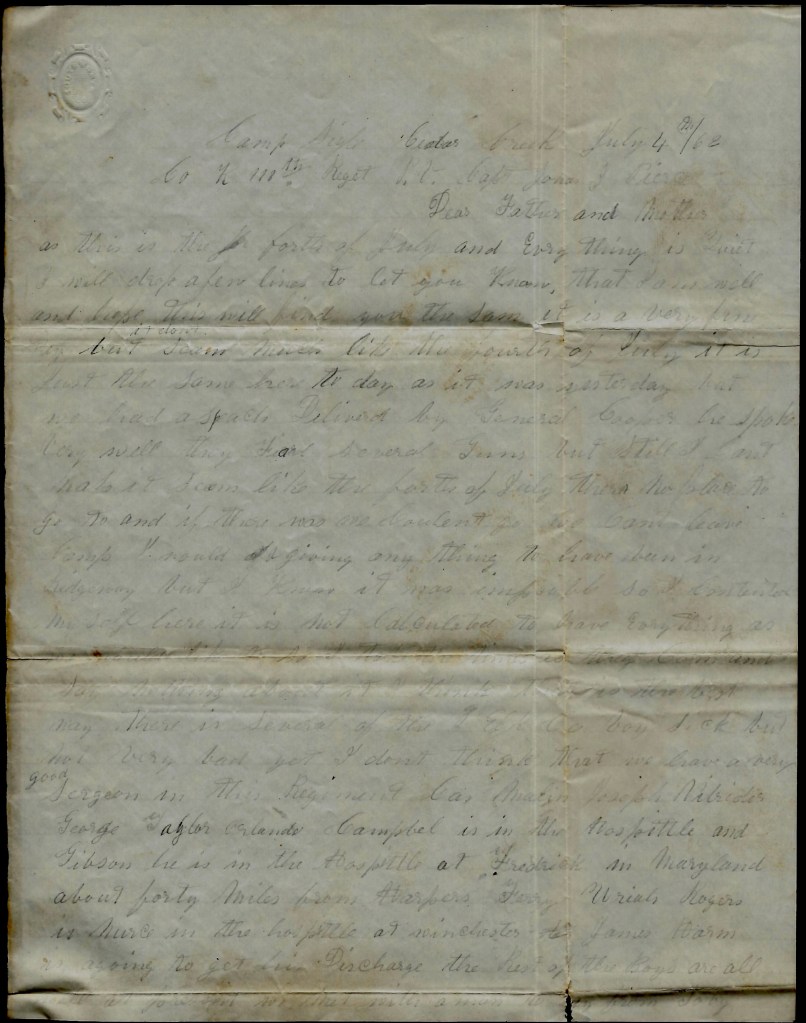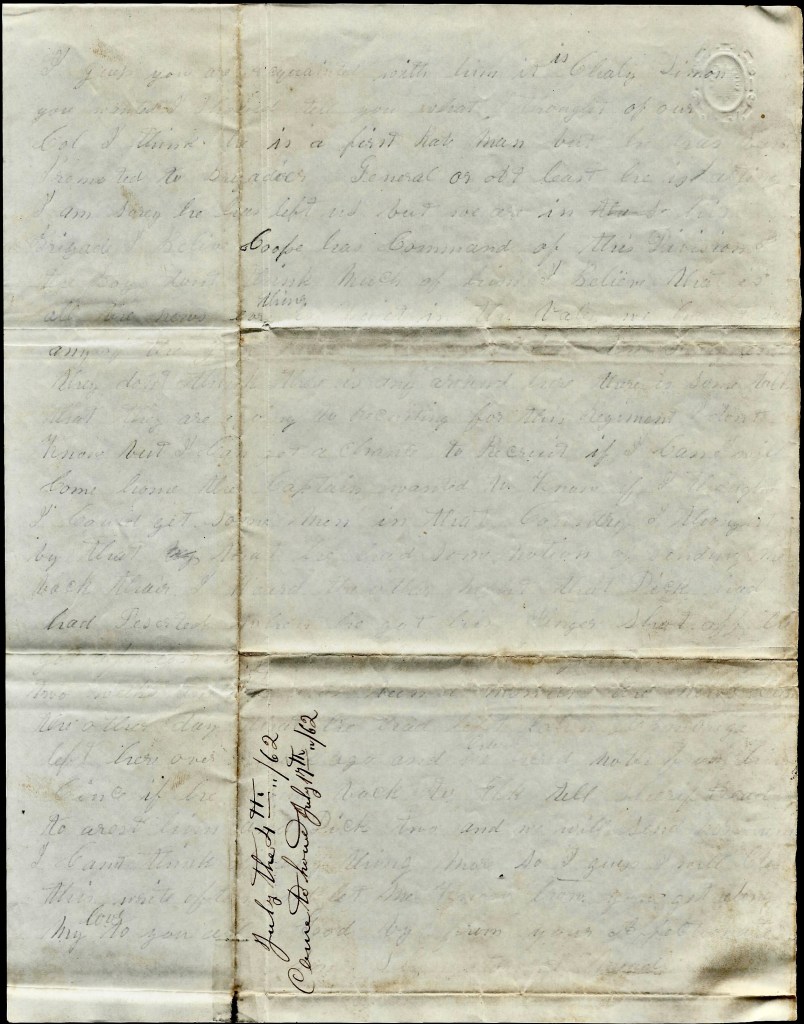
“Attached are two letters from my great-great-grandfather, Dr. Henry Francis Conrad, written while he was an assistant surgeon with the 111th Pennsylvania Volunteer Infantry and then when he found out he had been appointed surgeon of the 174th Pennsylvania Infantry (Drafted Militia).” This was the message sent me by John R. Conrad in August 2026, who further informed that both letters were addressed to Henry’s wife, Julia Annastacia (Adams) Conrad. He told me that he had obtained scans of the originals from a relative named Elaine Conrad, who most likely had given the originals to the Blair County (PA) Genealogical Society. He also sent me a transcript of a letter Dr. Conrad wrote to his local newspaper while serving with the 174th in Beaufort, South Carolina. The letter was not signed nor dated, but Dr. Conrad was the only member of the 174th from Blair County and the handwriting matched that of the two letters.
Henry Francis Conrad (1832-1872) was from Newry, Blair county, Pennsylvania. He was a graduate of St. Francis University (Loretto, Pa.) in 1855 and married Julia in Hollidaysburg on 23 December 1856. He served as an Assistant Surgeon with the 111th Pennsylvania from 8 August 1862 to 13 January 1863 when he was transferred to the 174th Pennsylvania (Drafted Militia) to serve as Full Surgeon. He was discharged from the service on 16 January 1864 and returned to Hollidaysburg to practice medicine but died of consumption eight years later in 1872.
Over the years I have transcribed a number of letters by members of the 111th Pennsylvania. These include:
Benjamin Franklin Edy, Co. C, 111th Pennsylvania (2 Letters)
Edwin Martin Whipple, Co. C, 111th Pennsylvania (61 Letters)
Unidentified Soldier, 111th Pennsylvania (1 Letter)
George W. Swineford, Co. B, 111th Pennsylvania (3 Letters)
Plympton A. Mead, Co. K, 111th Pennsylvania (1 Letter)
I have transcribed only one from a member of the 174th Pennsylvania (Drafted Militia):
John W. Snyder, Co. K, 174th Pennsylvania Drafted Militia (1 Letter)
Letter 1
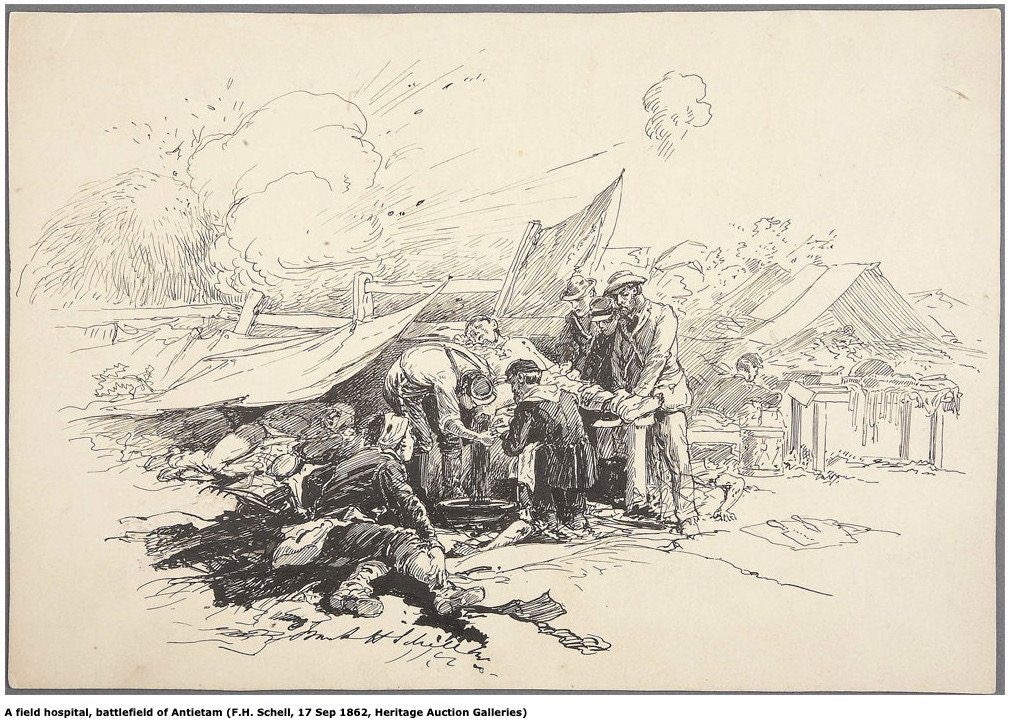
Hospital near Battlefield of Antietam 1
Wednesday night, September 24th 1862
Dear Julia,
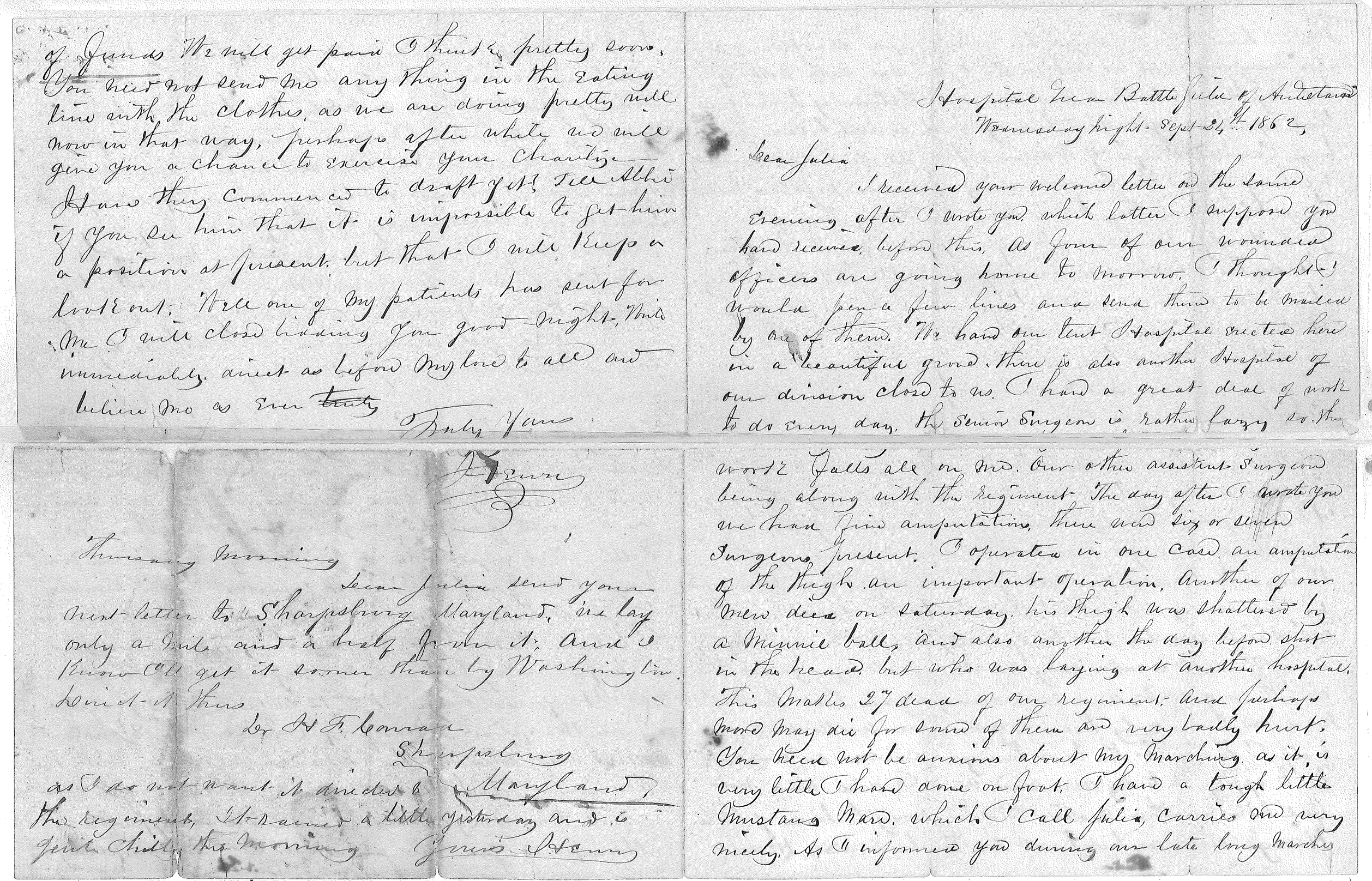
I received your welcome letter on the same evening after I wrote you which letter, I suppose, you have received before this. As four of our wounded officers are going home tomorrow, I thought I would pen a few lines and send them to be mailed by one of them.
We had our tent hospital erected here in a beautiful grove. There is also another hospital of our division close to us. I have a great deal of work to do every day. The Senior Surgeon is rather lazy so the work falls all on me, our other Assistant Surgeon being along with the regiment. The day after I wrote you we had five amputations there and six or seven surgeons present. I operated in one case—an amputation of the thigh, an important operation. Another of our men dies on Saturday. His thigh was shattered by a Minié ball, and also another the day before, shot in the head but who was laying at another hospital. This makes 27 dead of our regiment and perhaps more may die for some of them are very badly hurt.
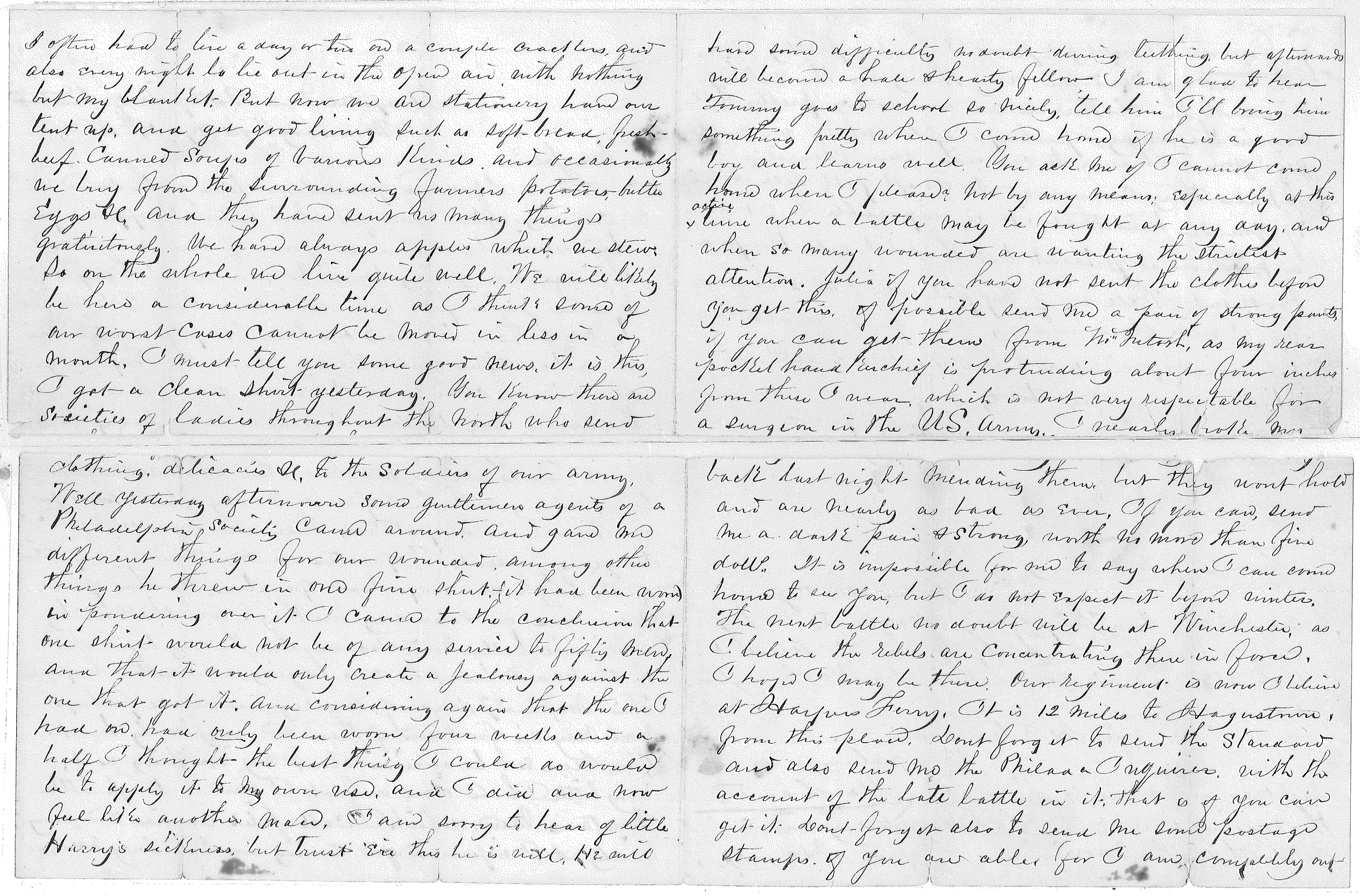
You need not be anxious about my marching as it is very little I have done on foot. I have a tough little mustang mare which I call Julia—carries me very nicely. As I informed you during our late long marches, I often had to live a day or two on a couple crackers and also every night to lie out in the open air with nothing but my blanket. But now we are stationery, have our tent up, and get good living such as soft bread, fresh beef, canned soups of various kinds, and occasionally we buy from the surrounding farmers potatoes, butter, eggs, &c. and they have sent us many things gratuitously. We have always apples which we stew. So on the whole, we live quite well.
We will likely be here a considerable time as I think some of our worst cases cannot be moved in less than a month. I must tell you some good news. It is this—I got a clean shirt yesterday. You know there are societies of ladies throughout the North who send clothing, delicacies, &c. to the soldiers of our army. Well yesterday afternoon some gentlemen agents of a Philadelphia Society came around and gave me different things for our wounded. Among other things, he threw in one fine shirt (it had been worn). In pondering over it, I came to the conclusion that one shirt would not be of any service to fifty men, and that it would only create a jealousy against the one that got it, and considering again that the one I had on had only been worn four weeks and a half, I thought the best thing I could do would be to apply it to my own use, and I did. And now feel like another man.
I am sorry to hear of little Harry’s sickness but trust ‘ere this he is well. He will have some difficulty no doubt during teething but afterwards will become a hale & hearty fellow. I am glad to hear Tommy goes to school so nicely. Tell him I’ll bring him something pretty when I come home if he is a good boy and learns well.
You ask me if I cannot come home when I please. Not by any means—especially at this active time when a battle may be fought at any day and when so many wounded are wanting the strictest attention. Julia, if you had not sent the clothes before you get this, if possible, send me a pair of strong pants if you can get them from McIntosh as my rear pocket handkerchief is protruding about four inches from those I wear, which is not very respectable for a surgeon in the US Army. I nearly broke my back last night mending them but they won’t hold and are nearly as bad as ever. If you can, send me a dark pair & strong, worth no more than five dollars.
It is impossible for me to say when I can come home to see you, but I do not expect it before winter. The next battle no doubt will be at Winchester as I believe the rebels are concentrating there in force. I hope I may be there. Our regiment is now, I believe, at Harpers Ferry. It is 12 miles to Hagerstown from this place. Don’t forget to send the Standard and also send me the Philadelphia Inquirer with the account of the late battle in it—that is, if you get it. Don’t forget also to send me some postage stamps if you are able for I am completely out of funds. We will get paid, I think, pretty soon. You need not send me anything in the eating line with the clothes as we are doing pretty well now in that way. Perhaps after awhile we will give you a chance to exercise your charity.
Have they commenced to draft yet? Tell Abbie if you see him that it is impossible to get him a position at present, but that I will keep a lookout. Well, one of my patients has sent for me. I will close bidding you good night. Write immediately. Direct as before. My love to all and believe me as ever truly yours, — Henry
Thursday morning. Dear Julia, send your letter to Sharpsburg, Maryland. We lay only a mile and a half from it and I know I’ll get it sooner than by Washington. Direct it thus:
Dr. H. F. Conrad, Sharpsburg, Maryland—-as I do not want it directed to the regiment. It rained a little yesterday and is quite chilly this morning.
1 The 111th Pennsylvania Regiment was part of the 2nd Brigade, 2nd Division, 12th Army Corps during the Battle of Antietam. Their hospital was probably established with other regiments of the 12th Army Corps at the Smoketown Field Hospital, set up immediately after the 17 September 1862 battle in an oak grove just one mile north of the main battlefield (near the intersection of Smoketown and Keedysville roads). It was the largest hospital in the area and there were wounded men treated there for many months.
Letter 2
Aquia Landing, Va.
January 27th 1863
Tuesday evening
Dear Julia,
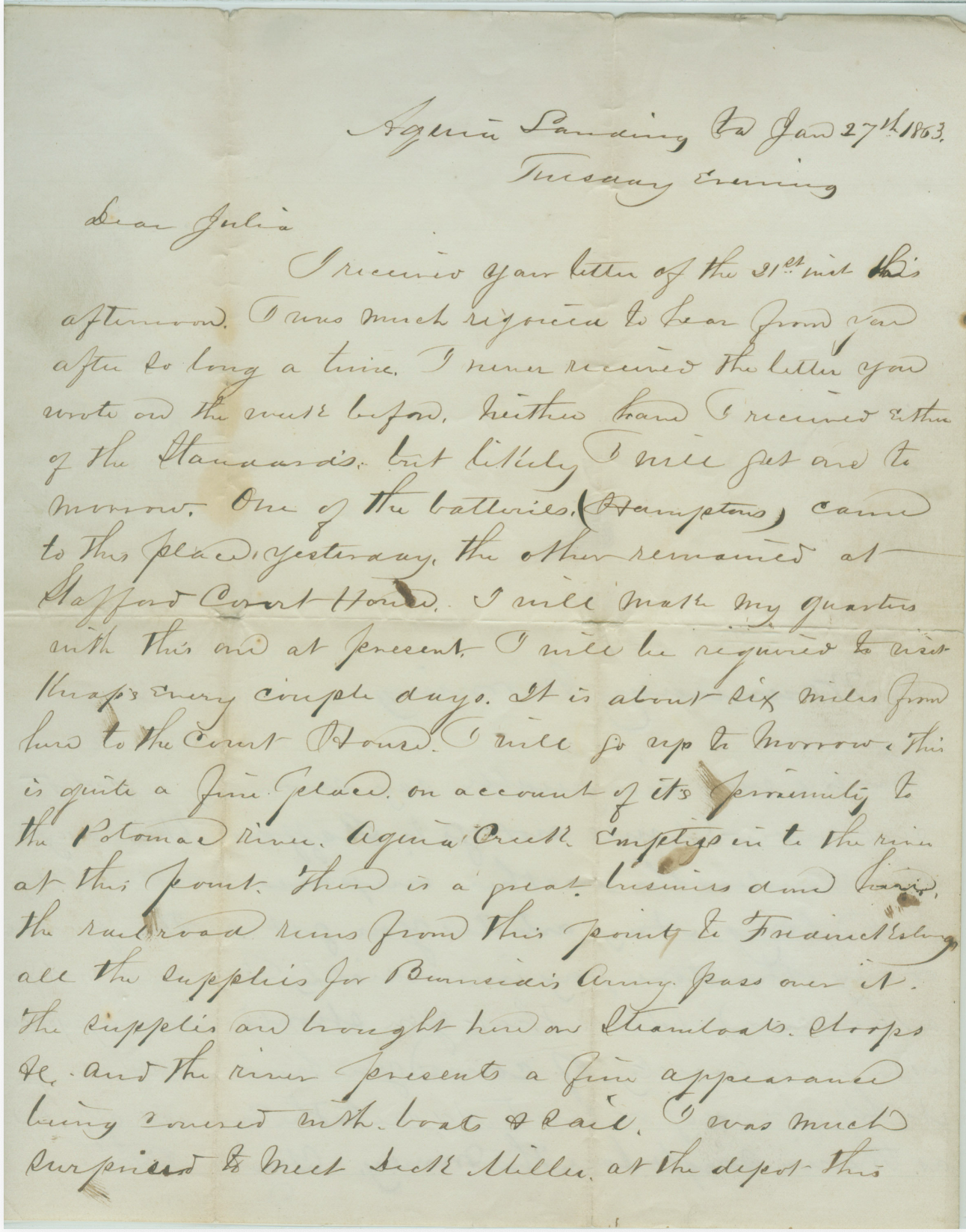
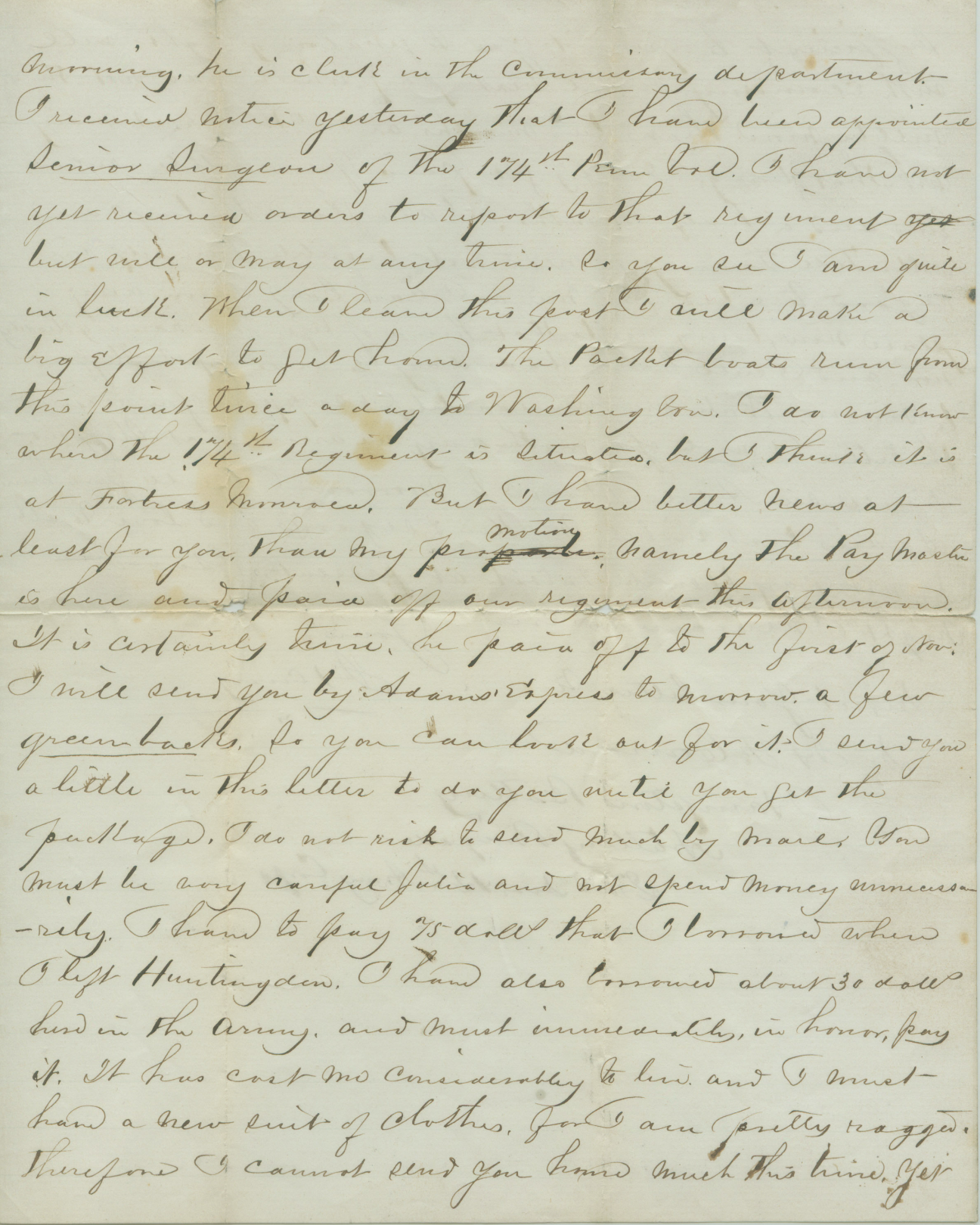
I received your letter of the 21st inst. this afternoon. I was much rejoiced to hear from you after so long a time. I never received the letter you wrote on the week before. Neither have I received either of the Standards, but likely I will get one tomorrow. One of the batteries (Hampton’s) came to this place yesterday. The other remained at Stafford Court House. I will make my quarters with this one at present. I will be required to visit Knapp’s [Battery] every couple days. It is about six miles from here to the Court House. I will go up tomorrow.
This is quite a fine place on account of its proximity to the Potomac River. Aquia Creek empties ito the river at this point. There is a great business done here. The railroad runs from this point to Fredericksburg. All the supplies for Burnside’s Army pass over it. The supplies are brought here on steamboats, sloops, &c. and the river presents a fine appearance, being covered with boats and sail.
I was much surprised to meet Dick Miller at the depot this morning. He is clerk in the commissary department.
I received notice yesterday that I have been appointed Senior Surgeon of the 174th Pennsylvania Volunteers. I have not yet received orders to report to that regiment but will or may at any time. So you see I am quite in luck. When I leave this post, I will make a big effort to get home. The packet boats run from this point twice a day to Washington. I do not know where the 174th Regiment is situated but I think it is at Fortress Monroe.
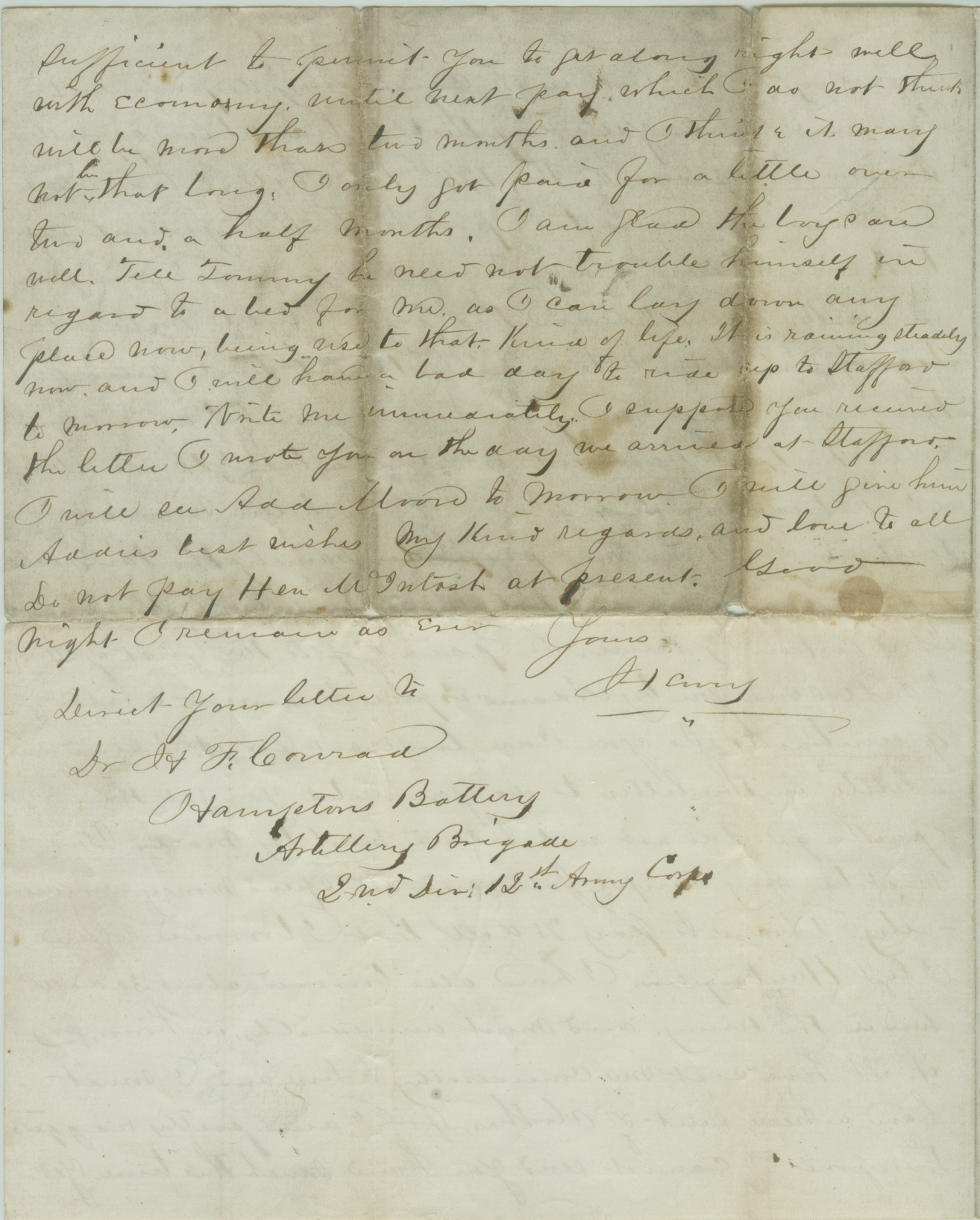
But I have better news at least for you than my promotion. Namely, the paymaster is here and paid off our regiment this afternoon. It is certainly time. He paid off to the first of November. I will send you by Adams Express tomorrow a few greenbacks so you can look out for it. I send you a little in this letter to do you until you get the package. I do not risk to send much by mail. You must be very careful, Julia, and not spend money unnecessarily. I have to pay 75 dollars that I borrowed when I left Huntingdon. I have also borrowed about 30 dollars here in the army and must immediately, in honor, pay it. It has cost me considerably to live and I must have a new suit of clothes for I am pretty ragged. Therefore, I cannot send you home much this time. Yet sufficient to permit you to get along right well with economy until next pay which I do not think will be more than two months and I think it may not be that long. I only got paid for a little over two and a half months.
I am glad the boys are well. Tell Tommy he need not trouble himself in regard to a bed for me as I can lay down any place now, being used to that kind of life. It is raining steadily now and I will have a bad day to ride up to Stafford tomorrow. Write me immediately. I suppose you received the letter I wrote you on the day we arrived at Stafford. I will see Add Moore tomorrow. I will give him Addie’s best wishes. My kind regards and love to all. Do not pay Hen McIntosh at present. Good night. I remain as ever yours, — Henry
Direct your letters to Dr. H. F. Conrad, Hampton’s Battery, Artillery Brigade, 2nd Division, 12th Army Corps
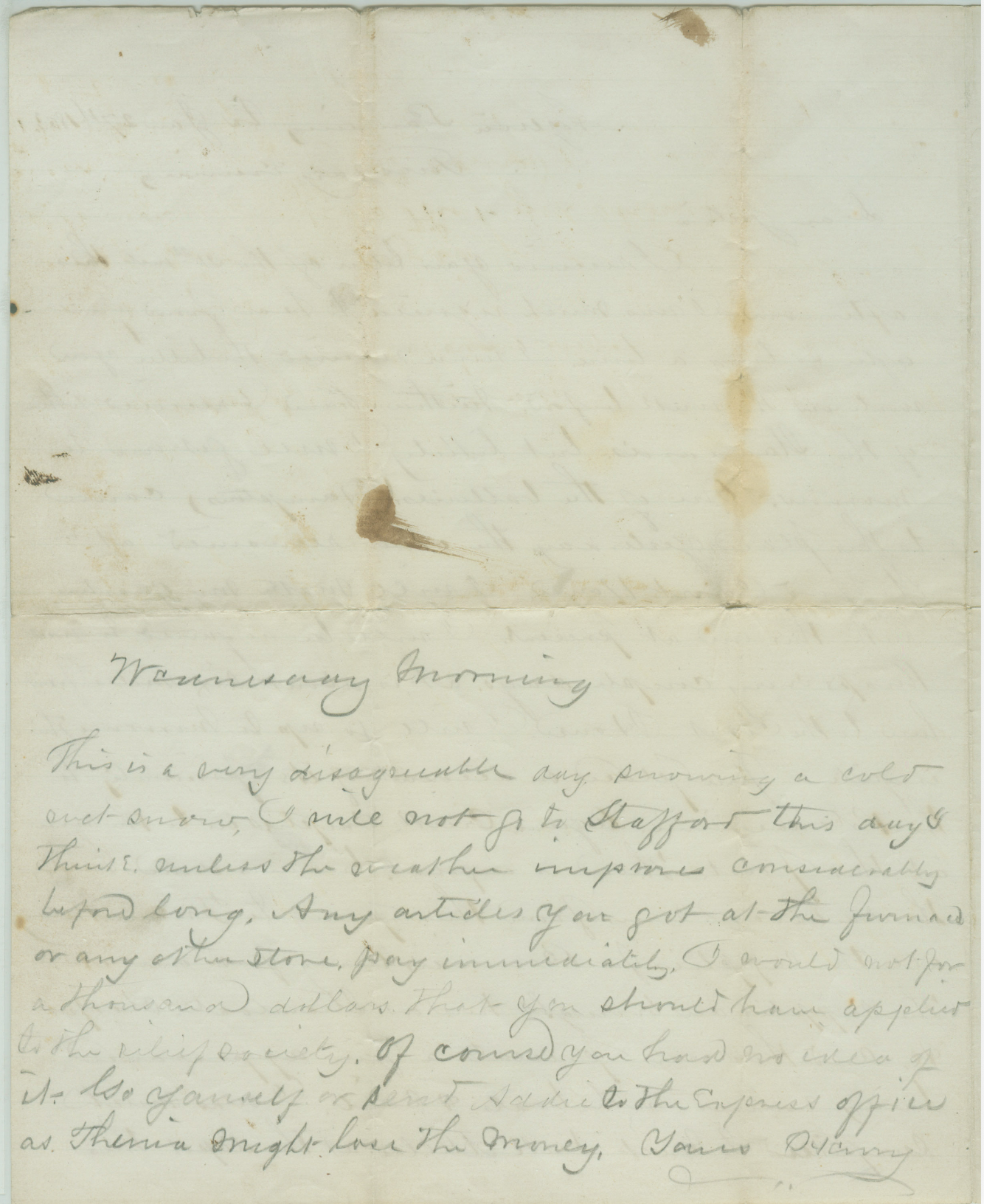
Wednesday morning [in pencil]. This is a very disagreeable day—snowing a cold wet snow. I will not go to Stafford this day, I think, unless the weather improves considerably before long. Any articles you get at the furnace or any other store, pay immediately. I would not for a thousand dollars that you should have applied to the Relief Society. Of course you had no idea of it. Go yourself or send Addie to the Express office as Thenia might lose the money. Yours, — Henry
Letter 3
[Editor’s Note: The following transcript was provided to me by John R. Conrad who stated that it was a letter his ancestor, Dr. Henry F. Conrad, wrote to his local newspaper, the Democratic Standard (Hollidaysburg, Pa.) while serving with the 174th Pennsylvania Vols. in Beaufort, South Carolina. The letter was not signed, but he was the only soldier in the 174th from Blair County, Pennsylvania, and the handwriting matches the handwriting in the two earlier letters.]
Dear Standard. 1 I have several times seated myself to drop you a friendly line, but always some unforeseen circumstance presented itself to prevent my carrying out my purpose. But indeed I must confess that life is here so monotonous and inactive that I have little to write about. Even when the opportunity was offered us to do something for our country and destroy the dull uniformity of quiet camp life, it was denied us. I have referenced to the time the gunboat, Washington, 2 was captured on Coosaw River, some six or seven miles above this area. The commander of this regiment, Col. John Nyce 3—an efficient & brave soldier—urgently requested the privilege from higher authority on the morning of this capture to proceed with part of his own regiment and one or two batteries of the 3rd Rhode Island Light Artillery, and prevent the ability of recovering the ordinance on board that boat and—if necessary—give them a specimen of the fighting quality of Bucks County Dutchmen. But from causes not known and most mysterious to us all, the request was refused and the Confeds were permitted to cross over to our side of the river (she was sunk on this side), raise her, tow her across to the mainland, and, as federals inform us, are now repairing her for their own use. All was within six or seven miles of our forces in the harbor and consisting of eight regiments of infantry and three batteries of artillery which could be brought into action if necessary, besides saying nothing of the gunboats lying in the river. But the Authorities seemed perfectly unconcerned and uninterested. But this appears as I’m provoking & dwell upon what I would willingly if possible eradicate from my memory forever.
We are encamped about a half mile west of Beaufort, and are pleasantly situated in a perfectly level field of about two hundred acres. In fact, the whole island is a level plain and I would judge is very fertile for particular products as corn, beans, peas, and I have been informed, cotton. Beaufort, situated in a bend of the Coosaw River, has been and is still a lovely place. The streets are lined with beautiful shade trees of live oak, locust, and others peculiar to this region whose spreading boughs cast a cooling shade over the sidewalks and attract a pleasant breeze which is quite refreshing on these hot sweltering days. The houses are generally built back from the street with a yard in front enclosed by a neat railing fence painted white, or a stone wall capped by an iron railing. The buildings are perfectly embowered in trees and shrubbery. The orange, fig, Jasmine, Magnolia, & Oleander abound—the two latter being now in full bloom. The gardens are beautified by a profusion of flowers of many varieties which diffuse a fragrant perfume throughout the atmosphere, soothing to the senses. Notwithstanding, an inconsiderate, vandal-like soldiery has produced considerable devastation dilapidation by tearing down the enclosures of parks, gardens, and even cemeteries. Still, sufficient remains to fully attest that Beaufort has been the abode of wealth, enormousness, & ease, and at one time almost, I might say, a perfect Eden.
There are stationed at present on this island, five Pennsylvania regiments, namely the 52nd, Col. Dodge; 55th, Col. White; 104th, Col. Davis; 174th, Col. Nyce; 176th, Col. Lechler. Col. Nyce appears to stand this Southern climate admirably, his extensive proportions are not in the least reduced, and he has the credit of having the cleanliest and most tidy and as thoroughly a drilled regiment as is on the island if not in the department.
There are two Negro regiments here both on pickets on the further end of the island. Apropos of Negro soldiers, they were as you are aware, in the late expedition to Jacksonville, Florida. The Republican press made a great blow about their superior bravery & fighting qualities. Now as the darkies say down here, “we can’t shurn it,” for we happen to know better having it from good authority that they would not at all stand firm, but cut and run at the first regular volley from the Rebs. And it is my opinion and always has been that a “Nigger” will not endure the screaming shell, whistling minie, or the smell of gunpowder.
Speaking of this Florida expedition, I would state that a regiment associated with it and now encamped on this island, has covered itself with an infamy which in the eyes of an enlightened and civilized people time alone will efface. I have reference to the wanton destruction of Jacksonville by fire. Most all the inhabitants who remained in the place were true to the Union and had placed themselves under the protection of the Union forces. So much had they identified themselves with the union cause that they had even been outlawed with the rebels. But their sincere loyalty did not protect them. The members of the above regiment with some blacks urged on by their white officers, with a vandalism worthy of the barbarous Malays, applied the flaming torch to all parts of the most flourishing and beautiful town of Florida—the resort of Northern invalids—reducing it to a heap of ashes & smoldering ruins. To their other outrages they have added that of Church robbery. Entering a church, they commenced sacking it, tore up a expensive organ and afterwards robbed the church of everything valuable and hallowed by those who had worshipped there, the barrels of the altar books, pictures, &c. Nothing escaped their rapacious hands. After they had completely sacked the building it was set fire to and was reduced to ashes with the rest of the divine place. I myself saw, after the return of the expedition to this place, some of the articles taken from this church by this wicked act of barbarianism, the inhabitants—men, women, and children—were left with nothing but the canopy of heaven to shield them from the vicissitudes of the weather, the pelting storm or the scorching rays of the sun. Some came here in the transports and more remained to be exposed to mercies of the rebel horde without food and houseless. And to suffer, heaven only knows what, for their loyalty.
And yet all this damnable outrage and crime is proper against humanity and marked at and no cognitions favored of it by those in authority but that heaven smile upon and assist our cause, or make it frown, when such wickedness is permitted. But then this we do know, that the members of the 8th Maine Regiment are looked upon by all honorable soldiers in this island department as abolition vagabonds, and their companionship with ease discarded. We do not now, as some time ago, see the Abolition papers so crowded with resolutions from different regiments proclaiming to the world their great patriotism, their determination to die beneath the glorious old flag, if necessary, and their denunciation of Copperheads in the North, _______ ______ _______ treasury ____ else. Now we consider these resolutions as altogether a poppy-cock arrangement—as though the loyalty of those individuals been brought into question that it is necessary for them to come out in those public manifestations to sustain it. We think not. The secret of the matter is this. They are gotten up in regiments, commanded by Abolition officers who are generally democrats for political purposes and to produce in the minds of the soldiers a prejudice against the Democratic Party at home and to produce the impression that some but not all foes are loyal and the great pillar upon which the Nation must stand [end of letter]
1 This letter was written by a soldier of the 174th Pennsylvania Regiment to the Hollidaysburg, Pennsylvania, Democratic Standard, but the 174th was from Bucks and Northampton Counties in eastern Pennsylvania. The only soldier in the unit from Blair County was Dr. Henry F. Conrad, the regimental surgeon. A comparison of the handwriting of this letter with that of known letters of Dr. Conrad strongly suggests that this letter was written by Dr. Conrad. Given the events noted in the letter, it was written after April 7 and before early June, 1863, probably in the middle of April.
2 On 9 April 1863, the 243-ton gunboat USS George Washington was ambushed, burned and sunk by Confederate artillery near Chisholm Island six miles north of Beaufort on the Coosaw River. She ran aground while navigating the shallow waterways near the Port Royal Ferry, and before she could get off, she was ambushed by the the Beaufort Volunteer Artillery and Nelson’s Light Artillery. One shot struck and exploded the ammunition magazine resulting in her catching fire and sinking in shallow water.
3 John Nyce (1831-1880) was colonel of the 174th Pennsylvania Infantry Regiment, a drafted unit that served from November 19, 1862 until August 7, 1863, when it was mustered out at Philadelphia, PA. It served most of that time on garrison duty in South Carolina, primarily in and around Port Royal and Hilton Head.