The following letter was written by Sergeant Freeman Hawkins Bowron (1839-1910) of Champlain who enlisted at the age of 22 in Co. H, 11th New York Cavalry in March 1862. The 11th New York Cavalry was nicknamed “Scott’s Nine Hundred” or “First United States Cavalry.” He worked his way up in rank to 1st Sergeant before accepting a commission as 2nd Lieutenant. After the war he married Clara A. Earle (1849-1923) and settled in Geneva, Kane county, Illinois.
Freeman was the son of Joseph and Jane Bowron of Champlain, New York.
Albumen photograph of J.R. Bostwick, Sutler of the 11th New York Cavalry.
T R A N S C R I P T I O N
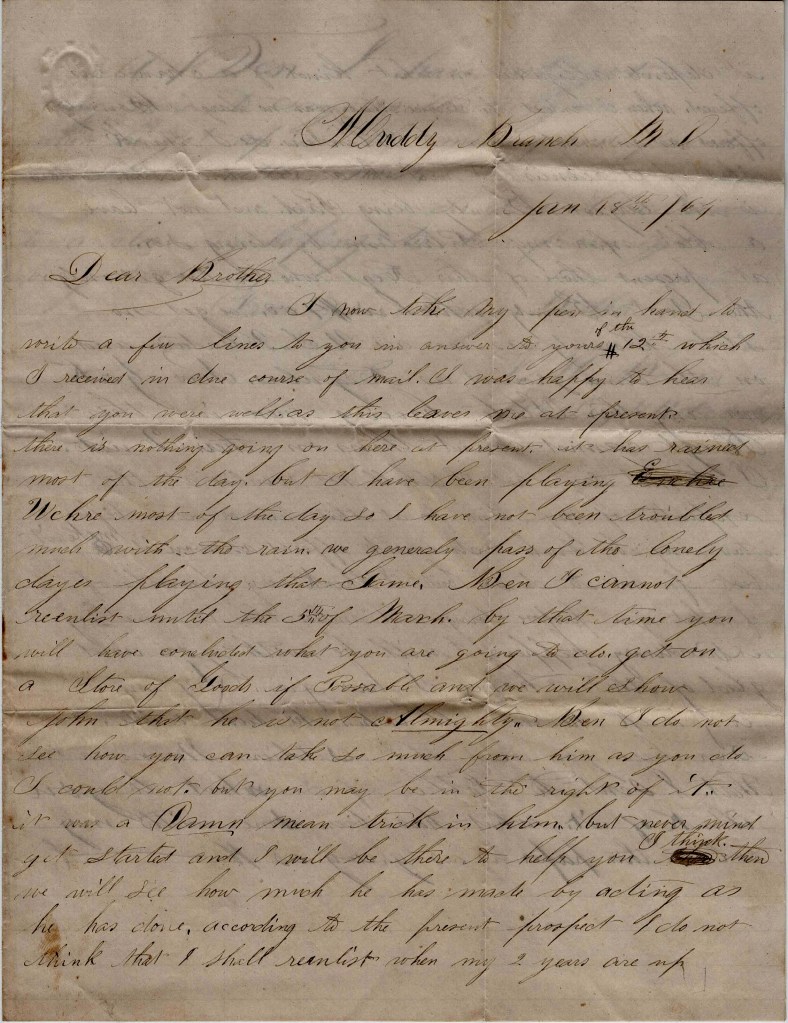
Muddy Branch, Maryland January 18, 1864
Dear Brother,
I now take my pen in hand to write a few lines to you in answer to yours of the 12th which I received in due course of mail. I was happy to hear that you were well as this leaves me at present. There is nothing going on here at present. It has rained most of the day but I have been playing Euchre most of the day so I have not been troubled much with the rain. We generally pass off the lonely days playing the game.
Ben, I cannot enlist until the 5th of March. By that time you will have concluded what you are going to do. Get on a store of goods if possible and we will show John that he is not Almighty. Ben, I do not see how you can take so much from him as you do. I could not. But you may be in the right of it. It was a damn mean trick in him but never mind. Get started and I will be there to help you I think. Then we will see how much he has made by acting as he has done. According to the present prospect, I do not think that I shall reenlist when my two years are up. It depends altogether on what kind of a chance is offered.
When I entered the service, there was no large bounty offered as an inducement to volunteers. So I think that if I reenlist, it will be at the time that there is the largest bounty being paid and not leave a blot upon my patriotism by doing so. At present, those of this regiment who reenlist get only the government bounty which is $400. We get no state bounty as we are U. S. Volunteers and on the same ground as Regulars. New York nor any other state having men in this regiment cannot count them on their quota. I do not say that I shall not reenlist at the expiration of my term, for at that time or even before there may be such inducements offered as would make it best for me to do so. But I think very favorable of what you propose doing and unless there is something extraordinary happens, I will be with you and glad of the chance.
I hear from Sy Moor every week. He was well when he last wrote. Ben, have you seen that Soldiers Memorial that I sent to Father? If so, what do you think of it? What has been done with my colt? This paper is as greasy as hell.
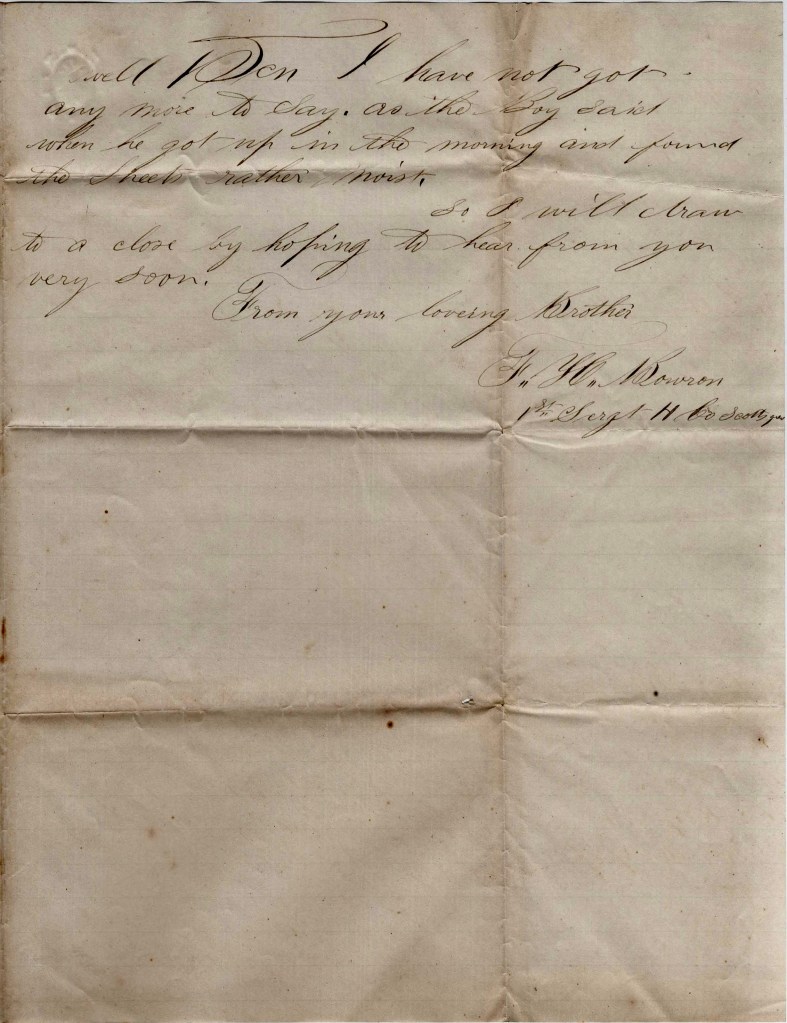
Well, Ben, I have not got any more to say as the Boy said when he got up in the morning and found the sheets rather moist. So I will draw to a close by hoping to hear from you very soon. From your loving brother, — F. H. Bowron, 1st Sergt., Co. H, Scotts 900.
I could not find an image of Daniel but here is one of William W. Harding of Co. G, 11th Pennsylvania Cavalry (Union Drummer Boy)
The following letter was written by 1st Sergeant Daniel H. Schriver (1836-1864) of Co. I, 11th Pennsylvania Cavalry. He enlisted in September 1861 and was promoted from 1st Sergeant to 2nd Lieutenant on 8 November 1863. He was killed in a brisk skirmish at Flat Creek Bridge, Virginia, on 14 May 1864. At the time of his enlistment, Daniel was described as a 25 year-old, 5′ 4″ tall, black-haired saddler.
Schriver’s letter informs his brother of the evacuation from White House Landing, McClellan’s Supply Depot on the Pamunkey river in June 1862 when J. E. B. Stuart conducted his raid. He referred to him as Jackson but it was actually Stuart.
T R A N S C R I P T I O N
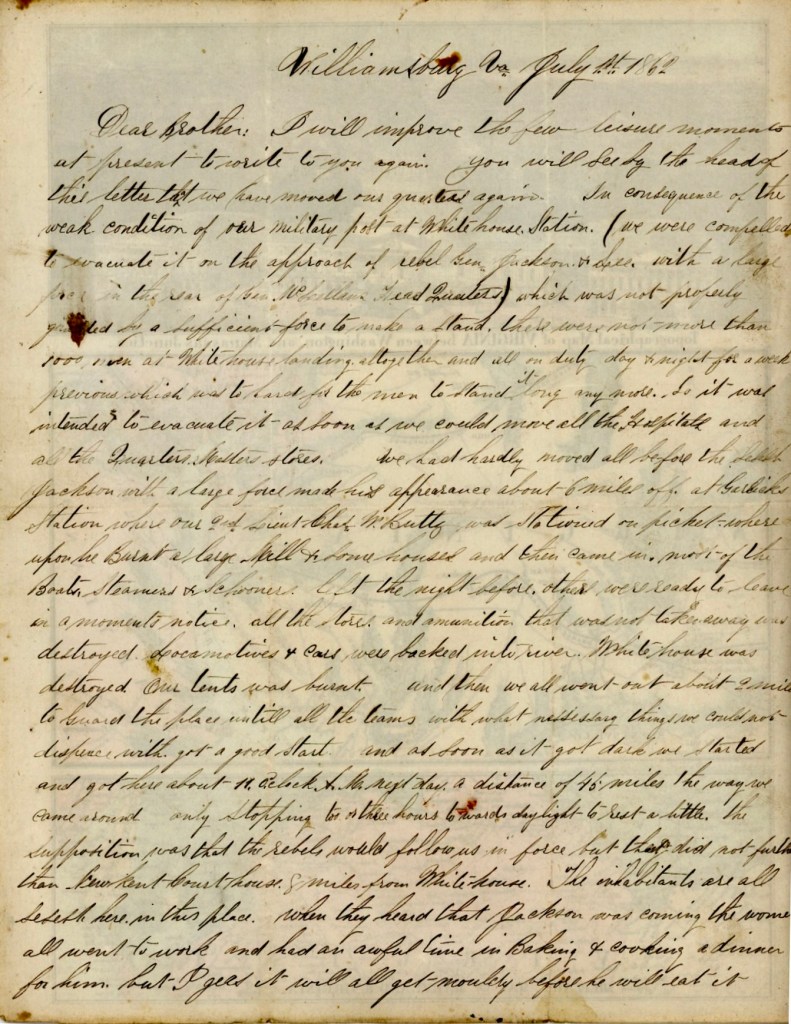
Williamsburg, Va. July 1st 1862
Dear Brother,
I will improve the few leisure moments at present to write to you again. You will see by the head of this letter that we have moved our quarters again. In consequence of the weak condition of our military post at White House Station, we were compelled to evacuate it on the approach of Gen. Jackson & Lee with a large force in the rear of McClellan’s Headquarters which was not properly guarded by a sufficient force to make a stand. There were not more than 1,000 men at White House Landing altogether and all on duty day and night for a week previous which was too hard for the men to stand it lone anymore. So it was intended to evacuate it as soon as we could move all the hospital and all the quartermaster’s stores.
We had hardly moved all before the Secesh Jackson with a large force made his appearance about 6 miles off at Garlick’s Station where our 2nd Lieutenant Chas. W. Butts was stationed on picket whereupon he burnt a large mill & some houses and then came in. Most of the boats and schooners left the night before; others were ready to leave in a moment’s notice. All the stores and ammunition that was not taken away was destroyed, locomotives and cars were backed into river. 1 White House was destroyed. Our tents was burnt. And then we all went out about two miles to guard the place until the teams with what necessary things we could not dispense with got a good start, and as soon as it got dark, we started and got here about 11 o’clock a.m. next day—a distance of 45 miles the way we came around, only stopping two r three hours towards daylight to rest a little.
“Burning of the White House- the Federal troops, by command of General McClellan, abandoning their position at the White House, and breaking up the commisariat depot on the Pamunkey River- departure of the Union flortilla for the James River, June 26th, 1862. The Confederate raid of Stuart’s cavalry at Garlick’s Landing and Tunstall’s Station had struck the occupants of the White House Landing with a deep sense of insecurity; and, consequently, when they received orders on Wednesday, June 25th, to prepare for the hasty removal of all the government stores, they set to work with great activity, and by Thursday the greater portion of the heavy stores were embarked on board the numerous transports lying in the river. Unfortunately, through some accident the White house took fire, and the house of Washington’s wife was soon destroyed.” — Frank Leslie, 1896
The supposition was that the rebels would follow us in force but they did not further than New Kent Court House, 8 miles from White House. The inhabitants are all secesh here in this place. When they heard that Jackson was coming, the women all went to work and had an awful time in baking and cooking a dinner for him but I guess it will all get moldy before he will eat it.
I do not think we will stay here long but where we will go to next I cannot say. But I hope not to a place where there are too few troops and so much duty to do. There sounds the bugle for sick call. I must go and see if anybody is sick enough to go to the Doctor’s 9in order to shirk duty). Excuse this scratching. I have to do it all on my knee under two India rubber blankets for tents. Yours expecting a letter soon from you, I remain your devoted brother, — Dan’l H. Schriver, 1st Sergt. Co. I
The surest way to direct your letters since we have no permanent encampment is to Camp Hamilton, Fort Monroe, Va., or to Washington D. C. and the other preliminaries and it will follow.
P. S. Enclosed you will find part of a Magnolia flower that grows wild here on pretty large trees.
1 J. E. B. Stuart’s cavalry raided Garlick’s Landing on the Pamunkey River above the railroad bridge and captured 14 wagons and some sutler’s stores, and burnt two schooners laden with forage and then headed toward Tunstall’s Station.
War Correspondent George Alfred Townsend was heading back to White House at the time of Stuart’s raid and described what he saw at Garlick’s Landing and White House when he arrived: “I remained a full hour under cover; but as no fresh approaches added to my mystery and fear, I sallied forth, and kept the route to Putney’s, with ears erect and expectant pulses. I had gone but a quarter of a mile, when I discerned, through the gathering gloom, a black, misshapen object, standing in the middle of the road. As it seemed motionless, I ventured closer, when the thing resolved to a sutler’s wagon, charred and broken, and still smoking from the incendiaries’ torch. Further on, more or these burned wagons littered the way, and in one place two slain horses marked the roadside. When I emerged upon the Hanover road, sounds of shrieks and shot issued from the landing a “Garlic,” and, in a moment, flames rose from the woody shores and reddened the evening. I knew by the gliding blaze that vessels had been fired and set adrift, and from my place could see the devouring element climbing rope and shroud. In a twinkling, a second light appeared behind the woods to my right, and the intelligence dawned upon me that the cars and houses at Tunstall’s Station had been burned. By the fitful illumination, I rode tremulously to the old head-quarters at Black Creek, and as I conjectured, the depot and train were luridly consuming. The vicinity was marked by wrecked sutler’s stores, the embers of wagons, and toppled steeds. Below Black Creek the ruin did not extend: but when I came to White House the greatest confusion existed. Sutlers were taking down their booths, transports were slipping their cables, steamers moving down the stream. Stuart had made the circuit of the Grand Army to show Lee where the infantry could follow.”
Joel Cook described what he heard about the attack on the train passing through Tunstall’s Station and the reaction at White House Landing: “There were numerous passengers on the cars, mostly laborers, civilians, and sick and wounded soldiers, and a general effort was made to jump off, and, if possible, elude the enemy’s fire. Several succeeded, and hid themselves in the wood; but the quickly increasing speed of the train prevented the majority from following their example. The cars, however, were soon out of reach of the Rebels, and the engineer, fearful of pursuit or of meeting more enemies, increased the pressure of steam so that the train almost flew over the distance between Tunstall’s Station and White House. There the news of what had occurred spread like lightning, and there was the utmost consternation among the sutlers, civilians, clerks, laborers, and negroes who inhabited the canvas town which had sprung up on the Pamunky. Lieutenant-colonel Ingalls, of the quartermaster’s department, was the officer in command, and, under fear of impending danger, he mustered the few soldiers who were at the place, and armed the civilians and laborers. He also placed all the money, records, mails, and other valuable property of the United States upon a steamboat in the river. The panic among the sutlers was beyond all description: each one expected utter ruin, and awaited, with an anxious heart, the approach of the enemy. They did not come, however, and White House, though it was so soon to be destroyed, had a short respite.” [Source: White House Landing Sustaining the Army of the Potomac during the Peninsula Campaign.]
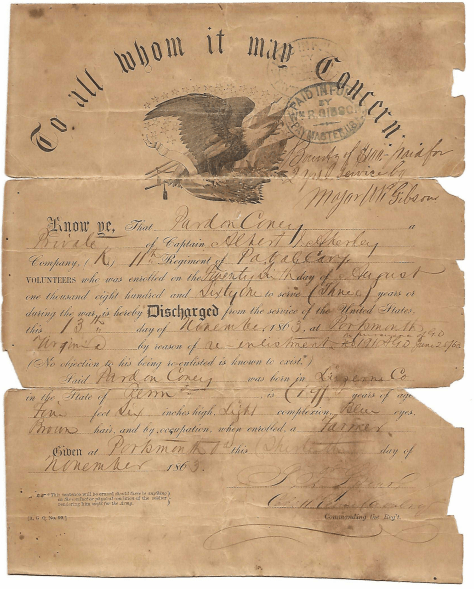
The following letter was written by Pardon Edgar Covey (1843-1896), the son of Almeron Covey (1813-1903) and Mary Ann Sisco (1817-1896) of Abington, Luzerne county, Pennsylvania. Pardon enlisted in Co. K of the 11th Pennsylvania Cavalry (108th Volunteers)—sometimes called “Harlan’s Light Cavalry.” He served from 25 August 1861 to 13 November 1863 according to his discharge papers, though the company muster rolls say he served until 1865.
The 11th Pennsylvania Cavalry was ordered to Fortress Monroe, Virginia, in mid-November 1861 and they remained there on duty at nearby Camp Hamilton until May 1862. Covey’s letters speaks of the arrival of infantry at Camp Hamilton as McClellan began his build up for launching the Peninsula Campaign.
Pardon Covey’s Discharge Papers
Transcription
Camp Hamilton, Virginia March 23, 1862
Dear Cousin,
I take the present time to answer your kind letter to let you know that I am well and hope this may find you the same. It has been quite unpleasant for the last few days but it is looking more now like good weather now. It looks like spring for the green grass is springing up fast and soon will be good feed for cattle. What few farmers that is left here has commenced planting potatoes and making garden. It looks like May with us. The leaves putting forth their leaves and the flowers is blooming on every bush.
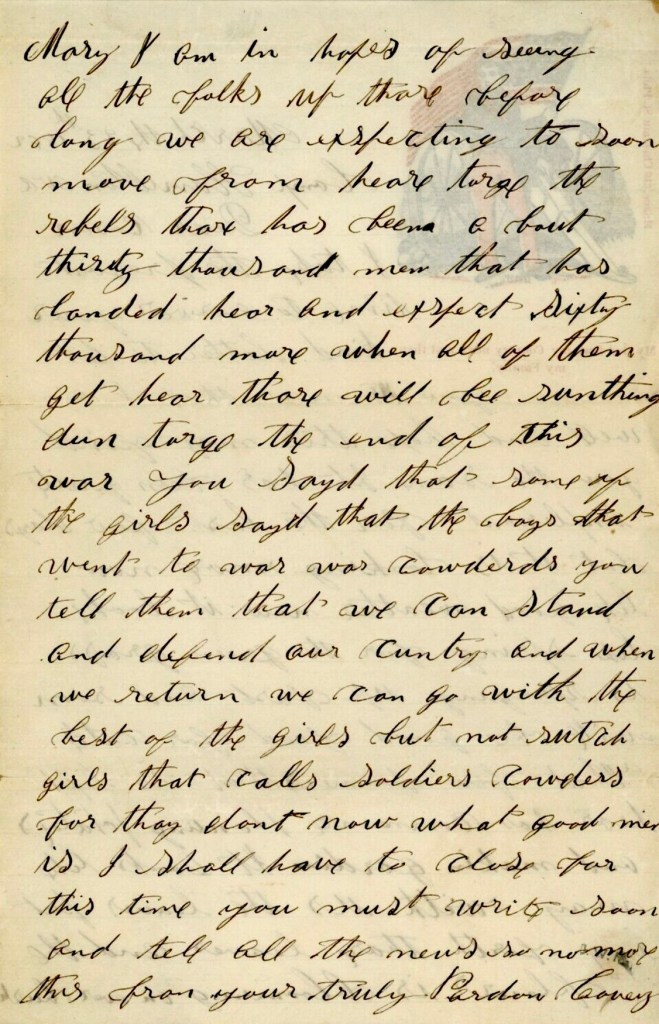
Mary, I am in hopes of seeing all the folks up there before long. We are expecting to soon move from here toward the rebels. There has been about thirty thousand men that has landed here and expect sixty thousand more. When all of them get here, there will be something done towards the end of this war.
You said that some of the girls said that the boys that went to war was cowards. You tell them that we can stand and defend our country and when we return we can go with the best of the girls but not such gurls that calls soldiers cowards for they don’t know what good men is. I shall have to close for this time. You must write soon and tell all the news. So no more. This from yours truly, — Pardon Covey
Oren Fletcher of Co. F, 11th Pennsylvania Cavalry (Jim Mayo Collection)
This partial letter is missing the signature page so I wasn’t certain of the identity of the author initially though it was clear he was a sergeant in Co. I, 11th Pennsylvania Cavalry. This regiment was organized at Philadelphia as an independent Regiment, “Harlan’s Light Cavalry,” under authority of the Secretary of War, August to October, 1861. Its name was changed officially to the 11th Pennsylvania Cavalry in November 1861.
The content suggested the sergeant was from Cumberland county, Pennsylvania, though he may have been from a neighboring county. When first published, my hunch was that the author was Daniel W. Balmer (1839-1914), the son of Daniel & Harriet (Fisher) Balmer. In 1860 he was a carpenter living with his family in Elizabethtown, Lancaster County, Pennsylvania. I subsequently transcribed a letter by Daniel H. Schriver, the 1st Sergeant of Co. I, 11th Pennsylvania Cavalry, and I feel confident that his handwriting matches this letter.
Transcription
Camp Hamilton near Fort Monroe, Virginia December 29th 1861
My Dear Brother,
I received your now most kind and considerate letter the day before Christmas (and one previous to that saying that you received my last, &c.) and one Christmas afternoon. A[bram] E. Garrett and I received that most welcome and ever memorable box which so agreeably surprised us upon opening it. It was truly a treat worthy of the greatest of patriots. May the glorious light of day never darken the National Emblem that now waves of the heads of the donors of this token of respect toward our unworthy.
A. E. Garrett said it was a treat to both of us (that is the turkey, &c.) and therefore insisted upon me partaking of it until it was finished. That was yesterday so you may be assured that there has been no want of appetite with us lately. Please remember me kindly to the donors of these articles and particularly to the Ladies Department of it. Tell them if I ever get down to Texas that I will bring them a Mexican poney along to ride up and down those Sherpherdstown hills, &c. That butter is very nice and sweet. The orderly sends his warmest respects to you as it was on his acount that I sent for it.
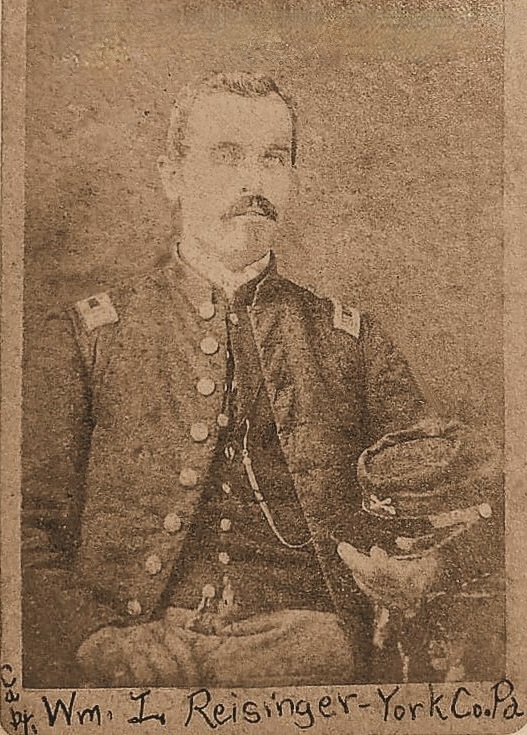
William Independence Reisinger (1823-1905) was promoted to Captain of Co. I, 11th Pennsylvania Cavalry in November 1862.
All the articles are just the thing except the boots which are a size too large for me. The legs are just right and also the instep part of them but the shoe part is too long and wide. My feet slips back and forward in them. Otherwise they are just right. I am sorry as they are a very good boot. However, there is no loss as I have sold them to our Lieutenant Wm. I[ndependence] Reisinger for $5.50. I could sell a dozen pair here without any trouble. There is government boots came here now for the men but the men do not like them as they are not very good and are very short in the legs. I got my old ones fixed up again. I do not want you to go to any extra trouble but if you can conveniently stop at George Otstot’s the next time you go to Mechanicsburg and tell him about it, and if he will send me another pair by express for $5 at his own expense just like the others only smaller in the foot, when he can do so and I will send you the money as soon as they arrive and you can pay him or I will give him $5.50 if he makes the fore top that is the front part of the legs longer than the hind part and rounded off at the top (and leave the front all the same kind of leather—no red or black sheepskin—and the boots to be the same kind of leather as the others were). If he will send them for that, well and good. If not, why don’t send them as I am not very hard up for them now.
I spent quite a pleasant Christmas. The Lieutenant and myself were down to the Fort on a kind of k—-y in the morning and in the afternoon the boys in general got happy.
Last week some of the boys had a chance for a scout. Some of the rebels made themselves pretty obnoxious about 1 mile or 2 out here so Gen. Wool (who is commanding general here at this post) gave orders for several companies of infantry and one of cavalry to go out on a kind of scout. So we each company got orders to send one sergeant and three of the best horsemen and soldiers to Headquarters for that purpose. The Lieutenant asked me to go and pick myself three of the best men in the company and report ourselves to the Colonel. I did so. We all left the next morning well armed with the full expectation of having a brush with the enemy that day but did not succeed. We at first took a northern direction for 6 or 7 miles, then we changed to southwestern toward Newport News 8 or ten miles southwest from here. We were within sight of it when we returned to camp. We seen but one rebel battalion that was out on drill. We were about going to make a charge on them when we were suddenly halted at a burnt bridge so that the infantry could not cross…[rest of letter is missing]
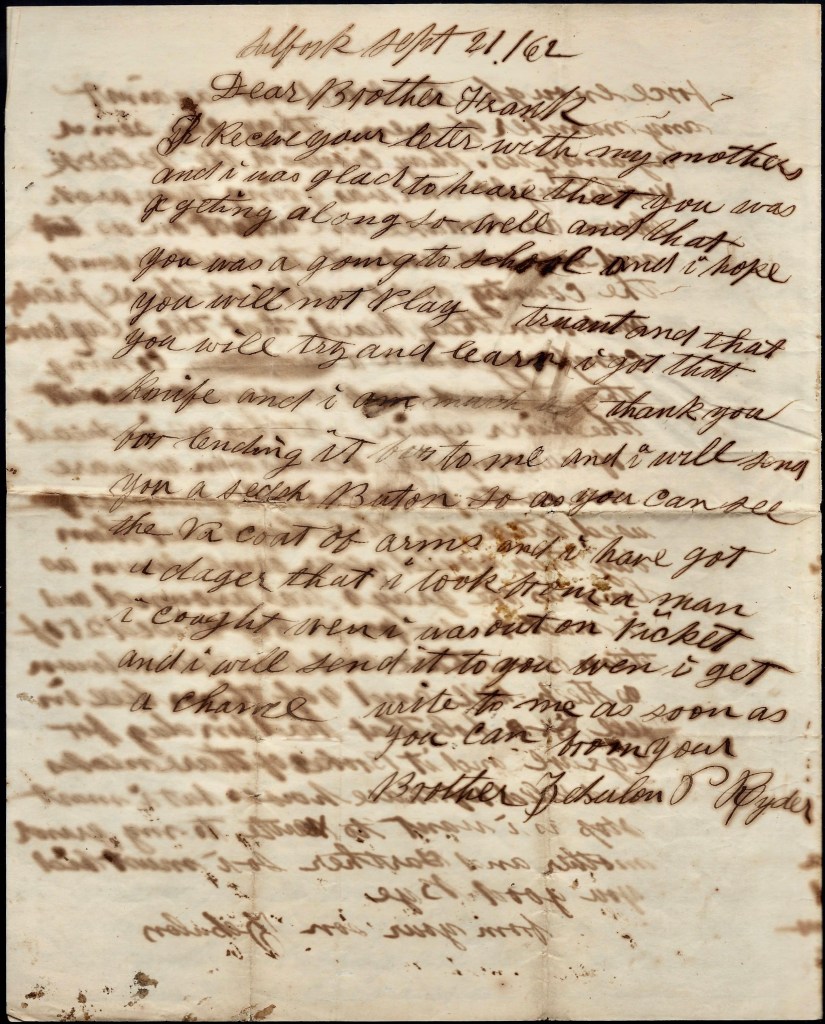
The following letter was written by Brooklyn born 18 year-old Zebulon P. Ryder (1841-1909) who enlisted in April 1861 as a private in Co. I of the 11th Pennsylvania Cavalry. He was the son of Christopher and Adeline Ryder. Zeb’s father worked as a Butcher in Brooklyn. Zeb must have lied about his age when he enlisted as he claimed to be 20 but census records tell us he was born in 1844-45. His younger brother Frank was born in 1848-49. Zeb survived the war and mustered out of the service on 16 May 1865.
Zeb’s letter was written from Suffolk, Virginia, in September 1862. He informs his mother that they were preparing for an attack at any time by a force with superior numbers but boasts that their Gray Horse Company—Company I—was dreaded so much by the Confederates that he didn’t think they’d come.
I received two letters from you last night—the first I received in a good while—and I was very glad to hear that you were well. You said you sent me letters before but I never got them and I suppose thy must be in the post office yet, The letters I got last night had 8.3 cent and 2.5 cents postage stamps in them and they came very handy. I got the box last Tuesday night and everything was all right—especially the bologna as I soon finished them. You said that you was glad that you thought it was hard for me to stay out here when all the boys went home but you thought wrong as there is nothing that suits me better than soldiering. And as for starving to death, you need not be alarmed about that as there is enough thrown away to keep two more companies besides ourself.
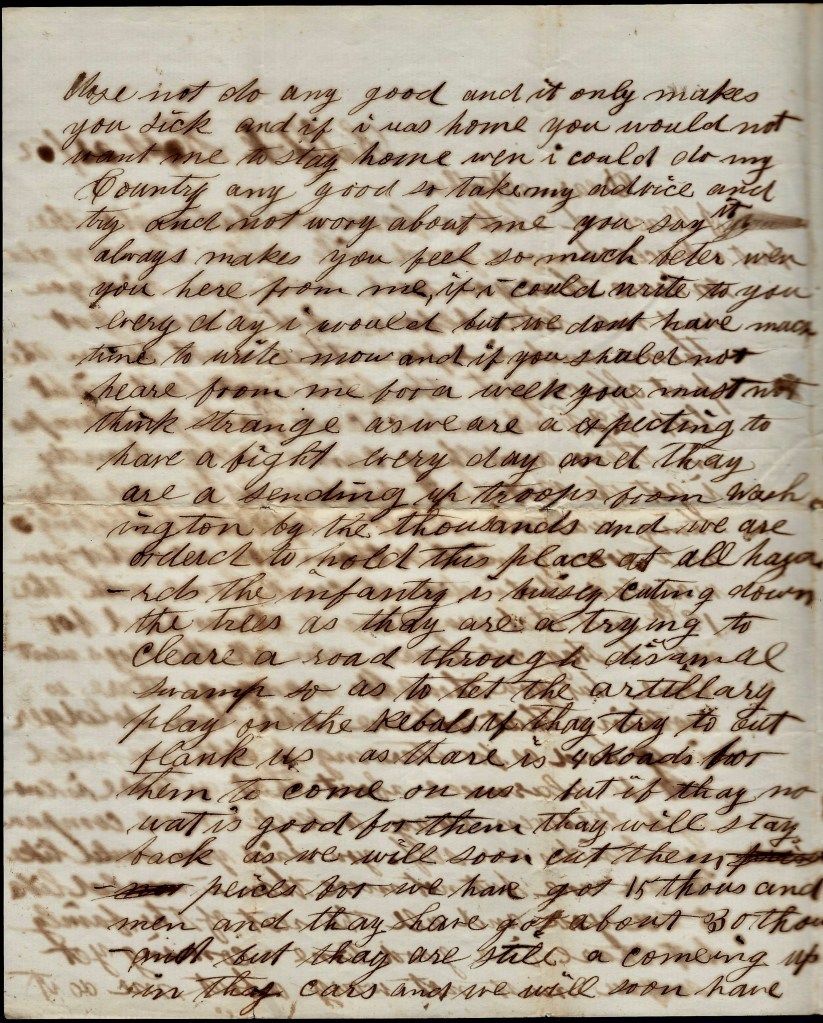
You said you would like to see me but not more than I would like to see you and all the rest of the family but there is a good time a coming yet so you must not worry about me. It would not do any good and it only makes you sick. And if I was home, you would not want me to stay home when I could do my country any good so take my advice and try and not worry about me. You say it always makes you feel so much better when you. hear from me. If I could write to you every day I would, but we don’t have much time to write now and if you should not hear from me for a week, you must not think strange as we are expecting to have a fight every day and they are a sending up troops from Washington by the thousands and we are ordered to hold the place at all hazards.
The infantry is busy cutting down the trees as they are a trying to clear a road through Dismal Swamp so as to let the artillery play on the Rebels if they try to out flank us as there is four roads for them to come on us. But if they know what is good for them, they will stay back as we will soon cut them to pieces. But we have got 15 thousand men and they have got about 30 thousand, but they are still coming up in the cars and we will soon have force enough to hold out against any number of men they can send against us.
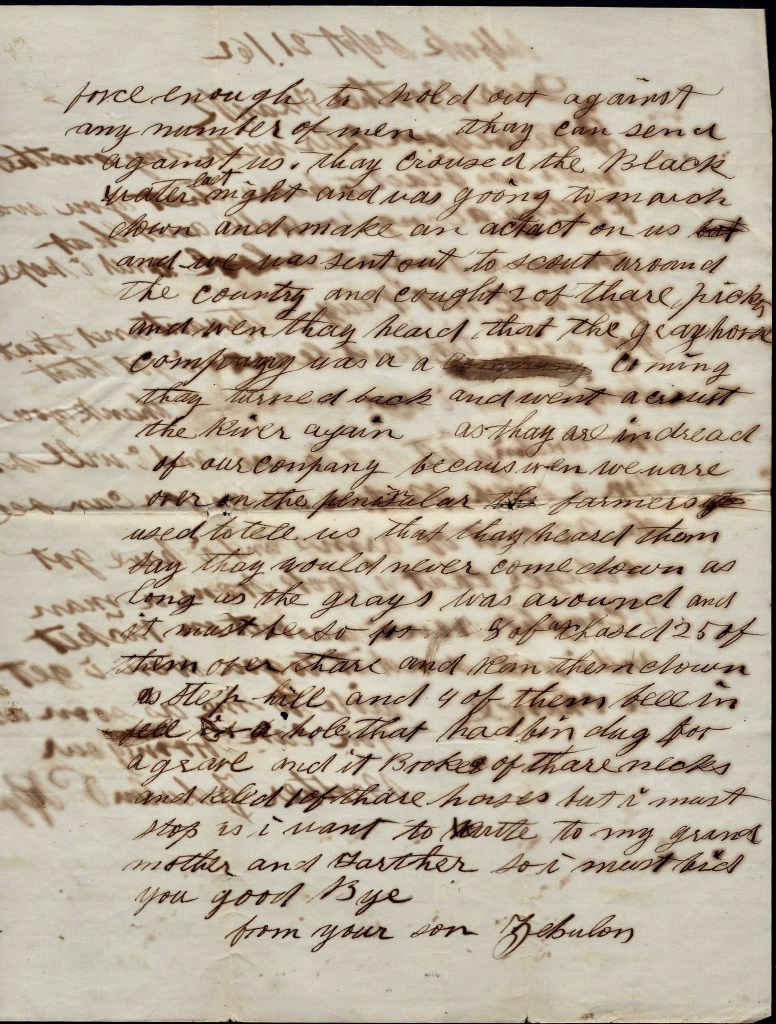
They crossed the Black Water last night and was going to march down and make an attack on us and we was sent out to scout around the country and caught two of their pickets and when they heard that the Grey Horse Company was a coming, they turned back and went across the river again as they are in dread of our company because when we were over on the Peninsula, the farmers used to tell us that they heard them say they would never come down as long as the Grays was around and it must be so for 8 of us chased 25 of them over there and ran them down a steep hill and 4 of them fell into a hole that had been dug for a grave and it broke their necks and killed their horses.
But I must stop as I want to write to my grandmother 1 and Father so I must bid you goodbye. From your son, — Zebulon
Suffolk, September 21st 1862
Dear Brother Frank, I received your letter with my mothers and I was glad to hear that you was a getting along so well and that you was a going to school and I hope you will not play truant and that you will try and learn.
I got that knife and I thank you for sending it to me and I will send you a secesh button so as you can see the Virginia coat of arms. And I have got a dagger that I took from a man I caught when I was out on picket and I will send it to you when I get a chance. Write to me as soon as you can. From your brother, — Zebulon P. Ryder
1 The letter that Zebulon Ryder sent to his Grandmother on 21 September 1862 can be found in the digital archives of the Pamplin Historical Park. See 2015.002.081a.
I could not find an image of Thomas but here is Oren Fletcher of Co. F, 11th Pennsylvania Cavalry (Jim Mayo Collection)
The following letter was written by Thomas J. Williams of Co. A of “Harlan’s Independent Light Cavalry,” which retained that name until 13 November 1861 when it was attached to Pennsylvania and called the 11th Pennsylvania Cavalry. He was carried on the company roster as Thomas “P.” Williams but only because he had a way of writing his middle initial in a manner that looked more like a “P” than a “J.” According to regimental records, he was mustered in as a private on 27 September 1861 and discharged on a surgeon’s certificate on 29 January 1863.
During the summer of 1861, Secretary of War Simon Cameron authorized the creation of twelve cavalry companies, with each company coming from a different state. Colonel Josiah Harlan was to organize Ohio’s company, but United States law prohibited the establishment of single companies from individual states. As a result of this prohibition, after Harlan’s Light Cavalry mustered into service on August 31, 1861, officials assigned the company to the 11th Regiment Pennsylvania Cavalry, which was stationed at Hesterville, Pennsylvania. The members of Harlan’s company became Company M of the 11th and consisted of recruits primarily from Marion, Crawford, Meigs, and Wyandot Counties, Ohio.
Upon joining the 11th, Harlan’s Light Cavalry and the rest of the regiment left Hesterville for Ball’s Crossroads, Virginia, where the Northerners remained until November 1861.
Thomas wrote the letter to John Dawson Clise (1830-1912), a merchant in Dunleith, Jo Daviess county, Illinois. He was appointed postmaster of Dunleith in March 1861.
Transcription
Addressed to Mr. J. D. Clise. Dunleith, Illinois Franked as “Soldier’s Letter” by “Maj. Samuel Wetherell, Harlan’s Cavalry”
Camp Palmer [near Ball’s Cross Roads], Virginia October 25, 1861
Dear Sir,
I have taken my pen in hand to inform you that I am well at present and hope these few lines will find you enjoying the same good health.
We have had a hell of a time since I saw you the last time. We get about half enough to eat but I got a horse, saddle, and bridle and saber. We are five miles from Washington in Virginia. We are where the Rebels were about three weeks ago today. There was three skirmishes.
By God, the boys keep such a noise. There is a great many soldiers around [in the] woods. The Rebels [are] about two miles [from] them. We are starved to death this winter. If we have to stay outdoors, we will all freeze.
Dear brother, this is Sunday. There are a great many soldiers. There is about one hundred thousand soldiers. I am about half a mile from Upton Hill and two miles from Munson Hill. I expect will be marched at any moment. Yours truly, — Thomas J. Williams
P. S. I forgot to ask you to favor me a little by sending me a few letter stamps for we can’t get to the City to get any and the sutler has broke down and it is impossible for us to get them. Tell the boys over to the State House that Jo sends them his respects.
I was on guard last night and I could see the camp fires of our brave brother soldiers on all sides. I suppose there is in this vicinity about 250 thousand.
The ring is sound and has no end And so am I to you a friend
You can direct to T. J. Williams, Company A, Harlan’s Regiment, Washington City
I could not find an image of Jared but here is a tintype of William W. Harding wearing the uniform of the 11th Pennsylvania Cavalry. William served in Co. G. He holds a model 1840 heavy cavalry saber and has a colt Model 1860 Army tucked in his belt.(Union Drummer Boy)
This partial year 1863 diary was kept by Jared Fuller (1821-1900) who was 40 years old when he enlisted on 22 August 1861 as a corporal in Co. A, 11th Pennsylvania Cavalry. He was discharged for disability on 25 October 1863 presumably related to the failing eyesight he complained of in his diary.
The 11th Pennsylvania Regiment (108th Volunteers) was organized at Philadelphia by Colonel Joseph Harlan of Philadelphia as an independent regiment under authority of the Secretary of War, known as “Harlan’s Light Cavalry.”Most companies were from Pennsylvania, but Company A was from Iowa, parts of E and F from New York, part of I from New Jersey, and Company M was from Ohio.
In the 1850 US Census, Jared was enumerated in Colchester, Delaware county, New York. At that time, prior to his marriage, he was living in the home of his parents, John Fuller (1780-1856) and Perninah Langdon (1784-1873).
Just before and after his enlistment, Jared resided in Fort Dodge, Webster county, Iowa. He was married in 1854 to Sarah J. Beates (1828-1869) and was the father of four children. When he returned to Fort Dodge after the war, he held several local elected positions including county treasurer and county recorder.
[Note: This diary is from the private collection of Greg Herr and was transcribed & published on Spared & Shared by express consent.]
Transcription
JANUARY
Thursday, January 1, 1863—It is New Years. How oft I have looked forward to this time of the year with bright & joyous hopes but today I look at it with indifference. It is a dark hour for my country.
Friday 2—Still on picket. The weather is beautiful—almost like Spring. Days are sunshine & the nights clear & frosty. I wonder what is stored up in future for me. Time will show.
Saturday 3—We were relieved from picket today. Some excitement in camp that the rebels are approaching in strong force. General Corcoran commanding here. I saw him today.
Sunday, January 4, 1863—Company inspection. This morning the day was uncommonly fine. The 58th Pennsylvania embarked for Newbern, North Carolina. Success attend them.
Monday 5—A body of infantry left Suffolk for North Carolina today. The 13th Indiana Regiment bid farewell to Brigadier Gen. [Otis S.] Ferry. He paid his farewell address & departed for the North.
Tuesday 6—Everything quiet here today. News arrived here by the papers that the gunboat Monitor foundered at sea off Cape Hatteras on her way south.
Wednesday, January 7, 1863—Everything passed off quietly today. Two companies of our regiment wet on a scout toward Blackwater. The companies returned from North Carolina all safe and sound.
Thursday 8—Camp Suffolk. Our regiment is out on a scout, Started this morning. Weather cool with a little rain. No stirring news.
Friday 9—Camp Suffolk, Va. Last night at 12 o’clock news came that our pickets were driven in. Snow fell in the night. Cannon heard toward Windsor. Regiment out yet. All quiet in Suffolk.
Saturday, January 10, 1863—Camp Suffolk, Va. A rainy day. Boys still out. Rumor says the rebels are this side Blackwater from 8 to 15 thousand strong. Two rebel prisoners were brought in at 11 o’clock p.m.
Sunday 11—Camp Suffolk, Va. All quiet all day. Rather cool and cloudy.
Monday 12—Camp Suffolk, Va. Rumors of rebels in force hanging around us. G & K companies go on scout. Weather cold.
Tuesday, January 13, 1863—Camp Suffolk, Va. This morning A & H companies go out on scout. Heavy cannonading heard on James river. Company came in at 9 p.m. Brought in 6 or prisoners—guerrillas.
Wednesday 14—Companies D & E go out today on scout. South rains. Weather warm. All quiet at Suffolk.
Thursday 15—Camp Suffolk. Company B went out on scout. Dull times. All quiet and so much so as to be oppressive.
Friday, January 16, 1863—Camp Suffolk. Rainy day in a Va. camp & its accompaniments of mud.
Saturday 17—Camp Suffolk. Cold & windy but clear. Nothing going on to break the monotony of life.
Sunday 18—Camp Suffolk. Last night was the coldest we have had. Dress parade at 9 o’clock a.m. Company started on a scout 5 p.m. Returned 9.
Monday, January 19, 1863—Camp Suffolk, Va. A fine morning bright but cool. Dress parade at 9 a.m. The day passed quietly away. The papers tonight brings of a victory in Arkansas. 7,000 prisoners.
Tuesday 20—Camp Suffolk. Cloudy wind south east & rather cold. Went on a scout to Holland Corners. The rebels had barricaded the road. Returned at 3 p.m. Another scout got 2 prisoners.
Wednesday 21—Camp Suffolk, Va. Rained all last night. 2 companies went on a scout 2 hours before day light pay master in camp.
Thursday, January 22, 1863—Camp Suffolk. Wet & moist on account of irregulation of pay rolls. No pay yet. Two companies on a scout returned at dark. No rebels found.
Friday 23—Camp Suffolk—Wet & stormy. No scout today. The Army of the Potomac is on the move once more. May the God of Battles be with them.
Saturday 24—Camp Suffolk. Weather still moist but clearing off. A scout of two companies have gone out to North Carolina & the Dismal Swamp. Another of two companies gone on the same.
Sunday, January 25, 1863—Camp Suffolk. Clear & pleasant. All quiet in camp today. Seems quiet like Sunday. All are anxious to [hear] from the advance of Burnside.
Monday 26—Clear & pleasant. Companies A & H returned from North Carolina. Burnsides advance was impeded by the bad roads and storms of last week.
Tuesday 27—Camp Suffolk, Va, Cloudy. A storm is pending. Detailed on camp guard today. Afternoon a furious storm is now raging. No news of importance from the army.
Wednesday, January 28, 1863—Camp Suffolk, Va. Stormed all night. The paymaster in camp. The pay rolls have been signed for 7 months pay. Hooker supersedes Burnside in command.
Thursday 29—Camp Suffolk. Cold & stormy last night. Co. G went on a scout this side of Carrsville. They was fired on by rebels in ambush. Another scout went today. Found rebels at Deserted House.
Friday 30—A force of 7 regiments of infantry, 11th Pennsylvania Cavalry, 2 batteries artillery & howitzers left Suffolk at 10 last night. At 8 this a.m., drove in the rebel pickets after [we] opened on them with all our artillery.
Saturday, January 31, 1863—Deserted House 10 miles from Suffolk. The Battle [of Kelly’s Store] yesterday, was an important affair. The rebels 4,000 strong under Gen. [Roger A.] Pryor was driven across the Blackwater by our force under Gen. [Michael] Corcoran. Our loss was severe.
FEBRUARY
Sunday, February 1—Camp Suffolk. James [A.] Beach was buried today with military honors. He was a brave and gallant soldier & met his death in the discharge of his duty.
Monday 2—Camp Suffolk. Co. A went on scout, Our party went to Carrsville. No rebels here since the battle. Went over the battlefield. The picture was horrible.
Tuesday, February 3, 1863—Camp Suffolk. A terrible snow storm is raging today. It seems quite like an Iowa snow storm. The surgeons report of killed & wounded in late battle is over 100.
Wednesday 4—Camp Suffolk, Weather cold . Snow about 8 inches deep. Rather hard keeping warm. Tonight the moonlight shining on the snow & post would remind one of a colder clime.
Thursday 5—Cold & rainy. Nothing doing today but camp duties & as few of them as can be got along with. Bids fair to be stormy night. No movements now.
Friday, February 6, 1863—Camp Suffolk. Rained all last night. Snow has disappeared & its place supplied with mud. Went to the hospital. Our wounded doing well.
Saturday 7—Camp Suffolk. Cleared off last night. Very disagreeable weather. Nothing going on but Saturday’s police.
Sunday 8—Camp Suffolk. Weather clear and beautiful. Been to church today. Our chaplain preached in town. Subject of discourse—the cross scene.
Monday, February 9, 1863—Camp Suffolk, Va. Weather continues beautiful. Went to Norfolk on pass. Enjoyed the journey much. Williams of Co. A got his discharge. Went on train with me to Norfolk.
Tuesday 10—Norfolk, Va. Weather warm and springlike. Vigorous steps are being taken to organize African regiments in Norfolk & other places.
Wednesday 11—Camp Suffolk. Cold & Cloudy. 2 companies on scout. Drill of the recruits. Eyes still weak. Co. E went to South Quay. Drove in the rebel pickets.
Thursday, February 12, 1863—Camp Suffolk. Weather stormy with cold wind. Two weeks since the battle. The [battlefield] scenes have not faded or lost any of its impression.
Friday 13—Camp Suffolk, Va. Another sudden change this morning. Clear & cold. Wind northwest. Co. A on a scout. Went to Carrsville. Suffered much with my eyes. The rebels not been here for 5 days.
Saturday 14—Camp Suffolk. Clear and cold. Some ice to be seen this morning. Saw the regimental surgeon. Got excused from full duty. Visited 130 New York. Saw my friend John Barager. *
* BARAGER, JOHN K.—Age, 44 years. Enlisted, August 6,1862, at Ossian, N . Y . ; mustered in as private, Co. I, August 16, 1862, to serve three years; appointed corporal, September 3, 1862; wounded, date not stated, at Old Church, Va.; died of such wounds, May 31, 1864; also borne as John K. Barragher.
Sunday, February 15, 1863—Camp Suffolk. Weather begins to assume the appearance of Spring. Dress Parade 9 a.m. Went to meeting in town 11 a.m. No preaching. Went to the negro meeting at noon.
Monday 16—Camp Suffolk, Va. Weather pleasant. 3 companies of cavalry went beyond Carrsville. Drove in the rebel pickets. Two of our men dismounted by wires they stretched across the road.
Tuesday 17—Camp Suffolk, Va. Steady rain & cold withall. A detail from our company went to Windsor. Saw the rebel pickets there. All quiet along the lines.
Wednesday, February 18, 1863—Camp Suffolk, Va. Rained all night & still raining & cold withall. Almost enough to snow. No scout yesterday or today on account of the bad weather.
Thursday 19—Camp Suffolk, Va. Weather still unsettled. Mud knee deep. Our company & two more on a scout. Have not returned yet 9 a.m.
Friday 20—Camp Suffolk, Va. Cleared off this morning. The scout that went out last night returned at midnight. Found no rebs. The 9th Army Corps has arrived at Fort Monroe.
Saturday, February 21, 1863—Clear & pleasant. A battalion under Major [Frank A.] Stratton gone to Elizabeth City & 2 companies on scout. Looks like a storm.
Sunday 22—Camp Suffolk, Va. Snowed all night & this morning it has turned to rain. The anniversary of the day fills the heart of the patriot with hope. The spirit of Washington still lives.
Monday 23—Camp Suffolk. Cold & windy. No mail since Saturday. Two companies on scout. The command under Major [Frank A.] Stratton returned today with some prisoners.
Tuesday, February 24, 1863—Camp Suffolk, Va. Cold & clear. Got a letter from home. Glad to hear all well there. Some of the money sent had been received.
Wednesday 25—Camp Suffolk, Va. Clear & Springlike. Co. A wet on a scout as far as Beaver Dam Church. Saw no rebels. News of the investment of Vicksburg received tonight.
Thursday 26—Camp Suffolk, Va. Dark and cloudy. Threatening a storm. Company Drill on foot in a.m. No news of importance. Rather dull in camp.
Friday, February 27, 1863—Warm & showery like Spring. Scout went out early this morning. An alarm in camp. The cavalry ordered out 10 p.m. Went to the old battlefield.
Saturday 28—Camp Suffolk. The alarm last night was occasioned by a force of rebels showing themselves to our pickets but fled before our troops arrived on the ground. Mustered for pay by Col. [Charles C.] Dodge of the 1st New York [Mounted] Rifles.
MARCH
Sunday, March 1—Camp Suffolk. Rainy during the forepart of the day. Suffering with my eyes. Fear I shall lose their use forever. Cleared off towards evening.
Monday, March 2, 1863—Camp Suffolk. Clear and Springlike. An order issued this morning for grinding sabers. Looks like bloody work. Mounted drill 10 a.m. The Conscription Bill gives hope to the loyal.
Tuesday 3—Camp Suffolk, Va. Weather pleasant. Rather dull in camp. Two companies on scout. Rumors of a raid to be made by our regiment & some mounted infantry on some rebel post.
Wednesday 4—Camp Suffolk. Snowed this morning & rather cold. Our regiment went on scout with two howitzers & mounted infantry. The force returned having made a successful raid.
Thursday, March 5, 1863—Camp Suffolk. Cold last night. Ice froze thicker than I have seen in Pa. The sad news came last night of the loss of another of our ironclads.
Friday 6—Camp Suffolk. Rather cold but pleasant. News from Vicksburg rather conflicting.
Saturday 7—Camp Suffolk,Va. Weather pleasant. The Saturday’s policing on the grounds & preparing for tomorrow’s inspection.
Sunday, March 8, 1863—Camp Suffolk. Warm & showery like Spring. Regimental Inspection 4 p.m. by Major Gen. Peck. Went meeting. Heard the chaplain of 112th New York Vols.
Monday 9—Camp Suffolk. Clear & pleasant. Dress Parade 9 a.m. 4 companies on 5 days scout to North Carolina.
Tuesday 10—Camp Suffolk. Dark and cloudy. Co. A on picket duty for 1 week.
Wednesday, March 11, 1863—Camp Suffolk, Va. Stormed hard all last night with high winds. Went this morning with forage to the South Quay picket station with forage. Cleared off this afternoon.
Thursday 12—Camp Suffolk. Clear and rather cold. All quiet in camp. Evening Co. K returned from a scout. Had one of their men shot by a bushwhacker who made his escape.
Friday 13—Camp Suffolk. Batteries practicing at target. Co. K went out in force to revenge the death of Corporal [Levi] Lewis * by laying waste [to] the country.
* Levi Lewis, born October 16, 1841, was reared on the family farm in Luzerne County, Pennsylvania. The oldest son of Robert S. and Mary Lewis, he had an older sister, Lydia Rugar, and two younger brothers, Robert T. and Car. Levi voluntarily joined Company K of the 11th Pennsylvania Cavalry. Sworn in on September 1, 1861, he was appointed corporal on September 9th and served primarily at Fort Monroe and at other camps in Virginia. He held the rank of corporal until he was killed by a sniper on March 12, 1863, at Suffolk, Virginia. His body and efforts were shipped home to Luzerne County, Pennsylvania, on March 17, 1863.
Saturday, March 14, 1863—Camp Suffolk. Clear & cold for the season and climate. 5 regiments of the army corps arrived here last night. The staff of the 28 N [ ] fetched up in our stable.
Sunday 15—Camp Suffolk. Still cold & dry. More soldiers are arriving.
Sunday 22—Camp Suffolk, Va. The snow is fast melting but oh! the mud. The band is now playing the dead march as the body of Lieut. Moody is being conveyed to the cars.
APRIL
Saturday 11—Camp Suffolk. The enemy have advanced upon us in force, driven in our pickets, and taken some of them. Our regiment went out toward night & engaged them and took two prisoners.
Sunday 12—Enemy seem to be preparing for an attack. No engagement as yet.
Monday, April 13, 1863—Enemy are all around us. A skirmish at noon on the Somerton Road. Enemy fell back.
Tuesday 14—Firing through the night by the gunboats. One gunboat reported disabled.
Monday 20—Camp Suffolk, Va. A gallant dash was made last night by the 89th New York & 8th Connecticut Volunteers across the Nansemond river, capturing 200 prisoners and a battery of guns. Loss small on our side. *
* “You have probably read about our taking the rebel battery the other side of the river, so I shall not need to say much about that. I was there of course. I fired my rifle 3 times. None of the boys fired more times than that, with one of our rifles, but those who had Sharps Rifles fired 5 times. Some of the boys fired none. One man of this company was wounded in his arm and leg but not seriously.” — Henry C. Smith, Co. E, 8th Connecticut Volunteers, 10 May 1863. [See: Henry Cole Smith Letters]
MAY
Sunday 3—Camp Suffolk, Va. Morning bright and beautiful. A large force went out on several roads to reconnoiter. Slight skirmishing on South Quay. Enemy in heavy force on Petersburg Road. Hard fighting. This force commanded by Major General Getty. Enemy driven back. Union loss 200.
Monday, May 4, 1863—Camp Suffolk, Va. As was thought by us yesterday, the enemy evacuated their position here last night and we are now pursuing them and taking many prisoners. [Leander] Chase of A Company, 11th Pa. Cav. took and brought in five prisoners and a sutler’s wagon.
JUNE
Monday 22—Regiment marched from Suffolk to Portsmouth.
Tuesday 23—Went on board transport. Arrived opposite Yorktown about sundown. Anchored in the middle of the river.
Wednesday, June 24, 1863—In York River opposite Yorktown on board transport. 2 o’clock afternoon received orders to move up the river within 10 miles of West Point.
Thursday 25—Arrived at the White House about 10 o’clock. Expecting to disembark. Saddles all stripped for a raid. Rebel pickets driven in. Two taken prisoners. Pickets and scout gone out.












 Spared & Shared 23